WO2023149484A1 - ポリエステル樹脂組成物 - Google Patents
ポリエステル樹脂組成物 Download PDFInfo
- Publication number
- WO2023149484A1 WO2023149484A1 PCT/JP2023/003262 JP2023003262W WO2023149484A1 WO 2023149484 A1 WO2023149484 A1 WO 2023149484A1 JP 2023003262 W JP2023003262 W JP 2023003262W WO 2023149484 A1 WO2023149484 A1 WO 2023149484A1
- Authority
- WO
- WIPO (PCT)
- Prior art keywords
- fatty acid
- acid ester
- ester compound
- resin composition
- polyester resin
- Prior art date
- Legal status (The legal status is an assumption and is not a legal conclusion. Google has not performed a legal analysis and makes no representation as to the accuracy of the status listed.)
- Ceased
Links
Images
Classifications
-
- C—CHEMISTRY; METALLURGY
- C08—ORGANIC MACROMOLECULAR COMPOUNDS; THEIR PREPARATION OR CHEMICAL WORKING-UP; COMPOSITIONS BASED THEREON
- C08K—Use of inorganic or non-macromolecular organic substances as compounding ingredients
- C08K5/00—Use of organic ingredients
- C08K5/04—Oxygen-containing compounds
- C08K5/10—Esters; Ether-esters
- C08K5/101—Esters; Ether-esters of monocarboxylic acids
- C08K5/103—Esters; Ether-esters of monocarboxylic acids with polyalcohols
-
- C—CHEMISTRY; METALLURGY
- C08—ORGANIC MACROMOLECULAR COMPOUNDS; THEIR PREPARATION OR CHEMICAL WORKING-UP; COMPOSITIONS BASED THEREON
- C08G—MACROMOLECULAR COMPOUNDS OBTAINED OTHERWISE THAN BY REACTIONS ONLY INVOLVING UNSATURATED CARBON-TO-CARBON BONDS
- C08G63/00—Macromolecular compounds obtained by reactions forming a carboxylic ester link in the main chain of the macromolecule
- C08G63/02—Polyesters derived from hydroxycarboxylic acids or from polycarboxylic acids and polyhydroxy compounds
- C08G63/12—Polyesters derived from hydroxycarboxylic acids or from polycarboxylic acids and polyhydroxy compounds derived from polycarboxylic acids and polyhydroxy compounds
- C08G63/16—Dicarboxylic acids and dihydroxy compounds
- C08G63/18—Dicarboxylic acids and dihydroxy compounds the acids or hydroxy compounds containing carbocyclic rings
- C08G63/181—Acids containing aromatic rings
- C08G63/183—Terephthalic acids
-
- C—CHEMISTRY; METALLURGY
- C08—ORGANIC MACROMOLECULAR COMPOUNDS; THEIR PREPARATION OR CHEMICAL WORKING-UP; COMPOSITIONS BASED THEREON
- C08L—COMPOSITIONS OF MACROMOLECULAR COMPOUNDS
- C08L67/00—Compositions of polyesters obtained by reactions forming a carboxylic ester link in the main chain; Compositions of derivatives of such polymers
- C08L67/02—Polyesters derived from dicarboxylic acids and dihydroxy compounds
Definitions
- the present invention relates to a polyester resin composition, and more particularly to a polyester resin composition that is excellent in good releasability, low fogging properties, and bleed-out resistance.
- Polybutylene terephthalate which is a typical engineering plastic among thermoplastic polyesters, has excellent moldability, mechanical strength, heat resistance, chemical resistance, and electrical properties. widely used in
- Patent Document 1 proposes that gas generation and bleeding out can be suppressed by blending polybutylene terephthalate with an aliphatic ester composed of a tri- to hexahydric aliphatic alcohol having a specific molecular weight and a fatty acid. There is no discussion of releasability.
- Patent Document 2 proposes a composition with low fogging properties while maintaining releasability by blending polybutylene terephthalate with an aliphatic ester composed of a tri- to hexahydric aliphatic alcohol and a fatty acid and an olefin elastomer. ing.
- polybutylene terephthalate is blended with a specific copolymerized polybutylene terephthalate and an aliphatic ester composed of a tri- to hexahydric aliphatic alcohol and a fatty acid to maintain mold releasability and achieve excellent low fogging properties.
- a composition is proposed. However, all of them merely propose to suppress precipitation on the surface of decomposition products of the fatty acid ester and improve the low fogging property by using a specific component together with the fatty acid ester. is not mentioned.
- Patent Document 4 proposes a composition having excellent fluidity while maintaining mechanical properties by blending polybutylene terephthalate with a high hydroxyl value glycerin fatty acid ester and a low hydroxyl value polyhydric alcohol fatty acid ester. , releasability, low gas properties, and low fogging properties are not mentioned.
- Patent Document 5 a fatty acid glycerin triester with high releasability and a fatty acid glycerin monoester with a large internal lubricating effect are used in combination with a polyester resin to enhance the releasability and at the same time improve the low fogging property.
- Polyester resin compositions have been proposed that can be used, but the improvement in releasability is due to an increase in the total amount of the glycerin fatty acid ester component.
- JP 2017-179204 A Japanese Patent Application Laid-Open No. 2019-59801 JP 2020-105311 A Japanese Unexamined Patent Application Publication No. 2017-101108 JP-A-2005-97563
- the present inventors have made intensive studies on the structure and properties of the polyester resin composition in order to solve the above-mentioned problems, and have found that the synergistic effect of improving the releasability is achieved by blending two or more specific release agents.
- the present inventors have completed the present invention by finding that the above object can be achieved by That is, the present invention has the following configurations.
- a release agent (B) is contained in 100 parts by mass of a polyalkylene terephthalate resin (A), and the release agent (B) consists of a polyhydric aliphatic alcohol and a fatty acid A polyester resin composition comprising two or more kinds of fatty acid ester compounds.
- the release agent (B) is a fatty acid ester compound (B1) consisting of a hexahydric fatty alcohol and a fatty acid having 5 to 30 carbon atoms, a dihydric to tetrahydric aliphatic alcohol, and a fatty acid having 5 to 30 carbon atoms.
- a fatty acid ester compound (B2) composed of a fatty acid.
- the combination of mold release agents provides a synergistic effect of improving mold release properties, resulting in excellent mold release properties and suppressing gas generation during drying and molding. It is possible to provide a polyester resin composition that can suppress the contamination of , and is also excellent in low fogging properties and bleed-out resistance.
- the polyalkylene terephthalate resin (A) used in the present invention comprises a dicarboxylic acid component mainly composed of a dicarboxylic acid compound and/or an ester-formed derivative thereof, and a diol component mainly composed of a diol compound and/or an ester-formed derivative thereof.
- the dicarboxylic acid component is mainly composed of terephthalic acid and / or its ester-forming derivative
- the diol component is alkylene glycol and / or its ester
- the main component is the formed derivative.
- the alkylene glycol is preferably an alkylene glycol having 2 to 8 carbon atoms.
- ethylene glycol trimethylene glycol, 1,2-propylene glycol, 1,4-butanediol, 1,3-butanediol, neopentyl glycol, 1,6-hexanediol, 1,4-cyclohexanediol , 1,4-cyclohexanedimethanol and the like, preferably any one of these, and more preferably any one of ethylene glycol, trimethylene glycol and 1,4-butanediol.
- Terephthalic acid and/or its ester-forming derivative accounts for preferably 80 mol% or more, more preferably 90 mol% or more, and even more preferably 95 mol% or more in 100 mol% of the dicarboxylic acid component. , 100 mol %.
- the amount of alkylene glycol and/or its ester-forming derivative is preferably 80 mol % or more, more preferably 90 mol % or more, further preferably 95 mol % or more. It may be mol %.
- Dicarboxylic acid components other than the main component (terephthalic acid), i.e., copolymerization components, include aliphatic dicarboxylic acids (e.g., adipic acid, sebacic acid, decanedicarboxylic acid), alicyclic dicarboxylic acids (e.g., hexahydrophthalic acid, hexahydroisophthalic acid, hexahydroterephthalic acid), aromatic dicarboxylic acids other than terephthalic acid (e.g., isophthalic acid, naphthalenedicarboxylic acids such as 2,6-naphthalenedicarboxylic acid, 4,4'-biphenyldicarboxylic acid), or these derivatives (for example, ester-forming derivatives such as lower alkyl esters, aryl esters, and acid anhydrides). These copolymerization components may be used alone or in combination of two or more.
- a diol component other than the diol component used as the main component may be used as a copolymerization component.
- Usable diol components are as exemplified above.
- the copolymer components may be used alone or in combination of two or more.
- a copolymerization component a condensate of a diol component (for example, in the case of ethylene glycol, diethylene glycol, etc.) that is by-produced during polymerization may be included.
- Preferred polyalkylene terephthalate resins (A) include homopolyesters such as polyethylene terephthalate (PET), polytrimethylene terephthalate (PTT) and polybutylene terephthalate (PBT), and copolyesters containing the above copolymerization components. can be used singly or in combination of two or more.
- the polyalkylene terephthalate resin (A) is preferably one or more selected from polyethylene terephthalate (PET), polytrimethylene terephthalate (PTT), and polybutylene terephthalate (PBT).
- the reduced viscosity (0.1 g of the resin is dissolved in 25 ml of a mixed solvent of phenol/tetrachloroethane (mass ratio 6/4) and measured at 30°C using an Ubbelohde viscosity tube ).
- the reduced viscosity of the polyalkylene terephthalate resin (A) is preferably in the range of 0.3 to 1.6 dl/g, more preferably in the range of 0.45 to 1.35 dl/g.
- the polyalkylene terephthalate resin composition of the present invention has good mechanical properties and moldability because the polyalkylene terephthalate resin has a reduced viscosity of 0.3 to 1.6 dl/g.
- the polyalkylene terephthalate resin (A) can be used together with other thermoplastic resins to the extent that the object of the present invention is not impaired.
- the amount of other thermoplastic resin used is not particularly limited as long as it does not impair the object of the present invention, but typically 100 parts by mass or less is preferable, 80 parts by mass or less is more preferable, and 50 parts by mass or less is particularly preferable.
- polyolefins such as polyethylene and polypropylene
- polyamides such as nylon 46, nylon 6, nylon 66, nylon 610, nylon 612, nylon 11, nylon 12 and MXD nylon
- Resin Polystyrene
- Polyvinyl chloride Polyacrylonitrile
- Cyclic olefin resin such as cyclic olefin polymer and cyclic olefin copolymer
- Acrylic resin Polyphenylene sulfide resins such as polyphenylene sulfide ketone, polybiphenylene sulfide, and polyphenylene sulfide sulfone
- polysulfone resins such as poly (ether sulfone) and poly (4,4'-bisphenol ether sulfone); polyether ketone resins; polyether ether ketone resins; Liquid crystalline polymer; fluororesin and the like can be mentioned.
- Two or more kinds of polyolefins such as poly
- the release agent (B) used in the present invention contains a fatty acid ester compound composed of a polyhydric fatty alcohol and a fatty acid. In the present invention, two or more of these aliphatic ester compounds are used. As the fatty acid ester, it is preferable that it is not partially saponified from the viewpoint of suppressing bleeding out, and in the present invention, partially saponified products are not classified as fatty acid ester compounds.
- polyhydric aliphatic alcohols examples include ethylene glycol, glycerin, 1,2,4-butanetriol, diglycerin, erythritol, pentaerythritol, sorbitol, triglycerin, dipentaerythritol, and tetraglycerin. These polyhydric aliphatic alcohols can be used alone or in combination of two or more. As the polyhydric aliphatic alcohol, a trihydric to hexahydric aliphatic alcohol is preferable, and glycerin and dipentaerythritol are particularly preferable.
- the fatty acid is preferably a linear or branched saturated fatty acid having 5 to 30 carbon atoms, such as pentanoic acid, hexanoic acid, octanoic acid, nonanoic acid, decanoic acid, lauric acid, oleic acid, myristic acid, and palmitic acid.
- stearic acid isostearic acid, 12-hydroxystearic acid, arachidic acid, behenic acid, lignoceric acid, cerotic acid, montanic acid and melissic acid.
- fatty acid ester compounds (B1) composed of hexavalent aliphatic alcohols and fatty acids having 5 to 30 carbon atoms and divalent to tetravalent aliphatics It is preferable to contain a fatty acid ester compound (B2) consisting of an alcohol and a fatty acid having 5 to 30 carbon atoms in order to exhibit a synergistic effect of releasability.
- a fatty acid ester compound (B2) consisting of an alcohol and a fatty acid having 5 to 30 carbon atoms in order to exhibit a synergistic effect of releasability.
- the fatty acid ester compound (B1) is an ester compound and has a certain degree of compatibility with the polyalkylene terephthalate resin (A). It has a strong tendency and greatly contributes to mold releasability. However, since the compatibility with the polyalkylene terephthalate resin (A) is not so high, when the molecular motion of the fatty acid ester compound (B1) is activated at high temperature, it is discharged out of the system as a gas, tending to cause fogging.
- the fatty acid ester compound (B2) is also an ester compound, and although it is compatible with the polyalkylene terephthalate resin (A), it does not have as many hydrophobic groups (having 5 to 30 carbon atoms) as the fatty acid ester compound (B1). Although it gathers near the surface layer of the product, it does not gather on the outermost layer and does not greatly contribute to mold releasability. However, since the compatibility with the polyalkylene terephthalate resin (A) is higher than that of the fatty acid ester compound (B1), even if the molecular motion of the fatty acid ester compound (B2) is activated at high temperatures, it can remain in the resin. This tends to suppress the discharge to the outside of the system.
- the fatty acid ester compound (B1) and the fatty acid ester compound (B2) have similar structures, they are considered to interact with each other.
- the fatty acid ester compound (B1) gathers in the outermost layer of the molded product and contributes very well to mold releasability.
- the fatty acid ester compound (B2) supplements the compatibility between the polyalkylene terephthalate resin (A) and the fatty acid ester compound (B1), thereby suppressing the release of the fatty acid ester compound (B1) out of the system.
- a synergistic effect can be obtained by using these fatty acid ester compounds in combination, and the low fogging property can be remarkably improved while maximizing the releasability.
- Examples of the hexavalent aliphatic alcohol of the fatty acid ester compound (B1) include dipentaerythritol and tetraglycerin, with dipentaerythritol being preferred.
- a fatty acid having 5 to 30 carbon atoms in the fatty acid ester compound (B1) a fatty acid having 12 to 30 carbon atoms is preferable, and a fatty acid having 18 to 28 carbon atoms is more preferable.
- This fatty acid may be substituted with a hydroxyl group or the like.
- the fatty acid ester compound (B1) is preferably a fatty acid ester compound composed of dipentaerythritol or tetraglycerin and a fatty acid having 5 to 30 carbon atoms, and a fatty acid hexaester composed of dipentaerythritol and a fatty acid having 12 to 30 carbon atoms. Compounds are more preferred.
- Dihydric to tetrahydric aliphatic alcohols of the fatty acid ester compound (B2) include ethylene glycol, glycerin, 1,2,4-butanetriol, diglycerin, erythritol, pentaerythritol and the like, but glycerin and pentaerythritol is preferred, and glycerin is more preferred.
- a fatty acid having 12 to 30 carbon atoms in the fatty acid ester compound (B2) a fatty acid having 12 to 30 carbon atoms is preferable, and a fatty acid having 12 to 28 carbon atoms is more preferable. This fatty acid may be substituted with a hydroxyl group or the like.
- the polyester resin composition of the present invention contains two or more types of fatty acid ester compounds, and the fatty acid ester compound (B1) thereof is 300 in thermogravimetry (measured at 20 ° C./min with a sample amount of 10 mg by a weight detection method). It is preferable that the weight loss rate at ° C. is 4.5% or less from the viewpoint of low staining of molds and dryers, low fogging, and bleed-out resistance. For the same reason, the fatty acid ester compound (B2) However, the weight loss rate at 300° C. in thermogravimetry (measurement of a sample amount of 10 mg at 20° C./min by weight detection method) is preferably 1.5% or less.
- the fatty acid ester compound (B2) used in the present invention is preferably a fatty acid ester compound composed of glycerin and a fatty acid having 5 to 30 carbon atoms, and from the viewpoint of releasability, a fatty acid composed of glycerin and a fatty acid having 12 to 30 carbon atoms.
- a triester compound is more preferred.
- the total content of component (B) is 0.01 to 4 parts by mass with respect to 100 parts by mass of polyalkylene terephthalate resin (A). If the content of component (B) is 0.01 parts by mass or more, the releasability tends to be good, and if it is 4 parts by mass or less, contamination of the mold and dryer, fogging, and bleeding out are suppressed tend to be able.
- the lower limit of the content is preferably 0.1 parts by mass or more, more preferably 0.2 parts by mass or more, and even more preferably 0.3 parts by mass or more.
- the upper limit of the content is preferably 3.5 parts by mass or less, more preferably 2 parts by mass or less, even more preferably 1 part by mass or less, and particularly preferably 0.6 parts by mass or less.
- the mass ratio of the fatty acid ester compound (B1) and the fatty acid ester compound (B2) in the component (B) is 40 to 90% by mass of the component (B1) with respect to the total of the components (B1) and (B2). and more preferably 45 to 80% by mass.
- the resin composition of the present invention may contain a release agent other than a fatty acid ester compound composed of a polyhydric aliphatic alcohol and a fatty acid, as long as it does not impair the purpose of the present invention.
- the resin composition of the present invention can contain various known additives as necessary within a range that does not impair the characteristics of the present invention.
- known additives include coloring agents such as pigments, reinforcing agents, heat stabilizers, antioxidants, ultraviolet absorbers, light stabilizers, plasticizers, modifiers, antistatic agents, flame retardants, dyes, and the like. be done.
- the reinforcing material is 0 to 200 parts by mass with respect to 100 parts by mass of the polyalkylene terephthalate resin (A), and the total amount of additives other than the reinforcing material is 100 parts by mass of the polyalkylene terephthalate resin (A). is preferably 0.1 to 60 parts by mass.
- the polyester resin composition of the present invention can be produced by mixing each of the above components and, if necessary, various additives, followed by melt-kneading. Any melt-kneading method known to those skilled in the art can be used, and a single-screw extruder, twin-screw extruder, pressure kneader, Banbury mixer, or the like can be used. Among them, it is preferable to use a twin-screw extruder.
- the method for molding the thermoplastic resin composition of the present invention is not particularly limited, and known methods such as injection molding, gas assist molding, thermal cycle molding, blow molding, and extrusion molding can be used. Molded articles can be obtained by the method. Among them, the injection molding method is preferable from the viewpoint of versatility.
- thermogravimetric measuring device (trade name: “EXSTAR6000, manufactured by Hitachi High-Tech Science Co., Ltd.”
- a sample amount of 10 mg is measured by weight detection at a heating rate of 20 ° C./min. It was measured between room temperature and 450°C.
- a weight loss rate at 300° C. was read from the measurement results.
- Fogging Additives contained in the materials used for automobile interiors volatilize in hot interiors and condense on the inner surface of the windshield, which has been cooled by the outside air. Sometimes. In addition, materials that tend to cause fogging tend to stain molds and dryers during injection molding, which may adversely affect the quality and productivity of molded products.
- the fogging was evaluated by the following method.
- An injection molding machine (trade name: "EC100N", manufactured by Toshiba Machine Co., Ltd.) was prepared, and a mold having a mirror surface polished with a #14000 file on one side was used, with a cylinder temperature of 260°C and a mold temperature of 50°C.
- a plurality of small pieces having a size of about 30 mm x 30 mm were cut out from a molded product (100 mm x 100 mm x 2 mmt (thickness)) obtained by injection molding under the conditions of .
- a total of 10 g of these small pieces is placed in a glass cylinder ( ⁇ 65 mm ⁇ height 80 mm) whose bottom is prepared by covering with aluminum foil, and this glass cylinder is placed on a hot plate (trade name: "Neo Hot Plate HT-1000", ASONE (manufactured by Co., Ltd.). Further, after covering the glass cylinder with a slide glass (78 mm ⁇ 76 mm ⁇ 1 mm) so as not to leave a gap, heat treatment was performed on the hot plate at 180° C. for 20 hours. As a result of the heat treatment, decomposition products sublimated from the polyester resin composition precipitate and adhere to the inner wall of the slide glass. was used to measure the haze value. The haze value is obtained from the ratio of diffuse transmitted light to all transmitted light, and can be used as an index of haze (%). A smaller haze value (transparency) means that the polyester resin composition has a lower fogging property.
- Bleed-out Additives contained in materials used for automotive interiors float to the surface after long-term use or in high-temperature environments, causing a phenomenon known as bleed-out that deteriorates the appearance and causes the surface to become sticky. can be a problem.
- the bleed-out was evaluated by the following method.
- An injection molding machine (trade name: "EC100N", manufactured by Toshiba Machine Co., Ltd.) was prepared, and a mold having a mirror surface polished with a #14000 file on one side was used, with a cylinder temperature of 260°C and a mold temperature of 50°C.
- a molded product (100 mm ⁇ 100 mm ⁇ 2 mmt (thickness)) obtained by injection molding under the conditions of is heat-treated at 160 ° C. for 24 hours in a known hot air dryer. Visually observe the surface state of the molded product.
- the occurrence of whitening and color unevenness was evaluated on a three-grade scale.
- b-1 Dipentaerythritol hexastearate (manufactured by Emery Oleochemicals Japan Co., Ltd., Roxol VPG2571, weight loss at 300° C. 4.3%)
- b-2 Glycerin tri-12-hydroxystearate (Rikemar TG-12 manufactured by Riken Vitamin Co., weight loss rate at 300° C.
- b-3 Pentaerythritol tetraester montanate (manufactured by Clariant Chemicals Co., Ltd., Recolb WE40 P, weight loss at 300°C 5.2%)
- b-4 Dipentaerythritol hexastearate (Rikester L-8483 manufactured by Riken Vitamin Co., Ltd. Weight loss rate at 300° C. 5.0%)
- b-5 Montanic acid partially saponified wax (Licowax OP P, manufactured by Clariant Chemicals Co., Ltd.)
- Carbon black (C) Carbon black (manufactured by Sumika Color Co., Ltd., black EPC-8E313)
- the compounding ingredients blended in the combinations shown in Tables 1 and 2 were kneaded in a co-rotating twin-screw extruder set at a cylinder temperature of 250-260°C, and the resulting strands were water-cooled and pelletized. Each obtained pellet was dried at 130° C. for 4 hours to obtain a polyester resin composition corresponding to each example and each comparative example. Evaluations (1) to (3) of the above molded articles were carried out on these polyester resin compositions.
- the addition amount of the release agent can be reduced by following a predetermined formulation, and a composition that is advantageous in terms of low fogging property and bleed-out resistance can be provided.
- a composition that is advantageous in terms of low fogging property and bleed-out resistance can be provided.
- Comparative Examples 4 and 5 since only one type of release agent was blended, the releasability was insufficient.
- Comparative Example 6 since a release agent having a weight loss rate at 300° C. outside the preferred range was blended alone, the releasability and anti-fogging properties were poor. Since Comparative Example 7 did not contain a predetermined fatty acid ester, the result was poor bleed-out resistance.
- the release resistance value was the same as in Examples 1 and 5.
- Example 1 polybutylene terephthalate, which has a high solidification speed, was blended as the polyalkylene terephthalate, so that the skin layer was not formed. No mold release wrinkles occurred quickly.
- Example 5 and Comparative Example 8 polyethylene terephthalate was added in addition to polybutylene terephthalate. Since it is a combination of esters, bleeding out can be suppressed, and further improvement in releasability can be expected by adjusting the amount of release agent added.
- Comparative Example 8 although two types of release agents were blended, since the predetermined fatty acid ester was not used in combination, the synergistic effect of improving the releasability due to the combination of release agents was not exhibited.
- the combination of mold release agents provides a synergistic effect of improving mold release properties, resulting in excellent mold release properties and suppressing gas generation during drying and molding.
- the molded product obtained has excellent low fogging and bleed-out resistance, so it is suitable for complex shapes that accompany the miniaturization of parts in the automobile and electrical and electronic fields. It is possible to provide a polyester resin composition that can correspond to a shape having a thin portion.
Landscapes
- Chemical & Material Sciences (AREA)
- Health & Medical Sciences (AREA)
- Chemical Kinetics & Catalysis (AREA)
- Medicinal Chemistry (AREA)
- Polymers & Plastics (AREA)
- Organic Chemistry (AREA)
- Compositions Of Macromolecular Compounds (AREA)
Abstract
Description
すなわち、本発明は以下の構成を有するものである。
[2] 前記離型剤(B)が、6価の脂肪族アルコールと炭素数5~30の脂肪酸からなる脂肪酸エステル化合物(B1)と2~4価の脂肪族アルコールと炭素数5~30の脂肪酸からなる脂肪酸エステル化合物(B2)を含む[1]に記載のポリエステル樹脂組成物。
[3] 前記脂肪酸エステル化合物(B1)の、熱重量測定における300℃の重量減少率が4.5%以下であることを特徴とする、[2]に記載のポリエステル樹脂組成物。
[4] 前記脂肪酸エステル化合物(B2)の、熱重量測定における300℃の重量減少率が1.5%以下であることを特徴とする、[2]または[3]に記載のポリエステル樹脂組成物。
[5] 前記脂肪酸エステル化合物(B2)が、グリセリンと炭素数5~30の脂肪酸からなる脂肪酸エステル化合物である[2]~[4]のいずれかに記載のポリエステル樹脂組成物。
[6] 前記脂肪酸エステル化合物(B2)が、グリセリンと炭素数12~30の脂肪酸からなる脂肪酸トリエステル化合物である[5]に記載のポリエステル樹脂組成物。
[7] 前記脂肪酸エステル化合物(B1)が、ジペンタエリスリトールまたはテトラグリセリンと炭素数5~30の脂肪酸からなる脂肪酸エステル化合物である[2]~[6]のいずれかに記載のポリエステル樹脂組成物。
[8] 前記脂肪酸エステル化合物(B1)が、ジペンタエリスリトールと炭素数12~30の脂肪酸からなる脂肪酸ヘキサエステル化合物である[7]に記載のポリエステル樹脂組成物。
上記の特定構造を有する化合物を併用することにより、相乗効果が得られる理由については定かではないが、以下のように考えられる。
脂肪酸エステル化合物(B1)はエステル化合物であり、ポリアルキレンテレフタレート樹脂(A)と一定の相溶性があるものの、疎水性の基(炭素数5~30)が多いため、成形品の最表層に集まる傾向が強く、離型性に大きく寄与する。しかし、ポリアルキレンテレフタレート樹脂(A)との相溶性はそれほど高くないため、高温下において脂肪酸エステル化合物(B1)の分子運動が活発化すると、ガスとして系外に排出されてしまい、フォギングを起こす傾向がある。
脂肪酸エステル化合物(B2)もエステル化合物であり、ポリアルキレンテレフタレート樹脂(A)と相溶性があるものの、疎水性の基(炭素数5~30)が脂肪酸エステル化合物(B1)ほど多くないため、成形品の表層付近には集まるが、最表層に集まっておらず、離型性に大きく寄与することはない。しかし、脂肪酸エステル化合物(B1)に比べて、ポリアルキレンテレフタレート樹脂(A)との相溶性が高いため、高温下において脂肪酸エステル化合物(B2)の分子運動が活発化しても樹脂内に留まることができ、系外への排出が抑制される傾向にある。
脂肪酸エステル化合物(B1)と脂肪酸エステル化合物(B2)は類似の構造であるため、相互作用し合うものと考えられる。脂肪酸エステル化合物(B1)と脂肪酸エステル化合物(B2)が共存することで、脂肪酸エステル化合物(B1)が成形品の最表層に集まり、離型性に非常に良く寄与する一方、表層付近に存在する脂肪酸エステル化合物(B2)が、ポリアルキレンテレフタレート樹脂(A)と脂肪酸エステル化合物(B1)の相溶性を補うことによって、脂肪酸エステル化合物(B1)の系外への排出を抑制する。すなわち、これら脂肪酸エステル化合物を併用することによって相乗効果が得られ、最大限の離型性を発現しながら、低フォギング性についても著しく改善できると考えられる。
脂肪酸エステル化合物(B1)としては、ジペンタエリスリトールまたはテトラグリセリンと炭素数5~30の脂肪酸からなる脂肪酸エステル化合物であることが好ましく、ジペンタエリスリトールと炭素数12~30の脂肪酸からなる脂肪酸ヘキサエステル化合物であることがより好ましい。
(1)ポリアルキレンテレフタレート樹脂の還元粘度
0.1gの樹脂をフェノール/テトラクロロエタン(質量比6/4)の混合溶媒25mlに溶解し、ウベローデ粘度管を用いて30℃で測定した。(単位:dl/g)
熱重量測定装置(商品名:「EXSTAR6000、株式会社日立ハイテクサイエンス製」)を用いて、重量検出方式でサンプル量10mgを20℃/分の昇温速度で室温から450℃の間で測定した。測定結果より、300℃での重量減少率を読み取った。
(1)離型性
(離型抵抗値)
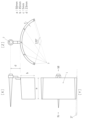
離型性の評価は、図1に示す、幅50mm、厚み5mm、中心角120°、抜き勾配3°のアーチ形状の成形品を用いて行った。アーチの内側の面のキャビティが♯12000番のやすりで鏡面磨きされており、その面にずり応力がかかる方向に突き出す離型方式であり、離型時の圧力計測アンプ(商品名:「MOLD MARSHALLING SYSTEM MPS08」、双葉電子工業株式会社製)と接続された先端部の直径が2mmのエジェクタピン型圧力センサー(商品名:「MOLD MARSHALLING SYSTEM SSEシリーズ」、双葉電子工業株式会社製)をエジェクタピンとして、中心角120°を30°毎に分けた位置に5本設けた金型を用い、射出成型機(商品名:「EC100N」、東芝機械株式会社製)を用いてシリンダー温度260℃、金型温度50℃、冷却時間10秒の条件で、離型時の突出し力(離型抵抗値)を測定した。測定値は5本のセンサー付きエジェクタピンのうち最も高い離型抵抗値をその水準の離型抵抗値とした。離型抵抗値が小さいほど、金型離型性が良好である。アーチ形状にすることで、樹脂の収縮による抱き付きの影響を軽減し、より正確な離型剤の評価が可能になっている。離型抵抗値が80MPaを超える場合は、成形品にエジェクタピンによるへこみや変形、離型しわが発生しやすく、離型性に難があると言える。
生産性の低下が生じたり、複雑形状の成形品を成形する際に問題となることがあるエジェクタピンによる成形品のへこみと鏡面部の離型しわの発生状態を目視で確認し、3段階で評価した。
○:エジェクタピンによるへこみおよび離型しわがない。
△:エジェクタピンによるへこみはないが、離型しわがある。
×:エジェクタピンによるへこみがある。
自動車内装として用いられる材料に含まれる添加剤が、高温になった車内で揮発して外気で冷えた窓ガラス内面に凝縮し、白く曇らせて視界を妨げるフォギングという現象が問題になることがある。またフォギングが発生しやすい材料は射出成形時に金型汚れや乾燥機の汚染が発生しやすくなり、成形品としての品質および生産性に悪影響を及ぼす恐れがある。
射出成形機(商品名:「EC100N」、東芝機械株式会社製)を準備し、片面が♯14000番のやすりで磨かれた鏡面を有する金型を用い、シリンダー温度260℃、金型温度50℃の条件で射出成形して得た成形品(100mm×100mm×2mmt(厚み))から30mm×30mm程度の大きさの小片を複数切り出した。次にこれら小片の合計10gを、アルミニウム箔を被せて底を作製したガラス筒(φ65mm×高さ80mm)に入れ、このガラス筒をホットプレート(商品名:「ネオホットプレートHT-1000」、アズワン株式会社製)上に直立させてセットした。さらに、上記ガラス筒に対し、隙間ができないようにスライドガラス(78mm×76mm×1mm)で蓋をした後、上記ホットプレートで180℃、20時間の熱処理を行った。熱処理の結果、スライドガラス内壁にポリエステル樹脂組成物より昇華した分解物などが析出し、付着するので、このスライドガラスに対してヘイズメーター(商品名:「NDH2000」、日本電色工業株式会社製)を用いてヘイズ値を測定した。ヘイズ値は、全光線透過光における拡散透過光の割合から求められ、曇り度(%)の指標とすることができる。ヘイズ値が小さい(透明である)ほど、ポリエステル樹脂組成物は低フォギング性を有することを意味する。
自動車内装として用いられる材料に含まれる添加剤が、長期使用や高温環境下での使用により、表面に浮き出すことで外観の悪化や表面のべたつきが発生するブリードアウトという現象が問題になることがある。
射出成形機(商品名:「EC100N」、東芝機械株式会社製)を準備し、片面が♯14000番のやすりで磨かれた鏡面を有する金型を用い、シリンダー温度260℃、金型温度50℃の条件で射出成形して得た成形品(100mm×100mm×2mmt(厚み))を公知の熱風乾燥機で、160℃で24時間、加熱処理した後の成形品の表面状態を目視で観察し、耐ブリードアウト性の評価として、白化や色ムラの発生状態を3段階で評価した。
○:白化や色ムラがほとんど見られない。
△:白化や色ムラがわずかに見られる。
×:白化や色ムラが目立つ。
〔ポリアルキレンテレフタレート樹脂(A)〕
a-1:ポリブチレンテレフタレート樹脂(東洋紡株式会社製 還元粘度0.83dl/g)
a-2:ポリエチレンテレフタレート樹脂(東洋紡株式会社製 還元粘度0.63dl/g)
b-1:ジペンタエリスリトールヘキサステアレート(エメリーオレオケミカルズジャパン株式会社製、ロキシオール VPG2571、300℃の重量減少率4.3%)
b-2:グリセリントリ-12-ヒドロキシステアレート(理研ビタミン株式会社製、リケマール TG-12、300℃の重量減少率1.3%)
b-3:モンタン酸ペンタエリスリトールテトラエステル(クラリアントケミカルズ株式会社製、リコルブ WE40 P、300℃の重量減少率5.2%)
b-4:ジペンタエリスリトールヘキサステアレート(理研ビタミン株式会社製、リケスター L-8483、300℃の重量減少率5.0%)
b-5:モンタン酸部分けん化ワックス(クラリアントケミカルズ株式会社製、リコワックス OP P)
C:カーボンブラック(住化カラー株式会社製、ブラック EPC-8E313)

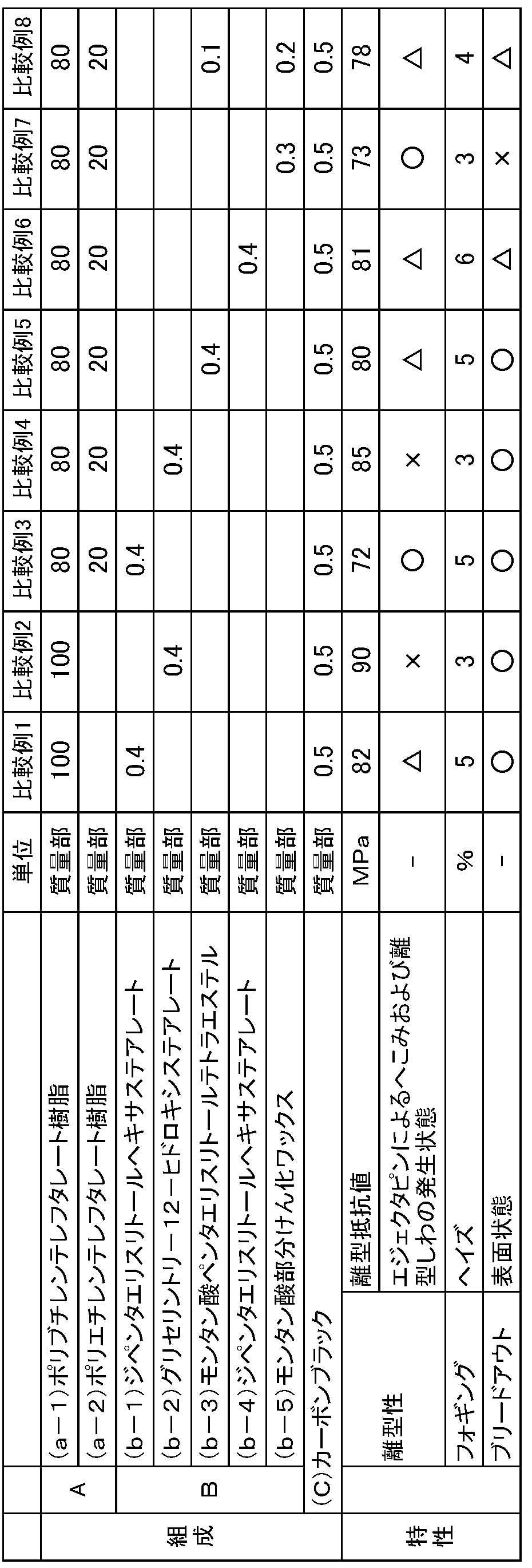
比較例1および2では離型剤を1種単独配合のため、離型性が不十分であり、これに対し、実施例1は、所定の配合に従って離型剤を併用することで離型性が向上する相乗効果があることが分かる。
比較例3では実用上問題のあるレベルではないが、これに対し、実施例2、3は、所定の配合に従って離型剤を併用することで離型性が向上する相乗効果があることが分かる。これにより所定の配合に従うことで離型剤の添加量を減らすことができ、低フォギング性と耐ブリードアウト性により有利な組成物が提供できると言える。
比較例4、5では、離型剤を1種単独配合のため、離型性が不十分であった。
比較例6では300℃の重量減少率が好ましい範囲外の離型剤を単独で配合しているため、離型性および低フォギング性が劣る結果になっている。
比較例7は所定の脂肪酸エステルを配合していないため、耐ブリードアウト性が劣る結果であった。
比較例8においては、離型抵抗値は実施例1および5と同等であったが、実施例1はポリアルキレンテレフタレートとして固化速度の速いポリブチレンテレフタレートを配合しているため、スキン層の形成が速く離型しわが発生しなかった。一方で実施例5と比較例8はポリブチレンテレフタレートに加え、ポリエチレンテレフタレートを配合しているため、固化速度が遅くなることで離型しわの発生が見られたが、実施例5は所定の脂肪酸エステルの組み合わせであったため、ブリードアウトが抑制できており、離型剤の添加量を調整することで更なる離型性の向上が望める。ただし、比較例8は離型剤を2種配合しているものの、所定の脂肪酸エステルの併用ではないため、離型剤の組み合わせによる離型性向上の相乗効果が発現しておらず、単純な離型剤の離型性効果の足し算になっており、耐ブリードアウト性が劣る結果であった。添加量を調整しても離型性と耐ブリードアウト性を両立した組成物を提供することが難しいと言える。
N 金型固定側
1 鏡面磨きされた面
2 センサーなしのエジェクタピンの位置
3 センサー付きエジェクタピンの位置
Claims (8)
- ポリアルキレンテレフタレート樹脂(A)100質量部に対し、離型剤(B)0.01~4質量部含有し、前記離型剤(B)が多価脂肪族アルコールと脂肪酸とからなる脂肪酸エステル化合物を2種類以上含有することを特徴とするポリエステル樹脂組成物。
- 前記離型剤(B)が、6価の脂肪族アルコールと炭素数5~30の脂肪酸からなる脂肪酸エステル化合物(B1)と2~4価の脂肪族アルコールと炭素数5~30の脂肪酸からなる脂肪酸エステル化合物(B2)を含む請求項1に記載のポリエステル樹脂組成物。
- 前記脂肪酸エステル化合物(B1)の、熱重量測定における300℃の重量減少率が4.5%以下であることを特徴とする、請求項2に記載のポリエステル樹脂組成物。
- 前記脂肪酸エステル化合物(B2)の、熱重量測定における300℃の重量減少率が1.5%以下であることを特徴とする、請求項2に記載のポリエステル樹脂組成物。
- 前記脂肪酸エステル化合物(B2)が、グリセリンと炭素数5~30の脂肪酸からなる脂肪酸エステル化合物である請求項2~4のいずれかに記載のポリエステル樹脂組成物。
- 前記脂肪酸エステル化合物(B2)が、グリセリンと炭素数12~30の脂肪酸からなる脂肪酸トリエステル化合物である請求項5に記載のポリエステル樹脂組成物。
- 前記脂肪酸エステル化合物(B1)が、ジペンタエリスリトールまたはテトラグリセリンと炭素数5~30の脂肪酸からなる脂肪酸エステル化合物である請求項2~4のいずれかに記載のポリエステル樹脂組成物。
- 前記脂肪酸エステル化合物(B1)が、ジペンタエリスリトールと炭素数12~30の脂肪酸からなる脂肪酸ヘキサエステル化合物である請求項7に記載のポリエステル樹脂組成物。
Priority Applications (3)
| Application Number | Priority Date | Filing Date | Title |
|---|---|---|---|
| CN202380020572.3A CN118786179A (zh) | 2022-02-07 | 2023-02-01 | 聚酯树脂组合物 |
| US18/835,861 US20250136787A1 (en) | 2022-02-07 | 2023-02-01 | Polyester resin composition |
| JP2023578603A JPWO2023149484A1 (ja) | 2022-02-07 | 2023-02-01 |
Applications Claiming Priority (2)
| Application Number | Priority Date | Filing Date | Title |
|---|---|---|---|
| JP2022-017526 | 2022-02-07 | ||
| JP2022017526 | 2022-02-07 |
Publications (1)
| Publication Number | Publication Date |
|---|---|
| WO2023149484A1 true WO2023149484A1 (ja) | 2023-08-10 |
Family
ID=87552425
Family Applications (1)
| Application Number | Title | Priority Date | Filing Date |
|---|---|---|---|
| PCT/JP2023/003262 Ceased WO2023149484A1 (ja) | 2022-02-07 | 2023-02-01 | ポリエステル樹脂組成物 |
Country Status (5)
| Country | Link |
|---|---|
| US (1) | US20250136787A1 (ja) |
| JP (1) | JPWO2023149484A1 (ja) |
| CN (1) | CN118786179A (ja) |
| TW (1) | TW202340370A (ja) |
| WO (1) | WO2023149484A1 (ja) |
Citations (4)
| Publication number | Priority date | Publication date | Assignee | Title |
|---|---|---|---|---|
| JP2005097563A (ja) * | 2003-08-26 | 2005-04-14 | Mitsubishi Rayon Co Ltd | 熱可塑性樹脂組成物及び光反射体、並びに光反射体用成形品の製造方法 |
| JP2012138537A (ja) * | 2010-12-28 | 2012-07-19 | Nichirei Magnet Kk | 抗曲げ性磁性プラスチックフィルム及びそれを用いた磁性カード |
| JP2013010856A (ja) * | 2011-06-29 | 2013-01-17 | Toyobo Co Ltd | 熱可塑性ポリエステル樹脂組成物、およびこれを用いた光反射体 |
| JP2017101108A (ja) * | 2015-11-30 | 2017-06-08 | ウィンテックポリマー株式会社 | ポリブチレンテレフタレート樹脂組成物 |
-
2023
- 2023-02-01 WO PCT/JP2023/003262 patent/WO2023149484A1/ja not_active Ceased
- 2023-02-01 CN CN202380020572.3A patent/CN118786179A/zh active Pending
- 2023-02-01 US US18/835,861 patent/US20250136787A1/en active Pending
- 2023-02-01 JP JP2023578603A patent/JPWO2023149484A1/ja active Pending
- 2023-02-06 TW TW112104084A patent/TW202340370A/zh unknown
Patent Citations (4)
| Publication number | Priority date | Publication date | Assignee | Title |
|---|---|---|---|---|
| JP2005097563A (ja) * | 2003-08-26 | 2005-04-14 | Mitsubishi Rayon Co Ltd | 熱可塑性樹脂組成物及び光反射体、並びに光反射体用成形品の製造方法 |
| JP2012138537A (ja) * | 2010-12-28 | 2012-07-19 | Nichirei Magnet Kk | 抗曲げ性磁性プラスチックフィルム及びそれを用いた磁性カード |
| JP2013010856A (ja) * | 2011-06-29 | 2013-01-17 | Toyobo Co Ltd | 熱可塑性ポリエステル樹脂組成物、およびこれを用いた光反射体 |
| JP2017101108A (ja) * | 2015-11-30 | 2017-06-08 | ウィンテックポリマー株式会社 | ポリブチレンテレフタレート樹脂組成物 |
Also Published As
| Publication number | Publication date |
|---|---|
| TW202340370A (zh) | 2023-10-16 |
| US20250136787A1 (en) | 2025-05-01 |
| CN118786179A (zh) | 2024-10-15 |
| JPWO2023149484A1 (ja) | 2023-08-10 |
Similar Documents
| Publication | Publication Date | Title |
|---|---|---|
| EP2177567B1 (en) | Polybutylene terephthalate resin composition and thin molded article | |
| US9671531B2 (en) | Thermoplastic resin composition for light reflector, formed article for light reflector, light reflector, and method for producing formed article for light reflector | |
| US10689506B2 (en) | Resin composition and resin molded body | |
| WO2016117586A1 (ja) | 赤外光透過性ポリエステル樹脂組成物 | |
| KR101093389B1 (ko) | 방담성과 이형성이 우수한 생분해성 다층시트 및 그 제조방법 | |
| EP3816219A1 (en) | Resin composition and molded resin object | |
| WO2016133056A1 (ja) | 赤外光透過性ポリエステル樹脂組成物 | |
| TW202340370A (zh) | 聚酯樹脂組成物 | |
| JP5789349B1 (ja) | ポリブチレンテレフタレート樹脂組成物 | |
| US11174373B2 (en) | Resin composition and resin molded body | |
| CN112041397B (zh) | 抗静电部件用树脂组合物 | |
| CN108291077A (zh) | 聚对苯二甲酸丁二醇酯树脂组合物 | |
| JP4205283B2 (ja) | コネクター用樹脂ペレット混合物およびその製造方法 | |
| JP6540288B2 (ja) | 赤外光透過性ポリエステル樹脂組成物 | |
| CN107614609A (zh) | 热塑性聚酯树脂组合物以及成形品 | |
| JP6202029B2 (ja) | 樹脂組成物及び樹脂成形体 | |
| JP6070746B2 (ja) | 樹脂組成物及び樹脂成形体 | |
| JP7800421B2 (ja) | 熱可塑性ポリエステルエラストマー樹脂組成物、及び成形体 | |
| JP3342958B2 (ja) | ポリブチレンテレフタレート樹脂組成物 | |
| US20160280800A1 (en) | Resin composition, method of preparing resin molded article, and resin molded article | |
| JP2004244538A (ja) | ポリトリメチレンテレフタレート樹脂組成物 | |
| JP2024140630A (ja) | 樹脂組成物、ペレット、成形品および樹脂組成物の製造方法 | |
| WO2023062642A1 (en) | Polybutylene terephthalate resin composition, molded article containing the same, and light reflector | |
| JP2018104654A (ja) | 熱可塑性ポリエステル樹脂組成物、その製造方法およびそれからなる成形品 | |
| JP2024140637A (ja) | 樹脂組成物、ペレット、成形品および樹脂組成物の製造方法 |
Legal Events
| Date | Code | Title | Description |
|---|---|---|---|
| 121 | Ep: the epo has been informed by wipo that ep was designated in this application |
Ref document number: 23749800 Country of ref document: EP Kind code of ref document: A1 |
|
| WWE | Wipo information: entry into national phase |
Ref document number: 2023578603 Country of ref document: JP |
|
| REG | Reference to national code |
Ref country code: BR Ref legal event code: B01A Ref document number: 112024013342 Country of ref document: BR |
|
| WWE | Wipo information: entry into national phase |
Ref document number: 2401005045 Country of ref document: TH |
|
| WWE | Wipo information: entry into national phase |
Ref document number: 18835861 Country of ref document: US |
|
| WWE | Wipo information: entry into national phase |
Ref document number: 202380020572.3 Country of ref document: CN |
|
| WWE | Wipo information: entry into national phase |
Ref document number: 202447066154 Country of ref document: IN |
|
| NENP | Non-entry into the national phase |
Ref country code: DE |
|
| ENP | Entry into the national phase |
Ref document number: 112024013342 Country of ref document: BR Kind code of ref document: A2 Effective date: 20240628 |
|
| 122 | Ep: pct application non-entry in european phase |
Ref document number: 23749800 Country of ref document: EP Kind code of ref document: A1 |
|
| WWP | Wipo information: published in national office |
Ref document number: 18835861 Country of ref document: US |