WO2023149103A1 - 複合材料および複合材料構造体の製造方法 - Google Patents
複合材料および複合材料構造体の製造方法 Download PDFInfo
- Publication number
- WO2023149103A1 WO2023149103A1 PCT/JP2022/046433 JP2022046433W WO2023149103A1 WO 2023149103 A1 WO2023149103 A1 WO 2023149103A1 JP 2022046433 W JP2022046433 W JP 2022046433W WO 2023149103 A1 WO2023149103 A1 WO 2023149103A1
- Authority
- WO
- WIPO (PCT)
- Prior art keywords
- resin material
- composite material
- mxene
- group
- particles
- Prior art date
- Legal status (The legal status is an assumption and is not a legal conclusion. Google has not performed a legal analysis and makes no representation as to the accuracy of the status listed.)
- Ceased
Links
Images



Classifications
-
- B—PERFORMING OPERATIONS; TRANSPORTING
- B29—WORKING OF PLASTICS; WORKING OF SUBSTANCES IN A PLASTIC STATE IN GENERAL
- B29C—SHAPING OR JOINING OF PLASTICS; SHAPING OF MATERIAL IN A PLASTIC STATE, NOT OTHERWISE PROVIDED FOR; AFTER-TREATMENT OF THE SHAPED PRODUCTS, e.g. REPAIRING
- B29C41/00—Shaping by coating a mould, core or other substrate, i.e. by depositing material and stripping-off the shaped article; Apparatus therefor
- B29C41/02—Shaping by coating a mould, core or other substrate, i.e. by depositing material and stripping-off the shaped article; Apparatus therefor for making articles of definite length, i.e. discrete articles
- B29C41/08—Coating a former, core or other substrate by spraying or fluidisation, e.g. spraying powder
-
- B—PERFORMING OPERATIONS; TRANSPORTING
- B29—WORKING OF PLASTICS; WORKING OF SUBSTANCES IN A PLASTIC STATE IN GENERAL
- B29C—SHAPING OR JOINING OF PLASTICS; SHAPING OF MATERIAL IN A PLASTIC STATE, NOT OTHERWISE PROVIDED FOR; AFTER-TREATMENT OF THE SHAPED PRODUCTS, e.g. REPAIRING
- B29C41/00—Shaping by coating a mould, core or other substrate, i.e. by depositing material and stripping-off the shaped article; Apparatus therefor
- B29C41/003—Shaping by coating a mould, core or other substrate, i.e. by depositing material and stripping-off the shaped article; Apparatus therefor characterised by the choice of material
-
- B—PERFORMING OPERATIONS; TRANSPORTING
- B29—WORKING OF PLASTICS; WORKING OF SUBSTANCES IN A PLASTIC STATE IN GENERAL
- B29C—SHAPING OR JOINING OF PLASTICS; SHAPING OF MATERIAL IN A PLASTIC STATE, NOT OTHERWISE PROVIDED FOR; AFTER-TREATMENT OF THE SHAPED PRODUCTS, e.g. REPAIRING
- B29C41/00—Shaping by coating a mould, core or other substrate, i.e. by depositing material and stripping-off the shaped article; Apparatus therefor
- B29C41/02—Shaping by coating a mould, core or other substrate, i.e. by depositing material and stripping-off the shaped article; Apparatus therefor for making articles of definite length, i.e. discrete articles
- B29C41/22—Making multilayered or multicoloured articles
-
- H—ELECTRICITY
- H01—ELECTRIC ELEMENTS
- H01G—CAPACITORS; CAPACITORS, RECTIFIERS, DETECTORS, SWITCHING DEVICES, LIGHT-SENSITIVE OR TEMPERATURE-SENSITIVE DEVICES OF THE ELECTROLYTIC TYPE
- H01G11/00—Hybrid capacitors, i.e. capacitors having different positive and negative electrodes; Electric double-layer [EDL] capacitors; Processes for the manufacture thereof or of parts thereof
- H01G11/22—Electrodes
- H01G11/30—Electrodes characterised by their material
-
- H—ELECTRICITY
- H01—ELECTRIC ELEMENTS
- H01M—PROCESSES OR MEANS, e.g. BATTERIES, FOR THE DIRECT CONVERSION OF CHEMICAL ENERGY INTO ELECTRICAL ENERGY
- H01M4/00—Electrodes
- H01M4/02—Electrodes composed of, or comprising, active material
- H01M4/13—Electrodes for accumulators with non-aqueous electrolyte, e.g. for lithium-accumulators; Processes of manufacture thereof
- H01M4/136—Electrodes based on inorganic compounds other than oxides or hydroxides, e.g. sulfides, selenides, tellurides, halogenides or LiCoFy
-
- H—ELECTRICITY
- H01—ELECTRIC ELEMENTS
- H01M—PROCESSES OR MEANS, e.g. BATTERIES, FOR THE DIRECT CONVERSION OF CHEMICAL ENERGY INTO ELECTRICAL ENERGY
- H01M4/00—Electrodes
- H01M4/02—Electrodes composed of, or comprising, active material
- H01M4/13—Electrodes for accumulators with non-aqueous electrolyte, e.g. for lithium-accumulators; Processes of manufacture thereof
- H01M4/139—Processes of manufacture
- H01M4/1397—Processes of manufacture of electrodes based on inorganic compounds other than oxides or hydroxides, e.g. sulfides, selenides, tellurides, halogenides or LiCoFy
-
- H—ELECTRICITY
- H01—ELECTRIC ELEMENTS
- H01M—PROCESSES OR MEANS, e.g. BATTERIES, FOR THE DIRECT CONVERSION OF CHEMICAL ENERGY INTO ELECTRICAL ENERGY
- H01M4/00—Electrodes
- H01M4/02—Electrodes composed of, or comprising, active material
- H01M4/36—Selection of substances as active materials, active masses, active liquids
- H01M4/58—Selection of substances as active materials, active masses, active liquids of inorganic compounds other than oxides or hydroxides, e.g. sulfides, selenides, tellurides, halogenides or LiCoFy; of polyanionic structures, e.g. phosphates, silicates or borates
-
- H—ELECTRICITY
- H01—ELECTRIC ELEMENTS
- H01M—PROCESSES OR MEANS, e.g. BATTERIES, FOR THE DIRECT CONVERSION OF CHEMICAL ENERGY INTO ELECTRICAL ENERGY
- H01M4/00—Electrodes
- H01M4/02—Electrodes composed of, or comprising, active material
- H01M4/62—Selection of inactive substances as ingredients for active masses, e.g. binders, fillers
-
- B—PERFORMING OPERATIONS; TRANSPORTING
- B29—WORKING OF PLASTICS; WORKING OF SUBSTANCES IN A PLASTIC STATE IN GENERAL
- B29C—SHAPING OR JOINING OF PLASTICS; SHAPING OF MATERIAL IN A PLASTIC STATE, NOT OTHERWISE PROVIDED FOR; AFTER-TREATMENT OF THE SHAPED PRODUCTS, e.g. REPAIRING
- B29C41/00—Shaping by coating a mould, core or other substrate, i.e. by depositing material and stripping-off the shaped article; Apparatus therefor
- B29C41/34—Component parts, details or accessories; Auxiliary operations
- B29C41/46—Heating or cooling
-
- B—PERFORMING OPERATIONS; TRANSPORTING
- B29—WORKING OF PLASTICS; WORKING OF SUBSTANCES IN A PLASTIC STATE IN GENERAL
- B29K—INDEXING SCHEME ASSOCIATED WITH SUBCLASSES B29B, B29C OR B29D, RELATING TO MOULDING MATERIALS OR TO MATERIALS FOR MOULDS, REINFORCEMENTS, FILLERS OR PREFORMED PARTS, e.g. INSERTS
- B29K2033/00—Use of polymers of unsaturated acids or derivatives thereof as moulding material
-
- B—PERFORMING OPERATIONS; TRANSPORTING
- B29—WORKING OF PLASTICS; WORKING OF SUBSTANCES IN A PLASTIC STATE IN GENERAL
- B29K—INDEXING SCHEME ASSOCIATED WITH SUBCLASSES B29B, B29C OR B29D, RELATING TO MOULDING MATERIALS OR TO MATERIALS FOR MOULDS, REINFORCEMENTS, FILLERS OR PREFORMED PARTS, e.g. INSERTS
- B29K2105/00—Condition, form or state of moulded material or of the material to be shaped
- B29K2105/06—Condition, form or state of moulded material or of the material to be shaped containing reinforcements, fillers or inserts
- B29K2105/16—Fillers
-
- B—PERFORMING OPERATIONS; TRANSPORTING
- B29—WORKING OF PLASTICS; WORKING OF SUBSTANCES IN A PLASTIC STATE IN GENERAL
- B29K—INDEXING SCHEME ASSOCIATED WITH SUBCLASSES B29B, B29C OR B29D, RELATING TO MOULDING MATERIALS OR TO MATERIALS FOR MOULDS, REINFORCEMENTS, FILLERS OR PREFORMED PARTS, e.g. INSERTS
- B29K2509/00—Use of inorganic materials not provided for in groups B29K2503/00 - B29K2507/00, as filler
- B29K2509/02—Ceramics
- B29K2509/04—Carbides; Nitrides
-
- B—PERFORMING OPERATIONS; TRANSPORTING
- B29—WORKING OF PLASTICS; WORKING OF SUBSTANCES IN A PLASTIC STATE IN GENERAL
- B29K—INDEXING SCHEME ASSOCIATED WITH SUBCLASSES B29B, B29C OR B29D, RELATING TO MOULDING MATERIALS OR TO MATERIALS FOR MOULDS, REINFORCEMENTS, FILLERS OR PREFORMED PARTS, e.g. INSERTS
- B29K2995/00—Properties of moulding materials, reinforcements, fillers, preformed parts or moulds
- B29K2995/0003—Properties of moulding materials, reinforcements, fillers, preformed parts or moulds having particular electrical or magnetic properties, e.g. piezoelectric
- B29K2995/0005—Conductive
Definitions
- the present disclosure relates to composite materials, more specifically, composite materials containing inorganic particles and a resin material, and methods of manufacturing composite material structures.
- MXene has attracted attention as a new conductive material.
- MXene is a type of so-called two-dimensional material, more specifically, a two-dimensional material having the form of one or more layers (layered material), as described below.
- MXenes are generally in the form of particles (which may include powders, flakes, nanosheets, etc.) of such two-dimensional materials (layered materials).
- Non-Patent Document 1 describes a composite material in which polyurethane is filled with MXene by applying an emulsion method.
- a composite material (hereinafter simply referred to as "conventional composite material") containing MXene and a resin material conventionally used in the technical field (polyurethane, etc., see Non-Patent Document 1) ), the physical properties of an object made of a conventional composite material change more over time than an object made of only MXene (MXene single material) (typically, the conductive decreased more over time).
- MXene single material typically, the conductive decreased more over time.
- Such a tendency was more conspicuous under a high-humidity environment (for example, relative humidity of 85%). That is, according to the research of the present inventors, the conventional composite material containing MXene and a resin material (polyurethane, etc.) has a problem that environmental resistance (especially moisture resistance) is lower than MXene single material. found.
- An object of the present disclosure is to provide a novel composite material containing MXene and a resin material, which has improved environmental resistance (especially moisture resistance) compared to conventional composite materials.
- a further object of the present disclosure is to provide a novel method of manufacturing a composite material structure containing MXene and a resin material.
- a composite material comprising particles of a two-dimensional material comprising one or more layers and a resin material,
- the layer has the following formula: M m X n (wherein M is at least one Group 3, 4, 5, 6, 7 metal; X is a carbon atom, a nitrogen atom, or a combination thereof; n is 1 or more and 4 or less, m is greater than n and less than or equal to 5) and a modification or termination T (T is at least one selected from the group consisting of a hydroxyl group, a fluorine atom, a chlorine atom, an oxygen atom and a hydrogen atom) present on the surface of the layer body represented by and
- the resin material is an anionic resin material containing an anionic polymer having at least one of a carboxylic acid group and a carboxylic acid group and having no NH group (excluding resin materials containing polyvinyl alcohol). , composites.
- a method for manufacturing a composite material structure comprising: (a) preparing a liquid composition comprising particles of a two-dimensional material comprising one or more layers, a resin material, and a liquid medium,
- the layer has the following formula: M m X n (wherein M is at least one Group 3, 4, 5, 6, 7 metal; X is a carbon atom, a nitrogen atom, or a combination thereof; n is 1 or more and 4 or less, m is greater than n and less than or equal to 5) and a modification or termination T (T is at least one selected from the group consisting of a hydroxyl group, a fluorine atom, a chlorine atom, an oxygen atom and a hydrogen atom) present on the surface of the layer body represented by and
- the resin material is an anionic resin material containing an anionic polymer having at least one of a carboxylic acid group and a carboxylic acid group and having no NH group (excluding resin materials containing polyvinyl alcohol). and (b) forming
- the ratio of the solid content of the resin material to the total of the particles of the two-dimensional material and the solid content of the resin material in the liquid composition is 0.1% by mass or more and 99.9% by mass. % or less.
- M m AX n (Wherein M, X, n and m are as described above, A is at least one Group 12, 13, 14, 15, 16 element) Further comprising obtaining particles of the two-dimensional material by a method comprising etching the raw material represented by with an etchant containing fluoride and acid (excluding hydrofluoric acid), above [8] to [ 12], the manufacturing method of the composite material structure according to any one of
- a composite material comprising particles of a predetermined two-dimensional material (also referred to herein as “MXene”) and a resin material has at least one of a carboxylic acid group and a carboxylic acid group, and , an anionic resin material containing an anionic polymer that does not have an NH group (except for resin materials containing polyvinyl alcohol). ) is provided. Further, according to the present disclosure, a novel method for manufacturing a composite material structure containing MXene and the resin material is provided.
- FIG. 1 is a schematic schematic cross-sectional view showing a composite material in one embodiment of the present disclosure
- Figure 1 is a schematic cross-sectional view showing particles of a two-dimensional material (MXene) that can be used in one embodiment of the present disclosure, where (a) shows a single-layer MXene particle and (b) shows a multi-layer (illustratively two Layer) shows MXene particles.
- 4 is a graph showing changes over time in conductivity of films produced in Example 1 and Comparative Examples 1 and 2.
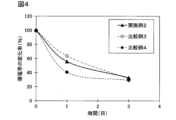
- FIG. 4 is a graph showing changes over time in conductivity of films produced in Example 2 and Comparative Examples 3 and 4.
- FIG. 10 is a graph showing changes over time in conductivity of films produced in Example 3 and Comparative Examples 5 and 6.
- a method for manufacturing a composite material and a composite material structure for example, a composite material having the form of a membrane
- a composite material structure for example, a composite material having the form of a membrane
- a composite material 20 of the present embodiment has particles 10 of a predetermined two-dimensional material (layered material), at least one of a carboxylic acid group and a carboxylic acid group, and an NH group. and an anionic resin material (excluding a resin material containing polyvinyl alcohol) containing an anionic polymer that does not contain (hereinafter, an anionic resin material having such limitations is also simply referred to as an "anionic resin material") 11.
- an anionic resin material 11 By using such an anionic resin material 11 in combination with particles 10 of a predetermined two-dimensional material (layered material), environmental resistance (especially moisture resistance) can be improved compared to conventional composite materials using polyurethane or the like. can be done.
- the composite material 20 of this embodiment may have any suitable structure and/or form.
- the composite material 20 of this embodiment may be a solid or non-flowing structure (substantially free of liquid media).
- the composite structure may be molded or molded into a predetermined shape.
- Such a composite material structure includes, for example, a composite material 20 having the form of a membrane, in other words a composite material membrane (shown as composite material 20 in FIG. 1).
- the composite material 20 of the present embodiment is not limited to this, and may be, for example, a liquid composition (eg slurry, paste, etc.) further containing a liquid medium (not shown in FIG. 1) described later.
- composite material 20 of this embodiment will be described in detail through a method for manufacturing a composite material structure (for example, a composite material film). Unless otherwise stated, the description of the method of making composite structures may also apply to composite materials.
- the method for manufacturing the composite material structure of the present embodiment includes: (a) preparing a liquid composition comprising particles of a predetermined two-dimensional material (layered material), an anionic resin material, and a liquid medium; and (b) using the liquid composition to prepare a precursor structure. Forming on a substrate and at least drying the precursor structure to obtain a composite structure.
- a predetermined two-dimensional material that can be used in this embodiment is MXene, which is defined as follows: A two-dimensional material (layered material) comprising one or more layers, wherein the layer has the formula: M m X n (wherein M is at least one Group 3, 4, 5, 6, 7 metal, the so-called early transition metals such as Sc, Ti, Zr, Hf, V, Nb, Ta, Cr, Mo and may contain at least one selected from the group consisting of Mn, X is a carbon atom, a nitrogen atom, or a combination thereof; n is 1 or more and 4 or less, m is greater than n and less than or equal to 5) (the layer body may have a crystal lattice in which each X is located in an octahedral array of M) and a surface of the layer body (more particularly, the surfaces of the layer bodies facing each other Two
- M is preferably at least one selected from the group consisting of Ti, Zr, Hf, V, Nb, Ta, Cr, Mo and Mn, and from Ti, V, Cr and Mo At least one selected from the group consisting of is more preferable.
- M m X n is Ti 2 C, Ti 3 C 2 , Ti 3 (CN), (Cr 2 Ti)C 2 , (Mo 2 Ti)C 2 , (Mo 2 Ti 2 )C 3 , and (Mo 2.7 V 1.3 )C 3 .
- M m X n can be Ti 3 C 2 .
- MXene particles selectively etch (remove and optionally layer-separate) A atoms (and optionally part of M atoms) from the raw material MAX phase.
- MXene particles selectively etch (remove and optionally layer-separate) A atoms (and optionally part of M atoms) from the raw material MAX phase.
- the method for producing a composite material structure of the present embodiment may further include a step of obtaining MXene particles before step (a), and the step of obtaining MXene particles includes Etching with an etchant (etching process) is included.
- the raw material MAX phase (hereinafter also simply referred to as "MAX raw material”) has the following formula: M m AX n (wherein M, X, n and m are as defined above, A is at least one Group 12, 13, 14, 15, 16 element, usually a Group A element, typically is group IIIA and group IVA, and more particularly may include at least one selected from the group consisting of Al, Ga, In, Tl, Si, Ge, Sn, Pb, P, As, S and Cd, preferably Al) is represented by A MAX phase is a crystal in which a layer composed of A atoms is located between two layers denoted by M m X n (each X may have a crystal lattice located in an octahedral array of M).
- hydroxyl groups, fluorine atoms, chlorine atoms, oxygen atoms and hydrogen atoms present in an etchant usually, but not limited to, an aqueous solution containing hydrofluoric acid
- an etchant usually, but not limited to, an aqueous solution containing hydrofluoric acid
- the etchant may contain any suitable acid (HF, HCl, HBr, HI, sulfuric acid, phosphoric acid, nitric acid, etc.).
- the MAX raw material may be etched with an etchant containing hydrofluoric acid.
- hydrofluoric acid hydrofluoric acid
- Etching with an etchant containing hydrofluoric acid can also be referred to as an ACID method.
- the etching solution may further contain other acids such as hydrochloric acid, hydrobromic acid, hydroiodic acid, nitric acid, sulfuric acid, acetic acid, formic acid, hypochlorous acid, fluorosulfonic acid, and the like. good.
- the MAX raw material may be etched with an etchant containing fluoride and acid (excluding hydrofluoric acid).
- Hydrofluoric acid (HF) is present in situ in the etchant by using a fluoride and an acid (except for hydrofluoric acid) in the etchant.
- Etching with an etchant containing fluoride and acid (excluding hydrofluoric acid) may also be referred to as the MILD method.
- fluorides metal fluorides such as lithium fluoride, sodium fluoride, potassium fluoride, etc. may be used, especially lithium fluoride.
- metal fluorides When metal fluorides are used, metal (metal ions) can be intercalated into the MXene particles in the etching process along with the etching of the MAX raw material.
- Acids include, for example, hydrochloric acid, hydrobromic acid, hydroiodic acid, nitric acid, sulfuric acid, acetic acid, formic acid, hypochlorous acid, fluorosulfonic acid, etc.
- Hydrochloric acid can be used.
- Ammonium hydrogen difluoride may be used as the fluoride and acid (excluding hydrofluoric acid).
- the etching treatment with an etchant containing hydrofluoric acid is preferable to the etching treatment with an etchant containing fluoride and acid (excluding hydrofluoric acid) (MILD method) (described later). (see the example to do).
- the step of obtaining MXene particles may include any appropriate treatment as appropriate after the etching treatment.
- Such treatments include, for example, washing, intercalation, delamination, and the like. Washing may apply a water wash followed by centrifugation/decantation. Intercalation can be intercalating metals (metal ions) into the MXene particles.
- Delamination is the application of impact, such as vibration and/or ultrasound, to promote delamination of MXene particles (multilayer MXene particles into MXene particles with fewer layers, e.g., single-layer MXene particles).
- delamination treatment can be performed for a predetermined period of time using handshake, automatic shaker, mechanical shaker, vortex mixer, homogenizer, ultrasonic bath, or the like.
- the MXene particles may contain a relatively small amount of residual A atoms, for example, 10% by mass or less relative to the original A atoms.
- the residual amount of A atoms can be preferably 8% by mass or less, more preferably 6% by mass or less. However, even if the residual amount of A atoms exceeds 10% by mass, there may be no problem depending on the application and usage conditions of the composite material.
- the MXene particles 10 synthesized in this manner are particles of a layered material containing one or more MXene layers 7a and 7b (examples of the MXene particles 10 are shown in FIG. 2 (a ) shows one layer of MXene particles 10a in FIG. 2(b) and two layers of MXene particles 10b in FIG. More specifically, the MXene layers 7a and 7b consist of layer bodies (M m X n layers) 1a and 1b represented by M m X n and surfaces of the layer bodies 1a and 1b (more specifically, in each layer with modifications or terminations T 3a, 5a, 3b, 5b present on at least one of the two surfaces facing each other).
- the MXene layers 7a, 7b are also denoted as "M m X n T s ", where s is any number.
- the MXene particle 10 has a plurality of MXene layers, even if the MXene layers are individually separated and exist as one layer (single-layer structure shown in FIG. 2(a), the so-called single-layer MXene particle 10a). may be a laminate (multilayer structure shown in FIG. 2(b), so-called multilayer MXene particles 10b) or a mixture thereof.
- MXene particles 10 can be particles (also referred to as powders or flakes) as aggregates composed of single-layered MXene particles 10a and/or multi-layered MXene particles 10b. In the case of multi-layered MXene particles, two adjacent MXene layers (eg 7a and 7b) are not necessarily completely separated and may be in partial contact.
- each MXene layer (corresponding to the MXene layers 7a and 7b) is, for example, 0.8 nm or more and 5 nm or less, particularly 0.8 nm or more and 3 nm or less (mainly
- the maximum dimension in a plane (two-dimensional sheet plane) parallel to the layers (which may correspond to the “in-plane dimension” of the particles) is, for example, 0.1 ⁇ m. above, especially 1 ⁇ m or more, for example 200 ⁇ m or less, especially 40 ⁇ m or less.
- the interlayer distance (or void dimension, indicated by ⁇ d in FIG. 2(b)) inside each laminate particle is not particularly limited, for example 0 .8 nm or more and less than 10 nm, particularly 0.8 nm or more and 5 nm or less, more particularly about 1 nm, and the maximum dimension in a plane (two-dimensional sheet plane) perpendicular to the stacking direction (which can correspond to the "in-plane dimension" of the particles) is for example 0.1 ⁇ m or more, especially 1 ⁇ m or more, for example 100 ⁇ m or less, especially 20 ⁇ m or less.
- the total number of layers in the MXene particles may be 1 or 2 or more, for example, 1 or more and 20 or less, and the thickness in the stacking direction (which can correspond to the "thickness" of the particles) is, for example, 0.8 nm or more. 20 nm or less.
- the MXene particle is a laminate (multilayer MXene) particle
- the MXene may have a small number of layers.
- the term “small number of layers” means, for example, that the number of stacked layers of MXene is 6 or less.
- the thickness in the stacking direction of a multilayer MXene with a small number of layers can be less than 10 nm. In this specification, this “multilayer MXene with a small number of layers” is also referred to as “small layer MXene”.
- the MXene particles may be particles (which may also be referred to as nanosheets) composed mostly of monolayer MXene and/or few-layer MXene.
- single-layer MXene and small-layer MXene may be collectively referred to as "single-layer/small-layer MXene”.
- each dimension described above is a number average dimension (eg, number average of at least 40) based on scanning electron microscope (SEM), transmission electron microscope (TEM) or atomic force microscope (AFM) photographs or X-ray It can be obtained as a distance in real space calculated from the position of the (002) plane in reciprocal lattice space measured by the diffraction (XRD) method.
- SEM scanning electron microscope
- TEM transmission electron microscope
- AFM atomic force microscope
- anionic resin material means an anionic resin material containing an anionic polymer having at least one of a carboxylic acid group and a carboxylic acid group and having no NH group (however, a resin containing polyvinyl alcohol excluding materials).
- An anionic polymer is a polymer (high molecular weight polymer) that has an anionic functional group and exhibits a negative charge (negative zeta potential) in a liquid medium.
- the proportion of monomer units having an anionic functional group in the anionic polymer is not particularly limited as long as the anionic polymer exhibits negative charge (negative zeta potential) in the liquid medium.
- the anionic resin material should just contain an anionic polymer.
- the anionic resin material may contain any suitable other ingredients in addition to the anionic polymer.
- the anionic resin material may contain one or more anionic polymers, but preferably does not contain high molecular weight polymers other than the anionic polymer.
- the anionic polymer having at least one of a carboxylic acid group and a carboxylic acid group means that it has -COOH and/or -COOX'(X' is a monovalent ion such as sodium, potassium, ammonium, etc.).
- Carboxylic acid groups and carboxylic acid groups are anionic functional groups that form --COO.sub.2-- in liquid media.
- the anionic polymer may or may not further contain at least one or more of other anionic functional groups such as sulfonate groups, sulfonate groups, phosphate groups and phosphate groups.
- the anionic polymer is required to have no NH group.
- the NH groups can be -N(H)- present in the backbone and/or side chains of the polymer and the H of the NH groups can form hydrogen bonds.
- an anionic polymer does not have urethane linkages (--NHCOO--), for example.
- anionic resin materials that can be used in the present disclosure exclude resin materials containing polyvinyl alcohol (PVA) (hereinafter also simply referred to as "PVA-containing resin materials").
- PVA-containing resin materials excluded in the present disclosure are resin materials containing PVA in addition to the anionic polymer.
- PVA polyvinyl alcohol
- PVA polyvinyl alcohol
- PVA polyvinyl alcohol
- PVA may be, for example, a homopolymer of vinyl alcohol or a copolymer of vinyl alcohol and vinyl acetate.
- PVA can be understood as a nonionic polymer with hydroxyl groups as nonionic functional groups.
- the PVA-containing resin material excluded in the present disclosure includes an anionic polymer and PVA, which is a nonionic polymer, and can be understood as an anion-nonionic hybrid resin material.
- PVA which is a nonionic polymer
- a hydroxyl group, an alkylene oxide group, and the like are known as examples of nonionic functional groups.
- the anionic resin material may be an acrylic resin material.
- the anionic resin material may contain an anionic acrylic polymer as the anionic polymer.
- Such an anionic acrylic polymer has at least one of a carboxylic acid group and a carboxylic acid group, and does not have an NH group.
- An acrylic polymer means a polymer containing monomer units derived from a (meth)acryloyl group as a main component.
- a "(meth)acryloyl group” means an acryloyl group and/or a methacryloyl group.
- a main component means a component that accounts for 50% by mass or more of the polymer.
- the anionic resin material is preferably a self-crosslinking resin material.
- a self-crosslinking anionic resin material has a self-crosslinking functional group introduced into an anionic polymer (for example, an anionic acrylic polymer).
- the anionic polymer may have a reactive functional group introduced therein and be crosslinkable by reacting with a crosslinker, or both.
- cross-linking may be carried out by a cross-linking reaction between a polymer into which a reactive functional group such as a carboxylic acid group, a sulfonic acid group, a carbonyl group, or a hydroxyl group has been introduced and a cross-linking agent having a cross-linkable functional group.
- a reactive functional group such as a carboxylic acid group, a sulfonic acid group, a carbonyl group, or a hydroxyl group
- a cross-linkable monomer having two or more vinyl groups in one molecule e.g., ethylene glycol di(meth)acrylate, polyethylene glycol di(meth)acrylate, divinylbenzene, etc.
- a monomer having a crosslinkable functional group for example, a methylol group-containing monomer, a hydrolyzable silyl group-containing monomer, etc.
- additives include, but are not limited to, surfactants, hardeners and/or crosslinkers, viscosity modifiers (eg, thickeners), and the like.
- surfactants include tetraethylene glycol and the like.
- anionic resin materials include Aron (registered trademark) NW-400 (manufactured by Toagosei Co., Ltd., self-crosslinking type, having at least one of a carboxylic acid group and a carboxylic acid group, and an NH group. containing an anionic acrylic polymer containing no surfactant, containing tetraethylene glycol as a surfactant and not containing PVA), Lipidure (registered trademark)-A (manufactured by NOF Corporation), and the like.
- the commercially available anionic resin material as a raw material may further contain a liquid medium as appropriate.
- the PVA-containing resin material excluded from the anionic resin material includes Aron (registered trademark) AS-2000 (manufactured by Toagosei Co., Ltd., non-reactive anionic acrylic (acrylic acid) polymer, including PVA) and the like.
- Liquid composition A liquid composition is prepared containing the MXene particles and the anionic resin material respectively prepared above in a liquid medium.
- the liquid medium may be either an aqueous medium or an organic medium, but an aqueous medium is preferred.
- the aqueous medium is typically water, and optionally contains a relatively small amount of other liquid substances in addition to water (for example, 30% by mass or less, preferably 20% by mass or less based on the total amount of the aqueous medium). good too.
- the organic medium is not particularly limited, but may be, for example, a protic solvent represented by alcohol, an aprotic solvent, or a mixed solvent of two or more thereof.
- the MXene particles can be well dispersed in the liquid medium by the anionic resin material.
- the environmental resistance of the finally obtained composite material (the composite material structure in this production example, but not limited to this) (particularly moisture resistance) can be improved (compared to conventional composites).
- the ratio of the solid content of the anionic resin material to the total solid content of the MXene particles and the anionic resin material may be 0.1% by mass or more and 99.9% by mass or less. The effect of improving environmental resistance (particularly moisture resistance) can be obtained.
- the above ratio in the liquid composition is the ratio of the anion to the total solid content of the MXene particles and the anionic resin material in the final composite material (in this production example, but not limited to the composite structure). may be substantially the same as the proportion of solids in the elastic resin material.
- the liquid composition can be in the form of slurry, paste, or the like, depending on the total solid content concentration including the MXene particles and the solid content of the anionic resin material.
- ⁇ Process (b) ⁇ Precursor structure> Then, the liquid composition prepared above is used to form a precursor structure on a substrate, and at least the precursor structure is dried to obtain a composite material structure. If the composite structure is a composite film, the precursor structure is a precursor film.
- the base material is not particularly limited, can be made of any suitable material, and can have any suitable structure and/or form.
- the region where the precursor structure is formed may or may not be flat, and may have a surface shape such as a curved surface, an uneven surface, or an irregular shape.
- the substrate may typically be a substrate, film, or the like, but is not limited to these.
- the surface of the substrate (the surface on which the precursor structure is formed) has functionalities capable of hydrogen bonding with the MXene particles. It preferably has a group (for example, an OH group, etc.).
- Such functional groups may be those originally possessed by the base material, or those that are developed by pretreatment (for example, plasma treatment). The pretreatment may be carried out for purposes such as cleaning and hydrophilization.
- the method of forming the precursor structure on the substrate is not particularly limited, but for example, the precursor structure may be formed by spraying a liquid composition onto the substrate.
- a precursor structure is formed on a porous member by a method other than spraying, for example, by using a porous member (e.g., membrane filter) as a substrate and passing a liquid composition through the porous member (filtration).
- the spraying can align the MXene particles on the substrate (aligned so that the two-dimensional sheet surface of the MXene particles is substantially parallel (for example, within ⁇ 20°) to the surface of the substrate).
- the resulting composite structure can be made denser than the filtration membrane, thus providing higher environmental resistance (moisture resistance).
- arbitrary methods such as bar coating, spin coating, and immersion can be applied.
- the unnecessary liquid medium is removed (the entire liquid medium may not necessarily be removed, and a portion may remain) to form the composite material structure.
- the above spraying and drying may be repeated to obtain a composite structure of desired thickness.
- the cross-linking reaction may proceed while the composite material structure is being formed.
- the cross-linking reaction may proceed by at least partially removing the liquid medium by drying.
- heating, radiation (light, ultraviolet rays, etc.) irradiation, etc. may be performed under appropriate conditions to proceed with the cross-linking reaction.
- the present disclosure is not bound by any theory, by using a liquid composition in which the MXene particles are well dispersed, the composite material finally obtained (the composite material structure in this production example, but limited to this
- the reason why the environmental resistance (especially moisture resistance) of the composite material can be improved (compared to conventional composite materials) is considered as follows.
- MXene particles are modified or terminated on the surface of the layer body represented by M m X n (T is at least one selected from the group consisting of hydroxyl group, fluorine atom, chlorine atom, oxygen atom and hydrogen atom ) and there are charged sites due to such a configuration.
- T is at least one selected from the group consisting of hydroxyl group, fluorine atom, chlorine atom, oxygen atom and hydrogen atom
- Two-dimensional sheet planes planes parallel to the layers of MXene particles occupying most of the surface of the MXene particles are usually negatively charged.
- the MXene particles are mixed with a liquid medium (typically water), the MXene particles can be attracted to each other by intermolecular forces or hydrogen bonding forces and aggregate in the liquid medium.
- an anionic resin material containing an anionic polymer having at least one of a carboxylic acid group and a carboxylic acid group and no NH group is used.
- MXene particles are extremely sensitive to polymer functional groups, among anionic functional groups, carboxylic acid groups and/or carboxylic acid groups that are capable of forming loose hydrogen bonds and are anionic and electrostatically repulsive. MXene particles can be well dispersed by using an anionic polymer having a base.
- NH groups can function as cationic functional groups. NH groups can also function as hydrogen donors, and MXene particles can form strong hydrogen bonds with NH groups. If the anionic polymer has an NH group, electrostatic attraction acts between the negative charge on the surface of the MXene particles and the NH group of the anionic polymer in the liquid medium. The hydrogen bonds between the particles and the NH groups of the anionic polymer are too strong, and the MXene particles may be linked together via the anionic polymer, resulting in aggregation of the MXene particles. In this embodiment, the anionic polymer does not have an NH group, so this problem can be avoided.
- the anionic resin materials that can be used in the present disclosure exclude PVA-containing resin materials.
- the MXene particles can be densely present in the finally obtained composite material (composite material structure in this production example, the same shall apply hereinafter). can be done.
- a liquid composition in which the MXene particles are well dispersed the MXene particles are considered to be evenly dispersed in the liquid medium. Even in the precursor structure formed using such a liquid composition, the MXene particles are considered to be evenly dispersed in the liquid medium, and in the composite material after drying, the MXene particles are highly oriented. can exist.
- the two-dimensional sheet surface of the MXene particles is substantially parallel (for example, within ⁇ 20°) to the surface of the base material. You can align and place them like this:
- the result is a composite material with a high density of MXene particles.
- Composites with a high density of MXene particles are less susceptible to the ambient environment, and thus can have improved environmental resistance (over conventional composites). For example, in high humidity conditions, a composite material with a higher density of MXene particles is less permeable to water molecules (fewer paths for water molecules to permeate), and thus can improve moisture resistance.
- MXene particles are considered to be unevenly distributed in the liquid medium and partially aggregated. Even in the precursor structure formed using such a liquid composition, the MXene particles are thought to be unevenly distributed in the liquid medium and partially aggregated. The MXene particles that have formed will interfere and disturb the orientation of the MXene particles. As a result, voids are generated in the vicinity of the aggregated MXene particles, resulting in a composite material with a low MXene particle density. Composites with low MXene particle densities are more susceptible to environmental influences and thus have lower environmental resistance (like conventional composites). For example, in high humidity conditions, composites with lower density of MXene particles are more permeable to water molecules (more paths for water molecules to permeate) and are therefore less moisture resistant.
- a composite material (composite material structure in this production example) having a high density of MXene particles is obtained by using a liquid composition in which MXene particles are well dispersed. Therefore, the environmental resistance (particularly moisture resistance) can be improved over conventional composite materials, preferably to the same extent as the MXene single material (consisting substantially only of MXene particles and containing no resin material) environmental resistance (especially humidity resistance) can be realized.
- the anionic resin material is preferably a self-crosslinking resin material.
- environmental resistance especially humidity resistance
- the reasons for this are believed to be as follows.
- a self-crosslinking resin material may be an anionic polymer into which a self-crosslinking functional group and/or a reactive functional group (that can react with a cross-linking agent) is introduced.
- MXene particles may have hydroxyl groups or the like as modifications or terminations T, such modifications or terminations T may undergo cross-linking reactions with the self-crosslinking and/or reactive functional groups of the anionic polymer.
- the anionic polymer crosslinked with the MXene particles is further crosslinked with another MXene particle, the anionic polymer is crosslinked between multiple MXene particles.
- MXene particles crosslinked in this way are in a state of being chemically bonded to each other, and are less susceptible to the influence of the surrounding environment, thereby further improving the environmental resistance. For example, under high-humidity conditions, it becomes difficult for water molecules to open between the MXene particles, so that the moisture resistance can be further improved.
- Environmental resistance can be determined based on the rate of change in physical properties of the composite material over time in a given environment, and the smaller the rate of change, the higher the environmental resistance (especially moisture resistance). More specifically, the humidity resistance is the rate of change in the physical properties of the composite material over time under a high humidity environment (e.g., 85% relative humidity), especially in a high temperature and high humidity environment (e.g., temperature of 60 ° C. and relative humidity of 85%). The smaller the rate of change, the higher the moisture resistance.
- a physical property of the composite material can be an electrical property, typically conductivity. In other words, according to this embodiment, the finally obtained composite material (composite material structure in this manufacturing example) can have an improved rate of decrease in conductivity over time (compared to conventional composite materials). can.
- the ratio of the solid content of the anionic resin material to the total of the MXene particles and the solid content of the anionic resin material is the ratio in the liquid composition. Similarly, it may be 0.1% by mass or more and 99.9% by mass or less.
- the ratio of the MXene particles to the total of the MXene particles and the solid content of the anionic resin material is, for example, 50% by mass or more. It can be 9% by mass or less.
- the composite material (structure, for example, membrane) of this embodiment can be used for any appropriate application.
- it can be used in applications where maintaining high conductivity (reducing initial conductivity loss) is required, such as electrodes and electromagnetic shielding (EMI shielding) in any suitable electrical device.
- EMI shielding electromagnetic shielding
- the electrodes are not particularly limited, but may be, for example, capacitor electrodes, battery electrodes, biomedical electrodes, sensor electrodes, antenna electrodes, and the like.
- capacitor electrodes capacitor electrodes
- battery electrodes biomedical electrodes
- sensor electrodes antenna electrodes
- the composite materials (structures, e.g. membranes) of the present embodiments large-capacity capacitors and batteries, low-impedance bioelectrodes, highly sensitive sensors and antennas can be obtained even with a smaller volume (volume occupied by the device). be able to.
- the capacitor can be an electrochemical capacitor.
- An electrochemical capacitor is a capacitor that utilizes the capacity that is generated due to the physicochemical reaction between an electrode (electrode active material) and ions in an electrolyte (electrolyte ion). device).
- the battery can be a chemical cell that can be repeatedly charged and discharged.
- the battery can be, for example, but not limited to, a lithium ion battery, a magnesium ion battery, a lithium sulfur battery, a sodium ion battery, and the like.
- a bioelectrode is an electrode for acquiring biosignals.
- the bioelectrodes can be, but are not limited to, electrodes for measuring EEG (electroencephalogram), ECG (electrocardiogram), EMG (electromyography), EIT (electrical impedance tomography), for example.
- the sensor electrode is an electrode for detecting the target substance, state, abnormality, etc.
- the sensor can be, for example, a gas sensor, a biosensor (a chemical sensor that utilizes a biogenic molecular recognition mechanism), or the like, but is not limited thereto.
- the antenna electrode is an electrode for radiating electromagnetic waves into space and/or receiving electromagnetic waves in space.
- an electromagnetic shield with a high shielding rate (EMI shielding properties) can be obtained.
- the present disclosure can be modified in various ways. It should be noted that the composite material of the present disclosure may be manufactured by methods different from the manufacturing methods in the above-described embodiments.
- Example 1 Preparation of MAX particles (precursor of MXene particles) TiC powder, Ti powder and Al powder (all manufactured by Kojundo Chemical Laboratory Co., Ltd.) at a molar ratio of 2: 1: 1 in a ball mill containing zirconia balls Charged and mixed for 24 hours. The obtained mixed powder was fired at 1350° C. for 2 hours in an Ar atmosphere. The sintered body (block) thus obtained was pulverized with an end mill to a maximum dimension of 40 ⁇ m or less. As a result, Ti 3 AlC 2 particles were obtained as MAX particles.
- etching was performed under the following etching conditions to obtain a solid-liquid mixture (slurry) containing solid components derived from the Ti 3 AlC 2 powder.
- Etching conditions ⁇ Precursor: Ti 3 AlC 2 (through a 45 ⁇ m sieve) ⁇ Etching liquid composition: 49% HF 6 mL 18 mL H2O HCl (12M) 36 mL ⁇ Precursor input amount: 3.0 g ⁇ Etching container: 100 mL eyeboy ⁇ Etching temperature: 35 ° C. ⁇ Etching time: 24h ⁇ Stirrer rotation speed: 400 rpm
- the slurry was divided into two parts, each of which was inserted into two 50 mL centrifuge tubes, centrifuged at 3500 G using a centrifuge, and then the supernatant was discarded. An operation of adding 40 mL of pure water to the remaining precipitate in each centrifuge tube, centrifuging again at 3500 G, and separating and removing the supernatant was repeated 11 times. After the final centrifugation, the supernatant was discarded to obtain the Ti 3 C 2 T x -water medium clay.
- Li intercalation The Ti 3 C 2 T x -water medium clay prepared by the above method was stirred under the following conditions using LiCl as the Li-containing compound at 20° C. or higher and 25° C. or lower for 12 hours. did the intercalation.
- Ti 3 C 2 T x -water borne clay (MXene after washing): 0.75 g solids ⁇ LiCl: 0.75 g ⁇ Intercalation container: 100 mL eyeboy ⁇ Temperature: 20°C or higher and 25°C or lower (room temperature) ⁇ Time: 10 hours ⁇ Stirrer rotation speed: 800 rpm
- MXene-water dispersion This MXene-containing clay and pure water were mixed in appropriate amounts to prepare an MXene-water dispersion (MXene slurry) having a solid content concentration (MXene particle concentration) of 34 mg/mL. .
- membrane composite material membrane
- an anionic acrylic resin material Aron (registered trademark) NW-400, manufactured by Toagosei Co., Ltd.
- NW-400 anionic acrylic resin material
- pure water was added to dilute the resin material.
- 17.647 g of the MXene-water dispersion (MXene particles: solid content concentration 34 mg/mL) prepared as described above was added to the diluted resin material to make a total amount of 40.00 g. Thereafter, the mixture was shaken and stirred for 15 minutes using an automatic shaker (SK550 1.1, manufactured by FAST&Fluid) to prepare a liquid composition containing MXene particles and a resin material. Aggregation of MXene particles was not observed in this liquid composition.
- an automatic shaker SK550 1.1, manufactured by FAST&Fluid
- the resulting liquid composition was sprayed onto a 3 cm square glass substrate (Tempax, manufactured by SCHOTT) whose surface had been previously washed with oxygen plasma to form a precursor film composed of the liquid composition. formed. After spraying, it was dried with hot air. The above spraying and drying were repeated 20 times in total. Thereafter, the precursor film was dried in a normal pressure oven at 80° C. for 2 hours and then in a vacuum oven at 150° C. for 15 hours to obtain a composite material film (spray method).
- the mass ratio of the MXene particles to the solid content of the resin material in the composite film is 95% by mass: 5% by mass.
- An MXene single material film was obtained in the same manner as in Example 1, except that the obtained liquid composition was used.
- an anionic polyurethane resin material (Rezamin D-4090, manufactured by Dainichiseika Kogyo Co., Ltd.) as a resin material in a 50 mL centrifuge tube, and then add 22.245 g of pure water to dilute the resin material. bottom. 17.647 g of the MXene-water dispersion (MXene particles: solid content concentration 34 mg/mL) prepared as described above was added to the diluted resin material to make a total amount of 40.00 g. Thereafter, the mixture was shaken and stirred for 15 minutes using an automatic shaker (SK550 1.1, manufactured by FAST & Fluid) to prepare a liquid composition containing MXene particles and a resin material.
- an automatic shaker (SK550 1.1, manufactured by FAST & Fluid) to prepare a liquid composition containing MXene particles and a resin material.
- a composite material film was obtained in the same manner as in Example 1, except that the obtained liquid composition was used.
- the MXene particles were slightly aggregated, but a film could be formed.
- the mass ratio of the MXene particles to the solid content of the resin material in the composite film is 95% by mass: 5% by mass.
- Example 2 Preparation of MAX particles (precursor of MXene particles) MAX particles were obtained in the same manner as in Example 1.
- Precursor etching MILD method
- Li intercalation Using the Ti 3 AlC 2 particles (powder) prepared by the above method, etching and Li intercalation are performed under the following etching conditions to form Ti 3 AlC 2 powder. A solid-liquid mixture (slurry) containing the derived solid component was obtained.
- Precursor etching and Li intercalation conditions ⁇ Precursor: Ti 3 AlC 2 (through a 45 ⁇ m sieve) ⁇ Etching liquid composition: LiF 3 g HCl (9M) 30 mL ⁇
- Precursor input amount 3 g ⁇ Etching container: 100 mL eyeboy ⁇ Etching temperature: 35 ° C.
- ⁇ Etching time 24h ⁇ Stirrer rotation speed: 400 rpm
- MXene-water dispersion This MXene-containing clay and pure water were mixed in appropriate amounts to prepare an MXene-water dispersion (MXene slurry) having a solid content concentration (MXene particle concentration) of 84 mg/mL. .
- membrane composite material membrane
- an anionic acrylic resin material Aron (registered trademark) NW-400, manufactured by Toagosei Co., Ltd.
- NW-400 anionic acrylic resin material
- pure water was added to dilute the resin material.
- 7.143 g of MXene-water dispersion (MXene particles: solid content concentration 84 mg/mL) prepared as described above was added to the diluted resin material to make a total amount of 40.00 g. Thereafter, the mixture was shaken and stirred for 15 minutes using an automatic shaker (SK550 1.1, manufactured by FAST&Fluid) to prepare a liquid composition containing MXene particles and a resin material.
- an automatic shaker SK550 1.1, manufactured by FAST&Fluid
- a composite material film was obtained in the same manner as in Example 1, except that the obtained liquid composition was used.
- the mass ratio of the MXene particles to the solid content of the resin material in the composite film is 95% by mass: 5% by mass.
- An MXene single material film was obtained in the same manner as in Example 1, except that the obtained liquid composition was used.
- an anionic polyurethane resin material (Rezamin D-4090, manufactured by Dainichiseika Kogyo Co., Ltd.) as a resin material in a 50 mL centrifuge tube, and then add 31.775 g of pure water to dilute the resin material. bottom. 7.143 g of MXene-water dispersion (MXene particles: solid content concentration 84 mg/mL) prepared as described above was added to the diluted resin material to make a total amount of 40.00 g. Thereafter, the mixture was shaken and stirred for 15 minutes using an automatic shaker (SK550 1.1, manufactured by FAST & Fluid) to prepare a liquid composition containing MXene particles and a resin material.
- an automatic shaker (SK550 1.1, manufactured by FAST & Fluid) to prepare a liquid composition containing MXene particles and a resin material.
- a composite material film was obtained in the same manner as in Example 1, except that the obtained liquid composition was used.
- the mass ratio of the MXene particles to the solid content of the resin material in the composite film is 95% by mass: 5% by mass.
- Example 3 Formation of film (composite material film) A liquid composition containing MXene particles and a resin material was prepared in the same manner as in Example 1.
- the resulting liquid composition was subjected to suction filtration overnight using a Nutsche.
- a membrane filter (Durapore, pore size 0.45 ⁇ m, manufactured by Merck Co., Ltd.) was used as a filter for suction filtration. After suction filtration, the precursor film on the filter was dried in a vacuum oven at 80° C. overnight to obtain a composite film.
- the mass ratio of the MXene particles to the solid content of the resin material in the composite film is the same as in Example 1 because of the composition of the liquid composition used.
- An MXene single material film was obtained in the same manner as in Example 3, except that the obtained liquid composition was used.
- a composite material film was obtained in the same manner as in Example 3, except that the obtained liquid composition was used.
- the mass ratio of the MXene particles to the solid content of the resin material in the composite film is the same as in Comparative Example 2 due to the composition of the liquid composition used.
- PVA-containing resin material Aron (registered trademark) AS-2000, manufactured by Toagosei Co., Ltd.
- PVA-containing resin material Aron (registered trademark) AS-2000, manufactured by Toagosei Co., Ltd.
- 22.254 g of pure water 22.254 g of pure water to dilute the resin material.
- 17.647 g of the MXene-water dispersion (MXene particles: solid content concentration 34 mg/mL) prepared as described above was added to the diluted resin material to make a total amount of 40.00 g. Thereafter, the mixture was shaken and stirred for 15 minutes using an automatic shaker (SK550 1.1, manufactured by FAST & Fluid) to prepare a liquid composition containing MXene particles and a resin material.
- an automatic shaker SK550 1.1, manufactured by FAST & Fluid
- the MXene particles aggregated and could not form a film.
- the MXene particles aggregated and could not form a film.
- Table 1 summarizes the methods for producing MXene particles, the type or presence of the resin material, and the film formation methods in Examples 1 to 3 and Comparative Examples 1 to 8 above.
- Aron NW-400 an anion containing an anionic acrylic polymer having at least one of a carboxylic acid group and a carboxylic acid group and no NH group, containing tetraethylene glycol as a surfactant and not containing PVA elastic resin material (self-crosslinking type)
- Rezamin D-4090 an anionic resin material containing a polyurethane polymer
- Aron AS-2000 a resin material containing an anionic acrylic (acrylic acid) polymer and PVA (non-reactive type)
- films composite material films in Examples 1 to 3 and Comparative Examples 2, 4 and 6, MXene single material films in Comparative Examples 1, 3 and 5
- the adhesion to the base material was evaluated as follows.
- Example 3 and Comparative Examples 5 and 6 a film was prepared on a membrane filter by suction filtration, and the membrane filter was removed and the film alone (self-standing film) can be used. No evaluation was done.
- a low resistivity meter Mitsubishi Chemical Analytic Co., Ltd., Loresta AX MCP-T370 was used for resistivity measurement.
- a stylus type surface profiler (DEKTAK8, manufactured by Bruker Japan Co., Ltd.) was used to measure the thickness ( ⁇ m) of the film immediately before it was placed in the constant temperature and humidity chamber. used for rate calculations.
- the conductivity change rate was determined with the conductivity immediately before being placed in the constant temperature and humidity chamber (initial) as 100%. The results are shown in Figures 3-5. Table 2 shows the electrical conductivity immediately before (initial) and one day after being placed in the constant temperature and humidity chamber.
- Comparative Examples 1, 3 and 5 containing no resin material are understood as controls in the evaluation of electrical conductivity.
- Example 1 and Comparative Examples 1 and 2 MXene particles produced by the ACID method were used to form a film by spraying. Conductivity was measured at the initial stage and after 1 day, as well as after 7 days and 14 days to examine the rate of change in conductivity. In Comparative Example 1 (control), the rate of change in conductivity after 14 days was -50%. It is considered that the MXene particles themselves have hydroxyl groups, Li intercalated in the MXene particles attracts water molecules, and the like, thereby absorbing water and lowering the electrical conductivity. In Example 1, the change in conductivity after 14 days was -54%. The degree of decrease in Example 1 was equivalent to that in Comparative Example 1. In contrast, in Comparative Example 2, the rate of change in conductivity after 14 days was -67%. The extent of decrease in Comparative Example 2 was significantly larger than the extent of decrease in Comparative Example 1 and Example 1.
- Example 2 and Comparative Examples 3 and 4 MXene particles produced by the MILD method were used to form a film by spraying.
- Conductivity was measured initially, after 1 day, and after 3 days to examine the rate of change in conductivity.
- Comparative Example 3 control
- the change in conductivity was ⁇ 36% after 1 day and ⁇ 69% after 3 days.
- the change in conductivity was -44% after 1 day and -67% after 3 days.
- the degree of decrease in Example 2 was equivalent to that in Comparative Example 3.
- Comparative Example 4 the rate of change in electrical conductivity was -59% after one day and -71% after three days.
- the range of decrease in Comparative Example 4 was significantly larger than the range of decrease in Comparative Example 3 and Example 2, especially after one day.
- Example 1 Comparing Example 1 (ACID method) in FIG. 3 and Example 2 (MILD method) in FIG. , is more preferable because higher moisture resistance can be obtained. This is probably because the MXene particles produced by the ACID method have lower hygroscopicity than the MXene particles produced by the MILD method, and the effect of using the anionic resin material in the present disclosure is likely to appear. Moisture absorption by the MXene particles is considered to occur due to the attraction of water molecules to the hydroxyl groups on the surface of the MXene particles and the intercalated Li. MXene particles are presumed to have different surface functional groups and Li amounts depending on the etching method (ACID method or MILD method). Therefore, the MXene particles produced by the ACID method and the MXene particles produced by the MILD method are considered to have different amounts of surface functional groups and Li, and accordingly different hygroscopicity.
- Example 3 and Comparative Examples 5 and 6 membranes were formed by suction filtration using MXene particles produced by the ACID method. Conductivity was measured initially and after 1 day as well as after 2 days to examine the rate of change in conductivity. In Comparative Example 5 (control), the rate of change in conductivity was -50% after 1 day and -55% after 2 days. In Example 2, the change in conductivity was -46% after 1 day and -56% after 2 days. The degree of decrease in Example 3 was equivalent to that in Comparative Example 5. In contrast, in Comparative Example 6, the rate of change in electrical conductivity was -61% after one day and -61% after two days. The range of decrease in Comparative Example 6 was significantly larger than the range of decrease in Comparative Example 5 and Example 3, especially after one day.
- Example 1 spray
- Example 3 suction filtration
- the film formed by spraying provides higher moisture resistance than the film formed by suction filtration. It is understood to be preferred. This is because the membrane formed by spraying has a higher density (less voids) than the membrane formed by suction filtration, and the effect of using the anionic resin material in the present disclosure is likely to appear. On the other hand, it is considered that the membrane formed by suction filtration tends to have a sparse structure.
- Adhesion bonding strength of films (samples not subjected to moisture resistance evaluation) prepared on substrates (glass substrates) in each of Examples 1-2 and Comparative Examples 1-4 to substrates was measured according to JIS K5600. -Evaluated according to the cross-cut method specified in 5-6. Evaluation results are classified as follows. Table 3 shows the results. 0: The edges of the cut are perfectly smooth and no peeling occurs on any grid mesh. 1: Small delamination of the coating at the intersection of the cuts. No more than 5% is clearly affected in the crosscut portion. 2: The coating is peeling off along the edges of the cut and/or at the intersections.
- the crosscut portion is clearly affected by more than 5%, but not more than 15%.
- 3 The coating is partially or totally detached along the edges of the cut and/or is partially or totally detached in various parts of the eye.
- the crosscut portion is affected by clearly more than 15% but not more than 35%.
- 4 The coating film is partially or wholly peeled off along the edge of the cut, and/or partially or wholly peeled off at several spots. No more than 65% is clearly affected in the crosscut portion. 5: Any degree of peeling that cannot be classified even in Class 4.
- Example 1 and Comparative Examples 1 and 2 in which films were formed by spraying using MXene particles produced by the ACID method, the films of Example 1 and Comparative Example 2 were evaluated as 0. The evaluation value was smaller than the evaluation value 4 of the film of Comparative Example 1.
- Example 1 and Comparative Example 2 a composite material film containing MXene particles and a resin material was formed, and it is considered that the adhesivity was ensured by mixing the resin material.
- Comparative Example 1 the MXene single material film was formed and the resin material was not mixed, so it is considered that the adhesion could not be ensured.
- Example 2 and Comparative Examples 3 and 4 in which films were formed by spraying using MXene particles produced by the MILD method, the films of Example 2 and Comparative Example 4 were rated 3 and 4, respectively.
- the evaluation value was smaller than the evaluation value of 5 for the film of No.
- Example 2 and Comparative Example 4 a composite material film containing MXene particles and a resin material was formed, and by mixing the resin material, the adhesion was improved compared to Comparative Example 4 in which the resin material was not mixed. it is conceivable that.
- Example 1 Comparing Example 1 (ACID method) and Example 2 (MILD method), the MXene particles produced by the ACID method have higher adhesion than the MXene particles produced by the MILD method. It is understood that it is more preferable because it can be obtained. As described above, the MXene particles produced by the ACID method and the MXene particles produced by the MILD method differ in the amount of surface functional groups and Li, and are considered to have different adhesion properties accordingly.
- the composite material of the present disclosure can be used for any suitable application, and can be preferably used as electrodes and electromagnetic shields in electrical devices, for example.
Landscapes
- Engineering & Computer Science (AREA)
- Chemical & Material Sciences (AREA)
- Mechanical Engineering (AREA)
- Chemical Kinetics & Catalysis (AREA)
- Electrochemistry (AREA)
- General Chemical & Material Sciences (AREA)
- Materials Engineering (AREA)
- Inorganic Chemistry (AREA)
- Power Engineering (AREA)
- Microelectronics & Electronic Packaging (AREA)
- Manufacturing & Machinery (AREA)
- Laminated Bodies (AREA)
Priority Applications (3)
| Application Number | Priority Date | Filing Date | Title |
|---|---|---|---|
| CN202280090699.8A CN118633137A (zh) | 2022-02-02 | 2022-12-16 | 复合材料和复合材料结构体的制造方法 |
| JP2023578410A JP7670178B2 (ja) | 2022-02-02 | 2022-12-16 | 複合材料および複合材料構造体の製造方法 |
| US18/785,689 US20240383175A1 (en) | 2022-02-02 | 2024-07-26 | Composite material and method for producing composite material structure body |
Applications Claiming Priority (2)
| Application Number | Priority Date | Filing Date | Title |
|---|---|---|---|
| JP2022014920 | 2022-02-02 | ||
| JP2022-014920 | 2022-02-02 |
Related Child Applications (1)
| Application Number | Title | Priority Date | Filing Date |
|---|---|---|---|
| US18/785,689 Continuation US20240383175A1 (en) | 2022-02-02 | 2024-07-26 | Composite material and method for producing composite material structure body |
Publications (1)
| Publication Number | Publication Date |
|---|---|
| WO2023149103A1 true WO2023149103A1 (ja) | 2023-08-10 |
Family
ID=87552205
Family Applications (1)
| Application Number | Title | Priority Date | Filing Date |
|---|---|---|---|
| PCT/JP2022/046433 Ceased WO2023149103A1 (ja) | 2022-02-02 | 2022-12-16 | 複合材料および複合材料構造体の製造方法 |
Country Status (4)
| Country | Link |
|---|---|
| US (1) | US20240383175A1 (https=) |
| JP (1) | JP7670178B2 (https=) |
| CN (1) | CN118633137A (https=) |
| WO (1) | WO2023149103A1 (https=) |
Cited By (1)
| Publication number | Priority date | Publication date | Assignee | Title |
|---|---|---|---|---|
| WO2025127031A1 (ja) * | 2023-12-13 | 2025-06-19 | 株式会社村田製作所 | 熱伝導材料 |
Families Citing this family (1)
| Publication number | Priority date | Publication date | Assignee | Title |
|---|---|---|---|---|
| CN119427797B (zh) * | 2024-12-11 | 2026-03-06 | 郑州大学 | 一种高取向层状结构复合薄膜的制备方法 |
Citations (5)
| Publication number | Priority date | Publication date | Assignee | Title |
|---|---|---|---|---|
| JP2017076739A (ja) * | 2015-10-16 | 2017-04-20 | 国立大学法人 東京大学 | 層状化合物を含む電気化学キャパシタ用電極材料の製造方法 |
| CN108715725A (zh) * | 2018-06-15 | 2018-10-30 | 西南交通大学 | 一种新型MXenes改性防腐涂料及其制备方法 |
| WO2018212044A1 (ja) * | 2017-05-16 | 2018-11-22 | 株式会社村田製作所 | 電磁シールドを有する電子部品およびその製造方法 |
| CN111276684A (zh) * | 2020-02-17 | 2020-06-12 | 东南大学 | 一种碳包覆复合材料的制备方法及其应用 |
| CN113088023A (zh) * | 2021-04-27 | 2021-07-09 | 北京石油化工学院 | 一种自修复介电弹性体复合材料及其制备方法 |
Family Cites Families (2)
| Publication number | Priority date | Publication date | Assignee | Title |
|---|---|---|---|---|
| CN111943208B (zh) | 2020-08-14 | 2022-04-01 | 中山大学 | 一种基于聚合物高温碳化制备碳化钛(MXene)柔性电极的方法及其应用 |
| CN116482184B (zh) | 2023-06-21 | 2023-09-29 | 国网浙江省电力有限公司湖州供电公司 | 一种锂电储能系统预警氢气传感器气敏层及其应用 |
-
2022
- 2022-12-16 WO PCT/JP2022/046433 patent/WO2023149103A1/ja not_active Ceased
- 2022-12-16 JP JP2023578410A patent/JP7670178B2/ja active Active
- 2022-12-16 CN CN202280090699.8A patent/CN118633137A/zh active Pending
-
2024
- 2024-07-26 US US18/785,689 patent/US20240383175A1/en active Pending
Patent Citations (5)
| Publication number | Priority date | Publication date | Assignee | Title |
|---|---|---|---|---|
| JP2017076739A (ja) * | 2015-10-16 | 2017-04-20 | 国立大学法人 東京大学 | 層状化合物を含む電気化学キャパシタ用電極材料の製造方法 |
| WO2018212044A1 (ja) * | 2017-05-16 | 2018-11-22 | 株式会社村田製作所 | 電磁シールドを有する電子部品およびその製造方法 |
| CN108715725A (zh) * | 2018-06-15 | 2018-10-30 | 西南交通大学 | 一种新型MXenes改性防腐涂料及其制备方法 |
| CN111276684A (zh) * | 2020-02-17 | 2020-06-12 | 东南大学 | 一种碳包覆复合材料的制备方法及其应用 |
| CN113088023A (zh) * | 2021-04-27 | 2021-07-09 | 北京石油化工学院 | 一种自修复介电弹性体复合材料及其制备方法 |
Non-Patent Citations (1)
| Title |
|---|
| LI YUXI, YAN JIANHUI, LIU YUJUN, XIE XU-MING: "Super Tough and Intelligent Multibond Network Physical Hydrogels Facilitated by Ti 3 C 2 T x MXene Nanosheets", ACS NANO, AMERICAN CHEMICAL SOCIETY, US, vol. 16, no. 1, 25 January 2022 (2022-01-25), US , pages 1567 - 1577, XP093082297, ISSN: 1936-0851, DOI: 10.1021/acsnano.1c10151 * |
Cited By (1)
| Publication number | Priority date | Publication date | Assignee | Title |
|---|---|---|---|---|
| WO2025127031A1 (ja) * | 2023-12-13 | 2025-06-19 | 株式会社村田製作所 | 熱伝導材料 |
Also Published As
| Publication number | Publication date |
|---|---|
| US20240383175A1 (en) | 2024-11-21 |
| CN118633137A (zh) | 2024-09-10 |
| JP7670178B2 (ja) | 2025-04-30 |
| JPWO2023149103A1 (https=) | 2023-08-10 |
Similar Documents
| Publication | Publication Date | Title |
|---|---|---|
| US20240383175A1 (en) | Composite material and method for producing composite material structure body | |
| JP7513110B2 (ja) | 導電性2次元粒子およびその製造方法、導電性膜、導電性複合材料、ならびに導電性ペースト | |
| US20230361308A1 (en) | Dispersions of carbon nanotubes for use in compositions for manufacturing battery electrodes | |
| JP7487783B2 (ja) | 導電性2次元粒子およびその製造方法 | |
| US20230227317A1 (en) | Conductive two-dimensional particle and method for producing the same | |
| CN114901470A (zh) | 导电性复合结构体及其制造方法 | |
| US12509592B2 (en) | Conductive two-dimensional particle-containing composition, conductive film, and method of producing conductive two-dimensional particle-containing composition | |
| CN116745864B (zh) | 导电性膜及其制造方法 | |
| US20250388740A1 (en) | Two-dimensional particle-containing composition and production method for two-dimensional particle-containing composition | |
| JP7754198B2 (ja) | 導電性膜、電極、および導電性膜の製造方法 | |
| WO2023002916A1 (en) | Electrode and method for producing the same | |
| JP7355249B2 (ja) | 膜の製造方法および導電性膜 | |
| US20240239663A1 (en) | Conductive two-dimensional particle and method for producing the same | |
| US20240279069A1 (en) | Two-dimensional particle, conductive film, conductive paste, and method for producing two-dimensional particle | |
| CN115997265A (zh) | 导电性膜及其制造方法 | |
| KR102268280B1 (ko) | 셀룰로오스 유도체에 의해 활성화된 환원된 그래핀 산화물 시트 및 그 제조방법 | |
| JP7786571B2 (ja) | 膜および電極 | |
| WO2023162423A1 (ja) | 2次元粒子、2次元粒子の製造方法および材料 | |
| US20260001769A1 (en) | Two-dimensional particle, and electroconductive film and method for producing same | |
| US20250066208A1 (en) | Conductive two-dimensional particle and method for producing same, conductive film, conductive paste, and conductive composite material | |
| WO2023233783A1 (ja) | 電極および電極の製造方法 | |
| CN120019461A (zh) | 包含活性复合颗粒和导电含碳颗粒的超级电容器电极涂层材料 |
Legal Events
| Date | Code | Title | Description |
|---|---|---|---|
| 121 | Ep: the epo has been informed by wipo that ep was designated in this application |
Ref document number: 22925007 Country of ref document: EP Kind code of ref document: A1 |
|
| WWE | Wipo information: entry into national phase |
Ref document number: 2023578410 Country of ref document: JP |
|
| WWE | Wipo information: entry into national phase |
Ref document number: 202280090699.8 Country of ref document: CN |
|
| NENP | Non-entry into the national phase |
Ref country code: DE |
|
| 122 | Ep: pct application non-entry in european phase |
Ref document number: 22925007 Country of ref document: EP Kind code of ref document: A1 |