WO2023149011A1 - 二次電池状態検出装置、学習部、二次電池状態検出方法 - Google Patents
二次電池状態検出装置、学習部、二次電池状態検出方法 Download PDFInfo
- Publication number
- WO2023149011A1 WO2023149011A1 PCT/JP2022/035710 JP2022035710W WO2023149011A1 WO 2023149011 A1 WO2023149011 A1 WO 2023149011A1 JP 2022035710 W JP2022035710 W JP 2022035710W WO 2023149011 A1 WO2023149011 A1 WO 2023149011A1
- Authority
- WO
- WIPO (PCT)
- Prior art keywords
- soh
- secondary battery
- battery state
- information indicating
- unit
- Prior art date
- Legal status (The legal status is an assumption and is not a legal conclusion. Google has not performed a legal analysis and makes no representation as to the accuracy of the status listed.)
- Ceased
Links
Images









Classifications
-
- G—PHYSICS
- G01—MEASURING; TESTING
- G01R—MEASURING ELECTRIC VARIABLES; MEASURING MAGNETIC VARIABLES
- G01R31/00—Arrangements for testing electric properties; Arrangements for locating electric faults; Arrangements for electrical testing characterised by what is being tested not provided for elsewhere
- G01R31/36—Arrangements for testing, measuring or monitoring the electrical condition of accumulators or electric batteries, e.g. capacity or state of charge [SoC]
- G01R31/367—Software therefor, e.g. for battery testing using modelling or look-up tables
-
- G—PHYSICS
- G01—MEASURING; TESTING
- G01R—MEASURING ELECTRIC VARIABLES; MEASURING MAGNETIC VARIABLES
- G01R31/00—Arrangements for testing electric properties; Arrangements for locating electric faults; Arrangements for electrical testing characterised by what is being tested not provided for elsewhere
- G01R31/36—Arrangements for testing, measuring or monitoring the electrical condition of accumulators or electric batteries, e.g. capacity or state of charge [SoC]
-
- G—PHYSICS
- G01—MEASURING; TESTING
- G01R—MEASURING ELECTRIC VARIABLES; MEASURING MAGNETIC VARIABLES
- G01R31/00—Arrangements for testing electric properties; Arrangements for locating electric faults; Arrangements for electrical testing characterised by what is being tested not provided for elsewhere
- G01R31/36—Arrangements for testing, measuring or monitoring the electrical condition of accumulators or electric batteries, e.g. capacity or state of charge [SoC]
- G01R31/389—Measuring internal impedance, internal conductance or related variables
-
- G—PHYSICS
- G01—MEASURING; TESTING
- G01R—MEASURING ELECTRIC VARIABLES; MEASURING MAGNETIC VARIABLES
- G01R31/00—Arrangements for testing electric properties; Arrangements for locating electric faults; Arrangements for electrical testing characterised by what is being tested not provided for elsewhere
- G01R31/36—Arrangements for testing, measuring or monitoring the electrical condition of accumulators or electric batteries, e.g. capacity or state of charge [SoC]
- G01R31/392—Determining battery ageing or deterioration, e.g. state of health
-
- H—ELECTRICITY
- H01—ELECTRIC ELEMENTS
- H01M—PROCESSES OR MEANS, e.g. BATTERIES, FOR THE DIRECT CONVERSION OF CHEMICAL ENERGY INTO ELECTRICAL ENERGY
- H01M10/00—Secondary cells; Manufacture thereof
- H01M10/42—Methods or arrangements for servicing or maintenance of secondary cells or secondary half-cells
-
- H—ELECTRICITY
- H01—ELECTRIC ELEMENTS
- H01M—PROCESSES OR MEANS, e.g. BATTERIES, FOR THE DIRECT CONVERSION OF CHEMICAL ENERGY INTO ELECTRICAL ENERGY
- H01M10/00—Secondary cells; Manufacture thereof
- H01M10/42—Methods or arrangements for servicing or maintenance of secondary cells or secondary half-cells
- H01M10/48—Accumulators combined with arrangements for measuring, testing or indicating the condition of cells, e.g. the level or density of the electrolyte
-
- H—ELECTRICITY
- H02—GENERATION; CONVERSION OR DISTRIBUTION OF ELECTRIC POWER
- H02J—ELECTRIC POWER NETWORKS; CIRCUIT ARRANGEMENTS OR SYSTEMS FOR SUPPLYING OR DISTRIBUTING ELECTRIC POWER; SYSTEMS FOR STORING ELECTRIC ENERGY
- H02J7/00—Circuit arrangements for charging or discharging batteries or for supplying loads from batteries
-
- Y—GENERAL TAGGING OF NEW TECHNOLOGICAL DEVELOPMENTS; GENERAL TAGGING OF CROSS-SECTIONAL TECHNOLOGIES SPANNING OVER SEVERAL SECTIONS OF THE IPC; TECHNICAL SUBJECTS COVERED BY FORMER USPC CROSS-REFERENCE ART COLLECTIONS [XRACs] AND DIGESTS
- Y02—TECHNOLOGIES OR APPLICATIONS FOR MITIGATION OR ADAPTATION AGAINST CLIMATE CHANGE
- Y02E—REDUCTION OF GREENHOUSE GAS [GHG] EMISSIONS, RELATED TO ENERGY GENERATION, TRANSMISSION OR DISTRIBUTION
- Y02E60/00—Enabling technologies; Technologies with a potential or indirect contribution to GHG emissions mitigation
- Y02E60/10—Energy storage using batteries
Definitions
- the present disclosure relates to a secondary battery state detection device, a learning unit, and a secondary battery state detection method.
- Patent Document 1 The state of deterioration is SOH (State of Health).
- Patent Document 1 first, the impedance spectrum of the secondary battery is measured using alternating current in a predetermined frequency range. Next, the coordinates of the vertices of the arc-shaped portion are obtained when the impedance spectrum is represented by a diagram including the arc-shaped portion on the complex plane defined by the real and imaginary axes. That is, the coordinates are represented by the real part and the imaginary part of the impedance.
- the ratio between the real part and the imaginary part of the impedance, that is, tan ⁇ is calculated.
- a correlation approximated by a simple approximation formula exists between the deterioration state of the secondary battery and tan ⁇ . Therefore, the deterioration state of the secondary battery is evaluated based on the calculated angle ⁇ and the approximation formula.
- the real part of the impedance is essential in order to evaluate the deterioration state of the secondary battery.
- the real part of the impedance is susceptible to wiring. For example, various influences such as the wiring of an assembled battery composed of secondary batteries, the environment in which the impedance is measured, the metal resistance of the wiring, the DC resistance of the wiring, and the like are included in the real part of the impedance as measurement errors. Therefore, in the evaluation using the real part of the impedance, the accuracy of estimating the state of deterioration of the secondary battery is lowered.
- the first object of the present disclosure is to provide a secondary battery state detection device and a learning unit that can shorten the SOH diagnosis time and estimate the SOH with high accuracy.
- a second object of the present invention is to provide a secondary battery state detection method.
- a secondary battery state detection device for estimating SOH indicating the degree of deterioration of a secondary battery includes a detection unit, a learning unit, a storage unit, a calculation unit, and an output unit.
- the detection unit detects information indicating the battery state of the secondary battery.
- the learning unit learns an SOH estimation model for estimating SOH.
- the storage unit stores the SOH estimation model.
- the calculation unit calculates the SOH using information indicating the battery state of the secondary battery detected by the detection unit and the SOH estimation model stored in the storage unit.
- the output unit outputs the SOH estimation result obtained by the calculation unit.
- the SOH estimation model learned by the learning unit uses SOH information and information indicating a battery state highly correlated with SOH among the information indicating the battery state of the secondary battery as learning data, and uses the SOH information as learning data. It is constructed by synthesizing a regression model using a variance-covariance matrix, with information indicating a battery state having a high correlation with SOH as an output as an input.
- a learning unit that is applied to a secondary battery state detection device that estimates an SOH that indicates the degree of deterioration of a secondary battery and builds an SOH estimation model for estimating the SOH, , SOH information, and information indicating a battery state having a high correlation with SOH among the information indicating the battery state of the secondary battery are used as learning data, and the SOH information is output, and the battery state having a high correlation with SOH is used as learning data.
- An SOH estimation model is constructed by synthesizing a regression model using a variance-covariance matrix with the information shown as input.
- a secondary battery state detection method for estimating SOH indicating the degree of deterioration of a secondary battery comprising: a first step of acquiring SOH information; is obtained, a second step of obtaining information indicating a battery state highly correlated with SOH among the information indicating the battery state of the secondary battery, and outputting the SOH information obtained in the first step, A third step of constructing an SOH estimation model by synthesizing a regression model using a variance-covariance matrix with information indicating a battery state highly correlated with SOH obtained in two steps as an input; a fourth step of estimating the SOH of the secondary battery by inputting information indicating the current battery state of the secondary battery into the SOH estimation model constructed in the step.
- the SOH is calculated by inputting information indicating the battery state of the secondary battery into the SOH estimation model. Therefore, the SOH diagnosis time of the secondary battery can be shortened. Further, since the regression model using the variance-covariance matrix is a nonlinear model, the estimation accuracy of the state of deterioration of the secondary battery is higher than that of the monotonic linear model. Therefore, the SOH of the secondary battery can be estimated with high accuracy.
- FIG. 1 is a diagram showing the configuration of a secondary battery state detection device according to one embodiment
- FIG. 2 is a diagram for explaining the contents of model construction and SOH estimation
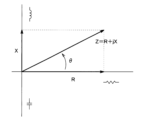
- FIG. 3 is a diagram for explaining the complex impedance Z
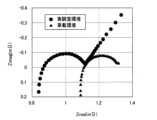
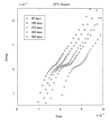
- FIG. 4 is a diagram showing a Nyquist plot of the complex impedance Z of a secondary battery in a laboratory environment and an in-vehicle environment
- FIG. 5 is a diagram showing the real component Zreal of the Nyquist plot shown in FIG.
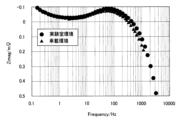
- FIG. 6 is a diagram showing the reactance component Zimag in the Nyquist plot shown in FIG.
- FIG. 1 is a diagram showing the configuration of a secondary battery state detection device according to one embodiment
- FIG. 2 is a diagram for explaining the contents of model construction and SOH estimation
- FIG. 3 is a diagram for explaining the complex impedance Z
- FIG. 4 is a diagram showing a Nyquist plot of the complex impedance Z of a secondary battery in a laboratory environment and an in-
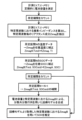
- FIG. 7 is a diagram showing a method of estimating the SOH of a secondary battery
- FIG. 8 is a diagram showing the results of measuring the relationship between each frequency and the reactance component Zimag for each temperature.
- FIG. 9 is a diagram showing a Nyquist plot before interpolating the data of the reactance component ZimagB
- FIG. 10 is a diagram showing a Nyquist plot after interpolating the data of the reactance component ZimagB
- FIG. 11 is a diagram showing an example in which each function of the secondary battery state detection device is arranged inside the mobility
- FIG. 12 is a diagram showing an example in which each function of the secondary battery state detection device is arranged inside and outside the mobility
- FIG. 13 is a diagram showing an example in which each function of the secondary battery state detection device is arranged inside and outside the mobility
- FIG. 14 is a diagram showing an example in which each function of the secondary battery state detection device is arranged outside the mobility
- FIG. 15 is a diagram showing an example in which each function of the secondary battery state detection device is arranged outside the mobility
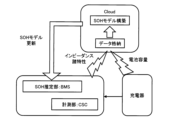
- FIG. 16 is a diagram for explaining updating of the SOH estimation model in the second embodiment
- FIG. 17 is a diagram showing input data of learning data and estimation accuracy of SOH in the third embodiment.
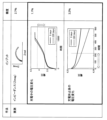
- FIG. 18 is a diagram showing the contents of updating input/output restriction parameters in the fourth embodiment.
- FIG. 19 is a diagram showing an example of charge/discharge control in the fourth embodiment
- FIG. 20 is a diagram showing an example of charge/discharge control in the fourth embodiment
- FIG. 21 is a diagram showing the variable usable capacity of the secondary battery in FIG.
- FIG. 22 is a diagram for explaining details of authentication in the fourth embodiment.
- a secondary battery state detection device is a device that estimates SOH indicating the degree of deterioration of a secondary battery. Also, the secondary battery state detection method is a method of estimating SOH indicating the degree of deterioration of the secondary battery.
- the secondary battery state detection device is provided for the secondary battery 10 .
- the secondary battery 10 constitutes a battery module in which a plurality of battery cells are connected in series. Each individual battery cell is, for example, a lithium ion secondary battery.
- the secondary battery 10 constitutes a power source of an electric vehicle such as an electric vehicle or a hybrid vehicle. Note that the battery module also includes a configuration in which each battery cell is connected in parallel.
- the secondary battery state detection device has a function of constructing an SOH estimation model for estimating the SOH of the secondary battery 10 and a function of calculating the SOH using the SOH estimation model.
- building the model a measured value of the battery capacity of the secondary battery 10 and a measured value of the impedance of the secondary battery 10 are used as learning data.
- SOH estimation SOH is calculated by performing calculations based on measured values and conditions for an SOH estimation model obtained by model building.
- the measured value is the imaginary part Zimag of the impedance of the secondary battery 10 .
- the conditions are the temperature T of the secondary battery 10, the SOC, and the specific frequency f.
- the secondary battery state detection device includes a measurement unit 20, an impedance generator 30, a specific frequency calculation unit 40, a storage unit 50, an SOC calculation unit 60, a calculation unit 70, an SOH model construction unit 75, It includes an SOH estimation unit 80 and an output unit 85 .
- the measurement unit 20 acquires the temperature, current, and voltage of the secondary battery 10 as information indicating the battery state of the secondary battery 10 .
- Measurement unit 20 includes temperature sensor 21 , current sensor 22 , voltage sensor 23 , temperature acquisition unit 24 , current value acquisition unit 25 , and voltage value acquisition unit 26 .
- the temperature sensor 21 measures the temperature of the secondary battery 10 .
- a temperature sensor 21 is installed in the secondary battery 10 .
- Current sensor 22 measures the current value of secondary battery 10 .
- Current sensor 22 is connected to secondary battery 10 .
- Voltage sensor 23 measures the voltage value of secondary battery 10 .
- Voltage sensor 23 is connected to secondary battery 10 .
- Each sensor 21-23 outputs a detection signal to each acquisition unit 24-26 at any time.
- the temperature acquisition unit 24, the current value acquisition unit 25, and the voltage value acquisition unit 26 are data acquisition units for periodically acquiring each data of the temperature, current value, and voltage value of the secondary battery 10.
- the temperature acquisition unit 24 periodically acquires information on the temperature T of the secondary battery 10 measured by the temperature sensor 21 .
- the temperature of the secondary battery 10 is information indicating a battery state that is highly correlated with SOH.
- the temperature obtaining unit 24 calculates the temperature T from the temperature distribution of the secondary battery 10 obtained during a certain period of time.
- the temperature T can be an average value calculated from the frequency distribution of the temperature of the secondary battery 10 acquired over a certain period of time.
- the temperature acquisition unit 24 outputs information on the temperature T of the secondary battery 10 to the calculation unit 70 .
- the temperature T it is also possible to adopt an average temperature of the secondary battery 10 acquired in a certain period, or the like, in order to reduce the calculation load.
- the current value acquisition unit 25 periodically acquires information on the current I of the secondary battery 10 measured by the current sensor 22 .
- the current value acquiring unit 25 calculates the current I from the current distribution of the secondary battery 10 acquired during a certain period of time.
- the current I can be an average value calculated from the frequency distribution of the current of the secondary battery 10 acquired over a certain period of time.
- the current value acquisition unit 25 outputs information on the current I of the secondary battery 10 to the calculation unit 70 .
- the current I it is also possible to adopt, for example, the average value of the current of the secondary battery 10 acquired during a certain period in order to reduce the calculation load.
- the voltage value acquisition unit 26 periodically acquires information on the voltage V of the secondary battery 10 measured by the voltage sensor 23 .
- the voltage V can be an average value calculated from the frequency distribution of the voltage values of the secondary battery 10 acquired over a certain period of time.
- the voltage value acquisition unit 26 outputs information on the voltage V of the secondary battery 10 to the calculation unit 70 .
- the voltage V it is also possible to adopt the average value of the voltage of the secondary battery 10 acquired in a certain period, etc., in order to reduce the calculation load.
- the measurement unit 20 also obtains information on the temperature T acquired by the temperature acquisition unit 24, information on the current I acquired by the current value acquisition unit 25, information on the voltage V acquired by the voltage value acquisition unit 26, and
- the measurement time t is stored in the storage unit 50 as time-series data.
- the measurement unit 20 measures the battery capacity of the secondary battery 10 based on the DC current.
- the measurement unit 20 measures the battery capacity of the secondary battery 10 by integrating the DC current charged during the period from when the measurement is started to when the secondary battery 10 reaches a fully charged state.
- the measurement unit 20 is used to acquire information indicating the battery state of the secondary battery 10 during SOH estimation.
- the measurement unit 20 may be used to acquire information indicating the battery state of the secondary battery 10 during model building.
- the impedance generator 30 is a device that acquires the impedance of the secondary battery 10 by electrochemical impedance spectroscopy (EIS). Impedance is a physical quantity that changes according to the degree of deterioration of secondary battery 10 .
- the impedance data EIS is sensing data measured by the impedance generator 30 .
- the impedance generator 30 has a superimposed current applying section 31 and an impedance measuring section 32 .
- the superimposed current application unit 31 applies to the secondary battery 10 a superimposed current in which a plurality of frequency components are superimposed. By using the superimposed current, it is possible to collectively acquire the battery voltage when currents of a plurality of frequencies are applied to the secondary battery 10 .
- multiple sine waves can be adopted as the superimposed current.
- a rectangular wave, a sawtooth wave, or a triangular wave can also be used as the superimposed current.
- the current value of the harmonics of the fundamental frequency as the superimposed frequency is greatly reduced as the order increases, whereas the multiple sinusoidal wave does not reduce the current value. Therefore, by adopting multiple sine waves as the superimposed current, high measurement accuracy can be maintained.
- the frequency to be superimposed is not particularly limited and can be set arbitrarily.
- the impedance measurement unit 32 acquires the current value of the superimposed current applied to the secondary battery 10 by the superimposed current application unit 31 . Also, the impedance measurement unit 32 acquires the response voltage when the superimposed current is applied to the secondary battery 10 . Therefore, after measuring the response voltage corresponding to the alternating current applied to the secondary battery 10, the impedance is calculated by dividing the response voltage by the alternating current as a complex number having information on the absolute value and phase. is the complex impedance that
- R is the real part of the complex impedance Z and is the resistance component.
- X is the imaginary part of the complex impedance Z and is the reactance component Zimag.
- ⁇ is the phase between the real part and the imaginary part.
- the impedance measurement unit 32 uses discrete Fourier transform to calculate the complex impedance Z of the secondary battery 10 for each of a plurality of frequency components.
- Detected values of the current sensor 22 and the voltage sensor 23 can be used as the current value and the voltage value when the superimposed current is applied.
- a fast discrete Fourier transform (FFT) can be employed as the discrete Fourier transform.
- the impedance generator 30 outputs the impedance data EIS of the calculated complex impedance Z for each of the plurality of frequency components to the calculator 70 .
- the impedance generator 30 may store the impedance data EIS in the storage unit 50 .
- the impedance generator 30 can be configured using, for example, a power conversion device that configures a vehicle-mounted power control unit. This eliminates the need to separately provide the impedance generator 30 including the superimposed current generator. Also, a large superimposed current can be generated. Therefore, it is possible to provide an apparatus configuration suitable for on-board diagnosis of the secondary battery 10 for in-vehicle use. Alternatively, it is also possible to adopt a configuration in which the superimposed current generator is arranged in a vehicle-mounted charging device (not shown) or an external charging device.
- the specific frequency calculation unit 40 is a device for obtaining in advance information on a specific frequency necessary for estimating the SOH of the secondary battery 10 by electrochemical impedance spectroscopy.
- the specific frequency calculator 40 may or may not be mounted on the vehicle.
- the specific frequency is a frequency determined by machine learning using previously acquired impedance data EIS of the secondary battery 10 . Moreover, the specific frequency is a frequency that has a large influence on the SOH of the secondary battery 10 .
- the degree of influence of the secondary battery 10 on the SOH corresponds to the strength of the correlation between the imaginary component Zimage of the complex impedance and the SOH. That is, the complex impedance reactance component Zimag and the specific frequency calculated based on the alternating current of the specific frequency that is highly correlated with the SOH of the secondary battery 10 indicate the battery state that is highly correlated with the SOH of the secondary battery 10. Information.
- the specific frequency is, for example, a specific frequency within a range of frequencies greater than 1 Hz, preferably greater than 10 Hz.
- the configuration of the secondary battery 10 differs depending on the electric vehicle in which it is mounted. Therefore, the characteristics of the secondary battery 10 differ depending on the vehicle type, for example. Therefore, the specific frequency differs depending on the configuration of secondary battery 10 .
- the specific frequency calculator 40 is used to obtain a specific frequency corresponding to the secondary battery 10 mounted on the electric vehicle. A method of obtaining the specific frequency will be described later.
- Specific frequencies are limited in advance by a dimensionality reduction method. Specifically, a secondary battery having the same configuration as the secondary battery 10 shown in FIG. 1 is prepared and the specific frequency is determined.
- the secondary battery 10 is deteriorated in advance under various conditions.
- Degradation conditions include, for example, storage with different temperatures or SOCs, or repeated charging and discharging with different temperatures or SOCs.
- the transition of SOH until the end of the life of the secondary battery 10 and the reactance component Zimag of the complex impedance Z are acquired as data.
- the correlation between the reactance component Zimag of the complex impedance Z and the SOH and the frequency in a certain range can be obtained.
- the above machine learning leads to the combination of the number of dimensions and the specific frequency.
- the specific frequency is determined as two frequencies.
- three frequencies are determined for the three-dimensional case.
- a plurality of frequencies are similarly determined in the case of four dimensions, five dimensions, and the like.
- the storage unit 50 is, for example, a rewritable non-volatile memory.
- the storage unit 50 stores programs for controlling the measurement unit 20 , the impedance generator 30 , the SOC calculation unit 60 , the calculation unit 70 and the SOH estimation unit 80 .
- the storage unit 50 stores the measurement result of the measurement unit 20 , the calculation result of the SOC calculation unit 60 , and the calculation result of the calculation unit 70 . These pieces of information are used as learning data for the SOH estimator 80 .
- the storage unit 50 stores the SOH estimation model acquired by the SOH model construction unit 75 .
- the SOH estimation model is used when the SOH estimation unit 80 calculates the SOH during SOH estimation.
- the storage unit 50 stores information on a plurality of specific frequencies in the range of frequencies used in electrochemical impedance spectroscopy measurement in the impedance generator 30 .
- Information on a plurality of specific frequencies is input in advance from the specific frequency calculator 40 .
- the SOC calculation unit 60 calculates the charging rate indicating the remaining battery level of the secondary battery 10 as information indicating the battery state of the secondary battery 10 .
- the charging rate of the secondary battery 10 is expressed as a percentage of the remaining capacity to the full charge capacity of the secondary battery 10 .
- the charging rate of the secondary battery 10 is SOC (State Of Charge).
- SOC of the secondary battery 10 is information indicating a battery state highly correlated with the SOH.
- the SOC calculation unit 60 calculates the integrated value of the current values of the secondary battery 10 acquired by the current value acquisition unit 25, and calculates the charging rate of the secondary battery 10 based on the integrated value.
- Information on the SOC calculated by the SOC calculation unit 60 is stored in the storage unit 50 and output to the calculation unit 70 .
- the SOC calculation unit 60 may be configured as part of the measurement unit 20 and the calculation unit 70 .
- the SOC calculator 60 may be used to obtain the SOC during model construction.
- the calculation unit 70 calculates the reactance component Zimag of the complex impedance Z based on the alternating current of the specific frequency applied to the secondary battery 10 as information indicating the battery state of the secondary battery 10 . That is, the calculation unit 70 acquires the reactance component Zimag of the complex impedance Z when the secondary battery 10 is supplied with an alternating current corresponding to a specific frequency. When there are four specific frequencies, the calculator 70 obtains four reactance components Zimag(x1, x2, x3, x4).
- the calculation unit 70 converts the reactance component Zimag to a predetermined temperature and a predetermined A calculated value corresponding to the SOC is calculated.
- the calculated value Zimag (x1, x2, x3, x4) is the temperature and SOC of the secondary battery 10 at the time of observation and the reactance component Zimag (x01, x02, x03, x04) which is the observed value. , to a given temperature and a given SOC.
- the predetermined temperature is, for example, 25°C.
- a predetermined SOC is, for example, 50%. This makes it possible to estimate the SOH independent of the environment in which the secondary battery 10 is placed and the state of the secondary battery 10 . Also, it is possible to reduce model errors due to correction of temperature and SOC.
- the relationship between the reactance component Zimag at each frequency of the secondary battery 10 obtained in advance and the temperature of the secondary battery 10 is represented by a linear model.
- the relationship between the reactance component Zimag at each frequency of the secondary battery 10 obtained in advance and the SOC of the secondary battery 10 is represented by a linear model. Therefore, the calculation unit 70 calculates the reactance component Zimag, which is a calculated value, based on a linear model of the reactance component Zimag at each frequency of the secondary battery 10 obtained in advance and the temperature and SOC of the secondary battery 10. .
- the calculation unit 70 may be used to acquire the reactance component Zimag when constructing the model.
- the SOH model construction unit 75 learns an SOH estimation model for estimating SOH.
- the SOH model construction unit 75 uses SOH information of the secondary battery 10 and information indicating a battery state highly correlated with the SOH as learning data.
- the SOH model construction unit 75 outputs SOH information of the secondary battery 10 and inputs information indicating a battery state highly correlated with SOH, and synthesizes a regression model using a variance-covariance matrix. , construct the SOH estimation model.
- the SOH model construction unit 75 outputs the learned SOH estimation model to the storage unit 50 .
- the SOH information is the battery capacity of the secondary battery 10 measured based on the current. Battery capacity is measured by the measuring unit 20 or another measuring device. Information indicating the battery state that is highly correlated with SOH is the reactance component Zimag of the complex impedance calculated based on the alternating current of the specific frequency. The reactance component Zimag is measured by the measurement unit 20 and the calculation unit 70 or other measurement equipment.
- the complex impedance Z of the secondary battery 10 is expressed as a Nyquist plot with the real component Zreal on the horizontal axis and the reactance component Zimag on the vertical axis.
- Complex impedance plots are different between a laboratory environment in which the secondary battery 10 is placed in a laboratory and an in-vehicle environment in which the secondary battery 10 is mounted in a vehicle.
- the real component Zreal in the vehicle environment is smaller than the real component Zreal in the laboratory environment by about 0.2 m ⁇ . This is because the contact resistance between the cells of the secondary battery 10, the current collection resistance inside the cells, and the like have an effect.
- the reactance component Zimag of the complex impedance Z as shown in FIG. 6, the difference between the reactance component Zimag in the in-vehicle environment and the reactance component Zimag in the laboratory environment is small. This means that the reactance component Zimag does not affect the measurement environment of the secondary battery 10 . Therefore, in order to estimate the SOH of the secondary battery 10, the reactance component Zimag of the complex impedance Z is used as a feature quantity.
- Equation (1) n is the number of samples and m is the number of explanatory variables. Also, y (n) corresponds to the estimated SOH. xn (n) corresponds to the reactance component Zimag at any particular frequency. Note that L and M do not have values.
- the mean of the normal distribution of y (i) is m i
- the variance of the normal distribution of y (i) is ⁇ yi 2
- the normal distribution of y (i) is Let ⁇ yi,j 2 be the covariance of y (j) with the normal distribution.
- ⁇ yi is the same as ⁇ yi,i . Accordingly, the average vector m is represented by the following equation (2).
- Equation (3) the variance-covariance matrix ⁇ is represented by Equation (3) below.
- the variance-covariance matrix ⁇ is expressed using the reactance component Zimag.
- the covariance ⁇ yi,j 2 is represented by the following equation (6) using the kernel function K.
- the kernel function K is represented by the following equation (7).
- kernel function K the following (8) may be used.
- kernel function K the following (9) may be used.
- Each kernel function K shown in equations (7) to (9) is an example, and other equations may be used. It is desirable to adopt the kernel function K that maximizes the SOH estimation accuracy.
- the reactance component Zimag is expressed using the kernel function K in the variance-covariance matrix ⁇ .
- the relationship between the n samples of X from the fourth step and the n+1th sample of X is determined, and the n y values are used to determine the n+1th y, or SOH We limit the estimated value of
- the SOH estimating unit 80 may detect that there is a certain time interval or more from the previous acquisition of the reactance component Zimag to the current acquisition of the reactance component Zimag. , interpolate the data between As a result, the number of data on the reactance component Zimag increases, so the accuracy of estimating the SOH of the secondary battery 10 improves.
- the SOH estimation unit 80 uses information indicating the battery state of the secondary battery 10 and the SOH estimation model stored in the storage unit 50 to calculate the SOH. Specifically, the SOH estimation unit 80 combines the SOH estimation model stored in the storage unit 50 with the reactance component Zimag, the specific frequency, the SOC, and the temperature acquired by the measurement unit 20, the SOC calculation unit 60, and the calculation unit 70. is used to estimate the SOH of the secondary battery 10 . The SOH estimation unit 80 outputs the calculation result of SOH to the output unit 85 .
- the output unit 85 outputs the SOH estimation result obtained by the SOH estimation unit 80 .
- the output unit 85 is, for example, a screen of a user's personal digital assistant, a navigation panel or a meter panel of an electric vehicle.
- the measurement unit 20, the impedance generation device 30, the SOC calculation unit 60, the calculation unit 70, the SOH model construction unit 75, the storage unit 50, the SOH estimation unit 80, and the output unit 85 are independent of each other. consists of That is, the measurement unit 20, the impedance generator 30, the SOC calculation unit 60, the calculation unit 70, the SOH model construction unit 75, the storage unit 50, the SOH estimation unit 80, and the output unit 85 are configured as dedicated modules.
- the measurement unit 20 and the impedance generator 30 can be mounted on an electric vehicle, and the SOC calculation unit 60, the calculation unit 70, the storage unit 50, and the SOH estimation unit 80 can be arranged in the cloud.
- the SOC calculation unit 60, the calculation unit 70, the storage unit 50, and the SOH estimation unit 80 can be arranged in the cloud.
- which module is placed where can be set as appropriate. Since each module is independent in this way, battery diagnosis can be performed without updating the model each time.
- the impedance generator 30 may be included in the measurement unit 20.
- the SOC calculation unit 60 may be included in the measurement unit 20 or may be included in the calculation unit 70 .
- the SOC calculation section 60 and the calculation section 70 may be included in the measurement section 20 .
- the SOC calculator 60 and the calculator 70 may be included in the SOH estimator 80 .
- the learning of the SOH estimation model is performed by acquiring the measured values of the secondary battery 10 as learning data, as shown in the upper part of FIG. 2 .
- SOH model construction is performed in a laboratory or the like before the secondary battery state detection device is applied to an electric vehicle.
- the measurement unit 20 measures the current I, voltage V, temperature T, and measurement time of these as information indicating the battery state of the secondary battery 10. Each t is measured and stored in the storage unit 50 .
- the measurement unit 20 periodically measures the battery capacity as SOH information.
- the secondary battery 10 is deteriorated at various deterioration levels. Thereby, the battery capacity at each deterioration level can be obtained.
- the battery capacity measured by the measurement unit 20 is used as an answer to the estimated SOH matching, that is, as an output of a regression model using the variance-covariance matrix ⁇ .
- a predetermined period is counted.
- the predetermined period is a relatively long period of time, such as half a year or one year.
- the measurement unit 20 measures the current I, the voltage V, the temperature T, and the measurement time t of these as information indicating the battery state of the secondary battery 10 , and stores them in the storage unit 50 . Further, the calculation unit 70 calculates the complex impedance Z at the specific frequency, and extracts the reactance component Zimag for each specific frequency as information indicating the battery state of the secondary battery 10 . Thereby, the reactance component Zimag under each condition at each deterioration level can be acquired.
- the reactance component Zimag is information indicating a battery state highly correlated with SOH among the information indicating the battery state of the secondary battery 10 .
- the reactance component Zimag in the predetermined section N is corrected to a reactance component Zimag corresponding to an arbitrary temperature using the temperature conversion model.
- the predetermined interval N is, for example, time such as one day or one week.
- the reactance component Zimag is calculated to a calculated value corresponding to a predetermined temperature. Therefore, as shown in FIG. 8, the relationship between the reactance component Zimag at each frequency of the secondary battery 10 and the temperature of the secondary battery 10 is obtained in advance.
- a calculated value is calculated based on a linear regression model of the reactance component Zimag at each frequency of the secondary battery 10 obtained in advance and the temperature of the secondary battery 10 . That is, the reactance component Zimag is corrected to a value ZimagA (Tstd) corresponding to an arbitrary temperature based on the linear function relationship between the temperature of the secondary battery 10 at the time of observation and the reactance component Zimag, which is an observed value.
- An arbitrary temperature is, for example, 25°C.
- the reactance component Zimag is converted to a predetermined SOC. is calculated to a calculated value ZimagB (Tstd, SOCstd) corresponding to .
- the model error can be reduced.
- reactance component ZimagB(Tstd, SOCstd) corresponding to arbitrary temperature and arbitrary SOC is used.
- the predetermined period is counted. That is, in the sixth step, how much time has passed since the reactance component ZimagB was obtained last time is counted. For example, the number of days since the previous reactance component ZimagB was obtained is counted. This is because when the number of data of the reactance component ZimagB is small, the number of data is interpolated in the seventh step.
- the reactance component ZimagB is interpolated when the number of days from the predetermined section N to N+1 is open in the predetermined period counted in the sixth step. That is, when there is a certain time interval or more from the acquisition of the previous reactance component ZimagB to the acquisition of the current reactance component ZimagB, the previously acquired reactance component ZimagB is used to obtain the previous reactance component ZimagB and the current reactance component ZimagB. Interpolate between ZimagB. That is, the number of data for the reactance component ZimagB is increased.
- the predetermined number of days is, for example, 50 days or 100 days. The predetermined number of days may be appropriately set according to the desired number of data.
- the reactance component ZimagB is obtained on the 90th, 180th, 270th, 330th, and 420th days. Then, the reactance component ZimagB between 90 days and 180 days is interpolated using the reactance component ZimagB in the time series before and after. Similarly, the data of the reactance component ZimagB is interpolated for other sections. Data interpolation is done by a linear regression model. Since the number of data of the reactance component ZimagB increases, the SOH estimation accuracy improves.
- a regression model using the variance-covariance matrix ⁇ is based on Gaussian Process Regression (GPR), which is a machine learning technique.
- the SOH of the secondary battery 10 is estimated using the reactance component ZimagB at the specific frequency obtained from the regression model in the eighth step.
- the SOH of the secondary battery 10 is estimated based on the data of the reactance component ZimagB acquired up to the fifth step.
- the SOH of the secondary battery 10 is estimated based on the interpolated data.
- the SOH estimation model is constructed as described above. After that, the SOH estimation model is stored in the storage unit 50 .
- the resistance of the secondary battery 10 measured based on the current may be used. Resistance includes static resistance and dynamic resistance. Either static resistance or dynamic resistance may be used as resistance as output data.
- the SOH estimation method using the SOH estimation model will be explained.
- the SOH can be calculated by inputting information indicating the battery state of the secondary battery 10 into the relational expression of the SOH estimation model. That is, the SOH estimation unit 80 estimates the SOH of the secondary battery 10 by inputting information indicating the current battery state of the secondary battery 10 into the SOH estimation model.
- the SOH estimator 80 uses, as the current measured value, the measured value of the reactance component Zimag of the complex impedance calculated based on the AC current of a specific frequency that is highly correlated with the SOH of the secondary battery 10 .
- the SOH estimator 80 uses the specific frequency f, SOC, and temperature T as conditions.
- the SOH estimating unit 80 Based on the temperature and SOC of the secondary battery 10 when the reactance component Zimag is obtained, the SOH estimating unit 80 converts the reactance component Zimag into a calculated value corresponding to a predetermined temperature and a predetermined SOC. 70 may be obtained.
- the SOH estimator 80 may calculate the SOH by inputting the data of the reference SOC and the reactance component ZimagB of the reference temperature into the relational expression of the SOH estimation model. Accordingly, it is possible to calculate SOH that is not affected by SOC and temperature.
- the SOH estimation unit 80 outputs the estimated SOH to the output unit 85.
- the output unit 85 notifies the user of the acquired SOH, and uses it for charge/discharge control of the secondary battery 10 and the like.
- the reactance component Zimag of the complex impedance Z is calculated based on the AC current at a specific frequency, not on all frequencies within a certain range. Therefore, the calculation time can be shortened compared to calculating the reactance component Zimag corresponding to all frequencies within a certain range.
- SOH can be calculated by inputting information indicating the battery state of the secondary battery to the SOH estimation model. Therefore, the SOH diagnosis time of the secondary battery 10 can be shortened.
- a nonlinear model using a variance-covariance matrix ⁇ is used to estimate the SOH of the secondary battery 10 . Therefore, the accuracy of estimating the state of deterioration of the secondary battery 10 can be improved more than the monotonous linear model. Therefore, the SOH of the secondary battery 10 can be estimated with high accuracy.
- each function of the secondary battery state detection device is configured independently. That is, each function can be appropriately arranged according to the object to which the secondary battery state detection device is applied.
- the SOH model construction unit 75 may be provided outside mobility such as an electric vehicle. Specific examples are shown in FIGS. 11 to 15. FIG. Note that the specific frequency calculation unit 40 may also be provided outside mobility such as an electric vehicle.
- each function excluding the SOH model construction unit 75 may be housed inside the mobility.
- the measurement unit and the SOH model storage/calculation unit are accommodated in the secondary battery 10 package.
- the measurement unit is a cell supervisory circuit (CSC) and corresponds to the measurement unit 20 and the impedance generator 30, for example.
- the SOH model storage/calculation unit is a battery management system (BMS) and corresponds to the SOC calculation unit 60, the calculation unit 70, the storage unit 50, and the SOH estimation unit 80, for example.
- the SOC calculation unit 60 and the calculation unit 70 may be arranged in the CSC or may be arranged in the BMS.
- the output unit 85 may be included in the BMS, or may be provided in the package of the secondary battery 10 .
- each function of the secondary battery state detection device may be provided inside and outside the mobility.
- the measurement unit is configured as a CSC or BMS and placed in mobility.
- the SOH model storage/computation unit is located in the cloud.
- the output unit 85 is arranged in a PC, a tablet, a mobile information terminal, or the like.
- the calculation results of SOH are provided to users and businesses through API services. This enables the user to know the remaining battery level and the travelable range with high accuracy. Operators will be able to perform remote monitoring and highly efficient operations.
- an electric vehicle that is mobility is charged at a charger or a charging station.
- the SOH model storage/calculation unit is placed in the charger or charging station.
- the SOH model storage/computation unit may be located in the cloud.
- each function of the secondary battery state detection device may be provided outside the mobility.
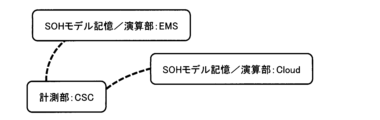
- the example of FIG. 14 is a case where the secondary battery 10 is separated from mobility, for example, at a repair shop or a factory that recycles collected batteries.
- the measuring section CSC
- the SOH model storage/calculation unit is configured as an energy management system (EMS).
- EMS energy management system
- the SOH model storage/computation unit may be located in the cloud.
- the output unit 85 may be provided in the measurement unit 20 or may be arranged in another electronic device.
- the example of FIG. 15 is a case where the secondary battery state detection device is applied to a rapid charging system.
- the rapid charging system controls the storage of power from solar power generation and electric wires in a large power storage facility by means of an integrated control facility, and charges the secondary battery 10 of mobility with the power via a power cabinet and a charging stand.
- the measurement unit is provided at the charging station.
- the SOH model storage/calculation unit corresponds to, for example, the storage unit 50, the SOC calculation unit 60, and the calculation unit 70, and is arranged in the cloud.
- the SOH estimator 80 is provided in the EMS.
- the SOH estimator 80 may be provided in the cloud.
- the output unit 85 is provided in the mobility or the user's electronic device.
- the output unit 85 may be provided in the EMS.
- the measurement unit 20, the impedance generator 30, the SOC calculation unit 60, and the calculation unit 70 of this embodiment correspond to the "detection unit”.
- the SOH model construction unit 75 corresponds to the "learning unit”.
- the SOH estimator 80 corresponds to the "calculator”.
- means executed by the measurement unit 20, the impedance generator 30, the SOC calculation unit 60, and the calculation unit 70 correspond to the "first step”.
- the means executed by the impedance generator 30, the SOC calculator 60, and the calculator 70 correspond to the "second step”.
- the means executed by the SOH model construction unit 75 corresponds to the "third step”.
- the means executed by the SOH estimator 80 corresponds to the "fourth step”.
- the market data is data that is accumulated as the secondary battery 10 is actually used. That is, the market data is data on measured impedance characteristics and battery capacity when the secondary battery 10 is in use.
- the measured impedance characteristics include data of complex impedance reactance component Zimag, specific frequency, temperature, and SOC.
- the battery capacity data may be calculated values using a model, etc., as well as actual measurement values using a charger.
- data on various impedance characteristics and battery capacity obtained in a laboratory or the like may be used as learning data. In this case, n-increment evaluation or the like may be adopted.
- Data obtained in a laboratory or the like is also data obtained by actually using the secondary battery 10 . Resistance data may be used instead of battery capacity data.
- the battery capacity is actually measured based on the amount of charge in the charger.
- Battery capacity data is transmitted from the charger to the cloud and stored in the cloud.
- each data of various impedance characteristics is transmitted to the cloud from the measuring unit (CSC) and the SOH estimating unit 80 (BMS) mounted on the electric vehicle and stored in the cloud.
- CSC measuring unit
- BMS SOH estimating unit 80
- the SOH model construction unit 75 reconstructs the SOH estimation model based on each data of impedance characteristics and battery capacity. By storing the reconstructed SOH estimation model in the storage unit 50, the SOH estimation model in the storage unit 50 is updated to the latest model. Since the storage unit 50 is independent of each component, the latest SOH estimation model can be used in the electric vehicle by replacing the storage unit 50 of the electric vehicle.
- the SOH estimation model stored in the storage unit 50 may be updated using communication such as OTA (Over the Air).
- OTA Over the Air
- the voltage during charging rises over time. Also, the charging voltage curve varies depending on the deterioration of the secondary battery 10 . Therefore, the charging time, voltage, and temperature between predetermined voltages during charging of the secondary battery 10 can be used as input data for learning data. These data are information indicating battery states that are highly correlated with SOH.
- the voltage after the suspension of charging decreases over time. Also, the voltage relaxation curve differs depending on the deterioration of the secondary battery 10 . Therefore, the rest time, voltage, and temperature in the predetermined rest time after charging of the secondary battery 10 can be used as input data for learning data. These data are information indicating battery states that are highly correlated with SOH.
- the estimation accuracy of SOH is 2.7% error in the case of impedance, 1.1% error in the case of voltage change during charging, and 1.1% error in the case of voltage change during charging.
- the error was 3.2% for the voltage change after rest. There was no difference in error for each input data. Therefore, any data may be used as information indicating a battery state highly correlated with SOH.
- the battery control parameters of the secondary battery 10 can be updated based on the SOH estimation result.
- battery control it can be used for charging control, for example.
- Win The input (Win) and output (Wout) of the secondary battery 10 are controlled by numerical values shown on the temperature and SOC maps. Each numerical value is set to a small value in advance in consideration of deterioration of the secondary battery 10 .
- Input/output limit parameters are stored, for example, in the BMU.
- the BMU input/output restriction parameter can be updated based on the SOH estimation result. Specifically, each numerical value of the temperature and SOC maps is updated to a value higher than the initial value.
- the input/output limit of the secondary battery 10 may be updated according to the variation of SOH and impedance (resistance).
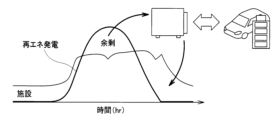
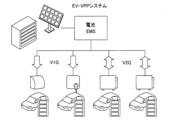
- EV-VPP Virtual Power Plant
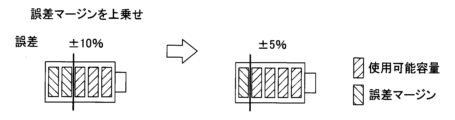
- the SOH error was, for example, ⁇ 10%.
- the usable amount of the secondary battery 10 can be varied according to the SOH estimation result. For example, the SOH error of the secondary battery 10 is reduced to ⁇ 5%, for example. In this way, the error margin of the secondary battery 10 can be minimized and the usable capacity can be increased.
- charging and discharging of the secondary battery 10 can be managed in the battery EMS.
- a V1G system that allows charging and a V2G system that allows charging and discharging are used.
- the usable capacity of the secondary battery 10 is increased, so the high efficiency region of the charger/discharger can be utilized. Therefore, the power of the secondary battery 10 can be used efficiently.
- the SOH estimation result of the secondary battery 10 can be used for the secondary battery 10 separated from the device or facility in which the secondary battery 10 is used.
- the secondary battery 10 is, for example, a replacement battery for an electric vehicle.
- an electric vehicle when a new car is sold, an electric vehicle can be priced without a battery, and the insurance interest rate can be changed according to the subsequent SOH estimation result.
- the replacement battery replacement work it is possible to perform partial maintenance on the secondary battery 10 instead of the entire secondary battery 10 according to the SOH estimation result.
- the secondary usage destination When reusing the secondary battery 10, the secondary usage destination can be determined according to the SOH estimation result.
- the replacement time of the secondary battery 10 it can be replaced in a short time because it has already been charged.
- the charging time and battery pack can be selected according to the intended use of the secondary battery 10 .
- a battery pack is a secondary battery 10 .
- the exchange can be made at a convenience store or the like.
- the combination of battery packs can be determined according to the SOH error. In used car sales, the need for battery assessment is eliminated. A residual value can be determined based on the SOH estimation results.
- the SOH estimation result of the secondary battery 10 can be used for battery pack authentication. As shown in FIG. 22, the input and output data for estimating SOH are combined and used for battery pack/vehicle authentication.
- the deterioration history of the secondary battery 10 is encrypted and used. Even if the calculated SOH values are the same, the deterioration histories are different, so it is possible to determine that they are different battery packs.
- the example shown in FIG. 22 is the case of using the complex impedance reactance component Zimag.
- the history of deterioration of the secondary battery 10 can also be used for authentication.
- the secondary battery 10 is not limited to being mounted on an electric vehicle, and may be installed at a predetermined location.
- the SOH of the secondary battery 10 is not limited to the SOH of the entire secondary battery 10 , and may be the SOH of a single battery cell constituting the secondary battery 10 or a plurality of SOHs.
- the SOH model construction unit 75 may be configured independently as a learning unit that constructs an SOH estimation model for estimating the SOH.
- the secondary battery state detection device can be system-linked for storage, calculation, and estimation via a server or the like. That is, in the secondary battery state detection device, each component may be distributed.
- the secondary battery state detection device may have a configuration that is completed within one device by arranging other components around the secondary battery 10 .
- the secondary battery 10 can be reused. Therefore, when reuse of the secondary battery 10 is taken into consideration, components other than the secondary battery 10 may be functionally arranged with respect to the secondary battery 10 to be reused. That is, the secondary battery state detection device may be configured by reconstructing the reused secondary battery 10 and other components such as the SOH estimating unit 80 . In this case, as described above, the secondary battery state detection device may be configured to cooperate with the system, or may be configured to be completed within one device.
Landscapes
- Physics & Mathematics (AREA)
- General Physics & Mathematics (AREA)
- Engineering & Computer Science (AREA)
- Manufacturing & Machinery (AREA)
- Chemical & Material Sciences (AREA)
- Chemical Kinetics & Catalysis (AREA)
- Electrochemistry (AREA)
- General Chemical & Material Sciences (AREA)
- Power Engineering (AREA)
- Secondary Cells (AREA)
- Tests Of Electric Status Of Batteries (AREA)
Priority Applications (3)
| Application Number | Priority Date | Filing Date | Title |
|---|---|---|---|
| EP22924916.4A EP4478068A4 (en) | 2022-02-07 | 2022-09-26 | SECONDARY BATTERY STATE DETECTION DEVICE, LEARNING UNIT, AND SECONDARY BATTERY STATE DETECTION METHOD |
| JP2023578366A JP7626258B2 (ja) | 2022-02-07 | 2022-09-26 | 二次電池状態検出装置、学習部、二次電池状態検出方法 |
| US18/788,857 US20240385250A1 (en) | 2022-02-07 | 2024-07-30 | Secondary battery state detection device, learning unit, and secondary battery state detection method |
Applications Claiming Priority (2)
| Application Number | Priority Date | Filing Date | Title |
|---|---|---|---|
| JP2022-016957 | 2022-02-07 | ||
| JP2022016957 | 2022-02-07 |
Related Child Applications (1)
| Application Number | Title | Priority Date | Filing Date |
|---|---|---|---|
| US18/788,857 Continuation US20240385250A1 (en) | 2022-02-07 | 2024-07-30 | Secondary battery state detection device, learning unit, and secondary battery state detection method |
Publications (1)
| Publication Number | Publication Date |
|---|---|
| WO2023149011A1 true WO2023149011A1 (ja) | 2023-08-10 |
Family
ID=87552015
Family Applications (1)
| Application Number | Title | Priority Date | Filing Date |
|---|---|---|---|
| PCT/JP2022/035710 Ceased WO2023149011A1 (ja) | 2022-02-07 | 2022-09-26 | 二次電池状態検出装置、学習部、二次電池状態検出方法 |
Country Status (4)
| Country | Link |
|---|---|
| US (1) | US20240385250A1 (https=) |
| EP (1) | EP4478068A4 (https=) |
| JP (1) | JP7626258B2 (https=) |
| WO (1) | WO2023149011A1 (https=) |
Cited By (1)
| Publication number | Priority date | Publication date | Assignee | Title |
|---|---|---|---|---|
| WO2025121773A1 (ko) * | 2023-12-05 | 2025-06-12 | 주식회사 엘지에너지솔루션 | 배터리 관리 장치 및 배터리 관리 방법 |
Families Citing this family (2)
| Publication number | Priority date | Publication date | Assignee | Title |
|---|---|---|---|---|
| JP7540403B2 (ja) | 2021-06-29 | 2024-08-27 | 株式会社デンソー | 電池測定装置及び電池測定方法 |
| JP7775720B2 (ja) * | 2022-01-20 | 2025-11-26 | 株式会社デンソー | 二次電池システム |
Citations (9)
| Publication number | Priority date | Publication date | Assignee | Title |
|---|---|---|---|---|
| WO2012095913A1 (ja) | 2011-01-14 | 2012-07-19 | パナソニック株式会社 | リチウムイオン二次電池の劣化評価方法、及び電池パック |
| JP2016090346A (ja) * | 2014-10-31 | 2016-05-23 | エンネット株式会社 | 電池診断装置および電池診断方法 |
| JP2019132666A (ja) * | 2018-01-30 | 2019-08-08 | プライムアースEvエナジー株式会社 | 組電池の状態推定装置及び組電池の状態推定方法 |
| WO2019240182A1 (ja) * | 2018-06-13 | 2019-12-19 | 株式会社Gsユアサ | 行動生成装置、蓄電素子評価装置、コンピュータプログラム、学習方法及び評価方法 |
| JP2020101399A (ja) * | 2018-12-20 | 2020-07-02 | トヨタ自動車株式会社 | 電池容量の推定方法および電池容量の推定装置 |
| WO2021044132A1 (en) * | 2019-09-02 | 2021-03-11 | Siemens Plc | Method and system for optimising battery usage |
| WO2021186593A1 (ja) * | 2020-03-17 | 2021-09-23 | 株式会社 東芝 | 蓄電池の状態を評価する情報処理装置、情報処理方法、コンピュータプログラム及び情報処理システム |
| JP2021185354A (ja) * | 2020-05-25 | 2021-12-09 | 株式会社エンビジョンAescジャパン | 劣化推定装置、モデル生成装置、劣化推定方法、モデル生成方法、及びプログラム |
| WO2022080377A1 (ja) * | 2020-10-15 | 2022-04-21 | 昭和電工株式会社 | リチウムイオンバッテリーの寿命予測方法、放電容量維持率予測方法、寿命予測プログラム、放電容量維持率予測プログラム及び情報処理装置 |
Family Cites Families (1)
| Publication number | Priority date | Publication date | Assignee | Title |
|---|---|---|---|---|
| CN109031153B (zh) * | 2018-10-16 | 2020-01-24 | 北京交通大学 | 一种锂离子电池的健康状态在线估计方法 |
-
2022
- 2022-09-26 EP EP22924916.4A patent/EP4478068A4/en active Pending
- 2022-09-26 WO PCT/JP2022/035710 patent/WO2023149011A1/ja not_active Ceased
- 2022-09-26 JP JP2023578366A patent/JP7626258B2/ja active Active
-
2024
- 2024-07-30 US US18/788,857 patent/US20240385250A1/en active Pending
Patent Citations (9)
| Publication number | Priority date | Publication date | Assignee | Title |
|---|---|---|---|---|
| WO2012095913A1 (ja) | 2011-01-14 | 2012-07-19 | パナソニック株式会社 | リチウムイオン二次電池の劣化評価方法、及び電池パック |
| JP2016090346A (ja) * | 2014-10-31 | 2016-05-23 | エンネット株式会社 | 電池診断装置および電池診断方法 |
| JP2019132666A (ja) * | 2018-01-30 | 2019-08-08 | プライムアースEvエナジー株式会社 | 組電池の状態推定装置及び組電池の状態推定方法 |
| WO2019240182A1 (ja) * | 2018-06-13 | 2019-12-19 | 株式会社Gsユアサ | 行動生成装置、蓄電素子評価装置、コンピュータプログラム、学習方法及び評価方法 |
| JP2020101399A (ja) * | 2018-12-20 | 2020-07-02 | トヨタ自動車株式会社 | 電池容量の推定方法および電池容量の推定装置 |
| WO2021044132A1 (en) * | 2019-09-02 | 2021-03-11 | Siemens Plc | Method and system for optimising battery usage |
| WO2021186593A1 (ja) * | 2020-03-17 | 2021-09-23 | 株式会社 東芝 | 蓄電池の状態を評価する情報処理装置、情報処理方法、コンピュータプログラム及び情報処理システム |
| JP2021185354A (ja) * | 2020-05-25 | 2021-12-09 | 株式会社エンビジョンAescジャパン | 劣化推定装置、モデル生成装置、劣化推定方法、モデル生成方法、及びプログラム |
| WO2022080377A1 (ja) * | 2020-10-15 | 2022-04-21 | 昭和電工株式会社 | リチウムイオンバッテリーの寿命予測方法、放電容量維持率予測方法、寿命予測プログラム、放電容量維持率予測プログラム及び情報処理装置 |
Non-Patent Citations (1)
| Title |
|---|
| See also references of EP4478068A4 |
Cited By (1)
| Publication number | Priority date | Publication date | Assignee | Title |
|---|---|---|---|---|
| WO2025121773A1 (ko) * | 2023-12-05 | 2025-06-12 | 주식회사 엘지에너지솔루션 | 배터리 관리 장치 및 배터리 관리 방법 |
Also Published As
| Publication number | Publication date |
|---|---|
| JP7626258B2 (ja) | 2025-02-04 |
| JPWO2023149011A1 (https=) | 2023-08-10 |
| US20240385250A1 (en) | 2024-11-21 |
| EP4478068A1 (en) | 2024-12-18 |
| EP4478068A4 (en) | 2025-06-04 |
Similar Documents
| Publication | Publication Date | Title |
|---|---|---|
| Wang et al. | A state-of-charge and state-of-health joint estimation method of lithium-ion battery based on temperature-dependent extended Kalman filter and deep learning | |
| Ge et al. | State of charge estimation of lithium-ion battery based on improved forgetting factor recursive least squares-extended Kalman filter joint algorithm | |
| JP7289063B2 (ja) | 二次電池の残存性能評価方法、二次電池の残存性能評価プログラム、演算装置、及び残存性能評価システム | |
| Li et al. | Comparative study of the influence of open circuit voltage tests on state of charge online estimation for lithium-ion batteries | |
| WO2023149011A1 (ja) | 二次電池状態検出装置、学習部、二次電池状態検出方法 | |
| Anton et al. | Support vector machines used to estimate the battery state of charge | |
| KR102652848B1 (ko) | 리튬 유황 배터리의 충전 상태 및 건강 상태를 결정하는 방법 및 장치 | |
| KR101227417B1 (ko) | 리튬이온전지의 충전상태 추정방법 및 이 방법을 구현하기 위한 시스템 | |
| JP2013019730A (ja) | バッテリの状態予測システム、方法及びプログラム | |
| EP1859523A1 (en) | Apparatus and method for estimating battery state of charge | |
| US20240272235A1 (en) | Battery diagnostic system | |
| JP2019117180A (ja) | 電池状態推定装置及び電池状態推定方法 | |
| Antaloae et al. | A novel method for the parameterization of a Li-ion cell model for EV/HEV control applications | |
| CN104698382A (zh) | 一种电池组的soc与soh的预测方法 | |
| CN104242393A (zh) | 基于动态soc估算系统的电池管理系统 | |
| JP7812754B2 (ja) | 蓄電池の充放電曲線を用いた経済性推定装置及び経済性推定方法 | |
| CN104577242A (zh) | 一种电池组管理系统和方法 | |
| Selvabharathi et al. | Experimental analysis on battery based health monitoring system for electric vehicle | |
| US20230366939A1 (en) | Diagnosis method of secondary battery, charging and discharging control method, diagnosis apparatus, management system, and non-transitory storage medium | |
| CN204030697U (zh) | 基于动态soc估算系统的电池管理系统 | |
| Wei et al. | Unscented particle filter based state of energy estimation for LiFePO4 batteries using an online updated model | |
| Xu | Remote SOC and SOH Estimation of High Energy Lithium Batteries Based on Dual-Mode Extended Kalman Filter Algorithm | |
| Cai et al. | D-ukf based state of health estimation for 18650 type lithium battery | |
| CN112993989B (zh) | 一种主动配电系统抗差状态估计数据处理方法 | |
| Chaoui et al. | Accurate state of charge (SOC) estimation for batteries using a reduced-order observer |
Legal Events
| Date | Code | Title | Description |
|---|---|---|---|
| 121 | Ep: the epo has been informed by wipo that ep was designated in this application |
Ref document number: 22924916 Country of ref document: EP Kind code of ref document: A1 |
|
| WWE | Wipo information: entry into national phase |
Ref document number: 2023578366 Country of ref document: JP |
|
| WWE | Wipo information: entry into national phase |
Ref document number: 2022924916 Country of ref document: EP |
|
| NENP | Non-entry into the national phase |
Ref country code: DE |
|
| ENP | Entry into the national phase |
Ref document number: 2022924916 Country of ref document: EP Effective date: 20240909 |