WO2023145545A1 - 化成品の製造方法 - Google Patents
化成品の製造方法 Download PDFInfo
- Publication number
- WO2023145545A1 WO2023145545A1 PCT/JP2023/001231 JP2023001231W WO2023145545A1 WO 2023145545 A1 WO2023145545 A1 WO 2023145545A1 JP 2023001231 W JP2023001231 W JP 2023001231W WO 2023145545 A1 WO2023145545 A1 WO 2023145545A1
- Authority
- WO
- WIPO (PCT)
- Prior art keywords
- mass
- oil
- pyrolysis
- hydrocracking
- gas
- Prior art date
- Legal status (The legal status is an assumption and is not a legal conclusion. Google has not performed a legal analysis and makes no representation as to the accuracy of the status listed.)
- Ceased
Links
Images

Classifications
-
- C—CHEMISTRY; METALLURGY
- C10—PETROLEUM, GAS OR COKE INDUSTRIES; TECHNICAL GASES CONTAINING CARBON MONOXIDE; FUELS; LUBRICANTS; PEAT
- C10G—CRACKING HYDROCARBON OILS; PRODUCTION OF LIQUID HYDROCARBON MIXTURES, e.g. BY DESTRUCTIVE HYDROGENATION, OLIGOMERISATION, POLYMERISATION; RECOVERY OF HYDROCARBON OILS FROM OIL-SHALE, OIL-SAND, OR GASES; REFINING MIXTURES MAINLY CONSISTING OF HYDROCARBONS; REFORMING OF NAPHTHA; MINERAL WAXES
- C10G69/00—Treatment of hydrocarbon oils by at least one hydrotreatment process and at least one other conversion process
- C10G69/02—Treatment of hydrocarbon oils by at least one hydrotreatment process and at least one other conversion process plural serial stages only
- C10G69/06—Treatment of hydrocarbon oils by at least one hydrotreatment process and at least one other conversion process plural serial stages only including at least one step of thermal cracking in the absence of hydrogen
-
- C—CHEMISTRY; METALLURGY
- C08—ORGANIC MACROMOLECULAR COMPOUNDS; THEIR PREPARATION OR CHEMICAL WORKING-UP; COMPOSITIONS BASED THEREON
- C08J—WORKING-UP; GENERAL PROCESSES OF COMPOUNDING; AFTER-TREATMENT NOT COVERED BY SUBCLASSES C08B, C08C, C08F, C08G or C08H
- C08J11/00—Recovery or working-up of waste materials
- C08J11/04—Recovery or working-up of waste materials of polymers
- C08J11/10—Recovery or working-up of waste materials of polymers by chemically breaking down the molecular chains of polymers or breaking of crosslinks, e.g. devulcanisation
- C08J11/12—Recovery or working-up of waste materials of polymers by chemically breaking down the molecular chains of polymers or breaking of crosslinks, e.g. devulcanisation by dry-heat treatment only
-
- C—CHEMISTRY; METALLURGY
- C10—PETROLEUM, GAS OR COKE INDUSTRIES; TECHNICAL GASES CONTAINING CARBON MONOXIDE; FUELS; LUBRICANTS; PEAT
- C10B—DESTRUCTIVE DISTILLATION OF CARBONACEOUS MATERIALS FOR PRODUCTION OF GAS, COKE, TAR, OR SIMILAR MATERIALS
- C10B53/00—Destructive distillation, specially adapted for particular solid raw materials or solid raw materials in special form
- C10B53/07—Destructive distillation, specially adapted for particular solid raw materials or solid raw materials in special form of solid raw materials consisting of synthetic polymeric materials, e.g. tyres
-
- C—CHEMISTRY; METALLURGY
- C10—PETROLEUM, GAS OR COKE INDUSTRIES; TECHNICAL GASES CONTAINING CARBON MONOXIDE; FUELS; LUBRICANTS; PEAT
- C10G—CRACKING HYDROCARBON OILS; PRODUCTION OF LIQUID HYDROCARBON MIXTURES, e.g. BY DESTRUCTIVE HYDROGENATION, OLIGOMERISATION, POLYMERISATION; RECOVERY OF HYDROCARBON OILS FROM OIL-SHALE, OIL-SAND, OR GASES; REFINING MIXTURES MAINLY CONSISTING OF HYDROCARBONS; REFORMING OF NAPHTHA; MINERAL WAXES
- C10G1/00—Production of liquid hydrocarbon mixtures from oil-shale, oil-sand, or non-melting solid carbonaceous or similar materials, e.g. wood, coal
- C10G1/002—Production of liquid hydrocarbon mixtures from oil-shale, oil-sand, or non-melting solid carbonaceous or similar materials, e.g. wood, coal in combination with oil conversion- or refining processes
-
- C—CHEMISTRY; METALLURGY
- C10—PETROLEUM, GAS OR COKE INDUSTRIES; TECHNICAL GASES CONTAINING CARBON MONOXIDE; FUELS; LUBRICANTS; PEAT
- C10G—CRACKING HYDROCARBON OILS; PRODUCTION OF LIQUID HYDROCARBON MIXTURES, e.g. BY DESTRUCTIVE HYDROGENATION, OLIGOMERISATION, POLYMERISATION; RECOVERY OF HYDROCARBON OILS FROM OIL-SHALE, OIL-SAND, OR GASES; REFINING MIXTURES MAINLY CONSISTING OF HYDROCARBONS; REFORMING OF NAPHTHA; MINERAL WAXES
- C10G1/00—Production of liquid hydrocarbon mixtures from oil-shale, oil-sand, or non-melting solid carbonaceous or similar materials, e.g. wood, coal
- C10G1/10—Production of liquid hydrocarbon mixtures from oil-shale, oil-sand, or non-melting solid carbonaceous or similar materials, e.g. wood, coal from rubber or rubber waste
-
- C—CHEMISTRY; METALLURGY
- C10—PETROLEUM, GAS OR COKE INDUSTRIES; TECHNICAL GASES CONTAINING CARBON MONOXIDE; FUELS; LUBRICANTS; PEAT
- C10G—CRACKING HYDROCARBON OILS; PRODUCTION OF LIQUID HYDROCARBON MIXTURES, e.g. BY DESTRUCTIVE HYDROGENATION, OLIGOMERISATION, POLYMERISATION; RECOVERY OF HYDROCARBON OILS FROM OIL-SHALE, OIL-SAND, OR GASES; REFINING MIXTURES MAINLY CONSISTING OF HYDROCARBONS; REFORMING OF NAPHTHA; MINERAL WAXES
- C10G2300/00—Aspects relating to hydrocarbon processing covered by groups C10G1/00 - C10G99/00
- C10G2300/10—Feedstock materials
- C10G2300/1003—Waste materials
-
- Y—GENERAL TAGGING OF NEW TECHNOLOGICAL DEVELOPMENTS; GENERAL TAGGING OF CROSS-SECTIONAL TECHNOLOGIES SPANNING OVER SEVERAL SECTIONS OF THE IPC; TECHNICAL SUBJECTS COVERED BY FORMER USPC CROSS-REFERENCE ART COLLECTIONS [XRACs] AND DIGESTS
- Y02—TECHNOLOGIES OR APPLICATIONS FOR MITIGATION OR ADAPTATION AGAINST CLIMATE CHANGE
- Y02W—CLIMATE CHANGE MITIGATION TECHNOLOGIES RELATED TO WASTEWATER TREATMENT OR WASTE MANAGEMENT
- Y02W30/00—Technologies for solid waste management
- Y02W30/50—Reuse, recycling or recovery technologies
- Y02W30/62—Plastics recycling; Rubber recycling
Definitions
- the present invention relates to a method for manufacturing chemical products.
- Patent Document 1 In recent years, as a method of reusing waste materials such as waste tires, waste rubbers, and waste plastics, conversion to chemical products by thermal decomposition or the like has been studied (for example, Patent Document 1).
- An object of the present invention is to provide a novel chemical product manufacturing method that enables chemical products to be efficiently manufactured from waste materials including waste tires.
- One aspect of the present invention relates to, for example, the following [1] to [11].
- [1] a pyrolysis step of obtaining a first gas, a pyrolysis oil, and a residue by pyrolyzing crushed waste materials including waste tires; Hydrocracking to obtain a second gas fraction, a light fraction having a boiling point of 350°C or less, and a heavy fraction having a boiling point of over 350°C by hydrocracking the feedstock oil containing at least part of the thermal cracking oil.
- the amount of the pyrolysis oil is 45% by mass or more with respect to the total amount of the first gas, the pyrolysis oil and the residue,
- the feedstock contains a low-boiling feedstock having a boiling point of 350°C or less and a high-boiling feedstock having a boiling point of more than 350°C, and the content of the high-boiling feedstock is the total amount of the feedstock. 15% by mass or more on a basis, Manufacturing method of chemical products.
- the waste material further includes at least one of waste rubbers and waste plastics.
- the method for producing a chemical product of the present embodiment includes a thermal decomposition step of obtaining a first gas, thermal decomposition oil, and residue by thermal decomposition of crushed waste materials including waste tires; A hydrocracking step of obtaining a second gas fraction, a light fraction with a boiling point of 350 ° C. or less, and a heavy fraction with a boiling point of more than 350 ° C. by hydrocracking the feedstock containing at least a part of the light and a steam cracking step of obtaining a chemical product by steam cracking a steam cracking feedstock oil containing at least part of
- the amount of thermal decomposition oil is 45% by mass or more with respect to the total amount of the first gas, thermal decomposition oil and residue.
- the feedstock contains a low boiling point feedstock having a boiling point of 350 ° C. or less and a high boiling point feedstock having a boiling point of more than 350 ° C., and the content of the high boiling point feedstock is is 15% by mass or more based on the total amount of
- thermal decomposition in the thermal decomposition step is performed under conditions where the amount of thermal decomposition oil is within the above predetermined range, and the raw materials in the hydrogenation step are a low boiling point raw material and a high boiling point raw material.
- the thermal decomposition step is a step of thermally decomposing crushed waste materials including waste tires to obtain a first gas component, thermal decomposition oil, and residue.
- the waste materials include at least waste tires, and may further include at least one of waste rubbers and waste plastics.
- Waste materials can also be referred to as polymeric waste materials containing polymeric materials.
- Polymer materials include, for example, natural rubber, BR (butadiene rubber), SBR (styrene-butadiene rubber), NBR (nitrile rubber), IIR (butyl rubber), Cl-IIR (chlorinated butyl rubber), Br-IIR (bromine butyl rubber), resin materials such as polyethylene, polypropylene, styrene-butadiene copolymer, ethylene-vinyl acetate copolymer, and polyvinyl chloride.
- the waste material may further contain metal content.
- waste tires sometimes contain metal components such as steel cords and wires, which are tire aggregates.
- the manufacturing method of the present embodiment may further include a removal step of removing the metal content from the waste material or its crushed material.
- a removal step of removing the metal content from the waste material or its crushed material There are no particular restrictions on the method of removing metals from the waste material, and examples thereof include a method of removing metals using a magnet, a sieve, or the like.
- the metal content in the waste material does not necessarily need to be removed before the thermal decomposition process.
- the pyrolysis step will yield a first gas content, pyrolysis oil, and a mixture of residue and metal content.
- the production method of the present embodiment may further include a removal step of removing metal components from the mixture.
- the method for removing the metal content from the mixture is not particularly limited, and examples thereof include a method using a magnet, a sieve, or the like.
- the method of crushing waste materials is not particularly limited, and may be, for example, mechanical crushing using a single-screw crusher or twin-screw crusher, water jet crushing, freeze crushing, laser crushing, or the like.
- Pyrolysis of the crushed waste material can be performed, for example, by placing the crushed waste material in a pyrolysis furnace, supplying high temperature gas to the pyrolysis furnace, and bringing the crushed waste material into contact with the high temperature gas.
- the hot gas is preferably an oxygen-free gas containing substantially no oxygen (eg, a gas with an oxygen content of 1% by volume or less).
- the high-temperature gas may be any gas other than oxygen and oxides, and may be, for example, nitrogen, inert gas such as argon or helium, hydrogen, or hydrocarbon having 1 to 4 carbon atoms.
- the pyrolysis furnace is not particularly limited, and may be, for example, a kettle-type pyrolysis furnace, a fluidized-bed pyrolysis furnace, a kiln-type pyrolysis furnace, or the like.
- the thermal decomposition temperature (temperature of the high-temperature gas) in the thermal decomposition step may be, for example, 300° C. or higher, and from the viewpoint of further improving the chemical product yield, it is preferably 350° C. or higher, more preferably 370° C. or higher, and further It is preferably 390° C. or higher.
- the thermal decomposition temperature (temperature of high-temperature gas) in the thermal decomposition step may be, for example, 800° C. or lower, and from the viewpoint of further improving chemical product yield, it is preferably 750° C. or lower, more preferably 730° C. or lower. , and more preferably 710° C. or less.
- the thermal decomposition temperature (temperature of high-temperature gas) in the thermal decomposition step is, for example, 300 to 800°C, 300 to 750°C, 300 to 730°C, 300 to 710°C, 350 to 800°C, 350 to 750°C, 350 to 730°C, 350-710°C, 370-800°C, 370-750°C, 370-730°C, 370-710°C, 390-800°C, 390-750°C, 390-730°C or 390-710°C good too.
- Thermal decomposition may be performed in the presence of a thermal decomposition catalyst or in the absence of a thermal decomposition catalyst.
- the thermal decomposition catalyst catalysts used in general petrochemical thermal decomposition can be used without particular limitation.
- the thermal decomposition catalyst may be an acidic catalyst or a basic catalyst.
- Acidic catalysts include, for example, catalysts containing aluminosilicates. Examples of aluminosilicates include smectite groups such as zeolite and montmorillonite. Examples of catalysts containing montmorillonite include clays and minerals such as activated clay, acid clay, and bentonite.
- carbonates such as sodium carbonate, can be used, for example.
- thermal decomposition may be appropriately adjusted so that, for example, the obtained component ratio, the properties of the obtained thermally decomposed oil, etc. are within the preferred ranges described later.
- the first gas, pyrolysis oil and residue are obtained.
- the residue may be obtained as a mixture with the metal.
- pyrolysis gas is generated in the pyrolysis furnace, and by cooling the pyrolysis gas, the pyrolysis oil can be recovered as an oil component.
- the thermal decomposition step for example, the first gas component can be recovered as residual gas after cooling the thermal decomposition gas and recovering the oil component.
- a residue can be recovered as a solid content remaining in the pyrolysis furnace after pyrolysis.
- the amount of thermal decomposition oil is 45% by mass or more with respect to the total amount of the first gas, thermal decomposition oil and residue.
- the amount of thermal decomposition oil is, for example, 45% by mass or more with respect to the total amount of the first gas, thermal decomposition oil and residue.
- the amount of thermal cracked oil relative to the total amount of the first gas, thermal cracked oil and residue is preferably 48% by weight or more, more preferably 50% by weight or more, and may be 51% by weight or more or 52% by weight or more.
- the amount of thermal cracked oil with respect to the total amount of the first gas, thermal cracked oil and residue may be, for example, 80% by mass or less, preferably 75% by mass or less, It is more preferably 70% by mass or less, still more preferably 65% by mass or less, and may be 60% by mass or less.
- the amount of thermal decomposition oil with respect to the total amount of the first gas, thermal decomposition oil and residue is, for example, 45 to 80% by mass, 45 to 75% by mass, 45 to 70% by mass, 45-65% by mass, 45-60% by mass, 48-80% by mass, 48-75% by mass, 48-70% by mass, 48-65% by mass, 48-60% by mass, 50-80% by mass, 50- 75% by mass, 50-70% by mass, 50-65% by mass, 50-60% by mass, 51-80% by mass, 51-75% by mass, 51-70% by mass, 51-65% by mass, 51-60% by mass %, 52-80% by weight, 52-75% by weight, 52-70% by weight, 52-65% by weight, or 52-60% by weight.
- the amount of the first gas is, for example, 25% by mass or less with respect to the total amount of the first gas, the pyrolysis oil and the residue.
- the first gas relative to the total amount of the first gas, the thermal cracking oil and the residue
- the amount of each component is preferably 20% by weight or less, more preferably 15% by weight or less, and may be 13% by weight or less or 10% by weight or less. If the thermal decomposition conditions are such that the amount of the first gas is 25% by mass or less, it is possible to suppress the decrease in the yield of the thermal decomposition oil due to the excessive progress of thermal decomposition of the crushed material.
- the amount of the first gas is, for example, 0.1% by mass or more with respect to the total amount of the first gas, the pyrolysis oil, and the residue. From the viewpoint of improving the purity of the chemical product obtained through the hydrocracking step and the steam cracking step, 0.5 mass% or more, 0.7 mass% or more, 1 mass% or more, 1.3 mass% or more, or 1 It may be 0.5% by mass or more.
- the crushed material contains chlorine
- part of the chlorine in the crushed material is gasified as chlorine gas or the like by thermal decomposition. That is, part of the chlorine contained in the crushed material is removed as part of the first gas.
- the chlorine content in the pyrolysis oil can be reduced compared to when the first gas is not generated. Therefore, the purity of the chemical product obtained through the hydrocracking process for the thermal cracking oil and the steam cracking process for the steam cracking feedstock oil is further improved by setting the thermal cracking conditions to generate a predetermined amount of the first gas component. Moreover, when a catalyst is used in the hydrocracking step, poisoning of the catalyst due to chlorine content can be suppressed, and deterioration of the catalyst can be suppressed. In the above description, the chlorine content was exemplified, but the same applies when the crushed material contains nitrogen, sulfur, and halogen elements other than chlorine.
- the amount of the first gas with respect to the total amount of the first gas, the pyrolysis oil and the residue is, for example, 0.1 to 25 mass%, 0.1 to 20 mass%, 0.1 to 15 % by mass, 0.1 to 13% by mass, 0.1 to 10% by mass or less, 0.5 to 25% by mass, 0.5 to 20% by mass, 0.5 to 15% by mass, 0.5 to 13% by mass %, 0.5 to 10 mass% or less, 0.7 to 25 mass%, 0.7 to 20 mass%, 0.7 to 15 mass%, 0.7 to 13 mass%, 0.7 to 10 mass% Below, 1 to 25% by mass, 1 to 20% by mass, 1 to 15% by mass, 1 to 13% by mass, 1 to 10% by mass or less, 1.3 to 25% by mass, 1.3 to 20% by mass, 1 .3 to 15% by mass, 1.3 to 13% by mass, 1.3 to 10% by mass or less, 1.5 to 25% by mass, 1.5 to 20% by mass, 1.5 to 15% by mass, 1. It may be 5 to 13% by mass or 1.5 to 10%
- the amount of residue is, for example, 10% by mass or more with respect to the total amount of the first gas, pyrolysis oil and residue.
- the amount of residue with respect to the total amount of the first gas, thermal cracked oil and residue is preferably 15% by mass or more, more preferably 20% by mass or more. If the thermal decomposition conditions are such that the amount of the residue is 10% by mass or more, it is possible to suppress the decrease in the yield of the thermally decomposed oil due to the excessive progress of the thermal decomposition of the crushed material.
- the amount of the residue is, for example, 60% by mass or less with respect to the total amount of the first gas, the pyrolysis oil and the residue. From the viewpoint of improving the yield of the chemical product obtained through the hydrocracking step and the steam cracking step, it is preferably 55% by mass or less, more preferably 50% by mass or less, and still more preferably 45% by mass or less. % by mass or less. As the amount of residue increases with respect to the total amount of the first gas, thermal cracking oil and residue, the first gas and heat relative to the total amount of the first gas, thermal cracking oil and residue The amount of cracked oil becomes smaller.
- the thermal decomposition conditions are such that the amount of residue is 60% by mass or less, the crushed material that should become thermal decomposition oil can be suppressed from remaining as a residue, and chemical products can be obtained through the hydrogen cracking process and the steam cracking process. It is possible to further improve the yield of pyrolysis oil that can be, and thus the yield of chemical products is further improved.
- the amount of the residue relative to the total amount of the first gas, the thermal decomposition oil and the residue is, for example, 10 to 60% by mass, 10 to 55% by mass, 10 to 50% by mass, 10 ⁇ 45% by mass, 10-40% by mass, 15-60% by mass, 15-55% by mass, 15-50% by mass, 15-45% by mass, 15-40% by mass, 20-60% by mass, 20-55% by mass % by weight, 20 to 50% by weight, 20 to 45% by weight or 20 to 40% by weight.
- the first gas component may be, for example, a component that is gaseous at normal pressure and 20°C among products generated by thermal decomposition.
- the first gas component may contain, for example, hydrogen, hydrocarbons having 1 to 4 carbon atoms, and the like.
- the recovery method for the first gas is not particularly limited.
- the first gas component can be recovered, for example, as residual gas after cooling the pyrolysis gas produced by thermal decomposition and recovering the oil component (pyrolysis oil).
- the first gas portion can be reused, for example, as a high-temperature gas (oxygen-free gas) in pyrolysis. That is, the first gas portion may be heated and supplied to the pyrolysis furnace as part (or all) of the hot gas (oxygen-free gas). Also, the first gas portion can be used, for example, as combustion gas for heating the pyrolysis section in the pyrolysis step or as combustion gas in a heating furnace for other steps.
- oxygen-free gas oxygen-free gas
- the pyrolysis oil may be, for example, a component that is liquid at normal pressure and 20°C among the products produced by pyrolysis.
- a method for recovering the pyrolysis oil is not particularly limited. Pyrolysis oil can be recovered, for example, as an oil distillate from a pyrolysis furnace. That is, the pyrolysis oil can be recovered, for example, as an oil condensed by cooling the pyrolysis gas produced by pyrolysis.
- the distillation properties of the thermally cracked oil are not particularly limited, as long as it can be used as a raw material oil in the hydrocracking process, for example.
- the 10% distillation temperature (T10) of the thermal cracking oil may be, for example, 90°C or higher, and from the viewpoint of being more suitable as a feedstock oil in the hydrocracking step, it is preferably 140°C or higher, more preferably 150°C. above, and more preferably above 155°C. Also, the 10% distillation temperature of the pyrolysis oil may be, for example, 200°C or lower, 190°C or lower, or 180°C or lower.
- the 10% distillation temperature (T10) of the pyrolysis oil is, for example, 90 to 200 ° C., 90 to 190 ° C., 90 to 180 ° C., 140 to 200 ° C., 140 to 190 ° C., 140 to 180 ° C., 150 to 200 °C, 150-190 °C, 150-180 °C, 155-200 °C, 155-190 °C or 155-180 °C.
- the 90% distillation temperature (T90) of the thermal cracking oil may be, for example, 350°C or higher, and from the viewpoint of being more suitable as a feedstock oil in the hydrocracking step, it is preferably 370°C or higher, more preferably 390°C. More preferably, the temperature is 400° C. or higher, and may be 410° C. or higher, 420° C. or higher, 430° C. or higher, 440° C. or higher, or 450° C. or higher. Also, the 90% distillation temperature (T90) of the pyrolysis oil may be, for example, 650°C or lower, preferably 600°C or lower, and more preferably 550°C or lower.
- the 90% distillation temperature (T90) of the pyrolysis oil is, for example, 350 to 650 ° C., 350 to 600 ° C., 350 to 550 ° C., 370 to 650 ° C., 370 to 600 ° C., 370 to 550 ° C., 390 to 650 °C, 390-600°C, 390-550°C, 400-650°C, 400-600°C, 400-550°C, 410-650°C, 410-600°C, 410-550°C, 420-650°C, 420-600 °C, 420-550°C, 430-650°C, 430-600°C, 430-550°C, 440-650°C, 440-600°C, 440-550°C, 450-650°C, 450-600°C or 450-550 °C.
- the pyrolysis oil preferably contains a low boiling point oil with a boiling point of 350°C or less and a high boiling point oil with a boiling point of over 350°C.
- the content of the high boiling point oil in the thermal cracking oil may be, for example, 10% by mass or more based on the total amount of the thermal cracking oil, and from the viewpoint of being more suitable as a feedstock oil in the hydrocracking process, preferably 15 mass % or more, more preferably 20 mass % or more, and may be 25 mass % or more, 30 mass % or more, or 35 mass % or more.
- the thermal cracking oil becomes more suitable as a feedstock oil in the hydrocracking process, and the chemical product yield tends to be more improved.
- the thermal cracked oil is cracked to produce a second gas, a light component with a boiling point of 350 ° C. or less, and a heavy component with a boiling point of 350 ° C. or higher. is obtained.
- the boiling point of the high boiling point oil can be lowered to convert the high boiling point oil into a light fraction.
- the light fraction is a substance supplied as a raw material for producing a chemical product in the steam cracking process, which will be described later.
- the thermal cracking oil becomes more suitable as a feedstock oil in the hydrocracking process, and the yield of chemical products tend to be better.
- the content of the high boiling point oil in the pyrolysis oil may be, for example, 70% by mass or less, 65% by mass or less, 60% by mass or less, 55% by mass or less, or 50% by mass or less, based on the total amount of the thermal decomposition oil.
- the content of the high boiling point oil in the pyrolysis oil is based on the total amount of the pyrolysis oil, for example, 10 to 70% by mass, 10 to 65% by mass, 10 to 60% by mass, 10 to 55% by mass, 10 to 50% by mass, 15-70% by mass, 15-65% by mass, 15-60% by mass, 15-55% by mass, 15-50% by mass, 20-70% by mass, 20-65% by mass, 20-60% by mass %, 20 to 55 mass%, 20 to 50 mass%, 25 to 70 mass%, 25 to 65 mass%, 25 to 60 mass%, 25 to 55 mass%, 25 to 50 mass%, 30 to 70 mass%, 30 to 65% by mass, 30 to 60% by mass, 30 to 55% by mass, 30 to 50% by mass, 35 to 70% by mass, 35 to 65% by mass, 35 to 60% by mass, 35 to 55% by mass, or 35 to It may be 50% by mass.
- the pyrolysis oil may contain nitrogen, sulfur, chlorine, halogen elements, and the like.
- the nitrogen content of the pyrolysis oil may be, for example, 100 mass ppm or more, 2000 mass ppm or more, 2500 mass ppm or more, or 3000 mass ppm or more.
- the nitrogen is converted to gas components such as ammonia by hydrogenation in the hydrocracking step, and can be easily separated from the liquid product. can.
- gas components such as ammonia by hydrogenation in the hydrocracking step
- the nitrogen content of the pyrolysis oil may be, for example, 20000 mass ppm or less, 15000 mass ppm or less, or 10000 mass ppm or less. If the nitrogen content is 20000 ppm by mass or less, the nitrogen content of the liquid product after the hydrocracking step can be significantly reduced. That is, the nitrogen content of the pyrolysis oil is, for example, 100 to 20000 mass ppm, 100 to 15000 mass ppm, 100 to 10000 mass ppm, 2000 to 20000 mass ppm, 2000 to 15000 mass ppm, 2000 to 10000 mass ppm, 2500 to 20000 mass ppm. ppm by weight, 2500 to 15000 ppm by weight, 2500 to 10000 ppm by weight, 3000 to 20000 ppm by weight, 3000 to 15000 ppm by weight or 3000 to 10000 ppm by weight.
- the sulfur content of the pyrolysis oil may be, for example, 10 mass ppm or more, 100 mass ppm or more, 500 mass ppm or more, or 1000 mass ppm or more.
- the sulfur is converted to gas components such as hydrogen sulfide by hydrogenation in the hydrocracking step, and can be easily separated from the liquid product. can be done.
- gas components such as hydrogen sulfide by hydrogenation in the hydrocracking step
- the sulfur content of the pyrolysis oil may be, for example, 30000 mass ppm or less, 20000 mass ppm or less, or 10000 mass ppm or less. If the sulfur content is 30000 ppm by mass or less, the sulfur content of the liquid product after the hydrocracking step can be significantly reduced. That is, the sulfur content of the pyrolysis oil is, for example, 10 to 30000 mass ppm, 10 to 20000 mass ppm, 10 to 10000 mass ppm, 100 to 30000 mass ppm, 100 to 20000 mass ppm, 100 to 10000 mass ppm, 500 to 30000 mass ppm. It may be mass ppm, 500 to 20000 mass ppm, 500 to 10000 mass ppm, 1000 to 30000 mass ppm, 1000 to 20000 mass ppm or 1000 to 10000 mass ppm.
- the chlorine content of the pyrolysis oil may be, for example, 10 mass ppm or more, 30 mass ppm or more, 50 mass ppm or more, or 100 mass ppm or more.
- the chlorine is converted to gas components such as hydrogen chloride by hydrogenation in the hydrocracking step, and can be easily separated from the liquid product. can be done.
- By supplying the liquid product in which the chlorine content is greatly reduced to the steam cracking process it is possible to easily obtain a high-purity chemical product (a chemical product containing less chlorine content).
- the chlorine content of the pyrolysis oil may be, for example, 2000 mass ppm or less, 1500 mass ppm or less, or 1000 mass ppm or less. If the chlorine content is 1000 ppm by mass or less, the chlorine content of the liquid product after the hydrocracking step can be significantly reduced. Moreover, it is preferable that not only the chlorine content but also other halogen element content be in the same range. That is, the chlorine content of the pyrolysis oil is, for example, 10 to 2000 mass ppm, 10 to 1500 mass ppm, 10 to 1000 mass ppm, 30 to 2000 mass ppm, 30 to 1500 mass ppm, 30 to 1000 mass ppm, 50 to 2000 mass ppm. It may be mass ppm, 50-1500 mass ppm, 50-1000 mass ppm, 100-2000 mass ppm, 100-1500 mass ppm or 100-1000 mass ppm.
- the residue may be, for example, a solid content that is not recovered as a pyrolysis gas among products generated by pyrolysis.
- a method for collecting the residue is not particularly limited.
- the residue can be recovered, for example, as solids remaining in the pyrolysis furnace (solids not discharged outside the reaction system as pyrolysis gas).
- the residue may be a carbide formed by pyrolysis of crushed waste materials.
- the residue can be recovered as char.
- Carbide is a component in which carbon accounts for the majority.
- the carbide may be, for example, a carbon concentrate based on carbon black.
- Char may have agglomerated parts in the process of pyrolysis.
- a powdery carbide can be obtained by pulverizing the aggregated carbide using a crusher or the like.
- the manufacturing method of the present embodiment may further include a step of pulverizing the residue to obtain powdery carbide.
- a manufacturing method can be said to be a method capable of manufacturing both chemical products and carbides.
- both the chemical product and the carbide can be obtained efficiently by adjusting the amounts of the pyrolysis oil and residue formed in the pyrolysis step to the above-described preferred ranges.
- the powdery charcoal can be suitably used for applications such as rubber additives, resin additives, and coloring agents.
- the residue may contain, for example, rubber components of waste materials that have not been completely thermally decomposed.
- the carbide since the rubber component has stickiness, the carbide is recovered as a mass in which the carbon black and the rubber component are mixed.
- Such carbides are difficult to pulverize using a grinder or the like because the stickiness of the rubber component inhibits pulverization of the carbides.
- the lumpy carbide leads to poor dispersion in the base material, it is difficult to use it for applications such as additives for rubbers, additives for resins, and coloring agents.
- the pyrolysis step of the present embodiment by adopting the above-described suitable pyrolysis conditions, the residual rubber component in the recovered charcoal is reduced, and the rubber additive, the resin additive, It tends to be easier to obtain a powdery charcoal that is suitable for uses such as a coloring agent.
- the production method of the present embodiment may further include a step of producing charcoal by thermal decomposition of the residue.
- the pyrolysis step may be performed, for example, by a pyrolysis apparatus equipped with a pyrolysis furnace.
- the pyrolysis furnace used in the pyrolysis step should be able to pyrolyze the crushed material, and for example, a batch-type pyrolysis furnace, a continuous pyrolysis furnace, or the like can be used.
- a continuous pyrolysis furnace for example, a rotary kiln, an auger furnace, or the like can be used.
- a thermal decomposition apparatus provided with a batch-type thermal decomposition furnace is described as an example of a thermal decomposition apparatus, a thermal decomposition apparatus is not limited to this.
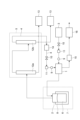
- FIG. 1 is a schematic diagram showing an example of a pyrolysis apparatus.
- the pyrolysis apparatus of FIG. 1 has a heat exchanger 1 for heating oxygen-free gas, a pyrolysis furnace 2 containing waste materials 6 inside, and an external heating means 8 for heating the pyrolysis furnace 2 from the outside.
- an oxygen-free gas to the heat exchanger 1 and an oxygen-free gas supply source 3 for supplying the heat exchanger 1 with the oxygen-free gas.
- the oil recovery device 5 may be equipped with a plurality of dry distillation towers 12a and 12b in order to separate the recovered oil according to its boiling point.
- Each dry distillation tower 12 may be connected to a recovery tank 13 through a pipe at its lower portion, and can store the recovered oil.
- the thermal cracking apparatus in FIG. 1 is equipped with a plurality of dry distillation towers 12a and 12b, but in this embodiment, the thermal cracked oil can be used as it is as the feedstock oil in the hydrocracking process, so the number of dry distillation towers is one. may be Further, in the pyrolysis apparatus of FIG. 1, each dry distillation tower 12 is connected to a different recovery tank 13, but each dry distillation tower 12 may be connected to the same recovery tank 13.
- Hydrocracking step In the hydrocracking step, a second gas component, a light component with a boiling point of 350° C. or less, a heavy component with a boiling point of over 350° C., and is the process of obtaining
- the raw material oil in the hydrocracking step may contain thermally cracked oil, and may contain a part of the fraction obtained by fractionating the thermally cracked oil. Moreover, the raw material oil in the hydrocracking step may further contain components other than the thermally cracked oil, and the thermally cracked oil may be used as it is as the raw material oil.
- the feedstock in the hydrocracking step contains a low boiling point feedstock with a boiling point of 350°C or less and a high boiling point feedstock with a boiling point of over 350°C, and the content of the high boiling point feedstock is, for example, based on the total amount of the feedstock. is 15% by mass or more.
- the light fraction is a substance supplied as a raw material for producing a chemical product in the steam cracking process, which will be described later. Therefore, if the content of the high-boiling-point raw material is 15% by mass or more based on the total amount of the raw material oil, it becomes more suitable as a raw material oil, and the yield of chemical products tends to be further improved.
- the content of the high-boiling-point raw material in the raw material oil is preferably 20% by mass or more, 25% by mass or more, 30% by mass or more, or 35% by mass or more based on the total amount of the raw material oil. % by mass or more.
- the content of the high boiling point raw material in the feedstock may be, for example, 70% by mass or less, 65% by mass or less, 60% by mass or less, 55% by mass or less, or 50% by mass or less based on the total amount of the raw material oil.
- the content of the high boiling point raw material in the raw material oil is, for example, 15 to 70% by mass, 15 to 65% by mass, 15 to 60% by mass, 15 to 55% by mass, 15 to 50% by mass, based on the total amount of the raw material oil.
- the 10% distillation temperature of the raw material oil may be, for example, 90°C or higher, preferably 140°C or higher, more preferably 150°C or higher, and even more preferably 155°C or higher.
- the 10% distillation temperature of the raw material oil may be, for example, 200°C or lower, 190°C or lower, or 180°C or lower. That is, the 10% distillation temperature of the raw material oil is, for example, 90 to 200°C, 90 to 190°C, 90 to 180°C, 140 to 200°C, 140 to 190°C, 140 to 180°C, 150 to 200°C, 150 to It may be 190°C, 150-180°C, 155-200°C, 155-190°C or 155-180°C.
- the 90% distillation temperature of the raw material oil may be, for example, 350°C or higher, preferably 370°C or higher, more preferably 390°C or higher, still more preferably 400°C or higher, and 410°C or higher, 420°C or higher, 430°C or higher. °C or higher, 440 °C or higher, or 450 °C or higher. Also, the 90% distillation temperature of the raw material oil may be, for example, 650°C or lower, preferably 600°C or lower, and more preferably 550°C or lower.
- the 90% distillation temperature of the raw material oil is, for example, 350 to 650°C, 350 to 600°C, 350 to 550°C, 370 to 650°C, 370 to 600°C, 370 to 550°C, 390 to 650°C, 390 to 600°C, 390-550°C, 400-650°C, 400-600°C, 400-550°C, 410-650°C, 410-600°C, 410-550°C, 420-650°C, 420-600°C, 420- 550°C, 430-650°C, 430-600°C, 430-550°C, 440-650°C, 440-600°C, 440-550°C, 450-650°C, 450-600°C or 450-550°C good too.
- the raw material oil may contain nitrogen, sulfur, chlorine, and other halogen elements.
- the nitrogen content of the feedstock may be, for example, 100 mass ppm or more, 2000 mass ppm or more, 2500 mass ppm or more, or 3000 mass ppm or more.
- the chemical product is produced through the hydrocracking process and the cracking process, so even if a large amount of nitrogen is present in the raw oil, a high-purity chemical product (a chemical product with low nitrogen content) ) can be easily obtained.
- the nitrogen content of the feedstock may be, for example, 20000 mass ppm or less, 15000 mass ppm or less, or 10000 mass ppm or less.
- the nitrogen content of the raw material oil is, for example, 100 to 20000 mass ppm, 100 to 15000 mass ppm, 100 to 10000 mass ppm, 2000 to 20000 mass ppm, 2000 to 15000 mass ppm, 2000 to 10000 mass ppm, 2500 to 20000 mass ppm. ppm, 2500-15000 ppm by weight, 2500-10000 ppm by weight, 3000-20000 ppm by weight, 3000-15000 ppm by weight or 3000-10000 ppm by weight.
- the sulfur content of the feedstock may be, for example, 10 mass ppm or more, 100 mass ppm or more, 500 mass ppm or more, or 1000 mass ppm or more.
- chemical products are produced through the hydrocracking process and the cracking process, so even if a large amount of sulfur is present in the raw oil, high-purity chemical products (chemical products with low sulfur content ) can be easily obtained.
- the sulfur content of the feedstock may be, for example, 30000 mass ppm or less, 20000 mass ppm or less, or 10000 mass ppm or less.
- the sulfur content of the raw material oil is, for example, 10 to 30000 mass ppm, 10 to 20000 mass ppm, 10 to 10000 mass ppm, 100 to 30000 mass ppm, 100 to 20000 mass ppm, 100 to 10000 mass ppm, 500 to 30000 mass ppm. ppm, 500-20000 ppm by weight, 500-10000 ppm by weight, 1000-30000 ppm by weight, 1000-20000 ppm by weight or 1000-10000 ppm by weight.
- the chlorine content of the raw material oil may be, for example, 10 mass ppm or more, 30 mass ppm or more, 50 mass ppm or more, or 100 mass ppm or more.
- the chlorine content of the feedstock may be, for example, 2000 mass ppm or less, 1500 mass ppm or less, or 1000 mass ppm or less.
- the chlorine content but also other halogen element content may be within the same range.
- the chlorine content of the raw material oil is, for example, 10 to 2000 mass ppm, 10 to 1500 mass ppm, 10 to 1000 mass ppm, 30 to 2000 mass ppm, 30 to 1500 mass ppm, 30 to 1000 mass ppm, 50 to 2000 mass ppm. ppm, 50-1500 ppm by weight, 50-1000 ppm by weight, 100-2000 ppm by weight, 100-1500 ppm by weight or 100-1000 ppm by weight.
- the hydrocracking step may be a step of hydrocracking the feedstock in the presence of a hydrocracking catalyst.
- Hydrocracking can be carried out, for example, by supplying feedstock oil to a reactor in which a hydrocracking catalyst is arranged and bringing it into contact with the hydrocracking catalyst in the reactor.
- hydrocracking catalyst for example, a known hydrocracking catalyst used for hydrocracking hydrocarbon oils can be used.
- the hydrocracking catalyst is preferably a catalyst that has excellent hydrogenation ability and is capable of efficiently hydrocracking high-boiling raw materials.
- the hydrocracking catalyst preferably contains, for example, a Ni-based catalyst.
- a Ni-based catalyst is a catalyst having Ni as an active metal.
- the hydrocracking step may be carried out using one type of hydrocracking catalyst, or may be carried out using a plurality of types of hydrocracking catalysts.
- a hydrocracking catalyst as a hydrocracking catalyst, a desulfurization/denitrogenation catalyst, a high-resolution catalyst, a low-resolution catalyst, and the like, which will be described later, can be used in appropriate combination.
- the desulfurization and denitrification catalyst may be any hydrocracking catalyst that has excellent desulfurization and denitrification performance.
- desulfurization/denitrogenation catalysts include hydrocracking catalysts in which an active metal is supported on a carrier containing alumina. Such hydrocracking catalysts tend to have good desulfurization and denitrification performance.
- the carrier of the desulfurization/denitrification catalyst may be a carrier containing alumina, preferably with an alumina content of 50% by mass or more.
- the content of alumina in the desulfurization/denitrogenation catalyst carrier may be, for example, 50% by mass or more, preferably 55% by mass or more, and more preferably 60% by mass or more, based on the total amount of the carrier.
- the carrier of the desulfurization/denitrogenation catalyst may contain components other than alumina.
- the carrier of the desulfurization/denitrification catalyst may contain, for example, oxides of Groups 2, 3, 4, 13, 14 or 15 of the periodic table. More specifically, the desulfurization/denitrogenation catalyst carrier may contain at least one of oxides such as silica, phosphorus, magnesia, zirconia, boria, titania, calcia, and zinc.
- carriers for desulfurization and denitrification catalysts include silica, silica-alumina, silica-alumina-phosphorus, silica-magnesia, alumina-silica-magnesia, alumina- It preferably contains silica-zirconia or the like.
- the carrier of the desulfurization/denitrogenation catalyst may be crystalline or amorphous.
- the shape of the carrier of the desulfurization/denitrogenation catalyst is not particularly limited, and may be, for example, spherical, columnar, trilobal, quadrilobal, or the like.
- Examples of active metals possessed by desulfurization/denitrification catalysts include Ni, Mo, Co, W, and P.
- the desulfurization/denitrogenation catalyst may have one type of active metal, or may have two or more types.
- the desulfurization/denitrogenation catalyst preferably contains at least Ni, and contains Ni and Mo or W, from the viewpoint of easily realizing excellent hydrogenation ability and enabling more efficient desulfurization/denitrogenation. is more preferable.
- Active metals may be activated by a sulfurization treatment.
- the inclusion of Ni sulfides in particular makes it easier for the desulfurization/denitrogenation catalyst to achieve excellent hydrogenation performance.
- high-resolution catalysts examples include hydrocracking catalysts in which an active metal is supported on a carrier containing zeolite. Such hydrocracking catalysts tend to have small pores and good hydrocracking capabilities.
- the carrier of the high-resolution catalyst may be a carrier containing zeolite, preferably the zeolite content is 1% by mass or more.
- the content of zeolite in the carrier of the high-resolution catalyst may be, for example, 2% by mass or more, preferably 3% by mass or more, and more preferably 5% by mass or more, based on the total amount of the carrier.
- the carrier of the high-resolution catalyst may contain components other than zeolite.
- Supports for high-resolution catalysts may include, for example, oxides of Groups 2, 3, 4, 13, 14, or 15 elements of the periodic table. More specifically, the carrier of the high-resolution catalyst may contain at least one oxide of silica, alumina, phosphorus, magnesia, zirconia, boria, titania, calcia, zinc, and the like.
- the carrier of the high-resolution catalyst is alumina, silica, silica-alumina, silica-alumina-phosphorus, silica-magnesia, alumina-silica-magnesia, It preferably contains alumina-silica-zirconia and the like.
- the carrier of the high-resolution catalyst may be crystalline or amorphous.
- the shape of the carrier of the high-resolution catalyst is not particularly limited, and may be, for example, spherical, cylindrical, three-lobed, or four-lobed.
- Examples of active metals possessed by high-resolution catalysts include Ni, Mo, Co, W, P, and the like.
- the high-resolution catalyst may have one type of active metal, or may have two or more types.
- the high-resolution catalyst preferably contains at least Ni, and more preferably contains Ni and Mo or W from the viewpoint of being able to easily achieve excellent hydrogenation ability and more efficiently hydrocracking high-boiling raw materials. preferable.
- Active metals may be activated by a sulfurization treatment.
- the inclusion of Ni sulfides in particular makes it easier for the desulfurization/denitrogenation catalyst to achieve excellent hydrogenation performance.
- low-resolution catalysts examples include hydrocracking catalysts in which an active metal is supported on a carrier containing alumina. Such hydrocracking catalysts tend to have more large pores than high resolution catalysts and have milder hydrocracking resolution than high resolution catalysts.
- the carrier of the low-resolution catalyst may be a carrier containing alumina.
- the content of alumina in the carrier of the low-resolution catalyst may be, for example, 20% by mass or more, preferably 25% by mass or more, and more preferably 30% by mass or more, based on the total amount of the carrier.
- the carrier of the low-resolution catalyst may contain components other than alumina.
- the low-resolution catalyst support may contain, for example, oxides of Groups 2, 3, 4, 13, 14, or 15 elements of the periodic table. More specifically, the low-resolution catalyst support may contain at least one oxide of silica, phosphorus, magnesia, zirconia, boria, titania, calcia, zinc, and the like.
- low-resolution catalyst supports include silica, silica-alumina, silica-alumina-phosphorus, silica-magnesia, alumina-silica-magnesia, alumina- It preferably contains silica-zirconia or the like.
- the carrier of the low-resolution catalyst may be crystalline or amorphous.
- the shape of the low-resolution catalyst support is not particularly limited, and may be, for example, spherical, cylindrical, three-lobed, four-lobed, or the like.
- Examples of active metals possessed by low-resolution catalysts include Ni, Mo, Co, W, P, and the like.
- the low-resolution catalyst may have one type of active metal, or may have two or more types.
- the low-resolution catalyst preferably contains at least Ni, and more preferably contains Ni and Mo or W, from the viewpoint of being able to hydrocrack a high-boiling-point raw material more efficiently.
- Active metals may be activated by a sulfurization treatment.
- the inclusion of Ni sulfides in particular makes it easier for the desulfurization/denitrogenation catalyst to achieve excellent hydrogenation performance.
- a desulfurization/denitrogenation catalyst and a cracking catalyst may be used in combination.
- the decomposition catalyst may be used in combination with a high-resolution catalyst and a low-resolution catalyst, may be used only with a high-resolution catalyst, or may be used with only a low-resolution catalyst.
- the desulfurization/denitrogenation catalyst may be arranged at least before the high-resolution catalyst and the low-resolution catalyst, or may be arranged both before and after the high-resolution catalyst and the low-resolution catalyst.
- the nitrogen content in the pyrolysis oil may adhere to the active sites of the high-resolution catalyst or low-resolution catalyst, reducing the decomposition performance of the high-resolution catalyst or low-resolution catalyst. be.
- the nitrogen content contained in the pyrolysis oil is converted into ammonia or the like, and the nitrogen content contained in the pyrolysis oil is reduced. Therefore, in the hydrocracking step, it is preferable to arrange the desulfurization/denitrogenation catalyst before the high-resolution catalyst and the low-resolution catalyst.
- the desulfurization/denitrogenation catalyst in the front stage of the hydrocracking unit, which will be described later. According to this arrangement, even if the pyrolysis oil contains nitrogen, it is possible to suppress deterioration in the decomposition performance of the high-resolution catalyst and the low-resolution catalyst.
- the hydrocracking step may be carried out using, for example, a flow reactor.
- the first catalyst layer containing the desulfurization/denitrogenation catalyst and the second catalyst layer containing the decomposing catalyst can be arranged in this order from the inlet side in the flow reactor. preferable.
- a third catalyst layer containing decomposing catalysts of different types and a fourth catalyst layer containing a desulfurization/denitrogenation catalyst are further arranged. good too.
- the reaction temperature in the hydrocracking step is not particularly limited, and may be, for example, 300° C. or higher, preferably 320° C. or higher, more preferably 340° C. or higher. Also, the reaction temperature in the hydrocracking step may be, for example, 480° C. or lower, preferably 460° C. or lower, more preferably 440° C. or lower.
- reaction temperature in the hydrocracking step is, for example, 300 to 480 ° C., 300 to 460 ° C., 300 to 440 ° C., 320 to 480 ° C., 320 to 460 ° C., 320 to 440 ° C., 340 to 480 ° C., 340 to 460 °C or 340-440 °C.
- the reaction pressure in the hydrocracking step is not particularly limited, and may be, for example, 1 MPaG or higher, preferably 3 MPaG or higher, more preferably 5 MPaG or higher.
- the reaction pressure in the hydrocracking step is not particularly limited, and may be, for example, 20 MPaG or less, preferably 19 MPaG or less, more preferably 18 MPaG or less. That is, the reaction pressure in the hydrocracking step is, for example, 1 to 20 MPaG, 1 to 19 MPaG, 1 to 18 MPaG, 3 to 20 MPaG, 3 to 19 MPaG, 3 to 18 MPaG, 5 to 20 MPaG, 5 to 19 MPaG or 5 to 18 MPaG. good too.
- the weight hourly space velocity (WHSV) of the feedstock may be, for example, 0.1 h ⁇ 1 or more, preferably 0.15 h ⁇ 1 or more, more preferably is greater than or equal to 0.2h ⁇ 1 .
- the weight hourly space velocity (WHSV) of the feedstock may be, for example, 5 h ⁇ 1 or less, preferably 4 h ⁇ 1 or less, and more preferably 3 h ⁇ 1 or less.
- the weight hourly space velocity (WHSV) of the feed oil is 0.1 to 5h -1 , 0.1 to 4h -1 , 0.1 to 3h -1 , 0.15 to 5h -1 , 0.15 to 4h ⁇ 1 , 0.15 to 3h ⁇ 1 , 0.2 to 5h ⁇ 1 , 0.2 to 4h ⁇ 1 or 0.2 to 3h ⁇ 1 .
- the hydrocracking step is carried out in the presence of hydrogen.
- the hydrogen/oil ratio may be, for example, 100 NL/L or higher, preferably 150 NL/L or higher, more preferably 200 NL/L or higher. Also, the hydrogen/oil ratio may be, for example, 1500 NL/L or less, preferably 1400 NL/L or less, and more preferably 1300 NL/L or less.
- the hydrogen / oil ratio is, for example, 100 to 1500 NL / L, 100 to 1400 NL / L, 100 to 1300 NL / L, 150 to 1500 NL / L, 150 to 1400 NL / L, 150 to 1300 NL / L, 200 to 1500 NL / L , 200-1400 NL/L or 200-1300 NL/L.
- a second gas component, a light component with a boiling point of 350°C or less, and a heavy component with a boiling point of over 350°C are obtained by hydrocracking the feedstock oil.
- the second gas component may be, for example, a component that is gaseous at room temperature and 20°C among the products produced by hydrocracking.
- the second gas component may contain, for example, hydrogen, hydrocarbons having 1 to 4 carbon atoms, and the like.
- the second gas portion may be used, for example, as the combustion gas for heating the pyrolysis section in the pyrolysis step or the combustion gas of the heating furnace in other steps.
- the light fraction may be, for example, a hydrocarbon oil having a boiling point of 350°C or less among the products produced by hydrocracking. Light ends are subjected to a steam cracking process.
- the sulfur content in the light fraction is, for example, 1500 ppm by mass or less, and from the viewpoint of reducing the amount of impurities in the chemical product obtained in the cracking process and preventing catalyst poisoning and equipment corrosion in the latter stage of the cracking process, it is preferably 1000 ppm. It is mass ppm or less, more preferably 900 mass ppm or less.
- the nitrogen content in the light fraction is, for example, 25 ppm by mass or less, preferably 20 mass ppm or less, more preferably 15 mass ppm or less from the viewpoint of reducing the amount of impurities in the chemical product obtained in the cracking process.
- the chlorine content in the light components is, for example, 20 mass ppm or less, and from the viewpoint of reducing the amount of impurities in the chemical product obtained in the cracking process and preventing catalyst poisoning and equipment corrosion in the latter stage of the cracking process, it is preferably 15. It is mass ppm or less, more preferably 10 mass ppm or less. Moreover, it is preferable that not only the chlorine content but also other halogen element content be in the same range.
- the heavy fraction may be, for example, a hydrocarbon oil with a boiling point exceeding 350°C among the products produced by hydrocracking.
- the heavy fraction may be reused, for example, as part or all of the feedstock for the hydrocracking process. Also, the heavy fraction may be used, for example, as combustion oil for heating the pyrolysis section in the pyrolysis step or as combustion oil for a heating furnace in other steps.
- the steam cracking step is a step of obtaining a chemical product by steam cracking a steam cracking raw material oil containing part of the light components obtained in the hydrocracking step.
- the steam cracking raw material oil is heat-treated with steam to decompose the light components, etc., and produce components useful as chemical products.
- part of the light fraction obtained in the hydrocracking process may be subjected to steam cracking, or the entirety may be subjected to steam cracking.
- the steam cracking raw material oil in the steam cracking process may further contain petroleum-derived ethane, naphtha, kerosene, light oil fractions, etc., in addition to the light components.
- the light fraction may be used as it is as the steam cracking raw material oil.
- the conditions for steam cracking are not particularly limited, and may be appropriately selected from known conditions adopted for steam cracking of ethane, naphtha, kerosene, and the like.
- the reaction temperature of steam cracking may be, for example, 650° C. or higher, preferably 700° C. or higher, more preferably 750° C. or higher.
- the reaction temperature of steam cracking may be, for example, 1000° C. or lower, preferably 950° C. or lower, more preferably 900° C. or lower. That is, the steam cracking reaction temperature is, for example, It may be 750-900°C.
- the steam cracking reaction time may be, for example, 0.05 seconds or longer, preferably 0.06 seconds or longer, and more preferably 0.08 seconds or longer.
- the steam cracking reaction time may be, for example, 2.0 seconds or less, preferably 1.9 seconds or less, and more preferably 1.8 seconds or less. That is, the reaction time of steam cracking is, for example, 0.05 to 2.0 seconds, 0.05 to 1.9 seconds, 0.05 to 1.8 seconds, 0.06 to 2.0 seconds, 0.06 to It may be 1.9 seconds, 0.06-1.8 seconds, 0.08-2.0 seconds, 0.08-1.9 seconds or 0.08-1.8 seconds.
- the steam/steam cracking raw material oil ratio (mass ratio) in steam cracking may be, for example, 0.2 or more, preferably 0.25 or more, and more preferably 0.3 or more.
- the ratio (mass ratio) of steam/steam cracking raw material oil may be, for example, 1.0 or less, preferably 0.9 or less, and more preferably 0.8 or less. That is, the steam/steam cracking raw material oil ratio (mass ratio) is, for example, 0.2 to 1.0, 0.2 to 0.9, 0.2 to 0.8, 0.25 to 1.0, 0 0.25-0.9, 0.25-0.8, 0.3-1.0, 0.3-0.9 or 0.3-0.8.
- the outlet reaction pressure of steam cracking may be, for example, 0.1 MPaA or higher, preferably 0.15 MPaA or higher, and more preferably 0.2 MPaA or higher.
- the reaction pressure of steam cracking may be, for example, 1.0 MPaA or less, preferably 0.8 MPaA or less, and more preferably 0.6 MPaA or less. That is, the outlet reaction pressure of steam cracking is, for example, 0.1 to 1.0 MPaA, 0.1 to 0.8 MPaA, 0.1 to 0.6 MPaA, 0.15 to 1.0 MPaA, 0.15 to 0.8 MPaA , 0.15-0.6 MPaA, 0.2-1.0 MPaA, 0.2-0.8 MPaA or 0.2-0.6 MPaA.
- Chemical products obtained in the steam cracking process include, for example, ethylene, propylene, butadiene, butenes, isoprene, benzene, toluene, xylene, ethylbenzene, styrene, cyclopentadiene, dicyclopentadiene, indene, and methylstyrene for resin conversion.
- Olefin-containing C9 aromatics and the like are included.
- Light fractions may be obtained in addition to chemical products.
- Light fractions include, for example, methane, ethane, propane, hexane, and the like.
- a heavy fraction may be obtained in addition to chemical products.
- the heavy fraction may be reused as a raw material for steam cracking or may be used as a raw material for producing carbides.
- the heavy fraction obtained in the steam cracking step of the present embodiment tends to have a high aromatic content, and can be suitably used as a raw material for producing carbides (particularly carbon black).
- chars especially carbon black
- the heavy fraction may be, for example, a fraction with a 10% distillation temperature of 190°C or higher, or a fraction with a 10% distillation temperature of 200°C or higher.
- the 10% distillation temperature of the heavy fraction may be, for example, 250°C or lower, or 240°C or lower.
- the 90% distillation temperature of the heavy fraction may be, for example, 450° C. or higher, or 500° C. or higher.
- the 90% distillation temperature of the heavy fraction may be, for example, 750°C or lower, or 700°C or lower. That is, the 10% distillation temperature of the heavy fraction may be, for example, 190-250°C, 190-240°C, 200-250°C or 200-240°C.
- the 90% distillation temperature of the heavy fraction may be, for example, 450-750°C, 450-700°C, 500-750°C or 500-700°C.
- the aromatic content of the heavy fraction may be, for example, 30% by mass or more, preferably 35% by mass or more, and more preferably 40% by mass or more. Further, the aromatic content of the heavy fraction may be, for example, 90% by mass or less. That is, the aromatic content of the heavy fraction may be, for example, 30-90% by weight, 35-90% by weight or 40-90% by weight.
- FIG. 2 is a schematic diagram showing an example of a system that implements the manufacturing method of this embodiment.
- the system 100 shown in FIG. 2 comprises a pyrolysis unit 110 , a first separation unit 111 , a comminution unit 112 , a hydrocracking unit 120 , a second separation unit 121 and a steam cracker 130 .
- the waste material S1 is supplied to the thermal decomposition unit 110, and the waste material S1 is thermally decomposed in the thermal decomposition unit 110.
- a first gas fraction S2, a pyrolysis oil S3, a mixture S4 of residues and metal fractions is produced.
- the first gas portion S2 may be discharged out of the system, or may be reused as oxygen-free gas in the thermal decomposition unit 110.
- the pyrolysis oil S3 is supplied to the hydrocracking unit 120 .
- the mixture S4 is supplied to the first separation unit 111 where it is separated into a residue portion S5 and a metal portion S6.
- the residue S5 is pulverized by the pulverization unit 112 and recovered as powdered carbide S7.
- the hydrocracking of the thermal cracking oil S3 produces a second gas fraction S8 and a hydrocracking oil S9.
- the second gas portion S8 may be discharged out of the system, or may be used as combustion gas for heating the thermal decomposition section in the thermal decomposition process or as combustion gas in the heating furnace in other processes.
- the hydrocracked oil S9 is supplied to the second separation unit 121, where it is fractionated into a light fraction S10 and a heavy fraction S11.
- Light fraction S10 is supplied to steam cracker 130 .
- the heavies S11 may be recovered as heavy oil and may be recycled to the hydrocracking unit 120, such as combustion oil for heating the pyrolysis section in the pyrolysis process or other process heating furnaces. It can be used as a combustion oil for
- the light fraction S10 is steam cracked to form a product gas S12, a product oil S13 and a heavy fraction S14.
- the generated gas S12 and the generated oil S13 are useful chemical products such as ethylene, propylene, butadiene, butenes, isoprene, benzene, toluene, xylene, ethylbenzene, styrene, cyclopentadiene, dicyclopentadiene, indene, and methylstyrene.
- Chemical products are obtained by appropriately separating and recovering the generated gas S12 and the generated oil S13, which contain C9 aromatics containing olefins for chemical products.
- the heavy fraction S14 is suitably used, for example, as a raw material for producing carbides.
- component analysis is performed by the following method. Distillation properties: JIS K 2254 (Petroleum products-distillation test method-Part 7 gas chromatography method) ⁇ Nitrogen content: JIS K 2609 (Crude oil and petroleum products-Nitrogen content test method) ⁇ Chlorine content: JPI-5S-64 (petroleum products-chlorine content test method-microcoulometric titration method) ⁇ Sulfur content: JIS K 2541-7 (Crude oil and petroleum products-Sulfur content test method Part 7: Wavelength dispersive fluorescent X-ray method (calibration curve method)) ⁇ Steam cracking gas analysis: JIS K 2301: 2011 (Fuel gas and natural gas-Analysis and test methods) ⁇ Analysis of steam cracking product oil: After fractionating the steam cracking product oil obtained after oil-water separation so as to obtain a fraction of 250 ° C or less, JIS K 2536-2 (Petroleum products - Component test method Part
- Example 1 (1) Thermal decomposition process A thermal decomposition process is performed using the thermal decomposition apparatus shown in FIG. Specifically, about 100 kg of cut waste truck tires (waste material 6) are put into the pyrolysis furnace 2 (capacity: 0.5 m 3 ), and after replacing the inside of the pyrolysis furnace 2 with nitrogen gas, pyrolysis is performed. While circulating the nitrogen gas in the apparatus, the gas temperature is raised to 500° C. by the heat exchanger 1 and maintained at this temperature.
- the gas flow rate of the nitrogen gas introduced into the pyrolysis furnace 2 is set to 0.005 m 3 /s [ntp], and the flow rate is set to 0.0045 m 3 /s [ntp] to 0.0055 m 3 /s [ntp]. Control to a range.
- the oxygen concentration in the system of the thermal decomposition apparatus is controlled within the range of 1% by volume or less.
- a zirconia oxygen sensor is used to measure the oxygen concentration in the pyrolyzer.
- a pyrolysis oil is obtained from the bottom of the dry distillation tower 12a. Also, a first gas component is obtained from the top of the dry distillation tower 12a.
- the reaction is continued until the distillation of the pyrolysis oil stops, after which the heat exchanger 1 is stopped and left to cool for about 12 hours.
- the mixture of residue and metals is then removed from the pyrolysis furnace. Metals are removed from the mixture with a magnetic separator to obtain a residue.
- the residue is pulverized into fine powder with a particle size of 1 mm or less by a hammer type grinder, and classified by an air classifier having a rotating blade to remove coarse powder with a particle size of 50 ⁇ m or more. A carbide with a frequency value of 4 ⁇ m is obtained.
- Table 1 shows the ratio of each component and the properties of the pyrolysis oil.
- the carrier is impregnated with this impregnating solution by an initial wetness method so that the Ni content in terms of oxide is 10% by mass and the W content in terms of oxide is 20% by mass based on the mass of the carrier. Carry out carrying.
- the obtained impregnated material (catalyst precursor) is dried at 120° C. for 3 hours and then calcined at 500° C. for 1 hour under air flow to obtain a hydrogenation catalyst B-1.
- Hydrocracking Hydrogenation catalyst A-1 and hydrocracking catalyst B-1 are filled in a reaction tube (inner diameter: 20 mm) at a weight ratio of 8:2.
- the order of filling is such that the hydrogenation catalyst A-1 is placed in the front stage of the reaction tube, and the hydrogenation catalyst B-1 is placed in the rear stage of the reaction tube.
- After sulfurization treatment with oil in which 1% by weight of carbon disulfide is dissolved in light oil, hydrogenation using pyrolysis oil as a raw material under the conditions of a reaction pressure of 11 MPaG, a reaction temperature of 390 ° C., and WHSV 0.3 h -1 .
- Cracking is performed to obtain a second gas fraction and a hydrocracked oil.
- the hydrocracked oil is fractionated into light components and heavy components, and the ratio of each component is determined. Table 2 shows the results.
- Example 2 Example 1 except that a waste material containing 50% by mass of waste truck tires, 30% by mass of polyethylene waste, 12.5% by mass of polypropylene waste, and 7.5% by mass of polystyrene waste is used as the waste material.
- a waste material containing 50% by mass of waste truck tires, 30% by mass of polyethylene waste, 12.5% by mass of polypropylene waste, and 7.5% by mass of polystyrene waste is used as the waste material.
- Example 3 A chemical product is produced in the same manner as in Example 1, except that the thermal decomposition temperature in the thermal decomposition step is changed to 400°C.
- Example 4 A chemical product is produced in the same manner as in Example 1, except that the thermal decomposition temperature in the thermal decomposition step is changed to 700°C.
- Example 5 Of the thermal cracked oil, the fraction with a boiling point range of 90 to 407 ° C. (content of high boiling point raw material: 25% by mass) is used as the feedstock oil for the hydrocracking step. Chemical products are produced in the same manner as in Example 1. manufacturing.
- Example 6 A chemical product is produced in the same manner as in Example 1, except that the thermal decomposition step is performed in the presence of a catalyst and the thermal decomposition temperature in the thermal decomposition step is changed to 350°C. Acidic clay is used as the catalyst used in the thermal decomposition process.
- Example 1 A chemical product is produced in the same manner as in Example 1, except that the thermal decomposition step is performed in the presence of a catalyst (acid clay).
- Tables 1-9 show the results in the thermal cracking process, hydrocracking process, and steam cracking process in Examples 1-6 and Comparative Examples 1-4.
- the chemical product yield (% by mass) relative to the total amount of thermal decomposition products excluding metals is the chemical product ( ethylene, propylene, butadiene, butenes, isoprene, cyclopentadiene, benzene, toluene, xylene, ethylbenzene, styrene, indene, and methylstyrene).
- SYMBOLS 1 Heat exchanger, 2... Pyrolysis furnace, 3... Anoxic gas supply source, 4... Circulation path, 5... Oil recovery apparatus, 6... Waste material, 7... Decomposition apparatus, 8... External heating means, 9... Flow meter , 10... Damper, 11... Blower, 12... Dry distillation tower, 13... Recovery tank, 14... Hot blast furnace, 15... Exhaust fan, 16... Exhaust gas treatment device, 100... System, 110... Pyrolysis unit, 111... First separation Unit, 112... pulverization unit, 120... hydrocracking unit, 121... second separation unit, 130... steam cracker, S1... waste material, S2... first gas, S3... pyrolysis oil, S4...
Landscapes
- Chemical & Material Sciences (AREA)
- Oil, Petroleum & Natural Gas (AREA)
- Engineering & Computer Science (AREA)
- Organic Chemistry (AREA)
- Chemical Kinetics & Catalysis (AREA)
- General Chemical & Material Sciences (AREA)
- Thermal Sciences (AREA)
- Physics & Mathematics (AREA)
- Life Sciences & Earth Sciences (AREA)
- Wood Science & Technology (AREA)
- Materials Engineering (AREA)
- Health & Medical Sciences (AREA)
- Polymers & Plastics (AREA)
- Medicinal Chemistry (AREA)
- Sustainable Development (AREA)
- Production Of Liquid Hydrocarbon Mixture For Refining Petroleum (AREA)
Priority Applications (3)
| Application Number | Priority Date | Filing Date | Title |
|---|---|---|---|
| EP23746759.2A EP4450598A4 (en) | 2022-01-27 | 2023-01-17 | CHEMICAL PRODUCT PRODUCTION PROCESS |
| US18/832,682 US20250145897A1 (en) | 2022-01-27 | 2023-01-17 | Method for producing chemical product |
| CN202380018284.4A CN118574914A (zh) | 2022-01-27 | 2023-01-17 | 化学品的制造方法 |
Applications Claiming Priority (2)
| Application Number | Priority Date | Filing Date | Title |
|---|---|---|---|
| JP2022010857A JP7870170B2 (ja) | 2022-01-27 | 2022-01-27 | 化成品の製造方法 |
| JP2022-010857 | 2022-05-20 |
Publications (1)
| Publication Number | Publication Date |
|---|---|
| WO2023145545A1 true WO2023145545A1 (ja) | 2023-08-03 |
Family
ID=87471415
Family Applications (1)
| Application Number | Title | Priority Date | Filing Date |
|---|---|---|---|
| PCT/JP2023/001231 Ceased WO2023145545A1 (ja) | 2022-01-27 | 2023-01-17 | 化成品の製造方法 |
Country Status (6)
| Country | Link |
|---|---|
| US (1) | US20250145897A1 (enExample) |
| EP (1) | EP4450598A4 (enExample) |
| JP (1) | JP7870170B2 (enExample) |
| CN (1) | CN118574914A (enExample) |
| TW (1) | TW202340434A (enExample) |
| WO (1) | WO2023145545A1 (enExample) |
Cited By (5)
| Publication number | Priority date | Publication date | Assignee | Title |
|---|---|---|---|---|
| WO2025023296A1 (ja) * | 2023-07-26 | 2025-01-30 | Eneos株式会社 | 化成品の製造方法およびその管理方法 |
| WO2025023293A1 (ja) * | 2023-07-26 | 2025-01-30 | Eneos株式会社 | 化成品の製造方法およびその管理方法 |
| WO2025023295A1 (ja) * | 2023-07-26 | 2025-01-30 | Eneos株式会社 | 化成品の製造方法およびその管理方法 |
| WO2026160306A1 (ja) * | 2025-01-23 | 2026-07-30 | Eneos株式会社 | 水素化処理油の製造方法 |
| WO2026160302A1 (ja) * | 2025-01-23 | 2026-07-30 | Eneos株式会社 | 水素化処理油およびその製造方法 |
Families Citing this family (2)
| Publication number | Priority date | Publication date | Assignee | Title |
|---|---|---|---|---|
| JP7870171B2 (ja) * | 2022-01-27 | 2026-06-04 | Eneos株式会社 | 化成品及び炭化物の製造方法 |
| WO2024104980A1 (en) | 2022-11-16 | 2024-05-23 | Nynas Ab (Publ) | Method of preparing a base oil from tire pyrolysis oil and a base oil obtainable using the method |
Citations (6)
| Publication number | Priority date | Publication date | Assignee | Title |
|---|---|---|---|---|
| JPS55500113A (enExample) * | 1978-02-15 | 1980-02-28 | ||
| JP2003129066A (ja) * | 1993-04-03 | 2003-05-08 | Der Gruene Punkt Duales System Deutschland Ag | 使用済みのまたは廃物のプラスチックの処理方法 |
| US20160264874A1 (en) * | 2015-03-10 | 2016-09-15 | Sabic Global Technologies, B.V. | Robust Integrated Process for Conversion of Waste Plastics to Final Petrochemical Products |
| JP2019533041A (ja) | 2016-09-22 | 2019-11-14 | サビック グローバル テクノロジーズ ベスローテン フェンノートシャップ | 熱分解、水添分解、水添脱アルキル化およびスチームクラッキングのステップを含む統合プロセス構成 |
| JP2020514298A (ja) * | 2017-01-05 | 2020-05-21 | サビック グローバル テクノロジーズ ベスローテン フェンノートシャップ | 廃棄プラスチックのプロピレンおよびクメンへの変換 |
| WO2021204817A1 (en) * | 2020-04-07 | 2021-10-14 | Total Research & Technology Feluy | Purification of waste plastic based oil via a two steps hydrotreatment |
Family Cites Families (4)
| Publication number | Priority date | Publication date | Assignee | Title |
|---|---|---|---|---|
| WO2016142808A1 (en) * | 2015-03-10 | 2016-09-15 | Sabic Global Technologies, B.V. | An integrated process for conversion of waste plastics to final petrochemical products |
| US10442997B2 (en) * | 2016-06-29 | 2019-10-15 | Sabic Global Technologies B.V. | Plastic pyrolysis |
| JP6999646B2 (ja) * | 2016-08-01 | 2022-01-18 | サビック グローバル テクノロジーズ ベスローテン フェンノートシャップ | 混合プラスチックの熱分解と熱分解油の脱塩素と同時に行う触媒プロセス |
| WO2020242917A1 (en) * | 2019-05-24 | 2020-12-03 | Eastman Chemical Company | Optimized cracker conditions to accept pyrolysis oil |
-
2022
- 2022-01-27 JP JP2022010857A patent/JP7870170B2/ja active Active
-
2023
- 2023-01-17 EP EP23746759.2A patent/EP4450598A4/en active Pending
- 2023-01-17 WO PCT/JP2023/001231 patent/WO2023145545A1/ja not_active Ceased
- 2023-01-17 CN CN202380018284.4A patent/CN118574914A/zh active Pending
- 2023-01-17 US US18/832,682 patent/US20250145897A1/en active Pending
- 2023-01-18 TW TW112102246A patent/TW202340434A/zh unknown
Patent Citations (6)
| Publication number | Priority date | Publication date | Assignee | Title |
|---|---|---|---|---|
| JPS55500113A (enExample) * | 1978-02-15 | 1980-02-28 | ||
| JP2003129066A (ja) * | 1993-04-03 | 2003-05-08 | Der Gruene Punkt Duales System Deutschland Ag | 使用済みのまたは廃物のプラスチックの処理方法 |
| US20160264874A1 (en) * | 2015-03-10 | 2016-09-15 | Sabic Global Technologies, B.V. | Robust Integrated Process for Conversion of Waste Plastics to Final Petrochemical Products |
| JP2019533041A (ja) | 2016-09-22 | 2019-11-14 | サビック グローバル テクノロジーズ ベスローテン フェンノートシャップ | 熱分解、水添分解、水添脱アルキル化およびスチームクラッキングのステップを含む統合プロセス構成 |
| JP2020514298A (ja) * | 2017-01-05 | 2020-05-21 | サビック グローバル テクノロジーズ ベスローテン フェンノートシャップ | 廃棄プラスチックのプロピレンおよびクメンへの変換 |
| WO2021204817A1 (en) * | 2020-04-07 | 2021-10-14 | Total Research & Technology Feluy | Purification of waste plastic based oil via a two steps hydrotreatment |
Non-Patent Citations (1)
| Title |
|---|
| See also references of EP4450598A4 |
Cited By (5)
| Publication number | Priority date | Publication date | Assignee | Title |
|---|---|---|---|---|
| WO2025023296A1 (ja) * | 2023-07-26 | 2025-01-30 | Eneos株式会社 | 化成品の製造方法およびその管理方法 |
| WO2025023293A1 (ja) * | 2023-07-26 | 2025-01-30 | Eneos株式会社 | 化成品の製造方法およびその管理方法 |
| WO2025023295A1 (ja) * | 2023-07-26 | 2025-01-30 | Eneos株式会社 | 化成品の製造方法およびその管理方法 |
| WO2026160306A1 (ja) * | 2025-01-23 | 2026-07-30 | Eneos株式会社 | 水素化処理油の製造方法 |
| WO2026160302A1 (ja) * | 2025-01-23 | 2026-07-30 | Eneos株式会社 | 水素化処理油およびその製造方法 |
Also Published As
| Publication number | Publication date |
|---|---|
| EP4450598A4 (en) | 2025-12-10 |
| JP7870170B2 (ja) | 2026-06-04 |
| TW202340434A (zh) | 2023-10-16 |
| EP4450598A1 (en) | 2024-10-23 |
| CN118574914A (zh) | 2024-08-30 |
| US20250145897A1 (en) | 2025-05-08 |
| JP2023109380A (ja) | 2023-08-08 |
Similar Documents
| Publication | Publication Date | Title |
|---|---|---|
| JP2023109380A (ja) | 化成品の製造方法 | |
| WO2023145544A1 (ja) | 化成品及び炭化物の製造方法 | |
| CN111032833B (zh) | 使用再循环级间产物多级提质烃热解焦油 | |
| JP5820890B2 (ja) | 芳香族化合物を含む留分から高付加価値の芳香族製品およびオレフィン製品を生産する方法 | |
| EP2751234B1 (en) | Upgrading hydrocarbon pyrolysis products by hydroprocessing | |
| US20140061096A1 (en) | Upgrading Hydrocarbon Pyrolysis Products by Hydroprocessing | |
| JP2020517797A (ja) | 原油の変換のためのシステムおよび方法 | |
| JP2014500859A (ja) | 石油、石炭または木に由来する炭化水素留分から高付加芳香族製品および軽質パラフィン製品を製造する方法 | |
| JP2013537223A (ja) | 石炭または木から産出される炭化水素油分から高付加価値の芳香族製品及びオレフィン製品を製造する方法 | |
| WO2025023294A1 (ja) | 化成品及び炭化物の製造方法並びに化成品の管理方法 | |
| WO2025023296A1 (ja) | 化成品の製造方法およびその管理方法 | |
| US20260218059A1 (en) | Plastic recycling process | |
| US20150136652A1 (en) | Process for hydrotreating a coal tar stream | |
| WO2025023293A1 (ja) | 化成品の製造方法およびその管理方法 | |
| WO2013033575A1 (en) | Process for reducing the asphaltene yield and recovering waste heat in a pyrolysis process by quenching with a hydroprocessed product | |
| JP7884697B2 (ja) | オレフィン製造用供給物の製造方法 | |
| WO2026160302A1 (ja) | 水素化処理油およびその製造方法 | |
| KR20240070013A (ko) | 폐플라스틱 열분해유의 정제 방법 및 정제 장치 | |
| CN105722955A (zh) | 加氢处理方法以及与多功能加氢处理器相关的应用 | |
| WO2025219653A1 (en) | Liquid phase hydrotreatment of liquefied waste plastic | |
| WO2026160306A1 (ja) | 水素化処理油の製造方法 | |
| CN105765037A (zh) | 加氢处理煤焦油料流的方法 | |
| JPH0552352B2 (enExample) |
Legal Events
| Date | Code | Title | Description |
|---|---|---|---|
| 121 | Ep: the epo has been informed by wipo that ep was designated in this application |
Ref document number: 23746759 Country of ref document: EP Kind code of ref document: A1 |
|
| WWE | Wipo information: entry into national phase |
Ref document number: 2023746759 Country of ref document: EP |
|
| ENP | Entry into the national phase |
Ref document number: 2023746759 Country of ref document: EP Effective date: 20240718 |
|
| WWE | Wipo information: entry into national phase |
Ref document number: 202380018284.4 Country of ref document: CN |
|
| WWE | Wipo information: entry into national phase |
Ref document number: 18832682 Country of ref document: US |
|
| NENP | Non-entry into the national phase |
Ref country code: DE |
|
| WWP | Wipo information: published in national office |
Ref document number: 18832682 Country of ref document: US |