WO2023136108A1 - 排気路構造 - Google Patents
排気路構造 Download PDFInfo
- Publication number
- WO2023136108A1 WO2023136108A1 PCT/JP2022/047792 JP2022047792W WO2023136108A1 WO 2023136108 A1 WO2023136108 A1 WO 2023136108A1 JP 2022047792 W JP2022047792 W JP 2022047792W WO 2023136108 A1 WO2023136108 A1 WO 2023136108A1
- Authority
- WO
- WIPO (PCT)
- Prior art keywords
- exhaust
- silencer
- exhaust passage
- capillary
- condensed water
- Prior art date
- Legal status (The legal status is an assumption and is not a legal conclusion. Google has not performed a legal analysis and makes no representation as to the accuracy of the status listed.)
- Ceased
Links
Images




Classifications
-
- F—MECHANICAL ENGINEERING; LIGHTING; HEATING; WEAPONS; BLASTING
- F01—MACHINES OR ENGINES IN GENERAL; ENGINE PLANTS IN GENERAL; STEAM ENGINES
- F01N—GAS-FLOW SILENCERS OR EXHAUST APPARATUS FOR MACHINES OR ENGINES IN GENERAL; GAS-FLOW SILENCERS OR EXHAUST APPARATUS FOR INTERNAL-COMBUSTION ENGINES
- F01N13/00—Exhaust or silencing apparatus characterised by constructional features
-
- F—MECHANICAL ENGINEERING; LIGHTING; HEATING; WEAPONS; BLASTING
- F01—MACHINES OR ENGINES IN GENERAL; ENGINE PLANTS IN GENERAL; STEAM ENGINES
- F01N—GAS-FLOW SILENCERS OR EXHAUST APPARATUS FOR MACHINES OR ENGINES IN GENERAL; GAS-FLOW SILENCERS OR EXHAUST APPARATUS FOR INTERNAL-COMBUSTION ENGINES
- F01N13/00—Exhaust or silencing apparatus characterised by constructional features
- F01N13/08—Other arrangements or adaptations of exhaust conduits
Definitions
- the present invention relates to an exhaust passage structure attached to the underfloor space of a vehicle.
- an exhaust passage structure that discharges the exhaust generated by the internal combustion engine of an automobile to the outside.
- the exhaust passage structure is composed of, for example, a cylindrical exhaust pipe, a sub-silencer with a larger diameter than the exhaust pipe, a main silencer with a larger diameter than the exhaust pipe, and a tail end on the rear side. It is attached to an attached member such as a converter, and its rear end is attached to a main silencer, and a sub-silencer is arranged in the middle of the exhaust passage. Then, as shown in FIG. 2 of Patent Document 1, it is used by being attached to an underfloor space of a vehicle such as a four-wheeled motor vehicle.
- the exhaust passage structure is required to have a structure capable of suppressing the height of the installation space under the floor of the vehicle and promoting the reduction of the floor of the vehicle.
- the present invention has been proposed in view of the above problems, and is an exhaust passage that can reduce the height of the installation space under the floor of the vehicle and can reliably drain the condensed water generated inside as necessary. It is intended to provide structure.
- the exhaust passage structure of the present invention is an exhaust passage structure installed in an underfloor space of a vehicle, the exhaust passage is configured by an exhaust pipe and a silencer disposed in the middle, and the entire lower end of the exhaust passage is substantially an inclined drainage channel extending horizontally and extending to a rear end of the exhaust channel and having a bottom portion that gradually slopes downward toward the rear end of the exhaust channel is formed below the exhaust channel; A capillary portion is provided to guide condensed water from the interior of the silencer to the inclined drainage channel. According to this, by extending the lower end of the exhaust passage substantially horizontally, the height of the installation space under the floor of the vehicle can be suppressed, and the floor of the vehicle can be lowered.
- the slanted drainage path for draining condensed water is a separate path from the exhaust path, and the condensed water is led out from the exhaust path, which becomes hot due to the exhaust, to the low-temperature slanted drainage path by thermocapillary phenomenon.
- thermocapillary phenomenon can be effectively used as an energy source to actively and reliably drain the condensed water without supplying energy separately.
- the capillary portion passes through the inside of the exhaust pipe on the downstream side of the silencer from near the rear end of the bottom plate of the silencer, and is guided from the downstream exhaust pipe to the inclined drainage passage. It is characterized by being curved and installed. According to this, the condensed water inside the silencer can be guided to the inclined drainage channel without forming a through hole in the outer wall of the silencer, and the required noise reduction performance of the silencer can be reliably obtained.
- the capillary portion is installed so as to be convex and curved upward, the installation state of the capillary portion can be stabilized.
- the thermocapillary phenomenon and the principle of siphon allow the condensed water to climb over the rear end wall of the silencer and lead out the condensed water to the slanted drainage channel, thereby reliably draining the water.
- the exhaust passage structure of the present invention is characterized in that the bottom plate of the silencer is formed so as to be inclined downward toward an introduction end of the condensed water of the capillary portion. According to this, the condensed water can be efficiently collected at the introduction end of the capillary portion inside the silencer, and the remaining condensed water can be drained to a smaller amount.
- the capillary portion is formed by inserting a capillary material that generates a capillary phenomenon in a cylindrical holding material that has been subjected to anti-corrosion treatment, and the inner diameter of the cylindrical holding material is the outer diameter of the capillary material. It is characterized in that the capillary member is locked and held by a locking portion formed larger than the diameter and provided inside the cylindrical holding member. According to this, by forming the capillary portion by embedding the capillary member in the cylindrical holding member, the capillary portion for leading the condensed water from the inside of the silencer to the inclined drainage channel can be installed in a stable state.
- tubular holding member by subjecting the tubular holding member to anti-corrosion treatment, it is possible to prolong the life of the tubular holding member and the capillary portion. Further, by forming the inner diameter of the tubular holding member larger than the outer diameter of the capillary tube member, it is possible to prevent the tubular holding member from being pressed when the condensed water freezes and expands in volume.
- the exhaust passage structure of the present invention is characterized in that the cylindrical holding member has a high thermal conductivity of 16 W/m ⁇ K or more. According to this, when the condensed water freezes inside the capillary tube portion or inside the capillary tube material, the frozen condensed water can be transferred to the high-temperature energy of the exhaust gas by inserting the capillary material inside the tubular holding member with high thermal conductivity. It can be used, melted, and drained into a sloped drain.
- the exhaust passage structure of the present invention is characterized in that a drainage hole is formed between the exhaust pipe and the inclined drainage passage to discharge condensed water from the exhaust pipe to the inclined drainage passage. According to this, even if condensed water is generated in a portion of the exhaust pipe other than the silencer, the condensed water can be smoothly discharged to the inclined drainage channel through the drain hole.
- the exhaust passage structure of the present invention is characterized in that the entire exhaust passage is formed in a flat shape extending substantially horizontally. According to this, the inner cross-sectional area required for the exhaust pipe and the inner cross-sectional area required for the silencer can be obtained more reliably while suppressing the height of the installation space under the floor of the vehicle.
- the exhaust passage structure of the present invention is characterized in that the exhaust passage and the inclined drainage passage are made of heat-resistant plastic. According to this, it is possible to easily manufacture an exhaust passage structure having a desired shape by adjusting the shape of the mold, and it is possible to increase the degree of freedom in the shape of the exhaust passage structure. In addition, since it is lighter than the exhaust path structure made of a metal material, the resonance frequency of the exhaust path structure can be increased, and it is possible to prevent the exhaust path structure from being deteriorated or damaged due to resonance vibration. .
- the height of the installation space under the floor of the vehicle can be suppressed, and necessary drainage of condensed water generated inside can be reliably performed.
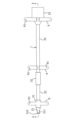
- FIG. 2 is a side view of the exhaust passage structure of the embodiment;
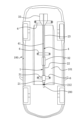
- FIG. 2 is a bottom view of the exhaust passage structure of the embodiment attached to the vehicle;
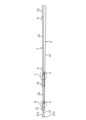
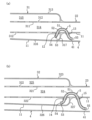
- AA sectional view of FIG. (a) is an enlarged view of the B section in FIG. 5, and
- (b) is an enlarged view of the C section in FIG. 6(a) and 6(b) are enlarged views corresponding to FIGS. 6(a) and 6(b) in a modification of the exhaust passage structure in which the bottom plate of the silencer is inclined.
- the exhaust passage structure of the embodiment according to the present invention is installed in the underfloor space of a vehicle 100, and the exhaust pipes are arranged in order from the upstream side of the exhaust system at intervals. 21, 22, 23, and a first silencer 31, a second silencer 32, and a third silencer 33 arranged in order from the upstream side of the exhaust system with a gap therebetween.
- the first silencer 31 is arranged between the exhaust pipe 21 and the exhaust pipe 22 and is provided in the middle of the exhaust passage 1
- the second silencer 32 is arranged between the exhaust pipe 22 and the exhaust pipe 23 to exhaust gas.
- the third silencer 33 is arranged at the rear end of the exhaust passage 1 .
- the exhaust pipes 21, 22, 23, the first silencer 31, the second silencer 32, and the third silencer 33 are each formed in a flat shape extending substantially horizontally, and the entire exhaust passage 1 has a flat shape extending substantially horizontally. Alternatively, it is formed in a flat cylindrical shape.
- the lower end of the entire exhaust passage 1, which is composed of the exhaust pipes 21, 22, 23, the first silencer 31, the second silencer 32, and the third silencer 33, is provided so as to extend substantially horizontally.
- the exhaust pipes 22 and 23, the second silencer 32, and the third silencer 33 are arranged above a bottom portion 41 of the inclined drainage channel 4, which will be described later. It is formed so as to have substantially the same height as the front end of the bottom portion 41 of the .
- an inclined drainage path 4 extending to the rear end of the exhaust path 1 and having a bottom portion 41 gradually inclined downward toward the rear end of the exhaust path 1 is a separate path from the exhaust path 1.
- the inclined drainage channel 4 is formed so as to extend from the rear end of the first silencer 31 to the rear end of the third silencer 33 .
- the slope of the bottom portion 41 of the inclined drainage channel 4 or the slope of the inner bottom surface, which is the inclined surface of the bottom portion 41, is 1 over the entire length of the inclined drainage channel 4 in order to smoothly move the condensed water in the inclined drainage channel 4 backward. /100 or more is preferable.
- the exhaust path 1 and the inclined drainage path 4 are communicated only at a location where the capillary portion 5 described later is provided. isolated by
- the exhaust passage structure composed of the exhaust passage 1 and the inclined drainage passage 4, or the drainage passage 1 and the inclined drainage passage 4, is preferably made of heat-resistant plastic that can withstand the exhaust temperature, and has a heat resistance temperature of 150 ° C. or more. It is more preferable to use heat-resistant plastic, but metal materials such as aluminum or brass may also be used. Alternatively, one of the exhaust passage 1 and the inclined drainage passage 4 may be made of heat-resistant plastic and the other of metal. good too.
- the exhaust passage structure composed of the drainage passage 1 and the inclined drainage passage 4 is formed of heat-resistant plastic such as polypropylene, for example, the exhaust passage 1 is divided vertically into two halves at a predetermined height position, which will be described later.
- the capillary portion 5 is bent as necessary and fixed by being fitted into the through holes 12 and 13 with sleeves, and fixed by being fitted into the through holes 14 and 15 with sleeves while being bent as necessary.
- the capillary portion 5 can be easily and reliably attached to a predetermined position, which is preferable for improving manufacturing efficiency.
- the exhaust passage structure composed of the drainage channel 1 and the inclined drainage channel 4 is divided into left and right halves made of heat-resistant plastic.
- the capillary portion 5 is press-fitted into the halves 15 and temporarily fixed by temporary fitting or the like, and then the left and right halves are fixed by welding or adhesion, or other than the bottom portion 41 of the inclined drainage channel 4.
- the exhaust passage structure main body and the bottom portion 41 which is a separate member, from a heat-resistant plastic, and fixing the capillary tube portion 5 by fitting the through holes 12, 13 with sleeves and the through holes 14, 15 with sleeves of the exhaust passage structure main body, respectively.
- the bottom portion 41 of the inclined drainage channel 4, which is a separate member may be fixed by welding or adhesion.
- the upper and lower halves can be manufactured in the same process as described above, the left and right halves can be manufactured in the same process, or the inclined drainage channel 4 can be formed as a separate member.
- the manufacturing process of the bottom part 41 after the capillary part 5 is fixed to the sleeve-equipped through holes 12, 13 and the sleeve-equipped through holes 14, 15, the upper and lower halves are fixed, the left and right halves are fixed, or an inclined drainage of another member is performed.
- the fixing of the bottom 41 of the channel 4 may be performed by adhesion, welding, or the like.
- connection pipe portion 211 On the front side of the exhaust pipe 21, a connection pipe portion 211 that is gradually deformed into a substantially cylindrical shape toward the upstream side is connected to the exhaust pipe 21, and a mounting flange 212 is provided at the front end of the connection pipe portion 211. . Insertion holes are formed in the mounting flange 212 at intervals in the circumferential direction.
- a flange is also provided at the rear end portion of the substantially tubular connected member 200 connected to the exhaust passage 1, and insertion holes are also formed in this flange at intervals in the circumferential direction.
- the exhaust path 1 and the connected member 200 on the vehicle 100 side are fixed by aligning the positions of the insertion holes and abutting the mounting flange 212, inserting bolts into the communicating insertion holes, tightening the bolts, tightening the nuts, etc.
- the member to be connected 200 is appropriate within the scope of the present invention, and can be, for example, an exhaust heat recovery device or a downstream pipe fixedly connected downstream thereof.
- the first silencer 31 corresponds to a sub-silencer and is provided in the middle of the exhaust passage 1 and near the upstream of the exhaust passage 1 .
- the first silencer 31 is formed in a flat tubular shape that extends substantially horizontally and has a closed front end surface and a rear end surface, and the inside is hollow.
- Through-hole groups 312 are respectively formed in the upper surface and the lower surface of the substantially flat cylindrical inner pipe portion 311 of the first silencer 31 , and the inner space 314 of the inner pipe portion 311 and the housing 313 of the first silencer 31 .
- a circular external space 315 between the inner tube portion 311 and the through hole group 312 communicate with each other.
- the external space 315 is a flat cylindrical continuous space that expands the exhaust gas.
- the first silencer 31 is provided with a capillary portion 5 for leading out condensed water from the interior of the first silencer 31 to the inclined drainage channel 4 .
- the capillary portion 5 is formed by inserting a capillary member 52 for generating a capillary phenomenon in a cylindrical holding member 51 subjected to anti-corrosion treatment.
- the inner diameter of the cylindrical holding member 51 is slightly larger than the outer diameter of the capillary member 52, and the capillary member 52 is locked and held by locking portions 53 such as locking claws provided inside the cylindrical holding member 51. ing.
- the cylindrical holding member 51 is preferably made of a highly thermally conductive material having a thermal conductivity of 16 W/m ⁇ K or more. It is preferable to use a metal material, and if the capillary tube portion 5 is assembled to the exhaust passage structure while being bent, it is preferable to use an easily bendable material such as aluminum.
- the capillary material 52 it is preferable to use a fibrous material such as glass fiber, carbon fiber, or aramid fiber, or a stranded wire, or a porous material such as diatomaceous earth, foamed resin, or foamed rubber.
- the capillary portion 5 provided in the first silencer 31 passes from the vicinity of the rear end of the bottom plate 316 of the first silencer 31 or the vicinity of the lower rear end wall 317 through the inside of the exhaust pipe 22 on the downstream side of the first silencer 31. , is installed in a curved manner so as to be guided from the exhaust pipe 22 on the downstream side to the inclined drainage channel 4 .
- the condensed water inlet end 54 of the capillary portion 5 is arranged near the rear end of the bottom plate 316 of the first silencer 31 , and the outlet end 55 is arranged near the bottom 41 of the inclined drainage channel 4 , for example.
- the capillary portion 5 is inserted through the sleeved through hole 12 formed in the inner pipe portion 311 of the first silencer 31 and the sleeved through hole 13 formed in the exhaust pipe 22 on the downstream side. , 13 are press-fitted into the sleeves.
- the method of fixing the capillary portion 5 is not limited to the fitting, but may be any applicable range such as gluing the outer periphery.
- the second silencer 32 corresponds to a sub-silencer, is provided in the middle of the exhaust passage 1 and slightly upstream from the middle position in the longitudinal direction of the exhaust passage 1, and is separated from the first silencer 31 on the downstream side of the first silencer 31.
- Through-hole groups 322 are respectively formed in the upper surface and the lower surface of the substantially flat cylindrical inner pipe portion 321 of the second silencer 32 , and the inner space 324 of the inner pipe portion 321 and the housing 323 of the second silencer 32 .
- a circular external space 325 between the inner pipe portion 321 and the through hole group 322 communicate with each other.
- the external space 325 is a flat cylindrical continuous space that expands the exhaust gas.
- the second silencer 32 is also provided with a capillary portion 5 having the same configuration as described above for leading condensed water from the inside of the second silencer 32 to the inclined drainage channel 4 .
- the capillary portion 5 provided in the second silencer 32 passes from the vicinity of the rear end of the bottom plate 326 of the second silencer 32 or the vicinity of the lower rear end wall 327 through the inside of the exhaust pipe 23 on the downstream side of the second silencer 32. , is installed in a curved manner so as to be guided from the exhaust pipe 23 on the downstream side to the inclined drainage channel 4 .
- the inlet end 54 of the condensed water of the capillary portion 5 is arranged near the rear end of the bottom plate 326 of the second silencer 32 , and the outlet end 55 is arranged near the bottom 41 of the inclined drainage channel 4 , for example.
- the capillary portion 5 is inserted through the sleeved through hole 14 formed in the inner pipe portion 321 of the second silencer 32 and the sleeved through hole 15 formed in the exhaust pipe 23 on the downstream side. , 15 are press-fitted into the sleeves.
- the capillary portion 5 provided in the second silencer 32 may also be fixed in an appropriate manner other than fitting as long as it is applicable.
- the third silencer 33 corresponds to a main silencer, and is formed at the rear end of the exhaust passage 1 so as to be substantially tapered in the width direction and to be substantially tapered in the height direction at an angle of inclination smaller than that in the width direction. ing.
- the third silencer 33 also includes a substantially flat cylindrical inner pipe portion up to a position on the upstream side of the rear end. and a circumferential external space that functions as an expansion chamber outside the inner tubular portion (not shown).
- mounting plate portions 6 are provided so as to project sideways from the upper side.
- the mounting plate portion 6 of this example is formed in an elongated plate shape, and a mounting hole 61 is formed in the vicinity of the tip thereof.
- the exhaust passage 1 is made of heat-resistant plastic, it is possible to fix the mounting plate portion 6 to a predetermined portion by gluing or the like. It is preferable to integrally form them by injection molding or the like using the same heat-resistant synthetic resin such as polypropylene.
- the mounting plate portions 6 are installed at a plurality of locations spaced apart in the longitudinal direction of the exhaust pipe 2. In the illustrated example, the mounting plate portions 6 are installed at three locations spaced apart in the longitudinal direction of the exhaust pipe 2. is set up.
- the exhaust path 1 and the inclined drainage path 4 integrally formed have fasteners such as screws and bolts inserted through mounting holes 61 in the vicinity of the tip of the mounting plate portion 6, and the tip of the fastener is attached to the mounting member 101. It is fixed so as to be embedded and attached to the underfloor space of the vehicle 100 . With the exhaust channel 1 and the inclined drainage channel 4 mounted in this way, the inclined drainage channel 4 is arranged below the exhaust channel 1 and the bottom 41 of the inclined drainage channel 4 slopes downward toward the rear of the vehicle 100 . provided to do so.
- the exhaust passage structure of the present embodiment by extending the lower end of the exhaust passage 1 substantially horizontally, the height of the installation space under the floor of the vehicle 100 can be suppressed, and the floor of the vehicle 100 can be lowered. can be done.
- the capillary portion 5 leads the condensed water to the inclined drainage passage 4, whereby the exhaust passage Necessary drainage of the condensed water generated inside 1 can be reliably performed. Therefore, blockage of the exhaust passage 1 due to freezing of condensed water and impossibility of starting the engine due to this blockage can be avoided. Corrosion can be prevented.
- the rear end of the exhaust passage 1 can be guided to a position corresponding to .
- the inclined drainage channel 4 for draining the condensed water is provided as a separate path from the exhaust channel 1, and the condensed water is discharged from the exhaust channel 1, which becomes hot due to the exhaust, to the low-temperature inclined drainage channel 4 by the thermocapillary phenomenon.
- the capillary portion 5 is passed from near the rear end of the bottom plate of the silencers 31, 32 through the inside of the exhaust pipes 22, 23 on the downstream side of the silencers 31, 32, and from the downstream exhaust pipes 22, 23 to the inclined drainage channel 4.
- the condensed water inside the silencers 31, 32 can be guided to the inclined drainage channel 4 without forming through holes in the outer walls of the housings 313, 323 of the silencers 31, 32, The required noise reduction performance of the silencers 31 and 32 can be reliably obtained.
- the capillary portion 5 is installed so as to be convex and curved upward, the installation state of the capillary portion 5 can be stabilized.
- the condensed water can be led out to the slanted drainage channel 4 by getting over the rear end wall of the silencer by the thermocapillary phenomenon and the principle of siphon, and can be reliably drained.
- the capillary portion 5 by inserting the capillary member 52 into the cylindrical holding member 51, the capillary portion 5 for leading the condensed water from the inside of the first silencer 31 and the second silencer 32 to the inclined drainage channel 4 is formed. It can be installed in a stable state. Further, by subjecting the tubular holding member 51 to anti-corrosion treatment, it is possible to prolong the life of the tubular holding member 51 and the capillary portion 5 . Further, by forming the inner diameter of the tubular holding member 51 larger than the outer diameter of the capillary member 52, it is possible to avoid the tubular holding member 51 from being pressed when the condensed water freezes and expands in volume. can.
- the cylindrical holding member 51 is made of a highly thermally conductive material having a thermal conductivity of 16 W/m ⁇ K or higher, and the capillary member 52 is embedded in the highly thermally conductive tubular holding member 51, whereby the capillary portion When condensed water freezes inside 5 or inside capillary material 52, the frozen condensed water can be melted using the high-temperature energy of the exhaust gas and led to the inclined drainage channel 4 for drainage.
- the entire exhaust passage 1 in a flat shape that extends substantially horizontally, the height of the installation space under the floor of the vehicle 100 is suppressed, and the inner cross-sectional areas required for the exhaust pipes 21, 22, and 23 are reduced. Also, the inner cross-sectional areas required for the silencers 31, 32, and 33 can be obtained more reliably.
- the shape of the mold can be adjusted to easily manufacture an exhaust passage structure of any shape. The degree of freedom can be increased and the weight of the exhaust path structure is lighter than that of the exhaust path structure formed of metal materials, so the resonance frequency of the exhaust path structure can be increased, and the vibration of the resonance deteriorates the exhaust path structure. , can prevent damage.
- the bottom plates 316 and 326 of the silencers 31 and 32 are formed to be inclined downward toward the condensed water introduction end portion 54 of the capillary portion 5, the capillary portion inside the silencers 31 and 32
- the condensed water can be effectively collected at the introduction end 54 of 5 and drained so that the remaining amount of condensed water is less.
- the inclination of the bottom plates 316 and 326 is preferably such that the position corresponding to the introduction end portion 54 of the capillary portion 5 is the lowest.
- the bottom plates 316 and 326 are gradually slanted downward toward the rear ends, and the silencers 31 and 32 are gradually slanted downward toward the center from both widthwise ends of the silencers 31 and 32. Good.
- a drain hole 16 for discharging condensed water from the exhaust pipe 22 or the exhaust pipe 23 or both of the exhaust pipes 22 and 23 to the inclined drainage channel 4 is provided in the exhaust pipe 22. , 23 and the inclined drainage channel 4, even if condensed water occurs in the exhaust pipes 22, 23 other than the silencers 31, 32, the inclined drainage channel 4 is discharged through the drain hole 16. It is suitable because it can be smoothly discharged and drained.
- the number of exhaust pipes constituting the exhaust passage and the silencers arranged in the middle is appropriate. is appropriate within the applicable range.
- the present invention can be used as an exhaust passage structure for exhaust emitted from an internal combustion engine of an automobile.
Landscapes
- Engineering & Computer Science (AREA)
- Chemical & Material Sciences (AREA)
- Combustion & Propulsion (AREA)
- Mechanical Engineering (AREA)
- General Engineering & Computer Science (AREA)
- Exhaust Silencers (AREA)
Applications Claiming Priority (2)
| Application Number | Priority Date | Filing Date | Title |
|---|---|---|---|
| JP2022002661A JP7720128B2 (ja) | 2022-01-11 | 2022-01-11 | 排気路構造 |
| JP2022-002661 | 2022-01-11 |
Publications (1)
| Publication Number | Publication Date |
|---|---|
| WO2023136108A1 true WO2023136108A1 (ja) | 2023-07-20 |
Family
ID=87279032
Family Applications (1)
| Application Number | Title | Priority Date | Filing Date |
|---|---|---|---|
| PCT/JP2022/047792 Ceased WO2023136108A1 (ja) | 2022-01-11 | 2022-12-24 | 排気路構造 |
Country Status (2)
| Country | Link |
|---|---|
| JP (1) | JP7720128B2 (https=) |
| WO (1) | WO2023136108A1 (https=) |
Families Citing this family (1)
| Publication number | Priority date | Publication date | Assignee | Title |
|---|---|---|---|---|
| WO2026083538A1 (ja) * | 2024-10-17 | 2026-04-23 | 日産自動車株式会社 | 音圧低減構造 |
Citations (5)
| Publication number | Priority date | Publication date | Assignee | Title |
|---|---|---|---|---|
| JPS56127316U (https=) * | 1980-02-25 | 1981-09-28 | ||
| JP2006112327A (ja) * | 2004-10-15 | 2006-04-27 | Calsonic Kansei Corp | 車両用消音器の水抜き構造 |
| DE102014006927A1 (de) * | 2014-05-10 | 2014-12-04 | Daimler Ag | Schalldämpfer für eine Abgasanlage und Verfahren zum Abführen von Flüssigkeit aus einem Schalldämpfer |
| JP2018031358A (ja) * | 2016-08-26 | 2018-03-01 | トヨタ自動車株式会社 | 排気管構造 |
| JP2018105206A (ja) * | 2016-12-26 | 2018-07-05 | トヨタ自動車株式会社 | 排気管構造 |
-
2022
- 2022-01-11 JP JP2022002661A patent/JP7720128B2/ja active Active
- 2022-12-24 WO PCT/JP2022/047792 patent/WO2023136108A1/ja not_active Ceased
Patent Citations (5)
| Publication number | Priority date | Publication date | Assignee | Title |
|---|---|---|---|---|
| JPS56127316U (https=) * | 1980-02-25 | 1981-09-28 | ||
| JP2006112327A (ja) * | 2004-10-15 | 2006-04-27 | Calsonic Kansei Corp | 車両用消音器の水抜き構造 |
| DE102014006927A1 (de) * | 2014-05-10 | 2014-12-04 | Daimler Ag | Schalldämpfer für eine Abgasanlage und Verfahren zum Abführen von Flüssigkeit aus einem Schalldämpfer |
| JP2018031358A (ja) * | 2016-08-26 | 2018-03-01 | トヨタ自動車株式会社 | 排気管構造 |
| JP2018105206A (ja) * | 2016-12-26 | 2018-07-05 | トヨタ自動車株式会社 | 排気管構造 |
Also Published As
| Publication number | Publication date |
|---|---|
| JP7720128B2 (ja) | 2025-08-07 |
| JP2023102223A (ja) | 2023-07-24 |
Similar Documents
| Publication | Publication Date | Title |
|---|---|---|
| KR100957147B1 (ko) | 차량의 소음기 및 이를 사용한 배기 장치 | |
| CN103568818B (zh) | 电池冷却管道 | |
| EP1469171B1 (en) | Internal combustion engine with blow-by gas recirculation system | |
| US11525377B1 (en) | Condensed water drainage device and exhaust system of a vehicle having the same | |
| WO2023136108A1 (ja) | 排気路構造 | |
| CN101680346A (zh) | 车载发动机的排气管 | |
| RU2750241C1 (ru) | Шина с основными канавками для подавления шума | |
| EP2193260B1 (en) | Exhaust silencer device for internal combustion engine | |
| CN114060134B (zh) | 一种车辆排气设备及排气控制方法 | |
| JPH0771663A (ja) | 熱可塑性樹脂製波形パイプ | |
| CN100538042C (zh) | 管接头 | |
| CN109941095A (zh) | 用于机动车辆的内燃发动机的排气系统及机动车辆 | |
| JP6589825B2 (ja) | 排気管構造 | |
| CN118082974A (zh) | 下车体结构及车辆 | |
| CN221957659U (zh) | 回油底座及车辆 | |
| JP7478502B2 (ja) | 排気マフラー | |
| JP2025535573A (ja) | 下部車体配置構造および車両 | |
| JP2022114400A5 (https=) | ||
| CN217681967U (zh) | 连接管、发动机组件和车辆 | |
| KR102407680B1 (ko) | 자동차 소음기용 드레인 튜브 | |
| CN119029256A (zh) | 一种燃料电池汽车排气消声器结构、消声管路系统及车辆 | |
| JP3932852B2 (ja) | 自動車の排気系構造 | |
| CN219236757U (zh) | 排气管及车辆 | |
| KR101316205B1 (ko) | 머플러 일체형 차체구조 | |
| JP2010012845A (ja) | 車両の下部構造 |
Legal Events
| Date | Code | Title | Description |
|---|---|---|---|
| 121 | Ep: the epo has been informed by wipo that ep was designated in this application |
Ref document number: 22920625 Country of ref document: EP Kind code of ref document: A1 |
|
| NENP | Non-entry into the national phase |
Ref country code: DE |
|
| 122 | Ep: pct application non-entry in european phase |
Ref document number: 22920625 Country of ref document: EP Kind code of ref document: A1 |