WO2023127646A1 - 洗浄装置、試料分析装置、および洗浄方法 - Google Patents
洗浄装置、試料分析装置、および洗浄方法 Download PDFInfo
- Publication number
- WO2023127646A1 WO2023127646A1 PCT/JP2022/047122 JP2022047122W WO2023127646A1 WO 2023127646 A1 WO2023127646 A1 WO 2023127646A1 JP 2022047122 W JP2022047122 W JP 2022047122W WO 2023127646 A1 WO2023127646 A1 WO 2023127646A1
- Authority
- WO
- WIPO (PCT)
- Prior art keywords
- cleaning
- cleaning liquid
- hollow body
- passage portion
- needle
- Prior art date
- Legal status (The legal status is an assumption and is not a legal conclusion. Google has not performed a legal analysis and makes no representation as to the accuracy of the status listed.)
- Ceased
Links
Images




Classifications
-
- G—PHYSICS
- G01—MEASURING; TESTING
- G01N—INVESTIGATING OR ANALYSING MATERIALS BY DETERMINING THEIR CHEMICAL OR PHYSICAL PROPERTIES
- G01N35/00—Automatic analysis not limited to methods or materials provided for in any single one of groups G01N1/00 - G01N33/00; Handling materials therefor
- G01N35/10—Devices for transferring samples or any liquids to, in, or from, the analysis apparatus, e.g. suction devices, injection devices
- G01N35/1004—Cleaning sample transfer devices
-
- B—PERFORMING OPERATIONS; TRANSPORTING
- B01—PHYSICAL OR CHEMICAL PROCESSES OR APPARATUS IN GENERAL
- B01L—CHEMICAL OR PHYSICAL LABORATORY APPARATUS FOR GENERAL USE
- B01L13/00—Cleaning or rinsing apparatus
- B01L13/02—Cleaning or rinsing apparatus for receptacle or instruments
Definitions
- the present invention relates to a cleaning device for cleaning a suction unit, a sample analyzer, and a cleaning method.
- Patent Document 1 does not consider any countermeasures against the above-described foreign matter adhering to the cleaning device.
- the present invention was made to solve the above-mentioned problems, and its object is to solve the problem even when foreign matter adheres to the aspiration tube after sample aspiration, and the foreign matter adheres to the washing device due to the movement of the aspiration tube. It is another object of the present invention to provide a cleaning apparatus, a sample analysis apparatus, and a cleaning method capable of reducing the possibility that the above-mentioned foreign substances adversely affect the analysis of a sample.
- a cleaning device is a cleaning device that cleans a suction part, and includes a first passage in which a suction tube for sucking a sample moves, and a first washing liquid supply that intersects with the first passage.
- a hollow body having a channel portion, a washing liquid discharge channel portion, a second channel portion which is connected to the first channel portion and the suction tube in a movement direction, and in which the suction tube moves; and an exterior of the hollow body.
- a wall portion having an inner surface positioned surrounding a side surface with a gap therebetween, the suction portion including the suction tube and the hollow body, the wall portion having a second wall extending through the inner surface; It has two cleaning liquid supply flow paths, and cleans at least one of the suction tube and the hollow body.
- a sample analyzer includes the cleaning device described above, an analysis chamber for analyzing the sample, and the suction tube for sucking the sample and discharging it into the analysis chamber. Prepare.
- a washing method after aspirating a sample with a suction tube, the suction tube is drawn into a first passage of a washing device through a second passage of a hollow body of the washing device.
- a drawing step a first cleaning liquid supply step of supplying the first cleaning liquid from the first cleaning liquid supply channel of the cleaning device into the first passage, and the first cleaning liquid supplied into the first passage,
- a second cleaning liquid supply step of supplying a second cleaning liquid from a second cleaning liquid supply flow path penetrating through the inner surface.
- the present invention even if foreign matter adheres to the aspiration tube after sample aspiration, and the foreign matter adheres to the cleaning device due to the movement of the aspiration tube, it is possible to reduce the possibility that the foreign matter adversely affects sample analysis. can.
- FIG. 1 is a perspective view showing an external configuration of a blood analyzer according to one embodiment of the present invention
- FIG. FIG. 2 is an explanatory diagram schematically showing the internal configuration of the blood analyzer
- FIG. 2 is a cross-sectional view showing a schematic configuration of a cleaning device included in the blood analyzer; It is a bottom view when the 2nd washing
- 4 is a flow chart showing the flow of each process for washing the needle after blood suction.
- FIG. 4 is an explanatory diagram schematically showing a path along which a first cleaning liquid flows from a first cleaning liquid supply channel portion toward a cleaning liquid discharge channel portion in the cleaning apparatus;
- FIG. 4 is an explanatory diagram schematically showing a path along which a second cleaning liquid flows in the cleaning apparatus;
- FIG. 4 is an explanatory diagram schematically showing a path along which a first cleaning liquid flows downward through a first channel portion and a second channel portion in the cleaning apparatus;
- blood whole blood
- a blood analyzer for analyzing blood is considered as an example of a sample analyzer.
- FIG. 1 is a perspective view showing the external configuration of a blood analyzer 1 of this embodiment.
- the blood analysis device 1 has a display section 3 on the front upper portion of the device main body 2 .
- the display unit 3 is composed of, for example, a liquid crystal display device with a touch panel, displays blood analysis results, etc., and accepts input of various types of information by an operator (for example, a medical worker).
- a storage container loading section 4 is provided at the bottom of the device main body 2 . Opening the cover 4a of the container loading section 4, setting the container 10 containing the blood sample (hereinafter simply referred to as blood), and closing the cover 4a to load the container 10 into the apparatus main body 2. can be done. Note that the storage container 10 may be loaded into the apparatus main body 2 in a state in which an adapter corresponding to the type of the storage container 10 is attached.
- a reagent container loading section 5 is provided on the side of the device main body 2 .
- reagents used in blood analysis for example, immunoassay reagents
- FIG. 2 is an explanatory diagram schematically showing the internal configuration of the blood analyzer 1.
- Blood analyzer 1 includes needle 20 , blood analysis section 30 , and control section 40 .
- the control unit 40 is composed of, for example, a central processing unit (computer) called a CPU (Central Processing Unit), and controls the operation of each unit of the blood analyzer 1 .
- a CPU Central Processing Unit
- the needle 20 is an aspiration tube that aspirates a sample (blood) from the storage container 10 and discharges the aspirated sample into an analysis chamber 31, which will be described later. That is, the needle 20 aspirates and discharges the blood contained in the container 10 .
- the needle 20 is an example of a suction unit SU to be cleaned by a cleaning device 60, which will be described later.
- the storage container 10 is a container in which blood can be collected (sampled) while the lid 10b is fitted to the container main body 10a, and is also called a vacuum blood collection tube.
- the lid 10b of the container 10 By piercing the lid 10b of the container 10 with the tip of the needle 20, the blood inside can be sucked.
- the rear end of the needle 20 is connected to a quantitative syringe 22 via a first pipe 21 indicated by a broken line and an electromagnetic valve device (not shown).
- a quantitative syringe 22 By driving the metering syringe 22 and the solenoid valve device by the control unit 40 , blood is sucked and discharged by the needle 20 .
- the needle 20 is moved horizontally and vertically by the probe unit 23 (driving unit).
- the probe unit 23 includes a horizontal movement mechanism 24 and a vertical movement mechanism 25 .
- the horizontal movement mechanism 24 and the vertical movement mechanism 25 are composed of feed screw mechanisms, for example.
- the feed screw mechanism rotates the feed screw with a stepping motor to horizontally or vertically move an engaging portion that engages with the feed screw.
- the horizontal movement mechanism 24 and the vertical movement mechanism 25 may include, for example, an endless belt, a drive roller and a driven roller for running the endless belt, and the like.
- the endless belt of the horizontal movement mechanism 24 runs in the horizontal direction
- the endless belt of the vertical movement mechanism 25 moves in the vertical direction. run.
- the needle 20 supported by the vertical movement mechanism 25 can be moved horizontally and vertically.
- the blood analysis unit 30 performs blood analysis such as counting blood cells and measuring immunity.
- the blood analysis unit 30 has a chamber 31 (container) that receives blood that has been sucked from the storage container 10 by the needle 20 and discharged. Chambers 31 are provided according to objects to be counted, such as red blood cells, white blood cells (including white blood cell classification), and CRP.
- a counting device is provided in the chamber 31 for counting blood cells.
- the counting device can perform measurement methods such as impedance method, flow cytometry, light-focusing flow impedance method, etc., depending on the blood cells to be counted.
- the control unit 40 can create a frequency distribution and the like by processing the measurement data acquired by the counting device. The processing of the measurement data is performed by the calculation section 40 a included in the control section 40 .
- the blood analyzer 1 has a chamber 31 (analysis chamber) for analyzing a sample (blood). Note that the above-described counting device may be provided outside the chamber 31 and connected to the chamber 31 .
- a plurality of reagent containers are provided near the chamber for CRP measurement.
- Each reagent container contains a hemolysis reagent, a buffer solution, an anti-human CRP-sensitized latex immunoreagent, and the like.
- the reagent is aspirated from each reagent container by the needle 20 at an appropriate timing and discharged into the chamber.
- the blood analysis section 30 further has a cleaning chamber 32 .
- the cleaning chamber 32 receives cleaning liquid that drops from above when the needle 20 is cleaned by the cleaning device 60, which will be described later. Washing chamber 32 also receives excess blood as it is expelled from needle 20 .
- the cleaning device 60 is supported by the probe unit 23 and moves horizontally as the needle 20 moves horizontally when the probe unit 23 is driven. Further, the needle 20 is moved vertically relative to the cleaning device 60 by driving the probe unit 23 .
- a discharge pipe 33 indicated by a dashed line is connected to the lower end of each chamber described above, that is, the analysis chamber (chamber 31) and the cleaning chamber 32.
- the waste liquid in each chamber is sent to the waste liquid container 50 through an electromagnetic valve device (not shown) by driving the discharge section (not shown).
- the above discharge unit is configured by a discharge syringe or a discharge pump.
- the control section 40 drives the probe unit 23 to move the needle 20 horizontally and vertically. .
- the needle 20 can enter and escape from the interior of each of the container 10, the chamber 31, and the reagent container.
- the blood analysis unit 30 performs blood analysis (blood cell count, immunoassay).
- the blood analyzer 1 further includes a temperature adjustment section 41 .
- the temperature adjuster 41 is connected to, for example, a second pipe 26 branched from the first pipe 21 .
- a switching valve 27 for switching the flow path is provided at a branching portion between the first pipe 21 and the second pipe 26 .
- the temperature adjustment unit 41 heats the diluent filled in a tank (also called a buffer tank) around which a heater is wound, using the heater.
- the warmed diluent joins the first pipe 21 via the second pipe 26 and the switching valve 27 and is discharged into the chamber 31 via the needle 20 .
- the blood previously sucked from the container 10 by the needle 20 is also discharged into the chamber 31 at the same time as the warmed diluent.
- the discharged blood is warmed to an arbitrary temperature by being mixed with the warmed diluent.
- the temperature adjustment unit 41 may be configured to warm the blood in the chamber 31 by directly warming the chamber 31 with a heater or the like. By warming the blood to an arbitrary temperature in this manner, it is possible to prevent the coagulation of blood that coagulates in cold weather.
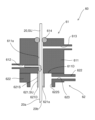
- FIG. 3 is a cross-sectional view showing a schematic configuration of the cleaning device 60.
- the cleaning device 60 is a device for cleaning the suction unit SU, and includes a first cleaning unit 61 and a second cleaning unit 62 .
- the suction unit SU to be cleaned by the cleaning device 60 includes not only the needle 20 described above but also a cylindrical body 621 described later. That is, the suction unit SU includes the needle 20 and the tubular body 621 .
- the moving direction of the needle 20 with respect to the cleaning device 60 by driving the probe unit 23 is defined as the vertical direction.
- the direction in which the needle 20 moves toward the containing container 10 (see FIG. 2) when sucking blood is defined as "down", and the opposite direction (the side away from the containing container 10) is defined as "up”.
- the first cleaning section 61 and the second cleaning section 62 are positioned side by side in the vertical direction. More specifically, the second cleaning section 62 is positioned below the first cleaning section 61 .
- the first cleaning unit 61 and the second cleaning unit 62 may be configured integrally, or may be configured by bonding (connecting) separate members to each other.
- the first cleaning section 61 has a cleaning block 611 , a first cleaning liquid supply channel section 612 and a cleaning liquid discharge channel section 613 .
- the washing block 611 is a block having a first passage portion 611a inside which the needle 20 moves.
- the first passage portion 611a has an inner diameter larger than the outer diameter of the needle 20 and is provided along the vertical direction. More specifically, the first passage portion 611a penetrates the cleaning block 611 in the vertical direction. Therefore, both ends in the vertical direction of the first passage portion 611a are open.
- a sealing member 614 is provided at the upper end portion of the first passage portion 611 a in the cleaning block 611 . The sealing material 614 seals the upper end of the first passage portion 611a with the needle 20 sandwiched therebetween.
- the first cleaning liquid supply channel portion 612 and the cleaning liquid discharge channel portion 613 are connected (intersect) with the first channel portion 611a at different positions in the cleaning block 611 . More specifically, the first cleaning liquid supply channel portion 612 is located below the cleaning liquid discharge channel portion 613 in the cleaning block 611 . The first cleaning liquid supply channel portion 612 and the cleaning liquid discharge channel portion 613 are positioned so as to extend in a direction intersecting the vertical direction (for example, the horizontal direction).
- the first cleaning liquid supply channel portion 612 is connected to a cleaning liquid storage section (not shown). Therefore, the cleaning liquid (first cleaning liquid) supplied from the cleaning liquid storage section flows through the first cleaning liquid supply channel section 612 .
- the cleaning liquid containing portion may be the buffer tank described above. In this case, the diluted liquid filled in the buffer tank can be used as the cleaning liquid. Note that the cleaning liquid is not limited to the diluent, and may be another liquid (for example, water).
- the cleaning liquid discharge channel portion 613 is connected to, for example, the waste liquid container 50 (see FIG. 2). The cleaning liquid (first cleaning liquid) discharged from the cleaning liquid discharge channel portion 613 flows toward the waste liquid container 50 .
- the second cleaning section 62 has a cylindrical body 621 and a wall section 622 .
- the cylindrical body 621 is an example of a hollow body, and has a circular cross-sectional profile.
- As the hollow body a rectangular tube having a polygonal cross section may be used.
- the tubular body 621 has a second passage portion 621a.
- the second passage portion 621a is positioned so as to pass through the tubular body 621 in the vertical direction. Therefore, both ends in the vertical direction of the second passage portion 621a are open.
- the second passage portion 621a is vertically connected to the first passage portion 611a of the first cleaning portion 61 .
- the cylindrical body 621 is positioned so as to protrude downward from the lower surface 611D of the cleaning block 611 of the first cleaning section 61 . That is, the cylindrical body 621 extends along the vertical direction.
- the second passage portion 621 a has an inner diameter larger than the outer diameter of the needle 20 .
- the needle 20 moves inside the second passage portion 621a.
- the cylindrical body 621 is made of metal such as SUS. That is, the cylindrical body 621 contains metal.
- the cylindrical body 621 is attached to the lower surface 611D of the cleaning block 611 by adhesion.
- the cylindrical body 621 may be press-fitted into the lower portion of the cleaning block 611 so that the second passage portion 621a is connected to the first passage portion 611a.
- the metal forming the cylindrical body 621 is not limited to SUS, but is preferably a metal having corrosion resistance to the cleaning liquid.
- the cylindrical body 621 may be made of resin.
- the wall portion 622 is located on the same side as the cylindrical body 621 with respect to the cleaning block 611 of the first cleaning portion 61 , that is, on the lower side of the cleaning block 611 .
- the wall portion 622 has an inner side surface 622 ⁇ /b>S and a second cleaning liquid supply channel portion 623 .
- the inner surface 622S is positioned apart from the outer peripheral surface 621S forming the outer surface of the cylindrical body 621 with a gap T therebetween. More specifically, the inner surface 622S surrounds the outer peripheral surface 621S of the cylinder 621 with a gap T therebetween. Thereby, a groove G is formed around the outer peripheral surface 621S of the cylinder 621 .
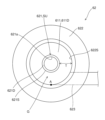
- FIG. 4 is a bottom view of the second cleaning unit 62 viewed from below, that is, the second cleaning unit 62 viewed from the side opposite to the first cleaning unit 61 (see FIG. 3).
- the outer peripheral surface 621S which is the outer surface of the cylindrical body 621, is circular, and the inner surface 622S of the wall portion 622 is also circular.
- the inner diameter of the inner surface 622S is larger than the outer diameter of the outer peripheral surface 621S.
- the groove G described above has a shape in which the lower surface 611D of the cleaning block 611 is the upper surface, the outer peripheral surface 621S of the cylinder 621 and the inner surface 622S of the wall portion 622 are the side surfaces, and the lower part is open. It is formed in an annular shape along the
- the second cleaning liquid supply channel portion 623 is located through the inner side surface 622S.
- the second cleaning liquid supply channel portion 623 is positioned extending in a direction intersecting the vertical direction (eg, horizontal direction).
- the second cleaning liquid supply channel section 623 extends along the tangential direction at an arbitrary point A on the inner surface 622S of the wall section 622. located.
- FIG. 5 is a flow chart showing the flow of each process related to washing the needle 20 after blood suction.
- the needle 20 is moved downward by driving the probe unit 23 from the state shown in FIG. Then, the tip 20b of the needle 20 is pierced into the lid 10b (see FIG. 2) of the container 10, and the needle 20 sucks blood.
- the probe unit 23 is driven to move the needle 20 upward, pull the needle 20 out of the container 10, insert the needle 20 into the first passage portion 611a of the first cleaning section 61, and insert the needle 20 into the second cleaning section 62 of the second cleaning section 62. It is drawn in via the second passage portion 621a (S1; drawing step). After the needle 20 is pulled out of the container 10 , the probe unit 23 is driven to horizontally move the needle 20 together with the cleaning device 60 and position it above the cleaning chamber 32 .
- the first cleaning liquid for example, diluent
- the first cleaning liquid supply channel portion 612 is supplied from the first cleaning liquid supply channel portion 612 to the first passage portion 611a (S2; first cleaning liquid supply step).
- the inside of the first passage portion 611a is filled with the cleaning liquid, so that the outer peripheral surface 20a (see FIG. 3) of the needle 20 positioned inside the first passage portion 611a is cleaned with the first cleaning liquid.
- the outer peripheral surface 20a of the needle 20 is washed over a wide range in the vertical direction, and the needle 20 is washed.
- the tip 20b (see FIG. 3) is also cleaned.
- the first cleaning liquid supplied to the first passage portion 611a is discharged through the cleaning liquid discharge channel portion 613 (S3; cleaning liquid discharge step).
- the dirty first cleaning liquid used for cleaning the needle 20 in the first passage portion 611a is discharged to the outside (for example, the waste liquid container 50, see FIG. 2) through the cleaning liquid discharge passage portion 613. . Therefore, the inside of the first passage portion 611a can always be filled with clean first cleaning liquid.
- FIG. 6 schematically shows, with arrows, the path through which the first cleaning liquid flows when S1 to S3 are performed in parallel.
- the cleaning liquid discharge channel portion 613 is located above the first cleaning liquid supply channel portion 612, so that the cleaning liquid is supplied from the first cleaning liquid supply channel portion 612 into the first channel portion 611a.
- the first cleaning liquid that has been washed and contaminated by cleaning flows into the upper cleaning liquid discharge channel portion 613 .
- the first cleaning liquid soiled by cleaning hardly travels downward along the outer peripheral surface 20a of the needle 20 and stains the outer peripheral surface 20a.
- FIG. 6 shows a state in which the foreign matter 70 adheres to the outer peripheral surface 621S of the cylindrical body 621.
- the needle 20 is moved downward by the probe unit 23, and the tip portion 20b of the needle 20 is moved to the cylindrical body 621. It protrudes downward from the lower end surface 621D.
- the second cleaning liquid is supplied from the second cleaning liquid supply channel portion 623 into the gap T between the outer peripheral surface 621S of the cylinder 621 and the inner side surface 622S of the wall section 622 (S4; second cleaning liquid supply process).
- the second cleaning liquid is supplied to the groove G from the second cleaning liquid supply channel portion 623 .
- the second cleaning liquid may be exactly the same cleaning liquid as the first cleaning liquid, or may be a cleaning liquid different from the first cleaning liquid.
- FIG. 7 schematically shows the path along which the second cleaning liquid flows with arrows. Due to the supply of the second cleaning liquid, the foreign matter 70 adhering to the outer peripheral surface 621S of the cylindrical body 621 is removed by the second cleaning liquid flowing through the groove G, drops downward together with the second cleaning liquid, and is collected in the cleaning chamber 32 .
- the second cleaning liquid supply channel portion 623 is positioned along the tangential direction to the point A (see FIG. 4), the second cleaning liquid supplied from the second cleaning liquid supply channel portion 623 to the groove G 2 The cleaning liquid swirls in the groove G and flows.
- the first cleaning liquid is supplied from the first cleaning liquid supply channel section 612 to the first passage section 611a (S5; first cleaning liquid resupply step).
- the discharge of the first cleaning liquid from the cleaning liquid discharge channel portion 613 is stopped.
- the first cleaning liquid supplied from the first cleaning liquid supply channel portion 612 to the first passage portion 611a flows downward as it is in the first passage portion 611a as indicated by the arrow in FIG. It drops downward from the second passage portion 621a and is collected in the cleaning chamber 32.
- the cleaning liquid (second cleaning liquid) is supplied from the second cleaning liquid supply channel portion 623 to the gap T (groove G).
- the foreign matter 70 can be removed by cleaning the outer peripheral surface 621S of the cylinder 621 . Therefore, it is possible to reduce the risk that the foreign matter 70 will adversely affect the subsequent blood analysis (for example, reduce the accuracy of the analysis).
- the outer peripheral surface 621S of the cylindrical body 621 is circular, and the inner side surface 622S of the wall portion 622 is also circular.
- an annular groove G is formed between the outer peripheral surface 621S of the cylindrical body 621 and the inner surface 622S of the wall portion 622, as shown in FIG.
- the cleaning liquid supplied from the second cleaning liquid supply channel portion 623 to the gap T (groove G) swirls and flows in the groove G as described above (see FIG. 7).
- the foreign matter 70 adhering to the outer peripheral surface 621S of the cylindrical body 621 can be efficiently removed by the swirling flow of the cleaning liquid. That is, by making the cleaning liquid supplied to the gap T by the second cleaning liquid supply channel portion 623 into a swirling flow that swirls around the outer peripheral surface 621S of the cylindrical body 621, the foreign matter 70 adhering to the outer peripheral surface 621S of the cylindrical body 621 is removed. It can be removed efficiently.
- the cylindrical body 621 contains metal. As a result, the strength of the cylindrical body 621 can be ensured, and the thickness of the cylindrical body 621 can be reduced. For example, the thickness of the cylinder 621 can be reduced to about 0.2 to 0.3 mm. As a result, the area of the lower end surface 621D of the cylindrical body 621 (the surface that intersects with the outer peripheral surface 621S of the cylindrical body 621 and is perpendicular to the movement direction of the needle 20) is reduced, thereby reducing adhesion of foreign matter to the lower end surface 621D. can be done. Therefore, by cleaning the outer peripheral surface 621S of the cylindrical body 621, most of the foreign matter 70 adhering to the cylindrical body 621 can be removed, and the removal efficiency of the foreign matter 70 can be improved.
- the needle 20 used in this embodiment is a suction tube having a tip portion 20b that can penetrate the lid 10b of the storage container 10 .
- Such an aspiration tube is also called a single-pierce aspiration tube.
- the foreign matter 70 may adhere to the suction tube, and this foreign matter may adhere to the outer peripheral surface 621 ⁇ /b>S of the cylindrical body 621 when the suction tube is taken into the cleaning device 60 . Therefore, the cleaning device 60 of the present embodiment is very effective when performing sampling using such a single-pierce suction tube.
- the blood analyzer 1 as the sample analyzer of this embodiment includes the cleaning device 60 configured as described above, an analysis chamber 31 for analyzing a sample (for example, blood), and aspirating and discharging the sample into the chamber 31. and a needle 20 that Even if foreign matter 70 adheres to cleaning device 60 (for example, outer peripheral surface 621S of cylindrical body 621) after aspirating (sampling) a sample, cleaning device 60 can remove foreign matter 70. Therefore, analysis in blood analyzer 1 is improved. A decrease in accuracy can be avoided.
- the blood analyzer 1 of the present embodiment also includes a probe unit 23 as a drive section that moves the needle 20 (in the vertical direction) with respect to the first passage section 611a and the second passage section 621a of the washing device 60.
- a probe unit 23 as a drive section that moves the needle 20 (in the vertical direction) with respect to the first passage section 611a and the second passage section 621a of the washing device 60.
- the needle 20 can be washed by drawing the outer peripheral surface 20a and the tip portion 20b of the needle 20 into the interior of the first passage portion 611a.
- the tip portion 20b of the needle 20 is moved from the end surface (lower end surface 621D) of the cylindrical body 621 opposite to the first cleaning section 61 side.
- the second cleaning liquid is supplied to the gap T while protruding to the outside.
- the second cleaning liquid falls from the outer peripheral surface 621S of the cylindrical body 621 along the outer peripheral surface 20a of the needle 20 into the cleaning chamber 32 below. Therefore, the second cleaning liquid supplied to the gap T can be efficiently recovered without being scattered around.
- the cleaning of the needle 20 by the cleaning device 60 is performed in the order of cleaning by the first cleaning unit 61 and cleaning by the second cleaning unit 62.
- the cleaning by the first cleaning unit 61 and the cleaning by the second cleaning unit 62 may be performed simultaneously.
- the cleaning device 60 of this embodiment can also be applied to cleaning a double-needle suction tube, for example. is.
- the sample may be other than blood.
- the sample may be a bodily fluid such as plasma, serum, saliva, urine, lymph, cerebrospinal fluid, and the like.
- the cleaning device 60 described in this embodiment can be applied to an apparatus for analyzing a sample such as plasma.
- the present invention can be used for sample analyzers such as blood analyzers.
- Blood analyzer 10 container 10b lid 20 needle (suction part, suction tube) 20a outer peripheral surface 20b tip portion 23 probe unit (driving portion) 31 chamber (analysis chamber) 60 cleaning device 61 first cleaning section 611 cleaning block 611a first passage section 612 first cleaning liquid supply channel section 613 cleaning liquid discharge channel section 62 second cleaning section 621 cylindrical body (suction section, hollow body) 621a Second passage portion 621S Outer peripheral surface (outer surface) 622 wall portion 622S inner surface 623 second cleaning liquid supply channel portion A arbitrary point T gap SU suction portion
Landscapes
- Chemical & Material Sciences (AREA)
- Health & Medical Sciences (AREA)
- General Health & Medical Sciences (AREA)
- General Physics & Mathematics (AREA)
- Physics & Mathematics (AREA)
- Life Sciences & Earth Sciences (AREA)
- Analytical Chemistry (AREA)
- Biochemistry (AREA)
- Clinical Laboratory Science (AREA)
- Chemical Kinetics & Catalysis (AREA)
- Immunology (AREA)
- Pathology (AREA)
- Automatic Analysis And Handling Materials Therefor (AREA)
- Cleaning In General (AREA)
- Cleaning By Liquid Or Steam (AREA)
- Sampling And Sample Adjustment (AREA)
Priority Applications (2)
| Application Number | Priority Date | Filing Date | Title |
|---|---|---|---|
| JP2023570905A JPWO2023127646A1 (https=) | 2021-12-28 | 2022-12-21 | |
| EP22915869.6A EP4439075A4 (en) | 2021-12-28 | 2022-12-21 | CLEANING DEVICE, SAMPLE ANALYSIS DEVICE AND CLEANING METHOD |
Applications Claiming Priority (2)
| Application Number | Priority Date | Filing Date | Title |
|---|---|---|---|
| JP2021213763 | 2021-12-28 | ||
| JP2021-213763 | 2021-12-28 |
Publications (1)
| Publication Number | Publication Date |
|---|---|
| WO2023127646A1 true WO2023127646A1 (ja) | 2023-07-06 |
Family
ID=86999016
Family Applications (1)
| Application Number | Title | Priority Date | Filing Date |
|---|---|---|---|
| PCT/JP2022/047122 Ceased WO2023127646A1 (ja) | 2021-12-28 | 2022-12-21 | 洗浄装置、試料分析装置、および洗浄方法 |
Country Status (3)
| Country | Link |
|---|---|
| EP (1) | EP4439075A4 (https=) |
| JP (1) | JPWO2023127646A1 (https=) |
| WO (1) | WO2023127646A1 (https=) |
Citations (7)
| Publication number | Priority date | Publication date | Assignee | Title |
|---|---|---|---|---|
| JPS5728262A (en) * | 1980-07-28 | 1982-02-15 | Aloka Co Ltd | Automatic nozzle cleaner |
| JPH06222065A (ja) | 1992-12-17 | 1994-08-12 | Smithkline Beckman Corp | 流体プローブ洗浄装置および方法 |
| JPH07146299A (ja) * | 1993-07-15 | 1995-06-06 | Abx Sa | 密閉フラスコからの液体採取用ニードルの洗浄装置 |
| JP2007093521A (ja) * | 2005-09-30 | 2007-04-12 | Sysmex Corp | ピペット洗浄部材、ピペット洗浄装置及び試料分析装置 |
| JP2014167401A (ja) * | 2013-02-28 | 2014-09-11 | Sysmex Corp | 試料分析装置 |
| CN108627657A (zh) * | 2018-01-18 | 2018-10-09 | 重庆中元汇吉生物技术有限公司 | 一种液体路径系统、免疫定量分析仪及其控制方法 |
| JP2019515309A (ja) * | 2016-05-11 | 2019-06-06 | ダイアトロン エムアイ ゼットアールテー | 自動サンプル分析装置において高精度で液体をサンプルするためのデバイスおよび方法 |
-
2022
- 2022-12-21 WO PCT/JP2022/047122 patent/WO2023127646A1/ja not_active Ceased
- 2022-12-21 EP EP22915869.6A patent/EP4439075A4/en active Pending
- 2022-12-21 JP JP2023570905A patent/JPWO2023127646A1/ja active Pending
Patent Citations (7)
| Publication number | Priority date | Publication date | Assignee | Title |
|---|---|---|---|---|
| JPS5728262A (en) * | 1980-07-28 | 1982-02-15 | Aloka Co Ltd | Automatic nozzle cleaner |
| JPH06222065A (ja) | 1992-12-17 | 1994-08-12 | Smithkline Beckman Corp | 流体プローブ洗浄装置および方法 |
| JPH07146299A (ja) * | 1993-07-15 | 1995-06-06 | Abx Sa | 密閉フラスコからの液体採取用ニードルの洗浄装置 |
| JP2007093521A (ja) * | 2005-09-30 | 2007-04-12 | Sysmex Corp | ピペット洗浄部材、ピペット洗浄装置及び試料分析装置 |
| JP2014167401A (ja) * | 2013-02-28 | 2014-09-11 | Sysmex Corp | 試料分析装置 |
| JP2019515309A (ja) * | 2016-05-11 | 2019-06-06 | ダイアトロン エムアイ ゼットアールテー | 自動サンプル分析装置において高精度で液体をサンプルするためのデバイスおよび方法 |
| CN108627657A (zh) * | 2018-01-18 | 2018-10-09 | 重庆中元汇吉生物技术有限公司 | 一种液体路径系统、免疫定量分析仪及其控制方法 |
Non-Patent Citations (1)
| Title |
|---|
| See also references of EP4439075A4 |
Also Published As
| Publication number | Publication date |
|---|---|
| EP4439075A1 (en) | 2024-10-02 |
| EP4439075A4 (en) | 2025-11-26 |
| JPWO2023127646A1 (https=) | 2023-07-06 |
Similar Documents
| Publication | Publication Date | Title |
|---|---|---|
| CN103728461B (zh) | 移液管单元和吸移测试液体的方法 | |
| US9217750B2 (en) | Sample processing apparatus and cleaning method | |
| EP2157435B1 (en) | Nozzle cleaning method, nozzle cleaning device, and automatic analyzer | |
| US9581584B2 (en) | Apparatus for measuring blood cells and immunity from whole blood | |
| JP6647288B2 (ja) | 自動分析装置及び方法 | |
| JP4938082B2 (ja) | 洗浄装置、吸引ノズルの詰り検知方法及び自動分析装置 | |
| CN104122387B (zh) | 全血血球免疫测定装置 | |
| EP0661542B1 (en) | Pipet washing apparatus | |
| JP4938083B2 (ja) | 洗浄装置、洗浄ノズルの詰り検知方法及び自動分析装置 | |
| CN108700610A (zh) | 自动分析装置及清洗方法 | |
| JPH08178824A (ja) | 粒子測定装置 | |
| JP6227441B2 (ja) | 分析装置及びその方法 | |
| WO2019078030A1 (ja) | 自動分析装置およびプローブの洗浄方法 | |
| JP5878138B2 (ja) | 試料分析装置 | |
| CN106018859B (zh) | 尿样本分析装置及尿样本分装方法 | |
| US12360132B2 (en) | Automatic analyzer | |
| WO2023127646A1 (ja) | 洗浄装置、試料分析装置、および洗浄方法 | |
| JPH11108923A (ja) | 全血血球免疫測定装置 | |
| CN107835942A (zh) | 自动分析装置及液体容器 | |
| JP4422658B2 (ja) | 液体分注装置 | |
| JP7167037B2 (ja) | 自動分析装置および検体分注機構の異常検出方法 | |
| JP2004004098A (ja) | 全血血球免疫測定装置 | |
| CN116235058A (zh) | 自动分析装置 | |
| CN112834771A (zh) | 自动分析装置 | |
| JP2024084948A (ja) | 検体分析装置、検体分析方法、およびプログラム |
Legal Events
| Date | Code | Title | Description |
|---|---|---|---|
| 121 | Ep: the epo has been informed by wipo that ep was designated in this application |
Ref document number: 22915869 Country of ref document: EP Kind code of ref document: A1 |
|
| WWE | Wipo information: entry into national phase |
Ref document number: 2023570905 Country of ref document: JP |
|
| WWE | Wipo information: entry into national phase |
Ref document number: 22915869.6 Country of ref document: EP |
|
| ENP | Entry into the national phase |
Ref document number: 2022915869 Country of ref document: EP Effective date: 20240628 |
|
| NENP | Non-entry into the national phase |
Ref country code: DE |