WO2023120464A1 - ガラス繊維強化プロピレン系樹脂組成物 - Google Patents
ガラス繊維強化プロピレン系樹脂組成物 Download PDFInfo
- Publication number
- WO2023120464A1 WO2023120464A1 PCT/JP2022/046629 JP2022046629W WO2023120464A1 WO 2023120464 A1 WO2023120464 A1 WO 2023120464A1 JP 2022046629 W JP2022046629 W JP 2022046629W WO 2023120464 A1 WO2023120464 A1 WO 2023120464A1
- Authority
- WO
- WIPO (PCT)
- Prior art keywords
- propylene
- glass fiber
- mass
- parts
- reinforced
- Prior art date
- Legal status (The legal status is an assumption and is not a legal conclusion. Google has not performed a legal analysis and makes no representation as to the accuracy of the status listed.)
- Ceased
Links
Images
Classifications
-
- C—CHEMISTRY; METALLURGY
- C08—ORGANIC MACROMOLECULAR COMPOUNDS; THEIR PREPARATION OR CHEMICAL WORKING-UP; COMPOSITIONS BASED THEREON
- C08K—Use of inorganic or non-macromolecular organic substances as compounding ingredients
- C08K3/00—Use of inorganic substances as compounding ingredients
- C08K3/02—Elements
- C08K3/04—Carbon
-
- C—CHEMISTRY; METALLURGY
- C08—ORGANIC MACROMOLECULAR COMPOUNDS; THEIR PREPARATION OR CHEMICAL WORKING-UP; COMPOSITIONS BASED THEREON
- C08K—Use of inorganic or non-macromolecular organic substances as compounding ingredients
- C08K3/00—Use of inorganic substances as compounding ingredients
- C08K3/30—Sulfur-, selenium- or tellurium-containing compounds
-
- C—CHEMISTRY; METALLURGY
- C08—ORGANIC MACROMOLECULAR COMPOUNDS; THEIR PREPARATION OR CHEMICAL WORKING-UP; COMPOSITIONS BASED THEREON
- C08K—Use of inorganic or non-macromolecular organic substances as compounding ingredients
- C08K7/00—Use of ingredients characterised by shape
- C08K7/02—Fibres or whiskers
- C08K7/04—Fibres or whiskers inorganic
- C08K7/14—Glass
-
- C—CHEMISTRY; METALLURGY
- C08—ORGANIC MACROMOLECULAR COMPOUNDS; THEIR PREPARATION OR CHEMICAL WORKING-UP; COMPOSITIONS BASED THEREON
- C08L—COMPOSITIONS OF MACROMOLECULAR COMPOUNDS
- C08L23/00—Compositions of homopolymers or copolymers of unsaturated aliphatic hydrocarbons having only one carbon-to-carbon double bond; Compositions of derivatives of such polymers
- C08L23/02—Compositions of homopolymers or copolymers of unsaturated aliphatic hydrocarbons having only one carbon-to-carbon double bond; Compositions of derivatives of such polymers not modified by chemical after-treatment
- C08L23/10—Homopolymers or copolymers of propene
-
- C—CHEMISTRY; METALLURGY
- C08—ORGANIC MACROMOLECULAR COMPOUNDS; THEIR PREPARATION OR CHEMICAL WORKING-UP; COMPOSITIONS BASED THEREON
- C08L—COMPOSITIONS OF MACROMOLECULAR COMPOUNDS
- C08L91/00—Compositions of oils, fats or waxes; Compositions of derivatives thereof
- C08L91/06—Waxes
Definitions
- the present invention relates to a glass fiber reinforced propylene resin composition.
- Fiber-reinforced resin moldings are lightweight and have excellent rigidity and heat resistance, so they are used in various fields such as electrical equipment, automobiles, housing equipment, and medical equipment.
- fiber-reinforced resin moldings for example, moldings using reinforcing fibers such as glass fibers and thermoplastic resins such as polyamide and polypropylene are known. In the field of automobiles, such fiber-reinforced resin moldings are used for members that require high rigidity and heat resistance, such as fan shrouds and propeller fans in engine rooms.
- Patent Document 1 describes a vehicle exterior part formed from a long glass fiber reinforced polyolefin composition containing long glass fiber reinforced polyolefin resin pellets, a polyolefin resin, an antioxidant, a light stabilizer, and an ultraviolet absorber. , describes that carbon black, wax, etc. can be further added to this composition.
- Patent Document 2 describes a long glass fiber reinforced polyolefin composition containing long glass fiber reinforced polyolefin resin pellets, a polyolefin resin, and a pigment having zinc sulfide, and carbon black, wax, etc. are further added to this composition. It states what you can do.
- Patent Document 3 describes a colorant composition containing an olefin resin, carbon black, and glass fiber, and further describes that polyethylene wax as a dispersant and lubricant can be added to this composition.
- US Pat. No. 6,200,400 describes a composite material comprising a polymeric resin and glass fiber strands comprising glass fibers coated with an aqueous sizing composition disposed in said polymeric resin, wherein the sizing composition comprises carbon black, polypropylene It is described that wax or the like may be included.
- Patent Document 5 describes a long-fiber-reinforced propylene-based resin composition containing an ethylene-based polymer having a density, melting point, and heat of fusion within predetermined ranges. It is described that it is possible to suppress the occurrence of appearance defects such as haze (hereinafter also referred to as "white haze”) and to form a molded article having excellent mechanical properties.
- white haze appearance defects
- the present inventors have found that white haze can be suppressed by blending carbon black and polyolefin wax into a glass fiber reinforced propylene resin composition.
- a white pigment is blended to solve the problem of color tone, the mechanical properties of the molded product deteriorate.
- the size of the molded body is increased, the occurrence of white haze cannot always be sufficiently suppressed.
- an object of the present invention is to provide a material suitable for producing a glass fiber reinforced molded article that suppresses the occurrence of white haze, is easy to adjust the color tone, and has excellent mechanical properties.
- a further object of the present invention is to provide a material suitable for sufficiently suppressing the generation of white haze even when the molded article is enlarged.
- the gist of the present invention is as follows.
- the glass fiber-reinforced propylene resin composition of the present invention it is possible to produce a glass fiber-reinforced molded article that suppresses the occurrence of white haze, easily adjusts the color tone, and has excellent mechanical properties. Further, the glass fiber-reinforced propylene-based resin composition of the present invention can provide a material suitable for sufficiently suppressing the generation of white haze even when the molded article is enlarged.
- the glass fiber-reinforced propylene-based resin composition according to the present invention is characterized by containing glass fiber, propylene-based resin, carbon black, polyolefin wax and zinc sulfide.
- the glass fiber-reinforced propylene-based resin composition of the present invention contains glass fibers.
- glass fibers glass such as E glass (Electrical glass), C glass (Chemical glass), A glass (Alkali glass), S glass (High strength glass) and alkali resistant glass are melt-spun into filament fibers.
- E glass Electro glass
- C glass Chemical glass
- a glass Alkali glass
- S glass High strength glass
- alkali resistant glass are melt-spun into filament fibers.
- long glass fibers are usually used as glass fibers.
- Continuous glass fiber bundles are usually used as raw materials for long glass fibers, and are commercially available as glass rovings.
- the average fiber diameter is usually 3 to 30 ⁇ m, preferably 13 to 20 ⁇ m, more preferably 16 to 18 ⁇ m, and the number of filament bundles is usually 400 to 10,000, preferably 1,000 to 6,000, More preferably, it is 3,000 to 5,000.
- a plurality of fiber bundles can be bundled and used.
- Functional groups may be introduced onto the surface of the glass fiber by various surface treatment methods such as electrolytic treatment or sizing agent treatment. It is preferable to use a sizing agent for the surface treatment, and it is particularly preferable to use a sizing agent containing a coupling agent. When surface-treated glass fibers are used, the adhesiveness between the glass fibers and the resin component is improved, and a molded article having good strength and appearance can be obtained.
- sizing agents include those containing coupling agents described in JP-A-2003-253563.
- coupling agents examples include silane-based coupling agents such as aminosilane and epoxysilane, and titanium-based coupling agents.
- the sizing agent preferably contains a resin emulsion in order to facilitate handling.
- the resin emulsion contained in the sizing agent includes, for example, urethane, olefin, acrylic, nylon, butadiene, or epoxy emulsions, and of these, urethane or olefin emulsions are preferred.
- the glass fiber-reinforced propylene-based resin composition of the present invention contains a propylene-based resin.
- the propylene-based resin is a polymer containing propylene-derived structural units as main structural units, and examples thereof include propylene homopolymers, propylene/ ⁇ -olefin random copolymers, and propylene-based block copolymers (hereinafter , which are collectively referred to as “unmodified propylene-based resins”), and modified polypropylene.
- propylene/ ⁇ -olefin random copolymer examples include random copolymers of propylene and at least one olefin selected from ethylene and ⁇ -olefins having 4 to 8 carbon atoms.
- olefins examples include ethylene, 1-butene, 1-pentene, 1-hexene, 4-methyl-1-pentene, 3-methyl-1-pentene, 1-heptene and 1-octene, Ethylene and 1-butene are preferred, and ethylene is particularly preferred.
- the ratio of propylene-derived structural units to all structural units in the random copolymer is preferably 90 mol % or more, more preferably 95 mol % or more.
- the propylene-based block copolymer is preferably composed of a propylene homopolymer portion and a propylene/ ⁇ -olefin random copolymer portion. Specific aspects of the propylene/ ⁇ -olefin random copolymer portion are the same as those of the propylene/ ⁇ -olefin random copolymer.
- the propylene-based block copolymer When the propylene-based block copolymer is fractionated with an n-decane solvent, there are component (hereinafter also referred to as “decane-insoluble portion”).
- the content of the decane soluble part is usually 5 to 30% by mass, preferably 5 to 25% by mass, more preferably 8 to 18% by mass, and the content of the decane insoluble part is usually 70 to 95% by mass. %, preferably 75 to 95 mass %, more preferably 82 to 92 mass %.
- the modified polypropylene is obtained by acid-modifying polypropylene. Modification methods include conventionally known methods such as graft modification and copolymerization.
- the polypropylene to be modified includes the unmodified propylene-based resin.
- Modifiers used for modification include, for example, unsaturated carboxylic acids and derivatives thereof.
- unsaturated carboxylic acids include acrylic acid, methacrylic acid, maleic acid, nadic acid, fumaric acid, itaconic acid, crotonic acid, citraconic acid, sorbic acid, mesaconic acid, angelic acid, and phthalic acid.
- derivatives thereof include acid anhydrides, esters, amides, imides, and metal salts. Specific examples include maleic anhydride, itaconic anhydride, citraconic anhydride, nadic anhydride, and phthalic anhydride.
- the acid addition amount of the modified polypropylene in other words, the ratio of the structure derived from the acid in the modified polypropylene is preferably 0.1 to 14% by weight, more preferably 0.3 to 8% by weight.
- the amount of acid addition is determined from the area of the peak from 1,670 cm -1 to 1,810 cm -1 by measuring the IR spectrum of the resin.
- the modification of the polypropylene may be performed prior to the production of the glass fiber reinforced resin pellets. It may be performed in the actual melt-kneading process.
- a modifier or a volatile component derived therefrom (hereinafter collectively referred to as a "volatile component”) remains in the modified polypropylene, the glass fiber-reinforced propylene-based resin composition is formed. Clouding may occur on the surface of the molded product. Therefore, it is preferable that the volatile component is small, and the volatile component content in the modified polypropylene, defined by the formula described in [0039] of WO 2020/091051, is preferably 9000 ppm or less, more preferably 7000 ppm or less. The amount of volatile components can be reduced by, for example, vacuum drying the modified polypropylene.
- modified polypropylene from the viewpoint of improving the affinity between the glass fiber and the unmodified propylene-based polymer and improving the strength or heat resistance of the molded article to be produced, fatty acid anhydride-modified polypropylene is preferable, particularly maleic anhydride. Modified polypropylene is preferred.
- the melt flow rate of modified polypropylene (according to ISO 1133-1, 230°C, 2.16 kg load) is preferably 50 g/10 minutes or more, more preferably 80 g/10 minutes or more, and the upper limit thereof is, for example, It may be 1000 g/10 minutes.
- the glass fiber-reinforced propylene-based resin composition of the present invention has fluidity suitable for injection molding.
- the melt flow rate of the propylene-based resin as a whole is determined from the viewpoint of injection molding a molded product having excellent mechanical properties with good processability. , preferably 25 to 500 g/10 min, more preferably 50 to 400 g/10 min.
- the propylene-based resin may contain a structural unit derived from biomass-derived propylene.
- the propylene constituting the polymer may be only biomass-derived propylene, may be only fossil fuel-derived propylene, or may contain both biomass-derived propylene and fossil fuel-derived propylene.
- Biomass-derived propylene is propylene sourced from any renewable natural raw material and its residues, such as plant-derived or animal-derived, including fungi, yeast, algae and bacteria, and contains 1 ⁇ C isotope as carbon. It is contained at a ratio of about 10 ⁇ 12 , and the biomass carbon concentration (pMC) measured according to ASTM D 6866 is about 100 (pMC). Biomass-derived propylene can be obtained, for example, by a conventionally known method.
- the propylene-based resin contains a structural unit derived from biomass-derived propylene from the viewpoint of environmental load reduction (mainly greenhouse gas reduction). If the polymer production conditions such as polymerization catalyst, polymerization process, polymerization temperature, etc. are the same, even if the raw material propylene is a propylene-based polymer containing biomass-derived propylene, the 14 C isotope is about 1 ⁇ 10 ⁇ 12 .
- the molecular structure is equivalent to that of a propylene homopolymer composed of fossil fuel-derived propylene, except for the ratio of . Therefore, the performance is assumed to be unchanged.
- the propylene-based resin may contain a structural unit derived from chemically recycled propylene.
- the propylene constituting the polymer may be only propylene derived from chemical recycling, or may contain propylene derived from chemical recycling and propylene derived from fossil fuel and/or propylene derived from biomass.
- Propylene derived from chemical recycling can be obtained, for example, by a conventionally known method.
- the propylene-based resin contains a structural unit derived from propylene derived from chemical recycling, from the viewpoint of reducing environmental load (mainly reducing waste).
- the raw material monomer is a propylene-based polymer containing a monomer derived from chemical recycling
- the monomer derived from chemical recycling may be a monomer obtained by depolymerizing or thermally decomposing a polymer such as waste plastic into a monomer unit such as propylene, or the like.
- glass fiber reinforced resin pellets In the glass fiber-reinforced propylene-based resin composition of the present invention, part or all of the propylene-based resin (hereinafter also referred to as "propylene-based resin (P1)”) and the glass fibers are pellets (hereinafter referred to as "glass fiber (also referred to as "reinforced resin pellets”) may be formed.
- P1 propylene-based resin
- glass fiber also referred to as "reinforced resin pellets
- the melt flow rate of the unmodified propylene-based resin is preferably 20 g/10 minutes or more, more It is preferably 30 g/10 minutes or more, more preferably 40 g/10 minutes or more, and its upper limit may be, for example, 300 g/10 minutes.
- the melt flow rate is within this range, the composition of the present invention has fluidity suitable for injection molding.
- the fiber length of the glass fiber in the glass fiber reinforced resin pellet is usually 4-10 mm, preferably 5-8 mm, and the fiber diameter is usually 10-20 ⁇ m, preferably 13-18 ⁇ m.
- the glass fibers are arranged substantially parallel to the longitudinal direction of the pellet, and the fiber length of the glass fiber is generally substantially equal to the particle length of the pellet (that is, the length in the longitudinal direction of the pellet). are essentially identical.
- the content of glass fiber in the glass fiber reinforced resin pellet is preferably 40-70% by mass, more preferably 45-60% by mass, based on 100% by mass of the glass fiber reinforced resin pellet.
- glass fiber reinforced resin pellets can be produced with good productivity.
- the content of the glass fiber is equal to or less than the upper limit, the fiber bundle of the glass fiber can be sufficiently impregnated with the resin.
- the amount of modified polypropylene in the glass fiber reinforced resin pellets is preferably 1 to 5% by mass, more preferably 2 to 5% by mass, relative to 100% by mass of the glass fiber reinforced resin pellets.
- the amount of the modified polypropylene is at least the lower limit, the adhesion between the glass fiber and the resin component is good.
- the amount of the modified polypropylene is equal to or less than the upper limit, the strength of the molded article produced from the composition of the present invention is good because the molecular weight of the modified polypropylene does not become too low.
- the shape of glass fiber reinforced resin pellets is usually columnar.
- the particle length (longitudinal length) of the glass fiber reinforced resin pellets is usually 4 to 10 mm, preferably 5 to 8 mm.
- the particle length of the glass fiber-reinforced resin pellets is at least the lower limit, the molded article produced from the glass fiber-reinforced propylene-based resin composition of the present invention has excellent mechanical properties. Further, when the particle length of the glass fiber-reinforced resin pellets is equal to or less than the upper limit, the glass fiber-reinforced propylene-based resin composition of the present invention is excellent in moldability.
- the glass fibers are usually arranged substantially parallel to the longitudinal direction of the pellet.
- the molded article formed from the glass fiber-reinforced propylene-based resin composition of the present invention containing the glass fiber-reinforced resin pellets has excellent mechanical strength.
- Glass fiber reinforced resin pellets can be produced by a known molding method such as a drawing method. It may be simply referred to as "molten resin” below.) is evenly impregnated between the filaments and then cut to the required length.
- a molten resin is supplied from the extruder into an impregnation die provided at the tip of the extruder, while a continuous glass fiber bundle is passed through, and the glass fiber bundle is impregnated with the molten resin. It is drawn through a nozzle and pelletized to the required length.
- the unmodified propylene-based polymer, the unsaturated carboxylic acid or its anhydride can be dry-blended together with the organic peroxide, put into the hopper of the extruder, and supplied while being modified at the same time.
- the method for impregnating the glass fiber roving with the molten resin is not particularly limited, and includes, for example, the method described in [0036] of International Publication 2010/137305.
- an extruder with two or more feed parts may be used, and the decomposing agent may be fed from the top feed and another resin may be fed from the side feed.
- Organic peroxides are preferred as the decomposing agent.
- two or more extruders (extrusion units) may be used, and the decomposing agent may be introduced into at least one of them.
- the resin, the unsaturated carboxylic acid or its derivative and the decomposing agent may be introduced into at least one portion of the extruder.
- the propylene-based resin (P2) is a polymer containing propylene-derived structural units as main structural units. Examples thereof include propylene homopolymers, propylene/ ⁇ -olefin random copolymers, and propylene-based block copolymers. coalescence is mentioned.
- the melt flow rate of the propylene-based resin (P2) (according to ISO 1133-1, 230°C, 2.16 kg load) is preferably 10 to 300 g/10 minutes, more preferably 20 to 250 g/10 minutes, still more preferably 20 to 200 g/10 minutes.
- the melt flow rate of the propylene-based resin (P2) is within this range, the molded article formed from the glass fiber-reinforced propylene-based resin composition of the present invention has excellent mechanical properties.
- Examples of the shape of the propylene-based resin (P2) include powder and pellets.
- the glass fiber-reinforced propylene-based resin composition of the present invention contains carbon black.
- the content of carbon black in the composition of the present invention is 0.12 parts by mass or more, preferably 0.15 to 1.0 parts by mass with respect to 100 parts by mass in total of the glass fiber and the propylene-based resin. is.
- the content of carbon black is within the above range, the reinforcing fiber molded article produced from the glass fiber-reinforced propylene resin composition is inhibited from generating white haze, and the generation of white haze is suppressed even in large-sized molded articles. is suppressed.
- the content is less than 0.12 parts by mass, the occurrence of white haze may not be suppressed.
- the content is equal to or less than the upper limit, the interfacial adhesion between the glass reinforcing fiber and the propylene-based resin is good.
- Examples of carbon black include furnace black, acetylene black, thermal black, and channel black.
- the glass fiber-reinforced propylene-based resin composition of the present invention contains polyolefin wax having an average particle size of 1 to 40 ⁇ m. This average particle size is the D50 in the volume-based particle size distribution measured by laser diffraction.
- the average particle size of the polyolefin wax is within this range, the polyolefin wax is effectively arranged between the carbon black particles to prevent aggregation of the carbon black particles and improve the dispersibility of the carbon black in the resin component. It is possible to suppress the occurrence of white haze in the molded body. On the other hand, if the average particle diameter is too much smaller than the lower limit, it may be difficult to produce the polyolefin wax. It may not be possible to suppress the generation of white haze in the molded product.
- the mechanical properties of the molded article tend to decrease as the amount of the ethylene-based polymer increases.
- the occurrence of white haze is suppressed by blending carbon black and polyolefin wax, so it is expected that there will be no concern when blending the above-mentioned ethylene polymer. .
- the polystyrene-equivalent number average molecular weight (Mn) of the polyolefin wax measured by gel permeation chromatography (GPC) under the following or equivalent conditions is preferably 2,000 to 10,000, more preferably 3,000, 000 to 4,000.
- Apparatus Gel permeation chromatograph Alliance GPC2000 type (manufactured by Waters) Solvent: o-dichlorobenzene Column: TSKgel GMH6-HT ⁇ 2, TSKgel GMH6-HTL column ⁇ 2 (both manufactured by Tosoh Corporation) Flow rate: 1.0 ml/min Sample: 0.15 mg/mL o-dichlorobenzene solution Temperature: 140°C The mass ratio of polyolefin wax to carbon black (mass of polyolefin wax/mass of carbon black) is 0.75 to 2.0, preferably 0.80 to 1.0.
- the polyolefin wax can be effectively arranged between the carbon black particles to prevent aggregation of the carbon black particles and improve the dispersibility of the carbon black in the resin component. Therefore, it is possible to suppress the occurrence of white haze in the molded product.
- the mass ratio is too much smaller than the lower limit, the dispersibility of carbon black is low, and the occurrence of white haze in the molded article may not be suppressed.
- polyethylene wax and polypropylene wax are preferable, and polypropylene wax is more preferable.
- the polyolefin waxes may be used singly or in combination of two or more.
- the glass fiber-reinforced propylene-based resin composition of the present invention contains zinc sulfide as a white pigment. Therefore, the molded article obtained from the glass fiber-reinforced propylene-based resin composition of the present invention is easy to adjust the color tone and has excellent mechanical properties. On the other hand, when other white pigments such as titanium oxide are used, the mechanical properties of the molded product may be impaired.
- the content of zinc sulfide in the composition of the present invention is more than 0 parts by mass and 1.3 parts by mass or less, preferably 0.1 parts by mass, with respect to a total of 100 parts by mass of the glass fiber and the propylene resin. ⁇ 1.0 part by mass. If the content exceeds the above upper limit, the residual fiber length in the molded article will be reduced, so that sufficient mechanical strength may not be exhibited. Moreover, when the residual fiber length is reduced, even if the mechanical strength is developed in the short term, long-term characteristics such as creep characteristics and vibration fatigue may not be sufficiently developed. On the other hand, when the composition of the present invention contains neither zinc sulfide nor other white pigments, the molded article obtained from the glass fiber-reinforced propylene-based resin composition containing carbon black becomes excessively black.
- the glass fiber-reinforced propylene-based resin composition of the present invention may, if necessary, contain polymers other than the respective components described above within a range that does not impair the effects of the present invention.
- polymers include ethylene-based polymers, and examples of ethylene-based polymers are ethylene-based polymers described in paragraphs [0054] to [0060] of WO 2020/091051. is mentioned.
- the glass fiber-reinforced propylene-based resin composition of the present invention may optionally contain a heat stabilizer, an antistatic agent, a weather stabilizer, a light stabilizer, an anti-aging agent, an antioxidant, and copper.
- Additives such as harm inhibitors, fatty acid metal salts, softeners, dispersants (except for the polyolefin waxes), fillers, colorants, pigments, foaming agents, etc., within limits that do not impair the effects of the present invention (for example, (at a ratio of 5% by mass or less with respect to 100% by mass of the composition).
- These components may be masterbatched.
- the glass fiber reinforced propylene resin composition of the present invention is 10 to 50 parts by mass, preferably 15 to 45 parts by mass, more preferably 20 to 40 parts by mass of the glass fiber; 50 to 90 parts by mass, preferably 55 to 85 parts by mass, more preferably 60 to 80 parts by mass of the propylene resin (where the total of the glass fiber and the propylene resin is 100 parts by mass); 0.12 parts by mass or more, preferably 0.15 to 1.0 parts by mass of the carbon black; the polyolefin wax in an amount such that the weight ratio of the polyolefin wax to the carbon black is 0.75 to 2.0, preferably 0.80 to 1.0; .3 parts by mass or less, preferably 0.1 to 1.0 parts by mass.
- the glass fiber-reinforced propylene-based resin composition of the present invention is prepared by mixing the glass fiber, the propylene-based resin, the carbon black, the polyolefin wax, the zinc sulfide, and optionally the additive. , for example, by dry blending.
- Part or all of the propylene-based resin and the glass fiber are preferably mixed in the form of the glass fiber-reinforced resin pellets described above.
- Examples of the method for producing the glass fiber reinforced propylene-based resin composition of the present invention further include: a step (1) of kneading a specified amount of a pigment (carbon black, zinc sulfide) and a pigment dispersant (polyolefin wax) into the propylene-based resin by melt-kneading; Step (2) of dry blending with reinforced resin pellets and a step (1) of obtaining a color masterbatch kneaded with a specified amount of pigment (carbon black, zinc sulfide) and a pigment dispersant (polyolefin wax), and glass fiber reinforced resin pellets and propylene-based resin and a step (2) of dry blending the color masterbatch obtained in step (1)
- a manufacturing method comprising:
- step (2) By performing step (2) by dry blending instead of melt-kneading, it is possible to prevent breakage of the glass fibers and produce a molded body with excellent mechanical properties.
- the glass fiber reinforced molded article according to the present invention comprises a composition containing the glass fiber, the propylene resin, the carbon black, the polyolefin wax, the zinc sulfide, and optionally the additive. .
- each component is as described above unless otherwise specified.
- the content of each component in the composition and its technical significance are the content of each component in the glass fiber-reinforced propylene-based resin composition according to the present invention described above and its technical significance. Same as meaning.
- the length of the glass fibers in the molded article of the present invention is usually different from the length of the glass fibers in the glass fiber-reinforced propylene-based resin composition of the present invention. This is because the glass fibers are broken and shortened during molding.
- the length of the glass fiber in the glass fiber reinforced molded article according to the present invention is calculated based on the following formula by extracting a predetermined number (1000) of glass fibers from the molded article, measuring the length of each fiber.
- the weight average fiber length is usually 0.5 to 5 mm, preferably 0.8 to 3 mm.
- the glass fiber reinforced molding according to the present invention comprises the glass fiber, the propylene resin, the carbon black, the polyolefin wax, and the zinc sulfide. and optionally the additive, for example, the glass fiber-reinforced propylene-based resin composition according to the present invention described above can be molded.
- injection molding method known molding methods such as injection molding method, extrusion molding method, blow molding method, compression molding method, injection compression molding method, gas injection injection molding and foam injection molding can be applied without particular limitation.
- injection molding, compression molding, and injection compression molding are particularly preferable, and injection molding is preferable from the viewpoint of producing molded articles with excellent appearance (that is, the generation of white haze is suppressed).
- the molded product of the present invention can be suitably used in various fields such as automotive interior and exterior parts, home appliance parts, and the like.
- automotive interior and exterior parts include back door inner materials.
- Measurement and evaluation methods of various physical properties are as follows.
- Average particle diameter As the average particle size of the dispersant, D50 in volume-based particle size distribution measured by laser diffraction method was employed.
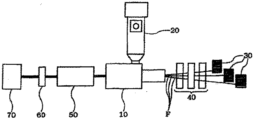
- 10 is a die
- 20 is an extruder that supplies molten resin to the die
- 30 is a roll for the fiber bundle F
- 40 is a group of tension rolls that apply a constant tension to the fiber bundle F drawn into the die 10
- 50 is a cooling means for cooling the molten resin-impregnated fiber bundle pulled out from the die
- 60 is a pull-out roll for the fiber bundle
- 70 is a pelletizer for cutting the pulled-out molten resin-impregnated fiber bundle.
- three independent fiber bundles F are simultaneously impregnated with molten resin.
- the specific manufacturing conditions are as follows.
- the raw materials used are as follows.
- Mold 350mm x 150mm x 2mm, with 60 ⁇ m deep satin texture Molding temperature: 210°C Mold temperature: 40°C Gate: Side gate (center on short side) Table 1 shows the evaluation results.
- Examples 2 to 8 Comparative Examples 1 to 10
- a glass fiber reinforced resin composition was prepared and a molded body was produced in the same manner as in Example 1, except that the raw materials and amounts of the composition were changed as shown in Table 1 or Table 2.
- the brightness of the molded article was lowered by increasing the proportion of carbon black, and the brightness of the molded body was increased by increasing the proportion of zinc sulfide, making it easy to adjust the color tone of the molded body.
Landscapes
- Chemical & Material Sciences (AREA)
- Health & Medical Sciences (AREA)
- Chemical Kinetics & Catalysis (AREA)
- Medicinal Chemistry (AREA)
- Polymers & Plastics (AREA)
- Organic Chemistry (AREA)
- Oil, Petroleum & Natural Gas (AREA)
- Compositions Of Macromolecular Compounds (AREA)
Priority Applications (1)
| Application Number | Priority Date | Filing Date | Title |
|---|---|---|---|
| JP2023569425A JP7812871B2 (ja) | 2021-12-21 | 2022-12-19 | ガラス繊維強化プロピレン系樹脂組成物 |
Applications Claiming Priority (2)
| Application Number | Priority Date | Filing Date | Title |
|---|---|---|---|
| JP2021-207321 | 2021-12-21 | ||
| JP2021207321 | 2021-12-21 |
Publications (1)
| Publication Number | Publication Date |
|---|---|
| WO2023120464A1 true WO2023120464A1 (ja) | 2023-06-29 |
Family
ID=86902681
Family Applications (1)
| Application Number | Title | Priority Date | Filing Date |
|---|---|---|---|
| PCT/JP2022/046629 Ceased WO2023120464A1 (ja) | 2021-12-21 | 2022-12-19 | ガラス繊維強化プロピレン系樹脂組成物 |
Country Status (2)
| Country | Link |
|---|---|
| JP (1) | JP7812871B2 (https=) |
| WO (1) | WO2023120464A1 (https=) |
Cited By (1)
| Publication number | Priority date | Publication date | Assignee | Title |
|---|---|---|---|---|
| WO2025057944A1 (ja) * | 2023-09-13 | 2025-03-20 | 三井化学株式会社 | オレフィン系樹脂組成物およびその用途 |
Citations (5)
| Publication number | Priority date | Publication date | Assignee | Title |
|---|---|---|---|---|
| JPS6069146A (ja) * | 1983-09-26 | 1985-04-19 | Mitsubishi Petrochem Co Ltd | ガラス繊維補強の着色プロピレン系樹脂組成物 |
| JPH02150444A (ja) * | 1988-11-30 | 1990-06-08 | Toyoda Gosei Co Ltd | 繊維強化ポリプロピレン樹脂組成物 |
| JP2001342305A (ja) * | 2000-05-31 | 2001-12-14 | Toyo Ink Mfg Co Ltd | 繊維強化オレフィン系樹脂用着色剤組成物及びその成形品 |
| JP2004123951A (ja) * | 2002-10-04 | 2004-04-22 | Daicel Chem Ind Ltd | 長繊維強化熱可塑性樹脂成形物およびその成形方法 |
| WO2021095777A1 (ja) * | 2019-11-11 | 2021-05-20 | 株式会社プライムポリマー | 顔料を含むポリオレフィン系樹脂組成物、着色樹脂ペレット及びその製造方法 |
-
2022
- 2022-12-19 JP JP2023569425A patent/JP7812871B2/ja active Active
- 2022-12-19 WO PCT/JP2022/046629 patent/WO2023120464A1/ja not_active Ceased
Patent Citations (5)
| Publication number | Priority date | Publication date | Assignee | Title |
|---|---|---|---|---|
| JPS6069146A (ja) * | 1983-09-26 | 1985-04-19 | Mitsubishi Petrochem Co Ltd | ガラス繊維補強の着色プロピレン系樹脂組成物 |
| JPH02150444A (ja) * | 1988-11-30 | 1990-06-08 | Toyoda Gosei Co Ltd | 繊維強化ポリプロピレン樹脂組成物 |
| JP2001342305A (ja) * | 2000-05-31 | 2001-12-14 | Toyo Ink Mfg Co Ltd | 繊維強化オレフィン系樹脂用着色剤組成物及びその成形品 |
| JP2004123951A (ja) * | 2002-10-04 | 2004-04-22 | Daicel Chem Ind Ltd | 長繊維強化熱可塑性樹脂成形物およびその成形方法 |
| WO2021095777A1 (ja) * | 2019-11-11 | 2021-05-20 | 株式会社プライムポリマー | 顔料を含むポリオレフィン系樹脂組成物、着色樹脂ペレット及びその製造方法 |
Cited By (1)
| Publication number | Priority date | Publication date | Assignee | Title |
|---|---|---|---|---|
| WO2025057944A1 (ja) * | 2023-09-13 | 2025-03-20 | 三井化学株式会社 | オレフィン系樹脂組成物およびその用途 |
Also Published As
| Publication number | Publication date |
|---|---|
| JP7812871B2 (ja) | 2026-02-10 |
| JPWO2023120464A1 (https=) | 2023-06-29 |
Similar Documents
| Publication | Publication Date | Title |
|---|---|---|
| CN101535382B (zh) | 有机纤维增强的复合树脂组合物及有机纤维增强的复合树脂成形品 | |
| JP6012914B1 (ja) | 炭素繊維強化樹脂組成物及びそれから得られる成形品 | |
| CN101925639B (zh) | 表面处理纤维、树脂组合物和其成形体 | |
| US7875667B2 (en) | Long-fiber reinforced polyolefin composition | |
| JP4606719B2 (ja) | 黒系着色した繊維強化樹脂組成物 | |
| WO2014084314A1 (ja) | ペレット混合物、炭素繊維強化ポリプロピレン樹脂組成物、成形体及びペレット混合物の製造方法 | |
| JP7198287B2 (ja) | 長繊維強化プロピレン系樹脂組成物および長繊維強化成形体 | |
| JP2009215492A (ja) | ガラス繊維強化樹脂組成物およびその製造方法 | |
| JP7812871B2 (ja) | ガラス繊維強化プロピレン系樹脂組成物 | |
| JP7770543B2 (ja) | エチレン系重合体組成物およびその用途 | |
| JP2018154795A (ja) | 炭素繊維強化樹脂組成物及び成形体 | |
| JP7648733B2 (ja) | ガラス繊維強化プロピレン系樹脂組成物 | |
| JP5533687B2 (ja) | エマルジョンからなるガラス繊維用集束剤、ガラス繊維、及びガラス繊維強化ポリオレフィン樹脂組成物 | |
| JP7734542B2 (ja) | オキサゾリン変性ポリプロピレン | |
| JP7269259B2 (ja) | 樹脂成形体及び樹脂組成物 | |
| JP4779300B2 (ja) | 繊維−ポリプロピレン樹脂複合体とそのペレット、および繊維強化樹脂成形品 | |
| JP2005272754A (ja) | 繊維含有樹脂ペレット | |
| JP7645706B2 (ja) | 繊維強化ポリプロピレン系樹脂組成物 | |
| JP2012202002A (ja) | 熱可塑性樹脂強化用繊維および繊維強化熱可塑性樹脂組成物 | |
| JP2025044612A (ja) | エチレン系重合体組成物およびその用途 | |
| CN114685732A (zh) | 噁唑啉改性聚丙烯 | |
| JP2025101379A (ja) | ガラス長繊維強化プロピレン系樹脂組成物ペレット、射出成形体、およびそれらの製造方法 | |
| JP2001064449A (ja) | 液晶ポリマー複合樹脂組成物 | |
| JP2006225533A (ja) | 樹脂組成物およびその成形品 |
Legal Events
| Date | Code | Title | Description |
|---|---|---|---|
| 121 | Ep: the epo has been informed by wipo that ep was designated in this application |
Ref document number: 22911166 Country of ref document: EP Kind code of ref document: A1 |
|
| NENP | Non-entry into the national phase |
Ref country code: DE |
|
| 32PN | Ep: public notification in the ep bulletin as address of the adressee cannot be established |
Free format text: NOTING OF LOSS OF RIGHTS PURSUANT TO RULE 112(1) EPC (EPO FORM 1205A DATED 26/09/2024) |
|
| WWE | Wipo information: entry into national phase |
Ref document number: 2023569425 Country of ref document: JP |
|
| 122 | Ep: pct application non-entry in european phase |
Ref document number: 22911166 Country of ref document: EP Kind code of ref document: A1 |