WO2023120435A1 - 電池パック - Google Patents
電池パック Download PDFInfo
- Publication number
- WO2023120435A1 WO2023120435A1 PCT/JP2022/046500 JP2022046500W WO2023120435A1 WO 2023120435 A1 WO2023120435 A1 WO 2023120435A1 JP 2022046500 W JP2022046500 W JP 2022046500W WO 2023120435 A1 WO2023120435 A1 WO 2023120435A1
- Authority
- WO
- WIPO (PCT)
- Prior art keywords
- cells
- heat insulating
- insulating member
- battery pack
- cell
- Prior art date
- Legal status (The legal status is an assumption and is not a legal conclusion. Google has not performed a legal analysis and makes no representation as to the accuracy of the status listed.)
- Ceased
Links
Images





Classifications
-
- H—ELECTRICITY
- H01—ELECTRIC ELEMENTS
- H01M—PROCESSES OR MEANS, e.g. BATTERIES, FOR THE DIRECT CONVERSION OF CHEMICAL ENERGY INTO ELECTRICAL ENERGY
- H01M10/00—Secondary cells; Manufacture thereof
- H01M10/60—Heating or cooling; Temperature control
- H01M10/65—Means for temperature control structurally associated with the cells
- H01M10/658—Means for temperature control structurally associated with the cells by thermal insulation or shielding
-
- H—ELECTRICITY
- H01—ELECTRIC ELEMENTS
- H01M—PROCESSES OR MEANS, e.g. BATTERIES, FOR THE DIRECT CONVERSION OF CHEMICAL ENERGY INTO ELECTRICAL ENERGY
- H01M10/00—Secondary cells; Manufacture thereof
- H01M10/60—Heating or cooling; Temperature control
- H01M10/61—Types of temperature control
- H01M10/613—Cooling or keeping cold
-
- H—ELECTRICITY
- H01—ELECTRIC ELEMENTS
- H01M—PROCESSES OR MEANS, e.g. BATTERIES, FOR THE DIRECT CONVERSION OF CHEMICAL ENERGY INTO ELECTRICAL ENERGY
- H01M10/00—Secondary cells; Manufacture thereof
- H01M10/60—Heating or cooling; Temperature control
- H01M10/64—Heating or cooling; Temperature control characterised by the shape of the cells
- H01M10/643—Cylindrical cells
-
- H—ELECTRICITY
- H01—ELECTRIC ELEMENTS
- H01M—PROCESSES OR MEANS, e.g. BATTERIES, FOR THE DIRECT CONVERSION OF CHEMICAL ENERGY INTO ELECTRICAL ENERGY
- H01M10/00—Secondary cells; Manufacture thereof
- H01M10/60—Heating or cooling; Temperature control
- H01M10/65—Means for temperature control structurally associated with the cells
- H01M10/651—Means for temperature control structurally associated with the cells characterised by parameters specified by a numeric value or mathematical formula, e.g. ratios, sizes or concentrations
-
- H—ELECTRICITY
- H01—ELECTRIC ELEMENTS
- H01M—PROCESSES OR MEANS, e.g. BATTERIES, FOR THE DIRECT CONVERSION OF CHEMICAL ENERGY INTO ELECTRICAL ENERGY
- H01M10/00—Secondary cells; Manufacture thereof
- H01M10/60—Heating or cooling; Temperature control
- H01M10/65—Means for temperature control structurally associated with the cells
- H01M10/653—Means for temperature control structurally associated with the cells characterised by electrically insulating or thermally conductive materials
-
- H—ELECTRICITY
- H01—ELECTRIC ELEMENTS
- H01M—PROCESSES OR MEANS, e.g. BATTERIES, FOR THE DIRECT CONVERSION OF CHEMICAL ENERGY INTO ELECTRICAL ENERGY
- H01M50/00—Constructional details or processes of manufacture of the non-active parts of electrochemical cells other than fuel cells, e.g. hybrid cells
- H01M50/20—Mountings; Secondary casings or frames; Racks, modules or packs; Suspension devices; Shock absorbers; Transport or carrying devices; Holders
- H01M50/204—Racks, modules or packs for multiple batteries or multiple cells
-
- H—ELECTRICITY
- H01—ELECTRIC ELEMENTS
- H01M—PROCESSES OR MEANS, e.g. BATTERIES, FOR THE DIRECT CONVERSION OF CHEMICAL ENERGY INTO ELECTRICAL ENERGY
- H01M50/00—Constructional details or processes of manufacture of the non-active parts of electrochemical cells other than fuel cells, e.g. hybrid cells
- H01M50/20—Mountings; Secondary casings or frames; Racks, modules or packs; Suspension devices; Shock absorbers; Transport or carrying devices; Holders
- H01M50/204—Racks, modules or packs for multiple batteries or multiple cells
- H01M50/207—Racks, modules or packs for multiple batteries or multiple cells characterised by their shape
- H01M50/213—Racks, modules or packs for multiple batteries or multiple cells characterised by their shape adapted for cells having curved cross-section, e.g. round or elliptic
-
- H—ELECTRICITY
- H01—ELECTRIC ELEMENTS
- H01M—PROCESSES OR MEANS, e.g. BATTERIES, FOR THE DIRECT CONVERSION OF CHEMICAL ENERGY INTO ELECTRICAL ENERGY
- H01M50/00—Constructional details or processes of manufacture of the non-active parts of electrochemical cells other than fuel cells, e.g. hybrid cells
- H01M50/20—Mountings; Secondary casings or frames; Racks, modules or packs; Suspension devices; Shock absorbers; Transport or carrying devices; Holders
- H01M50/244—Secondary casings; Racks; Suspension devices; Carrying devices; Holders characterised by their mounting method
-
- H—ELECTRICITY
- H01—ELECTRIC ELEMENTS
- H01M—PROCESSES OR MEANS, e.g. BATTERIES, FOR THE DIRECT CONVERSION OF CHEMICAL ENERGY INTO ELECTRICAL ENERGY
- H01M50/00—Constructional details or processes of manufacture of the non-active parts of electrochemical cells other than fuel cells, e.g. hybrid cells
- H01M50/20—Mountings; Secondary casings or frames; Racks, modules or packs; Suspension devices; Shock absorbers; Transport or carrying devices; Holders
- H01M50/289—Mountings; Secondary casings or frames; Racks, modules or packs; Suspension devices; Shock absorbers; Transport or carrying devices; Holders characterised by spacing elements or positioning means within frames, racks or packs
- H01M50/291—Mountings; Secondary casings or frames; Racks, modules or packs; Suspension devices; Shock absorbers; Transport or carrying devices; Holders characterised by spacing elements or positioning means within frames, racks or packs characterised by their shape
-
- H—ELECTRICITY
- H01—ELECTRIC ELEMENTS
- H01M—PROCESSES OR MEANS, e.g. BATTERIES, FOR THE DIRECT CONVERSION OF CHEMICAL ENERGY INTO ELECTRICAL ENERGY
- H01M50/00—Constructional details or processes of manufacture of the non-active parts of electrochemical cells other than fuel cells, e.g. hybrid cells
- H01M50/20—Mountings; Secondary casings or frames; Racks, modules or packs; Suspension devices; Shock absorbers; Transport or carrying devices; Holders
- H01M50/289—Mountings; Secondary casings or frames; Racks, modules or packs; Suspension devices; Shock absorbers; Transport or carrying devices; Holders characterised by spacing elements or positioning means within frames, racks or packs
- H01M50/293—Mountings; Secondary casings or frames; Racks, modules or packs; Suspension devices; Shock absorbers; Transport or carrying devices; Holders characterised by spacing elements or positioning means within frames, racks or packs characterised by the material
-
- H—ELECTRICITY
- H01—ELECTRIC ELEMENTS
- H01M—PROCESSES OR MEANS, e.g. BATTERIES, FOR THE DIRECT CONVERSION OF CHEMICAL ENERGY INTO ELECTRICAL ENERGY
- H01M10/00—Secondary cells; Manufacture thereof
- H01M10/60—Heating or cooling; Temperature control
- H01M10/62—Heating or cooling; Temperature control specially adapted for specific applications
- H01M10/625—Vehicles
-
- Y—GENERAL TAGGING OF NEW TECHNOLOGICAL DEVELOPMENTS; GENERAL TAGGING OF CROSS-SECTIONAL TECHNOLOGIES SPANNING OVER SEVERAL SECTIONS OF THE IPC; TECHNICAL SUBJECTS COVERED BY FORMER USPC CROSS-REFERENCE ART COLLECTIONS [XRACs] AND DIGESTS
- Y02—TECHNOLOGIES OR APPLICATIONS FOR MITIGATION OR ADAPTATION AGAINST CLIMATE CHANGE
- Y02E—REDUCTION OF GREENHOUSE GAS [GHG] EMISSIONS, RELATED TO ENERGY GENERATION, TRANSMISSION OR DISTRIBUTION
- Y02E60/00—Enabling technologies; Technologies with a potential or indirect contribution to GHG emissions mitigation
- Y02E60/10—Energy storage using batteries
Definitions
- the present disclosure relates to battery packs.
- cylindrical cells such as cylindrical lithium-ion batteries are electrically connected and housed in a case to be used in the form of a battery pack.
- the heat generated by the thermally runaway cell propagates to the surrounding cells, causing a chain reaction of thermal runaway in the surrounding cells. If it occurs in the middle of the battery pack, it may have a thermal effect on the outside of the battery pack. It is important to prevent such a cascade of thermal runaway of cells in order to ensure safe use of the battery pack.
- Patent Document 1 discloses a battery pack that includes a case that accommodates a plurality of cylindrical batteries (cells). Between the batteries adjacent to each other in the lateral direction of the case, a spacer including a thermally deformable resin core and two sheet bodies provided on both sides of the core is provided. The sheet body is made of a material having higher heat resistance than the core body.
- the purpose of the present disclosure is to reduce the size of the battery pack and enhance the effect of suppressing the chain of thermal runaway of the cells.
- a battery pack of the present disclosure is a battery pack configured by housing a battery block including a plurality of cells in an exterior case, or by forming a portion including the outer surface of the battery block to form an exterior case.
- a heat insulating member provided between adjacent cells among the cells, and a side member having higher thermal conductivity than the heat insulating member, which is arranged in contact with the side surface of the plurality of cells excluding the portion where the heat insulating member is provided.
- ⁇ b is the thermal conductivity of the side member, and the product of the specific heat and the density is where Cb, 0.1 W/(m ⁇ K) ⁇ b ⁇ 1.0 W/(m ⁇ K) and 1.75 ⁇ Cb ⁇ 3.25 J/(cm 3 ⁇ K), or , 1.0 W/(m ⁇ K) ⁇ b ⁇ 1000 W/(m ⁇ K), and 0.75 ⁇ Cb ⁇ 3.25 J/(cm 3 ⁇ K).
- the heat insulating member is provided between adjacent cells, and the side surface member having a higher thermal conductivity than the heat insulating member is in contact with the side surfaces of the plurality of cells excluding the portions where the heat insulating member is provided. be provided.
- the heat insulating member has a lower thermal conductivity than the side member and a relatively small product of specific heat and density.
- the side member has higher thermal conductivity than the heat insulating member, and the product of specific heat and density is relatively large. As a result, the heat is easily accumulated in the side member and is easily dissipated to the surroundings without excessively increasing the inter-cell distance.
- FIG. 1 is a schematic perspective view of a battery pack according to an embodiment
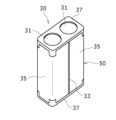
- FIG. 2 is a perspective view of a battery block containing two adjacent cells in the battery pack of FIG. 1
- FIG. 2B is a partially exploded perspective view of the battery block of FIG. 2A
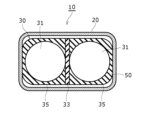
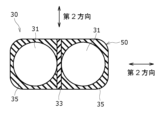
- FIG. FIG. 2 is a cross-sectional view taken along the line AA of FIG. 1; It is the figure which abbreviate
- FIG. 4 is a diagram showing the applicable range of the thermal conductivity of each material of the heat insulating member and the side member and the product of the specific heat and density in the embodiment.
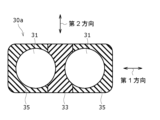
- FIG. 3C is a diagram corresponding to FIG.
- FIG. 3B of the battery block used in the analysis for confirming the effects of the embodiment;
- Thermal runaway of the cell when the thermal conductivities ⁇ a and ⁇ b and the products Ca and Cb of the specific heat and the density are changed in the materials forming the heat insulating member and the side member (heat insulating member material, side member material), respectively is a diagram showing analysis results for evaluating the effect of suppressing . It is a figure corresponding to FIG. 3B which shows another example of embodiment. It is a figure corresponding to FIG. 3B which shows another example of embodiment.
- FIG. 11 is a perspective view showing a battery block in another example of the embodiment;
- FIG. 10 is a cross-sectional view taken along the line BB of FIG. 9;
- FIG. 1 shows a schematic configuration of the battery pack 10.
- the battery pack 10 is used, for example, as a power source for devices driven by electric motors, such as electric vehicles, power-assisted bicycles, and electric motorcycles.
- the application of the battery pack 10 is not limited to this, and it can be used as a power supply for various electric devices.
- the battery pack 10 includes an exterior case 20 made of metal such as aluminum, and one or more battery blocks 30 housed inside the exterior case 20 .
- the battery block 30 has a plurality of cells 31 arranged in line, and the plurality of cells 31 are electrically connected to each other.
- the battery block 30 has, for example, a plurality of cells 31 electrically connected in parallel or in series.
- the battery pack 10 is configured such that a plurality of battery blocks 30 are electrically connected in series or in parallel to output a voltage suitable for the equipment used.
- the cell 31 is, for example, a cylindrical battery.
- a cylindrical battery is exemplified as the cell 31 in the present disclosure, the cell is not limited to a cylindrical battery, and may be a prismatic battery or the like.
- the cell 31 is a cylindrical battery having a bottomed cylindrical outer can and a sealing member that closes the opening of the outer can.
- An insulating gasket is provided between the outer can and the sealing member.
- the sealing member serves as a positive electrode terminal
- the outer can serves as a negative electrode terminal.
- the sealing member is provided with an exhaust valve for discharging gas when an abnormality occurs in the cell 31 and the internal pressure rises.
- the exhaust valve may be provided at the bottom of the outer can.
- a plurality of cells 31 in the battery block 30 are accommodated in holders 50 .
- the holder 50 of the battery block 30 includes a later-described heat insulating member 33 (FIGS. 2A and 2B) and two side members 35 (FIGS. 2A and 2B) having higher thermal conductivity than the heat insulating member 33. there is The holder 50 fixes the arrangement of the plurality of cells 31 and maintains the shape of the battery block 30 .
- the battery pack 10 also includes terminal plates (collector plates) that electrically connect the plurality of battery blocks 30 . A positive terminal and a negative terminal of the battery block 30 are connected to the terminal plate, respectively.
- the terminal board may be integrated with the holder.
- An external terminal 40 electrically connected to the battery block 30 is provided at the end of the exterior case 20 .
- the external terminal 40 is used as a terminal for supplying a DC voltage when the battery pack 10 is installed in a device in which it is used.
- the external terminals 40 are also used when charging the cells 31 of the battery pack 10 .
- the external terminal 40 may be provided only at one end of the battery pack 10, or may be provided at a plurality of locations.
- the portion including the outer surface of the battery block and formed by the heat insulating member or the side member may form the exterior case.
- the battery block 30 has a plurality of cells 31, heat insulating members 33, two side members 35, and two position fixing members 37. As shown in FIG. In the battery block 30, a plurality of cells 31 are arranged adjacent to each other in the first direction. The first direction is a direction perpendicular to the axial direction of each cell 31 .
- the heat insulating member 33 is arranged between the two cells 31, and the two side members 35 are arranged in contact with the side surfaces of the two cells 31 excluding the portion where the heat insulating member 33 is provided.
- the heat insulating member 33 and the two side members 35 are integrally fixed. Thereby, the side surfaces of the two cells 31 are covered with the heat insulating member 33 and the two side surface members 35 .
- Two position fixing members 37 are arranged at both ends of the two cells 31 in the axial direction, and the two cells 31 are sandwiched from both sides in the axial direction by the two position fixing members 37 .
- FIG. 2A shows a state in which the battery blocks 30 are fixed together.
- FIG. 2B shows the two cells 31, the heat insulating member 33, and the side member 35 before the position fixing member 37 is attached.
- the heat insulating member 33 is arranged between the two cells 31 so as to be in contact only at the position where the inter-cell distance is the shortest and sandwiched between the cylindrical side surfaces of the cells 31 . It has a flat plate shape. At this time, the heat insulating members 33 are located at all positions between the adjacent cells 31 in the first direction and in the second direction perpendicular to the axial direction of the cells 31, except for the axial ends of the cells 31. The space between the cells 31 is blocked.
- the side member 35 is arranged so as to cover almost the entire side surface of each cell 31 except for the portion where the heat insulating member 33 is not arranged.
- the heat insulating member 33 and the two side members 35 form a substantially rectangular parallelepiped holder 50 that holds two cells inside.
- the length of the holder 50 along the axial direction of the cells 31 is formed to be smaller than the length of the cells 31 in the axial direction. As shown in FIG. 2B , both axial end portions of the cell 31 protrude from both axial end surfaces of the holder 50 in the axial direction.
- the two position fixing members 37 are substantially rectangular flat plates and are arranged at both ends of the two cells 31 in the axial direction.
- Each position fixing member 37 has two openings 37 a at positions corresponding to the axial end faces of the two cells 31 .
- a housing portion 37b for housing the end portion of the cell 31 protruding from the holder 50 is formed. Both ends of the cell 31 in the axial direction form electrode terminals.
- the electrode terminals of the two cells 31 are electrically connected to current collecting plates (not shown) through the openings 37 a of the position fixing member 37 .
- fitting claws 37c are formed at four corners of the position fixing member 37.
- Fitting recesses 36 are formed at both ends of each side member 35 in the axial direction of the cell 31 at positions corresponding to the fitting claws 37c.
- Two position fixing members 37 are coupled to the two side members 35 from both sides in the axial direction of the cell 31 so that the fitting claws 37 c are fitted into the fitting recesses 36 . In this state, the ends of the cells 31 are accommodated in the accommodating portions 37b. Thereby, the battery block 30 is formed.
- the number of cells 31 in the battery block 30 is not limited to two, and may be three or more as shown in FIGS. 7 to 10 described later.
- the battery block 30 has the position fixing members 37 at both ends of the cells 31 in the axial direction. 35 may be used.
- FIG. 3A is a cross-sectional view taken along line AA of FIG. 1.
- FIG. 3B is a diagram in which the exterior case 20 is omitted from FIG. 3A.
- a heat insulating member 33 with low thermal conductivity is arranged between the two cells 31 .
- the heat insulating member 33 is made of, for example, foamed resin, heat insulating resin, foamed concrete, gypsum board, glass wool, or silica airgel. The physical properties of the material forming the heat insulating member 33 will be described later in detail.
- the heat insulating member 33 makes it difficult for the heat generated in the cell 31 to be transmitted to other adjacent cells 31 .
- a side surface member 35 having a higher thermal conductivity than the heat insulating member 33 is arranged in contact with the side surface of the cell 31 that is not in contact with the heat insulating member 33 .
- the side member 35 is made of, for example, a highly thermally conductive material containing thermosetting resin and thermally conductive filler. The physical properties of the material forming the side member 35 will be described later in detail. As described above, the heat generated in the cells 31 is less likely to be transmitted to other adjacent cells 31 due to the heat insulating member 33, and is more likely to be transmitted to the side members 35 having high thermal conductivity.
- thermosetting resin As the resin forming the side member 35, a thermosetting resin is preferable, but a thermoplastic resin may be used.
- a thermoplastic resin As for the resin constituting the side member 35, unsaturated polyester, epoxy resin, melamine resin, phenol resin, thermoplastic polycarbonate, polyethylene, polypropylene, polyvinyl chloride, polystyrene, etc. are assumed as thermosetting resins. Conceivable examples include polycarbonate, polyethylene, polypropylene, polyvinyl chloride, polystyrene, and the like.
- the resin forming the side member 35 may be metal oxide (eg, aluminum oxide, zinc oxide), metal nitride (eg, aluminum nitride, boron nitride), or metal oxynitride (eg, aluminum oxynitride), if necessary.
- a thermally conductive filler such as aluminum hydroxide, magnesium hydroxide, or sodium hydrogen carbonate may be mixed therein.
- the battery block 30 is housed in the exterior case 20 so that at least a portion of the side member 35 is in contact with the inner surface of the exterior case 20 .
- the heat generated in the cell 31 is easily transferred to and absorbed by the side member 35 , and the heat absorbed by the side member 35 is easily transferred to the exterior case 20 .
- the heat transferred to the exterior case 20 is radiated to the outside.
- FIG. 4 is a diagram showing the applicable range of the thermal conductivity of each material of the heat insulating member 33 and the side member 35 and the product of the specific heat and density in the embodiment.
- the horizontal axis represents thermal conductivity
- the vertical axis represents the product of specific heat and density.
- the product of specific heat and density corresponds to the heat capacity per unit volume.
- a range X indicated by thin sand in FIG. 4 indicates a range of physical property values of the material used for the heat insulating member 33 of the embodiment.
- a range Y indicated by a dark sandy area in FIG. 4 indicates a range of physical property values of the material used for the side member 35 of the embodiment.
- different materials are used for the heat insulating member 33 and the side member 35 .
- Black dots A to T in FIG. 4 indicate virtual materials.
- ⁇ a and Ca correspond to the range X, 0.001 W/(m ⁇ K) ⁇ a ⁇ 0.05 W/(m ⁇ K) and 0 ⁇ Ca ⁇ 2.5 J/(cm 3 ⁇ K).
- ⁇ b and Cb are 0.1 W/(m ⁇ K ) ⁇ b ⁇ 1.0 W/(m ⁇ K) and 1.75 ⁇ Cb ⁇ 3.25 J/(cm 3 ⁇ K), or 1.0 W/(m ⁇ K) ⁇ b ⁇ 1000 W /(m ⁇ K), and 0.75 ⁇ Cb ⁇ 3.25 J/(cm 3 ⁇ K).
- any one of the virtual materials A to C included in the range X can be used as the material of the heat insulating member 33 of the embodiment.
- Any one of the virtual materials A to T included in the range Y can be used as the material of the side member 35 of the embodiment.
- the heat insulating member 33 is provided between the adjacent cells 31, and the side surfaces of the plurality of cells 31 excluding the portion where the heat insulating member 33 is provided have a higher thermal conductivity than the heat insulating member 33.
- a member 35 is provided in contact.
- the heat insulating member 33 has a lower thermal conductivity than the side member 35, and the product of specific heat and density is relatively small.
- the side member 35 has higher thermal conductivity than the heat insulating member 33, and the product of specific heat and density is relatively large. As a result, heat is easily stored in the side member 35 and is easily dissipated to the surroundings without excessively increasing the inter-cell distance.
- the heat insulating member 33 is located at all positions in the second direction in at least part of the axial direction of the cells 31 between the adjacent cells 31, the adjacent cells 31 are insulated at least in part in the axial direction. It is completely blocked by the member 33. As a result, the effect of suppressing the chain of thermal runaway of the cells 31 can be further enhanced.
- a thermal fluid simulation was performed to evaluate the heat transfer from the thermal runaway cell to the adjacent cell 31 .
- a cell arranged adjacent to a thermal runaway cell may be referred to as an "adjacent cell”.
- a battery block 30a having the cross-sectional structure shown in FIG. 5 was used.
- the width of the heat insulating member 33 in the first direction is larger than the structure shown in FIGS. 3A and 3B.
- the heat insulating member 33 is arranged between the two cells 31 and is in contact with the arcuate cross-sectional area of each cell 31 including the position other than the position where the inter-cell distance is the shortest.
- the side member 35 is arranged so as to cover almost the entire side surface of each cell 31 except for the portion where the heat insulating member 33 is not arranged.
- Other configurations of the battery block 30a shown in FIG. 5 are the same as those of the battery block 30 shown in FIGS. 3A and 3B.
- FIG. 6 shows the case where the thermal conductivities ⁇ a and ⁇ b and the specific heat and density products Ca and Cb are changed in the materials forming the heat insulating member 33 and the side member 35 (the heat insulating member material and the side member material). , shows analysis results for evaluating the effect of suppressing thermal runaway of the cell 31.
- FIG. The vertical columns in FIG. 6 show virtual materials A to K used as heat insulating member materials and their respective thermal conductivities ⁇ a and (specific heat ⁇ density) Ca.
- virtual materials A to T used as side member materials and their respective thermal conductivities ⁇ b and (specific heat ⁇ density) Cb are shown.
- the circled characters indicate materials applicable to the heat insulating member 33 or the side member 35 in the embodiment.
- one of the two adjacent cells 31 shown in FIG. 5 is assumed to be a thermally runaway cell and the other is assumed to be an adjacent cell, and the initial temperature of the two cells 31 can be assumed based on the usage environment and battery pack form.
- a predetermined temperature was set.
- the cell size of each cell 31 was 18 mm in diameter and 65 mm in height (length in the axial direction).
- the shortest distance between adjacent cells 31 was set to 1 mm. Then, assuming that the thermally runaway cell generates heat with a predetermined amount of heat, a simulation was performed to calculate the temperature rise of the adjacent cell.
- the table in FIG. 6 shows the results of the above analysis
- the "x" in the table indicates that the maximum temperature of the adjacent battery is the heat resistance temperature of the cell 31 in the combination of the corresponding heat insulating member material and side member material. exceeds the predetermined temperature Tmax as , indicating that the effect of suppressing thermal runaway is insufficient.
- "o" in the table of FIG. 6 indicates that the maximum temperature of the adjacent battery according to the analysis is equal to or lower than the predetermined temperature Tmax in the corresponding combination of the heat insulating member material and the side member material, and the effect of suppressing thermal runaway is good. represents something.
- the battery block 30a is composed of two cells.
- the battery block has a configuration in which three or four cells 31 are arranged side by side in the first direction, or two or three cells 31 are arranged in a row in the first direction, as will be described later in another example.
- a similar analysis result can also be obtained with a configuration in which two rows are arranged in the second direction, with one row of strawberries.
- the shortest distance between adjacent cells 31 was set to 1 mm, but the same analysis results can be obtained even if the shortest distance is in the range of 0.3 mm to 3 mm other than 1 mm.
- the diameter of the cell 31 was set to 18 mm, but similar analysis results can be obtained for a range of 16 mm to 50 mm other than 18 mm.
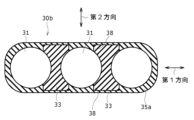
- FIG. 7 is a diagram corresponding to FIG. 3B showing another example of the embodiment.
- the battery block 30b includes three cells 31 arranged adjacent to each other in the first direction, two heat insulating members 33 provided between the cells 31, and the side surfaces of the three cells 31. and a side member 35a in contact with the side surface of the cell 31 so as to surround it.
- the shape of each heat insulating member 33 is the same as that of the battery block 30a of FIG.
- the side member 35a is formed in a flat annular shape that is oblong in the first direction.
- the two heat insulating members 33 are combined so as to fit into a fitting groove 38 formed on the inner circumference of the side member 35a. Thereby, the side member 35a is formed in an annular shape with the heat insulating member 33 arranged inside.
- Other configurations and actions in this example are the same as those in FIGS.
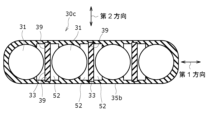
- FIG. 8 is a diagram corresponding to FIG. 3B showing another example of the embodiment.
- the battery block 30c includes four cells 31 arranged adjacent to each other in the first direction, three heat insulating members 33 provided between the cells 31, and a side member 35b contacting the side surface of the cell 31 so as to surround it.
- the shape of each heat insulating member 33 is the same as that of the battery block 30a of FIG. Both ends in the second direction of each heat insulating member 33 are coupled to be fitted into fitting grooves 39 formed on the inner circumference of the side surface member 35b.
- the side member 35b does not contact the heat insulating member 33 except for the fitting groove 39. Inside the side member 35b, an air layer is formed between both side surfaces of the heat insulating member 33 in the first direction and the side member 35b. Thereby, an air layer 52 is formed between adjacent cells. Although the heat insulating member 33 and the side surface of the cell 31 are separated in FIG. 8 , the side surface of the cell 31 may contact the heat insulating member 33 . In this example, other configurations and actions are the same as the configuration in FIGS. 1 to 4 or the configuration in FIG.
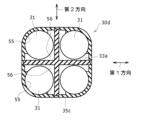
- FIG. 9 is a perspective view showing a battery block 30d in another example of the embodiment.
- 10 is a cross-sectional view taken along the line BB of FIG. 9.
- the battery block 30d has four cells 31 held inside a side member 35c having a substantially square cylindrical shape and having lid portions 53 at both ends in the axial direction.
- the four cells 31 are arranged in two rows in the second direction, with one row in which two cells 31 are arranged in the first direction.
- Openings 54 for exposing the electrode terminals of the cells 31 are formed in the cover 53 of the side member 35c.
- the side surface of the cell 31 is fitted and held in fitting recesses 55 having an arcuate cross section formed at four corners of the inner peripheral surface of the side surface member 35c.
- a heat insulating member 33a having a shape in which two plate portions are perpendicular to each other in a cruciform cross section is held on the inner peripheral surface of the side member 35c.
- the heat insulating member 33a extends between the adjacent cells 31 to shield the cells.
- an air layer 56 is formed between the cells adjacent to each other in the first direction and the second direction.
- the heat insulating member 33a and the side surface of the cell 31 are separated in FIG. 10, the side surface of the cell 31 may contact the heat insulating member 33a.
- other configurations and actions are similar to the configuration of FIGS. 1 to 4, the configuration of FIG. 7, or the configuration of FIG.
Landscapes
- Chemical & Material Sciences (AREA)
- Chemical Kinetics & Catalysis (AREA)
- Electrochemistry (AREA)
- General Chemical & Material Sciences (AREA)
- Engineering & Computer Science (AREA)
- Manufacturing & Machinery (AREA)
- Physics & Mathematics (AREA)
- Algebra (AREA)
- General Physics & Mathematics (AREA)
- Mathematical Analysis (AREA)
- Mathematical Optimization (AREA)
- Pure & Applied Mathematics (AREA)
- Battery Mounting, Suspending (AREA)
- Secondary Cells (AREA)
Priority Applications (4)
| Application Number | Priority Date | Filing Date | Title |
|---|---|---|---|
| CN202280077423.6A CN118285008A (zh) | 2021-12-24 | 2022-12-16 | 电池组 |
| EP22911138.0A EP4456263A4 (en) | 2021-12-24 | 2022-12-16 | BATTERY PACK |
| JP2023569408A JPWO2023120435A1 (https=) | 2021-12-24 | 2022-12-16 | |
| US18/715,773 US20250132422A1 (en) | 2021-12-24 | 2022-12-16 | Battery pack |
Applications Claiming Priority (2)
| Application Number | Priority Date | Filing Date | Title |
|---|---|---|---|
| JP2021210534 | 2021-12-24 | ||
| JP2021-210534 | 2021-12-24 |
Publications (1)
| Publication Number | Publication Date |
|---|---|
| WO2023120435A1 true WO2023120435A1 (ja) | 2023-06-29 |
Family
ID=86902701
Family Applications (1)
| Application Number | Title | Priority Date | Filing Date |
|---|---|---|---|
| PCT/JP2022/046500 Ceased WO2023120435A1 (ja) | 2021-12-24 | 2022-12-16 | 電池パック |
Country Status (5)
| Country | Link |
|---|---|
| US (1) | US20250132422A1 (https=) |
| EP (1) | EP4456263A4 (https=) |
| JP (1) | JPWO2023120435A1 (https=) |
| CN (1) | CN118285008A (https=) |
| WO (1) | WO2023120435A1 (https=) |
Citations (4)
| Publication number | Priority date | Publication date | Assignee | Title |
|---|---|---|---|---|
| JP2012033464A (ja) | 2010-07-02 | 2012-02-16 | Sanyo Electric Co Ltd | パック電池 |
| JP2020181740A (ja) * | 2019-04-25 | 2020-11-05 | パナソニックIpマネジメント株式会社 | 電動工具用の電池パック、電動工具 |
| WO2021019970A1 (ja) * | 2019-07-29 | 2021-02-04 | 三洋電機株式会社 | 電池パック |
| WO2021256093A1 (ja) * | 2020-06-18 | 2021-12-23 | 阿波製紙株式会社 | 断熱シート及びこれを備える電源装置 |
Family Cites Families (2)
| Publication number | Priority date | Publication date | Assignee | Title |
|---|---|---|---|---|
| JP2019053816A (ja) * | 2016-01-28 | 2019-04-04 | 三洋電機株式会社 | 電池パック |
| JP6846689B2 (ja) * | 2016-08-24 | 2021-03-24 | パナソニックIpマネジメント株式会社 | 電池モジュール |
-
2022
- 2022-12-16 CN CN202280077423.6A patent/CN118285008A/zh active Pending
- 2022-12-16 JP JP2023569408A patent/JPWO2023120435A1/ja active Pending
- 2022-12-16 EP EP22911138.0A patent/EP4456263A4/en active Pending
- 2022-12-16 US US18/715,773 patent/US20250132422A1/en active Pending
- 2022-12-16 WO PCT/JP2022/046500 patent/WO2023120435A1/ja not_active Ceased
Patent Citations (4)
| Publication number | Priority date | Publication date | Assignee | Title |
|---|---|---|---|---|
| JP2012033464A (ja) | 2010-07-02 | 2012-02-16 | Sanyo Electric Co Ltd | パック電池 |
| JP2020181740A (ja) * | 2019-04-25 | 2020-11-05 | パナソニックIpマネジメント株式会社 | 電動工具用の電池パック、電動工具 |
| WO2021019970A1 (ja) * | 2019-07-29 | 2021-02-04 | 三洋電機株式会社 | 電池パック |
| WO2021256093A1 (ja) * | 2020-06-18 | 2021-12-23 | 阿波製紙株式会社 | 断熱シート及びこれを備える電源装置 |
Non-Patent Citations (1)
| Title |
|---|
| See also references of EP4456263A4 |
Also Published As
| Publication number | Publication date |
|---|---|
| US20250132422A1 (en) | 2025-04-24 |
| CN118285008A (zh) | 2024-07-02 |
| EP4456263A1 (en) | 2024-10-30 |
| EP4456263A4 (en) | 2025-04-09 |
| JPWO2023120435A1 (https=) | 2023-06-29 |
Similar Documents
| Publication | Publication Date | Title |
|---|---|---|
| JP5110933B2 (ja) | パック電池 | |
| JP5067171B2 (ja) | 電気化学蓄電素子モジュール | |
| KR20190078841A (ko) | 개선된 냉각 구조를 갖는 배터리 모듈 | |
| WO2019058937A1 (ja) | 電池モジュール | |
| JPWO2011092773A1 (ja) | 電池モジュール | |
| WO2013021573A1 (ja) | 電池ブロック及び該電池ブロックを有する電池モジュール | |
| WO2017130260A1 (ja) | 電池パック | |
| JP6536497B2 (ja) | 電池パック | |
| KR20230145281A (ko) | 열차단 기능을 구비한 전지 모듈 | |
| KR102772374B1 (ko) | 에너지 저장 시스템 | |
| CN214898695U (zh) | 电池和用电装置 | |
| JP2010186715A (ja) | 組電池の放熱構造及び組電池 | |
| CN210467905U (zh) | 电池组 | |
| CN216389577U (zh) | 电池的热管理系统以及用电装置 | |
| KR102683482B1 (ko) | 전지 팩 | |
| WO2023120435A1 (ja) | 電池パック | |
| EP4564557A1 (en) | Battery, battery module, and vehicle having battery module | |
| WO2023120436A1 (ja) | 電池パック | |
| KR20240003775A (ko) | 열폭주 안정성을 갖는 배터리 시스템 | |
| CN222775552U (zh) | 电池装置以及用电设备 | |
| CN223785234U (zh) | 电池单元、动力电池及车辆 | |
| JP7666857B2 (ja) | 冷却機能を備えた電池モジュールおよびこれを含む電池パック | |
| CN222654084U (zh) | 电池装置、用电设备及储能装置 | |
| CN120261887B (zh) | 一种新能源汽车用高透气性的蓄电池外壳 | |
| CN222029221U (zh) | 电池包箱体、电池包及用电设备 |
Legal Events
| Date | Code | Title | Description |
|---|---|---|---|
| 121 | Ep: the epo has been informed by wipo that ep was designated in this application |
Ref document number: 22911138 Country of ref document: EP Kind code of ref document: A1 |
|
| WWE | Wipo information: entry into national phase |
Ref document number: 202280077423.6 Country of ref document: CN |
|
| WWE | Wipo information: entry into national phase |
Ref document number: 18715773 Country of ref document: US Ref document number: 2023569408 Country of ref document: JP |
|
| NENP | Non-entry into the national phase |
Ref country code: DE |
|
| ENP | Entry into the national phase |
Ref document number: 2022911138 Country of ref document: EP Effective date: 20240724 |
|
| WWP | Wipo information: published in national office |
Ref document number: 18715773 Country of ref document: US |