WO2023112698A1 - チタン酸リチウムカリウム及びその製造方法、摩擦調整材、摩擦材組成物、摩擦材、並びに摩擦部材 - Google Patents
チタン酸リチウムカリウム及びその製造方法、摩擦調整材、摩擦材組成物、摩擦材、並びに摩擦部材 Download PDFInfo
- Publication number
- WO2023112698A1 WO2023112698A1 PCT/JP2022/044381 JP2022044381W WO2023112698A1 WO 2023112698 A1 WO2023112698 A1 WO 2023112698A1 JP 2022044381 W JP2022044381 W JP 2022044381W WO 2023112698 A1 WO2023112698 A1 WO 2023112698A1
- Authority
- WO
- WIPO (PCT)
- Prior art keywords
- potassium titanate
- friction
- lithium potassium
- friction material
- mass
- Prior art date
- Legal status (The legal status is an assumption and is not a legal conclusion. Google has not performed a legal analysis and makes no representation as to the accuracy of the status listed.)
- Ceased
Links
Images
Classifications
-
- C—CHEMISTRY; METALLURGY
- C01—INORGANIC CHEMISTRY
- C01G—COMPOUNDS CONTAINING METALS NOT COVERED BY SUBCLASSES C01D OR C01F
- C01G23/00—Compounds of titanium
-
- C—CHEMISTRY; METALLURGY
- C09—DYES; PAINTS; POLISHES; NATURAL RESINS; ADHESIVES; COMPOSITIONS NOT OTHERWISE PROVIDED FOR; APPLICATIONS OF MATERIALS NOT OTHERWISE PROVIDED FOR
- C09K—MATERIALS FOR MISCELLANEOUS APPLICATIONS, NOT PROVIDED FOR ELSEWHERE
- C09K3/00—Materials not provided for elsewhere
- C09K3/14—Anti-slip materials; Abrasives
Definitions
- the present invention relates to lithium potassium titanate, a method for producing the lithium potassium titanate, and a friction modifier, friction material composition, friction material, and friction member using the lithium potassium titanate.
- Friction materials used in brakes such as disc brakes and drum brakes that constitute braking devices for various vehicles and industrial machines must have a large and stable coefficient of friction, excellent wear resistance, and aggressiveness to mating materials. is required to be low.
- Such a friction material includes a semi-metallic material containing steel fibers such as steel fibers and stainless steel fibers as a fiber base material at a rate of 30% by mass or more and less than 60% by mass; It is classified into three types: low steel materials containing less than mass %; and NAO (Non-Asbestos-Organic) materials containing no steel fibers. However, friction materials containing a small amount of steel fibers are also classified as NAO materials.
- NAO material which has low aggressiveness to mating materials and excellent balance between squeal and wear resistance, is the mainstream. Also, in Europe, low steel materials have been used from the viewpoint of maintaining the coefficient of friction during high-speed braking.
- Compositions used for friction materials generally contain copper fibers and copper powder.
- a primary role of copper is to provide thermal conductivity. Copper has a high thermal conductivity, so by diffusing the heat generated during braking from the friction interface, it is possible to reduce wear of the friction material due to excessive temperature rise and suppress vibration during braking.
- a second role of copper is to protect the friction interface during high temperature braking. Due to the ductility of copper, it extends to form a coating on the friction material surface during braking. It also transfers to the surface of the mating material to form an adhesive film (hereinafter referred to as "transfer film").
- friction materials containing copper contain copper in the abrasion powder generated during braking, and it has been suggested that it may cause pollution of rivers, lakes, and oceans.
- a state law prohibiting the sale of friction materials containing 5% by mass or more of copper, and from 2025 onwards, prohibiting the sale and installation of friction materials in new vehicles.
- Titanates include titanates with a tunnel crystal structure (e.g., potassium hexatitanate) and titanates with a layered crystal structure (e.g., lithium potassium titanate, magnesium potassium titanate). Each is used alone or in combination as appropriate.
- a friction material composition containing titanate and barium sulfate having an average particle size of 0.1 ⁇ m to 20 ⁇ m has been proposed (Patent Document 1).
- Potassium hexatitanate which has a thermally stable crystal structure, is an effective titanate that provides a coefficient of friction in the high-load range. and fibrous particles with an aspect ratio of 3 or more), their use is being refrained mainly in Europe.
- lithium potassium titanate is known as a titanate that does not contain WHO fibers, but although it has excellent wear resistance, it has a problem of friction coefficient in a high load range.
- An object of the present invention is to provide a lithium potassium titanate and a lithium potassium titanate that can increase the coefficient of friction in a high load range and improve the stability of the coefficient of friction when used as a friction material. and a friction modifier, a friction material composition, a friction material, and a friction member using the lithium potassium titanate.
- the present invention provides the following lithium potassium titanate, a method for producing the lithium potassium titanate, and a friction modifier, friction material composition, friction material, and friction member using the lithium potassium titanate.
- Item 2 The lithium potassium titanate according to Item 1, wherein the lithium potassium titanate is plate-like particles.
- Item 3 The lithium potassium titanate according to Item 1 or 2, wherein the lithium potassium titanate has an average particle size of 0.1 ⁇ m or more and 100 ⁇ m or less.
- Item 4 The lithium potassium titanate according to any one of items 1 to 3, wherein the lithium potassium titanate has a specific surface area of 0.1 m 2 /g or more and 10 m 2 /g or less.
- Item 5 The lithium potassium titanate according to any one of items 1 to 4, wherein the lithium potassium titanate has an alkali metal ion elution rate of 0.01% by mass or more and 15% by mass or less.
- Item 6 The method for producing lithium potassium titanate according to any one of items 1 to 5, comprising the steps of preparing a raw material lithium potassium titanate, and eluting a portion of potassium from the raw material lithium potassium titanate. and adjusting the molar ratio of titanium to potassium (TiO 2 /K 2 O) in terms of oxide to potassium to 8 to 35, followed by firing.
- Item 7 A friction modifier comprising the lithium potassium titanate according to any one of Items 1 to 5.
- Item 8 A friction material composition containing lithium potassium titanate according to any one of items 1 to 5 and a binder, and having a copper component content of less than 0.5% by mass as copper element.
- Item 9 The friction material composition according to Item 8, wherein the content of the lithium potassium titanate is 1% by mass or more and 40% by mass or less with respect to 100% by mass of the total amount of the friction material composition.
- Item 10 The friction material according to Item 8 or 9, characterized in that the mass ratio of the lithium potassium titanate to the binder (lithium potassium titanate/binder) is 0.1 or more and 8 or less. Composition.
- Item 11 The friction material composition according to any one of Items 8 to 10, wherein the content of steel-based fibers is less than 10% by mass with respect to the total amount of 100% by mass of the friction material composition.
- Item 12 A friction material that is a molded body of the friction material composition according to any one of Items 8 to 11.
- Item 13 A friction member comprising the friction material according to Item 12.
- lithium potassium titanate and lithium potassium titanate which can increase the friction coefficient in a high load region and improve the stability of the friction coefficient when used as a friction material. and a friction modifier, a friction material composition, a friction material, and a friction member using the lithium potassium titanate.
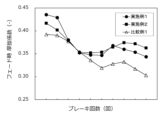
- FIG. 1 is a diagram showing the relationship between the number of times of braking and the coefficient of friction during fading in the fading test of the friction members obtained in Examples 1 and 2 and Comparative Example 1.
- FIG. 1 is a diagram showing the relationship between the number of times of braking and the coefficient of friction during fading in the fading test of the friction members obtained in Examples 1 and 2 and Comparative Example 1.
- Lithium potassium titanate >
- the present inventors have found that in lithium potassium titanate represented by the composition formula K 0.10 to 0.44 Li 0.27 Ti 1.73 O 3.65 to 3.82 , the X-ray diffraction of the lithium potassium titanate By setting the half width of the peak in the measurement to 0.20° or more, it is possible to increase the friction coefficient in a high load region when used as a friction material, and to improve the stability of the friction coefficient. I found
- the lithium potassium titanate of the present invention is a low-crystalline compound, unlike conventional ones.
- the term "low crystallinity" means that, in X-ray diffraction measurement, unlike an amorphous compound that does not have a specific peak, and unlike a crystalline compound that has a sharp peak, it shows an intermediate peak. It refers to things.
- the term "amorphous" in X-ray diffraction measurement refers to, for example, a peak having a half-value width of 5.0° or more, and a broad halo being observed with almost no peak being observed.
- the half width of the peak in lithium potassium titanate is preferably 0.25° or more, preferably 1.0° or less, and more preferably 0.8° or less.
- the half width means the width of the diffraction angle at the half height of the peak obtained by X-ray diffraction measurement.
- the half width of the peak in potassium lithium titanate can be adjusted, for example, by the molar ratio of titanium to potassium in terms of oxide (TiO 2 /K 2 O) in the manufacturing method described later.
- the X-ray diffraction measurement can be performed by a wide-angle X-ray diffraction method, and CuK ⁇ rays (wavelength 1.5418 ⁇ ) can be used.
- the X-ray diffraction measurement device for example, Rigaku's product number "Ultima IV" can be used.
- the lithium potassium titanate is preferably non-fibrous particles from the viewpoint of working environment.
- the non-fibrous particles include, for example, spherical particles (including those having slightly uneven surfaces and particles having a substantially spherical shape such as an elliptical cross section), columnar particles (rod-like, columnar, prismatic, strip-like, (Including those whose overall shape is almost columnar, such as a substantially cylindrical shape, a substantially rectangular shape, etc.), plate-like, block-like, shape with multiple protrusions (ameba-like, boomerang-like, cross-like, confetti-like, etc.), indeterminate Particle shape such as shape can be mentioned.
- the lithium potassium titanate is preferably tabular particles. Further, the lithium potassium titanate may be porous particles.
- non-fibrous particles refers to a rectangular parallelepiped having the smallest volume among the rectangular parallelepipeds circumscribing the particle (circumscribing rectangular parallelepiped). is the thickness T (where B>T), and L/B is 5 or less.
- “having a plurality of protrusions” means that the projected shape on a plane can take a shape having protrusions in at least two directions, unlike ordinary polygons, circles, ellipses, and the like. Specifically, this convex portion is a portion corresponding to a portion protruding from a polygon, circle, ellipse, etc. (basic figure) applied to a photograph (projection view) taken by a scanning electron microscope (SEM). say.
- the average particle size of the lithium potassium titanate is preferably 0.1 ⁇ m or more, more preferably 1 ⁇ m or more, still more preferably 3 ⁇ m or more, preferably 100 ⁇ m or less, more preferably 50 ⁇ m or less, and more preferably 50 ⁇ m or less. It is preferably 30 ⁇ m or less.
- the friction characteristics can be further improved when the friction material is produced.
- the average particle size refers to the particle size at 50% cumulative volume based on the particle size distribution measured by laser diffraction method.
- This D50 is the particle diameter at the point where the particle size distribution is obtained on a volume basis, the number of particles is counted from the smallest particle size on the cumulative curve with the total volume as 100%, and the cumulative value becomes 50%. be.
- the specific surface area of the lithium potassium titanate is preferably 0.1 m 2 /g or more, more preferably 0.3 m 2 /g or more, still more preferably 0.5 m 2 /g or more, and preferably It is 10 m 2 /g or less, more preferably 6 m 2 /g or less, still more preferably 4 m 2 /g or less.
- the specific surface area can be measured according to JIS Z8830.
- the alkali metal ion elution rate of lithium potassium titanate is preferably 0.01% by mass or more, more preferably 0.1% by mass or more, still more preferably 1% by mass or more, and preferably 15% by mass. or less, more preferably 10% by mass or less, and even more preferably 5% by mass or less.
- a novolak-type phenolic resin which is an example of a thermosetting resin used in a friction material composition
- a curing agent such as hexamethylenetetramine
- the hardening reaction is initiated by bonding with the hydroxyl groups inside.
- alkali metal ions are present at this time, an ion exchange reaction occurs with the hydrogen ions in the hydroxyl groups in the novolac-type phenolic resin, resulting in hexamethylenetetramine (curing agent (or curing accelerator)) and novolak-type phenolic resin (thermosetting).
- the alkali metal ion elution rate to the above upper limit or less, it is possible to prevent the curing inhibition of the thermosetting resin during heat and pressure molding, and as a result, the crack resistance at high temperature and high load is further improved.
- the alkali metal ion elution rate to the above lower limit or more, rusting of the rotor can be suppressed even if the friction material using the lithium potassium titanate of the present invention is left unused for a long period of time after braking. That is, by setting the alkali metal ion elution rate within the above range, both the crack resistance of the friction material and the rust prevention of the rotor can be achieved at a higher level.
- the alkali metal ion elution rate refers to the mass ratio of alkali metal ions eluted into water from a measurement sample such as lithium potassium titanate in water at 80°C.
- a treated layer made of a surface treatment agent may be formed on the surface of the lithium potassium titanate from the viewpoint of further improving the adhesion with the binder used in the friction material composition.
- surface treatment agents include silane coupling agents and titanium coupling agents. Among these, silane coupling agents are preferably used, and amino-based silane coupling agents, epoxy-based silane coupling agents, and alkyl-based silane coupling agents are more preferably used.
- One of the surface treating agents may be used alone, or two or more thereof may be used in combination.
- amino-based silane coupling agents include N-2-(aminoethyl)-3-aminopropylmethyldimethoxysilane, N-2-(aminoethyl)-3-aminopropyltrimethoxysilane, 3-aminopropyltri Methoxysilane, 3-aminopropyltriethoxysilane, 3-ethoxysilyl-N-(1,3-dimethylbutylidene)propylamine, N-phenyl-3-aminopropyltrimethoxysilane, N-(vinylbenzyl)-2 -aminoethyl-3-aminopropyltrimethoxysilane and the like.
- epoxy-based silane coupling agents include 3-glycidyloxypropyl(dimethoxy)methylsilane, 3-glycidyloxypropyltrimethoxysilane, diethoxy(3-glycidyloxypropyl)methylsilane, triethoxy(3-glycidyloxypropyl)silane, 2-(3,4-epoxycyclohexyl)ethyltrimethoxysilane and the like.
- alkyl-based silane coupling agents include methyltrimethoxysilane, dimethyldimethoxysilane, trimethylmethoxysilane, methyltriethoxysilane, ethyltrimethoxysilane, n-propyltrimethoxysilane, isobutyltrimethoxysilane, isobutyltriethoxysilane. , n-hexyltrimethoxysilane, n-hexylriethoxysilane, cyclohexylmethyldimethoxysilane, n-octyltriethoxysilane, n-decyltrimethoxysilane and the like.
- a known surface treatment method can be used as a method for forming a treatment layer made of a surface treatment agent on the surface of lithium potassium titanate.
- a wet method of dissolving the surface treatment agent in a mixed solvent) to form a solution and spraying the solution onto lithium potassium titanate can be used.
- the amount of the surface treatment agent when the surface of the lithium potassium titanate is treated with the surface treatment agent is not particularly limited. is 0.1 parts by mass or more and 20 parts by mass or less.
- the lithium potassium titanate used in the present invention can be granulated by treating the lithium potassium titanate with the surface treatment agent or the binder described below.
- the average particle size of the granular lithium potassium titanate is preferably 100 ⁇ m or more and preferably 200 ⁇ m or less.
- the method for producing lithium potassium titanate of the present invention is not particularly limited, it can be produced, for example, by the following method.
- raw material lithium potassium titanate hereinafter referred to as “raw material KTLO”
- part of the potassium is eluted from the raw material KTLO to adjust the molar ratio of titanium to potassium (TiO 2 /K 2 O) in terms of oxides to 8 or more and 35 or less (8 to 35), followed by firing.
- the molar ratio of titanium to potassium in terms of oxide (TiO 2 /K 2 O) is preferably 20 or less, more preferably 16 or less, still more preferably 10 or less.
- Lithium potassium titanate having a layered crystal structure of site type can be used.
- raw material KTLO includes, for example, titanium oxide or a compound that generates titanium oxide by heating (these are collectively abbreviated as "titanium compound”), potassium oxide or a compound that generates potassium oxide by heating (these are collectively abbreviated as “potassium compound”), lithium oxide or a compound that generates lithium oxide by heating (these are collectively abbreviated as “lithium compound”), and, if necessary, a mixture of flux. , can be obtained by firing.
- titanium compound low order titanium oxide, hydrous titanium oxide, hydrate of titanium oxide, titanium hydroxide, etc. can be used.
- a titanium compound may be used individually by 1 type, and may be used in combination of 2 or more type.
- Potassium compounds include potassium oxide, potassium carbonate, potassium hydroxide, potassium nitrate, and the like. Among them, potassium carbonate or potassium hydroxide can be preferably used as the potassium compound.
- a potassium compound may be used individually by 1 type, and may be used in combination of 2 or more type.
- Lithium compounds include lithium oxide, lithium hydroxide, and lithium carbonate.
- As the lithium compound lithium hydroxide or lithium carbonate can be preferably used.
- a lithium compound may be used individually by 1 type, and may be used in combination of 2 or more type.
- the mixing ratio of the titanium compound, the potassium compound, and the lithium compound can be appropriately adjusted according to the composition formula of the target raw material KTLO.
- the purpose of the flux is to form crystals at a temperature lower than the melting point, and as the crystal grows, it has an idiomorphic shape surrounded by flat crystal planes that reflect the crystal structure, making it easy to specify the crystal orientation.
- Potassium chloride, potassium fluoride, potassium molybdate, potassium tungstate, and the like can be suitably used as the material.
- Firing in the production of the raw material KTLO can be performed using an electric furnace or the like. Further, the firing reaction can be completed by maintaining the temperature in the range of 800° C. to 1100° C. for 1 hour to 24 hours. After firing, the resulting powder may be pulverized to a desired size or passed through a sieve to loosen it.
- the elution of potassium from the raw material KTLO can be performed by mixing an acid with an aqueous slurry in which the raw material KTLO is dispersed in water.
- the concentration of the aqueous slurry is not particularly limited and can be appropriately selected from a wide range.
- the concentration of the aqueous slurry may be about 1% by mass to 30% by mass in consideration of workability and the like.
- solids are separated from the slurry by filtration, centrifugation, or the like. The separated solid content can be washed with water and dried as necessary.
- the acid used here is not particularly limited, and known acids can be used.
- acids include inorganic acids such as sulfuric acid, hydrochloric acid and nitric acid, and organic acids such as acetic acid. Two or more acids may be used in combination as necessary.
- the amount of acid added to the aqueous slurry can be appropriately adjusted depending on the desired molar ratio of titanium to potassium in terms of oxide (TiO 2 /K 2 O). Lithium potassium titanate can be made to have low crystallinity by the potassium elution.
- Firing after elution of potassium can be performed using an electric furnace or the like. Further, the temperature is maintained in the range of 100° C. to 600° C., preferably 400° C. to 600° C. for 1 hour to 12 hours, more preferably 1 hour to 10 hours.
- the elution amount of alkali metal ions in lithium potassium titanate can be adjusted by the firing temperature and firing time.
- Lithium potassium titanate of the present invention can be obtained as described above.
- Friction Material Composition contains the lithium potassium titanate of the present invention and a binder, and the content of the copper component in terms of copper element is 0.00% with respect to 100% by mass of the total amount of the friction material composition. It is characterized by being less than 5% by mass.
- the lithium potassium titanate of the present invention can be used as a friction modifier.
- the friction material composition of the present invention may further contain other materials as necessary.
- the term "friction material composition” refers to a composition used for a friction material.
- the friction material composition of the present invention contains the lithium potassium titanate of the present invention as a friction modifier, it is possible to increase the coefficient of friction in the high-load region of the friction material and to increase the stability of the coefficient of friction. be able to.
- the content of the copper component is less than 0.5% by mass as a copper element with respect to the total amount of 100% by mass of the friction material composition, and preferably the copper component is not contained. environmental load can be reduced.
- the phrase "does not contain a copper component” means that copper fiber, copper powder, and copper-containing alloys (brass, bronze, etc.) and compounds are blended as raw materials for the friction material composition. It means that you have not.
- the friction material composition of the present invention excellent friction characteristics can be obtained even when the copper component is not contained or the copper component content is reduced.
- the friction material composition of the present invention is an NAO material in which the content of steel fibers such as steel fibers and stainless steel fibers is less than 10% by mass with respect to 100% by mass of the total amount of the friction material composition. is preferred. In this case, it is easy to form a transfer film on the surface of the mating material, and excellent friction and wear characteristics can be obtained.
- the binding material integrates the friction modifier such as lithium potassium titanate contained in the friction material composition and imparts strength.
- the binder used in the friction material composition of the present invention is not particularly limited, and thermosetting resins commonly used as binders for friction materials can be used.
- Thermosetting resins include, for example, phenolic resins; elastomer-dispersed phenolic resins such as acrylic elastomer-dispersed phenolic resins and silicone elastomer-dispersed phenolic resins; acrylic-modified phenolic resins, silicone-modified phenolic resins, cashew-modified phenolic resins, epoxy-modified phenolic resins, Modified phenol resins such as alkylbenzene-modified phenol resins; formaldehyde resins; melamine resins; epoxy resins; acrylic resins; aromatic polyester resins; One of these may be used alone, or two or more may be used in combination.
- phenol resins straight phenol resins
- modified phenol resins are preferred as thermosetting resins from the viewpoint of further improving heat resistance, moldability, and friction characteristics.
- the phenolic resin either a resol-type phenolic resin or a novolak-type phenolic resin can be used, but the novolac-type phenolic resin is preferable from the viewpoint of production stability and cost.
- the novolak-type phenol resin may contain additives such as a curing agent and a curing accelerator (for example, hexamethylenetetramine, etc.) as necessary.
- the content of the binder in the friction material composition is preferably 5% by mass or more, more preferably 8% by mass or more, and preferably 30% by mass or less with respect to 100% by mass of the total amount of the friction material composition. More preferably, it is 20% by mass or less.
- the lithium potassium titanate used in the friction material composition of the present invention is the aforementioned lithium potassium titanate of the present invention.
- the content of lithium potassium titanate in the friction material composition is preferably 1% by mass or more, more preferably 5% by mass or more, and still more preferably 10% by mass or more with respect to 100% by mass of the total amount of the friction material composition. , preferably 40% by mass or less, more preferably 35% by mass or less, and even more preferably 30% by mass or less.
- the mass ratio of lithium potassium titanate to the binder is preferably 0.1 or more, more preferably 0.5 or more, still more preferably 1.1 or more, preferably 8 or less, and more It is preferably 6 or less, more preferably 4 or less.
- friction material composition of the present invention in addition to the binder and lithium potassium titanate of the present invention, other materials usually used in friction material compositions (fiber base material, organic friction modifier, Inorganic friction modifiers, lubricants, pH modifiers, fillers, etc.) can be blended.
- the content of other materials in the friction material composition is preferably 30% by mass or more and preferably 94% by mass or less with respect to 100% by mass of the total amount of the friction material composition.
- Fiber base material The fiber base material exhibits reinforcing properties in the friction material.
- fiber base materials include inorganic fibers, metal fibers, organic fibers, and carbon-based fibers. One of these may be used alone, or two or more may be used in combination.
- inorganic fibers include glass fiber, rock wool, ceramic fiber, biodegradable ceramic fiber, biodegradable mineral fiber, biosoluble fiber (SiO 2 —CaO—SrO fiber, etc.), wollastonite fiber, silicate fiber, Mineral fibers and the like can be mentioned, and among these, rock wool is preferable.
- rock wool When rock wool is contained in the friction material composition, its content is preferably 1% by mass or more, preferably 10% by mass or less, more preferably 7% by mass with respect to 100% by mass of the total amount of the friction material composition % or less. If the content of rock wool is within the above range, the coefficient of friction can be increased during high-load braking.
- Metal fibers include single metals such as aluminum, iron, zinc, tin, titanium, nickel, magnesium, and silicon, fibers in the form of alloys (steel fibers, stainless steel fibers, etc.), and straight-shaped fibers mainly composed of metals such as cast iron fibers. Alternatively, curled metal fibers can be used.
- Organic fibers include aromatic polyamide (aramid) fiber, fibrillated aramid fiber (aramid pulp), acrylic fiber (homopolymer or copolymer fiber with acrylonitrile as the main raw material), fibrillated acrylic fiber, and cellulose fiber. , fibrillated cellulose fibers, phenolic resin fibers, and the like.
- the fibers are aramid fibers.
- the organic fiber is preferably fibrillated aramid fiber (also referred to as aramid pulp).
- the specific surface area of the fibrillated aramid fibers is preferably 5 m 2 /g or more, preferably 25 m 2 /g or less, more preferably 15 m 2 /g or less.
- the fibrillated aramid fiber preferably has a fiber length of 0.5 mm or more and preferably 1.2 mm or less.
- the content is preferably 1% by mass or more, preferably 10% by mass or less, more preferably 10% by mass or less, with respect to 100% by mass of the total amount of the friction material composition It is 8% by mass or less, more preferably 6% by mass or less. If the content of the fibrillated aramid fiber is at least the above lower limit, the crack resistance and wear resistance will be better. Further, if the content of the fibrillated aramid fibers is equal to or less than the above upper limit, deterioration of crack resistance and wear resistance due to uneven distribution of the fibrillated aramid fibers and other materials can be more reliably prevented.
- carbon-based fibers examples include carbon-based fibers such as flame-resistant fibers, PAN-based carbon fibers, pitch-based carbon fibers, and activated carbon fibers.
- Organic friction modifier is a friction modifier that is blended for the purpose of further improving the noise and vibration performance, wear resistance, and the like of the friction material.
- Organic friction modifiers include tire rubber, acrylic rubber, isoprene rubber, NBR (nitrile-butadiene rubber), SBR (styrene-butadiene rubber), unvulcanized or vulcanized rubber powder such as chlorinated butyl rubber, butyl rubber, and silicone rubber; dust; rubber-coated cashew dust; melamine dust and the like. One of these may be used alone, or two or more may be used in combination.
- the content is preferably 0.1% by mass or more, preferably 30% by mass, with respect to 100% by mass of the total amount of the friction material composition. Below, it is more preferably 20% by mass or less, still more preferably 10% by mass or less, and particularly preferably 6% by mass or less.
- Inorganic friction modifiers (excluding lithium potassium titanate) are used for the purpose of avoiding deterioration of the heat resistance of the friction material, or for the purpose of further improving the coefficient of friction in order to improve the wear resistance. It is a friction modifier to be blended.
- inorganic friction modifiers include abrasives, metal powders, and other inorganic fillers.
- the abrasive can be appropriately selected from those that act as an abrasive and improve the coefficient of friction depending on the material of the rotor, which is the mating material, and can be selected based on the Mohs hardness of the mating material.
- the Mohs hardness of the abrasive is preferably 6 or more, and preferably 8 or less, from the viewpoint of more effectively expressing the coefficient of friction of the abrasive.
- abrasives examples include silicon carbide (silicon carbide), titanium oxide, ⁇ -alumina, ⁇ -alumina, silica (silicon dioxide), magnesia (magnesium oxide), zirconia (zirconium oxide), zircon (zirconium silicate), oxide Chromium, iron oxide (triiron tetroxide, etc.), chromite, quartz, iron sulfide and the like can be mentioned.
- zirconia (zirconium oxide) and zircon (zirconium silicate) are preferred.
- the average particle size of zirconia (zirconium oxide) is preferably 1 ⁇ m to 14 ⁇ m.
- the average particle size of zircon (zirconium silicate) is preferably 0.2 ⁇ m to 2 ⁇ m.
- the content thereof is preferably 0.1% by mass or more, more preferably 5% by mass or more with respect to 100% by mass of the total amount of the friction material composition, It is preferably 30% by mass or less, more preferably 25% by mass or less, and even more preferably 18% by mass or less.
- Metal powders include single metals such as aluminum, zinc, iron, and tin, or powders in the form of alloys. One of these may be used alone, or two or more may be used in combination.
- inorganic fillers include vermiculite, clay, mica, talc, dolomite, chromite, mullite, calcium silicate, and titanates other than the above lithium potassium titanate (hereinafter referred to as "other titanates").
- other titanates include vermiculite, clay, mica, talc, dolomite, chromite, mullite, calcium silicate, and titanates other than the above lithium potassium titanate (hereinafter referred to as "other titanates”).
- One of these may be used alone, or two or more may be used in combination.
- titanates include Otsuka Chemical's TERRACESS JSL, TERRACESS JSL-R, TERRACESS DP-R, TERRACESS DP-A, TERRACESS DP-AS, Kubota's TXAX-MA, TXAX-A, and Toho Titanium.
- Potassium hexatitanate such as TOFIX-S and TOFIX-SNR manufactured by Otsuka Chemical
- Sodium hexatitanate such as TERRACESS DSR manufactured by Otsuka Chemical
- Potassium octatitanate such as TERRACE JP
- Potassium magnesium titanate such as TERRACE PM and TERRACE PS PS manufactured by Otsuka Chemical
- Lithium potassium titanate such as TERRACE L, TERRACE L-SS, TERRACE JSM-M manufactured by Otsuka Chemical, etc.
- Other titanates are preferably sodium hexatitanate, potassium octatitanate, potassium magnesium titanate, and potassium lithium titanate.
- the mass ratio of the other titanate to the lithium potassium titanate of the present invention is the friction in the high load region From the viewpoint of the coefficient, it is preferably 0.1 or more and preferably 3 or less.
- the lubricant is preferably a solid lubricant, and examples thereof include carbon-based lubricants, metal sulfide-based lubricants, and polytetrafluoroethylene (PTFE). It may be used, or two or more may be used in combination. Lubricants are preferably one or more selected from the group consisting of carbon-based lubricants and metal sulfide-based lubricants.
- the content thereof is preferably 0.1% by mass or more, more preferably 1% by mass or more, with respect to 100% by mass of the total amount of the friction material composition, It is preferably 20% by mass or less, more preferably 10% by mass or less, and even more preferably 5% by mass or less.
- Examples of the carbon-based lubricant include synthetic or natural graphite (graphite), scale-like graphite, phosphate-coated graphite, carbon black, coke, activated carbon, elastic graphitized carbon, and the like. Synthetic graphite and natural graphite are preferred from the viewpoint that they can be imparted to.
- Examples of the metal sulfide-based solid lubricant include antimony trisulfide, molybdenum disulfide, tin sulfide, iron sulfide, zinc sulfide, bismuth sulfide, tungsten disulfide, etc., and are less harmful to the human body. tin sulfide and molybdenum disulfide are preferred. One of these may be used alone, or two or more may be used in combination.
- pH adjusters include calcium hydroxide (slaked lime), sodium hydroxide, potassium hydroxide, sodium carbonate, potassium carbonate, sodium hydrogen carbonate, potassium hydrogen carbonate, trisodium phosphate, disodium hydrogen phosphate, and tripotassium phosphate. , dipotassium hydrogen phosphate and the like, and organic bases such as imidazole, histidine and hexamethylenediamine. From the viewpoint of cost and hygroscopicity, the pH adjuster is preferably an inorganic base. One of these may be used alone, or two or more may be used in combination.
- the pH adjusting material is sometimes used to prevent rust adhesion between the friction material and the mating material (rotor).
- the content is preferably 0.1% by mass or more and preferably 8% by mass or less with respect to 100% by mass of the total amount of the friction material composition.
- fillers examples include barium sulfate and calcium carbonate. Barium sulfate can preferably be used as the filler. One of these may be used alone, or two or more may be used in combination.
- Barium sulfate consists of elutriated barium sulfate (barite powder) obtained by pulverizing a mineral called barite, removing iron from it, washing it, and elutriating it, and artificially synthesized precipitated barium sulfate.
- the particle size of precipitated barium sulfate can be controlled by the conditions during synthesis, and fine barium sulfate with a low content of coarse particles can be produced. From the viewpoint of further reducing impurities and making the particle size distribution of the barium sulfate particles more uniform, it is preferable to use precipitated barium sulfate.
- the friction material composition of the present invention is produced by (1) mixing each component with a mixer such as a Loedige mixer (“Loedige” is a registered trademark), a pressure kneader, an Eirich mixer (“Eirich” is a registered trademark), or the like. Method; (2) A method of preparing granules of desired components and, if necessary, mixing other components using a mixer such as a Loedige mixer, a pressure kneader, or an Eirich mixer. can.
- the content of each component of the friction material composition of the present invention can be appropriately selected depending on the desired friction characteristics, and can be produced by the above production method.
- the friction material composition of the present invention may be prepared by preparing a masterbatch containing a specific component at a high concentration, adding a thermosetting resin or the like to this masterbatch, and mixing.
- the friction material composition is temporarily molded at room temperature (20° C.), and the obtained temporary molded body is heat-pressed (molding pressure: 10 MPa to 40 MPa, molding temperature: 150° C. to 200° C.). , If necessary, the obtained compact is subjected to heat treatment (150° C. to 220° C., held for 1 hour to 12 hours) in a heating furnace, and then the compact is machined and polished. A friction material having a predetermined shape can be manufactured.
- Friction members that can be formed using a friction material include, for example, (1) a structure consisting of only the friction material, (2) a base material such as a backing metal, and a book provided on the base material to provide a friction surface. A configuration including the friction material of the invention and the like can be mentioned.
- the base material is used to further improve the mechanical strength of the friction member.
- Materials for the substrate include metals, fiber-reinforced resins, and the like.
- metals or fiber reinforced resins include iron, stainless steel, glass fiber reinforced resins, carbon fiber reinforced resins, and the like.
- Friction materials usually have a large number of fine pores inside, and these pores serve as escape routes for decomposition products (gases and liquids) at high temperatures. Squealing is prevented by lowering the rigidity and improving damping performance.
- the composition of materials and molding conditions are controlled so that the porosity is preferably 5% to 30%, more preferably 10% to 25%.
- the friction member of the present invention is composed of the friction material composition of the present invention, excellent friction characteristics can be obtained even when the copper component is not contained or the copper component content is reduced. Therefore, the friction member of the present invention can be suitably used in brake systems in general, such as disc pads, brake linings, and clutch facings, which constitute braking devices for various vehicles and industrial machines. It can be preferably used as.
- the present invention is by no means limited to the following examples, and can be modified as appropriate within the scope of not changing the gist of the invention.
- compositional formula The crystal structure was confirmed by an X-ray diffraction measurement device (manufactured by Rigaku, product number “Ultima IV”). In addition, the compositional formula was confirmed by an ICP-AES analyzer (manufactured by SII Nanotechnology Co., Ltd., product number "SPS5100").
- Average particle size Measured with a laser diffraction particle size distribution analyzer (manufactured by Shimadzu Corporation, product number “SALD-2300”), and the particle size at 50% cumulative volume basis in the obtained particle size distribution was defined as the average particle size.
- Alkali metal ion elution rate Measure the mass (X) g of the sample, then add the sample to ultrapure water to prepare a 1% by mass slurry, stir at 80 ° C. for 4 hours, and remove the solid content with a membrane filter having a pore size of 0.2 ⁇ m. , to obtain an extract.
- the mass (Y) g of alkali metal ions in the obtained extract was measured with an ion chromatograph (manufactured by Dionex, product number "ICS-1100").
- the alkali metal ion elution rate (% by mass) was calculated based on the formula [(Y)/(X)] ⁇ 100 using the mass (X) g and (Y) g values.
- Phenolic resin Novolac-type phenolic resin powder containing hexamethylenetetramine
- Barium sulfate average particle size 1.6 ⁇ m Natural mica: average particle size 180 ⁇ m Cashew dust: average particle size 200 ⁇ m Iron oxide: average particle size 0.3 ⁇ m, Mohs hardness 6 Zirconium silicate: average particle size 1.1 ⁇ m, Mohs hardness 7.5 Antimony trisulfide: average particle size 1.5 ⁇ m Synthetic graphite: average particle size 730 ⁇ m Aramid fiber: fibrillated para-aramid fiber (aramid pulp), fiber length 0.89 mm, specific surface area 9.8 m 2 /g Slaked lime: average particle size 0.2 ⁇ m Rock wool: average fiber length 125 ⁇ m, maximum shot content (125 ⁇ m or more) 5.0%
- the surface (friction surface) of the friction member was polished by 1.0 mm, and a brake efficacy test was conducted based on JASO C406. However, the first fade test conditions were changed to a speed of 160 km/h assuming a high load, and the braking effectiveness test was conducted.
- the rotor used was a cast iron rotor belonging to standard number A48/A48M in ASTM standards.
- FIG. 1 is a diagram showing the relationship between the number of times of braking and the coefficient of friction during fading in the fading test of the friction members obtained in Examples 1 and 2 and Comparative Example 1.
Landscapes
- Chemical & Material Sciences (AREA)
- Organic Chemistry (AREA)
- Life Sciences & Earth Sciences (AREA)
- Environmental & Geological Engineering (AREA)
- General Life Sciences & Earth Sciences (AREA)
- Geology (AREA)
- Inorganic Chemistry (AREA)
- Engineering & Computer Science (AREA)
- Materials Engineering (AREA)
- Inorganic Compounds Of Heavy Metals (AREA)
Abstract
摩擦材に用いたときに、高負荷領域での摩擦係数を大きくすることができ、かつ摩擦係数の安定性を高めることができる、チタン酸リチウムカリウムを提供する。 組成式K0.10~0.44Li0.27Ti1.73O3.65~3.82で表されるチタン酸リチウムカリウムであり、前記チタン酸リチウムカリウムのX線回折測定における回折角2θ=10.9°~11.6°の範囲に観察されるピークの半価幅が、0.20°以上である、チタン酸リチウムカリウム。
Description
本発明は、チタン酸リチウムカリウム、該チタン酸リチウムカリウムの製造方法、並びに該チタン酸リチウムカリウムを用いた摩擦調整材、摩擦材組成物、摩擦材、及び摩擦部材に関する。
各種車両、産業機械等の制動装置を構成するディスクブレーキ、ドラムブレーキ等のブレーキ等に使用される摩擦材には、摩擦係数が大きく安定し、耐摩耗性が優れていること、相手材攻撃性が低いことが求められている。このような摩擦材は、繊維基材としてのスチール繊維やステンレス繊維等のスチール系繊維を、30質量%以上60質量%未満の割合で含有するセミメタリック材;スチール系繊維を10質量%以上30質量%未満の割合で含有するロースチール材;スチール系繊維を含有しないNAO(Non-Asbestos-Organic)材の3種類に分類される。ただし、スチール系繊維を微量に含有する摩擦材もNAO材に分類される。
日本及び米国では、快適性が重視されることから、相手材攻撃性が低く、鳴き及び耐摩耗性のバランスに優れるNAO材が主流となっている。また、欧州では、高速制動時の摩擦係数保持の観点でロースチール材が用いられていたが、高級志向化によりブレーキの鳴きが発生しにくいNAO材が用いられることが多くなってきている。
摩擦材に用いられる組成物(以下「摩擦材組成物」という)には、一般的に銅繊維や銅粉末が配合されている。銅の第一の役割としては、熱伝導率の付与が挙げられる。銅は熱伝導率が高いため、制動時に発生した熱を摩擦界面から拡散させることで、過度の温度上昇による摩擦材の摩耗を低減するとともに、制動中の振動を抑制することができる。銅の第二の役割としては、高温制動時における摩擦界面の保護が挙げられる。銅の展延性によって、制動時に摩擦材表面に延びて被膜を形成する。また、相手材表面に移行して凝着被膜(以下「トランスファーフィルム」という)を形成する。これらが保護膜として作用することよって、高温制動時に摩擦材の摩耗を低減するとともに、安定した摩擦係数の発現が可能となる。しかしながら、銅を含有する摩擦材は、制動時に生成される摩耗粉に銅を含み、河川、湖、海洋汚染等の原因になる可能性が示唆されていることから、米国のカリフォルニア州、ワシントン州では2021年以降は銅を5質量%以上、2025年以降は銅を0.5質量%以上含有する摩擦材の販売及び新車への組み付けを禁止する州法が発効されている。
そこで、NAO材においては、銅以外のトランスファーフィルムを担う成分として、チタン酸塩が注目されている。チタン酸塩には、トンネル状結晶構造のチタン酸塩(例えば6チタン酸カリウム)、層状結晶構造のチタン酸塩(例えばチタン酸リチウムカリウム、チタン酸マグネシウムカリウム)が存在し、摩擦材の用途に応じて、それぞれを単独、又は組合せて用いられている。例えば、チタン酸塩と平均粒子径が0.1μm~20μmの硫酸バリウムとを含有する摩擦材組成物(特許文献1)が提案されている。
近年、普及が著しいハイブリット車や電気自動車といった車両の制動には、回生ブレーキが搭載され、制動時の摩擦エネルギーを回収するようになっている。しかしながら、バッテリーが満充電の際にはその機構が作用せず、バッテリー搭載分の車重増のため、ブレーキにかかる負荷が増えるケースが想定されている。また、SUVに代表される車重の重い大型車の普及から、摩擦材には、従来以上に高負荷領域での摩擦係数が大きいことが重要となっている。さらに、一部の山岳地域では、過積載の車が急峻な道を下る際の制動力が十分ではないといった課題がある。
高負荷領域での摩擦係数を与えるチタン酸塩としては、熱的に安定な結晶構造をもつ6チタン酸カリウムが有力であるが、環境基準以上のWHOファイバー(長径が5μm以上、短径が3μm以下、及びアスペクト比が3以上の繊維状粒子)含有の懸念から、欧州を中心に使用が控えられつつある。一方で、WHOファイバー含有の懸念がないチタン酸塩として、チタン酸リチウムカリウムが知られているが、耐摩耗性は優れるものの、高負荷領域の摩擦係数が課題となっている。
本発明の目的は、摩擦材に用いたときに、高負荷領域での摩擦係数を大きくすることができ、しかも摩擦係数の安定性を高めることができる、チタン酸リチウムカリウム、該チタン酸リチウムカリウムの製造方法、並びに該チタン酸リチウムカリウムを用いた摩擦調整材、摩擦材組成物、摩擦材、及び摩擦部材を提供することにある。
本発明は、以下のチタン酸リチウムカリウム、該チタン酸リチウムカリウムの製造方法、並びに該チタン酸リチウムカリウムを用いた摩擦調整材、摩擦材組成物、摩擦材、及び摩擦部材を提供する。
項1 組成式K0.10~0.44Li0.27Ti1.73O3.65~3.82で表されるチタン酸リチウムカリウムであり、前記チタン酸リチウムカリウムのX線回折測定における回折角2θ=10.9°~11.6°の範囲に観察されるピークの半価幅が、0.20°以上である、チタン酸リチウムカリウム。
項2 前記チタン酸リチウムカリウムが、板状粒子である、項1に記載のチタン酸リチウムカリウム。
項3 前記チタン酸リチウムカリウムの平均粒子径が、0.1μm以上、100μm以下である、項1又は項2に記載のチタン酸リチウムカリウム。
項4 前記チタン酸リチウムカリウムの比表面積が、0.1m2/g以上、10m2/g以下である、項1~項3のいずれか一項に記載のチタン酸リチウムカリウム。
項5 前記チタン酸リチウムカリウムのアルカリ金属イオン溶出率が、0.01質量%以上、15質量%以下である、項1~項4のいずれか一項に記載のチタン酸リチウムカリウム。
項6 項1~項5のいずれか一項に記載のチタン酸リチウムカリウムの製造方法であって、原料チタン酸リチウムカリウムを用意する工程と、前記原料チタン酸リチウムカリウムからカリウムの一部を溶出させてカリウムに対するチタンの酸化物換算モル比(TiO2/K2O)を8~35に調整し、焼成する工程とを備える、チタン酸リチウムカリウムの製造方法。
項7 項1~項5のいずれか一項に記載のチタン酸リチウムカリウムからなる、摩擦調整材。
項8 項1~項5のいずれか一項のチタン酸リチウムカリウムと、結合材とを含有し、銅成分の含有量が銅元素として0.5質量%未満である、摩擦材組成物。
項9 前記チタン酸リチウムカリウムの含有量が、前記摩擦材組成物の合計量100質量%に対して、1質量%以上、40質量%以下である、項8に記載の摩擦材組成物。
項10 前記チタン酸リチウムカリウムの前記結合材に対する質量比(チタン酸リチウムカリウム/結合材)が、0.1以上、8以下であることを特徴とする、項8又は項9に記載の摩擦材組成物。
項11 スチール系繊維の含有量が、前記摩擦材組成物の合計量100質量%に対して、10質量%未満である、項8~項10のいずれか一項に記載の摩擦材組成物。
項12 項8~項11のいずれか一項に記載の摩擦材組成物の成形体である、摩擦材。
項13 項12に記載の摩擦材を備える、摩擦部材。
本発明によれば、摩擦材に用いたときに、高負荷領域での摩擦係数を大きくすることができ、しかも摩擦係数の安定性を高めることができる、チタン酸リチウムカリウム、該チタン酸リチウムカリウムの製造方法、並びに該チタン酸リチウムカリウムを用いた摩擦調整材、摩擦材組成物、摩擦材、及び摩擦部材を提供することができる。
以下、本発明を実施した好ましい形態の一例について説明する。ただし、以下の実施形態は単なる例示である。本発明は、以下の実施形態に何ら限定されない。
<1.チタン酸リチウムカリウム>
本発明のチタン酸リチウムカリウムは、組成式K0.10~0.44Li0.27Ti1.73O3.65~3.82で表される。また、上記チタン酸リチウムカリウムのX線回折測定における回折角2θ=10.9°~11.6°の範囲に観察されるピークの半価幅が0.20°以上であることを特徴とする。
本発明のチタン酸リチウムカリウムは、組成式K0.10~0.44Li0.27Ti1.73O3.65~3.82で表される。また、上記チタン酸リチウムカリウムのX線回折測定における回折角2θ=10.9°~11.6°の範囲に観察されるピークの半価幅が0.20°以上であることを特徴とする。
本発明者は、組成式K0.10~0.44Li0.27Ti1.73O3.65~3.82で表されるチタン酸リチウムカリウムにおいて、上記チタン酸リチウムカリウムのX線回折測定におけるピークの半価幅を0.20°以上とすることにより、摩擦材に用いたときに、高負荷領域での摩擦係数を大きくすることができ、しかも摩擦係数の安定性を高められることを見出した。
本発明のチタン酸リチウムカリウムは、従来とは異なり低結晶性の化合物である。本発明において「低結晶性」とは、X線回折測定において、特定のピークを持たないアモルファスの化合物とは異なり、また急峻なピークをもつ結晶性の化合物とも異なり、その中間的なピークを示すもののことをいうものとする。
ところで、チタン酸リチウムカリウムでは、通常、X線回折測定における層間距離に相当する結晶面(020面)に対応するピークが、回折角2θ=10.9°~11.6°の範囲において観察される。中間的なピークとは、この回折角2θ=10.9°~11.6°の範囲に観察されるピークの半価幅が、0.20°以上であることをいう。また、X線回折測定におけるアモルファスとは、例えば、ピークの半価幅が、5.0°以上であり、ほぼピークが観察されずにブロードなハローが観察されるものをいう。
チタン酸リチウムカリウムにおけるピークの半価幅は、好ましくは0.25°以上であり、好ましくは1.0°以下、より好ましくは0.8°以下である。本発明において半価幅とは、X線回折測定によって得られたピークの1/2の高さの箇所における回折角の幅を意味する。半価幅を、このような範囲に調整することにより、摩擦調整材として使用したときに摩擦係数が大きく安定性した摩擦材を得ることができる。なお、チタン酸リチウムカリウムにおけるピークの半価幅は、例えば、後述する製造方法におけるカリウムに対するチタンの酸化物換算モル比(TiO2/K2O)により調整することができる。
また、X線回折測定は、広角X線回折法によって行うことができ、CuKα線(波長1.5418Å)を用いることができる。X線回折測定装置としては、例えば、リガク社製、品番「UltimaIV」を用いることができる。
本発明において、上記チタン酸リチウムカリウムは、作業環境の観点から非繊維状粒子であることが好ましい。非繊維状粒子とは、例えば、球状(表面に若干の凹凸があるものや、断面が楕円状等の形状が略球状のものも含む)、柱状(棒状、円柱状、角柱状、短冊状、略円柱形状、略短冊形状等の全体として形状が略柱状のものも含む)、板状、ブロック状、複数の凸部を有する形状(アメーバ状、ブーメラン状、十字状、金平糖状等)、不定形状等の粒子形状を挙げることができる。これらのなかでも、上記チタン酸リチウムカリウムは、板状粒子であることが好ましい。また、上記チタン酸リチウムカリウムは、多孔質状の粒子であってもよい。これらの各種粒子形状は、製造条件、特に原料組成、焼成条件等により任意に制御することができる。また、各種粒子形状は、例えば、走査型電子顕微鏡(SEM)観察から解析することができる。
本明細書において「非繊維状粒子」とは、粒子に外接する直方体のうち最小の体積をもつ直方体(外接直方体)の最も長い辺を長径L、次に長い辺を短径B、最も短い辺を厚さT(B>Tとする)として、L/Bが5以下の粒子のことをいう。また、「複数の凸部を有する」とは、平面への投影形状が少なくとも通常の多角形、円、楕円等とは異なり2方向以上に凸部を有する形状を取り得るものをいう。具体的には、この凸部とは、走査型電子顕微鏡(SEM)による写真(投影図)に多角形、円、楕円等(基本図形)を当てはめ、それに対して突き出した部分に対応する部分をいう。
本発明において、上記チタン酸リチウムカリウムの平均粒子径は、好ましくは0.1μm以上、より好ましくは1μm以上、さらに好ましくは3μm以上であり、好ましくは100μm以下であり、より好ましくは50μm以下、さらに好ましくは30μm以下である。上記チタン酸リチウムカリウムの平均粒子径が上記範囲内にある場合、摩擦材を作製したときに摩擦特性をより一層向上させることができる。
本明細書において、平均粒子径とは、レーザー回折法により計測される粒度分布における体積基準累積50%時の粒子径のことをいう。このD50は、体積基準で粒度分布を求め、全体積を100%とした累積曲線において、粒子サイズの小さいものから粒子数をカウントしていき、累積値が50%となる点の粒子径である。
本発明において、上記チタン酸リチウムカリウムの比表面積は、好ましくは0.1m2/g以上、より好ましくは0.3m2/g以上、さらに好ましくは0.5m2/g以上であり、好ましくは10m2/g以下、より好ましくは6m2/g以下、さらに好ましくは4m2/g以下である。チタン酸リチウムカリウムの比表面積が上記範囲内にある場合、摩擦材を作製したときに摩擦特性をより一層向上させることができる。なお、比表面積は、JIS Z8830に準拠して測定することができる。
本発明において、チタン酸リチウムカリウムのアルカリ金属イオン溶出率は、好ましくは0.01質量%以上、より好ましくは0.1質量%以上、さらに好ましくは1質量%以上であり、好ましくは15質量%以下であり、より好ましくは10質量%以下であり、さらに好ましくは5質量%以下である。
ところで、摩擦材組成物に用いる熱硬化性樹脂の一例としてのノボラック型フェノール樹脂の硬化反応では、硬化剤(又は硬化促進剤)としての例えばヘキサメチレンテトラミンが開環することにより、ノボラック型フェノール樹脂中の水酸基と結合して硬化反応が開始される。しかしながら、この際にアルカリ金属イオンが存在すると、ノボラック型フェノール樹脂における水酸基中の水素イオンとイオン交換反応を起こし、ヘキサメチレンテトラミン(硬化剤(又は硬化促進剤))とノボラック型フェノール樹脂(熱硬化性樹脂)との結合を阻害(硬化阻害)すると考えられる。一方で、制動による摩擦材の摩滅破壊により、摩擦面にチタン酸リチウムカリウムに由来するアルカリ成分が溶出すると考えられる。
従って、アルカリ金属イオン溶出率を上記上限値以下とすることにより、加熱加圧成形時に熱硬化性樹脂の硬化阻害を防ぐことができ、その結果、高温高負荷時の耐クラック性をより一層向上させることができる。また、アルカリ金属イオン溶出率を上記下限値以上とすることにより、本発明のチタン酸リチウムカリウムを用いた摩擦材を制動後に長期間使用せずに放置してもローターの発錆を抑制できる。すなわち、アルカリ金属イオン溶出率を上記範囲とすることにより、摩擦材の耐クラック性とローターの発錆抑制とをより一層高いレベルで両立することができる。
なお、本明細書において、アルカリ金属イオン溶出率とは、80℃の水中においてチタン酸リチウムカリウム等の測定サンプルから水中に溶出したアルカリ金属イオンの質量割合のことをいう。
本発明においては、摩擦材組成物で用いられる結合材との密着性をより一層向上させる観点から、チタン酸リチウムカリウムの表面に表面処理剤からなる処理層が形成されていてもよい。表面処理剤としては、シランカップリング剤、チタンカップリング剤等が挙げられる。これらのなかでも、シランカップリング剤が好ましく用いられ、特にアミノ系シランカップリング剤、エポキシ系シランカップリング剤、アルキル系シランカップリング剤がより好ましく用いられる。上記表面処理剤は、1種を単独で用いてもよく、2種以上を混合して用いてもよい。
アミノ系シランカップリング剤としては、例えば、N-2-(アミノエチル)-3-アミノプロピルメチルジメトキシシラン、N-2-(アミノエチル)-3-アミノプロピルトリメトキシシラン、3-アミノプロピルトリメトキシシラン、3-アミノプロピルトリエトキシシラン、3-エトキシシリル-N-(1,3-ジメチルブチリデン)プロピルアミン、N-フェニル-3-アミノプロピルトリメトキシシラン、N-(ビニルベンジル)-2-アミノエチル-3-アミノプロピルトリメトキシシラン等が挙げられる。
エポキシ系シランカップリング剤としては、例えば、3-グリシジルオキシプロピル(ジメトキシ)メチルシラン、3-グリシジルオキシプロピルトリメトキシシラン、ジエトキシ(3-グリシジルオキシプロピル)メチルシラン、トリエトキシ(3-グリシジルオキシプロピル)シラン、2-(3,4-エポキシシクロヘキシル)エチルトリメトキシシラン等が挙げられる。
アルキル系シランカップリング剤としては、例えば、メチルトリメトキシシラン、ジメチルジメトキシシラン、トリメチルメトキシシラン、メチルトリエトキシシラン、エチルトリメトキシシラン、n-プロピルトリメトキシシラン、イソブチルトリメトキシシラン、イソブチルトリエトキシシラン、n-ヘキシルトリメトキシシラン、n-ヘキシルリエトキシシラン、シクロヘキシルメチルジメトキシシラン、n-オクチルトリエトキシシラン、n-デシルトリメトキシシラン等が挙げられる。
チタン酸リチウムカリウムの表面に表面処理剤からなる処理層を形成する方法としては、公知の表面処理方法を使用することができ、例えば、加水分解を促進する溶媒(例えば、水、アルコール又はこれらの混合溶媒)に表面処理剤を溶解して溶液とし、その溶液をチタン酸リチウムカリウムに噴霧する湿式法等で行うことができる。
表面処理剤を、上記チタン酸リチウムカリウムの表面へ処理する際の該表面処理剤の量は、特に限定されないが、湿式法の場合、例えば、チタン酸リチウムカリウム100質量部に対して表面処理剤が0.1質量部以上、20質量部以下となるように表面処理剤の溶液を噴霧すればよい。
本発明で用いるチタン酸リチウムカリウムは、上記チタン酸リチウムカリウムを上記表面処理剤又は後述の結合材により処理して顆粒状にしたものを用いることもできる。顆粒状チタン酸リチウムカリウムの平均粒子径は、好ましくは100μm以上であり、好ましくは200μm以下である。
(チタン酸リチウムカリウムの製造方法)
本発明のチタン酸リチウムカリウムの製造方法は、特に限定されるものではないが、例えば、以下の方法により製造することができる。まず、原料となる原料チタン酸リチウムカリウム(以下「原料KTLO」という)を用意する。次に、原料KTLOからカリウムの一部を溶出させてカリウムに対するチタンの酸化物換算モル比(TiO2/K2O)を8以上、35以下(8~35)に調整し、焼成することにより得ることができる。上記カリウムに対するチタンの酸化物換算モル比(TiO2/K2O)は、好ましくは20以下、より好ましくは16以下、さらに好ましくは10以下である。
本発明のチタン酸リチウムカリウムの製造方法は、特に限定されるものではないが、例えば、以下の方法により製造することができる。まず、原料となる原料チタン酸リチウムカリウム(以下「原料KTLO」という)を用意する。次に、原料KTLOからカリウムの一部を溶出させてカリウムに対するチタンの酸化物換算モル比(TiO2/K2O)を8以上、35以下(8~35)に調整し、焼成することにより得ることができる。上記カリウムに対するチタンの酸化物換算モル比(TiO2/K2O)は、好ましくは20以下、より好ましくは16以下、さらに好ましくは10以下である。
原料KTLOとしては、例えば、K0.8Li0.27Ti1.73O4、K0.5~0.7Li0.27Ti1.73O3.85~3.95等のレピドクロサイト型である層状結晶構造のチタン酸リチウムカリウムを用いることができる。
また、原料KTLOは、例えば、酸化チタン又は加熱により酸化チタンを生成する化合物(これらを総称して「チタン化合物」と略記する)と、酸化カリウム又は加熱により酸化カリウムを生成する化合物(これらを総称して「カリウム化合物」と略記する)と、酸化リチウム又は加熱により酸化リチウムを生成する化合物(これらを総称して「リチウム化合物」と略記する)と、必要に応じてフラックスとを混合した混合物を、焼成することで得ることができる。
チタン化合物としては、低次酸化チタンや、酸化チタンの含水物、酸化チタンの水和物、水酸化チタン等を用いることができる。チタン化合物は、1種を単独で使用してもよく2種以上を組み合わせて使用してもよい。
カリウム化合物としては、酸化カリウム、炭酸カリウム、水酸化カリウム、硝酸カリウム等を挙げることできる。なかでも、カリウム化合物としては、好ましくは炭酸カリウム又は水酸化カリウムを用いることができる。カリウム化合物は、1種を単独で用いてもよく、2種以上を組み合わせて用いてもよい。
リチウム化合物としては、酸化リチウム、水酸化リチウム、炭酸リチウム等が挙げられる。リチウム化合物としては、好ましくは水酸化リチウム又は炭酸リチウムを用いることができる。リチウム化合物は、1種を単独で用いてもよく、2種以上を組み合わせて用いてもよい。
チタン化合物とカリウム化合物とリチウム化合物との混合割合は、目的とする原料KTLOの組成式により適宜調整することができる。例えば、K0.8Li0.27Ti1.73O4を製造する場合は、Ti:K:Li=1.73:0.8:0.27(モル比)とすればよい。
フラックスとしては、融点よりも低い温度で結晶を生成し、結晶が成長しながら結晶構造を反映したフラットな結晶面で囲まれた自形を持つことで結晶方位の指定を容易にすることを目的として、塩化カリウム、フッ化カリウム、モリブデン酸カリウム、タングステン酸カリウム等を好適に用いることができる。
原料KTLOの製造における焼成は、電気炉等を用いて行うことができる。また、800℃~1100℃の温度範囲で、1時間~24時間保持することで焼成反応を完結することができる。焼成後、得られる粉体を所望のサイズに粉砕したり、篩に通してほぐしたりしてもよい。
原料KTLOからのカリウムの溶出は、原料KTLOを水中に分散させた水性スラリーに酸を混合することにより行うことができる。水性スラリーの濃度は、特に限定されず、広い範囲から適宜選択することができる。水性スラリーの濃度は、作業性等を考慮すると、1質量%~30質量%程度とすればよい。水性スラリーを調製した後、濾過、遠心分離などにより固形分を該スラリーから分離する。分離された固形分は、必要に応じて、水洗、乾燥することができる。
ここで使用する酸としては、特に限定されず、公知のものを使用することができる。酸としては、例えば、硫酸、塩酸、硝酸等の無機酸、酢酸等の有機酸を挙げることができる。酸は、必要に応じて2種以上を併用してもよい。水性スラリーに対する酸の添加量は、目的とするカリウムに対するチタンの酸化物換算モル比(TiO2/K2O)により適宜調整することができる。上記カリウム溶出によりチタン酸リチウムカリウムを低結晶性にすることができる。
カリウム溶出後の焼成は、電気炉等を用いて行うことができる。また、100℃~600℃、好ましくは400℃~600℃の温度範囲で、1時間~12時間保持することが好ましく、1時間~10時間保持することがより好ましい。上記焼成温度及び焼成時間によりチタン酸リチウムカリウムにおけるアルカリ金属イオンの溶出量を調整することができる。
焼成後、得られる粉体を所望のサイズに粉砕したり、篩に通してほぐしたりしてもよい。以上のようにして、本発明のチタン酸リチウムカリウムを得ることができる。
<2.摩擦材組成物>
本発明の摩擦材組成物は、本発明のチタン酸リチウムカリウムと、結合材とを含有し、摩擦材組成物の合計量100質量%に対して、銅成分の含有量が銅元素として0.5質量%未満であることを特徴とする。上記摩擦材組成物において、本発明のチタン酸リチウムカリウムは、摩擦調整材として用いることができる。また、本発明の摩擦材組成物は、必要に応じて、その他材料を更に含有することもできる。なお、本明細書において「摩擦材組成物」とは、摩擦材に用いる組成物のことをいう。
本発明の摩擦材組成物は、本発明のチタン酸リチウムカリウムと、結合材とを含有し、摩擦材組成物の合計量100質量%に対して、銅成分の含有量が銅元素として0.5質量%未満であることを特徴とする。上記摩擦材組成物において、本発明のチタン酸リチウムカリウムは、摩擦調整材として用いることができる。また、本発明の摩擦材組成物は、必要に応じて、その他材料を更に含有することもできる。なお、本明細書において「摩擦材組成物」とは、摩擦材に用いる組成物のことをいう。
本発明の摩擦材組成物は、摩擦調整材として本発明のチタン酸リチウムカリウムを含有するので、摩擦材における高負荷領域での摩擦係数を大きくすることができ、しかも摩擦係数の安定性を高めることができる。
また、摩擦材組成物の合計量100質量%に対して、銅成分の含有量が銅元素として0.5質量%未満、好ましくは銅成分を含有しないことにより、従来の摩擦材組成物と比較して環境負荷を低減することができる。なお、本明細書において、「銅成分を含有しない」とは、銅繊維、銅粉、並びに銅を含んだ合金(真鍮、青銅等)及び化合物のいずれをも、摩擦材組成物の原材料として配合していないことをいう。
本発明の摩擦材組成物によれば、銅成分を含有しない又は銅成分の含有量を少なくした場合においても、優れた摩擦特性を得ることができる。
また、本発明の摩擦材組成物は、スチール繊維、ステンレス繊維等のスチール系繊維の含有量が、摩擦材組成物の合計量100質量%に対して、10質量%未満であるNAO材であることが好ましい。この場合、相手材表面にトランスファーフィルムを形成しやすく、優れた摩擦摩耗特性を得ることができる。
(2-1.結合材)
結合材は、摩擦材組成物に含まれるチタン酸リチウムカリウムなどの摩擦調整材等を一体化し、強度を与えるものである。本発明の摩擦材組成物に用いる結合材としては、特に制限されず、通常、摩擦材の結合材として用いられる熱硬化性樹脂を使用することができる。
結合材は、摩擦材組成物に含まれるチタン酸リチウムカリウムなどの摩擦調整材等を一体化し、強度を与えるものである。本発明の摩擦材組成物に用いる結合材としては、特に制限されず、通常、摩擦材の結合材として用いられる熱硬化性樹脂を使用することができる。
熱硬化性樹脂としては、例えば、フェノール樹脂;アクリルエラストマー分散フェノール樹脂、シリコーンエラストマー分散フェノール樹脂等のエラストマー分散フェノール樹脂;アクリル変性フェノール樹脂、シリコーン変性フェノール樹脂、カシュー変性フェノール樹脂、エポキシ変性フェノール樹脂、アルキルベンゼン変性フェノール樹脂等の変性フェノール樹脂;ホルムアルデヒド樹脂;メラミン樹脂;エポキシ樹脂;アクリル樹脂;芳香族ポリエステル樹脂;ユリア樹脂等を挙げることができる。これらのうち1種を単独で用いてもよく、2種以上を組み合わせて用いてもよい。これらのなかでも、耐熱性、成形性、摩擦特性をより一層向上させる観点から、熱硬化性樹脂としては、フェノール樹脂(ストレートフェノール樹脂)や、変性フェノール樹脂が好ましい。フェノール樹脂としては、レゾール型フェノール樹脂、ノボラック型フェノール樹脂のいずれも使用できるが、製造の安定性及びコストの観点からノボラック型フェノール樹脂が好ましい。また、ノボラック型フェノール樹脂には必要に応じて硬化剤、硬化促進剤等の添加剤(例えばヘキサメチレンテトラミン等)が含まれていてもよい。
摩擦材組成物における結合材の含有量は、摩擦材組成物の合計量100質量%に対して、好ましくは5質量%以上、より好ましくは8質量%以上であり、好ましくは30質量%以下、より好ましくは20質量%以下である。結合材の含有量を上記範囲内とすることで配合材料の隙間に適切な量の結合材が充填され、より一層優れた摩擦特性を得ることができる。
(2-2.チタン酸リチウムカリウム)
本発明の摩擦材組成物に用いるチタン酸リチウムカリウムは、上述の本発明のチタン酸リチウムカリウムである。摩擦材組成物におけるチタン酸リチウムカリウムの含有量は、摩擦材組成物の合計量100質量%に対して、好ましくは1質量%以上、より好ましくは5質量%以上、さらに好ましくは10質量%以上であり、好ましくは40質量%以下、より好ましくは35質量%以下、さらに好ましくは30質量%以下である。チタン酸リチウムカリウムの含有量を上記範囲内とすることで、より一層優れた摩擦特性を得ることができる。
本発明の摩擦材組成物に用いるチタン酸リチウムカリウムは、上述の本発明のチタン酸リチウムカリウムである。摩擦材組成物におけるチタン酸リチウムカリウムの含有量は、摩擦材組成物の合計量100質量%に対して、好ましくは1質量%以上、より好ましくは5質量%以上、さらに好ましくは10質量%以上であり、好ましくは40質量%以下、より好ましくは35質量%以下、さらに好ましくは30質量%以下である。チタン酸リチウムカリウムの含有量を上記範囲内とすることで、より一層優れた摩擦特性を得ることができる。
チタン酸リチウムカリウムの結合材に対する質量比(チタン酸リチウムカリウム/結合材)は、好ましくは0.1以上、より好ましくは0.5以上、さらに好ましくは1.1以上、好ましくは8以下、より好ましくは6以下、さらに好ましくは4以下である。チタン酸リチウムカリウムの結合材に対する質量比を上記範囲とすることにより、摩擦材の成形性を一層向上させることができ、また適切なトランスファーフィルムを形成することができる。
(2-3.その他材料)
本発明の摩擦材組成物には、結合材、本発明のチタン酸リチウムカリウムの他に、必要に応じて、通常摩擦材組成物に用いられるその他材料(繊維基材、有機系摩擦調整材、無機系摩擦調整材、潤滑材、pH調整材、充填材など)を配合することができる。
本発明の摩擦材組成物には、結合材、本発明のチタン酸リチウムカリウムの他に、必要に応じて、通常摩擦材組成物に用いられるその他材料(繊維基材、有機系摩擦調整材、無機系摩擦調整材、潤滑材、pH調整材、充填材など)を配合することができる。
摩擦材組成物におけるその他材料の含有量は、摩擦材組成物の合計量100質量%に対して、好ましくは30質量%以上であり、好ましくは94質量%以下である。
(2-3-1.繊維基材)
繊維基材は、摩擦材において補強性を示すものである。繊維基材としては、無機繊維、金属繊維、有機繊維、炭素系繊維などを挙げることができる。これらのうち1種を単独で用いてもよく、2種以上を組み合わせて用いてもよい。
繊維基材は、摩擦材において補強性を示すものである。繊維基材としては、無機繊維、金属繊維、有機繊維、炭素系繊維などを挙げることができる。これらのうち1種を単独で用いてもよく、2種以上を組み合わせて用いてもよい。
無機繊維としては、ガラス繊維、ロックウール、セラミック繊維、生分解性セラミック繊維、生分解性鉱物繊維、生体溶解性繊維(SiO2-CaO-SrO系繊維など)、ワラストナイト繊維、シリケート繊維、鉱物繊維などを挙げることができ、これらのなかでもロックウールが好ましい。
摩擦材組成物にロックウールを含有する場合、その含有量は、摩擦材組成物の合計量100質量%に対して、好ましくは1質量%以上、好ましくは10質量%以下、より好ましくは7質量%以下である。ロックウールの含有量が上記範囲内であれば、高負荷制動時に摩擦係数をより大きくすることができる。
金属繊維としては、アルミ、鉄、亜鉛、錫、チタン、ニッケル、マグネシウム、シリコン等の金属単体又は合金形態の繊維(スチール繊維、ステンレス繊維など)、鋳鉄繊維などの金属を主成分とするストレート形状又はカール形状の金属繊維を挙げることができる。
有機繊維としては、芳香族ポリアミド(アラミド)繊維、フィブリル化アラミド繊維(アラミドパルプ)、アクリル繊維(アクリルニトリルを主原料とした単重合体または共重合体の繊維)、フィブリル化アクリル繊維、セルロース繊維、フィブリル化セルロース繊維、フェノール樹脂繊維等を挙げることができる。
摩擦材に適度な吸水性が付与され、大気中の水分が摩擦材の内部に吸収されやすくなり、チタン酸塩のアルカリ成分が溶出しやすくなり、ローターの防錆効果を期待できることから、上記有機繊維はアラミド繊維であることが好ましい。また、摩擦材の成形性をより一層向上させ、フィラーの保持性をより一層向上させる観点から、上記有機繊維は、フィブリル化アラミド繊維(アラミドパルプともいう)であることが好ましい。フィブリル化アラミド繊維の比表面積は、好ましくは5m2/g以上であり、好ましくは25m2/g以下、より好ましくは15m2/g以下である。フィブリル化アラミド繊維の繊維長は、好ましくは0.5mm以上であり、好ましくは1.2mm以下である。
摩擦材組成物にフィブリル化アラミド繊維を含有する場合、その含有量は、摩擦材組成物の合計量100質量%に対して、好ましくは1質量%以上、好ましくは10質量%以下、より好ましくは8質量%以下、さらに好ましくは6質量%以下である。フィブリル化アラミド繊維の含有量が上記下限値以上であれば、耐クラック性および耐摩耗性がより良好となる。また、フィブリル化アラミド繊維の含有量が上記上限値以下であれば、フィブリル化アラミド繊維と他材料との偏在による耐クラック性および耐摩耗性の悪化をより確実に防ぐことができる。
炭素系繊維としては、耐炎化繊維、PAN系炭素繊維、ピッチ系炭素繊維、活性炭繊維等の炭素系繊維等を挙げることができる。
(2-3-2.有機系摩擦調整材)
有機系摩擦調整材は、摩擦材の音振性能や耐摩耗性などをより一層向上させる目的で配合される摩擦調整材である。有機系摩擦調整材としては、タイヤゴム、アクリルゴム、イソプレンゴム、NBR(ニトリルブタジエンゴム)、SBR(スチレンブタジエンゴム)、塩素化ブチルゴム、ブチルゴム、シリコーンゴム等の未加硫又は加硫ゴム粉末;カシューダスト;ゴム被覆カシューダスト;メラミンダスト等を挙げることができる。これらのうち1種を単独で用いてもよく、2種以上を組み合わせて用いてもよい。
有機系摩擦調整材は、摩擦材の音振性能や耐摩耗性などをより一層向上させる目的で配合される摩擦調整材である。有機系摩擦調整材としては、タイヤゴム、アクリルゴム、イソプレンゴム、NBR(ニトリルブタジエンゴム)、SBR(スチレンブタジエンゴム)、塩素化ブチルゴム、ブチルゴム、シリコーンゴム等の未加硫又は加硫ゴム粉末;カシューダスト;ゴム被覆カシューダスト;メラミンダスト等を挙げることができる。これらのうち1種を単独で用いてもよく、2種以上を組み合わせて用いてもよい。
摩擦材組成物に有機系摩擦調整材を含有する場合、その含有量は、摩擦材組成物の合計量100質量%に対して、好ましくは0.1質量%以上であり、好ましくは30質量%以下、より好ましくは20質量%以下、さらに好ましくは10質量%以下、特に好ましくは6質量%以下である。
(2-3-3.無機系摩擦調整材)
無機系摩擦調整材(上記チタン酸リチウムカリウムは除く)は、摩擦材の耐熱性の悪化を避けることを目的として、あるいは耐摩耗性を向上させるため、摩擦係数をより一層向上させることを目的として配合される摩擦調整材である。無機系摩擦調整材としては、研削材、金属粉、その他無機充填材等が挙げられる。
無機系摩擦調整材(上記チタン酸リチウムカリウムは除く)は、摩擦材の耐熱性の悪化を避けることを目的として、あるいは耐摩耗性を向上させるため、摩擦係数をより一層向上させることを目的として配合される摩擦調整材である。無機系摩擦調整材としては、研削材、金属粉、その他無機充填材等が挙げられる。
研削材は、相手材であるローターの材質により研削材として作用し摩擦係数が向上するものを適宜選択することができ、相手材のモース硬度を基準に選択することができる。研削材による摩擦係数をより効果的に発現する観点から、研削材のモース硬度は、好ましくは6以上であり、好ましくは8以下である。
研削材としては、例えば、シリコンカーバイト(炭化ケイ素)、酸化チタン、αアルミナ、γアルミナ、シリカ(二酸化ケイ素)、マグネシア(酸化マグネシウム)、ジルコニア(酸化ジルコニウム)、ジルコン(ケイ酸ジルコニウム)、酸化クロム、酸化鉄(四酸化三鉄等)、クロマイト、石英、硫化鉄等が挙げられる。これらのなかでもジルコニア(酸化ジルコニウム)、ジルコン(ケイ酸ジルコニウム)であることが好ましい。ジルコニア(酸化ジルコニウム)の平均粒子径は1μm~14μmであることが好ましい。ジルコン(ケイ酸ジルコニウム)の平均粒子径は0.2μm~2μmであることが好ましい。
摩擦材組成物に研削材を含有する場合、その含有量は、摩擦材組成物の合計量100質量%に対して、好ましくは0.1質量%以上、より好ましくは5質量%以上であり、好ましくは30質量%以下、より好ましくは25質量%以下、さらに好ましくは18質量%以下である。
金属粉としては、アルミニウム、亜鉛、鉄、錫などの金属単体又は合金形態の粉末を挙げることができる。これらのうち1種を単独で用いてもよく、2種以上を組み合わせて用いてもよい。
その他無機充填材としては、バーミキュライト、クレー、マイカ、タルク、ドロマイト、クロマイト、ムライト、ケイ酸カルシウム、上記チタン酸リチウムカリウムを除くチタン酸塩(以下「その他チタン酸塩」という)等が挙げられる。これらのうち1種を単独で用いてもよく、2種以上を組み合わせて用いてもよい。
その他チタン酸塩としては、大塚化学社製のTERRACESS JSL、TERRACESS JSL-R、TERRACESS DP-R、TERRACESS DP-A、TERRACESS DP-AS、クボタ社製のTXAX-MA、TXAX-A、東邦チタニウム社製のTOFIX-S、TOFIX-SNR等の6チタン酸カリウム;大塚化学社製のTERRACESS DSR等の6チタン酸ナトリウム;大塚化学社製のTERRACESS TF-SS、TERRACESS TF-S、TERRACESS TF-L、TERRACESS JP等の8チタン酸カリウム;大塚化学社製のTERRACESS PM、TERRACESS PS等のチタン酸マグネシウムカリウム;大塚化学社製のTERRACESS L、TERRACESS L-SS、TERRACESS JSM-M等のチタン酸リチウムカリウム等を使用することができる。その他チタン酸塩としては、好ましくは6チタン酸ナトリウム、8チタン酸カリウム、チタン酸マグネシウムカリウム、チタン酸リチウムカリウムである。
摩擦材組成物にその他チタン酸塩を含有する場合、その他チタン酸塩の本発明のチタン酸リチウムカリウムに対する質量比(その他チタン酸塩/本発明のチタン酸リチウムカリウム)は、高負荷領域の摩擦係数の観点から、好ましくは0.1以上であり、好ましくは3以下である。
(2-3-4.潤滑材)
潤滑材としては、固体潤滑材であることが好ましく、例えば、炭素系潤滑材、金属硫化物系潤滑材、ポリテトラフルオロエチレン(PTFE)等を挙げることができ、これらのうち1種を単独で用いてもよく、2種以を組み合わせて用いてもよい。潤滑材は、好ましくは、炭素系潤滑材および金属硫化物系潤滑材からなる群から選ばれる1種又は2種以上である。
潤滑材としては、固体潤滑材であることが好ましく、例えば、炭素系潤滑材、金属硫化物系潤滑材、ポリテトラフルオロエチレン(PTFE)等を挙げることができ、これらのうち1種を単独で用いてもよく、2種以を組み合わせて用いてもよい。潤滑材は、好ましくは、炭素系潤滑材および金属硫化物系潤滑材からなる群から選ばれる1種又は2種以上である。
摩擦材組成物に潤滑材を含有する場合、その含有量は、摩擦材組成物の合計量100質量%に対して、好ましくは0.1質量%以上、より好ましくは1質量%以上であり、好ましくは20質量%以下、より好ましくは10質量%以下、さらに好ましくは5質量%以下である。
上記炭素系潤滑材としては、合成又は天然黒鉛(グラファイト)、鱗片状黒鉛、リン酸塩被覆黒鉛、カーボンブラック、コークス、活性炭、弾性黒鉛化カーボン等を挙げることができ、熱伝導性をより確実に付与できる観点から好ましくは合成黒鉛、天然黒鉛である。上記金属硫化物系固体潤滑材としては、三硫化アンチモン、二硫化モリブデン、硫化スズ、硫化鉄、硫化亜鉛、硫化ビスマス、二硫化タングステン等を挙げることができ、人体への有害性が少ないという観点から好ましくは硫化スズ、二硫化モリブデンである。これらのうち1種を単独で用いてもよく、2種以上を組み合わせて用いてもよい。
(2-3-5.pH調整材)
pH調整材としては、水酸化カルシウム(消石灰)、水酸化ナトリウム、水酸化カリウム、炭酸ナトリウム、炭酸カリウム、炭酸水素ナトリウム、炭酸水素カリウム、リン酸三ナトリウム、リン酸水素二ナトリウム、リン酸三カリウム、リン酸水素二カリウム等の無機塩基や、イミダゾール、ヒスチジン、ヘキサメチレンジアミン等の有機塩基等を挙げることができる。pH調整材は、コストや吸湿性の観点から、無機塩基であることが好ましい。これらのうち1種を単独で用いてもよく、2種以上を組み合わせて用いてもよい。pH調整材は、摩擦材と相手材(ローター)との錆固着を防止するために用いられることもある。
pH調整材としては、水酸化カルシウム(消石灰)、水酸化ナトリウム、水酸化カリウム、炭酸ナトリウム、炭酸カリウム、炭酸水素ナトリウム、炭酸水素カリウム、リン酸三ナトリウム、リン酸水素二ナトリウム、リン酸三カリウム、リン酸水素二カリウム等の無機塩基や、イミダゾール、ヒスチジン、ヘキサメチレンジアミン等の有機塩基等を挙げることができる。pH調整材は、コストや吸湿性の観点から、無機塩基であることが好ましい。これらのうち1種を単独で用いてもよく、2種以上を組み合わせて用いてもよい。pH調整材は、摩擦材と相手材(ローター)との錆固着を防止するために用いられることもある。
摩擦材組成物にpH調整材を含有する場合、その含有量は、摩擦材組成物の合計量100質量%に対して、好ましくは0.1質量%以上、好ましくは8質量%以下である。
(2-3-6.充填材)
充填材としては、硫酸バリウム、炭酸カルシウムなどを挙げることができる。充填材としては、好ましくは硫酸バリウムを用いることができる。これらのうち1種を単独で用いてもよく、2種以上を組み合わせて用いてもよい。
充填材としては、硫酸バリウム、炭酸カルシウムなどを挙げることができる。充填材としては、好ましくは硫酸バリウムを用いることができる。これらのうち1種を単独で用いてもよく、2種以上を組み合わせて用いてもよい。
硫酸バリウムには、重晶石と呼ばれる鉱物を粉砕して脱鉄洗浄、水簸して得られる簸性硫酸バリウム(バライト粉)と、人工的に合成する沈降性硫酸バリウムがある。沈降性硫酸バリウムは合成時の条件により粒子の大きさを制御することができ、目的とする粗大粒子の含有量が少ない、微細な硫酸バリウムを製造することができる 。不純物をより一層少なくし、硫酸バリウム粒子の粒度分布をより一層均一にする観点から、沈降性硫酸バリウムを用いることが好ましい。
(2-4.摩擦材組成物の製造方法)
本発明の摩擦材組成物は、(1)レーディゲミキサー(「レーディゲ」は登録商標)、加圧ニーダー、アイリッヒミキサー(「アイリッヒ」は登録商標)等の混合機で各成分を混合する方法;(2)所望する成分の造粒物を調製し、必要により他の成分をレーディゲミキサー、加圧ニーダー、アイリッヒミキサー等の混合機を用いて混合する方法等により製造することができる。
本発明の摩擦材組成物は、(1)レーディゲミキサー(「レーディゲ」は登録商標)、加圧ニーダー、アイリッヒミキサー(「アイリッヒ」は登録商標)等の混合機で各成分を混合する方法;(2)所望する成分の造粒物を調製し、必要により他の成分をレーディゲミキサー、加圧ニーダー、アイリッヒミキサー等の混合機を用いて混合する方法等により製造することができる。
本発明の摩擦材組成物の各成分の含有量は、所望する摩擦特性により適宜選択することができ、上記の製造方法により製造することができる。
また、本発明の摩擦材組成物は、特定の構成成分を高い濃度で含むマスターバッチを作製し、このマスターバッチに熱硬化性樹脂等を添加し混合することにより調製してもよい。
<3.摩擦材及び摩擦部材>
本発明においては、上記摩擦材組成物を、常温(20℃)にて仮成形し、得られた仮成形体を加熱加圧成形(成形圧力10MPa~40MPa、成形温度150℃~200℃)し、必要に応じて、得られた成形体に加熱炉内で熱処理(150℃~220℃、1時間~12時間保持)を施し、しかる後その成形体に機械加工、研磨加工を加えることにより、所定の形状を有する摩擦材を製造することができる。
本発明においては、上記摩擦材組成物を、常温(20℃)にて仮成形し、得られた仮成形体を加熱加圧成形(成形圧力10MPa~40MPa、成形温度150℃~200℃)し、必要に応じて、得られた成形体に加熱炉内で熱処理(150℃~220℃、1時間~12時間保持)を施し、しかる後その成形体に機械加工、研磨加工を加えることにより、所定の形状を有する摩擦材を製造することができる。
本発明の摩擦材は、該摩擦材を摩擦面となるように形成した摩擦部材として用いられる。摩擦材を用いて形成することができる摩擦部材としては、例えば、(1)摩擦材のみの構成、(2)裏金等の基材と、該基材の上に設けられ、摩擦面を与える本発明の摩擦材とを有する構成等が挙げられる。
基材は、摩擦部材の機械的強度をより一層向上させるために用いるものである。基材の材質としては、金属又は繊維強化樹脂等が挙げられる。金属又は繊維強化樹脂としては、例えば、鉄、ステンレス、ガラス繊維強化樹脂、炭素繊維強化樹脂等が挙げられる。
摩擦材には、通常、内部に微細な気孔が多数形成されており、この気孔が高温時の分解生成物(ガスや液状物)の逃げ道となって摩擦特性の低下防止を図るとともに、摩擦材の剛性を下げ減衰性を向上させることにより鳴きの発生を防止している。通常の摩擦材においては、気孔率が好ましくは5%~30%、より好ましくは10%~25%になるように、材料の配合、成形条件を管理している。
本発明の摩擦部材は、上記本発明の摩擦材組成物により構成されているので、銅成分を含有しない又は銅成分の含有量を少なくした場合においても、優れた摩擦特性を得ることができる。そのため、本発明の摩擦部材は、各種車両や、産業機械等の制動装置を構成するディスクパッド、ブレーキライニング、クラッチフェーシング等のブレーキシステム全般に好適に用いることができ、特に回生協調ブレーキの摩擦部材として好適に用いることができる。
以下、本発明について、具体的な実施例に基づいて、さらに詳細に説明する。
本発明は、以下の実施例に何ら限定されるものではなく、その要旨を変更しない範囲において適宜変更して実施することができる。
<チタン酸リチウムカリウムの製造>
(合成例1)チタン酸塩1の製造
チタン酸リチウムカリウム(K0.8Li0.27Ti1.73O4)の20質量%水性スラリーを調整し、該スラリーにチタン酸リチウムカリウムのカリウムに対して0.25当量の硫酸を混合し、常温(20℃)で2時間撹拌した。この水性スラリーを吸引ろ過し、脱イオン水で洗浄して分取したケーキ(固形分)を110℃で12時間乾燥し、電気炉にて500℃で1時間焼成した後、徐冷し、得られた焼成物を20メッシュの篩に通して目的とするチタン酸塩1を得た。
(合成例1)チタン酸塩1の製造
チタン酸リチウムカリウム(K0.8Li0.27Ti1.73O4)の20質量%水性スラリーを調整し、該スラリーにチタン酸リチウムカリウムのカリウムに対して0.25当量の硫酸を混合し、常温(20℃)で2時間撹拌した。この水性スラリーを吸引ろ過し、脱イオン水で洗浄して分取したケーキ(固形分)を110℃で12時間乾燥し、電気炉にて500℃で1時間焼成した後、徐冷し、得られた焼成物を20メッシュの篩に通して目的とするチタン酸塩1を得た。
(合成例2)チタン酸塩2の製造
硫酸の当量を0.20当量に変更した以外は、合成例1と同様の方法でチタン酸塩2を得た。
硫酸の当量を0.20当量に変更した以外は、合成例1と同様の方法でチタン酸塩2を得た。
(合成例3)チタン酸塩3の製造
チタン酸リチウムカリウム(大塚化学社製、商品名:TERRACESS L)をそのままチタン酸塩3とした。
チタン酸リチウムカリウム(大塚化学社製、商品名:TERRACESS L)をそのままチタン酸塩3とした。
<チタン酸塩の物性測定>
チタン酸塩1~チタン酸塩3の物性は、以下のように測定し、結果を表1に示した。
チタン酸塩1~チタン酸塩3の物性は、以下のように測定し、結果を表1に示した。
(組成式)
結晶構造は、X線回折測定装置(リガク社製、品番「UltimaIV」)により確認した。また、組成式は、ICP-AES分析装置(エスアイアイ・ナノテクノロジース社製、品番「SPS5100」)により確認した。
結晶構造は、X線回折測定装置(リガク社製、品番「UltimaIV」)により確認した。また、組成式は、ICP-AES分析装置(エスアイアイ・ナノテクノロジース社製、品番「SPS5100」)により確認した。
(半価幅)
X線回折測定装置(リガク社製、品番「UltimaIV」)により、X線回折パターンを測定し、回折角2θ=10.9°~11.6°に現れるピークの半価幅を、付属の積分強度計算ソフトにより計算した。
X線回折測定装置(リガク社製、品番「UltimaIV」)により、X線回折パターンを測定し、回折角2θ=10.9°~11.6°に現れるピークの半価幅を、付属の積分強度計算ソフトにより計算した。
(平均粒子径)
レーザー回折式粒度分布測定装置(島津製作所社製、品番「SALD-2300」)により測定し、得られた粒度分布における体積基準累積50%時の粒子径を平均粒子径とした。
レーザー回折式粒度分布測定装置(島津製作所社製、品番「SALD-2300」)により測定し、得られた粒度分布における体積基準累積50%時の粒子径を平均粒子径とした。
(比表面積)
自動比表面積測定装置(micromeritics社製、品番「TriStarII3020」)により測定した。
自動比表面積測定装置(micromeritics社製、品番「TriStarII3020」)により測定した。
(粒子形状)
電界放出型走査電子顕微鏡(日立ハイテク社製、品番「S-4800」)により確認した。
電界放出型走査電子顕微鏡(日立ハイテク社製、品番「S-4800」)により確認した。
(アルカリ金属イオン溶出率)
サンプルの質量(X)gを測定し、次いでサンプルを超純水に加えて1質量%のスラリーを調製し、80℃で4時間撹拌後、ポアサイズ0.2μmのメンブレンフィルターで固形分を除去し、抽出液を得た。得られた抽出液のアルカリ金属イオンの質量(Y)gをイオンクロマトグラフ(ダイオネクス社製、品番「ICS-1100」)にて測定した。次いで、上記質量(X)g及び(Y)gの値を用い、式[(Y)/(X)]×100に基づいて、アルカリ金属イオン溶出率(質量%)を算出した。
サンプルの質量(X)gを測定し、次いでサンプルを超純水に加えて1質量%のスラリーを調製し、80℃で4時間撹拌後、ポアサイズ0.2μmのメンブレンフィルターで固形分を除去し、抽出液を得た。得られた抽出液のアルカリ金属イオンの質量(Y)gをイオンクロマトグラフ(ダイオネクス社製、品番「ICS-1100」)にて測定した。次いで、上記質量(X)g及び(Y)gの値を用い、式[(Y)/(X)]×100に基づいて、アルカリ金属イオン溶出率(質量%)を算出した。

<摩擦部材の製造>
(実施例1~2及び比較例1)
表2に記載の配合比率に従って各材料を配合し、アイリッヒミキサーを用いて3分間混合を行なった。得られた混合物を常温(20℃)にて15MPaの圧力で5秒間加圧し、仮成形体を作製した。150℃に温めた加熱成形用金型のキャビティー部に、上記の仮成形体をはめ込み、その上にバックプレート(材質:鋼)を載せたまま、成形体の気孔率が15%となるように10MPa~40MPa圧力で300秒間加圧した。加圧開始から計測して5秒から70秒の間に5回のガス抜き処理を行った。得られた成形体を220℃に熱した恒温乾燥機に入れて2時間保持し、完全硬化を行うことにより、摩擦部材を得た。なお、表2中のチタン酸塩以外の材料は以下のものを用いた。
(実施例1~2及び比較例1)
表2に記載の配合比率に従って各材料を配合し、アイリッヒミキサーを用いて3分間混合を行なった。得られた混合物を常温(20℃)にて15MPaの圧力で5秒間加圧し、仮成形体を作製した。150℃に温めた加熱成形用金型のキャビティー部に、上記の仮成形体をはめ込み、その上にバックプレート(材質:鋼)を載せたまま、成形体の気孔率が15%となるように10MPa~40MPa圧力で300秒間加圧した。加圧開始から計測して5秒から70秒の間に5回のガス抜き処理を行った。得られた成形体を220℃に熱した恒温乾燥機に入れて2時間保持し、完全硬化を行うことにより、摩擦部材を得た。なお、表2中のチタン酸塩以外の材料は以下のものを用いた。
(結合材)
フェノール樹脂:ヘキサメチレンテトラミン配合ノボラック型フェノール樹脂粉末
フェノール樹脂:ヘキサメチレンテトラミン配合ノボラック型フェノール樹脂粉末
(その他材料)
硫酸バリウム:平均粒子径1.6μm
天然マイカ:平均粒子径180μm
カシューダスト:平均粒子径200μm
酸化鉄:平均粒子径0.3μm、モース硬度6
ケイ酸ジルコニウム:平均粒子径1.1μm、モース硬度7.5
三硫化アンチモン:平均粒子径1.5μm
合成黒鉛:平均粒子径730μm
アラミド繊維:フィブリル化したパラ型アラミド繊維(アラミドパルプ)、繊維長0.89mm、比表面積9.8m2/g
消石灰:平均粒子径0.2μm
ロックウール:平均繊維長125μm、最大ショット含有量(125μm以上)5.0%
硫酸バリウム:平均粒子径1.6μm
天然マイカ:平均粒子径180μm
カシューダスト:平均粒子径200μm
酸化鉄:平均粒子径0.3μm、モース硬度6
ケイ酸ジルコニウム:平均粒子径1.1μm、モース硬度7.5
三硫化アンチモン:平均粒子径1.5μm
合成黒鉛:平均粒子径730μm
アラミド繊維:フィブリル化したパラ型アラミド繊維(アラミドパルプ)、繊維長0.89mm、比表面積9.8m2/g
消石灰:平均粒子径0.2μm
ロックウール:平均繊維長125μm、最大ショット含有量(125μm以上)5.0%
<摩擦部材の評価>
上記で作製した摩擦部材のロックウェル硬度およびフェード試験は以下のように評価した。
上記で作製した摩擦部材のロックウェル硬度およびフェード試験は以下のように評価した。
(ロックウェル硬度)
摩擦部材の表面のロックウェル硬度をJIS D4421の方法に従い測定した。硬さのスケールはSスケールを用いた。結果を下記の表2に示す。
摩擦部材の表面のロックウェル硬度をJIS D4421の方法に従い測定した。硬さのスケールはSスケールを用いた。結果を下記の表2に示す。
(フェード試験)
摩擦部材の表面(摩擦面)を1.0mm研磨し、JASO C406に基づいてブレーキ効力試験を行った。ただし、第1フェード試験条件を、高負荷を想定した速度160km/hに条件変更し、ブレーキ効力試験を行った。なお、ローターはASTM規格における規格番号A48/A48Mに属する鋳鉄ローターを用いた。
摩擦部材の表面(摩擦面)を1.0mm研磨し、JASO C406に基づいてブレーキ効力試験を行った。ただし、第1フェード試験条件を、高負荷を想定した速度160km/hに条件変更し、ブレーキ効力試験を行った。なお、ローターはASTM規格における規格番号A48/A48Mに属する鋳鉄ローターを用いた。
図1は、実施例1~2及び比較例1で得られた摩擦部材のフェード試験において、ブレーキ回数と、フェード時摩擦係数との関係を示す図である。
図1より、上記半価幅が0.20°以上であるチタン酸リチウムカリウムを用いた実施例1~2では、上記半価幅が0.20°未満であるチタン酸リチウムカリウムを用いた比較例1と比較して、高負荷領域の摩擦係数が大きく、しかも摩擦係数の安定性にも優れていることがわかる。
また、試験結果から、第1フェード試験結果の10回ブレーキの平均値(平均μ)と、第1フェード時の最大μと最小μの差分からΔμ(最大-最小)を求めた。結果を下記の表2に示す。

Claims (13)
- 組成式K0.10~0.44Li0.27Ti1.73O3.65~3.82で表されるチタン酸リチウムカリウムであり、前記チタン酸リチウムカリウムのX線回折測定における回折角2θ=10.9°~11.6°の範囲に観察されるピークの半価幅が、0.20°以上である、チタン酸リチウムカリウム。
- 前記チタン酸リチウムカリウムが、板状粒子である、請求項1に記載のチタン酸リチウムカリウム。
- 前記チタン酸リチウムカリウムの平均粒子径が、0.1μm以上、100μm以下である、請求項1又は請求項2に記載のチタン酸リチウムカリウム。
- 前記チタン酸リチウムカリウムの比表面積が、0.1m2/g以上、10m2/g以下である、請求項1~請求項3のいずれか一項に記載のチタン酸リチウムカリウム。
- 前記チタン酸リチウムカリウムのアルカリ金属イオン溶出率が、0.01質量%以上、15質量%以下である、請求項1~請求項4のいずれか一項に記載のチタン酸リチウムカリウム。
- 請求項1~請求項5のいずれか一項に記載のチタン酸リチウムカリウムの製造方法であって、
原料チタン酸リチウムカリウムを用意する工程と、
前記原料チタン酸リチウムカリウムからカリウムの一部を溶出させてカリウムに対するチタンの酸化物換算モル比(TiO2/K2O)を8~35に調整し、焼成する工程とを備える、チタン酸リチウムカリウムの製造方法。 - 請求項1~請求項5のいずれか一項に記載のチタン酸リチウムカリウムからなる、摩擦調整材。
- 請求項1~請求項5のいずれか一項のチタン酸リチウムカリウムと、結合材とを含有し、
銅成分の含有量が銅元素として0.5質量%未満である、摩擦材組成物。 - 前記チタン酸リチウムカリウムの含有量が、前記摩擦材組成物の合計量100質量%に対して、1質量%以上、40質量%以下である、請求項8に記載の摩擦材組成物。
- 前記チタン酸リチウムカリウムの前記結合材に対する質量比(チタン酸リチウムカリウム/結合材)が、0.1以上、8以下であることを特徴とする、請求項8又は請求項9に記載の摩擦材組成物。
- スチール系繊維の含有量が、前記摩擦材組成物の合計量100質量%に対して、10質量%未満である、請求項8~請求項10のいずれか一項に記載の摩擦材組成物。
- 請求項8~請求項11のいずれか一項に記載の摩擦材組成物の成形体である、摩擦材。
- 請求項12に記載の摩擦材を備える、摩擦部材。
Priority Applications (1)
| Application Number | Priority Date | Filing Date | Title |
|---|---|---|---|
| JP2023567681A JPWO2023112698A1 (ja) | 2021-12-13 | 2022-12-01 |
Applications Claiming Priority (2)
| Application Number | Priority Date | Filing Date | Title |
|---|---|---|---|
| JP2021201902 | 2021-12-13 | ||
| JP2021-201902 | 2021-12-13 |
Publications (1)
| Publication Number | Publication Date |
|---|---|
| WO2023112698A1 true WO2023112698A1 (ja) | 2023-06-22 |
Family
ID=86774254
Family Applications (1)
| Application Number | Title | Priority Date | Filing Date |
|---|---|---|---|
| PCT/JP2022/044381 Ceased WO2023112698A1 (ja) | 2021-12-13 | 2022-12-01 | チタン酸リチウムカリウム及びその製造方法、摩擦調整材、摩擦材組成物、摩擦材、並びに摩擦部材 |
Country Status (2)
| Country | Link |
|---|---|
| JP (1) | JPWO2023112698A1 (ja) |
| WO (1) | WO2023112698A1 (ja) |
Citations (3)
| Publication number | Priority date | Publication date | Assignee | Title |
|---|---|---|---|---|
| JP2000265157A (ja) * | 1999-03-16 | 2000-09-26 | Otsuka Chem Co Ltd | 摩擦材 |
| WO2014156654A1 (ja) * | 2013-03-27 | 2014-10-02 | 大塚化学株式会社 | 樹脂組成物、摩擦材及びそれらの製造方法 |
| WO2017183155A1 (ja) * | 2016-04-21 | 2017-10-26 | 日立化成株式会社 | 摩擦材組成物、およびこれを用いた摩擦材および摩擦部材 |
-
2022
- 2022-12-01 JP JP2023567681A patent/JPWO2023112698A1/ja active Pending
- 2022-12-01 WO PCT/JP2022/044381 patent/WO2023112698A1/ja not_active Ceased
Patent Citations (3)
| Publication number | Priority date | Publication date | Assignee | Title |
|---|---|---|---|---|
| JP2000265157A (ja) * | 1999-03-16 | 2000-09-26 | Otsuka Chem Co Ltd | 摩擦材 |
| WO2014156654A1 (ja) * | 2013-03-27 | 2014-10-02 | 大塚化学株式会社 | 樹脂組成物、摩擦材及びそれらの製造方法 |
| WO2017183155A1 (ja) * | 2016-04-21 | 2017-10-26 | 日立化成株式会社 | 摩擦材組成物、およびこれを用いた摩擦材および摩擦部材 |
Non-Patent Citations (1)
| Title |
|---|
| FUSE, Y. ET AL.: "Composition-Dependent Ion-Exchange Reactivity of Potassium Lithium Titanates", BULLETIN OF THE CHEMICAL SOCIETY OF JAPAN, vol. 81, no. 6, 11 June 2008 (2008-06-11), pages 767 - 772, XP009546907, DOI: 10.1246/bcsj.81.767 * |
Also Published As
| Publication number | Publication date |
|---|---|
| JPWO2023112698A1 (ja) | 2023-06-22 |
Similar Documents
| Publication | Publication Date | Title |
|---|---|---|
| CN105555900B (zh) | 摩擦材料 | |
| JP5981839B2 (ja) | 摩擦材 | |
| CN110300787B (zh) | 摩擦材料组合物、摩擦材料和摩擦部件 | |
| WO2012169546A1 (ja) | ノンアスベスト摩擦材組成物 | |
| CN104884562A (zh) | 摩擦材料 | |
| WO2012169545A1 (ja) | ノンアスベスト摩擦材組成物 | |
| JP2020203966A (ja) | 摩擦材組成物、摩擦材、及び摩擦部材 | |
| JP6487055B2 (ja) | 多孔質チタン酸塩化合物粒子及びその製造方法 | |
| WO2019031557A1 (ja) | 摩擦材 | |
| JP7016996B1 (ja) | 摩擦調整材、摩擦材組成物、摩擦材、及び摩擦部材 | |
| JP2020094115A (ja) | 摩擦材組成物、摩擦材組成物を用いた摩擦材及び摩擦部材 | |
| JP7128323B2 (ja) | 摩擦材 | |
| WO2023112698A1 (ja) | チタン酸リチウムカリウム及びその製造方法、摩擦調整材、摩擦材組成物、摩擦材、並びに摩擦部材 | |
| WO2023112697A1 (ja) | 摩擦調整材、摩擦材組成物、摩擦材、及び摩擦部材 | |
| JP2020029490A (ja) | 摩擦材組成物、摩擦材及び摩擦部材 | |
| WO2024247696A1 (ja) | チタン酸マグネシウムカリウム、摩擦調整材、摩擦材組成物、摩擦材、及び摩擦部材 | |
| JP7016997B1 (ja) | 摩擦調整材、摩擦材組成物、摩擦材、及び摩擦部材 | |
| WO2023013396A1 (ja) | 摩擦材組成物、摩擦材、及び摩擦部材 | |
| JP2024081464A (ja) | 摩擦材組成物、摩擦材、及び摩擦部材 | |
| JP2025033786A (ja) | 摩擦材組成物、摩擦材、及び摩擦部材 | |
| JP2025036183A (ja) | 摩擦材組成物、摩擦材、及び摩擦部材 | |
| JP6233461B2 (ja) | ノンアスベスト摩擦材組成物 |
Legal Events
| Date | Code | Title | Description |
|---|---|---|---|
| 121 | Ep: the epo has been informed by wipo that ep was designated in this application |
Ref document number: 22907226 Country of ref document: EP Kind code of ref document: A1 |
|
| WWE | Wipo information: entry into national phase |
Ref document number: 2023567681 Country of ref document: JP |
|
| NENP | Non-entry into the national phase |
Ref country code: DE |
|
| 122 | Ep: pct application non-entry in european phase |
Ref document number: 22907226 Country of ref document: EP Kind code of ref document: A1 |