WO2023112572A1 - フェルール、光コネクタ、及び、光コネクタの製造方法 - Google Patents
フェルール、光コネクタ、及び、光コネクタの製造方法 Download PDFInfo
- Publication number
- WO2023112572A1 WO2023112572A1 PCT/JP2022/042128 JP2022042128W WO2023112572A1 WO 2023112572 A1 WO2023112572 A1 WO 2023112572A1 JP 2022042128 W JP2022042128 W JP 2022042128W WO 2023112572 A1 WO2023112572 A1 WO 2023112572A1
- Authority
- WO
- WIPO (PCT)
- Prior art keywords
- elastic body
- ferrule
- plate
- grooves
- optical fibers
- Prior art date
- Legal status (The legal status is an assumption and is not a legal conclusion. Google has not performed a legal analysis and makes no representation as to the accuracy of the status listed.)
- Ceased
Links
Images







Classifications
-
- G—PHYSICS
- G02—OPTICS
- G02B—OPTICAL ELEMENTS, SYSTEMS OR APPARATUS
- G02B6/00—Light guides; Structural details of arrangements comprising light guides and other optical elements, e.g. couplings
- G02B6/24—Coupling light guides
- G02B6/36—Mechanical coupling means
Definitions
- the present disclosure relates to ferrules, optical connectors, and methods of manufacturing optical connectors.
- This application claims priority based on Japanese Application No. 2021-204408 filed on December 16, 2021, and incorporates all the descriptions described in the Japanese Application.
- Patent Document 1 discloses an optical coupler for easily positioning an optical fiber with respect to a lens.
- This optical coupler includes a lens member in which a lens forming portion in which a plurality of collimator lenses are formed and a fiber holding portion in which a plurality of fiber guide grooves are formed are integrally molded.
- each optical fiber is adhesively fixed to the fiber guide groove while being pressed by the pressing lid after being inserted into the corresponding fiber guide groove.
- Each optical fiber is thereby positioned with respect to the corresponding collimator lens.
- a ferrule according to one embodiment of the present disclosure is a ferrule for holding a plurality of optical fibers, and includes a ferrule body and a pressing member.
- the ferrule body has a plurality of grooves in which each of the plurality of optical fibers can be placed, and a window opening toward at least a part of the plurality of grooves.
- the pressing member is arranged in the window and configured to sandwich and hold the plurality of optical fibers together with the plurality of grooves.
- the pressing member has a plate and an elastic body provided on the inner surface of the plate. The pressing member is arranged in the window so that the elastic body overlaps at least a portion of the plurality of grooves when viewed from a direction intersecting the surface on which the plate spreads.
- An optical connector includes the ferrule described above and a plurality of optical fibers respectively arranged in a plurality of grooves.
- a method for manufacturing an optical connector includes the steps of preparing the ferrule described above, arranging each of the plurality of optical fibers in corresponding grooves among the plurality of grooves, The method includes injecting an adhesive into the grooves, arranging the pressing member in the window such that the pressing member sandwiches the plurality of optical fibers together with the plurality of grooves, and curing the adhesive.
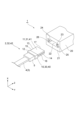
- FIG. 1 is a perspective view showing a state in which an optical connector according to one embodiment is attached to an adapter.
- 2 is a perspective view showing a state in which the optical connector shown in FIG. 1 is removed from the adapter;
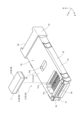
- FIG. 3 is a perspective view showing an optical connector according to one embodiment.
- 4 is a perspective view showing the ferrule of the optical connector shown in FIG. 3, showing a state before the lid is attached.
- FIG. 5A is a plan view showing a lid portion arranged in the window portion of the ferrule shown in FIG. 4.
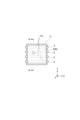
- FIG. 5B is a plan view of the window portion of the ferrule shown in FIG. 4 viewed from the direction X.
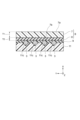
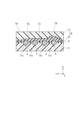
- FIG. 6 is an example of a cross-sectional view along the line VI-VI of the ferrule shown in FIG. 5B.
- FIG. 7A is a cross-sectional view of a ferrule according to a comparative example.
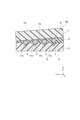
- FIG. 7B is an example of a cross-sectional view along the line VI-VI of the ferrule shown in FIG. 5B.
- FIG. 8A is a cross-sectional view of a ferrule according to a comparative example.
- FIG. 8B is an example of a cross-sectional view along the line VI-VI of the ferrule shown in FIG. 5B.
- FIG. 9A is a plan view showing a lid portion arranged on the window portion of the ferrule according to the first modified example.
- FIG. 9B is a plan view of the window portion of the ferrule according to the first modified example viewed from the direction X.
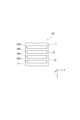
- FIG. 10A is a plan view showing a pressing member arranged in a window portion of a ferrule according to a second modification; 10B is a plan view of the window portion of the ferrule according to the second modified example viewed from the direction X.
- FIG. 10A is a plan view showing a pressing member arranged in a window portion of a ferrule according to a second modification
- 10B is a plan view of the window portion of the ferrule according to the second modified example viewed from the direction X.
- the holding lid holds down the plurality of optical fibers arranged in the fiber guide groove.
- the inclination of the pressing lid, shrinkage in the pressing lid, surface roughness of the inner surface of the pressing lid, etc. may cause the gap between the optical fiber and the groove, or between the optical fiber and the optical fiber.
- a gap may be generated between the presser lid. If such a gap occurs, the positioning accuracy of the optical fiber is lowered, thereby increasing the optical connection loss of the optical fiber.
- An object of the present disclosure is to provide a ferrule, an optical connector, and a method for manufacturing an optical connector that can reduce the connection loss of optical fibers.
- a ferrule is a ferrule for holding a plurality of optical fibers, and includes a ferrule body and a pressing member.
- the ferrule body has a plurality of grooves in which each of the plurality of optical fibers can be placed, and a window opening toward at least a portion of the plurality of grooves.
- the pressing member is arranged in the window and configured to sandwich and hold the plurality of optical fibers together with the plurality of grooves.
- the pressing member has a plate and an elastic body provided on the inner surface of the plate. The pressing member is arranged in the window so that the elastic body overlaps at least a portion of the plurality of grooves when viewed from a direction intersecting the surface on which the plate spreads.
- the pressing member that sandwiches and holds the plurality of optical fibers together with the plurality of grooves has at least one elastic body.
- the pressing member is configured such that an elastic body is provided between the plate and the optical fiber.
- the elastic body deforms and adheres closely to the plate and the plurality of optical fibers. Therefore, according to this ferrule, even if the plate is tilted or contracted, or the inner surface of the plate is roughened, the optical fiber and the groove portion or between the optical fiber and the pressing member can be kept in good contact with each other. is suppressed. Therefore, an appropriate load can be applied to a plurality of optical fibers.
- the optical fiber can be positioned with higher accuracy, and the connection loss of the optical fiber can be reduced.
- the elastic body may be formed from a component having a Young's modulus lower than that of the plate. Moreover, the Young's modulus of the elastic body may be 2 MPa or more and 80 MPa or less. Furthermore, the elastic body may be made of silicone resin. In any of these cases, the elastic body adheres more effectively to the inner surface of the plate and the plurality of optical fibers. Thereby, it is possible to reliably apply a load to the plurality of optical fibers. As a result, the optical fiber can be positioned more accurately, and the connection loss of the optical fiber can be further reduced.
- At least one of the plate and the elastic body may be made of a resin that can transmit ultraviolet rays.
- the adhesive is hardened by irradiating ultraviolet light from outside the plate, and the elastic body and the plate are used to fix the optical fiber. can be fixed in a positioned state.
- Both the plate and the elastic body may be made of a material (for example, resin) that can transmit ultraviolet rays.
- the thickness of the elastic body may be 10 ⁇ m or more and 100 ⁇ m or less.
- the thickness of the elastic body is 10 ⁇ m or more, the elastic body can more reliably adhere to both the inner surface of the plate and the optical fiber in the window.
- the thickness of the elastic body may be thinner than the thickness of the plate.
- the elastic body may cover at least the first ends in the longitudinal direction of the plurality of grooves.
- the optical fibers and the grooves are located between the optical fibers and the grooves, or between the optical fibers.
- the occurrence of a gap with the pressing member is suppressed. Therefore, an appropriate load can be applied to the plurality of optical fibers at the first end. As a result, it is possible to position the optical fibers more accurately at the first end where the output ends of the plurality of optical fibers are placed, thereby reducing the connection loss of the optical fibers.
- the elastic body may be provided so as to cover a portion having an area of 80% or more of the inner surface of the plate.
- the elastic body may be provided so as to cover a portion having an area of 80% or more of the inner surface of the plate.
- the plate is tilted or contracted, or the surface roughness of the inner surface of the plate becomes rough, in the portion having an area of 80% or more of the inner surface of the plate, between the optical fiber and the groove.
- the occurrence of a gap between the optical fiber and the pressing member is suppressed. Therefore, an appropriate load can be applied to a plurality of optical fibers.
- the optical fibers can be positioned more accurately in the portion of the inner surface of the plate that has an area of 80% or more, and the connection loss of the optical fibers can be reduced.
- the elastic body may include a first elastic body and a second elastic body, the first elastic body may cover the first ends in the longitudinal direction of the plurality of grooves, and the second elastic body may be , and may cover a second end opposite to the first end in the longitudinal direction of the plurality of grooves.
- the optical fibers and the grooves are Alternatively, the occurrence of a gap between the optical fiber and the pressing member is suppressed. Therefore, an appropriate load can be applied to a plurality of optical fibers. As a result, the optical fibers can be positioned more accurately at the first end and the second end of the plurality of grooves, and the connection loss of the optical fibers can be reduced.
- the elastic body may include a plurality of elastic bodies, and each of the plurality of elastic bodies may correspond to each of the plurality of grooves and cover the corresponding groove.
- each of the plurality of elastic bodies may correspond to each of the plurality of grooves and cover the corresponding groove.
- An optical connector includes the ferrule described above and a plurality of optical fibers respectively arranged in a plurality of grooves.
- the pressing member that sandwiches and holds the plurality of optical fibers together with the plurality of grooves has at least one elastic body.
- the elastic body is provided between the plate and the optical fiber.
- the plurality of optical fibers arranged in the plurality of grooves may be fixed to the ferrule body with an ultraviolet curing adhesive.
- the adhesive can be solidified more reliably by irradiating ultraviolet rays from the outside of the plate or the outside of the ferrule body. This makes it possible to provide an optical connector in which the ferrule body and the plurality of optical fibers are more reliably adhered and fixed.
- a method for manufacturing an optical connector includes steps of preparing a ferrule according to any one of the above-described embodiments, arranging a plurality of optical fibers in corresponding grooves among a plurality of grooves, and a step of injecting the adhesive from the portion toward the plurality of grooves; a step of placing the pressing member in the window so that the pressing member sandwiches the plurality of optical fibers together with the plurality of grooves; and a step of curing the adhesive. , including. According to this method, an optical connector capable of reducing the connection loss of optical fibers can be easily manufactured.
- FIG. 1 is a perspective view showing a state in which an optical connector is attached to an adapter in this optical connection structure.
- FIG. 2 is a perspective view showing a state in which the optical connector is removed from the adapter in the optical connection structure.
- 1 and 2 show an XYZ orthogonal coordinate system for easy understanding. The same applies to other figures.
- the Z direction is the longitudinal direction of the optical connector and the direction in which the optical connector is inserted into the adapter
- the Y direction is the lateral direction of the optical connector
- the X direction is the height direction of the optical connector.
- the optical connection structure comprises an optical connector 2 having a ferrule 10, and an adapter 20 into which the optical connector 2 can be inserted.
- the optical connector 2 has an optical fiber ribbon 4 accommodating a plurality of optical fibers 3, a boot 5, and a ferrule 10 attached to the tip of the optical fiber ribbon 4 via the boot 5. ing.
- Each optical fiber 3 accommodated in the optical fiber ribbon 4 extends along the Z direction.
- Each optical fiber 3 is arranged side by side along the Y direction that intersects (for example, is perpendicular to) the Z direction.
- a plurality of optical fibers 3 are arranged by being inserted along the Z direction into a plurality of optical fiber grooves (see FIG. 4 described later) formed inside the ferrule 10 .
- the ferrule 10 has, for example, a substantially rectangular parallelepiped appearance.
- the ferrule 10 accommodates and holds a plurality of optical fibers 3 inside.
- the ferrule 10 is a member for optically coupling each optical fiber 3 to another plurality of optical fibers held by ferrules (not shown) of other optical connectors.
- the ferrule 10 can be inserted into and removed from the adapter 20 along the Z direction in order to perform this optical coupling.
- Other optical connectors can have the same configuration as the optical connector 2 .
- the ferrule 10 has a body portion 11 and a flange portion 12 .
- the ferrule 10 is formed such that the flange portion 12 is larger than the body portion 11 in cross-sectional shape along the XY plane.
- the body portion 11 and the collar portion 12 are made of, for example, polyphenylene sulfide (PPS), polyetherimide (PEI), polycarbonate (PC), polymethyl methacrylate (PMMA), polyethersulfone (PES), or cycloolefin polymer ( COP) or the like.
- PPS polyphenylene sulfide
- PEI polyetherimide
- PC polycarbonate
- PMMA polymethyl methacrylate
- PES polyethersulfone
- COP cycloolefin polymer
- the body part 11 has both side surfaces 13 and 14 . Both side surfaces 13 and 14 are provided with a plurality of recesses 15 and 16, respectively. A plurality of recesses 15 and 16 extend along the Z direction. The plurality of recesses 15 and 16 are, for example, V-grooves or U-grooves extending in the Z direction. The plurality of recesses 15 and 16 function as guide grooves when the ferrule 10 is inserted into and removed from the adapter 20 . The ferrule 10 is, for example, inserted into the adapter 20 along the Z direction and fitted into the adapter 20 .
- the adapter 20 has a tubular shape capable of accommodating the ferrule 10 inside.
- the adapter 20 is configured such that when the ferrule 10 is inserted into the adapter 20 and fitted to the adapter 20, the ferrule 10 and another ferrule to be connected face each other inside the tubular shape of the adapter 20. ing. Inside the adapter 20, the front end face 17 of the ferrule 10 and the front end face of another ferrule to be connected may bump into each other to form an optical connection, or may be separated by a predetermined distance. Optical coupling may be made. More specifically, the adapter 20 has a storage portion 22 that opens at the front end surface 21 .
- the adapter 20 is configured such that the ferrule 10 can be inserted into the housing portion 22 .
- the storage portion 22 penetrates to the rear end surface on the side opposite to the front end surface 21 of the adapter 20 in the Z direction.
- the housing portion 22 is configured such that the other ferrule described above is inserted through an opening in the rear end face.
- a plurality of protrusions 23 and 24 facing each other in the Y direction are provided on both inner surfaces of the housing portion 22 of the adapter 20 .
- the plurality of protrusions 23 and 24 protrude toward the inside of the adapter 20 .
- the plurality of projections 23 and 24 enter and contact the plurality of recesses 15 and 16 of the ferrule 10 .
- the plurality of protrusions 23 and 24 guide the insertion of the ferrule 10 into the adapter 20 and its extraction to the outside.
- a plurality of gaps 25 and 26 may be further provided outside the plurality of protrusions 23 and 24 of the adapter 20, respectively.
- the plurality of protrusions 23 and 24 can easily elastically move outward in the Y direction. Therefore, even if the plurality of protrusions 23 and 24 of the adapter 20 are formed to be slightly narrow so as to reliably contact the plurality of recesses 15 and 16 of the ferrule 10, the plurality of protrusions 23 and 24 are not formed when the adapter 20 is inserted. The parts 23, 24 are allowed to move outward.
- the optical connection structure 1 includes multiple concave portions 15 and 16 and multiple convex portions 23 and 24 .
- the optical connection structure 1 allows the ferrule 10 (i.e., the plurality of optical fibers 3 of the optical connector 2) to move toward the adapter 20 when the ferrule 10 is inserted into the adapter 20 in the X-direction and The position in the Y direction and each rotation around each of the XYZ axes can be restricted. As a result, the ferrule 10 can be positioned in the optical connection structure 1 .
- FIG. 3 and 4 are perspective views showing an optical connector 2 having a ferrule 10 according to one embodiment.
- the ferrule 10 includes a body portion 11 (ferrule body), a collar portion 12, and a lid portion 6 (holding member).
- the body portion 11 has a plurality of side surfaces 13 and 14 , a plurality of concave portions 15 and 16 , a front end surface 17 , a rear end surface 18 and a lens group 19 .
- the ferrule 10 is further provided with a plurality of windows 11 a and 11 b on the upper surface of the main body 11 .
- the ferrule 10 has a plurality of grooves 11c formed inside the window 11a in which each of the plurality of optical fibers 3 can be placed.
- the window portion 11a opens toward at least part of the plurality of groove portions 11c.
- Each groove 11c may be, for example, a V-groove or a U-groove and extends along the Z direction.
- the plurality of grooves 11c are arranged along the Y direction.
- the plurality of grooves 11c are formed adjacent to each other.
- the depth of the groove portion 11c is smaller than the fiber diameter of the optical fiber 3, for example.
- a portion (upper portion) of the optical fiber 3 protrudes in the X direction from the groove portion 11c.
- a plurality of optical fibers 3 are inserted into the storage section continuing from the rear end face 18 of the ferrule 10 .
- the tip portions of the plurality of optical fibers 3 are aligned and housed in the plurality of groove portions 11c.
- Each optical fiber 3 accommodated in the groove portion 11c is optically coupled to each lens of the lens group 19 provided outside the ferrule 10 from the inside of the ferrule 10.
- a portion from the front edge of the window portion 11a of the ferrule 10 to the lens group 19 is made of, for example, at least a light-transmissive resin.
- the lid portion 6 is inserted into the window portion 11a from above in the X direction to press the optical fiber 3 against the groove portion 11c. Thereby, the positioning of the optical fiber 3 is performed.
- the width of the window portion 11a in the Y direction is substantially the same as the width of the lid portion 6 in the Y direction.
- the lid portion 6 is fitted to the window portion 11a in the Y direction.
- a fixing adhesive 9 (see FIG. 6, which will be described later) is injected into the gap between the window portion 11a and the lid portion 6 or through the window portion 11b.
- the optical fiber 3 is fixed to the main body 11 by curing the adhesive 9 .
- the fixing adhesive 9 is, for example, an ultraviolet curable adhesive.
- FIGS. 5A, 5B, and 6 are plan views showing the lid portion 6 and the main body portion 11 when viewed from the X direction.
- FIG. 5A is a plan view of the lid portion 6 when viewed from the optical fiber 3 (inside).
- FIG. 5B is a plan view of the body portion 11 and the lid portion 6 when viewed from outside (above) the window portion 11a. It should be noted that illustration of the plate 7 is omitted in FIG. 5B.
- FIG. 6 is a cross-sectional view along the line VI-VI of the optical connector 2 shown in FIG. 5B.
- the lid portion 6 is a member that is arranged in the window portion 11a and that sandwiches and holds the plurality of optical fibers 3 together with the plurality of groove portions 11c.
- a lid portion 6 has a plate 7 and an elastic body 8 as shown in FIGS. 5A, 5B and 6 .
- the plate 7 is a member for sandwiching the plurality of optical fibers 3 together with the plurality of grooves 11c via the elastic body 8.
- the plate 7 extends in the Y direction and the Z direction and has a plate shape, for example.
- the plate 7 is located outside the elastic body 8 in the window portion 11a.
- the plate 7 has an outer surface 7a exposed through the window 11a and an inner surface 7b provided on the opposite side of the outer surface 7a in the X direction.
- the plate 7 is made of, for example, a resin through which ultraviolet rays can pass.
- the plate 7 is made of a material such as, for example, polyphenylene sulfide (PPS), polyetherimide (PEI), polycarbonate (PC), polymethylmethacrylate (PMMA), polyethersulfone (PES) or cycloolefin polymer (COP). It is composed by The material forming the plate 7 may be any material that has a small difference in coefficient of linear expansion from the material forming the body portion 11, the flange portion 12, and the like. Thereby, when the ferrule 10 is exposed to high temperature or low temperature, it is possible to suppress the occurrence of connection loss of the optical fiber 3 in the optical connector 2 due to strain generated in the ferrule 10 .
- the thickness T1 of the plate 7 may be 100 ⁇ m or more and 700 ⁇ m or less. As an example, the thickness T1 of the plate 7 is 500 ⁇ m.
- the elastic body 8 is provided on the inner surface 7b of the plate 7.
- the elastic body 8 and the inner surface 7b are adhered and fixed, for example, by an adhesive that allows transmission of ultraviolet rays.
- the elastic body 8 is provided, for example, in a portion having an area of 80% or more of the inner surface 7b of the plate 7, and has a rectangular shape.
- the elastic body 8 is provided, for example, on the inner surface 7b of the plate 7 other than the outer edge.
- the elastic body 8 sandwiches and holds the plurality of optical fibers 3 together with the groove portion 11c.
- Such an elastic body 8 may be thinner than the plate 7, for example, and the thickness T2 of the elastic body 8 may be 10 ⁇ m or more and 100 ⁇ m or less, or may be 40 ⁇ m or more and 80 ⁇ m or less. As an example, the thickness T2 of the elastic body 8 is 30 ⁇ m.
- the elastic body 8 is made of a material having a Young's modulus lower than that of the plate 7, for example.
- the Young's modulus of the elastic body 8 is, for example, 2 MPa or more and 80 MPa or less.
- the elastic body 8 is made of silicone resin.
- the elastic body 8 may be composed of a resin that can transmit ultraviolet rays, and may be composed of, for example, a silicone resin that transmits ultraviolet rays. More specifically, the material forming the elastic body 8 is acrylic silicone, for example.
- the elastic body 8, the main body 11 and the plurality of optical fibers 3 are adhered and fixed with an ultraviolet curable adhesive 9, for example.
- the lid portion 6 having such an elastic body 8 is arranged so that the elastic body 8 entirely overlaps the plurality of groove portions 11c when viewed from the X direction, which is the direction that intersects the surface on which the plate 7 spreads. , is arranged in the window portion 11a.
- the plurality of optical fibers 3 are positioned with respect to the main body 11 by two points where the grooves 11c and the optical fibers 3 contact and the curved surface where the optical fibers 3 and the elastic body 8 contact.
- the lid portion 6 having the plate 7 and the elastic body 8 is prepared. Specifically, the inner surface 7b of the plate 7 is coated with an adhesive that transmits ultraviolet rays. This adhesive is, for example, an ultraviolet curable adhesive. After arranging the elastic body 8 on the inner surface 7b, the plate 7 and the elastic body 8 are bonded and fixed by irradiating ultraviolet rays. Finally, the elastic body 8 is cut to the required size. Both the plate 7 and the elastic body 8 may be cut to the required size.
- a ferrule 10 having a body portion 11 and a flange portion 12 and a plurality of optical fibers 3 are prepared.
- a plurality of optical fibers 3 are arranged in corresponding grooves 11c of the plurality of grooves 11c.
- an adhesive 9 for the body portion 11, the plurality of optical fibers 3 and the lid portion 6 is prepared, and the adhesive 9 is injected from the window portion 11a toward the plurality of groove portions 11c.
- This adhesive 9 is, for example, an ultraviolet curable adhesive.
- the lid portion 6 is made of, for example, a material that transmits ultraviolet rays.
- the lid portion 6 is arranged on the window portion 11a so that the lid portion 6 sandwiches the plurality of optical fibers 3 together with the plurality of groove portions 11c.
- the lid portion 6 is arranged so that the elastic body 8 of the lid portion 6 faces the optical fiber 3 .
- each optical fiber 3 is sandwiched between the arranged groove portion 11 c and the elastic body 8 of the lid portion 6 .
- the elastic body 8 is made of a relatively soft material. Therefore, even if there is some deviation between the lid portion 6 and the optical fibers 3 arranged in the groove portion 11c, the plurality of optical fibers 3 are more reliably held down by the lid portion 6.
- the adhesive 9 between the lid portion 6 and the main body portion 11 is cured by irradiating the adhesive 9 with ultraviolet rays.
- the adhesive 9 fixes the lid portion 6 and the plurality of optical fibers 3 to the main body portion 11 .
- each optical fiber 3 is fixed in a state in which it is reliably pressed into the groove portion 11c by the elastic body 8 of the lid portion 6.
- the adhesive 9 may be cured by a corresponding curing method.
- the optical connector 2 having the pressing structure shown in FIG. 6 is formed.
- FIGS. 7A and 7B are cross-sectional views when the inner surface 7b of the lid portion plate 7 has a shrinkage 7c and a large surface roughness 7d.
- FIG. 7A shows a case (comparative example 1) in which a plurality of optical fibers 3 are pressed against the body portion 11 (groove portion 11c) by a general lid portion 60 in which the elastic body 8 is not provided.
- FIG. 7B shows a case where a plurality of optical fibers 3 are pressed against the body portion 11 (groove portion 11c) by the cover portion 6 according to the present embodiment provided with the elastic body 8.
- FIG. 8A and 8B are cross-sectional views when the plate 7 is tilted with respect to the body portion 11.
- FIG. 8A shows a case (comparative example 2) in which a plurality of optical fibers 3 are pressed against the body portion 11 (groove portion 11c) by a general lid portion 60 in which the elastic body 8 is not provided.
- FIG. 8B shows a case where a plurality of optical fibers 3 are pressed against the body portion 11 (groove portion 11c) by the lid portion 6 according to the present embodiment provided with the elastic body 8.
- the elastic body 8 is deformed and adheres tightly to the inner surface 7b of the plate 7 and the plurality of optical fibers 3 . That is, the elastic body 8 fills the shrinkage 7c and the surface roughness 7d of the plate 7, and the inner surface of the lid portion 6 (the inner surface of the elastic body 8) can be made flatter. In this case, since all of the plurality of optical fibers 3 can be reliably fixed to the groove portion 11c by the cover portion 6, the gap between the optical fiber 3 and the groove portion 11c or between the optical fiber 3 and the cover portion 6 is reduced. Generation of S can be suppressed.
- the optical fiber 3 can be positioned more accurately, and the connection loss of the optical fiber 3 can be reduced. Further, even if the surface roughness 7d is, for example, 5 ⁇ m or more, the elastic body 8 can suppress the occurrence of the gap S. Thereby, even when the plate 7 is made of resin, the generation of the gap S can be suppressed.
- the lid portion 60 is tilted with respect to the main body portion 11 .
- This inclination may cause a gap S between the optical fiber 3 and the groove portion 11 c or between the optical fiber 3 and the plate 7 .
- the adhesive 9 injected from the window portion 11a enters the gap S.
- those optical fibers since at least a part of the optical fibers 3 (the right optical fiber 3 in the example of the figure) among the plurality of optical fibers 3 is not securely fixed to the groove 11c by the lid portion 60, those optical fibers The positioning accuracy of 3 may be degraded. As a result, the connection loss of the optical fiber 3 may increase.
- the elastic body 8 is deformed and adheres to the inner surface 7b of the plate 7 and the plurality of optical fibers 3 . That is, the elastic body 8 of the lid portion 6 contracts at a portion where the inclination of the plate 7 is small (on the left side of the figure), while the elastic body 8 of the lid portion 6 contracts at a portion where the inclination difference is large (on the right side of the figure).
- the inner surface of the lid portion 6 (the inner surface of the elastic body 8) can be made flatter by compensating for the inclination without contraction.
- the gap between the optical fiber 3 and the groove portion 11c or between the optical fiber 3 and the cover portion 6 is reduced.
- Generation of S can be suppressed.
- the optical fiber 3 can be positioned more accurately, and the connection loss of the optical fiber 3 can be reduced.
- the lid portion 6 for sandwiching and holding the plurality of optical fibers 3 together with the plurality of groove portions 11c has the elastic body 8. is positioned between the plate 7 and the optical fiber 3 .
- the elastic body 8 is deformed and closely adheres to the plate 7 and the plurality of optical fibers 3 . Therefore, according to the optical connector 2 having the ferrule 10, even if the plate 7 of the lid portion 6 is tilted or contracted, or the surface roughness of the inner surface of the plate 7 is roughened, the optical fiber 3 and the groove portion 11c are still connected to each other.
- the optical fiber 3 can be positioned more accurately, and the connection loss of the optical fiber 3 can be reduced.
- the inner surface 7b of the plate 7 of the lid 6 does not require high surface precision or flatness, so the plate 7 can be made of resin such as polycarbonate (PC). .
- the ferrule 10 can be produced at a lower cost.
- the high surface precision or flatness is, for example, submicron-order surface precision or flatness.
- the lid portion 6 can have a higher surface precision or flatness.
- the plurality of optical fibers 3 are positioned with respect to the main body 11 by two points where the grooves 11c and the optical fibers 3 contact and a curved surface where the optical fibers 3 and the elastic body 8 contact. As a result, the optical fiber 3 can be positioned with higher accuracy, so that the connection loss of the optical fiber 3 can be further reduced.
- the elastic body 8 is made of a component having a Young's modulus lower than that of the plate 7, for example.
- the Young's modulus of the elastic body 8 may be, for example, 2 MPa or more and 80 MPa or less.
- the elastic body 8 may be made of silicone resin, for example.
- the elastic body 8 is more effectively brought into close contact with the inner surface 7 b of the plate 7 and the plurality of optical fibers 3 . Thereby, the load can be applied to the plurality of optical fibers 3 more reliably. As a result, the optical fiber 3 can be positioned more accurately, and the connection loss of the optical fiber 3 can be further reduced.
- At least one of the plate 7 and the elastic body 8 may be made of a resin that can transmit ultraviolet rays.
- the plate 7 , the elastic body 8 , and the body portion 11 are adhered and fixed by the photocurable adhesive 9 by irradiating the plate 7 with ultraviolet rays or the like from the outside to harden the adhesive 9 .
- the ferrule 10 in which the plate 7, the elastic body 8, and the body portion 11 are more reliably adhered and fixed can be obtained.
- the work of adhesive fixing is easy.
- Both the plate 7 and the elastic body 8 may be made of a material (for example, resin) that can transmit ultraviolet rays.
- the thickness T2 of the elastic body 8 may be, for example, 10 ⁇ m or more and 100 ⁇ m or less.
- the elastic body 8 can more reliably adhere to both the inner surface 7b of the plate 7 and the optical fiber 3 within the window portion 11a. Since the thickness of the elastic body 8 is 100 ⁇ m or less, the thickness of the lid portion 6 (plate 7) can be suppressed while maintaining the strength of the lid portion 6 (plate 7), so that the ferrule 10 can be made thin.
- the elastic body 8 is provided in a portion of the inner surface 7b of the plate 7 having an area of 80% or more.
- the formation of a gap S between the optical fiber 3 and the groove portion 11c or between the optical fiber 3 and the lid portion 6 is suppressed in a portion having an area of 80% or more of the inner surface 7b of the plate 7. be done. Therefore, an appropriate load can be applied to all the optical fibers 3 regardless of the tilt of the plate 7, the shrinkage 7c generated in the plate 7, or the surface roughness 7d of the inner surface 7b of the plate 7, for example.
- the optical fiber 3 can be positioned more accurately in the portion of the inner surface 7b of the plate 7 having an area of 80% or more, and the connection loss of the optical fiber 3 can be reduced.
- the plurality of optical fibers 3 arranged in the plurality of grooves 11c are fixed to the main body 11 with an ultraviolet curing adhesive 9.
- the adhesive 9 can be hardened by irradiating ultraviolet rays from the outside of the plate 7 or the outside of the body portion 11 .
- the optical connector 2 in which the main body 11 and the plurality of optical fibers 3 are more reliably adhered and fixed can be obtained.
- the method for manufacturing the optical connector 2 comprises the steps of preparing the ferrule 10 described above, arranging the plurality of optical fibers 3 in the corresponding grooves 11c of the plurality of grooves 11c, and a step of injecting the adhesive 9 toward the plurality of grooves 11c from the above; a step of placing the lid 6 on the window 11a so that the lid 6 sandwiches the plurality of optical fibers 3 together with the plurality of grooves 11c; and C. curing the agent 9 .
- the optical connector 2 capable of reducing the connection loss of the optical fiber 3 can be easily manufactured.
- FIGS. 9A and 9B are plan views showing the lid portion 36 and the main body portion 11 when viewed from the X direction.
- FIG. 9A is a plan view of the lid portion 36 when viewed from the optical fiber 3 (inside).
- FIG. 9B is a plan view of the body portion 11 and the lid portion 36 when viewed from the outside of the window portion 11a. Illustration of the plate 7 is omitted in FIG. 9B.
- differences from the above-described embodiment will be mainly described, and descriptions of common points may be omitted.
- An optical connector 32 includes an optical fiber ribbon 4 accommodating a plurality of optical fibers 3, a boot 5, and a boot at the tip of the optical fiber ribbon 4, similarly to the optical connector 2 described above. and a ferrule 30 attached via 5 (see FIGS. 1 and 2).
- the ferrule 30, like the ferrule 10, has a body portion 11, a collar portion 12, and a lid portion .
- the lid portion 36 has a plate 7 and an elastic body 38 provided on the inner surface 7 b of the plate 7 .
- the elastic body 38 includes a first elastic body 38a and a second elastic body 38b. This point is different from the embodiment described above.
- the first elastic body 38a is located in a region close to one end 71 of the plate 7 with respect to the center of the inner surface 7b in the Z direction.
- the first elastic body 38a extends along the Y direction.
- the first elastic body 38a covers one end of each optical fiber 3 at the first ends 11d of the plurality of grooves 11c. In other words, the first elastic body 38a covers the first ends 11d of the plurality of grooves 11c in the Z direction (longitudinal direction).
- the second elastic body 38b is located in a region close to the other end 72 of the plate 7 with respect to the center of the inner surface 7b in the Z direction.
- the second elastic body 38b extends along the Y direction.
- the second elastic body 38b covers the other end of each optical fiber 3 at the second ends 11e of the plurality of grooves 11c.
- the second elastic body 38b covers the second ends 11e of the plurality of grooves 11c in the Z direction (longitudinal direction).
- One end 71 and the other end 72 face each other in the Z direction.
- the first end 11d and the second end 11e face each other in the Z direction. That is, the first end portion 11d is located on the opposite side of the second end portion 11e with respect to the center of the groove portion 11c in the Z direction.
- the manufacturing method of the optical connector 32 according to the first modified example is different from the manufacturing method of the optical connector 2 in that the lid portion 36 having the plate 7 and the elastic body 38 is prepared instead of the lid portion 6 .
- an adhesive that transmits ultraviolet rays is applied to the inner surface 7b of the plate 7 .
- the plate 7 and the elastic body 38 are bonded and fixed by irradiating ultraviolet rays after the elastic body 38 is placed on the inner surface 7b.
- the elastic body 38 is cut into required sizes to form the first elastic body 38a and the second elastic body 38b.
- the elastic body 38 has the first elastic body 38a and the second elastic body 38b as compared with the optical connector 2 including the ferrule 10.
- the first elastic body 38a covers the first ends 11d of the grooves 11c
- the second elastic bodies 38b covers the second ends 11e of the grooves 11c.
- the optical fiber 3 can be positioned more accurately at the first end 11d and the second end 11e of the plurality of grooves 11c, and the connection loss of the optical fiber 3 can be reduced.
- Other configurations and manufacturing methods are the same as those of the ferrule 10 and the optical connector 2 described above, and similar effects can be achieved.
- FIGS. 10A and 10B are plan views showing the lid portion 46 and the main body portion 11 when viewed from the X direction.
- FIG. 10A is a plan view of the lid portion 46 when viewed from the optical fiber 3 (inside).
- FIG. 10B is a plan view of the body portion 11 and the lid portion 46 when viewed from the outside of the window portion 11a. Illustration of the plate 7 is omitted in FIG. 10B.
- differences from the above-described embodiment will be mainly described, and descriptions of common points may be omitted.
- An optical connector 42 according to this modification includes an optical fiber ribbon 4 accommodating a plurality of optical fibers 3, a boot 5, and the boot 5 at the tip of the optical fiber ribbon 4, similar to the optical connector 2. and a ferrule 40 attached via (see FIGS. 1 and 2).
- the ferrule 40 like the ferrule 10 , has a body portion 11 , a collar portion 12 and a lid portion 46 .
- the lid portion 46 has a plate 7 and a plurality of elastic bodies 48a, 48b, 48c, 48d provided on the inner surface 7b of the plate 7. As shown in FIG.
- the optical connector 2 according to the second modification differs from the optical connector 2 having the lid portion 6 in that a plurality of elastic bodies 48a to 48d are provided.
- the plurality of elastic bodies 48a to 48d are arranged in the Y direction on the inner surface 7b. Each elastic body 48a to 48d extends from end 71 to end 72 in the Z direction. Each of the plurality of elastic bodies 48a to 48d corresponds to each of the plurality of grooves 11c. Each elastic body 48a to 48d covers the corresponding groove portion 11c, that is, the optical fiber 3 accommodated in the groove portion 11c. Each elastic body 48a to 48d covers the optical fiber 3 from the first end 11d to the second end 11e.
- the plurality of elastic bodies 48a to 48d are, for example, four elastic bodies.
- the plurality of elastic bodies 48a to 48d is not particularly limited as long as the number thereof is equal to or greater than the number of the plurality of grooves 11c.
- the manufacturing method of the optical connector 42 according to the second modification is different from the manufacturing method of the optical connector 2 in that a lid portion 46 having a plate 7 and a plurality of elastic bodies 48a to 48d is prepared instead of the lid portion 6. do. Specifically, first, an adhesive that transmits ultraviolet rays is applied to the inner surface 7b of the plate 7 . Subsequently, the plate 7 and the elastic sheet are adhered and fixed by irradiating ultraviolet rays after the elastic sheet is placed on the inner surface 7b. Finally, the elastic sheet is cut to the required size to form a plurality of elastic bodies 48a to 48d.
- the optical fiber 3 and the groove 11c are separated from each other in each groove 11c. 11c or between the optical fiber 3 and the lid portion 46 is suppressed. Thereby, an appropriate load can be applied to each optical fiber 3 corresponding to each groove portion 11c. That is, since the elastic bodies 48a to 48d are provided for each optical fiber 3, each optical fiber 3 can be firmly positioned. As a result, the optical fiber 3 can be positioned more precisely in each groove 11c, so that the connection loss of the optical fiber 3 can be reduced.
- the present invention is not limited to the above embodiments and modifications, and can be applied to various embodiments and modifications.
- the first modification, and the second modification the elastic body adhesively fixed to the plate 7 is cut to obtain the required size of the elastic body 8, the first elastic body 38a, and the second elastic body 38a.
- An elastic body 38b and a plurality of elastic bodies 48a to 48d may be formed by methods other than those described above.
- the elastic body may be cut to prepare the elastic body 8 of the required size in advance.
- the lid portion 6 may be prepared by attaching an elastic body 8 having a required size to the inner surface 7b of the plate 7.
- the elastic body may be cut to form the first elastic body 38a and the second elastic body 38b in advance.
- the lid portion 36 may be prepared by attaching the first elastic body 38 a and the second elastic body 38 b to the inner surface 7 b of the plate 7 .
- the elastic body may be cut to prepare a plurality of elastic bodies 48a to 48d in advance.
- the lid portion 46 may be prepared by attaching a plurality of elastic bodies 48 a to 48 d to the inner surface 7 b of the plate 7 .
- the first modified example, and the second modified example, first, ultraviolet curing resin is applied to the inner surface 7b of the plate 7 where the elastic bodies 8, 38a, 38b, 48a to 48d are to be arranged.
- the elastic bodies 8, 38 and 48 may be provided on the inner surface 7b of the plate 7 by curing the resin by irradiating it with ultraviolet rays.
- the material of the plate 7 is a material having a small difference in thermal expansion coefficient from the materials forming the body portion 11, the flange portion 12, the elastic body 8, and the like.
- the plate 7 may be made of glass.
- the plate 7 is larger than the elastic body 8 .
- plate 7 may be approximately the same size as elastic body 8 .
- SYMBOLS 1 ... Optical connection structure 2, 32, 42... Optical connector 3... Optical fiber 4... Optical fiber ribbon 5... Boot 6, 36, 46... Lid part (holding member) 60 Lid portion 7 Plate 7a Outer surface 7b Inner surface 7c Shrinkage 7d Surface roughness 8, 38, 48 Elastic body 9 Adhesive 10, 30, 40 Ferrule 11 Main body (ferrule main body) 11a, 11b... Window 11c... Groove 11d... First end 11e... Second end 12... Collars 13, 14... Side, both sides 15, 16... Recess 17... Front end face 18... Rear end face 19...
- Lens group Reference Signs List 20 Adapter 21 Front end surface 22 Storage portions 23, 24 Convex portions 25, 26 Gap 36 Cover portion 38a First elastic body 38b Second elastic bodies 48a, 48b, 48c, 48d Plural elastic bodies 71, 72... Edge S... Gap T1, T2... Thickness.
Landscapes
- Physics & Mathematics (AREA)
- General Physics & Mathematics (AREA)
- Optics & Photonics (AREA)
- Mechanical Coupling Of Light Guides (AREA)
Priority Applications (1)
| Application Number | Priority Date | Filing Date | Title |
|---|---|---|---|
| JP2023567619A JPWO2023112572A1 (https=) | 2021-12-16 | 2022-11-11 |
Applications Claiming Priority (2)
| Application Number | Priority Date | Filing Date | Title |
|---|---|---|---|
| JP2021204408 | 2021-12-16 | ||
| JP2021-204408 | 2021-12-16 |
Publications (1)
| Publication Number | Publication Date |
|---|---|
| WO2023112572A1 true WO2023112572A1 (ja) | 2023-06-22 |
Family
ID=86774002
Family Applications (1)
| Application Number | Title | Priority Date | Filing Date |
|---|---|---|---|
| PCT/JP2022/042128 Ceased WO2023112572A1 (ja) | 2021-12-16 | 2022-11-11 | フェルール、光コネクタ、及び、光コネクタの製造方法 |
Country Status (2)
| Country | Link |
|---|---|
| JP (1) | JPWO2023112572A1 (https=) |
| WO (1) | WO2023112572A1 (https=) |
Citations (7)
| Publication number | Priority date | Publication date | Assignee | Title |
|---|---|---|---|---|
| JPH0179003U (https=) * | 1987-11-18 | 1989-05-26 | ||
| JPH08313759A (ja) * | 1995-05-12 | 1996-11-29 | Fujikura Ltd | 光コネクタ取付治具およびそれを用いた光コネクタ取付方法 |
| JPH0926527A (ja) * | 1995-07-12 | 1997-01-28 | Fujikura Ltd | 多心光コネクタ |
| JPH0990152A (ja) * | 1995-09-28 | 1997-04-04 | Furukawa Electric Co Ltd:The | 多数本の光ファイバの一括融着接続方法 |
| JP2000241664A (ja) * | 1999-02-23 | 2000-09-08 | Sumitomo Electric Ind Ltd | 光ファイバ保持具 |
| US6409394B1 (en) * | 2000-03-21 | 2002-06-25 | Sumitomo Electric Industries, Ltd. | Optical connector |
| JP2006119523A (ja) * | 2004-10-25 | 2006-05-11 | Honda Tsushin Kogyo Co Ltd | 光コネクタ |
-
2022
- 2022-11-11 JP JP2023567619A patent/JPWO2023112572A1/ja active Pending
- 2022-11-11 WO PCT/JP2022/042128 patent/WO2023112572A1/ja not_active Ceased
Patent Citations (7)
| Publication number | Priority date | Publication date | Assignee | Title |
|---|---|---|---|---|
| JPH0179003U (https=) * | 1987-11-18 | 1989-05-26 | ||
| JPH08313759A (ja) * | 1995-05-12 | 1996-11-29 | Fujikura Ltd | 光コネクタ取付治具およびそれを用いた光コネクタ取付方法 |
| JPH0926527A (ja) * | 1995-07-12 | 1997-01-28 | Fujikura Ltd | 多心光コネクタ |
| JPH0990152A (ja) * | 1995-09-28 | 1997-04-04 | Furukawa Electric Co Ltd:The | 多数本の光ファイバの一括融着接続方法 |
| JP2000241664A (ja) * | 1999-02-23 | 2000-09-08 | Sumitomo Electric Ind Ltd | 光ファイバ保持具 |
| US6409394B1 (en) * | 2000-03-21 | 2002-06-25 | Sumitomo Electric Industries, Ltd. | Optical connector |
| JP2006119523A (ja) * | 2004-10-25 | 2006-05-11 | Honda Tsushin Kogyo Co Ltd | 光コネクタ |
Also Published As
| Publication number | Publication date |
|---|---|
| JPWO2023112572A1 (https=) | 2023-06-22 |
Similar Documents
| Publication | Publication Date | Title |
|---|---|---|
| EP1664871B1 (en) | Optical ferrule | |
| US10705299B2 (en) | Ferrule structure, ferrule structure with fiber, and method for manufacturing ferrule structure with fiber | |
| JP2018530013A (ja) | 導波路アクセス不可能スペースを有する光フェルール | |
| US20200088954A1 (en) | Ferrule, ferrule with optical fiber, and method of manufacturing ferrule with optical fiber | |
| JP7766607B2 (ja) | フェルール及び光コネクタ | |
| JP3091680B2 (ja) | リボン型光ケーブル用多芯光コネクタ | |
| JP4698376B2 (ja) | 多心光コネクタ | |
| CN115280207B (zh) | 光纤连接部件以及光纤连接部件的制造方法 | |
| WO2023112572A1 (ja) | フェルール、光コネクタ、及び、光コネクタの製造方法 | |
| US11150418B2 (en) | Optical connector ferrule and optical connector | |
| JPWO2002079831A1 (ja) | 光ファイバーアレイ及びその製造方法 | |
| CN115398295A (zh) | 光连接器、插芯以及光连接器的制造方法 | |
| CN113678042A (zh) | 插芯及光连接器 | |
| JP2023071241A (ja) | 光コネクタ、及び光コネクタの製造方法 | |
| JP7576514B2 (ja) | 光コネクタおよびその製造方法 | |
| JP2024089459A (ja) | フェルール、光コネクタ、および、光コネクタの製造方法 | |
| US20240402444A1 (en) | Optical module | |
| JP2024056503A (ja) | フェルール、光コネクタ、及び、光コネクタの製造方法 | |
| JP3485465B2 (ja) | 光コネクタ | |
| JP2000329971A (ja) | 光ファイバーアレイ | |
| JP2722566B2 (ja) | 光ファイバ位置決め部材 | |
| CN118604956A (zh) | 带光纤的插芯和带光纤的插芯的制造方法 | |
| CN108885312A (zh) | 光学连接器插芯、光学连接器以及光耦合结构 | |
| JP2005321425A (ja) | フェルール対向構造 | |
| JP2002107564A (ja) | 光導波路モジュール |
Legal Events
| Date | Code | Title | Description |
|---|---|---|---|
| 121 | Ep: the epo has been informed by wipo that ep was designated in this application |
Ref document number: 22907103 Country of ref document: EP Kind code of ref document: A1 |
|
| WWE | Wipo information: entry into national phase |
Ref document number: 2023567619 Country of ref document: JP |
|
| NENP | Non-entry into the national phase |
Ref country code: DE |
|
| 122 | Ep: pct application non-entry in european phase |
Ref document number: 22907103 Country of ref document: EP Kind code of ref document: A1 |