WO2023100786A1 - サルコシン化合物濃度の測定方法及びサルコシン化合物検出および濃度測定用トランジスタ型センサ - Google Patents
サルコシン化合物濃度の測定方法及びサルコシン化合物検出および濃度測定用トランジスタ型センサ Download PDFInfo
- Publication number
- WO2023100786A1 WO2023100786A1 PCT/JP2022/043706 JP2022043706W WO2023100786A1 WO 2023100786 A1 WO2023100786 A1 WO 2023100786A1 JP 2022043706 W JP2022043706 W JP 2022043706W WO 2023100786 A1 WO2023100786 A1 WO 2023100786A1
- Authority
- WO
- WIPO (PCT)
- Prior art keywords
- water
- sarcosine
- transistor
- concentration
- measuring
- Prior art date
- Legal status (The legal status is an assumption and is not a legal conclusion. Google has not performed a legal analysis and makes no representation as to the accuracy of the status listed.)
- Ceased
Links
Images



Classifications
-
- G—PHYSICS
- G01—MEASURING; TESTING
- G01N—INVESTIGATING OR ANALYSING MATERIALS BY DETERMINING THEIR CHEMICAL OR PHYSICAL PROPERTIES
- G01N27/00—Investigating or analysing materials by the use of electric, electrochemical, or magnetic means
- G01N27/26—Investigating or analysing materials by the use of electric, electrochemical, or magnetic means by investigating electrochemical variables; by using electrolysis or electrophoresis
- G01N27/403—Cells and electrode assemblies
- G01N27/414—Ion-sensitive or chemical field-effect transistors, i.e. ISFETS or CHEMFETS
-
- G—PHYSICS
- G01—MEASURING; TESTING
- G01N—INVESTIGATING OR ANALYSING MATERIALS BY DETERMINING THEIR CHEMICAL OR PHYSICAL PROPERTIES
- G01N33/00—Investigating or analysing materials by specific methods not covered by groups G01N1/00 - G01N31/00
- G01N33/18—Water
Definitions
- the present invention relates to a method for measuring the concentration of sarcosine compounds in water, and particularly using an organic transistor to detect sarcosine compounds in boiler water, industrial water, cooling water, hot water, washing water, process water, waste water, etc.
- the present invention relates to a method for measuring the concentration of a sarcosine compound suitable for measuring concentration.
- the present invention also relates to a transistor-based sensor for sarcosine compound detection and concentration measurement.
- steam is introduced into the heat exchanger and the product is heated by steam. Processes are performed to dry, concentrate, or sterilize the material.
- a process of liquefying and condensing steam by bringing it into contact with a cooling body for example, in a petrochemical plant, a thermoelectric plant, etc.
- the steam is applied to a turbine and used as a power source, and then liquefied and condensed in a condenser to be recovered.
- Patent Document 1 As a method for measuring the concentration of sarcosine compounds, there is a method of reacting an N-2-hydroxy-3-sulfopropylaniline derivative and measuring the resulting color product (Patent Document 1), but a reagent is required for the measurement; long measurement time; and other issues.
- Liquid chromatography (LC)/mass spectrometry (MS) method and total organic carbon (TOC) method are conceivable as methods for measuring the concentration of sarcosine compounds in water using a measuring device.
- LC/MS method and TOC method it is necessary to collect sample water in a glass bottle or plastic bottle on site and transport it to the place where the analyzer is located for measurement. During this time, the sarcosine compound adsorbs to the glass bottle or plastic bottle, making it impossible to accurately measure the concentration of the sarcosine compound in water.
- An object of the present invention is to provide a method for measuring the concentration of sarcosine compounds and a transistor-type sensor for detecting and measuring the concentration of sarcosine compounds, which can easily and quickly measure the concentration of sarcosine compounds on site without using reagents. .
- the gist of the present invention is as follows.
- a method of measuring the sarcosine compound concentration in the water to be measured by contacting the water to be measured with the extended gate using a transistor type sensor having an extended gate in which a dipicolylamine-copper (II) complex is introduced as a receptor.
- II dipicolylamine-copper
- the sarcosine compound has the general formula R 1 —CO—N(CH 3 )—(CH 2 ) n —COOR 2 (R 1 is a saturated or unsaturated hydrocarbon group having 10 to 22 carbon atoms, n is 0 , 1 or 2, and R 2 is the compound represented by H) or a salt thereof.
- the water to be measured is the water cycle or steam cycle water in the process of introducing steam into the heat exchanger to heat the object to be heated, or the process of bringing the steam into contact with the cooling body to liquefy and condense the steam.
- a method for measuring a sarcosine compound concentration according to any one of [1] to [6].
- the transistor type sensor has a transistor portion made of a field effect transistor and a detection portion separated from the transistor portion,
- the detection site has a metal film and the dipicolylamine-copper (II) complex modified on the surface of the metal film, the metal film and the gate electrode of the field effect transistor are electrically connected by wiring,
- the method for measuring the concentration of a sarcosine compound according to any one of [1] to [8], wherein the surface of the metal film having the dipicolylamine-copper(II) complex is brought into contact with water to be measured.
- a transistor-type sensor for detecting and measuring concentration of sarcosine compounds having an extended gate in which a dipicolylamine-copper (II) complex is introduced as a receptor.
- the transistor type sensor has a transistor portion made of a field effect transistor and a detection portion separated from the transistor portion,
- the detection site has a metal film and the dipicolylamine-copper(II) complex bound to the surface of the metal film, the metal film and the gate electrode of the field effect transistor are electrically connected by wiring,
- dipicolylamine-copper (II) complex Cu 2+ -DPA
- a sarcosine compound concentration in water can be measured by using a sarcosine compound detection sensor modified on the surface of an extended gate gold electrode as an organized monolayer.
- Appropriately control the concentration of sarcosine compounds by measuring the concentration of sarcosine compounds in water generated in the water cycle or steam cycle in the process of introducing steam into the heat exchanger to heat the object to be heated and the process of liquefying and condensing the steam. be able to.
- the method for measuring the sarcosine compound concentration of the present invention requires a short measurement time.
- FIG. 1 is a schematic longitudinal sectional view showing the configuration of a sarcosine compound concentration measuring device;
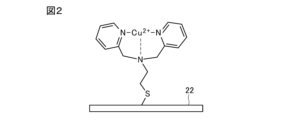
- FIG. 4 is a configuration diagram of a receptor portion;
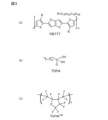
- FIG. 1 is a chemical structure diagram of materials used in Examples.
- FIG. It is a graph showing the measurement result of an example. It is a graph showing the measurement result of an example. It is a graph showing the measurement result of an example. It is a graph showing the measurement result of an example. It is a graph showing the measurement result of an example. It is a graph showing the measurement result of an example. It is a graph showing the measurement result of an example. It is a graph showing the measurement result of an example. It is a graph showing the measurement result of an example. It is a graph showing the measurement result of an example. It is a graph showing the measurement result of an example. It is a graph showing the measurement result of an example. It is a graph showing the measurement result of an example.
- a transistor-type sensor is used to measure the concentration of sarcosine compounds in water.
- An organic thin film transistor is composed of a substrate, a gate electrode, a gate insulating film, a source electrode, a drain electrode, an organic semiconductor, a sealing film and the like.
- the extended gate which is a detection electrode obtained by partially extending the gate electrode, with a receptor, the change in threshold voltage accompanying an increase in the concentration of the sarcosine compound is quantitatively read out.
- a dipicolylamine-copper(II) complex (Cu 2+ -DPA) is used as an artificial receptor for transistor-type sensors.
- the dipicolylamine-copper(II) complex binds to the extended gate gold electrode surface via thiol groups to modify the electrode surface, as shown in FIG.
- the sarcosine compound coordinates to the Cu 2+ of the dipicolylamine-copper(II) complex.
- Dipicolylamine-copper (II) complexes can be used with other metal complexes such as terpyridine metal complexes.
- artificial receptors in transistor-type sensors may decompose if they contain heavy metal ions (Cu, Zn, Fe, etc.) exceeding 1000 mg/L or extreme acids such as piranha solution. preferably not included.
- the transistor portion of the transistor-type sensor used in the present invention can be configured with a known transistor structure, and may be an inorganic transistor or an organic transistor. Among them, a thin film transistor (TFT) made of an organic polymer is preferable because it is small and can be used easily.
- TFT thin film transistor
- Fig. 1 shows an example of the configuration of a transistor-type sensor.
- the transistor-type sensor shown in FIG. 1 is composed of a transistor portion 10 and an extended gate serving as a detection portion 20 .
- a gate electrode 12 is formed on a substrate 11 made of glass or the like, and a gate made of an AlOx film 13 and tetradecylphosphonic acid (TDPA, whose structural formula is shown in FIG. 3(b)) is formed on the surface thereof.
- An insulating film 14 is formed. Electrodes for a source 15 and a drain 16 are formed thereon.
- An organic polymer semiconductor layer 17 is formed between the source electrode 15 and the drain electrode 16 .
- a sealing film 18 is formed to seal them.
- the extended gate which is the detection site 20 , comprises a metal film 22 on a substrate 21 .
- a dipicolylamine-copper (II) complex is bonded via a thiol group to the surface (upper surface in the drawing) of the metal film 22 .
- the amount of bonding of the dipicolylamine-copper(II) complex to the metal film surface is preferably about 1 ⁇ 10 ⁇ 9 to 1 ⁇ 10 ⁇ 10 mol/cm 2 .
- the upper surface side of the metal film 22 in FIG. 1 is the contact surface with the water to be measured.
- a reference electrode 24 made of an Ag/AgCl electrode is provided so as to be inserted into the water to be measured.
- the metal film 22 and the gate electrode 12 are electrically connected by the wiring 30 .
- the sarcosine compound concentration in the water to be measured is measured by bringing water to be measured containing the sarcosine compound into contact with the metal film 22 and measuring changes in the threshold voltage or drain current value of the transistor.
- the materials that make up the transistor are not particularly limited.
- inorganic materials such as glass, ceramic glass, ceramics, and metals, as well as organic materials such as resins and papers, to the substrate, a flexible sensor can be constructed.
- resins such as polyethylene naphthalate, polyethylene terephthalate, polyethylene, polyimide, polyparaxylylene (parylene (registered trademark)), paper, etc. can be used as the substrate.
- gate electrode materials include aluminum, silver, gold, copper, titanium, indium oxide (ITO), PEDOT:PSS, and the like.
- Materials for the source and drain electrodes include gold, silver, copper, platinum, aluminum, and conductive polymers such as PEDOT:PSS.
- Materials constituting the gate insulating film include, for example, silica, alumina, self-assembled monolayer (SAM), polystyrene, polyvinylphenol, polyvinyl alcohol, polymethylmethacrylate, polydimethylsiloxane, polysilsesquioxane, ionic liquid, Polytetrafluoroethylene (Teflon (registered trademark) AF, Cytop (registered trademark)) and the like can be mentioned.
- SAM self-assembled monolayer
- polystyrene polyvinylphenol
- polyvinyl alcohol polymethylmethacrylate
- polydimethylsiloxane polysilsesquioxane
- ionic liquid Polytetrafluoroethylene (Teflon (registered trademark) AF, Cytop (registered trademark)) and the like can be mentioned.
- P-type pentacene, dinaphthothienothiophene, benzothienobenzothiophene (Cn-BTBT), TIPS pentacene, TES-ADT, rubrene, P3HT, PBTTT, etc.
- Cn-BTBT benzothienobenzothiophene
- TIPS pentacene TES-ADT
- rubrene P3HT
- PBTTT etc.
- N-type fullerene or the like can be used.
- the structural formula of PBTTT is shown in FIG. 3(a).
- sealing film Materials constituting the sealing film (protective film) include polytetrafluoroethylene (Teflon (registered trademark) AF), CYTOP (registered trademark), polyparaxylylene (parylene (registered trademark)), and the like.
- Teflon registered trademark
- CYTOP registered trademark
- polyparaxylylene parylene (registered trademark)
- Cytop is shown in FIG. 3(c).
- Thin film transistors can be produced by dry processes such as vapor deposition and sputtering, coating by spin coating, bar coating, spray coating, screen printing, gravure offset printing, letterpress reverse printing, and inkjet printing by various printing machines. good. Printing can be made more efficiently and at a lower cost.
- the metal film In order to bind the dipicolylamine-copper (II) complex to the metal film of the detection site 20, which is the extended gate, the metal film should be immersed in the dipicolylamine-copper (II) complex solution.
- concentration of the dipicolylamine-copper (II) complex in this solution is preferably about 1 to 10 mM, and the immersion time is preferably about 1 to 2 hours.
- the transistor portion and the extension gate which is the detection portion, are fabricated separately, and by connecting them when in use, only the extension gate that is in direct contact with the sample can be easily replaced depending on the service life. can be installed. As a result, the transistor portion can be measured in a stable state. In addition, there is no need to replace the entire sensor, and the detection site can be used repeatedly by washing, so there is also the advantage of being economical.
- the present invention it is preferable to measure the sarcosine compound concentration in the water generated from the steam or water cycle by immersing the transistor sensor in water generated from the steam or water cycle, quantitatively reading changes in threshold voltage.
- the transistor-type sensor is installed so that the entire electrode part is immersed in the target water system.
- the place where the transistor type sensor is installed may be anywhere in the feed water line to the boiler, the blow line of the boiler, or the drain water line after passing through the heat exchanger in the heating process or the liquefaction condensation process and condensed, but is not limited to this.
- the transistor type sensor may be installed directly in the line or may be installed in a bypass line, but in order to avoid consumption of the transistor type sensor, it is desirable to install it in the bypass line. In order to avoid this, it is preferable to pass water through the bypass line only during measurement. If it is difficult to install the transistor sensor in the line or if the transistor sensor is severely depleted, the water generated from the steam or water cycle is sampled from the line, and then the transistor sensor is immersed in the sampled water. may be measured.
- the temperature of the water to be measured is room temperature when it comes into contact with the sensor.
- the temperature adjustment method is not limited to this.
- the water to be measured is preferably water cycle or steam cycle water in the step of introducing steam into a heat exchanger to heat an object to be heated, or in the step of bringing steam into contact with a cooling body to liquefy and condense steam. be.
- the sarcosine compound to be measured in the present invention preferably has the general formula R 1 —CO—N(CH 3 )—(CH 2 ) n —COOR 2 (R 1 is a saturated or unsaturated carbonized a hydrogen group, n is 0, 1 or 2, and R2 is a compound represented by H) or a salt thereof;
- the saturated or unsaturated hydrocarbon group for R 1 may be linear, branched, or cyclic, and may be an alkyl group, an alkenyl group, an alkadienyl group, or an alkynyl group. etc., preferably straight-chain alkyl groups or straight-chain alkenyl groups.
- R 1 preferably has 15 to 22 carbon atoms.
- n is 0, 1 or 2, preferably 1 or 2 from the viewpoint of corrosion suppression.
- Preferred salts of the sarcosine compound are amine salts, ammonium salts and alkali metal salts.
- sarcosine compounds are particularly preferably oleoyl sarcosine, lauroyl sarcosine, stearoyl sarcosine, and cocoyl sarcosine, and each of these can be used alone, or two or more of them can be used in combination if necessary.
- the method for measuring the sarcosine compound concentration of the present invention is suitable for measuring the sarcosine compound concentration in industrial water, cooling water, hot water, boiler water, cleaning water, process water, waste water, geothermal water, and the like.
- the pH of the water for measuring the sarcosine compound is preferably in the range of 3-12, more preferably 4-12, and particularly preferably 5-11.
- the pH in water is less than 3, the carboxyl group of the sarcosine compound is protonated and inhibits binding to the dipicolylamine-copper(II) complex on the receptor surface, making it impossible to properly measure the sarcosine compound concentration.
- the pH of the measurement water exceeds 12, the sarcosine compound is likely to be hydrolyzed, and the concentration of the sarcosine compound in the water may decrease.
- Water for measuring sarcosine compounds may contain Fe 3+ , Cu 2+ , Ca 2+ , Mg 2+ , Zn 2+ , Al 3+ and the like.
- Fe 3+ coexists it should be 5 mg/L or less, preferably 1 mg/L or less.
- Cu 2+ coexists it may be 5 mg/L or less, and preferably 1 mg/L or less.
- Ca 2+ coexists it may be 1000 mg/L as CaCO 3 or less, preferably 500 mg/L as CaCO 3 or less.
- Mg 2+ coexists it may be 500 mg/L as MgCO 3 or less, preferably 250 mg/L as MgCO 3 or less.
- Zn 2+ When Zn 2+ coexists, it should be 5 mg/L or less, preferably 1 mg/L or less. When Al 3+ coexists, it may be 5 mg/L or less, preferably 1 mg/L or less. If the concentration of the metal ion coexisting with the sarcosine compound exceeds the above range, the sarcosine compound and the metal ion will bind to each other, inhibiting the binding to the dipicolylamine-copper(II) complex on the receptor surface, thereby reducing the concentration of the sarcosine compound appropriately. Measurement may not be possible.
- the present invention is particularly suitable for measuring sarcosine compounds in water generated from steam cycles in contact with boilers, turbines, heat exchangers, and the like.
- heat exchangers include steam turbines, low-pressure turbines (steam turbines after intermediate-pressure turbines), condensers, air-cooled condensers, drying devices, concentrating devices, and heating devices.
- the sarcosine compound is dissolved in a solvent such as methanol, ethanol, or isopropanol and added to the steam or water supply of boilers, turbines, heat exchangers, etc.
- An emulsifier is used to make an aqueous emulsion, which is then added to the steam or water supply.
- a solvent such as methanol, ethanol, or isopropanol
- An emulsifier is used to make an aqueous emulsion, which is then added to the steam or water supply.
- HLB hydrophile-lipophile balance
- emulsifiers examples include polyoxyethylenealkylamines, preferably polyoxyethylenealkylamines having alkyl groups of 10 to 18 carbon atoms.
- fatty acid alkali metal salts particularly saturated or unsaturated fatty acid alkali metal salts having 8 to 24 carbon atoms, particularly 10 to 22 carbon atoms, can be suitably used.
- capric acid examples include sodium salts and potassium salts of saturated or unsaturated fatty acids such as lauric acid, myristic acid, palmitic acid, stearic acid, arachidic acid, behenic acid, oleic acid, erucic acid, linoleic acid, and linolenic acid.
- the sodium salt and potassium salt of the fatty acid manufactured from edible fats and oils can also be used preferably.
- the fatty acid alkali metal salt is particularly an unsaturated fatty acid having 14 to 22 carbon atoms, such as an alkali metal salt of a fatty acid containing 25% by weight or more of at least one selected from oleic acid, erucic acid, linoleic acid, and linolenic acid. preferred.
- an emulsifier an ester of glycerin and the aforementioned fatty acid can also be suitably used, and an ester of glycerin and stearic acid can be particularly preferably used. These emulsifiers may be used alone or in combination of two or more.
- the weight ratio of the sarcosine compound to the emulsifier is 40/1 to 1/1, especially 20/1 to 2/1. degree is preferred.
- sarcosine compound Only one type of sarcosine compound may be added, or two or more types may be added to the steam or feed water of boilers, turbines, heat exchangers, and the like.
- Long-chain aliphatic amines such as octadecylamine, oleylamine and oleylpropylenediamine may also be used in combination.
- the above sarcosine compound is preferably present at a rate of 0.01 to 10 ppm, particularly 0.1 to 1 ppm, relative to the amount of steam. If the amount of the sarcosine compound is less than this range, the sarcosine compound cannot sufficiently obtain the effect of suppressing the formation of a condensed water film and the effect of improving the heating efficiency. .
- ppm is the ratio of the weight of the sarcosine compound to water corresponding to the amount of steam, and corresponds to "mg/L-water”.
- Neutralizing amines include ammonia, monoethanolamine (MEA), cyclohexylamine (CHA), morpholine (MOR), diethylethanolamine (DEEA), monoisopropanolamine (MIPA), 3-methoxypropylamine (MOPA), Volatile amines such as 2-amino-2-methyl-1-propanol (AMP) and diglycolamine (DGA) can be used. These may use only 1 type and may use 2 or more types together.
- the pH may be adjusted with ammonia derived from the thermal decomposition of the oxygen scavenger below.
- the amount of the neutralizing amine to be added varies depending on the amount of sarcosine compound used, the type of object to be heated, the type of equipment, etc. In particular, it is preferable to set it to 5 to 15 ppm.
- the sarcosine compound may be used in combination with an oxygen scavenger, and the combined use of the oxygen scavenger can provide the same effect of reducing corrosion of steam drums as with the neutralizing amine.
- Hydrazine derivatives such as hydrazine and carbohydrazide can be used as oxygen scavengers.
- non-hydrazine oxygen scavengers include carbohydrazide, hydroquinone, 1-aminopyrrolidine, 1-amino-4-methylpiperazine, N,N-diethylhydroxylamine, isopropylhydroxylamine, erythorbic acid or salts thereof, ascorbic acid or Its salt, tannic acid or its salt, sugars, sodium sulfite, etc. can also be used. These may use only 1 type and may use 2 or more types together.
- the amount of the oxygen scavenger to be added varies depending on the amount of sarcosine compound used, the type of object to be heated, the type of steam dryer, etc., but is 0.01 to 3 ppm, particularly It is preferably 0.05 to 1 ppm.
- the above concomitant drug may be added to the same site as the sarcosine compound, or may be added to a different site.
- the chemicals to be added may be mixed in advance and added, or they may be added separately.
- Example 1 ⁇ Experimental conditions> Cocoyl sarcosine manufactured by CRODA was added to pure water to prepare 0, 0.4, 1.0 or 5.0 mg/L cocoyl sarcosine aqueous solutions.
- Fig. 1 We fabricated an extended gate type organic thin film transistor (Fig. 1) into which a dipicolylamine-copper (II) complex was introduced.
- the introduction of the dipicolylamine-copper (II) complex into the metal film 22 was performed by the following procedure.
- a treatment solution 1 was prepared by dissolving 10 mM of 2-[bis(2-pyridylmethyl)amino]ethanethiol and 50 mM of tris(2-carboxyethyl)phosphine hydrochloride in methanol. After the metal film 22 was immersed in the treatment liquid 1 for 1 hour, it was washed with ethanol and ultrapure water and dried.
- the detection part 20 of this transistor was immersed in each of the above solutions, and the threshold voltage was measured after 20 minutes.
- the material and thickness of the main parts of the transistor are as follows.
- Gate electrode aluminum, 30 nm Source and drain: gold, 30 nm Organic semiconductor: PBTTT Sealing film: Cytop (registered trademark) Metal film: gold, thickness 100 nm, area 15 mm 2 Source-drain spacing: 50 ⁇ m
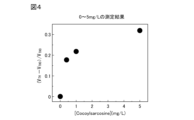
- the results are shown in FIG. As shown in FIG. 4, a good correlation was obtained between the sarcosine compound concentration and the threshold voltage.
- the threshold voltage on the y-axis in FIG. 4 is the numerical value obtained by dividing the difference between the threshold voltage (V TH ) of each sarcosine compound concentration and the threshold voltage (V TH0 ) of the blank by V TH0 (V TH ⁇ V TH0 )/V. TH0 was used.
- Example 2 ⁇ Experimental conditions> In an aqueous solution (HEPES buffer) adjusted to 100 mM HEPES, 10 mM NaCl, pH 7.4, 0 or 1.0 mg/L of cocoyl sarcosine manufactured by CRODA and FeCl 3 or CuCl 2 as Fe 3+ were added at 0, 0. 1, 0.2, 0.5, 1, 3, or 5 mg/L and 0, 0.1, 0.2, 0.3, 0.5, 1, 3, or 5 mg/L as Cu 2+ were prepared respectively.
- HEPES buffer 100 mM HEPES
- 10 mM NaCl, pH 7.4, 0 or 1.0 mg/L of cocoyl sarcosine manufactured by CRODA and FeCl 3 or CuCl 2 as Fe 3+ were added at 0, 0. 1, 0.2, 0.5, 1, 3, or 5 mg/L and 0, 0.1, 0.2, 0.3, 0.5, 1, 3, or 5 mg/L as Cu 2+ were prepared respectively.
- the detection part of the same extended gate type organic thin film transistor as in Example 1 was immersed in these aqueous solutions, and the threshold voltage was measured after 20 minutes.
- Example 3 ⁇ Experimental conditions> Cocoyl sarcosine manufactured by CRODA was added to an aqueous solution (MES buffer) adjusted to 100 mM MES, 10 mM NaCl, and pH 7.0 to prepare a 10 mg/L cocoyl sarcosine aqueous solution.
- MES buffer aqueous solution adjusted to 100 mM MES, 10 mM NaCl, and pH 7.0 to prepare a 10 mg/L cocoyl sarcosine aqueous solution.
- a solution was prepared by adding ethylenediaminetetraacetic acid to a concentration of 10 ⁇ M, which was used as treatment liquid 3 .
- the cocoyl sarcosine compound concentration was measured using an organic transistor having the same configuration as in Example 1. After that, the detection site was immersed in the treatment liquid 3 for 10 minutes and washed with ultrapure water. Further, the detection site was immersed in treatment solution 2 for 10 minutes, washed with ultrapure water and MES buffer, and the cocoyl sarcosine compound concentration was measured again.
- Example 4 Cocoyl sarcosine manufactured by CRODA was added to each aqueous solution (MES buffer) adjusted to 100 mM MES, 10 mM NaCl, pH 5.5, 6.2, and 7.0 to prepare a 1 mg/L cocoyl sarcosine aqueous solution. .
- the detection part of the same extended gate type organic thin film transistor as in Example 1 was immersed in these aqueous solutions, and the threshold voltage was measured after 20 minutes.
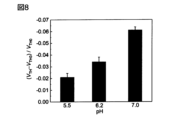
- the results are shown in FIG. As shown in FIG. 8, it was observed that the amount of change in the threshold voltage value of coil sarcosine was pH dependent.
- the threshold voltage on the y-axis in FIG. 8 is the numerical value obtained by dividing the difference between the threshold voltage (V TH ) of each cocoyl sarcosine compound concentration and the threshold voltage (V TH0 ) of the blank by V TH0 (V TH ⁇ V TH0 )/ VTH0 .
- Example 5 ⁇ Experimental conditions> Cocoyl sarcosine manufactured by CRODA was added to a solution (MES buffer) adjusted to 100 mM MES, 10 mM NaCl, pH 7.0, and 0, 0.1, 0.3, 0.5, 1.0, 3. 0, 5.0, or 10.0 mg/L cocoyl sarcosine aqueous solutions were prepared.
- MES buffer 100 mM MES, 10 mM NaCl, pH 7.0, and 0, 0.1, 0.3, 0.5, 1.0, 3. 0, 5.0, or 10.0 mg/L cocoyl sarcosine aqueous solutions were prepared.
- the introduction of the dipicolylamine-copper (II) complex into the metal film 22 was performed by the following procedure. After the metal film 22 was immersed in the treatment liquid 1 for 1 hour, it was washed with ethanol and ultrapure water and dried. A treatment liquid 4 was prepared by dissolving copper perchlorate in an MES buffer to a concentration of 1 mM. After the metal film 22 was immersed in the treatment liquid 4 for 1 hour, it was washed with ultrapure water and dried.
- the detection part 20 of the transistor was immersed in each of the above solutions, and the threshold voltage was measured after 20 minutes.
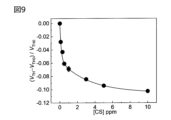
- the results are shown in FIG. As shown in FIG. 9, a good correlation was obtained between the cocoylsarcosine (CS) concentration and the threshold voltage.
- the threshold voltage on the y-axis in FIG. 4 is the numerical value obtained by dividing the difference between the threshold voltage (V TH ) of each sarcosine compound concentration and the threshold voltage (V TH0 ) of the blank by V TH0 (V TH ⁇ V TH0 )/V. TH0 was used.
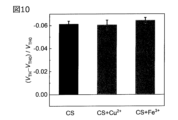
- Example 6 ⁇ Experimental conditions> An aqueous solution (MES buffer) adjusted to 100 mM MES, 10 mM NaCl, and pH 7.0 was added with 1.0 mg/L of cocoyl sarcosine manufactured by CRODA, and 1.0 mg of cocoyl sarcosine manufactured by CRODA. /L and FeCl 3 or CuCl 2 were added to give 10 mg/L as Fe 3+ and 10 mg/L as Cu 2+ , respectively.
- MES buffer 100 mM MES, 10 mM NaCl, and pH 7.0
- the detection part of the same extended gate type organic thin film transistor as in Example 1 was immersed in these aqueous solutions, and the threshold voltage was measured after 20 minutes.
- Example 7 Cocoyl sarcosine manufactured by CRODA was added to an aqueous solution (MES buffer) adjusted to 100 mM MES, 10 mM NaCl, and pH 7.0 to prepare a 10 mg/L cocoyl sarcosine aqueous solution.
- MES buffer aqueous solution adjusted to 100 mM MES, 10 mM NaCl, and pH 7.0 to prepare a 10 mg/L cocoyl sarcosine aqueous solution.
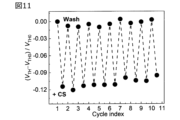
- the cocoyl sarcosine compound concentration was measured using an organic transistor having the same configuration as in Example 1. Thereafter, the detection site was immersed in the treatment liquid 4 for 10 minutes and washed with ultrapure water. Further, the detection site was immersed in treatment solution 2 for 10 minutes, washed with ultrapure water and MES buffer, and the cocoyl sarcosine compound concentration was measured again.
- the results are shown in FIG. As shown in FIG. 11, it was confirmed that the concentration of cocoylsarcosine could be measured repeatedly when the immersion in the cocoylsarcosine aqueous solution and the washing operation were alternately performed.
- the threshold voltage on the y-axis in FIG. 11 is the numerical value obtained by dividing the difference between the threshold voltage (V TH ) of each cocoyl sarcosine compound concentration and the threshold voltage (V TH0 ) of the blank by V TH0 (V TH ⁇ V TH0 )/ VTH0 .
- transistor portion 11 substrate 12 gate electrode 13 AlOx film 14 gate insulating film 15 source electrode 16 drain electrode 17 organic polymer semiconductor layer 20 detection portion 21 substrate 22 metal film 24 reference electrode
Landscapes
- Health & Medical Sciences (AREA)
- Life Sciences & Earth Sciences (AREA)
- Chemical & Material Sciences (AREA)
- Pathology (AREA)
- General Physics & Mathematics (AREA)
- Engineering & Computer Science (AREA)
- Physics & Mathematics (AREA)
- Analytical Chemistry (AREA)
- Biochemistry (AREA)
- General Health & Medical Sciences (AREA)
- Immunology (AREA)
- Food Science & Technology (AREA)
- Medicinal Chemistry (AREA)
- Microelectronics & Electronic Packaging (AREA)
- Molecular Biology (AREA)
- Chemical Kinetics & Catalysis (AREA)
- Electrochemistry (AREA)
- Investigating Or Analyzing Materials By The Use Of Electric Means (AREA)
Abstract
ジピコリルアミン-銅(II)錯体をレセプタとして導入した延長ゲートを有するトランジスタ型センサを用いて、測定対象水を延長ゲートに接触させて測定対象水中のサルコシン化合物濃度を測定する。トランジスタ型センサは、電界効果トランジスタよりなるトランジスタ部位と、該トランジスタ部位から離隔した検出部位とを有している。該検出部位は、金属膜と、該金属膜の表面に結合された前記ジピコリルアミン-銅(II)錯体とを有している。該金属膜と前記電界効果トランジスタのゲート電極とが配線により電気的に接続されている。該金属膜の該ジピコリルアミン-銅(II)錯体を有する面に測定対象水を接触させる。
Description
本発明は、水中のサルコシン化合物濃度を測定する方法に関するものであり、特に有機トランジスタを用いて、ボイラ水中、工業用水中、冷却水中、温水中、洗浄水中、工程水中、排水水中等のサルコシン化合物濃度を測定する方法に好適なサルコシン化合物濃度の測定方法に関する。また、本発明は、サルコシン化合物検出および濃度測定用トランジスタ型センサに関する。
蒸気を熱交換器に導入し被加熱物を加熱する工程、例えば、食品、飲料の製造工場、抄紙工場等では、蒸気を熱交換器に導入し、蒸気により製造物を加熱することにより、製造物を乾燥、濃縮、又は殺菌する処理が行われている。また、蒸気を冷却体に接触させることで蒸気を液化凝縮する工程、例えば、石油化学工場や熱電プラント等では、蒸気をタービンに当て動力源とした後、復水器で液化凝縮させ回収している。蒸気による加熱工程もしくは蒸気の液化凝縮工程の何れの工程においても、蒸気が飽和状態より低い温度の金属材料に接触し、液化凝縮が起こっている。この液化凝縮の過程で、凝縮液が壁面上に連続して液膜を形成する膜状凝縮と、凝縮液が壁面上を濡らさず多数の液滴となる滴状凝縮とがある。膜状凝縮に比べて滴状凝縮はその熱伝熱率が数倍から数十倍高いことから、蒸気の滴状凝縮化法として、膜状凝縮抑制効果のあるサルコシン化合物の使用が検討されている。
この場合、蒸気を熱交換器に導入し被加熱物を加熱する工程および蒸気を液化凝縮する工程に対してサルコシン化合物が設定値通り注入できているかを管理するために、水サイクルもしくは蒸気サイクルから生じる水(ボイラ装置の給水ライン、ドレン水ラインもしくはブロー水ラインなど)をサンプリングし、サルコシン化合物濃度を測定する必要がある。
サルコシン化合物濃度を測定する方法として、N-2-ヒドロキシ-3-スルホプロピルアニリン誘導体を作用させ、生ずる発色体を測定する方法があるが(特許文献1)、測定に試薬が必要である;廃液が生じる;測定時間が長い;などの課題がある。
測定装置による水中のサルコシン化合物濃度の測定方法として、液体クロマトグラフィー(LC)/質量分析(MS)法や全有機炭素(TOC)法などが考えられる。LC/MS法やTOC法の場合、現場でサンプル水をガラス瓶やポリ瓶に採取し分析装置がある場所まで輸送し測定する必要があるが、サンプル水を採取してから測定するまでに1週間はかかってしまい、その間にサルコシン化合物がガラス瓶やポリ瓶に吸着してしまうため、的確に水中のサルコシン化合物濃度を測定できない。
本発明は、試薬を用いることなく、現場でサルコシン化合物濃度を容易かつ迅速に測定することができるサルコシン化合物濃度の測定方法及びサルコシン化合物検出および濃度測定用トランジスタ型センサを提供することを課題とする。
本発明の要旨は次である。
[1] ジピコリルアミン-銅(II)錯体をレセプタとして導入した延長ゲートを有するトランジスタ型センサを用いて、測定対象水を延長ゲートに接触させて測定対象水中のサルコシン化合物濃度を測定する方法。
[2] 前記サルコシン化合物は、一般式R1-CO-N(CH3)-(CH2)n-COOR2(R1は炭素数10~22の飽和又は不飽和炭化水素基、nは0、1又は2、R2はH)で表わされる化合物又はその塩である、[1]のサルコシン化合物濃度の測定方法。
[3] 前記測定対象水中のサルコシン化合物濃度が5mg/L以下である、[1]のサルコシン化合物濃度の測定方法。
[4] 前記測定対象水中のFe3+濃度が5mg/L以下である、[1]~[3]のいずれかのサルコシン化合物濃度の測定方法。
[5] 前記測定対象水中のCu2+濃度が5mg/L以下である、[1]~[4]のいずれかのサルコシン化合物濃度の測定方法。
[6] 前記測定対象水中のpHが3~12である、[1]~[5]のいずれかのサルコシン化合物濃度の測定方法。
[7] 前記測定対象水は、蒸気を熱交換器に導入し被加熱物を加熱する工程、又は蒸気を冷却体に接触させることで蒸気を液化凝縮する工程における、水サイクルまたは蒸気サイクル水である、[1]~[6]のいずれかのサルコシン化合物濃度の測定方法。
[8] 前記熱交換器が蒸気タービン、復水器、空冷式復水器、乾燥装置、濃縮装置、又は昇温装置である、[7]のサルコシン化合物濃度の測定方法。
[9] 前記トランジスタ型センサは、電界効果トランジスタよりなるトランジスタ部位と、該トランジスタ部位から離隔した検出部位とを有しており、
該検出部位は、金属膜と、該金属膜の表面に修飾された前記ジピコリルアミン-銅(II)錯体とを有しており、
該金属膜と前記電界効果トランジスタのゲート電極とが配線により電気的に接続されており、
該金属膜の該ジピコリルアミン-銅(II)錯体を有する面に測定対象水を接触させる、[1]~[8]のいずれかのサルコシン化合物濃度の測定方法。
該検出部位は、金属膜と、該金属膜の表面に修飾された前記ジピコリルアミン-銅(II)錯体とを有しており、
該金属膜と前記電界効果トランジスタのゲート電極とが配線により電気的に接続されており、
該金属膜の該ジピコリルアミン-銅(II)錯体を有する面に測定対象水を接触させる、[1]~[8]のいずれかのサルコシン化合物濃度の測定方法。
[10] ジピコリルアミン-銅(II)錯体をレセプタとして導入した延長ゲートを有するサルコシン化合物検出および濃度測定用トランジスタ型センサ。
[11] 前記トランジスタ型センサは、電界効果トランジスタよりなるトランジスタ部位と、該トランジスタ部位から離隔した検出部位とを有しており、
該検出部位は、金属膜と、該金属膜の表面に結合された前記ジピコリルアミン-銅(II)錯体とを有しており、
該金属膜と前記電界効果トランジスタのゲート電極とが配線により電気的に接続されており、
該金属膜の該ジピコリルアミン-銅(II)錯体を有する面が測定対象水の接触面となっている[10]のサルコシン化合物検出および濃度測定用トランジスタ型センサ。
該検出部位は、金属膜と、該金属膜の表面に結合された前記ジピコリルアミン-銅(II)錯体とを有しており、
該金属膜と前記電界効果トランジスタのゲート電極とが配線により電気的に接続されており、
該金属膜の該ジピコリルアミン-銅(II)錯体を有する面が測定対象水の接触面となっている[10]のサルコシン化合物検出および濃度測定用トランジスタ型センサ。
本発明のサルコシン化合物濃度の測定方法及びサルコシン化合物検出および濃度測定用トランジスタ型センサによれば、有機薄膜トランジスタを活用した、人工レセプタとしてジピコリルアミン-銅(II)錯体(Cu2+-DPA)を自己組織化単分子膜として延長ゲート金電極表面に修飾したサルコシン化合物検出用センサを用いることで、水中のサルコシン化合物濃度を測定することができる。蒸気を熱交換器に導入し被加熱物を加熱する工程および蒸気を液化凝縮する工程において、水サイクルもしくは蒸気サイクルで生じる水中のサルコシン化合物濃度測定することで、サルコシン化合物の濃度管理を適切に行うことができる。
また、本発明のサルコシン化合物濃度の測定方法は、測定時間が短い。
本発明では、トランジスタ型センサを用いて水中のサルコシン化合物濃度を測定する。
トランジスタ型センサとしては、有機薄膜トランジスタを用いたものが好適である。有機薄膜トランジスタは、基板、ゲート電極、ゲート絶縁膜、ソース電極、ドレイン電極、有機半導体、封止膜等から構成されている。本発明では、ゲート電極を一部延長させた検出電極となる延長ゲートにレセプタを修飾することで、サルコシン化合物の濃度増加に伴う閾値電圧の変化を定量的に読み出す。
本発明では、トランジスタ型センサの人工レセプタとしてジピコリルアミン-銅(II)錯体(Cu2+-DPA)を用いる。ジピコリルアミン-銅(II)錯体は、図2の通り、チオール基を介して延長ゲート金電極表面に結合し、電極表面を修飾する。サルコシン化合物はジピコリルアミン-銅(II)錯体のCu2+に配位する。ジピコリルアミン-銅(II)錯体はターピリジン金属錯体などの他の金属錯体を用いることができる。また、トランジスタ型センサの人工レセプタは1000mg/Lを超える重金属イオン(Cu、Zn、Feなど)やピラニア溶液などの極端な酸が含まれると分解する可能性があるので、これらは測定対象の溶液中に含まれないことが好ましい。
本発明で用いるトランジスタ型センサのトランジスタ部位は、公知のトランジスタ構造により構成することができ、無機トランジスタでも、有機トランジスタであってもよい。中でも、小型で簡易的に用いることができる有機高分子よりなる薄膜トランジスタ(TFT)が好ましい。
図1に、トランジスタ型センサの構成の一例を示す。図1に示すトランジスタ型センサは、トランジスタ部位10と検出部位20である延長ゲートとから構成されている。
トランジスタ部位10は、ガラス等よりなる基板11上にゲート電極12が形成され、その表面に、AlOx膜13、テトラデシルホスホン酸(TDPA。構造式を図3(b)に示す。)よりなるゲート絶縁膜14が形成されている。その上に、ソース15及びドレイン16の電極が形成されている。
ソース電極15、ドレイン電極16間に有機高分子半導体層17が形成されている。これらを封止するように封止膜18が形成されている。
検出部位20である延長ゲートは、基板21上の金属膜22を備えている。金属膜22の表面(図の上面)側は、図2の通り、ジピコリルアミン-銅(II)錯体がチオール基を介して結合している。ジピコリルアミン-銅(II)錯体の金属膜表面への結合量は1×10⁻⁹~1×10⁻¹⁰mol/cm2程度が好適である。
金属膜22の図1の上面側が測定対象水との接触面となる。また、測定対象水に差し込まれるようにして、Ag/AgCl電極よりなる参照電極24が設けられている。
金属膜22とゲート電極12とが配線30によって導通されている。
金属膜22にサルコシン化合物を含む測定対象水を接触させて、トランジスタの閾値電圧又はドレイン電流値の変化を計測することによって、測定対象水中のサルコシン化合物濃度を測定する。
トランジスタを構成する材料は特に限定されるものではない。例えば基板はガラス、セラミックガラス、セラミックス、金属等の無機材料の他、樹脂、紙等の有機材料等を適用することにより、フレキシブルな形態のセンサを構成することができる。
有機トランジスタの場合は、基板としては、例えば、ポリエチレンナフタレート、ポリエチレンテレフタレート、ポリエチレン、ポリイミド、ポリパラキシリレン(パリレン(登録商標))等の樹脂、紙等を用いることができる。
ゲート電極材料としては、例えば、アルミニウム、銀、金、銅、チタン、酸化インジウム(ITO)、PEDOT:PSS等が挙げられる。ソース電極・ドレイン電極の材料としては、金、銀、銅、白金、アルミニウム、PEDOT:PSS等の導電性高分子が挙げられる。
ゲート絶縁膜の構成材料としては、例えば、シリカ、アルミナ、自己組織化単分子膜(SAM)、ポリスチレン、ポリビニルフェノール、ポリビニルアルコール、ポリメチルメタクリレート、ポリジメチルシロキサン、ポリシルセスキオキサン、イオン液体、ポリテトラフルオロエチレン(テフロン(登録商標)AF、サイトップ(登録商標))等が挙げられる。
有機半導体の構成材料としては、P型の場合は、ペンタセン、ジナフトチエノチオフェン、ベンゾチエノベンゾチオフェン(Cn-BTBT)、TIPSペンタセン、TES-ADT、ルブレン、P3HT、PBTTT等を用いることができる。N型の場合は、フラーレン等を用いることができる。PBTTTの構造式を図3(a)に示す。
封止膜(保護膜)の構成材料としては、ポリテトラフルオロエチレン(テフロン(登録商標)AF)、サイトップ(登録商標)、ポリパラキシリレン(パリレン(登録商標))等が挙げられる。サイトップ(登録商標)の構造式を図3(c)に示す。
薄膜トランジスタの作製方法は、蒸着法、スパッタリング法等のドライプロセスでも、スピンコート、バーコート、スプレーコート等による塗布、スクリーン印刷、グラビアオフセット印刷、凸版反転印刷、インクジェット印刷等の各種印刷機による印刷でもよい。印刷によれば、より効率的に低コストで作製することができる。
延長ゲートである検出部位20の金属膜にジピコリルアミン-銅(II)錯体を結合させるには、金属膜をジピコリルアミン-銅(II)錯体溶液に浸漬すればよい。この溶液のジピコリルアミン-銅(II)錯体濃度は1~10mM程度が好適であり、浸漬時間は1~2Hr程度が好適である。
図1のように、トランジスタ部位と検出部位である延長ゲートが別個に作製され、使用時にこれらを連結する構成とすることにより、試料と直接接触する延長ゲートのみを寿命に応じて容易に交換して取り付けることができる。これにより、トランジスタ部位は安定した状態での計測が可能である。また、センサ全体を交換する必要がなく、しかも、検出部位は洗浄操作を行うことにより繰り返し利用可能であるため、経済的であるという利点も有している。
本発明では、前記トランジスタ型センサを蒸気または水サイクルから生じる水に浸漬して閾値電圧の変化を定量的に読み込み、蒸気または水サイクルから生じる水のサルコシン化合物濃度を測定することが好ましい。
具体的には、前記トランジスタ型センサを対象水系に電極部全体が浸かるように設置する。前記トランジスタ型センサを設置する場所は、ボイラへの給水ライン、ボイラのブローライン、もしくは加熱工程や液化凝縮工程の熱交換器を通過し凝縮した後のドレン水ラインのどこでもよく、これに限定されない。また、前記トランジスタ型センサを上記ラインに直接設置してもよいし、バイパスラインに設置してもよいが、前記トランジスタ型センサの消耗を避けるためにバイパスラインに設置することが望ましく、さらに消耗を避けるために測定時にのみバイパスラインに通水し測定することが好ましい。また、上記ラインに設置することが困難、もしくは前記トランジスタ型センサの消耗が激しい場合は、上記ラインから蒸気もしくは水サイクルから生じる水をサンプリングしてから、そのサンプリング水に前記トランジスタ型センサを浸漬し測定してもよい。
前記測定対象水は、出来るだけ室温で測定することが望ましい。上記ラインに直接もしくはバイパスラインに前記トランジスタ型センサを設置する場合、前記測定対象水の温度がなるべく室温になるように冷却用の熱交換器を別途設置する、もしくは、ラインを長めにとって前記トランジスタ型センサに接触する際の前記測定対象水の温度が室温になるようにすることが好ましい。温度調整方法はこれに限定されない。
前記測定対象水は、好ましくは、蒸気を熱交換器に導入し被加熱物を加熱する工程、又は蒸気を冷却体に接触させることで蒸気を液化凝縮する工程における、水サイクルまたは蒸気サイクル水である。
本発明で測定対象とするサルコシン化合物は、好ましくは、一般式R1-CO-N(CH3)-(CH2)n-COOR2(R1は炭素数10~22の飽和又は不飽和炭化水素基、nは0、1又は2、R2はH)で表わされる化合物又はその塩である。
R1の飽和又は不飽和炭化水素基としては、直鎖状であってもよく、分岐鎖を有してもよく、また環状であってもよく、アルキル基、アルケニル基、アルカジエニル基、アルキニル基等が挙げられるが、好ましくは、直鎖アルキル基又は直鎖アルケニル基である。R1の炭素数は好ましくは15~22である。nは0、1又は2であり、腐食抑制の観点から好ましくは1又は2である。サルコシン化合物の塩としては、アミン塩、アンモニウム塩、アルカリ金属塩が好ましいものとして例示される。
このようなサルコシン化合物の具体例としては、特に好ましいのは、オレオイルサルコシン、ラウロイルサルコシン、ステアロイルサルコシンおよびココイルサルコシンであり、これらは夫々単独で使用し得る他、必要により2種以上を併用できる。
本発明のサルコシン化合物濃度の測定方法は、工業用水中、冷却水中、温水中、ボイラ水中、洗浄水中、工程水中、排水水中、地熱水中等のサルコシン化合物濃度を測定するのに好適である。
サルコシン化合物を測定する水のpHは好ましくは3~12の範囲であり、より好ましくは4~12、特に好ましくは5~11であることが好ましい。水中のpHが3未満になると、サルコシン化合物のカルボキシ基がプロトン化し、レセプタ表面のジピコリルアミン-銅(II)錯体との結合を阻害し、適切にサルコシン化合物濃度を測定できなくなる。また、測定水のpHが12を超えるとサルコシン化合物が加水分解しやすくなり、水中のサルコシン化合物濃度が低下するおそれがある。
測定水のpHが3~12、特に4~12の範囲において、pHの増加に伴い、脱プロトン化されたカルボキシ基の割合が増加するため、pHが12に近づくにつれ閾値電圧(VTH)とブランクの閾値電圧(VTH0)の差をVTH0で除した数値(VTH-VTH0)/VTH0の変化量は増加する。したがって、サルコシン化合物を測定する水のpHにおいて閾値電圧(VTH)とブランクの閾値電圧(VTH0)の差をVTH0で除した数値(VTH-VTH0)/VTH0の検量線を作成する必要がある。
サルコシン化合物を測定する水中には、Fe3+、Cu2+、Ca2+、Mg2+、Zn2+、Al3+などが含まれていてもよい。Fe3+が共存する場合、5mg/L以下であればよく、特に1mg/L以下であることが好ましい。Cu2+が共存する場合、5mg/L以下であればよく、特に1mg/L以下であることが好ましい。Ca2+が共存する場合、1000mg/L as CaCO3以下であればよく、特に500mg/L as CaCO3以下であることが好ましい。Mg2+が共存する場合、500mg/L as MgCO3以下であればよく、特に250mg/L as MgCO3以下であることが好ましい。Zn2+が共存する場合、5mg/L以下であればよく、特に1mg/L以下であることが好ましい。Al3+が共存する場合、5mg/L以下であればよく、特に1mg/L以下であることが好ましい。サルコシン化合物と共存する金属イオンの濃度が上記範囲を超えると、サルコシン化合物と金属イオンが結合し、レセプタ表面のジピコリルアミン-銅(II)錯体との結合を阻害し、適切にサルコシン化合物濃度を測定できなくなるおそれがある。
本発明は、特に、ボイラ、タービン、熱交換器などと接触する蒸気サイクルから生じる水中のサルコシン化合物の測定に好適である。熱交換器としては、例えば、蒸気タービン、低圧タービン等(中圧タービン以降の蒸気タービン)、復水器、空冷式復水器、乾燥装置、濃縮装置、昇温装置等が挙げられる。
サルコシン化合物は、メタノール、エタノール、イソプロパノール等の溶媒に溶解させてボイラ、タービン、熱交換器などの蒸気又は給水に添加されるが、乳化剤を用いて水性エマルジョンとし、これを蒸気又は給水に添加されるのが好ましい。乳化剤としては、HLB(親水性親油性バランス)値が高いものが良い。この値は12~16が好ましく、より望ましくは13~15が好ましい。
乳化剤としては、例えば、ポリオキシエチレンアルキルアミン等が挙げられ、好ましくはアルキル基の炭素数が10~18のポリオキシエチレンアルキルアミンである。これ以外の乳化剤としては、脂肪酸アルカリ金属塩、特に炭素数8~24とりわけ炭素数10~22の飽和又は不飽和の脂肪酸アルカリ金属塩を好適に用いることができ、具体的には、カプリン酸、ラウリン酸、ミリスチン酸、パルミチン酸、ステアリン酸、アラキン酸、ベヘン酸、オレイン酸、エルカ酸、リノール酸、リノレン酸などの飽和又は不飽和の脂肪酸のナトリウム塩やカリウム塩が挙げられる。また、この脂肪酸アルカリ金属塩としては、食用油脂から製造される脂肪酸のナトリウム塩やカリウム塩も好ましく用いることができる。脂肪酸アルカリ金属塩としては、特に炭素数14~22の不飽和脂肪酸、例えば、オレイン酸、エルカ酸、リノール酸、リノレン酸から選ばれる少なくとも1種を25重量%以上含有する脂肪酸のアルカリ金属塩が好適である。乳化剤としては、その他、グリセリンと前述の脂肪酸とのエステルも好適に用いることができ、特にグリセリンとステアリン酸とのエステルを好ましく用いることができる。これらの乳化剤は、1種のみを用いてもよく、2種以上を併用してもよい。
これら脂肪酸アルカリ金属塩等の乳化剤を用いて水性エマルジョンとする場合、サルコシン化合物と乳化剤との配合割合は重量比(サルコシン化合物/乳化剤)で40/1~1/1特に20/1~2/1程度が好適である。
ボイラ、タービン、熱交換器などの蒸気又は給水に対し、サルコシン化合物は1種のみが添加されてもよく、2種以上が添加されてもよい。また、オクタデシルアミン、オレイルアミン、オレイルプロピレンジアミン等の長鎖脂肪族アミンが併用されてもよい。
上記のサルコシン化合物は、蒸気量に対して0.01~10ppm、特に0.1~1ppmの割合で存在させることが好ましい。この範囲よりもサルコシン化合物量が少な過ぎるとサルコシン化合物による凝縮水膜形成抑制効果、加熱効率向上効果を十分に得ることができず、多過ぎると系内に粘着性の付着物が生じるおそれがある。
なお、ここで、「ppm」とは、蒸気量に対応する水に対するサルコシン化合物の重量の割合であり、「mg/L-水」に該当する。
上記のサルコシン化合物と共に、他の薬剤を併用してもよい。例えば、pH調整機能を有する中和性アミンを併用してもよく、中和性アミンの併用で蒸気ドラムやドラム前後の蒸気復水配管の腐食速度を低減させるという効果を得ることができる。中和性アミンとしては、アンモニア、モノエタノールアミン(MEA)、シクロヘキシルアミン(CHA)、モルホリン(MOR)、ジエチルエタノールアミン(DEEA)、モノイソプロパノールアミン(MIPA)、3-メトキシプロピルアミン(MOPA)、2-アミノ-2-メチル-1-プロパノール(AMP)、ジグリコールアミン(DGA)等の揮発性アミン等を用いることができる。これらは1種のみを用いてもよく、2種以上を併用してもよい。
また、中和性アミンに替えて、以下の脱酸素剤の熱分解に由来するアンモニアでpH調整してもよい。
中和性アミンを併用する場合、中和性アミンの添加量は、サルコシン化合物の使用量、被加熱物の種類や設備の形式などによっても異なるが、蒸気量に対して0.1~50ppm、特に5~15ppmとすることが好ましい。
また、サルコシン化合物と共に脱酸素剤を併用してもよく、脱酸素剤の併用で中和性アミンと同様に蒸気ドラム等の腐食低減という効果を得ることができる。脱酸素剤としては、ヒドラジンやカルボヒドラジドなどのヒドラジン誘導体を用いることができる。また、非ヒドラジン系脱酸素剤として、カルボヒドラジド、ハイドロキノン、1-アミノピロリジン、1-アミノ-4-メチルピペラジン、N,N-ジエチルヒドロキシルアミン、イソプロピルヒドロキシルアミン、エリソルビン酸又はその塩、アスコルビン酸又はその塩、タンニン酸又はその塩、糖類、亜硫酸ナトリウムなどを用いることもできる。これらは1種のみを用いてもよく、2種以上を併用してもよい。
脱酸素剤を併用する場合、脱酸素剤の添加量は、サルコシン化合物の使用量、被加熱物の種類や蒸気ドライヤの形式などによっても異なるが、蒸気量に対して0.01~3ppm、特に0.05~1ppmとすることが好ましい。
上記の併用薬剤は、サルコシン化合物と同一箇所に添加してもよく、異なる箇所に添加してもよい。2種以上の薬剤を同一箇所に添加する場合、添加する薬剤を予め混合して添加してもよく、各々別々に添加してもよい。
[実施例1]
<実験条件>
純水にCRODA製のココイルサルコシンを添加し、0、0.4、1.0又は5.0mg/Lのココイルサルコシン水溶液を作製した。
<実験条件>
純水にCRODA製のココイルサルコシンを添加し、0、0.4、1.0又は5.0mg/Lのココイルサルコシン水溶液を作製した。
ジピコリルアミン-銅(II)錯体を導入した延長ゲート型の有機薄膜トランジスタ(図1)を製作した。金属膜22へのジピコリルアミン-銅(II)錯体の導入は、以下の手順で行った。メタノールに2-[ビス(2-ピリジルメチル)アミノ]エタンチオールを10mM、トリス(2-カルボキシエチル)ホスフィン塩酸塩を50mMになるように溶解させ、処理液1を作製した。処理液1に金属膜22を1時間浸漬させた後、エタノールおよび超純水にて洗浄し、乾燥させた。次に、超純水に4-(2-ヒドロキシエチル)-1-ピペラジンエタンスルホン酸を加えた溶液(10mM、pH7.4)に、過塩素酸銅を1mMになるように溶解させ、処理液2を作製した。処理液2に金属膜22を1時間浸漬させた後、超純水で洗浄し、乾燥させた。
このトランジスタの検出部位20を上記の各溶液に浸漬し、20分後の閾値電圧を計測した。
なお、トランジスタの主要部分の材料、厚さは次のとおりである。
ゲート電極:アルミニウム,30nm
ソース及びドレイン:金,30nm
有機半導体:PBTTT
封止膜:Cytop(登録商標)
金属膜:金,厚さ100nm、面積15mm2
ソース・ドレイン間隔:50μm
ソース及びドレイン:金,30nm
有機半導体:PBTTT
封止膜:Cytop(登録商標)
金属膜:金,厚さ100nm、面積15mm2
ソース・ドレイン間隔:50μm
<結果・考察>
結果を図4に示す。図4の通り、サルコシン化合物濃度と閾値電圧には良好な相関関係を得られた。なお、図4のy軸の閾値電圧は、各サルコシン化合物濃度の閾値電圧(VTH)とブランクの閾値電圧(VTH0)の差をVTH0で除した数値(VTH-VTH0)/VTH0を用いた。
結果を図4に示す。図4の通り、サルコシン化合物濃度と閾値電圧には良好な相関関係を得られた。なお、図4のy軸の閾値電圧は、各サルコシン化合物濃度の閾値電圧(VTH)とブランクの閾値電圧(VTH0)の差をVTH0で除した数値(VTH-VTH0)/VTH0を用いた。
[実施例2]
<実験条件>
100 mM HEPES、10 mM NaCl、pH7.4に調整した水溶液(HEPESバッファー)に、CRODA製のココイルサルコシンを0又は1.0mg/Lと、FeCl3又はCuCl2とをFe3+として0、0.1、0.2、0.5、1、3、又は5mg/L、Cu2+として0、0.1、0.2、0.3、0.5、1、3、又は5mg/Lとなるように添加した水溶液をそれぞれ調製した。
<実験条件>
100 mM HEPES、10 mM NaCl、pH7.4に調整した水溶液(HEPESバッファー)に、CRODA製のココイルサルコシンを0又は1.0mg/Lと、FeCl3又はCuCl2とをFe3+として0、0.1、0.2、0.5、1、3、又は5mg/L、Cu2+として0、0.1、0.2、0.3、0.5、1、3、又は5mg/Lとなるように添加した水溶液をそれぞれ調製した。
これらの水溶液に実施例1と同一の延長ゲート型の有機薄膜トランジスタの検出部位を浸漬し、20分後の閾値電圧を計測した。
<結果・考察>
結果を図5,6に示す。図5,6に示す通り、Fe3+またはCu2+が共存していても1mg/Lのココイルサルコシン(図5,6ではCSと表記。)の閾値電圧には大きな変化は見られなかった。なお、各図のy軸の閾値電圧は、各ココイルサルコシン化合物濃度の閾値電圧(VTH)とブランクの閾値電圧(VTH0)の差をVTH0で除した数値(VTH-VTH0)/VTH0である。
結果を図5,6に示す。図5,6に示す通り、Fe3+またはCu2+が共存していても1mg/Lのココイルサルコシン(図5,6ではCSと表記。)の閾値電圧には大きな変化は見られなかった。なお、各図のy軸の閾値電圧は、各ココイルサルコシン化合物濃度の閾値電圧(VTH)とブランクの閾値電圧(VTH0)の差をVTH0で除した数値(VTH-VTH0)/VTH0である。
[実施例3]
<実験条件>
100 mM MES、10 mM NaCl、pH7.0に調整した水溶液(MESバッファー)に、CRODA製のココイルサルコシンを添加し、10mg/Lのココイルサルコシン水溶液を作製した。また、エチレンジアミン4酢酸を10μMになるように加えた溶液を作製し、処理液3とした。
<実験条件>
100 mM MES、10 mM NaCl、pH7.0に調整した水溶液(MESバッファー)に、CRODA製のココイルサルコシンを添加し、10mg/Lのココイルサルコシン水溶液を作製した。また、エチレンジアミン4酢酸を10μMになるように加えた溶液を作製し、処理液3とした。
図1の通り、実施例1と同一構成の有機トランジスタを用いて、ココイルサルコシン化合物濃度を測定した。その後、検出部位を処理液3に10分間浸漬させ、超純水で洗浄した。さらに検出部位を処理液2に10分間浸漬させ、超純水、MESバッファーで洗浄し、再びココイルサルコシン化合物濃度を測定した。
ココイルサルコシン化合物濃度を10mg/Lに調整したココイルサルコシン水溶液への浸漬と洗浄操作を交互に行い、流した際のドレイン電極とソース電極間に流れる電流Iを測定することで、ココイルサルコシンに対する繰り返し応答を試験した。
<結果・考察>
結果を図7に示す。図7に示す通り、ココイルサルコシン水溶液への浸漬と洗浄操作を交互行った際、ココイルサルコシン(CS)濃度を繰り返し測定できることが認められた。なお、図7のy軸の電流は、各サルコシン化合物濃度の電流(I)とブランクの閾値電流(I0)の差をI0で除した数値(I-I0)/I0を用いた。
結果を図7に示す。図7に示す通り、ココイルサルコシン水溶液への浸漬と洗浄操作を交互行った際、ココイルサルコシン(CS)濃度を繰り返し測定できることが認められた。なお、図7のy軸の電流は、各サルコシン化合物濃度の電流(I)とブランクの閾値電流(I0)の差をI0で除した数値(I-I0)/I0を用いた。
[実施例4]
<実験条件>
100 mM MES、10 mM NaCl、pH5.5、6.2、7.0に調整したそれぞれの水溶液(MESバッファー)に、CRODA製のココイルサルコシンを添加し、1mg/Lのココイルサルコシン水溶液を作製した。
<実験条件>
100 mM MES、10 mM NaCl、pH5.5、6.2、7.0に調整したそれぞれの水溶液(MESバッファー)に、CRODA製のココイルサルコシンを添加し、1mg/Lのココイルサルコシン水溶液を作製した。
これらの水溶液に実施例1と同一の延長ゲート型の有機薄膜トランジスタの検出部位を浸漬し、20分後の閾値電圧を計測した。
<結果・考察>
結果を図8に示す。図8に示す通り、コイルサルコシンの閾値電圧値の変化量はpH依存性があることが観測された。なお、図8のy軸の閾値電圧は、各ココイルサルコシン化合物濃度の閾値電圧(VTH)とブランクの閾値電圧(VTH0)の差をVTH0で除した数値(VTH-VTH0)/VTH0である。
結果を図8に示す。図8に示す通り、コイルサルコシンの閾値電圧値の変化量はpH依存性があることが観測された。なお、図8のy軸の閾値電圧は、各ココイルサルコシン化合物濃度の閾値電圧(VTH)とブランクの閾値電圧(VTH0)の差をVTH0で除した数値(VTH-VTH0)/VTH0である。
[実施例5]
<実験条件>
100 mM MES、10 mM NaCl、pH7.0に調整した溶液(MESバッファー)に、CRODA製のココイルサルコシンを添加し、0、0.1、0.3、0.5、1.0、3.0、5.0、又は10.0mg/Lのココイルサルコシン水溶液を作製した。
<実験条件>
100 mM MES、10 mM NaCl、pH7.0に調整した溶液(MESバッファー)に、CRODA製のココイルサルコシンを添加し、0、0.1、0.3、0.5、1.0、3.0、5.0、又は10.0mg/Lのココイルサルコシン水溶液を作製した。
金属膜22へのジピコリルアミン-銅(II)錯体の導入は、以下の手順で行った。処理液1に金属膜22を1時間浸漬させた後、エタノールおよび超純水にて洗浄し、乾燥させた。MESバッファーに、過塩素酸銅を1mMになるように溶解させ、処理液4を作製した。処理液4に金属膜22を1時間浸漬させた後、超純水で洗浄し、乾燥させた。
トランジスタの検出部位20を上記の各溶液に浸漬し、20分後の閾値電圧を計測した
<結果・考察>
結果を図9に示す。図9の通り、ココイルサルコシン(CS)濃度と閾値電圧には良好な相関関係を得られた。なお、図4のy軸の閾値電圧は、各サルコシン化合物濃度の閾値電圧(VTH)とブランクの閾値電圧(VTH0)の差をVTH0で除した数値(VTH-VTH0)/VTH0を用いた。
結果を図9に示す。図9の通り、ココイルサルコシン(CS)濃度と閾値電圧には良好な相関関係を得られた。なお、図4のy軸の閾値電圧は、各サルコシン化合物濃度の閾値電圧(VTH)とブランクの閾値電圧(VTH0)の差をVTH0で除した数値(VTH-VTH0)/VTH0を用いた。
[実施例6]
<実験条件>
100 mM MES、10 mM NaCl、pH7.0に調整した水溶液(MESバッファー)に、CRODA製のココイルサルコシンを1.0mg/Lとなるように添加した水溶液と、CRODA製のココイルサルコシンを1.0mg/LとFeCl3又はCuCl2とをFe3+として10mg/L、Cu2+として10mg/Lとなるように添加した水溶液をそれぞれ調製した。
<実験条件>
100 mM MES、10 mM NaCl、pH7.0に調整した水溶液(MESバッファー)に、CRODA製のココイルサルコシンを1.0mg/Lとなるように添加した水溶液と、CRODA製のココイルサルコシンを1.0mg/LとFeCl3又はCuCl2とをFe3+として10mg/L、Cu2+として10mg/Lとなるように添加した水溶液をそれぞれ調製した。
これらの水溶液に実施例1と同一の延長ゲート型の有機薄膜トランジスタの検出部位を浸漬し、20分後の閾値電圧を計測した。
<結果・考察>
結果を図10に示す。図10に示す通り、Fe3+またはCu2+が共存していても1mg/Lのココイルサルコシン(CS)濃度の閾値電圧には大きな変化は見られなかった。なお、各図のy軸の閾値電圧は、各ココイルサルコシン化合物濃度の閾値電圧(VTH)とブランクの閾値電圧(VTH0)の差をVTH0で除した数値(VTH-VTH0)/VTH0である。
結果を図10に示す。図10に示す通り、Fe3+またはCu2+が共存していても1mg/Lのココイルサルコシン(CS)濃度の閾値電圧には大きな変化は見られなかった。なお、各図のy軸の閾値電圧は、各ココイルサルコシン化合物濃度の閾値電圧(VTH)とブランクの閾値電圧(VTH0)の差をVTH0で除した数値(VTH-VTH0)/VTH0である。
[実施例7]
<実験条件>
100 mM MES、10 mM NaCl、pH7.0に調整した水溶液(MESバッファー)に、CRODA製のココイルサルコシンを添加し、10mg/Lのココイルサルコシン水溶液を作製した。
<実験条件>
100 mM MES、10 mM NaCl、pH7.0に調整した水溶液(MESバッファー)に、CRODA製のココイルサルコシンを添加し、10mg/Lのココイルサルコシン水溶液を作製した。
図1の通り、実施例1と同一構成の有機トランジスタを用いて、ココイルサルコシン化合物濃度を測定した。その後、検出部位を処理液4に10分間浸漬させ、超純水で洗浄した。さらに検出部位を処理液2に10分間浸漬させ、超純水、MESバッファーで洗浄し、再びココイルサルコシン化合物濃度を測定した。
ココイルサルコシン化合物濃度を10mg/Lに調整したココイルサルコシン水溶液への浸漬と洗浄操作を交互に行い、それぞれの閾値電圧を測定することで、ココイルサルコシン濃度に対する繰り返し応答を試験した。
<結果・考察>
結果を図11に示す。図11に示す通り、ココイルサルコシン水溶液への浸漬と洗浄操作を交互行った際、ココイルサルコシン濃度を繰り返し測定できることが認められた。なお、図11のy軸の閾値電圧は、各ココイルサルコシン化合物濃度の閾値電圧(VTH)とブランクの閾値電圧(VTH0)の差をVTH0で除した数値(VTH-VTH0)/VTH0である。
結果を図11に示す。図11に示す通り、ココイルサルコシン水溶液への浸漬と洗浄操作を交互行った際、ココイルサルコシン濃度を繰り返し測定できることが認められた。なお、図11のy軸の閾値電圧は、各ココイルサルコシン化合物濃度の閾値電圧(VTH)とブランクの閾値電圧(VTH0)の差をVTH0で除した数値(VTH-VTH0)/VTH0である。
本発明を特定の態様を用いて詳細に説明したが、本発明の意図と範囲を離れることなく様々な変更が可能であることは当業者に明らかである。
本出願は、2021年11月30日付で出願された日本特許出願2021-194499に基づいており、その全体が引用により援用される。
本出願は、2021年11月30日付で出願された日本特許出願2021-194499に基づいており、その全体が引用により援用される。
10 トランジスタ部位
11 基板
12 ゲート電極
13 AlOx膜
14 ゲート絶縁膜
15 ソース電極
16 ドレイン電極
17 有機高分子半導体層
20 検出部位
21 基板
22 金属膜
24 参照電極
11 基板
12 ゲート電極
13 AlOx膜
14 ゲート絶縁膜
15 ソース電極
16 ドレイン電極
17 有機高分子半導体層
20 検出部位
21 基板
22 金属膜
24 参照電極
Claims (11)
- ジピコリルアミン-銅(II)錯体をレセプタとして導入した延長ゲートを有するトランジスタ型センサを用いて、測定対象水を延長ゲートに接触させて測定対象水中のサルコシン化合物濃度を測定する方法。
- 前記サルコシン化合物は、一般式R1-CO-N(CH3)-(CH2)n-COOR2(R1は炭素数10~22の飽和又は不飽和炭化水素基、nは0、1又は2、R2はH)で表わされる化合物又はその塩である、請求項1のサルコシン化合物濃度の測定方法。
- 前記測定対象水中のサルコシン化合物濃度が5mg/L以下である、請求項1のサルコシン化合物濃度の測定方法。
- 前記測定対象水中のFe3+濃度が5mg/L以下である、請求項1~3のいずれかのサルコシン化合物濃度の測定方法。
- 前記測定対象水中のCu2+濃度が5mg/L以下である、請求項1~4のいずれかのサルコシン化合物濃度の測定方法。
- 前記測定対象水中のpHが3~12である、請求項1~5のいずれかのサルコシン化合物濃度の測定方法。
- 前記測定対象水は、蒸気を熱交換器に導入し被加熱物を加熱する工程、又は蒸気を冷却体に接触させることで蒸気を液化凝縮する工程における、水サイクルまたは蒸気サイクル水である、請求項1~6のいずれかのサルコシン化合物濃度の測定方法。
- 前記熱交換器が蒸気タービン、復水器、空冷式復水器、乾燥装置、濃縮装置、又は昇温装置である、請求項7のサルコシン化合物濃度の測定方法。
- 前記トランジスタ型センサは、電界効果トランジスタよりなるトランジスタ部位と、該トランジスタ部位から離隔した検出部位とを有しており、
該検出部位は、金属膜と、該金属膜の表面に結合された前記ジピコリルアミン-銅(II)錯体とを有しており、
該金属膜と前記電界効果トランジスタのゲート電極とが配線により電気的に接続されており、
該金属膜の該ジピコリルアミン-銅(II)錯体を有する面に測定対象水を接触させる、請求項1~8のいずれかのサルコシン化合物濃度の測定方法。 - ジピコリルアミン-銅(II)錯体をレセプタとして導入した延長ゲートを有するサルコシン化合物検出および濃度測定用トランジスタ型センサ。
- 前記トランジスタ型センサは、電界効果トランジスタよりなるトランジスタ部位と、該トランジスタ部位から離隔した検出部位とを有しており、
該検出部位は、金属膜と、該金属膜の表面に結合された前記ジピコリルアミン-銅(II)錯体とを有しており、
該金属膜と前記電界効果トランジスタのゲート電極とが配線により電気的に接続されており、
該金属膜の該ジピコリルアミン-銅(II)錯体を有する面が測定対象水の接触面となっている請求項10のサルコシン化合物検出および濃度測定用トランジスタ型センサ。
Priority Applications (1)
| Application Number | Priority Date | Filing Date | Title |
|---|---|---|---|
| JP2023564948A JPWO2023100786A1 (ja) | 2021-11-30 | 2022-11-28 |
Applications Claiming Priority (2)
| Application Number | Priority Date | Filing Date | Title |
|---|---|---|---|
| JP2021194499 | 2021-11-30 | ||
| JP2021-194499 | 2021-11-30 |
Publications (1)
| Publication Number | Publication Date |
|---|---|
| WO2023100786A1 true WO2023100786A1 (ja) | 2023-06-08 |
Family
ID=86612115
Family Applications (1)
| Application Number | Title | Priority Date | Filing Date |
|---|---|---|---|
| PCT/JP2022/043706 Ceased WO2023100786A1 (ja) | 2021-11-30 | 2022-11-28 | サルコシン化合物濃度の測定方法及びサルコシン化合物検出および濃度測定用トランジスタ型センサ |
Country Status (3)
| Country | Link |
|---|---|
| JP (1) | JPWO2023100786A1 (ja) |
| TW (1) | TW202331249A (ja) |
| WO (1) | WO2023100786A1 (ja) |
Citations (6)
| Publication number | Priority date | Publication date | Assignee | Title |
|---|---|---|---|---|
| JP2016045065A (ja) * | 2014-08-22 | 2016-04-04 | 国立大学法人山形大学 | トランジスタ型重金属イオンセンサ |
| JP2017032468A (ja) * | 2015-08-04 | 2017-02-09 | 国立大学法人山形大学 | エタノールアミンリン酸センサ及びその製造方法 |
| CN108982606A (zh) * | 2018-08-14 | 2018-12-11 | 南京市第二医院(江苏省传染病医院、南京市公共卫生医疗中心) | 基于聚酰胺酸和肌氨酸氧化酶的肌氨酸电化学检测方法 |
| US20180364249A1 (en) * | 2017-06-16 | 2018-12-20 | Prevention Medicals s.r.o. | Method of quantitative determination of sarcosine in a biological sample |
| JP2019045417A (ja) * | 2017-09-06 | 2019-03-22 | 国立大学法人 東京大学 | 電界効果トランジスタを備えるバイオセンサ |
| CN112858432A (zh) * | 2021-01-08 | 2021-05-28 | 上海工程技术大学 | 一种用于检测肌氨酸的生物传感器及其制备方法和应用 |
-
2022
- 2022-11-28 JP JP2023564948A patent/JPWO2023100786A1/ja active Pending
- 2022-11-28 WO PCT/JP2022/043706 patent/WO2023100786A1/ja not_active Ceased
- 2022-11-29 TW TW111145706A patent/TW202331249A/zh unknown
Patent Citations (6)
| Publication number | Priority date | Publication date | Assignee | Title |
|---|---|---|---|---|
| JP2016045065A (ja) * | 2014-08-22 | 2016-04-04 | 国立大学法人山形大学 | トランジスタ型重金属イオンセンサ |
| JP2017032468A (ja) * | 2015-08-04 | 2017-02-09 | 国立大学法人山形大学 | エタノールアミンリン酸センサ及びその製造方法 |
| US20180364249A1 (en) * | 2017-06-16 | 2018-12-20 | Prevention Medicals s.r.o. | Method of quantitative determination of sarcosine in a biological sample |
| JP2019045417A (ja) * | 2017-09-06 | 2019-03-22 | 国立大学法人 東京大学 | 電界効果トランジスタを備えるバイオセンサ |
| CN108982606A (zh) * | 2018-08-14 | 2018-12-11 | 南京市第二医院(江苏省传染病医院、南京市公共卫生医疗中心) | 基于聚酰胺酸和肌氨酸氧化酶的肌氨酸电化学检测方法 |
| CN112858432A (zh) * | 2021-01-08 | 2021-05-28 | 上海工程技术大学 | 一种用于检测肌氨酸的生物传感器及其制备方法和应用 |
Also Published As
| Publication number | Publication date |
|---|---|
| JPWO2023100786A1 (ja) | 2023-06-08 |
| TW202331249A (zh) | 2023-08-01 |
Similar Documents
| Publication | Publication Date | Title |
|---|---|---|
| Hegazy et al. | Three novel di-quaternary ammonium salts as corrosion inhibitors for API X65 steel pipeline in acidic solution. Part I: Experimental results | |
| Li et al. | Experimental and theoretical study on corrosion inhibition of o-phenanthroline for aluminum in HCl solution | |
| Fu et al. | L-Tryptophan as green corrosion inhibitor for low carbon steel in hydrochloric acid solution | |
| JP7467455B2 (ja) | センサー・プラットフォーム | |
| Li et al. | Inhibition effect of 6-benzylaminopurine on the corrosion of cold rolled steel in H2SO4 solution | |
| Okafor et al. | Corrosion inhibition of mild steel by ethylamino imidazoline derivative in CO2-saturated solution | |
| Li et al. | Inhibition by tetradecylpyridinium bromide of the corrosion of aluminium in hydrochloric acid solution | |
| Sakhaeinia et al. | Solubility of H2S in 1-(2-hydroxyethyl)-3-methylimidazolium ionic liquids with different anions | |
| Yıldırım et al. | Novel amide‐based cationic surfactants as efficient corrosion inhibitors for carbon steel in HCl and H2SO4 media | |
| Haiß et al. | On the way to greener ionic liquids: identification of a fully mineralizable phenylalanine-based ionic liquid | |
| Flores-De los Ríos et al. | Opuntia ficus-indica extract as green corrosion inhibitor for carbon steel in 1 M HCl solution | |
| WO2023100786A1 (ja) | サルコシン化合物濃度の測定方法及びサルコシン化合物検出および濃度測定用トランジスタ型センサ | |
| Kumar et al. | Modeling of gate bias controlled NO2 response of the PCDTBT based organic field effect transistor | |
| JP6544571B2 (ja) | エタノールアミンリン酸センサ及びその製造方法 | |
| JP6373125B2 (ja) | トランジスタ型重金属イオンセンサ | |
| US20230024193A1 (en) | Transistor-type sensor | |
| Öztürk et al. | Newly synthesized pyridinium salt based tricationic surfactants as corrosion inhibitor for carbon steel in 1.0 m HCl medium | |
| CN103376283B (zh) | 一种离子液体中痕量h2o的检测方法 | |
| Granero et al. | Dodigen 213-N as corrosion inhibitor for ASTM 1010 mild steel in 10% HCL | |
| Balcerzak et al. | Sensing properties of two-component Langmuir–Blodgett layer and its porous derivative in SAW sensor for vapors of methanol and ethanol | |
| WO2024024926A1 (ja) | トランジスタ型重金属イオンセンサ | |
| JP2016045064A (ja) | トランジスタ型アミンセンサ | |
| KR102488625B1 (ko) | No2와 높은 반응성 및 선택성을 가지는 공액 고분자 | |
| Allaoui et al. | Corrosion inhibition of carbon steel in 1M HCl medium using butanol extract of Traganum nudatum del | |
| WO2023276319A1 (ja) | 蒸気による伝熱効率改善方法 |
Legal Events
| Date | Code | Title | Description |
|---|---|---|---|
| 121 | Ep: the epo has been informed by wipo that ep was designated in this application |
Ref document number: 22901219 Country of ref document: EP Kind code of ref document: A1 |
|
| WWE | Wipo information: entry into national phase |
Ref document number: 2023564948 Country of ref document: JP |
|
| NENP | Non-entry into the national phase |
Ref country code: DE |
|
| 122 | Ep: pct application non-entry in european phase |
Ref document number: 22901219 Country of ref document: EP Kind code of ref document: A1 |