WO2023100740A1 - 貼付剤 - Google Patents
貼付剤 Download PDFInfo
- Publication number
- WO2023100740A1 WO2023100740A1 PCT/JP2022/043366 JP2022043366W WO2023100740A1 WO 2023100740 A1 WO2023100740 A1 WO 2023100740A1 JP 2022043366 W JP2022043366 W JP 2022043366W WO 2023100740 A1 WO2023100740 A1 WO 2023100740A1
- Authority
- WO
- WIPO (PCT)
- Prior art keywords
- mass
- adhesive layer
- less
- acid
- fatty acid
- Prior art date
- Legal status (The legal status is an assumption and is not a legal conclusion. Google has not performed a legal analysis and makes no representation as to the accuracy of the status listed.)
- Ceased
Links
Classifications
-
- A—HUMAN NECESSITIES
- A61—MEDICAL OR VETERINARY SCIENCE; HYGIENE
- A61K—PREPARATIONS FOR MEDICAL, DENTAL OR TOILETRY PURPOSES
- A61K31/00—Medicinal preparations containing organic active ingredients
- A61K31/16—Amides, e.g. hydroxamic acids
- A61K31/165—Amides, e.g. hydroxamic acids having aromatic rings, e.g. colchicine, atenolol, progabide
- A61K31/167—Amides, e.g. hydroxamic acids having aromatic rings, e.g. colchicine, atenolol, progabide having the nitrogen of a carboxamide group directly attached to the aromatic ring, e.g. lidocaine, paracetamol
-
- A—HUMAN NECESSITIES
- A61—MEDICAL OR VETERINARY SCIENCE; HYGIENE
- A61K—PREPARATIONS FOR MEDICAL, DENTAL OR TOILETRY PURPOSES
- A61K31/00—Medicinal preparations containing organic active ingredients
- A61K31/21—Esters, e.g. nitroglycerine, selenocyanates
- A61K31/215—Esters, e.g. nitroglycerine, selenocyanates of carboxylic acids
- A61K31/235—Esters, e.g. nitroglycerine, selenocyanates of carboxylic acids having an aromatic ring attached to a carboxyl group
- A61K31/24—Esters, e.g. nitroglycerine, selenocyanates of carboxylic acids having an aromatic ring attached to a carboxyl group having an amino or nitro group
- A61K31/245—Amino benzoic acid types, e.g. procaine, novocaine
-
- A—HUMAN NECESSITIES
- A61—MEDICAL OR VETERINARY SCIENCE; HYGIENE
- A61K—PREPARATIONS FOR MEDICAL, DENTAL OR TOILETRY PURPOSES
- A61K31/00—Medicinal preparations containing organic active ingredients
- A61K31/33—Heterocyclic compounds
- A61K31/395—Heterocyclic compounds having nitrogen as a ring hetero atom, e.g. guanethidine or rifamycins
- A61K31/435—Heterocyclic compounds having nitrogen as a ring hetero atom, e.g. guanethidine or rifamycins having six-membered rings with one nitrogen as the only ring hetero atom
- A61K31/44—Non condensed pyridines; Hydrogenated derivatives thereof
- A61K31/445—Non condensed piperidines, e.g. piperocaine
-
- A—HUMAN NECESSITIES
- A61—MEDICAL OR VETERINARY SCIENCE; HYGIENE
- A61K—PREPARATIONS FOR MEDICAL, DENTAL OR TOILETRY PURPOSES
- A61K47/00—Medicinal preparations characterised by the non-active ingredients used, e.g. carriers or inert additives; Targeting or modifying agents chemically bound to the active ingredient
- A61K47/02—Inorganic compounds
-
- A—HUMAN NECESSITIES
- A61—MEDICAL OR VETERINARY SCIENCE; HYGIENE
- A61K—PREPARATIONS FOR MEDICAL, DENTAL OR TOILETRY PURPOSES
- A61K47/00—Medicinal preparations characterised by the non-active ingredients used, e.g. carriers or inert additives; Targeting or modifying agents chemically bound to the active ingredient
- A61K47/06—Organic compounds, e.g. natural or synthetic hydrocarbons, polyolefins, mineral oil, petrolatum or ozokerite
- A61K47/08—Organic compounds, e.g. natural or synthetic hydrocarbons, polyolefins, mineral oil, petrolatum or ozokerite containing oxygen, e.g. ethers, acetals, ketones, quinones, aldehydes, peroxides
- A61K47/14—Esters of carboxylic acids, e.g. fatty acid monoglycerides, medium-chain triglycerides, parabens or PEG fatty acid esters
-
- A—HUMAN NECESSITIES
- A61—MEDICAL OR VETERINARY SCIENCE; HYGIENE
- A61K—PREPARATIONS FOR MEDICAL, DENTAL OR TOILETRY PURPOSES
- A61K47/00—Medicinal preparations characterised by the non-active ingredients used, e.g. carriers or inert additives; Targeting or modifying agents chemically bound to the active ingredient
- A61K47/06—Organic compounds, e.g. natural or synthetic hydrocarbons, polyolefins, mineral oil, petrolatum or ozokerite
- A61K47/20—Organic compounds, e.g. natural or synthetic hydrocarbons, polyolefins, mineral oil, petrolatum or ozokerite containing sulfur, e.g. dimethyl sulfoxide [DMSO], docusate, sodium lauryl sulfate or aminosulfonic acids
-
- A—HUMAN NECESSITIES
- A61—MEDICAL OR VETERINARY SCIENCE; HYGIENE
- A61K—PREPARATIONS FOR MEDICAL, DENTAL OR TOILETRY PURPOSES
- A61K47/00—Medicinal preparations characterised by the non-active ingredients used, e.g. carriers or inert additives; Targeting or modifying agents chemically bound to the active ingredient
- A61K47/06—Organic compounds, e.g. natural or synthetic hydrocarbons, polyolefins, mineral oil, petrolatum or ozokerite
- A61K47/22—Heterocyclic compounds, e.g. ascorbic acid, tocopherol or pyrrolidones
-
- A—HUMAN NECESSITIES
- A61—MEDICAL OR VETERINARY SCIENCE; HYGIENE
- A61K—PREPARATIONS FOR MEDICAL, DENTAL OR TOILETRY PURPOSES
- A61K47/00—Medicinal preparations characterised by the non-active ingredients used, e.g. carriers or inert additives; Targeting or modifying agents chemically bound to the active ingredient
- A61K47/50—Medicinal preparations characterised by the non-active ingredients used, e.g. carriers or inert additives; Targeting or modifying agents chemically bound to the active ingredient the non-active ingredient being chemically bound to the active ingredient, e.g. polymer-drug conjugates
- A61K47/51—Medicinal preparations characterised by the non-active ingredients used, e.g. carriers or inert additives; Targeting or modifying agents chemically bound to the active ingredient the non-active ingredient being chemically bound to the active ingredient, e.g. polymer-drug conjugates the non-active ingredient being a modifying agent
- A61K47/54—Medicinal preparations characterised by the non-active ingredients used, e.g. carriers or inert additives; Targeting or modifying agents chemically bound to the active ingredient the non-active ingredient being chemically bound to the active ingredient, e.g. polymer-drug conjugates the non-active ingredient being a modifying agent the modifying agent being an organic compound
- A61K47/543—Lipids, e.g. triglycerides; Polyamines, e.g. spermine or spermidine
-
- A—HUMAN NECESSITIES
- A61—MEDICAL OR VETERINARY SCIENCE; HYGIENE
- A61K—PREPARATIONS FOR MEDICAL, DENTAL OR TOILETRY PURPOSES
- A61K9/00—Medicinal preparations characterised by special physical form
- A61K9/70—Web, sheet or filament bases ; Films; Fibres of the matrix type containing drug
- A61K9/7023—Transdermal patches and similar drug-containing composite devices, e.g. cataplasms
- A61K9/703—Transdermal patches and similar drug-containing composite devices, e.g. cataplasms characterised by shape or structure; Details concerning release liner or backing; Refillable patches; User-activated patches
- A61K9/7038—Transdermal patches of the drug-in-adhesive type, i.e. comprising drug in the skin-adhesive layer
- A61K9/7046—Transdermal patches of the drug-in-adhesive type, i.e. comprising drug in the skin-adhesive layer the adhesive comprising macromolecular compounds
- A61K9/7053—Transdermal patches of the drug-in-adhesive type, i.e. comprising drug in the skin-adhesive layer the adhesive comprising macromolecular compounds obtained by reactions only involving carbon to carbon unsaturated bonds, e.g. polyvinyl, polyisobutylene, polystyrene
-
- A—HUMAN NECESSITIES
- A61—MEDICAL OR VETERINARY SCIENCE; HYGIENE
- A61P—SPECIFIC THERAPEUTIC ACTIVITY OF CHEMICAL COMPOUNDS OR MEDICINAL PREPARATIONS
- A61P23/00—Anaesthetics
- A61P23/02—Local anaesthetics
-
- A—HUMAN NECESSITIES
- A61—MEDICAL OR VETERINARY SCIENCE; HYGIENE
- A61P—SPECIFIC THERAPEUTIC ACTIVITY OF CHEMICAL COMPOUNDS OR MEDICINAL PREPARATIONS
- A61P43/00—Drugs for specific purposes, not provided for in groups A61P1/00-A61P41/00
-
- A—HUMAN NECESSITIES
- A61—MEDICAL OR VETERINARY SCIENCE; HYGIENE
- A61K—PREPARATIONS FOR MEDICAL, DENTAL OR TOILETRY PURPOSES
- A61K47/00—Medicinal preparations characterised by the non-active ingredients used, e.g. carriers or inert additives; Targeting or modifying agents chemically bound to the active ingredient
- A61K47/06—Organic compounds, e.g. natural or synthetic hydrocarbons, polyolefins, mineral oil, petrolatum or ozokerite
-
- A—HUMAN NECESSITIES
- A61—MEDICAL OR VETERINARY SCIENCE; HYGIENE
- A61K—PREPARATIONS FOR MEDICAL, DENTAL OR TOILETRY PURPOSES
- A61K47/00—Medicinal preparations characterised by the non-active ingredients used, e.g. carriers or inert additives; Targeting or modifying agents chemically bound to the active ingredient
- A61K47/44—Oils, fats or waxes according to two or more groups of A61K47/02-A61K47/42; Natural or modified natural oils, fats or waxes, e.g. castor oil, polyethoxylated castor oil, montan wax, lignite, shellac, rosin, beeswax or lanolin
Definitions
- the present invention relates to a patch containing a local anesthetic.
- Patch-type local anesthetic preparations are widely used for the purpose of reducing pain caused during medical procedures such as injection needle/indwelling intravenous needle puncture and minor skin surgery.
- a lidocaine tape (trade name: Penless Tape) is commercially available, and the package insert states that it should be applied to the planned puncture site for about 30 minutes when used to alleviate pain during puncture with an indwelling needle.
- Penless Tape a lidocaine tape
- the package insert states that it should be applied to the planned puncture site for about 30 minutes when used to alleviate pain during puncture with an indwelling needle.
- anesthetic effect is insufficient in the above-mentioned usage, and that an application time of about 100 minutes is required to obtain a sufficient pain relieving effect (Non-Patent Document 1).
- Patent Document 1 discloses a local anesthetic cream formulation containing a mixture of lidocaine and prilocaine.
- Patent Document 2 discloses a patch technology containing a mixture of lidocaine and prilocaine.
- Patent Document 3 discloses a patch technique using a higher fatty acid ester as a plasticizer in order to exhibit a fast-acting anesthetic action.
- JP-A-54-101414 Japanese Patent No. 6808628 WO2020/184208 Pamphlet
- Emla cream described in Patent Document 1 spreads the cream thickly on the skin, requires an occlusive closure (ODT) using a film, etc.
- ODT occlusive closure
- there is a risk of skin damage when spreading on the skin or wiping off the cream and there are also problems such as residual stickiness and adhesion of the cream to clothes, etc., so it can be used in a simple way.
- Adaptation to adhesive patches is strongly desired.
- the present inventors have developed a patch formed from an adhesive layer containing a local anesthetic, wherein the adhesive layer contains at least a thermoplastic elastomer, a higher fatty acid ester and dimethylsulfoxide, whereby a simple method can be obtained.
- the present invention was completed because it showed a sufficient rapid-acting anesthetic action as a local anesthesia patch that can be used in.
- the present invention is based on the findings of the present inventors, and means for solving the above problems are as follows. Namely
- a patch comprising a support and an adhesive layer on the support, wherein the adhesive layer contains a local anesthetic, a thermoplastic elastomer, a higher fatty acid ester, and dimethylsulfoxide. is an agent.
- the patch has a support and an adhesive layer on the support, and may further have other elements.
- the content of the volatile solvent remaining in the pressure-sensitive adhesive layer and used in the mixing step described later is preferably 0.5% by weight or less, and 0.1% by weight with respect to the total 100% by weight of the constituent components of the pressure-sensitive adhesive layer. % by mass or less is more preferable.
- the support is not particularly limited and can be appropriately selected depending on the intended purpose.
- adhesive sheets for skin application and those commonly used for percutaneous absorption preparations can be used.
- the material of the support is not particularly limited and can be appropriately selected depending on the intended purpose. and vinyl.
- the structure of the support may be a one-layer structure or a multi-layer structure. It may also be in the form of a knitted fabric, woven fabric, nonwoven fabric, film, foam, porous structure, network structure, sheet, or flat plate.
- the woven fabric, non-woven fabric, film, etc. constituting the support may contain an antistatic agent.
- a nonwoven fabric, woven fabric, knitted fabric, or a laminate of these and a film can be used as the support.
- the thickness of the support is not particularly limited and can be appropriately selected depending on the intended purpose.
- the thickness is preferably 50 ⁇ m or more and 2,000 ⁇ m or less, more preferably 100 ⁇ m or more and 1,000 ⁇ m or less.
- the pressure-sensitive adhesive layer contains (a) a local anesthetic, (b) a thermoplastic elastomer, (c) a higher fatty acid ester, and (d) dimethylsulfoxide, and may further contain other components.
- local anesthetic is not particularly limited and can be appropriately selected according to the purpose. Examples include those having a structure in which a ring and an alkyl chain are linked by an ester bond or an amide bond. Those having the above structure include, for example, lidocaine, prilocaine, tetracaine, benzocaine, bupivacaine, mepivacaine, levobupivacaine, ropivacaine and the like. Among these, lidocaine, prilocaine, tetracaine, or benzocaine is preferred, and lidocaine or prilocaine is more preferred.
- the said local anesthetic may be used individually by 1 type, and may use 2 or more types together.
- the local anesthetic may be a free form or a pharmaceutically acceptable salt, and is not particularly limited.
- the pharmaceutically acceptable salt is not particularly limited, and may be an inorganic salt or an organic salt.
- the inorganic salts include hydrochlorides, hydrobromides, nitrates, sulfates, phosphates, and the like.
- the organic acid salts include formates, acetates, trifluoroacetates, propionic acid salts, lactates, tartrates, oxalates, fumarates, maleates, citrates, malonates, methanesulfonates, and the like.
- the pharmaceutically acceptable salts may be used singly or in combination of two or more.
- a free form and a salt may be mixed and used. Among these, the free form or hydrochloride is preferred from the viewpoint of availability, and the free form is more preferred from the viewpoint of dispersibility in the adhesive.
- lidocaine and a local anesthetic other than lidocaine also called lidocaine and another local anesthetic
- Prilocaine, tetracaine, benzocaine, bupivacaine, mepivacaine, levobupivacaine, ropivacaine, and the like exist as solids at room temperature.
- the mixture of lidocaine and other local anesthetics is not particularly limited and can be appropriately selected depending on the intended purpose. Preferred are a mixture of lidocaine and prilocaine, a mixture of lidocaine and tetracaine, and a mixture of lidocaine and benzocaine. , a mixture of lidocaine and prilocaine is more preferred.
- the lower limit of the content of the local anesthetic in the adhesive layer is not particularly limited, depending on the purpose. Although it can be selected as appropriate, from the viewpoint of ensuring solubility in the adhesive layer and good skin permeability, it is preferably 1% by mass or more, more preferably 2% by mass or more, and further preferably 3% by mass or more. , more preferably 5% by mass or more, particularly preferably 6% by mass or more, and most preferably 7% by mass or more.
- the upper limit of the content of the local anesthetic in the adhesive layer is not particularly limited, depending on the purpose. Although it can be selected as appropriate, it is preferably 40% by mass or less, more preferably 30% by mass or less, even more preferably 20% by mass or less, and even more preferably 15% by mass or less.
- Content of the mixture of the local anesthetics in the adhesive layer when two or more of the local anesthetics are used in combination (the total amount of the local anesthetics in the total 100% by mass of the constituent components of the adhesive layer
- the lower limit of the ratio) is not particularly limited and can be appropriately selected according to the purpose, but from the viewpoint of ensuring solubility in the adhesive layer and good skin permeability, 1% by mass or more is preferably 2% by mass or more, more preferably 3% by mass or more, even more preferably 5% by mass or more, particularly preferably 10% by mass or more, and most preferably 13% by mass or more.
- Content of the mixture of the local anesthetics in the adhesive layer when two or more of the local anesthetics are used in combination (the total amount of the local anesthetics in the total 100% by mass of the constituent components of the adhesive layer
- the upper limit of the ratio is not particularly limited and can be appropriately selected depending on the purpose. % by mass or less is even more preferable.
- the lower limit of the content of lidocaine in the mixture of lidocaine and other local anesthetics is not particularly limited, and is appropriately selected according to the purpose. Although it can be selected, it is preferably 30% by mass or more, more preferably 40% by mass or more, still more preferably 45% by mass or more, and even more preferably 50% by mass or more.
- the upper limit of the content of lidocaine in the mixture of lidocaine and other local anesthetics is not particularly limited, and is appropriately selected according to the purpose.
- the weight ratio of said lidocaine and said other local anesthetic in said mixture of lidocaine and said other local anesthetic is 50/50 (weight ratio).
- thermoplastic elastomer is an elastomer that exhibits thermoplasticity by softening and exhibiting fluidity when heat is applied, and returning to a rubber-like elastic body upon cooling.
- thermoplastic elastomers such as acrylic thermoplastic elastomers, styrene thermoplastic elastomers, olefinic thermoplastic elastomers, and silicone thermoplastic elastomers can be used.
- the urethane-based means that it is composed of various polymers having a polyurethane skeleton
- the acrylic-based means that it is composed of various acrylic polymers having a polyacrylic acid ester and/or polymethacrylic acid ester skeleton
- Styrene-based means composed of various polymers having a polystyrene skeleton
- olefin-based means composed of various polymers having a polyolefin skeleton
- sicone-based means composed of various polymers having a silicone skeleton.
- thermoplastic elastomers are preferable, and styrene-based block copolymers are more preferable, from the viewpoint of achieving both sufficient skin adhesiveness and low skin irritation, which are the objects of the present invention.
- the styrene-based block copolymer is not particularly limited and may be appropriately selected depending on the intended purpose. Copolymers, styrene/isoprene/styrene block copolymers, styrene/ethylene/butylene block copolymers, styrene/ethylene/butylene/styrene block copolymers, styrene/ethylene/propylene block copolymers, styrene/ethylene/ Examples include propylene/styrene block copolymers, styrene/isobutylene block copolymers, and styrene/isobutylene/styrene block copolymers.
- ethylene/butylene refers to copolymer blocks of ethylene and butylene
- ethylene/propylene refers to copolymer blocks of ethylene and propylene.
- styrene-based block copolymers styrene, isoprene, and One or two or more selected from the group consisting of styrene block copolymers and styrene/isoprene block copolymers are particularly preferred. A mixture is more preferred.
- the lower limit of the content of the styrene/isoprene block copolymer in the mixture is not particularly limited and can be appropriately selected according to the purpose, but from the viewpoint of ensuring sufficient adhesive strength, it is preferably 15% by mass or more, more preferably 20% by mass or more, and 30% by mass or more. is more preferable, 40% by mass or more is particularly preferable, and 50% by mass or more is most preferable.
- the upper limit of the content of the styrene/isoprene block copolymer in the mixture is not particularly limited and can be appropriately selected depending on the purpose, but is preferably 80% by mass or less from the viewpoint of ensuring sufficient cohesive force.
- the styrene content in the styrene/isoprene/styrene block copolymer is not particularly limited and can be appropriately selected depending on the intended purpose. is more preferred.
- the upper limit is preferably 60% by mass or less, more preferably 50% by mass or less. Among these, 5 mass % or more and 60 mass % or less are preferable, and 10 mass % or more and 50 mass % or less are more preferable.
- the weight average molecular weight of the styrene/isoprene/styrene block copolymer measured by gel permeation chromatography (GPC) is not particularly limited and can be appropriately selected depending on the purpose, but is 20,000 or more.
- the styrene content in the styrene/isoprene block copolymer is not particularly limited and can be appropriately selected depending on the intended purpose. is more preferred.
- the upper limit is preferably 50% by mass or less, more preferably 40% by mass or less. Among these, 5 mass % or more and 50 mass % or less are preferable, and 10 mass % or more and 40 mass % or less are more preferable.
- the weight average molecular weight of the styrene/isoprene block copolymer measured by GPC is not particularly limited and can be appropriately selected depending on the purpose. ,000 or more and 300,000 or less is more preferable.
- the viscosity of the styrenic block copolymer is not particularly limited and can be appropriately selected according to the purpose.
- the lower limit of the solution viscosity in is preferably 500 mPa s or more, more preferably 800 mPa s or more, further preferably 900 mPa s or more, and the upper limit is preferably 2000 mPa s or less, more preferably 1800 mPa s or less, 1500 mPa ⁇ s or less is more preferable.
- solution viscosity of a 25% by mass toluene solution at 25°C is a method for measuring the viscosity of a styrene/isoprene/styrene block copolymer described on page 395 of "Standards for Pharmaceutical Excipients 2013" (published by Yakuji Nippo Co., Ltd.). is a value measured based on
- styrene/isoprene/styrene block copolymer and the styrene/isoprene block copolymer copolymers produced by methods known per se can be used.
- the styrene/isoprene/styrene block copolymer and the styrene/isoprene block copolymer commercially available products satisfying the above characteristics can be used.
- a mixture of the styrene/isoprene/styrene block copolymer and the styrene/isoprene block copolymer is also commercially available. can be suitably used as a commercial product of a mixture of and in the above mixing ratio.
- Examples of the commercially available products include “KRATON D1111”, “KRATON D1163”, “KRATON D1113” and “KRATON D1119” manufactured by KRATON POLYMERS, “JSR SIS5229”, “JSR SIS5002” and “JSR SIS5403” manufactured by JSR. "JSR SIS5505", "Quintac 3421”, “Quintac 3433N”, “Quintac 3520", “Quintac 3450”, and “Quintac 3270" manufactured by Nippon Zeon.
- the content of the thermoplastic elastomer in the pressure-sensitive adhesive layer is not particularly limited, and may be appropriately selected according to the purpose. However, if it is too small, it becomes difficult to maintain the shape of the adhesive layer, and if it is too large, the skin adhesiveness becomes insufficient. Preferably, 30% by mass or more is more preferable.
- the upper limit is preferably 70% by mass or less, more preferably 65% by mass or less, and even more preferably 60% by mass or less. Among these, 20% by mass or more and 70% by mass or less are preferable, 25% by mass or more and 65% by mass or less are more preferable, and 30% by mass or more and 60% by mass or less are even more preferable.
- the "higher fatty acid ester” is a compound in which the carboxyl group of a higher fatty acid is ester-bonded to an aliphatic alcohol.
- the higher fatty acid ester has the effect of moderately plasticizing the thermoplastic elastomer and contributes to imparting tackiness.
- it since it has a moderate affinity with the local anesthetic, it contributes to improvement in the solubility of the local anesthetic and suppression of crystal precipitation.
- the higher fatty acid constituting the higher fatty acid ester may be linear or branched.
- the higher fatty acid may be either saturated or unsaturated, but saturated higher fatty acid is preferable from the viewpoint of the plasticizing effect and thermal stability of the thermoplastic elastomer.
- the lower limit of the number of carbon atoms in the higher fatty acid (the number of carbon atoms in the ester moiety of the higher fatty acid ester) is not particularly limited and can be appropriately selected depending on the intended purpose. It is preferably 14 or more, more preferably 16 or more.
- the upper limit of the number of carbon atoms in the higher fatty acid (the number of carbon atoms in the ester moiety of the higher fatty acid ester) is not particularly limited and can be appropriately selected depending on the intended purpose. is preferred, 24 or less is more preferred, 20 or less is even more preferred, and 16 or less is particularly preferred.
- saturated higher fatty acids examples include capric acid (10 carbon atoms), lauric acid (12 carbon atoms), myristic acid (14 carbon atoms), palmitic acid (16 carbon atoms), stearic acid (18 carbon atoms), and isostearin.
- acid (18 carbon atoms) arachidic acid (20 carbon atoms), behenic acid (22 carbon atoms), lignoceric acid (24 carbon atoms), cerotic acid (26 carbon atoms), montanic acid (28 carbon atoms), melissic acid ( 30 carbon atoms) and the like.
- myristic acid, palmitic acid, or stearic acid is preferred, myristic acid or palmitic acid is more preferred, and myristic acid is even more preferred, from the viewpoint of the plasticizing effect of the thermoplastic elastomer.
- unsaturated higher fatty acids examples include palmitoleic acid (16 carbon atoms), oleic acid (18 carbon atoms), linoleic acid (18 carbon atoms), (9,12,15)-linolenic acid (18 carbon atoms), (6,9,12)-linolenic acid (18 carbon atoms), eleostearic acid (18 carbon atoms), and the like.
- oleic acid or linoleic acid is preferable from the viewpoint of the plasticizing effect of the thermoplastic elastomer.
- the aliphatic alcohol constituting the higher fatty acid ester is preferably a saturated or unsaturated aliphatic alcohol having 1 to 20 carbon atoms, such as methanol, ethanol, propanol, isopropanol, butanol, hexanol, heptanol, octanol, decanol. , cetanol, myristyl alcohol, hexyldecanol, oleyl alcohol, octyldodecanol and the like.
- Preferred specific examples of the higher fatty acid ester include, for example, myristate esters such as isopropyl myristate, ethyl myristate and octyldodecyl myristate; palmitate esters such as cetyl palmitate, isopropyl palmitate and ethyl palmitate; and stearin.
- Stearates such as isopropyl acid, isostearates such as hexyldecyl isostearate, 2-ethylhexanoates such as cetyl 2-ethylhexanoate, oleates such as decyl oleate, octyldodecyl oleate, and oleyl oleate , and linoleic acid esters such as ethyl linoleate.
- myristate, palmitate, isostearate, and 2-ethylhexanoate are preferable, and octyldodecyl myristate, cetyl palmitate, hexyldecyl isostearate, Cetyl 2-ethylhexanoate is more preferred.
- the higher fatty acid esters may be used singly or in combination of two or more.
- the content (proportion) of the higher fatty acid ester with respect to 100 parts by mass of the thermoplastic elastomer in the pressure-sensitive adhesive layer is not particularly limited and can be appropriately selected according to the purpose.
- the lower limit is preferably 25 parts by mass or more, and 30 parts by mass or more because it becomes difficult to maintain the shape of the adhesive layer if it is too much. It is more preferably 50 parts by mass or more, particularly preferably 70 parts by mass or more, and most preferably 80 parts by mass or more.
- the upper limit is preferably 200 parts by mass or less, more preferably 150 parts by mass or less, even more preferably 100 parts by mass or less, and particularly preferably 90 parts by mass or less. Among these, 25 parts by mass or more and 200 parts by mass or less are preferable, and 30 parts by mass or more and 150 parts by mass or less are more preferable.
- the content of the higher fatty acid ester in the pressure-sensitive adhesive layer is not particularly limited, and is appropriately selected according to the purpose.
- the lower limit is preferably 10% by mass or more, more preferably 15% by mass or more, and even more preferably 20% by mass or more.
- the upper limit is preferably 70% by mass or less, more preferably 65% by mass or less, and even more preferably 60% by mass or less, since it becomes difficult to maintain the shape of the adhesive layer if the amount added is too large. 50% by mass or less is particularly preferred, and 40% by mass or less is most preferred. Among these, 10% by mass or more and 70% by mass or less are preferable, 15% by mass or more and 65% by mass or less are more preferable, and 20% by mass or more and 60% by mass or less are even more preferable.
- the dimethylsulfoxide has the effect of dissolving the local anesthetic and the effect of promoting skin penetration of the local anesthetic.
- the content (proportion) of the dimethyl sulfoxide in the adhesive layer with respect to 100 parts by mass of the local anesthetic is not particularly limited and can be appropriately selected according to the purpose.
- the lower limit is preferably 5 parts by mass or more (1/0.05 or more), and more preferably 10 parts by mass or more (1/0.1 or more). It is preferably 15 parts by mass or more (1/0.15 or more), more preferably 20 parts by mass or more (1/0.2 or more).
- the upper limit is preferably 150 parts by mass or less (1/1.5 or less), more preferably 100 parts by mass or less (1/1 or less), further preferably 80 parts by mass or less (1/0.8 or less). It is more preferably 40 parts by mass or less (1/0.4 or less), most preferably 30 parts by mass or less (1/0.3 or less).
- the content of the dimethyl sulfoxide in the pressure-sensitive adhesive layer is not particularly limited, and can be appropriately selected according to the purpose. However, if it is added in a large amount, the cohesive force of the pressure-sensitive adhesive decreases and the pressure-sensitive adhesive cannot be established. 0.5% by mass or more is more preferable, 1% by mass or more is even more preferable, 2% by mass or more is particularly preferable, and 3% by mass or more is most preferable.
- the upper limit is preferably 20% by mass or less, more preferably 15% by mass or less, even more preferably 10% by mass or less, and particularly preferably 5% by mass or less.
- the other components are not particularly limited and can be appropriately selected according to the purpose. Examples include (e) medium chain fatty acid triglyceride, (f) filler, (g1) tackifier, ( g2) fatty acid monoester of polyhydric alcohol, (g3) alcohol solvent, (g4) ester solvent, (g5) amide solvent, (g6) liquid organic acid, (g7) carboxylate, (g8) lactone , (g9) surfactants, (g10) antioxidants, (g11) crystal precipitation inhibitors, and (g12) non-volatile hydrocarbon oils.
- examples include (e) medium chain fatty acid triglyceride, (f) filler, (g1) tackifier, ( g2) fatty acid monoester of polyhydric alcohol, (g3) alcohol solvent, (g4) ester solvent, (g5) amide solvent, (g6) liquid organic acid, (g7) carboxylate, (g8) lactone , (g9) surfactants, (g10) antioxidants, (g11) crystal precipitation inhibitors
- the adhesive patch of the present invention can contain (e) medium-chain fatty acid triglyceride or (f) a filler from the viewpoint of enhancing physical properties of the adhesive layer.
- the patch of the present invention has (g1) adhesive imparting agent, (g2) fatty acid monoester of polyhydric alcohol, (g3) alcohol solvent, (g4) ester solvent, (g5) amide solvent, (g6) liquid organic acid, (g7) carboxylate, (g8) a lactone, (g9) a surfactant, (g10) an antioxidant, (g11) a crystallization inhibitor, or (g12) a non-volatile hydrocarbon oil.
- the medium-chain fatty acid triglyceride is a triglyceride composed of a fatty acid having 6 to 12 carbon atoms such as caproic acid, caprylic acid, capric acid, lauric acid, and glycerin.
- a fatty acid having 6 to 12 carbon atoms such as caproic acid, caprylic acid, capric acid, lauric acid, and glycerin.
- Liquid caprylic acid triglyceride, a triglyceride mixture of caprylic acid and capric acid, a triglyceride mixture of caprylic acid, capric acid and lauric acid, and the like can be used.
- fats and oils that are liquid at room temperature containing a large amount of these can also be used.
- Such fats and oils include olive oil (olive oil), almond oil, safflower oil, soybean oil, corn oil, sesame oil, coconut oil, orange oil, ginger oil, spruce oil, rapeseed oil, castor oil, sunflower oil, cottonseed oil, peanut oil and the like. Among these, sesame oil is preferred.
- the medium-chain fatty acid triglycerides may be used singly or in combination of two or more.
- the dimethylsulfoxide is a liquid with a melting point of 19° C., it may freeze (crystallize) in the adhesive layer during storage in a cold place when used as an additive.
- the medium-chain fatty acid triglyceride has the effect of suppressing the crystallization of dimethylsulfoxide.
- the lower limit of the content of the medium-chain fatty acid triglyceride in the pressure-sensitive adhesive layer is not particularly limited, and may be appropriately selected according to the purpose.
- a medium-chain fatty acid triglyceride that is liquid at room temperature or a medium-chain fatty acid triglyceride-containing oil that is liquid at room temperature may be a commercially available product for pharmaceutical use.
- the filler may be contained in order to control the flexibility of the pressure-sensitive adhesive layer.
- the filler is not particularly limited and can be appropriately selected depending on the intended purpose.
- Cellulose derivatives such as propylmethyl cellulose, water-soluble polymers such as polyvinyl alcohol, dried aluminum hydroxide gel, aluminum compounds such as hydrated aluminum silicate, kaolin, titanium oxide and the like.
- light silicic anhydride is preferred from the viewpoint of improving dispersibility and cohesive strength.
- the said filler may be used individually by 1 type, and may use 2 or more types together.
- the content of the filler in the pressure-sensitive adhesive layer is not particularly limited and can be appropriately selected depending on the purpose, and has high skin permeability and It can be contained within a range in which sufficient cohesive strength and adhesive strength as a patch can be maintained. Among these, 10% by mass or less is preferable, 5% by mass or less is more preferable, and 2% by mass or less is even more preferable with respect to the total amount of the adhesive component.
- the "tackifier” is a tackifier generally used in the field of adhesive patches, such as rosin-based resins, polyterpene-based resins, coumarone-indene resins, petroleum-based resins, and terpene resins. , terpene-phenol resins, and alicyclic saturated hydrocarbon resins. Sufficient adhesive strength is required to obtain sufficient efficacy. However, although strong adhesion can be obtained by adding a large amount of the tackifier, the releasability of the local anesthetic from the adhesive layer is reduced and the skin irritation is increased.
- the content of the tackifier is preferably 50% by mass or less, more preferably 30% by mass or less, even more preferably 10% by mass or less, and particularly preferably contains no tackifier.
- fatty acid monoester of polyhydric alcohol is a compound in which one hydroxyl group of a polyhydric alcohol such as ethylene glycol, propylene glycol or glycerin is ester-bonded to a fatty acid. . Fatty acid monoesters of polyhydric alcohols contribute to the improvement of drug solubility without extremely reducing the cohesive strength of the adhesive base, and have an absorption promoting effect.
- the polyhydric alcohol constituting the fatty acid monoester of the polyhydric alcohol is not particularly limited and can be appropriately selected depending on the intended purpose. Examples thereof include ethylene glycol, propylene glycol, butylene glycol and glycerin.
- the fatty acid constituting the fatty acid monoester of the polyhydric alcohol is not particularly limited and can be appropriately selected depending on the purpose. Examples of fatty acids in are capric acid, caprylic acid, myristic acid, palmitic acid, stearic acid, isostearic acid, oleic acid, linoleic acid and the like.
- Suitable specific examples of the polyhydric alcohol fatty acid monoester include propylene glycol monocaprylate and propylene glycol monolaurate.
- the content of the fatty acid monoester of the polyhydric alcohol in the pressure-sensitive adhesive layer is not particularly limited, and is appropriately selected according to the purpose. However, from the viewpoint of enhancing the solubility and absorption promoting effect of the local anesthetic, it is preferably 2% by mass or more, more preferably 5% by mass or more.
- Alcohol-based solvent is not particularly limited and can be appropriately selected depending on the intended purpose.
- benzyl alcohol, diethylene glycol monoethyl ether, lauryl alcohol, or oleyl alcohol is preferable from the viewpoint of enhancing the solubility of the local anesthetic and the percutaneous absorption promoting effect of the local anesthetic.
- the content of the alcohol-based solvent in the pressure-sensitive adhesive layer is not particularly limited and can be appropriately selected depending on the purpose. From the viewpoint of enhancing the solubility and absorption promoting effect of the anesthetic, it is preferably 1% by mass or more, more preferably 3% by mass or more.
- ester-based solvent is not particularly limited and can be appropriately selected depending on the intended purpose. Examples include esters with alcohols and carbonate esters.
- diesters of dihydric alcohols and carboxylic acids include diesters composed of ethylene glycol, propylene glycol, butylene glycol, caprylic acid, capric acid, lauric acid, oleic acid, and the like.
- esters of polyhydric carboxylic acids and monohydric aliphatic alcohols include diesters of adipic acid that are liquid at room temperature such as diethyl adipate and diisopropyl adipate, diethyl sebacate, diisopropyl sebacate, dioctyldodecyl sebacate, and the like. and diesters of dicarboxylic acids having 2 to 12 carbon atoms and monohydric aliphatic alcohols having 1 to 20 carbon atoms which are liquid at room temperature, such as sebacic acid diesters which are liquid at room temperature.
- carbonic acid ester examples include cyclic carbonic acid esters of carbonic acid and diols having 2 to 10 carbon atoms, such as ethylene carbonate, propylene carbonate, and vinylene carbonate. Among these, propylene carbonate is preferred.
- ester-based solvents propylene glycol diesters, adipate diesters, sebacate diesters, and carbonate esters are preferable, and propylene glycol diesters, diisopropyl adipate, and diethyl sebacate are more preferable.
- the amide-based solvent is not particularly limited and may be appropriately selected depending on the intended purpose. imidazolidinones such as dimethyl-2-imidazolidinone; N-substituted toluidines such as crotamiton; formamide, N-methylformamide, N,N-dimethylformamide, N-methylacetamide, N,N-dimethylacetamide, N-methyl and alkanamides such as propanamide.
- N-methyl-2-pyrrolidone, crotamiton, N,N-dimethylformamide, N,N-dimethyl from the viewpoint of improving the solubility, dispersibility and percutaneous absorbability of the local anesthetic.
- Acetamide is preferred, and N-methyl-2-pyrrolidone and crotamiton are more preferred.
- the alcohol-based solvent, the amide-based solvent, and the ester-based solvent may be used singly or in combination of two or more.
- the lower limit of the content of the solvent in the pressure-sensitive adhesive layer is not particularly limited. It is preferably 0.1% by mass or more, more preferably 0.5% by mass or more, and still more preferably 1% by mass or more, and the upper limit is preferably 30% by mass or less, and 20% by mass. % or less is more preferable, and 15% by mass or less is even more preferable.
- liquid organic acid is not particularly limited and can be appropriately selected depending on the purpose. Examples include acetic acid, propionic acid, butyric acid, valeric acid, isovaleric acid, caproic acid, Enanthic acid (heptanoic acid), caprylic acid, pelargonic acid (nonanoic acid) and other aliphatic monocarboxylic acids; oleic acid, linoleic acid, arachidonic acid, docosahexaenoic acid and other aliphatic monocarboxylic acids; lactic acid (DL-lactic acid) , or a mixture of L-lactic acid and/or D-lactic acid and lactic acid anhydride); liquid carboxylic acids substituted with alkoxy groups such as methoxyacetic acid; sulfonic acids such as methanesulfonic acid; .
- liquid organic acids have the function of assisting the dissolution of the basic drug, allowing the basic drug to be contained in the pressure-sensitive adhesive layer at a high concentration and improving the dispersibility. It has the effect of improving percutaneous absorbability. From this point of view, among these liquid organic acids, Japanese Pharmacopoeia lactic acid, oleic acid and isostearic acid are preferred, and Japanese Pharmacopoeia lactic acid is more preferred.
- the said organic acid may be used individually by 1 type, and may use 2 or more types together.
- the lower limit of the content of the liquid organic acid in the pressure-sensitive adhesive layer is not particularly limited, and may be appropriately selected according to the purpose. However, it is preferably 0.1% by mass or more, more preferably 0.5% by mass or more, and the upper limit is preferably 20% by mass or less, more preferably 15% by mass or less.
- carboxylate is not particularly limited and can be appropriately selected depending on the purpose. Examples include aliphatic monocarboxylic acids, alicyclic monocarboxylic acids, aliphatic dicarboxylic acids, salt.
- Examples of the aliphatic monocarboxylic acids include short-chain fatty acids having 2 to 7 carbon atoms such as acetic acid, butyric acid, and hexanoic acid; medium-chain fatty acids having 8 to 11 carbon atoms, such as octanoic acid and decanoic acid; long-chain fatty acids with 12 or more carbon atoms such as myristic acid, stearic acid, isostearic acid, oleic acid; hydroxymonocarboxylic acids such as glycolic acid, lactic acid, 3-hydroxybutyric acid and mandelic acid; alkoxy groups such as methoxyacetic acid; and substituted monocarboxylic acids such as ketomonocarboxylic acids such as levulinic acid.
- short-chain fatty acids having 2 to 7 carbon atoms such as acetic acid, butyric acid, and hexanoic acid
- alicyclic monocarboxylic acid examples include alicyclic monocarboxylic acids having 6 or more and 8 or less carbon atoms such as cyclohexanecarboxylic acid.
- Examples of the aliphatic dicarboxylic acid include sebacic acid, adipic acid, malic acid, maleic acid, and fumaric acid.
- Preferred carboxylic acids include long-chain fatty acids with 12 or more carbon atoms and hydroxymonocarboxylic acids, such as myristic acid, stearic acid, isostearic acid, oleic acid, and lactic acid. Among these, oleic acid or lactic acid is preferred.
- carboxylic acid salt examples include alkali metal salts such as sodium salts and potassium salts, alkaline earth metal salts such as calcium salts, and amine salts.
- alkali metal salts such as sodium salts and potassium salts
- alkaline earth metal salts such as calcium salts
- amine salts examples include amine salts.
- a sodium salt is preferable from the viewpoint of the effect of improving absorbability.
- lactone is not particularly limited and can be appropriately selected depending on the intended purpose. Examples thereof include five-membered ring lactones such as ascorbic acid and isoascorbic acid.
- sodium oleate, sodium lactate, ascorbic acid, or isoascorbic acid is preferable as the carboxylate or lactone, considering the effect of improving drug stability or improving percutaneous absorbability.
- the lower limit of the content of the carboxylate or lactone with respect to 1 mol of the local anesthetic in the pressure-sensitive adhesive layer is not particularly limited, although it can be appropriately selected according to the purpose, it is preferably 0.1 mol or more, and the upper limit is preferably 5 mol or less, more preferably 3 mol or less. If the amount added to 1 mol of the local anesthetic is less than 0.1 mol, a sufficient transdermal absorbability improvement effect may not be obtained, and the amount added to 1 mol of the local anesthetic is more than 5 mol. In some cases, formulation physical properties such as adhesive strength may deteriorate.
- the surfactant is not particularly limited and can be appropriately selected depending on the purpose.
- examples include polyoxyethylene fatty acid esters such as polyoxyethylene monolaurate, polyoxyethylene Polyoxyethylene sorbitan fatty acid esters such as oleate, polyoxyethylene sorbitan fatty acid esters such as polyoxyethylene sorbitan monooleate, polyoxyethylene sorbitan monolaurate, polyoxyethylene sorbitan monopalmitate, sorbitan monolaurate, sorbitan mono Sorbitan fatty acid esters such as oleate, sorbitan sesquioleate, sorbitan trioleate, glycerin fatty acid esters such as glycerin monooleate, polyoxyethylene castor oil derivatives, polyoxyethylene hydrogenated castor oil, polyoxyethylene lauryl ether, polyoxyethylene Polyoxyethylene higher aliphatic alcohol ethers such as oleyl ether, polyoxyethylene alkylphenyl ethers such as polyoxyethylene non
- nonionic surfactants that are liquid at room temperature are preferred, and sorbitan fatty acid esters that are liquid at room temperature are more preferred, and sorbitan monolaurate, polyoxyethylene sorbitan mono Laurate is particularly preferred.
- the lower limit of the content of the surfactant in the pressure-sensitive adhesive layer is not particularly limited, and can be appropriately selected according to the purpose. , From the viewpoint of improving drug skin permeability, it is preferably 0.01% by mass or more, more preferably 0.1% by mass or more. The following is preferable, 5% by mass or less is more preferable, 3% by mass or less is even more preferable, 1% by mass or less is particularly preferable, and 0.5% by mass or less is most preferable.
- the antioxidant is not particularly limited and can be appropriately selected depending on the intended purpose. , rutin, ascorbic acid, N,N-dimethylthiourea, L-cysteine, 1-thioglycerol, 2-mercaptobenzimidazole and the like. Among these, dibutylhydroxytoluene, tocopherol, or 2-mercaptobenzimidazole is preferred.
- the antioxidants may be used singly or in combination of two or more.
- the content of the antioxidant in the pressure-sensitive adhesive layer is not particularly limited and can be appropriately selected depending on the purpose, and the content is high skin permeation. It can be contained within a range in which the adhesiveness and sufficient cohesive strength and adhesive strength as a patch can be maintained. Among these, 10% by mass or less is preferable, 5% by mass or less is more preferable, and 2% by mass or less is even more preferable.
- crystal precipitation inhibitor can be contained in the pressure-sensitive adhesive layer in order to suppress crystal precipitation of the local anesthetic.
- the crystal precipitation inhibitor is not particularly limited and can be appropriately selected depending on the intended purpose. are mentioned.
- the crystallization inhibitors may be used singly or in combination of two or more.
- the lower limit of the crystal precipitation suppression content in the pressure-sensitive adhesive layer is not particularly limited, and can be appropriately selected according to the purpose. , it can be contained within a range in which the adhesive force as a patch is maintained. Among these, 0.01% by mass or more is preferable, 0.1% by mass or more is more preferable, and the upper limit is preferably 10% by mass or less, and more preferably 5% by mass or less.
- Non-Volatile Hydrocarbon Oil is not particularly limited and can be appropriately selected depending on the intended purpose. Examples thereof include liquid paraffin, light liquid paraffin, squalene, and squalane. These may be used individually by 1 type, and may use 2 or more types together.
- the liquid paraffin and the light liquid paraffin are colorless, odorless and liquid mixtures of saturated hydrocarbons, and those conforming to the standards stipulated in the Japanese Pharmacopoeia, the United States Pharmacopoeia, the European Pharmacopoeia, etc. are preferably used. can.
- the content of the non-volatile hydrocarbon oil in the pressure-sensitive adhesive layer is not particularly limited and can be appropriately selected according to the purpose. It is more preferably 30% by mass or less, more preferably 20% by mass or less, more preferably 10% by mass or less, particularly preferably 5% by mass or less, and most preferably does not contain the non-volatile hydrocarbon oil.
- the other elements are not particularly limited and can be appropriately selected depending on the intended purpose.
- Examples thereof include a release liner. That is, the adhesive patch of the present invention may be constructed by spreading the pressure-sensitive adhesive layer having the above structure on the release liner.
- the "release liner” is not particularly limited, can be appropriately selected according to the purpose, and can be commonly used for adhesive sheets for skin application and transdermal absorption preparations.
- glassine paper polyolefins such as polyethylene and polypropylene, polyesters such as polyethylene terephthalate, resin films such as polystyrene, aluminum films, foamed polyethylene films or foamed polypropylene films, or laminates of two or more of the above can be used.
- resin films such as polystyrene, aluminum films, foamed polyethylene films or foamed polypropylene films, or laminates of two or more of the above can be used.
- those subjected to silicone processing, fluorine resin processing, embossing, hydrophilic processing, hydrophobic processing, etc. can also be used.
- the thickness of the release liner is generally 10 ⁇ m to 200 ⁇ m, preferably 15 ⁇ m to 150 ⁇ m.
- the method for producing the patch includes a mixing step of mixing a local anesthetic, a thermoplastic elastomer, a higher fatty acid ester, and dimethylsulfoxide, and may further include other steps.
- the local anesthetic, thermoplastic elastomer, higher fatty acid ester, and dimethylsulfoxide are as described in (Patch) above.
- the mixing step is not particularly limited and can be appropriately selected depending on the purpose.
- (a) local anesthetic as drug, (b) thermoplastic elastomer, (c) higher fatty acid ester, (d) dimethyl A method of dissolving or dispersing each of the sulfoxides in a volatile solvent such as toluene and mixing them is included. Thereby, the coating liquid for adhesive layer formation can be prepared.
- the volatile solvent is preferably one that can uniformly dissolve or disperse (a), (b), (c), and (d).
- aromatic hydrocarbons such as toluene and cyclohexane.
- alicyclic hydrocarbons such as methylcyclohexane, aliphatic hydrocarbons such as hexane and heptane, ethers such as tetrahydrofuran, diethyl ether and t-butyl methyl ether, ketones such as acetone, methyl ethyl ketone and methyl isobutyl ketone
- alcohols such as ethanol, propanol and butanol
- acetic esters such as ethyl acetate, propyl acetate, isopropyl acetate, butyl acetate and isobutyl acetate.
- the volatile medium may be used singly or in combination of two or more. Since each component constituting the adhesive layer has good solubility, aromatic hydrocarbons such as toluene, alicyclic hydrocarbons such as cyclohexane and methylcyclohexane, and aliphatic hydrocarbons such as hexane and heptane alone or in combination, or aromatic hydrocarbons such as toluene, aliphatic hydrocarbons such as hexane and heptane, and acetic acid such as ethyl acetate, propyl acetate, isopropyl acetate, butyl acetate, and isobutyl acetate. It is more preferable to use a combination of esters.
- ⁇ Other processes> The other steps are not particularly limited and can be appropriately selected depending on the intended purpose. process, or a process of laminating a release liner.
- the support, the pressure-sensitive adhesive layer, and the release liner are as described above.
- Application of the coating liquid for forming the pressure-sensitive adhesive layer can be performed by a conventional roll coater, die coater, gravure roll coater, reverse roll coater, kiss roll coater, dip roll coater, bar coater, knife coater, spray coater, and the like. It can be done using a coater.
- the coating liquid is preferably dried at a temperature of, for example, 40° C. or higher and 150° C. or lower under heating, and the drying temperature, drying time, and drying method may be adjusted according to the solvent and amount used.
- the weight per unit area of the dried pressure-sensitive adhesive layer may be adjusted according to the required skin adhesion and percutaneous absorption performance. In terms of the manufacturable range while obtaining skin adhesiveness, the pressure-sensitive adhesive layer after drying is preferably 10 g/m 2 or more and 1,000 g/m 2 or less, more preferably 20 g/m 2 or more and 800 g/m 2 or less. , more preferably 30 g/m 2 or more and 600 g/m 2 or less.
- the step of laminating the support and the pressure-sensitive adhesive layer is not particularly limited and can be appropriately selected according to the purpose. be done.
- the step of laminating the release liner is not particularly limited and can be appropriately selected according to the purpose. is spread on a release liner, the solvent in the coating solution is dried, and a pressure-sensitive adhesive layer is laminated on the surface of the release liner (spreading/drying step), or lamination of the support and the pressure-sensitive adhesive layer. After the step, the step of pressing the release liner onto the pressure-sensitive adhesive layer to laminate the adhesive layer may be used.
- Examples 1 to 3 Comparative Examples 1 to 4
- Preparation of Patch According to the formulation shown in Table 1, each component constituting the adhesive layer was weighed. First, a styrene/isoprene/styrene block copolymer (manufactured by JSR Corporation) was dissolved in propyl acetate, and then the components shown in Table 1 were added and mixed with stirring to prepare a coating solution for forming an adhesive layer. Lidocaine manufactured by Nippon Bulk Yakuhin Co., Ltd. was used, prilocaine manufactured by Shiratori Pharmaceutical Co., Ltd., and liquid paraffin manufactured by Sonneborn Co., Ltd. was used.
- the above coating liquid is applied to a silicone-treated polyethylene terephthalate (PET) film (release liner), prepared so that the adhesive layer after drying is about 350 ⁇ m, and after drying the solvent, the adhesive layer A PET film (backing) was laminated on the surface of the sheet, and cut into a size of 15 cm x 30 cm to obtain an intended patch.
- PET polyethylene terephthalate
- the skin permeability was evaluated as described above, and Table 1 shows the magnification of the sum of the cumulative non-permeable amounts of lidocaine and prilocaine 3 hours after the start of the test relative to Comparative Example 1.
- Example 1 showed a skin permeability that was about 3.4 times higher than Comparative Example 1.
- Emla registered trademark
- Comparative Examples 2 to 4 also exhibited skin permeability that was about twice as high as that of Comparative Example 1.
- Examples 4 to 6, Comparative Examples 5 and 6 Preparation of patches According to the formulation shown in Table 2, each component constituting the adhesive layer was weighed, and Examples 1 to 3 and Comparative Examples 1 to 4 were prepared. Each patch was prepared according to the method. A terpene resin manufactured by Arakawa Chemical Co., Ltd. was used.
- the skin permeability in Comparative Example 2 is about the same as in Example 1, and in Comparative Examples 3 and 4, skin permeability equal to or higher than that of the Emla (registered trademark) cream described above has been achieved.
- Emla registered trademark
- Examples 7 to 10, Comparative Examples 7 and 8 Preparation of patches According to the formulation shown in Table 3, each component constituting the adhesive layer was weighed, and Examples 1 to 3 and Comparative Examples 1 to 4 were prepared. Each patch was prepared according to the method. As sesame oil and light liquid paraffin, those manufactured by Kaneda Corporation were used. The anesthetic effects of the patches of Examples 7 to 10 and Comparative Examples 7 to 8 were evaluated as described above, and the anesthetic effects 1 hour after application are shown in Table 3.
- Example 11 to 16 Preparation of patches According to the formulation shown in Table 4, each component constituting the adhesive layer was weighed, and each patch was prepared according to the preparation methods of Examples 1 to 3 and Comparative Examples 1 to 4. agent was produced. Light anhydrous silicic acid used was manufactured by Nippon Aerosil Co., Ltd. The anesthetic effects of the patches of Examples 11 to 16 were evaluated as described above, and Table 3 shows the anesthetic effects 1 hour after application.
- Embodiments of the present invention include, for example, the following.
- a patch comprising a support and an adhesive layer on the support, wherein the adhesive layer contains a local anesthetic, a thermoplastic elastomer, a higher fatty acid ester, and dimethylsulfoxide. is an agent.
- ⁇ 4> The patch according to any one of ⁇ 1> to ⁇ 3>, wherein the ester moiety of the higher fatty acid ester has 12 or more and 30 or less carbon atoms.
- ⁇ 5> The patch according to any one of ⁇ 1> to ⁇ 4>, wherein the thermoplastic elastomer is a styrenic block copolymer.
- ⁇ 6> The patch according to ⁇ 5>, wherein the styrene block copolymer is a mixture of a styrene/isoprene/styrene block copolymer and a styrene/isoprene block copolymer.
- ⁇ 7> The patch according to ⁇ 6>, wherein the content of the styrene/isoprene block copolymer in the mixture is 50% by mass or more.
- ⁇ 8> The patch according to ⁇ 5>, wherein the 25% by mass toluene solution of the styrenic block copolymer has a solution viscosity of 800 mPa ⁇ s or more and 1500 mPa ⁇ s or less at a solution temperature of 25°C.
- ⁇ 9> The patch according to any one of ⁇ 1> to ⁇ 8>, wherein the content of the dimethylsulfoxide is 5 parts by mass or more and 150 parts by mass or less with respect to 100 parts by mass of the local anesthetic.
- ⁇ 10> The adhesive patch according to any one of ⁇ 1> to ⁇ 9>, wherein the content of the dimethylsulfoxide in the pressure-sensitive adhesive layer is 0.5% by mass or more and 10% by mass or less.
- ⁇ 11> The patch according to any one of ⁇ 1> to ⁇ 10>, wherein the pressure-sensitive adhesive layer contains a medium-chain fatty acid triglyceride.
- ⁇ 12> The patch according to any one of ⁇ 1> to ⁇ 11>, wherein the pressure-sensitive adhesive layer contains a filler.
- the local anesthetic is lidocaine, prilocaine, tetracaine, benzocaine, or bupivacaine , mepivacaine, levobupivacaine, and ropivacaine.
- a method for producing the patch according to any one of ⁇ 1> to ⁇ 15> comprising mixing a local anesthetic, a thermoplastic elastomer, a higher fatty acid ester, and dimethylsulfoxide. It is characterized by a method for producing an adhesive patch.
Landscapes
- Health & Medical Sciences (AREA)
- Chemical & Material Sciences (AREA)
- Life Sciences & Earth Sciences (AREA)
- Veterinary Medicine (AREA)
- Public Health (AREA)
- Medicinal Chemistry (AREA)
- General Health & Medical Sciences (AREA)
- Animal Behavior & Ethology (AREA)
- Pharmacology & Pharmacy (AREA)
- Epidemiology (AREA)
- Engineering & Computer Science (AREA)
- Bioinformatics & Cheminformatics (AREA)
- General Chemical & Material Sciences (AREA)
- Chemical Kinetics & Catalysis (AREA)
- Oil, Petroleum & Natural Gas (AREA)
- Dermatology (AREA)
- Emergency Medicine (AREA)
- Pain & Pain Management (AREA)
- Organic Chemistry (AREA)
- Nuclear Medicine, Radiotherapy & Molecular Imaging (AREA)
- Anesthesiology (AREA)
- Inorganic Chemistry (AREA)
- Biophysics (AREA)
- Molecular Biology (AREA)
- Medicinal Preparation (AREA)
- Acyclic And Carbocyclic Compounds In Medicinal Compositions (AREA)
Abstract
Description
一方、リドカインとプリロカインの混合物を有効成分とした局所麻酔クリーム製剤(エムラクリーム)も日本で市販されている。本クリーム製剤は、リドカインテープ剤よりも強い麻酔効果が確認されている(特許文献1)。
特許文献2では、リドカインとプリロカインの混合物を含む貼付剤の技術が開示されている。
特許文献3では、速効性の麻酔作用を示すために、可塑剤として高級脂肪酸エステルを用いた貼付剤技術が開示されている。
本発明は、本発明者らによる前記知見に基づくものであり、前記課題を解決するための手段としては以下の通りである。即ち、
<2> 前記<1>に記載の貼付剤を製造する方法であって、局所麻酔薬、熱可塑性エラストマー、高級脂肪酸エステル、及びジメチルスルホキシドを混合する工程を含むことを特徴とする貼付剤の製造方法である。
前記貼付剤は、支持体と、前記支持体上の粘着剤層と、を有し、さらにその他の要素を有することができる。
前記粘着剤層に残存する、後述の混合工程で使用する揮発性溶媒の含有量としては、前記粘着剤層の構成成分の合計100質量%に対し0.5質量%以下が好ましく、0.1質量%以下がより好ましい。
前記支持体としては、特に制限はなく、目的に応じて適宜選択することができ、例えば、皮膚貼付用粘着シートや経皮吸収製剤に汎用されるものなどを使用することができる。
前記支持体の材料としては、特に制限はなく、目的に応じて適宜選択することができ、例えば、ポリエチレンテレフタレート等のポリエステル、ポリエチレン、ポリプロピレン等のポリオレフィン、ポリウレタン、エチレン酢酸ビニル共重合体、ポリ塩化ビニルなどが挙げられる。
前記支持体の構造としては、1層構造であってもよく、多層構造であってもよい。また、編布、織布、不織布、フィルム、発泡体、多孔質、網目構造、シート状、平板状であってもよい。
前記粘着剤層は、(a)局所麻酔薬、(b)熱可塑性エラストマー、(c)高級脂肪酸エステル、(d)ジメチルスルホキシドを含み、さらに、その他の成分を含むことができる。
前記「局所麻酔薬」は、特に制限はなく、目的に応じて適宜選択することができ、例えば、芳香環、アルキル鎖、アミノ基からなる基本骨格を有し、かつ芳香環とアルキル鎖がエステル結合又はアミド結合にて結ばれた構造を有するものが挙げられる。前記構造を有するものとしては、例えば、リドカイン、プリロカイン、テトラカイン、ベンゾカイン、ブピバカイン、メピバカイン、レボブピバカイン、ロピバカインなどが挙げられる。これらの中でも、リドカイン、プリロカイン、テトラカイン、又はベンゾカインが好ましく、リドカイン、又はプリロカインがさらに好ましい。前記局所麻酔薬は、1種単独で使用してもよく、2種以上を併用してもよい。
前記薬学的に許容される塩は1種単独で使用してもよく、2種以上を併用してもよい。さらに、フリー体と塩を混合して用いてもよい。
これらの中でも、入手しやすさの観点から、フリー体又は塩酸塩が好ましく、粘着剤への分散性の観点から、フリー体がより好ましい。
前記粘着剤層中における前記局所麻酔薬の含有量(前記粘着剤層の構成成分の合計100質量%に占める前記局所麻酔薬の割合)の上限値としては、特に制限はなく、目的に応じて適宜選択することができるが、40質量%以下が好ましく、30質量%以下がより好ましく、20質量%以下がさらに好ましく、15質量%以下がよりさらに好ましい。
前記局所麻酔薬を2種以上併用する場合の、前記粘着剤層中における前記局所麻酔薬の混合物の含有量(前記粘着剤層の構成成分の合計100質量%に占める前記局所麻酔薬の合計量の割合)の上限値としては、特に制限はなく、目的に応じて適宜選択することができるが、40質量%以下が好ましく、30質量%以下がより好ましく、20質量%以下がさらに好ましく、15質量%以下がよりさらに好ましい。
前記局所麻酔薬としてリドカインと他の局所麻酔薬を用いる場合の、前記リドカインと他の局所麻酔薬の混合物中の前記リドカインの含有量の上限値としては、特に制限はなく、目的に応じて適宜選択することができるが、70質量%以下が好ましく、60質量%以下がより好ましく、55質量%以下がさらに好ましい。
前記リドカインと他の局所麻酔薬の混合物中の、前記リドカインと前記他の局所麻酔薬の質量比が50/50(質量比)であることが最も好ましい。
前記「熱可塑性エラストマー」とは、熱を加えると軟化して流動性を示し、冷却すればゴム状弾性体に戻る熱可塑性を示すエラストマーであり、ウレタン系熱可塑性エラストマー、アクリル系熱可塑性エラストマー、スチレン系熱可塑性エラストマー、オレフィン系熱可塑性エラストマー、シリコーン系熱可塑性エラストマーなど、各種の熱可塑性エラストマーが挙げられる。
なお、前記ウレタン系とはポリウレタン骨格を有する各種ポリマーからなることを意味し、前記アクリル系とはポリアクリル酸エステル及び/またはポリメタクリル酸エステルを骨格とする各種アクリルポリマーからなることを意味し、スチレン系とはポリスチレン骨格を有する各種ポリマーからなることを意味し、オレフィン系とはポリオレフィン骨格を有する各種ポリマーからなることを意味し、シリコーン系とはシリコーン骨格を有する各種ポリマーからなることを意味する。
これらの中でも、本発明の目的である十分な皮膚粘着性と低皮膚刺激性を両立させる観点から、スチレン系熱可塑性エラストマーが好ましく、スチレン系ブロック共重合体がより好ましい。
前記「エチレン/ブチレン」はエチレン及びブチレンの共重合体ブロックを示し、前記「エチレン/プロピレン」はエチレン及びプロピレンの共重合体ブロックを示す。これらスチレン系ブロック共重合体は、1種単独で使用してもよく、2種以上を併用してもよい。
前記スチレン系ブロック共重合体として前記スチレン・イソプレン・スチレンブロック共重合体とスチレン・イソプレンブロック共重合体との混合物を使用する場合、前記混合物中のスチレン・イソプレンブロック共重合体の含有量の上限値としては、特に制限はなく、目的に応じて適宜選択することができるが、十分な凝集力を確保する観点から、80質量%以下が好ましい。
また、前記スチレン・イソプレンブロック共重合体におけるスチレン含有量としては、特に制限はなく、目的に応じて適宜選択することができるが、下限値としては、5質量%以上が好ましく、10質量%以上がより好ましい。上限値としては、50質量%以下が好ましく、40質量%以下がより好ましい。これらの中でも、5質量%以上50質量%以下が好ましく、10質量%以上40質量%以下がより好ましい。また、前記スチレン・イソプレンブロック共重合体のGPCにより測定した重量平均分子量としては、特に制限はなく、目的に応じて適宜選択することができるが、10,000以上500,000以下が好ましく、20,000以上300,000以下がより好ましい。
前記「高級脂肪酸エステル」とは、高級脂肪酸のカルボキシル基が脂肪族アルコールとエステル結合した化合物である。前記高級脂肪酸エステルは前記熱可塑性エラストマーを適度に可塑化する効果を有し、粘着性の付与に寄与する。また、前記局所麻酔薬と適度な親和性があることから、前記局所麻酔薬溶解性の向上や結晶析出抑制にも寄与する。
前記高級脂肪酸の炭素数(前記高級脂肪酸エステルのエステル部位の炭素数)の下限値としては、特に制限はなく、目的に応じて適宜選択することができるが、凝集力の観点から、12以上が好ましく、14以上がより好ましく、16以上がさらに好ましい。
前記高級脂肪酸の炭素数(前記高級脂肪酸エステルのエステル部位の炭素数)の上限値としては、特に制限はなく、目的に応じて適宜選択することができるが、薬物溶解性の観点から、30以下が好ましく、24以下がより好ましく、20以下がさらに好ましく、16以下が特に好ましい。
本発明において、前記ジメチルスルホキシドは局所麻酔薬の溶解効果及び局所麻酔薬の皮膚浸透性を促進する効果を有する。
前記その他の成分としては、特に制限はなく、目的に応じて適宜選択することができ、例えば、(e)中鎖脂肪酸トリグリセリド、(f)充填剤、(g1)粘着付与剤、(g2)多価アルコールの脂肪酸モノエステル、(g3)アルコール系溶媒、(g4)エステル系溶媒、(g5)アミド系溶媒、(g6)液状の有機酸、(g7)カルボン酸塩、(g8)ラクトン、(g9)界面活性剤、(g10)抗酸化剤、(g11)結晶析出抑制剤、(g12)不揮発性炭化水素油などが挙げられる。
本発明の貼付剤は、粘着剤層の粘着力向上、粘着剤層中における前記局所麻酔薬の分散性や安定性の向上及び、局所麻酔薬の皮膚浸透性を高める観点から、(g1)粘着付与剤、(g2)多価アルコールの脂肪酸モノエステル、(g3)アルコール系溶媒、(g4)エステル系溶媒、(g5)アミド系溶媒、(g6)液状の有機酸、(g7)カルボン酸塩、(g8)ラクトン、(g9)界面活性剤、(g10)抗酸化剤、(g11)結晶析出抑制剤、又は(g12)不揮発性炭化水素油を含むことができる。
前記中鎖脂肪酸トリグリセリドは、カプロン酸、カプリル酸、カプリン酸、ラウリン酸等の炭素数6以上12以下の脂肪酸と、グリセリンよりなるトリグリセリドであり、本発明においては、常温で液状のカプリル酸トリグリセリド、カプリル酸及びカプリン酸のトリグリセリド混合物、カプリル酸、カプリン酸及びラウリン酸のトリグリセリド混合物等を用いることができる。また、これらを多く含む常温で液状の油脂を用いることもできる。かかる油脂としては、オリーブ油(オリブ油)、アルモンド油、サフラワー油、ダイズ油、トウモロコシ油、ゴマ油、ヤシ油、オレンジ油、ショウキョウ油、トウヒ油、ナタネ油、ヒマシ油、ヒマワリ油、綿実油、落花生油などが挙げられる。これらの中でも、ゴマ油が好ましい。前記中鎖脂肪酸トリグリセリドは、1種単独で使用してもよく、2種以上を併用してもよい。
前記粘着剤層が、前記中鎖脂肪酸トリグリセリドを含む場合の、前記粘着剤層中における前記中鎖脂肪酸トリグリセリドの含有量の下限値としては、特に制限はなく、目的に応じて適宜選択することができるが、前記ジメチルスルホキシドの結晶化抑制効果を有しつつ、前記粘着剤層の凝集力が低下しない観点から、0.1質量%以上が好ましく、0.5質量%以上がより好ましく、1質量%以上がさらに好ましく、3質量%以上が特に好ましく、5質量%以上が最も好ましく、上限値としては、20質量%以下が好ましく、15質量%以下がより好ましく、10質量%以下がさらに好ましい。
なお、本発明においては、常温で液状の中鎖脂肪酸トリグリセリド、又は常温で液状の中鎖脂肪酸トリグリセリド含有油脂として、医薬品用として市販されている製品を用いることもできる。
前記粘着剤層の柔軟性を制御するために前記充填剤を含有させることができる。
前記充填剤としては、特に制限はなく、目的に応じて適宜選択することができ、例えば、無水ケイ酸、軽質無水ケイ酸、含水ケイ酸等のケイ素化合物、エチルセルロース、メチルセルロース、ヒドロキシプロピルセルロース、ヒドロキシプロピルメチルセルロース等のセルロース誘導体、ポリビニルアルコール等の水溶性高分子、乾燥水酸化アルミニウムゲル、含水ケイ酸アルミニウム等のアルミニウム化合物、カオリン、酸化チタンなどが挙げられる。これらの中でも、分散性及び凝集力向上の観点から、軽質無水ケイ酸が好ましい。前記充填剤は、1種単独で使用してもよく、2種以上を併用してもよい。
前記「粘着付与剤」とは、通常貼付剤の分野で汎用される粘着付与剤であり、例えばロジン系樹脂、ポリテルペン系樹脂、クマロン-インデン樹脂、石油系樹脂、テルペン樹脂、テルペン-フェノール樹脂、脂環族飽和炭化水素樹脂などが挙げられる。十分な薬効を得るためには、十分な粘着力が必要である。しかしながら、前記粘着付与剤を大量に添加すると強い粘着は得られるものの、前記粘着剤層から前記局所麻酔薬の放出性が低下したり、皮膚刺激性が増大することから、前記粘着剤層中における前記粘着付与剤の含量としては、50質量%以下が好ましく、30質量%以下がより好ましく、10質量%以下がさらに好ましく、粘着付与剤を含まないことが特に好ましい。
前記「多価アルコールの脂肪酸モノエステル」とは、エチレングリコール、プロピレングリコール、グリセリンなどの多価アルコールの1つのヒドロキシル基と脂肪酸とがエステル結合した化合物である。多価アルコールの脂肪酸モノエステルは粘着基剤の凝集力を極端に低下させることなく、薬物溶解性の向上に寄与し、吸収促進効果を有する。
前記多価アルコールの脂肪酸モノエステルを構成する脂肪酸としては、特に制限はなく、目的に応じて適宜選択することができるが、炭素数8以上18以下の脂肪酸が好ましく、前記炭素数8以上18以下の脂肪酸としては、カプリン酸、カプリル酸、ミリスチン酸、パルミチン酸、ステアリン酸、イソステアリン酸、オレイン酸、リノール酸などが挙げられる。
前記「アルコール系溶媒」としては、特に制限はなく、目的に応じて適宜選択することができ、例えば、ベンジルアルコール、ジエチレングリコールモノエチルエーテル等の溶解性が高いアルコールや、ラウリルアルコール、イソステアリルアルコール等の炭素数12以上20以下程度の常温で液状の高級飽和脂肪族アルコール;オレイルアルコール等の炭素数12以上20以下程度の常温で液状の高級不飽和脂肪族アルコールなどが挙げられる。
これらの中でも、前記局所麻酔薬の溶解性や前記局所麻酔薬の経皮吸収促進効果を高める観点からベンジルアルコール、ジエチレングリコールモノエチルエーテル、ラウリルアルコール、又はオレイルアルコールが好ましい。
前記エステル系溶媒としては、特に制限はなく、目的に応じて適宜選択することができ、例えば、2価アルコールとカルボン酸のジエステル、多価カルボン酸と一価の脂肪族アルコールとのエステル、炭酸エステルなどが挙げられる。
前記アミド系溶媒としては、特に制限はなく、目的に応じて適宜選択することができ、例えば、N-メチル-2-ピロリドン、2-ピロリドン等のピロリドン;1,3-ジメチル-2-イミダゾリジノン等のイミダゾリジノン;クロタミトン等のN-置換トルイジン;ホルムアミド、N-メチルホルムアミド、N,N-ジメチルホルムアミド、N-メチルアセトアミド、N,N-ジメチルアセトアミド、N-メチルプロパンアミド等のアルカンアミドなどが挙げられる。
前記液状の有機酸としては、特に制限はなく、目的に応じて適宜選択することができ、例えば、酢酸、プロピオン酸、酪酸、吉草酸、イソ吉草酸、カプロン酸、エナント酸(ヘプタン酸)、カプリル酸、ペラルゴン酸(ノナン酸)等の脂肪族モノカルボン酸;オレイン酸、リノール酸、アラキドン酸、ドコサヘキサエン酸等の脂肪族不飽和モノカルボン酸;乳酸(DL-乳酸、若しくは、L-乳酸及び/又はD-乳酸と無水乳酸の混合物)等のヒドロキシカルボン酸;メトキシ酢酸等のアルコキシ基で置換された液状のカルボン酸;メタンスルホン酸等のスルホン酸などが挙げられる。
前記カルボン酸塩としては、特に制限はなく、目的に応じて適宜選択することができ、例えば、脂肪族モノカルボン酸、脂環式モノカルボン酸、脂肪族ジカルボン酸などの塩が挙げられる。
前記ラクトンとしては、特に制限はなく、目的に応じて適宜選択することができ、例えば、アスコルビン酸、イソアスコルビン酸等の5員環ラクトンなどが挙げられる。
前記界面活性剤としては、特に制限はなく、目的に応じて適宜選択することができ、例えば、ポリオキシエチレンモノラウレート等のポリオキシエチレン脂肪酸エステル、ポリオキシエチレンソルビットテトラオレエート等のポリオキシエチレンソルビット脂肪酸エステル、ポリオキシエチレンソルビタンモノオレエート、ポリオキシエチレンソルビタンモノラウレート、ポリオキシエチレンソルビタンモノパルミテート等のポリオキシエチレンソルビタン脂肪酸エステル、ソルビタンモノラウレート、ソルビタンモノオレエート、ソルビタンセスキオレエート、ソルビタントリオレエート等のソルビタン脂肪酸エステル、グリセリンモノオレエート、ポリオキシエチレンヒマシ油誘導体、ポリオキシエチレン硬化ヒマシ油等のグリセリン脂肪酸エステル、ポリオキシエチレンラウリルエーテル、ポリオキシエチレンオレイルエーテル等のポリオキシエチレン高級脂肪族アルコールエーテル、ポリオキシエチレンノニルフェニルエーテル等のポリオキシエチレンアルキルフェニルエーテル、ポリオキシエチレンラウリルアミン、ポリオキシエチレンオレイルアミン等のポリオキシエチレンアルキルアミノエーテル、商品名:プルロニック(登録商標)L-31、プルロニック(登録商標)L-44等のポリオキシエチレンポリオキシプロピレン共重合体、ポリグリセリル-3-ジオレエート等のポリグリセリル系エーテル等の非イオン性界面活性剤、ラウリル硫酸ナトリウム等のアルキル硫酸ナトリウム類等の陰イオン性界面活性剤、アルキルトリメチルアンモニウム塩、アルキルジメチルアンモニウム塩等の陽イオン性界面活性剤、アルキルジメチルアミンオキシド、アルキルカルボキシベタイン等の両性界面活性剤などが挙げられる。これら界面活性剤は、1種単独で使用してもよく、2種以上を併用してもよい。
前記抗酸化剤としては、特に制限はなく、目的に応じて適宜選択することができ、例えば、ジブチルヒドロキシルトルエン、4-ジオキシフェノール、トコフェロール、トコフェロールエステル誘導体、EDTA-2Na、ルチン、アスコルビン酸、N,N-ジメチルチオウレア、L-システイン、1-チオグリセロール、2-メルカプトベンズイミダゾールなどが挙げられる。これらの中でも、ジブチルヒドロキシルトルエン、トコフェロール、又は2-メルカプトベンズイミダゾールが好ましい。前記抗酸化剤は、1種単独で使用してもよく、2種以上を併用してもよい。
前記粘着剤層中で前記局所麻酔薬の結晶析出を抑制するために前記結晶析出抑制剤を含有させることができる。
前記不揮発性炭化水素油としては、特に制限はなく、目的に応じて適宜選択することができ、例えば、流動パラフィン、軽質流動パラフィン、スクワレン、スクワランなどが挙げられる。これらは、1種単独で使用してもよく、2種以上を併用してもよい。
前記その他の要素としては、特に制限はなく、目的に応じて適宜選択することができ、例えば、剥離ライナーなどが挙げられる。つまり、本発明の貼付剤は、上記の構成からなる粘着剤層を前記剥離ライナーに展延して構成されたものであってもよい。
前記貼付剤の製造方法は、局所麻酔薬、熱可塑性エラストマー、高級脂肪酸エステル、及びジメチルスルホキシドを混合する混合工程を含み、さらにその他の工程を含むことができる。
前記局所麻酔薬、熱可塑性エラストマー、高級脂肪酸エステル、及びジメチルスルホキシドは、上述の(貼付剤)に記載のとおりである。
前記混合工程としては、特に制限はなく、目的に応じて適宜選択することができ、例えば(a)薬物として局所麻酔薬、(b)熱可塑性エラストマー、(c)高級脂肪酸エステル、(d)ジメチルスルホキシドをそれぞれ、トルエン等の揮発性溶媒に溶解又は分散させて混合する方法が挙げられる。これにより、粘着剤層形成用の塗工液を調製することができる。
前記粘着剤層を構成する各成分の溶解性が良好なことから、トルエン等の芳香族系炭化水素、シクロヘキサン、メチルシクロヘキサン等の脂環族系炭化水素、ヘキサン、ヘプタン等の脂肪族系炭化水素を単独若しくは混合して使用すること、又は、トルエン等の芳香族系炭化水素、ヘキサン、ヘプタン等の脂肪族系炭化水素と、酢酸エチル、酢酸プロピル、酢酸イソプロピル、酢酸ブチル、酢酸イソブチル等の酢酸エステル類を組み合わせて使用することがさらに好ましい。
前記その他の工程としては、特に制限はなく、目的に応じて適宜選択することができるが、例えば、前記混合工程後の塗布工程、前記塗布工程後の乾燥工程、支持体と粘着剤層の積層工程、又は剥離ライナーの積層工程などが挙げられる。
前記支持体、前記粘着剤層、前記剥離ライナーは、上述のとおりである。
前記粘着剤層形成用の塗工液の塗布は、例えば、ロールコーター、ダイコーター、グラビアロールコーター、リバースロールコーター、キスロールコーター、ディップロールコーター、バーコーター、ナイフコーター、スプレーコーターなどの慣用のコーターを用いて行うことができる。
前記塗工液の乾燥は、加熱下、例えば40℃以上150℃以下程度の温度で行うことが好ましく、使用する溶媒や使用量によって、乾燥温度や乾燥時間、乾燥方式を調製すればよい。乾燥後の粘着剤層は、必要とする皮膚粘着性や、経皮吸収性能により単位面積当たりの重量を調整すればよい。皮膚粘着性を得つつ、製造可能な範囲としては、乾燥後の粘着剤層が、10g/m2以上1,000g/m2以下が好ましく、20g/m2以上800g/m2以下がより好ましく、30g/m2以上600g/m2以下がさらに好ましい。
前記支持体と粘着剤層の積層工程としては、特に制限はなく、目的に応じて適宜選択することができ、例えば、前記粘着剤層に前記支持体を圧着して、積層する方法などが挙げられる。
前記剥離ライナーの積層工程としては、特に制限はなく、目的に応じて適宜選択することができ、例えば、前記支持体と粘着剤層の積層工程前に、前記粘着剤層形成用の塗工液を剥離ライナー上に展延し、塗工液中の溶媒を乾燥して剥離ライナーの表面に粘着剤層を積層する工程(展延・乾燥工程)、又は、前記支持体と粘着剤層の積層工程後に、前記粘着剤層に前記剥離ライナーを圧着して、積層する工程などが挙げられる。
ヘアレスラット腹部摘出皮膚(日本エスエルシー、wistar、雄性、5週齢)を縦型フランツ拡散セル(ビードレックス社製、型番:TP-8s:現在はパーメギア社製のものが入手可能である)に装着し、実施例及び比較例で作製した貼付剤を直径1.0cmの円形に打ち抜き、フランツ拡散セルのラット皮膚上に貼付した。レセプター液としてリン酸緩衝生理食塩水を用い、温度32℃で試験を行った。試験開始3時間後にレセプター液の一部をサンプリングし、ラット皮膚を透過してきたリドカイン及びプリロカインの累積皮膚透過量をHPLCにより定量した。特許文献2の実施例2に記載の貼付剤を作製し、対照製剤(比較例1)として、実験を行った。
表1に示す処方に従って、粘着剤層を構成する各成分を秤取した。まず、スチレン・イソプレン・スチレンブロック共重合体(JSR社製)を酢酸プロピルで溶解した後、表1に示す成分を加えて混合撹拌し、粘着剤層形成用の塗工液を調製した。
リドカインは、日本バルク薬品社製のものを使用し、プリロカインは、白鳥製薬社製のものを使用し、流動パラフィンは、Sonneborn社製のものを使用した。
上述したとおりに、皮膚透過性の評価を行い、比較例1に対する、試験開始3時間後のリドカインとプリロカインの累積非不透過量の合算値の倍率を表1に示した。

健常なボランティアに貼付剤を1時間貼付し、剥離後すぐに貼付箇所をマンドリン線でつついて、麻酔効果の強弱を以下の基準で評価した。対照製剤として、市販のエムラ(登録商標)クリームを用いた。
3: 貼付1時間後に80%の麻酔効果を示した。
2: 貼付1時間後に60%の麻酔効果を示した。
1: 貼付1時間後に30%の麻酔効果を示した。
0: 麻酔効果を全く示さなかった。
表2に示す処方に従って、粘着剤層を構成する各成分を秤取し、実施例1から3、比較例1から4の調製方法にならい、各貼付剤を作製した。
テルペン樹脂は、荒川化学社製のものを使用した。

表3に示す処方に従って、粘着剤層を構成する各成分を秤取し、実施例1から3、比較例1から4の調製方法にならい、各貼付剤を作製した。
ゴマ油及び、軽質流動パラフィンは、カネダ社製のものを使用した。
実施例7から10、及び比較例7から8の貼付剤について、上述したとおりに、麻酔効果の評価を行い、貼付1時間後の麻酔効果を表3に示した。

表4に示す処方に従って、粘着剤層を構成する各成分を秤取し、実施例1から3、比較例1から4の調製方法にならい、各貼付剤を作製した。
軽質無水ケイ酸は、日本アエロジル株式会社製のものを使用した。
実施例11から16の貼付剤について、上述したとおりに、麻酔効果の評価を行い、貼付1時間後の麻酔効果を表3に示した。

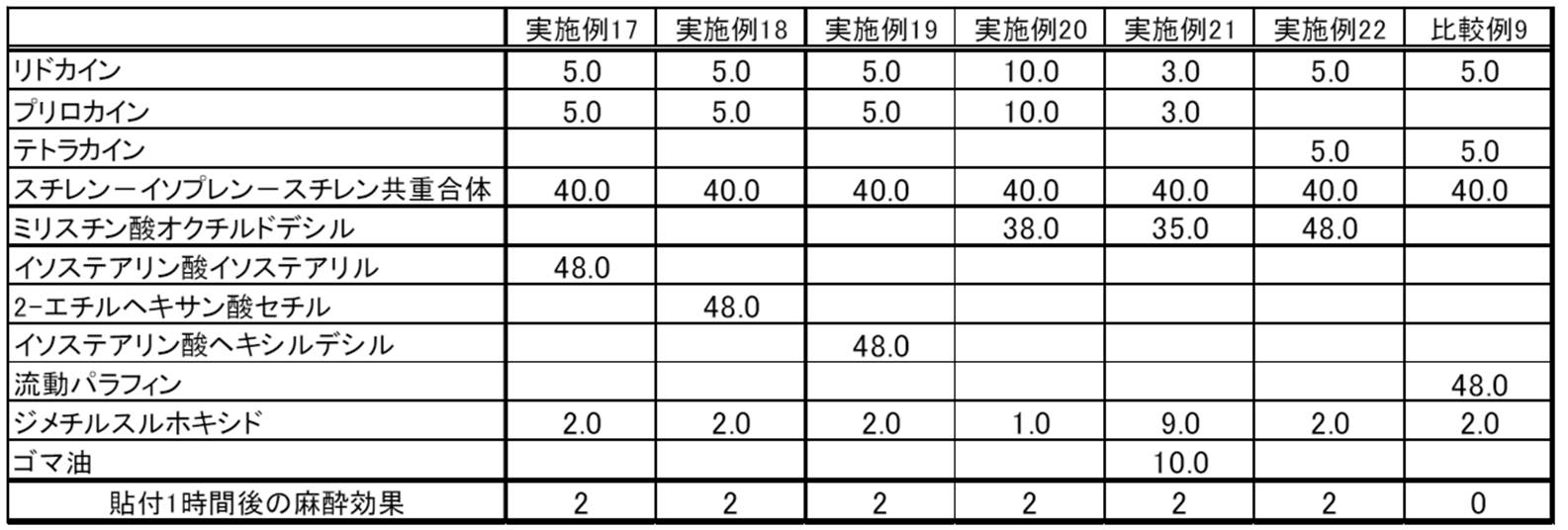
表5に示す処方に従って、粘着剤層を構成する各成分を秤取し、実施例1から3、比較例1から4の調製方法にならい、各貼付剤を作製した。
<1> 支持体と、前記支持体上の粘着剤層と、を有し、前記粘着剤層が、局所麻酔薬、熱可塑性エラストマー、高級脂肪酸エステル、及びジメチルスルホキシドを含むことを特徴とする貼付剤である。
<2> 前記熱可塑性エラストマー100質量部に対する前記高級脂肪酸エステルの含有量が50質量部以上200質量部以下である、前記<1>に記載の貼付剤である。
<3> 前記粘着剤層における前記高級脂肪酸エステルの含有量が60質量%以下である、前記<1>又は<2>に記載の貼付剤である。
<4> 前記高級脂肪酸エステルのエステル部位の炭素数が12以上30以下である、前記<1>から<3>のいずれかに記載の貼付剤である。
<5> 前記熱可塑性エラストマーがスチレン系ブロック共重合体である、前記<1>から<4>のいずれかに記載の貼付剤である。
<6> 前記スチレン系ブロック共重合体が、スチレン・イソプレン・スチレンブロック共重合体とスチレン・イソプレンブロック共重合体との混合物である、前記<5>に記載の貼付剤である。
<7> 前記混合物中のスチレン・イソプレンブロック共重合体の含有量が50質量%以上である、前記<6>に記載の貼付剤である。
<8> 前記スチレン系ブロック共重合体の25質量%トルエン溶液の溶液温度25℃における溶液粘度が、800mPa・s以上1500mPa・s以下である、前記<5>に記載の貼付剤である。
<9> 前記局所麻酔薬100質量部に対する前記ジメチルスルホキシドの含有量が5質量部以上150質量部以下である、前記<1>から<8>のいずれかに記載の貼付剤である。
<10> 前記粘着剤層における前記ジメチルスルホキシドの含有量が0.5質量%以上10質量%以下である、前記<1>から<9>のいずれかに記載の貼付剤である。
<11> 前記粘着剤層が中鎖脂肪酸トリグリセリドを含む、前記<1>から<10>のいずれか記載の貼付剤である。
<12> 前記粘着剤層が充填剤を含む、前記<1>から<11>のいずれかに記載の貼付剤である。
<13> 前記粘着剤層が界面活性剤含む、前記<1>から<12>のいずれかに記載の貼付剤である
<14> 前記局所麻酔薬が、リドカイン、プリロカイン、テトラカイン、ベンゾカイン、ブピバカイン、メピバカイン、レボブピバカイン、ロピバカインからなる群から選ばれる1種以上である、前記<1>から<13>のいずれかに記載の貼付剤である。
<15> 前記局所麻酔薬が、リドカインとプリロカインの混合物である、前記<14>に記載の貼付剤である。
<16> 前記<1>から<15>のいずれかに記載の貼付剤を製造する方法であって、局所麻酔薬、熱可塑性エラストマー、高級脂肪酸エステル、及びジメチルスルホキシドを混合する工程を含むことを特徴とする貼付剤の製造方法である。
Claims (16)
- 支持体と、
前記支持体上の粘着剤層と、を有し、
前記粘着剤層が、局所麻酔薬、熱可塑性エラストマー、高級脂肪酸エステル、及びジメチルスルホキシドを含むことを特徴とする貼付剤。 - 前記熱可塑性エラストマー100質量部に対する前記高級脂肪酸エステルの含有量が50質量部以上200質量部以下である、請求項1に記載の貼付剤。
- 前記粘着剤層における前記高級脂肪酸エステルの含有量が60質量%以下である、請求項1に記載の貼付剤。
- 前記高級脂肪酸エステルのエステル部位の炭素数が12以上30以下である、請求項1に記載の貼付剤。
- 前記熱可塑性エラストマーがスチレン系ブロック共重合体である、請求項1に記載の貼付剤。
- 前記スチレン系ブロック共重合体が、スチレン・イソプレン・スチレンブロック共重合体とスチレン・イソプレンブロック共重合体との混合物である、請求項5に記載の貼付剤。
- 前記混合物中のスチレン・イソプレンブロック共重合体の含有量が50質量%以上である、請求項6に記載の貼付剤。
- 前記スチレン系ブロック共重合体の25質量%トルエン溶液の溶液温度25℃における溶液粘度が、800mPa・s以上1500mPa・s以下である、請求項5に記載の貼付剤。
- 前記局所麻酔薬100質量部に対する前記ジメチルスルホキシドの含有量が5質量部以上150質量部以下である、請求項1に記載の貼付剤。
- 前記粘着剤層における前記ジメチルスルホキシドの含有量が0.5質量%以上10質量%以下である、請求項1に記載の貼付剤。
- 前記粘着剤層が中鎖脂肪酸トリグリセリドを含む、請求項1に記載の貼付剤。
- 前記粘着剤層が充填剤を含む、請求項1に記載の貼付剤。
- 前記粘着剤層が界面活性剤含む、請求項1に記載の貼付剤。
- 前記局所麻酔薬が、リドカイン、プリロカイン、テトラカイン、ベンゾカイン、ブピバカイン、メピバカイン、レボブピバカイン、ロピバカインからなる群から選ばれる1種以上である、請求項1に記載の貼付剤。
- 前記局所麻酔薬が、リドカインとプリロカインの混合物である、請求項14に記載の貼付剤。
- 請求項1から15のいずれかに記載の貼付剤を製造する方法であって、
局所麻酔薬、熱可塑性エラストマー、高級脂肪酸エステル、及びジメチルスルホキシドを混合する工程を含むことを特徴とする貼付剤の製造方法。
Priority Applications (3)
| Application Number | Priority Date | Filing Date | Title |
|---|---|---|---|
| CN202280078985.2A CN118317769A (zh) | 2021-12-02 | 2022-11-24 | 贴剂 |
| JP2023564919A JPWO2023100740A1 (ja) | 2021-12-02 | 2022-11-24 | |
| US18/710,056 US20250009682A1 (en) | 2021-12-02 | 2022-11-24 | Patch |
Applications Claiming Priority (4)
| Application Number | Priority Date | Filing Date | Title |
|---|---|---|---|
| JP2021196430 | 2021-12-02 | ||
| JP2021-196430 | 2021-12-02 | ||
| JP2022-179851 | 2022-11-09 | ||
| JP2022179851 | 2022-11-09 |
Publications (1)
| Publication Number | Publication Date |
|---|---|
| WO2023100740A1 true WO2023100740A1 (ja) | 2023-06-08 |
Family
ID=86612095
Family Applications (1)
| Application Number | Title | Priority Date | Filing Date |
|---|---|---|---|
| PCT/JP2022/043366 Ceased WO2023100740A1 (ja) | 2021-12-02 | 2022-11-24 | 貼付剤 |
Country Status (3)
| Country | Link |
|---|---|
| US (1) | US20250009682A1 (ja) |
| JP (1) | JPWO2023100740A1 (ja) |
| WO (1) | WO2023100740A1 (ja) |
Citations (3)
| Publication number | Priority date | Publication date | Assignee | Title |
|---|---|---|---|---|
| JP2006527734A (ja) * | 2003-06-19 | 2006-12-07 | フィタ,フェルナンド ボウファルド | 局所投与のための麻酔用組成物 |
| WO2018230687A1 (ja) * | 2017-06-16 | 2018-12-20 | 株式会社 メドレックス | 消炎鎮痛外用剤 |
| WO2020184208A1 (ja) * | 2019-03-14 | 2020-09-17 | 株式会社カネカ | 貼付剤 |
Family Cites Families (2)
| Publication number | Priority date | Publication date | Assignee | Title |
|---|---|---|---|---|
| US5985317A (en) * | 1996-09-06 | 1999-11-16 | Theratech, Inc. | Pressure sensitive adhesive matrix patches for transdermal delivery of salts of pharmaceutical agents |
| WO2006017632A1 (en) * | 2004-08-04 | 2006-02-16 | Cassel Douglas R | An analgesic patch for sports injury and rehabilitation medicine and method to alleviate pain |
-
2022
- 2022-11-24 JP JP2023564919A patent/JPWO2023100740A1/ja active Pending
- 2022-11-24 WO PCT/JP2022/043366 patent/WO2023100740A1/ja not_active Ceased
- 2022-11-24 US US18/710,056 patent/US20250009682A1/en active Pending
Patent Citations (3)
| Publication number | Priority date | Publication date | Assignee | Title |
|---|---|---|---|---|
| JP2006527734A (ja) * | 2003-06-19 | 2006-12-07 | フィタ,フェルナンド ボウファルド | 局所投与のための麻酔用組成物 |
| WO2018230687A1 (ja) * | 2017-06-16 | 2018-12-20 | 株式会社 メドレックス | 消炎鎮痛外用剤 |
| WO2020184208A1 (ja) * | 2019-03-14 | 2020-09-17 | 株式会社カネカ | 貼付剤 |
Non-Patent Citations (2)
| Title |
|---|
| EBERLIN LIVIA S., MULCAHY JOHN V., TZABAZIS ALEXANDER, ZHANG JIALING, LIU HUWEI, LOGAN MATTHEW M., ROBERTS HEATHER J., LEE GORDON : "Visualizing Dermal Permeation of Sodium Channel Modulators by Mass Spectrometric Imaging", JOURNAL OF THE AMERICAN CHEMICAL SOCIETY, AMERICAN CHEMICAL SOCIETY, vol. 136, no. 17, 30 April 2014 (2014-04-30), pages 6401 - 6405, XP093068977, ISSN: 0002-7863, DOI: 10.1021/ja501635u * |
| MOHAMMADI-SAMANI SOLIMAN, JAMSHIDZADEH AKRAM, MONTASERI HASHEM, RANGBAR-ZAHEDANI MOJGAN, KIANRAD ROSHAN: "The effects of some permeability enhancers on the percutaneous absorption of lidocaine", PAKISTAN JOURNAL OF PHARMACEUTICAL SCIENCES, FACULTY OF PHARMACY, UNIVERSITY OF KARACHI, PK, vol. 23, no. 1, 1 January 2010 (2010-01-01), PK , pages 83 - 88, XP093068976, ISSN: 1011-601X * |
Also Published As
| Publication number | Publication date |
|---|---|
| US20250009682A1 (en) | 2025-01-09 |
| JPWO2023100740A1 (ja) | 2023-06-08 |
Similar Documents
| Publication | Publication Date | Title |
|---|---|---|
| JP5301190B2 (ja) | 貼付剤 | |
| JP7285790B2 (ja) | 皮膚貼付用粘着シート | |
| EP3939661B1 (en) | Patch | |
| WO2014051128A1 (ja) | 貼付剤 | |
| JP5404048B2 (ja) | 貼付剤 | |
| JP2025146913A (ja) | ブロナンセリン含有貼付剤、及びその製造方法 | |
| WO2013187451A1 (ja) | 貼付剤 | |
| JP4678532B2 (ja) | 非ステロイド消炎鎮痛薬を含有する非水系経皮吸収製剤 | |
| KR102762297B1 (ko) | 경피 흡수 제제 | |
| JP2011074034A (ja) | 貼付剤 | |
| JP7526494B2 (ja) | 水性貼付剤 | |
| TW201946617A (zh) | 經皮吸收製劑 | |
| CN101411694A (zh) | 贴片制剂 | |
| JP7045045B2 (ja) | 外用剤 | |
| WO2023100740A1 (ja) | 貼付剤 | |
| JP2013184976A (ja) | 貼付剤 | |
| JP7683987B2 (ja) | ブロナンセリン含有貼付剤、及びその製造方法 | |
| CN118317769A (zh) | 贴剂 | |
| WO2021172157A1 (ja) | テトラカインを含む外用剤 | |
| JP7802471B2 (ja) | 貼付剤、貼付剤の製造方法、加水分解抑制剤、及び加水分解抑制方法 | |
| JP7768475B2 (ja) | 貼付剤、及びその製造方法 | |
| JP5281973B2 (ja) | ビソプロロール含有貼付剤 | |
| JP2026037735A (ja) | ロチゴチン貼付剤 | |
| JP2013184978A (ja) | 貼付剤 |
Legal Events
| Date | Code | Title | Description |
|---|---|---|---|
| 121 | Ep: the epo has been informed by wipo that ep was designated in this application |
Ref document number: 22901173 Country of ref document: EP Kind code of ref document: A1 |
|
| ENP | Entry into the national phase |
Ref document number: 2023564919 Country of ref document: JP Kind code of ref document: A |
|
| WWE | Wipo information: entry into national phase |
Ref document number: 18710056 Country of ref document: US |
|
| WWE | Wipo information: entry into national phase |
Ref document number: 202280078985.2 Country of ref document: CN |
|
| NENP | Non-entry into the national phase |
Ref country code: DE |
|
| 122 | Ep: pct application non-entry in european phase |
Ref document number: 22901173 Country of ref document: EP Kind code of ref document: A1 |