WO2023095747A1 - 着色樹脂粒子及び調光積層体 - Google Patents
着色樹脂粒子及び調光積層体 Download PDFInfo
- Publication number
- WO2023095747A1 WO2023095747A1 PCT/JP2022/043023 JP2022043023W WO2023095747A1 WO 2023095747 A1 WO2023095747 A1 WO 2023095747A1 JP 2022043023 W JP2022043023 W JP 2022043023W WO 2023095747 A1 WO2023095747 A1 WO 2023095747A1
- Authority
- WO
- WIPO (PCT)
- Prior art keywords
- resin particles
- colored resin
- light
- less
- particles
- Prior art date
- Legal status (The legal status is an assumption and is not a legal conclusion. Google has not performed a legal analysis and makes no representation as to the accuracy of the status listed.)
- Ceased
Links
Images


Classifications
-
- C—CHEMISTRY; METALLURGY
- C08—ORGANIC MACROMOLECULAR COMPOUNDS; THEIR PREPARATION OR CHEMICAL WORKING-UP; COMPOSITIONS BASED THEREON
- C08F—MACROMOLECULAR COMPOUNDS OBTAINED BY REACTIONS ONLY INVOLVING CARBON-TO-CARBON UNSATURATED BONDS
- C08F222/00—Copolymers of compounds having one or more unsaturated aliphatic radicals, each having only one carbon-to-carbon double bond, and at least one being terminated by a carboxyl radical and containing at least one other carboxyl radical in the molecule; Salts, anhydrides, esters, amides, imides, or nitriles thereof
- C08F222/10—Esters
- C08F222/1006—Esters of polyhydric alcohols or polyhydric phenols
- C08F222/106—Esters of polycondensation macromers
- C08F222/1063—Esters of polycondensation macromers of alcohol terminated polyethers
-
- G—PHYSICS
- G02—OPTICS
- G02F—OPTICAL DEVICES OR ARRANGEMENTS FOR THE CONTROL OF LIGHT BY MODIFICATION OF THE OPTICAL PROPERTIES OF THE MEDIA OF THE ELEMENTS INVOLVED THEREIN; NON-LINEAR OPTICS; FREQUENCY-CHANGING OF LIGHT; OPTICAL LOGIC ELEMENTS; OPTICAL ANALOGUE/DIGITAL CONVERTERS
- G02F1/00—Devices or arrangements for the control of the intensity, colour, phase, polarisation or direction of light arriving from an independent light source, e.g. switching, gating or modulating; Non-linear optics
- G02F1/01—Devices or arrangements for the control of the intensity, colour, phase, polarisation or direction of light arriving from an independent light source, e.g. switching, gating or modulating; Non-linear optics for the control of the intensity, phase, polarisation or colour
- G02F1/13—Devices or arrangements for the control of the intensity, colour, phase, polarisation or direction of light arriving from an independent light source, e.g. switching, gating or modulating; Non-linear optics for the control of the intensity, phase, polarisation or colour based on liquid crystals, e.g. single liquid crystal display cells
- G02F1/133—Constructional arrangements; Operation of liquid crystal cells; Circuit arrangements
- G02F1/1333—Constructional arrangements; Manufacturing methods
- G02F1/1339—Gaskets; Spacers; Sealing of cells
-
- C—CHEMISTRY; METALLURGY
- C08—ORGANIC MACROMOLECULAR COMPOUNDS; THEIR PREPARATION OR CHEMICAL WORKING-UP; COMPOSITIONS BASED THEREON
- C08F—MACROMOLECULAR COMPOUNDS OBTAINED BY REACTIONS ONLY INVOLVING CARBON-TO-CARBON UNSATURATED BONDS
- C08F212/00—Copolymers of compounds having one or more unsaturated aliphatic radicals, each having only one carbon-to-carbon double bond, and at least one being terminated by an aromatic carbocyclic ring
- C08F212/02—Monomers containing only one unsaturated aliphatic radical
- C08F212/04—Monomers containing only one unsaturated aliphatic radical containing one ring
- C08F212/06—Hydrocarbons
- C08F212/08—Styrene
-
- C—CHEMISTRY; METALLURGY
- C08—ORGANIC MACROMOLECULAR COMPOUNDS; THEIR PREPARATION OR CHEMICAL WORKING-UP; COMPOSITIONS BASED THEREON
- C08F—MACROMOLECULAR COMPOUNDS OBTAINED BY REACTIONS ONLY INVOLVING CARBON-TO-CARBON UNSATURATED BONDS
- C08F222/00—Copolymers of compounds having one or more unsaturated aliphatic radicals, each having only one carbon-to-carbon double bond, and at least one being terminated by a carboxyl radical and containing at least one other carboxyl radical in the molecule; Salts, anhydrides, esters, amides, imides, or nitriles thereof
- C08F222/10—Esters
- C08F222/1006—Esters of polyhydric alcohols or polyhydric phenols
- C08F222/105—Esters of polyhydric alcohols or polyhydric phenols of pentaalcohols
-
- C—CHEMISTRY; METALLURGY
- C08—ORGANIC MACROMOLECULAR COMPOUNDS; THEIR PREPARATION OR CHEMICAL WORKING-UP; COMPOSITIONS BASED THEREON
- C08K—Use of inorganic or non-macromolecular organic substances as compounding ingredients
- C08K3/00—Use of inorganic substances as compounding ingredients
- C08K3/02—Elements
- C08K3/04—Carbon
-
- C—CHEMISTRY; METALLURGY
- C08—ORGANIC MACROMOLECULAR COMPOUNDS; THEIR PREPARATION OR CHEMICAL WORKING-UP; COMPOSITIONS BASED THEREON
- C08K—Use of inorganic or non-macromolecular organic substances as compounding ingredients
- C08K3/00—Use of inorganic substances as compounding ingredients
- C08K3/02—Elements
- C08K3/08—Metals
-
- C—CHEMISTRY; METALLURGY
- C08—ORGANIC MACROMOLECULAR COMPOUNDS; THEIR PREPARATION OR CHEMICAL WORKING-UP; COMPOSITIONS BASED THEREON
- C08K—Use of inorganic or non-macromolecular organic substances as compounding ingredients
- C08K5/00—Use of organic ingredients
- C08K5/16—Nitrogen-containing compounds
- C08K5/22—Compounds containing nitrogen bound to another nitrogen atom
- C08K5/23—Azo-compounds
-
- C—CHEMISTRY; METALLURGY
- C09—DYES; PAINTS; POLISHES; NATURAL RESINS; ADHESIVES; COMPOSITIONS NOT OTHERWISE PROVIDED FOR; APPLICATIONS OF MATERIALS NOT OTHERWISE PROVIDED FOR
- C09K—MATERIALS FOR MISCELLANEOUS APPLICATIONS, NOT PROVIDED FOR ELSEWHERE
- C09K19/00—Liquid crystal materials
- C09K19/52—Liquid crystal materials characterised by components which are not liquid crystals, e.g. additives with special physical aspect: solvents, solid particles
- C09K19/54—Additives having no specific mesophase characterised by their chemical composition
- C09K19/542—Macromolecular compounds
- C09K19/544—Macromolecular compounds as dispersing or encapsulating medium around the liquid crystal
-
- G—PHYSICS
- G02—OPTICS
- G02F—OPTICAL DEVICES OR ARRANGEMENTS FOR THE CONTROL OF LIGHT BY MODIFICATION OF THE OPTICAL PROPERTIES OF THE MEDIA OF THE ELEMENTS INVOLVED THEREIN; NON-LINEAR OPTICS; FREQUENCY-CHANGING OF LIGHT; OPTICAL LOGIC ELEMENTS; OPTICAL ANALOGUE/DIGITAL CONVERTERS
- G02F1/00—Devices or arrangements for the control of the intensity, colour, phase, polarisation or direction of light arriving from an independent light source, e.g. switching, gating or modulating; Non-linear optics
- G02F1/01—Devices or arrangements for the control of the intensity, colour, phase, polarisation or direction of light arriving from an independent light source, e.g. switching, gating or modulating; Non-linear optics for the control of the intensity, phase, polarisation or colour
- G02F1/13—Devices or arrangements for the control of the intensity, colour, phase, polarisation or direction of light arriving from an independent light source, e.g. switching, gating or modulating; Non-linear optics for the control of the intensity, phase, polarisation or colour based on liquid crystals, e.g. single liquid crystal display cells
- G02F1/133—Constructional arrangements; Operation of liquid crystal cells; Circuit arrangements
- G02F1/1333—Constructional arrangements; Manufacturing methods
- G02F1/1339—Gaskets; Spacers; Sealing of cells
- G02F1/13392—Gaskets; Spacers; Sealing of cells spacers dispersed on the cell substrate, e.g. spherical particles, microfibres
-
- G—PHYSICS
- G02—OPTICS
- G02F—OPTICAL DEVICES OR ARRANGEMENTS FOR THE CONTROL OF LIGHT BY MODIFICATION OF THE OPTICAL PROPERTIES OF THE MEDIA OF THE ELEMENTS INVOLVED THEREIN; NON-LINEAR OPTICS; FREQUENCY-CHANGING OF LIGHT; OPTICAL LOGIC ELEMENTS; OPTICAL ANALOGUE/DIGITAL CONVERTERS
- G02F1/00—Devices or arrangements for the control of the intensity, colour, phase, polarisation or direction of light arriving from an independent light source, e.g. switching, gating or modulating; Non-linear optics
- G02F1/01—Devices or arrangements for the control of the intensity, colour, phase, polarisation or direction of light arriving from an independent light source, e.g. switching, gating or modulating; Non-linear optics for the control of the intensity, phase, polarisation or colour
- G02F1/13—Devices or arrangements for the control of the intensity, colour, phase, polarisation or direction of light arriving from an independent light source, e.g. switching, gating or modulating; Non-linear optics for the control of the intensity, phase, polarisation or colour based on liquid crystals, e.g. single liquid crystal display cells
- G02F1/133—Constructional arrangements; Operation of liquid crystal cells; Circuit arrangements
- G02F1/1333—Constructional arrangements; Manufacturing methods
- G02F1/1339—Gaskets; Spacers; Sealing of cells
- G02F1/13398—Spacer materials; Spacer properties
-
- G—PHYSICS
- G02—OPTICS
- G02F—OPTICAL DEVICES OR ARRANGEMENTS FOR THE CONTROL OF LIGHT BY MODIFICATION OF THE OPTICAL PROPERTIES OF THE MEDIA OF THE ELEMENTS INVOLVED THEREIN; NON-LINEAR OPTICS; FREQUENCY-CHANGING OF LIGHT; OPTICAL LOGIC ELEMENTS; OPTICAL ANALOGUE/DIGITAL CONVERTERS
- G02F1/00—Devices or arrangements for the control of the intensity, colour, phase, polarisation or direction of light arriving from an independent light source, e.g. switching, gating or modulating; Non-linear optics
- G02F1/01—Devices or arrangements for the control of the intensity, colour, phase, polarisation or direction of light arriving from an independent light source, e.g. switching, gating or modulating; Non-linear optics for the control of the intensity, phase, polarisation or colour
- G02F1/165—Devices or arrangements for the control of the intensity, colour, phase, polarisation or direction of light arriving from an independent light source, e.g. switching, gating or modulating; Non-linear optics for the control of the intensity, phase, polarisation or colour based on translational movement of particles in a fluid under the influence of an applied field
- G02F1/1675—Constructional details
- G02F1/1679—Gaskets; Spacers; Sealing of cells; Filling or closing of cells
-
- G—PHYSICS
- G02—OPTICS
- G02F—OPTICAL DEVICES OR ARRANGEMENTS FOR THE CONTROL OF LIGHT BY MODIFICATION OF THE OPTICAL PROPERTIES OF THE MEDIA OF THE ELEMENTS INVOLVED THEREIN; NON-LINEAR OPTICS; FREQUENCY-CHANGING OF LIGHT; OPTICAL LOGIC ELEMENTS; OPTICAL ANALOGUE/DIGITAL CONVERTERS
- G02F1/00—Devices or arrangements for the control of the intensity, colour, phase, polarisation or direction of light arriving from an independent light source, e.g. switching, gating or modulating; Non-linear optics
- G02F1/01—Devices or arrangements for the control of the intensity, colour, phase, polarisation or direction of light arriving from an independent light source, e.g. switching, gating or modulating; Non-linear optics for the control of the intensity, phase, polarisation or colour
- G02F1/19—Devices or arrangements for the control of the intensity, colour, phase, polarisation or direction of light arriving from an independent light source, e.g. switching, gating or modulating; Non-linear optics for the control of the intensity, phase, polarisation or colour based on variable-reflection or variable-refraction elements not provided for in groups G02F1/015 - G02F1/169
-
- C—CHEMISTRY; METALLURGY
- C08—ORGANIC MACROMOLECULAR COMPOUNDS; THEIR PREPARATION OR CHEMICAL WORKING-UP; COMPOSITIONS BASED THEREON
- C08F—MACROMOLECULAR COMPOUNDS OBTAINED BY REACTIONS ONLY INVOLVING CARBON-TO-CARBON UNSATURATED BONDS
- C08F2800/00—Copolymer characterised by the proportions of the comonomers expressed
- C08F2800/20—Copolymer characterised by the proportions of the comonomers expressed as weight or mass percentages
-
- C—CHEMISTRY; METALLURGY
- C08—ORGANIC MACROMOLECULAR COMPOUNDS; THEIR PREPARATION OR CHEMICAL WORKING-UP; COMPOSITIONS BASED THEREON
- C08K—Use of inorganic or non-macromolecular organic substances as compounding ingredients
- C08K3/00—Use of inorganic substances as compounding ingredients
- C08K3/02—Elements
- C08K3/08—Metals
- C08K2003/0881—Titanium
-
- C—CHEMISTRY; METALLURGY
- C08—ORGANIC MACROMOLECULAR COMPOUNDS; THEIR PREPARATION OR CHEMICAL WORKING-UP; COMPOSITIONS BASED THEREON
- C08K—Use of inorganic or non-macromolecular organic substances as compounding ingredients
- C08K2201/00—Specific properties of additives
- C08K2201/002—Physical properties
- C08K2201/005—Additives being defined by their particle size in general
Definitions
- the present invention relates to colored resin particles and a light control laminate using the colored resin particles.
- Light control materials such as light control glass and light control film have the property that the light transmittance changes depending on the presence or absence of the application of an electric field, making it possible to adjust the amount of incident light.
- the method of the light modulating material is roughly classified into the SPD (Suspended Particle Device) method and the PDLC (Polymer Dispersed Liquid Crystal) method.
- the SPD method is a method of dispersing a light control suspension in a resin matrix.
- the light conditioning suspension contains light conditioning particles.
- Light modulating particles are responsive to an electric field.
- the light-adjusting particles dispersed in the light-adjusting suspension absorb, scatter, or reflect light by Brownian motion. does not pass through
- the light modulating particles polarize and align in a direction parallel to the electric field, causing incident light to pass through the light modulating material.
- the light transmittance can be adjusted by utilizing the polarization orientation of the light adjusting particles.
- the PDLC method is a method in which liquid crystal is dispersed in a resin matrix.
- Examples of the form of the PDLC system include a form in which a liquid crystal and a resin matrix are dispersed as a continuous phase, and a form in which a liquid crystal is dispersed as a liquid crystal capsule in a resin matrix.
- the light transmittance is adjusted by utilizing the molecular orientation of the liquid crystal.
- a spacer is sometimes used to control the gap between two substrates when producing a light modulating laminate using a light modulating material.
- the spacer include resin particles.
- resin particles As an example of such resin particles, Patent Document 1 below discloses fine particles (resin particles) in which particles containing a crosslinkable polymer material are coated with a fluororesin or silicon resin.
- connection resistance of the resin particles may decrease due to the coloring agent.
- the resin particles are used as spacers, there is a problem that the conduction reliability of the obtained light control laminate is lowered.
- a broad aspect of the present invention provides colored resin particles containing resin particles and a colorant and having a volume resistivity of 1.0 ⁇ 10 10 ⁇ cm or more.
- the 20% K value is 100 N/mm 2 or more and 5000 N/mm 2 or less.
- the colored resin particles before light irradiation and the colored resin particles after light irradiation with an integrated light amount of 540 MJ/m 2 are measured according to JIS Z8781-4.
- Colored resin particles before light irradiation have a lightness L 0 * of 0 or more and 60 or less when the lightness is measured in the L*a*b* color system according to :2013. to the lightness L 540 * of the colored resin particles after light irradiation is 0.1 or more.
- the average particle size is 1 ⁇ m or more and 150 ⁇ m or less.
- the colored resin particles do not contain particles having a particle size of 1.2 times or more the average particle size, or have a particle size of 1.2 times or more of the average particle size. Contains less than 1000 ppm of particles.
- the CV value of the particle diameter is 10% or less.
- the coloring agent contains an organic black pigment, titanium black particles, or carbon black particles.
- the colored resin particles contain the coloring agent in a content of 20% by weight or less based on 100% by weight of the colored resin particles.
- the specific gravity is 1.5 or less.
- the colored resin particles contain a component derived from a polyfunctional (meth)acrylate compound.
- the colored resin particles contain 50% by weight or more of a component derived from a polyfunctional (meth)acrylate compound in 100% by weight of the colored resin particles.
- the colored resin particles are used as spacers.
- the colored resin particles are used as spacers in the light control laminate.
- a light-modulating laminate comprising a first substrate, a second substrate, and a light control layer disposed between the first substrate and the second substrate, A light-modulating laminate is provided in which the light-modulating layer contains the colored resin particles described above.
- the colored resin particles according to the present invention contain resin particles and a coloring agent, and have a volume resistivity of 1.0 ⁇ 10 10 ⁇ cm or more. In addition, it is possible to improve the conduction reliability of the obtained light control laminate.
- FIG. 1 is a cross-sectional view schematically showing colored resin particles according to the first embodiment of the present invention.
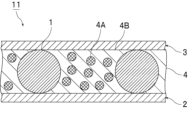
- FIG. 2 is a cross-sectional view schematically showing a PDLC-type light control laminate containing colored resin particles according to the first embodiment of the present invention.
- FIG. 3 is a cross-sectional view schematically showing an SPD-type light control laminate containing colored resin particles according to the first embodiment of the present invention.
- (meth)acrylate means one or both of “acrylate” and “methacrylate”
- (meth)acryl means one or both of "acrylic” and “methacrylic”. means both.
- the colored resin particles according to the present invention contain resin particles and a colorant.
- the colored resin particles according to the present invention have a volume resistivity of 1.0 ⁇ 10 10 ⁇ cm or more.
- the colored resin particles according to the present invention have the above configuration, the gap between the base materials can be controlled with high accuracy.
- the colored resin particles according to the present invention are provided with the above configuration, even if the colored resin particles are broken and the coloring agent inside flows out when used as a spacer, a short circuit occurs. can be suppressed. As a result, it is possible to improve the conduction reliability of the obtained light control laminate.
- the colored resin particles according to the present invention can suppress light leakage.
- a spherical shape is not limited to a true spherical shape, but includes a substantially spherical shape, and includes, for example, a shape having an aspect ratio (major axis/minor axis) of 1.5 or less.
- the volume resistivity of the colored resin particles is preferably 1.0 ⁇ 10 11 ⁇ cm or more, more preferably 1.0 ⁇ 10 12 ⁇ cm or more, and still more preferably 1.0 ⁇ 10 13 ⁇ cm or more. is.
- the upper limit of the volume resistivity of the colored resin particles is not particularly limited.
- the volume resistivity of the colored resin particles may be 1.0 ⁇ 10 20 ⁇ cm or less, or 1.0 ⁇ 10 18 ⁇ cm or less.
- the volume resistivity of the colored resin particles can be measured as follows. Using a powder resistance measurement system (for example, "Powder resistance measurement system MCP-PD51 type” manufactured by Mitsubishi Chemical Analytech Co., Ltd.), the colored resin particles filled in the probe are measured from 0 kN to 20 kN in increments of 4 kN with a hydraulic pump. load with . The volume resistivity of the colored resin particles under each load (0 kN, 4 kN, 8 kN, 12 kN, 16 kN, and 20 kN) is measured, and the lowest value is taken as the volume resistivity of the colored resin particles.
- a powder resistance measurement system for example, "Powder resistance measurement system MCP-PD51 type” manufactured by Mitsubishi Chemical Analytech Co., Ltd.
- Examples of a method for easily controlling the volume resistivity of the colored resin particles within a suitable range include a method for adjusting the type and content of the coloring agent.
- the 20% K value of the colored resin particles is preferably 100 N/mm 2 or more, more preferably 700 N/mm 2 or more, still more preferably 1000 N/mm 2 or more, preferably 5000 N/mm 2 or less, more preferably It is 4000 N/mm 2 or less, more preferably 3000 N/mm 2 or less.
- the 20% K value of the colored resin particles is equal to or higher than the lower limit and equal to or lower than the upper limit, the gap between the substrates can be controlled with higher accuracy, and the substrate can be prevented from being damaged.
- the 20% K value of the colored resin particles is equal to or more than the lower limit and equal to or less than the upper limit, it is possible to suppress destruction of the colored resin particles, thereby suppressing outflow of the colorant in the colored resin particles. It is possible to suppress the occurrence of a short circuit. As a result, it is possible to improve the conduction reliability of the obtained light control laminate.
- the 20% K value of the colored resin particles can be measured as follows. Using a microcompression tester, the colored resin particles are compressed at 25° C. with a smooth indenter end surface of a cylinder (diameter 50 ⁇ m, made of diamond) under conditions of applying a maximum test load of 20 mN for 60 seconds. The load value (N) and compression displacement (mm) at this time are measured. The 20% K value can be obtained from the obtained measured values by the following formula. As the microcompression tester, for example, "Fischer Scope H-100" manufactured by Fisher Co., Ltd. is used.
- Methods for easily controlling the 20% K value of the colored resin particles within a suitable range include adjusting the number of polymerizable functional groups and the molecular weight of the material (polymerizable monomer) for forming the resin particles, Examples include a method of adjusting the crosslink density of the colored resin particles by adjusting the type and content of the coloring agent.
- the average particle size of the colored resin particles is preferably 1 ⁇ m or more, more preferably 3 ⁇ m or more, and still more preferably 10 ⁇ m or more. , preferably 150 ⁇ m or less, more preferably 100 ⁇ m or less, still more preferably 50 ⁇ m or less.
- the particle diameter of the colored resin particles means the diameter when the colored resin particles are spherical, and when the colored resin particles have a shape other than a spherical shape, it is assumed to be a true sphere corresponding to the volume. means the diameter when The particle size of the colored resin particles is preferably an average particle size, more preferably a number average particle size.
- the particle size of the colored resin particles can be measured by any particle size distribution analyzer. For example, it can be measured using a particle size distribution measuring apparatus using the principle of laser light scattering, electrical resistance value change, image analysis after imaging, or the like.
- a particle size distribution measuring device (“Multisizer 4" manufactured by Beckman Coulter) is used to measure the particle size of about 100,000 colored resin particles, and the average value is A method of calculating is exemplified.
- the colored resin particles do not contain particles (colored resin particles) having a particle diameter of 1.2 times or more the average particle diameter, or It is preferable to contain particles (colored resin particles) having a particle diameter of 1.2 times or more the average particle diameter at 1000 ppm or less.
- the content of particles (colored resin particles) having a particle diameter of 1.2 times or more the average particle diameter is preferably 1000 ppm or less. It is more preferably 500 ppm or less, still more preferably 100 ppm or less, and particularly preferably 50 ppm or less.
- the content of particles (colored resin particles) having a particle diameter 1.2 times or more the average particle diameter should be 0 ppm (not contained). is most preferred.
- the content of particles (colored resin particles) having a particle diameter 1.2 times or more the average particle diameter can be measured as follows.
- the colored resin particles are filtered through a filter having a pore size 1.15 times the average particle diameter, the colored resin particles remaining on the filter are observed with an optical microscope, and the colored resin particles 1.2 times or more the average particle diameter are counted. do.
- the content of particles (colored resin particles) having a particle diameter 1.2 times or more the average particle diameter is calculated.
- the CV value of the particle diameter of the colored resin particles is preferably 2.0% or more, more preferably 2.5% or more, and preferably It is 10% or less, more preferably 8.0% or less.
- the CV value (variation coefficient) of the particle diameter of the colored resin particles can be measured as follows.
- CV value (%) ( ⁇ /Dn) ⁇ 100 ⁇ : standard deviation of the particle size of the colored resin particles Dn: average value of the particle size of the colored resin particles
- the aspect ratio of the colored resin particles is preferably 1.5 or less, more preferably 1.3 or less, from the viewpoint of controlling the gap between the substrates with higher accuracy.
- the above aspect ratio indicates major axis/minor axis.
- the aspect ratio is obtained by observing 10 arbitrary colored resin particles with an electron microscope or an optical microscope, taking the maximum diameter and the minimum diameter as the major diameter and the minor diameter, respectively, and averaging the major diameter / minor diameter of each spherical colored resin particle. It is preferable to obtain by calculating the value.
- the lower limit of the aspect ratio of the colored resin particles is not particularly limited.
- the aspect ratio of the colored resin particles may be 1.0 or more, or 1.1 or more.
- the specific gravity of the colored resin particles is preferably 1.5 or less, more preferably 1.4 or less, and still more preferably 1.3. It is below.
- the lower limit of the specific gravity of the colored resin particles is not particularly limited.
- the specific gravity of the colored resin particles may be 1.0 or more, or 1.1 or more.
- JIS Z8781-4 was used for each of the colored resin particles before light irradiation and the colored resin particles after light irradiation with an integrated light amount of 540 MJ/m 2 .
- the color resin particles have a lightness L 0 * of 0 or more and 60 or less before light irradiation, when the lightness is measured in the L*a*b* color system according to :2013.
- the lightness L 0 * of the colored resin particles before light irradiation is preferably 0 or more, more preferably 1 or more, and still more preferably 3 or more. , preferably 60 or less, more preferably 40 or less, and still more preferably 30 or less.
- the lightness L 540 * of the colored resin particles after light irradiation is preferably 1 or more, more preferably 3 or more, and still more preferably 4 or more. , preferably 60 or less, more preferably 50 or less, and still more preferably 40 or less.
- the ratio of the lightness L 0 * of the colored resin particles before light irradiation to the lightness L 540 * of the colored resin particles after light irradiation is preferably 0.1 or more, more preferably 0.3 or more, still more preferably 0.4 or more, particularly preferably 0.6 or more, and most preferably 0.8 or more.
- the upper limit of the ratio (L 0 */L 540 *) is not particularly limited.
- the ratio (L 0 */L 540 *) may be 1.0 or less.
- the lightness L 0 * of the colored resin particles before light irradiation is 0 or more and 60 or less, and the colored resin before light irradiation It is particularly preferable that the ratio of the lightness L 0 * of the particles to the lightness L 540 * of the colored resin particles after light irradiation (L 0 */L 540 *) is 0.1 or more.
- the lightness L 0 * of the colored resin particles before light irradiation and the lightness L 540 * of the colored resin particles after light irradiation can be measured as follows.
- a plate-like sample having the same composition as the colored resin particles is prepared.
- the plate-shaped sample is irradiated with light at an illuminance of 255 W/m 2 for 588 hours (accumulated light quantity: 540 MJ/m 2 ).
- the sample before light irradiation and the sample after light irradiation were measured for arbitrary 10 points using a color difference meter, and the lightness was measured using a circular measurement range of 8 mm in diameter .
- Examples of the color difference meter include "TES-3250" manufactured by SATOTECH.
- the lightness L 0 * of the colored resin particles before light irradiation and the lightness L 540 * of the colored resin particles after light irradiation may be measured for each colored resin particle.
- the colored resin particles before and after light irradiation are carried on an adhesive tape, and the lightness is measured using a color difference meter for arbitrary 10 points of the colored resin particles, with the measurement range being a circle with a diameter of 8 mm. , the respective average values are defined as lightness L 0 * and lightness L 540 *.
- Examples of the color difference meter include "TES-3250" manufactured by SATOTECH.
- the colored resin particles after light irradiation are obtained by irradiating the colored resin particles with light at an illuminance of 255 W/m 2 for 588 hours (accumulated light quantity: 540 MJ/m 2 ).
- the visible light transmittance of the colored resin particles is preferably 40% or less, more preferably 20% or less, and even more preferably 10% or less.
- the visible light transmittance of the colored resin particles can be measured as follows. A plate-shaped sample having the same composition as that of the colored resin particles is prepared, spectrometry or the like is performed, and the visible light transmittance can be measured according to ISO13837:2008. It can also be measured by a method conforming to the JIS K6714 standard.
- the colored resin particles according to the present invention are preferably used as spacers.
- the colored resin particles according to the present invention are particularly suitable for use as a spacer in a light control laminate.
- the colored resin particles may be used as a spacer for a light control glass, or may be used as a spacer for a light control film.
- the colored resin particles are preferably used as a spacer for a light control glass or a spacer for a light control film.
- the colored resin particles contain resin particles.
- the colored resin particles and the resin particles contain a resin.
- the colored resin particles and the resin particles preferably contain a polymer.
- the above polymer is obtained by polymerizing the polymerizable components.
- the colored resin particles and the resin particles preferably contain a component derived from a polymer component.
- the colored resin particles and the resin particles preferably contain a polymer as a polymer component.
- resins for forming the resin particles include polyolefin resins such as polyethylene, polypropylene, polystyrene, polyvinyl chloride, polyvinylidene chloride, polyisobutylene, and polybutadiene; acrylic resins such as polymethyl methacrylate and polymethyl acrylate; , polyamide, phenol formaldehyde resin, melamine formaldehyde resin, benzoguanamine formaldehyde resin, urea formaldehyde resin, phenol resin, melamine resin, benzoguanamine resin, urea resin, epoxy resin, unsaturated polyester resin, saturated polyester resin, polyethylene terephthalate, polysulfone, polyphenylene oxide , polyacetal, polyimide, polyamideimide, polyetheretherketone, polyethersulfone, and divinylbenzene polymer.
- polyolefin resins such as polyethylene, polypropylene, polystyrene, polyvinyl chloride, polyviny
- the divinylbenzene polymer may be a divinylbenzene copolymer.
- examples of the divinylbenzene copolymer and the like include a divinylbenzene-styrene copolymer and a divinylbenzene-(meth)acrylate copolymer.
- the resin for forming the resin particles contains one or more polymerizable monomers (polymerization components) having an ethylenically unsaturated group. It is preferably a polymer obtained by polymerizing two or more kinds.
- the polymerizable monomer having an ethylenically unsaturated group includes a non-crosslinkable monomer and a crosslinkable monomer. and a monomer of
- non-crosslinkable monomers examples include vinyl compounds such as styrene monomers such as styrene, ⁇ -methylstyrene, and chlorostyrene; methyl vinyl ether, ethyl vinyl ether, propyl vinyl ether, 1,4-butanediol divinyl ether; , cyclohexanedimethanol divinyl ether, diethylene glycol divinyl ether and other vinyl ether compounds; vinyl acetate, vinyl butyrate, vinyl laurate, vinyl stearate and other acid vinyl ester compounds; vinyl chloride, vinyl fluoride and other halogen-containing monomers; meth) acrylic compounds, methyl (meth) acrylate, ethyl (meth) acrylate, propyl (meth) acrylate, butyl (meth) acrylate, 2-ethylhexyl (meth) acrylate, lauryl (meth) acrylate, cetyl (meth) acryl
- crosslinkable monomers examples include vinyl monomers such as divinylbenzene, 1,4-divinyloxybutane and divinylsulfone as vinyl compounds; ) acrylate, polytetramethylene glycol diacrylate, tetramethylolmethane tri(meth)acrylate, tetramethylolmethane di(meth)acrylate, trimethylolpropane tri(meth)acrylate, dipentaerythritol tetra(meth)acrylate, dipentaerythritol hexa (meth)acrylate, dipentaerythritol penta(meth)acrylate, glycerol tri(meth)acrylate, glycerol di(meth)acrylate, polyethylene glycol di(meth)acrylate, polypropylene glycol di(meth)acrylate, polytetramethylene glycol di( Polyfunctional (meth)acrylate compounds such as meth)acrylate and 1,4-butan
- Heavy bond-containing silane alkoxides such as decamethylcyclopentasiloxane
- Cyclic siloxanes such as decamethylcyclopentasiloxane
- Modified (reactive) silicone oils such as one-end modified silicone oil, both-end silicone oil, and side-chain silicone oil
- (meth)acrylic acid, maleic acid and carboxyl group-containing monomers such as maleic anhydride.
- the resin particles can be obtained by polymerizing the polymerizable monomer having the ethylenically unsaturated group.
- the above polymerization method is not particularly limited, and polymerization can be carried out by known methods such as radical polymerization, ionic polymerization, polycondensation (condensation polymerization, polycondensation), addition condensation, living polymerization, and living radical polymerization.
- the resin particles can be easily obtained by performing radical polymerization or the like using the polymerizable monomer having the ethylenically unsaturated group.
- a method of suspension polymerization in the presence of a radical polymerization initiator, a seed polymerization method and a dispersion polymerization method which are methods of polymerizing by swelling a monomer together with a radical polymerization initiator using non-crosslinked seed particles, and the like. can be obtained by
- the polymer component contains a polyfunctional (meth)acrylate compound. That is, from the viewpoint of controlling the gap between substrates with higher accuracy, it is preferable that the colored resin particles and the resin particles contain a component derived from a polyfunctional (meth)acrylate compound.
- the polyfunctional (meth)acrylate compound may be a bifunctional (meth)acrylate compound, a trifunctional (meth)acrylate compound, or a trifunctional or higher (meth)acrylate compound. , a tetrafunctional (meth)acrylate compound, or a tetrafunctional or higher (meth)acrylate compound. Only one kind of the polyfunctional (meth)acrylate compound may be used, or two or more kinds thereof may be used in combination.
- the colored resin particles and the resin particles contain a bifunctional (meth)acrylate compound or a trifunctional (meth)acrylate compound. is preferred.
- the polyfunctional (meth)acrylate compound is preferably polytetramethylene glycol di(meth)acrylate or dipentaerythritol tetra(meth)acrylate.
- the content of the component derived from the polyfunctional (meth)acrylate compound in 100% by weight of the colored resin particles is preferably 10% by weight or more, more preferably 50% by weight or more, still more preferably 55% by weight or more, and particularly preferably is 60% by weight or more, preferably 95% by weight or less, more preferably 90% by weight or less, and even more preferably 80% by weight or less.
- the gap between the substrates can be controlled with even higher accuracy.
- the colored resin particles contain 50% by weight or more of a component derived from a polyfunctional (meth)acrylate compound in 100% by weight of the colored resin particles. It is preferably included in quantity.
- the content of the component derived from the polyfunctional (meth)acrylate compound in 100% by weight of the resin particles is preferably 10% by weight or more, more preferably 50% by weight or more, still more preferably 60% by weight or more, and particularly preferably It is 65% by weight or more, preferably 95% by weight or less, more preferably 90% by weight or less, and even more preferably 80% by weight or less.
- the content of the component derived from the polyfunctional (meth)acrylate compound is equal to or more than the lower limit and equal to or less than the upper limit, the gap between the substrates can be controlled with even higher accuracy.
- the colored resin particles contain a colorant.
- the coloring agent may be arranged in the resin particles, or may be arranged on the surface of the resin particles. From the viewpoint of enhancing the conduction reliability of the obtained light control laminate, the colorant is preferably arranged in the resin particles. The colorant is preferably contained in the resin particles.
- coloring agent examples include inorganic particles, dyes and pigments. Only one kind of the coloring agent may be used, or two or more kinds thereof may be used in combination.
- the inorganic particles include carbon black particles, carbon nanotube particles, titanium black particles, graphene particles, iron oxide particles, zinc oxide particles, calcium carbonate particles, alumina particles, kaolin clay particles, calcium silicate particles, magnesium oxide particles, hydroxide
- examples thereof include magnesium particles, aluminum hydroxide particles, magnesium carbonate particles, talc particles, feldspar particles, mica particles, barite particles, barium carbonate particles, titanium oxide particles, silica particles and glass beads.
- the inorganic particles are preferably carbon black particles or titanium black particles.
- the average particle size of the inorganic particles is preferably 0.01 ⁇ m or more, more preferably 0.5 ⁇ m or more, preferably 100 ⁇ m or less, more preferably 50 ⁇ m or less, and even more preferably 10 ⁇ m or less.
- the above average particle size indicates a weight average particle size.
- the average particle size can be measured by a dynamic light scattering method using a light scattering measurement device with a laser as a light source. Examples of the light scattering measurement device include "DLS-6000AL" manufactured by Otsuka Electronics Co., Ltd., and the like.
- the dyes include pyrene dyes, aminoketone dyes, anthraquinone dyes, and azo dyes.
- Examples of the pyrene dye include Solvent Green 5 (CAS79869-59-3) and Solvent Green 7 (CAS6358-69-6).
- aminoketone dyes examples include Solvent Yellow 98 (CAS 12671-74-8), Solvent Yellow 85 (CAS 12271-01-1) and Solvent Red 179 (CAS 8910-94-5), and Solvent Red 135 (CAS 71902-17-5). be done.
- anthraquinone dye examples include Solvent Yellow 163 (CAS 13676091-0), Solvent Red 207 (CAS 15958-69-6), Disperse Red 92 (CAS 12236-11-2), Solvent Violet 13 (CAS 81-48-1), Disperse Violet 31 (CAS6408- 72-6), Solvent Blue 97 (CAS 61969-44-6), Solvent Blue 45 (CAS 37229-23-5), Solvent Blue 104 (CAS 116-75-6) and Disperse Blue 214 (CAS 104491-84-1).
- azo dyes examples include Solvent Yellow 30 (CAS3321-10-4), Solvent Red164 (CAS70956-30-8), and Disperse Blue146 (CAS88650-91-3).
- the coloring agent preferably contains a pigment.
- a pigment when the colored resin particles are used as spacers, even if the colored resin particles are damaged and the coloring agent inside flows out, it is possible to suppress the occurrence of a short circuit. As a result, it is possible to further improve the conduction reliability of the obtained light control laminate.
- the pigment may be an organic pigment or an inorganic pigment.
- the organic pigment may or may not have a metal atom.
- the pigment may be a red pigment, a blue pigment, a yellow pigment, or a black pigment. Only one type of the pigment may be used, or two or more types may be used in combination.
- the pigment is more preferably an organic pigment. Pigments are more preferred, and organic black pigments are even more preferred.
- organic black pigment examples include anthraquinone-based pigments, anthanthrone-based pigments, dianthraquinonyl-based pigments, anthrapyrimidine-based pigments, flavanthrone-based pigments, diketopyrrolopyrrole-based pigments, quinacridone-based pigments, and diketopyrrolopyrrole-based pigments.
- indigo/thioindigo pigments perinone pigments, perylene pigments, phthalocyanine pigments, halogenated phthalocyanine pigments, indoline pigments, isoindoline pigments, isoindolinone pigments, indanthrone pigments, dioxazine pigments
- examples include quinophthalone pigments, nickel azo pigments, metal complex pigments, azo pigments (insoluble azo pigments, soluble azo pigments, high molecular weight azo pigments and azomethine azo black pigments), and aniline black pigments.
- the colorant is an organic black pigment, titanium black particles, or It preferably contains carbon black particles, more preferably contains an organic black pigment, and further preferably contains an azo pigment or a perylene pigment.
- the coloring agent preferably contains an azo pigment, titanium black particles, or carbon black particles.
- the average particle size of the organic black pigment is preferably 1 nm or more, more preferably 10 nm or more, preferably 500 nm or less, more preferably 300 nm or less, and still more preferably 100 nm or less.
- the above average particle size indicates a weight average particle size.
- the average particle size can be measured by a dynamic light scattering method using a light scattering measurement device with a laser as a light source. Examples of the light scattering measurement device include "DLS-6000AL" manufactured by Otsuka Electronics Co., Ltd., and the like.
- the colored resin particles preferably contain 20% by weight or less of the coloring agent in 100% by weight of the colored resin particles.
- the content of the coloring agent in 100% by weight of the colored resin particles is preferably 0.5% by weight or more, more preferably 1.0% by weight or more, and still more preferably 3.0% by weight or more. It is 20% by weight or less, more preferably 15% by weight or less, and even more preferably 10% by weight or less.
- the content of the coloring agent is at least the lower limit, it is possible to more effectively suppress light leakage.
- the content of the coloring agent is equal to or less than the upper limit, the insulation reliability of the colored resin particles can be further improved, and as a result, the conduction reliability of the obtained light control laminate can be further improved.
- the content of the colorant means the total content of the plurality of colorants.
- the colored resin particles may contain other components, if necessary.
- the other components include polymerization initiators, pigment dispersants, resin particle dispersants, surfactants, and the like. Only one of the other components may be used, or two or more thereof may be used in combination.
- a light control laminate according to the present invention includes a first base material, a second base material, and a light control layer disposed between the first base material and the second base material. .
- the light control layer contains the colored resin particles.
- the light control laminate according to the present invention has the above configuration, it is possible to control the gap between the base materials with high precision and to improve the conduction reliability of the obtained light control laminate.
- the light control layered product may be a PDLC (Polymer Dispersed Liquid Crystal) type light control layered product or an SPD (Suspended Particle Device) type light control layered product.
- the light control layered product is preferably an SPD type or PDLC type light control layered product. From the viewpoint of exhibiting the effect of the present invention more effectively, it is more preferable that the light control layered body is a PDLC type light control layered body.
- the light control laminate may not be a liquid crystal display device.
- the light control laminate may or may not have a curved surface portion.
- the light modulating laminate preferably has a curved surface portion.
- the light modulating laminate may have a folded or curved shape.
- the light modulating laminate preferably has a folded or curved shape, and is preferably used in a folded or curved shape.
- the light modulating laminate may have a bent portion or a curved portion. It is preferable that the light modulating laminate, the first base material, and the second base material have flexibility so that they can have a folded shape or a curved shape.
- the curvature of the curved surface portion of the light control laminate is preferably 300R or more and 1800R or less.
- the adhesive particles according to the present invention can The conduction reliability can be sufficiently improved over the entire dimming laminate.
- the light control laminate is preferably used for vehicle window glass, partitions, or the like.
- Examples of the vehicle include vehicles, ships, aircraft, and the like.
- the light control laminate is preferably used for window glass of vehicles such as vehicles, ships, and aircraft, partitions, and the like.
- the light control laminate is preferably a window glass or a partition, and more preferably a window glass or a partition for vehicles such as vehicles, ships, and aircraft.
- the light control laminate may be a window glass of a vehicle such as a vehicle, a ship, an aircraft, or the like, or may be a partition.
- the vehicle is a transportation vehicle.
- the partition may be a member that is arranged between the seats of the vehicle and partitions the seats.
- FIG. 1 is a cross-sectional view schematically showing colored resin particles according to the first embodiment of the present invention.
- the colored resin particles 1 contain resin particles and a colorant.
- the colored resin particles 1 have a volume resistivity of 1.0 ⁇ 10 10 ⁇ cm or more.
- FIG. 2 is a cross-sectional view schematically showing a PDLC-type light control laminate containing colored resin particles according to the first embodiment of the present invention.
- FIG. 3 is a cross-sectional view schematically showing an SPD-type light control laminate containing colored resin particles according to the first embodiment of the present invention.
- the size, thickness, shape and amount of addition of the light modulating layer and the colored resin particles are appropriately changed from the actual size and shape for convenience of illustration.
- the light modulating layer 4 is sandwiched between the first base material 2 and the second base material 3 .
- the light control layer 4 is arranged between the first base material 2 and the second base material 3 .
- a sealant may be arranged around the light control layer 4 .
- the light control layer 4 includes colored resin particles 1, liquid crystal capsules 4A, and a binder 4B.
- the liquid crystal capsule 4A is a liquid crystal material.
- the liquid crystal capsules 4A are dispersed in the binder 4B.
- the liquid crystal capsule 4A is held in a capsule shape in the binder 4B.
- the liquid crystal material may be encapsulated and dispersed in the binder, or the liquid crystal material may be dispersed in the binder as a continuous phase.
- the colored resin particles 1 are in contact with the first base material 2 and the second base material 3 . Colored resin particles 1 control the gap between first substrate 2 and second substrate 3 .
- Electrodes are formed on the surface of the first base material 2 and on the surface of the second base material 3 (not shown). Examples of materials for the electrodes include indium tin oxide (ITO). The electrodes are preferably transparent electrodes.
- the orientation of the liquid crystal molecules in the liquid crystal capsule 4A is not uniform. It scatters in the binder 4B and becomes opaque.
- the liquid crystal molecules in the liquid crystal capsule 4A are aligned in a direction parallel to the electric field.
- the binder 4B and the liquid crystal material have the same refractive index, light can be transmitted therethrough, resulting in a transparent state.
- the light modulating layer 5 is sandwiched between the first substrate 2 and the second substrate 3 .
- the light control layer 5 is arranged between the first base material 2 and the second base material 3 .
- the light control layer 5 includes colored resin particles 1, droplets 5A of light control suspension, and a resin matrix 5B. Droplets 5A of light conditioning suspension are dispersed in a resin matrix 5B. The droplets 5A of the light control suspension are held in a droplet state in the resin matrix 5B.
- the droplets 5A of the light adjusting suspension contain the dispersion medium 5Aa and the light adjusting particles 5Ab.
- the light adjusting particles 5Ab are dispersed in the dispersion medium 5Aa.
- the colored resin particles 1 are in contact with the first base material 2 and the second base material 3 . Colored resin particles 1 control the gap between first substrate 2 and second substrate 3 .
- Electrodes are formed on the surface of the first base material 2 and on the surface of the second base material 3 (not shown). Examples of materials for the electrodes include indium tin oxide (ITO). The electrodes are preferably transparent electrodes.
- the incident light is caused by the Brownian motion of the light control particles 5Ab dispersed in the dispersion medium 5Aa forming the liquid droplets 5A of the light control suspension. is absorbed, scattered, or reflected by the light control particles 5Ab, and the incident light cannot pass through the light control layer 5.
- the light adjustment particles 5Ab are arranged in a direction parallel to the electric field. Therefore, the incident light can pass between the arranged light adjusting particles 5Ab and can be transmitted through the light adjusting layer 5.
- the light control layer preferably has light control properties. Dimmability is a property that the visible light transmittance changes depending on whether or not an electric field is applied, and the amount of incident light can be adjusted.
- the light control layer contains the colored resin particles.
- the light modulating layer preferably further includes a binder and a liquid crystal material dispersed in the binder.
- the liquid crystal material is not particularly limited, and may be any liquid crystal material as long as it has the property of changing its orientation when an electric field is applied.
- the liquid crystal material may be dispersed in the binder as a continuous phase, or may be dispersed in the binder in the form of liquid crystal drops or liquid crystal capsules.
- Examples of the liquid crystal material include nematic liquid crystal and cholesteric liquid crystal.
- Examples of materials for the nematic liquid crystal include cyanobiphenyl, phenyl ester, azoxybenzene, fluorine-containing biphenyl, carbonate, and Schiff base materials. Only one kind of the nematic liquid crystal material may be used, or two or more kinds thereof may be used in combination.
- Materials for the cholesteric liquid crystal include steroidal cholesterol derivatives, Schiff bases, azos, azoxys, benzoates, biphenyls, terphenyls, cyclohexylcarboxylates, phenylcyclohexanes, biphenylcyclohexanes, and pyrimidines.
- cholesteric liquid crystal material Only one kind of the cholesteric liquid crystal material may be used, or two or more kinds thereof may be used in combination.
- the binder holds the liquid crystal material and suppresses the flow of the liquid crystal material.
- the binder is not particularly limited as long as it does not dissolve in the liquid crystal material, has strength to withstand external force, and has high transparency to reflected light and incident light.
- the binder material include water-soluble polymer materials such as gelatin, polyvinyl alcohol, cellulose derivatives, polyacrylic acid-based polymers, ethyleneimine, polyethylene oxide, polyacrylamide, polystyrene sulfonate, polyamidine, isoprene-based sulfonic acid polymers, and materials capable of forming an aqueous emulsion such as fluorine resin, silicone resin, acrylic resin, urethane resin, and epoxy resin. Only one kind of the binder material may be used, or two or more kinds thereof may be used in combination.
- the binder is preferably crosslinked with a crosslinking agent.
- the cross-linking agent is not particularly limited as long as it forms cross-links between the binders and hardens the binder, makes it insoluble, or makes it insoluble.
- Examples of the cross-linking agent include acetaldehyde, glutaraldehyde, glyoxal, potassium alum hydrate of a polyvalent metal salt compound, adipic acid dihydrazide, melamine formalin oligomer, ethylene glycol diglycidyl ether, polyamide epichlorohydrin, and polycarbodiimide. mentioned. Only one kind of the crosslinking agent may be used, or two or more kinds thereof may be used in combination.
- the light control layer further comprises a resin matrix and a light control suspension dispersed in the resin matrix.
- the light control suspension contains a dispersion medium and light control particles dispersed in the dispersion medium.
- the light adjusting particles include carbon-based materials such as polyiodide and carbon black, metal materials such as copper, nickel, iron, cobalt, chromium, titanium, and aluminum, and inorganic compound materials such as silicon nitride, titanium nitride, and aluminum oxide. etc. Also, these materials may be particles coated with a polymer. Only one type of the light adjusting particles may be used, or two or more types may be used in combination.
- the dispersion medium disperses the light adjustment particles in a fluid state.
- the dispersion medium selectively adheres to the light control particles, coats the light control particles, and causes the light control particles to migrate to the phase-separated droplet phase upon phase separation from the resin matrix.
- It is preferably a material that is functional, non-electrically conductive, and incompatible with the resin matrix.
- the dispersion medium is preferably a liquid copolymer having a refractive index similar to that of the resin matrix when the light control laminate is formed.
- a (meth)acrylic ester oligomer having a fluoro group or a hydroxyl group is preferable, and a (meth)acrylic ester oligomer having a fluoro group and a hydroxyl group is more preferable.
- the fluoro or hydroxyl monomer units are oriented toward the light modulating particles and the remaining monomer units stabilize the droplets of the light modulating suspension in the resin matrix. Therefore, the light control particles are easily dispersed in the light control suspension, and the light control particles are easily guided into the phase-separated droplets during phase separation from the resin matrix.
- Examples of the (meth)acrylic acid ester oligomer having a fluoro group or a hydroxyl group include 2,2,2-trifluoroethyl methacrylate/butyl acrylate/2-hydroxyethyl acrylate copolymer, and 3,5,5 acrylic acid.
- the weight average molecular weight of the (meth)acrylate oligomer is preferably 1000 or more, more preferably 2000 or more, and preferably 20000 or less, more preferably 10000 or less.
- the light control layer can be produced using the resin material for forming the resin matrix and the light control suspension.
- the resin material is preferably a resin material that cures when irradiated with energy rays.
- the resin material that is cured by irradiation with energy rays includes a polymer composition containing a photopolymerization initiator and a polymer compound that is cured by energy rays such as ultraviolet rays, visible rays, and electron beams.
- Examples of the polymer composition include a polymer composition containing a polymerizable monomer having an ethylenically unsaturated group and a photopolymerization initiator.
- Examples of the polymerizable monomer having an ethylenically unsaturated group include non-crosslinkable monomers and crosslinkable monomers.
- non-crosslinking monomer examples include the non-crosslinking monomers described above.
- crosslinkable monomer examples include the above-described crosslinkable monomers.
- photopolymerization initiator examples include 2,2-dimethoxy-1,2-diphenylethan-1-one, 1-(4-(2-hydroxyethoxy)phenyl)-2-hydroxy-2-methyl-1-propane -1-one, bis(2,4,6-trimethylbenzoyl)phenylphosphine oxide, 2-hydroxy-2-methyl-1-phenylpropan-1-one, and (1-hydroxycyclohexyl)phenylketone. be done.
- the resin material may contain organic solvent-soluble resin, thermoplastic resin, poly(meth)acrylic acid, and the like.
- the resin material may contain various additives such as an anti-coloring agent, an antioxidant, and an adhesion imparting agent, and may contain a solvent.
- the first substrate is preferably a transparent substrate.
- the second base material is preferably a transparent base material.
- the transparent substrate is, for example, a substrate having optical transparency (light transmissive substrate). For example, light is transmitted from one side of the transparent substrate to the other side through the transparent substrate. For example, when viewing a substance on the other side through the transparent substrate from one side of the transparent substrate, the substance can be visually recognized. Transparency also includes translucence, for example.
- the transparent substrate may be colorless and transparent, or may be colored and transparent.
- the materials of the first base material and the second base material are not particularly limited.
- the material of the first base material and the material of the second base material may be the same or different.
- materials for the first base material and the second base material include glass and resin films.
- the glass includes soda lime glass, lead glass, borosilicate glass for general construction, and glasses of various compositions for other applications, as well as functional glasses such as heat reflecting glass, heat absorbing glass, and tempered glass.
- the resin film include polyester films such as polyethylene terephthalate, polyolefin films such as polypropylene, and resin films such as acrylic resin films.
- the first substrate and the second substrate are preferably resin substrates, more preferably resin films, because they are excellent in transparency, moldability, adhesiveness, processability, and the like. , more preferably a polyethylene terephthalate film.
- the first base material and the second base material preferably include a base body and a conductive film formed on the surface of the base body so that an electric field for dimming can be applied.
- Examples of the conductive film include indium tin oxide (ITO), SnO 2 and In 2 O 3 .
- the conductive film is preferably a transparent conductive film.
- the visible light transmittance of the first base material and the second base material is preferably 75% or more, more preferably 80% or more.
- the visible light transmittance of the first base material and the second base material can be measured in accordance with ISO13837:2008 by carrying out spectrometry or the like.
- colorant Carbon black (inorganic black pigment) Titanium black (inorganic black pigment) Azo pigment (organic black pigment)
- Example 1 Preparation of colored resin particles (Example 1) To 30 parts by weight of divinylbenzene and 70 parts by weight of polytetramethylene glycol diacrylate, 5 parts by weight of carbon black was added and stirred to obtain a monomer mixture. 2000 parts by weight of a 2.5% by weight aqueous solution prepared by dissolving polyvinyl alcohol having a molecular weight of about 2000 in pure water was put into a reactor. The obtained monomer mixed solution was put into this and stirred to adjust the particle size so that the droplets of the monomer had a predetermined particle size. Next, the mixture was heated at 90° C. for 9 hours to polymerize the monomer droplets to obtain particles. After the obtained particles were washed several times with hot water and acetone respectively, a classification operation was performed to recover the colored resin particles.
- Example 2 to 14 and Comparative Example 2 Colored resin particles were produced in the same manner as in Example 1, except that the materials and contents (% by weight) of the colorants and resin particles were changed as shown in Tables 1-4.
- Comparative example 1 Resin particles were produced in the same manner as in Example 1, except that the material and content (% by weight) of the resin particles were changed as shown in Table 4. In Comparative Example 1, no coloring agent was used.
- PDLC type dimming laminate A known PDLC layer except that 5% by weight of the obtained colored resin particles or the resin particles of Comparative Example 1 was dispersed was placed between two PET films on which transparent and conductive ITO was deposited. A light control film was produced. A PDLC type light control laminate was produced by sandwiching a light control film between two sheets of transparent glass.
- a TN type liquid crystal display element was produced by the following method.
- a SiO 2 film was vapor-deposited on one surface of the first and second transparent substrates (transparent glass plate, 150 mm ⁇ 150 mm) by the CVD method, and then an ITO film was formed on the entire surface of the SiO 2 film by sputtering. Thereafter, a polyimide alignment film (“SE-7210” manufactured by Nissan Chemical Industries, Ltd.) was placed by spin coating, and baked at 280° C. for 90 minutes to form a polyimide alignment film. Next, after performing a rubbing treatment, the resulting colored resin particles were applied to the orientation film side of the first transparent substrate using a dry sprayer (“DISPA- ⁇ R” manufactured by Nisshin Engineering Co., Ltd.) at 20 per 1 mm 2 .
- DISPA- ⁇ R dry sprayer
- the resulting TN-type liquid crystal display element was sandwiched between polarizing films arranged in crossed Nicols so as to be in a normally white display mode, and a digital microscope ("VHX-2000" manufactured by Keyence Corporation) was observed while applying a voltage of 7 V. was used to observe the state of light leakage of the colored resin particles.
- the image magnification was set to 200 times, and the ratio of the number of colored resin particles through which light escaped was calculated in arbitrary 5 fields of view.
- the resin particles of Comparative Example 1 were also calculated in the same manner.
- the light leakage suppression property was judged according to the following criteria.
- the conduction reliability of the light control laminate was determined according to the following criteria.
- Connection resistance is 1.0 ⁇ 10 10 ⁇ / ⁇ or more ⁇ : Connection resistance is 1.0 ⁇ 10 9 ⁇ / ⁇ or more and less than 1.0 ⁇ 10 10 ⁇ / ⁇ ⁇ 1: Connection resistance is , 1.0 ⁇ 10 8 ⁇ / ⁇ or more and less than 1.0 ⁇ 10 9 ⁇ / ⁇ ⁇ 2: Connection resistance is 1.0 ⁇ 10 7 ⁇ / ⁇ or more and less than 1.0 ⁇ 10 8 ⁇ / ⁇ ⁇ : Connection resistance is less than 1.0 ⁇ 10 7 ⁇ / ⁇ / ⁇
- Gap controllability For the obtained light control laminate, the maximum value and minimum value of the distance between the substrates (transparent glass) were measured. Gap controllability was judged according to the following criteria.
- composition and results of the colored resin particles are shown in Tables 1 to 4 below.
Landscapes
- Physics & Mathematics (AREA)
- Chemical & Material Sciences (AREA)
- Nonlinear Science (AREA)
- Organic Chemistry (AREA)
- Medicinal Chemistry (AREA)
- Health & Medical Sciences (AREA)
- Polymers & Plastics (AREA)
- Chemical Kinetics & Catalysis (AREA)
- General Physics & Mathematics (AREA)
- Optics & Photonics (AREA)
- Crystallography & Structural Chemistry (AREA)
- Mathematical Physics (AREA)
- Materials Engineering (AREA)
- Engineering & Computer Science (AREA)
- Compositions Of Macromolecular Compounds (AREA)
- Laminated Bodies (AREA)
- Liquid Crystal (AREA)
- Processes Of Treating Macromolecular Substances (AREA)
- Electrochromic Elements, Electrophoresis, Or Variable Reflection Or Absorption Elements (AREA)
Priority Applications (6)
| Application Number | Priority Date | Filing Date | Title |
|---|---|---|---|
| CN202280071178.8A CN118202300A (zh) | 2021-11-26 | 2022-11-21 | 着色树脂粒子和调光叠层体 |
| US18/712,519 US20250011512A1 (en) | 2021-11-26 | 2022-11-21 | Colored resin particles and dimming laminate |
| JP2022573496A JP7615175B2 (ja) | 2021-11-26 | 2022-11-21 | 着色樹脂粒子及び調光積層体 |
| KR1020247016031A KR20240112274A (ko) | 2021-11-26 | 2022-11-21 | 착색 수지 입자 및 조광 적층체 |
| EP22898530.5A EP4439163A4 (en) | 2021-11-26 | 2022-11-21 | Colored resin particles and a gradient laminate |
| JP2024232601A JP2025041960A (ja) | 2021-11-26 | 2024-12-27 | 着色樹脂粒子及び調光積層体 |
Applications Claiming Priority (2)
| Application Number | Priority Date | Filing Date | Title |
|---|---|---|---|
| JP2021-191843 | 2021-11-26 | ||
| JP2021191843 | 2021-11-26 |
Publications (1)
| Publication Number | Publication Date |
|---|---|
| WO2023095747A1 true WO2023095747A1 (ja) | 2023-06-01 |
Family
ID=86539486
Family Applications (1)
| Application Number | Title | Priority Date | Filing Date |
|---|---|---|---|
| PCT/JP2022/043023 Ceased WO2023095747A1 (ja) | 2021-11-26 | 2022-11-21 | 着色樹脂粒子及び調光積層体 |
Country Status (7)
| Country | Link |
|---|---|
| US (1) | US20250011512A1 (https=) |
| EP (1) | EP4439163A4 (https=) |
| JP (2) | JP7615175B2 (https=) |
| KR (1) | KR20240112274A (https=) |
| CN (1) | CN118202300A (https=) |
| TW (1) | TW202336105A (https=) |
| WO (1) | WO2023095747A1 (https=) |
Cited By (1)
| Publication number | Priority date | Publication date | Assignee | Title |
|---|---|---|---|---|
| CN116360169A (zh) * | 2023-06-02 | 2023-06-30 | 合肥精卓光电有限责任公司 | 一种近黑色调光器件及其制备方法 |
Citations (3)
| Publication number | Priority date | Publication date | Assignee | Title |
|---|---|---|---|---|
| JPH1010540A (ja) | 1996-06-21 | 1998-01-16 | Hayakawa Rubber Co Ltd | 微粒子、スペーサー、微粒子の製造方法及び電気光学パネル |
| JP2000319529A (ja) * | 1999-05-12 | 2000-11-21 | Hayakawa Rubber Co Ltd | 合成樹脂系微粒子、電気光学パネル用スペーサ、合わせガラス用スペーサ及び塗料用充填材 |
| JP2002038048A (ja) * | 2000-06-07 | 2002-02-06 | Dmc 2 Degussa Metals Catalysts Cerdec Ag | 希土類酸化マンガンを含む顔料、該顔料を含有するコーティング組成物又はエナメル組成物、コーティングされた製品、該顔料の製造法及び製品の着色法 |
Family Cites Families (1)
| Publication number | Priority date | Publication date | Assignee | Title |
|---|---|---|---|---|
| TW401423B (en) * | 1996-02-14 | 2000-08-11 | Sekisui Fine Chemical Co Ltd | Spacer for liquid crystal display device and liquid crystal display device |
-
2022
- 2022-11-21 JP JP2022573496A patent/JP7615175B2/ja active Active
- 2022-11-21 CN CN202280071178.8A patent/CN118202300A/zh active Pending
- 2022-11-21 KR KR1020247016031A patent/KR20240112274A/ko active Pending
- 2022-11-21 US US18/712,519 patent/US20250011512A1/en active Pending
- 2022-11-21 EP EP22898530.5A patent/EP4439163A4/en active Pending
- 2022-11-21 WO PCT/JP2022/043023 patent/WO2023095747A1/ja not_active Ceased
- 2022-11-25 TW TW111145195A patent/TW202336105A/zh unknown
-
2024
- 2024-12-27 JP JP2024232601A patent/JP2025041960A/ja active Pending
Patent Citations (3)
| Publication number | Priority date | Publication date | Assignee | Title |
|---|---|---|---|---|
| JPH1010540A (ja) | 1996-06-21 | 1998-01-16 | Hayakawa Rubber Co Ltd | 微粒子、スペーサー、微粒子の製造方法及び電気光学パネル |
| JP2000319529A (ja) * | 1999-05-12 | 2000-11-21 | Hayakawa Rubber Co Ltd | 合成樹脂系微粒子、電気光学パネル用スペーサ、合わせガラス用スペーサ及び塗料用充填材 |
| JP2002038048A (ja) * | 2000-06-07 | 2002-02-06 | Dmc 2 Degussa Metals Catalysts Cerdec Ag | 希土類酸化マンガンを含む顔料、該顔料を含有するコーティング組成物又はエナメル組成物、コーティングされた製品、該顔料の製造法及び製品の着色法 |
Non-Patent Citations (2)
| Title |
|---|
| no. 1 5 9 5 8 - 6 9 - 6 |
| See also references of EP4439163A4 |
Cited By (2)
| Publication number | Priority date | Publication date | Assignee | Title |
|---|---|---|---|---|
| CN116360169A (zh) * | 2023-06-02 | 2023-06-30 | 合肥精卓光电有限责任公司 | 一种近黑色调光器件及其制备方法 |
| CN116360169B (zh) * | 2023-06-02 | 2023-10-24 | 合肥精卓光电有限责任公司 | 一种近黑色调光器件及其制备方法 |
Also Published As
| Publication number | Publication date |
|---|---|
| CN118202300A (zh) | 2024-06-14 |
| JP2025041960A (ja) | 2025-03-26 |
| EP4439163A4 (en) | 2025-11-12 |
| US20250011512A1 (en) | 2025-01-09 |
| JP7615175B2 (ja) | 2025-01-16 |
| EP4439163A1 (en) | 2024-10-02 |
| JPWO2023095747A1 (https=) | 2023-06-01 |
| KR20240112274A (ko) | 2024-07-18 |
| TW202336105A (zh) | 2023-09-16 |
Similar Documents
| Publication | Publication Date | Title |
|---|---|---|
| TWI832804B (zh) | 調光積層體及調光積層體用樹脂間隔件 | |
| JP2023112207A (ja) | 調光積層体及び調光積層体用樹脂スペーサ | |
| JP2025041960A (ja) | 着色樹脂粒子及び調光積層体 | |
| WO2023090457A1 (ja) | 接着性粒子及び積層体 | |
| JP7755568B2 (ja) | 接着性粒子、接着剤及び調光積層体 | |
| JP7579361B2 (ja) | 着色樹脂粒子及び調光積層体 | |
| JP7573012B2 (ja) | 複合粒子、複合粒子粉体及び調光材 | |
| CN116601000B (zh) | 粘接性粒子、粘接剂及调光叠层体 | |
| WO2025127132A1 (ja) | 樹脂粒子及び調光積層体 | |
| WO2024135711A1 (ja) | シリコーン粒子及び調光積層体 |
Legal Events
| Date | Code | Title | Description |
|---|---|---|---|
| WWE | Wipo information: entry into national phase |
Ref document number: 2022573496 Country of ref document: JP |
|
| 121 | Ep: the epo has been informed by wipo that ep was designated in this application |
Ref document number: 22898530 Country of ref document: EP Kind code of ref document: A1 |
|
| WWE | Wipo information: entry into national phase |
Ref document number: 202280071178.8 Country of ref document: CN |
|
| WWE | Wipo information: entry into national phase |
Ref document number: 18712519 Country of ref document: US |
|
| WWE | Wipo information: entry into national phase |
Ref document number: 2022898530 Country of ref document: EP |
|
| NENP | Non-entry into the national phase |
Ref country code: DE |
|
| ENP | Entry into the national phase |
Ref document number: 2022898530 Country of ref document: EP Effective date: 20240626 |