WO2023095593A1 - 成型体および成型体の製造方法 - Google Patents
成型体および成型体の製造方法 Download PDFInfo
- Publication number
- WO2023095593A1 WO2023095593A1 PCT/JP2022/041330 JP2022041330W WO2023095593A1 WO 2023095593 A1 WO2023095593 A1 WO 2023095593A1 JP 2022041330 W JP2022041330 W JP 2022041330W WO 2023095593 A1 WO2023095593 A1 WO 2023095593A1
- Authority
- WO
- WIPO (PCT)
- Prior art keywords
- lcp
- molded body
- resin
- liquid crystal
- heating
- Prior art date
- Legal status (The legal status is an assumption and is not a legal conclusion. Google has not performed a legal analysis and makes no representation as to the accuracy of the status listed.)
- Ceased
Links
Images





Classifications
-
- B—PERFORMING OPERATIONS; TRANSPORTING
- B29—WORKING OF PLASTICS; WORKING OF SUBSTANCES IN A PLASTIC STATE IN GENERAL
- B29C—SHAPING OR JOINING OF PLASTICS; SHAPING OF MATERIAL IN A PLASTIC STATE, NOT OTHERWISE PROVIDED FOR; AFTER-TREATMENT OF THE SHAPED PRODUCTS, e.g. REPAIRING
- B29C33/00—Moulds or cores; Details thereof or accessories therefor
- B29C33/38—Moulds or cores; Details thereof or accessories therefor characterised by the material or the manufacturing process
- B29C33/40—Plastics, e.g. foam or rubber
-
- B—PERFORMING OPERATIONS; TRANSPORTING
- B05—SPRAYING OR ATOMISING IN GENERAL; APPLYING FLUENT MATERIALS TO SURFACES, IN GENERAL
- B05D—PROCESSES FOR APPLYING FLUENT MATERIALS TO SURFACES, IN GENERAL
- B05D3/00—Pretreatment of surfaces to which liquids or other fluent materials are to be applied; After-treatment of applied coatings, e.g. intermediate treating of an applied coating preparatory to subsequent applications of liquids or other fluent materials
-
- B—PERFORMING OPERATIONS; TRANSPORTING
- B05—SPRAYING OR ATOMISING IN GENERAL; APPLYING FLUENT MATERIALS TO SURFACES, IN GENERAL
- B05D—PROCESSES FOR APPLYING FLUENT MATERIALS TO SURFACES, IN GENERAL
- B05D3/00—Pretreatment of surfaces to which liquids or other fluent materials are to be applied; After-treatment of applied coatings, e.g. intermediate treating of an applied coating preparatory to subsequent applications of liquids or other fluent materials
- B05D3/02—Pretreatment of surfaces to which liquids or other fluent materials are to be applied; After-treatment of applied coatings, e.g. intermediate treating of an applied coating preparatory to subsequent applications of liquids or other fluent materials by baking
-
- B—PERFORMING OPERATIONS; TRANSPORTING
- B05—SPRAYING OR ATOMISING IN GENERAL; APPLYING FLUENT MATERIALS TO SURFACES, IN GENERAL
- B05D—PROCESSES FOR APPLYING FLUENT MATERIALS TO SURFACES, IN GENERAL
- B05D3/00—Pretreatment of surfaces to which liquids or other fluent materials are to be applied; After-treatment of applied coatings, e.g. intermediate treating of an applied coating preparatory to subsequent applications of liquids or other fluent materials
- B05D3/12—Pretreatment of surfaces to which liquids or other fluent materials are to be applied; After-treatment of applied coatings, e.g. intermediate treating of an applied coating preparatory to subsequent applications of liquids or other fluent materials by mechanical means
-
- B—PERFORMING OPERATIONS; TRANSPORTING
- B05—SPRAYING OR ATOMISING IN GENERAL; APPLYING FLUENT MATERIALS TO SURFACES, IN GENERAL
- B05D—PROCESSES FOR APPLYING FLUENT MATERIALS TO SURFACES, IN GENERAL
- B05D7/00—Processes, other than flocking, specially adapted for applying liquids or other fluent materials to particular surfaces or for applying particular liquids or other fluent materials
- B05D7/24—Processes, other than flocking, specially adapted for applying liquids or other fluent materials to particular surfaces or for applying particular liquids or other fluent materials for applying particular liquids or other fluent materials
-
- B—PERFORMING OPERATIONS; TRANSPORTING
- B29—WORKING OF PLASTICS; WORKING OF SUBSTANCES IN A PLASTIC STATE IN GENERAL
- B29C—SHAPING OR JOINING OF PLASTICS; SHAPING OF MATERIAL IN A PLASTIC STATE, NOT OTHERWISE PROVIDED FOR; AFTER-TREATMENT OF THE SHAPED PRODUCTS, e.g. REPAIRING
- B29C43/00—Compression moulding, i.e. applying external pressure to flow the moulding material; Apparatus therefor
- B29C43/02—Compression moulding, i.e. applying external pressure to flow the moulding material; Apparatus therefor of articles of definite length, i.e. discrete articles
- B29C43/18—Compression moulding, i.e. applying external pressure to flow the moulding material; Apparatus therefor of articles of definite length, i.e. discrete articles incorporating preformed parts or layers, e.g. compression moulding around inserts or for coating articles
-
- B—PERFORMING OPERATIONS; TRANSPORTING
- B29—WORKING OF PLASTICS; WORKING OF SUBSTANCES IN A PLASTIC STATE IN GENERAL
- B29C—SHAPING OR JOINING OF PLASTICS; SHAPING OF MATERIAL IN A PLASTIC STATE, NOT OTHERWISE PROVIDED FOR; AFTER-TREATMENT OF THE SHAPED PRODUCTS, e.g. REPAIRING
- B29C43/00—Compression moulding, i.e. applying external pressure to flow the moulding material; Apparatus therefor
- B29C43/32—Component parts, details or accessories; Auxiliary operations
- B29C43/34—Feeding the material to the mould or the compression means
-
- B—PERFORMING OPERATIONS; TRANSPORTING
- B29—WORKING OF PLASTICS; WORKING OF SUBSTANCES IN A PLASTIC STATE IN GENERAL
- B29C—SHAPING OR JOINING OF PLASTICS; SHAPING OF MATERIAL IN A PLASTIC STATE, NOT OTHERWISE PROVIDED FOR; AFTER-TREATMENT OF THE SHAPED PRODUCTS, e.g. REPAIRING
- B29C70/00—Shaping composites, i.e. plastics material comprising reinforcements, fillers or preformed parts, e.g. inserts
- B29C70/04—Shaping composites, i.e. plastics material comprising reinforcements, fillers or preformed parts, e.g. inserts comprising reinforcements only, e.g. self-reinforcing plastics
- B29C70/06—Fibrous reinforcements only
- B29C70/10—Fibrous reinforcements only characterised by the structure of fibrous reinforcements, e.g. hollow fibres
- B29C70/12—Fibrous reinforcements only characterised by the structure of fibrous reinforcements, e.g. hollow fibres using fibres of short length, e.g. in the form of a mat
-
- B—PERFORMING OPERATIONS; TRANSPORTING
- B29—WORKING OF PLASTICS; WORKING OF SUBSTANCES IN A PLASTIC STATE IN GENERAL
- B29C—SHAPING OR JOINING OF PLASTICS; SHAPING OF MATERIAL IN A PLASTIC STATE, NOT OTHERWISE PROVIDED FOR; AFTER-TREATMENT OF THE SHAPED PRODUCTS, e.g. REPAIRING
- B29C70/00—Shaping composites, i.e. plastics material comprising reinforcements, fillers or preformed parts, e.g. inserts
- B29C70/04—Shaping composites, i.e. plastics material comprising reinforcements, fillers or preformed parts, e.g. inserts comprising reinforcements only, e.g. self-reinforcing plastics
- B29C70/28—Shaping operations therefor
- B29C70/40—Shaping or impregnating by compression not applied
- B29C70/42—Shaping or impregnating by compression not applied for producing articles of definite length, i.e. discrete articles
-
- C—CHEMISTRY; METALLURGY
- C08—ORGANIC MACROMOLECULAR COMPOUNDS; THEIR PREPARATION OR CHEMICAL WORKING-UP; COMPOSITIONS BASED THEREON
- C08L—COMPOSITIONS OF MACROMOLECULAR COMPOUNDS
- C08L101/00—Compositions of unspecified macromolecular compounds
-
- B—PERFORMING OPERATIONS; TRANSPORTING
- B29—WORKING OF PLASTICS; WORKING OF SUBSTANCES IN A PLASTIC STATE IN GENERAL
- B29K—INDEXING SCHEME ASSOCIATED WITH SUBCLASSES B29B, B29C OR B29D, RELATING TO MOULDING MATERIALS OR TO MATERIALS FOR MOULDS, REINFORCEMENTS, FILLERS OR PREFORMED PARTS, e.g. INSERTS
- B29K2101/00—Use of unspecified macromolecular compounds as moulding material
- B29K2101/10—Thermosetting resins
-
- B—PERFORMING OPERATIONS; TRANSPORTING
- B29—WORKING OF PLASTICS; WORKING OF SUBSTANCES IN A PLASTIC STATE IN GENERAL
- B29K—INDEXING SCHEME ASSOCIATED WITH SUBCLASSES B29B, B29C OR B29D, RELATING TO MOULDING MATERIALS OR TO MATERIALS FOR MOULDS, REINFORCEMENTS, FILLERS OR PREFORMED PARTS, e.g. INSERTS
- B29K2101/00—Use of unspecified macromolecular compounds as moulding material
- B29K2101/12—Thermoplastic materials
-
- B—PERFORMING OPERATIONS; TRANSPORTING
- B29—WORKING OF PLASTICS; WORKING OF SUBSTANCES IN A PLASTIC STATE IN GENERAL
- B29K—INDEXING SCHEME ASSOCIATED WITH SUBCLASSES B29B, B29C OR B29D, RELATING TO MOULDING MATERIALS OR TO MATERIALS FOR MOULDS, REINFORCEMENTS, FILLERS OR PREFORMED PARTS, e.g. INSERTS
- B29K2105/00—Condition, form or state of moulded material or of the material to be shaped
- B29K2105/0079—Liquid crystals
-
- B—PERFORMING OPERATIONS; TRANSPORTING
- B29—WORKING OF PLASTICS; WORKING OF SUBSTANCES IN A PLASTIC STATE IN GENERAL
- B29K—INDEXING SCHEME ASSOCIATED WITH SUBCLASSES B29B, B29C OR B29D, RELATING TO MOULDING MATERIALS OR TO MATERIALS FOR MOULDS, REINFORCEMENTS, FILLERS OR PREFORMED PARTS, e.g. INSERTS
- B29K2105/00—Condition, form or state of moulded material or of the material to be shaped
- B29K2105/06—Condition, form or state of moulded material or of the material to be shaped containing reinforcements, fillers or inserts
- B29K2105/12—Condition, form or state of moulded material or of the material to be shaped containing reinforcements, fillers or inserts of short lengths, e.g. chopped filaments, staple fibres or bristles
-
- B—PERFORMING OPERATIONS; TRANSPORTING
- B29—WORKING OF PLASTICS; WORKING OF SUBSTANCES IN A PLASTIC STATE IN GENERAL
- B29K—INDEXING SCHEME ASSOCIATED WITH SUBCLASSES B29B, B29C OR B29D, RELATING TO MOULDING MATERIALS OR TO MATERIALS FOR MOULDS, REINFORCEMENTS, FILLERS OR PREFORMED PARTS, e.g. INSERTS
- B29K2995/00—Properties of moulding materials, reinforcements, fillers, preformed parts or moulds
- B29K2995/0012—Properties of moulding materials, reinforcements, fillers, preformed parts or moulds having particular thermal properties
- B29K2995/0016—Non-flammable or resistant to heat
Definitions
- the present invention relates to a molded body and a method for manufacturing the molded body.
- liquid crystal polymer Compared to conventional substrate materials such as polyimide resin and epoxy resin, liquid crystal polymer (LCP) has a low dielectric constant and dielectric loss. , are used in circuit boards.
- glass bismaleimide substrates and glass epoxy substrates containing glass fibers as reinforcing fibers in bismaleimide resins, epoxy resins, etc. are also used as rigid substrate materials for circuit boards.
- the LCP when the LCP is made into a fiber, it becomes a fiber with a high rigidity equivalent to that of the glass fiber in the fiber axis direction, so the LCP fiber can also be used as a reinforcing fiber instead of the glass fiber.
- LCP has better dielectric properties than glass, and the finished circuit board has excellent high frequency properties.
- an object of the present disclosure is to provide a molded body having high strength and excellent adhesive strength between layers using LCP of fine fibers.
- the molded body of the present disclosure is A molded body containing a liquid crystal polymer powder and optionally containing a resin,
- the liquid crystal polymer powder contains fibrous particles made of a liquid crystal polymer,
- the fibrous particles made of the liquid crystal polymer have an average diameter of 2 ⁇ m or less,
- the resin has heat resistance,
- the resin is a thermoplastic resin or a thermosetting resin.
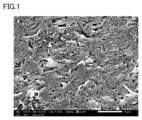
- FIG. 1 is an SEM photograph of the surface of the molded body in Example 2.
- FIG. FIG. 2 is an optical microscope photograph of a cross section of the molded body in Example 2.
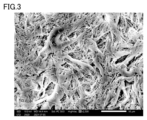
- FIG. 3 is an SEM photograph of the surface of the molded body in Example 3.
- FIG. 4 is an optical microscope photograph of a cross section of the molded body in Example 3.
- FIG. 5 is a photograph of the molded body in Example 3 taken in the form of a film.
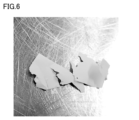
- FIG. 6 is a photograph of the molded body in Comparative Example 5 taken in the form of a film.
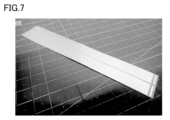
- FIG. 7 is a photograph of the flexible printed circuit board in Example 4.
- FIG. 8 is an example of a flow chart showing the manufacturing process of the molded body of the embodiment.
- FIG. 9 is another example of a flow chart showing the manufacturing process of the molded body of the embodiment.
- a molded body contains liquid crystal polymer powder (LCP powder), the LCP powder contains fibrous particles (liquid crystal polymer fiber: LCP fiber) made of a liquid crystal polymer, and the average diameter of the LCP fiber is is 2 ⁇ m or less.
- the molded body optionally contains a resin, and the resin is a thermoplastic resin or a thermosetting resin.
- thermotropic liquid crystal polymers are, for example, an aromatic polyester synthesized mainly from monomers such as aromatic diols, aromatic dicarboxylic acids, and aromatic hydroxycarboxylic acids, and exhibits liquid crystallinity when melted.
- Liquid crystal polymer molecules have a negative coefficient of linear expansion (CTE) in the axial direction of the molecular axis and a positive CTE in the radial direction of the molecular axis.
- CTE negative coefficient of linear expansion
- the liquid crystal polymer does not have an amide bond.
- a thermotropic liquid crystal polymer having no amide bond for example, a copolymer of parahydroxybenzoic acid, terephthalic acid, and dihydroxybiphenyl, which has a high melting point and a low CTE and is called a type 1 liquid crystal polymer (parahydroxybenzoic acid and ethylene terephthalate), or parahydroxybenzoic acid and 2,6-hydroxynaphthoic acid, which have a melting point between type 1 and type 2 liquid crystalline polymers, called type 1.5 (or type 3) and copolymers.
- the LCP fiber contained in the LCP powder is not particularly limited as long as it contains a fibrous portion.
- the fibrous portion may be linear or branched.
- the average diameter of LCP fibers is 2 ⁇ m or less, preferably 1 ⁇ m or less. Also, the average aspect ratio of the LCP fiber is preferably 10 or more and 500 or less, more preferably 10 or more and 300 or less.
- the average diameter and average aspect ratio of LCP fibers are measured by the following methods.
- LCP powder composed of LCP fibers to be measured is dispersed in ethanol to prepare a slurry in which 0.01% by mass of LCP powder is dispersed. At this time, the slurry is prepared so that the water content in the slurry is 1% by mass or less. Then, after dropping 5 to 10 ⁇ L of this slurry onto a slide glass, the slurry on the slide glass is naturally dried. The LCP powder is placed on the glass slide by allowing the slurry to air dry. Next, by observing a predetermined region of the LCP powder placed on the slide glass with a scanning electron microscope (SEM), 100 or more image data of particles (LCP fibers) constituting the LCP powder are collected.
- SEM scanning electron microscope
- the area is set according to the size of one particle of the LCP so that the number of image data is 100 or more.
- the magnification of the SEM is changed to 500 times, 3000 times, or 10000 times as appropriate, and the image data is collected. do.
- the longitudinal dimension and the width dimension of each of the LCP fibers are measured using the image data collected above. In one LCP fiber photographed in each of the above image data, the longest route among the routes from one end to the end opposite to the one end through the approximate center of the particle defined as the longitudinal direction. Then, the length of the straight line connecting both ends of the longest path is measured as the longitudinal dimension.
- the dimension of the particle in the direction orthogonal to the longitudinal direction is measured at three different points in the longitudinal direction of one particle of the LCP powder.
- the average value of the dimensions measured at these three points is taken as the width direction dimension (fiber diameter) per particle of the LCP powder.
- the ratio of the longitudinal dimension to the fiber diameter [longitudinal dimension/fiber diameter] is calculated as the aspect ratio of the LCP fiber.
- the average value of the fiber diameters measured for 100 LCP fibers is taken as the average diameter.
- the average value of the aspect ratios measured for 100 LCP fibers is taken as the average aspect ratio.
- the fibrous particles may be contained in the LCP powder as aggregates of fibrous particles.
- the axial direction of the LCP molecules constituting the fibrous particles and the longitudinal direction of the fibrous particles tend to coincide with each other.
- LCP powder is produced, a plurality of domains formed by bundles of LCP molecules are broken so that the axial direction of the LCP molecules is along the longitudinal direction of the fibrous particles. This is thought to be due to the orientation of the
- the content (number ratio) of particles other than fibrous particles is 20% or less.
- particles having a maximum height of 10 ⁇ m or less when the LCP powder is placed on a flat surface are fibrous particles, and particles having a maximum height of more than 10 ⁇ m are aggregate particles.
- the LCP powder preferably has a D50 (average particle diameter) value of 13 ⁇ m or less as measured by particle size measurement using a particle size distribution measuring device based on a laser diffraction scattering method.
- the molded body of the present embodiment optionally contains resin, and preferably contains resin.
- the resin has heat resistance and is a thermosetting resin or a thermoplastic resin.
- the type of resin may be appropriately selected.
- thermosetting resins examples include epoxy resins, bismaleimide resins, phenolic resins, unsaturated polyester resins, alkyd resins, and polyurethanes. Epoxy resins and bismaleimide resins are preferred as thermosetting resins having heat resistance.
- thermoplastic resins examples include polyimide resins, polyarylates, liquid crystal polymers, polyamideimide resins, polyetherimide resins, cycloolefin polymers, polybenzimidazole resins, and syndiotactic polystyrene.
- solvent-soluble thermoplastic resins are preferable, and examples include solvent-soluble polyimide resins, solvent-soluble liquid crystal polymers, polyarylates, polyamideimide resins, polyetherimide resins, and cycloolefins. Polymers, polybenzimidazole resins, syndiotactic polystyrene.
- the molding of this embodiment may contain additives.
- the function of the additive such as flame retardance, thermal conductivity, high dielectric constant, low dielectric constant, ferromagnetism, etc.
- the strength of the molded body can be increased.
- additives include inorganic fillers, metal powders, organic fillers, and the like.
- the molded article of the present embodiment may contain, for example, a curing agent or a curing accelerator within a range that does not hinder the object of the present disclosure.
- the molded body of the present embodiment has a high strength because the LCP fibers are bonded to each other. Further, when the molded body is laminated, the LCP fibers of different layers are bonded to each other between the layers, so that the molded body is excellent in the adhesive strength between the layers. In addition, since the LCP fibers are bonded to each other by heating, the molded body of the present embodiment does not require an adhesive for bonding the LCP fibers to each other.
- a dispersing step (S1) As an example of the method for manufacturing a molded body according to the present embodiment, a dispersing step (S1), a compounding step (S2), a first heating step (S3), a second heating and a step (S4).
- the LCP powder can be produced, for example, by performing the following coarse pulverization step, fine pulverization step, coarse particle removal step, and fiberization step in this order.
- LCP raw material examples include uniaxially oriented pellets, biaxially oriented films, and powdery LCP.
- the LCP that constitutes the LCP raw material is the same as the LCP that constitutes the LCP fiber described above.
- the LCP raw material is coarsely pulverized.
- the LCP raw material is coarsely pulverized with a cutter mill.
- the size of the coarsely pulverized LCP particles is not particularly limited as long as it can be used as a raw material for the fine pulverization step described below.
- the maximum particle size of the coarsely ground LCP particles is, for example, 3 mm or less.
- the LCP raw material can be used as a raw material for the fine grinding process
- the LCP raw material may be used directly as the raw material for the fine grinding process.
- the LCP raw material (after the coarsely pulverizing step) is pulverized while being dispersed in liquid nitrogen to obtain granular finely pulverized liquid crystal polymer (finely pulverized LCP).
- the fine pulverization step it is preferable to use media to pulverize the LCP raw material dispersed in liquid nitrogen.
- the media are beads, for example.
- a bead mill which has relatively few technical problems, from the viewpoint of handling liquid nitrogen.
- An apparatus that can be used in the pulverization step includes, for example, "LNM-08", which is a liquid nitrogen bead mill manufactured by Imex.
- the granular, pulverized LCP obtained by the pulverization step preferably has a D50 of 50 ⁇ m or less as measured by a particle size distribution measuring device using a laser diffraction scattering method. This can prevent nozzles from being clogged with particulate pulverized LCP in the fiberization step described below.
- coarse particle removal step coarse particles are removed from the granular finely pulverized LCP obtained in the fine pulverization step. For example, by sieving the granular finely ground LCP with a mesh to obtain the granular finely ground LCP under the sieve, and removing the granular LCP on the sieve to remove the coarse particles contained in the granular finely ground LCP can be removed.
- the type of mesh may be appropriately selected, and examples of meshes include those with an opening of 53 ⁇ m. Note that it is not always necessary to perform the coarse particle removal step.
- the granular LCP is pulverized with a wet high-pressure pulverizer to obtain LCP powder.
- the finely ground LCP is dispersed in the dispersion medium for the fiberization step.
- the finely ground LCP to be dispersed may not have coarse particles removed, but it is preferred that coarse particles have been removed.
- Dispersion media for fiberization include, for example, water, ethanol, methanol, isopropyl alcohol, toluene, benzene, xylene, phenol, acetone, methyl ethyl ketone, diethyl ether, dimethyl ether, hexane, or mixtures thereof.
- the finely pulverized LCP dispersed in the dispersion medium for the fiberization step that is, the paste-like or slurry-like finely pulverized LCP is passed through a nozzle while being pressurized at a high pressure.
- the shear force or collision energy due to the high-speed flow in the nozzle acts on the LCP, crushing the granular finely pulverized LCP, thereby promoting the fiberization of the LCP and forming fine LCP fibers.
- the nozzle diameter of the nozzle is preferably as small as possible within the range where clogging of the finely pulverized LCP does not occur in the nozzle. Since the particle size of the finely pulverized LCP is relatively small, it is possible to reduce the nozzle diameter of the wet high-pressure crusher used in the fiberization process.
- the nozzle diameter is, for example, 0.2 mm or less.
- the dispersion medium penetrates into the finely pulverized LCP through the fine cracks due to the pressurization by the wet high-pressure crusher. Then, when the paste-like or slurry-like finely ground LCP passes through the nozzle and is placed under normal pressure, the dispersion medium that has entered the inside of the finely ground LCP expands in a short time. Due to the expansion of the dispersion medium that has entered the finely pulverized LCP, the destruction progresses from the inside of the finely pulverized LCP.
- the granular LCP obtained by the conventional freeze-pulverization method is fibrillated by fibrillating the granular pulverized LCP obtained in the pulverization step of the present embodiment. It is possible to obtain an LCP powder that has a lower content of aggregated particles than the LCP powder obtained by crushing and that is composed of fine LCP fibers.
- LCP powder may be obtained by crushing the finely pulverized LCP a plurality of times with a wet high pressure crusher.
- the number of times of crushing by is preferably small, for example, 5 times or less.
- Dispersing step which is the first step in the method for producing a molded body
- the LCP powder prepared above is dispersed in a solution of a resin dissolved in a solvent to form a liquid mixture.
- thermosetting resins are in a liquid state before curing, and in some cases it is not necessary to dissolve the thermosetting resin in a solvent to form a coating film. It is preferable to dissolve the thermosetting resin in a solvent because the plane orientation can be performed.
- Any solvent can be used in the dispersing step as long as it can dissolve the resin and not dissolve the LCP powder.
- solvent examples include acetone, N-methyl-2-pyrrolidone (NMP), toluene, methyl ethyl ketone ( MEK), N,N-dimethylacetamide (DMAC), ethyl acetate, benzene, chloroform and the like.
- the LCP powder and the resin may be mixed at a volume ratio of 1:99 to 75:25.
- a mixture of liquid LCP powder, resin and additives is obtained.
- the mixing ratio of the additive is preferably 50% by volume or less with respect to the mixture.
- the molded body contains a curing agent and a curing accelerator, they are mixed in this step.
- the mixing ratio of the curing agent and the curing accelerator is appropriately adjusted within a range that does not hinder the object of the present disclosure.
- the liquid mixture is dried to form a composite of LCP fibers and resin.
- the compounding step includes, for example, a coating step and a drying step.
- the composite of LCP fiber and resin may be simply referred to as "composite”.
- the liquid mixture is applied to the base material.
- the “base material” refers to a material or support material for applying the liquid mixture, for example, a metal foil such as copper foil, a polyimide film, a PTFE film, or a reinforcing material such as a glass fiber fabric. , a composite sheet made of a heat-resistant resin that is difficult to adhere to the resin, and the like.
- the liquid mixture applied to the base material is heated and dried to evaporate the solvent.
- a composite is formed on the substrate by the heat drying.
- the solvent is gradually removed from the liquid mixture, so the overall thickness of the liquid mixture gradually decreases during drying.
- the thickness of the composite is thus reduced compared to the overall thickness of the liquid mixture formed on the article.
- the longitudinal orientation of the fibrous particles in the LCP powder changes. Specifically, among the fibrous particles, fibrous particles having a longitudinal direction in the thickness direction of the entire liquid mixture are inclined so that the longitudinal direction is directed in the main surface direction of the base material. Therefore, there is anisotropy in the longitudinal direction of the fibrous particles in the formed composite.
- a liquid mixture may be further applied onto the composite formed on the base material in the drying step, and then dried to evaporate the solvent.
- the compounding step may include the coating step and the drying step repeatedly in this order. Thereby, a composite having a desired basis weight can be obtained. Further, when the coating process and the drying process are repeated, a mixture in which the mixing ratio of the LCP powder, the resin and the additive is changed for each coating process may be used. This makes it possible to obtain a composite capable of forming a molded article having desired properties.
- thermosetting resin may be further performed after the drying process to bring the thermosetting resin into a semi-cured state (so-called B stage).
- the conditions for semi-curing vary depending on the curing properties of the thermosetting resin used, but are preferably performed at a lower temperature than in the first heating step described later.
- the heating temperature in the first heating step varies depending on the combination of the thermosetting resin, curing agent, catalyst, etc. used, but should be within the range where cross-linking proceeds sufficiently and abnormal heat generation due to excessive reaction does not occur. Moreover, the heating temperature in the first heating step is preferably lower than the heating temperature in the second heating step, which will be described later.
- the holding time in the first heating step may be a time sufficient for the cross-linking reaction to proceed, for example, 5 minutes or longer, or 15 minutes or longer.
- pressure may be applied simultaneously with heating.
- pressure is applied simultaneously with heating.
- the pressure is preferably 10 MPa or less. This is because the LCP resin melts and flows when the pressure exceeds 10 MPa.
- the pressure is preferably 1 MPa or more so that the LCP fibers are sufficiently bonded between the molded bodies.
- a reinforcing material such as a polyimide film, PTFE film, or glass fiber fabric as a release film and a heat-resistant resin that is difficult to adhere to LCP are placed between the press and the composite.
- a composite sheet or the like made of may be sandwiched.
- Step S4 the intermediate is heated to obtain a molded body.
- the heating may be performed in an inert gas atmosphere. By doing so, the strength of the molded body can be further improved.
- the heating temperature in the second heating step is in the range of -60°C to -5°C, which is the melting point of the LCP powder. If the heating temperature is lower than ⁇ 60° C., which is the melting point of the LCP powder, the adhesion between the LCP fibers is weak, and a molded article having practical strength cannot be obtained. If the heating temperature is higher than the melting point of the LCP powder of ⁇ 5° C., the LCP fibers are softened and deformed, making it impossible to maintain the molded product.
- the heating temperature is preferably in the range of ⁇ 50° C. to ⁇ 10° C. of the melting point of the LCP powder, more preferably in the range of ⁇ 40° C. to ⁇ 20° C. of the melting point of the LCP powder.
- the holding time in the second heating step is not particularly limited, and may be, for example, 5 minutes or longer, or 15 minutes or longer.
- the holding time may be, for example, 30 minutes or longer, or 60 minutes or longer.
- the base material bonded to the molding may be removed by etching or the like. As a result, it is possible to obtain a molded body in which the base material is not bonded. Moreover, when copper foil is used as the base material, the wiring pattern can be obtained by partially removing the copper foil.
- plasma treatment may be performed on the surface that comes into contact with another molded body after removing the base material.
- the resin covering the LCP fibers on the surface of the molded body is removed, so that the LCP fibers of the laminated molded bodies come into contact with each other, promoting fusion between the LCP fibers.
- an example of the method for manufacturing a molded body according to this embodiment includes a dispersing step (S1), a compounding step (S2), and a heating step (S3).
- the method for producing the LCP powder and other steps are the same as the above-described [Method for producing a molded body using a thermosetting resin as the resin], and thus description thereof is omitted.
- the dispersing step (S1) and the compounding step (S2) the "liquid mixture” in the above description shall be read as "paste mixture”.
- Heating step: S3 A molding is obtained by heating the composite in the heating step. Moreover, in the heating step, the heating may be performed in an inert gas atmosphere. By doing so, the strength of the molded body can be further improved.
- the heating temperature in the heating process is in the range of -60°C to -5°C, which is the melting point of the LCP powder. If the heating temperature is lower than ⁇ 60° C., which is the melting point of the LCP powder, the adhesion between the LCP fibers is weak, and a molded article having practical strength cannot be obtained. If the heating temperature is higher than the melting point of the LCP powder of ⁇ 5° C., the LCP fibers are softened and deformed, making it impossible to maintain the molded product.
- the heating temperature is preferably in the range of ⁇ 50° C. to ⁇ 10° C. of the melting point of the LCP powder, more preferably in the range of ⁇ 40° C. to ⁇ 20° C. of the melting point of the LCP powder.
- the holding time in the heating step is not particularly limited, and may be, for example, 5 minutes or longer, or 15 minutes or longer.
- the holding time may be, for example, 30 minutes or longer, or 60 minutes or longer.
- pressure may be applied simultaneously with heating.
- pressure is applied simultaneously with heating in the heating step.
- the pressure is preferably 10 MPa or less. This is because the LCP resin melts and flows when the pressure exceeds 10 MPa.
- the pressure is preferably 1 MPa or more so that the LCP fibers are sufficiently bonded between the molded bodies.
- a reinforcing material such as a polyimide film, PTFE film, or glass fiber fabric as a release film and a heat-resistant resin that is difficult to adhere to LCP are placed between the press and the composite.
- a composite sheet or the like made of may be sandwiched.
- Resin removal step: S5 When a solvent-soluble thermoplastic resin is used as the resin, at least part of the solvent-soluble thermoplastic resin may be removed from the molding. As a result, a molded body in which the removed resin portion is made porous can be obtained.
- the solvent-soluble thermoplastic resin may be removed by treating the molded body with a solvent after heating.
- the heating temperature is preferably within a range in which the solvent used does not rapidly vaporize.
- the solvent preferably dissolves only the thermoplastic resin without dissolving the LCP powder.
- Example 1 Manufacture of liquid crystal polymer powder
- LCP pellets cylindrical pellets with a diameter of 3 to 4 mm, melting point: 315° C.
- the material of LCP is a copolymer of parahydroxybenzoic acid and 4,6-hydroxynaphthoic acid.
- This LCP raw material was coarsely pulverized with a cutter mill (manufactured by IKA, MF10).
- Coarsely pulverized LCP was obtained by passing the coarsely pulverized LCP through a mesh with a diameter of 3 mm provided at the outlet of the cutter mill.
- the coarsely pulverized LCP was finely pulverized with a liquid nitrogen bead mill (LNM-08 manufactured by Imex, vessel capacity: 0.8 L). Specifically, 500 mL of media and 30 g of coarsely pulverized LCP were put into a vessel and pulverized for 120 minutes at a rotation speed of 2000 rpm. As media, zirconia (ZrO 2 ) beads with a diameter of 5 mm were used. In the liquid nitrogen bead mill, wet pulverization is performed in a state in which the coarsely pulverized LCP is dispersed in liquid nitrogen. Thus, by pulverizing the coarsely pulverized LCP with a liquid nitrogen bead mill, granular finely pulverized LCP was obtained.
- a liquid nitrogen bead mill liquid nitrogen bead mill
- the particle size of this finely ground LCP was measured.
- the finely pulverized LCP dispersed in the dispersion medium was subjected to ultrasonic treatment for 10 seconds, and then set in a particle size distribution measuring device (manufactured by Horiba, LA-950) using a laser diffraction scattering method. , particle size measurements were performed.
- Ekinen registered trademark, Nippon Alcohol Sales Co., Ltd.
- the measured D50 of the micronized LCP was 23 ⁇ m.
- the dispersion obtained by dispersing the finely ground LCP in Ekinene was sieved through a mesh with an opening of 53 ⁇ m to remove coarse particles contained in the finely ground LCP, and the finely ground LCP that passed through the mesh was collected.
- the yield of finely pulverized LCP by removing coarse particles was 85% by mass.
- the finely pulverized LCP from which coarse particles were removed was dispersed in a 20% by mass ethanol aqueous solution.
- the ethanol slurry in which the finely pulverized LCP was dispersed was crushed five times using a wet high-pressure crusher under the conditions of a nozzle diameter of 0.2 mm and a pressure of 200 MPa, thereby forming fibers.
- a high-pressure disperser (Nanoveita manufactured by Yoshida Kikai Kogyo Co., Ltd.) was used as the wet high-pressure crusher.
- LCP powder was obtained by drying the ethanol slurry in which finely ground LCP was dispersed with a spray dryer.
- the average fiber diameter measured for 100 LCP fibers contained in the LCP powder was 0.8 ⁇ m.
- a bisphenol A type epoxy resin (Mitsubishi Chemical Co., Ltd., jER828) was prepared as a resin (thermosetting resin), and an imidazole-based curing agent (Mitsubishi Chemical Co., Ltd., EMI24) was prepared as a curing agent.
- a first mixed liquid was obtained by dissolving the resin and the curing agent in acetone as a solvent.
- the mixing ratio of resin, curing agent and solvent was 10:0.2:89.8 in mass ratio.
- a second mixed liquid was obtained by mixing the LCP powder obtained above with the first mixed liquid.
- the mixing ratio of the resin and the LCP powder in the second liquid mixture was 9:1 by volume.
- the second mixed solution was applied to the surface of a 12 ⁇ m thick non-roughened electrolytic copper foil (F0-WS-12 manufactured by Furukawa Electric Co., Ltd.) using a metal plate with a thickness of 0.1 mm. .
- the electrolytic copper foil coated with the second mixed solution is heated in a hot air oven at 150° C. for 60 minutes to evaporate the acetone solvent and dry the second mixed solution on the electrolytic copper foil. to obtain a cured product.
- the copper foil integrated with the cured product was completely removed using ferric chloride to obtain a composite (first composite) of the LCP fiber serving as the core and the cured thermosetting resin.
- the second mixed solution was applied onto the roughened surface of a 12 ⁇ m thick electrolytic copper foil (FWJ-WS-12 manufactured by Furukawa Electric Co., Ltd.). Then, the electrolytic copper foil coated with the second mixed solution is heated in a hot air oven at 120° C. for 5 minutes to evaporate the acetone solvent and dry the second mixed solution on the electrolytic copper foil. The resin was semi-cured. As a result, a composite (second composite) of the thin LCP fiber and the resin semi-cured and solid at room temperature was formed on the electrolytic copper foil.
- a composite (second composite) of the thin LCP fiber and the resin semi-cured and solid at room temperature was formed on the electrolytic copper foil.
- the surface of the first composite from which the electrodeposited copper foil was removed and the surface of the second composite opposite to the electrodeposited copper foil were treated with a plasma treatment apparatus (Plasma Cleaner PC-300, Samco Co., Ltd.). ) was used for plasma treatment.
- the plasma treatment was performed for 5 minutes under the conditions of 10 sccm flow rate and 250 W output using argon as a processing gas.
- the plasma-treated first and second composites were heat-pressed using a vacuum high-temperature press (KVHC, manufactured by Kitagawa Seiki Co., Ltd.). Specifically, first, the plasma-treated surfaces of the first composite and the second composite are placed in contact with each other, and a release film is placed on the side of the first composite opposite to the second composite side. It was made to laminate
- As the release film a polyimide film (manufactured by Toray DuPont, Kapton (registered trademark) 100H, thickness: 25 ⁇ m) was used. Then, the laminate was set in a vacuum high-temperature press and pressed together with the electrolytic copper foil at a temperature of 150° C. and a press pressure of 2 MPa for 20 minutes. After the hot press was completed, the release film was removed to obtain an intermediate formed on the electrolytic copper foil.
- KVHC vacuum high-temperature press
- Example 1 The above intermediate was placed in a stainless steel vat and heated in a hot air inert oven (inert gas oven INH-21CD manufactured by Koyo Thermo Systems Co., Ltd.). Specifically, heat treatment was performed at 270° C. for 15 minutes under a nitrogen stream. Thus, a molded body of Example 1 was obtained.
- a hot air inert oven inert gas oven INH-21CD manufactured by Koyo Thermo Systems Co., Ltd.
- Example 2 a solvent-soluble polyimide resin (PI Technical Research Institute, Q-AD-X0516, solid content concentration 10% by mass) was used as the resin (thermoplastic resin).
- Example 2 The above resin and LCP powder similar to that of Example 1 were dissolved in NMP as a solvent to obtain a pasty mixture with a solid content of 8% by volume.
- the mixing ratio of the above resin and LCP powder in the mixture was 9:1 by volume.
- the paste-like mixture was applied onto the surface of the non-roughened electrolytic copper foil similar to the first composite of Example 1 using a metal plate with a thickness of 0.4 mm. Then, the electrolytic copper foil coated with the paste-like mixture was heated in a hot air oven at 150° C. for 15 minutes to vaporize the solvent NMP and dry the paste-like mixture on the electrolytic copper foil. Thus, a composite was formed on the electrolytic copper foil.
- each of the plasma-treated composites was heat-pressed using the same vacuum high-temperature press device as in Example 1. Specifically, first, each composite is laminated so that the plasma-treated surfaces are in contact with each other, and the opposite side of the plasma-treated surface of each composite, that is, the laminated composite is placed in a vacuum. A release film was laminated on the surface in contact with the press plate of the high-temperature press to obtain a laminate. A PTFE skived film (thickness: 50 ⁇ m) was used as the release film. Next, the laminate was set in a vacuum high-temperature press and pressed at a temperature of 280° C. and a press pressure of 6 MPa for 20 minutes. After the hot press was completed, the release film was removed. Thus, a molded body of Example 2 was obtained.
- Comparative Example 2 a compact of Comparative Example 2 was obtained in the same manner as in Example 2, except that the temperature of the vacuum high-temperature press was changed to 250°C.
- Comparative Example 3 the first liquid mixture used in Example 1 was impregnated with a commercially available meltblown nonwoven fabric. Except for this point, in the same manner as in Example 1, a molded body of Comparative Example 3 was obtained.
- Comparative Example 4 NMP was impregnated with the same resin as in Example 2 and the same meltblown nonwoven as in Comparative Example 3. Except for this point, in the same manner as in Example 2, a molded body of Comparative Example 4 was obtained.
- FIG. 1 is a SEM photograph of the surface of the molded body in Example 2. From FIG. 1, it was confirmed that the surface of the molded body had little undulations and irregularities.
- FIG. 2 is a SEM photograph of the cross section of the molded body in Example 2 before being treated with NMP. From FIG. 2, it was confirmed that the molded body was adhered.
- Example 3 A molded body of Example 2 was prepared. The molded article was immersed in NMP filled in a vat and heated on a hot plate at 130° C. for 5 minutes to completely remove the resin and obtain a molded article of Example 3.
- Comparative Example 5 A molded body of Comparative Example 2 was prepared. By performing the same treatment as in Example 3, the resin was completely removed, and a laminate of Comparative Example 5 was obtained.
- Example 3 Even if the resin was completely removed, no peeling of the laminated surface of the molded body was observed, and no collapse occurred (see FIGS. 4 and 5). Moreover, in Comparative Example 5, by completely removing the resin, not only did the laminated surface of the molded body peel off, but it also collapsed into fragments (see FIG. 6).
- FIG. 3 is an SEM photograph of the surface of the laminate in Example 3. From FIG. 3, it was confirmed that although the LCP fibers were closely adhered to each other, spaces existed between the LCP fibers to form a porous body.
- the dielectric constant of the molded body of Example 3 was measured according to JIS R 1641 and IEC 63185.
- the effective dielectric constant in the 30 GHz band was 2.0
- the dielectric loss tangent was 0.006. This is because the LCP fiber used as a raw material has an effective dielectric constant of 3.0 and a dielectric loss tangent of 0.001, and air has an effective dielectric constant of 1.0 and a dielectric loss tangent of 0. It can be seen that the electrical characteristics are significantly improved.
- Example 4 Four composites of Example 2 were prepared. A wiring pattern was formed on the copper foil of the composite by a subtractive method and filled with a conductive paste. After filling, using the same vacuum high-temperature press apparatus as in Example 1, the temperature was set to 280° C. and the press pressure was set to 4 MPa for 20 minutes to produce a four-layer flexible printed circuit board (FPC).
- FPC flexible printed circuit board
- the FPC board was immersed in NMP filled in a vat and heated on a hot plate at 130°C for 60 minutes to completely remove the resin and obtain the FPC board of Example 4.
- Example 4 Even if the resin was completely removed, no peeling of the laminated surface of the FPC substrate was observed, and no peeling of the electrodes was confirmed (see FIG. 7).
- Example 5 PTFE powder (average particle size: 4 ⁇ m) was prepared as an additive.
- Example 5 The PTFE powder, the same resin as in Example 2, and the LCP powder as in Example 1 were dissolved in NMP, a solvent, to obtain a pasty mixture with a solid content of 8% by volume.
- the mixing ratio of PTFE powder, resin and LCP powder in the mixture was 2:2:1 by volume. Except for this point, in the same manner as in Example 2, a molded body of Example 5 was obtained.
- Example 5 the moisture content of each molding was measured. Specifically, each molded body was immersed in water at 20° C. for 24 hours, and water content on the surface of each molded body was wiped off. The n number of each molded body is 3, and the values described later are their average values.
- Example 2 the water content of Example 2 was 1.8% by mass, and the water content of Example 5 was 0.8% by mass. From this, it was confirmed that by adding PTFE as an additive, the moisture content of the molding can be lowered.
Landscapes
- Engineering & Computer Science (AREA)
- Mechanical Engineering (AREA)
- Chemical & Material Sciences (AREA)
- Manufacturing & Machinery (AREA)
- Composite Materials (AREA)
- Life Sciences & Earth Sciences (AREA)
- Textile Engineering (AREA)
- Wood Science & Technology (AREA)
- Health & Medical Sciences (AREA)
- Chemical Kinetics & Catalysis (AREA)
- Medicinal Chemistry (AREA)
- Polymers & Plastics (AREA)
- Organic Chemistry (AREA)
- Compositions Of Macromolecular Compounds (AREA)
- Reinforced Plastic Materials (AREA)
Priority Applications (3)
| Application Number | Priority Date | Filing Date | Title |
|---|---|---|---|
| JP2023563597A JPWO2023095593A1 (https=) | 2021-11-26 | 2022-11-07 | |
| CN202280066672.5A CN118043185A (zh) | 2021-11-26 | 2022-11-07 | 成型体和成型体的制造方法 |
| US18/649,245 US20240278462A1 (en) | 2021-11-26 | 2024-04-29 | Molded body and method for manufacturing molded body |
Applications Claiming Priority (2)
| Application Number | Priority Date | Filing Date | Title |
|---|---|---|---|
| JP2021-192476 | 2021-11-26 | ||
| JP2021192476 | 2021-11-26 |
Related Child Applications (1)
| Application Number | Title | Priority Date | Filing Date |
|---|---|---|---|
| US18/649,245 Continuation US20240278462A1 (en) | 2021-11-26 | 2024-04-29 | Molded body and method for manufacturing molded body |
Publications (1)
| Publication Number | Publication Date |
|---|---|
| WO2023095593A1 true WO2023095593A1 (ja) | 2023-06-01 |
Family
ID=86539296
Family Applications (1)
| Application Number | Title | Priority Date | Filing Date |
|---|---|---|---|
| PCT/JP2022/041330 Ceased WO2023095593A1 (ja) | 2021-11-26 | 2022-11-07 | 成型体および成型体の製造方法 |
Country Status (4)
| Country | Link |
|---|---|
| US (1) | US20240278462A1 (https=) |
| JP (1) | JPWO2023095593A1 (https=) |
| CN (1) | CN118043185A (https=) |
| WO (1) | WO2023095593A1 (https=) |
Citations (1)
| Publication number | Priority date | Publication date | Assignee | Title |
|---|---|---|---|---|
| JP2021161185A (ja) * | 2020-03-31 | 2021-10-11 | 日鉄ケミカル&マテリアル株式会社 | 樹脂組成物、その製造方法、樹脂フィルム及び金属張積層板 |
Family Cites Families (2)
| Publication number | Priority date | Publication date | Assignee | Title |
|---|---|---|---|---|
| JP6576802B2 (ja) * | 2015-11-25 | 2019-09-18 | 上野製薬株式会社 | 液晶ポリマー |
| WO2021060255A1 (ja) * | 2019-09-25 | 2021-04-01 | 株式会社村田製作所 | 液晶ポリマーパウダーおよびその製造方法 |
-
2022
- 2022-11-07 WO PCT/JP2022/041330 patent/WO2023095593A1/ja not_active Ceased
- 2022-11-07 JP JP2023563597A patent/JPWO2023095593A1/ja active Pending
- 2022-11-07 CN CN202280066672.5A patent/CN118043185A/zh active Pending
-
2024
- 2024-04-29 US US18/649,245 patent/US20240278462A1/en active Pending
Patent Citations (1)
| Publication number | Priority date | Publication date | Assignee | Title |
|---|---|---|---|---|
| JP2021161185A (ja) * | 2020-03-31 | 2021-10-11 | 日鉄ケミカル&マテリアル株式会社 | 樹脂組成物、その製造方法、樹脂フィルム及び金属張積層板 |
Also Published As
| Publication number | Publication date |
|---|---|
| JPWO2023095593A1 (https=) | 2023-06-01 |
| US20240278462A1 (en) | 2024-08-22 |
| CN118043185A (zh) | 2024-05-14 |
Similar Documents
| Publication | Publication Date | Title |
|---|---|---|
| CN115087692B (zh) | 液晶聚合物膜及其制造方法 | |
| JP5904307B2 (ja) | フィブリル状液晶ポリマーパウダー、フィブリル化液晶ポリマーパウダーの製造方法、ペースト、樹脂多層基板、および、樹脂多層基板の製造方法 | |
| CN114096613B (zh) | 液晶聚酯树脂组合物、层叠体、液晶聚酯树脂膜和其制造方法 | |
| TWI890808B (zh) | 印刷配線板 | |
| JP6555009B2 (ja) | 熱伝導シートおよびその製造方法 | |
| TWI902849B (zh) | 粉體組合物及複合粒子 | |
| JP7639987B2 (ja) | 液晶ポリマーパウダー、液晶ポリマーフィルム、および、それらの製造方法 | |
| WO2023095593A1 (ja) | 成型体および成型体の製造方法 | |
| JP7119440B2 (ja) | 複合材料シートの製造方法 | |
| JP7743902B2 (ja) | 繊維マット | |
| TW200523290A (en) | Resin-impregnated substrate | |
| JP7666629B2 (ja) | 多孔体の製造方法および多孔体 | |
| US20260091571A1 (en) | Laminated film and method for producing laminated film | |
| JP7609288B2 (ja) | 液晶ポリマーフィルムおよび液晶ポリマーフィルムの製造方法 | |
| JP7673839B2 (ja) | 液晶ポリマーペレット、液晶ポリマーパウダー、液晶ポリマーフィルム、および、それらの製造方法 | |
| WO2022220079A1 (ja) | 繊維マットの製造方法、および繊維マット | |
| TW202235401A (zh) | 複合基板之製造方法及複合基板 | |
| JP7639951B2 (ja) | 液晶ポリマーフィルムおよびこれを備えた積層体、ならびに、液晶ポリマーフィルムの製造方法 | |
| JP7708106B2 (ja) | 分散液、複合粒子及び複合粒子の製造方法 | |
| US12617908B2 (en) | Liquid crystal polymer film, laminated body including the liquid crystal polymer film, and method of producing liquid crystal polymer film | |
| WO2022259753A1 (ja) | 液晶ポリマーウェブの製造方法 | |
| CN117693547A (zh) | 复合片和复合片的制造方法 |
Legal Events
| Date | Code | Title | Description |
|---|---|---|---|
| 121 | Ep: the epo has been informed by wipo that ep was designated in this application |
Ref document number: 22898377 Country of ref document: EP Kind code of ref document: A1 |
|
| WWE | Wipo information: entry into national phase |
Ref document number: 2023563597 Country of ref document: JP |
|
| WWE | Wipo information: entry into national phase |
Ref document number: 202280066672.5 Country of ref document: CN |
|
| NENP | Non-entry into the national phase |
Ref country code: DE |
|
| 122 | Ep: pct application non-entry in european phase |
Ref document number: 22898377 Country of ref document: EP Kind code of ref document: A1 |