WO2023090175A1 - 延伸フィルムの製造方法 - Google Patents
延伸フィルムの製造方法 Download PDFInfo
- Publication number
- WO2023090175A1 WO2023090175A1 PCT/JP2022/041234 JP2022041234W WO2023090175A1 WO 2023090175 A1 WO2023090175 A1 WO 2023090175A1 JP 2022041234 W JP2022041234 W JP 2022041234W WO 2023090175 A1 WO2023090175 A1 WO 2023090175A1
- Authority
- WO
- WIPO (PCT)
- Prior art keywords
- film
- hydroxybutyrate
- iii
- poly
- crystallinity
- Prior art date
- Legal status (The legal status is an assumption and is not a legal conclusion. Google has not performed a legal analysis and makes no representation as to the accuracy of the status listed.)
- Ceased
Links
Images

Classifications
-
- B—PERFORMING OPERATIONS; TRANSPORTING
- B29—WORKING OF PLASTICS; WORKING OF SUBSTANCES IN A PLASTIC STATE IN GENERAL
- B29C—SHAPING OR JOINING OF PLASTICS; SHAPING OF MATERIAL IN A PLASTIC STATE, NOT OTHERWISE PROVIDED FOR; AFTER-TREATMENT OF THE SHAPED PRODUCTS, e.g. REPAIRING
- B29C55/00—Shaping by stretching, e.g. drawing through a die; Apparatus therefor
- B29C55/02—Shaping by stretching, e.g. drawing through a die; Apparatus therefor of plates or sheets
- B29C55/18—Shaping by stretching, e.g. drawing through a die; Apparatus therefor of plates or sheets by squeezing between surfaces, e.g. rollers
-
- B—PERFORMING OPERATIONS; TRANSPORTING
- B29—WORKING OF PLASTICS; WORKING OF SUBSTANCES IN A PLASTIC STATE IN GENERAL
- B29C—SHAPING OR JOINING OF PLASTICS; SHAPING OF MATERIAL IN A PLASTIC STATE, NOT OTHERWISE PROVIDED FOR; AFTER-TREATMENT OF THE SHAPED PRODUCTS, e.g. REPAIRING
- B29C55/00—Shaping by stretching, e.g. drawing through a die; Apparatus therefor
- B29C55/02—Shaping by stretching, e.g. drawing through a die; Apparatus therefor of plates or sheets
-
- B—PERFORMING OPERATIONS; TRANSPORTING
- B29—WORKING OF PLASTICS; WORKING OF SUBSTANCES IN A PLASTIC STATE IN GENERAL
- B29C—SHAPING OR JOINING OF PLASTICS; SHAPING OF MATERIAL IN A PLASTIC STATE, NOT OTHERWISE PROVIDED FOR; AFTER-TREATMENT OF THE SHAPED PRODUCTS, e.g. REPAIRING
- B29C48/00—Extrusion moulding, i.e. expressing the moulding material through a die or nozzle which imparts the desired form; Apparatus therefor
- B29C48/001—Combinations of extrusion moulding with other shaping operations
- B29C48/0018—Combinations of extrusion moulding with other shaping operations combined with shaping by orienting, stretching or shrinking, e.g. film blowing
-
- B—PERFORMING OPERATIONS; TRANSPORTING
- B29—WORKING OF PLASTICS; WORKING OF SUBSTANCES IN A PLASTIC STATE IN GENERAL
- B29C—SHAPING OR JOINING OF PLASTICS; SHAPING OF MATERIAL IN A PLASTIC STATE, NOT OTHERWISE PROVIDED FOR; AFTER-TREATMENT OF THE SHAPED PRODUCTS, e.g. REPAIRING
- B29C48/00—Extrusion moulding, i.e. expressing the moulding material through a die or nozzle which imparts the desired form; Apparatus therefor
- B29C48/03—Extrusion moulding, i.e. expressing the moulding material through a die or nozzle which imparts the desired form; Apparatus therefor characterised by the shape of the extruded material at extrusion
- B29C48/07—Flat, e.g. panels
- B29C48/08—Flat, e.g. panels flexible, e.g. films
-
- B—PERFORMING OPERATIONS; TRANSPORTING
- B29—WORKING OF PLASTICS; WORKING OF SUBSTANCES IN A PLASTIC STATE IN GENERAL
- B29C—SHAPING OR JOINING OF PLASTICS; SHAPING OF MATERIAL IN A PLASTIC STATE, NOT OTHERWISE PROVIDED FOR; AFTER-TREATMENT OF THE SHAPED PRODUCTS, e.g. REPAIRING
- B29C48/00—Extrusion moulding, i.e. expressing the moulding material through a die or nozzle which imparts the desired form; Apparatus therefor
- B29C48/25—Component parts, details or accessories; Auxiliary operations
- B29C48/88—Thermal treatment of the stream of extruded material, e.g. cooling
-
- B—PERFORMING OPERATIONS; TRANSPORTING
- B29—WORKING OF PLASTICS; WORKING OF SUBSTANCES IN A PLASTIC STATE IN GENERAL
- B29C—SHAPING OR JOINING OF PLASTICS; SHAPING OF MATERIAL IN A PLASTIC STATE, NOT OTHERWISE PROVIDED FOR; AFTER-TREATMENT OF THE SHAPED PRODUCTS, e.g. REPAIRING
- B29C48/00—Extrusion moulding, i.e. expressing the moulding material through a die or nozzle which imparts the desired form; Apparatus therefor
- B29C48/25—Component parts, details or accessories; Auxiliary operations
- B29C48/88—Thermal treatment of the stream of extruded material, e.g. cooling
- B29C48/911—Cooling
- B29C48/9135—Cooling of flat articles, e.g. using specially adapted supporting means
- B29C48/914—Cooling drums
-
- B—PERFORMING OPERATIONS; TRANSPORTING
- B29—WORKING OF PLASTICS; WORKING OF SUBSTANCES IN A PLASTIC STATE IN GENERAL
- B29C—SHAPING OR JOINING OF PLASTICS; SHAPING OF MATERIAL IN A PLASTIC STATE, NOT OTHERWISE PROVIDED FOR; AFTER-TREATMENT OF THE SHAPED PRODUCTS, e.g. REPAIRING
- B29C48/00—Extrusion moulding, i.e. expressing the moulding material through a die or nozzle which imparts the desired form; Apparatus therefor
- B29C48/25—Component parts, details or accessories; Auxiliary operations
- B29C48/92—Measuring, controlling or regulating
-
- B—PERFORMING OPERATIONS; TRANSPORTING
- B29—WORKING OF PLASTICS; WORKING OF SUBSTANCES IN A PLASTIC STATE IN GENERAL
- B29C—SHAPING OR JOINING OF PLASTICS; SHAPING OF MATERIAL IN A PLASTIC STATE, NOT OTHERWISE PROVIDED FOR; AFTER-TREATMENT OF THE SHAPED PRODUCTS, e.g. REPAIRING
- B29C55/00—Shaping by stretching, e.g. drawing through a die; Apparatus therefor
- B29C55/005—Shaping by stretching, e.g. drawing through a die; Apparatus therefor characterised by the choice of materials
-
- B—PERFORMING OPERATIONS; TRANSPORTING
- B29—WORKING OF PLASTICS; WORKING OF SUBSTANCES IN A PLASTIC STATE IN GENERAL
- B29C—SHAPING OR JOINING OF PLASTICS; SHAPING OF MATERIAL IN A PLASTIC STATE, NOT OTHERWISE PROVIDED FOR; AFTER-TREATMENT OF THE SHAPED PRODUCTS, e.g. REPAIRING
- B29C55/00—Shaping by stretching, e.g. drawing through a die; Apparatus therefor
- B29C55/02—Shaping by stretching, e.g. drawing through a die; Apparatus therefor of plates or sheets
- B29C55/04—Shaping by stretching, e.g. drawing through a die; Apparatus therefor of plates or sheets uniaxial, e.g. oblique
-
- B—PERFORMING OPERATIONS; TRANSPORTING
- B29—WORKING OF PLASTICS; WORKING OF SUBSTANCES IN A PLASTIC STATE IN GENERAL
- B29C—SHAPING OR JOINING OF PLASTICS; SHAPING OF MATERIAL IN A PLASTIC STATE, NOT OTHERWISE PROVIDED FOR; AFTER-TREATMENT OF THE SHAPED PRODUCTS, e.g. REPAIRING
- B29C55/00—Shaping by stretching, e.g. drawing through a die; Apparatus therefor
- B29C55/02—Shaping by stretching, e.g. drawing through a die; Apparatus therefor of plates or sheets
- B29C55/10—Shaping by stretching, e.g. drawing through a die; Apparatus therefor of plates or sheets multiaxial
- B29C55/12—Shaping by stretching, e.g. drawing through a die; Apparatus therefor of plates or sheets multiaxial biaxial
-
- B—PERFORMING OPERATIONS; TRANSPORTING
- B29—WORKING OF PLASTICS; WORKING OF SUBSTANCES IN A PLASTIC STATE IN GENERAL
- B29C—SHAPING OR JOINING OF PLASTICS; SHAPING OF MATERIAL IN A PLASTIC STATE, NOT OTHERWISE PROVIDED FOR; AFTER-TREATMENT OF THE SHAPED PRODUCTS, e.g. REPAIRING
- B29C55/00—Shaping by stretching, e.g. drawing through a die; Apparatus therefor
- B29C55/02—Shaping by stretching, e.g. drawing through a die; Apparatus therefor of plates or sheets
- B29C55/10—Shaping by stretching, e.g. drawing through a die; Apparatus therefor of plates or sheets multiaxial
- B29C55/12—Shaping by stretching, e.g. drawing through a die; Apparatus therefor of plates or sheets multiaxial biaxial
- B29C55/14—Shaping by stretching, e.g. drawing through a die; Apparatus therefor of plates or sheets multiaxial biaxial successively
-
- C—CHEMISTRY; METALLURGY
- C08—ORGANIC MACROMOLECULAR COMPOUNDS; THEIR PREPARATION OR CHEMICAL WORKING-UP; COMPOSITIONS BASED THEREON
- C08J—WORKING-UP; GENERAL PROCESSES OF COMPOUNDING; AFTER-TREATMENT NOT COVERED BY SUBCLASSES C08B, C08C, C08F, C08G or C08H
- C08J5/00—Manufacture of articles or shaped materials containing macromolecular substances
- C08J5/18—Manufacture of films or sheets
-
- B—PERFORMING OPERATIONS; TRANSPORTING
- B29—WORKING OF PLASTICS; WORKING OF SUBSTANCES IN A PLASTIC STATE IN GENERAL
- B29C—SHAPING OR JOINING OF PLASTICS; SHAPING OF MATERIAL IN A PLASTIC STATE, NOT OTHERWISE PROVIDED FOR; AFTER-TREATMENT OF THE SHAPED PRODUCTS, e.g. REPAIRING
- B29C2948/00—Indexing scheme relating to extrusion moulding
- B29C2948/92—Measuring, controlling or regulating
- B29C2948/92504—Controlled parameter
- B29C2948/92704—Temperature
-
- B—PERFORMING OPERATIONS; TRANSPORTING
- B29—WORKING OF PLASTICS; WORKING OF SUBSTANCES IN A PLASTIC STATE IN GENERAL
- B29K—INDEXING SCHEME ASSOCIATED WITH SUBCLASSES B29B, B29C OR B29D, RELATING TO MOULDING MATERIALS OR TO MATERIALS FOR MOULDS, REINFORCEMENTS, FILLERS OR PREFORMED PARTS, e.g. INSERTS
- B29K2067/00—Use of polyesters or derivatives thereof, as moulding material
- B29K2067/04—Polyesters derived from hydroxycarboxylic acids
-
- B—PERFORMING OPERATIONS; TRANSPORTING
- B29—WORKING OF PLASTICS; WORKING OF SUBSTANCES IN A PLASTIC STATE IN GENERAL
- B29K—INDEXING SCHEME ASSOCIATED WITH SUBCLASSES B29B, B29C OR B29D, RELATING TO MOULDING MATERIALS OR TO MATERIALS FOR MOULDS, REINFORCEMENTS, FILLERS OR PREFORMED PARTS, e.g. INSERTS
- B29K2995/00—Properties of moulding materials, reinforcements, fillers, preformed parts or moulds
- B29K2995/0037—Other properties
- B29K2995/0077—Yield strength; Tensile strength
-
- B—PERFORMING OPERATIONS; TRANSPORTING
- B29—WORKING OF PLASTICS; WORKING OF SUBSTANCES IN A PLASTIC STATE IN GENERAL
- B29K—INDEXING SCHEME ASSOCIATED WITH SUBCLASSES B29B, B29C OR B29D, RELATING TO MOULDING MATERIALS OR TO MATERIALS FOR MOULDS, REINFORCEMENTS, FILLERS OR PREFORMED PARTS, e.g. INSERTS
- B29K2995/00—Properties of moulding materials, reinforcements, fillers, preformed parts or moulds
- B29K2995/0037—Other properties
- B29K2995/0094—Geometrical properties
- B29K2995/0097—Thickness
-
- B—PERFORMING OPERATIONS; TRANSPORTING
- B29—WORKING OF PLASTICS; WORKING OF SUBSTANCES IN A PLASTIC STATE IN GENERAL
- B29L—INDEXING SCHEME ASSOCIATED WITH SUBCLASS B29C, RELATING TO PARTICULAR ARTICLES
- B29L2007/00—Flat articles, e.g. films or sheets
- B29L2007/008—Wide strips, e.g. films, webs
Definitions
- the present invention relates to a method for producing a stretched film containing poly(3-hydroxybutyrate) resin.
- microplastics which are plastics that have been broken down and atomized by ultraviolet rays, adsorb harmful compounds in seawater, and when these are ingested by marine organisms, harmful substances are taken into the food chain.
- biodegradable plastics are expected for such marine pollution caused by plastics, but according to a report compiled by the United Nations Environment Program in 2015, composting biodegradable plastics such as polylactic acid are It has been pointed out that it cannot be used as a countermeasure against marine pollution because it cannot be expected to decompose in a short period of time in the actual ocean at low altitudes.
- poly(3-hydroxybutyrate)-based resin is a material that can be biodegraded even in seawater, so it is attracting attention as a material that can solve the above problems.
- a method of stretching a film is known as a technique for manufacturing a thin, high-strength film.
- a method of stretching a film is known as a technique for manufacturing a thin, high-strength film.
- the molten resin is cooled and solidified with a cast roll to form a raw film, and then the raw film is preheated to a stretchable temperature and then stretched.
- a stretched film can be continuously produced with good productivity.
- Patent Document 1 in order to achieve stretching of a film containing poly(3-hydroxybutyrate)-based resin, a thermoplastic resin containing poly(3-hydroxybutyrate)-based resin as a main component is melted to form a film. After being crystallized over a certain period of time, it is sandwiched between two rolls and roll-rolled for primary stretching, and then secondary stretching at a temperature higher than the rolling temperature to stretch in one direction. A method for producing a stretched film is described.
- Patent Document 2 a molten film made of a poly(3-hydroxybutyrate)-based resin as a raw material is rapidly cooled to a glass transition temperature of the resin + 10 ° C. or less, solidified to prepare an amorphous film, and then the amorphous Cold-stretching the quality film at a temperature of the glass transition temperature + 20 ° C. or less (specifically 3 ° C.) and further performing tension heat treatment at a temperature of 25 to 160 ° C. (specifically 100 ° C. for 2 hours).
- a method for producing unidirectionally stretched films are described in Patent Document 2, a method for producing unidirectionally stretched films.
- JP 2006-168159 A Japanese Patent Application Laid-Open No. 2003-311824
- a stretched film containing poly(3-hydroxybutyrate)-based resin as a main component can be produced, and a high draw ratio can be achieved. It is essential to carry out an annealing step for crystallizing the hydroxybutyrate)-based resin. It is described that the annealing step takes a long time such as 12 hours, and the film cannot be produced in a continuous process, resulting in poor productivity.
- the method described in Patent Document 1 in order to achieve a high draw ratio in one direction, a two-step drawing process of primary drawing by roll rolling and secondary drawing at high temperature is required, and the production process There is also the problem of complication.
- Patent Document 2 also describes that it takes a long time such as 2 hours for the tension heat treatment after stretching, and neither describes nor suggests that the stretched film is produced in a continuous process. not considered.
- a first aspect of the present invention is to provide a method for producing a stretched film containing a poly(3-hydroxybutyrate)-based resin at a high stretching ratio in a continuous process with good productivity in view of the above-mentioned current situation. With the goal.
- a second aspect of the present invention is a stretched film containing a poly(3-hydroxybutyrate)-based resin, which can be produced in a continuous process with good productivity and stretched in both the MD and TD directions. The purpose is to provide a film.
- the present inventors found that in the technique of cooling and solidifying the molten resin with a cast roll and then stretching, the crystallinity of the film peeled from the cast roll and the degree of stretching of the film.
- stretched films containing poly(3-hydroxybutyrate) resin can be produced in a continuous process with high productivity, and a high stretch ratio can be achieved.
- the present inventors succeeded in producing a film stretched in both the MD direction and the TD direction with good productivity by a continuous process while using poly(3-hydroxybutyrate)-based resin as a raw material. bottom. Such stretched films have not been reported so far.
- a first aspect of the present invention is a method for producing a stretched film containing a poly(3-hydroxybutyrate)-based resin, comprising the following steps (i) to (iii-a). (i) a step of melting the film raw material containing the poly(3-hydroxybutyrate)-based resin and extruding it onto a cast roll to form a film; Step (iii-a) to obtain a film having a degree of crystallinity of 20 to 45% by peeling from the film; Step of obtaining The production method may further include the following step (iii-b).
- step (iii-b) A step of stretching the film obtained in step (iii-a) in the TD direction to obtain a film having a degree of crystallinity of 30 to 60%. It relates to a stretched film containing a butyrate)-based resin and having a breaking strength of 50 MPa or more in the MD and TD directions.
- the first aspect of the present invention it is possible to provide a method for producing a stretched film containing a poly(3-hydroxybutyrate)-based resin at a high draw ratio in a continuous process with high productivity.
- a uniaxially stretched film stretched in the MD direction, or a biaxially stretched film stretched in the MD direction and the TD method respectively can be produced, and in each direction, a high stretch ratio It is possible to realize
- a stretched film containing a poly(3-hydroxybutyrate)-based resin is stretched in both the MD direction and the TD direction, which can be produced in a continuous process with good productivity.
- a stretched film can be provided.
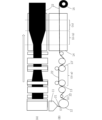
- FIG. 1 is a conceptual diagram showing an example of a production line from extrusion of a film raw material to film forming, film stretching, and film winding, according to one embodiment of the present invention.
- (A) is a top view
- (B) is a side view.
- the top view which shows the shape of the test piece used when measuring the breaking strength of the stretched film in an Example.
- a first aspect of the present invention relates to a method for producing a stretched film containing a poly(3-hydroxybutyrate)-based resin.
- the poly(3-hydroxybutyrate)-based resin is an aliphatic polyester resin that can be produced from microorganisms, and is a polyester resin having 3-hydroxybutyrate as a repeating unit.
- the poly(3-hydroxybutyrate)-based resin may be poly(3-hydroxybutyrate) having only 3-hydroxybutyrate as a repeating unit, or 3-hydroxybutyrate and other hydroxyalkanoates. It may be a copolymer with.
- the poly(3-hydroxybutyrate)-based resin may be a homopolymer and a mixture of one or more copolymers, or a mixture of two or more copolymers.
- poly(3-hydroxybutyrate)-based resin examples include poly(3-hydroxybutyrate), poly(3-hydroxybutyrate-co-3-hydroxyhexanoate), poly(3-hydroxybutyrate), late-co-3-hydroxyvalerate), poly(3-hydroxybutyrate-co-4-hydroxybutyrate), poly(3-hydroxybutyrate-co-3-hydroxyoctanoate), poly(3- hydroxybutyrate-co-3-hydroxyoctadecanoate) and the like.
- poly (3-hydroxybutyrate), poly (3-hydroxybutyrate-co-3-hydroxyhexanoate), poly (3-hydroxybutyrate-co- 3-hydroxyvalerate), poly(3-hydroxybutyrate-co-4-hydroxybutyrate) are preferred.
- poly(3-hydroxybutyrate-co-3-hydroxyhexanoate) is preferred from the viewpoints of being possible, being industrially easy to produce, and being a useful plastic in terms of physical properties.
- poly(3-hydroxybutyrate) resins that are prone to thermal decomposition under heating at 180° C. or higher, poly(3-hydroxybutyrate-co-3-hydroxyhexanoate) has a low melting point. It is also preferable from the viewpoint that molding can be performed at a low temperature.
- the poly(3-hydroxybutyrate-co-3-hydroxyvalerate) changes its melting point, Young's modulus, etc. depending on the ratio of the 3-hydroxybutyrate component and the 3-hydroxyvalerate component. It has a high degree of crystallinity of 50% or more, and is more flexible than poly(3-hydroxybutyrate), but the improvement in brittleness is insufficient.
- the poly(3-hydroxybutyrate)-based resin contains a copolymer of 3-hydroxybutyrate units and other hydroxyalkanoate units, all monomer units constituting the poly(3-hydroxybutyrate)-based resin
- the average content ratio of 3-hydroxybutyrate units and other hydroxyalkanoate units in 3-hydroxybutyrate units/other hydroxyalkanoate units is 99/1 from the viewpoint of achieving both strength and productivity of the stretched film. ⁇ 80/20 (mol%/mol%) is preferred, and 97/3 to 85/15 (mol%/mol%) is more preferred.
- the average content ratio of each monomer unit in the total monomer units constituting the poly(3-hydroxybutyrate)-based resin is a method known to those skilled in the art, for example, the method described in paragraph [0047] of WO 2013/147139. can be obtained by
- the average content ratio means the molar ratio of each monomer unit to the total monomer units constituting the poly(3-hydroxybutyrate)-based resin, and the poly(3-hydroxybutyrate)-based resin is two or more poly In the case of a mixture of (3-hydroxybutyrate)-based resins, it means the molar ratio of each monomer unit contained in the entire mixture.
- the poly(3-hydroxybutyrate)-based resin may be a mixture of at least two poly(3-hydroxybutyrate)-based resins that differ in the type and/or content of the constituent monomers.
- at least one highly crystalline poly(3-hydroxybutyrate)-based resin and at least one low-crystalline poly(3-hydroxybutyrate)-based resin can be used in combination.
- highly crystalline poly(3-hydroxybutyrate)-based resins have excellent productivity but poor mechanical strength
- low-crystalline poly(3-hydroxybutyrate)-based resins have poor productivity.
- the highly crystalline poly(3-hydroxybutyrate)-based resin forms fine resin crystal particles
- the low-crystalline poly(3-hydroxybutyrate)-based resin forms fine resin crystal particles. It is speculated that they form tie molecules that bridge each other.
- the content of 3-hydroxybutyrate units contained in the highly crystalline poly(3-hydroxybutyrate)-based resin is 3 in the total monomer units constituting the mixture of poly(3-hydroxybutyrate)-based resins. -It is preferably higher than the average content of hydroxybutyrate units.
- the content of the other hydroxyalkanoate units in the highly crystalline resin is 1 to 5 mol % is preferred, and 2 to 4 mol % is more preferred.
- poly(3-hydroxybutyrate)-based resin poly(3-hydroxybutyrate-co-3-hydroxyhexanoate) or poly(3-hydroxybutyrate-co-4- hydroxybutyrate) is preferred, and poly(3-hydroxybutyrate-co-3-hydroxyhexanoate) is more preferred.
- the content of 3-hydroxybutyrate units contained in the low-crystalline poly(3-hydroxybutyrate)-based resin is It is preferably lower than the average content of 3-hydroxybutyrate units.
- the content of other hydroxyalkanoate units in the low-crystalline resin is 24 to 99 mol % is preferred, 24 to 50 mol % is more preferred, 24 to 35 mol % is even more preferred, and 24 to 30 mol % is particularly preferred.
- poly(3-hydroxybutyrate)-based resin poly(3-hydroxybutyrate-co-3-hydroxyhexanoate) or poly(3-hydroxybutyrate-co-4- hydroxybutyrate) is preferred, and poly(3-hydroxybutyrate-co-3-hydroxyhexanoate) is more preferred.
- the ratio of each resin to the total amount of both resins is not particularly limited.
- the former is preferably 10% by weight or more and 60% by weight or less, the latter is preferably 40% by weight or more and 90% by weight or less, and the former is 25% by weight or more and 45% by weight or less, and the latter is 55% by weight or more and 75% by weight. The following are more preferable.
- the crystallinity of both resins is Intermediate medium crystallinity poly(3-hydroxybutyrate) based resins can be used in combination.
- the content of the other hydroxyalkanoate units in the medium-crystalline resin is It is preferably 6 mol % or more and less than 24 mol %, more preferably 6 mol % or more and 22 mol % or less, even more preferably 6 mol % or more and 20 mol % or less, and preferably 6 mol % or more and 18 mol % or less.
- poly(3-hydroxybutyrate)-based resin poly(3-hydroxybutyrate-co-3-hydroxyhexanoate) or poly(3-hydroxybutyrate-co-4- hydroxybutyrate) is preferred, and poly(3-hydroxybutyrate-co-3-hydroxyhexanoate) is more preferred.
- a high-crystalline poly(3-hydroxybutyrate)-based resin, a low-crystalline poly(3-hydroxybutyrate)-based resin , and the ratio of the medium-crystalline poly(3-hydroxybutyrate)-based resin to the total of the medium-crystalline poly(3-hydroxybutyrate)-based resin is preferably 1% by weight or more and 99% by weight or less, It is more preferably 90% by weight or less, and even more preferably 8% by weight or more and 85% by weight or less.
- the method of obtaining a blend of two or more poly(3-hydroxybutyrate)-based resins is not particularly limited, and may be a method of obtaining a blend by microbial production or a method of obtaining a blend by chemical synthesis.
- two or more resins may be melt-kneaded using an extruder, kneader, Banbury mixer, rolls, or the like to obtain a blend, or two or more resins may be dissolved in a solvent, mixed and dried. Blends may be obtained.
- the weight average molecular weight of the entire poly(3-hydroxybutyrate) resin is not particularly limited, but from the viewpoint of achieving both strength and productivity of the stretched film, it is preferably 200,000 to 2,000,000, more preferably 250,000 to 1,500,000. Preferably, 300,000 to 1,000,000 is more preferable.
- the poly(3-hydroxybutyrate)-based resin is a mixture of two or more poly(3-hydroxybutyrate)-based resins, each poly(3-hydroxybutyrate)-based resin constituting the mixture
- the weight average molecular weight is not particularly limited.
- highly crystalline poly(3-hydroxybutyrate)-based resin and low-crystalline poly(3-hydroxybutyrate)-based resin are used in combination, highly crystalline poly(3-hydroxybutyrate) )-based resin is preferably 200,000 to 1,000,000, more preferably 220,000 to 800,000, and still more preferably 250,000 to 600,000 from the viewpoint of achieving both strength and productivity of the stretched film.
- the weight-average molecular weight of the low-crystalline poly(3-hydroxybutyrate)-based resin is preferably 200,000 to 2,500,000, more preferably 250,000 to 2,300,000, from the viewpoint of achieving both strength and productivity of the stretched film. Preferably, 300,000 to 2,000,000 is more preferable.
- the weight-average molecular weight of the medium-crystalline poly(3-hydroxybutyrate)-based resin has an effect on the strength and production of the stretched film. 200,000 to 2,500,000 is preferable, 250,000 to 2,300,000 is more preferable, and 300,000 to 2,000,000 is still more preferable from the viewpoint of achieving both properties.
- the weight average molecular weight of the poly(3-hydroxybutyrate) resin can be measured by polystyrene conversion using gel permeation chromatography (HPLC GPC system manufactured by Shimadzu Corporation) using a chloroform solution.
- gel permeation chromatography HPLC GPC system manufactured by Shimadzu Corporation
- a column suitable for measuring the weight average molecular weight may be used.
- the method for producing the poly(3-hydroxybutyrate)-based resin is not particularly limited, and may be a production method by chemical synthesis or a production method by microorganisms. Among them, the production method using microorganisms is preferable. A known method can be applied to the production method using microorganisms.
- 3-hydroxybutyrate and other hydroxyalkanoate copolymer-producing bacteria include Aeromonas caviae, which is a P3HB3HV and P3HB3HH-producing bacterium, Alcaligenes eutrophus, which is a P3HB4HB-producing bacterium, and the like. It has been known.
- Alcaligenes eutrophus AC32 strain Alcaligenes eutrophus AC32, FERM BP-6038
- T.Fukui, Y.Doi, J.Bateriol into which a P3HA synthase group gene was introduced in order to increase the productivity of P3HB3HH .
- 179, p4821-4830 (1997) are more preferred, and microbial cells obtained by culturing these microorganisms under appropriate conditions and accumulating P3HB3HH in the cells are used.
- genetically modified microorganisms into which various poly(3-hydroxybutyrate)-based resin synthesis-related genes have been introduced may be used according to the poly(3-hydroxybutyrate)-based resin to be produced. Optimization of culture conditions, including the type of
- the poly(3-hydroxybutyrate)-based resin may be an unmodified resin, or an unmodified poly(3-hydroxybutyrate)-based resin, such as a peroxide, which reacts with the resin. (hereinafter referred to as "raw material for modification”) may be used to modify the resin.
- raw material for modification an unmodified poly(3-hydroxybutyrate)-based resin, such as a peroxide, which reacts with the resin.
- raw material for modification may be used to modify the resin.
- the resin and the modifying raw material may be reacted in advance to form a film, or the resin may be mixed with the modifying raw material and reacted during film formation. .
- the entire resin may be reacted with the modifying raw material, or a part of the resin may be reacted with the modifying raw material to obtain a modified resin, and then the rest of the resin may be reacted with the modifying raw material.
- An unmodified resin may be added to the modified resin.
- the raw material for modification is not particularly limited as long as it is a compound that can react with the poly(3-hydroxybutyrate)-based resin, but the handling and the reaction with the poly(3-hydroxybutyrate)-based resin are controlled.
- Organic peroxides can be preferably used because they are easy to remove.
- organic peroxide examples include diisobutyl peroxide, cumyl peroxyneodecanoate, di-n-propyl peroxydicarbonate, diisopropyl peroxydicarbonate, di-sec-butyl peroxydicarbonate, 1, 1,3,3-tetramethylbutyl peroxyneodecanoate, bis(4-t-butylcyclohexyl)peroxydicarbonate, bis(2-ethylhexyl)peroxydicarbonate, t-hexyl peroxyneodecanoate , t-butyl peroxyneodecanoate, t-butyl peroxyneoheptanoate, t-hexyl peroxypivalate, t-butyl peroxypivalate, di(3,5,5-trimethylhexanoyl) peroxy -oxide, dilauroyl peroxide, 1,1,3,3-tetramethylbutyl
- t-butylperoxy-2-ethylhexyl carbonate and t-butylperoxyisopropyl carbonate are mentioned. Among them, t-butylperoxy-2-ethylhexyl carbonate and t-butylperoxyisopropyl carbonate are preferred. A combination of two or more of these organic peroxides can also be used.
- the organic peroxide is used in various forms such as solid and liquid, and may be in a liquid form diluted with a diluent or the like.
- the organic peroxide in a form that can be easily mixed with the poly(3-hydroxybutyrate)-based resin is the poly(3-hydroxybutyrate) Butyrate) resin can be dispersed more uniformly, and local modification reaction in the resin composition can be easily suppressed.
- the film raw material or the stretched film may contain a resin other than the poly(3-hydroxybutyrate)-based resin within a range that does not impair the effects of the invention.
- Such other resins include, for example, aliphatic polyester resins such as polybutylene succinate adipate, polybutylene succinate, polycaprolactone, and polylactic acid; Aliphatic-aromatic polyester-based resins such as late terephthalate and the like are included.
- the other resin only one kind may be contained, or two or more kinds may be contained.
- the content of the other resin is not particularly limited, but is preferably 100 parts by weight or less, more preferably 50 parts by weight or less, and 30 parts by weight or less with respect to 100 parts by weight of the poly(3-hydroxybutyrate) resin. is more preferable, 10 parts by weight or less is even more preferable, and 5 parts by weight or less is particularly preferable.
- the lower limit of the content of the other resin is not particularly limited, and may be 0 parts by weight or more.
- the raw material for the film or the stretched film may contain additives that can be used together with the poly(3-hydroxybutyrate)-based resin as long as the effects of the invention are not impaired.
- additives include colorants such as pigments and dyes, odor absorbers such as activated carbon and zeolite, fragrances such as vanillin and dextrin, fillers, plasticizers, antioxidants, antioxidants, weather resistance improvers, UV absorbers, crystal nucleating agents, lubricants, release agents, water repellents, antibacterial agents, slidability improvers and the like. Only one kind of additive may be contained, or two or more kinds thereof may be contained. The content of these additives can be appropriately set by those skilled in the art according to the purpose of use. Crystal nucleating agents, lubricants, fillers, and plasticizers are described in more detail below.
- Crystal nucleating agent The film raw material or the stretched film may also contain a crystal nucleating agent.
- Crystal nucleating agents include, for example, polyhydric alcohols such as pentaerythritol, galactitol and mannitol; orotic acid, aspartame, cyanuric acid, glycine, zinc phenylphosphonate, boron nitride and the like.
- pentaerythritol is preferable because it has a particularly excellent effect of promoting crystallization of poly(3-hydroxybutyrate)-based resin.
- One type of crystal nucleating agent may be used, or two or more types may be used, and the use ratio can be appropriately adjusted according to the purpose.
- the amount of the crystal nucleating agent used is not particularly limited, but is preferably 0.1 to 5 parts by weight, and 0.5 to 3 parts by weight with respect to 100 parts by weight of the total poly(3-hydroxybutyrate) resin. More preferably, 0.7 to 1.5 parts by weight is even more preferable.
- the film raw material or the stretched film may also contain a lubricant.
- lubricants include behenic acid amide, oleic acid amide, erucic acid amide, stearic acid amide, palmitic acid amide, N-stearylbehenic acid amide, N-stearyl erucic acid amide, ethylene bis stearic acid amide, ethylene bis oleic acid amide, ethylenebiserucamide, ethylenebislaurylamide, ethylenebiscapricamide, p-phenylenebisstearicamide, polycondensates of ethylenediamine, stearic acid and sebacic acid.
- behenic acid amide or erucic acid amide is preferable because it has a particularly excellent lubricating effect on poly(3-hydroxybutyrate)-based resins.
- One type of lubricant may be used, or two or more types may be used, and the usage ratio can be appropriately adjusted according to the purpose.
- the amount of lubricant used is not particularly limited, but is preferably 0.01 to 5 parts by weight, more preferably 0.05 to 3 parts by weight, with respect to 100 parts by weight of the total poly(3-hydroxybutyrate) resin. , more preferably 0.1 to 1.5 parts by weight.
- the film raw material or the stretched film may contain a filler.
- a filler By including a filler, a stretched film with higher strength can be obtained.
- the filler may be either an inorganic filler or an organic filler, or both may be used in combination.
- inorganic fillers include, but are not limited to, silicates, carbonates, sulfates, phosphates, oxides, hydroxides, nitrides, and carbon black. Only one type of inorganic filler may be used, or two or more types may be used in combination.
- the content of the filler is not particularly limited, but it is preferably 1 to 100 parts by weight, more preferably 3 to 80 parts by weight, based on 100 parts by weight of the poly(3-hydroxybutyrate) resin. Preferably, it is from 5 to 70 parts by weight, and even more preferably from 10 to 60 parts by weight.
- the film raw material or the stretched film may not contain a filler.
- the film raw material or the stretched film may contain a plasticizer.
- plasticizers include glycerin ester compounds, citrate compounds, sebacate compounds, adipate compounds, polyether ester compounds, benzoate compounds, phthalate compounds, isosol Examples include bidester-based compounds, polycaprolactone-based compounds, and dibasic acid ester-based compounds. Among them, glycerin ester-based compounds, citrate ester-based compounds, sebacate-based compounds, and dibasic acid ester-based compounds are preferable in that the plasticizing effect on poly(3-hydroxybutyrate)-based resins is particularly excellent. .
- glycerin ester compounds include glycerin diacetomonolaurate and the like.
- citrate compounds include acetyl tributyl citrate and the like.
- sebacate-based compounds include dibutyl sebacate and the like.
- dibasic acid ester compounds include benzylmethyldiethylene glycol adipate.
- One type of plasticizer may be used, or two or more types may be used, and the use ratio can be appropriately adjusted according to the purpose.
- the amount of the plasticizer used is not particularly limited, but is preferably 1 to 20 parts by weight, more preferably 2 to 15 parts by weight, and 3 to 10 parts by weight is more preferred.
- the film raw material or the stretched film may not contain a plasticizer.
- the method for producing a stretched film according to this embodiment includes at least the following steps. (i) a step of melting the film raw material containing the poly(3-hydroxybutyrate)-based resin and extruding it onto a cast roll to form a film; Step (iii-a) to obtain a film having a degree of crystallinity of 20 to 45% by peeling from the film; A uniaxially stretched film stretched in the MD direction can be obtained through steps (i), (ii) and (iii-a).
- the MD direction is also called machine direction, machine direction, or longitudinal direction.
- a TD direction which will be described later, is a direction perpendicular to the MD direction, and is also called a vertical direction or a width direction.
- step (iii-a) After the step (iii-a), the following step (iv) is preferably carried out. (iv) heating the film obtained in step (iii-a) to a temperature higher than the temperature in step (iii-a) to obtain a film having a degree of crystallinity of 60% or more; step (i) , (ii), (iii-a), and (iv) make it possible to obtain a uniaxially stretched film that is stretched in the MD direction and has high strength in the MD direction.
- step (iii-a) a step of stretching the film obtained in step (iii-a) in the TD direction to obtain a film having a degree of crystallinity of 30 to 60% Steps (i), (ii), (iii-a) ), and (iii-b), a biaxially stretched film stretched in the MD direction and the TD direction can be obtained.
- step (iii-b) After the step (iii-b), the following step (iv) is preferably carried out.
- step (iv) Heating the film obtained in step (iii-b) to a temperature higher than the temperature in step (iii-b) to obtain a film having a degree of crystallinity of 60% or more Step (i) , (ii), (iii-a), (iii-b) and (iv) to obtain a biaxially stretched film which is stretched in the MD direction and the TD direction, respectively, and which has high strength in the MD direction and the TD direction, respectively. can be done.
- step (iv) may not be performed.
- the crystallinity of the film can be increased by leaving the stretched film obtained without carrying out the step (iv) for a long time, for example, at room temperature, and the stretched film can be made to have high strength. .
- the stretched film may shrink due to the standing, it is preferable to increase the film strength by performing the step (iv).
- step (i) In step (i), first, the film raw material is melted.
- the melting method is not particularly limited, but it is preferable to extrude the melted film raw material through a T-die, that is, by extrusion molding. According to the extrusion molding method, a film having a uniform thickness can be easily produced.
- extrusion molding a single-screw extruder, a twin-screw extruder, or the like can be used as appropriate.
- the conditions for melting the film raw material may be any conditions as long as the poly(3-hydroxybutyrate)-based resin is melted.
- the melted film material is extruded onto cast rolls to form a film.
- the melt of the film raw material contacts the cast roll and is cooled while moving along the surface of the cast roll. As a result, part of the poly(3-hydroxybutyrate)-based resin is crystallized.
- the step may be a step of extruding the melt onto one or more cast rolls, or a touch roll is opposed to the cast roll, and the melt extruded onto the cast roll is extruded onto the touch roll. It may be a step of sandwiching between.
- the said process is not a process of applying pressure to a film and implementing roll rolling.
- an air knife or an air chamber may be used to stably bring the melt into contact with the casting roll.
- the cast roll may be placed in a water tank or an air chamber may be used.
- the set temperature of the cast roll is preferably 50° C. or less in order to achieve a film crystallinity of 45% or less, which will be described later. It is more preferably 45° C. or lower, still more preferably 40° C. or lower.
- the lower limit of the set temperature of the cast roll is preferably 0° C. or higher, more preferably 5° C. or higher, still more preferably 10° C. or higher, still more preferably 12° C. or higher, and particularly preferably 15° C. or higher.
- the lower limit of the set temperature of the cast roll may be a temperature exceeding the glass transition temperature (Tg) of the poly(3-hydroxybutyrate)-based resin + 10 ° C., or a temperature of Tg + 12 ° C. or higher. , Tg+14° C. or higher.
- step (ii) the film formed in step (i) is peeled from the cast roll to obtain a film with a degree of crystallinity of 20-45%.
- the film can be peeled from the cast roll by conveying the film toward the next stretching step while rotating the cast roll.
- the film released from the cast roll has a degree of crystallinity of 20-45%.
- the film can be easily peeled from the cast roll. It is preferably 25% or more, more preferably 30% or more.
- the crystallinity of the film can be controlled to be relatively low in the next step (iii-a). As a result, it becomes possible to stretch a film containing a poly(3-hydroxybutyrate)-based resin at a high magnification. It is preferably 43% or less, more preferably 42% or less, and still more preferably 40% or less.
- the degree of crystallinity of the film when it is peeled off from the cast roll is mainly determined depending on the temperature of the film raw material melted in step (i) and the set temperature of the cast roll described above. In addition, the temperature of the atmosphere around the casting rule, the contact time between the casting roll and the film, etc. also affect the film. A person skilled in the art can easily control the crystallinity of the film considering these parameters.
- Crystallinity of a film can be determined with reference to POLYMER, 1992, Volume 33, Number 7, pp. 1563-1567. For example, it can be determined by the following procedure. A film to be measured is quickly cut into a size of 2 cm square, laminated so as to have a thickness of 200 to 500 ⁇ m, and fixed on a glass holder. This glass holder is fixed to the sample clip next to the characteristic X-ray Cu-K ⁇ light source in the XRD device, and the XRD measurement is performed in the range of 5 to 40° at a scan speed of 0.02 to 0.5°/min. do. Rint2500 manufactured by Rigaku can be used as the XRD device.
- the area (integrated intensity) of the waveform with both ends zero-corrected is defined as Ia + Ic (area of halo derived from amorphous + area of peak derived from crystal). From this, the area of the waveform obtained by subtracting the halo derived from the amorphous part (so that the symmetry of the scattering peak intensity is maintained) is defined as Ic. Crystallinity is calculated by the formula: Ia/(Ia+Ic) ⁇ 100.
- the film temperature in step (ii) is preferably 50° C. or less so as to suppress crystallization of the poly(3-hydroxybutyrate)-based resin and achieve a degree of crystallinity of 45% or less. It is more preferably 45° C. or lower, still more preferably 40° C. or lower, and even more preferably 35° C. or lower.
- the lower limit of the film temperature in step (ii) is preferably 0° C. or higher, more preferably 5° C. or higher, further preferably 10° C. or higher, so that the film can be easily peeled from the cast roll. °C or higher is even more preferred, and 15°C or higher is particularly preferred.
- the lower limit of the film temperature in step (ii) may be a temperature exceeding the glass transition temperature (Tg) of the poly(3-hydroxybutyrate)-based resin + 10 ° C., or a temperature of Tg + 12 ° C. or higher.
- the temperature may be Tg+14° C. or higher.
- Step (iii-a) In step (iii-a), the film obtained in step (ii) is stretched in the MD direction to obtain a film with a crystallinity of 30 to 55%.
- Step (iii-a) is preferably carried out in one production line continuously from step (ii).
- stretching the film in the MD direction refers to pulling the film in the MD direction, and is distinguished from stretching by applying pressure in the thickness direction of the film, such as roll rolling in which the film is sandwiched between two rolls. be.
- the stretching in the MD direction is not particularly limited, it can be carried out, for example, by using a roll longitudinal stretching machine and varying the rotation speed of the rolls between a plurality of rolls that transport the film.
- the stretching ratio in the MD direction can be determined by the ratio of the rotation speed of the rolls before stretching to the rotation speed of the rolls after stretching.
- the crystallinity of the MD-stretched film obtained in step (iii-a) is 30 to 55%.
- the degree of crystallinity of the film is 30% or more, the film can be easily peeled off from tools such as rolls used in the stretching process. It is preferably 35% or more, more preferably 40% or more, still more preferably 45% or more.
- the film contains a relatively large amount of amorphous regions, and crystal molecules are contained in the amorphous regions. can be oriented, and a high draw ratio can be achieved. Furthermore, when the step (iii-b) is carried out next, it becomes possible to control the degree of crystallinity of the film relatively low even in the step (iii-b), and at a high magnification even in the TD direction. can be stretched. If the degree of crystallinity of the film exceeds 55% in step (iii-a), the film becomes brittle, and the possibility of breaking the film during stretching increases, making it difficult to achieve a high draw ratio.
- the crystallinity is preferably 53% or less, more preferably 50% or less.
- the crystallinity of the film stretched in the MD direction obtained in step (iii-a) is preferably a value equal to or higher than the crystallinity of the film peeled from the cast roll obtained in step (ii). A value higher than the degree is more preferable.
- the present embodiment is distinctly different from the production of a stretched film from a general-purpose resin such as polypropylene in that the film is stretched while controlling the degree of crystallinity of the film to a relatively low range.
- the crystallinity of the film stretched in the MD direction mainly depends on the crystallinity of the film peeled off from the cast roll in the previous step (ii), the temperature conditions in this step (iii-a), the time required, etc. determined in dependence.
- a person skilled in the art can easily control the crystallinity of the film considering these parameters.
- the film temperature in step (iii-a) is preferably 65°C or less so as to suppress crystallization of the poly(3-hydroxybutyrate)-based resin and achieve a degree of crystallinity of 55% or less. It is more preferably 60° C. or lower, still more preferably 55° C. or lower, still more preferably 45° C. or lower, and particularly preferably 35° C. or lower. Moreover, the temperature is preferably 10° C. or higher so that the film can be easily peeled off from equipment such as rolls used in the stretching step. More preferably, it is 15°C or higher.
- the means for controlling the film temperature in step (iii-a) is not particularly limited, for example, the film temperature is controlled by applying an air current adjusted to a predetermined temperature to the film, or by setting the roll to a predetermined temperature.
- the draw ratio in step (iii-a) is not particularly limited, it is preferably 2 times or more. More preferably 2.5 times or more, still more preferably 3 times or more. According to this embodiment, such a high draw ratio can be achieved by controlling the crystallinity of the film in steps (ii) and (iii-a).
- the upper limit of the draw ratio is not particularly limited, and may be determined as appropriate. For example, it may be 8 times or less.
- Step (iii-b) In step (iii-b), the stretched film obtained in step (iii-a) is further stretched in the TD direction to obtain a film with a degree of crystallinity of 30 to 60%.
- Step (iii-b) is preferably carried out in one production line continuously from step (iii-a).
- the film In this step (iii-b), the film is preferably stretched in the TD direction.
- stretching the film in the TD direction refers to pulling the film in the TD direction, and stretching is performed by applying pressure in the thickness direction of the film, such as roll rolling in which the film is sandwiched between two rolls. is distinguished from
- the stretching in the TD direction is not particularly limited, but can be carried out, for example, by clamping both ends of the film in the width direction using a transverse stretching machine such as a clip-type tenter and pulling the film in the TD direction.
- the draw ratio in the TD direction can be determined by the ratio of the width of the clamped film before stretching to the width of the clamped film after stretching.
- the crystallinity of the film stretched in the TD direction obtained in step (iii-b) is 30-60%.
- the degree of crystallinity of the film is 30% or more, the film can be easily peeled off from tools such as rolls used in the stretching process. It is preferably 35% or more, more preferably 40% or more, still more preferably 45% or more, and particularly preferably 50% or more.
- the film contains a relatively large amount of amorphous regions, and crystal molecules are generated in the amorphous regions. It can be oriented and a high draw ratio can be achieved. If the degree of crystallinity of the film exceeds 60% in this step, the film becomes brittle, and the possibility of breaking the film by stretching increases, making it difficult to achieve a high stretching ratio.
- the crystallinity is preferably 59% or less, more preferably 56% or less.
- the crystallinity of the film stretched in the TD direction mainly depends on the crystallinity of the film obtained in the preceding step (iii-a), the temperature conditions in this step (iii-b), and the time required. determined by A person skilled in the art can easily control the crystallinity of the film considering these parameters.
- the crystallinity of the film stretched in the TD direction obtained in step (iii-b) is preferably a value equal to or higher than the crystallinity of the film stretched in the MD direction obtained in step (iii-a). A value higher than the crystallinity is more preferable.
- the film temperature in step (iii-b) is preferably 70°C or less so as to suppress crystallization of the poly(3-hydroxybutyrate)-based resin and achieve a crystallinity of 60% or less. It is more preferably 60° C. or lower, still more preferably 50° C. or lower, even more preferably 40° C. or lower, and particularly preferably 35° C. or lower. Moreover, the temperature is preferably 10° C. or higher so that the film can be easily peeled off from equipment such as rolls used in the stretching step. It is more preferably 15° C. or higher, and still more preferably 20° C. or higher.
- the means for controlling the film temperature in step (iii-b) is not particularly limited, but the method described above in step (iii-a) can be appropriately employed. These may be used singly or in combination.
- the draw ratio in step (iii-b) is not particularly limited, it is preferably 2 times or more. More preferably 3 times or more, still more preferably 4 times or more. According to this embodiment, such a high draw ratio can be achieved by controlling the crystallinity of the film in steps (ii), (iii-a), and (iii-b).
- the upper limit of the draw ratio is not particularly limited, and may be determined as appropriate. For example, it may be 8 times or less.
- step (iv) In step (iv), the film obtained in step (iii-a) or the film obtained in step (iii-b) is heated to a temperature higher than the temperature during step (iii-a) or (iii-b) to obtain a film with a degree of crystallinity of 60% or more. Step (iv) is preferably carried out in one production line continuously from step (iii-a) or (iii-b).
- the crystallinity of the stretched film achieved in step (iv) may be higher than the crystallinity achieved in step (iii-a) or step (iii-b). Specifically, it may be 60% or more, preferably more than 60%, more preferably 63% or more, even more preferably 65% or more, and particularly preferably 70% or more.
- the film temperature in step (iv) is higher than the film temperature in step (iii-a) or (iii-b), preferably 60°C or higher. It is more preferably 70° C. or higher, and still more preferably 80° C. or higher.
- the upper limit is not higher than the melting temperature of the resin, preferably 150° C. or lower, more preferably 145° C. or lower, and even more preferably 140° C. or lower.
- the film temperature in step (iv) is the same as in step (iii-a) or (iii-b). It is preferably 10° C. or higher than the film temperature, more preferably 20° C. or higher, even more preferably 30° C. or higher, even more preferably 40° C. or higher, and particularly preferably 50° C. or higher.
- the means for controlling the film temperature in step (iv) is not particularly limited, and the method described above in step (iii-a) can be appropriately employed. The methods described above may be used singly or in combination.
- step (iv) is preferably carried out while tensioning the film in the direction of stretching. This makes it possible to avoid heat shrinkage of the film. That is, when step (iv) is performed after step (iii-a), it is preferable to perform the step while applying tension to the film in the MD direction. When step (iii-b) is followed by step (iv), it is preferable to apply tension to the film in both the MD and TD directions. When tension is applied in the MD direction, for example, the rotational speeds of a plurality of rolls that transport the film may be controlled. When tension is applied in the TD direction, for example, step (iv) may be performed while clamping both ends of the film in the width direction with a transverse stretching machine and pulling the film in the TD direction. However, step (iv) does not substantially stretch the film. "The film is not substantially stretched” means that an operation intended to stretch the film is not performed in step (iv).
- melt extrusion of the film raw material to formation of the stretched film can be carried out in a continuous process.
- the continuous process refers to a crystallization process that takes a long time after forming into a film (specifically, after quenching in ice water, 12 hours at 40 ° C.). It refers to performing the stretching step without performing the step of performing time annealing.
- step (i) it is preferable to carry out the film from step (i) to the final step while continuously conveying the film.
- This embodiment may be carried out while winding the produced stretched film with a winding roll.
- the final step refers to step (iii-a) when performing up to step (iii-a), and refers to step (iii-b) when performing up to step (iii-b), When performing up to step (iv), it refers to step (iv).
- the transport speed is not particularly limited, but from the viewpoint of film productivity, it is preferably 5 m/min or more before the start of stretching. Also, from the viewpoint of production stability, it is preferable that the speed is 50 m/min or less at the stage before the start of stretching.
- FIG. 1 shows an example of a production line in which steps (i) to (iv) are carried out while continuously conveying a film.
- a rightward arrow in the drawing indicates the transport direction of the film.
- the melted film raw material is cooled while moving along the surface of the cast roll 12 . At this time, part of the resin contained in the film raw material is crystallized.
- the solidified film 22 is peeled off from the cast roll 12 along the transport path of the film (step (ii)).
- the film 22 is guided to the stretching rolls 13, 13', which are respectively arranged in the forward and backward directions in the transport direction of the film.
- the rear roll 13 ′ is set to rotate faster than the front roll 13 .
- the film 22 is stretched in the MD direction by being pulled in the MD direction by this speed difference (step (iii-a)).
- the film temperature during MD stretching is controlled by setting the temperature of the rolls 13 to a predetermined value using a heating medium.
- the film 22 stretched in the MD direction is guided into a transverse stretching machine 14 which is a clip-type tenter.
- a transverse stretching machine 14 which is a clip-type tenter.
- both ends of the film in the width direction are clamped and stretched in the TD direction (step (iii-b)). to control the film temperature during TD stretching.
- the internal temperature in the transverse stretcher 14 is raised while both ends of the film in the width direction are clamped.
- the film is thereby heated to promote crystallization of the poly(3-hydroxybutyrate)-based resin (step (iv)).
- the film 22 is wound up by the winding roll 15 .
- the process from extrusion of the film raw material to film forming, film stretching, and film winding is carried out while the film is continuously conveyed.
- the length, width, length/width, and thickness of the stretched film to be produced are not particularly limited, but are as described below for the second embodiment.
- stretched film to be produced may be laminated with other layers as described later with respect to the second aspect.
- the produced stretched film is thin but has high strength, so it can be suitably used as a packaging film, a heat-sealable film, a twisted film, and the like.
- a second aspect of the present invention relates to a stretched film containing a poly(3-hydroxybutyrate)-based resin.
- the stretched film according to the second aspect contains a poly(3-hydroxybutyrate)-based resin and exhibits a breaking strength of 50 MPa or more in each of the MD direction and the TD direction.
- a breaking strength of 50 MPa or more can be achieved by stretching the film at a high magnification and increasing the crystallinity of the film.
- steps (i), (ii), (iii-a) and (iii-b) are performed, and the draw ratio is set to 2 in each of the MD direction and the TD direction.
- the stretched film according to the second aspect can be produced by preferably carrying out the step (iv) after stretching the film by a factor of 1 or more to increase the degree of crystallinity of the film.
- the breaking strength is preferably 60 MPa or more, more preferably 70 MPa or more, in each of the MD and TD directions. Although the upper limit is not particularly limited, it may be 300 MPa or less, or 200 MPa or less.
- the breaking strength in the MD direction and the breaking strength in the TD direction may be the same or different. Breaking strength can be measured based on the description in the Examples section.
- the stretched film can be produced while being conveyed continuously, it is preferable that it has a long belt-like shape.
- the stretched film is preferably wound into a roll because it is easy to handle.
- the stretched film wound into a roll may be wound around a rod-shaped member.
- the ratio of the length of the stretched film to the width of the stretched film is not particularly limited, but may be 10 or more, for example. Also, it may be 50 or more, or 100 or more.
- the upper limit of the ratio is also not particularly limited, but may be, for example, 10,000 or less. Also, it may be 5,000 or less, or 3,000 or less.
- the length of the stretched film is not particularly limited, it may be, for example, 1 m or longer. Moreover, it may be 5 m or more, or may be 10 m or more.
- the upper limit of the length is also not particularly limited, but may be, for example, 1000 m or less. Moreover, it may be 500 m or less, 300 m or less, or 100 m or less.
- the width of the stretched film is not particularly limited, it may be, for example, 10 mm or more. Moreover, it may be 50 mm or more, 100 mm or more, or 200 mm or more.
- the upper limit of the width is also not particularly limited, but may be, for example, 2000 mm or less. Moreover, it may be 1000 mm or less, or may be 500 mm or less.
- the thickness of the stretched film is not particularly limited and can be appropriately set by those skilled in the art, but from the viewpoint of uniform thickness, appearance, strength, lightness, etc. of the film, it is preferably 10 to 200 ⁇ m. , 15 to 150 ⁇ m, more preferably 20 to 100 ⁇ m.
- Another layer may be laminated on the stretched film.
- the other layers include resin layers, inorganic layers, metal layers, metal oxide layers, and printed layers. These other layers may be laminated layers, coating layers, or deposited layers.
- the stretched film according to the second aspect can be suitably used as a packaging film, a heat-sealable film, a twist film, etc., because it is thin but has high strength.
- a method for producing a stretched film containing a poly(3-hydroxybutyrate)-based resin comprising the following steps (i) to (iii-a). (i) a step of melting the film raw material containing the poly(3-hydroxybutyrate)-based resin and extruding it onto a cast roll to form a film; Step (iii-a) to obtain a film having a degree of crystallinity of 20 to 45% by peeling from the film; [Item 2] The production method according to item 1, further comprising the following step (iii-b).
- step (iii-b) A step of stretching the film obtained in step (iii-a) in the TD direction to obtain a film with a degree of crystallinity of 30 to 60% [Item 3] 3.
- the manufacturing method according to item 1 or 2 further comprising the following step (iv).
- Step of obtaining a film of 60% or more [Item 4]
- the thickness was measured using a vernier caliper at 10 points every 10 cm along the TD direction of the film, and the arithmetic mean value of the thicknesses at 10 points was calculated to obtain the thickness of the film.
- the glass transition temperature (Tg) of each resin was determined by differential scanning calorimetry according to JIS K-7121. Specifically, first, about 5 mg of the resin to be measured is accurately weighed, and a differential scanning calorimeter (SSC5200, manufactured by Seiko Electronics Industries Co., Ltd.) is used to increase the temperature at a rate of 10 ° C./min from -20 ° C. to 200 ° C. The temperature was raised to , and a DSC curve was obtained. Next, in the obtained DSC curve, the baseline before and after the change is extended at the portion where the baseline changes stepwise due to the glass transition, and the center line equidistant from these two straight lines in the vertical direction is drawn. The temperature at the point where this center line intersects with the curve of the stepwise change due to the glass transition was defined as the glass transition temperature (Tg).
- SSC5200 differential scanning calorimeter
- the degree of crystallinity was measured for the film immediately after peeling from the cast roll, the film immediately after MD stretching, the film immediately after TD stretching, and the film immediately after heat treatment.
- the film to be measured was quickly cut into 2 cm squares, laminated so as to have a thickness of 200 to 500 ⁇ m, and fixed on a glass holder. This glass holder was fixed to the sample clip next to the characteristic X-ray Cu-K ⁇ light source in the XRD apparatus (Rint2500 manufactured by Rigaku), and the scanning speed was 0.02 to 0.5°/min. XRD measurements were performed on the range.
- the area (integrated intensity) of the waveform with both ends zero-corrected was defined as Ia + Ic (area of halo derived from amorphous + area of peak derived from crystal). From this, the area of the waveform obtained by subtracting the halo derived from the amorphous part (so that the symmetry of the scattering peak intensity is maintained) was defined as Ic. Crystallinity was calculated by the formula: Ia/(Ia+Ic) ⁇ 100.
- test piece (test piece conforming to the old JIS K7113-2 1/3) cut out in the shape shown in FIG. -LX 1 kN), a tensile test was performed in the stretching direction of the stretched film at a tensile speed of 100 mm/min according to JIS K7127, and the stress (breaking strength) when the test piece was broken was determined.
- poly(3-hydroxybutyrate) resin pellet P-1 To 100 parts by weight of poly(3-hydroxybutyrate) resin A-1, 0.5 parts by weight of behenic acid amide (manufactured by Nippon Seika Co., Ltd.: BNT-22H) as a lubricant and 0.5 parts by weight of pentaerythritol as a crystal nucleating agent. 5 parts by weight were dry blended.
- the obtained resin material is put into a ⁇ 26 mm co-rotating twin-screw extruder with the cylinder temperature and die temperature set to 150° C., extruded, passed through a water tank filled with hot water at 45° C. to solidify the strands, and then solidified by a pelletizer. By cutting, a resin pellet P-1 was obtained. The glass transition temperature of the resin pellet P-1 was 6°C.
- Example 1 The cylinder temperature and the die temperature of a single-screw extruder with a diameter of 40 mm connected to a T die with a width of 350 mm were set to 165°C, respectively.
- the resin pellets P-1 were put into the single-screw extruder and melted, and the melted resin at a temperature of 165° C. was extruded into a film with a T-die.
- a film-like molten resin was extruded onto a cast roll set at 20° C. to form a film, cooled to a film temperature of 20° C., and then peeled off from the cast roll.
- the peeled film was taken by a take-up roll and continuously stretched by a roll longitudinal stretching machine at a film temperature of 20° C. in the machine direction (MD) at a stretching ratio of 6 times.
- the film temperature at this time was controlled by adjusting the roll temperature in the roll longitudinal stretching machine to the same temperature (20° C.).
- the film was continuously stretched in the transverse (TD) direction with a clip-type tenter transverse stretching machine at a film temperature of 25° C. at a stretching ratio of 6 times.
- the film temperature at this time was controlled by applying an air current of the same temperature (25° C.) to the film in the transverse stretching machine.
- Example 2 A biaxially stretched film was obtained in the same manner as in Example 1, except that the film temperature cooled by the cast rolls, the film temperature during MD stretching, and the film temperature during TD stretching were each changed to 30°C.
- the crystallinity of the film when peeled from the cast roll was 42%
- the crystallinity of the film after MD stretching was 47%
- the crystallinity of the film after TD stretching was 59%
- the crystallinity of the film after heat treatment was 47%.
- the crystallinity of the film was 67%.
- the obtained film had a breaking strength in the MD direction of 60 MPa and a breaking strength in the TD direction of 116 MPa.
- Example 1 An attempt was made to produce a stretched film in the same manner as in Example 1, except that the temperature of the film cooled by the cast rolls in Example 1 was changed to 55°C. However, film breakage occurred during MD stretching, and a stretched film could not be produced. In this comparative example, the film had a crystallinity of 55% when peeled from the cast roll.
- Example 2 An attempt was made to produce a stretched film in the same manner as in Example 1, except that the film temperature during MD stretching was changed to 65°C. However, film breakage occurred during MD stretching, and a stretched film could not be produced. In this comparative example, the crystallinity of the film when peeled from the cast roll was 35%, and the crystallinity of the film after MD stretching was 60%.
Landscapes
- Engineering & Computer Science (AREA)
- Mechanical Engineering (AREA)
- Chemical & Material Sciences (AREA)
- Physics & Mathematics (AREA)
- Thermal Sciences (AREA)
- Manufacturing & Machinery (AREA)
- Materials Engineering (AREA)
- Health & Medical Sciences (AREA)
- Chemical Kinetics & Catalysis (AREA)
- Medicinal Chemistry (AREA)
- Polymers & Plastics (AREA)
- Organic Chemistry (AREA)
- Shaping By String And By Release Of Stress In Plastics And The Like (AREA)
- Manufacture Of Macromolecular Shaped Articles (AREA)
Priority Applications (3)
| Application Number | Priority Date | Filing Date | Title |
|---|---|---|---|
| US18/708,435 US20250010539A1 (en) | 2021-11-16 | 2022-11-04 | Method for producing stretched film |
| EP22895457.4A EP4434724A4 (en) | 2021-11-16 | 2022-11-04 | METHOD FOR PRODUCING A STRETCHED FILM |
| JP2023561528A JPWO2023090175A1 (https=) | 2021-11-16 | 2022-11-04 |
Applications Claiming Priority (4)
| Application Number | Priority Date | Filing Date | Title |
|---|---|---|---|
| JP2021-186513 | 2021-11-16 | ||
| JP2021186516 | 2021-11-16 | ||
| JP2021186513 | 2021-11-16 | ||
| JP2021-186516 | 2021-11-16 |
Publications (1)
| Publication Number | Publication Date |
|---|---|
| WO2023090175A1 true WO2023090175A1 (ja) | 2023-05-25 |
Family
ID=86396906
Family Applications (1)
| Application Number | Title | Priority Date | Filing Date |
|---|---|---|---|
| PCT/JP2022/041234 Ceased WO2023090175A1 (ja) | 2021-11-16 | 2022-11-04 | 延伸フィルムの製造方法 |
Country Status (4)
| Country | Link |
|---|---|
| US (1) | US20250010539A1 (https=) |
| EP (1) | EP4434724A4 (https=) |
| JP (1) | JPWO2023090175A1 (https=) |
| WO (1) | WO2023090175A1 (https=) |
Cited By (1)
| Publication number | Priority date | Publication date | Assignee | Title |
|---|---|---|---|---|
| WO2025070023A1 (ja) * | 2023-09-26 | 2025-04-03 | 株式会社カネカ | 熱可塑性樹脂フィルムの製造方法 |
Citations (10)
| Publication number | Priority date | Publication date | Assignee | Title |
|---|---|---|---|---|
| JPH09132701A (ja) * | 1995-11-07 | 1997-05-20 | Gunze Ltd | 微生物分解性フィルム |
| US20020061944A1 (en) * | 1997-07-25 | 2002-05-23 | Monsanto Company | PHA compositions and methods for their use in the production of PHA films |
| JP2003311824A (ja) | 2002-02-21 | 2003-11-06 | Japan Science & Technology Corp | ポリヒドロキシアルカン酸の高強度フィルムおよびその製造法 |
| JP2006168159A (ja) | 2004-12-15 | 2006-06-29 | Kaneka Corp | 生分解性フィルムの製造方法 |
| US20080132602A1 (en) * | 2006-12-01 | 2008-06-05 | Tepha, Inc. | Medical devices containing oriented films of poly-4-hydroxybutyrate and copolymers |
| CN102848569A (zh) * | 2012-10-03 | 2013-01-02 | 广东华业包装材料有限公司 | 3-羟基丁酸-4-羟基丁酸共聚物双向拉伸薄膜的生产方法 |
| WO2013147139A1 (ja) | 2012-03-30 | 2013-10-03 | 株式会社カネカ | 生分解性ポリエステル樹脂組成物 |
| WO2019142845A1 (ja) | 2018-01-17 | 2019-07-25 | 株式会社カネカ | 高組成比率の3hhモノマー単位を含む共重合phaを生産する形質転換微生物およびそれによるphaの製造方法 |
| US20190292348A1 (en) * | 2016-11-22 | 2019-09-26 | Omya International Ag | Surface-treated fillers for biaxially oriented polyester films |
| WO2020066987A1 (ja) * | 2018-09-27 | 2020-04-02 | 住友林業株式会社 | 好塩菌が産生するpha共重合体の分子量制御技術 |
Family Cites Families (1)
| Publication number | Priority date | Publication date | Assignee | Title |
|---|---|---|---|---|
| US8889945B2 (en) * | 2010-12-08 | 2014-11-18 | Kimberly-Clark Worldwide, Inc. | Elastic film containing a renewable starch polymer |
-
2022
- 2022-11-04 WO PCT/JP2022/041234 patent/WO2023090175A1/ja not_active Ceased
- 2022-11-04 EP EP22895457.4A patent/EP4434724A4/en active Pending
- 2022-11-04 US US18/708,435 patent/US20250010539A1/en active Pending
- 2022-11-04 JP JP2023561528A patent/JPWO2023090175A1/ja active Pending
Patent Citations (10)
| Publication number | Priority date | Publication date | Assignee | Title |
|---|---|---|---|---|
| JPH09132701A (ja) * | 1995-11-07 | 1997-05-20 | Gunze Ltd | 微生物分解性フィルム |
| US20020061944A1 (en) * | 1997-07-25 | 2002-05-23 | Monsanto Company | PHA compositions and methods for their use in the production of PHA films |
| JP2003311824A (ja) | 2002-02-21 | 2003-11-06 | Japan Science & Technology Corp | ポリヒドロキシアルカン酸の高強度フィルムおよびその製造法 |
| JP2006168159A (ja) | 2004-12-15 | 2006-06-29 | Kaneka Corp | 生分解性フィルムの製造方法 |
| US20080132602A1 (en) * | 2006-12-01 | 2008-06-05 | Tepha, Inc. | Medical devices containing oriented films of poly-4-hydroxybutyrate and copolymers |
| WO2013147139A1 (ja) | 2012-03-30 | 2013-10-03 | 株式会社カネカ | 生分解性ポリエステル樹脂組成物 |
| CN102848569A (zh) * | 2012-10-03 | 2013-01-02 | 广东华业包装材料有限公司 | 3-羟基丁酸-4-羟基丁酸共聚物双向拉伸薄膜的生产方法 |
| US20190292348A1 (en) * | 2016-11-22 | 2019-09-26 | Omya International Ag | Surface-treated fillers for biaxially oriented polyester films |
| WO2019142845A1 (ja) | 2018-01-17 | 2019-07-25 | 株式会社カネカ | 高組成比率の3hhモノマー単位を含む共重合phaを生産する形質転換微生物およびそれによるphaの製造方法 |
| WO2020066987A1 (ja) * | 2018-09-27 | 2020-04-02 | 住友林業株式会社 | 好塩菌が産生するpha共重合体の分子量制御技術 |
Non-Patent Citations (3)
| Title |
|---|
| POLYMER, vol. 33, no. 7, 1992, pages 1563 - 1567 |
| See also references of EP4434724A4 |
| T. FUKUIY. DOI, J. BACTERIOL., vol. 179, 1997, pages 4821 - 4830 |
Cited By (1)
| Publication number | Priority date | Publication date | Assignee | Title |
|---|---|---|---|---|
| WO2025070023A1 (ja) * | 2023-09-26 | 2025-04-03 | 株式会社カネカ | 熱可塑性樹脂フィルムの製造方法 |
Also Published As
| Publication number | Publication date |
|---|---|
| EP4434724A4 (en) | 2026-04-01 |
| EP4434724A1 (en) | 2024-09-25 |
| US20250010539A1 (en) | 2025-01-09 |
| JPWO2023090175A1 (https=) | 2023-05-25 |
Similar Documents
| Publication | Publication Date | Title |
|---|---|---|
| JP7807897B2 (ja) | 延伸フィルムの製造方法 | |
| JP2025116158A (ja) | 二軸延伸フィルムの製造方法 | |
| US8110138B2 (en) | Poly(hydroxyalkanoic acid) and thermoformed articles | |
| CN101910287A (zh) | 聚丙烯树脂组合物、由该树脂组合物形成的成型体以及该成型体的制造方法 | |
| US20260021641A1 (en) | Method for producing stretched film | |
| JP2023146094A (ja) | 熱可塑性樹脂フィルムの製造方法 | |
| US20260022219A1 (en) | Method for producing stretched film | |
| WO2023090175A1 (ja) | 延伸フィルムの製造方法 | |
| WO2023090176A1 (ja) | 延伸フィルム及びその製造方法 | |
| US20260109105A1 (en) | Method for producing stretched film | |
| JP7477982B2 (ja) | 樹脂フィルム、その製造方法、及び成形体 | |
| US20250304785A1 (en) | Resin composition for stretched film molding | |
| JP2025001853A (ja) | 延伸フィルム | |
| WO2024262377A1 (ja) | フィルム | |
| WO2025182626A1 (ja) | 延伸フィルムの製造方法 | |
| WO2025013664A1 (ja) | 押出フィルム | |
| EP4624127A1 (en) | Method for producing pellets comprising polyhydroxyalkanoate, and pellets produced thereby | |
| CN118922291A (zh) | 拉伸膜的制造方法 | |
| WO2025070023A1 (ja) | 熱可塑性樹脂フィルムの製造方法 | |
| WO2024262378A1 (ja) | 延伸フィルム | |
| JP2025001851A (ja) | 延伸フィルム | |
| WO2024262376A1 (ja) | フィルム | |
| JP2025001852A (ja) | フィルム | |
| US20260125556A1 (en) | Stretched film | |
| WO2025079554A1 (ja) | フィルム成形用樹脂組成物、フィルム、及び積層体 |
Legal Events
| Date | Code | Title | Description |
|---|---|---|---|
| 121 | Ep: the epo has been informed by wipo that ep was designated in this application |
Ref document number: 22895457 Country of ref document: EP Kind code of ref document: A1 |
|
| ENP | Entry into the national phase |
Ref document number: 2023561528 Country of ref document: JP Kind code of ref document: A |
|
| WWE | Wipo information: entry into national phase |
Ref document number: 18708435 Country of ref document: US |
|
| WWE | Wipo information: entry into national phase |
Ref document number: 2022895457 Country of ref document: EP |
|
| ENP | Entry into the national phase |
Ref document number: 2022895457 Country of ref document: EP Effective date: 20240617 |