WO2023080232A1 - 円偏光板、光学積層体、有機エレクトロルミネッセンス表示装置、表示装置 - Google Patents
円偏光板、光学積層体、有機エレクトロルミネッセンス表示装置、表示装置 Download PDFInfo
- Publication number
- WO2023080232A1 WO2023080232A1 PCT/JP2022/041347 JP2022041347W WO2023080232A1 WO 2023080232 A1 WO2023080232 A1 WO 2023080232A1 JP 2022041347 W JP2022041347 W JP 2022041347W WO 2023080232 A1 WO2023080232 A1 WO 2023080232A1
- Authority
- WO
- WIPO (PCT)
- Prior art keywords
- plate
- negative
- circularly polarizing
- layer
- polarizer
- Prior art date
- Legal status (The legal status is an assumption and is not a legal conclusion. Google has not performed a legal analysis and makes no representation as to the accuracy of the status listed.)
- Ceased
Links
Images



Classifications
-
- B—PERFORMING OPERATIONS; TRANSPORTING
- B32—LAYERED PRODUCTS
- B32B—LAYERED PRODUCTS, i.e. PRODUCTS BUILT-UP OF STRATA OF FLAT OR NON-FLAT, e.g. CELLULAR OR HONEYCOMB, FORM
- B32B7/00—Layered products characterised by the relation between layers; Layered products characterised by the relative orientation of features between layers, or by the relative values of a measurable parameter between layers, i.e. products comprising layers having different physical, chemical or physicochemical properties; Layered products characterised by the interconnection of layers
- B32B7/02—Physical, chemical or physicochemical properties
- B32B7/023—Optical properties
-
- G—PHYSICS
- G02—OPTICS
- G02B—OPTICAL ELEMENTS, SYSTEMS OR APPARATUS
- G02B5/00—Optical elements other than lenses
- G02B5/30—Polarising elements
-
- G—PHYSICS
- G09—EDUCATION; CRYPTOGRAPHY; DISPLAY; ADVERTISING; SEALS
- G09F—DISPLAYING; ADVERTISING; SIGNS; LABELS OR NAME-PLATES; SEALS
- G09F9/00—Indicating arrangements for variable information in which the information is built-up on a support by selection or combination of individual elements
-
- G—PHYSICS
- G09—EDUCATION; CRYPTOGRAPHY; DISPLAY; ADVERTISING; SEALS
- G09F—DISPLAYING; ADVERTISING; SIGNS; LABELS OR NAME-PLATES; SEALS
- G09F9/00—Indicating arrangements for variable information in which the information is built-up on a support by selection or combination of individual elements
- G09F9/30—Indicating arrangements for variable information in which the information is built-up on a support by selection or combination of individual elements in which the desired character or characters are formed by combining individual elements
-
- H—ELECTRICITY
- H10—SEMICONDUCTOR DEVICES; ELECTRIC SOLID-STATE DEVICES NOT OTHERWISE PROVIDED FOR
- H10K—ORGANIC ELECTRIC SOLID-STATE DEVICES
- H10K50/00—Organic light-emitting devices
- H10K50/80—Constructional details
- H10K50/86—Arrangements for improving contrast, e.g. preventing reflection of ambient light
-
- H—ELECTRICITY
- H10—SEMICONDUCTOR DEVICES; ELECTRIC SOLID-STATE DEVICES NOT OTHERWISE PROVIDED FOR
- H10K—ORGANIC ELECTRIC SOLID-STATE DEVICES
- H10K59/00—Integrated devices, or assemblies of multiple devices, comprising at least one organic light-emitting element covered by group H10K50/00
- H10K59/10—OLED displays
Definitions
- the present invention relates to circularly polarizing plates, optical laminates, organic electroluminescence display devices, and display devices.
- Patent Document 1 discloses a retardation plate in which two types of optically anisotropic layers exhibiting predetermined optical properties are laminated.
- the present inventors combined the optically anisotropic layer laminated retardation plate described in Patent Document 1 with a polarizer and applied it to a display device as a circularly polarizing plate, and the display device was operated in an oblique direction (display device When observed at all azimuth angles from the direction tilted from the normal direction of ), it was confirmed that there was a large change in color and there was room for improvement.
- the present invention is applied to a display device as a circularly polarizing plate in combination with a polarizer, and when the display device is observed from an oblique direction at all azimuth angles, the optical laminated film has a small color change.
- the task is to provide the body.
- Another object of the present invention is to provide a circularly polarizing plate, an organic electroluminescence display device, and a display device.
- a circularly polarizing plate having a polarizer and an optical laminate The optical laminate has, from the polarizer side, a negative A plate, a negative C plate, and a ⁇ /4 plate, the in-plane slow axis of the negative A plate and the absorption axis of the polarizer are parallel, A circularly polarizing plate, wherein the angle between the in-plane slow axis of the negative A plate and the in-plane slow axis of the ⁇ /4 plate is 45 ⁇ 10°.
- the ⁇ / 4 plate has a positive C plate on the side opposite to the polarizer side, and the thickness direction retardation of the positive C plate at a wavelength of 550 nm is -45 to -35 nm.
- the circularly polarizing plate according to any one of (1) to (9).
- (11) The circularly polarizing plate according to (10), wherein the maximum value of the difference between the refractive index of the adhesion layer and the refractive index of the layer adjacent to the adhesion layer is 0.08 or less.
- (12) having a negative A plate, a negative C plate, and a ⁇ /4 plate in this order; An optical laminate, wherein the angle formed by the in-plane slow axis of the negative A plate and the in-plane slow axis of the ⁇ /4 plate is 45 ⁇ 10°.
- (13) The optical laminate according to (12), wherein the negative A plate has an in-plane retardation of 70 to 90 nm at a wavelength of 550 nm.
- An organic electroluminescence display device comprising the circularly polarizing plate according to any one of (1) to (11) or the optical laminate according to any one of (12) to (21).
- a display device comprising the circularly polarizing plate according to any one of (1) to (11) or the optical laminate according to any one of (12) to (21), A display device in which a circularly polarizing plate or an optical laminate is arranged along a curved surface of the display device.
- an optical layered body that is applied to a display device as a circularly polarizing plate in combination with a polarizer, and has a small color change when the display device is observed obliquely in all azimuth angles.
- a circularly polarizing plate, an organic electroluminescence display device, and a display device can also be provided.
- FIG. 1 is an example of a schematic cross-sectional view of an optical layered body of the present invention
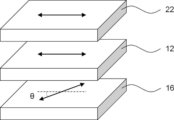
- FIG. FIG. 4 is a diagram showing the relationship between the in-plane slow axis of the negative A plate and the in-plane slow axis of the ⁇ /4 plate in the optical layered body of the present invention. It is an example of the schematic sectional drawing of the circularly-polarizing plate of this invention.
- FIG. 4 is a diagram showing the relationship among the absorption axis of the polarizer, the in-plane slow axis of the negative A-plate, and the in-plane slow axis of the ⁇ /4 plate in the circularly polarizing plate of the present invention.
- 1 is an example of a schematic cross-sectional view of an organic electroluminescence display device of the present invention.
- the numerical range represented by "-" means a range including the numerical values before and after "-" as lower and upper limits.
- the in-plane slow axis and the in-plane fast axis are defined at a wavelength of 550 nm unless otherwise specified. That is, unless otherwise specified, for example, the in-plane slow axis direction means the direction of the in-plane slow axis at a wavelength of 550 nm.
- Re( ⁇ ) and Rth( ⁇ ) represent in-plane retardation and thickness direction retardation at wavelength ⁇ , respectively. Unless otherwise specified, the wavelength ⁇ is 550 nm.
- NAR-4T Abbe refractometer
- DR-M2 multi-wavelength Abbe refractometer
- the values in the polymer handbook (JOHN WILEY & SONS, INC) and various optical film catalogs can be used.
- Average refractive index values of main optical films are exemplified below: cellulose acylate (1.48), cycloolefin polymer (1.52), polycarbonate (1.59), polymethyl methacrylate (1.49), and polystyrene (1.59).
- a plate and C plate are defined as follows. There are two types of A plates, a positive A plate (positive A plate) and a negative A plate (negative A plate). ) is nx, the refractive index in the direction orthogonal to the in-plane slow axis is ny, and the refractive index in the thickness direction is nz, the positive A plate satisfies the relationship of formula (A1). and the negative A plate satisfies the relationship of formula (A2).
- a positive A plate shows a positive Rth value
- a negative A plate shows a negative Rth value.
- C plates There are two types of C plates, a positive C plate (positive C plate) and a negative C plate (negative C plate), the positive C plate satisfies the relationship of formula (C1), and the negative C plate It satisfies the relationship of formula (C2).
- a positive C plate shows a negative Rth value
- a negative C plate shows a positive Rth value.
- Formula (C2) nz ⁇ nx ⁇ ny Note that the above “ ⁇ ” includes not only the case where both are completely the same, but also the case where both are substantially the same. "Substantially the same” means, for example, that (nx - ny) x d (where d is the thickness of the film) is 0 to 10 nm, preferably 0 to 5 nm.
- visible light means light with a wavelength of 400 to 700 nm.
- ultraviolet rays intend light with a wavelength of 10 nm or more and less than 400 nm.
- perpendicular and parallel shall include the range of error that is permissible in the technical field to which the present invention belongs. For example, it means that the angle is within a strict range of ⁇ 20°, and the error from the strict angle is preferably within a range of ⁇ 10°.
- a feature of the optical layered body of the present invention is that predetermined optically anisotropic layers (for example, a negative A plate, a negative C plate, a ⁇ /4 plate, and a positive C plate) are used in combination. More specifically, the optical laminate of the present invention has a negative A plate, a negative C plate, and a ⁇ /4 plate, and the in-plane slow axis of the negative A plate and the absorption axis of the polarizer are The in-plane slow axis of the negative A plate and the in-plane slow axis of the ⁇ /4 plate form an angle of 45 ⁇ 10°.
- a change in color may occur when the display device is obliquely observed at all azimuth angles.
- the change in the orientation relationship as described above is optically compensated, and as a result, the display device is tilted. It is considered that the change in color tone is reduced when observed from all directions in all azimuth angles.
- FIG. 1 shows a schematic cross-sectional view of the optical laminate of the present invention.
- the optical laminate 10 of the present invention has a negative A plate 12, a negative C plate 14, a ⁇ /4 plate 16 and a positive C plate 18 in this order.
- Optical stack 10 may not have positive C-plate 18 .
- the optical laminate preferably has a negative A plate, a negative C plate, a ⁇ /4 plate and a positive C plate in this order.
- FIG. 2 also shows the relationship between the in-plane slow axis of the negative A plate 12 and the in-plane slow axis of the ⁇ /4 plate 16 .
- FIG. 1 shows a schematic cross-sectional view of the optical laminate of the present invention.
- the optical laminate 10 of the present invention has a negative A plate 12, a negative C plate 14, a ⁇ /4 plate 16 and a positive C plate 18 in this order.
- Optical stack 10 may not have positive C-plate 18 .
- the optical laminate preferably has a negative A plate,
- the arrows in the negative A plate 12 and the ⁇ /4 plate 16 indicate the direction of the in-plane slow axis in each layer.
- ⁇ in FIG. 2 represents an angle (°) between the in-plane slow axis of the negative A plate 12 and the in-plane slow axis of the ⁇ /4 plate 16 .
- the negative A plate is an optically anisotropic layer, and is preferably arranged closest to the polarizer in the circularly polarizing plate described later.
- the in-plane retardation of the negative A plate at a wavelength of 550 nm is not particularly limited, but the optical laminate of the present invention and a polarizer are combined to form a circularly polarizing plate in a display device, and the display device is observed obliquely at all azimuth angles.
- the thickness is preferably 60 to 100 nm, more preferably 70 to 90 nm, in that the change in color tone is smaller (hereinafter also simply referred to as "the effect of the present invention is more excellent") when the thickness is reduced.
- the retardation in the thickness direction of the negative A plate at a wavelength of 550 nm is not particularly limited, but it is preferably -50 to -30 nm, more preferably -45 to -35 nm, in view of the superior effects of the present invention.
- the negative A plate exhibits forward wavelength dispersion (characteristic in which in-plane retardation decreases as the measurement wavelength increases), but reverse wavelength dispersion (characteristic in which in-plane retardation increases as the measurement wavelength increases). ) may be shown.
- the forward wavelength dispersion and the reverse wavelength dispersion are preferably exhibited in the visible light range (visible light range).
- Re(450)/Re(550) of the negative A plate is more than 1.00 and 1.20 or less. is preferred, and 1.02 to 1.10 is more preferred.
- Re(650)/Re(550) of the negative A plate is preferably 0.70 or more and less than 1.00, more preferably 0.80 to 0.99.
- the structure of the negative A plate is not particularly limited, and includes a layer formed by fixing a discotic liquid crystal compound in which the vertically aligned optical axis (the axis perpendicular to the disc plane) is aligned in the same direction, and a stretched film. From the point of view that the effects of the present invention are more excellent, a layer formed by fixing a discotic liquid crystal compound that is vertically aligned and whose optical axes (axis orthogonal to the disc plane) are aligned in the same direction is preferable.
- the state in which the discotic liquid crystal compound is vertically aligned means that the discotic surface of the discotic liquid crystal compound is parallel to the thickness direction of the layer.
- the angle formed by the disk surface and the thickness direction of the layer is preferably in the range of 0 ⁇ 20 °, and preferably in the range of 0 ⁇ 10 °. more preferred.
- the state in which the optical axes of the discotic liquid crystal compound (the axis orthogonal to the disc plane) are arranged in the same direction does not strictly require that they be in the same direction.
- the maximum difference in the orientation of the slow axis among the orientations of the slow axis at 20 locations (among the 20 orientations of the slow axis, the difference is the largest difference between two slow axis orientations) is less than 10°.
- the "fixed” state is a state in which the orientation of the liquid crystal compound is maintained.
- the layer does not have fluidity in the temperature range of 0 to 50° C., and -30 to 70° C. under more severe conditions, and the orientation is changed by an external field or force. It is preferable to be in a state in which the fixed alignment form can be stably maintained.
- discotic liquid crystal compound A known compound can be used as the discotic liquid crystal compound.
- discotic liquid crystal compounds include compounds described in paragraphs 0020 to 0067 of JP-A-2007-108732 and paragraphs 0013-0108 of JP-A-2010-244038.
- the discotic liquid crystal compound may have a polymerizable group.
- the type of polymerizable group is not particularly limited, and is preferably a functional group capable of addition polymerization reaction, more preferably a polymerizable ethylenically unsaturated group or a ring polymerizable group, (meth) acryloyl group, vinyl groups, styryl groups or allyl groups are more preferred.
- the negative A plate is preferably a layer formed by fixing a discotic liquid crystal compound having a polymerizable group by polymerization.
- the thickness of the negative A plate is not particularly limited, and is preferably 10 ⁇ m or less, more preferably 0.1 to 5.0 ⁇ m, even more preferably 0.3 to 2.0 ⁇ m.
- the thickness of the negative A plate intends the average thickness of the negative A plate. The average thickness is obtained by measuring the thickness of the negative A plate at five or more arbitrary points and arithmetically averaging them.
- a negative C plate is an optically anisotropic layer, and is arranged on a polarizer via the negative A plate in a circularly polarizing plate to be described later.
- the thickness direction retardation Rth (550) of the negative C plate at a wavelength of 550 nm is not particularly limited, it is preferably 15 to 55 nm, more preferably 25 to 45 nm, from the standpoint that the effects of the present invention are more excellent.
- the negative C plate exhibits forward wavelength dispersion (the retardation in the thickness direction decreases as the measurement wavelength increases), but reverse wavelength dispersion (the retardation in the thickness direction increases as the measurement wavelength increases). characteristics.) may be shown.
- the forward wavelength dispersion and the reverse wavelength dispersion are preferably exhibited in the visible light range (visible light range).
- Rth(450)/Rth(550) of the negative C plate is more than 1.00 and 1.20 or less. preferably 1.02 to 1.10.
- Rth(650)/Rth(550) of the negative C plate is preferably 0.70 or more and less than 1.00, more preferably 0.80 to 0.99.
- the structure of the negative C plate is not particularly limited, and examples thereof include a layer formed by fixing a horizontally aligned discotic liquid crystal compound and a resin film.
- the state in which the discotic liquid crystal compound is horizontally aligned means that the discotic surface of the discotic liquid crystal compound is parallel to the main surface of the layer.
- the angle formed by the disk surface and the main surface of the layer is preferably in the range of 0 ⁇ 20 °, and preferably in the range of 0 ⁇ 10 °. more preferred.
- Discotic liquid crystal compounds include, for example, the discotic liquid crystal compounds exemplified for the negative A plate.
- the discotic liquid crystal compound may have a polymerizable group.
- the types of polymerizable groups that the discotic liquid crystal compound may have are as described above.
- the negative C plate is preferably a layer formed by fixing a horizontally aligned discotic liquid crystal compound having a polymerizable group by polymerization.
- the thickness of the negative C plate is not particularly limited, and is preferably 10 ⁇ m or less, more preferably 0.1 to 5.0 ⁇ m, even more preferably 0.3 to 2.0 ⁇ m.
- the thickness of the negative C plate intends the average thickness of the negative C plate. The average thickness is obtained by measuring the thickness of the negative C plate at five or more arbitrary points and arithmetically averaging them.
- ( ⁇ /4 plate) ⁇ / 4 plate (plate with ⁇ / 4 function) is a plate that has the function of converting linearly polarized light of a specific wavelength into circularly polarized light (or circularly polarized light into linearly polarized light), which will be described later.
- the plate it is arranged on the polarizer via the negative A plate and the negative C plate. More specifically, it is a plate that exhibits an in-plane retardation of ⁇ /4 (or an odd multiple thereof) at a predetermined wavelength ⁇ nm.
- the in-plane retardation Re(550) of the ⁇ /4 plate at a wavelength of 550 nm is preferably 100 to 200 nm, more preferably 120 to 160 nm, and even more preferably 130 to 150 nm, from the viewpoint that the effects of the present invention are more excellent.
- a ⁇ /4 plate exhibits forward wavelength dispersion (in-plane retardation decreases as the measurement wavelength increases), but reverse wavelength dispersion (in-plane retardation increases as the measurement wavelength increases). characteristics.), but it is preferable to exhibit reverse wavelength dispersion from the viewpoint that the effect of the present invention is more excellent.
- the forward wavelength dispersion and the reverse wavelength dispersion are preferably exhibited in the visible light range (visible light range).
- Re (450) / Re (550) of the ⁇ /4 plate is 0.70 or more and less than 1.00 is preferable, and 0.80 to 0.90 is more preferable.
- Re(650)/Re(550) of the ⁇ /4 plate is preferably more than 1.00 and 1.20 or less, more preferably 1.02 to 1.10.
- the structure of the ⁇ /4 plate is not particularly limited, and includes a layer in which a horizontally aligned rod-shaped liquid crystal compound is fixed, and a stretched film. A fixed layer is preferred.
- the state in which the rod-shaped liquid crystal compound is horizontally aligned means that the long axis of the rod-shaped liquid crystal compound is parallel to the main surface of the ⁇ /4 plate.
- the angle formed by the long axis of the rod-shaped liquid crystal compound and the main surface of the ⁇ / 4 plate is preferably in the range of 0 ⁇ 20 °, 0 ⁇ 10 ° is more preferably within the range of
- the reverse wavelength dispersion rod-shaped liquid crystal compound is not particularly limited, for example, the compound represented by the general formula (1) described in JP-A-2010-084032 (particularly described in paragraph numbers [0067] to [0073] compound), the compound represented by the general formula (II) described in JP-A-2016-053709 (especially the compound described in paragraph numbers [0036] to [0043]), JP-A-2016-081035 Compounds represented by the general formula (1) described (in particular, compounds described in paragraph numbers [0043] to [0055]), compounds represented by the general formula (1) described in WO 2019/017444 (In particular, the compounds described in paragraphs [0015] to [0036]), and the compounds represented by the general formula (1) described in WO 2019/017445 (especially paragraphs [0015] to [0034] and the compound described in ).
- the term "rod-shaped liquid crystal compound with reverse wavelength dispersion” refers to a rod-shaped liquid crystal compound that exhibits reverse wavelength dispersion when a ⁇ /4 plate
- the reverse wavelength dispersion rod-like liquid crystal compound may have a polymerizable group.
- the types of polymerizable groups that the reverse wavelength dispersion rod-like liquid crystal compound may have are as described above.
- the ⁇ /4 plate is preferably a layer formed by fixing a reverse wavelength dispersion rod-like liquid crystal compound having a polymerizable group by polymerization.
- the thickness of the ⁇ /4 plate is not particularly limited, and is preferably 10 ⁇ m or less, more preferably 0.1 to 5.0 ⁇ m, even more preferably 0.3 to 3.0 ⁇ m.
- the thickness of the ⁇ /4 plate means the average thickness of the ⁇ /4 plate. The average thickness is obtained by measuring the thickness of the ⁇ /4 plate at five or more arbitrary points and arithmetically averaging them.
- the angle ⁇ between the in-plane slow axis of the negative A plate 12 and the in-plane slow axis of the ⁇ /4 plate 16 is 45 ⁇ 10°. is 35-55°.
- the angle ⁇ is preferably 40 to 50°, more preferably 42 to 48°, in terms of the effect of the present invention being more excellent.
- the angle ⁇ is the angle formed between the in-plane slow axis of the negative A plate 12 and the in-plane slow axis of the ⁇ /4 plate 16 when viewed from the normal direction of the surface of the negative A plate 12. Intend.
- the positive C plate is an optically anisotropic layer, and is arranged on the ⁇ /4 plate on the side opposite to the polarizer side in the circularly polarizing plate described later.
- the thickness direction retardation Rth (550) of the positive C plate at a wavelength of 550 nm is not particularly limited, it is preferably -55 to -25 nm, more preferably -45 to -35 nm, from the standpoint that the effects of the present invention are more excellent.
- the positive C plate exhibits forward wavelength dispersion (the retardation in the thickness direction decreases as the measurement wavelength increases), but reverse wavelength dispersion (the retardation in the thickness direction increases as the measurement wavelength increases). characteristics.) may be shown.
- the forward wavelength dispersion and the reverse wavelength dispersion are preferably exhibited in the visible light range (visible light range).
- Rth(450)/Rth(550) of the positive C plate is more than 1.00 and 1.20 or less. preferably 1.02 to 1.15. Also, Rth(650)/Rth(550) of the positive C plate is preferably 0.70 or more and less than 1.00, more preferably 0.80 to 0.99.
- the configuration of the positive C plate is not particularly limited, and includes a layer formed by fixing a vertically aligned rod-shaped liquid crystal compound and a resin film. A layer formed by bending is preferred.
- the state in which the rod-shaped liquid crystal compound is vertically aligned means that the long axis of the rod-shaped liquid crystal compound is parallel to the thickness direction of the positive C plate.
- the angle formed by the long axis of the rod-like liquid crystal compound and the thickness direction of the positive C plate is preferably in the range of 0 ⁇ 20°, more preferably 0 ⁇ 10°. It is more preferable to be within the range.
- a well-known compound can be used as a rod-like liquid crystal compound.
- a rod-shaped liquid crystal compound for example, a rod-shaped liquid crystal compound exemplified by the ⁇ /4 plate can be used.
- the rod-shaped liquid crystal compound may have a polymerizable group.
- the types of polymerizable groups that the rod-like liquid crystal compound may have are as described above.
- the positive C plate is preferably a layer formed by fixing a vertically aligned rod-shaped liquid crystal compound having a polymerizable group by polymerization.
- the thickness of the positive C plate is not particularly limited, and is preferably 10 ⁇ m or less, more preferably 0.1 to 5.0 ⁇ m, even more preferably 0.3 to 2.0 ⁇ m.
- the thickness of the positive C plate intends the average thickness of the positive C plate. The average thickness is obtained by measuring the thickness of the positive C plate at five or more arbitrary points and arithmetically averaging them.
- the optical laminate may contain layers other than the negative A plate, the negative C plate, the ⁇ /4 plate, and the positive C plate as long as the effects of the present invention are not impaired.
- Other members include, for example, an adhesion layer, an alignment film, and a substrate.
- the optical layered body may have an adhesion layer between each optically anisotropic layer.
- the optical laminate preferably has an adhesion layer between the negative A plate and the negative C plate and between the negative C plate and the ⁇ /4 plate. It is more preferable to have an adhesion layer between the plate and the ⁇ /4 plate.
- the adhesion layer include known pressure-sensitive adhesive layers and adhesive layers.
- An adhesive layer is a layer formed using an adhesive. Examples of adhesives include water-based adhesives, solvent-based adhesives, emulsion-based adhesives, non-solvent-based adhesives, active energy ray-curable adhesives, and heat-curable adhesives.
- Active energy ray-curable adhesives include electron beam-curable adhesives, ultraviolet-curable adhesives, and visible light-curable adhesives, and ultraviolet-curable adhesives are preferred.
- the adhesion layer is preferably a layer formed using an ultraviolet curing adhesive.
- Specific examples of active energy ray-curable adhesives include (meth)acrylate adhesives.
- examples of curable components in (meth)acrylate-based adhesives include (meth)acryloyl group-containing compounds and vinyl group-containing compounds.
- An adhesive layer is a layer formed using an adhesive.
- adhesives examples include rubber-based adhesives, acrylic adhesives, silicone-based adhesives, urethane-based adhesives, vinyl alkyl ether-based adhesives, polyvinyl alcohol-based adhesives, polyvinylpyrrolidone-based adhesives, and polyacrylamide-based adhesives. and cellulose-based adhesives, and acrylic-based adhesives (pressure-sensitive adhesives) are preferred.
- (meth)acrylate in which the alkyl group of the ester moiety is an alkyl group having 20 or less carbon atoms such as methyl, ethyl or butyl, (meth)acrylic acid and hydroxyethyl (meth)
- a copolymer with a (meth)acrylic monomer having a functional group such as acrylate is preferred.
- the maximum value of the refractive index difference is preferably 0.1 or less, more preferably 0.08 or less, still more preferably 0.06 or less, and particularly preferably 0.03 or less.
- the lower limit of the maximum value of the refractive index difference is not particularly limited, and may be 0.
- the maximum value of the refractive index difference is the maximum value given by the absolute value of the refractive index difference of each layer.
- the average refractive index (average of nx, ny, and nz) of each layer at a wavelength of 550 nm is used as the refractive index of each layer.
- the refractive index of each layer may be obtained by using an interference film thickness meter for each single layer.
- an interferometric film thickness meter may be used to obtain a profile related to the thickness of each layer and the refractive index of each layer, and the refractive index of each layer may be determined by fitting with each parameter.
- a microspectroscopic film thickness meter OPTM manufactured by Otsuka Electronics Co., Ltd.
- the maximum value of the difference between the refractive index of each adhesion layer and the refractive index of the layer adjacent to each adhesion layer is the above preferred embodiment. preferable.
- it is more preferable that both the difference between the refractive index of each adhesion layer and the refractive index of the layer adjacent to each adhesion layer are in the preferred embodiment described above. .
- the thickness of the adhesion layer is preferably 0.1 to 50 ⁇ m.
- the thickness of the adhesion layer is more preferably 25 ⁇ m or less, still more preferably 15 ⁇ m or less, and particularly preferably 5 ⁇ m or less, from the viewpoint of thinning.
- the thickness of the adhesion layer is more preferably 5 ⁇ m or more, still more preferably 15 ⁇ m or more, and particularly preferably 25 ⁇ m or more, in order to suppress interference unevenness.
- a high refractive index adhesive or pressure-sensitive adhesive may be used.
- a highly refractive monomer or highly refractive metal fine particles it is also preferable to use a highly refractive monomer or highly refractive metal fine particles. That is, the refractive index of the adhesion layer can be adjusted by using an adhesion layer containing a high refractive index monomer or high refractive metal fine particles.
- the high refractive index monomer preferably has a benzene ring skeleton in its molecule.
- Monofunctional monomers having a benzene ring skeleton in the molecule include, for example, ethoxylated O-phenylphenol (meth)acrylate, O-phenylphenol glycidyl ether (meth)acrylate, paracumylphenoxyethylene glycol (meth)acrylate, 2- methacryloyloxyethyl phthalate, 2-acryloyloxyethyl phthalate, 2-acryloyloxyethyl-2-hydroxyethyl phthalate, 2-acryloyloxypropyl phthalate, phenoxyethyl (meth)acrylate, EO-modified phenol (meth)acrylate, Phenoxydiethylene glycol (meth)acrylate, EO-modified nonylphenol (meth)acrylate, PO-modified nonylphenol (meth)acrylate, phenyl glycidyl ether (meth)acrylate, neopentyl glycol benzoate (meth)
- the components that constitute the inorganic particles include metal oxides, metal nitrides, metal oxynitrides, and simple metals.
- metal atoms contained in the metal oxides, metal nitrides, metal oxynitrides, and elemental metals include titanium atoms, silicon atoms, aluminum atoms, cobalt atoms, and zirconium atoms.
- Specific examples of inorganic particles include inorganic oxide particles such as alumina particles, alumina hydrate particles, silica particles, zirconia particles, and clay minerals (eg, smectite).
- Particles of zirconium oxide are preferred in terms of refractive index.
- a predetermined refractive index can be adjusted by changing the amount of the inorganic particles.
- the average particle diameter of the inorganic particles is not particularly limited, but when zirconium oxide is used as the main component, it is preferably 1 to 120 nm, more preferably 1 to 60 nm, and even more
- the optical laminate may further have an alignment film.
- the alignment film may be arranged between each optically anisotropic layer.
- the optical layered body 10 preferably does not have an alignment film between the optically anisotropic layers.
- the alignment film is formed by rubbing an organic compound (preferably polymer), oblique vapor deposition of an inorganic compound, formation of a layer having microgrooves, or organic compound (eg, ⁇ -tricosane) by the Langmuir-Blodgett method (LB film). acid, dioctadecylmethylammonium chloride, methyl stearate). Furthermore, an alignment film is also known in which an alignment function is produced by application of an electric field, application of a magnetic field, or light irradiation (preferably polarized light). The alignment film is preferably formed by rubbing a polymer. The alignment film also includes a photo-alignment film. The thickness of the alignment film is not particularly limited as long as the alignment function can be exhibited, but is preferably 0.01 to 5.0 ⁇ m, more preferably 0.05 to 2.0 ⁇ m, and further preferably 0.1 to 0.5 ⁇ m. preferable.
- LB film Langmuir-Blodgett method
- the optical laminate may further have a substrate.
- a transparent substrate is preferable as the substrate.
- the transparent substrate means a substrate having a visible light transmittance (average transmittance in the visible light region) of 60% or more, preferably 80% or more, more preferably 90% or more. Although the upper limit is not particularly limited, 99.9% or less is preferable.
- the thickness of the substrate is not particularly limited, but is preferably 10 to 200 ⁇ m, more preferably 10 to 100 ⁇ m, even more preferably 20 to 90 ⁇ m.
- the substrate may consist of a laminate of a plurality of sheets.
- the substrate may be subjected to a surface treatment (eg, glow discharge treatment, corona discharge treatment, ultraviolet (UV) treatment, flame treatment) on the surface of the substrate to improve adhesion with the layer provided thereon.
- a surface treatment eg, glow discharge treatment, corona discharge treatment, ultraviolet (UV) treatment, flame treatment
- an adhesive layer undercoat layer
- the substrate may be a so-called temporary support. For example, after manufacturing an optically anisotropic layer (negative A plate, negative C plate, ⁇ /4 plate, and positive C plate) on a substrate, the substrate is peeled off from the optically anisotropic layer, if necessary. may
- the method for manufacturing the optical layered body is not particularly limited, and known methods can be used. For example, prepare a negative A plate, a negative C plate, a ⁇ / 4 plate, and a positive C plate, and attach them in a predetermined order via an adhesion layer (e.g., adhesive layer or adhesive layer). Thus, an optical laminate can be produced.
- a negative A plate, a negative C plate, a ⁇ /4 plate, and a positive C plate can each be produced using an optically anisotropic layer-forming composition containing a liquid crystal compound having a polymerizable group.
- the method for producing an optical laminate may be a method of directly forming an optically anisotropic layer on an optically anisotropic layer (negative A plate, negative C plate, ⁇ /4 plate, and positive C plate).
- an optically anisotropic layer is formed using a composition for forming an optically anisotropic layer containing a material (e.g., photo-alignment polymer) that imparts alignment controllability to the surface of the optically anisotropic layer, and By coating and forming the composition for forming an optically anisotropic layer on the optically anisotropic layer, an aspect in which the optically anisotropic layer is in direct contact with the optically anisotropic layer can be produced.
- a material e.g., photo-alignment polymer
- the method for producing an optical layered body include a method of attaching using the adhesion layer and a method of using the composition for forming an optically anisotropic layer.
- the optically anisotropic layer A is formed using the composition A for forming an optically anisotropic layer, and the optically anisotropic layer A is formed.
- An optically anisotropic layer C is formed using the optically anisotropic layer-forming composition C, and an optically anisotropic layer is formed on the optically anisotropic layer C using the optically anisotropic layer-forming composition D.
- forming D to obtain a laminate CD having an optically anisotropic layer C and an optically anisotropic layer D;
- a method for producing an optical layered body is preferable, which includes a step of attaching the layered body AB and the layered body CD via an adhesion layer.
- an optically anisotropic layer (e.g., negative A plate, negative C plate, ⁇ /4 plate, and positive C plate) is formed using an optically anisotropic layer-forming composition containing a liquid crystal compound having a polymerizable group. ) will be described in detail.
- the liquid crystal compound having a polymerizable group (hereinafter also referred to as "polymerizable liquid crystal compound”) contained in the composition for forming an optically anisotropic layer is as described above.
- the rod-like liquid crystal compound and the discotic liquid crystal compound are appropriately selected according to the properties of the optically anisotropic layer to be formed.
- the content of the polymerizable liquid crystal compound in the composition for forming an optically anisotropic layer is preferably 60 to 99% by mass, more preferably 70 to 98% by mass, based on the total solid content of the composition for forming an optically anisotropic layer. is more preferred.
- the solid content means a component capable of forming an optically anisotropic layer from which the solvent has been removed.
- composition for forming an optically anisotropic layer may contain compounds other than the liquid crystal compound having a polymerizable group.
- the composition for forming an optically anisotropic layer may contain a polymerization initiator.
- the polymerization initiator to be used is selected according to the type of polymerization reaction, and examples thereof include thermal polymerization initiators and photopolymerization initiators.
- the content of the polymerization initiator in the composition for forming an optically anisotropic layer is preferably 0.01 to 20% by mass, more preferably 0.5 to 20% by mass, based on the total solid content of the composition for forming an optically anisotropic layer. 10% by mass is more preferred.
- compositions for forming an optically anisotropic layer include, in addition to the above, a polyfunctional monomer, a photoacid generator, and an alignment control agent (for example, a vertical alignment agent and a horizontal alignment agent). , surfactants, adhesion improvers, plasticizers, and solvents.
- the coating method of the composition for forming an optically anisotropic layer includes curtain coating, dip coating, spin coating, print coating, spray coating, slot coating, roll coating, slide coating, and blade coating. , gravure coating method, and wire bar method.
- the coating film formed by the coating is subjected to alignment treatment to align the polymerizable liquid crystal compound in the coating film.
- a discotic liquid crystal compound is vertically aligned.
- the discotic liquid crystal compound is horizontally aligned.
- the rod-like liquid crystal compound is horizontally aligned.
- the rod-like liquid crystal compound is vertically aligned.
- the orientation treatment can be performed by drying the coating film at room temperature or by heating the coating film.
- the liquid crystal phase formed by alignment treatment can generally be caused to transition by a change in temperature or pressure.
- the transition can also be achieved by changing the composition ratio such as the amount of solvent.
- the conditions for heating the coating film are not particularly limited, but the heating temperature is preferably 50 to 250°C, more preferably 50 to 150°C.
- the heating time is preferably 10 seconds to 10 minutes.
- the coating film may be cooled, if necessary, before the curing treatment (light irradiation treatment) to be described later.
- the cooling temperature is preferably 20 to 200°C, more preferably 30 to 150°C.
- the coating film in which the polymerizable liquid crystal compound is oriented is subjected to a curing treatment.
- a curing treatment There are no particular limitations on the method of curing treatment performed on the coating film in which the polymerizable liquid crystal compound is oriented, and examples thereof include light irradiation treatment and heat treatment. Among them, light irradiation treatment is preferable, and ultraviolet irradiation treatment is more preferable, in terms of production aptitude.
- the irradiation conditions for the light irradiation treatment are not particularly limited, but an irradiation amount of 50 to 1000 mJ/cm 2 is preferable.
- the atmosphere during the light irradiation treatment is not particularly limited, a nitrogen atmosphere is preferred.
- the above optical layered body can be applied to various uses, and is particularly suitable for antireflection purposes. More specifically, it can be suitably applied to antireflection applications of display devices such as organic electroluminescence (organic EL) display devices.
- display devices such as organic electroluminescence (organic EL) display devices.
- FIG. 3 shows a cross-sectional view of the circularly polarizing plate of the present invention.
- the circularly polarizing plate 20 has a polarizer 22, a negative A plate 12, a negative C plate 14, a ⁇ /4 plate 16, and a positive C plate 18 in this order.
- Circular polarizer 20 may not have positive C plate 18 .
- FIG. 4 shows the relationship between the absorption axis of the polarizer 22, the in-plane slow axis of the negative A plate 12, and the in-plane slow axis of the ⁇ /4 plate 16.
- the arrow in the polarizer 22 indicates the direction of the absorption axis
- the arrow in the negative A plate 12 and the ⁇ /4 plate 16 indicates the direction of the in-plane slow axis in each layer.
- ⁇ in FIG. 4 represents the angle (°) formed between the in-plane slow axis of the negative A plate 12 (or the absorption axis of the polarizer 22) and the in-plane slow axis of the ⁇ /4 plate 16.
- Each member included in the circularly polarizing plate 20 will be described in detail below. First, the aspects of the negative A plate 12, the negative C plate 14, the ⁇ /4 plate 16, and the positive C plate 18 that the circularly polarizing plate 20 has are as described above.
- the polarizer may be any member that has a function of converting natural light into specific linearly polarized light, and examples thereof include absorption polarizers.
- the type of polarizer is not particularly limited, and commonly used polarizers can be used. Examples thereof include iodine-based polarizers, dye-based polarizers using dichroic dyes, and polyene-based polarizers. Iodine-based polarizers and dye-based polarizers are generally produced by allowing polyvinyl alcohol to adsorb iodine or a dichroic dye and stretching the resultant.
- a protective film may be arranged on one side or both sides of the polarizer.
- a liquid crystal compound and a dichroic organic dye e.g., WO2017/195833
- a coated polarizer prepared by coating using a dichroic azo dye used in a light-absorbing anisotropic film described in JP-A-2004-231012 may also be used. That is, the polarizer may be a polarizer formed using a composition containing a polymerizable liquid crystal compound. This coated polarizer is a technique for orienting a dichroic organic dye by utilizing the orientation of a liquid crystal compound.
- a polarizer in which a dichroic organic dye is oriented by utilizing the orientation of liquid crystal without stretching has the following characteristics. It can be made very thin with a thickness of about 0.1 to 5 ⁇ m, and as described in JP-A-2019-194685, it is difficult for cracks to occur when bent and thermal deformation is small. It has many advantages such as excellent durability even with a polarizer having a high transmittance exceeding 50% as described in . By taking advantage of these advantages, it can be used for applications requiring high brightness, small size and light weight, applications for fine optical systems, applications for molding parts having curved surfaces, and applications for flexible parts. It is also possible to transfer the polarizer after peeling off the support.
- the transmittance of the polarizer is preferably 40% or more, more preferably 44% or more, and even more preferably 50% or more, in terms of power saving.
- the luminous efficiency correction single transmittance of the polarizer is measured using an automatic polarizing film measuring device: VAP-7070 (manufactured by JASCO Corporation).
- the visibility correction single transmittance can be measured as follows. A sample (5 cm ⁇ 5 cm) is prepared by pasting a polarizer onto glass via an adhesive. At this time, the polarizer protective film is attached to the polarizer so as to face the opposite side (air interface) to the glass. Set the glass side of the sample toward the light source and measure.
- the absorption axis of the polarizer 22 and the in-plane slow axis of the negative A plate 12 are parallel.
- the definition of parallel is as described above, in other words, the angle between the absorption axis of the polarizer 22 and the in-plane slow axis of the negative A plate 12 is -20 to 20°.
- the angle formed by the absorption axis of the polarizer 22 and the in-plane slow axis of the negative A plate 12 is more preferably ⁇ 5 to 5°, more preferably ⁇ 3 to 3°, from the viewpoint that the effect of the present invention is more excellent. More preferred.
- the above angle is intended to be the angle formed between the absorption axis of the polarizer 22 and the in-plane slow axis of the negative A plate 12 when viewed from the normal direction of the surface of the polarizer 22 .
- the angle ⁇ between the absorption axis of the polarizer 22 and the in-plane slow axis of the ⁇ /4 plate 16 is 45 ⁇ 10°. That is, the angle ⁇ between the absorption axis of the polarizer 22 and the in-plane slow axis of the ⁇ /4 plate 16 is 35 to 55°. Among them, the angle ⁇ between the absorption axis of the polarizer 22 and the in-plane slow axis of the ⁇ /4 plate 16 is more preferably 40 to 50°, more preferably 42 to 48°, from the viewpoint that the effect of the present invention is more excellent. is more preferred.
- the above angle ⁇ is intended to be the angle formed between the absorption axis of the polarizer 22 and the in-plane slow axis of the ⁇ /4 plate 16 when viewed from the normal direction of the surface of the polarizer 22 .
- the circularly polarizing plate may have members other than the optical layered body and the polarizer.
- the circularly polarizing plate may have an adhesion layer between the optical laminate and the polarizer. Examples of the adhesion layer include known pressure-sensitive adhesive layers and adhesive layers.
- the circular polarizer is between the circular polarizer and the negative A plate, between the negative A plate and the negative C plate, and between the negative C plate and the ⁇ /4 plate, at least one of It is preferable to have an adhesion layer between the circular polarizer and the negative A plate and between the negative C plate and the ⁇ /4 plate.
- the difference between the refractive index of the adhesion layer and the maximum refractive index of the layers adjacent to the adhesion layer is preferably 0.1 or less, more preferably 0.08 or less, still more preferably 0.06 or less, and particularly preferably 0.03 or less.
- the lower limit of the refractive index difference is not particularly limited, and may be 0.
- the difference in refractive index can be calculated by the same method as for the difference in refractive index in the optical layered body described above.
- the maximum value of the difference between the refractive index of each adhesion layer and the refractive index of the layer adjacent to each adhesion layer is the above preferred embodiment. preferable.
- both the difference between the refractive index of each adhesion layer and the refractive index of the layer adjacent to each adhesion layer are in the preferred embodiment described above. .
- the method for manufacturing the circularly polarizing plate is not particularly limited, and includes known methods. For example, there is a method of bonding a polarizer and an optical layered body via an adhesion layer.
- the organic electroluminescence display device of the present invention has the circularly polarizing plate described above.
- a circularly polarizing plate is usually provided on an organic electroluminescence display panel of an organic electroluminescence display device. That is, the organic electroluminescence display device of the present invention has an organic electroluminescence display panel and the circularly polarizing plate described above.
- An example of an organic electroluminescence display device has an organic electroluminescence display panel and a circularly polarizing plate (optical laminate and polarizer) in this order (see FIG. 5). More specifically, the organic electroluminescence display device 24 (organic EL display device 24) shown in FIG. Circularly polarizing plate 20 is the same as that shown in FIG.
- the organic EL display device 24 has an organic EL display panel 26, a positive C plate 18, a ⁇ /4 plate 16, a negative C plate 14, a negative A plate 12, and a polarizer 22 in this order.
- An organic electroluminescence display panel is a member in which a light-emitting layer or a plurality of organic compound thin films including a light-emitting layer are formed between a pair of electrodes of an anode and a cathode.
- an electron injection layer, an electron transport layer, and/or a protective layer, and each of these layers may have other functions.
- Various materials can be used to form each layer.
- the circularly polarizing plate described above can also be used in various display devices having curved surfaces. For example, it can be used for a rollable display, an in-vehicle display, a lens for sunglasses, a lens for goggles for an image display device, and the like, which have a curved surface.
- INDUSTRIAL APPLICABILITY The circularly polarizing plate of the present invention can be laminated on a curved surface or integrally molded with a resin, thereby contributing to improvement in design.
- a display device using the circularly polarizing plate of the present invention has a small color change when observed in all azimuth angles from an oblique direction, so a curved display or an in-vehicle display It is preferably used for In-vehicle display optical systems such as head-up displays, optical systems such as AR glasses and VR glasses, and optical sensors such as LiDAR (Light Detection and Ranging), face authentication systems, and polarization imaging are also preferable. Moreover, it is preferable that the circularly polarizing plate of the present invention is arranged along a curved surface for use in a display device having a curved surface.
- Example 1> (Preparation of negative C plate) -Preparation of cellulose acylate film-
- the following composition was put into a mixing tank, stirred, and heated at 90° C. for 10 minutes. Thereafter, the resulting composition was filtered through a filter paper with an average pore size of 34 ⁇ m and a sintered metal filter with an average pore size of 10 ⁇ m to prepare a dope.
- Cellulose acylate dope Cellulose acylate (acetyl substitution degree 2.86, viscosity average polymerization degree 310) 100 parts by mass sugar ester compound 1 (represented by formula (S4) below) 6.0 parts by mass sugar ester compound 2 (represented by formula (S5) below) 2.0 parts by mass silica particle dispersion (AEROSIL R972, Nippon Aerosil ( Co., Ltd.) 0.1 part by mass solvent (methylene chloride/methanol/butanol) ⁇
- the dope prepared above was cast using a drum film-forming machine.
- the dope was cast from a die in contact with a metal support cooled to 0° C., after which the resulting web (film) was stripped off.
- the drum was made of SUS.
- the web (film) obtained by casting is peeled off from the drum, and dried for 20 minutes in a tenter device using a tenter device in which both ends of the web are clipped and conveyed at 30 to 40 ° C. during film transportation. bottom. Subsequently, the web was post-dried by zone heating while being rolled. The resulting web was knurled and wound up.
- the resulting cellulose acylate film had a thickness of 40 ⁇ m, an in-plane retardation of 1 nm at a wavelength of 550 nm, and a retardation of 26 nm in the thickness direction at a wavelength of 550 nm.
- a composition 2 containing a discotic liquid crystal compound having the following composition was applied using a Giesser coater to form a composition layer. After that, both ends of the film were held, and a cooling plate (9°C) was placed on the side of the film on which the coating film was formed so that the distance from the film was 5 mm, and the coating film of the film was formed. A heater (110° C.) was installed on the side opposite to the surface so that the distance from the film was 5 mm, and dried for 90 seconds. Next, the obtained film was heated with warm air at 116° C.
- the obtained coating film was annealed with hot air at 1150° C. for 25 seconds to form a negative C plate.
- the resulting negative C plate was irradiated with UV light (ultra-high pressure mercury lamp; UL750; manufactured by HOYA) at room temperature through a wire grid polarizer at 7.9 mJ/cm 2 (wavelength: 313 nm), thereby irradiating the surface with A composition layer having alignment controllability was formed.
- the film thickness of the formed negative C plate was 1.0 ⁇ m.
- the in-plane retardation Re at a wavelength of 550 nm was 0 nm, and the thickness direction retardation Rth at a wavelength of 550 nm was 35 nm.
- the average inclination angle of the discotic surface of the discotic liquid crystal compound with respect to the film surface was 0°, and it was confirmed that the compound was oriented horizontally with respect to the film surface.
- composition 2 ⁇ Discotic liquid crystal compound 1 below 8 parts by mass Discotic liquid crystal compound 2 below 2 parts by mass Discotic liquid crystal compound 3 below 95.6 parts by mass Polymerizable monomer 1 below 14.0 parts by mass Polymerization initiator S- below 1 (oxime type) 3.0 parts by mass Photoacid generator D-1 3.0 parts by mass below Photo-alignable polymer A-1 below 1.0 parts by mass Triisopropylamine 0.2 parts by mass o-xylene 634 Mass ⁇
- Photo-alignable polymer A-1 (the alphabet described in each repeating unit represents the content (% by mass) of each repeating unit with respect to all repeating units, 37% by mass, 37% by mass, 26% by mass from the left repeating unit % by mass, and the weight-average molecular weight was 73,000.)
- composition 1 containing a rod-like liquid crystal compound having the following composition was applied using a Giesser coating machine, and heated with hot air at 95° C. for 120 seconds. Subsequently, the resulting composition layer was irradiated with UV (100 mJ/cm 2 ) at 95° C. to fix the orientation of the liquid crystal compound, thereby forming a negative A plate.
- the negative A plate had a thickness of 0.78 ⁇ m and Re(550) of 80 nm at a wavelength of 550 nm. Assuming that the width direction of the film was 0° (the longitudinal direction was 90°), the in-plane slow axis direction (orientation axis angle of the liquid crystal compound) was 90°.
- composition 1 ⁇ Discotic liquid crystal compound 1 above 80 parts by mass Discotic liquid crystal compound 2 above 20 parts by mass Alignment film interface alignment agent 1 below 1.8 parts by mass Polymerizable monomer 1 above 10.0 parts by mass Polymerization initiator S above -1 (oxime type) 5.0 parts by mass Fluorine-containing compound A below 0.1 parts by mass Fluorine-containing compound B below 0.2 parts by mass Fluorine-containing compound C below 0.1 parts by mass Defoaming agent 1 below 2.1 parts by mass methyl ethyl ketone 419 parts by mass ⁇
- Alignment film interface alignment agent 1 Alignment film interface alignment agent 1
- a laminate 1 was produced in which a negative C plate and a negative A plate were directly laminated on a long cellulose acylate film.
- composition 4 containing a rod-like liquid crystal compound having the following composition was applied onto the cellulose acylate film prepared above using a Giesser coater to form a composition layer. After that, both ends of the film were held, and a cooling plate (9°C) was placed on the side of the film on which the coating film was formed so that the distance from the film was 5 mm, and the coating film of the film was formed. A heater (75° C.) was installed on the side opposite to the surface so that the distance from the film was 5 mm, and dried for 2 minutes. Next, the obtained film was heated with warm air at 60° C.
- the obtained coating film was annealed with hot air at 120° C. for 1 minute to form a positive C plate.
- the resulting positive C plate was irradiated with UV light (ultra-high pressure mercury lamp; UL750; manufactured by HOYA) at room temperature through a wire grid polarizer at 7.9 mJ/cm 2 (wavelength: 313 nm), thereby irradiating the surface with A composition layer having alignment controllability was formed.
- the film thickness of the formed positive C plate was 0.35 ⁇ m.
- the in-plane retardation Re(550) at a wavelength of 550 nm was 0 nm
- the thickness direction retardation Rth(550) at a wavelength of 550 nm was -40 nm.
- the average tilt angle of the long axis direction of the rod-like liquid crystal compound with respect to the film surface was 90°, and it was confirmed that the compound was oriented perpendicular to the film surface.
- composition 4 The following rod-shaped liquid crystal compound (A) 100 parts by mass Polymerizable monomer (A-400, manufactured by Shin-Nakamura Chemical Co., Ltd.) 4.2 parts by mass The above polymerization initiator S-1 (oxime type) 5.1 parts by mass Above Photoacid generator D-1 3.0 parts by mass Polymer M-1 below 5.1 parts by mass Vertical alignment agent S01 below 1.9 parts by mass Photo-alignment polymer A-1 above 0.8 parts by mass Methyl Isobutyl ketone 567.0 parts by mass ⁇
- Rod-shaped liquid crystal compound (A) (hereinafter referred to as a mixture of compounds. Numerical values represent mass ratios.)
- composition 3 containing a rod-shaped liquid crystal compound having the following composition was applied, heated to 120°C with hot air, and then heated to 60°C.
- the orientation was stabilized by cooling. After that, under a nitrogen atmosphere (oxygen concentration of less than 100 ppm) using an ultra-high pressure mercury lamp, the film temperature was kept at 60°C.
- the orientation was fixed by UV irradiation (300 mJ/cm 2 ) to form a ⁇ /4 plate.
- the ⁇ /4 plate had a thickness of 2.8 ⁇ m, an in-plane retardation Re(550) of 141 nm at a wavelength of 550 nm, and a thickness direction retardation Rth(550) of 70.5 nm at a wavelength of 550 nm. Assuming that the width direction of the film is 0° (the longitudinal direction is 90°), the in-plane slow axis direction (orientation axis angle of the liquid crystal compound) was 45°.
- a laminate 2 was produced in which a positive C plate and a ⁇ /4 plate were directly laminated on a long cellulose acylate film.
- a rolled polyvinyl alcohol (PVA) film with a thickness of 60 ⁇ m was continuously stretched in the iodine aqueous solution in the longitudinal direction and dried to obtain a polarizer with a thickness of 13 ⁇ m.
- the luminous efficiency correction single transmittance of the polarizer was 43%. At this time, the absorption axis direction and the longitudinal direction of the polarizer coincided.
- the polarizer protective film was attached to one surface of the polarizer using the following PVA adhesive to prepare a linearly polarizing plate.
- PVA adhesive 100 parts by mass of a polyvinyl alcohol-based resin having an acetoacetyl group (average degree of polymerization: 1200, degree of saponification: 98.5 mol%, degree of acetoacetylation: 5 mol%) and 20 parts by mass of methylol melamine were heated at 30°C.
- a PVA adhesive was prepared as an aqueous solution adjusted to a solid content concentration of 3.7% by mass by dissolving in pure water under the temperature condition of .
- the cellulose acylate film on the positive C plate side of the laminate 2 was peeled off to expose the surface of the positive C plate that was in contact with the cellulose acylate film, thereby obtaining a circularly polarizing plate 1 .
- Example 1 Comparative Example 1> (Preparation of negative A plate), (preparation of negative C plate), and (preparation of positive C plate) were performed according to the same procedure as in Example 1, except that the thicknesses were changed as shown in Table 1 below. Each circularly polarizing plate was produced. In the circularly polarizing plates of Examples 1 to 9, the difference between the refractive index of each adhesion layer selected from a plurality of adhesion layers and the refractive index of the layer adjacent to each selected adhesion layer was All were 0.08 or less.
- the produced organic EL display device was observed at all azimuth angles from an oblique direction (a direction tilted from the normal direction of the display device). That is, the reflectance and reflected color of the organic EL display device were evaluated under bright light. Specifically, the reflected light was observed when a fluorescent lamp was projected from a polar angle of 45 degrees in black display where external light reflected light is most visually recognizable. More specifically, the reflected light in the viewing angle direction (polar angle 45 degrees, azimuth angle 0 to 165 degrees in increments of 15 degrees) was measured with a spectroradiometer SR-3 (manufactured by Topcon Corporation). Evaluation was made according to the following criteria based on the organic EL display device.
- the reflected color change was defined by the following formula as the magnitude of change ⁇ a * b * in color a * and b * of reflected light at all measurement angles.
- a spectroradiometer SR-3 manufactured by Topcon Corporation was used as a measuring device.
- maximum a * and “maximum b *” mean the maximum values of a * and b * obtained by measurement, respectively.
- minimum a * and “minimum b *” mean the minimum a * and b * values obtained by measurement, respectively.
- the organic EL display device using the circularly polarizing plate or the optical laminate of the present invention produced desired effects.
- a comparison of Examples 1, 2 and 6 confirmed that the effect is more excellent when Re(550) of the negative A plate is 70 to 90 nm.
- a comparison of Examples 1, 3 and 7 confirmed that the effect is more excellent when the Rth(550) of the negative C plate is 25 to 45 nm.
- Examples 1, 4 and 8 it was confirmed that when the Rth(550) of the positive C plate is -45 to -35 nm, the effect is more excellent.
- the desired effect was not obtained in Comparative Example 1 in which the negative A plate and the negative C plate were not provided.
- Example 10> In the same manner as in Example 1, a laminate 1 was obtained by laminating a negative C plate and a negative A plate on a cellulose acylate film in this order, and a positive C plate and a ⁇ /4 plate were laminated in this order on a cellulose acylate film. A laminated body 2 was obtained. Next, as a polarizing film, a polarizer using a dichroic organic dye and a polymerizable liquid crystal was prepared by the following procedure. A coating solution PA1 for forming an orientation layer, which will be described later, was continuously applied on a cellulose triacetate film TJ40 (manufactured by Fujifilm, thickness 40 ⁇ m) with a wire bar.
- TJ40 manufactured by Fujifilm, thickness 40 ⁇ m
- the support on which the coating film was formed was dried with hot air at 140° C. for 120 seconds, and then the coating film was irradiated with polarized ultraviolet rays (10 mJ/cm 2 , using an ultra-high pressure mercury lamp) to form a photo-alignment layer.
- PA1 was formed to obtain a TAC film with a photo-alignment layer PA1.
- the film thickness of the photo-alignment layer PA1 was 0.3 ⁇ m.
- Polymer PA-1 (weight average molecular weight: 35000)
- the following composition P2 for forming a light absorption anisotropic layer was continuously applied with a wire bar to form a coating film P2.
- the coating film P2 was heated at 140° C. for 30 seconds, and then the coating film P2 was cooled to room temperature (23° C.).
- the obtained coating film P2 was heated at 90° C. for 60 seconds and cooled again to room temperature.
- an LED (light emitting diode) lamp (center wavelength: 365 nm) was used to irradiate for 2 seconds under an irradiation condition of an illuminance of 200 mW/cm 2 to form a light absorption anisotropic layer P2 on the photo-alignment layer PA1.
- the molar content of radically polymerizable groups is 1.17 mmol/g.
- the film thickness of the light absorption anisotropic layer P2 was 1.0 ⁇ m.
- the following polymer liquid crystal compound P- 1 2.21 parts by mass Low-molecular-weight liquid crystalline compound M-1 1.36 parts by mass Polymerization initiator IRGACUREOXE-02 (manufactured by BASF) 0.150 parts by mass Surfactant F-1 below 0.026 parts by mass Parts Cyclopentanone 46.00 parts by mass Tetrahydrofuran 46.00 parts by mass Benzyl alcohol 3.00 parts by mass ⁇ ⁇
- the following cured layer forming composition K1 was continuously applied with a wire bar to form a coating film.
- the coating film was dried at room temperature and then irradiated with a high-pressure mercury lamp at an illuminance of 28 mW/cm 2 for 15 seconds to form a cured layer K1 on the light absorption anisotropic layer P2.
- the film thickness of the hardened layer K1 was 0.05 ⁇ m.
- composition K1 2.61 parts by mass of the rod-like liquid crystal compound (A) above 0.11 parts by mass of the modified trimethylolpropane triacrylate below 0.05 parts by mass of the photopolymerization initiator I-1 below 0.05 parts by mass of the surfactant F-3 below 21 parts by mass Methyl isobutyl ketone 297 parts by mass ⁇
- the following composition B2 for forming an oxygen barrier layer was continuously applied with a wire bar. After that, by drying with hot air at 100° C. for 2 minutes, an oxygen blocking layer B2 having a thickness of 1.0 ⁇ m was formed on the cured layer K1 to produce a polarizer including the light absorption anisotropic layer P2.
- the luminous efficiency correction single transmittance of the polarizer was 44%.
- Oxygen barrier layer-forming composition B2 ⁇ ⁇ 3.80 parts by mass of the following modified polyvinyl alcohol ⁇ 0.20 parts by mass of initiator Irg2959 (Irgacure 2959) ⁇ 70 parts by mass of water ⁇ 30 parts by mass of methanol ⁇ ⁇
- the oxygen blocking layer B2 side of the polarizer and the polarizer protective film were attached using an adhesive sheet. After that, only the TJ40 of the polarizer was peeled off, and the peeled surface and the surface of the negative A plate of the laminate 1 were continuously bonded together using an ultraviolet curable adhesive. Subsequently, the cellulose acylate film on the negative C plate side was peeled off to expose the surface of the negative C plate that was in contact with the cellulose acylate film. Subsequently, the exposed surface of the negative C plate and the surface of the ⁇ /4 plate of the laminate 2 were continuously bonded together using an ultraviolet curable adhesive.
- the cellulose acylate film on the positive C plate side was peeled off to expose the surface of the positive C plate that was in contact with the cellulose acylate film, thereby producing a circularly polarizing plate 2 .
- the difference between the refractive index of each adhesion layer selected from a plurality of adhesion layers and the refractive index of the layer adjacent to each selected adhesion layer is 0. 0.08 or less.
- Circularly polarizing plate 3 was produced by replacing the ultraviolet curable adhesive used in Example 1 and using the following adhesive A.
- the adhesive A had a refractive index controlled to 1.54, and an adhesive layer having a thickness of 15 ⁇ m was formed.
- the difference between the refractive index of each adhesion layer selected from a plurality of adhesion layers and the refractive index of the layer adjacent to each selected adhesion layer is 0. 0.08 or less.
- a circularly polarizing plate 4 was produced by replacing the ultraviolet curable adhesive used in Example 1 with the adhesive B described below.
- the adhesive B contains UV-2 described in International Publication WO2021/006097 as an ultraviolet absorber, has a refractive index controlled to 1.54, and forms an adhesive layer having a thickness of 25 ⁇ m.
- the difference between the refractive index of each adhesion layer selected from a plurality of adhesion layers and the refractive index of the layer adjacent to each selected adhesion layer is 0. 0.08 or less.
- the transmittance of the circularly polarizing plate 4 at a wavelength of 380 nm was 1% or less. The transmittance was measured with a UV-3150 spectrophotometer manufactured by Shimadzu Corporation.
Landscapes
- Physics & Mathematics (AREA)
- General Physics & Mathematics (AREA)
- Engineering & Computer Science (AREA)
- Theoretical Computer Science (AREA)
- Optics & Photonics (AREA)
- Polarising Elements (AREA)
Priority Applications (1)
| Application Number | Priority Date | Filing Date | Title |
|---|---|---|---|
| JP2023558090A JPWO2023080232A1 (https=) | 2021-11-08 | 2022-11-07 |
Applications Claiming Priority (2)
| Application Number | Priority Date | Filing Date | Title |
|---|---|---|---|
| JP2021-182052 | 2021-11-08 | ||
| JP2021182052 | 2021-11-08 |
Publications (1)
| Publication Number | Publication Date |
|---|---|
| WO2023080232A1 true WO2023080232A1 (ja) | 2023-05-11 |
Family
ID=86241603
Family Applications (1)
| Application Number | Title | Priority Date | Filing Date |
|---|---|---|---|
| PCT/JP2022/041347 Ceased WO2023080232A1 (ja) | 2021-11-08 | 2022-11-07 | 円偏光板、光学積層体、有機エレクトロルミネッセンス表示装置、表示装置 |
Country Status (2)
| Country | Link |
|---|---|
| JP (1) | JPWO2023080232A1 (https=) |
| WO (1) | WO2023080232A1 (https=) |
Cited By (1)
| Publication number | Priority date | Publication date | Assignee | Title |
|---|---|---|---|---|
| WO2025239209A1 (ja) * | 2024-05-14 | 2025-11-20 | 富士フイルム株式会社 | 円偏光板、有機エレクトロルミネッセンス表示装置 |
Citations (4)
| Publication number | Priority date | Publication date | Assignee | Title |
|---|---|---|---|---|
| WO2016052360A1 (ja) * | 2014-09-30 | 2016-04-07 | 富士フイルム株式会社 | 円偏光板、表示装置 |
| JP2018017996A (ja) * | 2016-07-29 | 2018-02-01 | 日東電工株式会社 | 位相差層付偏光板および有機el表示装置 |
| WO2018079854A1 (ja) * | 2016-10-31 | 2018-05-03 | 富士フイルム株式会社 | 光学フィルムおよび液晶表示装置 |
| JP2021516789A (ja) * | 2018-04-17 | 2021-07-08 | エルジー・ケム・リミテッド | 楕円偏光板および有機発光装置 |
-
2022
- 2022-11-07 WO PCT/JP2022/041347 patent/WO2023080232A1/ja not_active Ceased
- 2022-11-07 JP JP2023558090A patent/JPWO2023080232A1/ja active Pending
Patent Citations (4)
| Publication number | Priority date | Publication date | Assignee | Title |
|---|---|---|---|---|
| WO2016052360A1 (ja) * | 2014-09-30 | 2016-04-07 | 富士フイルム株式会社 | 円偏光板、表示装置 |
| JP2018017996A (ja) * | 2016-07-29 | 2018-02-01 | 日東電工株式会社 | 位相差層付偏光板および有機el表示装置 |
| WO2018079854A1 (ja) * | 2016-10-31 | 2018-05-03 | 富士フイルム株式会社 | 光学フィルムおよび液晶表示装置 |
| JP2021516789A (ja) * | 2018-04-17 | 2021-07-08 | エルジー・ケム・リミテッド | 楕円偏光板および有機発光装置 |
Cited By (1)
| Publication number | Priority date | Publication date | Assignee | Title |
|---|---|---|---|---|
| WO2025239209A1 (ja) * | 2024-05-14 | 2025-11-20 | 富士フイルム株式会社 | 円偏光板、有機エレクトロルミネッセンス表示装置 |
Also Published As
| Publication number | Publication date |
|---|---|
| JPWO2023080232A1 (https=) | 2023-05-11 |
Similar Documents
| Publication | Publication Date | Title |
|---|---|---|
| CN110709740B (zh) | 带相位差层的偏振片及图像显示装置 | |
| CN100487497C (zh) | 光扩散片、光学元件和图像显示装置 | |
| WO2003079059A1 (fr) | Pellicule antireflet et procede de fabrication associe, dispositif optique, affichage d'image | |
| KR20070087003A (ko) | 반사 방지 하드코트 필름, 광학 소자 및 화상 표시 장치 | |
| WO2003085424A1 (en) | Light-diffusing sheet, optical device, and image display | |
| WO2003100477A1 (fr) | Feuille diffusant la lumiere, element optique et unite d'affichage d'image | |
| US11947142B2 (en) | Optical film, circularly polarizing plate, and organic electroluminescent display device class | |
| CN100395283C (zh) | 导电纤维素基薄膜 | |
| US20230176269A1 (en) | Laminated film, circularly polarizing plate, and display device | |
| US11550088B2 (en) | Phase difference film, circularly polarizing plate, and display device | |
| US20240310562A1 (en) | Circularly polarizing plate, optical laminate, organic electroluminescent display device, and display device | |
| WO2023080232A1 (ja) | 円偏光板、光学積層体、有機エレクトロルミネッセンス表示装置、表示装置 | |
| US20250147210A1 (en) | Light absorption anisotropic film, manufacturing method of light absorption anisotropic film, laminate, and image display device | |
| US20250147211A1 (en) | Laminate, manufacturing method of laminate, and virtual reality display apparatus | |
| JP2022184691A (ja) | 位相差フィルム、円偏光板、表示装置 | |
| US12461295B2 (en) | Circularly polarizing plate, organic electroluminescent display device, and display device | |
| US20230194763A1 (en) | Optical film, circularly polarizing plate, and organic electroluminescent display device | |
| WO2022044500A1 (ja) | 偏光板、位相差層付偏光板および画像表示装置 | |
| US12032189B2 (en) | Phase difference film, circularly polarizing plate, and display device | |
| US20260126577A1 (en) | Polarizing plate and display device | |
| WO2025142815A1 (ja) | 積層体、複合レンズ、表示装置、仮想現実表示装置 | |
| JP2023124574A (ja) | 位相差板、仮支持体付き位相差板、円偏光板、表示装置 | |
| JP2025113364A (ja) | 粘着剤層付き偏光板、表示装置 | |
| CN121889705A (zh) | 光学层叠体的制造方法、偏振片的制造方法、光学层叠体、偏振片、有机电致发光显示装置 | |
| WO2025004793A1 (ja) | 偏光板、表示装置 |
Legal Events
| Date | Code | Title | Description |
|---|---|---|---|
| 121 | Ep: the epo has been informed by wipo that ep was designated in this application |
Ref document number: 22890052 Country of ref document: EP Kind code of ref document: A1 |
|
| ENP | Entry into the national phase |
Ref document number: 2023558090 Country of ref document: JP Kind code of ref document: A |
|
| 122 | Ep: pct application non-entry in european phase |
Ref document number: 22890052 Country of ref document: EP Kind code of ref document: A1 |