WO2023080132A1 - アラルキル樹脂、エポキシ樹脂の希釈剤、硬化性樹脂組成物、感光性樹脂組成物、硬化物、電子デバイス、アラルキル樹脂の製造方法 - Google Patents
アラルキル樹脂、エポキシ樹脂の希釈剤、硬化性樹脂組成物、感光性樹脂組成物、硬化物、電子デバイス、アラルキル樹脂の製造方法 Download PDFInfo
- Publication number
- WO2023080132A1 WO2023080132A1 PCT/JP2022/040860 JP2022040860W WO2023080132A1 WO 2023080132 A1 WO2023080132 A1 WO 2023080132A1 JP 2022040860 W JP2022040860 W JP 2022040860W WO 2023080132 A1 WO2023080132 A1 WO 2023080132A1
- Authority
- WO
- WIPO (PCT)
- Prior art keywords
- integer
- general formula
- aralkyl resin
- atom
- resin
- Prior art date
- Legal status (The legal status is an assumption and is not a legal conclusion. Google has not performed a legal analysis and makes no representation as to the accuracy of the status listed.)
- Ceased
Links
Classifications
-
- C—CHEMISTRY; METALLURGY
- C08—ORGANIC MACROMOLECULAR COMPOUNDS; THEIR PREPARATION OR CHEMICAL WORKING-UP; COMPOSITIONS BASED THEREON
- C08G—MACROMOLECULAR COMPOUNDS OBTAINED OTHERWISE THAN BY REACTIONS ONLY INVOLVING UNSATURATED CARBON-TO-CARBON BONDS
- C08G10/00—Condensation polymers of aldehydes or ketones with aromatic hydrocarbons or halogenated aromatic hydrocarbons only
- C08G10/02—Condensation polymers of aldehydes or ketones with aromatic hydrocarbons or halogenated aromatic hydrocarbons only of aldehydes
-
- C—CHEMISTRY; METALLURGY
- C08—ORGANIC MACROMOLECULAR COMPOUNDS; THEIR PREPARATION OR CHEMICAL WORKING-UP; COMPOSITIONS BASED THEREON
- C08L—COMPOSITIONS OF MACROMOLECULAR COMPOUNDS
- C08L61/00—Compositions of condensation polymers of aldehydes or ketones; Compositions of derivatives of such polymers
- C08L61/18—Condensation polymers of aldehydes or ketones with aromatic hydrocarbons or their halogen derivatives only
-
- C—CHEMISTRY; METALLURGY
- C08—ORGANIC MACROMOLECULAR COMPOUNDS; THEIR PREPARATION OR CHEMICAL WORKING-UP; COMPOSITIONS BASED THEREON
- C08L—COMPOSITIONS OF MACROMOLECULAR COMPOUNDS
- C08L63/00—Compositions of epoxy resins; Compositions of derivatives of epoxy resins
-
- G—PHYSICS
- G03—PHOTOGRAPHY; CINEMATOGRAPHY; ANALOGOUS TECHNIQUES USING WAVES OTHER THAN OPTICAL WAVES; ELECTROGRAPHY; HOLOGRAPHY
- G03F—PHOTOMECHANICAL PRODUCTION OF TEXTURED OR PATTERNED SURFACES, e.g. FOR PRINTING, FOR PROCESSING OF SEMICONDUCTOR DEVICES; MATERIALS THEREFOR; ORIGINALS THEREFOR; APPARATUS SPECIALLY ADAPTED THEREFOR
- G03F7/00—Photomechanical, e.g. photolithographic, production of textured or patterned surfaces, e.g. printing surfaces; Materials therefor, e.g. comprising photoresists; Apparatus specially adapted therefor
- G03F7/004—Photosensitive materials
-
- G—PHYSICS
- G03—PHOTOGRAPHY; CINEMATOGRAPHY; ANALOGOUS TECHNIQUES USING WAVES OTHER THAN OPTICAL WAVES; ELECTROGRAPHY; HOLOGRAPHY
- G03F—PHOTOMECHANICAL PRODUCTION OF TEXTURED OR PATTERNED SURFACES, e.g. FOR PRINTING, FOR PROCESSING OF SEMICONDUCTOR DEVICES; MATERIALS THEREFOR; ORIGINALS THEREFOR; APPARATUS SPECIALLY ADAPTED THEREFOR
- G03F7/00—Photomechanical, e.g. photolithographic, production of textured or patterned surfaces, e.g. printing surfaces; Materials therefor, e.g. comprising photoresists; Apparatus specially adapted therefor
- G03F7/004—Photosensitive materials
- G03F7/022—Quinonediazides
-
- G—PHYSICS
- G03—PHOTOGRAPHY; CINEMATOGRAPHY; ANALOGOUS TECHNIQUES USING WAVES OTHER THAN OPTICAL WAVES; ELECTROGRAPHY; HOLOGRAPHY
- G03F—PHOTOMECHANICAL PRODUCTION OF TEXTURED OR PATTERNED SURFACES, e.g. FOR PRINTING, FOR PROCESSING OF SEMICONDUCTOR DEVICES; MATERIALS THEREFOR; ORIGINALS THEREFOR; APPARATUS SPECIALLY ADAPTED THEREFOR
- G03F7/00—Photomechanical, e.g. photolithographic, production of textured or patterned surfaces, e.g. printing surfaces; Materials therefor, e.g. comprising photoresists; Apparatus specially adapted therefor
- G03F7/20—Exposure; Apparatus therefor
- G03F7/22—Exposing sequentially with the same light pattern different positions of the same surface
Definitions
- the present disclosure relates to aralkyl resins, diluents for epoxy resins, curable resin compositions, photosensitive resin compositions, cured products, electronic devices, and methods for producing aralkyl resins.
- Patent Document 1 describes a composition for forming a resist upper layer film for lithography containing a fluorine-containing resin.
- Patent Document 2 describes a resin substrate for a circuit board containing a polymer having a fluorine atom.
- Patent Document 3 describes a resist underlayer film material containing a fluorine-containing resin.
- Patent Document 4 discloses a fluorine-containing resin that can be preferably used for manufacturing electronic devices.
- the resin described in Patent Document 4 is a novolac resin, and in particular, a resin containing a structure in which a monocyclic or polycyclic aromatic ring is directly substituted with an oxygen atom is disclosed.
- This novolak resin has also been required to have further improved properties.
- the present inventors conducted studies with one object being to provide a fluorine-containing aralkyl resin having excellent properties that can be used for the production of electronic devices.
- R 1 represents a monovalent substituent excluding those in which the atom directly bonded to the aromatic ring is an oxygen atom, and when there are multiple R 1s , they may be the same or different.
- n is an integer of 0 to 2
- R 1 represents a monovalent substituent excluding those in which the atom directly bonded to the aromatic ring is an oxygen atom, and when there are multiple R 1s , they may be the same or different.
- m and k are integers of 0 to 2
- m+k 3
- m+k is 4
- X is a single bond or a divalent substituent other than an oxygen atom.
- R 1 represents a monovalent substituent excluding those in which the atom directly bonded to the aromatic ring is an oxygen atom, and when there are multiple R 1s , they may be the same or different.
- t is an integer of 0 to 2
- r is an integer of 1 or more
- s is an integer of 0 or more, provided that r + s ⁇ 4 when t is 0, r + s ⁇ 6 when t is 1,
- R 2 represents a hydrogen atom or a monovalent substituent, and when multiple R 2 are present, they may be the same or different.
- R 1 represents a monovalent substituent excluding those in which the atom directly bonded to the aromatic ring is an oxygen atom, and when there are multiple R 1s , they may be the same or different.
- n is an integer of 0 to 2
- R 2 represents a hydrogen atom or a monovalent substituent, and when multiple R 2 are present, they may be the same or different, t is an integer of 0 to 2, r is 1 or more is an integer and s is an integer greater than or equal to 0, provided that r+s ⁇ 4 when t is 0, r+s ⁇ 6 when t is 1, and r+s ⁇ 8 when t is 2.
- R 1 represents a monovalent substituent excluding those in which the atom directly bonded to the aromatic ring is an oxygen atom, and when there are multiple R 1s , they may be the same or different.
- m and k are integers of 0 to 2
- m+k 3
- m+k 4, it is an integer of p+q ⁇ 16
- X is a single bond or a divalent substituent other than an oxygen atom.
- R 2 represents a hydrogen atom or a monovalent substituent, and when multiple R 2 are present, they may be the same or different, t is an integer of 0 to 2, r is 1 or more is an integer and s is an integer greater than or equal to 0, provided that r+s ⁇ 4 when t is 0, r+s ⁇ 6 when t is 1, and r+s ⁇ 8 when t is 2.
- R3 represents a hydrogen atom or a monovalent organic group
- R4 represents a hydrogen atom, a methyl group, or a fluorine atom.
- a photosensitive resin composition comprising the aralkyl resin according to any one of [1] to [14] and a photosensitive agent.
- the photosensitive resin composition according to [19] which is a photoresist composition, a solder resist composition or an imprint composition.
- a method for producing an aralkyl resin comprising reacting an aromatic compound with fluoral in the presence of an acid catalyst to produce an aralkyl resin having a structural unit represented by the following general formula (1) or (2).
- R 1 represents a monovalent substituent excluding those in which the atom directly bonded to the aromatic ring is an oxygen atom, and when there are multiple R 1s , they may be the same or different.
- n is an integer of 0 to 2
- R 1 represents a monovalent substituent excluding those in which the atom directly bonded to the aromatic ring is an oxygen atom, and when there are multiple R 1s , they may be the same or different.
- m and k are integers of 0 to 2
- m+k 3
- m+k is 4
- X is a single bond or a divalent substituent other than an oxygen atom.
- a structure represented by the following general formula (4) or (5) by reacting an aromatic compound represented by the following general formula (11) or (12) with a phenolic compound in the presence of an acid catalyst A method for producing an aralkyl resin, comprising producing an aralkyl resin having units.
- R 1 represents a monovalent substituent excluding those in which the atom directly bonded to the aromatic ring is an oxygen atom, and when there are multiple R 1s , they may be the same or different.
- n is an integer of 0 to 2
- a is an integer of 2 or more
- n is 2 is an integer of p+a ⁇ 10 when Z represents a hydroxyl group, an alkoxy group having 1 to 4 carbon atoms, or a halogen atom, and when multiple Zs are present, they may be the same or different.
- R 1 represents a monovalent substituent excluding those in which the atom directly bonded to the aromatic ring is an oxygen atom, and when multiple R 1 are present, they may be the same or different.
- m and k are integers of 0 to 2
- a and b are integers of 1 or more
- Z represents a hydroxyl group, an alkoxy group having 1 to 4 carbon atoms, or a halogen atom, and when multiple Zs are present, they may be the same or different.
- R 1 represents a monovalent substituent excluding those in which the atom directly bonded to the aromatic ring is an oxygen atom, and when there are multiple R 1s , they may be the same or different.
- n is an integer of 0 to 2
- R 2 represents a hydrogen atom or a monovalent substituent, and when multiple R 2 are present, they may be the same or different, t is an integer of 0 to 2, r is 1 or more is an integer and s is an integer greater than or equal to 0, provided that r+s ⁇ 4 when t is 0, r+s ⁇ 6 when t is 1, and r+s ⁇ 8 when t is 2.
- R 1 represents a monovalent substituent excluding those in which the atom directly bonded to the aromatic ring is an oxygen atom, and when there are multiple R 1s , they may be the same or different.
- m and k are integers of 0 to 2
- m+k 3
- m+k 4, it is an integer of p+q ⁇ 16
- X is a single bond or a divalent substituent other than an oxygen atom.
- R 2 represents a hydrogen atom or a monovalent substituent, and when multiple R 2 are present, they may be the same or different, t is an integer of 0 to 2, r is 1 or more is an integer and s is an integer greater than or equal to 0, provided that r+s ⁇ 4 when t is 0, r+s ⁇ 6 when t is 1, and r+s ⁇ 8 when t is 2.
- R 1 represents a monovalent substituent excluding those in which the atom directly bonded to the aromatic ring is an oxygen atom, and when there are multiple R 1s , they may be the same or different.
- n is an integer of 0 to 2
- a is an integer of 2 or more, when n is 0, it is an integer of p + a ⁇ 6, when n is 1, it is an integer of p + a ⁇ 8, and n is 2 is an integer of p+a ⁇ 10 when
- R 1 represents a monovalent substituent excluding those in which the atom directly bonded to the aromatic ring is an oxygen atom, and when there are multiple R 1s , they may be the same or different.
- m and k are integers of 0 to 2
- a and b are integers of 1 or more
- X is a single bond or excluding an oxygen atom It is a divalent substituent.
- X to Y in the description of numerical ranges means X or more and Y or less, unless otherwise specified.
- “1 to 5% by mass” means “1% by mass or more and 5% by mass or less”.
- alkyl group includes not only alkyl groups without substituents (unsubstituted alkyl groups) but also alkyl groups with substituents (substituted alkyl groups).
- (meth)acryl used herein represents a concept that includes both acryl and methacryl. The same applies to similar notations such as "(meth)acrylate”.
- substituted means an atom or group of atoms having a bond.
- substituent refers to an atom or atomic group having one bond
- divalent substituent refers to an atom or atomic group having two bonds.
- organic group as used herein means an atomic group obtained by removing one or more hydrogen atoms from an organic compound, unless otherwise specified.
- monovalent organic group refers to an atomic group obtained by removing one hydrogen atom from any organic compound
- divalent organic group refers to two hydrogen atoms from any organic compound.
- the term “Me” represents a methyl group ( CH3 ).
- the term “fluoral” means trifluoroacetaldehyde.
- electronic device in this specification refers to semiconductor chips, semiconductor elements, printed wiring boards, electric circuits, display devices, information communication terminals, light emitting diodes, physical batteries, chemical batteries, etc., to which electronic engineering technology is applied. It is used in the sense of including elements, devices, final products, etc.
- Having a fluorine atom within a structural unit also provides advantages in, for example, imprint applications. Low adhesion to metal molds is expected as a property required for general imprinting resins. In the present disclosure, having a fluorine atom in a structural unit can reduce adhesion to a mold.
- the aralkyl resin in the present disclosure is an aralkyl resin having a structural unit represented by general formula (1) or (2) below.
- R 1 represents a monovalent substituent excluding those in which the atom directly bonded to the aromatic ring is an oxygen atom, and when there are multiple R 1s , they may be the same or different.
- n is an integer of 0 to 2
- R 1 represents a monovalent substituent excluding those in which the atom directly bonded to the aromatic ring is an oxygen atom, and when there are multiple R 1s , they may be the same or different.
- m and k are integers of 0 to 2
- m+k 3
- m+k is 4
- X is a single bond or a divalent substituent other than an oxygen atom.
- the aralkyl resin of the present disclosure has a structural unit represented by general formula (1) or (2) and a structural unit represented by general formulas (3), (4) and/or (5) below.
- R2 represents a hydrogen atom or a monovalent substituent, and when there are multiple R2s , they may be the same or different, and R1 is directly bonded to the aromatic ring.
- R 1 represents a monovalent substituent excluding those where the atom is an oxygen atom, and when there are multiple R 1s , they may be the same or different, t is an integer of 0 to 2, r is 1 and s is an integer greater than or equal to 0, provided that when t is 0, r+s ⁇ 4, when t is 1, r+s ⁇ 6, and when t is 2, r+s ⁇ 8.
- R 1 represents a monovalent substituent excluding those in which the atom directly bonded to the aromatic ring is an oxygen atom, and when there are multiple R 1s , they may be the same or different.
- n is an integer of 0 to 2, when n is 0, it is an integer of p ⁇ 4, when n is 1, it is an integer of p ⁇ 6, and when n is 2, it is an integer of p ⁇ 8 .
- R 2 represents a hydrogen atom or a monovalent substituent, and when multiple R 2 are present, they may be the same or different, t is an integer of 0 to 2, r is 1 or more is an integer and s is an integer greater than or equal to 0, provided that r+s ⁇ 4 when t is 0, r+s ⁇ 6 when t is 1, and r+s ⁇ 8 when t is 2.
- R 1 represents a monovalent substituent excluding those in which the atom directly bonded to the aromatic ring is an oxygen atom, and when there are multiple R 1s , they may be the same or different.
- m and k are integers of 0 to 2
- m+k 3
- m+k 4, it is an integer of p+q ⁇ 16
- X is a single bond or a divalent substituent other than an oxygen atom.
- R 2 represents a hydrogen atom or a monovalent substituent, and when multiple R 2 are present, they may be the same or different, t is an integer of 0 to 2, r is 1 or more is an integer and s is an integer greater than or equal to 0, provided that r+s ⁇ 4 when t is 0, r+s ⁇ 6 when t is 1, and r+s ⁇ 8 when t is 2.
- R 1 is a monovalent substituent excluding those in which the atom directly bonded to the aromatic ring is an oxygen atom
- examples of the monovalent substituent include an alkyl group, a cycloalkyl group, an aryl group and an alkenyl group. , an alkynyl group, a cyano group, and the like.
- Arbitrary carbon atoms of these groups may be substituted with any number and combination of substituents such as halogen atoms and haloalkoxy groups.
- the number of carbon atoms in the monovalent substituent is, for example, 1-20, preferably 1-10.
- R 1 directly bonded to the aromatic ring examples include hydrogen, fluorine, carbon, nitrogen, sulfur, silicon and phosphorus atoms. These atoms may be substituted with any number and any combination of substituents such as hydrogen atoms, alkyl groups, cycloalkyl groups and aryl groups. Furthermore, when the number of R 1 in general formula (1) is 2 or more, two or more R 1 are linked to form a saturated or unsaturated, monocyclic or polycyclic, C 3-6 A cyclic group may be formed.
- R 1 is preferably a hydrogen atom, a fluorine atom or an alkyl group.
- the alkyl group is preferably a linear or branched alkyl group having 1 to 6 carbon atoms, among which n-butyl, s-butyl, isobutyl, t-butyl, n-propyl, i- A propyl group, an ethyl group and a methyl group are preferred, and an ethyl group and a methyl group are particularly preferred.
- n is an integer of 0 to 2; when n is 0, p ⁇ 4; when n is 1, p ⁇ 6; and when n is 2, p ⁇ 8.
- p is preferably an integer of 0 to 2 from the viewpoint of ease of preparation of raw materials and cost.
- Preferred embodiments of the structural unit of the aralkyl resin having the partial structure represented by general formula (1) include structural units represented by the following structural formulas.
- R 1 is the same as R 1 in general formula (1), and preferred forms thereof are also the same.
- X is a divalent substituent group excluding an oxygen atom, it is preferably a divalent organic group.
- the divalent organic group include a methylene group, an ethylene group, an ethylidene group, a propylene group and a propylidene group. , isopropylidene group, butylene group, hexafluoroisopropylidene group, 2,2,2-trifluoroethylidene group, carbonyl group, phenylene group, naphthalene-1,4-diyl group and the like.
- X is a divalent substituent excluding an oxygen atom, a nitrogen atom, a sulfur atom, a silicon atom, a phosphorus atom, or the like is substituted with, for example, a hydrogen atom, an alkyl group, a cycloalkyl group, an aryl group, or the like. It may be a divalent substituent substituted with any number of groups in any combination.
- X is preferably a single bond or a divalent substituent in which a methylene group, an ethylene group, a hexafluoroisopropylidene group, a 2,2,2-trifluoroethylidene group, a nitrogen atom or a sulfur atom is the bonding site of X. is.
- Examples of divalent substituents in which a nitrogen atom serves as a binding site for X include -N(Me)- and -N(C 6 H 5 )-.
- m and k may be integers from 0 to 2.
- n and k are integers of 0 to 2; when m+k is 0, p+q ⁇ 8; when m+k is 1, p+q ⁇ 10; when m+k is 2, p+q ⁇ 12; , m+k is an integer of p+q ⁇ 14 when m+k is 3, and an integer of p+q ⁇ 16 when m+k is 4.
- p+q is preferably an integer of 0 to 4 from the viewpoint of ease of preparation of raw materials and cost.
- Preferred embodiments of the structural unit of the aralkyl resin having the partial structure represented by general formula (2) include structural units represented by the following structural formulas.
- aralkyl resin in the present disclosure may contain structural units that fit general formula (1) or (2) and structural units that do not fit general formulas (1) and (2).
- an aralkyl resin having a structural unit represented by general formula (1) or (2) and a structural unit represented by general formula (3), (4) and/or (5) is also used in the manufacture of electronic devices. It can be preferably used for
- R 1 is the same as R 1 in general formula (1), and preferred forms thereof are also the same.
- R 2 is a monovalent substituent
- examples of the monovalent substituent include an alkyl group, a cycloalkyl group, an aryl group, an alkenyl group, an alkynyl group, a cyano group, a glycidyl group, and a (meth)acryl group. etc. can be mentioned. Any number and any combination of substituents such as halogen atoms, alkoxy groups and haloalkoxy groups may be substituted on any carbon of these groups.
- R 2 is preferably a partial structure containing a hydrogen atom, an alkyl group, a glycidyl group, a polymerizable carbon-carbon double bond, or a partial structure represented by general formula (6) below.
- R3 represents a hydrogen atom or a monovalent organic group
- R4 represents a hydrogen atom, a methyl group, or a fluorine atom. Having this partial structure is preferable from a synthetic point of view.
- R3 in the partial structure represented by the general formula (6) is a monovalent organic group having a terminal carboxyl group.
- the presence of a carboxyl group at the end provides the effect of increasing developability.
- t is an integer of 0 to 2
- r is an integer of 1 or more
- s is an integer of 0 or more
- r+s is preferably 1 to 2 from the viewpoint of ease of preparation of raw materials and cost.
- R 1 is the same as R 1 in general formula (1), and preferred forms thereof are also the same.
- R 2 is the same as R 2 in general formula (3), and the same preferred forms are also included.
- n is an integer of 0 to 2; when n is 0, p ⁇ 4; when n is 1, p ⁇ 6; and when n is 2, p ⁇ 8.
- t is an integer of 0 to 2
- r is an integer of 1 or more
- s is an integer of 0 or more, provided that r + s ⁇ 4 when t is 0, r + s ⁇ 6 when t is 1, and t is When 2, r+s ⁇ 8.
- the structural unit represented by the general formula (4) means a structural unit in which the structural unit represented by the general formula (1) and the structural unit represented by the general formula (3) are combined, and the general formula In the structural unit represented by (4), the molar ratio of the structural unit represented by general formula (1) to the structural unit represented by general formula (3) is 1:1.
- R 1 is the same as R 1 in general formula (1), and preferred forms thereof are also the same.
- X is the same as X in general formula (2), and the same preferred forms are also included.
- R 2 is the same as R 2 in general formula (3), and the same preferred forms are also mentioned.
- m and k are integers of 0 to 2; when m+k is 0, p+q ⁇ 8; when m+k is 1, p+q ⁇ 10; when m+k is 2, p+q ⁇ 12; , m+k is an integer of p+q ⁇ 14 when m+k is 3, and an integer of p+q ⁇ 16 when m+k is 4.
- t is an integer of 0 to 2
- r is an integer of 1 or more
- s is an integer of 0 or more, provided that r + s ⁇ 4 when t is 0, r + s ⁇ 6 when t is 1, and t is When 2, r+s ⁇ 8.
- the structural unit represented by the general formula (5) means a structural unit in which the structural unit represented by the general formula (2) and the structural unit represented by the general formula (3) are combined, and the general formula In the structural unit represented by (5), the molar ratio of the structural unit represented by general formula (2) to the structural unit represented by general formula (3) is 1:1.
- the weight average molecular weight of the aralkyl resin in the present disclosure is preferably 300-500,000, more preferably 300-300,000, and even more preferably 300-200,000.
- the weight-average molecular weight it is possible to adjust alkali solubility, solvent solubility, physical properties when formed into a film, and the like. That is, by adjusting the weight-average molecular weight, the applicability of the aralkyl resin of the present disclosure to the manufacture of electronic devices can be further enhanced.
- the polydispersity (weight average molecular weight/number average molecular weight) of the aralkyl resin in the present disclosure is preferably 1-40, more preferably 1-20.
- the weight average molecular weight and polydispersity can be determined by gel permeation chromatography (GPC) using polystyrene as a standard substance.
- the aralkyl resins of the present disclosure are preferably used as diluents for epoxy resins. Also disclosed herein are diluents for epoxy resins, including the aralkyl resins of the present disclosure. Hereinafter, diluents for epoxy resins, including the aralkyl resins of the present disclosure, are referred to as diluents of the present disclosure.
- a curable resin composition comprising an aralkyl resin of the present disclosure or a diluent of the present disclosure and an epoxy resin is expected to have a dielectric constant and/or dissipation factor suitable for electronic device manufacturing.
- the term "diluent” refers to a substance that has few or no reactive substituents with the substance to be diluted (epoxy resin), and is used in the resin composition. It is a substance that reduces the concentration of the substance to be diluted in.
- the substance to be diluted is an epoxy resin
- the aralkyl resin used for the diluent of the epoxy resin or the diluent of the present disclosure preferably has a hydroxyl equivalent weight of 130 g/equivalent or more. It is also preferred that the aralkyl resin used for the diluent of the epoxy resin or the diluent of the present disclosure does not contain hydroxyl groups.
- the aralkyl resin of the present disclosure has a lower melt viscosity than the resin having no aralkyl structure of the present disclosure, and is excellent in handleability when used as a resin composition and fine workability during extrusion molding.
- the aralkyl resin of the present disclosure has a slower alkali dissolution rate than the resin having no aralkyl structure of the present disclosure, and the alkali dissolution rate can be appropriately controlled, so that the developability and film reduction are improved. be able to.
- the aralkyl resin of the present disclosure has sufficient heat resistance to be used in electronic device applications.
- the aralkyl resin of the present disclosure can employ a production method using a fluoral-containing mixture as a raw material in order to provide the “—CHCF 3 —” structure on the right side of general formulas (1) and (2).
- This method provides a higher yield than using formaldehyde as a raw material to produce an aralkyl resin having a “—CH 2 —” structure. From this point of view as well, the aralkyl resin of the present disclosure having the structure “—CHCF 3 —” is excellent.
- aralkyl resin I-1 (synthesis method I-1)> An aralkyl resin having a structural unit represented by general formula (1) or (2) can be produced (synthesized) by reacting an aromatic compound with fluorol in the presence of an acid catalyst. Raw materials, reaction conditions, and the like are described below.
- aromatic compounds examples include alkylbenzenes such as benzene, toluene, ethylbenzene, propylbenzene, isopropylbenzene, n-butylbenzene, isobutylbenzene and tert-butylbenzene; xylenes such as o-xylene, m-xylene and p-xylene; trimethylbenzenes such as 1,2,3-trimethylbenzene, 1,2,4-trimethylbenzene and 1,3,5-trimethylbenzene; halogenated benzenes such as fluorobenzene, chlorobenzene, bromobenzene and iodobenzene; , biphenyl, naphthalene, 1-methylnaphthalene, 2-methylnaphthalene, 1,2-dimethylnaphthalene, 1,3-dimethylnaphthalene, 1,4-dimethylnaphthalene
- Polycyclic aromatics may also be mentioned.
- Aromatic compounds having multiple aromatic rings in the molecule such as hexafluoro-2,2-diphenylpropane and trifluoro-2,2-diphenylethane, can also be mentioned.
- Aromatic amines such as diphenylamine, triphenylamine and carbazole; aromatic thiols such as thiophenol, toluenethiol and naphthalenethiol; aromatics such as thioanisole, diphenylsulfide, bis(p-tolyl)sulfide and dibenzothiophene. Sulfides may also be mentioned.
- fluororal For the preparation of fluororal, commercially available hydrates (products of Tokyo Chemical Industry Co., Ltd.) and hemiacetal of fluororal can be used as its equivalents. A hydrate of fluoral and a hemiacetal of fluoral can also be prepared by the method described in Japanese Patent Application Laid-Open No. 5-97757.
- Fluorals are low-boiling compounds, generally highly self-reactive, and difficult to handle.
- fluoral can be handled very stably in a hydrogen fluoride solution.
- 1,2,2,2-tetrafluoroethanol which is an adduct of fluoral and hydrogen fluoride, is produced as shown in the scheme below.
- 1,2,2,2-tetrafluoroethanol is in an equilibrium relationship between fluoral and hydrogen fluoride. It is presumed that when hydrogen fluoride is excessively present in the system, the equilibrium shifts toward the 1,2,2,2-tetrafluoroethanol side, and as a result, the decomposition of fluororal is suppressed. According to the findings of the present inventors, it has been confirmed that fluoral in hydrogen fluoride not only improves the stability of the compound but also raises the boiling point. It can be easily handled as an adduct of hydrogen.
- the amount of hydrogen fluoride to be added is usually 0.1 to 100 mol, preferably 1 to 75 mol, more preferably 2 to 50 mol, per 1 mol of the prepared fluororal. is.
- the amount of hydrogen fluoride to be added is determined from the viewpoint of sufficient stabilization effect and cost.
- the fluoral/hydrogen fluoride mixture may also contain excess hydrogen fluoride.
- hydrogen fluoride since hydrogen fluoride itself has a function as an acidic substance, hydrogen fluoride may act as an acid catalyst or a dehydrating agent, or act as an additive that accelerates the reaction. From these points, it can be said that there is an advantage in treating fluoral as a mixture of hydrogen fluoride.
- the synthesis can be carried out, for example, at -20 to 150°C for 1 to 30 hours.
- the pressure during synthesis can be carried out under conditions of 0.1 to 10 MPa in terms of absolute pressure.
- the pressure is preferably 0.1-5 MPa, more preferably 0.1-1 MPa.
- a solvent may be used in the synthesis.
- solvents include ketones such as acetone and methyl ethyl ketone, alcohols such as ethanol and butanol, esters such as ethyl acetate and butyl acetate, and ethers such as dimethyl ether, diethyl ether, tetrahydrofuran, diisopropyl ether, and tert-butyl methyl ether.
- ether alcohols such as ethoxyethyl alcohol
- ether esters such as propylene glycol monomethyl ether acetate, N,N-dimethylformamide, N,N-dimethylacetamide, N-methylpyrrolidone, N,N-dimethylimidazolidinone, etc.
- Nitriles such as amides, acetonitrile, propionitrile, and benzonitrile, sulfoxides such as dimethylsulfoxide, cyclic sulfones such as sulfolane, nitro hydrocarbons such as nitromethane and nitroethane, and nitro aromatic hydrocarbons such as nitrobenzene types can be mentioned.
- Halogen-based solvents such as 1,2-dichloroethane, chloroform, methylene chloride, carbon tetrachloride, and trichloroethane are also preferably used, particularly when fluoral is used as in the present disclosure.
- the molar ratio of aromatic compound:fluoral during synthesis is preferably 2:1 to 1:3, more preferably 2:1 to 1:2, still more preferably 2:1 to 1:1. be.
- the fluorine atoms are efficiently introduced into the aralkyl resin, and the solvent solubility when used in photosensitive resist applications can be made more suitable, making it suitable for imprint applications. Adhesion to the mold when used can be made more suitable.
- Catalysts that can be used in the synthesis include inorganic acids such as hydrochloric acid, sulfuric acid, perchloric acid and phosphoric acid, organic acids such as formic acid, acetic acid, oxalic acid, trichloroacetic acid and p-toluenesulfonic acid, zinc acetate, zinc chloride. and divalent metal salts such as magnesium acetate. These may be used alone or in combination of two or more. Incidentally, as mentioned above, it is believed that when a fluoral/hydrogen fluoride mixture is used, the hydrogen fluoride acts as an acid catalyst.
- the amount of the acid catalyst is preferably 0.01 to 100 mol, more preferably 0.1 to 30 mol, still more preferably 0, per 1 mol of fluoral. .5 to 25 mol.
- aralkyl resin For the obtained aralkyl resin, unreacted substances and impurities are removed by combining a precipitation treatment by putting it in a poor solvent (typically water), a washing treatment with water or sodium bicarbonate water, and a liquid separation operation. preferably.
- a poor solvent typically water
- a washing treatment with water or sodium bicarbonate water preferably.
- a liquid separation operation preferably.
- the aralkyl resin of this embodiment may be in powder form.
- the above powder may be dissolved in any solvent and used as an aralkyl resin solution.
- the total reaction time is usually 1 to 30 hours.
- analytical instruments such as nuclear magnetic resonance (NMR), gas chromatography (GC), liquid chromatography (LC), and gel permeation chromatography (GPC) are used, and the reaction conversion rate reaches a predetermined value.
- the reaction is preferably terminated when it is confirmed that it has been reached.
- ⁇ Manufacturing method I-2 of aralkyl resin (synthesis method I-2)> By reacting an aromatic compound, a phenolic compound, and a fluoral in the presence of an acid catalyst, in addition to the structural unit represented by general formula (1) or (2), general formula (3), ( An aralkyl resin having structural units represented by 4) and/or (5) and having phenolic hydroxyl groups and/or alkoxy groups in the molecular chain can be produced (synthesized). Raw materials, reaction conditions, and the like are described below.
- aromatic compound The aromatic compound is the same as the aromatic compound in ⁇ Aralkyl resin production method I-1 (synthesis method I-1)>.
- phenolic compounds examples include phenol, cresols such as o-cresol, m-cresol and p-cresol, 2,3-xylenol, 2,4-xylenol, 2,5-xylenol, 2,6-xylenol, 3 xylenols such as ,4-xylenol and 3,5-xylenol; ethylphenols such as o-ethylphenol, m-ethylphenol and p-ethylphenol; o-isopropylphenol, m-isopropylphenol, p-isopropylphenol, etc.
- polycyclic phenols such as 1-naphthol, 2-naphthol and 2-hydroxyanthracene, and dihydroxybenzenes such as hydroquinone, resorcinol and catechol.
- bisphenols such as bisphenol A, bisphenol F, bisphenol E, bisphenol S, bisphenol AF, bisphenol M, bisphenol P, bisphenol Z, 1,1,1-trifluoro-2,2-bis(4-hydroxyphenyl)ethane types can also be mentioned.
- alkoxybenzenes such as methoxybenzene, ethoxybenzene and propoxybenzene
- alkoxynaphthalenes such as 1-methoxynaphthalene and 2-methoxynaphthalene
- 1,2-dimethoxybenzene, 1,3-dimethoxybenzene and 1,4-dimethoxybenzene dialkoxybenzenes such as 1,2-dimethoxynaphthalene, 1,3-dimethoxynaphthalene, 1,4-dimethoxynaphthalene, 2,3-dimethoxynaphthalene, 2,4-dimethoxynaphthalene and other dialkoxynaphthalenes
- fluoroanisole chloroanisole, bromoanisole, iodoanisole, and other halogenated anisoles
- phenolic compounds having both a phenolic hydroxyl group and an alkoxy group on the aromatic ring, such as methoxyphenol and methoxynap
- fluoral is the same as the fluoral in ⁇ Aralkyl resin production method I-1 (synthesis method I-1)>.
- the synthesis can be carried out, for example, at -20 to 150°C for 1 to 30 hours.
- the pressure during synthesis can be carried out under conditions of 0.1 to 10 MPa in terms of absolute pressure.
- the pressure is preferably 0.1-5 MPa, more preferably 0.1-1 MPa.
- a solvent may be used in the synthesis.
- the solvent is the same as the solvent in the above ⁇ Aralkyl resin production method I-1 (synthesis method I-1)>.
- the molar ratio of aromatic compound to phenolic compound during synthesis is preferably from 99:1 to 1:99, more preferably from 95:5 to 5:95.
- the phenolic hydroxyl group and/or alkoxy group are efficiently introduced into the aralkyl resin, and the alkali solubility and solvent solubility are more suitable when used for photosensitive resist applications.
- the molar ratio of the sum of the aromatic compound and the phenolic compound to the fluoral during the synthesis is preferably from 2:1 to 1:3, more preferably from 2:1 to 1:2, still more preferably 2: 1 to 1:1.
- fluorine atoms are efficiently introduced into the aralkyl resin, and alkali solubility and solvent solubility can be made more suitable when used for photosensitive resist applications. Adhesion to a mold when used for imprinting can be made more suitable.
- the catalyst that can be used in the synthesis is the same as the catalyst in ⁇ Aralkyl resin production method I-1 (synthesis method I-1)>.
- the amount of the acid catalyst is the same as the amount of the catalyst in ⁇ Aralkyl resin production method I-1 (synthesis method I-1)>.
- aralkyl resin For the obtained aralkyl resin, unreacted substances and impurities are removed by combining a precipitation treatment by putting it in a poor solvent (typically water), a washing treatment with water or sodium bicarbonate water, and a liquid separation operation. preferably.
- a poor solvent typically water
- a washing treatment with water or sodium bicarbonate water preferably.
- a liquid separation operation preferably.
- the aralkyl resin of this embodiment may be in powder form.
- the above powder may be dissolved in any solvent and used as an aralkyl resin solution.
- the obtained aralkyl resin having a phenolic hydroxyl group can be used as an epoxy resin by, for example, reacting epichlorohydrin.
- the obtained epoxy resin can be reacted with a carboxylic acid such as (meth)acrylic acid and used as an epoxy (meth)acrylate resin.
- the resulting epoxy (meth)acrylate resin can be reacted with an acid anhydride or the like to be used as an acid-modified epoxy (meth)acrylate resin.
- the acid anhydride to be reacted may be a compound having a polymerizable carbon-carbon unsaturated bond.
- the total reaction time is usually 1 to 30 hours.
- analytical instruments such as nuclear magnetic resonance (NMR), gas chromatography (GC), liquid chromatography (LC), and gel permeation chromatography (GPC) are used, and the reaction conversion rate reaches a predetermined value.
- the reaction is preferably terminated when it is confirmed that it has been reached.
- n is an integer of 0 to 2
- a is an integer of 2 or more, when n is 0, it is an integer of p + a ⁇ 6, when n is 1, it is an integer of p + a ⁇ 8, and when n is 2 It is an integer of p+a ⁇ 10.
- Z represents a hydroxyl group, an alkoxy group having 1 to 4 carbon atoms, or a halogen atom, and when multiple Zs are present, they may be the same or different.
- R 1 is the same as R 1 in general formula (1), and preferred forms thereof are also the same.
- X is the same as X in general formula (2), and the same preferred forms are also included.
- n and k are integers of 0 to 2
- a and b are integers of 1 or more
- m + k is an integer of p+q+a+b ⁇ 14 when is 2
- an integer of p+q+a+b ⁇ 16 when m+k is 3, and an integer of p+q+a+b ⁇ 18 when m+k is 4.
- Z is preferably a hydroxyl group from the viewpoints of ease of preparation of raw materials and cost.
- Z can be prepared by methods described in the literature, such as Journal of Polymer Science (Hoboken, NJ, United States) (2020), 58(16), 2197-2210.
- An aromatic compound having a structure represented by general formula (11), wherein Z is a hydroxyl group, is represented by general formula (13) below.
- An aralkyl resin having a structural unit represented by general formula (4) can be produced by reacting an aromatic compound represented by general formula (13) with a phenolic compound in the presence of an acid catalyst.
- R 1 represents a monovalent substituent excluding those in which the atom directly bonded to the aromatic ring is an oxygen atom, and when there are multiple R 1s , they may be the same or different.
- n is an integer of 0 to 2
- a is an integer of 2 or more, when n is 0, it is an integer of p + a ⁇ 6, when n is 1, it is an integer of p + a ⁇ 8, and n is 2 is an integer of p+a ⁇ 10 when
- Z is preferably a hydroxyl group from the viewpoint of ease of preparation of raw materials and cost.
- Z can be prepared by methods described in literature such as Chinese Journal of Chemistry (2020), 38(9), 952-958.
- An aromatic compound having a structure represented by general formula (12), wherein Z is a hydroxyl group, is represented by general formula (14) below.
- An aralkyl resin having a structural unit represented by general formula (5) can be produced by reacting an aromatic compound represented by general formula (14) with a phenolic compound in the presence of an acid catalyst. preferable.
- R 1 represents a monovalent substituent excluding those in which the atom directly bonded to the aromatic ring is an oxygen atom, and when there are multiple R 1s , they may be the same or different.
- m and k are integers of 0 to 2
- a and b are integers of 1 or more
- p + q + a + b ⁇ 18 when m + k is 4
- X is a single bond or excluding an oxygen atom It is a divalent substituent.
- the synthesis can be carried out, for example, at -20 to 150°C for 2 to 30 hours.
- the pressure during synthesis can be carried out under conditions of 0.1 to 10 MPa in terms of absolute pressure.
- the pressure is preferably 0.1-5 MPa, more preferably 0.1-1 MPa.
- a solvent may be used in the synthesis.
- solvents include ketones such as acetone and methyl ethyl ketone, alcohols such as ethanol and butanol, esters such as ethyl acetate and butyl acetate, and ethers such as dimethyl ether, diethyl ether, tetrahydrofuran, diisopropyl ether, and tert-butyl methyl ether.
- ether alcohols such as ethoxyethyl alcohol, ether esters such as propylene glycol monomethyl ether acetate, N,N-dimethylformamide, N,N-dimethylacetamide, N-methylpyrrolidone, N,N-dimethylimidazolidinone, etc.
- Nitriles such as amides, acetonitrile, propionitrile, and benzonitrile, sulfoxides such as dimethylsulfoxide, cyclic sulfones such as sulfolane, nitro hydrocarbons such as nitromethane and nitroethane, and nitro aromatic hydrocarbons such as nitrobenzene types can be mentioned.
- Halogen solvents such as 1,2-dichloroethane, chloroform, methylene chloride, carbon tetrachloride and trichloroethane are also preferably used.
- the molar ratio of the aromatic compound represented by the general formula (11) or (12) to the phenol compound during synthesis is preferably 1:5 to 2:1, more preferably 1:3 to 1: 1.
- fluorine atoms are efficiently introduced into the aralkyl resin, and alkali solubility and solvent solubility can be made more suitable when used for photosensitive resist applications. Adhesion to a mold when used for imprinting can be made more suitable.
- Catalysts that can be used in the synthesis include inorganic acids such as hydrochloric acid, sulfuric acid, hydrogen fluoride, perchloric acid and phosphoric acid; Organic acids, divalent metal salts such as zinc acetate, zinc chloride and magnesium acetate, and the like. These may be used alone or in combination of two or more.
- the amount of the acid catalyst is preferably 0.01 to 100 mol per 1 mol of the aromatic compound represented by the general formula (11) or (12). It is preferably 0.01 to 30 mol.
- aralkyl resin For the obtained aralkyl resin, unreacted substances and impurities are removed by combining a precipitation treatment by putting it in a poor solvent (typically water), a washing treatment with water or sodium bicarbonate water, and a liquid separation operation. preferably.
- a poor solvent typically water
- a washing treatment with water or sodium bicarbonate water preferably.
- a liquid separation operation preferably.
- the aralkyl resin of this embodiment may be in powder form.
- the above powder may be dissolved in any solvent and used as an aralkyl resin solution.
- the obtained aralkyl resin having a phenolic hydroxyl group can be used as an epoxy resin by, for example, reacting epichlorohydrin.
- the obtained epoxy resin can be reacted with a carboxylic acid such as (meth)acrylic acid and used as an epoxy (meth)acrylate resin.
- the resulting epoxy (meth)acrylate resin can be reacted with an acid anhydride or the like to be used as an acid-modified epoxy (meth)acrylate resin.
- the acid anhydride to be reacted may be a compound having a polymerizable carbon-carbon bond.
- the total reaction time is usually 1 to 30 hours.
- analytical instruments such as nuclear magnetic resonance (NMR), gas chromatography (GC), liquid chromatography (LC), and gel permeation chromatography (GPC) are used, and the reaction conversion rate reaches a predetermined value.
- the reaction is preferably terminated when it is confirmed that it has been reached.
- the aralkyl resin in the present disclosure can be used as a resin composition by mixing with each component different from the aralkyl resin in the present disclosure.
- a curable resin composition in the present disclosure can be mentioned as an application destination of the aralkyl resin in the present disclosure and the diluent in the present disclosure.
- a curable resin composition can be produced by using an aralkyl resin in the present disclosure in combination with an epoxy resin.
- the aralkyl resin in the present disclosure may act as a curing agent or a diluent for the epoxy resin.
- the aralkyl resin in the present disclosure has a substituent, such as a hydroxyl group, that exhibits reactivity with the epoxy resin, the aralkyl resin in the present disclosure acts as a curing agent for the epoxy resin.
- the aralkyl resin of the present disclosure When the aralkyl resin of the present disclosure does not have substituents, such as hydroxyl groups, that are reactive with the epoxy resin, the aralkyl resin of the present disclosure acts as a diluent for the epoxy resin.
- Aralkyl resins in the present disclosure contain fluorine atoms. Therefore, a cured product formed from a curable resin composition containing an aralkyl resin in the present disclosure is expected to have a dielectric constant and/or dielectric loss tangent suitable for electronic device manufacture.
- Epoxy resin The epoxy resin to be combined with the aralkyl resin in the present disclosure is not particularly limited, and known epoxy resins may be used.
- Known epoxy resins include bifunctional epoxy resins such as bisphenol A type epoxy resin, bisphenol F type epoxy resin, bisphenol AF type epoxy resin, bisphenol AD type epoxy resin, hydrogenated bisphenol A type epoxy resin, and hydrogenated bisphenol.
- polyfunctional epoxy resins include phenol novolak epoxy resin, cresol novolak epoxy resin, bisphenol A novolak epoxy resin, bisphenol AF novolak epoxy resin, dicyclopentadiene phenol epoxy resin, and terpene phenol epoxy resin. , phenol aralkyl type epoxy resin, biphenyl aralkyl type epoxy resin, naphthol novolak type epoxy resin, polyhydric phenol resin obtained by condensation reaction with various aldehydes such as hydroxybenzaldehyde, crotonaldehyde, glyoxal, fluoral, petroleum heavy Epoxy resins, triglycidyl isocyanurates, etc. produced from various aromatic compounds such as modified phenolic resins obtained by polycondensing oils or pitches, formaldehyde polymers and phenols in the presence of acid catalysts, and epihalohydrin. can be mentioned.
- epoxy resins produced from various amine compounds such as diaminodiphenylmethane, aminophenol and xylenediamine and epihalohydrin
- epoxy resins produced from various carboxylic acids such as methylhexahydroxyphthalic acid and dimer acid and epihalohydrin Resins
- diluents for epoxy resins such as glycidyl ethers of aliphatic alcohols, alicyclic epoxy resins represented by 3,4-epoxycyclohexylmethyl-3',4'-epoxycyclohexanecarboxylate, and the like are also included.
- the amount ratio of the aralkyl resin and the epoxy resin in the present disclosure may be appropriately designed based on the epoxy equivalent of the epoxy resin. Typically, the mass ratio of aralkyl resin to epoxy resin in the present disclosure is about 1:10 to 10:1.
- the curable resin composition in the present disclosure may contain curing agents other than the aralkyl resin in the present disclosure.
- the type of curing agent is not particularly limited. Examples of curing agents include amine-based curing agents, acid anhydride-based curing agents, and phenol-based curing agents.
- the amine curing agent includes diethylenetriamine, triethylenetetramine, tetraethylenepentamine, N-aminoethylpiperazine, isophoronediamine, bis(4-aminocyclohexyl)methane, bis(aminomethyl)cyclohexane, m-xyl Aliphatic and alicyclic amines such as diamine, 3,9-bis(3-aminopropyl)-2,4,8,10-tetraspiro[5,5]undecane, metaphenylenediamine, diaminodiphenylmethane, diaminodiphenyl aromatic amines such as sulfone, benzyldimethylamine, 2,4,6-tris(dimethylaminomethyl)phenol, 1,8-diazabicyclo-(5,4,0)-undecene-7,1,5-diazabicyclo- Tertiary amines such as (4,3,0)-n
- the acid anhydride curing agent includes aromatic acid anhydrides such as phthalic anhydride, trimellitic anhydride and pyromellitic anhydride, tetrahydrophthalic anhydride, methyltetrahydrophthalic anhydride, hexahydrophthalic anhydride.
- aromatic acid anhydrides such as phthalic anhydride, trimellitic anhydride and pyromellitic anhydride
- tetrahydrophthalic anhydride methyltetrahydrophthalic anhydride
- hexahydrophthalic anhydride alicyclic acid anhydrides
- acids such as acids, methylhexahydrophthalic anhydride, methylendomethylenetetrahydrophthalic anhydride, trialkyltetrahydrophthalic anhydride, and the like.
- phenolic curing agents include catechol, resorcinol, hydroquinone, bisphenol F, bisphenol A, bisphenol AF, bisphenol S, biphenol, 1,1,1-trifluoro-2,2-bis(4-hydroxyphenyl ) dihydric phenols such as ethane, phenol novolacs, cresol novolaks, bisphenol A novolaks, trishydroxyphenylmethanes, aralkylpolyphenols, and various aldehydes and phenols such as hydroxybenzaldehyde, crotonaldehyde, glyoxal, and fluoral polyhydric phenol resin obtained by condensation reaction with bisphenol-based compounds, modified phenol resin obtained by polycondensation of heavy petroleum oil or pitches, formaldehyde polymer and phenols in the presence of an acid catalyst, etc.
- phenolic compounds and the like can be mentioned.
- curing agents include imidazole compounds and their salts, amine BF3 complex compounds, aliphatic sulfonium salts, aromatic sulfonium salts, iodonium salts and Bronsted acid salts such as phosphonium salts, dicyandiamide, adipic acid dihydrazide and phthalate. Also included are organic acid hydrazides such as acid dihydrazides, adipic acid, sebacic acid, terephthalic acid, trimellitic acid, and polycarboxylic acids such as carboxyl group-containing polyesters.
- the curable resin composition in the present disclosure may contain only one curing agent, or may contain curing agents with two or more different chemical structures.
- the amount thereof may be appropriately adjusted based on the epoxy equivalent of the epoxy resin and the like. Typically, when a curing agent is used, its amount is about 0.1 to 1,000 parts by weight with respect to 100 parts by weight of the epoxy resin.
- the curable resin composition in the present disclosure may contain a curing accelerator.
- curing accelerators for general epoxy resins such as tertiary amines, imidazoles, organic phosphine compounds or their salts, metal soaps such as zinc octylate and tin octylate can be used. can.
- the curable resin composition in the present disclosure may contain only one curing accelerator, or may contain two or more curing accelerators with different chemical structures.
- the amount may be adjusted as appropriate. Typically, when a curing accelerator is used, its amount is about 0.001 to 10 parts by weight with respect to 100 parts by weight of the epoxy resin.
- the curable resin composition in the present disclosure can contain one or more optional components in addition to the above components.
- Optional components include antioxidants, fillers, colorants, resins other than aralkyl resins, curable monomers, oligomers, and organic solvents.
- antioxidants examples include phenol-based, sulfur-based, and phosphorus-based antioxidants. When an antioxidant is used, its amount is usually 0.005 to 5 parts by weight, preferably 0.01 to 1 part by weight, per 100 parts by weight of the aralkyl resin.
- Fillers include metal oxides such as aluminum oxide and magnesium oxide, silicon compounds such as fine powder silica, fused silica and crystalline silica, glass beads, metal hydroxides such as aluminum hydroxide, gold, silver, Metals such as copper and aluminum, fluororesin powders such as polytetrafluoroethylene particles, carbon, rubbers, kaolin, mica, quartz powder, graphite, molybdenum disulfide, and boron nitride can be used.
- a filler its amount is, for example, 1,500 parts by mass or less, preferably 0.1 to 1,500 parts by mass, based on 100 parts by mass of the aralkyl resin.
- coloring agent examples include inorganic pigments such as titanium dioxide, molybdenum red, Prussian blue, ultramarine blue, cadmium yellow, and cadmium red, organic pigments, carbon black, phosphors, and the like.
- inorganic pigments such as titanium dioxide, molybdenum red, Prussian blue, ultramarine blue, cadmium yellow, and cadmium red
- organic pigments carbon black, phosphors, and the like.
- a coloring agent When a coloring agent is used, its amount is usually 0.01 to 30 parts by weight per 100 parts by weight of the aralkyl resin.
- flame retardants examples include antimony trioxide, bromine compounds, phosphorus compounds, and the like. When a flame retardant is used, its amount is usually 0.01 to 30 parts by weight per 100 parts by weight of the aralkyl resin.
- resins other than epoxy resins include (meth)acrylate resins, epoxy (meth)acrylate resins, styrene resins, polyimide resins, polyamide resins, polyamic acid resins, active ester resins, and the like.
- the amount thereof is usually 0.01 to 30 parts by mass with respect to 100 parts by mass of the solid content of the resin composition.
- curable monomers and oligomers examples include benzoxazine compounds and maleimide compounds.
- the amount thereof is usually 0.01 to 30 parts by mass with respect to 100 parts by mass of the solid content of the resin composition.
- organic solvents examples include ketones such as acetone, methyl ethyl ketone, methyl amyl ketone, methyl isobutyl ketone and cyclohexanone; esters such as ethyl acetate, butyl acetate and amyl acetate; ethers such as ethylene glycol monomethyl ether; One or more of amides such as formamide and N,N-dimethylacetamide, alcohols such as methanol and ethanol, and hydrocarbons such as toluene and xylene can be used.
- the curable resin composition of the present embodiment may contain a solvent, and may be solid or varnish-like.
- a cured product of a curable resin composition containing the aralkyl resin of the present disclosure has sufficient heat resistance to be used for electronic devices. Moreover, the curable resin composition containing the aralkyl resin of the present disclosure has a lower water absorption rate of the cured product than the curable resin composition containing the resin having no aralkyl structure of the present disclosure. The low water absorption of the cured product is effective when used in electronic devices from the viewpoint of dielectric properties and insulation reliability.
- a photosensitive resin composition can be preferably mentioned as an application destination of the aralkyl resin in the present disclosure.
- a photosensitive resin composition can be prepared by mixing the aralkyl resin of the present disclosure with at least a photosensitive agent.
- aralkyl resins tend to have good transparency to certain light and/or alkali solubility.
- a photosensitive resin composition having good performance can be prepared.
- the photosensitive resin composition herein can be patterned by exposure using a photoresist composition, ie, a photomask, followed by development, and selectively protects the substrate surface from processing such as etching in the manufacture of electronic devices. It is useful as a composition capable of protecting against This is due to the specific light transmittance, alkali solubility, and etching resistance of the aromatic ring contained in the aralkyl resin.
- the above-mentioned photosensitive resin composition can be patterned by a solder resist composition or an imprint composition, that is, by light, and can selectively protect the substrate surface from processing such as etching in the manufacture of electronic devices. It is also useful as a possible composition. This is due to the specific light transmittance described above and the etching resistance of the aromatic ring contained in the aralkyl resin.
- the amount of the aralkyl resin in the present disclosure is, for example, 20 to 99% by weight, preferably 50 to 98% by weight, based on the total non-volatile components of the photosensitive resin composition.
- a quinonediazide compound is typically used as the photosensitive agent.
- a quinonediazide compound is particularly preferably used when preparing a positive photosensitive resin composition. There are no particular restrictions on the quinonediazide compounds that can be used.
- Examples of the quinonediazide compound include those in which the sulfonic acid of quinonediazide is bonded to a polyhydroxy compound via an ester bond, the sulfonic acid of quinonediazide to a polyamino compound in a sulfonamide bond, and the sulfonic acid of quinonediazide to a polyhydroxypolyamino compound in an ester bond and/or a sulfone bond. Examples thereof include those with an amide bond. It is preferable that 50 mol % or more of all the functional groups of these polyhydroxy compounds and polyamino compounds are substituted with quinonediazide.
- both a 5-naphthoquinonediazidesulfonyl group and a 4-naphthoquinonediazidesulfonyl group are preferably used.
- a 4-naphthoquinonediazide sulfonyl ester compound has absorption in the i-line region and is suitable for i-line exposure.
- a 5-naphthoquinonediazide sulfonyl ester compound has absorption extending to the g-line region and is suitable for g-line exposure.
- a 4-naphthoquinonediazide sulfonyl ester compound or a 5-naphthoquinone diazidesulfonyl ester compound depending on the wavelength of exposure.
- a naphthoquinonediazide sulfonyl ester compound having a 4-naphthoquinonediazidesulfonyl group and a 5-naphthoquinonediazidesulfonyl group in the same molecule may be contained, and a 4-naphthoquinonediazide sulfonyl ester compound and a 5-naphthoquinonediazide sulfonyl ester compound may be contained. It may contain both.
- a photoinitiator is preferably used for preparing a negative photosensitive resin composition, particularly when the above-described aralkyl resin contains a polymerizable carbon-carbon double bond.
- the photopolymerization initiator is not particularly limited as long as it can generate active species such as radicals and polymerize polymerizable carbon-carbon double bonds upon irradiation with high-energy light such as ultraviolet rays. Specific examples include photoradical polymerization initiators.
- Radical photopolymerization initiators include intramolecular cleavage type that generates radicals by cleaving intramolecular bonds, and hydrogen abstraction type that generates radicals by using hydrogen donors such as tertiary amines and ethers together. . Either can be used in the first embodiment.
- 2-hydroxy-2-methyl-1-phenylpropan-1-one which is intramolecularly cleaved, generates radicals by cleaving the carbon-carbon bond upon exposure to light.
- Hydrogen-abstraction types include benzophenone, methyl orthobenzoin benzoate, 4-benzoyl-4'-methyldiphenyl sulfide, and the like.
- the radical photopolymerization generator is not particularly limited as long as it is a compound that generates radicals by absorbing light, and commercially available radical photopolymerization initiators can be used.
- a photoradical polymerization initiator can be purchased, for example, from BASF.
- the amount of the photosensitive agent is typically 1 to 90% by weight, preferably 1 to 50% by weight, based on the total non-volatile components in the photosensitive resin composition.
- the photosensitizer is a photopolymerization initiator, its proportion is preferably in the range of 0.1 to 7% by mass based on the total mass of non-volatile components in the photosensitive resin composition.
- the photosensitive resin composition preferably contains a solvent.
- the photosensitive resin composition preferably has components such as the aralkyl resin and the photosensitizer of the present disclosure dissolved or dispersed in a solvent.
- solvents include aprotic polar solvents such as N-methyl-2-pyrrolidone, ⁇ -butyrolactone, N,N-dimethylformamide, N,N-dimethylacetamide and dimethylsulfoxide;
- Examples include ethers, ketones such as acetone, methyl ethyl ketone, diisobutyl ketone and diacetone alcohol, esters such as ethyl acetate, propylene glycol monomethyl ether acetate and ethyl lactate, and aromatic hydrocarbons such as toluene and xylene.
- the solvent may be a single solvent or a mixed solvent.
- the amount of the solvent to be used may be appropriately adjusted according to the thickness of the film to be formed using the photosensitive resin composition.
- the amount of solvent used is such that the concentration of non-volatile components in the photosensitive resin composition is 1 to 95% by mass.
- the photosensitive resin composition may contain optional components for performance adjustment in addition to the aralkyl resin, photosensitizer and solvent in the present disclosure.
- optional components include surfactants, antioxidants, sensitizers, resins other than aralkyl resins, fillers, colorants, curable monomers, oligomers, and the like.
- a good pattern can be formed by using the photosensitive resin composition, for example, in the following procedure.
- a film forming step of applying a photosensitive resin composition on a substrate to form a photosensitive film (2)
- An exposure step of exposing the photosensitive film (3)
- the substrate to which the photosensitive resin composition is applied is not particularly limited. Substrates made of silicon wafers, metals, glasses, ceramics and plastics can be mentioned. Alternatively, the photosensitive resin composition may be applied onto a substrate that has been previously coated with another polymer. As the coating method, known coating methods such as spin coating, dip coating, spray coating, bar coating, applicator, ink jet, and roll coater can be applied without any particular limitation.
- the base material coated with the photosensitive resin composition is heated, for example, at 80 to 120° C. for about 30 seconds to 30 minutes to dry the solvent.
- a photosensitive film can be obtained by carrying out like this.
- Exposure process The photosensitive film obtained in the film formation process is usually irradiated with light through a photomask for forming a desired pattern.
- a known method and apparatus can be used for the exposure.
- a light source having a light source wavelength in the range of 100 to 600 nm can be used. Specific examples include low-pressure mercury lamps, high-pressure mercury lamps, ultra-high-pressure mercury lamps, KrF excimer lasers (wavelength: 248 nm), UV-LED lamps, and the like.
- the exposure dose is usually about 1 to 10,000 mJ/cm 2 , preferably about 10 to 5,000 mJ/cm 2 .
- post-exposure heating may be performed before or after the development step, if necessary.
- the post-exposure heating temperature is 60 to 180° C.
- the post-exposure heating time is usually 0.1 to 60 minutes, preferably 0.5 to 10 minutes.
- Developing process A patterned film is produced by developing the exposed photosensitive film obtained in the exposure process. By using an alkaline aqueous solution as a developer, the exposed portion is dissolved to form a pattern.
- the developer is not particularly limited as long as it can remove the photosensitive film in the exposed area.
- alkaline aqueous solutions in which inorganic alkalis, primary amines, secondary amines, tertiary amines, alcohol amines, quaternary ammonium salts, mixtures thereof, and the like are dissolved. More specifically, alkaline aqueous solutions such as potassium carbonate, sodium carbonate, potassium hydroxide, sodium hydroxide, ammonia, ethylamine, diethylamine, triethylamine, triethanolamine, and tetramethylammonium hydroxide (abbreviation: TMAH) can be mentioned. Among them, it is preferable to use a TMAH aqueous solution, and it is particularly preferable to use a 0.1 to 5% by mass TMAH aqueous solution.
- a known method such as an immersion method, a puddle method, or a spray method can be used.
- the development time is usually 0.1 to 120 minutes, preferably 0.5 to 60 minutes. After that, washing, rinsing, drying, etc. are performed as necessary. In this way a pattern can be formed on the substrate.
- the photosensitive resin composition containing the aralkyl resin of the present disclosure can be used as a photosensitive resin composition used in the manufacture of electronic devices such as photoresists, and used to form patterns on silicon wafers. can do.
- a cured product can be obtained by curing the curable resin composition. Curing can be done by light and/or heat. More specifically, the curable resin composition is usually heated at 100-200° C. for 0.1-20 minutes. Thereby, a cured product can be obtained. In order to improve the curing performance, "post-curing" may be performed at 70 to 200° C. for 0.1 to 10 hours.
- the cured product may be in the form of a molded product, a cast product, a laminate having a cured film formed on one or both sides of a base material, a film, a base resin for biomaterials, and the like.
- a cured product obtained by curing the curable resin composition has good transparency. From the viewpoint of this transparency, it is preferable to manufacture an optical member using the curable resin composition (manufacture an optical member comprising a cured product of the curable resin composition).
- the curable resin composition can be used as a transparent material for sealing optical elements such as optical sensors and imaging elements.
- the curable resin composition can also be used for the production of microlenses and as an optical adhesive.
- An electronic device may be manufactured using the curable resin composition. That is, you may manufacture an electronic device provided with the said hardened
- the curable resin composition can be used as a sealing material for electronic parts. That is, by encapsulating an electronic component with a melted product obtained by heating a curable resin composition, an electronic device in which the electronic component is encapsulated with the cured product can be produced.
- a substrate preferably a fiber substrate
- a curable resin composition such as glass fiber, carbon fiber, polyester fiber, polyamide fiber, paper, etc.
- curable materials can be produced.
- This curable material for lamination can be suitably used for manufacturing printed wiring boards such as multilayer electrical laminates, build-up laminates, and flexible laminates.
- an insulating film can be provided by applying a varnish-like curable resin composition to a circuit-formed substrate to form a resin film and curing the resin film.
- the weight average molecular weight Mw and number average molecular weight Mn were measured using gel permeation chromatography (GPC, HLC-8320 manufactured by Tosoh Corporation). Tetrahydrofuran (THF) was used as the mobile phase, and TSKgel SuperHZ (3000 ⁇ 1+2000 ⁇ 2)/(6.0 mm ID ⁇ 15 cm ⁇ 3) columns were used.
- the hydroxyl equivalent was calculated from the hydroxyl value measured based on JIS K 0070:1992.
- the epoxy equivalent was measured based on JIS K 7236:2009.
- the solid content acid value was calculated by measuring the acid value of the solution based on JIS K 0070:1992 and calculating the solid content acid value from the solid content concentration.
- the solid content concentration is calculated by dividing the mass of the residue after depressurizing distillation of the solvent in the solution containing the solvent by the total mass of the solution containing the solvent, or dividing the mass of the reaction substrate excluding the solvent into the solution containing the solvent. Calculated by dividing by the total mass.
- the gas flowing out of the reactor was collected over 18 hours in a SUS304 cylinder with a blowing tube cooled with a -15°C refrigerant.
- the hydrogen fluoride content, the hydrogen chloride content, and the organic substance content were calculated by titration for 484.8 g of the collected liquid containing fluororal obtained here.
- hydrogen fluoride was 40% by mass
- hydrogen chloride was 11% by mass
- the organic matter content was 49% by mass.
- part of the recovered organic matter was collected in a resin NMR tube and the degree of fluorination was confirmed by 19F-NMR, almost no low-order fluorinated substances were detected, and the fluorination progressed quantitatively.
- the fluoral-containing mixture (hydrogen fluoride: 44 mass% , hydrogen chloride: 1% by mass, organic matter: 55% by mass) 14.6 g (fluoral: 82 mmol, hydrogen fluoride: 0.321 mol), hydrogen fluoride 8.3 g (0.416 mol), benzene 1.3 g ( 16 mmol) and 10.0 g (0.106 mol) of phenol were added. Then, the reaction was carried out at 25° C. and an absolute pressure of 0.2 MPa for 20 hours. Thereafter, the same operation as in Synthesis Example 1 was performed, and the organic layer was recovered.
- the fluoral-containing mixture (hydrogen fluoride: 44 mass% , hydrogen chloride: 1% by mass, organic matter: 55% by mass) 14.6 g (fluoral: 82 mmol, hydrogen fluoride: 0.321 mol), hydrogen fluoride 8.3 g (0.416 mol), biphenyl 2.5 g ( 16 mmol) and 10.0 g (0.106 mol) of phenol were added. Then, the reaction was carried out at 25° C. and an absolute pressure of 0.2 MPa for 20 hours. Thereafter, the same operation as in Synthesis Example 1 was performed, and the organic layer was recovered.
- the fluoral-containing mixture (hydrogen fluoride: 44 mass% , hydrogen chloride: 1% by mass, organic matter: 55% by mass), 14.6 g (fluoral: 82 mmol, hydrogen fluoride: 0.321 mol), hydrogen fluoride 8.3 g (0.416 mol), meta-xylene 1.7 g (16 mmol) and 10.0 g (0.106 mol) of phenol were added. Then, the reaction was carried out at 60° C. and an absolute pressure of 0.4 MPa for 20 hours. Thereafter, the same operation as in Synthesis Example 1 was performed, and the organic layer was recovered.
- the fluoral-containing mixture (hydrogen fluoride: 44 mass% , hydrogen chloride: 1% by mass, organic matter: 55% by mass), 104.7 g (fluoral: 664 mmol, hydrogen fluoride: 2.99 mol), hydrogen fluoride 60.0 g (3.00 mol), biphenyl 18.1 g ( 118 mmol) and 62.5 g (664 mmol) of phenol were added. Then, the reaction was carried out at 25° C. and an absolute pressure of 0.2 MPa for 20 hours.
- the fluoral-containing mixture (hydrogen fluoride: 44 mass% , hydrogen chloride: 1% by mass, organic matter: 55% by mass), 104.7 g (fluoral: 664 mmol, hydrogen fluoride: 2.99 mol), hydrogen fluoride 60.0 g (3.00 mol), meta-xylene 12.5 g (118 mmol) and 62.5 g (664 mmol) of phenol were added. Then, the reaction was carried out at 25° C. and an absolute pressure of 0.2 MPa for 20 hours.
- aralkyl resin solution II (acid-modified epoxy acrylate resin solution)
- aralkyl resin solution II epoxy resin solution
- 30.0 g of the aralkyl resin solution I epoxy resin solution obtained above ( Epoxy equivalent (298 g/equivalent)
- 3.5 g (48 mmol) of acrylic acid, 29 mg of 4-methoxyphenol, and 72 mg of triphenylphosphine were charged, and the internal temperature was raised to 110° C. while introducing dry air and allowed to react for 15 hours. rice field.
- aralkyl resin solution IV (acid-modified epoxy acrylate resin solution)
- aralkyl resin solution III epoxy resin solution obtained above ( Epoxy equivalent: 274 g/equivalent)
- 4.1 g (48 mmol) of acrylic acid, 31 mg of 4-methoxyphenol, and 77 mg of triphenylphosphine were charged, and the temperature was raised to 110° C. while introducing dry air, and the mixture was reacted for 15 hours.
- the fluoral-containing mixture (hydrogen fluoride: 44 mass% , hydrogen chloride: 1% by mass, organic matter: 55% by mass), 18 g (fluoral: 103 mmol, hydrogen fluoride: 0.40 mol), hydrogen fluoride 10 g (0.50 mol), biphenyl 1.6 g (10 mmol), 2 - 10 g (92 mmol) of cresol and 40 g of chloroform were added. Then, the reaction was carried out at 70° C. and an absolute pressure of 0.4 MPa for 18 hours.
- the fluoral-containing mixture (hydrogen fluoride: 44 mass% , hydrogen chloride: 1% by mass, organic matter: 55% by mass), 18 g (fluoral: 103 mmol, hydrogen fluoride: 0.40 mol), hydrogen fluoride 10 g (0.50 mol), meta-xylene 1.1 g (10 mmol), 10 g (92 mmol) of 2-cresol and 40 g of chloroform were added. Then, the reaction was carried out at 70° C. and an absolute pressure of 0.4 MPa for 18 hours.
- the hydroxyl equivalent weight was 175 g/equivalent.
- Curable Resin Composition (Containing Epoxy Resin)> A curable resin composition having the composition shown in Table 1 was prepared, and the glass transition temperature and 5% heat weight loss temperature of each cured product were measured.
- epoxy resins and curing accelerators are as follows.
- Curing accelerator triphenylphosphine (0.4% by mass relative to the epoxy resin)
- the glass transition temperature was measured using a differential scanning calorimeter (manufactured by Hitachi High-Tech Science Co., Ltd., model name: DSC7000) at a heating rate of 10°C/min.
- thermogravimetric loss temperature was measured using a differential thermal/thermogravimetric simultaneous measurement device (manufactured by Hitachi High-Tech Science Co., Ltd., model name STA7200) under conditions of a temperature increase rate of 10° C./min in a nitrogen atmosphere.
- the cured product of the curable resin composition containing the aralkyl resin of the present embodiment has sufficient heat resistance for use in electronic devices.
- Table 2 shows the above measurement/evaluation results.
- the aralkyl resin of the present embodiment having an aralkyl structure is a resin having no aralkyl structure (Patent Document 4 (equivalent to the novolac resin described in 1.), and has a relatively low melt viscosity, and is excellent in handleability when used as a resin composition and fine workability during extrusion molding.
- epoxy resins and curing accelerators are as follows.
- Curing accelerator triphenylphosphine (0.4% by mass relative to the epoxy resin)
- the cured product of the curable resin composition comprising the aralkyl resin of the present embodiment is the resin having no aralkyl structure of the present disclosure (the novolak described in Patent Document 4 It is understood that the water absorption rate is lower than that of a cured product of a curable resin composition composed of (corresponding to resin).
- the low water absorption of the cured product is effective when used in electronic devices from the viewpoint of dielectric properties and insulation reliability.
- the glass transition temperature was measured using a differential scanning calorimeter (manufactured by Hitachi High-Tech Science Co., Ltd., model name: DSC7000) at a heating rate of 10°C/min.
- thermogravimetric loss temperature was measured using a differential thermal/thermogravimetric simultaneous measurement device (manufactured by Hitachi High-Tech Science Co., Ltd., model name STA7200) under conditions of a temperature increase rate of 10° C./min in a nitrogen atmosphere.
- the aralkyl resin of the present embodiment is the resin having no aralkyl structure of the present disclosure (Patent Document 4), the heat resistance is equivalent.
- the alkali dissolution rate of the resin was evaluated by the following procedure.
- PGMEA propylene glycol monomethyl ether acetate
- a resin composition was applied by spin coating to the surface of a silicon wafer that had been subjected to HMDS treatment, and the PGMEA was dried using a hot plate. Thus, a resin film was formed on the surface of the silicon wafer.
- the details of the spin coating conditions are as follows.
- the alkali dissolution rate of the aralkyl resin of the present disclosure is higher than that of the resin having no aralkyl structure of the present disclosure (corresponding to the novolac resin described in Patent Document 4). It is understood that by using the aralkyl resin of the present disclosure, it is possible to appropriately control the alkali dissolution rate and improve developability and film reduction.
- a photosensitive resin composition (photoresist composition) was prepared and evaluated by the following procedures. (1) 75 parts by mass of the aralkyl resin obtained in Synthesis Example 12 and 25 parts by mass of a quinone diazide photosensitizer (NT200, manufactured by Toyo Gosei Co., Ltd.) were dissolved in 500 parts by mass of PGMEA (propylene glycol monomethyl ether acetate), Then, it was filtered through a filter with a pore size of 0.2 ⁇ m. By carrying out like this, the photosensitive resin composition (photoresist composition) was prepared.
- a photosensitive resin composition (photoresist composition) was applied to the surface of the HMDS-treated silicon wafer by spin coating, and the PGMEA was dried using a hot plate. Thus, a photosensitive resin film (photoresist film) was formed on the surface of the silicon wafer.
- ⁇ Spin coating conditions slope 10 s, 1,000 rpm, 60 s ⁇ Drying conditions: 110°C, 60s ⁇ Dry film thickness: 1 ⁇ m
- a photomask having a line/space pattern of various widths is placed on the photosensitive resin film (photoresist film) formed in (2) above, and a g h line lamp (g and h lines are 200 mJ/cm 2 of h-line converted light was irradiated with a device that emits light at the same time.
- the light-irradiated photosensitive resin film (photoresist film) was developed together with the silicon wafer by immersing it in a developer (2.38% by mass tetramethylammonium hydroxide aqueous solution) for 30 seconds.
- the aralkyl resin of the present disclosure is preferably applied to photosensitive resin compositions such as photoresists used in the manufacture of electronic devices.
Landscapes
- Chemical & Material Sciences (AREA)
- Health & Medical Sciences (AREA)
- Chemical Kinetics & Catalysis (AREA)
- Medicinal Chemistry (AREA)
- Polymers & Plastics (AREA)
- Organic Chemistry (AREA)
- Physics & Mathematics (AREA)
- General Physics & Mathematics (AREA)
- Polyoxymethylene Polymers And Polymers With Carbon-To-Carbon Bonds (AREA)
- Epoxy Resins (AREA)
Abstract
Description
本発明者らは、電子デバイスの製造のために使用されうる、特性に優れる含フッ素アラルキル樹脂を提供することを目的の1つとして、検討を行った。
以下一般式(1)または(2)で表される構造単位を有するアラルキル樹脂。


上記一般式(1)で表される構造単位を有する[1]に記載のアラルキル樹脂。
上記一般式(2)で表される構造単位を有する[1]に記載のアラルキル樹脂。
[1]~[3]のいずれかに記載のアラルキル樹脂であって、以下一般式(3)で表される構造単位をさらに含むアラルキル樹脂。

[1]~[4]のいずれかに記載のアラルキル樹脂であって、以下一般式(4)または(5)で表される構造単位を有するアラルキル樹脂。


[4]または[5]に記載のアラルキル樹脂であって、R2がグリシジル基を含むアラルキル樹脂。
[4]または[5]に記載のアラルキル樹脂であって、R2が重合性炭素-炭素二重結合を含むアラルキル樹脂。
[4]または[5]に記載のアラルキル樹脂であって、R2が以下一般式(6)で表される部分構造を有するアラルキル樹脂。

[8]に記載のアラルキル樹脂であって、R3が末端にカルボキシ基を有する1価の有機基を表すアラルキル樹脂。
[1]、[2]又は[4]に記載のアラルキル樹脂であって、以下一般式(7)で表される構造単位を有するアラルキル樹脂。
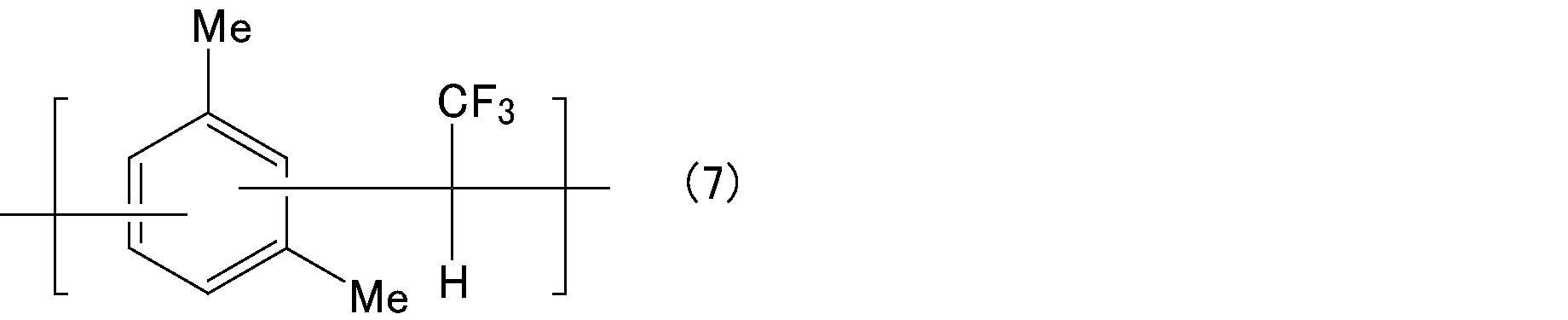
[1]、[2]又は[4]に記載のアラルキル樹脂であって、以下一般式(8)で表される構造単位を有するアラルキル樹脂。

[1]、[3]又は[4]に記載のアラルキル樹脂であって、以下一般式(9)で表される構造単位を有するアラルキル樹脂。

[1]、[2]又は[4]に記載のアラルキル樹脂であって、以下一般式(10)で表される構造単位を有するアラルキル樹脂。

[1]~[13]のいずれかに記載のアラルキル樹脂であって、重量平均分子量が300~200,000であるアラルキル樹脂。
[1]~[14]のいずれかに記載のアラルキル樹脂を含む、エポキシ樹脂の希釈剤。
水酸基当量が130g/当量以上である、[15]に記載のエポキシ樹脂の希釈剤。
[1]~[14]のいずれかに記載のアラルキル樹脂又は[15]若しくは[16]に記載のエポキシ樹脂の希釈剤を含む硬化性樹脂組成物。
さらにエポキシ樹脂を含む[17]に記載の硬化性樹脂組成物。
[1]~[14]のいずれかに記載のアラルキル樹脂と、感光剤と、を含む感光性樹脂組成物。
[19]に記載の感光性樹脂組成物であって、フォトレジスト組成物、ソルダーレジスト組成物またはインプリント組成物である感光性樹脂組成物。
[17]または[18]に記載の硬化性樹脂組成物を硬化させた硬化物。
[21]に記載の硬化物を含む電子デバイス。
芳香族化合物と、フルオラールとを、酸触媒の存在下で反応させることにより、以下一般式(1)または(2)で表される構造単位を有するアラルキル樹脂を製造する、アラルキル樹脂の製造方法。


以下一般式(11)または(12)で表される芳香族化合物と、フェノール系化合物を、酸触媒の存在下で反応させることにより、以下一般式(4)または(5)で表される構造単位を有するアラルキル樹脂を製造する、アラルキル樹脂の製造方法。


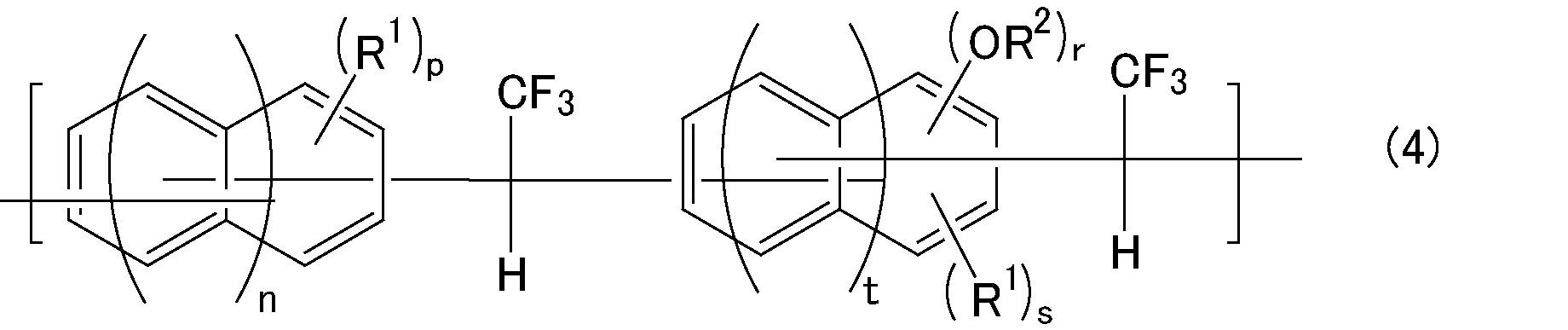

以下一般式(13)または(14)で表される芳香族化合物と、フェノール系化合物を、酸触媒の存在下で反応させることにより、前記一般式(4)または(5)で表される構造単位を有するアラルキル樹脂を製造する、[24]に記載のアラルキル樹脂の製造方法。


本明細書における「有機基」の語は、特に断りが無い限り、有機化合物から1つ以上の水素原子を除いた原子団のことを意味する。例えば、「1価の有機基」とは、任意の有機化合物から1つの水素原子を除いた原子団のことを表し、「2価の有機基」とは、任意の有機化合物から2つの水素原子を除いた原子団のことを表す。
本明細書中の化学式において、「Me」の表記は、メチル基(CH3)を表す。
本明細書中、「フルオラール」の語は、トリフルオロアセトアルデヒドを意味する。
本明細書中の「電子デバイス」の語は、半導体チップ、半導体素子、プリント配線基板、電気回路、ディスプレイ装置、情報通信端末、発光ダイオード、物理電池、化学電池など、電子工学の技術が適用された素子、デバイス、最終製品等を包含する意味で用いられる。



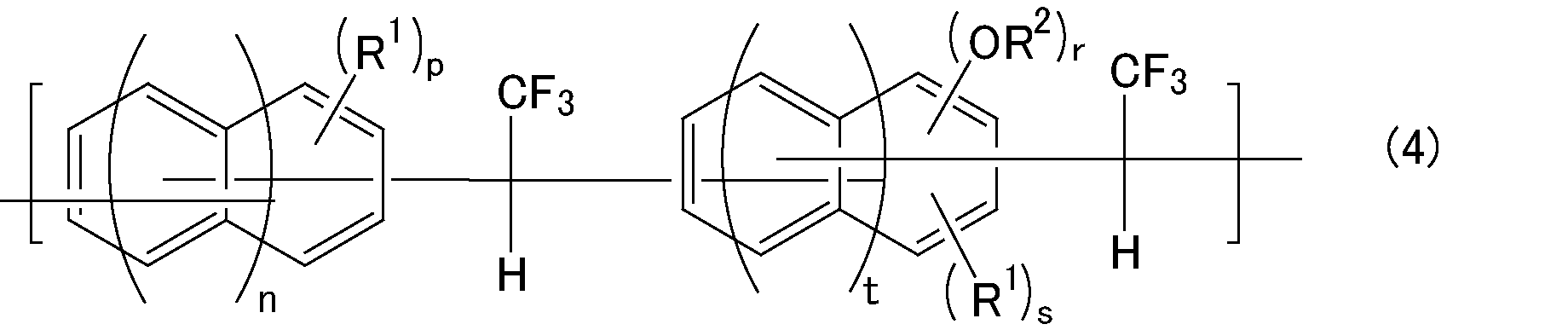

R1が芳香環に直接結合する原子が酸素原子であるものを除く1価の置換基である場合、その1価の置換基の例としては、アルキル基、シクロアルキル基、アリール基、アルケニル基、アルキニル基、シアノ基などを挙げることができる。これら基の任意の炭素上に、例えばハロゲン原子、ハロアルコキシ基などの置換基が、任意の数かつ任意の組み合わせで置換されていてもよい。その1価の置換基の炭素数は、例えば1~20、好ましくは1~10である。
また、R1において芳香環に直接結合する原子の例としては、水素原子、フッ素原子、炭素原子、窒素原子、硫黄原子、ケイ素原子、燐原子などをあげることができる。これらの原子上に、例えば水素原子、アルキル基、シクロアルキル基、アリール基などの置換基が任意の数かつ任意の組み合わせで置換されていてもよい。
さらに、一般式(1)中のR1の数が2以上である場合、2つ以上のR1が連結して、飽和または不飽和の、単環または多環の、炭素数3~6の環式基を形成してもよい。
R1は、好ましくは水素原子、フッ素原子またはアルキル基である。アルキル基としては、炭素数1~6の直鎖または分岐のアルキル基であることが好ましく、中でもn-ブチル基、s-ブチル基、イソブチル基、t-ブチル基、n-プロピル基、i-プロピル基、エチル基およびメチル基が好ましく、特にエチル基とメチル基が好ましい。
原料の準備の容易性やコストの観点から、pは好ましくは0~2の整数である。

R1は一般式(1)におけるR1と同等であり、好ましい形態も同じものが挙げられる。Xが、酸素原子を除く2価の置換基である場合、2価の有機基であることが好ましく2価の有機基の例としては、メチレン基、エチレン基、エチリデン基、プロピレン基、プロピリデン基、イソプロピリデン基、ブチレン基、ヘキサフルオロイソプロピリデン基、2,2,2-トリフルオロエチリデン基、カルボニル基、フェニレン基、ナフタレン1,4ジイル基などを挙げることができる。
また、Xが酸素原子を除く2価の置換基である場合、窒素原子、硫黄原子、ケイ素原子、燐原子などの原子上に、例えば水素原子、アルキル基、シクロアルキル基、アリール基などの置換基が任意の数かつ任意の組み合わせで置換されている2価の置換基であってもよい。Xは、好ましくは単結合またはメチレン基、エチレン基、ヘキサフルオロイソプロピリデン基、2,2,2-トリフルオロエチリデン基、窒素原子若しくは硫黄原子がXの結合部位となっている2価の置換基である。窒素原子がXの結合部位となっている2価の置換基としては、例えば、-N(Me)-、-N(C6H5)-等が挙げられる。
原料の準備の容易性やコストの観点から、p+qは好ましくは0~4の整数である。
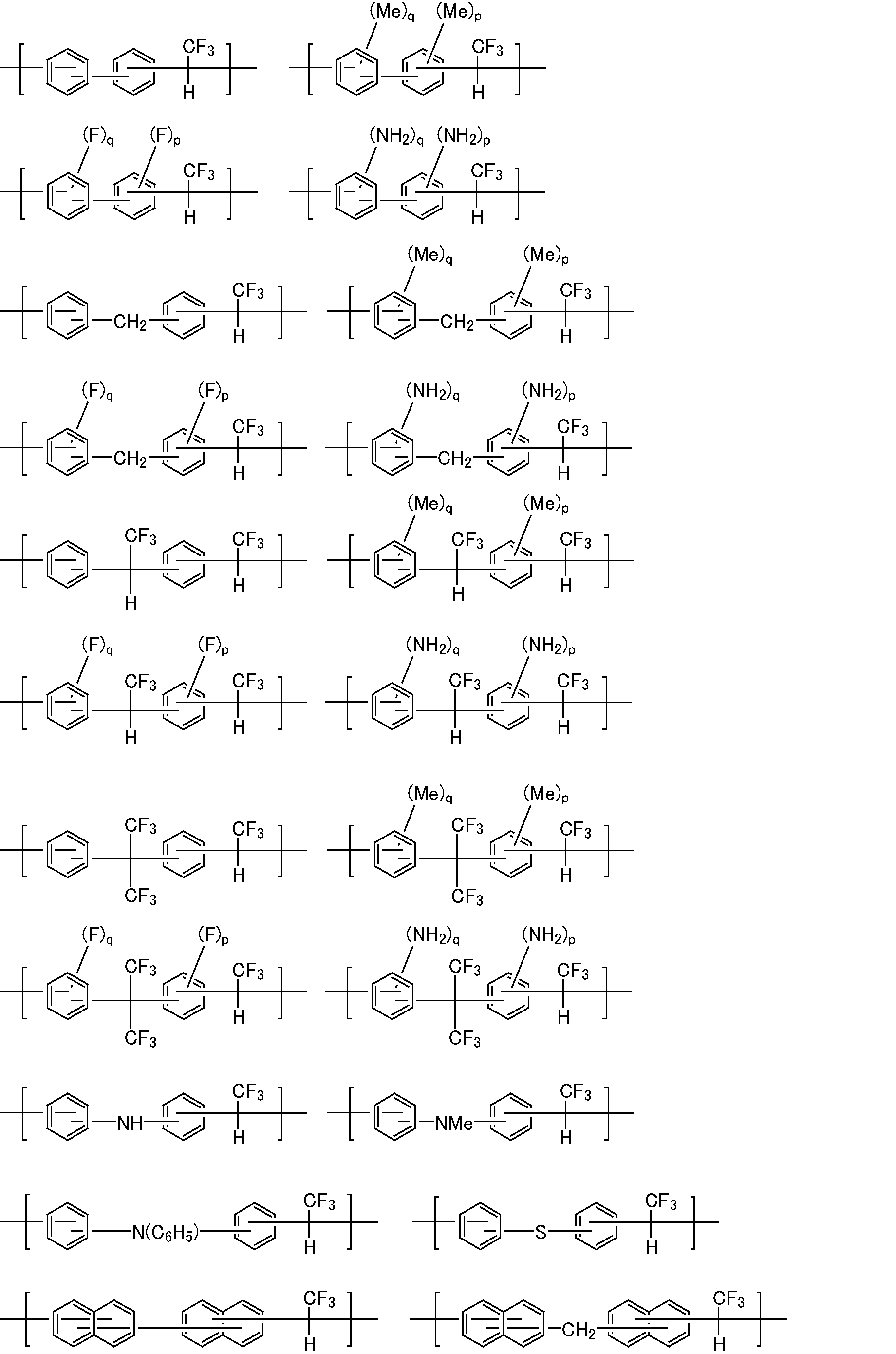
R1は一般式(1)におけるR1と同等であり、好ましい形態も同じものが挙げられる。R2が1価の置換基である場合、その1価の置換基の例としては、アルキル基、シクロアルキル基、アリール基、アルケニル基、アルキニル基、シアノ基、グリシジル基、(メタ)アクリル基などを挙げることができる。これら基の任意の炭素上に、例えばハロゲン原子、アルコキシ基、ハロアルコキシ基などの置換基が、任意の数かつ任意の組み合わせで置換されていてもよい。
R2は、好ましくは水素原子、アルキル基、グリシジル基、重合性炭素-炭素二重結合を含む部分構造、または以下一般式(6)で表される部分構造である。

R1は一般式(1)におけるR1と同等であり、好ましい形態も同じものが挙げられる。R2は一般式(3)におけるR2と同等であり、好ましい形態も同じものが挙げられる。nは0~2の整数であり、nが0のときp≦4の整数であり、nが1のときp≦6の整数であり、nが2のときp≦8の整数である。tは0~2の整数であり、rは1以上の整数であり、sは0以上の整数であり、ただし、tが0のときr+s≦4、tが1のときr+s≦6、tが2のときr+s≦8である。
一般式(4)で表される構造単位は、一般式(1)で表される構造単位と、一般式(3)で表される構造単位が結合した構造単位を意味しており、一般式(4)で表される構造単位において、一般式(1)で表される構造単位と、一般式(3)で表される構造単位のモル比は1:1である。
R1は一般式(1)におけるR1と同等であり、好ましい形態も同じものが挙げられる。Xは一般式(2)におけるXと同等であり、好ましい形態も同じものが挙げられる。R2は一般式(3)におけるR2と同等であり、好ましい形態も同じものがあげられる。mおよびkは0~2の整数であり、m+kが0のときp+q≦8の整数であり、m+kが1のときp+q≦10の整数であり、m+kが2のときp+q≦12の整数であり、m+kが3のときp+q≦14の整数であり、m+kが4のときp+q≦16の整数である。tは0~2の整数であり、rは1以上の整数であり、sは0以上の整数であり、ただし、tが0のときr+s≦4、tが1のときr+s≦6、tが2のときr+s≦8である。
一般式(5)で表される構造単位は、一般式(2)で表される構造単位と、一般式(3)で表される構造単位が結合した構造単位を意味しており、一般式(5)で表される構造単位において、一般式(2)で表される構造単位と、一般式(3)で表される構造単位のモル比は1:1である。
本開示におけるアラルキル樹脂の重量平均分子量は、好ましくは300~500,000、より好ましくは300~300,000、さらに好ましくは300~200,000である。重量平均分子量を調整することにより、アルカリ溶解性や溶剤溶解性、膜としたときの物性などを調整可能である。すなわち、重量平均分子量を調整することにより、本開示におけるアラルキル樹脂の電子デバイス製造への適用性を一層高めることができる。
本開示におけるアラルキル樹脂の多分散度(重量平均分子量/数平均分子量)は、好ましくは1~40、より好ましくは1~20である。多分散度を適当な数値範囲内とすることで、例えば、均一な膜を得やすくなったり、膜としたときの機械物性が良化したりする。
重量平均分子量や多分散度は、ゲルパーミエーションクロマトグラフィー(GPC)により、ポリスチレンを標準物質として求めることができる。
また、本開示のアラルキル樹脂を含む、エポキシ樹脂の希釈剤も本明細書に開示されている。
以下、本開示のアラルキル樹脂を含む、エポキシ樹脂の希釈剤を本開示の希釈剤という。
本開示のアラルキル樹脂又は本開示の希釈剤とエポキシ樹脂とを含む硬化性樹脂組成物は、電子デバイス製造に好適な誘電率および/または誘電正接を有することが期待される。
本明細書における「希釈剤」とは、希釈対象の物質(エポキシ樹脂)と反応性を示す置換基が少ない、または反応性を示す置換基を有さない性質の物質であり、樹脂組成物中における希釈対象の物質の濃度を低下させる物質である。
希釈対象の物質がエポキシ樹脂である場合、希釈剤は、エポキシ樹脂と反応性を有する水酸基が少ない、または水酸基を有さないことが好ましい。その観点から、エポキシ樹脂の希釈剤用に用いられるアラルキル樹脂又は本開示の希釈剤は、水酸基当量が130g/当量以上であることが好ましい。また、エポキシ樹脂の希釈剤用に用いられるアラルキル樹脂又は本開示の希釈剤は水酸基を含まないことが好ましい。
また、本開示のアラルキル樹脂は、電子デバイス用途に用いるのに十分な耐熱性を有する。
芳香族化合物と、フルオラールとを、酸触媒の存在下で反応させることで、一般式(1)または(2)で表される構造単位を有するアラルキル樹脂を製造(合成)することができる。以下、原材料や反応条件などについて説明する。
芳香族化合物としては、ベンゼン、トルエン、エチルベンゼン、プロピルベンゼン、イソプロピルベンゼン、nブチルベンゼン、イソブチルベンゼン、tert-ブチルベンゼン等のアルキルベンゼン類、o-キシレン、m-キシレン、p-キシレン等のキシレン類、1,2,3-トリメチルベンゼン、1,2,4-トリメチルベンゼン、1,3,5-トリメチルベンゼン等のトリメチルベンゼン類、フルオロベンゼン、クロロベンゼン、ブロモベンゼン、ヨードベンゼン等のハロゲン化ベンゼン類、また、ビフェニル、ナフタレン、1-メチルナフタレン、2-メチルナフタレン、1,2-ジメチルナフタレン、1,3-ジメチルナフタレン、1,4-ジメチルナフタレン、1,6-ジメチルナフタレン、2,3-ジメチルナフタレン、2,4-ジメチルナフタレン、2,5-ジメチルナフタレン、2,6-ジメチルナフタレン、1-メチルアントラセン、2-メチルアントラセン、1,2-ジメチルアントラセン、1,2,3-トリメチルアントラセン、フルオレン等の多環芳香族類も挙げることができる。
また、ジフェニルメタン、トリフェニルメタン、1,1-ジフェニルエタン、1,2-ジフェニルエタン、1,1-ジフェニルプロパン、1,2-ジフェニルプロパン、1,3-ジフェニルプロパン、2,2-ジフェニルプロパン、ヘキサフルオロ-2,2-ジフェニルプロパン、トリフルオロ-2,2-ジフェニルエタン等の芳香環を分子内に複数有する芳香族化合物類も挙げることができる。
さらに、アニリン、トルイジン、キシリジン、2-エチルアニリン、3-エチルアニリン、4-エチルアニリン、N-メチルアニリン、N-エチルアニリン、N-プロピルアニリン、N,N-ジメチルアニリン、ジフェニルアミン、N-メチルジフェニルアミン、トリフェニルアミン、カルバゾール等の芳香族アミン類や、チオフェノール、トルエンチオール、ナフタレンチオール等の芳香族チオール類、チオアニソール、ジフェニルスルフィド、ビス(p-トリル)スルフィド、ジベンゾチオフェン等の芳香族スルフィド類も挙げることができる。
フルオラールの調製は、それの等価体として市販品(東京化成工業株式会社品)の水和物やフルオラールのヘミアセタールが利用可能である。また、特開平5-97757号公報等の文献に記載の方法でフルオラールの水和物やフルオラールのヘミアセタール体を調製できる。

また、フルオラール/フッ化水素の混合物には、過剰量のフッ化水素が含まれる場合もある。しかし、フッ化水素自身は酸性物質としての機能を有するため、フッ化水素は酸触媒や脱水剤として作用したり、反応を促進させる添加剤として作用したりする場合もある。これらの点で、フルオラールを、フッ化水素の混合物として取り扱う利点はあると言える。
合成の際の圧力は、絶対圧で0.1~10MPaの条件で行うことができる。圧力は、好ましくは0.1~5MPa、より好ましくは0.1~1MPaである。高い圧力で反応する際には高圧反応容器が必要となり設備コストがかかってしまうため、できるだけ低い圧力で実施することが好ましい。
得られたアラルキル樹脂については、貧溶媒(典型的には水)に投入することによる析出処理、水や重曹水での洗浄処理、分液操作などを組み合わせることにより、未反応物や不純物を除去することが好ましい。これら処理の具体的方法は、ポリマー合成における公知の方法を適宜参照することができる。
芳香族化合物と、フェノール系化合物と、フルオラールとを、酸触媒の存在下で反応させることで、一般式(1)または(2)で表される構造単位に加え、一般式(3)、(4)および/または(5)で表される構造単位を有し、分子鎖中にフェノール性水酸基および/またはアルコキシ基を有するアラルキル樹脂を製造(合成)することができる。以下、原材料や反応条件などについて説明する。
芳香族化合物は、上記<アラルキル樹脂の製造方法I-1(合成方法I-1)>における芳香族化合物と同等である。
上記フェノール系化合物としては、フェノール、o-クレゾール、m-クレゾール、p-クレゾール等のクレゾール類、2,3-キシレノール、2,4-キシレノール、2,5-キシレノール、2,6-キシレノール、3,4-キシレノール、3,5-キシレノール等のキシレノール類、o-エチルフェノール、m-エチルフェノール、p-エチルフェノール等のエチルフェノール類、o-イソプロピルフェノール、m-イソプロピルフェノール、p-イソプロピルフェノール等のイソプロピルフェノール類、o-ブチルフェノール、m-ブチルフェノール、p-ブチルフェノール、p-イソブチルフェノール、p-tert-ブチルフェノール等のブチルフェノール類、p-tert-アミルフェノール、p-オクチルフェノール、p-ノニルフェノール、p-クミルフェノール等のアルキルフェノール類、フルオロフェノール、クロロフェノール、ブロモフェノール、ヨードフェノール等のハロゲン化フェノール類、p-フェニルフェノール、アミノフェノール、ニトロフェノール、ジニトロフェノール、トリニトロフェノール等の1価フェノール置換体を挙げることができる。
また、1-ナフトール、2-ナフトール、2-ヒドロキシアントラセン等の多環フェノール類、ハイドロキノン、レゾルシノール、カテコールなどのジヒドロキシベンゼン類も挙げることができる。
さらに、ビスフェノールA、ビスフェノールF、ビスフェノールE、ビスフェノールS、ビスフェノールAF、ビスフェノールM、ビスフェノールP、ビスフェノールZ、1,1,1-トリフルオロ-2,2-ビス(4-ヒドロキシフェニル)エタン等のビスフェノール類も挙げることができる。
さらに、メトキシベンゼン、エトキシベンゼン、プロポキシベンゼン等のアルコキシベンゼン、1-メトキシナフタレン、2-メトキシナフタレン等のアルコキシナフタレン類、1,2-ジメトキシベンゼン、1,3-ジメトキシベンゼン、1,4-ジメトキシベンゼン等のジアルコキシベンゼン類、1,2-ジメトキシナフタレン、1,3-ジメトキシナフタレン、1,4-ジメトキシナフタレン、2,3-ジメトキシナフタレン、2,4-ジメトキシナフタレン等のジアルコキシナフタレン類、フルオロアニソール、クロロアニソール、ブロモアニソール、ヨードアニソール等のハロゲン化アニソール類、メトキシフェノールやメトキシナフトール等、芳香環上にフェノール性水酸基とアルコキシ基の両方を有するフェノール系化合物類も挙げることができる。
フルオラールは、上記<アラルキル樹脂の製造方法I-1(合成方法I-1)>におけるフルオラールと同等である。
合成の際の圧力は、絶対圧で0.1~10MPaの条件で行うことができる。圧力は、好ましくは0.1~5MPa、より好ましくは0.1~1MPaである。高い圧力で反応する際には高圧反応容器が必要となり設備コストがかかってしまうため、できるだけ低い圧力で実施することが好ましい。
得られたアラルキル樹脂については、貧溶媒(典型的には水)に投入することによる析出処理、水や重曹水での洗浄処理、分液操作などを組み合わせることにより、未反応物や不純物を除去することが好ましい。これら処理の具体的方法は、ポリマー合成における公知の方法を適宜参照することができる。
本開示におけるアラルキル樹脂の製造方法として、以下一般式(11)または(12)で表される芳香族化合物と、フェノール系化合物を、酸触媒の存在下で反応させることで、一般式(1)または(2)で表される構造単位と、一般式(3)、(4)および/または(5)で表される構造単位を有し、分子鎖中にフェノール性水酸基および/またはアルコキシ基を有するアラルキル樹脂を製造(合成)することができる。


一般式(11)で表される構造を有する芳香族化合物は、原料の準備の容易性やコストの観点から、Zが水酸基であることが好ましい。例えば、Journal of Polymer Science (Hoboken,NJ,United States)(2020),58(16),2197-2210等、文献に記載の方法で調製できる。
一般式(13)で表される芳香族化合物と、フェノール系化合物を、酸触媒の存在下で反応させることにより、一般式(4)で表される構造単位を有するアラルキル樹脂を製造することが好ましい。

一般式(12)で表される構造を有する芳香族化合物は、原料の準備の容易性やコストの観点から、Zが水酸基であることが好ましい。例えば、Chinese Journal of Chemistry(2020),38(9),952-958等、文献に記載の方法で調製できる。
一般式(14)で表される芳香族化合物と、フェノール系化合物を、酸触媒の存在下で反応させることにより、一般式(5)で表される構造単位を有するアラルキル樹脂を製造することが好ましい。

合成の際の圧力は、絶対圧で0.1~10MPaの条件で行うことができる。圧力は、好ましくは0.1~5MPa、より好ましくは0.1~1MPaである。高い圧力で反応する際には高圧反応容器が必要となり設備コストがかかってしまうため、できるだけ低い圧力で実施することが好ましい。
得られたアラルキル樹脂については、貧溶媒(典型的には水)に投入することによる析出処理、水や重曹水での洗浄処理、分液操作などを組み合わせることにより、未反応物や不純物を除去することが好ましい。これら処理の具体的方法は、ポリマー合成における公知の方法を適宜参照することができる。
本開示におけるアラルキル樹脂は、本開示におけるアラルキル樹脂とは異なる各成分と混合することにより、樹脂組成物として利用することができる。
本開示におけるアラルキル樹脂及び本開示の希釈剤の応用先として、硬化性樹脂組成物を挙げることができる。
例えば、本開示におけるアラルキル樹脂をエポキシ樹脂と組み合わせて用いることで、硬化性樹脂組成物を製造することができる。この場合、本開示におけるアラルキル樹脂は、エポキシ樹脂の硬化剤として働く場合もあれば、希釈剤として働く場合もある。本開示におけるアラルキル樹脂が水酸基等のエポキシ樹脂と反応性を示す置換基を有する場合、本開示のアラルキル樹脂はエポキシ樹脂の硬化剤として働く。本開示におけるアラルキル樹脂が水酸基等のエポキシ樹脂と反応性を示す置換基を有しない場合、本開示のアラルキル樹脂はエポキシ樹脂の希釈剤として働く。
本開示におけるアラルキル樹脂は、フッ素原子を含む。よって、本開示におけるアラルキル樹脂を含む硬化性樹脂組成物により形成された硬化物は、電子デバイス製造に好適な誘電率および/または誘電正接を有することが期待される。
本開示におけるアラルキル樹脂と組み合わせるエポキシ樹脂は特に制限されず、公知のエポキシ樹脂を用いてよい。公知のエポキシ樹脂としては、2官能型エポキシ樹脂、例えば、ビスフェノールA型エポキシ樹脂、ビスフェノールF型エポキシ樹脂、ビスフェノールAF型エポキシ樹脂、ビスフェノールAD型エポキシ樹脂、水添ビスフェノールA型エポキシ樹脂、水添ビスフェノールF型エポキシ樹脂、ビスフェノールA-アルキレンオキサイド付加体のジグリシジルエーテル、ビスフェノールFのアルキレンオキサイド付加体のジグリシジルエーテル、ビスフェノールS型エポキシ樹脂、テトラメチルビスフェノールA型エポキシ樹脂、テトラメチルビスフェノールF型エポキシ樹脂、チオジフェノール型エポキシ樹脂、ジヒドロキシジフェニルエーテル型エポキシ樹脂、テルペンジフェノール型エポキシ樹脂、ビフェノール型エポキシ樹脂、テトラメチルビフェノール型エポキシ樹脂、ハイドロキノン型エポキシ樹脂、メチルハイドロキノン型エポキシ樹脂、ジブチルハイドロキノン型エポキシ樹脂、レゾルシン型エポキシ樹脂、メチルレゾルシン型エポキシ樹脂、ジヒドロキシナフタレン型エポキシ樹脂、1,1,1-トリフルオロ-2,2-ビス(4-グリシジルオキシフェニル)エタンなどを挙げることができる。
本開示における硬化性樹脂組成物は、本開示におけるアラルキル樹脂以外の硬化剤を含んでも良い。本開示における硬化性樹脂組成物が硬化剤を含む場合、硬化剤の種類は特に限定されない。硬化剤としては、例えばアミン系硬化剤、酸無水物系硬化剤、フェノール系硬化剤などを挙げることができる。
本開示における硬化性樹脂組成物が硬化剤を含む場合、その量は、エポキシ樹脂のエポキシ当量などを踏まえて適宜調整すればよい。典型的には、硬化剤を用いる場合、その量は、エポキシ樹脂100質量部に対して0.1~1,000質量部程度である。
硬化速度を速めたり、かつ/または、硬化をより完全にしたりする観点から、本開示における硬化性樹脂組成物は、硬化促進剤を含んでもよい。硬化促進剤としては、3級アミン類、イミダゾール類、有機ホスフィン化合物類またはこれらの塩類、オクチル酸亜鉛、オクチル酸スズ等の金属石鹸類といった、一般のエポキシ樹脂向けの硬化促進剤を用いることができる。
本開示における硬化性樹脂組成物が硬化促進剤を含む場合、その量は適宜調整すればよい。典型的には、硬化促進剤を用いる場合、その量は、エポキシ樹脂100質量部に対して0.001~10質量部程度である。
本開示における硬化性樹脂組成物は、上記成分のほか、任意の成分を1または2以上含むことができる。任意の成分としては、酸化防止剤、充填剤(フィラー)、着色剤、アラルキル樹脂以外の樹脂、硬化性モノマー、オリゴマー、有機溶剤などが挙げられる。
充填剤(フィラー)を用いる場合、その量は、アラルキル樹脂100質量部に対して、例えば1,500質量部以下、好ましくは0.1~1,500質量部である。
着色剤を用いる場合、その量は、アラルキル樹脂100質量部に対して、通常0.01~30質量部である。
本実施形態の硬化性樹脂組成物は、溶剤を含むものであってもよく、固形状でもワニス状でもよい。
また、本開示のアラルキル樹脂を含む硬化性樹脂組成物は、本開示のアラルキル構造を有さない樹脂を含む硬化性樹脂組成物と比べて、硬化物の吸水率が低くなる。硬化物の吸水率が低いことは、誘電特性や絶縁信頼性の観点から、電子デバイスに利用する際に有効である。
本開示におけるアラルキル樹脂の応用先として、感光性樹脂組成物を好ましく挙げることができる。具体的には、本開示におけるアラルキル樹脂と、少なくとも感光剤とを混合することで、感光性樹脂組成物を調製することができる。
既に述べたように、アラルキル樹脂の、特定の光の透過性、および/または、アルカリ溶解性は良好な傾向がある。このような良好な特性を有するアラルキル樹脂を用いることで、良好な性能を有する感光性樹脂組成物を調製することができる。特に、本明細書における感光性樹脂組成物は、フォトレジスト組成物、すなわち、フォトマスクを用いた露光とその後の現像によりパターニング可能であり、電子デバイス製造におけるエッチングなどの処理から基板表面を選択的に保護することが可能な組成物として有用である。これは、アラルキル樹脂の、特定の光の透過性、アルカリ溶解性、および、アラルキル樹脂が含む芳香環の耐エッチング性による。
溶剤としては、N-メチル-2-ピロリドン、γ-ブチロラクトン、N,N-ジメチルホルムアミド、N,N-ジメチルアセトアミド、ジメチルスルホキシドなどの非プロトン性極性溶媒、テトラヒドロフラン、ジオキサン、プロピレングリコールモノメチルエーテルなどのエーテル類、アセトン、メチルエチルケトン、ジイソブチルケトン、ジアセトンアルコールなどのケトン類、酢酸エチル、プロピレングリコールモノメチルエーテルアセテート、乳酸エチルなどのエステル類、トルエン、キシレンなどの芳香族炭化水素類などが挙げられる。溶剤は単独溶剤であっても混合溶剤であってもよい。
(1)感光性樹脂組成物を基材上に塗布して感光膜を形成する膜形成工程
(2)感光性膜を露光する露光工程
(3)露光後の感光性膜を現像して、パターンを形成する現像工程
感光性樹脂組成物を塗布する基材は特に限定されない。シリコンウエハ、金属、ガラス、セラミック、プラスチック製の基材を挙げることができる。また、あらかじめ他のポリマーが塗布されている基材上に感光性樹脂組成物を塗布してもよい。塗布方法としては、スピンコート、ディップコート、スプレーコート、バーコート、アプリケーター、インクジェット、ロールコーター等、公知の塗布方法を特に制限無く適用できる。
膜形成工程で得られた感光性膜に対し、通常は、目的のパターンを形成するためのフォトマスクを介して光を照射する。露光には、公知の方法・装置を用いることができる。光源としては、光源波長が100~600nmの範囲のものを用いることができる。具体的に例示すると、低圧水銀灯、高圧水銀灯、超高圧水銀灯、KrFエキシマレーザー(波長248nm)、UV-LEDランプなどを用いることができる。露光量は、通常1~10,000mJ/cm2程度、好ましくは10~5,000mJ/cm2程度である。
露光工程で得られた露光後の感光性膜を現像することで、パターン形状をする膜を作製する。アルカリ性の水溶液を現像液として用いることで、露光部が溶解し、パターンが形成される。
上記硬化性樹脂組成物を硬化させることで、硬化物を得ることができる。硬化は、光および/または熱により行うことができる。
より具体的には、硬化性樹脂組成物を、通常、100~200℃で0.1~20分間加熱する。これにより硬化物を得ることができる。硬化性能の向上を図るために、70~200℃で0.1~10時間の範囲で「後硬化」を行ってもよい。
硬化物の形態は、成形体、注型物、何らかの基材の片面または両面に硬化膜が形成された積層体、フィルム、生体材料用ベース樹脂等であることができる。
例えば、光センサー、撮像素子などの光学素子を封止するための透明材料として、上記硬化性樹脂組成物を用いることができる。また、マイクロレンズの製造用途や、光学用接着剤としても上記硬化性樹脂組成物を用いることができる。
別の例として、ガラス繊維、カーボン繊維、ポリエステル繊維、ポリアミド繊維、紙等の基材(好ましくは繊維基材)に、硬化性樹脂組成物を塗布する、かつ/または、含浸させる等により、積層用硬化性材料を製造することができる。この積層用硬化性材料は、多層電気積層板や、ビルドアップ積層板、フレキシブル積層板等のプリント配線板の製造に好適に使用できる。
さらに別の例として、ワニス状の硬化性樹脂組成物を、回路が形成された基板に塗布して樹脂膜を形成し、硬化させることで、絶縁膜を設けることができる。
896gの特級試薬CrCl3・6H2Oを純水に溶かして3.0Lの溶液とした。この溶液に粒状アルミナ400gを浸漬し、一昼夜放置した。放置後の溶液を濾過してアルミナを取り出し、そのアルミナを熱風循環式乾燥器中で100℃に保ち、さらに一昼夜乾燥した。このようにしてクロム担持アルミナを得た。
得られたクロム担持アルミナを、電気炉を備えた円筒形SUS316L製反応管(直径4.2cm、長さ60cm)に充填した。この反応管に窒素ガスを約20mL/分の流量で流しながら、クロム担持アルミナを300℃まで昇温した。反応管から水の流出が見られなくなった時点で、窒素ガスにフッ化水素を同伴させ、その濃度を徐々に高めた。充填されたクロム担持アルミナのフッ素化によるホットスポットが反応管出口端に達したタイミングで反応器温度を350℃に上げ、その状態を5時間保った。このようにして、フルオラール合成のための触媒を得た。以下では、この触媒を「触媒A」と表記する。
電気炉を備えた円筒形反応管を有する気相反応装置(SUS316L製、直径2.5cm、長さ40cm)に、触媒Aを125mL充填した。
気相反応装置に約100mL/分の流量で空気を流しながら、反応管の温度を280℃に上げ、フッ化水素を約0.32g/分の速度で1時間にわたり導入した。
次いで、クロラール(トリクロロエタナール)を約0.38g/分(接触時間15秒)の速度で反応管へ供給開始した。反応開始1時間後には反応は安定した。反応安定後、反応器から流出するガスを、-15℃の冷媒で冷却した吹き込み管付きSUS304製シリンダーへ18時間かけて捕集した。
ここで得たフルオラール含有の484.8gの捕集液について、滴定により、フッ化水素含量、塩化水素含量、そして有機物含量を算出した。算出の結果、フッ化水素40質量%、塩化水素11質量%、そして有機物含有量49質量%であり、有機物の回収率は88%(供給原料クロラールモル数基準)であった。また、回収した有機物の一部を樹脂製のNMRチューブに採取し、19F-NMRにてフッ素化度を確認すると、低次フッ素化物はほぼ未検出であり、定量的にフッ素化が進行していることを確認した。
次に、捕集したフルオラール含有の混合物の一部、150g(フッ化水素:40質量%、塩化水素:11質量%、有機物:49質量%)を-15℃の冷媒を通液させた冷却管と温度計と攪拌機を備え付けた500mlのSUS製反応器に仕込み、反応器を25℃になるように加温した。常圧下、冷却管にてフッ化水素を還流させながら、冷却管の頂塔からすり抜ける塩化水素を、水に吸収させて除去した。5時間の還流後、反応器からサンプリングを行い、得られたサンプルを滴定することにより、フッ化水素含量、塩化水素含量、そして有機物含量を算出した。算出の結果、フッ化水素:44質量%、塩化水素:1質量%、有機物:55質量%であった。
[物性データ]
1,2,2,2-テトラフルオロエタノール:
19F-NMR(400MHz,CFCl3)δ(ppm):-85.82(3F,s),-137.95(1F,d,J=54.9Hz)
フッ化水素:
19F-NMR(400MHz,CFCl3)δ(ppm):-193.37(1F,s)

[物性データ]
数平均分子量(Mn)=592、重量平均分子量(Mw)=845、多分散度(Mw/Mn)=1.4

[物性データ]
数平均分子量(Mn)=622、重量平均分子量(Mw)=723、多分散度(Mw/Mn)=1.2

[物性データ]
数平均分子量(Mn)=924、重量平均分子量(Mw)=1185、多分散度(Mw/Mn)=1.3
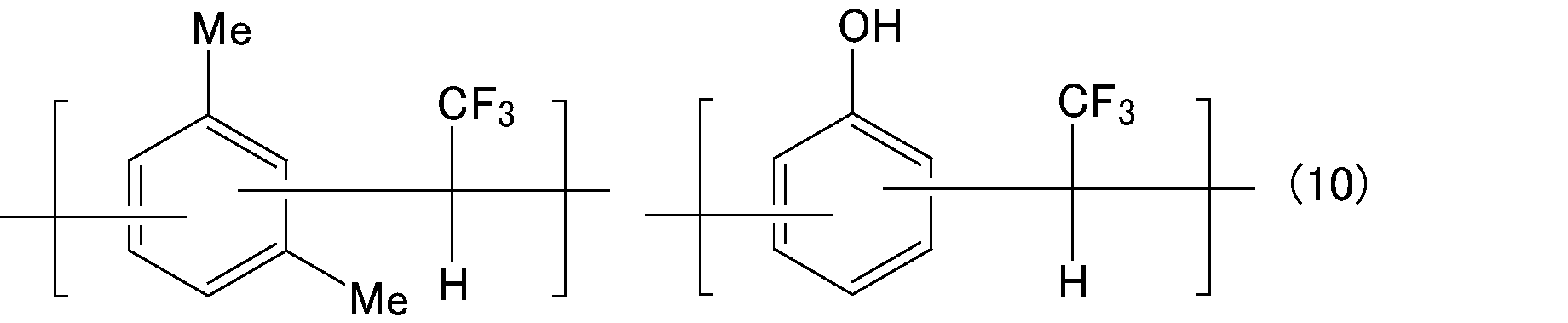
[物性データ]
数平均分子量(Mn)=598、重量平均分子量(Mw)=691、多分散度(Mw/Mn)=1.2

攪拌機と温度計を備えた50mLガラス製フラスコに、上記の粗エポキシ樹脂、メチルイソブチルケトン19.0g、1-ブタノール1.9g、20質量%水酸化ナトリウム水溶液4.3gを仕込み、ウォーターバスで80℃に加熱して2時間アルカリ処理した。その後、過剰分のアルカリを塩酸で中和して、分液操作で有機層を回収し、メチルイソブチルケトン50gを加えた後、水50gで3回洗浄した。そして、分液操作で有機層を回収し、エバポレーターで濃縮して目的のアラルキル樹脂(エポキシ樹脂)を7.6g得た。エポキシ当量は271g/当量であった。
[物性データ]
数平均分子量(Mn)=1035、重量平均分子量(Mw)=1519、多分散度(Mw/Mn)=1.5

[物性データ]
数平均分子量(Mn)=623、重量平均分子量(Mw)=821、多分散度(Mw/Mn)=1.4

[物性データ]
数平均分子量(Mn)=793、重量平均分子量(Mw)=1058、多分散度(Mw/Mn)=1.5

[物性データ]
数平均分子量(Mn)=712、重量平均分子量(Mw)=884、多分散度(Mw/Mn)=1.2
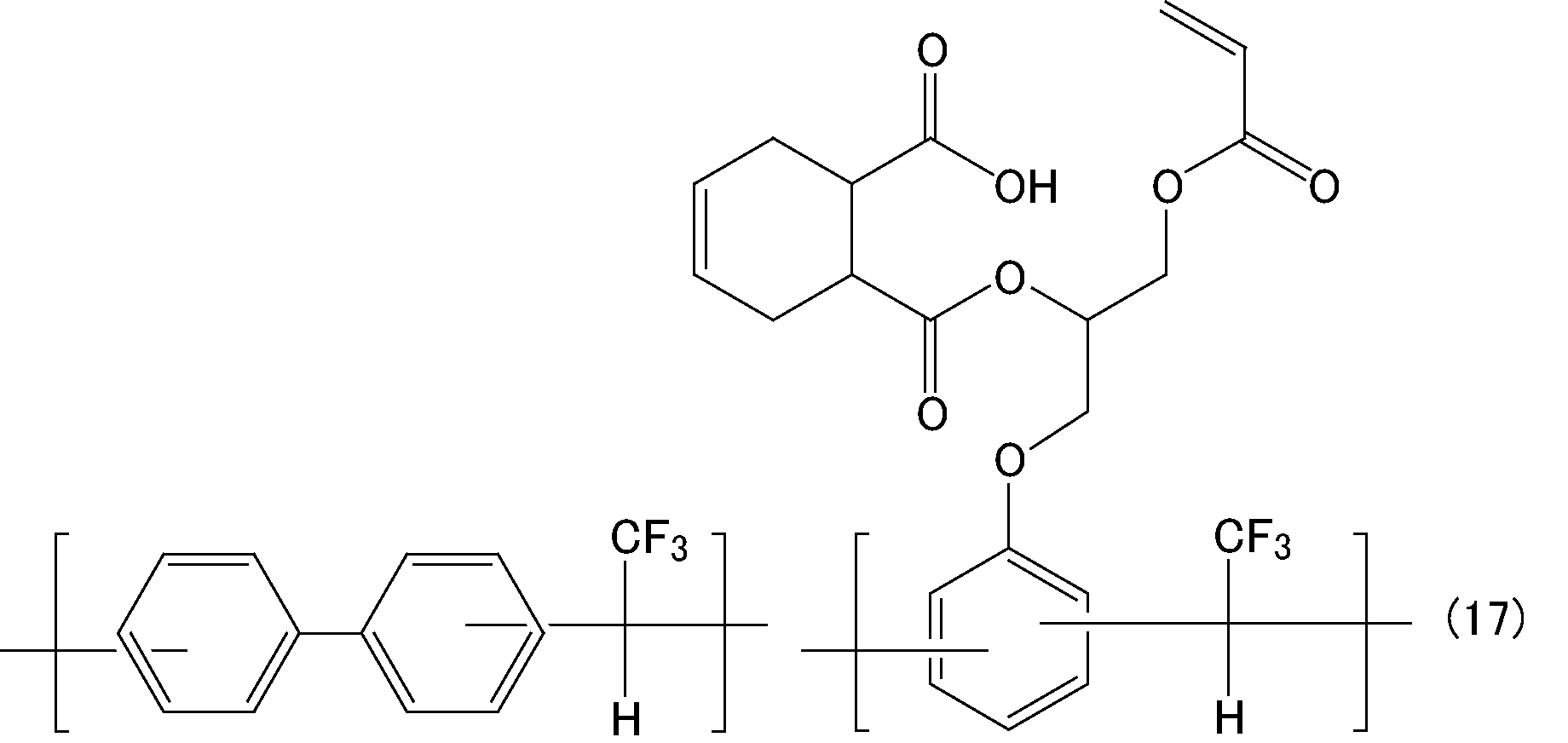
攪拌機、滴下ロートおよび温度計を備えた50mLガラス製フラスコに、合成例7で得られたアラルキル樹脂溶液100g(水酸基当量210g/当量)と、エピクロルヒドリン146g(1.57mol)と、1-ブタノール14.6gを仕込み、ウォーターバスで内温50℃に加熱した。その後、20質量%水酸化ナトリウム水溶液57.7g(289mmol)を1時間かけてフラスコ内に滴下した。その後、合成例5と同様の操作を行い、有機層を回収し、エバポレーターで濃縮して、アラルキル樹脂溶液I(エポキシ樹脂溶液)を133.0g回収した。固形分濃度は48.1質量%であり、固形分のエポキシ当量は298g/当量であった。
攪拌機、還流冷却器および温度計を備えた100mLガラス製フラスコに、上記で得られたアラルキル樹脂溶液I(エポキシ樹脂溶液)30.0g(エポキシ当量298g/当量)と、アクリル酸3.5g(48mmol)、4-メトキシフェノール29mg、トリフェニルホスフィン72mgを仕込み、乾燥空気を導入しながら、内温110℃に昇温して15時間反応させた。その後、1,2,3,6-テトラヒドロフタル酸無水物4.4g(29mmol)を入れ、6時間反応させた。冷却後、目的のアラルキル樹脂溶液II(酸変性エポキシアクリレート樹脂溶液)を得た。固形分濃度は59.0質量%、固形分酸価は85mgKOH/gであった。
[物性データ]
数平均分子量(Mn)=1180、重量平均分子量(Mw)=2904、多分散度(Mw/Mn)=2.5

攪拌機、滴下ロートおよび温度計を備えた50mLガラス製フラスコに、合成例8で得られたアラルキル樹脂溶液100g(水酸基当量198g/当量)と、エピクロルヒドリン135g(1.46mol)と、1-ブタノール13.5gを仕込み、ウォーターバスで50℃に加熱した。その後、20質量%水酸化ナトリウム水溶液53.6g(268mmol)を1時間かけてフラスコ内に滴下した。その後、合成例5と同様の操作を行い、有機層を回収し、エバポレーターで濃縮して、アラルキル樹脂溶液III(エポキシ樹脂溶液)を103.5g回収した。固形分濃度は51.8質量%であり、固形分のエポキシ当量は274g/当量であった。
攪拌機、還流冷却器および温度計を備えた100mLガラス製フラスコに、上記で得られたアラルキル樹脂溶液III(エポキシ樹脂溶液)30.0g(エポキシ当量274g/当量)と、アクリル酸4.1g(48mmol)、4-メトキシフェノール31mg、トリフェニルホスフィン77mgを仕込み、乾燥空気を導入しながら、110℃に昇温して15時間反応させた。その後、1,2,3,6-テトラヒドロフタル酸無水物5.2g(34mmol)を入れ、6時間反応ささせた。冷却後、目的のアラルキル樹脂溶液IV(酸変性エポキシアクリレート樹脂溶液)を得た。固形分濃度は63.3質量%、固形分酸価は84mgKOH/gであった。
[物性データ]
数平均分子量(Mn)=1142、重量平均分子量(Mw)=1995、多分散度(Mw/Mn)=2.3

[物性データ]
数平均分子量(Mn)=9597、重量平均分子量(Mw)=79248、多分散度(Mw/Mn)=8.3

[物性データ]
数平均分子量(Mn)=5760、重量平均分子量(Mw)=27033、多分散度(Mw/Mn)=4.7

[物性データ]
数平均分子量(Mn)=806、重量平均分子量(Mw)=1272、多分散度(Mw/Mn)=1.6

[物性データ]
数平均分子量(Mn)=956、重量平均分子量(Mw)=2236、多分散度(Mw/Mn)=2.3

[物性データ]
数平均分子量(Mn)=7056、重量平均分子量(Mw)=21287、多分散度(Mw/Mn)=3.0

表1に表される組成の硬化性樹脂組成物を調製し、各硬化物のガラス転移温度と5%熱重量減少温度を測定した。
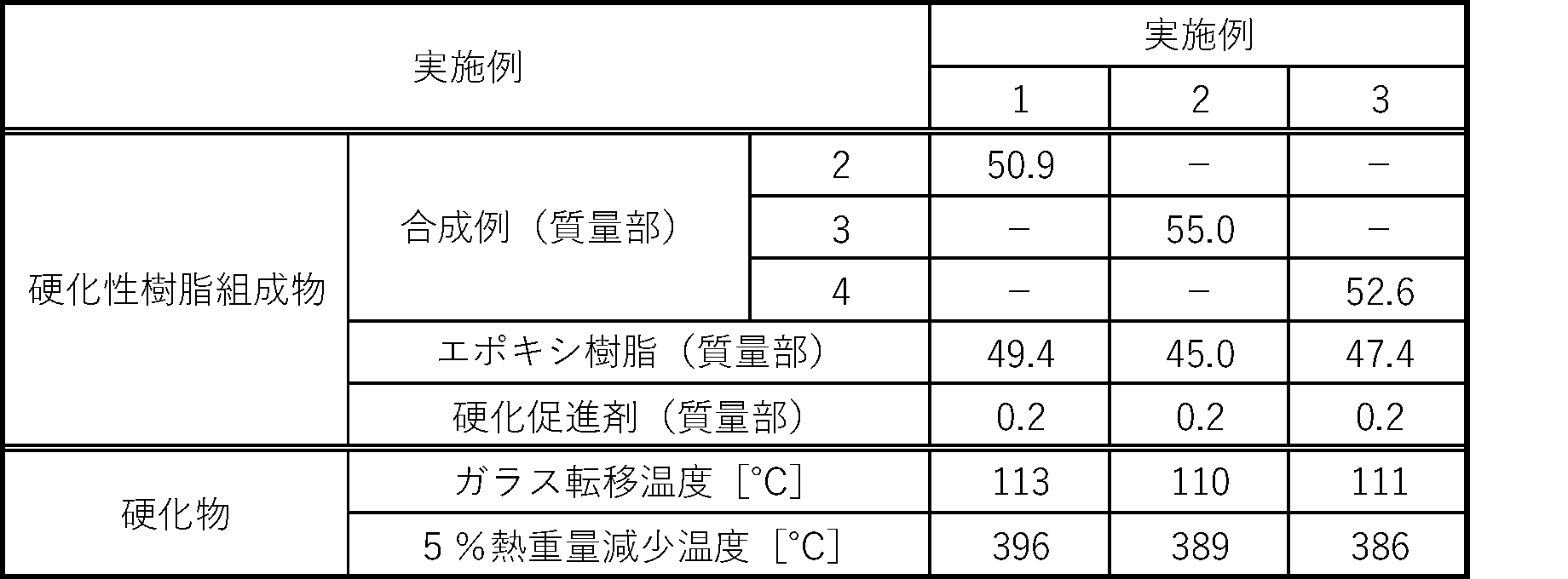
・エポキシ樹脂:ビスフェノールA型エポキシ樹脂(三菱ケミカル製、jer828、エポキシ当量=186g/当量)
・硬化促進剤:トリフェニルホスフィン(エポキシ樹脂に対して0.4質量%)
1気圧の下、回転粘度計(ANTONPAAR製、品名:PHYSICAMCR51,測定用コーンCP50-1)を用い、150℃に加熱されたアラルキル樹脂の粘度を測定した。装置の設定は以下のとおりとした。この測定における、せん断速度1000[1/s]での粘度を後掲の表に示す。
・せん断速度:対数昇降(開始10[1/s]-終了1000[1/s])
・測定間隔:対数(開始90秒-終了3秒)
・測定点:21

表3に表される組成の硬化性樹脂組成物を調製し、硬化物の吸水率を測定した。

・エポキシ樹脂:ビスフェノールA型エポキシ樹脂(三菱ケミカル製、jer828、エポキシ当量=186g/当量)
・硬化促進剤:トリフェニルホスフィン(エポキシ樹脂に対して0.4質量%)
表4に表される樹脂のガラス転移温度と5%熱重量減少温度を測定した。
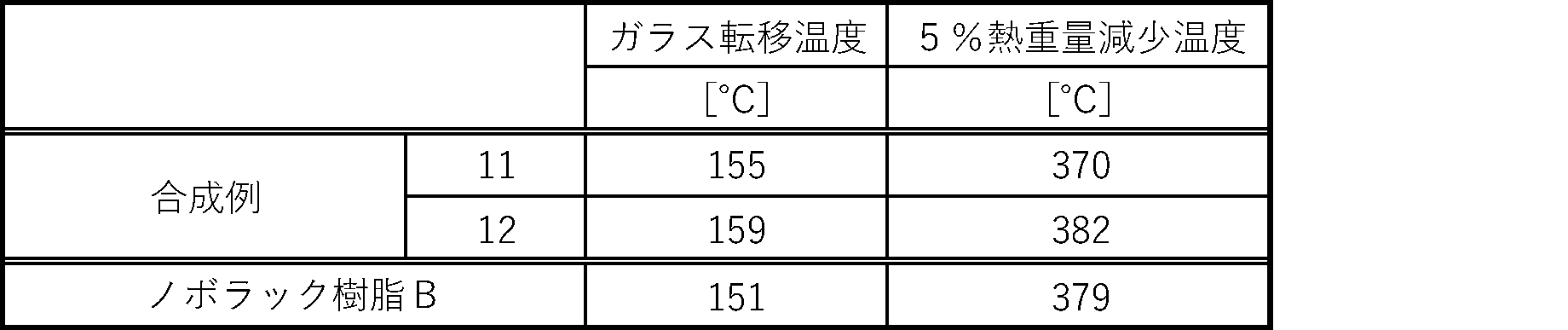
表5に表される樹脂組成物を調製し、アルカリ溶解速度を測定した。

(1)合成例11,12で得られた樹脂及びノボラック樹脂Bの単体もしくは混合物を、PGMEA(プロピレングリコールモノメチルエーテルアセテート)に溶解し、その後、ポアサイズ0.2μmのフィルターで濾過した。こうすることで、樹脂のPGMEA溶液を得た。
(2)HMDS処理がされたシリコンウエハの表面に、樹脂組成物をスピンコートにより塗布し、ホットプレートを用いてPGMEAを乾燥させた。このようにして、シリコンウエハの表面に樹脂膜を形成した。スピンコート条件の詳細は以下の通りである。
・スピンコート条件:スロープ50s、1,000rpm、60s
・乾燥条件:110℃、60s
・乾燥膜厚:10μm
(3)上記(2)で形成した樹脂膜を、シリコンウエハごと、アルカリ水溶液(2.38質量%テトラメチルアンモニウムヒドロキシド水溶液)に浸漬した。そして、浸漬時間と膜厚との関係から、アルカリ溶解速度を算出した。
以下の手順で、感光性樹脂組成物(フォトレジスト組成物)を調製し、そして評価した。
(1)合成例12で得られたアラルキル樹脂75質量部と、キノンジアジド系感光剤(東洋合成社製、NT200)25質量部とを、PGMEA(プロピレングリコールモノメチルエーテルアセテート)500質量部に溶解し、その後、ポアサイズ0.2μmのフィルターで濾過した。こうすることで、感光性樹脂組成物(フォトレジスト組成物)を調製した。
(2)HMDS処理したシリコンウエハの表面に、感光性樹脂組成物(フォトレジスト組成物)をスピンコートにより塗布し、ホットプレートを用いてPGMEAを乾燥させた。このようにして、シリコンウエハの表面に感光性樹脂膜(フォトレジスト膜)を形成した。
・スピンコート条件:スロープ10s、1,000rpm、60s
・乾燥条件:110℃、60s
・乾燥膜厚:1μm
(3)上記(2)で形成された感光性樹脂膜(フォトレジスト膜)の上に、様々な幅のライン/スペースパターンを有するフォトマスクを載せ、g・h線ランプ(g、h線が同時に出る装置)で、h線換算で200mJ/cm2の光を照射した。
(4)光照射された感光性樹脂膜(フォトレジスト膜)を、シリコンウエハごと、現像液(2.38質量%テトラメチルアンモニウムヒドロキシド水溶液)に30秒間浸漬して現像処理した。浸漬後、取り出したシリコンウエハ上の樹脂膜に窒素ガスを吹き付けることで、乾燥させた。このようにして、シリコンウエハ上に「パターン」を得た。
上記「パターン」を、マイクロスコープで観察した。観察の結果、ライン/スペース=5μm/5μmのパターンが解像できていることを確認した。この結果より、本開示のアラルキル樹脂は、フォトレジスト等の、電子デバイス製造の際に用いられる感光性樹脂組成物に好ましく適用されることが理解される。
Claims (25)
- 以下一般式(1)または(2)で表される構造単位を有するアラルキル樹脂。
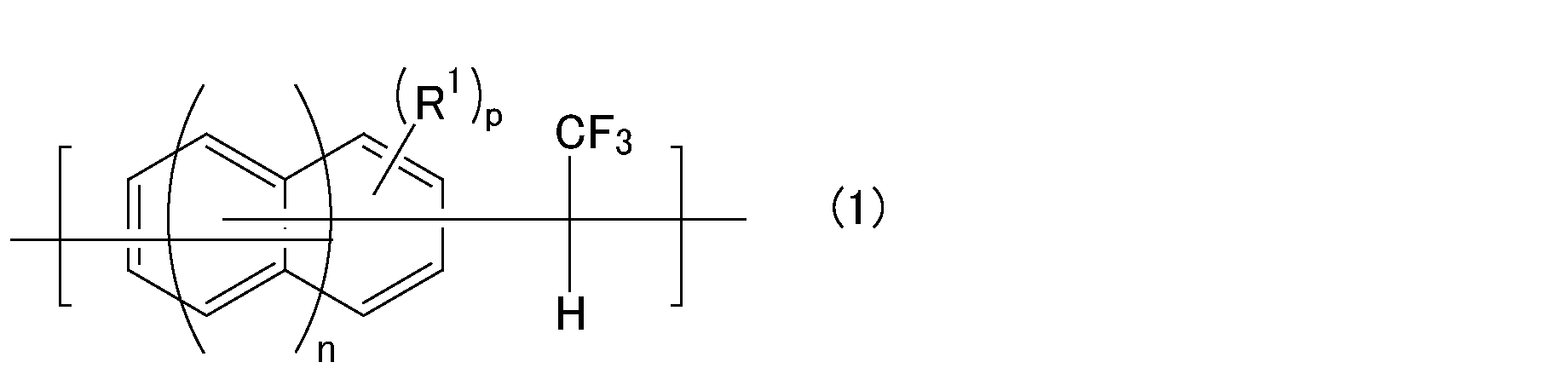

- 上記一般式(1)で表される構造単位を有する請求項1に記載のアラルキル樹脂。
- 上記一般式(2)で表される構造単位を有する請求項1に記載のアラルキル樹脂。
- 請求項1に記載のアラルキル樹脂であって、以下一般式(3)で表される構造単位をさらに含むアラルキル樹脂。
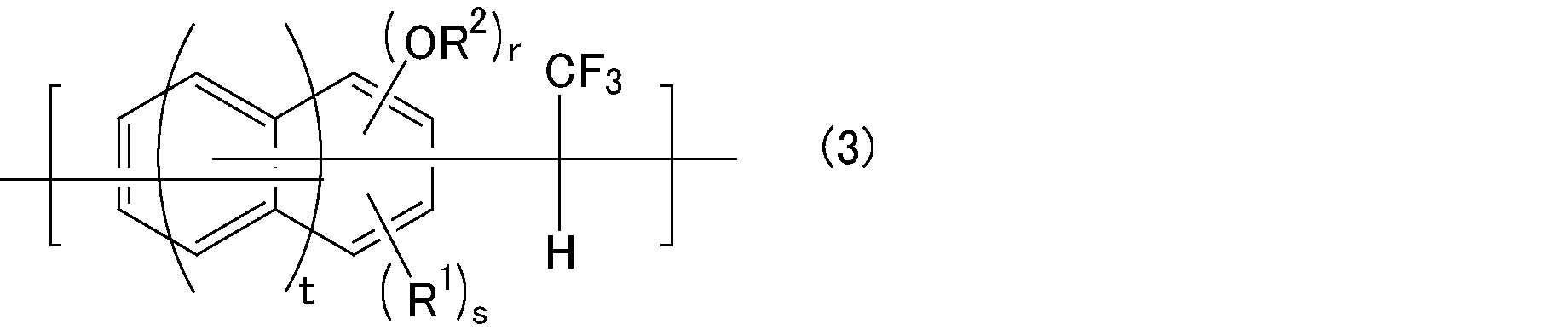
- 請求項1に記載のアラルキル樹脂であって、以下一般式(4)または(5)で表される構造単位を有するアラルキル樹脂。


- 請求項4または5に記載のアラルキル樹脂であって、R2がグリシジル基を含むアラルキル樹脂。
- 請求項4または5に記載のアラルキル樹脂であって、R2が重合性炭素-炭素二重結合を含むアラルキル樹脂。
- 請求項4または5に記載のアラルキル樹脂であって、R2が以下一般式(6)で表される部分構造を有するアラルキル樹脂。

- 請求項8に記載のアラルキル樹脂であって、R3が末端にカルボキシ基を有する1価の有機基を表すアラルキル樹脂。
- 請求項1または4に記載のアラルキル樹脂であって、以下一般式(7)で表される構造単位を有するアラルキル樹脂。
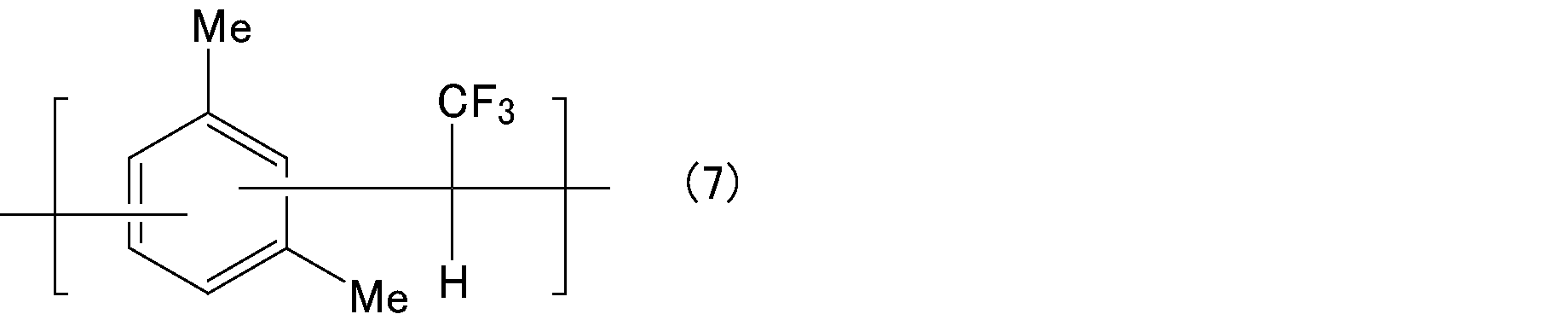
- 請求項1または4に記載のアラルキル樹脂であって、以下一般式(8)で表される構造単位を有するアラルキル樹脂。

- 請求項1または4に記載のアラルキル樹脂であって、以下一般式(9)で表される構造単位を有するアラルキル樹脂。

- 請求項1または4に記載のアラルキル樹脂であって、以下一般式(10)で表される構造単位を有するアラルキル樹脂。

- 請求項1または4に記載のアラルキル樹脂であって、重量平均分子量が300~200,000であるアラルキル樹脂。
- 請求項1または4に記載のアラルキル樹脂を含む、エポキシ樹脂の希釈剤。
- 水酸基当量が130g/当量以上である、請求項15に記載のエポキシ樹脂の希釈剤。
- 請求項1に記載のアラルキル樹脂又は請求項15に記載のエポキシ樹脂の希釈剤を含む硬化性樹脂組成物。
- さらにエポキシ樹脂を含む請求項17に記載の硬化性樹脂組成物。
- 請求項1または4に記載のアラルキル樹脂と、感光剤と、を含む感光性樹脂組成物。
- 請求項19に記載の感光性樹脂組成物であって、フォトレジスト組成物、ソルダーレジスト組成物またはインプリント組成物である感光性樹脂組成物。
- 請求項17に記載の硬化性樹脂組成物を硬化させた硬化物。
- 請求項21に記載の硬化物を含む電子デバイス。
- 芳香族化合物と、フルオラールとを、酸触媒の存在下で反応させることにより、以下一般式(1)または(2)で表される構造単位を有するアラルキル樹脂を製造する、アラルキル樹脂の製造方法。


- 以下一般式(11)または(12)で表される芳香族化合物と、フェノール系化合物を、酸触媒の存在下で反応させることにより、以下一般式(4)または(5)で表される構造単位を有するアラルキル樹脂を製造する、アラルキル樹脂の製造方法。




- 以下一般式(13)または(14)で表される芳香族化合物と、フェノール系化合物を、酸触媒の存在下で反応させることにより、前記一般式(4)または(5)で表される構造単位を有するアラルキル樹脂を製造する、請求項24に記載のアラルキル樹脂の製造方法。


Priority Applications (3)
| Application Number | Priority Date | Filing Date | Title |
|---|---|---|---|
| JP2023558038A JPWO2023080132A1 (ja) | 2021-11-02 | 2022-11-01 | |
| CN202280066753.5A CN118043368A (zh) | 2021-11-02 | 2022-11-01 | 芳烷基树脂、环氧树脂的稀释剂、固化性树脂组合物、光敏性树脂组合物、固化物、电子装置、芳烷基树脂的制备方法 |
| KR1020247012222A KR20240088837A (ko) | 2021-11-02 | 2022-11-01 | 아랄킬 수지, 에폭시 수지의 희석제, 경화성 수지 조성물, 감광성 수지 조성물, 경화물, 전자 디바이스, 아랄킬 수지의 제조방법 |
Applications Claiming Priority (2)
| Application Number | Priority Date | Filing Date | Title |
|---|---|---|---|
| JP2021179571 | 2021-11-02 | ||
| JP2021-179571 | 2021-11-02 |
Publications (1)
| Publication Number | Publication Date |
|---|---|
| WO2023080132A1 true WO2023080132A1 (ja) | 2023-05-11 |
Family
ID=86241151
Family Applications (1)
| Application Number | Title | Priority Date | Filing Date |
|---|---|---|---|
| PCT/JP2022/040860 Ceased WO2023080132A1 (ja) | 2021-11-02 | 2022-11-01 | アラルキル樹脂、エポキシ樹脂の希釈剤、硬化性樹脂組成物、感光性樹脂組成物、硬化物、電子デバイス、アラルキル樹脂の製造方法 |
Country Status (5)
| Country | Link |
|---|---|
| JP (1) | JPWO2023080132A1 (ja) |
| KR (1) | KR20240088837A (ja) |
| CN (1) | CN118043368A (ja) |
| TW (1) | TW202330683A (ja) |
| WO (1) | WO2023080132A1 (ja) |
Citations (3)
| Publication number | Priority date | Publication date | Assignee | Title |
|---|---|---|---|---|
| JPS63179914A (ja) * | 1986-12-10 | 1988-07-23 | インペリアル・ケミカル・インダストリーズ・ピーエルシー | オリゴマー、その製造方法、これを含有する付加重合性組成物、架橋熱硬化性樹脂、繊維複合材料及びその製造方法 |
| WO2020162408A1 (ja) * | 2019-02-06 | 2020-08-13 | セントラル硝子株式会社 | 1,1,1-トリフルオロ-2,2-ビスアリールエタンの製造方法、および1,1,1-トリフルオロ-2,2-ビスアリールエタン |
| WO2021193878A1 (ja) * | 2020-03-27 | 2021-09-30 | セントラル硝子株式会社 | ノボラック樹脂、エポキシ樹脂、感光性樹脂組成物、硬化性樹脂組成物、硬化物、電子デバイス、ノボラック樹脂の製造方法およびエポキシ樹脂の製造方法 |
-
2022
- 2022-11-01 KR KR1020247012222A patent/KR20240088837A/ko active Pending
- 2022-11-01 WO PCT/JP2022/040860 patent/WO2023080132A1/ja not_active Ceased
- 2022-11-01 CN CN202280066753.5A patent/CN118043368A/zh active Pending
- 2022-11-01 JP JP2023558038A patent/JPWO2023080132A1/ja active Pending
- 2022-11-02 TW TW111141768A patent/TW202330683A/zh unknown
Patent Citations (3)
| Publication number | Priority date | Publication date | Assignee | Title |
|---|---|---|---|---|
| JPS63179914A (ja) * | 1986-12-10 | 1988-07-23 | インペリアル・ケミカル・インダストリーズ・ピーエルシー | オリゴマー、その製造方法、これを含有する付加重合性組成物、架橋熱硬化性樹脂、繊維複合材料及びその製造方法 |
| WO2020162408A1 (ja) * | 2019-02-06 | 2020-08-13 | セントラル硝子株式会社 | 1,1,1-トリフルオロ-2,2-ビスアリールエタンの製造方法、および1,1,1-トリフルオロ-2,2-ビスアリールエタン |
| WO2021193878A1 (ja) * | 2020-03-27 | 2021-09-30 | セントラル硝子株式会社 | ノボラック樹脂、エポキシ樹脂、感光性樹脂組成物、硬化性樹脂組成物、硬化物、電子デバイス、ノボラック樹脂の製造方法およびエポキシ樹脂の製造方法 |
Also Published As
| Publication number | Publication date |
|---|---|
| CN118043368A (zh) | 2024-05-14 |
| JPWO2023080132A1 (ja) | 2023-05-11 |
| KR20240088837A (ko) | 2024-06-20 |
| TW202330683A (zh) | 2023-08-01 |
Similar Documents
| Publication | Publication Date | Title |
|---|---|---|
| JP7602145B2 (ja) | ノボラック樹脂、エポキシ樹脂、感光性樹脂組成物、硬化性樹脂組成物、硬化物、電子デバイス、ノボラック樹脂の製造方法、エポキシ樹脂の製造方法および活性エステル樹脂の製造方法 | |
| JP2022033731A (ja) | 化合物、樹脂、組成物並びにレジストパターン形成方法及び回路パターン形成方法 | |
| JP7069529B2 (ja) | 化合物、樹脂、組成物並びにレジストパターン形成方法及び回路パターン形成方法 | |
| JP6165690B2 (ja) | 有機膜形成用組成物の製造方法 | |
| KR20160135122A (ko) | 감방사선 수지 조성물 및 전자 부품 | |
| JP5383606B2 (ja) | フェノール樹脂およびその製造方法 | |
| WO2018016614A1 (ja) | 化合物、樹脂、組成物及びパターン形成方法 | |
| WO2018016634A1 (ja) | 化合物、樹脂及び組成物、並びにレジストパターン形成方法及び回路パターン形成方法 | |
| CN107848926B (zh) | 酚醛清漆型含酚性羟基树脂以及抗蚀膜 | |
| CN107108418A (zh) | 含酚性羟基化合物、包含其的组合物及其固化膜 | |
| US9550711B2 (en) | Fluorine-containing polymerizable monomer and polymer compound using same | |
| KR20190049731A (ko) | 화합물, 수지, 조성물, 그리고 레지스트패턴 형성방법 및 회로패턴 형성방법 | |
| JP7061271B2 (ja) | 化合物、樹脂、組成物、並びにレジストパターン形成方法及び回路パターン形成方法 | |
| KR20180048651A (ko) | 수지 조성물 | |
| JPWO2018101376A1 (ja) | 化合物、樹脂、組成物並びにレジストパターン形成方法及び回路パターン形成方法 | |
| JP7445382B2 (ja) | 化合物、樹脂、組成物及びパターン形成方法 | |
| CN111655662A (zh) | 化合物、树脂、组合物、抗蚀图案形成方法、电路图案形成方法和树脂的纯化方法 | |
| WO2023080132A1 (ja) | アラルキル樹脂、エポキシ樹脂の希釈剤、硬化性樹脂組成物、感光性樹脂組成物、硬化物、電子デバイス、アラルキル樹脂の製造方法 | |
| KR101759624B1 (ko) | 헥사플루오로이소프로판올기를 포함하는 노볼락 수지 및 그 제조 방법과 그 조성물 | |
| CN110198924A (zh) | 化合物、树脂、组合物和图案形成方法 | |
| JP2008285470A (ja) | フェノール性水酸基およびメチロール基を有する新規なフルオレン化合物およびその製造方法 | |
| JP2015196709A (ja) | ノボラック型フェノール樹脂及びその製造方法、フォトレジスト組成物、エポキシ化ノボラック型フェノール樹脂、エポキシ樹脂組成物並びに硬化物 | |
| WO2017217312A1 (ja) | レジスト用樹脂組成物及びレジスト膜 | |
| JP6063740B2 (ja) | ノボラック樹脂、その製造方法、及びその用途 | |
| JP2008024900A (ja) | ベンゾオキサゾール前駆体、樹脂組成物およびそれを用いたコーティングワニス、樹脂膜並びに半導体装置 |
Legal Events
| Date | Code | Title | Description |
|---|---|---|---|
| 121 | Ep: the epo has been informed by wipo that ep was designated in this application |
Ref document number: 22889952 Country of ref document: EP Kind code of ref document: A1 |
|
| WWE | Wipo information: entry into national phase |
Ref document number: 2023558038 Country of ref document: JP |
|
| WWE | Wipo information: entry into national phase |
Ref document number: 202280066753.5 Country of ref document: CN |
|
| NENP | Non-entry into the national phase |
Ref country code: DE |
|
| 122 | Ep: pct application non-entry in european phase |
Ref document number: 22889952 Country of ref document: EP Kind code of ref document: A1 |