WO2023080077A1 - 開閉システム - Google Patents
開閉システム Download PDFInfo
- Publication number
- WO2023080077A1 WO2023080077A1 PCT/JP2022/040413 JP2022040413W WO2023080077A1 WO 2023080077 A1 WO2023080077 A1 WO 2023080077A1 JP 2022040413 W JP2022040413 W JP 2022040413W WO 2023080077 A1 WO2023080077 A1 WO 2023080077A1
- Authority
- WO
- WIPO (PCT)
- Prior art keywords
- opening
- person
- user
- closing
- motion
- Prior art date
- Legal status (The legal status is an assumption and is not a legal conclusion. Google has not performed a legal analysis and makes no representation as to the accuracy of the status listed.)
- Ceased
Links
Images






Classifications
-
- E—FIXED CONSTRUCTIONS
- E05—LOCKS; KEYS; WINDOW OR DOOR FITTINGS; SAFES
- E05F—DEVICES FOR MOVING WINGS INTO OPEN OR CLOSED POSITION; CHECKS FOR WINGS; WING FITTINGS NOT OTHERWISE PROVIDED FOR, CONCERNED WITH THE FUNCTIONING OF THE WING
- E05F15/00—Power-operated mechanisms for wings
- E05F15/70—Power-operated mechanisms for wings with automatic actuation
- E05F15/73—Power-operated mechanisms for wings with automatic actuation responsive to movement or presence of persons or objects
Definitions
- Patent Document 1 The user manually opens and closes the entrance door when going out or returning home.
- An object of the present disclosure is to provide a door opening/closing system capable of controlling the opening/closing mode of the door according to the attribute of the user.
- a detection unit that detects a person within a predetermined range from an openable and closable body, authenticates the person based on detection data of the person, and authenticates the person based on the authentication result of the person.
- a determination unit that controls the opening or closing operation of the opening/closing body, wherein the determination unit determines the attribute of the authenticated person and controls the opening/closing mode of the opening/closing body according to the content of the attribute. It is an opening and closing system.
- FIG. 1 is a schematic configuration diagram of an opening/closing system according to an embodiment
- FIG. 4 is a flow diagram of the opening/closing system in the first scene according to the present embodiment
- FIG. 10 is a diagram illustrating the operation of the opening/closing system in a second scene according to the present embodiment
- FIG. 4 is a flow diagram of the opening/closing system in the first scene according to the present embodiment
- FIG. 10 is a diagram illustrating the operation of the opening/closing system in a second scene according to the present embodiment
- FIG. 9 is a flow diagram of the opening/closing system in the second scene according to the present embodiment; It is a figure explaining the structural example of the display which concerns on this embodiment.
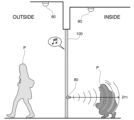
- FIG. 11 is a diagram for explaining the operation of the opening/closing system in the third scene according to the present embodiment;
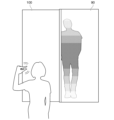
- FIG. 11 is a diagram for explaining the operation of the opening/closing system in the third scene according to the present embodiment; It is a figure which shows the entrance door of the hinged door which concerns on this embodiment. It is a figure which shows the entrance door of the hinged door which concerns on this embodiment. It is a figure which shows the entrance door of the hinged door which concerns on this embodiment. It is a figure which shows the entrance door of the hinged door which concerns on this embodiment. It is a figure which shows the entrance door of the hinged door which concerns on this embodiment.
- the opening/closing system 1 electrically opens and closes the opening/closing body.
- the opening/closing body is a fitting installed in building B, for example.
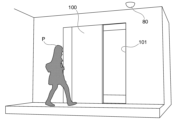
- the opening/closing body is fittings associated with an opening/closing operation, such as an entrance door 100, a window, a shutter, a garage door, and a gate, as illustrated in FIG.
- the opening/closing body may be installed inside the building B, or may be installed outside the building B.
- the opening/closing body may be a door provided in a delivery box for temporarily storing delivered packages.
- the opening/closing body may be a storage door provided in a storage space provided in the room, or may be a mirror rotatably installed in the room.
- FIG. 2 the case where the opening/closing body is the entrance door 100 installed at the entrance of the building B will be described.
- the entrance door 100 may be a hinged door or a sliding door.
- the opening/closing system 1 is configured, for example, to control the opening/closing operation of an entrance door 100 (sliding door in this example) provided at the entrance of building B as illustrated in FIG.
- the opening/closing system 1 can open/close the entrance door 100 touchless without requiring the user P to perform a locking/unlocking operation. According to the opening/closing system 1, the user P can go in and out of the entrance without stopping.
- the entrance 101 shown in FIG. 2 is partitioned into a space outside the building B and inside the building B by an entrance door 100, and a step is provided on the floor surface between the outside of the building B and the inside of the building B. It is formed flat.
- the entrance door 100 is, for example, a sliding door that opens and closes based on a horizontal sliding motion, or a hinged door that opens and closes around a rotation axis along the vertical direction.
- the front door 100 is driven by a drive unit, which will be described later, to perform opening and closing operations.
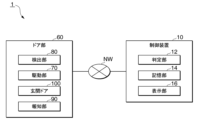
- the opening/closing system 1 shown in FIG. 3 includes a door section 60 to be controlled and a control device 10 that controls the door section 60 .
- Door unit 60 and control device 10 are communicably connected via network NW.
- the door section 60 and the control device 10 may be communicatively connected based on a wired connection.
- the control device 10 may be a device built in the door portion 60 .
- the door unit 60 includes an entrance door 100 that can be freely opened and closed, a drive unit 70 that drives the opening and closing of the entrance door 100, a detection unit 80 that detects the user P of the entrance door 100, and a notification unit that transmits information to the user P.
- the driving unit 70 includes a motor, a speed reducer, an actuator, etc., which are driving sources for opening and closing the entrance door 100 .
- Components of the drive unit 70 are configured according to the opening/closing mechanism of the entrance door 100 .
- the driving unit 70 performs unlocking and locking operations of the entrance door 100 based on the operation of the driving source. The unlocking and locking operations may be performed based on an electronic lock (not shown) provided separately.
- the detection unit 80 acquires the biometric authentication data of the person outside the entrance door 100 .
- the detection unit 80 has a camera, and acquires image data including a person's face (hereinafter referred to as "face image data") within a predetermined range outside the front door 100 as biometric authentication data.
- face image data a person's face
- the detection unit 80 may acquire data other than the face image data as the biometric authentication data as long as the data can identify a person.
- the detection unit 80 may be configured by, for example, a device that acquires biometric authentication data such as fingerprints, voiceprints, iris patterns, and vein patterns.
- the detection unit 80 may communicate with a mobile device (not shown) possessed by the user P to acquire authentication data with which the user P can be identified.
- the detection unit 80 acquires the attribute data of a person within a predetermined range outside the entrance door 100 .
- the predetermined range is, for example, the detection range of the detection section 80 .
- the predetermined range may be an area within a predetermined distance range from the entrance door 100 set in advance.
- the predetermined range may be a time interval for reaching the entrance door 100 according to the moving speed of the user P.
- the predetermined range may be appropriately adjusted according to the opening/closing mechanism of the entrance door 100 and the attributes of the user P.
- the detection unit 80 acquires, for example, image data including at least part of the body of a person outside the front door 100 as attribute data.
- the attribute data is, for example, the person outside the entrance door 100, such as the user P standing, carrying luggage or a child, using a wheelchair, carrying a stroller, or using a cane.
- the detection unit 80 may include a LIDAR (Light Detection and Ranging, Laser Imaging Detection and Ranging), an ultrasonic sensor, a laser sensor, etc., as long as the attribute data can be acquired.
- LIDAR Light Detection and Ranging, Laser Imaging Detection and Ranging
- an ultrasonic sensor a laser sensor, etc.
- the notification unit 90 includes, for example, a display device, a speaker, lighting, etc., and uses information transmission media such as images, sounds, and lights to transmit information related to the opening/closing operation of the front door 100 regardless of the attributes of the user P. introduce.
- the notification unit 90 notifies the authentication result of the user P via, for example, an information transmission medium.
- the notification unit 90 notifies the user P of the next operation when the authentication is successful.
- the notification unit 90 notifies the operation performed by the user P when the authentication fails.
- the notification unit 90 notifies the operation status of the front door 100 when the front door 100 is opened and closed.
- the control device 10 is installed, for example, in building B where the door section 60 is installed.
- the control device 10 may be a device that is installed in a place other than the building B and controls the door section 60 via the network NW.
- the control device 10 is configured by, for example, an information processing terminal device such as a personal computer.
- the control device 10 authenticates the user P based on the biometric authentication data acquired from the detection unit 80 and controls the opening/closing operation of the entrance door 100 .
- the control device 10 includes, for example, a determination unit 12 that controls the door unit 60 based on the authentication result of the user P, a storage unit 14 that stores data and programs necessary for processing of the determination unit 12, and a door unit 60. and a display unit 16 for displaying information necessary for control.
- the storage unit 14 is, for example, a non-temporary storage medium such as a hard disk drive or flash memory.
- the storage unit 14 is built in the control device 10 .
- the storage unit 14 may be externally connected to the control device 10 .
- the storage unit 14 may be a server device connected to the control device 10 via the network NW.
- the display unit 16 is a display device such as a liquid crystal display or an organic EL (Electro Luminescence) display. In the storage unit 14 opening/closing system 1, the display unit 16 may not necessarily be provided.
- the determination unit 12 is implemented by, for example, a hardware processor such as a CPU (Central Processing Unit) executing a program (software). Some or all of these components are hardware (circuit parts) such as LSI (Large Scale Integrated circuit), ASIC (Application Specific Integrated Circuit), FPGA (Field-Programmable Gate Array), GPU (Graphics Processing Unit) ; including circuitry), or by cooperation of software and hardware.
- the program may be stored in advance in a storage device such as a HDD (Hard Disk Drive) or flash memory (a storage device with a non-transitory storage medium), or may be stored in a removable storage such as a DVD or CD-ROM.
- the storage device may be stored in a medium (non-temporary storage medium) and installed in the storage device by loading the storage medium into the drive device.
- the storage device is configured by, for example, an HDD, flash memory, EEPROM (Electrically Erasable Programmable Read Only Memory), ROM (Read Only Memory), or RAM (Random Access Memory).
- the determination unit 12 performs biometric authentication by comparing biometric authentication data acquired by the detection unit 80 with biometric authentication data registered in advance in the storage unit 14 (hereinafter referred to as “registered authentication data”). .
- the registration authentication data is stored in advance in the storage unit 14 based on the registration procedure of the user P, for example.
- the determination unit 12 extracts relative positions of characteristic parts such as eyes, nose, mouth, and ears based on the acquired image data including the face, and determines a plurality of features based on these relative positions. Generate a vector.
- the determination unit 12 uses the generated feature vectors as feature amounts, associates the feature amounts with the ID of the user P, creates registration authentication data, and stores the registration authentication data in the storage unit 14 .
- the determination unit 12 may previously execute machine learning based on deep learning using a plurality of image data including the face of the user P as teacher data, and associate the face of the user P with the ID of the user P. .
- the determination unit 12 may generate registration authentication data by associating the ID of the user P with data relating to the operation for opening and closing the front door 100 .
- the determination unit 12 compares the biometric authentication data acquired by the detection unit 80 with registration authentication data registered in advance in the storage unit 14, and if the feature amounts match, the person included in the image data is registered in advance. It is determined that the user is the user P.
- the matching of the feature amounts is not limited to the case where the generated feature amount and the stored feature amount have the same value, but also when the generated feature amount is a value within a predetermined range including the stored feature amount. Including if there is.
- the determination unit 12 compares the biometric authentication data acquired by the detection unit 80 with the registered authentication data registered in advance in the storage unit 14, and if the feature amounts do not match, the person included in the image data is identified in advance.
- the notification unit 90 notifies the room entry procedure method.
- Procedures for entering the room include, for example, contacting the manager of building B, contacting residents of building B, and performing procedures for registration as user P, and the like.
- the determination unit 12 determines the attribute of a person within a predetermined range from the entrance door 100. do. For example, the determination unit 12 previously executes machine learning based on deep learning using a plurality of image data including the body of the user P as teacher data, and includes at least a part of the newly acquired body of the user P. The attribute of the user P included in the image data is determined based on the image data.
- the determination unit 12 acquires image data including at least part of the body of the user P who is within a predetermined range from the front door 100 from the detection unit 80, and determines the predetermined range from the front door 100 based on the acquired image data. Generate the attribute value of the user P who is inside. The determination unit 12 determines attributes of the user P based on the attribute values.
- the attributes of the user P are, for example, the state of not holding an object to be carried in both hands, the state of holding an object to be carried in both hands, the state of using a wheelchair, the state of using a cane or crutches, walking or running speed.
- a classification item including a state that affects the open/closed state of the front door 100 when the user P uses the front door 100, such as the state of , is set in advance.
- the attributes of the user P the age group and disability attributes of the user P may be stored in advance in the storage unit 14 based on the user P registration procedure.
- the determination unit 12 controls the opening/closing mode of the entrance door 100 according to the attributes of the authenticated user P (person) based on the determination results.
- the determining unit 12 controls the driving unit 70 according to the contents of the attributes to determine the opening timing, opening speed, open state time, opening amount, opening angle, closing operation start timing, closing speed, It adjusts the opening/closing mode such as the closing timing of the closing operation. For example, when a user who is transporting an object enters a room, the determination unit 12 adjusts the opening/closing mode of the front door 100 to suit the transportation state of the object to be transported.
- the determination unit 12 adjusts the opening/closing mode of the entrance door 100 to suit the use of the wheelchair.
- the opening/closing system 1 adjusts the opening/closing mode of the entrance door 100 according to the attribute of the user P when the user P moves to an area within a predetermined range from the entrance door 100.
- User P's convenience can be improved regardless of P's attributes.
- the determination unit 12 may determine the actions of the user P within a predetermined range from the front door 100 and control the opening and closing of the front door 100 .
- the detection unit 80 detects a two-dimensional gesture or a three-dimensional gesture performed by a person within a predetermined range from the entrance door 100 .
- the motion of a person within a predetermined range from the entrance door 100 may be the motion of a person within a predetermined range outside the entrance door 100 or within a predetermined range inside the entrance door 100. It may be a human action or both.
- the detection unit 80 detects actions (gestures) of a person who has returned home or a visitor.
- the detection unit 80 detects an action (gesture) of a person going out.
- the detection unit 80 outputs the detection result to the determination unit 12 .
- the detection unit 80 is installed at a position such as the entrance door 100, the ceiling, the wall, or the like, where the motion of a person can be detected.
- the detection unit 80 detects the relative position between the entrance door 100 and the person in addition to the camera that images the entrance door 100 and the person, and a sensor capable of detecting the movement of the person (for example, a motion sensor such as a radar sensor). ), there is no particular limitation, and known techniques described in Patent Documents 2 to 10 may be used.
- the detection unit 80 may use a known sensor such as a millimeter wave sensor, millimeter wave radar, infrared sensor, acceleration sensor, angular velocity sensor, or geomagnetic sensor.
- registration authentication data and motion data corresponding to motions for opening and closing the entrance door 100 are associated and registered.
- the motion data includes feature amount data corresponding to the motion.
- the motion data includes, for example, a plurality of feature amount data at predetermined time intervals from the start to the end of motion.
- the storage unit 14 stores an action corresponding to a human action (hereinafter referred to as "first action”) for unlocking and opening the front door 100 by the user P outside the front door 100.
- the data and the ID of the user P are associated and registered in advance.
- a human action hereinafter referred to as "second action” for unlocking and opening the front door 100 by a person inside the front door 100 (for example, a person inside the room) is stored. is registered in advance.
- motion data corresponding to a human motion hereinafter referred to as a "third motion" for executing at least one of closing and locking of the front door 100 may be registered in advance. good.
- the first actions are, for example, casual daily actions such as touching glasses or earlobes, actions that do not use hands such as shaking the head, and changes in facial expressions.
- the second action is, for example, putting on shoes.
- the second action is not limited to this, and the second action may be a casual daily action such as touching glasses or earlobes, a motion that does not use hands such as shaking the head, or an extraordinary action. It may be a change in facial expression or the like.
- the third action includes casual daily actions such as touching eyeglasses and earlobes, actions that do not use hands such as shaking the head, facial expressions, and the like.
- each of the first action, the second action, and the third action is not particularly limited as long as it is a human action.
- the human action registered as the registered action is not limited to one according to the attributes of the user P, and may be plural.
- the first action, the second action, and the third action may include actions other than gestures, such as vocalization, depending on the attribute of the user P.
- the notification unit 90 may be a display device installed on the inner wall surface inside the doorway 101 or may be a display device installed embedded in the wall inside the doorway 101 .
- the notification unit 90 has a structure in which the inside (for example, the interior) cannot be seen from the outside (for example, the outdoors) of the entrance door 100, but the outside can be seen from the inside of the entrance door 100. - ⁇
- the determination unit 12 controls the opening/closing operation of the entrance door 100 based on the detection result of the detection unit 80. For example, the determination unit 12 executes determination processing for determining whether or not the motion of a person detected by the detection unit 80 is a predetermined motion registered in advance. Each operation of the first operation, the second operation, and the third operation is an example of a predetermined operation. If the human motion detected by the detection unit 80 is a predetermined motion as a result of determination processing, the determination unit 12 causes the entrance door 100 to open or close.
- the opening operation may be either an operation of unlocking the entrance door 100 or an operation of moving the entrance door 100 so that the entrance door 100 is open, or both operations. may contain.
- the closing operation may be either an operation of moving the entrance door 100 so that the entrance door 100 is closed or an operation of locking the entrance door 100, or includes both operations. It's okay.
- the opening operation refers to an operation to move the front door 100 to an open state
- the closing operation refers to an operation to move the front door 100 to a closed state. indicates that
- the determining unit 12 executes determination processing of user P's actions.
- the determination unit 12 controls the front door 100 to open to allow the user P to enter the room.
- the determination unit 12 performs determination processing for determining whether or not the motion of the user P inside the entrance door 100 detected by the detection unit 80 is a second motion such as putting on shoes.
- the determination unit 12 controls the front door 100 to open according to the attribute of the user P when the motion of the person detected by the detection unit 80 is the second motion.
- the determination unit 12 controls display contents displayed on the notification unit 90 .
- the determination unit 12 displays on the notification unit 90 based on the action of the user P who is present in the interior space of the building B across the entrance door 100. You may change the transparency of a part of the person's appearance.
- the determination unit 12 may change the degree of transparency according to the human motion detected by the detection unit 80 .
- the determination unit 12 may select a position (hereinafter referred to as a “transparency change position”) at which the degree of transparency is changed according to the motion of the person detected by the detection unit 80 .
- the determination unit 12 changes the transparency according to the pinch motion, If the human motion is a swipe motion of moving the hand or finger in any of the up, down, left, and right directions, the transparency change position may be changed according to the swipe motion.
- FIG. 1 The operation of the opening/closing system 1 in three situations will be described below with reference to FIGS. 4 and 5.
- FIG. 4 The operation of the opening/closing system 1 in three situations will be described below with reference to FIGS. 4 and 5.
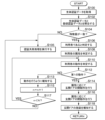
- the determination unit 12 acquires image data including the person's face as biometric authentication data (step S100).
- the determination unit 12 collates the biometric authentication data with registered authentication data registered in advance in the storage unit 14 (step S102).
- the determination unit 12 determines whether or not the feature amount generated based on the biometric authentication data matches the feature amount included in the registered authentication data (step S104).
- the determination unit 12 determines that the person located within the predetermined range of the entrance door 100 is the pre-registered user P (step S106).
- the determination unit 12 determines the attributes of the user P based on the image data (step S108). Attributes include height, body shape, carrying luggage, carrying a child, crutches, cane, handicapped markings, wheelchair , whether the user is assisting in a wheelchair or pushing a baby stroller, etc.
- the above example is an illustration, and is not limited to this.
- the determination unit 12 determines the content of the user's motion based on the detection result of the user's motion that has been successfully biometrically authenticated (step S110). For example, the detection unit 80 detects the movement of the user within a predetermined range on condition that the biometric authentication is successful. The detection unit 80 outputs motion data including the detected motion of the user to the determination unit 12 .
- the determination unit 12 determines whether or not the motion of the user P detected by the detection unit 80 is the first motion (step S112). If the motion of the user detected by the detection unit 80 is the first motion, the determination unit 12 unlocks the front door 100 based on the open state control content according to the attribute of the user P. to open (step S114).
- the detection unit 80 determines the attributes of a user at a position about 2 m away from the entrance door 100, detects the movement, and the determination unit 12 detects the motion of the user. is the first operation, the opening/closing mode of the entrance door 100 is controlled based on the control contents of the opening/closing mode according to the attribute of the user P.
- the determination unit 12 determines that the attribute of the user P is in a state in which there is no problem in entering and exiting the entrance door 100 and determines that the first action is performed
- the determination unit 12 unlocks the entrance door 100 and Execute the opening operation at once.
- the user P can pass through the doorway 101 without stopping in front of the doorway 101, for example.
- the determination unit 12 unlocks the entrance door 100 in about 2 seconds, and completes the opening operation of the entrance door 100 in about 5 seconds.
- the determination unit 12 closes the front door 100 based on the control details of the closed state according to the attribute of the user P after a predetermined time set according to the attribute has elapsed. to lock the front door 100 (step S116). Since the detector 80 measures the relative position between the entrance door 100 and the user, the entrance door 100 is not controlled to be closed while the user P is passing through the entrance 101 .
- the determination unit 12 may start closing the front door 100 when the user passes through the entrance 101 and the relative distance of the user from the front door 100 reaches a predetermined distance. In the example shown in FIG. 4, the entrance door 100 is completely closed 5 seconds after the user has passed through the entrance, and is then locked within 2 seconds.
- the determination unit 12 When the locking of the entrance door 100 is completed, the determination unit 12 notifies the user that the entrance door 100 has been locked (step S118). For example, the determination unit 12 outputs a preset sound when the front door 100 is completely locked. However, it is not limited to this, and the determination unit 12 only needs to notify the user that the front door 100 has been locked, and the notification mode is not particularly limited.
- the determination unit 12 determines that the authentication has failed, and executes processing based on the authentication failure (step S105). ). If the determination unit 12 cannot determine the first motion in step S112, the determination unit 12 causes the notification unit 90 to perform a motion (step S113), and returns the process to step S110. When the number of times n (n: natural number) for determining the first action reaches a preset number of times N (N: a natural number equal to or greater than n) (S115, S117), the determination unit 12 performs the process of step S105.
- N a natural number equal to or greater than n
- the opening/closing system 1 when both face authentication and motion authentication are used, if the user P routinely poses openly in order to unlock and open the front door 100, There is a possibility that the information may be read by surrounding people, and the user P needs to consider the line of sight of the surrounding people.
- the motion registered in the opening/closing system 1 as the first motion is desirably a casual daily motion such as touching glasses or an earlobe.
- the user P may hold a device that can be recognized by the control device 10, and the control device 10 detects that the device held by the user P is detected within a predetermined range from the front door 100 by the detection unit 80. In this case, opening/closing control may be started.
- the detection unit 80 detects a user approaching the entrance/exit 101 (step S200). For example, the detection unit 80 detects the user when the distance of the user from the entrance door 100 is within a predetermined distance.
- the detection unit 80 outputs detection data of the detected user P to the determination unit 12 .
- the determination unit 12 determines the attributes of the user P based on the detection data (step S202).
- the determination unit 12 determines the motion of the person inside the front door 100 (step S204).
- the motion of the person inside the entrance door 100 detected by the detection unit 80 is determined (step S206).
- the determination unit 12 executes the unlocking and opening motions of the front door 100 according to the attributes of the user P. (Step S210).
- the action registered in advance by the user P may be, for example, the action of putting on shoes, which is performed before exiting the entrance door 100, or may be an action arbitrarily set by the user P.
- the detection unit 80 detects the movement of the user P who is about 2 m away from the entrance door 100, and the determination unit 12 detects that the user's movement is the movement of putting on shoes.
- the unlocking and opening operations of the entrance door 100 are executed at once according to the attribute of the user P. For example, the entrance door 100 is unlocked in about 2 seconds, and the opening operation of the entrance door 100 is completed in about 5 seconds.
- the determination unit 12 controls the entrance door 100 to be closed according to the attribute of the user P and locks the entrance door 100 (step S212). Since the detector 80 measures the relative position between the entrance door 100 and the user, the entrance door 100 is not controlled to be closed when the user is passing through the entrance.
- the determination unit 12 may start closing the front door 100 when the user passes through the front door and the relative distance of the user from the front door 100 reaches a predetermined distance. In the example shown in FIG. 6, the entrance door 100 is completely closed 5 seconds after the user has passed through the entrance, and then locked within 2 seconds.
- the determination unit 12 notifies the user that the entrance door 100 has been locked (step S214). For example, the determination unit 12 causes the notification unit 90 to output a preset sound when the front door 100 is completely locked.
- the notification content of the notification unit 90 is not limited to this, and it is sufficient to notify that the front door 100 has been locked according to the attribute of the user P, and the notification mode is not particularly limited.
- step S208 the determination unit 12 executes the processing of step S208 until the predetermined motion is recognized.
- the user P may perform not only the same action, but also one action selected from a plurality of actions registered in advance.
- the determination unit 12 When a visitor approaches the entrance door 100, the determination unit 12 notifies the user in the room that the visitor is present. For example, when a visitor approaches the entrance door 100, the determination unit 12 outputs to the notification unit 90 that there is a visitor. As an example, the determination unit 12 may display the presence of a visitor on the notification unit 90 as character information, or display a color indicating the presence of a visitor on the notification unit 90 . For example, the determination unit 12 may determine that there is a visitor when the biometric authentication for confirming that the person is a resident fails.
- the notification unit 90 may be provided at the entrance door 100 or adjacent to the entrance door 100 as described above.
- the notification unit 90 has a structure in which a person cannot see inside (for example, indoors) from the outside (for example, outdoors) of the entrance door 100, but can see outside from the inside of the entrance door 100. good.
- the notification unit 90 has a glass 102, a semi-transmissive reflective film 104, and a light control film 103.
- the notification unit 90 has, for example, a semi-transmissive reflective film installed on the surface of the glass 102 on the outdoor side (outside), and a light control film 103 installed on the surface of the glass 102 on the indoor side (inside). Therefore, the visitor cannot visually recognize the interior through the notification unit 90, and the resident inside the room can visually recognize the visitor.
- the determination unit 12 can, for example, turn ON/OFF the light control film 103 partially.
- a light control film divided into a plurality of sheets is installed inside the notification unit 90, and the determination unit 12 turns ON/OFF the current or voltage for each light control film 103, thereby When viewed from above, the transparency of a portion of the human figure displayed on the notification unit 90 can be changed.
- the light control film 103 can use an electrochromic (EC) material or the like.
- the appearance of the visitor is displayed on the notification unit 90.
- the appearance of the visitor displayed on the notification unit 90 as an initial condition may not be 100% transparent, but may be set so that the silhouette can be seen, or may be opaque.
- the user P in the room confirms who the visitor is in detail, the user P may perform a pinch motion inside the doorway 101 as illustrated in FIG. 9 .
- the detection unit 80 detects the movement of the user when the distance of the user from the entrance door 100 is within a predetermined distance (entrance area).
- the determination unit 12 changes the transparency at the transparency change position on the notification unit 90 according to the pinch motion.
- the determination unit 12 changes the transparency change position on the notification unit 90 according to the swipe motion.
- the determination unit 12 makes the notification unit 90 opaque.
- the determination unit 12 may determine that the user in the room has finished serving the visitor, for example, based on the user's action. For example, the user performs a certain action (hereinafter referred to as "fourth action") after finishing the reception of the visitor. If the motion of the user inside the entrance door 100 detected by the detection unit 80 is the fourth motion, the determination unit 12 determines that reception of the visitor has ended.
- the determination unit 12 detects that the user in the room has finished receiving the visitor by operating an operation unit (not shown) (for example, an intercom switch or a touch panel button in the entrance area). good.
- the determination unit 12 may determine that the reception has ended when the detection unit 80 detects that no one is inside or outside the entrance door 100 .
- the opening/closing system 1 includes a detection unit 80 that detects the motion of a person within a predetermined range from the opening/closing body, and a determination unit 12 that controls the opening/closing motion of the opening/closing body based on the detection result of the detection unit 80 .
- the opening/closing system 1 can perform the opening/closing operation of an opening/closing body such as an entrance door without manual operation. For example, if the opening/closing body is a garage door, the garage door can be opened and closed by making a gesture from inside the car.
- the determination unit 12 executes determination processing for determining whether or not the human motion detected by the detection unit 80 is a predetermined motion registered in advance, and determines whether the human motion detected by the detection unit 80 is a predetermined motion.
- the opening/closing body may be opened or closed.
- the opening/closing system 1 may acquire biometric authentication data of a person outside the entrance door 100 and compare the acquired biometric authentication data with registered authentication data registered in advance. If the motion of the person outside the entrance door 100 is a predetermined motion when the collation is successful, the determination unit 12 controls the entrance door 100 to open to allow the user to enter the room. good. In the opening/closing system, it is necessary to confirm the intention of the person through gestures when performing the unlocking or opening operation in order to prevent the unlocking operation or opening operation from being performed against the user's will. and
- the detection unit 80 may detect the motion of a person inside the entrance door 100.
- the determination unit 12 determines whether the motion of the person inside the entrance door 100 detected by the detection unit 80 is the motion of putting on shoes. In the case of putting on shoes, the front door 100 may be controlled to open. The user can control the front door 100 to be open without manual operation when going out.
- hinged doors may be based on the premise that they will be used by able-bodied people without any burden, and there is room for improvement in the current manual opening and closing operations for people with disabilities and those with luggage when going out or returning home. For example, for a person with a disability, to open a hinged entrance door, they must lean forward and put their hands on the knob or handle of the entrance door, or step back when opening the entrance door forward. is large. A swing door cannot be easily replaced by a sliding door.
- the opening/closing system 1 may further include a known opening/closing mechanism capable of electrically opening and closing the hinged door.
- the opening/closing system 1 further includes an opening/closing mechanism, and while utilizing an existing hinged door, the opening/closing system 1 can accommodate not only persons with disabilities but also various people and situations, and provides easy-to-use and stress-free passage through the entrance/exit 101. ⁇ be able to.
- the opening/closing body to which the opening/closing system 1 is applied is not particularly limited, but it is more effective when applied to the hinged entrance door 100 .
- the determination unit 12 may cause the entrance door 100 to close.
- the determining unit 12 may lock the entrance door 100 when the entrance door 100 is closed.
- the determination unit 12 may lock the entrance door 100 when the motion of the person detected by the detection unit 80 is the third motion.
- the determination unit 12 may execute both or one of the closed state and the locked state of the front door 100 in response to a human action. In the case shown in FIG. 11 as well, the determination unit 12 may notify by sound or the like when the door is locked.
- the registered motions are not only hand-shaped gestures, but also subtle movements of the fingertips, facial expressions such as winking and raising eyebrows, and tilting the head. It may be an intentional action of a person. As a result, even a physically handicapped person can open and close the entrance door 100 without manually operating it.
- registration actions and attributes can be registered for each individual in the storage unit 14.
- the determination unit 12 can record a passage log for each user P by recording the registration operation and attributes used in the determination process.
- Registration operations and attributes may be associated with set values and stored in the storage unit 14 for each user P.
- the set values include, for example, the adjustment of the opening/closing speed of the entrance door 100, the presence/absence of automatic locking of the entrance door 100, and the like.
- the entrance door 100 can be used as a personal device for adjusting the opening/closing speed of the entrance door 100, whether or not to automatically lock the entrance door 100, and the like.
- the set value may be the time from locking to closing operation. Thereby, the time from locking to closing operation can be set for each individual, and the time from locking to closing operation can be set to the time according to each individual's preference. As a result, the time can be set according to one's own preference without feeling rushed.
- a home delivery company or a resident of Building B may hold a large package in their hands when bringing it into the room.
- human motion such as elbow motion is registered as the registered motion such as the first motion.
- a home delivery company or a resident of the building B can unlock and open the hinged entrance door 100 by moving the elbow or the like when bringing a large package into the room.
- the opening/closing system 1 the home delivery company or the residents of the building B can easily unlock and open the entrance door 100 even when they are holding the package in their hands.
- the opening/closing mode of the entrance door 100 can be controlled in accordance with the attribute of .
- the front door 100 can be easily unlocked and opened, and the front door 100 can be closed and locked.
- the opening/closing mode of the entrance door 100 can be controlled according to the attributes of the person P.
- a change in facial expression is registered as the registered motion such as the first motion.
- the entrance door 100 can be unlocked and opened, and the entrance door 100 can be closed and locked by changing facial expressions.
- the opening/closing mode of the entrance door 100 can be controlled in accordance with the attribute of .
- biometric authentication When unlocking and opening the entrance door 100 from inside the room, biometric authentication may or may not be used.
- biometric authentication is not used, but the processing from step S100 to step S106 shown in FIG. 5 may be executed before step S200 in FIG.
- Registration authentication data for biometric authentication when going out may be set so as not to include biometric authentication data for people who are concerned about going out alone, such as people with dementia and infants. As a result, it is possible to prevent the user P who has attributes such as a person suffering from dementia or an infant from going out alone.
- the registration authentication data for biometric authentication when going out may be, for example, the biometric authentication data of a person suffering from dementia or an infant. In this case, if the biometric authentication is successful, the determination unit 12 does not unlock or open the front door 100 regardless of the detection result of the detection unit 80 .
- the gesture for unlocking and opening the entrance door 100 from inside the room may be set for each individual. This gesture may not be assigned to people with dementia, young children, etc. As a result, it is possible to prevent a person suffering from dementia, an infant, or the like from going out alone.
- the opening/closing system 1 may turn on or off lighting devices installed at the doorway 101 or the like based on the detection result of the detection unit 80 .
- the determination unit 12 determines whether the motion of the person detected by the detection unit 80 is a predetermined motion registered in advance, and determines whether the motion of the person detected by the detection unit 80 is the predetermined motion.
- the lighting device may be turned on or off.
- the lighting device installed at the entrance/exit 101 or the like may be turned on or off by automatic detection by distance detection, detection by a human sensor, time setting, or the like.
- a device that uses a gesture as a trigger may be an opening/closing operation of an opening/closing body, and other devices such as a lighting device may be turned on and off by automatic detection such as distance detection or time setting.
- the determination unit 12 executes the unlocking and opening operations of the front door 100 at once when the motion of the user detected by the detection unit 80 is the motion of putting on shoes. It is not limited to this.
- the determination unit 12 unlocks the front door 100 when the detection unit 80 detects the action of putting on shoes, and opens the front door 100 when the detection unit 80 detects the action of putting on shoes. You may let The motion after putting on the shoes may be a standing motion after the motion of putting on the shoes.
- a display unit such as liquid crystal or organic EL may be installed on the light control film.
- This display may be transparent or transmissive.
- the present invention is not limited to this, and the display portion provided on the light control film may include transparent or non-transmissive portions.
Landscapes
- Power-Operated Mechanisms For Wings (AREA)
Abstract
開閉自在な開閉体から所定の範囲内において人を検出する検出部(80)と、前記人の検出データに基づいて前記人を認証すると共に、前記人の認証結果に基づいて前記開閉体の開動作或いは閉動作を制御する判定部(12)を備え、前記判定部(12)は、認証された前記人の属性を判定すると共に、前記属性の内容に応じて前記開閉体の開閉態様を制御する、開閉システム(1)である。
Description
本出願は、開閉システムに関する。
本出願は、2021年11月04日にアメリカ合衆国に出願された特許出願63/275,463及び2021年12月2日にアメリカ合衆国に出願された特許出願63/285,093に基づき優先権を主張し、その内容をここに援用する。
本出願は、2021年11月04日にアメリカ合衆国に出願された特許出願63/275,463及び2021年12月2日にアメリカ合衆国に出願された特許出願63/285,093に基づき優先権を主張し、その内容をここに援用する。
利用者は、外出時や帰宅時などでは、玄関ドアを手動により開けたり閉めたりしている(特許文献1参照)。
住宅の玄関ドアは、従来、玄関を出入りする人間(ユーザー)の手動操作によって開け閉めされることが多かった。しかしながら、近年、リモコンやセンサ等を使用してユーザーが近づくと開閉する自動ドアへの要求が高まっている。とくに、荷物を持っていたり、子供を抱きかかえていたりする場合や、負傷している場合等、手を使って施解錠したり、玄関ドアを開けたりする動作をとりにくい場合があり、ハンズフリーで開閉するドアが求められている。また玄関ドアは、健常者だけでなく、障がい者、高齢者など様々な利用者に利用される。そのため、玄関ドアの開閉態様は、利用者の状況や事情に応じて異なっている。玄関ドアを含む開閉扉は、利用者の状況や事情に関わらず、様々な属性の人にとって使いやすいユニバーサルデザインとされていることが望ましい。
本開示は、利用者の属性に応じて扉の開閉態様を制御することができる扉の開閉システムを提供することを目的とする。
本開示の一態様は、開閉自在な開閉体から所定の範囲内において人を検出する検出部と、前記人の検出データに基づいて前記人を認証すると共に、前記人の認証結果に基づいて前記開閉体の開動作或いは閉動作を制御する判定部を備え、前記判定部は、認証された前記人の属性を判定すると共に、前記属性の内容に応じて前記開閉体の開閉態様を制御する、開閉システムである。
本実施形態に係る開閉システム1は、開閉体を電動により開閉させる。開閉体は、例えば建物Bに設置されている建具である。例えば、開閉体は、図1に例示するような、玄関ドア100、窓、シャッター、ガレージドア、門扉などの開閉動作を伴う建具である。開閉体は、建物B内に設置されてもよいし、建物B外に設置されてもよい。開閉体は、配達された荷物を一時的に収納するための宅配ボックスに設けられた扉であってもよい。開閉体は、室内に設けられた収納スペースに設けられた収納扉であってもよいし、室内に回動可能に設置されている鏡であってもよい。以下では、図2に示すように、開閉体が建物Bの出入口に設置された玄関ドア100である場合について説明する。なお、玄関ドア100は、開き戸であってもよいし、引戸であってもよい。
開閉システム1は、例えば、図2に例示するような建物Bの出入口に設けられた玄関ドア100(この例では引戸)の開閉動作を制御するように構成されている。開閉システム1は、利用者Pの施解錠操作を必要とせずに玄関ドア100をタッチレスに開閉させることができる。開閉システム1によれば、利用者Pは、立ち止まることなく出入口に出入りできる。
図2に示す出入口101は、玄関ドア100により建物B外と建物B内との空間に仕切られており、建物B外と建物B内との間の床面には、段差が設けられておらず、平坦に形成されている。建物Bの出入口101の床面をこのように構成することにより、利用者Pが車椅子利用者や高齢者である場合であっても、利用者Pは出入口101を容易かつスムーズに出入りすることができる。玄関ドア100は、例えば、水平方向へのスライド動作に基づいて開閉する引戸、上下方向に沿った回転軸を中心に開閉する開き戸である。玄関ドア100は、後述の駆動部により駆動され、開閉動作を行う。
図3に示す開閉システム1は、制御対象であるドア部60と、ドア部60を制御する制御装置10とを備えている。ドア部60と制御装置10とは、ネットワークNWを介して通信可能に接続されている。ドア部60と制御装置10とは、有線接続に基づいて通信可能に接続されていてもよい。制御装置10は、ドア部60に内蔵される装置であってもよい。ドア部60は、開閉自在な玄関ドア100と、玄関ドア100の開閉を駆動する駆動部70と、玄関ドア100の利用者Pを検出する検出部80と、利用者Pに情報を伝達する報知部90とを備えている。駆動部70は、玄関ドア100の開閉動作の駆動源であるモータ、減速機、アクチュエータ等を備えている。駆動部70の構成要素は、玄関ドア100の開閉機構に応じて構成されている。駆動部70は、駆動源の動作に基づいて玄関ドア100の開錠及び施錠の動作を行う。開錠及び施錠の動作は、別途設けられる電子錠(不図示)に基づいて行われてもよい。
検出部80は、玄関ドア100の外側にいる人の生体認証データを取得する。例えば、検出部80は、カメラを有しており、玄関ドア100の外側の所定の範囲にいる人の顔を含む画像データ(以下、「顔画像データ」という。)を生体認証データとして取得する。検出部80は、生体認証データは、人を識別することができるデータであれば、顔画像データ以外のデータを取得してもよい。検出部80は、例えば、指紋、声紋、虹彩、静脈パターンなどの生体認証データを取得する装置により構成されていてもよい。検出部80は、利用者Pが所持している携帯機器(不図示)と通信を行い、利用者Pを特定可能な認証データを取得してもよい。
検出部80は、玄関ドア100の外側の所定範囲内にいる人の属性データを取得する。所定範囲とは、例えば、検出部80の検出範囲である。所定範囲は、予め設定された玄関ドア100から所定距離範囲内の領域であってもよい。所定範囲は、利用者Pの移動速度に応じた玄関ドア100まで到達する時間間隔であってもよい。所定範囲は、玄関ドア100の開閉機構や、利用者Pの属性に応じて適宜調整されてもよい。検出部80は、例えば、玄関ドア100の外側にいる人の身体の少なくとも一部を含む画像データを属性データとして取得する。属性データは、例えば、玄関ドア100の外側にいる人が、立っている、荷物や子供を抱えている、車椅子を利用している、ベビーカーを運んでいる、杖をついている等の利用者Pの属性を識別するためのデータである。検出部80は、属性データを取得可能であれば、カメラ以外にLIDAR(Light Detection and Ranging、Laser Imaging Detection and Ranging)、超音波センサ、レーザセンサ等を備えていてもよい。
報知部90は、例えば、表示装置、スピーカ、照明等を備え、利用者Pの属性に関わらず、画像、音声、光等の情報伝達媒体を用いて玄関ドア100の開閉動作に関連する情報を伝達する。報知部90は、例えば、情報伝達媒体を介して利用者Pの認証結果を報知する。報知部90は、認証が成功した場合、利用者Pが次に行う操作を報知する。報知部90は、認証が失敗した場合、利用者Pが行う操作を報知する。報知部90は、玄関ドア100の開動作、閉動作が行われる際に、玄関ドア100の動作状況を報知する。
制御装置10は、例えば、ドア部60が設けられた建物Bに設けられている。制御装置10は、建物B以外の場所に設置され、ネットワークNWを介してドア部60を制御する装置であってもよい。制御装置10は、例えば、パーソナルコンピュータ等の情報処理端末装置により構成されている。制御装置10は、検出部80から取得した生体認証データに基づいて利用者Pを認証し、玄関ドア100の開閉動作を制御する。制御装置10は、例えば、利用者Pの認証結果に基づいてドア部60を制御する判定部12と、判定部12の処理に必要なデータやプログラムを記憶する記憶部14と、ドア部60の制御に必要な情報を表示する表示部16とを備えている。
記憶部14は、例えば、ハードディスクドライブ、フラッシュメモリ等の非一時的な記憶媒体である。記憶部14は、制御装置10に内蔵されている。記憶部14は、制御装置10に外部接続されていてもよい。記憶部14は、ネットワークNWを介して制御装置10に接続されたサーバ装置であってもよい。表示部16は、液晶ディスプレイ、有機EL(Electro Luminescence)ディスプレイ等の表示装置である。記憶部14開閉システム1において、表示部16は、必ずしも設けられていなくてもよい。
判定部12は、例えば、CPU(Central Processing Unit)等のハードウェアプロセッサがプログラム(ソフトウェア)を実行することにより実現される。これらの構成要素のうち一部または全部は、LSI(Large Scale Integrated circuit)やASIC(Application Specific Integrated Circuit)、FPGA(Field-Programmable Gate Array)、GPU(Graphics Processing Unit)等のハードウェア(回路部;circuitryを含む)によって実現されてもよいし、ソフトウェアとハードウェアの協働によって実現されてもよい。プログラムは、予めHDD(Hard Disk Drive)やフラッシュメモリ等の記憶装置(非一過性の記憶媒体を備える記憶装置)に格納されていてもよいし、DVDやCD-ROM等の着脱可能な記憶媒体(非一時的な記憶媒体)に格納されており、記憶媒体がドライブ装置に装着されることで記憶装置にインストールされてもよい。記憶装置は、例えば、HDD、フラッシュメモリ、EEPROM(Electrically Erasable Programmable Read Only Memory)、ROM(Read Only Memory)、またはRAM(Random Access Memory)等により構成される。
判定部12は、検出部80が取得した生体認証データと、記憶部14に予め登録されている生体認証データ(以下、「登録認証データ」という。)とを照合することで生体認証を実行する。登録認証データは、例えば、予め利用者Pの登録手続きに基づいて記憶部14に記憶されている。判定部12は、取得した顔を含む画像データに基づいて、目、鼻、口、耳等の特徴的な部位の相対的な位置を抽出し、これらの相対的な位置に基づいて複数の特徴ベクトルを生成する。
判定部12は、生成した複数の特徴ベクトルを特徴量とし、特徴量と利用者PのIDとを対応付けて登録認証データを生成し記憶部14に記憶する。判定部12は、利用者Pの顔を含む複数の画像データを教師データとして用いるディープラーニングに基づく機械学習を予め実行し、利用者Pの顔と利用者PのIDとを対応付けてもよい。判定部12は、後述の様に、利用者PのIDに玄関ドア100を開閉させるための動作に関するデータを対応付けて登録認証データを生成してもよい。
判定部12は、検出部80が取得した生体認証データと、記憶部14に予め登録されている登録認証データとを照合し、特徴量が一致した場合、画像データに含まれる人を予め登録された利用者Pであると判定する。特徴量が一致することは、生成された特徴量と記憶されている特徴量とが同値である場合だけでなく、生成された特徴量が記憶されている特徴量を含む所定範囲内の値である場合も含む。判定部12は、検出部80が取得した生体認証データと、記憶部14に予め登録されている登録認証データとを照合し、特徴量が一致しない場合、画像データに含まれる人を予め登録された利用者Pでないと判定する。判定部12は、登録された利用者Pでないと判定した場合、報知部90から入室の手続き方法を報知する。入室の手続きは、例えば、建物Bの管理者への連絡、建物Bの居住者への連絡、利用者Pとしての登録手続等を行うことである。
判定部12は、検出部80が取得した生体認証データと、記憶部14に予め登録されている登録認証データとの照合が成功すると、玄関ドア100から所定の範囲内にいる人の属性を判定する。判定部12は、例えば、利用者Pの身体を含む複数の画像データを教師データとして用いるディープラーニングに基づく機械学習を予め実行し、新たに取得された利用者Pの身体の少なくとも一部を含む画像データに基づいて画像データに含まれる利用者Pの属性を判定するように構成されている。
判定部12は、検出部80から玄関ドア100から所定の範囲内にいる利用者Pの身体の少なくとも一部を含む画像データを取得し、取得した画像データに基づいて玄関ドア100から所定の範囲内にいる利用者Pの属性値を生成する。判定部12は、属性値に基づいて利用者Pの属性を判定する。利用者Pの属性は、例えば、両手に運搬対象を持たない状態、両手に運搬対象を持っている状態、車椅子を利用している状態、杖や松葉杖を利用している状態、歩行や走行速度の状態等の利用者Pが玄関ドア100を利用する際に玄関ドア100の開閉状態に影響を与える状態を含む分類項目が予め設定されている。利用者Pの属性のうち、利用者Pの年齢層や障がいの属性は、予め利用者Pの登録手続きに基づいて記憶部14に記憶されていてもよい。
判定部12は、認証した利用者P(人)の属性の判定結果に基づいて、属性の内容に応じた玄関ドア100の開閉態様を制御する。判定部12は、属性の内容に応じて駆動部70を制御して玄関ドア100の開動作のタイミング、開放速度、開状態の時間、開放量、開放角度、閉動作の開始タイミング、閉鎖速度、閉動作の終了タイミング等の開閉態様を調整する。判定部12は、例えば、運搬対象を運搬している利用者の入室時において、玄関ドア100の開閉態様を運搬対象の運搬状態に適した内容に調整する。判定部12は、例えば、車椅子を利用している利用者の入室時において、玄関ドア100の開閉態様を車椅子の利用に適した内容に調整する。上記構成により、開閉システム1は、利用者Pが玄関ドア100から所定範囲内の領域に移動した際に、玄関ドア100の開閉態様を利用者Pの属性に応じて調整することで、利用者Pの属性にかかわらず、利用者Pの利便性を向上させることができる。
判定部12は、玄関ドア100から所定の範囲内にいる利用者Pの動作を判定し、玄関ドア100の開閉を制御してもよい。検出部80は、玄関ドア100から所定の範囲内にいる人が行った2次元ジェスチャー或いは三次元ジェスチャーを検出する。玄関ドア100から所定の範囲内にいる人の動作とは、玄関ドア100の外側の所定の範囲内にいる人の動作であってもよいし、玄関ドア100の内側の所定の範囲内にいる人の動作であってもよいし、その両方であってもよい。検出部80は、帰宅した人や訪問者の動作(ジェスチャー)を検知する。検出部80は、外出する人の動作(ジェスチャー)を検知する。検出部80は、検知結果を判定部12に出力する。検出部80は、は、例えば玄関ドア100や天井、壁等の人の動作を検出可能な位置に設置されている。
検出部80は、玄関ドア100及び人を撮像するカメラの他に、玄関ドア100及び人の間の相対位置を検知し、人の動作を検知可能であるセンサ(例えば、レーダセンサなどのモーションセンサ)であれば、特に限定されず、特許文献2から10に記載された公知の技術を用いてもよい。検出部80は、ミリ波センサ、ミリ波レーダ、赤外線センサ、加速度センサ、角速度センサ、地磁気センサ等の公知のセンサを用いてもよい。
記憶部14には、登録認証データと、玄関ドア100を開閉させるための動作(以下、「登録動作」という。)に対応する動作データとが対応付けられて登録されている。動作データは、動作に応じた特徴量データを含んでいる。動作データは、例えば、動作開始から終了までの間における所定時間間隔毎の複数の特徴量データを含んでいる。
例えば、記憶部14には、玄関ドア100の外側にいる利用者Pが玄関ドア100を解錠及び開動作させるための人の動作(以下、「第1の動作」という。)に対応する動作データと利用者PのIDとが対応付けられて予め登録されている。記憶部14には、玄関ドア100の内側にいる人(例えば、室内にいる人)が玄関ドア100を解錠及び開動作させるための人の動作(以下、「第2の動作」という。)に対応する動作データが予め登録されている。記憶部14には、玄関ドア100を閉動作及び施錠の少なくともいずれか一方を実行するための人の動作(以下、「第3の動作」という。)に対応する動作データが予め登録されてもよい。
第1の動作は、例えばメガネや耳たぶをさわる等のさりげない日常的な動作、首振りなどの手を使わない動作、顔の表情の変化などである。第2の動作は、例えば靴を履く動作である。ただし、これに限定されず、第2の動作は、メガネや耳たぶをさわる等のさりげない日常的な動作でもよいし、首振りなどの手を使わない動作でもよいし、非日常的な動作であってもよいし、顔の表情の変化などであってもよい。第3の動作は、メガネや耳たぶをさわる等のさりげない日常的な動作、首振りなどの手を使わない動作、顔の表情などである。ただし、第1の動作、第2の動作及び第3の動作のそれぞれは、人の動作であれば、特に限定されない。第1の動作、第2の動作及び第3の動作などの登録動作として登録される人の動作は、利用者Pの属性に応じて1つに限定されず、複数であってもよい。第1の動作、第2の動作及び第3の動作には、利用者Pの属性に応じてジェスチャー以外の発声等の動作が含まれていてもよい。
報知部90は、出入口101内の内壁面に設置されている表示装置であってもよいし、出入口101内の壁に埋め込まれて設置されている表示装置であってもよい。報知部90は、玄関ドア100の外側(例えば、屋外)から内側(例えば、屋内)を見ることができないが、玄関ドア100の内側から外側を見ることができる構造を有している。
判定部12は、検出部80の検出結果に基づいて玄関ドア100の開閉動作を制御する。例えば判定部12は、検出部80が検出した人の動作が、予め登録されている所定の動作であるか否かを判定する判定処理を実行する。第1の動作、第2の動作及び第3の動作の各動作は、所定の動作の一例である。判定部12は、判定処理の結果、検出部80が検出した人の動作が所定の動作である場合には、玄関ドア100を開動作或いは閉動作させる。
開動作とは、玄関ドア100を解錠する動作と、玄関ドア100が開状態であるように玄関ドア100を移動させる動作とのいずれか一方の動作であってもよいし、両方の動作を含んでもよい。閉動作とは、玄関ドア100が閉状態であるように玄関ドア100を移動させる動作と、玄関ドア100を施錠する操作とのいずれか一方の動作であってもよいし、両方の動作を含んでもよい。以下に説明する場合には、開動作とは玄関ドア100が開状態であるように移動させる操作であることを示し、閉動作とは玄関ドア100が閉状態であるように移動させる操作であることを示す。
例えば、判定部12は、利用者Pの認証が成功し、利用者Pの属性を判定した場合、利用者Pの動作の判定処理を実行する。判定部12は、玄関ドア100の外側にいる利用者Pの動作が第1の動作である場合には、玄関ドア100を開状態に制御し、利用者Pが入室することを可能とする。判定部12は、検出部80が検出した玄関ドア100の内側にいる利用者Pの動作が、靴を履く動作などの第2の動作であるか否かを判定する判定処理を実行する。判定部12は、検出部80が検出した人の動作が第2の動作である場合には、玄関ドア100を利用者Pの属性に応じた開状態に制御する。
判定部12は、報知部90に表示される表示内容を制御する。判定部12は、後述の様に報知部90に訪問者が表示される場合において、玄関ドア100を隔てて建物Bの内部空間に存在する利用者Pの動作に基づいて、報知部90に表示されている人の姿のうち、一部分の透過度を変更してもよい。例えば、判定部12は、検出部80で検出された人の動作に応じて透過度を変更してもよい。例えば、判定部12は、検出部80により検出された人の動作に応じて透過度を変更する位置(以下、「透過度変更位置」という。)を選択してもよい。一例として、判定部12は、検出部80により検出された人の動作が指先を動作させるピンチ動作である場合には、そのピンチ動作に応じて透過度を変更し、検出部80により検出された人の動作が手や指を上下左右方向の何れかの方向に移動させるスワイプ動作である場合には、そのスワイプ動作に応じて透過度変更位置を変更してもよい。
以下に、3つの場面での開閉システム1の動作について、図4及び図5を用いて説明する。
(帰宅時での開閉システム1の動作)
第1の場面として、建物Bの利用者が帰宅した場面での開閉システム1の動作について説明する。判定部12は、人(利用者P)が玄関ドア100の所定範囲内に位置した場合、人の顔を含む画像データを生体認証データとして取得する(ステップS100)。判定部12は、生体認証データと、記憶部14に予め登録されている登録認証データとを照合する(ステップS102)。判定部12は、生体認証データに基づいて生成した特徴量が登録認証データに含まれる特徴量と一致するか否かを判定する(ステップS104)。
第1の場面として、建物Bの利用者が帰宅した場面での開閉システム1の動作について説明する。判定部12は、人(利用者P)が玄関ドア100の所定範囲内に位置した場合、人の顔を含む画像データを生体認証データとして取得する(ステップS100)。判定部12は、生体認証データと、記憶部14に予め登録されている登録認証データとを照合する(ステップS102)。判定部12は、生体認証データに基づいて生成した特徴量が登録認証データに含まれる特徴量と一致するか否かを判定する(ステップS104)。
判定部12は、生体認証データが登録認証データと一致した場合には、玄関ドア100の所定範囲内に位置する人を予め登録された利用者Pであると判定する(ステップS106)。生体認証が成功した場合、判定部12は、画像データに基づいて利用者Pの属性を判定する(ステップS108)。属性とは、身長、体形、荷物を持っているか、子供を抱きかかえているか、松葉杖をついているか、杖をついているか、身体に障害のあることを示す目印を持っているか、車椅子に乗っているか、車椅子を介助しているか、ベビーカーを押しているかなど、ドアの開閉制御に必要な利用者の身体的状態や物理的状態を意味する。なお、上記例は例示であって、これに限定されない。
判定部12は、生体認証に成功した利用者の動作の検出結果に基づいて利用者の動作の内容を判定する(ステップS110)。例えば、検出部80は、生体認証に成功していることを条件として、所定の範囲内にいる利用者の動きを検出する。検出部80は、検出した利用者の動作を含む動作データを判定部12に出力する。
判定部12は、検出部80が検出した利用者Pの動作が第1の動作であるか否かを判定する(ステップS112)。判定部12は、検出部80が検出した利用者の動作が第1の動作である場合には、利用者Pの属性に応じた開状態の制御内容に基づいて、玄関ドア100を解錠して開動作させる(ステップS114)。
例えば、図4に例示するように、例えば、検出部80が玄関ドア100から2m程度離れた位置にいる利用者の属性を判定すると共に、動きを検出し、判定部12は、利用者の動作が第1の動作であると判定した場合、利用者Pの属性に応じた開閉態様の制御内容に基づいて、玄関ドア100の開閉態様を制御する。判定部12は、例えば、利用者Pの属性を玄関ドア100の出入りにおいて支障がない状態であると判定した場合であり、且つ、第1の動作を判定した場合、玄関ドア100の解錠及び開動作を一気に実行する。利用者Pは、例えば、出入口101の前において立ち止まることなく、出入口101を通過することができる。判定部12は、例えば、2s程度の間に玄関ドア100を解錠し、5秒程度の間に玄関ドア100の開動作を完了させる。
判定部12は、例えば、利用者が入室すると、属性に応じて設定された所定時間が経過した後、利用者Pの属性に応じた閉状態の制御内容に基づいて、玄関ドア100を閉状態に制御して玄関ドア100を施錠する(ステップS116)。検出部80により、玄関ドア100と利用者との相対位置が測定されているため、利用者Pが出入口101を通過している状態においては、玄関ドア100を閉状態に制御しない。判定部12は、利用者が出入口101を通過して玄関ドア100からの利用者の相対距離が所定距離になった場合には、玄関ドア100の閉動作を開始してもよい。図4に示す例では、利用者が玄関を通過してから5秒経過すると玄関ドア100の閉状態が完了し、その後、2秒の間に施錠が完了する。
判定部12は、玄関ドア100の施錠が完了した場合、玄関ドア100の施錠が完了したことを利用者に報知する(ステップS118)。例えば、判定部12は、玄関ドア100の施錠が完了すると、予め設定された音を出力する。ただし、これに限定されず、判定部12は、玄関ドア100の施錠が完了したことを利用者に報知できればよく、その報知態様は特に限定されない。
判定部12は、ステップS104において生体認証データに含まれる特徴量が登録認証データに含まれる特徴量と一致しない場合、認証が失敗であると判定し、認証失敗に基づく処理を実行する(ステップS105)。判定部12は、ステップS112において第1の動作を判定できない場合、動作を行うように報知部90に報知を行わせ(ステップS113)、処理をステップS110に戻す。判定部12は、第1の動作を判定の回数n(n:自然数)が予め設定された回数N(N:n以上の自然数)となった場合(S115、S117)、ステップS105の処理を行ってもよい。
利用者Pにとって、帰宅時では、無音であり、且つタッチレスのジェスチャーで玄関ドア100を解錠及び開動作させることは有効である。例えば、開閉システム1において、顔認証と動作の認証を併用している場合、利用者Pが玄関ドア100を解錠及び開動作を実行させるために、あからさまなポーズを日常的に行った場合、周囲の人によって読み取られてしまう虞があると共に、利用者Pは、周囲の目線に配慮する必要性が生じる。例えば、第1の動作として開閉システム1に登録する動作は、メガネや耳たぶをさわる等、さりげない日常的な動作であることが望ましい。帰宅時において荷物が多い場合や、手を使うことができない利用者Pは、手を使うジェスチャーを行うことは困難であるため、首振りなどの手を使わないジェスチャーを第1の動作として登録すればよい。利用者Pは、制御装置10により認識可能な装置を保持してもよく、制御装置10は、利用者Pが保持している装置が検出部80により玄関ドア100から所定範囲内で検出された場合、開閉制御を開始してもよい。
(外出時での開閉システム1の動作)
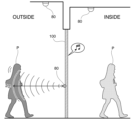
第2の場面として、建物Bの利用者が外出する場面での開閉システム1の動作について、図6及び図7を用いて説明する。検出部80は、出入口101に近づいた利用者を検出する(ステップS200)。例えば、検出部80は、玄関ドア100からの利用者の距離が所定距離以内になった場合、利用者を検出する。検出部80は、検出した利用者Pの検出データを判定部12に出力する。判定部12は、検出データに基づいて利用者Pの属性を判定する(ステップS202)。判定部12は、玄関ドア100の内側にいる人の動作を判定する(ステップS204)。検出部80が検出した玄関ドア100の内側にいる人の動作を判定する(ステップS206)。判定部12は、検出部80が検出した人の動作が予め登録された所定の動作である場合(ステップS208)、利用者Pの属性に応じて玄関ドア100の解錠及び開動作を実行する(ステップS210)。利用者Pが予め登録する動作は、例えば、靴を履く動作など、玄関ドア100から出る前に行われる動作であってもよいし、利用者Pが任意に設定する動作であってもよい。
第2の場面として、建物Bの利用者が外出する場面での開閉システム1の動作について、図6及び図7を用いて説明する。検出部80は、出入口101に近づいた利用者を検出する(ステップS200)。例えば、検出部80は、玄関ドア100からの利用者の距離が所定距離以内になった場合、利用者を検出する。検出部80は、検出した利用者Pの検出データを判定部12に出力する。判定部12は、検出データに基づいて利用者Pの属性を判定する(ステップS202)。判定部12は、玄関ドア100の内側にいる人の動作を判定する(ステップS204)。検出部80が検出した玄関ドア100の内側にいる人の動作を判定する(ステップS206)。判定部12は、検出部80が検出した人の動作が予め登録された所定の動作である場合(ステップS208)、利用者Pの属性に応じて玄関ドア100の解錠及び開動作を実行する(ステップS210)。利用者Pが予め登録する動作は、例えば、靴を履く動作など、玄関ドア100から出る前に行われる動作であってもよいし、利用者Pが任意に設定する動作であってもよい。
例えば、図6に例示するように、例えば、検出部80が玄関ドア100から2m程度離れた位置にいる利用者Pの動きを検出し、判定部12は、利用者の動作が靴を履く動作である場合、利用者Pの属性に応じて玄関ドア100の解錠及び開動作を一気に実行する。例えば、2s程度の間に玄関ドア100を解錠し、5秒程度の間に玄関ドア100の開動作が完了する。
判定部12は、例えば、玄関ドア100を通過すると利用者Pの属性に応じて玄関ドア100を閉状態に制御して玄関ドア100を施錠する(ステップS212)。検出部80により、玄関ドア100と利用者との相対位置が測定されているため、利用者が玄関を通過している場合には、玄関ドア100を閉状態に制御しない。判定部12は、利用者が玄関を通過して玄関ドア100からの利用者の相対距離が所定距離になった場合には、玄関ドア100の閉動作を開始してもよい。図6に示す例では、利用者が玄関を通過してから5秒経過すると玄関ドア100の閉状態が完了し、その後、施錠が2秒の間に完了する。
判定部12は、玄関ドア100の施錠が完了すると、玄関ドア100の施錠が完了したことを利用者に報知する(ステップS214)。例えば、判定部12は、玄関ドア100の施錠が完了すると、予め設定された音を報知部90から出力させる。報知部90の報知内容は、これに限定されず、玄関ドア100の施錠が完了したことを利用者Pの属性に応じて報知できればよく、その報知態様には特に限定されない。
判定部12は、ステップS208で所定の動作を判定できない場合、所定の動作を認識するまでステップS208の処理を実行する。このとき、利用者Pは、同じ動作だけでなく、予め登録された複数の動作の中から選択される1つの動作を行ってもよい。
第2の場面では、玄関ドア100の解錠及び開動作のトリガーとして声を用いても問題はない。ただし、室内にいる人に外出することを常に知らせる必要も無いので、トリガーとしてジェスチャーを使用することは有効である。トリガーとして、靴を履いてからのジェスチャーを使用すると、靴を履いてから出入口101前において立ち止まる場合がある。開閉システム1は、靴を履く動作を上記トリガーとして使用するため、靴を履いてから出入口101の前において立ち止まる必要がない。
(来客時での開閉システム1の動作)
第3の場面として、来客時での開閉システム1の動作について、図8から図10を用いて説明する。判定部12は、訪問者が玄関ドア100に近づくと、訪問者がいることを室内の利用者に通知する。例えば、判定部12は、訪問者が玄関ドア100に近づくと、報知部90に訪問者がいることを出力する。一例として、判定部12は、訪問者がいることを文字情報として報知部90に表示してもよいし、訪問者がいることを示す色を報知部90に表示してもよい。例えば、判定部12は、住人であることを確認するための上記生体認証が失敗した場合には、訪問者がいるとして判定してもよい。
第3の場面として、来客時での開閉システム1の動作について、図8から図10を用いて説明する。判定部12は、訪問者が玄関ドア100に近づくと、訪問者がいることを室内の利用者に通知する。例えば、判定部12は、訪問者が玄関ドア100に近づくと、報知部90に訪問者がいることを出力する。一例として、判定部12は、訪問者がいることを文字情報として報知部90に表示してもよいし、訪問者がいることを示す色を報知部90に表示してもよい。例えば、判定部12は、住人であることを確認するための上記生体認証が失敗した場合には、訪問者がいるとして判定してもよい。
ここで、報知部90は、上述したように、玄関ドア100や玄関ドア100に隣接して設けられていてもよい。報知部90は、人が玄関ドア100の外側(例えば、屋外)から内側(例えば、屋内)を見ることができないが、玄関ドア100の内側から外側を見ることができる構造を有していてもよい。例えば、図8に例示するように、報知部90は、ガラス102、半透過性反射フィルム104、及び調光フィルム103を有している。報知部90は、例えば、ガラス102の屋外側(外側)の表面には半透過性反射フィルムが設置され、ガラス102の屋内側(内側)の表面には調光フィルム103が設置されている。このため、訪問者は、報知部90を介して屋内を視認できず、室内側にいる住人からは、訪問者を視認できる。
判定部12は、例えば、部分的に調光フィルム103をON/OFFできる。例えば、報知部90の内側には、複数枚に分割された調光フィルムが設置されており、判定部12は、それぞれの調光フィルム103に対する電流或いは電圧をON/OFFすることで、室内側から見て、報知部90に表示されている人の姿のうち、一部分の透過度を変更することができる。例えば、調光フィルム103は、エレクトロクロミック(EC)材料などを用いることができる。
訪問者が玄関先に来た場合には、報知部90に訪問者の姿が表示される。初期条件として報知部90に表示される訪問者の姿は、透過度が100%ではなく、シルエットがわかる程度に透過度が設定されてもよいし、不透明であってもよい。室内にいる利用者Pは、訪問者が誰であるかを詳しく確認する場合には、図9に例示するように、出入口101の内側においてピンチ動作を行ってもよい。検出部80は、玄関ドア100からの利用者の距離が所定距離以内(玄関エリア)になった場合には、利用者の動きを検出する。判定部12は、検出部80が検出した利用者の動作がピンチ動作である場合には、そのピンチ動作に応じて、報知部90上の透過度変更位置での透過度を変更する。
室内にいる利用者Pは、透過度変更位置を変更したい場合には、図10に例示するように、スワイプ動作を実行する。判定部12は、検出部80が検出した利用者の動作がスワイプ動作である場合には、そのスワイプ動作に応じて、報知部90上の透過度変更位置を変更する。
室内にいる利用者が来客の応対を終了すると、判定部12は、報知部90を不透明にする。判定部12は、室内にいる利用者が来客の応対を終了したことを、例えば利用者の動作によって判定してもよい。例えば、利用者は、来客の応対が終わると、ある決まった動作(以下、「第4の動作」という。)を行う。判定部12は、検出部80が検出した玄関ドア100の内側にいる利用者の動作が、第4の動作である場合には、来客の応対が終了したと判定する。判定部12は、不図示の操作部(例えば、インターホンのスイッチや玄関エリアにあるタッチパネルのボタンなど)が操作されることで室内にいる利用者が来客の応対を終了したことを検出してもよい。判定部12は、玄関ドア100の内側と外側とに人がいなくなったことが検出部80により検出された場合に、応対が終了したと判定してもよい。
開閉システム1は、開閉体から所定の範囲内にいる人の動作を検出する検出部80と、検出部80の検出結果に基づいて開閉体の開閉動作を制御する判定部12と、を備える。開閉システム1は、手動操作を行わずに玄関ドアなどの開閉体の開閉動作を行うことができる。例えば、開閉体がガレージドアである場合には、車の中からジェスチャーを行うことでガレージドアを開閉することができる。
判定部12は、検出部80が検出した人の動作が、事前に登録されている所定の動作であるか否かを判定する判定処理を実行し、検出部80が検出した人の動作が所定の動作である場合には開閉体を開状態或いは閉状態に動作させてもよい。
開閉システム1は、玄関ドア100の外側にいる人の生体認証データを取得し、取得した生体認証データと、予め登録されている登録認証データとの照合を行ってもよい。判定部12は、照合が成功した場合に玄関ドア100の外側にいる人の動作が所定の動作である場合には、玄関ドア100を開状態に制御して利用者の入室を許可してもよい。開閉システムでは、利用者の意に反して解錠操作や開動作が実行されることを抑制するため、解錠操作或いは開動作を行うにあたって人の動作(ジェスチャー)という人の意志の確認を必要としている。
検出部80は、玄関ドア100の内側にいる人の動作を検出してもよい。判定部12は、検出部80が検出した玄関ドア100の内側にいる人の動作が、人が靴を履く動作であるか否かを判定し、検出部80が検出した前記人の動作が前記靴を履く動作である場合には、玄関ドア100を開状態に制御してもよい。利用者は、外出時において、手動操作を行わずに、玄関ドア100を開状態に制御することができる。
以上、この開示の実施形態について図面を参照して詳述してきたが、具体的な構成はこの実施形態に限られるものではなく、この開示の要旨を逸脱しない範囲の設計等も含まれる。玄関ドア100が引き戸である場合を例示したが、図11に例示するように開き戸であってもよい。
開き戸は、健常者が負荷なく使う前提の仕様となっている場合があり、障がい者や荷物を持っての外出や帰宅においては、現在の手動操作での開閉動作は改善の余地がある。例えば、障がい者にとって、開き戸の玄関ドアを開状態にするには、体を乗り出して玄関ドアのノブやハンドルに手をかけたり、玄関ドアを手前に開く場合に後ろに下がったりする等、負担が大きい。開き戸から引き戸に容易に取り換えられることはできない。
開閉システム1は、開き戸を電動で開閉できる公知の開閉機構を更に有してもよい。開閉システム1は、開閉機構を更に有することで、既存の開き戸を活用しながら、障がい者の方だけでなく様々な人やシチュエーションに対応し、使い勝手がよくストレスフリーな出入口101の通過を提供することができる。開閉システム1を適用する開閉体は特に限定されないが、開き戸の玄関ドア100に適用する場合においてより効果を発揮する。
例えば、判定部12は、判定処理の結果、検出部80が検出した人の動作が第3の動作である場合には、玄関ドア100を閉状態に動作させてもよい。この場合には、判定部12は、玄関ドア100が閉状態になったことを契機として、玄関ドア100を施錠してもよい。判定部12は、玄関ドア100が閉状態である場合において、検出部80が検出した人の動作が第3の動作である場合には、玄関ドア100を施錠してもよい。判定部12は、玄関ドア100の閉状態及び施錠の両方及びいずれか一方を人の動作を契機として実行してもよい。図11に示す場合においても、判定部12は、施錠を行った場合には音などによる報知を行ってもよい。
登録動作(第1の動作、第2の動作、及び第3の動作)は、手の形だけのジェスチャーではなく指先の微妙な動き、ウインクや眉毛を上げるなどの顔の表情、頭を傾げるなどの人の意図的な動作であってもよい。これにより、身体に障がいを持つ人でも、玄関ドア100を手動で操作することなく開閉動作を行うことができる。
開閉システム1では、記憶部14に対して、登録動作及び属性を個人ごとに登録可能である。判定部12は、判定処理にて用いられた登録動作及び属性を記録することで、利用者Pごとの通過ログが記録できる。記憶部14に対して、登録動作及び属性と設定値とを関連付けて利用者Pごとに格納してもよい。設定値とは、例えば玄関ドア100の開閉スピードの調整、玄関ドア100の自動施錠の有無などである。これにより、玄関ドア100の開閉スピードの調整、玄関ドア100の自動施錠の有無など、玄関ドア100が個人に合わせたデバイスとして用いることができる。設定値は、施錠から閉動作までの時間であってもよい。これにより、施錠から閉動作までの時間を個人ごとに設定可能であり、施錠から閉動作までの時間を各個人の好みに応じた時間に設定することができる。これにより、せかされることを感じることなく、自身の好みに応じた時間設定を行うことができる。
例えば、宅配業者や建物Bの住人は、大きな荷物を室内に運び入れる際には、その荷物を手により保持している場合がある。図12Aに示す例では、第1の動作などの登録動作として、肘の動きなどの人の動きが登録されている。宅配業者や建物Bの住人は、大きな荷物を室内に運び入れる際には、肘などを動かす動作を行うことで開き戸の玄関ドア100の解錠及び開動作を行うことができる。開閉システム1によれば、宅配業者や建物Bの住人は、荷物を手により保持している場合であっても、容易に玄関ドア100の解錠及び開動作を行うことができ、利用者Pの属性に応じて玄関ドア100の開閉態様を制御することができる。
例えば、視覚障がい者や高齢者は、杖を用いて歩行する場合があり、手のジャスチャーを行うことが困難な場合がある。図12Bに示す例では、第1の動作や第2の動作などの登録動作として、顔を動かしたり、肩を動かしたりするなどの手以外の人の動きが登録されている。開閉システム1によれば、手のジャスチャーを行うことが困難な場合であっても、容易に玄関ドア100の解錠及び開動作や玄関ドア100の閉動作及び施錠を行うことができ、利用者Pの属性に応じて玄関ドア100の開閉態様を制御することができる。
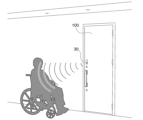
車椅子の使用者や重度の障がいがある人にとって、手足を使用したジェスチャーを行うことが困難な場合がある。図12Cに示す例では、第1の動作などの登録動作として、顔の表情変化が登録されている。開閉システム1によれば、顔の表情変化により玄関ドア100の解錠及び開動作や玄関ドア100の閉動作及び施錠が可能となるため、車椅子の使用者や障害がある人も、利用者Pの属性に応じて玄関ドア100の開閉態様を制御することができる。
室内からの玄関ドア100の解錠及び開動作を行うにあたっては、生体認証を用いてもよいし、用いなくともよい。例えば、図6に示す外出時の場面においては、生体認証を用いていないが、図7のステップS200の前に、図5に示すステップS100からステップS106の処理を実行してもよい。外出時の生体認証における登録認証データは、例えば、認知症を患っている人や幼児など1人での外出に心配がある人の生体認証データを含まないように設定されてもよい。これにより、認知症を患っている人や幼児などの属性を有する利用者Pが1人により外出することを抑制することができる。
外出時の生体認証における登録認証データは、例えば、認知症を患っている人や幼児などの生体認証データであってもよい。この場合には、生体認証が成功した場合には、判定部12は、検出部80の検出結果に関わらず、玄関ドア100の解錠及び開動作を行わない。
ジェスチャーをトリガーとして、室内からの玄関ドア100の解錠及び開動作が行われる場合には、室内からの玄関ドア100の解錠及び開動作のためのジェスチャーを個人ごとに設定してもよい。このジェスチャーは、認知症を患っている人や幼児などには、割り当てられていなくてもよい。これにより、認知症を患っている人や幼児などが1人により外出することを抑制することができる。
開閉システム1は、出入口101などに設置されている照明装置を、検出部80の検出結果に基づいて点灯或いは消灯させてもよい。例えば、判定部12は、検出部80が検出した人の動作が、事前に登録されている所定の動作であるか否かを判定し、検出部80が検出した人の動作が所定の動作である場合には、照明装置の点灯或いは消灯させてもよい。ただし、これに限定されず、出入口101などに設置されている照明装置は、距離検出、人感センサによる検出、時間設定などによって自動検出して点灯或いは消灯してもよい。例えば、ジェスチャーをトリガーとして使用するものは開閉体の開閉動作とし、その他の装置、例えば照明装置の点灯及び消灯の動作は、例えば距離検出や時間設定などの自動検出による動作としてもよい。
建物Bの利用者が外出する場面において、判定部12は、検出部80が検出した利用者の動作が靴を履く動作である場合に玄関ドア100の解錠及び開動作を一気に実行したが、これに限定されない。例えば、判定部12は、検出部80により靴を履く動作を検出した場合には玄関ドア100の解錠を実行し、靴を履き終わった動作を検出した場合には、玄関ドア100を開動作させてもよい。靴を履き終わった動作は、靴を履く動作の後の起立動作であってもよい。
例えば、報知部90において、液晶や有機ELなどの表示部が調光フィルムに上に設置されてもよい。この表示部は、透明或いは透過であってもよい。ただし、これに限定されず、調光フィルムに設置されている表示部は、透明或いは透過ではない箇所を含んでもよい。
1 開閉システム、10 制御装置、12 判定部、14 記憶部、16 表示部、50 制御部、60 ドア部、70 駆動部、80 検出部、90 報知部、100 玄関ドア、101 出入口、102 ガラス、103 調光フィルム、104 半透過性反射フィルム、B 建物、NW ネットワーク、P 利用者
Claims (4)
- 開閉自在な開閉体から所定の範囲内において人を検出する検出部と、
前記人の検出データに基づいて前記人を認証すると共に、前記人の認証結果に基づいて前記開閉体の開動作或いは閉動作を制御する判定部を備え、
前記判定部は、認証された前記人の属性を判定すると共に、前記属性の内容に応じて前記開閉体の開閉態様を制御する、
開閉システム。 - 前記判定部は、
認証された前記人の動作を判定し、前記動作が、事前に登録されている所定の動作であるか否かを判定し、
前記人の前記動作が前記所定の動作である場合、前記開閉体の前記開閉態様を制御する、
請求項1に記載の開閉システム。 - 前記判定部は、
前記開閉体の外側にいる前記人の生体認証データを取得し、取得した前記生体認証データと、予め登録されている登録認証データとを照合し、
前記生体認証データに基づいて生成される特徴量が前記登録認証データに含まれる特徴量と一致し、且つ、前記開閉体の外側にいる前記人の前記動作が前記所定の動作である場合、前記人が入室する際の前記開閉体の開状態及び閉状態を前記属性に応じて制御する、
請求項2に記載の開閉システム。 - 前記判定部は、前記開閉体の内側にいる前記人の動作内容の検出結果を取得し、前記開閉体の内側にいる前記人が、前記開閉体の外側に出るか否かを判定し、前記人が前記開閉体の外側に出ると判定した場合、前記開閉体を開状態に制御する、
請求項1から3のいずれか一項に記載の開閉システム。
Priority Applications (1)
| Application Number | Priority Date | Filing Date | Title |
|---|---|---|---|
| JP2023558004A JPWO2023080077A1 (ja) | 2021-11-04 | 2022-10-28 |
Applications Claiming Priority (4)
| Application Number | Priority Date | Filing Date | Title |
|---|---|---|---|
| US202163275463P | 2021-11-04 | 2021-11-04 | |
| US63/275,463 | 2021-11-04 | ||
| US202163285093P | 2021-12-02 | 2021-12-02 | |
| US63/285,093 | 2021-12-02 |
Publications (1)
| Publication Number | Publication Date |
|---|---|
| WO2023080077A1 true WO2023080077A1 (ja) | 2023-05-11 |
Family
ID=86241129
Family Applications (1)
| Application Number | Title | Priority Date | Filing Date |
|---|---|---|---|
| PCT/JP2022/040413 Ceased WO2023080077A1 (ja) | 2021-11-04 | 2022-10-28 | 開閉システム |
Country Status (2)
| Country | Link |
|---|---|
| JP (1) | JPWO2023080077A1 (ja) |
| WO (1) | WO2023080077A1 (ja) |
Citations (2)
| Publication number | Priority date | Publication date | Assignee | Title |
|---|---|---|---|---|
| JPH108825A (ja) * | 1996-04-02 | 1998-01-13 | Heinrich Landert | ドア装置の作動方法及びこの方法により作動するドア装置 |
| WO2009104380A1 (ja) * | 2008-02-22 | 2009-08-27 | グローリー株式会社 | ゲート装置 |
-
2022
- 2022-10-28 JP JP2023558004A patent/JPWO2023080077A1/ja active Pending
- 2022-10-28 WO PCT/JP2022/040413 patent/WO2023080077A1/ja not_active Ceased
Patent Citations (2)
| Publication number | Priority date | Publication date | Assignee | Title |
|---|---|---|---|---|
| JPH108825A (ja) * | 1996-04-02 | 1998-01-13 | Heinrich Landert | ドア装置の作動方法及びこの方法により作動するドア装置 |
| WO2009104380A1 (ja) * | 2008-02-22 | 2009-08-27 | グローリー株式会社 | ゲート装置 |
Also Published As
| Publication number | Publication date |
|---|---|
| JPWO2023080077A1 (ja) | 2023-05-11 |
Similar Documents
| Publication | Publication Date | Title |
|---|---|---|
| Kane et al. | Sense and accessibility: Understanding people with physical disabilities’ experiences with sensing systems | |
| JP5630318B2 (ja) | スマートエントリシステム | |
| CN114937294B (zh) | 车门控制方法及装置、系统、车、电子设备和存储介质 | |
| US12123247B2 (en) | Access control system comprising a sliding door and visualization of status information | |
| KR20230164398A (ko) | 차량 및 그 제어 방법 | |
| JP6389823B2 (ja) | 非接触アクセス制御と非接触ドア操作を伴うドアシステム | |
| JP7075702B2 (ja) | 入退室認証システムおよび入退室認証方法 | |
| US20160010378A1 (en) | Automated entrance | |
| WO2002086825A1 (en) | Automatic access to an automobile via biometrics | |
| WO2022048118A1 (zh) | 车载机器人的控制方法及装置、车辆、电子设备和介质 | |
| CN110415389A (zh) | 姿势进入控制系统和预测移动设备相对于用户所在部位的方法 | |
| CN110413135A (zh) | 姿势进入控制系统和操作方法 | |
| JP6683173B2 (ja) | エレベータ装置 | |
| KR101920540B1 (ko) | 홍채인식을 이용한 감성도어락 제어방법 | |
| CN120340151A (zh) | 智能门锁开门控制方法、系统及智能门锁 | |
| WO2023080077A1 (ja) | 開閉システム | |
| JP2019105046A (ja) | 車両用ドア制御システム | |
| CN113508211B (zh) | 具有从内部无接触地打开的移动门的访问控制系统 | |
| JP6963915B2 (ja) | ドア | |
| JP2010112127A (ja) | 端末配置装置およびセキュリティシステム | |
| CN110415390A (zh) | 使用由移动设备的用户执行的设备姿势的姿势进入控制系统 | |
| CN115731646A (zh) | 用于促进与访问控制系统的接口连接的系统和方法 | |
| CN109463868B (zh) | 一种智能旅行箱 | |
| JP7281520B2 (ja) | ドア及び入退室管理システム | |
| CN206696915U (zh) | 一种集成多种识别方式的门禁系统 |
Legal Events
| Date | Code | Title | Description |
|---|---|---|---|
| 121 | Ep: the epo has been informed by wipo that ep was designated in this application |
Ref document number: 22889897 Country of ref document: EP Kind code of ref document: A1 |
|
| WWE | Wipo information: entry into national phase |
Ref document number: 2023558004 Country of ref document: JP |
|
| NENP | Non-entry into the national phase |
Ref country code: DE |
|
| 122 | Ep: pct application non-entry in european phase |
Ref document number: 22889897 Country of ref document: EP Kind code of ref document: A1 |