WO2023058619A1 - 金属カーバイドおよび炭化水素の製造方法、ならびに金属カーバイド組成物 - Google Patents
金属カーバイドおよび炭化水素の製造方法、ならびに金属カーバイド組成物 Download PDFInfo
- Publication number
- WO2023058619A1 WO2023058619A1 PCT/JP2022/037022 JP2022037022W WO2023058619A1 WO 2023058619 A1 WO2023058619 A1 WO 2023058619A1 JP 2022037022 W JP2022037022 W JP 2022037022W WO 2023058619 A1 WO2023058619 A1 WO 2023058619A1
- Authority
- WO
- WIPO (PCT)
- Prior art keywords
- metal
- carbide
- producing
- molten salt
- precipitate
- Prior art date
- Legal status (The legal status is an assumption and is not a legal conclusion. Google has not performed a legal analysis and makes no representation as to the accuracy of the status listed.)
- Ceased
Links
Images







Classifications
-
- C—CHEMISTRY; METALLURGY
- C10—PETROLEUM, GAS OR COKE INDUSTRIES; TECHNICAL GASES CONTAINING CARBON MONOXIDE; FUELS; LUBRICANTS; PEAT
- C10H—PRODUCTION OF ACETYLENE BY WET METHODS
- C10H21/00—Details of acetylene generators; Accessory equipment for, or features of, the wet production of acetylene
- C10H21/10—Carbide compositions
-
- C—CHEMISTRY; METALLURGY
- C07—ORGANIC CHEMISTRY
- C07C—ACYCLIC OR CARBOCYCLIC COMPOUNDS
- C07C1/00—Preparation of hydrocarbons from one or more compounds, none of them being a hydrocarbon
- C07C1/02—Preparation of hydrocarbons from one or more compounds, none of them being a hydrocarbon from oxides of a carbon
- C07C1/12—Preparation of hydrocarbons from one or more compounds, none of them being a hydrocarbon from oxides of a carbon from carbon dioxide with hydrogen
-
- C—CHEMISTRY; METALLURGY
- C01—INORGANIC CHEMISTRY
- C01B—NON-METALLIC ELEMENTS; COMPOUNDS THEREOF; METALLOIDS OR COMPOUNDS THEREOF NOT COVERED BY SUBCLASS C01C
- C01B32/00—Carbon; Compounds thereof
- C01B32/90—Carbides
- C01B32/914—Carbides of single elements
- C01B32/935—Carbides of alkali metals, strontium, barium or magnesium
-
- C—CHEMISTRY; METALLURGY
- C01—INORGANIC CHEMISTRY
- C01B—NON-METALLIC ELEMENTS; COMPOUNDS THEREOF; METALLOIDS OR COMPOUNDS THEREOF NOT COVERED BY SUBCLASS C01C
- C01B32/00—Carbon; Compounds thereof
- C01B32/90—Carbides
- C01B32/914—Carbides of single elements
- C01B32/942—Calcium carbide
-
- C—CHEMISTRY; METALLURGY
- C01—INORGANIC CHEMISTRY
- C01D—COMPOUNDS OF ALKALI METALS, i.e. LITHIUM, SODIUM, POTASSIUM, RUBIDIUM, CAESIUM, OR FRANCIUM
- C01D15/00—Lithium compounds
- C01D15/02—Oxides; Hydroxides
-
- C—CHEMISTRY; METALLURGY
- C01—INORGANIC CHEMISTRY
- C01F—COMPOUNDS OF THE METALS BERYLLIUM, MAGNESIUM, ALUMINIUM, CALCIUM, STRONTIUM, BARIUM, RADIUM, THORIUM, OR OF THE RARE-EARTH METALS
- C01F11/00—Compounds of calcium, strontium, or barium
- C01F11/02—Oxides or hydroxides
-
- C—CHEMISTRY; METALLURGY
- C25—ELECTROLYTIC OR ELECTROPHORETIC PROCESSES; APPARATUS THEREFOR
- C25B—ELECTROLYTIC OR ELECTROPHORETIC PROCESSES FOR THE PRODUCTION OF COMPOUNDS OR NON-METALS; APPARATUS THEREFOR
- C25B1/00—Electrolytic production of inorganic compounds or non-metals
-
- C—CHEMISTRY; METALLURGY
- C25—ELECTROLYTIC OR ELECTROPHORETIC PROCESSES; APPARATUS THEREFOR
- C25B—ELECTROLYTIC OR ELECTROPHORETIC PROCESSES FOR THE PRODUCTION OF COMPOUNDS OR NON-METALS; APPARATUS THEREFOR
- C25B1/00—Electrolytic production of inorganic compounds or non-metals
- C25B1/01—Products
-
- C—CHEMISTRY; METALLURGY
- C25—ELECTROLYTIC OR ELECTROPHORETIC PROCESSES; APPARATUS THEREFOR
- C25B—ELECTROLYTIC OR ELECTROPHORETIC PROCESSES FOR THE PRODUCTION OF COMPOUNDS OR NON-METALS; APPARATUS THEREFOR
- C25B1/00—Electrolytic production of inorganic compounds or non-metals
- C25B1/01—Products
- C25B1/14—Alkali metal compounds
-
- C—CHEMISTRY; METALLURGY
- C25—ELECTROLYTIC OR ELECTROPHORETIC PROCESSES; APPARATUS THEREFOR
- C25B—ELECTROLYTIC OR ELECTROPHORETIC PROCESSES FOR THE PRODUCTION OF COMPOUNDS OR NON-METALS; APPARATUS THEREFOR
- C25B1/00—Electrolytic production of inorganic compounds or non-metals
- C25B1/01—Products
- C25B1/18—Alkaline earth metal compounds or magnesium compounds
-
- C—CHEMISTRY; METALLURGY
- C25—ELECTROLYTIC OR ELECTROPHORETIC PROCESSES; APPARATUS THEREFOR
- C25B—ELECTROLYTIC OR ELECTROPHORETIC PROCESSES FOR THE PRODUCTION OF COMPOUNDS OR NON-METALS; APPARATUS THEREFOR
- C25B11/00—Electrodes; Manufacture thereof not otherwise provided for
- C25B11/04—Electrodes; Manufacture thereof not otherwise provided for characterised by the material
-
- C—CHEMISTRY; METALLURGY
- C25—ELECTROLYTIC OR ELECTROPHORETIC PROCESSES; APPARATUS THEREFOR
- C25B—ELECTROLYTIC OR ELECTROPHORETIC PROCESSES FOR THE PRODUCTION OF COMPOUNDS OR NON-METALS; APPARATUS THEREFOR
- C25B15/00—Operating or servicing cells
- C25B15/08—Supplying or removing reactants or electrolytes; Regeneration of electrolytes
-
- C—CHEMISTRY; METALLURGY
- C25—ELECTROLYTIC OR ELECTROPHORETIC PROCESSES; APPARATUS THEREFOR
- C25B—ELECTROLYTIC OR ELECTROPHORETIC PROCESSES FOR THE PRODUCTION OF COMPOUNDS OR NON-METALS; APPARATUS THEREFOR
- C25B15/00—Operating or servicing cells
- C25B15/08—Supplying or removing reactants or electrolytes; Regeneration of electrolytes
- C25B15/081—Supplying products to non-electrochemical reactors that are combined with the electrochemical cell, e.g. Sabatier reactor
-
- C—CHEMISTRY; METALLURGY
- C01—INORGANIC CHEMISTRY
- C01B—NON-METALLIC ELEMENTS; COMPOUNDS THEREOF; METALLOIDS OR COMPOUNDS THEREOF NOT COVERED BY SUBCLASS C01C
- C01B32/00—Carbon; Compounds thereof
- C01B32/90—Carbides
- C01B32/907—Oxycarbides; Sulfocarbides; Mixture of carbides
-
- C—CHEMISTRY; METALLURGY
- C01—INORGANIC CHEMISTRY
- C01P—INDEXING SCHEME RELATING TO STRUCTURAL AND PHYSICAL ASPECTS OF SOLID INORGANIC COMPOUNDS
- C01P2002/00—Crystal-structural characteristics
- C01P2002/70—Crystal-structural characteristics defined by measured X-ray, neutron or electron diffraction data
- C01P2002/72—Crystal-structural characteristics defined by measured X-ray, neutron or electron diffraction data by d-values or two theta-values, e.g. as X-ray diagram
-
- C—CHEMISTRY; METALLURGY
- C25—ELECTROLYTIC OR ELECTROPHORETIC PROCESSES; APPARATUS THEREFOR
- C25B—ELECTROLYTIC OR ELECTROPHORETIC PROCESSES FOR THE PRODUCTION OF COMPOUNDS OR NON-METALS; APPARATUS THEREFOR
- C25B1/00—Electrolytic production of inorganic compounds or non-metals
- C25B1/01—Products
- C25B1/02—Hydrogen or oxygen
-
- C—CHEMISTRY; METALLURGY
- C25—ELECTROLYTIC OR ELECTROPHORETIC PROCESSES; APPARATUS THEREFOR
- C25B—ELECTROLYTIC OR ELECTROPHORETIC PROCESSES FOR THE PRODUCTION OF COMPOUNDS OR NON-METALS; APPARATUS THEREFOR
- C25B1/00—Electrolytic production of inorganic compounds or non-metals
- C25B1/01—Products
- C25B1/135—Carbon
-
- C—CHEMISTRY; METALLURGY
- C25—ELECTROLYTIC OR ELECTROPHORETIC PROCESSES; APPARATUS THEREFOR
- C25B—ELECTROLYTIC OR ELECTROPHORETIC PROCESSES FOR THE PRODUCTION OF COMPOUNDS OR NON-METALS; APPARATUS THEREFOR
- C25B1/00—Electrolytic production of inorganic compounds or non-metals
- C25B1/01—Products
- C25B1/28—Per-compounds
- C25B1/30—Peroxides
-
- C—CHEMISTRY; METALLURGY
- C25—ELECTROLYTIC OR ELECTROPHORETIC PROCESSES; APPARATUS THEREFOR
- C25B—ELECTROLYTIC OR ELECTROPHORETIC PROCESSES FOR THE PRODUCTION OF COMPOUNDS OR NON-METALS; APPARATUS THEREFOR
- C25B9/00—Cells or assemblies of cells; Constructional parts of cells; Assemblies of constructional parts, e.g. electrode-diaphragm assemblies; Process-related cell features
- C25B9/09—Fused bath cells
Definitions
- the present invention relates to a method for producing metal carbide and hydrocarbon, and a metal carbide composition.
- Acetylene is an industrially important substance as a raw material for various organic compounds. Acetylene is usually obtained by reacting metal carbide (mainly calcium carbide) with water.
- metal carbide mainly calcium carbide
- Patent Document 1 Calcium carbide is generally obtained by heating a mixture of quicklime (calcium oxide) and coke to a high temperature in an electric furnace (for example, Patent Document 1).
- US Pat. No. 6,200,000 proposes pre-briquetting coke and then mixing with quicklime. According to Patent Document 2, this makes it possible to obtain calcium carbide more effectively.
- Patent Document 3 proposes a method of producing lithium carbide by reacting metallic lithium obtained by melting and electrolyzing lithium chloride with carbon powder such as carbon black.
- Non-Patent Document 1 discloses that metal lithium obtained by molten salt electrolysis of lithium hydroxide is reacted with a carbon source such as carbon dioxide to produce lithium carbide, and the by-produced lithium hydroxide is subjected to molten salt electrolysis.
- a carbon source such as carbon dioxide
- JP-A-61-178412 Japanese Patent Application Laid-Open No. 2018-35328 JP-A-2-256626
- Non-Patent Document 1 mentions carbon dioxide as one of the carbon sources, but when carbon dioxide is used as the carbon source, a large amount of by-products are generated. Therefore, from the viewpoint of Faraday efficiency, graphite carbon It is desirable to use
- An object of the present disclosure is to provide a method for producing metal carbide using carbon dioxide as a carbon source and metal oxide as a metal source.
- the present disclosure further provides a method of producing hydrocarbons from metal carbides obtained using carbon dioxide as the carbon source and metal oxides as the metal source. Additionally, the present disclosure provides metal carbide compositions.
- the present disclosure includes the following aspects. [1] preparing a molten salt containing an oxide of a first metal; adding carbon dioxide to the molten salt; and A method for producing metal carbide, comprising applying a voltage to the molten salt containing carbon dioxide to obtain a precipitate containing carbide of the first metal.
- the precipitates further include carbon, simple substance of the first metal, halides, carbonates, oxides, hydrides and peroxides, and simple substances of metals other than the first metal contained in the molten salt. , halides, carbonates, oxides and carbides.
- carbide of the first metal as a main component, Further, it consists of carbon, elemental substances of the first metal, halides, carbonates, oxides, hydrides and peroxides, and elemental substances, halides, carbonates, oxides and carbides of metals other than the first metal.
- a metal carbide composition comprising at least one selected from the group.
- a method for producing metal carbide using carbon dioxide as a carbon source and a metal oxide as a metal source and a method for producing metal carbide using carbon dioxide as a carbon source and a metal oxide as a metal source Methods of producing hydrocarbons from metal carbides are provided, as well as metal carbide compositions.
- 1 is a flow chart illustrating a method for manufacturing metal carbide according to the present disclosure
- 1 is a flow chart illustrating a method for producing hydrocarbons according to the present disclosure
- 1 is a flow chart illustrating another method of producing hydrocarbons according to the present disclosure.
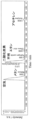
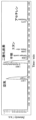
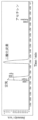
- 1 is a graph showing part of the results of GC-MS analysis of the hydrolyzate obtained in Example 1.
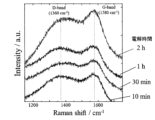
- FIG. 1 is a graph showing the results of Raman spectroscopic analysis of the hydrolyzate obtained in Example 1.
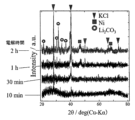
- FIG. 1 is a graph showing the results of XRD analysis of the hydrolyzate obtained in Example 1.
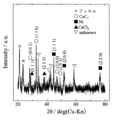
- FIG. 4 is a graph showing the results of XRD analysis of precipitates obtained in Example 2.
- FIG. 4 is a graph showing part of the results of GC-MS analysis of the hydrolyzate obtained in Example 3.
- FIG. 4 is a graph showing part of the results of GC-MS analysis of the hydrolyzate obtained in Example 4.
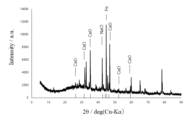
- FIG. 4 is a graph showing the results of XRD analysis of precipitates obtained in Example 5.
- FIG. 4 is a graph showing the results of GC-MS analysis of the hydrolyzate obtained in Example 6.
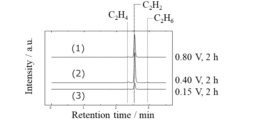
- FIG. 10 is a graph showing the results of GC-MS analysis of gases produced in Examples 7-9.
- FIG. 10 is a graph showing potential changes of the working electrode with respect to the reference electrode during energization for producing metal carbide in Example 10.
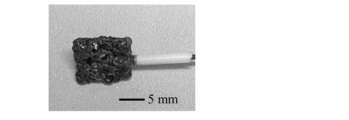
- FIG. 10 is a photograph showing the appearance of the working electrode after energization for producing metal carbide in Example 10.
- FIG. 11 is a photograph showing the appearance of a working electrode after energization for producing metal carbide in Example 11.
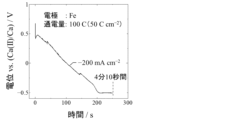
- FIG. 10 is a graph showing potential changes of the working electrode with respect to the reference electrode during energization for producing metal carbide in Examples 12 to 15.
- FIG. 13 is a photograph showing the appearance of a working electrode after energization for producing metal carbide in Example 13.
- FIG. 10 is a graph showing potential changes of the working electrode with respect to the reference electrode during energization for producing metal carbide in Example 16.
- FIG. 16 is a photograph showing the appearance of the working electrode after energization for producing metal carbide in Example 16.
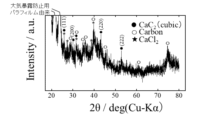
- FIG. 10 is a graph showing the results of XRD analysis of precipitates obtained in Example 16.
- FIG. 10 is a graph showing the results of XRD analysis of metal oxides regenerated in Example 16.
- metal carbide is obtained by applying a voltage to a molten salt containing metal oxide and carbon dioxide (CO 2 ).
- CO 2 carbon dioxide
- the reaction proceeds rapidly at a relatively low temperature of 800° C. or lower, and metal carbide can be obtained efficiently.
- the use of metal oxides increases the solubility of carbon dioxide in the molten salt. Therefore, the target metal carbide can be obtained with higher productivity, selectivity and safety in a smaller electrolytic bath.
- CO2 which is said to cause global warming, can be effectively used as a carbon source.
- the present disclosure includes hydrolyzing the metal carbides obtained by the above methods to obtain hydrocarbons. According to this method, highly pure hydrocarbons can be obtained efficiently. Furthermore, since industrially important hydrocarbons (typically acetylene) can be produced from CO 2 , the method of the present disclosure is very useful from the viewpoint of environmental conservation.
- industrially important hydrocarbons typically acetylene
- the present disclosure includes reusing a metal hydroxide, which is a by-product when producing hydrocarbons, as a metal source for producing the above-mentioned metal carbide.
- a recycling system is constructed that includes the production of the first metal carbide using the oxide of the first metal and the production of hydrocarbons using the first metal carbide. Therefore, resources can be effectively utilized.
- the present disclosure includes a carbide composition containing a carbide of a first metal.
- This carbide composition can be used in the production of hydrocarbons.
- a method for producing a metal carbide according to the present disclosure includes preparing a molten salt containing a first metal oxide, adding carbon dioxide to the molten salt, and applying a voltage to the molten salt containing carbon dioxide. , obtaining a deposit comprising carbides of the first metal.
- FIG. 1 is a flow chart illustrating a method for manufacturing metal carbide according to the present disclosure.
- molten salt containing a first metal oxide is prepared.
- the oxide of the first metal is the metal source of the desired metal carbide.
- metal salts (including metal oxides) contained in the electrolytic bath are referred to as molten salts, even if they are not completely ionized.
- the oxide of the first metal is not particularly limited, and is appropriately selected according to the target metal carbide.
- the first metal is preferably at least one selected from the group consisting of alkali metals and alkaline earth metals. This is because alkali metals and alkaline earth metals have smaller ionization energies than other metals and are easily ionized.
- alkali metals include at least one selected from the group consisting of lithium (Li), sodium (Na), potassium (K), rubidium (Rb), cesium (Cs) and francium (Fr).
- Preferred alkali metals include at least one selected from the group consisting of Li, Na, K, Rb and Cs. In particular, at least one selected from the group consisting of Li, Na, K and Cs is preferred.
- Alkaline earth metals include at least one selected from the group consisting of beryllium (Be), magnesium (Mg), calcium (Ca), strontium (Sr), barium (Ba) and radium (Ra).
- Preferred alkaline earth metals include at least one selected from the group consisting of Mg, Ca, Sr and Ba.
- Li, Na, K and Ca are preferable as the first metal, considering the reactivity of the oxide of the first metal to water.
- Na and Ca are more preferable from the viewpoint of inexpensiveness, and Li and Ca are more preferable from the viewpoint of handling properties such as safety and toxicity.
- Li, Na, K and Cs are preferred as the first metal in terms of the high solubility of hydroxides in water. If the hydroxide of the first metal is highly soluble in water, the recycling efficiency of the first metal in the subsequent steps increases. In the hydrocarbon production process, metal carbides are hydrolyzed. At this time, a hydroxide of the first metal is by-produced together with the hydrocarbon. Since hydrocarbons are generally difficult to dissolve in water, they can be easily extracted as gases. Also, the carbon contained in the precipitate precipitates or floats in water. When the by-produced first metal hydroxide is dissolved in water, carbon can be efficiently removed by filtration. The first metal hydroxide can be recovered by removing the water from the filtrate.
- the hydroxide of the first metal yields the oxide of the first metal. That is, the higher the solubility of the hydroxide of the first metal in water, the easier the recovery of the oxide of the first metal.
- the obtained oxide of the first metal is reused for the preparation of the molten salt.
- the lower the solubility of the hydroxide of the first metal in water the less energy is required for its recovery. From the viewpoint of energy reduction, the first metal is preferably Ca.
- the amount of the first metal oxide contained in the molten salt is not particularly limited. From the viewpoint of reaction efficiency, the number of moles of the oxide of the first metal is preferably 1 mol% or more, more preferably 2 mol% or more, and 3 mol% or more with respect to the total number of moles of the molten salt in the electrolytic bath. is particularly preferred.
- the number of moles of the oxide of the first metal is preferably 20 mol % or less, more preferably 15 mol % or less, and particularly preferably 10 mol % or less, relative to the total number of moles of the molten salt in the electrolytic bath. In one aspect, the number of moles of the oxide of the first metal is 1 mol % or more and 20 mol % or less with respect to the total number of moles of the molten salt in the electrolytic bath.
- the molten salt preferably contains a metal salt other than the oxide of the first metal.
- Other metal salts function primarily as electrolytes in electrolytic baths.
- Other metal salts also facilitate melting of oxides of the first metal.
- Other metal salts include salts of a metal (hereinafter referred to as second metal) ion and its counterion (hereinafter referred to as second anion).
- the second metal and the first metal may be the same or different.
- carbide of the first metal is likely to be produced.
- the second anion is other than an oxide ion.
- metal salts are not particularly limited as long as the target metal carbide can be stably deposited. Among others, it is preferable that other metal salts melt at a temperature of 800° C. or less.
- Examples of the second metal include alkali metals, alkaline earth metals, rare earth elements, aluminum (Al), gallium (Ga), indium (In), thallium (Tl), zinc (Zn), cadmium (Cd), and gold. (Au), silver (Ag), and copper (Cu).
- Alkali metals and alkaline earth metals are as described above.
- Rare earth elements include scandium (Sc), yttrium (Y), lanthanides and actinides. Among them, at least one selected from the group consisting of alkali metals and alkaline earth metals is preferable because the melting temperature of other metal salts tends to be low.
- Examples of the second anion include carbonate ion (CO 3 2 ⁇ ), sulfate ion, phosphate ion, nitrate ion, acetate ion, carboxylate ion, oxide ion (O 2 ⁇ ), and halogen ion.
- halogen ions are preferable because the melting temperature of other metal salts tends to be low. Halogen has a large electron affinity.
- Halogen includes at least one selected from the group consisting of fluorine (F), chlorine (Cl), bromine (Br), iodine (I) and astatine (At).
- Preferred halogens include at least one selected from the group consisting of F, Cl, Br and I.
- F and/or Cl are preferred in that it can improve the solubility of the oxide of the first metal and/or CO2 .
- the second anion preferably contains an oxide ion because CO 2 is easily ionized.
- oxides of the second metal include oxides of at least one metal selected from the group consisting of alkali metals and alkaline earth metals different from the first metal.
- metal salts specifically include LiF, NaF, KF, RbF, CsF, LiCl, NaCl, KCl, RbCl, CsCl, LiBr, NaBr, KBr, RbBr, CsBr, LiI, NaI, KI, RbI, alkali metal halides such as CsI ; _ _ _ _ _ _ _ _ Alkaline earth metal halides such as SrI 2 and BaI 2 , halides of rare earth elements such as AlCl 3 , oxides of metals other than the first metal such as Li 2 O and CaO, Li 2 CO 3 and Na 2 CO 3 , K 2 CO 3 and the like, and metal nitrates such as LiNO 3 , NaNO 3 and KNO 3 .
- at least one selected from the group consisting of lithium salts, sodium salts and potassium salts is preferable.
- metal salts are used singly or in combination of two or more. Among them, it is preferable to use a combination of two or more other metal salts because the melting temperature tends to decrease.
- combinations of multiple types of chlorides, combinations of multiple types of fluorides, and combinations of one or more chlorides and one or more fluorides are included. Specific examples include combinations of LiCl and KCl, LiCl, KCl and CaCl 2 , LiF, NaF and KF, NaF and NaCl, and NaCl, KCl and AlCl 3 .
- the compounding ratio of each metal salt is not particularly limited.
- the number of moles of LiCl may be 30 mol% or more, 45 mol% or more, or 50 mol% or more with respect to the total number of moles of LiCl and KCl.
- the mole number of LiCl may be 90 mol % or less, 70 mol % or less, or 65 mol % or less with respect to the total mol number of LiCl and KCl.
- the molar number of LiCl is 45 mol % or more and 90 mol % or less with respect to the total molar number of LiCl and KCl.
- a gas containing carbon dioxide is added to the molten salt in the molten state.
- a gas containing carbon dioxide (hereinafter sometimes referred to as CO 2 gas) is brought into contact with the molten salt in a liquid state in a gaseous state.
- the CO 2 gas may be blown into the gas phase of the electrolytic bath and brought into contact with the liquid surface of the molten salt, or the CO 2 gas may be blown into the molten salt.
- the CO2 gas may be a mixture of CO2 and an inert gas (typically argon).
- a sufficient amount of CO 2 gas may be added to the molten salt before voltage application, or CO 2 gas may be added to the molten salt while voltage is being applied.
- the blown CO 2 not only physically dissolves in the molten salt, but can also be ionized and dissolved in the electrolytic bath as carbonate ions (CO 3 2 ⁇ ).
- first metal ions and oxide ions (O 2 ⁇ ) are generated by dissociation of the oxide of the first metal.
- CO 2 can, for example, react with the above oxide ions present in the molten salt to form carbonate ions (CO 3 2 ⁇ ). That is, the oxide of the first metal increases the amount of CO 2 dissolved in the molten salt, improving productivity.
- lithium ions (Li + ) and oxide ions (O 2 ⁇ ) are generated in the molten salt by dissociation of the oxide of the first metal (Formula 1).
- CO 2 for example, reacts with the oxide ions described above to form carbonate ions (CO 3 2 ⁇ ) (equation 2).
- the amount of CO 2 gas to be blown may be appropriately set according to the amount of oxide of the first metal.
- the amount of CO 2 gas blown is, for example, the equivalent or more of the oxide of the first metal contained in the molten salt, taking into account the efficiency of gas absorption into the molten salt.
- the amount of CO 2 gas blown may be 44.0 g or more, or 440 g or more.
- the bubble diameter of the blown CO 2 gas is small.
- the bubble diameter of the CO 2 gas is preferably 10 mm or less, more preferably 1 mm or less.
- the bubble diameter of CO 2 gas may be 100 nm or more, and may be 1 ⁇ m or more.
- the bubble diameter of the CO2 gas can be made finer by, for example, bubbling through a porous material made of quartz glass or high-purity alumina, stirring with a stirrer, applying vibration, or irradiating with ultrasonic waves. is possible.
- the CO 2 gas is preferably preheated in advance to near the temperature of the molten salt. By preheating, the temperature of the molten salt is lowered and solidification is easily suppressed.
- lithium carbide Li 2 C 2
- Form 3 lithium carbide
- Side reactions can produce carbon and metallic lithium on the cathode (equations 4, 5). Some or all of the carbon and metallic lithium produced in this side reaction can be further reacted to lithium carbide (equation 6).
- metallic lithium can react with carbon dioxide physically dissolved in the molten salt to form lithium carbide (equation 7).
- the oxide of the first metal and carbon dioxide may further react to form carbide of the first metal.
- the first metal is Li
- lithium carbide can be produced (equation 8).
- the first metal is Na, K or Ca
- a similar reaction precipitates sodium carbide (Na 2 C 2 ), potassium carbide (K 2 C 2 ) or calcium carbide (CaC 2 ).
- Na 2 C 2 sodium carbide
- K 2 C 2 potassium carbide
- CaC 2 calcium carbide
- O 2 ⁇ is oxidized to generate oxygen on the anode.
- Oxygen generated on the anode is discharged into the gas phase. This oxygen gas can be recovered and used for other uses.
- the voltage is applied at a temperature at which the molten salt can be maintained in a molten state.
- the temperature of the electrolytic bath may be, for example, 350° C. or higher, or 400° C. or higher.
- the temperature of the electrolytic bath may be, for example, 800° C. or lower, or 700° C. or lower. According to the present disclosure, the reaction proceeds at such relatively low temperatures, resulting in high energy efficiency.
- the applied voltage is set so that the cathode potential is between the potential (Ec) at which carbon deposits and the potential (Em) at which the first metal deposits. This can further improve the selectivity of the first metal carbide. If the potential of the cathode is too high (noble), mainly carbon will be deposited, and the production amount of the desired first metal carbide tends to decrease. When the potential of the cathode is excessively low (base), although the first metal carbide is generated, among the metals contained in the molten salt, the metal with the most noble oxidation-reduction potential in the molten salt is mainly deposited. .
- an alloy of the plurality of metals may precipitate.
- the cathode potential may be 0.0 V or more and 1.0 V or less (Li + /Li standard).
- the voltage may be direct current, intermittent (pulsed electrolysis), or superimposed alternating current.
- the potentials Ec and Em can be determined by performing cyclic voltammetry measurements, for example with Ni electrodes, in the molten salt used.
- the current value may be appropriately set according to the amount of CO 2 supplied per unit time.
- the current value should be adjusted to the CO 2 and CO 2- It is set so that a large amount of CO 3 2- is produced by the reaction of 2 and O 2 - .
- the material of the cathode is not particularly limited.
- cathode materials include Ag, Cu, Ni, Pb, Hg, Tl, Bi, In, Sn, Cd, Au, Zn, Pd, Ga, Ge, Ni, Fe, Pt, Pd, Ru, Ti, Metals such as Cr, Mo, W, V, Nb, Ta, Zr and alloys thereof, and carbon materials such as glassy carbon, natural graphite, isotropic graphite, pyrolytic graphite, plastic formed carbon and conductive diamond. is mentioned.
- the material of the anode is not particularly limited.
- Materials for the anode include, for example, Pt, conductive metal oxides, glassy carbon, natural graphite, isotropic graphite, pyrolytic graphite, plastic formed carbon, and boron-doped diamond.
- Electrodes made of conductive metal oxide include, for example, a transparent conductive electrode called an ITO electrode, which is a film of a mixed oxide of indium and tin formed on glass, and a ruthenium electrode called a DSA electrode (trademark of De Nora Permelec Electrode Co., Ltd.).
- an oxide-based anode is preferable because it is less likely to be consumed by an oxidation reaction.
- the obtained metal carbide is mainly a carbide of the first metal (first metal carbide).
- the first metal carbide is preferably at least one selected from the group consisting of Li2C2 , Na2C2 , K2C2 and CaC2 .
- the first metal carbide can be obtained with high selectivity.
- the selectivity of the first metal carbide is the mass of the first metal carbide relative to the total mass of the simple substance of the first metal, the compound containing the first metal (including the first metal carbide), and carbon contained in the deposit on the cathode. is represented by
- the selectivity of the first metal carbide is 60% by mass or more, and may be 80% by mass or more.
- the selectivity of the first metal carbide may be 99% by mass or less, and may be 90% by mass or less. In one aspect, the selectivity of the first metal carbide is 90% by mass or more and 99.9% by mass or less.
- Examples of the compound containing the first metal other than the first metal carbide include salts of the first metal and the second anion (e.g., halides of the first metal), carbonates of the first metal, and oxidation of the first metal. substances, hydrides of the first metal, peroxides of the first metal, and the like.
- the precipitate may contain impurities.
- Impurities are precipitates other than the first metal carbide.
- Impurities contained in the deposits on the cathode include, for example, carbon, solidified electrolytes (other metal salts), compounds containing metal materials constituting devices such as electrode materials, molten salts, and oxides of the first metal. At least one selected from the group consisting of a minor component contained, a simple substance of the first metal, a compound containing a first metal other than the first metal carbide, and a compound containing a second metal.
- the carbon may include at least one selected from the group consisting of nanocarbon materials such as graphite, amorphous carbon, glassy carbon, carbon nanotube, diamond, nanodiamond, and graphene.
- the compound containing the second metal includes at least one selected from the group consisting of simple substances of the second metal, halides, carbonates, oxides and carbides.
- the compound containing the metal material constituting the device includes at least one selected from the group consisting of halides, oxides, carbonates, metals, and hydrates thereof.
- the precipitate contains impurities such as Li, KCl, LiCl, Li At least one selected from the group consisting of 2 CO 3 , K 2 CO 3 , LiKC 2 , HLiC 2 , K 2 C 2 , NiCl 2 may be included.
- the amount of impurities is preferably 40% by mass or less, more preferably 20% by mass or less, and particularly preferably 10% by mass or less, of the total precipitates on the cathode.
- the amount of impurities may be 10% by mass or more, 1% by mass or more, or 0.1% by mass or more of the total precipitates. In one aspect, the amount of impurities is 0.1 mass % or more and 10 mass % or less of the total precipitates.
- the presence of the first metal carbide, the first metal element, the compound containing the first metal, and other impurities and their quantification can be performed, for example, by Raman spectroscopic analysis and X-ray diffraction (XRD) analysis of the precipitate. can.
- XRD X-ray diffraction
- the present disclosure includes methods of producing hydrocarbons from metal carbides obtained using CO2 . That is, the method for producing hydrocarbons according to the present disclosure includes preparing a molten salt containing a first metal oxide, adding carbon dioxide to the molten salt, applying a voltage to the molten salt containing carbon dioxide, and , obtaining a precipitate comprising a carbide of the first metal, and hydrolyzing the carbide of the first metal to obtain a hydrocarbon and a hydroxide of the first metal.
- FIG. 2 is a flow chart illustrating a method for producing hydrocarbons according to the present disclosure.
- molten salt A molten salt is prepared in the same manner as the molten salt preparation (S11) in the method for producing metal carbide described above.
- the first metal carbide may be isolated from the precipitate and hydrolyzed. Isolation is carried out, for example, by pulverizing the precipitate and utilizing the difference in specific gravity. Alternatively, the precipitate may be hydrolyzed as it is. In this case, the carbide of the second metal that may be contained in the precipitate is also hydrolyzed to produce hydrocarbons.
- Resulting hydrocarbons include, for example, methane, ethane, ethylene, acetylene ( C2H2 ) , propane, propylene, butane, butene.
- Acetylene is obtained as the main component when an isolated first metal carbide is used, or when the amount of impurities contained in the precipitate (especially simple metal) is small.
- a main component is a component that accounts for 50% by mass or more of the total mass of the recovered gas.
- Acetylene is an industrially important hydrocarbon.
- the resulting gas may contain water vapor, hydrogen, nitrogen, and oxygen as impurities in addition to hydrocarbons.
- the amount of impurities is preferably 10% by mass or less, more preferably 1% by mass or less, of the gas to be recovered.
- the amount of impurities may be 0.0001 mass % or more of the recovered gas, and may be 0.001 mass % or more. In one aspect, the amount of impurities is 0.0001 mass % or more and 1 mass % or less of the recovered gas.
- the resulting gas may contain, for example, acetylene and at least one selected from the group consisting of ethylene, ethane, methane and hydrogen.
- GC-MS analysis gas chromatograph mass spectrometry
- FT-IR analysis Fourier transform infrared absorption spectrometry
- UV-Vis analysis ultraviolet-visible absorption spectroscopy
- the Faraday efficiency e for hydrocarbon production is improved.
- the Faraday efficiency e is, for example, 50% or more, and can be 80% or more.
- the Faraday efficiency e may be, for example, 99.9% or less, or 99% or less.
- the Faradaic efficiency e is 50% or more and 99.9% or less.
- the Faraday efficiency e for C 2 H 2 production can be calculated as follows. First, the volume ratio of C 2 H 2 contained in the recovered gas is calculated from the total area of the peaks obtained from the GC-MS analysis and the calibration curve. Next, the generated volume of C 2 H 2 is calculated from the volume occupied by the gas phase in the recovery container and the calculated volume ratio of C 2 H 2 to the gas. Finally, assuming that the generated C 2 H 2 is in the standard state (0° C., 101 kPa), the Faraday efficiency e (%) is calculated by the following formula.
- the amount of water to be brought into contact with the precipitate is appropriately set according to the mass of the precipitate.
- the above amount of water is, for example, the amount required for hydrolysis of the metal carbide and metal contained in the precipitate.
- the load in recovering the hydroxide of the first metal tends to increase.
- the first metal is lithium, it may be, for example, 10 times or more, or 20 times or more the mass of the precipitate.
- the above amount of water is, for example, 100 times or less, and may be 50 times or less with respect to the mass of the precipitate.
- Hydrolysis of the first metal carbide also produces hydroxides of the first metal along with hydrocarbons.
- hydrolysis of lithium carbide produces lithium hydroxide along with acetylene (equation 9).
- Formula 9 Li2C2 + 2H2O- > C2H2 + 2LiOH
- the present disclosure further includes recovering the hydroxide of the first metal by-produced during hydrolysis as an oxide and reusing it as a metal source for producing the first metal carbide. This allows hydrocarbons to be produced in a cycled manner.
- the method for producing a hydrocarbon of the present disclosure further includes dehydrating the produced first metal hydroxide to obtain a first metal oxide, and , above (1) reuse in the preparation of the molten salt.
- FIG. 3 is a flow chart showing another hydrocarbon production method (recycling system) according to the present disclosure.
- the hydroxide of the first metal either precipitates in the water used for hydrolysis or dissolves in water, depending on its solubility in water. Impurities contained in the precipitate are also precipitated or dissolved in the water. It is desirable to remove as much of the impurities as possible before dehydrating the hydroxide of the first metal.
- the water solubility S of the hydroxide of the first metal at 20° C. is 10 g/100 g H 2 O or more
- impurities typically carbon precipitated in water are filtered or Remove by centrifugation.
- the solubility S of lithium hydroxide is 12.8 g/100 g H2O . Therefore, when the first metal is lithium, the precipitated impurities are first removed by filtration. Then, when the filtrate is sufficiently heated, lithium oxide is obtained according to the following reaction formula. 2LiOH ⁇ Li2O + H2O
- Examples of the first metal having a hydroxide solubility S of 10 g/100 g H 2 O or more include sodium, potassium, rubidium, cesium, etc., in addition to lithium.
- the solubility S of the hydroxide of the first metal is 10 g/100 g H 2 O or more, and the solubility S of the carbonate of the first metal is 1/2 or less of the solubility S of the hydroxide of the first metal. If so, an equivalent amount of CO 2 may be blown into water containing the hydroxide of the first metal to precipitate the first metal as a carbonate. In this case, the first metal oxide can be obtained more efficiently by heating and thermally decomposing the precipitate.
- the solubility S of lithium carbonate is 1.33 g/100 g H 2 O, approximately 10 times less than the solubility S of lithium hydroxide. Therefore, lithium can be efficiently obtained as an oxide by once precipitating it as a carbonate. Lithium carbonate precipitated in water is easily thermally decomposed into lithium oxide by heating.
- Examples of the first metal having a hydroxide solubility S of 10 g/100 g H 2 O or more and a carbonate solubility S of not more than half the hydroxide solubility S include lithium, sodium, potassium, and calcium. , strontium, barium and the like.
- Excess CO2 in water containing the hydroxide of the first metal when the solubility S of the hydroxide of the first metal is less than 10 g/100 g H2O and the first metal is capable of forming bicarbonate may be blown in to once generate the first metal bicarbonate.
- the hydrogen carbonate of the first metal is easily dissolved in water.
- the precipitate containing impurities is then removed in the same manner as in (i) and (ii) above.
- the remaining aqueous solution is heated to thermally decompose the hydrogen carbonate of the first metal, thereby generating the hydroxide of the first metal again.
- the first metal is produced as an oxide by dehydrating the hydroxide of the first metal.
- the solubility S of calcium hydroxide (Ca(OH) 2 ) is 0.17 g/100 g H 2 O and calcium forms bicarbonate. Therefore, from calcium hydroxide (Ca(OH) 2 ), by the following reaction formula, calcium hydrogen carbonate (Ca(HCO 3 ) 2 ) and calcium hydroxide (Ca(OH) 2 ) are converted into calcium oxide (CaO) can be obtained.
- the above products containing oxides of the first metal contain, as impurities, oxides of the second metal, hydroxides of the first and second metals, peroxides, carbonates, hydrogen carbonates and water thereof. Japanese foods and the like can be included.
- the amount of impurities is preferably 20% by mass or less, more preferably 10% by mass or less, of the total amount of the product.
- the amount of impurities may be 0.1% by weight or more, and may be 1.0% by weight or more of the total amount of the product. In one aspect, the amount of impurities is 0.1 wt% or more and 20 wt% or less of the total amount of the above product.
- the present disclosure includes metal carbide compositions.
- the metal carbide composition contains a carbide of the first metal as a main component, and further includes carbon, an element of the first metal, halides, carbonates, oxides, hydrides and peroxides, and metals other than the first metal. at least one selected from the group consisting of an element, halides, carbonates, oxides and carbides of The metal carbide composition is obtained, for example, by the method for producing metal carbide of the present disclosure. In this case, the metal carbide composition is the deposit that forms on the cathode. Examples of metals other than the first metal include the second metals described above.
- the main component of the metal carbide composition is carbide of the first metal.
- the first metal is as described above.
- a main component is a component that accounts for 50% by mass or more of the total mass of the metal carbide composition.
- the content of the carbide of the first metal is preferably 80% by mass or more, more preferably 90% by mass or more, of the mass of the metal carbide composition.
- the content of the carbide of the first metal may be 99.9% by mass or less, and may be 99% by mass or less of the mass of the metal carbide composition. In one aspect, the content of carbide of the first metal is 80% by mass or more and 99.9% by mass or less of the mass of the metal carbide composition.
- the metal carbide composition contains the first metal carbide, carbon, the first metal simple substance, halide, carbonate, oxide , hydrides and peroxides, and at least one selected from the group consisting of simple substances of the second metal, halides, carbonates, oxides and carbides.
- the metal carbide composition also contains at least one selected from the group consisting of solidified electrolytes (other metal salts), halides, oxides, metals, and hydrates of materials constituting the device. obtain.
- the carbon may include at least one selected from the group consisting of nanocarbon materials such as graphite, amorphous carbon, glassy carbon, carbon nanotube, diamond, nanodiamond, and graphene.
- a working electrode (1 cm ⁇ 1.5 cm nickel plate), a counter electrode (coiled platinum wire) and a reference electrode (Ag + /Ag) are attached to the lids of these containers, respectively, and the lids are used to seal the containers. bottom.
- CO 2 was bubbled into each of the 450° C. molten salts in four vessels over 30 minutes at a flow rate of 100 mL/min.
- a voltage was applied while maintaining the potential of the working electrode at 0.09 V with respect to the reference electrode.
- Application times were 10 minutes, 30 minutes, 1 hour and 2 hours, respectively. Precipitates were confirmed on the working electrode. All experimental operations were performed in a glove box in which a high-purity argon atmosphere was maintained.
- the obtained gas was subjected to GC-MS analysis, and it was confirmed that C 2 H 2 was produced as the main component. Furthermore, it was confirmed that methane, ethane, and hydrogen were by-produced. In addition, it contained water, carbon dioxide, nitrogen, oxygen and argon as impurities. The production amount of each component was also confirmed. The mass ratio of C 2 H 2 in the recovered gas was well above 50% by mass.
- FIG. 4A shows the result of GC-MS analysis of the gas obtained by hydrolyzing the precipitate obtained by applying voltage for 1 hour.
- the Faraday efficiency was calculated to be about 25.2% for this C2H2 gas production.
- the average current value at this time was 359.4 mA.
- FIGS. 4B and 4C collectively show the analysis results of the deposits obtained with voltage application times of 10 minutes, 30 minutes, 1 hour, and 2 hours. These analyzes confirmed that all hydrolysates contained at least KCl, Ni, carbon, and Li 2 CO 3 . Therefore, it is considered that the precipitates before hydrolysis contained Li 2 C 2 as well as the aforementioned KCl, Ni, carbon, and Li 2 CO 3 . The mass ratio of impurities in the hydrolyzate was well below 50% by mass.
- Example 2 Manufacture of metal carbide
- a precipitate was obtained in the same manner as in Example 1, except that the voltage was applied for 30 minutes while maintaining the potential of the working electrode with respect to the reference electrode at 0.225V. The average current value at this time was 570 mA.
- XRD analysis of the obtained precipitate confirmed that the precipitate contained Li 2 C 2 and at least KCl, LiCl, Ni, carbon, Li 2 O, and Li 2 CO 3 as impurities. rice field.
- FIG. 5 shows the results of XRD analysis of the obtained precipitate. The mass ratio of impurities in the precipitate was sufficiently less than 50% by mass.
- Example 3 Manufacture of metal carbide
- a precipitate was obtained in the same manner as in Example 1, except that the voltage was applied for 1 hour while maintaining the potential of the working electrode with respect to the reference electrode at 0.3V.
- the average current value at this time was 684 mA.
- the precipitate contained Li 2 C 2 and at least KCl, LiCl, Ni, carbon, Li 2 O, and Li 2 CO 3 as impurities. It was confirmed that The mass ratio of impurities in the precipitate was sufficiently less than 50% by mass.
- Example 4 Manufacture of metal carbide
- a precipitate was obtained in the same manner as in Example 1, except that the voltage was applied for 1 hour while maintaining the potential of the working electrode with respect to the reference electrode at 0.75V. The average current value at this time was 75 mA. From the Raman spectroscopy and XRD analysis of the obtained precipitate, the precipitate contains Li 2 C 2 and at least KCl, LiCl, Ni, carbon, Li 2 O and Li 2 CO 3 as impurities. was confirmed. The mass ratio of impurities in the precipitate was sufficiently less than 50% by mass.
- a deposit was obtained in the same manner as in Example 1, except that this molten salt was used and that the voltage was applied for 30 minutes while maintaining the potential of the working electrode at 0.4 V with respect to the reference electrode. From Raman spectroscopic analysis and XRD analysis of the obtained precipitate, it was confirmed that the precipitate contained CaC 2 and at least LiCl, KCl, CaCl 2 , Ni, carbon, CaO, and CaCO 3 as impurities. was done.
- FIG. 8 shows the results of XRD analysis of the obtained precipitate. The mass ratio of impurities in the precipitate was sufficiently less than 50% by mass.
- Example 6 Manufacture of metal carbide
- a precipitate was obtained in the same manner as in Example 5, except that the voltage was applied for 1 hour while maintaining the potential of the working electrode with respect to the reference electrode at 0.15V. From the Raman spectroscopic analysis and XRD analysis of the obtained precipitate, it was confirmed that the precipitate contained CaC 2 and at least CaCl 2 as an impurity. The mass ratio of impurities in the precipitate was sufficiently less than 50% by mass.
- Example 7 Manufacture of metal carbide
- a deposit was obtained in the same manner as in Example 5, except that iron was used as the working electrode and the voltage was applied for 2 hours while maintaining the potential of the working electrode at 0.80 V with respect to the reference electrode. From the Raman spectroscopic analysis and XRD analysis of the obtained precipitate, it was confirmed that the precipitate contained CaC 2 and at least CaCl 2 as an impurity. The mass ratio of impurities in the precipitate was sufficiently less than 50% by mass.
- Example 8 Manufacture of metal carbide
- a deposit was obtained in the same manner as in Example 5, except that the potential of the working electrode with respect to the reference electrode was maintained at 0.40V. From the Raman spectroscopic analysis and XRD analysis of the obtained precipitate, it was confirmed that the precipitate contained CaC 2 and at least CaCl 2 as an impurity. The mass ratio of impurities in the precipitate was sufficiently less than 50% by mass.
- Example 9 Manufacture of metal carbide
- a precipitate was obtained in the same manner as in Example 5, except that the potential of the working electrode with respect to the reference electrode was maintained at 0.15V. From the Raman spectroscopic analysis and XRD analysis of the obtained precipitate, it was confirmed that the precipitate contained CaC 2 and at least CaCl 2 as an impurity. The mass ratio of impurities in the precipitate was sufficiently less than 50% by mass.
- Example 10 Manufacture of metal carbide Deposition was carried out in the same manner as in Example 5, except that the current value between the working electrode and the counter electrode was maintained at ⁇ 100 mA, that is, the current density was maintained at ⁇ 50 mA/cm 2 until the energization amount reached 100C. got stuff
- FIG. 11(1) shows the potential change of the working electrode with respect to the reference electrode when the current is applied.
- FIG. 12 shows the appearance of the working electrode after energization. A black deposit can be confirmed on the surface of the working electrode. From the Raman spectroscopic analysis and XRD analysis of the obtained precipitate, it was confirmed that the precipitate contained CaC 2 and at least CaCl 2 as an impurity. The mass ratio of impurities in the precipitate was sufficiently less than 50% by mass.
- Example 11 Manufacture of metal carbide
- FIG. 11(2) shows changes in the potential of the working electrode with respect to the reference electrode during the energization.
- FIG. 13 shows the appearance of the working electrode after energization.
- a black deposit can be confirmed on the surface of the working electrode. From the Raman spectroscopic analysis and XRD analysis of the obtained precipitate, it was confirmed that the precipitate contained CaC 2 and at least CaCl 2 as an impurity. The mass ratio of impurities in the precipitate was sufficiently less than 50% by mass.
- Pyrex trademark of Corning
- FIG. 14(1) shows changes in the potential of the working electrode with respect to the reference electrode during the energization. From the Raman spectroscopic analysis and XRD analysis of the obtained precipitate, it was confirmed that the precipitate contained CaC 2 and at least CaCl 2 as an impurity. The mass ratio of impurities in the precipitate was sufficiently less than 50% by mass.
- Example 13 Manufacture of metal carbide
- a deposit was obtained in the same manner as in Example 12, except that the current density was maintained at ⁇ 200 mA/cm 2 .
- FIG. 14(2) shows changes in the potential of the working electrode with respect to the reference electrode during the energization.
- FIG. 15 shows the appearance of the working electrode after energization. A black deposit can be confirmed on the surface of the working electrode. From the Raman spectroscopic analysis and XRD analysis of the obtained precipitate, it was confirmed that the precipitate contained CaC 2 and at least CaCl 2 as an impurity. The mass ratio of impurities in the precipitate was sufficiently less than 50% by mass.
- Example 14 Manufacture of metal carbide
- a deposit was obtained in the same manner as in Example 12, except that the current density was maintained at ⁇ 300 mA/cm 2 .
- FIG. 14(3) shows the potential change of the working electrode with respect to the reference electrode when the current is applied. From the Raman spectroscopic analysis and XRD analysis of the obtained precipitate, it was confirmed that the precipitate contained CaC 2 and at least CaCl 2 as an impurity. The mass ratio of impurities in the precipitate was sufficiently less than 50% by mass.
- Example 15 Manufacture of metal carbide
- a deposit was obtained in the same manner as in Example 12, except that the current density was maintained at ⁇ 400 mA/cm 2 .
- FIG. 14(4) shows changes in the potential of the working electrode with respect to the reference electrode during the energization. From the Raman spectroscopic analysis and XRD analysis of the obtained precipitate, it was confirmed that the precipitate contained CaC 2 and at least CaCl 2 as an impurity. The mass ratio of impurities in the precipitate was sufficiently less than 50% by mass.
- Example 16 Manufacture of metal carbide
- Example 13 Manufacture of metal carbide
- Example 13 except that the molten salt of NaCl-KCl-CaCl 2 -CaO was previously added with 7 mol% of CaC 2 with respect to the total number of moles of NaCl, KCl and CaCl 2 .
- a precipitate was obtained in the same manner.
- FIG. 16 shows changes in the potential of the working electrode with respect to the reference electrode during the energization.
- FIG. 17 shows the appearance of the working electrode after energization. A black deposit can be confirmed on the surface of the working electrode. The amount of precipitates was large, and the working electrode was entirely large due to the precipitates. In FIG. 17, the original size of the working electrode is indicated by a dashed line for reference.
- FIG. 18 shows the results of XRD analysis of the obtained precipitates. From FIG. 18, it was confirmed that the precipitate contained CaC 2 and at least carbon and CaCl 2 as impurities. The mass ratio of impurities in the precipitate was sufficiently less than 50% by mass.
- the raw material metal oxide (CaO in Example 16) can be easily regenerated and recovered from the aqueous solution after hydrolysis.
- the recovered metal oxide can be reused as a raw material for manufacturing metal carbide. This creates a recycling system and provides an environmentally friendly process.
- the production method of the present disclosure uses carbon dioxide, which causes global warming, as a carbon source, and is therefore useful in various fields, particularly in the environmental field.
Landscapes
- Chemical & Material Sciences (AREA)
- Organic Chemistry (AREA)
- Inorganic Chemistry (AREA)
- Engineering & Computer Science (AREA)
- Chemical Kinetics & Catalysis (AREA)
- Materials Engineering (AREA)
- Electrochemistry (AREA)
- Metallurgy (AREA)
- Oil, Petroleum & Natural Gas (AREA)
- Life Sciences & Earth Sciences (AREA)
- Geology (AREA)
- General Chemical & Material Sciences (AREA)
- Carbon And Carbon Compounds (AREA)
- Electrolytic Production Of Non-Metals, Compounds, Apparatuses Therefor (AREA)
- Electrolytic Production Of Metals (AREA)
- Organic Low-Molecular-Weight Compounds And Preparation Thereof (AREA)
Priority Applications (3)
| Application Number | Priority Date | Filing Date | Title |
|---|---|---|---|
| EP22878488.0A EP4394085A4 (en) | 2021-10-04 | 2022-10-03 | METHOD FOR PRODUCING METAL CARBIDE, METHOD FOR PRODUCING HYDROCARBON, AND METAL CARBIDE COMPOSITION |
| CN202280066996.9A CN118056035A (zh) | 2021-10-04 | 2022-10-03 | 金属碳化物和烃的制造方法以及金属碳化物组合物 |
| US18/619,620 US20240286974A1 (en) | 2021-10-04 | 2024-03-28 | Method for producing metal carbide, method for producing hydrocarbon, and metal carbide composition |
Applications Claiming Priority (2)
| Application Number | Priority Date | Filing Date | Title |
|---|---|---|---|
| JP2021163668 | 2021-10-04 | ||
| JP2021-163668 | 2021-10-04 |
Related Child Applications (1)
| Application Number | Title | Priority Date | Filing Date |
|---|---|---|---|
| US18/619,620 Continuation US20240286974A1 (en) | 2021-10-04 | 2024-03-28 | Method for producing metal carbide, method for producing hydrocarbon, and metal carbide composition |
Publications (1)
| Publication Number | Publication Date |
|---|---|
| WO2023058619A1 true WO2023058619A1 (ja) | 2023-04-13 |
Family
ID=85804306
Family Applications (1)
| Application Number | Title | Priority Date | Filing Date |
|---|---|---|---|
| PCT/JP2022/037022 Ceased WO2023058619A1 (ja) | 2021-10-04 | 2022-10-03 | 金属カーバイドおよび炭化水素の製造方法、ならびに金属カーバイド組成物 |
Country Status (6)
| Country | Link |
|---|---|
| US (1) | US20240286974A1 (https=) |
| EP (1) | EP4394085A4 (https=) |
| JP (3) | JP7270223B2 (https=) |
| CN (1) | CN118056035A (https=) |
| TW (1) | TW202330404A (https=) |
| WO (1) | WO2023058619A1 (https=) |
Cited By (4)
| Publication number | Priority date | Publication date | Assignee | Title |
|---|---|---|---|---|
| WO2024214618A1 (ja) * | 2023-04-12 | 2024-10-17 | ダイキン工業株式会社 | 金属カーバイドおよび炭化水素の製造方法、ならびに炭素含有部材 |
| WO2024214616A1 (ja) * | 2023-04-12 | 2024-10-17 | ダイキン工業株式会社 | 金属カーバイドおよび炭化水素の製造方法、ならびに炭素含有部材 |
| JP2024152637A (ja) * | 2023-04-12 | 2024-10-25 | ダイキン工業株式会社 | 金属カーバイドおよび炭化水素の製造方法、ならびに炭素含有部材 |
| JP2024152638A (ja) * | 2023-04-12 | 2024-10-25 | ダイキン工業株式会社 | 金属カーバイドおよび炭化水素の製造方法、ならびに炭素含有部材 |
Families Citing this family (4)
| Publication number | Priority date | Publication date | Assignee | Title |
|---|---|---|---|---|
| TW202330403A (zh) * | 2021-10-04 | 2023-08-01 | 學校法人同志社 | 金屬碳化物及烴的製造方法、以及金屬碳化物組成物 |
| JP7810367B2 (ja) * | 2024-02-28 | 2026-02-03 | ダイキン工業株式会社 | 金属カーバイドおよび炭化水素の製造方法、ならびに金属含有部材 |
| JP2025141345A (ja) | 2024-03-15 | 2025-09-29 | ダイキン工業株式会社 | 金属カーバイドおよび炭化水素の製造方法 |
| CN120005645B (zh) * | 2025-03-24 | 2025-12-05 | 昆明理工大学 | 一种耦合太阳能加速废旧轮胎热解制氢工艺及装置 |
Citations (4)
| Publication number | Priority date | Publication date | Assignee | Title |
|---|---|---|---|---|
| JPS61178412A (ja) | 1985-02-02 | 1986-08-11 | Agency Of Ind Science & Technol | 溶鉱炉法による炭化カルシウムの製造方法 |
| JPH02256626A (ja) | 1988-08-25 | 1990-10-17 | Taiyo Sanso Co Ltd | 高純度アセチレンガスの製造方法 |
| JP2018035328A (ja) | 2016-09-02 | 2018-03-08 | デンカ株式会社 | ブリケットの製造方法及びカルシウムカーバイドの製造方法 |
| JP2021163668A (ja) | 2020-04-01 | 2021-10-11 | 株式会社豊田中央研究所 | 燃料電池ガス拡散層 |
Family Cites Families (4)
| Publication number | Priority date | Publication date | Assignee | Title |
|---|---|---|---|---|
| US4009219A (en) * | 1975-04-28 | 1977-02-22 | Tamers Murry A | Total synthesis of benzene from non-hydrocarbon materials |
| US4137295A (en) * | 1977-04-20 | 1979-01-30 | Tamers Murry A | Carbide production using molten metals as heat source |
| CN112391643A (zh) * | 2020-10-30 | 2021-02-23 | 东北石油大学 | 一种熔盐电化学法驱动二氧化碳/水协同转化制备富烃碳基燃料气的方法及系统 |
| TW202330403A (zh) * | 2021-10-04 | 2023-08-01 | 學校法人同志社 | 金屬碳化物及烴的製造方法、以及金屬碳化物組成物 |
-
2022
- 2022-10-03 CN CN202280066996.9A patent/CN118056035A/zh active Pending
- 2022-10-03 WO PCT/JP2022/037022 patent/WO2023058619A1/ja not_active Ceased
- 2022-10-03 TW TW111137603A patent/TW202330404A/zh unknown
- 2022-10-03 EP EP22878488.0A patent/EP4394085A4/en active Pending
- 2022-10-03 JP JP2022159606A patent/JP7270223B2/ja active Active
-
2023
- 2023-02-17 JP JP2023023708A patent/JP7565049B2/ja active Active
-
2024
- 2024-03-28 US US18/619,620 patent/US20240286974A1/en active Pending
- 2024-09-19 JP JP2024162288A patent/JP2024169598A/ja active Pending
Patent Citations (4)
| Publication number | Priority date | Publication date | Assignee | Title |
|---|---|---|---|---|
| JPS61178412A (ja) | 1985-02-02 | 1986-08-11 | Agency Of Ind Science & Technol | 溶鉱炉法による炭化カルシウムの製造方法 |
| JPH02256626A (ja) | 1988-08-25 | 1990-10-17 | Taiyo Sanso Co Ltd | 高純度アセチレンガスの製造方法 |
| JP2018035328A (ja) | 2016-09-02 | 2018-03-08 | デンカ株式会社 | ブリケットの製造方法及びカルシウムカーバイドの製造方法 |
| JP2021163668A (ja) | 2020-04-01 | 2021-10-11 | 株式会社豊田中央研究所 | 燃料電池ガス拡散層 |
Non-Patent Citations (5)
| Title |
|---|
| MCENANEY JMROHR BANIELANDER ACSINGH ARKING LANORSKOV JKJARAMILLO TF: "A cyclic electrochemical strategy to produce acetylene from CO , CH , or alternative carbon sources", SUSTAIN ENERGY FUELS, vol. 4, 2020, pages 2752 - 2759 |
| See also references of EP4394085A4 |
| TOPOR D. C., SELMAN J. R.: "MOLYBDEMUM CARBIDE COATINGS ELECTRODEPOSITED FROM MOLTEN FLUORIDE BATH.", JOURNAL OF THE ELECTROCHEMICAL SOCIETY, ELECTROCHEMICAL SOCIETY., vol. 135., no. 02., 1 February 1988 (1988-02-01), pages 384 - 387., XP000073183, ISSN: 0013-4651 * |
| XINXIN LIANG; JUANXIU XIAO; WEI WENG; WEI XIAO: "Electrochemical Reduction of Carbon Dioxide and Iron Oxide in Molten Salts to Fe/Fe3C Modified Carbon for Electrocatalytic Oxygen Evolution", ANGEWANDTE CHEMIE, WILEY - V C H VERLAG GMBH & CO. KGAA, DE, vol. 133, no. 4, 24 November 2020 (2020-11-24), DE , pages 2148 - 2152, XP071383420, ISSN: 0044-8249, DOI: 10.1002/ange.202013257 * |
| YABE, H. ; EMA, K. ; ITO, Y.: "The effect of silver ion on electrodeposition of tungsten and tungsten carbide from molten chloride", ELECTROCHIMICA ACTA, ELSEVIER, AMSTERDAM, NL, vol. 35, no. 1, 1 January 1990 (1990-01-01), AMSTERDAM, NL , pages 187 - 189, XP026516640, ISSN: 0013-4686, DOI: 10.1016/0013-4686(90)85057-T * |
Cited By (5)
| Publication number | Priority date | Publication date | Assignee | Title |
|---|---|---|---|---|
| WO2024214618A1 (ja) * | 2023-04-12 | 2024-10-17 | ダイキン工業株式会社 | 金属カーバイドおよび炭化水素の製造方法、ならびに炭素含有部材 |
| WO2024214616A1 (ja) * | 2023-04-12 | 2024-10-17 | ダイキン工業株式会社 | 金属カーバイドおよび炭化水素の製造方法、ならびに炭素含有部材 |
| JP2024152637A (ja) * | 2023-04-12 | 2024-10-25 | ダイキン工業株式会社 | 金属カーバイドおよび炭化水素の製造方法、ならびに炭素含有部材 |
| JP2024152638A (ja) * | 2023-04-12 | 2024-10-25 | ダイキン工業株式会社 | 金属カーバイドおよび炭化水素の製造方法、ならびに炭素含有部材 |
| JP7583418B2 (ja) | 2023-04-12 | 2024-11-14 | ダイキン工業株式会社 | 金属カーバイドおよび炭化水素の製造方法、ならびに炭素含有部材 |
Also Published As
| Publication number | Publication date |
|---|---|
| EP4394085A1 (en) | 2024-07-03 |
| JP7565049B2 (ja) | 2024-10-10 |
| JP2023054787A (ja) | 2023-04-14 |
| TW202330404A (zh) | 2023-08-01 |
| JP2023057158A (ja) | 2023-04-20 |
| JP2024169598A (ja) | 2024-12-05 |
| CN118056035A (zh) | 2024-05-17 |
| JP7270223B2 (ja) | 2023-05-10 |
| US20240286974A1 (en) | 2024-08-29 |
| EP4394085A4 (en) | 2025-04-30 |
Similar Documents
| Publication | Publication Date | Title |
|---|---|---|
| JP7270223B2 (ja) | 金属カーバイドおよび炭化水素の製造方法、ならびに金属カーバイド組成物 | |
| JP7270224B2 (ja) | 金属カーバイドおよび炭化水素の製造方法、ならびに金属カーバイド組成物 | |
| CN105189346B (zh) | 用于纯碳产生的工艺、组合物和其方法 | |
| WO2014191765A1 (en) | Electrochemical process for production of graphene | |
| WO2023157509A1 (ja) | 炭素製造方法、炭素製造装置、二酸化炭素回収方法、二酸化炭素回収装置 | |
| JP7583418B2 (ja) | 金属カーバイドおよび炭化水素の製造方法、ならびに炭素含有部材 | |
| US20250026641A1 (en) | Cubic carbon nitride crystal and method for producing same | |
| US20260035804A1 (en) | Methods for producing metal carbide and hydrocarbon, and carbon-containing member | |
| JP7810367B2 (ja) | 金属カーバイドおよび炭化水素の製造方法、ならびに金属含有部材 | |
| US20260035826A1 (en) | Methods for producing metal carbide and hydrocarbon, and carboncontaining member | |
| WO2025192722A1 (ja) | 金属カーバイドおよび炭化水素の製造方法 | |
| JP2024152637A (ja) | 金属カーバイドおよび炭化水素の製造方法、ならびに炭素含有部材 | |
| US1566694A (en) | Method of electrolytically producing aluminum |
Legal Events
| Date | Code | Title | Description |
|---|---|---|---|
| 121 | Ep: the epo has been informed by wipo that ep was designated in this application |
Ref document number: 22878488 Country of ref document: EP Kind code of ref document: A1 |
|
| WWE | Wipo information: entry into national phase |
Ref document number: 2022878488 Country of ref document: EP |
|
| WWE | Wipo information: entry into national phase |
Ref document number: 202280066996.9 Country of ref document: CN |
|
| ENP | Entry into the national phase |
Ref document number: 2022878488 Country of ref document: EP Effective date: 20240327 |
|
| NENP | Non-entry into the national phase |
Ref country code: DE |