WO2023047759A1 - 水素検知装置及び水素検知装置の制御方法 - Google Patents
水素検知装置及び水素検知装置の制御方法 Download PDFInfo
- Publication number
- WO2023047759A1 WO2023047759A1 PCT/JP2022/026591 JP2022026591W WO2023047759A1 WO 2023047759 A1 WO2023047759 A1 WO 2023047759A1 JP 2022026591 W JP2022026591 W JP 2022026591W WO 2023047759 A1 WO2023047759 A1 WO 2023047759A1
- Authority
- WO
- WIPO (PCT)
- Prior art keywords
- hydrogen
- electrode
- terminal
- hydrogen sensor
- circuit
- Prior art date
- Legal status (The legal status is an assumption and is not a legal conclusion. Google has not performed a legal analysis and makes no representation as to the accuracy of the status listed.)
- Ceased
Links
Images







Classifications
-
- G—PHYSICS
- G01—MEASURING; TESTING
- G01N—INVESTIGATING OR ANALYSING MATERIALS BY DETERMINING THEIR CHEMICAL OR PHYSICAL PROPERTIES
- G01N27/00—Investigating or analysing materials by the use of electric, electrochemical, or magnetic means
- G01N27/02—Investigating or analysing materials by the use of electric, electrochemical, or magnetic means by investigating impedance
- G01N27/04—Investigating or analysing materials by the use of electric, electrochemical, or magnetic means by investigating impedance by investigating resistance
- G01N27/12—Investigating or analysing materials by the use of electric, electrochemical, or magnetic means by investigating impedance by investigating resistance of a solid body in dependence upon absorption of a fluid; of a solid body in dependence upon reaction with a fluid, for detecting components in the fluid
- G01N27/122—Circuits particularly adapted therefor, e.g. linearising circuits
-
- G—PHYSICS
- G01—MEASURING; TESTING
- G01N—INVESTIGATING OR ANALYSING MATERIALS BY DETERMINING THEIR CHEMICAL OR PHYSICAL PROPERTIES
- G01N27/00—Investigating or analysing materials by the use of electric, electrochemical, or magnetic means
-
- G—PHYSICS
- G01—MEASURING; TESTING
- G01N—INVESTIGATING OR ANALYSING MATERIALS BY DETERMINING THEIR CHEMICAL OR PHYSICAL PROPERTIES
- G01N27/00—Investigating or analysing materials by the use of electric, electrochemical, or magnetic means
- G01N27/02—Investigating or analysing materials by the use of electric, electrochemical, or magnetic means by investigating impedance
- G01N27/04—Investigating or analysing materials by the use of electric, electrochemical, or magnetic means by investigating impedance by investigating resistance
-
- G—PHYSICS
- G01—MEASURING; TESTING
- G01N—INVESTIGATING OR ANALYSING MATERIALS BY DETERMINING THEIR CHEMICAL OR PHYSICAL PROPERTIES
- G01N27/00—Investigating or analysing materials by the use of electric, electrochemical, or magnetic means
- G01N27/02—Investigating or analysing materials by the use of electric, electrochemical, or magnetic means by investigating impedance
- G01N27/04—Investigating or analysing materials by the use of electric, electrochemical, or magnetic means by investigating impedance by investigating resistance
- G01N27/12—Investigating or analysing materials by the use of electric, electrochemical, or magnetic means by investigating impedance by investigating resistance of a solid body in dependence upon absorption of a fluid; of a solid body in dependence upon reaction with a fluid, for detecting components in the fluid
-
- G—PHYSICS
- G01—MEASURING; TESTING
- G01N—INVESTIGATING OR ANALYSING MATERIALS BY DETERMINING THEIR CHEMICAL OR PHYSICAL PROPERTIES
- G01N33/00—Investigating or analysing materials by specific methods not covered by groups G01N1/00 - G01N31/00
- G01N33/0004—Gaseous mixtures, e.g. polluted air
- G01N33/0009—General constructional details of gas analysers, e.g. portable test equipment
- G01N33/0027—General constructional details of gas analysers, e.g. portable test equipment concerning the detector
- G01N33/0031—General constructional details of gas analysers, e.g. portable test equipment concerning the detector comprising two or more sensors, e.g. a sensor array
-
- G—PHYSICS
- G01—MEASURING; TESTING
- G01N—INVESTIGATING OR ANALYSING MATERIALS BY DETERMINING THEIR CHEMICAL OR PHYSICAL PROPERTIES
- G01N33/00—Investigating or analysing materials by specific methods not covered by groups G01N1/00 - G01N31/00
- G01N33/0004—Gaseous mixtures, e.g. polluted air
- G01N33/0009—General constructional details of gas analysers, e.g. portable test equipment
- G01N33/0027—General constructional details of gas analysers, e.g. portable test equipment concerning the detector
- G01N33/0036—General constructional details of gas analysers, e.g. portable test equipment concerning the detector specially adapted to detect a particular component
- G01N33/005—H2
-
- G—PHYSICS
- G01—MEASURING; TESTING
- G01N—INVESTIGATING OR ANALYSING MATERIALS BY DETERMINING THEIR CHEMICAL OR PHYSICAL PROPERTIES
- G01N33/00—Investigating or analysing materials by specific methods not covered by groups G01N1/00 - G01N31/00
- G01N33/0004—Gaseous mixtures, e.g. polluted air
- G01N33/0009—General constructional details of gas analysers, e.g. portable test equipment
- G01N33/0073—Control unit therefor
Definitions
- the present disclosure relates to a hydrogen detection device and a method of controlling a hydrogen detection device, and more particularly to a wide-range hydrogen detection device that detects low-concentration and high-concentration hydrogen.
- Patent Document 1 Conventionally, wide-range hydrogen detectors have been proposed that detect both low-concentration and high-concentration hydrogen (see Patent Document 1, for example).
- the leak detection means has two modes, a leak detection mode and a gas concentration measurement mode. This eliminates the waiting time due to fatigue of the gas sensor.
- an object of the present disclosure is to provide a wide-range hydrogen detection device or the like that is compact and detects low-concentration and high-concentration hydrogen.
- a hydrogen detection device is a first hydrogen sensor and a second hydrogen sensor that detect hydrogen, and is connected to the first hydrogen sensor and the second hydrogen sensor.
- a first detection circuit wherein the first hydrogen sensor comprises a first electrode and a second electrode having their main surfaces facing each other; a first metal oxide layer disposed in contact with a surface; a first insulating film covering the first electrode, the second electrode, and the first metal oxide layer; a first terminal and a second terminal connected via vias to the other surface facing each other; and a third terminal connected via vias to the other surface of the first electrode facing the principal surface,
- the first insulating film exposes the other surface of the second electrode between the first terminal and the second terminal in plan view with respect to the second electrode without being covered with the first insulating film.
- the second hydrogen sensor has one opening, and includes a third electrode and a fourth electrode whose main surfaces face each other, and the main surface of the third electrode and the main surface of the fourth electrode. a second metal oxide layer disposed in contact with a second insulating film covering the third electrode, the fourth electrode, and the second metal oxide layer; a fourth terminal and a fifth terminal connected via vias to the other surface; and a sixth terminal connected via vias to the other surface of the third electrode facing the principal surface;
- the second insulating film has a second opening that exposes the other surface of the fourth electrode between the fourth terminal and the fifth terminal in plan view with respect to the fourth electrode without being covered with the second insulating film.
- the first detection circuit has a first resistance value between the first terminal and the second terminal, and a resistance value between at least one of the fourth terminal and the fifth terminal and the sixth terminal. and a first measuring circuit for measuring a second resistance value between.
- a control method for a hydrogen detection device is a control method for the hydrogen detection device, wherein the first detection circuit acquires the first resistance value, Either the first resistance value or the second resistance value is selectively output based on the acquired first resistance value.
- a wide-range hydrogen detection device that is compact and detects low-concentration and high-concentration hydrogen is provided.
- FIG. 1A is a cross-sectional view showing a configuration example of a hydrogen sensor according to an embodiment.
- FIG. 1B is a top view showing a configuration example of the hydrogen sensor according to the embodiment.
- FIG. 2A is a block diagram showing a configuration example of a hydrogen detection device according to an embodiment.
- FIG. 2B is a diagram showing an example of voltage application when the hydrogen detector shown in FIG. 2A is driven in horizontal mode.
- FIG. 2C is a diagram showing an example of voltage application when the hydrogen detection device shown in FIG. 2A is driven in the vertical mode.
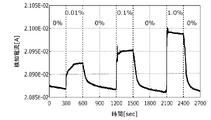
- FIG. 3A is a diagram showing an actual measurement example (waveform of detection current) in the horizontal mode by the hydrogen detection device according to the embodiment.
- FIG. 1A is a cross-sectional view showing a configuration example of a hydrogen sensor according to an embodiment.
- FIG. 1B is a top view showing a configuration example of the hydrogen sensor according to the embodiment.
- FIG. 2A is a block diagram showing a configuration example of a
- FIG. 3B is a graph showing the relationship between the detected current (horizontal axis) obtained in FIG. 3A and the hydrogen concentration (vertical axis) at that time.
- FIG. 4A is a diagram showing an actual measurement example (waveform of detection current) in the vertical mode by the hydrogen detection device according to the embodiment.
- FIG. 4B is a graph showing the relationship between the detected current (horizontal axis) obtained in FIG. 4A and the hydrogen concentration (vertical axis) at that time.
- FIG. 5 is a flow chart showing an example of the operation of the hydrogen detection device shown in FIG. 2A (method for controlling the hydrogen detection device).
- FIG. 6 is a block diagram showing a configuration example of a hydrogen detection device according to a first modified example of the embodiment.
- FIG. 7 is a flow chart showing an operation example of the hydrogen detection device according to the first modification shown in FIG.
- FIG. 8 is a block diagram showing a configuration example of a hydrogen detection device according to a second modification of the embodiment.
- FIG. 9 is a block diagram showing a configuration example of a hydrogen detection device according to a third modified example of the embodiment.
- FIG. 10 is a block diagram showing a configuration example of a hydrogen detection device according to a fourth modification of the embodiment.
- FIG. 11 is a configuration example of a resistor with a fixed resistance value that can be applied to one of the two hydrogen sensors forming the first bridge circuit and one of the two hydrogen sensors forming the second bridge circuit in FIG. It is a cross-sectional view showing the.
- FIG. 11 is a configuration example of a resistor with a fixed resistance value that can be applied to one of the two hydrogen sensors forming the first bridge circuit and one of the two hydrogen sensors forming the second bridge circuit in FIG. It is a cross-sectional view showing the.
- FIG. 12 is a block diagram showing a configuration example of a hydrogen detection device according to a fifth modified example of the embodiment.
- FIG. 13A is a block diagram showing a configuration example of a hydrogen detection device according to a sixth modification of the embodiment;
- FIG. 13B is an equivalent circuit diagram of the hydrogen detection device shown in FIG. 13A.
- FIG. 1A is a cross-sectional view showing a configuration example of the hydrogen sensor 100 according to Embodiment 1.
- FIG. 1B is a top view showing a configuration example of the hydrogen sensor 100 according to Embodiment 1.
- FIG. 1A shows a schematic cross section taken along the line IA-IA in FIG. 1B and viewed in the direction of the arrow.
- the hydrogen sensor 100 is a fine structure that can be manufactured in a semiconductor manufacturing process, and is a wide-range hydrogen sensor that detects low-concentration and high-concentration hydrogen.
- a first electrode 103 and a second electrode 106 arranged so as to form a metal oxide layer 104 arranged in contact with the main surface of the first electrode 103 and the main surface of the second electrode 106; Insulating films 107a to 107c, 109a and 109b covering the second electrode 106 and the metal oxide layer 104, and a first terminal TE1 and a second It has a terminal TE2 and a third terminal BE connected via a via to the other surface of the first electrode 103 that faces the main surface.
- the insulating film 107b has an opening 106a that exposes the other surface of the second electrode 106 between the first terminal TE1 and the second terminal TE2 in plan view with respect to the second electrode 106 without being covered with the insulating film 107b.
- the first electrode 103 is a planar electrode and has two surfaces. One of the two surfaces of the first electrode 103 (that is, the top surface in FIG. 1A) is in contact with the metal oxide layer 104, and the other surface (that is, the bottom surface in FIG. 1A) is on the insulating film 107a and the via 108. touch.
- the first electrode 103 has the same rectangular shape as the second electrode 106 in FIG. 1B.
- the first electrode 103 may be made of a material such as tungsten, nickel, tantalum, titanium, aluminum, tantalum nitride, or titanium nitride, which has a lower standard electrode potential than the metals that make up the metal oxide. The higher the standard electrode potential, the more difficult it is to oxidize.
- the first electrode 103 of FIG. 1A is formed of, for example, a transition metal nitride such as tantalum nitride (TaN) or titanium nitride (TiN), or a stack thereof.
- the metal oxide layer 104 is sandwiched between two opposing main surfaces of the first electrode 103 and the second electrode 106, is composed of a metal oxide as a resistance film having gas sensitivity, and is in contact with the second electrode 106. It has a resistance value that reversibly changes depending on the presence or absence of hydrogen-containing gas in the gas. It is sufficient that the metal oxide layer 104 has the property that the resistance changes with hydrogen.
- the metal oxide layer 104 is composed of an oxygen-deficient metal oxide.
- the base metal of the metal oxide layer 104 is tantalum (Ta), hafnium (Hf), titanium (Ti), zirconium (Zr), niobium (Nb), tungsten (W), nickel (Ni), iron (Fe), and the like. and aluminum (Al).
- the "oxygen deficiency" of the metal oxide refers to the amount of oxygen deficiency in the metal oxide with respect to the amount of oxygen in an oxide having a stoichiometric composition composed of the same elements as the metal oxide. Percentage.
- the oxygen deficit is a value obtained by subtracting the oxygen amount in the metal oxide from the oxygen amount in the metal oxide having the stoichiometric composition.
- the degree of oxygen deficiency of the metal oxide is determined by the metal oxide with the stoichiometric composition is defined based on the one with the highest resistance of Metal oxides of stoichiometric composition are more stable and have higher resistance values than metal oxides of other compositions.
- the stoichiometric oxide according to the above definition is Ta 2 O 5 and thus can be expressed as TaO 2.5 .
- a metal oxide with excess oxygen has a negative oxygen deficiency.
- the degree of oxygen deficiency can take a positive value, 0, or a negative value.
- An oxide with a low oxygen deficiency has a high resistance value because it is closer to an oxide having a stoichiometric composition, and an oxide with a high oxygen deficiency has a low resistance value because it is closer to a metal that constitutes the oxide.
- the metal oxide layer 104 shown in FIG. 1A has a first layer 104a in contact with the first electrode 103, a second layer 104b in contact with the first layer 104a and the second electrode 106, and an insulating isolation layer 104i.
- the degree of oxygen deficiency of the second layer 104b is smaller than that of the first layer 104a.
- the first layer 104a is TaOx .
- the second layer 104b is Ta 2 O 5 with less oxygen deficiency than the first layer 104a.
- the metal oxide layer 104 has an insulating separation layer 104i on the outer circumference of the first electrode 103 in plan view.
- planar view refers to viewing the hydrogen sensor 100 according to the present disclosure from a viewpoint in the stacking direction of FIG. 1A. It refers to viewing from a viewpoint in the normal direction of the surface, for example, viewing the top surface of the hydrogen sensor 100 shown in FIG. 1B.
- the resistance value decreases according to the amount of hydrogen-containing gas in contact with the second electrode 106 (as the amount increases).
- hydrogen atoms are dissociated from the hydrogen-containing gas at the second electrode 106 .
- the dissociated hydrogen atoms penetrate into the metal oxide layer 104 and form impurity levels. In particular, it is concentrated in the vicinity of the interface with the second electrode 106, apparently reducing the thickness of the second layer 104b. As a result, the resistance value of the metal oxide layer 104 is lowered.
- the second electrode 106 is a planar electrode having hydrogen dissociation properties and has two surfaces. One of the two surfaces of the second electrode 106 (i.e., the bottom surface in FIG. 1A) is in contact with the metal oxide layer 104, and the other surface (i.e., the top surface in FIG. 1A) is in contact with the metal layer 106s and ambient air. .
- the second electrode 106 has an exposed portion 106e exposed to the outside air within the opening 106a.
- the second electrode 106 is, for example, a noble metal such as platinum (Pt), iridium (Ir), palladium (Pd), nickel (Ni), or an alloy containing at least one of these, which contains hydrogen atoms.
- the second electrode 106 in FIG. 1A is platinum (Pt).
- Two terminals, that is, a first terminal TE1 and a second terminal TE2 are connected to the second electrode 106 .
- the first terminal TE1 is connected to the second electrode 106 through the via 108.
- the second terminal TE2 is connected to the second electrode 106 through the via 108.
- the first terminal TE1 and the second terminal TE2 are connected to an external detection circuit that drives the hydrogen sensor 100 through the openings TE1a and TE2a.
- the first terminal TE1 and the second terminal TE2 are arranged at positions sandwiching the exposed portion 106e in plan view of the second electrode 106, as shown in FIG. 1B.
- a predetermined voltage is applied between the first terminal TE1 and the second terminal TE2, thereby energizing the exposed portion 106e of the second electrode 106, that is, causing current to flow through the exposed portion 106e. It is considered that the energization of the exposed portion 106e of the second electrode 106 activates the hydrogen dissociation action of the exposed portion 106e.
- the predetermined voltages may be voltages having polarities opposite to each other.
- the hydrogen sensor 100 changes the resistance value between the first terminal TE1 and the second terminal TE2 by touching the exposed portion 106e with gas molecules containing hydrogen atoms while the exposed portion 106e is energized.
- the detection circuit detects this change in resistance value (this detection is also referred to as a "horizontal mode"), thereby detecting gas molecules containing low-concentration hydrogen atoms.
- the third terminal BE is connected to the first electrode 103 through the opening BEa, the via 108, the wiring 114 and the via 108.
- the third terminal BE is connected to an external detection circuit that drives the hydrogen sensor 100 through an opening BEa.
- the hydrogen sensor 100 changes the resistance between the first electrode 103 and the second electrode 106 by contacting the exposed portion 106e with gas molecules containing hydrogen atoms while the exposed portion 106e is energized. In other words, in the hydrogen sensor 100, gas molecules containing hydrogen atoms come into contact with the exposed portion 106e while the exposed portion 106e is energized. change the resistance value of Gas molecules containing high-concentration hydrogen atoms are also detected by the detection of this change in resistance value by the detection circuit (this detection is also referred to as a “longitudinal mode”).
- the insulating film 102, the insulating films 107a to 107c, and the insulating films 109a and 109b, which cover the main parts of the hydrogen sensor 100, are made of a silicon oxide film, a silicon nitride film, or the like.
- a metal layer 106s is formed on the upper surface of the second electrode 106 other than the opening 106a.
- the metal layer 106s is made of TiAlN, for example, and is formed as an etching stopper for forming the via 108, but is not essential.
- the laminate of the first electrode 103, the metal oxide layer 104, and the second electrode 106 is an element that can be used as a memory element of a resistance change memory (ReRAM).
- ReRAM resistance change memory
- the resistance change memory among the possible states of the metal oxide layer 104, two states, a high resistance state and a low resistance state, are used as a digital memory element.
- the hydrogen sensor 100 of the present disclosure utilizes the high resistance state among possible states of the metal oxide layer 104 .
- the metal oxide layer 104 has a two-layer structure composed of a first layer 104a made of TaOx and a second layer 104b made of Ta2O5 having a low degree of oxygen deficiency. Although an example has been shown, a one-layer structure made of Ta 2 O 5 or TaO x having a low degree of oxygen deficiency may also be used.
- FIG. 2A is a block diagram showing a configuration example of the hydrogen detection device 10 according to the embodiment.
- the hydrogen detection device 10 dynamically selectively drives the hydrogen sensor 100 shown in FIGS. and a hydrogen sensor 100 shown in FIGS. 1A and 1B and a detection circuit 200 connected to the hydrogen sensor 100.
- FIG. 1A and 1B a detection circuit 200 connected to the hydrogen sensor 100.
- the detection circuit 200 includes a control circuit 210 , a drive circuit 220 , and ammeters 230 and 231 .
- the ammeter 230 is a measuring circuit that measures the current flowing through the hydrogen sensor 100 in the horizontal mode, that is, the current flowing between the first terminal TE1 and the second terminal TE2 of the hydrogen sensor 100.
- the ammeter 231 is a measuring circuit that measures the current flowing through the hydrogen sensor 100 in the vertical mode, that is, the current flowing between at least one of the first terminal TE1 and the second terminal TE2 of the hydrogen sensor 100 and the third terminal BE. is.
- the drive circuit 220 changes the potentials (0.25 V, ⁇ 0.25 V, 1.5 V) shown in FIG. , the first terminal TE1, the second terminal TE2, and the third terminal BE, the current value (current value I1) flowing through the ammeter 230 is read, and the read current value I1 is returned to the control circuit 210.
- the drive circuit 220 applies the potentials (0.25 V, ⁇ 0.25 V, ⁇ 2.2 V) shown in FIG. 2C to the first terminal TE1.
- FIG. 2B and 2C the applied voltages shown in FIGS. 2B and 2C are examples, and are not limited to such values.
- the control circuit 210 When the control circuit 210 receives an instruction CMD1 from the outside, the control circuit 210 dynamically determines the mode (horizontal mode/vertical mode) suitable for the current hydrogen concentration using the hydrogen sensor 100 by communicating with the drive circuit 220. , the resistance value (R1 or R2) of the hydrogen sensor 100 in the determined mode is calculated and output to the outside. Specifically, the control circuit 210 calculates the resistance value (R1 or R2 ) is calculated.
- the control circuit 210 may be composed of a memory storing a program, a processor executing the program, or the like, or may be a logic circuit/sequencer that sequentially executes processing according to an instruction CMD1 given from the outside. good. Further, the control circuit 210 may output the hydrogen concentration converted from the resistance value instead of the resistance value of the hydrogen sensor 100, or together with the resistance value.
- FIG. 3A is a diagram showing an actual measurement example (waveform of the detected current obtained by the ammeter 230) in the horizontal mode by the hydrogen detection device 10 according to the embodiment.
- FIG. 3B is a graph showing the relationship between the detected current (horizontal axis) obtained in FIG. 3A and the hydrogen concentration (vertical axis) at that time.
- the hydrogen sensor 100 is intermittently exposed to hydrogen of predetermined concentrations (0.01%, 0.1%, 1.0% from the left) three times.
- FIG. 3B plots the current through the hydrogen sensor 100 in lateral mode during exposure to hydrogen in FIG. 3A and the points corresponding to the hydrogen concentration at that time.
- the value of the hydrogen concentration is the percentage (%) of the gas volume ratio.
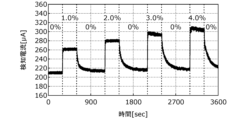
- FIG. 4A is a diagram showing an actual measurement example (waveform of the detected current obtained by the ammeter 231) in the vertical mode by the hydrogen detection device 10 according to the embodiment.
- FIG. 4B is a graph showing the relationship between the detected current (horizontal axis) obtained in FIG. 4A and the hydrogen concentration (vertical axis) at that time.
- the hydrogen sensor 100 is intermittently exposed to hydrogen at a predetermined concentration (1.0%, 2.0%, 3.0%, 4.0% from the left) four times. ing.
- points corresponding to the current flowing through the hydrogen sensor 100 in the vertical mode during exposure to hydrogen in FIG. 4A and the hydrogen concentration at that time are plotted.
- FIGS. 4A and 4B showing the characteristics of the hydrogen sensor 100 in the vertical mode
- FIGS. 4A and 4B showing the characteristics of the hydrogen sensor 100 in the vertical mode
- the detection current increases approximately linearly with the logarithmic increase in concentration for low concentrations of hydrogen, including the range of 0.01 to 1%.
- the detection current increases substantially in proportion to the concentration. That is, the hydrogen sensor 100 detects low-concentration hydrogen in the horizontal mode, and detects high-concentration hydrogen in the vertical mode.
- the hydrogen sensor 100 detects low-concentration hydrogen exceeding the concentration range shown in FIG. 3B in the horizontal mode, and detects high-concentration hydrogen exceeding the concentration range shown in FIG. 4B in the vertical mode.
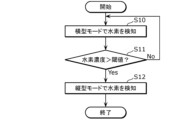
- FIG. 5 is a flowchart showing an example of the operation of the hydrogen detection device 10 (control method of the hydrogen detection device 10) shown in FIG. 2A. Here, a process is shown in which the hydrogen detection device 10 detects the hydrogen concentration while dynamically switching between the horizontal mode and the vertical mode.
- control circuit 210 of the hydrogen detection device 10 When the control circuit 210 of the hydrogen detection device 10 receives an instruction CMD1 indicating the start of detection from the outside, it first detects the hydrogen concentration in the horizontal mode (S10). Specifically, the control circuit 210 controls the drive circuit 220 to change the potentials (0.25 V, ⁇ 0.25 V, 1.5 V) shown in FIG. 2B to the first terminal TE1 and the second terminal TE1, respectively. A process of reading the current value (current value I1) flowing through the ammeter 230 while being applied to the terminal TE2 and the third terminal BE via the drive circuit 220 is repeated by driving the hydrogen sensor 100 with a pulse voltage.
- current value I1 current value flowing through the ammeter 230 while being applied to the terminal TE2 and the third terminal BE via the drive circuit 220 is repeated by driving the hydrogen sensor 100 with a pulse voltage.
- the control circuit 210 calculates the resistance value R1 of the hydrogen sensor 100 from the current value I1 obtained from the drive circuit 220 and the voltage value applied to the hydrogen sensor 100 by the drive circuit 220, and the calculated resistance value (R1 or The hydrogen concentration converted from the resistance value R1) is output to the outside.
- control circuit 210 every time the control circuit 210 obtains the hydrogen concentration converted from the resistance value R1, it determines whether the hydrogen concentration exceeds a threshold value (for example, hydrogen concentration 1%) (S11).
- a threshold value for example, hydrogen concentration 1%)
- the control circuit 210 switches from the horizontal mode to the vertical mode to detect the hydrogen concentration ( S12). Specifically, the control circuit 210 controls the drive circuit 220 to change the potentials (0.25 V, ⁇ 0.25 V, ⁇ 2.2 V) shown in FIG. A process of reading the current value (current value I2) flowing through the ammeter 231 while being applied to the two terminals TE2 and the third terminal BE via the drive circuit 220 is repeated by driving the hydrogen sensor 100 with a pulse voltage.
- a threshold value for example, hydrogen concentration 1%)
- the control circuit 210 calculates the resistance value R2 of the hydrogen sensor 100 from the current value I2 obtained from the drive circuit 220 and the voltage value applied to the hydrogen sensor 100 by the drive circuit 220, and converts the calculated resistance value R2 (or The hydrogen concentration converted from the resistance value R2) is output to the outside.
- the control circuit 210 continues hydrogen detection in the horizontal mode.
- control circuit 210 may switch from the vertical mode to the horizontal mode. .
- the hydrogen detection device 10 includes a first hydrogen sensor (hydrogen sensor 100) that detects hydrogen, and a third detection circuit
- the first hydrogen sensor (hydrogen sensor 100) includes a first electrode 103 and a second electrode 106 whose main surfaces face each other, and a main surface of the first electrode 103 and a second A first metal oxide layer (metal oxide layer 104) arranged in contact with the main surface of the electrode 106, the first electrode 103, the second electrode 106 and the first metal oxide layer (metal oxide layer 104) a first insulating film (insulating films 107a to 107c, etc.) covering the second electrode 106; It has a third terminal BE connected to the other surface facing the main surface of the electrode 103 via a via 108, and the first insulating film (insulating films 107a to 107c, etc.) It has a first opening (opening 106a) that exposes the other surface of the second electrode 106 between the first terminal TE1 and the second terminal TE2 without being
- the third detection circuit detects a first resistance between the first terminal TE1 and the second terminal TE2, and between at least one of the first terminal TE1 and the second terminal TE2 and the third terminal BE.
- a third measurement circuit (ammeters 230 and 231, respectively) for measuring a second resistance value between the two, and a second control circuit (control circuit 210).
- low-concentration hydrogen and high-concentration hydrogen can be detected simply by switching the drive mode for the hydrogen sensor 100, which is a fine structure that can be manufactured in a semiconductor manufacturing process. Therefore, a wide-range hydrogen detector 10 that can detect both low-concentration and high-concentration hydrogen can be realized without the need for a valve or the like for switching the gas flow path as compared with the conventional technique.
- control circuit 210 selectively outputs either the first resistance value or the second resistance value based on the first resistance value.
- an appropriate drive mode is dynamically determined according to the actual hydrogen concentration, and hydrogen detection is performed using an appropriate measurement range.
- the first resistance value is more dependent on low-concentration hydrogen than the second resistance value.
- the hydrogen sensor 100 is driven in the horizontal mode for low-concentration hydrogen, and the hydrogen sensor 100 is driven in the vertical mode for high-concentration hydrogen. detection becomes possible.
- the first metal oxide layer (metal oxide layer 104) is composed of a transition metal oxide.
- the first electrode 103 is made of a transition metal nitride, and the second electrode 106 is made of a noble metal.
- the third detection circuit acquires the first resistance value, and based on the acquired first resistance value, the first resistance value and the second resistance value.
- low-concentration hydrogen and high-concentration hydrogen can be selectively detected simply by switching the drive mode for the hydrogen sensor 100, which is a fine structure. Therefore, a control method for a wide-range hydrogen detection device 10 that can detect both low-concentration and high-concentration hydrogen can be achieved without the need for a valve or the like for switching the gas flow path as compared with the prior art.
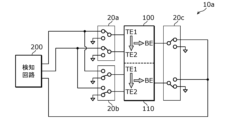
- FIG. 6 is a block diagram showing a configuration example of a hydrogen detection device 10a according to the first modified example of the embodiment.
- a hydrogen detection device 10a according to this modification has a configuration in which a backup hydrogen sensor is added to the hydrogen detection device 10 according to the embodiment. More specifically, the hydrogen detection device 10a includes a backup hydrogen sensor 110 and three switching circuits 20a to 20c in addition to the configuration of the hydrogen detection device 10 according to the embodiment.
- the spare hydrogen sensor 110 is a spare hydrogen sensor having the same structure as the hydrogen sensor 100 .
- Each of the three switching circuits 20a to 20c is a switch composed of two single pole double throw (SPDT) switches.
- the switching circuit 20a switches conduction/non-conduction between the detection circuit 200 and the first terminal TE1 and the second terminal TE2 of the hydrogen sensor 100 under the control of the control circuit 210 included in the detection circuit 200.
- the switching circuit 20b switches conduction/non-conduction between the detection circuit 200 and the first terminal TE1 and the second terminal TE2 of the auxiliary hydrogen sensor 110 under the control of the control circuit 210 provided in the detection circuit 200 .
- the switching circuit 20c switches conduction/non-conduction between the detection circuit 200 and the third terminal BE of the hydrogen sensor 100 and the third terminal BE of the auxiliary hydrogen sensor 110 under the control of the control circuit 210 provided in the detection circuit 200 .
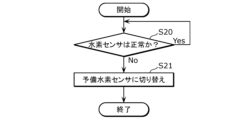
- FIG. 7 is a flow chart showing an operation example of the hydrogen detection device 10a according to the first modified example shown in FIG. Here, the process of dynamically switching the hydrogen sensor used by the hydrogen detection device 10a from the hydrogen sensor 100 to the backup hydrogen sensor 110 is shown.
- the control circuit 210 normally connects the hydrogen sensor 100 to the detection circuit 200 by controlling the switching circuits 20a to 20c, and uses the hydrogen sensor 100 to detect hydrogen as shown in the flowchart of FIG. Is going.
- Control circuit 210 determines whether or not hydrogen sensor 100 is normal in parallel with hydrogen detection (S20). Specifically, the control circuit 210 controls the resistance value of the hydrogen sensor 100 to be within a predetermined range (for example, the resistance value corresponding to the hydrogen concentration range of 0 to 1% in the horizontal mode and 1.0% in the vertical mode). A resistance value corresponding to a hydrogen concentration range of up to 100%) is determined to determine whether it is normal or abnormal.
- control circuit 210 determines that it is normal (Yes in S20), the control circuit 210 continues hydrogen detection using the hydrogen sensor 100. On the other hand, when it determines that it is abnormal (No in S20). ), the control circuit 210 controls the switching circuits 20a to 20c to switch the hydrogen sensor connected to the detection circuit 200 from the hydrogen sensor 100 to the backup hydrogen sensor 110, and performs hydrogen detection using the backup hydrogen sensor 110 ( S21).
- the hydrogen detection device 10a has, in addition to the configuration of the hydrogen detection device 10 according to the embodiment, the auxiliary hydrogen sensor 110 having the same structure as the first hydrogen sensor (hydrogen sensor 100). , third switching circuits (switching circuits 20a to 20c) that selectively connect either the first hydrogen sensor (hydrogen sensor 100) or the backup hydrogen sensor (backup hydrogen sensor 110) to the third detection circuit (detection circuit 200) and As a result, even if one hydrogen sensor 100 fails, hydrogen detection can be continued using the backup hydrogen sensor 110, thereby improving user convenience.
- third switching circuits switching circuits 20a to 20c
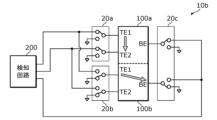
- FIG. 8 is a block diagram showing a configuration example of a hydrogen detection device 10b according to a second modified example of the embodiment.
- a hydrogen detection device 10b according to this modification includes a horizontal mode hydrogen sensor and a vertical mode hydrogen sensor. More specifically, the hydrogen detection device 10b includes a horizontal mode hydrogen sensor 100a and a vertical mode hydrogen sensor 100b instead of the hydrogen sensor 100 corresponding to both modes according to the embodiment.
- the provision of switching circuits 20a to 20c is the same as in the first modification.
- the hydrogen sensor 100a dedicated to the horizontal mode may be the same as the hydrogen sensor 100 according to the embodiment, or may have a material or structure that increases the sensitivity of the hydrogen sensor 100 according to the embodiment in the horizontal mode. may be improved.
- the vertical mode-dedicated hydrogen sensor 100b may be the same as the hydrogen sensor 100 according to the embodiment, or may be made of a material different from that of the hydrogen sensor 100 according to the embodiment so as to increase the sensitivity in the vertical mode. Alternatively, it may have an improved structure.
- Each of the three switching circuits 20a to 20c is a switch composed of two single pole double throw (SPDT) switches.
- the switching circuit 20a switches conduction/non-conduction between the detection circuit 200 and the first terminal TE1 and the second terminal TE2 of the horizontal mode hydrogen sensor 100a under the control of the control circuit 210 included in the detection circuit 200.
- the switching circuit 20b switches conduction/non-conduction between the detection circuit 200 and the first terminal TE1 and the second terminal TE2 of the vertical mode hydrogen sensor 100b under the control of the control circuit 210 provided in the detection circuit 200.
- the switching circuit 20c Under the control of a control circuit 210 included in the detection circuit 200, the switching circuit 20c connects the detection circuit 200 with the third terminal BE of the hydrogen sensor 100a dedicated to the horizontal mode and the third terminal BE of the hydrogen sensor 100b dedicated to the vertical mode. switch between conduction and non-conduction.
- the operation of the hydrogen detection device 10b (control method of the hydrogen detection device 10b) according to this modified example is the same as, for example, the flowchart shown in FIG. That is, the control circuit 210 of the hydrogen detection device 10b controls the switching circuits 20a to 20c to connect the horizontal mode hydrogen sensor 100a to the detection circuit 200. , low-concentration hydrogen is detected in horizontal mode (S10).
- control circuit 210 every time the control circuit 210 obtains the hydrogen concentration converted from the resistance value, it determines whether the hydrogen concentration exceeds a threshold value (for example, hydrogen concentration 1%) (S11).
- a threshold value for example, hydrogen concentration 1%)
- the control circuit 210 controls the switching circuits 20a to 20c so that the detection circuit 200
- the hydrogen sensor to be connected is switched from the horizontal mode hydrogen sensor 100a to the vertical mode hydrogen sensor 100b to detect the hydrogen concentration (S12).
- the control circuit 210 continues hydrogen detection using the horizontal mode hydrogen sensor 100a.
- the hydrogen detection device 10b includes a first hydrogen sensor (hydrogen sensor 100a dedicated to horizontal mode) and a second hydrogen sensor (hydrogen sensor 100b dedicated to vertical mode) for detecting hydrogen,
- a first detection circuit (detection circuit 200) is connected to the first hydrogen sensor (horizontal mode hydrogen sensor 100a) and the second hydrogen sensor (vertical mode hydrogen sensor 100b).
- the first hydrogen sensor (horizontal mode hydrogen sensor 100a only) includes a first electrode 103 and a second electrode 106 whose main surfaces face each other, and a main surface of the first electrode 103 and a main surface of the second electrode .
- the second hydrogen sensor (hydrogen sensor 100b for vertical mode only) includes a third electrode (first electrode 103) and a fourth electrode (second electrode 106) arranged with their main surfaces facing each other, and a third electrode A second metal oxide layer (metal oxide layer 104) disposed in contact with the main surface of the (first electrode 103) and the main surface of the fourth electrode (second electrode 106); a second insulating film (insulating films 107a to 107c, etc.) covering the electrode 103), the fourth electrode (second electrode 106), and the second metal oxide layer (metal oxide layer 104); 106) connected via vias 108 to the other surface facing the main surface of the terminal 106), the main terminal of the third electrode (first electrode 103) and the fourth and fifth terminals (first terminal TE1 and second terminal TE2).
- the second insulating film (insulating films 107a to 107c, etc.) has a fourth electrode (second electrode 106) between the fourth terminal and the fifth terminal (the first terminal TE1 and the second terminal TE2) in plan view, the other surface of the fourth electrode (the second electrode 106) is covered with the second insulating film (insulating films 107a to 107a). 107c, etc.), and the first detection circuit (detection circuit 200) has a first resistance value between the first terminal TE1 and the second terminal TE2, and a first measuring circuit (each , ammeters 230 and 231).
- the hydrogen sensors 100a and 100b which are fine structures that can be manufactured in the semiconductor manufacturing process, low-concentration hydrogen and high-concentration hydrogen can be detected. Therefore, a wide-range hydrogen detection device 10b that can detect both low-concentration and high-concentration hydrogen can be realized without the need for a valve or the like for switching the gas flow path, as compared with the conventional one.
- the first detection circuit (detection circuit 200) further has a first control circuit (control circuit 210) that selectively outputs either the first resistance value or the second resistance value.
- the first control circuit selectively outputs the first resistance value and the second resistance value based on the first resistance value.
- an appropriate hydrogen sensor 100a or 100b is dynamically selected according to the actual hydrogen concentration, and hydrogen detection is performed using an appropriate measurement range.
- a first hydrogen sensor (hydrogen sensor 100a dedicated to horizontal mode) and a second hydrogen sensor (hydrogen sensor 100b dedicated to vertical mode) are selectively connected to the first detection circuit (detection circuit 200).
- 1 switching circuits switching circuits 20a to 20c.
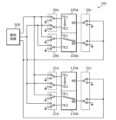
- FIG. 9 is a block diagram showing a configuration example of a hydrogen detection device 10c according to a third modified example of the embodiment.
- a hydrogen detection device 10c according to the present modification has a configuration in which a backup hydrogen sensor is added to the hydrogen detection device 10b according to the second modification. More specifically, in addition to the configuration of the hydrogen detection device 10b according to the second modification, the hydrogen detection device 10c has a backup hydrogen sensor 110a dedicated to the horizontal mode and a backup hydrogen sensor 110b dedicated to the vertical mode. and circuits 21a to 21c.
- the horizontal mode-only spare hydrogen sensor 110a is a spare hydrogen sensor having the same structure as the horizontal mode-only hydrogen sensor 100a.
- the vertical mode-only spare hydrogen sensor 110b is a spare hydrogen sensor having the same structure as the vertical mode-only hydrogen sensor 100b.
- Each of the three switching circuits 21a to 21c is a switch composed of two single pole double throw (SPDT) switches.
- the switching circuit 21a switches conduction/non-conduction between the detection circuit 200 and the first terminal TE1 and the second terminal TE2 of the auxiliary hydrogen sensor 110a dedicated to the horizontal mode.
- the switching circuit 21b switches conduction/non-conduction between the detection circuit 200 and the first terminal TE1 and the second terminal TE2 of the standby hydrogen sensor 110b dedicated to the vertical mode under the control of the control circuit 210 included in the detection circuit 200. .
- the switching circuit 21c switches between the detection circuit 200 and the third terminal BE of the horizontal mode-only standby hydrogen sensor 110a and the vertical mode-only standby hydrogen sensor 110b. Switches between conduction/non-conduction with BE.
- the hydrogen detection device 10c according to the third modified example is provided with two spare hydrogen sensors 110a and 110b, only one spare hydrogen sensor may be provided as the spare hydrogen sensor. By selectively using one spare hydrogen sensor in horizontal mode and vertical mode, it can function as a spare hydrogen sensor for both horizontal mode hydrogen sensor 100a and vertical mode hydrogen sensor 100b.
- the hydrogen detection device 10c has the same structure as the first hydrogen sensor (horizontal mode hydrogen sensor 100a) or the second hydrogen sensor (vertical mode hydrogen sensor 100b).
- either the second hydrogen sensor (vertical mode-only hydrogen sensor 100b) or the reserve hydrogen sensor (at least one of the reserve hydrogen sensors 110a and 110b) may be selectively connected to the first detection circuit (detection circuit 200) and a second switching circuit (switching circuits 21a to 21c).
- FIG. 10 is a block diagram showing a configuration example of a hydrogen detection device 10d according to the fourth modified example of the embodiment.
- a hydrogen detection device 10d according to this modification includes two bridge circuits including hydrogen sensors. More specifically, the hydrogen detection device 10d includes a first bridge circuit 120a and a second bridge circuit 120b each composed of four resistance elements, two switching circuits 22a and 22b, and switching circuits 22a and 22b. and a detection circuit 200a connected to the first bridge circuit 120a and the second bridge circuit 120b.
- the first bridge circuit 120a is a circuit for detecting low-concentration hydrogen, and has substantially the same structure as two resistors R1a and R2a, one horizontal mode hydrogen sensor 100c, and one hydrogen sensor. A total of four resistance elements are bridge-connected.
- FIG. 11 shows a cross-sectional structure of a resistive element 100d having substantially the same structure as the hydrogen sensor.
- FIG. 11 shows a resistor R100 having a fixed resistance value. As can be seen from the figure, this resistor R100 has no opening 106a in the hydrogen sensor 100 shown in FIG. 1A (ie, the opening 106a is blocked). ). Resistor R100 thus has a fixed resistance value, independent of the hydrogen concentration to which it is exposed.
- the two resistors R1a and R2a are made of polysilicon or the like and have a fixed resistance value of, for example, 20 ⁇ .
- the hydrogen sensor 100c and the resistive element 100d dedicated to the horizontal mode are connected to the first terminal TE1 with the voltage VH ( 1 V), a voltage VB (2.0 V) is applied to the third terminal BE, and the second terminal TE2 is connected to the reference potential (VSS) via resistors R1a and R2a.
- the second bridge circuit 120b is a circuit for detecting high-concentration hydrogen. A total of four resistance elements are bridge-connected. Like the resistor element 100d, the resistor element 100f has the structure shown in FIG.
- the two resistors R1b and R2b are made of polysilicon or the like and have a fixed resistance value of, for example, 10 k ⁇ .
- the hydrogen sensor 100e and the resistive element 100f dedicated to the vertical mode have a voltage applied to the first terminal TE1 so that the hydrogen sensor 100e and the resistive element 100f are driven in the vertical mode.
- a voltage VH (2.6 V) is applied
- a voltage VL (1.8 V) is applied to the second terminal TE2
- a reference potential (VSS) is connected to the third terminal BE via resistors R1b and R1b.
- Sensing circuit 200a includes a voltmeter 240 for measuring a first voltage between two junctions in first bridge circuit 120a and a second voltage between two junctions in second bridge circuit 120b. .
- the switching circuits 22a and 22b are both single pole double throw (SPDT) switches. Under the control of the detection circuit 200a, the switching circuit 22a switches the connection point between the horizontal mode hydrogen sensor 100c and the resistor R1a in the first bridge circuit 120a and the vertical mode hydrogen sensor in the second bridge circuit 120b. Switching is performed to selectively connect one of the connection points between the sensor 100e and the resistor R1b to one of the input terminals (+terminal) of the voltmeter 240.
- FIG. Under the control of the detection circuit 200a, the switching circuit 22b connects the connection point between the resistance element 100d and the resistor R2a in the first bridge circuit 120a and the connection point between the resistance element 100f and the resistor R2b in the second bridge circuit 120b. A switch selectively connects either of the points to the other of the input terminals of the voltmeter 240 (the minus terminal).
- the second bridge circuit 120b That is, at each of the two connection points between the second bridge circuit 120b and the voltmeter 240, there is a hydrogen sensor or a divided voltage generated by a resistor R100 having substantially the same structure as the hydrogen sensor and a resistor R1b or R2b. voltage is generated. Therefore, due to the structural similarity between the hydrogen sensor and the resistor R100, the fluctuation factors of these characteristics are in phase and canceled, thereby ensuring operational stability against temperature fluctuations and disturbance noise.
- the operation of the hydrogen detection device 10d (control method of the hydrogen detection device 10d) according to this modified example is the same as, for example, the flowchart shown in FIG. That is, the detection circuit 200a first controls the switching circuits 22a and 22b to connect the first bridge circuit 120a including the horizontal mode hydrogen sensor 100c and the resistive element 100d to the voltmeter 240. Low-concentration hydrogen detection is performed in horizontal mode using the dedicated hydrogen sensor 100c and resistive element 100d (S10). When the horizontal mode hydrogen sensor 100c detects hydrogen and these resistance balances are lost (that is, when there is a difference in the resistance values of the hydrogen sensor 100c and the resistance element 100d), the voltmeter 240 indicates the polarity. Measured as voltage.
- the voltage value (or the hydrogen concentration converted from the voltage) by the voltmeter 240 every time the detection circuit 200a obtains the voltage value (or the hydrogen concentration converted from the voltage) by the voltmeter 240, the voltage value (or the hydrogen concentration) becomes a threshold value (for example, the hydrogen concentration is 1% or more). corresponding voltage value) is exceeded (S11).
- the detection circuit 200a switches to the switching circuit 22a and 22b, the bridge circuit connected to the voltmeter 240 is changed from the first bridge circuit 120a including the horizontal mode hydrogen sensor 100c and resistive element 100d to the vertical mode hydrogen sensor 100e and resistive element.
- the hydrogen concentration is detected by switching to the second bridge circuit 120b including 100f (S12).
- the detection circuit 200a is dedicated to the horizontal mode. Hydrogen detection using the first bridge circuit 120a including the hydrogen sensor 100c and the resistive element 100d is continued.
- the hydrogen detection device 10d includes the first bridge circuit 120a and the second bridge circuit 120b, which are each composed of four resistance elements, and the first bridge circuit 120a and the second bridge circuit 120b.
- One of the four resistive elements forming the first bridge circuit 120a is the first hydrogen sensor (horizontal mode hydrogen sensor 100c).
- one of the four resistive elements constituting the second bridge circuit 120b is the second hydrogen sensor (vertical mode hydrogen sensor 100e)
- the second detection circuit (detection circuit 200a) is the first bridge It has a second measuring circuit (voltmeter 240) that measures a first voltage between two connection points in circuit 120a and a second voltage between two connection points in second bridge circuit 120b.
- the resistance element 100d corresponding to the first hydrogen sensor 100c in the positional relationship that determines the first voltage is the first opening (opening) in the first hydrogen sensor.
- the resistance element 100f that corresponds to the second hydrogen sensor 100e in the positional relationship that determines the second voltage is the second opening (opening) in the second hydrogen sensor. 106a) is not formed.
- the four resistance elements forming the first bridge circuit 120a have the same basic structure, and the resistance balance of the first bridge circuit 120a is maintained with high accuracy in an environment where hydrogen does not exist, resulting in high sensitivity. can be realized.
- the same manufacturing process can be applied to the four resistance elements, except for the formation of the openings. The same can be said for the second bridge circuit 120b.
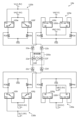
- FIG. 12 is a block diagram showing a configuration example of a hydrogen detection device 10e according to a fifth modified example of the embodiment.
- a hydrogen detection device 10e according to this modification has a configuration in which a backup bridge circuit is added to the hydrogen detection device 10d according to the fourth modification. More specifically, the hydrogen detection device 10e has, in addition to the configuration of the hydrogen detection device 10d according to the fourth modification, two auxiliary bridge circuits (a first auxiliary bridge circuit 130a and a second auxiliary bridge circuit 130b) and four Switching circuits 22c to 22f are provided.
- the first backup bridge circuit 130a has the same configuration as the first bridge circuit 120a.
- the second backup bridge circuit 130b has the same configuration as the second bridge circuit 120b. Therefore, the first auxiliary bridge circuit 130a includes the first hydrogen sensor 100g and a resistive element 100h having substantially the same structure as the hydrogen sensor.
- the resistance element 100h has a structure in which the first hydrogen sensor does not have the first opening (opening 106a). (ie resistor R100).
- the second auxiliary bridge circuit 130b also includes a second hydrogen sensor 100i and a resistive element 100j having substantially the same structure as the hydrogen sensor.
- the resistive element 100j has a structure in which the second hydrogen sensor does not have the second opening (opening 106a) (that is, the resistor R100).
- the switching circuits 22c and 22d are both single pole double throw (SPDT) switches. Under the control of the detection circuit 200a, the switching circuit 22c is a connection point between the horizontal mode-only hydrogen sensor 100g and the resistor R3a in the first backup bridge circuit 130a, and the vertical mode-only connection point in the second backup bridge circuit 130b. switching is performed to selectively connect one of the connection points between the hydrogen sensor 100i and the resistor R3b to one of the input terminals of the voltmeter 240.
- SPDT single pole double throw
- the switching circuit 22d connects the connection point between the resistive element 100h and the resistor R4a in the first auxiliary bridge circuit 130a and the connection point between the resistive element 100j and the resistor R4b in the second auxiliary bridge circuit 130b. , is selectively connected to the other input terminal of the voltmeter 240 .
- the switching circuits 22e and 22f are both single pole double throw (SPDT) switches.
- the switching circuit 22e selectively connects either the second bridge circuit 120b or the second backup bridge circuit 130b to one of the input terminals of the voltmeter 240 under the control of the detection circuit 200a.
- the switching circuit 22f selectively connects either the first bridge circuit 120a or the first backup bridge circuit 130a to the other input terminal of the voltmeter 240 under the control of the detection circuit 200a.
- An operation example of the hydrogen detection device 10e according to this modified example is the same processing as in FIG. That is, the detection circuit 200a normally detects low-concentration and high-concentration hydrogen using the first bridge circuit 120a and the second bridge circuit 120b by controlling the switching circuits 22e and 22f. When it is determined that one of the bridge circuits is not operating normally, the bridge circuit is switched to the corresponding backup bridge circuit, and low-concentration and high-concentration hydrogen detection is performed.
- the hydrogen detection device 10e according to the fifth modification has the same configuration as the first bridge circuit 120a or the second bridge circuit 120b in addition to the configuration of the hydrogen detection device 10d according to the fourth modification.
- a circuit in the modification, a first backup bridge circuit 130a having the same configuration as the first bridge circuit 120a and a second backup bridge circuit 130b having the same configuration as the second bridge circuit 120b), the first bridge circuit 120a and the first A third switching circuit that selectively connects either the backup bridge circuit 130a or selectively connects either the second bridge circuit 120b or the second backup bridge circuit 130b to the second detection circuit (detection circuit 200a). (switching circuits 22e and 22f).
- the hydrogen detection device 10e according to the fifth modification includes two spare bridge circuits (the first spare bridge circuit 130a and the second spare bridge circuit 130b). Only the circuit may be provided. Even when one backup bridge circuit is provided, it functions as a backup bridge circuit for the corresponding first bridge circuit 120a or second bridge circuit 120b, thereby improving the operational reliability of the hydrogen detection device.
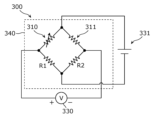
- FIG. 13A is a block diagram showing a configuration example of a hydrogen detection device 300 according to a sixth modification of the embodiment.
- the hydrogen detector 300 is composed of a semiconductor chip 340 and a voltmeter 330 .
- a semiconductor chip 340 includes terminals 301 to 304 connected to a fixed potential, a hydrogen sensor 310 as an example of a first resistance element that constitutes a bridge circuit, a resistor R1 as an example of a second resistance element, and a third resistance element.
- a reference element 311 that is an example of a resistance element, a resistor R2 that is an example of a fourth resistance element, and switching circuits 320 to 323 are formed. Note that the hydrogen detector 300 does not necessarily require the voltmeter 330 .
- the hydrogen sensor 310 is a sensor having the same structure as the hydrogen sensor 100 shown in FIG. and the first metal oxide layer (metal oxide layer 104) arranged in contact with the main surface of the second electrode 106, the first electrode 103, the second electrode 106 and the first metal oxide layer (metal oxide and a first insulating film (insulating films 107a to 107c, etc.) covering the layer 104).
- the first insulating film has an opening (opening 106a) that exposes the other surface facing the main surface of the second electrode 106 without being covered with the first insulating film.
- the hydrogen sensor 310 has a first terminal TE1, a second terminal TE2 and a third terminal BE.
- the reference element 311 has the same structure as the resistor R100 shown in FIG. 11, and corresponds to the hydrogen sensor 100 shown in FIG. 1A in which the opening 106a is not formed (that is, the opening 106a is closed). .
- the reference element 311 includes a third electrode (first electrode 103 in FIG. 11) and a fourth electrode (second electrode 106 in FIG. 11) arranged with their main surfaces facing each other, and a third electrode ( A second metal oxide layer (metal oxide layer 104 in FIG. 11) arranged in contact with the main surface of the first electrode 103) and the main surface of the fourth electrode (second electrode 106 in FIG. 11); A second insulating film (see 11 insulating films 107a to 107c, etc.).
- the second insulating film does not have an opening that exposes the other surface facing the main surface of the fourth electrode (second electrode 106 in FIG. 11) without being covered with the second insulating film.
- the reference element 311 has a first terminal TE1, a second terminal TE2 and a third terminal BE.
- the two resistors R1 and R2 have the same resistance value and are made of polysilicon or the like and have a fixed resistance value, for example, 20 ⁇ .
- the switching circuits 320 and 321 are switches for switching the hydrogen sensor 100 between the horizontal mode and the vertical mode. Specifically, when the hydrogen sensor 100 is placed in the horizontal mode connection state, the switching circuit 320 connects the second terminal TE2 of the hydrogen sensor 100 to the resistor R1 in response to an external control signal, and The switching circuit 321 connects the third terminal BE of the hydrogen sensor 100 to the terminal 303 . On the other hand, when the hydrogen sensor 100 is to be connected in the vertical mode, the switching circuit 320 connects the second terminal TE2 of the hydrogen sensor 100 to the terminal 301 and switches the switching circuit 321 to the terminal 301 in response to an external control signal. connects the third terminal BE of the hydrogen sensor 100 to the resistor R1.
- the switching circuits 322 and 323 are switches for switching the connection state of the reference element 311 between the horizontal mode and the vertical mode. Specifically, when the reference element 311 is placed in the horizontal mode connection state, the switching circuit 322 connects the second terminal TE2 of the reference element 311 to the resistor R2 in response to an external control signal, and The switching circuit 323 connects the third terminal BE of the reference element 311 to the terminal 303 . On the other hand, when the reference element 311 is placed in the connection state of the vertical mode, the switching circuit 322 connects the second terminal TE2 of the reference element 311 to the terminal 301 in response to an external control signal, and the switching circuit 323 connects the third terminal BE of the reference element 311 to the resistor R2.
- FIG. 13B is an equivalent circuit diagram of the hydrogen detection device 300 shown in FIG. 13A.
- an external DC voltage source 331 not shown in FIG. 13A is also shown.
- the equivalent circuit diagram shown in this figure is for a case in which the hydrogen sensor 310 and the reference element 311 are connected in a horizontal mode to detect low-concentration hydrogen, and a case in which the hydrogen sensor 310 and the reference element 311 are connected in a vertical mode.
- An equivalent circuit is shown that can be applied to both cases of detecting high concentrations of hydrogen in the state of
- the reference element 311 when the hydrogen sensor 310 is used in horizontal mode, the reference element 311 is also used in horizontal mode, while when the hydrogen sensor 310 is used in vertical mode, the reference element 311 is also used in horizontal mode. Used in portrait mode.
- the hydrogen sensor 310 and the reference element 311 basically have the same structure and have the same resistance value in an environment where hydrogen does not exist.
- Resistors R1 and R2 have fixed resistance values.
- the resistance value of the hydrogen sensor 310 changes, causing a difference in the resistance values between the hydrogen sensor 310 and the reference element 311.
- the resistance value between the hydrogen sensor 310 and the resistor R1 changes.
- a difference is generated between the potential at the connection point and the potential at the connection point between the reference element 311 and the resistor R2, and the potential difference is measured by the voltmeter 330.
- the hydrogen detection device 300 is composed of the bridge circuit including the hydrogen sensor and the switching circuits 320 to 323. Therefore, the hydrogen detection device 300 has high sensitivity and a wide range of detection of low and high concentrations of hydrogen. A hydrogen sensing device is realized.
- the hydrogen sensor 310, the reference element 311, and the resistors R1 and R2, which constitute the bridge circuit, are formed on one semiconductor chip 340 by the same semiconductor manufacturing process. , miniaturization of the hydrogen detection device 300 is realized.
- the hydrogen sensor 310 and the reference element 311 can be selectively switched between the horizontal mode and the vertical mode, but such switching is not necessarily required. It may be fixed to one of the modes. Therefore, the hydrogen sensor 310 and the reference element 311 do not necessarily need to be provided with three terminals (the first terminal TE1, the second terminal TE2, and the third terminal BE). good.
- the hydrogen sensor 310, the reference element 311, and the resistors R1 and R2 are formed on one semiconductor chip 340.
- the hydrogen sensor 310 and Only the reference device 311 may be formed on one semiconductor chip 340 .
- the hydrogen sensor 310 and the reference element 311 have the same basic structure and constitute a bridge circuit, and highly sensitive hydrogen detection is realized.
- the detection circuit 200 includes the two ammeters 230 and 231, but is not limited to this configuration, and includes one ammeter and one ammeter in the horizontal mode. and vertical mode.
- the detection circuit 200 has a function of operating based on the instruction CMD1 from the outside, but the instruction CMD1 from the outside is not necessarily required. As shown in the flowchart of FIG. 5, it is also possible to operate in a fixed processing flow such as always operating in the horizontal mode and switching to the vertical mode when the hydrogen concentration exceeds a threshold value.
- the current flows from the first terminal TE1 to the second terminal TE2 in the horizontal mode, but the direction of current flow may be reversed.
- the hydrogen detection device 10 according to the embodiment is always driven in the horizontal mode.
- the switching circuits 20a to 20c are double-throw switches that connect the terminals of the hydrogen sensors to either the detection circuit 200 or the ground. It may be a single-throw switch that determines whether or not the terminal of is connected to the detection circuit 200 (ON/OFF type).
- the detection circuit 200a includes one voltmeter 240 and is selectively connected to either the first bridge circuit 120a or the second bridge circuit 120b.
- the configuration is not limited, and a total of two voltmeters, a voltmeter connected to the first bridge circuit 120a and a voltmeter connected to the second bridge circuit 120b, may be provided.
- the hydrogen detection device 10e according to the fifth modification is provided with two spare bridge circuits (the first spare bridge circuit 130a and the second spare bridge circuit 130b).
- at least one spare hydrogen sensor is provided to replace the horizontal mode hydrogen sensor 100c and the resistance element 100d that constitute the first bridge circuit 120a.
- At least one spare hydrogen sensor may be provided to replace the vertical mode hydrogen sensor 100e and the resistive element 100f that constitute the bridge circuit 120b.
- the hydrogen detection device is a wide-range hydrogen detection device that detects low-concentration and high-concentration hydrogen, and is particularly a small and wide-range hydrogen detection device that detects low-concentration and high-concentration hydrogen. As, for example, it can be used as a hydrogen detection device mounted on a fuel cell vehicle.
Landscapes
- Chemical & Material Sciences (AREA)
- Chemical Kinetics & Catalysis (AREA)
- Electrochemistry (AREA)
- Physics & Mathematics (AREA)
- Health & Medical Sciences (AREA)
- Life Sciences & Earth Sciences (AREA)
- Analytical Chemistry (AREA)
- Biochemistry (AREA)
- General Health & Medical Sciences (AREA)
- General Physics & Mathematics (AREA)
- Immunology (AREA)
- Pathology (AREA)
- Investigating Or Analyzing Materials By The Use Of Electric Means (AREA)
- Investigating Or Analyzing Materials By The Use Of Fluid Adsorption Or Reactions (AREA)
Priority Applications (3)
| Application Number | Priority Date | Filing Date | Title |
|---|---|---|---|
| CN202280062917.7A CN117980732A (zh) | 2021-09-22 | 2022-07-04 | 氢检测装置以及氢检测装置的控制方法 |
| JP2023549384A JPWO2023047759A1 (https=) | 2021-09-22 | 2022-07-04 | |
| US18/604,130 US20240272106A1 (en) | 2021-09-22 | 2024-03-13 | Hydrogen detection device and control method for hydrogen detection device |
Applications Claiming Priority (2)
| Application Number | Priority Date | Filing Date | Title |
|---|---|---|---|
| JP2021-154912 | 2021-09-22 | ||
| JP2021154912 | 2021-09-22 |
Related Child Applications (1)
| Application Number | Title | Priority Date | Filing Date |
|---|---|---|---|
| US18/604,130 Continuation US20240272106A1 (en) | 2021-09-22 | 2024-03-13 | Hydrogen detection device and control method for hydrogen detection device |
Publications (1)
| Publication Number | Publication Date |
|---|---|
| WO2023047759A1 true WO2023047759A1 (ja) | 2023-03-30 |
Family
ID=85720438
Family Applications (1)
| Application Number | Title | Priority Date | Filing Date |
|---|---|---|---|
| PCT/JP2022/026591 Ceased WO2023047759A1 (ja) | 2021-09-22 | 2022-07-04 | 水素検知装置及び水素検知装置の制御方法 |
Country Status (4)
| Country | Link |
|---|---|
| US (1) | US20240272106A1 (https=) |
| JP (1) | JPWO2023047759A1 (https=) |
| CN (1) | CN117980732A (https=) |
| WO (1) | WO2023047759A1 (https=) |
Cited By (2)
| Publication number | Priority date | Publication date | Assignee | Title |
|---|---|---|---|---|
| WO2024009891A1 (ja) * | 2022-07-04 | 2024-01-11 | ヌヴォトンテクノロジージャパン株式会社 | 水素検知装置及びその製造方法 |
| WO2025079597A1 (ja) * | 2023-10-11 | 2025-04-17 | ヌヴォトンテクノロジージャパン株式会社 | 水素検知装置及びその製造方法 |
Families Citing this family (1)
| Publication number | Priority date | Publication date | Assignee | Title |
|---|---|---|---|---|
| JP7731857B2 (ja) * | 2022-08-25 | 2025-09-01 | 株式会社東芝 | センサ及びセンサシステム |
Citations (7)
| Publication number | Priority date | Publication date | Assignee | Title |
|---|---|---|---|---|
| US5985673A (en) * | 1994-12-22 | 1999-11-16 | Arizona Baord Of Regents | Method for regeneration of a sensor |
| JP2009103605A (ja) * | 2007-10-24 | 2009-05-14 | Yazaki Corp | ガス濃度測定回路体およびガス濃度測定方法 |
| JP2017181494A (ja) * | 2016-03-25 | 2017-10-05 | パナソニックIpマネジメント株式会社 | 気体センサ、水素検出方法、及び燃料電池自動車 |
| JP2017198661A (ja) * | 2016-04-26 | 2017-11-02 | パナソニックIpマネジメント株式会社 | 気体検出装置及び気体検出方法 |
| JP2017215312A (ja) * | 2016-05-25 | 2017-12-07 | パナソニックIpマネジメント株式会社 | 気体センサ装置、気体センサモジュール、及び気体検知方法 |
| US20200003718A1 (en) * | 2017-03-31 | 2020-01-02 | Sensirion Ag | Sensor for measuring a gas concentration |
| WO2021210453A1 (ja) * | 2020-04-16 | 2021-10-21 | ヌヴォトンテクノロジージャパン株式会社 | 水素センサ、水素検知方法および水素検知装置 |
Family Cites Families (6)
| Publication number | Priority date | Publication date | Assignee | Title |
|---|---|---|---|---|
| EP3343212B1 (en) * | 2015-08-28 | 2019-11-06 | Panasonic Intellectual Property Management Co., Ltd. | Gas sensor and fuel cell vehicle |
| CN107102032B (zh) * | 2016-02-22 | 2021-08-06 | 新唐科技日本株式会社 | 气体传感器及氢浓度判定方法 |
| JP6761764B2 (ja) * | 2016-03-18 | 2020-09-30 | パナソニックセミコンダクターソリューションズ株式会社 | 水素センサ及び燃料電池自動車、並びに水素検出方法 |
| CN107315033B (zh) * | 2016-04-26 | 2021-08-06 | 新唐科技日本株式会社 | 气体检测装置以及氢检测方法 |
| WO2023136083A1 (ja) * | 2022-01-17 | 2023-07-20 | ヌヴォトンテクノロジージャパン株式会社 | 水素検知方法、駆動回路および水素検知装置 |
| WO2024009891A1 (ja) * | 2022-07-04 | 2024-01-11 | ヌヴォトンテクノロジージャパン株式会社 | 水素検知装置及びその製造方法 |
-
2022
- 2022-07-04 WO PCT/JP2022/026591 patent/WO2023047759A1/ja not_active Ceased
- 2022-07-04 JP JP2023549384A patent/JPWO2023047759A1/ja active Pending
- 2022-07-04 CN CN202280062917.7A patent/CN117980732A/zh active Pending
-
2024
- 2024-03-13 US US18/604,130 patent/US20240272106A1/en active Pending
Patent Citations (7)
| Publication number | Priority date | Publication date | Assignee | Title |
|---|---|---|---|---|
| US5985673A (en) * | 1994-12-22 | 1999-11-16 | Arizona Baord Of Regents | Method for regeneration of a sensor |
| JP2009103605A (ja) * | 2007-10-24 | 2009-05-14 | Yazaki Corp | ガス濃度測定回路体およびガス濃度測定方法 |
| JP2017181494A (ja) * | 2016-03-25 | 2017-10-05 | パナソニックIpマネジメント株式会社 | 気体センサ、水素検出方法、及び燃料電池自動車 |
| JP2017198661A (ja) * | 2016-04-26 | 2017-11-02 | パナソニックIpマネジメント株式会社 | 気体検出装置及び気体検出方法 |
| JP2017215312A (ja) * | 2016-05-25 | 2017-12-07 | パナソニックIpマネジメント株式会社 | 気体センサ装置、気体センサモジュール、及び気体検知方法 |
| US20200003718A1 (en) * | 2017-03-31 | 2020-01-02 | Sensirion Ag | Sensor for measuring a gas concentration |
| WO2021210453A1 (ja) * | 2020-04-16 | 2021-10-21 | ヌヴォトンテクノロジージャパン株式会社 | 水素センサ、水素検知方法および水素検知装置 |
Cited By (2)
| Publication number | Priority date | Publication date | Assignee | Title |
|---|---|---|---|---|
| WO2024009891A1 (ja) * | 2022-07-04 | 2024-01-11 | ヌヴォトンテクノロジージャパン株式会社 | 水素検知装置及びその製造方法 |
| WO2025079597A1 (ja) * | 2023-10-11 | 2025-04-17 | ヌヴォトンテクノロジージャパン株式会社 | 水素検知装置及びその製造方法 |
Also Published As
| Publication number | Publication date |
|---|---|
| CN117980732A (zh) | 2024-05-03 |
| US20240272106A1 (en) | 2024-08-15 |
| JPWO2023047759A1 (https=) | 2023-03-30 |
Similar Documents
| Publication | Publication Date | Title |
|---|---|---|
| WO2023047759A1 (ja) | 水素検知装置及び水素検知装置の制御方法 | |
| US10591432B2 (en) | Hydrogen detection method using gas sensor having a metal oxide layer | |
| JP6782642B2 (ja) | 気体センサ及び水素濃度判定方法 | |
| CN107315034B (zh) | 气体检测装置以及氢检测方法 | |
| JP7648606B2 (ja) | 水素センサ、水素検知方法および水素検知装置 | |
| US12235232B2 (en) | Gas sensor, method of manufacturing gas sensor, and fuel cell vehicle | |
| CN107315033B (zh) | 气体检测装置以及氢检测方法 | |
| CN110114662B (zh) | 气体检测装置、气体检测系统、燃料电池汽车及气体检测方法 | |
| US20250116623A1 (en) | Hydrogen detection device and method for manufacturing the same | |
| US11536677B2 (en) | Gas detection device, gas sensor system, fuel cell vehicle, and hydrogen detection method | |
| US20240361267A1 (en) | Hydrogen detection method, drive circuit, and hydrogen detection device | |
| WO2020213223A1 (ja) | 気体センサの駆動方法及び気体検出装置 | |
| US12493009B2 (en) | Hydrogen sensor | |
| WO2025079597A1 (ja) | 水素検知装置及びその製造方法 | |
| WO2025159102A1 (ja) | 水素検知装置及び水素検知方法 |
Legal Events
| Date | Code | Title | Description |
|---|---|---|---|
| 121 | Ep: the epo has been informed by wipo that ep was designated in this application |
Ref document number: 22872516 Country of ref document: EP Kind code of ref document: A1 |
|
| WWE | Wipo information: entry into national phase |
Ref document number: 2023549384 Country of ref document: JP |
|
| WWE | Wipo information: entry into national phase |
Ref document number: 202280062917.7 Country of ref document: CN |
|
| NENP | Non-entry into the national phase |
Ref country code: DE |
|
| 122 | Ep: pct application non-entry in european phase |
Ref document number: 22872516 Country of ref document: EP Kind code of ref document: A1 |