WO2023037438A1 - ロータ、モータ、圧縮機および冷凍サイクル装置 - Google Patents
ロータ、モータ、圧縮機および冷凍サイクル装置 Download PDFInfo
- Publication number
- WO2023037438A1 WO2023037438A1 PCT/JP2021/032986 JP2021032986W WO2023037438A1 WO 2023037438 A1 WO2023037438 A1 WO 2023037438A1 JP 2021032986 W JP2021032986 W JP 2021032986W WO 2023037438 A1 WO2023037438 A1 WO 2023037438A1
- Authority
- WO
- WIPO (PCT)
- Prior art keywords
- slit
- rotor
- magnetic pole
- center line
- shortest distance
- Prior art date
- Legal status (The legal status is an assumption and is not a legal conclusion. Google has not performed a legal analysis and makes no representation as to the accuracy of the status listed.)
- Ceased
Links
Images







Classifications
-
- H—ELECTRICITY
- H02—GENERATION; CONVERSION OR DISTRIBUTION OF ELECTRIC POWER
- H02K—DYNAMO-ELECTRIC MACHINES
- H02K1/00—Details of the magnetic circuit
- H02K1/06—Details of the magnetic circuit characterised by the shape, form or construction
- H02K1/22—Rotating parts of the magnetic circuit
- H02K1/27—Rotor cores with permanent magnets
- H02K1/2706—Inner rotors
- H02K1/272—Inner rotors the magnetisation axis of the magnets being perpendicular to the rotor axis
- H02K1/274—Inner rotors the magnetisation axis of the magnets being perpendicular to the rotor axis the rotor consisting of two or more circumferentially positioned magnets
- H02K1/2753—Inner rotors the magnetisation axis of the magnets being perpendicular to the rotor axis the rotor consisting of two or more circumferentially positioned magnets the rotor consisting of magnets or groups of magnets arranged with alternating polarity
- H02K1/276—Magnets embedded in the magnetic core, e.g. interior permanent magnets [IPM]
-
- F—MECHANICAL ENGINEERING; LIGHTING; HEATING; WEAPONS; BLASTING
- F25—REFRIGERATION OR COOLING; COMBINED HEATING AND REFRIGERATION SYSTEMS; HEAT PUMP SYSTEMS; MANUFACTURE OR STORAGE OF ICE; LIQUEFACTION SOLIDIFICATION OF GASES
- F25B—REFRIGERATION MACHINES, PLANTS OR SYSTEMS; COMBINED HEATING AND REFRIGERATION SYSTEMS; HEAT PUMP SYSTEMS
- F25B31/00—Compressor arrangements
- F25B31/02—Compressor arrangements of motor-compressor units
- F25B31/026—Compressor arrangements of motor-compressor units with compressor of rotary type
-
- H—ELECTRICITY
- H02—GENERATION; CONVERSION OR DISTRIBUTION OF ELECTRIC POWER
- H02K—DYNAMO-ELECTRIC MACHINES
- H02K1/00—Details of the magnetic circuit
- H02K1/06—Details of the magnetic circuit characterised by the shape, form or construction
- H02K1/22—Rotating parts of the magnetic circuit
- H02K1/27—Rotor cores with permanent magnets
-
- H—ELECTRICITY
- H02—GENERATION; CONVERSION OR DISTRIBUTION OF ELECTRIC POWER
- H02K—DYNAMO-ELECTRIC MACHINES
- H02K1/00—Details of the magnetic circuit
- H02K1/06—Details of the magnetic circuit characterised by the shape, form or construction
- H02K1/22—Rotating parts of the magnetic circuit
- H02K1/27—Rotor cores with permanent magnets
- H02K1/2706—Inner rotors
- H02K1/272—Inner rotors the magnetisation axis of the magnets being perpendicular to the rotor axis
- H02K1/274—Inner rotors the magnetisation axis of the magnets being perpendicular to the rotor axis the rotor consisting of two or more circumferentially positioned magnets
- H02K1/2753—Inner rotors the magnetisation axis of the magnets being perpendicular to the rotor axis the rotor consisting of two or more circumferentially positioned magnets the rotor consisting of magnets or groups of magnets arranged with alternating polarity
- H02K1/276—Magnets embedded in the magnetic core, e.g. interior permanent magnets [IPM]
- H02K1/2766—Magnets embedded in the magnetic core, e.g. interior permanent magnets [IPM] having a flux concentration effect
-
- H—ELECTRICITY
- H02—GENERATION; CONVERSION OR DISTRIBUTION OF ELECTRIC POWER
- H02K—DYNAMO-ELECTRIC MACHINES
- H02K21/00—Synchronous motors having permanent magnets; Synchronous generators having permanent magnets
- H02K21/12—Synchronous motors having permanent magnets; Synchronous generators having permanent magnets with stationary armatures and rotating magnets
- H02K21/14—Synchronous motors having permanent magnets; Synchronous generators having permanent magnets with stationary armatures and rotating magnets with magnets rotating within the armatures
-
- H—ELECTRICITY
- H02—GENERATION; CONVERSION OR DISTRIBUTION OF ELECTRIC POWER
- H02K—DYNAMO-ELECTRIC MACHINES
- H02K2213/00—Specific aspects, not otherwise provided for and not covered by codes H02K2201/00 - H02K2211/00
- H02K2213/03—Machines characterised by numerical values, ranges, mathematical expressions or similar information
Definitions
- the present disclosure relates to rotors, motors, compressors, and refrigeration cycle devices.
- a permanent magnet-embedded rotor has a rotor core having a magnet insertion hole and permanent magnets arranged in the magnet insertion hole.
- the permanent magnet has a flat plate shape and is magnetized in the thickness direction.
- Two or more permanent magnets may be arranged in one magnet insertion hole.
- two permanent magnets may be arranged in a V-shaped magnet insertion hole.
- the three permanent magnets are arranged obliquely with respect to the central permanent magnet so that the permanent magnets on both sides face each other. Such an arrangement is also referred to as a bathtub arrangement.
- Patent Document 1 in order to collect the magnetic flux emitted from the permanent magnet at the center of the pole, it has been proposed to form a long slit in the circumferential direction adjacent to the end of the V-shaped magnet insertion hole (for example, Patent Document 1 reference).
- the direction of the magnetic flux flowing into the end of the permanent magnet closest to the outer circumference of the rotor core is close to the thickness direction (that is, the magnetization direction) of the permanent magnet. . Therefore, the demagnetization of the permanent magnets cannot be sufficiently suppressed only by providing the slits as described above.
- the present disclosure has been made to solve the above problems, and aims to suppress demagnetization of permanent magnets.
- a rotor of the present disclosure includes a rotor core having an outer periphery extending in a circumferential direction about an axis and magnet insertion holes positioned inside the outer periphery in a radial direction about the axis, and arranged in the magnet insertion holes. and at least three permanent magnets.
- the magnet insertion hole has a first hole positioned at the center in the circumferential direction of the magnet insertion hole, and two second holes extending from both ends of the first hole in the circumferential direction toward the outer circumference.
- the at least three permanent magnets have a first permanent magnet positioned in the first hole and a second permanent magnet positioned in each of the second holes.
- the first hole extends in a direction orthogonal to the magnetic pole center line, which is a radial straight line passing through the circumferential center of the magnet insertion hole.
- the rotor core includes first slits formed between each of the second holes and the magnetic pole center line and having a length in the circumferential direction, and formed between the first slit and the magnetic pole center line, and having a diameter and a second slit having a length in the direction.
- the shortest distance C [mm] from the first slit to the magnet insertion hole and the shortest distance S [mm] from the first slit to the outer circumference satisfy S ⁇ 0.7517C 2 +0.2021C+1.1395. .
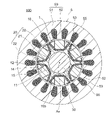
- FIG. 1 is a cross-sectional view showing a motor according to Embodiment 1;
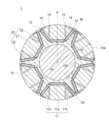
- FIG. 2 is a cross-sectional view showing the rotor of Embodiment 1;
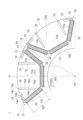
- FIG. 2 is a cross-sectional view showing an enlarged part of the rotor of Embodiment 1.
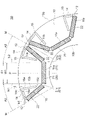
- FIG. 4 is a cross-sectional view showing an enlarged region corresponding to one magnetic pole of the rotor of the first embodiment;
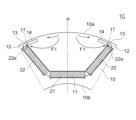
- FIG. 5 is a schematic diagram showing the flow of magnetic flux in the rotor core in Comparative Example (A) and Embodiment 1 (B); 4 is an enlarged cross-sectional view showing a portion including magnet insertion holes and side slits of the rotor of the first embodiment; FIG.
- FIG. 8 is a cross-sectional view showing an enlarged part of the rotor of the second embodiment
- 4 is a table showing the relationship between the ratio of the permanent magnet width W1 to the shortest distance B from the magnetic pole center line to the slit, and the reduction rate of the induced voltage.
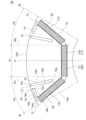
- FIG. 11 is a cross-sectional view showing an enlarged part of a rotor according to Embodiment 3;
- FIG. 11 is a cross-sectional view showing an enlarged region corresponding to one magnetic pole of the rotor of Embodiment 3; 5 is a graph showing the relationship between the Vf ratio and the angle between the edge of the slit and the straight line passing through the radially inner endpoint of the edge and the point on the pole center side of the side slit. It is a sectional view showing a compressor to which a motor of each embodiment can be applied.
- FIG. 19 is a diagram showing a refrigeration cycle apparatus having the compressor of FIG. 18;
- FIG. 1 is a cross-sectional view showing motor 100 of Embodiment 1.
- FIG. A motor 100 is a permanent magnet embedded motor in which permanent magnets 20 are embedded in a rotor 1 .
- the motor 100 has a rotatable rotor 1 and a stator 5 provided so as to surround the rotor 1 .
- An air gap of 0.3 to 1.0 mm is formed between the stator 5 and the rotor 1, for example.
- the stator 5 is fixed inside a closed container 502 (FIG. 19) of a compressor 500, which will be described later.
- the direction of the axis Ax which is the rotation axis of the rotor 1, is hereinafter referred to as the "axial direction”.
- a circumferential direction about the axis Ax is called a “circumferential direction”.
- a radial direction about the axis Ax is referred to as a “radial direction”.
- the stator 5 has a stator core 50 and a coil 55 wound around the stator core 50 .
- the stator core 50 is formed by laminating magnetic steel sheets in the axial direction and fixing them by caulking or the like.
- the plate thickness of the electromagnetic steel plate is, for example, 0.1 to 0.7 mm.
- Stator core 50 has an annular yoke 51 centered on axis Ax and a plurality of teeth 52 extending radially inward from yoke 51 .
- the teeth 52 are formed at regular intervals in the circumferential direction. Although the number of teeth 52 is 18 here, it may be 2 or more. Slots 53 for accommodating coils 55 are formed between adjacent teeth 52 . An insulating portion made of resin such as polyethylene terephthalate (PET) is provided between the slot 53 and the coil 55 .
- PET polyethylene terephthalate
- the coil 55 is composed of a magnet wire and wound around the teeth 52 by concentrated winding or distributed winding.
- a wire diameter of the coil 55 is, for example, 0.8 mm.
- the coil 55 has three-phase windings of U-phase, V-phase and W-phase, and is connected by Y-connection or delta-connection.
- FIG. 2 is a sectional view showing the rotor 1.
- the rotor 1 has a cylindrical rotor core 10 , permanent magnets 20 attached to the rotor core 10 , and a shaft 30 fixed to the central portion of the rotor core 10 .
- a central axis of the shaft 30 is the above-described axis Ax.
- the rotor core 10 has an outer circumference 10a and an inner circumference 10b. Both the outer circumference 10a and the inner circumference 10b are circular around the axis Ax.
- the rotor core 10 is formed by laminating magnetic steel sheets in the axial direction and integrating them by caulking or the like.
- the plate thickness of the electromagnetic steel plate is, for example, 0.1 to 0.7 mm, here it is 0.35 mm.
- a shaft 30 is fixed to the inner circumference 10b of the rotor core 10 by shrink fitting or press fitting.
- a plurality of magnet insertion holes 11 are formed along the outer circumference 10 a of the rotor core 10 .
- the plurality of magnet insertion holes 11 are formed at regular intervals in the circumferential direction.
- the magnet insertion hole 11 extends from one axial end to the other axial end of the rotor core 10 .
- One magnet insertion hole 11 corresponds to one magnetic pole.
- the number of magnet insertion holes 11 is six here, so the number of poles is six. However, the number of poles is not limited to six, and may be two or more.
- An interpolar portion M is formed between adjacent magnetic poles, that is, between adjacent magnet insertion holes 11 .
- the three permanent magnets 20 are arranged in each magnet insertion hole 11 .
- the three permanent magnets 20 include a permanent magnet 21 as a first permanent magnet located in the center in the circumferential direction and two permanent magnets 22 as second permanent magnets located on both sides thereof.
- Both permanent magnets 21 and 22 are rare earth magnets containing, for example, neodymium (Nd), iron (Fe) and boron (B).
- FIG. 3 is a diagram showing a portion of the rotor 1, more specifically, an area corresponding to two magnetic poles.
- the center of the magnet insertion hole 11 in the circumferential direction corresponds to the pole center.
- a straight line in the radial direction passing through the pole center is called a magnetic pole centerline P.
- the magnet insertion hole 11 has a first hole 11a located in the center in the circumferential direction and two second holes 11b located on both sides in the circumferential direction of the first hole 11a.
- a first hole portion 11a of the magnet insertion hole 11 extends in a direction perpendicular to the magnetic pole center line P. As shown in FIG.
- Each second hole 11b of the magnet insertion hole 11 extends from the longitudinal end of the first hole 11a toward the outer circumference 10a. Further, each second hole portion 11b extends obliquely with respect to the magnetic pole center line P so that the distance from the magnetic pole center line P increases toward the outer side in the radial direction.
- the angle between the first hole portion 11a and the second hole portion 11b is, for example, 120 degrees, but is not limited to this.
- a permanent magnet 21 is arranged in the first hole portion 11 a of the magnet insertion hole 11 .
- Permanent magnets 22 are arranged in the two second holes 11b, respectively. Therefore, the permanent magnets 22 on both sides are arranged to be inclined with respect to the central permanent magnet 21 .
- Such arrangement of the permanent magnet 21 and the two permanent magnets 22 is called a bathtub arrangement.
- the permanent magnet 21 has a width W1 in the direction perpendicular to the magnetic pole center line P and a thickness in the direction of the magnetic pole center line P.
- Each permanent magnet 22 has a width W2 in a direction inclined to the magnetic pole center line P and a thickness in a direction orthogonal to the width direction.
- FIG. 4 is an enlarged view of a portion of the rotor 1 corresponding to one magnetic pole.
- the permanent magnet 21 has an outer surface 21a on the side of the outer circumference 10a, an inner surface 21b on the side of the inner circumference 10b, and end faces 21c on both ends in the width direction.
- the width W1 is the distance between the two end faces 21c.
- Each permanent magnet 22 has an outer surface 22a on the magnetic pole center line P side, an inner surface 22b on the interpolar portion M side, and end faces 22c at both ends in the width direction.
- the width W2 is the distance between the two end faces 22c.
- the positioning portion 111 is a convex portion that protrudes from the side of the first hole portion 11a on the inner circumference 10b side.
- recesses 112 facing the inner surface 21b of the permanent magnet 21 are formed adjacent to the two positioning portions 111 in the first hole portion 11a.
- the concave portion 112 is formed to facilitate processing of the positioning portion 111 and reduce stress concentration.
- the positioning portion 113 is a convex portion that protrudes from the side of the second hole portion 11b on the interpolar portion M side.
- recesses 114 facing the inner surface 22b of the permanent magnet 22 are formed adjacent to the two positioning portions 113 in each of the second holes 11b.
- the concave portion 114 is formed to facilitate processing of the positioning portion 113 and reduce stress concentration.
- the magnet insertion hole 11 has a flux barrier 12 on the outer circumference 10a side of each second hole 11b.
- the flux barrier 12 is an air gap for reducing leakage flux between adjacent magnetic poles.
- a thin portion 13 is formed between the flux barrier 12 and the outer periphery 10 a of the rotor core 10 . It is desirable that the width of the thin portion 13 in the radial direction be the same as the plate thickness of the electromagnetic steel sheets forming the rotor core 10 .
- a side slit 14 is formed between the magnet insertion hole 11 and the magnetic pole center line P, more specifically between the flux barrier 12 and the magnetic pole center line P.
- the side slits 14 extend in the circumferential direction along the outer circumference 10a of the rotor core 10. As shown in FIG.
- the side slit 14 has a length L1 in the circumferential direction and a width H1 in the radial direction. Length L1 is longer than width H1.
- the side slits 14 are also called first slits or circumferential slits.
- the side slit 14 has an edge 14a facing the outer periphery 10a of the rotor core 10, an opposite edge 14b, an edge 14c facing the magnetic pole center line P, and an edge 14d facing the magnet insertion hole 11.
- a thin portion 16 is formed between the edge 14 a of the side slit 14 and the outer circumference 10 a of the rotor core 10 .
- a thin portion 17 is formed between the edge 14 d of the side slit 14 and the magnet insertion hole 11 .
- the edge 14 d of the side slit 14 faces the flux barrier 12 here, but may face the magnet insertion hole 11 .
- a slit 15 is formed between the side slit 14 and the magnetic pole center line P. Each slit 15 extends parallel to the magnetic pole center line P. As shown in FIG.
- the slit 15 has a radial length L2 and a circumferential width H2. Length L2 is longer than width H2.
- the slit 15 is also called a second slit or a radial slit.
- the slit 15 has an edge 15a facing the magnetic pole center line P, an opposite edge 15b, a radially outer edge 15c, and a radially inner edge 15d.
- the edge 15c faces the outer periphery 10a of the rotor core 10, and the edge 15d faces the second hole portion 11b of the magnet insertion hole 11. As shown in FIG.
- the slit 15 extends parallel to the magnetic pole center line P here, it may be inclined with respect to the magnetic pole center line P. In that case, it is desirable that the slit 15 is inclined so that the distance from the magnetic pole center line P increases toward the radially outer side (see FIG. 15 described later).
- stator magnetic flux The magnetic flux generated by the current flowing through the coils 55 of the stator 5 is called stator magnetic flux.
- Stator magnetic flux flows into the rotor core 10 from the teeth 52 of the stator 5 .
- FIG. 5 is a schematic diagram showing the flow of magnetic flux in a rotor 1C of a comparative example that does not have slits 15.
- FIG. 5 in the rotor 1C of the comparative example, as in the rotor 1 of the first embodiment, permanent magnets 21 and 22 are arranged in the magnet insertion hole 11 in a bathtub shape.
- the magnetic flux flows into the corner 22e of the permanent magnet 22 on the side of the outer circumference 10a at an angle nearly parallel to the magnetization direction (that is, the thickness direction) of the permanent magnet 22.
- the rotor 1C of the comparative example is provided with side slits 14 for rectifying the magnetic flux of the permanent magnets 21 and 22 toward the pole center.
- one of the stator magnetic flux passes through the thin portion 17 between the side slit 14 and the magnet insertion hole 11 toward the outer circumference 10a of the rotor core 10, as indicated by arrow F1 in FIG.
- the thickness of the permanent magnet 22 In order to suppress the demagnetization of the permanent magnet 22, it is conceivable to increase the thickness of the permanent magnet 22.
- the permanent magnets 22 are composed of high-cost rare earth magnets, increasing the thickness of the permanent magnets 22 leads to an increase in manufacturing costs.
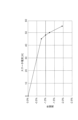
- FIG. 6 is a graph showing the relationship between the stator current and the demagnetization factor of the permanent magnet 22 in the motor including the rotor 1C of the comparative example.
- the horizontal axis indicates the stator current, and the vertical axis indicates the demagnetization factor.
- a stator current is a current that flows through the coils 55 of the stator 5 .
- the demagnetization factor D is obtained from the magnetic flux ⁇ f pre [Wb] of the permanent magnet 22 before demagnetization and the magnetic flux ⁇ f aft [Wb] after demagnetization by the following equation (1).
- the demagnetization rate reaches -1%, and when the stator current increases further, demagnetization progresses further.
- the current value when the demagnetization rate reaches -1% is called the reference current.
- the radial width of the thin portion 16 between the side slit 14 and the outer circumference 10a of the rotor core 10 is increased. Therefore, the magnetic flux flowing from the stator core 50 into the interpolar portion M of the rotor core 10 flows along the outer circumference 10a of the rotor core 10 through the thin portion 16 as indicated by the arrow F2, instead of flowing radially inward through the interpolar portion M. flow easily.
- Embodiment 1 a slit 15 is formed between the side slit 14 and the magnetic pole center line P, as shown in FIG. 7(B).
- the flow of magnetic flux from the pole center side toward the corner 22e of the permanent magnet 22 can be blocked by the slit 15 as indicated by the arrow F1.
- demagnetization of the permanent magnet 22 can be suppressed.
- the radial width of the thin portion 16 between the side slit 14 and the outer circumference 10a of the rotor core 10 can be narrowed. Therefore, the magnetic flux that has flowed from the stator core 50 into the interpolar portion M of the rotor core 10 tends to flow radially inward as indicated by the arrow F4. As a result, the flow of magnetic flux along the outer periphery 10a of the rotor core 10 is reduced, and demagnetization of the permanent magnets 22 as shown in FIG. 7A can be suppressed.
- FIG. 8 is a schematic diagram showing an enlarged portion of the rotor 1 including the side slits 14 and the magnet insertion holes 11.
- the shortest distance C is the shortest distance from the edge 14d of the side slit 14 on the side of the magnet insertion hole 11 to the edge 116 of the second hole portion 11b of the magnet insertion hole 11 on the side slit 14 side.
- the shortest distance S is the shortest distance from the edge 14 a of the side slit 14 on the side of the outer circumference 10 a to the outer circumference 10 a of the rotor core 10 .
- the shortest distance C is the minimum width of the thin portion 17 described above
- the shortest distance S is the minimum width of the thin portion 16 described above.
- the width of the thin portion 17 is constant over the edge 14d of the side slit 14, but it is not necessarily constant.
- the width of the thin portion 16 is constant over the edge 14a of the side slit 14, but it is not necessarily constant.
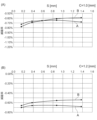
- FIG. 9A is a graph showing the relationship between the shortest distance S and the demagnetization rate when the shortest distance C is 0.38 mm.
- FIG. 9B is a graph showing the relationship between the shortest distance S and the demagnetization rate when the shortest distance C is 0.75 mm.
- FIG. 10(A) is a graph showing the relationship between the shortest distance S and the demagnetization rate when the shortest distance C is 1.00 mm.
- FIG. 10B is a graph showing the relationship between the shortest distance S and the demagnetization rate when the shortest distance C is 1.20 mm.
- the horizontal axis indicates the shortest distance S
- the vertical axis indicates the demagnetization rate.
- the definition of demagnetization rate is as described with reference to formula (1).
- the value of the demagnetization rate is negative, and the larger the absolute value, the more demagnetization progresses.
- the above reference current is passed through the coil 55 of the stator 5 .
- Symbol A indicates the data of the first embodiment
- symbol B indicates the data of the comparative example (FIG. 5).
- the absolute value of the demagnetization rate of the first embodiment is the same as that of the comparative example when the shortest distance S is 1.1 mm or less. is less than or equal to the absolute value of In other words, when the shortest distance S is 1.1 mm or less, the demagnetization rate is better than that of the comparative example.
- the demagnetization rate is improved over the comparative example within the range of the shortest distance S of 0.9 mm or less.
- the demagnetization rate is improved over the comparative example within the range of the shortest distance S of 0.6 mm or less.
- FIG. 11 is a graph showing the relationship between the shortest distance C and the shortest distance S when the demagnetization rate is improved compared to the comparative example from the results of FIGS. 9(A) to 10(B).
- the side slits 14 and the slits 15 are formed in the rotor core 10, and the shortest distance C from the side slits 14 to the magnet insertion holes 11 and the shortest distance S from the side slits 14 to the outer circumference 10a of the rotor core 10 are expressed by the equation (2). is satisfied, demagnetization of the permanent magnet 22 can be suppressed.
- the shortest distance S from the side slits 14 to the outer periphery 10a of the rotor core 10 is equal to or greater than the plate thickness T of the electromagnetic steel sheets forming the rotor core 10 . Therefore, it is more desirable that the shortest distance C and the shortest distance S satisfy the following equation (3).
- the plate thickness T is, for example, 0.35 mm. T ⁇ S ⁇ 0.7517C 2 +0.2021C+1.1395 (3)
- the shortest distance C from the side slit 14 to the magnet insertion hole 11 is preferably equal to or greater than the plate thickness T of the magnetic steel sheet due to restrictions in processing the magnetic steel sheet. It is desirable to be 0 mm or less. That is, it is desirable to satisfy T ⁇ C ⁇ 1.0.
- the length L1 of the side slit 14 is the length in the circumferential direction.
- the length L2 of the slit 15 is the length in the radial direction, more specifically, the length in the direction parallel to the magnetic pole center line P.
- FIG. 12 is a graph showing the relationship between the length ratio L2/L1 and the demagnetization factor.
- the length L1 of the side slit 14 was kept constant, and the length L2 of the slit 15 was varied. Further, by setting the distance between the radially outer end of the slit 15 and the outer periphery 10a of the rotor core 10 constant (equivalent to the plate thickness T of the electromagnetic steel sheet here) and changing the position of the radially inner end of the slit 15, , the length L2 of the slit 15 is changed.
- the ratio L2/L1 is 0.426 or more, the absolute value of the demagnetization rate can be suppressed to less than 1.0%.
- the ratio L2/L1 of the length L2 of the slit 15 to the length L1 of the side slit 14 is preferably 0.426 or more.
- the slit 15 may be arranged between the side slit 14 and the magnetic pole center line P, but as shown in FIG. Desirably, it is at least half the width W1 (that is, B ⁇ W1 ⁇ 1/2). This is because the magnetic flux from the permanent magnet 21 to the stator 5 can be prevented from being blocked by the slits 15 .
- one permanent magnet 21 is arranged in the first hole portion 11a of the magnet insertion hole 11 and one permanent magnet 22 is arranged in each second hole portion 11b.
- Two or more permanent magnets may be arranged in each of the hole 11a and the second hole 11b.
- the permanent magnets 21 and 22 have been described as having the same shape and the same dimensions, they do not necessarily have the same shape and the same dimensions.
- the magnet insertion hole 11 has the first hole portion 11a and the two second hole portions 11b, and the permanent magnets 21 and 22 are arranged in a bathtub shape. are placed in Circumferentially long side slits 14 are formed between the respective second holes 11b and the magnetic pole center line P, and radially long slits 15 are formed between the side slits 14 and the magnetic pole center line P. formed.
- the shortest distance C [mm] from the side slit 14 to the magnet insertion hole 11 and the shortest distance S [mm] from the side slit 14 to the outer circumference 10a of the rotor core 10 are S ⁇ 0.7517C 2 +0.2021C+1.1395. satisfy.
- the shortest distance S is equal to or greater than the plate thickness T of the electromagnetic steel sheets forming the rotor core 10, the effect of suppressing demagnetization of the permanent magnets 22 can be achieved without complicating the manufacturing process of the rotor 1.
- the ratio L2/L1 of the length L2 of the slit 15 to the length L1 of the side slit 14 is set to 0.426 or more, the flow of the magnetic flux toward the corner 22e side of the permanent magnet 22 is interrupted by the slit 15, The effect of suppressing demagnetization of the permanent magnet 22 can be enhanced.
- the shortest distance B from the magnetic pole center line P to the slit 15 and the width W1 of the permanent magnet 21 satisfy B ⁇ W1 ⁇ 1/2, so that the magnetic flux from the permanent magnet 21 to the stator 5 can be effectively generated. can be utilized and the motor efficiency can be increased.
- the magnetic flux flows from the stator 5 into the rotor core 10 and the corners of the permanent magnets 22 flow into the rotor core 10 .
- Magnetic flux directed toward the portion 22e can be reduced. Thereby, the demagnetization suppressing effect of the permanent magnet 22 can be enhanced.
- FIG. 13 is a sectional view showing part of the rotor 1A of the second embodiment.
- a rotor 1 ⁇ /b>A of the second embodiment differs from the rotor 1 of the first embodiment in the arrangement of slits 15 .
- Each magnetic pole region of the rotor 1A is divided into three regions in a direction orthogonal to the magnetic pole center line P.
- one end face 21c is the first end E1 and the other end face 21c is the second end E2.
- a straight line passing through the first end E1 and parallel to the magnetic pole center line P is defined as a straight line N1.
- a straight line passing through the second end E2 and parallel to the magnetic pole center line P is defined as a straight line N2.
- the straight line N1 is also called the first straight line
- the straight line N2 is also called the second straight line.
- a region sandwiched between straight lines N1 and N2 in the circumferential direction is defined as a first region A1.
- the first area A1 has the same width W1 as the permanent magnet 21 .
- the area between the straight line N1 and the interpolar portion M and the area between the straight line N2 and the interpolar portion M are defined as second areas A2.
- the first area A1 is an area sandwiched between the permanent magnet 21 and the outer circumference 10a of the rotor core 10.
- the second area A2 is an area located outside the first area A1 in the circumferential direction.
- the slit 15 is arranged within the first area A1. Therefore, the area between the permanent magnet 22 arranged in the second hole portion 11b of the magnet insertion hole 11 and the slit 15 is widened, and the magnetic flux emitted from the permanent magnet 22 hardly causes magnetic saturation in the area.
- the slit 15 is parallel to the magnetic pole center line P here.
- B be the shortest distance from the magnetic pole center line P to the edge 15 a of the slit 15 . Since the slit 15 is arranged within the first area A1, the shortest distance B is less than half the width W1 of the permanent magnet 21 (that is, B ⁇ W1/2).
- G be the shortest distance from the magnet insertion hole 11 to the slit 15 .
- the shortest distance G is the shortest distance from the first hole portion 11 a of the magnet insertion hole 11 to the edge 15 d of the slit 15 .
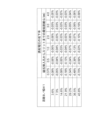
- FIG. 14 is a table showing analysis results of changes in induced voltage when the ratio B/W1 is changed.
- the induced voltage is a voltage generated when the magnetic flux of the permanent magnets 21 and 22 interlinks with the coil 55 of the stator 5.
- the higher the induced voltage the higher the motor output.
- FIG. 14 shows the amount of decrease in the induced voltage from the reference value of the induced voltage of the rotor 1C (FIG. 5) of the comparative example without the slits 15 as a reference value.
- the ratio B/W1 is changed to 3.6%, 7.3%, 14.6%, 21.9%, 29.2%, 36.5%, and 43.8%.
- the shortest distance G from the magnet insertion hole 11 to the slit 15 is also changed to 0.375 mm, 0.5 mm, 1.0 mm, 2.0 mm, 3.0 mm, and 4.0 mm.
- the shortest distance B from the magnetic pole center line P to the slit 15 is preferably 21.9% or less of the width W1 of the permanent magnet 21.
- the shortest distance G from the magnet insertion hole 11 to the slit 15 should be equal to or greater than the plate thickness of the electromagnetic steel plate forming the rotor core 10 .
- the slit 15 extends parallel to the magnetic pole center line P here, it may be inclined with respect to the magnetic pole center line P. In this case, at least the radially inner end of the slit 15 is located in the first region A1, and the shortest distance B from the magnetic pole center line P to the slit 15 is 21.9% or less of the width W1 of the permanent magnet 21. It is desirable to have
- the rotor 1A of the second embodiment is configured similarly to the rotor 1 of the first embodiment.
- FIG. 15 is a cross-sectional view showing part of the rotor 1B of the third embodiment.
- a rotor 1B of the third embodiment differs from the rotor 1 of the first embodiment in the arrangement of slits 15.
- FIG. 15 is a cross-sectional view showing part of the rotor 1B of the third embodiment.
- a rotor 1B of the third embodiment differs from the rotor 1 of the first embodiment in the arrangement of slits 15.
- FIG. 15 is a cross-sectional view showing part of the rotor 1B of the third embodiment.
- a rotor 1B of the third embodiment differs from the rotor 1 of the first embodiment in the arrangement of slits 15.
- FIG. 15 is a cross-sectional view showing part of the rotor 1B of the third embodiment.
- a rotor 1B of the third embodiment differs from the rotor 1 of the first embodiment in the arrangement of slits 15.
- FIG. 15 is a cross-sectional view showing part of
- Each magnetic pole of the rotor 1B is divided into a first area A1 and second areas A2 on both sides thereof, as described in the second embodiment.
- the slit 15 is formed in the second area A2.
- the entire slit 15 is arranged in the second area A2.
- the arrangement is not limited to such arrangement, and at least the radially inner end portion of the slit 15 may be arranged in the second area A2.
- the slit 15 extends obliquely with respect to the magnetic pole center line P. More specifically, the slit 15 extends obliquely so that the distance from the magnetic pole center line P increases toward the radially outer side.
- FIG. 16 is an enlarged view of a portion corresponding to one magnetic pole of the rotor 1B.
- the slit 15 has an edge 15b facing the second hole 11b.
- a point 15e is a radial inner end point of the edge 15b.
- a point in the side slit 14 that protrudes most toward the magnetic pole center line P in the circumferential direction is a point 14e.
- a straight line passing through the point 14e of the side slit 14 and the point 15e of the slit 15 is defined as a straight line L0.
- the angle between the edge 15b of the slit 15 and the straight line L0 is defined as an angle ⁇ .
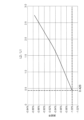
- FIG. 17 is a graph showing changes in the Vf ratio when the angle ⁇ is changed.
- the Vf ratio is the ratio (V/f) between the output voltage (V) and the frequency (f).
- V the output voltage
- f the frequency
- FIG. 17 shows the amount of decrease in the Vf ratio from the reference value, with the Vf ratio of the rotor 1C (FIG. 5) of the comparative example having no slit 15 as the reference value.
- the amount of decrease in the Vf ratio is suppressed to 0.8% or less when the angle ⁇ is in the range of 29 to 56 degrees. If the slit 15 is formed so that the angle ⁇ is 29 to 56 degrees, the magnetic flux from the permanent magnets 21 and 22 to the stator 5 is not blocked by the slit 15 as much as possible, and the magnetic flux flows smoothly. Because we can. Therefore, by setting the range of the angle ⁇ to 29 to 56 degrees, the motor output can be improved.
- the number of poles of the rotor 1B is six has been described here, the number of poles of the rotor 1B is not limited to six. As the number of poles of the rotor 1B increases, the spread angle of the magnetic flux per magnetic pole becomes narrower. Therefore, when the above results are applied to the rotor 1B having the number of poles N (N is a natural number), the desirable range of the angle ⁇ between the edge 15b of the slit 15 and the straight line L0 is 29 ⁇ N/6 ⁇ 56 ⁇ N/6.
- the end side 15b of the slit 15 facing the second hole portion 11b, the radially inner end point (point 15e) of the end side 15b and the most magnetic pole of the side slit 14 The angle ⁇ formed by the straight line L0 passing through the point 14e on the side of the center line P is in the range of 29 ⁇ N/6 ⁇ 56 ⁇ N/6. Therefore, the magnetic flux from the permanent magnets 21 and 22 can flow smoothly toward the stator 5, and the motor output can be improved.
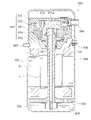
- FIG. 18 is a longitudinal sectional view showing a compressor 500 to which the motors of Embodiments 1-3 are applicable.
- Compressor 500 is a scroll compressor here, but is not limited to this.
- the compressor 500 includes a motor 100, a compression mechanism 501 connected to one end of a shaft 30 of the motor 100, a subframe 503 supporting the other end of the shaft 30, and a sealed container 502 housing them. have. Refrigerant oil 504 is stored in an oil sump 505 at the bottom of the sealed container 502 .
- the compression mechanism 501 includes a fixed scroll 511 and an orbiting scroll 512 , an Oldham ring 513 , a compliant frame 514 and a guide frame 515 . Both the fixed scroll 511 and the orbiting scroll 512 have plate-like spiral teeth and are combined to form a compression chamber 516 .
- the fixed scroll 511 has a discharge port 511a through which the refrigerant compressed in the compression chamber 516 is discharged.
- a suction pipe 506 passing through the sealed container 502 is press-fitted into the fixed scroll 511 .
- a discharge pipe 507 for discharging high-pressure refrigerant gas discharged from the discharge port 511 a of the fixed scroll 511 is provided so as to pass through the sealed container 502 .
- the motor 100 is incorporated inside the sealed container 502 by shrink fitting.
- a glass terminal 508 for electrically connecting the stator 5 of the motor 100 and the drive circuit is fixed to the sealed container 502 by welding.
- the operation of the compressor 500 is as follows.
- the shaft 30 rotates together with the rotor 1 .
- the orbiting scroll 512 oscillates, changing the volume of the compression chamber 516 between the fixed scroll 511 and the orbiting scroll 512 .
- the refrigerant gas is sucked into the compression chamber 516 from the suction pipe 506 and compressed.
- the high-pressure refrigerant gas compressed in the compression chamber 516 is discharged from the discharge port 511a of the fixed scroll 511 into the sealed container 502 and discharged from the discharge pipe 507 to the outside. Also, part of the refrigerant gas discharged from compression chamber 516 into sealed container 502 passes through a hole provided in motor 100 and cools motor 100 .
- the motor 100 described in each embodiment has high motor efficiency due to suppression of demagnetization of the permanent magnets 22 . Therefore, by using the motor 100 as a driving source of the compressor 500, the operating efficiency of the compressor 500 can be improved.
- FIG. 19 is a diagram showing the configuration of a refrigeration cycle device 400.
- the refrigeration cycle device 400 includes a compressor 401 , a condenser 402 , an expansion device (decompression device) 403 and an evaporator 404 .
- the compressor 401, the condenser 402, the expansion device 403 and the evaporator 404 are connected by a refrigerant pipe 407 to form a refrigeration cycle. That is, the refrigerant circulates through the compressor 401 , the condenser 402 , the expansion device 403 and the evaporator 404 in this order.
- the compressor 401 , the condenser 402 and the expansion device 403 are provided in the outdoor unit 410 .
- Compressor 401 is composed of compressor 500 shown in FIG.
- the outdoor unit 410 is provided with an outdoor fan 405 that supplies outdoor air to the condenser 402 .
- Evaporator 404 is provided in indoor unit 420 .
- the indoor unit 420 is provided with an indoor fan 406 that supplies the air cooled by the evaporator 404 indoors.
- the operation of the refrigeration cycle device 400 is as follows. Compressor 401 compresses the sucked refrigerant and sends it out.
- the condenser 402 exchanges heat between the refrigerant flowing from the compressor 401 and outdoor air, condenses and liquefies the refrigerant, and sends the liquefied refrigerant to the refrigerant pipe 407 .
- Outdoor fan 405 supplies outdoor air to condenser 402 .
- the expansion device 403 reduces the pressure of the refrigerant flowing through the refrigerant pipe 407 to bring it into a low pressure state.
- the evaporator 404 exchanges heat between the refrigerant decompressed by the expansion device 403 and the air in the room, evaporates the refrigerant, and sends it out to the refrigerant pipe 407 .
- Cold air cooled by heat exchange in the evaporator 404 is supplied indoors by an indoor fan 406 .
- the refrigeration cycle device 400 has a compressor 401 with improved operating efficiency by applying the motor 100 described in each embodiment. Therefore, the operating efficiency of the refrigeration cycle device 400 can be improved.
- stator 10 rotor core, 10a outer periphery, 10b inner periphery, 11 magnet insertion hole, 11a first hole, 11b second hole, 12 flux barrier, 13 thin portion, 14 side slit (first slit), 14a, 14b, 14c, 14d edge, 15 slit (second slit), 15a, 15b, 15c, 15d edge, 16 outer peripheral area, 20 permanent magnet, 21 permanent magnet (first permanent magnet), 21c end face, 22 permanent magnet (second permanent magnet), 22c end face, 22e corner, 30 shaft, 50 stator core, 51 yoke, 52 teeth, 53 slot, 55 coil, 100 motor, 111, 113 Positioning part, 112, 114 recessed part, 400 refrigeration cycle device, 401 compressor, 402 condenser, 403 expansion device, 404 evaporator, 410 outdoor unit, 420 indoor unit, 500 compressor, 501 compression mechanism, 502 sealed container.
Landscapes
- Engineering & Computer Science (AREA)
- Power Engineering (AREA)
- Physics & Mathematics (AREA)
- Mechanical Engineering (AREA)
- Thermal Sciences (AREA)
- General Engineering & Computer Science (AREA)
- Permanent Field Magnets Of Synchronous Machinery (AREA)
- Iron Core Of Rotating Electric Machines (AREA)
Priority Applications (4)
| Application Number | Priority Date | Filing Date | Title |
|---|---|---|---|
| PCT/JP2021/032986 WO2023037438A1 (ja) | 2021-09-08 | 2021-09-08 | ロータ、モータ、圧縮機および冷凍サイクル装置 |
| JP2023546619A JPWO2023037438A1 (https=) | 2021-09-08 | 2021-09-08 | |
| CN202180101998.2A CN117897884A (zh) | 2021-09-08 | 2021-09-08 | 转子、马达、压缩机以及制冷循环装置 |
| US18/682,196 US20240348115A1 (en) | 2021-09-08 | 2021-09-08 | Rotor, motor, compressor, and refrigeration cycle apparatus |
Applications Claiming Priority (1)
| Application Number | Priority Date | Filing Date | Title |
|---|---|---|---|
| PCT/JP2021/032986 WO2023037438A1 (ja) | 2021-09-08 | 2021-09-08 | ロータ、モータ、圧縮機および冷凍サイクル装置 |
Publications (1)
| Publication Number | Publication Date |
|---|---|
| WO2023037438A1 true WO2023037438A1 (ja) | 2023-03-16 |
Family
ID=85507344
Family Applications (1)
| Application Number | Title | Priority Date | Filing Date |
|---|---|---|---|
| PCT/JP2021/032986 Ceased WO2023037438A1 (ja) | 2021-09-08 | 2021-09-08 | ロータ、モータ、圧縮機および冷凍サイクル装置 |
Country Status (4)
| Country | Link |
|---|---|
| US (1) | US20240348115A1 (https=) |
| JP (1) | JPWO2023037438A1 (https=) |
| CN (1) | CN117897884A (https=) |
| WO (1) | WO2023037438A1 (https=) |
Citations (3)
| Publication number | Priority date | Publication date | Assignee | Title |
|---|---|---|---|---|
| JP2007074898A (ja) * | 2006-12-15 | 2007-03-22 | Hitachi Ltd | 永久磁石式回転電機およびそれを用いた圧縮機 |
| JP2010088169A (ja) * | 2008-09-30 | 2010-04-15 | Fujitsu General Ltd | 電動機 |
| WO2020194504A1 (ja) * | 2019-03-26 | 2020-10-01 | 三菱電機株式会社 | ロータ、モータ、圧縮機、及び空気調和機 |
Family Cites Families (4)
| Publication number | Priority date | Publication date | Assignee | Title |
|---|---|---|---|---|
| US20100088169A1 (en) * | 2008-10-08 | 2010-04-08 | Aptakon | Methods and webpages for commerce and information exchange |
| WO2017203618A1 (ja) * | 2016-05-25 | 2017-11-30 | 三菱電機株式会社 | 回転子、電動機、圧縮機、空気調和機、及び電動機の製造方法 |
| JP6692501B2 (ja) * | 2017-08-30 | 2020-05-13 | 三菱電機株式会社 | ロータ、電動機、圧縮機および空気調和装置 |
| CN112075011B (zh) * | 2018-05-10 | 2023-05-09 | 三菱电机株式会社 | 转子、电动机、压缩机及空气调节装置 |
-
2021
- 2021-09-08 WO PCT/JP2021/032986 patent/WO2023037438A1/ja not_active Ceased
- 2021-09-08 US US18/682,196 patent/US20240348115A1/en active Pending
- 2021-09-08 CN CN202180101998.2A patent/CN117897884A/zh not_active Withdrawn
- 2021-09-08 JP JP2023546619A patent/JPWO2023037438A1/ja not_active Withdrawn
Patent Citations (3)
| Publication number | Priority date | Publication date | Assignee | Title |
|---|---|---|---|---|
| JP2007074898A (ja) * | 2006-12-15 | 2007-03-22 | Hitachi Ltd | 永久磁石式回転電機およびそれを用いた圧縮機 |
| JP2010088169A (ja) * | 2008-09-30 | 2010-04-15 | Fujitsu General Ltd | 電動機 |
| WO2020194504A1 (ja) * | 2019-03-26 | 2020-10-01 | 三菱電機株式会社 | ロータ、モータ、圧縮機、及び空気調和機 |
Also Published As
| Publication number | Publication date |
|---|---|
| US20240348115A1 (en) | 2024-10-17 |
| JPWO2023037438A1 (https=) | 2023-03-16 |
| CN117897884A (zh) | 2024-04-16 |
Similar Documents
| Publication | Publication Date | Title |
|---|---|---|
| JPWO2017126053A1 (ja) | 永久磁石同期電動機、圧縮機および空気調和機 | |
| EP3832849A1 (en) | Electric motor, compressor, and air conditioner | |
| CN108886276B (zh) | 电动机、送风机、压缩机及空气调节装置 | |
| US11831204B2 (en) | Rotor, motor, compressor, and air conditioner | |
| US11888353B2 (en) | Motor, compressor, and air conditioner | |
| CN111033947B (zh) | 转子、电动机、压缩机及空调装置 | |
| CN111819764A (zh) | 电动机、压缩机、送风机以及制冷空调装置 | |
| CN110663160A (zh) | 电动机、压缩机及空气调节装置 | |
| WO2021070353A1 (ja) | ロータ、電動機、圧縮機、及び空気調和機 | |
| CN109417320B (zh) | 转子、电动机、送风机、压缩机以及空气调节装置 | |
| WO2020089991A1 (ja) | ロータ、モータ、圧縮機、及び冷凍空調装置 | |
| CN115398778A (zh) | 转子、电动机、压缩机、空调装置以及转子的制造方法 | |
| WO2023037438A1 (ja) | ロータ、モータ、圧縮機および冷凍サイクル装置 | |
| US11962191B2 (en) | Rotor, electric motor, compressor, and air conditioner | |
| WO2020059056A1 (ja) | ステータ、電動機、圧縮機および空気調和装置 | |
| JP7433420B2 (ja) | ロータ、モータ、圧縮機および空気調和装置 | |
| WO2024166161A1 (ja) | 回転子、電動機、圧縮機および冷凍サイクル装置 | |
| WO2022180717A1 (ja) | 電動機、圧縮機および冷凍サイクル装置 |
Legal Events
| Date | Code | Title | Description |
|---|---|---|---|
| 121 | Ep: the epo has been informed by wipo that ep was designated in this application |
Ref document number: 21956735 Country of ref document: EP Kind code of ref document: A1 |
|
| WWE | Wipo information: entry into national phase |
Ref document number: 2023546619 Country of ref document: JP |
|
| WWE | Wipo information: entry into national phase |
Ref document number: 202180101998.2 Country of ref document: CN |
|
| NENP | Non-entry into the national phase |
Ref country code: DE |
|
| 122 | Ep: pct application non-entry in european phase |
Ref document number: 21956735 Country of ref document: EP Kind code of ref document: A1 |