WO2023033070A1 - 銅又は銅合金からなるカソード電極 - Google Patents
銅又は銅合金からなるカソード電極 Download PDFInfo
- Publication number
- WO2023033070A1 WO2023033070A1 PCT/JP2022/032843 JP2022032843W WO2023033070A1 WO 2023033070 A1 WO2023033070 A1 WO 2023033070A1 JP 2022032843 W JP2022032843 W JP 2022032843W WO 2023033070 A1 WO2023033070 A1 WO 2023033070A1
- Authority
- WO
- WIPO (PCT)
- Prior art keywords
- electrode
- hydrogen peroxide
- copper
- cathode
- cathode electrode
- Prior art date
- Legal status (The legal status is an assumption and is not a legal conclusion. Google has not performed a legal analysis and makes no representation as to the accuracy of the status listed.)
- Ceased
Links
Images





Classifications
-
- H—ELECTRICITY
- H01—ELECTRIC ELEMENTS
- H01M—PROCESSES OR MEANS, e.g. BATTERIES, FOR THE DIRECT CONVERSION OF CHEMICAL ENERGY INTO ELECTRICAL ENERGY
- H01M12/00—Hybrid cells; Manufacture thereof
- H01M12/04—Hybrid cells; Manufacture thereof composed of a half-cell of the fuel-cell type and of a half-cell of the primary-cell type
- H01M12/06—Hybrid cells; Manufacture thereof composed of a half-cell of the fuel-cell type and of a half-cell of the primary-cell type with one metallic and one gaseous electrode
-
- H—ELECTRICITY
- H01—ELECTRIC ELEMENTS
- H01M—PROCESSES OR MEANS, e.g. BATTERIES, FOR THE DIRECT CONVERSION OF CHEMICAL ENERGY INTO ELECTRICAL ENERGY
- H01M4/00—Electrodes
- H01M4/86—Inert electrodes with catalytic activity, e.g. for fuel cells
-
- H—ELECTRICITY
- H01—ELECTRIC ELEMENTS
- H01M—PROCESSES OR MEANS, e.g. BATTERIES, FOR THE DIRECT CONVERSION OF CHEMICAL ENERGY INTO ELECTRICAL ENERGY
- H01M4/00—Electrodes
- H01M4/86—Inert electrodes with catalytic activity, e.g. for fuel cells
- H01M4/90—Selection of catalytic material
-
- Y—GENERAL TAGGING OF NEW TECHNOLOGICAL DEVELOPMENTS; GENERAL TAGGING OF CROSS-SECTIONAL TECHNOLOGIES SPANNING OVER SEVERAL SECTIONS OF THE IPC; TECHNICAL SUBJECTS COVERED BY FORMER USPC CROSS-REFERENCE ART COLLECTIONS [XRACs] AND DIGESTS
- Y02—TECHNOLOGIES OR APPLICATIONS FOR MITIGATION OR ADAPTATION AGAINST CLIMATE CHANGE
- Y02E—REDUCTION OF GREENHOUSE GAS [GHG] EMISSIONS, RELATED TO ENERGY GENERATION, TRANSMISSION OR DISTRIBUTION
- Y02E60/00—Enabling technologies; Technologies with a potential or indirect contribution to GHG emissions mitigation
- Y02E60/30—Hydrogen technology
- Y02E60/50—Fuel cells
Definitions
- the present invention relates to a cathode electrode made of copper or a copper alloy, and to a novel cathode electrode that imparts electronic conductivity to an ion-conducting battery and activates the electrode reaction.
- Non-Patent Document 1 “Single-Compartment hydrogen peroxide fuel cell with poly(3,4-ethylenedioxythiophene) cathodes” Chemical Communications, 2018, Vol.54, Pages 11873-11876).
- a hydrogen oxide fuel cell has also been announced (Non-Patent Document 2: "Copper hexacyanoferrate as cathode material for hydrogen peroxide fuel cell” International Journal of Hydrogen Energy, ELSEVIER, Vol.45, Issue 47, 25 September 2020, Pages 25708-25718 ).
- An object of the present invention is to provide a new electrode that can be used as a cathode electrode for hydrogen peroxide fuel cells.
- porous carbon electrodes have been used as cathode electrodes for metal-air batteries, and poly(3,4-ethylenedioxy)thiophene (PEDOT) and copper hexacyanoferrate (CuHCF) have been proposed as cathode electrodes for hydrogen peroxide fuel cells.
- PEDOT poly(3,4-ethylenedioxy)thiophene
- CuHCF copper hexacyanoferrate
- the present invention has been made with a focus on the catalytic function of copper or its alloy in hydrogen peroxide, and the gist thereof is to react hydrogen peroxide or hydroxyl in an aqueous solution containing hydrogen peroxide.
- a cathode electrode for a metal-air battery and a hydrogen peroxide fuel cell comprising copper or a copper alloy having the function of decomposing ions to form oxygen and hydrogen.
- the present invention provides an electrode having a metallic copper or alloy thereof surface on the electrode surface, which is used in an alkaline electrolyte solution containing hydrogen peroxide, and a catalyst that decomposes hydrogen peroxide and / or hydroxy ions in the aqueous solution.
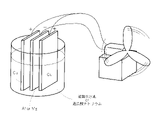
- the anode obtains electrons through an oxidation reaction of 2Mg ⁇ 2Mg 2+ +4e ⁇ , while the cathode electrode reduces oxygen to O 2 +2H 2 O+4e ⁇ 4OH ⁇ to produce hydroxy ions.
- the cathode electrode instead of the porous carbon electrode, copper and copper alloys are used as the cathode electrode in an electrolyte containing hydrogen peroxide, so that under load (data logger) An electromotive force of 1.2 V or more can be obtained by measuring .
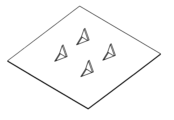
- the copper electrode placed facing the anode electrode surface preferably has a plurality of triangular electrode projections formed at regular intervals on the electrode surface. This is because an avalanche amplification effect of current can be easily obtained due to the electron conduction effect.
- an open-top frame that surrounds the battery cell and an electrode mounting base that divides the frame into upper and lower parts at a constant height from the bottom and has openings through which the electrolytic solution flows up and down are made of metallic copper or an alloy thereof. It is preferably formed from This is because the reaction efficiency in metal-air batteries and hydrogen peroxide fuel cells is proportional to the electrode area of copper and copper alloys.
- FIG. 1 is a conceptual diagram showing a basic battery reaction using copper or an alloy thereof of the present invention as a cathode electrode.
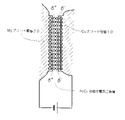
- FIG. FIG. 2 is a conceptual diagram of a cathode electrode in which a dipole electric double layer is formed that does not short-circuit even if the anode electrode and the cathode electrode are in contact with each other.
- FIG. 2 is a conceptual diagram of a cathode electrode in which an anode electrode and a cathode electrode are in contact to form a dipole microcapacitor at the shorted portion;
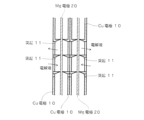
- FIG. 3B is a cross-sectional view of an electrode configuration in which the copper cathode electrode of FIG. 3A is combined with the magnesium anode electrode sandwiched therebetween;
- FIG. 4B is a cross-sectional view of an electrode configuration in which the copper cathode electrode of FIG. 4A is combined with the magnesium anode electrode sandwiched therebetween
- FIG. 5B is a cross-sectional view of an electrode configuration in which the copper cathode electrode of FIG.
- FIG. 5A is combined with the magnesium anode electrode sandwiched therebetween;
- FIG. 3 is a perspective view showing a combination of a copper cathode electrode and a T-shaped copper spacer with a dipole electric double layer between the magnesium and copper electrodes.
- FIG. 6A shows a cross-sectional view of an electrode configuration combining a copper electrode and a magnesium electrode.
- FIG. 3 is a perspective view showing an electrode bath composed only of a copper cathode electrode;
- FIG. 3B is a photograph showing an aluminum electrode plate (a) used in combination with the copper electrode of FIG. 3A and an aluminum electrode plate (b) melted by receiving electron discharge from the cathode after use as an electrode.
- an Al or Mg anode electrode and a Cu cathode electrode are immersed in a neutral or alkaline electrolyte solution containing hydrogen peroxide and arranged opposite to each other.
- Electromotive force in the configuration of anode electrode/alkaline electrolyte containing hydrogen peroxide/cathode electrode, the reaction of the metal-air battery is as follows.
- the oxidation reaction on the anode side is M ⁇ Mn++ne-,
- the reduction reaction on the cathode side becomes O2+H2O+4e- ⁇ 4OH-.
- hydrogen peroxide is added to the electrolytic solution in order to promote the reduction reaction on the cathode side of the metal-air battery, thereby improving the cause of the inferior ionization rate of the positive electrode on the cathode side compared to the negative electrode on the anode side.
- metallic copper is Cu+2H2O2 ⁇ Cu2++2OH+2OH- and Cu + 2OH ⁇ Cu 2+ +2OH - and partly dissolve in hydrogen peroxide, Cu 2+ +2HO2 ⁇ ⁇ Cu+2HO2, and the HO2 group accelerates the decomposition of hydrogen peroxide through the Haber u. Willstatter chain (Non-Patent Document 3).
- Non-Patent Document 1 a normal hydrogen peroxide fuel cell (see Non-Patent Document 1) is constructed.
- hydrogen peroxide is decomposed into 2H 2 O 2 ⁇ .4OH accompanied by a catalytic reaction on the surface of the copper cathode, and .4OH ⁇ H 2 +O 2 +4e- ⁇ and oxygen and hydrogen are generated, or hydroxyl ions are generated. It is thought that 4OH- ⁇ 2H 2 +2O 2 +4e- is decomposed to generate oxygen and hydrogen, and electrons are released at the same time.
- the electric double layer formed on the surface of the cathode electrode contains hydrogen peroxide and is formed by its dipole function. Therefore, even if the anode electrode of the counter electrode is in contact with the cathode electrode, a short circuit does not occur (Fig. 2A). It has an electric double layer microcapacitor structure at the tip of the electrode (FIG. 2B), and many microcapacitors are scattered on the electrode surface, and the power generation capacity is more than doubled due to the microcapacitor effect.
- hydrogen peroxide was added to the electrolytic solution as an oxidizing agent for forming an insulating electric double layer on the surface of the cathode electrode.
- sodium percarbonate is used to supply part or all of the hydrogen peroxide to the aqueous electrolytic solution.
- a neutral or alkaline aqueous solution containing 0.5 to 2.0 mol of alkali metal or alkaline earth metal halide salt, particularly sodium chloride, and several percent to ten and several percent of hydrogen peroxide water (volume %) or sodium percarbonate (% by weight) is preferably added.
- the anode electrode is made of magnesium or its alloy, and by adopting a cell structure of (-) Mg/NaCl+H2O2/Cu(+), hydrogen peroxide or hydroxyl radicals decomposed by it are decomposed between the copper cathode electrode and the cathode electrode. gives the decomposition voltage required to
- the anode electrode and the cathode electrode are alternately arranged to face each other with a constant spacing interposed between them, and an electric double layer capacitor is formed from an aqueous electrolyte solution containing hydrogen peroxide at the contact portion between the anode electrode and the cathode electrode ( 2A), the spacer is made of the same metallic copper or copper alloy as the cathode electrode, and has point-like protrusions on the surface of the counter electrode at regular intervals (FIG. 2B), and has an effect as a microcapacitor.
- FIGS. 3-5 and 6 were used to compare the performance of the cells with and without the microcapacitor concept shown in FIG. 2B.
- a top-opening cuboid plastic container with a capacity of 3000 ml is used.
- a copper cathode electrode plate 10 having a thickness of 1 mm and a length and width of 100 ⁇ 100 mm is provided with a large number of triangular protrusions 11 having a height of 50 mm cut vertically and horizontally at intervals of 150 mm to 200 mm.
- FIG. 3A, 4A, and 5A a copper cathode electrode plate 10 having a thickness of 1 mm and a length and width of 100 ⁇ 100 mm is provided with a large number of triangular protrusions 11 having a height of 50 mm cut vertically and horizontally at intervals of 150 mm to 200 mm.
- the copper plates 10 at both ends are laminated with the protrusions 11 facing inward, and the middle copper electrodes 10 are laminated back to back to sandwich a magnesium anode electrode plate 20 having a thickness of 2 mm and a size of 100 ⁇ 100 mm.
- a microcapacitor can be formed by an electric double layer on the surface of the copper cathode electrode, as shown in FIG. 2B.
- a copper cathode electrode plate 10 having a thickness of 1 mm and a length and width of 100 ⁇ 100 mm shown in FIG.
- a Mg anode electrode plate 20 having a thickness of 2 mm and a size of 100 ⁇ 100 mm is sandwiched between the cathode electrode plates with spacers S interposed therebetween.
- the state shown in the top end view of FIG. 5B is obtained. Using this combination of electrodes results in FIG. 2A and does not form the microcapacitor shown in FIG. 2B.
- an electrolytic solution of 0.5 mol/l or more, preferably 1.5 mol/l or more, 2 mol/l of sodium chloride is prepared in about 1500 ml of pure water, and 50 to 100 g of sodium percarbonate and 30 g of sodium percarbonate are added thereto. 50 ml of % hydrogen peroxide solution is added. After a certain period of time, the cell reaction consumes hydrogen peroxide and the current decreases, so 10 ml of 30% hydrogen peroxide solution is added every 2 to 3 hours.
- the performance of the electrode configurations of FIGS. 3-5A and 5B is compared with the electrode configuration of FIGS. rice field. Since the conditions were the same except for the electrode configuration, the point that the hydrogen peroxide fuel cell reaction in alkaline electrolyzed water was accompanied by the magnesium air cell reaction was the same.
- the configuration of the present invention is epoch-making because it can provide a novel and useful configuration for a hydrogen peroxide fuel cell of a one-compartment structure.
- FIG. 8(a) is a 1.5 mm thick, 15 cm square aluminum electrode plate used in combination with a copper electrode with four protrusions (FIG. 3A).
- An electric double layer microcapacitor is formed between the tip of the projection of the copper electrode and the aluminum electrode plate, and electrons are collected on the cathode side. Electrons flow to the anode electrode side (electron conductivity).
- Such a phenomenon is surprising in a battery using an electrolytic solution that mainly conducts ions. As shown in FIG.
- a hole is formed, and a powdery rough electrode surface is formed around the hole. From this, it is surmised that a phenomenon (electron conduction) occurs in which electrons discharge from the protrusions on the copper electrode side to the aluminum electrode surface, and the electrons that reach the aluminum electrode collide with the surrounding metal atoms and are excited one after another. It is presumed to be effective. This seems to be the reason why the amount of power generation increases when the copper electrode does not have protrusions.
Landscapes
- Chemical & Material Sciences (AREA)
- Chemical Kinetics & Catalysis (AREA)
- Electrochemistry (AREA)
- General Chemical & Material Sciences (AREA)
- Engineering & Computer Science (AREA)
- Manufacturing & Machinery (AREA)
- Materials Engineering (AREA)
- Inert Electrodes (AREA)
- Hybrid Cells (AREA)
Applications Claiming Priority (2)
| Application Number | Priority Date | Filing Date | Title |
|---|---|---|---|
| JP2021-142110 | 2021-09-01 | ||
| JP2021142110A JP7784844B2 (ja) | 2021-09-01 | 2021-09-01 | 銅又は銅合金からなる燃料電池用カソード電極 |
Publications (1)
| Publication Number | Publication Date |
|---|---|
| WO2023033070A1 true WO2023033070A1 (ja) | 2023-03-09 |
Family
ID=85412318
Family Applications (1)
| Application Number | Title | Priority Date | Filing Date |
|---|---|---|---|
| PCT/JP2022/032843 Ceased WO2023033070A1 (ja) | 2021-09-01 | 2022-08-31 | 銅又は銅合金からなるカソード電極 |
Country Status (2)
| Country | Link |
|---|---|
| JP (1) | JP7784844B2 (https=) |
| WO (1) | WO2023033070A1 (https=) |
Citations (4)
| Publication number | Priority date | Publication date | Assignee | Title |
|---|---|---|---|---|
| JPS6380480A (ja) * | 1986-07-09 | 1988-04-11 | アンテロツクス (ソシエテ アノニム) | 燃料電池及び燃料電池で発電する方法 |
| JP2009032628A (ja) * | 2007-07-31 | 2009-02-12 | National Institute Of Advanced Industrial & Technology | 燃料電池 |
| JP2017092014A (ja) * | 2015-11-13 | 2017-05-25 | 基嗣 田島 | アルミニウム空気電池 |
| JP2018206578A (ja) * | 2017-06-02 | 2018-12-27 | 国立研究開発法人産業技術総合研究所 | リチウム空気電池用電解液、リチウム空気電池 |
-
2021
- 2021-09-01 JP JP2021142110A patent/JP7784844B2/ja active Active
-
2022
- 2022-08-31 WO PCT/JP2022/032843 patent/WO2023033070A1/ja not_active Ceased
Patent Citations (4)
| Publication number | Priority date | Publication date | Assignee | Title |
|---|---|---|---|---|
| JPS6380480A (ja) * | 1986-07-09 | 1988-04-11 | アンテロツクス (ソシエテ アノニム) | 燃料電池及び燃料電池で発電する方法 |
| JP2009032628A (ja) * | 2007-07-31 | 2009-02-12 | National Institute Of Advanced Industrial & Technology | 燃料電池 |
| JP2017092014A (ja) * | 2015-11-13 | 2017-05-25 | 基嗣 田島 | アルミニウム空気電池 |
| JP2018206578A (ja) * | 2017-06-02 | 2018-12-27 | 国立研究開発法人産業技術総合研究所 | リチウム空気電池用電解液、リチウム空気電池 |
Also Published As
| Publication number | Publication date |
|---|---|
| JP2023139328A (ja) | 2023-10-04 |
| JP7784844B2 (ja) | 2025-12-12 |
Similar Documents
| Publication | Publication Date | Title |
|---|---|---|
| Concha et al. | Direct oxidation of sodium borohydride on Pt, Ag and alloyed Pt–Ag electrodes in basic media. Part I: bulk electrodes | |
| EP2929586B1 (en) | Anaerobic aluminum-water electrochemical cell | |
| JP5737727B2 (ja) | マグネシウム電池 | |
| JP7678547B2 (ja) | 金属銅をカソード電極とする1コンパートメント型水溶液燃料電池 | |
| KR100864024B1 (ko) | 수소 발생 장치 및 이를 이용한 연료전지 시스템 | |
| US20240204209A1 (en) | Air electrode having hydrogen peroxide-containing electric double layer, and metal-air battery using same | |
| WO2023033070A1 (ja) | 銅又は銅合金からなるカソード電極 | |
| US20250286173A1 (en) | Air battery in which metallic copper or alloy thereof serves as oxygen reducing air electrode | |
| JP2024034273A (ja) | 銅又は銅合金からなるカソード電極 | |
| JP7784845B2 (ja) | 銅又は銅合金からなるカソード電極を用いる過酸化水素燃料電池の燃焼方法 | |
| JP2023061404A (ja) | アバランシェ増幅機能を有する電池 | |
| KR100859176B1 (ko) | 수소 발생 장치용 전해질 용액 및 이를 포함하는 수소 발생장치 | |
| JP2024034270A (ja) | 金属銅又はその合金を酸素還元空気極とする空気電池 | |
| JP2015022871A (ja) | 金属空気電池 | |
| EP4398350A1 (en) | Battery having electronic conduction function via electric double layer capacitor | |
| JP7822724B2 (ja) | マイクロキャパシタ | |
| JP2024034840A (ja) | 電気二重層キャパシタを介する電子伝導機能を有する電池 | |
| HK40110588A (zh) | 具备包含过氧化氢的电偶极子层的空气电极、及使用该空气电极的金属空气电池 | |
| US20130088184A1 (en) | Battery device utilizing oxidation and reduction reactions to produce electric potential | |
| HK40110590A (zh) | 将金属铜或其合金作为氧化还原空气电极的空气电池 | |
| KR100685907B1 (ko) | 무기물질을이용한 전극제조 방법 | |
| HK40110589A (zh) | 具有经由双电层电容器的电子传导功能的电池 | |
| JP2023139328A5 (https=) |
Legal Events
| Date | Code | Title | Description |
|---|---|---|---|
| 121 | Ep: the epo has been informed by wipo that ep was designated in this application |
Ref document number: 22864652 Country of ref document: EP Kind code of ref document: A1 |
|
| DPE1 | Request for preliminary examination filed after expiration of 19th month from priority date (pct application filed from 20040101) | ||
| NENP | Non-entry into the national phase |
Ref country code: DE |
|
| 32PN | Ep: public notification in the ep bulletin as address of the adressee cannot be established |
Free format text: NOTING OF LOSS OF RIGHTS PURSUANT TO RULE 112(1) EPC (EPO FORM 1205 DATED 12.06.2024) |
|
| 122 | Ep: pct application non-entry in european phase |
Ref document number: 22864652 Country of ref document: EP Kind code of ref document: A1 |