WO2023027151A1 - 被膜の製造方法 - Google Patents
被膜の製造方法 Download PDFInfo
- Publication number
- WO2023027151A1 WO2023027151A1 PCT/JP2022/032072 JP2022032072W WO2023027151A1 WO 2023027151 A1 WO2023027151 A1 WO 2023027151A1 JP 2022032072 W JP2022032072 W JP 2022032072W WO 2023027151 A1 WO2023027151 A1 WO 2023027151A1
- Authority
- WO
- WIPO (PCT)
- Prior art keywords
- component
- film
- fiber
- forming
- less
- Prior art date
- Legal status (The legal status is an assumption and is not a legal conclusion. Google has not performed a legal analysis and makes no representation as to the accuracy of the status listed.)
- Ceased
Links
Images

Classifications
-
- A—HUMAN NECESSITIES
- A61—MEDICAL OR VETERINARY SCIENCE; HYGIENE
- A61K—PREPARATIONS FOR MEDICAL, DENTAL OR TOILETRY PURPOSES
- A61K8/00—Cosmetics or similar toiletry preparations
- A61K8/18—Cosmetics or similar toiletry preparations characterised by the composition
- A61K8/30—Cosmetics or similar toiletry preparations characterised by the composition containing organic compounds
- A61K8/33—Cosmetics or similar toiletry preparations characterised by the composition containing organic compounds containing oxygen
- A61K8/34—Alcohols
-
- A—HUMAN NECESSITIES
- A61—MEDICAL OR VETERINARY SCIENCE; HYGIENE
- A61K—PREPARATIONS FOR MEDICAL, DENTAL OR TOILETRY PURPOSES
- A61K8/00—Cosmetics or similar toiletry preparations
- A61K8/02—Cosmetics or similar toiletry preparations characterised by special physical form
-
- A—HUMAN NECESSITIES
- A61—MEDICAL OR VETERINARY SCIENCE; HYGIENE
- A61K—PREPARATIONS FOR MEDICAL, DENTAL OR TOILETRY PURPOSES
- A61K8/00—Cosmetics or similar toiletry preparations
- A61K8/02—Cosmetics or similar toiletry preparations characterised by special physical form
- A61K8/04—Dispersions; Emulsions
- A61K8/046—Aerosols; Foams
-
- A—HUMAN NECESSITIES
- A61—MEDICAL OR VETERINARY SCIENCE; HYGIENE
- A61K—PREPARATIONS FOR MEDICAL, DENTAL OR TOILETRY PURPOSES
- A61K8/00—Cosmetics or similar toiletry preparations
- A61K8/18—Cosmetics or similar toiletry preparations characterised by the composition
- A61K8/30—Cosmetics or similar toiletry preparations characterised by the composition containing organic compounds
- A61K8/33—Cosmetics or similar toiletry preparations characterised by the composition containing organic compounds containing oxygen
- A61K8/34—Alcohols
- A61K8/345—Alcohols containing more than one hydroxy group
-
- A—HUMAN NECESSITIES
- A61—MEDICAL OR VETERINARY SCIENCE; HYGIENE
- A61K—PREPARATIONS FOR MEDICAL, DENTAL OR TOILETRY PURPOSES
- A61K8/00—Cosmetics or similar toiletry preparations
- A61K8/18—Cosmetics or similar toiletry preparations characterised by the composition
- A61K8/30—Cosmetics or similar toiletry preparations characterised by the composition containing organic compounds
- A61K8/33—Cosmetics or similar toiletry preparations characterised by the composition containing organic compounds containing oxygen
- A61K8/35—Ketones, e.g. benzophenone
-
- A—HUMAN NECESSITIES
- A61—MEDICAL OR VETERINARY SCIENCE; HYGIENE
- A61K—PREPARATIONS FOR MEDICAL, DENTAL OR TOILETRY PURPOSES
- A61K8/00—Cosmetics or similar toiletry preparations
- A61K8/18—Cosmetics or similar toiletry preparations characterised by the composition
- A61K8/72—Cosmetics or similar toiletry preparations characterised by the composition containing organic macromolecular compounds
-
- A—HUMAN NECESSITIES
- A61—MEDICAL OR VETERINARY SCIENCE; HYGIENE
- A61K—PREPARATIONS FOR MEDICAL, DENTAL OR TOILETRY PURPOSES
- A61K8/00—Cosmetics or similar toiletry preparations
- A61K8/18—Cosmetics or similar toiletry preparations characterised by the composition
- A61K8/72—Cosmetics or similar toiletry preparations characterised by the composition containing organic macromolecular compounds
- A61K8/81—Cosmetics or similar toiletry preparations characterised by the composition containing organic macromolecular compounds obtained by reactions involving only carbon-to-carbon unsaturated bonds
-
- A—HUMAN NECESSITIES
- A61—MEDICAL OR VETERINARY SCIENCE; HYGIENE
- A61K—PREPARATIONS FOR MEDICAL, DENTAL OR TOILETRY PURPOSES
- A61K8/00—Cosmetics or similar toiletry preparations
- A61K8/18—Cosmetics or similar toiletry preparations characterised by the composition
- A61K8/72—Cosmetics or similar toiletry preparations characterised by the composition containing organic macromolecular compounds
- A61K8/81—Cosmetics or similar toiletry preparations characterised by the composition containing organic macromolecular compounds obtained by reactions involving only carbon-to-carbon unsaturated bonds
- A61K8/8129—Compositions of homopolymers or copolymers of compounds having one or more unsaturated aliphatic radicals, each having only one carbon-to-carbon double bond, and at least one being terminated by an alcohol, ether, aldehydo, ketonic, acetal or ketal radical; Compositions of hydrolysed polymers or esters of unsaturated alcohols with saturated carboxylic acids; Compositions of derivatives of such polymers, e.g. polyvinylmethylether
-
- A—HUMAN NECESSITIES
- A61—MEDICAL OR VETERINARY SCIENCE; HYGIENE
- A61K—PREPARATIONS FOR MEDICAL, DENTAL OR TOILETRY PURPOSES
- A61K8/00—Cosmetics or similar toiletry preparations
- A61K8/18—Cosmetics or similar toiletry preparations characterised by the composition
- A61K8/72—Cosmetics or similar toiletry preparations characterised by the composition containing organic macromolecular compounds
- A61K8/81—Cosmetics or similar toiletry preparations characterised by the composition containing organic macromolecular compounds obtained by reactions involving only carbon-to-carbon unsaturated bonds
- A61K8/8135—Compositions of homopolymers or copolymers of compounds having one or more unsaturated aliphatic radicals, each having only one carbon-to-carbon double bond, and at least one being terminated by an acyloxy radical of a saturated carboxylic acid, of carbonic acid or of a haloformic acid; Compositions of derivatives of such polymers, e.g. vinyl esters (polyvinylacetate)
-
- A—HUMAN NECESSITIES
- A61—MEDICAL OR VETERINARY SCIENCE; HYGIENE
- A61K—PREPARATIONS FOR MEDICAL, DENTAL OR TOILETRY PURPOSES
- A61K8/00—Cosmetics or similar toiletry preparations
- A61K8/18—Cosmetics or similar toiletry preparations characterised by the composition
- A61K8/72—Cosmetics or similar toiletry preparations characterised by the composition containing organic macromolecular compounds
- A61K8/84—Cosmetics or similar toiletry preparations characterised by the composition containing organic macromolecular compounds obtained by reactions otherwise than those involving only carbon-carbon unsaturated bonds
- A61K8/86—Polyethers
-
- A—HUMAN NECESSITIES
- A61—MEDICAL OR VETERINARY SCIENCE; HYGIENE
- A61K—PREPARATIONS FOR MEDICAL, DENTAL OR TOILETRY PURPOSES
- A61K8/00—Cosmetics or similar toiletry preparations
- A61K8/18—Cosmetics or similar toiletry preparations characterised by the composition
- A61K8/72—Cosmetics or similar toiletry preparations characterised by the composition containing organic macromolecular compounds
- A61K8/84—Cosmetics or similar toiletry preparations characterised by the composition containing organic macromolecular compounds obtained by reactions otherwise than those involving only carbon-carbon unsaturated bonds
- A61K8/87—Polyurethanes
-
- A—HUMAN NECESSITIES
- A61—MEDICAL OR VETERINARY SCIENCE; HYGIENE
- A61Q—SPECIFIC USE OF COSMETICS OR SIMILAR TOILETRY PREPARATIONS
- A61Q17/00—Barrier preparations; Preparations brought into direct contact with the skin for affording protection against external influences, e.g. sunlight, X-rays or other harmful rays, corrosive materials, bacteria or insect stings
-
- A—HUMAN NECESSITIES
- A61—MEDICAL OR VETERINARY SCIENCE; HYGIENE
- A61Q—SPECIFIC USE OF COSMETICS OR SIMILAR TOILETRY PREPARATIONS
- A61Q19/00—Preparations for care of the skin
-
- D—TEXTILES; PAPER
- D04—BRAIDING; LACE-MAKING; KNITTING; TRIMMINGS; NON-WOVEN FABRICS
- D04H—MAKING TEXTILE FABRICS, e.g. FROM FIBRES OR FILAMENTARY MATERIAL; FABRICS MADE BY SUCH PROCESSES OR APPARATUS, e.g. FELTS, NON-WOVEN FABRICS; COTTON-WOOL; WADDING ; NON-WOVEN FABRICS FROM STAPLE FIBRES, FILAMENTS OR YARNS, BONDED WITH AT LEAST ONE WEB-LIKE MATERIAL DURING THEIR CONSOLIDATION
- D04H1/00—Non-woven fabrics formed wholly or mainly of staple fibres or like relatively short fibres
- D04H1/70—Non-woven fabrics formed wholly or mainly of staple fibres or like relatively short fibres characterised by the method of forming fleeces or layers, e.g. reorientation of fibres
- D04H1/72—Non-woven fabrics formed wholly or mainly of staple fibres or like relatively short fibres characterised by the method of forming fleeces or layers, e.g. reorientation of fibres the fibres being randomly arranged
- D04H1/728—Non-woven fabrics formed wholly or mainly of staple fibres or like relatively short fibres characterised by the method of forming fleeces or layers, e.g. reorientation of fibres the fibres being randomly arranged by electro-spinning
-
- A—HUMAN NECESSITIES
- A61—MEDICAL OR VETERINARY SCIENCE; HYGIENE
- A61K—PREPARATIONS FOR MEDICAL, DENTAL OR TOILETRY PURPOSES
- A61K2800/00—Properties of cosmetic compositions or active ingredients thereof or formulation aids used therein and process related aspects
- A61K2800/10—General cosmetic use
-
- A—HUMAN NECESSITIES
- A61—MEDICAL OR VETERINARY SCIENCE; HYGIENE
- A61K—PREPARATIONS FOR MEDICAL, DENTAL OR TOILETRY PURPOSES
- A61K2800/00—Properties of cosmetic compositions or active ingredients thereof or formulation aids used therein and process related aspects
- A61K2800/80—Process related aspects concerning the preparation of the cosmetic composition or the storage or application thereof
- A61K2800/95—Involves in-situ formation or cross-linking of polymers
Definitions
- the present invention relates to a film manufacturing method.
- Patent Documents 1 to 3 describe methods of forming a film on the skin by electrostatically spraying a composition onto the skin.
- the composition used in this method contains a volatile substance, a film-forming polymer, and the like.
- electrostatically spraying the volatile substance is volatilized and a film made of a polymer or the like having film-forming ability is formed on the skin or the like.
- apparatuses for electrostatic spraying Patent Documents 4 and 5).
- the present invention provides the following components (A), (B) and (C): (A) one or more volatile substances selected from water, alcohols and ketones; (B) a water-insoluble polymer having fiber-forming ability, and (C) containing one or more selected from polyols, Component (B) contains (B1) the polymer having a molecular weight of 1 ⁇ 10 5 or more, The content mass ratio of component (B1) to component (B) ((B1)/(B)) is 0.5 or more, The content mass ratio of component (B) to component (C) ((B)/(C)) is 1 or more, Provided is a film-forming composition for forming a film comprising a deposit containing fibers directly on the skin by electrostatic spraying.
- the present invention also provides the following components (A), (B) and (C): (A) one or more volatile substances selected from water, alcohols and ketones; (B) a water-insoluble polymer having fiber-forming ability, and (C) containing one or more selected from polyols, Component (B) has a number average molecular weight of 4.5 ⁇ 10 4 or more, The content mass ratio of component (B) to component (C) ((B)/(C)) is 1 or more, Provided is a film-forming composition for forming a film comprising a deposit containing fibers directly on the skin by electrostatic spraying.
- the present invention also provides the following components (A), (B) and (C): (A) one or more volatile substances selected from water, alcohols and ketones; (B) a water-insoluble polymer having fiber-forming ability, and (C) containing one or more selected from polyols, Component (B) contains (B1) the polymer having a molecular weight of 1 ⁇ 10 5 or more, The content mass ratio of component (B1) to component (B) ((B1)/(B)) is 0.5 or more, Using a composition containing component (B) with respect to component (C) in a mass ratio ((B)/(C)) of 1 or more, a film comprising deposits containing fibers is formed on the surface of a film-forming object.
- the present invention provides the following components (A), (B) and (C): (A) one or more volatile substances selected from water, alcohols and ketones; (B) a water-insoluble polymer having fiber-forming ability, and (C) containing one or more selected from polyols, Component (B) has a number average molecular weight of 4.5 ⁇ 10 4 or more, Using a composition containing component (B) with respect to component (C) in a mass ratio ((B)/(C)) of 1 or more, a film comprising deposits containing fibers is formed on the surface of a film-forming object. To provide a method of manufacturing a coating.
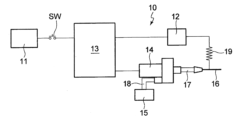
- FIG. 1 is a schematic diagram showing the configuration of an electrostatic spray device suitable for use in the present invention.
- FIG. 2 is a schematic diagram showing how the electrostatic spray method is performed using an electrostatic spray device.
- a film obtained by electrostatically spraying a composition containing a volatile substance and a polymer having film-forming ability may cause conspicuous pores, breakage of the film, and poor film removal depending on the applied site and person.
- a problem was found that a decrease may occur.
- the present invention provides a composition for forming a coating on the skin or the like by electrostatic spraying and a method for producing a coating having high sebum resistance.
- the present inventors have made various studies on the composition of the composition for spraying used in the electrostatic spray method, and found that in addition to a polymer having a fiber-forming ability with a specific molecular weight distribution and a volatile substance, a certain amount of polyol is blended. In this way, the formed film does not break even in the presence of a large amount of sebum, and the feel of the film is improved. Furthermore, the inventors have also found that the film can be easily and cleanly removed when peeling off the film formed on a site with a lot of sebum, and completed the present invention.
- the film is a film composed of deposits containing fibers, is uniform, has high adhesion and transparency, and does not tear or float. , it is possible to form a film with a good touch. Furthermore, when peeling and removing the film formed on the site with a lot of sebum, the film can be removed easily and cleanly.
- the method for producing a film according to the present invention is a method for producing a film by forming a film comprising deposits containing fibers on the surface of an object to be film-formed such as skin.
- a composition containing predetermined ingredients is applied to a film-forming object such as skin to form a film.
- the present invention employs an electrostatic spray method as a method of forming a film.
- the electrostatic spray method is a method in which a positive or negative high voltage is applied to a composition to charge the composition, and the charged composition is sprayed toward an object to form a film such as skin.
- the sprayed composition spreads in space while repeatedly being atomized by Coulombic repulsive force, and in the process or after adhering to the skin, the solvent, which is a volatile substance, dries to form a deposit containing fibers on the surface of the skin. Forms a film of matter.
- the electrostatic spray method an electrostatic spinning method is preferable.
- a composition used for electrostatic spraying is also referred to as a "spraying composition" and can also be referred to as a "spinning composition".
- composition used in the present invention is liquid under the environment in which the electrostatic spraying method is carried out.
- This composition contains the following components (A), (B) and (C).
- the component (B) includes the following (1) to (4) is preferably the case.
- Component (B) contains (B1) the above-described polymer having a molecular weight of 1 ⁇ 10 5 or more, and the content mass ratio of component (B1) to component (B) ((B1)/(B)) is 0.00. When it is 5 or more and the content mass ratio of component (B) to component (C) ((B)/(C)) is 1 or more.
- Component (B) has a number average molecular weight of 4.5 ⁇ 10 4 or more.
- component (A) is obtained by adding component (A), component (B) and component (C), and component (B) has a number average molecular weight of 4.5 ⁇ 10 4 or more.
- component (B) has a number average molecular weight of 4.5 ⁇ 10 4 or more.
- the volatile substance of component (A) is a substance that has volatility in a liquid state.
- Component (A) in the composition for spraying is discharged from the tip of a nozzle toward a fiber forming object such as skin after sufficiently charging the composition for spraying placed in an electric field, and spraying component (A). evaporates, the charge density of the composition for spraying becomes excessive, and component (A) further evaporates while becoming finer due to Coulomb repulsion, finally forming a coating containing dry fiber deposits.
- the vapor pressure of the volatile substance at 20° C. is preferably 0.01 kPa or more and 106.66 kPa or less, more preferably 0.13 kPa or more and 66.66 kPa or less. It is more preferably 67 kPa or more and 40.00 kPa or less, and even more preferably 1.33 kPa or more and 40.00 kPa or less.
- component (A) for example, monovalent chain aliphatic alcohols, monovalent cycloaliphatic alcohols, and monovalent aromatic alcohols are preferably used.
- monovalent chain aliphatic alcohols include C 1 -C 6 alcohols
- examples of monovalent cyclic alcohols include C 4 -C 6 cyclic alcohols
- examples of monovalent aromatic alcohols include benzyl alcohol and phenylethyl alcohol.
- Specific examples thereof include ethanol, isopropyl alcohol, butyl alcohol, phenylethyl alcohol, n-propanol, n-pentanol and the like.
- alcohols do not include polyols, which are polyhydric alcohols, and are alcohols other than component (C), which will be described later.
- ketones include di-C 1 -C 4 alkyl ketones such as acetone, methyl ethyl ketone, methyl isobutyl ketone and the like. These ketones can be used singly or in combination of two or more.
- Water can also be contained in the component (A). When water is contained, it is preferable to use water together with alcohol and/or ketone.
- the content of water in component (A) is preferably 0.01% by mass or more and 5% by mass or less from the viewpoint of the volatility of component (A) and the adhesion of the film to the skin.
- the volatile substance of component (A) is more preferably one or more selected from ethanol, isopropyl alcohol, butyl alcohol and water, more preferably one or more selected from ethanol and butyl alcohol. and more preferably a volatile substance containing ethanol.
- the content of component (A) in the composition for spraying is preferably 45% by mass or more, more preferably 50% by mass or more, and even more preferably 55% by mass or more.
- the content is preferably 95% by mass or less, more preferably 94% by mass or less, and even more preferably 93% by mass or less.
- the content of component (A) in the composition for spraying is preferably 45% by mass or more and 95% by mass or less, more preferably 50% by mass or more and 94% by mass or less, and 55% by mass or more and 93% by mass or less. The following are more preferable.
- the spray composition can be sufficiently volatilized when the electrostatic spray method is carried out even in the presence of the component (C).
- Ethanol is preferably 50% by mass or more, more preferably 65% by mass or more, and even more preferably 80% by mass or more, based on the total amount of the volatile substances of component (A). Moreover, it is preferable that it is 100 mass % or less. Ethanol is preferably 50% by mass or more and 100% by mass or less, more preferably 65% by mass or more and 100% by mass or less, and 80% by mass or more and 100% by mass of the total amount of the volatile substances of component (A). % by mass or less is more preferable.
- the water-insoluble polymer having fiber-forming ability which is component (B), is generally a substance that can be dissolved in the volatile substance of component (A).
- “dissolved” means that it is in a dispersed state at 20° C., and that the dispersed state is visually uniform, preferably visually transparent or translucent.
- water-insoluble polymer As the water-insoluble polymer with fiber-forming ability, an appropriate one is used according to the properties of the volatile substance of component (A).
- water-insoluble polymer means that 1 g of the polymer is weighed under an environment of 1 atm and 23° C., then immersed in 10 g of ion-exchanged water, and after 24 hours, 0.5 g of the immersed polymer It has the property that ultra does not dissolve.
- water-insoluble polymer (B) capable of forming fibers examples include fully saponified polyvinyl alcohol that can be insolubilized after fiber formation, partially saponified polyvinyl alcohol that can be cross-linked after fiber formation by using a cross-linking agent, and low saponified polyvinyl alcohol.
- poly(N-propanoylethyleneimine) graft-dimethylsiloxane/ ⁇ -aminopropylmethylsiloxane copolymer oxazoline-modified silicone, polyvinyl acetal diethylaminoacetate, twein (major component of corn protein), polyester, polylactic acid (PLA) ), acrylic resins such as polyacrylonitrile resins and polymethacrylic acid resins, polystyrene resins, polyvinyl butyral resins, polyethylene terephthalate resins, polybutylene terephthalate resins, polyurethane resins, polyamide resins, polyimide resins, and polyamideimide resins.
- PVA polylactic acid
- acrylic resins such as polyacrylonitrile resins and polymethacrylic acid resins
- polystyrene resins polyvinyl butyral resins
- polyethylene terephthalate resins polybutylene terephthalate resins
- water-insoluble polymers can be used alone or in combination of two or more.
- it is selected from fully saponified polyvinyl alcohol, partially saponified polyvinyl alcohol, low saponified polyvinyl alcohol, polyvinyl butyral resin, polyurethane resin, polymethacrylic acid resin, oxazoline-modified silicone, polyvinyl acetal diethylaminoacetate, and polylactic acid.
- polyvinyl butyral resin polylactic acid and polyurethane resin
- polyvinyl butyral resin is particularly preferred as the main component.
- these components (B) preferably have a specific molecular weight or molecular weight distribution from the viewpoint of imparting excellent sebum resistance to the coating containing fiber deposits.
- the component (B) has these specific molecular weights or molecular weight distributions, the peelability of the film containing sebum is remarkably improved.
- the molecular weight of component (B) is determined by preparing a calibration curve from standard polystyrene using gel permeation chromatography (GPC).
- the component (B) contains (B1) the polymer having a molecular weight of 1 ⁇ 10 5 or more, and the content mass ratio of the component (B1) to the component (B) ((B1)/(B)) is preferably 0.5 or more.
- the component (B) contains 50% by mass or more of the polymer (B1) having a molecular weight of 1 ⁇ 10 5 or more.
- the content mass ratio of component (B1) to component (B) ((B1)/(B)) is from the viewpoint of imparting excellent sebum resistance to the coating containing fiber deposits, and from the viewpoint of improving the feel of the coating. From the standpoint of peelability of a film containing sebum, it is preferably 0.51 or more, more preferably 0.53 or more, and even more preferably 0.55 or more.
- the upper limit of (B1)/(B) is preferably 1 or less, more preferably 0.95 or less, and even more preferably 0.9 or less.
- the component (B) preferably has a number average molecular weight of 4.5 ⁇ 10 4 or more. 4.
- the number-average molecular weight of component (B) imparts excellent resistance to sebum to the film containing fiber deposits, improves the feel of the film, and removes the film containing sebum. It is preferably 6 ⁇ 10 4 or more, more preferably 4.7 ⁇ 10 4 or more, even more preferably 4.8 ⁇ 10 4 or more.
- the upper limit of the number average molecular weight of component (B) is preferably 3 ⁇ 10 5 or less, more preferably 2 ⁇ 10 5 or less, and even more preferably 1.7 ⁇ 10 5 or less.
- the composition is obtained by adding component (A), component (B) and component (C), and component (B) has a number average molecular weight of 4.5 ⁇ 10 4 or more. It is preferable to have The number average molecular weight of the component (B) in the composition obtained by adding the component (B) is from the viewpoint of imparting excellent sebum resistance to the coating containing fiber deposits and from the viewpoint of improving the feel of the coating. And from the viewpoint of peelability of a film containing sebum, it is preferably 4.6 ⁇ 10 4 or more, more preferably 4.7 ⁇ 10 4 or more, and 4.8 ⁇ 10 4 or more. is more preferred. From the same viewpoint, the upper limit of the number average molecular weight of component (B) is preferably 3 ⁇ 10 5 or less, more preferably 2 ⁇ 10 5 or less, and even more preferably 1.7 ⁇ 10 5 or less.
- the component (B) is a polymer having a molecular weight distribution peak exceeding 9.0 ⁇ 10 4 .
- the peak of the molecular weight distribution of component (B) is 9 from the viewpoint of imparting excellent sebum resistance to the film containing fiber deposits, the viewpoint of improving the feel of the film, and the peelability of the film containing sebum. It is preferably 0.5 ⁇ 10 4 or more, more preferably 1.0 ⁇ 10 5 or more, further preferably 1.1 ⁇ 10 5 or more.
- the upper limit of the peak of the molecular weight distribution of component (B) is preferably 1.0 ⁇ 10 6 or less, more preferably 7.0 ⁇ 10 5 or less, and further preferably 5.0 ⁇ 10 5 or less. Preferably, 3.5 ⁇ 10 5 or less is even more preferable.
- the component (B) is a polymer whose main chain functional group is modified, such as a polyvinyl butyral resin
- the modification rate of the groups is 75% or less.
- the acetalization rate (butyralization rate) is preferably 75% or less.
- the content of component (B) in the composition for spraying is from the viewpoint of forming a film containing fiber deposits on a film-forming object such as skin and having excellent sebum resistance and containing sebum. From the viewpoint of film releasability, the content is preferably 2% by mass or more, more preferably 4% by mass or more, and even more preferably 5% by mass or more. The content is preferably 30% by mass or less, more preferably 20% by mass or less, and even more preferably 15% by mass or less.
- the content of component (B) in the composition for spraying is preferably 2% by mass or more and 30% by mass or less, more preferably 4% by mass or more and 20% by mass or less, and 5% by mass or more and 15% by mass. The following are more preferable. By including the component (B) in the composition for spraying in this proportion, it is possible to efficiently form the coating containing the desired fiber deposits.
- the content mass ratio of component (B) to component (A) in the composition for spraying ((B)/(A)) is such that component (A) can be sufficiently volatilized when electrostatic spraying is performed. , from the viewpoint of being able to form a desired film, it is preferably 0.03 or more and 0.5 or less, more preferably 0.04 or more and 0.4 or less, and even more preferably 0.055 or more and 0.3 or less.
- the content mass ratio of ethanol (A) to component (B) in the spray composition ((B)/(A)) is such that ethanol (A) is sufficiently volatilized when electrostatic spraying is performed. 0.03 or more and 0.5 or less, more preferably 0.04 or more and 0.4 or less, and even more preferably 0.055 or more and 0.3 or less, from the viewpoint of being able to form the desired film.
- the component (C) used in the present invention is one or more selected from polyols.
- polyol of component (C) examples include alkylene glycols such as ethylene glycol, propylene glycol, 1,3-propanediol, and 1,3-butanediol; diethylene glycol, dipropylene glycol, polyethylene glycol having a molecular weight of 1000 or less, and polypropylene.
- polyalkylene glycols such as glycol; glycerins such as glycerin, diglycerin, and triglycerin; Among these, from the viewpoint of being able to impart excellent sebum resistance to a film containing fiber deposits, improving the feel of the film and improving the peelability of the film containing sebum, ethylene glycol, Propylene glycol, 1,3-butanediol, dipropylene glycol, polyethylene glycol having a molecular weight of 1,000 or less, glycerin, and diglycerin are preferable, and polyethylene glycol, propylene glycol, 1,3-butanediol, and glycerin having a molecular weight of 1,000 or less are more preferable. , polyethylene glycol having a molecular weight of 1000 or less, and 1,3-butanediol are more preferred.
- the content of the component (C) in the composition for spraying can impart excellent sebum resistance to the coating containing the deposits of fibers, and from the viewpoint of improving the feel of the coating and the coating containing sebum. From the viewpoint of improving peelability, it is preferably 0.1% by mass or more, more preferably 0.5% by mass or more, further preferably 1% by mass, preferably 30% by mass or less, and more preferably 25% by mass or less. 20 mass % or less is more preferable. Specifically, it is preferably 0.1% by mass or more and 30% by mass or less, more preferably 0.5% by mass or more and 25% by mass or less, and even more preferably 1% by mass or more and 20% by mass or less.
- the fibers formed by an electrostatic spray method, preferably an electrostatic spinning method, from the composition for spraying of the present invention contain the component (B) as the main component and form a film as a deposit of fibers in which the component (C) is present. can do.
- the presence of the component (C) refers to the state in which it is carried inside the fiber, on the surface side of the fiber, or between the fibers.
- the content mass ratio of component (B) to component (C) is preferably 1 or more.
- excellent sebum resistance can be imparted to the coating containing the fiber deposits, the feel of the coating is improved, and the peelability of the coating containing sebum is improved.
- the ((B)/(C)) is more preferably 1.1 or more, further preferably 1.2 or more.
- the upper limit of ((B)/(C)) is preferably 30 or less, more preferably 25 or less, and even more preferably 20 or less. Specifically, it is preferably from 1 to 30, more preferably from 1.1 to 25, and even more preferably from 1.2 to 20.
- the composition for spraying of the present invention may further contain component (D) oil.
- the oil is an oil that becomes liquid as a whole (liquid at 20°C), and in addition to the oil that is liquid at 20°C (liquid oil), it may contain semi-solid oil and solid oil.
- Liquid oils include hydrocarbon oils, ester oils, higher alcohols, silicone oils, fatty acids and the like. Among these, hydrocarbon oils, ester oils, and silicone oils are preferable from the viewpoint of imparting excellent sebum resistance to a coating containing fiber deposits and improving the feel of the coating. Also, one selected from these liquid oils or a combination of two or more thereof can be used.
- liquid hydrocarbon oil examples include liquid paraffin, squalane, squalene, n-octane, n-heptane, cyclohexane, light isoparaffin, liquid isoparaffin, hydrogenated polyisobutene, polybutene, polyisobutene, etc., including fiber deposits.
- Liquid paraffin, light isoparaffin, liquid isoparaffin, squalane, squalene, n-octane, n-heptane, and cyclohexane are preferable from the viewpoint of improving the feel of the coating, and liquid paraffin, Squalane is more preferred.
- the total content of isododecane, isohexadecane, and hydrogenated polyisobutene in the liquid agent is It is preferably 10% by mass or less, more preferably 5% by mass or less, still more preferably 1% by mass or less, still more preferably 0.5% by mass or less, and may not be contained.
- the ester oil and the silicone oil preferably have a viscosity of 1 mPa s at 30° C. from the viewpoint of imparting excellent sebum resistance to the film containing the fiber deposits and improving the feel of the film. or more, more preferably 3 mPa ⁇ s or more.
- the viscosity here is measured at 30° C. with a BM viscometer (manufactured by Tokimec, measurement conditions: rotor No. 1, 60 rpm, 1 minute).
- the total content of ether oils such as cetyl-1,3-dimethylbutyl ether, dicapryl ether, dilauryl ether, and diisostearyl ether in component (D) is preferably 10% by mass or less. , more preferably 5% by mass or less, and still more preferably 1% by mass or less.
- ester oils include esters composed of linear or branched fatty acids and linear or branched alcohols or polyhydric alcohols. Specifically, isopropyl myristate, cetyl isooctanoate, isocetyl octanoate, octyldodecyl myristate, isopropyl palmitate, butyl stearate, hexyl laurate, decyl oleate, octyldodecyl oleate, hexyldecyl dimethyloctanoate, lactic acid Cetyl, myristyl lactate, lanolin acetate, isocetyl stearate, isocetyl isostearate, ethylhexyl isononanoate, isononyl isononanoate, isotridecyl isononanoate, isostearyl isostearate, choleste
- octyldodecyl myristate, myristyl myristate, isocetyl stearate, and isononanoic acid can impart excellent sebum resistance to a coating containing fiber deposits and improve the feel of the coating.
- ester oil it is possible to use vegetable oils and animal oils containing the above ester oils, such as olive oil, jojoba oil, macadamia nut oil, medform oil, castor oil, safflower oil, sunflower oil, avocado oil, and canola oil. , Chinese ginseng oil, rice germ oil, rice bran oil and the like.
- higher alcohols include liquid higher alcohols having 12 to 20 carbon atoms, and higher alcohols containing branched fatty acids as constituents are preferred, and specific examples include isostearyl alcohol and oleyl alcohol.
- liquid silicone oils include linear silicones, cyclic lysicones, and modified silicones, such as dimethylpolysiloxane, dimethylcyclopolysiloxane, methylphenylpolysiloxane, methylhydrogenpolysiloxane, phenyl-modified silicone, higher alcohol-modified organo Polysiloxane etc. are mentioned.
- the component (D) may contain an oil that is solid at 20°C as long as the component (D) is liquid as a whole.
- the oil that is solid at 20° C. is not particularly limited as long as it is commonly used in cosmetics. Examples include waxes, cholesterol derivatives, phytosterol derivatives, dipentaerythritol fatty acid esters, triglycerides, lanolin, lanosterol derivatives, vaseline, ceramides, higher alcohols and higher fatty acids.
- the content of component (D) in the composition for spraying is 0% by mass or more from the viewpoint of imparting excellent sebum resistance to a coating containing fiber deposits and improving the feel of the coating. It is preferably 25% by mass or less, more preferably 20% by mass or less, and even more preferably 15% by mass or less. Specifically, it is preferably 0% by mass or more and 25% by mass or less, more preferably 0% by mass or more and 20% by mass or less, and even more preferably 0% by mass or more and 15% by mass or less. From the viewpoint of maintaining the transparency of the film, the content is more preferably 0.5% by mass or more.
- the spray composition may contain only component (A), component (B) and component (C) described above, or component (A), component (B), component (C) and component (D) may be included, or other components may be included in addition to component (A), component (B), component (C) and component (D).
- Other components include, for example, other plasticizers, coloring pigments, extender pigments, dyes, surfactants, fragrances, repellents, antioxidants, stabilizers, and preservatives for the polymer having fiber-forming properties of component (B). , and various vitamins.
- the content of the other components is preferably 0.1% by mass or more and 30% by mass or less, and 0.5% by mass or more and 20% by mass or less. It is even more preferable to have
- the composition for spraying is electrostatically sprayed onto the surface of a film-forming object to form a film comprising deposits containing fibers.
- the object to be film-formed may be a base material such as resin, glass, or metal, or may be skin, but skin is preferred.
- the composition for spraying is electrostatically sprayed directly onto the skin surface to form a film consisting of deposits containing fibers on the skin surface.
- electrostatic spraying methods it is preferable to employ an electrostatic spinning method in order to efficiently form a deposit containing fibers.
- the composition for spraying preferably the composition for spinning
- the viscosity at 25° C. is preferably 5000 mPa ⁇ s or less, more preferably 2000 mPa ⁇ s or less, still more preferably 1500 mPa ⁇ s or less.
- a spray composition having a viscosity in this range can be used to successfully form a porous coating, especially a porous coating consisting of a deposit of fibers, by electrostatic spraying.
- the formation of a porous coating is advantageous from the viewpoints of adhesion of the coating, transparency of the coating, suppression of the feeling of the coating, prevention of stuffiness of the skin, and the like.
- the viscosity of the composition for spraying is measured at 30° C. using an E-type viscometer.
- the E-type viscometer for example, an E-type viscometer manufactured by Tokyo Keiki Co., Ltd. can be used.
- rotor No. 43 can be used.
- the composition for spraying is directly sprayed or ejected onto the target area of the film-forming object, preferably human skin, by an electrostatic spray method.
- skin also includes nails.
- the electrostatic spray method includes the step of electrostatically spraying the nebulizing composition onto the skin using an electrostatic spray device.
- An electrostatic spray device basically comprises a container containing the composition, a nozzle for discharging the composition, a supply device for supplying the composition contained in the container to the nozzle, and the and a power source for applying voltage to the nozzles.
- FIG. 1 shows a schematic diagram showing the configuration of an electrostatic spray device preferably used in the present invention.
- the electrostatic spray device 10 shown in the figure includes a low voltage power supply 11 .
- the low-voltage power supply 11 can generate a voltage of several volts to ten and several volts.
- the low voltage power supply 11 preferably consists of one or more batteries. Also, by using a battery as the low-voltage power supply 11, there is an advantage that it can be easily replaced as necessary. An AC adapter or the like can be used as the low-voltage power supply 11 instead of the battery.
- the electrostatic spray device 10 also includes a high voltage power supply 12.
- the high voltage power supply 12 is connected to the low voltage power supply 11 and has an electric circuit (not shown) that boosts the voltage generated by the low voltage power supply 11 to a high voltage.
- a booster electric circuit is generally composed of a transformer, a capacitor, a semiconductor device, and the like.
- the electrostatic spray device 10 further comprises an auxiliary electrical circuit 13.
- the auxiliary electric circuit 13 is interposed between the low-voltage power supply 11 and the high-voltage power supply 12 described above, and has a function of adjusting the voltage of the low-voltage power supply 11 to stably operate the high-voltage power supply 12 .
- the auxiliary electric circuit 13 has a function of controlling the number of revolutions of a motor provided in a micro gear pump 14, which will be described later. By controlling the number of revolutions of the motor, the supply amount of the spray composition from the spray composition container 15 to the micro gear pump 14, which will be described later, is controlled.
- a switch SW is attached between the auxiliary electric circuit 13 and the low-voltage power supply 11, and the electrostatic spray device 10 can be operated/stopped by turning on/off the switch SW.
- a piston pump can also be used to supply the spray composition and control the amount of supply.
- Electrostatic spray device 10 further comprises nozzle 16 .
- the nozzle 16 is made of various conductors such as metals, or non-conductors such as plastics, rubbers and ceramics, and has a shape that allows the composition for spraying to be discharged from its tip.
- a minute space through which the composition for spraying flows is formed in the nozzle 16 along the longitudinal direction of the nozzle 16 .
- the size of the cross section of this minute space is preferably 100 ⁇ m or more and 1000 ⁇ m or less in terms of diameter.
- Nozzle 16 communicates with micro gear pump 14 via conduit 17 .
- Conduits 17 may be conductive or non-conductive.
- the nozzle 16 is electrically connected to the high voltage power supply 12 . This makes it possible to apply a high voltage to the nozzle 16 .
- the nozzle 16 and the high-voltage power supply 12 are electrically connected via a current limiting resistor 19 in order to prevent excessive current from flowing when the human body directly touches the nozzle 16 .
- the micro gear pump 14 communicating with the nozzle 16 via the conduit 17 functions as a supply device that supplies the spray composition contained in the container 15 to the nozzle 16 .
- the micro gear pump 14 operates by receiving power from the low voltage power supply 11 .
- the micro gear pump 14 is also configured to supply a predetermined amount of the spray composition to the nozzle 16 under the control of the auxiliary electrical circuit 13 .
- a container 15 is connected to the micro gear pump 14 via a flexible conduit 18 .
- the container 15 contains the spray composition.
- Container 15 is preferably in the form of a replaceable cartridge.
- the electrostatic spray device 10 having the above configuration can be used, for example, as shown in FIG. FIG. 2 shows a handheld electrostatic spray device 10 having dimensions that allow it to be held with one hand.
- FIG. 2 shows a handheld electrostatic spray device 10 having dimensions that allow it to be held with one hand.
- a nozzle (not shown) is arranged at one end 10a of the housing 20 in the longitudinal direction.
- the nozzle is arranged in the housing 20 so that the blowing direction of the composition coincides with the longitudinal direction of the housing 20 and is convex toward the skin side.
- the user When operating the electrostatic spray device 10, the user, i.e., the person who is to form a coating on the target site on the skin by electrostatic spraying, holds the device 10 in his hand and the nozzle (not shown) is positioned.
- One end 10a of the device 10 is directed toward the application site for electrostatic spraying.
- one end 10a of the electrostatic spray device 10 is shown directed toward the inside of the forearm of the user. Under this condition, the device 10 is switched on to perform the electrostatic spray method. Turning on the device 10 creates an electric field between the nozzle and the skin. In the embodiment shown in FIG. 2, a high positive voltage is applied to the nozzle and the skin is the negative electrode.
- the composition for spraying at the tip of the nozzle is polarized by electrostatic induction, the tip portion becomes cone-shaped, and droplets of the charged composition for spraying are emitted from the tip of the cone. Along the electric field, it is ejected into the air toward the skin.
- component (A) which is a solvent, evaporates from the charged composition for spraying discharged into space, the charge density on the surface of the composition for spraying becomes excessive, and spreads in space while being repeatedly finely divided by Coulombic repulsive force. , reaches the skin. In this case, by appropriately adjusting the viscosity of the spray composition, the sprayed composition can reach the application site in the form of droplets.
- the volatile substance that is the solvent is volatilized from the droplets, and the polymer that is the solute and has fiber-forming ability is solidified, and fibers are formed while being stretched and deformed by the potential difference.
- Fibers can be deposited on the application site. For example, increasing the viscosity of the spray composition tends to deposit the composition on the application site in the form of fibers. This forms a porous coating of fibrous deposits on the surface of the application site.
- a high potential difference is generated between the nozzle and the skin during the electrostatic spray method.
- the impedance is very large, the current flowing through the human body is extremely small.
- the inventors have confirmed that the current flowing through the human body during electrostatic spraying is several orders of magnitude smaller than the current flowing through the human body due to, for example, static electricity generated in normal life.
- the fibers In the case of skin that contains a lot of sebum, the fibers swell and become easier to plasticize due to the compounding of component (C) in the fibers. As a result, the resulting film is transparent and has good adhesion, but it is thought that the durability, that is, the resistance to sebum, is lowered.
- the durability that is, the resistance to sebum, is lowered.
- the coating by using a fiber-forming polymer having a specific molecular weight or molecular weight distribution as the component (B), although the coating is flexible, the durability in the presence of sebum is improved, It is considered that neither tearing nor floating occurs.
- component (A), component (B) and component (C), which are spray compositions are measured as follows.
- Component (A), which is a volatile substance, does not exist in the formed film, or volatilizes even if it exists, so the formed film contains component (B) and component (C) as main components.
- the content is measured as follows.
- ⁇ Method for measuring the content of component (A), component (B) and component (C) in spray composition There is a method of separation and identification by liquid chromatography (HPLC) in a solution state, and a method of identification by an infrared spectrophotometer (IR).
- HPLC liquid chromatography
- IR infrared spectrophotometer
- components with higher molecular weights are eluted first, so the composition can be identified by predicting the molecular weight and the elution position of the components.
- IR analysis it is also possible to assign and identify functional groups from individual absorbers, and in general, it is possible to identify by comparing the standard chart of commercially available additives and the IR chart of the component.
- ⁇ Method for measuring the contents of component (B) and component (C) in the formed coating A solvent capable of dissolving the film is searched for, and after dissolving the film in the solvent, separation and identification by liquid chromatography (HPLC) or identification by infrared spectrophotometer (IR) are performed.
- HPLC liquid chromatography
- IR infrared spectrophotometer
- the fibers forming the coating are continuous fibers of infinite length, but preferably have a length that is at least 100 times the thickness of the fibers.
- a fiber having a length of 100 times or more the thickness of the fiber is defined as "continuous fiber”.
- the coating produced by the electrostatic spray method is preferably a porous, discontinuous coating composed of deposits of continuous fibers.
- the film in this form can not only be handled as a single sheet as an aggregate, but also has the characteristic of being extremely soft. It has the advantage of being superior. In addition, there is also the advantage that removal by peeling of the coating is easy. On the other hand, a continuous film having no pores is not easily peeled off, and has low perspiration wicking properties, so that the skin may become stuffy.
- requiring pores refers to pores between fibers, and includes the presence of, for example, a liquid substance between fibers.
- a porous discontinuous film consisting of an aggregate of particles requires an operation such as rubbing the entire film in order to completely remove the film, and it is difficult to completely remove it without damaging the skin. Have difficulty.
- the thickness of the fibers forming the coating is preferably 10 nm or more, more preferably 50 nm or more, and even more preferably 100 nm or more, when expressed in circle equivalent diameter. Also, it is preferably 3000 nm or less, more preferably 1500 nm or less, and even more preferably 1200 nm or less.
- SEM scanning electron microscope
- the fiber is magnified 10,000 times and observed, and defects (fiber clumps, fiber intersections, droplets) are removed from the two-dimensional image, Ten fibers are arbitrarily selected, a line perpendicular to the longitudinal direction of the fibers is drawn, and the fiber diameter can be directly read.
- the composition for spraying that has been electrostatically sprayed and fibrous is charged with the component (B) and the component (C) while the component (A) evaporates. reach the skin directly.
- the skin is also charged, so the fibers adhere to the skin in the form of a sheet of film due to electrostatic force. Since fine unevenness such as texture is formed on the surface of the skin, it is considered that the fibers are more closely attached to the surface of the skin in the form of a sheet of film in combination with the anchoring effect of the unevenness.
- the electrostatic spray device 10 is turned off.
- the electric field between the nozzle and the skin disappears and the charge is fixed on the surface of the skin.
- the adhesiveness of the coating in the form of a single sheet is further exhibited, the coating is less likely to peel off from the edges during wear, and the durability during use is improved.
- the coating can be sufficiently adhered to the skin without applying a separate liquid to the skin. The reason for this is that the presence of the component (C) in the fiber softens the fiber itself due to the plasticizing effect and enhances the followability to fine uneven surfaces, and the component (C) bleeds out to the fiber surface. This is thought to be due to the fact that liquid bridges are formed between the fibers and the skin.
- the fibers constituting the coating hardly reflect light, and the coating tends to be transparent in appearance. , the skin can be covered in a natural-looking state.
- the distance between the nozzle and the skin depends on the voltage applied to the nozzle, it is preferably 50 mm or more and 150 mm or less for successful formation of the coating.
- the distance between the nozzle and the skin can be measured with a commonly used non-contact sensor or the like.
- the basis weight of the coating is preferably 0.1 g/m 2 or more, and is 1 g/m 2 or more. is more preferred. It is also preferably 50 g/m 2 or less, more preferably 40 g/m 2 or less.
- the basis weight of the coating is preferably 0.1 g/m 2 or more and 50 g/m 2 or less, more preferably 1 g/m 2 or more and 40 g/m 2 or less.
- the electrostatic spraying step of forming a film by electrostatically spraying the composition directly onto the skin means a step of forming a film by electrostatically spraying the composition onto the skin, and is a step of electrostatic spinning. is preferred.
- the composition is electrostatically spun onto a place other than the skin to prepare a fiber sheet for application that is composed of a deposit of fibers and is used by transferring to the skin, and the fiber sheet for application is prepared. Methods include applying to the skin. Such a method using a fiber sheet for application is a method different from the electrostatic spray process.
- the thickness of the fiber sheet for application is preferably 100 nm to 500 ⁇ m, more preferably 500 nm to 300 ⁇ m, even more preferably 1 ⁇ m to 100 ⁇ m, and even more preferably 10 ⁇ m to 50 ⁇ m, from the viewpoint of adhesion and obtaining an inconspicuous appearance. Setting is preferable from the point of sticking.
- the color of the patch fiber sheet before being transferred to the skin is preferably transparent white or translucent white.
- the L value is preferably 80 or more, more preferably 90 or more. From the viewpoint of an inconspicuous appearance, the a value and b value are preferably -20 to 30, more preferably -10 to 20, and still more preferably 0 to 10.
- the fiber sheet for attachment is preferably produced by electrospinning on a peelable base material, or formed on another base material by an electrospinning method and then laminated on the peelable base material.
- the peelable base material is a non-woven fabric sheet made of synthetic resin such as polyolefin-based resin or polyester-based resin, the fiber diameter of which is larger than that of the fiber sheet, or the surface forming the fiber sheet of the film.
- a sheet having minute unevenness for example, a sheet having a height or width greater than the fiber thickness of the present invention but not more than 1 mm, more preferably not more than 500 ⁇ m, can be used.
- Electrostatic spray device 10 need not be held by a person wishing to coat their skin as long as an electric field exists between the two.
- the present invention further discloses the following method for producing a coating.
- component (A), component (B) and component (C) (A) one or more volatile substances selected from water, alcohols and ketones; (B) a water-insoluble polymer having fiber-forming ability, and (C) containing one or more selected from polyols, Component (B) has a number average molecular weight of 4.5 ⁇ 10 4 or more, The content mass ratio of component (B) to component (C) ((B)/(C)) is 1 or more, A film-forming composition for forming a film comprising a fiber-containing deposit directly on the skin by electrostatic spraying.
- component (A), component (B) and component (C) (A) one or more volatile substances selected from water, alcohols and ketones; obtained by adding one or more selected from (B) a water-insoluble polymer having fiber-forming ability and (C) a polyol, Component (B) has a number average molecular weight of 4.5 ⁇ 10 4 or more, The content mass ratio (B)/(C) of component (B) to component (C) is 1 or more, A film-forming composition for forming a film comprising a fiber-containing deposit directly on the skin by electrostatic spraying.
- component (A), component (B) and component (C) (A) one or more volatile substances selected from water, alcohols and ketones; (B) a water-insoluble polymer with fiber-forming ability; (C) contains one or more selected from polyols, Component (B) is a polymer with a molecular weight distribution peak exceeding 9.0 ⁇ 10 4 , The content mass ratio (B)/(C) of component (B) to component (C) is 1 or more, A film-forming composition for forming a film comprising a fiber-containing deposit directly on the skin by electrostatic spraying.
- the volatile substance of component (A) preferably has a vapor pressure of 0.01 kPa or more and 106.66 kPa or less, more preferably 0.13 kPa or more and 66.66 kPa or less at 20°C.
- the film-forming composition according to any one of ⁇ 1> to ⁇ 4>, more preferably 0.67 kPa or more and 40.00 kPa or less, and even more preferably 1.33 kPa or more and 40.00 kPa or less. thing.
- the volatile substance of component (A) is an alcohol, and the alcohol is one selected from monovalent chain aliphatic alcohols, monovalent cycloaliphatic alcohols, and monovalent aromatic alcohols, or Two or more types are preferable, and the alcohol is more preferably one or two or more selected from ethanol, isopropyl alcohol, butyl alcohol, phenylethyl alcohol, propanol, and pentanol, any of the above ⁇ 1> to ⁇ 5>
- the volatile substance of component (A) is one or more selected from ethanol, isopropyl alcohol, butyl alcohol, and water, more preferably one or two selected from ethanol and butyl alcohol.
- the content of component (A) in the composition is preferably 45% by mass or more, more preferably 50% by mass or more, even more preferably 55% by mass or more, and 95% by mass or more. % by mass or less, more preferably 94% by mass or less, and even more preferably 93% by mass or less, and the content of component (A) in the composition is 45% by mass or more to 95% by mass. %, more preferably 50% by mass or more and 94% by mass or less, and even more preferably 55% by mass or more and 93% by mass or less. film-forming composition.
- the film-forming polymer is partially saponified polyvinyl alcohol, low-saponified polyvinyl alcohol, fully saponified polyvinyl alcohol, polyvinyl butyral resin, polyurethane resin, polymethacrylic acid resin, oxazoline-modified silicone, polyvinyl acetal diethylaminoacetate, and polylactic acid, preferably one or two or more selected from polyvinyl butyral resin, polylactic acid and polyurethane resin, more preferably one or two or more selected from polyvinyl butyral resin.
- the film-forming composition according to any one of ⁇ 1> to ⁇ 8>, which is more preferably composed of a polyvinyl butyral resin as a main component.
- the content mass ratio of component (B1) to component (B) ((B1)/(B)) is preferably 0.5 or more, more preferably 0.51 or more, further preferably 0.53 or more, 0.55 or more is more preferable, 1 or less is preferable, 0.95 or less is more preferable, and 0.9 or less is even more preferable.
- Composition. ⁇ 11> Component (B) has a number average molecular weight of preferably 4.6 ⁇ 10 4 or more, more preferably 4.7 ⁇ 10 4 or more, and more preferably 4.8 ⁇ 10 4 or more. is more preferably 3 ⁇ 10 5 or less, more preferably 2 ⁇ 10 5 or less, and even more preferably 1.7 ⁇ 10 5 or less. film-forming composition.
- Component (B) has a number average molecular weight of preferably 4.6 ⁇ 10 4 or more, more preferably 4.7 ⁇ 10 4 or more, and more preferably 4.8 ⁇ 10 4 or more. is more preferably 3 ⁇ 10 5 or less, more preferably 2 ⁇ 10 5 or less, and even more preferably 1.7 ⁇ 10 5 or less, the coating according to any one of ⁇ 3>, ⁇ 5> to ⁇ 9> Forming composition.
- Component (B) has a molecular weight distribution peak of preferably 9.5 ⁇ 10 4 or more, more preferably 1.0 ⁇ 10 5 or more, and 1.1 ⁇ 10 5 or more.
- the content of component (B) is preferably 2% by mass or more, more preferably 4% by mass or more, even more preferably 5% by mass or more, and 30% by mass or less. It is preferably 20% by mass or less, more preferably 15% by mass or less, preferably 2% by mass or more and 30% by mass or less, and 4% by mass or more and 20% by mass or less.
- the film-forming composition according to any one of ⁇ 1> to ⁇ 13> which is more preferably 5% by mass or more and 15% by mass or less.
- the content mass ratio of component (B) to component (A) ((B)/(A)) is preferably 0.03 or more and 0.5 or less, more preferably 0.04 or more and 0.4 or less,
- the film-forming composition according to any one of ⁇ 1> to ⁇ 14> which is more preferably 0.055 or more and 0.3 or less.
- ⁇ 16> The film-forming composition according to any one of ⁇ 1> to ⁇ 15>, wherein the polyol of component (C) is one or more selected from alkylene glycols, polyalkylene glycols and glycerins.
- the content of component (C) is preferably 0.1% by mass or more, more preferably 0.5% by mass or more, still more preferably 1% by mass, and preferably 30% by mass or less, and 25% by mass or less. is more preferably 20% by mass or less, preferably 0.1% by mass or more and 30% by mass or less, more preferably 0.5% by mass or more and 25% by mass or less, and more preferably 1% by mass or more and 20% by mass or less.
- the film-forming composition according to any one of ⁇ 1> to ⁇ 16>.
- the content mass ratio of component (B) to component (C) ((B)/(C)) is more preferably 1.1 or more, further preferably 1.2 or more, and preferably 30 or less.
- component (D) oil is preferably one or more selected from hydrocarbon oils, ester oils, higher alcohols, silicone oils and fatty acids, and selected from hydrocarbon oils, ester oils and silicone oils.
- the content of component (D) is preferably 0% by mass or more, more preferably 0.5% by mass or more, still more preferably 1% by mass, and preferably 25% by mass or less, and more preferably 20% by mass or less.
- 15% by mass or less is more preferable, 0% by mass or more and 25% by mass or less is preferable, 0.5% by mass or more and 20% by mass or less is more preferable, and 1% by mass or more and 15% by mass or less is more preferable ⁇ 19>
- the film-forming composition according to ⁇ 20> is preferably 0% by mass or more, more preferably 0.5% by mass or more, still more preferably 1% by mass, and preferably 25% by mass or less, and more preferably 20% by mass or less.
- 15% by mass or less is more preferable
- 0% by mass or more and 25% by mass or less is preferable
- 0.5% by mass or more and 20% by mass or less is more preferable
- 1% by mass or more and 15% by mass or less is more preferable ⁇ 19>
- the viscosity at 25°C is preferably 1 mPa s or more and 5000 mPa s or less, more preferably 10 mPa s or more and 2000 mPa s or less, and still more preferably 50 mPa s or more and 1500 mPa s or less.
- component (A), component (B) and component (C) (A) one or more volatile substances selected from water, alcohols and ketones; (B) a water-insoluble polymer having fiber-forming ability, and (C) containing one or more selected from polyols, Component (B) contains (B1) the polymer having a molecular weight of 1 ⁇ 10 5 or more, The content mass ratio of component (B1) to component (B) ((B1)/(B)) is 0.5 or more, Using a composition containing component (B) with respect to component (C) in a mass ratio ((B)/(C)) of 1 or more, a film comprising deposits containing fibers is formed on the surface of a film-forming object.
- a method for producing a coating ⁇ 24> The following component (A), component (B) and component (C): (A) one or more volatile substances selected from water, alcohols and ketones; (B) a water-insoluble polymer having fiber-forming ability, and (C) containing one or more selected from polyols, Component (B) has a number average molecular weight of 4.5 ⁇ 10 4 or more, Using a composition containing component (B) with respect to component (C) in a mass ratio ((B)/(C)) of 1 or more, a film comprising deposits containing fibers is formed on the surface of a film-forming object. A method for producing a coating.
- component (A), component (B) and component (C) (A) one or more volatile substances selected from water, alcohols and ketones; obtained by adding one or more selected from (B) a water-insoluble polymer having fiber-forming ability and (C) a polyol, Using a composition in which the number average molecular weight of component (B) is 4.5 ⁇ 10 4 or more and the content mass ratio (B)/(C) of component (B) to component (C) is 1 or more, A method for producing a coating, comprising forming a coating comprising deposits containing fibers on the surface of an object to be coated.
- component (A), component (B) and component (C) (A) one or more volatile substances selected from water, alcohols and ketones; (B) a water-insoluble polymer with fiber-forming ability; (C) contains one or more selected from polyols, A composition in which the peak of the molecular weight distribution of component (B) is a polymer exceeding 9.0 ⁇ 10 4 and the content mass ratio (B)/(C) of component (B) to component (C) is 1 or more. is used to form a coating comprising deposits containing fibers on the surface of an object to be coated.
- ⁇ 27> The method for producing a film according to any one of ⁇ 23> to ⁇ 26>, wherein the film-forming target is skin.
- component (A), component (B) and component (C) (A) one or more volatile substances selected from water, alcohols and ketones; (B) a water-insoluble polymer having fiber-forming ability, and (C) containing one or more selected from polyols, Component (B) contains (B1) the polymer having a molecular weight of 1 ⁇ 10 5 or more, The content mass ratio of component (B1) to component (B) ((B1)/(B)) is 0.5 or more, A method of applying a composition containing component (B) to component (C) in a mass ratio ((B)/(C)) of 1 or more to a region including a site of high sebum secretion in humans.
- component (A), component (B) and component (C) (A) one or more volatile substances selected from water, alcohols and ketones; (B) a water-insoluble polymer having fiber-forming ability, and (C) containing one or more selected from polyols, Component (B) has a number average molecular weight of 4.5 ⁇ 10 4 or more, A method of applying a composition containing component (B) to component (C) in a mass ratio ((B)/(C)) of 1 or more to a region including a site of high sebum secretion in humans.
- component (A), component (B) and component (C) (A) one or more volatile substances selected from water, alcohols and ketones; obtained by adding one or more selected from (B) a water-insoluble polymer having fiber-forming ability and (C) a polyol, A composition in which the number average molecular weight of component (B) is 4.5 ⁇ 10 4 or more and the mass ratio (B)/(C) of component (B) to component (C) is 1 or more is administered to humans.
- component (A), component (B) and component (C) (A) one or more volatile substances selected from water, alcohols and ketones; (B) a water-insoluble polymer with fiber-forming ability; (C) contains one or more selected from polyols, A composition in which the peak of the molecular weight distribution of component (B) is a polymer exceeding 9.0 ⁇ 10 4 and the content mass ratio (B)/(C) of component (B) to component (C) is 1 or more. to areas containing areas of high sebum secretion in humans.
- component (A), component (B) and component (C) (A) one or more volatile substances selected from water, alcohols and ketones; (B) a water-insoluble polymer having fiber-forming ability, and (C) containing one or more selected from polyols, Component (B) contains (B1) the polymer having a molecular weight of 1 ⁇ 10 5 or more, The content mass ratio of component (B1) to component (B) ((B1)/(B)) is 0.5 or more, Using a composition containing component (B) with respect to component (C) in a mass ratio ((B)/(C)) of 1 or more, a film comprising deposits containing fibers is formed on the surface of a film-forming object.
- a method for producing a sebum-resistant film ⁇ 33> The following component (A), component (B) and component (C): (A) one or more volatile substances selected from water, alcohols and ketones; (B) a water-insoluble polymer having fiber-forming ability, and (C) containing one or more selected from polyols, Component (B) has a number average molecular weight of 4.5 ⁇ 10 4 or more, Using a composition containing component (B) with respect to component (C) in a mass ratio ((B)/(C)) of 1 or more, a film comprising deposits containing fibers is formed on the surface of a film-forming object. A method for producing a sebum-resistant film.
- component (A), component (B) and component (C) (A) one or more volatile substances selected from water, alcohols and ketones; obtained by adding one or more selected from (B) a water-insoluble polymer having fiber-forming ability and (C) a polyol, Using a composition in which the number average molecular weight of component (B) is 4.5 ⁇ 10 4 or more and the content mass ratio (B)/(C) of component (B) to component (C) is 1 or more, A method for producing a sebum-resistant coating, comprising forming a coating comprising deposits containing fibers on the surface of an object to be coated.
- component (A), component (B) and component (C) (A) one or more volatile substances selected from water, alcohols and ketones; (B) a water-insoluble polymer with fiber-forming ability; (C) contains one or more selected from polyols, A composition in which the peak of the molecular weight distribution of component (B) is a polymer exceeding 9.0 ⁇ 10 4 and the content mass ratio (B)/(C) of component (B) to component (C) is 1 or more.
- a method for producing a sebum-resistant coating which comprises forming a coating comprising deposits containing fibers on the surface of an object to be coated, using ⁇ 36>
- a method of applying a sebum-resistant sheet is applied to apply a sebum-resistant sheet.
- component (A), component (B) and component (C) (A) one or more volatile substances selected from water, alcohols and ketones; (B) a water-insoluble polymer having fiber-forming ability, and (C) containing one or more selected from polyols, Component (B) has a number average molecular weight of 4.5 ⁇ 10 4 or more, Using a composition containing component (B) with respect to component (C) in a mass ratio ((B)/(C)) of 1 or more, a film comprising deposits containing fibers is formed on the surface of a film-forming object. A method of applying a sebum-resistant sheet.
- component (A), component (B) and component (C) (A) one or more volatile substances selected from water, alcohols and ketones; obtained by adding one or more selected from (B) a water-insoluble polymer having fiber-forming ability and (C) a polyol, Using a composition in which the number average molecular weight of component (B) is 4.5 ⁇ 10 4 or more and the content mass ratio (B)/(C) of component (B) to component (C) is 1 or more, A method of applying a sebum-resistant sheet to form a film comprising deposits containing fibers on the surface of a film-forming object.
- component (A), component (B) and component (C) (A) one or more volatile substances selected from water, alcohols and ketones; (B) a water-insoluble polymer with fiber-forming ability; (C) contains one or more selected from polyols, A composition in which the peak of the molecular weight distribution of component (B) is a polymer exceeding 9.0 ⁇ 10 4 and the content mass ratio (B)/(C) of component (B) to component (C) is 1 or more.
- a fiber patch sheet composed of a deposit of fibers and used by transferring it to the skin, wherein the fiber sheet for patch includes (B) polyvinyl butyral resin as the main component of the fibers, and component (C) It contains one or more selected from polyols, the number average molecular weight of component (B) is 4.5 ⁇ 10 4 or more, and the content mass ratio of component (B) to component (C) ((B) /(C)) is 1 or more.
- the thickness of the fiber constituting the fiber sheet for attachment is 10 nm or more and 3000 nm or less, preferably 50 nm or more and 1500 nm or less, more preferably 100 nm or more and 1200 nm or less in equivalent circle diameter.
- the fiber for attachment according to ⁇ 40> or ⁇ 41>, wherein the fiber sheet for attachment has a thickness of 100 nm to 500 ⁇ m, preferably 500 nm to 300 ⁇ m, more preferably 1 ⁇ m to 100 ⁇ m, further preferably 10 ⁇ m to 50 ⁇ m. sheet.
- Examples 1 to 11 and Comparative Examples 1 to 3 (1) Preparation of composition for spraying Compositions for spraying having compositions shown in Tables 1 to 3 were prepared. The amounts of ethanol shown in Tables 1 to 3 are effective amounts and do not contain water. (2) Electrostatic Spraying Process Using an electrostatic spraying device 10 having the configuration shown in FIG. 1 and the appearance shown in FIG. 2, an electrostatic spraying method was applied directly to the skin for 20 seconds. The conditions for the electrostatic spray method were as shown below.
- the fact that the skin care cosmetic and the film are completely compatible means that the film is visually colorless and transparent.
- Table 1 shows the evaluation results.
- the evaluation criteria were as shown below. 5: Even if the film is attached to the skin at normal times, the film does not feel a feeling of film, tightness, or discomfort, and even when the expression is changed, the film does not feel tight, tight, or uncomfortable. It is a feeling that is no different from the state where it is not attached. 4: Even if the film is attached to the skin at normal times, there is no particular feeling of film, tightness, or discomfort, but a slight feeling of film, tightness, or discomfort is felt when the facial expression is changed, but it is particularly uncomfortable.
- electrostatic spray device 11 low voltage power supply 12 high voltage power supply 13 auxiliary electrical circuit 14 micro gear pump 15 container 16 nozzle 17 conduit 18 flexible conduit 19 current limiting resistor 20 housing
Landscapes
- Health & Medical Sciences (AREA)
- Life Sciences & Earth Sciences (AREA)
- Animal Behavior & Ethology (AREA)
- General Health & Medical Sciences (AREA)
- Public Health (AREA)
- Veterinary Medicine (AREA)
- Birds (AREA)
- Epidemiology (AREA)
- Emergency Medicine (AREA)
- Dermatology (AREA)
- Chemical & Material Sciences (AREA)
- Dispersion Chemistry (AREA)
- Engineering & Computer Science (AREA)
- Textile Engineering (AREA)
- Cosmetics (AREA)
- Paints Or Removers (AREA)
- Treatments For Attaching Organic Compounds To Fibrous Goods (AREA)
- Nonwoven Fabrics (AREA)
Priority Applications (2)
| Application Number | Priority Date | Filing Date | Title |
|---|---|---|---|
| CN202280057707.9A CN117897131A (zh) | 2021-08-26 | 2022-08-25 | 覆膜的制造方法 |
| US18/685,784 US20240350397A1 (en) | 2021-08-26 | 2022-08-25 | Method for producing film |
Applications Claiming Priority (2)
| Application Number | Priority Date | Filing Date | Title |
|---|---|---|---|
| JP2021-138129 | 2021-08-26 | ||
| JP2021138129 | 2021-08-26 |
Publications (1)
| Publication Number | Publication Date |
|---|---|
| WO2023027151A1 true WO2023027151A1 (ja) | 2023-03-02 |
Family
ID=85322858
Family Applications (1)
| Application Number | Title | Priority Date | Filing Date |
|---|---|---|---|
| PCT/JP2022/032072 Ceased WO2023027151A1 (ja) | 2021-08-26 | 2022-08-25 | 被膜の製造方法 |
Country Status (5)
| Country | Link |
|---|---|
| US (1) | US20240350397A1 (https=) |
| JP (1) | JP2023033227A (https=) |
| CN (1) | CN117897131A (https=) |
| TW (1) | TW202327546A (https=) |
| WO (1) | WO2023027151A1 (https=) |
Citations (9)
| Publication number | Priority date | Publication date | Assignee | Title |
|---|---|---|---|---|
| JP2015113293A (ja) * | 2013-12-10 | 2015-06-22 | 花王株式会社 | ナノファイバ積層シート |
| JP2018177803A (ja) * | 2017-04-19 | 2018-11-15 | 花王株式会社 | 被膜の製造方法 |
| JP2019038856A (ja) * | 2016-12-28 | 2019-03-14 | 花王株式会社 | 被膜の製造方法 |
| WO2020033266A1 (en) * | 2018-08-09 | 2020-02-13 | Kao Corporation | Method for producing coating |
| WO2020033265A1 (en) * | 2018-08-09 | 2020-02-13 | Kao Corporation | Method for producing wearable coating |
| JP2020063226A (ja) * | 2018-02-08 | 2020-04-23 | 花王株式会社 | 被膜形成用組成物 |
| JP2020180053A (ja) * | 2019-04-23 | 2020-11-05 | エア・ウォーター・ゾル株式会社 | エアゾール式ネイルマニキュア |
| JP2021054734A (ja) * | 2019-09-27 | 2021-04-08 | 花王株式会社 | ナノファイバシート |
| JP2022039741A (ja) * | 2020-08-28 | 2022-03-10 | 花王株式会社 | 消臭用の静電紡糸用組成物 |
Family Cites Families (1)
| Publication number | Priority date | Publication date | Assignee | Title |
|---|---|---|---|---|
| US20210196613A1 (en) * | 2017-04-19 | 2021-07-01 | Kao Corporation | Method for producing coating |
-
2022
- 2022-08-25 WO PCT/JP2022/032072 patent/WO2023027151A1/ja not_active Ceased
- 2022-08-25 TW TW111131993A patent/TW202327546A/zh unknown
- 2022-08-25 JP JP2022134119A patent/JP2023033227A/ja active Pending
- 2022-08-25 CN CN202280057707.9A patent/CN117897131A/zh active Pending
- 2022-08-25 US US18/685,784 patent/US20240350397A1/en active Pending
Patent Citations (9)
| Publication number | Priority date | Publication date | Assignee | Title |
|---|---|---|---|---|
| JP2015113293A (ja) * | 2013-12-10 | 2015-06-22 | 花王株式会社 | ナノファイバ積層シート |
| JP2019038856A (ja) * | 2016-12-28 | 2019-03-14 | 花王株式会社 | 被膜の製造方法 |
| JP2018177803A (ja) * | 2017-04-19 | 2018-11-15 | 花王株式会社 | 被膜の製造方法 |
| JP2020063226A (ja) * | 2018-02-08 | 2020-04-23 | 花王株式会社 | 被膜形成用組成物 |
| WO2020033266A1 (en) * | 2018-08-09 | 2020-02-13 | Kao Corporation | Method for producing coating |
| WO2020033265A1 (en) * | 2018-08-09 | 2020-02-13 | Kao Corporation | Method for producing wearable coating |
| JP2020180053A (ja) * | 2019-04-23 | 2020-11-05 | エア・ウォーター・ゾル株式会社 | エアゾール式ネイルマニキュア |
| JP2021054734A (ja) * | 2019-09-27 | 2021-04-08 | 花王株式会社 | ナノファイバシート |
| JP2022039741A (ja) * | 2020-08-28 | 2022-03-10 | 花王株式会社 | 消臭用の静電紡糸用組成物 |
Also Published As
| Publication number | Publication date |
|---|---|
| JP2023033227A (ja) | 2023-03-09 |
| CN117897131A (zh) | 2024-04-16 |
| US20240350397A1 (en) | 2024-10-24 |
| TW202327546A (zh) | 2023-07-16 |
Similar Documents
| Publication | Publication Date | Title |
|---|---|---|
| JP6453434B2 (ja) | 被膜の製造方法 | |
| JP6203362B2 (ja) | 被膜の製造方法 | |
| JP7216484B2 (ja) | 紫外線防御被膜の製造方法 | |
| EP3613405A1 (en) | Method for forming coating film | |
| WO2018194130A1 (ja) | 被膜形成用組成物 | |
| JP7216485B2 (ja) | 化粧被膜の製造方法 | |
| WO2023027151A1 (ja) | 被膜の製造方法 | |
| JP7227701B2 (ja) | 紫外線防御被膜の製造方法 | |
| JP2023177929A (ja) | 被膜形成用組成物 |
Legal Events
| Date | Code | Title | Description |
|---|---|---|---|
| 121 | Ep: the epo has been informed by wipo that ep was designated in this application |
Ref document number: 22861439 Country of ref document: EP Kind code of ref document: A1 |
|
| WWE | Wipo information: entry into national phase |
Ref document number: 18685784 Country of ref document: US |
|
| WWE | Wipo information: entry into national phase |
Ref document number: 202280057707.9 Country of ref document: CN |
|
| NENP | Non-entry into the national phase |
Ref country code: DE |
|
| 122 | Ep: pct application non-entry in european phase |
Ref document number: 22861439 Country of ref document: EP Kind code of ref document: A1 |