WO2023017758A1 - 吸収性物品 - Google Patents
吸収性物品 Download PDFInfo
- Publication number
- WO2023017758A1 WO2023017758A1 PCT/JP2022/029647 JP2022029647W WO2023017758A1 WO 2023017758 A1 WO2023017758 A1 WO 2023017758A1 JP 2022029647 W JP2022029647 W JP 2022029647W WO 2023017758 A1 WO2023017758 A1 WO 2023017758A1
- Authority
- WO
- WIPO (PCT)
- Prior art keywords
- absorbent article
- liquid
- acid
- aliphatic monohydric
- acids
- Prior art date
- Legal status (The legal status is an assumption and is not a legal conclusion. Google has not performed a legal analysis and makes no representation as to the accuracy of the status listed.)
- Ceased
Links
Images


Classifications
-
- A—HUMAN NECESSITIES
- A61—MEDICAL OR VETERINARY SCIENCE; HYGIENE
- A61F—FILTERS IMPLANTABLE INTO BLOOD VESSELS; PROSTHESES; DEVICES PROVIDING PATENCY TO, OR PREVENTING COLLAPSING OF, TUBULAR STRUCTURES OF THE BODY, e.g. STENTS; ORTHOPAEDIC, NURSING OR CONTRACEPTIVE DEVICES; FOMENTATION; TREATMENT OR PROTECTION OF EYES OR EARS; BANDAGES, DRESSINGS OR ABSORBENT PADS; FIRST-AID KITS
- A61F13/00—Bandages or dressings; Absorbent pads
- A61F13/15—Absorbent pads, e.g. sanitary towels, swabs or tampons for external or internal application to the body; Supporting or fastening means therefor; Tampon applicators
- A61F13/51—Absorbent pads, e.g. sanitary towels, swabs or tampons for external or internal application to the body; Supporting or fastening means therefor; Tampon applicators characterised by the outer layers of the pads
- A61F13/511—Topsheet, i.e. the permeable cover or layer facing the skin
Definitions
- the present disclosure relates to absorbent articles.
- Patent Document 1 discloses an absorbent material having a liquid-permeable topsheet, a liquid-impermeable backsheet, and an absorbent body between the liquid-permeable topsheet and the liquid-impermeable backsheet.
- blood having a kinematic viscosity of 0.01 to 80 mm 2 /s at 40° C., a water holding rate of 0.01 to 4.0% by mass, and a weight average molecular weight of less than 1,000, at least on the convex portion.
- Absorbent articles are disclosed which are characterized by containing a lubricity imparting agent.
- the blood lubricity-imparting agent efficiently slides the blood into the absorbent article, and after absorbing the menstrual blood, the top sheet has no sticky feeling and the top sheet is dry. There is.
- the above blood lubricity-imparting agents tend to migrate from the liquid-permeable top sheet due to their properties, and there is room for improvement. Therefore, the present disclosure is to provide an absorbent article that is provided with a gel composition that does not easily change its position over time and that allows bodily fluids to repeatedly slide down over time, and that is excellent in repeated absorbency over time. aim.
- the present disclosure discloses an absorbent article comprising a liquid-permeable sheet, a liquid-impermeable sheet, and an absorbent body therebetween, wherein the liquid-permeable sheet contains an oily component and a polyhydric alcohol. and a biosurfactant.
- the absorbent article of the present disclosure has a gel composition that does not easily change its position over time and allows bodily fluids to repeatedly slide off over time, and is excellent in repeated absorption over time.
- FIG. 1 is a plan view of a sanitary napkin 1 according to the first embodiment.
- FIG. 2 is a plan view of the sanitary napkin 1 according to the second embodiment.
- An absorbent article comprising a liquid-permeable sheet, a liquid-impermeable sheet, and an absorbent body therebetween,
- the liquid-permeable sheet comprises a gel composition containing an oily component, a polyhydric alcohol, and a biosurfactant,
- the absorbent article characterized in that:
- the liquid-permeable sheet comprises a gel composition containing an oily component. Since the gel composition is gel and has a certain viscosity, even when a predetermined pressure (for example, pressure during storage (during transportation) of the absorbent article, etc.) is applied, the position of the composition does not change. Hateful. That is, in the absorbent article, the gel composition is less likely to change its position over time.
- a predetermined pressure for example, pressure during storage (during transportation) of the absorbent article, etc.
- the oily component in the gel composition is a component for allowing liquids such as body fluids to slide down onto the absorber.
- the gel composition remains liquid even when stored for a long period of time, especially at high temperatures. It has a certain familiarity with
- hydrophilicity A gel composition containing a liquid component (polyhydric alcohol) and a biosurfactant is compatible with a liquid, and a gel composition containing a lipophilic component (oil component), a hydrophilic component (polyhydric alcohol), and a biosurfactant.
- a part quickly forms an emulsion of the oily component (first time).
- Part of the emulsion of the oil component (first time) allows the liquid to slide down onto the absorbent body, and the remainder remains on the liquid-permeable sheet.
- the absorbent article can repeatedly slide off menstrual blood even immediately after manufacturing or after a certain period of time has passed since manufacturing, and the absorbent article can be repeatedly absorbed over time. Excellent.
- the emulsion of the oily component formed from the gel composition has a predetermined average particle size, the emulsion of the oily component is easily disposed on the surface of the liquid-permeable sheet, and Multiple emulsions make it easier for liquids to slide down onto the absorbent.
- the liquid-permeable sheet is made of a predetermined nonwoven fabric, the oil component emulsion is easily placed on the fiber surface, and the oil component emulsion placed on the fiber surface absorbs the liquid. It becomes easy to slide down on the absorber.
- the gel composition has a predetermined viscosity near the body temperature of the wearer and at a shear rate corresponding to storage. It is difficult to change, and when liquid reaches the liquid-permeable sheet, an emulsion of the oil component is likely to be formed.
- the gel composition contains the oily component, the polyhydric alcohol, and the biosurfactant, based on the total mass thereof, of 60.0 to 94.9% by mass, and 5.0 to 39.9% by mass. 6.
- the gel composition has a predetermined composition, the effects of aspect 1 are more likely to be exhibited.
- the biosurfactant is selected from predetermined ones, when the gel composition comes into contact with the liquid, an emulsion of the oily component is easily formed, and the effect of the aspect 1 is more likely to be exhibited. Become.
- Embodiment 1 wherein the oily component has a kinematic viscosity at 40° C. of 0.01 to 80 mm 2 /s, a water hold rate of 0.01 to 4.0% by mass, and a weight average molecular weight of less than 1,000.
- the oily component since the oily component has a predetermined kinematic viscosity, water holding rate and weight average molecular weight, the oily component makes it easier for the body fluid to slide down from the liquid-permeable sheet to the absorbent body, and the effect of aspect 1. is easier to demonstrate.
- the oil component comprises (a 1 ) an ester of a chain hydrocarbon tetraol and at least one fatty acid, (a 2 ) an ester of a chain hydrocarbon triol and at least one fatty acid, and (a 3 ) a chain hydrocarbon.
- esters of diols with at least one fatty acid (b 1 ) ethers of linear hydrocarbon tetraols with at least one aliphatic monohydric alcohol, (b 2 ) linear hydrocarbon triols with at least one aliphatic monohydric alcohol Ethers of alcohols, (b 3 ) ethers of chain hydrocarbon diols and at least one aliphatic monohydric alcohol, (c 1 ) chain hydrocarbon tetracarboxylic acids having 4 carboxyl groups, hydroxy acids, alkoxy Esters of acids or oxoacids with at least one aliphatic monohydric alcohol, (c 2 ) chain hydrocarbon tricarboxylic acids having 3 carboxyl groups, hydroxy acids, alkoxy acids or oxoacids with at least one fatty acid (c 3 ) esters of linear hydrocarbon dicarboxylic acids, hydroxy acids, alkoxy acids or oxo acids having two carboxyl groups with at least one aliphatic monohydr
- the oily component since the oily component is selected from predetermined ones, the oily component makes it easier for the body fluid to slide down from the liquid-permeable sheet to the absorbent body, making it easier to exhibit the effects of aspect 1.
- the gel composition further contains a drug. Therefore, when the absorbent article is worn, every time the gel composition comes into contact with a liquid, the drug is released from the gel composition, and a part thereof can act on the skin of the wearer of the absorbent article. Therefore, the drug can act on the wearer's skin for an extended period of time.
- the oil component of the gel composition further contains a warming agent and/or a cooling agent. Therefore, when the absorbent article is worn, before the liquid reaches the liquid-permeable sheet, the warming agent and/or the cooling agent are unlikely to exert their effects, and each time the liquid reaches the liquid-permeable sheet, Secondly, the oily component is emulsified with a warming agent and/or a cooling agent, placed on the surface of the liquid-permeable sheet, and the warming agent and/or the cooling agent act on the wearer's skin for a long period of time. be able to.
- the gel composition is arranged at a predetermined position, an emulsion of the oily component is easily formed quickly from the gel composition, and the effect of aspect 1 is more likely to be exhibited.
- the gel composition is arranged on the skin-contacting surface of the liquid-permeable sheet in a predetermined state, it is less likely to impede the absorbency of the absorbent article, and the effect of aspect 1 is further enhanced. easier to perform.
- the absorbent article of the present disclosure will now be described in detail.
- ⁇ Oil component> The above oily component has the same effect as the blood lubricity-imparting agent described in Patent Document 1, and has the role of allowing not only menstrual blood but also body fluids such as urine to slide down from the liquid-permeable sheet into the absorbent body.
- the oily component preferably has a dynamic range of 0 to 80 mm 2 /s, more preferably 1 to 70 mm 2 /s, still more preferably 3 to 60 mm 2 /s, and even more preferably 5 to 50 mm 2 /s at 40°C. viscosity, and even more preferably a kinematic viscosity of 7 to 45 mm 2 /s.
- the melting point of the oil component is preferably 45° C. or lower. This is because if the oily component contains crystals at 40°C, its kinematic viscosity tends to increase. In this specification, the kinematic viscosity at 40°C may be simply referred to as "kinematic viscosity".
- the kinematic viscosity can be measured at a test temperature of 40°C using a Canon Fenske counterflow viscometer according to JIS K 2283:2000 "5. Kinematic viscosity test method".
- the above oily component is preferably 0.01 to 4.0% by mass, more preferably 0.02 to 3.5% by mass, still more preferably 0.03 to 3.0% by mass, and even more preferably 0.04% by mass. -2.5% by weight, and even more preferably from 0.05 to 2.0% by weight.
- water holding rate means the percentage of water a substance can hold and can be measured as follows. (1) A test tube, a rubber plug, a substance to be measured and deionized water are placed in a constant temperature room at 40°C for a day and night. (2) Put 5.0 g of the substance to be measured and 5.0 g of deionized water into a 20 mL test tube in the constant temperature room. (3) In the temperature-controlled room, the mouth of the test tube is plugged with a rubber plug, rotated once, and left to stand for 5 minutes.
- the oily component has a weight average molecular weight of less than 1,000 and preferably less than 900. This is because if the weight average molecular weight is 1,000 or more, the oily component itself tends to have tackiness, which tends to give discomfort to the wearer.
- the oily component preferably has a weight average molecular weight of 100 or more, and more preferably has a weight average molecular weight of 200 or more. This is because, when the weight-average molecular weight is small, the vapor pressure of the oily component becomes high, which may cause problems such as vaporization during storage, decrease in amount, and odor during wearing.
- the "weight average molecular weight” is a polydisperse compound (e.g., a compound produced by sequential polymerization, a plurality of fatty acids, and an ester produced from a plurality of aliphatic monohydric alcohols).
- the weight average molecular weight means a polystyrene-equivalent value determined by gel permeation chromatography (GPC).
- GPC measurement conditions include, for example, the following. Model: High performance liquid chromatogram Lachrom Elite manufactured by Hitachi High-Technologies Corporation Column: SHODEX KF-801, KF-803 and KF-804 manufactured by Showa Denko Co., Ltd. Eluent: THF Flow rate: 1.0 mL/min Injection amount: 100 ⁇ L Detection: RI (differential refractometer)
- oily component examples include (a 1 ) an ester of a chain hydrocarbon tetraol and at least one fatty acid, (a 2 ) an ester of a chain hydrocarbon triol and at least one fatty acid, and (a 3 ) a chain (b 1 ) ethers of linear hydrocarbon tetraols and at least one aliphatic monohydric alcohol; (b 2 ) linear hydrocarbon triols and at least one fatty acid; (b 3 ) an ether of a chain hydrocarbon diol and at least one aliphatic monohydric alcohol, (c 1 ) a chain hydrocarbon tetracarboxylic acid having 4 carboxyl groups, hydroxy an ester of an acid, an alkoxy acid or an oxo acid with at least one aliphatic monohydric alcohol, (c 2 ) a chain hydrocarbon tricarboxylic acid having 3 carboxyl groups, a hydroxy acid, an alkoxy acid or an oxo acid, and at least
- (a 1 ) ester of chain hydrocarbon tetraol and at least one fatty acid examples include a tetraester of pentaerythritol and a fatty acid, a triester of pentaerythritol and a fatty acid, a diester of pentaerythritol and a fatty acid, a penta Monoesters of erythritol and fatty acids are mentioned.
- fatty acids examples include saturated fatty acids such as C 2 to C 30 saturated fatty acids such as acetic acid (C 2 ) (C 2 means the number of carbon atoms, the same shall apply hereinafter), propanoic acid (C 3 ), butanoic acid (C 4 ) and its isomers such as 2-methylpropanoic acid (C 4 ), pentanoic acid (C 5 ) and its isomers such as 2-methylbutanoic acid (C 5 ), 2,2-dimethyl Propanoic acid (C 5 ), hexanoic acid (C 6 ), heptanoic acid (C 7 ), octanoic acid (C 8 ) and isomers thereof such as 2-ethylhexanoic acid (C 8 ), nonanoic acid (C 9 ) , decanoic acid ( C10 ), dodecanoic acid ( C12 ), tetradecanoic acid ( C14 ), hexadecanoic acid (C16
- the fatty acids can also be unsaturated fatty acids.
- unsaturated fatty acids include C 3 to C 20 unsaturated fatty acids such as monounsaturated fatty acids such as crotonic acid (C 4 ), myristoleic acid (C 14 ), palmitoleic acid (C 16 ), oleic acid (C 18 ), elaidic acid (C 18 ), vaccenic acid (C 18 ), gadoleic acid (C 20 ), eicosenoic acid (C 20 ), diunsaturated fatty acids such as linoleic acid (C 18 ), tri-unsaturated fatty acids such as eicosadienoic acid ( C20 ), e.g.
- tetraunsaturated fatty acids such as stearidonic acid ( C20 ), arachidonic acid ( C20 ), eicosatetraenoic acid ( C20 ), etc.
- pentaunsaturated fatty acids such as boseopentaenoic acid ( C18 ), eicosapentaene acid (C 20 ), etc., and partially hydrogenated products thereof.
- the ester of pentaerythritol and fatty acid is preferably an ester of pentaerythritol and fatty acid derived from saturated fatty acid, that is, an ester of pentaerythritol and saturated fatty acid.
- the ester of pentaerythritol and fatty acid is preferably a diester, a triester or a tetraester, more preferably a triester or a tetraester, from the viewpoint of reducing the water holding rate. A tetraester is more preferred.
- esters of pentaerythritol and fatty acids examples include Unistar H-408BRS, H-2408BRS-22 (mixture), etc. (manufactured by NOF Corporation).
- esters of chain hydrocarbon triols and at least one fatty acid include, for example, triesters of glycerin and fatty acids, diesters of glycerin and fatty acids, and monoesters of glycerin and fatty acids.
- the fatty acid is as described above.
- the ester of glycerin and fatty acid is preferably a diester or a triester, and more preferably a triester, from the viewpoint of reducing the water holding rate.
- Examples of the above-mentioned triesters of glycerin with two or more fatty acids include triesters of glycerin with octanoic acid (C 8 ) and decanoic acid (C 10 ), glycerin with octanoic acid (C 8 ), decane Triesters of acids (C 10 ) and dodecanoic acid (C 12 ), glycerol with octanoic acid (C 8 ), decanoic acid (C 10 ), dodecanoic acid (C 12 ), tetradecanoic acid (C 14 ), hexadecanoic acid (C 16 ) and triesters with octadecanoic acid (C 18 ).
- the total number of carbon atoms of the fatty acids constituting the glycerin-fatty acid triester is about 40 or less.
- triesters of glycerin and fatty acids include tricoconut oil fatty acid glycerides, NA36, Panacet 800, Panacet 800B and Panacet 810S, and tri C2L oil fatty acid glycerides and tri CL oil fatty acid glycerides (manufactured by NOF Corporation). ) and the like.
- esters of chain hydrocarbon diols and at least one fatty acid include, for example, C 2 -C 6 chain chain hydrocarbon diols such as C 2 -C 6 glycols such as ethylene glycol and propylene. Mono- or diesters of glycols, butylene glycol, pentylene glycol or hexylene glycol with fatty acids can be mentioned.
- the fatty acids include those listed in "(a 1 ) Esters of chain hydrocarbon tetraols with at least one fatty acid". Considering the possibility of denaturation due to oxidation or the like, the above ester of C 2 -C 6 glycol and fatty acid should be an ester of C 2 -C 6 glycol and fatty acid derived from saturated fatty acid, that is, C 2 . Preferred are esters of ⁇ C6 glycols with saturated fatty acids.
- the ester of a fatty acid with a glycol derived from a glycol having a large number of carbon atoms such as butylene glycol, pliers, etc.
- Esters of fatty acids with glycols derived from len glycol or hexylene glycol are preferred.
- the ester of C 2 -C 6 glycol and fatty acid is preferably a diester from the viewpoint of reducing the water holding rate. Examples of commercially available esters of C 2 -C 6 glycols and fatty acids include COMPOL BL and COMPOL BS (manufactured by NOF Corporation).
- (b 1 ) ether of linear hydrocarbon tetraol and at least one aliphatic monohydric alcohol include, for example, tetraethers, triethers, diethers and monoethers of pentaerythritol and aliphatic monohydric alcohols. .
- aliphatic monohydric alcohols include saturated aliphatic monohydric alcohols and unsaturated aliphatic monohydric alcohols.
- saturated aliphatic monohydric alcohol include C 1 to C 20 saturated aliphatic monohydric alcohols such as methyl alcohol (C 1 ) (C 1 represents the number of carbon atoms, the same shall apply hereinafter), ethyl alcohol ( C 2 ), propyl alcohol (C 3 ) and its isomers such as isopropyl alcohol (C 3 ), butyl alcohol (C 4 ) and its isomers such as sec-butyl alcohol (C 4 ) and tert-butyl alcohol (C 4 ), pentyl alcohol (C 5 ), hexyl alcohol (C 6 ), heptyl alcohol (C 7 ), octyl alcohol (C 8 ) and isomers thereof such as 2-ethylhexyl alcohol (C 8 ), nonyl alcohol ( C9 ), decyl alcohol ( C 1
- Examples of the unsaturated aliphatic monohydric alcohol include those obtained by replacing one of the C—C single bonds of the saturated aliphatic monohydric alcohol with a C ⁇ C double bond, such as oleyl alcohol. It is commercially available from Shin Nippon Chemical Co., Ltd. under the names of the Licacol series and the Angecool series.
- Ethers of chain hydrocarbon triols and at least one aliphatic monohydric alcohol include, for example, triethers, diethers and monoethers of glycerin and aliphatic monohydric alcohols.
- the aliphatic monohydric alcohol is as described above.
- Ethers of chain hydrocarbon diols and at least one aliphatic monohydric alcohol include diethers of C 2 -C 6 glycols and aliphatic monohydric alcohols, C 2 -C 6 glycols and one aliphatic alcohol.
- Monoethers with functional alcohols are mentioned.
- the aliphatic monohydric alcohol is as described above.
- esters of chain hydrocarbon tetracarboxylic acids, hydroxy acids, alkoxy acids or oxo acids having 4 carboxyl groups and at least one aliphatic monohydric alcohol for example, 4 carboxyl groups monoesters, diesters, triesters and tetraesters, preferably diesters, triesters and tetraesters, of linear hydrocarbon tetracarboxylic acids, hydroxyacids, alkoxyacids or oxoacids with at least one aliphatic monohydric alcohol , more preferably triesters and tetraesters, and even more preferably tetraesters.
- chain hydrocarbon tetracarboxylic acids examples include alkanetetracarboxylic acids such as butanetetraacid, pentanetetraacid, hexanetetraacid, heptanetetraacid, octanetetraacid, nonanetetraacid and decanetetraacid.
- alkanetetracarboxylic acids such as butanetetraacid, pentanetetraacid, hexanetetraacid, heptanetetraacid, octanetetraacid, nonanetetraacid and decanetetraacid.
- the aliphatic monohydric alcohol is as described above.
- esters of chain hydrocarbon tricarboxylic acids, hydroxy acids, alkoxy acids or oxo acids having 3 carboxyl groups and at least one aliphatic monohydric alcohol include, for example, Monoesters, diesters and triesters, preferably diesters and triesters, and more preferably triesters of linear hydrocarbon tricarboxylic acids, hydroxy acids, alkoxy acids or oxo acids with at least one aliphatic monohydric alcohol having mentioned.
- chain hydrocarbon tricarboxylic acid examples include alkanetricarboxylic acids such as propane triacid, butane triacid, pentane triacid, hexane triacid, heptane triacid, octane triacid, nonane triacid and decane triacid. mentioned.
- alkanetricarboxylic acids such as propane triacid, butane triacid, pentane triacid, hexane triacid, heptane triacid, octane triacid, nonane triacid and decane triacid. mentioned.
- the aliphatic monohydric alcohol is as described above.
- An example is tributyl O-acetylcitrate, which is commercially available.
- esters of chain hydrocarbon dicarboxylic acids, hydroxy acids, alkoxy acids or oxo acids having two carboxyl groups and at least one aliphatic monohydric alcohol include monoesters and diesters, preferably diesters, of linear hydrocarbon dicarboxylic acids, hydroxy acids, alkoxy acids or oxo acids with at least one aliphatic monohydric alcohol.
- chain hydrocarbon dicarboxylic acids examples include alkanedicarboxylic acids such as ethanedioic acid, propanedioic acid, butanedioic acid, pentanedioic acid, hexanedioic acid, heptanedioic acid, octanedioic acid, nonanedioic acid and Decanedioic acid is mentioned.
- alkanedicarboxylic acids such as ethanedioic acid, propanedioic acid, butanedioic acid, pentanedioic acid, hexanedioic acid, heptanedioic acid, octanedioic acid, nonanedioic acid and Decanedioic acid is mentioned.
- alkanedicarboxylic acids such as ethanedioic acid, propanedioic acid, butanedioic acid,
- the ether of the aliphatic monohydric alcohol and the aliphatic monohydric alcohol has the following formula (1): R 1 OR 2 (1) (wherein each of R 1 and R 2 is a chain hydrocarbon)
- R 1 and R 2 is a chain hydrocarbon
- a compound having The aliphatic monohydric alcohol (corresponding to R 1 OH and R 2 OH in formula (1)) constituting the ether is as described above.
- dialkyl ketone As the dialkyl ketone, the following formula (2): R3COR4 ( 2) (wherein each of R 3 and R 4 is an alkyl group)
- R3COR4 2 (wherein each of R 3 and R 4 is an alkyl group)
- esters of fatty acids and aliphatic monohydric alcohols include the following formula (3): R5COOR6 ( 3) (wherein R 5 and R 6 are each a chain hydrocarbon) A compound having
- the fatty acid (corresponding to R 5 COOH in formula (3)) constituting the above ester includes the above-described fatty acids, and saturated fatty acids are preferable in consideration of the possibility of modification due to oxidation or the like.
- Examples of the aliphatic monohydric alcohol (corresponding to R 6 OH in formula (3)) constituting the ester include the above-mentioned aliphatic monohydric alcohols.
- esters of the above fatty acids and aliphatic monohydric alcohols include esters of dodecanoic acid (C 12 ) and dodecyl alcohol (C 12 ), tetradecanoic acid (C 14 ) and dodecyl alcohol (C 12 ).
- esters of commercially available esters of fatty acids and aliphatic monohydric alcohols include Electol WE20 and Electol WE40 (manufactured by NOF Corporation).
- a compound having The above dialkyl carbonates are commercially available, and can also be synthesized by reacting phosgene with alcohols, reacting chloroformate with alcohols or alcoholates, and reacting silver carbonate with alkyl iodides.
- the polyoxy C 3 -C 6 alkylene glycol is i) an oxy C 3 -C 6 alkylene skeleton, i.e. any one selected from the group consisting of an oxypropylene skeleton, an oxybutylene skeleton, an oxypentylene skeleton, and an oxyhexylene skeleton.
- a homopolymer having one skeleton and having hydroxy groups at both ends ii) a block copolymer having two or more skeletons selected from the above group and having hydroxy groups at both ends, or iii) the above It means a random copolymer having two or more skeletons selected from the group and having hydroxy groups at both ends.
- Examples of commercially available poly C 3 -C 6 alkylene glycols include Uniol (trademark) PB-500 and PB-700 (manufactured by NOF Corporation).
- ester of polyoxy C 3 -C 6 alkylene glycol with at least one fatty acid As the ester of the polyoxy C 3 -C 6 alkylene glycol and at least one fatty acid, the OH terminal of the polyoxy C 3 -C 6 alkylene glycol described in the section "(e 1 ) Polyoxy C 3 -C 6 alkylene glycol”. one or both of which are esterified with fatty acids, i.e., monoesters and diesters. The fatty acid is as described above.
- Chain alkanes include, for example, straight-chain alkanes and branched-chain alkanes.
- Commercially available products of the above hydrocarbons include, for example, Pearl Ream 6 (NOF CORPORATION).
- the polyhydric alcohol means a dihydric or higher alcohol, and includes, for example, dihydric alcohol, trihydric alcohol, tetrahydric alcohol, pentahydric alcohol, hexahydric or higher alcohol, and ethers thereof. or a polyether of a dihydric alcohol.
- the dihydric alcohol include C 2 to C 6 chain hydrocarbon diols such as C 2 to C 6 glycols such as ethylene glycol, propylene glycol, butylene glycol, pentylene glycol or hexylene glycol. mentioned.
- Examples of the trihydric alcohol include the chain hydrocarbon triols described above, such as glycerin.
- Examples of the tetrahydric alcohol include the chain hydrocarbon tetraols described above, such as pentaerythritol.
- Examples of the pentahydric or higher alcohol include xylitol and sorbitol.
- Examples of the ether include diethylene glycol, dipropylene glycol, diglycerin, triethylene glycol, tripropylene glycol, tetraethylene glycol, tetrapropylene glycol and the like.
- the biosurfactant is a natural compound produced by microorganisms, and generally has high biodegradability and low skin irritation to the human body, and therefore has high stability to the environment and the human body.
- biosurfactants according to the present disclosure include lipopeptide compounds such as surfactin, arthrofactin, and iturin; glycolipids such as mannosylerythritol lipids, sophorolipids, trehalolipids and rhamnolipids; fatty acids such as spiculisporic acid; and salts thereof, and any combination thereof.
- the biosurfactant is preferably a lipopeptide compound and a salt thereof, more preferably surfactin, arthrofactin, iturin, and salts thereof, and further surfactin and a salt thereof, because of the high stability of the gel composition. preferable.
- the salt of surfactin has the following formula (5) (wherein X means an amino acid residue selected from the group consisting of leucine, isoleucine, and valine residues, R means a C 9 -C 18 alkyl group, and M + means an alkali metal ion or a quaternary ammonium ion.) is indicated by
- the amino acid residue as X can be in the L- or D-configuration, preferably in the L-configuration.
- the C 9 -C 18 alkyl group as R means a linear or branched monovalent saturated hydrocarbon group, n-nonyl group, 6-methyloctyl group, 7-methyloctyl group, n- Decyl group, 8-methylnonyl group, n-undecyl group, 9-methyldecyl group, n-dodecyl group, 10-methylundecyl group, n-tridecyl group, 11-methyldodecyl group, n-tetradecyl group, n-pentadecyl group , n-hexadecyl group, n-heptadecyl group, n-octadecyl group and the like.
- Alkali metal ions as M + include lithium ions, sodium ions, potassium ions, and the like.
- Substituents of the quaternary ammonium ion as M + include, for example, alkyl groups such as methyl group, ethyl group, n-propyl group, isopropyl group, n-butyl group and tert-butyl group; benzyl group, methylbenzyl and aralkyl groups such as phenylethyl group; and organic groups such as aryl groups such as phenyl group, toluyl group and xylyl group.
- Examples of quaternary ammonium ions include tetramethylammonium ion, tetraethylammonium ion, pyridinium ion and the like.
- Surfactin or a salt thereof can be obtained by culturing a microorganism such as a strain belonging to Bacillus subtilis according to a known method, and can be separated from the culture medium.
- the culture medium can be used as it is.
- Surfactin or a salt thereof may also be synthetic.
- the composition of the gel composition is not particularly limited as long as it is gel. However, in order to facilitate the action of the gel composition, the oily component, the polyhydric alcohol, and the biosurfactant are combined. , based on their total weight, preferably 60.0 to 94.9% by weight, 5.0 to 39.9% by weight and 0.1 to 5.0% by weight, more preferably 69.7 to 92.0% by weight. 0 wt%, 6.0 to 30.0 wt% and 0.3 to 4.0 wt%, and more preferably 75.0 to 90.0 wt%, 7.0 to 22.0 wt% and 0.0 wt%. It is contained at a ratio of 5 to 3.0% by mass.
- the gel composition preferably has a viscosity of 50 to 1,000 Pa ⁇ s, more preferably 100 to 800 Pa ⁇ s, and still more preferably 200 to 500 Pa ⁇ s at 36°C and a shear rate of 0.28 (1/s). has a viscosity of s. Since the gel composition has a predetermined viscosity near the wearer's body temperature and at a shear rate corresponding to storage, the gel composition does not easily change its position when the absorbent article is worn, When the liquid reaches the permeable sheet, it tends to form an emulsion of the oily component.
- the viscosity of the gel composition can be measured using the following equipment. ⁇ Equipment: HAAKE RheoStress1 manufactured by Thermo Fisher SCIENTIFIC ⁇ Sensor: Cone ⁇ 60mm, 1°angle C60/1 ⁇ Shear rate: 0.28 (1/s) ⁇ Measurement time: 30 seconds ⁇ Sampling: 100, average value calculation
- the gel composition is preferably configured to form an emulsion of the oily component upon contact with moisture, and wherein the emulsion preferably has a thickness of 0.5 to 5.0 ⁇ m and more. It preferably has an average particle size of 1.0 to 3.0 ⁇ m.
- the particle size of the oil component emulsion formed from the gel composition can be measured using the following apparatus.
- Apparatus laser diffraction scattering particle size distribution analyzer manufactured by Microtrack Bell Co.
- Emulsion formation conditions 10.0 g of gel composition and 90.0 g of water are added to a 300 mL beaker to form a gel composition. Stir until there are no lumps and let stand for 10 minutes.
- the gel composition can further contain other components within a range that does not inhibit its action.
- Pearl-derived components can be mentioned as the above-mentioned other components.
- the pearl-derived component is not particularly limited as long as it is derived from shellfish having a mother-of-pearl layer.
- Shellfish having the above-mentioned mother-of-pearl include Akoya oysters, black oysters (black pearls), white oysters (South Sea pearls), Mabe oysters (mabe pearls), seawater shells such as abalone, Ikecho oysters (freshwater pearls), and crow oysters (freshwater pearls). ) and the like.
- the pearl-derived component examples include pulverized products of the above-mentioned nacre-bearing shellfish, that is, powders, and the above-mentioned nacre-bearing shellfish organic matter, such as the protein conchiolin, and peptides derived from the organic matter, It can be an amino acid, such as hydrolyzed conchiolin.
- the above peptides, amino acids, etc. may be in liquid form.
- Examples of the above-mentioned other components include fragrances, solvents, and the like.
- Examples of the other components include silicone oil, silicone, and silicone resin.
- Examples of the other components include antioxidants such as BHT (2,6-di-t-butyl-p-cresol), BHA (butylated hydroxyanisole), propyl gallate, and the like.
- the above other ingredients include, for example, vitamins such as natural vitamins and synthetic vitamins.
- vitamins include water-soluble vitamins such as vitamin B group, such as vitamin B1 , vitamin B2 , vitamin B3 , vitamin B5 , vitamin B6 , vitamin B7 , vitamin B9 , vitamin B12. etc., and vitamin C.
- vitamins include fat-soluble vitamins such as vitamin A group, vitamin D group, vitamin E group, and vitamin K group.
- the above vitamins also include their derivatives.
- Examples of the above other components include amino acids such as alanine, arginine, lysine, histidine, proline, hydroxyproline, etc., and peptides.
- the other components include, for example, zeolites, such as natural zeolites such as analcite, chabazite, heulandite, natrolite, stiltite, and somossonite, and synthetic zeolites.
- zeolites such as natural zeolites such as analcite, chabazite, heulandite, natrolite, stiltite, and somossonite
- the other ingredients include cholesterol, hyaluronic acid, lecithin, ceramide, and the like.
- the above-mentioned other ingredients include, for example, drugs such as skin astringent agents, anti-acne agents, anti-wrinkle agents, anti-cellulite agents, whitening agents, antibacterial agents, anti-fungal agents, anti-inflammatory agents, warming agents, cooling agents. sensitizers and the like.
- drugs such as skin astringent agents, anti-acne agents, anti-wrinkle agents, anti-cellulite agents, whitening agents, antibacterial agents, anti-fungal agents, anti-inflammatory agents, warming agents, cooling agents. sensitizers and the like.
- Examples of the skin astringents include zinc oxide, aluminum sulfate, tannic acid, oil-soluble skin astringents such as oil-soluble polyphenols.
- the above oil-soluble polyphenols include natural oil-soluble polyphenols, such as Macarium bark extract, Hypericum extract, Dead nettle extract, Chamomile extract, Burdock extract, Salvia extract, Linden extract, Bodaiju extract, White birch extract, Horsetail extract, Sage extract, Salvia extract , walnut extract, hibiscus extract, loquat leaf extract, bodaiju extract, hop extract, horse chestnut extract, yokuinin extract and the like.
- anti-acne agent examples include salicylic acid, benzoyl peroxide, resorcinol, sulfur, erythromycin, zinc and the like.
- anti-wrinkle agent examples include lactic acid, salicylic acid, salicylic acid derivatives, glycolic acid, phytic acid, lipoic acid, and lysophosphatidic acid.
- anti-cellulite agent examples include xanthine compounds such as aminophylline, caffeine, theophylline, and theobromine.
- whitening agent examples include niacinamide, kojic acid, arbutin, glucosamine and its derivatives, phytosterol derivatives, ascorbic acid and its derivatives, mulberry extract and placenta extract.
- anti-inflammatory agent examples include naturally-derived anti-inflammatory agents such as botanicals, Ogon, Hypericum perforatum, chamomile, licorice, prunus perilla, mugwort, and perilla extract, and synthetic anti-inflammatory agents such as allantoin and dipotassium glycyrrhizinate. be done.
- the warming agent includes those that activate TRP channels, such as agonists for TRPV1 receptors and agonists for TRPV3 receptors, and agonists for TRPV1 are preferred.
- the TRPV1 receptor has a high activation temperature threshold of over 43° C., and can impart a high sense of warmth to the wearer.
- the warming agent is preferably a plant-derived compound.
- the warming agent include capsicoside, capsaicin, capsaicinoids (dihydrocapsaicin, nordihydrocapsaicin, homodihydrocapsaicin, homocapsaicin, nonivamide, etc.), capsanthin, benzyl nicotinate, ⁇ -butoxyethyl nicotinate, and N-acyl.
- vanillamide, nonanoic acid vanillylamide, polyhydric alcohol, red pepper powder, red pepper tincture, red pepper extract, nonanoic acid vanillyl ether, vanillyl alcohol alkyl ether derivatives e.g., vanillyl ethyl ether, vanillyl butyl ether, vanillyl pentyl ether, vanillyl hexyl ether
- isovanillyl alcohol alkyl ether ethyl vanillyl alcohol alkyl ether, veratial alcohol derivatives, substituted benzyl alcohol derivatives, substituted benzyl alcohol alkyl ethers, vanillin propylene glycol acetal, ethyl vanillin propylene glycol acetal, ginger extract, Ginger oil, gingerols, gingerones, hesperidin, and pyrrolidone carboxylic acids, and any combination thereof.
- the above warming agent is preferably not capsaicin from the viewpoint that the wearer is less likely to feel pain, itchiness, etc., and vanillyl alcohol alkyl ether derivatives (for example, vanillyl ethyl ether, vanillyl butyl ether, vanillyl pentyl More preferred are ether, vanillylhexyl ether ginger extract, ginger oil, gingerol, and gingerone, and any combination thereof.
- cooling agent examples include those that activate TRP channels, such as agonists for the TRPM8 receptor, agonists for the TRPA1 receptor, etc., and agonists for the TRPM8 receptor are preferred.
- cooling agent examples include menthol (eg, l-menthol) and derivatives thereof (eg, menthyl lactate, menthyl glyceryl ether, such as l-menthyl glyceryl ether), methyl salicylate, camphor, plants (eg, mint, Eucalyptus)-derived essential oils and the like.
- menthol eg, l-menthol
- derivatives thereof eg, menthyl lactate, menthyl glyceryl ether, such as l-menthyl glyceryl ether
- methyl salicylate eg, camphor
- plants eg, mint, Eucalyptus-derived essential oils and the like.
- Examples of the other components include pH adjusters, moisturizing agents, pigments, dyes, pigments, plant extracts, and the like.
- Examples of the pH adjuster include those for keeping the skin weakly acidic, such as malic acid, succinic acid, citric acid, tartaric acid, and lactic acid.
- Examples of the pigment include titanium oxide.
- the above other components may be lipophilic or hydrophilic.
- the other component is hydrophilic, the other hydrophilic component tends to exist together with the polyhydric alcohol.
- the other hydrophilic components are easily dissolved in the liquid together with the polyhydric alcohol, and for example, the effects of the other components are exhibited in the liquid. can be done.
- the other lipophilic component is likely to exist together with the oily component.
- other components that are lipophilic components are less likely to exert their effects, and when the liquid reaches the liquid-permeable sheet, other components that are lipophilic Ingredients are released with the emulsion of oily ingredients, facilitating the action of other ingredients.
- the warming and cooling agents are lipophilic, the warming or cooling agent can impart its effect to the wearer each time the gel composition contacts the liquid.
- the liquid to be absorbed by the absorbent article of the present disclosure is not particularly limited as long as it is in liquid form. Examples include runny nose and breast milk.
- Absorbent articles of the present disclosure include those that absorb the above liquids, and include, for example, sanitary napkins, panty sheets, disposable diapers, incontinence pads, disposable shorts, breast pads, pet sheets, and the like.
- the liquid-permeable sheet preferably contains the gel composition in a basis weight of 1 to 30 g/m 2 , more preferably 2 to 20 g/m 2 , and even more preferably 3 to 10 g/m 2 . Including in This is from the viewpoint of the action of the gel composition and the absorbency of the absorbent article.
- the gel composition can be disposed at any position on the liquid-permeable sheet in the thickness direction of the absorbent article, such as the skin-contacting surface of the liquid-permeable sheet, the inside of the liquid-permeable sheet, the liquid-permeable It can be arranged on the non-skin-contacting surface of the sheet or the like, and is preferably arranged on the skin-contacting surface of the liquid-permeable sheet from the viewpoint that the gel composition exerts its action.
- the gel composition is placed in any region of the liquid-permeable sheet in the planar direction of the absorbent article. It is preferably arranged in a direct contact area, for example, an excretory opening contact area of the liquid-permeable sheet.
- FIG. 1 is a plan view showing a sanitary napkin 1 according to one embodiment (first embodiment) of the present disclosure.
- the sanitary napkin 1 shown in FIG. 1 is arranged between a liquid-permeable sheet 2, a liquid-impermeable sheet (not shown), and between the liquid-permeable sheet 2 and the liquid-impermeable sheet (not shown). and an absorbent body 3.
- the sanitary napkin 1 shown in FIG. 1 also has side sheets 4 and embossed portions 5 .
- the liquid-permeable sheet 2 includes a plurality of lines of gel composition 6 on its skin-contacting surface, and the plurality of lines of gel composition 6 extend along the longitudinal direction L of the sanitary napkin 1. and spaced apart in the width direction W of the sanitary napkin 1 on the skin-contacting surface of the liquid-permeable sheet 2 .
- FIG. 2 is a plan view showing a sanitary napkin 1 according to another embodiment (second embodiment) of the present disclosure.
- the liquid-permeable sheet 2 contains a gel composition 6 on its skin-contacting surface, and a plurality of dots of the gel-like composition 6 are included in the liquid-permeable sheet. 2 are arranged in a staggered manner on the skin contact surface.
- the liquid-permeable sheet can be a fabric (for example, nonwoven fabric, woven fabric, and knitted fabric), a perforated film, or the like.
- the fibers constituting the fabric preferably have an average fiber diameter of 5 to 60 ⁇ m, more preferably 10 to 40 ⁇ m, and still more preferably 15 to 30 ⁇ m.
- the oily component emulsion is more likely to be placed on the surface of the fibers that make up the fabric, and the oily component emulsion makes it easier for the liquid to slide down onto the absorber. This effect is enhanced when the average particle size of the emulsion of the oily component is within the above range.
- the average fiber diameter of the fibers constituting the fabric is preferably larger than that of the emulsion of the oil component, more preferably 2 times or more, still more preferably 3 times or more, and even more preferably 5 times or more, And even more preferably seven times or more. This makes it easier for the emulsion of the oily component to be placed on the surface of the fiber.
- a predetermined number eg, 10
- Panacet 810S manufactured by NOF Corporation
- 10.9 parts of glycerin 10.9 parts of glycerin
- Kaneka Surfactin manufactured by Kaneka Corporation
- Panacet 810S is a triester (triglyceride) of glycerin and fatty acid containing C8 fatty acid: C10 fatty acid in a weight ratio of approximately 85:15.
- Example 1 and Comparative Examples 2 to 5 Initial (immediately after production) sanitary napkin No. 1 to No. 5 and sanitary napkin No. 5 after aging (after storage at 50° C. for 4 weeks). 1 to No. The absorption speed with 5 and the rewet rate were evaluated. Table 1 shows the results. Methods for evaluating the absorption speed and the rewet rate are as follows.
- Rewet rate (%) 100 x (filter paper mass after test - initial filter paper mass) / 6
- the “absorption rate (first time)” which is the time for the defibrinated horse blood to move from the liquid-permeable sheet to the absorbent body
- the “absorption rate (second time)” which is the time for the defibrinated horse blood to migrate from the liquid-permeable sheet to the absorber.
- the above-mentioned absorption speed means the time until redness of the blood disappears on the surface and inside of the liquid-permeable sheet after the defibrinated horse blood is dropped on the sanitary napkin.
- Sanitary napkin no. 1 showed fast absorption and low rewet both initially and after aging.
- Sanitary napkin no. 2 to No. 4 repelled the defibrinated horse blood after the elapse of time, and the defibrinated horse blood remained on the liquid-permeable sheet. It is thought that the oily component had an effect.
- Example 2 A gel composition and a sanitary napkin were formed in the same manner as in Production Example 1, except that Panacet 810S (manufactured by NOF Corporation) as an oily component was changed as follows. 1 and Sanitary Napkin No. It was confirmed that it has the same effect as 1.
- Panacet 810S manufactured by NOF Corporation
- H-408BRS ((a 1 ) an ester of a chain hydrocarbon tetraol and at least one fatty acid, manufactured by NOF Corporation)
- Unistar H-208BRS ((a 3 ) an ester of a chain hydrocarbon diol and at least one fatty acid, manufactured by NOF Corporation)
- Tributyl O-acetylcitrate ((c 2 ) an ester of a chain hydrocarbon tricarboxylic acid, hydroxy acid, alkoxy acid or oxo acid having 3 carboxyl groups and at least one aliphatic monohydric alcohol)
- tributyl citrate ((c 2 ) an ester of a chain hydrocarbon tricarboxylic acid, hydroxy acid, alkoxy acid or oxo acid having 3 carboxyl groups and at least one aliphatic monohydric alcohol))
- dioctyl adipate ((c 3 ) an ester of a chain hydrocarbon dicarboxylic acid, hydroxy acid, alkoxy acid or oxo acid having two carboxyl groups and at least one aliphatic monohydric alcohol)
- Electol WE20 (ester of (d 3 ) fatty acid and aliphatic monohydric alcohol)
- Uniol PB500 ((e 1 ) polyoxy C 3 -C 6 alkylene glycol)
- Pearlream 6 (A)
Landscapes
- Health & Medical Sciences (AREA)
- Epidemiology (AREA)
- Engineering & Computer Science (AREA)
- Biomedical Technology (AREA)
- Heart & Thoracic Surgery (AREA)
- Vascular Medicine (AREA)
- Life Sciences & Earth Sciences (AREA)
- Animal Behavior & Ethology (AREA)
- General Health & Medical Sciences (AREA)
- Public Health (AREA)
- Veterinary Medicine (AREA)
- Absorbent Articles And Supports Therefor (AREA)
Abstract
本開示は、経時でその位置を変化させにくく且つ経時で体液を繰り返し滑落させることができるゲル状組成物を備えており、経時での繰り返し吸収性に優れる吸収性物品を提供することを目的とする。本開示に係る吸収性物品は、以下の構成を有する。 液透過性シート(2)と、液不透過性シートと、それらの間の吸収体(3)とを備える吸収性物品(1)であって、液透過性シート(2)が、油性成分と、多価アルコールと、バイオサーファクタントとを含むゲル状組成物(6)を備えていることを特徴とする吸収性物品(1)。
Description
本開示は、吸収性物品に関する。
経血等の体液を吸収性物品の内部に滑落させるため、所定の血液滑性付与剤を吸収性物品に塗工することが行われている。
例えば、特許文献1には、液透過性のトップシートと、液不透過性のバックシートと、上記液透過性のトップシート及び液不透過性のバックシートの間の吸収体とを有する吸収性物品であって、上記液透過性のトップシートが、肌当接面に、凸部と、凹部とを含む凹凸構造を有し、そして上記液透過性のトップシートが、排泄口当接域において、少なくとも上記凸部に、40℃における0.01~80mm2/sの動粘度と、0.01~4.0質量%の抱水率と、1,000未満の重量平均分子量とを有する血液滑性付与剤を含むことを特徴とする吸収性物品が開示されている。
例えば、特許文献1には、液透過性のトップシートと、液不透過性のバックシートと、上記液透過性のトップシート及び液不透過性のバックシートの間の吸収体とを有する吸収性物品であって、上記液透過性のトップシートが、肌当接面に、凸部と、凹部とを含む凹凸構造を有し、そして上記液透過性のトップシートが、排泄口当接域において、少なくとも上記凸部に、40℃における0.01~80mm2/sの動粘度と、0.01~4.0質量%の抱水率と、1,000未満の重量平均分子量とを有する血液滑性付与剤を含むことを特徴とする吸収性物品が開示されている。
特許文献1に係る吸収性物品では、血液滑性付与剤が血液を効率よく吸収性物品の内部に滑落させ、経血を吸収した後、トップシートにべたつき感がなく、トップシートがサラサラしているものである。しかし、上記血液滑性付与剤は、その特性上、液透過性のトップシートから移動しやすく、改良の余地がある。
従って、本開示は、経時でその位置を変化させにくく且つ経時で体液を繰り返し滑落させることができるゲル状組成物を備えており、経時での繰り返し吸収性に優れる吸収性物品を提供することを目的とする。
従って、本開示は、経時でその位置を変化させにくく且つ経時で体液を繰り返し滑落させることができるゲル状組成物を備えており、経時での繰り返し吸収性に優れる吸収性物品を提供することを目的とする。
本開示者らは、液透過性シートと、液不透過性シートと、それらの間の吸収体とを備える吸収性物品であって、上記液透過性シートが、油性成分と、多価アルコールと、バイオサーファクタントとを含むゲル状組成物を備えていることを特徴とする吸収性物品を見出した。
本開示の吸収性物品は、経時でその位置を変化させにくく且つ経時で体液を繰り返し滑落させることができるゲル状組成物を備えており、経時での繰り返し吸収性に優れる。
具体的には、本開示は以下の態様に関する。
[態様1]
液透過性シートと、液不透過性シートと、それらの間の吸収体とを備える吸収性物品であって、
上記液透過性シートが、油性成分と、多価アルコールと、バイオサーファクタントとを含むゲル状組成物を備えている、
ことを特徴とする、上記吸収性物品。
[態様1]
液透過性シートと、液不透過性シートと、それらの間の吸収体とを備える吸収性物品であって、
上記液透過性シートが、油性成分と、多価アルコールと、バイオサーファクタントとを含むゲル状組成物を備えている、
ことを特徴とする、上記吸収性物品。
上記吸収性物品では、液透過性シートが、油性成分を含むゲル状組成物を備えている。上記ゲル状組成物は、ゲル状であり、一定の粘度を有するため、所定の圧力(例えば、吸収性物品の保管時(輸送時)の圧力等)が加わった場合でも、その位置を変化させにくい。
すなわち、上記吸収性物品では、ゲル状組成物は、経時でその位置を変化させにくい。
すなわち、上記吸収性物品では、ゲル状組成物は、経時でその位置を変化させにくい。
また、ゲル状組成物における油性成分は、体液等の液体を吸収体に滑落させるための成分であるが、油性成分そのものは親油性を有するため、油性成分の状態が変化すると、液体の吸収性が変化する場合がある。例えば、油性成分が、液透過性シートに微粒子状で均一に配置された状態から、液透過性シートに大きな液滴として不均一に配置された状態に変化すると、親油性を有する油性成分が、親水性を有する液体を弾き、液体が吸収体に滑落せず、液透過性シートに残存しやすくなる場合がある。
上記吸収性物品では、油性成分が、多価アルコール及びバイオサーファクタントとともにゲル状で存在していることから、長期間、特に高温で保管された場合であっても、ゲル状組成物が、液体に対して一定のなじみ性を有している。
従って、製造直後であっても、そして製造から一定の時間が経過した場合であっても、上記吸収性物品の使用時に、液透過性シートに体液等の液体(1回目)が到達すると、親水性成分(多価アルコール)及びバイオサーファクタントを含むゲル状組成物が液体となじみ、親油性成分(油性成分)と、親水性成分(多価アルコール)と、バイオサーファクタントとを含むゲル状組成物の一部が迅速に油性成分のエマルション(1回目)を形成する。当該油性成分のエマルション(1回目)は、その一部が、液体を吸収体に滑落させるとともに、その残余が液透過性シートに残存する。
液透過性シートに液体(2回目)が到達すると、残余の油性成分のエマルション(1回目)が、液体を吸収体に迅速に滑落させることができる。また、液透過性シートに液体(2回目)が到達した際に、ゲル状組成物の一部がさらに油性成分のエマルション(2回目)を形成し、当該油性成分のエマルション(2回目)は、その一部が、液体を吸収体に滑落させるとともに、その残余が液透過性シートに残存する。
これらを繰り返すことにより、上記吸収性物品は、製造直後であっても、製造から一定の時間が経過した場合であっても、経血を繰り返し滑落させることができ、経時での繰り返し吸収性に優れる。
これらを繰り返すことにより、上記吸収性物品は、製造直後であっても、製造から一定の時間が経過した場合であっても、経血を繰り返し滑落させることができ、経時での繰り返し吸収性に優れる。
[態様2]
上記ゲル状組成物が、水分と接触すると上記油性成分のエマルションを形成するように構成されている、態様1に記載の吸収性物品。
上記吸収性物品では、ゲル状組成物が、水分と接触すると油性成分のエマルションを形成するように構成されているので、態様1の効果をより発揮することができる。
上記ゲル状組成物が、水分と接触すると上記油性成分のエマルションを形成するように構成されている、態様1に記載の吸収性物品。
上記吸収性物品では、ゲル状組成物が、水分と接触すると油性成分のエマルションを形成するように構成されているので、態様1の効果をより発揮することができる。
[態様3]
上記エマルションが、0.5~5.0μmの平均粒径を有する、態様2に記載の吸収性物品。
上記エマルションが、0.5~5.0μmの平均粒径を有する、態様2に記載の吸収性物品。
上記吸収性物品では、ゲル状組成物から形成される油性成分のエマルションが所定の平均粒径を有するため、油性成分のエマルションが液透過性シートの表面に複数のエマルションが配置されやすくなるとともに、複数のエマルションが液体を吸収体に滑落させやすくなる。
[態様4]
上記液透過性シートが、5~60μmの平均繊維径を有する繊維を含む不織布から構成されている、態様3に記載の吸収性物品。
上記液透過性シートが、5~60μmの平均繊維径を有する繊維を含む不織布から構成されている、態様3に記載の吸収性物品。
上記吸収性物品では、液透過性シートが所定の不織布から構成されているため、油性成分のエマルションが繊維の表面に配置されやすくなり、繊維の表面に配置された油性成分のエマルションが、液体を吸収体に滑落させやすくなる。
[態様5]
上記ゲル状組成物が、36℃及び0.28(1/s)の剪断速度において、50~1,000Pa・sの粘度を有する、態様1~4のいずれか一項に記載の吸収性物品。
上記ゲル状組成物が、36℃及び0.28(1/s)の剪断速度において、50~1,000Pa・sの粘度を有する、態様1~4のいずれか一項に記載の吸収性物品。
上記吸収性物品では、ゲル状組成物が、着用者の体温付近且つ保管時に相当する剪断速度において、所定の粘度を有することから、吸収性物品の着用時に、ゲル状組成物が、その位置を変化させにくいとともに、液透過性シートに液体が到達した際に、油性成分のエマルションが形成されやすくなる。
[態様6]
上記ゲル状組成物が、上記油性成分と、上記多価アルコールと、上記バイオサーファクタントとを、それらの合計質量に基づいて、60.0~94.9質量%と、5.0~39.9質量%と、0.1~5.0質量%との比率で含む、態様1~5のいずれか一項に記載の吸収性物品。
上記ゲル状組成物が、上記油性成分と、上記多価アルコールと、上記バイオサーファクタントとを、それらの合計質量に基づいて、60.0~94.9質量%と、5.0~39.9質量%と、0.1~5.0質量%との比率で含む、態様1~5のいずれか一項に記載の吸収性物品。
上記吸収性物品では、ゲル状組成物が所定の組成を有するため、態様1の効果をより発揮しやすくなる。
[態様7]
上記バイオサーファクタントが、サーファクチン、アルスロファクチン、イチュリン、及びそれらの塩、並びにそれらの任意の組み合わせからなる群から選択される、態様1~6のいずれか一項に記載の吸収性物品。
上記バイオサーファクタントが、サーファクチン、アルスロファクチン、イチュリン、及びそれらの塩、並びにそれらの任意の組み合わせからなる群から選択される、態様1~6のいずれか一項に記載の吸収性物品。
上記吸収性物品では、バイオサーファクタントが、所定のものから選択されるため、ゲル状組成物が液体と接触する際に、油性成分のエマルションが形成されやすくなり、態様1の効果をより発揮しやすくなる。
[態様8]
上記多価アルコールが、3価以上のアルコールであるか、又は2価アルコールのポリエーテルである、態様1~7のいずれか一項に記載の吸収性物品。
上記吸収性物品では、多価アルコールが、所定のものから選択されるため、ゲル状組成物が液体と接触する際に、多価アルコールが液体中に溶解しやすくなり、態様1の効果をより発揮しやすくなる。
上記多価アルコールが、3価以上のアルコールであるか、又は2価アルコールのポリエーテルである、態様1~7のいずれか一項に記載の吸収性物品。
上記吸収性物品では、多価アルコールが、所定のものから選択されるため、ゲル状組成物が液体と接触する際に、多価アルコールが液体中に溶解しやすくなり、態様1の効果をより発揮しやすくなる。
[態様9]
上記油性成分が、40℃における0.01~80mm2/sの動粘度と、0.01~4.0質量%の抱水率と、1,000未満の重量平均分子量とを有する、態様1~8のいずれか一項に記載の吸収性物品。
上記油性成分が、40℃における0.01~80mm2/sの動粘度と、0.01~4.0質量%の抱水率と、1,000未満の重量平均分子量とを有する、態様1~8のいずれか一項に記載の吸収性物品。
上記吸収性物品では、油性成分が所定の動粘度、抱水率及び重量平均分子量を有することから、油性成分が、体液を、液透過性シートから吸収体に滑落させやすくなり、態様1の効果をより発揮しやすくなる。
[態様10]
上記油性成分が、(a1)鎖状炭化水素テトラオールと少なくとも1の脂肪酸とのエステル、(a2)鎖状炭化水素トリオールと少なくとも1の脂肪酸とのエステル、(a3)鎖状炭化水素ジオールと少なくとも1の脂肪酸とのエステル、(b1)鎖状炭化水素テトラオールと少なくとも1の脂肪族1価アルコールとのエーテル、(b2)鎖状炭化水素トリオールと少なくとも1の脂肪族1価アルコールとのエーテル、(b3)鎖状炭化水素ジオールと少なくとも1の脂肪族1価アルコールとのエーテル、(c1)4個のカルボキシル基を有する鎖状炭化水素テトラカルボン酸、ヒドロキシ酸、アルコキシ酸又はオキソ酸と、少なくとも1の脂肪族1価アルコールとのエステル、(c2)3個のカルボキシル基を有する鎖状炭化水素トリカルボン酸、ヒドロキシ酸、アルコキシ酸又はオキソ酸と、少なくとも1の脂肪族1価アルコールとのエステル、(c3)2個のカルボキシル基を有する鎖状炭化水素ジカルボン酸、ヒドロキシ酸、アルコキシ酸又はオキソ酸と、少なくとも1の脂肪族1価アルコールとのエステル、(d1)脂肪族1価アルコールと脂肪族1価アルコールとのエーテル、(d2)ジアルキルケトン、(d3)脂肪酸と脂肪族1価アルコールとのエステル、(d4)ジアルキルカーボネート、(e1)ポリオキシC3~C6アルキレングリコール、(e2)ポリオキシC3~C6アルキレングリコールと少なくとも1の脂肪酸とのエステル、(e3)ポリオキシC3~C6アルキレングリコールと少なくとも1の脂肪族1価アルコールとのエーテル、及び(f1)鎖状アルカン、並びにそれらの任意の組み合わせから成る群から選択される、態様1~9のいずれか一項に記載の吸収性物品。
上記油性成分が、(a1)鎖状炭化水素テトラオールと少なくとも1の脂肪酸とのエステル、(a2)鎖状炭化水素トリオールと少なくとも1の脂肪酸とのエステル、(a3)鎖状炭化水素ジオールと少なくとも1の脂肪酸とのエステル、(b1)鎖状炭化水素テトラオールと少なくとも1の脂肪族1価アルコールとのエーテル、(b2)鎖状炭化水素トリオールと少なくとも1の脂肪族1価アルコールとのエーテル、(b3)鎖状炭化水素ジオールと少なくとも1の脂肪族1価アルコールとのエーテル、(c1)4個のカルボキシル基を有する鎖状炭化水素テトラカルボン酸、ヒドロキシ酸、アルコキシ酸又はオキソ酸と、少なくとも1の脂肪族1価アルコールとのエステル、(c2)3個のカルボキシル基を有する鎖状炭化水素トリカルボン酸、ヒドロキシ酸、アルコキシ酸又はオキソ酸と、少なくとも1の脂肪族1価アルコールとのエステル、(c3)2個のカルボキシル基を有する鎖状炭化水素ジカルボン酸、ヒドロキシ酸、アルコキシ酸又はオキソ酸と、少なくとも1の脂肪族1価アルコールとのエステル、(d1)脂肪族1価アルコールと脂肪族1価アルコールとのエーテル、(d2)ジアルキルケトン、(d3)脂肪酸と脂肪族1価アルコールとのエステル、(d4)ジアルキルカーボネート、(e1)ポリオキシC3~C6アルキレングリコール、(e2)ポリオキシC3~C6アルキレングリコールと少なくとも1の脂肪酸とのエステル、(e3)ポリオキシC3~C6アルキレングリコールと少なくとも1の脂肪族1価アルコールとのエーテル、及び(f1)鎖状アルカン、並びにそれらの任意の組み合わせから成る群から選択される、態様1~9のいずれか一項に記載の吸収性物品。
上記吸収性物品では、油性成分が、所定のものから選択されるため、油性成分が、体液を、液透過性シートから吸収体に滑落させやすくなり、態様1の効果をより発揮しやすくなる。
[態様11]
上記ゲル状組成物が、薬剤をさらに含む、態様1~10のいずれか一項に記載の吸収性物品。
上記ゲル状組成物が、薬剤をさらに含む、態様1~10のいずれか一項に記載の吸収性物品。
上記吸収性物品では、ゲル状組成物が薬剤をさらに含む。従って、吸収性物品の着用時に、ゲル状組成物が液体と接触する度に、ゲル状組成物から薬剤が放出され、その一部が吸収性物品の着用者の皮膚等に作用することができるため、薬剤が、長時間にわたって着用者の皮膚に作用することができる。
[態様12]
上記油性成分が、温感剤及び/又は冷感剤をさらに含む、態様1~11のいずれか一項に記載の吸収性物品。
上記油性成分が、温感剤及び/又は冷感剤をさらに含む、態様1~11のいずれか一項に記載の吸収性物品。
上記吸収性物品では、ゲル状組成物の油性成分が温感剤及び/又は冷感剤をさらに含む。従って、吸収性物品の着用時に、液透過性シートに液体が到達する前においては、温感剤及び/又は冷感剤がその作用を発揮しにくく、そして液透過性シートに液体が到達する度に、油性成分が温感剤及び/又は冷感剤とともにエマルション化され、液透過性シートの表面に配置され、温感剤及び/又は冷感剤が、長時間にわたって着用者の皮膚に作用することができる。
[態様13]
上記ゲル状組成物が、上記液透過性シートの体液と直接接触する領域に配置されている、態様1~12のいずれか一項に記載の吸収性物品。
上記ゲル状組成物が、上記液透過性シートの体液と直接接触する領域に配置されている、態様1~12のいずれか一項に記載の吸収性物品。
上記吸収性物品では、ゲル状組成物が所定の位置に配置されているため、ゲル状組成物から、油性成分のエマルションが迅速に形成されやすくなり、態様1の効果をより発揮しやすくなる。
[態様14]
上記ゲル状組成物が、上記液透過性シートの肌当接面に、ライン状、ドット状又は粒子状で配置されている、態様1~13のいずれか一項に記載の吸収性物品。
上記ゲル状組成物が、上記液透過性シートの肌当接面に、ライン状、ドット状又は粒子状で配置されている、態様1~13のいずれか一項に記載の吸収性物品。
上記吸収性物品では、ゲル状組成物が、液透過性シートの肌当接面に所定の状態で配置されているため、吸収性物品の吸収性を阻害しにくく、そして態様1の効果をより発揮しやすくなる。
本開示の吸収性物品について、以下、詳細に説明する。
<油性成分>
上記油性成分は、特許文献1に記載の血液滑性付与剤と同様の作用を有し、経血のみならず、尿等の体液を液透過性シートから吸収体内部に滑落させる役割を有する。
<油性成分>
上記油性成分は、特許文献1に記載の血液滑性付与剤と同様の作用を有し、経血のみならず、尿等の体液を液透過性シートから吸収体内部に滑落させる役割を有する。
上記油性成分は、40℃において、好ましくは0~80mm2/s、より好ましくは1~70mm2/s、さらに好ましくは3~60mm2/s、さらにいっそう好ましくは5~50mm2/sの動粘度を有する、そしてさらにいっそう好ましくは7~45mm2/sの動粘度を有する。
また、油性成分が、40℃において、0~80mm2/sの動粘度を有するために、油性成分の融点が45℃以下であることが好ましい。油性成分が40℃で結晶を含むと、その動粘度が高くなる傾向があるからである。
なお、本明細書では、40℃における動粘度を、単に「動粘度」と称する場合がある。
上記動粘度が80mm2/sを超えると、油性成分の粘性が高く、液透過性シートの肌当接面に到達した液体とともに、液透過性シートから吸収体内部に滑落することが難しくなる傾向がある。
なお、本明細書では、40℃における動粘度を、単に「動粘度」と称する場合がある。
上記動粘度が80mm2/sを超えると、油性成分の粘性が高く、液透過性シートの肌当接面に到達した液体とともに、液透過性シートから吸収体内部に滑落することが難しくなる傾向がある。
上記動粘度は、JIS K 2283:2000の「5.動粘度試験方法」に従って、キャノンフェンスケ逆流形粘度計を用いて、40℃の試験温度で測定されることができる。
上記油性成分は、好ましくは0.01~4.0質量%、より好ましくは0.02~3.5質量%、さらに好ましくは0.03~3.0質量%、さらにいっそう好ましくは0.04~2.5質量%、そしてさらにいっそう好ましくは0.05~2.0質量%の抱水率を有する。
本明細書において、「抱水率」は、物質が、保持することができる水の比率を意味し、以下の通りに測定されうる。
(1)40℃の恒温室に、試験管、ゴム栓、測定すべき物質及び脱イオン水を一昼夜静置する。
(2)上記恒温室で、20mLの試験管に、測定すべき物質5.0gと、脱イオン水5.0gを投入する。
(3)上記恒温室で、試験管の口をゴム栓にて栓をし、1回転させ、5分間静置する。
(1)40℃の恒温室に、試験管、ゴム栓、測定すべき物質及び脱イオン水を一昼夜静置する。
(2)上記恒温室で、20mLの試験管に、測定すべき物質5.0gと、脱イオン水5.0gを投入する。
(3)上記恒温室で、試験管の口をゴム栓にて栓をし、1回転させ、5分間静置する。
(4)上記恒温室で、測定すべき物質の層(通常は、上層)3.0gを、直径90mmのガラス製シャーレ(質量:W0)に採取する。
(5)上記シャーレを、オーブン内で、105℃で3時間加熱し、水分を蒸発させ、シャーレごと、質量を測定する(質量:W1)。
(6)抱水率を、以下の式に従って算出する。
抱水率(%)=100×(W0-W1)/3.0
測定は3回実施し、平均値を採用する。
(5)上記シャーレを、オーブン内で、105℃で3時間加熱し、水分を蒸発させ、シャーレごと、質量を測定する(質量:W1)。
(6)抱水率を、以下の式に従って算出する。
抱水率(%)=100×(W0-W1)/3.0
測定は3回実施し、平均値を採用する。
上記油性成分は、1,000未満の重量平均分子量を有し、そして好ましくは900未満の重量平均分子量を有する。上記重量平均分子量が1,000以上であると、油性成分そのものにタック性が生じ、着用者に不快感を与える傾向があるからである。
上記油性成分は、100以上の重量平均分子量を有することが好ましく、そして200以上の重量平均分子量を有することがより好ましい。上記重量平均分子量が小さくなると、上記油性成分の蒸気圧が高くなり、保存中に気化し、量の減少、着用時の臭気等の問題が発生する場合があるからである。
上記油性成分は、100以上の重量平均分子量を有することが好ましく、そして200以上の重量平均分子量を有することがより好ましい。上記重量平均分子量が小さくなると、上記油性成分の蒸気圧が高くなり、保存中に気化し、量の減少、着用時の臭気等の問題が発生する場合があるからである。
なお、本明細書において、「重量平均分子量」は、多分散系の化合物(例えば、逐次重合により製造された化合物、複数の脂肪酸と、複数の脂肪族1価アルコールとから生成されたエステル)と、単一化合物(例えば、1種の脂肪酸と、1種の脂肪族1価アルコールから生成されたエステル)とを含む概念であり、Ni個の分子量Miの分子(i=1、又はi=1,2・・・)からなる系において、次の式:
Mw=ΣNiMi 2/ΣNiMi
により求められるMwを意味する。
Mw=ΣNiMi 2/ΣNiMi
により求められるMwを意味する。
本明細書において、重量平均分子量は、ゲルパーミエーションクロマトグラフィー(GPC)により求められる、ポリスチレン換算の値を意味する。
GPCの測定条件としては、例えば、以下が挙げられる。
機種:(株)日立ハイテクノロジーズ製 高速液体クロマトグラム Lachrom Elite
カラム:昭和電工(株)製 SHODEX KF-801、KF-803及びKF-804
溶離液:THF
流量 :1.0mL/分
打込み量:100μL
検出:RI(示差屈折計)
GPCの測定条件としては、例えば、以下が挙げられる。
機種:(株)日立ハイテクノロジーズ製 高速液体クロマトグラム Lachrom Elite
カラム:昭和電工(株)製 SHODEX KF-801、KF-803及びKF-804
溶離液:THF
流量 :1.0mL/分
打込み量:100μL
検出:RI(示差屈折計)
上記油性成分としては、例えば、(a1)鎖状炭化水素テトラオールと少なくとも1の脂肪酸とのエステル、(a2)鎖状炭化水素トリオールと少なくとも1の脂肪酸とのエステル、(a3)鎖状炭化水素ジオールと少なくとも1の脂肪酸とのエステル、(b1)鎖状炭化水素テトラオールと少なくとも1の脂肪族1価アルコールとのエーテル、(b2)鎖状炭化水素トリオールと少なくとも1の脂肪族1価アルコールとのエーテル、(b3)鎖状炭化水素ジオールと少なくとも1の脂肪族1価アルコールとのエーテル、(c1)4個のカルボキシル基を有する鎖状炭化水素テトラカルボン酸、ヒドロキシ酸、アルコキシ酸又はオキソ酸と、少なくとも1の脂肪族1価アルコールとのエステル、(c2)3個のカルボキシル基を有する鎖状炭化水素トリカルボン酸、ヒドロキシ酸、アルコキシ酸又はオキソ酸と、少なくとも1の脂肪族1価アルコールとのエステル、(c3)2個のカルボキシル基を有する鎖状炭化水素ジカルボン酸、ヒドロキシ酸、アルコキシ酸又はオキソ酸と、少なくとも1の脂肪族1価アルコールとのエステル、(d1)脂肪族1価アルコールと脂肪族1価アルコールとのエーテル、(d2)ジアルキルケトン、(d3)脂肪酸と脂肪族1価アルコールとのエステル、(d4)ジアルキルカーボネート、(e1)ポリオキシC3~C6アルキレングリコール、(e2)ポリオキシC3~C6アルキレングリコールと少なくとも1の脂肪酸とのエステル、(e3)ポリオキシC3~C6アルキレングリコールと少なくとも1の脂肪族1価アルコールとのエーテル、及び(f1)鎖状アルカンが挙げられる。
[(a1)鎖状炭化水素テトラオールと少なくとも1の脂肪酸とのエステル]
(a1)鎖状炭化水素テトラオールと少なくとも1の脂肪酸とのエステルとしては、例えば、ペンタエリトリトールと脂肪酸とのテトラエステル、ペンタエリトリトールと脂肪酸とのトリエステル、ペンタエリトリトールと脂肪酸とのジエステル、ペンタエリトリトールと脂肪酸とのモノエステルが挙げられる。
(a1)鎖状炭化水素テトラオールと少なくとも1の脂肪酸とのエステルとしては、例えば、ペンタエリトリトールと脂肪酸とのテトラエステル、ペンタエリトリトールと脂肪酸とのトリエステル、ペンタエリトリトールと脂肪酸とのジエステル、ペンタエリトリトールと脂肪酸とのモノエステルが挙げられる。
上記脂肪酸としては、例えば、飽和脂肪酸、例えば、C2~C30の飽和脂肪酸、例えば、酢酸(C2)(C2は、炭素数を意味する、以下同じ)、プロパン酸(C3)、ブタン酸(C4)及びその異性体、例えば、2-メチルプロパン酸(C4)、ペンタン酸(C5)及びその異性体、例えば、2-メチルブタン酸(C5)、2,2-ジメチルプロパン酸(C5)、ヘキサン酸(C6)、ヘプタン酸(C7)、オクタン酸(C8)及びその異性体、例えば、2-エチルヘキサン酸(C8)、ノナン酸(C9)、デカン酸(C10)、ドデカン酸(C12)、テトラデカン酸(C14)、ヘキサデカン酸(C16)、ヘプタデカン酸(C17)、オクタデカン酸(C18)、エイコサン酸(C20)、ドコサン酸(C22)、テトラコサン酸(C24)、ヘキサコサン酸(C26)、オクタコサン酸(C28)、トリアコンタン酸(C30)等、並びに列挙されていないこれらの異性体が挙げられる。
上記脂肪酸はまた、不飽和脂肪酸であることができる。上記不飽和脂肪酸としては、例えば、C3~C20の不飽和脂肪酸、例えば、モノ不飽和脂肪酸、例えば、クロトン酸(C4)、ミリストレイン酸(C14)、パルミトレイン酸(C16)、オレイン酸(C18)、エライジン酸(C18)、バクセン酸(C18)、ガドレイン酸(C20)、エイコセン酸(C20)等、ジ不飽和脂肪酸、例えば、リノール酸(C18)、エイコサジエン酸(C20)等、トリ不飽和脂肪酸、例えば、リノレン酸、例えば、α-リノレン酸(C18)及びγ-リノレン酸(C18)、ピノレン酸(C18)、エレオステアリン酸、例えば、α-エレオステアリン酸(C18)及びβ-エレオステアリン酸(C18)、ミード酸(C20)、ジホモ-γ-リノレン酸(C20)、エイコサトリエン酸(C20)等、テトラ不飽和脂肪酸、例えば、ステアリドン酸(C20)、アラキドン酸(C20)、エイコサテトラエン酸(C20)等、ペンタ不飽和脂肪酸、例えば、ボセオペンタエン酸(C18)、エイコサペンタエン酸(C20)等、並びにこれらの部分水素付加物が挙げられる。
上記ペンタエリトリトールと脂肪酸とのエステルとしては、酸化等により変性する可能性を考慮すると、飽和脂肪酸に由来する、ペンタエリトリトールと脂肪酸とのエステル、すなわち、ペンタエリトリトールと飽和脂肪酸とのエステルであることが好ましい。
また、上記ペンタエリトリトールと脂肪酸とのエステルとしては、抱水率の値を小さくする観点から、ジエステル、トリエステル又はテトラエステルであることが好ましく、トリエステル又はテトラエステルであることがより好ましく、そしてテトラエステルであることがさらに好ましい。
また、上記ペンタエリトリトールと脂肪酸とのエステルとしては、抱水率の値を小さくする観点から、ジエステル、トリエステル又はテトラエステルであることが好ましく、トリエステル又はテトラエステルであることがより好ましく、そしてテトラエステルであることがさらに好ましい。
上記ペンタエリトリトールと脂肪酸とのエステルの市販品としては、ユニスター H-408BRS、H-2408BRS-22(混合品)等(以上、日油株式会社製)が挙げられる。
[(a2)鎖状炭化水素トリオールと少なくとも1の脂肪酸とのエステル]
(a2)鎖状炭化水素トリオールと少なくとも1の脂肪酸とのエステルとしては、例えば、グリセリンと脂肪酸とのトリエステル、グリセリンと脂肪酸とのジエステル、及びグリセリンと脂肪酸とのモノエステルが挙げられる。
(a2)鎖状炭化水素トリオールと少なくとも1の脂肪酸とのエステルとしては、例えば、グリセリンと脂肪酸とのトリエステル、グリセリンと脂肪酸とのジエステル、及びグリセリンと脂肪酸とのモノエステルが挙げられる。
上記脂肪酸は、上述の通りである。
上記グリセリンと脂肪酸とのエステルとしては、抱水率の値を小さくする観点から、ジエステル又はトリエステルであることが好ましく、そしてトリエステルであることがより好ましい。
上記グリセリンと脂肪酸とのエステルとしては、抱水率の値を小さくする観点から、ジエステル又はトリエステルであることが好ましく、そしてトリエステルであることがより好ましい。
上記グリセリンと、2種以上の脂肪酸とのトリエステルとしては、例えば、グリセリンと、オクタン酸(C8)及びデカン酸(C10)とのトリエステル、グリセリンと、オクタン酸(C8)、デカン酸(C10)及びドデカン酸(C12)とのトリエステル、グリセリンと、オクタン酸(C8)、デカン酸(C10)、ドデカン酸(C12)、テトラデカン酸(C14)、ヘキサデカン酸(C16)及びオクタデカン酸(C18)とのトリエステル等が挙げられる。
融点を45℃以下とする観点から考察すると、上記グリセリンと脂肪酸とのトリエステルは、グリセリンと脂肪酸とのトリエステルを構成する脂肪酸の炭素数の合計が、約40以下であることが好ましい。
上記グリセリンと脂肪酸とのトリエステルの市販品としては、トリヤシ油脂肪酸グリセリド、NA36、パナセート800、パナセート800B及びパナセート810S、並びにトリC2L油脂肪酸グリセリド及びトリCL油脂肪酸グリセリド(以上、日油株式会社製)等が挙げられる。
[(a3)鎖状炭化水素ジオールと少なくとも1の脂肪酸とのエステル]
(a3)鎖状炭化水素ジオールと少なくとも1の脂肪酸とのエステルとしては、例えば、C2~C6の鎖状炭化水素ジオール、例えば、C2~C6のグリコール、例えば、エチレングリコール、プロピレングリコール、ブチレングリコール、ペンチレングリコール又はヘキシレングリコールと、脂肪酸とのモノエステル又はジエステルが挙げられる。
(a3)鎖状炭化水素ジオールと少なくとも1の脂肪酸とのエステルとしては、例えば、C2~C6の鎖状炭化水素ジオール、例えば、C2~C6のグリコール、例えば、エチレングリコール、プロピレングリコール、ブチレングリコール、ペンチレングリコール又はヘキシレングリコールと、脂肪酸とのモノエステル又はジエステルが挙げられる。
上記脂肪酸としては、「(a1)鎖状炭化水素テトラオールと少なくとも1の脂肪酸とのエステル」において列挙されている脂肪酸が挙げられる。
上記C2~C6グリコールと脂肪酸とのエステルとしては、酸化等により変性する可能性を考慮すると、飽和脂肪酸に由来する、C2~C6グリコールと脂肪酸とのエステル、すわなち、C2~C6グリコールと飽和脂肪酸とのエステルであることが好ましい。
上記C2~C6グリコールと脂肪酸とのエステルとしては、酸化等により変性する可能性を考慮すると、飽和脂肪酸に由来する、C2~C6グリコールと脂肪酸とのエステル、すわなち、C2~C6グリコールと飽和脂肪酸とのエステルであることが好ましい。
また、上記C2~C6グリコールと脂肪酸とのエステルとしては、抱水率の値を小さくする観点から、炭素数の大きいグリコールに由来する、グリコールと脂肪酸とのエステル、例えば、ブチレングリコール、ペンチレングリコール又はヘキシレングリコールに由来するグリコールと脂肪酸とのエステルであることが好ましい。
さらに、上記C2~C6グリコールと脂肪酸とのエステルとしては、抱水率の値を小さくする観点から、ジエステルであることが好ましい。
上記C2~C6グリコールと脂肪酸とのエステルの市販品としては、例えば、コムポールBL、コムポールBS(以上、日油株式会社製)等が挙げられる。
さらに、上記C2~C6グリコールと脂肪酸とのエステルとしては、抱水率の値を小さくする観点から、ジエステルであることが好ましい。
上記C2~C6グリコールと脂肪酸とのエステルの市販品としては、例えば、コムポールBL、コムポールBS(以上、日油株式会社製)等が挙げられる。
[(b1)鎖状炭化水素テトラオールと少なくとも1の脂肪族1価アルコールとのエーテル]
(b1)鎖状炭化水素テトラオールと少なくとも1の脂肪族1価アルコールとのエーテルとしては、例えば、ペンタエリトリトールと脂肪族1価アルコールとのテトラエーテル、トリエーテル、ジエーテル及びモノエーテルが挙げられる。
(b1)鎖状炭化水素テトラオールと少なくとも1の脂肪族1価アルコールとのエーテルとしては、例えば、ペンタエリトリトールと脂肪族1価アルコールとのテトラエーテル、トリエーテル、ジエーテル及びモノエーテルが挙げられる。
脂肪族1価アルコールとしては、例えば、飽和脂肪族1価アルコール及び不飽和脂肪族1価アルコールが挙げられる。
上記飽和脂肪族1価アルコールとしては、例えば、C1~C20の飽和脂肪族1価アルコール、例えば、メチルアルコール(C1)(C1は、炭素数を示す、以下同じ)、エチルアルコール(C2)、プロピルアルコール(C3)及びその異性体、例えば、イソプロピルアルコール(C3)、ブチルアルコール(C4)及びその異性体、例えば、sec-ブチルアルコール(C4)及びtert-ブチルアルコール(C4)、ペンチルアルコール(C5)、ヘキシルアルコール(C6)、ヘプチルアルコール(C7)、オクチルアルコール(C8)及びその異性体、例えば、2-エチルヘキシルアルコール(C8)、ノニルアルコール(C9)、デシルアルコール(C10)、ドデシルアルコール(C12)、テトラデシルアルコール(C14)、ヘキサデシルアルコール(C16)、へプラデシルアルコール(C17)、オクタデシルアルコール(C18)、及びエイコシルアルコール(C20)、並びに列挙されていないこれらの異性体が挙げられる。
上記飽和脂肪族1価アルコールとしては、例えば、C1~C20の飽和脂肪族1価アルコール、例えば、メチルアルコール(C1)(C1は、炭素数を示す、以下同じ)、エチルアルコール(C2)、プロピルアルコール(C3)及びその異性体、例えば、イソプロピルアルコール(C3)、ブチルアルコール(C4)及びその異性体、例えば、sec-ブチルアルコール(C4)及びtert-ブチルアルコール(C4)、ペンチルアルコール(C5)、ヘキシルアルコール(C6)、ヘプチルアルコール(C7)、オクチルアルコール(C8)及びその異性体、例えば、2-エチルヘキシルアルコール(C8)、ノニルアルコール(C9)、デシルアルコール(C10)、ドデシルアルコール(C12)、テトラデシルアルコール(C14)、ヘキサデシルアルコール(C16)、へプラデシルアルコール(C17)、オクタデシルアルコール(C18)、及びエイコシルアルコール(C20)、並びに列挙されていないこれらの異性体が挙げられる。
上記不飽和脂肪族1価アルコールとしては、上記飽和脂肪族1価アルコールのC-C単結合の1つを、C=C二重結合で置換したもの、例えば、オレイルアルコールが挙げられ、例えば、新日本理化株式会社から、リカコールシリーズ及びアンジェコオールシリーズの名称で市販されている。
[(b2)鎖状炭化水素トリオールと少なくとも1の脂肪族1価アルコールとのエーテル、]
(b2)鎖状炭化水素トリオールと少なくとも1の脂肪族1価アルコールとのエーテルとしては、例えば、グリセリンと脂肪族1価アルコールとのトリエーテル、ジエーテル及びモノエーテルが挙げられる。
上記脂肪族1価アルコールは、上述の通りである。
(b2)鎖状炭化水素トリオールと少なくとも1の脂肪族1価アルコールとのエーテルとしては、例えば、グリセリンと脂肪族1価アルコールとのトリエーテル、ジエーテル及びモノエーテルが挙げられる。
上記脂肪族1価アルコールは、上述の通りである。
[(b3)鎖状炭化水素ジオールと少なくとも1の脂肪族1価アルコールとのエーテル]
(b3)鎖状炭化水素ジオールと少なくとも1の脂肪族1価アルコールとのエーテルとしては、C2~C6グリコールと脂肪族1価アルコールとのジエーテル、C2~C6グリコールと脂肪族1価アルコールとのモノエーテルが挙げられる。
上記脂肪族1価アルコールは、上述の通りである。
(b3)鎖状炭化水素ジオールと少なくとも1の脂肪族1価アルコールとのエーテルとしては、C2~C6グリコールと脂肪族1価アルコールとのジエーテル、C2~C6グリコールと脂肪族1価アルコールとのモノエーテルが挙げられる。
上記脂肪族1価アルコールは、上述の通りである。
[(c1)4個のカルボキシル基を有する鎖状炭化水素テトラカルボン酸、ヒドロキシ酸、アルコキシ酸又はオキソ酸と、少なくとも1の脂肪族1価アルコールとのエステル]
(c1)4個のカルボキシル基を有する鎖状炭化水素テトラカルボン酸、ヒドロキシ酸、アルコキシ酸又はオキソ酸と、少なくとも1の脂肪族1価アルコールとのエステルとしては、例えば、4個のカルボキシル基を有する鎖状炭化水素テトラカルボン酸、ヒドロキシ酸、アルコキシ酸又はオキソ酸と、少なくとも1の脂肪族1価アルコールとのモノエステル、ジエステル、トリエステル及びテトラエステル、好ましくはジエステル、トリエステル及びテトラエステル、より好ましくはトリエステル及びテトラエステル、そしてさらに好ましくはテトラエステルが挙げられる。
(c1)4個のカルボキシル基を有する鎖状炭化水素テトラカルボン酸、ヒドロキシ酸、アルコキシ酸又はオキソ酸と、少なくとも1の脂肪族1価アルコールとのエステルとしては、例えば、4個のカルボキシル基を有する鎖状炭化水素テトラカルボン酸、ヒドロキシ酸、アルコキシ酸又はオキソ酸と、少なくとも1の脂肪族1価アルコールとのモノエステル、ジエステル、トリエステル及びテトラエステル、好ましくはジエステル、トリエステル及びテトラエステル、より好ましくはトリエステル及びテトラエステル、そしてさらに好ましくはテトラエステルが挙げられる。
上記鎖状炭化水素テトラカルボン酸としては、例えば、アルカンテトラカルボン酸、例えば、ブタン四酸、ペンタン四酸、ヘキサン四酸、ヘプタン四酸、オクタン四酸、ノナン四酸及びデカン四酸が挙げられる。
上記脂肪族1価アルコールは、上述の通りである。
上記脂肪族1価アルコールは、上述の通りである。
[(c2)3個のカルボキシル基を有する鎖状炭化水素トリカルボン酸、ヒドロキシ酸、アルコキシ酸又はオキソ酸と、少なくとも1の脂肪族1価アルコールとのエステル]
(c2)3個のカルボキシル基を有する鎖状炭化水素トリカルボン酸、ヒドロキシ酸、アルコキシ酸又はオキソ酸と、少なくとも1の脂肪族1価アルコールとのエステルとしては、例えば、3個のカルボキシル基を有する鎖状炭化水素トリカルボン酸、ヒドロキシ酸、アルコキシ酸又はオキソ酸と、少なくとも1の脂肪族1価アルコールとのモノエステル、ジエステル及びトリエステル、好ましくはジエステル及びトリエステル、そしてより好ましくはトリエステルが挙げられる。
(c2)3個のカルボキシル基を有する鎖状炭化水素トリカルボン酸、ヒドロキシ酸、アルコキシ酸又はオキソ酸と、少なくとも1の脂肪族1価アルコールとのエステルとしては、例えば、3個のカルボキシル基を有する鎖状炭化水素トリカルボン酸、ヒドロキシ酸、アルコキシ酸又はオキソ酸と、少なくとも1の脂肪族1価アルコールとのモノエステル、ジエステル及びトリエステル、好ましくはジエステル及びトリエステル、そしてより好ましくはトリエステルが挙げられる。
上記鎖状炭化水素トリカルボン酸としては、例えば、アルカントリカルボン酸、例えば、プロパン三酸、ブタン三酸、ペンタン三酸、ヘキサン三酸、ヘプタン三酸、オクタン三酸、ノナン三酸及びデカン三酸が挙げられる。
上記脂肪族1価アルコールは、上述の通りである。
例として、O-アセチルクエン酸トリブチルが挙げられ、そして市販されている。
上記脂肪族1価アルコールは、上述の通りである。
例として、O-アセチルクエン酸トリブチルが挙げられ、そして市販されている。
[(c3)2個のカルボキシル基を有する鎖状炭化水素ジカルボン酸、ヒドロキシ酸、アルコキシ酸又はオキソ酸と、少なくとも1の脂肪族1価アルコールとのエステル]
(c3)2個のカルボキシル基を有する鎖状炭化水素ジカルボン酸、ヒドロキシ酸、アルコキシ酸又はオキソ酸と、少なくとも1の脂肪族1価アルコールとのエステルとしては、例えば、2個のカルボキシル基を有する鎖状炭化水素ジカルボン酸、ヒドロキシ酸、アルコキシ酸又はオキソ酸と、少なくとも1の脂肪族1価アルコールとのモノエステル及びジエステル、好ましくはジエステルが挙げられる。
(c3)2個のカルボキシル基を有する鎖状炭化水素ジカルボン酸、ヒドロキシ酸、アルコキシ酸又はオキソ酸と、少なくとも1の脂肪族1価アルコールとのエステルとしては、例えば、2個のカルボキシル基を有する鎖状炭化水素ジカルボン酸、ヒドロキシ酸、アルコキシ酸又はオキソ酸と、少なくとも1の脂肪族1価アルコールとのモノエステル及びジエステル、好ましくはジエステルが挙げられる。
上記鎖状炭化水素ジカルボン酸としては、例えば、アルカンジカルボン酸、例えば、エタン二酸、プロパン二酸、ブタン二酸、ペンタン二酸、ヘキサン二酸、ヘプタン二酸、オクタン二酸、ノナン二酸及びデカン二酸が挙げられる。
上記脂肪族1価アルコールについては、上述の通りである。
例としては、アジピン酸ジオクチルが挙げられ、そして市販されている。
上記脂肪族1価アルコールについては、上述の通りである。
例としては、アジピン酸ジオクチルが挙げられ、そして市販されている。
[(d1)脂肪族1価アルコールと脂肪族1価アルコールとのエーテル]
上記脂肪族1価アルコールと脂肪族1価アルコールとのエーテルとしては、次の式(1):
R1OR2 (1)
(式中、R1及びR2のそれぞれは、鎖状炭化水素である)
を有する化合物が挙げられる。
上記エーテルを構成する脂肪族1価アルコール(式(1)において、R1OH及びR2OHに相当する)としては、上述の通りである。
上記脂肪族1価アルコールと脂肪族1価アルコールとのエーテルとしては、次の式(1):
R1OR2 (1)
(式中、R1及びR2のそれぞれは、鎖状炭化水素である)
を有する化合物が挙げられる。
上記エーテルを構成する脂肪族1価アルコール(式(1)において、R1OH及びR2OHに相当する)としては、上述の通りである。
[(d2)ジアルキルケトン]
上記ジアルキルケトンとしては、次の式(2):
R3COR4 (2)
(式中、R3及びR4のそれぞれは、アルキル基である)
を有する化合物が挙げられる。
上記ジアルキルケトンは、市販されている他、公知の方法、例えば、第二級アルコールを、クロム酸等で酸化することにより得ることができる。
上記ジアルキルケトンとしては、次の式(2):
R3COR4 (2)
(式中、R3及びR4のそれぞれは、アルキル基である)
を有する化合物が挙げられる。
上記ジアルキルケトンは、市販されている他、公知の方法、例えば、第二級アルコールを、クロム酸等で酸化することにより得ることができる。
[(d3)脂肪酸と脂肪族1価アルコールとのエステル]
上記脂肪酸と脂肪族1価アルコールとのエステルとしては、例えば、次の式(3):
R5COOR6 (3)
(式中、R5及びR6は、それぞれ、鎖状炭化水素である)
を有する化合物が挙げられる。
上記脂肪酸と脂肪族1価アルコールとのエステルとしては、例えば、次の式(3):
R5COOR6 (3)
(式中、R5及びR6は、それぞれ、鎖状炭化水素である)
を有する化合物が挙げられる。
上記エステルを構成する脂肪酸(式(3)において、R5COOHに相当する)としては、上述の脂肪酸が挙げられ、酸化等により変性する可能性を考慮すると、飽和脂肪酸が好ましい。上記エステルを構成する脂肪族1価アルコール(式(3)において、R6OHに相当する)としては、例えば、上述の脂肪族1価アルコールが挙げられる。
上記脂肪酸と脂肪族1価アルコールとのエステルの例としては、例えば、ドデカン酸(C12)と、ドデシルアルコール(C12)とのエステル、テトラデカン酸(C14)と、ドデシルアルコール(C12)とのエステル等が挙げられ、上記脂肪酸と脂肪族1価アルコールとのエステルの市販品としては、例えば、エレクトールWE20、及びエレクトールWE40(以上、日油株式会社製)が挙げられる。
[(d4)ジアルキルカーボネート]
上記ジアルキルカーボネートとしては、次の式(4):
R7OC(=O)OR8 (4)
(式中、R7及びR8のそれぞれは、アルキル基である)
を有する化合物が挙げられる。
上記ジアルキルカーボネートは、市販されている他、ホスゲンとアルコールとの反応、塩化ギ酸エステルとアルコール又はアルコラートとの反応、及び炭酸銀とヨウ化アルキルとの反応により合成することができる。
上記ジアルキルカーボネートとしては、次の式(4):
R7OC(=O)OR8 (4)
(式中、R7及びR8のそれぞれは、アルキル基である)
を有する化合物が挙げられる。
上記ジアルキルカーボネートは、市販されている他、ホスゲンとアルコールとの反応、塩化ギ酸エステルとアルコール又はアルコラートとの反応、及び炭酸銀とヨウ化アルキルとの反応により合成することができる。
[(e1)ポリオキシC3~C6アルキレングリコール]
上記ポリオキシC3~C6アルキレングリコールは、i)オキシC3~C6アルキレン骨格、すなわち、オキシプロピレン骨格、オキシブチレン骨格、オキシペンチレン骨格、及びオキシヘキシレン骨格から成る群から選択されるいずれか1種の骨格を有し且つ両末端にヒドロキシ基を有するホモポリマー、ii)上記群から選択される2種以上の骨格を有し且つ両末端にヒドロキシ基を有するブロックコポリマー、又はiii)上記群から選択される2種以上の骨格を有し且つ両末端にヒドロキシ基を有するランダムコポリマーを意味する。
上記ポリC3~C6アルキレングリコールの市販品としては、例えば、ユニオール(商標)PB-500及びPB-700(以上、日油株式会社製)が挙げられる。
[(e2)ポリオキシC3~C6アルキレングリコールと少なくとも1の脂肪酸とのエステル]
上記ポリオキシC3~C6アルキレングリコールと少なくとも1の脂肪酸とのエステルとしては、「(e1)ポリオキシC3~C6アルキレングリコール」の項で説明したポリオキシC3~C6アルキレングリコールのOH末端の一方又は両方が、脂肪酸によりエステル化されているもの、すなわち、モノエステル及びジエステルが挙げられる。
上記脂肪酸については、上述の通りである。
上記ポリオキシC3~C6アルキレングリコールと少なくとも1の脂肪酸とのエステルとしては、「(e1)ポリオキシC3~C6アルキレングリコール」の項で説明したポリオキシC3~C6アルキレングリコールのOH末端の一方又は両方が、脂肪酸によりエステル化されているもの、すなわち、モノエステル及びジエステルが挙げられる。
上記脂肪酸については、上述の通りである。
[(e3)ポリオキシC3~C6アルキレングリコールと少なくとも1の脂肪族1価アルコールとのエーテル]
上記ポリオキシC3~C6アルキレングリコールと少なくとも1の脂肪族1価アルコールとのエーテルとしては、「(e1)ポリオキシC3~C6アルキレングリコール」の項で説明したポリオキシC3~C6アルキレングリコールのOH末端の一方又は両方が、脂肪族1価アルコールによりエーテル化されているもの、すなわち、モノエーテル及びジエーテルが挙げられる。
上記脂肪族1価アルコールについては、上述の通りである。
上記ポリオキシC3~C6アルキレングリコールと少なくとも1の脂肪族1価アルコールとのエーテルとしては、「(e1)ポリオキシC3~C6アルキレングリコール」の項で説明したポリオキシC3~C6アルキレングリコールのOH末端の一方又は両方が、脂肪族1価アルコールによりエーテル化されているもの、すなわち、モノエーテル及びジエーテルが挙げられる。
上記脂肪族1価アルコールについては、上述の通りである。
[(f1)鎖状アルカン]
(f1)鎖状アルカンとしてが、例えば、直鎖アルカン及び分岐鎖アルカンが挙げられる。
上記炭化水素の市販品としては、例えば、パールリーム6(日油株式会社)が挙げられる。
(f1)鎖状アルカンとしてが、例えば、直鎖アルカン及び分岐鎖アルカンが挙げられる。
上記炭化水素の市販品としては、例えば、パールリーム6(日油株式会社)が挙げられる。
<多価アルコール>
上記多価アルコールは、2価以上のアルコールを意味し、例えば、2価アルコール、3価アルコール、4価アルコール、5価アルコール、6価以上のアルコール、及びそれらのエーテル等が挙げられ、3価以上のアルコールであるか、又は2価アルコールのポリエーテルであることが好ましい。
上記2価アルコールとしては、例えば、C2~C6の鎖状炭化水素ジオール、例えば、C2~C6のグリコール、例えば、エチレングリコール、プロピレングリコール、ブチレングリコール、ペンチレングリコール又はヘキシレングリコールが挙げられる。
上記多価アルコールは、2価以上のアルコールを意味し、例えば、2価アルコール、3価アルコール、4価アルコール、5価アルコール、6価以上のアルコール、及びそれらのエーテル等が挙げられ、3価以上のアルコールであるか、又は2価アルコールのポリエーテルであることが好ましい。
上記2価アルコールとしては、例えば、C2~C6の鎖状炭化水素ジオール、例えば、C2~C6のグリコール、例えば、エチレングリコール、プロピレングリコール、ブチレングリコール、ペンチレングリコール又はヘキシレングリコールが挙げられる。
上記3価アルコールとしては、例えば、上述の鎖状炭化水素トリオールが挙げられ、例えば、グリセリンが挙げられる。
上記4価アルコールとしては、例えば、上述の鎖状炭化水素テトラオールが挙げられ、例えば、ペンタエリトリトールが挙げられる。
上記5価以上のアルコールとしては、例えば、キシリトール、ソルビトール等が挙げられる。
上記エーテルとしては、例えば、ジエチレングリコール、ジプロピレングリコール、ジグリセリン、トリエチレングリコール、トリプロピレングリコール、テトラエチレングリコール、テトラプロピレングリコール等が挙げられる。
上記4価アルコールとしては、例えば、上述の鎖状炭化水素テトラオールが挙げられ、例えば、ペンタエリトリトールが挙げられる。
上記5価以上のアルコールとしては、例えば、キシリトール、ソルビトール等が挙げられる。
上記エーテルとしては、例えば、ジエチレングリコール、ジプロピレングリコール、ジグリセリン、トリエチレングリコール、トリプロピレングリコール、テトラエチレングリコール、テトラプロピレングリコール等が挙げられる。
<バイオサーファクタント>
上記バイオサーファクタントは、微生物により生産される天然の化合物であり、一般に生分解性が高く、人体に対する皮膚刺激性が低いため、環境及び人体への安定性が高い。本開示に係るバイオサーファクタントとしては、サーファクチン、アルスロファクチン、イチュリン等のリポペプチド化合物、マンノシルエリスリトールリピッド、ソホロリピッド、トレハロースリピッド、ラムノリピッド等の糖脂質、スピクリスポール酸等の脂肪酸、エマルザン等のポリマー、及びそれらの塩、並びにそれらの任意の組み合わせが挙げられる。
上記バイオサーファクタントは、微生物により生産される天然の化合物であり、一般に生分解性が高く、人体に対する皮膚刺激性が低いため、環境及び人体への安定性が高い。本開示に係るバイオサーファクタントとしては、サーファクチン、アルスロファクチン、イチュリン等のリポペプチド化合物、マンノシルエリスリトールリピッド、ソホロリピッド、トレハロースリピッド、ラムノリピッド等の糖脂質、スピクリスポール酸等の脂肪酸、エマルザン等のポリマー、及びそれらの塩、並びにそれらの任意の組み合わせが挙げられる。
上記バイオサーファクタントは、ゲル状組成物の安定性の高さから、リポペプチド化合物及びその塩が好ましく、サーファクチン、アルスロファクチン、イチュリン、及びそれらの塩がより好ましく、サーファクチン及びその塩がさらに好ましい。
サーファクチンの塩は、次の式(5)

(式中、Xは、ロイシン残基、イソロイシン残基、及びバリン残基からなる群より選択されるアミノ酸残基を意味し、Rは、C9~C18アルキル基を意味し、そしてM+は、アルカリ金属イオン又は第四級アンモニウムイオンを意味する。)
で示される。
で示される。
Xとしてのアミノ酸残基は、L体又はD体であることができ、好ましくはL体である。
RとしてのC9~C18アルキル基は、直鎖状又は分枝鎖状の1価飽和炭化水素基を意味し、n-ノニル基、6-メチルオクチル基、7-メチルオクチル基、n-デシル基、8-メチルノニル基、n-ウンデシル基、9-メチルデシル基、n-ドデシル基、10-メチルウンデシル基、n-トリデシル基、11-メチルドデシル基、n-テトラデシル基、n-ペンタデシル基、n-ヘキサデシル基、n-ヘプタデシル基、n-オクタデシル基等が挙げられる。
RとしてのC9~C18アルキル基は、直鎖状又は分枝鎖状の1価飽和炭化水素基を意味し、n-ノニル基、6-メチルオクチル基、7-メチルオクチル基、n-デシル基、8-メチルノニル基、n-ウンデシル基、9-メチルデシル基、n-ドデシル基、10-メチルウンデシル基、n-トリデシル基、11-メチルドデシル基、n-テトラデシル基、n-ペンタデシル基、n-ヘキサデシル基、n-ヘプタデシル基、n-オクタデシル基等が挙げられる。
M+としてのアルカリ金属イオンとしては、リチウムイオン、ナトリウムイオン、カリウムイオン等が挙げられる。
M+としての第四級アンモニウムイオンの置換基としては、例えば、メチル基、エチル基、n-プロピル基、イソプロピル基、n-ブチル基、tert-ブチル基等のアルキル基;ベンジル基、メチルベンジル基、フェニルエチル基等のアラルキル基;フェニル基、トルイル基、キシリル基等のアリール基等の有機基が挙げられる。
第四級アンモニウムイオンとしては、例えば、テトラメチルアンモニウムイオン、テトラエチルアンモニウムイオン、ピリジニウムイオン等が挙げられる。
M+としての第四級アンモニウムイオンの置換基としては、例えば、メチル基、エチル基、n-プロピル基、イソプロピル基、n-ブチル基、tert-ブチル基等のアルキル基;ベンジル基、メチルベンジル基、フェニルエチル基等のアラルキル基;フェニル基、トルイル基、キシリル基等のアリール基等の有機基が挙げられる。
第四級アンモニウムイオンとしては、例えば、テトラメチルアンモニウムイオン、テトラエチルアンモニウムイオン、ピリジニウムイオン等が挙げられる。
サーファクチン又はその塩は、公知方法に従って、微生物、例えば、バチルス・ズブチリスに属する菌株を培養し、その培養液から分離することができ、精製品であってもよく、また、未精製のまま、例えば、培養液のまま使用することもできる。サーファクチン又はその塩はまた、合成したものであってもよい。
<ゲル状組成物>
上記ゲル状組成物は、ゲル状であれば、その組成は特に制限されないが、ゲル状組成物の作用を発揮しやすくするため、上記油性成分と、上記多価アルコールと、上記バイオサーファクタントとを、それらの合計質量に基づいて、好ましくは60.0~94.9質量%、5.0~39.9質量%及び0.1~5.0質量%、より好ましくは69.7~92.0質量%、6.0~30.0質量%及び0.3~4.0質量%、そしてさらに好ましくは75.0~90.0質量%、7.0~22.0質量%及び0.5~3.0質量%の比率で含む。
上記ゲル状組成物は、ゲル状であれば、その組成は特に制限されないが、ゲル状組成物の作用を発揮しやすくするため、上記油性成分と、上記多価アルコールと、上記バイオサーファクタントとを、それらの合計質量に基づいて、好ましくは60.0~94.9質量%、5.0~39.9質量%及び0.1~5.0質量%、より好ましくは69.7~92.0質量%、6.0~30.0質量%及び0.3~4.0質量%、そしてさらに好ましくは75.0~90.0質量%、7.0~22.0質量%及び0.5~3.0質量%の比率で含む。
上記ゲル状組成物は、36℃及び0.28(1/s)の剪断速度において、好ましくは50~1,000Pa・s、より好ましくは100~800Pa・s、そしてさらに好ましくは200~500Pa・sの粘度を有する。ゲル状組成物が、着用者の体温付近且つ保管時に相当する剪断速度において、所定の粘度を有することにより、吸収性物品の着用時に、ゲル状組成物が、その位置を変化させにくいとともに、液透過性シートに液体が到達した際に、油性成分のエマルションが形成されやすくなる。
本明細書では、上記ゲル状組成物の粘度は、以下の機器を用いて測定することができる。
・機器:Thermo Fisher SCIENTIFIC社製
HAAKE RheoStress1
・センサー:Coneφ60mm,1°angle C60/1
・剪断速度:0.28(1/s)
・測定時間:30秒
・サンプリング;100,平均値算出
・機器:Thermo Fisher SCIENTIFIC社製
HAAKE RheoStress1
・センサー:Coneφ60mm,1°angle C60/1
・剪断速度:0.28(1/s)
・測定時間:30秒
・サンプリング;100,平均値算出
上記ゲル状組成物は、水分と接触すると、上記油性成分のエマルションを形成するように構成されていることが好ましく、そしてその場合に、エマルションが、好ましくは0.5~5.0μm、そしてより好ましくは1.0~3.0μmの平均粒径を有する。それにより、液透過性シートの表面に配置される油性成分のエマルションの個数が増えるとともに、個々のエマルションが液体を吸収体に滑落させやすくなる。
本明細書では、上記ゲル状組成物から形成される油性成分のエマルションの粒径は、以下の装置を用いて測定することができる。
・装置:マイクロトラックベル社製のレーザー回折散乱式粒度分布測定装置
・エマルションの形成条件:300mLのビーカーに、ゲル状組成物10.0gと、水90.0gとを添加し、ゲル状組成物の塊がなくなるまで攪拌し、10分静置する。
・装置:マイクロトラックベル社製のレーザー回折散乱式粒度分布測定装置
・エマルションの形成条件:300mLのビーカーに、ゲル状組成物10.0gと、水90.0gとを添加し、ゲル状組成物の塊がなくなるまで攪拌し、10分静置する。
[その他の成分]
上記ゲル状組成物は、その作用を阻害しない範囲で、その他の成分をさらに含むことができる。
上記その他の成分としては、パール由来成分が挙げられる。
上記パール由来成分としては、真珠層を有する貝に由来する成分であれば、特に制限されない。上記真珠層を有する貝としては、アコヤガイ、クロチョウガイ(黒蝶真珠)、シロチョウガイ(南洋真珠)、マベガイ(マベ真珠)、アワビ等の海水性の貝、イケチョウガイ(淡水パール)、カラス貝(淡水パール)等が挙げられる。
上記ゲル状組成物は、その作用を阻害しない範囲で、その他の成分をさらに含むことができる。
上記その他の成分としては、パール由来成分が挙げられる。
上記パール由来成分としては、真珠層を有する貝に由来する成分であれば、特に制限されない。上記真珠層を有する貝としては、アコヤガイ、クロチョウガイ(黒蝶真珠)、シロチョウガイ(南洋真珠)、マベガイ(マベ真珠)、アワビ等の海水性の貝、イケチョウガイ(淡水パール)、カラス貝(淡水パール)等が挙げられる。
上記パール由来成分としては、上述の真珠層を有する貝の粉砕物、すなわち、粉体が挙げられ、そして上述の真珠層を有する貝の有機質、例えば、タンパク質コンキオリン、及び上記有機質に由来するペプチド、アミノ酸、例えば、加水分解コンキオリン等であることができる。上記ペプチド、アミノ酸等は、液状であってもよい。
上記その他の成分としては、例えば、香料、溶媒等が挙げられる。
上記その他の成分としては、例えば、シリコーンオイル、シリコーン、シリコーン系レジン等が挙げられる。
上記その他の成分としては、例えば、酸化防止剤、例えば、BHT(2,6-ジ-t-ブチル-p-クレゾール)、BHA(ブチル化ヒドロキシアニソール)、没食子酸プロピル等が挙げられる。
上記その他の成分としては、例えば、シリコーンオイル、シリコーン、シリコーン系レジン等が挙げられる。
上記その他の成分としては、例えば、酸化防止剤、例えば、BHT(2,6-ジ-t-ブチル-p-クレゾール)、BHA(ブチル化ヒドロキシアニソール)、没食子酸プロピル等が挙げられる。
上記その他の成分としては、例えば、ビタミン、例えば、天然ビタミン又は合成ビタミンが挙げられる。上記ビタミンとしては、例えば、水溶性ビタミン、例えば、ビタミンB群、例えば、ビタミンB1,ビタミンB2,ビタミンB3,ビタミンB5,ビタミンB6,ビタミンB7,ビタミンB9,ビタミンB12等、ビタミンCが挙げられる。
上記ビタミンとしては、例えば、脂溶性ビタミン、例えば、ビタミンA群、ビタミンD群、ビタミンE群、およびビタミンK群等が挙げられる。
上記ビタミンにはまた、それらの誘導体も含まれる。
上記ビタミンとしては、例えば、脂溶性ビタミン、例えば、ビタミンA群、ビタミンD群、ビタミンE群、およびビタミンK群等が挙げられる。
上記ビタミンにはまた、それらの誘導体も含まれる。
上記その他の成分としては、例えば、アミノ酸、例えば、アラニン、アルギニン、リジン、ヒスチジン、プロリン、ヒドロキシプロリン等、並びにペプチドが挙げられる。
上記その他の成分としては、例えば、ゼオライト、例えば、天然ゼオライト、例えば、方沸石、菱沸石、輝沸石、ナトロライト、束沸石、及びソモソナイト、並びに、合成ゼオライトが挙げられる。
上記その他の成分としては、例えば、コレステロール、ヒアルロン酸、レシチン、セラミド等が挙げられる。
上記その他の成分としては、例えば、コレステロール、ヒアルロン酸、レシチン、セラミド等が挙げられる。
また、上記その他の成分としては、例えば、薬剤、例えば、皮膚収斂剤、抗ニキビ剤、抗シワ剤、抗セルライト剤、美白剤、抗菌剤、抗カビ剤、抗炎症剤、温感剤、冷感剤等が挙げられる。
上記皮膚収斂剤としては、例えば、酸化亜鉛、硫酸アルミニウム、タンニン酸等、油溶性皮膚収斂剤、例えば、油溶性ポリフェノールが挙げられる。上記油溶性ポリフェノールとしては、天然の油溶性ポリフェノール、例えば、オオバクエキス、オトギリソウエキス、オドリコソウエキス、カモミラエキス、ゴボウエキス、サルビアエキス、シナノキエキス、セイヨウボダイジュエキス、シラカバエキス、スギナエキス、セージエキス、サルビアエキス、テウチグルミエキス、ハイビスカスエキス、ビワ葉エキス、ボダイジュエキス、ホップエキス、マロニエエキス、ヨクイニンエキス等が挙げられる。
上記抗ニキビ剤としては、例えば、サリチル酸、過酸化ベンゾイル、レゾルシノール、イオウ、エリスロマイシン、亜鉛等が挙げられる。
上記抗シワ剤としては、例えば、乳酸、サリチル酸、サリチル酸誘導体、グリコール酸、フィチン酸、リポ酸、リソフォスファチド酸が挙げられる。
上記抗シワ剤としては、例えば、乳酸、サリチル酸、サリチル酸誘導体、グリコール酸、フィチン酸、リポ酸、リソフォスファチド酸が挙げられる。
上記抗セルライト剤としては、例えば、キサンチン化合物、例えば、アミノフィリン、カフェイン、テオフィリン、テオブロミン等が挙げられる。
上記美白剤としては、例えば、ナイアシンアミド、コウジ酸、アルブチン、グルコサミン及びその誘導体、フィトステロール誘導体、アスコルビン酸及びその誘導体、並びにクワ抽出物及び胎盤抽出物が挙げられる。
上記抗炎症剤としては、例えば、天然由来の抗炎症剤、例えば、ボタン、オオゴン、オトギリソウ、カモミール、甘草、モモノハ、ヨモギ、シソエキス等、合成抗炎症剤、例えば、アラントイン、グリチルリチン酸ジカリウム等が挙げられる。
上記美白剤としては、例えば、ナイアシンアミド、コウジ酸、アルブチン、グルコサミン及びその誘導体、フィトステロール誘導体、アスコルビン酸及びその誘導体、並びにクワ抽出物及び胎盤抽出物が挙げられる。
上記抗炎症剤としては、例えば、天然由来の抗炎症剤、例えば、ボタン、オオゴン、オトギリソウ、カモミール、甘草、モモノハ、ヨモギ、シソエキス等、合成抗炎症剤、例えば、アラントイン、グリチルリチン酸ジカリウム等が挙げられる。
上記温感剤としては、TRPチャネルを活性化するもの、例えば、TRPV1レセプターに対するアゴニスト、TRPV3レセプターに対するアゴニスト等が挙げられ、TRPV1に対するアゴニストであることが好ましい。TRPV1レセプターは、活性化温度閾値が43℃超と高く、着用者に高い温感を付与することができる。
上記温感剤は、着用者の安心感の観点から、植物由来の化合物であることが好ましい。上記温感剤としては、例えば、カプシコシド、カプサイシン、カプサイシノイド類(ジヒドロカプサイシン、ノルジヒドロカプサイシン、ホモジヒドロカプサイシン、ホモカプサイシン、ノニバミド等)、カプサンチン、ニコチン酸ベンジル、ニコチン酸β-ブトキシエチル、N-アシルワニルアミド、ノナン酸バニリルアミド、多価アルコール、唐辛子末、唐辛子チンキ、唐辛子エキス、ノナン酸バニリルエーテル、バニリルアルコールアルキルエーテル誘導体(例えば、バニリルエチルエーテル、バニリルブチルエーテル、バニリルペンチルエーテル、バニリルヘキシルエーテル)、イソバニリルアルコールアルキルエーテル、エチルバニリルアルコールアルキルエーテル、ベラトリアルアルコール誘導体、置換ベンジルアルコール誘導体、置換ベンジルアルコールアルキルエーテル、バニリンプロピレングリコールアセタール、エチルバニリンプロピレングリコールアセタール、ショウガエキス、ジンジャーオイル、ジンゲロール、ジンゲロン、ヘスペリジン、及びピロリドンカルボン酸、並びにそれらの任意の組み合わせが挙げられる。
上記温感剤は、着用者が痛さ、痒さ等を感じにくい観点から、カプサイシンではないことが好ましく、そしてバニリルアルコールアルキルエーテル誘導体(例えば、バニリルエチルエーテル、バニリルブチルエーテル、バニリルペンチルエーテル、バニリルヘキシルエーテルショウガエキス、ジンジャーオイル、ジンゲロール、及びジンゲロン、並びにそれらの任意の組み合わせがより好ましい。
上記冷感剤としては、例えば、TRPチャネルを活性化するもの、例えば、TRPM8レセプターに対するアゴニスト、TRPA1レセプターに対するアゴニスト等が挙げられ、TRPM8レセプターに対するアゴニストであることが好ましい。
上記冷感剤としては、例えば、メントール(例えば、l-メントール)及びその誘導体(例えば、乳酸メンチル、メンチルグリセリルエーテル、例えば、l-メンチルグリセリルエーテル)、サリチル酸メチル、カンファー、植物(例えば、ミント、ユーカリ)由来の精油等が挙げられる。
また、上記その他の成分としては、例えば、pH調整剤、保湿剤、色素、染料、顔料、植物抽出エキス等が挙げられる。
上記pH調整剤としては、皮膚を弱酸性に保つためのもの、例えば、リンゴ酸、コハク酸、クエン酸、酒石酸、乳酸等が挙げられる。
上記顔料としては、例えば、酸化チタンが挙げられる。
上記pH調整剤としては、皮膚を弱酸性に保つためのもの、例えば、リンゴ酸、コハク酸、クエン酸、酒石酸、乳酸等が挙げられる。
上記顔料としては、例えば、酸化チタンが挙げられる。
上記その他の成分は、親油性であっても、親水性であってもよい。上記その他の成分が親水性であることにより、親水性であるその他の成分が、多価アルコールとともに存在しやすくなる。その結果、液透過性シートに液体が到達した際に、親水性であるその他の成分が、多価アルコールとともに、液体に溶解しやすくなり、例えば、液体中でその他の成分の作用を発揮することができる。
上記その他の成分が親油性であることにより、親油性であるその他の成分が、油性成分とともに存在しやすくなる。その結果、液透過性シートに液体が到達する前には、親油性成分であるその他の成分がその作用を発揮しにくく、液透過性シートに液体が到達した際に、親油性であるその他の成分が、油性成分のエマルションとともに放出され、その他の成分の作用を発揮しやすくなる。
例えば、温感剤及び冷感剤が親油性である場合には、ゲル状組成物が液体と接触する都度、温感剤又は冷感剤が、その作用を着用者に付与することができる。
例えば、温感剤及び冷感剤が親油性である場合には、ゲル状組成物が液体と接触する都度、温感剤又は冷感剤が、その作用を着用者に付与することができる。
[吸収性物品]
本開示の吸収性物品が吸収すべき液体は、液状であれば特に制限されず、例えば、体液、例えば、血液、経血、尿、唾液、汗、精液、リンパ液、組織液、体腔液、涙、鼻水、母乳等が挙げられる。
本開示の吸収性物品としては、上記液体を吸収するものが挙げられ、例えば、生理用ナプキン、おりもの用シート、使い捨ておむつ、尿取りパッド、使い捨てショーツ、母乳パッド、ペットシート等が挙げられる。
本開示の吸収性物品が吸収すべき液体は、液状であれば特に制限されず、例えば、体液、例えば、血液、経血、尿、唾液、汗、精液、リンパ液、組織液、体腔液、涙、鼻水、母乳等が挙げられる。
本開示の吸収性物品としては、上記液体を吸収するものが挙げられ、例えば、生理用ナプキン、おりもの用シート、使い捨ておむつ、尿取りパッド、使い捨てショーツ、母乳パッド、ペットシート等が挙げられる。
上記吸収性物品では、液透過性シートは、ゲル状組成物を、好ましくは1~30g/m2、より好ましくは2~20g/m2、そしてさらに好ましくは3~10g/m2の坪量で含む。ゲル状組成物の作用と、吸収性物品の吸収性との観点からである。
上記ゲル状組成物は、吸収性物品の厚さ方向において、液透過性シートの任意の位置に配置されうるが、液透過性シートの肌当接面、液透過性シートの内部、液透過性シートの非肌当接面等に配置されることができ、ゲル状組成物がその作用を発揮する観点から、液透過性シートの肌当接面に配置されることが好ましい。
上記ゲル状組成物は、吸収性物品の平面方向において、液透過性シートの任意の領域に配置されるが、ゲル状組成物がその作用を発揮する観点から、液透過性シートの、体液と直接接触する領域、例えば、液透過性シートの排泄口当接域に配置されることが好ましい。
上記ゲル状組成物は、公知のコーターを用いて、任意の形態、例えば、ライン状、ドット状、粒子状(例えば、微粒子状)等に塗工される。
図1は、本開示の実施形態の1つ(第1実施形態)に従う生理用ナプキン1を示す平面図である。図1に示される生理用ナプキン1は、液透過性シート2と、液不透過性シート(図示せず)と、液透過性シート2及び液不透過性シート(図示せず)の間に配置された吸収体3とを有する。図1に示される生理用ナプキン1はまた、サイドシート4と、エンボス部5とを有する。
図1は、本開示の実施形態の1つ(第1実施形態)に従う生理用ナプキン1を示す平面図である。図1に示される生理用ナプキン1は、液透過性シート2と、液不透過性シート(図示せず)と、液透過性シート2及び液不透過性シート(図示せず)の間に配置された吸収体3とを有する。図1に示される生理用ナプキン1はまた、サイドシート4と、エンボス部5とを有する。
液透過性シート2は、その肌当接面に、複数のライン状のゲル状組成物6を含み、そして複数のライン状のゲル状組成物6は、生理用ナプキン1の長手方向Lに沿って、そして生理用ナプキン1の幅方向Wに離間して、液透過性シート2の肌当接面に配置されている。
図2は、本開示の別の実施形態(第2実施形態)に従う生理用ナプキン1を示す平面図である。図2に示される生理用ナプキン1では、液透過性シート2は、その肌当接面に、ゲル状組成物6を含み、そして複数のドット状のゲル状組成物6が、液透過性シート2の肌当接面に、千鳥状に配置されている。
上記液透過性シートは、布帛(例えば、不織布、織布及び編物)、開孔フィルム等であることができる。
液透過性シートが布帛である場合には、布帛を構成する繊維が、好ましくは5~60μm、より好ましくは10~40μm、そしてさらに好ましくは15~30μmの平均繊維径を有する。それにより、布帛を構成する繊維の表面に油性成分のエマルションが配置されやすくなり、油性成分のエマルションが、液体を吸収体に滑落させやすくなる。なお、当該効果は、油性成分のエマルションの平均粒径が上述の範囲にある場合に、より高くなる。
液透過性シートが布帛である場合には、布帛を構成する繊維が、好ましくは5~60μm、より好ましくは10~40μm、そしてさらに好ましくは15~30μmの平均繊維径を有する。それにより、布帛を構成する繊維の表面に油性成分のエマルションが配置されやすくなり、油性成分のエマルションが、液体を吸収体に滑落させやすくなる。なお、当該効果は、油性成分のエマルションの平均粒径が上述の範囲にある場合に、より高くなる。
また、布帛を構成する繊維の上記平均繊維径は、油性成分のエマルションよりも、好ましくは大きく、より好ましくは2倍以上大きく、さらに好ましくは3倍以上大きく、さらにいっそう好ましくは5倍以上大きく、そしてさらにいっそう好ましくは7倍以上大きい。それにより、油性成分のエマルションが繊維の表面に配置されやすくなる。
本明細書では、繊維の平均繊維径は以下の通り測定される。
・液透過性シートの任意の場所から、縦×横=5mm×5mmの試料を10個切り出す。
・走査型電子顕微鏡(KEYENCE社製,VE-7800)を用いて、倍率500倍で試料の表面の写真を計10枚(1試料1枚)撮影する。
・計10枚の写真のそれぞれにおいて、所定本数(例えば、10本)の繊維の繊維径を測定する。
・計10枚の写真の所定本数の繊維径の和を、計10枚の写真の所定本数の和で除した値を平均繊維径とする。
・液透過性シートの任意の場所から、縦×横=5mm×5mmの試料を10個切り出す。
・走査型電子顕微鏡(KEYENCE社製,VE-7800)を用いて、倍率500倍で試料の表面の写真を計10枚(1試料1枚)撮影する。
・計10枚の写真のそれぞれにおいて、所定本数(例えば、10本)の繊維の繊維径を測定する。
・計10枚の写真の所定本数の繊維径の和を、計10枚の写真の所定本数の和で除した値を平均繊維径とする。
以下、例を挙げて本開示を説明するが、本開示はこれらの例に限定されるものではない。
[製造例1]
油性成分としてのパナセート810S(日油株式会社製)88.4部と、グリセリン10.9部と、カネカ・サーファクチン(カネカ株式会社製)0.7部とを室温で混合し、ゲル状組成物No.1を形成した。
なお、パナセート810Sは、C8の脂肪酸:C10の脂肪酸がおおよそ85:15の重量比で含まれている、グリセリンと脂肪酸とのトリエステル(トリグリセリド)である。
[製造例1]
油性成分としてのパナセート810S(日油株式会社製)88.4部と、グリセリン10.9部と、カネカ・サーファクチン(カネカ株式会社製)0.7部とを室温で混合し、ゲル状組成物No.1を形成した。
なお、パナセート810Sは、C8の脂肪酸:C10の脂肪酸がおおよそ85:15の重量比で含まれている、グリセリンと脂肪酸とのトリエステル(トリグリセリド)である。
ゲル状組成物No.1を、図1に示されるように、市販の生理用ナプキン(ユニ・チャーム株式会社製,ソフィボディフィット,以下、「市販ナプキン」と称する)の液透過性シートの肌当接面に、複数のライン状に塗工し、生理用ナプキンNo.1を得た。なお、ライン状のゲル状組成物No.1の塗工部の幅及び非塗工部の幅のそれぞれは2mmであり、坪量(塗工部及び非塗工部を含む平均坪量)は4.0g/m2であった。
[比較製造例2]
油性成分としてのパナセート810S(日油株式会社製)95部と、レオパールKL2(千葉製粉株式会社製,パルミチン酸デキストリン)5部とを80℃で混合し、ゲル状組成物No.2を形成した。
ゲル状組成物No.2を、製造例1と同一のライン状及び同一坪量で市販ナプキンに塗工し、生理用ナプキンNo.2を得た。
油性成分としてのパナセート810S(日油株式会社製)95部と、レオパールKL2(千葉製粉株式会社製,パルミチン酸デキストリン)5部とを80℃で混合し、ゲル状組成物No.2を形成した。
ゲル状組成物No.2を、製造例1と同一のライン状及び同一坪量で市販ナプキンに塗工し、生理用ナプキンNo.2を得た。
[比較製造例3]
油性成分としてのパナセート810S(日油株式会社製)85部と、レオパールTT2(千葉製粉株式会社製,(パルミチン酸/エチルヘキサン酸)デキストリン)15部とを80℃で混合し、ゲル状組成物No.3を形成した。
ゲル状組成物No.3を、製造例1と同一のライン状及び同一坪量で市販ナプキンに塗工し、生理用ナプキンNo.3を得た。
油性成分としてのパナセート810S(日油株式会社製)85部と、レオパールTT2(千葉製粉株式会社製,(パルミチン酸/エチルヘキサン酸)デキストリン)15部とを80℃で混合し、ゲル状組成物No.3を形成した。
ゲル状組成物No.3を、製造例1と同一のライン状及び同一坪量で市販ナプキンに塗工し、生理用ナプキンNo.3を得た。
[比較製造例4]
パナセート810Sを、製造例1と同一のライン状及び同一坪量で市販ナプキンに塗工し、生理用ナプキンNo.4を得た。
[比較製造例5]
市販ナプキンを、生理用ナプキンNo.5とした。
パナセート810Sを、製造例1と同一のライン状及び同一坪量で市販ナプキンに塗工し、生理用ナプキンNo.4を得た。
[比較製造例5]
市販ナプキンを、生理用ナプキンNo.5とした。
[実施例1及び比較例2~5]
初期(製造直後)の生理用ナプキンNo.1~No.5と、経時後(50℃で4週間保管後)の生理用ナプキンNo.1~No.5との吸収速度と、リウェット率とを評価した。結果を表1に示す。
なお、吸収速度と、リウェット率との評価方法は、以下の通りである。
初期(製造直後)の生理用ナプキンNo.1~No.5と、経時後(50℃で4週間保管後)の生理用ナプキンNo.1~No.5との吸収速度と、リウェット率とを評価した。結果を表1に示す。
なお、吸収速度と、リウェット率との評価方法は、以下の通りである。
[リウェット率及び吸収速度]
生理用ナプキンの液透過性シートの上に、穴の開いたアクリル板(200mm×100mm,125g,中央に、40mm×10mmの穴が開いている)を置き、上記穴から、37±1℃の馬脱繊維血(株式会社ジャパン・ラム製)3gを、ピペットを用いて滴下(1回目)し、1分後、37±1℃の馬脱繊維血3gを、アクリル板の穴から、ピペットで再度滴下する(2回目)。
生理用ナプキンの液透過性シートの上に、穴の開いたアクリル板(200mm×100mm,125g,中央に、40mm×10mmの穴が開いている)を置き、上記穴から、37±1℃の馬脱繊維血(株式会社ジャパン・ラム製)3gを、ピペットを用いて滴下(1回目)し、1分後、37±1℃の馬脱繊維血3gを、アクリル板の穴から、ピペットで再度滴下する(2回目)。
2回目の馬脱繊維血の滴下後、直ちに上記アクリル板を外し、馬脱繊維血を滴下した場所にろ紙(50mm×35mm)10枚を置き、その上から、圧力が30g/cm2となるようにおもりを置く。1分後、上記ろ紙を取出し、以下の式に従って、「リウェット率」を算出する。
リウェット率(%)=100×(試験後のろ紙質量-当初のろ紙質量)/6
リウェット率(%)=100×(試験後のろ紙質量-当初のろ紙質量)/6
また、リウェット率の評価とは別に、1回目の馬脱繊維血の滴下後、馬脱繊維血が液透過性シートから吸収体に移行する時間である「吸収速度(1回目)」と、2回目の馬脱繊維血の滴下後、馬脱繊維血が液透過性シートから吸収体に移行する時間である「吸収速度(2回目)」とを測定する。上記吸収速度は、生理用ナプキンに馬脱繊維血を滴下後、液透過性シートの表面及び内部に、血液の赤さが見られなくなるまでの時間を意味する。
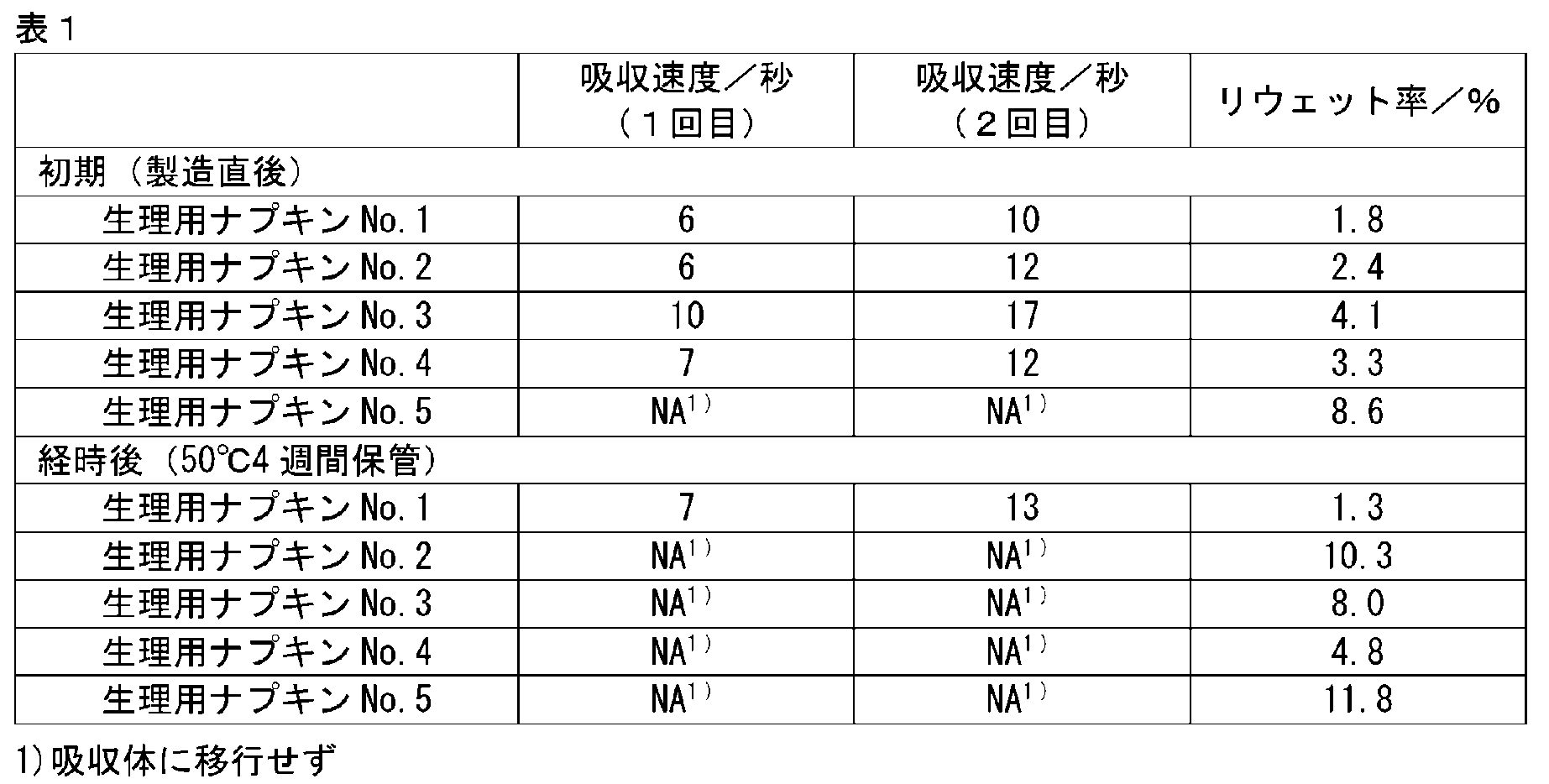
生理用ナプキンNo.1は、初期及び経時後とも、吸収が早く、そしてリウェットも少なかった。
生理用ナプキンNo.2~No.4は、経時後において、馬脱繊維血を弾き、馬脱繊維血が液透過性シートに残存した。油性成分が影響したものと思われる。
生理用ナプキンNo.5は、初期及び経時後とも、液透過性シートに馬脱繊維血が残存した。
生理用ナプキンNo.2~No.4は、経時後において、馬脱繊維血を弾き、馬脱繊維血が液透過性シートに残存した。油性成分が影響したものと思われる。
生理用ナプキンNo.5は、初期及び経時後とも、液透過性シートに馬脱繊維血が残存した。
また、個包装化した生理用ナプキンNo.1及びNo.4をパッケージに充填し、さらに段ボールに梱包した。当該段ボールを、宅配便を利用して、東京-香川間を複数回往復させた。生理用ナプキンNo.1では、ゲル状組成物No.1は、概ねその位置を変えておらず、ライン状の配置を保持していたが、生理用ナプキンNo.4では、パナセート810Sの一部が移動していた。
[実施例2]
油性成分としてのパナセート810S(日油株式会社製)を、以下に変更した以外は、製造例1と同様にてゲル状組成物及び生理用ナプキンを形成したところ、ゲル状組成物No.1及び生理用ナプキンNo.1と同様の効果を有していることを確認した。
(i)H-408BRS((a1)鎖状炭化水素テトラオールと少なくとも1の脂肪酸とのエステル,日油株式会社製)
(ii)ユニスター H-208BRS((a3)鎖状炭化水素ジオールと少なくとも1の脂肪酸とのエステル,日油株式会社製),
(iii)O-アセチルクエン酸トリブチル((c2)3個のカルボキシル基を有する鎖状炭化水素トリカルボン酸、ヒドロキシ酸、アルコキシ酸又はオキソ酸と、少なくとも1の脂肪族1価アルコールとのエステル)
(iv)クエン酸トリブチル(((c2)3個のカルボキシル基を有する鎖状炭化水素トリカルボン酸、ヒドロキシ酸、アルコキシ酸又はオキソ酸と、少なくとも1の脂肪族1価アルコールとのエステル))
(v)アジピン酸ジオクチル((c3)2個のカルボキシル基を有する鎖状炭化水素ジカルボン酸、ヒドロキシ酸、アルコキシ酸又はオキソ酸と、少なくとも1の脂肪族1価アルコールとのエステル)
(vi)エレクトールWE20((d3)脂肪酸と脂肪族1価アルコールとのエステル)
(vii)ユニオールPB500((e1)ポリオキシC3~C6アルキレングリコール)
(viii)パールリーム6(A)
(v)アジピン酸ジオクチル((c3)2個のカルボキシル基を有する鎖状炭化水素ジカルボン酸、ヒドロキシ酸、アルコキシ酸又はオキソ酸と、少なくとも1の脂肪族1価アルコールとのエステル)
(vi)エレクトールWE20((d3)脂肪酸と脂肪族1価アルコールとのエステル)
(vii)ユニオールPB500((e1)ポリオキシC3~C6アルキレングリコール)
(viii)パールリーム6(A)
1 生理用ナプキン
2 液透過性シート
3 吸収体
4 サイドシート
5 エンボス部
6 ゲル状組成物
2 液透過性シート
3 吸収体
4 サイドシート
5 エンボス部
6 ゲル状組成物
Claims (14)
- 液透過性シートと、液不透過性シートと、それらの間の吸収体とを備える吸収性物品であって、
前記液透過性シートが、油性成分と、多価アルコールと、バイオサーファクタントとを含むゲル状組成物を備えている、
ことを特徴とする、前記吸収性物品。 - 前記ゲル状組成物が、水分と接触すると前記油性成分のエマルションを形成するように構成されている、請求項1に記載の吸収性物品。
- 前記エマルションが、0.5~5.0μmの平均粒径を有する、請求項2に記載の吸収性物品。
- 前記液透過性シートが、5~60μmの平均繊維径を有する繊維を含む不織布から構成されている、請求項3に記載の吸収性物品。
- 前記ゲル状組成物が、36℃及び0.28(1/s)の剪断速度において、50~1,000Pa・sの粘度を有する、請求項1~4のいずれか一項に記載の吸収性物品。
- 前記ゲル状組成物が、前記油性成分と、前記多価アルコールと、前記バイオサーファクタントとを、それらの合計質量に基づいて、60.0~94.9質量%と、5.0~39.9質量%と、0.1~5.0質量%との比率で含む、請求項1~5のいずれか一項に記載の吸収性物品。
- 前記バイオサーファクタントが、サーファクチン、アルスロファクチン、イチュリン、及びそれらの塩、並びにそれらの任意の組み合わせからなる群から選択される、請求項1~6のいずれか一項に記載の吸収性物品。
- 前記多価アルコールが、3価以上のアルコールであるか、又は2価アルコールのポリエーテルである、請求項1~7のいずれか一項に記載の吸収性物品。
- 前記油性成分が、40℃における0.01~80mm2/sの動粘度と、0.01~4.0質量%の抱水率と、1,000未満の重量平均分子量とを有する、請求項1~8のいずれか一項に記載の吸収性物品。
- 前記油性成分が、(a1)鎖状炭化水素テトラオールと少なくとも1の脂肪酸とのエステル、(a2)鎖状炭化水素トリオールと少なくとも1の脂肪酸とのエステル、(a3)鎖状炭化水素ジオールと少なくとも1の脂肪酸とのエステル、(b1)鎖状炭化水素テトラオールと少なくとも1の脂肪族1価アルコールとのエーテル、(b2)鎖状炭化水素トリオールと少なくとも1の脂肪族1価アルコールとのエーテル、(b3)鎖状炭化水素ジオールと少なくとも1の脂肪族1価アルコールとのエーテル、(c1)4個のカルボキシル基を有する鎖状炭化水素テトラカルボン酸、ヒドロキシ酸、アルコキシ酸又はオキソ酸と、少なくとも1の脂肪族1価アルコールとのエステル、(c2)3個のカルボキシル基を有する鎖状炭化水素トリカルボン酸、ヒドロキシ酸、アルコキシ酸又はオキソ酸と、少なくとも1の脂肪族1価アルコールとのエステル、(c3)2個のカルボキシル基を有する鎖状炭化水素ジカルボン酸、ヒドロキシ酸、アルコキシ酸又はオキソ酸と、少なくとも1の脂肪族1価アルコールとのエステル、(d1)脂肪族1価アルコールと脂肪族1価アルコールとのエーテル、(d2)ジアルキルケトン、(d3)脂肪酸と脂肪族1価アルコールとのエステル、(d4)ジアルキルカーボネート、(e1)ポリオキシC3~C6アルキレングリコール、(e2)ポリオキシC3~C6アルキレングリコールと少なくとも1の脂肪酸とのエステル、(e3)ポリオキシC3~C6アルキレングリコールと少なくとも1の脂肪族1価アルコールとのエーテル、及び(f1)鎖状アルカン、並びにそれらの任意の組み合わせから成る群から選択される、請求項1~9のいずれか一項に記載の吸収性物品。
- 前記ゲル状組成物が、薬剤をさらに含む、請求項1~10のいずれか一項に記載の吸収性物品。
- 前記油性成分が、温感剤及び/又は冷感剤をさらに含む、請求項1~11のいずれか一項に記載の吸収性物品。
- 前記ゲル状組成物が、前記液透過性シートの体液と直接接触する領域に配置されている、請求項1~12のいずれか一項に記載の吸収性物品。
- 前記ゲル状組成物が、前記液透過性シートの肌当接面に、ライン状、ドット状又は粒子状で配置されている、請求項1~13のいずれか一項に記載の吸収性物品。
Applications Claiming Priority (2)
| Application Number | Priority Date | Filing Date | Title |
|---|---|---|---|
| JP2021131155A JP7840122B2 (ja) | 2021-08-11 | 2021-08-11 | 吸収性物品 |
| JP2021-131155 | 2021-08-11 |
Publications (1)
| Publication Number | Publication Date |
|---|---|
| WO2023017758A1 true WO2023017758A1 (ja) | 2023-02-16 |
Family
ID=85199973
Family Applications (1)
| Application Number | Title | Priority Date | Filing Date |
|---|---|---|---|
| PCT/JP2022/029647 Ceased WO2023017758A1 (ja) | 2021-08-11 | 2022-08-02 | 吸収性物品 |
Country Status (2)
| Country | Link |
|---|---|
| JP (2) | JP7840122B2 (ja) |
| WO (1) | WO2023017758A1 (ja) |
Families Citing this family (1)
| Publication number | Priority date | Publication date | Assignee | Title |
|---|---|---|---|---|
| WO2025169856A1 (ja) * | 2024-02-07 | 2025-08-14 | ユニ・チャーム株式会社 | ショーツ型ナプキン |
Citations (4)
| Publication number | Priority date | Publication date | Assignee | Title |
|---|---|---|---|---|
| JP2013179982A (ja) * | 2012-02-29 | 2013-09-12 | Unicharm Corp | 吸収性物品 |
| WO2015186375A1 (ja) * | 2014-06-06 | 2015-12-10 | ユニ・チャーム株式会社 | 吸収性物品 |
| JP2019131473A (ja) * | 2016-06-01 | 2019-08-08 | 株式会社カネカ | バイオサーファクタントとノニオン界面活性剤を含むことを特徴とする乳化物 |
| JP2020174996A (ja) * | 2019-04-19 | 2020-10-29 | ユニ・チャーム株式会社 | 吸収性物品 |
-
2021
- 2021-08-11 JP JP2021131155A patent/JP7840122B2/ja active Active
-
2022
- 2022-08-02 WO PCT/JP2022/029647 patent/WO2023017758A1/ja not_active Ceased
-
2024
- 2024-06-26 JP JP2024102756A patent/JP2024114819A/ja not_active Withdrawn
Patent Citations (4)
| Publication number | Priority date | Publication date | Assignee | Title |
|---|---|---|---|---|
| JP2013179982A (ja) * | 2012-02-29 | 2013-09-12 | Unicharm Corp | 吸収性物品 |
| WO2015186375A1 (ja) * | 2014-06-06 | 2015-12-10 | ユニ・チャーム株式会社 | 吸収性物品 |
| JP2019131473A (ja) * | 2016-06-01 | 2019-08-08 | 株式会社カネカ | バイオサーファクタントとノニオン界面活性剤を含むことを特徴とする乳化物 |
| JP2020174996A (ja) * | 2019-04-19 | 2020-10-29 | ユニ・チャーム株式会社 | 吸収性物品 |
Also Published As
| Publication number | Publication date |
|---|---|
| JP7840122B2 (ja) | 2026-04-03 |
| JP2023025797A (ja) | 2023-02-24 |
| JP2024114819A (ja) | 2024-08-23 |
Similar Documents
| Publication | Publication Date | Title |
|---|---|---|
| JP6021567B2 (ja) | 吸収性物品 | |
| JP6116177B2 (ja) | 吸収性物品 | |
| JP6116179B2 (ja) | 吸収性物品 | |
| JP6116178B2 (ja) | 吸収性物品 | |
| WO2014050666A1 (ja) | 吸収性物品 | |
| JP2014068954A (ja) | 不織布及び吸収性物品 | |
| JP6057648B2 (ja) | 吸収性物品 | |
| JP6012380B2 (ja) | 不織布及び吸収性物品 | |
| JP2015229075A (ja) | 吸収性物品 | |
| JP2024114819A (ja) | 吸収性物品 | |
| JP5988810B2 (ja) | 吸収性物品 | |
| JP7713914B2 (ja) | 吸収性物品 | |
| JP6104551B2 (ja) | 吸収性物品 | |
| JP5939949B2 (ja) | 吸収性物品 |
Legal Events
| Date | Code | Title | Description |
|---|---|---|---|
| 121 | Ep: the epo has been informed by wipo that ep was designated in this application |
Ref document number: 22855821 Country of ref document: EP Kind code of ref document: A1 |
|
| WWE | Wipo information: entry into national phase |
Ref document number: 2401000845 Country of ref document: TH |
|
| NENP | Non-entry into the national phase |
Ref country code: DE |
|
| 122 | Ep: pct application non-entry in european phase |
Ref document number: 22855821 Country of ref document: EP Kind code of ref document: A1 |