WO2023008513A1 - 無方向性電磁鋼板、鉄心、鉄心の製造方法、モータ、およびモータの製造方法 - Google Patents
無方向性電磁鋼板、鉄心、鉄心の製造方法、モータ、およびモータの製造方法 Download PDFInfo
- Publication number
- WO2023008513A1 WO2023008513A1 PCT/JP2022/029067 JP2022029067W WO2023008513A1 WO 2023008513 A1 WO2023008513 A1 WO 2023008513A1 JP 2022029067 W JP2022029067 W JP 2022029067W WO 2023008513 A1 WO2023008513 A1 WO 2023008513A1
- Authority
- WO
- WIPO (PCT)
- Prior art keywords
- less
- steel sheet
- oriented electrical
- electrical steel
- iron core
- Prior art date
- Legal status (The legal status is an assumption and is not a legal conclusion. Google has not performed a legal analysis and makes no representation as to the accuracy of the status listed.)
- Ceased
Links
Images
Classifications
-
- C—CHEMISTRY; METALLURGY
- C22—METALLURGY; FERROUS OR NON-FERROUS ALLOYS; TREATMENT OF ALLOYS OR NON-FERROUS METALS
- C22C—ALLOYS
- C22C38/00—Ferrous alloys, e.g. steel alloys
- C22C38/18—Ferrous alloys, e.g. steel alloys containing chromium
- C22C38/40—Ferrous alloys, e.g. steel alloys containing chromium with nickel
- C22C38/58—Ferrous alloys, e.g. steel alloys containing chromium with nickel with more than 1.5% by weight of manganese
-
- C—CHEMISTRY; METALLURGY
- C22—METALLURGY; FERROUS OR NON-FERROUS ALLOYS; TREATMENT OF ALLOYS OR NON-FERROUS METALS
- C22C—ALLOYS
- C22C38/00—Ferrous alloys, e.g. steel alloys
- C22C38/60—Ferrous alloys, e.g. steel alloys containing lead, selenium, tellurium, or antimony, or more than 0.04% by weight of sulfur
-
- C—CHEMISTRY; METALLURGY
- C21—METALLURGY OF IRON
- C21D—MODIFYING THE PHYSICAL STRUCTURE OF FERROUS METALS; GENERAL DEVICES FOR HEAT TREATMENT OF FERROUS OR NON-FERROUS METALS OR ALLOYS; MAKING METAL MALLEABLE, e.g. BY DECARBURISATION OR TEMPERING
- C21D6/00—Heat treatment of ferrous alloys
- C21D6/008—Heat treatment of ferrous alloys containing Si
-
- C—CHEMISTRY; METALLURGY
- C21—METALLURGY OF IRON
- C21D—MODIFYING THE PHYSICAL STRUCTURE OF FERROUS METALS; GENERAL DEVICES FOR HEAT TREATMENT OF FERROUS OR NON-FERROUS METALS OR ALLOYS; MAKING METAL MALLEABLE, e.g. BY DECARBURISATION OR TEMPERING
- C21D8/00—Modifying the physical properties of ferrous metals or ferrous alloys by deformation combined with, or followed by, heat treatment
- C21D8/12—Modifying the physical properties of ferrous metals or ferrous alloys by deformation combined with, or followed by, heat treatment during manufacturing of articles with special electromagnetic properties
-
- C—CHEMISTRY; METALLURGY
- C21—METALLURGY OF IRON
- C21D—MODIFYING THE PHYSICAL STRUCTURE OF FERROUS METALS; GENERAL DEVICES FOR HEAT TREATMENT OF FERROUS OR NON-FERROUS METALS OR ALLOYS; MAKING METAL MALLEABLE, e.g. BY DECARBURISATION OR TEMPERING
- C21D8/00—Modifying the physical properties of ferrous metals or ferrous alloys by deformation combined with, or followed by, heat treatment
- C21D8/12—Modifying the physical properties of ferrous metals or ferrous alloys by deformation combined with, or followed by, heat treatment during manufacturing of articles with special electromagnetic properties
- C21D8/1216—Modifying the physical properties of ferrous metals or ferrous alloys by deformation combined with, or followed by, heat treatment during manufacturing of articles with special electromagnetic properties characterised by the working steps
- C21D8/1233—Cold rolling
-
- C—CHEMISTRY; METALLURGY
- C21—METALLURGY OF IRON
- C21D—MODIFYING THE PHYSICAL STRUCTURE OF FERROUS METALS; GENERAL DEVICES FOR HEAT TREATMENT OF FERROUS OR NON-FERROUS METALS OR ALLOYS; MAKING METAL MALLEABLE, e.g. BY DECARBURISATION OR TEMPERING
- C21D8/00—Modifying the physical properties of ferrous metals or ferrous alloys by deformation combined with, or followed by, heat treatment
- C21D8/12—Modifying the physical properties of ferrous metals or ferrous alloys by deformation combined with, or followed by, heat treatment during manufacturing of articles with special electromagnetic properties
- C21D8/1244—Modifying the physical properties of ferrous metals or ferrous alloys by deformation combined with, or followed by, heat treatment during manufacturing of articles with special electromagnetic properties characterised by the heat treatment
- C21D8/1261—Modifying the physical properties of ferrous metals or ferrous alloys by deformation combined with, or followed by, heat treatment during manufacturing of articles with special electromagnetic properties characterised by the heat treatment following hot rolling
-
- C—CHEMISTRY; METALLURGY
- C21—METALLURGY OF IRON
- C21D—MODIFYING THE PHYSICAL STRUCTURE OF FERROUS METALS; GENERAL DEVICES FOR HEAT TREATMENT OF FERROUS OR NON-FERROUS METALS OR ALLOYS; MAKING METAL MALLEABLE, e.g. BY DECARBURISATION OR TEMPERING
- C21D8/00—Modifying the physical properties of ferrous metals or ferrous alloys by deformation combined with, or followed by, heat treatment
- C21D8/12—Modifying the physical properties of ferrous metals or ferrous alloys by deformation combined with, or followed by, heat treatment during manufacturing of articles with special electromagnetic properties
- C21D8/1244—Modifying the physical properties of ferrous metals or ferrous alloys by deformation combined with, or followed by, heat treatment during manufacturing of articles with special electromagnetic properties characterised by the heat treatment
- C21D8/1266—Modifying the physical properties of ferrous metals or ferrous alloys by deformation combined with, or followed by, heat treatment during manufacturing of articles with special electromagnetic properties characterised by the heat treatment between cold rolling steps
-
- C—CHEMISTRY; METALLURGY
- C21—METALLURGY OF IRON
- C21D—MODIFYING THE PHYSICAL STRUCTURE OF FERROUS METALS; GENERAL DEVICES FOR HEAT TREATMENT OF FERROUS OR NON-FERROUS METALS OR ALLOYS; MAKING METAL MALLEABLE, e.g. BY DECARBURISATION OR TEMPERING
- C21D8/00—Modifying the physical properties of ferrous metals or ferrous alloys by deformation combined with, or followed by, heat treatment
- C21D8/12—Modifying the physical properties of ferrous metals or ferrous alloys by deformation combined with, or followed by, heat treatment during manufacturing of articles with special electromagnetic properties
- C21D8/1244—Modifying the physical properties of ferrous metals or ferrous alloys by deformation combined with, or followed by, heat treatment during manufacturing of articles with special electromagnetic properties characterised by the heat treatment
- C21D8/1272—Final recrystallisation annealing
-
- C—CHEMISTRY; METALLURGY
- C21—METALLURGY OF IRON
- C21D—MODIFYING THE PHYSICAL STRUCTURE OF FERROUS METALS; GENERAL DEVICES FOR HEAT TREATMENT OF FERROUS OR NON-FERROUS METALS OR ALLOYS; MAKING METAL MALLEABLE, e.g. BY DECARBURISATION OR TEMPERING
- C21D9/00—Heat treatment, e.g. annealing, hardening, quenching or tempering, adapted for particular articles; Furnaces therefor
- C21D9/46—Heat treatment, e.g. annealing, hardening, quenching or tempering, adapted for particular articles; Furnaces therefor for sheet metals
-
- C—CHEMISTRY; METALLURGY
- C22—METALLURGY; FERROUS OR NON-FERROUS ALLOYS; TREATMENT OF ALLOYS OR NON-FERROUS METALS
- C22C—ALLOYS
- C22C38/00—Ferrous alloys, e.g. steel alloys
-
- C—CHEMISTRY; METALLURGY
- C22—METALLURGY; FERROUS OR NON-FERROUS ALLOYS; TREATMENT OF ALLOYS OR NON-FERROUS METALS
- C22C—ALLOYS
- C22C38/00—Ferrous alloys, e.g. steel alloys
- C22C38/001—Ferrous alloys, e.g. steel alloys containing N
-
- C—CHEMISTRY; METALLURGY
- C22—METALLURGY; FERROUS OR NON-FERROUS ALLOYS; TREATMENT OF ALLOYS OR NON-FERROUS METALS
- C22C—ALLOYS
- C22C38/00—Ferrous alloys, e.g. steel alloys
- C22C38/002—Ferrous alloys, e.g. steel alloys containing In, Mg, or other elements not provided for in one single group C22C38/001 - C22C38/60
-
- C—CHEMISTRY; METALLURGY
- C22—METALLURGY; FERROUS OR NON-FERROUS ALLOYS; TREATMENT OF ALLOYS OR NON-FERROUS METALS
- C22C—ALLOYS
- C22C38/00—Ferrous alloys, e.g. steel alloys
- C22C38/004—Very low carbon steels, i.e. having a carbon content of less than 0,01%
-
- C—CHEMISTRY; METALLURGY
- C22—METALLURGY; FERROUS OR NON-FERROUS ALLOYS; TREATMENT OF ALLOYS OR NON-FERROUS METALS
- C22C—ALLOYS
- C22C38/00—Ferrous alloys, e.g. steel alloys
- C22C38/005—Ferrous alloys, e.g. steel alloys containing rare earths, i.e. Sc, Y, Lanthanides
-
- C—CHEMISTRY; METALLURGY
- C22—METALLURGY; FERROUS OR NON-FERROUS ALLOYS; TREATMENT OF ALLOYS OR NON-FERROUS METALS
- C22C—ALLOYS
- C22C38/00—Ferrous alloys, e.g. steel alloys
- C22C38/008—Ferrous alloys, e.g. steel alloys containing tin
-
- C—CHEMISTRY; METALLURGY
- C22—METALLURGY; FERROUS OR NON-FERROUS ALLOYS; TREATMENT OF ALLOYS OR NON-FERROUS METALS
- C22C—ALLOYS
- C22C38/00—Ferrous alloys, e.g. steel alloys
- C22C38/02—Ferrous alloys, e.g. steel alloys containing silicon
-
- C—CHEMISTRY; METALLURGY
- C22—METALLURGY; FERROUS OR NON-FERROUS ALLOYS; TREATMENT OF ALLOYS OR NON-FERROUS METALS
- C22C—ALLOYS
- C22C38/00—Ferrous alloys, e.g. steel alloys
- C22C38/04—Ferrous alloys, e.g. steel alloys containing manganese
-
- C—CHEMISTRY; METALLURGY
- C22—METALLURGY; FERROUS OR NON-FERROUS ALLOYS; TREATMENT OF ALLOYS OR NON-FERROUS METALS
- C22C—ALLOYS
- C22C38/00—Ferrous alloys, e.g. steel alloys
- C22C38/06—Ferrous alloys, e.g. steel alloys containing aluminium
-
- C—CHEMISTRY; METALLURGY
- C22—METALLURGY; FERROUS OR NON-FERROUS ALLOYS; TREATMENT OF ALLOYS OR NON-FERROUS METALS
- C22C—ALLOYS
- C22C38/00—Ferrous alloys, e.g. steel alloys
- C22C38/08—Ferrous alloys, e.g. steel alloys containing nickel
-
- C—CHEMISTRY; METALLURGY
- C22—METALLURGY; FERROUS OR NON-FERROUS ALLOYS; TREATMENT OF ALLOYS OR NON-FERROUS METALS
- C22C—ALLOYS
- C22C38/00—Ferrous alloys, e.g. steel alloys
- C22C38/12—Ferrous alloys, e.g. steel alloys containing tungsten, tantalum, molybdenum, vanadium, or niobium
-
- C—CHEMISTRY; METALLURGY
- C22—METALLURGY; FERROUS OR NON-FERROUS ALLOYS; TREATMENT OF ALLOYS OR NON-FERROUS METALS
- C22C—ALLOYS
- C22C38/00—Ferrous alloys, e.g. steel alloys
- C22C38/14—Ferrous alloys, e.g. steel alloys containing titanium or zirconium
-
- C—CHEMISTRY; METALLURGY
- C22—METALLURGY; FERROUS OR NON-FERROUS ALLOYS; TREATMENT OF ALLOYS OR NON-FERROUS METALS
- C22C—ALLOYS
- C22C38/00—Ferrous alloys, e.g. steel alloys
- C22C38/16—Ferrous alloys, e.g. steel alloys containing copper
-
- C—CHEMISTRY; METALLURGY
- C22—METALLURGY; FERROUS OR NON-FERROUS ALLOYS; TREATMENT OF ALLOYS OR NON-FERROUS METALS
- C22C—ALLOYS
- C22C38/00—Ferrous alloys, e.g. steel alloys
- C22C38/18—Ferrous alloys, e.g. steel alloys containing chromium
- C22C38/34—Ferrous alloys, e.g. steel alloys containing chromium with more than 1.5% by weight of silicon
-
- C—CHEMISTRY; METALLURGY
- C22—METALLURGY; FERROUS OR NON-FERROUS ALLOYS; TREATMENT OF ALLOYS OR NON-FERROUS METALS
- C22C—ALLOYS
- C22C38/00—Ferrous alloys, e.g. steel alloys
- C22C38/18—Ferrous alloys, e.g. steel alloys containing chromium
- C22C38/40—Ferrous alloys, e.g. steel alloys containing chromium with nickel
- C22C38/42—Ferrous alloys, e.g. steel alloys containing chromium with nickel with copper
-
- C—CHEMISTRY; METALLURGY
- C22—METALLURGY; FERROUS OR NON-FERROUS ALLOYS; TREATMENT OF ALLOYS OR NON-FERROUS METALS
- C22C—ALLOYS
- C22C38/00—Ferrous alloys, e.g. steel alloys
- C22C38/18—Ferrous alloys, e.g. steel alloys containing chromium
- C22C38/40—Ferrous alloys, e.g. steel alloys containing chromium with nickel
- C22C38/44—Ferrous alloys, e.g. steel alloys containing chromium with nickel with molybdenum or tungsten
-
- C—CHEMISTRY; METALLURGY
- C22—METALLURGY; FERROUS OR NON-FERROUS ALLOYS; TREATMENT OF ALLOYS OR NON-FERROUS METALS
- C22C—ALLOYS
- C22C38/00—Ferrous alloys, e.g. steel alloys
- C22C38/18—Ferrous alloys, e.g. steel alloys containing chromium
- C22C38/40—Ferrous alloys, e.g. steel alloys containing chromium with nickel
- C22C38/46—Ferrous alloys, e.g. steel alloys containing chromium with nickel with vanadium
-
- C—CHEMISTRY; METALLURGY
- C22—METALLURGY; FERROUS OR NON-FERROUS ALLOYS; TREATMENT OF ALLOYS OR NON-FERROUS METALS
- C22C—ALLOYS
- C22C38/00—Ferrous alloys, e.g. steel alloys
- C22C38/18—Ferrous alloys, e.g. steel alloys containing chromium
- C22C38/40—Ferrous alloys, e.g. steel alloys containing chromium with nickel
- C22C38/48—Ferrous alloys, e.g. steel alloys containing chromium with nickel with niobium or tantalum
-
- C—CHEMISTRY; METALLURGY
- C22—METALLURGY; FERROUS OR NON-FERROUS ALLOYS; TREATMENT OF ALLOYS OR NON-FERROUS METALS
- C22C—ALLOYS
- C22C38/00—Ferrous alloys, e.g. steel alloys
- C22C38/18—Ferrous alloys, e.g. steel alloys containing chromium
- C22C38/40—Ferrous alloys, e.g. steel alloys containing chromium with nickel
- C22C38/50—Ferrous alloys, e.g. steel alloys containing chromium with nickel with titanium or zirconium
-
- C—CHEMISTRY; METALLURGY
- C22—METALLURGY; FERROUS OR NON-FERROUS ALLOYS; TREATMENT OF ALLOYS OR NON-FERROUS METALS
- C22C—ALLOYS
- C22C38/00—Ferrous alloys, e.g. steel alloys
- C22C38/18—Ferrous alloys, e.g. steel alloys containing chromium
- C22C38/40—Ferrous alloys, e.g. steel alloys containing chromium with nickel
- C22C38/54—Ferrous alloys, e.g. steel alloys containing chromium with nickel with boron
-
- H—ELECTRICITY
- H01—ELECTRIC ELEMENTS
- H01F—MAGNETS; INDUCTANCES; TRANSFORMERS; SELECTION OF MATERIALS FOR THEIR MAGNETIC PROPERTIES
- H01F1/00—Magnets or magnetic bodies characterised by the magnetic materials therefor; Selection of materials for their magnetic properties
- H01F1/01—Magnets or magnetic bodies characterised by the magnetic materials therefor; Selection of materials for their magnetic properties of inorganic materials
- H01F1/03—Magnets or magnetic bodies characterised by the magnetic materials therefor; Selection of materials for their magnetic properties of inorganic materials characterised by their coercivity
- H01F1/12—Magnets or magnetic bodies characterised by the magnetic materials therefor; Selection of materials for their magnetic properties of inorganic materials characterised by their coercivity of soft-magnetic materials
- H01F1/14—Magnets or magnetic bodies characterised by the magnetic materials therefor; Selection of materials for their magnetic properties of inorganic materials characterised by their coercivity of soft-magnetic materials metals or alloys
- H01F1/147—Alloys characterised by their composition
-
- H—ELECTRICITY
- H01—ELECTRIC ELEMENTS
- H01F—MAGNETS; INDUCTANCES; TRANSFORMERS; SELECTION OF MATERIALS FOR THEIR MAGNETIC PROPERTIES
- H01F1/00—Magnets or magnetic bodies characterised by the magnetic materials therefor; Selection of materials for their magnetic properties
- H01F1/01—Magnets or magnetic bodies characterised by the magnetic materials therefor; Selection of materials for their magnetic properties of inorganic materials
- H01F1/03—Magnets or magnetic bodies characterised by the magnetic materials therefor; Selection of materials for their magnetic properties of inorganic materials characterised by their coercivity
- H01F1/12—Magnets or magnetic bodies characterised by the magnetic materials therefor; Selection of materials for their magnetic properties of inorganic materials characterised by their coercivity of soft-magnetic materials
- H01F1/14—Magnets or magnetic bodies characterised by the magnetic materials therefor; Selection of materials for their magnetic properties of inorganic materials characterised by their coercivity of soft-magnetic materials metals or alloys
- H01F1/147—Alloys characterised by their composition
- H01F1/14708—Fe-Ni based alloys
- H01F1/14716—Fe-Ni based alloys in the form of sheets
-
- H—ELECTRICITY
- H01—ELECTRIC ELEMENTS
- H01F—MAGNETS; INDUCTANCES; TRANSFORMERS; SELECTION OF MATERIALS FOR THEIR MAGNETIC PROPERTIES
- H01F1/00—Magnets or magnetic bodies characterised by the magnetic materials therefor; Selection of materials for their magnetic properties
- H01F1/01—Magnets or magnetic bodies characterised by the magnetic materials therefor; Selection of materials for their magnetic properties of inorganic materials
- H01F1/03—Magnets or magnetic bodies characterised by the magnetic materials therefor; Selection of materials for their magnetic properties of inorganic materials characterised by their coercivity
- H01F1/12—Magnets or magnetic bodies characterised by the magnetic materials therefor; Selection of materials for their magnetic properties of inorganic materials characterised by their coercivity of soft-magnetic materials
- H01F1/14—Magnets or magnetic bodies characterised by the magnetic materials therefor; Selection of materials for their magnetic properties of inorganic materials characterised by their coercivity of soft-magnetic materials metals or alloys
- H01F1/147—Alloys characterised by their composition
- H01F1/14766—Fe-Si based alloys
- H01F1/14791—Fe-Si-Al based alloys, e.g. Sendust
-
- H—ELECTRICITY
- H01—ELECTRIC ELEMENTS
- H01F—MAGNETS; INDUCTANCES; TRANSFORMERS; SELECTION OF MATERIALS FOR THEIR MAGNETIC PROPERTIES
- H01F1/00—Magnets or magnetic bodies characterised by the magnetic materials therefor; Selection of materials for their magnetic properties
- H01F1/01—Magnets or magnetic bodies characterised by the magnetic materials therefor; Selection of materials for their magnetic properties of inorganic materials
- H01F1/03—Magnets or magnetic bodies characterised by the magnetic materials therefor; Selection of materials for their magnetic properties of inorganic materials characterised by their coercivity
- H01F1/12—Magnets or magnetic bodies characterised by the magnetic materials therefor; Selection of materials for their magnetic properties of inorganic materials characterised by their coercivity of soft-magnetic materials
- H01F1/14—Magnets or magnetic bodies characterised by the magnetic materials therefor; Selection of materials for their magnetic properties of inorganic materials characterised by their coercivity of soft-magnetic materials metals or alloys
- H01F1/16—Magnets or magnetic bodies characterised by the magnetic materials therefor; Selection of materials for their magnetic properties of inorganic materials characterised by their coercivity of soft-magnetic materials metals or alloys in the form of sheets
-
- H—ELECTRICITY
- H01—ELECTRIC ELEMENTS
- H01F—MAGNETS; INDUCTANCES; TRANSFORMERS; SELECTION OF MATERIALS FOR THEIR MAGNETIC PROPERTIES
- H01F41/00—Apparatus or processes specially adapted for manufacturing or assembling magnets, inductances or transformers; Apparatus or processes specially adapted for manufacturing materials characterised by their magnetic properties
- H01F41/02—Apparatus or processes specially adapted for manufacturing or assembling magnets, inductances or transformers; Apparatus or processes specially adapted for manufacturing materials characterised by their magnetic properties for manufacturing cores, coils, or magnets
-
- H—ELECTRICITY
- H01—ELECTRIC ELEMENTS
- H01F—MAGNETS; INDUCTANCES; TRANSFORMERS; SELECTION OF MATERIALS FOR THEIR MAGNETIC PROPERTIES
- H01F41/00—Apparatus or processes specially adapted for manufacturing or assembling magnets, inductances or transformers; Apparatus or processes specially adapted for manufacturing materials characterised by their magnetic properties
- H01F41/02—Apparatus or processes specially adapted for manufacturing or assembling magnets, inductances or transformers; Apparatus or processes specially adapted for manufacturing materials characterised by their magnetic properties for manufacturing cores, coils, or magnets
- H01F41/0206—Manufacturing of magnetic cores by mechanical means
- H01F41/0233—Manufacturing of magnetic circuits made from sheets
-
- B—PERFORMING OPERATIONS; TRANSPORTING
- B21—MECHANICAL METAL-WORKING WITHOUT ESSENTIALLY REMOVING MATERIAL; PUNCHING METAL
- B21D—WORKING OR PROCESSING OF SHEET METAL OR METAL TUBES, RODS OR PROFILES WITHOUT ESSENTIALLY REMOVING MATERIAL; PUNCHING METAL
- B21D28/00—Shaping by press-cutting; Perforating
- B21D28/02—Punching blanks or articles with or without obtaining scrap; Notching
-
- C—CHEMISTRY; METALLURGY
- C22—METALLURGY; FERROUS OR NON-FERROUS ALLOYS; TREATMENT OF ALLOYS OR NON-FERROUS METALS
- C22C—ALLOYS
- C22C2202/00—Physical properties
- C22C2202/02—Magnetic
-
- Y—GENERAL TAGGING OF NEW TECHNOLOGICAL DEVELOPMENTS; GENERAL TAGGING OF CROSS-SECTIONAL TECHNOLOGIES SPANNING OVER SEVERAL SECTIONS OF THE IPC; TECHNICAL SUBJECTS COVERED BY FORMER USPC CROSS-REFERENCE ART COLLECTIONS [XRACs] AND DIGESTS
- Y02—TECHNOLOGIES OR APPLICATIONS FOR MITIGATION OR ADAPTATION AGAINST CLIMATE CHANGE
- Y02T—CLIMATE CHANGE MITIGATION TECHNOLOGIES RELATED TO TRANSPORTATION
- Y02T10/00—Road transport of goods or passengers
- Y02T10/60—Other road transportation technologies with climate change mitigation effect
- Y02T10/64—Electric machine technologies in electromobility
Definitions
- the present invention relates to a non-oriented electrical steel sheet. More specifically, the present invention relates to a non-oriented electrical steel sheet, an iron core, a method for manufacturing an iron core, a motor, and a method for manufacturing a motor, which are suitable for integrally punched iron cores for motors such as electric vehicles and hybrid vehicles.
- This application claims priority based on Japanese Patent Application No. 2021-126289 filed in Japan on July 30, 2021, the content of which is incorporated herein.
- a motor generally consists of a stator and a rotor.
- Iron cores for this stator include integral punched iron cores and split iron cores.
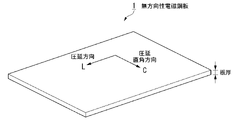
- Non-oriented electromagnetic cores with good magnetic properties in the rolling direction (hereinafter also referred to as "L direction”) and in the direction perpendicular to the rolling direction (hereinafter also referred to as "C direction”) are used for integrally punched cores and split cores.
- a steel plate is required.
- each member of the motor is required to have high shape accuracy.
- both integrally stamped cores and split cores are formed by stamping steel blanks.
- the shape accuracy after the punching process may be degraded due to the mechanical anisotropy of the steel plate blank. be. Therefore, non-oriented electrical steel sheets with small mechanical anisotropy are desired for use in integrally punched iron cores.
- Patent Document 1 discloses a technique related to a non-oriented electrical steel sheet with excellent magnetic properties.
- Patent Literature 2 discloses a technique related to a non-oriented electrical steel sheet that can improve the motor efficiency of a split core motor.
- Patent Document 3 discloses a technique related to a non-oriented electrical steel sheet having excellent magnetic properties.
- the present invention has been made in view of the above problems, and provides a non-oriented electrical steel sheet having excellent magnetic properties and small mechanical anisotropy for an integrally punched iron core, an iron core, a method for manufacturing an iron core, and a motor. , and a motor manufacturing method.
- the gist of the present invention is as follows.
- a non-oriented electrical steel sheet in % by mass, C: 0.005% or less, Si: 1.0% or more and 5.0% or less, sol. Al: less than 2.5%, Mn: 3.0% or less, P: 0.3% or less, S: 0.01% or less, N: 0.01% or less, B: 0.10% or less, O: 0.10% or less, Mg: 0.10% or less, Ca: 0.01% or less, Ti: 0.10% or less, V: 0.10% or less, Cr: 5.0% or less, Ni: 5.0% or less, Cu: 5.0% or less, Zr: 0.10% or less, Sn: 0.10% or less, Sb: 0.10% or less, Ce: 0.10% or less, Nd: 0.10% or less, Bi: 0.10% or less, W: 0.10% or less, Mo: 0.10% or less, Nb: 0.10% or less, Y: 0.10% or less, and has a chemical composition with the balance consisting of Fe and impur
- X (2 ⁇ B 50L +B 50C )/(3 ⁇ Is) (Formula 1) (here, B 50L is the magnetic flux density in the rolling direction when magnetized with a magnetizing force of 5000 A / m. B 50C is the magnetic flux density in the direction perpendicular to the rolling when magnetized with a magnetizing force of 5000 A / m. Is is the spontaneous magnetization at room temperature. )
- B 50L is the magnetic flux density in the rolling direction when magnetized with a magnetizing force of 5000 A / m.
- B 50C is the magnetic flux density in the direction perpendicular to the rolling when magnetized with a magnetizing force of 5000 A / m.
- Is is the spontaneous magnetization at room temperature.
- Al 0.10% or more and less than 2.5%, Mn: 0.0010% or more and 3.0% or less, P: 0.0010% or more and 0.3% or less, S: 0.0001% or more and 0.01% or less, N: more than 0.0015% and 0.01% or less, B: 0.0001% or more and 0.10% or less, O: 0.0001% or more and 0.10% or less, Mg: 0.0001% or more and 0.10% or less, Ca: 0.0003% or more and 0.01% or less, Ti: 0.0001% or more and 0.10% or less, V: 0.0001% or more and 0.10% or less, Cr: 0.0010% or more and 5.0% or less, Ni: 0.0010% or more and 5.0% or less, Cu: 0.0010% or more and 5.0% or less, Zr: 0.0002% or more and 0.10% or less, Sn: 0.0010% or more and 0.10% or less, Sb: 0.0010% or more and 0.10% or less, Ce: 0.001% or more and 0.1
- the total Al content may be greater than 4.0%.
- the X value may be 0.800 or more and less than 0.845.
- the X value may be 0.800 or more and less than 0.830.
- a core according to an aspect of the present invention may include the non-oriented electrical steel sheet according to any one of (1) to (6) above.
- a method for manufacturing an iron core according to an aspect of the present invention may include processing and laminating the non-oriented electrical steel sheet according to any one of (1) to (6) above. .
- a motor according to an aspect of the present invention may include the core described in (7) above.
- a method for manufacturing a motor according to an aspect of the present invention includes a step of processing and laminating the non-oriented electrical steel sheets according to any one of (1) to (6) above to manufacture an iron core, and You may have the process of assembling the said core.
- a non-oriented electrical steel sheet having excellent magnetic properties and small mechanical anisotropy, an iron core, a method for manufacturing an iron core, a motor, and a method for manufacturing a motor are provided for an integrally punched iron core. can provide.
- FIG. 1 is a schematic diagram of a non-oriented electrical steel sheet according to an embodiment of the present invention.
- FIG. 1 shows a schematic diagram of a non-oriented electrical steel sheet according to one embodiment of the present invention.
- the non-oriented electrical steel sheet according to the present embodiment contains Si as a chemical composition, optionally contains selective elements, and the balance consists of Fe and impurities. Each element will be described below.
- C 0% or more and 0.005% or less
- C (carbon) is an element that is contained as an impurity and deteriorates magnetic properties. Therefore, the C content should be 0.005% or less. Preferably, it is 0.003% or less. Since the C content is preferably small, there is no need to limit the lower limit, and the lower limit may be 0%. However, since it is not easy to make the content 0% industrially, the lower limit may be more than 0% or 0.0010%.
- Si 1.0% or more and 5.0% or less Si (silicon) is an element effective in increasing the resistivity of the steel sheet and reducing iron loss. Therefore, the Si content should be 1.0% or more. Moreover, Si is an effective element for achieving both magnetic properties and mechanical anisotropy as a non-oriented electrical steel sheet for an integrally punched iron core. In this case, the Si content is preferably greater than 3.25%, more preferably 3.27% or more, further preferably 3.30% or more, and 3.40% or more. is more preferred. On the other hand, if it is contained excessively, the magnetic flux density is remarkably lowered. Therefore, the Si content should be 5.0% or less. The Si content is preferably 4.0% or less, more preferably 3.5% or less.
- sol. Al 0% or more and less than 2.5%
- Al aluminum
- sol. Al content is less than 2.5%.
- sol. There is no need to limit the lower limit of Al, and the lower limit may be 0%. However, in order to more reliably obtain the effect of the above action, sol. It is preferable to set the Al content to 0.10% or more.
- sol. Al means acid-soluble aluminum.
- Si and Al are elements that are effective in achieving both magnetic properties and mechanical anisotropy. Therefore, Si and sol.
- the total Al content is preferably over 4.0%, more preferably over 4.10%, and even more preferably over 4.15%. On the other hand, since Si and Al have high solid-solution strengthening ability, cold rolling becomes difficult when they are contained excessively. Therefore, Si and sol.
- the total Al content is preferably less than 5.5%.
- Mn 0% or more and 3.0% or less
- Mn manganese
- the Mn content is set to 3.0% or less. Preferably, it is 2.5% or less.
- the lower limit of Mn is preferably 0%.
- the Mn content is preferably 0.0010% or more, more preferably 0.010% or more.
- P 0% or more and 0.3% or less
- P phosphorus
- P is an element generally contained as an impurity.
- P since it has the effect of improving the texture of the non-oriented electrical steel sheet and improving the magnetic properties, it may be contained as necessary.
- P since P is also a solid-solution strengthening element, an excessive P content hardens the steel sheet and makes cold rolling difficult. Therefore, the P content should be 0.3% or less.
- the P content is preferably 0.2% or less. There is no need to limit the lower limit of P, and the lower limit may be 0%. However, in order to more reliably obtain the above-mentioned effects, the P content is preferably 0.0010% or more, more preferably 0.015% or more.
- S 0% or more and 0.01% or less S (sulfur) is contained as an impurity, combines with Mn in steel to form fine MnS, inhibits grain growth during annealing, It degrades the magnetic properties of the electrical steel sheet. Therefore, the S content should be 0.01% or less.
- the S content is preferably 0.005% or less, more preferably 0.003% or less. Since the S content is preferably small, there is no need to limit the lower limit, and the lower limit may be 0%. However, since it is not easy to reduce the content to 0% industrially, the lower limit may be set to 0.0001%.
- N 0% or more and 0.01% or less N (nitrogen) is contained as an impurity, combines with Al to form fine AlN, inhibits the growth of crystal grains during annealing, and degrades magnetic properties. Therefore, the N content is set to 0.01% or less.
- the N content is preferably 0.005% or less, more preferably 0.003% or less. Since the N content is preferably small, there is no need to limit the lower limit, and the lower limit may be 0%. However, since it is not easy to reduce the content to 0% industrially, the lower limit may be 0.0001% or more, may be more than 0.0015%, or may be 0.0025% or more.
- Sn 0% or more and 0.10% or less
- Sb 0% or more and 0.10% or less
- Sn (tin) and Sb (antimony) improve the texture of the non-oriented electrical steel sheet and improve the magnetic properties (e.g., magnetic flux density ), it may be contained as necessary. However, if it is contained excessively, it may embrittle the steel and cause cold-rolling fracture, and may deteriorate the magnetic properties. Therefore, the contents of Sn and Sb are each set to 0.10% or less. Sn and Sb do not need to have a lower limit, and the lower limit may be 0%. However, in order to more reliably obtain the effects of the above action, the Sn content is preferably 0.0010% or more, more preferably 0.01% or more. The Sb content is preferably 0.0010% or more, preferably 0.002% or more, more preferably 0.01% or more, and more than 0.025%. More preferred.
- Ca 0% or more and 0.01% or less
- Ca (calcium) suppresses precipitation of fine sulfides (MnS, Cu 2 S, etc.) by forming coarse sulfides, so it is an effective choice for inclusion control. It is an element, and when added in an appropriate amount, it has the effect of improving crystal grain growth and improving magnetic properties (for example, iron loss). However, if it is contained excessively, the effects due to the above action become saturated, leading to an increase in cost. Therefore, the Ca content should be 0.01% or less.
- the Ca content is preferably 0.008% or less, more preferably 0.005% or less.
- the Ca content is preferably 0.001% or more, more preferably 0.003% or more.
- Cr 0% or more and 5.0% or less Cr (chromium) is a selective element that increases specific resistance and improves magnetic properties (for example, iron loss). However, if it is contained excessively, the saturation magnetic flux density may be lowered, and the effect due to the above action is saturated, leading to an increase in cost. Therefore, the Cr content is set to 5.0% or less.
- the Cr content is preferably 0.5% or less, more preferably 0.1% or less. There is no need to limit the lower limit of Cr, and the lower limit may be 0%. However, the Cr content is preferably 0.0010% or more in order to more reliably obtain the effects of the above action.
- Ni 0% or more and 5.0% or less
- Ni (nickel) is a selective element that improves magnetic properties (for example, saturation magnetic flux density). However, if it is contained excessively, the effects due to the above action become saturated, leading to an increase in cost. Therefore, the Ni content is set to 5.0% or less.
- the Ni content is preferably 0.5% or less, more preferably 0.1% or less. There is no need to limit the lower limit of Ni, and the lower limit may be 0%. However, the Ni content is preferably 0.0010% or more in order to more reliably obtain the effects of the above action.
- Cu 0% or more and 5.0% or less
- Cu (copper) is a selective element that improves steel sheet strength. However, if it is contained excessively, the saturation magnetic flux density may be lowered, and the effect due to the above action is saturated, leading to an increase in cost. Therefore, the Cu content is set to 5.0% or less.
- the Cu content is preferably 0.1% or less. There is no need to limit the lower limit of Cu, and the lower limit may be 0%. However, the Cu content is preferably 0.0010% or more in order to more reliably obtain the effects of the above action.
- Ce 0% or more and 0.10% or less
- Ce suppresses the precipitation of fine sulfides (MnS, Cu 2 S, etc.) by forming coarse sulfides and oxysulfides, and improves grain growth.
- MnS, Cu 2 S, etc. fine sulfides
- the Ce content should be 0.10% or less.
- the Ce content is preferably 0.01% or less, more preferably 0.009% or less, and even more preferably 0.008% or less.
- the Ce content is preferably 0.001% or more in order to more reliably obtain the effects of the above action.
- the Ce content is more preferably 0.002% or more, more preferably 0.003% or more, and even more preferably 0.005% or more.
- the chemical composition of the non-oriented electrical steel sheet according to the present embodiment includes, in addition to the above elements, selective elements such as B, O, Mg, Ti, V, Zr, Nd, Bi, W, Mo, Nb, Y may be contained.
- selective elements such as B, O, Mg, Ti, V, Zr, Nd, Bi, W, Mo, Nb, Y may be contained.
- the content of these selective elements may be controlled based on known knowledge. For example, the content of these selective elements may be as follows.
- B 0% or more and 0.10% or less
- O 0% or more and 0.10% or less
- Mg 0% or more and 0.10% or less
- Ti 0% or more and 0.10% or less
- V 0% or more and 0.10% or less
- Zr 0% or more and 0.10% or less
- Nd 0% or more and 0.10% or less
- Bi 0% or more and 0.10% or less
- W 0% or more and 0.10% or less
- Mo 0% or more and 0.10% or less
- Nb 0% or more and 0.10% or less
- Y 0% or more and 0.10% or less.
- the non-oriented electrical steel sheet according to the present embodiment has a chemical composition of, in mass%, C: 0.0010% or more and 0.005% or less, sol. Al: 0.10% or more and less than 2.5%, Mn: 0.0010% or more and 3.0% or less, P: 0.0010% or more and 0.3% or less, S: 0.0001% or more and 0.01% or less, N: more than 0.0015% and 0.01% or less, B: 0.0001% or more and 0.10% or less, O: 0.0001% or more and 0.10% or less, Mg: 0.0001% or more and 0.10% or less, Ca: 0.0003% or more and 0.01% or less, Ti: 0.0001% or more and 0.10% or less, V: 0.0001% or more and 0.10% or less, Cr: 0.0010% or more and 5.0% or less, Ni: 0.0010% or more and 5.0% or less, Cu: 0.0010% or more and 5.0% or less, Zr: 0.0002% or more and 0.10% or less, sol
- the B content is preferably 0.01% or less
- the O content is preferably 0.01% or less
- the Mg content is preferably 0.005% or less
- the Ti content is preferably 0.002% or less
- the V content is preferably 0.002% or less
- the Zr content is preferably 0.002% or less
- the Nd content is 0.01%
- Bi content is preferably 0.01% or less
- W content is preferably 0.01% or less
- Mo content is preferably 0.01% or less
- the Nb content is 0.002% or less
- the Y content is preferably 0.01% or less
- the Ti content is preferably 0.001% or more
- the V content is preferably 0.002% or more
- the Nb content is preferably 0.002% or more.
- the above chemical composition can be measured by a general analysis method for steel.
- the chemical composition may be measured using ICP-AES (Inductively Coupled Plasma-Atomic Emission Spectrometry).
- sol. Al can be measured by ICP-AES using the filtrate obtained by thermally decomposing the sample with acid.
- C and S may be measured using the combustion-infrared absorption method, N using the inert gas fusion-thermal conductivity method, and O using the inert gas fusion-nondispersive infrared absorption method.
- the above chemical composition is the composition of a non-oriented electrical steel sheet that does not contain an insulating coating or the like. If the non-oriented electrical steel sheet used as the measurement sample has an insulating coating or the like on the surface, the measurement is performed after removing this.
- the insulating coating or the like may be removed by the following method. First, a non-oriented electrical steel sheet having an insulating coating or the like is immersed in an aqueous sodium hydroxide solution, an aqueous sulfuric acid solution, and an aqueous nitric acid solution in that order, and then washed. Finally, it is dried with warm air. Thereby, a non-oriented electrical steel sheet from which the insulating coating is removed can be obtained. Alternatively, the insulating coating or the like may be removed by grinding.
- the X value specified by the following (Equation 1) shall be 0.800 or more. In order to improve this magnetic property, it is preferably 0.820 or more.
- X (2 ⁇ B 50L +B 50C )/(3 ⁇ Is) (Formula 1) here, B 50L is the magnetic flux density in the rolling direction when magnetized with a magnetizing force of 5000 A / m.
- B 50C is the magnetic flux density in the direction perpendicular to the rolling when magnetized with a magnetizing force of 5000 A / m.
- Is is the spontaneous magnetization at room temperature.
- Is in (Formula 1) may be obtained by the following (Formula 2) and (Formula 3).
- (Formula 2) calculates
- the density of the steel sheet in (Formula 2) may be measured according to JIS Z8807:2012.
- the density may be measured in the state of having the insulating coating by the method concerned, and the same density value is used when evaluating the magnetic properties described later.
- the density of Fe in (Equation 2) should be 7.873 g/cm 3 .
- Fe content (mass%) 100 (mass%) - [C, Si, Mn, sol. Total content of Al, P, S, N, B, O, Mg, Ca, Ti, V, Cr, Ni, Cu, Zr, Sn, Sb, Ce, Nd, Bi, W, Mo, Nb, Y ( % by mass)] (Formula 3)
- the X value is preferably less than 0.845, more preferably less than 0.840. is more preferably less than 0.835, even more preferably less than 0.830.
- the iron loss W10 /1k when excited at a magnetic flux density of 1.0 T and a frequency of 1 kHz shall be 80 W/kg or less.
- Iron loss W10 /1k is preferably 70 W/kg or less, more preferably 49 W/kg or less. It should be noted that the lower limit of iron loss W 10/1k need not be limited, but the lower limit may be set to 30 W/kg, if necessary.
- the magnetic properties can be measured by the single sheet magnetic property test method (Single Sheet Tester: SST) specified in JIS C2556:2015.
- a test piece of a smaller size for example, a test piece of width 55 mm ⁇ length 55 mm
- a test piece of width 55 mm ⁇ length 55 mm is collected and conforms to the single plate magnetic property test method. measurements may be taken.
- two test pieces of width 8 mm x length 16 mm are used to make a test piece of width 16 mm x length 16 mm according to the single plate magnetic property test method. measurements may be taken. In that case, it is preferable to use an Epstein-equivalent value converted into a value measured by an Epstein tester specified in JIS C 2550:2011.
- the average crystal grain size is set to 30 ⁇ m or more and 200 ⁇ m or less.
- the average crystal grain size can be measured by the cutting method specified in JIS G0551:2020.
- a vertical cross-sectional structure photograph an average value of grain sizes measured by a cutting method in the plate thickness direction and the rolling direction may be used.
- An optical microscopic photograph can be used as the longitudinal section structure photograph, and for example, a photograph taken at a magnification of 50 times may be used.
- the plate thickness shall be 0.35 mm or less. Preferably, it is 0.30 mm or less. On the other hand, excessive thinning significantly reduces the productivity of the steel plate and the motor, so the plate thickness should be 0.10 mm or more. Preferably, it is 0.15 mm or more.
- the plate thickness can be measured with a micrometer.
- the non-oriented electrical steel sheet used as a measurement sample has an insulating film etc. on the surface, it measures after removing this.
- the method for removing the insulating coating is as described above.
- the roundness after the round punching process is more than 0.9997 and 1.0000 or less.
- the diameter of the inner circumference of the molded product The value (roundness) obtained by dividing the minimum value by the maximum value of the diameter of the inner peripheral circle of the molded product is preferably more than 0.9997 and 1.0000 or less.
- the circularity is preferably greater than 0.9998, more preferably 0.9999 or more.
- the above roundness may be measured by the following method.
- a non-oriented electrical steel sheet is punched out with a hollow disk-shaped (perfect circle) mold having an inner diameter of 80.0 mm and an outer diameter of 100 mm at a punching speed of 250 strokes/min using a 25t continuous progressive press.
- 60 punched products are piled up and crimped as a core.
- the resulting ring-shaped core simulates a solid punched stator core in a motor, and the roundness of the inner peripheral circle can be an index of the accuracy of the air gap with the rotor core.
- the diameter of the inner circumference of the obtained ring-shaped core is measured at a plurality of points, and the ratio between the maximum value and the minimum value of the measured diameters is taken as the roundness.
- the non-oriented electrical steel sheet according to the present embodiment has excellent magnetic properties and excellent roundness for use in a monolithically punched iron core.
- the non-oriented electrical steel sheet according to the present embodiment satisfies the X value of 0.800 or more and the iron loss W 10/1k of 80 W/kg or less, and as a result, has excellent roundness. be done.
- the non-oriented electrical steel sheet according to the present embodiment has an X value of 0.800 or more and less than 0.845 and an iron loss W 10/1k of 49 W/kg or less if the chemical composition and manufacturing conditions are preferably controlled. As a result, the effect of further improving the roundness is obtained. In this case, it can be determined that both the magnetic properties and the circularity are more preferably compatible for use in the one-piece punched iron core.
- the non-oriented electrical steel sheet according to the present embodiment Since the non-oriented electrical steel sheet according to the present embodiment has excellent magnetic properties and small mechanical anisotropy, it is suitable for integrally punched iron cores of motors such as electric vehicles and hybrid vehicles. Therefore, the core including the non-oriented electrical steel sheet according to this embodiment exhibits excellent performance. In addition, since the non-oriented electrical steel sheet according to the present embodiment is suitable for an integrally punched iron core, a motor including this iron core exhibits excellent performance.
- the method of manufacturing the non-oriented electrical steel sheet according to the present embodiment is not particularly limited as long as it has the above configuration.
- the following manufacturing method is one example for manufacturing the non-oriented electrical steel sheet according to this embodiment, and is a suitable example of the manufacturing method for the non-oriented electrical steel sheet according to this embodiment.
- a method for manufacturing a non-oriented electrical steel sheet according to the present embodiment is characterized by having the following steps (A) to (D).
- Second cold rolling step (D) The cold rolled steel sheet obtained by the second cold rolling step is subjected to cold rolling at a rolling reduction of 900 ° C. or higher and 1200 ° C. A final annealing process in which the final annealing is held in a temperature range of °C or less
- First cold rolling step In the first cold rolling step, the hot-rolled steel sheet having the above chemical composition is cold-rolled at a rolling reduction (cumulative rolling reduction) of 10% or more and 75% or less. If the rolling reduction in the first cold rolling step is less than 10% or more than 75%, it may not be possible to obtain the desired magnetic properties and roundness. Therefore, the rolling reduction in the first cold rolling step is set to 10% or more and 75% or less.
- Cold rolling conditions other than the above such as the steel sheet temperature during cold rolling and the diameter of the rolling rolls, are not particularly limited, and are appropriately selected according to the chemical composition of the hot rolled steel sheet, the desired thickness of the steel sheet, and the like.
- Hot-rolled steel sheets are usually cold-rolled after the scale formed on the surface of the steel sheet during hot rolling is removed by pickling. As will be described later, when the hot-rolled steel sheet is subjected to hot-rolled steel annealing, the hot-rolled steel sheet may be pickled either before the hot-rolled steel annealing or after the hot-rolled steel annealing.
- the cold-rolled steel sheet obtained in the first cold rolling step is heated from 500 ° C. to 650 ° C. at an average temperature increase rate of 30 ° C./h or more and 1000 ° C./sec or less (0.0083 ° C./ seconds or more and 1000° C./second or less), a holding temperature of 700° C. or more and 1100° C. or less, and a holding time of 10 seconds or more and 40 hours or less (0.0028 hours or more and 40 hours or less). If the above conditions are not satisfied in the intermediate annealing step, it may not be possible to obtain the desired magnetic properties and roundness. Conditions other than those described above for the intermediate annealing are not particularly limited.
- the average heating rate from 500°C to 650°C is preferably 300°C/second or more.
- the holding temperature is preferably 850° C. or higher.
- the holding time is preferably 180 seconds or less (0.05 hours or less).
- the Si content more than 3.25%
- the average temperature increase rate from 500 ° C. to 650 ° C.: 300 ° C./sec or more, the holding temperature: 850 ° C. or more, and If the holding time: 180 seconds or less is satisfied at the same time, a non-oriented electrical steel sheet having favorable both magnetic properties and roundness can be obtained.
- the intermediate-annealed steel sheet obtained in the intermediate-annealing step is cold-rolled at a rolling reduction (cumulative rolling reduction) of 50% or more and 85% or less to obtain a rolling reduction of 0.10 mm or more and 0.35 mm or less. thickness.
- the rolling reduction in the second cold rolling step is set to 50% or more and 85% or less.
- the plate thickness shall be 0.10 mm or more and 0.35 mm or less.
- the plate thickness is preferably 0.15 mm or more and 0.30 mm or less.
- Cold rolling conditions other than those described above such as the steel sheet temperature during cold rolling and the diameter of the rolling rolls, are not particularly limited, and are appropriately selected according to the chemical composition of the steel sheet, the desired thickness of the steel sheet, and the like. .
- the cold-rolled steel sheet obtained in the second cold rolling step is subjected to finish annealing in a temperature range of 900°C or higher and 1200°C or lower. If the final annealing temperature in the final annealing step is less than 900° C., insufficient grain growth may result in an average grain size of less than 30 ⁇ m, resulting in insufficient magnetic properties. Therefore, the final annealing temperature should be 900° C. or higher. On the other hand, if the final annealing temperature exceeds 1200° C., grain growth proceeds excessively, resulting in an average crystal grain size exceeding 200 ⁇ m, and sufficient magnetic properties may not be obtained.
- the final annealing temperature should be 1200° C. or lower.
- the finish annealing time for holding in the temperature range of 900° C. or higher and 1200° C. or lower may not be particularly specified, but it is preferable to set it to 1 second or longer in order to more reliably obtain good magnetic properties. On the other hand, from the viewpoint of productivity, it is preferable to set the finish annealing time to 120 seconds or less. Conditions other than the above for the finish annealing are not particularly limited.
- Hot-rolled sheet annealing process The hot-rolled steel sheet to be subjected to the first cold rolling step may be subjected to hot-rolled sheet annealing. Better magnetic properties can be obtained by subjecting the hot-rolled sheet to annealing.
- Hot-rolled sheet annealing may be performed by either box annealing or continuous annealing. When box annealing is used, it is preferable to keep the temperature range of 700° C. or higher and 900° C. or lower for 1 hour or longer and 20 hours or shorter. When continuous annealing is performed, it is preferable to hold the temperature in the temperature range of 850° C. or higher and 1100° C. or lower for 1 second or longer and 180 seconds or shorter. Conditions other than the above for hot-rolled sheet annealing are not particularly limited.
- the hot-rolled steel sheet to be subjected to the first cold rolling step can be obtained by subjecting a steel ingot or steel billet (hereinafter also referred to as "slab") having the chemical composition described above to hot rolling.
- slab steel ingot or steel billet
- the steel having the above chemical composition is made into a slab by a general method such as continuous casting or blooming of a steel ingot, and the slab is charged into a heating furnace and hot rolled. At this time, if the slab temperature is high, the hot rolling may be performed without charging the slab into the heating furnace.
- Various conditions for hot rolling are not particularly limited.
- a coating step may be performed in which an insulating film consisting of only organic components, only inorganic components, or an organic-inorganic composite is applied to the surface of the steel sheet according to a general method. From the viewpoint of reducing the environmental load, an insulating coating that does not contain chromium may be applied. Moreover, the coating step may be a step of applying an insulating coating that exerts adhesiveness by applying heat and pressure. Acrylic resins, phenol resins, epoxy resins, melamine resins, or the like can be used as coating materials exhibiting adhesive properties.
- An integrally punched iron core may be manufactured using the non-oriented electrical steel sheet according to the present embodiment manufactured as described above.
- This iron core manufacturing method may have a step of processing and laminating the above-described non-oriented electrical steel sheets.
- a motor may be manufactured using this integrally punched iron core.
- a method for manufacturing this motor may include a step of processing and laminating the above-described non-oriented electrical steel sheets to manufacture a core, and a step of assembling the core.
- non-oriented electrical steel sheets were manufactured by carrying out each step under the conditions shown in Tables 1 to 16.
- pickling was performed after the hot rolling.
- test No. Samples 1 and 17 were pickled before hot-rolled sheet annealing, and other samples were pickled after hot-rolled sheet annealing.
- the holding time of the finish annealing was set to 30 seconds.
- the chemical composition, plate thickness, average crystal grain size, X value related to magnetic flux density, iron loss W 10/1k , and circularity of the produced non-oriented electrical steel sheets were measured. These measurement methods are as described above. These measurement results are shown in Tables 1-16.
- the chemical composition of the manufactured non-oriented electrical steel sheet was substantially the same as that of the slab. Elements represented by "-” in the table indicate that they are not consciously controlled and manufactured. In addition, the Si content indicated by "3.3” in the table was over 3.25%. In addition, manufacturing conditions represented by "-” in the table indicate that the control was not performed.
- the plate thickness of the produced non-oriented electrical steel sheet was the same as the finished plate thickness after the second cold rolling step.
- the roundness was defined as the ratio between the maximum and minimum diameters of the inner peripheral circle of the ring-shaped core, and the roundness was evaluated according to the following criteria. Excellent: circularity of 0.9999 or more and 1.0000 or less Very Good: circularity of more than 0.9998 to less than 0.9999 Good: circularity of more than 0.9997 to 0.9998 or less Poor: circularity is 0.9997 or less
- a non-oriented electrical steel sheet having excellent magnetic properties and small mechanical anisotropy, a core, a method for manufacturing a core, a motor, and a method for manufacturing a motor are provided for an integrally punched core. Since it can be provided, it has high industrial applicability.
Landscapes
- Chemical & Material Sciences (AREA)
- Engineering & Computer Science (AREA)
- Metallurgy (AREA)
- Organic Chemistry (AREA)
- Mechanical Engineering (AREA)
- Materials Engineering (AREA)
- Physics & Mathematics (AREA)
- Power Engineering (AREA)
- Electromagnetism (AREA)
- Crystallography & Structural Chemistry (AREA)
- Manufacturing & Machinery (AREA)
- Thermal Sciences (AREA)
- Dispersion Chemistry (AREA)
- Soft Magnetic Materials (AREA)
- Manufacturing Of Steel Electrode Plates (AREA)
- Manufacturing Cores, Coils, And Magnets (AREA)
- Iron Core Of Rotating Electric Machines (AREA)
Priority Applications (8)
| Application Number | Priority Date | Filing Date | Title |
|---|---|---|---|
| CN202280021056.8A CN117015626A (zh) | 2021-07-30 | 2022-07-28 | 无取向电磁钢板、铁芯、铁芯的制造方法、电机、及电机的制造方法 |
| BR112023015130A BR112023015130A2 (pt) | 2021-07-30 | 2022-07-28 | Chapa de aço elétrico não orientada, núcleo de ferro, métodos para fabricar um núcleo de ferro e um motor, e, motor |
| JP2022558034A JP7243938B1 (ja) | 2021-07-30 | 2022-07-28 | 無方向性電磁鋼板、鉄心、鉄心の製造方法、モータ、およびモータの製造方法 |
| EP22849574.3A EP4379071A4 (en) | 2021-07-30 | 2022-07-28 | NON-ORIENTED ELECTRICAL STEEL SHEET, IRON CORE, IRON CORE MANUFACTURING PROCESS AND MOTOR MANUFACTURING PROCESS |
| KR1020237030484A KR20230144583A (ko) | 2021-07-30 | 2022-07-28 | 무방향성 전자 강판, 철심, 철심의 제조 방법, 모터, 및 모터의 제조 방법 |
| US18/077,789 US11814710B2 (en) | 2021-07-30 | 2022-12-08 | Non oriented electrical steel sheet, iron core, manufacturing method of iron core, motor, and manufacturing method of motor |
| US18/464,879 US20230416892A1 (en) | 2021-07-30 | 2023-09-11 | Non oriented electrical steel sheet, iron core, manufacturing method of iron core, motor, and manufacturing method of motor |
| US19/213,772 US20250277292A1 (en) | 2021-07-30 | 2025-05-20 | Non oriented electrical steel sheet, iron core, manufacturing method of iron core, motor, and manufacturing method of motor |
Applications Claiming Priority (2)
| Application Number | Priority Date | Filing Date | Title |
|---|---|---|---|
| JP2021126289 | 2021-07-30 | ||
| JP2021-126289 | 2021-07-30 |
Related Child Applications (1)
| Application Number | Title | Priority Date | Filing Date |
|---|---|---|---|
| US18/077,789 Continuation US11814710B2 (en) | 2021-07-30 | 2022-12-08 | Non oriented electrical steel sheet, iron core, manufacturing method of iron core, motor, and manufacturing method of motor |
Publications (1)
| Publication Number | Publication Date |
|---|---|
| WO2023008513A1 true WO2023008513A1 (ja) | 2023-02-02 |
Family
ID=85086139
Family Applications (1)
| Application Number | Title | Priority Date | Filing Date |
|---|---|---|---|
| PCT/JP2022/029067 Ceased WO2023008513A1 (ja) | 2021-07-30 | 2022-07-28 | 無方向性電磁鋼板、鉄心、鉄心の製造方法、モータ、およびモータの製造方法 |
Country Status (7)
| Country | Link |
|---|---|
| US (3) | US11814710B2 (https=) |
| EP (1) | EP4379071A4 (https=) |
| JP (1) | JP7243938B1 (https=) |
| KR (1) | KR20230144583A (https=) |
| CN (1) | CN117015626A (https=) |
| BR (1) | BR112023015130A2 (https=) |
| WO (1) | WO2023008513A1 (https=) |
Cited By (1)
| Publication number | Priority date | Publication date | Assignee | Title |
|---|---|---|---|---|
| WO2023190621A1 (ja) * | 2022-03-30 | 2023-10-05 | 日本製鉄株式会社 | 無方向性電磁鋼板及びモータコア |
Families Citing this family (4)
| Publication number | Priority date | Publication date | Assignee | Title |
|---|---|---|---|---|
| KR20250103077A (ko) * | 2023-12-28 | 2025-07-07 | 현대제철 주식회사 | 무방향성 전기강판 및 그 제조방법 |
| KR102942050B1 (ko) * | 2023-12-29 | 2026-03-23 | 현대제철 주식회사 | 무방향성 전기강판 및 그 제조방법 |
| WO2026068962A1 (en) * | 2024-09-30 | 2026-04-02 | The University Of Warwick | Non-grain oriented electrical steel alloys |
| CN120719204B (zh) * | 2025-08-18 | 2025-11-18 | 张家港扬子江冷轧板有限公司 | 一种无取向硅钢及其制备方法和应用 |
Citations (7)
| Publication number | Priority date | Publication date | Assignee | Title |
|---|---|---|---|---|
| JPH02232319A (ja) * | 1989-03-03 | 1990-09-14 | Nkk Corp | 磁気特性の優れた無方向性電磁鋼板の製造方法 |
| JPH0888114A (ja) * | 1994-09-19 | 1996-04-02 | Sumitomo Metal Ind Ltd | 無方向性電磁鋼板の製造方法 |
| JP2005200756A (ja) * | 2004-01-19 | 2005-07-28 | Sumitomo Metal Ind Ltd | 無方向性電磁鋼板の製造方法 |
| JP2011236486A (ja) * | 2010-05-13 | 2011-11-24 | Sumitomo Metal Ind Ltd | 無方向性電磁鋼板およびその製造方法 |
| WO2013069754A1 (ja) | 2011-11-11 | 2013-05-16 | 新日鐵住金株式会社 | 無方向性電磁鋼板およびその製造方法 |
| JP5716315B2 (ja) | 2010-08-10 | 2015-05-13 | 新日鐵住金株式会社 | 無方向性電磁鋼板およびその製造方法 |
| JP2021126289A (ja) | 2020-02-13 | 2021-09-02 | トヨタ自動車株式会社 | 推定方法 |
Family Cites Families (5)
| Publication number | Priority date | Publication date | Assignee | Title |
|---|---|---|---|---|
| JPS5816717Y2 (ja) | 1977-09-08 | 1983-04-04 | 竹内 良子 | 撹拌装置 |
| JPS6245875Y2 (https=) | 1980-07-01 | 1987-12-09 | ||
| JP4019608B2 (ja) * | 1999-06-16 | 2007-12-12 | 住友金属工業株式会社 | 無方向性電磁鋼板およびその製造方法 |
| JP5671871B2 (ja) * | 2010-08-09 | 2015-02-18 | 新日鐵住金株式会社 | 無方向性電磁鋼板およびその製造方法 |
| JP5671870B2 (ja) * | 2010-08-09 | 2015-02-18 | 新日鐵住金株式会社 | 無方向性電磁鋼板およびその製造方法 |
-
2022
- 2022-07-28 KR KR1020237030484A patent/KR20230144583A/ko not_active Withdrawn
- 2022-07-28 CN CN202280021056.8A patent/CN117015626A/zh not_active Withdrawn
- 2022-07-28 JP JP2022558034A patent/JP7243938B1/ja not_active Ceased
- 2022-07-28 BR BR112023015130A patent/BR112023015130A2/pt not_active Application Discontinuation
- 2022-07-28 WO PCT/JP2022/029067 patent/WO2023008513A1/ja not_active Ceased
- 2022-07-28 EP EP22849574.3A patent/EP4379071A4/en not_active Withdrawn
- 2022-12-08 US US18/077,789 patent/US11814710B2/en active Active
-
2023
- 2023-09-11 US US18/464,879 patent/US20230416892A1/en not_active Abandoned
-
2025
- 2025-05-20 US US19/213,772 patent/US20250277292A1/en active Pending
Patent Citations (8)
| Publication number | Priority date | Publication date | Assignee | Title |
|---|---|---|---|---|
| JPH02232319A (ja) * | 1989-03-03 | 1990-09-14 | Nkk Corp | 磁気特性の優れた無方向性電磁鋼板の製造方法 |
| JPH0888114A (ja) * | 1994-09-19 | 1996-04-02 | Sumitomo Metal Ind Ltd | 無方向性電磁鋼板の製造方法 |
| JP2005200756A (ja) * | 2004-01-19 | 2005-07-28 | Sumitomo Metal Ind Ltd | 無方向性電磁鋼板の製造方法 |
| JP2011236486A (ja) * | 2010-05-13 | 2011-11-24 | Sumitomo Metal Ind Ltd | 無方向性電磁鋼板およびその製造方法 |
| JP5447167B2 (ja) | 2010-05-13 | 2014-03-19 | 新日鐵住金株式会社 | 無方向性電磁鋼板およびその製造方法 |
| JP5716315B2 (ja) | 2010-08-10 | 2015-05-13 | 新日鐵住金株式会社 | 無方向性電磁鋼板およびその製造方法 |
| WO2013069754A1 (ja) | 2011-11-11 | 2013-05-16 | 新日鐵住金株式会社 | 無方向性電磁鋼板およびその製造方法 |
| JP2021126289A (ja) | 2020-02-13 | 2021-09-02 | トヨタ自動車株式会社 | 推定方法 |
Non-Patent Citations (1)
| Title |
|---|
| See also references of EP4379071A4 |
Cited By (1)
| Publication number | Priority date | Publication date | Assignee | Title |
|---|---|---|---|---|
| WO2023190621A1 (ja) * | 2022-03-30 | 2023-10-05 | 日本製鉄株式会社 | 無方向性電磁鋼板及びモータコア |
Also Published As
| Publication number | Publication date |
|---|---|
| KR20230144583A (ko) | 2023-10-16 |
| CN117015626A (zh) | 2023-11-07 |
| EP4379071A1 (en) | 2024-06-05 |
| US11814710B2 (en) | 2023-11-14 |
| EP4379071A4 (en) | 2024-11-13 |
| US20230106099A1 (en) | 2023-04-06 |
| JP7243938B1 (ja) | 2023-03-22 |
| JPWO2023008513A1 (https=) | 2023-02-02 |
| US20250277292A1 (en) | 2025-09-04 |
| US20230416892A1 (en) | 2023-12-28 |
| BR112023015130A2 (pt) | 2024-02-06 |
Similar Documents
| Publication | Publication Date | Title |
|---|---|---|
| JP7243938B1 (ja) | 無方向性電磁鋼板、鉄心、鉄心の製造方法、モータ、およびモータの製造方法 | |
| JP6651759B2 (ja) | 無方向性電磁鋼板およびその製造方法 | |
| JP5716315B2 (ja) | 無方向性電磁鋼板およびその製造方法 | |
| JP7243936B1 (ja) | 無方向性電磁鋼板、鉄心、鉄心の製造方法、モータ、およびモータの製造方法 | |
| JP5671872B2 (ja) | 無方向性電磁鋼板およびその製造方法 | |
| JP7243937B1 (ja) | 無方向性電磁鋼板、鉄心、鉄心の製造方法、モータ、およびモータの製造方法 | |
| JP7448873B2 (ja) | 無方向性電磁鋼板及びモータコア | |
| WO2015199211A1 (ja) | 電磁鋼板 | |
| CN110177897A (zh) | 无方向性电磁钢板及其制造方法 | |
| JP2012036459A (ja) | 無方向性電磁鋼板およびその製造方法 | |
| JP5671871B2 (ja) | 無方向性電磁鋼板およびその製造方法 | |
| JP5671869B2 (ja) | 無方向性電磁鋼板およびその製造方法 | |
| JP5447167B2 (ja) | 無方向性電磁鋼板およびその製造方法 | |
| JP2021025097A (ja) | 無方向性電磁鋼板及びその製造方法 | |
| JP5671870B2 (ja) | 無方向性電磁鋼板およびその製造方法 | |
| CN105189800B (zh) | 高频铁损特性优异的无方向性电磁钢板 | |
| JP4855220B2 (ja) | 分割コア用無方向性電磁鋼板 | |
| JP2003055746A (ja) | 無方向性電磁鋼板およびその製造方法 |
Legal Events
| Date | Code | Title | Description |
|---|---|---|---|
| ENP | Entry into the national phase |
Ref document number: 2022558034 Country of ref document: JP Kind code of ref document: A |
|
| 121 | Ep: the epo has been informed by wipo that ep was designated in this application |
Ref document number: 22849574 Country of ref document: EP Kind code of ref document: A1 |
|
| WWE | Wipo information: entry into national phase |
Ref document number: 202317051295 Country of ref document: IN |
|
| REG | Reference to national code |
Ref country code: BR Ref legal event code: B01A Ref document number: 112023015130 Country of ref document: BR |
|
| ENP | Entry into the national phase |
Ref document number: 20237030484 Country of ref document: KR Kind code of ref document: A |
|
| WWE | Wipo information: entry into national phase |
Ref document number: 1020237030484 Country of ref document: KR |
|
| WWE | Wipo information: entry into national phase |
Ref document number: 202280021056.8 Country of ref document: CN |
|
| ENP | Entry into the national phase |
Ref document number: 112023015130 Country of ref document: BR Kind code of ref document: A2 Effective date: 20230727 |
|
| WWE | Wipo information: entry into national phase |
Ref document number: 2022849574 Country of ref document: EP |
|
| NENP | Non-entry into the national phase |
Ref country code: DE |
|
| ENP | Entry into the national phase |
Ref document number: 2022849574 Country of ref document: EP Effective date: 20240229 |
|
| WWW | Wipo information: withdrawn in national office |
Ref document number: 2022849574 Country of ref document: EP |