WO2023007915A1 - 空調制御方法及びプログラム、並びに空調制御システム及び空調機 - Google Patents
空調制御方法及びプログラム、並びに空調制御システム及び空調機 Download PDFInfo
- Publication number
- WO2023007915A1 WO2023007915A1 PCT/JP2022/020803 JP2022020803W WO2023007915A1 WO 2023007915 A1 WO2023007915 A1 WO 2023007915A1 JP 2022020803 W JP2022020803 W JP 2022020803W WO 2023007915 A1 WO2023007915 A1 WO 2023007915A1
- Authority
- WO
- WIPO (PCT)
- Prior art keywords
- temperature
- compressor
- threshold
- air conditioning
- conditioning control
- Prior art date
- Legal status (The legal status is an assumption and is not a legal conclusion. Google has not performed a legal analysis and makes no representation as to the accuracy of the status listed.)
- Ceased
Links
Images




Classifications
-
- F—MECHANICAL ENGINEERING; LIGHTING; HEATING; WEAPONS; BLASTING
- F24—HEATING; RANGES; VENTILATING
- F24F—AIR-CONDITIONING; AIR-HUMIDIFICATION; VENTILATION; USE OF AIR CURRENTS FOR SCREENING
- F24F11/00—Control or safety arrangements
- F24F11/62—Control or safety arrangements characterised by the type of control or by internal processing, e.g. using fuzzy logic, adaptive control or estimation of values
- F24F11/63—Electronic processing
- F24F11/65—Electronic processing for selecting an operating mode
- F24F11/66—Sleep mode
-
- F—MECHANICAL ENGINEERING; LIGHTING; HEATING; WEAPONS; BLASTING
- F24—HEATING; RANGES; VENTILATING
- F24F—AIR-CONDITIONING; AIR-HUMIDIFICATION; VENTILATION; USE OF AIR CURRENTS FOR SCREENING
- F24F11/00—Control or safety arrangements
- F24F11/30—Control or safety arrangements for purposes related to the operation of the system, e.g. for safety or monitoring
-
- F—MECHANICAL ENGINEERING; LIGHTING; HEATING; WEAPONS; BLASTING
- F24—HEATING; RANGES; VENTILATING
- F24F—AIR-CONDITIONING; AIR-HUMIDIFICATION; VENTILATION; USE OF AIR CURRENTS FOR SCREENING
- F24F11/00—Control or safety arrangements
- F24F11/30—Control or safety arrangements for purposes related to the operation of the system, e.g. for safety or monitoring
- F24F11/46—Improving electric energy efficiency or saving
-
- F—MECHANICAL ENGINEERING; LIGHTING; HEATING; WEAPONS; BLASTING
- F24—HEATING; RANGES; VENTILATING
- F24F—AIR-CONDITIONING; AIR-HUMIDIFICATION; VENTILATION; USE OF AIR CURRENTS FOR SCREENING
- F24F11/00—Control or safety arrangements
- F24F11/50—Control or safety arrangements characterised by user interfaces or communication
- F24F11/61—Control or safety arrangements characterised by user interfaces or communication using timers
-
- F—MECHANICAL ENGINEERING; LIGHTING; HEATING; WEAPONS; BLASTING
- F24—HEATING; RANGES; VENTILATING
- F24F—AIR-CONDITIONING; AIR-HUMIDIFICATION; VENTILATION; USE OF AIR CURRENTS FOR SCREENING
- F24F11/00—Control or safety arrangements
- F24F11/70—Control systems characterised by their outputs; Constructional details thereof
- F24F11/80—Control systems characterised by their outputs; Constructional details thereof for controlling the temperature of the supplied air
- F24F11/86—Control systems characterised by their outputs; Constructional details thereof for controlling the temperature of the supplied air by controlling compressors within refrigeration or heat pump circuits
-
- F—MECHANICAL ENGINEERING; LIGHTING; HEATING; WEAPONS; BLASTING
- F24—HEATING; RANGES; VENTILATING
- F24F—AIR-CONDITIONING; AIR-HUMIDIFICATION; VENTILATION; USE OF AIR CURRENTS FOR SCREENING
- F24F2110/00—Control inputs relating to air properties
- F24F2110/10—Temperature
-
- F—MECHANICAL ENGINEERING; LIGHTING; HEATING; WEAPONS; BLASTING
- F24—HEATING; RANGES; VENTILATING
- F24F—AIR-CONDITIONING; AIR-HUMIDIFICATION; VENTILATION; USE OF AIR CURRENTS FOR SCREENING
- F24F2110/00—Control inputs relating to air properties
- F24F2110/10—Temperature
- F24F2110/12—Temperature of the outside air
Definitions
- the present disclosure relates to air conditioning control methods and programs for controlling air conditioners, air conditioning control systems, and air conditioners.
- Patent Document 1 discloses an air conditioner.
- this air conditioner after the difference between the room temperature and the set temperature reaches a predetermined value and the compressor is stopped, that is, the thermostat is turned off, the difference between the room temperature and the set temperature reaches a predetermined value and the compressor is operated.
- the wind direction changing means is controlled to change the direction of the blowing airflow in the horizontal direction by a predetermined value.
- the present disclosure provides an air conditioning control method, etc. that facilitates suppressing the range of temperature change in the target space.
- An air conditioning control method includes a first acquisition step and a control step.
- the first acquisition step acquires a first temperature, which is the temperature of a target space in which the indoor unit of an air conditioner having an indoor unit and an outdoor unit is installed.
- operation of a compressor included in the outdoor unit is controlled based on the first temperature acquired in the first acquisition step.
- the compressor is stopped, and when the first temperature exceeds the threshold value while the compressor is stopped, the compressor is operated. Let The threshold value while the compressor is stopped and the threshold value while the compressor is operating are different from each other.
- a program according to one aspect of the present disclosure causes one or more processors to execute the air conditioning control method.
- An air conditioning control system includes a first acquisition unit and a control unit.
- the first acquisition unit acquires a first temperature, which is the temperature of a target space in which the indoor unit of an air conditioner having an indoor unit and an outdoor unit is installed.
- the control unit controls operation of a compressor included in the outdoor unit based on the first temperature acquired by the first acquisition unit.
- the control unit stops the compressor when the first temperature exceeds a threshold value while the compressor is in operation, and operates the compressor when the first temperature exceeds the threshold value while the compressor is stopped. Let The threshold value while the compressor is stopped and the threshold value while the compressor is operating are different from each other.
- An air conditioner includes the air conditioning control system, the indoor unit installed in the target space, and the outdoor unit installed outside the target space.
- FIG. 1 is an explanatory diagram showing an example of control of a compressor by an air conditioner of a comparative example.
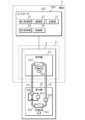
- FIG. 2 is a block diagram showing the overall configuration including the air conditioning control system in the embodiment.
- FIG. 3 is an explanatory diagram showing an example of compressor control by the air conditioning control system according to the embodiment.
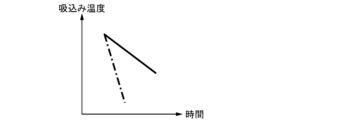
- FIG. 4A is an explanatory diagram of the correlation between the intake temperature of the indoor unit and the outside air temperature when the compressor is operating during the heating operation of the air conditioner.
- FIG. 4B is an explanatory diagram of the correlation between the intake air temperature of the indoor unit and the outside air temperature when the compressor is stopped during the heating operation of the air conditioner.
- FIG. 5 is a flow chart showing an operation example of the air conditioning control system in the embodiment.
- FIG. 6 is a block diagram showing the overall configuration including an air conditioning control system in the first modified example of the embodiment.
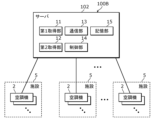
- FIG. 7 is a block diagram showing the overall configuration including an air conditioning control system in the second modified example of the embodiment.
- the indoor unit is installed in the target space
- the outdoor unit is installed outdoors
- the operation of the compressor of the outdoor unit is controlled to adjust the temperature of the target space. is being done.
- the compressor is operated or stopped according to the result of comparison between the suction temperature in the indoor unit and the threshold value corresponding to the set temperature.
- suction temperature simply means "indoor unit suction temperature”.
- FIG. 1 is an explanatory diagram showing an example of compressor control by an air conditioner of a comparative example.
- the air conditioner of the comparative example is performing heating operation.
- the air conditioner of the comparative example when the intake temperature falls below the threshold Th0 while the compressor is stopped, the compressor is operated to supply warmed air to the target space.
- the temperature of the target space rises.
- the suction temperature exceeds the threshold value Th0 while the compressor is in operation, the compressor is stopped, thereby stopping the supply of warmed air to the target space. This lowers the temperature of the target space.
- the temperature of the target space is adjusted to approximately the set temperature by repeating the above control.
- the change width W1 of the temperature (intake temperature) of the target space is relatively large, specifically several degrees Celsius or more.
- the width of change W1 is represented, for example, by a representative value (for example, an average value, etc.) of the difference between the maximum value and minimum value of the temperature of the target space or the difference between the maximum value and the minimum value in a certain period of time.
- the phenomenon in which the width of change W1 increases in this way can be adapted to the size of the target space, not only when an air conditioner having an excessive operating performance (cooling/heating capacity) for the size of the target space is installed. It can also occur when an air conditioner with operability is installed.
- a predetermined numerical value (for example, a first temperature, etc., which will be described later) is compared with a threshold value.
- a threshold value may include a threshold.
- one of the branch conditions "a predetermined numerical value exceeds (or falls below) a threshold value" may be read as "a predetermined numerical value is equal to or greater than (or less than) a threshold value”.
- FIG. 2 is a block diagram showing the overall configuration including the air conditioning control system 100 according to the embodiment.
- the air conditioning control system 100 is a system for controlling the air conditioner 2 installed to adjust the temperature of the target space 4 .
- the target space 4 is, for example, a room, and refers to a relatively large area in the facility 5 whose temperature is adjusted by the air conditioner 2 . That is, the target space 4 is basically a closed space within the facility 5 . In addition, the target space 4 may not be a space completely closed to the space outside the facility 5. For example, one or more doors provided at the entrance of the facility 5, It may be connected to the space outside the facility 5 through one or more windows.
- the facilities 5 include residential facilities such as detached houses or collective housing.
- the facilities 5 are not limited to residential facilities, but may be stores such as convenience stores or supermarkets, and may also include non-residential facilities such as offices, schools, welfare facilities, hospitals and factories.
- the air conditioner 2 has an indoor unit 31 and an outdoor unit 32 , and the indoor unit 31 is installed in the target space 4 .
- the indoor unit 31 and the outdoor unit 32 are connected to each other by a refrigerant pipe P1.
- the air conditioner 2 is capable of both cooling operation and heating operation.
- the air conditioner 2 may be a dedicated cooling machine or a heating dedicated machine.
- the indoor unit 31 is, for example, a ceiling-embedded type and installed on the ceiling of the target space 4 .
- the indoor unit 31 is not limited to the ceiling-embedded type, and may be a ceiling-suspended type, a wall-mounted type, or a floor-mounted type.
- the indoor unit 31 has a fan 311 that blows cool air or warm air to the target space 4 and a heat exchanger 312 .
- the heat exchanger 312 functions as an evaporator that absorbs ambient heat and evaporates the liquid refrigerant during cooling operation, and functions as a condenser that releases the heat of the gas refrigerant and liquefies the refrigerant during heating operation. do.
- the outdoor unit 32 is installed outside the facility 5.
- the outdoor unit 32 has a fan 321 , a heat exchanger 322 , a compressor 323 , a four-way valve 324 and an expansion valve 325 .
- Fan 321 blows air to heat exchanger 322 .
- Heat exchanger 322 functions as a condenser during cooling operation, and functions as an evaporator during heating operation.
- the compressor 323 draws in and compresses the gas refrigerant to increase the pressure.
- the four-way valve 324 is used to reverse the flow of refrigerant between cooling operation and heating operation.
- the expansion valve 325 expands the liquid refrigerant and lowers the pressure.
- the air conditioning control system 100 includes a first acquisition unit 11, a second acquisition unit 12, a communication unit 13, a control unit 14, and a storage unit 15, as shown in FIG.
- the air conditioning control system 100 may include at least the first acquisition unit 11 and the control unit 14, and may not include other components.
- other components described above can be realized by a system or the like different from the air conditioning control system 100 .
- the air conditioning control system 100 is realized by a controller 101 installed in the facility 5.
- the controller 101 may be installed in the target space 4 or may be installed outside the target space 4 .
- the controller 101 is connected to the indoor unit 31 and the outdoor unit 32 of the air conditioner 2 by signal lines. And the controller 101 communicates with the indoor unit 31 of the air conditioner 2 via a signal line. Also, the controller 101 communicates with the outdoor unit 32 of the air conditioner 2 via a signal line.
- the controller 101 has a processor and memory, and implements various functions by executing a computer program stored in the memory with the processor.
- the memory is storage unit 15 .
- the first acquisition unit 11 acquires the first temperature, which is the temperature of the target space 4 in which the indoor unit 31 of the air conditioner 2 is installed.
- the first temperature is the intake temperature in the indoor unit 31 of the air conditioner 2 .
- the intake temperature can be detected, for example, by a temperature sensor installed in the indoor unit 31 .
- the first acquisition unit 11 acquires the first temperature by, for example, communicating with the temperature sensor via the communication unit 13 and receiving the detection result from the temperature sensor.
- the first temperature is not limited to the suction temperature in the indoor unit 31, and may be a temperature obtained from a temperature sensor installed inside the target space 4, for example.
- the second acquisition unit 12 acquires the second temperature, which is the outside air temperature.
- the second temperature is the intake temperature in the outdoor unit 32 of the air conditioner 2 .
- the intake temperature can be detected, for example, by a temperature sensor installed outside the facility 5 including the target space 4 .
- the second acquisition unit 12 acquires the second temperature by, for example, communicating with the temperature sensor via the communication unit 13 and receiving the detection result from the temperature sensor.
- the second temperature is not limited to the outside air temperature of the facility 5 .
- the second acquisition unit 12 communicates with a server that provides weather information via the communication unit 13 and acquires weather information for the area where the facility 5 is located, and obtains the temperature of the area as a second You may acquire it as a temperature.
- the communication unit 13 has a communication interface that communicates with the indoor unit 31 and the outdoor unit 32 of the air conditioner 2 via signal lines.
- the communication unit 13 transmits signals including commands to the indoor unit 31 and the outdoor unit 32 via signal lines.
- the indoor unit 31 and the outdoor unit 32 operate according to the content of the command.
- the communication unit 13 may have a wireless communication interface for wireless communication with an information terminal owned by the user or a remote controller for the air conditioner 2 .
- the information terminal is, for example, a portable terminal such as a smart phone or a tablet terminal.
- the communication unit 13 may relay commands transmitted from the information terminal (or remote controller) by the user operating the information terminal (or remote controller) to the indoor unit 31 and the outdoor unit 32. .
- the user can remotely control the air conditioner 2 using an information terminal or remote controller.
- the control unit 14 adjusts the temperature of the target space 4 by controlling the air conditioner 2 .
- the air conditioner 2 is controlled by transmitting signals including commands to the indoor unit 31 and the outdoor unit 32 of the air conditioner 2 via signal lines. More specifically, the control unit 14 (in control step ST2) adjusts the compressor of the outdoor unit 32 based on the first temperature (suction temperature) acquired by the first acquisition unit 11 (first acquisition step ST1). It controls the operation of H.323. Thereby, the control unit 14 adjusts the temperature of the target space 4 so that the temperature of the target space 4 is maintained at the set temperature.
- the set temperature can be appropriately set by the user, for example, using an information terminal or remote controller.
- control unit 14 is capable of executing both control for causing the air conditioner 2 to perform cooling operation and control for causing the air conditioner 2 to perform heating operation.
- Two operating modes (first operating mode and second operating mode) are possible. Which of the first operation mode and the second operation mode the control unit 14 should be operated in can be appropriately set by the user, for example, using an information terminal or a remote controller.
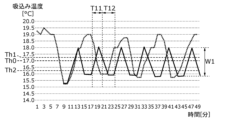
- FIG. 3 is an explanatory diagram showing an example of control of the compressor 323 by the air conditioning control system 100 according to the embodiment.
- FIG. 3 is an example of control when the air conditioner 2 is performing heating operation.
- the dashed line graph represents transition of the first temperature (suction temperature) when the control unit 14 is operating in the first operation mode
- the solid line line graph represents the It represents the transition of the first temperature when operating in two operation modes.
- the change width W1 of the temperature (first temperature) of the target space 4 shown in FIG. 3 is larger than the actual change width W1 of the temperature of the target space 4 .
- the actual change width W1 of the temperature of the target space 4 is, for example, about several tenths of degrees centigrade.
- the control unit 14 compares the first temperature (suction temperature) with the threshold value Th0, and switches the operation of the compressor 323 according to the comparison result. That is, in the first operation mode, the controller 14 controls the operation of the compressor 323 in the same manner as the air conditioner of the comparative example.
- the threshold Th0 is determined according to the set temperature.
- the storage unit 15 stores data that associates the set temperature with the threshold value Th0. Then, the control unit 14 reads the threshold Th0 corresponding to the set temperature from the storage unit 15 to determine the threshold Th0 used in the first operation mode.
- the compressor 323 is operated. Further, when the air conditioner 2 is performing cooling operation, the control unit 14 stops the compressor 323 when the first temperature falls below the threshold Th0 while the compressor 323 is in operation, and 1 When the temperature exceeds the threshold Th0, the compressor 323 is operated.
- the control unit 14 compares the first temperature (suction temperature) with the threshold, and switches the operation of the compressor 323 according to the comparison result. That is, in the second operation mode, the control unit 14 (in the control step ST2) stops the compressor 323 when the first temperature exceeds (exceeds) the threshold value while the compressor 323 is in operation. When the first temperature falls below (exceeds) the threshold at , the compressor 323 is operated.
- the threshold value while the compressor 323 is stopped and the threshold value while the compressor 323 is operating are different from each other.
- the threshold when the compressor 323 is stopped is referred to as the "first threshold Th1"
- the threshold when the compressor 323 is in operation is referred to as the "second threshold Th2".
- the compressor 323 when the air conditioner 2 is performing heating operation as shown in FIG.
- the compressor 323 is stopped, and when the second temperature falls below (exceeds) the first threshold value Th1 while the compressor 323 is stopped, the compressor 323 is operated.
- the threshold (first threshold Th1) while the compressor 323 is stopped is higher than the threshold (second threshold Th2) while the compressor 323 is operating. .
- the control unit 14 stops the compressor 323 when the first temperature falls below (exceeds) the second threshold Th2 while the compressor 323 is operating, and the compressor 323 When the second temperature exceeds (exceeds) the first threshold value Th1 while the engine is stopped, the compressor 323 is operated.
- the threshold (first threshold Th1) while the compressor 323 is stopped is lower than the threshold (second threshold Th2) while the compressor 323 is operating. .
- the thresholds are determined based on the amount of change in the first temperature (suction temperature) per unit time. That is, in the embodiment, the threshold value is determined such that the greater the slope of the change in the first temperature, the earlier the switching of the operation of the compressor 323 is performed. For example, when the air conditioner 2 is performing heating operation, the larger the amount of change in the first temperature per unit time, the higher the first threshold Th1 and the lower the second threshold Th2.
- the thresholds are such that the positive and negative of the amount of change per unit time of the first temperature (suction temperature) from when the operation of the compressor 323 is switched are reversed. It is determined based on the delay time until Here, an increase in the first temperature is defined as a positive change, and a decrease in the first temperature is defined as a negative change. Then, for example, if the air conditioner 2 is performing heating operation, the delay time is set so that the first temperature rises (from negative to positive) from the time when the air conditioner 2 switches from the stopped state to the operating state. This corresponds to the time required to turn (see period T12 in FIG. 3).
- the delay time is set so that the first temperature decreases (from positive to negative) from the point in time when the air conditioner 2 switches from the operating state to the stopped state. (see period T11 in FIG. 3).
- a threshold is determined. For example, when the air conditioner 2 is performing heating operation, the longer the delay time, the higher the first threshold Th1 and the lower the second threshold Th2.
- the thresholds are determined based on the second temperature (outside air temperature) acquired by the second acquisition unit 12 (second acquisition step ST3).
- the correlation between the outside air temperature and the first temperature (intake temperature) will be described with reference to FIGS. 4A and 4B.
- FIG. 4A is an explanatory diagram of the correlation between the intake temperature of the indoor unit 31 and the outside air temperature when the compressor 323 is operating during the heating operation of the air conditioner 2.
- FIG. 4A since the compressor 323 is in operation, the suction temperature increases over time. Also, in FIG. 4A, the outside temperature in the graph indicated by the dashed line is lower than the outside temperature in the graph indicated by the solid line. As shown in FIG. 4A, the lower the outside air temperature, the more difficult it is for the temperature (intake temperature) of the target space 4 to rise.
- FIG. 4B is an explanatory diagram of the correlation between the intake temperature of the indoor unit 31 and the outside air temperature when the compressor 323 is stopped during the heating operation of the air conditioner 2.
- FIG. 4B since the compressor 323 is stopped, the suction temperature decreases over time.
- the outside temperature in the graph indicated by the dashed line is lower than the outside temperature in the graph indicated by the solid line. As shown in FIG. 4B, the lower the outside air temperature, the easier it is for the temperature (intake temperature) of the target space 4 to drop.
- the amount of change in the first temperature (suction temperature) per unit time changes according to the outside air temperature. Therefore, in the embodiment, for example, if the air conditioner 2 is in heating operation, the lower the outside air temperature, the higher the second threshold Th2 and the higher the first threshold Th1.
- control unit 14 periodically updates the thresholds (first threshold Th1 and second threshold Th2) based on the second temperature (outside temperature) acquired by the second acquisition unit 12. In this manner, in the embodiment, the control unit 14 uses an appropriate threshold according to changes in the outside air temperature during the operation in the second operation mode to adjust the temperature (intake temperature) of the target space 4 to The change width W1 of is suppressed.
- the control unit 14 reads the threshold values (the first threshold value Th1 and the second threshold value Th2) from the storage unit 15 to determine the threshold values to be used in the second operation mode.
- the thresholds stored in the storage unit 15 are prepared, for example, as follows.
- the amount of change per unit time of the outside air temperature, the first temperature (suction temperature) during operation in the first operation mode, and the delay time are actually measured. Then, a number of data sets are prepared with a combination of these measured values as one data set. Then, using these many data sets, a threshold value (first A threshold Th1 and a second threshold Th2) are determined. As a result, data is created in which the outside air temperature, the amount of change in the first temperature per unit time, the delay time, and the threshold value are linked. The created data is stored in the storage unit 15 .
- control unit 14 can determine the thresholds (the first threshold Th1 and the second threshold Th2) by inputting the first temperature and the like acquired by the first acquisition unit 11 to the learned model, for example. be.
- control unit 14 takes into consideration that it takes time to reflect the switching of the operation of the compressor 323 in the temperature (suction temperature) of the target space 4 during operation in the second operation mode. and controls to switch the operation of the compressor 323 . Therefore, when the control unit 14 operates in the second operation mode, the change width W1 of the temperature of the target space 4 is suppressed compared to when the control unit 14 operates in the first operation mode. (See Figure 3).
- control unit 14 uses two thresholds, the first threshold Th1 and the second threshold Th2, during operation in the second operation mode, but is not limited to this.
- the control unit 14 may realize the first threshold Th1 and the second threshold Th2 by varying one threshold according to the operating state of the compressor 323 during operation in the second operation mode. .
- the storage unit 15 is a storage device that stores information (computer programs, etc.) necessary for the processor of the controller 101 to perform various controls.
- the storage unit 15 is implemented by, for example, a semiconductor memory, but is not particularly limited, and known electronic information storage means can be used.
- the storage unit 15 stores data and the like regarding threshold values in each of the first operation mode and the second operation mode.
- FIG. 5 is a flow chart showing an operation example of the air conditioning control system 100 according to the embodiment.
- the air conditioner 2 is performing the heating operation and the control unit 14 is operating in the second operation mode.
- operating the compressor 323 is represented as "compressor: ON”
- stopping the compressor 323 is represented as "compressor: OFF”.
- Processing S1 corresponds to a part of control step ST2 of the air conditioning control method.
- the 1st acquisition part 11 acquires 1st temperature regularly (S2).
- Processing S2 corresponds to the first acquisition step ST1 of the air conditioning control method.
- the control unit 14 compares the first temperature (suction temperature) acquired by the first acquisition unit 11 with the second threshold Th2, and the first temperature does not exceed the second threshold Th2. In the meantime (S3: No), the operation of the compressor 323 is continued. On the other hand, when the first temperature exceeds the second threshold Th2 (S3: Yes), the controller 14 stops the compressor 323 (S4). As a result, the supply of warmed air to the target space 4 is stopped, the rise in the first temperature slows down, and eventually the first temperature starts to fall.
- the processes S3 and S4 correspond to part of the control step ST2 of the air conditioning control method.
- the first acquisition unit 11 periodically acquires the first temperature (suction temperature) in the same manner as described above even while the compressor 323 is stopped (S5). Processing S5 corresponds to the first acquisition step ST1 of the air conditioning control method.
- the control unit 14 compares the first temperature (suction temperature) acquired by the first acquisition unit 11 with the first threshold value Th1, and the first temperature does not fall below the first threshold value Th1. In the meantime (S6: No), the stop of the compressor 323 is continued. On the other hand, when the first temperature exceeds the first threshold Th1 (S6: Yes), the controller 14 operates the compressor 323 (S7). As a result, the warmed air is supplied to the target space 4, and the decrease in the first temperature is moderated, and eventually the first temperature starts to increase.
- the processes S6 and S7 correspond to part of the control step ST2 of the air conditioning control method.
- the second acquisition unit 12 obtains the second temperature (external temperature) is acquired (S9).
- Processing S9 corresponds to the second acquisition step ST3 of the air conditioning control method.
- the control unit 14 updates the thresholds (the first threshold Th1 and the second threshold Th2) based on the second temperature acquired by the second acquisition unit 12 (S10). For example, when the second temperature does not change before and after the predetermined time has passed, the control unit 14 may maintain the current value without updating the threshold.
- the operation of the compressor is switched according to the result of comparison between a single threshold value and the temperature of the target space (suction temperature). Therefore, in the air conditioner of the comparative example, there is a problem that a delay tends to occur before the switching of the operation of the compressor is reflected in the temperature of the target space, and the change width W1 of the temperature of the target space tends to become relatively large. be.
- the threshold when the compressor 323 is stopped and the threshold when the compressor 323 is in operation are made different from each other. Therefore, in the air-conditioning control system 100 (air-conditioning control method) according to the embodiment, switching of the operation of the compressor 323 is reflected in the temperature (suction temperature) of the target space 4 as compared with the air conditioner of the comparative example. There is an advantage that the change width W1 of the temperature of the target space 4 can be easily suppressed because the delay until the target space 4 is less likely to occur.
- the change width W1 of the temperature (intake temperature) of the target space 4 can be several degrees Celsius or more. ), the change width W1 can be suppressed to several tenths of degrees Celsius.
- the air conditioning control system 100 air conditioning control method according to the embodiment, compared to the air conditioner of the comparative example, the user is less likely to notice changes in the temperature of the target space 4 and feel uncomfortable.
- the target space 4 is a bedroom where the user sleeps, and the operation in the second operation mode by the control unit 14 (control step ST2) is executed when the user goes to bed.
- the user can adjust the set temperature according to the level of the temperature (intake temperature) of the target space 4 when the user is awake, but adjusts the set temperature when sleeping (unconscious). I can't. Therefore, if the change width W1 of the temperature of the target space 4 increases during sleep, the user may unconsciously feel discomfort.
- users who are dissatisfied with their sleeping environment tend to be more sensitive to changes in sensible temperature.
- control unit 14 executes the operation in the second operation mode when the user goes to bed, the change width W1 of the temperature of the target space 4 is suppressed, thereby making it easier to provide the user with a comfortable sleeping environment. There is an advantage.
- control unit 14 may operate in the second operation mode regardless of whether the user is asleep, that is, may always execute the control step ST2 while the air conditioner 2 is operating.
- the control step ST2 may be executed only during sleep.
- the control unit 14 may start the operation in the second operation mode (control step ST2) when, for example, the user operates the information terminal or the like to instruct the start of sleep control. good.
- the control unit 14 monitors the detection result of a motion sensor that detects whether or not the user is in bed, for example, and when it is detected that the user is in bed, the control unit 14 operates in the second operation mode (control step ST2) may be started automatically.
- FIG. 6 is a block diagram showing the overall configuration including an air conditioning control system 100A according to the first modified example of the embodiment.
- an air conditioning control system 100A is incorporated in the indoor unit 31 of the air conditioner 2.
- the air conditioner 2 includes an air conditioning control system 100 ⁇ /b>A, an indoor unit 31 installed in the target space 4 , and an outdoor unit 32 installed outside the target space 4 .
- the controller 101 is installed in the facility 5.
- the air conditioning control system 100A may be built in the air conditioner 2 as well as the mode built in the controller 101 .
- FIG. 7 is a block diagram showing the overall configuration including an air conditioning control system 100B according to the second modified example of the embodiment.
- an air conditioning control system 100B is built in a server 102 installed at a remote location away from the facility 5.
- the air conditioning control system 100B individually controls one or more air conditioners 2 installed in each of the multiple facilities 5 . That is, the air conditioning control system 100B individually controls the plurality of air conditioners 2 .
- Communication between the server 102 and each air conditioner 2 is performed via an external network such as the Internet, for example.
- the air-conditioning control system 100B may be built in the server 102 as well as the mode built in the controller 101 .
- the thresholds are, for example, the amount of solar radiation to the target space 4, or the setting in the target space 4 may be determined further based on the opening and closing of the curtains. This is because these parameters can also contribute to the temperature of the target space 4 (intake temperature) during the daytime.
- the thresholds may be determined in consideration of the size of the target space 4 or the cooling/heating capacity of the air conditioner 2. This is because these parameters can also contribute to the temperature of the target space 4 (suction temperature).
- the thresholds are determined by machine learning or the like before operation of the air conditioning control system 100, but are not limited to this.
- the threshold value is the measured value of the amount of change per unit time of the outside air temperature, the first temperature (suction temperature) during operation in the first operation mode, and the delay time during operation of the air conditioning control system 100. may be re-learned using
- the thresholds are determined based on the second temperature (outside temperature), but they do not have to be determined based on the second temperature. In this case, the thresholds (first threshold Th1 and second threshold Th2) do not have to be updated periodically. Also, in this case, the air conditioning control system 100 does not have to include the second acquisition unit 12 . In other words, the air conditioning control method does not need to execute the second obtaining step ST3.
- the thresholds are determined based on the amount of change per unit time of the second temperature (outside air temperature) and the first temperature (suction temperature), and the delay time. but not limited to this.
- the threshold may be determined based on one or more of these three parameters.
- the communication between the air conditioning control system 100 and the indoor unit 31 and the outdoor unit 32 of the air conditioner 2 is wired communication using signal lines, but may be wireless communication.
- the communication standard for communication between the air conditioning control system 100 and the indoor units 31 and 32 may be Wi-Fi (registered trademark) or BLE (Bluetooth (registered trademark) Low Energy).
- the air conditioning control system 100 was realized as a single device, but may be realized by a plurality of devices.
- the components included in the air-conditioning control system 100 may be distributed among the multiple devices in any way.
- some of the components included in the air conditioning control system 100 in the above embodiments may be included in a server. That is, the present disclosure may be implemented by cloud computing or by edge computing.
- all or part of the components of the air conditioning control system 100 in the present disclosure may be configured with dedicated hardware, or a software program suitable for each component may be executed. It may be realized by Each component may be implemented by a program execution unit such as a CPU (Central Processing Unit) or processor reading and executing a software program recorded in a recording medium such as a HDD (Hard Disk Drive) or semiconductor memory. good.
- a program execution unit such as a CPU (Central Processing Unit) or processor reading and executing a software program recorded in a recording medium such as a HDD (Hard Disk Drive) or semiconductor memory. good.
- the components of the air conditioning control system 100 in the present disclosure may be configured with one or more electronic circuits.
- Each of the one or more electronic circuits may be a general-purpose circuit or a dedicated circuit.
- One or more electronic circuits may include, for example, a semiconductor device, an IC (Integrated Circuit), or an LSI (Large Scale Integration).
- An IC or LSI may be integrated on one chip or may be integrated on a plurality of chips. Although they are called ICs or LSIs here, they may be called system LSIs, VLSIs (Very Large Scale Integration), or ULSIs (Ultra Large Scale Integration) depending on the degree of integration.
- An FPGA Field Programmable Gate Array
- general or specific aspects of the present disclosure may be implemented as a system, apparatus, method, integrated circuit, or computer program.
- a computer-readable non-temporary recording medium such as an optical disk, HDD, or semiconductor memory storing the computer program.
- the present disclosure may be implemented as a program for causing a computer to execute the air conditioning control method in the above embodiments.
- this program may be recorded in a non-temporary recording medium such as a computer-readable CD-ROM, or distributed through a communication channel such as the Internet.
- the air conditioning control method in the embodiment includes the first acquisition step ST1 and the control step ST2.
- the first temperature which is the temperature of the target space 4 in which the indoor unit 31 of the air conditioner 2 having the indoor unit 31 and the outdoor unit 32 is installed, is acquired.
- the operation of the compressor 323 included in the outdoor unit 32 is controlled based on the first temperature acquired in the first acquisition step ST1.
- the compressor 323 is stopped when the first temperature exceeds the threshold (second threshold Th2) while the compressor 323 is in operation, and the first temperature reaches the threshold (first threshold Th1 ), the compressor 323 is operated.
- the threshold (first threshold Th1) while the compressor 323 is stopped and the threshold (second threshold Th2) while the compressor 323 is operating are different from each other.
- the threshold (first threshold Th1) while the compressor 323 is stopped is the threshold (second threshold Th2 ).
- the threshold (first threshold Th1) while the compressor 323 is stopped is the threshold (second threshold Th2 ).
- the thresholds are determined based on the amount of change in the first temperature per unit time.
- the threshold values are set from the time when the operation of the compressor 323 is switched until the sign of the amount of change per unit time of the first temperature is reversed. is determined based on the delay time of
- the air conditioning control method further includes a second acquisition step ST3 of acquiring a second temperature, which is the outside air temperature.
- the thresholds are determined based on the second temperature acquired in the second acquisition step ST3.
- the target space 4 is the bedroom where the user sleeps.
- Control step ST2 is executed when the user goes to bed.
- the program in the embodiment causes one or more processors to execute the air conditioning control method described above.
- the air conditioning control systems 100, 100A, and 100B in the embodiment include a first acquisition unit 11 and a control unit 14.
- the first acquisition unit 11 acquires a first temperature, which is the temperature of the target space 4 in which the indoor unit 31 of the air conditioner 2 having the indoor unit 31 and the outdoor unit 32 is installed.
- the control unit 14 controls the operation of the compressor 323 included in the outdoor unit 32 based on the first temperature acquired by the first acquisition unit 11 .
- the control unit 14 stops the compressor 323 when the first temperature exceeds the threshold (second threshold Th2) while the compressor 323 is in operation, and the first temperature reaches the threshold (first threshold Th1 ), the compressor 323 is operated.
- the threshold (first threshold Th1) while the compressor 323 is stopped and the threshold (second threshold Th2) while the compressor 323 is operating are different from each other.
- the air conditioner 2 in the embodiment includes the air conditioning control system 100A described above, an indoor unit 31 installed in the target space 4, and an outdoor unit 32 installed outside the target space 4.
- the present disclosure is applicable to air conditioning control methods for controlling air conditioners.
Landscapes
- Engineering & Computer Science (AREA)
- Chemical & Material Sciences (AREA)
- Combustion & Propulsion (AREA)
- Mechanical Engineering (AREA)
- General Engineering & Computer Science (AREA)
- Physics & Mathematics (AREA)
- Signal Processing (AREA)
- Human Computer Interaction (AREA)
- Thermal Sciences (AREA)
- Fuzzy Systems (AREA)
- Mathematical Physics (AREA)
- Air Conditioning Control Device (AREA)
Priority Applications (3)
| Application Number | Priority Date | Filing Date | Title |
|---|---|---|---|
| EP22847110.8A EP4379278A4 (en) | 2021-07-28 | 2022-05-19 | AIR CONDITIONING CONTROL METHOD AND PROGRAM, AIR CONDITIONING SYSTEM, AND AIR CONDITIONER |
| JP2023501172A JP7710174B2 (ja) | 2021-07-28 | 2022-05-19 | 空調制御方法及びプログラム、並びに空調制御システム |
| CN202280006122.4A CN116134274A (zh) | 2021-07-28 | 2022-05-19 | 空调控制方法及程序、以及空调控制系统及空调机 |
Applications Claiming Priority (2)
| Application Number | Priority Date | Filing Date | Title |
|---|---|---|---|
| JP2021-123092 | 2021-07-28 | ||
| JP2021123092 | 2021-07-28 |
Publications (1)
| Publication Number | Publication Date |
|---|---|
| WO2023007915A1 true WO2023007915A1 (ja) | 2023-02-02 |
Family
ID=85086469
Family Applications (1)
| Application Number | Title | Priority Date | Filing Date |
|---|---|---|---|
| PCT/JP2022/020803 Ceased WO2023007915A1 (ja) | 2021-07-28 | 2022-05-19 | 空調制御方法及びプログラム、並びに空調制御システム及び空調機 |
Country Status (4)
| Country | Link |
|---|---|
| EP (1) | EP4379278A4 (https=) |
| JP (1) | JP7710174B2 (https=) |
| CN (1) | CN116134274A (https=) |
| WO (1) | WO2023007915A1 (https=) |
Citations (4)
| Publication number | Priority date | Publication date | Assignee | Title |
|---|---|---|---|---|
| JP2000104978A (ja) | 1998-09-28 | 2000-04-11 | Matsushita Refrig Co Ltd | 空気調和機 |
| JP2014020720A (ja) * | 2012-07-20 | 2014-02-03 | Azbil Corp | 空調システムの最適起動停止制御装置および最適起動停止制御方法 |
| JP2016090097A (ja) * | 2014-10-31 | 2016-05-23 | ダイキン工業株式会社 | 空気調和機 |
| JP2017083139A (ja) * | 2015-10-30 | 2017-05-18 | パナホーム株式会社 | 建築物の空調方法 |
Family Cites Families (7)
| Publication number | Priority date | Publication date | Assignee | Title |
|---|---|---|---|---|
| JPS5367941A (en) * | 1976-11-29 | 1978-06-16 | Hitachi Ltd | Control device for air conditioner |
| JPH06257876A (ja) * | 1993-03-09 | 1994-09-16 | Fujitsu General Ltd | 空気調和機の制御方法 |
| KR100556617B1 (ko) * | 1999-09-02 | 2006-03-06 | 삼성전자주식회사 | 냉장고의 냉동실 운전 제어방법 |
| BRPI0500666A (pt) * | 2005-02-21 | 2006-10-17 | Multibras Eletrodomesticos Sa | sistema compensador de carga térmica em um aparelho de refrigeração |
| CN105423500B (zh) * | 2015-12-28 | 2018-02-06 | 芜湖美智空调设备有限公司 | 空调器的控制方法、空调器的控制系统和空调器 |
| CN108224704A (zh) * | 2017-12-25 | 2018-06-29 | 青岛海尔空调电子有限公司 | 空调的控制方法 |
| CN108731202A (zh) * | 2018-05-31 | 2018-11-02 | 四川长虹空调有限公司 | 一种变频空调除湿模式控制方法及空调 |
-
2022
- 2022-05-19 CN CN202280006122.4A patent/CN116134274A/zh active Pending
- 2022-05-19 EP EP22847110.8A patent/EP4379278A4/en active Pending
- 2022-05-19 WO PCT/JP2022/020803 patent/WO2023007915A1/ja not_active Ceased
- 2022-05-19 JP JP2023501172A patent/JP7710174B2/ja active Active
Patent Citations (4)
| Publication number | Priority date | Publication date | Assignee | Title |
|---|---|---|---|---|
| JP2000104978A (ja) | 1998-09-28 | 2000-04-11 | Matsushita Refrig Co Ltd | 空気調和機 |
| JP2014020720A (ja) * | 2012-07-20 | 2014-02-03 | Azbil Corp | 空調システムの最適起動停止制御装置および最適起動停止制御方法 |
| JP2016090097A (ja) * | 2014-10-31 | 2016-05-23 | ダイキン工業株式会社 | 空気調和機 |
| JP2017083139A (ja) * | 2015-10-30 | 2017-05-18 | パナホーム株式会社 | 建築物の空調方法 |
Non-Patent Citations (1)
| Title |
|---|
| See also references of EP4379278A4 |
Also Published As
| Publication number | Publication date |
|---|---|
| CN116134274A (zh) | 2023-05-16 |
| JP7710174B2 (ja) | 2025-07-18 |
| JPWO2023007915A1 (https=) | 2023-02-02 |
| EP4379278A1 (en) | 2024-06-05 |
| EP4379278A4 (en) | 2024-10-09 |
Similar Documents
| Publication | Publication Date | Title |
|---|---|---|
| CN112567183B (zh) | 空调装置、控制装置、空气调节方法以及存储介质 | |
| JP6091624B2 (ja) | 空気調和システム | |
| WO2019034127A1 (zh) | 基于人体舒适度的空调器控制方法及空调器 | |
| CN109269020A (zh) | 空调控制方法、控制装置及空调 | |
| CN110986327A (zh) | 空调器的睡眠模式控制方法与空调器 | |
| CN113983663A (zh) | 制冷系统及其控制方法、装置、存储介质 | |
| JP2022056416A (ja) | 制御装置、空調システム、空調機制御方法及びプログラム | |
| CN105202693A (zh) | 一种空调射频遥控控制方法 | |
| CN105066365A (zh) | 空调射频遥控控制方法 | |
| JPWO2020035913A1 (ja) | 空調装置、制御装置、空調方法及びプログラム | |
| JPWO2020035911A1 (ja) | 空調装置、制御装置、空調方法及びプログラム | |
| JP7191110B2 (ja) | 空調装置、制御装置、空調方法及びプログラム | |
| JP2015152201A (ja) | 窓開閉システム | |
| CN110762781A (zh) | 一种基于物联网的节能暖通空调控制系统及方法 | |
| WO2023007915A1 (ja) | 空調制御方法及びプログラム、並びに空調制御システム及び空調機 | |
| WO2020035908A1 (ja) | 空調装置、制御装置、空調方法及びプログラム | |
| JP2023123727A (ja) | 空調装置 | |
| US11573025B2 (en) | Server and control method thereof for a multi-air conditioning system including grouping of indoor units | |
| JP7016601B2 (ja) | 空調装置、制御装置、空調方法及びプログラム | |
| JP6910552B2 (ja) | 制御システム、空気調和機およびサーバ | |
| CN105091244A (zh) | 一种空调蓝牙遥控控制方法 | |
| JP7811733B2 (ja) | 空調制御システム、コントローラ、空調制御方法、及びプログラム | |
| WO2024116241A1 (ja) | 空調装置、空調制御装置、空調システム及び空調制御方法 | |
| JP2021069283A (ja) | 制御装置及び制御システム | |
| CN115614966B (zh) | 空调器及其控制方法、可读存储介质 |
Legal Events
| Date | Code | Title | Description |
|---|---|---|---|
| ENP | Entry into the national phase |
Ref document number: 2023501172 Country of ref document: JP Kind code of ref document: A |
|
| 121 | Ep: the epo has been informed by wipo that ep was designated in this application |
Ref document number: 22847110 Country of ref document: EP Kind code of ref document: A1 |
|
| WWE | Wipo information: entry into national phase |
Ref document number: 2022847110 Country of ref document: EP |
|
| NENP | Non-entry into the national phase |
Ref country code: DE |
|
| ENP | Entry into the national phase |
Ref document number: 2022847110 Country of ref document: EP Effective date: 20240228 |