WO2023002875A1 - ハロゲン化フタロシアニン色材、着色硬化性組成物、カラーフィルタ、及び表示装置 - Google Patents
ハロゲン化フタロシアニン色材、着色硬化性組成物、カラーフィルタ、及び表示装置 Download PDFInfo
- Publication number
- WO2023002875A1 WO2023002875A1 PCT/JP2022/027188 JP2022027188W WO2023002875A1 WO 2023002875 A1 WO2023002875 A1 WO 2023002875A1 JP 2022027188 W JP2022027188 W JP 2022027188W WO 2023002875 A1 WO2023002875 A1 WO 2023002875A1
- Authority
- WO
- WIPO (PCT)
- Prior art keywords
- group
- carbon atoms
- general formula
- hydrocarbon group
- substituted
- Prior art date
- Legal status (The legal status is an assumption and is not a legal conclusion. Google has not performed a legal analysis and makes no representation as to the accuracy of the status listed.)
- Ceased
Links
Images

Classifications
-
- C—CHEMISTRY; METALLURGY
- C09—DYES; PAINTS; POLISHES; NATURAL RESINS; ADHESIVES; COMPOSITIONS NOT OTHERWISE PROVIDED FOR; APPLICATIONS OF MATERIALS NOT OTHERWISE PROVIDED FOR
- C09B—ORGANIC DYES OR CLOSELY-RELATED COMPOUNDS FOR PRODUCING DYES, e.g. PIGMENTS; MORDANTS; LAKES
- C09B47/00—Porphines; Azaporphines
- C09B47/04—Phthalocyanines abbreviation: Pc
- C09B47/08—Preparation from other phthalocyanine compounds, e.g. cobaltphthalocyanineamine complex
- C09B47/18—Obtaining compounds having oxygen atoms directly bound to the phthalocyanine skeleton
-
- C—CHEMISTRY; METALLURGY
- C09—DYES; PAINTS; POLISHES; NATURAL RESINS; ADHESIVES; COMPOSITIONS NOT OTHERWISE PROVIDED FOR; APPLICATIONS OF MATERIALS NOT OTHERWISE PROVIDED FOR
- C09B—ORGANIC DYES OR CLOSELY-RELATED COMPOUNDS FOR PRODUCING DYES, e.g. PIGMENTS; MORDANTS; LAKES
- C09B67/00—Influencing the physical, e.g. the dyeing or printing properties of dyestuffs without chemical reactions, e.g. by treating with solvents grinding or grinding assistants, coating of pigments or dyes; Process features in the making of dyestuff preparations; Dyestuff preparations of a special physical nature, e.g. tablets, films
- C09B67/006—Preparation of organic pigments
-
- C—CHEMISTRY; METALLURGY
- C09—DYES; PAINTS; POLISHES; NATURAL RESINS; ADHESIVES; COMPOSITIONS NOT OTHERWISE PROVIDED FOR; APPLICATIONS OF MATERIALS NOT OTHERWISE PROVIDED FOR
- C09B—ORGANIC DYES OR CLOSELY-RELATED COMPOUNDS FOR PRODUCING DYES, e.g. PIGMENTS; MORDANTS; LAKES
- C09B67/00—Influencing the physical, e.g. the dyeing or printing properties of dyestuffs without chemical reactions, e.g. by treating with solvents grinding or grinding assistants, coating of pigments or dyes; Process features in the making of dyestuff preparations; Dyestuff preparations of a special physical nature, e.g. tablets, films
- C09B67/0071—Process features in the making of dyestuff preparations; Dehydrating agents; Dispersing agents; Dustfree compositions
- C09B67/0084—Dispersions of dyes
-
- G—PHYSICS
- G02—OPTICS
- G02B—OPTICAL ELEMENTS, SYSTEMS OR APPARATUS
- G02B5/00—Optical elements other than lenses
- G02B5/20—Filters
-
- G—PHYSICS
- G02—OPTICS
- G02F—OPTICAL DEVICES OR ARRANGEMENTS FOR THE CONTROL OF LIGHT BY MODIFICATION OF THE OPTICAL PROPERTIES OF THE MEDIA OF THE ELEMENTS INVOLVED THEREIN; NON-LINEAR OPTICS; FREQUENCY-CHANGING OF LIGHT; OPTICAL LOGIC ELEMENTS; OPTICAL ANALOGUE/DIGITAL CONVERTERS
- G02F1/00—Devices or arrangements for the control of the intensity, colour, phase, polarisation or direction of light arriving from an independent light source, e.g. switching, gating or modulating; Non-linear optics
- G02F1/01—Devices or arrangements for the control of the intensity, colour, phase, polarisation or direction of light arriving from an independent light source, e.g. switching, gating or modulating; Non-linear optics for the control of the intensity, phase, polarisation or colour
- G02F1/13—Devices or arrangements for the control of the intensity, colour, phase, polarisation or direction of light arriving from an independent light source, e.g. switching, gating or modulating; Non-linear optics for the control of the intensity, phase, polarisation or colour based on liquid crystals, e.g. single liquid crystal display cells
- G02F1/133—Constructional arrangements; Operation of liquid crystal cells; Circuit arrangements
- G02F1/1333—Constructional arrangements; Manufacturing methods
- G02F1/1335—Structural association of cells with optical devices, e.g. polarisers or reflectors
-
- G—PHYSICS
- G03—PHOTOGRAPHY; CINEMATOGRAPHY; ANALOGOUS TECHNIQUES USING WAVES OTHER THAN OPTICAL WAVES; ELECTROGRAPHY; HOLOGRAPHY
- G03F—PHOTOMECHANICAL PRODUCTION OF TEXTURED OR PATTERNED SURFACES, e.g. FOR PRINTING, FOR PROCESSING OF SEMICONDUCTOR DEVICES; MATERIALS THEREFOR; ORIGINALS THEREFOR; APPARATUS SPECIALLY ADAPTED THEREFOR
- G03F7/00—Photomechanical, e.g. photolithographic, production of textured or patterned surfaces, e.g. printing surfaces; Materials therefor, e.g. comprising photoresists; Apparatus specially adapted therefor
- G03F7/004—Photosensitive materials
-
- G—PHYSICS
- G03—PHOTOGRAPHY; CINEMATOGRAPHY; ANALOGOUS TECHNIQUES USING WAVES OTHER THAN OPTICAL WAVES; ELECTROGRAPHY; HOLOGRAPHY
- G03F—PHOTOMECHANICAL PRODUCTION OF TEXTURED OR PATTERNED SURFACES, e.g. FOR PRINTING, FOR PROCESSING OF SEMICONDUCTOR DEVICES; MATERIALS THEREFOR; ORIGINALS THEREFOR; APPARATUS SPECIALLY ADAPTED THEREFOR
- G03F7/00—Photomechanical, e.g. photolithographic, production of textured or patterned surfaces, e.g. printing surfaces; Materials therefor, e.g. comprising photoresists; Apparatus specially adapted therefor
- G03F7/004—Photosensitive materials
- G03F7/027—Non-macromolecular photopolymerisable compounds having carbon-to-carbon double bonds, e.g. ethylenic compounds
- G03F7/028—Non-macromolecular photopolymerisable compounds having carbon-to-carbon double bonds, e.g. ethylenic compounds with photosensitivity-increasing substances, e.g. photoinitiators
- G03F7/031—Organic compounds not covered by group G03F7/029
Definitions
- the present invention relates to a halogenated phthalocyanine colorant, a colored curable composition, a color filter, and a display device.
- Color filters are used in these liquid crystal display devices and organic light emitting display devices.
- the light passing through the color filter is colored into the color of each pixel constituting the color filter as it is, and the light of these colors is combined to form a color image.
- an organic light emitting element emitting white light or an inorganic light emitting element emitting white light may be used.
- the organic light emitting display device uses a color filter for color adjustment. Therefore, in color filters, there is an increasing demand for higher brightness, higher contrast, and improved color reproducibility.
- the color filter is generally composed of a transparent substrate, a colored layer formed on the transparent substrate and composed of colored patterns of the three primary colors of red, green, and blue, and a colored layer formed on the transparent substrate so as to partition each colored pattern. and a formed light blocking portion.
- a pigment dispersion method which has excellent average characteristics in terms of spectral characteristics, durability, pattern shape, accuracy, etc., is most widely used.
- a color filter having pixels formed using a pigment dispersion method there is a problem that the light transmittance of the color filter is reduced and the contrast is lowered due to the pigment particles. Therefore, attempts have been made to achieve color filters with improved brightness and contrast by using coloring compositions using dyes that do not form particles.
- Patent Literature 3 describes that the object is to provide a colored resin composition that has sufficient brightness for practical use and can form a pattern in which the generation of foreign matter is suppressed.
- the technique of the colored resin composition still has the problem that foreign matter tends to precipitate after the heat treatment (after the post-baking step) and the contrast is poor, as shown in the comparative examples described later.
- the present invention has been made in view of the above circumstances, and an object of the present invention is to provide a halogenated phthalocyanine coloring material and a colored curable composition capable of forming a colored layer in which deposition of foreign matter is suppressed and contrast is improved. do. Another object of the present invention is to provide a color filter and a display device formed using the colored curable composition.
- the halogenated phthalocyanine colorant according to the present invention is a halogenated phthalocyanine colorant represented by the following general formula (1).
- X 1 to X 16 are each independently a hydrogen atom, a halogen atom, a hydroxy group, a substituted or unsubstituted hydrocarbon group having 1 to 6 carbon atoms, or the following general formula (2 ) represents a monovalent group represented by At least one of X 1 to X 16 is a fluorine atom, and at least one of X 1 to X 16 is a monovalent group represented by general formulas (2-1) to (2-5) below. and at least one of X 1 to X 16 is a monovalent group represented by general formula (2-6) below.
- the colored curable composition according to the present invention contains a coloring material, a polymer, a polymerizable compound, an initiator, and a solvent, and the coloring material contains the halogenated phthalocyanine coloring material according to the present invention. .
- a color filter according to the present invention is a color filter comprising at least a transparent substrate and a colored layer provided on the transparent substrate, wherein at least one of the colored layers is the colored curable composition according to the present invention. It is characterized by being a colored layer which is a cured product of.
- the present invention provides a display device characterized by having the color filter according to the present invention.
- a halogenated phthalocyanine coloring material capable of suppressing precipitation of foreign matter and forming a colored layer with improved contrast, and coloring curability capable of forming a colored layer with improved contrast using the halogenated phthalocyanine coloring material
- a composition, a color filter using the colored curable composition, and a display device using the color filter can be provided.
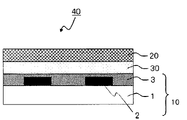
- FIG. 1 is a schematic diagram showing an example of the color filter of the present invention.
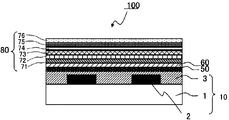
- FIG. 2 is a schematic diagram showing an example of the display device of the present invention.
- FIG. 3 is a schematic diagram showing another example of the display device of the present invention.
- light includes electromagnetic waves having wavelengths in the visible and non-visible regions, and radiation
- radiation includes, for example, microwaves and electron beams. Specifically, it refers to electromagnetic waves with a wavelength of 5 ⁇ m or less and electron beams.
- (meth)acryl means acrylic and methacrylic
- (meth)acrylate means acrylate and methacrylate
- (meth)acryloyl means acryloyl and methacryloyl.
- substituted or unsubstituted means that it may have a substituent.
- substituted or unsubstituted alkyl group includes alkyl groups having substituents and alkyl groups having no substituents.
- halogenated Phthalocyanine colorant is a halogenated phthalocyanine colorant represented by the following general formula (1).
- X 1 to X 16 are each independently a hydrogen atom, a halogen atom, a hydroxy group, a substituted or unsubstituted hydrocarbon group having 1 to 6 carbon atoms, or the following general formula (2 ) represents a monovalent group represented by At least one of X 1 to X 16 is a fluorine atom, and at least one of X 1 to X 16 is a monovalent group represented by general formulas (2-1) to (2-5) below. and at least one of X 1 to X 16 is a monovalent group represented by general formula (2-6) below.
- the phthalocyanine colorant has a planar structure of the phthalocyanine ring and easily forms a laminated structure through ⁇ - ⁇ interaction, and has high crystallinity. Therefore, the colored layer containing the phthalocyanine colorant has a problem that after the heat treatment (post-baking process), crystal growth and aggregation of the phthalocyanine colorant tend to deposit foreign matters, resulting in poor contrast.
- X 1 to X 16 is a fluorine atom
- at least one of X 1 to X 16 is , a monovalent group represented by the general formulas (2-1) to (2-5)
- at least one of X 1 to X 16 is 1 represented by the general formula (2-6) is the base of the valence. Since at least one of X 1 to X 16 is a fluorine atom, the electron-withdrawing effect shifts the color derived from the phthalocyanine skeleton, which is the hue in the blue region, to a longer wavelength, making it suitable for green colored layers for color filters. become color.
- the crystal growth and aggregation of the phthalocyanine colorant are suppressed after the heat treatment (post-baking step) of the colored layer. Presumably, this suppresses the deposition of foreign matter and enables the formation of a colored layer with improved contrast.
- the halogen atoms in X 1 to X 16 include a fluorine atom, a chlorine atom, a bromine atom, an iodine atom and the like. At least one of X 1 to X 16 is a fluorine atom. Among them, 6 to 10, especially 7 to 9 of X 1 to X 16 are preferably fluorine atoms in terms of color and maximum absorption wavelength range.
- X 1 to X 16 may be hydrogen atoms.
- the number of hydrogen atoms among X 1 to X 16 may be appropriately selected by adjusting the color, and may be 0 to 8, may be 0 to 4, or may be 0 to 2. It's fine.
- X 1 to X 16 may be hydroxy groups. The number of hydroxy groups among X 1 to X 16 may be appropriately selected from the viewpoint of color and maximum absorption wavelength range, but may be 0 to 4 or may be 0 to 2. .
- the hydrocarbon group in the substituted or unsubstituted hydrocarbon group having 1 to 6 carbon atoms in X 1 to X 16 , includes a linear or branched aliphatic hydrocarbon group, an alicyclic and aromatic hydrocarbon groups.
- the aliphatic hydrocarbon group may be a saturated aliphatic hydrocarbon group (alkyl group) or an unsaturated aliphatic hydrocarbon group (alkenyl group, alkynyl group).
- straight-chain or branched aliphatic hydrocarbon groups include, for example, a methyl group, an ethyl group, a straight-chain or branched propyl group, a straight-chain or branched butyl group, a straight-chain or A branched pentyl group, a linear or branched hexyl group, a vinyl group, a propenyl group, a 1-butenyl group and the like can be mentioned, and examples of the alicyclic hydrocarbon group include a cyclopentyl group, a cyclohexyl group and the like.
- a phenyl group is mentioned, for example.
- the substituent includes a halogen atom, —OR s1 , —COR s1 , —COOR s1 (wherein R s1 is a hydrogen atom, a substituted or unsubstituted carbon atom number of 1 to 14 hydrocarbon groups, or substituted or unsubstituted heterocyclic groups having 5 to 14 ring atoms), specifically halogen atoms, hydroxy groups, aldehyde groups, carboxy groups, alkoxy groups, An aryloxy group, a heteroaryloxy group, an acyl group, an alkoxycarbonyl group, an aryloxycarbonyl group, a heteroaryloxycarbonyl group and the like can be mentioned.
- the hydrocarbon group having 1 to 14 carbon atoms in R s1 may be the same as the above-described hydrocarbon group having 1 to 6 carbon atoms, as well as the alicyclic hydrocarbon group and the aromatic hydrocarbon group described later.
- the heterocyclic group having 5 to 14 ring atoms may be the same as the heterocyclic group having 5 to 14 ring atoms described later.
- the hydrocarbon group in R s1 may be a hydrocarbon group having 1 to 6 carbon atoms
- the heterocyclic group may be a heterocyclic group having 5 to 6 ring atoms.
- R s1 may be a hydrocarbon group having 1 to 6 carbon atoms, may be a hydrocarbon group having 1 to 4 carbon atoms, or may be a methyl group, an ethyl group, a linear or branched propyl group. . Further, the substituent of the hydrocarbon group or heterocyclic group in R s1 may be an alkoxy group having 1 to 5 carbon atoms.
- X 1 to X 16 may be a monovalent group represented by general formula (2) below, and at least one of X 1 to X 16 is represented by general formula (2- 1) to (2-5), and at least one of X 1 to X 16 is a monovalent group represented by the following general formula (2-6).
- the substituted or unsubstituted straight-chain or branched aliphatic hydrocarbon group having 1 to 6 carbon atoms is a saturated aliphatic hydrocarbon group or an unsaturated aliphatic hydrocarbon group. It may be a hydrogen group.
- Linear or branched aliphatic hydrocarbon groups having 1 to 6 carbon atoms include, for example, methyl group, ethyl group, linear or branched propyl group, linear or branched butyl group, linear or branched pentyl group, linear A chain or branched hexyl group, a vinyl group, a propenyl group, a 1-butenyl group and the like can be mentioned.
- the linear or branched aliphatic hydrocarbon group having 1 to 6 carbon atoms may be a linear or branched aliphatic hydrocarbon group having 1 to 4 carbon atoms. It may be a chain or branched aliphatic hydrocarbon group.
- examples of the alicyclic hydrocarbon group having 5 to 14 carbon atoms include a cyclopentyl group , cyclohexyl group, norbornyl group, and adamantyl group.
- the alicyclic hydrocarbon group may be an alicyclic hydrocarbon group having 5 to 10 carbon atoms, or an alicyclic hydrocarbon group having 5 to 6 carbon atoms.
- examples of the aromatic hydrocarbon group having 6 to 14 carbon atoms include phenyl group and naphthyl. group, biphenyl group, fluorenyl group, anthracenyl group, and the like.
- the aromatic hydrocarbon group may be an aromatic hydrocarbon group having 6 to 10 carbon atoms and may be a phenyl group.
- the heterocyclic group having 5 to 14 ring atoms includes, for example, one free valence having a furan ring, thiophene ring, pyrrole ring, 2H-pyran ring, 4H-thiopyran ring, pyridine ring, 1,3-oxazole ring, isoxazole ring, 1,3-thiazole ring, isothiazole ring, imidazole ring, Groups such as pyrazole ring, furazane ring, pyrazine ring, pyrimidine ring, pyridazine ring, carbazole ring, acridine ring and the like are included.
- the heterocyclic group may be a heterocyclic group having 5 to 6 ring-constituting atoms.
- the substituent may be a halogen atom, —OR s1 , —COR s1 , —COOR s1 (here R s1 is a hydrogen atom, a substituted or unsubstituted hydrocarbon group having 1 to 14 carbon atoms, or a substituted or unsubstituted heterocyclic group having 5 to 14 ring atoms), a halogen atom, It may be a hydroxy group, an aldehyde group, a carboxy group, an alkoxy group, an aryloxy group, a heteroaryloxy group, an acyl group, an alkoxycarbonyl group, an aryloxycarbonyl group, a heteroaryloxycarbonyl group, and the like.
- the substituent may be a halogen atom, a substituted or unsubstituted straight chain having 1 to 6 carbon atoms, or A branched aliphatic hydrocarbon group, —OR s1 , —COR s1 , —COOR s1 (wherein R s1 is a hydrogen atom, a substituted or unsubstituted hydrocarbon group having 1 to 14 carbon atoms, or a substituted or unsubstituted heterocyclic group having 5 to 14 ring atoms), halogen atoms, linear or branched alkyl groups having 1 to 6 carbon atoms, hydroxy groups, aldehyde groups, carboxy groups, alkoxy groups, aryloxy groups, It may be a heteroaryloxy group, an acyl group, an alkoxycarbonyl group, an aryloxycarbonyl group, a heteroary
- the hydrocarbon group having 1 to 14 carbon atoms in R s1 includes, in addition to the hydrocarbon groups having 1 to 6 carbon atoms in X 1 to X 16 , the alicyclic hydrocarbon group in R 2 P and the aromatic It may be the same as a hydrocarbon group. Further, the heterocyclic group having 5 to 14 ring atoms may be the same as the heterocyclic group having 5 to 14 ring atoms in R 1 P above. From the viewpoint of solvent solubility, the hydrocarbon group in R s1 may be a hydrocarbon group having 1 to 6 carbon atoms, or may be a linear or branched aliphatic hydrocarbon group having 1 to 4 carbon atoms.
- the heterocyclic group may be a heterocyclic group having 5 to 6 ring atoms.
- R s1 may be a hydrocarbon group having 1 to 6 carbon atoms, may be a hydrocarbon group having 1 to 4 carbon atoms, or may be a methyl group, an ethyl group, a linear or branched propyl group. .
- the linear or branched aliphatic hydrocarbon group having 1 to 6 carbon atoms which the alicyclic hydrocarbon group, aromatic hydrocarbon group, and heterocyclic group in R 2 may have as a substituent includes the above - mentioned It may be the same as a linear or branched aliphatic hydrocarbon group having 1 to 6 carbon atoms, or may be a linear or branched aliphatic hydrocarbon group having 1 to 4 carbon atoms. Further, the substituent of the hydrocarbon group or heterocyclic group in R s1 may be an alkoxy group having 1 to 5 carbon atoms.
- R L1 represents an aliphatic hydrocarbon group having 1 to 6 carbon atoms or a -CO- group
- R L2 each independently represents an aliphatic hydrocarbon group having 1 to 6 carbon atoms.
- the aliphatic hydrocarbon group having 1 to 6 carbon atoms in R L1 and R L2 is a divalent aliphatic hydrocarbon group, a divalent linear or branched saturated or unsaturated aliphatic hydrocarbon group, an aliphatic A cyclic hydrocarbon group may be mentioned, and may be a divalent linear or branched aliphatic hydrocarbon group, or may be a saturated aliphatic hydrocarbon group.
- linear or branched aliphatic hydrocarbon groups examples include methylene group, ethylene group, linear or branched propylene group, linear or branched butylene group, linear or branched pentylene group, linear or branched hexylene group, and the like. mentioned.
- the aliphatic hydrocarbon group having 1 to 6 carbon atoms in R L1 and R L2 may be an aliphatic hydrocarbon group having 1 to 3 carbon atoms.
- the aliphatic hydrocarbon group having 1 to 6 carbon atoms in R L2 of general formula (2-2) may be an ethylene group or a branched propylene group.
- n in general formula (2-2) represents an integer of 1-5, and may be 1-3.
- R a represents a substituted or unsubstituted aromatic hydrocarbon group having 6 to 14 carbon atoms.
- the substituted or unsubstituted aromatic hydrocarbon group having 6 to 14 carbon atoms in R a may be the same as R 2 above.
- R b is a hydrogen atom, a substituted or unsubstituted linear or branched aliphatic hydrocarbon group having 1 to 6 carbon atoms, substituted or an unsubstituted alicyclic hydrocarbon group having 5 to 14 carbon atoms, a substituted or unsubstituted aromatic hydrocarbon group having 6 to 14 carbon atoms, or a substituted or unsubstituted 5 to 14 ring atoms represents a heterocyclic group.
- R b is a substituted or unsubstituted linear or branched aliphatic hydrocarbon group having 1 to 6 carbon atoms, a substituted or unsubstituted alicyclic hydrocarbon group having 5 to 14 carbon atoms, a substituted or unsubstituted
- the aromatic hydrocarbon group having 6 to 14 carbon atoms or the substituted or unsubstituted heterocyclic group having 5 to 14 ring atoms may be the same as R 2 P above.
- R b is a substituted or unsubstituted alicyclic hydrocarbon group having 5 to 14 carbon atoms, a substituted or unsubstituted aromatic group having 6 to 14 carbon atoms, and a It may be a hydrocarbon group or a substituted or unsubstituted heterocyclic group having 5 to 14 ring atoms.
- R b is a substituted or unsubstituted alicyclic hydrocarbon group having 5 to 14 carbon atoms or a substituted or unsubstituted aromatic hydrocarbon group having 6 to 14 carbon atoms from the viewpoint of solvent solubility.
- R b may be an unsubstituted aliphatic hydrocarbon group having 1 to 3 carbon atoms in terms of solvent solubility.
- Rb may be a hydrogen atom from the viewpoint of good solubility in a highly polar solvent.
- R c represents a substituted or unsubstituted alicyclic hydrocarbon group having 5 to 14 carbon atoms.
- the substituted or unsubstituted alicyclic hydrocarbon group having 5 to 14 carbon atoms in R c may be the same as R 2 above.
- R p aromatic hydrocarbon groups in R p , R a , and R b in general formula (2), precipitation of foreign matter is suppressed, and a colored layer with improved contrast is easily formed.
- It may be a monovalent group represented by
- -W- is a single bond or -O-
- R s1 is a hydrogen atom, a substituted or unsubstituted hydrocarbon group having 1 to 14 carbon atoms, or a substituted or unsubstituted ring is a heterocyclic group having 5 to 14 atoms
- R s2 is a halogen atom, an alkyl group having 1 to 4 carbon atoms or an alkoxy group having 1 to 4 carbon atoms
- p is an integer of 1 to 3
- q is an integer of 0 to 2.
- multiple W and R s1 may be the same or different
- q is 2 may be the same. It may be different. * indicates the binding position.
- R s1 may be the same as described above. From the viewpoint of solvent solubility, R s1 may be a substituted or unsubstituted aliphatic hydrocarbon group having 1 to 6 carbon atoms, or a substituted or unsubstituted alkyl group having 1 to 6 carbon atoms. .
- the alkyl group is preferably an alkyl group having 1 to 5 carbon atoms, more preferably a linear alkyl group having 1 to 5 carbon atoms.
- R s1 is a substituted alkyl group, it may be a group having an alkoxy group having 1 to 5 carbon atoms as a substituent.
- p may be 1 or 2, and may be 1;
- p 2
- two -CO-WR s1 are at the 3,5-position or 2,4-position with respect to -O- to which the monovalent group represented by the general formula (3) is bonded. It may be bonded, and may be bonded at the 3- and 5-positions.
- q may be 0 or 1 and may be 0;
- the alicyclic hydrocarbon groups in R p , R b , and R c in general formula (2) are among those represented by general formula (4) below, since precipitation of foreign matter is suppressed and a colored layer with improved contrast is easily formed. It may be a monovalent group represented by
- -W- is a single bond or -O-
- R s1 is a hydrogen atom, a substituted or unsubstituted hydrocarbon group having 1 to 14 carbon atoms, or a substituted or unsubstituted ring is a heterocyclic group having 5 to 14 constituent atoms
- R s2 is a halogen atom, an alkyl group having 1 to 4 carbon atoms or an alkoxy group having 1 to 4 carbon atoms
- p is an integer of 1 to 3
- q is an integer of 0 to 2.
- multiple W and R s1 may be the same or different
- q is 2 may be the same. It may be different. * indicates the binding position.
- R s1 may be the same as described above. From the viewpoint of solvent solubility, R s1 may be a substituted or unsubstituted aliphatic hydrocarbon group having 1 to 6 carbon atoms, or a substituted or unsubstituted alkyl group having 1 to 6 carbon atoms. .
- the alkyl group is preferably an alkyl group having 1 to 5 carbon atoms, more preferably a linear alkyl group having 1 to 5 carbon atoms.
- R s1 is a substituted alkyl group, it is preferably a group having an alkoxy group having 1 to 5 carbon atoms as a substituent.
- p may be 1 or 2, and may be 1;
- q may be 0 or 1 and may be 0;
- the general formula (2-1) has a bulky terminal, and the bulky terminal is more mobile, It is preferable from the viewpoint that crystal growth is easily suppressed by steric hindrance.
- the aromatic hydrocarbon group in R a of the general formula (2-1) is a monovalent group represented by the general formula (3), precipitation of foreign matter is suppressed and the contrast is improved. It is preferable from the viewpoint of easy formation of a colored layer.
- the general formula (2-5) has a bulky terminal and is easy to suppress crystal growth due to steric hindrance. preferable.
- the aliphatic hydrocarbon group in R c of the general formula (2-5) is a monovalent group represented by the general formula (4), precipitation of foreign matter is suppressed and the contrast is improved. It is preferable from the viewpoint of easy formation of a colored layer.
- the monovalent groups represented by the general formulas (2-1) to (2-5) the general formula (2-2), the general formula (2-3) and the general formula (2-4) is preferable because the alkylene oxide chain and the ester portion easily improve the affinity with the polymer or the polymerizable compound and easily suppress the aggregation of the coloring material.
- the terminal R b is a substituted or unsubstituted alicyclic hydrocarbon having 5 to 14 carbon atoms group, substituted or unsubstituted aromatic hydrocarbon group with 6 to 14 carbon atoms, or substituted or unsubstituted heterocyclic group with 5 to 14 ring atoms, affinity with polymers and polymerizable compounds It is preferable from the viewpoint that the properties are easily improved, the aggregation of the coloring material is easily suppressed, and the terminal is bulky and crystal growth is easily suppressed by steric hindrance.
- the terminal R b is a monovalent group represented by the general formula (3) or a monovalent group represented by the general formula (4), precipitation of foreign substances is suppressed and contrast is improved. It is preferable from the point that it is easy to form an improved colored layer.
- halogenated phthalocyanine coloring material of the present invention precipitation of foreign matter is suppressed, contrast is improved, and a colored layer is formed that exhibits excellent color characteristics such as brightness and tinting strength when toned according to various color standards.
- 6 to 10, especially 7 to 9 of X 1 to X 16 are preferably monovalent groups represented by the above general formula (2), because of the ease with which X 1 to X 16 can be combined.
- the precipitation of foreign matter is suppressed and a colored layer with improved contrast is easily formed.
- 4.5, especially 4 are preferably monovalent groups represented by the general formulas (2-1) to (2-5).
- the precipitation of foreign matter is suppressed and a colored layer with improved contrast is easily formed.
- 4.5 on average, preferably 4, are monovalent groups represented by the general formula (2-6).
- any one of X 1 to X 4 and X 5 to X 8 are selected from the viewpoint that deposition of foreign matter is suppressed and a colored layer with improved contrast is easily formed.
- Any one of X 9 to X 12 and any one of X 13 to X 16 are represented by general formulas (2-1) to (2-5) having a total of four monovalent groups, and any one of X 1 to X 4 , any one of X 5 to X 8 , any one of X 9 to X 12 , and , any one of X 13 to X 16 preferably has a total of four monovalent groups represented by the general formula (2-6), and further X 2 or X 3 , X 6 or X 7 , X 10 or X 11 , and X 14 or X 15 each have a total of four monovalent groups represented by the general formulas (2-1) to (2-5), and It is more preferable to have a total of four monovalent groups represented by general formulas (2-1) to (2-5), and It is more preferable
- a method for producing the halogenated phthalocyanine colorant conventionally known production methods can be appropriately selected and used. For example, a method of cyclizing a phthalonitrile compound and a metal salt in a molten state or in an organic solvent can be preferably used. can be manufactured.
- the phthalonitrile compound used as a starting material can also be synthesized by appropriately selecting a conventionally known production method, and a commercially available product may be used.
- the colored curable composition according to the present invention contains a coloring material, a polymer, a polymerizable compound, an initiator, and a solvent, and the coloring material is the halogenated phthalocyanine of the present invention.
- a coloring material is the halogenated phthalocyanine of the present invention.
- Contains colorant Since the colored curable composition of the present invention contains the halogenated phthalocyanine colorant of the present invention, precipitation of foreign matter is suppressed and a colored layer with improved contrast can be formed.
- the colored curable composition according to the present invention contains at least a coloring material, a polymer, a polymerizable compound, an initiator, and a solvent, and further to the extent that the effects of the present invention are not impaired. It may contain ingredients.
- the coloring material may further contain other coloring materials in addition to the halogenated phthalocyanine coloring material represented by the general formula (1).
- the other coloring material is not particularly limited as long as it is capable of developing a desired color, and various organic pigments, inorganic pigments, dyes, salt-forming compounds of dyes, etc. may be used alone or in combination of two or more. can be used. Among them, organic pigments are preferably used because of their high color developability and high heat resistance. Examples of organic pigments include compounds classified as pigments in the Color Index (C.I.; published by The Society of Dyers and Colorists). .) numbered ones can be mentioned.
- the colorant may further contain a yellow colorant.
- a green colorant different from the halogenated phthalocyanine colorant represented by the general formula (1) may be further contained.
- yellow coloring materials include C.I. I. Pigment Yellow 1, 3, 12, 13, 14, 15, 16, 17, 20, 24, 31, 55, 60, 61, 65, 71, 73, 74, 81, 83, 93, 95, 97, 98, 100, 101, 104, 106, 108, 109, 110, 113, 114, 116, 117, 119, 120, 126, 127, 128, 129, 138, 139, 150, 151, 152, 153, 154, 155, 156, 166, 168, 175, 185, 231, and yellow pigments such as derivative pigments thereof, coumarin dyes, cyanine dyes, merocyanine dyes, azo dyes, methine dyes, azomethine dyes, quinophthalone dyes, etc
- a quinophthalone-based colorant is preferable because of its excellent heat resistance and light resistance and high transmittance.
- the quinophthalone-based colorant is also preferable in that it has a hue suitable for use in color filters.
- a quinophthalone-based colorant refers to a colorant synthesized by condensation of a quinoline derivative such as quinaldine and a phthalic anhydride derivative or a naphthalic anhydride derivative, and may be any of pigments, dyes, and salt-forming compounds of dyes. good.
- quinophthalone pigments include, for example, C.I. I. Pigment Yellow 138 and the like.
- Examples of quinophthalone dyes include C.I. I. Disperse Yellow 54, 64, 67, 134, 149, 160, C.I. I. Solvent Yellow 114, 157 and the like, among which C.I. I. Disperse Yellow 54 is preferred.
- the green colorant different from the halogenated phthalocyanine colorant of the present invention C.I. I. Pigment Green 1, 2, 4, 7, 8, 10, 13, 14, 15, 17, 18, 19, 26, 36, 45, 48, 50, 51, 54, 55, 58, 59, 62, 63, etc. green pigments, squarylium, triarylmethane, anthraquinone, coumarin, cyanine, or green dyes such as azo dyes.
- the green colorant different from the halogenated phthalocyanine colorant is preferably a phthalocyanine green pigment.
- the phthalocyanine green pigment include C.I. I.
- C.I. I. Pigment Green 7, 58, 59, 62 or 63 is preferred,
- C.I. I. Pigment Green 58, 59, 62 or 63 is preferred,
- C.I. I. Pigment Green 59 is more preferred.
- colorants include, for example, blue colorants and orange colorants.
- orange colorant C.I. I. Pigment Orange 1, 5, 13, 14, 16, 17, 24, 34, 36, 38, 40, 43, 46, 49, 51, 61, 63, 64, 71, 73;
- blue colorant C.I. I. Pigment Blue 15, 15:3, 15:4, 15:6, 60.
- the content ratio of the halogenated phthalocyanine colorant of the present invention to the entire colorant may be appropriately adjusted according to the desired chromaticity, and is not particularly limited.
- the content of the halogenated phthalocyanine colorant of the present invention with respect to the entire colorant is preferably 30 to 95% by mass, more preferably 40 to 85% by mass. More preferably, it is contained in an amount of 50 to 80% by mass.
- the yellow colorant is appropriately selected and used singly or in combination of two or more.
- the content ratio of the yellow colorant to the halogenated phthalocyanine colorant of the present invention may be appropriately adjusted according to the desired chromaticity, and is not particularly limited. Among them, from the viewpoint of desired chromaticity adjustment, it is preferable to contain 5 to 233 parts by mass of a yellow colorant with respect to 100 parts by mass of the halogenated phthalocyanine colorant of the present invention, and 18 to 150 parts by mass. is more preferable, and it is even more preferable to contain 25 to 100 parts by mass.
- the green colorant different from the halogenated phthalocyanine colorant when a green colorant different from the halogenated phthalocyanine colorant is contained, the green colorant different from the halogenated phthalocyanine colorant is appropriately selected, and one kind alone or two Used by mixing more than one species.
- the content ratio of the green colorant different from the halogenated phthalocyanine colorant to the halogenated phthalocyanine colorant of the present invention may be appropriately adjusted to a desired chromaticity, It is not particularly limited.
- a green colorant different from the halogenated phthalocyanine colorant is contained with respect to 100 parts by mass of the halogenated phthalocyanine colorant of the present invention. preferably 18 to 567 parts by mass, and even more preferably 25 to 400 parts by mass.
- the green colorant containing the halogenated phthalocyanine colorant of the present invention is added to the entire colorant.
- the content ratio of the yellow colorant to the green colorant containing the halogenated phthalocyanine colorant of the present invention may be appropriately adjusted according to the desired chromaticity, and is not particularly limited. Among them, from the viewpoint of desired chromaticity adjustment and brightness adjustment, it is preferable to contain 5 to 70 parts by mass of a yellow colorant with respect to 100 parts by mass of a green colorant containing the halogenated phthalocyanine colorant of the present invention. , more preferably 20 to 50 parts by mass.
- the colorant may further contain a colorant other than the green colorant and the yellow colorant, as long as the effects of the present invention are not impaired.
- the total content of the green colorant containing the halogenated phthalocyanine colorant of the present invention and the yellow colorant is preferably 70 to 100% by mass, especially 80 to 100% by mass, based on the total colorant. % is more preferable.
- the total content of the coloring material is, for example, preferably in the range of 3% to 65% by mass, more preferably 4% to 60% by mass, based on the total solid content of the colored curable composition. If it is at least the above lower limit, the colored layer will have a sufficient color density when the colored curable composition is applied to a predetermined film thickness (usually 1.0 to 5.0 ⁇ m). Moreover, if it is below the said upper limit, while being excellent in storage stability, the coloring layer which has sufficient hardness and adhesiveness with a board
- the content of the colorant is preferably 15% by mass to 65% by mass, more preferably 25% by mass, based on the total solid content of the colored curable composition. % to 60% by mass.
- the solid content includes all substances other than the solvent described above, including monomers and the like dissolved in the solvent.
- Binder component The polymer, polymerizable compound, and initiator contained in the colored curable composition according to the present invention serve as a binder component of the colored curable composition to impart film-forming properties and adhesion to a surface to be coated.
- a binder component used in forming a conventionally known colored layer can be used as appropriate, and is not particularly limited, but can be polymerized and cured by visible light, ultraviolet rays, electron beams, or the like, for example. Examples include a photosensitive binder component and a thermosetting binder component that can be polymerized and cured by heating, and a mixture thereof can also be used.
- thermosetting binder component a polymer which may have a thermally polymerizable functional group as a polymer, a compound having a thermally polymerizable functional group in the molecule as a polymerizable compound, and the above thermally polymerizable polymer as an initiator.
- examples include systems containing at least a thermal polymerization initiator including a curing agent that reacts with the functional group.
- thermally polymerizable functional groups include epoxy groups, isocyanate groups, carboxy groups, amino groups, and hydroxy groups.
- a photosensitive binder component having alkali developability is preferably used.
- a thermosetting binder component may be used in addition to the photosensitive binder component.
- the photosensitive binder component includes a positive photosensitive binder component and a negative photosensitive binder component.
- the positive photosensitive binder component include, for example, an alkali-soluble resin as a polymer, a compound having an acid-cleavable bond and an ethylenically unsaturated group in the molecule as a polymerizable compound, and a thermal radical polymerization initiator as an initiator. and a system containing a photoacid generator.
- the negative photosensitive binder component a system containing at least an alkali-soluble resin as a polymer, a compound having an ethylenically unsaturated group in the molecule as a polymerizable compound, and a photopolymerization initiator as an initiator is preferably used. be done.
- the binder component contained in the colored curable composition according to the present invention the negative photosensitive binder component is preferable because a pattern can be easily formed by photolithography using existing processes.
- an alkali-soluble resin that is soluble in an alkali developer is preferably used.
- the alkali-soluble resin has an acidic group and can be appropriately selected and used as long as it acts as a binder resin and is soluble in the alkali developer used for pattern formation.
- the alkali-soluble resin can be considered to have an acid value of 30 mgKOH/g or more.
- a carboxy group is mentioned as an acidic group which alkali-soluble resin has, for example.
- the alkali-soluble resin having a carboxy group include a carboxy group-containing copolymer having a carboxy group and an epoxy (meth)acrylate resin having a carboxy group.
- the carboxy group-containing copolymer include (meth) acrylic copolymers having a carboxy group and styrene-(meth) acrylic copolymers having a carboxy group. .
- these (meth)acrylic copolymers styrene-(meth)acrylic copolymers having a carboxyl group
- (meth)acrylic copolymers such as (meth)acrylic copolymers
- epoxy (meth)acrylate resins are a mixture of two or more.
- a (meth)acrylic copolymer such as a (meth)acrylic copolymer having a carboxy group and a styrene-(meth)acrylic copolymer having a carboxy group is, for example, a carboxy group-containing ethylenically unsaturated monomer, and, if necessary, other copolymerizable monomers are (co)polymerized by a known method.
- Carboxy group-containing ethylenically unsaturated monomers include, for example, (meth)acrylic acid, vinylbenzoic acid, maleic acid, maleic acid monoalkyl ester, fumaric acid, itaconic acid, crotonic acid, cinnamic acid, (meth)acrylic acid dimer etc.
- addition reaction products of monomers having a hydroxy group such as 2-hydroxyethyl (meth)acrylate and cyclic anhydrides such as maleic anhydride, phthalic anhydride and cyclohexanedicarboxylic anhydride, ⁇ -carboxy-polycaprolactone mono (Meth)acrylates and the like can also be used.
- Anhydride-containing monomers such as maleic anhydride, itaconic anhydride, and citraconic anhydride may also be used as precursors of the carboxy group.
- (meth)acrylic acid is particularly preferable from the viewpoint of copolymerizability, cost, solubility, glass transition temperature, and the like.
- the alkali-soluble resin preferably further has a hydrocarbon ring from the viewpoint of excellent adhesion to the substrate.
- a hydrocarbon ring which is a bulky group
- shrinkage during curing is suppressed, peeling from the substrate is alleviated, and substrate adhesion is improved.
- an alkali-soluble resin having a hydrocarbon ring which is a bulky group the solvent resistance of the resulting colored layer is improved, and in particular swelling of the colored layer is suppressed, which is also preferable.
- hydrocarbon rings examples include cyclic aliphatic hydrocarbon rings which may have substituents, aromatic rings which may have substituents, and combinations thereof, and hydrocarbon rings may have a substituent such as a carbonyl group, a carboxy group, an oxycarbonyl group, an amide group, or the like.
- hydrocarbon rings include aliphatic hydrocarbons such as cyclopropane, cyclobutane, cyclopentane, cyclohexane, norbornane, tricyclo[5.2.1.0(2,6)]decane (dicyclopentane), and adamantane.
- Ring Aromatic hydrocarbon ring such as benzene, naphthalene, anthracene, phenanthrene, fluorene, etc.; Chain polycyclic ring such as biphenyl, terphenyl, diphenylmethane, triphenylmethane, stilbene, cardo structure (9,9-diarylfluorene), etc. is mentioned.
- the hydrocarbon ring when an aliphatic hydrocarbon ring is contained as the hydrocarbon ring, the heat resistance and adhesion of the colored layer are improved, and the brightness of the obtained colored layer is also preferably improved.
- a structure cardo structure in which two benzene rings are bonded to a fluorene skeleton is included, the curability of the colored layer is improved, the solvent resistance is improved, and swelling against NMP is particularly suppressed.
- the hydrocarbon ring may be contained as a monovalent group or may be contained as a divalent or higher group.
- the alkali-soluble resin used in the present invention using a (meth)acrylic copolymer having a structural unit having a hydrocarbon ring, in addition to a structural unit having a carboxy group, adjusts the amount of each structural unit. It is preferable from the viewpoint that it is easy to improve the function of the structural unit by increasing the amount of the structural unit having a hydrocarbon ring.
- an ethylenically unsaturated monomer having a hydrocarbon ring is used as the above-mentioned "other copolymerizable monomer”.
- Ethylenically unsaturated monomers having a hydrocarbon ring used in alkali-soluble resins having a hydrocarbon ring include, for example, cyclohexyl (meth)acrylate, dicyclopentanyl (meth)acrylate, adamantyl (meth)acrylate, isobornyl (meth)acrylate, ) acrylate, phenoxyethyl (meth)acrylate, styrene, a monomer having a cardo structure and an ethylenically unsaturated group, etc. can be preferably used, and the effect of suppressing the deposition of foreign substances derived from the coloring material even after heat treatment is obtained.
- cyclohexyl (meth) acrylate dicyclopentanyl (meth) acrylate, adamantyl (meth) acrylate, benzyl (meth) acrylate, styrene, and monomers having a cardo structure and an ethylenically unsaturated group are preferred in view of their large size. .
- the alkali-soluble resin used in the present invention also preferably has an ethylenically unsaturated bond in its side chain.
- the alkali-soluble resins may form cross-linked bonds with each other, or between the alkali-soluble resin and the polyfunctional monomer in the step of curing the resin composition during the production of the color filter.
- the film strength of the cured film is further improved, the development resistance is improved, and the heat shrinkage of the cured film is suppressed, resulting in excellent adhesion to the substrate.
- the ethylenically unsaturated group means a radically polymerizable group containing a carbon-carbon double bond, and examples thereof include (meth)acryloyl group, vinyl group and allyl group.
- a method for introducing an ethylenically unsaturated bond into an alkali-soluble resin may be appropriately selected from conventionally known methods. For example, a method in which a compound having both an epoxy group and an ethylenically unsaturated bond in the molecule, such as glycidyl (meth)acrylate, is added to the carboxyl group of the alkali-soluble resin to introduce an ethylenically unsaturated bond into the side chain.
- a structural unit having a hydroxy group is introduced into the copolymer, a compound having an isocyanate group and an ethylenically unsaturated bond is added in the molecule, and an ethylenically unsaturated bond is introduced into the side chain.
- the alkali-soluble resin used in the present invention may further contain other structural units such as a structural unit having an ester group such as methyl (meth)acrylate and ethyl (meth)acrylate.
- the structural unit having an ester group functions not only as a component that suppresses alkali solubility of the colored curable composition, but also as a component that improves solvent solubility and solvent re-solubility.
- the alkali-soluble resin used in the present invention is a (meth)acrylic copolymer and a styrene-(meth)acrylic copolymer having a structural unit having a carboxy group and a structural unit having a hydrocarbon ring ( It is preferably a meth)acrylic resin, and a (meth)acrylic copolymer and styrene having a structural unit having a carboxy group, a structural unit having a hydrocarbon ring, and a structural unit having an ethylenically unsaturated bond - (Meth)acrylic resins such as (meth)acrylic copolymers are more preferable.
- the desired performance of the alkali-soluble resin used in the present invention can be obtained by appropriately adjusting the charged amount of the monomer that induces each structural unit.
- the copolymerization ratio of the carboxy group-containing ethylenically unsaturated monomer in the carboxy group-containing copolymer is usually 5% by mass or more and 50% by mass or less, preferably 10% by mass or more and 40% by mass or less.
- the copolymerization ratio of the carboxyl group-containing ethylenically unsaturated monomer is 5% by mass or more, the decrease in the solubility of the obtained coating film in an alkaline developer can be suppressed, and pattern formation is facilitated.
- the copolymerization ratio is 50% by mass or less, chipping of the pattern and film roughness on the pattern surface are less likely to occur during development with an alkaline developer.
- the said copolymerization ratio is a value calculated from the preparation amount of each monomer.
- (meth)acrylic resins such as (meth)acrylic copolymers and styrene-(meth)acrylic copolymers having structural units having ethylenically unsaturated bonds, which are more preferably used as alkali-soluble resins .
- the amount of the monomer having both an epoxy group and an ethylenically unsaturated bond is preferably 10% by mass or more and 95% by mass or less with respect to 100% by mass of the carboxy group-containing ethylenically unsaturated monomer, It is more preferably 15% by mass or more and 90% by mass or less.
- a preferred weight average molecular weight (Mw) of the carboxy group-containing copolymer is in the range of 1,000 to 50,000, more preferably 3,000 to 20,000.
- the weight average molecular weight of the carboxyl group-containing copolymer is 1,000 or more, sufficient curability of the coating film can be obtained, and when it is 50,000 or less, pattern formation becomes easy during development with an alkaline developer.
- the weight average molecular weight (Mw) in the present invention is obtained as a standard polystyrene conversion value by gel permeation chromatography (GPC).
- (meth)acrylic copolymer having a carboxy group examples include those described in JP-A-2013-029832.
- the epoxy (meth)acrylate resin having a carboxy group is not particularly limited. ) acrylate compounds are suitable. Epoxy compounds, unsaturated group-containing monocarboxylic acids, and acid anhydrides can be appropriately selected from known ones and used. Among the epoxy (meth)acrylate resins having a carboxyl group, those containing the cardo structure in the molecule have an improved display defect suppressing effect, improve the curability of the colored layer, and reduce the residual of the colored layer. It is preferable from the point that the film ratio becomes high.
- the alkali-soluble resin preferably has an acid value of 30 mgKOH/g or more, more preferably 40 mgKOH/g or more, from the viewpoint of developability (solubility) in an alkaline aqueous solution used as a developer.
- the carboxyl group-containing copolymer has an acid value of 50 mgKOH/g or more and 300 mgKOH/g or less in terms of developability (solubility) in an alkaline aqueous solution used in the developer and adhesion to a substrate. more preferably 60 mgKOH/g or more and 280 mgKOH/g or less, and even more preferably 70 mgKOH/g or more and 250 mgKOH/g or less.
- the acid value can be measured according to JIS K 0070.
- the ethylenically unsaturated bond equivalent when the side chain of the alkali-soluble resin has an ethylenically unsaturated group is 100 or more and 2000 or less from the viewpoint that the film strength of the cured film is improved and the deposition of the coloring material can be further suppressed.
- a range is preferable, and a range of 140 or more and 1500 or less is particularly preferable.
- the ethylenically unsaturated bond equivalent is 2000 or less, the development resistance and adhesion are excellent. Also, if it is 100 or more, the ratio of other structural units such as structural units having a carboxy group and structural units having a hydrocarbon ring can be relatively increased, so that excellent developability and heat resistance can be obtained.
- the ethylenically unsaturated bond equivalent is the weight average molecular weight per mole of the ethylenically unsaturated bond in the alkali-soluble resin, and is represented by the following formula (1).
- Ethylenically unsaturated bond equivalent (g / mol) W (g) / M (mol) (In formula (1), W represents the mass (g) of the alkali-soluble resin, and M represents the number of moles (mol) of ethylenically unsaturated bonds contained in the alkali-soluble resin W (g).)
- the ethylenically unsaturated bond equivalent is obtained, for example, by measuring the number of ethylenically unsaturated bonds contained per 1 g of the alkali-soluble resin in accordance with the iodine value test method described in JIS K 0070: 1992. can be calculated.
- the content of the alkali-soluble resin used in the colored curable composition is not particularly limited, but is preferably 5% by mass to 60% by mass, more preferably 10% by mass, based on the total solid content of the colored curable composition. It is in the range of mass % to 40 mass %.
- the content of the alkali-soluble resin is at least the above lower limit value, sufficient alkali developability is easily obtained, and when the content of the alkali-soluble resin is at most the above upper limit value, film roughness and pattern chipping occur during development. is easy to suppress.
- the content of the polymer having an ethylenically unsaturated group in the colored curable composition is, for example, preferably 5% by mass to 60% by mass, more preferably 5% by mass to 60% by mass, based on the total solid content of the colored curable composition 10% by mass to 45% by mass.
- the content of the polymer having an ethylenically unsaturated group is at least the above lower limit, sufficient curing can be obtained, and peeling of the patterned coating film of the colored curable composition can be suppressed.
- peeling by cure shrinkage can be suppressed as content of the polymer which has an ethylenically unsaturated group is below the said upper limit.
- the colored curable composition according to the present invention includes, as the polymer, for example, a phenol resin, a urea resin, a diallyl phthalate resin, a melamine resin, a guanamine resin, an unsaturated polyester resin, a polyurethane resin, an epoxy resin, an aminoalkyd resin, Thermosetting polymers such as melamine-urea cocondensation resins, silicon resins, and polysiloxane resins may also be contained.
- a phenol resin for example, a phenol resin, a urea resin, a diallyl phthalate resin, a melamine resin, a guanamine resin, an unsaturated polyester resin, a polyurethane resin, an epoxy resin, an aminoalkyd resin, Thermosetting polymers such as melamine-urea cocondensation resins, silicon resins, and polysiloxane resins may also be contained.
- the said polymer may be used individually by 1 type, and may be used in combination of 2 or more type.
- the content of the polymer in the colored curable composition is not particularly limited, but is, for example, preferably 5% by mass to 60% by mass, more preferably 10% by mass, based on the total solid content of the colored curable composition. % to 50% by mass.
- the polymer content is at least the above lower limit, a decrease in film strength can be suppressed, and when the polymer content is at most the above upper limit, components other than the polymer can be sufficiently contained. .
- the polymerizable compound is not particularly limited as long as it can be polymerized by an initiator described later, and for example, a photopolymerizable compound or a thermally polymerizable compound can be used.
- a photopolymerizable compound or a thermally polymerizable compound can be used as the thermally polymerizable compound.
- a compound having a thermally polymerizable functional group such as a carboxyl group, an amino group, an epoxy group, a hydroxy group, a glycidyl group, an isocyanate group, and an alkoxyl group in the molecule can be used.
- a compound having an ethylenically unsaturated group can also be used as a thermally polymerizable compound by using it in combination with a thermal radical polymerization initiator.
- a photopolymerizable compound that can be polymerized by a photoinitiator, which will be described later, is preferable because a pattern can be easily formed by photolithography using an
- the photopolymerizable compound used in the colored curable composition is not particularly limited as long as it can be polymerized by the photoinitiator described later, and usually a compound having two or more ethylenically unsaturated bonds is used.
- polyfunctional (meth)acrylates having two or more acryloyl groups or methacryloyl groups are preferred.
- Such a polyfunctional (meth)acrylate may be appropriately selected from among conventionally known ones and used. Specific examples include those described in JP-A-2013-029832.
- photopolymerizable compounds may be used singly or in combination of two or more. Further, when excellent photocurability (high sensitivity) is required for the colored curable composition of the present invention, the photopolymerizable compound has three polymerizable ethylenically unsaturated bonds (trifunctional) or more. Poly(meth)acrylates of trihydric or higher polyhydric alcohols and dicarboxylic acid-modified products thereof are preferable.
- trimethylolpropane tri(meth)acrylate pentaerythritol tri( meth)acrylate, succinic acid-modified pentaerythritol tri(meth)acrylate, pentaerythritol tetra(meth)acrylate, dipentaerythritol tetra(meth)acrylate, dipentaerythritol penta(meth)acrylate, dipentaerythritol penta(meth)acrylate Preferred are succinic acid-modified acrylates, dipentaerythritol hexa(meth)acrylate, and the like.
- the content of the polymerizable compound in the colored curable composition is, for example, preferably 5% by mass to 60% by mass, more preferably 10% by mass, relative to the total solid content of the colored curable composition. It is more preferably 50% by mass, and even more preferably 20% by mass to 40% by mass.
- the content of the polymerizable compound is at least the above lower limit, poor curing can be suppressed, so that the exposed portion can be suppressed from eluting during development, and the content of the polymerizable compound is at most the above upper limit. , development defects can be suppressed, and heat shrinkage can be suppressed, so fine wrinkles are less likely to occur on the entire surface of the colored layer.
- the initiator used in the colored curable composition of the present invention is not particularly limited, and can be used alone or in combination of two or more of conventionally known various initiators.
- the initiator include polymerization initiators such as thermal polymerization initiators and photopolymerization initiators, and specific examples include those described in JP-A-2013-029832.
- photoinitiators examples include aromatic ketones, benzoin ethers, halomethyloxadiazole compounds, ⁇ -aminoketones, biimidazoles, N,N-dimethylaminobenzophenone, halomethyl-S-triazine compounds, thioxanthone, and the like. be able to.
- Specific examples of photoinitiators include aromatic ketones such as benzophenone, 4,4′-bisdiethylaminobenzophenone, 4-methoxy-4′-dimethylaminobenzophenone, benzoin ethers such as benzoin methyl ether, and ethylbenzoin.
- benzoin biimidazoles such as 2-(o-chlorophenyl)-4,5-phenylimidazole dimer, 2-trichloromethyl-5-(p-methoxystyryl)-1,3,4-oxadiazole and the like halomethyloxadiazole compounds, halomethyl-S-triazine compounds such as 2-(4-butoxy-naphth-1-yl)-4,6-bis-trichloromethyl-S-triazine, 2,2-dimethoxy-1 , 2-diphenylethan-1-one, 2-methyl-1-[4-(methylthio)phenyl]-2-morpholinopropanone, 1,2-benzyl-2-dimethylamino-1-(4-morpholinophenyl )-butanone-,, 1-hydroxy-cyclohexyl-phenyl ketone, benzyl, benzoylbenzoic acid, methyl benzoylbenzoate, 4-benzoyl-4'-methyl
- 2-methyl-1-[4-(methylthio)phenyl]-2-morpholinopropan-1-one, 2-benzyl-2-(dimethylamino)-1-(4-morpholinophenyl)-1- Butanone, 4,4'-bis(diethylamino)benzophenone and diethylthioxanthone are preferably used.
- combining an ⁇ -aminoacetophenone initiator such as 2-methyl-1-[4-(methylthio)phenyl]-2-morpholinopropan-1-one with a thioxanthone such as diethylthioxanthone can improve sensitivity. It is preferable from the viewpoint of adjustment, suppressing water staining, and improving development resistance.
- the total content thereof is, for example, preferably 5% by mass to 15% by mass based on the total solid content of the colored curable composition. If the content is equal to or less than the upper limit, the amount of sublimate during the manufacturing process is reduced, which is preferable. When it is at least the lower limit value, development resistance such as water staining is improved.
- the photoinitiator preferably contains an oxime ester photoinitiator, among others, from the viewpoint of being able to improve the sensitivity.
- an oxime ester-based photoinitiator by using an oxime ester-based photoinitiator, in-plane variations in line width can be easily suppressed when a fine line pattern is formed.
- the use of an oxime ester-based photoinitiator tends to improve the residual film rate and enhance the effect of suppressing the occurrence of water stains.
- the oxime ester photoinitiator from the viewpoint of reducing contamination of the colored curable composition and contamination of the device due to decomposition products, among them, those having an aromatic ring are preferable, and those having a condensed ring containing an aromatic ring are preferable. More preferably, it has a condensed ring containing a benzene ring and a hetero ring.
- Oxime ester photoinitiators include 1,2-octadione-1-[4-(phenylthio)-, 2-(o-benzoyloxime)], ethanone, 1-[9-ethyl-6-(2-methyl benzoyl)-9H-carbazol-3-yl]-,1-(o-acetyloxime), JP-A-2000-80068, JP-A-2001-233842, JP-T-2010-527339, JP-T-2010-527338, It can be appropriately selected from oxime ester photoinitiators described in JP-A-2013-041153 and the like.
- Irgacure OXE-01 having a diphenyl sulfide skeleton
- Adeka Arcules NCI-930 and TR-PBG-3057 Irgacure OXE-02 having a carbazole skeleton
- Adeka Arcules NCI-831 Adeka Arcules NCI-831
- TR-PBG-304 and TR.
- -PBG-345, TR-PBG-365 having a fluorene skeleton, etc. may be used (Irgacure series manufactured by BASF, Adeka Arcles series manufactured by ADEKA, and TR series manufactured by Changzhou Tenryu Denshi New Materials Co., Ltd.).
- an oxime ester photoinitiator having a diphenyl sulfide skeleton or a fluorene skeleton from the viewpoint of brightness.
- an oxime ester photoinitiator having a carbazole skeleton from the viewpoint of high sensitivity.
- an oxime ester photoinitiator having a diphenyl sulfide skeleton it is preferable to use a combination of an oxime ester photoinitiator having a diphenyl sulfide skeleton and an oxime ester photoinitiator having a carbazole skeleton.
- the oxime ester photoinitiator may be used in combination with a photoinitiator having a tertiary amine structure.
- a photoinitiator having a tertiary amine structure has a tertiary amine structure, which is an oxygen quencher, in the molecule, so that radicals generated from the initiator are less likely to be deactivated by oxygen, and sensitivity can be improved. be.
- photoinitiators having a tertiary amine structure include, for example, 2-methyl-1-(4-methylthiophenyl)-2-morpholinopropan-1-one (eg Irgacure 907, manufactured by BASF), 2-benzyl-2-(dimethylamino)-1-(4-morpholinophenyl)-1-butanone (eg Irgacure 369, manufactured by BASF), 4,4′-bis(diethylamino)benzophenone (eg Hycure ABP, Kawaguchi Pharmaceutical Co., Ltd.) and the like.
- 2-methyl-1-(4-methylthiophenyl)-2-morpholinopropan-1-one eg Irgacure 907, manufactured by BASF
- 2-benzyl-2-(dimethylamino)-1-(4-morpholinophenyl)-1-butanone eg Irgacure 369, manufactured by BASF
- the oxime ester photoinitiator may be combined with a thioxanthone initiator.
- Two or more kinds of oxime ester photoinitiators may be combined with a thioxanthone photoinitiator from the viewpoints of being easy to use, having a high effect of suppressing the occurrence of water stains, and improving development resistance.
- the content of the initiator in the colored curable composition is, for example, preferably 0.1% by mass to 15% by mass, more preferably 1% by mass to 10% by mass, based on the total solid content of the colored curable composition. is within the range of When the content of the initiator is at least the above lower limit, curing proceeds sufficiently, and when the content of the initiator is at most the above upper limit, side reactions can be suppressed and stability over time can be maintained. .
- ⁇ Sensitizer> since the dye diffused in the system absorbs the exposure light and tends to lose the radical generation from the initiator, from the point of compensating for this, it is preferable to include a sensitizer in combination with the photoinitiator. is preferred. Among them, from the viewpoint of good reactivity of the (meth)acrylic polymerization system, it is preferable to contain a thiol-based sensitizer, and it is more preferable to contain the oxime ester-based initiator in combination with a thiol-based sensitizer.
- Examples of thiol-based sensitizers include monofunctional thiol compounds having one thiol group and polyfunctional thiol compounds having two or more thiol groups.
- Examples of monofunctional thiol compounds include 2-mercaptobenzothiazole, 2-mercaptobenzoxazole, 2-mercaptobenzimidazole, 2-mercapto-5-methoxybenzothiazole, 2-mercapto-5-methoxybenzimidazole, 3-mercapto propionic acid, methyl 3-mercaptopropionate, ethyl 3-mercaptopropionate, octyl 3-mercaptopropionate and the like.
- polyfunctional thiol compounds include 1,4-bis(3-mercaptobutyryloxy)butane, 1,3,5-tris(3-mercaptobutyloxyethyl)-1,3,5-triazine-2, 4,6(1H,3H,5H)-trione, trimethylolpropane tris (3-mercaptopropionate), pentaerythritol tetrakis (3-mercaptobutyrate), pentaerythritol tetrakis (3-mercaptopropionate), di pentaerythritol hexakis(3-mercaptopropionate), tetraethylene glycol bis(3-mercaptopropionate) and the like.
- the content of the sensitizer when it is contained is, from the viewpoint of the effect of improving the curability, for example, 0.5% by mass with respect to the total solid content of the colored curable composition. ⁇ 10% by mass can be used.
- the content when the sensitizer is included is more preferably 1% by mass to 6% by mass, more preferably 2% by mass to 5% by mass, relative to the total solid content of the colored curable composition. be.
- the binder component (polymer, polymerizable compound, initiator, optionally contained sensitizer) used in the colored curable composition of the present invention is the solid content of the colored curable composition It is preferably in the range of 35% by mass to 97% by mass, more preferably in the range of 40% by mass to 96% by mass, relative to the total amount. If it is at least the above lower limit, a colored layer having excellent hardness and adhesion to the substrate can be obtained. Moreover, if it is below the said upper limit, it will be excellent in developability, and generation
- the solvent used in the present invention is not particularly limited as long as it does not react with each component in the colored curable composition and is capable of dissolving or dispersing them.
- a solvent can be used individually or in combination of 2 or more types. Specific examples of solvents include alcohol solvents such as methyl alcohol, ethyl alcohol, i-propyl alcohol and methoxy alcohol; carbitol solvents such as methoxyethoxyethanol and ethoxyethoxyethanol; ethyl acetate, butyl acetate and methoxypropione.
- Ester solvents such as methyl acid, ethyl methoxypropionate, ethyl ethoxypropionate, ethyl lactate, methyl hydroxypropionate, ethyl hydroxypropionate, n-butyl acetate, isobutyl acetate, n-butyl butyrate, clohexanol acetate; acetone, Ketone solvents such as methyl ethyl ketone, cyclohexanone and 2-heptanone; glycol ether acetates such as methoxyethyl acetate, propylene glycol monomethyl ether acetate, 3-methoxy-3-methyl-1-butyl acetate, 3-methoxybutyl acetate and ethoxyethyl acetate carbitol acetate solvents such as methoxyethoxyethyl acetate, ethoxyethoxyethyl acetate, and butyl car
- Hydrogen-based solvents saturated hydrocarbon-based solvents such as N-heptane, N-hexane and N-octane; and organic solvents such as aromatic hydrocarbons such as toluene and xylene.
- organic solvents such as aromatic hydrocarbons such as toluene and xylene.
- glycol ether acetate-based solvents, carbitol acetate-based solvents, glycol ether-based solvents, and ester-based solvents are preferably used in terms of solubility of other components.
- propylene glycol monomethyl ether acetate propylene glycol monoethyl ether acetate, 2-methoxyethyl acetate, propylene glycol monomethyl ether, diethylene glycol ethyl methyl ether, butyl carbitol acetate (BCA), 3-methoxy -3-methyl-1-butyl acetate, ethyl lactate, methyl 2-hydroxypropionate, and one or more selected from the group consisting of 3-methoxybutyl acetate, the solubility of other ingredients and application It is preferable from the viewpoint of aptitude.
- a mixed solvent containing two or more kinds of solvents may also be used from the viewpoint of developability, solvent re-solubility, and the like.
- the content of the solvent may be set as appropriate within a range in which the colored layer can be formed with high accuracy. Generally, it is preferably in the range of 55% to 95% by mass, more preferably 65% to 88% by mass, based on the total amount of the colored curable composition containing the solvent. When the content of the solvent is within the above range, excellent applicability can be obtained.
- the coloring material When the coloring material is dispersed in the colored curable composition of the present invention, it may further contain a dispersing agent from the viewpoint of coloring material dispersibility and coloring material dispersion stability.
- the dispersant can be appropriately selected and used from conventionally known dispersants.
- the dispersing agent for example, a cationic, anionic, nonionic, amphoteric, silicone or fluorine surfactant can be used.
- surfactants polymer dispersants are preferred because they can be uniformly and finely dispersed.
- polymer dispersants include (co)polymers of unsaturated carboxylic acid esters such as polyacrylic acid esters; (partial) amine salts of (co)polymers of unsaturated carboxylic acids such as polyacrylic acid; (Partial) ammonium salts and (partial) alkylamine salts; (co)polymers of hydroxy group-containing unsaturated carboxylic acid esters such as hydroxy group-containing polyacrylic acid esters and modified products thereof; polyurethanes; unsaturated polyamides; Polysiloxanes; long-chain polyaminoamide phosphates; polyethyleneimine derivatives (amides obtained by reacting poly(lower alkyleneimine) with free carboxy group-containing polyesters and their bases); polyallylamine derivatives (polyallylamine and free A reaction product obtained by reacting one or more compounds selected from three types of compounds: a polyester, a polyamide, or a co-condensation product of an ester and an amide (polyester
- the polymer dispersant may be, for example, a polymer dispersant containing a nitrogen atom in its main chain or side chain and having an amine value. It may be a polymeric dispersant. Among them, from the viewpoint that the main chain skeleton is difficult to thermally decompose and has high heat resistance, for example, a polymer having a structural unit represented by the following general formula (I) as described in JP-A-2016-224447, Using a dispersant that is at least one of a block copolymer and a salt-type block copolymer having a structural unit represented by the following general formula (I) as described in International Publication 2016/104493: good.
- R 1 is a hydrogen atom or a methyl group
- A is a divalent linking group
- R 2 and R 3 are each independently a hydrogen atom, or a hydrocarbon optionally containing a hetero atom. group, and R 2 and R 3 may combine with each other to form a ring structure.
- the polymer dispersant may be, for example, a polymer dispersant containing an acidic group in its main chain or side chain and having an acid value.
- the main chain skeleton is difficult to thermally decompose and has high heat resistance.
- I′′) is a graft copolymer having at least one selected from structural units represented by the following general formula (II) and a structural unit represented by the following general formula (II), or represented by the following general formula (I′) and a block portion containing at least one selected from structural units represented by the following general formula (I′′) and a block portion containing a structural unit represented by the following general formula (III):
- a non-aqueous dispersant may be used.
- L 1 is a direct bond or a divalent linking group
- R 1 is a hydrogen atom or a methyl group
- R 2 is a hydrocarbon group, —[CH (R 6 )—CH(R 7 )—O] x1 —R 8 or a monovalent group represented by —[(CH 2 ) y1 —O] z1 —R 8 , wherein R 6 and R 7 each independently is a hydrogen atom or a methyl group
- R 9 is a hydrogen atom or an alkyl group having 1 to 5 carbon atoms
- the hydrocarbon group may have a substituent
- x1 is an integer of 1 to 18
- y1 represents an integer of 1 to 5
- z1 represents an
- X + represents an organic cation.
- L 2 is a direct bond or a divalent linking group
- R 3 is a hydrogen atom or a methyl group
- Polymer is a structural unit represented by the following general formula (IV) and general formula (V ) represents a polymer chain having one or more selected from structural units represented by
- R 4 is a hydrogen atom or a methyl group
- R 5 is a hydrocarbon group, -[CH(R 10 )-CH(R 11 )-O] x2 -R 12 , -[(CH 2 ) y2 -O] z2 - R12 , -[CO-( CH2 ) y2 -O] z2 - R12 , -CO-O-R12 ' or -O-CO-R12 ' ' groups
- R 10 and R 11 are each independently a hydrogen atom or a methyl group
- R 12 is a hydrogen atom
- R 14 is a hydrogen atom or a methyl group
- R 15 is a hydrocarbon group, -[CH(R 16 )-CH(R 17 )-O] x3 - R 18 , —[(CH 2 ) y3 —O] z3 —R 18 , —[CO—(CH 2 ) y3 —O] z3 —R 18 , —CO—O—R 19 or —O—CO—R 20
- R 16 and R 17 are each independently a hydrogen atom or a methyl group
- R 18 is a hydrogen atom, a hydrocarbon group, —CHO, —CH 2 CHO or —CH 2 COOR 21 .
- R 19 is a hydrocarbon group, -[CH(R 16 )-CH(R 17 )-O] x4 -R 18 , -[(CH 2 ) y4 -O] z4 -R 18 , —[CO—(CH 2 ) y4 —O] z4 —A monovalent group represented by R 18 , R 20 is an alkyl group having 1 to 18 carbon atoms, and R 21 is a hydrogen atom or an alkyl group having 1 to 5 carbon atoms and the hydrocarbon group may have a substituent.
- m is an integer of 1-5
- n and n' are integers of 5-200.
- x3 and x4 are integers of 1 to 18; y3 and y4 are integers of 1 to 5; z3 and z4 are integers of 1 to 18; )
- the content of the dispersing agent is appropriately selected according to the type of coloring material used, the solid content concentration in the colored curable composition described later, and the like.
- the content is not particularly limited as long as the coloring material can be uniformly dispersed.
- it is preferably in the range of 1% to 40% by mass, more preferably 2% to 30% by mass, still more preferably 3% to 25% by mass, based on the total solid content.
- it is at least the above lower limit, the dispersibility and dispersion stability of the coloring material are excellent, and the storage stability of the colored curable composition is excellent. Moreover, if it is below the said upper limit, developability will become favorable.
- the content of the dispersant is, for example, preferably 2% by mass to 25% by mass, more preferably 3%, based on the total solid content of the colored curable composition. It is in the range of mass % to 20 mass %.
- the mass of the dispersant is the block copolymer before salt formation and one or more compounds selected from the group consisting of the above general formulas (1) to (3). is the total mass of
- the colored curable composition may contain various additives as necessary.
- additives include antioxidants, leveling agents, polymerization terminators, plasticizers, surfactants, antifoaming agents, silane coupling agents, ultraviolet absorbers, adhesion promoters, and the like.
- the colored curable composition of the present invention preferably further contains an antioxidant.
- the antioxidant may be appropriately selected from conventionally known ones. Specific examples of antioxidants include hindered phenol-based antioxidants, amine-based antioxidants, phosphorus-based antioxidants, sulfur-based antioxidants, hydrazine-based antioxidants, and the like. From this point of view, it is preferable to use a hindered phenol-based antioxidant.
- surfactants and plasticizers include those described in JP-A-2013-029832.
- the P / V ratio ((coloring material component mass in the composition) / (solid content mass other than the coloring material component in the composition) ratio) is due to degassing and heat shrinkage. From the point of view, it is preferably 0.1 or more, more preferably 0.2 or more, and is excellent in display defects and manufacturing convenience, that is, solvent resolubility, development residue, development adhesion, It is preferably 0.6 or less, and more preferably 0.5 or less, from the viewpoint of excellent development resistance, water stain prevention effect, and the like.
- the method for producing the colored curable composition of the present invention is not particularly limited. It can be prepared by mixing using a mixing means.
- the colored curable composition of the present invention contains a colorant, a polymer, a polymerizable compound, an initiator, a dispersant, a solvent, and optionally various additive components
- the resin composition For example, (1) first, a coloring material and a dispersant are added to a solvent to prepare a coloring material dispersion, and a polymer, a polymerizable compound, and an initiator are added to the dispersion.
- a method for preparing a colorant dispersion can be appropriately selected from conventionally known dispersion methods and used.
- a method for producing a colorant dispersion includes the steps of preparing the dispersant and dispersing the colorant in a solvent in the presence of the dispersant. Two or more colorants may be co-dispersed in a solvent in the presence of the dispersant, or one or more colorants may be dispersed or co-dispersed and then two or more colorant dispersions may be mixed. A coloring material dispersion may be obtained by doing so.
- the colorant When the colorant is dispersed, it can be dispersed using a conventionally known disperser.
- the disperser include roll mills such as two-roll and three-roll roll mills, ball mills such as ball mills and vibrating ball mills, bead mills such as paint conditioners, continuous disk-type bead mills, and continuous annular-type bead mills.
- the diameter of the beads used is preferably 0.03 to 3.0 mm, more preferably 0.05 to 2.0 mm.
- pre-dispersion is performed with 2.0 mm zirconia beads having a relatively large bead diameter, and main dispersion is further performed with 0.1 mm zirconia beads having a relatively small bead diameter.
- filter through a filter of 0.5 to 2 ⁇ m.
- the colorant when only a colorant that dissolves in the colored curable composition is used as the colorant, the colorant is dissolved in a solvent instead of the colorant dispersion containing the dispersant. You may use the coloring material solution which carried out.
- a coloring material solution in which a coloring material is dissolved in a solvent and a “colorant dispersion” in which particles of a coloring material are dispersed in a solvent, " It is sometimes called a coloring material liquid.
- the colored curable composition according to the present invention is capable of forming a colored layer in which precipitation of foreign substances is suppressed and the contrast is improved, and the coloring excellent in brightness by containing the halogenated phthalocyanine colorant of the present invention. Since it can form a layer, it can be preferably used for color filters. INDUSTRIAL APPLICABILITY The colored curable composition according to the present invention is used in various applications requiring suppression of deposition of foreign matter and good contrast, and is also used for inkjet inks and printing inks.
- the color filter according to the present invention is a color filter including at least a transparent substrate and a colored layer provided on the transparent substrate, wherein at least one of the colored layers is colored curable according to the present invention. It has a colored layer which is a cured product of the composition.
- FIG. 1 is a schematic cross-sectional view showing an example of the color filter of the present invention.
- the color filter 10 of the present invention has a transparent substrate 1, a light shielding portion 2 and a colored layer 3. As shown in FIG.
- At least one of the colored layers used in the color filter of the present invention is a colored layer formed by curing the colored curable composition of the present invention.
- the colored layer is usually formed in an opening of a light shielding part on a transparent substrate, which will be described later, and is usually composed of colored patterns of three or more colors.
- the arrangement of the colored layers is not particularly limited, and may be a general arrangement such as a stripe type, mosaic type, triangle type, four-pixel arrangement type, or the like. Moreover, the width, area, etc. of the colored layer can be arbitrarily set.
- the thickness of the colored layer is appropriately controlled by adjusting the coating method, the solid content concentration and viscosity of the colored curable composition, and is preferably in the range of 1 to 5 ⁇ m.
- the colored layer can be formed, for example, by the following method.
- a coating method such as a spray coating method, a dip coating method, a bar coating method, a roll coating method, a spin coating method, or a die coating method.
- the spin coating method and the die coating method can be preferably used.
- After drying the wet coating film using a hot plate, oven, etc. it is exposed through a mask of a predetermined pattern to photopolymerize the alkali-soluble resin and the polyfunctional monomer, etc. to cure. It is used as a coating film.
- Light sources used for exposure include, for example, ultraviolet light from low-pressure mercury lamps, high-pressure mercury lamps, metal halide lamps, electron beams, and the like.
- the amount of exposure is appropriately adjusted depending on the light source used, the thickness of the coating film, and the like.
- heat treatment may be performed.
- the heating conditions are appropriately selected depending on the mixing ratio of each component in the colored curable composition to be used, the thickness of the coating film, and the like.
- a coating film is formed in a desired pattern by developing with a developer to dissolve and remove the unexposed portions.
- a developer a solution obtained by dissolving an alkali in water or a water-soluble solvent is usually used. An appropriate amount of a surfactant or the like may be added to this alkaline solution.
- a general method can be adopted as the developing method.
- the developer is usually washed and the cured coating film of the colored curable composition is dried to form a colored layer.
- the heating conditions are not particularly limited, and are appropriately selected according to the application of the coating film.
- the light-shielding portion in the color filter of the present invention is formed in a pattern on a transparent substrate, which will be described later, and can be the same as those used as light-shielding portions in general color filters.
- the pattern shape of the light shielding portion is not particularly limited, and examples thereof include a stripe shape, a matrix shape, and the like.
- the light shielding portion may be a metal thin film of chromium or the like formed by a sputtering method, a vacuum deposition method, or the like.
- the light-shielding portion may be a resin layer containing light-shielding particles such as carbon fine particles, metal oxides, inorganic pigments, or organic pigments in a resin binder.
- a method of patterning by development using a photosensitive resist a method of patterning using an inkjet ink containing light-shielding particles, a method of thermally transferring a photosensitive resist, and the like can be used. be.
- the film thickness of the light-shielding portion is set to about 0.2 to 0.4 ⁇ m in the case of a metal thin film, and is set to about 0.5 to 2 ⁇ m in the case of a black pigment dispersed or dissolved in a binder resin. be done.
- a transparent substrate, a silicon substrate, and a transparent substrate or a silicon substrate on which an aluminum, silver, silver/copper/palladium alloy thin film or the like is formed are used.
- Other color filter layers, resin layers, transistors such as TFTs, circuits, and the like may be formed on these substrates.
- the transparent substrate in the color filter of the present invention is not particularly limited as long as it is transparent to visible light, and transparent substrates used in general color filters can be used. Specifically, transparent rigid materials such as quartz glass, alkali-free glass, and synthetic quartz plates, or transparent flexible materials such as transparent resin films, optical resin plates, and flexible glass. material.
- the thickness of the transparent substrate is not particularly limited, a thickness of about 100 ⁇ m to 1 mm, for example, can be used depending on the application of the color filter of the present invention.
- the color filter of the present invention may be formed with, for example, an overcoat layer, a transparent electrode layer, an alignment film, columnar spacers, etc., in addition to the above substrate, light shielding portion and colored layer.
- a display device includes the color filter according to the present invention.
- the configuration of the display device is not particularly limited, and can be appropriately selected from conventionally known display devices, such as liquid crystal display devices and organic light-emitting display devices.
- display defects such as alignment disorder of liquid crystal due to the electrical characteristics of green pixels and burn-in phenomenon due to switching threshold shift are suppressed. Apparatus is preferably selected.
- a liquid crystal display device of the present invention includes the above-described color filter of the present invention, a counter substrate, and a liquid crystal layer formed between the color filter and the counter substrate. Such a liquid crystal display device of the present invention will be described with reference to the drawings.
- FIG. 2 is a schematic diagram showing an example of the display device of the present invention, and is a schematic diagram showing an example of a liquid crystal display device.
- a liquid crystal display device 40 of the present invention includes a color filter 10, a counter substrate 20 having a TFT array substrate and the like, and a liquid crystal layer formed between the color filter 10 and the counter substrate 20. 30.
- the liquid crystal display device of the present invention is not limited to the configuration shown in FIG. 2, and may have a known configuration as a liquid crystal display device generally using color filters.
- the driving method of the liquid crystal display device of the present invention is not particularly limited, and a driving method generally used for liquid crystal display devices can be adopted. Examples of such driving methods include the TN method, the IPS method, the OCB method, and the MVA method. Any of these methods can be suitably used in the present invention. Also, the counter substrate can be appropriately selected and used according to the driving method of the liquid crystal display device of the present invention. Further, as the liquid crystal constituting the liquid crystal layer, various liquid crystals having different dielectric anisotropy and mixtures thereof can be used according to the driving method of the liquid crystal display device of the present invention.
- a method for forming the liquid crystal layer a method generally used as a method for manufacturing a liquid crystal cell can be used, and examples thereof include a vacuum injection method and a liquid crystal dropping method.
- a vacuum injection method for example, a liquid crystal cell is prepared in advance using a color filter and a counter substrate, and the liquid crystal is heated to make it an isotropic liquid.
- a liquid crystal layer can be formed by injecting in the state of and sealing with an adhesive. After that, by slowly cooling the liquid crystal cell to room temperature, the enclosed liquid crystal can be oriented.
- liquid crystal dropping method for example, a sealant is applied to the periphery of the color filter, the color filter is heated to a temperature at which the liquid crystal becomes isotropic, and the liquid crystal is dropped in an isotropic liquid state using a dispenser or the like.
- a liquid crystal layer can be formed by stacking the color filter and the counter substrate under reduced pressure and adhering them with a sealant. After that, by slowly cooling the liquid crystal cell to room temperature, the enclosed liquid crystal can be oriented.
- FIG. 3 is a schematic diagram showing another example of the display device of the present invention, and is a schematic diagram showing an example of an organic light-emitting display device.
- the organic light-emitting display device 100 of the present invention has a color filter 10 and an organic light-emitting body 80.
- An organic protective layer 50 and an inorganic oxide film 60 may be provided between the color filter 10 and the organic light emitter 80 .
- a transparent anode 71, a hole injection layer 72, a hole transport layer 73, a light emitting layer 74, an electron injection layer 75, and a cathode 76 are sequentially formed on the upper surface of the color filter. method, and a method of bonding the organic light emitter 80 formed on another substrate onto the inorganic oxide film 60, and the like.
- the transparent anode 71, the hole injection layer 72, the hole transport layer 73, the light emitting layer 74, the electron injection layer 75, the cathode 76, and other structures in the organic light emitter 80 known structures can be appropriately used.
- the organic light-emitting display device 100 manufactured in this way can be applied to, for example, a passive drive type organic EL display and an active drive type organic EL display.
- the organic light-emitting display device of the present invention is not limited to the configuration shown in FIG. 3, and may have a known configuration as an organic light-emitting display device generally using color filters.
- glycidyl methacrylate 20 parts by mass of glycidyl methacrylate (GMA), 0.2 parts by mass of triethylamine, and 0.05 parts by mass of p-methoxyphenol are added to the obtained polymer solution, and heated at 110° C. for 10 hours.
- the reaction between the carboxylic acid group of main chain methacrylic acid and the epoxy group of glycidyl methacrylate was carried out.
- air was bubbled into the reaction solution to prevent polymerization of glycidyl methacrylate.
- the reaction was tracked by measuring the acid value of the solution.
- the resulting alkali-soluble resin A is a resin in which a side chain having an ethylenically unsaturated bond is introduced using GMA to the main chain formed by copolymerization of BzMA, MMA, and MAA, and has an acid value of 74 mgKOH/g. It had a weight average molecular weight of 12,000.
- the alkali-soluble resin A solution had a solid content of 40% by mass.
- Example 1 (1) Production of Halogenated Phthalocyanine Coloring Material 1 5.0 g (25.0 mmol) of tetrachlorophthalonitrile and 25 ml of N,N-dimethylformamide were placed in a 100 ml flask and stirred at 40° C. until dissolved. Next, 4.15 g (25.0 mmol) of methyl 4-(hydroxymethyl)benzoate was added and stirred at 40° C. until dissolved. Then, 5.18 g (37.5 mmol) of potassium carbonate was added and reacted at 100° C. for 6 hours.
- dispersant b salt-type block copolymer coalescence
- halogenated phthalocyanine coloring material 1 a coloring material
- Pigment Yellow 138 (PY138, trade name: Chromofine Yellow 6206EC, manufactured by Dainichiseika Kogyo Co., Ltd.), 14.63 parts by mass of the alkali-soluble resin A solution obtained in Synthesis Example 1, and PGMEA 64.25 parts by mass and 100 parts by mass of zirconia beads with a particle size of 2.0 mm are placed in a mayonnaise bottle and shaken for 1 hour with a paint shaker (manufactured by Asada Iron Works Co., Ltd.) for preliminary crushing, followed by a particle size of 2.0 mm.
- a paint shaker manufactured by Asada Iron Works Co., Ltd.
- the zirconia beads were taken out, 200 parts by mass of zirconia beads having a particle size of 0.1 mm were added, and dispersion was similarly carried out for 4 hours using a paint shaker as main pulverization to obtain a coloring material liquid G1.
- the colored curable composition G1 obtained in (3) above is placed on a glass substrate (manufactured by NH Techno Glass Co., Ltd., "NA35") having a thickness of 0.7 mm and a size of 100 mm x 100 mm. , After applying using a spin coater, dry using a hot plate at 80 ° C. for 3 minutes, irradiate ultraviolet rays of 60 mJ / cm 2 using an ultra-high pressure mercury lamp, and post-bake in a clean oven at 230 ° C. for 30 minutes. By doing so, the colored layer G1 was formed by adjusting the film thickness so as to have a film thickness of 2.5 ⁇ m.
- Example 2 (1) Production of Halogenated Phthalocyanine Coloring Material 2 5.0 g (25.0 mmol) of tetrachlorophthalonitrile and 25 ml of N,N-dimethylformamide were placed in a 100 ml flask and stirred at 40° C. until dissolved. Next, 3.35 g (25.0 mmol) of diethylene glycol monoethyl ether was added and stirred at 40° C. until dissolved. Then, 5.18 g (37.5 mmol) of potassium carbonate was added and reacted at 100° C. for 6 hours.
- Example 3 (1) Production of Halogenated Phthalocyanine Coloring Material 3 5.0 g (25.0 mmol) of tetrachlorophthalonitrile and 25 ml of N,N-dimethylformamide were placed in a 100 ml flask and stirred at 40° C. until dissolved. Next, 2.60 g (25.0 mmol) of ethyl glycolate was added and stirred at 40° C. until dissolved. Then, 5.18 g (37.5 mmol) of potassium carbonate was added and reacted at 100° C. for 6 hours.
- Example 4 (1) Production of Halogenated Phthalocyanine Coloring Material 4 5.0 g (25.0 mmol) of tetrachlorophthalonitrile and 25 ml of N,N-dimethylformamide were placed in a 100 ml flask and stirred at 40° C. until dissolved. Next, 4.31 g (25.0 mmol) of ethyl trans-4-hydroxycyclohexanecarboxylate was added and stirred at 40° C. until dissolved. Then, 5.18 g (37.5 mmol) of potassium carbonate was added and reacted at 100° C. for 6 hours.
- Comparative example 1 (1) Production of Comparative Halogenated Phthalocyanine Coloring Material 1 5.0 g (25.0 mmol) of tetrachlorophthalonitrile and 25 ml of N,N-dimethylformamide were placed in a 100 ml flask and stirred at 40° C. until dissolved. Next, 8.31 g (50.0 mmol) of ethyl 4-hydroxybenzoate was added and stirred at 40° C. until dissolved. Then, 5.18 g (37.5 mmol) of potassium carbonate was added and reacted at 0° C. for 3 hours.
- Comparative Intermediate 1 was analyzed by LC-MS. A representative chemical structural formula of Comparative Intermediate 1 is shown below.
- Comparative example 2 (1) Production of Comparative Halogenated Phthalocyanine Coloring Material 2 5.0 g (25.0 mmol) of tetrachlorophthalonitrile and 25 ml of N,N-dimethylformamide were placed in a 100 ml flask and stirred at 40° C. until dissolved. Next, 4.40 g (50.0 mmol) of 1-pentanol was added and stirred at 40° C. until dissolved. Then, 5.18 g (37.5 mmol) of potassium carbonate was added and reacted at 100° C. for 15 hours.
- Comparative Intermediate 2 was analyzed by LC-MS. A representative chemical structural formula of Comparative Intermediate 2 is shown below.
- Comparative Example 3 (1) Production of Comparative Halogenated Phthalocyanine Coloring Material 3 2.40 g (12.0 mmol) of tetrafluorophthalonitrile and 12.0 g of benzonitrile were charged into a 50 ml flask, and then 0.96 g (3.00 mmol) of zinc iodide was added. ) was added and reacted with stirring at 150° C. for 16 hours. After the reaction solution was cooled to room temperature, 20 ml of a mixed solvent of water and methanol (3:7) was added, and the generated precipitate was collected with filter paper, stirred several times with isopropyl alcohol in a beaker, and filtered. was washed repeatedly. The resulting product was dried to obtain a comparative halogenated Phthalocyanine colorant 3. A representative chemical structural formula of Comparative Halogenated Phthalocyanine Colorant 3 is shown below.
- Comparative Example 4 (1) Production of Comparative Halogenated Phthalocyanine Colorant 4 5.0 g (25.0 mmol) of tetrachlorophthalonitrile and 25 ml of N,N-dimethylformamide were placed in a 100 ml flask and stirred at 40° C. until dissolved. Next, 8.31 g (50.0 mmol) of methyl 4-(hydroxymethyl)benzoate was added and stirred at 40° C. until dissolved. Then, 5.18 g (37.5 mmol) of potassium carbonate was added and reacted at 100° C. for 15 hours.
- Comparative intermediate 4 was analyzed by LC-MS. A representative chemical structural formula of Comparative Intermediate 4 is shown below.
- Comparative Halogenated Phthalocyanine Colorant 4 A representative chemical structural formula of Comparative Halogenated Phthalocyanine Colorant 4 is shown below.
- Comparative Intermediate 5 was analyzed by LC-MS. Representative chemical structural formulas of comparative intermediates are shown below.
- Comparative Intermediate 5 4.28 g (10.00 mmol) of Comparative Intermediate 5 and 17.0 g of benzonitrile were added to a 50 ml flask, then 0.80 g (2.50 mmol) of zinc iodide was added and stirred at 150° C. for 16 hours. while reacting. After the reaction solution was cooled to room temperature, 20 ml of a mixed solvent of water and methanol (3:7) was added, and the generated precipitate was collected with filter paper, stirred several times with isopropyl alcohol in a beaker, and filtered. was washed repeatedly. The resulting product was dried to obtain a comparative halogenated phthalocyanine colorant 5. A representative chemical structural formula of Comparative Halogenated Phthalocyanine Colorant 5 is shown below.
- Comparative Example 6 Production of comparative halogenated phthalocyanine coloring material 6 5.0 g (25.0 mmol) of tetrachlorophthalonitrile and 25 ml of N,N-dimethylformamide were placed in a 100 ml flask and stirred at 40°C until dissolved. Next, 5.21 g (50.0 mmol) of ethyl glycolate was added and stirred at 40° C. until dissolved. Then, 5.18 g (37.5 mmol) of potassium carbonate was added and reacted at 100° C. for 15 hours.
- Comparative intermediate 6 was analyzed by LC-MS. A representative chemical structural formula of Comparative Intermediate 6 is shown below.
- Comparative Example 7 (1) Production of comparative halogenated phthalocyanine coloring material 7 5.0 g (25.0 mmol) of tetrachlorophthalonitrile and 25 ml of N,N-dimethylformamide were placed in a 100 ml flask and stirred at 40°C until dissolved. Next, 8.61 g (50.0 mmol) of methyl trans-4-hydroxycyclohexanecarboxylate was added and stirred at 40° C. until dissolved. Then, 5.18 g (37.5 mmol) of potassium carbonate was added and reacted at 100° C. for 15 hours.
- Comparative intermediate 7 was analyzed by LC-MS. A representative chemical structural formula of Comparative Intermediate 7 is shown below.
- B 10 or less minute precipitates of less than 1 ⁇ m are observed per 1 mm square area in observation with reflected light of 200x optical microscope.
- C More than 10 fine precipitates of less than 1 ⁇ m are observed per 1 mm square area in reflected light observation at 200x optical microscope, and/or 10 or less precipitates of 1 ⁇ m or more are observed per 1 mm square area.
- D More than 10 precipitates of 1 ⁇ m or more are observed per 1 mm square area in 200 ⁇ reflected light observation with an optical microscope.
- Contrast of each colored layer was measured using a contrast measuring device CT-1B manufactured by Tsubosaka Electric Co., Ltd. and a microscopic spectroscopic measuring device OSP-SP200 manufactured by Olympus Co., Ltd. as a blank 18000.
- CT-1B contrast measuring device
- OSP-SP200 microscopic spectroscopic measuring device
Landscapes
- Physics & Mathematics (AREA)
- Chemical & Material Sciences (AREA)
- General Physics & Mathematics (AREA)
- Organic Chemistry (AREA)
- Nonlinear Science (AREA)
- Optics & Photonics (AREA)
- Chemical Kinetics & Catalysis (AREA)
- Spectroscopy & Molecular Physics (AREA)
- Mathematical Physics (AREA)
- Crystallography & Structural Chemistry (AREA)
- Dispersion Chemistry (AREA)
- Optical Filters (AREA)
Priority Applications (2)
| Application Number | Priority Date | Filing Date | Title |
|---|---|---|---|
| JP2023536700A JPWO2023002875A1 (https=) | 2021-07-20 | 2022-07-11 | |
| CN202280049999.1A CN117677675B (zh) | 2021-07-20 | 2022-07-11 | 卤化酞菁色材、着色固化性组合物、滤色器及显示装置 |
Applications Claiming Priority (2)
| Application Number | Priority Date | Filing Date | Title |
|---|---|---|---|
| JP2021119493 | 2021-07-20 | ||
| JP2021-119493 | 2021-07-20 |
Publications (1)
| Publication Number | Publication Date |
|---|---|
| WO2023002875A1 true WO2023002875A1 (ja) | 2023-01-26 |
Family
ID=84979228
Family Applications (1)
| Application Number | Title | Priority Date | Filing Date |
|---|---|---|---|
| PCT/JP2022/027188 Ceased WO2023002875A1 (ja) | 2021-07-20 | 2022-07-11 | ハロゲン化フタロシアニン色材、着色硬化性組成物、カラーフィルタ、及び表示装置 |
Country Status (3)
| Country | Link |
|---|---|
| JP (1) | JPWO2023002875A1 (https=) |
| CN (1) | CN117677675B (https=) |
| WO (1) | WO2023002875A1 (https=) |
Cited By (1)
| Publication number | Priority date | Publication date | Assignee | Title |
|---|---|---|---|---|
| WO2025088941A1 (ja) * | 2023-10-27 | 2025-05-01 | 株式会社Dnpファインケミカル | カラーフィルタ用感光性着色樹脂組成物、カラーフィルタ、及び表示装置 |
Citations (3)
| Publication number | Priority date | Publication date | Assignee | Title |
|---|---|---|---|---|
| JPH05345861A (ja) * | 1992-04-14 | 1993-12-27 | Nippon Shokubai Co Ltd | 新規含フッ素フタロシアニン化合物、その製造方法、およびそれを含んでなる近赤外線吸収材料 |
| JP2014067019A (ja) * | 2012-09-04 | 2014-04-17 | Nippon Shokubai Co Ltd | 光選択透過フィルター形成用樹脂組成物及びその用途 |
| JP2014153554A (ja) * | 2013-02-08 | 2014-08-25 | Fujifilm Corp | 硬化性組成物およびカラーフィルタ |
Family Cites Families (5)
| Publication number | Priority date | Publication date | Assignee | Title |
|---|---|---|---|---|
| DE69230121T2 (de) * | 1991-07-15 | 2000-04-20 | Nippon Shokubai Co. Ltd. | Neue Phthalocyaninverbindungen, deren Herstellungsverfahren und im nahen Infrarot absorbierende Materialien die sie enthalten |
| JP3475078B2 (ja) * | 1997-06-05 | 2003-12-08 | 株式会社日本触媒 | フタロシアニン化合物の製造方法 |
| JP4782259B2 (ja) * | 1999-03-31 | 2011-09-28 | 株式会社日本触媒 | 顔料分散剤およびその用途 |
| KR102059198B1 (ko) * | 2012-03-22 | 2019-12-24 | 가부시키가이샤 닛폰 쇼쿠바이 | 광 선택 투과 필터, 수지 시트 및 고체 촬상 소자 |
| JP6486768B2 (ja) * | 2015-05-18 | 2019-03-20 | 山本化成株式会社 | フタロシアニン化合物を含有して成るフィルタ |
-
2022
- 2022-07-11 JP JP2023536700A patent/JPWO2023002875A1/ja active Pending
- 2022-07-11 WO PCT/JP2022/027188 patent/WO2023002875A1/ja not_active Ceased
- 2022-07-11 CN CN202280049999.1A patent/CN117677675B/zh active Active
Patent Citations (3)
| Publication number | Priority date | Publication date | Assignee | Title |
|---|---|---|---|---|
| JPH05345861A (ja) * | 1992-04-14 | 1993-12-27 | Nippon Shokubai Co Ltd | 新規含フッ素フタロシアニン化合物、その製造方法、およびそれを含んでなる近赤外線吸収材料 |
| JP2014067019A (ja) * | 2012-09-04 | 2014-04-17 | Nippon Shokubai Co Ltd | 光選択透過フィルター形成用樹脂組成物及びその用途 |
| JP2014153554A (ja) * | 2013-02-08 | 2014-08-25 | Fujifilm Corp | 硬化性組成物およびカラーフィルタ |
Cited By (3)
| Publication number | Priority date | Publication date | Assignee | Title |
|---|---|---|---|---|
| WO2025088941A1 (ja) * | 2023-10-27 | 2025-05-01 | 株式会社Dnpファインケミカル | カラーフィルタ用感光性着色樹脂組成物、カラーフィルタ、及び表示装置 |
| JP7675268B1 (ja) | 2023-10-27 | 2025-05-12 | 株式会社Dnpファインケミカル | カラーフィルタ用感光性着色樹脂組成物、カラーフィルタ、及び表示装置 |
| JP2025078584A (ja) * | 2023-10-27 | 2025-05-20 | 株式会社Dnpファインケミカル | カラーフィルタ用感光性着色樹脂組成物、カラーフィルタ、及び表示装置 |
Also Published As
| Publication number | Publication date |
|---|---|
| JPWO2023002875A1 (https=) | 2023-01-26 |
| CN117677675B (zh) | 2026-02-27 |
| TW202321377A (zh) | 2023-06-01 |
| CN117677675A (zh) | 2024-03-08 |
Similar Documents
| Publication | Publication Date | Title |
|---|---|---|
| JP6494875B2 (ja) | カラーフィルタ用色材分散液、カラーフィルタ用着色樹脂組成物、カラーフィルタ、及び表示装置 | |
| JP6578252B2 (ja) | カラーフィルタ用色材分散液、カラーフィルタ用感光性着色樹脂組成物、カラーフィルタ、及び表示装置 | |
| JP6059396B2 (ja) | カラーフィルタ用色材分散液、カラーフィルタ用感光性着色樹脂組成物、カラーフィルタ、液晶表示装置、及び有機発光表示装置 | |
| JP6059397B2 (ja) | カラーフィルタ用色材分散液、カラーフィルタ用感光性着色樹脂組成物、カラーフィルタ、及び表示装置 | |
| TWI510564B (zh) | 彩色濾光片用著色組成物、彩色濾光片、顯示元件及彩色濾光片用顏料分散液 | |
| WO2018062105A1 (ja) | カラーフィルタ用感光性着色樹脂組成物、カラーフィルタ、及び表示装置 | |
| WO2017159634A1 (ja) | カラーフィルタ用着色樹脂組成物、顔料分散液、カラーフィルタ、及び表示装置 | |
| WO2018124087A1 (ja) | カラーフィルタ用色材分散液、カラーフィルタ用着色樹脂組成物、カラーフィルタ、及び表示装置 | |
| JP2017156524A (ja) | カラーフィルタ用感光性着色樹脂組成物、カラーフィルタ、表示装置 | |
| JP6826828B2 (ja) | カラーフィルタ用色材分散液、カラーフィルタ用感光性着色樹脂組成物、カラーフィルタ、及び表示装置 | |
| JP6868359B2 (ja) | カラーフィルタ用色材分散液、カラーフィルタ用感光性着色樹脂組成物、カラーフィルタ、及び表示装置 | |
| JP5899719B2 (ja) | 顔料分散液、カラーフィルタ用ネガ型レジスト組成物及びその製造方法、カラーフィルタ、並びに、液晶表示装置及び有機発光表示装置 | |
| JPWO2012005203A1 (ja) | トリアリールメタン系着色剤、着色組成物、カラーフィルタ及び表示素子 | |
| CN117677675B (zh) | 卤化酞菁色材、着色固化性组合物、滤色器及显示装置 | |
| JP6450057B1 (ja) | 感光性着色樹脂組成物及びその硬化物、カラーフィルタ、並びに表示装置 | |
| JP7105221B2 (ja) | カラーフィルタ用色材分散液、カラーフィルタ用着色樹脂組成物、カラーフィルタ、表示装置 | |
| JP7506013B2 (ja) | ハロゲン化フタロシアニン色材、色材液、着色硬化性組成物、カラーフィルタ、及び表示装置 | |
| WO2020044975A1 (ja) | 着色樹脂組成物、硬化物、カラーフィルタ、及び表示装置 | |
| WO2023026894A1 (ja) | 感光性着色樹脂組成物、カラーフィルタ、及び表示装置 | |
| JP2020126093A (ja) | 色材分散液、分散補助樹脂、感光性着色樹脂組成物及びその硬化物、カラーフィルタ、表示装置 | |
| TWI917671B (zh) | 鹵化酞菁色材、著色硬化性組合物、彩色濾光片、及顯示裝置 | |
| JP7675268B1 (ja) | カラーフィルタ用感光性着色樹脂組成物、カラーフィルタ、及び表示装置 | |
| JP6895294B2 (ja) | 色材分散液、色材、着色樹脂組成物、カラーフィルタ、及び表示装置 |
Legal Events
| Date | Code | Title | Description |
|---|---|---|---|
| 121 | Ep: the epo has been informed by wipo that ep was designated in this application |
Ref document number: 22845809 Country of ref document: EP Kind code of ref document: A1 |
|
| WWE | Wipo information: entry into national phase |
Ref document number: 2023536700 Country of ref document: JP |
|
| WWE | Wipo information: entry into national phase |
Ref document number: 202280049999.1 Country of ref document: CN |
|
| NENP | Non-entry into the national phase |
Ref country code: DE |
|
| 122 | Ep: pct application non-entry in european phase |
Ref document number: 22845809 Country of ref document: EP Kind code of ref document: A1 |