WO2022259753A1 - 液晶ポリマーウェブの製造方法 - Google Patents
液晶ポリマーウェブの製造方法 Download PDFInfo
- Publication number
- WO2022259753A1 WO2022259753A1 PCT/JP2022/017257 JP2022017257W WO2022259753A1 WO 2022259753 A1 WO2022259753 A1 WO 2022259753A1 JP 2022017257 W JP2022017257 W JP 2022017257W WO 2022259753 A1 WO2022259753 A1 WO 2022259753A1
- Authority
- WO
- WIPO (PCT)
- Prior art keywords
- lcp
- liquid crystal
- web
- crystal polymer
- fibers
- Prior art date
- Legal status (The legal status is an assumption and is not a legal conclusion. Google has not performed a legal analysis and makes no representation as to the accuracy of the status listed.)
- Ceased
Links
Images




Classifications
-
- D—TEXTILES; PAPER
- D01—NATURAL OR MAN-MADE THREADS OR FIBRES; SPINNING
- D01D—MECHANICAL METHODS OR APPARATUS IN THE MANUFACTURE OF ARTIFICIAL FILAMENTS, THREADS, FIBRES, BRISTLES OR RIBBONS
- D01D5/00—Formation of filaments, threads, or the like
- D01D5/04—Dry spinning methods
-
- D—TEXTILES; PAPER
- D04—BRAIDING; LACE-MAKING; KNITTING; TRIMMINGS; NON-WOVEN FABRICS
- D04H—MAKING TEXTILE FABRICS, e.g. FROM FIBRES OR FILAMENTARY MATERIAL; FABRICS MADE BY SUCH PROCESSES OR APPARATUS, e.g. FELTS, NON-WOVEN FABRICS; COTTON-WOOL; WADDING ; NON-WOVEN FABRICS FROM STAPLE FIBRES, FILAMENTS OR YARNS, BONDED WITH AT LEAST ONE WEB-LIKE MATERIAL DURING THEIR CONSOLIDATION
- D04H13/00—Other non-woven fabrics
-
- D—TEXTILES; PAPER
- D04—BRAIDING; LACE-MAKING; KNITTING; TRIMMINGS; NON-WOVEN FABRICS
- D04H—MAKING TEXTILE FABRICS, e.g. FROM FIBRES OR FILAMENTARY MATERIAL; FABRICS MADE BY SUCH PROCESSES OR APPARATUS, e.g. FELTS, NON-WOVEN FABRICS; COTTON-WOOL; WADDING ; NON-WOVEN FABRICS FROM STAPLE FIBRES, FILAMENTS OR YARNS, BONDED WITH AT LEAST ONE WEB-LIKE MATERIAL DURING THEIR CONSOLIDATION
- D04H3/00—Non-woven fabrics formed wholly or mainly of yarns or like filamentary material of substantial length
- D04H3/005—Synthetic yarns or filaments
- D04H3/009—Condensation or reaction polymers
Definitions
- the present invention relates to a method for producing a liquid crystal polymer web.
- Liquid crystal polymer (LCP) is used as the main material in high-frequency FPC boards, but there is a demand for even lower dielectric properties. ing. In that case, it is desirable to add fluororesin powder. In addition to fluororesins, there are many demands for adding functional fillers to LCP for imparting various functions.
- a thin continuous web is formed from fibers cut into lengths of about 1 to 10 cm using a card or an air random machine.
- pulp sheets or short fibers synthetic fibers, etc.
- a continuous web is formed by depositing the defibrated short fibers on a wire mesh running through air.
- Patent Document 1 Japanese Patent Application Laid-Open No. 2018-145574
- the fibers are screened by a rotationally driven cylindrical screen and the screened fibers are again dispersed by a rotationally driven cylindrical screen.
- a web sheet is produced by depositing the dispersed fiber powder on a mesh belt while sucking it down.
- Patent Document 1 describes that the average diameter of the fibers used for fabricating the web sheet is 1 ⁇ m or more and 1000 ⁇ m or less, and the length of the fibers is 1 ⁇ m or more and 5 mm or less.
- Typical methods for producing LCP films include the melt extrusion method (horizontal stretching) and the melt extrusion method (inflation).
- LCP which is a rod-shaped polymer
- LCP and the viscosity of the fluororesin in the molten state are different. They do not match each other, and their compatibility with fluororesin is low. For this reason, the fluororesin forms aggregates and is difficult to uniformly disperse in the LCP.
- the fluororesin does not agglomerate due to the difference in the viscosity of the LCP and the melt viscosity of the fluororesin, since the fluororesin is not in a molten state.
- the fluororesin since the fluororesin has low hydrophilicity, the fluororesin cannot be suspended in a dispersion medium containing water in which the LCP fibrous material can be dispersed.
- a dispersant such as a surfactant
- water it is possible to disperse hydrophobic fibers and the like in water, but the surfactant remains in the web even after drying, and is used for electronic parts.
- the electrical properties of the web can be adversely affected.
- short fibers of 20 mm or less cannot usually be used.
- short fibers of 20 mm or less can be used, but fibers with a length (longitudinal dimension) of several mm or less cannot be used.
- Patent Document 1 The method described in Patent Document 1 can also be used with micron-order fibers. Furthermore, compared with the carding method and the airlaid method, the uniformity of fiber distribution in the resulting web is high.
- an object of the present invention is to provide a manufacturing method that can easily manufacture a liquid crystal polymer web using fine liquid crystal polymer fibers.
- Another object of one aspect of the present invention is to provide a manufacturing method capable of manufacturing a web formed by combining a liquid crystal polymer fiber and a solid material different from the liquid crystal polymer fiber.
- a method for producing a liquid crystal polymer web according to the present invention comprises: a slurry preparation step of preparing a slurry containing a dispersion medium and liquid crystal polymer fibers dispersed in the dispersion medium; a spray-drying step of spraying the slurry and drying the sprayed slurry with a drying gas; depositing the spray dried liquid crystal polymer fibers to form a web.
- a liquid crystal polymer web can be easily produced using fine liquid crystal polymer fibers.
- a web can be produced by combining liquid crystal polymer fibers and a solid material different from the liquid crystal polymer fibers.
- FIG. 2 is a flow chart showing manufacturing steps of the liquid crystal polymer web of the embodiment.
- FIG. 4 is a schematic diagram for explaining the manufacturing process of the liquid crystal polymer web of the embodiment.
- FIG. 4 is a schematic diagram for explaining the manufacturing process of the liquid crystal polymer web of the embodiment.
- FIG. 4 is a schematic diagram for explaining the manufacturing process of the liquid crystal polymer web of the embodiment.
- 1 is photographs of cross sections of liquid crystal polymer webs in Example 1 and Comparative Example 2.
- FIG. It is a photograph of a dispersion liquid in a confirmation test of a low-dispersion dispersion medium.
- 4 is a cross-sectional photograph of the composite web of Example 2.
- FIG. 4 is a cross-sectional photograph of a film obtained by pressing the composite web of Example 2.
- FIG. 4 is a cross-sectional photograph of the composite web of Example 3.
- FIG. 4 is a cross-sectional photograph of the composite web of Example 4.
- FIG. 4 is a cross-sectional photograph
- a method for producing a liquid crystal polymer (fine fiber) web according to one embodiment of the present invention will be described below.
- the method for producing a liquid crystal polymer web includes at least a slurry preparation step (S1), a spray drying step (S2), and a deposition step (S3).
- a slurry containing a dispersion medium and liquid crystal polymer fibers dispersed in the dispersion medium is prepared.
- the slurry is sprayed, and the sprayed slurry is dried with a drying gas.
- liquid crystal polymer web A liquid crystal polymer web (LCP web) according to one embodiment of the present invention is a web comprising liquid crystal polymer fibers (LCP fibers).
- the LCP web preferably contains liquid crystal polymer fibers (LCP fibers) as a main component.
- the "main component” is a component having the largest volume ratio of the main component to all components, and the ratio of the main component to all components is preferably 50% by volume or more and 90% by volume or less, It is more preferably 50% by volume or more and 80% by volume or less, and still more preferably 50% by volume or more and 70% by volume or less.
- the LCP web may consist solely of LCP fibers or may contain LCP fibers and other materials.
- the composite material (material other than the LCP fiber) to be combined with the LCP may be the main component of the LCP web.
- the ratio of the composite material to the total components of the LCP web is preferably 50% to 90% by volume (LCP fiber is 10% to 50% by volume), more preferably 50% to 80% by volume. (20% by volume or more and 50% by volume or less of LCP fiber), more preferably 50% by volume or more and 70% by volume or less (30% by volume or more and 50% by volume or less of LCP fiber).
- the term "web” refers to an aggregate of LCP fibers on a sheet formed by stacking LCP fibers, and the LCP fibers are basically not adhered to each other, but are partially adhered to each other. may be For example, a web irradiated with a flash lamp is also included in the "web" here.
- the thickness of the LCP web is not particularly limited, it is, for example, 5 ⁇ m or more and 250 ⁇ m or less.
- the LCP web according to this embodiment can be made into a film by pressing.
- the film may have a copper foil bonded to at least one surface, or may have a copper foil bonded to both surfaces.
- the LCP film to which the copper foil is bonded in this way can be used as one laminate-like molded body, for example, FCCL (Flexible Copper Clad Laminates) capable of circuit formation by a subtraction method.
- FCCL Flexible Copper Clad Laminates
- a liquid crystal polymer fiber is a fibrous particle (material) containing a liquid crystal polymer as a main component.
- the LCP fiber is not particularly limited as long as it contains a fibrous portion.
- the fibrous portion may be linear or branched.
- the average diameter of the LCP fibers (fibrous particles) in the powdery fine short fibers is more preferably 2 ⁇ m or less, more preferably 1 ⁇ m or less. Also, the average aspect ratio of the LCP fiber is preferably 10 or more and 500 or less, more preferably 300 or less, and still more preferably 100 or less.
- the average diameter and average aspect ratio of the LCP fibers contained in the LCP powder are measured by the following methods.
- LCP powder composed of LCP fibers to be measured is dispersed in ethanol to prepare a slurry in which 0.01% by mass of LCP powder is dispersed. At this time, the slurry is prepared so that the water content in the slurry is 1% by mass or less. Then, after dropping 5 to 10 ⁇ L of this slurry onto a slide glass, the slurry on the slide glass is naturally dried. The LCP powder is placed on the glass slide by allowing the slurry to air dry.
- the area is set according to the size of one particle of the LCP so that the number of image data is 100 or more.
- the magnification of the scanning electron microscope is changed to 500 times, 3000 times, or 10000 times as appropriate, and the above images are obtained. Collect data.
- the longitudinal dimension and the width dimension of each LCP fiber are measured using the collected image data.
- the dimension of the particle in the direction orthogonal to the longitudinal direction is measured at three different points in the longitudinal direction of one particle of the LCP powder.
- the average value of the dimensions measured at these three points is taken as the width direction dimension (fiber diameter) per particle of the LCP powder.
- the ratio of the longitudinal dimension to the fiber diameter [longitudinal dimension/fiber diameter] is calculated as the aspect ratio of the LCP fiber.
- the average value of the fiber diameters measured for 100 LCP fibers is taken as the average diameter. Also, the average value of the aspect ratios measured for 100 LCP fibers is taken as the average aspect ratio.
- liquid crystal polymer LCP
- thermotropic liquid crystal polymers examples include, but are not limited to, thermotropic liquid crystal polymers.
- the liquid crystal polymer does not have an amide bond.
- a thermotropic liquid crystal polymer having no amide bond for example, a copolymer of parahydroxybenzoic acid, terephthalic acid and dihydroxybiphenyl (parahydroxybenzoic acid and ethylene terephthalate), or parahydroxybenzoic acid and 2,6-hydroxynaphthoate, which have a melting point between type 1 and type 2 liquid crystal polymers, called type 1.5 (or type 3). Copolymers with acids are mentioned.
- the slurry preparation step (S1) is a step of preparing a slurry (LCP slurry) containing a dispersion medium and liquid crystal polymer fibers dispersed in the dispersion medium.
- the LCP slurry can be prepared, for example, by dispersing the LCP fibers (fibrous particles) in the powdery fine short fibers in the dispersion medium.
- Examples of the dispersion medium used for preparing the LCP slurry include water, ethanol, methanol, isopropyl alcohol, toluene, benzene, xylene, phenol, acetone, methyl ethyl ketone, diethyl ether, dimethyl ether, hexane, N,N-dimethylacetamide, tetrahydrofuran. , diethylene glycol monohexyl ether, etc., or a mixture of at least two selected from these.
- Preferred dispersion media among these are water, ethanol, or a mixture thereof (ethanol aqueous solution).
- the LCP powder used for the preparation of the LCP slurry may contain particles other than LCP fibers (particles that do not substantially contain fibrous portions, aggregated particles formed by agglomeration of LCP fibers, etc.). , the content (number ratio) is preferably 20% or less.
- the LCP powder preferably has a D50 (average particle diameter) value of 13 ⁇ m or less as measured by particle size measurement using a particle size distribution measuring device based on a laser diffraction scattering method.
- the liquid crystal polymer fibers and a solid material different from the liquid crystal polymer fibers may be dispersed in the slurry.
- a liquid crystal polymer web with high dispersion uniformity of the LCP fibers and the solid material can be obtained.
- the solid material used in this case is preferably a material having high dispersibility in the dispersion medium of the slurry.
- the spray drying step is a step of spraying the slurry and drying the sprayed slurry with a drying gas.
- a circulating drying gas 2 A method of spraying the slurry into hot air (within the chamber 3) by the spraying device 1 and drying it can be mentioned.
- a slurry is prepared by using a spray drying apparatus equipped with a spray device 13 having a two-fluid nozzle capable of ejecting two independent fluids from a first nozzle 11 and a second nozzle 12. may be spray-dried.
- a spray drying apparatus equipped with a spray device 13 having a two-fluid nozzle capable of ejecting two independent fluids from a first nozzle 11 and a second nozzle 12.
- the LCP slurry is spray-dried, and fine particles made of LCP fibers are obtained.
- the powder becomes dispersed in the chamber below the atomizer 13 .
- a solid material (powder, fibrous material, etc.) different from the liquid crystal polymer fiber may be dispersed in the drying gas.
- a liquid crystal polymer web with high dispersion uniformity of the LCP fibers and the solid material can be obtained.
- the solid material mixed with the drying gas preferably contains a material with low dispersibility in the dispersion medium of the LCP slurry (low-dispersibility material).
- the solid materials are added to the LCP slurry. may be blended, and the solid material may be blended in the drying gas.
- the solid material has low dispersibility in the dispersion medium of the LCP slurry, it is preferable to disperse the solid material in the drying gas.
- the dispersion uniformity of the solid material in the LCP web is low unless surface treatment of the material, addition of a dispersant to the dispersion medium, etc. are performed. It is for the sake of becoming.
- a solid material is added to a dispersion medium of 50 mL of a 60% by mass ethanol aqueous solution in a 70 mL sample bottle (Kakuyo Co., Ltd. M-70), After shaking the sample bottle 10 times by hand, ultrasonic treatment is performed for 1 minute using a desktop ultrasonic cleaner "UT206" (manufactured by Sharp Corporation, oscillation frequency: 37 kHz). Note that 0.1% by volume is the concentration of solid materials in the slurry generally used in the wet papermaking process. After standing still for 1 minute, if the presence of solid material can be visually confirmed on the gas-liquid surface or bottom of the sample bottle, the solid material is a solid material with low dispersibility in the dispersion medium (low-dispersibility material ).
- the reason why the 60% by mass ethanol aqueous solution is used as the evaluation dispersion medium is that if the ethanol concentration exceeds 60% by weight, the ethanol aqueous solution is treated as a hazardous material, making it extremely difficult to handle in the wet papermaking method. Materials that cannot be dispersed in a 60 wt % aqueous solution of ethanol are difficult to combine with LCP fibers in the wet papermaking process, so the dry process is considered more suitable.
- Low-dispersion materials include, for example, perfluoroalkoxyalkane (PFA), polytetrafluoroethylene (PTFE), FEP (Teflon: registered trademark), cycloolefin polymer (COP/COC), polyphenylene ether (PPE), syndiotak tic polystyrene (SPS), polyetheretherketone (PEEK), bismaleimide, polynorbornene (PNB), hydrocarbon-based polymer materials, and the like.
- PFA perfluoroalkoxyalkane
- PTFE polytetrafluoroethylene
- FEP Teflon: registered trademark
- COP/COC cycloolefin polymer
- PPE polyphenylene ether
- SPS syndiotak tic polystyrene
- PEEK polyetheretherketone
- PPB polynorbornene
- hydrocarbon-based polymer materials and the like.
- perfluoroalkoxyalkane with an average particle size (D50) of 2 ⁇ m and polytetrafluoroethylene (PTFE) with an average particle size of 4 ⁇ m contain 60% by mass of ethanol as a dispersion medium. It has been confirmed by experiments that the material corresponds to the low-dispersibility material based on the above criteria for ethanol aqueous solution).
- FIG. 6 shows photographs of the PFA (FIG. 6(a)) and PTFE (FIG. 6(b)) dispersions in the confirmatory test of the low-dispersion dispersion medium (after standing still for 1 minute).
- the drying gas may be reused.
- the drying gas may be reused.
- the drying gas is N2 or the like. Environmental and cost burdens are reduced.
- the deposition process is the process of depositing spray dried liquid crystal polymer fibers to form a web.
- a specific method for producing an LCP web from the deposit 5 is, for example, a method of instantaneously heating the LCP fiber deposit using a flash lamp or the like.
- An LCP web can be produced by fixing the LCP fibers to each other by such a momentary heat treatment. In this way, when the LCP fibers are fixed together by a method that does not apply pressure to the deposit, a bulky (high porosity) LCP web can be obtained.
- Such bulky LCP webs are difficult to obtain by conventional manufacturing methods (especially wet methods such as papermaking).
- the method for producing the LCP web from the deposit 5 is not particularly limited, and depending on the application of the LCP web, the deposit 5 is lightly heated or pressurized to increase the strength of the web to the extent that it can be peeled off from the mesh.
- an LCP web may be produced by bonding LCP fibers together with an adhesive or the like.
- the obtained LCP web may be further subjected to other processes such as a pressing process and a winding process, if necessary.
- a liquid crystal polymer web can be easily manufactured even when fine liquid crystal polymer fibers are used.
- fine LCP fibers do not scatter, and problems such as clogging of fine LCP fibers and airflow control as in the method described in Patent Document 1 are less likely to occur. It's for.
- LCP fibers fine fibers and fibers that are easily charged, such as LCP fibers, tend to agglomerate and form aggregates.
- the LCP fibers can be sufficiently dispersed by controlling wettability and stirring. Then, by spray-drying the slurry in which the LCP fibers are well dispersed, the dry powder of the LCP fibers is present in the gas in a good dispersed state, and the LCP web is formed from the deposits while maintaining the dispersed state. can be made.
- an LCP web in which the LCP fibers are highly uniformly dispersed can be obtained regardless of the size and chargeability of the LCP fibers.
- the amount of solvent used can be reduced to about 1/10 compared to the papermaking method.
- the liquid crystal polymer powder can be produced, for example, by performing the following coarse pulverization step, fine pulverization step, coarse particle removal step, and fiberization step in this order.
- LCP raw material composed of the liquid crystal polymer used to produce the liquid crystal polymer powder
- examples of the shape of the raw material (LCP raw material) composed of the liquid crystal polymer used to produce the liquid crystal polymer powder include biaxially oriented film or web, uniaxially oriented pellets, and powder.
- the LCP that constitutes the LCP raw material is the same as the LCP that constitutes the LCP fiber described above.
- the LCP raw material is coarsely pulverized.
- the LCP raw material is coarsely pulverized with a cutter mill.
- the size of the coarsely pulverized LCP particles is not particularly limited as long as it can be used as a raw material for the fine pulverization step described below.
- the maximum particle size of the coarsely ground LCP particles is, for example, 3 mm or less.
- the LCP raw material can be used as a raw material for the fine grinding process
- the LCP raw material may be used directly as the raw material for the fine grinding process.
- the LCP raw material (after the coarsely pulverizing step) is pulverized while being dispersed in liquid nitrogen to obtain granular finely pulverized liquid crystal polymer (finely pulverized LCP).
- the fine pulverization step it is preferable to use media to pulverize the LCP raw material dispersed in liquid nitrogen.
- the media are beads, for example.
- a bead mill which has relatively few technical problems, from the viewpoint of handling liquid nitrogen.
- An apparatus that can be used in the pulverization step includes, for example, "LNM-08", which is a liquid nitrogen bead mill manufactured by Imex.
- the granular, pulverized LCP obtained by the pulverization step preferably has a D50 of 50 ⁇ m or less as measured by a particle size distribution measuring device using a laser diffraction scattering method. This can prevent nozzles from being clogged with particulate pulverized LCP in the fiberization step described below.
- coarse particle removal step coarse particles are removed from the granular finely pulverized LCP obtained in the finely pulverizing step. For example, by sieving the granular finely ground LCP with a mesh to obtain the granular finely ground LCP under the sieve, and by removing the granular liquid crystal polymer on the sieve, the coarse powder contained in the granular finely ground LCP is obtained. Grains can be removed.
- the type of mesh may be appropriately selected, and examples of meshes include those with an opening of 53 ⁇ m. Note that it is not always necessary to perform the coarse particle removal step.
- the fiberization step Next, in the fiberization step, the granular liquid crystal polymer is crushed with a wet high pressure crusher to obtain a liquid crystal polymer powder.
- the finely ground LCP is dispersed in the dispersion medium for the fiberization step.
- the finely ground LCP to be dispersed may not have coarse particles removed, but it is preferred that coarse particles have been removed.
- Dispersion media for the fiberizing step include, for example, water, ethanol, methanol, isopropyl alcohol, toluene, benzene, xylene, phenol, acetone, methyl ethyl ketone, diethyl ether, dimethyl ether, hexane, or mixtures thereof.
- the dispersion medium used in this fiberization step is preferably the same as the dispersion medium for the LCP slurry described above.
- the finely pulverized LCP dispersed in the dispersion medium for the fiberization step that is, the paste-like or slurry-like finely pulverized LCP is passed through a nozzle while being pressurized at a high pressure.
- shear force or collision energy due to high-speed flow in the nozzle acts on the liquid crystal polymer, crushing the granular finely ground LCP, and fiberization of the liquid crystal polymer progresses, resulting in fine particles.
- a liquid crystal polymer powder consisting of LCP fibers can be obtained.
- the nozzle diameter of the nozzle is preferably as small as possible within the range where clogging of the finely pulverized LCP does not occur in the nozzle. Since the particle size of the finely pulverized LCP is relatively small, it is possible to reduce the nozzle diameter of the wet high-pressure crusher used in the fiberization process.
- the nozzle diameter is, for example, 0.2 mm or less.
- the dispersion medium penetrates into the finely pulverized LCP through the fine cracks due to the pressurization by the wet high-pressure crusher. Then, when the paste-like or slurry-like finely ground LCP passes through the nozzle and is placed under normal pressure, the dispersion medium that has entered the inside of the finely ground LCP expands in a short time. Due to the expansion of the dispersion medium that has entered the finely pulverized LCP, the destruction progresses from the inside of the finely pulverized LCP.
- the fiberization step of the present embodiment by fibrillating the granular pulverized LCP obtained in the pulverization step of the present embodiment, the granular liquid crystal polymer obtained by the conventional freeze pulverization method is obtained. It is possible to obtain a liquid crystal polymer powder having a lower content of aggregated particles than the liquid crystal polymer powder obtained by crushing and consisting of fine LCP fibers.
- the liquid crystal polymer powder may be obtained by crushing the finely pulverized LCP multiple times with a wet high-pressure crusher.
- the number of times of crushing by the wet high-pressure crusher is preferably small, for example, 5 times or less.
- Example 1> (Slurry preparation step: S1) First, as an LCP raw material, an LCP film (melting point: 315° C., thickness: 250 ⁇ m) in which molecules are biaxially oriented in the plane direction was prepared.
- the material of LCP is a copolymer of parahydroxybenzoic acid and 4,6-hydroxynaphthoic acid.
- This LCP raw material was coarsely pulverized with a cutter mill (manufactured by IKA, MF10). Coarsely pulverized LCP was passed through a mesh with an opening of 3 mm provided at the outlet of the cutter mill to obtain coarsely pulverized LCP.
- the coarsely pulverized LCP was finely pulverized with a liquid nitrogen bead mill (LNM-08 manufactured by Imex, vessel capacity: 0.8 L). Specifically, 500 mL of media and 30 g of coarsely pulverized LCP were put into a vessel and pulverized for 120 minutes at a rotation speed of 2000 rpm. As media, zirconia (ZrO 2 ) beads with a diameter of 5 mm were used. In the liquid nitrogen bead mill, wet pulverization is performed in a state in which the coarsely pulverized LCP is dispersed in liquid nitrogen. Thus, by pulverizing the coarsely pulverized LCP with a liquid nitrogen bead mill, granular finely pulverized LCP was obtained.
- a liquid nitrogen bead mill liquid nitrogen bead mill
- the particle size distribution of this finely ground LCP was measured.
- the finely pulverized LCP dispersed in the dispersion medium was subjected to ultrasonic treatment for 10 seconds, and then set in a particle size distribution measuring device (manufactured by Horiba, LA-950) using a laser diffraction scattering method. , the particle size distribution was measured.
- Ekinen registered trademark, Nippon Alcohol Sales Co., Ltd.
- the measured D50 of the micronized LCP was 23 ⁇ m.
- the dispersion obtained by dispersing the finely ground LCP in Ekinene was sieved through a mesh with an opening of 53 ⁇ m to remove coarse particles contained in the finely ground LCP, and the finely ground LCP that passed through the mesh was collected.
- the yield of finely pulverized LCP by removing coarse particles was 85% by mass.
- the finely pulverized LCP from which coarse particles were removed was dispersed in a 20% by mass ethanol aqueous solution.
- the ethanol slurry in which the finely pulverized LCP was dispersed was crushed five times using a wet high-pressure crusher under conditions of a nozzle diameter of 0.18 mm and a pressure of 200 MPa to form fibers.
- a high-pressure disperser (Starburst Lab manufactured by Sugino Machine Co., Ltd.) was used as the wet high-pressure crusher.
- a slurry in which the LCP powder (LCP fiber) was dispersed in the ethanol aqueous solution was prepared.
- This slurry was further diluted with an ethanol aqueous solution (ethanol concentration: 50% by mass) so that the concentration of LCP was 1% by mass.
- the LCP slurry prepared as above was spray dried.
- a spray drying apparatus equipped with a spray device 13 having a two-fluid nozzle capable of ejecting two independent fluids from a first nozzle 11 and a second nozzle 12 is used. and spray-dried. That is, the LCP slurry is sprayed from the first nozzle 11, and the N2 gas heated to 180 ° C. is ejected from the second nozzle 12 as a drying gas, so that the LCP slurry is spray-dried and made of LCP fibers.
- the fine powder was dispersed in the chamber below the atomizer 13 .
- Deposition step: S3 A mesh with an opening of 11 ⁇ m (manufactured by Kurabea Co., Ltd.) was placed at a position 40 cm below the spraying device 13, and a fine powder composed of LCP fibers dispersed in the chamber was obtained by sucking from below the mesh. After depositing on the mesh and depositing a predetermined amount of LCP fibers, the mesh was removed (see Figure 4).
- the collected LCP fiber deposit on the mesh was heat-treated with a flash lamp, and the LCP fibers on the surface were fixed to each other in order to obtain sufficient strength to be peeled off from the mesh, thereby producing an LCP web. .
- the LCP web of Example 1 was obtained by peeling the resulting LCP web from the mesh. It should be noted that the thickness of the resulting LCP web was approximately 100 ⁇ m (FIG. 5).
- Example 2 A slurry similar to that of Example 1 is sprayed under similar conditions. At this time, in the spray drying step, powder of PFA particles having an average particle size (D50) of 2 ⁇ m is dispersed in the drying gas so as to have a concentration of 30% by volume. Otherwise, an LCP web is produced in the same manner as in Example 1. The resulting composite web exhibits good dispersion of PFA (see Figure 7).
- FIG. 7 is a cross-sectional photograph of the composite web of Example 2, and the hatched portion in FIG. 7 is PFA. This web-enriched film (after pressing) also exhibits better dispersibility of PFA (see FIG. 8) compared to Comparative Example 1 (FIG. 11) described later.
- FIG. 8 is a cross-sectional photograph of the above film.
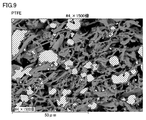
- Example 3 A composite web is produced in the same manner as in Example 2, except that the powder of PFA particles is changed to PTFE. Composite webs deposited under these conditions showed good dispersion of PTFE (see Figure 9).
- FIG. 9 is a cross-sectional photograph of the composite web of Example 3, and the hatched portion in FIG. 9 is PTFE.
- Example 4 Hydrophilic-treated PFA was added to the slurry of Example 1 so as to be 30% by volume, and a web was formed by deposition through a spray-drying process. Composite webs deposited under these conditions showed good dispersion of PFA (see Figure 10).
- FIG. 10 is a cross-sectional photograph of the composite web of Example 4, and the hatched portion in FIG. 10 is PFA.
- hydrophilic treatment surface treatment was performed using a powder plasma treatment device manufactured by Kai Semiconductor Co., Ltd. until PFA was mixed with the aqueous solution and dispersed.
- the powder plasma processing apparatus described above is a device for performing atmospheric pressure plasma processing in a liquid, and is a dielectric barrier discharge plasma device using water as a dielectric. Thus, a hydrophilically treated PFA dispersion was obtained.
- Example 5 A composite web is produced in the same manner as in Example 2, except that the powder of PFA particles is changed to polynorbornene. Composite webs deposited under these conditions showed good dispersion of polynorbornene.
- FIG. 11 shows a cross-sectional state of a film obtained by molding LCP and PFA by melt extrusion. Strong aggregation of PFA is seen.
- FIG. 5 is a photograph (scanning electron microscope image) of the cross section of the LCP web (surface parallel to the thickness direction of the web) in Example 1 (top) and Comparative Example 2 (bottom).
- the numerical value on the photograph of FIG. 5 shows the magnifying power of the microscope. From the photograph in FIG. 5, it can be seen that in Example 1, a web with high LCP fiber dispersion uniformity was produced. In addition, it can be seen that the LCP web of Example 1 is bulkier (has a higher porosity) than the LCP web produced by the papermaking method of Comparative Example 2.
Landscapes
- Engineering & Computer Science (AREA)
- Textile Engineering (AREA)
- Mechanical Engineering (AREA)
- Chemical & Material Sciences (AREA)
- Chemical Kinetics & Catalysis (AREA)
- Nonwoven Fabrics (AREA)
Priority Applications (2)
| Application Number | Priority Date | Filing Date | Title |
|---|---|---|---|
| CN202280016678.1A CN116917562A (zh) | 2021-06-07 | 2022-04-07 | 液晶聚合物网的制造方法 |
| JP2023527548A JP7666595B2 (ja) | 2021-06-07 | 2022-04-07 | 液晶ポリマーウェブの製造方法 |
Applications Claiming Priority (2)
| Application Number | Priority Date | Filing Date | Title |
|---|---|---|---|
| JP2021095206 | 2021-06-07 | ||
| JP2021-095206 | 2021-06-07 |
Publications (1)
| Publication Number | Publication Date |
|---|---|
| WO2022259753A1 true WO2022259753A1 (ja) | 2022-12-15 |
Family
ID=84425866
Family Applications (1)
| Application Number | Title | Priority Date | Filing Date |
|---|---|---|---|
| PCT/JP2022/017257 Ceased WO2022259753A1 (ja) | 2021-06-07 | 2022-04-07 | 液晶ポリマーウェブの製造方法 |
Country Status (3)
| Country | Link |
|---|---|
| JP (1) | JP7666595B2 (https=) |
| CN (1) | CN116917562A (https=) |
| WO (1) | WO2022259753A1 (https=) |
Citations (4)
| Publication number | Priority date | Publication date | Assignee | Title |
|---|---|---|---|---|
| JPH02234909A (ja) * | 1989-02-01 | 1990-09-18 | E I Du Pont De Nemours & Co | リオトロピック液晶ポリマーからサブデニール繊維を製造する方法 |
| WO2008102538A1 (ja) * | 2007-02-21 | 2008-08-28 | Panasonic Corporation | ナノファイバ製造装置 |
| CN102071542A (zh) * | 2011-02-22 | 2011-05-25 | 天津工业大学 | 一种聚合物纳微纤维非织造布的制备方法 |
| WO2021060255A1 (ja) * | 2019-09-25 | 2021-04-01 | 株式会社村田製作所 | 液晶ポリマーパウダーおよびその製造方法 |
Family Cites Families (4)
| Publication number | Priority date | Publication date | Assignee | Title |
|---|---|---|---|---|
| JP2000119952A (ja) * | 1998-10-14 | 2000-04-25 | Sumitomo Chem Co Ltd | 液晶ポリエステル繊維および液晶ポリエステル不織布の製造方法 |
| JP4936026B2 (ja) * | 2009-04-02 | 2012-05-23 | 宇部興産株式会社 | 導電性バインダーの製造方法 |
| CN108601247A (zh) * | 2013-05-22 | 2018-09-28 | 株式会社村田制作所 | 树脂多层基板 |
| JP2018142449A (ja) * | 2017-02-28 | 2018-09-13 | 三菱ケミカル株式会社 | 多孔質電極基材およびその製造方法 |
-
2022
- 2022-04-07 WO PCT/JP2022/017257 patent/WO2022259753A1/ja not_active Ceased
- 2022-04-07 CN CN202280016678.1A patent/CN116917562A/zh active Pending
- 2022-04-07 JP JP2023527548A patent/JP7666595B2/ja active Active
Patent Citations (4)
| Publication number | Priority date | Publication date | Assignee | Title |
|---|---|---|---|---|
| JPH02234909A (ja) * | 1989-02-01 | 1990-09-18 | E I Du Pont De Nemours & Co | リオトロピック液晶ポリマーからサブデニール繊維を製造する方法 |
| WO2008102538A1 (ja) * | 2007-02-21 | 2008-08-28 | Panasonic Corporation | ナノファイバ製造装置 |
| CN102071542A (zh) * | 2011-02-22 | 2011-05-25 | 天津工业大学 | 一种聚合物纳微纤维非织造布的制备方法 |
| WO2021060255A1 (ja) * | 2019-09-25 | 2021-04-01 | 株式会社村田製作所 | 液晶ポリマーパウダーおよびその製造方法 |
Also Published As
| Publication number | Publication date |
|---|---|
| CN116917562A (zh) | 2023-10-20 |
| JP7666595B2 (ja) | 2025-04-22 |
| JPWO2022259753A1 (https=) | 2022-12-15 |
Similar Documents
| Publication | Publication Date | Title |
|---|---|---|
| JP7260054B2 (ja) | 液晶ポリマーフィルムおよびその製造方法 | |
| JP7405146B2 (ja) | 液晶ポリマーパウダーおよびその製造方法 | |
| JP7666595B2 (ja) | 液晶ポリマーウェブの製造方法 | |
| US20250092605A1 (en) | Liquid crystal polymer powder, liquid crystal polymer film, and method of producing same | |
| US20240150655A1 (en) | Method for manufacturing fiber mat, and fiber mat | |
| US12552990B2 (en) | Porous body and method for manufacturing porous body | |
| CN117015642B (zh) | 纤维毡的制造方法和纤维毡 | |
| JP7673839B2 (ja) | 液晶ポリマーペレット、液晶ポリマーパウダー、液晶ポリマーフィルム、および、それらの製造方法 | |
| WO2023032376A1 (ja) | 液晶ポリマーフィルムおよび液晶ポリマーフィルムの製造方法 | |
| WO2024029207A1 (ja) | 液晶ポリマーフィルムおよびこれを備えた積層体、ならびに、液晶ポリマーフィルムの製造方法 | |
| US20260091571A1 (en) | Laminated film and method for producing laminated film | |
| JP2003025325A (ja) | 複合粒子の製造方法 | |
| TWI853221B (zh) | 片狀銀粉及其製造方法和導電膏 | |
| CN100408294C (zh) | 液晶聚合物的研磨 | |
| CN121909084A (zh) | 银粉和银粉的制造方法以及导电性糊剂 |
Legal Events
| Date | Code | Title | Description |
|---|---|---|---|
| 121 | Ep: the epo has been informed by wipo that ep was designated in this application |
Ref document number: 22819941 Country of ref document: EP Kind code of ref document: A1 |
|
| ENP | Entry into the national phase |
Ref document number: 2023527548 Country of ref document: JP Kind code of ref document: A |
|
| WWE | Wipo information: entry into national phase |
Ref document number: 202280016678.1 Country of ref document: CN |
|
| NENP | Non-entry into the national phase |
Ref country code: DE |
|
| 122 | Ep: pct application non-entry in european phase |
Ref document number: 22819941 Country of ref document: EP Kind code of ref document: A1 |