WO2022255281A1 - 蓄熱剤組成物の製造方法 - Google Patents
蓄熱剤組成物の製造方法 Download PDFInfo
- Publication number
- WO2022255281A1 WO2022255281A1 PCT/JP2022/021854 JP2022021854W WO2022255281A1 WO 2022255281 A1 WO2022255281 A1 WO 2022255281A1 JP 2022021854 W JP2022021854 W JP 2022021854W WO 2022255281 A1 WO2022255281 A1 WO 2022255281A1
- Authority
- WO
- WIPO (PCT)
- Prior art keywords
- heat storage
- polyalkylene glycol
- solution
- agent composition
- storage agent
- Prior art date
- Legal status (The legal status is an assumption and is not a legal conclusion. Google has not performed a legal analysis and makes no representation as to the accuracy of the status listed.)
- Ceased
Links
Classifications
-
- C—CHEMISTRY; METALLURGY
- C09—DYES; PAINTS; POLISHES; NATURAL RESINS; ADHESIVES; COMPOSITIONS NOT OTHERWISE PROVIDED FOR; APPLICATIONS OF MATERIALS NOT OTHERWISE PROVIDED FOR
- C09K—MATERIALS FOR MISCELLANEOUS APPLICATIONS, NOT PROVIDED FOR ELSEWHERE
- C09K5/00—Heat-transfer, heat-exchange or heat-storage materials, e.g. refrigerants; Materials for the production of heat or cold by chemical reactions other than by combustion
- C09K5/02—Materials undergoing a change of physical state when used
- C09K5/06—Materials undergoing a change of physical state when used the change of state being from liquid to solid or vice versa
-
- Y—GENERAL TAGGING OF NEW TECHNOLOGICAL DEVELOPMENTS; GENERAL TAGGING OF CROSS-SECTIONAL TECHNOLOGIES SPANNING OVER SEVERAL SECTIONS OF THE IPC; TECHNICAL SUBJECTS COVERED BY FORMER USPC CROSS-REFERENCE ART COLLECTIONS [XRACs] AND DIGESTS
- Y02—TECHNOLOGIES OR APPLICATIONS FOR MITIGATION OR ADAPTATION AGAINST CLIMATE CHANGE
- Y02E—REDUCTION OF GREENHOUSE GAS [GHG] EMISSIONS, RELATED TO ENERGY GENERATION, TRANSMISSION OR DISTRIBUTION
- Y02E60/00—Enabling technologies; Technologies with a potential or indirect contribution to GHG emissions mitigation
- Y02E60/14—Thermal energy storage
Definitions
- the present invention relates to a method for producing a heat storage agent composition.
- Some pharmaceuticals and specimens handled by medical institutions such as hospitals, and food products handled by supermarkets, etc., need to be kept cold or warm within a predetermined temperature range during transportation in order to maintain their quality.
- a method for keeping cold or warm articles such as medicines, specimens, and foods of this type
- a method using a latent heat storage material that utilizes phase transition such as melting of a substance and latent heat is known.
- a heat storage material that has been melted or solidified in advance is placed in an adiabatic transport container, and the latent heat of this heat storage material is used to keep the goods stored in the transport container cool or warm.
- a predetermined temperature range (hereinafter sometimes referred to as "controlled temperature”) for a long time.
- a heat storage material having a melting temperature and/or a solidification temperature within a predetermined temperature range.
- Patent Literature 1 discloses a heat storage agent composition containing an aqueous solution of at least one water-soluble salt that is insoluble in polyalkylene glycol and polyalkylene glycol.
- Patent Document 2 discloses a heat storage agent composition containing methyl laurate, 12-hydroxystearic acid and sorbitan fatty acid ester.
- the weight ratio of methyl laurate and 12-hydroxystearic acid is within a specific range
- the weight ratio of methyl laurate and sorbitan fatty acid ester is within a specific range. .
- the conventional heat storage agent composition described above still has room for improvement from the viewpoint of safety and melting temperature range.
- the present invention has been made in view of the above problems, and its object is to be able to maintain the temperature of a temperature-controlled article in various controlled temperature ranges, and not fall under the dangerous goods under the Fire Service Act of Japan. , to provide a novel heat storage agent composition.
- the present inventor has completed the present invention as a result of diligent studies to solve the above problems.
- a method for producing a heat storage agent composition comprises a polyalkylene glycol solution (I) containing a polyalkylene glycol and a metal soap (A) soluble in the polyalkylene glycol, a metal ion ( and C), wherein the metal ion (C) converts the metal soap (A) into the polyalkylene glycol-insoluble metal soap (B).
- the heat storage agent composition disclosed in Patent Document 1 still has room for improvement from the viewpoint of safety. Specifically, the heat storage agent composition disclosed in Patent Document 1 is highly probable to be regarded as belonging to the fourth category of hazardous materials under the Fire Service Act of Japan. In other words, the heat storage agent composition disclosed in Patent Document 1 is considered to be a hazardous material when (a) stored or (b) transported by means of transportation such as vehicles, aircraft, ships, etc. It is highly probable. Therefore, the heat storage agent composition disclosed in Patent Document 1 is required to be stored/managed in a warehouse for hazardous materials, and when special restrictions are imposed on storage such as a limited amount of storage.
- the heat storage agent composition disclosed in Patent Document 1 requires labeling/procedures as a dangerous substance when transported by transportation means such as vehicles, aircraft, and ships, and the amount of loading is In some cases, there may be special restrictions on transportation, such as being restricted.
- the heat storage agent composition disclosed in Patent Document 2 still has room for improvement from the viewpoint of the melting temperature range.
- the heat storage agent composition disclosed in Patent Document 2 is a composition containing methyl laurate as a main component. Therefore, the heat storage agent composition disclosed in Patent Document 2 has a melting temperature of 1°C to 10°C.
- some articles such as medicines, specimens, and foods have a temperature that should be kept cold or warm (that is, a controlled temperature) in a temperature range higher than 10°C.
- the present inventors conducted extensive studies in order to obtain a heat storage agent composition that can maintain the temperature of articles to be temperature-controlled in various controlled temperature ranges and that does not fall under the category of dangerous substances under the Fire Service Act of Japan. .
- the present inventors investigated the use of polyalkylene glycol whose melting temperature can change depending on the number average molecular weight.
- the present inventor conducted extensive research in order to provide a heat storage agent composition that contains polyalkylene glycol and does not fall under the category of hazardous materials under the Fire Service Act of Japan. More specifically, the present inventors conducted extensive studies with the aim of retaining the shape of a heat storage agent composition containing polyalkylene glycol (for example, containing it as a main component) even at 40°C.
- organic gelling agents e.g., carboxymethyl cellulose, hydroxyethyl cellulose and hydroxypropyl cellulose
- organic gelling agents e.g., carboxymethyl cellulose, hydroxyethyl cellulose and hydroxypropyl cellulose
- these organic gelling agents are insoluble in polyalkylene glycol, and could not retain the shape of the heat storage agent composition containing polyalkylene glycol even at 40°C. Therefore, the present inventor further searched for a compound capable of retaining the shape of a heat storage agent composition containing polyalkylene glycol even at 40°C.
- the metal soap (B) is insoluble in polyalkylene glycol, and the metal soap (B) can be deposited in a uniformly dispersed state in the composition;
- the produced metal soap (B) functions as a gelling agent (thickening agent), so that the resulting composition (heat storage agent composition) retains its shape at 40°C.
- soluble in polyalkylene glycol means that the solubility in polyethylene glycol at 23°C is 3% (weight/weight%) or more.
- insoluble in polyalkylene glycol is intended to have a solubility of less than 3% (wt/wt%) in polyethylene glycol at 23°C.
- metal soaps (A) that are soluble in polyalkylene glycol.
- metal soaps lithium stearate, lithium laurate, lithium montanate, sodium laurate, sodium stearate, sodium 12-hydroxystearate, sodium behenate, sodium montanate, lauric acid.
- the polyalkylene glycol may retain its shape at 40°C.
- the metal soap (B) since the metal soap (B) is insoluble in polyalkylene glycol, when the metal soap (B), which is insoluble in polyalkylene glycol, is directly added to the polyalkylene glycol, the metal soap (B) is uniform in the polyalkylene glycol. not distributed to As a result, there is also the problem that the physical properties of the obtained heat storage agent composition are not stable.
- the metal soap (A) soluble in polyalkylene glycol is uniformly dispersed in the polyalkylene glycol, and then the metal soap (A) is converted to the metal soap (B). . Therefore, there is an advantage that the obtained heat storage agent composition retains its shape at 40° C. and also has stable physical properties. That is, in one embodiment of the present invention, among many metal soaps, a metal soap (A) that is soluble in polyalkylene glycol is used.
- a method for producing a heat storage agent composition comprises a polyalkylene glycol solution (I) containing a polyalkylene glycol and a metal soap (A) soluble in the polyalkylene glycol; and mixing.
- the metal ion (C) is an ion that changes the metal soap (A) into the polyalkylene glycol-insoluble metal soap (B).
- the "method for producing a heat storage agent composition according to one embodiment of the present invention” may be referred to as “this production method”.
- the “step of mixing the polyalkylene glycol solution (I) and the metal ions (C)” may also be referred to as the “metal ion (C) mixing step”.
- “polyalkylene glycol solution (I)” may be simply referred to as “solution (I)”.
- the heat storage agent composition obtained by this production method can maintain the temperature of the temperature-controlled article in various controlled temperature ranges (eg, 1°C to 40°C). Therefore, the heat storage agent composition obtained by the present production method can be used to treat temperature-controlled articles whose controlled temperature is in the range of 1° C. to 40° C. in a specific environment within the controlled temperature of each temperature-controlled article. allow storage or transportation; In addition, since this production method has the above-described configuration, the heat storage agent composition obtained by this production method is judged not to fall under the category of dangerous goods under the Fire Service Act of Japan, and restrictions on handling are relaxed. have advantages.
- the heat storage agent composition obtained by this production method does not undergo solid-liquid separation even after multiple uses, and thus has the advantage of being able to withstand long-term use.
- the heat storage agent composition obtained by this production method is safe, can withstand long-term use, and can suppress the amount of diffusion by retaining its shape (gelation) in the unlikely event of leakage. Therefore, it can be said that the heat storage agent composition is more environmentally friendly than the conventional heat storage agent composition. Therefore, one embodiment of the present invention can contribute to achieving the Sustainable Development Goals (SDGs).
- SDGs Sustainable Development Goals
- the heat storage agent composition according to one embodiment of the present invention stores thermal energy applied from the outside while the heat storage agent composition undergoes a phase transition from a solidified state (solid) to a molten state (in other words, during melting). It can be used as a latent heat type heat storage material. Therefore, the heat storage agent composition according to one embodiment of the present invention can also be said to be a "melting-type latent heat storage agent composition". In addition, the heat storage agent composition according to one embodiment of the present invention releases thermal energy to the outside during the phase transition of the heat storage agent composition from the molten state to the solidified state (solid) (in other words, during solidification). It can be used as a latent heat type heat storage material. Therefore, the heat storage agent composition according to one embodiment of the present invention can also be said to be a "solidifying latent heat storage agent composition".
- Polyalkylene glycol is not particularly limited.
- polyalkylene glycols include polyalkylene glycols having 2 to 4 carbon atoms in the alkylene group.
- Specific examples of polyalkylene glycol include polyethylene glycol, polypropylene glycol, and polyoxytetramethylene glycol. As the polyalkylene glycol, one of these may be used alone, or two or more thereof may be used in combination.
- the polyalkylene glycol preferably contains any one of polyethylene glycol and polypropylene glycol, in which the alkylene group has 2 to 3 carbon atoms, and includes polyethylene glycol. is more preferred, and polyethylene glycol is even more preferred.
- the number average molecular weight of polyalkylene glycol is not particularly limited. Polyalkylene glycols have different melting points depending on the number average molecular weight. Therefore, by changing the number average molecular weight of the polyalkylene glycol used in the production method of the present invention and/or by using a plurality of polyalkylene glycols with different number average molecular weights, the heat storage agent composition obtained Solidification start temperature can be adjusted.
- the melting point of polyethylene glycol having a number average molecular weight of 200 is -65°C to -50°C
- the melting point of polyethylene glycol having a number average molecular weight of 400 is 4°C to 8°C
- the melting point of polyethylene glycol having a number average molecular weight of 600 is -65°C to -50°C.
- the melting point of some polyethylene glycol is 15°C to 25°C
- the melting point of polyethylene glycol with a number average molecular weight of 1000 is 30°C to 40°C.
- the number average molecular weight of the polyalkylene glycol is preferably from 200 to 20,000, more preferably from 400 to 10,000, even more preferably from 400 to 1,000.
- This configuration has the advantage of being able to adjust the solidification start temperature of the heat storage agent composition to a temperature range suitable for constant temperature transportation of pharmaceuticals, medical devices, cells, specimens, organs, chemical substances, foods, and the like.
- only a single number-average molecular weight polyalkylene glycol may be used, or two or more different number-average molecular weight polyalkylene glycols may be used in combination.
- the heat storage agent composition contains polyalkylene glycol with a number average molecular weight of 400 and polyalkylene glycol with a number average molecular weight of 600
- the weight ratio of the polyalkylene glycol having a number average molecular weight of 400 to the polyalkylene glycol having a number average molecular weight of 600 in the heat storage agent composition is preferably 0.20 to 2.00, more preferably 0.30 to 1.50, still more preferably 0.40 to 1.20, and particularly preferably 0.50 to 1.00.
- This configuration has the advantage of being able to adjust the solidification start temperature of the heat storage agent composition to a temperature range suitable for constant temperature transportation of pharmaceuticals, medical devices, cells, specimens, organs, chemical substances, foods, and the like.
- the heat storage agent composition contains polyalkylene glycol with a number average molecular weight of 400, polyalkylene glycol with a number average molecular weight of 600, and polyalkylene glycol with a number average molecular weight of 1000 will be described. .
- the weight ratio of the polyalkylene glycol having a number average molecular weight of 400 to the polyalkylene glycol having a number average molecular weight of 600 in the heat storage agent composition is , is preferably 0.20 to 2.00, more preferably 0.25 to 1.50, even more preferably 0.30 to 1.00, and particularly preferably 0.35 to 0.80.
- the weight ratio of the polyalkylene glycol having a number average molecular weight of 1000 to the polyalkylene glycol having a number average molecular weight of 400 in the heat storage agent composition is preferably 0.01 to 2.00, more preferably 0.03 to 1.50, even more preferably 0.03 to 1.00, and particularly preferably 0.05 to 0.50.
- the weight ratio of the polyalkylene glycol with a number average molecular weight of 1000 to the polyalkylene glycol with a number average molecular weight of 600 in the heat storage agent composition is preferably 0.010 to 0.5000, more preferably 0.015 to 0.3000, more preferably 0.020 to 0.250, more preferably 0.025 to 0.100, and 0.030 to 0.080 is particularly preferred.
- the heat storage agent composition contains polyalkylene glycol with a number average molecular weight of 600 and polyalkylene glycol with a number average molecular weight of 1000
- the weight ratio of polyalkylene glycol with a number average molecular weight of 1000 to polyalkylene glycol with a number average molecular weight of 600 in the heat storage agent composition is preferably 0.040 to 1.000, more preferably 0.080 to 0.750, even more preferably 0.120 to 0.500, and particularly preferably 0.150 to 0.350.
- This configuration has the advantage of being able to adjust the solidification start temperature of the heat storage agent composition to a temperature range suitable for constant temperature transportation of pharmaceuticals, medical devices, cells, specimens, organs, chemical substances, foods, and the like.
- the number average molecular weight of polyalkylene glycol is a value obtained by measuring by SEC method (Size Exclusion Chromatography).
- the polyalkylene glycol may be the main ingredient.
- the polyalkylene glycol may account for 50% by weight or more in 100% by weight of the heat storage agent composition obtained by this production method.
- the heat storage agent composition obtained by this production method when polyalkylene glycol is the main ingredient, the heat storage agent composition has an advantage of being excellent in safety.
- the amount of polyalkylene glycol in the heat storage agent composition obtained by this production method is not particularly limited.
- the amount of polyalkylene glycol in the heat storage agent composition is preferably 60% by weight or more, more preferably 70% by weight or more, and 80% by weight or more in 100% by weight of the heat storage agent composition. is more preferably 90% by weight or more, and particularly preferably 95% by weight or more.
- This configuration has the advantage of stabilizing thermal properties such as the melting point, freezing point and/or solidification start temperature of the heat storage agent composition.
- metal soap As used herein, the term "metal soap” is intended as a general term for metal salts of fatty acids, and specifically, an anion (anion) derived from a fatty acid and a cation (cation), which is a metal ion. Bound substances are intended. Therefore, “metal soap” herein also includes sodium salts of fatty acids and potassium salts of fatty acids. In this specification, the metal ions contained in the metal soap (A) may be referred to as metal ions (D).
- the metal ion (D) is preferably potassium ion.
- Metal soaps containing potassium ions as metal ions (D) are often soluble in polyalkylene glycol. Therefore, by using the metal soap (A) containing potassium ions as the metal ions (D), the anions derived from the fatty acid (that is, the metal ions (D)) can be uniformly dissolved in the polyalkylene glycol. It has the advantage of being easy.
- the metal soap (A) is preferably composed of anions derived from fatty acids having 6 to 18 carbon atoms, more preferably composed of anions derived from fatty acids having 12 to 18 carbon atoms.
- the fatty acid may be a saturated fatty acid or an unsaturated fatty acid.
- the metal soap (A) is more preferably composed of an anion derived from at least one fatty acid selected from the group consisting of lauric acid, stearic acid, myristic acid, palmitic acid and oleic acid.
- the resulting heat storage agent composition has stable shape retention performance at 40° C. and does not undergo solid-liquid separation even during long-term storage. It has the advantage of having properties.
- the metal soap (A) is not particularly limited as long as it is soluble in polyalkylene glycol.
- the metal soap (A) is preferably at least one selected from the group consisting of potassium laurate, potassium stearate, potassium myristate, potassium palmitate and potassium oleate. According to this configuration, the obtained heat storage agent composition has the advantage of having stable shape retention performance at 40° C. and having the property of not causing solid-liquid separation even during long-term storage.
- the metal ion (C) is not particularly limited as long as it is an ion capable of converting the metal soap (A) into the polyalkylene glycol-insoluble metal soap (B). From the viewpoint that the metal soap (A) is easily changed to the metal soap (B) insoluble in the polyalkylene glycol, the metal ion (C) includes the metal ion (D) contained in the metal soap (A) to be used. Ions with a low ionization tendency are preferred.
- metal ions (C) are preferably sodium ions.
- the metal ion (D) contained in the metal soap (A) is a potassium ion and the metal ion (C) is a sodium ion
- the potassium ion has a higher ionization tendency than the sodium ion and exists as an ion in the solution.
- Potassium soaps are easily converted to sodium soaps by ion exchange.
- metal soap (B) Since the metal soap (B) is insoluble in polyalkylene glycol, the metal soap (B) produced by mixing the solution (I) and the metal ion (C) is partly or entirely Precipitation may occur.
- the heat storage agent composition obtained by this production method retains its shape at 40° C. due to the formation of the metal soap (B). Therefore, metal soap (B) can also be called a gelling agent or a thickening agent.
- the metal soap (B) contained in the heat storage agent composition does not necessarily have to be entirely precipitated, and part or all of it may be dissolved in the heat storage agent composition.
- the metal soap (B) is preferably composed of anions derived from fatty acids having 6 to 18 carbon atoms, more preferably composed of anions derived from fatty acids having 12 to 18 carbon atoms.
- the fatty acid may be a saturated fatty acid or an unsaturated fatty acid.
- the metal soap (B) is more preferably composed of an anion derived from at least one fatty acid selected from the group consisting of lauric acid, stearic acid, myristic acid, palmitic acid and oleic acid.
- the resulting heat storage agent composition has stable shape retention performance at 40° C. and does not undergo solid-liquid separation even during long-term storage. It has the advantage of having properties.
- the metal soap (B) is not particularly limited as long as it is insoluble in polyalkylene glycol.
- Metal soap (B) is preferably at least one selected from the group consisting of sodium laurate, sodium stearate, sodium myristate, sodium palmitate and sodium oleate. According to this configuration, the obtained heat storage agent composition has the advantage of having stable shape retention performance at 40° C. and having the property of not causing solid-liquid separation even during long-term storage.
- the heat storage agent composition according to one embodiment of the present invention may contain other components in addition to the polyalkylene glycol and the metal soap (B).
- Other components include, for example, water, corrosion inhibitors, antioxidants, antistatic agents, colorants, antifungal agents, and the like.
- the heat storage agent composition according to one embodiment of the present invention preferably contains water.
- water it is preferable to use water in this production method.
- This configuration has the advantage that it is possible to reliably uniformly disperse the metal ions (C) in the solution (1).
- water is cheap and safe. Therefore, using water in this production method to obtain a heat storage agent composition containing water is preferable not only from the above-mentioned advantages, but also from the viewpoint of cost and safety.
- Water is not particularly limited, and examples include tap water, industrial water, RO water (water purified by reverse osmosis membrane method), distilled water, pure water (e.g., deionized water (purified water), etc.), and ultrapure water.
- Water is preferably RO water, distilled water, pure water (for example, deionized water) and/or ultrapure water in terms of stable production of the heat storage agent composition.
- the amount of water in the heat storage agent composition obtained by this production method is not particularly limited.
- the amount of water in the heat storage agent composition is preferably 1.0% by weight to 10.0% by weight, more preferably 1.3% by weight to 9.0% by weight, based on 100% by weight of the heat storage agent composition. more preferably 1.5 wt% to 8.0 wt%, even more preferably 1.8 wt% to 7.0 wt%, and 2.0 wt% to 6.0 wt%. 0% by weight is particularly preferred.
- the amount of water used in the production method for example, the amount of aqueous solution containing metal ions (C) used can be adjusted so that the amount of water in the obtained heat storage agent composition is within the above range. preferable.
- This configuration has the advantage that the metal ions (C) can be uniformly dispersed in the solution (I) without impairing the thermal properties of the polyalkylene glycol.
- This production method comprises a metal ion (C) mixing step of mixing a polyalkylene glycol solution (I) containing a polyalkylene glycol and a metal soap (A) soluble in the polyalkylene glycol with a metal ion (C).
- the polyalkylene glycol solution (I) is a solution containing polyalkylene glycol as a solvent, metal soap (A) as a solute, and 50% by weight or more of 100% by weight of the solvent being polyalkylene glycol.
- the amount (content) of polyalkylene glycol in the solvent of solution (I) or in solution (I) is not particularly limited.
- the amount of the polyalkylene glycol in the solvent of the solution (I) or in the solution (I) is within the above-mentioned preferred range in consideration of the following points. (i) the amount of solution (I) used, (ii) the amount of polyalkylene glycol in solution (I) and the amount of polyalkylene glycol used other than solution (I), etc. .
- the amount (content) of the polyalkylene glycol in the solution (I) is, for example, preferably 60% by weight or more, more preferably 70% by weight or more, based on 100% by weight of the solution (I). It is more preferably at least 90% by weight, particularly preferably at least 95% by weight.
- the number average molecular weight of the polyalkylene glycol in the solvent of solution (I) or in solution (I) is not particularly limited.
- the number average molecular weight of the polyalkylene glycol in the solvent of the solution (I) or in the solution (I) is determined so that the solidification initiation temperature of the obtained heat storage agent composition has a desired value, taking into consideration the following points. , can be set as appropriate: (i) the amount of solution (I) used, the number average molecular weight and amount of polyalkylene glycol in solution (I), (ii) the number of polyalkylene glycols used other than solution (I) average molecular weight and quantity, etc.
- the amount (content) of the metal soap (A) in the solution (I) is not particularly limited.
- the amount of metal soap (A) in solution (I) can be appropriately set in consideration of the amount of solution (I) used and the amount of metal ion (C) used.
- the amount of metal soap (A) in 100% by weight of solution (I) is preferably 0.1% to 10.0% by weight, preferably 0.2% to 5% by weight. 0% by weight, more preferably 0.3% to 3.0% by weight, and particularly preferably 0.4% to 1.8% by weight. According to this configuration, there is no possibility that the metal soap (A) will be precipitated due to temperature changes in the solution (I), and the obtained heat storage agent composition has the advantage that it does not undergo solid-liquid separation even during long-term storage. .
- a method for preparing the polyalkylene glycol solution (I) is not particularly limited, but an example thereof includes a method of mixing the polyalkylene glycol and the metal soap (A).
- a) polyalkylene glycol is mixed with a solution of metal soap (A) dissolved in any solvent (for example, water or a small amount of polyalkylene glycol solution).
- any solvent for example, water or a small amount of polyalkylene glycol solution.
- the polyalkylene glycol and the solid metal soap (A) may be mixed.
- the mixture obtained by mixing the polyalkylene glycol and the metal soap (A) (or the solution of the metal soap (A)) may be (a) heated to an arbitrary temperature (for example, 50° C.), (b ) may be maintained (warmed) at an arbitrary temperature (eg, 50° C.) for a certain period of time (eg, until the metal soap (A) is dissolved), and/or (c) may be stirred.
- an arbitrary temperature for example, 50° C.
- b may be maintained (warmed) at an arbitrary temperature (eg, 50° C.) for a certain period of time (eg, until the metal soap (A) is dissolved)
- c) may be stirred.
- the metal soap (A) can be easily dissolved in the polyalkylene glycol solution and/or the metal soap (A) can be reliably uniformly dispersed in the solution (I).
- Each of the device for mixing the polyalkylene glycol and the metallic soap (A) (or the solution of the metallic soap (A)), the device for heating the mixture obtained by such mixing, and the device for stirring the mixture is particularly There is no limitation, and known devices can be used.
- the metal ion (C) mixing step may include a step of mixing (a) the polyalkylene glycol solution (I) and a metal salt containing the metal ion (C), and (b) the polyalkylene glycol solution ( A step of mixing I) with a solution containing metal ions (C) may be included.
- the metal ion (C) mixing step includes mixing the polyalkylene glycol solution (I) and the solution containing the metal ions (C). It is preferable to include a step (hereinafter sometimes referred to as a “metal ion (C)-containing solution mixing step”).
- the solution containing the metal ion (C) may be a polyalkylene glycol solution containing polyalkylene glycol and the metal ion (C), and contains the metal ion (C). It may be an aqueous solution.
- the polyalkylene glycol and the polyalkylene glycol solution containing the metal ion (C) in the metal ion (C) mixing step are referred to as "polyalkylene glycol solution (II)" or simply “solution (II)". In some cases.
- aqueous solution (IV) containing metal ions (C) in the metal ion (C) mixing step
- aqueous solution (IV) containing metal ions (C) or simply “aqueous solution (IV)”. In some cases.
- the polyalkylene glycol solution (I) is mixed with the polyalkylene glycol solution (II) containing the polyalkylene glycol and the metal ion (C).
- the polyalkylene glycol solution (II) in which the metal ions (C) are uniformly dispersed in the solution and the solution (I) can be mixed.
- the obtained heat storage agent composition can retain its shape uniformly over the entire heat storage agent composition even at 40° C. (in other words, it can be a uniform gel). That is, the obtained heat storage agent composition has the advantage that it is judged not to fall under the category of dangerous substances under the Japanese Fire Service Law even after long-term use, and the concern of solid-liquid separation can be avoided.
- the polyalkylene glycol solution (II) is a solution containing polyalkylene glycol as a solvent, metal ions (C) as a solute, and 50% by weight or more of 100% by weight of the solvent being polyalkylene glycol.
- the polyalkylene glycol in the solution (II) may be the same polyalkylene glycol as the polyalkylene glycol in the solution (I) (for example, a polyalkylene glycol having the same number of carbon atoms in the alkylene group and/or the number average molecular weight), Different polyalkylene glycols (eg, polyalkylene glycols having different carbon numbers and/or number average molecular weights in the alkylene group) may be used.
- the amount (content) of polyalkylene glycol in the solvent of solution (II) or in solution (II) is not particularly limited.
- the amount of the polyalkylene glycol in the solvent of the solution (II) or in the solution (II) is within the preferred range described above, taking into consideration the following points. It can be set appropriately so that: the amount of solution (II) used, the amount of polyalkylene glycol in solution (II), and the amount of polyalkylene glycol used in other than solution (II) (for example, solution (I)) etc.
- the amount (content) of the polyalkylene glycol in the solution (II) is, for example, preferably 60% by weight or more, more preferably 70% by weight or more, in 100% by weight of the solution (II). It is more preferably at least 90% by weight, particularly preferably at least 95% by weight.
- the number average molecular weight of the polyalkylene glycol in the solvent of solution (II) or in solution (II) is not particularly limited.
- the number-average molecular weight of the polyalkylene glycol in the solvent of the solution (II) or in the solution (II) is determined so that the solidification initiation temperature of the obtained heat storage agent composition becomes a desired value, taking into consideration the following points. , can be set as appropriate: the amount of solution (II) used, the number average molecular weight and amount of polyalkylene glycol in solution (II), and the polyalkylene glycol used in solution (II) other than (e.g., solution (I)) number average molecular weight and amount of
- the amount (content) of the metal ion (C) in the solution (II) is not particularly limited.
- the relationship between the amount of metal ion (C) in solution (II) and the amount of metal soap (A) is ⁇ (molar amount of metal ion (C)) ⁇ (valence of metal ion (C)) ⁇ is excessive with respect to ⁇ (molar amount of metal ion (D) contained in metal soap (A)) ⁇ (valence of metal ion (D) contained in metal soap (A)) ⁇ is preferably
- ⁇ (metal ion ( The ratio of the value of (molar amount of C)) ⁇ (valence of metal ion (C)) ⁇ is preferably 2 or more, more preferably 3 or more, even more preferably 4 or more, 5 or more is particularly preferred. According to this configuration, all of the metal soap (A) is replaced with the metal soap (B), so solid-liquid separation of the gel caused by the metal soap (A) remaining in the heat storage agent composition is reduced or
- the method for preparing solution (II) is not particularly limited.
- Examples of the method for preparing the solution (II) include (a) a method of mixing a polyalkylene glycol and a metal salt containing a metal ion (C), and (b) a method of mixing a polyalkylene glycol and a metal ion (C). and a method of mixing with a solution.
- the solution containing metal ion (C) may be polyalkylene glycol and a polyalkylene glycol solution containing metal ion (C), or an aqueous solution containing metal ion (C).
- aqueous solution containing the metal ion (C) in the preparation of the solution (II) may be referred to as "aqueous solution (III) containing metal ion (C)" or simply “aqueous solution (III)”. .
- the solution (II) is preferably prepared by mixing the polyalkylene glycol and the aqueous solution (III) containing the metal ion (C), in other words, the polyalkylene glycol solution (II) is , polyalkylene glycol and the aqueous solution (III) containing the metal ion (C). According to this configuration, it is possible to obtain the polyalkylene glycol solution (II) in which the metal ions (C) are uniformly dispersed in the solution.
- the obtained heat storage agent composition can retain its shape uniformly over the entire heat storage agent composition even at 40° C. (in other words, it can be a uniform gel). That is, the obtained heat storage agent composition has the advantage that it is judged not to fall under the category of dangerous substances under the Japanese Fire Service Law even after long-term use, and the concern of solid-liquid separation can be avoided.
- the aqueous solution (III) containing metal ions (C) is a solution containing water as a solvent, metal ions (C) as a solute, and 50% by weight or more of 100% by weight of the solvent being water.
- the solvent of the aqueous solution (III) may be water only.
- the aqueous solution (III) can be prepared by mixing water and a metal salt containing the metal ion (C).
- the metal salt containing the metal ion (C) is not particularly limited, and examples thereof include sodium compounds such as sodium chloride, sodium bromide, sodium sulfate, sodium nitrate, sodium acetate, sodium carbonate and sodium formate.
- the metal salt containing the metal ion (C) one of these may be used alone, or two or more thereof may be used in combination.
- a case of adopting a method of mixing polyalkylene glycol and an aqueous solution (III) containing a metal ion (C) as a method for preparing the solution (II) will be described.
- a water-soluble metal salt that is insoluble in polyalkylene glycol can be used as the metal salt containing the metal ion (C).
- Such metal salts are not particularly limited and include, for example, the above-mentioned sodium compounds.
- sodium chloride, sodium bromide, sodium sulfate, and sodium nitrate are metal salts that are odorless, safe, and have few restrictions on handling.
- acetate, sodium carbonate and sodium formate more preferably at least one selected from the group consisting of sodium chloride, sodium sulfate and sodium nitrate
- the resulting heat storage agent composition may contain water.
- the advantages of including water in the heat storage agent composition are as described above.
- the polyalkylene glycols contained in the heat storage agent composition as the amount of polyalkylene glycol dissolved in water increases, the latent heat amount of the heat storage agent composition may decrease. Therefore, it is preferable that the amount of polyalkylene glycol dissolved in water in the heat storage agent composition is small. Therefore, the higher the concentration of the metal ion (C) (or the metal salt containing the metal ion (C)) in the aqueous solution (III), the better, and the closer to the saturation concentration the better.
- the saturation concentration of sodium chloride with respect to water at 20°C is 26.5 (weight/weight%).
- the concentration of the metal ions (C) in the aqueous solution (III) can be adjusted.
- the mixture obtained by mixing water and the metal salt containing the metal ion (C) may be (a) heated to an arbitrary temperature (for example, 25 ° C.), (b ) may be maintained (warmed) at an arbitrary temperature (eg, 20° C.) for a certain period of time (eg, until the metal salt containing the metal ion (C) is dissolved), and/or (c) stirred.
- an arbitrary temperature for example, 25 ° C.
- b may be maintained (warmed) at an arbitrary temperature (eg, 20° C.) for a certain period of time (eg, until the metal salt containing the metal ion (C) is dissolved)
- c stirred.
- each of the device for mixing water and the metal salt containing the metal ion (C), the device for heating the mixture obtained by such mixing, and the device for stirring the mixture especially There is no limitation, and known devices can be used.
- solution (II) a mixture obtained by mixing polyalkylene glycol and a solution containing metal ions (C) (for example, aqueous solution (III)) may be stirred.
- This configuration has the advantage that the metal ions (C) can be reliably uniformly dispersed in the solution (II).
- an apparatus for mixing polyalkylene glycol and a solution containing metal ions (C) e.g., aqueous solution (III)
- Each device for stirring is not particularly limited, and known devices can be used.
- the metal ion (C) mixing step preferably includes a step of mixing the polyalkylene glycol solution (I) with an aqueous solution (IV) containing the metal ion (C) as the metal ion (C) solution mixing step.
- the process of dispersing the metal ions (C) in the polyalkylene glycol in advance can be omitted, so that there is an advantage that the working efficiency is improved.
- the step of mixing the polyalkylene glycol solution (I) and the aqueous solution (IV) containing the metal ions (C) may be referred to as "aqueous solution (IV) mixing step".
- the aqueous solution (IV) containing metal ions (C) is a solution containing water as a solvent, metal ions (C) as a solute, and 50% by weight or more of 100% by weight of the solvent being water.
- the solvent of the aqueous solution (IV) may be water only.
- the aqueous solution (IV) can be said to be the same aqueous solution as the aqueous solution (III) described above, although the steps used in this production method and the purpose of use are different. Therefore, for the aqueous solution (IV), the description in the above section (Aqueous solution (III) containing metal ions (C)) can be used as appropriate.
- the metal salt containing the metal ion (C) used in the preparation of the aqueous solution (IV) includes the metal salts described in the above section (Aqueous solution (III) containing the metal ion (C)). .
- the method for preparing the aqueous solution (IV) may also include the metal salt described in the above section (Aqueous solution (III) containing metal ion (C)). can.
- sodium chloride, sodium bromide, sodium sulfate, and sodium nitrate are metal salts that are odorless, safe, and have few restrictions on handling.
- acetate, sodium carbonate and sodium formate more preferably at least one selected from the group consisting of sodium chloride, sodium sulfate and sodium nitrate
- the amount (content) of the metal ion (C) in the solution (IV) is not particularly limited.
- the relationship between the amount of metal ion (C) in solution (IV) and the amount of metal soap (A) is ⁇ (molar amount of metal ion (C)) ⁇ (valence of metal ion (C)) ⁇ is excessive with respect to ⁇ (molar amount of metal ion (D) contained in metal soap (A)) ⁇ (valence of metal ion (D) contained in metal soap (A)) ⁇ is preferably
- ⁇ (metal ion ( The ratio of the value of (molar amount of C)) ⁇ (valence of metal ion (C)) ⁇ is preferably 2 or more, more preferably 3 or more, even more preferably 4 or more, 5 or more is particularly preferred. According to this configuration, all of the metal soap (A) is replaced with the metal soap (B), so solid-liquid separation of the gel caused by the metal soap (A) remaining in the heat storage agent composition is reduced or prevented.
- the metal ion (C) mixing step may include (a) a step of simultaneously mixing the solution (I) and the metal ion (C), and (b) adding the metal ion (C) to the solution (I). or (c) adding the solution (I) to the metal ions (C).
- the step of mixing the metal ions (C) includes (a) mixing the solution (I) and the metal ions (C) simultaneously, or (b) adding the metal ions (C) to the solution (I). It is preferable to include steps.
- the metal salt containing the metal ion (C) (for example, the sodium compound described above) is combined with the metal soap (A) (for example, potassium laurate, potassium stearate, potassium myristate, potassium palmitate, potassium oleate).
- the metal soap (A) for example, potassium laurate, potassium stearate, potassium myristate, potassium palmitate, potassium oleate.
- the solution (II) or aqueous solution (IV) containing the metal ion (C) generally tends to have a higher specific gravity than the solution (I).
- a solution with a relatively high specific gravity is added to a solution with a relatively low specific gravity, and the mixture is mixed. preferably.
- the metal ion (C) mixing step is performed as the solution (II) mixing step or the aqueous solution (IV) mixing step ( a) simultaneously mixing a solution (I) containing a metal soap (A) and a solution (II) or an aqueous solution (IV) containing a metal ion (C), or (b) a metal soap (A ) to the solution (I) containing the metal ion (C), the step of adding the solution (II) or the aqueous solution (IV) containing the metal ion (C).
- the metal ion (C) mixing step is, for example, a solution (II) mixing step or an aqueous solution (IV) mixing step, in which (a) a solution (I) at a relatively high temperature (e.g., 50°C) and a room temperature (e.g., 25°C) ) with a solution (II) or an aqueous solution (IV) of (b) relatively high temperature (e.g. 50 ° C.) solution (I) at about room temperature (e.g.
- the amounts of solution (I), solution (II) and aqueous solution (IV) used in the metal ion (C) mixing step are not particularly limited.
- Each of the amounts of solution (I), solution (II) and aqueous solution (IV) used in the metal ion (C) mixing step is the amount of metal soap (A) in solution (I), The amount of metal ion (C) (metal salt), the amount of metal ion (C) (metal salt) in solution (IV), and the amount of polyalkylene glycol in solution (I) and solution (II), etc.
- the solidification start temperature of the resulting heat storage agent composition can be appropriately set to a desired temperature.
- the amount (used amount) of the metal ion (C) is not particularly limited.
- the relationship between the amount of the metal ion (C) and the amount of the metal soap (A) in the metal ion (C) mixing step is ⁇ (molar amount of metal ion (C)) x (valence of metal ion (C) number) ⁇ is the value of ⁇ (molar amount of metal ion (D) contained in metal soap (A)) ⁇ (valence of metal ion (D) contained in metal soap (A)) ⁇ preferably in excess.
- ⁇ (metal ion ( The ratio of the value of (molar amount of C)) ⁇ (valence of metal ion (C)) ⁇ is preferably 2 or more, more preferably 3 or more, even more preferably 4 or more, 5 or more is particularly preferred. According to this configuration, all of the metal soap (A) is replaced with the metal soap (B), so solid-liquid separation of the gel caused by the metal soap (A) remaining in the heat storage agent composition is reduced or prevented. be able to.
- a case of preparing a heat storage material containing the heat storage agent composition by storing the heat storage agent composition in a container will be described.
- the production of the heat storage agent composition and the preparation of the heat storage material may be performed at the same time.
- a blow container made of HDPE is filled with the solution (I) at a relatively high temperature (for example, 50°C) and then filled with the solution (II) or the aqueous solution (IV) at about room temperature (for example, 25°C).
- the production of the heat storage agent composition and the preparation of the heat storage material may be performed simultaneously.
- the solution (I) at a relatively high temperature (eg, 50°C) and the solution (II) or aqueous solution (IV) at about room temperature (eg, 25°C) are mixed in an HDPE blow container.
- the production of the heat storage agent composition and the preparation of the heat storage material may be performed at the same time by a method of simultaneous filling.
- a case of preparing a heat storage material containing the heat storage agent composition by storing the obtained heat storage agent composition in an airtight container after manufacturing the heat storage agent composition will be described.
- the heat storage agent composition retains its shape at 40.degree. Therefore, after heating the heat storage agent composition obtained after production to a temperature higher than 40° C. (for example, 60° C.) to obtain a fluid heat storage agent composition, the heat storage agent composition is placed, for example, in a 500 mL HDPE blow container.
- a heat storage material can be prepared by filling the heat storage agent composition.
- a heat storage agent composition according to one embodiment of the present invention contains a polyalkylene glycol and a metal soap (B) insoluble in the polyalkylene glycol, and retains its shape at 40°C.
- the heat storage agent composition according to one embodiment of the present invention has the above configuration, (i) in various controlled temperature ranges (for example, 1° C. to 40° C.), pharmaceuticals, medical devices, cells, specimens, organs, It is possible to maintain the temperature of temperature-controlled articles such as chemical substances or food, to enable the storage or transportation of such temperature-controlled articles, and , has the advantage that handling constraints are relaxed.
- the heat storage agent composition according to one embodiment of the present invention retains its shape at 40°C.
- the fact that the heat storage agent composition retains its shape at 40°C means that the heat storage agent composition does not have fluidity at 40°C.
- the heat storage agent composition is in a molten state at 40°C, the heat storage agent composition does not have fluidity at 40°C, so it can be said that the heat storage agent composition is not liquid but gel at 40°C.
- a heat storage agent composition (sample) is placed in a flat-bottomed transparent glass tube having an inner diameter of 30 mm and a height of 120 mm to a height of 55 mm from the bottom.
- the glass tube is provided with a marked line at 85 mm from the bottom; (2) Leave the glass tube upright for 10 minutes in a constant temperature water bath adjusted to 40°C; (3) After 10 minutes, remove the glass tube from the constant temperature water bath and lay it horizontally; (4) Measure the time from laying the glass tube horizontally until the sample in the glass tube exceeds the 85 mm marked line; (5) If the obtained time is within 90 seconds, it is determined that the heat storage agent composition retains its shape at 40° C. (in other words, it does not have fluidity).
- This test is the same as the test based on the Class 4 and Designated Combustible Judgment Flowchart stipulated by the Fire and Disaster Management Agency of the Ministry of Internal Affairs and Communications in accordance with the government ordinance on the regulation of dangerous substances in Japan.
- the heat storage agent composition according to one embodiment of the present invention retains its shape at 40°C.
- the heat storage agent composition according to one embodiment of the present invention is: It does not contain substances listed in items 1 to 9 of the same category, and (b) has a flash point of 40° C. or higher as measured by a seta closed flash point tester. Therefore, it is determined that the heat storage agent composition according to one embodiment of the present invention does not fall under the category of hazardous materials under the Fire Service Act of Japan.
- the solidification start temperature of the present heat storage agent composition is preferably 1.0°C to 40.0°C, more preferably 1.0°C to 30.0°C, more preferably 1.0°C to 20.0°C. 0°C to 15.0°C is more preferred, 3.0°C to 15.0°C is more preferred, 5.0°C to 15.0°C is even more preferred, and 6.0°C to 12.0°C is particularly preferred. .
- This configuration has the advantage that it can be suitably used as a heat storage agent composition when the article to be temperature-controlled is a biopharmaceutical, a pharmaceutical intermediate, a vaccine, or the like.
- the “solidification initiation temperature” of the heat storage agent composition means “the temperature exhibited by the heat storage agent composition when the gelled heat storage agent composition begins to solidify, in other words, to solidify”. intended to be
- the solidification initiation temperature of the heat storage agent composition can be measured by the following method using a constant temperature bath having a temperature control unit and a thermocouple: (1) A heat storage agent composition is placed in a test tube, and a thermocouple is inserted in the center of the heat storage agent composition; (2) The test tube is placed in a constant temperature bath having a temperature control unit; (3) While monitoring the temperature of the heat storage agent composition, the temperature in the constant temperature bath is lowered from a high temperature (eg, 50°C) to a low temperature (eg, -50°C) at a constant cooling rate (eg, a rate of 1°C/min).
- a high temperature eg, 50°C
- a low temperature eg, -50°C
- a constant cooling rate eg, a rate of 1°C/min
- the temperature is lowered, and the temperature change of the heat storage agent composition is plotted against time and graphed; (3)
- the temperature of the heat storage agent composition in the test tube changes in the following order (i) to (iii) as compared with the temperature of the constant temperature bath that decreases at a constant rate: (i (ii) after a slight increase from temperature T1 to temperature T2, there is little change from temperature T2 to temperature T3 due to the latent heat of the heat storage agent composition; (3) At temperature T3 , the temperature begins to drop significantly.
- Temperature T1 is referred to herein as the "solidification initiation temperature”.
- the heat storage agent composition according to one embodiment of the present invention can be used as a heat storage material by being stored (filled) in a container, bag, or the like.
- a heat storage material containing the heat storage agent composition according to one embodiment of the present invention in other words, a heat storage material containing the heat storage agent composition according to one embodiment of the present invention is also one embodiment of the present invention. .
- the container or bag is mainly made of resin (for example, synthetic resin).
- resin for example, synthetic resin.
- the resin include polyvinyl chloride, polyethylene, polypropylene, polyethylene terephthalate, polystyrene, nylon and polyester.
- One of these materials may be used alone, or two or more of these materials may be used in combination in order to improve heat resistance and barrier properties (for example, a multi-layer structure is used). etc.) can also be done. From the point of view of handling and cost, it is preferable to use a container or bag made of polyethylene.
- the shape of the container or bag is not particularly limited, but from the viewpoint of efficient heat exchange between the cold storage material composition and the temperature-controlled article or its surrounding space through the container or bag, the thickness is A shape that is thin and can secure a large surface area is preferable.
- the container for example, an HDPE blown container having an internal capacity of 500 mL is suitable.
- the heat storage agent composition according to one embodiment of the present invention is suitably used for storing and transporting various articles such as cells, pharmaceuticals, medical devices, cells, specimens, organs, chemical substances, and foods that require temperature control. can.
- the heat storage agent composition according to one embodiment of the present invention or the heat storage material according to one embodiment of the present invention can also be used as various heat retaining tools.
- the heat storage agent composition according to one embodiment of the present invention or the heat storage material according to one embodiment of the present invention can be used as a heat storage material in various heat storage devices such as air conditioners and heat recovery systems.
- the heat storage agent composition according to one embodiment of the present invention or the heat storage material according to one embodiment of the present invention can be applied to various devices as a heat storage material. can.
- An embodiment of the present invention may have the following configuration.
- a heat storage agent composition that contains a polyalkylene glycol and a metal soap (B) that is insoluble in the polyalkylene glycol, and retains its shape at 40°C.
- An embodiment of the present invention may have the following configuration.
- step includes mixing the polyalkylene glycol solution (I) with a polyalkylene glycol solution (II) containing the polyalkylene glycol and the metal ion (C).
- a method for producing a heat storage agent composition includes mixing the polyalkylene glycol solution (I) with a polyalkylene glycol solution (II) containing the polyalkylene glycol and the metal ion (C).
- the metal soap (A) is at least one selected from the group consisting of potassium laurate, potassium stearate, potassium myristate, potassium palmitate and potassium oleate [Y1] to [Y4] A method for producing a heat storage agent composition according to any one of .
- [Y6] of [Y1] to [Y5], wherein the metal soap (B) is at least one selected from the group consisting of sodium laurate, sodium stearate, sodium myristate, sodium palmitate and sodium oleate A method for producing the heat storage agent composition according to any one of the above.
- Raw materials used in Examples and Comparative Examples are as follows. ⁇ Main agent> ⁇ Polyethylene glycol 400 (PEG400) (number average molecular weight 400, manufactured by Sanyo Chemical Industries, Ltd.) ⁇ Polyethylene glycol 600 (PEG600) (number average molecular weight 600, manufactured by Sanyo Chemical Industries, Ltd.) ⁇ Polyethylene glycol 1000 (PEG1000) (number average molecular weight 1000, manufactured by Sanyo Chemical Industries, Ltd.) The ratios of PEG400, PEG600, and PEG1000 described in the table all represent the amount (% by weight) of each PEG used when the heat storage agent composition is taken as 100% by weight.
- Example 1 Method for preparing polyalkylene glycol solution (I-1)
- Example 2 Method for preparing polyalkylene glycol solution (I-1)
- 4.0 g of potassium laurate was added to 272.5 g of polyethylene glycol 600 to form a mixture.
- the mixture was heated and kept at 50° C., and potassium laurate was dissolved in polyethylene glycol 600 to prepare a polyalkylene glycol solution (I-1).
- a blown container made of HDPE (High Density PolyEthylene) having a content of 500 mL was filled with the polyethylene glycol solution (I-1) and then with the polyethylene glycol solution (II-1). After closing the cap of the HDPE blow container, the HDPE blow container was shaken up and down 10 times and allowed to stand still for 10 minutes to obtain a heat storage material (a-1) in which the heat storage agent composition was solidified.
- HDPE High Density PolyEthylene
- Example 2 (Method for preparing polyalkylene glycol solutions (I-1) and (II-1)) Polyalkylene glycol solutions (I-1) and (II-1) were prepared in the same manner as in Example 1.
- Example 3 (Method for producing polyalkylene glycol solution (I-2)) 4.0 g of potassium laurate was added to a mixture of 198.5 g of polyethylene glycol 400 and 272.5 g of polyethylene glycol 600 to prepare a mixture. The mixture was heated and kept at 50° C., and potassium laurate was dissolved in the mixture of polyethylene glycols to prepare a polyalkylene glycol solution (I-2).
- Example 4 (Method for preparing polyalkylene glycol solution (I-3)) To 272.5 g of polyethylene glycol 600 was added 4.0 g of potassium stearate to form a mixture. The mixture was heated and kept at 50° C., and potassium stearate was dissolved in polyethylene glycol 600 to prepare a polyalkylene glycol solution (I-3).
- Polyalkylene glycol solution (II-1) was prepared in the same manner as in Example 1.
- Example 5 (Method for producing polyalkylene glycol solution (I-4)) 4.0 g of potassium stearate was added to a mixture of 198.5 g of polyethylene glycol 400 and 272.5 g of polyethylene glycol 600 to prepare a mixture. The mixture was heated and kept at 50° C. to dissolve potassium stearate to prepare a polyalkylene glycol solution (I-4).
- an aqueous sodium chloride solution (IV-1) was prepared by dissolving 5.5 g of purified salt in 19.5 g of water at room temperature.
- the polyethylene glycol solution (I-4) was filled into an HDPE blown container having a content of 500 mL, and then the sodium chloride aqueous solution (IV-1) was filled.
- the HDPE blow container was shaken up and down 10 times and allowed to stand still for 10 minutes to obtain a heat storage material (a-5) in which the heat storage agent composition was solidified.
- the moles of sodium ions (sodium chloride) and potassium ions (potassium laurate) present in all the liquids in the manufacturing process of the heat storage materials (a-1, a-2, a-3) of Examples 1 to 3 The ratio was 0.0188 mol:0.0034 mol, with a large excess of sodium ions.
- the molar ratio of sodium ions (sodium chloride) and potassium ions (potassium stearate) present in the entire liquid during the manufacturing process of the heat storage materials (a-4, a-5) of Examples 4 and 5 was 0.019. mol: 0.0025 mol, a large excess of sodium ions.
- Example 6 (Method for preparing polyalkylene glycol solution (I-5)) 4.0 g of potassium laurate was added to a mixture of 331.0 g of polyethylene glycol 600 and 15.0 g of polyethylene glycol 1000 to prepare a mixture. The mixture was heated and kept at 50° C., and potassium laurate was dissolved in the mixture of polyethylene glycols to prepare a polyalkylene glycol solution (I-5).
- Example 7 (Method for preparing polyalkylene glycol solutions (I-5) and (II-2)) Polyalkylene glycol solution (I-5) and polyalkylene glycol solution (II-2) were prepared by the same method as in Example 6.
- Example 8 (Method for producing polyalkylene glycol solution (I-6)) To a mixture of 135.0 g of polyethylene glycol 400, 331.0 g of polyethylene glycol 600 and 15.0 g of polyethylene glycol 1000, 4.0 g of potassium laurate was added to prepare a mixture. The mixture was heated and kept at 50° C., and potassium laurate was dissolved in the mixed solution of polyethylene glycol to prepare a polyalkylene glycol solution (I-6).
- Example 9 (Method for preparing polyalkylene glycol solution (I-7)) 4.0 g of potassium stearate was added to a mixture of 331.0 g of polyethylene glycol 600 and 15.0 g of polyethylene glycol 1000 to form a mixture. The mixture was heated and kept at 50° C., and potassium stearate was dissolved in the mixed solution of polyethylene glycol to prepare a polyalkylene glycol solution (I-7).
- Example 10 (Method for producing polyalkylene glycol solution (I-8)) 4.0 g of potassium stearate was added to a mixture of 135.0 g of polyethylene glycol 400, 331.0 g of polyethylene glycol 600 and 15.0 g of polyethylene glycol 1000 to prepare a mixture. The mixture was heated and kept at 50° C., and potassium stearate was dissolved in the mixed solution of polyethylene glycol to prepare a polyalkylene glycol solution (I-8).
- the moles of sodium ions (sodium chloride) and potassium ions (potassium laurate) present in all liquids in the manufacturing process of the heat storage materials (b-1, b-2, b-3) of Examples 6 to 8 The ratio was 0.0113 mol:0.0034 mol, indicating a large excess of sodium ions.
- the molar ratio of sodium ions (sodium chloride) and potassium ions (potassium stearate) present in the entire liquid in the manufacturing process of the heat storage materials (b-4, b-5) of Examples 9 and 10 was 0.0113. mol: 0.0025 mol, a large excess of sodium ions.
- Example 11 (Method for preparing polyalkylene glycol solution (I-9)) A mixture was prepared by adding 4.0 g of potassium laurate to 250.0 g of polyethylene glycol 600. The mixture was heated and kept at 50° C., and potassium laurate was dissolved in polyethylene glycol 600 to prepare a polyalkylene glycol solution (I-9).
- Example 12 (Method for preparing polyalkylene glycol solutions (I-9) and (II-3)) Polyalkylene glycol solution (I-9) and polyalkylene glycol solution (II-3) were prepared in the same manner as in Example 11.
- Example 13 (Method for producing polyalkylene glycol solution (I-10)) 4.0 g of potassium laurate was added to a mixture of 337.5 g of polyethylene glycol 600 and 93.5 g of polyethylene glycol 1000 at 50° C. to prepare a mixture. While the mixture was kept at 50° C., potassium laurate was dissolved in the mixed solution of polyethylene glycol to prepare a polyalkylene glycol solution (I-10).
- Example 14 (Method for preparing polyalkylene glycol solution (I-11)) To 250.0 g of polyethylene glycol 600 was added 4.0 g of potassium stearate to form a mixture. The mixture was heated and kept at 50° C., and potassium stearate was dissolved in polyethylene glycol 600 to prepare a polyalkylene glycol solution (I-11).
- Example 15 (Method for producing polyalkylene glycol solution (I-12)) 4.0 g of potassium stearate was added to a mixture of 337.5 g of polyethylene glycol 600 and 93.5 g of polyethylene glycol 1000 at 50° C. to prepare a mixture. While the mixture was kept at 50° C., potassium stearate was dissolved in the mixture of polyethylene glycols to prepare a polyalkylene glycol solution (I-12).
- the moles of sodium ions (sodium chloride) and potassium ions (potassium laurate) present in all liquids in the manufacturing process of the heat storage materials (c-1, c-2, c-3) of Examples 11 to 13 The ratio was 0.0188 mol:0.0034 mol, with a large excess of sodium ions.
- the molar ratio of sodium ions (sodium chloride) and potassium ions (potassium stearate) present in the entire liquid in the manufacturing process of the heat storage materials (c-4, c-5) of Examples 14 and 15 was 0.019. mol: 0.0025 mol, a large excess of sodium ions.
- Example 16 (Method for preparing polyalkylene glycol solution (I-13)) 4.0 g of potassium myristate was added to 272.5 g of polyethylene glycol 600 to prepare a mixture. The mixture was heated and kept at 50° C., and potassium myristate was dissolved in polyethylene glycol 600 to prepare a polyalkylene glycol solution (I-13).
- Polyalkylene glycol solution (II-1) was prepared in the same manner as in Example 1.
- Example 17 (Method for producing polyalkylene glycol solution (I-14)) 4.0 g of potassium myristate was added to a mixture of 198.5 g of polyethylene glycol 400 and 272.5 g of polyethylene glycol 600 to prepare a mixture. The mixture was heated and kept at 50° C. to dissolve potassium myristate to prepare a polyalkylene glycol solution (I-14).
- an aqueous sodium chloride solution (IV-1) was prepared by dissolving 5.5 g of purified salt in 19.5 g of water at room temperature.
- a polyethylene glycol solution (I-14) was filled into a 500 mL HDPE blown container, and then the sodium chloride aqueous solution (IV-1) was filled.
- the HDPE blow container was shaken up and down 10 times and allowed to stand still for 10 minutes to obtain a heat storage material (a-8) in which the heat storage agent composition was solidified.
- Example 18 (Method for preparing polyalkylene glycol solution (I-15)) 4.0 g of potassium palmitate was added to 272.5 g of polyethylene glycol 600 to prepare a mixture. The mixture was heated and kept at 50° C., and potassium palmitate was dissolved in polyethylene glycol 600 to prepare a polyalkylene glycol solution (I-7).
- Polyalkylene glycol solution (II-1) was prepared in the same manner as in Example 1.
- Example 19 (Method for producing polyalkylene glycol solution (I-16)) 4.0 g of potassium palmitate was added to a mixture of 198.5 g of polyethylene glycol 400 and 272.5 g of polyethylene glycol 600 to prepare a mixture. The mixture was heated and kept at 50° C. to dissolve potassium palmitate to prepare a polyalkylene glycol solution (I-16).
- an aqueous sodium chloride solution (IV-1) was prepared by dissolving 5.5 g of purified salt in 19.5 g of water at room temperature.
- a polyethylene glycol solution (I-16) was filled into a 500 mL HDPE blown container, and then the sodium chloride aqueous solution (IV-1) was filled.
- the HDPE blow container was shaken up and down 10 times and allowed to stand still for 10 minutes to obtain a heat storage material (a-10) in which the heat storage agent composition was solidified.
- Example 20 (Method for preparing polyalkylene glycol solution (I-17)) 4.0 g of potassium oleate was added to 272.5 g of polyethylene glycol 600 to prepare a mixture. The mixture was heated and kept at 50° C., and potassium oleate was dissolved in polyethylene glycol 600 to prepare a polyalkylene glycol solution (I-17).
- Polyalkylene glycol solution (II-1) was prepared in the same manner as in Example 1.
- Example 21 (Method for producing polyalkylene glycol solution (I-18)) 4.0 g of potassium oleate was added to a mixture of 198.5 g of polyethylene glycol 400 and 272.5 g of polyethylene glycol 600 to prepare a mixture. The mixture was heated and kept at 50° C. to dissolve potassium oleate to prepare a polyalkylene glycol solution (I-18).
- an aqueous sodium chloride solution (IV-1) was prepared by dissolving 5.5 g of purified salt in 19.5 g of water at room temperature.
- a polyethylene glycol solution (I-18) was filled into an HDPE blown container having a content of 500 mL, and then the sodium chloride aqueous solution (IV-1) was filled.
- the HDPE blow container was shaken up and down 10 times and allowed to stand still for 10 minutes to obtain a heat storage material (a-12) in which the heat storage agent composition was solidified.
- the molar ratio of sodium ions (sodium chloride) and potassium ions (potassium myristate) present in all liquids in the manufacturing process of the heat storage materials (a-7 and a-8) of Examples 16 and 17 was 0.00. 0188 mol: 0.0030 mol, and sodium ions (sodium chloride and potassium ions (potassium palmitate) present in all liquids in the manufacturing process of the heat storage materials (a-9, a-10) of Examples 18 to 19 is 0.0188 mol:0.0027 mol, and sodium ions (sodium chloride and The molar ratio with potassium ions (potassium oleate) was 0.0188 mol:0.0025 mol, and sodium ions were in large excess in all cases.
- examples include lithium stearate, lithium laurate, lithium montanate, sodium 12-hydroxystearate, sodium behenate, sodium montanate, potassium 12-hydroxystearate, potassium montanate, calcium laurate , calcium 12-hydroxystearate, calcium montanate, barium laurate, zinc laurate, zinc 12-hydroxystearate, aluminum stearate, aluminum 12-hydroxystearate or aluminum 2-ethylhexanoate, and polyalkylene Although added directly to the glycol, it was not possible to force the polyalkylene glycol to retain its shape at 40°C.
- the polyalkylene glycol could be kept in shape at 40° C., but sodium laurate or sodium stearate was not present in the polyalkylene glycol. Due to the uniformity, the physical properties of the resulting heat storage agent composition were unstable. That is, in one embodiment of the present invention, the step of using a metal soap (A) that is soluble in polyalkylene glycol and converting the metal soap (A) into the metal soap (B) in the polyalkylene glycol is important. We were able to prove that
- compositions of the heat storage agent compositions contained in the heat storage materials (a-1) to (a-12), (b-1) to (b-6) and (c-1) to (c-6) are shown in Table 1. and Table 2.
- a heat storage agent composition is taken out from each of the heat storage materials (a-1) to (a-12), (b-1) to (b-6) and (c-1) to (c-6), and each heat storage agent Each physical property of the composition was measured and evaluated by the following methods.
- the solidification initiation temperature of each heat storage agent composition was measured by the following method using a constant temperature bath having a temperature control unit and a thermocouple: (1) A heat storage agent composition was placed in a test tube, and a thermocouple was inserted in the center of the heat storage agent composition; (2) the test tube was placed in a constant temperature bath having a temperature control unit; (3) While monitoring the temperature of the heat storage agent composition, the temperature in the constant temperature bath is lowered from 50° C. to ⁇ 50° C. at a rate of 1° C./min, and the temperature change of the heat storage agent composition is measured against time.
- the temperature of the heat storage agent composition in the test tube changed in the following order (i) to (iii) as compared with the temperature of the constant temperature bath, which decreased at a constant rate: (i ( ii ) after a slight increase from temperature T1 to temperature T2 , from temperature T2 to temperature T3 , there is little change due to the latent heat of the heat storage agent composition; (3) After the temperature T3 , the temperature began to decrease significantly.
- the temperature T1 is defined as the "solidification initiation temperature”.
- the glass tube was provided with a marked line at 85 mm from the bottom; (2) The glass tube was left upright for 10 minutes in a constant temperature water bath adjusted to 20°C; (3) After 10 minutes, the glass tube was taken out of the constant temperature water bath and placed horizontally; (4) The time from laying down the glass tube horizontally until the sample in the glass tube crossed the 85 mm marked line was measured; (5) Based on the measurement results, whether or not the heat storage agent composition retains its shape at 20° C. (in other words, whether or not it has fluidity) was determined according to the following criteria. Within 90 seconds: The heat storage agent composition retains its shape at 20°C (has fluidity).
- the heat storage agent composition does not retain its shape at 20°C (has no fluidity) (denoted as "No” in the table). It should be noted that the heat storage agent composition determined to retain its shape at 20°C by the above test was judged to be "not liquid at 20°C" by a test based on the Class 4 and Designated Combustible Judgment Flowchart stipulated by the Fire and Disaster Management Agency of the Ministry of Internal Affairs and Communications. be judged.
- the glass tube was provided with a marked line at 85 mm from the bottom; (2) The glass tube was left upright for 10 minutes in a constant temperature water bath adjusted to 40°C; (3) After 10 minutes, the glass tube was taken out of the constant temperature water bath and placed horizontally; (4) The time from laying down the glass tube horizontally until the sample in the glass tube crossed the 85 mm marked line was measured; (5) Based on the measurement results, whether or not the heat storage agent composition retains its shape at 40° C. (in other words, whether or not it has fluidity) was determined according to the following criteria. Within 90 seconds: The heat storage agent composition retains its shape at 40°C (has fluidity).
- the heat storage agent composition does not retain its shape at 40°C (has no fluidity) (denoted as "No” in the table). It should be noted that the heat storage agent composition determined to retain its shape at 40°C by the above test was judged to be "non-liquid at 40°C" by a test based on the Class 4 and Designated Combustible Judgment Flow Chart stipulated by the Fire and Disaster Management Agency of the Ministry of Internal Affairs and Communications. be judged. Therefore, the heat storage agent composition determined to retain its shape at 40.degree.
- (iv) Hazardous material determination Table 2 shows the results of the shape retention test at 20°C, the shape retention test at 40°C, and the flash point measurement test. As shown in Table 2, the heat storage agent compositions of Examples 1 to 15 retain their shape at 40°C, ie they are not liquid at 40°C. In addition, the heat storage agent compositions of Examples 1 to 15 did not contain the substances listed in Items 1 to 9 of Appendix 1, Group 2 of the Fire Service Act, and the flash points measured by the Seta closed flash point measurement test were is above 40°C. Therefore, it is determined that the heat storage agent compositions of Examples 1 to 15 do not fall under the second category of hazardous materials under the Japanese Fire Service Law. The heat storage agent compositions of Examples 1 to 15 do not correspond to either Category 2 or Category 4 hazardous materials under the Fire Service Act of Japan. non-dangerous goods".
- the heat storage agent compositions of Comparative Examples 1, 5 and 9 do not retain their shape at 40°C, that is, they are liquid at 40°C.
- the heat storage agent compositions of Comparative Examples 1, 5 and 9 are "not ignitable" in the measurement result obtained by the closed ceta flash point measurement test.
- the heat storage agent compositions of Comparative Examples 1, 5 and 9 were measured for Cleveland open flash point by a Cleveland open flash point measurement test. °C or higher. Therefore, the heat storage agent compositions of Comparative Examples 1 and 5 are determined to be "dangerous materials" in the hazardous material determination under the Japanese Fire Service Law.
- the heat storage agent composition of Comparative Example 9 is determined as a "designated combustible material" in the hazardous material determination under the Fire Service Act of Japan.
- Heat cycle test For each heat storage agent composition, a test (heat cycle test) was conducted in which the temperature of the heat storage agent composition was repeatedly raised and lowered multiple times. The results of the heat cycle test indicate physical properties of the heat storage agent composition (heat storage material) after multiple uses.
- the heat cycle test was specifically carried out by the following method: (1) A heat storage agent composition was placed in a test tube, and a thermocouple was inserted into the center of the heat storage agent composition; The test tube was placed in a constant temperature bath with (3) After holding the temperature in the constant temperature bath at 50°C for 1 hour, the temperature was lowered from 50°C to 2°C over 1 hour, held at 2°C for 1 hour, and then raised from 2°C to 50°C over 1 hour. was repeated 50 times; (4) After performing the variable temperature cycle, the state of the heat storage agent composition was observed. Specifically, it was visually determined whether or not the heat storage agent composition was solid-liquid separated.
- Tables 3 and 4 show the measurement and evaluation results of each physical property.
- the heat storage agent composition or heat storage material according to one embodiment of the present invention can maintain the temperature of a temperature-controlled article in various controlled temperature ranges (for example, 1°C to 40°C), and meets the requirements of the Japanese Fire Service Law. It does not correspond to dangerous goods in Therefore, one embodiment of the present invention can be suitably used for storing and transporting various articles such as pharmaceuticals, medical devices, cells, specimens, organs, chemical substances or foods. Moreover, one embodiment of the present invention can be suitably used as various heat-retaining tools. Furthermore, the heat storage agent composition according to one embodiment of the present invention can be suitably used as a heat storage material in various heat storage devices such as air conditioners and heat recovery systems.
Landscapes
- Chemical & Material Sciences (AREA)
- Engineering & Computer Science (AREA)
- Physics & Mathematics (AREA)
- Chemical Kinetics & Catalysis (AREA)
- Combustion & Propulsion (AREA)
- Thermal Sciences (AREA)
- Materials Engineering (AREA)
- Organic Chemistry (AREA)
- Compositions Of Macromolecular Compounds (AREA)
Abstract
様々な管理温度領域で温度管理対象物品を温度保持可能であり、かつ危険物に該当しない、蓄熱剤組成物を提供することを課題とする。ポリアルキレングリコールに可溶な金属石鹸(A)を含むポリアルキレングリコール溶液(I)と、金属石鹸(A)をポリアルキレングリコールに不溶な金属石鹸(B)に変化させる金属イオン(C)とを混合する工程を有する、蓄熱剤組成物の製造方法とする。
Description
本発明は、蓄熱剤組成物の製造方法に関する。
病院等の医療機関で取り扱われる医薬品および検体、並びにスーパーマーケット等で取り扱われる食品等のなかには、その品質を保持するため、輸送時に所定の温度範囲内に保冷または保温される必要があるものがある。
従来、この種の医薬品、検体または食品等の物品を保冷または保温する方法として、物質の融解などの相転移および潜熱を利用した潜熱蓄熱材を用いる方法が知られている。具体的には、断熱性を有する輸送容器内に、予め融解または凝固させた蓄熱材を配置し、この蓄熱材の潜熱を利用して、輸送容器内に収容した物品を保冷または保温する方法である。
保冷または保温の対象となる物品(以下、「温度管理対象物品」と称する場合がある。)を、所定の温度(以下、「管理温度」と称する場合がある。)範囲内に長時間維持するためには、所定の温度範囲内に融解温度および/または凝固温度を有する蓄熱材を用いることが好ましいとされている。
従来、多くの蓄熱剤組成物が開発されている。例えば、特許文献1には、ポリアルキレングリコールに対して不溶で、かつ水溶性の塩類の少なくとも1種の水溶液、およびポリアルキレングリコールを含有してなる蓄熱剤組成物が開示されている。
また、特許文献2には、ラウリン酸メチル、12-ヒドロキシステアリン酸およびソルビタン脂肪酸エステルを含む蓄熱剤組成物が開示されている。特許文献2の蓄熱剤組成物では、ラウリン酸メチルと12-ヒドロキシステアリン酸との重量比率が特定の範囲内であり、かつラウリン酸メチルとソルビタン脂肪酸エステルとの重量比率が特定の範囲内である。
しかしながら、上述した従来の蓄熱剤組成物では、安全性および融解温度の範囲の観点から、依然として改善の余地が存在していた。
本発明は、上記問題点に鑑みてなされたものであり、その目的は、様々な管理温度領域で、温度管理対象物品を温度保持可能であり、かつ日本国の消防法における危険物に該当しない、新規の蓄熱剤組成物を提供することにある。
本発明者は、前記課題を解決するため鋭意検討した結果、本発明を完成させるに至った。
すなわち、本発明の一実施形態に係る蓄熱剤組成物の製造方法は、ポリアルキレングリコールおよび当該ポリアルキレングリコールに可溶な金属石鹸(A)を含むポリアルキレングリコール溶液(I)と、金属イオン(C)と、を混合する工程を有し、前記金属イオン(C)は、前記金属石鹸(A)を前記ポリアルキレングリコールに不溶な金属石鹸(B)に変化させる。
本発明の一実施形態によれば、様々な管理温度領域で、温度管理対象物品を温度保持可能であり、かつ日本国の消防法における危険物に該当しない、新規の蓄熱剤組成物を提供できるという効果を奏する。
本発明の一実施形態について以下に説明するが、本発明はこれに限定されるものではない。本発明は、以下に説明する各構成に限定されるものではなく、請求の範囲に示した範囲で種々の変更が可能である。また、異なる実施形態または実施例にそれぞれ開示された技術的手段を組み合わせて得られる実施形態または実施例についても、本発明の技術的範囲に含まれる。さらに、各実施形態にそれぞれ開示された技術的手段を組み合わせることにより、新しい技術的特徴を形成することができる。なお、本明細書中に記載された学術文献および特許文献の全てが、本明細書中において参考文献として援用される。また、本明細書において特記しない限り、数値範囲を表す「A~B」は、「A以上(Aを含みかつAより大きい)B以下(Bを含みかつBより小さい)」を意図する。
〔1.本発明の一実施形態の技術的思想〕
特許文献1に開示されている蓄熱剤組成物は、安全性の観点から、依然として改善の余地が存在していた。具体的に、特許文献1に開示されている蓄熱剤組成物は、日本国の消防法における危険物第四類に該当するとみなされる蓋然性が高いものである。換言すれば、特許文献1に開示されている蓄熱剤組成物は、(a)保管、または(b)車両、航空機、船舶等の輸送手段によって輸送、する場合に、危険物であるとみなされる蓋然性が高いものである。それ故、特許文献1に開示されている蓄熱剤組成物は、危険物倉庫での保管/管理を必要とされる、および、保管量が制限されるなど、保管において特段の制限が設けられる場合がある。また、特許文献1に開示されている蓄熱剤組成物は、車両、航空機、船舶等の輸送手段による輸送にて、危険物であることの表示/手続きを必要とされる、および、搭載量が制限されるなど、輸送において特段の制限が設けられる場合がある。
特許文献1に開示されている蓄熱剤組成物は、安全性の観点から、依然として改善の余地が存在していた。具体的に、特許文献1に開示されている蓄熱剤組成物は、日本国の消防法における危険物第四類に該当するとみなされる蓋然性が高いものである。換言すれば、特許文献1に開示されている蓄熱剤組成物は、(a)保管、または(b)車両、航空機、船舶等の輸送手段によって輸送、する場合に、危険物であるとみなされる蓋然性が高いものである。それ故、特許文献1に開示されている蓄熱剤組成物は、危険物倉庫での保管/管理を必要とされる、および、保管量が制限されるなど、保管において特段の制限が設けられる場合がある。また、特許文献1に開示されている蓄熱剤組成物は、車両、航空機、船舶等の輸送手段による輸送にて、危険物であることの表示/手続きを必要とされる、および、搭載量が制限されるなど、輸送において特段の制限が設けられる場合がある。
特許文献2に開示されている蓄熱剤組成物は、融解温度の範囲の観点から、依然として改善の余地が存在していた。特許文献2に開示されている蓄熱剤組成物は、ラウリン酸メチルを主成分とする組成物である。それ故、特許文献2に開示されている蓄熱剤組成物は、融解温度が1℃~10℃である。一方で、上述したように、医薬品、検体または食品等の物品の中には、10℃よりも高い温度域に、保冷または保温されるべき温度(すなわち管理温度)が存在する物品も存在する。
そこで、本発明者は、様々な管理温度領域において温度管理対象物品を温度保持可能であり、かつ日本国の消防法における危険物に該当しない蓄熱剤組成物を得るために、鋭意検討を行った。
まず、本発明者は、融解温度の範囲の観点から、数平均分子量に依存して融解温度が変化し得るポリアルキレングリコールを使用することを検討した。
次に、本発明者は、ポリアルキレングリコールを含み、かつ日本国の消防法における危険物に該当しない蓄熱剤組成物を提供するために、鋭意検討を行った。より具体的に、本発明者は、ポリアルキレングリコールを含む(例えば、主成分として含む)蓄熱剤組成物を40℃においても形状保持させることを目的として、鋭意検討を行った。
本発明者は、ポリアルキレングリコールを含む蓄熱剤組成物を40℃においても形状保持させるために、一般的に使用されている有機系ゲル化剤(例えば、カルボキシメチルセルロース、ヒドロキシエチルセルロースおよびヒドロキシプロピルセルロース)を検討した。しかしながら、これら有機系ゲル化剤はポリアルキレングリコールに不溶であり、ポリアルキレングリコールを含む蓄熱剤組成物を40℃においても形状保持させることはできなかった。そこで、本発明者は、さらに、ポリアルキレングリコールを含む蓄熱剤組成物を40℃においても形状保持させ得る化合物の探索を行った。
その結果、本発明者は、以下の新規知見を独自に見出し、本発明を完成させるに至った:
(a)ポリアルキレングリコールおよび当該ポリアルキレングリコールに可溶な金属石鹸(A)を含むポリアルキレングリコール溶液(I)と、特定の金属イオン(C)と、を混合することにより、驚くべきことに、40℃においても形状保持する蓄熱剤組成物が得られる;
(b)40℃において形状保持する蓄熱剤組成物は、日本国の消防法における危険物に該当しないと判定される。
(a)ポリアルキレングリコールおよび当該ポリアルキレングリコールに可溶な金属石鹸(A)を含むポリアルキレングリコール溶液(I)と、特定の金属イオン(C)と、を混合することにより、驚くべきことに、40℃においても形状保持する蓄熱剤組成物が得られる;
(b)40℃において形状保持する蓄熱剤組成物は、日本国の消防法における危険物に該当しないと判定される。
さらに、本発明者は、金属石鹸(A)を含むポリアルキレングリコール溶液(I)と特定の金属イオン(C)との混合により、40℃においても形状保持する蓄熱剤組成物が得られる原因を検討したところ、以下の事項を独自に推察するに至った;
(a)金属イオン(C)は、金属石鹸(A)を構成する金属イオン(D)に比べ、イオン化傾向が小さい;
(b)金属石鹸(A)は、ポリアルキレングリコールに可溶なため、ポリアルキレングリコール溶液(I)中に均一分散した状態で存在する;
(c)ポリアルキレングリコール溶液(I)と金属イオン(C)との混合により、得られる組成物中において、金属石鹸(A)を構成する金属イオン(D)と金属イオン(C)との間でイオン交換が生じ、ポリアルキレングリコール溶液(I)中の金属石鹸(A)の均一分散に依存して、金属イオン(C)を含む金属石鹸(B)が組成物中で均一分散された状態で生成される;
(d)金属石鹸(B)はポリアルキレングリコールに不溶であり、組成物中にて、金属石鹸(B)は均一分散された状態で析出し得る;
(e)生成された金属石鹸(B)がゲル化剤(増粘剤)として機能することにより、得られる組成物(蓄熱剤組成物)は、40℃において形状保持する。
(a)金属イオン(C)は、金属石鹸(A)を構成する金属イオン(D)に比べ、イオン化傾向が小さい;
(b)金属石鹸(A)は、ポリアルキレングリコールに可溶なため、ポリアルキレングリコール溶液(I)中に均一分散した状態で存在する;
(c)ポリアルキレングリコール溶液(I)と金属イオン(C)との混合により、得られる組成物中において、金属石鹸(A)を構成する金属イオン(D)と金属イオン(C)との間でイオン交換が生じ、ポリアルキレングリコール溶液(I)中の金属石鹸(A)の均一分散に依存して、金属イオン(C)を含む金属石鹸(B)が組成物中で均一分散された状態で生成される;
(d)金属石鹸(B)はポリアルキレングリコールに不溶であり、組成物中にて、金属石鹸(B)は均一分散された状態で析出し得る;
(e)生成された金属石鹸(B)がゲル化剤(増粘剤)として機能することにより、得られる組成物(蓄熱剤組成物)は、40℃において形状保持する。
ここで、本明細書において、ポリアルキレングリコールに可溶であるとは、23℃のポリエチレングリコールに対する溶解度が3%(重量/重量%)以上であることを意図する。本明細書において、ポリアルキレングリコールに不溶であるとは、23℃のポリエチレングリコールに対する溶解度が3%(重量/重量%)未満であることを意図する。
なお、本発明者は、鋭意検討の過程で、ポリアルキレングリコールに可溶である金属石鹸(A)の種類が非常に少ないという知見を得た。一例として、本発明者は、以下の金属石鹸;ステアリン酸リチウム、ラウリン酸リチウム、モンタン酸リチウム、ラウリン酸ナトリウム、ステアリン酸ナトリウム、12-ヒドロキシステアリン酸ナトリウム、ベヘン酸ナトリウム、モンタン酸ナトリウム、ラウリン酸カリウム、ミリスチン酸カリウム、パルミチン酸カリウム、ステアリン酸カリウム、12-ヒドロキシステアリン酸カリウム、オレイン酸カリウム、モンタン酸カリウム、ラウリン酸カルシウム、12-ヒドロキシステアリン酸カルシウム、モンタン酸カルシウム、ラウリン酸バリウム、ラウリン酸亜鉛、12-ヒドロキシステアリン酸亜鉛、ステアリン酸アルミニウム、12-ヒドロキシステアリン酸アルミニウムおよび2-エチルヘキサン酸アルミニウム、のポリアルキレングリコールに対する溶解性を調査した。その結果、本発明者らは、上述した金属石鹸のうち、ラウリン酸カリウム、ステアリン酸カリウム、ミリスチン酸カリウム、パルミチン酸カリウムおよびオレイン酸カリウムがポリアルキレングリコールに対して可溶であることを発見した。
また、ポリアルキレングリコールに不溶である金属石鹸(B)をポリアルキレングリコールに直接添加することによりポリアルキレングリコールが40℃において形状保持する場合が有る。しかしながら、金属石鹸(B)がポリアルキレングリコールに不溶なため、ポリアルキレングリコールに不溶である金属石鹸(B)をポリアルキレングリコールに直接添加する場合、ポリアルキレングリコール中で金属石鹸(B)が均一に分散されない。その結果、得られる蓄熱剤組成物の物性も安定しないという課題もあった。一方、本発明の一実施形態では、ポリアルキレングリコールに可溶である金属石鹸(A)をポリアルキレングリコール中に均一に分散させた後、金属石鹸(A)を金属石鹸(B)に変換する。そのため、得られる蓄熱剤組成物が40℃において形状保持される共に、その物性も安定するという利点も有する。すなわち、本発明の一実施形態では、数多ある金属石鹸の中でもポリアルキレングリコールに可溶である金属石鹸(A)を使用する。
〔2.蓄熱剤組成物の製造方法〕
本発明の一実施形態に係る蓄熱剤組成物の製造方法は、ポリアルキレングリコールおよび当該ポリアルキレングリコールに可溶な金属石鹸(A)を含むポリアルキレングリコール溶液(I)と、金属イオン(C)と、を混合する工程を有する。前記金属イオン(C)は、前記金属石鹸(A)を前記ポリアルキレングリコールに不溶な金属石鹸(B)に変化させるイオンである。
本発明の一実施形態に係る蓄熱剤組成物の製造方法は、ポリアルキレングリコールおよび当該ポリアルキレングリコールに可溶な金属石鹸(A)を含むポリアルキレングリコール溶液(I)と、金属イオン(C)と、を混合する工程を有する。前記金属イオン(C)は、前記金属石鹸(A)を前記ポリアルキレングリコールに不溶な金属石鹸(B)に変化させるイオンである。
本明細書において、「本発明の一実施形態に係る蓄熱剤組成物の製造方法」を「本製造方法」と称する場合もある。本明細書において、「ポリアルキレングリコール溶液(I)と金属イオン(C)とを混合する工程」を「金属イオン(C)混合工程」と称する場合もある。本明細書において、「ポリアルキレングリコール溶液(I)」を、単に「溶液(I)」と称する場合もある。
本製造方法は上述した構成を有するため、本製造方法により得られる蓄熱剤組成物は、様々な管理温度領域(例えば、1℃~40℃)で、温度管理対象物品を温度保持可能である。それ故、本製造方法により得られる蓄熱剤組成物は、管理温度が1℃~40℃の範囲である温度管理対象物品を、特定の環境下において、それぞれの温度管理対象物品の管理温度内で保管または輸送することを可能とする。また、本製造方法は上述した構成を有するため、本製造方法により得られる蓄熱剤組成物は、日本国の消防法における危険物に該当しないと判定され、取り扱い上の制約が緩和される、という利点を有する。また、本製造方法により得られる蓄熱剤組成物は、複数回使用後においても固液分離することがなく、すなわち長期使用に耐え得るものであるという利点も有する。また、本製造方法により得られる蓄熱剤組成物は、安全であり、長期使用に耐え、万一漏出した場合でも形状保持(ゲル化)していることにより拡散量を抑制し得るものであることから、従来の蓄熱剤組成物よりも環境に優しい蓄熱剤組成物といえる。それ故、本発明の一実施形態は、持続可能な開発目標(SDGs)の達成に貢献できるものである。
本発明の一実施形態に係る蓄熱剤組成物は、蓄熱剤組成物が凝固状態(固体)から溶融状態に相転移する間(換言すれば、融解する間)に外部から加えられる熱エネルギーを蓄えることが可能であり、潜熱型の蓄熱材として利用できるものである。それ故、本発明の一実施形態に係る蓄熱剤組成物は、「融解型潜熱蓄熱剤組成物」ともいえる。また、本発明の一実施形態に係る蓄熱剤組成物は、蓄熱剤組成物が溶融状態から凝固状態(固体)に相転移する間(換言すれば、凝固する間)に熱エネルギーを外部に放出することが可能であり、潜熱型の蓄熱材として利用できるものである。それ故、本発明の一実施形態に係る蓄熱剤組成物は、「凝固型潜熱蓄熱剤組成物」ともいえる。
(2-1.ポリアルキレングリコール)
ポリアルキレングリコールとしては、特に限定されない。ポリアルキレングリコールとしては、アルキレン基の炭素数が2~4であるポリアルキレングリコールが挙げられる。ポリアルキレングリコールとして、具体的には、ポリエチレングリコール、ポリプロピレングリコール、およびポリオキシテトラメチレングリコールなどが挙げられる。ポリアルキレングリコールとしては、これらのうち1種を単独で使用してもよく、2種以上を組み合わせて使用してもよい。
ポリアルキレングリコールとしては、特に限定されない。ポリアルキレングリコールとしては、アルキレン基の炭素数が2~4であるポリアルキレングリコールが挙げられる。ポリアルキレングリコールとして、具体的には、ポリエチレングリコール、ポリプロピレングリコール、およびポリオキシテトラメチレングリコールなどが挙げられる。ポリアルキレングリコールとしては、これらのうち1種を単独で使用してもよく、2種以上を組み合わせて使用してもよい。
価格、入手の容易性、等の観点から、ポリアルキレングリコールとしては、アルキレン基の炭素数が2~3である、ポリエチレングリコールおよびポリプロピレングリコールの何れか1つを含むことが好ましく、ポリエチレングリコールを含むことがより好ましく、ポリエチレングリコールであることがさらに好ましい。
ポリアルキレングリコールの数平均分子量としては、特に限定されない。ポリアルキレングリコールは、数平均分子量に依存して、融点が異なる。それ故、本製造方法にて使用するポリアルキレングリコールの数平均分子量を変化させることにより、および/または、数平均分子量の異なるポリアルキレングリコールを複数種使用することにより、得られる蓄熱剤組成物の凝固開始温度を調節できる。例えば、数平均分子量が200であるポリエチレングリコールの融点は-65℃~-50℃であり、数平均分子量が400であるポリエチレングリコールの融点は4℃~8℃であり、数平均分子量が600であるポリエチレングリコールの融点は15℃~25℃であり、数平均分子量が1000であるポリエチレングリコールの融点は30℃~40℃である。
ポリアルキレングリコールの数平均分子量は、200~20000であることが好ましく、400~10000であることがより好ましく、400~1000であることがさらに好ましい。当該構成によると、医薬品、医療機器、細胞、検体、臓器、化学物質もしくは食品等の定温輸送用途に適した温度領域に、蓄熱剤組成物の凝固開始温度を調整可能という利点を有する。本製造方法において、単一の数平均分子量のポリアルキレングリコールのみを使用してもよく、2種類以上の異なる数平均分子量のポリアルキレングリコールを組み合わせて使用してもよい。
本発明の一実施形態において、蓄熱剤組成物が、数平均分子量400のポリアルキレングリコールと、数平均分子量600のポリアルキレングリコールとを含む場合について説明する。この場合、蓄熱剤組成物における数平均分子量600のポリアルキレングリコールに対する数平均分子量400のポリアルキレングリコールの重量比率(数平均分子量400のポリアルキレングリコールの重量/数平均分子量600のポリアルキレングリコール)は、0.20~2.00が好ましく、0.30~1.50がより好ましく、0.40~1.20がさらに好ましく、0.50~1.00が特に好ましい。当該構成によると、医薬品、医療機器、細胞、検体、臓器、化学物質もしくは食品等の定温輸送用途に適した温度領域に、蓄熱剤組成物の凝固開始温度を調整可能という利点を有する。
本発明の一実施形態において、蓄熱剤組成物が、数平均分子量400のポリアルキレングリコールと、数平均分子量600のポリアルキレングリコールと、数平均分子量1000のポリアルキレングリコールと、を含む場合について説明する。この場合、蓄熱剤組成物における数平均分子量600のポリアルキレングリコールに対する数平均分子量400のポリアルキレングリコールの重量比率(数平均分子量400のポリアルキレングリコールの重量/数平均分子量600のポリアルキレングリコール)は、0.20~2.00が好ましく、0.25~1.50がより好ましく、0.30~1.00がさらに好ましく、0.35~0.80が特に好ましい。また、この場合、蓄熱剤組成物における数平均分子量400のポリアルキレングリコールに対する数平均分子量1000のポリアルキレングリコールの重量比率(数平均分子量1000のポリアルキレングリコールの重量/数平均分子量400のポリアルキレングリコール)は、0.01~2.00が好ましく、0.03~1.50がより好ましく、0.03~1.00がさらに好ましく、0.05~0.50が特に好ましい。さらに、この場合、蓄熱剤組成物における数平均分子量600のポリアルキレングリコールに対する数平均分子量1000のポリアルキレングリコールの重量比率(数平均分子量1000のポリアルキレングリコールの重量/数平均分子量600のポリアルキレングリコール)は、0.010~0.5000が好ましく、0.015~0.3000がより好ましく、0.020~0.250がより好ましく、0.025~0.100がさらに好ましく、0.030~0.080が特に好ましい。蓄熱剤組成物中の複数種のポリアルキレングリコールの比率が上述した範囲内である場合、医薬品、医療機器、細胞、検体、臓器、化学物質もしくは食品等の定温輸送用途に適した温度領域に、蓄熱剤組成物の凝固開始温度を調整可能という利点を有する。
本発明の一実施形態において、蓄熱剤組成物が、数平均分子量600のポリアルキレングリコールと、数平均分子量1000のポリアルキレングリコールとを含む場合について説明する。この場合、蓄熱剤組成物における数平均分子量600のポリアルキレングリコールに対する数平均分子量1000のポリアルキレングリコールの重量比率(数平均分子量1000のポリアルキレングリコールの重量/数平均分子量600のポリアルキレングリコール)は、0.040~1.000が好ましく、0.080~0.750がより好ましく、0.120~0.500がさらに好ましく、0.150~0.350が特に好ましい。当該構成によると、医薬品、医療機器、細胞、検体、臓器、化学物質もしくは食品等の定温輸送用途に適した温度領域に、蓄熱剤組成物の凝固開始温度を調整可能という利点を有する。
本明細書において、ポリアルキレングリコールの数平均分子量は、SEC法(Size Exclusion Chromatography;サイズ排除クロマトグラフィー)により測定して得られた値とする。
本製造方法により得られる蓄熱剤組成物において、ポリアルキレングリコールは主剤であってもよい。換言すれば、本製造方法により得られる蓄熱剤組成物100重量%中、ポリアルキレングリコールが50重量%以上を占めていてもよい。本製造方法により得られる蓄熱剤組成物において、ポリアルキレングリコールが主剤である場合、当該蓄熱剤組成物は、安全性に優れるという利点を有する。
本製造方法により得られる蓄熱剤組成物におけるポリアルキレングリコールの量は特に限定されない。当該蓄熱剤組成物におけるポリアルキレングリコールの量は、当該蓄熱剤組成物100重量%中、60重量%以上であることが好ましく、70重量%以上であることがより好ましく、80重量%以上であることがより好ましく、90重量%以上であることがさらに好ましく、95重量%以上であることが特に好ましい。当該構成によると、蓄熱剤組成物の融点、凝固点および/または凝固開始温度等の熱特性が安定化するという利点を有する。
(2-2.金属石鹸(A))
本明細書において、「金属石鹸」とは、脂肪酸の金属塩の総称を意図し、具体的には、脂肪酸に由来する陰イオン(アニオン)と、金属イオンである陽イオン(カチオン)とがイオン結合した物質を意図する。それ故、本明細書における「金属石鹸」は、脂肪酸のナトリウム塩および脂肪酸のカリウム塩も含む。本明細書において、金属石鹸(A)に含まれる金属イオンを、金属イオン(D)と称する場合もある。
本明細書において、「金属石鹸」とは、脂肪酸の金属塩の総称を意図し、具体的には、脂肪酸に由来する陰イオン(アニオン)と、金属イオンである陽イオン(カチオン)とがイオン結合した物質を意図する。それ故、本明細書における「金属石鹸」は、脂肪酸のナトリウム塩および脂肪酸のカリウム塩も含む。本明細書において、金属石鹸(A)に含まれる金属イオンを、金属イオン(D)と称する場合もある。
金属イオン(D)は、カリウムイオンであることが好ましい。金属イオン(D)としてカリウムイオンを含む金属石鹸は、ポリアルキレングリコールに対して可溶である場合が多い。それ故、金属イオン(D)としてカリウムイオンを含む金属石鹸(A)を用いることにより、脂肪酸に由来する陰イオン(すなわち金属イオン(D))を、ポリアルキレングリコールに対して、均一に溶解させやすいという利点を有する。
金属石鹸(A)は、炭素数が6~18の脂肪酸に由来する陰イオンから構成されることが好ましく、炭素数が12~18の脂肪酸に由来する陰イオンから構成されることがより好ましい。なお、前記脂肪酸は、飽和脂肪酸であってもよく、不飽和脂肪酸であってもよい。例えば、金属石鹸(A)は、ラウリン酸、ステアリン酸、ミリスチン酸、パルミチン酸およびオレイン酸からなる群から選択される少なくとも1種の脂肪酸に由来する陰イオンから構成されることが更に好ましい。金属石鹸(A)を構成する陰イオンが上述した範囲内である場合、得られる蓄熱剤組成物は、40℃において安定した形状保持性能を有し、かつ長期間の保管においても固液分離しない特性を有するというという利点を有する。
金属石鹸(A)としては、ポリアルキレングリコールに可溶である限り、特に限定されない。金属石鹸(A)は、ラウリン酸カリウム、ステアリン酸カリウム、ミリスチン酸カリウム、パルミチン酸カリウムおよびオレイン酸カリウムからなる群から選択される少なくとも1種であることが好ましい。当該構成によると、得られる蓄熱剤組成物は、40℃において安定した形状保持性能を有し、かつ長期間の保管においても固液分離しない特性を有するというという利点を有する。
(2-3.金属イオン(C))
金属イオン(C)としては、金属石鹸(A)を、前記ポリアルキレングリコールに不溶な金属石鹸(B)に変化させることができるイオンである限り、特に制限されない。金属石鹸(A)を、前記ポリアルキレングリコールに不溶な金属石鹸(B)に変化させ易いという観点から、金属イオン(C)としては、使用する金属石鹸(A)に含まれる金属イオン(D)よりも、イオン化傾向が小さいイオンが好ましい。例えば、金属イオン(C)は、ナトリウムイオンであることが好ましい。例えば、金属石鹸(A)に含まれる金属イオン(D)がカリウムイオンで金属イオン(C)がナトリウムイオンである場合、カリウムイオンは、ナトリウムイオンに比べイオン化傾向が大きく溶液中でイオンとして存在しやすいため、イオン交換により、カリウム石鹸は容易にナトリウム石鹸に変化する。
金属イオン(C)としては、金属石鹸(A)を、前記ポリアルキレングリコールに不溶な金属石鹸(B)に変化させることができるイオンである限り、特に制限されない。金属石鹸(A)を、前記ポリアルキレングリコールに不溶な金属石鹸(B)に変化させ易いという観点から、金属イオン(C)としては、使用する金属石鹸(A)に含まれる金属イオン(D)よりも、イオン化傾向が小さいイオンが好ましい。例えば、金属イオン(C)は、ナトリウムイオンであることが好ましい。例えば、金属石鹸(A)に含まれる金属イオン(D)がカリウムイオンで金属イオン(C)がナトリウムイオンである場合、カリウムイオンは、ナトリウムイオンに比べイオン化傾向が大きく溶液中でイオンとして存在しやすいため、イオン交換により、カリウム石鹸は容易にナトリウム石鹸に変化する。
(2-4.金属石鹸(B))
金属イオン(C)混合工程において、溶液(I)と金属イオン(C)とを混合する。これにより、得られる組成物中において、金属石鹸(A)を構成する金属イオン(D)と金属イオン(C)との間でイオン交換が生じ、金属イオン(C)を含む金属石鹸(B)が組成物中に生成される。なお、溶液(I)の混合および撹拌、または金属石鹸(A)の自由拡散により、溶液(I)中の金属石鹸(A)は、溶液(I)の全体にわたって均一分散して存在する。そのため、金属イオン(C)を含む金属石鹸(B)も、得られる組成物の全体にわたって、均一に生成される。
金属イオン(C)混合工程において、溶液(I)と金属イオン(C)とを混合する。これにより、得られる組成物中において、金属石鹸(A)を構成する金属イオン(D)と金属イオン(C)との間でイオン交換が生じ、金属イオン(C)を含む金属石鹸(B)が組成物中に生成される。なお、溶液(I)の混合および撹拌、または金属石鹸(A)の自由拡散により、溶液(I)中の金属石鹸(A)は、溶液(I)の全体にわたって均一分散して存在する。そのため、金属イオン(C)を含む金属石鹸(B)も、得られる組成物の全体にわたって、均一に生成される。
金属石鹸(B)は、ポリアルキレングリコールに不溶であるため、溶液(I)と金属イオン(C)との混合により生じた金属石鹸(B)は、得られる組成物中で一部またはすべてが析出する場合がある。金属石鹸(B)の生成により、本製造方法により得られる蓄熱剤組成物は、40℃において形状保持する。それ故、金属石鹸(B)は、ゲル化剤または増粘剤と称することもできる。なお、蓄熱剤組成物に含まれる金属石鹸(B)は、必ずしもそのすべてが析出していなくてもよく、一部またはすべてが蓄熱剤組成物中に溶解していてもよい。
金属石鹸(B)は、炭素数が6~18の脂肪酸に由来する陰イオンから構成されることが好ましく、炭素数が12~18の脂肪酸に由来する陰イオンから構成されることがより好ましい。なお、前記脂肪酸は、飽和脂肪酸であってもよく、不飽和脂肪酸であってもよい。例えば、金属石鹸(B)は、ラウリン酸、ステアリン酸、ミリスチン酸、パルミチン酸およびオレイン酸からなる群から選択される少なくとも1種の脂肪酸に由来する陰イオンから構成されることが更に好ましい。金属石鹸(B)を構成する陰イオンが上述した範囲内である場合、得られる蓄熱剤組成物は、40℃において安定した形状保持性能を有し、かつ長期間の保管においても固液分離しない特性を有するというという利点を有する。
金属石鹸(B)としては、ポリアルキレングリコールに不溶である限り、特に限定されない。金属石鹸(B)は、ラウリン酸ナトリウム、ステアリン酸ナトリウム、ミリスチン酸ナトリウム、パルミチン酸ナトリウムおよびオレイン酸ナトリウムからなる群から選択される少なくとも1種であることが好ましい。当該構成によると、得られる蓄熱剤組成物は、40℃において安定した形状保持性能を有し、かつ長期間の保管においても固液分離しない特性を有するというという利点を有する。
(2-5.その他成分)
本発明の一実施形態に係る蓄熱剤組成物は、ポリアルキレングリコールおよび金属石鹸(B)以外に、その他成分を含んでいてもよい。その他成分としては、例えば、水、腐食防止剤、酸化防止剤、耐電防止剤、着色剤、防黴剤などが挙げられる。
本発明の一実施形態に係る蓄熱剤組成物は、ポリアルキレングリコールおよび金属石鹸(B)以外に、その他成分を含んでいてもよい。その他成分としては、例えば、水、腐食防止剤、酸化防止剤、耐電防止剤、着色剤、防黴剤などが挙げられる。
(2-6.水)
本発明の一実施形態に係る蓄熱剤組成物は水を含むことが好ましい。換言すれば、本製造方法において、水を使用することが好ましい。例えば、後述するように金属イオン(C)を水溶液として、溶液(I)と混合することが好ましい。当該構成によると、金属イオン(C)を確実に溶液(1)中に均一分散させることが可能となるという利点を有する。さらに、水は安価であり、かつ安全である。そのため、本製造方法において水を使用し、水を含む蓄熱剤組成物を得ることは、上述した利点のみではなく、価格および安全性の観点からも好ましい。
本発明の一実施形態に係る蓄熱剤組成物は水を含むことが好ましい。換言すれば、本製造方法において、水を使用することが好ましい。例えば、後述するように金属イオン(C)を水溶液として、溶液(I)と混合することが好ましい。当該構成によると、金属イオン(C)を確実に溶液(1)中に均一分散させることが可能となるという利点を有する。さらに、水は安価であり、かつ安全である。そのため、本製造方法において水を使用し、水を含む蓄熱剤組成物を得ることは、上述した利点のみではなく、価格および安全性の観点からも好ましい。
水としては、特に限定されず、例えば、水道水、工業用水、RO水(逆浸透膜法により精製された水)、蒸留水、純水(例えば、脱イオン水(イオン交換樹脂により精製された水)等)、および超純水などが挙げられる。蓄熱剤組成物の安定した生産が可能な点から、水としては、RO水、蒸留水、純水(例えば脱イオン水)および/または超純水が好ましい。
本製造方法により得られる蓄熱剤組成物における水の量は特に限定されない。当該蓄熱剤組成物における水の量は、当該蓄熱剤組成物100重量%中、1.0重量%~10.0重量%であることが好ましく、1.3重量%~9.0重量%であることがより好ましく、1.5重量%~8.0重量%であることがより好ましく、1.8重量%~7.0重量%であることがさらに好ましく、2.0重量%~6.0重量%であることが特に好ましい。換言すれば、得られる蓄熱剤組成物における水の量が上述した範囲内となるように、本製造方法における水の使用量、例えば金属イオン(C)を含む水溶液の使用量を調節することが好ましい。当該構成によると、ポリアルキレングリコールの熱特性を阻害することなく、金属イオン(C)を溶液(I)中に均一分散させることが可能となるという利点を有する。
(2-7.金属イオン(C)混合工程)
本製造方法は、ポリアルキレングリコールおよび当該ポリアルキレングリコールに可溶な金属石鹸(A)を含むポリアルキレングリコール溶液(I)と、金属イオン(C)と、を混合する金属イオン(C)混合工程を有する。
本製造方法は、ポリアルキレングリコールおよび当該ポリアルキレングリコールに可溶な金属石鹸(A)を含むポリアルキレングリコール溶液(I)と、金属イオン(C)と、を混合する金属イオン(C)混合工程を有する。
(ポリアルキレングリコール溶液(I))
ポリアルキレングリコール溶液(I)は、溶媒としてポリアルキレングリコールを含み、溶質として金属石鹸(A)を含み、かつ溶媒100重量%のうち50重量%以上がポリアルキレングリコールである溶液である。
ポリアルキレングリコール溶液(I)は、溶媒としてポリアルキレングリコールを含み、溶質として金属石鹸(A)を含み、かつ溶媒100重量%のうち50重量%以上がポリアルキレングリコールである溶液である。
溶液(I)の溶媒中または溶液(I)中の、ポリアルキレングリコールの量(含有量)としては特に限定されない。溶液(I)の溶媒中または溶液(I)中のポリアルキレングリコールの量は、以下の点を考慮した上で、得られる蓄熱剤組成物中のポリアルキレングリコールの量が上述した好ましい範囲内となるように、適宜設定され得る:(i)溶液(I)の使用量、(ii)溶液(I)中のポリアルキレングリコールの量および溶液(I)以外で使用されるポリアルキレングリコールの量等。溶液(I)中のポリアルキレングリコールの量(含有量)は、例えば、溶液(I)100重量%中、60重量%以上であることが好ましく、70重量%以上であることがより好ましく、80重量%以上であることがより好ましく、90重量%以上であることがさらに好ましく、95重量%以上であることが特に好ましい。
溶液(I)の溶媒中または溶液(I)中の、ポリアルキレングリコールの数平均分子量としては特に限定されない。溶液(I)の溶媒中または溶液(I)中のポリアルキレングリコールの数平均分子量は、以下の点を考慮した上で、得られる蓄熱剤組成物の凝固開始温度が所望の値となるように、適宜設定され得る:(i)溶液(I)の使用量、溶液(I)中のポリアルキレングリコールの数平均分子量および量、(ii)溶液(I)以外で使用されるポリアルキレングリコールの数平均分子量および量等。
溶液(I)中の金属石鹸(A)の量(含有量)としては特に限定されない。溶液(I)中の金属石鹸(A)の量は、溶液(I)の使用量および使用される金属イオン(C)の量も考慮して、適宜設定され得る。本発明の一実施形態において、溶液(I)100重量%中の金属石鹸(A)の量は、0.1重量%~10.0重量%であることが好ましく、0.2重量%~5.0重量%であることがより好ましく、0.3重量%~3.0重量%であることがさらに好ましく、0.4重量%~1.8重量%であることが特に好ましい。当該構成によると、溶液(I)の温度変化により金属石鹸(A)が析出する虞が無く、得られる蓄熱剤組成物は、長期間の保管においても固液分離しない特性を有するという利点を有する。
(ポリアルキレングリコール溶液(I)の調製方法)
ポリアルキレングリコール溶液(I)の調製方法としては、特に限定されないが、例えば、ポリアルキレングリコールと金属石鹸(A)とを混合する方法が挙げられる。ポリアルキレングリコール溶液(I)の調製において、(a)ポリアルキレングリコールと、任意の溶媒(例えば、水、または少量のポリアルキレングリコール溶液など)に溶解した金属石鹸(A)の溶液とを混合してもよく、(b)ポリアルキレングリコールと、固体状の金属石鹸(A)とを混合してもよい。ポリアルキレングリコールと金属石鹸(A)(または金属石鹸(A)の溶液)とを混合して得られた混合物を、(a)任意の温度(例えば50℃)に加熱してもよく、(b)任意の温度(例えば50℃)にて一定時間(例えば金属石鹸(A)が溶解するまで)保持(保温)してもよく、および/または(c)攪拌してもよい。当該構成によると、金属石鹸(A)をポリアルキレングリコール溶液に容易に溶解させることができる、および/または、金属石鹸(A)を確実に溶液(I)中に均一分散させることができる、という利点を有する。
ポリアルキレングリコール溶液(I)の調製方法としては、特に限定されないが、例えば、ポリアルキレングリコールと金属石鹸(A)とを混合する方法が挙げられる。ポリアルキレングリコール溶液(I)の調製において、(a)ポリアルキレングリコールと、任意の溶媒(例えば、水、または少量のポリアルキレングリコール溶液など)に溶解した金属石鹸(A)の溶液とを混合してもよく、(b)ポリアルキレングリコールと、固体状の金属石鹸(A)とを混合してもよい。ポリアルキレングリコールと金属石鹸(A)(または金属石鹸(A)の溶液)とを混合して得られた混合物を、(a)任意の温度(例えば50℃)に加熱してもよく、(b)任意の温度(例えば50℃)にて一定時間(例えば金属石鹸(A)が溶解するまで)保持(保温)してもよく、および/または(c)攪拌してもよい。当該構成によると、金属石鹸(A)をポリアルキレングリコール溶液に容易に溶解させることができる、および/または、金属石鹸(A)を確実に溶液(I)中に均一分散させることができる、という利点を有する。
ポリアルキレングリコールと金属石鹸(A)(または金属石鹸(A)の溶液)とを混合するための装置、かかる混合により得られた混合物を加熱する装置、当該混合物を撹拌する装置の各々は、特に限定されず、公知の装置を利用できる。
金属イオン(C)混合工程は、(a)ポリアルキレングリコール溶液(I)と、金属イオン(C)を含む金属塩とを混合する工程を含んでいてもよく、(b)ポリアルキレングリコール溶液(I)と金属イオン(C)を含む溶液とを混合する工程を含んでいてもよい。金属イオン(C)を確実に溶液(I)中に均一分散させるという観点から、金属イオン(C)混合工程は、ポリアルキレングリコール溶液(I)と金属イオン(C)を含む溶液とを混合する工程(以下、「金属イオン(C)含有溶液混合工程」と称する場合もある。)を含むことが好ましい。
金属イオン(C)含有溶液混合工程において、金属イオン(C)を含む溶液としては、ポリアルキレングリコールおよび金属イオン(C)を含むポリアルキレングリコール溶液であってもよく、金属イオン(C)を含む水溶液であってもよい。本明細書において、金属イオン(C)混合工程における、ポリアルキレングリコールおよび金属イオン(C)含むポリアルキレングリコール溶液を、「ポリアルキレングリコール溶液(II)」、または単に「溶液(II)」と称する場合もある。また、本明細書において、金属イオン(C)混合工程における、金属イオン(C)を含む水溶液を、「金属イオン(C)を含む水溶液(IV)」、または単に「水溶液(IV)」と称する場合もある。
(2-8.溶液(II)混合工程)
金属イオン(C)混合工程は、金属イオン(C)溶液混合工程として、ポリアルキレングリコール溶液(I)と、ポリアルキレングリコールおよび金属イオン(C)を含むポリアルキレングリコール溶液(II)と、を混合する工程を含むことが好ましい。当該構成によると、溶液中に金属イオン(C)が均一分散されているポリアルキレングリコール溶液(II)と溶液(I)とを混合することができる。その結果、得られる蓄熱剤組成物は、蓄熱剤組成物全体に渡って均一に、40℃においても形状保持できる(換言すれば均一ゲルとなり得る)。すなわち、得られる蓄熱剤組成物は、長期間の使用後も、日本国の消防法における危険物に該当しないと判定され、かつ固液分離の懸念を回避できるという利点を有する。
金属イオン(C)混合工程は、金属イオン(C)溶液混合工程として、ポリアルキレングリコール溶液(I)と、ポリアルキレングリコールおよび金属イオン(C)を含むポリアルキレングリコール溶液(II)と、を混合する工程を含むことが好ましい。当該構成によると、溶液中に金属イオン(C)が均一分散されているポリアルキレングリコール溶液(II)と溶液(I)とを混合することができる。その結果、得られる蓄熱剤組成物は、蓄熱剤組成物全体に渡って均一に、40℃においても形状保持できる(換言すれば均一ゲルとなり得る)。すなわち、得られる蓄熱剤組成物は、長期間の使用後も、日本国の消防法における危険物に該当しないと判定され、かつ固液分離の懸念を回避できるという利点を有する。
本明細書において、「ポリアルキレングリコール溶液(I)とポリアルキレングリコールおよび金属イオン(C)を含むポリアルキレングリコール溶液(II)とを混合する工程」を「溶液(II)混合工程」と称する場合もある。
(ポリアルキレングリコール溶液(II))
ポリアルキレングリコール溶液(II)は、溶媒としてポリアルキレングリコールを含み、溶質として金属イオン(C)を含み、かつ溶媒100重量%のうち50重量%以上がポリアルキレングリコールである溶液である。
ポリアルキレングリコール溶液(II)は、溶媒としてポリアルキレングリコールを含み、溶質として金属イオン(C)を含み、かつ溶媒100重量%のうち50重量%以上がポリアルキレングリコールである溶液である。
溶液(II)におけるポリアルキレングリコールは、溶液(I)におけるポリアルキレングリコールと同種のポリアルキレングリコール(例えばアルキレン基の炭素数および/または数平均分子量が同一のポリアルキレングリコール)であってもよく、異なるポリアルキレングリコール(例えばアルキレン基の炭素数および/または数平均分子量が異なるポリアルキレングリコール)であってもよい。
溶液(II)の溶媒中または溶液(II)中の、ポリアルキレングリコールの量(含有量)としては特に限定されない。溶液(II)の溶媒中または溶液(II)中のポリアルキレングリコールの量は、以下の点も考慮した上で、得られる蓄熱剤組成物中のポリアルキレングリコールの量が上述した好ましい範囲内となるように、適宜設定され得る:溶液(II)の使用量、溶液(II)中のポリアルキレングリコールの量および溶液(II)以外(例えば溶液(I))で使用されるポリアルキレングリコールの量等。溶液(II)中のポリアルキレングリコールの量(含有量)は、例えば、溶液(II)100重量%中、60重量%以上であることが好ましく、70重量%以上であることがより好ましく、80重量%以上であることがより好ましく、90重量%以上であることがさらに好ましく、95重量%以上であることが特に好ましい。
溶液(II)の溶媒中または溶液(II)中の、ポリアルキレングリコールの数平均分子量としては特に限定されない。溶液(II)の溶媒中または溶液(II)中のポリアルキレングリコールの数平均分子量は、以下の点も考慮した上で、得られる蓄熱剤組成物の凝固開始温度が所望の値となるように、適宜設定され得る:溶液(II)の使用量、溶液(II)中のポリアルキレングリコールの数平均分子量および量、並びに溶液(II)以外(例えば溶液(I))で使用されるポリアルキレングリコールの数平均分子量および量等。
溶液(II)中の金属イオン(C)の量(含有量)としては特に限定されない。溶液(II)中の金属イオン(C)の量と、金属石鹸(A)の量との関係としては、{(金属イオン(C)のモル量)×(金属イオン(C)の価数)}の値が、{(金属石鹸(A)に含まれる金属イオン(D)のモル量)×(金属石鹸(A)に含まれる金属イオン(D)の価数)}の値に対して過剰であることが好ましい。例えば、{(金属石鹸(A)に含まれる金属イオン(D)のモル量)×(金属石鹸(A)に含まれる金属イオン(D)の価数)}の値に対する、{(金属イオン(C)のモル量)×(金属イオン(C)の価数)}の値の比は、2以上であることが好ましく、3以上であることがより好ましく、4以上であることが更に好ましく、5以上であることが特に好ましい。当該構成によれば、全ての金属石鹸(A)が金属石鹸(B)に置き換わるため、蓄熱剤組成物中に金属石鹸(A)が残ることに生じるゲルの固液分離を、低減または防止することができる。
溶液(II)の調製方法としては、特に限定されない。溶液(II)の調製方法としては、例えば、(a)ポリアルキレングリコールと、金属イオン(C)を含む金属塩とを混合する方法、(b)ポリアルキレングリコールと、金属イオン(C)を含む溶液とを混合する方法、などが挙げられる。溶液(II)の調製において、金属イオン(C)を含む溶液としては、ポリアルキレングリコールおよび金属イオン(C)を含むポリアルキレングリコール溶液であってもよく、金属イオン(C)を含む水溶液であってもよい。本明細書において、溶液(II)の調製における、金属イオン(C)を含む水溶液を、「金属イオン(C)を含む水溶液(III)」、または単に「水溶液(III)」と称する場合もある。
本製造方法において、ポリアルキレングリコールと金属イオン(C)を含む水溶液(III)とを混合することにより、溶液(II)を調製することが好ましく、換言すれば、ポリアルキレングリコール溶液(II)は、ポリアルキレングリコールと金属イオン(C)を含む水溶液(III)との混合物であることが好ましい。当該構成によると、溶液中に金属イオン(C)が均一分散されているポリアルキレングリコール溶液(II)を得ることができる。それ故、金属イオン(C)混合工程において、溶液(II)混合工程として、溶液中に金属イオン(C)が均一分散されているポリアルキレングリコール溶液(II)と溶液(I)とを混合することができる。その結果、得られる蓄熱剤組成物は、蓄熱剤組成物全体に渡って均一に、40℃においても形状保持できる(換言すれば均一ゲルとなり得る)。すなわち、得られる蓄熱剤組成物は、長期間の使用後も、日本国の消防法における危険物に該当しないと判定され、かつ固液分離の懸念を回避できるという利点を有する。
(金属イオン(C)を含む水溶液(III))
金属イオン(C)を含む水溶液(III)は、溶媒として水を含み、溶質として金属イオン(C)を含み、かつ溶媒100重量%のうち50重量%以上が水である溶液である。水溶液(III)の溶媒は、水のみであってもよい。
金属イオン(C)を含む水溶液(III)は、溶媒として水を含み、溶質として金属イオン(C)を含み、かつ溶媒100重量%のうち50重量%以上が水である溶液である。水溶液(III)の溶媒は、水のみであってもよい。
水溶液(III)は、水と金属イオン(C)を含む金属塩とを混合することにより、調製することができる。金属イオン(C)を含む金属塩としては、特に限定されず、例えば、塩化ナトリウム、臭化ナトリウム、硫酸ナトリウム、硝酸ナトリウム、酢酸ナトリウム、炭酸ナトリウムおよびギ酸ナトリウムなどのナトリウム化合物、などが挙げられる。金属イオン(C)を含む金属塩としては、これらのうち1種を単独で使用してもよく、2種以上を組み合わせて使用してもよい。
溶液(II)の調製方法として、ポリアルキレングリコールと金属イオン(C)を含む水溶液(III)とを混合する方法を採用する場合について説明する。この場合、金属イオン(C)を含む金属塩として、ポリアルキレングリコールに対して不溶であり、かつ水溶性の金属塩を利用することができる。そのような金属塩としては、特に限定されず、例えば、上述したナトリウム化合物などが挙げられる。
水溶液(III)の調製において使用する金属イオン(C)を含む金属塩としては、無臭、安全且つ取り扱い上の制約が小さい金属塩であることから、塩化ナトリウム、臭化ナトリウム、硫酸ナトリウム、硝酸ナトリウム、酢酸ナトリウム、炭酸ナトリウムおよびギ酸ナトリウムからなる群から選択される少なくとも1種であることが好ましく、塩化ナトリウム、硫酸ナトリウムおよび硝酸ナトリウムからなる群から選択される少なくとも1種であることがより好ましく、塩化ナトリウムおよび硫酸ナトリウムからなる群から選択される少なくとも1種であることがさらに好ましく、塩化ナトリウムを含むことが特に好ましく、塩化ナトリウムであることが最も好ましい。
溶液(II)が、ポリアルキレングリコールと水溶液(III)との混合物である場合、得られる蓄熱剤組成物は水を含み得る。蓄熱剤組成物が水を含むことによる利点は上述した通りである。一方、蓄熱剤組成物に含まれるポリアルキレングリコールのうち、水に溶解したポリアルキレングリコールの量が増加するほど、蓄熱剤組成物の潜熱量が低下し得る。それ故、蓄熱剤組成物中において、水に溶解されるポリアルキレングリコールの量が少ない方が好ましい。そのため、水溶液(III)における金属イオン(C)(または金属イオン(C)を含む金属塩)の濃度は高いほど好ましく、飽和濃度に近いほど好ましい。例えば、20℃の水に対する塩化ナトリウムの飽和濃度は26.5(重量/重量%)である。また、水溶液(III)における金属イオン(C)の濃度に依存して、得られる蓄熱剤組成物の凝固開始温度を調整できる。
水溶液(III)の調製において、水と金属イオン(C)を含む金属塩とを混合して得られた混合物を、(a)任意の温度(例えば25℃)に加熱してもよく、(b)任意の温度(例えば20℃)にて一定時間(例えば金属イオン(C)を含む金属塩が溶解するまで)保持(保温)してもよく、および/または(c)攪拌してもよい。当該構成によると、金属イオン(C)を水に容易に溶解させることができる、および/または、金属イオン(C)を確実に水中に均一分散させることができる、という利点を有する。水溶液(III)の調製において、水と金属イオン(C)を含む金属塩とを混合するための装置、かかる混合により得られた混合物を加熱する装置、当該混合物を撹拌する装置の各々は、特に限定されず、公知の装置を利用できる。
溶液(II)の調製において、ポリアルキレングリコールと金属イオン(C)を含む溶液(例えば、水溶液(III))とを混合して得られた混合物を、攪拌してもよい。当該構成によると、金属イオン(C)を確実に溶液(II)中に均一分散させることができるという利点を有する。溶液(II)の調製において、ポリアルキレングリコールと金属イオン(C)を含む溶液(例えば、水溶液(III))とを混合するための装置、かかる混合により得られた混合物を加熱する装置、当該混合物を撹拌する装置の各々は、特に限定されず、公知の装置を利用できる。
(2-9.水溶液(IV)混合工程)
金属イオン(C)混合工程は、金属イオン(C)溶液混合工程として、ポリアルキレングリコール溶液(I)と、金属イオン(C)を含む水溶液(IV)と、を混合する工程を含むことが好ましい。当該構成によると、金属イオン(C)をあらかじめポリアルキレングリコールに分散させるという工程が省けるため、作業効率が上がるという利点を有する。本明細書において、「ポリアルキレングリコール溶液(I)と金属イオン(C)を含む水溶液(IV)とを混合する工程」を「水溶液(IV)混合工程」と称する場合もある。
金属イオン(C)混合工程は、金属イオン(C)溶液混合工程として、ポリアルキレングリコール溶液(I)と、金属イオン(C)を含む水溶液(IV)と、を混合する工程を含むことが好ましい。当該構成によると、金属イオン(C)をあらかじめポリアルキレングリコールに分散させるという工程が省けるため、作業効率が上がるという利点を有する。本明細書において、「ポリアルキレングリコール溶液(I)と金属イオン(C)を含む水溶液(IV)とを混合する工程」を「水溶液(IV)混合工程」と称する場合もある。
(金属イオン(C)を含む水溶液(IV))
金属イオン(C)を含む水溶液(IV)は、溶媒として水を含み、溶質として金属イオン(C)を含み、かつ溶媒100重量%のうち50重量%以上が水である溶液である。水溶液(IV)の溶媒は、水のみであってもよい。
金属イオン(C)を含む水溶液(IV)は、溶媒として水を含み、溶質として金属イオン(C)を含み、かつ溶媒100重量%のうち50重量%以上が水である溶液である。水溶液(IV)の溶媒は、水のみであってもよい。
水溶液(IV)は、本製造方法において使用する工程および使用目的が異なるが、上述した水溶液(III)と同様の水溶液であるといえる。そのため、水溶液(IV)については、前記(金属イオン(C)を含む水溶液(III))の項の記載を適宜援用できる。例えば、水溶液(IV)の調製で使用する、金属イオン(C)を含む金属塩としては、前記(金属イオン(C)を含む水溶液(III))の項に記載の金属塩を挙げることができる。また、例えば、水溶液(IV)の調製方法(混合物の加熱、温度保持および撹拌など)についても、前記(金属イオン(C)を含む水溶液(III))の項に記載の金属塩を挙げることができる。
水溶液(IV)の調製において使用する金属イオン(C)を含む金属塩としては、無臭、安全且つ取り扱い上の制約が小さい金属塩であることから、塩化ナトリウム、臭化ナトリウム、硫酸ナトリウム、硝酸ナトリウム、酢酸ナトリウム、炭酸ナトリウムおよびギ酸ナトリウムからなる群から選択される少なくとも1種であることが好ましく、塩化ナトリウム、硫酸ナトリウムおよび硝酸ナトリウムからなる群から選択される少なくとも1種であることがより好ましく、塩化ナトリウムおよび硫酸ナトリウムからなる群から選択される少なくとも1種であることがさらに好ましく、塩化ナトリウムを含むことが特に好ましく、塩化ナトリウムであることが最も好ましい。
溶液(IV)中の金属イオン(C)の量(含有量)としては特に限定されない。溶液(IV)中の金属イオン(C)の量と、金属石鹸(A)の量との関係としては、{(金属イオン(C)のモル量)×(金属イオン(C)の価数)}の値が、{(金属石鹸(A)に含まれる金属イオン(D)のモル量)×(金属石鹸(A)に含まれる金属イオン(D)の価数)}の値に対して過剰であることが好ましい。例えば、{(金属石鹸(A)に含まれる金属イオン(D)のモル量)×(金属石鹸(A)に含まれる金属イオン(D)の価数)}の値に対する、{(金属イオン(C)のモル量)×(金属イオン(C)の価数)}の値の比は、2以上であることが好ましく、3以上であることがより好ましく、4以上であることが更に好ましく、5以上であることが特に好ましい。当該構成によれば、全ての金属石鹸(A)が金属石鹸(B)に置き換わるため、蓄熱剤組成物中に金属石鹸(A)が残ることに生じるゲルの固液分離を、低減または防止することができる。
(金属イオン(C)混合工程)
金属イオン(C)混合工程は、(a)溶液(I)と金属イオン(C)とを同時に混合する工程を含んでいてもよく、(b)溶液(I)に金属イオン(C)を添加する工程を含んでいてもよく、または(c)金属イオン(C)に溶液(I)を添加する工程を含んでいてもよい。金属イオン(C)混合工程は、(a)溶液(I)と金属イオン(C)とを同時に混合する工程を含んでいるか、または(b)溶液(I)に金属イオン(C)を添加する工程を含んでいることが好ましい。
金属イオン(C)混合工程は、(a)溶液(I)と金属イオン(C)とを同時に混合する工程を含んでいてもよく、(b)溶液(I)に金属イオン(C)を添加する工程を含んでいてもよく、または(c)金属イオン(C)に溶液(I)を添加する工程を含んでいてもよい。金属イオン(C)混合工程は、(a)溶液(I)と金属イオン(C)とを同時に混合する工程を含んでいるか、または(b)溶液(I)に金属イオン(C)を添加する工程を含んでいることが好ましい。
ここで、金属イオン(C)を含む金属塩(例えば上述したナトリウム化合物)は、金属石鹸(A)(例えば、ラウリル酸カリウム、ステアリン酸カリウム、ミリスチン酸カリウム、パルミチン酸カリウム、オレイン酸カリウム)と比較して、一般的に、比重が重い傾向がある。すなわち、金属イオン(C)含む溶液(II)もしくは水溶液(IV)は、溶液(I)と比較して、一般的に、比重が重い傾向がある。一般的に、2種の溶液を混合してできる限り均一な混合液を得るためには、相対的に比重の軽い溶液中に、相対的に比重の重い溶液を添加して、混合液を混合することが好ましい。それ故、金属石鹸(A)および金属イオン(C)が均一分散した組成物を得るために、金属イオン(C)混合工程は、溶液(II)混合工程または水溶液(IV)混合工程として、(a)金属石鹸(A)を含む溶液(I)と、金属イオン(C)を含む溶液(II)もしくは水溶液(IV)とを同時に混合する工程を含んでいるか、または(b)金属石鹸(A)を含む溶液(I)に対して、金属イオン(C)含む溶液(II)もしくは水溶液(IV)を添加する工程を含んでいることが好ましい。
金属イオン(C)混合工程は、例えば、溶液(II)混合工程または水溶液(IV)混合工程として、(a)比較的高温(例えば50℃)の溶液(I)と、室温程度(例えば25℃)の溶液(II)もしくは水溶液(IV)とを同時に混合する工程を含んでいるか、または(b)比較的高温(例えば50℃)の溶液(I)に対して、室温程度(例えば25℃)の溶液(II)もしくは水溶液(IV)を添加する工程を含んでいることが好ましい。比較的高温(例えば50℃)の溶液(I)を使用することにより、(a)金属石鹸(A)の溶解が容易となることから、溶液(I)の調製作業を効率化できる、および(b)過飽和による溶液(I)から金属石鹸(A)の析出の懸念を払拭することができる、という利点を有する。さらに、溶液の温度が異なる2つの溶液を混合することにより、得られる蓄熱剤組成物の温度を調整できる。得られる蓄熱剤組成物の形状保持性が発揮され始める時間(換言すればゲル化が始まる時間)は、当該蓄熱剤組成物の温度に依存する。それ故、溶液の温度が異なる2つの溶液を混合することにより、得られる蓄熱剤組成物の形状保持性が発揮され始める時間を調整可能であるという利点を有する。
金属イオン(C)混合工程で使用する溶液(I)、溶液(II)および水溶液(IV)の量としては特に限定されない。金属イオン(C)混合工程で使用する溶液(I)、溶液(II)および水溶液(IV)の量の各々は、溶液(I)中の金属石鹸(A)の量、溶液(II)中の金属イオン(C)(金属塩)の量、溶液(IV)中の金属イオン(C)(金属塩)の量、並びに、溶液(I)および溶液(II)中のポリアルキレングリコールの量などを考慮して、得られる蓄熱剤組成物の凝固開始温度が所望の温度となるように適宜設定され得る。
金属イオン(C)混合工程において、金属イオン(C)の量(使用量)は特に限定されない。金属イオン(C)混合工程における金属イオン(C)の量と、金属石鹸(A)の量との関係としては、{(金属イオン(C)のモル量)×(金属イオン(C)の価数)}の値が、{(金属石鹸(A)に含まれる金属イオン(D)のモル量)×(金属石鹸(A)に含まれる金属イオン(D)の価数)}の値に対して過剰であることが好ましい。例えば、{(金属石鹸(A)に含まれる金属イオン(D)のモル量)×(金属石鹸(A)に含まれる金属イオン(D)の価数)}の値に対する、{(金属イオン(C)のモル量)×(金属イオン(C)の価数)}の値の比は、2以上であることが好ましく、3以上であることがより好ましく、4以上であることが更に好ましく、5以上であることが特に好ましい。当該構成によれば、全ての金属石鹸(A)が金属石鹸(B)に置き換わるため、蓄熱剤組成物中に金属石鹸(A)が残ることに生じるゲルの固液分離を、低減または防止することができる。
後述するように、蓄熱剤組成物を容器内に格納することにより、当該蓄熱剤組成物を含む蓄熱材を調製する場合について説明する。この場合、蓄熱剤組成物の製造と蓄熱材の調製とを同時に行ってもよい。例えば、HDPE製ブロー容器中に、比較的高温(例えば50℃)の溶液(I)を充填した後、室温程度(例えば25℃)の溶液(II)または水溶液(IV)を充填する方法により、蓄熱剤組成物の製造と蓄熱材の調製とを同時に行ってもよい。また、スタティックミキサーを用いることにより、HDPE製ブロー容器中に、比較的高温(例えば50℃)の溶液(I)と、室温程度(例えば25℃)の溶液(II)または水溶液(IV)とを同時に充填する方法により、蓄熱剤組成物の製造と蓄熱材の調製とを同時に行ってもよい。
蓄熱剤組成物を製造後に、得られた蓄熱剤組成物を密閉容器内に格納することにより、当該蓄熱剤組成物を含む蓄熱材を調製する場合について説明する。この場合、蓄熱剤組成物は、製造から一定時間経過後に、40℃で形状保持するようになり、換言すれば40℃で流動性を失う。そのため、製造後に得られた蓄熱剤組成物を40℃よりも高温(例えば60℃)に加熱して流動性を有する蓄熱剤組成物とした後に、例えば、内容量500mLのHDPE製ブロー容器中に蓄熱剤組成物を充填することにより、蓄熱材を調製することができる。
〔3.蓄熱剤組成物〕
本発明の一実施形態に係る蓄熱剤組成物は、ポリアルキレングリコールと、当該ポリアルキレングリコールに不溶な金属石鹸(B)とを含み、40℃において形状保持する。
本発明の一実施形態に係る蓄熱剤組成物は、ポリアルキレングリコールと、当該ポリアルキレングリコールに不溶な金属石鹸(B)とを含み、40℃において形状保持する。
本発明の一実施形態に係る蓄熱剤組成物は、前記構成を有するため、(i)様々な管理温度領域(例えば、1℃~40℃)で、医薬品、医療機器、細胞、検体、臓器、化学物質もしくは食品等の温度管理対象物品を温度保持し、当該温度管理対象物品の保管または輸送を可能とし、かつ(ii)日本国の消防法における危険物に該当しないと判定され、安全であり、取り扱い上の制約が緩和される、という利点を有する。
また、本発明の一実施形態に係る蓄熱剤組成物は、40℃において形状保持する。蓄熱剤組成物が40℃において形状保持するとは、蓄熱剤組成物が40℃において流動性を有さないことを意味する。蓄熱剤組成物が40℃において溶融状態である場合、蓄熱剤組成物は40℃において流動性を有さないため、40℃において液体状ではなく、ゲル状であるともいえる。
蓄熱剤組成物が40℃において40℃において形状保持するか否か(換言すれば、流動性を有するか否か)は、以下の試験で確認できる:
(1)内径30mm、高さ120mmの平底円筒型透明ガラス管中に、底から55mmの高さまで蓄熱剤組成物(試料)を入れる。なお、ガラス管には、底から85mmに標線を設ける;
(2)40℃に調整した恒温水槽中で、ガラス管を直立させた状態で10分間放置する;(3)10分後、ガラス管を恒温水槽から取り出し、水平に倒す;
(4)ガラス管を水平に倒してから、ガラス管内の試料が85mmの標線を超えるまでの時間を測定する;
(5)得られた時間が90秒以内であれば、蓄熱剤組成物は40℃において形状保持する(換言すれば、流動性を有さない)、と判定する。
なお、この試験は、日本国における危険物の規制に関する政令により、総務省消防庁が規定する第四類及び指定可燃物判断フローチャートに基づく試験と同一である。
(1)内径30mm、高さ120mmの平底円筒型透明ガラス管中に、底から55mmの高さまで蓄熱剤組成物(試料)を入れる。なお、ガラス管には、底から85mmに標線を設ける;
(2)40℃に調整した恒温水槽中で、ガラス管を直立させた状態で10分間放置する;(3)10分後、ガラス管を恒温水槽から取り出し、水平に倒す;
(4)ガラス管を水平に倒してから、ガラス管内の試料が85mmの標線を超えるまでの時間を測定する;
(5)得られた時間が90秒以内であれば、蓄熱剤組成物は40℃において形状保持する(換言すれば、流動性を有さない)、と判定する。
なお、この試験は、日本国における危険物の規制に関する政令により、総務省消防庁が規定する第四類及び指定可燃物判断フローチャートに基づく試験と同一である。
上述したように、本発明の一実施形態に係る蓄熱剤組成物は、40℃において形状保持する。また、本発明の一実施形態に係る蓄熱剤組成物は、(a)日本国総務省消防庁が規定する第二類及び指定可燃物判断フローチャートにて言及されている消防法別表第1第二類の項第1~9号の物質を含有せず、かつ(b)セタ密閉式引火点測定器によって測定された引火点が40℃以上である。そのため、本発明の一実施形態に係る蓄熱剤組成物は、日本国の消防法における危険物に該当しないと判定される。
(凝固開始温度)
本蓄熱剤組成物の凝固開始温度は、1.0℃~40.0℃が好ましく、1.0℃~30.0℃がより好ましく、1.0℃~20.0℃がより好ましく、1.0℃~15.0℃がより好ましく、3.0℃~15.0℃がさらに好ましく、5.0℃~15.0℃がさらに好ましく、6.0℃~12.0℃が特に好ましい。当該構成によると、温度管理対象物品がバイオ医薬品、医薬品中間体およびワクチンなどである場合に、蓄熱剤組成物として好適に利用できるという利点を有する。
本蓄熱剤組成物の凝固開始温度は、1.0℃~40.0℃が好ましく、1.0℃~30.0℃がより好ましく、1.0℃~20.0℃がより好ましく、1.0℃~15.0℃がより好ましく、3.0℃~15.0℃がさらに好ましく、5.0℃~15.0℃がさらに好ましく、6.0℃~12.0℃が特に好ましい。当該構成によると、温度管理対象物品がバイオ医薬品、医薬品中間体およびワクチンなどである場合に、蓄熱剤組成物として好適に利用できるという利点を有する。
本明細書において蓄熱剤組成物の「凝固開始温度」とは、「ゲル状の蓄熱剤組成物が凝固し始めるとき、換言すれば固化し始めるときに、当該蓄熱剤組成物が呈する温度」のことを意図する。
本明細書において蓄熱剤組成物の凝固開始温度は、温度コントロールユニットを有する恒温槽および熱電対を使用して、以下のような方法により測定することができる:
(1)試験管内に蓄熱剤組成物を入れ、当該蓄熱剤組成物の中央部に熱電対を挿入する;(2)温度コントロールユニットを有する恒温槽中に、前記試験管を入れる;
(3)蓄熱剤組成物の温度をモニターしながら、恒温槽内の温度を一定の降温速度(例えば1℃/minの速度)で、高温(例えば50℃)から低温(例えば-50℃)へ降温させ、蓄熱剤組成物の温度変化を時間に対してプロットし、グラフ化する;
(3)ここで、試験管内の蓄熱剤組成物の温度は、一定速度で下降していく恒温槽の温度と比較して、次の(i)~(iii)の順で変化する:(i)温度T1まで一定速度で温度下降する;(ii)温度T1から温度T2までわずかに上昇した後、温度T2から温度T3まで、蓄熱剤組成物の潜熱によりほとんど変化しなくなり、略定温を保持する;(3)温度T3を境に、大きく下降し始める。本明細書において、温度T1を「凝固開始温度」と称する。
(1)試験管内に蓄熱剤組成物を入れ、当該蓄熱剤組成物の中央部に熱電対を挿入する;(2)温度コントロールユニットを有する恒温槽中に、前記試験管を入れる;
(3)蓄熱剤組成物の温度をモニターしながら、恒温槽内の温度を一定の降温速度(例えば1℃/minの速度)で、高温(例えば50℃)から低温(例えば-50℃)へ降温させ、蓄熱剤組成物の温度変化を時間に対してプロットし、グラフ化する;
(3)ここで、試験管内の蓄熱剤組成物の温度は、一定速度で下降していく恒温槽の温度と比較して、次の(i)~(iii)の順で変化する:(i)温度T1まで一定速度で温度下降する;(ii)温度T1から温度T2までわずかに上昇した後、温度T2から温度T3まで、蓄熱剤組成物の潜熱によりほとんど変化しなくなり、略定温を保持する;(3)温度T3を境に、大きく下降し始める。本明細書において、温度T1を「凝固開始温度」と称する。
〔4.蓄熱材〕
本発明の一実施形態に係る蓄熱剤組成物は、容器または袋等に格納する(充填する)ことにより蓄熱材として使用することができる。本発明の一実施形態に係る蓄熱剤組成物を格納してなる蓄熱材、換言すれば本発明の一実施形態に係る蓄熱剤組成物を含む蓄熱材もまた、本発明の一実施形態である。
本発明の一実施形態に係る蓄熱剤組成物は、容器または袋等に格納する(充填する)ことにより蓄熱材として使用することができる。本発明の一実施形態に係る蓄熱剤組成物を格納してなる蓄熱材、換言すれば本発明の一実施形態に係る蓄熱剤組成物を含む蓄熱材もまた、本発明の一実施形態である。
上記容器または袋は、蓄熱剤組成物と反応する懸念が小さいという観点から、主に樹脂(例えば合成樹脂)で形成されたものであることが好ましい。上記樹脂としては、例えば、ポリ塩化ビニル、ポリエチレン、ポリプロピレン、ポリエチレンテレフタレート、ポリスチレン、ナイロンおよびポリエステル等が挙げられる。
これらの素材は、1種類を単独で使用してもよく、耐熱性およびバリアー性を高めるために、これらの素材のうち2種類以上を組み合わせて使用する(例えば、多層構造としたものを使用する等)こともできる。取り扱い、およびコストの点より、ポリエチレンからなる容器または袋を用いることが好ましい。
上記容器または袋の形状としては、特に限定されないが、容器または袋を介して蓄冷材組成物と温度管理対象物品またはその周辺の空間との間で効率良く熱交換を行うという観点から、厚みが薄く、且つ表面積を大きく確保できる形状が好ましい。容器としては、例えば、内容量500mLのHDPE製ブロー容器が好適に挙げられる。
〔5.用途〕
本発明の一実施形態に係る蓄熱剤組成物は、例えば、温度管理の必要な細胞、医薬品、医療機器、細胞、検体、臓器、化学物質もしくは食品等の各種物品の保管および輸送に好適に使用できる。また、本発明の一実施形態に係る蓄熱剤組成物または本発明の一実施形態に係る蓄熱材は、各種の保温用具として使用することもできる。さらに、本発明の一実施形態に係る蓄熱剤組成物または本発明の一実施形態に係る蓄熱材は、冷暖房機器および熱回収システムなどの各種の蓄熱装置における蓄熱材料として使用することができる。従来の、ポリエチレングリコールを蓄熱材料とした装置と同様に、本発明の一実施形態に係る蓄熱剤組成物または本発明の一実施形態に係る蓄熱材を蓄熱材料として、各種装置に適用することができる。
本発明の一実施形態に係る蓄熱剤組成物は、例えば、温度管理の必要な細胞、医薬品、医療機器、細胞、検体、臓器、化学物質もしくは食品等の各種物品の保管および輸送に好適に使用できる。また、本発明の一実施形態に係る蓄熱剤組成物または本発明の一実施形態に係る蓄熱材は、各種の保温用具として使用することもできる。さらに、本発明の一実施形態に係る蓄熱剤組成物または本発明の一実施形態に係る蓄熱材は、冷暖房機器および熱回収システムなどの各種の蓄熱装置における蓄熱材料として使用することができる。従来の、ポリエチレングリコールを蓄熱材料とした装置と同様に、本発明の一実施形態に係る蓄熱剤組成物または本発明の一実施形態に係る蓄熱材を蓄熱材料として、各種装置に適用することができる。
本発明の一実施形態は、以下の様な構成であってもよい。
〔X1〕ポリアルキレングリコールおよび当該ポリアルキレングリコールに可溶な金属石鹸(A)を含むポリアルキレングリコール溶液(I)と、金属イオン(C)と、を混合する工程を有し、前記金属イオン(C)は、前記金属石鹸(A)を前記ポリアルキレングリコールに不溶な金属石鹸(B)に変化させる、蓄熱剤組成物の製造方法。
〔X2〕前記工程が、前記ポリアルキレングリコール溶液(I)と、ポリアルキレングリコールおよび前記金属イオン(C)を含むポリアルキレングリコール溶液(II)と、を混合する工程を含む、〔X1〕に記載の蓄熱剤組成物の製造方法。
〔X3〕前記ポリアルキレングリコール溶液(II)が、前記ポリアルキレングリコールと、前記金属イオン(C)を含む水溶液(III)と、の混合物である、〔X2〕に記載の蓄熱剤組成物の製造方法。
〔X4〕前記ポリアルキレングリコール溶液(I)と、前記金属イオン(C)を含む水溶液(IV)と、を混合する工程を含む、〔X1〕に記載の蓄熱剤組成物の製造方法。
〔X5〕前記ポリアルキレングリコールの数平均分子量が400以上である、〔X1〕~〔X4〕のいずれか1つに記載の蓄熱剤組成物の製造方法。
〔X6〕前記ポリアルキレングリコールがポリエチレングリコールである、〔X1〕~〔X5〕のいずれか1つに記載の蓄熱剤組成物の製造方法。
〔X7〕前記金属石鹸(A)が、ラウリン酸カリウムおよびステアリン酸カリウムからなる群から選択される少なくとも1種である、〔X1〕~〔X6〕のいずれか1つに記載の蓄熱剤組成物の製造方法。
〔X8〕前記金属石鹸(B)がラウリン酸ナトリウムおよびステアリン酸ナトリウムからなる群から選択される少なくとも1種である、〔X1〕~〔X7〕のいずれか1つに記載の蓄熱剤組成物の製造方法。
〔X9〕前記金属イオン(C)がナトリウムイオンである、〔X1〕~〔X8〕のいずれか1つに記載の蓄熱剤組成物の製造方法。
〔X10〕ポリアルキレングリコールと、当該ポリアルキレングリコールに不溶な金属石鹸(B)とを含み、40℃において形状保持する、蓄熱剤組成物。
本発明の一実施形態は、以下の様な構成であってもよい。
〔Y1〕ポリアルキレングリコールおよび当該ポリアルキレングリコールに可溶な金属石鹸(A)を含むポリアルキレングリコール溶液(I)と、金属イオン(C)と、を混合する工程を有し、前記金属イオン(C)は、前記金属石鹸(A)を前記ポリアルキレングリコールに不溶な金属石鹸(B)に変化させる、蓄熱剤組成物の製造方法。
〔Y2〕前記工程が、前記ポリアルキレングリコール溶液(I)と、ポリアルキレングリコールおよび前記金属イオン(C)を含むポリアルキレングリコール溶液(II)と、を混合する工程を含む、〔Y1〕に記載の蓄熱剤組成物の製造方法。
〔Y3〕前記ポリアルキレングリコール溶液(II)が、前記ポリアルキレングリコールと、前記金属イオン(C)を含む水溶液(III)と、の混合物である、〔Y2〕に記載の蓄熱剤組成物の製造方法。
〔Y4〕前記ポリアルキレングリコール溶液(I)と、前記金属イオン(C)を含む水溶液(IV)と、を混合する工程を含む、〔Y1〕に記載の蓄熱剤組成物の製造方法。
〔Y5〕前記金属石鹸(A)が、ラウリン酸カリウム、ステアリン酸カリウム、ミリスチン酸カリウム、パルミチン酸カリウムおよびオレイン酸カリウムからなる群から選択される少なくとも1種である、〔Y1〕~〔Y4〕のいずれか1つに記載の蓄熱剤組成物の製造方法。
〔Y6〕前記金属石鹸(B)がラウリン酸ナトリウム、ステアリン酸ナトリウム、ミリスチン酸ナトリウム、パルミチン酸ナトリウムおよびオレイン酸ナトリウムからなる群から選択される少なくとも1種である、〔Y1〕~〔Y5〕のいずれか1つに記載の蓄熱剤組成物の製造方法。
〔Y7〕前記金属イオン(C)がナトリウムイオンである、〔Y1〕~〔Y6〕のいずれか1つに記載の蓄熱剤組成物の製造方法。
〔Y8〕前記ポリアルキレングリコールの数平均分子量が400以上である、〔Y1〕~〔Y7〕のいずれか1つに記載の蓄熱剤組成物の製造方法。
〔Y9〕前記ポリアルキレングリコールがポリエチレングリコールである、〔Y1〕~〔Y8〕のいずれか1つに記載の蓄熱剤組成物の製造方法。
〔Y10〕ポリアルキレングリコールと、当該ポリアルキレングリコールに不溶な金属石鹸(B)とを含み、40℃において形状保持する、蓄熱剤組成物。
〔Y11〕前記金属石鹸(B)がラウリン酸ナトリウム、ステアリン酸ナトリウム、ミリスチン酸ナトリウム、パルミチン酸ナトリウムおよびオレイン酸ナトリウムからなる群から選択される少なくとも1種である、〔Y10〕に記載の蓄熱剤組成物。
〔Y12〕前記ポリアルキレングリコールの数平均分子量が400以上である、〔Y10〕または〔Y11〕に記載の蓄熱剤組成物。
〔Y13〕前記ポリアルキレングリコールがポリエチレングリコールである、〔Y10〕~〔Y12〕のいずれか1つに記載の蓄熱剤組成物。
以下、実施例により本発明の一実施形態を更に詳細に説明するが、本発明はかかる実施例のみに限定されるものではない。
実施例および比較例で使用した原料は以下のとおりである。
<主剤>
・ポリエチレングリコール400(PEG400)(数平均分子量400、三洋化成工業株式会社製)
・ポリエチレングリコール600(PEG600)(数平均分子量600、三洋化成工業株式会社製)
・ポリエチレングリコール1000(PEG1000)(数平均分子量1000、三洋化成工業株式会社製)
表中に記載のPEG400、PEG600、PEG1000の比率はいずれも、蓄熱剤組成物を100重量%とした場合に含まれるそれぞれのPEGの使用量(重量%)を表す。
<金属石鹸(A)>
・ラウリン酸カリウム(日東化成工業株式会社製、KS-3)
・ステアリン酸カリウム(日東化成工業株式会社製、K-St)
・ミリスチン酸カリウム(富士フィルムワコーケミカル株式会社製)
・パルミチン酸カリウム(富士フィルムワコーケミカル株式会社製)
・オレイン酸カリウム(東京化成工業株式会社製)
<有機系ゲル化剤>
・カルボキシメチルセルロース(CMC、ダイセルファインケム株式会社製、CMC2260)
・ヒドロキシエチルセルロース(HEC、ダイセルファインケム株式会社製、SP900)
・ヒドロキシプロピルセルロース(HPC、日本曹達株式会社製、HPC-H)
<金属イオン(C)を含む塩>
・精製塩(塩化ナトリウム、日本食塩製造株式会社製)。
<主剤>
・ポリエチレングリコール400(PEG400)(数平均分子量400、三洋化成工業株式会社製)
・ポリエチレングリコール600(PEG600)(数平均分子量600、三洋化成工業株式会社製)
・ポリエチレングリコール1000(PEG1000)(数平均分子量1000、三洋化成工業株式会社製)
表中に記載のPEG400、PEG600、PEG1000の比率はいずれも、蓄熱剤組成物を100重量%とした場合に含まれるそれぞれのPEGの使用量(重量%)を表す。
<金属石鹸(A)>
・ラウリン酸カリウム(日東化成工業株式会社製、KS-3)
・ステアリン酸カリウム(日東化成工業株式会社製、K-St)
・ミリスチン酸カリウム(富士フィルムワコーケミカル株式会社製)
・パルミチン酸カリウム(富士フィルムワコーケミカル株式会社製)
・オレイン酸カリウム(東京化成工業株式会社製)
<有機系ゲル化剤>
・カルボキシメチルセルロース(CMC、ダイセルファインケム株式会社製、CMC2260)
・ヒドロキシエチルセルロース(HEC、ダイセルファインケム株式会社製、SP900)
・ヒドロキシプロピルセルロース(HPC、日本曹達株式会社製、HPC-H)
<金属イオン(C)を含む塩>
・精製塩(塩化ナトリウム、日本食塩製造株式会社製)。
<蓄熱剤組成物の製造>
(実施例1)
(ポリアルキレングリコール溶液(I-1)の作製方法)
272.5gのポリエチレングリコール600に対してラウリン酸カリウム4.0gを添加し、混合物を作製した。当該混合物を加熱し、50℃に保ったまま、ラウリン酸カリウムをポリエチレングリコール600に溶解させ、ポリアルキレングリコール溶液(I-1)を作製した。
(実施例1)
(ポリアルキレングリコール溶液(I-1)の作製方法)
272.5gのポリエチレングリコール600に対してラウリン酸カリウム4.0gを添加し、混合物を作製した。当該混合物を加熱し、50℃に保ったまま、ラウリン酸カリウムをポリエチレングリコール600に溶解させ、ポリアルキレングリコール溶液(I-1)を作製した。
(ポリアルキレングリコール溶液(II-1)の作製方法)
まず、水19.5gに精製塩5.5gを室温で溶解させ、塩化ナトリウム水溶液(III-1)を作製した。次に、198.5gのポリエチレングリコール400と塩化ナトリウム水溶液(III-1)とを25℃に保ったまま攪拌混合し、ポリアルキレングリコール溶液(II-1)を作製した。
まず、水19.5gに精製塩5.5gを室温で溶解させ、塩化ナトリウム水溶液(III-1)を作製した。次に、198.5gのポリエチレングリコール400と塩化ナトリウム水溶液(III-1)とを25℃に保ったまま攪拌混合し、ポリアルキレングリコール溶液(II-1)を作製した。
(蓄熱材(a-1)の製造方法)
内容量500mLのHDPE(High Density PolyEthylene、高密度ポリエチレン)製ブロー容器中に、ポリエチレングリコール溶液(I-1)を充填した後、ポリエチレングリコール溶液(II-1)を充填した。HDPE製ブロー容器のキャップを閉めた後、HDPE製ブロー容器を上下方向に10回振り、10分間静置することにより、蓄熱剤組成物が固形化した蓄熱材(a-1)を得た。
内容量500mLのHDPE(High Density PolyEthylene、高密度ポリエチレン)製ブロー容器中に、ポリエチレングリコール溶液(I-1)を充填した後、ポリエチレングリコール溶液(II-1)を充填した。HDPE製ブロー容器のキャップを閉めた後、HDPE製ブロー容器を上下方向に10回振り、10分間静置することにより、蓄熱剤組成物が固形化した蓄熱材(a-1)を得た。
(実施例2)
(ポリアルキレングリコール溶液(I-1)および(II-1)の作製方法)
実施例1と同じ方法により、ポリアルキレングリコール溶液(I-1)および(II-1)を作製した。
(ポリアルキレングリコール溶液(I-1)および(II-1)の作製方法)
実施例1と同じ方法により、ポリアルキレングリコール溶液(I-1)および(II-1)を作製した。
(蓄熱材(a-2)の製造方法)
内容量500mLのHDPE製ブロー容器中に、ポリエチレングリコール溶液(I-1)とポリエチレングリコール溶液(II-1)とをスタティックミキサーを介して同時充填し、当該ブロー容器を10分間静置することにより、蓄熱剤組成物が固形化した蓄熱材(a-2)を得た。
内容量500mLのHDPE製ブロー容器中に、ポリエチレングリコール溶液(I-1)とポリエチレングリコール溶液(II-1)とをスタティックミキサーを介して同時充填し、当該ブロー容器を10分間静置することにより、蓄熱剤組成物が固形化した蓄熱材(a-2)を得た。
(実施例3)
(ポリアルキレングリコール溶液(I-2)の製造方法)
198.5gのポリエチレングリコール400と272.5gのポリエチレングリコール600との混合液に対して、ラウリン酸カリウム4.0gを添加し、混合物を作製した。当該混合物を加熱し、50℃に保ったまま、ラウリン酸カリウムをポリエチレングリコールの混合液に溶解させ、ポリアルキレングリコール溶液(I-2)を作製した。
(ポリアルキレングリコール溶液(I-2)の製造方法)
198.5gのポリエチレングリコール400と272.5gのポリエチレングリコール600との混合液に対して、ラウリン酸カリウム4.0gを添加し、混合物を作製した。当該混合物を加熱し、50℃に保ったまま、ラウリン酸カリウムをポリエチレングリコールの混合液に溶解させ、ポリアルキレングリコール溶液(I-2)を作製した。
(蓄熱材(a-3)の製造方法)
まず、水19.5gに精製塩5.5gを室温で溶解させ、塩化ナトリウム水溶液(IV-1)を作製した。次に、内容量500mLのHDPE製ブロー容器中に、ポリエチレングリコール溶液(I-2)を充填した後、当該塩化ナトリウム水溶液(IV-1)を充填した。HDPE製ブロー容器のキャップを閉めた後、HDPE製ブロー容器を上下方向に10回振り、10分間静置することにより、蓄熱剤組成物が固形化した蓄熱材(a-3)を得た。
まず、水19.5gに精製塩5.5gを室温で溶解させ、塩化ナトリウム水溶液(IV-1)を作製した。次に、内容量500mLのHDPE製ブロー容器中に、ポリエチレングリコール溶液(I-2)を充填した後、当該塩化ナトリウム水溶液(IV-1)を充填した。HDPE製ブロー容器のキャップを閉めた後、HDPE製ブロー容器を上下方向に10回振り、10分間静置することにより、蓄熱剤組成物が固形化した蓄熱材(a-3)を得た。
(実施例4)
(ポリアルキレングリコール溶液(I-3)の作製方法)
272.5gのポリエチレングリコール600に対して、ステアリン酸カリウム4.0gを添加し、混合物を作製した。当該混合物を加熱し、50℃に保ったまま、ステアリン酸カリウムをポリエチレングリコール600に溶解させ、ポリアルキレングリコール溶液(I-3)を作製した。
(ポリアルキレングリコール溶液(I-3)の作製方法)
272.5gのポリエチレングリコール600に対して、ステアリン酸カリウム4.0gを添加し、混合物を作製した。当該混合物を加熱し、50℃に保ったまま、ステアリン酸カリウムをポリエチレングリコール600に溶解させ、ポリアルキレングリコール溶液(I-3)を作製した。
(ポリアルキレングリコール溶液(II-1)の作製方法)
実施例1と同じ方法により、ポリアルキレングリコール溶液(II-1)を作製した。
実施例1と同じ方法により、ポリアルキレングリコール溶液(II-1)を作製した。
(蓄熱材(a-4)の製造方法)
内容量500mLのHDPE製ブロー容器中に、ポリエチレングリコール溶液(I-3)を充填した後、ポリエチレングリコール溶液(II-1)を充填した。HDPE製ブロー容器のキャップを閉めた後、HDPE製ブロー容器を上下方向に10回振り、10分間静置することにより、蓄熱剤組成物が固形化した蓄熱材(a-4)を得た。
内容量500mLのHDPE製ブロー容器中に、ポリエチレングリコール溶液(I-3)を充填した後、ポリエチレングリコール溶液(II-1)を充填した。HDPE製ブロー容器のキャップを閉めた後、HDPE製ブロー容器を上下方向に10回振り、10分間静置することにより、蓄熱剤組成物が固形化した蓄熱材(a-4)を得た。
(実施例5)
(ポリアルキレングリコール溶液(I-4)の製造方法)
198.5gのポリエチレングリコール400と272.5gのポリエチレングリコール600との混合液に対して、ステアリン酸カリウム4.0gを添加し、混合物を作製した。当該混合物を加熱し、50℃に保ったまま、ステアリン酸カリウムを溶解させ、ポリアルキレングリコール溶液(I-4)を作製した。
(ポリアルキレングリコール溶液(I-4)の製造方法)
198.5gのポリエチレングリコール400と272.5gのポリエチレングリコール600との混合液に対して、ステアリン酸カリウム4.0gを添加し、混合物を作製した。当該混合物を加熱し、50℃に保ったまま、ステアリン酸カリウムを溶解させ、ポリアルキレングリコール溶液(I-4)を作製した。
(蓄熱材(a-5)の製造方法)
まず、水19.5gに精製塩5.5gを室温で溶解させた塩化ナトリウム水溶液(IV-1)を作製した。次に、内容量500mLのHDPE製ブロー容器中に、ポリエチレングリコール溶液(I-4)を充填した後、当該塩化ナトリウム水溶液(IV-1)を充填した。HDPE製ブロー容器のキャップを閉めた後、HDPE製ブロー容器を上下方向に10回振り、10分間静置することで蓄熱剤組成物が固形化した蓄熱材(a-5)を得た。
まず、水19.5gに精製塩5.5gを室温で溶解させた塩化ナトリウム水溶液(IV-1)を作製した。次に、内容量500mLのHDPE製ブロー容器中に、ポリエチレングリコール溶液(I-4)を充填した後、当該塩化ナトリウム水溶液(IV-1)を充填した。HDPE製ブロー容器のキャップを閉めた後、HDPE製ブロー容器を上下方向に10回振り、10分間静置することで蓄熱剤組成物が固形化した蓄熱材(a-5)を得た。
なお、実施例1~3の蓄熱材(a-1、a-2、a-3)の製造過程における全液中に存在するナトリウムイオン(塩化ナトリウム)とカリウムイオン(ラウリン酸カリウム)とのモル比率は0.0188モル:0.0034モルであり、ナトリウムイオンが大過剰であった。更に実施例4~5の蓄熱材(a-4、a-5)の製造過程における全液中に存在するナトリウムイオン(塩化ナトリウム)とカリウムイオン(ステアリン酸カリウム)とのモル比率は0.019モル:0.0025モルであり、ナトリウムイオンが大過剰であった。
(比較例1)
まず、水19.5gに精製塩5.5gを室温で溶解させ、塩化ナトリウム水溶液を作製した。次に、200.0gのポリエチレングリコール400と275.0gのポリエチレングリコール600との混合液に、当該塩化ナトリウム水溶液を25℃に保ったまま攪拌混合し、蓄熱剤組成物を得た。その後、内容量500mLのHDPE製ブロー容器に当該蓄熱剤組成物を充填し蓄熱材(a-6)を得た。
まず、水19.5gに精製塩5.5gを室温で溶解させ、塩化ナトリウム水溶液を作製した。次に、200.0gのポリエチレングリコール400と275.0gのポリエチレングリコール600との混合液に、当該塩化ナトリウム水溶液を25℃に保ったまま攪拌混合し、蓄熱剤組成物を得た。その後、内容量500mLのHDPE製ブロー容器に当該蓄熱剤組成物を充填し蓄熱材(a-6)を得た。
(比較例2)
実施例1の(ポリアルキレングリコール溶液(I-1)の作製方法)において、ラウリン酸カリウムをCMCに変更した以外は同じ操作によりポリアルキレングリコール溶液(I)の作製を試みたが、ポリアルキレングリコールにCMCは溶解しなかった。そのため、それ以降の操作は行わなかった。
実施例1の(ポリアルキレングリコール溶液(I-1)の作製方法)において、ラウリン酸カリウムをCMCに変更した以外は同じ操作によりポリアルキレングリコール溶液(I)の作製を試みたが、ポリアルキレングリコールにCMCは溶解しなかった。そのため、それ以降の操作は行わなかった。
(比較例3)
実施例1の(ポリアルキレングリコール溶液(I-1)の作製方法)において、ラウリン酸カリウムをHECに変更した以外は同じ操作によりポリアルキレングリコール溶液(I)の作製を試みたが、ポリアルキレングリコールにHECは溶解しなかった。そのため、それ以降の操作は行わなかった。
実施例1の(ポリアルキレングリコール溶液(I-1)の作製方法)において、ラウリン酸カリウムをHECに変更した以外は同じ操作によりポリアルキレングリコール溶液(I)の作製を試みたが、ポリアルキレングリコールにHECは溶解しなかった。そのため、それ以降の操作は行わなかった。
(比較例4)
実施例1の(ポリアルキレングリコール溶液(I-1)の作製方法)において、ラウリン酸カリウムをHPCに変更した以外は同じ操作によりポリアルキレングリコール溶液(I)の作製を試みたが、ポリアルキレングリコールにHPCは溶解しなかった。そのため、それ以降の操作は行わなかった。
実施例1の(ポリアルキレングリコール溶液(I-1)の作製方法)において、ラウリン酸カリウムをHPCに変更した以外は同じ操作によりポリアルキレングリコール溶液(I)の作製を試みたが、ポリアルキレングリコールにHPCは溶解しなかった。そのため、それ以降の操作は行わなかった。
(実施例6)
(ポリアルキレングリコール溶液(I-5)の作製方法)
331.0gのポリエチレングリコール600と15.0gのポリエチレングリコール1000との混合液に、ラウリン酸カリウム4.0gを添加し、混合物を作製した。当該混合物を加熱し、50℃に保ったまま、ラウリン酸カリウムをポリエチレングリコールの混合液に溶解させ、ポリアルキレングリコール溶液(I-5)を作製した。
(ポリアルキレングリコール溶液(I-5)の作製方法)
331.0gのポリエチレングリコール600と15.0gのポリエチレングリコール1000との混合液に、ラウリン酸カリウム4.0gを添加し、混合物を作製した。当該混合物を加熱し、50℃に保ったまま、ラウリン酸カリウムをポリエチレングリコールの混合液に溶解させ、ポリアルキレングリコール溶液(I-5)を作製した。
(ポリアルキレングリコール溶液(II-2)の作製方法)
まず、水11.7gに精製塩3.3gを室温で溶解させ、塩化ナトリウム水溶液(III-2)を作製した。135gのポリエチレングリコール400と塩化ナトリウム水溶液(III-2)とを、25℃に保ったまま攪拌混合し、ポリアルキレングリコール溶液(II-2)を作製した。
まず、水11.7gに精製塩3.3gを室温で溶解させ、塩化ナトリウム水溶液(III-2)を作製した。135gのポリエチレングリコール400と塩化ナトリウム水溶液(III-2)とを、25℃に保ったまま攪拌混合し、ポリアルキレングリコール溶液(II-2)を作製した。
(蓄熱材(b-1)の製造方法)
内容量500mLのHDPE製ブロー容器中に、ポリエチレングリコール溶液(I-5)を充填した後、ポリエチレングリコール溶液(II-2)を充填した。HDPE製ブロー容器のキャップを閉めた後、HDPE製ブロー容器を上下方向に10回振り、10分間静置することで蓄熱剤組成物が固形化した蓄熱材(b-1)を得た。
内容量500mLのHDPE製ブロー容器中に、ポリエチレングリコール溶液(I-5)を充填した後、ポリエチレングリコール溶液(II-2)を充填した。HDPE製ブロー容器のキャップを閉めた後、HDPE製ブロー容器を上下方向に10回振り、10分間静置することで蓄熱剤組成物が固形化した蓄熱材(b-1)を得た。
(実施例7)
(ポリアルキレングリコール溶液(I-5)および(II-2)の作製方法)
実施例6と同じ方法により、ポリアルキレングリコール溶液(I-5)およびポリアルキレングリコール溶液(II-2)を作製した。
(ポリアルキレングリコール溶液(I-5)および(II-2)の作製方法)
実施例6と同じ方法により、ポリアルキレングリコール溶液(I-5)およびポリアルキレングリコール溶液(II-2)を作製した。
(蓄熱材(b-2)の製造方法)
内容量500mLのHDPE製ブロー容器中にポリエチレングリコール溶液(I-5)とポリエチレングリコール溶液(II-2)とをスタティックミキサーを介して同時充填させ、10分間静置することにより、蓄熱剤組成物が固形化した蓄熱材(b-2)を得た。
内容量500mLのHDPE製ブロー容器中にポリエチレングリコール溶液(I-5)とポリエチレングリコール溶液(II-2)とをスタティックミキサーを介して同時充填させ、10分間静置することにより、蓄熱剤組成物が固形化した蓄熱材(b-2)を得た。
(実施例8)
(ポリアルキレングリコール溶液(I-6)の製造方法)
135.0gのポリエチレングリコール400と331.0gのポリエチレングリコール600と15.0gのポリエチレングリコール1000との混合液に対して、ラウリン酸カリウム4.0gを添加し、混合物を作製した。当該混合物を加熱し、50℃に保ったまま、ラウリン酸カリウムをポリエチレングリコールの混合液に溶解させ、ポリアルキレングリコール溶液(I-6)を作製した。
(ポリアルキレングリコール溶液(I-6)の製造方法)
135.0gのポリエチレングリコール400と331.0gのポリエチレングリコール600と15.0gのポリエチレングリコール1000との混合液に対して、ラウリン酸カリウム4.0gを添加し、混合物を作製した。当該混合物を加熱し、50℃に保ったまま、ラウリン酸カリウムをポリエチレングリコールの混合液に溶解させ、ポリアルキレングリコール溶液(I-6)を作製した。
(蓄熱材(b-3)の製造方法)
まず、水11.7gに精製塩3.3gを室温で溶解させ、塩化ナトリウム水溶液(IV-2)を作製した。次に、内容量500mLのHDPE製ブロー容器中にポリエチレングリコール溶液(I-6)を充填した後、当該塩化ナトリウム水溶液(IV-2)を充填した。HDPE製ブロー容器のキャップを閉めた後、HDPE製ブロー容器を上下方向に10回振り、10分間静置することで蓄熱剤組成物が固形化した蓄熱材(b-3)を得た。
まず、水11.7gに精製塩3.3gを室温で溶解させ、塩化ナトリウム水溶液(IV-2)を作製した。次に、内容量500mLのHDPE製ブロー容器中にポリエチレングリコール溶液(I-6)を充填した後、当該塩化ナトリウム水溶液(IV-2)を充填した。HDPE製ブロー容器のキャップを閉めた後、HDPE製ブロー容器を上下方向に10回振り、10分間静置することで蓄熱剤組成物が固形化した蓄熱材(b-3)を得た。
(実施例9)
(ポリアルキレングリコール溶液(I-7)の作製方法)
331.0gのポリエチレングリコール600と15.0gのポリエチレングリコール1000との混合液に、ステアリン酸カリウム4.0gを添加し、混合物を作製した。当該混合物を加熱し、50℃に保ったまま、ステアリン酸カリウムをポリエチレングリコールの混合液に溶解させ、ポリアルキレングリコール溶液(I-7)を作製した。
(ポリアルキレングリコール溶液(I-7)の作製方法)
331.0gのポリエチレングリコール600と15.0gのポリエチレングリコール1000との混合液に、ステアリン酸カリウム4.0gを添加し、混合物を作製した。当該混合物を加熱し、50℃に保ったまま、ステアリン酸カリウムをポリエチレングリコールの混合液に溶解させ、ポリアルキレングリコール溶液(I-7)を作製した。
(ポリアルキレングリコール溶液(II-2)の作製方法)
実施例6と同じ方法により、ポリアルキレングリコール溶液(II-2)を作製した。
実施例6と同じ方法により、ポリアルキレングリコール溶液(II-2)を作製した。
(蓄熱材(b-4)の製造方法)
内容量500mLのHDPE製ブロー容器中に、ポリエチレングリコール溶液(I-7)を充填した後、ポリエチレングリコール溶液(II-2)を充填した。HDPE製ブロー容器のキャップを閉めた後、HDPE製ブロー容器を上下方向に10回振り、10分間静置することで蓄熱剤組成物が固形化した蓄熱材(b-4)を得た。
内容量500mLのHDPE製ブロー容器中に、ポリエチレングリコール溶液(I-7)を充填した後、ポリエチレングリコール溶液(II-2)を充填した。HDPE製ブロー容器のキャップを閉めた後、HDPE製ブロー容器を上下方向に10回振り、10分間静置することで蓄熱剤組成物が固形化した蓄熱材(b-4)を得た。
(実施例10)
(ポリアルキレングリコール溶液(I-8)の製造方法)
135.0gのポリエチレングリコール400と331.0gのポリエチレングリコール600と15.0gのポリエチレングリコール1000との混合液に、ステアリン酸カリウム4.0gを添加し、混合物を作製した。当該混合物を加熱し、50℃に保ったまま、ステアリン酸カリウムをポリエチレングリコールの混合液に溶解させ、ポリアルキレングリコール溶液(I-8)を作製した。
(ポリアルキレングリコール溶液(I-8)の製造方法)
135.0gのポリエチレングリコール400と331.0gのポリエチレングリコール600と15.0gのポリエチレングリコール1000との混合液に、ステアリン酸カリウム4.0gを添加し、混合物を作製した。当該混合物を加熱し、50℃に保ったまま、ステアリン酸カリウムをポリエチレングリコールの混合液に溶解させ、ポリアルキレングリコール溶液(I-8)を作製した。
(蓄熱材(b-5)の製造方法)
まず、水11.7gに精製塩3.3gを室温で溶解させ、塩化ナトリウム水溶液(IV-2)を作製した。次に、内容量500mLのHDPE製ブロー容器中に、ポリエチレングリコール溶液(I-8)を充填した後、当該塩化ナトリウム水溶液(IV-2)を充填した。HDPE製ブロー容器のキャップを閉めた後、HDPE製ブロー容器を上下方向に10回振り、10分間静置することで蓄熱剤組成物が固形化した蓄熱材(b-5)を得た。
まず、水11.7gに精製塩3.3gを室温で溶解させ、塩化ナトリウム水溶液(IV-2)を作製した。次に、内容量500mLのHDPE製ブロー容器中に、ポリエチレングリコール溶液(I-8)を充填した後、当該塩化ナトリウム水溶液(IV-2)を充填した。HDPE製ブロー容器のキャップを閉めた後、HDPE製ブロー容器を上下方向に10回振り、10分間静置することで蓄熱剤組成物が固形化した蓄熱材(b-5)を得た。
なお、実施例6~8の蓄熱材(b-1、b-2、b-3)の製造過程における全液中に存在するナトリウムイオン(塩化ナトリウム)とカリウムイオン(ラウリン酸カリウム)とのモル比率は0.0113モル:0.0034モルであり、ナトリウムイオンが大過剰であった。更に実施例9~10の蓄熱材(b-4、b-5)の製造過程における全液中に存在するナトリウムイオン(塩化ナトリウム)とカリウムイオン(ステアリン酸カリウム)とのモル比率は0.0113モル:0.0025モルであり、ナトリウムイオンが大過剰であった。
(比較例5)
まず、水11.7gに精製塩3.3gを室温で溶解させ、塩化ナトリウム水溶液を作製した。136.1gのポリエチレングリコール400と333.8gのポリエチレングリコール600と15.1gのポリエチレングリコール1000との混合液に、当該塩化ナトリウム水溶液を25℃に保ったまま攪拌混合した後、内容量500mLのHDPE製ブロー容器に充填し蓄熱材(b-6)を得た。
まず、水11.7gに精製塩3.3gを室温で溶解させ、塩化ナトリウム水溶液を作製した。136.1gのポリエチレングリコール400と333.8gのポリエチレングリコール600と15.1gのポリエチレングリコール1000との混合液に、当該塩化ナトリウム水溶液を25℃に保ったまま攪拌混合した後、内容量500mLのHDPE製ブロー容器に充填し蓄熱材(b-6)を得た。
(比較例6)
実施例6(ポリアルキレングリコール溶液(I-5)の作製方法)において、ラウリン酸カリウムをCMCに変更した以外は同じ方法によりポリアルキレングリコール溶液(I)の作製を試みたが、ポリアルキレングリコールにCMCは溶解しなかった。そのため、それ以降の操作は行わなかった。
実施例6(ポリアルキレングリコール溶液(I-5)の作製方法)において、ラウリン酸カリウムをCMCに変更した以外は同じ方法によりポリアルキレングリコール溶液(I)の作製を試みたが、ポリアルキレングリコールにCMCは溶解しなかった。そのため、それ以降の操作は行わなかった。
(比較例7)
実施例6の(ポリアルキレングリコール溶液(I-5)の作製方法)において、ラウリン酸カリウムをHECに変更した以外は同じ方法によりポリアルキレングリコール溶液(I)の作製を試みたが、ポリアルキレングリコールにHECは溶解しなかった。そのため、それ以降の操作は行わなかった。
実施例6の(ポリアルキレングリコール溶液(I-5)の作製方法)において、ラウリン酸カリウムをHECに変更した以外は同じ方法によりポリアルキレングリコール溶液(I)の作製を試みたが、ポリアルキレングリコールにHECは溶解しなかった。そのため、それ以降の操作は行わなかった。
(比較例8)
実施例6の(ポリアルキレングリコール溶液(I-5)の作製方法)において、ラウリン酸カリウムをHPCに変更した以外は同じ方法によりポリアルキレングリコール溶液(I)の作製を試みたが、ポリアルキレングリコールにHPCは溶解しなかった。そのため、それ以降の操作は行わなかった。
実施例6の(ポリアルキレングリコール溶液(I-5)の作製方法)において、ラウリン酸カリウムをHPCに変更した以外は同じ方法によりポリアルキレングリコール溶液(I)の作製を試みたが、ポリアルキレングリコールにHPCは溶解しなかった。そのため、それ以降の操作は行わなかった。
(実施例11)
(ポリアルキレングリコール溶液(I-9)の作製方法)
250.0gのポリエチレングリコール600に対してラウリン酸カリウム4.0gを添加し、混合物を作製した。当該混合物を加熱し、50℃に保ったまま、ラウリン酸カリウムをポリエチレングリコール600に溶解させ、ポリアルキレングリコール溶液(I-9)を作製した。
(ポリアルキレングリコール溶液(I-9)の作製方法)
250.0gのポリエチレングリコール600に対してラウリン酸カリウム4.0gを添加し、混合物を作製した。当該混合物を加熱し、50℃に保ったまま、ラウリン酸カリウムをポリエチレングリコール600に溶解させ、ポリアルキレングリコール溶液(I-9)を作製した。
(ポリアルキレングリコール溶液(II-3)の作製方法)
まず、水19.5gに精製塩5.5gを室温で溶解させ、塩化ナトリウム水溶液(III-1)を作製した。次に、127.5gのポリエチレングリコール600と93.5gのポリエチレングリコール1000と塩化ナトリウム水溶液(III-1)とを50℃に保ったまま攪拌混合し、ポリアルキレングリコール溶液(II-3)を作製した。
まず、水19.5gに精製塩5.5gを室温で溶解させ、塩化ナトリウム水溶液(III-1)を作製した。次に、127.5gのポリエチレングリコール600と93.5gのポリエチレングリコール1000と塩化ナトリウム水溶液(III-1)とを50℃に保ったまま攪拌混合し、ポリアルキレングリコール溶液(II-3)を作製した。
(蓄熱材(c-1)の製造方法)
内容量500mLのHDPE製ブロー容器中に、ポリエチレングリコール溶液(I-9)を充填した後、ポリエチレングリコール溶液(II-3)を充填した。HDPE製ブロー容器のキャップを閉めた後、HDPE製ブロー容器を上下方向に10回振り、10分間静置することにより、蓄熱剤組成物が固形化した蓄熱材(c-1)を得た。
内容量500mLのHDPE製ブロー容器中に、ポリエチレングリコール溶液(I-9)を充填した後、ポリエチレングリコール溶液(II-3)を充填した。HDPE製ブロー容器のキャップを閉めた後、HDPE製ブロー容器を上下方向に10回振り、10分間静置することにより、蓄熱剤組成物が固形化した蓄熱材(c-1)を得た。
(実施例12)
(ポリアルキレングリコール溶液(I-9)および(II-3)の作製方法)
実施例11と同じ方法により、ポリアルキレングリコール溶液(I-9)およびポリアルキレングリコール溶液(II-3)を作製した。
(ポリアルキレングリコール溶液(I-9)および(II-3)の作製方法)
実施例11と同じ方法により、ポリアルキレングリコール溶液(I-9)およびポリアルキレングリコール溶液(II-3)を作製した。
(蓄熱材(c-2)の製造方法)
内容量500mLのHDPE製ブロー容器中にポリエチレングリコール溶液(I-9)とポリエチレングリコール溶液(II-3)とをスタティックミキサーを介して同時充填させ、10分間静置することにより、蓄熱剤組成物が固形化した蓄熱材(c-2)を得た。
内容量500mLのHDPE製ブロー容器中にポリエチレングリコール溶液(I-9)とポリエチレングリコール溶液(II-3)とをスタティックミキサーを介して同時充填させ、10分間静置することにより、蓄熱剤組成物が固形化した蓄熱材(c-2)を得た。
(実施例13)
(ポリアルキレングリコール溶液(I-10)の製造方法)
50℃の337.5gのポリエチレングリコール600と93.5gのポリエチレングリコール1000との混合液に対して、ラウリン酸カリウム4.0gを添加し、混合物を作製した。当該混合物を50℃に保ったまま、ラウリン酸カリウムをポリエチレングリコールの混合液に溶解させ、ポリアルキレングリコール溶液(I-10)を作製した。
(ポリアルキレングリコール溶液(I-10)の製造方法)
50℃の337.5gのポリエチレングリコール600と93.5gのポリエチレングリコール1000との混合液に対して、ラウリン酸カリウム4.0gを添加し、混合物を作製した。当該混合物を50℃に保ったまま、ラウリン酸カリウムをポリエチレングリコールの混合液に溶解させ、ポリアルキレングリコール溶液(I-10)を作製した。
(蓄熱材(c-3)の製造方法)
まず、水19.5gに精製塩5.5gを室温で溶解させ、塩化ナトリウム水溶液(IV-1)を作製した。次に、内容量500mLのHDPE製ブロー容器中にポリエチレングリコール溶液(I-10)を充填した後、当該塩化ナトリウム水溶液(IV-1)を充填した。HDPE製ブロー容器のキャップを閉めた後、HDPE製ブロー容器を上下方向に10回振り、10分間静置することで蓄熱剤組成物が固形化した蓄熱材(c-3)を得た。
まず、水19.5gに精製塩5.5gを室温で溶解させ、塩化ナトリウム水溶液(IV-1)を作製した。次に、内容量500mLのHDPE製ブロー容器中にポリエチレングリコール溶液(I-10)を充填した後、当該塩化ナトリウム水溶液(IV-1)を充填した。HDPE製ブロー容器のキャップを閉めた後、HDPE製ブロー容器を上下方向に10回振り、10分間静置することで蓄熱剤組成物が固形化した蓄熱材(c-3)を得た。
(実施例14)
(ポリアルキレングリコール溶液(I-11)の作製方法)
250.0gのポリエチレングリコール600に、ステアリン酸カリウム4.0gを添加し、混合物を作製した。当該混合物を加熱し、50℃に保ったまま、ステアリン酸カリウムをポリエチレングリコール600に溶解させ、ポリアルキレングリコール溶液(I-11)を作製した。
(ポリアルキレングリコール溶液(I-11)の作製方法)
250.0gのポリエチレングリコール600に、ステアリン酸カリウム4.0gを添加し、混合物を作製した。当該混合物を加熱し、50℃に保ったまま、ステアリン酸カリウムをポリエチレングリコール600に溶解させ、ポリアルキレングリコール溶液(I-11)を作製した。
(ポリアルキレングリコール溶液(II-3)の作製方法)
実施例11と同じ方法により、ポリアルキレングリコール溶液(II-3)を作製した。
実施例11と同じ方法により、ポリアルキレングリコール溶液(II-3)を作製した。
(蓄熱材(c-4)の製造方法)
内容量500mLのHDPE製ブロー容器中に、ポリエチレングリコール溶液(I-11)を充填した後、ポリエチレングリコール溶液(II-3)を充填した。HDPE製ブロー容器のキャップを閉めた後、HDPE製ブロー容器を上下方向に10回振り、10分間静置することで蓄熱剤組成物が固形化した蓄熱材(c-4)を得た。
内容量500mLのHDPE製ブロー容器中に、ポリエチレングリコール溶液(I-11)を充填した後、ポリエチレングリコール溶液(II-3)を充填した。HDPE製ブロー容器のキャップを閉めた後、HDPE製ブロー容器を上下方向に10回振り、10分間静置することで蓄熱剤組成物が固形化した蓄熱材(c-4)を得た。
(実施例15)
(ポリアルキレングリコール溶液(I-12)の製造方法)
50℃の337.5gのポリエチレングリコール600と93.5gのポリエチレングリコール1000との混合液に対して、ステアリン酸カリウム4.0gを添加し、混合物を作製した。当該混合物を50℃に保ったまま、ステアリン酸カリウムをポリエチレングリコールの混合液に溶解させ、ポリアルキレングリコール溶液(I-12)を作製した。
(ポリアルキレングリコール溶液(I-12)の製造方法)
50℃の337.5gのポリエチレングリコール600と93.5gのポリエチレングリコール1000との混合液に対して、ステアリン酸カリウム4.0gを添加し、混合物を作製した。当該混合物を50℃に保ったまま、ステアリン酸カリウムをポリエチレングリコールの混合液に溶解させ、ポリアルキレングリコール溶液(I-12)を作製した。
(蓄熱材(c-5)の製造方法)
まず、水19.5gに精製塩5.5gを室温で溶解させ、塩化ナトリウム水溶液(IV-1)を作製した。次に、内容量500mLのHDPE製ブロー容器中に、ポリエチレングリコール溶液(I-12)を充填した後、当該塩化ナトリウム水溶液(IV-1)を充填した。HDPE製ブロー容器のキャップを閉めた後、HDPE製ブロー容器を上下方向に10回振り、10分間静置することにより、蓄熱剤組成物が固形化した蓄熱材(c-5)を得た。
まず、水19.5gに精製塩5.5gを室温で溶解させ、塩化ナトリウム水溶液(IV-1)を作製した。次に、内容量500mLのHDPE製ブロー容器中に、ポリエチレングリコール溶液(I-12)を充填した後、当該塩化ナトリウム水溶液(IV-1)を充填した。HDPE製ブロー容器のキャップを閉めた後、HDPE製ブロー容器を上下方向に10回振り、10分間静置することにより、蓄熱剤組成物が固形化した蓄熱材(c-5)を得た。
なお、実施例11~13の蓄熱材(c-1、c-2、c-3)の製造過程における全液中に存在するナトリウムイオン(塩化ナトリウム)とカリウムイオン(ラウリン酸カリウム)とのモル比率は0.0188モル:0.0034モルであり、ナトリウムイオンが大過剰であった。更に実施例14~15の蓄熱材(c-4、c-5)の製造過程における全液中に存在するナトリウムイオン(塩化ナトリウム)とカリウムイオン(ステアリン酸カリウム)とのモル比率は0.019モル:0.0025モルであり、ナトリウムイオンが大過剰であった。
(比較例9)
まず、水19.5gに精製塩5.5gを室温で溶解させ、塩化ナトリウム水溶液を作製した。次に、50℃で加熱した380.5gのポリエチレングリコール600と94.5gのポリエチレングリコール1000との混合液に、当該塩化ナトリウム水溶液を50℃に保ったまま攪拌混合し、蓄熱剤組成物を得た。その後、内容量500mLのHDPE製ブロー容器に充填し蓄熱材(c-6)を得た。
まず、水19.5gに精製塩5.5gを室温で溶解させ、塩化ナトリウム水溶液を作製した。次に、50℃で加熱した380.5gのポリエチレングリコール600と94.5gのポリエチレングリコール1000との混合液に、当該塩化ナトリウム水溶液を50℃に保ったまま攪拌混合し、蓄熱剤組成物を得た。その後、内容量500mLのHDPE製ブロー容器に充填し蓄熱材(c-6)を得た。
(比較例10)
実施例11の(ポリアルキレングリコール溶液(I-9)の作製方法)において、ラウリン酸カリウムをCMCに変更した以外は同じ方法によりポリアルキレングリコール溶液(I)の作製を試みたが、ポリアルキレングリコールにCMCは溶解しなかった。そのため、それ以降の操作は行わなかった。
実施例11の(ポリアルキレングリコール溶液(I-9)の作製方法)において、ラウリン酸カリウムをCMCに変更した以外は同じ方法によりポリアルキレングリコール溶液(I)の作製を試みたが、ポリアルキレングリコールにCMCは溶解しなかった。そのため、それ以降の操作は行わなかった。
(比較例11)
実施例11の(ポリアルキレングリコール溶液(I-9)の作製方法)において、ラウリン酸カリウムをHECに変更した以外は同じ方法によりポリアルキレングリコール溶液(I)の作製を試みたが、ポリアルキレングリコールにHECは溶解しなかった。そのため、それ以降の操作は行わなかった。
実施例11の(ポリアルキレングリコール溶液(I-9)の作製方法)において、ラウリン酸カリウムをHECに変更した以外は同じ方法によりポリアルキレングリコール溶液(I)の作製を試みたが、ポリアルキレングリコールにHECは溶解しなかった。そのため、それ以降の操作は行わなかった。
(比較例12)
実施例11の(ポリアルキレングリコール溶液(I-9)の作製方法)において、ラウリン酸カリウムをHPCに変更した以外は同じ方法によりポリアルキレングリコール溶液(I)の作製を試みたが、ポリアルキレングリコールにHPCは溶解しなかった。そのため、それ以降の操作は行わなかった。
実施例11の(ポリアルキレングリコール溶液(I-9)の作製方法)において、ラウリン酸カリウムをHPCに変更した以外は同じ方法によりポリアルキレングリコール溶液(I)の作製を試みたが、ポリアルキレングリコールにHPCは溶解しなかった。そのため、それ以降の操作は行わなかった。
(実施例16)
(ポリアルキレングリコール溶液(I-13)の作製方法)
272.5gのポリエチレングリコール600に対して、ミリスチン酸カリウム4.0gを添加し、混合物を作製した。当該混合物を加熱し、50℃に保ったまま、ミリスチン酸カリウムをポリエチレングリコール600に溶解させ、ポリアルキレングリコール溶液(I-13)を作製した。
(ポリアルキレングリコール溶液(I-13)の作製方法)
272.5gのポリエチレングリコール600に対して、ミリスチン酸カリウム4.0gを添加し、混合物を作製した。当該混合物を加熱し、50℃に保ったまま、ミリスチン酸カリウムをポリエチレングリコール600に溶解させ、ポリアルキレングリコール溶液(I-13)を作製した。
(ポリアルキレングリコール溶液(II-1)の作製方法)
実施例1と同じ方法により、ポリアルキレングリコール溶液(II-1)を作製した。
実施例1と同じ方法により、ポリアルキレングリコール溶液(II-1)を作製した。
(蓄熱材(a-7)の製造方法)
内容量500mLのHDPE製ブロー容器中に、ポリエチレングリコール溶液(I-13)を充填した後、ポリエチレングリコール溶液(II-1)を充填した。HDPE製ブロー容器のキャップを閉めた後、HDPE製ブロー容器を上下方向に10回振り、10分間静置することにより、蓄熱剤組成物が固形化した蓄熱材(a-7)を得た。
内容量500mLのHDPE製ブロー容器中に、ポリエチレングリコール溶液(I-13)を充填した後、ポリエチレングリコール溶液(II-1)を充填した。HDPE製ブロー容器のキャップを閉めた後、HDPE製ブロー容器を上下方向に10回振り、10分間静置することにより、蓄熱剤組成物が固形化した蓄熱材(a-7)を得た。
(実施例17)
(ポリアルキレングリコール溶液(I-14)の製造方法)
198.5gのポリエチレングリコール400と272.5gのポリエチレングリコール600との混合液に対して、ミリスチン酸カリウム4.0gを添加し、混合物を作製した。当該混合物を加熱し、50℃に保ったまま、ミリスチン酸カリウムを溶解させ、ポリアルキレングリコール溶液(I-14)を作製した。
(ポリアルキレングリコール溶液(I-14)の製造方法)
198.5gのポリエチレングリコール400と272.5gのポリエチレングリコール600との混合液に対して、ミリスチン酸カリウム4.0gを添加し、混合物を作製した。当該混合物を加熱し、50℃に保ったまま、ミリスチン酸カリウムを溶解させ、ポリアルキレングリコール溶液(I-14)を作製した。
(蓄熱材(a-8)の製造方法)
まず、水19.5gに精製塩5.5gを室温で溶解させた塩化ナトリウム水溶液(IV-1)を作製した。次に、内容量500mLのHDPE製ブロー容器中に、ポリエチレングリコール溶液(I-14)を充填した後、当該塩化ナトリウム水溶液(IV-1)を充填した。HDPE製ブロー容器のキャップを閉めた後、HDPE製ブロー容器を上下方向に10回振り、10分間静置することで蓄熱剤組成物が固形化した蓄熱材(a-8)を得た。
まず、水19.5gに精製塩5.5gを室温で溶解させた塩化ナトリウム水溶液(IV-1)を作製した。次に、内容量500mLのHDPE製ブロー容器中に、ポリエチレングリコール溶液(I-14)を充填した後、当該塩化ナトリウム水溶液(IV-1)を充填した。HDPE製ブロー容器のキャップを閉めた後、HDPE製ブロー容器を上下方向に10回振り、10分間静置することで蓄熱剤組成物が固形化した蓄熱材(a-8)を得た。
(実施例18)
(ポリアルキレングリコール溶液(I-15)の作製方法)
272.5gのポリエチレングリコール600に対して、パルミチン酸カリウム4.0gを添加し、混合物を作製した。当該混合物を加熱し、50℃に保ったまま、パルミチン酸カリウムをポリエチレングリコール600に溶解させ、ポリアルキレングリコール溶液(I-7)を作製した。
(ポリアルキレングリコール溶液(I-15)の作製方法)
272.5gのポリエチレングリコール600に対して、パルミチン酸カリウム4.0gを添加し、混合物を作製した。当該混合物を加熱し、50℃に保ったまま、パルミチン酸カリウムをポリエチレングリコール600に溶解させ、ポリアルキレングリコール溶液(I-7)を作製した。
(ポリアルキレングリコール溶液(II-1)の作製方法)
実施例1と同じ方法により、ポリアルキレングリコール溶液(II-1)を作製した。
実施例1と同じ方法により、ポリアルキレングリコール溶液(II-1)を作製した。
(蓄熱材(a-9)の製造方法)
内容量500mLのHDPE製ブロー容器中に、ポリエチレングリコール溶液(I-7)を充填した後、ポリエチレングリコール溶液(II-1)を充填した。HDPE製ブロー容器のキャップを閉めた後、HDPE製ブロー容器を上下方向に10回振り、10分間静置することにより、蓄熱剤組成物が固形化した蓄熱材(a-9)を得た。
内容量500mLのHDPE製ブロー容器中に、ポリエチレングリコール溶液(I-7)を充填した後、ポリエチレングリコール溶液(II-1)を充填した。HDPE製ブロー容器のキャップを閉めた後、HDPE製ブロー容器を上下方向に10回振り、10分間静置することにより、蓄熱剤組成物が固形化した蓄熱材(a-9)を得た。
(実施例19)
(ポリアルキレングリコール溶液(I-16)の製造方法)
198.5gのポリエチレングリコール400と272.5gのポリエチレングリコール600との混合液に対して、パルミチン酸カリウム4.0gを添加し、混合物を作製した。当該混合物を加熱し、50℃に保ったまま、パルミチン酸カリウムを溶解させ、ポリアルキレングリコール溶液(I-16)を作製した。
(ポリアルキレングリコール溶液(I-16)の製造方法)
198.5gのポリエチレングリコール400と272.5gのポリエチレングリコール600との混合液に対して、パルミチン酸カリウム4.0gを添加し、混合物を作製した。当該混合物を加熱し、50℃に保ったまま、パルミチン酸カリウムを溶解させ、ポリアルキレングリコール溶液(I-16)を作製した。
(蓄熱材(a-10)の製造方法)
まず、水19.5gに精製塩5.5gを室温で溶解させた塩化ナトリウム水溶液(IV-1)を作製した。次に、内容量500mLのHDPE製ブロー容器中に、ポリエチレングリコール溶液(I-16)を充填した後、当該塩化ナトリウム水溶液(IV-1)を充填した。HDPE製ブロー容器のキャップを閉めた後、HDPE製ブロー容器を上下方向に10回振り、10分間静置することで蓄熱剤組成物が固形化した蓄熱材(a-10)を得た。
まず、水19.5gに精製塩5.5gを室温で溶解させた塩化ナトリウム水溶液(IV-1)を作製した。次に、内容量500mLのHDPE製ブロー容器中に、ポリエチレングリコール溶液(I-16)を充填した後、当該塩化ナトリウム水溶液(IV-1)を充填した。HDPE製ブロー容器のキャップを閉めた後、HDPE製ブロー容器を上下方向に10回振り、10分間静置することで蓄熱剤組成物が固形化した蓄熱材(a-10)を得た。
(実施例20)
(ポリアルキレングリコール溶液(I-17)の作製方法)
272.5gのポリエチレングリコール600に対して、オレイン酸カリウム4.0gを添加し、混合物を作製した。当該混合物を加熱し、50℃に保ったまま、オレイン酸カリウムをポリエチレングリコール600に溶解させ、ポリアルキレングリコール溶液(I-17)を作製した。
(ポリアルキレングリコール溶液(I-17)の作製方法)
272.5gのポリエチレングリコール600に対して、オレイン酸カリウム4.0gを添加し、混合物を作製した。当該混合物を加熱し、50℃に保ったまま、オレイン酸カリウムをポリエチレングリコール600に溶解させ、ポリアルキレングリコール溶液(I-17)を作製した。
(ポリアルキレングリコール溶液(II-1)の作製方法)
実施例1と同じ方法により、ポリアルキレングリコール溶液(II-1)を作製した。
実施例1と同じ方法により、ポリアルキレングリコール溶液(II-1)を作製した。
(蓄熱材(a-11)の製造方法)
内容量500mLのHDPE製ブロー容器中に、ポリエチレングリコール溶液(I-9)を充填した後、ポリエチレングリコール溶液(II-1)を充填した。HDPE製ブロー容器のキャップを閉めた後、HDPE製ブロー容器を上下方向に10回振り、10分間静置することにより、蓄熱剤組成物が固形化した蓄熱材(a-11)を得た。
内容量500mLのHDPE製ブロー容器中に、ポリエチレングリコール溶液(I-9)を充填した後、ポリエチレングリコール溶液(II-1)を充填した。HDPE製ブロー容器のキャップを閉めた後、HDPE製ブロー容器を上下方向に10回振り、10分間静置することにより、蓄熱剤組成物が固形化した蓄熱材(a-11)を得た。
(実施例21)
(ポリアルキレングリコール溶液(I-18)の製造方法)
198.5gのポリエチレングリコール400と272.5gのポリエチレングリコール600との混合液に対して、オレイン酸カリウム4.0gを添加し、混合物を作製した。当該混合物を加熱し、50℃に保ったまま、オレイン酸カリウムを溶解させ、ポリアルキレングリコール溶液(I-18)を作製した。
(ポリアルキレングリコール溶液(I-18)の製造方法)
198.5gのポリエチレングリコール400と272.5gのポリエチレングリコール600との混合液に対して、オレイン酸カリウム4.0gを添加し、混合物を作製した。当該混合物を加熱し、50℃に保ったまま、オレイン酸カリウムを溶解させ、ポリアルキレングリコール溶液(I-18)を作製した。
(蓄熱材(a-12)の製造方法)
まず、水19.5gに精製塩5.5gを室温で溶解させた塩化ナトリウム水溶液(IV-1)を作製した。次に、内容量500mLのHDPE製ブロー容器中に、ポリエチレングリコール溶液(I-18)を充填した後、当該塩化ナトリウム水溶液(IV-1)を充填した。HDPE製ブロー容器のキャップを閉めた後、HDPE製ブロー容器を上下方向に10回振り、10分間静置することで蓄熱剤組成物が固形化した蓄熱材(a-12)を得た。
まず、水19.5gに精製塩5.5gを室温で溶解させた塩化ナトリウム水溶液(IV-1)を作製した。次に、内容量500mLのHDPE製ブロー容器中に、ポリエチレングリコール溶液(I-18)を充填した後、当該塩化ナトリウム水溶液(IV-1)を充填した。HDPE製ブロー容器のキャップを閉めた後、HDPE製ブロー容器を上下方向に10回振り、10分間静置することで蓄熱剤組成物が固形化した蓄熱材(a-12)を得た。
なお、実施例16~17の蓄熱材(a-7、a-8)の製造過程における全液中に存在するナトリウムイオン(塩化ナトリウム)とカリウムイオン(ミリスチン酸カリウム)とのモル比率は0.0188モル:0.0030モルであり、実施例18~19の蓄熱材(a-9、a-10)の製造過程における全液中に存在するナトリウムイオン(塩化ナトリウムとカリウムイオン(パルミチン酸カリウム)とのモル比率は0.0188モル:0.0027モルであり、実施例20~21の蓄熱材(a-11、a-12)の製造過程における全液中に存在するナトリウムイオン(塩化ナトリウムとカリウムイオン(オレイン酸カリウム)とのモル比率は0.0188モル:0.0025モルであり、いずれもナトリウムイオンが大過剰であった。
また、上述したように、一例として、ステアリン酸リチウム、ラウリン酸リチウム、モンタン酸リチウム、12-ヒドロキシステアリン酸ナトリウム、ベヘン酸ナトリウム、モンタン酸ナトリウム、12-ヒドロキシステアリン酸カリウム、モンタン酸カリウム、ラウリン酸カルシウム、12-ヒドロキシステアリン酸カルシウム、モンタン酸カルシウム、ラウリン酸バリウム、ラウリン酸亜鉛、12-ヒドロキシステアリン酸亜鉛、ステアリン酸アルミニウム、12-ヒドロキシステアリン酸アルミニウムまたは2-エチルヘキサン酸アルミニウムの各金属石鹸をポリアルキレングリコールに直接添加したが、ポリアルキレングリコールを40℃において形状保持させることはできなかった。また、ラウリン酸ナトリウムまたはステアリン酸ナトリウムをポリアルキレングリコールに直接添加することで、ポリアルキレングリコールを40℃において形状保持させることができたが、ポリアルキレングリコール中でラウリン酸ナトリウムまたはステアリン酸ナトリウムが不均一なため、得られた蓄熱剤組成物の物性は不安定であった。すなわち、本発明の一実施形態では、ポリアルキレングリコールに可溶である金属石鹸(A)を使用し、当該金属石鹸(A)をポリアルキレングリコール中で金属石鹸(B)に変換する工程が重要であることを実証することができた。
蓄熱材(a-1)~(a-12)、(b-1)~(b-6)および(c-1)~(c-6)に含まれる蓄熱剤組成物の組成を、表1および表2に示す。


<凝固開始温度の測定>
各蓄熱剤組成物の凝固開始温度を、温度コントロールユニットを有する恒温槽および熱電対を使用して、以下の方法により測定した:
(1)試験管内に蓄熱剤組成物を入れ、当該蓄熱剤組成物の中央部に熱電対を挿入した;(2)温度コントロールユニットを有する恒温槽中に、前記試験管を入れた;
(3)蓄熱剤組成物の温度をモニターしながら、恒温槽内の温度を1℃/minの速度で、50℃から-50℃へ降温させ、蓄熱剤組成物の温度変化を時間に対してプロットし、グラフ化した;
(3)ここで、試験管内の蓄熱剤組成物の温度は、一定速度で下降していく恒温槽の温度と比較して、次の(i)~(iii)の順で変化した:(i)温度T1まで一定速度で温度下降した;(ii)温度T1から温度T2までわずかに上昇した後、温度T2から温度T3まで、蓄熱剤組成物の潜熱によりほとんど変化しなくなり、略定温を保持した;(3)温度T3を境に、大きく下降し始めた。本明細書において、温度T1を「凝固開始温度」とした。
各蓄熱剤組成物の凝固開始温度を、温度コントロールユニットを有する恒温槽および熱電対を使用して、以下の方法により測定した:
(1)試験管内に蓄熱剤組成物を入れ、当該蓄熱剤組成物の中央部に熱電対を挿入した;(2)温度コントロールユニットを有する恒温槽中に、前記試験管を入れた;
(3)蓄熱剤組成物の温度をモニターしながら、恒温槽内の温度を1℃/minの速度で、50℃から-50℃へ降温させ、蓄熱剤組成物の温度変化を時間に対してプロットし、グラフ化した;
(3)ここで、試験管内の蓄熱剤組成物の温度は、一定速度で下降していく恒温槽の温度と比較して、次の(i)~(iii)の順で変化した:(i)温度T1まで一定速度で温度下降した;(ii)温度T1から温度T2までわずかに上昇した後、温度T2から温度T3まで、蓄熱剤組成物の潜熱によりほとんど変化しなくなり、略定温を保持した;(3)温度T3を境に、大きく下降し始めた。本明細書において、温度T1を「凝固開始温度」とした。
<形状保持性の評価>
(i)20℃における形状保持性試験
各蓄熱剤組成物について、20℃において形状保持するか否か(換言すれば、流動性を有するか否か)を、以下の試験で確認した:
(1)内径30mm、高さ120mmの平底円筒型透明ガラス管中に、底から55mmの高さまで蓄熱剤組成物(試料)を入れた。なお、ガラス管には、底から85mmに標線を設けた;
(2)20℃に調整した恒温水槽中で、ガラス管を直立させた状態で10分間放置した;(3)10分後、ガラス管を恒温水槽から取り出し、水平に倒した;
(4)ガラス管を水平に倒してから、ガラス管内の試料が85mmの標線を超えるまでの時間を測定した;
(5)測定結果に基づき、以下の基準で、蓄熱剤組成物が20℃において形状保持するか否か(換言すれば、流動性を有するか否か)を判定した。
90秒以内:蓄熱剤組成物は20℃において形状保持する(流動性を有する)。
90秒を超える:蓄熱剤組成物は20℃において形状保持しない(流動性を有しない)(表中では「否」と表記)。
なお、上記試験により、20℃において形状保持すると判定された蓄熱剤組成物は、総務省消防庁が規定する第四類及び指定可燃物判断フローチャートに基づく試験によって、「20℃で液状でない」と判定される。
(i)20℃における形状保持性試験
各蓄熱剤組成物について、20℃において形状保持するか否か(換言すれば、流動性を有するか否か)を、以下の試験で確認した:
(1)内径30mm、高さ120mmの平底円筒型透明ガラス管中に、底から55mmの高さまで蓄熱剤組成物(試料)を入れた。なお、ガラス管には、底から85mmに標線を設けた;
(2)20℃に調整した恒温水槽中で、ガラス管を直立させた状態で10分間放置した;(3)10分後、ガラス管を恒温水槽から取り出し、水平に倒した;
(4)ガラス管を水平に倒してから、ガラス管内の試料が85mmの標線を超えるまでの時間を測定した;
(5)測定結果に基づき、以下の基準で、蓄熱剤組成物が20℃において形状保持するか否か(換言すれば、流動性を有するか否か)を判定した。
90秒以内:蓄熱剤組成物は20℃において形状保持する(流動性を有する)。
90秒を超える:蓄熱剤組成物は20℃において形状保持しない(流動性を有しない)(表中では「否」と表記)。
なお、上記試験により、20℃において形状保持すると判定された蓄熱剤組成物は、総務省消防庁が規定する第四類及び指定可燃物判断フローチャートに基づく試験によって、「20℃で液状でない」と判定される。
(ii)40℃における形状保持性試験
各蓄熱剤組成物について、40℃において形状保持するか否か(換言すれば、流動性を有するか否か)を、以下の試験で確認した:
(1)内径30mm、高さ120mmの平底円筒型透明ガラス管中に、底から55mmの高さまで蓄熱剤組成物(試料)を入れた。なお、ガラス管には、底から85mmに標線を設けた;
(2)40℃に調整した恒温水槽中で、ガラス管を直立させた状態で10分間放置した;(3)10分後、ガラス管を恒温水槽から取り出し、水平に倒した;
(4)ガラス管を水平に倒してから、ガラス管内の試料が85mmの標線を超えるまでの時間を測定した;
(5)測定結果に基づき、以下の基準で、蓄熱剤組成物が40℃において形状保持するか否か(換言すれば、流動性を有するか否か)を判定した。
90秒以内:蓄熱剤組成物は40℃において形状保持する(流動性を有する)。
90秒を超える:蓄熱剤組成物は40℃において形状保持しない(流動性を有しない)(表中では「否」と表記)。
なお、上記試験により、40℃において形状保持すると判定された蓄熱剤組成物は、総務省消防庁が規定する第四類及び指定可燃物判断フローチャートに基づく試験によって、「40℃で液状でない」と判定される。それ故、上記試験により40℃において形状保持すると判定された蓄熱剤組成物は、日本国の消防法における危険物第四類に該当しないと判定される。
各蓄熱剤組成物について、40℃において形状保持するか否か(換言すれば、流動性を有するか否か)を、以下の試験で確認した:
(1)内径30mm、高さ120mmの平底円筒型透明ガラス管中に、底から55mmの高さまで蓄熱剤組成物(試料)を入れた。なお、ガラス管には、底から85mmに標線を設けた;
(2)40℃に調整した恒温水槽中で、ガラス管を直立させた状態で10分間放置した;(3)10分後、ガラス管を恒温水槽から取り出し、水平に倒した;
(4)ガラス管を水平に倒してから、ガラス管内の試料が85mmの標線を超えるまでの時間を測定した;
(5)測定結果に基づき、以下の基準で、蓄熱剤組成物が40℃において形状保持するか否か(換言すれば、流動性を有するか否か)を判定した。
90秒以内:蓄熱剤組成物は40℃において形状保持する(流動性を有する)。
90秒を超える:蓄熱剤組成物は40℃において形状保持しない(流動性を有しない)(表中では「否」と表記)。
なお、上記試験により、40℃において形状保持すると判定された蓄熱剤組成物は、総務省消防庁が規定する第四類及び指定可燃物判断フローチャートに基づく試験によって、「40℃で液状でない」と判定される。それ故、上記試験により40℃において形状保持すると判定された蓄熱剤組成物は、日本国の消防法における危険物第四類に該当しないと判定される。
(iii)引火点測定試験
蓄熱剤組成物について、クリーブランド開放式引火点、タグ密閉式引火点およびセタ密閉式引火点の、各引火点を測定した。実施例に示す蓄熱剤組成物については、セタ密閉式引火点を測定した。比較例に示す蓄熱剤組成物は、タグ密閉式引火点を測定した後、クリーブランド開放式引火点を測定した。各引火点の測定試験について、以下に説明する。
蓄熱剤組成物について、クリーブランド開放式引火点、タグ密閉式引火点およびセタ密閉式引火点の、各引火点を測定した。実施例に示す蓄熱剤組成物については、セタ密閉式引火点を測定した。比較例に示す蓄熱剤組成物は、タグ密閉式引火点を測定した後、クリーブランド開放式引火点を測定した。各引火点の測定試験について、以下に説明する。
<引火点測定試験>
クリーブランド開放式引火点:JIS K2265-4に則り、田中科学機器作製株式会社製クリーブランド開放式自動引火点試験器aco-8を用いて測定した。
タグ密閉式引火点:JIS K2265-1に則り、田中科学機器作製株式会社製タグ密閉式自動引火点試験器atg-8lfcを用いて測定した。
セタ密閉式引火点:JIS K2265-2(迅速平衡密閉法)に則り、田中科学機器作製株式会社製セタ密閉式引火点試験器(迅速平衡密閉法)30000-3を用いて測定した。
クリーブランド開放式引火点:JIS K2265-4に則り、田中科学機器作製株式会社製クリーブランド開放式自動引火点試験器aco-8を用いて測定した。
タグ密閉式引火点:JIS K2265-1に則り、田中科学機器作製株式会社製タグ密閉式自動引火点試験器atg-8lfcを用いて測定した。
セタ密閉式引火点:JIS K2265-2(迅速平衡密閉法)に則り、田中科学機器作製株式会社製セタ密閉式引火点試験器(迅速平衡密閉法)30000-3を用いて測定した。
(iv)危険物判定
20℃における形状保持性試験、40℃における形状保持性試験および引火点測定試験の結果を表2に示す。表2に示すように、実施例1~15の蓄熱剤組成物は、40℃において形状保持し、すなわち40℃において液状ではない。また、実施例1~15の蓄熱剤組成物は、消防法別表第1第二類の項第1~9号の物質を含有せず、セタ密閉式引火点測定試験によって、測定された引火点が40℃以上である。そのため、実施例1~15の蓄熱剤組成物は、日本国の消防法におけるにおける危険物第二類に該当しないと判定される。実施例1~15の蓄熱剤組成物は、日本国の消防法におけるにおける危険物第二類および危険物第四類のいずれにも該当しないため、日本国の消防法における危険物判定にて「非危険物」と判定される。
20℃における形状保持性試験、40℃における形状保持性試験および引火点測定試験の結果を表2に示す。表2に示すように、実施例1~15の蓄熱剤組成物は、40℃において形状保持し、すなわち40℃において液状ではない。また、実施例1~15の蓄熱剤組成物は、消防法別表第1第二類の項第1~9号の物質を含有せず、セタ密閉式引火点測定試験によって、測定された引火点が40℃以上である。そのため、実施例1~15の蓄熱剤組成物は、日本国の消防法におけるにおける危険物第二類に該当しないと判定される。実施例1~15の蓄熱剤組成物は、日本国の消防法におけるにおける危険物第二類および危険物第四類のいずれにも該当しないため、日本国の消防法における危険物判定にて「非危険物」と判定される。
表2に示すように、比較例1、5および9の蓄熱剤組成物は、40℃において形状保持せず、すなわち40℃で液状である。また、比較例1、5および9の蓄熱剤組成物は、セタ密閉式引火点測定試験によって得られた測定結果が「引火せず」である。比較例1、5および9の蓄熱剤組成物について、クリーブランド開放式引火点測定試験によって、クリーブランド開放式引火点を測定したところ、比較例1および5は250℃未満であり、比較例9は250℃以上であった。そのため、比較例1および5の蓄熱剤組成物は、日本国の消防法におけるにおける危険物判定にて「危険物」と判定される。また、比較例9の蓄熱剤組成物は、日本国の消防法におけるにおける危険物判定にて「指定可燃物」と判定される。
<ヒートサイクル試験>
各蓄熱剤組成物について、蓄熱剤組成物の昇温と降温とを複数回繰り返す試験(ヒートサイクル試験)を実施した。ヒートサイクル試験の結果は、複数回使用後の蓄熱剤組成物(蓄熱材)の物性を意図する。ヒートサイクル試験は、具体的に以下の方法で実施した:(1)試験管内に蓄熱剤組成物を入れ、当該蓄熱剤組成物の中央部に熱電対を挿入した;(2)温度コントロールユニットを有する恒温槽中に、前記試験管を入れた;
(3)恒温槽内の温度を50℃で1時間保持後、50℃から2℃迄1時間かけて降温し、2℃で1時間保持後、2℃から50℃迄1時間かけて昇温する変温サイクルを50回繰り返した;
(4)変温サイクル実施後、蓄熱剤組成物の状態観察を行った。具体的には、蓄熱剤組成物が固液分離しているか否かを目視で判定した。
各蓄熱剤組成物について、蓄熱剤組成物の昇温と降温とを複数回繰り返す試験(ヒートサイクル試験)を実施した。ヒートサイクル試験の結果は、複数回使用後の蓄熱剤組成物(蓄熱材)の物性を意図する。ヒートサイクル試験は、具体的に以下の方法で実施した:(1)試験管内に蓄熱剤組成物を入れ、当該蓄熱剤組成物の中央部に熱電対を挿入した;(2)温度コントロールユニットを有する恒温槽中に、前記試験管を入れた;
(3)恒温槽内の温度を50℃で1時間保持後、50℃から2℃迄1時間かけて降温し、2℃で1時間保持後、2℃から50℃迄1時間かけて昇温する変温サイクルを50回繰り返した;
(4)変温サイクル実施後、蓄熱剤組成物の状態観察を行った。具体的には、蓄熱剤組成物が固液分離しているか否かを目視で判定した。
各物性の測定および評価結果を、表3および表4に示す。
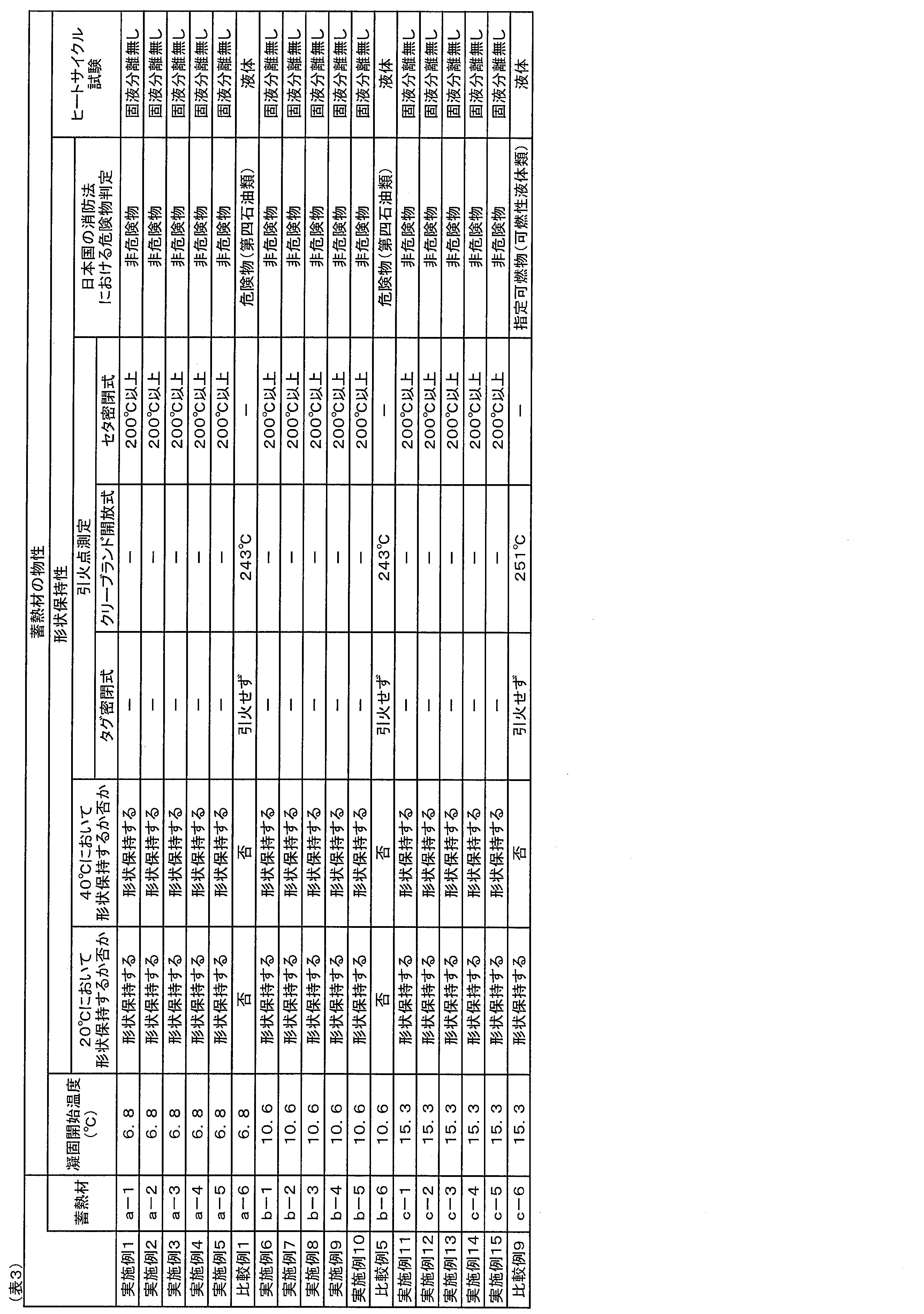
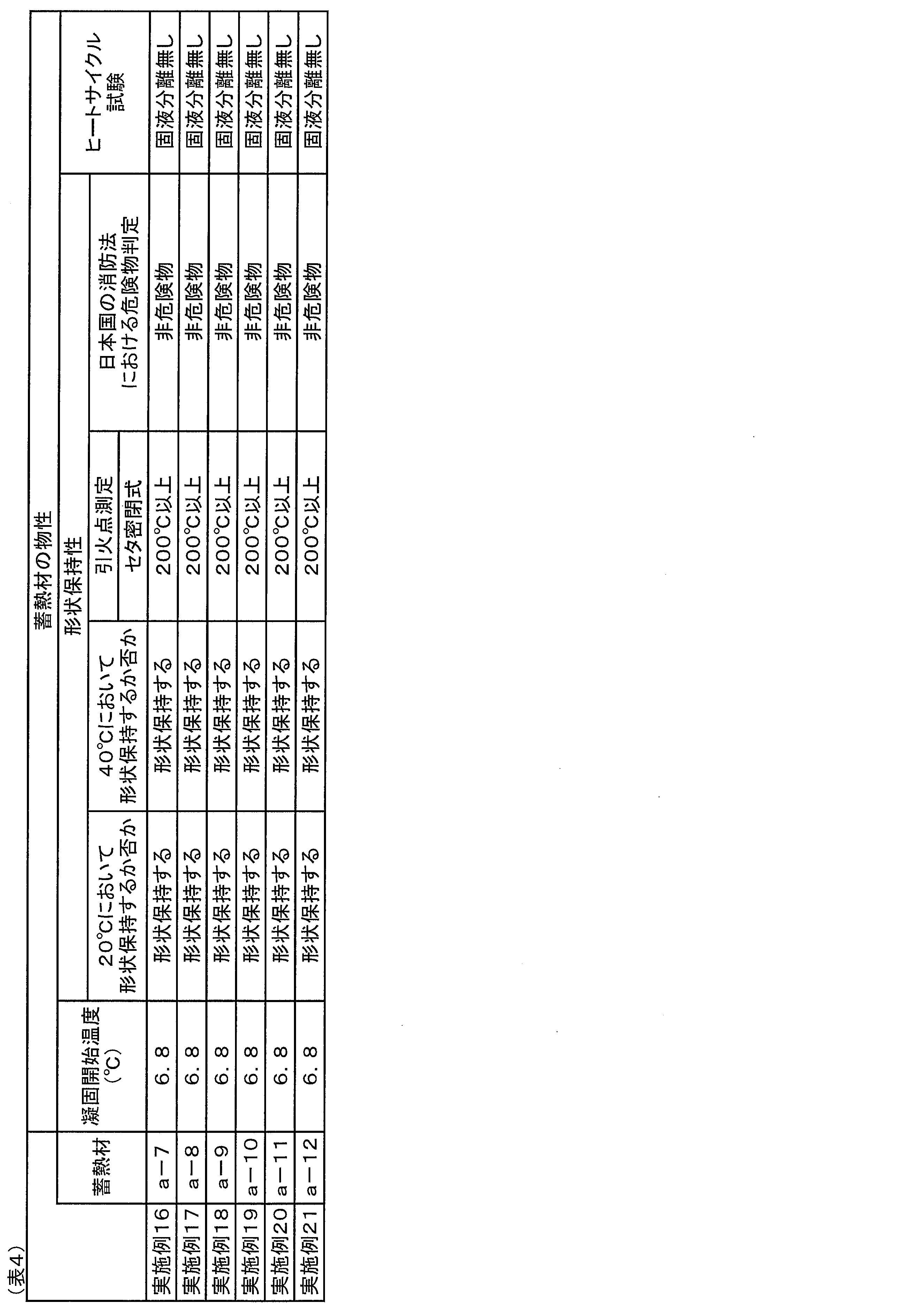
本発明の一実施形態に係る蓄熱剤組成物または蓄熱材は、様々な管理温度領域(例えば、1℃~40℃)で、温度管理対象物品を温度保持可能であり、かつ日本国の消防法における危険物に該当しない。従って、本発明の一実施形態は、例えば医薬品、医療機器、細胞、検体、臓器、化学物質もしくは食品等の各種物品の保管および輸送に好適に利用できる。また、本発明の一実施形態は、各種の保温用具として好適に利用できる。さらに、本発明の一実施形態に係る蓄熱剤組成物は、冷暖房機器および熱回収システムなどの各種の蓄熱装置における蓄熱材料として好適に利用できる。
Claims (13)
- ポリアルキレングリコールおよび当該ポリアルキレングリコールに可溶な金属石鹸(A)を含むポリアルキレングリコール溶液(I)と、
金属イオン(C)と、を混合する工程を有し、
前記金属イオン(C)は、
前記金属石鹸(A)を前記ポリアルキレングリコールに不溶な金属石鹸(B)に変化させる、蓄熱剤組成物の製造方法。 - 前記工程が、
前記ポリアルキレングリコール溶液(I)と、
ポリアルキレングリコールおよび前記金属イオン(C)を含むポリアルキレングリコール溶液(II)と、
を混合する工程を含む、請求項1に記載の蓄熱剤組成物の製造方法。 - 前記ポリアルキレングリコール溶液(II)が、
前記ポリアルキレングリコールと、前記金属イオン(C)を含む水溶液(III)と、の混合物である、請求項2に記載の蓄熱剤組成物の製造方法。 - 前記ポリアルキレングリコール溶液(I)と、
前記金属イオン(C)を含む水溶液(IV)と、
を混合する工程を含む、請求項1に記載の蓄熱剤組成物の製造方法。 - 前記金属石鹸(A)が、ラウリン酸カリウム、ステアリン酸カリウム、ミリスチン酸カリウム、パルミチン酸カリウムおよびオレイン酸カリウムからなる群から選択される少なくとも1種である、請求項1~4のいずれか1項に記載の蓄熱剤組成物の製造方法。
- 前記金属石鹸(B)がラウリン酸ナトリウム、ステアリン酸ナトリウム、ミリスチン酸ナトリウム、パルミチン酸ナトリウムおよびオレイン酸ナトリウムからなる群から選択される少なくとも1種である、請求項1~5のいずれか1項に記載の蓄熱剤組成物の製造方法。
- 前記金属イオン(C)がナトリウムイオンである、請求項1~6のいずれか1項に記載の蓄熱剤組成物の製造方法。
- 前記ポリアルキレングリコールの数平均分子量が400以上である、請求項1~7のいずれか1項に記載の蓄熱剤組成物の製造方法。
- 前記ポリアルキレングリコールがポリエチレングリコールである、請求項1~8のいずれか1項に記載の蓄熱剤組成物の製造方法。
- ポリアルキレングリコールと、当該ポリアルキレングリコールに不溶な金属石鹸(B)とを含み、
40℃において形状保持する、蓄熱剤組成物。 - 前記金属石鹸(B)がラウリン酸ナトリウム、ステアリン酸ナトリウム、ミリスチン酸ナトリウム、パルミチン酸ナトリウムおよびオレイン酸ナトリウムからなる群から選択される少なくとも1種である、請求項10に記載の蓄熱剤組成物。
- 前記ポリアルキレングリコールの数平均分子量が400以上である、請求項10または11に記載の蓄熱剤組成物。
- 前記ポリアルキレングリコールがポリエチレングリコールである、請求項10~12のいずれか1項に記載の蓄熱剤組成物。
Priority Applications (1)
| Application Number | Priority Date | Filing Date | Title |
|---|---|---|---|
| JP2023525804A JPWO2022255281A1 (ja) | 2021-05-31 | 2022-05-30 |
Applications Claiming Priority (2)
| Application Number | Priority Date | Filing Date | Title |
|---|---|---|---|
| JP2021-091632 | 2021-05-31 | ||
| JP2021091632 | 2021-05-31 |
Publications (1)
| Publication Number | Publication Date |
|---|---|
| WO2022255281A1 true WO2022255281A1 (ja) | 2022-12-08 |
Family
ID=84323214
Family Applications (1)
| Application Number | Title | Priority Date | Filing Date |
|---|---|---|---|
| PCT/JP2022/021854 Ceased WO2022255281A1 (ja) | 2021-05-31 | 2022-05-30 | 蓄熱剤組成物の製造方法 |
Country Status (2)
| Country | Link |
|---|---|
| JP (1) | JPWO2022255281A1 (ja) |
| WO (1) | WO2022255281A1 (ja) |
Cited By (1)
| Publication number | Priority date | Publication date | Assignee | Title |
|---|---|---|---|---|
| WO2025009270A1 (ja) * | 2023-07-04 | 2025-01-09 | 株式会社カネカ | 無機系潜熱蓄熱材組成物およびその利用 |
Citations (4)
| Publication number | Priority date | Publication date | Assignee | Title |
|---|---|---|---|---|
| JPH09143460A (ja) * | 1995-11-24 | 1997-06-03 | Futaba Kagaku:Kk | 蓄冷蓄熱媒体組成物 |
| JP2000345147A (ja) * | 1999-06-02 | 2000-12-12 | Asahi Denka Kogyo Kk | 潜熱蓄熱材組成物 |
| JP2006096898A (ja) * | 2004-09-30 | 2006-04-13 | Tamai Kasei Kk | ポリアルキレングリコールを含有する蓄熱材組成物 |
| JP2021004292A (ja) * | 2019-06-25 | 2021-01-14 | 株式会社カネカ | 蓄熱材組成物 |
-
2022
- 2022-05-30 JP JP2023525804A patent/JPWO2022255281A1/ja active Pending
- 2022-05-30 WO PCT/JP2022/021854 patent/WO2022255281A1/ja not_active Ceased
Patent Citations (4)
| Publication number | Priority date | Publication date | Assignee | Title |
|---|---|---|---|---|
| JPH09143460A (ja) * | 1995-11-24 | 1997-06-03 | Futaba Kagaku:Kk | 蓄冷蓄熱媒体組成物 |
| JP2000345147A (ja) * | 1999-06-02 | 2000-12-12 | Asahi Denka Kogyo Kk | 潜熱蓄熱材組成物 |
| JP2006096898A (ja) * | 2004-09-30 | 2006-04-13 | Tamai Kasei Kk | ポリアルキレングリコールを含有する蓄熱材組成物 |
| JP2021004292A (ja) * | 2019-06-25 | 2021-01-14 | 株式会社カネカ | 蓄熱材組成物 |
Cited By (1)
| Publication number | Priority date | Publication date | Assignee | Title |
|---|---|---|---|---|
| WO2025009270A1 (ja) * | 2023-07-04 | 2025-01-09 | 株式会社カネカ | 無機系潜熱蓄熱材組成物およびその利用 |
Also Published As
| Publication number | Publication date |
|---|---|
| JPWO2022255281A1 (ja) | 2022-12-08 |
Similar Documents
| Publication | Publication Date | Title |
|---|---|---|
| US10717910B2 (en) | Cold storage material composition, cold storage material, and transport container | |
| CN111819265B (zh) | 蓄冷材料组合物及其利用 | |
| CN108884380B (zh) | 蓄热材料组合物及其应用 | |
| CN109609102B (zh) | 相变材料的组合物及其制备方法 | |
| JP6227559B2 (ja) | 蓄熱材組成物、蓄熱材及び輸送容器 | |
| CN111670239B (zh) | 潜热蓄热材料及使用其的保冷工具以及保冷方法 | |
| WO2022255281A1 (ja) | 蓄熱剤組成物の製造方法 | |
| JP2015078307A (ja) | 蓄熱材容器 | |
| JP7242643B2 (ja) | 蓄冷材組成物、蓄冷材および輸送容器 | |
| JP2016014088A (ja) | 蓄熱材組成物 | |
| EP0030599B1 (en) | Hydrated magnesium nitrate/magnesium chloride reversible phase change compositions and their preparation | |
| Kumano et al. | Effects of solutes and additives on ice growth prevention in ice slurry production | |
| JP7631489B2 (ja) | 蓄冷材 | |
| US20190048242A1 (en) | Thermal storage medium, and thermal storage pack, thermostatic vessel, and transport box using the medium | |
| US11912845B2 (en) | In-situ generation of nucleating agents for indicating devices | |
| JP7286435B2 (ja) | 蓄熱材組成物 | |
| JP4840075B2 (ja) | 保冷剤および保冷材 | |
| US20260125591A1 (en) | Inorganic latent heat storage material composition and use thereof | |
| CN121420046A (zh) | 无机系潜热蓄热材料组合物及其利用 | |
| JP2021123638A (ja) | 蓄熱材の製造方法 | |
| JP2000008029A (ja) | 潜熱蓄熱材組成物及び蓄熱方法 | |
| JP2024010569A (ja) | 蓄熱材組成物およびその製造方法 | |
| JP2000034473A (ja) | 潜熱蓄熱材組成物 | |
| JP2020070312A (ja) | 潜熱蓄熱材組成物 | |
| JP2000178545A (ja) | 潜熱蓄熱材組成物 |
Legal Events
| Date | Code | Title | Description |
|---|---|---|---|
| 121 | Ep: the epo has been informed by wipo that ep was designated in this application |
Ref document number: 22816029 Country of ref document: EP Kind code of ref document: A1 |
|
| WWE | Wipo information: entry into national phase |
Ref document number: 2023525804 Country of ref document: JP |
|
| NENP | Non-entry into the national phase |
Ref country code: DE |
|
| 122 | Ep: pct application non-entry in european phase |
Ref document number: 22816029 Country of ref document: EP Kind code of ref document: A1 |