WO2022230626A1 - 非水電解質二次電池 - Google Patents
非水電解質二次電池 Download PDFInfo
- Publication number
- WO2022230626A1 WO2022230626A1 PCT/JP2022/017147 JP2022017147W WO2022230626A1 WO 2022230626 A1 WO2022230626 A1 WO 2022230626A1 JP 2022017147 W JP2022017147 W JP 2022017147W WO 2022230626 A1 WO2022230626 A1 WO 2022230626A1
- Authority
- WO
- WIPO (PCT)
- Prior art keywords
- positive electrode
- aqueous electrolyte
- secondary battery
- negative electrode
- mixture layer
- Prior art date
- Legal status (The legal status is an assumption and is not a legal conclusion. Google has not performed a legal analysis and makes no representation as to the accuracy of the status listed.)
- Ceased
Links
Images


Classifications
-
- H—ELECTRICITY
- H01—ELECTRIC ELEMENTS
- H01M—PROCESSES OR MEANS, e.g. BATTERIES, FOR THE DIRECT CONVERSION OF CHEMICAL ENERGY INTO ELECTRICAL ENERGY
- H01M10/00—Secondary cells; Manufacture thereof
- H01M10/05—Accumulators with non-aqueous electrolyte
- H01M10/058—Construction or manufacture
- H01M10/0587—Construction or manufacture of accumulators having only wound construction elements, i.e. wound positive electrodes, wound negative electrodes and wound separators
-
- H—ELECTRICITY
- H01—ELECTRIC ELEMENTS
- H01M—PROCESSES OR MEANS, e.g. BATTERIES, FOR THE DIRECT CONVERSION OF CHEMICAL ENERGY INTO ELECTRICAL ENERGY
- H01M10/00—Secondary cells; Manufacture thereof
- H01M10/04—Construction or manufacture in general
- H01M10/0431—Cells with wound or folded electrodes
-
- H—ELECTRICITY
- H01—ELECTRIC ELEMENTS
- H01M—PROCESSES OR MEANS, e.g. BATTERIES, FOR THE DIRECT CONVERSION OF CHEMICAL ENERGY INTO ELECTRICAL ENERGY
- H01M10/00—Secondary cells; Manufacture thereof
- H01M10/05—Accumulators with non-aqueous electrolyte
- H01M10/052—Li-accumulators
- H01M10/0525—Rocking-chair batteries, i.e. batteries with lithium insertion or intercalation in both electrodes; Lithium-ion batteries
-
- H—ELECTRICITY
- H01—ELECTRIC ELEMENTS
- H01M—PROCESSES OR MEANS, e.g. BATTERIES, FOR THE DIRECT CONVERSION OF CHEMICAL ENERGY INTO ELECTRICAL ENERGY
- H01M10/00—Secondary cells; Manufacture thereof
- H01M10/42—Methods or arrangements for servicing or maintenance of secondary cells or secondary half-cells
- H01M10/4235—Safety or regulating additives or arrangements in electrodes, separators or electrolyte
-
- H—ELECTRICITY
- H01—ELECTRIC ELEMENTS
- H01M—PROCESSES OR MEANS, e.g. BATTERIES, FOR THE DIRECT CONVERSION OF CHEMICAL ENERGY INTO ELECTRICAL ENERGY
- H01M4/00—Electrodes
- H01M4/02—Electrodes composed of, or comprising, active material
- H01M4/04—Processes of manufacture in general
- H01M4/0402—Methods of deposition of the material
- H01M4/0404—Methods of deposition of the material by coating on electrode collectors
-
- H—ELECTRICITY
- H01—ELECTRIC ELEMENTS
- H01M—PROCESSES OR MEANS, e.g. BATTERIES, FOR THE DIRECT CONVERSION OF CHEMICAL ENERGY INTO ELECTRICAL ENERGY
- H01M4/00—Electrodes
- H01M4/02—Electrodes composed of, or comprising, active material
- H01M4/04—Processes of manufacture in general
- H01M4/043—Processes of manufacture in general involving compressing or compaction
- H01M4/0435—Rolling or calendering
-
- H—ELECTRICITY
- H01—ELECTRIC ELEMENTS
- H01M—PROCESSES OR MEANS, e.g. BATTERIES, FOR THE DIRECT CONVERSION OF CHEMICAL ENERGY INTO ELECTRICAL ENERGY
- H01M4/00—Electrodes
- H01M4/02—Electrodes composed of, or comprising, active material
- H01M4/13—Electrodes for accumulators with non-aqueous electrolyte, e.g. for lithium-accumulators; Processes of manufacture thereof
-
- H—ELECTRICITY
- H01—ELECTRIC ELEMENTS
- H01M—PROCESSES OR MEANS, e.g. BATTERIES, FOR THE DIRECT CONVERSION OF CHEMICAL ENERGY INTO ELECTRICAL ENERGY
- H01M4/00—Electrodes
- H01M4/02—Electrodes composed of, or comprising, active material
- H01M4/36—Selection of substances as active materials, active masses, active liquids
- H01M4/48—Selection of substances as active materials, active masses, active liquids of inorganic oxides or hydroxides
- H01M4/52—Selection of substances as active materials, active masses, active liquids of inorganic oxides or hydroxides of nickel, cobalt or iron
- H01M4/525—Selection of substances as active materials, active masses, active liquids of inorganic oxides or hydroxides of nickel, cobalt or iron of mixed oxides or hydroxides containing iron, cobalt or nickel for inserting or intercalating light metals, e.g. LiNiO2, LiCoO2 or LiCoOxFy
-
- H—ELECTRICITY
- H01—ELECTRIC ELEMENTS
- H01M—PROCESSES OR MEANS, e.g. BATTERIES, FOR THE DIRECT CONVERSION OF CHEMICAL ENERGY INTO ELECTRICAL ENERGY
- H01M4/00—Electrodes
- H01M4/02—Electrodes composed of, or comprising, active material
- H01M4/62—Selection of inactive substances as ingredients for active masses, e.g. binders, fillers
- H01M4/621—Binders
- H01M4/622—Binders being polymers
- H01M4/623—Binders being polymers fluorinated polymers
-
- H—ELECTRICITY
- H01—ELECTRIC ELEMENTS
- H01M—PROCESSES OR MEANS, e.g. BATTERIES, FOR THE DIRECT CONVERSION OF CHEMICAL ENERGY INTO ELECTRICAL ENERGY
- H01M4/00—Electrodes
- H01M4/02—Electrodes composed of, or comprising, active material
- H01M4/62—Selection of inactive substances as ingredients for active masses, e.g. binders, fillers
- H01M4/624—Electric conductive fillers
- H01M4/625—Carbon or graphite
-
- H—ELECTRICITY
- H01—ELECTRIC ELEMENTS
- H01M—PROCESSES OR MEANS, e.g. BATTERIES, FOR THE DIRECT CONVERSION OF CHEMICAL ENERGY INTO ELECTRICAL ENERGY
- H01M4/00—Electrodes
- H01M4/02—Electrodes composed of, or comprising, active material
- H01M4/64—Carriers or collectors
- H01M4/66—Selection of materials
- H01M4/661—Metal or alloys, e.g. alloy coatings
-
- H—ELECTRICITY
- H01—ELECTRIC ELEMENTS
- H01M—PROCESSES OR MEANS, e.g. BATTERIES, FOR THE DIRECT CONVERSION OF CHEMICAL ENERGY INTO ELECTRICAL ENERGY
- H01M50/00—Constructional details or processes of manufacture of the non-active parts of electrochemical cells other than fuel cells, e.g. hybrid cells
- H01M50/40—Separators; Membranes; Diaphragms; Spacing elements inside cells
- H01M50/409—Separators, membranes or diaphragms characterised by the material
- H01M50/431—Inorganic material
- H01M50/434—Ceramics
-
- H—ELECTRICITY
- H01—ELECTRIC ELEMENTS
- H01M—PROCESSES OR MEANS, e.g. BATTERIES, FOR THE DIRECT CONVERSION OF CHEMICAL ENERGY INTO ELECTRICAL ENERGY
- H01M50/00—Constructional details or processes of manufacture of the non-active parts of electrochemical cells other than fuel cells, e.g. hybrid cells
- H01M50/40—Separators; Membranes; Diaphragms; Spacing elements inside cells
- H01M50/409—Separators, membranes or diaphragms characterised by the material
- H01M50/443—Particulate material
-
- H—ELECTRICITY
- H01—ELECTRIC ELEMENTS
- H01M—PROCESSES OR MEANS, e.g. BATTERIES, FOR THE DIRECT CONVERSION OF CHEMICAL ENERGY INTO ELECTRICAL ENERGY
- H01M50/00—Constructional details or processes of manufacture of the non-active parts of electrochemical cells other than fuel cells, e.g. hybrid cells
- H01M50/40—Separators; Membranes; Diaphragms; Spacing elements inside cells
- H01M50/409—Separators, membranes or diaphragms characterised by the material
- H01M50/449—Separators, membranes or diaphragms characterised by the material having a layered structure
- H01M50/451—Separators, membranes or diaphragms characterised by the material having a layered structure comprising layers of only organic material and layers containing inorganic material
-
- H—ELECTRICITY
- H01—ELECTRIC ELEMENTS
- H01M—PROCESSES OR MEANS, e.g. BATTERIES, FOR THE DIRECT CONVERSION OF CHEMICAL ENERGY INTO ELECTRICAL ENERGY
- H01M50/00—Constructional details or processes of manufacture of the non-active parts of electrochemical cells other than fuel cells, e.g. hybrid cells
- H01M50/40—Separators; Membranes; Diaphragms; Spacing elements inside cells
- H01M50/46—Separators, membranes or diaphragms characterised by their combination with electrodes
-
- H—ELECTRICITY
- H01—ELECTRIC ELEMENTS
- H01M—PROCESSES OR MEANS, e.g. BATTERIES, FOR THE DIRECT CONVERSION OF CHEMICAL ENERGY INTO ELECTRICAL ENERGY
- H01M50/00—Constructional details or processes of manufacture of the non-active parts of electrochemical cells other than fuel cells, e.g. hybrid cells
- H01M50/40—Separators; Membranes; Diaphragms; Spacing elements inside cells
- H01M50/463—Separators, membranes or diaphragms characterised by their shape
-
- H—ELECTRICITY
- H01—ELECTRIC ELEMENTS
- H01M—PROCESSES OR MEANS, e.g. BATTERIES, FOR THE DIRECT CONVERSION OF CHEMICAL ENERGY INTO ELECTRICAL ENERGY
- H01M4/00—Electrodes
- H01M4/02—Electrodes composed of, or comprising, active material
- H01M2004/026—Electrodes composed of, or comprising, active material characterised by the polarity
- H01M2004/028—Positive electrodes
-
- Y—GENERAL TAGGING OF NEW TECHNOLOGICAL DEVELOPMENTS; GENERAL TAGGING OF CROSS-SECTIONAL TECHNOLOGIES SPANNING OVER SEVERAL SECTIONS OF THE IPC; TECHNICAL SUBJECTS COVERED BY FORMER USPC CROSS-REFERENCE ART COLLECTIONS [XRACs] AND DIGESTS
- Y02—TECHNOLOGIES OR APPLICATIONS FOR MITIGATION OR ADAPTATION AGAINST CLIMATE CHANGE
- Y02E—REDUCTION OF GREENHOUSE GAS [GHG] EMISSIONS, RELATED TO ENERGY GENERATION, TRANSMISSION OR DISTRIBUTION
- Y02E60/00—Enabling technologies; Technologies with a potential or indirect contribution to GHG emissions mitigation
- Y02E60/10—Energy storage using batteries
-
- Y—GENERAL TAGGING OF NEW TECHNOLOGICAL DEVELOPMENTS; GENERAL TAGGING OF CROSS-SECTIONAL TECHNOLOGIES SPANNING OVER SEVERAL SECTIONS OF THE IPC; TECHNICAL SUBJECTS COVERED BY FORMER USPC CROSS-REFERENCE ART COLLECTIONS [XRACs] AND DIGESTS
- Y02—TECHNOLOGIES OR APPLICATIONS FOR MITIGATION OR ADAPTATION AGAINST CLIMATE CHANGE
- Y02P—CLIMATE CHANGE MITIGATION TECHNOLOGIES IN THE PRODUCTION OR PROCESSING OF GOODS
- Y02P70/00—Climate change mitigation technologies in the production process for final industrial or consumer products
- Y02P70/50—Manufacturing or production processes characterised by the final manufactured product
Definitions
- the present disclosure relates to non-aqueous electrolyte secondary batteries.
- a non-aqueous electrolyte secondary battery comprising an electrode body in which a positive electrode and a negative electrode are arranged facing each other with a separator interposed therebetween has been widely used.
- Patent Literature 1 discloses a technique of setting the static friction coefficient of the surface of the separator to 0.45 or less in order to improve the ability to remove the core when manufacturing a wound electrode assembly.
- Electrode deformation may occur in which the constituting electrode plate is bent. Since electrode plate deformation can be a cause of internal short circuits, it is an important issue to suppress electrode plate deformation.
- electrode plate deformation is likely to occur in the range of several turns in the winding direction from the inner end of the positive electrode mixture layer. It turned out that it bends while deforming. Therefore, when the coefficient of friction of the surface of the separator is small, the amount of deformation of the positive electrode tends to increase. In addition, when the coefficient of friction of the surface of the separator is large, when the electrode body is wound, the separator comes into close contact with the delivery roller, causing misalignment of the separator, which may reduce the productivity of the battery. It turns out there is.
- An object of the present disclosure is to improve productivity while suppressing electrode plate deformation in a non-aqueous electrolyte secondary battery.
- the non-aqueous electrolyte secondary battery according to the present disclosure includes an electrode body in which a positive electrode and a negative electrode are wound with a separator interposed therebetween, and an outer package that houses the electrode body.
- the positive electrode mixture layer is formed on the surface of the electric body, and the surface of the separator facing the positive electrode mixture layer extends two or more turns in the winding direction from the position facing the inner end of the positive electrode mixture layer. It is characterized by including a high-friction region formed in a range less than the circumference and a low-friction region adjacent to the high-friction region in the winding direction.
- non-aqueous electrolyte secondary battery According to the non-aqueous electrolyte secondary battery according to the present disclosure, it is possible to both suppress electrode plate deformation and improve productivity.
- FIG. 1 is a vertical cross-sectional view of a cylindrical secondary battery that is an example of an embodiment
- FIG. 1 is a lateral cross-sectional view of a cylindrical secondary battery that is an example of an embodiment
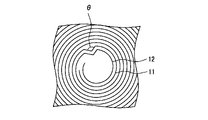
- FIG. It is a figure for demonstrating the evaluation method of the deformation
- a cylindrical battery in which a wound electrode body is housed in a cylindrical outer body is exemplified, but the electrode body is not limited to a wound type, and a plurality of positive electrodes and a plurality of negative electrodes are interposed between separators. It may be of a laminated type in which one sheet is alternately laminated on the other.
- the exterior body is not limited to a cylindrical shape, and may be, for example, rectangular, coin-shaped, or the like.
- the outer package may be a pouch type configured by a laminate sheet including a metal layer and a resin layer.
- FIG. 1 is a vertical cross-sectional view of a cylindrical secondary battery 10 that is an example of an embodiment.
- FIG. 2 is a horizontal cross-sectional view of a cylindrical secondary battery 10 that is an example of an embodiment.
- an electrode body 14 and a non-aqueous electrolyte (not shown) are housed in an exterior body 15 , and the upper end portion of the exterior body 15 is closed with a sealing body 16 so that the secondary battery 10 The inside is sealed.
- the sealing member 16 side will be referred to as "upper”
- the bottom side of the outer package 15 will be referred to as "lower”.
- non-aqueous solvent (organic solvent) of the non-aqueous electrolyte carbonates, lactones, ethers, ketones, esters, etc. can be used, and two or more of these solvents can be mixed and used. .
- a mixed solvent containing a cyclic carbonate and a chain carbonate For example, cyclic carbonates such as ethylene carbonate (EC), propylene carbonate (PC), and butylene carbonate (BC) can be used, and chain carbonates such as dimethyl carbonate (DMC), ethylmethyl carbonate (EMC), and diethyl carbonate ( DEC) or the like can be used.
- EC ethylene carbonate
- PC propylene carbonate
- BC butylene carbonate
- chain carbonates such as dimethyl carbonate (DMC), ethylmethyl carbonate (EMC), and diethyl carbonate ( DEC) or the like can be used.
- electrolyte salt of the non-aqueous electrolyte LiPF 6 , LiBF 4 , LiCF 3 SO 3 and mixtures thereof can be used.
- the amount of electrolyte salt dissolved in the non-aqueous solvent can be, for example, 0.5 to 2.0 mol/L.
- the electrode body 14 has a wound structure in which the positive electrode 11 and the negative electrode 12 are wound with the separator 13 interposed therebetween.
- the number of turns of the electrode body is, for example, 10 to 30 times with the positive electrode 11 as a reference.
- the negative electrode 12 is formed to have a size one size larger than that of the positive electrode 11 and is formed longer than the positive electrode 11 in the longitudinal direction and the lateral direction (vertical direction) in order to suppress deposition of lithium.
- the separator 13 is preferably formed to be larger in width and length than the positive electrode 11 and the negative electrode 12 in order to prevent electrical contact between the positive electrode 11 and the negative electrode 12 .
- the winding inner end 11 e of the positive electrode mixture layer 11 b coincides with the winding inner end of the positive electrode 11 .
- the winding inner end of the negative electrode mixture layer 12b does not coincide with the winding inner end of the negative electrode 12, and the negative electrode current collector 12a in which the negative electrode mixture layer 12b is not formed at the winding inner end of the negative electrode 12 is formed.
- An exposed exposed portion is provided.
- a negative electrode lead 20 is welded to the exposed portion.
- the positive electrode 11 is provided with an exposed portion where the positive electrode current collector 11a is exposed in the central portion in the longitudinal direction, and the positive electrode lead 19 is welded to the exposed portion.
- An exposed portion may be provided at the outer end of the winding of the negative electrode 12, and the negative electrode lead 20 may be connected to the exposed portion. may be electrically connected.
- insulating plates 17 and 18 are provided above and below the electrode body 14, respectively.
- the positive electrode lead 19 extends upward through the through hole of the insulating plate 17 and is welded to the lower surface of the filter 22 which is the bottom plate of the sealing member 16 .
- the cap 26, which is the top plate of the sealing member 16 electrically connected to the filter 22 serves as a positive electrode terminal.
- the negative electrode lead 20 extends through the through hole of the insulating plate 18 to the bottom side of the outer package 15 and is welded to the bottom of the outer package 15 .
- the exterior body 15 becomes a negative electrode terminal.
- the negative electrode lead 20 passes through the insulating plate 18 and extends to the bottom side of the outer package 15 and is welded to the bottom inner surface of the outer package 15. .
- the exterior body 15 is, for example, a bottomed cylindrical metal exterior can.
- a gasket 27 is provided between the exterior body 15 and the sealing body 16 to ensure hermetic sealing of the inside of the secondary battery 10 .
- the exterior body 15 has, for example, a grooved part 21 that supports the sealing body 16 and is formed by pressing the side part from the outside.
- the grooved portion 21 is preferably annularly formed along the circumferential direction of the exterior body 15 and supports the sealing body 16 via a gasket 27 on its upper surface.
- the sealing body 16 has a filter 22, a lower valve body 23, an insulating member 24, an upper valve body 25, and a cap 26 which are stacked in order from the electrode body 14 side.
- Each member constituting the sealing member 16 has, for example, a disk shape or a ring shape, and each member other than the insulating member 24 is electrically connected to each other.
- the lower valve body 23 and the upper valve body 25 are connected to each other at their central portions, and an insulating member 24 is interposed between their peripheral edge portions.
- the positive electrode 11, the negative electrode 12, and the separator 13, which constitute the electrode assembly 14, and particularly the separator 13, will be described in detail below.
- the positive electrode 11 has a positive electrode current collector 11a and a positive electrode mixture layer 11b formed on the surface of the positive electrode current collector 11a. As shown in FIG. 2, the positive electrode mixture layers 11b are preferably formed on both sides of the positive electrode current collector 11a.
- a foil of a metal such as aluminum that is stable in the potential range of the positive electrode 11, a film in which the metal is arranged on the surface layer, or the like can be used.
- the positive electrode mixture layer 11b contains, for example, a positive electrode active material, a binder, a conductive agent, and the like.
- the positive electrode 11 is formed by applying, for example, a positive electrode mixture slurry containing a positive electrode active material, a binder, a conductive agent, etc. onto the positive electrode current collector 11a, drying the coating film, and then rolling to form a positive electrode mixture layer 11b. can be formed on both sides of the positive electrode current collector 11a.
- Examples of the positive electrode active material contained in the positive electrode mixture layer 11b include lithium transition metal oxides containing transition metal elements such as Co, Mn, and Ni.
- Lithium transition metal oxides include, for example, Li x CoO 2 , Li x NiO 2 , Li x MnO 2 , Li x Co y Ni 1-y O 2 , Li x Co y M 1-y O z , Li x Ni 1 -yMyOz , LixMn2O4 , LixMn2 - yMyO4 , LiMPO4 , Li2MPO4F ( M ; Na , Mg , Sc , Y , Mn, Fe, Co, At least one of Ni, Cu, Zn, Al, Cr, Pb, Sb, and B, 0 ⁇ x ⁇ 1.2, 0 ⁇ y ⁇ 0.9, 2.0 ⁇ z ⁇ 2.3).
- the positive electrode active material is Li x NiO 2 , Li x Co y Ni 1-y O 2 , Li x Ni 1- y My O z ( M; at least one of Na, Mg, Sc, Y, Mn, Fe, Co, Ni, Cu, Zn, Al, Cr, Pb, Sb, and B, 0 ⁇ x ⁇ 1.2, 0 ⁇ y ⁇ 0 .9, 2.0 ⁇ z ⁇ 2.3).
- Inorganic particles such as tungsten oxide, aluminum oxide, and lanthanide-containing compounds may adhere to the surfaces of the lithium transition metal oxide particles.
- Examples of the conductive agent contained in the positive electrode mixture layer 11b include carbon black (CB), acetylene black (AB), ketjen black, carbon nanotubes (CNT), graphene, graphite and other carbon materials. These may be used alone or in combination of two or more.
- binder contained in the positive electrode mixture layer 11b examples include fluorine-based resins such as polytetrafluoroethylene (PTFE) and polyvinylidene fluoride (PVDF), polyacrylonitrile (PAN), polyimide-based resins, acrylic-based resins, and polyolefin-based resins. Resin etc. can be illustrated. These may be used alone or in combination of two or more. Further, these resins may be used in combination with carboxymethyl cellulose (CMC) or salts thereof, polyethylene oxide (PEO), and the like.
- PTFE polytetrafluoroethylene
- PVDF polyvinylidene fluoride
- PAN polyacrylonitrile
- PAN polyimide-based resins
- acrylic-based resins acrylic-based resins
- polyolefin-based resins examples include polyolefin-based resins.
- the negative electrode 12 has a negative electrode current collector 12a and a negative electrode mixture layer 12b formed on the surface of the negative electrode current collector 12a. As shown in FIG. 2, the negative electrode mixture layers 12b are preferably formed on both sides of the negative electrode current collector 12a.
- a foil of a metal such as copper or a copper alloy that is stable in the potential range of the negative electrode, or a film in which the metal is arranged on the surface layer can be used.
- the negative electrode mixture layer 12b contains, for example, a negative electrode active material, a binder, and the like.
- a negative electrode mixture slurry containing a negative electrode active material, a binder, and the like is applied onto the negative electrode current collector 12a, the coating film is dried, and then rolled to form the negative electrode mixture layer 12b. It can be produced by forming on both sides of the conductor 12a.
- the negative electrode active material contained in the negative electrode mixture layer 12b is not particularly limited as long as it can reversibly absorb and release lithium ions, and carbon-based active materials such as graphite are generally used.
- Graphite may be any of natural graphite such as flaky graphite, massive graphite and earthy graphite, artificial graphite such as massive artificial graphite and graphitized mesophase carbon microbeads.
- a metal alloyed with Li such as Si or Sn, a metal compound containing Si, Sn or the like, a lithium-titanium composite oxide, or the like may be used.
- a silicon-based active material is preferable as the negative electrode active material other than the carbon-based active material.
- Silicon-based active materials include, for example, Si-containing compounds represented by SiO x (0.5 ⁇ x ⁇ 1.6), or lithium silicates represented by Li 2y SiO (2+y) (0 ⁇ y ⁇ 2) A Si-containing compound in which fine particles of Si are dispersed in a phase is mentioned.
- the content of the silicon-based active material in the negative electrode mixture layer 12b is, for example, 1% by mass to 15% by mass, preferably 5% by mass to 10% by mass, relative to the total mass of the negative electrode active material.
- a conductive film is preferably formed on the surface of the particles of the silicon-based active material.
- At least one selected from carbon materials, metals, and metal compounds can be exemplified as a constituent material of the conductive film.
- carbon materials such as amorphous carbon are preferable.
- the carbon coating can be formed by, for example, a CVD method using acetylene, methane, etc., a method of mixing coal pitch, petroleum pitch, phenol resin, etc. with silicon-based active material particles and subjecting the mixture to heat treatment.
- a conductive film may be formed by adhering a conductive filler such as carbon black to the particle surface of the silicon-based active material using a binder.
- the binder contained in the negative electrode mixture layer 12b may be fluorine-containing resin such as PTFE or PVDF, PAN, polyimide, acrylic resin, polyolefin, or the like. Butadiene rubber (SBR) is used. Further, the negative electrode mixture layer may contain CMC or its salt, polyacrylic acid (PAA) or its salt, polyvinyl alcohol (PVA), or the like. The negative electrode mixture layer contains, for example, SBR and CMC or a salt thereof.
- the surface of the separator 13 facing the positive electrode mixture layer 11b is a high-friction region formed in a range of two or more turns and less than six turns in the winding direction R from the position facing the winding inner end 11e of the positive electrode mixture layer 11b. , a high-friction region and a low-friction region adjacent in the winding direction R. As a result, while the high-friction region suppresses bending of the positive electrode, the low-friction region suppresses winding misalignment of the separator.
- the coefficient of friction of the high-friction region is preferably 0.6 or more.
- the upper limit of the coefficient of friction in the high-friction region is, for example, 1.1 from the viewpoint of running stability of the separator during winding.
- the coefficient of friction in the low-friction region is preferably 0.4 or less.
- the lower limit of the coefficient of friction in the low-friction region is, for example, 0.1 from the viewpoint of preventing the separator from slipping on the supply reel.
- the separator 13 has, for example, a porous substrate 13a and an inorganic particle layer containing inorganic particles formed on the surface of the substrate 13a.
- the separator 13 has a first inorganic particle layer 13b formed on the surface of the substrate 13a and a surface of the first inorganic particle layer 13b on the surface facing the positive electrode mixture layer 11b.
- the first inorganic particle layer 13b and the second inorganic particle layer 13c may be collectively referred to as an inorganic particle layer).
- the first inorganic particle layer 13b is formed on the entire surface of the separator 13 facing the positive electrode mixture layer 11b.
- the second inorganic particle layer 13c is formed on the surface of the first inorganic particle layer 13b within a range of 2 or more and less than 6 turns in the winding direction R from the position facing the winding inner end 11e of the positive electrode mixture layer 11b. It is That is, the surface of the first inorganic particle layer 13b is a low-friction area, and the surface of the second inorganic particle layer 13c is a high-friction area.
- the first inorganic particle layer 13b and the second inorganic particle layer 13c can be produced by, for example, a micro gravure coating method.
- the inorganic particles for forming the first inorganic particle layer 13b are applied again by the micro gravure coating method.
- the separator 13 can be produced by intermittently applying the dispersion.
- the structure of the inorganic particle layer on the surface of the base material 13a is not limited to the example of FIG. may be
- the separator 13 may have an inorganic particle layer on both the surface facing the positive electrode mixture layer 11b and the surface facing the negative electrode mixture layer 12b. It is preferable to have an inorganic particle layer only on the surface facing 11b.
- the base material 13a is a porous sheet having ion permeability and insulation properties, and is composed of, for example, a microporous thin film, woven fabric, nonwoven fabric, or the like.
- the material of the base material 13a is not particularly limited, but may be polyolefin such as polyethylene, polypropylene, copolymer of polyethylene and ⁇ -olefin, acrylic resin, polystyrene, polyester, cellulose, polyimide, polyphenylene sulfide, polyetheretherketone, fluororesin. etc. can be exemplified.
- the base material 13a made of polyolefin may be exposed to the potential of the positive electrode 11 and oxidatively deteriorated. Effectively suppresses oxidative deterioration. Furthermore, the inorganic particle layer improves the heat resistance of the separator 13 .
- the inorganic particle layer is a porous layer whose main component is inorganic particles.
- inorganic particles contained in the inorganic particle layer include metal oxide particles, metal nitride particles, metal fluoride particles, metal carbide particles, and the like.
- metal oxide particles include aluminum oxide, titanium oxide, magnesium oxide, zirconium oxide, nickel oxide, silicon oxide, and manganese oxide.
- metal nitride particles include titanium nitride, boron nitride, aluminum nitride, magnesium nitride, and silicon nitride.
- metal fluoride particles include aluminum fluoride, lithium fluoride, sodium fluoride, magnesium fluoride, calcium fluoride, barium fluoride, and the like.
- metal carbide particles include silicon carbide, boron carbide, titanium carbide, and tungsten carbide.
- the inorganic particles are porous aluminosilicate such as zeolite ( M2 / nO.Al2O3.xSiO2.yH2O , M is a metal element, n is the valence of M, x ⁇ 2 , y ⁇ 0). Salts, layered silicates such as talc (Mg 3 Si 4 O 10 (OH) 2 ), and minerals such as barium titanate (BaTiO 3 ) and strontium titanate (SrTiO 3 ) may be used. In addition, these may be used individually by 1 type, and may use 2 or more types together.
- the content of the inorganic particles contained in the inorganic particle layer is preferably 85 to 99% by mass, more preferably 90 to 98% by mass, based on the total mass of the inorganic particle layer.
- the average particle diameter (D50) of the inorganic particles contained in the second inorganic particle layer 13c is preferably 0.3 ⁇ m or less from the viewpoint of improving adhesion with the facing positive electrode mixture layer 11b. .
- D50 means a particle size at which the cumulative frequency is 50% from the smaller particle size in the volume-based particle size distribution, and is also called median diameter.
- the particle size distribution of the inorganic particles can be measured using a laser diffraction particle size distribution analyzer (eg MT3000II manufactured by Microtrack Bell Co., Ltd.) using water as a dispersion medium.
- the lower limit of D50 of the inorganic particles contained in the second inorganic particle layer 13c is, for example, 0.1 ⁇ m from the viewpoint of suppressing aggregation of the inorganic particles in the dispersion.
- the average particle diameter (D50) of the inorganic particles contained in the first inorganic particle layer 13b is preferably 0.6 ⁇ m or more from the viewpoint of improving slipperiness with the delivery roller.
- the upper limit of D50 of the inorganic particles contained in the first inorganic particle layer 13b is, for example, 1.5 ⁇ m from the viewpoint of suppressing peeling of the first inorganic particle layer 13b.
- the thickness of the first inorganic particle layer 13b is preferably smaller than the thickness of the substrate 13a, and is, for example, 0.5 ⁇ m to 5 ⁇ m. Also, the thickness of the second inorganic particle layer 13c is, for example, 0.5 ⁇ m to 5 ⁇ m.
- the inorganic particle layer preferably further contains a binder.
- the binder has a function of bonding the individual inorganic particles together and the inorganic particles and the substrate 13a.
- binders include fluorine resins such as polyvinylidene fluoride (PVDF) and polytetrafluoroethylene (PTFE), polyimide resins, acrylic resins, polyolefin resins, styrene-butadiene rubber (SBR), nitrile- butadiene rubber (NBR), carboxymethyl cellulose (CMC) or its salt, polyvinyl alcohol (PVA), and the like. These may be used individually by 1 type, and may use 2 or more types together.
- the content of the binder contained in the inorganic particle layer is preferably 0.5 to 10% by mass, more preferably 1 to 5% by mass, relative to the total mass of the inorganic particle layer.
- the coefficient of friction of the first inorganic particle layer 13b and the second inorganic particle layer 13c is preferably adjusted by the average particle diameter of the inorganic particles as in the above example, but the shape and material of the inorganic particles and the binding The type and amount of the agent may be adjusted.
- Example 1 [Preparation of positive electrode] 100 parts by mass of LiNi 0.88 Co 0.09 Al 0.03 O 2 , 1 part by mass of acetylene black (AB), and 0.9 parts by mass of polyvinylidene fluoride (PVDF) were mixed, and N- An appropriate amount of methyl-2-pyrrolidone (NMP) was added to prepare a positive electrode mixture slurry. Next, the positive electrode mixture slurry was applied to both surfaces of a 15 ⁇ m thick aluminum foil, and the coating film was dried.
- NMP methyl-2-pyrrolidone
- the coating film After rolling the coating film using a roller, it is cut into a predetermined electrode size (thickness 0.144 mm, width 62.6 mm, length 861 mm), and positive electrode mixture layers are formed on both sides of the positive electrode current collector.
- a positive electrode was fabricated. An exposed portion in which the positive electrode mixture layer was not formed and the positive electrode current collector was exposed was provided in the longitudinal central portion of the positive electrode, and an aluminum positive electrode lead was welded to the exposed portion.
- [Preparation of negative electrode] 95 parts by mass of graphite powder, 5 parts by mass of Si oxide, 1 part by mass of carboxymethylcellulose sodium (CMC-Na), and 1 part by mass of styrene-butadiene rubber (SBR) dispersion are mixed, and water is added. was added in an appropriate amount to prepare a negative electrode mixture slurry. Next, the negative electrode mixture slurry was applied to both sides of a copper foil having a thickness of 8 ⁇ m, and the coating film was dried. Then, after the coating film was rolled using a roller, it was cut into a predetermined electrode size to prepare a negative electrode in which negative electrode mixture layers were formed on both sides of a negative electrode current collector.
- CMC-Na carboxymethylcellulose sodium
- SBR styrene-butadiene rubber
- An exposed portion where the negative electrode mixture layer is not formed and the negative electrode current collector is exposed is provided at one end in the longitudinal direction of the negative electrode (the end located on the inner side of the winding of the electrode body), and the exposed portion is a negative electrode made of nickel. Welded the leads.
- a polyethylene porous substrate having a thickness of 12 ⁇ m was prepared. After mixing ⁇ -Al 2 O 3 powder having an average particle size (D50) of 0.8 ⁇ m and an acrylic ester binder emulsion at a solid content mass ratio of 97:3, the solid content concentration was 10 mass %. An appropriate amount of water was added to prepare a first dispersion. The first dispersion is applied to the entire surface of one side of the substrate using a micro gravure coater, the coating film is dried by heating in an oven at 50 ° C. for 4 hours, and an average thickness of 4 ⁇ m is applied on one side of the substrate. A first inorganic particle layer was formed.
- the solid content concentration was 10 mass. % to prepare a second dispersion.
- the second dispersion is intermittently applied to the surface of the first inorganic particle layer with a micro gravure coater, and the coating film is dried by heating in an oven at 50 ° C. for 4 hours to form a second inorganic particle layer having an average thickness of 3 ⁇ m, A separator was produced.
- the second inorganic particle layer is formed in a range of two turns in the winding direction from a position facing the inner end of the winding of the positive electrode mixture layer. was coated with the second dispersion.
- the friction coefficients of the surfaces of the first inorganic particle layer and the second inorganic particle layer were measured by the method described above.
- the friction coefficient of the first inorganic particle layer was 0.4, and the friction coefficient of the second inorganic particle layer was 0.6.
- a wound electrode body was produced by spirally winding the positive electrode and the negative electrode with a separator interposed therebetween. At this time, the separator was arranged such that the first inorganic particle layer and the second inorganic particle layer faced the positive electrode mixture layer and the second inorganic particle layer was on the inner side of the winding of the electrode body. The number of turns of the electrode body was set to 18 times on the basis of the positive electrode.
- Non-aqueous electrolyte 5 parts by mass of vinylene carbonate (VC) was added to 100 parts by mass of a mixed solvent in which ethylene carbonate (EC) and dimethyl carbonate (DMC) were mixed at a volume ratio of 3:7, and lithium hexafluorophosphate was added.
- VC vinylene carbonate
- DMC dimethyl carbonate
- LiPF 6 dissolving
- Insulating plates were placed above and below the electrode body, respectively, and the electrode body was housed in an exterior can.
- the negative electrode lead was welded to the bottom of a bottomed cylindrical outer can, and the positive electrode lead was welded to the sealant.
- the opening of the outer can was sealed with a sealing member via a gasket, and left standing in a constant temperature bath at 60°C for 15 hours to produce a non-aqueous electrolyte secondary battery. did.
- the capacity of the produced secondary battery was 4600mAh.
- the non-aqueous electrolyte secondary battery was charged at a constant current of 1380 mA (0.3 It) until the battery voltage reached 4.2 V, and then charged at a constant voltage of 4.2 V with a current of 92 mA (0.02 It ), and the battery was charged.
- the cross section of the charged non-aqueous electrolyte secondary battery near the winding center of the electrode body was observed using an X-ray CT apparatus (Shimadzu Corporation, SMX-225CT FPD HR). As shown in FIG. 3, when deformation (bending) of the electrode plate (at least one of the positive electrode and the negative electrode) with an angle ⁇ of 150° or less is confirmed, it is determined that the electrode plate is deformed, and the presence or absence of electrode plate deformation is determined. evaluated.
- Example 2 In the production of the separator, the electrode body was prepared in the same manner as in Example 1, except that the second inorganic particle layer was formed in the range of four turns in the winding direction from the position facing the inner end of the positive electrode mixture layer. and batteries were produced and evaluated.
- Example 3 An electrode was prepared in the same manner as in Example 1, except that the ⁇ -Al 2 O 3 powder used in the second dispersion was changed to an ⁇ -Al 2 O 3 powder having a D50 of 0.3 ⁇ m in the production of the separator. A body and a battery were produced and evaluated.
- the electrode body was prepared in the same manner as in Example 1, except that the second inorganic particle layer was formed in a range of 6 turns in the winding direction from the position facing the inner end of the positive electrode mixture layer. and batteries were produced and evaluated.
- Table 1 shows the evaluation results of winding misalignment and electrode plate deformation according to the experimental example and the comparative example. Table 1 also lists the D50 and friction coefficient of the first inorganic particle layer and the D50, friction coefficient and range of the second inorganic particle layer.
Landscapes
- Chemical & Material Sciences (AREA)
- Chemical Kinetics & Catalysis (AREA)
- Electrochemistry (AREA)
- General Chemical & Material Sciences (AREA)
- Engineering & Computer Science (AREA)
- Manufacturing & Machinery (AREA)
- Materials Engineering (AREA)
- Inorganic Chemistry (AREA)
- Ceramic Engineering (AREA)
- Secondary Cells (AREA)
Priority Applications (4)
| Application Number | Priority Date | Filing Date | Title |
|---|---|---|---|
| EP22795542.4A EP4333153A4 (en) | 2021-04-26 | 2022-04-06 | SECONDARY BATTERY WITH NON-AQUEOUS ELECTROLYTE |
| CN202280029210.6A CN117178404A (zh) | 2021-04-26 | 2022-04-06 | 非水电解质二次电池 |
| JP2023517413A JPWO2022230626A1 (https=) | 2021-04-26 | 2022-04-06 | |
| US18/287,233 US20240204261A1 (en) | 2021-04-26 | 2022-04-06 | Non-aqueous electrolyte secondary battery |
Applications Claiming Priority (2)
| Application Number | Priority Date | Filing Date | Title |
|---|---|---|---|
| JP2021073995 | 2021-04-26 | ||
| JP2021-073995 | 2021-04-26 |
Publications (1)
| Publication Number | Publication Date |
|---|---|
| WO2022230626A1 true WO2022230626A1 (ja) | 2022-11-03 |
Family
ID=83847447
Family Applications (1)
| Application Number | Title | Priority Date | Filing Date |
|---|---|---|---|
| PCT/JP2022/017147 Ceased WO2022230626A1 (ja) | 2021-04-26 | 2022-04-06 | 非水電解質二次電池 |
Country Status (5)
| Country | Link |
|---|---|
| US (1) | US20240204261A1 (https=) |
| EP (1) | EP4333153A4 (https=) |
| JP (1) | JPWO2022230626A1 (https=) |
| CN (1) | CN117178404A (https=) |
| WO (1) | WO2022230626A1 (https=) |
Cited By (3)
| Publication number | Priority date | Publication date | Assignee | Title |
|---|---|---|---|---|
| WO2024197468A1 (zh) * | 2023-03-24 | 2024-10-03 | 宁德时代新能源科技股份有限公司 | 正极极片、电池单体、电池和用电装置 |
| EP4625569A4 (en) * | 2022-11-22 | 2026-03-18 | Panasonic Ip Man Co Ltd | SECONDARY BATTERY |
| EP4625570A4 (en) * | 2022-11-22 | 2026-03-18 | Panasonic Ip Man Co Ltd | SECONDARY BATTERY |
Citations (6)
| Publication number | Priority date | Publication date | Assignee | Title |
|---|---|---|---|---|
| JP2011126275A (ja) | 2009-11-20 | 2011-06-30 | Mitsubishi Plastics Inc | 積層多孔フィルム、電池用セパレータおよび電池 |
| JP2012142153A (ja) * | 2010-12-28 | 2012-07-26 | Mitsubishi Heavy Ind Ltd | 電池 |
| JP2013089441A (ja) * | 2011-10-18 | 2013-05-13 | Panasonic Corp | 電池用電極群およびこれを用いた電池 |
| JP2013114847A (ja) * | 2011-11-28 | 2013-06-10 | Panasonic Corp | リチウムイオン二次電池とその製造方法 |
| JP2013178952A (ja) * | 2012-02-28 | 2013-09-09 | Nissan Motor Co Ltd | 非水電解質二次電池 |
| JP2020107411A (ja) * | 2018-12-26 | 2020-07-09 | 旭化成株式会社 | 微細パタンを有するセパレータ、捲回体および非水電解質電池とその製造方法 |
Family Cites Families (8)
| Publication number | Priority date | Publication date | Assignee | Title |
|---|---|---|---|---|
| US20110171509A1 (en) * | 2009-07-31 | 2011-07-14 | Yasushi Nakagiri | Non-aqueous electrolyte secondary battery and method for producing the same |
| KR101147242B1 (ko) * | 2010-04-01 | 2012-05-18 | 삼성에스디아이 주식회사 | 전극 어셈블리와 이를 적용한 이차전지 |
| CN102222802A (zh) * | 2010-04-15 | 2011-10-19 | 深圳市比克电池有限公司 | 一种锂离子电池的制造方法及其卷芯与锂离子电池 |
| JP5885519B2 (ja) * | 2012-01-30 | 2016-03-15 | 株式会社Lixil | キャビネット |
| FR2991186B1 (fr) * | 2012-05-31 | 2015-05-15 | Valois Sas | Dispositif de distribution de produit fluide. |
| EP3350853A4 (en) * | 2015-07-22 | 2019-10-09 | Celgard LLC | IMPROVED MEMBRANES, SEPARATORS, BATTERIES AND METHODS |
| JP6240697B2 (ja) * | 2016-03-16 | 2017-11-29 | 住友化学株式会社 | セパレータ捲回体 |
| KR102414357B1 (ko) * | 2019-01-18 | 2022-06-29 | 주식회사 엘지에너지솔루션 | 이중 코팅층이 형성된 분리막 및 이를 포함하는 이차전지 |
-
2022
- 2022-04-06 US US18/287,233 patent/US20240204261A1/en active Pending
- 2022-04-06 EP EP22795542.4A patent/EP4333153A4/en active Pending
- 2022-04-06 JP JP2023517413A patent/JPWO2022230626A1/ja active Pending
- 2022-04-06 WO PCT/JP2022/017147 patent/WO2022230626A1/ja not_active Ceased
- 2022-04-06 CN CN202280029210.6A patent/CN117178404A/zh active Pending
Patent Citations (6)
| Publication number | Priority date | Publication date | Assignee | Title |
|---|---|---|---|---|
| JP2011126275A (ja) | 2009-11-20 | 2011-06-30 | Mitsubishi Plastics Inc | 積層多孔フィルム、電池用セパレータおよび電池 |
| JP2012142153A (ja) * | 2010-12-28 | 2012-07-26 | Mitsubishi Heavy Ind Ltd | 電池 |
| JP2013089441A (ja) * | 2011-10-18 | 2013-05-13 | Panasonic Corp | 電池用電極群およびこれを用いた電池 |
| JP2013114847A (ja) * | 2011-11-28 | 2013-06-10 | Panasonic Corp | リチウムイオン二次電池とその製造方法 |
| JP2013178952A (ja) * | 2012-02-28 | 2013-09-09 | Nissan Motor Co Ltd | 非水電解質二次電池 |
| JP2020107411A (ja) * | 2018-12-26 | 2020-07-09 | 旭化成株式会社 | 微細パタンを有するセパレータ、捲回体および非水電解質電池とその製造方法 |
Non-Patent Citations (1)
| Title |
|---|
| See also references of EP4333153A4 |
Cited By (3)
| Publication number | Priority date | Publication date | Assignee | Title |
|---|---|---|---|---|
| EP4625569A4 (en) * | 2022-11-22 | 2026-03-18 | Panasonic Ip Man Co Ltd | SECONDARY BATTERY |
| EP4625570A4 (en) * | 2022-11-22 | 2026-03-18 | Panasonic Ip Man Co Ltd | SECONDARY BATTERY |
| WO2024197468A1 (zh) * | 2023-03-24 | 2024-10-03 | 宁德时代新能源科技股份有限公司 | 正极极片、电池单体、电池和用电装置 |
Also Published As
| Publication number | Publication date |
|---|---|
| EP4333153A4 (en) | 2025-06-18 |
| CN117178404A (zh) | 2023-12-05 |
| JPWO2022230626A1 (https=) | 2022-11-03 |
| US20240204261A1 (en) | 2024-06-20 |
| EP4333153A1 (en) | 2024-03-06 |
Similar Documents
| Publication | Publication Date | Title |
|---|---|---|
| CN113632256B (zh) | 二次电池 | |
| WO2022230626A1 (ja) | 非水電解質二次電池 | |
| JP7386432B2 (ja) | 非水電解質二次電池 | |
| US20260081235A1 (en) | Non-aqueous electrolyte secondary battery | |
| CN112204767B (zh) | 非水电解质二次电池 | |
| JP7324120B2 (ja) | 非水電解質二次電池用正極活物質、及び非水電解質二次電池 | |
| WO2023120493A1 (ja) | 二次電池用正極及び二次電池 | |
| US20250309470A1 (en) | Non-aqueous electrolyte secondary battery | |
| WO2024042871A1 (ja) | 非水電解質二次電池 | |
| WO2024042897A1 (ja) | 二次電池用負極および非水電解質二次電池 | |
| WO2023189226A1 (ja) | 円筒形二次電池 | |
| US20240339727A1 (en) | Non-aqueous electrolyte secondary battery | |
| US20250210630A1 (en) | Negative electrode active material for nonaqueous electrolyte secondary batteries, and nonaqueous electrolyte secondary battery | |
| WO2023234086A1 (ja) | 非水電解質二次電池 | |
| WO2024181189A1 (ja) | 円筒形二次電池 | |
| WO2023189234A1 (ja) | 円筒形二次電池 | |
| WO2023053582A1 (ja) | 二次電池用正極、及びそれを用いた二次電池 | |
| WO2023127508A1 (ja) | 非水電解質二次電池 | |
| TW202429741A (zh) | 非水電解質二次電池 | |
| WO2022163531A1 (ja) | 非水電解質二次電池用活物質、及び非水電解質二次電池 | |
| WO2022176629A1 (ja) | 非水電解質二次電池 | |
| WO2024247841A1 (ja) | 円筒形二次電池 | |
| WO2024142786A1 (ja) | 二次電池用負極及び二次電池 | |
| WO2025225625A1 (ja) | 非水電解質二次電池 | |
| WO2025248932A1 (ja) | 非水電解液、及び非水電解質二次電池 |
Legal Events
| Date | Code | Title | Description |
|---|---|---|---|
| 121 | Ep: the epo has been informed by wipo that ep was designated in this application |
Ref document number: 22795542 Country of ref document: EP Kind code of ref document: A1 |
|
| WWE | Wipo information: entry into national phase |
Ref document number: 2023517413 Country of ref document: JP |
|
| WWE | Wipo information: entry into national phase |
Ref document number: 18287233 Country of ref document: US |
|
| WWE | Wipo information: entry into national phase |
Ref document number: 202317071010 Country of ref document: IN |
|
| WWE | Wipo information: entry into national phase |
Ref document number: 2022795542 Country of ref document: EP |
|
| NENP | Non-entry into the national phase |
Ref country code: DE |
|
| ENP | Entry into the national phase |
Ref document number: 2022795542 Country of ref document: EP Effective date: 20231127 |