WO2022225014A1 - パターン形成用組成物 - Google Patents
パターン形成用組成物 Download PDFInfo
- Publication number
- WO2022225014A1 WO2022225014A1 PCT/JP2022/018430 JP2022018430W WO2022225014A1 WO 2022225014 A1 WO2022225014 A1 WO 2022225014A1 JP 2022018430 W JP2022018430 W JP 2022018430W WO 2022225014 A1 WO2022225014 A1 WO 2022225014A1
- Authority
- WO
- WIPO (PCT)
- Prior art keywords
- group
- carbon atoms
- formula
- pattern
- forming composition
- Prior art date
- Legal status (The legal status is an assumption and is not a legal conclusion. Google has not performed a legal analysis and makes no representation as to the accuracy of the status listed.)
- Ceased
Links
Images


Classifications
-
- G—PHYSICS
- G03—PHOTOGRAPHY; CINEMATOGRAPHY; ANALOGOUS TECHNIQUES USING WAVES OTHER THAN OPTICAL WAVES; ELECTROGRAPHY; HOLOGRAPHY
- G03F—PHOTOMECHANICAL PRODUCTION OF TEXTURED OR PATTERNED SURFACES, e.g. FOR PRINTING, FOR PROCESSING OF SEMICONDUCTOR DEVICES; MATERIALS THEREFOR; ORIGINALS THEREFOR; APPARATUS SPECIALLY ADAPTED THEREFOR
- G03F7/00—Photomechanical, e.g. photolithographic, production of textured or patterned surfaces, e.g. printing surfaces; Materials therefor, e.g. comprising photoresists; Apparatus specially adapted therefor
- G03F7/004—Photosensitive materials
- G03F7/038—Macromolecular compounds which are rendered insoluble or differentially wettable
- G03F7/0387—Polyamides or polyimides
-
- H—ELECTRICITY
- H10—SEMICONDUCTOR DEVICES; ELECTRIC SOLID-STATE DEVICES NOT OTHERWISE PROVIDED FOR
- H10K—ORGANIC ELECTRIC SOLID-STATE DEVICES
- H10K50/00—Organic light-emitting devices
- H10K50/80—Constructional details
- H10K50/85—Arrangements for extracting light from the devices
-
- C—CHEMISTRY; METALLURGY
- C08—ORGANIC MACROMOLECULAR COMPOUNDS; THEIR PREPARATION OR CHEMICAL WORKING-UP; COMPOSITIONS BASED THEREON
- C08G—MACROMOLECULAR COMPOUNDS OBTAINED OTHERWISE THAN BY REACTIONS ONLY INVOLVING UNSATURATED CARBON-TO-CARBON BONDS
- C08G73/00—Macromolecular compounds obtained by reactions forming a linkage containing nitrogen with or without oxygen or carbon in the main chain of the macromolecule, not provided for in groups C08G12/00 - C08G71/00
- C08G73/06—Polycondensates having nitrogen-containing heterocyclic rings in the main chain of the macromolecule
-
- C—CHEMISTRY; METALLURGY
- C08—ORGANIC MACROMOLECULAR COMPOUNDS; THEIR PREPARATION OR CHEMICAL WORKING-UP; COMPOSITIONS BASED THEREON
- C08G—MACROMOLECULAR COMPOUNDS OBTAINED OTHERWISE THAN BY REACTIONS ONLY INVOLVING UNSATURATED CARBON-TO-CARBON BONDS
- C08G73/00—Macromolecular compounds obtained by reactions forming a linkage containing nitrogen with or without oxygen or carbon in the main chain of the macromolecule, not provided for in groups C08G12/00 - C08G71/00
- C08G73/06—Polycondensates having nitrogen-containing heterocyclic rings in the main chain of the macromolecule
- C08G73/0622—Polycondensates containing six-membered rings, not condensed with other rings, with nitrogen atoms as the only ring hetero atoms
- C08G73/0638—Polycondensates containing six-membered rings, not condensed with other rings, with nitrogen atoms as the only ring hetero atoms with at least three nitrogen atoms in the ring
- C08G73/0644—Poly(1,3,5)triazines
-
- C—CHEMISTRY; METALLURGY
- C08—ORGANIC MACROMOLECULAR COMPOUNDS; THEIR PREPARATION OR CHEMICAL WORKING-UP; COMPOSITIONS BASED THEREON
- C08K—Use of inorganic or non-macromolecular organic substances as compounding ingredients
- C08K3/00—Use of inorganic substances as compounding ingredients
- C08K3/10—Metal compounds
-
- C—CHEMISTRY; METALLURGY
- C08—ORGANIC MACROMOLECULAR COMPOUNDS; THEIR PREPARATION OR CHEMICAL WORKING-UP; COMPOSITIONS BASED THEREON
- C08L—COMPOSITIONS OF MACROMOLECULAR COMPOUNDS
- C08L79/00—Compositions of macromolecular compounds obtained by reactions forming in the main chain of the macromolecule a linkage containing nitrogen with or without oxygen or carbon only, not provided for in groups C08L61/00 - C08L77/00
- C08L79/04—Polycondensates having nitrogen-containing heterocyclic rings in the main chain; Polyhydrazides; Polyamide acids or similar polyimide precursors
-
- G—PHYSICS
- G03—PHOTOGRAPHY; CINEMATOGRAPHY; ANALOGOUS TECHNIQUES USING WAVES OTHER THAN OPTICAL WAVES; ELECTROGRAPHY; HOLOGRAPHY
- G03F—PHOTOMECHANICAL PRODUCTION OF TEXTURED OR PATTERNED SURFACES, e.g. FOR PRINTING, FOR PROCESSING OF SEMICONDUCTOR DEVICES; MATERIALS THEREFOR; ORIGINALS THEREFOR; APPARATUS SPECIALLY ADAPTED THEREFOR
- G03F7/00—Photomechanical, e.g. photolithographic, production of textured or patterned surfaces, e.g. printing surfaces; Materials therefor, e.g. comprising photoresists; Apparatus specially adapted therefor
- G03F7/004—Photosensitive materials
-
- G—PHYSICS
- G03—PHOTOGRAPHY; CINEMATOGRAPHY; ANALOGOUS TECHNIQUES USING WAVES OTHER THAN OPTICAL WAVES; ELECTROGRAPHY; HOLOGRAPHY
- G03F—PHOTOMECHANICAL PRODUCTION OF TEXTURED OR PATTERNED SURFACES, e.g. FOR PRINTING, FOR PROCESSING OF SEMICONDUCTOR DEVICES; MATERIALS THEREFOR; ORIGINALS THEREFOR; APPARATUS SPECIALLY ADAPTED THEREFOR
- G03F7/00—Photomechanical, e.g. photolithographic, production of textured or patterned surfaces, e.g. printing surfaces; Materials therefor, e.g. comprising photoresists; Apparatus specially adapted therefor
- G03F7/004—Photosensitive materials
- G03F7/0045—Photosensitive materials with organic non-macromolecular light-sensitive compounds not otherwise provided for, e.g. dissolution inhibitors
-
- H—ELECTRICITY
- H05—ELECTRIC TECHNIQUES NOT OTHERWISE PROVIDED FOR
- H05B—ELECTRIC HEATING; ELECTRIC LIGHT SOURCES NOT OTHERWISE PROVIDED FOR; CIRCUIT ARRANGEMENTS FOR ELECTRIC LIGHT SOURCES, IN GENERAL
- H05B33/00—Electroluminescent light sources
- H05B33/02—Details
-
- H—ELECTRICITY
- H05—ELECTRIC TECHNIQUES NOT OTHERWISE PROVIDED FOR
- H05B—ELECTRIC HEATING; ELECTRIC LIGHT SOURCES NOT OTHERWISE PROVIDED FOR; CIRCUIT ARRANGEMENTS FOR ELECTRIC LIGHT SOURCES, IN GENERAL
- H05B33/00—Electroluminescent light sources
- H05B33/10—Apparatus or processes specially adapted to the manufacture of electroluminescent light sources
Definitions
- the present invention relates to a pattern forming composition.
- liquid crystal displays organic electroluminescence (EL) displays, touch panels, optical semiconductor (light emitting diode (LED), etc.) elements, solid-state imaging elements, organic thin film solar cells, dye-sensitized solar cells, organic thin film transistors (TFT), etc.
- high-performance polymer materials have come to be required. Specific properties required include 1) heat resistance, 2) transparency, 3) high refractive index, 4) high solubility, 5) low volume shrinkage, 6) high temperature and humidity resistance, and 7) high film hardness. etc.
- a polymer containing a repeating unit having a triazine ring and an aromatic ring has a high refractive index, and the polymer alone has high heat resistance, high transparency, high refractive index, high solubility, It has already been found that it can achieve low volume shrinkage and is suitable as a film-forming composition for producing electronic devices (Patent Document 1).
- organic electroluminescence displays generally have a problem of low light extraction efficiency, that is, the efficiency with which generated light exits the device.
- various techniques have been developed in the past. , techniques using high refractive index layers and high refractive index patterns are known. Many negative photosensitive compositions have been proposed for this high refractive index pattern, and the present applicant has so far reported various materials capable of forming a negative high refractive index pattern (Patent Documents 2-4).
- the pattern is formed by leaving the part that is cured by the light irradiated from above, so the shape after development generally tends to be inversely tapered, and undercuts are likely to occur.
- the present invention has been made in view of the above circumstances, and an object of the present invention is to provide a pattern-forming composition capable of forming a pattern having a high refractive index and excellent transparency even when it contains inorganic fine particles.
- a composition containing a triazine ring-containing polymer in which at least a portion of the triazine ring terminal is blocked with a hydroxyl-substituted arylamino group and a cross-linking agent has a high refractive index and is transparent. It was found that a fine pattern can be formed.
- the inventors of the present invention found that when inorganic fine particles are contained in the composition, inorganic fine particles having an alkali-reactive group on the surface thereof are used. The inventors have found that a transparent fine pattern can be formed with a high refractive index even when it is contained, and have completed the present invention.
- a pattern-forming composition comprising a ring-containing polymer, a cross-linking agent, inorganic fine particles having an alkali-reactive group on their surface, and an organic solvent.
- R and R′ independently represent a hydrogen atom, an alkyl group, an alkoxy group, an aryl group, or an aralkyl group
- Q is a divalent group having 3 to 30 carbon atoms and having a ring structure.
- R 1 to R 92 are each independently a hydrogen atom, a halogen atom, a carboxy group, a sulfo group, an alkyl group having 1 to 10 carbon atoms, an alkyl group having 1 to 10 carbon atoms, represents a halogenated alkyl group or an alkoxy group having 1 to 10 carbon atoms
- R 93 and R 94 each represent a hydrogen atom or an alkyl group having 1 to 10 carbon atoms
- W 1 and W 2 are each independently a single bond
- CR 95 R 96 R 95 and R 96 are each independently a hydrogen atom, a C 1-10 alkyl group (provided that these may form a ring), or represents a halogenated alkyl group having 1 to
- R 1 and R 2 each independently represent an alkylene group having 1 to 5 carbon atoms which may have a branched structure. * represents a bond. .
- [3] The pattern-forming composition according to [1] or [2], wherein the hydroxyl-substituted arylamino group is represented by formula (15).
- [4] The pattern-forming composition according to [3], wherein the hydroxyl-substituted arylamino group is represented by formula (16).
- An electronic device comprising a substrate and the cured product of [10] formed on the substrate.
- An optical member comprising a substrate and the cured product of [10] formed on the substrate.
- the pattern-forming composition according to any one of [1] to [9] is applied to a substrate, the organic solvent is evaporated, light is irradiated through a patterned mask, and then developed. , and further baking.
- the composition of the present invention is masked, exposed to light, cured, developed with an alkali, and baked to give a fine pattern having a high refractive index and excellent transparency.
- the pattern produced from the composition of the present invention can exhibit the characteristics of high heat resistance, high refractive index, and low volume shrinkage due to the triazine ring-containing polymer.
- optical semiconductor devices solid-state image sensors, organic thin-film solar cells, dye-sensitized solar cells, organic thin-film transistors, lenses, prisms, cameras, binoculars, microscopes, semiconductor exposure equipment, etc. It can be suitably used in the field of materials.
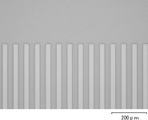
- FIG. 3 is an optical microscope photograph of a patterned film produced in Example 3-1.
- 3 is an electron micrograph of a patterned film produced in Example 3-1.
- 3 is an optical microscope photograph of a patterned film produced in Example 3-2.
- 3 is an optical microscope photograph of a patterned film produced in Example 3-3.
- the pattern-forming composition according to the present invention includes a repeating unit structure represented by the following formula (1) and has at least one triazine ring terminal, at least part of which is a hydroxyl-substituted arylamino It is characterized by containing a group-sealed triazine ring-containing polymer, a cross-linking agent, inorganic fine particles having an alkali-reactive group on the surface, and an organic solvent.
- Triazine Ring-Containing Polymer The triazine ring-containing polymer used in the present invention contains a repeating unit structure represented by the following formula (1).
- a triazine ring-containing polymer is, for example, a so-called hyperbranched polymer.
- a hyperbranched polymer is a highly branched polymer having an irregularly branched structure.
- the term "irregular" as used herein means that the branch structure is more irregular than that of a dendrimer, which is a highly branched polymer having a regular branch structure.
- a triazine ring-containing polymer which is a hyperbranched polymer, has a structure larger than the repeating unit structure represented by formula (1), and each of the three bonds of the repeating unit structure represented by formula (1) has , and a structure (structure X) in which repeating unit structures represented by formula (1) are bonded.
- the structure X is distributed throughout the triazine ring-containing polymer except for the terminals.
- the repeating unit structure may consist essentially of the repeating unit structure represented by formula (1).
- R and R′ each independently represent a hydrogen atom, an alkyl group, an alkoxy group, an aryl group, or an aralkyl group. preferable.
- the number of carbon atoms in the alkyl group is not particularly limited, but is preferably 1 to 20. Considering that the heat resistance of the polymer is further improved, the number of carbon atoms in the alkyl group is 1 to 10. More preferably, 1 to 3 are even more preferable.
- the structure of the alkyl group is not particularly limited, and may be, for example, linear, branched, cyclic, or a combination of two or more thereof.
- alkyl groups are methyl, ethyl, n-propyl, isopropyl, cyclopropyl, n-butyl, isobutyl, s-butyl, t-butyl, cyclobutyl, 1-methyl-cyclopropyl, 2-methyl-cyclopropyl.
- n-pentyl 1-methyl-n-butyl, 2-methyl-n-butyl, 3-methyl-n-butyl, 1,1-dimethyl-n-propyl, 1,2-dimethyl-n-propyl, 2 , 2-dimethyl-n-propyl, 1-ethyl-n-propyl, cyclopentyl, 1-methyl-cyclobutyl, 2-methyl-cyclobutyl, 3-methyl-cyclobutyl, 1,2-dimethyl-cyclopropyl, 2,3- dimethyl-cyclopropyl, 1-ethyl-cyclopropyl, 2-ethyl-cyclopropyl, n-hexyl, 1-methyl-n-pentyl, 2-methyl-n-pentyl, 3-methyl-n-pentyl, 4-methyl -n-pentyl, 1,1-dimethyl-n-butyl, 1,2-dimethyl-n-butyl, 1,3-dimethyl-n-butyl,
- the number of carbon atoms in the alkoxy group is not particularly limited, it is preferably 1 to 20, and in consideration of further increasing the heat resistance of the polymer, the number of carbon atoms in the alkoxy group is more preferably 1 to 10. 1 to 3 are even more preferred.
- the structure of the alkyl moiety is not particularly limited, and may be, for example, linear, branched, cyclic, or a combination of two or more thereof.
- alkoxy groups include methoxy, ethoxy, n-propoxy, isopropoxy, n-butoxy, isobutoxy, s-butoxy, t-butoxy, n-pentoxy, 1-methyl-n-butoxy, 2-methyl-n -butoxy, 3-methyl-n-butoxy, 1,1-dimethyl-n-propoxy, 1,2-dimethyl-n-propoxy, 2,2-dimethyl-n-propoxy, 1-ethyl-n-propoxy, n -hexyloxy, 1-methyl-n-pentyloxy, 2-methyl-n-pentyloxy, 3-methyl-n-pentyloxy, 4-methyl-n-pentyloxy, 1,1-dimethyl-n-butoxy, 1,2-dimethyl-n-butoxy, 1,3-dimethyl-n-butoxy, 2,2-dimethyl-n-butoxy, 2,3-dimethyl-n-butoxy, 3,3-dimethyl-n-butoxy, 1-ethoxy,
- the number of carbon atoms in the aryl group is not particularly limited, it is preferably 6 to 40, and in consideration of further increasing the heat resistance of the polymer, the number of carbon atoms in the aryl group is more preferably 6 to 16. 6 to 13 are even more preferred.
- the aryl group includes an aryl group having a substituent. Examples of substituents include halogen atoms, alkyl groups having 1 to 6 carbon atoms, alkoxy groups having 1 to 6 carbon atoms, nitro groups, and cyano groups.
- aryl groups include phenyl, o-chlorophenyl, m-chlorophenyl, p-chlorophenyl, o-fluorophenyl, p-fluorophenyl, o-methoxyphenyl, p-methoxyphenyl, p-nitrophenyl, p-cyanophenyl, ⁇ -naphthyl, ⁇ -naphthyl, o-biphenylyl, m-biphenylyl, p-biphenylyl, 1-anthryl, 2-anthryl, 9-anthryl, 1-phenanthryl, 2-phenanthryl, 3-phenanthryl, 4 -phenanthryl, 9-phenanthryl groups and the like.
- the aralkyl group includes an aralkyl group having a substituent.
- substituents include halogen atoms, alkyl groups having 1 to 6 carbon atoms, alkoxy groups having 1 to 6 carbon atoms, nitro groups, and cyano groups.
- Specific examples include benzyl, p-methylphenylmethyl, m-methylphenylmethyl, o-ethylphenylmethyl, m-ethylphenylmethyl, p-ethylphenylmethyl, 2-propylphenylmethyl, 4-isopropylphenylmethyl, 4-isobutylphenylmethyl, ⁇ -naphthylmethyl group and the like.
- Q in formula (1) is not particularly limited as long as it is a divalent group having 3 to 30 carbon atoms and having a ring structure.
- the ring structure may be an aromatic ring structure or an alicyclic structure.
- the above Q preferably represents at least one selected from the group represented by formulas (2) to (13).
- R 1 to R 92 above each independently represent a hydrogen atom, a halogen atom, a carboxy group, a sulfo group, an alkyl group having 1 to 10 carbon atoms, a halogenated alkyl group having 1 to 10 carbon atoms, or a halogen atom having 1 to 10 carbon atoms.
- R 93 and R 94 each represent a hydrogen atom or an alkyl group having 1 to 10 carbon atoms
- W 1 and W 2 are each independently a single bond
- CR 95 R 96 R 95 and R 96 are each independently a hydrogen atom, a C 1-10 alkyl group (provided that these may form a ring), or represents a halogenated alkyl group having 1 to 10 carbon atoms.
- C ⁇ O, O, S, SO, SO 2 , or NR 97 R 97 is represents a hydrogen atom, an alkyl group having 1 to 10 carbon atoms, or a phenyl group).
- Halogen atoms include fluorine, chlorine, bromine and iodine atoms. Examples of the alkyl group and alkoxy group are the same as those described above.
- the halogenated alkyl group having 1 to 10 carbon atoms is obtained by substituting at least one hydrogen atom in the alkyl group having 1 to 10 carbon atoms with a halogen atom, and specific examples thereof include trifluoromethyl , 2,2,2-trifluoroethyl, perfluoroethyl, 3,3,3-trifluoropropyl, 2,2,3,3,3-pentafluoropropyl, 2,2,3,3-tetrafluoropropyl , 2,2,2-trifluoro-1-(trifluoromethyl)ethyl, perfluoropropyl, 4,4,4-trifluorobutyl, 3,3,4,4,4-pentafluorobutyl, 2,2 , 3,3,4,4,4-heptafluorobutyl, perfluorobutyl, 2,2,3,3,4,4,5,5,5-nonafluoropentyl, 2,2,3,3,4 , 4,5,5-octafluoropenty
- a perfluoroalkyl group having 1 to 10 carbon atoms is preferred, particularly 1 to 5 carbon atoms, in consideration of enhancing the solubility of the triazine ring-containing polymer in low-polar solvents while maintaining the refractive index. is more preferred, and a trifluoromethyl group is even more preferred.
- X 1 and X 2 each independently represent a single bond, an alkylene group having 1 to 10 carbon atoms, or a group represented by formula (14).
- the structures of these alkyl groups, halogenated alkyl groups, alkoxy groups, and alkylene groups are not particularly limited, and may be, for example, linear, branched, cyclic, or combinations of two or more thereof.
- R 98 to R 101 each independently represent a hydrogen atom, a halogen atom, a carboxy group, a sulfo group, an alkyl group having 1 to 10 carbon atoms, a halogenated alkyl group having 1 to 10 carbon atoms, or a representing 10 alkoxy groups
- Y 1 and Y 2 independently represent a single bond or an alkylene group having 1 to 10 carbon atoms.
- halogen atoms, alkyl groups, halogenated alkyl groups and alkoxy groups include the same halogen atoms, alkyl groups, halogenated alkyl groups and alkoxy groups for R 1 to R 92 .
- the structures of the alkyl groups and alkoxy groups in R 98 to R 101 are not particularly limited, and may be, for example, linear, branched, cyclic, or combinations of two or more thereof.
- the structure of the alkylene group in Y 1 and Y 2 is not particularly limited, and may be linear, branched, cyclic, or a combination of two or more thereof.
- Examples of alkylene groups having 1 to 10 carbon atoms include methylene, ethylene, propylene, trimethylene, tetramethylene and pentamethylene groups.
- the structure of the alkylene group is not particularly limited, and may be linear, branched, cyclic, or a combination of two or more thereof.
- Q is preferably at least one represented by formulas (2) and (5) to (13), and formulas (2), (5), (7), (8), (11) to (13) ) is more preferred.
- Specific examples of the divalent groups represented by the above formulas (2) to (13) include, but are not limited to, those represented by the following formulae.
- Ph represents a phenyl group. * represents a bond.
- Q is more preferably a divalent group represented by the following formula, since a polymer with a higher refractive index can be obtained.
- Ph represents a phenyl group. * represents a bond.
- Q is preferably an m-phenylene group represented by formula (17).
- Q in formula (1) represents at least one selected from the group represented by formulas (102) to (115), for example. * represents a bond.
- R 1 and R 2 above independently represent an optionally branched alkylene group having 1 to 5 carbon atoms.
- alkylene groups include methylene, ethylene, propylene, trimethylene, tetramethylene, and pentamethylene groups. is preferred, and an alkylene group having 1 to 2 carbon atoms, more preferably a methylene or ethylene group, most preferably a methylene group.
- ⁇ Hydroxyl group-substituted arylamino group In the triazine ring-containing polymer used in the present invention, at least a portion of the triazine ring terminal is hydroxyl-substituted arylamino, from the viewpoint of improving the solubility of the thin film or cured film obtained using the same in an alkaline developer. is capped with a group.
- the hydroxyl group is a hydroxyl group directly bonded to an aryl group, and is a so-called phenolic hydroxyl group. Examples of the aryl group include the same groups as those exemplified above, and a phenyl group is particularly preferred.
- the hydroxyl-substituted arylamino group is preferably a hydroxyl-substituted phenylamino group represented by formula (15), and a phenylamino group having a hydroxyl group at the meta-position of the amino group represented by formula (16). is more preferred.
- the weight average molecular weight of the triazine ring-containing polymer in the present invention is not particularly limited, but is preferably 500 to 500,000, more preferably 500 to 100,000. is preferably 2,000 or more from the viewpoint of lowering the ,000 or less is more preferable, and 10,000 or less is more preferable.
- the weight average molecular weight in the present invention is the average molecular weight obtained by standard polystyrene conversion by gel permeation chromatography (hereinafter referred to as GPC) analysis.
- triazine ring-containing polymer (hyperbranched polymer) of the present invention can be produced according to the method disclosed in International Publication No. 2010/128661 mentioned above.
- triazine ring-containing polymer (19) can be obtained by reacting triazine compound (18) and aryldiamino compound (20) in a suitable organic solvent.
- the charging ratio of the aryldiamino compound (20) is arbitrary as long as the desired polymer can be obtained. is preferred, and 0.7 to 5 equivalents is more preferred.
- the aryldiamino compound (20) may be added neat or in the form of a solution dissolved in an organic solvent, but the latter method is preferred in consideration of ease of operation and ease of control of the reaction. .
- the reaction temperature may be appropriately set within the range from the melting point to the boiling point of the solvent used, preferably about 30 to 150°C, more preferably -10 to 100°C.
- organic solvent various solvents commonly used in this type of reaction can be used, such as tetrahydrofuran, dioxane, dimethylsulfoxide; N,N-dimethylformamide, N-methyl-2-pyrrolidone, tetramethylurea, hexamethylphosphoramide, N,N-dimethylacetamide, 3-methoxy-N,N-dimethylpropanamide, 3-butoxy-N,N-dimethylpropanamide, N-methyl-2-piperidone, N,N'- Dimethylethylene urea, N,N,N',N'-tetramethylmalonic acid amide, N-methylcaprolactam, N-acetylpyrrolidine, N,N-diethylacetamide, N-ethyl-2-pyrrolidone, N,N-dimethyl Amide solvents such as propionic acid amide, N,N-dimethylisobutyramide, N-methylformamide, N,N'-dimethyl
- N,N-dimethylformamide, dimethylsulfoxide, N-methyl-2-pyrrolidone, N,N-dimethylacetamide, 3-methoxy-N,N-dimethylpropanamide, 3-butoxy-N,N-dimethylpropanamide, and mixed systems thereof are preferred, particularly N,N-dimethylacetamide, N-methyl-2-pyrrolidone, 3-methoxy-N,N-dimethylpropanamide, 3-butoxy-N,N-dimethylpropanamide, preferred.
- various bases commonly used during or after polymerization may be added.
- this base include potassium carbonate, potassium hydroxide, sodium carbonate, sodium hydroxide, sodium hydrogen carbonate, sodium ethoxide, sodium acetate, lithium carbonate, lithium hydroxide, lithium oxide, potassium acetate, magnesium oxide, oxide calcium, barium hydroxide, trilithium phosphate, trisodium phosphate, tripotassium phosphate, cesium fluoride, aluminum oxide, ammonia, n-propylamine, trimethylamine, triethylamine, diisopropylamine, diisopropylethylamine, N-methylpiperidine, 2,2,6,6-tetramethyl-N-methylpiperidine, pyridine, 4-dimethylaminopyridine, N-methylmorpholine, 2-aminoethanol, ethyldiethanolamine, diethylaminoethanol and the like.
- the amount of the base to be added is preferably 1 to 100 equivalents, more preferably 1 to 10 equivalents, relative to 1 equivalent of the triazine compound (18).
- These bases may be used in the form of an aqueous solution. Although it is preferable that no raw material components remain in the resulting polymer, some of the raw materials may remain as long as the effects of the present invention are not impaired. After completion of the reaction, the product can be easily purified by a reprecipitation method or the like.
- the triazine ring-containing polymer of the present invention has at least one triazine ring terminal, and at least part of this triazine ring terminal is capped with a hydroxyl-substituted arylamino group.
- this terminal blocking method a known method may be adopted.
- the triazine ring-containing polymer (19) obtained by the above method is treated with an amino It may be treated with an arylamine compound having a phenolic hydroxyl group such as phenol.
- the amount of the terminal blocking agent used is preferably about 0.05 to 10 equivalents, more preferably 0.1 to 5 equivalents, relative to 1 equivalent of halogen atoms derived from the surplus triazine compound that was not used in the polymerization reaction. Preferably, 0.5 to 2 equivalents is even more preferred.
- the reaction solvent and the reaction temperature the same conditions as described in Scheme 1 above can be mentioned, and the terminal blocking agent may be charged simultaneously with the aryldiamino compound (20).
- An arylamine compound having no substituent may be used together with the above hydroxyl-substituted arylamine compound, and the terminals may be blocked with two or more groups.
- terminal blocking may also be performed using an arylamine compound having a specific heteroatom-containing substituent.
- the refractive index of the resulting film can be further increased by end capping with an arylamino group having a specific heteroatom-containing substituent.
- Particular heteroatom-containing substituents include cyano groups, amino groups, alkylamino groups, arylamino groups, nitro groups, thiol groups, alkylmercapto groups, arylmercapto groups, alkoxycarbonyl groups, alkoxycarbonyloxy groups.
- the arylamino group having a specific heteroatom-containing substituent includes those represented by the following formula (34).
- Y is a "specific heteroatom-containing substituent" and is a cyano group, an amino group, an alkylamino group, an arylamino group, a nitro group, a thiol group, an alkylmercapto group, an arylmercapto group, an alkoxycarbonyl group. or represents an alkoxycarbonyloxy group.
- m represents an integer of 1 to 5; When m is 2 or more, Y may be the same or different. * represents a bond.
- Y is preferably a cyano group or a nitro group.
- m is preferably 1.
- Y is preferably substituted at the para- or meta-position.
- the ratio of the arylamine compound having a phenolic hydroxyl group and the arylamine compound having a specific heteroatom-containing substituent is determined by alkali developability and high refractive index. From the viewpoint of achieving a good balance between efficiency and efficiency, 0.1 to 1.0 mol of an arylamine compound having a specific heteroatom-containing substituent per 1 mol of an arylamine compound having a phenolic hydroxyl group is preferable, and 0.1 ⁇ 0.5 mol is more preferred, and 0.1 to 0.3 mol is even more preferred.
- triazine ring-containing polymers include, but are not limited to, those represented by formulas (21) to (24).
- R 1 to R 4 have the same meanings as above.
- the content of the triazine ring-containing polymer in the pattern forming composition is not particularly limited, but is preferably 1 to 50% by mass, more preferably 5 to 30% by mass.
- cross-linking agent any compound capable of forming a cross-linked structure by causing a cross-linking reaction alone or together with the triazine ring-containing polymer described above can be used. is not particularly limited. Examples of such compounds include melamine-based compounds having cross-linking substituents such as methylol groups and methoxymethyl groups (e.g., phenoplast compounds, aminoplast compounds, etc.), substituted urea-based compounds, cross-linking groups such as epoxy groups and oxetane groups.
- Compounds containing forming substituents e.g., polyfunctional epoxy compounds, polyfunctional oxetane compounds, etc.
- compounds containing blocked isocyanate groups compounds having acid anhydride groups, compounds having (meth)acrylic groups, and the like.
- compounds containing epoxy groups, blocked isocyanate groups, and (meth)acrylic groups are preferable.
- compounds containing blocked isocyanate groups and photocurable without the use of initiators are preferable.
- a polyfunctional epoxy compound and/or a polyfunctional (meth)acrylic compound, which gives a composition having a high molecular weight, are preferred.
- the polyfunctional epoxy compound is not particularly limited as long as it has two or more epoxy groups in one molecule. Specific examples thereof include tris(2,3-epoxypropyl) isocyanurate, 1,4-butanediol diglycidyl ether, 1,2-epoxy-4-(epoxyethyl) cyclohexane, glycerol triglycidyl ether, and diethylene glycol diglycidyl.
- YH-434 and YH434L manufactured by Nippon Steel Chemical & Materials Co., Ltd.
- Epolead GT-401 which is an epoxy resin having a cyclohexene oxide structure.
- the polyfunctional (meth)acrylic compound is not particularly limited as long as it has two or more (meth)acrylic groups in one molecule.
- Specific examples include ethylene glycol diacrylate, ethylene glycol dimethacrylate, polyethylene glycol diacrylate, polyethylene glycol dimethacrylate, ethoxylated bisphenol A diacrylate, ethoxylated bisphenol A dimethacrylate, ethoxylated trimethylolpropane triacrylate, ethoxylated Trimethylolpropane trimethacrylate, ethoxylated glycerin triacrylate, ethoxylated glycerin trimethacrylate, ethoxylated pentaerythritol tetraacrylate, ethoxylated pentaerythritol tetramethacrylate, ethoxylated dipentaerythritol hexaacrylate, polyglycerin monoethylene oxide polyacrylate, polygly
- the polyfunctional (meth) acrylic compound is available as a commercial product, specific examples thereof include NK Ester A-200, A-400, A-600, A-1000, A- 9300 (tris(2-acryloyloxyethyl) isocyanurate), A-9300-1CL, A-TMPT, UA-53H, 1G, 2G, 3G, 4G, 9G, 14G, 23G, ABE-300, A-BPE-4, A-BPE-6, A-BPE-10, A-BPE-20, A-BPE-30, BPE-80N, BPE- 100N, BPE-200, BPE-500, BPE-900, BPE-1300N, A-GLY-3E, A-GLY-9E, A-GLY-20E, A-TMPT-3EO, A-TMPT-9EO, AT-20E, ATM-4E, ATM-35E, A-DPH, A-TMPT, A-DCP, A-HD-N, TMPT, DCP, NPG, HD-
- the compound having an acid anhydride group is not particularly limited as long as it is a carboxylic acid anhydride obtained by dehydration condensation of two molecules of carboxylic acid.
- Specific examples thereof include phthalic anhydride and tetrahydrophthalic anhydride. , hexahydrophthalic anhydride, methyltetrahydrophthalic anhydride, methylhexahydrophthalic anhydride, nadic anhydride, methyl nadic anhydride, maleic anhydride, succinic anhydride, octyl succinic anhydride, dodecenyl succinic anhydride, etc.
- the compound containing a blocked isocyanate group has two or more blocked isocyanate groups in one molecule in which the isocyanate group (--NCO) is blocked with an appropriate protective group, and when exposed to a high temperature during thermosetting, ,
- the protective group (blocking portion) is thermally dissociated and the resulting isocyanate group is not particularly limited as long as it causes a urethane bond reaction with the phenolic hydroxyl group of the triazine ring-containing polymer of the present invention.
- Examples include compounds having two or more groups represented by the following formulas in one molecule (these groups may be the same or different).
- Rb represents the organic group of the block portion.
- Such a compound can be obtained, for example, by reacting a compound having two or more isocyanate groups in one molecule with an appropriate blocking agent.
- compounds having two or more isocyanate groups in one molecule include polyisocyanates such as isophorone diisocyanate, 1,6-hexamethylene diisocyanate, methylenebis(4-cyclohexyl isocyanate), trimethylhexamethylene diisocyanate, and dimers thereof. , trimers, and reaction products thereof with diols, triols, diamines, or triamines.
- blocking agents include alcohols such as methanol, ethanol, isopropanol, n-butanol, 2-ethoxyhexanol, 2-N,N-dimethylaminoethanol, 2-ethoxyethanol and cyclohexanol; phenol, o-nitrophenol , p-chlorophenol, o-, m- or p-cresol, etc.; lactams, such as ⁇ -caprolactam; Pyrazoles such as pyrazole, 3,5-dimethylpyrazole and 3-methylpyrazole; Thiols such as dodecanethiol and benzenethiol.
- alcohols such as methanol, ethanol, isopropanol, n-butanol, 2-ethoxyhexanol, 2-N,N-dimethylaminoethanol, 2-ethoxyethanol and cyclohexanol
- Compounds containing a blocked isocyanate group are also available as commercial products, and specific examples thereof include Takenate (registered trademark) B-830, B-815N, B-842N, B-870N, B-874N, B-882N, B-7005, B-7030, B-7075, B-5010 (manufactured by Mitsui Chemicals, Inc.), Duranate (registered trademark) 17B-60PX, TPA-B80E, MF-B60X, MF-K60X, E402-B80T (manufactured by Asahi Kasei Corporation), Karenz MOI-BM (registered trademark) (manufactured by Showa Denko K.K.), TRIXENE (registered trademark) BI7950, 7951, 7960, No. 7961, No. 7982, No. 7990, No. 7991, No. 7992 (all manufactured by Baxenden Chemical) and the like.
- the aminoplast compound is not particularly limited as long as it has two or more methoxymethylene groups in one molecule.
- Cymel series such as tetramethoxymethylbenzoguanamine 1123 (manufactured by Nippon Cytec Industries Co., Ltd.), methylated melamine resin Nicalac (registered trademark) MW-30HM, MW-390, MW-100LM, the same Melamine compounds such as Nicalac series such as MX-750LM and methylated urea resins such as MX-270, MX-280 and MX-290 (manufactured by Sanwa Chemical Co., Ltd.).
- the oxetane compound is not particularly limited as long as it has two or more oxetanyl groups in one molecule. , manufactured by Toagosei Co., Ltd.) and the like.
- the phenoplast compound has two or more hydroxymethylene groups in one molecule, and when exposed to high temperatures during thermosetting, it undergoes a dehydration condensation reaction with the phenolic hydroxyl groups of the triazine ring-containing polymer of the present invention. The cross-linking reaction proceeds.
- phenoplast compounds include 2,6-dihydroxymethyl-4-methylphenol, 2,4-dihydroxymethyl-6-methylphenol, bis(2-hydroxy-3-hydroxymethyl-5-methylphenyl)methane, Bis(4-hydroxy-3-hydroxymethyl-5-methylphenyl)methane, 2,2-bis(4-hydroxy-3,5-dihydroxymethylphenyl)propane, bis(3-formyl-4-hydroxyphenyl)methane , bis(4-hydroxy-2,5-dimethylphenyl)formylmethane, ⁇ , ⁇ -bis(4-hydroxy-2,5-dimethylphenyl)-4-formyltoluene, and the like.
- Phenoplast compounds are also commercially available, and specific examples thereof include 26DMPC, 46DMOC, DM-BIPC-F, DM-BIOC-F, TM-BIP-A, BISA-F, and BI25X-DF. , BI25X-TPA (manufactured by Asahi Yukizai Co., Ltd.) and the like.
- a polyfunctional (meth)acrylic compound is preferable because it can suppress a decrease in the refractive index due to the addition of a cross-linking agent and the curing reaction proceeds rapidly. Therefore, dipentaerythritol hexaacrylate and its EO adduct are preferred.
- examples of such polyfunctional (meth)acrylic compounds include NK Ester A-DPH and NK Ester A-DPH-12E (both manufactured by Shin-Nakamura Chemical Co., Ltd.).
- the above-mentioned cross-linking agents may be used alone or in combination of two or more.
- the content of the cross-linking agent in the pattern forming composition is preferably 1 to 200 parts by mass with respect to 100 parts by mass of the triazine ring-containing polymer, but considering solvent resistance, the lower limit is preferably 2 parts by mass, It is more preferably 5 parts by mass, and considering controlling the refractive index and the residue in the unexposed area, the upper limit is preferably 150 parts by mass, more preferably 100 parts by mass, and even more preferably 90 parts by mass. Department.
- Inorganic Fine Particles Inorganic fine particles have alkali-reactive groups on their surfaces. Since the inorganic fine particles have an alkali-reactive group on the surface, when the unexposed portion of the pattern film obtained from the pattern-forming composition is developed with an alkaline developer, the inorganic fine particles in the unexposed portion contain a triazine ring. It becomes easy to remove with an alkaline developer together with other components such as a polymer and a cross-linking agent. As a result, the pattern formability is good in spite of containing the inorganic fine particles.
- Inorganic fine particles having alkali-reactive groups on their surfaces are, for example, organic silicon compounds having unmodified inorganic fine particles as core particles and having alkali-reactive groups. It is obtained by modifying the surface of the core particles.
- Organosilicon compounds have hydrolyzable groups that generate Si—OH groups upon hydrolysis. Hydrolyzable groups include, for example, silicon-bonded alkoxy groups and silicon-bonded acetoxy groups. The number of hydrolyzable groups in the organosilicon compound is not particularly limited, but may be 1 to 3, for example.
- alkali-reactive groups include acid anhydride groups, epoxy groups, and phenol groups.
- Organosilicon compounds having an acid anhydride group include, for example, 3-trimethoxysilylpropylsuccinic anhydride, 3-triethoxysilylpropylsuccinic anhydride, 3-dimethylmethoxysilylpropylsuccinic anhydride, 3- succinic anhydrides such as dimethylethoxysilylpropyl succinic anhydride, 3-trimethoxysilylpropylcyclohexyldicarboxylic anhydride, 3-triethoxysilylpropylcyclohexyldicarboxylic anhydride, 3-dimethylmethoxysilylpropylcyclohexyldicarboxylic anhydride dicarboxylic anhydrides such as 3-dimethylethoxysilylpropylcyclohexyldicarboxylic anhydride, 3-trimethoxysilylpropy
- the bonding amount of the organosilicon compound to the surface of the core particles is not particularly limited, but is preferably 0.1 to 30% by mass, more preferably 1 to 15% by mass, relative to the core particles.
- the primary particle size of the surface-modified inorganic fine particles is preferably 20 nm or less from the viewpoints of dispersion stability, refractive index and transparency of the resulting film.
- the secondary particle diameter (according to dynamic light scattering method) of the surface-modified inorganic fine particles is preferably 2 to 100 nm, more preferably 5 to 50 nm, from the viewpoint of dispersion stability, refractive index and transparency of the resulting thin film. ⁇ 20 nm is even more preferred.
- the surface-modified inorganic fine particles are prepared by adding a predetermined amount of an organosilicon compound to an aqueous dispersion of core particles or a dispersion in a hydrophilic organic solvent, hydrolyzing the organosilicon compound with a catalyst such as dilute hydrochloric acid, and treating the surface of the core particles. It can be obtained by binding to
- the aqueous dispersion or hydrophilic organic solvent dispersion of the core particles can be further replaced with a hydrophobic organic solvent.
- This replacement method can be carried out by a conventional method such as a distillation method or an ultrafiltration method.
- hydrophobic solvents include ketones such as methyl ethyl ketone and methyl isobutyl ketone, cyclic ketones such as cyclopentanone and cyclohexanone, and esters such as ethyl acetate and butyl acetate.
- the organic solvent dispersion of the core particles may contain optional components.
- the dispersibility of the core particles can be further improved.
- phosphoric acid derivatives include phenylphosphonic acid and metal salts thereof.
- phosphoric acid-based surfactants include Disperbyk (manufactured by BYK-Chemie), Phosphanol (manufactured by Toho Chemical Industry Co., Ltd.), and Nikkor (manufactured by Nikko Chemicals Co., Ltd.).
- Oxycarboxylic acids include, for example, lactic acid, tartaric acid, citric acid, gluconic acid, malic acid and glycolic acid.
- the content of these optional components is preferably about 30% by mass or less with respect to all metal oxides in the core particles.
- the concentration of the core particles in the organic solvent dispersion is preferably 10 to 60% by mass, more preferably 30 to 50% by mass.
- inorganic fine particles serving as core particles of surface-modified inorganic fine particles include Be, Al, Si, Ti, V, Fe, Cu, Zn, Y, Zr, Nb, Mo, In, Sn, Sb, Ta, W, It contains oxides, sulfides or nitrides of one or more metals selected from the group consisting of Pb, Bi and Ce, and it is particularly preferable to contain these metal oxides.
- the inorganic fine particles may be used alone or in combination of two or more.
- metal oxides include Al2O3 , ZnO, TiO2 , ZrO2, Fe2O3 , Sb2O5 , BeO , ZnO , SnO2 , CeO2 , SiO2 , and WO3 . is mentioned. It is also effective to use a plurality of metal oxides as a composite oxide.
- a composite oxide is a mixture of two or more kinds of inorganic oxides in the production stage of fine particles.
- composite oxides of TiO 2 and ZrO 2 , composite oxides of TiO 2 , ZrO 2 and SnO 2 , composite oxides of ZrO 2 and SnO 2 and the like can be mentioned. Further, it may be a compound of the above metals.
- Examples include ZnSb 2 O 6 , BaTiO 3 , SrTiO 3 and SrSnO 3 . These compounds can be used alone or in admixture of two or more, and may also be used in admixture with the above oxides.
- the inorganic fine particles serving as the core particles of the surface-modified inorganic fine particles are, for example, third metal oxide particles ( C).
- the first metal oxide particles (A) can be produced by known methods such as ion exchange, deflocculation, hydrolysis, and reaction methods.
- the ion exchange method include at least one metal selected from the group consisting of Ti, Fe, Cu, Zn, Y, Zr, Nb, Mo, In, Sn, Sb, Ta, W, Pb, Bi and Ce. and a method of treating an acid salt of the metal with a hydrogen-type ion exchange resin, or a method of treating a basic salt of the metal with a hydroxyl-type anion exchange resin.
- Examples of deflocculation include washing the gel obtained by neutralizing the acid salt of the metal with a base or neutralizing the basic salt of the metal with an acid, followed by peptization with an acid or a base.
- Examples of the hydrolysis method include a method of hydrolyzing the alkoxide of the above metal, or a method of hydrolyzing the basic salt of the above metal under heating and then removing unnecessary acid.
- Examples of the reaction method include a method of reacting the metal powder with an acid.
- the first metal oxide particles (A) are preferably oxides of metals having a valence of 2 to 6, such as Ti, Fe, Cu, Zn, Y, Zr, Nb, Mo, In, Sn, Sb, Ta , W, Pb, Bi, Ba, Al, Sr, Hf and Ce.
- metal oxides include, for example, TiO2 , Fe2O3 , CuO , ZnO, Y2O3 , ZrO2 , Nb2O5 , MoO3 , In2O3 , SnO2 , Sb2O5 .
- metal oxides can be used singly or in combination of two or more.
- the method of combining the metal oxides include a method of mixing several types of the metal oxides, a method of compounding the metal oxides, and a method of forming a solid solution of the metal oxides at the atomic level.
- Combinations of the metal oxides include, for example, SnO 2 —TiO 2 composite particles in which SnO 2 particles and TiO 2 particles are chemically bonded at their interfaces, and SnO 2 particles and WO 3 particles.
- 2 composite particles, and TiO 2 --ZrO 2 --SnO 2 composite particles obtained by forming a solid solution of TiO 2 , ZrO 2 and SnO 2 at the atomic level.
- the first metal oxide particles ( A ) can also be used as a compound by combining metal components. ZnO, BaTiO 3 , SrTiO 3 , aluminum-doped zinc oxide, and the like.
- the TiO 2 contained in the particles has any of anatase, rutile, anatase/rutile mixed, and brookite crystal structures.
- those containing the rutile type are preferable in consideration of the refractive index and transparency of the resulting thin film.
- the first metal oxide particles (A) form a thin film layer made of a metal oxide such as zirconium oxide, silicon oxide, and aluminum oxide on the surface from the viewpoint of suppressing the activity (for example, photocatalytic performance).
- the thin film layer can be formed, for example, by adding a zirconium compound to an aqueous dispersion of the first metal oxide particles (A) and heating the mixture at 40 to 200.degree.
- zirconium compound examples include zirconium oxychloride, zirconium chloride, zirconium hydroxide, zirconium sulfate, zirconium nitrate, zirconium oxynitrate, zirconium acetate, zirconyl carbonate, ammonium zirconium carbonate, potassium zirconium carbonate, zirconium ethylhexanoate, and stearic acid.
- the amount of the zirconia compound used, as zirconium oxide, is preferably 3 to 50% by mass relative to the first metal oxide particles (A) used.
- the primary particle size of the first metal oxide particles (A) is preferably 2 to 60 nm, more preferably 2 to 30 nm, from the viewpoints of dispersion stability, refractive index and transparency of the resulting thin film. More preferably, 2 to 20 nm is particularly preferred. From the viewpoint of dispersion stability, refractive index and transparency of the obtained thin film, 5 to 100 nm is preferred, 5 to 50 nm is more preferred, and 5 to 30 nm is particularly preferred.
- the first metal oxide particles (A) can be synthesized, for example, according to the method described in International Publication No. 2013/081136.
- the second metal oxide particles (B) are preferably oxide particles of at least one metal selected from the group consisting of Si, Al, Sn, Zr, Mo, Sb and W.
- the second metal oxide particles (B) are in the form of metal oxides, for example, SiO 2 , Al 2 O 3 , SnO 2 , ZrO 2 , MoO 3 , Sb 2 O 5 , WO 3 and the like. can. And these metal oxides can be used individually by 1 type, and can also be used in combination of 2 or more types. Examples of the method of combining the metal oxides include a method of mixing several types of the metal oxides, a method of compounding the metal oxides, and a method of forming a solid solution of the metal oxides at the atomic level.
- the second metal oxide particles (B) include, for example, SnO 2 —WO 3 composite particles, SnO 2 particles in which SnO 2 particles and WO 3 particles are chemically bonded at their interface to form a composite.
- SnO 2 —WO 3 SiO 2 composite particles produced and composited
- SnO 2 —MoO 3 composited by chemical bonding of SnO 2 particles, MoO 3 particles and SiO 2 particles at their interfaces
- Examples include SiO 2 composite particles, Sb 2 O 5 -SiO 2 composite particles in which Sb 2 O 5 particles and SiO 2 particles are chemically bonded at their interface to form a composite.
- the ratio (mass ratio) of the metal oxides contained is not particularly limited, but for example, SnO 2 —SiO 2 composite
- the particles preferably have a SiO 2 /SnO 2 mass ratio of 0.1 to 5, and the Sb 2 O 5 —SiO 2 composite particles preferably have a Sb 2 O 5 /SiO 2 mass ratio of 0.1 to 5.
- the second metal oxide particles (B) can be produced by known methods such as an ion exchange method and an oxidation method.
- the ion exchange method include a method of treating an acid salt of the above metal with a hydrogen ion exchange resin.
- the oxidation method include a method of reacting the powder of the metal or the oxide of the metal with hydrogen peroxide.
- the primary particle size of the second metal oxide particles (B) is preferably 5 nm or less, more preferably 1 to 5 nm, from the viewpoints of dispersion stability and the refractive index and transparency of the resulting thin film. preferable.
- the third metal oxide particles (C) are metal oxide particles obtained by coating the surfaces of the first metal oxide particles (A) with the second metal oxide particles (B). Examples of the manufacturing method include the following first method and second method.
- an aqueous dispersion containing the first metal oxide particles (A) and an aqueous dispersion containing the second metal oxide particles (B) are separated by (B)/(A).
- the aqueous dispersion is heated.
- An aqueous dispersion of the third metal oxide particles (C) in which the surfaces of the first metal oxide particles (A) are coated with the Sb 2 O 5 —SiO 2 composite particles is obtained.
- an aqueous dispersion containing the first metal oxide particles (A), a water-soluble tin oxide alkali salt and a silicon oxide alkali salt as the second metal oxide particles (B), SnO 2 After mixing so that the mass ratio represented by /SiO 2 (value in terms of metal oxide) is 0.1 to 5, cation exchange is performed to remove alkali metal ions SnO 2 —SiO obtained by 2 and an aqueous dispersion of composite particles so that the mass ratio represented by (B)/(A) (in terms of metal oxide) is 0.05 to 0.5, and then mixed. It is a method of heating an aqueous dispersion.
- an aqueous solution of sodium salt can be preferably used as the aqueous solution of water-soluble alkali salt used in the second method.
- an aqueous solution of sodium salt can be preferably used.
- aqueous dispersion containing the first metal oxide particles (A) and an aqueous solution of sodium stannate and sodium silicate as the second metal oxide particles (B) After mixing an aqueous dispersion containing the first metal oxide particles (A) and an aqueous solution of sodium stannate and sodium silicate as the second metal oxide particles (B), cation exchange is performed to obtain and an aqueous dispersion of SnO 2 —SiO 2 composite particles obtained above are mixed so that the mass ratio is 0.05 to 0.5, and the aqueous dispersion is heated at 70 to 350° C.
- An aqueous dispersion of the third metal oxide particles (C) in which the surface of the metal oxide particles (A) as nuclei is coated with the second metal oxide particles (B) composed of SnO 2 —SiO 2 composite particles. can get.
- the temperature at which the first metal oxide particles (A) and the second metal oxide particles (B) are mixed is usually 1 to 100°C, preferably 20 to 60°C.
- the heating temperature after mixing is preferably 70 to 350°C, more preferably 70 to 150°C.
- the heating time after mixing is usually 10 minutes to 5 hours, preferably 30 minutes to 4 hours.
- the aqueous dispersion of the third metal oxide particles (C) may contain any component.
- oxycarboxylic acids it is possible to further improve performance such as dispersibility of the third metal oxide particles (C).
- the oxycarboxylic acid include lactic acid, tartaric acid, citric acid, gluconic acid, malic acid and glycolic acid.
- the content of the oxycarboxylic acids is preferably about 30% by mass or less with respect to all metal oxides in the third metal oxide particles (C).
- the dispersion of the third metal oxide particles (C) may contain an alkaline component.
- alkali component include alkali metal hydroxides such as Li, Na, K, Rb, and Cs; ammonia; ethylamine, isopropylamine, n-propylamine, n-butylamine, diethylamine, di-n-propylamine, Diisopropylamine, di-n-butylamine, diisobutylamine, triethylamine, tripropylamine, tributylamine, triisobutylamine, triamylamine (tri-n-pentylamine), tri-n-hexylamine, tri-n-octylamine , dimethylpropylamine, dimethylbutylamine, dimethylhexylamine, etc.
- alkali component include alkali metal hydroxides such as Li, Na, K, Rb, and Cs; ammonia; ethylamine,
- alkali component is preferably about 30% by mass or less with respect to all metal oxides in the third metal oxide particles (C). Moreover, these alkali components can be used in combination with the above oxycarboxylic acid.
- the aqueous dispersion of the third metal oxide particles (C) When it is desired to further increase the concentration of the aqueous dispersion of the third metal oxide particles (C), it can be concentrated to a maximum of about 65% by mass by a conventional method.
- the method includes, for example, an evaporation method and an ultrafiltration method.
- the alkali metal hydroxide, amine, quaternary ammonium salt, oxycarboxylic acid, etc. may be added.
- the total metal oxide concentration of the solvent dispersion of the third metal oxide particles (C) is preferably 10 to 60% by mass, more preferably 20 to 50% by mass.
- an organic solvent dispersion of the third metal oxide particles (C) is obtained.
- This substitution can be carried out by an ordinary method such as a distillation method or an ultrafiltration method.
- the hydrophilic organic solvent include lower alcohols such as methanol, ethanol, isopropanol and 1-propanol, ethers such as propylene glycol monomethyl ether, linear amides such as dimethylformamide and N,N'-dimethylacetamide, Cyclic amides such as N-methyl-2-pyrrolidone, glycols such as ethyl cellosolve and ethylene glycol.
- the primary particle size of the third metal oxide particles (C) is preferably 20 nm or less from the viewpoints of dispersion stability and the refractive index and transparency of the resulting film.
- the dynamic light scattering particle diameter (according to the dynamic light scattering method), which is the secondary particle diameter of the third metal oxide particles (C), is determined by 2 to 100 nm is preferred.
- the refractive index of the surface-modified inorganic fine particles is not particularly limited, but is preferably from 1.6 to 2.6, more preferably from 1.8 to 2.6, from the viewpoint of not lowering the refractive index of the resulting film.
- the refractive index of the inorganic fine particles can be obtained, for example, by measuring the refractive index of a liquid of the surface-modified inorganic fine particles dispersed in a solvent or resin with a known refractive index with an Abbe refractometer and extrapolating from the value, or by extrapolating the measured value.
- the refractive index of a film or cured product containing fine particles is measured with an Abbe refractometer or spectroscopic ellipsometry, and the refractive index can be extrapolated from the measured value.
- the content of the surface-modified inorganic fine particles in the composition may be within a range that does not impair the dispersibility in the final composition obtained. It is possible to control accordingly. For example, it can be added in the range of 0.1 to 1,000 parts by mass, preferably 1 to 500 parts by mass, with respect to 100 parts by mass of the triazine ring-containing polymer. And from the viewpoint of obtaining solvent resistance, it is more preferably 10 to 300 parts by mass.
- organic solvents include toluene, p-xylene, o-xylene, m-xylene, ethylbenzene, styrene, ethylene glycol dimethyl ether, propylene glycol monomethyl ether, ethylene glycol monomethyl ether, propylene glycol, propylene glycol.
- the solid content concentration in the composition is not particularly limited as long as it does not affect storage stability, and may be appropriately set according to the thickness of the desired film. Specifically, from the viewpoint of solubility and storage stability, the solid content concentration is preferably 0.1 to 50% by mass, more preferably 0.1 to 40% by mass.
- composition of the present invention can also contain an initiator suitable for each cross-linking agent.
- an initiator suitable for each cross-linking agent.
- photocuring proceeds to give a cured film without using an initiator.
- an initiator may be used.
- a photoacid generator or a photobase generator can be used.
- the photoacid generator may be appropriately selected from known ones and used.
- onium salt derivatives such as diazonium salts, sulfonium salts and iodonium salts can be used.
- aryldiazonium salts such as phenyldiazonium hexafluorophosphate, 4-methoxyphenyldiazonium hexafluoroantimonate, and 4-methylphenyldiazonium hexafluorophosphate; diphenyliodonium hexafluoroantimonate, bis(4-methylphenyl) diaryliodonium salts such as iodonium hexafluorophosphate, bis(4-tert-butylphenyl)iodonium hexafluorophosphate; triphenylsulfonium hexafluoroantimonate, tris(4-methoxyphenyl)sulfonium hexafluorophosphate, diphenyl-4-thiophenoxy phenylsulfonium hexafluoroantimonate, diphenyl-4-thiophenoxyphenylsulfonium hex
- onium salts may be commercially available products, and specific examples include San-Aid SI-60, SI-80, SI-100, SI-60L, SI-80L, SI-100L, SI-L145, SI- L150, SI-L160, SI-L110, SI-L147 (manufactured by Sanshin Chemical Industry Co., Ltd.), UVI-6950, UVI-6970, UVI-6974, UVI-6990, UVI-6992 (manufactured by Union Carbide company), CPI-100P, CPI-100A, CPI-200K, CPI-200S (manufactured by San-Apro Co., Ltd.), Adeka Optomer SP-150, SP-151, SP-170, SP-171 (manufactured by San-Apro Co., Ltd.) Asahi Denka Kogyo Co., Ltd.), Irgacure 261 (BASF), CI-2481, CI-2624, CI-2639, CI-2064
- the photobase generator it may be appropriately selected from known ones and used. etc. can be used. Specific examples include 2-nitrobenzylcyclohexylcarbamate, triphenylmethanol, O-carbamoylhydroxylamide, O-carbamoyloxime, [[(2,6-dinitrobenzyl)oxy]carbonyl]cyclohexylamine, bis[[(2 -nitrobenzyl)oxy]carbonyl]hexane 1,6-diamine, 4-(methylthiobenzoyl)-1-methyl-1-morpholinoethane, (4-morpholinobenzoyl)-1-benzyl-1-dimethylaminopropane, N- (2-nitrobenzyloxycarbonyl)pyrrolidine, hexaamminecobalt (III) tris(triphenylmethylborate), 2-benzyl-2-dimethylamino-1-(4-morpholinophenyl)-butanone, 2,6-dimethyl
- a photoacid or base generator When a photoacid or base generator is used, it is preferably used in the range of 0.1 to 15 parts by mass, more preferably in the range of 1 to 10 parts by mass, per 100 parts by mass of the polyfunctional epoxy compound. If necessary, an epoxy resin curing agent may be blended in an amount of 1 to 100 parts by mass with respect to 100 parts by mass of the polyfunctional epoxy compound.
- a photoradical polymerization initiator when using a polyfunctional (meth)acrylic compound, a photoradical polymerization initiator can be used.
- the radical photopolymerization initiator it may be appropriately selected and used from known ones. is mentioned.
- a photocleavable photoradical polymerization initiator is preferred.
- the photo-cleavable photoradical polymerization initiator is described in Latest UV Curing Techniques (page 159, published by: Kazuhiro Takasusu, published by: Technical Information Institute, 1991).
- radical photopolymerization initiators include, for example, BASF trade name: Irgacure 127, 184, 369, 379, 379EG, 651, 500, 754, 819, 903, 907, 784, 2959, CGI1700, CGI1750, CGI1850 , CG24-61, OXE01, OXE02, OXE03, OXE04, Darocure 1116, 1173, MBF, manufactured by BASF Product name: Lucirin TPO, manufactured by UCB Product name: Ebecryl P36, manufactured by Fratezuri Lamberti Product name: Ezacure KIP150, KIP65LT, KIP100F, KT37, KT55, KTO46, KIP75/B and the like.
- BASF trade name Irgacure 127, 184, 369, 379, 379EG, 651, 500, 754, 819, 903, 907, 784, 2959, CGI1700, CGI1750, CGI1850 ,
- a photoradical polymerization initiator When using a photoradical polymerization initiator, it is preferable to use it in the range of 0.1 to 200 parts by weight with respect to 100 parts by weight of the polyfunctional (meth) acrylate compound, and to use it in the range of 1 to 150 parts by weight. is more preferred.
- composition of the present invention may contain other components other than the triazine ring-containing polymer, the cross-linking agent and the solvent, such as leveling agents, surfactants, Silane coupling agents, polymerization inhibitors, antioxidants, rust inhibitors, release agents, plasticizers, defoaming agents, thickeners, dispersants, antistatic agents, anti-settling agents, pigments, dyes, UV absorbers , additives such as light stabilizers may also be included.
- leveling agents such as leveling agents, surfactants, Silane coupling agents, polymerization inhibitors, antioxidants, rust inhibitors, release agents, plasticizers, defoaming agents, thickeners, dispersants, antistatic agents, anti-settling agents, pigments, dyes, UV absorbers , additives such as light stabilizers may also be included.
- surfactants include polyoxyethylene alkyl ethers such as polyoxyethylene lauryl ether, polyoxyethylene stearyl ether, polyoxyethylene cetyl ether, and polyoxyethylene oleyl ether; polyoxyethylene octylphenol ether, polyoxyethylene nonylphenol; Polyoxyethylene alkylallyl ethers such as ethers; polyoxyethylene/polyoxypropylene block copolymers; sorbitan monolaurate, sorbitan monopalmitate, sorbitan monostearate, sorbitan monooleate, sorbitan trioleate, sorbitan tristearate sorbitan fatty acid esters such as; Nonionic surfactants such as sorbitan fatty acid esters, trade names Ftop EF301, EF303, EF352 (manufactured by Mitsubishi Materials Electronic Chemicals Co., Ltd.
- surfactants may be used alone or in combination of two or more.
- the amount of the surfactant used is preferably 0.0001 to 5 parts by mass, more preferably 0.001 to 1 part by mass, and 0.01 to 0.5 parts by mass with respect to 100 parts by mass of the triazine ring-containing polymer. Even more preferable.
- Pattern production method and cured product In the pattern production method using the composition of the present invention, the composition is applied to a substrate, and then heated as necessary to evaporate the solvent, followed by heating or light.
- a desired cured film can be formed by irradiation, and in producing a cured film by light irradiation, light irradiation is performed through a mask on which a desired pattern is formed, and then development is performed with a developer to create a fine pattern. can be formed.
- a cured product can be obtained by using the pattern forming composition of the present invention.
- the method for applying the composition is arbitrary, and examples thereof include spin coating, dipping, flow coating, inkjet, jet dispenser, spraying, bar coating, gravure coating, slit coating, and roll coating.
- method, transfer printing method, brush coating method, blade coating method, air knife coating method, and the like can be used.
- the base material silicon, glass coated with indium tin oxide (ITO), glass coated with indium zinc oxide (IZO), polyethylene terephthalate (PET), plastic, glass, quartz, and ceramics. etc., and a flexible base material having flexibility can also be used.
- the calcination temperature is not particularly limited for the purpose of evaporating the solvent, and can be carried out at, for example, 70 to 400°C.
- the baking time may be any time for the solvent to evaporate, and for example, 1 to 600 seconds can be adopted.
- the baking method is not particularly limited. For example, a hot plate or an oven may be used to evaporate under an appropriate atmosphere such as air, an inert gas such as nitrogen, or vacuum.
- the sintering temperature and sintering time may be selected in accordance with the process steps of the target electronic device, and the sintering conditions may be selected such that the physical properties of the obtained film are suitable for the required characteristics of the electronic device.
- the conditions for light irradiation are not particularly limited either, and suitable irradiation energy and time may be adopted according to the triazine ring-containing polymer and cross-linking agent to be used.
- Development after exposure can be carried out, for example, by immersing the exposed resin in an organic solvent developer or an aqueous developer.
- organic solvent developer include PGME, PGMEA, a mixed solvent of PGME and PGMEA, NMP, ⁇ -butyrolactone, DMSO, etc.
- aqueous developer include sodium carbonate, potassium carbonate, Alkaline aqueous solutions such as sodium hydroxide, potassium hydroxide and tetramethylammonium hydroxide can be used.
- the composition of the present invention may further contain an oxirane ring-containing compound and a photocurable catalyst.
- the oxirane ring-containing compound include those having one or more, preferably two or more, oxirane rings in the molecule. Specific examples include glycidyl ether type epoxy resins, glycidyl ester type epoxy resins, alicyclic epoxy resins Examples include resins, epoxy-modified polybutadiene resins, oxetane compounds, and the like. These may be used alone or in combination of two or more.
- the amount of the oxirane ring-containing compound is not particularly limited, it can be about 10 to 400 parts by mass with respect to 100 parts by mass of the triazine ring-containing polymer.
- Photocurable catalysts include photocation generators.
- the photocation generator include triarylsulfonium salts such as triphenylsulfonium hexafluorophosphate and triphenylsulfonium hexafluoroantimonate; triarylselenium salts; diphenyliodonium hexafluorophosphate and diphenyliodonium hexafluoroantimonate. and diaryliodonium salts. These may be used alone or in combination of two or more.
- the amount of the photocurable catalyst to be added is not particularly limited, but can be about 0.1 to 100 parts by mass with respect to 100 parts by mass of the triazine ring-containing polymer.
- oxirane ring-containing compounds and photocurable catalysts can be blended in any order with each component constituting the composition of the present invention. Moreover, you may use the organic solvent mentioned above in that case.
- the composition containing these by the above-described method for example, it can be cured by irradiating ultraviolet light or the like at 1 to 4000 mj/cm 2 .
- Light irradiation may be performed using various known techniques such as a high-pressure mercury lamp, metal halide lamp, xenon lamp, LED, and laser light.
- the film may be heated at about 110 to 180° C. before and after the exposure. Development after exposure can be carried out by immersing the exposed resin in the organic solvent developer or aqueous developer described above.
- the cured product obtained as described above can achieve high heat resistance, high refractive index, and low volume shrinkage.
- electronic devices and optical materials such as imaging devices, organic thin-film solar cells, dye-sensitized solar cells, organic thin-film transistors (TFTs), lenses, prism cameras, binoculars, microscopes, semiconductor exposure equipment, etc. available for
- Apparatus OLYMPUS BX51 manufactured by Olympus Optical Co., Ltd.
- Device JEOL JSM-7400F
- Exposure Apparatus: Mask aligner MA6 manufactured by SUSS
- developing Apparatus: Compact developing apparatus ADE-3000S manufactured by Actes Kyosan Co., Ltd.
- 1,3-Phenylenediamine [2] (228.70 g, 2.115 mol, manufactured by Amino-Chem) and 3464.72 g of dimethylacetamide (DMAc, manufactured by Kanto Chemical Co., Ltd.) were placed in a 5,000 mL four-necked flask.
- DMAc dimethylacetamide
- 1,3-phenylenediamine [2] was dissolved in DMAc by stirring. Then, it is cooled to ⁇ 10° C. in an ethanol-dry ice bath, and 2,4,6-trichloro-1,3,5-triazine [1] (390.00 g, 2.115 mol, manufactured by Tokyo Chemical Industry Co., Ltd.).
- Tetrahydrofuran (THF, 2,246 g), ammonium acetate (2,526 g) and ion-exchanged water (2,526 g) were added to the reaction solution and stirred for 30 minutes. After stopping the stirring, the solution was transferred to a separating funnel, separated into an organic layer and an aqueous layer, and the organic layer was recovered. The recovered organic layer was added dropwise to a mixed liquid of methanol (8,421 g) and ion-exchanged water (5,614 g) for reprecipitation. The resulting precipitate was filtered and dried in a vacuum dryer at 120° C. for 8 hours to obtain 536.2 g of the objective polymer compound [4] (hereinafter referred to as P-1).
- Compound P-1 had a weight average molecular weight Mw of 5,970 and a polydispersity Mw/Mn of 2.5 as measured by GPC in terms of polystyrene.
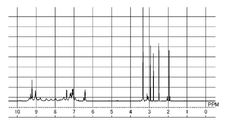
- FIG. 1 shows the measurement results of the 1 H-NMR spectrum of compound P-1.
- Production Example 1 Production of First Metal Oxide Particles (A1) Put 126.2 g of pure water in a 1-liter container, add 17.8 g of metastannic acid (contains 15 g of SnO 2 , manufactured by Showa Kako Co., Ltd.), titanium Tetraisopropoxide 284 g (contains 80 g in terms of TiO2 , manufactured by Nippon Soda Co., Ltd. A-1), oxalic acid dihydrate 98 (contains 70 g in terms of oxalic acid, manufactured by Ube Industries, Ltd.), 35 mass% 438 g of an aqueous tetraethylammonium hydroxide solution (manufactured by Seichem Japan) was added with stirring.
- metastannic acid contains 15 g of SnO 2 , manufactured by Showa Kako Co., Ltd.
- titanium Tetraisopropoxide 284 g contains 80 g in terms of TiO2 , manufactured by Nippo
- the resulting mixed solution had a molar ratio of oxalic acid/titanium atoms of 0.78 and a molar ratio of tetraethylammonium hydroxide/titanium atoms of 1.04.
- 950 g of the mixed solution was held at 80° C. for 2 hours, and further reduced to 580 Torr and held for 2 hours to prepare a titanium mixed solution.
- the titanium mixed solution after preparation had a pH of 4.7, an electrical conductivity of 27.2 mS/cm, and a metal oxide concentration of 10.0% by mass.
- 950 g of the titanium mixed solution and 950 g of pure water were charged into a 3-liter glass-lined autoclave container, and hydrothermally treated at 140° C. for 5 hours.
- the hydrothermally treated solution taken out was an aqueous dispersion of pale milky white titanium oxide-containing colloidal particles.
- the resulting dispersion had a pH of 3.9, a conductivity of 19.7 mS/cm, a TiO2 concentration of 4.2 wt%, a tetraethylammonium hydroxide concentration of 8.0 wt%, an oxalic acid concentration of 3.7 wt%, a dynamic Oval particles with a primary particle diameter of 4 to 10 nm were observed by light scattering method particle diameter 16 nm and transmission electron microscope observation.
- the obtained dispersion was dried at 110° C.
- the obtained colloidal particles containing titanium oxide were used as core particles (A).
- 70.8 g of zirconium oxychloride (containing 21.19% by mass as ZrO2, manufactured by Daiichi Kigenso Kagaku Kogyo Co., Ltd.) was diluted with 429.2 g of pure water to obtain 500 g of an aqueous zirconium oxychloride solution ( 3 as ZrO2). 0% by mass) was separately prepared, and 1,000 g of a dispersion (aqueous dispersion sol) of the core particles (A) was added thereto with stirring.
- first metal oxide particles (A1)) having a thin film layer of zirconium oxide formed on the surface thereof is hydrolyzed by heating to 95°C. was gotten.
- the resulting water-dispersed sol had a pH of 1.2 and a total metal oxide concentration of 20% by mass, and colloidal particles having a primary particle diameter of 4 to 10 nm were observed by transmission electron microscope observation.
- Second Metal Oxide Particles (B1) 77.2 g of JIS No. 3 sodium silicate (containing 29.8% by mass of SiO 2 , manufactured by Fuji Chemical Co., Ltd.) was dissolved in 1,282 g of pure water, Then, 20.9 g of sodium stannate NaSnO 3 .H 2 O (contains 55.1% by mass as SnO 2 , manufactured by Showa Kako Co., Ltd.) was dissolved. The resulting aqueous solution is passed through a column filled with a hydrogen-type cation exchange resin (Amberlite (registered trademark) IR-120B) to obtain a water-dispersed sol of acidic silicon dioxide-stannic oxide composite colloidal particles (B1).
- a hydrogen-type cation exchange resin Amberlite (registered trademark) IR-120B
- Production Example 3 Production of Third Metal Oxide Particles (C1) 1,455 g of the water-dispersed sol of the first metal oxide particles (A1) obtained in Production Example 1 was prepared in Production Example 2 as the second metal oxide. It was added to 2,634 g of the water-dispersed sol of particles (B1) under stirring. Then, the solution was passed through a column packed with 500 ml of an anion exchange resin (Amberlite (registered trademark) IRA-410, manufactured by Organo Co., Ltd.). Next, after heating the water-dispersed sol after passing the liquid at 95 ° C.
- an anion exchange resin Amberlite (registered trademark) IRA-410, manufactured by Organo Co., Ltd.
- the liquid was passed through a column packed with a hydrogen-type cation exchange resin (Amberlite (registered trademark) IR-120B), and tri-n-pentyl Stabilized with amine and concentrated by an ultrafiltration membrane method, an intermediate thin film layer made of zirconium oxide is formed between the first metal oxide particles (A1) and the second metal oxide particles (B1).
- a water-dispersed sol of silicon dioxide-stannic oxide composite oxide-coated titanium oxide-containing colloidal particles (C1) (hereinafter referred to as third metal oxide particles (C1)) was obtained.
- the resulting water-dispersed sol had a total metal oxide concentration of 20% by mass, and a primary particle size of this sol was 4 to 10 nm when observed with a transmission electron microscope.
- This methanol-dispersed sol had a total metal oxide concentration of 30.0% by mass, a viscosity of 1.5 mPa ⁇ s, a particle diameter of 18 nm as determined by the dynamic light scattering method, and a water content of 1.0% by mass.
- Production Example 4 Production of Surface-Modified Inorganic Fine Particles (D1) ), trade name: KBM-403) was added, and heated under reflux at 70° C. for 5 hours. A methanol dispersion of surface-modified inorganic fine particles (D1) having 3-glycidoxypropyltrimethoxysilane bound to the surface (hereinafter referred to as surface-modified inorganic fine particles (D1)) was obtained. Next, using an evaporator, methanol is distilled off while adding propylene glycol monomethyl ether at 80 Torr to replace methanol with propylene glycol monomethyl ether, and 530 g of the propylene glycol monomethyl ether dispersion of the surface-modified inorganic fine particles (D1) is obtained.
- the obtained dispersion (hereinafter referred to as D-1 solution) has a specific gravity of 1.210, a viscosity of 3.8 mPa s, a total metal oxide concentration of 30.3% by mass, and a primary particle diameter of 4 as determined by transmission electron microscope observation. ⁇ 10 nm, and the dynamic light scattering particle size was 15 nm.
- D-1 solution 3-glycidoxypropyltrimethoxysilane bound to the surface of the third metal oxide particles (C1) is the total metal oxidation of the third metal oxide particles (C1). It was 4.7% by mass with respect to the product.
- the film was developed with a 2.38% tetramethylammonium hydroxide (hereinafter abbreviated as TMAH) solution for 40 seconds, and then rinsed with ultrapure water for 30 seconds. After rinsing, it was dried at 100° C. for 10 minutes using a hot plate to obtain a cured film.
- TMAH tetramethylammonium hydroxide
- the cured film obtained above was measured for refractive index, film thickness, b * , transmittance at 400 to 800 nm, and HAZE. Table 1 shows the results.
- the transmittance an average transmittance of 400 to 800 nm was calculated.
- the cured film obtained from the SP-1 solution has an excellent effect of maintaining a high transmittance and a low HAZE value while maintaining a high refractive index even after washing with an alkaline aqueous solution. Recognize.
- Example 3-1 (2) Preparation of patterning film [Example 3-1]
- the SP-1 solution prepared in Example 1-1 was spin-coated on a 50 mm ⁇ 50 mm ⁇ 0.7 mm non-alkali glass substrate with a spin coater at 200 rpm for 5 seconds and 500 rpm for 30 seconds, and a hot plate was used. After temporary drying at 100 ° C. for 5 minutes, a mask with circular openings with a diameter of 15 ⁇ m arranged at intervals of 15 ⁇ m and a space (ultraviolet shielding portion) corresponding to the remaining portion other than the openings using a mask aligner MA6 manufactured by SUSS Co., Ltd.
- Example 3-2 In the same manner as in Example 3-1, except that the mask used was changed to a mask having a linear opening with a width of 10 ⁇ m and a linear space (ultraviolet shielding portion) with a width of 10 ⁇ m called line & space. A patterned film was obtained. An optical microscope photograph of the obtained patterned film is shown in FIG.
- Example 3-3 In the same manner as in Example 3-1, except that the mask used was changed to a mask having a linear opening with a width of 15 ⁇ m and a linear space (ultraviolet shielding portion) with a width of 15 ⁇ m called line & space. A patterned film was obtained. An optical microscope photograph of the obtained patterned film is shown in FIG.
Landscapes
- Chemical & Material Sciences (AREA)
- Physics & Mathematics (AREA)
- Polymers & Plastics (AREA)
- Health & Medical Sciences (AREA)
- Chemical Kinetics & Catalysis (AREA)
- Medicinal Chemistry (AREA)
- Organic Chemistry (AREA)
- General Physics & Mathematics (AREA)
- Optics & Photonics (AREA)
- Spectroscopy & Molecular Physics (AREA)
- Engineering & Computer Science (AREA)
- Manufacturing & Machinery (AREA)
- Macromolecular Compounds Obtained By Forming Nitrogen-Containing Linkages In General (AREA)
- Plural Heterocyclic Compounds (AREA)
Abstract
Description
求められる具体的な特性としては、1)耐熱性、2)透明性、3)高屈折率、4)高溶解性、5)低体積収縮率、6)高温高湿耐性、7)高膜硬度などが挙げられる。
この点に鑑み、本出願人は、トリアジン環および芳香環を有する繰り返し単位を含む重合体が高屈折率を有し、ポリマー単独で高耐熱性、高透明性、高屈折率、高溶解性、低体積収縮を達成でき、電子デバイスを作製する際の膜形成用組成物として好適であることを既に見出している(特許文献1)。
この問題を解決する光取り出し法として、従来種々の技術が開発されており、その一つとして、光が外部に出るまでに損失されてしまう原因の一つである層間の屈折率差をなくすため、高屈折率層や高屈折率パターンを用いる技術が知られている。
この高屈折率パターンには、多くのネガ型感光性組成物が提案されてきており、本出願人も、これまでネガ型の高屈折率パターンを形成できる各種材料を報告している(特許文献2~4参照)。
他方、パターン形成用組成物に無機微粒子を添加した場合、パターン形成性が劣る。
本発明は、上記事情に鑑みてなされたものであり、無機微粒子を含有する場合でも高屈折率で透明性に優れたパターンを形成し得るパターン形成用組成物を提供することを目的とする。
[1] 下記式(1)で表される繰り返し単位構造を含むとともに、少なくとも1つのトリアジン環末端を有し、そのトリアジン環末端の少なくとも一部が水酸基置換アリールアミノ基で封止されているトリアジン環含有重合体と、架橋剤と、アルカリ反応性基を表面に有する無機微粒子と、有機溶媒とを含むことを特徴とするパターン形成用組成物。

[2] 前記式(1)中のQが、式(2)~(13)及び式(102)~(115)で示される群から選ばれる少なくとも1種を表す、[1]に記載のパターン形成用組成物。
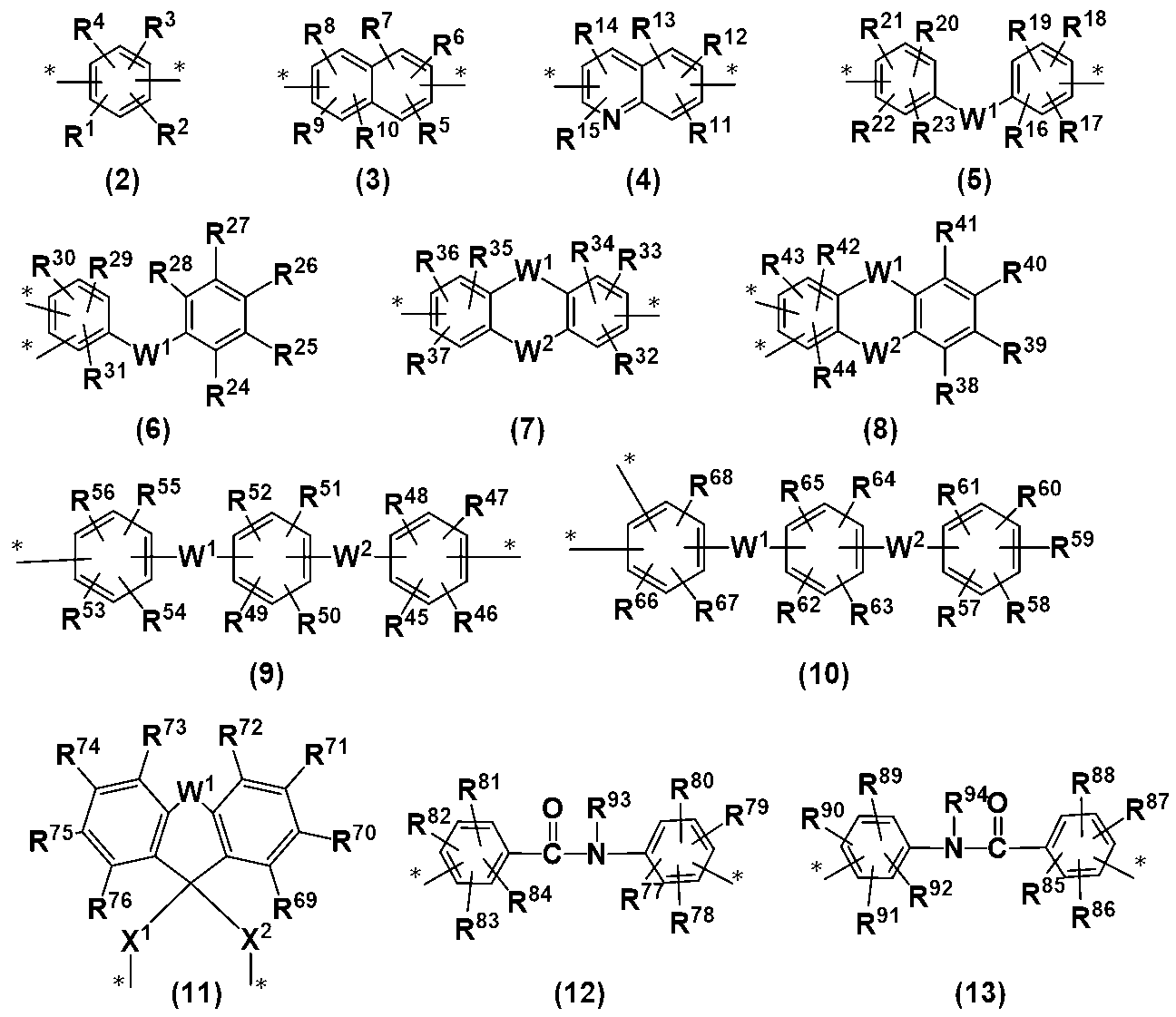
R93およびR94は、水素原子または炭素数1~10のアルキル基を表し、
W1およびW2は、互いに独立して、単結合、CR95R96(R95およびR96は、互いに独立して、水素原子、炭素数1~10のアルキル基(ただし、これらは一緒になって環を形成していてもよい。)、または炭素数1~10のハロゲン化アルキル基を表す。)、C=O、O、S、SO、SO2、またはNR97(R97は、水素原子、炭素数1~10のアルキル基またはフェニル基を表す。)を表し、
X1およびX2は、互いに独立して、単結合、炭素数1~10のアルキレン基、または式(14)
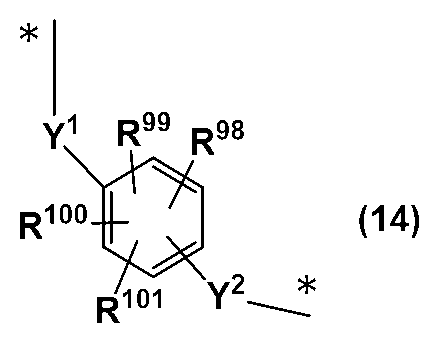
Y1およびY2は、互いに独立して、単結合または炭素数1~10のアルキレン基を表す。)で示される基を表す。
*は結合手を表す。〕
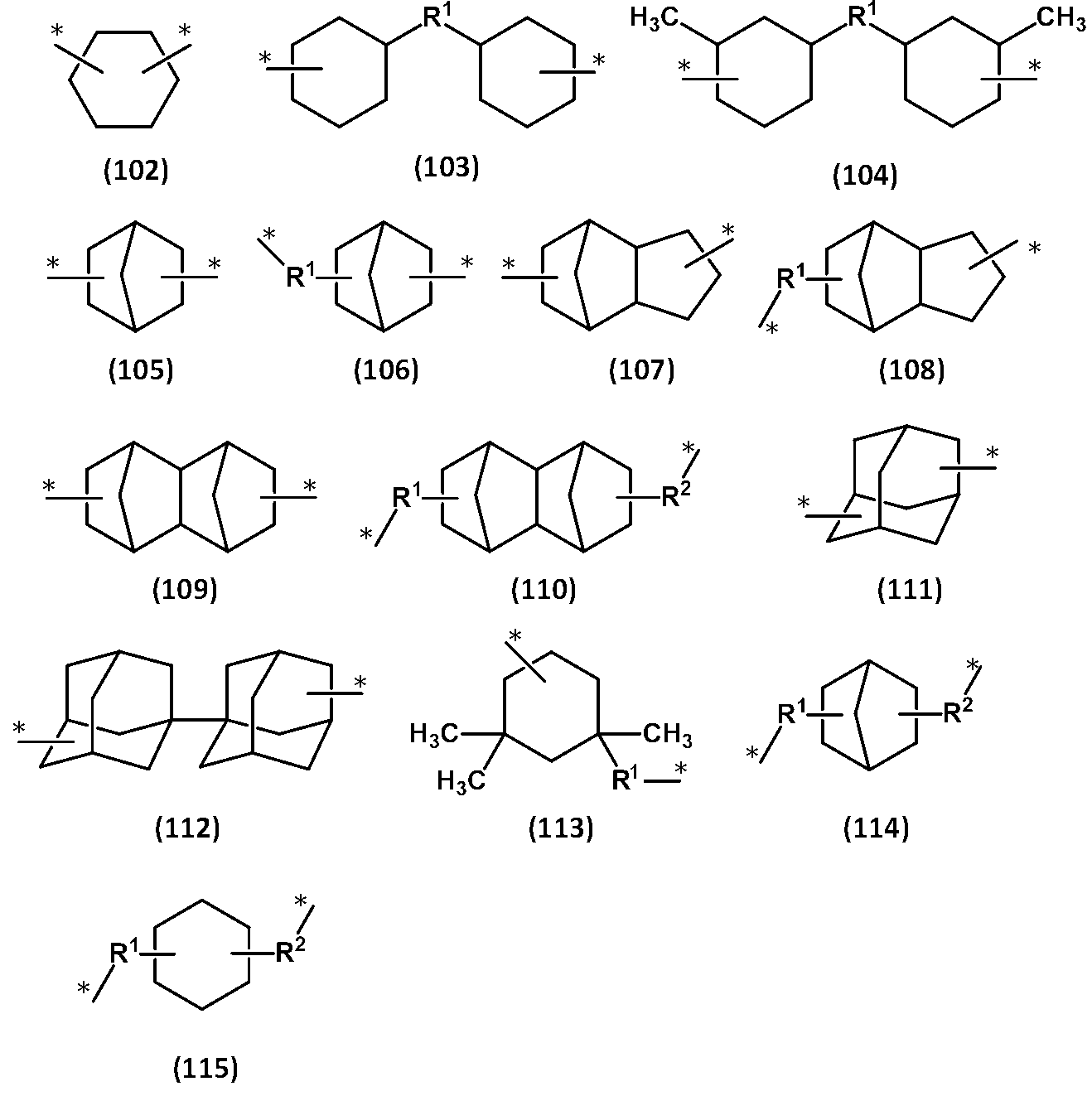
[3] 前記水酸基置換アリールアミノ基が、式(15)で示される[1]又は[2]に記載のパターン形成用組成物。
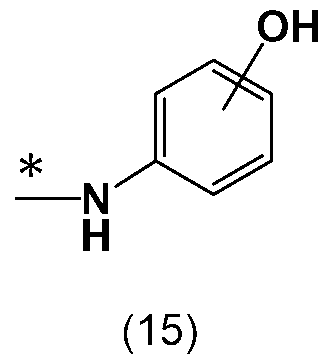
[4] 前記水酸基置換アリールアミノ基が、式(16)で示される[3]に記載のパターン形成用組成物。

[5] 前記式(1)中のQが、式(17)で示される[1]~[4]のいずれかに記載のパターン形成用組成物。

[6] 前記架橋剤が、多官能(メタ)アクリル化合物である[1]~[5]のいずれかに記載のパターン形成用組成物。
[7] 前記無機微粒子が、金属酸化物、金属硫黄物または金属窒化物を含む[1]~[6]のいずれかに記載のパターン形成用組成物。
[8] 前記アルカリ反応性基が、酸無水物基またはエポキシ基である[1]~[7]のいずれかに記載のパターン形成用組成物。
[9] 有機エレクトロルミネッセンス素子の光取り出し層用である[1]~[8]のいずれかに記載のパターン形成用組成物。
[10] [1]~[9]のいずれかに記載のパターン形成用組成物から作製された硬化物。
[11] 基材と、前記基材上に形成された[10]に記載の硬化物とを備える電子デバイス。
[12] 有機エレクトロルミネッセンスである[11]に記載の電子デバイス。
[13] 基材と、前記基材上に形成された[10]に記載の硬化物とを備える光学部材。
[14] [1]~[9]のいずれかに記載のパターン形成用組成物を基材に塗布し、有機溶媒を蒸発させ、パターンが形成されたマスクを介して光照射した後、現像し、さらに焼成することを特徴とするパターンの作製方法。
本発明の組成物から作製されたパターンは、トリアジン環含有重合体による、高耐熱性、高屈折率、低体積収縮という特性を発揮し得るため、液晶ディスプレイ、有機エレクトロルミネッセンス(EL)ディスプレイ、タッチパネル、光半導体素子、固体撮像素子、有機薄膜太陽電池、色素増感太陽電池、有機薄膜トランジスタ、レンズ、プリズム、カメラ、双眼鏡、顕微鏡、半導体露光装置等を作製する際の一部材など、電子デバイスや光学材料の分野に好適に利用できる。
本発明に係るパターン形成用組成物は、下記式(1)で表される繰り返し単位構造を含むとともに、少なくとも1つのトリアジン環末端を有し、そのトリアジン環末端の少なくとも一部が水酸基置換アリールアミノ基で封止されているトリアジン環含有重合体と、架橋剤と、アルカリ反応性基を表面に有する無機微粒子と、有機溶媒とを含むことを特徴とする。
本発明で用いるトリアジン環含有重合体は、下記式(1)で表される繰り返し単位構造を含む。
トリアジン環含有重合体は、例えば、いわゆるハイパーブランチポリマーである。ハイパーブランチポリマーとは、不規則な分岐構造を有する高分岐ポリマーである。ここでの不規則とは、規則的な分岐構造を有する高分岐ポリマーであるデンドリマーの分岐構造よりも不規則であることを意味する。
例えば、ハイパーブランチポリマーであるトリアジン環含有重合体は、式(1)で表される繰り返し単位構造よりも大きな構造として、式(1)で表される繰り返し単位構造の3つの結合手のそれぞれに、式(1)で表される繰り返し単位構造が結合してなる構造(構造X)を含む。ハイパーブランチポリマーであるトリアジン環含有重合体においては、構造Xがトリアジン環含有重合体の末端を除く全体に分布している。
ハイパーブランチポリマーであるトリアジン環含有重合体においては、繰り返し単位構造が、本質的に式(1)で表される繰り返し単位構造のみからであってもよい。
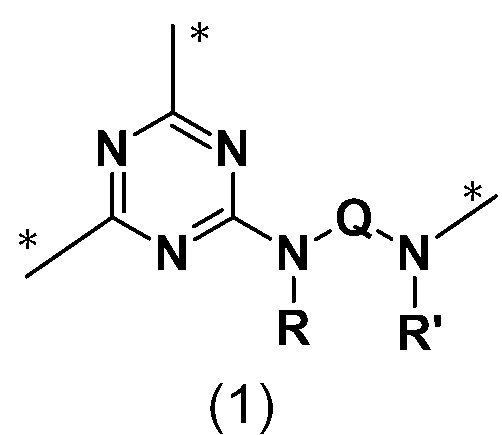
上記式中、RおよびR’は、互いに独立して、水素原子、アルキル基、アルコキシ基、アリール基、またはアラルキル基を表すが、屈折率をより高めるという観点から、ともに水素原子であることが好ましい。
本発明において、アルキル基の炭素数としては特に限定されるものではないが、1~20が好ましく、ポリマーの耐熱性をより高めることを考慮すると、アルキル基の炭素数としては、1~10がより好ましく、1~3がより一層好ましい。また、アルキル基の構造は、特に限定されず、例えば、直鎖状、分岐状、環状、およびこれらの2以上の組み合わせのいずれでもよい。
本発明において上記アリール基には、置換基を有するアリール基が含まれる。置換基としては、例えば、ハロゲン原子、炭素数1~6のアルキル基、炭素数1~6のアルコキシ基、ニトロ基、シアノ基などが挙げられる。
アリール基の具体例としては、フェニル、o-クロルフェニル、m-クロルフェニル、p-クロルフェニル、o-フルオロフェニル、p-フルオロフェニル、o-メトキシフェニル、p-メトキシフェニル、p-ニトロフェニル、p-シアノフェニル、α-ナフチル、β-ナフチル、o-ビフェニリル、m-ビフェニリル、p-ビフェニリル、1-アントリル、2-アントリル、9-アントリル、1-フェナントリル、2-フェナントリル、3-フェナントリル、4-フェナントリル、9-フェナントリル基等が挙げられる。
本発明において、アラルキル基には、置換基を有するアラルキル基が含まれる。置換基としては、例えば、ハロゲン原子、炭素数1~6のアルキル基、炭素数1~6のアルコキシ基、ニトロ基、シアノ基などが挙げられる。
その具体例としては、ベンジル、p-メチルフェニルメチル、m-メチルフェニルメチル、o-エチルフェニルメチル、m-エチルフェニルメチル、p-エチルフェニルメチル、2-プロピルフェニルメチル、4-イソプロピルフェニルメチル、4-イソブチルフェニルメチル、α-ナフチルメチル基等が挙げられる。
式(1)中のQとしては、環構造を有する炭素数3~30の2価の基であれば特に限定されるものではない。
環構造は、芳香族環構造であってもよいし、脂環構造であってもよい。
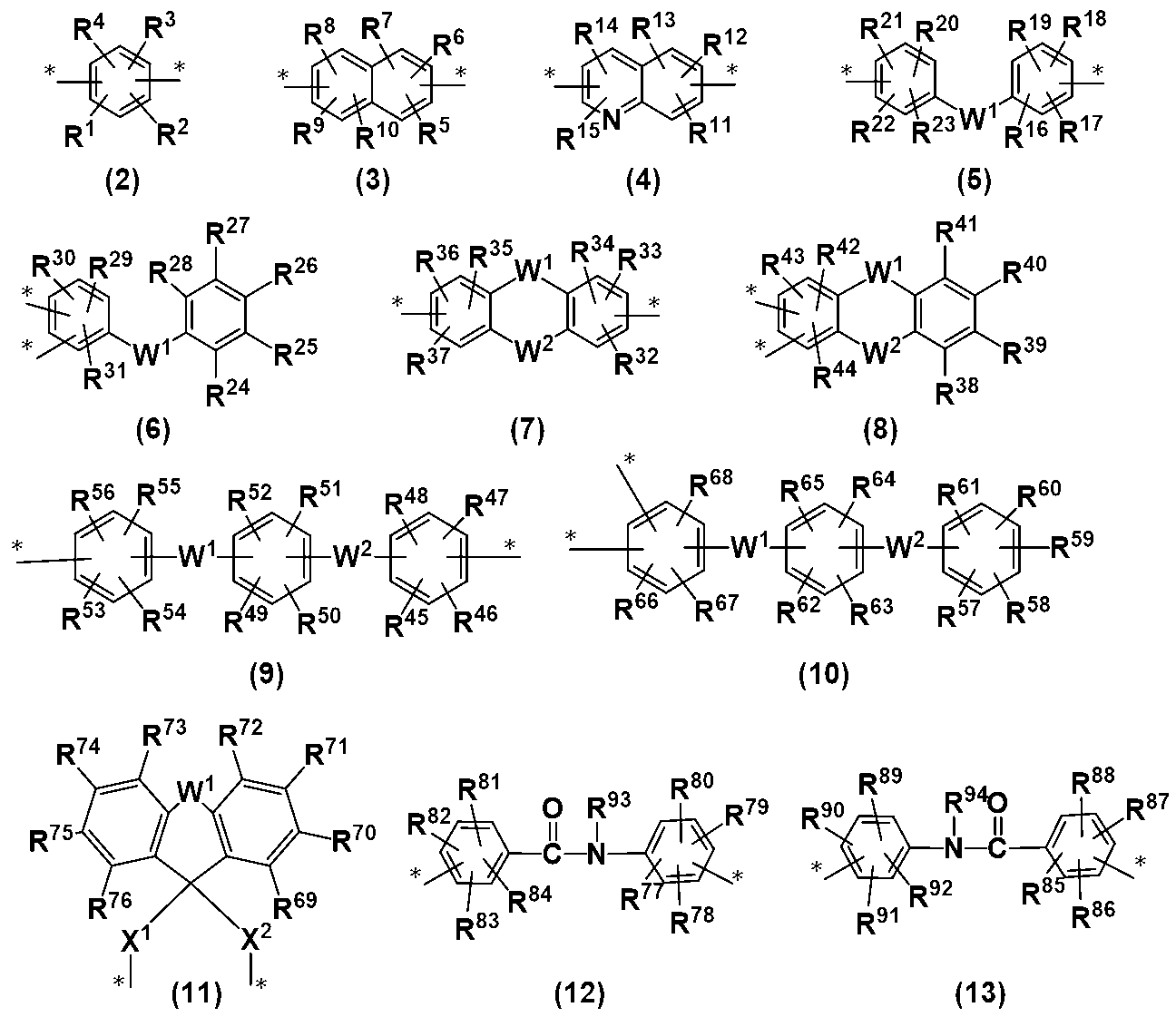
R93およびR94は、水素原子または炭素数1~10のアルキル基を表し、
W1およびW2は、互いに独立して、単結合、CR95R96(R95およびR96は、互いに独立して、水素原子、炭素数1~10のアルキル基(ただし、これらは一緒になって環を形成していてもよい。)、または炭素数1~10のハロゲン化アルキル基を表す。)、C=O、O、S、SO、SO2、またはNR97(R97は、水素原子、炭素数1~10のアルキル基またはフェニル基を表す。)を表す。
ハロゲン原子としては、フッ素原子、塩素原子、臭素原子、ヨウ素原子が挙げられる。
なお、アルキル基、アルコキシ基としては上記と同様のものが挙げられる。
これらのアルキル基、ハロゲン化アルキル基、アルコキシ基、及びアルキレン基の構造は、特に限定されず、例えば、直鎖状、分岐状、環状、およびこれらの2以上の組み合わせのいずれでもよい。

Y1およびY2は、互いに独立して、単結合または炭素数1~10のアルキレン基を表す。
これらハロゲン原子、アルキル基、ハロゲン化アルキル基、アルコキシ基としては、R1~R92におけるハロゲン原子、アルキル基、ハロゲン化アルキル基、アルコキシ基と同様のものが挙げられる。
R98~R101におけるアルキル基、及びアルコキシ基の構造は、特に限定されず、例えば、直鎖状、分岐状、環状、およびこれらの2以上の組み合わせのいずれでもよい。
Y1およびY2におけるアルキレン基の構造は、特に限定されず、例えば、直鎖状、分岐状、環状、およびこれらの2以上の組み合わせのいずれでもよい。
炭素数1~10のアルキレン基としては、メチレン、エチレン、プロピレン、トリメチレン、テトラメチレン、ペンタメチレン基等が挙げられる。
上記アルキレン基の構造は、特に限定されず、例えば、直鎖状、分岐状、環状、およびこれらの2以上の組み合わせのいずれでもよい。
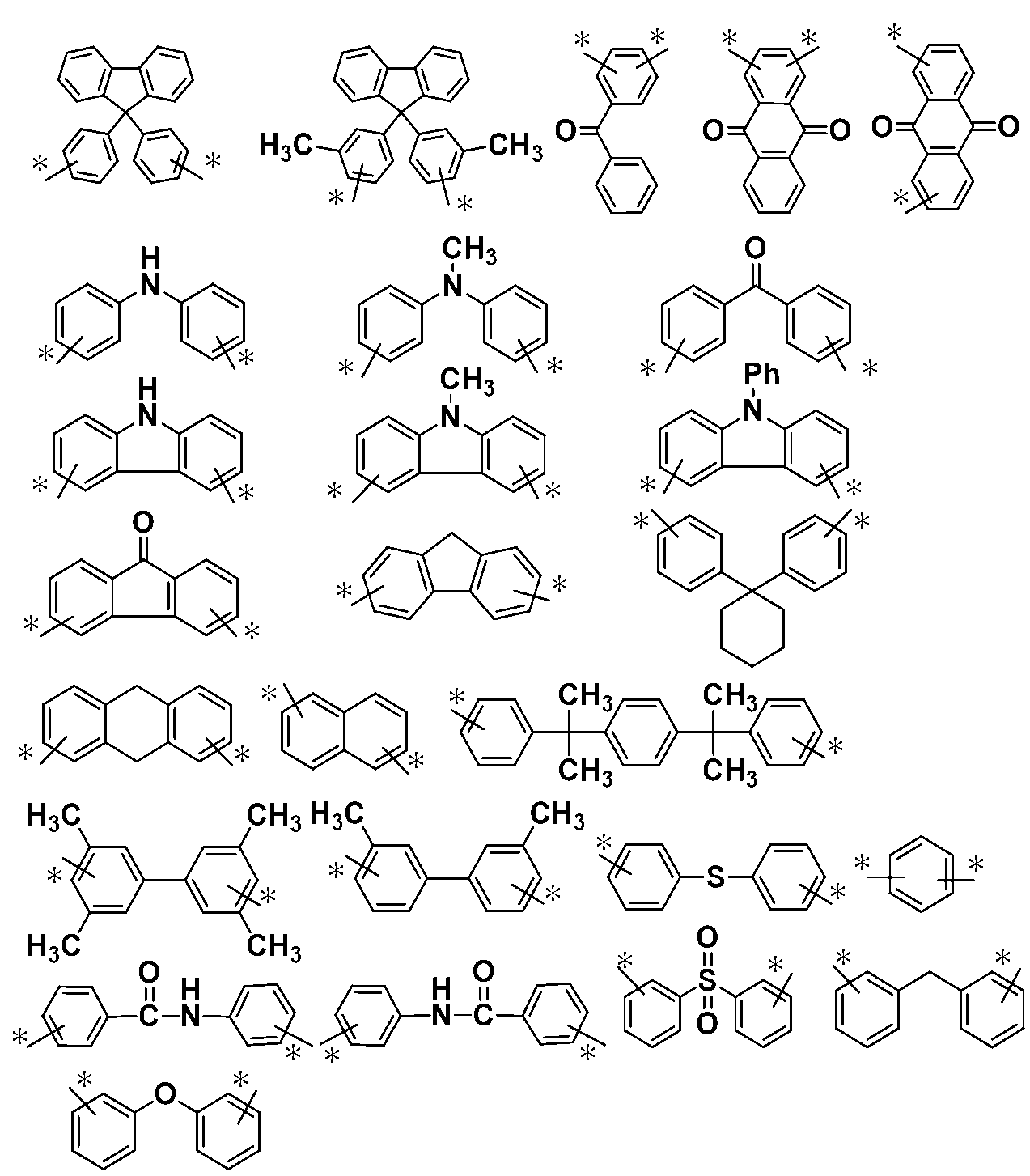


このようなアルキレン基としては、メチレン、エチレン、プロピレン、トリメチレン、テトラメチレン、ペンタメチレン基等が挙げられるが、得られるポリマーの屈折率をより高めるということを考慮すると、炭素数1~3のアルキレン基が好ましく、炭素数1~2のアルキレン基、具体的には、メチレン、エチレン基がより好ましく、メチレン基が最適である。
なお、本発明で用いるトリアジン環含有重合体では、これを用いて得られる薄膜や硬化膜のアルカリ現像液に対する溶解性を向上させるという点から、そのトリアジン環末端の少なくとも一部が水酸基置換アリールアミノ基で封止されている。当該水酸基は、アリール基に直接結合した水酸基であり、いわゆるフェノール性水酸基である。
このアリール基としては、上記で例示した基と同様のものが挙げられるが、特に、フェニル基が好ましい。
アリール基上の水酸基の数は、特に限定されるものではないが、アルカリ現像液での現像性および有機溶媒に対する溶解性のバランスを考慮すると、1つが好適である。
これらの観点から、本発明では、水酸基置換アリールアミノ基として、式(15)で示される水酸基置換フェニルアミノ基が好ましく、式(16)で示されるアミノ基のメタ位に水酸基を有するフェニルアミノ基がより好ましい。
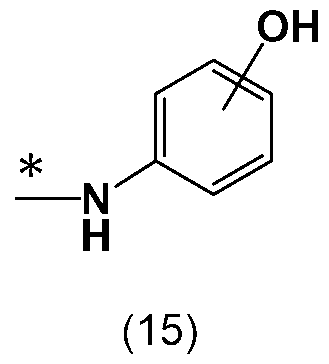
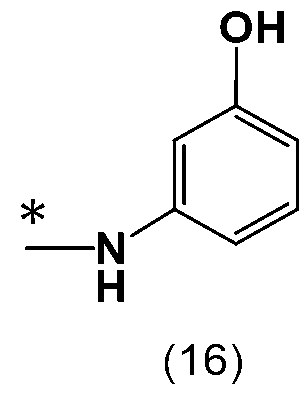
なお、本発明における重量平均分子量は、ゲルパーミエーションクロマトグラフィー(以下、GPCという)分析による標準ポリスチレン換算で得られる平均分子量である。
例えば、下記スキーム1に示されるように、トリアジン環含有重合体(19)は、トリアジン化合物(18)、およびアリールジアミノ化合物(20)を適当な有機溶媒中で反応させて得ることができる。

アリールジアミノ化合物(20)は、ニートで加えても、有機溶媒に溶かした溶液で加えてもよいが、操作の容易さや反応のコントロールのし易さなどを考慮すると、後者の手法が好適である。
反応温度は、用いる溶媒の融点から溶媒の沸点までの範囲で適宜設定すればよいが、30~150℃程度が好ましく、-10~100℃がより好ましい。
中でもN,N-ジメチルホルムアミド、ジメチルスルホキシド、N-メチル-2-ピロリドン、N,N-ジメチルアセトアミド、3-メトキシ-N,N-ジメチルプロパンアミド、3-ブトキシ-N,N-ジメチルプロパンアミド、およびそれらの混合系が好ましく、特に、N,N-ジメチルアセトアミド、N-メチル-2-ピロリドン、3-メトキシ-N,N-ジメチルプロパンアミド、3-ブトキシ-N,N-ジメチルプロパンアミド、が好適である。
この塩基の具体例としては、炭酸カリウム、水酸化カリウム、炭酸ナトリウム、水酸化ナトリウム、炭酸水素ナトリウム、ナトリウムエトキシド、酢酸ナトリウム、炭酸リチウム、水酸化リチウム、酸化リチウム、酢酸カリウム、酸化マグネシウム、酸化カルシウム、水酸化バリウム、リン酸三リチウム、リン酸三ナトリウム、リン酸三カリウム、フッ化セシウム、酸化アルミニウム、アンモニア、n-プロピルアミン、トリメチルアミン、トリエチルアミン、ジイソプロピルアミン、ジイソプロピルエチルアミン、N-メチルピペリジン、2,2,6,6-テトラメチル-N-メチルピペリジン、ピリジン、4-ジメチルアミノピリジン、N-メチルモルホリン、2-アミノエタノール、エチルジエタノールアミン、ジエチルアミノエタノール等が挙げられる。
塩基の添加量は、トリアジン化合物(18)1当量に対して1~100当量が好ましく、1~10当量がより好ましい。なお、これらの塩基は水溶液にして用いてもよい。
得られる重合体には、原料成分が残存していないことが好ましいが、本発明の効果を損なわなければ一部の原料が残存していてもよい。
反応終了後、生成物は再沈法等によって容易に精製できる。
この末端封止方法としては、公知の方法を採用すればよく、例えば、上記の手法により得られたトリアジン環含有重合体(19)を、末端封止基を与える末端封止剤である、アミノフェノール等のフェノール性水酸基を有するアリールアミン化合物で処理すればよい。
この場合、末端封止剤の使用量は、重合反応に使われなかった余剰のトリアジン化合物由来のハロゲン原子1当量に対し、0.05~10当量程度が好ましく、0.1~5当量がより好ましく、0.5~2当量がより一層好ましい。
反応溶媒や反応温度としては、上記スキーム1で述べたのと同様の条件が挙げられ、また、末端封止剤は、アリールジアミノ化合物(20)と同時に仕込んでもよい。
なお、上記水酸基置換アリールアミン化合物とともに、置換基を有しないアリールアミン化合物を用い、2種類以上の基で末端封止を行ってもよい。
特定のヘテロ原子含有置換基としては、シアノ基、アミノ基、アルキルアミノ基、アリールアミノ基、ニトロ基、チオール基、アルキルメルカプト基、アリールメルカプト基、アルコキシカルボニル基、アルコキシカルボニルオキシ基が挙げられる。
特定のヘテロ原子含有置換基を有するアリールアミノ基としては、下記式(34)で示されるものが挙げられる。

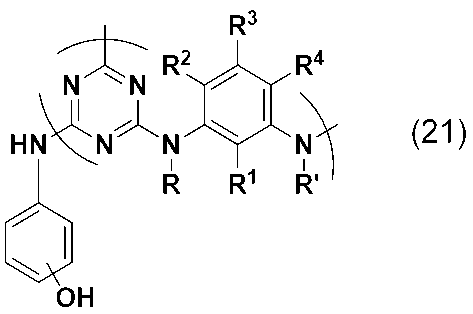


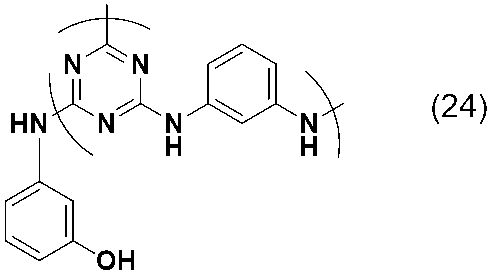
本発明で用いる架橋剤としては、単独で架橋反応を起こして、又は上述したトリアジン環含有重合体と一緒になって架橋反応を起こして、架橋構造を形成しうる化合物であれば特に限定されるものではない。
そのような化合物としては、メチロール基、メトキシメチル基などの架橋形成置換基を有するメラミン系化合物(例えば、フェノプラスト化合物、アミノプラスト化合物など)、置換尿素系化合物、エポキシ基またはオキセタン基などの架橋形成置換基を含有する化合物(例えば、多官能エポキシ化合物、多官能オキセタン化合物など)、ブロックイソシアナート基を含有する化合物、酸無水物基を有する化合物、(メタ)アクリル基を有する化合物等が挙げられるが、耐熱性や保存安定性の観点からエポキシ基、ブロックイソシアネート基、(メタ)アクリル基を含有する化合物が好ましく、特に、ブロックイソシアネート基を有する化合物や、開始剤を用いなくとも光硬化可能な組成物を与える多官能エポキシ化合物および/または多官能(メタ)アクリル化合物が好ましい。
その具体例としては、トリス(2,3-エポキシプロピル)イソシアヌレート、1,4-ブタンジオールジグリシジルエーテル、1,2-エポキシ-4-(エポキシエチル)シクロヘキサン、グリセロールトリグリシジルエーテル、ジエチレングリコールジグリシジルエーテル、2,6-ジグリシジルフェニルグリシジルエーテル、1,1,3-トリス[p-(2,3-エポキシプロポキシ)フェニル]プロパン、1,2-シクロヘキサンジカルボン酸ジグリシジルエステル、4,4’-メチレンビス(N,N-ジグリシジルアニリン)、3,4-エポキシシクロヘキシルメチル-3,4-エポキシシクロヘキサンカルボキシレート、トリメチロールエタントリグリシジルエーテル、ビスフェノール-A-ジグリシジルエーテル、ペンタエリスリトールポリグリシジルエーテル等が挙げられる。
その具体例としては、エチレングリコールジアクリレート、エチレングリコールジメタクリレート、ポリエチレングリコールジアクリレート、ポリエチレングリコールジメタクリレート、エトキシ化ビスフェノールAジアクリレート、エトキシ化ビスフェノールAジメタクリレート、エトキシ化トリメチロールプロパントリアクリレート、エトキシ化トリメチロールプロパントリメタクリレート、エトキシ化グリセリントリアクリレート、エトキシ化グリセリントリメタクリレート、エトキシ化ペンタエリスリトールテトラアクリレート、エトキシ化ペンタエリスリトールテトラメタクリレート、エトキシ化ジペンタエリスリトールヘキサアクリレート、ポリグリセリンモノエチレンオキサイドポリアクリレート、ポリグリセリンポリエチレングリコールポリアクリレート、ジペンタエリスリトールヘキサアクリレート、ジペンタエリスリトールヘキサメタクリレート、ネオペンチルグリコールジアクリレート、ネオペンチルグリコールジメタクリレート、ペンタエリスリトールトリアクリレート、ペンタエリスリトールトリメタクリレート、トリメチロールプロパントリアクリレート、トリメチロールプロパントリメタクリレート、トリシクロデカンジメタノールジアクリレート、トリシクロデカンジメタノールジメタクリレート、1,6-ヘキサンジオールジアクリレート、1,6-ヘキサンジオールジメタクリレート、多塩基酸変性アクリルオリゴマー等が挙げられる。
上記多塩基酸変性アクリルオリゴマーも市販品として入手が可能であり、その具体例としては、アロニックスM-510,520(以上、東亞合成(株)製)等が挙げられる。

一分子中2個以上のイソシアネート基を有する化合物としては、例えば、イソホロンジイソシアネート、1,6-ヘキサメチレンジイソシアネート、メチレンビス(4-シクロヘキシルイソシアネート)、トリメチルヘキサメチレンジイソシアネートのポリイソシアネートや、これらの二量体、三量体、および、これらとジオール類、トリオール類、ジアミン類、またはトリアミン類との反応物などが挙げられる。
ブロック剤としては、例えば、メタノール、エタノール、イソプロパノール、n-ブタノール、2-エトキシヘキサノール、2-N,N-ジメチルアミノエタノール、2-エトキシエタノール、シクロヘキサノール等のアルコール類;フェノール、o-ニトロフェノール、p-クロロフェノール、o-、m-またはp-クレゾール等のフェノール類;ε-カプロラクタム等のラクタム類、アセトンオキシム、メチルエチルケトンオキシム、メチルイソブチルケトンオキシム、シクロヘキサノンオキシム、アセトフェノンオキシム、ベンゾフェノンオキシム等のオキシム類;ピラゾール、3,5-ジメチルピラゾール、3-メチルピラゾール等のピラゾール類;ドデカンチオール、ベンゼンチオール等のチオール類などが挙げられる。
オキセタン化合物としては、オキセタニル基を一分子中2個以上有するものであれば、特に限定されるものではなく、例えば、オキセタニル基を含有するOXT-221、OX-SQ-H、OX-SC(以上、東亜合成(株)製)等が挙げられる。
フェノプラスト化合物としては、例えば、2,6-ジヒドロキシメチル-4-メチルフェノール、2,4-ジヒドロキシメチル-6-メチルフェノール、ビス(2-ヒドロキシ-3-ヒドロキシメチル-5-メチルフェニル)メタン、ビス(4-ヒドロキシ-3-ヒドロキシメチル-5-メチルフェニル)メタン、2,2-ビス(4-ヒドロキシ-3,5-ジヒドロキシメチルフェニル)プロパン、ビス(3-ホルミル-4-ヒドロキシフェニル)メタン、ビス(4-ヒドロキシ-2,5-ジメチルフェニル)ホルミルメタン、α,α-ビス(4-ヒドロキシ-2,5-ジメチルフェニル)-4-ホルミルトルエン等が挙げられる。
フェノプラスト化合物は、市販品としても入手が可能であり、その具体例としては、26DMPC、46DMOC、DM-BIPC-F、DM-BIOC-F、TM-BIP-A、BISA-F、BI25X-DF、BI25X-TPA(以上、旭有機材(株)製)等が挙げられる。
このような多官能(メタ)アクリル化合物としては、例えば、NKエステルA-DPH、同A-DPH-12E(いずれも、新中村化学工業(株)製)等が挙げられる。
パターン形成用組成物における架橋剤の含有量は、トリアジン環含有重合体100質量部に対して、1~200質量部が好ましいが、溶剤耐性を考慮すると、その下限は、好ましくは2質量部、より好ましくは5質量部であり、さらには、屈折率および未露光部の残渣をコントロールすることを考慮すると、その上限は好ましくは150質量部、より好ましくは100質量部、より一層好ましくは90質量部である。
無機微粒子は、アルカリ反応性基を表面に有する。
無機微粒子がアルカリ反応性基を表面に有することで、パターン形成用組成物から得られたパターン膜の未露光部分をアルカリ現像液により現像する際に、未露光部分の無機微粒子が、トリアジン環含有重合体、架橋剤等の他の成分とともにアルカリ現像液により除去されやすくなる。その結果、無機微粒子を含有しているにも関わらず、パターン形成性が良好である。
有機ケイ素化合物は、加水分解によりSi-OH基を生成する加水分解性基を有する。加水分解性基としては、例えば、ケイ素原子に結合したアルコキシ基、ケイ素原子に結合したアセトキシ基などが挙げられる。有機ケイ素化合物における加水分解基の数としては、特に限定されないが、例えば、1~3個が挙げられる。
酸無水物基を有する有機ケイ素化合物としては、例えば、3-トリメトキシシリルプロピルコハク酸無水物、3-トリエトキシシシリルプロピルコハク酸無水物、3-ジメチルメトキシシリルプロピルコハク酸無水物、3-ジメチルエトキシシリルプロピルコハク酸無水物のようなコハク酸無水物、3-トリメトキシシリルプロピルシクロヘキシルジカルボン酸無水物、3-トリエトキシシリルプロピルシクロヘキシルジカルボン酸無水物、3-ジメチルメトキシシリルプロピルシクロヘキシルジカルボン酸無水物、3-ジメチルエトキシシリルプロピルシクロヘキシルジカルボン酸無水物のようなジカルボン酸無水物、3-トリメトキシシリルプロピルフタル酸無水物、3-トリエトキシシリルプロピルフタル酸無水物、3-ジメチルメトキシシリルプロピルフタル酸無水物、3-ジメチルエトキシシリルプロピルフタル酸無水物のようなフタル酸無水物等のアルコキシシリル基含有アルキルカルボン酸無水物が挙げられる。
エポキシ基を有する有機ケイ素化合物としては、例えば、3-グリシドキシプロピルトリメトキシシランなどが挙げられる。
表面修飾無機微粒子の二次粒子径(動的光散乱法による)は、分散安定性、得られる薄膜の屈折率および透明性の点から、2~100nmが好ましく、5~50nmがより好ましく、5~20nmがより一層好ましい。
金属酸化物の具体例としては、例えば、Al2O3、ZnO、TiO2、ZrO2、Fe2O3、Sb2O5、BeO、ZnO、SnO2、CeO2、SiO2、WO3などが挙げられる。
また、複数の金属酸化物を複合酸化物として用いることも有効である。複合酸化物とは、微粒子の製造段階で2種以上の無機酸化物を混合させたものである。例えば、TiO2とZrO2との複合酸化物、TiO2とZrO2とSnO2との複合酸化物、ZrO2とSnO2との複合酸化物などが挙げられる。
さらに、上記金属の化合物であってもよい。例えば、ZnSb2O6、BaTiO3、SrTiO3、SrSnO3などが挙げられる。これらの化合物は、単独でまたは2種以上を混合して用いることができ、さらに上記の酸化物と混合して用いてもよい。
第1金属酸化物粒子(A)の二次粒子径である動的光散乱法粒子径(動的光散乱法による)は、分散安定性、得られる薄膜の屈折率および透明性の点から、5~100nmが好ましく、5~50nmがより好ましく、5~30nmが特に好ましい。
第3金属酸化物粒子(C)の溶媒分散液の全金属酸化物濃度は、好ましくは10~60質量%であり、より好ましくは20~50質量%である。
第3金属酸化物粒子(C)の二次粒子径である動的光散乱法粒子径(動的光散乱法による)は、分散安定性、得られる薄膜の屈折率および透明性の点から、2~100nmが好ましい。
有機溶媒の具体例としては、トルエン、p-キシレン、o-キシレン、m-キシレン、エチルベンゼン、スチレン、エチレングリコールジメチルエーテル、プロピレングリコールモノメチルエーテル、エチレングリコールモノメチルエーテル、プロピレングリコール、プロピレングリコールモノエチルエーテル、エチレングリコールモノエチルエーテル、エチレングリコールモノイソプロピルエーテル、エチレングリコールモノメチルエーテルアセテート、プロピレングリコールモノメチルエーテルアセテート、エチレングリコールモノエチルエーテルアセテート、ジエチレングリコールジメチルエーテル、プロピレングリコールモノブチルエーテル、エチレングリコールモノブチルエーテル、ジエチレングリコールジエチルエーテル、ジプロピレングリコールモノメチルエーテル、ジエチレングリコールモノメチルエーテル、ジプロピレングリコールモノエチルエーテル、ジエチレングリコールモノエチルエーテル、トリエチレングリコールジメチルエーテル、ジエチレングリコールモノエチルエーテルアセテート、ジエチレングリコール、1-オクタノール、エチレングリコール、ヘキシレングリコール、トリメチレングリコール、1-メトキシ-2-ブタノール、シクロヘキサノール、ジアセトンアルコール、フルフリルアルコール、テトラヒドロフルフリルアルコール、プロピレングリコール、ベンジルアルコール、1,3-ブタンジオール、1,4-ブタンジオール、2,3-ブタンジオール、γ-ブチロラクトン、アセトン、メチルエチルケトン、メチルイソプロピルケトン、ジエチルケトン、メチルイソブチルケトン、メチルn-ブチルケトン、シクロペンタノン、シクロヘキサノン、酢酸エチル、酢酸イソプロピル、酢酸n-プロピル、酢酸イソブチル、酢酸n-ブチル、乳酸エチル、メタノール、エタノール、イソプロパノール、tert-ブタノール、アリルアルコール、n-プロパノール、2-メチル-2-ブタノール、イソブタノール、n-ブタノール、2-メチル-1-ブタノール、1-ペンタノール、2-メチル-1-ペンタノール、2-エチルヘキサノール、1-メトキシ-2-プロパノール、テトラヒドロフラン、1,4-ジオキサン、N,N-ジメチルホルムアミド、N,N-ジメチルアセトアミド(DMAc)、N-メチル-2-ピロリドン、1,3-ジメチル-2-イミダゾリジノン、ジメチルスルホキシド、N-シクロヘキシル-2-ピロリジノン等が挙げられ、これらは単独で用いても、2種以上混合して用いてもよい。
本発明の組成物には、それぞれの架橋剤に応じた開始剤を配合することもできる。なお、上述のとおり、架橋剤として多官能エポキシ化合物および/または多官能(メタ)アクリル化合物を用いる場合、開始剤を使用せずとも光硬化が進行して硬化膜を与えるものであるが、その場合に開始剤を使用しても差し支えない。
光酸発生剤としては、公知のものから適宜選択して用いればよく、例えば、ジアゾニウム塩、スルホニウム塩やヨードニウム塩などのオニウム塩誘導体を用いることができる。
その具体例としては、フェニルジアゾニウムヘキサフルオロホスフェート、4-メトキシフェニルジアゾニウムヘキサフルオロアンチモネート、4-メチルフェニルジアゾニウムヘキサフルオロホスフェート等のアリールジアゾニウム塩;ジフェニルヨードニウムヘキサフルオロアンチモネート、ビス(4-メチルフェニル)ヨードニウムヘキサフルオロホスフェート、ビス(4-tert-ブチルフェニル)ヨードニウムヘキサフルオロホスフェート等のジアリールヨードニウム塩;トリフェニルスルホニウムヘキサフルオロアンチモネート、トリス(4-メトキシフェニル)スルホニウムヘキサフルオロホスフェート、ジフェニル-4-チオフェノキシフェニルスルホニウムヘキサフルオロアンチモネート、ジフェニル-4-チオフェノキシフェニルスルホニウムヘキサフルオロホスフェート、4,4’-ビス(ジフェニルスルフォニオ)フェニルスルフィド-ビスヘキサフルオロアンチモネート、4,4’-ビス(ジフェニルスルフォニオ)フェニルスルフィド-ビスヘキサフルオロホスフェート、4,4’-ビス[ジ(β-ヒドロキシエトキシ)フェニルスルホニオ]フェニルスルフィド-ビスヘキサフルオロアンチモネート、4,4’-ビス[ジ(β-ヒドロキシエトキシ)フェニルスルホニオ]フェニルスルフィド-ビス-ヘキサフルオロホスフェート、4-[4’-(ベンゾイル)フェニルチオ]フェニル-ジ(4-フルオロフェニル)スルホニウムヘキサフルオロアンチモネート、4-[4’-(ベンゾイル)フェニルチオ]フェニル-ビス(4-フルオロフェニル)スルホニウムヘキサフルオロホスフェート等のトリアリールスルホニウム塩等が挙げられる。
その具体例としては、2-ニトロベンジルシクロヘキシルカルバメート、トリフェニルメタノール、O-カルバモイルヒドロキシルアミド、O-カルバモイルオキシム、[[(2,6-ジニトロベンジル)オキシ]カルボニル]シクロヘキシルアミン、ビス[[(2-ニトロベンジル)オキシ]カルボニル]ヘキサン1,6-ジアミン、4-(メチルチオベンゾイル)-1-メチル-1-モルホリノエタン、(4-モルホリノベンゾイル)-1-ベンジル-1-ジメチルアミノプロパン、N-(2-ニトロベンジルオキシカルボニル)ピロリジン、ヘキサアンミンコバルト(III)トリス(トリフェニルメチルボレート)、2-ベンジル-2-ジメチルアミノ-1-(4-モルホリノフェニル)-ブタノン、2,6-ジメチル-3,5-ジアセチル-4-(2’-ニトロフェニル)-1,4-ジヒドロピリジン、2,6-ジメチル-3,5-ジアセチル-4-(2’,4’-ジニトロフェニル)-1,4-ジヒドロピリジン等が挙げられる。
また、光塩基発生剤は市販品を用いてもよく、その具体例としては、TPS-OH、NBC-101、ANC-101(いずれも製品名、みどり化学(株)製)等が挙げられる。
なお、必要に応じてエポキシ樹脂硬化剤を、多官能エポキシ化合物100質量部に対して、1~100質量部の量で配合してもよい。
光ラジカル重合開始剤としても、公知のものから適宜選択して用いればよく、例えば、アセトフェノン類、ベンゾフェノン類、ミヒラーのベンゾイルベンゾエート、アミロキシムエステル、オキシムエステル類、テトラメチルチウラムモノサルファイドおよびチオキサントン類等が挙げられる。
特に、光開裂型の光ラジカル重合開始剤が好ましい。光開裂型の光ラジカル重合開始剤については、最新UV硬化技術(159頁、発行人:高薄一弘、発行所:(株)技術情報協会、1991年発行)に記載されている。
市販の光ラジカル重合開始剤としては、例えば、BASF社製 商品名:イルガキュア 127、184、369、379、379EG、651、500、754、819、903、907、784、2959、CGI1700、CGI1750、CGI1850、CG24-61、OXE01、OXE02、OXE03、OXE04、ダロキュア 1116、1173、MBF、BASF社製 商品名:ルシリン TPO、UCB社製 商品名:エベクリル P36、フラテツリ・ランベルティ社製 商品名:エザキュアー KIP150、KIP65LT、KIP100F、KT37、KT55、KTO46、KIP75/B等が挙げられる。
光ラジカル重合開始剤を用いる場合、多官能(メタ)アクリレート化合物100質量部に対して、0.1~200質量部の範囲で使用することが好ましく、1~150質量部の範囲で使用することがより好ましい。
本発明の組成物には、本発明の効果を損なわない限りにおいて、トリアジン環含有重合体、架橋剤および溶媒以外のその他の成分、例えば、レベリング剤、界面活性剤、シランカップリング剤、重合禁止剤、酸化防止剤、防錆剤、離型剤、可塑剤、消泡剤、増粘剤、分散剤、帯電防止剤、沈降防止剤、顔料、染料、紫外線吸収剤、光安定剤などの添加剤が含まれていてもよい。
界面活性剤としては、例えば、ポリオキシエチレンラウリルエーテル、ポリオキシエチレンステアリルエーテル、ポリオキシエチレンセチルエーテル、ポリオキシエチレンオレイルエーテル等のポリオキシエチレンアルキルエーテル類;ポリオキシエチレンオクチルフェノールエーテル、ポリオキシエチレンノニルフェノールエーテル等のポリオキシエチレンアルキルアリルエーテル類;ポリオキシエチレン・ポリオキシプロピレンブロックコポリマー類;ソルビタンモノラウレート、ソルビタンモノパルミテート、ソルビタンモノステアレート、ソルビタンモノオレエート、ソルビタントリオレエート、ソルビタントリステアレート等のソルビタン脂肪酸エステル類;ポリオキシエチレンソルビタンモノラウレート、ポリオキシエチレンソルビタンモノパルミテート、ポリオキシエチレンソルビタンモノステアレート、ポリオキシエチレンソルビタントリオレエート、ポリオキシエチレンソルビタントリステアレート等のポリオキシエチレンソルビタン脂肪酸エステル類等のノニオン系界面活性剤、商品名エフトップEF301、EF303、EF352(三菱マテリアル電子化成(株)製(旧(株)ジェムコ製))、商品名メガファックF171、F173、R-08、R-30、R-40、R-41、F-114、F-410、F-430、F-444、F-477、F-552、F-553、F-554、F-555、F-556、F-557、F-558、F-559、F-561、F-562、F-563、RS-75、RS-72-K、RS-76-E、RS-76NS、RS-77(DIC(株)製)、フロラードFC430、FC431(住友スリーエム(株)製)、商品名アサヒガードAG710,サーフロンS-382、SC101、SC102、SC103、SC104、SC105、SC106(AGC(株)製)等のフッ素系界面活性剤、オルガノシロキサンポリマーKP341(信越化学工業(株)製)、BYK-302、BYK-307、BYK-322、BYK-323、BYK-330、BYK-333、BYK-370、BYK-375、BYK-378(ビックケミー・ジャパン(株)製)等が挙げられる。
本発明の組成物を用いたパターンの作製方法では、基材に塗布し、その後、必要に応じて加熱して溶剤を蒸発させた後、加熱または光照射して所望の硬化膜とすることができ、光照射にて硬化膜を作製するにあたって、所望のパターンが形成されたマスクを介して光照射した後、現像液にて現像することで微細パターンを形成することができる。また、本発明のパターン形成用組成物を利用すると硬化物を得ることができる。
この際、組成物の塗布方法は任意であり、例えば、スピンコート法、ディップ法、フローコート法、インクジェット法、ジェットディスペンサー法、スプレー法、バーコート法、グラビアコート法、スリットコート法、ロールコート法、転写印刷法、刷毛塗り、ブレードコート法、エアーナイフコート法等の方法を採用できる。
焼成温度は、溶媒を蒸発させる目的では特に限定されず、例えば70~400℃で行うことができる。
焼成時間は、溶媒が蒸発する時間であればよく、例えば、1~600秒が採用できる。
焼成方法としては、特に限定されるものではなく、例えば、ホットプレートやオーブンを用いて、大気、窒素等の不活性ガス、真空中等の適切な雰囲気下で蒸発させればよい。
焼成温度および焼成時間は、目的とする電子デバイスのプロセス工程に適合した条件を選択すればよく、得られる膜の物性値が電子デバイスの要求特性に適合するような焼成条件を選択すればよい。
光照射する場合の条件も特に限定されるものではなく、用いるトリアジン環含有重合体および架橋剤に応じて、適宜な照射エネルギーおよび時間を採用すればよい。
有機溶媒現像液の具体例としては、PGME、PGMEA、PGMEとPGMEAの混合溶媒、NMP、γ-ブチロラクトン、DMSO等が挙げられ、一方、水性現像液の具体例としては、炭酸ナトリウム、炭酸カリウム、水酸化ナトリウム,水酸化カリウム,テトラメチルアンモニウムヒドロキシド等のアルカリ水溶液が挙げられる。
オキシラン環含有化合物としては、分子内にオキシラン環を1個以上、好ましくは2個以上有するものが挙げられ、その具体例としては、グリシジルエーテル型エポキシ樹脂、グリシジルエステル型エポキシ樹脂、脂環式エポキシ樹脂、エポキシ変性ポリブタジエン樹脂、オキセタン化合物等が挙げられる。これらは単独で用いても、2種以上組み合わせて用いてもよい。
オキシラン環含有化合物の配合量は、特に限定されるものではないが、トリアジン環含有重合体100質量部に対し、10~400質量部程度とすることができる。
光硬化型触媒の配合量は、特に限定されるものではないが、トリアジン環含有重合体100質量部に対し、0.1~100質量部程度とすることができる。
これらを含む組成物も上述した手法によって塗布した後、例えば、紫外光等を1~4000mj/cm2にて光照射して硬化させることができる。光照射は、高圧水銀ランプ、メタルハライドランプ、キセノンランプ、LED、レーザー光等の公知の各種手法を用いて行えばよい。
なお、必要に応じ、露光前後に110~180℃程度で加熱してもよい。
露光後の現像は、上述した有機溶媒現像液または水性現像液中に露光樹脂を浸漬して行うことができる。
[1H-NMR]
装置:Bruker NMR System AVANCE III HD 500(500MHz)
測定溶媒:重水素化ジメチルスルホキシド(DMSO-d6)
基準物質:テトラメチルシラン(TMS)(δ0.0ppm)
[GPC]
装置:東ソー(株)製 HLC-8200 GPC
カラム:東ソーTSKgel α-3000 +東ソーTSKgel α-4000
カラム温度:40℃
溶媒:ジメチルホルムアミド(DMF)
検出器:UV(271nm)
検量線:標準ポリスチレン
[エリプソメーター]
装置:ジェー・エー・ウーラム・ジャパン製 多入射角分光エリプソメーターVASE
[分光測色計]
装置:コニカミノルタ製 CM-3700A
[濁度計]
装置:日本電色工業株式会社製 HAZE METER NDH 5000
[光学顕微鏡]
装置:オリンパス光学工業株式会社製 OLYMPUS BX51
[電子顕微鏡]
装置:日本電子製 JSM-7400F
[露光]
装置:SUSS社製マスクアライナーMA6
[現像]
装置:アクテス京三(株)製 小型現像装置 ADE-3000S
[合成例1]高分子化合物[4]の合成

化合物P-1のGPCによるポリスチレン換算で測定される重量平均分子量Mwは5,970、多分散度Mw/Mnは2.5であった。化合物P-1の1H-NMRスペクトルの測定結果を図1に示す。
得られた化合物P-1(10.0g)を、シクロペンタノン(以下、CPNと略す)(15.0g)に溶解させたところ溶解し、40質量%の均一なワニス(以下、P-1溶液という)が得られた。
以下の製造例1~4で実施した物性測定の方法および測定装置を以下に示す。
(1)水分量:カールフィッシャー滴定法にて求めた。
(2)一次粒子径:分散液を銅メッシュ上で乾燥させ、透過型電子顕微鏡にて観察し、100個の粒子径を測定し、その平均値を一次粒子径として求めた。
(3)比重:浮き秤法にて求めた(20℃)。
(4)粘度:オストワルド粘度計にて求めた(20℃)。
(5)動的光散乱法による粒子径:Malvern製、Zetasizer Nanoで測定して求めた。
(6)固形分濃度:500℃で焼成した際の残存固形物より求めた。
(7)有機シラン化合物の結合量:変性金属酸化物コロイド粒子に結合した有機シラン化合物の量は、元素分析により求めた。
装置:PerkinElmer製、SeriesII CHNS/O Analyzer 2400
1リットルの容器に純水126.2gを入れ、メタスズ酸17.8g(SnO2換算で15g含有、昭和化工(株)製)、チタンテトライソプロポキシド284g(TiO2換算で80g含有、日本曹達(株)製A-1)、シュウ酸二水和物98(シュウ酸換算で70g含有、宇部興産(株)製)、35質量%水酸化テトラエチルアンモニウム水溶液438g(セイケムジャパン製)を攪拌下で添加した。得られた混合溶液は、シュウ酸/チタン原子のモル比0.78、水酸化テトラエチルアンモニウム/チタン原子のモル比1.04であった。該混合溶液950gを、80℃で2時間保持し、さらに580Torrまで減圧して2時間保持し、チタン混合溶液を調製した。調製後のチタン混合溶液のpHは4.7、電導度は27.2mS/cm、金属酸化物濃度10.0質量%であった。3リットルのガラスライニングされたオートクレーブ容器に上記チタン混合溶液950g、純水950gを投入し、140℃で5時間水熱処理を行った。室温に冷却後、取り出された水熱処理後の溶液は淡い乳白色の酸化チタン含有コロイド粒子の水分散液であった。得られた分散液は、pH3.9、電導度19.7mS/cm、TiO2濃度4.2質量%、水酸化テトラエチルアンモニウム濃度8.0質量%、シュウ酸濃度3.7質量%、動的光散乱法粒子径16nm、透過型電子顕微鏡観察では、一次粒子径4~10nmの楕円粒子が観察された。得られた分散液を110℃で乾燥させた粉末のX線回折分析を行い、ルチル型結晶であることが確認された。得られた酸化チタン含有コロイド粒子を核粒子(A)とした。次いで、オキシ塩化ジルコニウム(ZrO2として21.19質量%含有、第一稀元素化学工業(株)製)70.8gを純水429.2gで希釈してオキシ塩化ジルコニウム水溶液500g(ZrO2として3.0質量%含有、)を別途調製し、これに核粒子(A)の分散液(水分散ゾル)1,000gを攪拌下で添加した。次いで、95℃に加熱して加水分解を行って、表面に酸化ジルコニウムの薄膜層が形成された酸化チタン含有核粒子(A1)(以下、第1金属酸化物粒子(A1))の水分散ゾルが得られた。得られた水分散ゾルは、pH1.2、全金属酸化物濃度20質量%であり、透過型電子顕微鏡観察では、一次粒子径4~10nmのコロイド粒子が観察された。
JIS3号珪酸ナトリウム(SiO2として29.8質量%含有、富士化学(株)製)77.2gを純水1,282gに溶解し、次いで、スズ酸ナトリウムNaSnO3・H2O(SnO2として55.1質量%含有、昭和化工(株)製)20.9gを溶解した。得られた水溶液を水素型陽イオン交換樹脂(アンバーライト(登録商標)IR-120B)を充填したカラムに通すことにより、酸性の二酸化珪素-酸化第二スズ複合コロイド粒子(B1)の水分散ゾル(pH2.4、SnO2として0.44質量%、SiO2として0.87質量%を含有、SiO2/SnO2質量比2.0)2,634gを得た。次いで、得られた水分散ゾルにジイソプロピルアミンを6.9g添加した。得られたゾルは、アルカリ性の二酸化珪素-酸化第二スズ複合コロイド粒子(B1)(以下、第2金属酸化物粒子(B1))の水分散ゾルであり、pH8.0であった。該水分散ゾルでは、透過型電子顕微鏡により4nm以下の一次粒子径のコロイド粒子が観察された。
製造例1で得られた第1金属酸化物粒子(A1)の水分散ゾル1,455gを製造例2で調製した第2金属酸化物粒子(B1)の水分散ゾル2,634gに撹拌下で添加した。次いで、アニオン交換樹脂(アンバーライト(登録商標)IRA-410、オルガノ(株)製)500ミリリットルを詰めたカラムに通液した。次いで、通液後の水分散ゾルを95℃で3時間加熱した後、水素型陽イオン交換樹脂(アンバーライト(登録商標)IR-120B)を充填したカラムに通液し、トリ-n-ペンチルアミンで安定化させ、限外ろ過膜法で濃縮し、第1金属酸化物粒子(A1)と第2金属酸化物粒子(B1)との間に酸化ジルコニウムからなる中間薄膜層が形成されている二酸化珪素-酸化第二スズ複合酸化物被覆酸化チタン含有コロイド粒子(C1)(以下、第3金属酸化物粒子(C1))の水分散ゾルを得た。得られた水分散ゾルの全金属酸化物濃度は20質量%であり、このゾルの透過型電子顕微鏡観察による一次粒子径は4~10nmであった。次いで、得られた水分散ゾルの分散媒をロータリーエバポレーターを用いてメタノールに置換して、第3金属酸化物粒子(C1)のメタノール分散ゾルを得た。このメタノール分散ゾルは、全金属酸化物濃度30.0質量%、粘度1.5mPa・s、動的光散乱法による粒子径18nm、水分1.0質量%であった。
製造例3で得られた第3金属酸化物粒子(C1)のメタノール分散ゾル533gに3-グリシドキシプロピルトリメトキシシラン(信越化学工業(株)製、商品名:KBM-403)を12.6g添加し、70℃で還流加熱を5時間行った。3-グリシドキシプロピルトリメトキシシランが表面に結合した表面修飾無機微粒子(D1)(以下、表面修飾無機微粒子(D1))のメタノール分散液を得た。次いで、エバポレータを用いて80Torrでプロピレングリコールモノメチルエーテルを添加しながらメタノールを留去することによりメタノールをプロピレングリコールモノメチルエーテルに置換して、表面修飾無機微粒子(D1)のプロピレングリコールモノメチルエーテル分散液を530g得た。得られた分散液(以下、D-1溶液という)は、比重1.210、粘度3.8mPa・s、全金属酸化物濃度30.3質量%、透過型電子顕微鏡観察による一次粒子径は4~10nm、動的光散乱法粒子径は15nmであった。得られた表面修飾無機微粒子(D1)において、第3金属酸化物粒子(C1)の表面に結合した3-グリシドキシプロピルトリメトキシシランは、第3金属酸化物粒子(C1)の全金属酸化物に対して4.7質量%であった。
[実施例1-1]
溶解性の確認にて得られたP-1溶液(5.116g)、架橋剤として80質量%プロピレングリコールモノメチルエーテル(PGME)溶液のA-DPH-12E(新中村化学社製)6.754g、無機微粒子として30.3質量%のD-1溶液6.754g、光ラジカル発生剤として10質量%CPN溶液のOXE-04(BASF社製)0.614g、界面活性剤として10質量%PGME溶液のメガファックR-40(DIC(株)製)0.041g、およびPGME(0.173g)を配合して目視で溶解したことを確認し、固形分40質量%のワニスを調製した(以下、SP-1溶液という)。
[実施例2-1]
このSP-1溶液を50mm×50mm×0.7mmの無アルカリガラス基板上に、スピンコーターにて200rpmで5秒間、500rpmで30秒間スピンコートし、ホットプレートを用いて100℃で5分間仮乾燥後、SUSS社製マスクアライナーMA6を用いて、365nmの波長の光にて、150mJ/cm2の露光量を照射した。
UV照射後、2.38%のテトラメチルアンモニウムヒドロキシド(以下、TMAHと略す)溶液を用いて40秒間現像し、その後30秒間超純水でリンスした。リンス後、ホットプレートを用いて100℃で10分間乾燥させ、硬化膜を得た。
上記で得られた硬化膜について、屈折率、膜厚、b*、400~800nmの透過率、HAZEを測定した。結果を表1に示す。なお、透過率については400~800nmの平均透過率を算出した。

[実施例3-1]
実施例1-1で調製したSP-1溶液を50mm×50mm×0.7mmの無アルカリガラス基板上に、スピンコーターにて200rpmで5秒間、500rpmで30秒間スピンコートし、ホットプレートを用いて100℃で5分間仮乾燥後、SUSS社製マスクアライナーMA6を用いて、15μm間隔で配置された直径15μmの円形の開口部と、開口部以外の残部にあたるスペース(紫外線遮蔽部)を設けたマスクを塗布膜上に設置し、365nmの波長の光にて、150mJ/cm2の露光量を照射した。
UV照射後、2.38%のTMAH溶液を用いて40秒間現像し、その後30秒間超純水でリンスした。リンス後、ホットプレートを用いて85℃で10分間乾燥させ、パターニング膜を得た。
得られたパターニング膜の光学顕微鏡写真および電子顕微鏡写真を図2,3に示す。
用いたマスクをライン&スペースと呼ばれる幅10μmの直線状の開口部と幅10μmの直線状のスペース(紫外線遮蔽部)を設けたマスクに変更した以外は、実施例3-1と同様にして、パターニング膜を得た。
得られたパターニング膜の光学顕微鏡写真を図4に示す。
用いたマスクをライン&スペースと呼ばれる幅15μmの直線状の開口部と幅15μmの直線状のスペース(紫外線遮蔽部)を設けたマスクに変更した以外は、実施例3-1と同様にして、パターニング膜を得た。
得られたパターニング膜の光学顕微鏡写真を図5に示す。
Claims (14)
- 下記式(1)で表される繰り返し単位構造を含むとともに、少なくとも1つのトリアジン環末端を有し、そのトリアジン環末端の少なくとも一部が水酸基置換アリールアミノ基で封止されているトリアジン環含有重合体と、架橋剤と、アルカリ反応性基を表面に有する無機微粒子と、有機溶媒とを含むことを特徴とするパターン形成用組成物。

- 前記式(1)中のQが、式(2)~(13)及び式(102)~(115)で示される群から選ばれる少なくとも1種を表す、請求項1に記載のパターン形成用組成物。
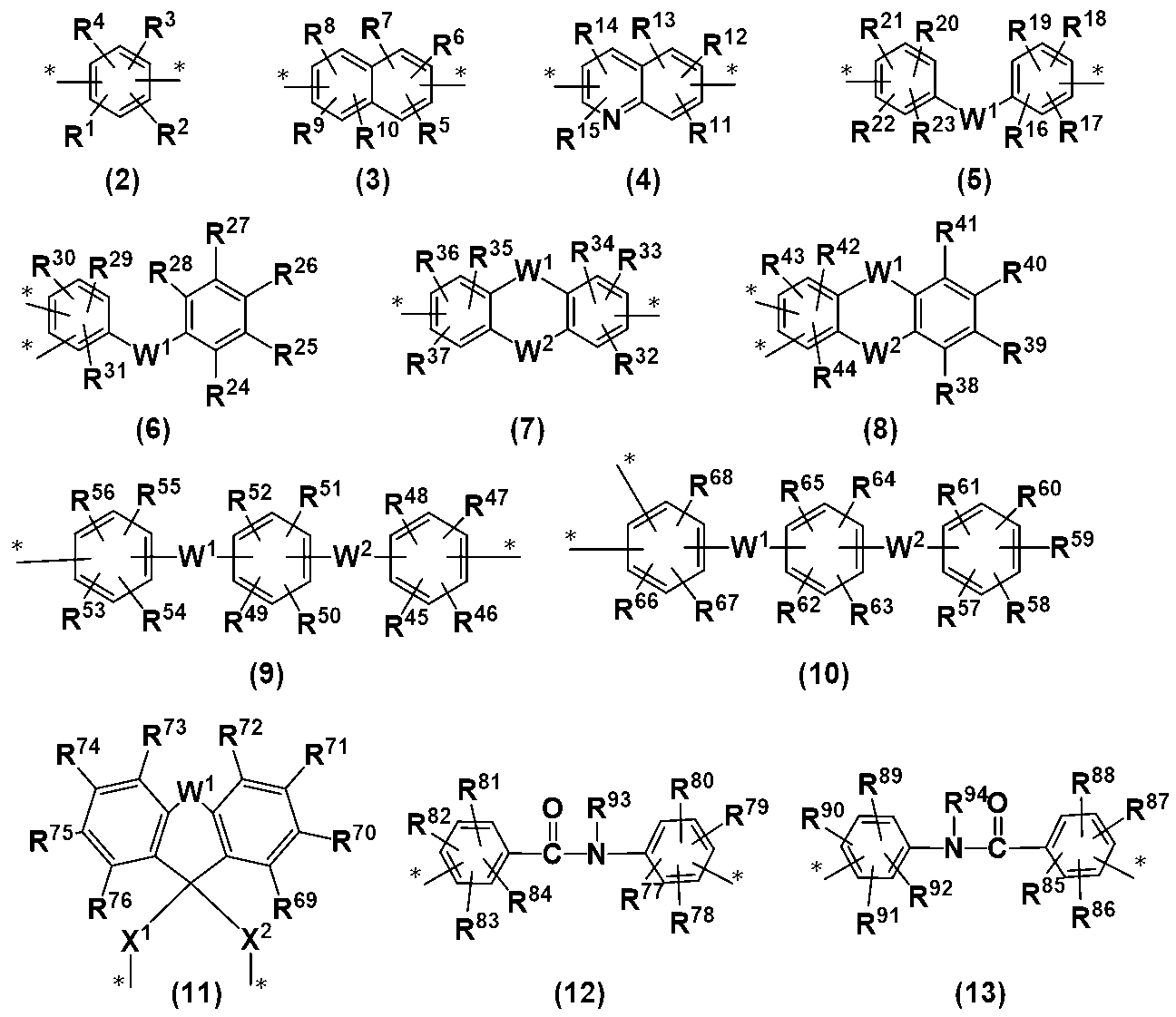
R93およびR94は、水素原子または炭素数1~10のアルキル基を表し、
W1およびW2は、互いに独立して、単結合、CR95R96(R95およびR96は、互いに独立して、水素原子、炭素数1~10のアルキル基(ただし、これらは一緒になって環を形成していてもよい。)、または炭素数1~10のハロゲン化アルキル基を表す。)、C=O、O、S、SO、SO2、またはNR97(R97は、水素原子、炭素数1~10のアルキル基またはフェニル基を表す。)を表し、
X1およびX2は、互いに独立して、単結合、炭素数1~10のアルキレン基、または式(14)
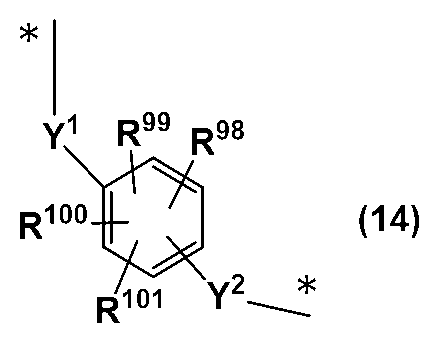
Y1およびY2は、互いに独立して、単結合または炭素数1~10のアルキレン基を表す。)で示される基を表す。
*は結合手を表す。〕

- 前記水酸基置換アリールアミノ基が、式(15)で示される請求項1に記載のパターン形成用組成物。

- 前記水酸基置換アリールアミノ基が、式(16)で示される請求項3に記載のパターン形成用組成物。
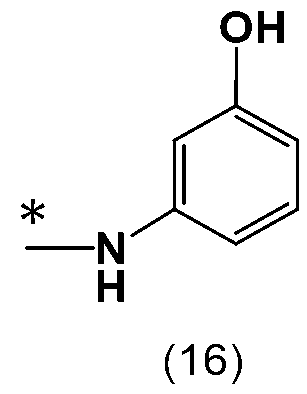
- 前記式(1)中のQが、式(17)で示される請求項1に記載のパターン形成用組成物。

- 前記架橋剤が、多官能(メタ)アクリル化合物である請求項1に記載のパターン形成用組成物。
- 前記無機微粒子が、金属酸化物、金属硫黄物または金属窒化物を含む請求項1に記載のパターン形成用組成物。
- 前記アルカリ反応性基が、酸無水物基またはエポキシ基である請求項1に記載のパターン形成用組成物。
- 有機エレクトロルミネッセンス素子の光取り出し層用である請求項1に記載のパターン形成用組成物。
- 請求項1~9のいずれかに記載のパターン形成用組成物から作製された硬化物。
- 基材と、前記基材上に形成された請求項10に記載の硬化物とを備える電子デバイス。
- 有機エレクトロルミネッセンスである請求項11に記載の電子デバイス。
- 基材と、前記基材上に形成された請求項10に記載の硬化物とを備える光学部材。
- 請求項1~9のいずれかに記載のパターン形成用組成物を基材に塗布し、有機溶媒を蒸発させ、パターンが形成されたマスクを介して光照射した後、現像し、さらに焼成することを特徴とするパターンの作製方法。
Priority Applications (3)
| Application Number | Priority Date | Filing Date | Title |
|---|---|---|---|
| KR1020237039854A KR20230175251A (ko) | 2021-04-23 | 2022-04-21 | 패턴 형성용 조성물 |
| CN202280029868.7A CN117597398A (zh) | 2021-04-23 | 2022-04-21 | 图案形成用组合物 |
| JP2023515515A JPWO2022225014A1 (ja) | 2021-04-23 | 2022-04-21 |
Applications Claiming Priority (2)
| Application Number | Priority Date | Filing Date | Title |
|---|---|---|---|
| JP2021073304 | 2021-04-23 | ||
| JP2021-073304 | 2021-04-23 |
Publications (1)
| Publication Number | Publication Date |
|---|---|
| WO2022225014A1 true WO2022225014A1 (ja) | 2022-10-27 |
Family
ID=83722395
Family Applications (1)
| Application Number | Title | Priority Date | Filing Date |
|---|---|---|---|
| PCT/JP2022/018430 Ceased WO2022225014A1 (ja) | 2021-04-23 | 2022-04-21 | パターン形成用組成物 |
Country Status (5)
| Country | Link |
|---|---|
| JP (1) | JPWO2022225014A1 (ja) |
| KR (1) | KR20230175251A (ja) |
| CN (1) | CN117597398A (ja) |
| TW (1) | TWI892005B (ja) |
| WO (1) | WO2022225014A1 (ja) |
Families Citing this family (1)
| Publication number | Priority date | Publication date | Assignee | Title |
|---|---|---|---|---|
| JP7334875B1 (ja) * | 2023-03-10 | 2023-08-29 | 東ソー株式会社 | ブロックイソシアネート組成物及びその製造方法、塗料用硬化剤、塗料組成物、並びに、塗膜 |
Citations (7)
| Publication number | Priority date | Publication date | Assignee | Title |
|---|---|---|---|---|
| WO2013094663A1 (ja) * | 2011-12-20 | 2013-06-27 | 日産化学工業株式会社 | トリアジン環含有重合体およびそれを含む膜形成用組成物 |
| WO2013168788A1 (ja) * | 2012-05-11 | 2013-11-14 | 日産化学工業株式会社 | 膜形成用組成物 |
| JP2013245206A (ja) * | 2012-05-28 | 2013-12-09 | Iwate Univ | ヒドロキシ基含有芳香族ジアミン、ポリアミド樹脂、樹脂組成物、及び、それらの用途 |
| JP2014162829A (ja) * | 2013-02-22 | 2014-09-08 | Idemitsu Kosan Co Ltd | トリアジン環含有線状ポリマーからなる高屈折率材料 |
| WO2017138547A1 (ja) * | 2016-02-09 | 2017-08-17 | 日産化学工業株式会社 | トリアジン環含有重合体およびそれを含む組成物 |
| WO2019093203A1 (ja) * | 2017-11-08 | 2019-05-16 | 日産化学株式会社 | トリアジン環含有重合体およびそれを含む組成物 |
| WO2021117692A1 (ja) * | 2019-12-09 | 2021-06-17 | 日産化学株式会社 | パターン形成用組成物 |
Family Cites Families (6)
| Publication number | Priority date | Publication date | Assignee | Title |
|---|---|---|---|---|
| EP2428529B1 (en) | 2009-05-07 | 2019-03-06 | Nissan Chemical Corporation | Triazine ring-containing polymer and film-forming composition comprising same |
| WO2015098788A1 (ja) * | 2013-12-24 | 2015-07-02 | 日産化学工業株式会社 | トリアジン系重合体含有組成物 |
| JP6638651B2 (ja) | 2014-08-13 | 2020-01-29 | 日産化学株式会社 | トリアジン環含有重合体およびそれを含む組成物 |
| US10228620B2 (en) * | 2015-01-15 | 2019-03-12 | Nissan Chemical Industries, Ltd. | Triazine-ring-containing polymer and composition containing same |
| JP6804047B2 (ja) * | 2015-06-03 | 2020-12-23 | 日産化学株式会社 | トリアジン環含有重合体およびそれを含む膜形成用組成物 |
| JP6838562B2 (ja) * | 2015-12-21 | 2021-03-03 | 日産化学株式会社 | トリアジン環含有重合体およびそれを含む膜形成用組成物 |
-
2022
- 2022-04-21 KR KR1020237039854A patent/KR20230175251A/ko active Pending
- 2022-04-21 WO PCT/JP2022/018430 patent/WO2022225014A1/ja not_active Ceased
- 2022-04-21 JP JP2023515515A patent/JPWO2022225014A1/ja active Pending
- 2022-04-21 CN CN202280029868.7A patent/CN117597398A/zh active Pending
- 2022-04-22 TW TW111115428A patent/TWI892005B/zh active
Patent Citations (7)
| Publication number | Priority date | Publication date | Assignee | Title |
|---|---|---|---|---|
| WO2013094663A1 (ja) * | 2011-12-20 | 2013-06-27 | 日産化学工業株式会社 | トリアジン環含有重合体およびそれを含む膜形成用組成物 |
| WO2013168788A1 (ja) * | 2012-05-11 | 2013-11-14 | 日産化学工業株式会社 | 膜形成用組成物 |
| JP2013245206A (ja) * | 2012-05-28 | 2013-12-09 | Iwate Univ | ヒドロキシ基含有芳香族ジアミン、ポリアミド樹脂、樹脂組成物、及び、それらの用途 |
| JP2014162829A (ja) * | 2013-02-22 | 2014-09-08 | Idemitsu Kosan Co Ltd | トリアジン環含有線状ポリマーからなる高屈折率材料 |
| WO2017138547A1 (ja) * | 2016-02-09 | 2017-08-17 | 日産化学工業株式会社 | トリアジン環含有重合体およびそれを含む組成物 |
| WO2019093203A1 (ja) * | 2017-11-08 | 2019-05-16 | 日産化学株式会社 | トリアジン環含有重合体およびそれを含む組成物 |
| WO2021117692A1 (ja) * | 2019-12-09 | 2021-06-17 | 日産化学株式会社 | パターン形成用組成物 |
Also Published As
| Publication number | Publication date |
|---|---|
| TW202309147A (zh) | 2023-03-01 |
| JPWO2022225014A1 (ja) | 2022-10-27 |
| CN117597398A (zh) | 2024-02-23 |
| TWI892005B (zh) | 2025-08-01 |
| KR20230175251A (ko) | 2023-12-29 |
Similar Documents
| Publication | Publication Date | Title |
|---|---|---|
| TWI620790B (zh) | 膜形成用組成物 | |
| KR102641678B1 (ko) | 트라이아진환 함유 중합체 및 그것을 포함하는 조성물 | |
| JP6638651B2 (ja) | トリアジン環含有重合体およびそれを含む組成物 | |
| JP7136119B2 (ja) | トリアジン環含有重合体およびそれを含む組成物 | |
| JP6804047B2 (ja) | トリアジン環含有重合体およびそれを含む膜形成用組成物 | |
| WO2022225020A1 (ja) | トリアジン環含有重合体、及びパターン形成用組成物 | |
| WO2016114337A1 (ja) | トリアジン環含有重合体およびそれを含む組成物 | |
| JP7077622B2 (ja) | トリアジン環含有重合体およびそれを含む膜形成用組成物 | |
| TWI892005B (zh) | 圖型形成用組成物 | |
| JP6702319B2 (ja) | インクジェット塗布用膜形成用組成物 | |
| JP7484332B2 (ja) | トリアジン環含有重合体およびそれを含む膜形成用組成物 | |
| TWI920293B (zh) | 含三嗪環聚合物,及圖型形成用組成物 | |
| TWI917615B (zh) | 膜形成用組成物、薄膜、電子裝置及光學構件 | |
| WO2022225012A1 (ja) | 膜形成用組成物 | |
| WO2022225003A1 (ja) | 膜形成用組成物 | |
| WO2022225017A1 (ja) | 無溶剤型組成物 | |
| WO2025229983A1 (ja) | パターン形成用組成物及び硬化膜 | |
| WO2022225001A1 (ja) | トリアジン環含有重合体、及びパターン形成用組成物 | |
| WO2025229988A1 (ja) | 無溶剤型組成物及び硬化膜 |
Legal Events
| Date | Code | Title | Description |
|---|---|---|---|
| 121 | Ep: the epo has been informed by wipo that ep was designated in this application |
Ref document number: 22791785 Country of ref document: EP Kind code of ref document: A1 |
|
| WWE | Wipo information: entry into national phase |
Ref document number: 2023515515 Country of ref document: JP |
|
| WWE | Wipo information: entry into national phase |
Ref document number: 202280029868.7 Country of ref document: CN |
|
| ENP | Entry into the national phase |
Ref document number: 20237039854 Country of ref document: KR Kind code of ref document: A |
|
| WWE | Wipo information: entry into national phase |
Ref document number: 1020237039854 Country of ref document: KR |
|
| NENP | Non-entry into the national phase |
Ref country code: DE |
|
| 122 | Ep: pct application non-entry in european phase |
Ref document number: 22791785 Country of ref document: EP Kind code of ref document: A1 |