WO2022224779A1 - 有機el表示装置 - Google Patents
有機el表示装置 Download PDFInfo
- Publication number
- WO2022224779A1 WO2022224779A1 PCT/JP2022/016191 JP2022016191W WO2022224779A1 WO 2022224779 A1 WO2022224779 A1 WO 2022224779A1 JP 2022016191 W JP2022016191 W JP 2022016191W WO 2022224779 A1 WO2022224779 A1 WO 2022224779A1
- Authority
- WO
- WIPO (PCT)
- Prior art keywords
- colorant
- pigment
- group
- organic
- weight
- Prior art date
- Legal status (The legal status is an assumption and is not a legal conclusion. Google has not performed a legal analysis and makes no representation as to the accuracy of the status listed.)
- Ceased
Links
Images
Classifications
-
- G—PHYSICS
- G03—PHOTOGRAPHY; CINEMATOGRAPHY; ANALOGOUS TECHNIQUES USING WAVES OTHER THAN OPTICAL WAVES; ELECTROGRAPHY; HOLOGRAPHY
- G03F—PHOTOMECHANICAL PRODUCTION OF TEXTURED OR PATTERNED SURFACES, e.g. FOR PRINTING, FOR PROCESSING OF SEMICONDUCTOR DEVICES; MATERIALS THEREFOR; ORIGINALS THEREFOR; APPARATUS SPECIALLY ADAPTED THEREFOR
- G03F7/00—Photomechanical, e.g. photolithographic, production of textured or patterned surfaces, e.g. printing surfaces; Materials therefor, e.g. comprising photoresists; Apparatus specially adapted therefor
- G03F7/004—Photosensitive materials
- G03F7/027—Non-macromolecular photopolymerisable compounds having carbon-to-carbon double bonds, e.g. ethylenic compounds
- G03F7/028—Non-macromolecular photopolymerisable compounds having carbon-to-carbon double bonds, e.g. ethylenic compounds with photosensitivity-increasing substances, e.g. photoinitiators
- G03F7/031—Organic compounds not covered by group G03F7/029
-
- H—ELECTRICITY
- H10—SEMICONDUCTOR DEVICES; ELECTRIC SOLID-STATE DEVICES NOT OTHERWISE PROVIDED FOR
- H10K—ORGANIC ELECTRIC SOLID-STATE DEVICES
- H10K59/00—Integrated devices, or assemblies of multiple devices, comprising at least one organic light-emitting element covered by group H10K50/00
- H10K59/30—Devices specially adapted for multicolour light emission
- H10K59/38—Devices specially adapted for multicolour light emission comprising colour filters or colour changing media [CCM]
-
- G—PHYSICS
- G02—OPTICS
- G02B—OPTICAL ELEMENTS, SYSTEMS OR APPARATUS
- G02B5/00—Optical elements other than lenses
- G02B5/20—Filters
-
- G—PHYSICS
- G03—PHOTOGRAPHY; CINEMATOGRAPHY; ANALOGOUS TECHNIQUES USING WAVES OTHER THAN OPTICAL WAVES; ELECTROGRAPHY; HOLOGRAPHY
- G03F—PHOTOMECHANICAL PRODUCTION OF TEXTURED OR PATTERNED SURFACES, e.g. FOR PRINTING, FOR PROCESSING OF SEMICONDUCTOR DEVICES; MATERIALS THEREFOR; ORIGINALS THEREFOR; APPARATUS SPECIALLY ADAPTED THEREFOR
- G03F7/00—Photomechanical, e.g. photolithographic, production of textured or patterned surfaces, e.g. printing surfaces; Materials therefor, e.g. comprising photoresists; Apparatus specially adapted therefor
- G03F7/0005—Production of optical devices or components in so far as characterised by the lithographic processes or materials used therefor
- G03F7/0007—Filters, e.g. additive colour filters; Components for display devices
-
- G—PHYSICS
- G03—PHOTOGRAPHY; CINEMATOGRAPHY; ANALOGOUS TECHNIQUES USING WAVES OTHER THAN OPTICAL WAVES; ELECTROGRAPHY; HOLOGRAPHY
- G03F—PHOTOMECHANICAL PRODUCTION OF TEXTURED OR PATTERNED SURFACES, e.g. FOR PRINTING, FOR PROCESSING OF SEMICONDUCTOR DEVICES; MATERIALS THEREFOR; ORIGINALS THEREFOR; APPARATUS SPECIALLY ADAPTED THEREFOR
- G03F7/00—Photomechanical, e.g. photolithographic, production of textured or patterned surfaces, e.g. printing surfaces; Materials therefor, e.g. comprising photoresists; Apparatus specially adapted therefor
- G03F7/004—Photosensitive materials
-
- G—PHYSICS
- G03—PHOTOGRAPHY; CINEMATOGRAPHY; ANALOGOUS TECHNIQUES USING WAVES OTHER THAN OPTICAL WAVES; ELECTROGRAPHY; HOLOGRAPHY
- G03F—PHOTOMECHANICAL PRODUCTION OF TEXTURED OR PATTERNED SURFACES, e.g. FOR PRINTING, FOR PROCESSING OF SEMICONDUCTOR DEVICES; MATERIALS THEREFOR; ORIGINALS THEREFOR; APPARATUS SPECIALLY ADAPTED THEREFOR
- G03F7/00—Photomechanical, e.g. photolithographic, production of textured or patterned surfaces, e.g. printing surfaces; Materials therefor, e.g. comprising photoresists; Apparatus specially adapted therefor
- G03F7/004—Photosensitive materials
- G03F7/0048—Photosensitive materials characterised by the solvents or agents facilitating spreading, e.g. tensio-active agents
-
- G—PHYSICS
- G03—PHOTOGRAPHY; CINEMATOGRAPHY; ANALOGOUS TECHNIQUES USING WAVES OTHER THAN OPTICAL WAVES; ELECTROGRAPHY; HOLOGRAPHY
- G03F—PHOTOMECHANICAL PRODUCTION OF TEXTURED OR PATTERNED SURFACES, e.g. FOR PRINTING, FOR PROCESSING OF SEMICONDUCTOR DEVICES; MATERIALS THEREFOR; ORIGINALS THEREFOR; APPARATUS SPECIALLY ADAPTED THEREFOR
- G03F7/00—Photomechanical, e.g. photolithographic, production of textured or patterned surfaces, e.g. printing surfaces; Materials therefor, e.g. comprising photoresists; Apparatus specially adapted therefor
- G03F7/004—Photosensitive materials
- G03F7/027—Non-macromolecular photopolymerisable compounds having carbon-to-carbon double bonds, e.g. ethylenic compounds
-
- G—PHYSICS
- G03—PHOTOGRAPHY; CINEMATOGRAPHY; ANALOGOUS TECHNIQUES USING WAVES OTHER THAN OPTICAL WAVES; ELECTROGRAPHY; HOLOGRAPHY
- G03F—PHOTOMECHANICAL PRODUCTION OF TEXTURED OR PATTERNED SURFACES, e.g. FOR PRINTING, FOR PROCESSING OF SEMICONDUCTOR DEVICES; MATERIALS THEREFOR; ORIGINALS THEREFOR; APPARATUS SPECIALLY ADAPTED THEREFOR
- G03F7/00—Photomechanical, e.g. photolithographic, production of textured or patterned surfaces, e.g. printing surfaces; Materials therefor, e.g. comprising photoresists; Apparatus specially adapted therefor
- G03F7/004—Photosensitive materials
- G03F7/09—Photosensitive materials characterised by structural details, e.g. supports, auxiliary layers
- G03F7/105—Photosensitive materials characterised by structural details, e.g. supports, auxiliary layers having substances, e.g. indicators, for forming visible images
-
- G—PHYSICS
- G09—EDUCATION; CRYPTOGRAPHY; DISPLAY; ADVERTISING; SEALS
- G09F—DISPLAYING; ADVERTISING; SIGNS; LABELS OR NAME-PLATES; SEALS
- G09F9/00—Indicating arrangements for variable information in which the information is built-up on a support by selection or combination of individual elements
- G09F9/30—Indicating arrangements for variable information in which the information is built-up on a support by selection or combination of individual elements in which the desired character or characters are formed by combining individual elements
-
- H—ELECTRICITY
- H05—ELECTRIC TECHNIQUES NOT OTHERWISE PROVIDED FOR
- H05B—ELECTRIC HEATING; ELECTRIC LIGHT SOURCES NOT OTHERWISE PROVIDED FOR; CIRCUIT ARRANGEMENTS FOR ELECTRIC LIGHT SOURCES, IN GENERAL
- H05B33/00—Electroluminescent light sources
- H05B33/12—Light sources with substantially two-dimensional [2D] radiating surfaces
-
- H—ELECTRICITY
- H05—ELECTRIC TECHNIQUES NOT OTHERWISE PROVIDED FOR
- H05B—ELECTRIC HEATING; ELECTRIC LIGHT SOURCES NOT OTHERWISE PROVIDED FOR; CIRCUIT ARRANGEMENTS FOR ELECTRIC LIGHT SOURCES, IN GENERAL
- H05B33/00—Electroluminescent light sources
- H05B33/12—Light sources with substantially two-dimensional [2D] radiating surfaces
- H05B33/14—Light sources with substantially two-dimensional [2D] radiating surfaces characterised by the chemical or physical composition or the arrangement of the electroluminescent material, or by the simultaneous addition of the electroluminescent material in or onto the light source
-
- H—ELECTRICITY
- H10—SEMICONDUCTOR DEVICES; ELECTRIC SOLID-STATE DEVICES NOT OTHERWISE PROVIDED FOR
- H10K—ORGANIC ELECTRIC SOLID-STATE DEVICES
- H10K59/00—Integrated devices, or assemblies of multiple devices, comprising at least one organic light-emitting element covered by group H10K50/00
-
- H—ELECTRICITY
- H10—SEMICONDUCTOR DEVICES; ELECTRIC SOLID-STATE DEVICES NOT OTHERWISE PROVIDED FOR
- H10K—ORGANIC ELECTRIC SOLID-STATE DEVICES
- H10K59/00—Integrated devices, or assemblies of multiple devices, comprising at least one organic light-emitting element covered by group H10K50/00
- H10K59/30—Devices specially adapted for multicolour light emission
- H10K59/35—Devices specially adapted for multicolour light emission comprising red-green-blue [RGB] subpixels
Definitions
- the present invention relates to an organic EL display device.
- organic EL which is a self-luminous element
- development and mass production of display devices using (organic electroluminescence) are progressing.
- display devices using (organic electroluminescence) are progressing.
- microdisplays high-definition and small displays of about 0.5 inches (hereinafter referred to as microdisplays) such as head-mounted displays and electronic viewfinders.
- the display method of the organic EL display includes a method of forming a white light-emitting layer and using a color filter to express colors such as RGB, and a method of vapor-depositing a light-emitting layer that emits each color such as RGB to express colors.
- a color filter to express colors
- RGB color filter
- the pixel size of a microdisplay is as small as 1 ⁇ m to 5 ⁇ m. Therefore, the conventional method of fabricating organic EL elements and color filters on separate substrates and bonding them together results in lower precision and color shifts. occur. Therefore, a method of forming a color filter on an organic EL element has been proposed.
- Patent Document 1 proposes a method of increasing curability at low temperatures by using an alkali-soluble resin containing an epoxy group and a coloring composition containing an amine compound as a curing agent.
- the addition of an amine compound to the coloring composition may reduce the transmittance of the color filter.
- Patent Document 2 proposes a method of curing at a low temperature by using an oxetane compound and a benzophenone-based compound having a peroxide skeleton as a thermal polymerization initiator.
- the curing temperature is 150° C. Considering the heat resistance of the organic EL element, further low-temperature curability is required. Further, in order to achieve high color reproducibility, it is necessary to control the spectral transmittance of the color filter by blending the coloring agent, and to increase the concentration of the coloring agent in order to make the film thinner. In the methods of Patent Documents 1 and 2, when the concentration of the coloring agent is high, it is very difficult to achieve sufficient sensitivity for patterning due to insufficient photocurability. There have been problems such as a decrease in pixel linearity (improper pixel linearity) and peeling of pixels during the development process (improper adhesion). In addition, there is a problem that the coloring agents that can be used are limited.
- the present invention provides an organic EL display having a color filter which has high luminance and high color reproducibility, good pixel adhesion in the development process even when the colorant concentration is high, and good pixel linearity.
- the purpose is to provide an apparatus.
- the organic EL display device is An organic EL display device having an organic EL layer and a color filter on a silicon substrate on which driving elements are formed, the color filter has pixels including red pixels, green pixels, and blue pixels;
- the film thickness of the pixel is 1.5 ⁇ m
- the spectral transmittance of the red pixel has a maximum light transmittance of 0.5% or less in a wavelength range of 450 nm to 560 nm, a 50% half-value wavelength of 593 nm to 603 nm, and a maximum light transmittance of a wavelength range of 600 nm to 700 nm.
- the maximum transmittance of light in the wavelength range of 400 nm to 470 nm is 2% or less
- the maximum transmittance of light in the wavelength range of 525 to 535 nm is 67% or more
- the 50% half-value wavelength on the short wavelength side is 497.
- the spectral transmittance of the blue pixel has a maximum light transmittance of less than 20% in a wavelength range of 500 nm to 560 nm
- the pixel is a cured product of a photosensitive coloring composition containing a coloring agent (A), a photopolymerizable monomer (B), a photopolymerization initiator (C), and a resin (D),
- the coloring agent (A) contains Pigment Red 177 and other coloring agents
- the colorant (A) contains Pigment Yellow 185 and one or more selected from the group consisting of Pigment Green 36, Pigment Green 62, Pigment Green 63 and Pigment Green 59, and contains other colorants.
- the content of Pigment Yellow 185 in the colorant (A) of the green pixel is 49% by weight to 59% by weight, said blue pixels comprising Pigment Blue 15:6 and other colorants;
- the other coloring agent contains one or more selected from the group consisting of Pigment Red 254 and Pigment Yellow 139, in the green pixel, the other colorant comprises Pigment Blue 15:3;
- the other coloring agent contains one or more selected from the group consisting of Pigment Violet 23 and xanthene dyes,
- the photopolymerizable monomer (B) contains a compound represented by the following general formula (1)
- the photopolymerization initiator (C) contains an oxime ester photopolymerization initiator.
- the cured product constituting the red pixel contains colorant (A-1) Pigment Red 177, colorant (A-2) Pigment Red 254, and colorant (A-3) Pigment Yellow 139, In the colorant (A) in the red pixel, The content of the coloring agent (A-1) is 55% to 65% by weight, The content of the coloring agent (A-2) is 15% by weight to 25% by weight, and the content of the coloring agent (A-3) is 15% to 25% by weight, The cured product constituting the green pixel includes colorant (A-4) Pigment Yellow 185, colorant (A-5) Pigment Green 36, colorant (A-6) Pigment Green 62, and colorant (A-11).
- the content of the compound represented by the general formula (1) is 50% by weight or more with respect to the total amount of the photopolymerizable monomer (B).
- the oxime ester photopolymerization initiator is a compound represented by the following general formula (2).
- R 1 represents an optionally substituted alkyl group having 1 to 20 carbon atoms
- R 2 represents represents an optionally substituted alkyl group having 1 to 20 carbon atoms or an optionally substituted aryl group
- each of R 3 to R 10 independently has a hydrogen atom and a substituent; represents an alkyl group having 1 to 20 carbon atoms which may be represents a good aryl group.
- the oxime ester photopolymerization initiator is a compound represented by the following general formula (3).
- W 1 and W 2 each independently represent a carbonyl bond (--CO--) or a single bond, and at least one of W 1 and W 2 is a carbonyl bond (--CO--).
- R a is an alkyl group having 2 to 6 carbon atoms
- R b is an alkyl group having 4 to 10 carbon atoms
- R c contains at least a hydrocarbon ring or heterocyclic ring and further has 1 to 4 carbon atoms.
- R b and R c are substituents different from each other.
- R d and R e are each independently an alkyl group having 1 to 6 carbon atoms.
- the resin (D) contains a photosensitive resin.
- the photosensitive resin contains a vinyl polymer having an aromatic carboxylic acid at the end.
- the photosensitive coloring composition further contains a solvent, and the solvent contains an ether ester solvent and an ether alcohol solvent.
- an organic EL display device having a color filter which has high luminance and high color reproducibility, good pixel adhesion in the development process even when the colorant concentration is high, and good pixel linearity. can do.
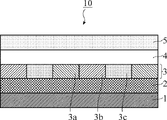
- FIG. 1 is a schematic cross-sectional view of the present organic EL display device.
- the "50% half-value wavelength” represents the wavelength (nm) at which the spectral transmittance is 50% in the wavelength region from 400 nm to 700 nm.
- “Short wavelength side 50% half-value wavelength” represents the wavelength (nm) when the spectral transmittance becomes 50% for the first time when the measurement is started from the short wavelength (400 nm) and scanned to the long wavelength side.
- “Side 50% half-value wavelength” represents the wavelength (nm) at which the spectral transmittance becomes 50% for the first time when the measurement is started from the long wavelength (700 nm) and scanned to the short wavelength side.
- “(Meth)acryloyl”, “(meth)acryl”, “(meth)acrylic acid”, “(meth)acrylate”, or “(meth)acrylamide” unless otherwise specified , “acryloyl and/or methacryloyl”, “acrylic and/or methacrylic”, “acrylic acid and/or methacrylic acid”, “acrylate and/or methacrylate”, or “acrylamide and/or methacrylamide”.
- C.I mentioned in this specification means a color index (C.I.).
- the organic EL display device (hereinafter also referred to as the present organic EL display device)
- An organic EL display device having an organic EL layer and a color filter on a silicon substrate on which driving elements are formed, the color filter has pixels including red pixels, green pixels, and blue pixels;
- the film thickness of the pixel is 1.5 ⁇ m
- the spectral transmittance of the red pixel has a maximum light transmittance of 0.5% or less in a wavelength range of 450 nm to 560 nm, a 50% half-value wavelength of 593 nm to 603 nm, and a maximum light transmittance of a wavelength range of 600 nm to 700 nm.
- the maximum transmittance of light in the wavelength range of 400 nm to 470 nm is 2% or less
- the maximum transmittance of light in the wavelength range of 525 to 535 nm is 67% or more
- the 50% half-value wavelength on the short wavelength side is 497.
- the spectral transmittance of the blue pixel has a maximum light transmittance of less than 20% in a wavelength range of 500 nm to 560 nm
- the pixel is a cured product of a photosensitive coloring composition containing a coloring agent (A), a photopolymerizable monomer (B), a photopolymerization initiator (C), and a resin (D),
- the coloring agent (A) contains Pigment Red 177 and other coloring agents
- the colorant (A) contains Pigment Yellow 185 and one or more selected from the group consisting of Pigment Green 36, Pigment Green 62, Pigment Green 63 and Pigment Green 59, and contains other colorants.
- the content of Pigment Yellow 185 in the colorant (A) of the green pixel is 49% by weight to 59% by weight, said blue pixels comprising Pigment Blue 15:6 and other colorants;
- the other coloring agent contains one or more selected from the group consisting of Pigment Red 254 and Pigment Yellow 139, in the green pixel, the other colorant comprises Pigment Blue 15:3;
- the other coloring agent contains one or more selected from the group consisting of Pigment Violet 23 and xanthene dyes,
- the photopolymerizable monomer (B) contains a compound represented by the following general formula (1)
- the photopolymerization initiator (C) contains an oxime ester photopolymerization initiator.
- the organic EL display device since the pixels of the color filter are a cured product of the specific photosensitive coloring composition, even when the color filter is formed on the organic EL layer, the organic EL layer It is possible to obtain a high-quality organic EL display device that can suppress the influence of heat, has high luminance and high color reproducibility, and is excellent in pixel linearity.
- the organic EL display device uses pixels whose color filters have the above-mentioned specific spectral characteristics, so that colors connecting R (red), G (green), and B (blue) in the xy chromaticity diagram can be obtained. The area of the region defined by the triangle is expanded, and the display device has a wide color reproduction range (that is, high color reproducibility).
- the photosensitive coloring composition for pixel formation will be described first, and then the structure of the organic EL display device will be described.
- Each pixel of the color filter is a cured product of a photosensitive coloring composition containing a coloring agent (A), a photopolymerizable monomer (B), a photopolymerization initiator (C), and a resin (D).
- the photopolymerizable monomer (B) contains at least a compound represented by general formula (1)
- the photopolymerization initiator (C) contains at least an oxime ester photopolymerization initiator. characterized by comprising
- the photosensitive coloring composition contains at least a coloring agent (A), a photopolymerizable monomer (B), a photopolymerization initiator (C), and a resin (D), and if necessary, other It may contain the components of The details of each component will be described below.
- the coloring agent (A) adjusts the color tone of the pixels of the color filter so that specific spectral characteristics described later can be obtained. It can be selected and used as appropriate.
- the pigment both organic pigments and inorganic pigments can be suitably used.
- the present photosensitive coloring composition is excellent in low-temperature curability, even dyes with low heat resistance compared to pigments can be suitably used.
- Inorganic pigments include barium sulfate, zinc white, lead sulfate, yellow lead, zinc yellow, red iron oxide (red iron oxide (III)), cadmium red, ultramarine blue, Prussian blue, chromium oxide green, cobalt green, amber, titanium black, synthetic Metal oxide powders such as iron black, titanium oxide and iron tetroxide, metal sulfide powders, metal powders, and the like can be used. Inorganic pigments are preferably used in combination with organic pigments in order to ensure good applicability, sensitivity, developability, etc. while maintaining a balance between chroma and lightness.
- any of acid dyes, direct dyes, basic dyes, salt-forming dyes, oil-soluble dyes, disperse dyes, reactive dyes, mordant dyes, vat dyes, sulfur dyes, and the like can be used as dyes.
- it may be in the form of a lake pigment obtained by converting a derivative of these or a dye into a lake.
- the colorant (A) preferably contains a pigment, and more preferably an organic pigment, because it has high color developability, excellent heat resistance, and particularly excellent thermal decomposition resistance.
- the coloring agent (A) will be described below more specifically for each color.
- This organic EL display device uses C.I. I. Pigment Red 177 (also referred to as coloring agent (A-1)) is used in combination with other coloring agents.
- C.I. I. Pigment Red 177 also referred to as coloring agent (A-1)
- the spectral transmittance of the red pixel when the film thickness of the pixel is 1.5 ⁇ m
- the maximum transmittance of light in the wavelength range of 450 nm to 560 nm is 0.5. % or less
- the maximum transmittance of light having a half-value wavelength of 593 nm to 603 nm and a wavelength of 600 nm to 700 nm is easily adjusted to 80% or more and less than 100%.
- a red pigment, an orange pigment, or a yellow pigment is preferable as the other coloring agent in the red pixel coloring agent.
- Other colorants may be used singly or in combination of two or more.
- red pigment examples include C.I. I. Pigment Red 1, 2, 3, 4, 5, 6, 7, 8, 9, 12, 14, 15, 16, 17, 21, 22, 23, 31, 32, 37, 38, 41, 47, 48, 48:1, 48:2, 48:3, 48:4, 49, 49:1, 49:2, 50:1, 52:1, 52:2, 53, 53:1, 53:2, 53: 3, 57, 57:1, 57:2, 58:4, 60, 63, 63:1, 63:2, 64, 64:1, 68, 69, 81, 81:1, 81:2, 81: 3, 81:4, 83, 88, 90:1, 101, 101:1, 104, 108, 108:1, 109, 112, 113, 114, 122, 123, 144, 146, 147, 149, 151, 166, 168, 169, 170, 172, 173, 174, 175, 176, 178, 179, 181, 184, 185, 187, 188, 190, 193, 194, 200,
- orange pigment examples include C.I. I. Pigment Orange 36, 38, 43, 51, 55, 59, 61 and the like.
- yellow pigment examples include C.I. I. Pigment Yellow 1, 1:1, 2, 3, 4, 5, 6, 9, 10, 12, 13, 14, 16, 17, 24, 31, 32, 34, 35, 35: 1, 36, 36: 1, 37, 37: 1, 40, 41, 42, 43, 48, 53, 55, 61, 62, 62: 1, 63, 65, 73, 74, 75, 81, 83, 87, 93, 94, 95,97,100,101,104,105,108,109,110,111,116,117,119,120,126,127,127:1,128,129,133,134,136,138,139, 142, 147, 148, 150, 151, 153, 154, 155, 157, 158, 159, 160, 161, 162, 163, 164, 165, 166, 167, 168, 169, 170, 172, 173, 174, 175, 176, 180, 181, 182, 183, 184, 185, 188, 189, 190, 191, 191
- pigment red 254 colorant (A -2)
- Pigment Yellow 139 colorant (A-3)
- the content of the colorant (A-1) in the colorant (A) is 55% to 65% by weight.
- the content of the coloring agent (A-2) is preferably 15% to 25% by weight
- the content of the coloring agent (A-3) is preferably 15% to 25% by weight.
- the colorant for green pixels is C.I. I. Pigment Yellow 185 (also referred to as colorant (A-4)) and one or more selected from the group consisting of Pigment Green 36, Pigment Green 62, Pigment Green 63 and Pigment Green 59, in the colorant (A) Pigment Yellow 185 content of 49% to 59% by weight.
- the spectral transmittance of the green pixel when the film thickness of the pixel is 1.5 ⁇ m is 2% or less in the wavelength range of 400 nm to 470 nm.
- a green pigment, a yellow pigment, or a blue pigment is preferable as the other coloring agent in the green pixel coloring agent.
- Other colorants may be used singly or in combination of two or more.
- green pigment examples include C.I. I. Pigment Green 1, 2, 4, 7, 8, 10, 13, 14, 15, 17, 18, 19, 26, 36, 45, 48, 50, 51, 54, 55, 58, 59, 62, 63, etc. is mentioned.
- blue pigment examples include C.I. I. Pigment Blue 1, 1:2, 9, 14, 15, 15:1, 15:2, 15:3, 15:4, 15:6, 16, 17, 19, 25, 27, 28, 29, 33, 35, 36, 56, 56:1, 60, 61, 61:1, 62, 63, 66, 67, 68, 71, 72, 73, 74, 75, 76, 78, 79 and the like.
- yellow pigment examples include those similar to those exemplified in the red pixel colorant.
- Pigment Green 36 (colorant (A- 5)), Pigment Green 62 (colorant (A-6)), Pigment Green 63 (colorant (A-11)), Pigment Green 59 (colorant (A-12)), Pigment Blue 15:3 (colorant Agent (A-7)) is preferred.
- colorant (A) for green pixels As a combination of colorants (A) for green pixels, the following combinations (I) to (IV) are more preferable.
- Colorant (A-4), Colorant (A-5) and Colorant (A-7) (II) Colorant (A-4) and Colorant (A-6)
- III) Colorant (A-4) and Colorant (A-11) (IV) Colorant (A-4) and Colorant (A-12)
- the content of the coloring agent (A-4) is 49% to 59% by weight, the coloring agent (A-5), the coloring agent (A-6), the coloring agent (A-11) or the coloring agent (A-12)
- the content of 33% to 51% by weight, the content of the colorant (A-7) is preferably 0% to 13% by weight, and the content of the colorant (A-7) is 3% by weight. ⁇ 13% by weight is more preferred.
- the present organic EL display device uses a combination of Pigment Blue 15:6 (also referred to as coloring agent (A-8)) and other coloring agents as a coloring agent for blue pixels.
- Pigment Blue 15:6 also referred to as coloring agent (A-8)
- other coloring agents as a coloring agent for blue pixels.
- a blue pigment, a purple pigment, or a xanthene-based dye is preferable as the other coloring agent in the coloring agent for blue pixels.
- Other colorants may be used singly or in combination of two or more.
- the purple pigment examples include C.I. I. Pigment Violet 1, 1:1, 2, 2:2, 3, 3:1, 3:3, 5, 5:1, 14, 15, 16, 19, 23, 25, 27, 29, 31, 32, 37, 39, 42, 44, 47, 49, 50 and the like.
- blue pigment are the same as those exemplified in the above green pixel colorant.
- the xanthene dyes may be in the form of oil-soluble dyes, acid dyes, direct dyes, or basic dyes, and may also be used as lake pigments.
- the xanthene-based basic dye is preferably used after being salted using an organic acid or perchloric acid.
- the organic acid it is preferable to use an organic sulfonic acid or an organic carboxylic acid.
- naphthalenesulfonic acid such as Bias acid and perchloric acid are preferably used from the standpoint of resistance.
- the xanthene-based acid dye is salt-formed using a quaternary ammonium salt compound, a tertiary amine compound, a secondary amine compound, a primary amine compound, or a resin component having these functional groups, and used as a salt-forming compound. Alternatively, it can be sulfonamidated and used as a sulfonic acid amide compound.
- a salt-forming compound of a xanthene-based acid dye and a sulfonic acid amide compound of a xanthene-based acid dye are preferable because they are excellent in hue and resistance. It is more preferable to use a sulfonic acid amide compound obtained by sulfonamidating a xanthene acid dye.
- rhodamine-based dyes are preferable because they are excellent in color development and durability.
- xanthene oil-soluble dyes include C.I. I. Solvent Red 35, C.I. I. Solvent Red 36, C.I. I. Solvent Red 42, C.I. I. Solvent Red 43, C.I. I. Solvent Red 44, C.I. I. Solvent Red 45, C.I. I. Solvent Red 46, C.I. I. Solvent Red 47, C.I. I. Solvent Red 48, C.I. I. Solvent Red 49, C.I. I. Solvent Red 72, C.I. I. Solven Red 73, C.I. I. Solvent Red 109, C.I. I. Solvent Red 140, C.I. I. Solvent Red 141, C.I. I.
- Solvent Red 237 C.I. I. Solvent Red 246, C.I. I. solvent violet 2, C.I. I. solvent violet 10 and the like. Among them, C.I. I. Solvent Red 35, C.I. I. Solvent Red 36, C.I. I. Solvent Red 49, C.I. I. Solvent Red 109, C.I. I. Solvent Red 237, C.I. I. Solvent Red 246, C.I. I. Solvent Violet 2 is more preferred.
- xanthene-based basic dyes include C.I. I. Basic Red 1 (Rhodamine 6GCP), 8 (Rhodamine G), C.I. I. Basic Violet 10 (Rhodamine B) and the like. Among them, C.I. I. Basic Red 1, C.I. I. Basic Violet 10 is preferred.
- xanthene acid dyes include C.I. I. Acid Red 51 (erythrosine (food red No. 3)), C.I. I. Acid Red 52 (acid rhodamine), C.I. I. Acid Red 87 (Eosin G (Edible Red No. 103)), C.I. I. Acid Red 92 (Acid Phloxine PB (Edible Red No. 104)), C.I. I. Acid Red 289, C.I. I. Acid Red 388, Rose Bengal B (Edible Red No. 5), Acid Rhodamine G, C.I. I. acid violet 9; Among them, C.I. I. Acid Red 87, C.I. I. Acid Red 92, C.I. I.
- Acid Red 388 C.I. I. Acid Red 52 (acid rhodamine), C.I. I. Acid Red 289, Acid Rhodamine G, C.I. I. Acid Violet 9 is more preferred, and C.I. I. Acid Red 52, C.I. I. Preferably Acid Red 289 is used.
- the xanthene-based acid dye may be a salt-forming compound with a nitrogen-containing compound, and a quaternary ammonium salt compound, a tertiary amine compound, a secondary amine compound, a primary amine compound, etc., or a resin component having these functional groups is used. It is preferable to make a salt-forming compound of an acid dye by salt-forming, because high heat resistance, light resistance, and solvent resistance can be imparted. Acid dyes can be imparted with high heat resistance, light resistance and solvent resistance by sulfonamidation. Moreover, it may be a salt-forming compound of an acid dye and a compound having an onium base. An excellent coloring composition can be obtained.
- Primary amine compounds include methylamine, ethylamine, propylamine, isopropylamine, butylamine, amylamine, hexylamine, heptylamine, octylamine, nonylamine, decylamine, undecylamine, dodecylamine (laurylamine), tridodecylamine, tetra decylamine (myristylamine), pentadecylamine, cetylamine, stearylamine, oleylamine, cocoalkylamine, beef tallow alkylamine, hardened beef tallow alkylamine, aliphatic unsaturated primary amines such as allylamine, aniline, benzylamine, and the like. .
- Secondary amine compounds include aliphatic unsaturated secondary amines such as dimethylamine, diethylamine, dipropylamine, diisopropylamine, dibutylamine, diamylamine and diallylamine, methylaniline, ethylaniline, dibenzylamine, diphenylamine, dicocoalkyl Amine, di-cured beef tallow alkylamine, distearylamine and the like.
- Tertiary amine compounds include trimethylamine, triethylamine, tripropylamine, tributylamine, triamylamine, dimethylaniline, diethylaniline, and tribenzylamine.
- a xanthene-based acid dye it may be used as a salt-forming compound (a) consisting of the acid dye and a quaternary ammonium salt compound.
- the quaternary ammonium salt compound as the counter component of the acid dye is described below.
- the quaternary ammonium salt compound (a) functions as a counter for acid dyes by having an amino group.
- a preferred form of the quaternary ammonium salt compound, which is the counter component of the salt-forming compound, is colorless or white.
- colorless or white means a so-called transparent state, and is defined as a state in which the transmittance is 95% or more, preferably 98% or more in the entire wavelength region of 400 to 700 nm in the visible light region. It is. That is, it is preferable that it does not interfere with the color development of the dye component and does not cause color change.
- the molecular weight of the counter portion which is the cationic component of the quaternary ammonium salt compound, is preferably in the range of 190-900. If the molecular weight is less than 190, the light resistance and heat resistance may be lowered, and the solubility in solvents may be lowered. On the other hand, if the molecular weight exceeds 900, the proportion of the coloring component in the molecule will decrease, resulting in a decrease in color developability and brightness. More preferably, the molecular weight of the counter moiety is in the range of 240-850. Particularly preferred are counter moieties with molecular weights in the range of 350-800.
- the molecular weight was calculated based on the structural formula, and the atomic weight of C was 12, the atomic weight of H was 1, and the atomic weight of N was 14.
- a compound represented by the following general formula (5) is preferable as the quaternary ammonium salt compound.
- R 31 to R 34 each independently represent an alkyl group having 1 to 20 carbon atoms or a benzyl group, and at least two of R 31 to R 34 have 5 to 20.
- X 1- represents an inorganic or organic anion.
- R 31 to R 34 When at least two or more of R 31 to R 34 have 5 to 20 carbon atoms, good solubility in a solvent is obtained. If there are three or more alkyl groups having a carbon number of less than 5, the solubility in a solvent is deteriorated, and foreign matter is likely to occur in the coating film. In addition, if an alkyl group having more than 20 carbon atoms is present, the salt-forming compound (a) will be impaired in color development.
- X 1- may be an inorganic or organic anion, preferably a halogen, and preferably a chloride ion (anion).
- Quaternary ammonium salt compounds include tetramethylammonium chloride, tetraethylammonium chloride, monostearyltrimethylammonium chloride, distearyldimethylammonium chloride, tristearylmonomethylammonium chloride, cetyltrimethylammonium chloride, trioctylmethylammonium chloride, and dioctyldimethylammonium chloride.
- monolauryltrimethylammonium chloride monolauryltrimethylammonium chloride, dilauryldimethylammonium chloride, trilaurylmethylammonium chloride, triamylbenzylammonium chloride, trihexylbenzylammonium chloride, trioctylbenzylammonium chloride, trilaurylbenzylammonium chloride, benzyldimethylstearylammonium chloride, and Examples include benzyldimethyloctylammonium chloride, dialkyl (alkyl is C14 to C18) dimethylammonium chloride (cured beef tallow), and the like.
- Specific products of quaternary ammonium salt compounds include, for example, Kotamine 24P, Kotamine 86P Conc, Kotamine 60W, Kotamine 86W, Kotamine D86P, Sansol C, Sansol B-50 manufactured by Kao Corporation, and Arcade 210- manufactured by Lion Corporation. 80E, 2C-75, 2HT-75, 2HT flakes, 2O-75I, 2HP-75, 2HP flakes, among others, Cortamine D86P (distearyldimethylammonium chloride), Arcade 2HT-75 (dialkyl (alkyl is C14- C18) dimethylammonium chloride).
- a xanthene-based acid dye it may be used as a salt-forming compound (a') comprising an acid dye and a resin having a cationic group in its side chain.
- a resin having a cationic group in a side chain for obtaining the salt-forming compound (a') will be described.
- the resin having a cationic group in the side chain for obtaining the salt-forming compound is not particularly limited as long as it has at least one onium base in the side chain.
- ammonium salts iodonium salts, sulfonium salts, diazonium salts, and phosphonium salts are preferable, and considering storage stability (thermal stability), ammonium salts, iodonium salts, and sulfonium salts are preferred. is more preferable. Ammonium salts are more preferred.
- the same resin As the binder resin constituting the photosensitive coloring composition.
- the resin having a cationic group in the side chain for obtaining the salt-forming compound (a') is preferably an acrylic resin.
- an alkali resin containing a structural unit represented by the following general formula (6) is preferable.
- a salt-forming compound can be obtained by forming a salt between the cationic group in the general formula (6) and the anionic group of the xanthene-based acid dye.
- R 41 represents a hydrogen atom or a substituted or unsubstituted alkyl group
- R 42 to R 44 each independently represent a hydrogen atom, an optionally substituted alkyl group, a substituted represents an optionally substituted alkenyl group or an optionally substituted aryl group, two of R 42 to R 44 may be bonded together to form a ring
- Q is an alkylene group, an arylene group, or —CONH —R 45 —, —COO—R 45 —
- R 45 represents an alkylene group
- X 2- represents an inorganic or organic anion.
- Examples of the alkyl group for R 41 include methyl group, ethyl group, propyl group, n-butyl group, i-butyl group, t-butyl group, n-hexyl group and cyclohexyl group.
- an alkyl group having 1 to 12 carbon atoms is preferable, an alkyl group having 1 to 8 carbon atoms is more preferable, and an alkyl group having 1 to 4 carbon atoms is particularly preferable.
- examples of the substituent include a hydroxyl group and an alkoxyl group.
- R 41 is most preferably a hydrogen atom or a methyl group.
- alkyl groups for R 42 to R 44 include linear alkyl groups (methyl, ethyl, n-propyl, n-butyl, n-pentyl, n-octyl, n-decyl, n-dodecyl, n-tetradecyl, n-hexadecyl and n-octadecyl, etc.), branched alkyl groups (isopropyl, isobutyl, sec-butyl, tert-butyl, isopentyl, neopentyl, tert-pentyl, isohexyl, 2-ethylhexyl and 1,1,3,3-tetramethyl butyl, etc.), cycloalkyl groups (such as cyclopropyl, cyclobutyl, cyclopentyl and cyclohexyl) and bridged cyclic alkyl groups (such as nor
- alkenyl groups for R 42 to R 44 include linear or branched alkenyl groups (vinyl, allyl, 1-propenyl, 2-propenyl, 1-butenyl, 2-butenyl, 3-butenyl, 1-methyl-1 -propenyl, 1-methyl-2-propenyl, 2-methyl-1-propenyl and 2-methyl-2-propenyl etc.), cycloalkenyl groups (2-cyclohexenyl and 3-cyclohexenyl etc.).
- the alkenyl group is preferably an alkenyl group having 2 to 18 carbon atoms, more preferably an alkenyl group having 2 to 8 carbon atoms.
- aryl groups for R 42 to R 44 include monocyclic aryl groups (phenyl etc.), condensed polycyclic aryl groups (naphthyl, anthracenyl, phenanthrenyl, anthraquinolyl, fluorenyl, naphthoquinolyl etc.) and aromatic heterocyclic hydrocarbons.
- alkyl group, alkenyl group or aryl group represented by R 42 to R 44 has a substituent
- substituents include a halogen atom, a hydroxyl group, an alkoxyl group, an aryloxy group, an alkenyl group, an acyl group, A substituent selected from an alkoxycarbonyl group, a carboxyl group, a phenyl group, and the like can be mentioned.
- substituents halogen atoms, hydroxyl groups, alkoxyl groups, and phenyl groups are particularly preferred.
- R 42 to R 44 are preferably optionally substituted alkyl groups, more preferably unsubstituted alkyl groups.
- two of R 42 to R 44 may combine with each other to form a ring.
- the component of Q connecting the vinyl moiety and the ammonium base represents an alkylene group, an arylene group, -CONH-R 45 -, and -COO-R 45 -, and R 45 represents an alkylene group, Among them, -CONH-R 45 - and -COO-R 45 - are preferred from the viewpoint of polymerizability and availability. Further, R45 is more preferably a methylene group, an ethylene group, a propylene group or a butylene group, and particularly preferably an ethylene group.
- the component X 2- in general formula (6), which constitutes the counter anion of the resin, may be an inorganic or organic anion.
- the counter anion known ones can be employed without limitation, and specific examples include hydroxide ions; halide ions such as chloride ions, bromide ions and iodide ions; carboxylate ions such as formate ions and acetate ions; such as carbonate, bicarbonate, nitrate, sulfate, sulfite, chromate, dichromate, phosphate, cyanide, permanganate and also hexacyanoferrate(III) complex ions and the like.
- Halogen ions and carboxylate ions are preferred, and halogen ions are most preferred, from the viewpoints of suitability for synthesis and stability.
- the counter anion is an organic acid ion such as carboxylate ion
- the organic acid ion may be covalently bonded to the resin to form an inner salt.
- One method of introducing an oxetane group into a resin having a cationic group in its side chain is to convert an ethylenically unsaturated monomer containing an oxetane structure to a cationic group represented by general formula (6). It is a method of copolymerizing with an ethylenically unsaturated monomer.
- Ethylenically unsaturated monomers having an oxetane group include (3-methyl-3-oxetanyl)methyl (meth)acrylate, (3-ethyl-3-oxetanyl)methyl (meth)acrylate, (3-butyl-3 -oxetanyl)methyl (meth)acrylate, (3-hexyltyl-3-oxetanyl)methyl (meth)acrylate and the like.
- Examples of commercially available products include ETERNA COLL OXMA (manufactured by Ube Industries), OXE-10, and OXE-30 (manufactured by Osaka Organic Chemical Industry Co., Ltd.).
- a salt-forming compound of an acid dye and a nitrogen-containing compound or a resin having a cationic group in a side chain can be produced by a conventionally known method.
- a specific method is disclosed in Japanese Patent Application Laid-Open No. 11-72969.
- a quaternary ammonium salt compound may be added, and the solution may be subjected to chlorination while stirring.
- the sulfonic acid group (--SO 3 H) and sodium sulfonate group (--SO 3 Na) in the xanthene-based acid dye are combined with the ammonium group (NH4 + ) in the quaternary ammonium salt compound to form a salt.
- a compound is obtained.
- methanol and ethanol are also usable solvents for chlorination.
- the salt-forming compound is obtained by stirring or vibrating an aqueous solution in which a resin having a cationic group in the side chain represented by the general formula (6) and an acid dye is dissolved, or It can be easily obtained by mixing an aqueous solution of a resin having a cationic group in its side chain and an aqueous solution of an acid dye under stirring or shaking.
- an aqueous solution the ammonium group of the resin and the anionic group of the acid dye are ionized, and they form an ionic bond, and the ion-bonded portion becomes water-insoluble and precipitates.
- the salt composed of the counter anion of the resin and the counter cation of the acid dye is water-soluble, it can be removed by washing with water or the like.
- the resin having a cationic group in the side chain and the acid dye to be used may be of a single type or may be of a plurality of types having different structures. Also, with other acid dyes, a salt-forming compound with a nitrogen-containing compound or a resin having a cationic group in the side chain can be obtained in the same manner as for xanthene dyes.
- the acid dye may be a sulfonic acid amide compound obtained by reacting a sulfonic acid amide compound with an anionic dye.
- Sulfonic acid amide compounds of acid dyes that can be preferably used for acid dyes are obtained by chlorinating acid dyes having —SO 3 H and —SO 3 Na by a conventional method to convert —SO 3 H to —SO 2 Cl.
- Compounds can be prepared by reacting with an amine having a —NH 2 group.
- Amine compounds that can be preferably used in sulfonamidation include, specifically, 2-ethylhexylamine, dodecylamine, 3-decyloxypropylamine, 3-(2-ethylhexyloxy)propylamine, and 3-ethoxypropyl. Amines, cyclohexylamines and the like are preferably used.
- C.I. I As an example of xanthene-based acid dyes, C.I. I.
- a sulfonic acid amide compound obtained by modifying Acid Red 289 with 3-(2-ethylhexyloxy)propylamine C.I. I.
- Acid Red 289 is sulfonyl chlorided and then reacted with the theoretical equivalent of 3-(2-ethylhexyloxy)propylamine in dioxane to give C.I. I.
- a sulfonic acid amide compound of Acid Red 289 may be obtained.
- Acid Red 52 is sulfonyl chlorided and then reacted with the theoretical equivalent of 3-(2-ethylhexyloxy)propylamine in dioxane to give C.I. I.
- a sulfonic acid amide compound of Acid Red 52 may be obtained.
- pigment violet 23 colorant (A -9)
- xanthene dyes colorant (A-10) are preferred.
- the content of the colorant (A-8) in the colorant (A) is 58% to 64% by weight.
- the content of the coloring agent (A-9) is preferably 12% to 20% by weight, and the content of the coloring agent (A-10) is preferably 17% to 25% by weight.
- the method for refining the pigment can be appropriately selected from known methods, and examples thereof include wet grinding, dry grinding, dissolution precipitation method, etc. Salt milling treatment by a kneader method, which is one type of wet grinding, is performed. be able to.
- the salt milling process involves milling a mixture of a pigment, a water-soluble inorganic salt, and a water-soluble organic solvent while heating using a kneader such as a kneader, two-roll mill, three-roll mill, ball mill, attritor, and sand mill.
- a kneader such as a kneader, two-roll mill, three-roll mill, ball mill, attritor, and sand mill.
- This is a treatment in which water-soluble inorganic salts and water-soluble organic solvents are removed by washing with water after kneading to a certain extent.
- the water-soluble inorganic salt functions as a crushing aid, and the high hardness of the inorganic salt is used to crush the pigment during salt milling.
- water-soluble inorganic salt sodium chloride, barium chloride, potassium chloride, sodium sulfate, etc. can be used, but it is preferable to use sodium chloride (salt) from the viewpoint of price.
- the water-soluble inorganic salt is preferably used in an amount of 50 to 2,000 parts by mass, most preferably 300 to 1,000 parts by mass, based on 100 parts by mass of the pigment, from the viewpoint of both processing efficiency and production efficiency.
- the water-soluble organic solvent has the function of moistening the pigment and the water-soluble inorganic salt, and is not particularly limited as long as it dissolves (mixes) in water and does not substantially dissolve the inorganic salt used.
- a high boiling point solvent having a boiling point of 120° C. or higher is preferable from the viewpoint of safety.
- the water-soluble organic solvent is preferably used in an amount of 5 to 1,000 parts by mass, most preferably 50 to 500 parts by mass, per 100 parts by mass of the pigment.
- a resin may be added as necessary when salt milling the pigment.
- the type of resin used is not particularly limited, and natural resins, modified natural resins, synthetic resins, synthetic resins modified with natural resins, and the like can be used.
- the resins used are preferably solid at room temperature, water-insoluble, and more preferably partially soluble in the above organic solvents.
- the amount of the resin used is preferably in the range of 5 to 200 parts by mass with respect to 100 parts by mass of the pigment.
- the primary particle size of the pigment is preferably 20 nm or more because it is well dispersed in the carrier. Moreover, since a color filter having a high contrast ratio can be formed, the thickness is preferably 100 nm or less. A particularly preferred range is from 25 to 85 nm.
- the primary particle size of the pigment is determined by a method of directly measuring the size of the primary particles from an electron micrograph of the pigment taken by a TEM (transmission electron microscope). Specifically, the minor axis diameter and the major axis diameter of the primary particles of each pigment are measured, and the average is taken as the particle diameter of the pigment particles. Next, for 100 or more pigment particles, the volume of each particle is obtained by approximating it to the cube of the obtained particle size, and the volume average particle size is taken as the average primary particle size.
- the photopolymerizable monomer (B) contains at least a compound represented by the following general formula (1), and may further contain other photopolymerizable monomers as necessary.
- the compound represented by formula (1) include trimethylolpropane triacrylate, trimethylolpropane EO-modified triacrylate, trimethylolpropane PO-modified triacrylate, pentaerythritol triacrylate, and pentaerythritol tetraacrylate. be done.
- the compounds represented by formula (1) can be used singly or in combination of two or more.
- photopolymerizable monomers include known (meth)acrylate monomers. Specifically, for example, methyl (meth) acrylate, ethyl (meth) acrylate, 2-hydroxyethyl (meth) acrylate, 2-hydroxypropyl (meth) acrylate, cyclohexyl (meth) acrylate, ⁇ -carboxyethyl (meth) Acrylates, polyethylene glycol di(meth)acrylate, 1,6-hexanediol di(meth)acrylate, triethylene glycol di(meth)acrylate, tripropylene glycol di(meth)acrylate, pentaerythritol tri(meth)acrylate, pentaerythritol Tetra (meth) acrylate, 1,6-hexanediol diglycidyl ether di (meth) acrylate, bisphenol A diglycidyl ether di (meth) acrylate, neopentyl
- the content of the photopolymerizable monomer (B) with respect to the total solid content in the photosensitive coloring composition is preferably 5-40% by mass.
- the content of the compound represented by the general formula (1) contained in the photopolymerizable monomer (B) is 50 to 100% by mass with respect to the total amount of the photopolymerizable monomer (B). and more preferably 60% by mass or more.
- the photopolymerization initiator (C) contains an oxime ester-based photopolymerization initiator, and may further contain other photopolymerization initiators as necessary.
- the photosensitive coloring composition containing the oxime ester-based photopolymerization initiator can be a photosensitive coloring composition having ultraviolet irradiation curability and solvent developability or alkali developability. Therefore, according to the said photosensitive coloring composition, a pixel can be formed by the photolithographic method.
- a photosensitive coloring composition having excellent color characteristics and chemical resistance and good patterning properties can be obtained.
- the N—O bond of the oxime is cleaved to generate iminyl radicals and alkyloxy radicals. Since these radicals are further decomposed to generate highly active radicals, a pattern can be formed with a small amount of exposure.
- the coloring agent concentration of the photosensitive coloring composition is high, the UV transmittance of the coating film may be low, and the curing degree of the coating film may be low. Since the present photosensitive coloring composition contains an oxime ester photopolymerization initiator with high quantum efficiency, it has excellent curability even when the concentration of the coloring agent is high.
- oxime ester photopolymerization initiator examples include, among others, oxime ester photopolymerization initiators represented by the following general formulas (2) to (4), and represented by the following general formula (2) or (3). is preferred, and an oxime ester photopolymerization initiator represented by the general formula (2) is more preferred.
- R 1 represents an optionally substituted alkyl group having 1 to 20 carbon atoms
- R 2 represents represents an optionally substituted alkyl group having 1 to 20 carbon atoms or an optionally substituted aryl group
- each of R 3 to R 10 independently has a hydrogen atom and a substituent; represents an alkyl group having 1 to 20 carbon atoms which may be represents a good aryl group.
- alkyl groups having 1 to 20 carbon atoms in R 1 to R 10 include linear alkyl groups such as methyl group, ethyl group, propyl group, butyl group, hexyl group, octyl group and dodecyl group.
- Examples of the aryl group for R 2 to R 11 include phenyl group, naphthyl group, anthracenyl group and the like.
- the substituent that the alkyl group and the aryl group may have means that the alkyl group or the aryl group may have a substituent instead of a hydrogen atom.
- the substituent include halogen atoms such as a fluorine atom, a chlorine atom, a bromine atom and an iodine atom; alkoxy groups such as a methoxy group, an ethoxy group and a tert-butoxy group; Group; Alkoxycarbonyl group such as methoxycarbonyl group, butoxycarbonyl group, phenoxycarbonyl group; Acyloxy group such as acetoxy group, propionyloxy group, benzoyloxy group; Acyl group, benzoyl group, isobutyryl group, acryloyl group, methacryloyl group, methoxalyl acyl groups such as groups; alkylsulfanyl groups such as methylsulfanyl group and tert-butyl
- R 1 is carbon which may have a substituent an alkyl group having a number of 1 to 20,
- R 2 being an optionally substituted alkyl group having 1 to 20 carbon atoms or an optionally substituted aryl group
- R 3 to R 10 each independently represents a hydrogen atom, an optionally substituted alkyl group having 1 to 20 carbon atoms, an optionally substituted aryl group, a nitro group, or an R -CO- group is preferred.
- R 4 to R 6 and R 8 to R 10 are hydrogen atoms
- R 7 is a hydrogen atom or R 11 —CO— group
- R 11 is an aryl group which may have a substituent. is more preferable.
- oxime ester-based photopolymerization initiators represented by general formula (2) compounds represented by the following chemical formulas (2-1) and (2-2) are preferred.
- W 1 and W 2 each independently represent a carbonyl bond (--CO--) or a single bond, and at least one of W 1 and W 2 is a carbonyl bond (--CO--).
- R a is an alkyl group having 2 to 6 carbon atoms
- R b is an alkyl group having 4 to 10 carbon atoms
- R c contains at least a hydrocarbon ring or heterocyclic ring and further has 1 to 4 carbon atoms.
- R d and R e are each independently an alkyl group having 1 to 6 carbon atoms.
- alkyl groups for R a include linear alkyl groups such as ethyl, propyl, butyl and hexyl groups.
- the alkyl group for Rb includes linear alkyl groups such as butyl, hexyl, octyl and dodecyl groups.
- the hydrocarbon ring for Rc includes aliphatic hydrocarbon rings such as cyclohexyl groups, and aromatic hydrocarbon rings such as phenyl groups, naphthyl groups and anthracenyl groups.
- examples of the heterocyclic ring for R c include rings in which one or more carbon atoms of the above hydrocarbon ring are replaced with a nitrogen atom, an oxygen atom, or a sulfur atom.
- alkyl groups for R d and R e include linear alkyl groups such as methyl, ethyl, propyl, butyl and hexyl groups.
- oxime ester-based photopolymerization initiator represented by general formula (3) a compound represented by the following chemical formula (3-1) is preferred.
- R 21 and R 22 are each independently a hydrogen atom, an optionally substituted alkyl group having 1 to 20 carbon atoms, or an optionally substituted aryl and R 23 and R 24 are each independently a hydrogen atom, an optionally substituted alkyl group having 1 to 20 carbon atoms, or an optionally substituted aryl group, R 25 is a hydrogen atom, an optionally substituted alkyl group having 1 to 20 carbon atoms, an optionally substituted aryl group, or an R 26 —CO— group, and R 26 is a substituted an alkyl group having 1 to 20 carbon atoms which may have a group, an aryl group which may have a substituent, or a heterocyclic group.
- the alkyl group having 1 to 20 carbon atoms for R 21 to R 26 can be the same as the alkyl group having 1 to 20 carbon atoms for R 1 to R 10 .
- the aryl groups for R 21 to R 26 can be the same as the aryl groups for R 2 to R 11 above.
- heterocyclic ring in the heterocyclic group represented by R 26 examples include furan, thiophene, pyrrole, oxazole, thiazole, imidazole, pyrazole, pyran, pyrone, pyridine, pyrone, pyridazine, pyrimidine, pyrazine, benzofuran, thionaphthene, indole, carbazole, coumarin, quinoline, phthalazine, quinoxaline and the like.
- the substituents that the alkyl group and the aryl group may have may be the same as the substituents in the general formula (2).
- R 21 is an optionally substituted aryl group
- R 22 is a C 1 to 20 optionally substituted aryl group. It is preferably an alkyl group
- R 23 and R 24 are hydrogen atoms
- R 25 is a hydrogen atom, or an R 26 —CO— group.
- oxime ester photopolymerization initiator represented by general formula (4) a compound represented by the following chemical formula (4-1) is preferable.
- the photopolymerization initiator (C) may further contain other photopolymerization initiators.
- Other photopolymerization initiators include, for example, 4-phenoxydichloroacetophenone, 4-t-butyl-dichloroacetophenone, diethoxyacetophenone, 1-(4-isopropylphenyl)-2-hydroxy-2-methylpropane-1 -one, 1-hydroxycyclohexylphenyl ketone, 2-methyl-1-[4-(methylthio)phenyl]-2-morpholinopropan-1-one, 2-(dimethylamino)-2-[(4-methylphenyl ) Methyl]-1-[4-(4-morpholinyl)phenyl]-1-butanone, 2-benzyl-2-dimethylamino-1-(4-morpholinophenyl)-butan-1-one and other acetophenone compounds Benzoin compounds such as benzoin, benzoin, benzoin, benzoin, be
- photopolymerization initiators can be used singly or as a mixture of two or more at any ratio as required.
- all acetophenone compounds are manufactured by BASF Japan Co., Ltd.
- "IRGACURE 907" (2-methyl-1-[4-(methylthio)phenyl]-2-morpholinopropane-1 -on)
- "IRGACURE 369” (2-(dimethylamino)-2-[(4-methylphenyl)methyl]-1-[4-(4-morpholinyl)phenyl]-1-butanone
- IRGACURE 379 2-benzyl-2-dimethylamino-1-(4-morpholinophenyl)-butan-1-one and phosphine-based compounds are all manufactured by BASF Japan Ltd.
- IRGACURE 819 bis(2,4,6- trimethylbenzoyl)phenylphosphine oxide
- IRGACURE TPO (2,4,6-trimethylbenzoyldiphenylphosphine oxide) and the like.
- the content of the photopolymerization initiator (C) is preferably 0.5 to 50 parts by mass with respect to 100 parts by mass of the colorant (A), and from the viewpoint of photocurability and developability, 1 to 30 parts by mass. is more preferable.
- the photopolymerization initiator (C) is 1 part by mass or more, the adhesiveness to the substrate is excellent.
- the photopolymerization initiator (C) is 30 parts by mass or less, the resolution is excellent.
- the photosensitive coloring composition may further contain a sensitizer.
- Sensitizers include chalcone derivatives, unsaturated ketones such as dibenzalacetone; 1,2-diketone derivatives such as benzyl and camphorquinone; benzoin derivatives, fluorene derivatives, naphthoquinone derivatives, anthraquinone derivatives, xanthene derivatives, thioxanthene.
- polymethine dyes such as derivatives, xanthone derivatives, thioxanthone derivatives, coumarin derivatives, ketocoumarin derivatives, cyanine derivatives, merocyanine derivatives, oxonol derivatives; acridine derivatives, azine derivatives, thiazine derivatives, oxazine derivatives, indoline derivatives, azulene derivatives, azulenium derivatives, squarylium derivatives, porphyrin derivatives, tetraphenylporphyrin derivatives, triarylmethane derivatives, tetrabenzoporphyrin derivatives, tetrapyrazinoporphyrazine derivatives, phthalocyanine derivatives, tetraazaporphyrazine derivatives, tetraquinoxalyloporphyrazine derivatives, naphthalocyanine derivatives, phthalocyanine derivatives, pyrylium derivatives, thio
- sensitizers that are particularly suitable for sensitization. More specifically, 2,4-diethylthioxanthone, 2-chlorothioxanthone, 2,4-dichlorothioxanthone, 2-isopropylthioxanthone, 4-isopropylthioxanthone, 1-chloro-4-propoxythioxanthone, 4,4′-bis (Dimethylamino)benzophenone, 4,4'-bis(diethylamino)benzophenone, 4,4'-bis(ethylmethylamino)benzophenone, N-ethylcarbazole, 3-benzoyl-N-ethylcarbazole, 3,6-dibenzoyl- Examples include N-ethylcarbazole and the like.
- sensitizers include "KAYACURE DETX-S” (2,3-diethylthioxanthone manufactured by Nippon Kayaku Co., Ltd.), "EAB-F”(4,4'-bis(diethylamino)benzophenone, Hodogaya Chemical Industry company) and the like.
- a sensitizer that absorbs light in the ultraviolet to near-infrared region can also be contained.
- the sensitizers can be used singly or as a mixture of two or more at any ratio as required.
- the content when using a sensitizer is preferably 3 to 60 parts by weight with respect to 100 parts by weight of the photopolymerization initiator (C) contained in the coloring composition, and photocurability and developability. From the point of view, it is more preferably 5 to 50 parts by mass.
- This photosensitive coloring composition contains a resin (D).
- the resin (D) is preferably a transparent resin having a transmittance of 80% or more in the entire wavelength range of 400 to 700 nm when a 2 ⁇ m-thick coating is formed, and the transmittance is preferably 95% or more.
- the resin (D) is preferably one or more selected from thermoplastic resins and photosensitive resins. Moreover, it is preferable that the resin (D) has alkali solubility. Thereby, the film formed from the photosensitive coloring composition can be patterned by photolithography.
- the photosensitive resin that does not have alkali solubility and the alkali-soluble resin may have a thermosetting group. Examples of the thermosetting group include an epoxy group and an oxetanyl group.
- the resin (D) can be used alone or in combination of two or more.
- the content of resin (D) is preferably 20 to 400 parts by mass, more preferably 50 to 250 parts by mass, based on 100 parts by mass of colorant (A). When contained in an appropriate amount, a film can be easily formed, and good color characteristics can be easily obtained.
- alkali-soluble resins include resins having acidic groups such as carboxyl groups and sulfone groups.
- Alkali-soluble thermoplastic resins include, for example, acrylic resins having acidic groups, ⁇ -olefin/(anhydride) maleic acid copolymers, styrene/styrenesulfonic acid copolymers, and ethylene/(meth)acrylic acid copolymers. , or isobutylene/(anhydride) maleic acid copolymer.
- an acrylic resin having an acidic group and a styrene/styrenesulfonic acid copolymer are preferred from the standpoint of improving developability, heat resistance and transparency.
- thermoplastic resin may contain those not having alkali solubility.
- Non-alkali-soluble thermoplastic resins include, for example, acrylic resins, butyral resins, styrene-maleic acid copolymers, chlorinated polyethylene, chlorinated polypropylene, polyvinyl chloride, vinyl chloride-vinyl acetate copolymers, polyvinyl acetate , polyurethane resins, polyester resins, vinyl resins, alkyd resins, polystyrene resins, polyamide resins, rubber resins, cyclized rubber resins, celluloses, polyethylene (HDPE, LDPE), polybutadiene, and polyimide resins. .
- the alkali-soluble photosensitive resin has photosensitivity because it has a polymerizable unsaturated group.
- the alkali-soluble photosensitive resin is alkali-soluble and photosensitive, and a known resin can be used, and a resin synthesized by the following methods (i) and (ii) is preferable.
- the alkali-soluble photosensitive resin is used, it is three-dimensionally crosslinked by irradiation with light, increasing the crosslink density, thereby improving the chemical resistance of the film.
- Method (i) for example, first synthesizes a polymer of an epoxy group-containing monomer and other monomers. Next, there is a method of adding a monocarboxyl group-containing monomer to the epoxy group of the polymer, and reacting the formed hydroxyl group with a polybasic acid anhydride to obtain an alkali-soluble photosensitive resin.
- the monocarboxyl group-containing monomer is a monomer having one carboxyl group.
- Epoxy group-containing monomers include, for example, glycidyl (meth)acrylate, methylglycidyl (meth)acrylate, 2-glycidoxyethyl (meth)acrylate, 3,4-epoxybutyl (meth)acrylate, and 3,4- Epoxycyclohexyl (meth)acrylates can be mentioned.
- glycidyl (meth)acrylate is preferable from the viewpoint of reactivity.
- Monocarboxyl group-containing monomers are, for example, (meth)acrylic acid, crotonic acid, o-, m-, p-vinylbenzoic acid, ⁇ -position haloalkyl of (meth)acrylic acid, alkoxyl, halogen, nitro, cyano-substituted and monocarboxylic acids such as monocarboxylic acids.
- polybasic acid anhydrides examples include tetrahydrophthalic anhydride, phthalic anhydride, hexahydrophthalic anhydride, succinic anhydride, and maleic anhydride.
- the polybasic acid anhydride may have a carboxyl group that does not form an acid anhydride.
- Other monomers include, for example, methyl (meth) acrylate, ethyl (meth) acrylate, n-propyl (meth) acrylate, isopropyl (meth) acrylate, n-butyl (meth) acrylate, isobutyl (meth) acrylate, t- Butyl (meth)acrylate, 2-ethylhexyl (meth)acrylate, cyclohexyl (meth)acrylate, stearyl (meth)acrylate, lauryl (meth)acrylate, tetrahydrofurfuryl (meth)acrylate, isobornyl (meth)acrylate, phenyl (meth)acrylate (meth)acrylates such as acrylate, benzyl (meth)acrylate, phenoxyethyl (meth)acrylate, phenoxydiethylene glycol (meth)acrylate, methoxypolypropylene glycol (meth)
- a hydroxyl group-containing monomer, a carboxyl group-containing monomer, and other monomers are synthesized to produce a polymer.
- a method of synthesizing an alkali-soluble photosensitive resin by reacting the hydroxyl group of the polymer with the isocyanate group of an isocyanate group-containing monomer.
- Hydroxyl group-containing monomers for example, 2-hydroxyethyl (meth) acrylate, 2- or 3-hydroxypropyl (meth) acrylate, 2- or 3- or 4-hydroxybutyl (meth) acrylate, glycerol mono (meth)
- Examples include acrylates or hydroxyalkyl methacrylates such as cyclohexanedimethanol mono(meth)acrylate.
- polyether mono(meth)acrylate obtained by addition polymerization of ethylene oxide, propylene oxide, and/or butylene oxide to hydroxyalkyl (meth)acrylate, poly ⁇ -valerolactone, poly ⁇ -caprolactone, and/or poly Polyester mono(meth)acrylates to which 12-hydroxystearic acid or the like is added are also included.
- 2-hydroxyethyl methacrylate and glycerol mono(meth)acrylate are preferred, and glycerol mono(meth)acrylate is more preferred.
- isocyanate group-containing monomers examples include 2-(meth)acryloylethyl isocyanate, 2-(meth)acryloyloxyethyl isocyanate, and 1,1-bis[methacryloyloxy]ethyl isocyanate.
- monomers that can be used other than the above monomers include phosphate ester group-containing monomers.
- a phosphate ester group-containing monomer is, for example, a compound obtained by reacting a hydroxyl group of a hydroxyl group-containing monomer with a phosphorylating agent such as phosphorus pentoxide or polyphosphoric acid.
- the raw materials for the resin (D) can be used singly or in combination of two or more. Moreover, resin (D) can be used individually or in combination of 2 or more types.
- the content of the resin (D) is preferably 20 to 400 parts by mass, more preferably 50 to 250 parts by mass, based on 100 parts by mass of the colorant (A). 20 parts by mass or more is preferable because the film formability and various resistances are good, and 400 parts by mass or less is preferable because the concentration of the coloring agent is high and good color characteristics can be exhibited.
- the weight average molecular weight (Mw) of the resin (D) is preferably 2,000 to 40,000, more preferably 3,000 to 30,000, even more preferably 4,000 to 20,000.
- the value of Mw/Mn is preferably 10 or less.
- Mn is a number average molecular weight.
- the acid value of the resin (D) is preferably 50-200 mgKOH/g, more preferably 70-180 mgKOH/g, even more preferably 90-170 mgKOH/g. Adequate acid value enables highly balanced alkali solubility, adhesion, and residue suppression.
- the photosensitive coloring composition contains a coloring agent (A), a photopolymerizable monomer (B), a photopolymerization initiator (C), and a resin (D), and optionally other components.
- A coloring agent
- B photopolymerizable monomer
- C photopolymerization initiator
- D resin
- the photosensitive coloring composition may contain a thermosetting compound.
- a thermosetting compound As a result, when a color filter is produced, the heat resistance is improved because the crosslinking density is improved in the heating step after the film is patterned by photolithography. In addition, since the colorant (A) is less likely to aggregate in the heating step, the contrast ratio is further improved.
- thermosetting compound is a low-molecular-weight compound or polymer (thermosetting resin) and is not limited by molecular weight.
- the thermosetting resin is included in the thermosetting compound.
- Thermosetting compounds include, for example, epoxy compounds, oxetane compounds, benzoguanamine compounds, rosin-modified maleic acid compounds, rosin-modified fumaric acid compounds, melamine compounds, urea compounds, and phenolic compounds. Among these, epoxy compounds and oxetane compounds are preferred.
- Epoxy compounds include, for example, bisphenols (bisphenol A, bisphenol F, bisphenol S, biphenol, bisphenol AD, etc.), phenols (phenol, alkyl-substituted phenol, aromatic-substituted phenol, naphthol, alkyl-substituted naphthol, dihydroxybenzene, alkyl-substituted polycondensates of various aldehydes (formaldehyde, acetaldehyde, alkylaldehyde, benzaldehyde, alkyl-substituted benzaldehyde, hydroxybenzaldehyde, naphthaldehyde, glutaraldehyde, phthalaldehyde, crotonaldehyde, cinnamaldehyde, etc.), phenol polymers with various diene compounds (dicyclopentadiene, terpenes, vinylcyclohexene
- epoxy compounds include, for example, Epicoat 807, Epicote 815, Epicote 825, Epicote 827, Epicote 828, Epicote 190P, Epicote 191P (manufactured by Yuka Shell Epoxy Co., Ltd.), Epicote 1004, and Epicote 1256 (manufactured by Yuka Shell Epoxy Co., Ltd.).
- the content of the epoxy compound is preferably 0.5 to 300 parts by mass, more preferably 1.0 to 50 parts by mass, based on 100 parts by mass of the colorant (A).
- the heat resistance and pattern shape of the film are further improved.
- An oxetane compound is a compound having an oxetane group.
- examples of the oxetane compound include monofunctional oxetane compounds, bifunctional oxetane compounds, and trifunctional or higher oxetane compounds.
- Monofunctional oxetane compounds include, for example, (3-ethyloxetan-3-yl)methyl acrylate, (3-ethyloxetan-3-yl)methyl methacrylate, 3-ethyl-3-hydroxymethyloxetane, 3-ethyl-3- (2-ethylhexyloxymethyl)oxetane, 3-ethyl-3-(phenoxymethyl)oxetane, 3-ethyl-3-(2-methacryloxymethyl)oxetane, 3-ethyl-3- ⁇ [3-(triethoxy silyl)propoxy]methyl ⁇ oxetane and the like.
- Commercially available products include OXE-10 and OXE-30 manufactured by Osaka Organic Chemical Industry Co., Ltd., OXT-101 and OXT-212 manufactured by Toagosei Co., Ltd., and the like.
- Bifunctional oxetane compounds include, for example, 4,4′-bis[(3-ethyl-3-oxetanyl)methoxymethyl]biphenyl), 1,4-bis[(3-ethyl-3-oxetanyl)methoxymethyl]benzene, 1,4-bis ⁇ [(3-ethyl-3-oxetanyl)methoxy]methyl ⁇ benzene, di[1-ethyl(3-oxetanyl)]methyl ether, di[1-ethyl(3-oxetanyl)]methyl ether- 3-ethyl-3-hydroxymethyloxetane, 3-ethyl-3-(2-ethylhexyloxymethyl)oxetane, 3-ethyl-3-(2-phenoxymethyl)oxetane, 3,7-bis(3-oxetanyl) -5-oxa-nonane, 1,2-bis[(3-e
- trifunctional or higher oxetane groups include pentaerythritol tris(3-ethyl-3-oxetanylmethyl) ether, pentaerythritol tetrakis(3-ethyl-3-oxetanylmethyl) ether, and dipentaerythritol hexa(3-ethyl).
- the content of the oxetane compound is preferably 0.5 to 50 parts by mass, more preferably 1 to 40 parts by mass. If it is contained in an appropriate amount, the solvent resistance of the film will be further improved.
- a melamine compound is a compound having a melamine ring structure.
- Melamine compounds include low-molecular-weight compounds and high-molecular-weight compounds.
- the melamine compound used herein is preferably a compound in which a methylol group or an ether group is bonded to a melamine ring.
- the average number of bonds of methylol groups and/or ether groups per melamine ring is preferably 5.0 or more. If it has an appropriate number of bonds, the solvent resistance of the film is further improved, and the contrast ratio is less likely to decrease.
- melamine compounds include, for example, Nicarac MW-30HM, MW-390, MW-100LM, MX-750LM, MW-30M, MW-30, MW-22, MS-21, MS-11, MW-24X , MS-001, MX-002, MX-730, MX-750, MX-708, MX-706, MX-042, MX-45, MX-500, MX-520, MX-43, MX-417, MX -410 (manufactured by Sanwa Chemical Co., Ltd.), Cymel 232, 235, 236, 238, 285, 300, 301, 303, 350, 370 (manufactured by Nippon Cytec Industries Co., Ltd.) and the like.
- dicarac MW-30HM, MW-390, MW-100LM, MX-750LM, MW-30M, and MW-30 having an average number of methylol groups and/or ether groups per melamine ring of 5.0 or more , MW-22, MS-21, MS-11, MW-24X, MX-45 (manufactured by Sanwa Chemical Co., Ltd.) Cymel 232, 235, 236, 238, 300, 301, 303, 350 (manufactured by Nippon Cytec Industries Co., Ltd.) is preferable in terms of further improving the crosslink density of the coating.
- the total content of the thermosetting compound is preferably 20-400 parts by mass, more preferably 50-250 parts by mass, based on 100 parts by mass of the colorant (A). 20 parts by mass or more is preferable because the film formability and various resistances are good, and 400 parts by mass or less is preferable because the concentration of the coloring agent is high and good color characteristics can be exhibited.
- the present photosensitive coloring composition may contain an antioxidant.
- the antioxidant prevents the photopolymerization initiator and the thermosetting compound from being oxidized and yellowing due to the heat process during thermosetting and ITO annealing, so that the transmittance of the pixel can be increased.
- the "antioxidant” may be a compound having an ultraviolet absorption function, a radical scavenging function, or a peroxide decomposition function. , sulfur-based, benzotriazole-based, benzophenone-based, hydroxylamine-based, salicylic acid ester-based, and triazine-based compounds, and known ultraviolet absorbers, antioxidants, and the like can be used.
- hindered phenol-based antioxidants hindered phenol-based antioxidants, hindered amine-based antioxidants, phosphorus-based antioxidants, and sulfur-based antioxidants are preferred from the viewpoint of achieving both transmittance and sensitivity of the coating film.
- Dophenol-based antioxidants, hindered amine-based antioxidants, or phosphorus-based antioxidants are more preferred.
- Hindered phenol antioxidants include 2,4-bis[(laurylthio)methyl]-o-cresol, 1,3,5-tris(3,5-di-t-butyl-4-hydroxybenzyl), 1,3,5-tris(4-t-butyl-3-hydroxy-2,6-dimethylbenzyl), 2,4-bis-(n-octylthio)-6-(4-hydroxy-3,5-di -t-butylanilino)-1,3,5-triazine, pentaerythritol tetrakis[3-(3,5-di-tert-butyl-4-hydroxyphenyl)propionate, 2,6-di-t-butyl-4- nonylphenol, 2,2'-isobutylidene-bis-(4,6-dimethyl-phenol), 4,4'-butylidene-bis-(2-t-butyl-5-methylphenol), 2,2'-thio- Bis-(6-t-buty
- Hindered amine antioxidants include bis(2,2,6,6-tetramethyl-4-piperidyl) sebacate, bis(N-methyl-2,2,6,6-tetramethyl-4-piperidyl) sebacate, N,N'-bis(2,2,6,6-tetramethyl-4-piperidyl)-1,6-hexamethylenediamine, 2-methyl-2-(2,2,6,6-tetramethyl-4 -piperidyl)amino-N-(2,2,6,6-tetramethyl-4-piperidyl)propionamide, tetrakis(2,2,6,6-tetramethyl-4-piperidyl)(1,2,3, 4-butanetetracarboxylate, poly[ ⁇ 6-(1,1,3,3-tetramethylbutyl)imino-1,3,5-triazine-2,4-diyl ⁇ (2,2,6,6 -tetramethyl-4-piperidyl)imino ⁇ hexamethyl ⁇ (2,2,6,6-tetra
- Phosphorus antioxidants include tris(isodecyl)phosphite, tris(tridecyl)phosphite, phenylisooctylphosphite, phenylisodecylphosphite, phenyldi(tridecyl)phosphite, diphenylisooctylphosphite, diphenylisodecyl phosphite, diphenyltridecylphosphite, triphenylphosphite, tris(nonylphenyl)phosphite, 4,4' isopropylidenediphenol alkylphosphite, trisnonylphenylphosphite, trisdinonylphenylphosphite, tris(2 ,4-di-t-butylphenyl)phosphite, tris(biphenyl)phosphi
- Sulfur antioxidants include 2,2-thio-diethylenebis[3-(3,5-di-t-butyl-4-hydroxyphenyl)propionate], 2,4-bis[(octylthio)methyl]- o-cresol, 2,4-bis[(laurylthio)methyl]-o-cresol and the like.
- oligomer type and polymer type compounds having a thioether structure may also be used.
- Benzotriazole-based antioxidants include oligomer-type and polymer-type compounds having a benzotriazole structure.
- Benzophenone antioxidants such as 2-hydroxy-4-methoxybenzophenone, 2,4-dihydroxybenzophenone, 2-hydroxy-4-n-octoxybenzophenone, 4-dodecyloxy-2-hydroxybenzophenone, 2-hydroxy-4- Octadecyloxybenzophenone, 2,2'dihydroxy-4-methoxybenzophenone, 2,2'dihydroxy-4,4'-dimethoxybenzophenone, 2,2',4,4'-tetrahydroxybenzophenone, 2-hydroxy-4- methoxy-5-sulfobenzophenone, 2-hydroxy-4-methoxy-2'-carboxybenzophenone, 2-hydroxy-4-chlorobenzophenone and the like.
- oligomer type and polymer type compounds having a benzophenone structure may also be used.
- triazine antioxidants examples include 2,4-bis(allyl)-6-(2-hydroxyphenyl)1,3,5-triazine.
- oligomer type and polymer type compounds having a triazine structure may also be used.
- salicylic acid ester-based antioxidants examples include phenyl salicylate, p-octylphenyl salicylate, and p-tertbutylphenyl salicylate.
- oligomer type and polymer type compounds having a salicylic acid ester structure may also be used.
- antioxidants can be used singly or as a mixture of two or more at any ratio as needed.
- the content of the antioxidant is preferably 0.5 to 5.0% by mass based on the total solid content of the photosensitive coloring composition from the viewpoint of brightness and sensitivity.
- the photosensitive coloring composition may contain an adhesion improver such as a silane coupling agent in order to improve adhesion to the substrate.
- an adhesion improver such as a silane coupling agent in order to improve adhesion to the substrate.
- adhesion improvers include vinylsilanes such as vinyltrimethoxysilane and vinyltriethoxysilane, 3-methacryloxypropylmethyldimethoxysilane, 3-methacryloxypropyltrimethoxysilane, 3-methacryloxypropylmethyldiethoxysilane, 3- (Meth)acrylsilanes such as methacryloxypropyltriethoxysilane and 3-acryloxypropyltrimethoxysilane 2-(3,4-epoxycyclohexyl)ethyltrimethoxysilane, 3-glycidoxypropylmethyldimethoxysilane, 3- Epoxysilanes such as glycidoxypropyltrimethoxysilane, 3-glycidoxypropylmethyldiethoxysilane, 3-glycidoxypropyltriethoxysilane, N-2-(aminoethyl)-3-aminopropylmethyldimethoxysilane , N-
- the adhesion improver can be used in an amount of 0.01 to 10 parts by weight, preferably 0.05 to 5 parts by weight, per 100 parts by weight of the colorant in the coloring composition. Within this range, the effect is enhanced and the balance between adhesion, resolution, and sensitivity is good, which is more preferable.
- a leveling agent may be added to the photosensitive coloring composition in order to improve the leveling property of the composition.
- the leveling agent dimethylsiloxane having a polyether structure or a polyester structure in its main chain is preferred. Specific examples of dimethylsiloxane having a polyether structure in the main chain include FZ-2122 manufactured by Dow Corning Toray Co., Ltd. and BYK-333 manufactured by BYK Chemie. Specific examples of dimethylsiloxane having a polyester structure include BYK-310 and BYK-370 manufactured by BYK-Chemie. A dimethylsiloxane having a polyether structure in its main chain and a dimethylsiloxane having a polyester structure in its main chain can be used in combination.
- the content of the leveling agent is preferably 0.003 to 0.5% by mass based on the total solid content of the coloring composition.
- a leveling agent is a type of so-called surfactant having a hydrophobic group and a hydrophilic group in the molecule, which has a hydrophilic group but has low solubility in water, and when added to the coloring composition, its It is useful that it has the characteristic of low surface tension lowering ability and good wettability to the glass plate despite the low surface tension lowering ability, and it is added in an amount that does not cause defects in the coating film due to bubbling.
- a substance capable of sufficiently suppressing chargeability can be preferably used.
- a dimethylpolysiloxane having a polyalkylene oxide unit can be preferably used as a leveling agent having such preferred properties.
- Polyalkylene oxide units include polyethylene oxide units and polypropylene oxide units, and dimethylpolysiloxane may have both polyethylene oxide units and polypropylene oxide units.
- Anionic, cationic, nonionic or amphoteric surfactants can be added to the leveling agent as auxiliaries. Two or more kinds of surfactants may be mixed and used. Examples of anionic surfactants added to the leveling agent include polyoxyethylene alkyl ether sulfate, sodium dodecylbenzene sulfonate, alkali salt of styrene-acrylic acid copolymer, sodium alkyl naphthalene sulfonate, and alkyldiphenyl ether disulfonic acid.
- cationic surfactants that are added to leveling agents include alkyl quaternary ammonium salts and their ethylene oxide adducts.
- Nonionic surfactants added to the leveling agent include polyoxyethylene oleyl ether, polyoxyethylene lauryl ether, polyoxyethylene nonylphenyl ether, polyoxyethylene alkyl ether phosphate, polyoxyethylene sorbitan monostearate. , polyethylene glycol monolaurate; alkylbetaines such as alkyldimethylaminoacetic acid betaine; amphoteric surfactants such as alkylimidazoline; and fluorine-based and silicone-based surfactants.
- the photosensitive coloring composition may contain a curing agent and a curing accelerator as necessary in order to assist curing of the thermosetting resin.
- a curing agent Phenol-based resins, amine-based compounds, acid anhydrides, active esters, carboxylic acid-based compounds, sulfonic acid-based compounds and the like are effective as curing agents, but are not particularly limited to these. Any curing agent can be used as long as it can react with the . Among these, compounds having two or more phenolic hydroxyl groups in one molecule and amine curing agents are preferred.
- the curing accelerator examples include amine compounds (e.g., dicyandiamide, benzyldimethylamine, 4-(dimethylamino)-N,N-dimethylbenzylamine, 4-methoxy-N,N-dimethylbenzylamine, 4-methyl -N,N-dimethylbenzylamine, etc.), quaternary ammonium salt compounds (e.g., triethylbenzylammonium chloride, etc.), blocked isocyanate compounds (e.g., dimethylamine, etc.), imidazole derivatives bicyclic amidine compounds and salts thereof (e.g., imidazole, 2-methylimidazole, 2-ethylimidazole, 2-ethyl-4-methylimidazole, 2-phenylimidazole, 4-phenylimidazole, 1-cyanoethyl-2-phenylimidazole, 1-(2-cyanoethyl)-2- ethyl-4-methylimid
- the present photosensitive coloring composition may contain a storage stabilizer in order to stabilize the viscosity over time.
- Storage stabilizers include, for example, benzyltrimethyl chloride, quaternary ammonium chloride such as diethylhydroxyamine, organic acids such as lactic acid and oxalic acid and their methyl ethers, t-butylpyrocatechol, tetraethylphosphine, tetraphenylphosphine and the like. organic phosphines, phosphites, and the like.
- the storage stabilizer can be used in an amount of 0.1 to 10 parts by weight with respect to 100 parts by weight of the colorant.
- the photosensitive coloring composition may contain a solvent. This facilitates the adjustment of the viscosity of the photosensitive coloring composition, making it easier to form a film with a smooth surface.
- the solvent may be appropriately selected according to the purpose of use and contained in an appropriate amount.
- Solvents include, for example, ester solvents (solvents containing -COO- in the molecule but not containing -O-), ether solvents (solvents containing -O- in the molecule but not containing -COO-), ether ester solvents (solvents containing -COO- and -O- in the molecule), ketone solvents (solvents containing -CO- in the molecule but not -COO-), alcohol solvents (containing OH in the molecule, -O -, -CO- and -COO--free solvents), aromatic hydrocarbon solvents, amide solvents, dimethyl sulfoxide and the like.
- ester solvent examples include methyl lactate, ethyl lactate, butyl lactate, methyl 2-hydroxyisobutanoate, ethyl acetate, n-butyl acetate, isobutyl acetate, pentyl formate, isopentyl acetate, butyl propionate, isopropyl butyrate, ethyl butyrate, Butyl butyrate, methyl pyruvate, ethyl pyruvate, propyl pyruvate, methyl acetoacetate, ethyl acetoacetate, cyclohexanol acetate, ⁇ -butyrolactone and the like.
- Ether solvents include ether solvents having no hydroxyl group and ether alcohol solvents (solvents containing —OH and —O— in the molecule).
- Ether alcohol solvents include, for example, ethylene glycol monomethyl ether, diethylene glycol monomethyl ether, ethylene glycol monoethyl ether, diethylene glycol monoethyl ether, ethylene glycol monopropyl ether, ethylene glycol monobutyl ether, diethylene glycol monomethyl ether, diethylene glycol monoethyl ether, and diethylene glycol monobutyl ether.
- propylene glycol monomethyl ether propylene glycol monomethyl ether, dipropylene glycol monomethyl ether, tripropylene glycol monomethyl ether, propylene glycol monoethyl ether, propylene glycol monopropyl ether, propylene glycol monobutyl ether, 3-methoxy-1-butanol, 3-methoxy-3-methyl Butanol etc. are mentioned.
- Ether solvents having no hydroxyl group include, for example, tetrahydrofuran, tetrahydropyran, 1,4-dioxane, diethylene glycol dimethyl ether, diethylene glycol diethyl ether, diethylene glycol methyl ethyl ether, diethylene glycol dipropyl ether, diethylene glycol dibutyl ether, dipropylene glycol dimethyl ether, dipropylene. Glycol methyl-n-propyl ether, anisole, phenetole, methylanisole and the like.
- the present photosensitive coloring composition preferably contains an ether alcohol solvent from the viewpoint of compatibility and coatability of the photosensitive coloring composition.
- Ether ester solvents are, for example, methyl methoxyacetate, ethyl methoxyacetate, butyl methoxyacetate, methyl ethoxyacetate, ethyl ethoxyacetate, methyl 3-methoxypropionate, ethyl 3-methoxypropionate, methyl 3-ethoxypropionate, 3- ethyl ethoxypropionate, methyl 2-methoxypropionate, ethyl 2-methoxypropionate, propyl 2-methoxypropionate, methyl 2-ethoxypropionate, ethyl 2-ethoxypropionate, methyl 2-methoxy-2-methylpropionate , ethyl 2-ethoxy-2-methylpropionate, 3-methoxybutyl acetate, 3-methyl-3-methoxybutyl acetate, propylene glycol monomethyl ether acetate, propylene glycol monoethyl ether acetate, propylene glycol mono
- Ketone solvents are, for example, 4-hydroxy-4-methyl-2-pentanone, acetone, 2-butanone, 2-heptanone, 3-heptanone, 4-heptanone, 4-methyl-2-pentanone, cyclopentanone, cyclohexanone, and isophorone.
- alcohol solvents examples include methanol, ethanol, propanol, butanol, hexanol, cyclohexanol, ethylene glycol, propylene glycol, 1,3-butylene glycol, and glycerin.
- aromatic hydrocarbon solvents examples include benzene, toluene, xylene, and mesitylene.
- Amide solvents include, for example, N,N-dimethylformamide, N,N-dimethylacetamide, N-methylpyrrolidone and the like.
- a solvent having a boiling point of 120°C or higher and 245°C or lower at 1 atm is preferable in terms of coating properties and drying properties.
- propylene glycol monomethyl ether acetate, ethyl lactate, butyl lactate, propylene glycol monomethyl ether, ethyl 3-ethoxypropionate ethylene glycol monomethyl ether, diethylene glycol monomethyl ether, diethylene glycol monoethyl ether, 4-hydroxy-4-methyl-2- Pentanone, N,N-dimethylformamide, N-methylpyrrolidone, cyclohexanone, tripropylene glycol monomethyl ether, 3-methoxy-1-butanol, 3-methoxy-3-methylbutanol, diethylene glycol monomethyl ether, diethylene glycol monoethyl ether, diethylene glycol mono Butyl ether, propylene glycol monomethyl ether, propylene glycol monobutyl ether, dipropylene
- solvents can adjust the viscosity of the photosensitive coloring composition to an appropriate viscosity and can form a coating film with the desired uniform thickness, 200 parts per 100 parts by mass of the solid content of the photosensitive coloring composition It is preferably used in an amount of up to 900 parts by mass, more preferably in an amount of 300 to 570 parts by mass.
- the viscosity of the photosensitive coloring composition is preferably 2.4 to 7.2 mPa ⁇ s, more preferably 3.4 to 6.4 mPa ⁇ s.
- the photosensitive coloring composition of the present organic EL display device it is preferable to use both an ether alcohol solvent and an ether ester solvent as the solvent.
- an ether alcohol solvent and an ether ester solvent By using the solvent together, cracks on the surface of pixels formed from the photosensitive coloring composition are suppressed, and the smoothness is improved.
- the boiling point of these solvents is preferably 140° C. or higher and 245° C. or lower.
- ether alcohol solvents include tripropylene glycol monomethyl ether, diethylene glycol monomethyl ether, diethylene glycol monoethyl ether, diethylene glycol monobutyl ether, propylene glycol monobutyl ether, dipropylene glycol monomethyl ether, 3-methoxy-1-butanol, 3-methoxy-3 -Methylbutanol is preferred.
- propylene glycol monomethyl ether acetate and ethyl 3-ethoxypropionate are preferable as the ether ester solvent.
- the ratio of the ether ester solvent is preferably 250 to 600 parts by weight, preferably 300 to 450 parts by weight, with respect to 100 parts by weight of the solid content of the photosensitive coloring composition. part is more preferred.
- the ratio of the ether alcohol solvent is preferably 2.5 to 100 parts by mass, more preferably 5 to 45 parts by mass, per 100 parts by mass of the solid content of the photosensitive coloring composition.
- a dispersing aid such as a pigment derivative, a resin-type dispersant, or a surfactant may be contained as appropriate. Since the dispersing aid has a great effect of preventing the reaggregation of the colorant after dispersion, the coloring composition obtained by dispersing the colorant in the colorant carrier using the dispersing aid has good brightness and viscosity stability. get better.
- dye derivatives include compounds obtained by introducing a basic substituent, an acidic substituent, or a phthalimidomethyl group optionally having a substituent into an organic pigment, anthraquinone, acridone or triazine. 63-305173, JP-B-57-15620, JP-B-59-40172, JP-B-63-17102, JP-B-5-9469, JP-A-2001-335717, JP-A-2003- 128669, JP 2004-091497, JP 2007-156395, JP 2008-094873, JP 2008-094986, JP 2008-095007, JP 2008-195916 Those described in publications, Japanese Patent No. 4585781 and the like can be used, and these can be used alone or in combination of two or more.
- the content of the pigment derivative is preferably 0.5 parts by mass or more, more preferably 1 part by mass or more, and most preferably 3 parts by mass or more with respect to 100 parts by mass of the colorant.
- the amount is preferably 40 parts by mass or less, more preferably 35 parts by mass or less.
- the resin-type dispersant has a colorant affinity site having a property of adsorbing to the colorant and a site compatible with the colorant carrier, and adsorbs to the colorant to disperse the colorant into the colorant carrier. It works to stabilize the Specific examples of resin-type dispersants include polyurethanes, polycarboxylic acid esters such as polyacrylates, unsaturated polyamides, polycarboxylic acids, polycarboxylic acid (partial) amine salts, polycarboxylic acid ammonium salts, and polycarboxylic acid alkylamine salts.
- Oily dispersants such as (meth)acrylic acid-styrene copolymer, (meth)acrylic acid-(meth)acrylic acid ester copolymer, styrene-maleic acid copolymer, polyvinyl alcohol, water-soluble such as polyvinylpyrrolidone Resins, water-soluble polymer compounds, polyesters, modified polyacrylates, ethylene oxide/propylene oxide addition compounds, phosphoric acid esters, etc. are used, and these can be used alone or in combination of two or more. It is not necessarily limited to these.
- resin-type dispersants include Disperbyk-101, 103, 107, 108, 110, 111, 116, 130, 140, 154, 161, 162, 163, 164, 165, 166, and 170 manufactured by BYK-Chemie Japan.
- Surfactants include sodium lauryl sulfate, polyoxyethylene alkyl ether sulfate, sodium dodecylbenzenesulfonate, alkali salt of styrene-acrylic acid copolymer, sodium stearate, sodium alkylnaphthalenesulfonate, sodium alkyldiphenylether disulfonate.
- a resin-type dispersant or surfactant When a resin-type dispersant or surfactant is added, it is preferably 0.1 to 55 parts by mass, more preferably 0.1 to 45 parts by mass, per 100 parts by mass of the colorant. If the amount of the resin-type dispersant and surfactant is less than 0.1 parts by mass, it is difficult to obtain the effect of addition. If the content is more than 55 parts by mass, the excess dispersant affects dispersion may affect
- a method for producing a photosensitive coloring composition for example, first prepares a colorant dispersion, and then adds a photopolymerizable monomer, a photopolymerization initiator, and other components used as necessary. and methods to do so.
- the colorant dispersion is prepared, for example, by dispersing the colorant in a colorant carrier such as a binder resin and/or an organic solvent, preferably together with a dispersing aid, using a kneader, a two-roll mill, a three-roll mill, a ball mill, or a horizontal sand mill. , a vertical sand mill, an annular bead mill, or an attritor.
- the plurality of colorants may be dispersed in the colorant carrier at the same time, or the colorant dispersions may be separately prepared and then mixed.
- the coloring agent has high solubility, specifically, when the coloring agent has high solubility in the organic solvent to be used, and when it is dissolved by stirring and no foreign matter is confirmed, it is manufactured by finely dispersing as described above. No need.
- the present photosensitive coloring composition is separated by means of centrifugation, filtration with a sintered filter or membrane filter, or the like, to obtain coarse particles of 5 ⁇ m or more, preferably 1 ⁇ m or more, more preferably 0.5 ⁇ m or more, particularly preferably It is preferable to remove coarse particles of 0.3 ⁇ m or more and mixed dust.
- FIG. 1 is a schematic cross-sectional view of the organic EL display device.
- This organic EL display device 10 has an organic EL layer 2 and a color filter on a silicon substrate 1 on which drive elements are formed. It may have a layer 4 and a cover glass 5, and may have a flat layer (planar) between the organic EL layer 2 and the color filter 3 (not shown). Details of each configuration of the organic EL display device will be described below.
- the color filter 3 is formed on the organic EL layer and has at least red pixels, green pixels, and blue pixels (3a, 3b, 3c).
- the pixel is a cured product of the photosensitive coloring composition described above.
- the color filter may also have magenta pixels, cyan pixels, yellow pixels, or other pixels.
- a color filter is formed on the organic EL layer 2 or on a flat layer provided as necessary.
- the fine uneven surface of the organic EL layer can be planarized.
- a well-known curable resin can be used for the flat layer, preferably an ultraviolet curable resin, and if necessary, a thermosetting resin may be used together.
- the ultraviolet curable resin is not particularly limited, an acrylic resin exhibiting sensitivity to the i-line (wavelength of 365 nm) is preferable.
- the method of forming the pixels constituting the color filter is not particularly limited, the following method can be used, for example.
- a coating method such as a spray coating method, a dip coating method, a bar coating method, a call coating method, a spin coating method, and a coating film to form
- a mask of a predetermined pattern to photopolymerize a photopolymerizable monomer or a photosensitive resin to form a cured coating film.
- Light sources used for exposure include, for example, ultraviolet light from low-pressure mercury lamps, high-pressure mercury lamps, metal halide lamps, electron beams, and the like.
- the amount of exposure may be appropriately adjusted depending on the light source used, the thickness of the coating film, and the like. Moreover, in order to accelerate the polymerization reaction after exposure, heat treatment may be performed. Since the photosensitive coloring composition has low-temperature curability, it can be sufficiently cured even by heat treatment at 100° C. or less.
- the film thickness of the pixels forming the color filter is 0.5 ⁇ m to 2.0 ⁇ m, more preferably 1.0 to 2.0 ⁇ m.
- the red, green, and blue pixels forming the color filter have the following spectral characteristics, so that a high-quality organic EL display device with high luminance and high color reproducibility can be obtained.
- Red pixel the maximum transmittance of light in the wavelength range of 450 nm to 560 nm is 0.5% or less, and the maximum transmittance of light in the wavelength range of 600 nm to 700 nm is 80% or more and less than 100%.
- Green pixel Maximum light transmittance in the wavelength range of 400 nm to 470 nm is 2% or less, maximum light transmittance in the wavelength range of 525 to 535 nm is 67% or more, short wavelength side 50% half value wavelength is 497 to 507 nm, and long wavelength The side 50% half-value wavelength is 554 to 581 nm.
- Blue pixel Maximum transmittance of light in the wavelength range of 500 nm to 560 nm is less than 20%. Since each pixel of the color filter has the above spectral characteristics, the color filter has a wide color gamut.
- the organic EL layer can be formed of an organic light-emitting single layer or multiple layers containing a light-emitting material.
- a general three-layer structure in which a hole transport layer, an electron transporting organic light-emitting layer, and an electron transport layer are sequentially stacked, a hole (electron) injection layer, a hole (A multi-layer structure may be employed in which an electron) transport layer and a layer having separate injection and transport functions are provided, or a layer for blocking hole (electron) transport is provided.
- An example of the organic EL layer is a structure in which an anode, an organic layer, and a cathode are laminated in order from the silicon substrate side, and airtightly covered with a sealing layer.
- the anode is provided on a silicon substrate and is composed of a conductive material with a large work function.
- conductive materials with a large work function include nickel, silver, gold, platinum, palladium, selenium, rhodium, ruthenium, iridium, rhenium, tungsten, molybdenum, chromium, tantalum, niobium, alloys thereof, and tin oxide ( SnO2), indium tin oxide (ITO), zinc oxide, titanium oxide, and the like.
- the cathode is constructed using a conductive material with a small work function.
- a conductive material for example, an alloy of an active metal such as Li, Mg, or Ca and a metal such as Ag, Al, or In, or a structure in which these are laminated can be used.
- a thin compound layer of active metal such as Li, Mg or Ca and halogen such as fluorine or bromine or oxygen may be inserted between the organic layer.
- the anode and cathode are patterned into shapes suitable for the driving method of the display device.
- the drive system of the organic EL display device is a simple matrix type
- the anode and the cathode are formed in stripes that intersect with each other, and the intersection of these stripes becomes the organic EL element.
- the organic layer has at least a white light-emitting layer, and is usually composed of a plurality of layers of organic layers. It may have a charge transport layer such as a hole transport layer that transports holes and an electron transport layer that transports electrons to the white light emitting layer.
- Emission characteristics of white color should include emission in at least three regions of red region (600 nm to 780 nm), green region (475 nm to 600 nm), and blue region (380 nm to 475 nm).
- the number of emission peaks does not necessarily need to be three or more.
- two emission peaks may be used as long as they emit light in the above region.
- the material constituting such a white light-emitting layer is not particularly limited as long as it emits fluorescence or phosphorescence. Moreover, the light-emitting material may have a hole-transport property or an electron-transport property. Examples of light-emitting materials include dye-based materials, metal complex-based materials, and polymer-based materials.
- dye-based materials examples include cyclopentamine derivatives, tetraphenylbutadiene derivatives, triphenylamine derivatives, oxadiazole derivatives, pyrazoloquinoline derivatives, distyrylbenzene derivatives, distyrylarylene derivatives, silole derivatives, thiophene ring compounds, pyridine. Ring compounds, perinone derivatives, perylene derivatives, oligothiophene derivatives, trifmanylamine derivatives, oxadiazole dimers, pyrazoline dimers and the like can be mentioned.
- metal complex-based materials examples include aluminum quinolinol complexes, benzoquinolinol beryllium complexes, benzoxazole zinc complexes, benzothiazole zinc complexes, azomethyl zinc complexes, porphyrin zinc complexes, and europium complexes, or Al, Zn, and Be as central metals. or a rare earth metal such as Tb, Eu, and Dy, and a ligand having an oxadiazole, thiadiazole, phenylpyridine, phenylbenzimidazole, quinoline structure, or the like.
- polymer materials include polyparaphenylene vinylene derivatives, polythiophene derivatives, polyparaphenylene derivatives, polysilane derivatives, polyacetylene derivatives, polyfluorene derivatives, polyvinylcarbazole derivatives, and the dye materials and metal complex materials described above. Examples thereof include molecularized ones.
- Examples of the method for forming the white light-emitting layer include a vapor deposition method, a printing method, an inkjet method, a spin coating method, a casting method, a dipping method, a bar coating method, a blade coating method, a roll coating method, a gravure coating method, and flexographic printing. method, spray coating method, self-assembly method (alternate adsorption method, self-assembled monolayer method), and the like.
- vapor deposition, spin coating, and inkjet are preferably used, and the film thickness of the white light-emitting layer is usually about 5 nm to 5 ⁇ m.
- the organic EL layer may have a hole injection layer formed between the white light emitting layer and the anode. This is because the provision of the hole-injection layer stabilizes the injection of holes into the white light-emitting layer, and can increase the light emission efficiency.
- a material for forming the hole injection layer a material generally used for the hole injection layer of an organic EL device can be used. Further, the material for forming the hole injection layer may be any material that has either hole injection properties or electron barrier properties.
- materials for forming the hole injection layer include triazole derivatives, oxadiazole derivatives, imidazole derivatives, polyarylalkane derivatives, pyrazoline derivatives, pyrazolone derivatives, phenylenediamine derivatives, arylamine derivatives, amino-substituted chalcone derivatives, oxazole derivatives, styrylanthracene derivatives, fluorenone derivatives, hydrazone derivatives, stilbene derivatives, silazane derivatives, polysilane-based, aniline-based copolymers, and conductive polymer oligomers such as thiophene oligomers.
- examples of materials for forming the hole injection layer include porphyrin compounds, aromatic tertiary amine compounds, and styrylamine compounds.
- the film thickness of the hole injection layer is usually about 5 nm to 1 ⁇ m.
- the organic EL layer may have an electron injection layer formed between the white light emitting layer and the cathode.
- the electron injection layer By providing the electron injection layer, the injection of electrons into the white light emitting layer can be stabilized and the luminous efficiency can be improved.
- Materials for forming the electron injection layer include, for example, nitro-substituted fluorene derivatives, anthraquinodimethane derivatives, diphenylquinone derivatives, thiopyran dioxide derivatives, heterocyclic tetracarboxylic acid anhydrides such as naphthalene perylene, carbodiimides, and fluorenylidene methane derivatives.
- anthraquinodimethane and anthrone derivatives oxadiazole derivatives, thiazole derivatives in which the oxygen atom of the oxadiazole ring of the oxadiazole derivative is substituted with a sulfur atom, and quinoxaline derivatives having a quinoxaline ring known as an electron-withdrawing group.
- metal complexes of 8-quinolinol derivatives such as tris(8-quinolinol)aluminum, phthalocyanines, metal phthalocyanines, and distyrylpyrazine derivatives.
- ⁇ Preparation of coloring agent> (Micronized red pigment (PR177-1)) dianthraquinone pigment C.I. I. 150 parts of Pigment Red 177 (“Cinilex Red SR3C” manufactured by CINIC Chemicals), 1500 parts of sodium chloride and 250 parts of diethylene glycol were placed in a stainless steel 1-gallon kneader (manufactured by Inoue Seisakusho) and kneaded at 60° C. for 10 hours.
- Pigment Red SR3C manufactured by CINIC Chemicals
- the kneaded mixture is poured into hot water, stirred for 1 hour while heating to about 70°C to form a slurry, filtered and washed with water to remove salt and diethylene glycol, dried at 80°C for a day and night, and pulverized.
- anthraquinone-based fine pigment PR177-1
- this kneaded product is put into 8000 parts of hot water and stirred for 2 hours while heating to 80°C to form a slurry, which is repeatedly filtered and washed with water to remove sodium chloride and diethylene glycol, and then dried at 85°C for a day and night. , to obtain a diketopyrrolopyrrole micronized red pigment (PR254-1).
- C.I. I. Pigment Yellow 185 (BASF "Paliotol Yellow L 1155") 200 parts, sodium chloride 1000 parts, and diethylene glycol 100 parts were placed in a stainless steel 1-gallon kneader (manufactured by Inoue Seisakusho) and kneaded at 100° C. for 6 hours. Next, this kneaded product is put into 5 liters of hot water and stirred for 1 hour while heating to 70°C to form a slurry, which is repeatedly filtered and washed with water to remove sodium chloride and diethylene glycol, and then dried at 80°C for a day and night. , to obtain a finely divided yellow pigment (PY185-1).
- C.I. I. Pigment Yellow 185 BASF "Paliotol Yellow L 1155” 200 parts, sodium chloride 1000 parts, and diethylene glycol 100 parts were placed in a stainless steel 1-gallon kneader (manufactured by Inoue Seisakusho)
- C.I. I. Pigment Yellow 185 (BASF "Paliotol Yellow L 1155") 95 parts, rosin maleic acid resin (manufactured by Arakawa Chemical Industries, Ltd. "Malquido 32") 10 parts, sodium chloride 1200 parts, and diethylene glycol 120 parts are added to a stainless steel 1 gallon kneader ( (manufactured by Inoue Seisakusho Co., Ltd.) and kneaded at 60° C. for 8 hours.
- a stainless steel 1 gallon kneader (manufactured by Inoue Seisakusho Co., Ltd.) and kneaded at 60° C. for 8 hours.
- this kneaded product is put into 8000 parts of hot water and stirred for 1 hour while heating to about 70°C to form a slurry, which is repeatedly filtered and washed with water to remove sodium chloride and diethylene glycol, and then dried at 80°C for a day and night. to obtain 105 parts of a yellow fine pigment (PY185-2).
- PG36-1 phthalocyanine pigment C.I. I. 120 parts of Pigment Green 36 ("Lionor Green 6YK” manufactured by Toyocolor Co., Ltd.), 1600 parts of sodium chloride, and 270 parts of diethylene glycol were placed in a stainless steel 1-gallon kneader (manufactured by Inoue Seisakusho Co., Ltd.) and kneaded at 70° C. for 12 hours. This mixture was poured into 5,000 parts of hot water and stirred for 1 hour while heating to about 70°C to form a slurry, which was repeatedly filtered and washed with water to remove salt and solvent. A finely divided pigment (PG36-1) was obtained.
- PG62-1 phthalocyanine green pigment C.I. I. 200 parts of Pigment Green 62 (manufactured by Toyocolor Co., Ltd.), 1400 parts of sodium chloride and 360 parts of diethylene glycol were placed in a stainless steel 1-gallon kneader (manufactured by Inoue Seisakusho) and kneaded at 80° C. for 6 hours. Next, this kneaded product is put into 8000 parts of hot water and stirred for 2 hours while heating to 80°C to form a slurry, which is repeatedly filtered and washed with water to remove sodium chloride and diethylene glycol, and then dried at 85°C for a day and night. , to obtain a finely divided phthalocyanine green pigment (PG62-1).
- PG63-1 phthalocyanine green pigment C.I. I. 200 parts of Pigment Green 63 (manufactured by Toyocolor Co., Ltd.), 1400 parts of sodium chloride and 360 parts of diethylene glycol were placed in a stainless steel 1-gallon kneader (manufactured by Inoue Seisakusho) and kneaded at 80° C. for 6 hours. Next, this kneaded product is put into 8000 parts of hot water and stirred for 2 hours while heating to 80°C to form a slurry, which is repeatedly filtered and washed with water to remove sodium chloride and diethylene glycol, and then dried at 85°C for a day and night. , to obtain a phthalocyanine-based micronized green pigment (PG63-1).
- this kneaded product is put into 8000 parts of hot water and stirred for 2 hours while heating to 80°C to form a slurry, which is repeatedly filtered and washed with water to remove sodium chloride and diethylene glycol, and then dried at 85°C for a day and night. , to obtain a finely divided phthalocyanine blue pigment (PB15:6-1).
- PB15:3-1 phthalocyanine blue pigment
- phthalocyanine blue pigment C.I. Pigment Blue 15:3, "LIONOL BLUE FG-7351” manufactured by Toyocolor Co., Ltd.
- 600 parts of sodium chloride 600 parts of diethylene glycol
- 600 parts of diethylene glycol 600 parts of sodium chloride
- diethylene glycol 600 parts of diethylene glycol
- a stainless steel 1 gallon kneader manufactured by Inoue Seisakusho
- this kneaded product is put into 5 liters of hot water, stirred for 1 hour while heating to 70° C. to form a slurry, repeatedly filtered and washed with water to remove sodium chloride and diethylene glycol, and then dried at 80° C. for a day and night. to obtain a finely divided phthalocyanine blue pigment (PB15:3-1).
- this kneaded product is put into 8000 parts of hot water and stirred for 2 hours while heating to 80°C to form a slurry, which is repeatedly filtered and washed with water to remove sodium chloride and diethylene glycol, and then dried at 85°C for a day and night. , to obtain a dioxazine-based finely divided purple pigment (PV23-1).
- a salt-forming compound (V) was prepared from Acid Red 289 and a quaternary ammonium salt compound, tristearylmonomethylammonium chloride.
- Resin Dispersant Solution 1 Photosensitive Resin Into a reaction vessel equipped with a gas inlet tube, a thermometer, a condenser and a stirrer, 8 parts of 3-mercapto-1,2-propanediol, 12 parts of pyromellitic anhydride, 80 parts of propylene glycol monomethyl ether acetate (PGMAc) and 0.2 parts of monobutyltin oxide as a catalyst were charged, and after purging with nitrogen gas, reaction was carried out at 120° C. for 5 hours (first step). It was confirmed by acid value measurement that 95% or more of the acid anhydride was half-esterified.
- PGMAc propylene glycol monomethyl ether acetate
- MMA methyl methacrylate
- tBA t-butyl acrylate
- EA ethyl acrylate
- MAA methacrylic acid
- BzMA benzyl methacrylate
- HEMA 2-hydroxyethyl methacrylate 50 parts of (HEMA) was charged, the inside of the reaction vessel was heated to 80° C., 1 part of 2,2′-azobis(2,4-dimethylvaleronitrile) was added, and the mixture was reacted for 12 hours (second step). Solid content measurement confirmed that 95% had reacted.
- Resin-type dispersant solution 2 30 parts of ethyl acrylate, 20 parts of tert-butyl acrylate, and 40 parts of 2-methyl methacrylate were charged into a reaction vessel equipped with a non-photosensitive gas inlet tube, a thermometer, a condenser, and a stirrer. , was replaced with nitrogen gas. The inside of the reaction vessel was heated to 80° C., and a solution of 6 parts of 3-mercapto-1,2-propanediol and 0.1 part of 2,2′-azobisisobutyronitrile dissolved in 45.7 parts of cyclohexanone was prepared. was added and reacted for 10 hours. Solid content measurement confirmed that 95% had reacted.
- the weight average molecular weight was 4,000.
- binder resin ⁇ Production of binder resin> (Acrylic resin solution (D-1)): photosensitive resin 100 parts of propylene glycol monomethyl ether acetate was placed in a separable 4-necked flask equipped with a thermometer, a cooling tube, a nitrogen gas inlet tube, and a stirrer, and the mixture was placed in the vessel. The mixture was heated to 120° C. while introducing nitrogen gas, and at the same temperature, 5.2 parts of styrene, 35.5 parts of glycidyl methacrylate, 41.0 parts of dicyclopentanyl methacrylate, and 1. azobisisobutyronitrile were added from a dropping tube.
- Photosensitive Resin 182 g of propylene glycol monomethyl ether acetate was introduced into a flask equipped with a stirrer, a thermometer, a reflux condenser, a dropping funnel and a nitrogen introduction tube, and the atmosphere in the flask was adjusted. After converting air to nitrogen, heating to 100° C., 70.5 g (0.40 mol) of benzyl methacrylate, 43.0 g (0.5 mol) of methacrylic acid, monomethacrylate with a tricyclodecane skeleton (Hitachi Chemical Co., Ltd.
- Pigment dispersion (PR-1) After stirring and mixing the following mixture uniformly, using zirconia beads with a diameter of 0.5 mm, after dispersing for 3 hours with an Eiger mill (manufactured by Eiger Japan Co., Ltd. "Mini Model M-250 MKII"), 5.0 ⁇ m to prepare a pigment dispersion (PR-1) having a non-volatile content of 20% by weight.
- Propylene glycol monomethyl ether acetate 72.2 parts
- Pigment dispersion (PR-2) After stirring and mixing the following mixture uniformly, using zirconia beads with a diameter of 0.5 mm, after dispersing for 3 hours with an Eiger mill (manufactured by Eiger Japan Co., Ltd. "Mini Model M-250 MKII"), 5.0 ⁇ m to prepare a pigment dispersion (PR-2) having a non-volatile content of 20% by weight.
- Propylene glycol monomethyl ether acetate 72.2 parts
- Pigment dispersion (PY-1) After stirring and mixing the following mixture uniformly, using zirconia beads with a diameter of 0.5 mm, after dispersing for 3 hours with an Eiger mill (manufactured by Eiger Japan Co., Ltd. "Mini Model M-250 MKII"), 5.0 ⁇ m to prepare a pigment dispersion (PY-1) having a non-volatile content of 20% by weight.
- Pigment dispersion (PY-2) After stirring and mixing the following mixture uniformly, using zirconia beads with a diameter of 0.5 mm, after dispersing for 3 hours with an Eiger mill (manufactured by Eiger Japan Co., Ltd. "Mini Model M-250 MKII"), 5.0 ⁇ m to prepare a pigment dispersion (PY-2) having a non-volatile content of 20% by weight.
- Pigment dispersion (PY-3) After stirring and mixing the following mixture uniformly, using zirconia beads with a diameter of 0.5 mm, after dispersing for 3 hours with an Eiger mill (manufactured by Eiger Japan Co., Ltd. "Mini Model M-250 MKII"), 5.0 ⁇ m to prepare a pigment dispersion (PY-3) having a non-volatile content of 20% by weight.
- Pigment dispersion (PY-4) After stirring and mixing the following mixture uniformly, using zirconia beads with a diameter of 0.5 mm, after dispersing for 3 hours with an Eiger mill (manufactured by Eiger Japan Co., Ltd. "Mini Model M-250 MKII"), 5.0 ⁇ m to prepare a pigment dispersion (PY-4) having a non-volatile content of 20% by weight.
- Pigment dispersion (PG-1) After stirring and mixing the following mixture uniformly, using zirconia beads with a diameter of 0.5 mm, after dispersing for 3 hours with an Eiger mill (manufactured by Eiger Japan Co., Ltd. "Mini Model M-250 MKII"), 5.0 ⁇ m to prepare a pigment dispersion (PG-1) having a non-volatile content of 20% by weight.
- Pigment dispersion (PG-2) After stirring and mixing the following mixture uniformly, using zirconia beads with a diameter of 0.5 mm, after dispersing for 3 hours with an Eiger mill (manufactured by Eiger Japan Co., Ltd. "Mini Model M-250 MKII"), 5.0 ⁇ m to prepare a pigment dispersion (PG-2) having a non-volatile content of 20% by weight.
- Resin type dispersant solution 2 (non-photosensitive) 12.5 parts
- Propylene glycol monomethyl ether acetate 72.5 parts
- Pigment dispersion (PG-3) After stirring and mixing the following mixture uniformly, using zirconia beads with a diameter of 0.5 mm, after dispersing for 3 hours with an Eiger mill (manufactured by Eiger Japan Co., Ltd. "Mini Model M-250 MKII"), 5.0 ⁇ m to prepare a pigment dispersion (PG-3) having a non-volatile content of 20% by weight.
- Resin type dispersant solution 2 (non-photosensitive) 12.5 parts
- Propylene glycol monomethyl ether acetate 72.5 parts
- Pigment dispersion (PG-4) After stirring and mixing the following mixture uniformly, using zirconia beads with a diameter of 0.5 mm, after dispersing for 3 hours with an Eiger mill (manufactured by Eiger Japan Co., Ltd. "Mini Model M-250 MKII"), 5.0 ⁇ m to prepare a pigment dispersion (PG-4) having a non-volatile content of 20% by weight.
- Resin type dispersant solution 2 (non-photosensitive) 12.5 parts
- Propylene glycol monomethyl ether acetate 72.5 parts
- Pigment dispersion (PG-5) After stirring and mixing the following mixture uniformly, using zirconia beads with a diameter of 0.5 mm, after dispersing for 3 hours with an Eiger mill (manufactured by Eiger Japan Co., Ltd. "Mini Model M-250 MKII"), 5.0 ⁇ m to prepare a pigment dispersion (PG-5) having a non-volatile content of 20% by weight.
- Pigment dispersion (PB-1) After stirring and mixing the following mixture uniformly, using zirconia beads with a diameter of 0.5 mm, after dispersing for 3 hours with an Eiger mill (manufactured by Eiger Japan Co., Ltd. "Mini Model M-250 MKII"), 5.0 ⁇ m to prepare a pigment dispersion (PB-1) having a non-volatile content of 20% by weight.
- Pigment dispersion (PB-2) After stirring and mixing the following mixture uniformly, using zirconia beads with a diameter of 0.5 mm, after dispersing for 3 hours with an Eiger mill (manufactured by Eiger Japan Co., Ltd. "Mini Model M-250 MKII"), 5.0 ⁇ m to prepare a pigment dispersion (PB-2) having a non-volatile content of 17% by weight.
- Pigment Dispersion (PV-1) After stirring and mixing the following mixture uniformly, using zirconia beads with a diameter of 0.5 mm, after dispersing for 3 hours with an Eiger mill (manufactured by Eiger Japan Co., Ltd. "Mini Model M-250 MKII"), 5.0 ⁇ m to prepare a pigment dispersion (PV-1) having a non-volatile content of 17% by weight.
- Photopolymerizable monomer B-1 trimethylolpropane EO-modified triacrylate ("Aronix M-350" manufactured by Toagosei Co., Ltd.)
- Photopolymerizable monomer B-2 trimethylolpropane triacrylate ("Aronix M-309" manufactured by Toagosei Co., Ltd.)
- Photopolymerizable monomer B-3 pentaerythritol tri and tetraacrylate ("Aronix M-306" manufactured by Toagosei Co., Ltd.)
- Photopolymerizable monomer B-4 dipentaerythritol hexaacrylate ("Aronix M-402" manufactured by Toagosei Co., Ltd.)
- Photopolymerization initiator C-4 2-methyl-1-[4-(methylthio)phenyl]-2-morpholinopropan-1-one (manufactured by BASF Japan Ltd. "IRGACURE-907") ⁇ Leveling agent> Leveling agent: A solution prepared by dissolving 1 part of "FZ-2122" manufactured by Dow Corning Toray Co., Ltd. in 99 parts of propylene glycol monomethyl ether acetate (PGMAc) ⁇ solvent (S)> Solvent S-1: Propylene glycol monomethyl ether acetate Solvent S-2: Tripropylene glycol monomethyl ether Solvent S-3: 3-methoxy-1-butanol
- a TFT layer was formed on a silicon substrate using a known method such as a sputtering method or an etching method. Furthermore, after forming a white organic EL element on the TFT layer by using a known method such as vapor deposition, silicon nitride was coated by a CVD method to form an organic EL element substrate.
- the green photosensitive coloring composition is applied with a spinner so that the film thickness of the cured finish is 1.5 ⁇ m, and the color filter is applied through a pattern mask through ultraviolet exposure, alkali development, water washing and drying steps. of green layer (G) was formed. After that, it was cured by heating at 80° C. for 10 minutes using a heating oven to complete the formation of the green layer (G) of the color filter.
- the red photosensitive coloring composition is applied with a spinner so that the film thickness of the cured finish becomes 1.5 ⁇ m, and a pattern mask is formed.
- a red layer (R) of a color filter was temporarily formed through ultraviolet exposure, alkali development, water washing and drying steps. Then, it was cured by heating at 80° C. for 10 minutes using a heating oven to complete the formation of the red layer (R) of the color filter.
- the blue photosensitive coloring composition is applied with a spinner so that the film thickness of the cured finish is 1.5 ⁇ m, and is applied through a pattern mask.
- the blue layer (B) of the color filter was temporarily formed through the steps of ultraviolet exposure, alkali development, water washing and drying. Thereafter, the composition was cured by heating at 80° C. for 10 minutes using a heating oven to complete the formation of the blue layer (B) of the color filter, thereby producing a color filter.
- Tables 8 to 11 show the combinations of photosensitive coloring compositions used in producing the color filters and organic EL display devices of each example and comparative example. Tables 8 to 11 show the appearance of the obtained color filters and organic EL display devices and the results of spectral transmittance measurement.
- ⁇ Pixel shape (linearity)> Each photosensitive coloring composition was coated on a silicon wafer substrate having a diameter of 200 mm using a spin coater so that the thickness after drying was 1.50 ⁇ m, and dried at 70° C. for 1 minute to obtain a substrate.
- i-line stepper exposure apparatus FPA-3000i5+ manufactured by Canon Inc.
- Exposure was through a photomask having a square opening of 2.40 ⁇ m square.
- TMAH a 2.38% aqueous solution of tetramethylammonium hydroxide manufactured by Tama Kagaku Kogyo Co., Ltd.
- the linearity of the pixels formed by the apertures was observed using a scanning electron microscope (“S-3000N” manufactured by Hitachi High-Tech Co., Ltd.) and evaluated according to the following criteria.
- S-3000N scanning electron microscope
- Each photosensitive coloring composition was coated on a silicon wafer substrate having a diameter of 200 mm using a spin coater so that the thickness after drying was 1.50 ⁇ m, and dried at 70° C. for 1 minute to obtain a substrate.
- an i-line stepper exposure apparatus FPA-3000i5+ manufactured by Canon Inc.
- Exposure was through a photomask having a square opening of 2.40 ⁇ m square.
- TMAH a 2.38% aqueous solution of tetramethylammonium hydroxide manufactured by Tama Kagaku Kogyo Co., Ltd.
- the exposed film was puddle-developed with 2.38% TMAH (a 2.38% aqueous solution of tetramethylammonium hydroxide manufactured by Tama Kagaku Kogyo Co., Ltd.) for 1 minute.
- the substrate was rinsed with pure water using a spin shower for 20 seconds, and then spin-dried.
- S-3000N manufactured by Hitachi High-Tech
- ⁇ No development residue in the non-exposed area (preferable level for practical use)
- ⁇ Development residue is present in part of the non-exposed area (practical level)
- ⁇ Development residue is present on the entire surface of the non-exposed area (level not suitable for practical use)
- Each photosensitive coloring composition is spin-coated on a glass substrate having a length of 100 mm ⁇ width of 100 mm and a thickness of 0.7 mm using a spin coater so that the dry film thickness is 1.50 ⁇ m, and dried at 70 ° C. for 1 minute. did.
- the resulting film was exposed to light of 3000 mJ/cm 2 with an ultra-high pressure mercury lamp having an i-ray illuminance of 30 mW/cm 2 through a photomask in which a 400 ⁇ m square square pattern mask pattern was arranged. After the pattern-exposed film was developed with 2.38% TMAH, the unexposed portion was washed with pure water.
- ⁇ Eab * ((L * (2)-L * (1)) 2 +(a * (2)-a * (1)) 2 +(b * (2)-b * (1)) 2 ) 1 /2
- ⁇ Eab * is less than 3.0 (preferable level for practical use)
- ⁇ Eab * is 3.0 or more and less than 6.0 (practical level)
- ⁇ Eab * is 6.0 or more (level not suitable for practical use)
- the NTSC area ratio (the ratio of the color gamut of the organic EL display device of Example or Comparative Example to the color gamut defined by the NTSC standard) was calculated from the obtained chromaticities of red, green, and blue. Color reproducibility can be evaluated by NTSC chromaticity.
- NTSC area ratio 93% or more were evaluated as ⁇ , those with an NTSC area ratio of 90% or more were evaluated as ⁇ , those with 85% or more and less than 90% were evaluated as ⁇ , and those with less than 85% were evaluated as x. If the NTSC area ratio is less than 85%, the image will appear to lack sharpness when displayed as an organic EL display device, so it was judged not to be practical.
- the luminance (W ⁇ L) of 330 cd/m 2 or more when all pixels of red, green, and blue are lit and displayed in white is ⁇ , and 300 cd/m 2 or more and less than 330 cd/m 2 was evaluated as ⁇ , 280 cd/m 2 or more and less than 300 cd/m 2 was evaluated as ⁇ , and less than 280 cd/m 2 was evaluated as x. If the luminance is less than 280 cd/m 2 , the image will appear dark when displayed, so it was determined that this is not practical as an organic EL display device.
- ⁇ Pixel crack> Each photosensitive coloring composition was coated on a silicon wafer substrate having a diameter of 200 mm using a spin coater so that the thickness after drying was 1.50 ⁇ m, and dried at 70° C. for 1 minute to obtain a substrate.
- i-line stepper exposure apparatus FPA-3000i5+ manufactured by Canon Inc.
- Exposure was through a photomask having a square opening of 2.40 ⁇ m square.
- TMAH a 2.38% aqueous solution of tetramethylammonium hydroxide manufactured by Tama Kagaku Kogyo Co., Ltd.
- the substrate was rinsed with pure water using a spin shower for 20 seconds, and then spin-dried. After spin-drying, it was baked on a hot plate at 90° C. for 5 minutes to obtain a monochromatic patterned substrate.
- the second and third colors were also added in the same manner to obtain a patterned substrate in which three colors of RGB were added.
- the pixel surface was observed using a scanning electron microscope ("S-3000N" manufactured by Hitachi High-Tech) and evaluated according to the following criteria.
- S-3000N manufactured by Hitachi High-Tech
- the present invention can be used as an organic EL display device for electronic devices such as smart glasses, head-mounted displays, and electronic viewfinders.
Landscapes
- Physics & Mathematics (AREA)
- General Physics & Mathematics (AREA)
- Spectroscopy & Molecular Physics (AREA)
- Engineering & Computer Science (AREA)
- Architecture (AREA)
- Structural Engineering (AREA)
- Theoretical Computer Science (AREA)
- Optics & Photonics (AREA)
- Electroluminescent Light Sources (AREA)
- Materials For Photolithography (AREA)
- Optical Filters (AREA)
Priority Applications (4)
| Application Number | Priority Date | Filing Date | Title |
|---|---|---|---|
| JP2023516405A JP7826296B2 (ja) | 2021-04-22 | 2022-03-30 | 有機el表示装置 |
| KR1020237037258A KR102898797B1 (ko) | 2021-04-22 | 2022-03-30 | 유기 el 표시 장치 |
| CN202280026148.5A CN117099481A (zh) | 2021-04-22 | 2022-03-30 | 有机el显示装置 |
| US18/475,169 US20240085784A1 (en) | 2021-04-22 | 2023-09-26 | Organic el display device |
Applications Claiming Priority (2)
| Application Number | Priority Date | Filing Date | Title |
|---|---|---|---|
| JP2021-072704 | 2021-04-22 | ||
| JP2021072704 | 2021-04-22 |
Related Child Applications (1)
| Application Number | Title | Priority Date | Filing Date |
|---|---|---|---|
| US18/475,169 Continuation US20240085784A1 (en) | 2021-04-22 | 2023-09-26 | Organic el display device |
Publications (1)
| Publication Number | Publication Date |
|---|---|
| WO2022224779A1 true WO2022224779A1 (ja) | 2022-10-27 |
Family
ID=81259243
Family Applications (1)
| Application Number | Title | Priority Date | Filing Date |
|---|---|---|---|
| PCT/JP2022/016191 Ceased WO2022224779A1 (ja) | 2021-04-22 | 2022-03-30 | 有機el表示装置 |
Country Status (6)
| Country | Link |
|---|---|
| US (1) | US20240085784A1 (https=) |
| JP (2) | JP7050207B1 (https=) |
| KR (1) | KR102898797B1 (https=) |
| CN (1) | CN117099481A (https=) |
| TW (1) | TWI912507B (https=) |
| WO (1) | WO2022224779A1 (https=) |
Cited By (1)
| Publication number | Priority date | Publication date | Assignee | Title |
|---|---|---|---|---|
| WO2024204797A1 (ja) * | 2023-03-31 | 2024-10-03 | artience株式会社 | 有機EL表示装置用感光性着色組成物、Micro-LED表示装置用感光性着色組成物、硬化膜、有機EL表示装置およびMicro-LED表示装置 |
Families Citing this family (1)
| Publication number | Priority date | Publication date | Assignee | Title |
|---|---|---|---|---|
| WO2024029204A1 (ja) * | 2022-08-03 | 2024-02-08 | 住友化学株式会社 | 着色硬化性樹脂組成物、カラーフィルタ、表示装置、及び固体撮像素子 |
Citations (6)
| Publication number | Priority date | Publication date | Assignee | Title |
|---|---|---|---|---|
| JP2008268739A (ja) * | 2007-04-24 | 2008-11-06 | Toppan Printing Co Ltd | カラーフィルタ基板およびこれを用いた車載用液晶表示装置 |
| JP2009265641A (ja) * | 2008-03-31 | 2009-11-12 | Sumitomo Chemical Co Ltd | カラーフィルター |
| JP2010189560A (ja) * | 2009-02-19 | 2010-09-02 | Toppan Printing Co Ltd | 赤色着色組成物及びそれを用いた赤色カラーフィルタ |
| JP2017167399A (ja) * | 2016-03-17 | 2017-09-21 | 株式会社Dnpファインケミカル | カラーフィルタ用感光性着色樹脂組成物、カラーフィルタ、表示装置 |
| WO2018151044A1 (ja) * | 2017-02-17 | 2018-08-23 | 東レ株式会社 | 着色組成物、それを用いたカラーフィルタ基板および表示装置 |
| JP2021044410A (ja) * | 2019-09-11 | 2021-03-18 | 東洋インキScホールディングス株式会社 | 有機el表示装置 |
Family Cites Families (10)
| Publication number | Priority date | Publication date | Assignee | Title |
|---|---|---|---|---|
| JPH11337715A (ja) * | 1998-05-21 | 1999-12-10 | Matsushita Electron Corp | カラーフィルタおよびこれを用いた固体撮像装置 |
| JP2003255531A (ja) | 2002-03-05 | 2003-09-10 | Fujifilm Arch Co Ltd | 光硬化性組成物、光硬化膜の製造方法、カラーフィルター及びカラーフィルターの製造方法 |
| JP2009192664A (ja) | 2008-02-13 | 2009-08-27 | Toppan Printing Co Ltd | カラーフィルタおよびこれを用いた液晶表示装置 |
| US8192906B2 (en) | 2009-03-13 | 2012-06-05 | Lexmark International, Inc. | Black toner formulation |
| JP2010186560A (ja) * | 2010-06-04 | 2010-08-26 | Sharp Corp | 光記録媒体 |
| US20130095322A1 (en) | 2010-06-16 | 2013-04-18 | M. Technique Co., Ltd. | Novel yellow pigment composition, and method for producing yellow pigment microparticles |
| JP5765059B2 (ja) | 2010-08-16 | 2015-08-19 | Jsr株式会社 | 着色組成物、着色組成物の製造方法、着色パターン、カラーフィルタ、カラー表示素子及びカラーフィルタの製造方法 |
| JP5818728B2 (ja) | 2012-03-23 | 2015-11-18 | 東洋インキScホールディングス株式会社 | 固体撮像素子用着色組成物及びカラーフィルタ |
| WO2020241328A1 (ja) * | 2019-05-29 | 2020-12-03 | 株式会社Dnpファインケミカル | カラーフィルタ用感光性着色樹脂組成物、硬化物、カラーフィルタ、及び表示装置 |
| CN120936914A (zh) | 2023-03-31 | 2025-11-11 | 爱天思株式会社 | 有机el显示装置用感光性着色组合物、微型led显示装置用感光性着色组合物、硬化膜、有机el显示装置及微型led显示装置 |
-
2021
- 2021-09-30 JP JP2021161634A patent/JP7050207B1/ja active Active
-
2022
- 2022-03-30 KR KR1020237037258A patent/KR102898797B1/ko active Active
- 2022-03-30 JP JP2023516405A patent/JP7826296B2/ja active Active
- 2022-03-30 WO PCT/JP2022/016191 patent/WO2022224779A1/ja not_active Ceased
- 2022-03-30 CN CN202280026148.5A patent/CN117099481A/zh active Pending
- 2022-03-31 TW TW111112654A patent/TWI912507B/zh active
-
2023
- 2023-09-26 US US18/475,169 patent/US20240085784A1/en active Pending
Patent Citations (6)
| Publication number | Priority date | Publication date | Assignee | Title |
|---|---|---|---|---|
| JP2008268739A (ja) * | 2007-04-24 | 2008-11-06 | Toppan Printing Co Ltd | カラーフィルタ基板およびこれを用いた車載用液晶表示装置 |
| JP2009265641A (ja) * | 2008-03-31 | 2009-11-12 | Sumitomo Chemical Co Ltd | カラーフィルター |
| JP2010189560A (ja) * | 2009-02-19 | 2010-09-02 | Toppan Printing Co Ltd | 赤色着色組成物及びそれを用いた赤色カラーフィルタ |
| JP2017167399A (ja) * | 2016-03-17 | 2017-09-21 | 株式会社Dnpファインケミカル | カラーフィルタ用感光性着色樹脂組成物、カラーフィルタ、表示装置 |
| WO2018151044A1 (ja) * | 2017-02-17 | 2018-08-23 | 東レ株式会社 | 着色組成物、それを用いたカラーフィルタ基板および表示装置 |
| JP2021044410A (ja) * | 2019-09-11 | 2021-03-18 | 東洋インキScホールディングス株式会社 | 有機el表示装置 |
Cited By (1)
| Publication number | Priority date | Publication date | Assignee | Title |
|---|---|---|---|---|
| WO2024204797A1 (ja) * | 2023-03-31 | 2024-10-03 | artience株式会社 | 有機EL表示装置用感光性着色組成物、Micro-LED表示装置用感光性着色組成物、硬化膜、有機EL表示装置およびMicro-LED表示装置 |
Also Published As
| Publication number | Publication date |
|---|---|
| TWI912507B (zh) | 2026-01-21 |
| JPWO2022224779A1 (https=) | 2022-10-27 |
| CN117099481A (zh) | 2023-11-21 |
| JP2022167753A (ja) | 2022-11-04 |
| KR20230173673A (ko) | 2023-12-27 |
| TW202242034A (zh) | 2022-11-01 |
| KR102898797B1 (ko) | 2025-12-11 |
| JP7826296B2 (ja) | 2026-03-09 |
| US20240085784A1 (en) | 2024-03-14 |
| JP7050207B1 (ja) | 2022-04-07 |
Similar Documents
| Publication | Publication Date | Title |
|---|---|---|
| JP7382466B2 (ja) | 有機el表示装置 | |
| JP7433385B2 (ja) | 感光性着色組成物、ブラックマトリックス、およびシリコン基板 | |
| JP2022113705A (ja) | 固体撮像素子用カラーフィルタの感光性着色組成物、カラーフィルタ、およびそれを用いた固体撮像素子 | |
| JP2019066834A (ja) | カラーフィルタ用感光性着色組成物及びカラーフィルタ | |
| US20240085784A1 (en) | Organic el display device | |
| JP2019138983A (ja) | 有機el表示装置用感光性着色組成物、カラーフィルタ及び有機el表示装置 | |
| JP7315419B2 (ja) | 有機el表示装置 | |
| KR20250166902A (ko) | 유기 EL 표시 장치용 감광성 착색 조성물, Micro-LED 표시 장치용 감광성 착색 조성물, 경화막, 유기 EL 표시 장치 및 Micro-LED 표시 장치 | |
| WO2025057864A1 (ja) | 有機el表示装置およびその製造方法 | |
| JP7131089B2 (ja) | カラーフィルタ用着色組成物及びカラーフィルタ | |
| JP2020076046A (ja) | 着色組成物、感光性着色組成物、およびカラーフィルタ、カラー液晶表示装置 | |
| JP7370425B1 (ja) | 有機el表示装置用感光性組成物および有機el表示装置 | |
| JP2020085937A (ja) | 感光性着色組成物、カラーフィルタ、および液晶表示装置 | |
| TW202147031A (zh) | 感光性著色組成物、彩色濾光片及圖像顯示裝置 | |
| WO2024204795A1 (ja) | 有機EL表示装置およびMicro-LED表示装置 | |
| JP7119387B2 (ja) | カラーフィルタ用感光性着色組成物及びカラーフィルタ | |
| JP7318770B2 (ja) | カラーフィルタ用感光性着色組成物及びカラーフィルタ | |
| JP2020060631A (ja) | 感光性着色組成物、カラーフィルタ、およびカラー液晶表示装置 | |
| KR20250130090A (ko) | 착색 감광성 수지 조성물, 컬러필터, 화상표시장치 및 고체 촬상 소자 | |
| JP2022178750A (ja) | 感光性着色組成物、カラーフィルタ、画像表示装置、及び固体撮像素子 | |
| JP2020079833A (ja) | カラーフィルタ用感光性着色組成物、およびカラーフィルタおよび液晶表示装置 | |
| JP2020076820A (ja) | 着色組成物、感光性着色組成物、およびカラーフィルタ、カラー液晶表示装置 |
Legal Events
| Date | Code | Title | Description |
|---|---|---|---|
| 121 | Ep: the epo has been informed by wipo that ep was designated in this application |
Ref document number: 22791554 Country of ref document: EP Kind code of ref document: A1 |
|
| WWE | Wipo information: entry into national phase |
Ref document number: 202280026148.5 Country of ref document: CN |
|
| WWE | Wipo information: entry into national phase |
Ref document number: 2023516405 Country of ref document: JP |
|
| NENP | Non-entry into the national phase |
Ref country code: DE |
|
| 122 | Ep: pct application non-entry in european phase |
Ref document number: 22791554 Country of ref document: EP Kind code of ref document: A1 |