WO2022215462A1 - 感圧スイッチ - Google Patents
感圧スイッチ Download PDFInfo
- Publication number
- WO2022215462A1 WO2022215462A1 PCT/JP2022/011691 JP2022011691W WO2022215462A1 WO 2022215462 A1 WO2022215462 A1 WO 2022215462A1 JP 2022011691 W JP2022011691 W JP 2022011691W WO 2022215462 A1 WO2022215462 A1 WO 2022215462A1
- Authority
- WO
- WIPO (PCT)
- Prior art keywords
- pressure
- sensitive switch
- dielectric
- connection terminal
- substrate
- Prior art date
- Legal status (The legal status is an assumption and is not a legal conclusion. Google has not performed a legal analysis and makes no representation as to the accuracy of the status listed.)
- Ceased
Links
Images











Classifications
-
- H—ELECTRICITY
- H01—ELECTRIC ELEMENTS
- H01H—ELECTRIC SWITCHES; RELAYS; SELECTORS; EMERGENCY PROTECTIVE DEVICES
- H01H11/00—Apparatus or processes specially adapted for the manufacture of electric switches
-
- H—ELECTRICITY
- H01—ELECTRIC ELEMENTS
- H01H—ELECTRIC SWITCHES; RELAYS; SELECTORS; EMERGENCY PROTECTIVE DEVICES
- H01H13/00—Switches having rectilinearly-movable operating part or parts adapted for pushing or pulling in one direction only, e.g. push-button switch
-
- H—ELECTRICITY
- H01—ELECTRIC ELEMENTS
- H01H—ELECTRIC SWITCHES; RELAYS; SELECTORS; EMERGENCY PROTECTIVE DEVICES
- H01H13/00—Switches having rectilinearly-movable operating part or parts adapted for pushing or pulling in one direction only, e.g. push-button switch
- H01H13/02—Details
- H01H13/04—Cases; Covers
- H01H13/06—Dustproof, splashproof, drip-proof, waterproof or flameproof casings
-
- H—ELECTRICITY
- H01—ELECTRIC ELEMENTS
- H01H—ELECTRIC SWITCHES; RELAYS; SELECTORS; EMERGENCY PROTECTIVE DEVICES
- H01H36/00—Switches actuated by change of magnetic field or of electric field, e.g. by change of relative position of magnet and switch, by shielding
Definitions
- the present disclosure relates to pressure sensitive switches.
- Pressure-sensitive switches are used as operation switches for mobile communication devices such as smartphones and electronic devices such as tablet devices.
- a pressure-sensitive switch has a dielectric and a conductive resin separated by a gap, and when the conductive resin is pressed, the change in the size of the gap between the dielectric and the conductive resin corresponds to the change in capacitance. is detected as
- Japanese Patent Application Laid-Open No. 2017-7059 describes a package for mounting electronic components such as a pressure sensitive switch.
- This electronic component mounting package includes a base having a first recess and a protrusion.
- the projection has an annular electronic component mounting surface on which the electronic component is mounted and a second recess, and is provided so as to protrude from the bottom surface of the first recess of the base.
- an electronic component such as a pressure sensor is mounted on the electronic component mounting surface of the base.
- many members including spacers are arranged on the substrate, or the electronic component is wire-bonded to connection terminals formed on the substrate. This complicates the structure and manufacturing process of the package.
- an object of the present disclosure is to simplify the structure of the pressure-sensitive switch.
- a pressure-sensitive switch includes: a substrate having a first connection terminal arranged around the recess, and a flat second connection terminal arranged on the bottom surface of the recess; a dielectric in contact with the second connection terminal; a flexible conductive sheet with a lower surface in contact with the first connection terminal and disposed above the dielectric and spaced apart from the dielectric; The connection terminal, dielectric and conductive sheet form a variable capacitor whose capacitance changes as the conductive sheet is depressed.
- the pressure-sensitive switch according to the present disclosure preferably further includes a spacer having a through-hole formed in the central portion and arranged between the dielectric and the conductive sheet.
- the pressure-sensitive switch according to the present disclosure preferably further includes an adhesive sheet having a frame-like planar shape, disposed so as to sandwich the conductive sheet, and having a lower surface adhered to the substrate.
- the pressure-sensitive switch according to the present disclosure preferably further includes a deflection prevention sheet adhered to the upper surface of the adhesive sheet, the through hole having an outer edge protruding inside the adhesive sheet so as to press the conductive sheet.
- the pressure-sensitive switch according to the present disclosure preferably further includes a waterproof sheet arranged to cover the conductor.
- the pressure-sensitive switch according to the present disclosure includes a waterproof sheet arranged so as to cover the conductive sheet by bonding the outer edge to the upper surface of the adhesive sheet, and a press-down hole penetrating from the upper surface to the lower surface. It is preferable to further have a case adhered to the waterproof sheet.
- the case has an opening whose area is larger than that of the opening of the press-down hole, and the concave portion including the opening of the press-down hole when viewed from above the bottom surface of the case. It is preferably formed in
- the width of the recess is wider than the width of the dielectric.
- the method for manufacturing a pressure-sensitive switch includes a plurality of pressure-sensitive switches each having a first connection terminal arranged around the recess, and a flat plate-shaped second connection terminal arranged on the bottom surface of the recess.
- a dielectric is arranged on the assembly substrate to which the substrates are connected so as to contact the second connection terminal, and a flexible member is arranged above the dielectric so as to be separated from the dielectric while the lower surface is in contact with the first connection terminal. Including placing conductive sheets and dividing the assembly substrate.
- the first connection terminal is formed with a plurality of protrusions.
- the structure of the pressure sensitive switch is simplified.
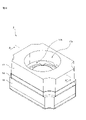
- FIG. 1 is a perspective view of a pressure sensitive switch according to a first embodiment
- FIG. FIG. 2 is a cross-sectional view taken along line AA' shown in FIG. 1
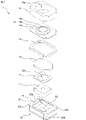
- FIG. 2 is an exploded perspective view of the pressure sensitive switch shown in FIG. 1
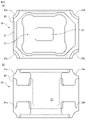
- (a) is a plan view of the circuit board shown in FIG. 1
- (b) is a bottom view of the circuit board shown in FIG. 2 is a block diagram of a detection system that detects pressure based on an electrical signal output from the pressure-sensitive switch shown in FIG. 1
- FIG. It is a figure which shows the manufacturing method of the pressure-sensitive switch shown in FIG.
- FIG. 10 is a perspective view of a pressure-sensitive switch according to a second embodiment
- 8 is a cross-sectional view taken along line AA' shown in FIG. 7
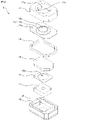
- FIG. FIG. 8 is an exploded perspective view of the pressure sensitive switch shown in FIG. 7
- FIG. 11 is a perspective view of a pressure-sensitive switch according to a third embodiment
- 11 is a cross-sectional view taken along line AA' shown in FIG. 10
- FIG. 11 is an exploded perspective view of the pressure sensitive switch shown in FIG. 10;
- FIG. 10 is a perspective view of a pressure-sensitive switch according to a second embodiment
- 8 is a cross-sectional view taken along line AA' shown in FIG. 7
- FIG. 11 is a perspective view of a pressure-sensitive switch according to a third embodiment
- 11 is a cross-sectional view taken along line AA' shown in FIG. 10
- FIG. 11 is an exploded perspective view of the pressure sensitive switch shown in FIG. 10;
- FIG. 10 is a perspective
- FIG. 10 is a perspective view of the case shown in FIG. 10, and (b) is a bottom view of the case shown in FIG. 2 is a cross-sectional view corresponding to the cross-sectional view of the pressure-sensitive switch according to the second modification of the pressure-sensitive switch shown in FIG. 1 taken along the line AA' shown in FIG. 1;
- FIG. FIG. 15 is a plan view of a circuit board included in the pressure-sensitive switch shown in FIG. 14;
- FIG. 10 is a diagram schematically showing the configuration of a pressure-sensitive switch according to a fourth embodiment, (a) being a perspective view of the pressure-sensitive switch, (b) being an exploded perspective view of the pressure-sensitive switch, and (c) ) is a cross-sectional view of the pressure-sensitive switch taken along line AA' shown in (a).
- 17 is a cross-sectional view schematically showing an operation when the pressure-sensitive switch shown in FIG. 16 is pressed;
- FIG. 17 schematically shows an example of a method for manufacturing the pressure-sensitive switch shown in FIG. 16;
- FIG. FIG. 11 is a diagram schematically showing the configuration of a substrate according to a first modification of the pressure sensitive switch according to the fourth embodiment;
- FIG. 14 is a diagram schematically showing the configuration of a substrate according to a second modification of the pressure-sensitive switch of the fourth embodiment; It is the figure which showed typically the structure of the pressure-sensitive switch which concerns on 5th Embodiment. It is the figure which showed typically the structure of the pressure-sensitive switch which concerns on 6th Embodiment.
- FIG. 21 is a diagram schematically showing a modification of the outer frame member of the pressure sensitive switch according to the sixth embodiment;
- FIG. 21 is a cross-sectional view schematically showing another modification of the outer frame member of the pressure-sensitive switch according to the sixth embodiment;
- FIG. 6 is a diagram schematically showing a reinforcing portion made of a conductive resin, which is another example of the deflection preventing member.
- FIG. 26 is a diagram schematically showing a modification of the reinforcing portion of the conductive resin shown in FIG. 25;
- FIG. 24 is a diagram schematically showing a spacer as still another example of the deflection preventing member shown in FIG.
- FIG. 1 is a perspective view of the pressure-sensitive switch according to the first embodiment
- FIG. 2 is a cross-sectional view along line AA' shown in FIG. 1
- FIG. 3 is an exploded perspective view of the pressure-sensitive switch shown in FIG. It is a diagram.
- the pressure sensitive switch 1 includes a circuit board 10, a dielectric 11, a spacer 12, a conductive sheet 13, an adhesive sheet 14, a waterproof sheet 15 and a case 16.
- a signal representing the magnitude of the pressing force is output to an external detection device (not shown).
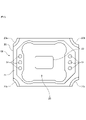
- FIG. 4(a) is a plan view of the circuit board 10
- FIG. 4(b) is a bottom view of the circuit board 10.
- the circuit board 10 includes a base 20, a first connection terminal 21, a second connection terminal 22, a first side electrode 23a, a second side electrode 23b, a third side electrode 23c, a fourth side electrode 23d, and a first bottom electrode 24a. , a second bottom electrode 24b, a third bottom electrode 24c and a fourth bottom electrode 24d.
- the base 20 has a substantially rectangular planar shape with cut corners, and is formed with a recess 25 capable of accommodating the dielectric 11 .
- the first connection terminal 21 and the second connection terminal 22 are conductive thin films made of a conductive material such as copper.
- the first connection terminal 21 has a substantially frame-like planar shape and is arranged on the surface of the base 20 so as to surround the recess 25 .
- the second connection terminal 22 is a plate-like member having a rectangular planar shape and is arranged on the bottom surface of the recess 25 .
- the second connection terminal 22 forms, together with the dielectric 11 and the conductive sheet 13, a variable capacitor whose capacitance changes as the conductive sheet 13 is pushed down.
- the first side electrode 23a, the second side electrode 23b, the third side electrode 23c, and the fourth side electrode 23d are made of a conductive material such as copper, like the first connection terminal 21 and the second connection terminal 22. It is a conductive thin film and is arranged in a notch formed in a square of the base 20 .
- the first side electrode 23 a and the second side electrode 23 b are electrically connected to the first connection terminal 21 on the surface of the base 20 and insulated from the second connection terminal 22 .
- the third side electrode 23c and the fourth side electrode 23d are insulated from the first connection terminal 21 and electrically connected to the second connection terminal 22 via the first internal electrode 26 and the second internal electrode 27. .
- the first internal electrode 26 is a cylindrical conductive member also called a through electrode or a conductive via that extends in a direction perpendicular to the extending direction of the first connection terminal 21 and the second connection terminal 22. 2 is electrically connected to the connection terminal 22 .
- the second internal electrode 27 is a flat plate-like conductive member arranged inside the base 20 so as to extend parallel to the first connection terminal 21 and the second connection terminal 22. It is electrically connected to the four side electrodes 23 d and the first internal electrode 26 .
- Each of the first bottom electrode 24a, the second bottom electrode 24b, the third bottom electrode 24c, and the fourth bottom electrode 24d is a conductive thin film formed of a conductive material such as copper. placed in The first bottom electrode 24a is electrically connected to the first side electrode 23a, the second bottom electrode 24b is electrically connected to the second side electrode 23b, and the third bottom electrode 24c is electrically connected to the third side electrode 23c. , and the fourth bottom electrode 24d is electrically connected to the fourth side electrode 23d.
- the first bottom electrode 24a and the second bottom electrode 24b are electrically connected to the first connection terminal 21 via the first side electrode 23a and the second side electrode 23b.
- the third bottom electrode 24c and the fourth bottom electrode 24d are electrically connected to the second connection terminal 22 via the third side electrode 23c and the fourth side electrode 23d, the first internal electrode 26 and the second internal electrode 27. be.
- the dielectric 11 is a dielectric member having a rectangular planar shape formed of a ferroelectric material such as barium titanate having a dielectric constant of 1.0 or more, and has a concave portion whose bottom surface is in contact with the second connection terminal 22 . 25.
- the dielectric 11 is electrically connected to the second connection terminal 22 by being adhered to the second connection terminal 22 via a conductive adhesive layer such as silver paste (not shown), and is inside the recess 25. Fixed.
- the spacer 12 is a rectangular plate-like insulating member made of synthetic resin such as polyimide resin, and is arranged above the dielectric 11 .
- the spacer 12 has a circular through hole 12a formed in its center.
- the conductive sheet 13 is made of conductive rubber in which metal powder or conductive carbon black is mixed with a flexible synthetic resin such as silicone, and is arranged above the dielectric 11 with spacers 12 interposed therebetween.
- the central portion of the lower surface of conductive sheet 13 is arranged to face the central portion of the upper surface of dielectric 11 via through hole 12 a formed in spacer 12 .
- the distance between the top surface of the dielectric 11 and the bottom surface of the conductive sheet 13 is a distance corresponding to the thickness of the spacer 12 .
- conductive rubber is used for the conductive sheet 13, but a film obtained by vapor-depositing aluminum on a polyimide film, a conductive resin sheet, or the like may be used.
- the adhesive sheet 14 is a frame-shaped member made of synthetic resin such as polyimide or polyphthalamide, and is arranged on the upper surface of the base 20 of the circuit board 10 so as to sandwich the conductive sheet 13 .
- the adhesive sheet 14 holds the conductive sheet 13 due to the viscosity of the synthetic resin forming the adhesive sheet 14 .
- the outer edge of the adhesive sheet 14 matches the outer edge of the base 20 .
- the lower surface of the adhesive sheet 14 is adhered to the upper surface of the base 20 with a synthetic adhesive such as an acrylic resin adhesive, and the upper surface of the adhesive sheet 14 is adhered to the lower surface of the waterproof sheet 15 with a synthetic adhesive.
- the waterproof sheet 15 is made of a highly waterproof synthetic resin such as polyimide or polyamide. It protects the conductive sheet 13 from water droplets, moisture, dust, and the like.
- the waterproof sheet 15 includes a base portion 15a, an inclined portion 15b and a pressing surface 15c.
- the outer edge of the base portion 15 a matches the outer edges of the adhesive sheet 14 and the base 20 .
- the inclined portion 15b has a ring-shaped planar shape and is a conical surface that extends upward while being inclined inwardly from the central portion of the base portion 15a.
- the pressing surface 15c has a circular planar shape and is arranged inside the inclined portion 15b.
- the pressing surface 15c moves downward and contacts the upper surface of the conductive sheet 13 in response to being pressed from above. As the pressing surface 15 c is further pressed, the lower surface of the conductive sheet 13 contacts the upper surface of the dielectric 11 . After the lower surface of the conductive sheet 13 contacts the upper surface of the dielectric 11, when the pressing surface 15c is further depressed, the area of the contact surface where the lower surface of the conductive sheet 13 and the upper surface of the dielectric 11 contact gradually increases. As the area of the contact surface where the lower surface of the conductive sheet 13 and the upper surface of the dielectric 11 contact increases, the capacitance of the capacitor formed by the conductive sheet 13 and the second connection terminals 22 increases.
- the pressure-sensitive switch 1 transmits an electric signal indicating the capacitance of the capacitor, which changes when the pressing surface 15c of the waterproof sheet 15 is pressed, to the first bottom electrode 24a, the second bottom electrode 24b, the third bottom electrode 24c, and the third bottom electrode 24c. 4 output from the bottom electrode 24d.
- the case 16 is made of a highly rigid synthetic resin such as polyamide resin, and its lower surface is adhered to the upper surface of the waterproof sheet 15 with a synthetic adhesive.
- the case 16 is formed with a push-down hole 16a penetrating from the upper surface to the lower surface.
- the diameter of the depression hole 16 a is longer than the outer shape of the inclined portion 15 b of the waterproof sheet 15 , and the lower surface of the case 16 is adhered to the upper surface of the base portion 15 a of the waterproof sheet 15 .
- the lower surface of the case 16 is applied with a fixing pressure P1 (not shown) corresponding to the facing area where the lower surface of the case 16 and the upper surface of the conductive sheet 13 face each other through the base 15a of the waterproof sheet 15 and the weight of the case 16. applied to
- FIG. 5 is a block diagram of a detection system that detects pressure sensitivity based on the electrical signal output from the pressure sensitive switch 1.
- the detection system 30 has an oscillator circuit 31 , a switched capacitor circuit 32 , a sample and hold circuit 33 , a monostable multivibrator 34 and an amplifier 35 .
- the switched capacitor circuit 32 is connected to the output terminal of the oscillation circuit 31 .
- the sample hold circuit 33 is connected to the output terminal of the switched capacitor circuit 32 .
- a monostable multivibrator 34 is connected between the oscillator circuit 31 and the sample-and-hold circuit 33 .
- the amplifier 35 is connected to the output terminal of the sample hold circuit 33 .
- the switched capacitor circuit 32 has a pressure sensitive switch 1 , an operational amplifier 36 , a reference capacitor 37 and an analog switch 38 .
- a reference capacitor 37 is connected between the oscillator circuit 31 and the inverting input terminal of the operational amplifier 36 .
- the pressure sensitive switch 1 is connected between the inverting input terminal of the operational amplifier 36 and the output terminal of the operational amplifier 36 .
- the analog switch 38 is connected in parallel with the pressure-sensitive switch 1 and connected to the oscillation circuit 31 .
- the pressure-sensitive switch 1 is formed by the conductive sheet 13 and the second connection terminal 22 by changing the area of the contact surface where the lower surface of the conductive sheet 13 and the upper surface of the dielectric 11 contact when the pressing surface 15c is pressed. function as a variable capacitor with a variable capacitance.
- the analog switch 38 is switched in synchronization with the oscillation cycle of the oscillation circuit 31, half-wave amplitude modulation proportional to the ratio Cr/Cs between the capacitance Cr of the reference capacitor 37 and the capacitance Cs of the pressure-sensitive switch 1 is generated.
- An output Vout is obtained.
- Vp is the applied voltage to the reference capacitor 37 and the pressure-sensitive switch 1 .
- Vout -Vp.(Cr/Cs)
- a monostable multivibrator 34 that receives the output signal of the oscillation circuit 31 generates a timing pulse and supplies it to the sample hold circuit 33 .
- the sample hold circuit 33 holds the output of the operational amplifier 36 at the time of receiving the timing pulse and supplies it to the amplifier 35 .
- the sensing system 30 makes it possible to sense the output Vout proportional to the capacitance Cr of the pressure sensitive switch 1 .
- FIG. 6A and 6B show a method of manufacturing the pressure-sensitive switch 1.
- FIG. 6A shows the first step
- FIG. 6B shows the second step
- FIG. 6C shows the third step
- 6(d) shows the fourth step
- FIG. 6(e) shows the fifth step
- FIG. 6(f) shows the sixth step.
- FIG. 6 shows the manufacturing process of a single pressure-sensitive switch 1.
- a plurality of pressure-sensitive switches 1 are collectively assembled by using a collective board in which a plurality of circuit boards 10 are connected.
- a collective board in which a plurality of circuit boards 10 are connected is prepared.
- the collective substrate is heated to cure the conductive adhesive layer, and through the conductive adhesive layer, The dielectric 11 is arranged in the recess 25 by being adhered to the second connection terminal 22 .
- the spacer 12 is arranged above the dielectric 11 by bonding the bottom surface of the spacer 12 to the top surface of the dielectric 11 .
- the integrated conductive sheet 13 and adhesive sheet 14 are arranged on the upper surface of the circuit board 10, and the lower surface of the adhesive sheet 14 is adhered to the upper surface of the circuit board 10, whereby the conductive sheet 13 is is arranged above the dielectric 11 via the spacer 12 .
- the waterproof sheet 15 is arranged so as to cover the dielectric 11 , the spacers 12 and the conductive sheet 13 by bonding the bottom surface of the waterproof sheet 15 to the top surface of the adhesive sheet 14 .
- the case 16 is arranged above the waterproof sheet 15 by bonding the lower surface of the case 16 to the upper surface of the waterproof sheet 15 .
- the pressure-sensitive switches 1 formed on the plurality of circuit boards 10 are cut, thereby completing the manufacturing process of the pressure-sensitive switches 1 .
- the pressure-sensitive switch 1 Since the pressure-sensitive switch 1 has a simple configuration with a small number of parts due to the circuit board 10, the dielectric 11, the spacer 12, the conductive sheet 13, the adhesive sheet 14, the waterproof sheet 15, and the case 16, it is manufactured by a simple manufacturing process. be able to.
- the pressure-sensitive switch 1 can be miniaturized by minimizing the area to be covered.
- the adhesive sheet 14 functions as a deflection preventing member that fixes the conductive sheet 13. Therefore, deterioration due to abrasion of the conductive sheet 13 against the upper surface of the circuit board 10 or the like is suppressed for each pressing operation. can do.
- FIG. 7 is a perspective view of the pressure-sensitive switch 2 according to the second embodiment
- FIG. 8 is a cross-sectional view along line AA' shown in FIG. 7
- FIG. 9 is an exploded view of the pressure-sensitive switch shown in FIG. It is a perspective view.
- the pressure-sensitive switch 2 differs from the pressure-sensitive switch 1 in that it has a first adhesive sheet 44a and a second adhesive sheet 44b instead of the adhesive sheet 14. Moreover, the pressure-sensitive switch 2 differs from the pressure-sensitive switch 1 in that it has a bending prevention sheet 45 .
- the configuration and function of the constituent elements of the pressure-sensitive switch 2 other than the first adhesive sheet 44a, the second adhesive sheet 44b, and the deflection prevention sheet 45 are the same as the configuration and function of the constituent elements of the pressure-sensitive switch 1 denoted by the same reference numerals. Therefore, detailed description is omitted here.
- the first adhesive sheet 44a and the second adhesive sheet 44b are frame-shaped members formed of a synthetic resin such as polyimide or polyphthalamide, and are attached to the base 20 of the circuit board 10 so as to surround the conductive sheet 13. It is arranged superimposed on the upper surface. The first adhesive sheet 44a and the second adhesive sheet 44b are adhered with an adhesive.
- the deflection preventing sheet 45 is a frame-shaped insulating member made of synthetic resin such as polyimide resin, and is arranged between the second adhesive sheet 44 b and the waterproof sheet 15 .
- the anti-deflection sheet 45 fixes the conductive sheet 13 by pressing the conductive sheet 13 with its inner edge.
- the anti-bending sheet 45 functions to fix the conductive sheet 13, thereby suppressing deterioration of the conductive sheet 13 due to abrasion of the conductive sheet 13 against the upper surface of the circuit board 10, etc., each time a pressing operation is performed. be able to.
- the second adhesive sheet 44a is applied from the lower surface of the first adhesive sheet 44a to the second adhesive sheet 44b.
- the height to the upper surface of the adhesive sheet 44b can be set to be the same as or lower than the height of the conductive sheet 13 .
- the height from the lower surface of the first adhesive sheet 44a to the upper surface of the second adhesive sheet 44b is set equal to or lower than the height of the conductive sheet 13,
- the anti-deflection sheet 45 can fix the conductive sheet 13 more firmly.
- FIG. 10 is a perspective view of the pressure-sensitive switch according to the third embodiment
- FIG. 11 is a cross-sectional view along line AA' shown in FIG. 10
- FIG. 12 is an exploded perspective view of the pressure-sensitive switch shown in FIG. It is a diagram.
- the pressure-sensitive switch 3 differs from the pressure-sensitive switch 1 in having a case 17 instead of the case 16.
- the configurations and functions of the constituent elements of the pressure-sensitive switch 3 other than the case 17 are the same as those of the constituent elements of the pressure-sensitive switch 1 denoted by the same reference numerals, and therefore detailed descriptions thereof are omitted here.
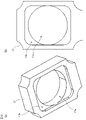
- FIG. 13(a) is a perspective view of the case 17, and FIG. 13(b) is a bottom view of the case 17.
- FIG. 13(b) is a perspective view of the case 17
- the case 17, like the case 16, is made of a highly rigid synthetic resin such as a polyamide resin, and its lower surface is adhered to the upper surface of the waterproof sheet 15 with a synthetic adhesive.
- the case 17 has a diameter longer than the outer shape of the inclined portion 15b of the waterproof sheet 15, and is formed with a push-down hole 17a penetrating from the upper surface to the lower surface.
- the bottom surface of the case 17 is formed so that the area of the opening is larger than the area of the opening of the push-down hole 17a and includes the opening of the push-down hole 17a when the bottom of the case 17 is viewed from above.
- a recess 17b is formed.
- the length of the recess 17b in the short direction is the same as the diameter of the depression hole 17a, and the length of the recess 17b in the longitudinal direction is longer than the diameter of the depression hole 17a.
- the depth of the recess 17b is greater than the height between the base 15a of the waterproof sheet 15 and the pressing surface 15c.
- the width of the recess 17 b is wider than the width of the dielectric 11 .
- the conductive sheet 13 is integrated with the adhesive sheet 14 by being sandwiched between the adhesive sheets 14 . deforms convexly toward the pressing surface 15c.
- the on-load applied to the pressing surface 15c when the pressing surface 15c is pressed increases, and the operator operating the pressure sensor 1 moves the pressing surface 15c upward. There is a risk that the burden on the operator will increase due to the increased load when pressing 15c.
- the convex deformation of the conductive sheet 13 can be suppressed.
- variation occurs in the thickness of the sandwiched conductive sheet 13 .
- the thickness of the conductive sheet 13 varies, the distance between the conductive sheet 13 and the first connection terminals 21 varies, and contact failure may occur between the conductive sheet 13 and the first connection terminals 21 . .
- the width of the conductive sheet 13 is close to the width of the dielectric 11, and since the conductive sheet 13 has no escape, the conductive sheet 13 enters the depression hole 16a.
- the conductive sheet 13 is inserted into the depression hole 16a, which may increase the load when depressed by a pressing portion such as a pen.
- the conductive sheet 13 enters the depression hole 17a through the recess 17b. Flatter than the pressure sensitive switch 1 used.
- the pressure-sensitive sensor 3 Since the flatness of the conductive sheet 13 of the pressure-sensitive switch 3 is more improved than that of the pressure-sensitive switch 1, the pressure-sensitive sensor 3 should have a lighter load than the pressure-sensitive sensor 1 when pressed by a pressing part such as a pen. can be done.
- FIG. 14 is a cross-sectional view corresponding to the cross-sectional view along line AA' shown in FIG. 1 of the pressure-sensitive switch according to the second modification of the pressure-sensitive switch 1, and FIG. 1 is a plan view of a circuit board having; FIG.
- the pressure-sensitive switch 4 differs from the pressure-sensitive switch 1 in that it has a circuit board 50 instead of the circuit board 10 .
- the configurations and functions of the constituent elements of the pressure-sensitive switch 4 other than the circuit board 50 are the same as those of the constituent elements of the pressure-sensitive switch 1 denoted by the same reference numerals, and therefore detailed descriptions thereof are omitted here.
- the circuit board 50 differs from the circuit board 50 in that a plurality of protrusions 51 are formed on the surface of the first connection terminals 21 .
- the configurations and functions of the components of the circuit board 50 other than the plurality of protrusions 51 are the same as the configurations and functions of the components denoted by the same reference numerals, so detailed description thereof will be omitted here.
- Each of the plurality of projections 51 is made of a conductive material such as silver paste having a hardness higher than that of the conductive sheet 13 , and three projections 51 are arranged on each of the pair of short sides of the first connection terminal 21 .
- a plurality of protrusions 51 are formed on the surface of the first connection terminal 21 , thereby suppressing displacement of the conductive sheet 13 without changing the thickness of the conductive sheet 13 .
- the pressure-sensitive switch 4 can suppress the occurrence of poor conduction between the conductive sheets 13 by forming each of the plurality of protrusions 51 from a conductive material.
- the pressure-sensitive switch 45 three protrusions are arranged on each of the pair of short sides of the first connection terminal 21, but in the pressure-sensitive sensor according to the embodiment, the elliptical protrusions are arranged in a pair of short sides. One may be arranged on each side. The shape, number, and position of the protrusions are not limited as long as they are within the first connection terminal 21 .
- the substrate has a recess for housing the dielectric, and the dielectric is arranged in the recess so as to be in contact with the connection terminal formed on the bottom surface of the recess.
- the pressure-sensitive switch is formed only by arranging the conductive resin on the substrate so as to cover the recess. Since the pressure-sensitive switch according to the fourth embodiment is formed by arranging the conductive resin 104 on the substrate 102 so as to cover the concave portion, the structure of the pressure-sensitive switch and its manufacturing method are simplified. be.
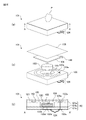
- 16(a) to 16(c) are diagrams schematically showing the configuration of the pressure sensitive switch 101 according to the fourth embodiment.
- 16A is a perspective view of the pressure-sensitive switch 101
- FIG. 16B is an exploded perspective view of the pressure-sensitive switch 101
- FIG. It is a sectional view of pressure sensitive switch 101 in A' line.
- the pressure sensitive switch 101 includes a substrate 102 , a dielectric 103 , a conductive resin 104 and a waterproof sheet 105 .
- the pressure-sensitive switch 101 When the pressure-sensitive switch 101 is pressed from above by a pressing object P such as a finger or a non-dielectric pen, it outputs a signal representing the magnitude of the pressing force to an external detection device (not shown) via the cable 124 .
- the pressure-sensitive switch 101 is used as an operation switch used in mobile communication devices such as smartphones and electronic devices such as tablet devices.
- the planar shape of the pressure-sensitive switch 101 is, for example, a rectangular shape of 4 mm ⁇ 4 mm. may have.
- the substrate 102 is made of a highly insulating material whose main material is polyimide, polyamide, or the like.
- the substrate 102 has a planar shape that roughly matches the contour of the pressure-sensitive switch 1 .
- the substrate 102 is formed with a recess 120 that accommodates the dielectric 103 .
- the concave portion 120 shown in FIG. 16B has a circular planar shape, the shape of the concave portion 120 may be appropriately determined according to the application. good.
- the substrate 102 has a first wiring layer 121a, a second wiring layer 121b, and a third wiring layer 121c.
- the first wiring layer 121 a is formed to be the first surface on the front side of the substrate 102 .
- the second wiring layer 121 b is formed so as to be at least the bottom surface of the recess 120 of the substrate 102 .
- the third wiring layer 121c is formed to be the second surface on the back side opposite to the front surface of the substrate 102 .
- the first wiring layer 121a has first connection terminals 122a.
- the first connection terminal 122a is arranged in a ring shape on the first surface of the substrate 102 so as to surround the concave portion 120 of the substrate 102, as shown in FIG. 16(b).
- the second wiring layer 121b has second connection terminals 122b.
- the second connection terminal 122b is arranged in a circular shape at the center of the circular bottom surface of the recess 120, as shown in FIG. 16(c).
- the third wiring layer 121c has a third connection terminal 122c and a fourth connection terminal 122d.
- the third connection terminal 122c is electrically connected to the first connection terminal 122a through the internal wiring 123a of the substrate 102
- the fourth connection terminal 122d is electrically connected to the second connection terminal 122b through the internal wiring 123b of the substrate 102.
- the third connection terminal 122c is arranged on the second surface of the substrate 102 so as to overlap the first connection terminal 122a in plan view
- the fourth connection terminal 122d is arranged on the substrate 102 so as to overlap the second connection terminal 122b in plan view. Arranged on the second surface.
- the third connection terminal 122c and the fourth connection terminal 122d may be connected to the first connection terminal 122a and the second connection terminal 122b by wiring outside the substrate 102, respectively.
- the internal wirings 123a and 123b are through electrodes or conductive vias formed in the substrate 102.
- the through electrodes are formed in through holes formed in the substrate 102 with a metal paste such as gold, silver, or copper.
- the conductive via is formed by plating gold, silver, copper, or the like on the inner surface of the through hole formed in the substrate 102 .
- the dielectric 103 is arranged in the recess 120 so as to be in contact with the second connection terminal 122b.
- a material of the dielectric 103 is a ferroelectric such as barium titanate having a dielectric constant of 1.0 or more.
- the dielectric 103 has, for example, a flat cylindrical shape with a diameter of 2.8 mm and a thickness of 0.5 mm, or a flat prism shape with a length of 2.8 mm, a width of 2.8 mm and a thickness of 0.5 mm.
- a plurality of dielectrics 103 may be arranged in the recess 120 .
- the dielectric 103 may be adhered to the bottom surface of the recess 120 of the substrate 102 via an adhesive layer such as silver paste (not shown).
- the height of the dielectric 103 is lower than the depth of the recess 120, as shown in FIG. 16(c). By making the height of dielectric 103 lower than the depth of recess 120 , dielectric 103 is completely housed in recess 120 .
- the conductive resin 104 is arranged on the first surface of the substrate 102 so as to be in contact with the first connection terminals 122a and cover the recess 120 with a predetermined gap d from the dielectric 103 .
- the conductive resin 104 is made of a flexible material such as silicone rubber.
- the conductive resin 104 has, for example, a flat prismatic shape of 3.2 mm long ⁇ 3.2 mm wide ⁇ 0.2 mm thick, or a flat cylindrical shape of 3.2 mm diameter ⁇ 0.2 mm thick.
- the conductive resin 104 is formed with protrusions 140 as shown in FIG. 16(b).
- the conductive resin 104 is easily brought into contact with the first connection terminal 122a.
- the predetermined gap d is formed between the conductive resin 104 and the dielectric 103 simply by arranging the conductive resin 104 on the first surface of the substrate 102 . Therefore, the structure of the pressure sensitive switch 101 and its manufacturing method are simplified.
- the waterproof sheet 105 is formed of a highly waterproof material whose main material is a resin such as polyimide or polyamide, and is arranged on the first surface of the substrate 102 so as to cover the conductive resin 104.
- the waterproof sheet 105 has a planar shape that roughly matches the outline of the pressure-sensitive switch 101 and has a thickness of 0.125 mm, for example.
- the waterproof sheet 105 may be adhered to the first surface of the substrate 102 via an adhesive layer 161 such as an adhesive or an adhesive sheet.
- the waterproof sheet 105 may be adhered to the conductive resin 104 via an adhesive layer 162 such as an adhesive or an adhesive sheet.
- the waterproof sheet 105 is adhered to the conductive resin 104 via an adhesive layer 162 such as an adhesive or an adhesive sheet as a deflection prevention member.
- an adhesive layer 162 such as an adhesive or an adhesive sheet as a deflection prevention member.
- the waterproof sheet 105 is arranged on the first surface of the substrate 2 so as to cover the conductive resin 104 to protect the substrate 102, the dielectric 103, and the conductive resin 104 from water droplets, moisture, dust, and the like.
- the waterproof sheet 105 is made of a highly waterproof material whose main material is a resin such as polyimide or polyamide, has a planar shape that roughly matches the contour of the pressure-sensitive switch 101, and has a thickness of, for example, 0.125 mm. .
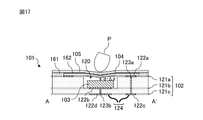
- FIG. 17 is a cross-sectional view schematically showing the operation when the pressure-sensitive switch 101 is pressed.
- a pressing object P such as a finger or a non-dielectric pen
- the conductive resin 104 and the waterproof sheet 105 protrude toward the concave portion 120 of the substrate 102 as shown in FIG. and curves.
- the distance between the dielectric 103 and the conductive resin 104 when the pressure-sensitive switch 101 is not pressed from above is the size of a predetermined gap d, as shown in FIG. 16(c).
- the distance between the dielectric 103 and the conductive resin 104 becomes d- ⁇ d, which is shorter than the predetermined gap d. and the conductive resin 104 changes.
- the pressure-sensitive switch 101 converts a change in capacitance caused by a change in distance between the dielectric 103 and the conductive resin 104 into a potential difference between the first connection terminal 122a and the second connection terminal 122b via the cable 124. output.
- a detection system that detects pressure based on a signal indicating a change in capacitance output from the pressure-sensitive switch 101 is the same as the detection system 30 described with reference to FIG. omitted.
- FIG. 18(a) to 18(c) are diagrams schematically showing an example of a method for manufacturing the pressure sensitive switch 101.
- FIG. 18(a) to 18(c) show the process of dividing one collective pressure-sensitive switch 101c and collectively manufacturing a plurality of pressure-sensitive switches 101 (four in the figure).
- the aggregate substrate 102c is an assembly in which a plurality of substrates 102 are connected.
- dielectrics 103 whose height is lower than the depth of the recesses 120 are arranged in each of the plurality of recesses 120 so as to come into contact with the second connection terminals 122b.
- the conductive resin 104 is placed on the collective substrate 102c so as to contact the first connection terminals 122a and cover the recesses 120 with a predetermined gap d from the dielectric 103. is placed on the first surface of the After the conductive resin 104 is placed, the collective waterproof sheet 105c is placed on the first surface of the collective substrate 102c so as to cover all the conductive resin 104.
- the assembled waterproof sheet 105c is an assembly in which a plurality of waterproof sheets 105 are connected.
- each part constituting the pressure-sensitive switch 101 preferably has heat resistance that can withstand heat treatment, and preferably has heat resistance of at least 270°C.
- the collective pressure-sensitive switch 101c is divided along the dashed cutting line S into a plurality of pressure-sensitive switches 101 as shown in FIG. 18(c). Individualized. For example, dicing may be used as a dividing method.
- the manufacturing method is also simplified.
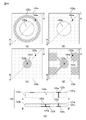
- the pressure-sensitive switch according to the fourth embodiment includes the recess formed on the first surface, the first connection terminal formed on the first surface, and the second connection terminal formed on the bottom surface of the recess. a dielectric disposed in the recess so as to be in contact with the second connection terminal and having a height lower than the depth of the recess; and a dielectric in contact with the first connection terminal and separated from the dielectric by a predetermined gap. and a conductive resin disposed on the first surface of the substrate so as to cover the recess, wherein a change in the size of the gap between the dielectric and the conductive resin when pressed is controlled by the first connection terminal and the second connection. It is characterized by outputting as a change in potential difference between terminals. Since the pressure-sensitive switch 101 is formed simply by arranging the conductive resin on the substrate so as to cover the concave portion, the structure of the pressure-sensitive switch and its manufacturing method are simplified.
- FIGS. 19(a) to 19(e) are diagrams schematically showing the configuration of the substrate 132 according to the first modification included in the pressure sensitive switch 101 according to the fourth embodiment.
- the substrate 102 shown in FIGS. 16(a) to 16(c) is a single substrate 102 integrally molded, but the substrate 132 consists of a first substrate 132a and a second substrate 132a as shown in FIG. 19(e).
- the two substrates 132b may be bonded together.
- 19(a) and 19(b) respectively show the front and rear surfaces of the first substrate 132a
- FIGS. 19(c) and 19(d) respectively show the front and rear surfaces of the second substrate 132b.
- the first substrate 132a has an opening 120a and a first wiring layer 121a.
- the first wiring layer 121a is formed on the surface of the first substrate 132a.
- the second substrate 132b has a second wiring layer 121b and a third wiring layer 121c.
- the second wiring layer 121b is formed on the front surface of the second substrate 132b, and the third wiring layer 121c is formed on the back surface of the second substrate 132b.
- the second substrate 132b may be a flexible substrate.
- the first wiring layer 121a has first connection terminals 122a. As shown in FIG. 19A, the first connection terminal 122a is arranged in a ring shape on the surface of the first substrate 132a, which is the first surface of the substrate 132, so as to surround the opening 120a.
- the second wiring layer 121b has second connection terminals 122b.
- the second connection terminal 122b is arranged in a circular shape in the center of the surface of the second substrate 132b that serves as the bottom surface of the recess 120, as shown in FIG. 19(c).
- the third wiring layer 121c has a third connection terminal 122c and a fourth connection terminal 122d.
- the third connection terminal 122c is arranged on the back surface of the second substrate 132b, which is the second surface of the substrate 132, as shown in FIG. are arranged in a circle on the
- the substrate 132 is easily configured by bonding together the first substrate 132a and the second substrate 132b having simple structures.
- the internal wirings 123a and 123b may be formed after bonding the first substrate 132a and the second substrate 132b together.
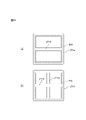
- FIGS. 20(a) to 20(c) are diagrams schematically showing the configuration of a substrate 142 according to a second modification included in the pressure sensor 101 according to the fourth embodiment.
- the substrate 102 shown in FIGS. 18(a) to 18(c) is the substrate 102 having three wiring layers. It may have two wiring layers as shown.
- the substrate 142 has a first wiring layer 121a and a second wiring layer 121b.
- the first wiring layer 121 a forms the first surface, which is the front surface of the substrate 142 .
- the second wiring layer 121b forms at least the bottom surface of the recess 120 of the substrate 142, and forms the second surface, which is the back surface opposite to the surface of the substrate 142. As shown in FIG.
- the substrate 142 is made thinner, and the pressure sensitive switch 101 is made thinner.
- the first wiring layer 121a has first connection terminals 122a.
- the first connection terminal 122a is arranged in a ring shape on the first surface of the substrate 142 so as to surround the recess 120, as shown in FIG. 20(a).
- the second wiring layer 121b has a second connection terminal 122b and a third connection terminal 122c.
- the second connection terminal 122b is arranged circularly in the center of the circular bottom surface of the concave portion 120 as shown in FIG. placed on the face. Further, the third connection terminal 122c is arranged on the second surface of the substrate 142, as shown in FIG. 20(b).
- the second wiring layer 121b may be composed of a metal plate or the like provided with an insulating film.
- FIG. 21 is a diagram schematically showing the configuration of the pressure sensitive switch 151 according to the fifth embodiment.
- a pressure-sensitive switch 151 shown in FIG. 21 further includes a case 108 in addition to the constituent elements of the pressure-sensitive switch 101 .
- the case 108 is made of plastic, metal, or the like, and presses and fixes the conductive resin 104 and the waterproof sheet 105 to the substrate 102 .
- the conductive resin 104 and the waterproof sheet 105 are fixed in the vertical direction, the bending of the conductive resin 104 is suppressed, and even if the pressure sensitive switch 1 is repeatedly pressed, It becomes difficult for the conductive resin 104 to deteriorate.
- An adhesive layer for adhering the conductive resin 104 and the waterproof sheet 105 to the substrate 102 may be omitted.
- the substrate has a recess for housing the dielectric, the dielectric is arranged in the recess so as to be in contact with the connection terminal formed on the bottom surface of the recess, and the conductive resin The anti-deflection member is arranged so as to be in contact with.
- the pressure-sensitive switch according to the present disclosure has a simple structure because the pressure-sensitive switch is formed only by arranging the conductive resin on the substrate so as to cover the recess, and the conductive resin is fixed by the bending prevention member. And it is hard to deteriorate even if it is pressed repeatedly.
- FIGSixth embodiment 22(a) to 22(d) are diagrams schematically showing the configuration of the pressure sensitive switch 201 according to the sixth embodiment.
- 22(a) is a perspective view of the pressure-sensitive switch 201
- FIG. 22(b) is an exploded perspective view of the pressure-sensitive switch 201
- FIG. ' is a cross-sectional view of the pressure-sensitive switch 201 along the line.
- the pressure-sensitive switch 201 includes a substrate 202 , a dielectric 203 , a conductive resin 204 , a waterproof sheet 205 and an outer frame member 271 .
- the structures and functions of the substrate 202, the dielectric 203, the conductive resin 204, and the waterproof sheet 205 are the same as the structures and functions of the substrate 102, the dielectric 103, the conductive resin 104, and the waterproof sheet 105, so detailed descriptions thereof are omitted here. .
- the outer frame member 271 has an opening 270 whose planar shape roughly matches the outline of the conductive resin 204 , and is arranged on the first surface of the substrate 202 so as to surround the outer edge of the conductive resin 4 .
- the outer frame member 271 is made of a resin-based material such as polyimide or polyphthalamide. Further, the outer frame member 271 may be made of the same material as the conductive resin 204 .
- the outer frame member 271 has a planar shape that roughly matches the outline of the pressure-sensitive switch 201 and has a thickness of, for example, 0.17 mm. It functions as a positioning member that positions 204 .
- the pressure-sensitive switch 201 is fixed by adjusting the amount of deflection of the waterproof sheet 205 by arranging the outer frame member 271 between the waterproof sheet 205 and the substrate 202 without directly adhering the waterproof sheet 205 to the substrate 202. It becomes possible to
- the outer frame member 281 is attached to the substrate 202 with its upper surface adhered to the lower surface of the outer edge of the waterproof sheet 205 via an adhesive layer 264 such as an adhesive or an adhesive sheet. is different from the outer frame member 271 .
- an adhesive layer 264 such as an adhesive or an adhesive sheet.
- FIGS. 23(a) to 23(d) are cross-sectional views schematically showing modifications of the outer frame member 271, which are examples of anti-deflection members. Since the opening 270 has a planar shape smaller than the outline of the conductive resin 204 , it is arranged on the first surface of the substrate 202 so as to overlap the outer edge of the conductive resin 204 in plan view, thereby fixing the conductive resin 204 . By arranging the outer frame members 271a to 271d, bending of the conductive resin 204 is suppressed, so that the conductive resin 204 is less likely to deteriorate even if the pressure sensitive switches 201a to 201d are repeatedly pressed.
- the outer frame members 271a to 271d are made of a resin-based material such as polyimide or polyphthalamide.
- the outer frame member 271a according to the first modification is fixed by sandwiching the outer edge of the conductive resin 204 between the outer frame member 271a and the substrate 202 in the pressure-sensitive switch 201a.
- the conductive resin 204 may be adhered to the substrate 202 when the outer frame member 271a is used.
- the outer frame member 271b according to the second modification is fixed by sandwiching the outer edge of the conductive resin 204 between the outer frame member 271b and the waterproof sheet 205 in the pressure-sensitive switch 201b. .
- the conductive resin 204 may be adhered to the waterproof sheet 205 when the outer frame member 271b is used.
- the outer frame member 271c according to the third modification has a first outer frame member 2711 and a second outer frame member 2712 in the pressure-sensitive switch 201c.
- the frame member 2711 and the second outer frame member 2712 sandwich and fix the outer edge of the conductive resin 204 .
- the outer edge of the conductive resin 204 and the inner edge of the outer frame member 271d according to the fourth modification are the same as the upper surface of the conductive resin 204 and the outer frame member 271d in the pressure sensitive switch 201d. are shaped to engage each other so that the upper surfaces of the The conductive resin 204, the outer frame member 271d, and the engaging portion 243 between the conductive resin 204 and the outer frame member 271d are waterproofed by engaging each other so that the top surface of the conductive resin 204 and the top surface of the outer frame member 271d are aligned. It is in contact with the lower surface of the sheet 205 without gaps.
- the conductive resin 204 may be adhered to the waterproof sheet 205 .
- the outer edge of the conductive resin 204 and the inner edge of the outer frame member 271d may have a shape that engages with each other such that the lower surface of the conductive resin 204 and the lower surface of the outer frame member 271d are aligned.
- the conductive resin 204, the outer frame member 271d, and the engaging portion 243 between the conductive resin 204 and the outer frame member 271d are engaged with each other so that the lower surface of the conductive resin 204 and the lower surface of the outer frame member 271d are aligned with each other. It is in contact with the upper surface of 202 without gaps.
- a conductive resin 204 may be adhered to the substrate 202 .
- outer frame member according to the modified example may have an uneven shape on the surface where the conductive resin 204 is sandwiched and fixed.
- a detection system that detects pressure based on a signal indicating a change in capacitance output from the pressure-sensitive switch 201 is the same as the detection system 30 described with reference to FIG. omitted.
- FIGS. 24(a) and 24(b) are plan views schematically showing other modifications of the outer frame member of the pressure-sensitive switch according to the sixth embodiment. 24(a) and 24(b), illustration of the protrusion 240 of the conductive resin 204 is omitted for the sake of convenience.
- the outer frame member 271e according to the fifth modified example has a reinforcing portion 2713 connected from one end to the other end of the outer frame member 271e.
- the reinforcing portion 2713 may be made of the same material as the outer frame member 271e, or may be a plate spring made of metal or the like. Since the outer frame member 271e has the reinforcing portion 2713, the bending of the conductive resin 204 is suppressed. The conductive resin 204 may be adhered to the reinforcing portion 2713 of the outer frame member 271e.
- the outer frame member 271f according to the sixth modification is a reinforcing portion connected from another end of the outer frame member 271f to another other end so as to intersect with the reinforcing portion 2713. 2714. Further having the reinforcing portion 2714 makes it more difficult for the conductive resin 204 to deteriorate. The conductive resin 204 may be further adhered to the reinforcing portion 2714 of the outer frame member 271f.
- the reinforcements 2713 and 2714 shown in FIGS. 24(a) and 24(b) may be combined with the configurations shown in FIGS. 23(a)-23(d).
- the reinforcing portions 2713 and 2714 may be provided on either side of the conductive resin 204.
- the conductive resin 204 is pressed so that the conductive resin 204 protrudes toward the concave portion 220 side of the substrate 202 and is easily bent. It is preferably provided on the side where the
- FIGS. 25(a) to 25(c) are diagrams schematically showing a reinforcing portion 272 of the conductive resin 204, which is another example of the deflection prevention member.
- the pressure-sensitive switch 201 may include a reinforcing portion 272 that reinforces the conductive resin 204 from one end to the other end, as shown in FIG. 25(a).
- the reinforcing portion 272 is an example of a deflection prevention member, and is a plate spring made of metal or the like. Since bending of the conductive resin 204 is suppressed by providing the reinforcing portion 272, the conductive resin 204 is less likely to deteriorate even if the pressure-sensitive switch 201 is repeatedly pressed.
- the reinforcing portion 272 may be arranged along the diagonal line of the conductive resin 204 as shown in FIG. 25(b). Further, another reinforcing portion 272b may be arranged along another diagonal line of the conductive resin 204 so as to cross the reinforcing portion 272 so that the reinforcing portion 272 and the reinforcing portion 272b form a cross shape. By arranging the reinforcing portion 272 and the reinforcing portion 272b in a cross shape, the conductive resin 204 is further prevented from deteriorating.
- the reinforcing portion 272c according to the modification may be arranged so as to cross all the sides of the conductive resin 204, as shown in FIG. 25(c).
- the reinforcing portions 272 and 272b may be provided on either side of the conductive resin 204, but the conductive resin 204 is pressed so that the conductive resin 204 projects toward the concave portion 220 side of the substrate 202 and is easily bent. It is preferably provided on the side where the Also, the reinforcing portions 272 and 272b may be provided on both sides of the conductive resin 204, and as shown in FIG.
- the outer frame member 271b may sandwich and fix the outer edge of the conductive resin 4 .
- FIGS. 26(a) and 26(b) are diagrams schematically showing modifications of the reinforcing portion 272 of the conductive resin 204.
- FIG. 26(a) shows a perspective view of the conductive resin 204
- FIG. 26(b) shows a plan view of the conductive resin 204.
- FIG. 26(a) shows a perspective view of the conductive resin 204
- FIG. 26(b) shows a plan view of the conductive resin 204.
- the conductive resin 204 has a protrusion 240 at one corner, which is arranged to contact the first connection terminal 222a of the substrate 202, and a reinforcing portion 272. may be arranged to reinforce from the protrusion 240 of the conductive resin 204 to the other corner of the conductive resin 204 .
- the reinforcing portion 272 By arranging the reinforcing portion 272 so as to reinforce the conductive resin 204 from the protrusion 240 of the conductive resin 204 to the other corner of the conductive resin 204, the conductive resin 204 is entirely reinforced by the reinforcing portion 272, so that the conductive resin 204 further deteriorates. becomes difficult.
- FIG. 27 is a diagram schematically showing a spacer 273, which is still another example of the deflection prevention member.
- FIG. 27 is a cross-sectional view of a pressure-sensitive switch 201a according to a modification taken along line AA' shown in FIG. 22(a).
- the separation distance between the dielectric 203 and the conductive resin 204 is large, the deformation of the conductive resin 204 becomes large when the pressure sensitive switch 201a is pressed, and the conductive resin 204 tends to deteriorate. Further, if the size of the gap d between the dielectric 203 and the conductive resin 204 varies, the pressure-sensitive accuracy of the pressure-sensitive switch 201a is lowered.
- a plurality of spacers 273 are arranged between the dielectric 203 and the conductive resin 204 to keep the gap d between the dielectric 203 and the conductive resin 204 at a predetermined small constant distance. .
- the height of the spacer 273 is, for example, 0.025 mm.
- the size of the gap d between the dielectric 203 and the conductive resin 204 is fixed to the height of the spacer 273, the deformation of the conductive resin 204 when the pressure-sensitive switch 201a is pressed becomes small. 204 is suppressed from deteriorating.
- the height of the dielectric 203 is preferably higher than the depth of the recess 220, as shown in FIG.
- the difference between the height of the dielectric 203 and the depth of the recess 220 of the substrate 202 is set to 0.1 mm, for example.
- the conductive resin 204 and the waterproof sheet 205 have bent portions, the conductive resin 204 and the waterproof sheet 205 can be fixed to the concave portion 220 by covering the dielectric 203 from above. Moreover, bending of the conductive resin 204 and the waterproof sheet 205 is suppressed.
- An adhesive layer for adhering the dielectric 203 to the bottom of the recess 220 may be omitted. Also, instead of the outer frame member 271, an adhesive layer 261 may be arranged to adhere the waterproof sheet 205 to the first surface of the substrate 202.
- the pressure-sensitive switch 201 includes the recess formed on the first surface, the first connection terminal formed on the first surface, and the second connection terminal formed on the bottom surface of the recess.
- a substrate having a terminal, a dielectric disposed in the recess so as to be in contact with the second connection terminal, and a substrate in contact with the first connection terminal and covering the recess with a predetermined gap from the dielectric.
- the pressure-sensitive switch 201 Since the pressure-sensitive switch 201 according to the sixth embodiment is formed only by arranging the conductive resin, the pressure-sensitive switch has a simple structure and is resistant to deterioration even when repeatedly pressed. .
- the manufacturing method of the pressure-sensitive switch 201 is the same as that of FIGS.
- the pressure-sensitive switch may have the following aspects. (1) a substrate having a recess formed on a first surface, first connection terminals formed on the first surface, and second connection terminals formed on the bottom surface of the recess; a dielectric disposed in the recess so as to be in contact with the second connection terminal and having a height lower than the depth of the recess; a conductive resin disposed on the first surface of the substrate so as to be in contact with the first connection terminal and cover the recess with a predetermined gap from the dielectric; and outputting a change in the size of the gap between the dielectric and the conductive resin when pressed as a change in the potential difference between the first connection terminal and the second connection terminal. pressure switch.
- the substrate further has a third connection terminal and a fourth connection terminal formed on a second surface opposite to the first surface;
- the pressure-sensitive switch according to aspect 1 wherein the third connection terminal is electrically connected to the first connection terminal, and the fourth connection terminal is electrically connected to the second connection terminal.
- the substrate is a first substrate having an opening and a first connection terminal, and a second substrate having a second connection terminal, a third connection terminal, and a fourth connection terminal. composed together, The pressure-sensitive switch according to aspect 2, wherein the opening is closed by the second substrate to form a recess on the surface of the first substrate opposite to the first surface.
- the substrate further has third connection terminals formed on a second surface opposite to the first surface, and the third connection terminals are electrically connected to the first connection terminals.
- the pressure-sensitive switch according to aspect 1 is, The pressure-sensitive switch according to aspect 1, wherein the second connection terminal is formed on the second surface of the substrate.
- the pressure-sensitive switch according to any one of modes 1 to 4 further comprising a waterproof sheet arranged on the first surface of the substrate so as to cover the conductive resin.
- An aggregate substrate having a plurality of recesses formed on the first surface, first connection terminals formed on the first surface, and second connection terminals formed on bottom surfaces of the plurality of recesses. to form disposing a dielectric whose height is lower than the depth of the recess in each of the plurality of recesses so as to be in contact with the second connection terminal; disposing a conductive resin on the first surface of the aggregate substrate so as to be in contact with the first connection terminal and cover the plurality of recesses with a predetermined gap from the dielectric, and Cut the collective substrate to manufacture multiple pressure sensitive switches,
- a method of manufacturing a pressure-sensitive switch comprising the steps of:
- the pressure-sensitive switch may have the following aspects. (1) a substrate having a recess formed on a first surface, first connection terminals formed on the first surface, and second connection terminals formed on the bottom surface of the recess; a dielectric disposed in the recess so as to be in contact with the second connection terminal; a conductive resin disposed on the first surface of the substrate so as to be in contact with the first connection terminal and cover the recess with a predetermined gap from the dielectric; a waterproof sheet disposed on the first surface of the substrate so as to cover the conductive resin; a deflection prevention member arranged to be in contact with the conductive resin and fixing the conductive resin; and outputting a change in the size of the gap between the dielectric and the conductive resin when pressed as a change in the potential difference between the first connection terminal and the second connection terminal.
- the pressure-sensitive switch (2) The pressure-sensitive switch according to mode 1, wherein the conductive resin is adhered to the waterproof sheet. (3) The pressure-sensitive member according to aspect 1 or 2, wherein the deflection prevention member includes an outer frame member that is arranged on the first surface of the substrate so as to overlap the outer edge of the conductive resin in plan view and fixes the conductive resin. switch. (4) The pressure-sensitive switch according to aspect 3, wherein the outer frame member is adhered to the substrate, and the outer edge portion of the conductive resin is sandwiched between the outer frame member and the substrate and fixed. (5) The pressure-sensitive switch according to aspect 3, wherein the outer frame member is adhered to the waterproof sheet, and the outer edge portion of the conductive resin is sandwiched between the outer frame member and the waterproof sheet and fixed.
- the outer frame member has a first outer frame member and a second outer frame member, and the first outer frame member and the second outer frame member sandwich and fix the outer edge of the conductive resin.
- the pressure sensitive switch according to aspect 3. (7) The pressure-sensitive switch according to aspect 3, wherein the outer edge portion of the conductive resin and the inner edge portion of the outer frame member are shaped to engage with each other so that the upper surface of the conductive resin and the upper surface of the outer frame member are aligned.
- the outer frame member has a reinforcing portion connected from one end to the other end of the outer frame member; The pressure-sensitive switch according to any one of aspects 3 to 7, wherein the conductive resin is adhered to the reinforcing portion.
- the conductive resin has a protrusion at one corner arranged to come into contact with the first connection terminal; 8.
- the anti-deflection member includes a reinforcing portion adhered to the conductive resin and reinforcing the conductive resin from the projection to the other corner.
- the deflection prevention member includes a plurality of spacers arranged between the dielectric and the conductive resin, and the height of the dielectric is higher than the depth of the recess. pressure sensitive switch.
- a substrate having a recess formed on the first surface, a first connection terminal formed on the first surface, and a second connection terminal formed on the bottom surface of the recess; a dielectric disposed in the recess so as to be in contact with the second connection terminal; a conductive resin disposed on the first surface of the substrate so as to be in contact with the first connection terminal and cover the recess with a predetermined gap from the dielectric; a waterproof sheet disposed on the first surface of the substrate so as to cover the conductive resin; , wherein the waterproof sheet is adhered to the conductive resin and functions as a deflection preventing member for fixing the conductive resin.
- Aspect 11 further comprising an outer frame member disposed on the first surface of the substrate so as to surround the outer edge of the conductive resin and positioning the conductive resin such that the conductive resin is positioned above the dielectric. pressure sensitive switch.
- a pressure-sensitive switch according to aspect 12 wherein the lower surface of the outer frame member is adhered to the upper surface of the outer edge portion of the substrate.
- a pressure-sensitive switch according to aspect 12 or 13 wherein the upper surface of the outer frame member is adhered to the lower surface of the outer edge portion of the waterproof sheet.
Landscapes
- Engineering & Computer Science (AREA)
- Manufacturing & Machinery (AREA)
- Push-Button Switches (AREA)
Priority Applications (1)
| Application Number | Priority Date | Filing Date | Title |
|---|---|---|---|
| JP2022546446A JPWO2022215462A1 (https=) | 2021-04-09 | 2022-03-15 |
Applications Claiming Priority (4)
| Application Number | Priority Date | Filing Date | Title |
|---|---|---|---|
| JP2021066652 | 2021-04-09 | ||
| JP2021-066633 | 2021-04-09 | ||
| JP2021066633 | 2021-04-09 | ||
| JP2021-066652 | 2021-04-09 |
Publications (1)
| Publication Number | Publication Date |
|---|---|
| WO2022215462A1 true WO2022215462A1 (ja) | 2022-10-13 |
Family
ID=83546207
Family Applications (1)
| Application Number | Title | Priority Date | Filing Date |
|---|---|---|---|
| PCT/JP2022/011691 Ceased WO2022215462A1 (ja) | 2021-04-09 | 2022-03-15 | 感圧スイッチ |
Country Status (2)
| Country | Link |
|---|---|
| JP (1) | JPWO2022215462A1 (https=) |
| WO (1) | WO2022215462A1 (https=) |
Citations (3)
| Publication number | Priority date | Publication date | Assignee | Title |
|---|---|---|---|---|
| JP2003234035A (ja) * | 2002-02-06 | 2003-08-22 | Alps Electric Co Ltd | 接点板およびこれを用いたスイッチ装置 |
| JP2016510547A (ja) * | 2013-01-17 | 2016-04-07 | マイクロチップ テクノロジー インコーポレイテッドMicrochip Technology Incorporated | 物理的力容量式タッチセンサ |
| JP2020123481A (ja) * | 2019-01-30 | 2020-08-13 | シチズン電子株式会社 | 感圧スイッチ及びその製造方法 |
-
2022
- 2022-03-15 JP JP2022546446A patent/JPWO2022215462A1/ja not_active Ceased
- 2022-03-15 WO PCT/JP2022/011691 patent/WO2022215462A1/ja not_active Ceased
Patent Citations (3)
| Publication number | Priority date | Publication date | Assignee | Title |
|---|---|---|---|---|
| JP2003234035A (ja) * | 2002-02-06 | 2003-08-22 | Alps Electric Co Ltd | 接点板およびこれを用いたスイッチ装置 |
| JP2016510547A (ja) * | 2013-01-17 | 2016-04-07 | マイクロチップ テクノロジー インコーポレイテッドMicrochip Technology Incorporated | 物理的力容量式タッチセンサ |
| JP2020123481A (ja) * | 2019-01-30 | 2020-08-13 | シチズン電子株式会社 | 感圧スイッチ及びその製造方法 |
Also Published As
| Publication number | Publication date |
|---|---|
| JPWO2022215462A1 (https=) | 2022-10-13 |
Similar Documents
| Publication | Publication Date | Title |
|---|---|---|
| US7528337B2 (en) | Pressure sensitive conductive sheet and panel switch using same | |
| US7960667B2 (en) | Movable contact element and switch using the same | |
| US7538287B2 (en) | Touch panel and manufacturing method thereof | |
| US5569886A (en) | Flexible printed circuit board | |
| US9672998B2 (en) | Push switch | |
| JP3613897B2 (ja) | 液晶表示装置及びその使用機器 | |
| JP7222729B2 (ja) | 感圧スイッチ | |
| WO2009116364A1 (ja) | スライド操作式スイッチ | |
| US7746662B2 (en) | Touch panel | |
| WO2022215462A1 (ja) | 感圧スイッチ | |
| JP2002107245A (ja) | 力検出装置 | |
| JP2001245394A (ja) | エレクトレットコンデンサマイクロホン | |
| JP2023108953A (ja) | 圧力センサ | |
| WO2025118257A1 (zh) | 压电换能器及压力感应按键 | |
| KR20170097925A (ko) | 이동통신 단말기의 사이드 버튼 구조 | |
| WO2019098391A1 (ja) | スイッチ用可動接点体及びスイッチ | |
| JP2001292363A (ja) | 撮像装置および携帯電話機 | |
| KR101208261B1 (ko) | 전자부품용 택트 스위치 | |
| CN114981614B (zh) | 变形检测传感器 | |
| JP3617495B2 (ja) | 半導体素子の接続構造、液晶表示装置及び電子機器 | |
| JP3757779B2 (ja) | 液晶表示装置 | |
| WO2023176902A1 (ja) | 感圧センサ | |
| JP4186972B2 (ja) | 基板間接続用シート状デバイスおよび接続構造体 | |
| CN117642052A (zh) | 压电换能器及压力感应按键 | |
| JP2023059604A (ja) | 圧電デバイス |
Legal Events
| Date | Code | Title | Description |
|---|---|---|---|
| ENP | Entry into the national phase |
Ref document number: 2022546446 Country of ref document: JP Kind code of ref document: A |
|
| 121 | Ep: the epo has been informed by wipo that ep was designated in this application |
Ref document number: 22784447 Country of ref document: EP Kind code of ref document: A1 |
|
| NENP | Non-entry into the national phase |
Ref country code: DE |
|
| 122 | Ep: pct application non-entry in european phase |
Ref document number: 22784447 Country of ref document: EP Kind code of ref document: A1 |