WO2022215156A1 - 香味吸引器 - Google Patents
香味吸引器 Download PDFInfo
- Publication number
- WO2022215156A1 WO2022215156A1 PCT/JP2021/014599 JP2021014599W WO2022215156A1 WO 2022215156 A1 WO2022215156 A1 WO 2022215156A1 JP 2021014599 W JP2021014599 W JP 2021014599W WO 2022215156 A1 WO2022215156 A1 WO 2022215156A1
- Authority
- WO
- WIPO (PCT)
- Prior art keywords
- housing
- magnet
- flavor inhaler
- contact surface
- flavor
- Prior art date
- Legal status (The legal status is an assumption and is not a legal conclusion. Google has not performed a legal analysis and makes no representation as to the accuracy of the status listed.)
- Ceased
Links
Images



Classifications
-
- A—HUMAN NECESSITIES
- A24—TOBACCO; CIGARS; CIGARETTES; SIMULATED SMOKING DEVICES; SMOKERS' REQUISITES
- A24F—SMOKERS' REQUISITES; MATCH BOXES; SIMULATED SMOKING DEVICES
- A24F40/00—Electrically operated smoking devices; Component parts thereof; Manufacture thereof; Maintenance or testing thereof; Charging means specially adapted therefor
- A24F40/40—Constructional details, e.g. connection of cartridges and battery parts
-
- A—HUMAN NECESSITIES
- A24—TOBACCO; CIGARS; CIGARETTES; SIMULATED SMOKING DEVICES; SMOKERS' REQUISITES
- A24F—SMOKERS' REQUISITES; MATCH BOXES; SIMULATED SMOKING DEVICES
- A24F40/00—Electrically operated smoking devices; Component parts thereof; Manufacture thereof; Maintenance or testing thereof; Charging means specially adapted therefor
- A24F40/20—Devices using solid inhalable precursors
Definitions
- the present invention relates to flavor inhalers.
- flavor inhalers for inhaling flavors without burning materials have been known.
- the flavor inhaler has, for example, a chamber containing a flavor generating article and a heater for heating the flavor generating article contained in the chamber.
- a member detachably attached to the outside of the device for the purpose of protecting or customizing the device see Patent Document 1.
- the member can be detachably attached to the flavor suction device by a magnet. It is assumed that such a detachable member may unintentionally come off from the flavor inhaler due to external force being applied while the user is handling the flavor inhaler. Specifically, for example, when the user puts the flavor inhaler in and out of a bag or pocket of clothing, the bag or clothing may get caught on the member, and the member may unintentionally come off the flavor inhaler.
- One of the purposes of the present invention is to prevent the member of the flavor suction device from coming off the flavor suction device.
- a flavor inhaler has a first housing and a second housing connected to the first housing.
- the first housing has a first contact surface that contacts the second housing.
- the length of the second housing in the first direction parallel to the first contact surface is smaller than the length of the outer edge of the first contact surface of the first housing in the first direction.
- the second housing abuts on the first abutment surface of the first housing, and the length of the second housing in the first direction is the first distance of the outer edge of the first abutment surface of the first housing. shorter than the length in the direction.
- the second housing can be attached to the first housing so that the second housing does not protrude from the first contact surface in the first direction.
- a second embodiment is the first embodiment, when viewed from a second direction perpendicular to the first contact surface, the outer edge of the second housing in the first direction is the outer edge of the first housing in the first direction. 1 located inside the outer edge of the contact surface.
- the second housing since the second housing does not protrude from the first contact surface in the predetermined first direction parallel to the first contact surface, the second housing is caught by some member and comes off the first housing. can be further suppressed.
- a third embodiment is the first embodiment or the second embodiment, having an atomizing portion for consumables, and in a state in which the second housing is not connected to the first housing, the first housing
- the gist of the invention is that it is configured to hold a chemical portion.
- the third aspect it is possible to prevent the second housing from coming off the first housing that holds the atomizing section. Further, even if the second housing is detached from the first housing, detachment of the atomizing section from the first housing can be suppressed.
- a fourth mode is any one of the first to third modes, wherein the outer edge of the second housing extends along the first contact surface of the first housing when viewed from a second direction orthogonal to the first contact surface.
- the gist is that it is located inside the outer edge of the surface.
- the second housing since the second housing does not protrude from the first contact surface in an arbitrary direction parallel to the first contact surface, the second housing is prevented from being detached from the first housing due to some member being caught in the second housing. can be further suppressed.
- a fifth embodiment is any one of the first to fourth embodiments, wherein the second housing has a second contact surface that contacts the first contact surface of the first housing, is connected to the first housing, the second housing is separated from the first housing except for the second contact surface of the second housing.
- a gap can be formed between the first contact surface and the second contact surface by contacting the first housing with a portion of the second housing other than the second contact surface. can be prevented.
- the first housing can floating with respect to the second housing. This can prevent foreign matter such as dust from entering the flavor inhaler through the gap between the first contact surface and the second contact surface.
- a sixth form is any one of the first to fifth forms, having a magnet and a magnetic body attracted to the magnet, and one of the magnet and the magnetic body is directly connected to the first housing or The other of said magnet and said ferromagnetic material is directly or indirectly retained by said second housing, and said magnet and said magnetic material are connected to said first housing by said second housing.
- the gist is that it is configured to maintain a state in which the
- the second housing can be easily attached to and detached from the first housing.
- the gist of the seventh embodiment is that in the sixth embodiment, the magnet and the magnetic body are separated from each other when the second housing is connected to the first housing.
- a gap may occur between the second housing and the first contact surface of the first housing depending on the design accuracy of the first housing and the second housing.
- the magnet and the magnetic body do not come into contact with each other, but attract each other to maintain the connected state between the first housing and the second housing. 1 contact surface can be suppressed.
- the heat transmitted from the atomizing section to the magnet is less likely to be transmitted to the magnetic body because air with low thermal conductivity is present in the gap. As a result, it is possible to prevent the second housing from becoming hot.
- An eighth embodiment is the sixth embodiment or the seventh embodiment, having a yoke surrounding the magnet, wherein the magnet has a first surface facing the magnetic body, a second surface facing the first surface, a side surface that connects the first surface and the second surface, and the yoke covers at least part of the side surface of the magnet and the second surface of the magnet.
- the magnetic flux of the magnet can be directed to the first surface side, that is, the magnetic body side by the yoke, so that the first housing and the second housing can be connected more strongly. Moreover, when a magnetic sensor is provided in the flavor inhaler, it is possible to suppress the influence of the magnet on the magnetic sensor.
- a ninth embodiment is the eighth embodiment, wherein the yoke has a side wall portion covering a part of the side surface of the magnet, and the magnet protrudes from the side wall portion of the yoke toward the magnetic body. This is the gist of it.
- the yoke can be made of, for example, a ferritic stainless steel plate.
- the magnet protrudes from the side wall of the yoke toward the magnetic body, so that the side wall of the yoke is prevented from protruding and being exposed from the magnet.
- the yoke material it is possible to save the trouble of processing the end portion of the side wall portion of the yoke on the side of the magnetic material cleanly.
- a tenth form is any one of the first to ninth forms, having a concave portion and a convex portion for positioning the first housing and the second housing, and the first housing includes the concave portion or the convex portion.
- the gist of the invention is that it has either one of a convex portion, and the convex portion is configured to fit into the concave portion.
- the second housing is connected to the first housing so that the convex portion fits in the concave portion, thereby separating the first housing and the second housing. Relative positions can be easily determined. Further, it is possible to prevent the position of the second housing from being shifted with respect to the first housing while the second housing is connected to the first housing.
- a flavor inhaler comprises an atomizing section, a first housing containing the atomizing section, a second housing connected to the first housing, and arranged in one of the first housing and the second housing. and a magnetic body arranged in the other of the first housing and the second housing. The magnet and the magnetic body are configured to keep the second housing connected to the first housing. When the first housing is connected to the second housing, the magnet is separated from the magnetic body.
- the second housing can be easily attached to and detached from the first housing. If the magnet and the magnetic body come into contact with each other, the heat of the atomizing section housed in the first housing is easily transferred to the second housing through the magnet and the magnetic body. According to the eleventh form, since the magnet is separated from the magnetic body, the heat of the atomizing section is less likely to be transmitted to the second housing due to the presence of air between the magnet and the magnetic body. As a result, it is possible to prevent the second housing from becoming hot.
- the flavor inhaler has a first portion provided in the first housing and a second portion provided in the second housing and facing the first portion. You may A first distance between the magnet and the magnetic body is preferably greater than a distance between the first portion and the second portion. The first portion and the second portion may face each other in the direction in which the magnet and the magnetic body face each other.
- the magnet since the magnet is separated from the magnetic body, the heat of the atomizing section is less likely to be transmitted to the second housing. As a result, it is possible to prevent the second housing from becoming hot. Also, the second housing may bend when force is applied to the outer surface of the second housing. In this regard, since the distance between the magnet and the magnetic body is greater than the distance between the first portion and the second portion, even if the second housing bends in the direction in which the magnetic body and the magnet face each other, the magnet The first portion and the second portion come into contact before the contact with the magnetic material. Therefore, the magnet can be prevented from coming into contact with the magnetic body.
- the first portion is a first accommodating portion provided in the first housing, and the second portion is provided in the second housing and faces the first accommodating portion. It may be the second accommodation section.
- a magnet may be placed in one of the first housing portion or the second housing portion.
- a magnetic body may be arranged in the other of the first accommodating portion and the second accommodating portion. Preferably, a first distance between the magnet and the magnetic body is greater than a second distance between peripheral edges of the first receiving portion and the second receiving portion.
- the magnet since the magnet is separated from the magnetic body, the heat of the atomizing section is less likely to be transmitted to the second housing. As a result, it is possible to prevent the second housing from becoming hot. Also, the second housing may bend when force is applied to the outer surface of the second housing. In this regard, since the distance between the magnet and the magnetic body is greater than the second distance between the peripheral edge portions of the first receiving portion and the second receiving portion, the second housing allows the magnet and the magnetic body to face each other. Even if it bends in the direction to which it bends, a 1st accommodating part and a 2nd accommodating part will contact before a magnet contacts a magnetic body. Therefore, the magnet can be prevented from coming into contact with the magnetic body. As a result, it is possible to prevent heat transfer due to contact between the magnet and the magnetic body.
- a magnetic detection element for detecting the magnetism of the magnet and a magnetic detection element containing the magnet and positioned between the magnet and the magnetic detection element and a yoke, wherein the yoke has a side wall portion surrounding the magnet, and a third distance between the side wall portion and the magnetic body is greater than the second distance.
- the third distance between the side wall portion and the magnetic body may be the size of the gap in the direction in which the magnet and the magnetic body face each other.
- the fourteenth form by using the yoke, magnetic shielding can be performed so that the magnetism of the magnet is not detected by the magnetic detection element while increasing the force that attracts the second housing with respect to the first housing. Furthermore, since the third distance is greater than the second distance, even if the second housing is bent in the direction in which the magnetic body and the magnet face each other, the first housing portion and the second housing portion are separated before the magnetic body comes into contact with the yoke. comes into contact. Therefore, it is possible to prevent the magnetic body from contacting the yoke. As a result, it is possible to reduce the amount of heat transferred from the atomizing portion to the surface of the second housing. As a result, it is possible to prevent heat transfer due to contact between the magnetic body and the yoke.
- FIG. 1 is a schematic cross-sectional side view of a consumable;
- FIG. 5 is a cross-sectional view of the flavor sucker taken along line 5-5 shown in FIG. 1B;
- FIG. 6 is a cross-sectional view of the flavor inhaler taken along line 6-6 shown in FIG. 1A;
- FIG. 7A is an enlarged view of the frame 7A shown in FIG. 6.
- FIG. 7B is an enlarged view of a frame 7B shown in FIG. 6.
- FIG. 7C is an enlarged view of the frame 7C shown in FIG. 6.
- FIG. FIG. 3 is a perspective view of a yoke;
- FIG. 1A is a schematic front view of the flavor inhaler 100 according to this embodiment.
- FIG. 1B is a schematic top view of the flavor inhaler 100 according to this embodiment.
- FIG. 1C is a schematic bottom view of the flavor inhaler 100 according to this embodiment.
- an XYZ orthogonal coordinate system may be attached for convenience of explanation. In this coordinate system, the Z axis points vertically upward, the XY plane is arranged to cut the flavor inhaler 100 horizontally, and the Y axis extends from the front to the back of the flavor inhaler 100. arranged to come out.
- the Z-axis can also be said to be the insertion direction of the consumable material 110 accommodated in the chamber 50 of the atomizing section 30, which will be described later.
- the X-axis direction can also be said to be the longitudinal direction of the device in a plane perpendicular to the insertion direction of the consumable material 110, or the direction in which the heating section and the power supply section are aligned.
- the Y-axis direction can also be said to be the lateral direction of the device in a plane perpendicular to the direction of insertion of the consumable.
- the flavor inhaler 100 is configured to be able to heat consumables. Specifically, the flavor inhaler 100 is configured to generate a flavored aerosol, for example, by heating a stick-shaped consumable having a flavor source that includes the aerosol source.
- the flavor inhaler 100 has an outer housing 101, a slide cover 102, and a switch section 103.
- Outer housing 101 forms the outermost housing of flavor inhaler 100 and is sized to fit in the user's hand. When the user uses the flavor inhaler 100, the user can hold the outer housing 101 by hand and inhale the aerosol.
- the outer housing 101 is divided in the Y-axis direction into an outer panel 70 (corresponding to at least part of the members constituting the second housing) and an outer case 80 (second housing). (corresponding to at least part of the members constituting the 1 housing).
- the outer housing 101 can be formed by connecting the outer panel 70 to the outer case 80 in the Y-axis direction.
- the outer panel 70 can be detachably attached to the outer case 80 .
- the slide cover 102 is slidably attached to the outer housing 101 so as to close an opening (not shown) for inserting consumables. Specifically, the slide cover 102 moves between a closed position (position shown in FIGS. 1A and 1B) that closes an opening (not shown) of the outer housing 101 and an open position that opens the opening (not shown). It is configured to be movable along the outer surface of 101 . For example, the user can manually operate the slide cover 102 to move the slide cover 102 between the closed position and the open position. The sliding cover 102 thereby allows or restricts access of consumables to the interior of the flavor inhaler 100 .
- the switch section 103 is used to switch the operation of the flavor inhaler 100 between on and off. For example, by operating the switch unit 103 with the consumable material inserted into the flavor inhaler 100, the user can supply power from a power source (not shown) to a heating unit (not shown) to heat the consumable material without burning it. can be done.
- the switch section 103 may have a switch provided outside the outer housing 101 or may have a switch positioned inside the outer housing 101 . When the switch is located inside the outer housing 101 , the switch is indirectly pressed by pressing the switch portion 103 on the surface of the outer housing 101 . In this embodiment, an example in which the switches of the switch section 103 are located inside the outer housing 101 will be described.
- the flavor inhaler 100 may further have a terminal (not shown).
- a terminal may be an interface that connects the flavor inhaler 100 to, for example, an external power source.
- the power source of the flavor inhaler 100 is a rechargeable battery
- current can flow from the external power source to the power source to charge the power source.
- data transmission cable to the terminal, data related to the operation of the flavor inhaler 100 may be transmitted to an external device.
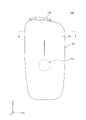
- FIG. 2 is a front view of the flavor inhaler 100 with the outer panel 70 removed.
- FIG. 3 is a front view of the inner side of the outer panel 70.
- the flavor inhaler 100 has an inner panel 10 (corresponding to at least part of the members forming the first housing) inside the outer case 80 . That is, the inner panel 10 is accommodated inside the outer housing 101 .
- the outer housing 101 can hold the inner panel 10 so that the inner panel 10 does not separate from the outer case 80 even when the outer panel 70 is removed from the flavor inhaler 100 . Therefore, the outer case 80 and the inner panel 10 together can constitute a first housing to which the outer panel 70, which can constitute a second housing, is attached and detached.
- the flavor inhaler 100 has a magnet 62 for keeping the outer panel 70 connected to the outer case 80 .
- the magnet 62 is held by the inner panel 10 held by the outer case 80 . That is, the magnet 62 is indirectly held by the outer case 80 . Alternatively, the magnet 62 may be directly held by the outer case 80 . If there is only one magnet 62, the force with which the outer panel 70 is attracted to the outer case 80 is weak, and the connection may easily be broken. Therefore, it is preferable that two or more magnets 62 are provided in the flavor inhaler 100 . In the example shown in FIG. 2, two magnets 62 are held by the inner panel 10 so as to be spaced apart in the Z direction.
- the magnet 62 may be a permanent magnet or an electromagnet using a power source.
- the outer panel 70 has a attracting member 64 (corresponding to an example of a magnetic body) that is attracted by the magnet 62 .
- the attracting member 64 can be made of any material that is attracted to the magnet 62, such as a magnetic material such as ferritic stainless steel or cold-rolled steel plate.
- the attraction member 64 may also be a magnet oriented to be attracted to the magnet 62 .
- the suction member 64 is directly held by the outer panel 70 in the illustrated example, the suction member 64 may be indirectly held by the outer panel 70 via a member other than the outer panel 70 .
- the attraction member 64 can be attached to the outer panel 70 so as to face the magnet 62 when the outer panel 70 is connected to the outer case 80 .
- the magnet 62 and the attracting member 64 are configured to keep the outer panel 70 connected to the outer case 80 . That is, since the outer panel 70 and the outer case 80 are connected by magnetic force rather than mechanical connection means (for example, screw fastening or connection by an adhesive material), a tool such as a screwdriver or a large force is required to break the adhesion.
- the outer panel 70 can be easily attached/detached to/from the outer case 80 without giving any force. Therefore, the flavor inhaler 100 has a suitable structure for a user who wants to replace the outer panel 70 with a preferred one. 2 and 3, the magnet 62 is provided on the outer case 80 and the attracting member 64 is provided on the outer panel 70. However, the magnet 62 is provided on the outer panel 70 and the attracting member 64 is provided on the outer case 80. may be provided.
- FIG. 4 is a schematic side cross-sectional view of consumable 110 .
- the flavor inhaler 100 and the consumable 110 may constitute a smoking system.
- consumable article 110 includes smokable article 111 , tubular member 114 , hollow filter portion 116 and filter portion 115 .
- a smokable article 111 is wrapped by a first wrapping paper 112 .
- the tubular member 114 , the hollow filter portion 116 and the filter portion 115 are wrapped with a second wrapping paper 113 different from the first wrapping paper 112 .
- the second wrapping paper 113 also wraps a portion of the first wrapping paper 112 that wraps the smokable article 111 .
- the tubular member 114, the hollow filter portion 116, the filter portion 115 and the smokable article 111 are connected.
- second wrapping paper 113 may be omitted and first wrapping paper 112 may be used to connect tubular member 114, hollow filter portion 116, and filter portion 115 to smokable article 111.
- FIG. A lip release agent 117 is applied to the outer surface of the second wrapping paper 113 in the vicinity of the filter portion 115 side end to prevent the user's lips from sticking to the second wrapping paper 113 .
- a portion of the consumable product 110 to which the lip release agent 117 is applied functions as a mouthpiece for the consumable product 110 .
- the tubular member 114 that functions as a cooling segment may be provided with openings V concentrically in the circumferential direction.
- the opening V provided in the cylindrical member 114 is normally a hole for facilitating the inflow of air from the outside due to suction by the user. can be lowered.
- Smokables 111 may include flavor sources, such as tobacco, and aerosol sources.
- the first wrapping paper 112 around which the smokable article 111 is wrapped may be a breathable sheet member.
- Tubular member 114 may be a paper tube or hollow filter.
- the consumable item 110 includes a smokable article 111, a tubular member 114, a hollow filter portion 116, and a filter portion 115, but the configuration of the consumable item 110 is not limited to this.
- hollow filter portion 116 may be omitted, and cylindrical member 114 and filter portion 115 may be arranged adjacent to each other.
- the ventilation resistance in the long axis direction per one consumable material 110 is not particularly limited, it is usually 8 mmH 2 O or more, preferably 10 mmH 2 O or more, and preferably 12 mmH 2 from the viewpoint of ease of absorption. O or more is more preferable, and it is usually 100 mmH 2 O or less, preferably 80 mmH 2 O or less, and more preferably 60 mmH 2 O or less.
- FIG. 5 is a cross-sectional view of flavor inhaler 100 taken along line 5-5 shown in FIG. 1B.
- the inner panel 10 is housed inside the outer housing 101 of the flavor inhaler 100 .
- the inner panel 10 is made of, for example, a resin, particularly polycarbonate (PC), ABS (Acrylonitrile-Butadiene-Styrene) resin, PEEK (polyetheretherketone), or a polymer alloy containing a plurality of types of polymers, or It can be made of metal such as aluminum.
- the inner panel 10 is preferably made of PEEK.
- the material of the inner panel 10 is not particularly limited.
- a power supply section 20 and an atomization section 30 for the consumables 110 are provided in the inner space of the inner panel 10 .
- the outer housing 101 is made of, for example, a resin, particularly polycarbonate (PC), ABS (Acrylonitrile-Butadiene-Styrene) resin, PEEK (polyetheretherketone), or a polymer alloy containing a plurality of types of polymers. Alternatively, it may be made of metal such as aluminum.
- the power supply unit 20 has a power supply 21 .
- Power source 21 may be, for example, a rechargeable battery or a non-rechargeable battery.
- the power supply 21 is electrically connected to the atomizing section 30 via a PCB (Printed Circuit Board) (not shown) or the like. Thereby, the power source 21 can supply power to the atomization section 30 so as to appropriately heat the consumable material 110 .
- PCB Print Circuit Board
- the atomizing section 30 includes a chamber 50 extending in the direction in which the consumable material 110 is inserted (the Z-axis direction), a heating section 40 surrounding a portion of the chamber 50, a heat insulating section 32, and a substantially cylindrical insert. and a guide member 34 .
- Chamber 50 is configured to contain consumables 110 .
- the chamber 50 is preferably made of a material having heat resistance and a small coefficient of thermal expansion.
- the chamber 50 can be made of metal such as stainless steel, resin such as PEEK, glass, or ceramic.
- a bottom member 36 may be provided at the bottom of the chamber 50 as shown. Bottom member 36 may act as a stop to position consumable 110 inserted into chamber 50 .
- the bottom member 36 has unevenness on the surface with which the consumable material 110 abuts, and can define a space capable of supplying air to the surface with which the consumable material 110 abuts.
- the bottom member 36 may be made of, for example, a resin material such as PEEK, metal, glass, ceramic, or the like, but is not particularly limited to this.
- the material forming the bottom member 36 may be a material having a lower thermal conductivity than the material forming the chamber 50 .
- an adhesive that can be composed of a resin material such as epoxy resin or an inorganic material can be used.
- the heating unit 40 is configured to contact the outer peripheral surface of the chamber 50 and heat the consumable material 110 housed in the chamber 50 .
- the heating section 40 may comprise a heating element, such as a heating track, and an electrically insulating sheet covering at least one side of the heating element.
- the heat insulation part 32 has a substantially tubular shape as a whole and is arranged so as to surround the chamber 50 .
- the heat insulating portion 32 may include, for example, an airgel sheet.
- the insertion guide member 34 is made of a resin material such as PEEK, PC, or ABS, and is provided between the slide cover 102 in the closed position and the chamber 50 .
- the flavor inhaler 100 also has a first holding portion 37 and a second holding portion 38 for holding the heat insulating portion 32 .
- the first holding portion 37 and the second holding portion 38 can be made of elastomer such as silicone rubber, for example. As shown in FIG. 5, the first holding portion 37 holds the end portion of the heat insulating portion 32 on the Z-axis positive direction side. Also, the second holding portion 38 holds the end portion of the heat insulating portion 32 on the Z-axis negative direction side.
- the insertion guide member 34 has a function of guiding the insertion of the consumable item 110 . Specifically, the insertion guide member 34 guides the insertion of the consumable item 110 into the chamber 50 by inserting the consumable item 110 into the insertion guide member 34 when the slide cover 102 is in the open position. In this embodiment, since the insertion guide member 34 can come into contact with the chamber 50, the insertion guide member 34 is preferably made of PEEK from the viewpoint of heat resistance. As shown in FIG. 5, the slide cover 102 is movable between an open position and a closed position in direction D1.
- the flavor inhaler 100 has a first chassis 22 extending in the Z-axis direction between the power supply 21 and the atomizing section 30, and a second chassis 23 extending to cover the slide cover 102 side of the power supply 21.
- the first chassis 22 and the second chassis 23 are configured to define a space within the inner panel 10 in which the power supply 21 is housed.
- the flavor inhaler 100 contains a printed circuit board having a control unit.
- a slide cover position detection unit (not shown) for detecting this, a light source unit (not shown) for notifying the remaining capacity of the power supply 21 by lighting, a switch unit 103, and a magnetic detection element to be described later are connected. It is
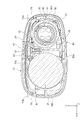
- FIG. 6 is a cross-sectional view of flavor inhaler 100 taken along line 6-6 shown in FIG. 1A.
- the outer case 80 has a first panel portion 80a and a first peripheral wall portion 80b extending from the periphery of the first panel portion 80a at an angle to the first panel portion 80a.
- the outer case 80 also has an opening 81 defined by the first peripheral wall portion 80b. That is, the outer case 80 can be formed in a box shape having an opening 81 as a whole.
- the atomization unit 30 and the power source 21 can be accommodated in the outer case 80 through the opening 81 of the outer case 80 .
- the inner panel 10 is configured to block the opening 81 .
- the outer panel 70 is connected to the outer case 80.
- the outer panel 70 includes a second panel portion 70a positioned to face the first panel portion 80a of the outer case 80, and a second panel portion 70a extending from the periphery of the second panel portion 70a at an angle to the second panel portion 70a. 2 peripheral wall portions 70b.
- the outer panel 70 may be formed only from the second panel portion 70a. That is, the outer panel 70 may be a generally flat panel as a whole.
- the first chassis 22 and inner panel 10 are fastened together with screws 24 .
- the head of screw 24 is covered with magnet 62 . That is, since the screw 24 cannot be removed by using a tool unless the magnet 62 is removed, the user cannot easily disassemble the flavor inhaler 100 .
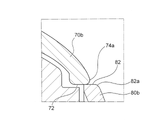
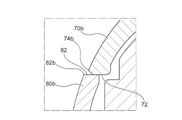
- FIG. 7A is an enlarged view of frame 7A shown in FIG.
- FIG. 7B is an enlarged view of frame 7B shown in FIG.
- the first peripheral wall portion 80b of the outer case 80 has a first contact surface 82 that contacts the outer panel 70.
- the second peripheral wall portion 70 b of the outer panel 70 has a second contact surface 72 that contacts the first contact surface 82 .
- "abutting" means not only when two members are in contact with each other, but also when a slight gap (for example, 5 mm or less) exists between two members due to manufacturing errors. Also includes Therefore, a slight gap due to manufacturing error may exist between the first contact surface 82 and the second contact surface 72 .
- the length of the outer panel 70 in the first direction (the direction parallel to the XZ plane) parallel to the first contact surface 82 is the outer edge of the first contact surface 82 of the outer case 80. less than the length in the first direction.
- the outer panel 70 can be attached to the outer case 80 so that the outer panel 70 does not protrude from the first contact surface 82 in the first direction. Separation from the outer case 80 can be suppressed.
- the direction parallel to the first contact surface 82 in the cross section shown in FIG. 6 is described as the first direction. It can be in any direction parallel to the contact surface 82 .
- the first direction can also be said to be an arbitrary direction parallel to the cross section in which the outer panel 70 is placed on the outer case 80 of the flavor inhaler 100 , for example.
- the outer case 80 is preferably configured to hold the atomizing section 30 when the outer panel 70 is not connected to the outer case 80 . That is, even if the outer panel 70 is detached from the outer case 80 , detachment of the atomizing section 30 from the outer case 80 can be suppressed.
- the outer case 80 is configured to hold the inner panel 10 inside. 20, and atomizing section 30 can be retained.
- the outer edge of the outer panel 70 in the first direction corresponds to the outer edge of the first contact surface 82 of the outer case 80 in the first direction. is preferably located inside the As a result, the outer panel 70 does not protrude from the first contact surface 82 in the predetermined first direction parallel to the first contact surface 82 , thereby further preventing the outer panel 70 from being caught by some member and coming off the outer case 80 .
- the outer edge of the outer panel 70 be positioned inside the outer edge of the first contact surface 82 of the outer case 80 when viewed from the second direction (Y-axis direction) perpendicular to the first contact surface 82 .
- the length of the outer panel 70 in this direction is the outer edge of the first contact surface 82 of the outer case 80. is preferably less than the length of As a result, the outer panel 70 does not protrude from the first contact surface 82 in any direction parallel to the first contact surface 82 , thereby further preventing the outer panel 70 from being caught by some member and coming off the outer case 80 . .
- the outer panel 70 when the outer panel 70 is connected to the outer case 80 , it is preferable that the outer panel 70 does not come into contact with the outer case 80 except for the second contact surface 72 of the outer panel 70 .
- the outer panel 70 does not come into contact with the inner panel 10 when the outer panel 70 is connected to the outer case 80 .
- FIG. 7C is an enlarged view of frame 7C shown in FIG.
- the magnet 62 is housed in a recessed accommodation portion 10a formed in the inner panel 10
- the attracting member 64 is housed in a recessed accommodation portion 70c formed in the outer panel 70, and is attached by an adhesive. can be fixed.
- the magnet 62 and the attracting member 64 are preferably spaced apart so as not to contact each other when the outer panel 70 is connected to the outer case 80 .
- a gap may occur between the outer panel 70 and the first contact surface 82 of the outer case 80 depending on the manufacturing accuracy of the outer panel 70 and the outer case 80 .
- the magnet 62 and the attracting member 64 attract each other without contacting each other, thereby maintaining the state in which the outer panel 70 and the outer case 80 are connected. Therefore, it is possible to suppress the formation of a gap between the outer panel 70 and the first contact surface 82 of the outer case 80 .
- a gap may occur between the first contact surface 82 and the second contact surface 72 due to a slight manufacturing error.
- the magnet 62 is, for example, a double-sided magnetized magnet. It is preferable to use the yoke 55 when the opposing surface facing the attracting member 64 is one of the N pole and the S pole, and the opposite surface opposite to the opposing surface is the other of the N pole and the S pole. If one side of the magnet 62 is multipolar, the yoke 55 is unnecessary.
- the flavor attractor 100 has a yoke 55 surrounding the magnet 62, as shown in FIG. 7C.
- the magnet 62 has a first surface 62a facing the attracting member 64, a second surface 62b opposite to the first surface 62a, and a side surface 62c connecting the first surface 62a and the second surface 62b. As shown in FIG.
- the yoke 55 preferably covers at least a portion of the side surface 62c of the magnet 62 and the second surface 62b.
- the yoke 55 can direct the magnetic flux of the magnet 62 toward the first surface 62a, that is, toward the attracting member 64, so that the outer panel 70 and the outer case 80 can be connected more strongly.
- the flavor inhaler 100 may be provided with a magnetic sensor (magnetic detection element). In this case, the yoke 55 can suppress the influence of the magnet 62 on the magnetic sensor (that is, prevent the magnetic sensor from detecting the magnetism of the magnet 62).
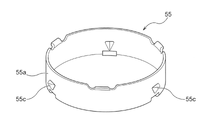
- FIG. 7D is a perspective view of the yoke 55.
- the yoke 55 has a side wall portion 55a, a cap portion 55b, and a claw portion 55c formed on the side wall portion 55a.
- the cap portion 55b is fixed in close contact with the second surface 62b of the magnet 62 via an adhesive.
- Side wall portion 55 a surrounds magnet 62 .
- the side wall portion 55a may cover the entire side surface 62c of the magnet 62, but preferably covers a portion of the side surface 62c.
- the magnet 62 preferably protrudes from the side wall portion 55a of the yoke 55 toward the attracting member 64. As shown in FIG.
- the yoke 55 can be made of a magnetic material such as a ferritic stainless steel plate or a cold-rolled steel plate.
- the magnet 62 protrudes from the side wall portion 55a of the yoke 55 toward the attracting member 64, so that the side wall portion 55a of the yoke 55 is prevented from protruding from the magnet 62 and being exposed.
- the material of the yoke 55 it is possible to save the trouble of processing the end portion of the side wall portion 55a of the yoke 55 on the side of the suction member 64 cleanly.
- the first surface 62a is the N pole
- the second surface 62b is the S pole.
- the magnetic lines of force are directed from the first surface 62a to the attracting member 64, and from the attracting member 64 to the tip of the side wall portion 55a of the yoke 55 that is close to the attracting member 64, thereby increasing the force of the magnet 62 that attracts the attracting member 64.
- the diameter of the suction member 64 is made larger than the diameter of the side wall portion 55a. More specifically, the width or diameter of the surface of the attracting member 64 facing the yoke 55 is made larger than the width or diameter of the side wall portion 55 a of the yoke 55 .
- the attracting member 64 can face the tip of the side wall portion 55a of the yoke 55, so that the magnet 62 has the effect of attracting the attracting member 64. can be avoided.
- the magnetic sensor described above can be used to detect the presence or absence of the outer panel 70 .
- the magnet 62 is provided on the inner surface of the outer panel 70
- the magnetic sensor is provided on the inner panel 10 or a portion covered with the inner panel 10
- the side wall portion 55a of the yoke 55 is positioned between the magnetic sensor and the magnet 62. can be placed in This makes it difficult for the magnetic sensor to detect the magnetism of the magnet 62, thus easing restrictions on placement of the magnetic sensor.
- the flavor inhaler 100 preferably has recesses and protrusions for positioning the outer panel 70 and the outer case 80 relative to each other.
- the outer panel 70 preferably has either a concave portion or a convex portion, and the convex portion is preferably configured to fit into the concave portion.
- the outer panel 70 has a convex portion 66 (or a peripheral portion 66) that defines a housing portion 70c of the suction member 64.
- the convex portion 66 protrudes in a direction substantially perpendicular to the first contact surface 82 .
- the inner panel 10 also has recesses 68 into which the projections 66 are fitted.
- the outer panel 70 By connecting the outer panel 70 to the outer case 80 so that the protrusions 66 fit into the recesses 68, the relative positions of the outer panel 70 and the outer case 80 can be easily determined.
- the outer panel 70 is connected to the outer case 80 , it is possible to prevent the position of the outer panel 70 from being shifted with respect to the outer case 80 . In other words, movement of the outer panel 70 parallel to the first contact surface 82 with respect to the outer case 80 can be restricted.
- the outer panel 70 has the projections 66, but in addition to or instead of this, the outer panel 70 may have recesses into which the projections provided on the inner panel 10 are fitted.
- the side wall portion 55a of the yoke 55 is provided with a plurality of claw portions 55c.
- a plurality of claw portions 55c are formed outside the housing portion 10a, and the outer diameter of the side wall portion 55a of the yoke 55 defined by these claw portions 55c is larger than the diameter (inner diameter) of the housing portion 10a. Therefore, when the yoke 55 is inserted into the housing portion 10a with the cap portion 55b facing the housing portion 10a, the claw portion 55c is press-fitted into the housing portion 10a. Thereby, the yoke 55 is held so as not to slip out of the accommodating portion 10a.
- the cap portion 55b and the bottom surface 10b of the housing portion 10a can be fixed with an adhesive so that the yoke 55 does not slip out of the housing portion 10a.
- the distance between the exposed first surface 62a of the magnet 62 and the exposed surface 64a of the attracting member 64 (that is, the surface 64a facing the magnet 62) is L1
- the side wall portion of the yoke 55 from the surface 64a of the attracting member 64 is Let L2 be the distance to 55a, and L3 and L4 be the distances from the peripheral edge portion 66 of the housing portion 70c of the outer panel 70 to the peripheral edge portion 10c of the housing portion 10a of the inner panel 10.
- the smaller one of L1 and L2 is made larger than the smaller one of L3 and L4.
- the outer panel 70 bends in a direction in which L1, L2, L3, and L4 become smaller.
- the smaller one of L3 and L4 (L3 ⁇ L4 in this embodiment and L3) is smaller than the smaller one of L1 and L2 (L1 in this embodiment).
- the attracting member 64 does not come into contact with either the magnet 62 or the yoke 55 .
- the distance between the outer panel 70 and the inner panel 10 at any location may be smaller than the distance L1 or L2 between the magnet 62 and the attracting member 64 or the yoke 55 .
- the outer panel 70 and the inner panel 10 come into contact with each other before the magnet 62 comes into contact with the attracting member 64 or the yoke 55, thereby preventing the magnet 62 from coming into contact with the attracting member 64 or the yoke 55. can be prevented.
- the heat of the atomization section 30 can be transferred to the magnet 62 .
- the heat transferred to the magnet 62 is transferred to the outer panel 70 .
- the yoke 55 and the magnet 62 are made of metal having higher thermal conductivity than resin members. Therefore, when the yoke 55 and the magnet 62 come into close contact with or contact with the attracting member 64, the temperature of the attracting member 64, which is also made of metal, rises in a short period of time, and heat is transferred from the attracting member 64 to the outer panel 70. obtain. Since the outer panel 70 is held by the user, it is desirable that the temperature of the outer panel 70 does not rise as much as possible.
- the magnet 62 since the magnet 62 is separated from the attracting member 64, the heat from the magnet 62 is transmitted to the attracting member 64 via air (space). As a result, heat is less likely to be transmitted to the outer panel 70 than when the magnet 62 is in contact with the attracting member 64 .
- the smaller one of L3 and L4 (L3 in this embodiment) is smaller than the smaller one of L1 and L2 (L1 in this embodiment). Even when a force is applied from the surface, the heat transfer from the magnet 62 to the attracting member 64 is conducted through the space (air), so the temperature of the outer panel 70 can be made difficult to rise.
- the structure has been described as a structure in which no parts are interposed between the magnetic body 64 and the magnet 62.
- an independent foam layer, a continuous foam layer, or a semi-continuous foam layer such as silicone sponge or urethane sponge may be used.
- a foam member having a low thermal conductivity may be placed between the magnetic body 64 and the magnet 62 .
- the thickness of the foam member does not become zero no matter what force is applied from the outside, so contact between the magnetic body 64 and the magnet 62 can be more reliably avoided.
- the foam member is not arranged in the portions indicated by L3 and L4 shown in FIG.
- the heating unit 40 is not limited to a resistance heating type, and may be an induction heating type. In that case, the heating unit 40 can heat the chamber 50 by induction heating. Further, when the consumable material 110 has a susceptor, the heating unit 40 can heat the susceptor of the consumable material 110 by induction heating. Furthermore, the heating unit 40 may have an internal heater that heats the consumable material 110 from the inside.
- the consumable 110 may be a tank containing liquid. In this case, the heating unit 40 may be configured to atomize the liquid in the tank.
- Inner panel 10a Accommodating portion 10c: Peripheral edge portion 30: Atomizing portion 55: Yoke 55a: Side wall portion 62: Magnet 62a: First surface 62b: Second surface 62c: Side surface 64: Attracting member 66: Convex portion, peripheral edge Portion 68: recess 70: outer panel 70c: housing portion 72: second contact surface 74a: first end 74b: second end 80: outer case 82: first contact surface 100: flavor suction device 101: outer housing 110: Consumables
Landscapes
- Disinfection, Sterilisation Or Deodorisation Of Air (AREA)
- Catching Or Destruction (AREA)
- Packages (AREA)
Priority Applications (4)
| Application Number | Priority Date | Filing Date | Title |
|---|---|---|---|
| PCT/JP2021/014599 WO2022215156A1 (ja) | 2021-04-06 | 2021-04-06 | 香味吸引器 |
| JP2023512543A JP7689570B2 (ja) | 2021-04-06 | 2021-04-06 | 香味吸引器 |
| EP21935962.7A EP4321041A4 (en) | 2021-04-06 | 2021-04-06 | Flavor inhaler |
| TW110133788A TW202239343A (zh) | 2021-04-06 | 2021-09-10 | 香味吸嚐器 |
Applications Claiming Priority (1)
| Application Number | Priority Date | Filing Date | Title |
|---|---|---|---|
| PCT/JP2021/014599 WO2022215156A1 (ja) | 2021-04-06 | 2021-04-06 | 香味吸引器 |
Publications (1)
| Publication Number | Publication Date |
|---|---|
| WO2022215156A1 true WO2022215156A1 (ja) | 2022-10-13 |
Family
ID=83545285
Family Applications (1)
| Application Number | Title | Priority Date | Filing Date |
|---|---|---|---|
| PCT/JP2021/014599 Ceased WO2022215156A1 (ja) | 2021-04-06 | 2021-04-06 | 香味吸引器 |
Country Status (4)
| Country | Link |
|---|---|
| EP (1) | EP4321041A4 (https=) |
| JP (1) | JP7689570B2 (https=) |
| TW (1) | TW202239343A (https=) |
| WO (1) | WO2022215156A1 (https=) |
Citations (6)
| Publication number | Priority date | Publication date | Assignee | Title |
|---|---|---|---|---|
| JPH04122213U (ja) * | 1991-04-17 | 1992-11-02 | デルタ工業株式会社 | 自動車用サンバイザ |
| JP2016152180A (ja) * | 2015-02-19 | 2016-08-22 | Smk株式会社 | 磁気接合式コネクタ |
| US20180295890A1 (en) * | 2017-02-10 | 2018-10-18 | Richard Smayda | Vaporizer having induction heating and methods of using same |
| WO2019084161A1 (en) | 2017-10-24 | 2019-05-02 | British American Tobacco (Investments) Limited | SYSTEM AND METHOD FOR IMPLEMENTING AEROSOL |
| US20190273383A1 (en) * | 2018-04-28 | 2019-09-05 | Dongguan Mysmok Electronic Technology Co., Ltd | Portable electronic smoking device, power supply unit for electronic smoking apparatus, and electronic smoking apparatus |
| JP2021500006A (ja) * | 2017-08-23 | 2021-01-07 | フィリップ・モーリス・プロダクツ・ソシエテ・アノニム | 充電装置を有するエアロゾル発生システムおよび端接点を有するエアロゾル発生装置 |
Family Cites Families (5)
| Publication number | Priority date | Publication date | Assignee | Title |
|---|---|---|---|---|
| GB2567348B (en) * | 2016-07-29 | 2022-09-28 | Pax Labs Inc | Methods and apparatuses for concentrate vaporization |
| CN206482013U (zh) * | 2016-11-09 | 2017-09-12 | 惠州市吉瑞科技有限公司深圳分公司 | 一种电子烟 |
| GB2574112A (en) * | 2018-02-08 | 2019-11-27 | Shenzhen Ivps Tech Co Ltd | Battery assembly and electronic cigarette having same |
| EP3711571A1 (en) * | 2019-03-22 | 2020-09-23 | Nerudia Limited | Smoking substitute system with external panel to provide thermal insulation to an internal housing |
| TW202215996A (zh) * | 2020-10-16 | 2022-05-01 | 瑞士商傑太日煙國際股份有限公司 | 帶有蓋和隔絕氣隙之氣溶膠產生裝置 |
-
2021
- 2021-04-06 JP JP2023512543A patent/JP7689570B2/ja active Active
- 2021-04-06 WO PCT/JP2021/014599 patent/WO2022215156A1/ja not_active Ceased
- 2021-04-06 EP EP21935962.7A patent/EP4321041A4/en active Pending
- 2021-09-10 TW TW110133788A patent/TW202239343A/zh unknown
Patent Citations (7)
| Publication number | Priority date | Publication date | Assignee | Title |
|---|---|---|---|---|
| JPH04122213U (ja) * | 1991-04-17 | 1992-11-02 | デルタ工業株式会社 | 自動車用サンバイザ |
| JP2016152180A (ja) * | 2015-02-19 | 2016-08-22 | Smk株式会社 | 磁気接合式コネクタ |
| US20180295890A1 (en) * | 2017-02-10 | 2018-10-18 | Richard Smayda | Vaporizer having induction heating and methods of using same |
| JP2021500006A (ja) * | 2017-08-23 | 2021-01-07 | フィリップ・モーリス・プロダクツ・ソシエテ・アノニム | 充電装置を有するエアロゾル発生システムおよび端接点を有するエアロゾル発生装置 |
| WO2019084161A1 (en) | 2017-10-24 | 2019-05-02 | British American Tobacco (Investments) Limited | SYSTEM AND METHOD FOR IMPLEMENTING AEROSOL |
| JP2021500032A (ja) * | 2017-10-24 | 2021-01-07 | ブリティッシュ アメリカン タバコ (インヴェストメンツ) リミテッドBritish American Tobacco (Investments) Limited | エアロゾル供給システム及び取外し可能な部材 |
| US20190273383A1 (en) * | 2018-04-28 | 2019-09-05 | Dongguan Mysmok Electronic Technology Co., Ltd | Portable electronic smoking device, power supply unit for electronic smoking apparatus, and electronic smoking apparatus |
Non-Patent Citations (1)
| Title |
|---|
| See also references of EP4321041A4 |
Also Published As
| Publication number | Publication date |
|---|---|
| JPWO2022215156A1 (https=) | 2022-10-13 |
| EP4321041A4 (en) | 2025-06-25 |
| EP4321041A1 (en) | 2024-02-14 |
| TW202239343A (zh) | 2022-10-16 |
| JP7689570B2 (ja) | 2025-06-06 |
Similar Documents
| Publication | Publication Date | Title |
|---|---|---|
| KR102726275B1 (ko) | 에어로졸 발생 장치 | |
| CN105658099B (zh) | 电子吸烟装置及其制造方法 | |
| WO2022215153A1 (ja) | 香味吸引器 | |
| US11445758B2 (en) | Electronic cigarette assembly | |
| KR20200043988A (ko) | 단부 접점을 갖는 에어로졸 발생 장치 및 충전 장치를 구비한 에어로졸 발생 시스템 | |
| CN113768196A (zh) | 一种电子雾化装置及其发热组件 | |
| JP2026035835A (ja) | ホルダー | |
| JP7689570B2 (ja) | 香味吸引器 | |
| CN109998176B (zh) | 侧面拆装烟弹的电子烟及电子烟套装 | |
| CN216255435U (zh) | 一种电子雾化装置及其发热组件 | |
| CN117355230A (zh) | 香味吸取器以及香味吸取器的制造方法 | |
| CN209449672U (zh) | 电子烟 | |
| TWI861435B (zh) | 香味吸嚐器 | |
| CN120225079A (zh) | 风味吸入器和风味吸入系统 | |
| WO2020114264A1 (zh) | 电子烟 | |
| US20240041130A1 (en) | Flavor inhaler and flavor inhaler manufacturing method | |
| JP7847671B2 (ja) | 香味吸引器および香味吸引システム | |
| JP7637265B2 (ja) | 香味吸引器 | |
| WO2025126355A1 (ja) | 香味吸引器 | |
| CN214047562U (zh) | 一种提取器组件及其电子烟具 | |
| TW202222189A (zh) | 香味吸嚐器及香味吸嚐器的製造方法 | |
| CN120152630A (zh) | 风味吸入器和风味吸入系统 | |
| TW202137899A (zh) | 氣溶膠產生設備 | |
| WO2023112184A1 (ja) | 香味吸引器 | |
| CN112244362A (zh) | 供电装置、以及电子雾化设备 |
Legal Events
| Date | Code | Title | Description |
|---|---|---|---|
| 121 | Ep: the epo has been informed by wipo that ep was designated in this application |
Ref document number: 21935962 Country of ref document: EP Kind code of ref document: A1 |
|
| ENP | Entry into the national phase |
Ref document number: 2023512543 Country of ref document: JP Kind code of ref document: A |
|
| WWE | Wipo information: entry into national phase |
Ref document number: 2021935962 Country of ref document: EP |
|
| NENP | Non-entry into the national phase |
Ref country code: DE |
|
| ENP | Entry into the national phase |
Ref document number: 2021935962 Country of ref document: EP Effective date: 20231106 |