WO2022201638A1 - 亜鉛二次電池 - Google Patents
亜鉛二次電池 Download PDFInfo
- Publication number
- WO2022201638A1 WO2022201638A1 PCT/JP2021/043179 JP2021043179W WO2022201638A1 WO 2022201638 A1 WO2022201638 A1 WO 2022201638A1 JP 2021043179 W JP2021043179 W JP 2021043179W WO 2022201638 A1 WO2022201638 A1 WO 2022201638A1
- Authority
- WO
- WIPO (PCT)
- Prior art keywords
- zinc
- secondary battery
- ldh
- negative electrode
- electrode plate
- Prior art date
- Legal status (The legal status is an assumption and is not a legal conclusion. Google has not performed a legal analysis and makes no representation as to the accuracy of the status listed.)
- Ceased
Links
Images


Classifications
-
- H—ELECTRICITY
- H01—ELECTRIC ELEMENTS
- H01M—PROCESSES OR MEANS, e.g. BATTERIES, FOR THE DIRECT CONVERSION OF CHEMICAL ENERGY INTO ELECTRICAL ENERGY
- H01M10/00—Secondary cells; Manufacture thereof
- H01M10/24—Alkaline accumulators
- H01M10/30—Nickel accumulators
-
- H—ELECTRICITY
- H01—ELECTRIC ELEMENTS
- H01M—PROCESSES OR MEANS, e.g. BATTERIES, FOR THE DIRECT CONVERSION OF CHEMICAL ENERGY INTO ELECTRICAL ENERGY
- H01M12/00—Hybrid cells; Manufacture thereof
- H01M12/08—Hybrid cells; Manufacture thereof composed of a half-cell of a fuel-cell type and a half-cell of the secondary-cell type
-
- H—ELECTRICITY
- H01—ELECTRIC ELEMENTS
- H01M—PROCESSES OR MEANS, e.g. BATTERIES, FOR THE DIRECT CONVERSION OF CHEMICAL ENERGY INTO ELECTRICAL ENERGY
- H01M4/00—Electrodes
- H01M4/02—Electrodes composed of, or comprising, active material
- H01M4/24—Electrodes for alkaline accumulators
-
- H—ELECTRICITY
- H01—ELECTRIC ELEMENTS
- H01M—PROCESSES OR MEANS, e.g. BATTERIES, FOR THE DIRECT CONVERSION OF CHEMICAL ENERGY INTO ELECTRICAL ENERGY
- H01M4/00—Electrodes
- H01M4/02—Electrodes composed of, or comprising, active material
- H01M4/24—Electrodes for alkaline accumulators
- H01M4/32—Nickel oxide or hydroxide electrodes
-
- H—ELECTRICITY
- H01—ELECTRIC ELEMENTS
- H01M—PROCESSES OR MEANS, e.g. BATTERIES, FOR THE DIRECT CONVERSION OF CHEMICAL ENERGY INTO ELECTRICAL ENERGY
- H01M50/00—Constructional details or processes of manufacture of the non-active parts of electrochemical cells other than fuel cells, e.g. hybrid cells
- H01M50/40—Separators; Membranes; Diaphragms; Spacing elements inside cells
- H01M50/409—Separators, membranes or diaphragms characterised by the material
- H01M50/431—Inorganic material
- H01M50/434—Ceramics
-
- H—ELECTRICITY
- H01—ELECTRIC ELEMENTS
- H01M—PROCESSES OR MEANS, e.g. BATTERIES, FOR THE DIRECT CONVERSION OF CHEMICAL ENERGY INTO ELECTRICAL ENERGY
- H01M4/00—Electrodes
- H01M4/02—Electrodes composed of, or comprising, active material
- H01M4/36—Selection of substances as active materials, active masses, active liquids
- H01M4/38—Selection of substances as active materials, active masses, active liquids of elements or alloys
-
- H—ELECTRICITY
- H01—ELECTRIC ELEMENTS
- H01M—PROCESSES OR MEANS, e.g. BATTERIES, FOR THE DIRECT CONVERSION OF CHEMICAL ENERGY INTO ELECTRICAL ENERGY
- H01M4/00—Electrodes
- H01M4/02—Electrodes composed of, or comprising, active material
- H01M4/36—Selection of substances as active materials, active masses, active liquids
- H01M4/38—Selection of substances as active materials, active masses, active liquids of elements or alloys
- H01M4/42—Alloys based on zinc
-
- H—ELECTRICITY
- H01—ELECTRIC ELEMENTS
- H01M—PROCESSES OR MEANS, e.g. BATTERIES, FOR THE DIRECT CONVERSION OF CHEMICAL ENERGY INTO ELECTRICAL ENERGY
- H01M4/00—Electrodes
- H01M4/02—Electrodes composed of, or comprising, active material
- H01M4/36—Selection of substances as active materials, active masses, active liquids
- H01M4/48—Selection of substances as active materials, active masses, active liquids of inorganic oxides or hydroxides
-
- Y—GENERAL TAGGING OF NEW TECHNOLOGICAL DEVELOPMENTS; GENERAL TAGGING OF CROSS-SECTIONAL TECHNOLOGIES SPANNING OVER SEVERAL SECTIONS OF THE IPC; TECHNICAL SUBJECTS COVERED BY FORMER USPC CROSS-REFERENCE ART COLLECTIONS [XRACs] AND DIGESTS
- Y02—TECHNOLOGIES OR APPLICATIONS FOR MITIGATION OR ADAPTATION AGAINST CLIMATE CHANGE
- Y02E—REDUCTION OF GREENHOUSE GAS [GHG] EMISSIONS, RELATED TO ENERGY GENERATION, TRANSMISSION OR DISTRIBUTION
- Y02E60/00—Enabling technologies; Technologies with a potential or indirect contribution to GHG emissions mitigation
- Y02E60/10—Energy storage using batteries
Definitions
- the present invention relates to zinc secondary batteries.
- zinc secondary batteries such as nickel-zinc secondary batteries and air-zinc secondary batteries
- metallic zinc deposits in the form of dendrites from the negative electrode during charging, and penetrates the pores of a separator such as a non-woven fabric to reach the positive electrode. known to cause short circuits. Short circuits caused by such zinc dendrites lead to shortening of repeated charge/discharge life.
- a battery has been proposed that includes a layered double hydroxide (LDH) separator that selectively allows hydroxide ions to permeate while blocking the penetration of zinc dendrites (see, for example, Patent Documents 1 (International Publication No. 2016/076047), Patent Document 2 (International Publication No. 2019/124270)).
- LDH-like compounds are known as hydroxides and/or oxides having a layered crystal structure similar to LDH, although they cannot be called LDH. It exhibits physical ion conduction properties.
- Patent Document 3 International Publication No. 2020/255856 describes hydroxide ions containing a porous substrate and a layered double hydroxide (LDH)-like compound that closes the pores of the porous substrate.
- a conductive separator is disclosed.
- Patent Document 4 International Publication No. 2020/049902 describes ZnO particles, (i) metal Zn particles having a predetermined particle size, (ii) a predetermined metal element and (iii) a hydroxyl group.
- Patent Document 5 Japanese Patent No. 6190101
- a negative electrode active material such as metal Zn or ZnO
- a polymer such as an aromatic group-containing polymer, an ether group-containing polymer, or a hydroxyl group-containing polymer
- a conductive aid Including, a negative electrode mixture is disclosed, and in addition to suppressing the shape change of the electrode active material and the morphological change of the electrode active material such as dendrite, dissolution, corrosion and passivation formation, high cycle characteristics, rate characteristics, coulomb efficiency, etc. It is described that it is suitable for forming a storage battery that exhibits the battery performance of
- the electrolytic solution is a protein capable of forming a complex with Zn and / or a derivative and / or degradation product thereof, or a polyphenol capable of forming a complex with Zn and / or Zinc secondary batteries are disclosed that further comprise derivatives and/or decomposition products thereof, and preferred examples of such materials include casein, leucine, and tannic acid.
- the present inventors have conducted a predetermined charge-discharge cycle test in a coordinate system consisting of the x-axis assigned with the number of cycles and the y-axis assigned with the remaining area ratio (%) of the negative electrode plate according to the number of cycles.
- the inventors have found that the charge-discharge cycle performance is improved by constructing the zinc secondary battery so that the result falls within the range of y ⁇ 0.10x+100 and y ⁇ 0.01x+100.
- an object of the present invention is to provide a zinc secondary battery that exhibits improved charge-discharge cycle performance.
- a positive electrode plate comprising a positive active material; a negative electrode plate comprising a negative electrode active material containing at least one selected from the group consisting of zinc, zinc oxide, zinc alloys and zinc compounds; a hydroxide ion conductive separator separating the positive electrode plate and the negative electrode plate so as to conduct hydroxide ions; an electrolyte;
- a zinc secondary battery comprising a unit cell comprising: - current density: 12.5mA/ cm2 - Temperature: 25°C - Charge/discharge rate: 0.5C - Depth of Discharge (DOD): 70% - charging: constant current (CC) charging (cutoff voltage 1.9V) followed by constant voltage (CV) charging - discharging: constant current (CC) discharging (cutoff voltage 1.4V) - Pause time when switching charging/discharging: 5 minutes - Number of cycles: 40 times or more In a coordinate system consisting of the x-axis to which the number of cycles is assigned and the y-axi
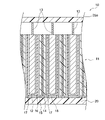
- FIG. 1 is a schematic cross-sectional view showing an example of a nickel-zinc secondary battery according to the present invention
- FIG. FIG. 2 is a diagram schematically showing an example of an A-A′ line cross section of the nickel-zinc secondary battery shown in FIG. 1
- 4 is a graph plotting the residual area ratio of the negative electrode at each cycle number obtained in Examples 1 to 85.
- the zinc secondary battery of the present invention is not particularly limited as long as it is a secondary battery using zinc as a negative electrode and using an alkaline electrolyte (typically an aqueous alkali metal hydroxide solution). Therefore, it can be a nickel-zinc secondary battery, a silver-zinc oxide secondary battery, a manganese-zinc oxide secondary battery, an air-zinc secondary battery, and various other alkaline zinc secondary batteries.
- the positive plate comprises nickel hydroxide and/or nickel oxyhydroxide, thereby making the zinc secondary battery a nickel-zinc secondary battery.
- the positive electrode plate may be the air electrode layer, thereby making the zinc secondary battery a zinc air secondary battery.
- FIGS. 1 and 2 show one embodiment of a zinc secondary battery according to the present invention.
- the zinc secondary battery 10 shown in FIGS. 1 and 2 comprises a battery element 11 in a closed container 20, the battery element 11 comprising a positive plate 12, a negative plate 14, and a hydroxide ion conducting separator. 16 and a unit cell 10 a containing an electrolyte 18 .
- the positive electrode plate 12 contains a positive electrode active material.
- the negative plate 14 includes a negative active material including at least one selected from the group consisting of zinc, zinc oxide, zinc alloys and zinc compounds.
- the hydroxide ion conducting separator 16 separates the positive plate 12 and the negative plate 14 in a hydroxide ion conducting manner.
- this zinc secondary battery 10 was subjected to a charge-discharge cycle test under the following conditions: - current density: 12.5mA/ cm2 - Temperature: 25°C - Charge/discharge rate: 0.5C - Depth of Discharge (DOD): 70% - charging: constant current (CC) charging (cutoff voltage 1.9V) followed by constant voltage (CV) charging - discharging: constant current (CC) discharging (cutoff voltage 1.4V) - Pause time when switching between charging and discharging: 5 minutes - Number of cycles: When the number of cycles is 40 or more, the x-axis to which the number of cycles is assigned and the remaining area ratio (%) of the negative electrode plate according to the number of cycles are assigned. The result of the charge-discharge cycle test falls within the range of the area satisfying y ⁇ 0.10x+100 and y ⁇ 0.01x+100 in the coordinate system consisting of the y-axis.
- the charge-discharge cycle performance is improved.
- zinc secondary batteries with excellent charge-discharge cycle performance can be conveniently determined.
- the above range for example, 40 times, 100 times, 150 times, 200 times.
- Long-term performance such as the cycle life of the zinc secondary battery can be predicted relatively accurately only by confirming by a charge-discharge cycle test with a relatively small number of times.
- y ⁇ 0.10x+100 is a formula that defines the lower limit of the above range
- y ⁇ 0.09x+100 is more preferable
- y ⁇ 0.05x+100 is even more preferable.
- y ⁇ 0.01x+100 is a formula that defines the upper limit of the above range
- the preferred upper limit is y ⁇ 0.02x+100, more preferably y ⁇ 0.03x+100. That is, a preferable region is a region satisfying y ⁇ 0.09x+100 and y ⁇ 0.02x+100, and more preferably a region satisfying y ⁇ 0.05x+100 and y ⁇ 0.03x+100. In these preferred regions, it is possible to provide a zinc secondary battery exhibiting even more improved charge-discharge cycle performance.
- the above region satisfies x ⁇ 40 (since there is a condition that the number of cycles is 40 or more), but the upper limit is not particularly limited. However, the above range typically satisfies x ⁇ 1200, x ⁇ 1000, x ⁇ 800, x ⁇ 600, x ⁇ 400, x ⁇ 200, x ⁇ 150, or x ⁇ 100.
- a preferred additive to be added to the negative electrode plate 14 is a nonionic water-absorbing polymer.
- nonionic water-absorbing polymers include polyalkylene oxide-based water-absorbing resins, polyvinylacetamide-based water-absorbing resins, polyvinyl alcohol (PVA resin), and polyvinyl butyral (PVB resin), more preferably polyalkylene oxide-based It is a water absorbent resin.
- PVA resin polyvinyl alcohol
- PVB resin polyvinyl butyral
- a commercially available product can be used as the polyalkylene oxide-based water absorbent resin.
- the nonionic water-absorbing polymer may contain at least one selected from hydrophilic ether groups, hydroxyl groups, amide groups, and acetamide groups.
- the nonionic water-absorbing polymer may exist as particles in the negative electrode, or may cover the active material.
- a method of adding the nonionic water-absorbing polymer in the form of a slurry or a method of heating and melting the nonionic water-absorbing polymer during production can be considered.
- the melting point of the nonionic water-absorbing polymer is preferably 45°C to 350°C, more preferably 45°C to 200°C, still more preferably 50°C to 100°C.
- the content of the nonionic water-absorbing polymer in the negative electrode plate 14 is preferably 0.01 to 6.0 parts by weight, more preferably 0.01 to 6.0 parts by weight, based on 100 parts by weight of the ZnO particles. 01 to 5.5 parts by weight, more preferably 0.05 to 5.0 parts by weight, particularly preferably 0.07 to 4.0 parts by weight.
- the nonionic water-absorbing polymer is preferably particulate.
- the particle size of the nonionic water-absorbing polymer is preferably 10-200 ⁇ m, more preferably 15-180 ⁇ m, even more preferably 20-160 ⁇ m, particularly preferably 30-150 ⁇ m. All the particles of the nonionic water-absorbing polymer do not have to fall within the above numerical range, and the average particle diameter D50 may be within the above numerical range.
- Preferred additives to be added to the electrolytic solution 18 include proteins capable of forming complexes with Zn and/or derivatives and/or degradation products thereof, or polyphenols capable of forming complexes with Zn and/or derivatives and/or degradation products thereof.
- the electrolyte may contain a protein capable of forming a complex with Zn, and part or all of the protein may exist as a derivative and/or degradation product thereof (eg, peptide or amino acid).
- the electrolyte may contain polyphenols capable of complexing with Zn, but some or all of them may be present as polyphenol derivatives and/or degradation products.
- the protein as an additive is not particularly limited as long as it can form a complex with Zn.
- proteins examples include casein, gelatin and the like, with casein being particularly preferred. Proteins such as casein may form micelles in the electrolyte. Derivatives of proteins such as casein are not particularly limited as long as they are compounds that have been modified by introduction or substitution of functional groups, oxidation, reduction, substitution of atoms, etc. to the extent that the structure and properties of the protein are not significantly changed. Examples include sodium salts and potassium salts. Examples of protein degradation products such as casein include polypeptides, tripeptides, dipeptides, and amino acids such as glutamic acid, aspartic acid, leucine, isoleucine, histidine, methionine, glycine, proline, tyrosine, and lysine.
- examples of preferred amino acids include aspartic acid, methionine, glycine, leucine and isoleucine, more preferably glycine, leucine and isoleucine, particularly preferably leucine and isoleucine, most preferably leucine.
- Polyphenol as an additive is not particularly limited as long as it can form a complex with Zn.
- examples of such polyphenols include hydrolyzable (pyrogallol-type) tannins and condensed (catechol-type) tannins, preferably hydrolyzable (pyrogallol-type) tannins, more preferably hydrolyzed It is tannic acid, which is one of the type (pyrogallol-type) tannins.
- Derivatives of polyphenols such as tannic acid are not particularly limited as long as they are compounds that have been modified to such an extent that the structure and properties of polyphenols are not significantly changed by introduction or substitution of functional groups, oxidation, reduction, or substitution of atoms.
- Examples of tannic acid derivatives include compounds having a molecular structure in which at least part of the hydroxyl groups contained in the tannic acid molecule are substituted with an alkyl ether group, an alkyl ester group, or the like.
- Examples of tannic acid decomposition products include compounds produced by hydrolyzing at least part of the ester bonds in the tannic acid molecule.
- the positive electrode plate 12 contains a positive electrode active material.
- the positive electrode active material contains nickel hydroxide and/or nickel oxyhydroxide.
- the positive plate 12 further includes a positive current collector (not shown) having a positive current collector tab 13 extending from an end (eg, top end) of the positive plate 12 .
- Preferred examples of the positive electrode current collector include nickel porous substrates such as foamed nickel plates.
- a positive electrode plate composed of a positive electrode/positive current collector can be preferably produced by uniformly applying a paste containing an electrode active material such as nickel hydroxide onto a nickel porous substrate and drying the paste. .
- the positive electrode plate 12 shown in FIG. 2 includes a positive electrode current collector (for example, foamed nickel), it is not shown. This is because, in the case of the nickel-zinc secondary battery, the positive electrode current collector is integrated with the positive electrode active material, and thus the positive electrode current collector cannot be depicted separately.
- the nickel-zinc secondary battery 10 preferably further includes a positive collector plate connected to the tip of the positive collector tab 13, and more preferably, a plurality of positive collector tabs 13 are connected to one positive collector plate. be. By doing so, current collection can be performed with good space efficiency with a simple configuration, and connection to the positive electrode terminal 26 is also facilitated. Alternatively, the positive current collecting plate itself may be used as the positive terminal 26 .
- the positive electrode plate 12 may contain at least one additive selected from the group consisting of silver compounds, manganese compounds, and titanium compounds, whereby the positive electrode reaction absorbs hydrogen gas generated by the self-discharge reaction. can promote Moreover, the positive electrode plate 12 may further contain cobalt. Cobalt is preferably contained in the positive electrode plate 12 in the form of cobalt oxyhydroxide. In the positive electrode plate 12, cobalt functions as a conductive aid, thereby contributing to an improvement in charge/discharge capacity.
- the negative electrode plate 14 contains a negative electrode active material.
- the negative electrode active material contains at least one selected from the group consisting of zinc, zinc oxide, zinc alloys and zinc compounds.
- Zinc may be contained in any form of zinc metal, zinc compound, and zinc alloy as long as it has electrochemical activity suitable for the negative electrode.
- Preferred examples of the negative electrode material include zinc oxide, zinc metal, calcium zincate, etc., and a mixture of zinc metal and zinc oxide is more preferred.
- the negative electrode active material may be configured in a gel form, or may be mixed with the electrolytic solution 18 to form a negative electrode mixture.
- a gelled negative electrode can be easily obtained by adding an electrolytic solution and a thickener to the negative electrode active material.
- the thickener include polyvinyl alcohol, polyacrylate, CMC, alginic acid, etc. Polyacrylic acid is preferable because of its excellent chemical resistance to strong alkali.
- the zinc alloy it is possible to use a zinc alloy that does not contain mercury and lead, which is known as a zinc-free zinc alloy.
- a zinc alloy containing 0.01 to 0.1% by mass of indium, 0.005 to 0.02% by mass of bismuth, and 0.0035 to 0.015% by mass of aluminum has the effect of suppressing hydrogen gas generation. Therefore, it is preferable.
- Indium and bismuth are particularly advantageous in terms of improving discharge performance.
- the use of a zinc alloy for the negative electrode slows down the rate of self-dissolution in an alkaline electrolyte, thereby suppressing the generation of hydrogen gas and improving safety.
- the shape of the negative electrode material is not particularly limited, it is preferably powdered, which increases the surface area and enables high-current discharge.
- the average particle size of the preferred negative electrode material is in the range of 3 to 100 ⁇ m in minor axis. It is easy to mix uniformly with the agent, and is easy to handle during battery assembly.
- the negative electrode plate 14 further includes a negative electrode current collector 15, and the negative electrode current collector 15 has a negative electrode current collecting tab 15a extending from an end portion (for example, an upper end) of the negative electrode plate 14.
- the negative electrode current collecting tab 15 a is preferably provided at a position not overlapping the positive electrode current collecting tab 13 .
- the zinc secondary battery 10 preferably further includes a negative electrode current collector plate connected to the tip of the negative electrode current collector tab 15a, and more preferably a plurality of negative electrode current collector tabs 15a are connected to one negative electrode current collector plate. . By doing so, it is possible to collect current with a simple structure and with good space efficiency, and the connection to the negative electrode terminal 28 is also facilitated. Alternatively, the negative current collecting plate itself may be used as the negative terminal 28 .
- the negative electrode current collector 15 include copper foil, copper expanded metal, and copper punching metal, with copper expanded metal being more preferred.
- copper expanded metal for example, a mixture comprising zinc oxide powder and/or zinc powder and, if desired, a binder (for example, polytetrafluoroethylene particles) is applied onto a copper expanded metal to form a negative electrode composed of a negative electrode/a negative electrode current collector. Plates can be preferably made. At that time, it is also preferable to press the dried negative electrode plate (that is, the negative electrode/negative electrode current collector) to prevent the electrode active material from falling off and to improve the electrode density.
- the zinc secondary battery 10 may further include a liquid retaining member 17 that contacts the positive electrode plate 12 and/or the negative electrode plate 14 .
- a liquid retaining member 17 that contacts the positive electrode plate 12 and/or the negative electrode plate 14 .
- the positive electrode plate 12 and/or the negative electrode plate 14 is covered or wrapped with the liquid retaining member 17 .
- a simple configuration in which the liquid retaining member 17 is arranged on one side of the positive electrode plate 12 or the negative electrode plate 14 may be employed.
- the electrolytic solution 18 can be evenly present between the positive electrode plate 12 and/or the negative electrode plate 14 and the hydroxide ion conductive separator 16. and/The transfer of hydroxide ions between the negative electrode plate 14 and the hydroxide ion conductive separator 16 can be performed efficiently.
- the liquid holding member 17 is not particularly limited as long as it can hold the electrolytic solution 18, but is preferably a sheet-like member.
- Preferred examples of the liquid-retaining member 17 include nonwoven fabrics, water-absorbing resins, liquid-retaining resins, porous sheets, and various spacers, but nonwoven fabrics are particularly preferable in that a negative electrode structure with good performance can be produced at low cost. be.
- the liquid retaining member 17 or the nonwoven fabric preferably has a thickness of 10 to 200 ⁇ m, more preferably 20 to 200 ⁇ m, still more preferably 20 to 150 ⁇ m, particularly preferably 20 to 100 ⁇ m, most preferably 20 ⁇ m. ⁇ 60 ⁇ m.
- a sufficient amount of the electrolytic solution 18 can be retained in the liquid retaining member 17 while keeping the overall size of the positive electrode structure and/or the negative electrode structure compact without waste.
- the hydroxide ion-conducting separator 16 is provided so as to separate the positive electrode plate 12 and the negative electrode plate 14 so that hydroxide ions can be conducted.
- the negative plate 14 may be covered or wrapped with a hydroxide ion conductive separator 16 .
- a simple configuration in which the hydroxide ion conductive separator 16 is arranged on one side of the positive electrode plate 12 or the negative electrode plate 14 may also be used.
- the hydroxide ion-conducting separator 16 is not particularly limited as long as it can separate the positive electrode plate 12 and the negative electrode plate 14 so that hydroxide ions can be conducted, but typically includes a hydroxide ion-conducting solid electrolyte. , is a separator that allows hydroxide ions to pass through exclusively by utilizing hydroxide ion conductivity.
- Preferred hydroxide ion-conducting solid electrolytes are layered double hydroxides (LDH) and/or LDH-like compounds. Therefore, hydroxide ion conducting separator 16 is preferably an LDH separator.
- LDH separator refers to a separator containing LDH and/or LDH-like compounds, which selectively removes hydroxide ions by exclusively utilizing the hydroxide ion conductivity of LDH and/or LDH-like compounds.
- LDH-like compounds are hydroxides and/or oxides of layered crystal structure similar to LDH, although they may not be called LDH, and can be said to be equivalents of LDH.
- LDH can be interpreted as including not only LDH but also LDH-like compounds.
- the LDH separator is preferably composited with the porous substrate.
- the LDH separator further includes a porous substrate, and the LDH and/or the LDH-like compound are combined with the porous substrate in a form in which the pores of the porous substrate are filled.
- preferred LDH separators are those in which LDH and/or LDH-like compounds are porous so as to exhibit hydroxide ion conductivity and gas impermeability (and thus function as LDH separators exhibiting hydroxide ion conductivity). block the pores of the base material.
- the porous substrate is preferably made of a polymeric material, and it is particularly preferable that the LDH is incorporated throughout the entire thickness direction of the porous substrate made of polymeric material.
- LDH separators as disclosed in Patent Documents 1-4 can be used.
- the thickness of the LDH separator is preferably 5-100 ⁇ m, more preferably 5-80 ⁇ m, still more preferably 5-60 ⁇ m, particularly preferably 5-40 ⁇ m.
- the positive electrode plate 12 and/or the negative electrode plate 14 are covered or wrapped with the liquid retaining member 17 and/or the separator 16, their outer edges (sides from which the positive electrode current collecting tab 13 and the negative electrode current collecting tab 15a extend) except) preferably closed.
- the liquid-retaining member 17 and/or the separator 16 has a closed outer edge by bending the liquid-retaining member 17 and/or the separator 16 or by sealing the liquid-retaining members 17 and/or the separators 16 together.
- Preferred examples of sealing techniques include adhesives, heat welding, ultrasonic welding, adhesive tapes, sealing tapes, and combinations thereof.
- an LDH separator containing a porous substrate made of a polymeric material has the advantage of being easy to bend because of its flexibility.
- Thermal welding and ultrasonic welding may be performed using a commercially available heat sealer or the like.
- the outer peripheral portion of the liquid retaining member 17 should be sandwiched between the LDH separators forming the outer peripheral portion. It is preferable to perform heat welding and ultrasonic welding by using the same method because more effective sealing can be performed.
- commercially available adhesives, adhesive tapes and sealing tapes may be used, but those containing an alkali-resistant resin are preferable in order to prevent deterioration in an alkaline electrolyte.
- examples of preferable adhesives include epoxy resin adhesives, natural resin adhesives, modified olefin resin adhesives, and modified silicone resin adhesives. It is more preferable because it is particularly excellent in alkalinity.
- a product example of the epoxy resin-based adhesive includes the epoxy adhesive Hysol (registered trademark) (manufactured by Henkel).
- the outer edge of one side, which is the upper end of the separator 16 is open.
- This open-top configuration makes it possible to deal with the problem of overcharging in nickel-zinc batteries and the like. That is, when a nickel-zinc battery or the like is overcharged, oxygen (O 2 ) may be generated in the positive electrode plate 12, but the LDH separator has a high degree of denseness that substantially allows only hydroxide ions to pass. Impervious to O2 .
- O 2 can escape to the upper side of the positive electrode plate 12 and be sent to the negative electrode plate 14 side through the upper open portion, thereby O 2 can oxidize Zn in the negative electrode active material and return it to ZnO.
- the overcharge resistance can be improved by using the top-open battery element 11 in a sealed nickel-zinc secondary battery.
- a ventilation hole may be opened after sealing the outer edge of one side, which is the upper end of the LDH separator, or a part of the outer edge may be unsealed so that a ventilation hole is formed during sealing. good.
- the electrolytic solution 18 preferably contains an aqueous alkali metal hydroxide solution.
- the electrolytic solution 18 is only shown locally in FIG.
- alkali metal hydroxides include potassium hydroxide, sodium hydroxide, lithium hydroxide and ammonium hydroxide, with potassium hydroxide being more preferred.
- Zinc compounds such as zinc oxide and zinc hydroxide may be added to the electrolytic solution in order to suppress self-dissolution of zinc and/or zinc oxide.
- the electrolyte may be mixed with the positive electrode active material and/or the negative electrode active material to exist in the form of a positive electrode mixture and/or a negative electrode mixture.
- the electrolyte may be gelled to prevent leakage of the electrolyte.
- the gelling agent it is desirable to use a polymer that absorbs the solvent of the electrolytic solution and swells, and polymers such as polyethylene oxide, polyvinyl alcohol and polyacrylamide, and starch are used.
- the battery element 11 includes a plurality of positive plates 12, a plurality of negative plates 14, and a plurality of separators 16, and the unit of positive plates 12/separators 16/negative plates 14 is repeated. It is preferably in the form of a positive/negative layered body in which the positive and negative electrodes are stacked in such a manner as to That is, it is preferable that the zinc secondary battery 10 has a plurality of unit cells 10a, so that the plurality of unit cells 10a as a whole form a multi-layer cell. This is a so-called assembled battery or laminated battery configuration, and is advantageous in that a high voltage and a large current can be obtained.
- the closed container 20 is preferably made of resin.
- the resin constituting the sealed container 20 is preferably a resin having resistance to alkali metal hydroxides such as potassium hydroxide, more preferably polyolefin resin, ABS resin, or modified polyphenylene ether, and still more preferably ABS resin. or modified polyphenylene ether.
- the closed container 20 has an upper lid 20a.
- the sealed container 20 (for example, the upper lid 20a) may have a pressure release valve for releasing gas.
- a case group in which two or more airtight containers 20 are arranged may be accommodated in the outer frame to constitute a battery module.
- the LDH separator may contain an LDH-like compound.
- LDH-like compounds are (a) is a hydroxide and/or oxide having a layered crystal structure containing Mg and one or more elements containing at least Ti selected from the group consisting of Ti, Y and Al, or (b) (i ) Ti, Y, and optionally Al and/or Mg, and (ii) an additional element M that is at least one selected from the group consisting of In, Bi, Ca, Sr, and Ba.
- (c) is a hydroxide and/or oxide, or (c) is a hydroxide and/or oxide of layered crystal structure comprising Mg, Ti, Y, and optionally Al and/or In, said (c) in the LDH-like compound is present in the form of a mixture with In(OH) 3 .
- the LDH-like compound is a hydroxide having a layered crystal structure containing Mg and at least one element containing at least Ti selected from the group consisting of Ti, Y and Al. and/or an oxide.
- Typical LDH-like compounds are therefore complex hydroxides and/or complex oxides of Mg, Ti, optionally Y and optionally Al.
- the LDH-like compound preferably does not contain Ni.
- the LDH-like compound may further contain Zn and/or K. By doing so, the ionic conductivity of the LDH separator can be further improved.
- LDH-like compounds can be identified by X-ray diffraction. Specifically, when X-ray diffraction is performed on the surface of the LDH separator, the A peak derived from an LDH-like compound is detected in the range.
- LDH is a material with an alternating layer structure in which exchangeable anions and H 2 O are present as intermediate layers between stacked hydroxide elementary layers.
- a peak due to the crystal structure of LDH that is, the (003) peak of LDH
- a peak due to the crystal structure of LDH that is, the (003) peak of LDH
- the interlayer distance of the layered crystal structure can be determined by Bragg's equation using 2 ⁇ corresponding to the peak derived from the LDH-like compound in X-ray diffraction.
- the interlayer distance of the layered crystal structure constituting the LDH-like compound thus determined is typically 0.883 to 1.8 nm, more typically 0.883 to 1.3 nm.
- the atomic ratio of Mg/(Mg+Ti+Y+Al) in the LDH-like compound determined by energy dispersive X-ray spectroscopy (EDS) is preferably 0.03 to 0.25, It is more preferably 0.05 to 0.2.
- the atomic ratio of Ti/(Mg+Ti+Y+Al) in the LDH-like compound is preferably 0.40 to 0.97, more preferably 0.47 to 0.94.
- the atomic ratio of Y/(Mg+Ti+Y+Al) in the LDH-like compound is preferably 0 to 0.45, more preferably 0 to 0.37.
- the atomic ratio of Al/(Mg+Ti+Y+Al) in the LDH-like compound is preferably 0 to 0.05, more preferably 0 to 0.03. Within the above range, the alkali resistance is even more excellent, and the effect of suppressing short circuits caused by zinc dendrites (that is, dendrite resistance) can be more effectively realized.
- LDH separators have the general formula: M 2+ 1 ⁇ x M 3+ x (OH) 2 A n ⁇ x/n ⁇ mH 2 O (wherein M 2+ is a divalent cation, M 3+ is a trivalent cation, A n- is an n-valent anion, n is an integer of 1 or more, x is 0.1 to 0.4, and m is 0 or more.
- M 2+ is a divalent cation
- M 3+ is a trivalent cation
- a n- is an n-valent anion
- n is an integer of 1 or more
- x is 0.1 to 0.4
- m is 0 or more.
- the atomic ratios in LDH-like compounds generally deviate from the general formula for LDH. Therefore, it can be said that the LDH-like compound in this aspect generally has a composition ratio (atomic ratio) different from conventional LDH.
- an EDS analyzer eg, X-act, manufactured by Oxford Instruments
- X-act e.g., X-act, manufactured by Oxford Instruments
- the LDH-like compound has a layered crystal structure comprising (i) Ti, Y and optionally Al and/or Mg and (ii) an additional element M It can be hydroxide and/or oxide. Accordingly, typical LDH-like compounds are complex hydroxides and/or complex oxides of Ti, Y, additional element M, optionally Al and optionally Mg.
- the additive element M is In, Bi, Ca, Sr, Ba, or a combination thereof.
- the atomic ratio of Ti/(Mg+Al+Ti+Y+M) in the LDH-like compound determined by energy dispersive X-ray spectroscopy (EDS) is preferably 0.50 to 0.85, It is more preferably 0.56 to 0.81.
- the atomic ratio of Y/(Mg+Al+Ti+Y+M) in the LDH-like compound is preferably 0.03-0.20, more preferably 0.07-0.15.
- the atomic ratio of M/(Mg+Al+Ti+Y+M) in the LDH-like compound is preferably 0.03-0.35, more preferably 0.03-0.32.
- the atomic ratio of Mg/(Mg+Al+Ti+Y+M) in the LDH-like compound is preferably 0 to 0.10, more preferably 0 to 0.02.
- the atomic ratio of Al/(Mg+Al+Ti+Y+M) in the LDH-like compound is preferably 0 to 0.05, more preferably 0 to 0.04.
- LDH separators have the general formula: M 2+ 1 ⁇ x M 3+ x (OH) 2 A n ⁇ x/n ⁇ mH 2 O (wherein M 2+ is a divalent cation, M 3+ is a trivalent cation, A n- is an n-valent anion, n is an integer of 1 or more, x is 0.1 to 0.4, and m is 0 or more.
- M 2+ is a divalent cation
- M 3+ is a trivalent cation
- a n- is an n-valent anion
- n is an integer of 1 or more
- x is 0.1 to 0.4
- m is 0 or more.
- the atomic ratios in LDH-like compounds generally deviate from the general formula for LDH. Therefore, it can be said that the LDH-like compound in this aspect generally has a composition ratio (atomic ratio) different from conventional LDH.
- an EDS analyzer eg, X-act, manufactured by Oxford Instruments
- X-act e.g., X-act, manufactured by Oxford Instruments
- the LDH-like compound is a hydroxide and/or oxide of layered crystal structure comprising Mg, Ti, Y and optionally Al and/or In.
- the LDH-like compound may be present in the form of a mixture with In(OH) 3 .
- the LDH-like compounds of this embodiment are hydroxides and/or oxides of layered crystal structure containing Mg, Ti, Y, and optionally Al and/or In.
- Typical LDH-like compounds are therefore complex hydroxides and/or complex oxides of Mg, Ti, Y, optionally Al and optionally In.
- the LDH-like compound In that can be contained in the LDH-like compound is not only intentionally added to the LDH-like compound, but also inevitably mixed into the LDH-like compound due to the formation of In(OH) 3 or the like. can be anything. Although the above elements may be replaced with other elements or ions to the extent that the basic properties of the LDH-like compound are not impaired, the LDH-like compound preferably does not contain Ni.
- LDH separators have the general formula: M 2+ 1 ⁇ x M 3+ x (OH) 2 A n ⁇ x/n ⁇ mH 2 O (wherein M 2+ is a divalent cation, M 3+ is a trivalent cation, A n- is an n-valent anion, n is an integer of 1 or more, x is 0.1 to 0.4, and m is 0 or more.
- M 2+ is a divalent cation
- M 3+ is a trivalent cation
- a n- is an n-valent anion
- n is an integer of 1 or more
- x is 0.1 to 0.4
- m is 0 or more.
- the atomic ratios in LDH-like compounds generally deviate from the above general formula for LDH. Therefore, it can be said that the LDH-like compound in this aspect generally has a composition ratio (atomic ratio) different from conventional LDH.
- the mixture according to embodiment (c) above contains not only LDH-like compounds but also In(OH) 3 (typically composed of LDH-like compounds and In(OH) 3 ).
- the inclusion of In(OH) 3 can effectively improve the alkali resistance and dendrite resistance of the LDH separator.
- the content of In(OH) 3 in the mixture is not particularly limited, and is preferably an amount that can improve the alkali resistance and dendrite resistance without substantially impairing the hydroxide ion conductivity of the LDH separator.
- In(OH) 3 may have a cubic crystal structure, or may have a structure in which In(OH) 3 crystals are surrounded by an LDH-like compound.
- In(OH) 3 can be identified by X-ray diffraction.
- Examples 1-75 Simple cells of nickel-zinc secondary batteries with various specifications were produced according to the following procedure, and a charge-discharge cycle test was performed.
- a charge/discharge cycle test was performed on the simple sealed cell at 25° C. using a charge/discharge device (TOSCAT3100 manufactured by Toyo System Co., Ltd.). This cycle test consisted of constant current (CC) charging to a battery voltage of 1.9 V at a discharge rate of 0.5 C (current density of 12.5 mA/cm 2 ), followed by a voltage of 1.9 V to the capacity of the positive electrode. After constant voltage (CV) charging to 63%, after a 5-minute charging rest period, the depth of discharge (DOD) is 70% at a charging rate of 0.5 C (current density of 12.5 mA/cm 2 ). A constant current (CC) discharge was performed at a cut-off voltage of 1.4 V until a constant current (CC) discharge was performed, and a discharge rest period of 5 minutes was provided.
- CC constant current
- the remaining area ratio of the negative electrode plate is the area of the portion (visible black) where the negative electrode active material (ZnO) remains on the negative electrode plate after the cycle test, and the area of the negative electrode on the negative electrode plate before the cycle test. It is a value obtained by dividing by the area of the region (visible black) covered with the active material (ZnO) and multiplying by 100. The results were as shown in Tables 3-8 and FIG.
- Examples 76-85 Simple cells of nickel-zinc secondary batteries with various specifications were produced according to the following procedure, and a charge-discharge cycle test was performed.
- Negative Electrode active material > ⁇ ZnO powder (manufactured by Seido Chemical Industry Co., Ltd., JIS standard 1 grade, average particle size D50: 0.2 ⁇ m) ⁇ Metal Zn powder (manufactured by DOWA Electronics Co., Ltd., doped with Bi and In, Bi: 70 ppm by weight, In: 200 ppm by weight, average particle size D50: 120 ⁇ m)
- ⁇ Additive> ⁇ Nonionic water-absorbing polymer (sodium polyacrylate, product name: Aquacoke C-PF, manufactured by Sumitomo Seika Co., Ltd.) ⁇ In 2 O 3 powder (product name: indium oxide, manufactured by Konan Inorganic Co., Ltd.) ⁇ Propylene glycol (PG) (product name: propylene glycol, manufactured by Kanto Kagaku Co., Ltd.) ⁇ PTFE (product name: Polyflon PT
- metal Zn powder, polytetrafluoroethylene (PTFE), and optionally other additives were added to the ZnO powder, and kneaded with propylene glycol.
- the obtained kneaded material was rolled by a roll press to obtain a negative electrode active material sheet.
- the negative electrode active material sheet was press-bonded to a copper expanded metal plated with tin to obtain a negative electrode. In this way, various negative electrode plates were produced.
- FIG. 3 shows the results of Examples 1 to 85 in a coordinate system consisting of the x-axis to which the number of cycles is assigned and the y-axis to which the remaining area ratio (%) of the negative electrode plate according to the number of cycles is assigned. It is a plotted graph. From FIG.
Landscapes
- Chemical & Material Sciences (AREA)
- Chemical Kinetics & Catalysis (AREA)
- Electrochemistry (AREA)
- General Chemical & Material Sciences (AREA)
- Engineering & Computer Science (AREA)
- Manufacturing & Machinery (AREA)
- Ceramic Engineering (AREA)
- Inorganic Chemistry (AREA)
- Battery Electrode And Active Subsutance (AREA)
- Cell Separators (AREA)
- Secondary Cells (AREA)
- Hybrid Cells (AREA)
Priority Applications (1)
| Application Number | Priority Date | Filing Date | Title |
|---|---|---|---|
| JP2023508457A JP7564941B2 (ja) | 2021-03-26 | 2021-11-25 | 亜鉛二次電池 |
Applications Claiming Priority (2)
| Application Number | Priority Date | Filing Date | Title |
|---|---|---|---|
| JP2021054418 | 2021-03-26 | ||
| JP2021-054418 | 2021-03-26 |
Publications (1)
| Publication Number | Publication Date |
|---|---|
| WO2022201638A1 true WO2022201638A1 (ja) | 2022-09-29 |
Family
ID=83395253
Family Applications (1)
| Application Number | Title | Priority Date | Filing Date |
|---|---|---|---|
| PCT/JP2021/043179 Ceased WO2022201638A1 (ja) | 2021-03-26 | 2021-11-25 | 亜鉛二次電池 |
Country Status (2)
| Country | Link |
|---|---|
| JP (1) | JP7564941B2 (https=) |
| WO (1) | WO2022201638A1 (https=) |
Cited By (1)
| Publication number | Priority date | Publication date | Assignee | Title |
|---|---|---|---|---|
| WO2024195225A1 (ja) * | 2023-03-23 | 2024-09-26 | 日本碍子株式会社 | 亜鉛二次電池用負極、並びにニッケル亜鉛二次電池及びその使用方法 |
Citations (3)
| Publication number | Priority date | Publication date | Assignee | Title |
|---|---|---|---|---|
| JPH0696796A (ja) * | 1992-09-10 | 1994-04-08 | Yuasa Corp | 密閉形二次電池 |
| WO2020049902A1 (ja) * | 2018-09-03 | 2020-03-12 | 日本碍子株式会社 | 負極及び亜鉛二次電池 |
| WO2020049901A1 (ja) * | 2018-09-03 | 2020-03-12 | 日本碍子株式会社 | 亜鉛二次電池 |
-
2021
- 2021-11-25 JP JP2023508457A patent/JP7564941B2/ja active Active
- 2021-11-25 WO PCT/JP2021/043179 patent/WO2022201638A1/ja not_active Ceased
Patent Citations (3)
| Publication number | Priority date | Publication date | Assignee | Title |
|---|---|---|---|---|
| JPH0696796A (ja) * | 1992-09-10 | 1994-04-08 | Yuasa Corp | 密閉形二次電池 |
| WO2020049902A1 (ja) * | 2018-09-03 | 2020-03-12 | 日本碍子株式会社 | 負極及び亜鉛二次電池 |
| WO2020049901A1 (ja) * | 2018-09-03 | 2020-03-12 | 日本碍子株式会社 | 亜鉛二次電池 |
Cited By (1)
| Publication number | Priority date | Publication date | Assignee | Title |
|---|---|---|---|---|
| WO2024195225A1 (ja) * | 2023-03-23 | 2024-09-26 | 日本碍子株式会社 | 亜鉛二次電池用負極、並びにニッケル亜鉛二次電池及びその使用方法 |
Also Published As
| Publication number | Publication date |
|---|---|
| JPWO2022201638A1 (https=) | 2022-09-29 |
| JP7564941B2 (ja) | 2024-10-09 |
Similar Documents
| Publication | Publication Date | Title |
|---|---|---|
| JP6856823B2 (ja) | 負極及び亜鉛二次電池 | |
| US7807296B2 (en) | Copper-manganese mixed oxide cathode material for use in alkaline cells having high capacity | |
| JP6955111B2 (ja) | 亜鉛二次電池 | |
| CN100446331C (zh) | 碱性蓄电池及其制造方法 | |
| JP7773625B2 (ja) | 負極及び亜鉛二次電池 | |
| JP7382488B2 (ja) | 亜鉛二次電池及びモジュール電池 | |
| US20230261251A1 (en) | Negative electrode and zinc secondary battery | |
| JP7564941B2 (ja) | 亜鉛二次電池 | |
| WO2022190460A1 (ja) | 亜鉛二次電池 | |
| US20250015339A1 (en) | Zinc secondary battery | |
| US20240413486A1 (en) | Zinc secondary battery | |
| JP7773647B2 (ja) | 負極板及び亜鉛二次電池 | |
| JP7506822B2 (ja) | ニッケル亜鉛二次電池 | |
| JP7545569B2 (ja) | 亜鉛二次電池 | |
| CN116349061A (zh) | 负极及锌二次电池 | |
| JP7626646B2 (ja) | 定置型ニッケル亜鉛二次電池 | |
| JP7557613B2 (ja) | 負極及び亜鉛二次電池 | |
| JP7737545B2 (ja) | 負極及び亜鉛二次電池 | |
| WO2024176531A1 (ja) | 亜鉛二次電池 | |
| JP7773660B2 (ja) | 負極板及び亜鉛二次電池 | |
| JP7564668B2 (ja) | 負極及び亜鉛二次電池 | |
| JP7449139B2 (ja) | 二次電池及び二次電池の製造方法 | |
| WO2025197192A1 (ja) | 負極板および亜鉛二次電池 | |
| CN111033821B (zh) | 非水电解质二次电池用正极及非水电解质二次电池 | |
| WO2025163962A1 (ja) | 亜鉛二次電池 |
Legal Events
| Date | Code | Title | Description |
|---|---|---|---|
| 121 | Ep: the epo has been informed by wipo that ep was designated in this application |
Ref document number: 21933236 Country of ref document: EP Kind code of ref document: A1 |
|
| WWE | Wipo information: entry into national phase |
Ref document number: 2023508457 Country of ref document: JP |
|
| NENP | Non-entry into the national phase |
Ref country code: DE |
|
| 122 | Ep: pct application non-entry in european phase |
Ref document number: 21933236 Country of ref document: EP Kind code of ref document: A1 |