WO2022201363A1 - 車載装置、車両、情報処理方法、およびプログラム - Google Patents
車載装置、車両、情報処理方法、およびプログラム Download PDFInfo
- Publication number
- WO2022201363A1 WO2022201363A1 PCT/JP2021/012263 JP2021012263W WO2022201363A1 WO 2022201363 A1 WO2022201363 A1 WO 2022201363A1 JP 2021012263 W JP2021012263 W JP 2021012263W WO 2022201363 A1 WO2022201363 A1 WO 2022201363A1
- Authority
- WO
- WIPO (PCT)
- Prior art keywords
- vehicle
- road
- width
- information
- unit
- Prior art date
- Legal status (The legal status is an assumption and is not a legal conclusion. Google has not performed a legal analysis and makes no representation as to the accuracy of the status listed.)
- Ceased
Links
Images



Classifications
-
- B—PERFORMING OPERATIONS; TRANSPORTING
- B60—VEHICLES IN GENERAL
- B60W—CONJOINT CONTROL OF VEHICLE SUB-UNITS OF DIFFERENT TYPE OR DIFFERENT FUNCTION; CONTROL SYSTEMS SPECIALLY ADAPTED FOR HYBRID VEHICLES; ROAD VEHICLE DRIVE CONTROL SYSTEMS FOR PURPOSES NOT RELATED TO THE CONTROL OF A PARTICULAR SUB-UNIT
- B60W40/00—Estimation or calculation of non-directly measurable driving parameters for road vehicle drive control systems not related to the control of a particular sub unit, e.g. by using mathematical models
- B60W40/02—Estimation or calculation of non-directly measurable driving parameters for road vehicle drive control systems not related to the control of a particular sub unit, e.g. by using mathematical models related to ambient conditions
-
- G—PHYSICS
- G08—SIGNALLING
- G08G—TRAFFIC CONTROL SYSTEMS
- G08G1/00—Traffic control systems for road vehicles
Definitions
- the present invention relates to an in-vehicle device, a vehicle, an information processing method, and a program.
- the width of the road may be narrower than the width of the vehicle, and the vehicle may not be able to pass through the road. Therefore, it is desirable to know whether or not the vehicle can pass through the road before the vehicle enters the road.
- an in-vehicle device as one aspect of the present invention is an in-vehicle device mounted on a vehicle, comprising detection means for detecting a travelable width of a road around the vehicle; determining means for determining whether or not the vehicle can pass through the road based on the vehicle information related to the road and the width of the road that can be traveled detected by the detecting means.
- 1 is a block diagram showing a configuration example of an in-vehicle device according to an embodiment;
- An in-vehicle device 100 according to one embodiment of the present invention is a device that detects the width of a road around which a vehicle 1 (self-vehicle) can travel, and determines whether or not the vehicle 1 can pass through the road.
- a straddle-type vehicle motorcycle
- the in-vehicle device according to the present invention can also be installed in wheeled vehicles (ordinary cars, light cars, trucks, etc.).
- the ⁇ drivable width of a road'' is the width of a portion of a road on which a vehicle can actually run (pass). It can include the width of the roadway part (for example, the part inside the roadway outside line) excluding the prohibited part where the vehicle is prohibited, and the width of the part other than the part where the obstacle is located.
- the “drivable width of the road” may be simply referred to as “the width of the road”.
- FIG. 1 is a diagram showing an example of a vehicle 1 (straddle-type vehicle) in which an in-vehicle device 100 of this embodiment is mounted.
- the arrow FR indicates the longitudinal direction of the vehicle 1
- FT indicates the front
- RR indicates the rear.
- a vehicle 1 shown in FIG. 1 is a motorcycle having front wheels FW and rear wheels RW. , a steering wheel HD that is gripped by the driver to steer the vehicle 1, and a screen SC that is placed in front of the driver to prevent the wind from traveling.
- the vehicle 1 is also provided with a camera CMR that captures the surroundings (for example, the front) of the vehicle 1 and a notification unit NTC that notifies the driver of information.
- the notification part NTC may include, for example, an audio output device (eg a speaker) and/or a display device (eg a display). Camera CMR and/or notification unit NTC may be understood as components of in-vehicle device 100 .
- FIG. 2 is a block diagram showing a configuration example of the in-vehicle device 100 of this embodiment.
- the in-vehicle device 100 is a device that determines whether or not the vehicle 1 can pass through the road around the vehicle 1 (self-vehicle).
- a photographing unit 110, a notification unit 120, a communication unit 130, and a processing unit 140 can be provided.
- the photographing unit 110 is arranged to photograph the front of the vehicle 1, and the road in front of the vehicle 1 is captured based on the image of the front of the vehicle 1 obtained using the photographing unit 110. An example of determining whether or not the vehicle 1 can pass will be described.
- the photographing unit 110 corresponds to, for example, the camera CMR of FIG.
- the photographing unit 110 may be understood as an external sensor that acquires external world information (forward information) regarding targets including objects and signs that exist around (in front of) the vehicle 1 .
- the photographing unit 110 can photograph a road in front of the vehicle 1 and generate an image including the road.
- the imaging unit 110 may be referred to as the camera 110 .
- the notification unit 120 corresponds to, for example, the notification unit NTC (audio output device and/or display device) in FIG.
- the notification unit 120 notifies an occupant (for example, a driver) of the vehicle 1 of the judgment result of the judgment unit 143 (to be described later) by voice using an audio output device (speaker) and/or by display on a display device (display). to notify.
- the communication unit 130 transmits information about the state of the road ahead (drivable width) detected by the detection unit 142 (to be described later) to a server outside the vehicle, and detects surrounding vehicles existing around the vehicle 1 (for example, following vehicles). (vehicle-to-vehicle communication).
- the server outside the vehicle that has received information about the state of the road ahead may transmit the information to surrounding vehicles, or may use the information as map information.
- the surrounding vehicles that have received the information about the state of the road ahead may display the information on a display provided in the surrounding vehicle to notify the driver of the surrounding vehicle.
- the processing unit 140 can be configured by a computer including a processor represented by a CPU, a storage device such as a semiconductor memory, an interface with an external device, and the like.
- the processing section 140 may be configured as part of an ECU (Electronic Control Unit) that controls each section of the vehicle V.
- the storage device stores a program for determining whether or not the vehicle 1 can pass the road ahead of the vehicle 1 (hereinafter sometimes referred to as a determination program).
- the processing unit 140 can determine whether or not the vehicle 1 can pass the road ahead of the vehicle 1 .
- the processing unit 140 of this embodiment may include an acquisition unit 141 , a detection unit 142 , a determination unit 143 , and an output unit 144 .
- the acquisition unit 141 acquires various types of information and data. In the case of this embodiment, the acquisition unit 141 acquires the image obtained by the camera 110 .
- the acquisition unit 141 may also acquire information about the vehicle 1 (hereinafter sometimes referred to as vehicle information).
- vehicle information When vehicle information is stored in a storage device of vehicle 1 (processing unit 140), acquisition unit 141 can acquire vehicle information from the storage device.
- the vehicle information when the vehicle information is stored in a server outside the vehicle (database on the network), the acquisition unit 141 can acquire the vehicle information from the server via the communication unit 130 .
- the vehicle information may include information regarding the vehicle width and/or vehicle class of the vehicle 1 .
- the vehicle information includes, for example, displacement of a two-wheeled vehicle, vehicle class information such as a scooter, a motorcycle, an ordinary vehicle, a light vehicle, a truck, and a tricycle, vehicle width information of the vehicle 1, and/or vehicle 1 It can include information such as the total length, shape, and drive system (four-wheel drive, two-wheel drive) of the vehicle.
- the detection unit 142 detects the state of the road in front of the vehicle 1 (hereinafter sometimes referred to as the front road) based on the image obtained from the camera 110 by the acquisition unit 141 .
- the detection unit 142 extracts the road ahead and detects the state of the road ahead by performing known image processing on the image obtained from the camera 110 by the acquisition unit 141 .
- the state of the road ahead can include, for example, the width of the road ahead and/or the road surface condition of the road ahead.
- the detection unit 142 extracts feature points of the road ahead (eg, lane markings (white lines), steps on the shoulder, side walls, etc.) included in the image obtained by the acquisition unit 141 using known image processing.
- the detection unit 142 calculates the reflectance and/or specularity of the road surface of the road ahead included in the image obtained by the acquisition unit 141 using known image processing, thereby detecting whether the road ahead is wet. It is possible to detect the road surface condition of the road ahead, such as whether it is wet (wet) or frozen.
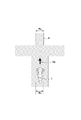
- the determination unit 143 determines whether the vehicle 1 can pass through the road ahead. determine whether or not For example, as shown in FIG . 3, the determination unit 143 compares the width W1 of the vehicle 1 included in the vehicle information with the width W2 of the forward road R detected by the detection unit 142, and determines the width of the vehicle 1. If the width W2 of the front road R is wider than the width W1, it is determined that the vehicle 1 can pass through the front road R. On the other hand, if the width W2 of the front road R is narrower than the width W1 of the vehicle 1 , it is determined that the vehicle 1 cannot pass through the front road R.
- the determination unit 143 can compare the vehicle information with the road surface condition of the front road R detected by the detection unit 142, and determine whether the vehicle 1 can travel on the front road R or not. As an example, when the road surface condition is wet or icy and the vehicle 1 is a straddle-type vehicle (motorcycle), the determination unit 143 determines that the vehicle 1 cannot travel on the forward road R. .
- FIG . 3 is a diagram for explaining the width W1 of the vehicle 1 and the width W2 of the forward road R, and the arrow TD in the diagram indicates the traveling direction of the vehicle 1. As shown in FIG.
- the output unit 144 outputs the determination result to the notification unit 120 when the determination unit 143 determines whether or not the vehicle 1 can pass through the road ahead. For example, the output unit 144 outputs (transmits) information indicating the determination result of the determination unit 143 to a display device (display) serving as the notification unit 120, so that the determination result is displayed to the passenger of the vehicle 1 (for example, the driver). ) can be notified (notified). Further, when the detection unit 142 detects the state of the road ahead, the output unit 144 outputs information about the state of the road ahead to the communication unit 130 . As a result, the output unit 144 can transmit information about the state of the road ahead to the server in the vehicle body and transmit the information to surrounding vehicles (for example, following vehicles) via the communication unit 130 .
- the output unit 144 can transmit information about the state of the road ahead to the server in the vehicle body and transmit the information to surrounding vehicles (for example, following vehicles) via the communication unit 130 .
- FIG. 4 is a flowchart showing determination processing executed by the processing unit 140. As shown in FIG. The flowchart shown in FIG. 4 can be repeatedly executed, and can be newly started from step S11 even after step S19 is finished (or can be newly started from step S12).
- the processing unit 140 acquires vehicle information.
- the vehicle information may include information regarding the vehicle width and/or vehicle class of the vehicle 1 . If the vehicle information is stored in the storage device of the vehicle 1, the processing unit 140 acquires the vehicle information from the storage device. vehicle information from the server.
- step S12 the processing unit 140 (acquisition unit 141) causes the camera 110 to photograph the surroundings (front) of the vehicle 1, thereby acquiring the image obtained by the camera 110.
- step S13 the processing unit 140 (detection unit 142) detects the width of the road ahead based on the image acquired in step S12. For example, as described above, the processing unit 140 performs known image processing on the image acquired in step S12 to extract the road ahead included in the image and detect the width of the road ahead. can be done.
- the processing unit 140 (output unit 144) may notify the occupant of the vehicle 1 of the information by outputting the information on the width of the forward road to the notification unit 120.
- the processing unit 140 outputs information about the width of the road ahead to the communication unit 130, thereby transmitting the information to at least one of a server outside the vehicle and surrounding vehicles (for example, following vehicles). good too.
- the processing unit 140 transmits the information only to the following vehicles of the following vehicles of the vehicle 1 (own vehicle) whose vehicle width or vehicle class is equal to or smaller than the vehicle 1.
- the processing unit 140 acquires following vehicle information regarding the vehicle width or vehicle rating of the following vehicle via the communication unit 130 (for example, vehicle-to-vehicle communication), and based on the following vehicle information, determines the vehicle width or vehicle size. is less than or equal to vehicle 1 can be identified.
- the processing unit 140 can transmit information about the width of the road ahead only to the specified following vehicle, which can be advantageous in reducing the amount of communication.
- step S14 the processing unit 140 (determining unit 143) compares the width of the vehicle 1 included in the vehicle information acquired in step S11 with the width of the road ahead detected in step S13, and determines the width of the vehicle 1. It is determined whether or not the width of the road ahead is wider. If the width of the road ahead is wider than the width of the vehicle 1, the process proceeds to step S15. On the other hand, if the width of the road ahead is narrower than the width of the vehicle 1, the process advances to step S18, and the processing unit 140 (determining unit 143) determines that the vehicle 1 cannot pass through the road ahead.
- step S15 the processing unit 140 (detection unit 142) detects the road surface condition of the road ahead based on the image acquired in step S12. For example, as described above, the processing unit 140 performs known image processing on the image acquired in step S12 to calculate the reflectance and/or specularity of the road ahead, thereby determining the road surface condition of the road ahead. can be detected.
- the processing unit 140 (output unit 144) may notify the occupant of the vehicle 1 of the information about the road surface condition of the road ahead by outputting the information to the notification unit 120.
- the processing unit 140 (output unit 144) outputs information about the road surface condition of the road ahead to the communication unit 130, thereby transmitting the information to at least one of a server outside the vehicle and surrounding vehicles (for example, following vehicles). may
- the processing unit 140 determines whether the vehicle 1 can travel on the road ahead. For example, as described above, the processing unit 140 determines whether the vehicle 1 can travel on the road ahead based on the vehicle information acquired in step S11 and the road surface condition of the road ahead detected in step S15. do. When it is determined that the vehicle 1 can travel on the road ahead, the process proceeds to step S17, and the processing unit 140 (determining unit 143) determines that the vehicle 1 can pass the road ahead. On the other hand, if it is determined that the vehicle 1 cannot travel on the road ahead, the process advances to step S18, and the processing unit 140 (determining unit 143) determines that the vehicle 1 cannot pass the road ahead.
- step S19 the processing unit 140 (output unit 144) notifies the occupant of the vehicle 1 of the determination result in step S17 or S18.
- the processing unit 140 outputs (transmits) information indicating the determination result in step S17 or S18 to an audio output device (speaker) and/or a display device (display) as the notification unit 120. Accordingly, it is possible to notify the passenger (for example, the driver) of the vehicle 1 of the determination result.
- the in-vehicle device 100 of the present embodiment captures the road (front road) around the vehicle 1 based on the image obtained by the image capturing unit 110 (camera) that captures the surroundings of the vehicle 1. Determine whether or not 1 can pass. Through such processing, the occupant (driver) of the vehicle 1 can grasp whether or not the vehicle 1 can pass through the front road before the vehicle 1 enters the front road.
- the processing unit 140 detects that the road ahead of the vehicle 1 is narrowing in the traveling direction by repeating the flow chart of FIG. , to at least one of a server outside the vehicle and a surrounding vehicle (for example, a following vehicle) via the communication unit 130 .
- a server outside the vehicle and a surrounding vehicle for example, a following vehicle
- the vehicle 1 travels further.
- the obstacle narrows the width of the road in which the vehicle can travel
- information to that effect is transmitted to at least one of a server outside the vehicle and surrounding vehicles via the communication unit 130. sell.
- the processing unit 140 determines whether or not the vehicle 1 can pass through the front road based on the width of the front road (steps S13 to S14), and An example of performing both steps (steps S15 and S16) of determining whether or not the vehicle 1 can pass through the forward road based on the situation has been described.
- the processing unit 140 is not limited to this, and the processing unit 140 performs only one of the steps of determining based on the width of the road ahead (steps S13 and S14) and the steps of determining based on the road surface conditions of the road ahead (steps S15 and S16). may be performed.
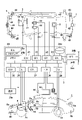
- FIG. 5 is a block diagram showing a configuration example of the control device 2 of the vehicle 1. As shown in FIG. In FIG. 5, a schematic plan view and a side view of the vehicle 1 are shown. As the vehicle 1, a sedan-type four-wheeled passenger car is exemplified.
- the control device 2 corresponds to the processing section 140 of the in-vehicle device 100 shown in FIG. 2 and controls each section of the vehicle 1 .
- the control device 2 includes a plurality of ECUs 20 to 29 communicatively connected by an in-vehicle network.
- Each ECU (Electronic Control Unit) includes a processor represented by a CPU, a storage device such as a semiconductor memory, an interface with an external device, and the like.
- the storage device stores programs executed by the processor, data used for processing by the processor, and the like.
- Each ECU may include a plurality of processors, storage devices, interfaces, and the like.
- the ECU 20 includes a processor 20a and a memory 20b.
- Processing by the ECU 20 is executed by the processor 20a executing instructions included in the program stored in the memory 20b.
- the ECU 20 may include a dedicated integrated circuit such as an ASIC for executing processing by the ECU 20 . The same applies to other ECUs.
- each ECU 20 to 29 takes charge of will be described below. It should be noted that the number of ECUs and the functions they are in charge of can be appropriately designed, and it is possible to subdivide or integrate them more than in the present embodiment.
- the ECU 20 performs overall control of the vehicle 1 (self-vehicle) according to this embodiment.
- the ECU 20 can be configured to execute control related to automatic driving of the vehicle 1 .
- the ECU 20 can automatically control at least one of steering and vehicle speed (acceleration/deceleration) of the vehicle 1 .
- the ECU 21 controls the electric power steering device 3.
- the electric power steering device 3 includes a mechanism that steers the front wheels according to the driver's driving operation (steering operation) on the steering wheel 31 .
- the electric power steering device 3 also includes a motor 3a that exerts a driving force for assisting a steering operation and automatically steering the front wheels, a steering angle sensor 3b that detects a steering angle, and the like.
- the ECU 21 automatically controls the electric power steering device 3 in response to instructions from the ECU 20 to control the traveling direction of the vehicle 1 .
- the ECUs 22 and 23 control the detection units 41 to 43 that detect the vehicle's surroundings and process information on the detection results.
- the detection unit 41 corresponds to the imaging unit 110 (camera) of the in-vehicle device 100 shown in FIG. be).
- the camera 41 is attached to the vehicle interior side of the front window in the front part of the roof of the vehicle 1 so as to be able to photograph the front of the vehicle 1 .
- Analysis (image processing) of the images captured by the camera 41 analyzes the target in front of the vehicle 1, as well as the width (width) and state of the road in front of the vehicle 1, the display of traffic lights, and the lanes on the road. Demarcation lines (white lines, etc.) can be analyzed (extracted).
- the detection unit 42 is a Light Detection and Ranging (LIDAR), and uses light to detect targets around the vehicle 1 and measure the distance to the target. Below, the detection unit 42 may be described as “rider 42".
- the detection unit 43 is a millimeter wave radar, and uses radio waves to detect targets around the vehicle 1 and to measure the distance to the target. Below, the detection unit 43 may be described as "radar 43".
- the ECU 22 controls the one camera 41 and each rider 42 and processes the detection results.
- the ECU 23 performs control of the other camera 41 and each radar 43 and information processing of detection results.
- the ECU 24 controls the gyro sensor 5, the GPS sensor 24b, and the communication device 24c, and performs information processing of detection results or communication results.
- a gyro sensor 5 detects rotational motion of the vehicle 1 .
- the course of the vehicle 1 can be determined based on the detection result of the gyro sensor 5, the wheel speed, and the like.
- GPS sensor 24 b detects the current position of vehicle 1 .
- the communication device 24c performs wireless communication with the server via the network. Using this communication device 24c, the ECU 24 can receive information from the server via the network, and transmit information to the server via the network.
- the ECU 24 can access a map information database 24a built in a storage device, and the ECU 24 searches for a route from the current location to the destination.
- the database 24a can be placed on a network, and the communication device 24c can access the database 24a on the network to obtain information.
- the ECU 25 includes a communication device 25a capable of communicating with an information processing device such as vehicle-to-vehicle communication, road-to-vehicle communication, or a smartphone.
- the communication device 25a can wirelessly communicate with other vehicles in the vicinity to exchange information between vehicles, or can exchange information with an external information processing device or the like by wireless communication.
- the communication device 24c and the communication device 25a correspond to the communication section 130 of the in-vehicle device 100 shown in FIG.
- the ECU 26 controls the power plant 6.
- the power plant 6 is a mechanism that outputs driving force for rotating the drive wheels of the vehicle 1, and includes, for example, an engine and a transmission.
- the configuration of the power plant 6 is not limited to this example, and includes an electric vehicle using an electric motor as a power source, a hybrid vehicle having both an engine and an electric motor, and the like.
- the ECU 26 controls the output of the engine in response to the driver's driving operation (accelerator operation or acceleration operation) detected by the operation detection sensor 7a provided on the accelerator pedal 7A, or detects the vehicle speed detected by the vehicle speed sensor 7c.
- the gear stage of the transmission is switched based on the information.
- the ECU 26 automatically controls the power plant 6 in response to instructions from the ECU 20 to control the vehicle speed (the speed and acceleration/deceleration of the vehicle 1).
- the ECU 27 controls the direction indicators 8a (winkers) and lamps 8b (headlights, taillights, etc.).
- the ECU 28 also controls the input/output device 9 .
- the input/output device 9 outputs information to passengers including the driver, and receives input of information from the passengers.
- a voice output device 91 (for example, a speaker) notifies the passenger of information by voice.
- a display device 92 (for example, a display) notifies the driver of information by displaying an image. Audio output device 91 and/or display device 92 correspond to notification unit 120 of in-vehicle device 100 shown in FIG.
- the input device 93 is arranged at a position operable by the driver, and includes a group of switches for inputting instructions to the vehicle 1 and a voice input device for inputting the voice of the passenger.
- the ECU 29 controls the braking device 10 and a parking brake (not shown).
- the brake device 10 is, for example, a disc brake device, is provided on each wheel of the vehicle 1, and decelerates or stops the vehicle 1 by applying resistance to the rotation of the wheels.
- the ECU 29 controls the operation of the brake device 10 in response to the driver's driving operation (brake operation) detected by the operation detection sensor 7b provided on the brake pedal 7B, for example.
- the ECU 29 automatically controls the braking device 10 in response to instructions from the ECU 20 to control deceleration and stopping of the vehicle 1 .
- the brake device 10 and the parking brake can also be operated to keep the vehicle 1 stopped.
- the transmission of the power plant 6 is equipped with a parking lock mechanism, it can also be operated to keep the vehicle 1 in a stopped state.
- the ECU 20 that controls the automatic driving uses the determination result of the determination unit 143 described in the first embodiment to control the automatic driving before the vehicle 1 enters the front road. Furthermore, since it is possible to determine whether or not the vehicle 1 can pass through the front road, it is possible to realize more accurate automatic driving.
- a program that implements one or more functions described in the above embodiments is supplied to a system or device via a network or storage medium, and one or more processors in the computer of the system or device read this program. can be executed.
- the present invention can also be realized by such an aspect.
- the in-vehicle device of the above embodiment includes: An in-vehicle device (eg, 100) mounted on a vehicle (eg, 1), detection means (e.g. 142) for detecting a drivable width (e.g. W 2 ) of a road (e.g. R) around the vehicle; determining means (for example, 143) for determining whether or not the vehicle can pass through the road based on the vehicle information about the vehicle and the travelable width of the road detected by the detecting means; .
- the occupant (driver) of the vehicle can grasp whether or not the vehicle can pass through the road before the vehicle enters the road around the vehicle.
- the driving state of the vehicle is automatic driving, it is possible to grasp whether the vehicle can pass through the road before the vehicle enters the road around the vehicle. It becomes possible to realize driving.
- the vehicle information includes information indicating the vehicle width (for example, W 1 ) or vehicle class of the vehicle.
- the judging means judges whether or not the vehicle can pass through the road based on the width or class of the vehicle and the width of the road detected by the detecting means. According to this embodiment, it is possible to appropriately determine whether or not the vehicle can pass through the road around the vehicle according to the width and class of the vehicle.
- the detection means further detects a road surface condition of the road
- the judging means judges whether or not the vehicle can pass through the road based on the vehicle information and the road surface condition detected by the detecting means. According to this embodiment, it is possible to appropriately determine whether or not the vehicle can travel on the road, that is, whether or not the vehicle can pass through the road, according to the road surface conditions around the vehicle. can be done.
- notification means for example, 120, 144.
- a vehicle occupant for example, a driver
- It further comprises communication means (for example, 130, 144) for transmitting information about the width of the road that can be traveled, detected by the detection means, to at least one of surrounding vehicles present around the vehicle and a server.
- communication means for example, 130, 144 for transmitting information about the width of the road that can be traveled, detected by the detection means, to at least one of surrounding vehicles present around the vehicle and a server.
- the communication means when the detection means detects that the width of the road becomes narrower in the traveling direction of the vehicle, transmits information to that effect to the at least one of the vehicles.
- the width of the road itself becomes narrower, and the drivable width of the road becomes narrower. In this case, it is possible to make a vehicle that is scheduled to pass through the road later understand that the width of the road that can be traveled will be narrower.
- the communication means transmits the information about the width of the road that can be traveled detected by the detection means only to following vehicles having a vehicle width or vehicle class equal to or smaller than the vehicle, among the following vehicles of the vehicle.
- the following vehicle of the vehicle 1 can grasp the width of the road around (in front of) the vehicle that the vehicle can travel through, for example, vehicle-to-vehicle communication.
- the information about the width of the road that can be traveled is transmitted only to following vehicles whose vehicle width or vehicle class is equal to or less than the vehicle (self-vehicle), it can be advantageous in terms of reducing the amount of communication.
Landscapes
- Engineering & Computer Science (AREA)
- Physics & Mathematics (AREA)
- General Physics & Mathematics (AREA)
- Automation & Control Theory (AREA)
- Mathematical Physics (AREA)
- Transportation (AREA)
- Mechanical Engineering (AREA)
- Traffic Control Systems (AREA)
Priority Applications (2)
| Application Number | Priority Date | Filing Date | Title |
|---|---|---|---|
| JP2023508262A JP7642789B2 (ja) | 2021-03-24 | 2021-03-24 | 車載装置、車両、情報処理方法、およびプログラム |
| PCT/JP2021/012263 WO2022201363A1 (ja) | 2021-03-24 | 2021-03-24 | 車載装置、車両、情報処理方法、およびプログラム |
Applications Claiming Priority (1)
| Application Number | Priority Date | Filing Date | Title |
|---|---|---|---|
| PCT/JP2021/012263 WO2022201363A1 (ja) | 2021-03-24 | 2021-03-24 | 車載装置、車両、情報処理方法、およびプログラム |
Publications (1)
| Publication Number | Publication Date |
|---|---|
| WO2022201363A1 true WO2022201363A1 (ja) | 2022-09-29 |
Family
ID=83396590
Family Applications (1)
| Application Number | Title | Priority Date | Filing Date |
|---|---|---|---|
| PCT/JP2021/012263 Ceased WO2022201363A1 (ja) | 2021-03-24 | 2021-03-24 | 車載装置、車両、情報処理方法、およびプログラム |
Country Status (2)
| Country | Link |
|---|---|
| JP (1) | JP7642789B2 (https=) |
| WO (1) | WO2022201363A1 (https=) |
Citations (6)
| Publication number | Priority date | Publication date | Assignee | Title |
|---|---|---|---|---|
| JP2005326963A (ja) * | 2004-05-12 | 2005-11-24 | Fujitsu Ten Ltd | 運転支援装置 |
| JP2019219796A (ja) * | 2018-06-18 | 2019-12-26 | 株式会社デンソーテン | 車両走行制御サーバ、車両走行制御方法、および車両制御装置 |
| JP2020027645A (ja) * | 2018-08-08 | 2020-02-20 | 住友電気工業株式会社 | サーバ、無線通信方法、コンピュータプログラム、及び車載装置 |
| JP2020077127A (ja) * | 2018-11-06 | 2020-05-21 | 三菱自動車工業株式会社 | 運転支援装置 |
| JP2020119034A (ja) * | 2019-01-18 | 2020-08-06 | トヨタ自動車株式会社 | 車両、車両制御方法、及び車両制御プログラム |
| JP2020147281A (ja) * | 2019-03-15 | 2020-09-17 | スズキ株式会社 | 運転支援装置 |
Family Cites Families (1)
| Publication number | Priority date | Publication date | Assignee | Title |
|---|---|---|---|---|
| JP2015031533A (ja) | 2013-07-31 | 2015-02-16 | 住友電気工業株式会社 | 経路探索装置、コンピュータプログラム及び経路探索方法 |
-
2021
- 2021-03-24 JP JP2023508262A patent/JP7642789B2/ja active Active
- 2021-03-24 WO PCT/JP2021/012263 patent/WO2022201363A1/ja not_active Ceased
Patent Citations (6)
| Publication number | Priority date | Publication date | Assignee | Title |
|---|---|---|---|---|
| JP2005326963A (ja) * | 2004-05-12 | 2005-11-24 | Fujitsu Ten Ltd | 運転支援装置 |
| JP2019219796A (ja) * | 2018-06-18 | 2019-12-26 | 株式会社デンソーテン | 車両走行制御サーバ、車両走行制御方法、および車両制御装置 |
| JP2020027645A (ja) * | 2018-08-08 | 2020-02-20 | 住友電気工業株式会社 | サーバ、無線通信方法、コンピュータプログラム、及び車載装置 |
| JP2020077127A (ja) * | 2018-11-06 | 2020-05-21 | 三菱自動車工業株式会社 | 運転支援装置 |
| JP2020119034A (ja) * | 2019-01-18 | 2020-08-06 | トヨタ自動車株式会社 | 車両、車両制御方法、及び車両制御プログラム |
| JP2020147281A (ja) * | 2019-03-15 | 2020-09-17 | スズキ株式会社 | 運転支援装置 |
Also Published As
| Publication number | Publication date |
|---|---|
| JPWO2022201363A1 (https=) | 2022-09-29 |
| JP7642789B2 (ja) | 2025-03-10 |
Similar Documents
| Publication | Publication Date | Title |
|---|---|---|
| CN110271532B (zh) | 车辆控制装置 | |
| US11605299B2 (en) | Vehicle and control method thereof | |
| JP7053707B2 (ja) | 車両及びその制御装置 | |
| JP6970215B2 (ja) | 車両制御装置、それを有する車両、および制御方法 | |
| US11299148B2 (en) | Travel control apparatus and vehicle | |
| JP7183438B2 (ja) | 運転支援装置、運転支援方法及びプログラム | |
| CN110626344A (zh) | 车辆的控制装置 | |
| JP7036857B2 (ja) | 車両及びその制御装置 | |
| JP2023136206A (ja) | 運転支援装置、車両、運転支援方法、およびプログラム | |
| US20230245470A1 (en) | Driving assistance apparatus, vehicle, driving assistance method, and storage medium | |
| US12128884B2 (en) | Vehicle control apparatus, vehicle control method, and storage medium | |
| US11820282B2 (en) | Notification apparatus, vehicle, notification method, and storage medium | |
| JP6664371B2 (ja) | 物体認識装置、物体認識方法及び車両 | |
| US20210312814A1 (en) | Vehicle, device, and method | |
| JP7028905B2 (ja) | 車両及びその制御装置 | |
| CN113859227B (zh) | 驾驶辅助装置、车辆、便携终端以及存储介质 | |
| CN113386756B (zh) | 车辆追随行驶系统、车辆控制装置、车辆及车辆控制方法 | |
| JP7642789B2 (ja) | 車載装置、車両、情報処理方法、およびプログラム | |
| JP6953575B2 (ja) | 車両制御装置、車両、車両制御方法およびプログラム | |
| CN113525351A (zh) | 驾驶员辅助设备及其方法 | |
| CN113415269B (zh) | 车辆通信系统、存储介质、及监视对象物检测方法 | |
| US20260015007A1 (en) | Drive recorder and control method thereof | |
| US20240317225A1 (en) | Vehicle control device, operation method of vehicle control device, and storage medium | |
| CN120716739A (zh) | 驾驶辅助装置、车辆、驾驶辅助装置的控制方法、程序产品以及存储介质 |
Legal Events
| Date | Code | Title | Description |
|---|---|---|---|
| 121 | Ep: the epo has been informed by wipo that ep was designated in this application |
Ref document number: 21932973 Country of ref document: EP Kind code of ref document: A1 |
|
| WWE | Wipo information: entry into national phase |
Ref document number: 2023508262 Country of ref document: JP |
|
| WWE | Wipo information: entry into national phase |
Ref document number: 202347061221 Country of ref document: IN |
|
| NENP | Non-entry into the national phase |
Ref country code: DE |
|
| 122 | Ep: pct application non-entry in european phase |
Ref document number: 21932973 Country of ref document: EP Kind code of ref document: A1 |