WO2022196723A1 - 感応膜及びガスセンサ - Google Patents
感応膜及びガスセンサ Download PDFInfo
- Publication number
- WO2022196723A1 WO2022196723A1 PCT/JP2022/011854 JP2022011854W WO2022196723A1 WO 2022196723 A1 WO2022196723 A1 WO 2022196723A1 JP 2022011854 W JP2022011854 W JP 2022011854W WO 2022196723 A1 WO2022196723 A1 WO 2022196723A1
- Authority
- WO
- WIPO (PCT)
- Prior art keywords
- sensitive
- carbon black
- sensitivity
- sensitive material
- conductive particles
- Prior art date
- Legal status (The legal status is an assumption and is not a legal conclusion. Google has not performed a legal analysis and makes no representation as to the accuracy of the status listed.)
- Ceased
Links
Images



Classifications
-
- G—PHYSICS
- G01—MEASURING; TESTING
- G01N—INVESTIGATING OR ANALYSING MATERIALS BY DETERMINING THEIR CHEMICAL OR PHYSICAL PROPERTIES
- G01N27/00—Investigating or analysing materials by the use of electric, electrochemical, or magnetic means
- G01N27/02—Investigating or analysing materials by the use of electric, electrochemical, or magnetic means by investigating impedance
- G01N27/04—Investigating or analysing materials by the use of electric, electrochemical, or magnetic means by investigating impedance by investigating resistance
- G01N27/12—Investigating or analysing materials by the use of electric, electrochemical, or magnetic means by investigating impedance by investigating resistance of a solid body in dependence upon absorption of a fluid; of a solid body in dependence upon reaction with a fluid, for detecting components in the fluid
-
- G—PHYSICS
- G01—MEASURING; TESTING
- G01N—INVESTIGATING OR ANALYSING MATERIALS BY DETERMINING THEIR CHEMICAL OR PHYSICAL PROPERTIES
- G01N27/00—Investigating or analysing materials by the use of electric, electrochemical, or magnetic means
- G01N27/02—Investigating or analysing materials by the use of electric, electrochemical, or magnetic means by investigating impedance
- G01N27/04—Investigating or analysing materials by the use of electric, electrochemical, or magnetic means by investigating impedance by investigating resistance
Definitions
- the present disclosure relates to a sensitive film and a gas sensor. More particularly, the present invention relates to a sensitive film and a gas sensor comprising a film body containing a sensitive material and carbon black contained in the film body.
- Patent Document 1 describes a sensor used in an artificial olfactory system.
- the sensor detects an analyte in a fluid, includes a layer comprising electrically conductive modified particles, and is electrically connected to an electrical measurement device.
- the conductive modifying particles contain carbon black having at least one organic group.
- a problem with this type of sensor is that it easily responds to moisture other than the subject.
- An object of the present disclosure is to provide a sensitive film capable of suppressing response to moisture and a gas sensor including the same.
- a sensitive film includes a film body containing a sensitive material and a plurality of conductive particles contained in the film body.
- the film main body is expandable by adsorption of the object to be detected.
- a ratio M1/M2 between the mass M1 of the sensitive material and the mass M2 of the plurality of conductive particles is 0.4 or less.
- a sensitive film includes a film body containing a sensitive material and a plurality of conductive particles contained in the film body.
- the film main body is expandable by adsorption of the object to be detected.
- a ratio V1/V2 between the volume V1 of the sensitive material and the volume V2 of the plurality of conductive particles is 0.72 or less.
- a gas sensor includes the sensitive film and electrodes electrically connected to the sensitive film.
- FIG. 1A is a perspective view of a gas sensor according to one embodiment of the present disclosure
- FIG. FIG. 1B is a plan view showing the sensor unit of the same
- FIG. 1C is a perspective view showing the sensitive film of the same.
- 2A and 2B are explanatory diagrams showing the operation of the sensitive film of the same.
- FIG. 2C is a graph showing an example of change in resistance value with respect to time obtained by the operation of the same sensitive film.
- FIG. 3A is a graph showing the sensor sensitivity to the object to be detected (VOC) of the above, showing the relationship between the mass ratio of the sensitive material and carbon black and the sensor sensitivity.
- FIG. VOC sensor sensitivity to the object to be detected
- FIG. 3B is a graph showing the sensor sensitivity to moisture of the above, showing the relationship between the mass ratio of the sensitive material and carbon black and the sensor sensitivity.
- FIG. 3C is a graph showing the relationship between the mass ratio of the above sensitive material and carbon black, and the ratio of sensor sensitivity to substances to be detected (VOC) and sensor sensitivity to moisture.
- FIG. 4A is a graph showing the sensor sensitivity to the object to be detected (VOC) of the above, showing the relationship between the volume ratio of the sensitive material and carbon black and the sensor sensitivity.
- FIG. 4B is a graph showing the sensor sensitivity to moisture of the above, showing the relationship between the volume ratio of the sensitive material and carbon black and the sensor sensitivity.
- FIG. 4C is a graph showing the relationship between the volume ratio of the same sensitive material to carbon black and the ratio of sensor sensitivity to substances to be detected (VOC) and sensor sensitivity to moisture.
- FIG. 5A is a scanning micrograph of a cross section of the same sensitive film.
- FIG. 5B is an enlarged scanning micrograph of FIG. 5A.
- 5C and 5D are schematic cross-sectional views of the same sensitive film.
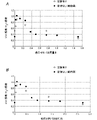
- FIG. 6A is a graph showing the relationship between the mass ratio of the same sensitive material and carbon black and the ratio of sensor sensitivity to substances to be detected (VOC) and sensor sensitivity to moisture.
- FIG. 6B is a graph showing the relationship between the volume ratio of the same sensitive material to carbon black and the ratio of sensor sensitivity to substances to be detected (VOC) and sensor sensitivity to moisture.
- FIG. 7A is a graph showing the relationship between the mass ratio of the same sensitive material and carbon black and the ratio of sensor sensitivity to substances to be detected (VOC) and sensor sensitivity to moisture.
- FIG. 7B is a graph showing the relationship between the volume ratio of the same sensitive material to carbon black and the ratio of sensor sensitivity to substances to be detected (VOC) and sensor sensitivity to moisture.
- FIG. 8A is a graph showing the relationship between the mass ratio of the same sensitive material and carbon black and the ratio of the sensor sensitivity to substances to be detected (VOC) and the sensor sensitivity to moisture.
- FIG. 8B is a graph showing the relationship between the volume ratio of the sensitive material to carbon black and the ratio of sensor sensitivity to substances to be detected (VOC) and sensor sensitivity to moisture.
- FIG. 9A is a graph showing the relationship between the mass ratio of the same sensitive material and carbon black and the ratio of sensor sensitivity to substances to be detected (VOC) and sensor sensitivity to moisture.
- FIG. 9B is a graph showing the relationship between the volume ratio of the same sensitive material to carbon black and the ratio of sensor sensitivity to substances to be detected (VOC) and sensor sensitivity to moisture.
- FIG. 1A is a schematic configuration diagram of a gas sensor 1 according to this embodiment.
- the gas sensor 1 is used, for example, to detect odor component molecules as molecules to be detected. Odor component molecules include volatile organic compounds (VOCs), ammonia, and the like.
- the gas sensor 1 is used to detect VOCs as molecules to be detected.
- the gas sensor 1 detects VOC, which is an odor component molecule contained in a sample gas such as gas collected from food, exhaled air collected from a human body, or air collected from a room in a building.
- the molecules to be detected by the gas sensor 1 are not limited to VOCs, and may be molecules of multiple types of odor components including VOCs, or molecules other than odor components, such as combustible gases, toxic gases such as carbon monoxide, and the like. can be a molecule of
- the gas sensor 1 includes a supply section 11, a sensor section 12, and a processing section 13.
- the supply unit 11 supplies a sample gas and a reference gas containing odor molecules to the sensor unit 12 .
- the sensor unit 12 includes multiple sensitive films 20 and multiple electrodes 21 .
- the processing unit 13 includes a detection unit that detects changes in the resistance value obtained by the sensor unit 12 and a control unit that controls the operation of the gas sensor 1 .
- the supply unit 11 has pipes through which the sample gas and the reference gas flow.
- the processing unit 13 has an electric circuit that constitutes a detection unit and a control unit.
- the sensor section 12 is formed by providing a plurality of sensitive films 20 on a substrate 120 .
- a plurality of sensitive films 20 (four in this embodiment) are arranged side by side in the vertical direction and the horizontal direction.
- Each sensitive film 20 is formed in a circular shape in plan view.
- the number, arrangement, and shape of the sensitive films 20 in the sensor section 12 are not limited to those shown in FIG.
- the sensitive film 20 includes a film body 201 and conductive particles 202.
- Conductive particles 202 are dispersed in the matrix of membrane body 201 .
- the membrane body 201 contains a sensitive material.
- the sensitive material is selected according to the type of chemical substance to be adsorbed by the membrane body 201 and/or the type of the conductive particles 202 .
- the sensitive material is composed of an electrically insulating organic material, and includes, for example, at least one material selected from the group consisting of macromolecules and low-molecular weight materials. It is particularly preferred that the sensitive material contains a polymer. Note that if the sensitive material contains a polymer, the film main body 201 can have heat resistance.
- Preferred examples of sensitive materials include materials commercially available as stationary phases for columns in gas chromatographs. More specifically, the sensitive material is, for example, at least one material selected from the group consisting of polyalkylene glycols, polyesters, silicones, glycerols, nitriles, dicarboxylic acid monoesters, and aliphatic amines. including.
- the membrane body 201 can easily adsorb chemical substances, especially volatile organic compounds, in the gas.
- Polyalkylene glycols include, for example, polyethylene glycol (heat resistant temperature 170°C).
- Polyesters include, for example, at least one material selected from the group consisting of poly(diethylene glycol adipate) and poly(ethylene succinate).
- Silicones include, for example, at least one material selected from the group consisting of dimethylsilicone, phenylmethylsilicone, trifluoropropylmethylsilicone, and cyanosilicone (heat resistant temperature of 275°C).
- Glycerols include, for example, diglycerol (heat resistant temperature 150°C).
- Nitriles are selected from the group consisting of, for example, N,N-bis(2-cyanoethyl)formamide (heat resistant temperature 125°C) and 1,2,3-tris(2-cyanoethoxy)propane (heat resistant temperature 150°C).
- Dicarboxylic acid monoesters include, for example, at least one material selected from the group consisting of nitroterephthalic acid-modified polyethylene glycol (heat resistant temperature: 275°C) and diethylene glycol succinate (heat resistant temperature: 225°C).
- Aliphatic amines include, for example, tetrahydroxyethylethylenediamine (heat resistant temperature 125°C).
- the conductive particles 202 are particles that constitute carbon black.
- Carbon black is an aggregate of ultrafine spherical particles obtained by incomplete combustion of compounds containing hydrocarbons or carbon.
- the film body 201 contains at least one material selected from the group consisting of conductive polymers, metals, metal oxides, semiconductors, superconductors and complex compounds as conductive particles. may contain.
- a pair of electrodes 21 are connected to the sensitive film 20 .
- Each electrode 21 is electrically connected to the conductive particles 202 in the sensitive film 20 .
- the pair of electrodes 21 are electrically connected to the detection section of the processing section 13 .
- the thickness of the film main body 201 is small before the odor molecules G are adsorbed, as shown in FIG. 2A. That is, the plurality of conductive particles 202 dispersed in the film main body 201 are in a dense state.
- the film main body 201 expands and becomes thicker. That is, the plurality of conductive particles 202 dispersed in the film main body 201 are in a sparse state (see FIG. 2B).
- FIG. 2C the resistance value of the sensitive film 20 increases at time t1 when the odor molecules G are adsorbed.
- the film main body 201 of the sensitive film 20 shrinks and the thickness of the sensitive film 20 becomes smaller.
- the gas sensor 1 detects the odor in the sample gas supplied from the supply section 11 to the sensor section 12 . It is possible to detect whether the molecule G is present or not.
- Conductive carbon black is mainly used as a conductive material in fields such as films, IC trays, surface heating elements, magnetic tapes, and conductive rubbers.
- Carbon black for color is mainly used as a black pigment in fields such as newspaper ink, printing ink, resin coloring, paint, and toner.
- Conductive carbon black and color carbon black can be distinguished by the degree of development of a network structure (so-called structure) formed by carbon black particles (conductive particles 202). Conductive carbon black has a well-developed structure, whereas color-use carbon black has a less-developed structure than conductive carbon black.
- the structure is carbon black particles chemically and physically bonded to each other, but carbon black with a well-developed structure has many carbon black particles that are chemically and physically bonded to each other. Undeveloped carbon black has fewer particles of carbon black that are chemically and physically bound together.
- carbon black having an undeveloped structure it is preferable to use carbon black having an undeveloped structure. Specifically, in the present embodiment, it is preferable to use carbon black having a dibutyl phthalate absorption amount (hereinafter sometimes referred to as DBP absorption amount) of less than 100 cm 3 /100 g. Carbon black having a DBP absorption of 100 cm 3 /100 g or more has a well-developed structure and is preferably not used in this example.
- the DBP absorption amount is the amount of DBP (dibutyl phthalate) absorbed by 100 g of carbon black, and is measured according to JIS K6221.
- Dst aggregate Stokes mode diameter
- a sample solution with a carbon black concentration of 0.01 wt% is prepared by adding precisely weighed carbon black to a 20% ethanol aqueous solution containing a surfactant. This is sufficiently dispersed by ultrasonic waves and used as a measurement sample.
- 10 ml of spin liquid (pure water) was injected into a centrifugal sedimentation type particle size distribution analyzer, 1 ml of buffer solution (20 vol% ethanol aqueous solution) was further injected, and then 1 ml of the measurement sample prepared above was injected.
- the Stokes equivalent diameter is measured by centrifugation at , and a histogram of the frequency of occurrence relative to the Stokes equivalent diameter is created. Let Dst be the Stokes equivalent diameter of the maximum frequency of the histogram thus obtained.
- the average primary particle size (D0) of carbon black can be calculated by observing the carbon black particles (conductive particles 202) in the sensitive film 20 with an electron microscope.
- Dst/D0 there is a correlation between the DBP absorption and the Dst/D0 value, and Dst/D0 of less than 4 corresponds to a DBP absorption of less than 100 cm 3 /100 g.
- the electrical conduction of carbon black in the polymer matrix is based on the "conducting pathway theory” in which ⁇ electrons move through the structure, and the “tunnel effect theory” in which conduction occurs when ⁇ electrons jump in the gap between particles. and both are in conflict.
- a carbon black having a DBP absorption of 100 cm 3 /100 g or more has a well-developed structure, and it is considered that electrical conduction through conductive paths is dominant.
- carbon black of less than 100 cm 3 /100 g has an undeveloped structure, and it is considered that electrical conduction due to tunnel effect is dominant.
- electric conduction occurs due to the tunneling effect of carbon black. Therefore, it is considered that the change in the resistance value due to the adsorption of the odorant molecule G increases, and the gas sensor 1 becomes highly sensitive.
- the lower limit of the DBP absorption amount of carbon black is not particularly set, it is preferably 50 cm 3 /100 g or more. In this case, Dst/D0 corresponds to 2 or more.
- the ratio M1/M2 between the mass M1 of the sensitive material and the mass M2 of the plurality of conductive particles is preferably 0.4 or less.
- the ratio M1/M2 between the mass M1 of the sensitive material and the mass M2 of the plurality of conductive particles is 0.025 or more and 0.25 or less.
- FIG. 3A shows the sensor sensitivity to the object to be detected.
- the sensor sensitivity is plotted against the mass ratio (M1/M2) of the sensitive material and the plurality of conductive particles.
- the evaluation gas is dry air containing 10 ppm of benzaldehyde as a substance to be detected. Carbon black was used as the plurality of conductive particles.
- Biscyanopropyl-cyanopropylphenylpolysiloxane manufactured by Sigma-Aldrich, trade name SP-2330 was used as the sensitive material.
- the sensor sensitivity is Rs/R0, where Rs is the resistance value measured at the sensitive film 20 when the evaluation gas is introduced into the gas sensor 1, and R0 is the resistance value measured at the sensitive film 20 when the odorless gas is introduced into the gas sensor 1. defined in
- the sensor sensitivity increases as the mass ratio between the sensitive material and the plurality of conductive particles increases.
- the sensor sensitivity was measured by using the same sensitive film 20 and changing the evaluation gas.
- the evaluation gas is moist air containing 10000 ppm of moisture.
- VOC sensitivity/H 2 O sensitivity (Ratio of resistance change to 10 ppm of benzaldehyde)/(Ratio of resistance change to 10000 ppm of H 2 O).
- FIG. 3C VOC sensitivity/H 2 O sensitivity is VOC sensitivity/H 2 O sensitivity when the mass ratio (M1/M2) of the sensitive material and the plurality of conductive particles is 0.4 or less.
- the sensitivity increases, and in particular, the VOC sensitivity/H 2 O sensitivity has a peak when the mass ratio (M1/M2) of the sensitive material and the plurality of conductive particles is 0.025 or more and 0.25 or less. and the value of VOC sensitivity/H 2 O sensitivity is greater than others. Therefore, when the mass ratio (M1/M2) of the sensitive material and the plurality of conductive particles is between 0.025 and 0.25, the VOC sensitivity/H 2 O sensitivity is maximized and the influence of moisture is reduced. It is conceivable that the object to be detected can be detected by
- the ratio V1/V2 between the volume V1 of the sensitive material and the volume V2 of the plurality of conductive particles is preferably 0.72 or less.
- the ratio V1/V2 between the volume V1 of the sensitive material and the volume V2 of the plurality of conductive particles is 0.045 or more and 0.45 or less.
- FIG. 4A shows the sensor sensitivity to the object to be detected.
- the sensor sensitivity is plotted against the volume ratio (V1/V2) of the sensitive material and the plurality of conductive particles.
- the evaluation gas and the sensitive film 20 are the same as above.
- the sensor sensitivity increases as the volume ratio between the sensitive material and the plurality of conductive particles increases.
- the sensor sensitivity was measured by changing the evaluation gas.
- the evaluation gas is air containing 10000 ppm of moisture.
- VOC sensitivity/H 2 O sensitivity is VOC sensitivity/H 2 O sensitivity when the volume ratio (V1/V2) of the sensitive material and the plurality of conductive particles is 0.72 or less.
- the sensitivity increases, and in particular, the VOC sensitivity/H 2 O sensitivity has a peak when the volume ratio (V1/V2) of the sensitive material and the plurality of conductive particles is between 0.045 and 0.45.
- VOC sensitivity/H 2 O sensitivity is greater than others. Therefore, when the volume ratio (V1/V2) of the sensitive material and the plurality of conductive particles is between 0.045 and 0.45, the VOC sensitivity/H 2 O sensitivity is maximized, and the influence of moisture is minimized. It is conceivable that the object to be detected can be detected by reducing the From this result, when considering the volume, if the sensitive material contained in the sensitive film 20 exceeds 50 vol% of the volume of the plurality of conductive particles (carbon black), the response of the sensitive film 20 to moisture increases. This is thought to be due to the possibility that the liberated sensitive material other than the sensitive material coating around the plurality of conductive particles responds to water.
- FIG. 5A is a scanning micrograph of the cross section of the sensitive film 20, and FIG. 5B is an enlarged scanning micrograph of FIG. 5A.
- a plurality of conductive particles can be assumed to be a structure coated with a sensitive material forming a film body 201 in the sensitive film 20 .
- FIG. 5C schematically shows the state of the conductive particles 202 in the sensitive film 20 when the amount of sensitive material in the sensitive film 20 is small.
- a sensitive material 200 is present over the outer surface of the plurality of conductive particles 202 .
- the sensitive material 200 also exists between a plurality of adjacent conductive particles 202 as shown in FIG. 5D.
- the thickness of the coating layer (sensitive material) where the volume ratio of the sensitive material and the plurality of conductive particles is 50:100 is approximately 2.2 nm. If the amount of the sensitive material is too large, the free portion of the sensitive material may affect the responsiveness, which may lead to an increase in the responsiveness of the sensitive film 20 to moisture.
- the amount of surface functional groups of the carbon black particles is preferably as small as possible. Thereby, the response of the sensitive film 20 to moisture can be suppressed.
- a surface functional group exists on the surface of the carbon black particles (conductive particles 202).
- surface functional groups include carboxyl groups, hydroxyl groups, and quinone groups.
- the more surface functional groups in carbon black the higher the volatile content. That is, the higher the volatile content of carbon black, the higher the number of surface functional groups.
- the sensitive film 20 used for the measurement of the VOC sensitivity/H 2 O sensitivity uses carbon black as the plurality of conductive particles 202.
- Carbon black with a small amount of surface functional groups (CB surface functional group small ) and carbon black having a large amount of surface functional groups (denoted as CB surface functional group large) were used to prepare the sensitive films 20 .
- the carbon black with a low amount of surface functional groups had a volatile content of 2.4 wt %, and the carbon black with a high amount of surface functional groups had a volatile content of 8.0 wt %.
- the volatile matter is the volatile matter (weight loss) when carbon black is heated at 950° C. for 7 minutes.
- the volatile content can be measured by the method described in JIS K 6221 "Testing method for carbon black for rubber”. Specifically, a specified amount of carbon black is placed in a crucible, and the volatilization loss is measured after heating at 950° C. for 7 minutes.
- the mass ratio (M1/M2) between the sensitive material and carbon black (CB) is 0.4 or less, and in particular, the mass ratio (M1/M2) between the sensitive material and carbon black (CB) ) is between 0.025 and 0.25, the smaller CB surface functional group exhibits a higher VOC sensitivity/H 2 O sensitivity than the larger CB surface functional group.
- the volume ratio (V1/V2) between the sensitive material and carbon black (CB) is 0.72 or less. When V2) is between 0.045 and 0.45, the smaller CB surface functional group exhibits a higher VOC sensitivity/H 2 O sensitivity than the larger CB surface functional group.
- carbon black with a small amount of surface functional groups is more preferable than the use of carbon black with a large amount of surface functional groups because it suppresses the influence of moisture on the sensitive film.
- carbon black with a volatile matter content of less than 2.5 wt % can also be used.
- the sensitive film 20 used for the VOC sensitivity/H 2 O sensitivity measurement uses a high polarity sensitive material and a low polarity sensitive material as sensitive materials.
- the highly polar sensitive material the same biscyanopropyl-cyanopropylphenylpolysiloxane (manufactured by Sigma-Aldrich, trade name SP-2330) was used.
- Methylphenylpolysiloxane manufactured by Shinwa Kako Co., Ltd., trade name OV-17 was used as the low-polar sensitive material.
- the mass ratio (M1/ M2) is 0.4 or less, and in particular, when the mass ratio (M1/M2) of the sensitive material and carbon black (CB) is between 0.025 and 0.25, the VOC sensitivity/H 2 O sensitivity is High value.
- the mass ratio (M1/ M2) of the sensitive material and carbon black (CB) is between 0.025 and 0.25, the VOC sensitivity/H 2 O sensitivity is High value.
- the volume ratio (V1 /V2) is 0.72 or less, and in particular, when the volume ratio (V1/V2) of the sensitive material and carbon black (CB) is between 0.045 and 0.45, VOC sensitivity/H 2 O sensitivity shows a high value. Therefore, it is considered that the influence of moisture on the sensitive film can be suppressed by making the ratio of the sensitive material smaller than that of the plurality of conductive particles, regardless of the polarity of the sensitive material.
- the sensitive film 20 used for the measurement of the VOC sensitivity/H 2 O sensitivity uses a highly polar sensitive material as a sensitive material.
- the highly polar sensitive material the same biscyanopropyl-cyanopropylphenylpolysiloxane (manufactured by Sigma-Aldrich, trade name SP-2330) was used.
- the sensitive film 20 was prepared with a film main body 201 having a gap and without a gap.
- the membrane body 201 without voids is formed as a dense membrane.
- the membrane body 201 with voids is made by thermally decomposing a part of the sensitive material.
- the sensitive film 20 without voids has a mass ratio (M1/M2) of the sensitive material and carbon black (CB) of 0.4 or less than the sensitive film 20 with voids.
- M1/M2 mass ratio between the sensitive material and carbon black
- the VOC sensitivity/H 2 O sensitivity exhibits a high value.
- the sensitive film 20 without voids has a volume ratio (V1/V2) of the sensitive material and carbon black (CB) of 0.72 or less than the sensitive film 20 with voids.
- V1/V2 volume ratio of the sensitive material and carbon black (CB)
- CB carbon black
- the sensitive film 20 used for the VOC sensitivity/H 2 O sensitivity measurement uses a low-polarity sensitive material as a sensitive material.
- the low-polarity sensitive material used was the same methylphenylpolysiloxane (manufactured by Shinwa Kako Co., Ltd., trade name OV-17).
- the sensitive film 20 was prepared with a film main body 201 having a gap and without a gap.
- the sensitive film 20 without voids is superior to the sensitive film with voids.
- the mass ratio (M1/M2) between the sensitive material and carbon black (CB) is 0.4 or less, and in particular, the mass ratio (M1/M2) between the sensitive material and carbon black (CB) is 0
- a high value of VOC sensitivity/H 2 O sensitivity is shown between .025 and 0.25.
- the sensitive film 20 without voids is superior to the sensitive film 20 with voids, as in the case of using a high-polarity sensitive material.
- the volume ratio (V1/V2) between the sensitive material and carbon black (CB) is 0.72 or less than the film 20, and in particular, the volume ratio (V1/V2) between the sensitive material and carbon black (CB) is 0.
- a high value of VOC sensitivity/H 2 O sensitivity is shown between .045 and 0.45. Therefore, even when a low-polarity sensitive material is used, a dense film without voids is more preferable than a structure having voids in the sensitive film 20 because it suppresses the effects of moisture.
- the sensitive film (20) includes a film body (201) containing a sensitive material and a plurality of conductive particles (202) contained in the film body (201). .
- the membrane body (201) is expandable by adsorption of the object to be detected.
- a ratio M1/M2 between the mass M1 of the sensitive material and the mass M2 of the plurality of conductive particles (202) is 0.4 or less.
- a second aspect is the sensitive film (20) according to the first aspect, wherein the ratio M1/M2 between the mass M1 of the sensitive material and the mass M2 of the plurality of conductive particles (202) is 0.025 or more. 0.25 or less.
- the response of the sensitive film (20) to moisture can be further suppressed, so that there is the advantage that the response of the sensitive film (20) to the substance to be detected is relatively improved. be.
- a sensitive film (20) comprises a film body (201) containing a sensitive material and a plurality of conductive particles (202) contained in the film body (201).
- the membrane body (201) is expandable by adsorption of the object to be detected.
- a ratio V1/V2 between the volume V1 of the sensitive material and the volume V2 of the plurality of conductive particles is 0.72 or less.
- a fourth aspect is the sensitive film (20) according to the third aspect, wherein the ratio V1/V2 between the volume V1 of the sensitive material and the volume V2 of the plurality of conductive particles (202) is 0.045 or more .45 or less.
- the response of the sensitive film (20) to moisture can be further suppressed, so that there is the advantage that the response of the sensitive film (20) to the substance to be detected is relatively improved. be.
- a fifth aspect is the sensitive film (20) according to any one of the first to fourth aspects, wherein the plurality of conductive particles (202) contain carbon black.
- the carbon black has an absorption of dibutyl phthalate of less than 100 cm 3 /100 g.
- the electrical conduction of the sensitive film (20) becomes electrical conduction due to the tunnel effect, which has the advantage of increasing the sensitivity of the gas sensor.
- a sixth aspect is the sensitive film (20) according to any one of the first to fourth aspects, wherein the plurality of conductive particles (202) contain carbon black.
- the carbon black has a ratio (Dst/D0) of aggregate Stokes mode diameter: Dst and average primary particle diameter: D0 as determined by centrifugal sedimentation analysis of less than 4.
- the electrical conduction of the sensitive film (20) becomes electrical conduction due to the tunnel effect, which has the advantage of increasing the sensitivity of the gas sensor.
- a gas sensor (1) according to a seventh aspect comprises any one of the first to sixth sensitive films (20) and an electrode (21) electrically connected to the sensitive film (20).
- the sensitive film (20) suppresses the response to moisture other than the sample, and the sensitivity of the gas sensor (1) can be increased.
Landscapes
- Chemical & Material Sciences (AREA)
- Chemical Kinetics & Catalysis (AREA)
- Electrochemistry (AREA)
- Physics & Mathematics (AREA)
- Health & Medical Sciences (AREA)
- Life Sciences & Earth Sciences (AREA)
- Analytical Chemistry (AREA)
- Biochemistry (AREA)
- General Health & Medical Sciences (AREA)
- General Physics & Mathematics (AREA)
- Immunology (AREA)
- Pathology (AREA)
- Investigating Or Analyzing Materials By The Use Of Fluid Adsorption Or Reactions (AREA)
Priority Applications (3)
| Application Number | Priority Date | Filing Date | Title |
|---|---|---|---|
| CN202280020855.3A CN116964442A (zh) | 2021-03-19 | 2022-03-16 | 敏感膜和气体传感器 |
| JP2023507152A JPWO2022196723A1 (https=) | 2021-03-19 | 2022-03-16 | |
| US18/282,451 US20240151673A1 (en) | 2021-03-19 | 2022-03-16 | Sensitive membrane and gas sensor |
Applications Claiming Priority (2)
| Application Number | Priority Date | Filing Date | Title |
|---|---|---|---|
| JP2021-046557 | 2021-03-19 | ||
| JP2021046557 | 2021-03-19 |
Publications (1)
| Publication Number | Publication Date |
|---|---|
| WO2022196723A1 true WO2022196723A1 (ja) | 2022-09-22 |
Family
ID=83321058
Family Applications (1)
| Application Number | Title | Priority Date | Filing Date |
|---|---|---|---|
| PCT/JP2022/011854 Ceased WO2022196723A1 (ja) | 2021-03-19 | 2022-03-16 | 感応膜及びガスセンサ |
Country Status (4)
| Country | Link |
|---|---|
| US (1) | US20240151673A1 (https=) |
| JP (1) | JPWO2022196723A1 (https=) |
| CN (1) | CN116964442A (https=) |
| WO (1) | WO2022196723A1 (https=) |
Cited By (1)
| Publication number | Priority date | Publication date | Assignee | Title |
|---|---|---|---|---|
| WO2023210266A1 (ja) * | 2022-04-27 | 2023-11-02 | 日本特殊陶業株式会社 | ガスセンサ及びガスセンサの製造方法 |
Citations (7)
| Publication number | Priority date | Publication date | Assignee | Title |
|---|---|---|---|---|
| JPS5038236A (https=) * | 1973-08-14 | 1975-04-09 | ||
| JPH0249149A (ja) * | 1988-02-19 | 1990-02-19 | Asahi Chem Ind Co Ltd | 感湿または結露センサ |
| JPH1194784A (ja) * | 1997-09-22 | 1999-04-09 | Shimadzu Corp | ガスセンサ |
| JP2002509609A (ja) * | 1997-07-02 | 2002-03-26 | デュラセル、インコーポレーテッド | 有機溶媒蒸気検出器 |
| JP2004340945A (ja) * | 2003-04-11 | 2004-12-02 | Therm-O-Disc Inc | 蒸気センサーおよびそのための材料 |
| JP2006182818A (ja) * | 2004-12-27 | 2006-07-13 | Tokai Carbon Co Ltd | ブラックマトリックス用カーボンブラックの製造方法およびブラックマトリックス用カーボンブラック |
| JP2010038692A (ja) * | 2008-08-04 | 2010-02-18 | Osaka Univ | ガス検知素子 |
Family Cites Families (9)
| Publication number | Priority date | Publication date | Assignee | Title |
|---|---|---|---|---|
| US4631952A (en) * | 1985-08-30 | 1986-12-30 | Chevron Research Company | Resistive hydrocarbon leak detector |
| EP1278061B1 (en) * | 2001-07-19 | 2011-02-09 | Sony Deutschland GmbH | Chemical sensors from nanoparticle/dendrimer composite materials |
| JP4315365B2 (ja) * | 2003-01-08 | 2009-08-19 | 東海カーボン株式会社 | 炭素微小球の製造方法 |
| CN101371364A (zh) * | 2005-12-03 | 2009-02-18 | 泰科热控制有限公司 | 用于检测有机液体的传感器 |
| US7631697B2 (en) * | 2006-11-29 | 2009-12-15 | Schlumberger Technology Corporation | Oilfield apparatus comprising swellable elastomers having nanosensors therein and methods of using same in oilfield application |
| US8309028B2 (en) * | 2007-02-02 | 2012-11-13 | Commonwealth Scientific And Industrial Research Organisation | Chemiresistor for use in conducting electrolyte solution |
| CN101387614A (zh) * | 2008-10-16 | 2009-03-18 | 上海交通大学 | 基于导电聚合物-碳黑颗粒的气敏微传感器 |
| CA3000385A1 (en) * | 2017-04-11 | 2018-10-11 | Syscor Controls & Automation Inc. | Polymer absorption sensor having low cross-sensitivity |
| US12422391B2 (en) * | 2019-08-27 | 2025-09-23 | Chemelex Europe Gmbh | Ruggedized sensor for detecting organic liquids |
-
2022
- 2022-03-16 WO PCT/JP2022/011854 patent/WO2022196723A1/ja not_active Ceased
- 2022-03-16 JP JP2023507152A patent/JPWO2022196723A1/ja active Pending
- 2022-03-16 CN CN202280020855.3A patent/CN116964442A/zh active Pending
- 2022-03-16 US US18/282,451 patent/US20240151673A1/en active Pending
Patent Citations (7)
| Publication number | Priority date | Publication date | Assignee | Title |
|---|---|---|---|---|
| JPS5038236A (https=) * | 1973-08-14 | 1975-04-09 | ||
| JPH0249149A (ja) * | 1988-02-19 | 1990-02-19 | Asahi Chem Ind Co Ltd | 感湿または結露センサ |
| JP2002509609A (ja) * | 1997-07-02 | 2002-03-26 | デュラセル、インコーポレーテッド | 有機溶媒蒸気検出器 |
| JPH1194784A (ja) * | 1997-09-22 | 1999-04-09 | Shimadzu Corp | ガスセンサ |
| JP2004340945A (ja) * | 2003-04-11 | 2004-12-02 | Therm-O-Disc Inc | 蒸気センサーおよびそのための材料 |
| JP2006182818A (ja) * | 2004-12-27 | 2006-07-13 | Tokai Carbon Co Ltd | ブラックマトリックス用カーボンブラックの製造方法およびブラックマトリックス用カーボンブラック |
| JP2010038692A (ja) * | 2008-08-04 | 2010-02-18 | Osaka Univ | ガス検知素子 |
Non-Patent Citations (1)
| Title |
|---|
| NAGASHIMA, KAZUKI ET AL.: "1PC-085 Innovative Molecular Recognition Sensing by Nanowires with Robust Molecular Fingerprint", PROCEEDINGS OF THE 100TH ANNUAL SPRING MEETING OF THE CHEMICAL SOCIETY OF JAPAN (CSJ); MARCH 22-25, 2020, vol. 100, 5 March 2020 (2020-03-05) - 25 March 2020 (2020-03-25), pages 1PC - 085, XP009539598 * |
Cited By (1)
| Publication number | Priority date | Publication date | Assignee | Title |
|---|---|---|---|---|
| WO2023210266A1 (ja) * | 2022-04-27 | 2023-11-02 | 日本特殊陶業株式会社 | ガスセンサ及びガスセンサの製造方法 |
Also Published As
| Publication number | Publication date |
|---|---|
| CN116964442A (zh) | 2023-10-27 |
| US20240151673A1 (en) | 2024-05-09 |
| JPWO2022196723A1 (https=) | 2022-09-22 |
Similar Documents
| Publication | Publication Date | Title |
|---|---|---|
| Kuberský et al. | Towards a fully printed electrochemical NO2 sensor on a flexible substrate using ionic liquid based polymer electrolyte | |
| Pandey et al. | Pd-doped reduced graphene oxide sensing films for H2 detection | |
| CN110603439B (zh) | 用于气体测试的传感器和方法 | |
| Lee et al. | A resistive-type sensor based on flexible multi-walled carbon nanotubes and polyacrylic acid composite films | |
| JP6774127B2 (ja) | ホルムアルデヒド検知センサ、および、それを用いたシステム | |
| Shen et al. | Exhaling‐driven hydroelectric nanogenerators for stand‐alone nonmechanical breath analyzing | |
| Su et al. | Humidity sensing and electrical properties of a composite material of nano-sized SiO2 and poly (2-acrylamido-2-methylpropane sulfonate) | |
| CN103293193B (zh) | 一种基于二氧化钛/石墨烯的二氧化氮传感器及制备方法 | |
| US11958747B2 (en) | Annealed metal nano-particle decorated nanotubes | |
| JP2017166947A (ja) | ガス検出装置 | |
| WO2022196723A1 (ja) | 感応膜及びガスセンサ | |
| Kuberský et al. | Quantitative fluctuation-enhanced sensing in amperometric NO2 sensors | |
| US8551571B2 (en) | Method for making a conductive polymer composite for detecting a sort of gas | |
| WO2022196745A1 (ja) | 感応膜及びガスセンサ | |
| WO2022196744A1 (ja) | 感応膜及びガスセンサ | |
| Wiederoder et al. | Impact of graphene nanoplatelet concentration and film thickness on vapor detection for polymer based chemiresistive sensors | |
| Espinosa et al. | Highly selective NO2 gas sensors made of MWCNTs and WO3 hybrid layers | |
| TWI415143B (zh) | 用於偵測氣體之可導電的高分子複合材料元件的製造方法 | |
| US20250216355A1 (en) | Sensitive membrane and gas sensor | |
| Homer et al. | Polymer-based carbon monoxide sensors | |
| Sakar Dasdan | Poly (phenyl sulfone)/graphite composite as a robust low-cost, comb-type interdigited sensor for detection of organic solvent vapors | |
| Homer et al. | Further Expanding the Capabilities of the JPL Electronic Nose to Include Post-fire Constituents | |
| Yuan et al. | Detection of organic chemical vapors with a MWNTs-polymer array chemiresistive sensor | |
| Ngo et al. | Isopropyl Alcohol Sensor Development for Air Quality Monitoring | |
| SALIKHOV et al. | VESTNIK BASHKIRSKOGO UNIVERSITETA |
Legal Events
| Date | Code | Title | Description |
|---|---|---|---|
| 121 | Ep: the epo has been informed by wipo that ep was designated in this application |
Ref document number: 22771468 Country of ref document: EP Kind code of ref document: A1 |
|
| WWE | Wipo information: entry into national phase |
Ref document number: 2023507152 Country of ref document: JP |
|
| WWE | Wipo information: entry into national phase |
Ref document number: 202280020855.3 Country of ref document: CN |
|
| WWE | Wipo information: entry into national phase |
Ref document number: 18282451 Country of ref document: US |
|
| NENP | Non-entry into the national phase |
Ref country code: DE |
|
| 122 | Ep: pct application non-entry in european phase |
Ref document number: 22771468 Country of ref document: EP Kind code of ref document: A1 |