WO2022196563A1 - ゲームシステム、ゲーム制御方法およびプログラム - Google Patents
ゲームシステム、ゲーム制御方法およびプログラム Download PDFInfo
- Publication number
- WO2022196563A1 WO2022196563A1 PCT/JP2022/010923 JP2022010923W WO2022196563A1 WO 2022196563 A1 WO2022196563 A1 WO 2022196563A1 JP 2022010923 W JP2022010923 W JP 2022010923W WO 2022196563 A1 WO2022196563 A1 WO 2022196563A1
- Authority
- WO
- WIPO (PCT)
- Prior art keywords
- game
- stage
- user
- adjustment value
- amount
- Prior art date
- Legal status (The legal status is an assumption and is not a legal conclusion. Google has not performed a legal analysis and makes no representation as to the accuracy of the status listed.)
- Ceased
Links
Images








Classifications
-
- A—HUMAN NECESSITIES
- A63—SPORTS; GAMES; AMUSEMENTS
- A63F—CARD, BOARD, OR ROULETTE GAMES; INDOOR GAMES USING SMALL MOVING PLAYING BODIES; VIDEO GAMES; GAMES NOT OTHERWISE PROVIDED FOR
- A63F13/00—Video games, i.e. games using an electronically generated display having two or more dimensions
- A63F13/45—Controlling the progress of the video game
-
- A—HUMAN NECESSITIES
- A63—SPORTS; GAMES; AMUSEMENTS
- A63F—CARD, BOARD, OR ROULETTE GAMES; INDOOR GAMES USING SMALL MOVING PLAYING BODIES; VIDEO GAMES; GAMES NOT OTHERWISE PROVIDED FOR
- A63F13/00—Video games, i.e. games using an electronically generated display having two or more dimensions
- A63F13/60—Generating or modifying game content before or while executing the game program, e.g. authoring tools specially adapted for game development or game-integrated level editor
- A63F13/69—Generating or modifying game content before or while executing the game program, e.g. authoring tools specially adapted for game development or game-integrated level editor by enabling or updating specific game elements, e.g. unlocking hidden features, items, levels or versions
-
- A—HUMAN NECESSITIES
- A63—SPORTS; GAMES; AMUSEMENTS
- A63F—CARD, BOARD, OR ROULETTE GAMES; INDOOR GAMES USING SMALL MOVING PLAYING BODIES; VIDEO GAMES; GAMES NOT OTHERWISE PROVIDED FOR
- A63F13/00—Video games, i.e. games using an electronically generated display having two or more dimensions
- A63F13/70—Game security or game management aspects
- A63F13/79—Game security or game management aspects involving player-related data, e.g. identities, accounts, preferences or play histories
- A63F13/792—Game security or game management aspects involving player-related data, e.g. identities, accounts, preferences or play histories for payment purposes, e.g. monthly subscriptions
-
- A—HUMAN NECESSITIES
- A63—SPORTS; GAMES; AMUSEMENTS
- A63F—CARD, BOARD, OR ROULETTE GAMES; INDOOR GAMES USING SMALL MOVING PLAYING BODIES; VIDEO GAMES; GAMES NOT OTHERWISE PROVIDED FOR
- A63F13/00—Video games, i.e. games using an electronically generated display having two or more dimensions
- A63F13/80—Special adaptations for executing a specific game genre or game mode
- A63F13/825—Fostering virtual characters
-
- A—HUMAN NECESSITIES
- A63—SPORTS; GAMES; AMUSEMENTS
- A63F—CARD, BOARD, OR ROULETTE GAMES; INDOOR GAMES USING SMALL MOVING PLAYING BODIES; VIDEO GAMES; GAMES NOT OTHERWISE PROVIDED FOR
- A63F9/00—Games not otherwise provided for
-
- Y—GENERAL TAGGING OF NEW TECHNOLOGICAL DEVELOPMENTS; GENERAL TAGGING OF CROSS-SECTIONAL TECHNOLOGIES SPANNING OVER SEVERAL SECTIONS OF THE IPC; TECHNICAL SUBJECTS COVERED BY FORMER USPC CROSS-REFERENCE ART COLLECTIONS [XRACs] AND DIGESTS
- Y02—TECHNOLOGIES OR APPLICATIONS FOR MITIGATION OR ADAPTATION AGAINST CLIMATE CHANGE
- Y02E—REDUCTION OF GREENHOUSE GAS [GHG] EMISSIONS, RELATED TO ENERGY GENERATION, TRANSMISSION OR DISTRIBUTION
- Y02E60/00—Enabling technologies; Technologies with a potential or indirect contribution to GHG emissions mitigation
- Y02E60/10—Energy storage using batteries
Definitions
- the present invention relates to games.
- Patent Document 1 an instruction to use the gaming value (i.e. bet) is received from the user, and the amount of reward is given to the user according to the result of the lottery game.
- an instruction to use the gaming value i.e. bet
- the amount of reward is given to the user according to the result of the lottery game.
- one aspect of the present invention is to suppress significant differences in game elements according to the amount of game value used while maintaining opportunities for users to use a large number of game values. With the goal.
- a game system is a system for controlling a game in which a first stage and a second stage are repeated, wherein in the first stage, a game value and an update process for updating parameters related to the game element of the user according to the consumption amount, which is a part of the usage amount, in the first stage.
- an adjustment value setting unit that sets an adjustment value according to the usage amount;
- a progress control unit that progresses a specific game using the game element in the second stage; and a reward management unit that gives a reward corresponding to a value to the user according to the result of the specific game.
- a game control method is a method of controlling a game in which a first stage and a second stage are repeated, wherein in the first stage, a variable amount of usage relating to game value is indicated.
- receiving from the user in the first stage, updating parameters related to the user's game element according to the consumption amount that is part of the usage amount, setting an adjustment value according to the usage amount, and
- a specific game using the game element is progressed, and in the second stage, a reward corresponding to the adjustment value is given to the user according to the result of the specific game.
- a program instructs a computer system, in the first stage, to indicate a variable usage amount related to game value, in order to control a game in which the first stage and the second stage are repeated.
- an instruction receiving unit that receives instructions from a user;
- an update processing unit that updates, in the first stage, parameters relating to game elements of the user according to the consumption amount that is part of the usage amount; and adjustment according to the usage amount.
- an adjustment value setting unit that sets a value; a progress control unit that advances a specific game using the game elements in the second stage;
- the computer system functions as a remuneration management section for giving to the user according to the result of the above.
- FIG. 1 is a plan view illustrating the appearance of a game system according to a first embodiment;
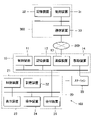
- FIG. 1 is a block diagram illustrating the configuration of a game system;
- FIG. 4 is a schematic diagram of game data;
- 1 is a block diagram illustrating the functional configuration of a game system;
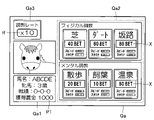
- FIG. It is a schematic diagram of a training screen.
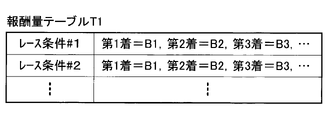
- FIG. 10 is a schematic diagram of magnification options on the training screen. It is a schematic diagram of a training screen. It is a schematic diagram of a reward amount table.
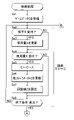
- 4 is a flowchart illustrating a part of control processing; 8 is a flowchart illustrating another part of control processing; It is a schematic diagram of a result screen.
- FIG. 11 is a schematic diagram of a display screen for first ranking in the second embodiment.
- FIG. 11 is a schematic diagram of a display screen for a second ranking in the second embodiment
- 9 is a flowchart illustrating operations of the game system and the management system in the second embodiment
- It is a flow chart which illustrates operation of a remuneration management part in a 3rd embodiment.
- FIG. 12 is a schematic diagram of a limit value table in the third embodiment
- FIG. 1 is a plan view of a game system 100 according to the first embodiment.
- the game system 100 is installed, for example, in an amusement facility.
- Amusement facilities are, for example, entertainment facilities such as game centers or casinos, or commercial facilities such as shopping centers. Note that although a plurality of game systems 100 are actually installed in different game facilities, the following description will focus on any one game system 100 for the sake of convenience.
- the game system 100 of the first embodiment provides a plurality of users with a horse racing game in which training stages and competition stages are alternately repeated.
- the training stage is a stage in which a virtual racehorse owned by each user (hereinafter referred to as "owned horse") is trained.
- the competition stage is a stage in which a plurality of racehorses trained in the training stage race. In the competition stage, a virtual race by a plurality of racehorses progresses.
- a racehorse (proprietary horse) is an example of a "game element" used in a horse racing game.
- the training stage is an example of the "first stage”
- the battle stage is an example of the "second stage”.
- a game system 100 of the first embodiment comprises a central unit 10 and a plurality of stations 20, as illustrated in FIG.
- a plurality of stations 20 are installed around the central unit 10, for example.
- Each station 20 is a unit used by the user to play the horse racing game.
- the game system 100 can be realized as a single device, or as a plurality of devices configured separately from each other.
- the central unit 10 includes a field 16 simulating a racecourse and a plurality of model horses 17 simulating racehorses.
- a plurality of model horses 17 move on the field 16 .
- Each model horse 17 corresponds to one of a plurality of racehorses competing in the race stage. In other words, the plurality of model horses 17 three-dimensionally expresses how the plurality of racehorses race.
- Each of the plurality of stations 20 includes a display device 23, an operation device 24, and a reception device 25.
- the display device 23 displays various images according to the progress of the horse racing game.
- various display panels such as a liquid crystal display panel or an organic EL (Electroluminescence) panel are used as the display device 23 .
- the operating device 24 is an input device that receives user's operations.
- a touch panel that detects a user's contact with the display surface of the display device 23 is used as the operation device 24 .
- a plurality of operators operated by the user may be used as the operation device 24 .
- the receiving device 25 receives value media from users.
- Value media are, for example, physical medals (tokens) or electronic medals.
- the reception device 25 includes a transport path for transporting the physical medals supplied by the user to the slot, and a counter for counting the physical medals.
- a communication device that communicates with a management server device (not shown) that manages an electronic medal account for each user may be used as the reception device 25 .
- the reception device 25 executes withdrawal processing for transferring electronic medals from an account managed by the management server device to the game system 100 and deposit processing for transferring electronic medals to the account of the management server device.
- a reader that transfers electronic medals from a recording medium such as an IC card in which electronic medals are recorded to the game system 100 may be used as the reception device 25 .
- the amount of credits corresponding to the amount of value media accepted by the accepting device 25 is set to be usable by the user.
- a credit is a game value for a user to play a game.
- FIG. 2 is a block diagram illustrating the configuration of the game system 100. As shown in FIG. FIG. 2 representatively shows a specific configuration of one station 20 out of the plurality of stations 20. As shown in FIG. Each of the plurality of stations 20 includes a control device 21 and a storage device 22 in addition to the aforementioned display device 23 , operation device 24 and reception device 25 .
- the controller 21 is one or more processors that control the operation of the station 20 .
- processors such as CPU (Central Processing Unit), GPU (Graphics Processing Unit), DSP (Digital Signal Processor), FPGA (Field Programmable Gate Array), or ASIC (Application Specific Integrated Circuit)
- the control device 21 is configured by the following.
- the storage device 22 is a single or multiple memories that store programs executed by the control device 21 and various data used by the control device 21 .
- a known recording medium such as a semiconductor recording medium and a magnetic recording medium, or a combination of multiple types of recording media is used as the storage device 22 .
- the storage device 22 of the first embodiment stores the amount C of credits owned by the user (hereinafter referred to as "possession amount").
- the owned amount C is the amount of credits that the user can use for the horse racing game.
- the game system 100 includes a control device 11, a storage device 12, a communication device 13, and a drive device 14 in addition to the plurality of stations 20 described above.
- the control device 11 is one or more processors that control the entire game system 100 .
- the control device 11 is configured by one or more types of processors such as CPU, GPU, DSP, FPGA, or ASIC.
- the control device 11 may implement the functions of the control device 21 . That is, the controller 21 of each station 20 may be omitted.
- the driving device 14 moves each of the model horses 17 under the control of the control device 11 .
- a moving image of a plurality of racehorses racing may be displayed on the display device (not shown) of the central unit 10 or the display device 23 of each station 20 .
- the storage device 12 is a single or multiple memories that store programs executed by the control device 11 and various data used by the control device 11 .
- a known recording medium such as a semiconductor recording medium and a magnetic recording medium, or a combination of multiple types of recording media is used as the storage device 12 .
- a portable recording medium that can be attached to and detached from the game system 100, or a recording medium (for example, cloud storage) that can be written or read by the control device 11 via a communication network 200 such as the Internet is stored. You may utilize as the apparatus 12.
- FIG. Note that the storage device 12 may implement the functions of the storage device 22 . That is, the storage device 22 of each station 20 may be omitted.
- the communication device 13 communicates with the management system 300 via the communication network 200.
- the management system 300 is a server system comprising a control device 31 , a storage device 32 and a communication device 33 . Note that the management system 300 may be grasped as an element of the game system 100. FIG.
- the control device 31 is a single or multiple processors that control the entire management system 300 . Specifically, the control device 31 is configured by one or more types of processors such as CPU, GPU, DSP, FPGA, or ASIC. Communication device 33 communicates with game system 100 via communication network 200 .
- the storage device 32 is a single or multiple memories that store programs executed by the control device 31 and various data used by the control device 31 .
- a known recording medium such as a semiconductor recording medium and a magnetic recording medium, or a combination of multiple types of recording media is used as the storage device 32 .
- the storage device 32 of the first embodiment stores game data G for each of a plurality of users. Game data G is stored in the storage device 32 for a plurality of users who use any of a plurality of game systems 100 installed in different game facilities.
- FIG. 3 is a schematic diagram of the game data G of each user.
- each user's game data G includes the user's identification information U, the user's name N, and racehorse data H relating to the user's owned horse.
- the identification information U is a code string for identifying the user.
- Each user is provided with a registration card upon pre-registration.
- a registration card is a recording medium on which user identification information is recorded.
- the game data G corresponding to the identification information U that matches or is related to the identification information recorded in the registration card of the user is transferred from the management system 300 to the game system 100. transferred.
- the user name N is, for example, a character string set by the user at the time of registration for use.
- the racehorse data H is data related to the horse owned by the user. Specifically, the racehorse data H includes attribute data H1, performance parameters H2, and performance data H3.
- the attribute data H1 is data representing attributes of the owned horse. Specifically, attributes such as the name, sex, age, coat color, etc. of the owned horse are designated by the attribute data H1.
- the ability parameter H2 is a parameter relating to the ability of the owned horse. Specifically, the ability parameter H2 includes a plurality of ability values such as speed, stamina and condition of the owned horse.
- the ability parameter H2 is an example of a "parameter".
- the track record data H3 includes the past track record of owned horses (for example, ranking in each race), the first total reward amount P1 and the second total reward amount P2.
- the first total reward amount P1 is the total value of the basic rewards B obtained by the user in one or more past races.
- the basic reward B is a virtual prize money (for example, game score) given to the user according to the race results in the competition stage.
- the special reward W is credit given to the user as a reward. That is, the special reward W is added to the owned amount C of credits owned by the user.
- the second total reward amount P2 of the performance data H3 is the total value of special rewards W obtained by the user in one or more past races. As understood from the above description, in the first embodiment, the first total reward amount P1 and the second total reward amount P2 are individually counted.
- the game data G of the user who plays the horse racing game by the game system 100 is transmitted from the communication device 33 to the game system 100 .
- the communication device 13 of the game system 100 receives game data G from the management system 300 .
- Game data G for each user is stored in the storage device 12 or the storage device 22 .
- FIG. 4 is a block diagram illustrating the functional configuration of the game system 100.
- the controller 11 of the central unit 10 implements specific functions by executing programs stored in the storage device 12 .
- the controller 21 of each station 20 implements specific functions by executing programs stored in the storage device 22 .
- the control device 11 and each control device 21 implement a control processing section 40 for controlling the horse racing game.
- Each function of the control processing unit 40 may be realized by the control device 11 or the control device 21 alone, or may be realized by cooperation between the control device 11 and the control device 21 .
- the control processing unit 40 includes a display control unit 41 , an instruction reception unit 42 , an update processing unit 43 , an adjustment value setting unit 44 , a progress control unit 45 and a reward management unit 46 .
- the display control unit 41 causes the display device 23 of each station 20 to display various images related to the horse racing game. Specifically, the display control unit 41 causes the display device 23 to display images corresponding to each of the training stage and the battle stage.
- FIG. 5 is a schematic diagram of a screen Qa displayed on each display device 23 by the display control unit 41 in the training stage (hereinafter referred to as "training screen"). As illustrated in FIG. 5, the training screen Qa includes an information display area Qa1, a training selection area Qa2, and a magnification selection area Qa3.
- the racehorse data H of the owned horse is displayed in the information display area Qa1.
- the name, gender and age of the owned horse represented by the attribute data H1, and the battle record and the first total reward amount P1 represented by the performance data H3 are displayed.
- Other information for example, the second total reward amount P2 regarding the owned horse may be displayed in the information display area Qa1.
- the training selection area Qa2 is an image for the user to instruct the training method to be implemented for training the owned horse. Specifically, a plurality of training methods that are candidates for selection by the user are displayed in the training selection area Qa2. A plurality of training methods are classified into, for example, physical training and mental training. Physical training includes multiple training methods (turf/dirt/hill) to enhance a horse's physical abilities (eg, speed and stamina). Mental training includes a plurality of training methods (walking/fodder/hot spring) for adjusting the mental ability (eg, condition) of the owned horse. By operating the operation device 24, the user can select any one of a plurality of training methods within the training selection area Qa2. It should be noted that one or more training methods may be selected automatically (ie, without requiring manual selection by the user) during the training stage.
- the amount of credits (hereinafter referred to as "usage amount") X required for selecting the training method is displayed.
- the usage amount X is the amount of credits consumed for selecting each training method (that is, the bet amount).
- the usage amount X is individually set for each training method. That is, the usage amount X is set to a different numerical value for each training method. Note that the usage amount X may be the same value for two or more training methods.
- the consumption amount Y is a numerical value corresponding to part or all of the usage amount X (X ⁇ Y).
- the consumption amount Y can also be rephrased as the basic amount of credits consumed for the user to select a desired training method.
- the magnification selection area Qa3 is an image for the user to specify the magnification R.
- a plurality of candidate values (x1, x2, x5, x10, x20) regarding the magnification R are displayed as illustrated in FIG.
- the user can select one of the multiple candidate values as the magnification R by operating the operation device 24 .
- the display device 23 may display a phrase suggesting the candidate value of the magnification R to the user. For example, for the numerical value "1" of the magnification R, a phrase such as "normal” meaning a standard value may be displayed. According to the above embodiment, the user can easily grasp the standard value of the magnification R. Alternatively, the user may directly indicate the numerical value of the magnification R by operating the operating device 24 .
- the display control unit 41 updates the usage amount X of each training method according to the magnification R selected by the user.
- FIG. 5 exemplifies the usage amount X of each training method when the magnification R is "1".
- the usage amount X of each training method is updated to a numerical value ten times the numerical value illustrated in FIG. 5, as illustrated in FIG.
- the consumption amount Y is a fixed value set for each training method, while the usage amount X is a variable value according to the magnification R selected by the user.
- the instruction accepting unit 42 in FIG. 4 accepts instructions from the user to the operation device 24 .
- the instruction receiving unit 42 receives an instruction from the user to select one of the multiple candidate values displayed in the magnification selection area Qa3 as the magnification R.
- the usage amount X for each training method is set to the product of the multiplier R selected by the user and the consumption amount Y corresponding to the training method.
- the instruction receiving unit 42 receives from the user an instruction to select one of the plurality of training methods in the training selection area Qa2. Since the usage amount X is set for each training method, an instruction by the user to select a desired training method from the training selection area Qa2 corresponds to an instruction for the usage amount X corresponding to the training method.
- the instruction receiving unit 42 subtracts the usage amount X corresponding to the training method selected by the user from the credit amount C owned by the user. That is, when the user selects a desired training method, the usage amount X corresponding to the training method is consumed from the owned amount C of credits. Therefore, selection of a training method can also be rephrased as an instruction to consume X credits.
- the update processing unit 43 updates the ability parameter H2 of the horse owned by the user in accordance with the instruction of the usage amount X by the user. Specifically, the update processing unit 43 updates the ability parameter H2 of the owned horse according to the consumption Y of the usage X. For example, the update processing unit 43 changes the ability value corresponding to the training method among the plurality of ability values represented by the ability parameter H2 by the amount of change corresponding to the consumption amount Y.
- the amount of change in the ability parameter H2 is set according to, for example, the amount of consumption Y and random numbers generated stochastically.
- the consumption Y is a fixed value set for each training method. Therefore, the amount of change in the ability parameter H2 is set according to the training method selected by the user, and does not depend on the magnification R. Therefore, if the training method selected by the user is common (that is, the consumption amount Y is common), even if the usage amount X differs according to the magnification R, the ability parameter H2 will not be affected by the random number. It is similarly updated according to the consumption amount Y of the thing.
- the ability parameter H2 is updated according to the consumption Y of "4". That is, the difference in the magnification R does not affect the updating of the ability parameter H2.
- training event a game event (hereinafter referred to as "training event") for training the horse owned by the user is executed.
- One training event includes reception of an instruction for the usage amount X by the instruction reception unit 42 (that is, instruction to select a training method) and updating of the ability parameter H2 by the update processing unit 43 . That is, for each training event, the instruction reception unit 42 receives an instruction for the usage amount X, and the update processing unit 43 updates the ability parameter H2.
- the adjustment value setting unit 44 in FIG. 4 sets the adjustment value Z according to the usage amount X indicated by the user.
- the adjustment value Z is updated for each training event. Specifically, the additional value D corresponding to the usage amount X is added to the adjustment value Z for each training event (Z ⁇ Z+D).
- FIG. In other words, the usage amount X is divided into the consumption amount Y for updating the capacity parameter H2 and the addition value D for increasing the adjustment value Z.
- the adjustment value setting unit 44 of the first embodiment sets the adjustment value Z by accumulating the addition value D obtained by subtracting the consumption amount Y from the usage amount X for each training event. That is, the adjustment value setting unit 44 sets the adjustment value Z for each training event.
- the consumption amount Y is a fixed value set for each training method
- the progress control unit 45 progresses the race in the competition stage. Specifically, the progress control unit 45 determines the order of each of the plurality of racehorses entering the race. The ranking of the plurality of racehorses is determined according to the ability parameter H2 of each racehorse and random numbers generated stochastically. Roughly speaking, the higher the numerical value represented by the performance parameter H2, the easier it is for a racehorse to obtain a higher rank in the race. A known technique is arbitrarily adopted for determining the ranking of each racehorse according to the performance parameter H2. For example, the progress control unit 45 may determine the order of each racehorse by simulating a race by a plurality of racehorses by applying the ability parameter H2.
- the reward management unit 46 gives the user a special reward W according to the results of the race in the battle stage. Specifically, the remuneration management unit 46 adds the special remuneration W to the credit ownership amount C of the user (C ⁇ C+W).
- the remuneration amount table T1 is used for setting the basic remuneration B by the remuneration management unit 46.
- the reward amount table T1 is stored in the storage device 12 or the storage device 22.
- FIG. FIG. 8 is a schematic diagram of the reward amount table T1.
- the reward amount table T1 is a data table in which a basic reward B is registered for each condition (hereinafter referred to as "race condition") relating to the race executed in the competition stage.
- Race conditions are, for example, conditions such as distance, racecourse, course (turf/dirt), or class (grade).
- a basic reward B (B1, B2, . . . ) corresponding to different rankings in the race are registered for each race condition in the reward amount table T1.
- a basic reward B corresponding to a combination of one race condition and one ranking means a virtual prize given to the user when the owned horse wins the ranking in the race of the race conditions.
- the reward management unit 46 sets the basic reward B for each race condition (that is, each race) by referring to the reward amount table T1. Specifically, the remuneration management unit 46 determines the race conditions of the race in which the user's owned horses enter, and the rank of the owned horses in the race, among the plurality of basic remunerations B registered in the remuneration amount table T1. Identify the base reward B corresponding to the combination.
- the special reward W is set to a larger value. That is, a user who instructs a large number of usage amounts X can obtain a large number of special rewards W according to the results of the race. Therefore, the user can be provided with ample opportunity to use a large number of credits.
- FIGS. 9 and 10 are flowcharts illustrating specific procedures of processing executed by the control device 11 and the control device 21 (hereinafter referred to as "control processing").
- control processing the control process is started in response to an instruction from the user to the operation device 24 .
- the display control unit 41 causes the display device 23 to display an image corresponding to the progress of the horse racing game.
- a plurality of users using different stations 20 play the horse racing game at the same time, but the following description will focus on processing for one user for convenience.
- the control processing unit 40 receives the user's game data G from the management system 300 via the communication device 13 and saves the game data G in the storage device 12 or the storage device 22 (Sa1). .
- the training stage (Sa2-Sa8) is started.
- the racehorse data H of each owned horse may be limitedly provided to the game system 100 from which the user acquired the owned horse. That is, the user can use the owned horse acquired and trained in a specific game system 100 only for the horse racing game of that game system 100 .
- a form in which owned horses can be shared among a plurality of game systems 100 is also envisioned.
- the instruction receiving unit 42 determines whether or not an instruction for the magnification R has been received from the user (Sa2).
- the display control unit 41 sets the usage amount X of each training method on the training screen Qa to a numerical value corresponding to the magnification R instructed by the user. Update (Sa3).
- the usage amount X is not updated.
- the instruction receiving unit 42 determines whether or not an instruction for the usage amount X has been received from the user (Sa4). That is, it is determined whether or not the training method has been instructed by the user.
- the instruction receiving unit 42 receives the instruction of the usage amount X (Sa4: YES)
- the instruction receiving unit 42 extracts the usage amount X instructed by the user from the owned amount of credit C stored in the storage device 22. Subtract (Sa5).
- the update processing unit 43 updates the ability parameter H2 of the horse owned by the user in accordance with the instruction of the usage amount X by the user (Sa6). Specifically, the update processing unit 43 updates the capacity parameter H2 according to the consumption amount Y, which is a part of the usage amount X.
- FIG. Further, the adjustment value setting unit 44 sets the adjustment value Z according to the usage amount X instructed by the user (Sa7). Specifically, the adjustment value setting unit 44 adds an addition value D corresponding to the usage amount X to the current adjustment value Z.
- the instruction receiving unit 42 determines whether or not the condition for ending the training stage is satisfied (Sa8).
- the end condition of the training stage is a condition regarding the instruction of the usage amount X by the user.
- the termination condition in the first embodiment is that the number of times the instruction reception unit 42 receives an instruction for the usage amount X from the user reaches a predetermined upper limit. In other words, the training stage ends when the number of instructions for the usage amount X reaches the upper limit.
- the instruction receiving unit 42 of the first embodiment limits the number of times of receiving instructions of the usage amount X from the user in the training stage to within a predetermined limit number of times (i.e., within a range below the upper limit). Restrict. That is, the number of training events within one training stage is limited within the limited number of times.
- the user can select a desired training method within the limited number of times. That is, the user can select each of the plurality of training methods at any ratio within the limited number of times.
- the training stage ends and the battle stage (Sa9-Sa15) illustrated in FIG. 10 begins. Even if the end condition is not satisfied, if the user instructs to end the training stage by operating the operation device 24, the training stage is shifted to the battle stage.
- running instruction includes specification of race conditions related to a race to be entered.
- the instruction receiving unit 42 determines whether or not a running instruction has been received from the user (Sa9).
- the progression control unit 45 advances the race in which multiple racehorses enter (Sa10). Specifically, the progress control unit 45 determines the ranking of each racehorse according to the ability parameter H2 of each of the plurality of racehorses. Further, the progress control unit 45 moves each of the plurality of model horses 17 by controlling the drive device 14 .
- the reward management unit 46 sets a special reward W for the horse owned by the user (Sa11).
- the addition to the base reward B initializes the adjustment value Z to zero.
- the remuneration management unit 46 adds the special remuneration W to the owned credit amount C stored in the storage device 12 (Sa12). That is, the special reward W is given to the user.
- the remuneration management unit 46 adds the current basic remuneration B to the user's first total remuneration amount P1 represented by the performance data H3 (Sa13). That is, the first total reward amount P1 is a numerical value obtained by totaling the basic rewards B for one or more past races, as described above.
- the remuneration management unit 46 also adds the current special remuneration W to the user's second total remuneration amount P2 represented by the performance data H3 (Sa14). That is, the second total reward amount P2 is a numerical value obtained by totaling the special rewards W for one or more past races, as described above.
- the display control unit 41 causes the display device 23 to display a screen (hereinafter referred to as "result screen") Qb showing the results of the race (Sa15).
- the basic reward B and the special reward W are displayed in addition to the ranking obtained by the horse owned by the user.
- the updated first total reward amount P1 and second total reward amount P2 according to the results of this race are displayed on the result screen Qb.
- progress of the race (Sa10), management of rewards (Sa11-Sa14), and display of results (Sa15) are executed. If the instruction receiving unit 42 does not receive a running instruction from the user in the battle stage (Sa9: NO), the battle stage ends without executing the processes (Sa9-Sa15) illustrated above.
- the instruction receiving unit 42 determines whether or not an instruction to end the horse racing game has been received from the user (Sa16). If the instruction accepting unit 42 does not accept the end instruction (Sa16: NO), the process proceeds to step Sa2. That is, the battle stage ends, and the training stage (Sa2-Sa8) starts.
- the horse racing game repeats the training stage and the battle stage.
- the training stage is repeated multiple times. That is, the reception of the instruction of the magnification R or the usage amount X (Sa2-Sa5), the updating of the ability parameter H2 (Sa6), and the updating of the adjustment value Z (Sa7) are repeated multiple times.
- the battle stage is repeated multiple times. That is, the progress of the race (Sa10), management of rewards (Sa11-Sa14), and display of results (Sa15) are repeated multiple times.
- the control processing unit 40 transmits the game data G stored in the storage device 12 to the management system 300 via the communication device 13 (Sa17).
- the management system 300 updates the user's existing game data G with new game data G received from the game system 100 .
- the performance parameter H2 related to the racehorse is updated according to the consumption Y, which is a part of the usage X instructed by the user.
- a significant difference in the performance parameter H2 depending on the usage amount X is suppressed compared to the configuration in which the performance parameter H2 is updated accordingly. Therefore, a situation in which a user who used a large number of credits can develop a race with an excessive advantage is suppressed. That is, users who do not use many credits are not unduly disadvantaged in the race. Therefore, it is possible to suppress the deterioration of the interest of the horse racing game.
- an adjustment value Z is set according to the usage amount X instructed by the user, and a special reward W corresponding to the adjustment value Z is given to the user in the battle stage. Therefore, users can be provided with ample incentives and opportunities to use multiple credits.
- the amount of rewards that can be acquired in the competition stage is determined according to the amount of credits used to acquire racehorses (hereinafter referred to as "acquired amount").
- a determined configuration (hereinafter “contrast") is also envisioned.
- the amount of reward is determined according to the amount of use acquired in the initial stage of acquiring a racehorse. For example, a racehorse with a larger acquisition usage can obtain a larger number of rewards in a race.
- the training stage is repeated, including receiving an indication of usage X that affects special reward W and updating ability parameter H2. Therefore, a highly entertaining horse racing game is realized in which the user can strategically instruct the amount of credit X to be used for each training stage while checking the ability parameter H2 of the owned horse at any time.
- the usage amount X is the product of the consumption amount Y and the magnification R
- the instruction receiving unit 42 receives the usage amount X instruction and the magnification R instruction. Therefore, the user can clearly grasp the consumption amount Y, which contributes to updating the ability parameter H2 of the owned horse, and the multiplier R, which contributes to the special reward W in the battle stage, out of the usage amount X.
- the adjustment value Z is set by summing the addition value D corresponding to the usage amount X for multiple user instructions. Therefore, the user can be given an incentive to use a large number of credits over multiple training stages.
- the addition value D is added to the adjustment value Z for each training event.
- the adjustment value Z may be calculated by adding a plurality of past addition values D at the stage (Sa11) of setting the special reward W in the battle stage.
- users are given a special reward W in an amount corresponding to the basic reward B and the adjustment value Z that are set for each race in the competition stage. Therefore, it is possible to vary the special reward W depending on the adjustment value Z for each race.
- the second embodiment is a form in which the function of the display control unit 41 is added to the first embodiment.
- the configuration and operation described above for the first embodiment are similarly adopted for the second embodiment. Therefore, the same effects as in the first embodiment are realized in the second embodiment as well.
- the display control unit 41 of the second embodiment executes processing for displaying on the display device 23 the ranking of rewards obtained by a plurality of users in the past. Specifically, the display control unit 41 selectively displays each of the first ranking and the second ranking on the display device 23 .
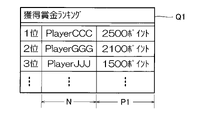
- FIG. 12 is a schematic diagram of the first ranking display screen Q1.
- the first ranking is the ranking of the first total reward amount P1, which is the total value of the basic reward B.
- the first ranking is a list in which the user's name N and the first total reward amount P1 are arranged for each of a predetermined number of users ranked high in descending order of the first total reward amount P1. is.
- FIG. 13 is a schematic diagram of the second ranking display screen Q2.
- the second ranking is the ranking of the second total reward amount P2, which is the total value of the special reward W.
- the second ranking is a list in which the user's name N and the second total reward amount P2 are arranged for each of a predetermined number of users ranked high in descending order of the second total reward amount P2. is.
- the display of the second ranking can give the user an effective incentive to use a large number of credits in the training stage.
- the first ranking is a ranking that does not directly depend on the adjustment value Z. In other words, a user who tends to limit the use of credits in the training stage will find it difficult to obtain a high ranking in the second ranking, but may be able to obtain a high ranking in the first ranking by obtaining the basic reward B. . Therefore, the display of the first ranking provides an incentive for users who tend not to use a large number of credits to play the horse racing game.
- both the user who uses a large number of credits and the user who uses a small number of credits can maintain the incentive to play the horse racing game.
- FIG. 14 is a flowchart illustrating operations of the game system 100 and the management system 300 in the second embodiment. In parallel with the aforementioned control processing (FIGS. 9 and 10), the processing of FIG. 14 is executed at predetermined time intervals.
- the instruction receiving unit 42 determines whether or not the user has instructed to display the ranking (Sb1). When the instruction receiving unit 42 does not receive the ranking display instruction (Sb1: NO), the processing illustrated below is not executed.
- the display control unit 41 transmits an information request from the communication device 13 to the management system 300 (Sb2).
- the information request specifies the type of ranking (first ranking/second ranking) specified by the user.
- the control device 31 of the management system 300 receives the information request via the communication device 33 (Sc1).
- the control device 31 determines from the information request whether or not the ranking designated by the user is the first ranking (Sc2).
- the control device 31 When the user instructs the first ranking (Sc2: YES), the control device 31 generates first ranking list data (Sc3).
- the first ranking list data is a list in which the name N and the first total reward amount P1 are specified for each user listed in the first ranking.
- control device 31 extracts the game data G of a predetermined number of users ranked high in descending order of the first total reward amount P1 from the plurality of game data G stored in the storage device 32, List data in which the name N registered in each extracted game data G and the first total reward amount P1 are arranged is generated.
- the second ranking list data is a list in which the name N and the second total reward amount P2 are specified for each user listed in the second ranking.
- the control device 31 extracts the game data G of a predetermined number of users ranked high in descending order of the second total reward amount P2 from the plurality of game data G stored in the storage device 32, List data in which the name N registered in each extracted game data G and the second total reward amount P2 are arranged is generated.
- the control device 31 of the management system 300 functions as an element (aggregation processing unit) that generates the first ranking regarding the first total reward amount P1 or the second ranking regarding the second total reward amount P2. do.
- the control device 31 transmits the list data generated by the above procedure from the communication device 33 to the requesting game system 100 (Sc5).
- the display control unit 41 of the game system 100 receives the list data via the communication device 13 (Sb3). Then, the display control unit 41 generates a ranking image represented by the list data, and causes the display device 23 to display the image (Sb4). That is, the ranking specified by the user is displayed on the display device 23 out of the first ranking and the second ranking.
- the management system 300 generates the rankings when the user instructs to display the rankings (or receives an information request).
- the control device 31 of the management system 300 may generate the first ranking list data and the second ranking list data at a predetermined cycle.
- the control device 31 of the management system 300 Upon receiving an information request from the game system 100, the control device 31 of the management system 300 transmits the latest list data at the time of the reception to the requesting game system 100.
- image data representing the image of the first ranking or the second ranking may be generated by the management system 300 and transmitted to the game system 100 .
- 3rd Embodiment is a form which changed the process regarding the adjustment value Z from 1st Embodiment.
- the configuration and operation are the same as those of the first embodiment except for the changes from the first embodiment described below. Therefore, the third embodiment also achieves the same effect as the first embodiment.
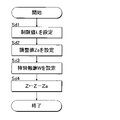
- FIG. 15 is a flowchart illustrating the operation of the reward management unit 46 in the third embodiment.
- the process of FIG. 15 is executed.
- the remuneration management unit 46 sets the limit value L (Sd1).
- the limit value L means the maximum value that can be used as the special reward W among the adjustment values Z set by the adjustment value setting unit 44 .
- a limit value table T2 is used for setting the limit value L by the remuneration management unit 46.
- FIG. The limit value table T2 is stored in the storage device 12 or the storage device 22.
- FIG. 16 is a schematic diagram of the limit value table T2.
- the limit value table T2 is a data table in which limit values L (L1, L2, .
- the reward management unit 46 sets the limit value L for each race condition (that is, each race) by referring to the limit value table T2. That is, the remuneration management unit 46 identifies the limit value L corresponding to the race conditions of the race in which the horse owned by the user participates, among the plurality of limit values L registered in the limit value table T2.
- the remuneration management unit 46 calculates an adjustment value Za according to the adjustment value Z (Sd2).
- the adjustment value Za is a quantity within the range of the adjustment value Z that is equal to or lower than the limit value L (hereinafter referred to as "limit range").
- the operation (Sa12) of adding the special reward W set by the above procedure to the user's credit possession amount C (Sa12) is the same as in the first embodiment. That is, the remuneration management unit 46 provides the user with a special remuneration W corresponding to the numerical value of the adjustment value Z within the limit range in the battle stage.
- the adjustment value Z after subtraction in step Sd4 is carried over to the next training stage or battle stage.
- the adjustment value Z is "1000" and the limit value L is "300”
- the adjustment value setting unit 44 adds the addition value D to the adjustment value Z after the subtraction.
- the reward management unit 46 sets the special reward W according to the adjustment value Z after the subtraction.
- the quantity obtained by subtracting the quantity within the limit range from the adjustment value Z set by the adjustment value setting unit 44 (that is, the adjustment value Z after the subtraction in step Sd4) is used in subsequent training stages or It is carried over as adjustment value Z in the battle stage.
- the amount of the adjustment value Z that is applied to set the special reward W is limited within the limit range (the range below the limit value L), so the special reward W given to the user is The possibility of being overpopulated is reduced.
- the remaining amount of the adjustment value Z other than the quantity within the limit range is carried over as the adjustment value Z in the immediately following training stage or battle stage. Therefore, the user can be given an incentive to continue playing the horse racing game.
- the limit value L limit range
- the limit value L may be set to a fixed value that does not depend on race conditions.
- the number of instructions for the usage amount X in the training stage is limited within the limited number of times, but the configuration for limiting the use of credits in the training stage is not limited to the above examples.
- Aspect 1 and Aspect 2 illustrated below are assumed.
- the instruction receiving unit 42 limits the time for receiving an instruction of the usage amount X from the user in the training stage to within a predetermined time limit. That is, the end condition (Sa8) of the training stage is that the elapsed time from the start of the training stage reaches a predetermined upper limit value. Specifically, the instruction receiving unit 42 counts the elapsed time from the start of the training stage, and when the elapsed time reaches the upper limit value, it is determined that the end condition is satisfied (Sa8: YES), and the training stage is started. finish. Therefore, within the time limit, the user is allowed to specify the usage amount X any number of times. The user can select a desired training method any number of times within the time limit. That is, according to the above aspect, the user can select the number of times of each of the plurality of training methods within the time limit at any ratio.
- the instruction receiving unit 42 limits the total value of the usage amount X related to one or more instructions received from the user in the training stage within a predetermined limit range. That is, the end condition (Sa8) of the training stage is that the total value of the usage amount X instructed by the user reaches a predetermined upper limit value. Specifically, the instruction receiving unit 42 sums the usage amount X for each instruction of the usage amount X in the training stage, and when the total value reaches the upper limit of the limit range, the end condition is met (Sa8: YES) and terminate the training stage. Therefore, the user can select any training method any number of times until the total usage X reaches the upper limit of the limit range.
- the amount of usage X specified by the user is limited. In other words, restrictions on the number of times, time, quantity, etc. may be omitted with respect to the indication of the usage amount X in the training stage.
- the user may indicate the total value of the usage amount X in the training stage.
- the update processing unit 43 determines, for example, a combination of one or more training methods (that is, a training menu) to be executed in the training stage according to a predetermined rule within the range of the total value instructed by the user. For example, by referring to a table in which training menus are registered for each of a plurality of ranges regarding the total value of the usage amount X, the update processing unit 43 selects the training menu corresponding to the total value instructed by the user. . According to the above embodiment, it is possible to reduce the user's burden of selecting a training method.
- the user individually instructs the usage amount X and the magnification R, but the instruction of the magnification R by the user may be omitted.
- the display control unit 41 causes the display device 23 to display a plurality of candidate values regarding the usage amount X for each training method, and the instruction receiving unit 42 selects the candidate value selected by the user from among the plurality of candidate values as the usage amount.
- a form defined as X is assumed.
- the user may directly indicate the numerical value of the usage amount X by operating the operation device 24 .
- a predetermined amount of the usage amount X or a predetermined ratio of the usage amount X is set as the consumption amount Y.
- the adjustment value setting unit 44 may calculate the addition value D by a predetermined calculation using the amount X used.
- the added value D is calculated by multiplying the usage amount X by a predetermined coefficient.
- any specific method for calculating the adjustment value Z (or the addition value D) can be used as long as the adjustment value Z changes according to the amount X used. That is, the adjustment value setting unit 44 is comprehensively expressed as an element that sets the adjustment value Z according to the usage amount X.
- the additional value D corresponding to the usage amount X is added to the adjustment value Z.
- the adjustment value Z may be set to an average value of the magnifications R specified by the user.
- the adjustment value setting unit 44 calculates, as the adjustment value Z, an average value (for example, a simple average or a weighted average) of the magnifications R specified by the user in the training events over the last predetermined number of times.
- the ability parameter H2 of the owned horse is updated according to the consumption Y of the usage X, but the update processing unit 43 updates according to the consumption Y separately.
- special processing (hereinafter referred to as "special processing") relating to the ability parameter H2 may be generated stochastically in the training event.
- the special process is a process of adjusting the ability parameter H2 of the owned horse so that the battle stage can be advantageously developed, and means awakening of the owned horse. For example, a process of increasing the upper limit of the ability value represented by the ability parameter H2 (so-called breakthrough), a process of adding a different type of ability value from the existing ability value to the ability parameter H2, or a process of increasing the ability value indicated by the ability parameter H2.
- Special processing is exemplified by a processing that greatly increases it.
- a process of changing the attribute (for example, class) of the owned horse may be executed as a special process.
- the update processing unit 43 may control the probability of occurrence of special processing according to the amount X of usage. For example, the greater the usage amount X indicated by the user in the training event, the higher the probability that special processing will occur. However, the probability of special processing occurring may be a fixed value.
- the form in which the training stage and the battle stage are alternately repeated was exemplified, but the repetition of the training stage and the battle stage is not limited to the above examples.
- a form in which the battle stage is repeated multiple times after the training stage is repeated multiple times is also assumed.
- a form in which the battle stage is repeated a plurality of times after execution of one training stage, or a form in which a single battle stage is executed after repetition of the training stage a plurality of times is also conceivable.
- stages other than the training stage and the battle stage may be executed.
- the management system 300 generates rankings for all users who manage the game data G. You can limit the range. For example, among a plurality of users, the control device 31 of the management system 300 may generate the first ranking and the second ranking targeting users with specific attributes. For example, in a configuration in which the area or facility where the game system 100 is installed is registered in the game data G, users who have played a horse racing game in a specific area or facility among a plurality of users are targeted for the first ranking and the first ranking. 2 rankings may be generated.
- the control device 11 or the control device 21 of the game system 100 may generate the first ranking and the second ranking.
- the display control unit 41 may cause the display device 23 to display both the first ranking and the second ranking in parallel.
- a race in which a plurality of racehorses race is illustrated, but the type of game (specific game) played by the user in the battle stage is arbitrary and is not limited to horse racing.
- various competitive games in which a plurality of users compete in competitions such as martial arts or sports are exemplified as specific games.
- the specific game is not limited to a competitive game in which a plurality of users compete against each other.
- a lottery game in which a lottery process (e.g., a physical lottery or an electronic lottery) that stochastically determines whether a user wins or loses (losing) is executed, and an action in which a user operates a character to achieve various purposes.
- any game such as a game, a search game in which a user operates a character to search for various locations, or the like is exemplified as the specific game.
- the "specific game” is any type of game that can reward the user according to the result of the game.
- the user's game data G includes a plurality of racehorse data H corresponding to different owned horses.
- a training stage and a battle stage are executed for each of a plurality of owned horses owned by the user.
- the functions of the game system 100 according to the above-described embodiments are stored in one or more processors constituting one or both of the control device 11 and the control device 21 and one or both of the storage device 12 and the storage device 22.
- the program according to each of the above forms can be provided in a form stored in a computer-readable recording medium and installed in the computer.
- the recording medium is, for example, a non-transitory recording medium, and an optical recording medium (optical disc) such as a CD-ROM is a good example.
- recording media in the form of The non-transitory recording medium includes any recording medium other than transitory (propagating signal), and does not exclude volatile recording media.
- a recording medium for storing the program in the distribution device corresponds to the non-transitory recording medium described above.
- a game system (100) according to one aspect (Appendix 1) of the present invention is a system for controlling a game in which a first stage and a second stage are repeated, an instruction receiving unit (42) for receiving an instruction from a user for the usage amount (X) of the user, and in the first stage, according to the consumption amount (Y) that is a part of the usage amount (X), the user an update processing unit (43) for updating parameters (H2) related to the game elements of; an adjustment value setting unit (44) for setting an adjustment value (Z) according to the usage amount (X); a progress control unit (45) for progressing a specific game using said game elements; and a reward management unit (46) to be given to the user.
- the entire usage (X) is A significant difference in the parameter (H2) depending on the amount of usage (X) is suppressed compared to the configuration in which the parameter (H2) is updated depending on the amount of usage (X). Therefore, a situation in which a user who has used a large number of game values can unduly develop a game event in an advantageous manner is suppressed. That is, game balance is maintained. Therefore, it is possible to suppress the decline in the interest of the game.
- an adjustment value (Z) is set according to the usage amount (X) instructed by the user, and in the second stage, a reward (W) corresponding to the adjustment value (Z) is given to the user. . Therefore, users can be provided with sufficient incentives and opportunities to use a large number of game values.
- the first stage which includes receiving an indication of the usage amount (X) and updating the parameter (H2), is repeated. Therefore, a highly entertaining game is realized in which the user can strategically indicate the usage amount (X) of the game value for each first stage.
- the type of "specific game” is arbitrary. For example, a competition game in which a plurality of users compete in various sports, etc., a lottery game in which a lottery process (for example, a physical lottery or an electronic lottery) that stochastically determines the winning/losing (losing) of a user is executed, etc. Any kind of game is included in the concept of "particular game”.
- Game element means an element used in a specific game. Specifically, a character appearing in a specific game is exemplified as a game element. For example, in a horse racing game in which a plurality of racehorses race, each racehorse corresponds to a game element. Further, for example, in a lottery game in which one of a plurality of lottery elements is determined by lottery processing, each lottery element is exemplified as a game element.
- Parameter (H2) means a parameter (H2) that affects the outcome of a specific game, for example, a parameter (H2) related to the ability of a game element.
- a numerical value representing the ability of a character appearing in a specific game corresponds to the "parameter (H2)".
- a numerical value representing the ability of a character appearing in a specific game corresponds to the "parameter (H2)".
- a numerical value representing the ability (for example, speed, stamina or condition) of the racehorse is exemplified as a "parameter (H2)".
- the parameter related to the lottery element (that is, the numerical value affecting the amount of reward) is set to "parameter (H2)”. Equivalent to.
- First stage means the stage of updating parameters (H2) related to game elements.
- Update is, for example, a process of updating the parameter (H2) so as to increase the possibility of achieving a specific game goal.
- the process of increasing the ability value represented by the parameter (H2) is exemplified as "update”.
- the process of updating the parameters of a character appearing in a specific game is also expressed as training of the character.
- the "second stage” is a stage that includes the progress of a specific game that utilizes the user's game elements and the provision of a reward (W) according to the result of the specific game. “Giving a reward (W) according to the result of a specific game” means that the presence or absence of a reward (W) to the user or the amount of the reward (W) given to the user depends on the result of the specific game. means.
- the result of a specific game is, for example, victory or defeat or ranking.
- Playing value is a tangible or intangible value used as compensation for playing a game.
- a tangible game value is, for example, a physical medal (token coin), money (coin), or a ticket.
- Intangible game values are, for example, electronic medals, electronic money (electronic money), credits, or points.
- Adjustment value (Z) is a variable for setting the amount of reward (W) given to the user in the second stage.
- the adjustment value (Z) is a quantity added to a predetermined base reward (B) or a value multiplied by the base reward (B) (that is, a multiplier (R)).
- Reward (W) is the value given to the user according to the result of a specific game.
- the type of “reward (W)” is arbitrary, but for example, the same kind of game value as the game value used in the first stage is an example of "reward (W)".
- the game value used in the first stage and the type of reward (W) given to the user in the second stage may be different.
- the usage amount (X) is a product of the consumption amount (Y) and the magnification (R), and the instruction received by the instruction receiving unit (42) is the Includes indication of magnification (R).
- the consumption amount (Y) of the usage amount (X) that contributes to the update of the game element parameter (H2) and the multiplier (R) that contributes to the reward (W) in the specific game are It is clearly recognizable by the user.
- the instruction for the magnification (R) is, for example, an instruction to select one of a plurality of candidate values for the magnification (R), or an instruction to specify the magnification (R) by a numerical value.
- the consumption (Y) is a variable value instructed by the user or a predetermined fixed value.
- the instruction receiving unit (42) receives the instruction of the usage amount (X) a plurality of times
- the adjustment value setting unit (44) receives the instruction of the usage amount (X) a plurality of times.
- the adjustment value (Z) is set by summing the amount (D) corresponding to each usage amount (X) instructed by the user in each of the above. According to the above aspect, since the adjustment value (Z) is set by totaling the amount (D) corresponding to the usage amount (X) instructed by the user over multiple times, the adjustment value (Z) is set over multiple first stages. The user is given an incentive to use a large number of game values.
- the quantity (D) (quantity corresponding to the usage amount (X)) summed up when setting the adjustment value (Z) is the usage amount (X) itself or a part of the usage amount (X). For example, a configuration that sets the adjustment value (Z) by summing the usage (X) over a plurality of first stages, or a quantity (D) that is obtained by subtracting the consumption (Y) from the usage (X) A configuration is envisioned that sets the adjustment value (Z) by summing over multiple first stages.
- the instruction receiving unit (42) receives the instruction of the usage amount (X) a plurality of times
- the adjustment value setting unit (44) receives the instruction of the usage amount (X) a plurality of times.
- the adjustment value (Z) is set by summing the amount (D) obtained by subtracting the consumption amount (Y) from each usage amount (X) instructed by the user. According to the above aspect, the user is given an incentive to use a sufficient amount (D) of game values over a plurality of first stages.
- the specific game is one of a plurality of specific games, and the reward management unit (46) sets a basic reward set for each specific game.
- a reward (W) corresponding to (B) and the adjustment value (Z) is given to the user. According to the above aspect, it is possible to vary the amount of reward (W) depending on the adjustment value (Z) for each specific game.
- the configuration and processing for setting the amount of reward (W) according to the basic reward (B) and the adjustment value (Z) are arbitrary.
- the reward management unit (46) sets the amount of the reward (W) by adding the basic reward (B) set for each specific game and the amount according to the adjustment value (Z), or a specific game
- a configuration is assumed in which the remuneration management unit (46) sets the amount of remuneration (W) by multiplying the adjustment value (Z) by the basic remuneration (B) that is set every time.
- a user who obtains a large number of basic rewards (B) while suppressing the use of game value in the first stage may obtain a high rank in the first ranking. That is, there is a possibility that not only users who use a large number of game values but also users who use a small number of game values can be ranked high. Therefore, both the user who uses a large number of game values and the user who uses a small number of game values can maintain the incentive to play the game.
- the remuneration management unit (46) determines, in the second stage, the quantity within the limit range of the quantity corresponding to the adjustment value (Z)
- the reward (W) corresponding to the amount is given to the user, and the remaining amount obtained by subtracting the quantity within the limit range from the adjustment value (Z) is the adjustment value ( Z).
- the quantity applied to set the reward (W) in the second stage is limited within the limit range, so the reward ( W) is less likely to be overly numerous.
- the remaining amount of the adjustment value (Z) other than the quantity within the limit range is carried over as the adjustment value (Z) in the immediately following first stage or second stage. Therefore, the user can be given an incentive to continue playing the game.
- the instruction receiving unit (42) limits the number of times of receiving the usage amount (X) instruction from the user in the first stage. Limit the number of times.
- the instruction accepting unit (42) limits the time for accepting the usage amount (X) instruction from the user in the first stage. Limit in time.
- the instruction receiving unit (42) calculates the total usage amount (X) related to one or more instructions received from the user in the first stage. Constrain values within given limits.
- a game control method is a method of controlling a game in which a first stage and a second stage are repeated, wherein in the first stage, a variable usage amount (X) related to game value is received from the user, and in the first stage, in accordance with the consumption amount (Y) that is part of the usage amount (X), the parameter (H2) related to the game element of the user is updated, and An adjustment value (Z) is set according to the usage amount (X), a specific game using the game element is progressed in the second stage, and the adjustment value (Z) is adjusted in the second stage.
- a reward (W) is given to the user according to the result of the specific game.
- a program controls a computer system (11, 21) in the first stage to control a game in which the first stage and the second stage are repeated.
- an instruction receiving unit (42) for receiving an instruction of a usage amount (X) from a user;
- an update processing unit (43) for updating a parameter (H2) relating to an element;
- an adjustment value setting unit (44) for setting an adjustment value (Z) according to the usage amount (X);
- It functions as a reward management unit (46) for granting.
- DESCRIPTION OF SYMBOLS 100 Game system, 10... Central unit, 11, 21, 31... Control device, 12, 22, 32... Storage device, 13, 33... Communication device, 14... Drive device, 20... Station, 23... Display device, 24 ... operation device, 25 ... reception device, 200 ... communication network, 300 ... management system, 40 ... control processing unit, 41 ... display control unit, 42 ... instruction reception unit, 43 ... update processing unit, 44 ... adjustment value setting unit, 45... progress control section, 46... remuneration management section.
Landscapes
- Engineering & Computer Science (AREA)
- Multimedia (AREA)
- Business, Economics & Management (AREA)
- Computer Security & Cryptography (AREA)
- General Business, Economics & Management (AREA)
- Management, Administration, Business Operations System, And Electronic Commerce (AREA)
Applications Claiming Priority (2)
| Application Number | Priority Date | Filing Date | Title |
|---|---|---|---|
| JP2021041132A JP7440922B2 (ja) | 2021-03-15 | 2021-03-15 | ゲームシステム、ゲーム制御方法およびプログラム |
| JP2021-041132 | 2021-03-15 |
Publications (1)
| Publication Number | Publication Date |
|---|---|
| WO2022196563A1 true WO2022196563A1 (ja) | 2022-09-22 |
Family
ID=83320332
Family Applications (1)
| Application Number | Title | Priority Date | Filing Date |
|---|---|---|---|
| PCT/JP2022/010923 Ceased WO2022196563A1 (ja) | 2021-03-15 | 2022-03-11 | ゲームシステム、ゲーム制御方法およびプログラム |
Country Status (2)
| Country | Link |
|---|---|
| JP (2) | JP7440922B2 (https=) |
| WO (1) | WO2022196563A1 (https=) |
Families Citing this family (2)
| Publication number | Priority date | Publication date | Assignee | Title |
|---|---|---|---|---|
| JP7586534B1 (ja) | 2023-07-14 | 2024-11-19 | 株式会社コナミアミューズメント | ゲームシステム、ゲーム制御方法およびプログラム |
| JP7596582B1 (ja) | 2024-03-29 | 2024-12-09 | 株式会社バンダイ | プログラム及びゲーム装置 |
Citations (4)
| Publication number | Priority date | Publication date | Assignee | Title |
|---|---|---|---|---|
| JP2002177630A (ja) * | 2000-12-08 | 2002-06-25 | Konami Co Ltd | ゲーム装置 |
| JP2015116207A (ja) * | 2013-12-16 | 2015-06-25 | 株式会社セガゲームス | ゲーム装置、ゲームシステムおよびゲームプログラム |
| JP2017023481A (ja) * | 2015-07-23 | 2017-02-02 | 株式会社コナミデジタルエンタテインメント | ゲーム装置、及びプログラム |
| JP2019088852A (ja) * | 2019-01-30 | 2019-06-13 | 株式会社コナミデジタルエンタテインメント | ゲーム装置、及びプログラム |
Family Cites Families (2)
| Publication number | Priority date | Publication date | Assignee | Title |
|---|---|---|---|---|
| JPH0712190U (ja) * | 1993-07-30 | 1995-02-28 | 株式会社イグレックス | ゲーム装置 |
| JP5769842B2 (ja) * | 2014-03-12 | 2015-08-26 | 株式会社タイトー | ゲームシステム、ゲームプログラム及びゲームサーバ |
-
2021
- 2021-03-15 JP JP2021041132A patent/JP7440922B2/ja active Active
-
2022
- 2022-03-11 WO PCT/JP2022/010923 patent/WO2022196563A1/ja not_active Ceased
-
2024
- 2024-02-16 JP JP2024021594A patent/JP7716129B2/ja active Active
Patent Citations (4)
| Publication number | Priority date | Publication date | Assignee | Title |
|---|---|---|---|---|
| JP2002177630A (ja) * | 2000-12-08 | 2002-06-25 | Konami Co Ltd | ゲーム装置 |
| JP2015116207A (ja) * | 2013-12-16 | 2015-06-25 | 株式会社セガゲームス | ゲーム装置、ゲームシステムおよびゲームプログラム |
| JP2017023481A (ja) * | 2015-07-23 | 2017-02-02 | 株式会社コナミデジタルエンタテインメント | ゲーム装置、及びプログラム |
| JP2019088852A (ja) * | 2019-01-30 | 2019-06-13 | 株式会社コナミデジタルエンタテインメント | ゲーム装置、及びプログラム |
Also Published As
| Publication number | Publication date |
|---|---|
| JP2024040496A (ja) | 2024-03-25 |
| JP2022141016A (ja) | 2022-09-29 |
| JP7440922B2 (ja) | 2024-02-29 |
| JP7716129B2 (ja) | 2025-07-31 |
Similar Documents
| Publication | Publication Date | Title |
|---|---|---|
| US6929550B2 (en) | Network game method and network game system | |
| JP5833766B2 (ja) | スキル正規化ハイブリッドゲーム | |
| JP5323787B2 (ja) | ゲームシステム及びプログラム | |
| US20170228986A1 (en) | Head-to-head and tournament play for enriched game play environment | |
| JP6648993B2 (ja) | プログラム、ゲーム装置及びサーバシステム | |
| JP7674685B2 (ja) | 情報処理装置、情報処理方法及びプログラム | |
| JP6482024B2 (ja) | ゲーム装置、及びプログラム | |
| JP7716129B2 (ja) | ゲームシステム、ゲーム制御方法およびプログラム | |
| JP6803515B2 (ja) | ゲーム装置、及びプログラム | |
| JP7842359B2 (ja) | 情報処理装置、情報処理方法及びプログラム | |
| JP7695094B2 (ja) | コンピュータシステムおよびゲームシステム | |
| JP7727238B2 (ja) | 情報処理装置、情報処理方法及びプログラム | |
| JP7752214B2 (ja) | コンピュータシステムおよびゲームシステム | |
| JP2025081491A (ja) | 情報処理装置、情報処理方法及びプログラム | |
| JP5953986B2 (ja) | ゲーム装置、ゲーム制御サーバ、ゲーム制御プログラム | |
| JP7168339B2 (ja) | サーバシステム及び付与媒体投票制御方法 | |
| JP2024004147A (ja) | プログラム、情報処理システム、および情報処理方法 | |
| JP7632928B1 (ja) | ゲームライブ配信システム及びプログラム | |
| WO2025203785A1 (ja) | 情報処理システム、情報処理方法及び非一時的なコンピュータ可読媒体 | |
| JP2026046520A (ja) | ゲームシステム、ゲームシステムの動作方法およびプログラム | |
| KR20150004957A (ko) | 온라인 맞고 게임 제공 시스템 및 방법 |
Legal Events
| Date | Code | Title | Description |
|---|---|---|---|
| 121 | Ep: the epo has been informed by wipo that ep was designated in this application |
Ref document number: 22771311 Country of ref document: EP Kind code of ref document: A1 |
|
| NENP | Non-entry into the national phase |
Ref country code: DE |
|
| 122 | Ep: pct application non-entry in european phase |
Ref document number: 22771311 Country of ref document: EP Kind code of ref document: A1 |