WO2022196442A1 - 密閉電池 - Google Patents
密閉電池 Download PDFInfo
- Publication number
- WO2022196442A1 WO2022196442A1 PCT/JP2022/009996 JP2022009996W WO2022196442A1 WO 2022196442 A1 WO2022196442 A1 WO 2022196442A1 JP 2022009996 W JP2022009996 W JP 2022009996W WO 2022196442 A1 WO2022196442 A1 WO 2022196442A1
- Authority
- WO
- WIPO (PCT)
- Prior art keywords
- negative electrode
- electrode lead
- positive electrode
- sealed battery
- lead
- Prior art date
- Legal status (The legal status is an assumption and is not a legal conclusion. Google has not performed a legal analysis and makes no representation as to the accuracy of the status listed.)
- Ceased
Links
Images

Classifications
-
- H—ELECTRICITY
- H01—ELECTRIC ELEMENTS
- H01M—PROCESSES OR MEANS, e.g. BATTERIES, FOR THE DIRECT CONVERSION OF CHEMICAL ENERGY INTO ELECTRICAL ENERGY
- H01M50/00—Constructional details or processes of manufacture of the non-active parts of electrochemical cells other than fuel cells, e.g. hybrid cells
- H01M50/50—Current conducting connections for cells or batteries
- H01M50/531—Electrode connections inside a battery casing
- H01M50/534—Electrode connections inside a battery casing characterised by the material of the leads or tabs
-
- H—ELECTRICITY
- H01—ELECTRIC ELEMENTS
- H01M—PROCESSES OR MEANS, e.g. BATTERIES, FOR THE DIRECT CONVERSION OF CHEMICAL ENERGY INTO ELECTRICAL ENERGY
- H01M10/00—Secondary cells; Manufacture thereof
- H01M10/05—Accumulators with non-aqueous electrolyte
- H01M10/058—Construction or manufacture
- H01M10/0587—Construction or manufacture of accumulators having only wound construction elements, i.e. wound positive electrodes, wound negative electrodes and wound separators
-
- H—ELECTRICITY
- H01—ELECTRIC ELEMENTS
- H01M—PROCESSES OR MEANS, e.g. BATTERIES, FOR THE DIRECT CONVERSION OF CHEMICAL ENERGY INTO ELECTRICAL ENERGY
- H01M50/00—Constructional details or processes of manufacture of the non-active parts of electrochemical cells other than fuel cells, e.g. hybrid cells
- H01M50/10—Primary casings; Jackets or wrappings
- H01M50/102—Primary casings; Jackets or wrappings characterised by their shape or physical structure
- H01M50/107—Primary casings; Jackets or wrappings characterised by their shape or physical structure having curved cross-section, e.g. round or elliptic
-
- H—ELECTRICITY
- H01—ELECTRIC ELEMENTS
- H01M—PROCESSES OR MEANS, e.g. BATTERIES, FOR THE DIRECT CONVERSION OF CHEMICAL ENERGY INTO ELECTRICAL ENERGY
- H01M50/00—Constructional details or processes of manufacture of the non-active parts of electrochemical cells other than fuel cells, e.g. hybrid cells
- H01M50/10—Primary casings; Jackets or wrappings
- H01M50/116—Primary casings; Jackets or wrappings characterised by the material
- H01M50/117—Inorganic material
- H01M50/119—Metals
-
- H—ELECTRICITY
- H01—ELECTRIC ELEMENTS
- H01M—PROCESSES OR MEANS, e.g. BATTERIES, FOR THE DIRECT CONVERSION OF CHEMICAL ENERGY INTO ELECTRICAL ENERGY
- H01M50/00—Constructional details or processes of manufacture of the non-active parts of electrochemical cells other than fuel cells, e.g. hybrid cells
- H01M50/10—Primary casings; Jackets or wrappings
- H01M50/183—Sealing members
- H01M50/184—Sealing members characterised by their shape or structure
-
- H—ELECTRICITY
- H01—ELECTRIC ELEMENTS
- H01M—PROCESSES OR MEANS, e.g. BATTERIES, FOR THE DIRECT CONVERSION OF CHEMICAL ENERGY INTO ELECTRICAL ENERGY
- H01M50/00—Constructional details or processes of manufacture of the non-active parts of electrochemical cells other than fuel cells, e.g. hybrid cells
- H01M50/50—Current conducting connections for cells or batteries
- H01M50/531—Electrode connections inside a battery casing
- H01M50/536—Electrode connections inside a battery casing characterised by the method of fixing the leads to the electrodes, e.g. by welding
-
- Y—GENERAL TAGGING OF NEW TECHNOLOGICAL DEVELOPMENTS; GENERAL TAGGING OF CROSS-SECTIONAL TECHNOLOGIES SPANNING OVER SEVERAL SECTIONS OF THE IPC; TECHNICAL SUBJECTS COVERED BY FORMER USPC CROSS-REFERENCE ART COLLECTIONS [XRACs] AND DIGESTS
- Y02—TECHNOLOGIES OR APPLICATIONS FOR MITIGATION OR ADAPTATION AGAINST CLIMATE CHANGE
- Y02E—REDUCTION OF GREENHOUSE GAS [GHG] EMISSIONS, RELATED TO ENERGY GENERATION, TRANSMISSION OR DISTRIBUTION
- Y02E60/00—Enabling technologies; Technologies with a potential or indirect contribution to GHG emissions mitigation
- Y02E60/10—Energy storage using batteries
-
- Y—GENERAL TAGGING OF NEW TECHNOLOGICAL DEVELOPMENTS; GENERAL TAGGING OF CROSS-SECTIONAL TECHNOLOGIES SPANNING OVER SEVERAL SECTIONS OF THE IPC; TECHNICAL SUBJECTS COVERED BY FORMER USPC CROSS-REFERENCE ART COLLECTIONS [XRACs] AND DIGESTS
- Y02—TECHNOLOGIES OR APPLICATIONS FOR MITIGATION OR ADAPTATION AGAINST CLIMATE CHANGE
- Y02P—CLIMATE CHANGE MITIGATION TECHNOLOGIES IN THE PRODUCTION OR PROCESSING OF GOODS
- Y02P70/00—Climate change mitigation technologies in the production process for final industrial or consumer products
- Y02P70/50—Manufacturing or production processes characterised by the final manufactured product
Definitions
- the present disclosure relates to sealed batteries.
- Patent Document 1 discloses a secondary battery in which a negative electrode lead made of Cu plated with Ni is used to connect a negative electrode and an outer can, and the negative electrode lead and the outer can are connected by resistance welding. In resistance welding, only the vicinity of the interface between the negative electrode lead and the outer can is joined by welding, so it is difficult to increase the joining strength. If the output of resistance welding is increased in order to increase the bonding strength, spatter will scatter inside the battery, raising the risk of a short circuit.
- Patent Literature 2 discloses a method of welding a negative electrode lead and an outer can using a laser in order to prevent the generation of spatter.
- the main component of the negative electrode lead is Cu, which has a low electrical resistivity.
- Cu forms a monotectic alloy with Fe, which is the main component of the outer can, during the melting and solidification process when the outer can and the negative electrode lead are laser-welded, Fe and Cu separate into two phases to form the negative electrode lead. Solidification cracks are likely to occur at the welded portion of the outer can.
- Patent Literatures 1 and 2 have not studied solidification cracking, and there is still room for improvement.
- An object of the present disclosure is to provide a low-resistance sealed battery in which solidification cracking at the welded portion between the negative electrode lead and the outer can is suppressed.
- a sealed battery which is one aspect of the present disclosure, includes an electrode body in which a positive electrode and a negative electrode are wound with a separator interposed therebetween, a bottomed cylindrical outer can containing the electrode body, and a sealing body that closes an opening of the outer can.
- a negative electrode lead connected to the negative electrode and the outer can are welded at a weld formed from the outer surface of the outer can to the negative electrode lead, the outer can is made of a metal containing Fe, and the negative electrode lead is , a metal containing Cu as a main component, and the Cu concentration of the welded portion is 10% by mass or less.
- the sealed battery that is one aspect of the present disclosure, output and reliability can be improved.
- FIG. 1 is an axial cross-sectional view of a cylindrical secondary battery that is an example of an embodiment
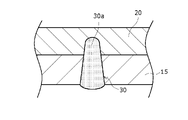
- FIG. 4 is an enlarged cross-sectional view of a welded portion between an outer can and a negative electrode lead in an example of an embodiment
- a cylindrical non-aqueous electrolyte secondary battery (hereinafter referred to as a secondary battery), which is an example of an embodiment of a sealed battery according to the present disclosure, will be described in detail below with reference to the drawings.
- a secondary battery which is an example of an embodiment of a sealed battery according to the present disclosure.
- specific shapes, materials, numerical values, directions, etc. are examples for facilitating understanding of the present invention, and can be appropriately changed according to the specifications of the cylindrical secondary battery.
- the outer can is not limited to a cylindrical shape, and may be, for example, rectangular.
- the characteristic portions thereof will be used in combination as appropriate.
- FIG. 1 is an axial cross-sectional view of a secondary battery 10 that is an example of an embodiment.
- an electrode body 14 and a non-aqueous electrolyte (not shown) are housed in an outer can 15 .
- Carbonates, lactones, ethers, ketones, esters and the like can be used as the non-aqueous solvent (organic solvent) of the electrolytic solution, and two or more of these solvents can be used in combination.
- a mixed solvent containing a cyclic carbonate and a chain carbonate it is preferable to use a mixed solvent containing a cyclic carbonate and a chain carbonate.
- cyclic carbonates such as ethylene carbonate (EC), propylene carbonate (PC), and butylene carbonate (BC)
- chain carbonates such as dimethyl carbonate (DMC), ethylmethyl carbonate (EMC), and diethyl carbonate ( DEC) and the like
- DEC diethyl carbonate
- LiPF 6 , LiBF 4 , LiCF 3 SO 3 and mixtures thereof can be used as the electrolyte salt of the electrolytic solution.
- the amount of electrolyte salt dissolved in the non-aqueous solvent can be, for example, 0.5 to 2.0 mol/L.
- the sealing member 16 side will be referred to as "upper” and the bottom side of the outer can 15 will be referred to as "lower”.
- the electrode body 14 has a wound structure in which the positive electrode 11 and the negative electrode 12 are wound with the separator 13 interposed therebetween.
- the positive electrode 11 , the negative electrode 12 , and the separator 13 are all formed in a belt shape, and are spirally wound around a winding core arranged along the winding axis, so that they are alternately arranged in the radial direction of the electrode assembly 14 . It will be in a laminated state.
- the positive electrode 11 has a strip-shaped positive electrode current collector and positive electrode mixture layers formed on both sides of the positive electrode current collector.
- a foil of a metal such as aluminum, a film in which the metal is arranged on the surface layer, or the like is used.
- the thickness of the positive electrode current collector is, for example, 10 ⁇ m to 30 ⁇ m.
- the positive electrode mixture layer preferably contains a positive electrode active material, a conductive agent, and a binder.
- a positive electrode mixture slurry containing a positive electrode active material, a conductive agent, a binder, and a solvent such as N-methyl-2-pyrrolidone (NMP) is applied to both sides of the positive electrode current collector and dried. After that, it can be produced by rolling.
- NMP N-methyl-2-pyrrolidone
- the positive electrode 11 is provided with a positive electrode exposed portion where the surface of the positive electrode current collector is exposed.
- the positive electrode exposed portion is a portion to which a positive electrode lead 19 to be described later is connected, and is a portion where the surface of the positive electrode current collector is not covered with the positive electrode mixture layer.
- the positive electrode exposed portions are preferably provided on both surfaces of the positive electrode 11 so as to overlap with each other in the thickness direction of the positive electrode 11 .
- the positive electrode lead 19 is joined to the positive electrode exposed portion by, for example, ultrasonic welding.
- the positive electrode exposed portion is provided, for example, at a position substantially equidistant from the winding inner end portion and the winding outer end portion of the electrode body 14 . This improves current collection.
- the positive electrode lead 19 By connecting the positive electrode lead 19 to the positive electrode exposed portion provided at such a position, when the electrode body 14 is wound, the positive electrode lead 19 is positioned substantially at the center in the radial direction of the electrode body 14 in the width direction. is arranged so as to protrude upward from the end face of the
- the positive electrode exposed portion is provided, for example, by intermittent application in which the positive electrode mixture slurry is not applied to a part of the positive electrode current collector.
- Examples of the positive electrode active material contained in the positive electrode mixture layer include lithium transition metal oxides containing transition metal elements such as Co, Mn, and Ni.
- Lithium transition metal oxides include, for example, Li x CoO 2 , Li x NiO 2 , Li x MnO 2 , Li x Co y Ni 1-y O 2 , Li x Co y M 1-y O z , Li x Ni 1- yMyOz , LixMn2O4 , LixMn2 - yMyO4 , LiMPO4 , Li2MPO4F
- M is Na , Mg , Sc , Y , Mn, Fe, Co, At least one of Ni, Cu, Zn, Al, Cr, Pb, Sb, and B, 0 ⁇ x ⁇ 1.2, 0 ⁇ y ⁇ 0.9, 2.0 ⁇ z ⁇ 2.3).
- the positive electrode active material is Li x NiO 2 , Li x Co y Ni 1-y O 2 , Li x Ni 1- y My O z ( M is at least one of Na, Mg, Sc, Y, Mn, Fe, Co, Ni, Cu, Zn, Al, Cr, Pb, Sb, and B, 0 ⁇ x ⁇ 1.2, 0 ⁇ y ⁇ 0 .9, 2.0 ⁇ z ⁇ 2.3).
- Examples of conductive agents contained in the positive electrode mixture layer include carbon black (CB), acetylene black (AB), ketjen black, carbon nanotubes (CNT), graphene, graphite and other carbon-based particles. These may be used alone or in combination of two or more.
- binder contained in the positive electrode mixture layer examples include fluorine-based resins such as polytetrafluoroethylene (PTFE) and polyvinylidene fluoride (PVdF), polyacrylonitrile (PAN), polyimide-based resins, acrylic resins, and polyolefins. system resins, and the like. These may be used individually by 1 type, and may be used in combination of 2 or more types. Styrene-butadiene rubber (SBR), nitrile rubber (NBR), CMC or its salt, polyacrylic acid or its salt, polyvinyl alcohol, or the like may be used when preparing the positive electrode mixture slurry with an aqueous solvent.
- SBR Styrene-butadiene rubber
- NBR nitrile rubber
- CMC polyacrylic acid or its salt
- polyvinyl alcohol or the like
- the negative electrode 12 has a strip-shaped negative electrode current collector and negative electrode mixture layers formed on both sides of the negative electrode current collector.
- a foil of a metal such as copper, a film in which the metal is arranged on the surface layer, or the like is used.
- the thickness of the negative electrode current collector is, for example, 5 ⁇ m to 30 ⁇ m.
- the negative electrode mixture layer includes, for example, a negative electrode active material and a binder.
- the negative electrode mixture layer can be produced, for example, by coating a negative electrode mixture slurry containing a negative electrode active material, a binder, and a solvent such as water on both sides of the negative electrode current collector, drying the slurry, and then rolling.
- the negative electrode 12 is provided with a negative electrode exposed portion where the surface of the negative electrode current collector is exposed.
- the negative electrode exposed portion is a portion to which the negative electrode lead 20 described later is connected, and is a portion where the surface of the negative electrode current collector is not covered with the negative electrode mixture layer.
- the negative electrode exposed portions are preferably provided on both surfaces of the negative electrode 12 so as to overlap with each other in the thickness direction of the negative electrode 12 .
- the negative electrode lead 20 is joined to the negative electrode exposed portion by, for example, ultrasonic welding.
- the negative electrode exposed portion is provided, for example, at the winding inner end portion or the winding outer end portion of the electrode body 14 .
- the negative electrode lead 20 may be joined to either the inner end of the winding or the outer end of the winding of the electrode assembly 14 .
- the negative electrode lead 20 may be joined to both the winding inner end portion and the winding outer end portion of the negative electrode 12 . In this case, current collection is improved.
- the outer end of the winding can be held without using the negative electrode lead 20 at the outer end of the winding of the negative electrode 12. It can also be electrically connected to the outer can 15 .
- the negative electrode exposed portion is provided, for example, by intermittent application in which the negative electrode mixture slurry is not applied to a part of the negative electrode current collector.
- the negative electrode active material contained in the negative electrode mixture layer is not particularly limited as long as it can reversibly absorb and release lithium ions. It is possible to use metals that are alloyed with, or alloys and oxides containing these.
- binder contained in the negative electrode mixture layer examples include styrene-butadiene rubber (SBR), nitrile-butadiene rubber (NBR), carboxymethylcellulose (CMC) or salts thereof, polyacrylic acid (PAA) or salts thereof (PAA -Na, PAA-K, and partially neutralized salts), polyvinyl alcohol (PVA), and the like.
- the binder may also contain fluorine-based resins such as polytetrafluoroethylene (PTFE) and polyvinylidene fluoride (PVdF), polyacrylonitrile (PAN), polyimide-based resins, acrylic-based resins, polyolefin-based resins, and the like. These may be used individually by 1 type, and may be used in combination of 2 or more types.
- the positive electrode lead 19 axially extends from the upper end of the electrode body 14 from substantially the center in the radial direction between the center and the outermost periphery.
- the positive electrode lead 19 is made of Al, for example.
- the negative electrode lead 20 axially extends from the vicinity of the winding axis at the lower end of the electrode body 14 .
- the negative electrode lead 20 is made of a metal containing Cu as a main component. Thereby, the resistance can be reduced and the output of the battery can be improved.
- the negative electrode lead 20 may have a Ni plating layer on its surface. That is, the negative electrode lead 20 may have a Ni-plated layer on the surface of metal containing Cu as a main component. Thereby, oxidation of Cu can be suppressed. From the viewpoint of suppressing the oxidation of Cu, it is preferable that the Ni plating layers are formed on both surfaces of the metal containing Cu as a main component. In the following description, the Ni plating layer is formed on both sides of the metal containing Cu as its main component, and the thickness of the Ni plating layer is the thickness of one side of the metal containing Cu as its main component.
- the portion of the negative electrode lead 20 excluding the Ni plating layer may contain elements other than Cu only at an impurity level, and may be composed of substantially Cu only.
- the content of elements other than Cu in the portion of the negative electrode lead 20 excluding the Ni plating is preferably 1% by mass or less, more preferably 0.5% by mass or less, and particularly preferably 0.1% by mass or less.
- the thickness of the negative electrode lead 20 is, for example, 50 ⁇ m to 200 ⁇ m. Also, the thickness of the Ni plating layer is preferably 0.1 ⁇ m to 20 ⁇ m, more preferably 0.5 ⁇ m to 10 ⁇ m, and particularly preferably 0.5 ⁇ m to 5 ⁇ m. If the thickness of the Ni plating layer is 0.1 ⁇ m or more, oxidation of Cu can be suppressed. From the viewpoint of cost reduction, the thickness of the Ni plating layer is preferably as thin as possible within the range in which oxidation of Cu can be suppressed. The ratio of the thickness of the Ni plating layer to the thickness of the negative electrode lead 20 (thickness of Ni plating layer/thickness of negative electrode lead) is, for example, 0.005 to 0.2.
- the outer can 15 is a cylindrical container with a bottom, and accommodates the electrode assembly 14, a non-aqueous electrolyte, and the like inside. Moreover, the outer can 15 is made of a metal containing Fe. The outer can 15 is, for example, carbon steel. The thickness of the outer can 15 is, for example, 0.2 mm to 0.8 mm. Also, the outer can 15 may have a Ni-plated layer on its surface, or may have a Ni-plated layer on both the inner surface and the outer surface. The thickness of the Ni plating layer on the surface of the outer can 15 is, for example, 0.1 ⁇ m to 10 ⁇ m.
- the inside of the secondary battery 10 is hermetically sealed by closing the upper end of the outer can 15 with the sealing member 16 .
- Insulating plates 17 and 18 are provided above and below the electrode body 14, respectively.
- the positive electrode lead 19 extends upward through the through hole of the insulating plate 17 and is welded to the lower surface of the filter 22 which is the bottom plate of the sealing member 16 .
- the cap 26, which is the top plate of the sealing member 16 electrically connected to the filter 22, serves as a positive electrode terminal.
- the negative electrode lead 20 extends through the through hole of the insulating plate 18 toward the bottom of the outer can 15 and is welded to the inner surface of the bottom of the outer can 15 .
- the outer can 15 serves as a negative electrode terminal.
- a gasket 27 is provided between the outer can 15 and the sealing body 16 to ensure the sealing of the inside of the secondary battery 10 .
- the outer can 15 has, for example, a grooved portion 21 that supports the sealing member 16 and is formed by pressing the side portion from the outside.
- the grooved portion 21 is preferably annularly formed along the circumferential direction of the outer can 15 and supports the sealing member 16 on its upper surface.
- the sealing body 16 has a filter 22, a lower valve body 23, an insulating member 24, an upper valve body 25, and a cap 26 which are stacked in order from the electrode body 14 side.
- Each member constituting the sealing member 16 has, for example, a disk shape or a ring shape, and each member other than the insulating member 24 is electrically connected to each other.
- the lower valve body 23 and the upper valve body 25 are connected to each other at their central portions, and an insulating member 24 is interposed between their peripheral edge portions.
- FIG. 2 is an enlarged cross-sectional view of the welded portion 30 between the outer can 15 and the negative electrode lead 20 in one example of the embodiment.
- the outer can 15 and the negative electrode lead 20 are welded together at a welded portion 30 formed from the outer surface of the outer can 15 to the negative electrode lead 20 .
- the welded portion 30 penetrates the bottom of the outer can 15 and reaches the interior of the negative electrode lead 20 from the outer surface of the outer can 15 .
- the welded portion 30 is, for example, a melt-solidified portion between the outer can 15 and the negative electrode lead 20 formed by irradiating the outer surface of the outer can 15 with a laser. That is, the welded portion 30 may be formed by irradiating the bottom portion of the outer can 15 from the outside of the secondary battery 10 with a laser while the negative electrode lead 20 is in contact with the inner surface of the outer can 15 .
- the wavelength of the laser is not particularly limited as long as it is absorbed by the outer can 15, and is, for example, 1060 nm to 1080 nm. Note that the laser output is not particularly limited as long as the welded portion 30 as described above is formed.
- the Cu concentration in the contact portion 30a between the negative electrode lead 20 and the armored can 15 in the welded portion 30 is preferably 10% by mass or less, more preferably 8.6% by mass or less.
- the welded portion 30 is an alloy formed by melting and solidifying the metal containing Fe forming the outer can 15 and the metal containing Cu as the main component forming the negative electrode lead 20 .
- the Cu concentration in the welded portion 30 can be measured using an electron probe microanalyzer (EPMA). Depending on the welding conditions, the composition of the alloy formed in the weld may not be uniform. Therefore, it is preferable to measure the Cu concentration at the center of the contact portion 30a of the welded portion 30 where the negative electrode lead 20 and the outer can 15 are in contact with each other immediately before welding.
- the measurement range is, for example, within 100 ⁇ m from the center of the contact portion 30a.
- the contact portion 30a is a portion of the weld portion 30 corresponding to the contact surface and the vicinity thereof immediately before the negative electrode lead 20 and the outer can 15 are welded.
- the presence or absence of solidification cracks in the welded portion 30 can be confirmed by observing the welded portion 30 with a scanning electron microscope (SEM), for example.
- Example 1 [Preparation of positive electrode] A lithium transition metal oxide represented by LiNi 0.8 Co 0.15 Al 0.05 O 2 was used as a positive electrode active material. 100 parts by mass of this positive electrode active material, 2.5 parts by mass of acetylene black (AB) as a conductive agent, and 1.7 parts by mass of polyvinylidene fluoride (PVdF) as a binder are mixed, and , N-methyl-2-pyrrolidone (NMP) was added in an appropriate amount to prepare a positive electrode mixture slurry.
- AB acetylene black
- PVdF polyvinylidene fluoride
- NMP N-methyl-2-pyrrolidone
- this positive electrode mixture slurry was applied to both sides of a positive electrode current collector made of aluminum foil, dried, cut into a predetermined electrode size, and rolled using a roller to obtain a band-shaped positive electrode.
- a non-coating portion in which no active material was formed was formed at one end in the length direction of the positive electrode, and one end of a positive electrode lead made of Al was fixed to the non-coating portion by ultrasonic welding.
- Graphitizable carbon was used as the negative electrode active material. 100 parts by mass of this negative electrode active material, 0.6 parts by mass of styrene-butadiene rubber (SBR) as a binder, and 1 part by mass of carboxymethyl cellulose (CMC) as a thickening agent are mixed, and water is added. An appropriate amount was added to prepare a negative electrode mixture slurry. Next, this negative electrode mixture slurry was applied to both sides of a negative electrode current collector made of copper foil, dried, cut into a predetermined electrode size, and rolled using a roller to obtain a band-shaped negative electrode.
- SBR styrene-butadiene rubber
- CMC carboxymethyl cellulose
- a non-coating portion where no active material was formed was formed at one end portion in the length direction of the negative electrode.
- a negative electrode lead having a thickness of 0.1 mm was prepared by forming a Ni plating layer having a thickness of 1 ⁇ m on each side of Cu, and one end of the negative electrode lead was fixed to the uncoated portion by ultrasonic welding.
- EC ethylene carbonate
- EMC ethylmethyl carbonate
- DEC diethyl carbonate
- a non-aqueous electrolyte was prepared by adding so as to be 1.0 mol/L.
- a wound electrode assembly was produced by spirally winding the positive electrode and the negative electrode with a separator made of polyolefin resin interposed therebetween. Insulating plates were arranged above and below the electrode body, and the electrode body was housed in a bottomed cylindrical metal can. The thickness of the outer can was 0.4 mm, and a Ni plating layer with a thickness of 1 ⁇ m was provided on both sides of the outer can. Next, a fiber laser with a wavelength of 1070 nm was irradiated from the outside of the outer can to the bottom of the outer can, and the negative electrode lead projecting from the electrode body was welded to the bottom of the outer can.
- a grooved portion was formed in the opening of the outer can by pressing, and a non-aqueous electrolyte was injected into the inside of the outer can. After the gasket was accommodated in the upper part of the grooved portion and the sealing body was welded to the positive electrode lead, the opening of the outer can was sealed by crimping the sealing body through the gasket to produce a sealed battery.
- Example 2 A battery was fabricated in the same manner as in Example 1, except that a negative electrode lead with a thickness of 0.1 mm and a Ni plating layer with a thickness of 3 ⁇ m formed on each side of Cu was used in the fabrication of the negative electrode.
- Example 3 A battery was fabricated in the same manner as in Example 1, except that a negative electrode lead with a thickness of 0.1 mm having a Ni plating layer with a thickness of 5 ⁇ m formed on each side of Cu was used in the fabrication of the negative electrode.
- Example 4 A battery was fabricated in the same manner as in Example 1, except that a negative electrode lead with a thickness of 0.1 mm having a Ni plating layer with a thickness of 10 ⁇ m formed on each side of Cu was used in the fabrication of the negative electrode.
- Example 5 A battery was fabricated in the same manner as in Example 1, except that a negative electrode lead having a thickness of 0.1 mm and having no Ni plating layer formed on the surface thereof was used in the fabrication of the negative electrode.
- Table 1 shows the evaluation results of Examples and Comparative Examples.
- Example 1-5 the occurrence of solidification cracking could be suppressed compared to Comparative Examples 1-5 by controlling the Cu concentration of the weld zone to 10% by mass or less. Although solidification cracking occurred in Example 5, the cracking was not large enough to cause peeling of the negative electrode lead.
Landscapes
- Chemical & Material Sciences (AREA)
- Chemical Kinetics & Catalysis (AREA)
- Electrochemistry (AREA)
- General Chemical & Material Sciences (AREA)
- Inorganic Chemistry (AREA)
- Engineering & Computer Science (AREA)
- Manufacturing & Machinery (AREA)
- Secondary Cells (AREA)
- Connection Of Batteries Or Terminals (AREA)
Priority Applications (4)
| Application Number | Priority Date | Filing Date | Title |
|---|---|---|---|
| EP22771194.2A EP4310998A4 (en) | 2021-03-17 | 2022-03-08 | SEALED BATTERY |
| JP2023506997A JP7757390B2 (ja) | 2021-03-17 | 2022-03-08 | 密閉電池 |
| US18/280,550 US20240154266A1 (en) | 2021-03-17 | 2022-03-08 | Sealed battery |
| CN202280019569.5A CN117015904A (zh) | 2021-03-17 | 2022-03-08 | 密闭电池 |
Applications Claiming Priority (2)
| Application Number | Priority Date | Filing Date | Title |
|---|---|---|---|
| JP2021043474 | 2021-03-17 | ||
| JP2021-043474 | 2021-03-17 |
Publications (1)
| Publication Number | Publication Date |
|---|---|
| WO2022196442A1 true WO2022196442A1 (ja) | 2022-09-22 |
Family
ID=83320420
Family Applications (1)
| Application Number | Title | Priority Date | Filing Date |
|---|---|---|---|
| PCT/JP2022/009996 Ceased WO2022196442A1 (ja) | 2021-03-17 | 2022-03-08 | 密閉電池 |
Country Status (5)
| Country | Link |
|---|---|
| US (1) | US20240154266A1 (https=) |
| EP (1) | EP4310998A4 (https=) |
| JP (1) | JP7757390B2 (https=) |
| CN (1) | CN117015904A (https=) |
| WO (1) | WO2022196442A1 (https=) |
Citations (3)
| Publication number | Priority date | Publication date | Assignee | Title |
|---|---|---|---|---|
| JP2001176490A (ja) | 1999-12-14 | 2001-06-29 | Sony Corp | 非水電解液二次電池 |
| JP2004158318A (ja) * | 2002-11-07 | 2004-06-03 | Matsushita Electric Ind Co Ltd | 円筒形電池とその製造方法 |
| JP2010003686A (ja) | 2008-06-20 | 2010-01-07 | Samsung Sdi Co Ltd | 二次電池及びその製造方法 |
Family Cites Families (5)
| Publication number | Priority date | Publication date | Assignee | Title |
|---|---|---|---|---|
| JP2014132516A (ja) * | 2011-04-28 | 2014-07-17 | Hitachi Maxell Ltd | 円筒形リチウムイオン二次電池およびその製造方法 |
| US20190198882A1 (en) * | 2016-09-23 | 2019-06-27 | Samsung Sdi Co., Ltd. | Secondary battery |
| US20200141434A1 (en) | 2017-07-25 | 2020-05-07 | Sumitomo Electric Industries, Ltd. | Method of manufacturing metal member-welded structure, and metal member-welded structure |
| JP7009271B2 (ja) * | 2018-03-16 | 2022-01-25 | 三洋電機株式会社 | 密閉電池の製造方法及び密閉電池 |
| WO2023095383A1 (ja) | 2021-11-29 | 2023-06-01 | パナソニックIpマネジメント株式会社 | 接合体、レーザ加工方法及びレーザ加工装置 |
-
2022
- 2022-03-08 US US18/280,550 patent/US20240154266A1/en active Pending
- 2022-03-08 WO PCT/JP2022/009996 patent/WO2022196442A1/ja not_active Ceased
- 2022-03-08 CN CN202280019569.5A patent/CN117015904A/zh active Pending
- 2022-03-08 JP JP2023506997A patent/JP7757390B2/ja active Active
- 2022-03-08 EP EP22771194.2A patent/EP4310998A4/en active Pending
Patent Citations (3)
| Publication number | Priority date | Publication date | Assignee | Title |
|---|---|---|---|---|
| JP2001176490A (ja) | 1999-12-14 | 2001-06-29 | Sony Corp | 非水電解液二次電池 |
| JP2004158318A (ja) * | 2002-11-07 | 2004-06-03 | Matsushita Electric Ind Co Ltd | 円筒形電池とその製造方法 |
| JP2010003686A (ja) | 2008-06-20 | 2010-01-07 | Samsung Sdi Co Ltd | 二次電池及びその製造方法 |
Non-Patent Citations (1)
| Title |
|---|
| See also references of EP4310998A4 |
Also Published As
| Publication number | Publication date |
|---|---|
| JP7757390B2 (ja) | 2025-10-21 |
| EP4310998A1 (en) | 2024-01-24 |
| US20240154266A1 (en) | 2024-05-09 |
| JPWO2022196442A1 (https=) | 2022-09-22 |
| CN117015904A (zh) | 2023-11-07 |
| EP4310998A4 (en) | 2024-12-04 |
Similar Documents
| Publication | Publication Date | Title |
|---|---|---|
| WO2011001617A1 (ja) | 捲回型電極群および電池 | |
| WO2018079291A1 (ja) | 非水電解質二次電池用電極及び非水電解質二次電池 | |
| JP7320166B2 (ja) | 二次電池 | |
| JP7171585B2 (ja) | 円筒形非水電解質二次電池 | |
| WO2021039275A1 (ja) | 非水電解質二次電池 | |
| WO2018173899A1 (ja) | 非水電解質二次電池 | |
| WO2022024712A1 (ja) | 非水電解質二次電池 | |
| JPWO2020170598A1 (ja) | 電極板及びその製造方法、二次電池及びその製造方法 | |
| US11183678B2 (en) | Electrode for nonaqueous electrolyte secondary battery and nonaqueous electrolyte secondary battery | |
| JP7808586B2 (ja) | 円筒形電池、及びその製造方法 | |
| CN118285006A (zh) | 非水电解质二次电池 | |
| WO2022202270A1 (ja) | 円筒形電池 | |
| WO2021049471A1 (ja) | 非水電解質二次電池 | |
| US20240145676A1 (en) | Nonaqueous electrolyte secondary battery | |
| WO2023002798A1 (ja) | 非水電解質二次電池及び非水電解質二次電池の製造方法 | |
| WO2022186039A1 (ja) | 円筒形電池 | |
| WO2022249989A1 (ja) | 非水電解質二次電池 | |
| JP7601772B2 (ja) | 非水電解質二次電池及び非水電解質二次電池の製造方法 | |
| KR101833609B1 (ko) | 축전 장치의 제조 방법 및 축전 장치 | |
| JP2007172880A (ja) | 電池およびその製造方法 | |
| WO2022196442A1 (ja) | 密閉電池 | |
| JP2010080294A (ja) | 二次電池 | |
| US20220115671A1 (en) | Positive electrode and secondary battery | |
| WO2026070618A1 (ja) | 円筒形電池 | |
| WO2026048749A1 (ja) | 非水電解質二次電池 |
Legal Events
| Date | Code | Title | Description |
|---|---|---|---|
| 121 | Ep: the epo has been informed by wipo that ep was designated in this application |
Ref document number: 22771194 Country of ref document: EP Kind code of ref document: A1 |
|
| WWE | Wipo information: entry into national phase |
Ref document number: 2023506997 Country of ref document: JP |
|
| WWE | Wipo information: entry into national phase |
Ref document number: 18280550 Country of ref document: US Ref document number: 202280019569.5 Country of ref document: CN |
|
| WWE | Wipo information: entry into national phase |
Ref document number: 202347060166 Country of ref document: IN |
|
| WWE | Wipo information: entry into national phase |
Ref document number: 2022771194 Country of ref document: EP |
|
| NENP | Non-entry into the national phase |
Ref country code: DE |
|
| ENP | Entry into the national phase |
Ref document number: 2022771194 Country of ref document: EP Effective date: 20231017 |