WO2022195993A1 - ペット用おむつ - Google Patents
ペット用おむつ Download PDFInfo
- Publication number
- WO2022195993A1 WO2022195993A1 PCT/JP2021/046595 JP2021046595W WO2022195993A1 WO 2022195993 A1 WO2022195993 A1 WO 2022195993A1 JP 2021046595 W JP2021046595 W JP 2021046595W WO 2022195993 A1 WO2022195993 A1 WO 2022195993A1
- Authority
- WO
- WIPO (PCT)
- Prior art keywords
- tail hole
- pet
- edge
- ventral
- main body
- Prior art date
- Legal status (The legal status is an assumption and is not a legal conclusion. Google has not performed a legal analysis and makes no representation as to the accuracy of the status listed.)
- Ceased
Links
Images






Classifications
-
- A—HUMAN NECESSITIES
- A01—AGRICULTURE; FORESTRY; ANIMAL HUSBANDRY; HUNTING; TRAPPING; FISHING
- A01K—ANIMAL HUSBANDRY; AVICULTURE; APICULTURE; PISCICULTURE; FISHING; REARING OR BREEDING ANIMALS, NOT OTHERWISE PROVIDED FOR; NEW BREEDS OF ANIMALS
- A01K23/00—Manure or urine pouches
-
- A—HUMAN NECESSITIES
- A01—AGRICULTURE; FORESTRY; ANIMAL HUSBANDRY; HUNTING; TRAPPING; FISHING
- A01K—ANIMAL HUSBANDRY; AVICULTURE; APICULTURE; PISCICULTURE; FISHING; REARING OR BREEDING ANIMALS, NOT OTHERWISE PROVIDED FOR; NEW BREEDS OF ANIMALS
- A01K1/00—Housing animals; Equipment therefor
- A01K1/01—Removal of dung or urine ; Removal of manure from stables
- A01K1/0107—Cat trays; Dog urinals; Toilets for pets
- A01K1/011—Cat trays; Dog urinals; Toilets for pets with means for removing excrement
-
- A—HUMAN NECESSITIES
- A01—AGRICULTURE; FORESTRY; ANIMAL HUSBANDRY; HUNTING; TRAPPING; FISHING
- A01K—ANIMAL HUSBANDRY; AVICULTURE; APICULTURE; PISCICULTURE; FISHING; REARING OR BREEDING ANIMALS, NOT OTHERWISE PROVIDED FOR; NEW BREEDS OF ANIMALS
- A01K13/00—Devices for grooming or caring of animals, e.g. curry-combs; Fetlock rings; Tail-holders; Devices for preventing crib-biting; Washing devices; Protection against weather conditions or insects
- A01K13/006—Protective coverings
-
- A—HUMAN NECESSITIES
- A61—MEDICAL OR VETERINARY SCIENCE; HYGIENE
- A61F—FILTERS IMPLANTABLE INTO BLOOD VESSELS; PROSTHESES; DEVICES PROVIDING PATENCY TO, OR PREVENTING COLLAPSING OF, TUBULAR STRUCTURES OF THE BODY, e.g. STENTS; ORTHOPAEDIC, NURSING OR CONTRACEPTIVE DEVICES; FOMENTATION; TREATMENT OR PROTECTION OF EYES OR EARS; BANDAGES, DRESSINGS OR ABSORBENT PADS; FIRST-AID KITS
- A61F13/00—Bandages or dressings; Absorbent pads
- A61F13/15—Absorbent pads, e.g. sanitary towels, swabs or tampons for external or internal application to the body; Supporting or fastening means therefor; Tampon applicators
- A61F13/45—Absorbent pads, e.g. sanitary towels, swabs or tampons for external or internal application to the body; Supporting or fastening means therefor; Tampon applicators characterised by the shape
- A61F13/49—Absorbent pads, e.g. sanitary towels, swabs or tampons for external or internal application to the body; Supporting or fastening means therefor; Tampon applicators characterised by the shape specially adapted to be worn around the waist, e.g. diapers, nappies
- A61F13/496—Absorbent pads, e.g. sanitary towels, swabs or tampons for external or internal application to the body; Supporting or fastening means therefor; Tampon applicators characterised by the shape specially adapted to be worn around the waist, e.g. diapers, nappies in the form of pants or briefs
-
- A—HUMAN NECESSITIES
- A61—MEDICAL OR VETERINARY SCIENCE; HYGIENE
- A61F—FILTERS IMPLANTABLE INTO BLOOD VESSELS; PROSTHESES; DEVICES PROVIDING PATENCY TO, OR PREVENTING COLLAPSING OF, TUBULAR STRUCTURES OF THE BODY, e.g. STENTS; ORTHOPAEDIC, NURSING OR CONTRACEPTIVE DEVICES; FOMENTATION; TREATMENT OR PROTECTION OF EYES OR EARS; BANDAGES, DRESSINGS OR ABSORBENT PADS; FIRST-AID KITS
- A61F13/00—Bandages or dressings; Absorbent pads
- A61F13/15—Absorbent pads, e.g. sanitary towels, swabs or tampons for external or internal application to the body; Supporting or fastening means therefor; Tampon applicators
- A61F13/53—Absorbent pads, e.g. sanitary towels, swabs or tampons for external or internal application to the body; Supporting or fastening means therefor; Tampon applicators characterised by the absorbing medium
-
- A—HUMAN NECESSITIES
- A61—MEDICAL OR VETERINARY SCIENCE; HYGIENE
- A61F—FILTERS IMPLANTABLE INTO BLOOD VESSELS; PROSTHESES; DEVICES PROVIDING PATENCY TO, OR PREVENTING COLLAPSING OF, TUBULAR STRUCTURES OF THE BODY, e.g. STENTS; ORTHOPAEDIC, NURSING OR CONTRACEPTIVE DEVICES; FOMENTATION; TREATMENT OR PROTECTION OF EYES OR EARS; BANDAGES, DRESSINGS OR ABSORBENT PADS; FIRST-AID KITS
- A61F13/00—Bandages or dressings; Absorbent pads
- A61F13/15—Absorbent pads, e.g. sanitary towels, swabs or tampons for external or internal application to the body; Supporting or fastening means therefor; Tampon applicators
- A61F13/56—Supporting or fastening means
- A61F13/5622—Supporting or fastening means specially adapted for diapers or the like
- A61F13/565—Supporting or fastening means specially adapted for diapers or the like pants type diaper
- A61F13/5655—Supporting or fastening means specially adapted for diapers or the like pants type diaper adjustable pants type diapers
-
- A—HUMAN NECESSITIES
- A61—MEDICAL OR VETERINARY SCIENCE; HYGIENE
- A61F—FILTERS IMPLANTABLE INTO BLOOD VESSELS; PROSTHESES; DEVICES PROVIDING PATENCY TO, OR PREVENTING COLLAPSING OF, TUBULAR STRUCTURES OF THE BODY, e.g. STENTS; ORTHOPAEDIC, NURSING OR CONTRACEPTIVE DEVICES; FOMENTATION; TREATMENT OR PROTECTION OF EYES OR EARS; BANDAGES, DRESSINGS OR ABSORBENT PADS; FIRST-AID KITS
- A61F13/00—Bandages or dressings; Absorbent pads
- A61F13/15—Absorbent pads, e.g. sanitary towels, swabs or tampons for external or internal application to the body; Supporting or fastening means therefor; Tampon applicators
- A61F13/56—Supporting or fastening means
- A61F13/58—Adhesive tab fastener elements
- A61F13/581—Tab fastener elements combining adhesive and mechanical fastening
-
- A—HUMAN NECESSITIES
- A61—MEDICAL OR VETERINARY SCIENCE; HYGIENE
- A61F—FILTERS IMPLANTABLE INTO BLOOD VESSELS; PROSTHESES; DEVICES PROVIDING PATENCY TO, OR PREVENTING COLLAPSING OF, TUBULAR STRUCTURES OF THE BODY, e.g. STENTS; ORTHOPAEDIC, NURSING OR CONTRACEPTIVE DEVICES; FOMENTATION; TREATMENT OR PROTECTION OF EYES OR EARS; BANDAGES, DRESSINGS OR ABSORBENT PADS; FIRST-AID KITS
- A61F13/00—Bandages or dressings; Absorbent pads
- A61F13/15—Absorbent pads, e.g. sanitary towels, swabs or tampons for external or internal application to the body; Supporting or fastening means therefor; Tampon applicators
- A61F2013/15008—Absorbent pads, e.g. sanitary towels, swabs or tampons for external or internal application to the body; Supporting or fastening means therefor; Tampon applicators characterized by the use
- A61F2013/15186—Absorbent pads, e.g. sanitary towels, swabs or tampons for external or internal application to the body; Supporting or fastening means therefor; Tampon applicators characterized by the use for animals
-
- A—HUMAN NECESSITIES
- A61—MEDICAL OR VETERINARY SCIENCE; HYGIENE
- A61F—FILTERS IMPLANTABLE INTO BLOOD VESSELS; PROSTHESES; DEVICES PROVIDING PATENCY TO, OR PREVENTING COLLAPSING OF, TUBULAR STRUCTURES OF THE BODY, e.g. STENTS; ORTHOPAEDIC, NURSING OR CONTRACEPTIVE DEVICES; FOMENTATION; TREATMENT OR PROTECTION OF EYES OR EARS; BANDAGES, DRESSINGS OR ABSORBENT PADS; FIRST-AID KITS
- A61F13/00—Bandages or dressings; Absorbent pads
- A61F13/15—Absorbent pads, e.g. sanitary towels, swabs or tampons for external or internal application to the body; Supporting or fastening means therefor; Tampon applicators
- A61F13/45—Absorbent pads, e.g. sanitary towels, swabs or tampons for external or internal application to the body; Supporting or fastening means therefor; Tampon applicators characterised by the shape
- A61F13/49—Absorbent pads, e.g. sanitary towels, swabs or tampons for external or internal application to the body; Supporting or fastening means therefor; Tampon applicators characterised by the shape specially adapted to be worn around the waist, e.g. diapers, nappies
- A61F13/49007—Form-fitting, self-adjusting disposable diapers
- A61F13/49009—Form-fitting, self-adjusting disposable diapers with elastic means
- A61F2013/49041—Form-fitting, self-adjusting disposable diapers with elastic means having a specific location other than covered by groups A61F13/49011 - A61F13/49019
-
- A—HUMAN NECESSITIES
- A61—MEDICAL OR VETERINARY SCIENCE; HYGIENE
- A61F—FILTERS IMPLANTABLE INTO BLOOD VESSELS; PROSTHESES; DEVICES PROVIDING PATENCY TO, OR PREVENTING COLLAPSING OF, TUBULAR STRUCTURES OF THE BODY, e.g. STENTS; ORTHOPAEDIC, NURSING OR CONTRACEPTIVE DEVICES; FOMENTATION; TREATMENT OR PROTECTION OF EYES OR EARS; BANDAGES, DRESSINGS OR ABSORBENT PADS; FIRST-AID KITS
- A61F13/00—Bandages or dressings; Absorbent pads
- A61F13/15—Absorbent pads, e.g. sanitary towels, swabs or tampons for external or internal application to the body; Supporting or fastening means therefor; Tampon applicators
- A61F13/56—Supporting or fastening means
- A61F13/58—Adhesive tab fastener elements
- A61F2013/588—Adhesive tab fastener elements on waist panels
Definitions
- the present disclosure relates to pet diapers.
- Patent Document 1 discloses a pet diaper that is worn on pets such as dogs and cats.
- the pet diaper of Patent Document 1 includes a diaper main body in which a tail hole is formed in a buttock covering the pet's buttocks and through which excrement excreted by the pet passes, and a feces bag that collects feces that have passed through the tail hole. ing.
- This pet diaper prevents feces from adhering to pet hair and the like by absorbing urine with a water absorbent body of the diaper body and collecting feces in a feces bag.
- the tail hole formed in the pet diaper of Patent Document 1 needs to be maintained in a position facing the anus of the pet in order to expel feces.
- the pet diaper may be displaced, and the position of the tail hole may be displaced with respect to the position of the pet's anus. If the position of the tail hole is displaced, excreted feces may enter the interior of the pet diaper and adhere to the pet. In order to ensure that feces pass through the tail hole, it is conceivable to increase the size of the tail hole formed in the pet diaper. There is a risk of leakage.
- an object of the present invention is to provide a pet diaper that can prevent urinary leakage and discharge feces to the outside.
- the pet diaper extends in a horizontal direction arranged along the waist direction of the pet and in a vertical direction orthogonal to the horizontal direction and connecting the abdomen side to the back side of the pet, and absorbs It has a body portion that includes a sexual core.
- the main body is formed with a vertically elongated tail hole having a maximum vertical opening width larger than a horizontal maximum opening width.
- the pet diaper includes a pair of fastening tabs provided on the ventral side of the tail hole and extending outward from the side edges of the main body in the lateral direction, and a pair of fastening tabs provided on the dorsal side of the tail hole. and a target portion for engaging the.
- the dorsal edge of the tail hole is located more ventral than the longitudinal midpoint between the centerline of the main body and the ventral edge of the target.
- the tail hole since the tail hole has a vertically long shape, the pet's anus can be exposed from the main body during excretion.
- the pet diaper can be worn with the pet diaper.
- the dorsal edge of the tail hole can be reliably brought into contact with the dorsal part of the tail. Therefore, displacement of the pet diaper is suppressed, and excrement can be discharged to the outside of the pet diaper while preventing urine leakage.
- the maximum longitudinal opening width of the tail hole may be greater than the distance between the ventral edge of the tail hole and the longitudinal centerline of the main body. In this aspect, since the maximum opening width in the vertical direction of the tail hole is formed relatively long, the anus of the pet can be surely exposed from the main body, and feces can be discharged to the outside.
- the maximum longitudinal opening width of the tail hole may be greater than the distance between the dorsal edge of the tail hole and the midpoint. In this aspect, since the maximum opening width in the vertical direction of the tail hole is formed relatively long, the anus of the pet can be reliably exposed from the main body, and feces can be discharged to the outside of the pet diaper.
- the distance between the ventral edge of the tail hole and the centerline of the body in the longitudinal direction is less than the distance between the dorsal edge of the tail hole in the longitudinal direction and the midpoint.
- the ventral edge of the tail hole may be arranged more ventral than the center line of the main body in the longitudinal direction.
- the body portion is formed with a tongue provided so as to overlap the tail hole, and the tongue is a base end connected to the edge of the tail hole and a distal end on the opposite side of the base end. and opening the tail hole when folded back from the base end, and the tip of the tongue may be directed ventrally or laterally in a state in which the tongue is not folded back. .
- the tongue piece when the tongue piece is folded back from the base end portion, the tongue piece is not arranged below the pet's anus, so that feces are prevented from adhering to the pet diaper during excretion. can be done.
- the tail hole may be formed by cutting a part of the main body.
- the dorsal edge of the absorbent core may be positioned more to the ventral side than the ventral edge of the tail hole.
- regions where no absorbent core is arranged are formed on both lateral sides of the tail hole and on the dorsal side. These areas have a lower stiffness due to the absorbent core and flexibly deform along the pet's buttocks. Therefore, the fit of the pet diaper is improved, a gap is less likely to form between the edge of the tail hole and the buttocks of the pet, and fecal matter is prevented from entering the pet diaper through the gap.
- the distance between the ventral edge of the tail hole and the dorsal edge of the absorbent core is the distance between the dorsal edge of the absorbent core and the centerline of the main body in the longitudinal direction. may be smaller than the distance of In this aspect, since the dorsal edge of the absorbent core is arranged at a position close to the ventral edge of the tail hole, urine leakage from the tail hole can be suppressed.
- One aspect of the pet diaper is fixed to the main body in a longitudinally stretched state, and extends longitudinally at least between the ventral edge of the tail hole and the dorsal edge of the absorbent core. You may further have the expansion-contraction member which carries out.
- the elastic member since the elastic member extends at least between the ventral edge of the tail hole and the dorsal edge of the absorbent core, the expansion and contraction of the elastic member allows the tail hole of the main body and the absorbent core to expand.
- the area between the absorbent core is pulled toward the absorbent core and pressed against the buttocks of the pet.
- the fit of the pet diaper is improved, and a gap is less likely to occur between the edge of the tail hole and the buttocks of the pet. Therefore, feces are less likely to enter the interior of the pet diaper, and feces are less likely to adhere to the pet.
- One aspect of the pet diaper further comprises leak-proof gathers positioned laterally outside the absorbent core, and the stretchable member is positioned laterally outside the leak-proof gathers. good too.
- the elastic member since the elastic member is arranged laterally outside the leakproof gathers, the lateral side edges of the main body can be arranged in close contact with the pet's leg. Therefore, the fit of the pet diaper can be further improved.
- the leak-proof gather includes a second stretchable member extending in the longitudinal direction, an upright portion that stands up due to contraction of the second stretchable member, and a vertical fixed portion that serves as an upright fulcrum for the upright portion in the vertical direction.
- the vertical fixing part may be fixed to the body part at a position between the ventral edge of the tail hole and the dorsal edge of the absorbent core.
- the opening width of the tail hole in the lateral direction may be continuously narrowed toward the ventral side. Since the width of the anus during defecation is larger than the width of feces, by narrowing the width of the tail hole in the lateral direction toward the ventral side, it is possible to reduce the opening area of the tail hole while allowing feces to pass through. In addition, urine leakage from the tail hole can be suppressed by reducing the opening area of the tail hole.
- stool can be discharged to the outside while preventing urine leakage.
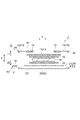
- FIG. 2 is a cross-sectional view schematically showing the pet diaper along line AA in FIG. 1; It is a figure which shows the state which mounted
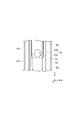
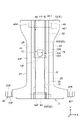
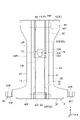
- FIG. 10 is a plan view showing a pet diaper according to still another embodiment
- Fig. 10 is a plan view showing a pet diaper according to still another embodiment
- Fig. 10 is a plan view showing a pet diaper according to still another embodiment
- Fig. 10 is a plan view showing a pet diaper according to still another embodiment
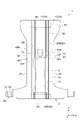
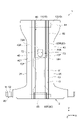
- FIG. 1 is a plan view of the pet diaper according to the embodiment viewed from the surface side Z1.
- FIG. 2 is a cross-sectional view schematically showing the pet diaper along line AA shown in FIG.
- FIGS. 1 and 2 show the pet diaper 1 in a stretched state in which the pet diaper 1 is stretched to the point where no wrinkles are formed.
- the positional relationship in the extended state will be described unless otherwise specified.
- each member is shown separated in the thickness direction Z for convenience of explanation, but they are in contact with each other in the thickness direction Z in an actual product.
- the pet diaper 1 is a diaper used for pets.
- "pet” broadly includes vertebrates and invertebrates, and typically includes companion animals such as dogs, cats, rabbits, and hamsters.
- the pet diaper 1 of one embodiment is a dog or cat diaper. This pet diaper 1 is suitably used when a pet is taken for a walk.
- the pet diaper 1 extends in a lateral direction X arranged along the circumference of the pet and in a longitudinal direction Y orthogonal to the lateral direction X.
- the vertical direction Y is a direction connecting the ventral side to the back side of the pet.
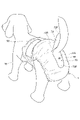
- the thickness direction Z is a direction orthogonal to the horizontal direction X and the vertical direction Y, and includes a front side Z1 that is brought into contact with a pet when worn and a back side Z2 that is directed outward when worn. As shown in FIG. 3, the pet diaper according to the embodiment is worn so as to cover the abdomen of the pet through the crotch to the dorsal side.
- the pet diaper 1 has a body portion 2.
- the body portion 2 includes at least a topsheet 10 , a backsheet 20 and an absorbent core 30 .
- the surface sheet 10 constitutes a surface of the body portion 2 that is put against the pet, and is arranged on the surface side Z1.
- the topsheet 10 has liquid permeability that allows body fluids to permeate to the absorbent core 30 side.
- the topsheet 10 is positioned in the center in the longitudinal direction Y and includes a center sheet 11 covering the absorbent core 30 and side sheets 12 covering both sides in the lateral direction X of the center sheet 11 . As shown in FIG. 2, the inner portion of the side sheet 12 in the lateral direction X is folded back to the back side Z2.
- a stretchable member (second stretchable member) 13 stretched in the vertical direction Y is arranged between the folded side sheets 12 .
- the side sheets 12 and the elastic members 13 constitute leak-proof gathers 80 .
- the leak-preventing gathers 80 are erect leak-preventing gathers and are arranged on the surface side Z1 of the absorbent core 30 . Details of the leak-proof gathers 80 will be described later.
- the back sheet 20 constitutes a surface positioned on the outside of the main body 2 when worn, and is arranged on the back side Z2.
- the back sheet 20 includes a liquid-impermeable back film 21 and a back non-woven fabric 22 located on the back side Z2 of the back film 21 .
- the back nonwoven fabric 22 may be arranged on the front side Z1 from the back film 21 .
- the length of the back film 21 in the lateral direction X may be shorter than the length of the back nonwoven fabric 22 in the lateral direction X, and the back nonwoven fabric 22 may extend to both sides of the back film 21 in the lateral direction X.
- the absorbent core 30 is arranged between the topsheet 10 and the backsheet 20 .
- the absorbent core 30 includes, for example, plant-based pulp and absorbent polymer (SAP) to absorb, for example, pet urine.
- SAP plant-based pulp and absorbent polymer
- the upper and lower surfaces of the absorbent core 30 may be covered by a core wrap 32.
- the absorbent core 30 is arranged substantially in the center of the main body 2 in the lateral direction X.
- the width of the absorbent core 30 in the lateral direction X is shorter than the width of the main body 2 in the lateral direction X.
- the width of the absorbent core 30 in the lateral direction X is partially narrowed at a position between the dorsal edge 30R of the absorbent core 30 and the ventral edge 30F of the absorbent core 30. good too.
- the dorsal edge 30R of the absorbent core 30 is arranged on the dorsal side of the center line CL2 of the main body 2 in the vertical direction Y.
- the ventral edge 30F of the absorbent core 30 is arranged on the dorsal side of the ventral edge 2F, which will be described later. That is, the length in the vertical direction Y of the absorbent core 30 is shorter than the length in the vertical direction Y of the body portion 2 .
- the dorsal edge 30R of the absorbent core 30 is positioned more to the ventral side than the ventral edge 70F of the tail hole 70, which will be described later.
- the body portion 2 has a dorsal edge 2R located on the dorsal side in the longitudinal direction Y and a ventral edge 2F located on the ventral side in the longitudinal direction Y.
- the dorsal side edge 2R is arranged on the dorsal side in the pet's waist direction when worn, and the ventral side edge 2F is arranged on the ventral side in the pet's waist direction when worn.
- the main body 2 includes a dorsal region 51 located on the dorsal edge 2R side, a ventral region 52 located on the ventral edge 2F side, and a dorsal region 51 and ventral region 52 in the longitudinal direction Y.
- a pair of extending portions 14 projecting outward in the lateral direction X from the body portion 2 are formed in the dorsal region 51 of the body portion 2 .
- a pair of extending portions 15 projecting outward in the lateral direction X from the body portion 2 are formed in the ventral region 52 of the body portion 2 .
- a pair of extensions 15 define a pair of leg openings for the rear legs of the pet to pass through.
- a pair of fastening tabs 90 are provided on the pair of extensions 15, respectively.
- the pair of fastening tabs 90 extends outward in the horizontal direction X from the main body 2 in the vicinity of the ventral edge 2F in the vertical direction Y of the main body 2 .
- Each of the pair of fastening tabs 90 may have a base sheet 91 joined to the extending portion 15 and a joint portion 92 provided on the base sheet 91 .
- the joint portion 92 is arranged on the front surface side Z1 of the fastening tab 90 .
- the joining portion 92 is, for example, a mechanical fastener, and is configured to be joinable to the target portion 45 formed on the rear surface side Z2 of the main body portion 2 .
- the pair of fastening tabs 90 are provided on the ventral side of the tail hole 70 to be described later, and the target portion 45 is provided on the dorsal side of the tail hole 70 .
- the body portion 2 does not include the target portion 45 and may be configured such that the joint portions 92 of the pair of fastening tabs 90 are directly joined to the back side Z2 of the backsheet 20 .
- waist gathers 93 that stretch in the horizontal direction X may be provided near the ventral edge 2F of the main body 2 .
- the waist gathers 93 are arranged, for example, on the ventral side of the dorsal side edges 90R of the pair of fastening tabs 90, and expand and contract in the lateral direction to bring the ventral region 52 into close contact with the abdomen of the pet.
- a tail hole 70 is formed in the body portion 2 .
- the tail hole 70 is a substantially tongue-shaped opening formed in the main body 2 by, for example, making a substantially U-shaped notch that is open on the back side of the main body 2 .
- the tail hole 70 is used as an excretion hole through which the pet's tail can be inserted and the feces of the pet can pass.
- the tail hole 70 has a vertically long shape in which the maximum opening width W2 in the vertical direction Y is larger than the maximum opening width W1 in the horizontal direction X.
- the maximum opening width W1 of the tail hole 70 in the lateral direction X is designed to be larger than the width of the pet's anus 98 (see FIG. 3).
- the opening width in the lateral direction X of the tail hole 70 may be continuously narrowed toward the ventral side.
- the dorsal edge 70R of the tail hole 70 and the ventral edge 70F of the tail hole 70 are arranged on the dorsal side of the center line CL2 of the main body 2 in the longitudinal direction Y.
- the center line CL2 is an imaginary line that extends along the lateral direction X at an equal distance from the dorsal edge 2R and ventral edge 2F. That is, the center line CL2 is a portion where a crease is formed when the pet diaper 1 is folded in the vertical direction Y, and when the pet diaper 1 is attached to the pet, the center line CL2 of the main body portion 2 is closer to the center line CL2 than the center line CL2. The most ventral area is applied to the pet's urinary opening.
- the dorsal edge 70R of the tail hole 70 is more ventral than the middle point MP between the center line CL2 of the body portion 2 and the ventral edge 45F of the target portion 45 in the longitudinal direction Y. are placed in In one embodiment, the maximum opening width W2 of the tail hole 70 in the longitudinal direction Y is greater than the distance D1 between the ventral edge 70F of the tail hole 70 and the center line CL2 of the body portion 2 in the longitudinal direction Y. may Also, the maximum opening width W2 of the tail hole 70 in the longitudinal direction Y may be larger than the distance D2 between the dorsal edge 70R of the tail hole 70 and the intermediate point MP.
- the maximum opening width W2 of the tail hole 70 in the longitudinal direction Y may be 35 mm or more and 80 mm or less, more preferably 40 mm or more and 80 mm or less.
- the distance D1 between the ventral edge 70F of the tail hole 70 and the center line CL2 of the body portion 2 in the longitudinal direction Y is the distance between the dorsal edge 70R of the tail hole 70 and the midpoint MP. It may be smaller than the distance D2.
- the ventral edge 70F of the tail hole 70 is formed on the dorsal side of the dorsal edge 70R of the absorbent core 30 . Therefore, regions in which the absorbent core 30 is not arranged are formed on the outside of the tail hole 70 of the main body 2 in the lateral direction X and on the dorsal side of the tail hole 70 of the main body 2 .
- the distance D3 between the ventral edge 70F of the tail hole 70 and the dorsal edge 70R of the absorbent core 30 is the distance between the dorsal edge 30R of the absorbent core 30 and the longitudinal direction Y may be shorter than the distance D4 between the center line CL2 of the main body portion 2 at . That is, the dorsal edge 30R of the absorbent core 30 is arranged at a position close to the ventral edge 70F of the tail hole 70 .
- the tail hole 70 is formed on the center line CL1 in the lateral direction X of the body portion 2.
- the center line CL1 is an imaginary line that extends along the vertical direction Y and is located at equal distances from the pair of side edges 2S of the main body 2 in the horizontal direction X.
- the maximum opening width W1 of the tail hole 70 in the lateral direction X is the distance D5 between the center line CL1 of the main body portion 2 in the lateral direction X and the inner edge 80S of the leakproof gathers 80 in the lateral direction X. can be smaller.
- the distance D6 between the dorsal edge 70R of the tail hole 70 in the longitudinal direction Y and the dorsal edge 30R of the absorbent core 30 is the same as the side edge 70S of the tail hole 70 in the lateral direction X, which will be described later. It may be larger than the distance D7 between the elastic member 40 and the elastic member 40.
- the shape of the tail hole 70 is not limited to the substantially tongue shape, and may be semicircular, rectangular, trapezoidal, polygonal, or elliptical.
- a tongue piece 72 is formed on the body portion 2 .
- the tongue piece 72 is a flap-shaped member formed, for example, by cutting the body portion 2 , and is composed of, for example, a part of the topsheet 10 and the backsheet 20 .
- the tongue piece 72 has a shape that substantially matches the opening shape of the tail hole 70 and is arranged so as to overlap the tail hole 70 .
- the tongue piece 72 has a base end portion 72R connected to the dorsal edge 70R of the tail hole 70, a tip end portion 72F located on the opposite side of the base end portion 72R, and the base end portion 72R and the tip end portion 72F. It has a connecting side portion 72S.
- the tip portion 72 ⁇ /b>F is connected to the intermediate region 53 of the body portion 2 .
- tip portion 72F and the side portion 72S are not connected to the intermediate region 53 of the body portion 2 and are separated.
- a tip portion 72F of the tongue piece 72 is directed to the ventral side when the tongue piece 72 is not folded back (in a state of overlapping with the tail hole 70).
- the tongue piece 72 is configured to open the tail hole 70 by folding back toward the back surface side Z2 starting from the base end portion 72R. As described above, since the distal end portion 72F of the tongue piece 72 is directed to the ventral side, when the tail is inserted into the tail hole 70 and the tongue piece 72 is folded back to the back side Z2 with the base end portion 72R as the starting point. Additionally, the tongue 72 abuts the dorsal side of the tail. Placing the tongue piece 72 on the back side of the tail prevents feces from adhering to the tongue piece 72 during excretion.
- the tip portion 72F and the side portion 72S of the tongue piece 72 are temporarily fixed to the intermediate region 53 of the body portion 2 via discontinuous cuts, for example, perforations, so that the tongue piece 72 is sewn.
- the tip portion 72F and side portion 72S may be released from the intermediate region 53 of the body portion 2 by tearing along the grain.
- the tongue piece 72 may be formed by making a substantially U-shaped cut open in the horizontal direction X of the main body 2 .
- the tip portion 72F of the tongue piece 72 shown in FIG. 4 may be oriented in the lateral direction X when the tongue piece 72 is not folded back.
- the tail is inserted into the tail hole 70, and when the tongue piece 72 is folded back to the rear side Z2 starting from the base end portion 72R, the tongue piece 72 comes into contact with the side of the pet's tail. touch.
- a tongue piece 72 is provided by making an annular cut along the entire periphery of the edge of the tail hole 70 and cutting off a part of the body portion 2 .
- a tail hole 70 may be formed that does not.
- the tongue piece 72 is not placed below the pet's anus 98, so that feces do not enter the pet diaper 1 during excretion. Adhesion is suppressed.
- the leak-preventing gathers 80 are arranged on the outer side of the absorbent core 30 in the lateral direction X, and suppress leakage of urine excreted into the absorbent core 30 in the lateral direction X.
- the leak-proof gathers 80 are composed of the elastic member 13 extending in the vertical direction Y, the standing portion 81 standing up by contraction of the elastic member 13, and the horizontal fixing that serves as the standing fulcrum of the standing portion 81 in the horizontal direction X. 82 and a vertical fixing portion 83 that serves as an erecting fulcrum of the erecting portion 81 in the vertical direction Y. As shown in FIG.
- the standing portion 81 , the horizontal fixing portion 82 and the vertical fixing portion 83 of the leak-proof gathers 80 are constituted by the side sheets 12 .
- the standing portion 81 is a portion of the side seat 12 that is not connected to the center seat 11 , and the elastic member 13 in a stretched state is arranged on the standing portion 81 .
- the lateral fixing portion 82 is a portion of the side seat 12 that is fixed to the center seat 11 on the outer side of the standing portion 81 in the lateral direction X, and serves as the standing fulcrum of the standing portion 81 in the lateral direction X.
- the horizontal fixing portion 82 may be formed over the entire vertical direction Y of the body portion 2 at a position outside the standing portion 81 in the horizontal direction X. As shown in FIG.
- the vertical fixing portion 83 is a portion of the side seat 12 that is fixed to the center seat 11 outside the vertical direction Y of the standing portion 81, and serves as a vertical fulcrum for the vertical direction Y of the standing portion 81.
- the vertical fixing portion 83 includes a first vertical fixing portion 83R and a second vertical fixing portion 83F.
- the first vertical fixing portion 83 ⁇ /b>R is formed inside the horizontal fixing portion 82 in the horizontal direction X and on the dorsal side of the absorbent core 30 . More specifically, the ventral edge 83I of the first vertical fixing portion 83R is positioned between the ventral edge 70F of the tail hole 70 and the dorsal edge 30R of the absorbent core 30. ing.
- the second vertical fixing part 83 ⁇ /b>F is formed inside the horizontal fixing part 82 in the horizontal direction X and on the ventral side of the absorbent core 30 . That is, the vertical fixing portion 83 is fixed to the main body portion 2 at a position outside the absorbent core 30 in the vertical direction Y. As shown in FIG.
- the standing portion 81 is arranged inside the horizontal fixing portion 82 in the horizontal direction X and inside the vertical fixing portion 83 in the vertical direction Y.
- a stretchable member 13 stretched in the vertical direction Y is connected to the upright portion 81 , and when the stretchable member 13 contracts in the vertical direction Y, the body portion 2 is deformed in a closing direction. Due to this deformation, the standing portion 81 rises with the horizontal fixing portion 82 as a starting point. In this way, the standing portions 81 stand up at positions sandwiching the absorbent core 30 from the lateral direction X, thereby preventing urine leakage.
- the pet diaper 1 further includes a pair of stretchable members (first stretchable members) 40 that are stretchable in the length direction.
- first stretchable members first stretchable members
- the pair of elastic members 40 are arranged outside in the horizontal direction X from the elastic members 13 of the leak-proof gathers 80 .
- the elastic member 40 extends in the longitudinal direction Y over the entire area of the main body 2 .
- the stretchable member 40 is fixed to the main body 2 while being stretched in the longitudinal direction Y, thereby applying a force for deforming the main body 2 in a closing direction.
- the pair of stretchable members 40 are, for example, thread rubber or flat rubber that can contract in the length direction, and are arranged along the side edges 2S of the main body 2 between the top sheet 10 and the back sheet 20 of the main body 2. It is The pair of elastic members 40 may extend in the longitudinal direction Y while being sewn to the top sheet 10 and the back sheet 20 of the main body 2 .
- the expansion ratio of the elastic member 40 when the pet diaper 1 is in the stretched state, the expansion ratio of the elastic member 40 may be higher than the expansion ratio of the elastic member 13 of the leak-proof gathers 80 .
- the extension ratio indicates the degree of extension when the natural length of the elastic member 40 or the elastic member 13 is set to 1.
- the natural length of the elastic member 40 or the elastic member 13 is the length of the elastic member 40 or the elastic member 13 when no external force is applied.
- the expansion ratio of the elastic member 40 is obtained by (length of the elastic member 40 in the elongated state)/(length of the elastic member 40 in the natural state). The contractile force of the elastic member 40 or the elastic member 13 increases as the extension ratio increases.
- the contractile force of the elastic member 40 can bring the side edge 2S of the main body 2 into close contact with the pet. Even in this case, it is possible to prevent the pet diaper 1 from slipping.
- the effective length of the telescopic member 40 may be longer than the effective length of the telescopic member 13.
- the effective length is the length of the portion of the elastic member 40 or the elastic member 13 that actually contracts.
- the effective length of the elastic member 40 matches the length of the main body portion 2 in the vertical direction Y, and the effective length of the elastic member 13 is the ventral side of the first vertical fixing portion 83R. and the dorsal edge of the second vertical fixing portion 83F.
- the contractile force of the stretchable member 40 allows the pet diaper to be opened. 1 can be secured.
- the elastic member 40 extends over the entire area of the main body 2 in the longitudinal direction Y. Therefore, the elastic member 40 overlaps the area extending in the lateral direction X from the area between the tail hole 70 and the absorbent core 30 .
- the region between the ventral edge 70F of the tail hole 70 of the main body 2 and the dorsal edge 30R of the absorbent core 30 moves toward the absorbent core 30. It is pulled and pressed against the pet's buttocks.
- the fit between the main body 2 and the pet's buttocks is improved, and a gap is less likely to occur between the main body 2 and the pet's buttocks.
- feces are less likely to enter the interior of the pet diaper 1, and feces are less likely to adhere to the pet.
- the absorbent core 30 is not arranged in the area between the tail hole 70 of the body part 2 and the absorbent core 30, so the rigidity of this area is low by the amount of the absorbent core 30. Therefore, since the area between the tail hole 70 and the absorbent core 30 is flexibly deformed along the pet's buttocks, a gap is less likely to occur between the main body 2 and the pet's buttocks.
- the elastic member 40 does not have to extend over the entire length of the main body 2 in the longitudinal direction Y.
- the stretchable member 40 extends at least between the ventral edge 70F of the tail hole 70 and the dorsal edge 30R of the absorbent core 30, the contractile force of the stretchable member 40 causes the body portion 2 to expand. Since the region between the tail hole 70 and the absorbent core 30 is pulled toward the absorbent core 30, it is possible to prevent a gap from forming between the main body 2 and the buttocks of the pet.
- the elastic member 40 may extend beyond the center position of the tail hole 70 in the longitudinal direction Y.
- the dorsal edge 40R of the elastic member 40 is positioned between the dorsal edge 70R of the tail hole 70 and the central position of the tail hole 70 in the longitudinal direction Y.
- the ventral side edge 40F of the elastic member 40 is arranged at a position corresponding to the dorsal side edge 30R of the absorbent core 30 .
- the contraction of the elastic member 40 causes the outer region of the tail hole 70 in the lateral direction X to be pressed against the pet's buttocks. It becomes difficult for gaps to occur between them.
- the elastic member 40 may extend beyond the dorsal edge 70R of the tail hole 70 in the longitudinal direction.
- the dorsal edge 40R of the elastic member 40 is positioned between the dorsal edge 70R of the tail hole 70 and the target portion 45 in the longitudinal direction Y, and the elastic member An edge 40F on the ventral side of the absorbent core 40 is arranged at a position corresponding to an edge 30R on the dorsal side of the absorbent core 30 in the longitudinal direction Y.
- contraction of the stretchable member 40 causes the area of the main body 2 on the dorsal side of the tail hole 70 to be pressed against the pet's back, so that the fit of the pet diaper 1 is improved.
- the elastic member 70 when the virtual tail hole 75 is set at a position symmetrical to the tail hole 70 with respect to the center line CL2 in the longitudinal direction Y, the elastic member 70 is positioned on the ventral side of the virtual tail hole 75. It may extend beyond the edge 75F.
- the dorsal edge 40R of the elastic member 40 is arranged at a position corresponding to the ventral edge 70F of the tail hole 70 in the longitudinal direction Y, and the ventral side of the elastic member 40 is arranged in the longitudinal direction Y between the ventral edge 75F of the imaginary tail hole 75 and the fastening tab 90 .
- the stretchable member 40 extends beyond the center line CL2 to the ventral side, so contraction of the stretchable member 40 presses the ventral region of the main body 2 against the abdomen of the pet. The fit of the diaper 1 is improved.
- the elastic member 40 may extend beyond the dorsal edges 90R of the pair of fastening tabs 90 in the longitudinal direction Y.
- the dorsal edge 40R of the elastic member 40 is arranged at a position that coincides with the ventral edge 70F of the tail hole 70 in the longitudinal direction Y, and the ventral side of the elastic member 40 is disposed in the longitudinal direction Y between the dorsal edge 90R of the fastening tab 90 and the ventral edge 90F of the fastening tab 90 .
- the elastic member 40 extends beyond the dorsal edges 90R of the pair of fastening tabs 90 so that the tension that pulled the pair of fastening tabs 90 up to engage the target portion 45 is reduced.
- the stretchable member 40 is stretched to the ventral side by , and the contractile force of the stretchable member 40 presses the main body 2 against the buttocks of the pet. Therefore, the fit of the pet diaper 1 is improved.
- the elastic member 40 may extend beyond the ventral edge 45F of the target portion 45 in the longitudinal direction.
- the dorsal edge 40R of the elastic member 40 is between the ventral edge 45F of the target portion 45 and the dorsal edge 45R of the target portion 45 in the longitudinal direction Y.
- the ventral side edge 40F of the elastic member 40 is arranged at a position corresponding to the dorsal side edge 30R of the absorbent core 30 .
- pets such as dogs and cats adopt a posture in which the buttocks are protruded and the back is rounded during defecation.
- the elastic member 40 extends beyond the ventral edge 45F of the target portion 45, so that the elastic member 40 expands when the pet's back is curled during defecation, and the elastic member 40 contracts.
- the main body part 2 is pressed against the pet's back by force. Therefore, the fit of the pet diaper 1 is improved.
- the elastic member 40 may extend beyond the dorsal edge 93F of the waist gathers 93 .
- the dorsal edge 40R of the elastic member 40 is aligned with the ventral edge 70F of the tail hole 70, and the ventral edge 40F of the elastic member 40 is aligned. are arranged in the longitudinal direction Y between the waist gathers 93 and the ventral edge 2F.
- the ventral edge 70F of the tail hole 70 is arranged on the dorsal side of the center line CL2 of the main body 2 in the longitudinal direction Y.
- An edge 70 ⁇ /b>F on the ventral side of the hole 70 may be arranged on the ventral side of the center line CL ⁇ b>2 of the main body 2 in the longitudinal direction Y.
- the dorsal edge 70R of the tail hole 70 is arranged dorsal to the center line CL2
- the ventral edge 70F of the tail hole 70 is ventral to the center line CL2.
- FIG. 3 is a diagram showing a pet wearing the pet diaper 1.
- FIG. 3 When putting the pet diaper 1 on a pet, the pet's anus 98 is first exposed through the tail hole 70 by putting the pet's tail out through the tail hole 70 to the rear side Z2 of the diaper. At this time, the tongue piece 72 is turned back to the rear surface side Z2 starting from the base end portion 72R, so that the tongue piece 72 is brought into contact with the rear surface side of the tail. Next, the belly side edge 2F of the main body 2 is applied to the belly of the pet.
- the dorsal edge 2R of the main body 2 is applied to the back of the pet.
- the pair of fastening tabs 90 are pulled toward the back of the pet in the direction of the waist, and the pair of fastening tabs 90 are locked to the outer surface of the target portion 45 of the body portion 2 .
- the pet diaper 1 is worn so as to cover the pet's belly, back and crotch.
- the tail hole 70 exposes the anus 98 of the pet through the tail hole 70 of the main body 2, so that the pet diaper 1 receives urine of the pet. At the same time, feces of the pet can be passed through the tail hole 70 and discharged to the outside.
- the tail hole 70 has a vertically long shape, so that the anus 98 of the pet can be reliably exposed from the body part 2 when the pet diaper 1 is put on the pet.
- the dorsal edge 70R of the tail hole 70 on the ventral side of the intermediate point MP between the center line CL2 of the main body portion 2 and the ventral edge 45F of the target portion 45 in the longitudinal direction Y,
- the edge 70R on the back side of the tail hole 70 can be reliably brought into contact with the back of the tail. Therefore, displacement of the pet diaper 1 is suppressed, and excrement can be discharged to the outside of the pet diaper 1 while preventing urine leakage.
- the pet diaper 1 is not attached with a feces bag for collecting feces discharged from the tail hole 70 .
- the area between the tail hole 70 of the main body 2 and the absorbent core 30 is pressed against the buttocks of the pet due to the contraction of the elastic member 40, so that the end edge of the tail hole 70 and the absorbent core 30 are pressed against the buttocks of the pet.
- a gap is less likely to occur between the pet's buttocks. Therefore, feces are prevented from entering the interior of the pet diaper 1 through the gap and adhering to the pet.
Landscapes
- Life Sciences & Earth Sciences (AREA)
- Health & Medical Sciences (AREA)
- Environmental Sciences (AREA)
- Animal Husbandry (AREA)
- Biodiversity & Conservation Biology (AREA)
- Engineering & Computer Science (AREA)
- General Health & Medical Sciences (AREA)
- Epidemiology (AREA)
- Biomedical Technology (AREA)
- Heart & Thoracic Surgery (AREA)
- Vascular Medicine (AREA)
- Animal Behavior & Ethology (AREA)
- Public Health (AREA)
- Veterinary Medicine (AREA)
- Zoology (AREA)
- Mechanical Engineering (AREA)
- Absorbent Articles And Supports Therefor (AREA)
- Housing For Livestock And Birds (AREA)
Priority Applications (5)
| Application Number | Priority Date | Filing Date | Title |
|---|---|---|---|
| CN202180095562.7A CN116963594A (zh) | 2021-03-19 | 2021-12-16 | 宠物用尿布 |
| KR1020237030427A KR20230157328A (ko) | 2021-03-19 | 2021-12-16 | 애완동물용 기저귀 |
| BR112023016332A BR112023016332A2 (pt) | 2021-03-19 | 2021-12-16 | Fralda para animal de estimação |
| EP21931735.1A EP4278894A4 (en) | 2021-03-19 | 2021-12-16 | PET DIAPER |
| US18/368,713 US12433255B2 (en) | 2021-03-19 | 2023-09-15 | Diaper for pet |
Applications Claiming Priority (2)
| Application Number | Priority Date | Filing Date | Title |
|---|---|---|---|
| JP2021046106A JP7791654B2 (ja) | 2021-03-19 | 2021-03-19 | ペット用おむつ |
| JP2021-046106 | 2021-03-19 |
Related Child Applications (1)
| Application Number | Title | Priority Date | Filing Date |
|---|---|---|---|
| US18/368,713 Continuation US12433255B2 (en) | 2021-03-19 | 2023-09-15 | Diaper for pet |
Publications (1)
| Publication Number | Publication Date |
|---|---|
| WO2022195993A1 true WO2022195993A1 (ja) | 2022-09-22 |
Family
ID=83320069
Family Applications (1)
| Application Number | Title | Priority Date | Filing Date |
|---|---|---|---|
| PCT/JP2021/046595 Ceased WO2022195993A1 (ja) | 2021-03-19 | 2021-12-16 | ペット用おむつ |
Country Status (7)
| Country | Link |
|---|---|
| US (1) | US12433255B2 (https=) |
| EP (1) | EP4278894A4 (https=) |
| JP (2) | JP7791654B2 (https=) |
| KR (1) | KR20230157328A (https=) |
| CN (1) | CN116963594A (https=) |
| BR (1) | BR112023016332A2 (https=) |
| WO (1) | WO2022195993A1 (https=) |
Families Citing this family (3)
| Publication number | Priority date | Publication date | Assignee | Title |
|---|---|---|---|---|
| JP1704199S (ja) * | 2021-03-19 | 2022-01-12 | ペット用使い捨ておむつ | |
| USD1052193S1 (en) | 2022-05-16 | 2024-11-19 | Unicharm Corporation | Disposable diaper for pets |
| USD1052825S1 (en) | 2022-10-06 | 2024-11-26 | Unicharm Corporation | Disposable diaper for pets |
Citations (6)
| Publication number | Priority date | Publication date | Assignee | Title |
|---|---|---|---|---|
| JP2017085906A (ja) * | 2015-11-02 | 2017-05-25 | ユニ・チャーム株式会社 | 愛玩動物用の吸収性物品 |
| JP6232688B1 (ja) | 2017-04-20 | 2017-11-22 | 加奈子 岩野 | ペット用オムツ |
| US20180249681A1 (en) * | 2017-03-02 | 2018-09-06 | Microfine, Inc. | Durable Pet Diaper and Method of Using the Same |
| JP2019022466A (ja) * | 2017-07-25 | 2019-02-14 | 株式会社青和 | 糞収納袋及びペット用おむつ |
| JP2020080833A (ja) * | 2018-11-30 | 2020-06-04 | 第一衛材株式会社 | ペット用おむつ |
| JP2020188749A (ja) * | 2019-05-20 | 2020-11-26 | ユニ・チャーム株式会社 | ペット用おむつ及びペット用おむつの製造方法 |
Family Cites Families (15)
| Publication number | Priority date | Publication date | Assignee | Title |
|---|---|---|---|---|
| US4537153A (en) * | 1982-01-07 | 1985-08-27 | Vidal Stella M | Device with pouches for receiving animal waste |
| US4917683A (en) * | 1989-01-17 | 1990-04-17 | Thompson Kathaleen H | Canine seasonal panties |
| US5383867A (en) * | 1993-05-25 | 1995-01-24 | Klinger; Joan | Universal incontinence device |
| US5954015A (en) * | 1997-06-02 | 1999-09-21 | Ohta Eizai Co., Ltd. | Disposable diaper for animals and method of manufacture |
| US7635360B2 (en) * | 2003-07-22 | 2009-12-22 | Kimberly-Clark Worldwide, Inc. | Method for the manufacture of a disposable undergarment having a cutout |
| JP2005333954A (ja) * | 2004-05-31 | 2005-12-08 | Ota Eizai Kk | ペット用オムツ及びポケット体 |
| US20100229803A1 (en) * | 2009-03-13 | 2010-09-16 | Mark Edward Meissner | Animal diaper with reduced shifting |
| JP6084450B2 (ja) * | 2012-12-13 | 2017-02-22 | ユニ・チャーム株式会社 | ペット用使い捨ておむつ |
| JP6084453B2 (ja) * | 2012-12-13 | 2017-02-22 | ユニ・チャーム株式会社 | ペット用使い捨ておむつ |
| JP6084451B2 (ja) * | 2012-12-13 | 2017-02-22 | ユニ・チャーム株式会社 | ペット用使い捨ておむつ |
| JP6162525B2 (ja) * | 2013-08-02 | 2017-07-12 | ドギーマンハヤシ株式会社 | ペット用紙オムツ |
| JP5628454B1 (ja) * | 2014-06-06 | 2014-11-19 | ユニ・チャーム株式会社 | 愛玩動物用の吸収性物品 |
| JP5837250B1 (ja) * | 2015-05-12 | 2015-12-24 | ユニ・チャーム株式会社 | 愛玩動物用の吸収性物品 |
| JP6522545B2 (ja) * | 2016-05-11 | 2019-05-29 | ユニ・チャーム株式会社 | 愛玩動物用の吸収性物品 |
| JP3213659U (ja) | 2017-09-11 | 2017-11-24 | 雅央 今泉 | ペット用使い捨ておむつ |
-
2021
- 2021-03-19 JP JP2021046106A patent/JP7791654B2/ja active Active
- 2021-12-16 CN CN202180095562.7A patent/CN116963594A/zh active Pending
- 2021-12-16 BR BR112023016332A patent/BR112023016332A2/pt unknown
- 2021-12-16 EP EP21931735.1A patent/EP4278894A4/en active Pending
- 2021-12-16 KR KR1020237030427A patent/KR20230157328A/ko active Pending
- 2021-12-16 WO PCT/JP2021/046595 patent/WO2022195993A1/ja not_active Ceased
-
2023
- 2023-09-15 US US18/368,713 patent/US12433255B2/en active Active
-
2024
- 2024-05-27 JP JP2024085556A patent/JP2024098126A/ja not_active Withdrawn
Patent Citations (6)
| Publication number | Priority date | Publication date | Assignee | Title |
|---|---|---|---|---|
| JP2017085906A (ja) * | 2015-11-02 | 2017-05-25 | ユニ・チャーム株式会社 | 愛玩動物用の吸収性物品 |
| US20180249681A1 (en) * | 2017-03-02 | 2018-09-06 | Microfine, Inc. | Durable Pet Diaper and Method of Using the Same |
| JP6232688B1 (ja) | 2017-04-20 | 2017-11-22 | 加奈子 岩野 | ペット用オムツ |
| JP2019022466A (ja) * | 2017-07-25 | 2019-02-14 | 株式会社青和 | 糞収納袋及びペット用おむつ |
| JP2020080833A (ja) * | 2018-11-30 | 2020-06-04 | 第一衛材株式会社 | ペット用おむつ |
| JP2020188749A (ja) * | 2019-05-20 | 2020-11-26 | ユニ・チャーム株式会社 | ペット用おむつ及びペット用おむつの製造方法 |
Non-Patent Citations (1)
| Title |
|---|
| See also references of EP4278894A4 |
Also Published As
| Publication number | Publication date |
|---|---|
| JP2022144906A (ja) | 2022-10-03 |
| EP4278894A1 (en) | 2023-11-22 |
| US20240000043A1 (en) | 2024-01-04 |
| EP4278894A4 (en) | 2025-01-01 |
| BR112023016332A2 (pt) | 2023-10-03 |
| JP7791654B2 (ja) | 2025-12-24 |
| JP2024098126A (ja) | 2024-07-19 |
| US12433255B2 (en) | 2025-10-07 |
| KR20230157328A (ko) | 2023-11-16 |
| CN116963594A (zh) | 2023-10-27 |
Similar Documents
| Publication | Publication Date | Title |
|---|---|---|
| US20110209675A1 (en) | Adjustable Fit Disposable Male Dog Diaper or Post Surgical Protective Wrap | |
| JP6084451B2 (ja) | ペット用使い捨ておむつ | |
| WO2022195993A1 (ja) | ペット用おむつ | |
| JP3944058B2 (ja) | ペット用尿捕捉用品 | |
| WO2015005069A1 (ja) | 愛玩動物用の吸収性物品 | |
| JP5755630B2 (ja) | ペット用使い捨ておむつ | |
| KR20240160122A (ko) | 애완동물용 기저귀 | |
| CN108882695B (zh) | 玩赏动物用的吸收性物品 | |
| JP7650926B2 (ja) | ペット用おむつ及びペット用おむつの製造方法 | |
| JP2014117174A5 (https=) | ||
| US20240325217A1 (en) | Diaper for pets | |
| JP6465749B2 (ja) | 愛玩動物用の吸収性物品 | |
| US10952409B2 (en) | Absorbent article for pet animals | |
| JP5829600B2 (ja) | ペット用使い捨ておむつ | |
| JP2014117178A5 (https=) | ||
| JP2023152258A (ja) | ペット用オムツ | |
| TW202434105A (zh) | 寵物用吸收性物品 |
Legal Events
| Date | Code | Title | Description |
|---|---|---|---|
| 121 | Ep: the epo has been informed by wipo that ep was designated in this application |
Ref document number: 21931735 Country of ref document: EP Kind code of ref document: A1 |
|
| ENP | Entry into the national phase |
Ref document number: 2021931735 Country of ref document: EP Effective date: 20230814 |
|
| REG | Reference to national code |
Ref country code: BR Ref legal event code: B01A Ref document number: 112023016332 Country of ref document: BR |
|
| WWE | Wipo information: entry into national phase |
Ref document number: 202317056869 Country of ref document: IN |
|
| WWE | Wipo information: entry into national phase |
Ref document number: 202180095562.7 Country of ref document: CN |
|
| ENP | Entry into the national phase |
Ref document number: 112023016332 Country of ref document: BR Kind code of ref document: A2 Effective date: 20230814 |
|
| NENP | Non-entry into the national phase |
Ref country code: DE |