WO2022185685A1 - 給油装置のノズル掛け - Google Patents
給油装置のノズル掛け Download PDFInfo
- Publication number
- WO2022185685A1 WO2022185685A1 PCT/JP2021/047829 JP2021047829W WO2022185685A1 WO 2022185685 A1 WO2022185685 A1 WO 2022185685A1 JP 2021047829 W JP2021047829 W JP 2021047829W WO 2022185685 A1 WO2022185685 A1 WO 2022185685A1
- Authority
- WO
- WIPO (PCT)
- Prior art keywords
- nozzle
- switch
- rotation
- hook
- driving
- Prior art date
- Legal status (The legal status is an assumption and is not a legal conclusion. Google has not performed a legal analysis and makes no representation as to the accuracy of the status listed.)
- Ceased
Links
Images



Classifications
-
- B—PERFORMING OPERATIONS; TRANSPORTING
- B67—OPENING, CLOSING OR CLEANING BOTTLES, JARS OR SIMILAR CONTAINERS; LIQUID HANDLING
- B67D—DISPENSING, DELIVERING OR TRANSFERRING LIQUIDS, NOT OTHERWISE PROVIDED FOR
- B67D7/00—Apparatus or devices for transferring liquids from bulk storage containers or reservoirs into vehicles or into portable containers, e.g. for retail sale purposes
- B67D7/06—Details or accessories
-
- B—PERFORMING OPERATIONS; TRANSPORTING
- B67—OPENING, CLOSING OR CLEANING BOTTLES, JARS OR SIMILAR CONTAINERS; LIQUID HANDLING
- B67D—DISPENSING, DELIVERING OR TRANSFERRING LIQUIDS, NOT OTHERWISE PROVIDED FOR
- B67D7/00—Apparatus or devices for transferring liquids from bulk storage containers or reservoirs into vehicles or into portable containers, e.g. for retail sale purposes
- B67D7/06—Details or accessories
- B67D7/08—Arrangements of devices for controlling, indicating, metering or registering quantity or price of liquid transferred
- B67D7/12—Arrangements of devices for controlling, indicating, metering or registering quantity or price of liquid transferred operated by movement of delivery hose or nozzle or by devices associated therewith
-
- B—PERFORMING OPERATIONS; TRANSPORTING
- B67—OPENING, CLOSING OR CLEANING BOTTLES, JARS OR SIMILAR CONTAINERS; LIQUID HANDLING
- B67D—DISPENSING, DELIVERING OR TRANSFERRING LIQUIDS, NOT OTHERWISE PROVIDED FOR
- B67D7/00—Apparatus or devices for transferring liquids from bulk storage containers or reservoirs into vehicles or into portable containers, e.g. for retail sale purposes
- B67D7/06—Details or accessories
- B67D7/42—Filling nozzles
Definitions
- the present invention is a fueling device installed at a gas station or the like, in which a fueling nozzle provided at the tip of a fueling hose is locked (the fueling nozzle is hung), and when fueling a vehicle, the fueling nozzle is engaged. It relates to the nozzle hanging that releases the stop (refueling nozzle is removed).
- the refueling nozzle provided at the end of the refueling hose is removed from the nozzle hook, and the refueling nozzle is inserted into the refueling port of the vehicle to refuel the vehicle's fuel tank.
- a nozzle hook that locks the fueling nozzle is provided with a nozzle switch that detects that the fueling nozzle has been removed (unlocked), and the control unit of the fueling device turns on the nozzle switch.
- the lubricating pump is controlled to start or stop by turning it off.
- a nozzle switch is provided on the housing side of a fueling device, and movement of a switch operating lever interlocking with locking or unlocking of a fueling nozzle is controlled by a link mechanism to the nozzle switch.
- a device that conveys information has been proposed (see Patent Document 1).
- Patent Document 1 the operation of the switch operating lever provided on the nozzle hanger is transmitted to the nozzle switch via the link mechanism. It is required to be determined with precision. This is because if the mounting position of the nozzle hanger is not accurate, the nozzle switch may not turn on/off normally, which may interfere with the lubricating operation of the lubricating device. Further, by repeatedly opening and closing the panel of the fueling device, the relative position between the sensing portion of the nozzle switch and the member that contacts the nozzle switch changes. In order to avoid changes in the relative position between the sensing part of the nozzle switch and the member that contacts the nozzle switch, the nozzle hook and the nozzle switch are integrated. and reassembly are required, and maintainability is poor.
- the nozzle switch is arranged on the front side of the frame of the housing body, so the structure is such that the nozzle switch protrudes on the front side of the frame. Therefore, during maintenance work or the like, a worker may be injured by contacting the protruding nozzle switch.
- the present invention has been proposed in view of the above-mentioned problems of the prior art. To provide a nozzle hanger for a lubricating device capable of arranging a nozzle switch at a position where a worker is not injured without requiring complicated work.
- the nozzle hook (1) of the fueling device (100) of the present invention comprises a nozzle hook body (2) holding a discharge pipe of the fuel nozzle, a receiving portion (3) holding a lever guard of the fuel nozzle, and the lever.
- a nozzle hook (1) of a fueling device (100) having a switch part (4) operated by a guard when the fuel nozzle is locked (hooked) on the nozzle hook (1), the back surface of the switch part (4)
- a rotating member (5) formed with a driven gear (5A) to which rotation (rotation) of the switch section (4) is transmitted by a drive gear (4B) formed in the nozzle hanging body (2) is separated from the a drive member (6) for driving a nozzle switch (10) mounted on a housing body (101) disposed at a position where the nozzle switch (10) is positioned; and a connection for transmitting the rotation of the rotating member (5) to the drive member (6).
- the connecting member (7) is preferably made of a flexible linear material (for
- the rotating member (5) includes a driven gear (5A) driven by a drive gear (4B) integrated with the switch section (4), and a driven gear (5A) driven by the driven gear (5A).
- a first rotating shaft (5B) that serves as a rotation center when the rotating member (5) rotates (rotates), and the connecting member (7) at a position spaced apart from the first rotating shaft (5B). ) is preferably provided with a first connection portion (5C) to which one end (7C) of the first connection portion (5C) is connected.
- the pressing portion (5A) is preferably cylindrical.
- the driving member (6) includes a spring that biases the other end (7D: the end connected to the second connecting portion 6E) of the connecting member (7) in a pulling direction.
- a second rotating shaft (6D) an operating piece (6C: plate spring) for operating the nozzle switch (10) at one end, and a second connecting portion (6E) for connecting with the connecting member (7). It is preferable to have
- the drive member (6) is provided with a notch (6F) that contacts the stopper pin (9).
- a first connection (5C) connected to the coupling member (7) by the amplification ratio of the drive gear (4B, for example 40 teeth) and the driven gear (5A, for example 30 teeth) is preferably changed.
- the driven gear (5A) rotates more (eg, 20 degrees) and the first connection (5C) connected to the coupling member (7)
- a spring for example, biased so as to release the lock of the fuel nozzle
- the switch portion (4) when the fuel nozzle is engaged with the nozzle hook (1), the switch portion (4) is rotated (turned) by the driving gear (4B) formed on the back surface of the switch portion (4). ) is transmitted to the rotating member (5), and the rotation of the rotating member (5) is transmitted to the driving member (6) through the connecting member (7) to drive the nozzle switch (10).
- the nozzle switch (10) can be reliably operated by unlocking.
- the rotating member (5) is driven by a driven gear (5A) driven by a drive gear (4B) integrated with the switch section (4), and driven by the driven gear (5A).
- the amount of rotation (rotation amount) of the rotating member (5) corresponds to the amount of displacement of the connecting member (7), corresponding to the distance between the first rotating shaft (5B) and the first connecting portion (5C). It can be set as appropriate.
- the driving member (6) includes a spring that biases the other end (7D: the end connected to the second connecting portion 6E) of the connecting member (7) in a pulling direction.
- a second rotating shaft (6D) an operating piece (6C: plate spring) for operating the nozzle switch (10) at one end, and a second connecting portion (6E) for connecting with the connecting member (7). If provided, the movement of the switch portion (4) when locking or unlocking the fuel nozzle can be reliably transmitted to the nozzle switch (10).
- the drive member (6) is provided with a notch (6F) that abuts against the stopper pin (9), the operating piece (6C) will be subjected to more force than necessary. This prevents damage to the nozzle switch (10).
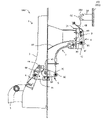
- FIG. 5 is an explanatory cross-sectional view showing a state in which the fuel nozzle is not locked to the nozzle hook according to the embodiment of the present invention
- FIG. 5 is an explanatory cross-sectional view showing a state in which the fuel nozzle is locked
- FIG. 5 is a partially enlarged cross-sectional view showing the vicinity of the switch portion in a state where the fuel nozzle is not locked
- FIG. 5 is a partially enlarged cross-sectional view showing the vicinity of the switch portion in a state where the fuel nozzle is locked
- FIG. 5 is a partially enlarged cross-sectional view showing the vicinity of the nozzle switch in a state where the fuel nozzle is not locked
- FIG. 5 is a partially enlarged cross-sectional view showing the vicinity of the nozzle switch in a state where the fuel nozzle is not locked
- FIG. 5 is a partially enlarged cross-sectional view showing the vicinity of the nozzle switch in a state where the fuel nozzle is locked;
- FIG. 5 is an explanatory diagram showing a state in which the nozzle switch does not operate even if the fuel nozzle is locked;
- FIG. 10 is an explanatory diagram showing the relative positional relationship between a leaf spring and a nozzle switch sensing portion that prevent the nozzle switch from not operating even if the fuel nozzle is locked;
- reference numeral 100 designates a fueling system to which the present invention is applied. 1 and 2, a fueling device (indicated by reference numeral 100) is provided with a nozzle hook 1, and a fueling nozzle (not shown) is locked or unlocked on the nozzle hook 1. As shown in FIG. The fuel nozzle is provided at the tip of a fuel hose (not shown). When refueling a vehicle (not shown), the refueling nozzle is removed from the nozzle hook 1, the refueling nozzle is inserted into a refueling port (not shown) of the vehicle, and the fuel tank of the vehicle is refueled. In FIG.
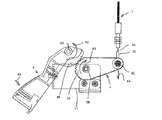
- the nozzle hook 1 shows a state in which the fuel nozzle is not engaged with the nozzle hook 1 and in FIG. 2 showing a state in which the fuel nozzle is engaged with the nozzle hook 1, the nozzle hook 1 has a hood portion 2A. It includes a main body 2 , a receiving portion 3 , a switch portion 4 , a rotating member 5 , a driving member 6 , and a connecting member 7 that connects the rotating member 5 and the driving member 6 .
- the hood portion 2A of the nozzle hook body 2 is configured to hold the discharge pipe (not shown) of the fuel nozzle.
- the receiving portion 3 is configured to hold a lever guard (not shown) of the fuel nozzle.
- the switch portion 4 is pressed by the lever guard and changes its position when the fuel nozzle is hooked (locked) on the nozzle hook 1 .
- the rotary member 5 is driven by transmission of the variation of the switch portion 4 via the driven gear 5A.
- the drive gear 4B provided integrally with the switch portion 4 also rotates (see FIG. 3), and the rotation is screwed with the drive gear 4B. It is transmitted to the rotating member 5 via the driven gear 5A, and the rotating member 5 rotates.
- the driving member 6 is arranged at a position separated from the nozzle hook main body 2 and is driven by the rotating member 5 via the transmission member 7 to drive the nozzle switch 10 .
- the nozzle switch 10 is attached to the top panel 102 of the housing body 101 .
- the switch part 4 is rotatably supported by a rotating shaft 4A, and the rotating shaft 4A is fixed to the nozzle hanger main body 2.
- the switch portion 4 moves outward (left in FIG. 1) from the opening 2B (FIG. 1) of the nozzle hook body 2 due to the repulsive force of the biasing means (not shown). direction).
- FIG. 2 when a refueling nozzle (not shown) is hooked to the nozzle hook 1, the switch portion 4 is pressed by a lever guard (not shown) of the refueling nozzle, and the switch portion 4 rotates the rotating shaft 4A. It rotates counterclockwise (in the direction of arrow A1 in FIG.
- the drive gear 4B is formed integrally with the switch section 4. As shown in FIG. More specifically, the drive gear 4B may be configured integrally with the switch section 4, or the drive gear 4B may be configured to rotate integrally with the switch section 4 although it is a separate body. good.
- a rotating member 5 is arranged on the back side of the switch portion 4 (the side opposite to the side pressed by the lever guard: the right side in FIGS. 1 and 2), and the rotating member 5 is a locking member. It is attached to the nozzle hanging main body 2 via 11 .
- the rotating member 5 is configured in a plate shape having semicircular ends with different diameters.
- the rotating member 5 includes a driven gear 5A, a first rotating shaft 5B, and a first connecting portion 5C.
- the driven gear 5A is provided at one end of the rotating member 5 (the end with the larger diameter: the left end in FIG. 1) and meshes with the driving gear 4B of the switch section 4. As shown in FIG.
- the driven gear 5A may be configured integrally with the rotating member 5, or may be configured separately from the rotating member 5 so as to rotate together.
- the first rotating shaft 5B is provided near the end on the side where the driven gear 5A is formed (the end with the larger diameter: the left end in FIG. 1), and the driven gear 5A is the switch portion It is the center of rotation when the rotating member 5 is driven by the drive gear 4B of 4 and rotates with respect to the locking member 11 (nozzle hook main body 2).
- the first connection portion 5C is provided in the vicinity of the other end (the end with the smaller diameter: the end on the right side in FIG. 1) and at a position spaced apart from the first rotation shaft 5B. and is connected to one end 7C of the connecting member 7. As shown in FIG. In FIG. In FIG.
- reference numeral 13 denotes a stopper for restricting the rotation of the switch portion 4 and the rotation of the rotating member 5 when the fuel nozzle (not shown) is engaged with the nozzle hook 1 .
- the stopper 13 is provided on the locking member 11 or the nozzle hanging body 2 .
- the connecting member 7 includes a connecting wire 7A and a sheath 7B (cover member), which are flexible linear materials. , and the other end 7D of the connecting member 7 is connected to the second connecting portion 6E of the driving member 6 .
- the connecting member 7 has the function of transmitting the rotation of the rotating member 5 to the driving member 6 .
- the driving member 6 has a rectangular plate-shaped body portion 6A, an operating piece mounting portion 6B, and an operating piece 6C (leaf spring).
- the actuating piece mounting portion 6B is connected to the end portion of the main body portion 6A (the end portion away from the connecting member 7).
- the operating piece 6C is fixed to the tip of the operating piece mounting portion 6B by a fixing means 6G, and is operated (ON/OFF) by pressing the nozzle switch 10.
- a fixing means 6G As described above, when the fuel nozzle (not shown) is engaged with the nozzle hook 1, the switch portion 4 rotates counterclockwise about the rotating shaft 4A, and the rotating member 5 rotates about the rotating shaft 5B. As shown in FIG. It abuts on the sensing portion 10A.
- the driving member 6 is rotatably supported by a second rotating shaft 6D on a mounting bracket 12 fixed to the upper part of the nozzle hanging body 2 in the main body 6A.
- the second rotating shaft 6D has a spring, which pulls the other end 7D of the connecting member 7 and urges it to maintain the state shown in FIG.
- a cutout portion 6F (FIG. 1) is formed in the body portion 6A of the driving member 6, and the stopper pin 9 is positioned in the cutout portion 6F.
- the stopper pin 9 is fixed to the mounting bracket 12, and when the driving member 6 is assembled to the mounting bracket 12, the stopper pin 9 is positioned within the notch 6F.
- a stopper 14 is provided on the mounting bracket 12, and the stopper 14 restricts rotation of the driving member 6 or the operating piece mounting portion 6B when the fuel nozzle is removed from the nozzle hook 1. .
- FIG. 3 when a fuel nozzle (not shown) is engaged with the nozzle hook 1 (FIGS. 1 and 2), the switch portion 4 is pressed in the direction of arrow A1, and the switch portion 4 rotates about the rotation shaft 4A. It rotates in the A2 direction. Since the drive gear 4B of the switch section 4 and the driven gear 5A of the rotating member 5 are screwed together, the rotation of (the drive gear 4B of) the switch section 4 in the direction of the arrow A2 is performed via the screwed driven gear 5A. The force is transmitted to the rotating member 5, and the rotating member 5 rotates in the arrow A3 direction around the first rotating shaft 5B.
- the movement amount of the first connecting portion 5C of the rotating member 5 (not shown) can be changed in the movement amount of the first connecting portion 5C of the rotating member 5, that is, the amount of pulling of the connecting member 7 when locking or unlocking the nozzle hook 1.
- FIG. For example, if the number of teeth of the drive gear 4B and the number of teeth of the driven gear 5A are 40 and 30, respectively, when the drive gear 4B rotates (rotates 15 degrees), the driven gear 5A rotates more (20 degrees). , the amount of movement of the first connecting portion 1C of the rotary member 5 connected to the connecting member 7 (the amount of movement in the direction of arrow A4) becomes larger than the amount of movement of the switch section 4 (the amount of movement in the direction of arrow A1). Therefore, the detection accuracy of the nozzle switch 10 (FIGS. 1 and 2) is improved.
- the driven gear 5A of the rotary member 5 ( The meshing portion with the driving gear 4B) and the first rotation shaft 5B can be made shorter than the distance between the first rotation shaft 5B and the first connection portion 5C.
- the second rotating shaft 6D of the driving member 6 is provided with a spring (not shown), and the elastic repulsive force of the spring pulls the other end 7D of the connecting member 7 in the direction opposite to the arrow A41. 1 and 5 when the fuel nozzle is not engaged with the nozzle hook 1.
- the wire 7A of the connecting member 7 is pulled at the second connecting portion 6E.
- the drive member 6 (body portion 6A) connected to the other end 7D rotates in the arrow A5 direction around the second rotation shaft 6D.
- the driving member 6 rotates in the direction of the arrow A5 about the second rotating shaft 6D
- the side of the operating piece mounting portion 6B of the driving member 6 rotates in the direction of the arrow A6 and is attached to the operating piece mounting portion 6B.
- the operating piece 6C contacts and presses the sensing portion 10A of the nozzle switch 10 attached to the upper panel 102 (FIG. 6).
- the sensing part 10A is pressed, the nozzle switch 10 generates an OFF signal (signal to the effect that the fueling nozzle is locked by the nozzle hook 1) to the control device (not shown) of the fueling device (reference numeral 100). do.
- the fuel nozzle is removed from the state of FIG.
- the wire 7A of the connecting member 7 moves in the direction opposite to the arrow A41 (FIG. 5), and the driving member 6 rotates in the direction opposite to the arrow A5 to operate.
- the mounting piece 6B side rotates in the opposite direction of the arrow A6, and the operating piece 6C is separated from the sensing portion 10A of the nozzle switch 10.
- the notch 6F formed in the driving member 6 abuts the stopper pin 9 fixed to the mounting bracket 12, no force is applied to the operating piece 6C more than necessary.
- the stopper 14 provided on the mounting bracket 12 restricts the rotation of the operating piece mounting portion 6B of the driving member 6. As shown in FIG.
- the projection position of the leaf spring 6C in the arrow A51 direction (the same arrow direction as the arrow A88 in FIG. 8) is set to coincide with the projection position shown in FIG.
- the inventors have found that they do not get into a state ("mucked" state).
- the directions of arrow A51 (FIG. 5), arrow A61 (FIG. 6), and arrow A88 (FIG. 8) are all different from the nozzle switch 10 side of the upper panel 102 to which the nozzle switch 10 is attached. It is the direction of the arrow when viewed horizontally from the opposite side, and the directions of arrow A51 (FIG. 5), arrow A61 (FIG. 6), and arrow A88 (FIG. 8) are all the same direction.
- the wire 7A of the connecting member 7 is pulled in the direction of the arrow A4 (FIG. 3) via the first connecting portion 5C, and the tensile force is transmitted to the driving member 6 via the second connecting portion 6E. .
- the driving member 6 rotates in the direction of the arrow A5 (FIG. 5) about the second rotating shaft 6D, and the operating piece mounting portion 6B of the driving member 6 rotates in the direction of the arrow A6.
- the operating piece 6C attached to the end of the portion 6B contacts and presses the sensing portion 10A of the nozzle switch 10 to drive the nozzle switch 10. As shown in FIG.
- the nozzle switch 10 can be reliably operated (ON/OFF operation) by locking or unlocking the fuel nozzle.
- the distance between the first rotating shaft 5B and the first connecting portion 5C is appropriately set, and the rotation amount (rotation amount) of the rotation member 5 and the displacement amount (movement amount) of the connecting member 7 are determined. can be set as appropriate.
- the gear ratio (amplification ratio) between the drive gear 4B of the switch section 4 and the driven gear 5A of the rotating member 5 is appropriately set to lock or engage the fuel nozzle with the nozzle hook 1. It is possible to change the amount of movement of the first connecting portion 5C in the rotating member 5, that is, the amount of pulling of the connecting member 7 when releasing the stop.
- the driving member 6 has a second rotating shaft 6D having a spring that biases the other end 7D of the connecting member 7 in a pulling direction, and an operating piece 6C that operates the nozzle switch 10 at one end. , and the second connecting portion 6E connected to the connecting member 7 at the other end, so that the operation of the switch portion 4 can be reliably transmitted to the nozzle switch 10. As shown in FIG.
- the nozzle switch 10 is attached to the upper panel 102 of the housing 101, and the operation piece 6C in the state where the fuel nozzle is locked to the nozzle hook 1 and the state in which the fuel nozzle is not locked to the nozzle hook 1
- the actuating piece 6C has the same projection position in the horizontal direction as viewed from the side opposite to the nozzle switch 10 of the upper panel 102 to which the nozzle switch 10 is attached. Therefore, it is possible to prevent the operating piece 6C (leaf spring) from coming into contact with the nozzle switch 10 (see FIG. 7: a so-called "lost" state) even if the fuel nozzle is locked to the nozzle hook 1.
- FIG. 7 a so-called "lost" state
- the drive member 6 is provided with the notch 6F that abuts on the stopper pin 9 fixed to the nozzle hook main body 2, so that the force applied to the operating piece 6C is greater than necessary. is prevented from acting, and damage to the nozzle switch 10 can be prevented.
Landscapes
- Engineering & Computer Science (AREA)
- Mechanical Engineering (AREA)
- Physics & Mathematics (AREA)
- Mathematical Physics (AREA)
- Theoretical Computer Science (AREA)
- Loading And Unloading Of Fuel Tanks Or Ships (AREA)
Priority Applications (3)
| Application Number | Priority Date | Filing Date | Title |
|---|---|---|---|
| KR1020227042549A KR20230153239A (ko) | 2021-03-04 | 2021-12-23 | 급유장치의 노즐걸이 |
| JP2022557668A JPWO2022185685A1 (https=) | 2021-03-04 | 2021-12-23 | |
| CN202180094236.4A CN116848061A (zh) | 2021-03-04 | 2021-12-23 | 加油装置的喷嘴架 |
Applications Claiming Priority (2)
| Application Number | Priority Date | Filing Date | Title |
|---|---|---|---|
| JP2021034048 | 2021-03-04 | ||
| JP2021-034048 | 2021-03-04 |
Publications (1)
| Publication Number | Publication Date |
|---|---|
| WO2022185685A1 true WO2022185685A1 (ja) | 2022-09-09 |
Family
ID=83153938
Family Applications (1)
| Application Number | Title | Priority Date | Filing Date |
|---|---|---|---|
| PCT/JP2021/047829 Ceased WO2022185685A1 (ja) | 2021-03-04 | 2021-12-23 | 給油装置のノズル掛け |
Country Status (4)
| Country | Link |
|---|---|
| JP (1) | JPWO2022185685A1 (https=) |
| KR (1) | KR20230153239A (https=) |
| CN (1) | CN116848061A (https=) |
| WO (1) | WO2022185685A1 (https=) |
Citations (7)
| Publication number | Priority date | Publication date | Assignee | Title |
|---|---|---|---|---|
| JPS54148760U (https=) * | 1978-04-08 | 1979-10-16 | ||
| US4611729A (en) * | 1984-08-28 | 1986-09-16 | Dresser Industries, Inc. | Universal nozzle boot for fuel dispenser |
| JPS62208395A (ja) * | 1986-03-10 | 1987-09-12 | 株式会社タツノ・メカトロニクス | 給油装置 |
| JPS6445295A (en) * | 1987-08-14 | 1989-02-17 | Tokyo Tatsuno Kk | Nozzle hanger for lubricating device |
| JPH0948259A (ja) * | 1995-08-10 | 1997-02-18 | Fuji Kiko Co Ltd | 自動車のアクセルペダル装置 |
| JP2003165424A (ja) * | 2001-11-29 | 2003-06-10 | Honda Motor Co Ltd | 自動車用足周り整備作業台車 |
| JP2014080238A (ja) * | 2012-09-26 | 2014-05-08 | Tatsuno Corp | 給油装置のノズル掛け |
Family Cites Families (1)
| Publication number | Priority date | Publication date | Assignee | Title |
|---|---|---|---|---|
| KR102374960B1 (ko) | 2016-08-01 | 2022-03-16 | 가부시끼가이샤 다쓰노 | 노즐걸이 및 급유장치 |
-
2021
- 2021-12-23 JP JP2022557668A patent/JPWO2022185685A1/ja active Pending
- 2021-12-23 WO PCT/JP2021/047829 patent/WO2022185685A1/ja not_active Ceased
- 2021-12-23 CN CN202180094236.4A patent/CN116848061A/zh active Pending
- 2021-12-23 KR KR1020227042549A patent/KR20230153239A/ko active Pending
Patent Citations (7)
| Publication number | Priority date | Publication date | Assignee | Title |
|---|---|---|---|---|
| JPS54148760U (https=) * | 1978-04-08 | 1979-10-16 | ||
| US4611729A (en) * | 1984-08-28 | 1986-09-16 | Dresser Industries, Inc. | Universal nozzle boot for fuel dispenser |
| JPS62208395A (ja) * | 1986-03-10 | 1987-09-12 | 株式会社タツノ・メカトロニクス | 給油装置 |
| JPS6445295A (en) * | 1987-08-14 | 1989-02-17 | Tokyo Tatsuno Kk | Nozzle hanger for lubricating device |
| JPH0948259A (ja) * | 1995-08-10 | 1997-02-18 | Fuji Kiko Co Ltd | 自動車のアクセルペダル装置 |
| JP2003165424A (ja) * | 2001-11-29 | 2003-06-10 | Honda Motor Co Ltd | 自動車用足周り整備作業台車 |
| JP2014080238A (ja) * | 2012-09-26 | 2014-05-08 | Tatsuno Corp | 給油装置のノズル掛け |
Also Published As
| Publication number | Publication date |
|---|---|
| KR20230153239A (ko) | 2023-11-06 |
| CN116848061A (zh) | 2023-10-03 |
| JPWO2022185685A1 (https=) | 2022-09-09 |
Similar Documents
| Publication | Publication Date | Title |
|---|---|---|
| US8662545B2 (en) | Vehicle door latch apparatus | |
| US8240723B2 (en) | Door latch apparatus for vehicle | |
| US8061742B2 (en) | Door locking system for vehicle | |
| US8146964B2 (en) | Support mechanism and a latch mechanism | |
| US20100026014A1 (en) | Door latch apparatus for vehicle | |
| JP5303902B2 (ja) | 車両ドアロック装置 | |
| JP6144512B2 (ja) | 車両ドアロック装置 | |
| EP1946959B1 (en) | Latch device for vehicle seat | |
| CN113330176B (zh) | 带有紧急释放装置的电动车辆车门闩锁 | |
| CN101158257B (zh) | 门锁装置 | |
| CN107975309B (zh) | 门锁装置 | |
| US20220251878A1 (en) | Latch apparatus | |
| CN108019102B (zh) | 门锁装置 | |
| JP6338921B2 (ja) | 車両用のドアラッチ装置 | |
| US11939798B2 (en) | Opening and closing device for vehicle sliding door | |
| WO2022185685A1 (ja) | 給油装置のノズル掛け | |
| WO2019151457A1 (ja) | インサイドハンドル装置 | |
| CN113167085B (zh) | 门开闭装置 | |
| KR20100041490A (ko) | 차량용 스트라이커 기구 | |
| WO2017145405A1 (ja) | チャイルドロック機構付きドアラッチ装置及びチャイルドロック機構の組付方法 | |
| JPWO2022185685A5 (https=) | ||
| JP7232426B2 (ja) | 給油装置のノズル掛け | |
| JP5420950B2 (ja) | 車両のドアハンドル装置 | |
| JP5028703B2 (ja) | 自動車用ドアのドアロックシステム | |
| JP4169428B2 (ja) | 車両における扉体の開閉操作装置 |
Legal Events
| Date | Code | Title | Description |
|---|---|---|---|
| ENP | Entry into the national phase |
Ref document number: 2022557668 Country of ref document: JP Kind code of ref document: A |
|
| 121 | Ep: the epo has been informed by wipo that ep was designated in this application |
Ref document number: 21928374 Country of ref document: EP Kind code of ref document: A1 |
|
| WWE | Wipo information: entry into national phase |
Ref document number: 12023552063 Country of ref document: PH |
|
| WWE | Wipo information: entry into national phase |
Ref document number: 202180094236.4 Country of ref document: CN |
|
| NENP | Non-entry into the national phase |
Ref country code: DE |
|
| 122 | Ep: pct application non-entry in european phase |
Ref document number: 21928374 Country of ref document: EP Kind code of ref document: A1 |