WO2022172442A1 - 浸水予測プログラム、浸水予測装置および機械学習方法 - Google Patents
浸水予測プログラム、浸水予測装置および機械学習方法 Download PDFInfo
- Publication number
- WO2022172442A1 WO2022172442A1 PCT/JP2021/005495 JP2021005495W WO2022172442A1 WO 2022172442 A1 WO2022172442 A1 WO 2022172442A1 JP 2021005495 W JP2021005495 W JP 2021005495W WO 2022172442 A1 WO2022172442 A1 WO 2022172442A1
- Authority
- WO
- WIPO (PCT)
- Prior art keywords
- machine learning
- inundation
- resolution
- image
- prediction
- Prior art date
- Legal status (The legal status is an assumption and is not a legal conclusion. Google has not performed a legal analysis and makes no representation as to the accuracy of the status listed.)
- Ceased
Links
Images




Classifications
-
- G—PHYSICS
- G01—MEASURING; TESTING
- G01W—METEOROLOGY
- G01W1/00—Meteorology
- G01W1/10—Devices for predicting weather conditions
-
- G—PHYSICS
- G08—SIGNALLING
- G08B—SIGNALLING SYSTEMS, e.g. PERSONAL CALLING SYSTEMS; ORDER TELEGRAPHS; ALARM SYSTEMS
- G08B31/00—Predictive alarm systems characterised by extrapolation or other computation using updated historic data
Definitions
- Embodiments of the present invention relate to inundation prediction technology.
- One aspect aims to reduce the computational cost of inundation prediction.
- the inundation prediction program causes a computer to execute acquisition processing, generation processing, and output processing.
- the acquisition process acquires observation information about the target area.
- the observation information is input to the first machine learning model to generate the first image showing the prediction result of the inundation situation in the target area, and the first image is applied to the second machine learning model.
- the input produces a second image with higher resolution than the first image.
- the second image is output as the inundation prediction result of the target area.
- FIG. 1 is an explanatory diagram illustrating an overview of inundation prediction (at the time of machine learning) according to the embodiment.
- FIG. 2 is an explanatory diagram for explaining downsampling and super-resolution.
- FIG. 3 is an explanatory diagram for explaining an outline of inundation prediction (at the time of prediction) according to the embodiment.
- FIG. 4 is a block diagram of a functional configuration example of the information processing apparatus according to the embodiment;
- FIG. 5 is a flowchart illustrating an operation example of the information processing apparatus according to the embodiment during machine learning.
- FIG. 6 is an explanatory diagram for explaining an overview of downsampling.
- 7 is a flowchart illustrating an operation example of the information processing apparatus according to the embodiment during machine learning;
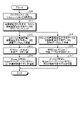
- FIG. 8 is a flowchart illustrating an operation example of the information processing apparatus according to the embodiment during prediction.
- FIG. 9 is a block diagram showing an example of a computer configuration.
- machine learning is performed so that the prediction map is output as the correct answer for the observation information input. , to create a machine learning model. Then, at the time of prediction, by inputting actual observation information about the target area into the machine learning model, a prediction map is obtained from the output of the machine learning model.
- FIG. 1 is an explanatory diagram explaining an overview of inundation prediction (during machine learning) according to the embodiment.
- the information processing apparatus As shown in FIG. 1, in S1, the information processing apparatus according to the embodiment prepares a set of training data used for machine learning.
- the high-resolution inundation prediction data D2 is the correct answer corresponding to the observation information D1, which indicates the predicted value of the inundation situation at each point corresponding to each mesh (water level from the ground, underfloor inundation, presence of above-floor inundation, etc.) is a forecast map of Also, the pixel value of each pixel in the high-resolution inundation prediction data D2 corresponds to the prediction value of the inundation situation at each point in the target area.
- the method of obtaining high-resolution inundation prediction data D2 by an information processing device is not limited to obtaining by simulation from observation information D1.
- the information processing device may acquire high-resolution inundation prediction data D2 based on observed values (water level at each point, etc.) obtained by actual observation.
- the information processing device down-samples the prediction map in the high-resolution inundation prediction data D2 (S1b), thereby obtaining low-resolution inundation prediction data D3 having a resolution lower than that of the high-resolution inundation prediction data D2. .
- FIG. 2 is an explanatory diagram explaining downsampling and super-resolution.
- the information processing device obtains low-resolution inundation prediction data D3 of 50 m mesh by down-sampling the high-resolution prediction inundation data D2 of 5 m mesh.
- the information processing device prepares data sets of high-resolution inundation prediction data D2 and low-resolution inundation prediction data D3 corresponding to observation information D1 from observation information D1 in various cases as training data.
- the information processing device uses the low-resolution inundation prediction data D3 and the high-resolution inundation prediction data D2 in the prepared training data to create a model in a known super-resolution technology using a CNN (Convolutional Neural Network) or the like.
- a second machine learning model M2 is generated (S3).
- the second machine learning model M2 is a CNN that provides a single image super-resolution method for obtaining a higher-resolution image by increasing the resolution (super-resolution) from one image. .
- the information processing device has a gradient such that the output from the second machine learning model M2 when the low-resolution inundation prediction data D3 is input to the second machine learning model M2 is the low-resolution inundation prediction data D3 that is correct.
- the parameters of the second machine learning model M2 are set using a known method such as the method or error backpropagation method.
- FIG. 3 is an explanatory diagram for explaining an overview of inundation prediction (at the time of prediction) according to the embodiment.
- the information processing apparatus of the embodiment collects information distributed from meteorological organizations and the like and measurement data from measurement devices, and generates observation information D10 regarding the target area. get.
- the information processing device inputs the obtained observation information D10 to the first machine learning model M1 to generate low-resolution inundation prediction data D11 indicating the prediction result (prediction map) of the inundation situation in the target area.
- the information processing device inputs the generated low-resolution inundation prediction data D11 to the second machine learning model M2 to generate high-resolution inundation prediction data D12 having a higher resolution than the low-resolution inundation prediction data D11.
- the information processing device obtains high-resolution inundation prediction data D12 by increasing the resolution (super-resolution) of the low-resolution inundation prediction data D11 using the second machine learning model M2.
- the information processing apparatus can obtain the high-resolution inundation prediction data D12, which is a prediction map of the inundation situation with high resolution (for example, 5m mesh).
- low-resolution inundation prediction data D11 which is a low-resolution prediction map with coarser resolution than high-resolution inundation prediction data D12, is obtained from the observation information D10 using the first machine learning model M1 (task B).
- the information processing apparatus of the embodiment obtains high-resolution inundation prediction data D12 by increasing the resolution of the low-resolution inundation prediction data D11 using the second machine learning model M2 (task C).
- task (B) performs machine learning on how flooding occurs from various observation information D10, the number of cases is about the same as task (A) (N_A ⁇ N_B). However, since the amount of data for each case used for machine learning is the low-resolution inundation prediction data D3 down-sampled from the high-resolution inundation prediction data D2, S_A>>S_B.
- Task (C) obtains high-resolution inundation prediction data D12 by increasing the resolution of low-resolution inundation prediction data D11, and differences in observation information D1 do not matter during machine learning.
- the predicted values (pixel values) of each point in the same target area are targeted for high resolution, so the number of cases is less (N_A>>N_C).
- FIG. 4 is a block diagram showing a functional configuration example of the information processing device according to the embodiment.
- the information processing apparatus 1 has a communication section 10 , a display section 11 , an operation section 12 , an input/output section 13 , a storage section 14 and a control section 15 .
- This information processing device 1 is an example of a flood prediction device, and for example, a PC (Personal Computer) can be applied.
- PC Personal Computer
- the communication unit 10 is realized by, for example, a NIC (Network Interface Card) or the like.
- the communication unit 10 is a communication interface that is wired or wirelessly connected to another information processing apparatus via a network (not shown) and controls information communication with the other information processing apparatus.
- the operation unit 12 is an input device that receives various operations from the user of the information processing device 1 .
- the operation unit 12 is realized by, for example, a keyboard, a mouse, etc. as an input device.
- the operation unit 12 outputs the operation input by the user to the control unit 15 as operation information.
- the operation unit 12 may be realized by a touch panel or the like as an input device, and the display device of the display unit 11 and the input device of the operation unit 12 may be integrated.
- the input/output unit 13 is, for example, a memory card R/W (Reader/Writer).
- the input/output unit 13 may read the observation information 141 or the like stored in the memory card and store it in the storage unit 14 instead of the observation information 141 or the like received by the communication unit 10 .
- the input/output unit 13 stores, for example, the prediction result output from the control unit 15 in a memory card.
- the memory card for example, an SD memory card or the like can be used.
- the storage unit 14 is realized by, for example, semiconductor memory devices such as RAM (Random Access Memory) and flash memory, and storage devices such as hard disks and optical disks.
- the storage unit 14 stores observation information 141, training data 142, prediction data 143, first machine learning model information 144, second machine learning model information 145, and the like.
- the observation information 141 is observation information about the target area obtained from a server or the like, and corresponds to the observation information D1 and D10 described above.
- the training data 142 is data used for machine learning of the first machine learning model M1 and the second machine learning model M2. Specifically, the training data 142 is a set of the observation information D1 described above, the high-resolution inundation prediction data D2 corresponding to the observation information D1, and the low-resolution inundation prediction data D3 for each case used for machine learning. be.
- the prediction data 143 is data indicating prediction results from the observation information D10. Specifically, the prediction data 143 is the low-resolution inundation prediction data D11 obtained by inputting the observation information D10 into the first machine learning model M1, and the low-resolution inundation prediction data D11 obtained by the second machine learning model M2. corresponds to the high-resolution inundation prediction data D12 obtained by inputting to .
- the first machine learning model information 144 is information related to the first machine learning model M1, and includes parameters and the like for constructing the first machine learning model M1 such as a neural network.
- the second machine learning model information 145 is information about the second machine learning model M2, and includes parameters and the like for constructing the second machine learning model M2 such as CNN.
- the control unit 15 is a processing unit that controls the operation of the information processing device 1 .
- the control unit 15 has an acquisition unit 151 , a training data generation unit 152 , a first machine learning unit 153 , a second machine learning unit 154 , an estimation unit 155 and an output unit 156 .
- the control unit 15 can be realized by a CPU (Central Processing Unit), an MPU (Micro Processing Unit), or the like.
- the control unit 15 can also be realized by hardwired logic such as ASIC (Application Specific Integrated Circuit) and FPGA (Field Programmable Gate Array).
- the acquisition unit 151 is a processing unit that acquires the observation information 141.
- the acquisition unit 151 acquires the observation information 141 by communicating via the communication unit 10 with a specific server that provides the observation information 141 regarding the target area.
- the acquisition unit 151 stores the acquired observation information 141 in the storage unit 14 .
- the training data creation unit 152 is a processing unit that creates the training data 142 used for machine learning of the first machine learning model M1 and the second machine learning model M2. Specifically, the training data creation unit 152 performs a simulation or the like from the observation information D1 (141) to obtain high-resolution inundation prediction data D2 corresponding to the observation information D1. Note that the training data creation unit 152 may obtain the high-resolution inundation prediction data D2 by directly applying the observation values included in the observation information D1.
- the training data creation unit 152 acquires low-resolution inundation prediction data D3 with a resolution lower than that of the high-resolution inundation prediction data D2 by down-sampling the prediction map in the high-resolution inundation prediction data D2.
- the training data creation unit 152 stores in the storage unit 14 training data 142 that is a set of the observation information D1 and the high-resolution inundation prediction data D2 and low-resolution inundation prediction data D3 corresponding to the observation information D1.
- the training data creation unit 152 creates training data 142 for the number of cases by performing the above process for the number of cases used for machine learning.
- the parameters of the first machine learning model M1 are set to the first machine learning model information 144 , and stored in the storage unit 14 .
- the second machine learning unit 154 is a processing unit that generates a second machine learning model M2 based on the training data 142. Specifically, the second machine learning unit 154 reads the low resolution inundation prediction data D3 and the high resolution inundation prediction data D2 for each case included in the training data 142 . Next, the second machine learning unit 154 inputs the read low-resolution flood prediction data D3 to the second machine-learning model M2, and the high-resolution flood prediction that the output from the second machine-learning model M2 is correct. The parameters of the second machine learning model M2 are set (adjusted) so as to become the data D2.
- the second machine learning unit 154 performs the above processing on each of the predetermined number of cases prepared as the training data 142, and then converts the parameters of the second machine learning model M2 into the second machine learning model information 145. , and stored in the storage unit 14 .
- the estimation unit 155 is a processing unit that estimates high-resolution inundation prediction data D12, which is a prediction map of the flood situation in the target area, based on the observation information 141 (D10) of the target area. Specifically, the estimation unit 155 constructs the first machine learning model M1 based on the first machine learning model information 144 read from the storage unit 14 . Next, the estimation unit 155 generates low-resolution inundation prediction data D11 by inputting the observation information D10 to the first machine learning model M1. The estimation unit 155 stores the generated low-resolution inundation prediction data D ⁇ b>11 as prediction data 143 in the storage unit 14 .
- the estimation unit 155 constructs the second machine learning model M2 based on the second machine learning model information 145 read from the storage unit 14.
- the estimation unit 155 generates high-resolution flood prediction data D12 by inputting the low-resolution prediction flood data D11 to the second machine learning model M2.
- the estimation unit 155 stores the generated high-resolution inundation prediction data D ⁇ b>12 as prediction data 143 in the storage unit 14 .
- the output unit 156 is a processing unit that outputs the estimation result of the estimation unit 155 . Specifically, the output unit 156 reads the high-resolution inundation prediction data D12 included in the prediction data 143 from the storage unit 14, and based on the high-resolution inundation prediction data D12, predicts the inundation situation at each point in the target area. Generate a map display screen. Next, the output unit 156 outputs the data of the generated display screen to the display unit 11 to display the prediction map on the display device.
- FIG. 5 is a flowchart showing an operation example of the information processing apparatus 1 according to the embodiment during machine learning.
- the training data 142 is created by simulation based on the observation information D1.
- the training data creation unit 152 down-samples the N sets of high-resolution inundation prediction data D2 to acquire low-resolution inundation prediction data D3 from the high-resolution inundation prediction data D2 (S11).
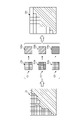
- FIG. 6 is an explanatory diagram explaining an outline of downsampling.
- the training data creation unit 152 acquires low-resolution inundation prediction data D3 from high-resolution inundation prediction data D2 by performing downsampling on a predetermined scale (for example, 5 m mesh ⁇ 50 m mesh). .
- the training data creation unit 152 samples pixels with the worst inundation prediction evaluation among the pixels included in the area. By doing so, the low-resolution inundation prediction data D3 is acquired.
- the good or bad inundation evaluation means the height of the water level from the ground, and the higher the water level, the worse the evaluation (the evaluation is worse for the inundation above the floor than for the inundation under the floor).
- the training data creation unit 152 prevents pixels with the worst inundation prediction evaluation from being removed by downsampling.
- the high-resolution inundation prediction data D2a of the specific region includes a right diagonal shaded portion (predicted value a) and a left diagonal shaded portion (predicted value b).
- the predicted value b has a lower evaluation than the predicted value a.
- the training data creation unit 152 samples the predicted value b with a poor evaluation. That is, the training data creation unit 152 down-samples the high-resolution flood prediction data D2a to the low-resolution flood prediction data D3a with the prediction value b for one pixel.
- the high-resolution inundation prediction data D2b of the specific area includes a right diagonal shaded portion (predicted value a) and a left diagonal shaded portion (predicted value b). Therefore, the training data generation unit 152 down-samples the high-resolution flood prediction data D2b to the low-resolution flood prediction data D3b in which the prediction value b is one pixel.
- the training data generation unit 152 down-samples the high-resolution flood prediction data D2c to the low-resolution flood prediction data D3c in which the prediction value a is one pixel.
- the training data creation unit 152 prepares N sets of observation information D1 and low-resolution inundation prediction data D3 as training data 142 (S12).
- the first machine learning unit 153 performs machine learning for the first machine learning model M1 using a set of the N_train observation information D1 and the low-resolution flood prediction data D3.
- the first machine learning unit 153 also validates the first machine learning model M1 after machine learning using a set of the N_test observation information D1 and the low-resolution inundation prediction data D3.
- the first machine learning unit 153 adopts the first machine learning model M1 whose prediction error is confirmed to be within a predetermined range by validation, and constructs the first machine learning model M1 (S14).
- the training data creation unit 152 prepares M sets of high-resolution inundation prediction data D2 and low-resolution inundation prediction data D3 as training data 142 (S15).
- the second machine learning unit 154 performs machine learning of the second machine learning model M2 using a set of the M_train high-resolution inundation prediction data D2 and low-resolution inundation prediction data D3. Also, the second machine learning unit 154 validates the second machine learning model M2 after machine learning with a set of the high-resolution inundation prediction data D2 of M_test and the low-resolution inundation prediction data D3. The second machine learning unit 154 adopts the second machine learning model M2 whose prediction error is confirmed to be within a predetermined range by validation, and constructs the second machine learning model M2 (S17).
- control unit 15 stores the first machine learning model information 144 and the second machine learning model information 145 regarding the constructed first machine learning model M1 and second machine learning model M2 in the storage unit 14. , and terminate the process.
- the processing of S13 and S14 by the first machine learning unit 153 and the processing of S16 and S17 by the second machine learning unit 154 may be performed in parallel.
- the training data creation unit 152 prepares N pieces of observation information D1 of various types (S10a).
- the observation information D1 also includes high-resolution inundation observation data (actually measured inundation situation map) corresponding to the high-resolution inundation prediction data D2.
- the training data creation unit 152 down-samples the low-resolution inundation observation data from the high-resolution inundation observation data for the N sets of observation information D1 (S11a).
- the training data generator 152 prepares N sets of observation information D1 and low-resolution inundation observation data as training data 142 (S12a).
- the first machine learning unit 153 performs the same processing as S13 and S14 described above based on the prepared training data 142 to build the first machine learning model M1.
- the training data creation unit 152 prepares M sets of high-resolution inundation observation data and low-resolution inundation observation data as training data 142 (S15a).
- the second machine learning unit 154 performs the same processing as S16 and S17 described above based on the prepared training data 142 to build the second machine learning model M2.
- FIG. 8 is a flowchart showing an operation example of the information processing apparatus 1 according to the embodiment during prediction.
- the acquisition unit 151 acquires observation information D10 at the time of disaster occurrence from a specific server or the like that provides observation information on the target area (S20).
- the estimation unit 155 constructs a second machine learning model M2 from the second machine learning model information 145.
- the estimating unit 155 acquires high-resolution inundation prediction data D12 by inputting the low-resolution inundation prediction data D11 acquired in S21 to the constructed second machine learning model M2 (S22).
- the output unit 156 outputs the high-resolution inundation prediction data D12 acquired in S22 to the display unit 11 (S23), and displays a prediction map based on the observation information D10 when a disaster occurs.
- the information processing device 1 acquires the observation information D10 regarding the target area.
- the information processing device 1 inputs the obtained observation information D10 to the first machine learning model M1 to generate a first image (low-resolution inundation prediction data D11) showing the prediction result of the inundation situation in the target area.
- the information processing device 1 inputs the first image to the second machine learning model M2 to generate a second image (high-resolution flood prediction data D12) having a resolution higher than that of the first image.
- the information processing device 1 outputs a second image generated as a flood prediction result for the target area.
- the information processing device 1 can perform highly accurate inundation prediction using a machine learning model at high resolution while suppressing an increase in the amount of memory and calculation required for processing. In this way, the information processing device 1 can assist in increasing the accuracy of flood prediction.
- the first image generated by the information processing device 1 is a map image showing the flooding situation at each point in the target area.
- the information processing apparatus 1 can obtain a higher-definition map image of the inundation situation at each point of the target area.
- the information processing device 1 can create a machine learning model that performs highly accurate inundation prediction at high resolution while suppressing increases in memory and computational complexity required for processing. In this way, the information processing device 1 can assist in increasing the accuracy of inundation prediction.
- a computer 200 includes a CPU 201 that executes various types of arithmetic processing, a GPU 201a that specializes in predetermined arithmetic processing such as image processing and machine learning processing, an input device 202 that receives data input, and a monitor 203. , and a speaker 204 .
- the computer 200 also has a medium reading device 205 for reading a program or the like from a storage medium, an interface device 206 for connecting with various devices, and a communication device 207 for communicating with an external device by wire or wirelessly.
- the computer 200 also has a RAM 208 that temporarily stores various information, and a hard disk device 209 . Each unit ( 201 to 209 ) in computer 200 is connected to bus 210 .
Landscapes
- Engineering & Computer Science (AREA)
- Environmental & Geological Engineering (AREA)
- Environmental Sciences (AREA)
- Atmospheric Sciences (AREA)
- Biodiversity & Conservation Biology (AREA)
- Ecology (AREA)
- Life Sciences & Earth Sciences (AREA)
- Business, Economics & Management (AREA)
- Computing Systems (AREA)
- Emergency Management (AREA)
- Physics & Mathematics (AREA)
- General Physics & Mathematics (AREA)
- Alarm Systems (AREA)
- Management, Administration, Business Operations System, And Electronic Commerce (AREA)
Priority Applications (2)
| Application Number | Priority Date | Filing Date | Title |
|---|---|---|---|
| JP2022581146A JP7529059B2 (ja) | 2021-02-15 | 2021-02-15 | 浸水予測プログラム、浸水予測装置および機械学習方法 |
| PCT/JP2021/005495 WO2022172442A1 (ja) | 2021-02-15 | 2021-02-15 | 浸水予測プログラム、浸水予測装置および機械学習方法 |
Applications Claiming Priority (1)
| Application Number | Priority Date | Filing Date | Title |
|---|---|---|---|
| PCT/JP2021/005495 WO2022172442A1 (ja) | 2021-02-15 | 2021-02-15 | 浸水予測プログラム、浸水予測装置および機械学習方法 |
Publications (1)
| Publication Number | Publication Date |
|---|---|
| WO2022172442A1 true WO2022172442A1 (ja) | 2022-08-18 |
Family
ID=82837531
Family Applications (1)
| Application Number | Title | Priority Date | Filing Date |
|---|---|---|---|
| PCT/JP2021/005495 Ceased WO2022172442A1 (ja) | 2021-02-15 | 2021-02-15 | 浸水予測プログラム、浸水予測装置および機械学習方法 |
Country Status (2)
| Country | Link |
|---|---|
| JP (1) | JP7529059B2 (https=) |
| WO (1) | WO2022172442A1 (https=) |
Cited By (1)
| Publication number | Priority date | Publication date | Assignee | Title |
|---|---|---|---|---|
| WO2025134322A1 (ja) * | 2023-12-21 | 2025-06-26 | 株式会社エル・ティー・エス | 洪水予測方法、及び洪水予測システム |
Citations (3)
| Publication number | Priority date | Publication date | Assignee | Title |
|---|---|---|---|---|
| JP2008084243A (ja) * | 2006-09-29 | 2008-04-10 | Hitachi Engineering & Services Co Ltd | 氾濫シミュレーション装置およびプログラム |
| CN111382716A (zh) * | 2020-03-17 | 2020-07-07 | 上海眼控科技股份有限公司 | 数值模式的天气预测方法、装置、计算机设备和存储介质 |
| JP6813865B1 (ja) * | 2020-02-25 | 2021-01-13 | Arithmer株式会社 | 情報処理方法、プログラム、情報処理装置及びモデル生成方法 |
Family Cites Families (4)
| Publication number | Priority date | Publication date | Assignee | Title |
|---|---|---|---|---|
| JP7055654B2 (ja) | 2018-02-08 | 2022-04-18 | 株式会社東芝 | 流出解析装置及び流出解析パラメータ調整方法 |
| WO2019176826A1 (ja) | 2018-03-14 | 2019-09-19 | 日本電気株式会社 | 領域判定装置、監視システム、領域判定方法、及び、記録媒体 |
| CN111505738A (zh) | 2020-03-17 | 2020-08-07 | 上海眼控科技股份有限公司 | 数值天气预报中气象因素的预测方法及设备 |
| JP7397781B2 (ja) | 2020-10-15 | 2023-12-13 | 大成建設株式会社 | 学習装置、学習方法および予測装置 |
-
2021
- 2021-02-15 JP JP2022581146A patent/JP7529059B2/ja active Active
- 2021-02-15 WO PCT/JP2021/005495 patent/WO2022172442A1/ja not_active Ceased
Patent Citations (3)
| Publication number | Priority date | Publication date | Assignee | Title |
|---|---|---|---|---|
| JP2008084243A (ja) * | 2006-09-29 | 2008-04-10 | Hitachi Engineering & Services Co Ltd | 氾濫シミュレーション装置およびプログラム |
| JP6813865B1 (ja) * | 2020-02-25 | 2021-01-13 | Arithmer株式会社 | 情報処理方法、プログラム、情報処理装置及びモデル生成方法 |
| CN111382716A (zh) * | 2020-03-17 | 2020-07-07 | 上海眼控科技股份有限公司 | 数值模式的天气预测方法、装置、计算机设备和存储介质 |
Cited By (1)
| Publication number | Priority date | Publication date | Assignee | Title |
|---|---|---|---|---|
| WO2025134322A1 (ja) * | 2023-12-21 | 2025-06-26 | 株式会社エル・ティー・エス | 洪水予測方法、及び洪水予測システム |
Also Published As
| Publication number | Publication date |
|---|---|
| JP7529059B2 (ja) | 2024-08-06 |
| JPWO2022172442A1 (https=) | 2022-08-18 |
Similar Documents
| Publication | Publication Date | Title |
|---|---|---|
| Yousif et al. | Super-resolution reconstruction of turbulent flow fields at various Reynolds numbers based on generative adversarial networks | |
| Gao et al. | Enhancing transparency in data-driven urban pluvial flood prediction using an explainable CNN model | |
| Gupta et al. | Accelerated multiscale mechanics modeling in a deep learning framework | |
| Heitzler et al. | GPU-accelerated rendering methods to visually analyze large-scale disaster simulation data | |
| KR102156659B1 (ko) | 딥 러닝을 이용한 글로벌 부동산 가격 자동 평가 및 예측 장치 및 그 방법 | |
| JP5276927B2 (ja) | 浸水予測装置 | |
| JPWO2018179376A1 (ja) | 劣化予測装置、劣化予測方法、及びプログラム | |
| CN118332655A (zh) | 一种道路桥梁检测方法、系统及存储介质 | |
| KR20230029409A (ko) | 반도체 장치의 제조를 위한 방법, 전자 장치 및 전자 장치의 동작 방법 | |
| EP4312179A1 (en) | Structure state prediction device, method, and program | |
| Ouala et al. | Residual integration neural network | |
| JP7529059B2 (ja) | 浸水予測プログラム、浸水予測装置および機械学習方法 | |
| Herath et al. | Subgrid informed neural networks for high-resolution flood mapping | |
| JP4979322B2 (ja) | 氾濫シミュレーション装置およびプログラム | |
| Bryant et al. | Resolution enhancement of flood inundation grids | |
| CN101946265A (zh) | 地图显示装置 | |
| Wang et al. | A semi-automatic neighborhood rule discovery approach | |
| Lee et al. | Vision-based geometric finite element model updating for cable suspension bridges | |
| WO2024203905A1 (ja) | 条件予測方法、プログラム、および装置 | |
| JP7294383B2 (ja) | パラメータ推定装置、経路別人数推定装置、パラメータ推定方法、経路別人数推定方法及びプログラム | |
| JP7283574B2 (ja) | 空間データ高解像度化方法、空間データ高解像度化装置及びプログラム | |
| Zhuang et al. | Prediction of ventilation performance in urban area with CFD simulation and conditional generative adversarial networks | |
| US20210133564A1 (en) | Space time electron-hole charge transport network for solid-state material studies | |
| Antonau et al. | Advancing high-fidelity Digital Twin Technology for Structural Health Monitoring | |
| CN119623288B (zh) | 结构数字孪生方法、设备、存储介质及产品 |
Legal Events
| Date | Code | Title | Description |
|---|---|---|---|
| 121 | Ep: the epo has been informed by wipo that ep was designated in this application |
Ref document number: 21925692 Country of ref document: EP Kind code of ref document: A1 |
|
| ENP | Entry into the national phase |
Ref document number: 2022581146 Country of ref document: JP Kind code of ref document: A |
|
| NENP | Non-entry into the national phase |
Ref country code: DE |
|
| 122 | Ep: pct application non-entry in european phase |
Ref document number: 21925692 Country of ref document: EP Kind code of ref document: A1 |