WO2022163480A1 - 二次電池、電子機器及び電動工具 - Google Patents
二次電池、電子機器及び電動工具 Download PDFInfo
- Publication number
- WO2022163480A1 WO2022163480A1 PCT/JP2022/001900 JP2022001900W WO2022163480A1 WO 2022163480 A1 WO2022163480 A1 WO 2022163480A1 JP 2022001900 W JP2022001900 W JP 2022001900W WO 2022163480 A1 WO2022163480 A1 WO 2022163480A1
- Authority
- WO
- WIPO (PCT)
- Prior art keywords
- negative electrode
- active material
- electrode active
- positive electrode
- secondary battery
- Prior art date
- Legal status (The legal status is an assumption and is not a legal conclusion. Google has not performed a legal analysis and makes no representation as to the accuracy of the status listed.)
- Ceased
Links
Images




Classifications
-
- H—ELECTRICITY
- H01—ELECTRIC ELEMENTS
- H01M—PROCESSES OR MEANS, e.g. BATTERIES, FOR THE DIRECT CONVERSION OF CHEMICAL ENERGY INTO ELECTRICAL ENERGY
- H01M10/00—Secondary cells; Manufacture thereof
- H01M10/04—Construction or manufacture in general
- H01M10/0431—Cells with wound or folded electrodes
-
- H—ELECTRICITY
- H01—ELECTRIC ELEMENTS
- H01M—PROCESSES OR MEANS, e.g. BATTERIES, FOR THE DIRECT CONVERSION OF CHEMICAL ENERGY INTO ELECTRICAL ENERGY
- H01M50/00—Constructional details or processes of manufacture of the non-active parts of electrochemical cells other than fuel cells, e.g. hybrid cells
- H01M50/40—Separators; Membranes; Diaphragms; Spacing elements inside cells
- H01M50/46—Separators, membranes or diaphragms characterised by their combination with electrodes
-
- H—ELECTRICITY
- H01—ELECTRIC ELEMENTS
- H01M—PROCESSES OR MEANS, e.g. BATTERIES, FOR THE DIRECT CONVERSION OF CHEMICAL ENERGY INTO ELECTRICAL ENERGY
- H01M10/00—Secondary cells; Manufacture thereof
- H01M10/04—Construction or manufacture in general
-
- H—ELECTRICITY
- H01—ELECTRIC ELEMENTS
- H01M—PROCESSES OR MEANS, e.g. BATTERIES, FOR THE DIRECT CONVERSION OF CHEMICAL ENERGY INTO ELECTRICAL ENERGY
- H01M10/00—Secondary cells; Manufacture thereof
- H01M10/05—Accumulators with non-aqueous electrolyte
- H01M10/052—Li-accumulators
-
- H—ELECTRICITY
- H01—ELECTRIC ELEMENTS
- H01M—PROCESSES OR MEANS, e.g. BATTERIES, FOR THE DIRECT CONVERSION OF CHEMICAL ENERGY INTO ELECTRICAL ENERGY
- H01M10/00—Secondary cells; Manufacture thereof
- H01M10/05—Accumulators with non-aqueous electrolyte
- H01M10/052—Li-accumulators
- H01M10/0525—Rocking-chair batteries, i.e. batteries with lithium insertion or intercalation in both electrodes; Lithium-ion batteries
-
- H—ELECTRICITY
- H01—ELECTRIC ELEMENTS
- H01M—PROCESSES OR MEANS, e.g. BATTERIES, FOR THE DIRECT CONVERSION OF CHEMICAL ENERGY INTO ELECTRICAL ENERGY
- H01M10/00—Secondary cells; Manufacture thereof
- H01M10/05—Accumulators with non-aqueous electrolyte
- H01M10/058—Construction or manufacture
- H01M10/0587—Construction or manufacture of accumulators having only wound construction elements, i.e. wound positive electrodes, wound negative electrodes and wound separators
-
- H—ELECTRICITY
- H01—ELECTRIC ELEMENTS
- H01M—PROCESSES OR MEANS, e.g. BATTERIES, FOR THE DIRECT CONVERSION OF CHEMICAL ENERGY INTO ELECTRICAL ENERGY
- H01M50/00—Constructional details or processes of manufacture of the non-active parts of electrochemical cells other than fuel cells, e.g. hybrid cells
- H01M50/10—Primary casings; Jackets or wrappings
-
- H—ELECTRICITY
- H01—ELECTRIC ELEMENTS
- H01M—PROCESSES OR MEANS, e.g. BATTERIES, FOR THE DIRECT CONVERSION OF CHEMICAL ENERGY INTO ELECTRICAL ENERGY
- H01M50/00—Constructional details or processes of manufacture of the non-active parts of electrochemical cells other than fuel cells, e.g. hybrid cells
- H01M50/50—Current conducting connections for cells or batteries
- H01M50/531—Electrode connections inside a battery casing
-
- H—ELECTRICITY
- H01—ELECTRIC ELEMENTS
- H01M—PROCESSES OR MEANS, e.g. BATTERIES, FOR THE DIRECT CONVERSION OF CHEMICAL ENERGY INTO ELECTRICAL ENERGY
- H01M50/00—Constructional details or processes of manufacture of the non-active parts of electrochemical cells other than fuel cells, e.g. hybrid cells
- H01M50/50—Current conducting connections for cells or batteries
- H01M50/531—Electrode connections inside a battery casing
- H01M50/536—Electrode connections inside a battery casing characterised by the method of fixing the leads to the electrodes, e.g. by welding
-
- Y—GENERAL TAGGING OF NEW TECHNOLOGICAL DEVELOPMENTS; GENERAL TAGGING OF CROSS-SECTIONAL TECHNOLOGIES SPANNING OVER SEVERAL SECTIONS OF THE IPC; TECHNICAL SUBJECTS COVERED BY FORMER USPC CROSS-REFERENCE ART COLLECTIONS [XRACs] AND DIGESTS
- Y02—TECHNOLOGIES OR APPLICATIONS FOR MITIGATION OR ADAPTATION AGAINST CLIMATE CHANGE
- Y02E—REDUCTION OF GREENHOUSE GAS [GHG] EMISSIONS, RELATED TO ENERGY GENERATION, TRANSMISSION OR DISTRIBUTION
- Y02E60/00—Enabling technologies; Technologies with a potential or indirect contribution to GHG emissions mitigation
- Y02E60/10—Energy storage using batteries
-
- Y—GENERAL TAGGING OF NEW TECHNOLOGICAL DEVELOPMENTS; GENERAL TAGGING OF CROSS-SECTIONAL TECHNOLOGIES SPANNING OVER SEVERAL SECTIONS OF THE IPC; TECHNICAL SUBJECTS COVERED BY FORMER USPC CROSS-REFERENCE ART COLLECTIONS [XRACs] AND DIGESTS
- Y02—TECHNOLOGIES OR APPLICATIONS FOR MITIGATION OR ADAPTATION AGAINST CLIMATE CHANGE
- Y02P—CLIMATE CHANGE MITIGATION TECHNOLOGIES IN THE PRODUCTION OR PROCESSING OF GOODS
- Y02P70/00—Climate change mitigation technologies in the production process for final industrial or consumer products
- Y02P70/50—Manufacturing or production processes characterised by the final manufactured product
Definitions
- the present invention relates to secondary batteries, electronic devices, and power tools.
- Lithium-ion batteries are also being developed for applications that require high output, such as power tools and automobiles.
- Patent Document 1 describes a cylindrical lithium ion battery.
- Patent Literature 1 lacks such a viewpoint, and is insufficient as a technique for ensuring the safety and the like of secondary batteries.
- one of the objects of the present invention is to provide a secondary battery that minimizes the contact of metal powder falling off a positive electrode current collector (foil) with a negative electrode.
- Another object of the present invention is to provide a secondary battery in which deformation of a separator is suppressed as much as possible in a process of sucking metal powder.
- Another object of the present invention is to provide an electronic device and a power tool using these secondary batteries.
- the present invention A secondary battery in which an electrode winding body in which a strip-shaped positive electrode and a strip-shaped negative electrode are laminated with a separator interposed therebetween, and a positive electrode current collector plate and a negative electrode current collector plate are housed in a battery can,
- the positive electrode has a positive electrode active material coated portion coated with a positive electrode active material layer and a positive electrode active material uncoated portion on a strip-shaped positive electrode foil
- the negative electrode has a negative electrode active material coated portion coated with a negative electrode active material layer on a strip-shaped negative electrode foil and a negative electrode active material uncoated portion extending at least in the longitudinal direction of the negative electrode foil,
- the positive electrode active material non-coated portion is joined to the positive electrode current collector plate at one end of the electrode winding body,
- the negative electrode active material non-coated portion is joined to the negative electrode current collector plate at the other end of the electrode winding body,
- the electrode winding body has a flat surface formed by bending and overlapping one or both of
- the present invention it is possible to minimize the contact of the metal powder falling off the positive electrode current collector (foil) with the negative electrode. Moreover, deformation of the separator can be suppressed as much as possible in the step of sucking the metal powder. It should be noted that the contents of the present invention should not be construed as being limited by the effects exemplified in this specification.
- FIG. 1 is a cross-sectional view of a lithium ion battery according to an embodiment.
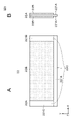
- 2A and 2B are diagrams for explaining the positive electrode according to the embodiment.
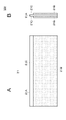
- 3A and 3B are diagrams for explaining the negative electrode according to the embodiment.
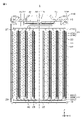
- FIG. 4 is a diagram showing a positive electrode, a negative electrode, and a separator before winding.
- FIG. 5A is a plan view of a positive collector plate according to the embodiment
- FIG. 5B is a plan view of a negative collector plate according to the embodiment.
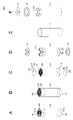
- 6A to 6F are diagrams for explaining the assembly process of the lithium ion battery according to the embodiment.
- FIG. 7 is a diagram for explaining a flat surface on the positive electrode side according to the embodiment.
- FIG. 8 is a diagram showing a cross section of the positive electrode side of the lithium ion battery according to the embodiment.
- FIG. 9 is a diagram for explaining the end joining process according to the embodiment.
- FIG. 10 is a diagram for explaining the second embodiment.
- FIG. 11 is a diagram for explaining Examples 1 and 2.
- FIG. FIG. 12 is a diagram for explaining Comparative Example 1.
- FIG. FIG. 13 is a connection diagram used for explaining a battery pack as an application example of the present invention.
- FIG. 14 is a connection diagram used for explaining a power tool as an application example of the present invention.
- FIG. 15 is a connection diagram used for explaining an electric vehicle as an application example of the present invention.
- FIG. 1 is a schematic cross-sectional view of a lithium ion battery 1.
- the lithium ion battery 1 is, for example, a cylindrical lithium ion battery 1 in which an electrode winding body 20 is housed inside a battery can 11 as shown in FIG. In the following description, unless otherwise specified, the horizontal direction toward the paper surface of FIG.
- the Z-axis direction is the X-axis direction
- the depth direction is the Y-axis direction
- the vertical direction 1, and the extending direction of the axis )) indicated by the dashed line in FIG. 1 is appropriately referred to as the Z-axis direction.
- the lithium ion battery 1 has a roughly cylindrical battery can 11 , and inside the battery can 11 , a pair of insulating plates 12 and 13 and an electrode winding 20 are provided.
- the lithium ion battery 1 may further include, for example, one or more of a thermal resistance (PTC) element and a reinforcing member inside the battery can 11 .
- PTC thermal resistance
- the battery can 11 is mainly a member that houses the electrode winding body 20 .
- the battery can 11 is, for example, a cylindrical container that is open at one end and closed at the other end. That is, the battery can 11 has one open end surface (open end surface 11N).
- the battery can 11 contains, for example, one or more of metal materials such as iron, aluminum, and alloys thereof.
- the surface of the battery can 11 may be plated with, for example, one or more of metal materials such as nickel.
- the insulating plates 12 and 13 are disk-shaped having surfaces substantially perpendicular to the central axis of the electrode winding body 20 (a direction passing through substantially the center of the end face of the electrode winding body 20 and parallel to the Z axis in FIG. 1). It is a board of Also, the insulating plates 12 and 13 are arranged, for example, so as to sandwich the electrode winding body 20 between them.
- the battery lid 14 and the safety valve mechanism 30 are crimped to the open end surface 11N of the battery can 11 via a gasket 15 to form a crimp structure 11R (crimp structure).
- crimp structure 11R crimp structure
- the battery lid 14 is a member that mainly closes the open end face 11N of the battery can 11 in a state where the electrode wound body 20 and the like are housed inside the battery can 11 .
- the battery lid 14 contains, for example, the same material as the battery can 11 forming material.
- a central region of the battery lid 14 protrudes, for example, in the +Z direction.
- the area (peripheral area) of the battery lid 14 other than the central area is in contact with the safety valve mechanism 30, for example.
- Gasket 15 is a member that is mainly interposed between battery can 11 (bent portion 11P) and battery lid 14 to seal the gap between bent portion 11P and battery lid 14 .
- the surface of the gasket 15 may be coated with, for example, asphalt.
- the gasket 15 contains, for example, one or more of insulating materials.
- the type of insulating material is not particularly limited, but polymer materials such as polybutylene terephthalate (PBT) and polypropylene (PP) can be used. Among them, the insulating material is preferably polybutylene terephthalate. This is because the gap between the bent portion 11P and the battery lid 14 can be sufficiently sealed while the battery can 11 and the battery lid 14 are electrically separated from each other.
- the safety valve mechanism 30 mainly releases the internal pressure by releasing the sealed state of the battery can 11 as necessary when the internal pressure (internal pressure) of the battery can 11 increases.
- the cause of the rise in the internal pressure of the battery can 11 is, for example, the gas generated due to the decomposition reaction of the electrolytic solution during charging and discharging.
- a strip-shaped positive electrode 21 and a strip-shaped negative electrode 22 are laminated with a separator 23 interposed therebetween, and are spirally wound and impregnated with an electrolytic solution. It's settled.
- the positive electrode 21 is formed by forming a positive electrode active material layer 21B on one side or both sides of a positive electrode foil 21A, and the material of the positive electrode foil 21A is, for example, a metal foil made of aluminum or an aluminum alloy.
- the negative electrode 22 is formed by forming a negative electrode active material layer 22B on one side or both sides of a negative electrode foil 22A, and the material of the negative electrode foil 22A is, for example, metal foil made of nickel, nickel alloy, copper, or copper alloy.
- the separator 23 is a porous and insulating film that electrically insulates the positive electrode 21 and the negative electrode 22 while enabling movement of substances such as ions and electrolytic solution.
- FIG. 2A is a front view of the positive electrode 21 before winding
- FIG. 2B is a side view of the positive electrode 21 in FIG. 2A
- the positive electrode 21 has a portion (dotted portion) covered with the positive electrode active material layer 21B on one main surface and the other main surface of the positive electrode foil 21A, and the portion not covered with the positive electrode active material layer 21B. It has a positive electrode active material uncoated portion 21C.
- the portion covered with the positive electrode active material layer 21B is appropriately referred to as the positive electrode active material covered portion 21B.
- the positive electrode foil 21A may have a configuration in which the positive electrode active material covering portion 21B is provided on one main surface.
- FIG. 3A is a front view of the negative electrode 22 before winding
- FIG. 3B is a side view of the negative electrode 22 in FIG. 3A.
- the negative electrode 22 has a portion (dotted portion) covered with the negative electrode active material layer 22B on one main surface and the other main surface of the negative electrode foil 22A, and the portion not covered with the negative electrode active material layer 22B. It has a certain negative electrode active material uncoated portion 22C.
- the portion covered with the negative electrode active material layer 22B is appropriately referred to as the negative electrode active material covered portion 22B.
- the negative electrode foil 22A may have a configuration in which the negative electrode active material covering portion 22B is provided on one main surface of the negative electrode foil 22A.
- the negative electrode active material uncoated portion 22C includes, for example, a first negative electrode active material uncoated portion 221A extending in the longitudinal direction of the negative electrode 22 (X-axis direction in FIG. A second negative electrode active material non-coated portion 221B extending in the lateral direction of the negative electrode 22 (the Y-axis direction in FIG. 3; also referred to as the width direction as appropriate) on the winding start side of the negative electrode 22, and the winding of the negative electrode 22 It has a third negative electrode active material uncovered portion 221C extending in the lateral direction of the negative electrode 22 (the Y-axis direction in FIG. 3) on the rotation termination side.
- a first negative electrode active material uncoated portion 221A extending in the longitudinal direction of the negative electrode 22 (X-axis direction in FIG.
- a second negative electrode active material non-coated portion 221B extending in the lateral direction of the negative electrode 22 (the Y-axis direction in FIG. 3; also referred to as the width direction as appropriate)
- the electrode winding body 20 is configured such that the positive electrode active material uncoated portion 21C and the first negative electrode active material uncoated portion 221A face opposite directions to each other, and the separator 23 are stacked and wound.
- a through hole 26 is provided in the center of the electrode winding body 20 .
- the through-hole 26 is a hole formed substantially at the center of the laminate in which the positive electrode 21 , the negative electrode 22 and the separator 23 are laminated.
- the through-hole 26 is used as a hole for inserting a rod-shaped welding tool (hereinafter referred to as a welding rod as appropriate) or the like in the process of assembling the lithium ion battery 1 .
- FIG. 4 shows an example of the structure before winding in which the positive electrode 21, the negative electrode 22 and the separator 23 are laminated.
- the positive electrode 21 includes an insulating layer 101 (the gray area in FIG. 4) that covers the boundary between the positive electrode active material covered portion 21B (the portion sparsely dotted in FIG. 4) and the positive electrode active material non-coated portion 21C. further has The length of the insulating layer 101 in the width direction is, for example, about 3 mm.
- An insulating layer 101 covers the entire region of the positive electrode active material uncovered portion 21C facing the negative electrode active material covered portion 22B with the separator 23 interposed therebetween.
- the insulating layer 101 has the effect of reliably preventing an internal short circuit of the lithium ion battery 1 when foreign matter enters between the negative electrode active material covered portion 22B and the positive electrode active material uncovered portion 21C. Moreover, the insulating layer 101 absorbs the impact when the lithium ion battery 1 is impacted, and has the effect of reliably preventing the positive electrode active material uncoated portion 21C from bending and short-circuiting with the negative electrode 22 .
- the length in the width direction of the positive electrode active material uncoated portion 21C is D5, and the length in the width direction of the first negative electrode active material uncoated portion 221A is D6.
- the positive electrode foil 21A and the positive electrode active material uncoated portion 21C are made of, for example, aluminum, and the negative electrode foil 22A and the negative electrode active material uncoated portion 22C are made of, for example, copper.
- the positive electrode active material uncoated portion 21C is generally softer (lower Young's modulus) than the negative electrode active material uncoated portion 22C.
- the height of the bent portion measured from the tip of the separator 23 is about the same for the positive electrode 21 and the negative electrode 22 .
- the positive electrode active material uncoated portion 21C is bent and overlaps appropriately, laser welding of the positive electrode active material uncoated portion 21C and the positive electrode current collector plate 24 in the manufacturing process of the lithium ion battery 1 (details will be described later) is performed. can be easily joined.
- the negative electrode active material non-coated portion 22C is bent and overlaps appropriately, in the manufacturing process of the lithium ion battery 1, the negative electrode active material non-coated portion 22C and the negative electrode current collector plate 25 can be easily joined by laser welding. be able to.
- the positive electrode collector plate 24 is arranged on one end surface 41 of the electrode wound body 20
- the negative electrode collector plate is arranged on the other end surface 42 of the electrode wound body 20 .
- a collector plate 25 is arranged.
- the positive electrode current collector plate 24 and the positive electrode active material uncoated portion 21C present on the end face 41 are welded at multiple points, and the negative electrode current collector plate 25 and the negative electrode active material uncoated portion 22C present on the end face 42 (specifically, Specifically, the internal resistance of the lithium ion battery 1 is suppressed to a low level by welding to the first negative electrode active material non-coated portion 221A) at multiple points, enabling high rate discharge.
- FIGS. 5A and 5B An example of a current collector plate is shown in FIGS. 5A and 5B.
- FIG. 5A shows the positive collector plate 24 and FIG. 5B shows the negative collector plate 25 .
- the positive collector plate 24 and the negative collector plate 25 are accommodated in the battery can 11 (see FIG. 1).
- the material of the positive electrode current collector plate 24 is, for example, a metal plate made of aluminum or an aluminum alloy alone or a composite material
- the material of the negative electrode current collector plate 25 is, for example, nickel, a nickel alloy, copper, or a copper alloy alone. Or a metal plate made of composite material.
- the shape of the positive electrode current collector plate 24 is such that a flat fan-shaped fan-shaped portion 31 is attached to a rectangular band-shaped portion 32 .
- a hole 35 is formed near the center of the fan-shaped portion 31 , and the position of the hole 35 corresponds to the through hole 26 .
- the portion indicated by dots in FIG. 5A is an insulating portion 32A in which an insulating tape is attached to the belt-like portion 32 or an insulating material is applied. This is the connecting portion 32B.
- the strip-shaped portion 32 is less likely to come into contact with the portion of the negative electrode potential. good.
- the charge/discharge capacity can be increased by increasing the width between the positive electrode 21 and the negative electrode 22 by an amount corresponding to the thickness of the insulating portion 32A.
- the shape of the negative electrode current collector plate 25 is almost the same as that of the positive electrode current collector plate 24, but the shape of the strip portion is different.
- the strip portion 34 of the negative electrode current collector plate in FIG. 5B is shorter than the strip portion 32 of the positive electrode current collector plate 24, and there is no portion corresponding to the insulating portion 32A.
- the band-shaped portion 34 is provided with a plurality of circular protrusions (projections) 37 indicated by circles. During resistance welding, the current concentrates on the protrusion 37 , melting the protrusion 37 and welding the belt-like portion 34 to the bottom of the battery can 11 .
- the negative collector plate 25 has a hole 36 near the center of the fan-shaped portion 33 , and the position of the hole 36 corresponds to the through hole 26 . Since the fan-shaped portion 31 of the positive electrode current collector plate 24 and the fan-shaped portion 33 of the negative electrode current collector plate 25 are fan-shaped, they partially cover the end surfaces 41 and 42 . By not covering the entire lithium ion battery 1, the electrolytic solution can be smoothly penetrated into the electrode winding body 20 when assembling the lithium ion battery 1, and the lithium ion battery 1 is in an abnormally high temperature state or an overcharged state. It is possible to make it easier to release the gas that is sometimes generated to the outside of the lithium ion battery 1 .
- the positive electrode active material layer 21B contains at least a positive electrode material (positive electrode active material) capable of intercalating and deintercalating lithium, and may further contain a positive electrode binder, a positive electrode conductor, and the like.
- the positive electrode material is preferably a lithium-containing composite oxide or a lithium-containing phosphate compound.
- the lithium-containing composite oxide has, for example, a layered rock salt type or spinel type crystal structure.
- a lithium-containing phosphate compound has, for example, an olivine-type crystal structure.
- the positive electrode binder contains synthetic rubber or a polymer compound.
- Synthetic rubbers include styrene-butadiene-based rubber, fluorine-based rubber, and ethylene propylene diene.
- Polymer compounds include polyvinylidene fluoride (PVdF) and polyimide.
- the positive electrode conductor is a carbon material such as graphite, carbon black, acetylene black, or ketjen black.
- the positive electrode conductor may be a metal material or a conductive polymer.
- the surface of the negative electrode foil 22A that constitutes the negative electrode 22 is preferably roughened in order to improve adhesion with the negative electrode active material layer 22B.
- the negative electrode active material layer 22B contains at least a negative electrode material (negative electrode active material) capable of intercalating and deintercalating lithium, and may further contain a negative electrode binder, a negative electrode conductor, and the like.
- the negative electrode material includes, for example, a carbon material.
- the carbon material is graphitizable carbon, non-graphitizable carbon, graphite, low-crystalline carbon, or amorphous carbon.
- the shape of the carbon material is fibrous, spherical, granular or scaly.
- the negative electrode material includes, for example, a metal-based material.
- metallic materials include Li (lithium), Si (silicon), Sn (tin), Al (aluminum), Zr (zinc), and Ti (titanium).
- Metallic elements form compounds, mixtures, or alloys with other elements, examples of which include silicon oxide (SiO x (0 ⁇ x ⁇ 2)), silicon carbide (SiC), or an alloy of carbon and silicon , lithium titanate (LTO).
- the separator 23 is a porous film containing resin, and may be a laminated film of two or more kinds of porous films. Resins include polypropylene and polyethylene. The separator 23 may contain a resin layer on one side or both sides of a porous membrane as a base layer. This is because the adhesion of the separator 23 to each of the positive electrode 21 and the negative electrode 22 is improved, so that distortion of the wound electrode body 20 is suppressed.
- the resin layer contains resin such as PVdF.
- resin such as PVdF.
- a solution in which a resin is dissolved in an organic solvent is applied to the substrate layer, and then the substrate layer is dried.
- the base layer may be dried after the base layer is immersed in the solution.
- the resin layer preferably contains inorganic particles or organic particles from the viewpoint of improving heat resistance and battery safety. Types of inorganic particles include aluminum oxide, aluminum nitride, aluminum hydroxide, magnesium hydroxide, boehmite, talc, silica, mica, and the like.
- a surface layer containing inorganic particles as a main component and formed by a sputtering method, an ALD (atomic layer deposition) method, or the like may be used instead of the resin layer.
- the electrolytic solution contains a solvent and an electrolyte salt, and may further contain additives and the like as necessary.
- the solvent is a non-aqueous solvent such as an organic solvent, or water.
- An electrolytic solution containing a non-aqueous solvent is called a non-aqueous electrolytic solution.
- Non-aqueous solvents include cyclic carbonates, chain carbonates, lactones, chain carboxylates, nitriles (mononitriles), and the like.
- a representative example of the electrolyte salt is a lithium salt, but salts other than the lithium salt may be included.
- Lithium salts include lithium hexafluorophosphate ( LiPF6 ), lithium tetrafluoroborate ( LiBF4 ), lithium perchlorate (LiClO4), lithium methanesulfonate ( LiCH3SO3 ) , trifluoromethanesulfonic acid.
- Lithium (LiCF 3 SO 3 ) dilithium hexafluorosilicate (Li 2 SF 6 ), and the like.
- a mixture of these salts can also be used, and among them, a mixture of LiPF 6 and LiBF 4 is preferably used from the viewpoint of improving battery characteristics.
- the content of the electrolyte salt is not particularly limited, it is preferably 0.3 mol/kg to 3 mol/kg with respect to the solvent.
- the positive electrode active material is applied to the surface of the strip-shaped positive electrode foil 21A to form the positive electrode active material coating portion 21B, and the negative electrode active material is coated onto the surface of the strip-shaped negative electrode foil 22A, which is used as the negative electrode active material.
- the material covering portion 22B is used.
- a positive electrode active material non-coated portion 21C not coated with a positive electrode active material is provided on one end side in the width direction of the positive electrode foil 21A, and a negative electrode active material non-coated portion 21C not coated with a negative electrode active material is provided on the negative electrode foil 22A.
- Covered portions 22C (first negative electrode active material uncovered portion 221A, second negative electrode active material uncovered portion 221B, and third negative electrode active material uncovered portion 221C) were provided.
- processes such as drying were performed on the positive electrode 21 and the negative electrode 22 .
- the positive electrode active material uncoated portion 21C and the negative electrode active material uncoated portion 22C are stacked in opposite directions with the separator 23 interposed therebetween, and spirally wound so as to form a through hole 26 on the central axis.
- An electrode winding body 20 such as 6A was produced.
- grooves 43 were formed (fabricated) as shown in FIG. 6B using a groove forming jig (not shown) having flat plates or the like on the end faces (groove forming step). Specifically, a groove 43 was formed in a part of the end face 41 and a part of the end face 42 by pressing a plate or the like of a groove forming jig vertically against the end faces 41 and 42 . By this method, grooves 43 radially extending from the through-holes 26 were produced. The groove 43 extends, for example, from the outer edges 27 , 28 of the end faces 41 , 42 respectively to the through hole 26 . Note that the number and arrangement of the grooves 43 shown in FIG. 6B are merely examples, and are not limited to the illustrated example.
- a flat surface forming jig (not shown) was used to form a flat surface as shown in FIG. 6C (flat surface forming step).
- the flat end surfaces of the flat surface forming jig were simultaneously pressed against the end surfaces 41 and 42 with the same pressure from both pole sides, and a load was applied in a substantially vertical direction.
- the positive electrode active material uncoated portion 21C and the negative electrode active material uncoated portion 22C are overlapped toward the central axis of the winding structure.
- the end surfaces 41 and 42 are made to be flat surfaces by bending them. For example, as shown in FIG.
- a bent portion 71 is formed by overlapping the bent positive electrode active material non-coated portion 21C, and the outer surface of the bent portion 71 is a flat surface 72 .
- a bent portion (a bent portion 81 described later) and a flat surface (a flat surface 82 described later) are also formed by bending the first negative electrode active material uncoated portion 221A.
- end joining step the ends of predetermined separators were joined by heat welding using, for example, a sheathed heater. Details of the end joining step will be described later.
- a suction device (not shown) is used to remove metal powder that may have fallen off from the positive electrode active material non-coated portion 21C and the first negative electrode active material non-coated portion 221A during the groove forming step and the flat surface forming step.
- Aspirated suction step
- suction is performed in a state in which a suction device is brought close to or in contact with one end surface of the electrode winding body 20 (a state in which air can flow in from the other end surface through the through holes 26).
- the suction device is moved to the other end face side to perform suction in the same manner. This removed the metal powder.
- the fan-shaped portion 31 of the positive electrode collector plate 24 was laser-welded to the end surface 41
- the fan-shaped portion 33 of the negative electrode collector plate 25 was laser-welded to the end surface 42 to join them.
- the strip-shaped portion 32 of the positive electrode current collector plate 24 and the strip-shaped portion 34 of the negative electrode current collector plate 25 are bent, and the insulating plate 12 is attached to the positive electrode current collector plate 24 and the insulating plate 13 is attached to the negative electrode current collector plate 25 .
- the electrode winding body 20 assembled as described above was inserted into the battery can 11 shown in FIG. 6E.
- the negative electrode current collector plate 25 was welded to the bottom of the battery can 11 by pressing a welding rod (not shown). After the electrolytic solution was injected into the battery can 11, it was sealed with a gasket 15 and a battery lid 14 as shown in FIG. 6F. Lithium ion battery 1 was produced as described above.
- the insulating plate 12 and the insulating plate 13 may be insulating tapes.
- the joining method may be a method other than laser welding.
- the groove 43 remains in the flat surface even after the positive electrode active material uncoated portion 21C and the first negative electrode active material uncoated portion 221A are bent, and the portion without the groove 43 is the positive electrode current collector plate 24 or The groove 43 may be joined to a part of the positive electrode current collector plate 24 or the negative electrode current collector plate 25 , although it is joined to the negative electrode current collector plate 25 .
- the “flat surface” in this specification means not only a completely flat surface, but also the positive electrode active material uncoated portion 21C and the positive electrode current collector plate 24, and the first negative electrode active material uncoated portion 221A and the negative electrode. It is meant to include a surface having some unevenness or surface roughness to the extent that it can be bonded to the current collector plate 25 .
- the diameter of the through-hole 26 must be large enough to insert the welding rod. must.
- a necessary size as the diameter of the through hole 26 can be secured.
- the positive electrode active material uncoated portion 21C which was pushed inward during the formation of the flat surface, has no place to go, and the positive electrode active material uncoated portion 21C is partially broken, increasing the risk of generating metal powder. Metal dust can also be generated during the groove forming process.
- the generated metal powder may contact the innermost negative electrode (hereinafter referred to as the innermost negative electrode) of the negative electrodes of the electrode roll 20, causing an internal short circuit. Therefore, in the lithium ion battery 1 according to the present embodiment, a configuration is adopted in which the metal powder generated from the positive electrode active material uncoated portion 21C does not come into contact with the negative electrode 22 .
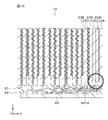
- FIG. 8 is a diagram showing a part of a cross section obtained by cutting at least the positive electrode side of the electrode-wound body 20 according to the present embodiment along a plane including the central axis of the electrode-wound body 20 .
- Cross-sectional observation is performed, for example, as follows. A lithium ion battery 1 is cut into round slices about half the height and embedded in resin. Next, the lithium ion battery 1 is cut along a plane including the central axis.
- Cross-sectional observation can be performed by observing with a microscope. The cross-sectional observation can be performed in the same manner for the negative electrode side of the electrode winding body 20 as well.
- the positive electrode side of the wound electrode body 20 means a region including the end face 41 of both end faces of the wound electrode body 20 having a substantially cylindrical shape. Further, the negative electrode side of the wound electrode body 20 means a region including the end face 42 among both end faces of the wound electrode body 20 having a substantially cylindrical shape.
- the peripheral surface of the through-hole 26 is composed of, for example, the separator 23A.
- the separator 23A is located on the innermost peripheral side of the electrode winding body 20.
- Separators 23B, 23C, and 23D are laminated toward the outside (in the X-axis direction in FIG. 8) of the separator 23A.
- the innermost negative electrode 22D is positioned outside the separator 23D, and the separator 23E is positioned outside the innermost negative electrode 22D.
- the ends of the separators are joined together.
- the bonding is, for example, bonding by thermal fusion using a heater.
- the innermost negative electrode 22D is covered with the mutually bonded separators 23D and 23E.
- metal powder is likely to fall off from the positive electrode active material uncoated portion 21C near the inside of the bent portion 71 .
- the innermost negative electrode 22D is covered with the separators 23D and 23E, the metal powder and the innermost negative electrode 22D do not come into contact with each other, and internal short-circuiting occurs due to the contact between the two. can be prevented.
- a rod-shaped heater for example, a sheathed heater
- heater 110 is inserted 1.5 to 3.0 mm below flat surface 72 .
- the heater 110 is energized, and the temperature of the heater 110 rises to 120-200.degree.
- the heater 110 heats and melts the separators 23A to 23E.
- the heating time is set to about 1 to 10 seconds.
- the heater 110 is taken out from the through-hole 26, and the melted separators 23A to 23E are cooled and hardened, so that the separators 23D and 23E are heat-sealed.
- the separators 23A to 23C located inside the separator 23D are also melted, the ends of the separators 23A to 23E are heat-sealed to each other as shown in FIGS. is spliced with
- separators located outside the separator 23E do not need to be heat-sealed. This is because when the positive electrode active material non-coated portion 21C is bent toward the center, a bending force is also applied to the separator 23 (the separator located outside the separator 23E), and accordingly the end portion of the separator 23 is inclined inward. do. By covering the negative electrode 22 with the slanted end of the separator 23, the intrusion of metal powder is prevented. However, since the separators 23A to 23D (especially the separator 23D) do not have the positive electrode 21 and the negative electrode 22 on both sides, the positions of the separators 23A to 23D are not stable and relatively free.
- the space between the innermost negative electrode 22D and the positive electrode active material uncoated portion 21C is less likely to be covered with the separator 23E or the like, increasing the risk of metal powder entering the innermost negative electrode 22D.
- the separators 23D and 23E by heat-sealing at least the separators 23D and 23E, it is possible to block a portion where there is a high possibility that metal powder will enter. Furthermore, since only the minimum necessary portions are heat-sealed, it is possible to prevent the manufacturing process of the lithium ion battery 1 from becoming complicated.
- At least the separators (separators 23D, 23E) located on both sides of the innermost negative electrode 22D are heat-sealed so as to cover the innermost negative electrode 22D, so that metal powder penetrates into the innermost negative electrode 22D. can be prevented. Therefore, it is possible to prevent the occurrence of an internal short due to contact between the innermost peripheral side negative electrode 22D and metal powder.
- the electrode winding body 20 When the ends of a thin flat plate (for example, a thickness of 0.5 mm) are pressed vertically against the end surfaces 41 and 42 (when performing the step shown in FIG. 6B) during the production of a lithium ion battery, the electrode winding body
- the negative electrode active material may peel off from the negative electrode active material covering portion 22B on the winding start side of 20 (longitudinal end side of the positive electrode or negative electrode at the innermost circumference of the electrode wound body 20). This peeling is considered to be caused by the stress generated when pressing against the end surface 42 .
- the peeled negative electrode active material may enter the inside of the electrode winding body 20, thereby causing an internal short circuit.
- the second negative electrode active material non-coated portion 221B and the third negative electrode active material non-coated portion 221C are provided, it is possible to prevent the negative electrode active material from peeling off, thereby preventing the occurrence of an internal short circuit. Such an effect can also be obtained by providing only one of the second negative electrode active material uncovered portion 221B and the third negative electrode active material uncovered portion 221C, but it is more preferable to provide both.
- the negative electrode 22 can have a region of the negative electrode active material uncoated portion 22C on the principal surface of the side not facing the positive electrode active material coated portion 21B. This is because even if the negative electrode active material coating portion 22B is provided on the main surface that does not face the positive electrode active material coating portion 21B, it is considered that the contribution to charging and discharging is low. It is preferable that the area of the negative electrode active material non-coated portion 22C is 3/4 or more and 5/4 or less of the electrode wound body 20 . At this time, since the negative electrode active material coating portion 22B that contributes little to charging and discharging is not provided, the initial capacity can be increased with respect to the same volume of the electrode wound body 20 .
- the electrode wound body 20 is wound so that the positive electrode active material uncoated portion 21C and the first negative electrode active material uncoated portion 221A face opposite directions. , the positive electrode active material uncoated portions 21C gather, and the end surface 42 of the electrode winding body 20 gathers the first negative electrode active material uncoated portions 221A.
- the positive electrode active material uncoated portion 21C and the first negative electrode active material uncoated portion 221A are bent to form flat end surfaces 41 and 42 .
- the bending direction is the direction from the outer edges 27, 28 of the end faces 41, 42 toward the through hole 26, and in the wound state, adjacent active material non-coated portions are overlapped with each other and bent.
- the end surface 41 is a flat surface, the contact between the positive electrode active material uncoated portion 21C and the positive electrode current collector plate 24 can be improved, and the first negative electrode active material uncoated portion 221A and the negative electrode current collector can be improved. Good contact with the plate 25 can be achieved. In addition, since the end surfaces 41 and 42 are curved to form flat surfaces, the resistance of the lithium ion battery 1 can be reduced.
- the end surfaces 41 and 42 can be made flatter.
- Either one of the positive electrode active material uncoated portion 21C and the first negative electrode active material uncoated portion 221A may be bent, but both are preferably bent.
- a lithium-ion battery (lithium-ion battery 1A) according to the second embodiment has an electrode winding body 20 like the lithium-ion battery 1 does.
- the electrode roll 20 has a plurality of layers of separators including a separator 23D joined to a separator 23E inside an innermost negative electrode 22D, that is, separators 23A to 23D.
- FIG. 10 is a cross-sectional view of the negative electrode side of the electrode winding body 20 of the lithium ion battery 1A in the same cross section as in the first embodiment.
- a bent portion 81 is formed by bending the first negative electrode active material uncoated portion 221A. Further, the outer surface of the bent portion 81 is a flat surface 82 .
- the ends of the multiple layers of separators (separators 23A to 23D) located inside the innermost negative electrode 22D are joined to each other.
- the separator 23E located outside the innermost negative electrode 22D and the separators 23A to 23D are not joined.
- the separator 23E can also melt, but since the first negative electrode active material uncoated portion 221A of the innermost negative electrode 22D is interposed between the separator 23D and the separator 23E, the separator 23D and the separator 23E are not heat-sealed.
- the ends of the separators 23A to 23E are heat-sealed on the positive electrode side. Also, the ends of the separators 23A to 23D are thermally fused to each other on the negative electrode side. Since the ends of the multiple layers of separator 23 are heat-sealed to each other on the positive and negative electrode sides, the strength is improved compared to a single-layer separator 23 . As a result, the separator 23 is not deformed when the suction step is performed, and deformation of the electrode-wound body 20 can be suppressed as much as possible. In addition, it is possible to prevent the separator 23 from being sucked into the suction device as much as possible.
- the battery size is 21700 (diameter: 21 mm, height: 70 mm), the length of the negative electrode active material coating portion 22B in the width direction is 62 mm, and the length of the separator 23 in the width direction is 64 mm, the clearance between the positive electrode active material coating portion 21B and the negative electrode active material coating portion 22B is 1.5 mm, and the clearance between the negative electrode active material coating portion 22B and the separator 23 is 1.5 mm.
- the separator 23 was superimposed so as to cover the entire range of the positive electrode active material covered portion 21B and the negative electrode active material covered portion 22B, and the length in the width direction of the positive electrode active material non-covered portion 21C was set to 5 mm.
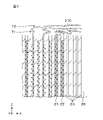
- FIG. 11 is a diagram corresponding to the first embodiment
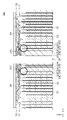
- FIGS. 10 and 11 are diagrams corresponding to the second embodiment
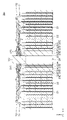
- FIG. 12 is a diagram corresponding to the first comparative example.
- Example 1 A lithium ion battery 1 was produced by the steps described above. At this time, in the end joining step, on the positive electrode side, a sheathed heater is inserted into the through-hole 26 to a depth of 2 mm and heated at 150° C. for 3 seconds, thereby The ends of the separators (separators 23A to 23E) including the separators located at the positions were joined by heat sealing (see FIG. 11).
- Example 2 In the end joining step of Example 2, on the negative electrode side, a sheathed heater is inserted to a depth of 2 mm into the through-hole 26 and heated at 150° C. for 3 seconds to join the ends of the separators 23A to 23D together. They were joined by heat sealing. Otherwise, a lithium ion battery 1 was produced in the same manner as in Example 1 (see FIGS. 10 and 11).
- Comparative Example 1 In Comparative Example 1, the end joining step was not performed, and the ends of the separator 23 on both the positive and negative sides were not joined (see FIG. 12). Lithium ion battery 1 was produced in the same manner as in Example 1 except for the above.
- Examples 1 and 2 and Comparative Example 1 were evaluated using the process defect rate and the open circuit voltage defect rate.
- the process defect rate was evaluated as follows. For the purpose of sucking the metal powder, suction was performed for 5 seconds at a flow rate of 60 L/min in a state in which the suction device was in complete contact with the negative electrode side end face of the electrode roll 20 after molding. When the through hole 26 was completely blocked by the separator 23 on the inner peripheral side, it was determined to be defective by the appearance inspection. The process defect rate was calculated by dividing the number of through-holes 26 blocked by the number of test pieces.
- Example 1 the process defect rate was 3%, which was better than the process defect rate (8%) of Comparative Example 1 in which the ends were not joined. This is because the ends of the separators 23A to 23E are joined to each other to increase the strength, and when the metal powder is sucked, the separator 23 located on the inner peripheral side may deform and block the through hole 26. Presumably because it is less.
- the open circuit voltage defect rate was 2%, which was better than the open circuit voltage defect rate (6%) of Comparative Example 1 in which the ends were not joined. This is because the protection of the innermost negative electrode 22D prevents metal powder generated from the positive electrode active material uncoated portion 21C during the molding of the electrode roll 20 from coming into contact with the innermost negative electrode 22D. It is considered that the open circuit voltage defect rate decreased because it could be suppressed.
- Example 2 the process defect rate is 0%, which is better than the process defect rate (8%) of Comparative Example 1 in which the ends are not joined, and is better than the process defect rate (3%) of Example 1. also improved further. This is because the ends of the separators on both the positive and negative sides are joined to each other, so that the strength of both sides is increased, and when the metal powder is sucked, the separator 23 located on the inner peripheral side deforms and closes the through holes 26 . It is thought that this is because there are even fewer cases where the In Example 2, the open circuit voltage defect rate was 2%, which was better than the open circuit voltage defect rate (6%) of Comparative Example 1 in which the ends were not joined.
- Example 1 since the innermost negative electrode 22D is protected, the metal powder generated from the positive electrode active material uncoated portion 21C during the molding of the electrode wound body 20 is It is considered that the open-circuit voltage defect rate decreased because contact with the negative electrode 22D could be suppressed.
- the process defect rate was as high as 8%. This is because the ends of the separators on the positive and negative sides are not joined to each other, so when the metal powder is sucked, the separator 23 located on the inner peripheral side is often deformed and closes the through holes 26 . This is thought to be because In Comparative Example 1, the open circuit voltage defect rate was as high as 6%. This is because the innermost negative electrode 22D is not covered, and metal powder generated from the positive electrode active material non-coated portion 21C during the molding of the electrode roll 20 comes into contact with the innermost negative electrode 22D, causing an internal short circuit. This is probably because there are more things to do. From the above, it can be said that the configurations shown in Examples 1 and 2 are preferable configurations of the lithium ion battery 1 .
- the separator on the inner peripheral side has a configuration in which four layers of separators (separators 23A to 23D) are laminated, but it may be one layer, or a plurality of layers other than four layers. .
- the configuration in which the second negative electrode active material uncovered portion 221B and the third negative electrode active material uncovered portion 221C are provided is preferable, but the present invention is also applicable to a lithium ion battery without these. be able to.
- a heat fusion method is used as an example of the bonding method.
- the number of the grooves 43 is eight in the above-described embodiment and comparative example, the number may be other than this.
- the battery size is 21700 (diameter 21 mm, height 70 mm), it may be 18650 (diameter 18 mm, height 65 mm) or other sizes.
- the fan-shaped portions 31 and 33 according to the embodiment may have a shape other than the fan-shaped shape.
- the present invention can be applied to batteries other than lithium ion batteries and batteries other than cylindrical batteries (for example, laminate type batteries, square batteries, coin type batteries, button type batteries). is also possible.
- the shape of the "end surface of the wound electrode" may be not only cylindrical but also rectangular, elliptical, or flat.
- the present invention can also be implemented as a method for manufacturing a battery.
- FIG. 13 is a block diagram showing a circuit configuration example when the secondary battery according to the embodiment or example of the present invention is applied to the battery pack 300.
- the battery pack 300 includes an assembled battery 301 , a switch section 304 including a charge control switch 302 a and a discharge control switch 303 a , a current detection resistor 307 , a temperature detection element 308 and a control section 310 .
- the control unit 310 can control each device, control charging/discharging when abnormal heat is generated, and calculate and correct the remaining capacity of the battery pack 300 .
- a positive terminal 321 and a negative terminal 322 of the battery pack 300 are connected to a charger or an electronic device, and charging and discharging are performed.
- the assembled battery 301 is formed by connecting a plurality of secondary batteries 301a in series and/or in parallel.
- FIG. 13 shows an example in which six secondary batteries 301a are connected in two parallel three series (2P3S).
- the secondary battery of the present invention can be applied to the secondary battery 301a.
- the temperature detection unit 318 is connected to a temperature detection element 308 (eg, a thermistor), measures the temperature of the assembled battery 301 or the battery pack 300, and supplies the measured temperature to the control unit 310.
- the voltage detection unit 311 measures the voltage of the assembled battery 301 and the secondary batteries 301 a that constitute it, A/D-converts the measured voltage, and supplies it to the control unit 310 .
- a current measurement unit 313 measures current using a current detection resistor 307 and supplies the measured current to the control unit 310 .
- the switch control section 314 controls the charge control switch 302a and the discharge control switch 303a of the switch section 304 based on the voltage and current input from the voltage detection section 311 and the current measurement section 313.
- the switch control unit 314 controls the switch unit 304 when the secondary battery 301a reaches the overcharge detection voltage (for example, 4.20V ⁇ 0.05V) or higher or the overdischarge detection voltage (2.4V ⁇ 0.1V) or lower. Overcharge or overdischarge is prevented by sending an OFF control signal to .
- the charge control switch 302a or the discharge control switch 303a After the charge control switch 302a or the discharge control switch 303a is turned off, charging or discharging is possible only through the diode 302b or the diode 303b.
- Semiconductor switches such as MOSFETs can be used for these charge/discharge switches. Note that although the switch section 304 is provided on the + side in FIG. 13, it may be provided on the - side.
- the memory 317 consists of RAM and ROM, and stores and rewrites the values of the battery characteristics calculated by the control unit 310, the full charge capacity, the remaining capacity, and the like.
- the secondary battery according to the embodiment or example of the present invention described above can be mounted on devices such as electronic devices, electric transportation devices, and power storage devices, and used to supply electric power.
- Examples of electronic devices include notebook computers, smartphones, tablet terminals, PDAs (personal digital assistants), mobile phones, wearable terminals, digital still cameras, e-books, music players, game machines, hearing aids, electric tools, televisions, and lighting equipment. , toys, medical devices, and robots. In a broad sense, electronic devices also include electric transportation equipment, power storage devices, power tools, electric unmanned aerial vehicles, and the like, which will be described later.
- Electric transportation equipment includes electric vehicles (including hybrid vehicles), electric motorcycles, electrically assisted bicycles, electric buses, electric carts, automated guided vehicles (AGV), and railway vehicles. It also includes electric passenger aircraft and electric unmanned aerial vehicles for transportation.
- the secondary battery according to the present invention can be used not only as a driving power source, but also as an auxiliary power source, an energy regeneration power source, and the like.
- power storage devices include power storage modules for commercial or domestic use, power storage power sources for buildings such as houses, buildings, and offices, or for power generation equipment.
- the electric driver 431 is provided with a motor 433 that transmits rotational power to a shaft 434 and a trigger switch 432 that is operated by a user.
- a battery pack 430 and a motor control unit 435 are accommodated in a lower housing of the handle of the electric driver 431 .
- the battery pack 430 is built into the electric driver 431 or is detachable therefrom.
- the secondary battery of the present invention can be applied to the batteries forming battery pack 430 .
- Each of the battery pack 430 and the motor control unit 435 may be provided with a microcomputer (not shown) so that charge/discharge information of the battery pack 430 can be communicated with each other.
- the motor control unit 435 can control the operation of the motor 433 and cut off the power supply to the motor 433 in the event of an abnormality such as overdischarge.
- FIG. 15 schematically shows a configuration example of a hybrid vehicle (HV) employing a series hybrid system.
- a series hybrid system is a vehicle that runs with a power driving force conversion device using power generated by a generator driven by an engine or power temporarily stored in a battery.
- This hybrid vehicle 600 includes an engine 601, a generator 602, a power driving force conversion device (DC motor or AC motor, hereinafter simply referred to as "motor 603"), driving wheels 604a, driving wheels 604b, wheels 605a, wheels 605b, A battery 608, a vehicle control device 609, various sensors 610, and a charging port 611 are mounted.
- the battery 608 the secondary battery of the present invention or a power storage module equipped with a plurality of secondary batteries of the present invention can be applied.
- the electric power of the battery 608 operates the motor 603, and the rotational force of the motor 603 is transmitted to the driving wheels 604a and 604b.
- the rotational power produced by engine 601 allows power generated by generator 602 to be stored in battery 608 .
- Various sensors 610 control the engine speed via the vehicle control device 609 and control the opening of a throttle valve (not shown).
- HV plug-in hybrid vehicles
- the secondary battery according to the present invention can be applied to a miniaturized primary battery and use it as a power supply for the tire pressure monitoring system (TPMS) built into the wheels 604 and 605.
- TPMS tire pressure monitoring system
- the present invention can also be applied to a parallel system that uses both an engine and a motor, or a hybrid vehicle that combines a series system and a parallel system. Furthermore, the present invention can also be applied to an electric vehicle (EV or BEV) that runs only with a drive motor that does not use an engine, or a fuel cell vehicle (FCV).
- EV or BEV electric vehicle
- FCV fuel cell vehicle
Landscapes
- Chemical & Material Sciences (AREA)
- Chemical Kinetics & Catalysis (AREA)
- Electrochemistry (AREA)
- General Chemical & Material Sciences (AREA)
- Engineering & Computer Science (AREA)
- Manufacturing & Machinery (AREA)
- Materials Engineering (AREA)
- Secondary Cells (AREA)
- Battery Electrode And Active Subsutance (AREA)
- Sealing Battery Cases Or Jackets (AREA)
- Connection Of Batteries Or Terminals (AREA)
Priority Applications (3)
| Application Number | Priority Date | Filing Date | Title |
|---|---|---|---|
| JP2022578298A JP7494948B2 (ja) | 2021-01-26 | 2022-01-20 | 二次電池、電子機器及び電動工具 |
| CN202280008949.9A CN116745950A (zh) | 2021-01-26 | 2022-01-20 | 二次电池、电子设备以及电动工具 |
| US18/211,955 US20230335863A1 (en) | 2021-01-26 | 2023-06-20 | Secondary battery, electronic equipment, and electric tool |
Applications Claiming Priority (2)
| Application Number | Priority Date | Filing Date | Title |
|---|---|---|---|
| JP2021010583 | 2021-01-26 | ||
| JP2021-010583 | 2021-01-26 |
Related Child Applications (1)
| Application Number | Title | Priority Date | Filing Date |
|---|---|---|---|
| US18/211,955 Continuation US20230335863A1 (en) | 2021-01-26 | 2023-06-20 | Secondary battery, electronic equipment, and electric tool |
Publications (1)
| Publication Number | Publication Date |
|---|---|
| WO2022163480A1 true WO2022163480A1 (ja) | 2022-08-04 |
Family
ID=82654462
Family Applications (1)
| Application Number | Title | Priority Date | Filing Date |
|---|---|---|---|
| PCT/JP2022/001900 Ceased WO2022163480A1 (ja) | 2021-01-26 | 2022-01-20 | 二次電池、電子機器及び電動工具 |
Country Status (4)
| Country | Link |
|---|---|
| US (1) | US20230335863A1 (https=) |
| JP (1) | JP7494948B2 (https=) |
| CN (1) | CN116745950A (https=) |
| WO (1) | WO2022163480A1 (https=) |
Citations (3)
| Publication number | Priority date | Publication date | Assignee | Title |
|---|---|---|---|---|
| JP2007335156A (ja) * | 2006-06-13 | 2007-12-27 | Honda Motor Co Ltd | 蓄電素子 |
| JP2012009249A (ja) * | 2010-06-24 | 2012-01-12 | Toyota Motor Corp | 電池 |
| WO2021177149A1 (ja) * | 2020-03-06 | 2021-09-10 | 株式会社村田製作所 | 二次電池、電子機器及び電動工具 |
Family Cites Families (5)
| Publication number | Priority date | Publication date | Assignee | Title |
|---|---|---|---|---|
| KR101023865B1 (ko) * | 2009-02-25 | 2011-03-22 | 에스비리모티브 주식회사 | 이차 전지 |
| JP5456542B2 (ja) * | 2010-04-01 | 2014-04-02 | 日立ビークルエナジー株式会社 | 角形二次電池および角形二次電池の製造方法 |
| JP6232849B2 (ja) * | 2012-09-26 | 2017-11-22 | 株式会社Gsユアサ | 蓄電素子 |
| JP6146232B2 (ja) * | 2013-09-20 | 2017-06-14 | 三菱自動車工業株式会社 | 二次電池 |
| CN104993168A (zh) * | 2015-06-17 | 2015-10-21 | 河南力源电池有限公司 | 一种高容量9v可充锂电池及工艺制作方法 |
-
2022
- 2022-01-20 WO PCT/JP2022/001900 patent/WO2022163480A1/ja not_active Ceased
- 2022-01-20 JP JP2022578298A patent/JP7494948B2/ja active Active
- 2022-01-20 CN CN202280008949.9A patent/CN116745950A/zh active Pending
-
2023
- 2023-06-20 US US18/211,955 patent/US20230335863A1/en active Pending
Patent Citations (3)
| Publication number | Priority date | Publication date | Assignee | Title |
|---|---|---|---|---|
| JP2007335156A (ja) * | 2006-06-13 | 2007-12-27 | Honda Motor Co Ltd | 蓄電素子 |
| JP2012009249A (ja) * | 2010-06-24 | 2012-01-12 | Toyota Motor Corp | 電池 |
| WO2021177149A1 (ja) * | 2020-03-06 | 2021-09-10 | 株式会社村田製作所 | 二次電池、電子機器及び電動工具 |
Also Published As
| Publication number | Publication date |
|---|---|
| JPWO2022163480A1 (https=) | 2022-08-04 |
| US20230335863A1 (en) | 2023-10-19 |
| JP7494948B2 (ja) | 2024-06-04 |
| CN116745950A (zh) | 2023-09-12 |
Similar Documents
| Publication | Publication Date | Title |
|---|---|---|
| JP7428235B2 (ja) | 二次電池、電子機器及び電動工具 | |
| JP7251686B2 (ja) | 二次電池、電子機器及び電動工具 | |
| JP7409398B2 (ja) | 二次電池、電子機器及び電動工具 | |
| US12046777B2 (en) | Secondary battery, battery pack, electronic device, electric tool, and electric vehicle | |
| WO2022168623A1 (ja) | 二次電池、電子機器及び電動工具 | |
| WO2022163482A1 (ja) | 二次電池、電子機器及び電動工具 | |
| US20240405293A1 (en) | Secondary battery, electronic device, and electric tool | |
| JP7540515B2 (ja) | 二次電池、電子機器及び電動工具 | |
| JP7501647B2 (ja) | 二次電池、電子機器及び電動工具 | |
| JP7405239B2 (ja) | 二次電池、電子機器及び電動工具 | |
| JP7290173B2 (ja) | 二次電池、二次電池の製造方法、電子機器、電動工具 | |
| JP7601109B2 (ja) | 二次電池、電子機器、電動工具及び二次電池の製造方法 | |
| JP7380825B2 (ja) | 二次電池、電子機器及び電動工具 | |
| JP7416095B2 (ja) | 二次電池、電子機器及び電動工具 | |
| JP7416094B2 (ja) | 二次電池、電子機器及び電動工具 | |
| JP7517476B2 (ja) | 二次電池、電子機器及び電動工具 | |
| JP7494948B2 (ja) | 二次電池、電子機器及び電動工具 | |
| JP7544156B2 (ja) | 二次電池、電子機器及び電動工具 | |
| JP7683614B2 (ja) | 二次電池、電子機器及び電動工具 |
Legal Events
| Date | Code | Title | Description |
|---|---|---|---|
| 121 | Ep: the epo has been informed by wipo that ep was designated in this application |
Ref document number: 22745701 Country of ref document: EP Kind code of ref document: A1 |
|
| ENP | Entry into the national phase |
Ref document number: 2022578298 Country of ref document: JP Kind code of ref document: A |
|
| WWE | Wipo information: entry into national phase |
Ref document number: 202280008949.9 Country of ref document: CN |
|
| NENP | Non-entry into the national phase |
Ref country code: DE |
|
| 122 | Ep: pct application non-entry in european phase |
Ref document number: 22745701 Country of ref document: EP Kind code of ref document: A1 |