WO2022153993A1 - ゲームシステム、ゲーム制御方法およびプログラム - Google Patents
ゲームシステム、ゲーム制御方法およびプログラム Download PDFInfo
- Publication number
- WO2022153993A1 WO2022153993A1 PCT/JP2022/000650 JP2022000650W WO2022153993A1 WO 2022153993 A1 WO2022153993 A1 WO 2022153993A1 JP 2022000650 W JP2022000650 W JP 2022000650W WO 2022153993 A1 WO2022153993 A1 WO 2022153993A1
- Authority
- WO
- WIPO (PCT)
- Prior art keywords
- user
- game
- relationship
- participation
- lottery
- Prior art date
- Legal status (The legal status is an assumption and is not a legal conclusion. Google has not performed a legal analysis and makes no representation as to the accuracy of the status listed.)
- Ceased
Links
Images
Classifications
-
- A—HUMAN NECESSITIES
- A63—SPORTS; GAMES; AMUSEMENTS
- A63F—CARD, BOARD, OR ROULETTE GAMES; INDOOR GAMES USING SMALL MOVING PLAYING BODIES; VIDEO GAMES; GAMES NOT OTHERWISE PROVIDED FOR
- A63F13/00—Video games, i.e. games using an electronically generated display having two or more dimensions
- A63F13/60—Generating or modifying game content before or while executing the game program, e.g. authoring tools specially adapted for game development or game-integrated level editor
- A63F13/69—Generating or modifying game content before or while executing the game program, e.g. authoring tools specially adapted for game development or game-integrated level editor by enabling or updating specific game elements, e.g. unlocking hidden features, items, levels or versions
-
- A—HUMAN NECESSITIES
- A63—SPORTS; GAMES; AMUSEMENTS
- A63F—CARD, BOARD, OR ROULETTE GAMES; INDOOR GAMES USING SMALL MOVING PLAYING BODIES; VIDEO GAMES; GAMES NOT OTHERWISE PROVIDED FOR
- A63F13/00—Video games, i.e. games using an electronically generated display having two or more dimensions
- A63F13/70—Game security or game management aspects
- A63F13/79—Game security or game management aspects involving player-related data, e.g. identities, accounts, preferences or play histories
-
- A—HUMAN NECESSITIES
- A63—SPORTS; GAMES; AMUSEMENTS
- A63F—CARD, BOARD, OR ROULETTE GAMES; INDOOR GAMES USING SMALL MOVING PLAYING BODIES; VIDEO GAMES; GAMES NOT OTHERWISE PROVIDED FOR
- A63F13/00—Video games, i.e. games using an electronically generated display having two or more dimensions
- A63F13/70—Game security or game management aspects
- A63F13/79—Game security or game management aspects involving player-related data, e.g. identities, accounts, preferences or play histories
- A63F13/795—Game security or game management aspects involving player-related data, e.g. identities, accounts, preferences or play histories for finding other players; for building a team; for providing a buddy list
-
- A—HUMAN NECESSITIES
- A63—SPORTS; GAMES; AMUSEMENTS
- A63F—CARD, BOARD, OR ROULETTE GAMES; INDOOR GAMES USING SMALL MOVING PLAYING BODIES; VIDEO GAMES; GAMES NOT OTHERWISE PROVIDED FOR
- A63F13/00—Video games, i.e. games using an electronically generated display having two or more dimensions
- A63F13/80—Special adaptations for executing a specific game genre or game mode
-
- A—HUMAN NECESSITIES
- A63—SPORTS; GAMES; AMUSEMENTS
- A63F—CARD, BOARD, OR ROULETTE GAMES; INDOOR GAMES USING SMALL MOVING PLAYING BODIES; VIDEO GAMES; GAMES NOT OTHERWISE PROVIDED FOR
- A63F13/00—Video games, i.e. games using an electronically generated display having two or more dimensions
- A63F13/80—Special adaptations for executing a specific game genre or game mode
- A63F13/843—Special adaptations for executing a specific game genre or game mode involving concurrently two or more players on the same game device, e.g. requiring the use of a plurality of controllers or of a specific view of game data for each player
-
- A—HUMAN NECESSITIES
- A63—SPORTS; GAMES; AMUSEMENTS
- A63F—CARD, BOARD, OR ROULETTE GAMES; INDOOR GAMES USING SMALL MOVING PLAYING BODIES; VIDEO GAMES; GAMES NOT OTHERWISE PROVIDED FOR
- A63F9/00—Games not otherwise provided for
Definitions
- the present invention relates to a game.
- Patent Document 1 discloses a game system in which other users who have a friendship relationship are registered for each of a plurality of users who play a medal game. A user who visits a game facility can grasp the friends located in the game facility.
- one aspect of the present invention is to enable a plurality of users who have registered a predetermined relationship to easily share the experience of the game.
- the game system includes a relationship registration unit that registers relationships between a first user and a plurality of users including a second user, and the first user. 1
- the use of the game value in the game played by the user is received from the second user whose relationship with the first user is registered, and the result of the game played by the first user. It is provided with a granting process for granting a reward to the second user according to the situation, and a participation processing unit for executing a participation process including the second user.
- the game control method registers a relationship between a first user and a plurality of users including the second user, and uses the game value in the game played by the first user. Is received from the second user whose relationship with the first user is registered, and a reward is given to the second user according to the result of the game played by the first user. Execute the grant process and the participation process including.
- the program according to one aspect of the present invention includes a relationship registration unit that registers relationships between a first user and a plurality of users including a second user, and a game in a game played by the first user.
- the use of the value is received from the second user whose relationship with the first user is registered, and the second user is rewarded according to the result of the game played by the first user.
- the computer system functions as a participatory processing unit that executes a participatory process including the granting process.
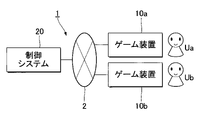
- FIG. 1 is a block diagram illustrating the configuration of the game system 1 according to the first embodiment.
- the game system 1 of the first embodiment is an information system including a plurality of game devices 10 (10a, 10b) and a control system 20.
- Each of the plurality of game devices 10 is installed in different game facilities.
- the amusement facility is, for example, an entertainment facility such as a game center or a casino, or a commercial facility such as a shopping center.
- Each game device 10 is a computer system that provides a game to users U (Ua, Ub) in the game facility.
- Ua, Ub users U
- FIG. 1 among the plurality of game devices 10, the game device 10a used by the user Ua and the game device 10b used by the user Ub are shown for convenience.
- User Ua is an example of a "second user”
- user Ub is an example of a "first user”.
- the control system 20 is a computer system for controlling the operation of each of the plurality of game devices 10.
- a server system installed outside the amusement facility is used as the control system 20.
- Each of the plurality of game devices 10 communicates with the control system 20 via a communication network 2 such as the Internet.
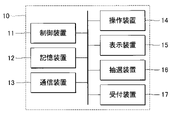
- FIG. 2 is a block diagram illustrating the configuration of each game device 10.
- the game device 10 includes a control device 11, a storage device 12, a communication device 13, an operation device 14, a display device 15, a lottery device 16, and a reception device 17.
- the game device 10 is also realized by a plurality of devices configured as separate bodies from each other.
- the control device 11 is composed of, for example, a single or a plurality of processors that control each element of the game device 10. Specifically, for example, one or more types of processors such as CPU (Central Processing Unit), GPU (Graphics Processing Unit), DSP (Digital Signal Processor), FPGA (Field Programmable Gate Array), or ASIC (Application Specific Integrated Circuit). 3.
- the control device 11 is configured.
- the communication device 13 communicates with the control system 20 via the communication network 2.
- the storage device 12 is a single or a plurality of memories for storing a program executed by the control device 11 and various data used by the control device 11.
- a known recording medium such as a semiconductor recording medium and a magnetic recording medium, or a combination of a plurality of types of recording media is used as the storage device 12.
- the operation device 14 is an input device that accepts operations by the user U.
- the operation device 14 is, for example, a touch panel that detects a plurality of controls operated by the user U or a contact by the user U.
- the display device 15 displays an image under the control of the control device 11.
- various display panels such as a liquid crystal display panel or an organic EL (Electroluminescence) panel are used as the display device 15.
- the reception device 17 receives the value medium from the user U.
- the value medium is, for example, a physical medal (token) or an electronic medal.
- the reception device 17 includes a transport path for transporting the physical medals supplied by the user U to the slot, and a counter for counting the physical medals.
- a communication device that communicates with a management server device (not shown) that manages an electronic medal account for each user U may be used as the reception device 17.
- the reception device 17 executes a withdrawal process for transferring an electronic medal from an account managed by the management server device to the game device 10 and a deposit process for transferring the electronic medal to the account of the management server device.
- a reader that transfers the electronic medals to the game device 10 from a recording medium such as an IC card on which the electronic medals are recorded may be used as the reception device 17.
- the game value of the quantity corresponding to the quantity of the value medium received by the reception device 17 is set to be usable by the user U.
- the game value is a value (credit) for the user U to play the game.
- the lottery device 16 is a mechanism for executing a physical lottery in which any one of a plurality of lottery numbers is randomly selected. Winning (success) / loss (failure) of user U is determined according to the result of the physical lottery. For example, a rotating disk (roulette) that allows a lottery body such as a sphere to enter any of a plurality of lottery holes, or a lottery machine that allows any one of the plurality of lottery bodies to enter one or more lottery holes is used as the lottery device 16. Illustrated.
- the electronic lottery for determining the winning / losing of the user U by the calculation by the control device 11 may be adopted instead of the physical lottery. In the configuration in which the electronic lottery is executed, the lottery device 16 may be omitted.
- the lottery device 16 is used for the lottery game.
- the normal game is a lottery game in which the user U plays constantly or repeatedly.
- a special game is executed when a predetermined condition (hereinafter referred to as "execution condition") is satisfied as a result of the normal game.
- the execution condition is, for example, that the number of specific items acquired by the user U in the normal game reaches a predetermined value.
- the special game is a lottery game in which a lot of rewards are given to the user U to win / lose a special prize (jackpot).
- the special game is an example of the "first game”
- the normal game is an example of the "second game”.
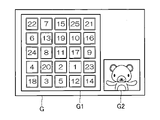
- FIG. 3 is a schematic diagram of a play screen G displayed by the display device 15 for a normal game.
- the play screen G includes a game image G1 and a character G2.
- the game image G1 is an image showing the progress of a normal game.
- the normal game in the first embodiment is a bingo game (that is, a card game) that uses lottery cards in which a plurality of lottery numbers are arranged in a matrix.
- the game image G1 is an image representing a lottery card.
- the character G2 is an object for staging owned by the user U.
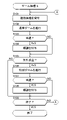
- FIG. 4 is a flowchart illustrating a specific procedure of a process (hereinafter referred to as “game process”) S executed by the control device 11 of each game device 10.
- game process a process executed by the control device 11 of each game device 10.
- User U acquires the game value by inputting a value medium to the reception device 17.
- the user U can instruct the use of a desired quantity (hereinafter referred to as "usage amount") of the game value by operating the operation device 14.
- the use of the game value means that the user U consumes the game value (that is, bets) for playing a normal game and obtaining a reward at the time of winning.
- the control device 11 receives an instruction to use the game value from the user U (S101). Specifically, the control device 11 subtracts the usage amount from the game value quantity held by the user U.
- the control device 11 advances the normal game (S102). Specifically, the control device 11 executes the physical lottery by controlling the lottery device 16 while displaying the play screen G on the display device 15. Further, the control device 11 grants an item to the user U when a predetermined condition is satisfied in the process of the physical lottery. The control device 11 determines the winning / losing of the user U according to the result of the physical lottery (S103). When the user U wins the normal game (S103: YES), the control device 11 gives the user U a game value of a quantity corresponding to the usage amount as a reward (S104).
- the quantity obtained by multiplying the usage amount by the coefficient (odds) is added as a reward to the quantity of the game value held by the user U.
- the reward given to the user U (S104) is not executed.
- the control device 11 determines whether or not the execution condition of the special game is satisfied (S105). For example, the control device 11 determines whether or not the number of items acquired by the user U has reached a predetermined value. When the execution condition is satisfied (S105: YES), the control device 11 advances the special game (S106). The content of the special game is arbitrary, but for example, a lottery game using a physical lottery by the lottery device 16 is executed. As understood from the above description, the control device 11 functions as an element (progress control unit) for advancing the lottery game (S102, S106). On the other hand, if the execution condition is not satisfied (S105: NO), the control device 11 does not execute the special game.
- the control device 11 determines whether the user U has won or lost (S107). When the user U wins the special game (S107: YES), the control device 11 gives the user U a large number of game values as a reward (S108). For example, the amount of game value accumulated for each execution of the normal game is given to the user U as a reward for the special game. If the user U loses the special game (S107: NO), the reward given to the user U (S108) is not executed. A predetermined amount of game value may be given to the user U who has been defeated in the special game.
- the control device 11 determines whether or not the predetermined end condition is satisfied (S109).
- the end condition is that, for example, an operation on the operation device 14 indicates the end of the operation of the game device 10. If the end condition is not satisfied (S109: NO), the control device 11 shifts the process to step S101. On the other hand, when the end condition is satisfied (S109: YES), the control device 11 ends the game process S.
- the game process S illustrated above is executed in each of the plurality of game devices 10.
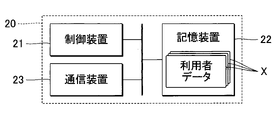
- FIG. 5 is a block diagram illustrating the configuration of the control system 20.
- the control system 20 is realized by a computer system including a control device 21, a storage device 22, and a communication device 23.
- the control system 20 is also realized by a plurality of devices configured as separate bodies from each other.
- the control device 21 is composed of, for example, a single or a plurality of processors that control each element of the control system 20. Specifically, the control device 21 is composed of one or more types of processors such as a CPU, GPU, DSP, FPGA, or ASIC.
- the communication device 23 communicates with each game device 10 via the communication network 2.
- the storage device 22 is a single or a plurality of memories for storing a program executed by the control device 21 and various data used by the control device 21.
- a known recording medium such as a semiconductor recording medium and a magnetic recording medium, or a combination of a plurality of types of recording media is used as the storage device 22.
- a portable recording medium attached to and detached from the control system 20, or a recording medium (for example, cloud storage) capable of being written or read by the control device 21 via, for example, a communication network 2 is used as the storage device 22. You may use it.
- the storage device 22 stores user data X for each of the plurality of users U.
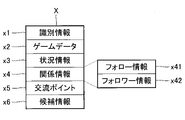
- the user data X of each user U is data in which a plurality of information about the user U is registered.
- FIG. 6 is a schematic diagram of user data X. As illustrated in FIG. 6, the user data X includes identification information x1, game data x2, status information x3, relationship information x4, exchange points x5, and candidate information x6.
- the identification information x1 is a code string for identifying the user U.
- the identification information x1 is given to the user U who has registered the use in advance, and is stored in a recording medium (for example, an IC card) possessed by the user U.
- Each game device 10 starts a lottery game using the user data X including the identification information x1 received from the recording medium of the user U, and updates the user data X at any time according to the progress of the lottery game. ..
- Game data x2 is information related to game play by user U. Specifically, as a result of the game played by the user U in the past, the player name set by the user U, the character name of the character G2 owned by the user U, the parameters related to the character G2, and the like are the game data x2. Registered as. Examples of parameters related to the character G2 include items equipped by the character G2, ability values of the character G2, and the like. It should be noted that the character G2 does not necessarily have to appear in the game played by the user U. That is, the parameters related to the character G2 may be omitted from the game data x2.
- the game data x2 is also paraphrased as data representing the progress of the lottery game (for example, items acquired by the user U).
- the status information x3 is data representing the current status of the user U. Specifically, whether or not the user U is currently playing and the name of the game facility where the user U is located are registered in the user data X as status information x3.
- Each user U can build a predetermined relationship (hereinafter referred to as "friend relationship") in the lottery game with another user U.
- the friendship of each user U is divided into a one-way friendship and a two-way friendship. Focusing on the user Ua and the user Ub, the one-way friend relationship is a relationship in which the user Ua follows the user Ub but the user Ub does not follow the user Ua.
- the two-way friend is a relationship in which the user Ua and the user Ub follow each other. That is, for example, a relationship in which the user Ua follows the user Ub and the user Ub follows the user Ua is a two-way friend relationship (follow-follower relationship).
- Relationship information x4 is information representing a friend relationship between users U.
- the relationship information x4 of the first embodiment includes follow information x41 and follower information x42.
- the follow information x41 of each user U includes the identification information x1 of another user U that the user U follows.
- the follower information x42 of each user includes the identification information x1 of another user U who follows the user U.
- both the follow information x41 and the follower information x42 in the user data X of the user Ua and the user Ub are combined with the other user.
- the identification information x1 of U is included.
- the exchange point x5 is an in-game value given to each user U due to the friendship between the users U.
- the user U can change the ability value or equipment of the character G2 owned by the user U in exchange for the consumption of the exchange point x5.
- the user U can acquire items such as ornaments equipped by the character G2 owned by the user U by consuming a predetermined amount of the exchange points x5.
- various rewards are given to the user U instead of the exchange points x5.
- Candidate information x6 is information indicating other users U (hereinafter referred to as "candidate users U") who are candidates for the other user when each user U builds a friend relationship. Although the details will be described later, other users U in which each user U has been involved in the past play of the lottery game (particularly a normal game) are registered in the candidate information x6 as the candidate user U. Specifically, the identification information x1 of the candidate user U is registered as the candidate information x6. In the first embodiment, the user U who has been involved in the past play of the lottery game is registered as the candidate user U, but while the user U is playing the lottery game, The candidate user U may be determined according to the behavior of the user U.
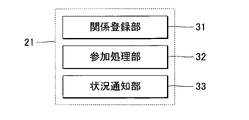
- FIG. 7 is a block diagram illustrating the functional configuration of the control system 20. As illustrated in FIG. 7, the control device 21 of the control system 20 performs a plurality of functions (relationship registration unit 31, participation processing unit 32, and status notification unit 33) by executing a program stored in the storage device 22. Realize.
- the relationship registration unit 31 registers a friend relationship between users U. Specifically, the relationship registration unit 31 registers the friend relationship between the users U by updating the relationship information x4 in the user data X of each user U.
- Each user U can participate in a lottery game (normal game and special game) played by another user U.
- a reward is given to the other users U who participated in the lottery game.
- the participation processing unit 32 of FIG. 7 controls each user U to participate in the lottery game. That is, participation in the lottery game by the user U means a game for obtaining a reward according to the result of the lottery game played by another user U. Whether or not you participate in the lottery game does not affect the result of the lottery game itself. However, it is assumed that the presence or absence of participation of the user U or the number of participation affects the result of the lottery game.
- the participation processing unit 32 of the first embodiment executes the participation processing Q (see FIG. 13).
- the participation process Q is a process for controlling the participation of the user U in the lottery game.
- Participation processing Q includes normal participation processing Q1 and special participation processing Q2.
- the normal participation process Q1 is a process for controlling the participation of the user U in the normal game.
- the special participation process Q2 is a process for controlling the participation of the user U in the special game.
- the user U can participate in the special game only for the user U who has a two-way friend relationship with the user U.
- any user U can participate in the normal game played by the user U regardless of the presence or absence of a relationship with the user U and the mode (one-way / two-way).
- the status notification unit 33 of FIG. 7 notifies other users U who participate in the lottery game of the status of the lottery game (normal game or special game) played by the user U. Therefore, the user U who participates in the lottery game can confirm the progress of the lottery game.
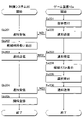
- FIG. 8 is a specific example of the operation of the game system 1 when the user Ua participates in the lottery game of another user U without using the friend relationship between the users U.
- the process of FIG. 8 is also referred to as a process executed in an initial state in which a friend relationship is not established between the user Ua and another user U.
- the user Ua instructs the game device 10a to participate in the normal game of another user U by operating the operation device 14.
- the control device 11 transmits the notification M11 from the communication device 13 to the control system 20 (Sa102).
- the notification M11 is a message requesting that the user Ua participate in the normal game of another user U.
- the control device 21 of the control system 20 receives the notification M11 transmitted by the game device 10a by the communication device 23 (Sb101). Upon receiving the notification M11, the control device 21 selects one of the plurality of users U (hereinafter referred to as "selected user U") in which the user data X is recorded in the storage device 22 (Sb102). For example, the control device 21 randomly selects a user U from a plurality of users U. The control device 21 may select the user U according to a predetermined condition. The control device 21 transmits a notification M12 indicating the selected user U from the communication device 23 to the requesting game device 10a (Sb103). The notification M12 includes the user data X of the candidate user U.
- the control device 11 of the game device 10a receives the notification M12 transmitted by the control system 20 by the communication device 13 (Sa103).
- the control device 11 causes the display device 15 to display the information (for example, game data x2) represented by the user data X in the notification M12 (Sa104).
- the user Ua confirms the information of the selected user U by visually recognizing the display of the display device 15.
- the user Ua instructs the game device 10a to participate in the normal game played by the selected user U by operating the operation device 14.
- the control device 11 transmits the notification M13 from the communication device 13 to the control system 20 (Sa106).
- the notification M13 includes the identification information x1 of the user Ua and the identification information x1 of the selected user U.
- the control device 21 of the control system 20 receives the notification M13 transmitted by the game device 10a by the communication device 23 (Sb104). Upon receiving the notification M13, the control device 21 executes the normal participation process Q1 in which the user Ua participates in the normal game played by the selected user U (Sb105). The specific procedure of the normal participation process Q1 will be described later.
- the control device 21 registers the identification information x1 of the selected user U this time in the candidate information x6 in the user data X of the user Ua (Sb106). That is, the selected user U who has played the normal game in which the user Ua participates is registered in the user data X of the user Ua as the candidate user U.
- two or more users U in which the user Ua participates in the normal game among the plurality of users U are registered as candidate users U of the user Ua.
- the mode in which the control system 20 selects one selected user U is illustrated, but the control system 20 selects a plurality of users U, and the user Ua is selected from the plurality of users U. May select the desired selective user U.
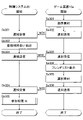
- FIG. 9 is a specific example of the operation of the game system 1 when the user Ua establishes a friendship with another user U.
- the user Ua instructs the game device 10a to present the candidate user U by operating the operation device 14.
- the control device 11 transmits the notification M21 from the communication device 13 to the control system 20 (Sa202).
- the notification M21 is a message requesting the presentation of the candidate user U, and includes the identification information x1 of the user Ua.
- the relationship registration unit 31 of the control system 20 receives the notification M21 transmitted by the game device 10a by the communication device 23 (Sb201). Upon receiving the notification M21, the relationship registration unit 31 extracts a plurality of candidate users U related to the user Ua (Sb202). Specifically, the relationship registration unit 31 searches the storage device 22 for the user data X of the user Ua corresponding to the identification information x1 in the notification M21, and a plurality of candidate information x6 of the user data X indicates. Identify the candidate user U. That is, a plurality of candidate users U who have played the past normal games in which the user Ua participated are specified. The relationship registration unit 31 transmits a notification M22 indicating a plurality of candidate users U from the communication device 23 to the requesting game device 10a (Sb203). The notification M22 includes the user data X of each of the plurality of candidate users U.
- the control device 11 of the game device 10a receives the notification M22 transmitted by the control system 20 by the communication device 13 (Sa203).
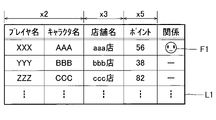
- the control device 11 causes the display device 15 to display the image (hereinafter referred to as “candidate list”) L1 represented by each user data X in the notification M22 (Sa204).
- the relationship registration unit 31 of the control system 20 causes the display device 15 of the game device 10a to display the candidate list L1 including the plurality of candidate users U.
- FIG. 10 is a schematic diagram of the candidate list L1.
- the candidate list L1 is an image in which the information of the user data X is arranged for each of the plurality of candidate users U. For example, the player name and character name indicated by the game data x2 of the user data X, the game facility indicated by the situation information x3, and the numerical value of the exchange point x5 are displayed for each candidate user U.
- the follow image F1 is displayed for the candidate user U who is following the user Ua among the plurality of candidate users U.
- the follow image F1 is an image meaning that the candidate user U is following the user Ua.
- the control device 11 displays the follow image F1 for the candidate user U in which the follow information x41 of the relationship information x4 includes the identification information x1 of the user Ua among the plurality of candidate users U.
- the relationship registration unit 31 presents to the user Ua a plurality of candidate users U who have been involved in the user Ua in the past play of the normal game.
- the follow image F1 may be displayed for the candidate user U that the user Ua is following.
- the user U can also cancel the follow-up relationship with respect to the candidate user U that the user Ua is following.
- the user Ua can select any of the plurality of candidate users U displayed in the candidate list L1 by operating the operation device 14.
- the selection of the candidate user U by the user Ua corresponds to an instruction that the user Ua follows the candidate user U.
- the control device 11 transmits the notification M23 from the communication device 13 to the control system 20 (Sa206) as illustrated in FIG.
- the notification M23 includes the identification information x1 of the user Ua and the identification information x1 of the candidate user U selected by the user Ua.
- the relationship registration unit 31 of the control system 20 receives the notification M23 transmitted by the game device 10a by the communication device 23 (Sb204). Upon receiving the notification M23, the relationship registration unit 31 registers the relationship between the user Ua and the candidate user U (Sb205). Specifically, the relationship registration unit 31 searches the storage device 22 for the user data X corresponding to the identification information x1 of the user Ua in the notification M23, and obtains the identification information x1 of the candidate user U in the notification M23. Register in the follow information x41 of the user data X. Further, the relationship registration unit 31 may register the identification information x1 of the user Ua in the follower information x42 of the user data X of the candidate user U.
- the relationship registration unit 31 registers the relationship between the user U selected by the user Ua among the plurality of users U and the user Ua.
- a friend relationship one-way friend relationship or two-way friend relationship
- the user Ua can build a friendship with the candidate user U who has been involved in the past play of the lottery game.
- FIG. 11 is a specific example of the operation of the game system 1 when the user Ua participates in the lottery game of another user U by using the friend relationship between the users U.
- the user Ua instructs the game device 10a to present another user U (hereinafter referred to as "registered user U") who has a friendship with the user Ua.
- the control device 11 transmits the notification M31 from the communication device 13 to the control system 20 (Sa302).
- the notification M31 is a message requesting the presentation of the registered user U, and includes the identification information x1 of the user Ua.
- the participation processing unit 32 of the control system 20 receives the notification M31 transmitted by the game device 10a by the communication device 23 (Sb301). Upon receiving the notification M31, the participation processing unit 32 extracts a plurality of registered users U related to the user Ua (Sb302). Specifically, the participation processing unit 32 searches the user data X of the user Ua corresponding to the identification information x1 in the notification M31 from the storage device 22, and identifies the identification information x1 in the relational information x4 of the user data X. Identify a plurality of registered users U registered with. That is, a plurality of registered users U in which one (one-way friend relationship) or both (two-way friend relationship) of the follow relationship and the follower relationship are established with the user Ua are specified. The participation processing unit 32 transmits a notification M32 indicating a plurality of registered users U from the communication device 23 to the requesting game device 10a (Sb303). The notification M32 includes the user data X of each of the plurality of registered users U.
- the control device 11 of the game device 10a receives the notification M32 transmitted by the control system 20 by the communication device 13 (Sa303).
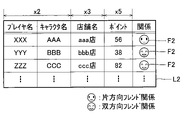
- the control device 11 causes the display device 15 to display the image (hereinafter referred to as “friend list”) L2 represented by each user data X in the notification M32 (Sa304).
- the participation processing unit 32 of the control system 20 causes the display device 15 of the game device 10a to display the friend list L2 including the plurality of registered users U.
- FIG. 12 is a schematic diagram of the friend list L2.
- the friend list L2 is an image in which the information of the user data X is arranged for each of the plurality of registered users U.
- the information of the user data X is displayed for one or more registered users U who are actually playing the lottery game among the plurality of registered users U.
- the player name and character name indicated by the game data x2 of the user data X, the game facility indicated by the situation information x3, and the numerical value of the exchange point x5 are displayed for each registered user U. Will be done.
- the registered user U who has finished playing the lottery game may be deleted from the friend list L2.
- the related image F2 is displayed for each registered user U.
- the relationship image F2 is an image showing the relationship between the user Ua and each registered user U. Specifically, the relationship image F2 shows whether the relationship between the registered user U and the user Ua is a one-way friend relationship (follow relationship or follower relationship) or a two-way friend relationship. For example, the relationship between the relationship image F2 of the registered user U who has a one-way friend relationship with the user Ua and the registered user U who has a two-way friend relationship with the user Ua. It is displayed in a mode different from that of the image F2.
- the user Ua can select any of the plurality of registered users U displayed in the friend list L2 by operating the operation device 14. That is, the user Ua selects the registered user U who is actually playing the lottery game. Further, the user Ua can instruct to participate in the lottery game played by the selected registered user U by operating the operation device 14. Specifically, with respect to the registered user U having a one-way friend relationship, the user Ua can instruct the registered user U to participate in the normal game played by the registered user U. That is, the control device 11 receives an instruction from the user Ua to participate in the normal game for the registered user U who has a one-way friendship with the user Ua. The control device 11 does not accept an instruction to participate in the special game for the registered user U who has a one-way friend relationship with the user Ua.
- the user Ua can instruct to participate in the normal game or the special game played by the registered user U.
- the user Ua selects a lottery game that the user Ua wants to participate in from the normal game and the special game by operating the operation device 14. That is, the control device 11 receives an instruction from the user Ua to participate in the normal game or the special game for the registered user U who has a two-way friendship with the user Ua.
- the user Ua is prohibited from participating in the special game for the registered user U who has a one-way friend relationship, while the user Ua is special for the registered user U who has a two-way friend relationship. Participation in the game is allowed.
- the control device 11 When the selection of the registered user U and the instruction to participate in the lottery game are received from the user Ua (Sa305), the control device 11 notifies the control system 20 of the notification M33 from the communication device 13 as illustrated in FIG. Send (Sa306).
- the notification M33 includes the identification information x1 of the user Ua, the identification information x1 of the candidate user U selected by the user Ua, and the information indicating the lottery game (normal game / special game) selected by the user Ua. ..
- the participation processing unit 32 of the control system 20 receives the notification M33 transmitted by the game device 10a by the communication device 23 (Sb304). Upon receiving the notification M33, the participation processing unit 32 executes the participation processing Q (Sb305). As described above, the participation process Q is a process in which the user Ua participates in the lottery game played by the registered user U.
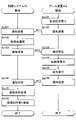
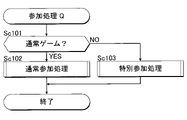
- FIG. 13 is a flowchart illustrating a specific procedure of the participation process Q.
- the control device 21 of the control system 20 determines whether or not the lottery game for which the user Ua has instructed to participate is a normal game (Sc101). That is, it is determined whether the normal game or the special game is designated in the notification M33.
- the control device 21 executes the normal participation process Q1 (Sc102).
- the control device 21 executes the special participation process Q2 (Sc103).
- the normal participation process Q1 is executed and the user
- the normal participation process Q1 or the special participation process Q2 is executed.
- the user Ua participates in the lottery game played by the game device 10b by the game device 10a.
- FIG. 14 is a flowchart illustrating a specific procedure of the normal participation process Q1.
- the status notification unit 33 of the control system 20 acquires status data representing the progress of the normal game from the game device 10b (Q101). Specifically, the status notification unit 33 inquires the game device 10b about the status of the normal game, and receives the status data transmitted from the game device 10b by the communication device 23. The status notification unit 33 transmits the status data of the normal game from the communication device 23 to the game device 10a (Q102). The control device 11 of the game device 10a receives the status data transmitted from the control system 20 by the communication device 13 (Sd101), and causes the display device 15 to display the progress status represented by the status data (Sd102).
- the status notification unit 33 of the control system 20 determines whether or not the normal game has ended by referring to the status data received from the game device 10b (Q103).
- the status notification unit 33 shifts the process to step Q101. That is, the operation of notifying the game device 10a of the progress of the normal game (Q101-Q102) is repeated until the end of the normal game.
- the participation processing unit 32 determines whether or not the user Ub has won the normal game (Q104).
- the control device 11 of the game device 10b gives a reward to the user Ub who has won the normal game (S104).
- the participation processing unit 32 gives a reward to the user Ua who participated in the normal game (Q105). For example, a predetermined amount of game value is given to the user Ua as a reward.
- the game value given to the user Ua is an example of the "first reward”.
- a friend relationship (one-way friend relationship and two-way friend relationship) is established between the user Ua and the user Ub (selected user U). do not have.
- a one-way friend relationship or a two-way friend relationship is established between the user Ua and the user Ub (registered user U).
- the participation processing unit 32 determines whether or not a two-way friend relationship is established between the user Ua and the user Ub. (Q106).
- the friend relationship is not established between the user Ua and the user Ub, and when the friend relationship is not established between the user Ua and the user Ub. This includes the case where a one-way friend relationship is established between the user Ua and the user Ub.
- the participation processing unit 32 determines whether or not the one-way friend relationship is established between the user Ua and the user Ub (Q107). ..
- the participation processing unit 32 adds a predetermined value to the exchange point x5 of the user Ua who is a participant of the normal game (Q108).
- the friend relationship is not established between the user Ua and the user Ub (S107: NO)
- the exchange point x5 is not given to the user Ua (Q108).
- the participation processing unit 32 receives the exchange point x5 of the user Ub who plays the normal game and the exchange point x5 of the user Ua who is a participant. A predetermined value is added to both of (Q109). If the user Ub loses the normal game (Q104: NO), the game value and the exchange points x5 (Q105-Q109) are not executed. Even if the user Ub loses the normal game, the exchange points x5 may be given to the user Ua (and the user Ub).
- the exchange points x5 may be given to the user Ua (and the user Ub) regardless of the result of the normal game by the user Ub.
- the presence or absence of grant to the user Ua is controlled according to the winning / losing of the normal game.
- the exchange point x5 is an example of the "second reward".
- the user Ua when a friendship is established between the user Ua and the user Ub, the user Ua is allowed to acquire 5 exchange points on condition that the user Ub is elected, while the user Ua is allowed to acquire the exchange points x5. If a friendship is not established between Ua and the user Ub, the user Ua is not allowed to acquire 5 exchange points.
- the operation permitted for the normal game of the user Ub by the user Ua who has not registered the friendship with the user Ub is the use in which the friendship with the user Ub is registered.
- the user Ua is constrained as compared to the permissible behavior of the user Ub for the normal game.
- the reward (game value) when the user Ub wins the normal game is related to the presence or absence and mode (one-way friend relationship / two-way friend relationship) of the friend relationship between the user Ua and the user Ub. It is given to both user Ua and user Ub.
- the status notification unit 33 transmits status data representing the result of the normal game to the game device 10a (Q11).
- the control device 11 of the game device 10a receives the status data transmitted from the control system 20 by the communication device 13 (Sd103), and displays the result of the normal game represented by the status data on the display device 15 (Sd104).
- the specific procedure of the normal participation process Q1 is as described above.
- FIG. 15 is a flowchart illustrating a specific procedure of the special participation process Q2.
- a user Ub having a two-way friend relationship is selected from the friend list L2 (FIG. 11: Sa305)
- the user Ua operates the operation device 14 to specify a desired usage amount and use the game value.
- the use of the game value means that the user Ua consumes the game value (that is, a bet) in exchange for participation in a special game played by the user Ub and acquisition of a reward at the time of winning the user Ub. do.
- the control device 11 of the game device 10a receives an instruction to use the game value from the user Ua (Se101). Specifically, the control device 11 subtracts the usage amount from the game value quantity held by the user Ua.
- the control device 11 transmits the notification M41 from the communication device 13 to the control system 20 (Se102).
- the notification M41 is a message meaning that the user Ua uses the game value for the special game of the user Ub, and includes the identification information x1 of the user Ua and the usage amount of the game value.
- the participation processing unit 32 of the control system 20 executes the reception processing R1 (Q201).
- the reception process R1 is a process of accepting the use of the game value in the special game played by the user Ub from the user Ua.
- the reception process R1 is a process in which the participation processing unit 32 receives the notification M41 including the usage amount of the game value by the communication device 23.
- the status notification unit 33 of the control system 20 acquires status data representing the progress of the special game from the game device 10b (Q202). Specifically, the status notification unit 33 inquires the game device 10b about the status of the special game, and receives the status data transmitted from the game device 10b by the communication device 23. The status notification unit 33 transmits the status data of the special game from the communication device 23 to the game device 10a (Q203). The control device 11 of the game device 10a receives the status data transmitted from the control system 20 by the communication device 13 (Se103), and causes the display device 15 to display the progress status represented by the status data (Se104).
- the control device 11 of the game device 10a determines whether or not the special game has ended by referring to the status data received from the control system 20 (Se105). If the special game has not ended (Se105: NO), the control device 11 shifts the process to step Se101. That is, until the end of the special game played by the user Ub, the process of accepting the instruction to use the game value (including the instruction of the usage amount) from the user Ua (Se101, Se102) and the display of the status of the special game (Se103). , Se104) is repeated. That is, the user Ua can adjust (for example, increase) the amount of the game value used in the special game while checking the status of the special game on the display of the display device 15 at any time.
- the status notification unit 33 of the control system 20 determines whether or not the special game has ended by referring to the status data received from the game device 10b (Q204). If the special game has not ended (Q204: NO), the status notification unit 33 shifts the process to step Q201. That is, until the end of the special game, the acceptance of participation by the user Ua (Q201) and the operation of notifying the game device 10a of the progress of the special game (Q202-Q203) are repeated. On the other hand, when the special game ends (Q204: YES), the participation processing unit 32 determines whether or not the user Ub has won the special game (Q205).
- the participation processing unit 32 executes the grant processing R2 (Q206).
- the grant process R2 is a process of granting a reward to the user Ua by winning the user Ub in the special game.
- the participation processing unit 32 of the first embodiment gives the user Ua a game value of a quantity corresponding to the usage amount designated by the user Ua (hereinafter referred to as “reward amount”) as a reward. For example, the amount used is calculated by multiplying the amount used by a predetermined coefficient as the amount of reward.
- the participation processing unit 32 grants the exchange points x5 to both the user Ua and the user Ub. Specifically, a predetermined value is added to each exchange point x5 of the user Ua and the user Ub.
- the participation processing unit 32 does not execute the grant processing R2.
- the participation processing unit 32 transmits a notification M42 indicating the reward amount of the game value from the communication device 23 to the game device 10a.
- the control device 11 of the game device 10a receives the notification M42 transmitted from the control system 20 by the communication device 13 (Se106).
- the control device 11 adds the reward amount indicated by the notification M42 to the amount of the game value held by the user Ua (Se107). That is, the game value that the user Ua can use for the lottery game increases.
- the status notification unit 33 transmits the status data indicating the result of the special game (winning / losing) to the game device 10a. (Q207).
- the control device 11 of the game device 10a receives the status data transmitted from the control system 20 by the communication device 13 (Se108), and displays the result of the special game represented by the status data on the display device 15 (Se109).
- the specific procedure of the special participation process Q2 is as described above.
- the user Ua whose relationship with the user Ub (two-way friend relationship) is registered can participate in the special game played by the user Ub. Specifically, the user Ua participates in the special game by using the game value, and obtains a reward according to the result of the special game played by the user Ub. Therefore, the user Ua can easily share the experience of the special game with the user Ub whose relationship with the user Ua is registered.
- the user Ua can participate in the special game while checking the status of the special game played by the user Ub. Therefore, the user Ua can participate in the special game while checking the status of the special game played by the user Ub. For example, the user Ua can determine the amount of game value used (bet amount) while checking the status of the game by the user Ub.
- the user Ua who has a two-way friend relationship with the user Ub is allowed to participate in the special game played by the user Ub.
- the user Uc (third user) who does not have a two-way friend relationship with the user Ub is not allowed to participate in the special game played by the user Ub.
- the actions allowed for the user Uc for the lottery game in relation to the user Ub are compared with the actions allowed for the user Ua for the lottery game in relation to the user Ub. And be constrained.
- the user Ua is the user U whose relationship with the user Ub (specifically, the two-way friend relationship) is registered, and the user Uc is the user U whose relationship with the user Ub is not registered. Is. According to the above configuration, by registering the relationship with the user Ub, the restrictions on the operations allowed for the lottery game are relaxed. Therefore, the registration of the relationship between the users U is promoted.
- the embodiment in which the user Ua participates in the special game actually being played by the user Ub is illustrated.
- the user Ua can reserve to participate in the special game that the user Ub will play later. That is, even if the user Ub does not play the special game during the period in which the user Ua is playing the lottery game, the user Ua uses the game value for the special game of the user Ub, and the result of the special game. You can get rewards according to.
- the participation processing unit 32 of the second embodiment receives the reception processing R1. Is executed (Q201).
- the selection of the registered user U and the instruction of the usage amount of the game value by the user Ua correspond to the instruction of reservation participation for the special game.
- the reservation participation is instructed, the user Ua can end the lottery game without waiting for the participation of the special game.
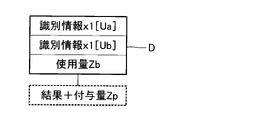
- the participation processing unit 32 stores the reservation data D representing the reservation participation by the user Ua in the storage device 22.
- the reservation data D includes the identification information x1 of the user Ua, the identification information x1 of the user Ub selected by the user Ua as the participation destination of the special game, and the usage amount Zb of the game value. including.
- the special game played by the user Ub is started.
- the participation processing unit 32 adds data representing the result of the special game to the reservation data D as shown by a broken line in FIG. Further, when the user Ub is elected in the special game, the participation processing unit 32 also adds the reward amount Zp of the game value given to the user Ua as a reward to the reservation data D.
- the user Ua starts the lottery game.
- the lottery game is started when the user Ua logs in to the game system 1.
- the participation processing unit 32 of the control system 20 executes the grant processing R2.
- the participation processing unit 32 transmits a notification M42 indicating the reward amount Zp added to the reservation data D to the game device 10a (Q206).
- the control device 11 of the game device 10a adds the reward amount Zp indicated by the notification M42 to the amount of the game value held by the user Ua (Se107).
- the status notification unit 33 transmits the status data representing the result of the special game added to the reservation data D to the game device 10a (Q207).
- the control device 11 of the game device 10a causes the display device 15 to display the result of the special game represented by the situation data (Se108, Se109).
- the participation processing unit 32 of the second embodiment when the user Ua instructs to participate in the reservation, the user Ua uses the game system 1 after the reception process R1 is executed.
- the grant process R2 is executed. That is, the grant process R2 is executed after the user Ua starts using the game system 1 (for example, logs in). Therefore, it is not necessary for the user Ua to use the game system 1 within the period in which the special game of the user Ub progresses. For example, the user Ua can return home after being instructed to participate in the reservation, resume the use of the game system 1 on or after the next day, and then obtain a reward according to the result of the special game. Further, the same effect as that of the first embodiment is realized in the second embodiment.
- Situation B can be rephrased as a situation in which the game device 10a and the game device 10b are installed in one game facility.
- situation C can be rephrased as a situation in which the game device 10a used by the user Ua and the game device 10b used by the user Ub constitute a single device.
- the participation processing unit 32 can recognize whether the status of the user Ua and the user Ub corresponds to the status A to the status C by referring to the status information x3 of each user data X.
- the participation processing unit 32 of the third embodiment changes the mode of the participation processing Q according to which of the above-exemplified situations A and C the user Ua and the user Ub are in. Specifically, the participation processing unit 32 sets the maximum value of the amount of game value that the user Ua can use for the special game played by the user Ub (hereinafter referred to as "maximum usage amount") by the user Ua and the user. Make a difference depending on the situation of Ub. For example, the participation processing unit 32 notifies the game device 10 of the maximum usage amount according to the situation between the user Ua and the user Ub.
- the control device 11 of the game device 10 limits the usage amount Zb received from the user Ua and the user Ub within a range lower than the maximum usage amount notified from the participation processing unit 32.
- the maximum usage is individually set for each situation so that the maximum usage in Situation C exceeds the maximum usage in Situation B and the maximum usage in Situation B exceeds the maximum usage in Situation A. .. That is, Situation B is given preferential treatment over Situation A regarding participation in the special game. Therefore, rather than the user Ua and the user Ub visiting different game facilities (situation A), the user Ua and the user Ub visit the same game facility together (situation B or situation C). ) Is promoted. Also, situation C is given preferential treatment over situation B. Therefore, rather than the user Ua and the user Ub using different game devices 10 (situation B), the user Ua and the user Ub play together on one game device 10 (situation C). ) Is promoted.
- the mode of the participation process Q is diversified according to the relationship between the user Ua and the user Ub and the game system 1 (the positional relationship between the user Ua and the user Ub).
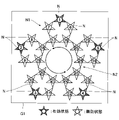
- FIG. 17 is a schematic diagram of a game image G1 used in a normal game in the fourth embodiment.
- the game image G1 of the fourth embodiment is an image in which a plurality of lottery numbers N selected by the lottery device 16 by lottery are arranged in a plane.
- the plurality of lottery numbers N are divided into a first group N1 and a second group N2.
- the plurality of lottery numbers N constituting the first group N1 are arranged in an annular shape.
- the plurality of lottery numbers N constituting the second group N2 are arranged in an annular shape in the region surrounded by the first group N1.
- the control device 11 moves a plurality of lottery numbers N of the second group N2 in the circumferential direction in response to an instruction from the user U to the operation device 14.
- the position of each lottery number N in the first group N1 is fixed.
- a configuration is also assumed in which a plurality of lottery numbers N of the first group N1 move in the circumferential direction.
- Each of the plurality of lottery numbers N is adjacent to two or more other lottery numbers N.
- each lottery number N of the second group N2 is adjacent to two lottery numbers N of the second group N2 located on both sides in the circumferential direction and one lottery number N of the first group N1.
- the specific lottery numbers N (specifically, “1" to "5") in the first group N1 are adjacent to the two lottery numbers N of the first group N1 located on both sides in the circumferential direction.
- the remaining lottery numbers N (specifically, "6" to "15") of the first group N1 are divided into one lottery number N of the first group N1 and one lottery number N of the second group N2. Next to each other.
- Each of the plurality of lottery numbers N is set to either the valid state or the invalid state.
- the lottery number N in the valid state and the lottery number N in the invalid state are displayed in different modes.
- a specific lottery number N specifically, "1” to "5"
- the state is set, and the remaining lottery numbers N (specifically, "6" to "25") are set to the invalid state.
- the lottery device 16 repeats a lottery operation of randomly selecting one of a plurality of lottery numbers N (hereinafter referred to as "selection number N") over a predetermined number of times.
- selection number N a plurality of lottery numbers N
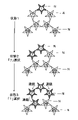
- the control device 11 shifts the selection number N from the invalid state to the valid state. For example, when the lottery number N "7" in the invalid state is selected by lottery as in the state 1 of FIG. 18, the lottery number N "7" transitions from the invalid state to the valid state as in the state 2.
- the control device 11 sets one or more lottery numbers N adjacent to the selection number N in the valid state. For example, when the lottery number N "1" that is already in the valid state is selected by lottery as in the state 2 of FIG. 18, the lottery number N "6" adjacent to the lottery number N "1” is as shown in the state 3. "Transitions from the invalid state to the valid state. Further, when the lottery number N adjacent to the selection number N in the valid state is already in the valid state, the control device 11 sets the other lottery number N adjacent to the lottery number N to the valid state. For example, when the lottery number N "7" adjacent to the valid lottery number N "1" is already in the valid state as in the state 2 of FIG.
- another lottery number N adjacent to the lottery number N "7" "17” also transitions from the invalid state to the valid state.
- the other lottery numbers N adjacent to the lottery number N are also set to the valid state in a chain reaction.
- the control device 11 counts the number of lottery numbers N in the valid state when the physical lottery by the lottery device 16 is repeated a predetermined number of times, and gives the user U a reward according to the number. For example, the quantity corresponding to the number of lottery numbers N in the valid state is added to the quantity of the game value held by the user U.
- the fourth embodiment there is a possibility that a plurality of lottery numbers N will transition to the valid state in a chain reaction. That is, a large number of lottery numbers N may transition to the valid state at once depending on the result of one physical lottery. Therefore, it is possible to provide the user U with a highly entertaining normal game.
- the method for building a friendship between users U is not limited to the above-mentioned examples of each form.
- the control device 21 of the control system 20 registers the friend relationship (for example, the two-way friend relationship) between the user Ua and the user Ub. May be good.
- a friend relationship between the user Ua and the user Ub may be registered by using an authentication code composed of numbers or characters.
- the game device 10a presents the authentication code to the user Ua by displaying the display device 15.
- the user Ua notifies, for example, the user Ub who is an acquaintance of the user Ua of the authentication code presented by the game device 10a.
- Any method such as e-mail or SMS (Short Message Service) is used to notify the user Ub of the authentication code.
- the user Ub inputs the authentication code notified by the user Ua into the game device 10b.
- the control device 21 of the control system 20 registers the friend relationship between the user Ua and the user Ub when the authentication code presented to the user Ua and the authentication code input by the user Ub match.
- the total number of users U that each user U can establish a friendship with may be limited to a range below a predetermined value. Further, it is assumed that the friend relationship between the users U can be canceled according to the instruction from each user U. It is also preferable that a lock function that does not accept an instruction to cancel the friend relationship between the users U can be set for each friend relationship between the users U.
- the establishment of a two-way friendship between the user Ua and the user Ub is a condition for the user Ua to participate in the special game played by the user Ub.
- the relationship required between the user Ua and the user Ub in order for the user Ua to participate in the special game of the user Ub is not limited to the two-way friend relationship.
- the participation of the user Ua in the special game of the user Ub may be permitted provided that a one-way friend relationship is established between the user Ua and the user Ub. That is, the relationship in which the user Ua follows the user Ub or the relationship in which the user Ua is followed by the user Ub is a condition for participation by the user Ua.
- the user U who has played the normal game in which the user Ua participates is registered as the candidate user U, but the conditions of the candidate user U are not limited to the above examples.
- another user U who participated in the normal game played by the user Ua may be registered as a candidate user U. That is, the user U who has been involved in the user Ua in the past game (for example, a normal game) is selected as the candidate user U who is a candidate for building a friendship with the user Ua.
- prior involvement with user Ua is not an essential condition for candidate user U. That is, the user Ua and any user U who has not been involved in the past may be selected as the candidate user U.
- the game value of the reward amount corresponding to the usage amount specified by the user Ua is given to the user Ua. did.
- the amount of reward given to the user Ua according to the result of the special game of the user Ub is not limited to the above examples.
- the game value of the reward amount corresponding to the amount of the game value acquired by the user Ub by winning the special game may be given to the user Ua.
- the game value is given as a reward to the user Ua who participated in the special game of the user Ub, but the types of rewards given to the user Ua are not limited to the above examples.
- a game value different from the game value used (bet) by the user Ub in the special game, an object such as an item or a character that can be used in the lottery game, or the right to play a predetermined game is granted to the special game. It may be given to the user Ub as a reward for participation.
- the user Ua who has registered a two-way friendship with the user Ub is allowed to participate in the special game played by the user Ub, but the user Ub
- the operation of the user Ua whose permission or denial is controlled depending on the presence or absence of the relationship with the user is not limited to participation in the special game. For example, a message between user Ua and user Ub, provided that a specific relationship (eg, one-way friend relationship or two-way friend relationship) is established between user Ua and user Ub. It is assumed that the exchange of the above is permitted.
- the ranking among the plurality of users U including the user Ua and the user Ub is ranked by each game device 10.
- a form of displaying on the display device 15 is also assumed.
- the control device 21 of the control system 20 calculates the total value of the acquired amount of the game value in the group including the user Ua and the user Ub, and compares the total value with other groups to display each ranking. It may be displayed on the device 15.
- the degree of operation allowed for each user U may be controlled stepwise according to the relationship between the users U. It is preferable that the upper limit (maximum usage amount) of the usage amount of the game value allowed for the user Ua in the special game played by the user Ub changes according to the relationship between the user Ua and the user Ub. be.
- the control device 21 has a maximum usage amount when a two-way friend relationship is established between the user Ua and the user Ub, and a maximum usage amount when a one-way friend relationship is established between the two. The maximum usage is controlled according to the disappearance between the user Ua and the user Ub so as to exceed the amount.
- the user Ua and the user Ub are compared with the case where the one-way friend relationship is established. It is also envisioned that the types of messages or the number of characters that can be exchanged between them will increase.
- the information displayed in the friend list L2 is not limited to the information illustrated in FIG. For example, it may be displayed in the friend list L2 whether or not each registered user U is playing the game. Further, in a situation where the registered user U uses the game device 10 capable of selectively playing any one of the plurality of game modes, the game mode selected by the registered user U may be displayed in the friend list L2. It is also assumed that the user U who participates in the lottery game can select which of the plurality of game modes he / she participates in.
- the usage amount of the game value is a variable value according to the instruction from the user Ua is illustrated, but the game used by the user Ua in the special game of the user Ub.
- the quantity of value (usage) may be a fixed value that does not depend on the instruction from the user Ua.
- the reward amount given to the user Ua may be a fixed value that does not depend on the result of the special game.
- both a form in which the user Ua can instruct the usage amount of the game value and a form in which the usage amount of the game value is a fixed value are adopted. Therefore, the quantity of the game value given to the user Ua (Q105) when the user Ub wins the normal game may be either a variable value or a fixed value.
- the type of the lottery game in which the user Ub participates is not limited to the special game.
- a form in which user Ua can participate in games other than normal games and special games is also assumed.
- any user Ua regardless of whether or not he / she has a friendship with the user Ub, can participate in a game other than the special game played by the user Ub. It is preferable that only the user Ua who has a friend relationship (one-way friend relationship or two-way friend relationship) registered with the user Ub can participate.
- the lottery game is illustrated in each of the above-described forms, the type of game in the present invention is not limited to the above examples.
- the game device 10a and the game device 10b may be integrally configured.
- a game unit including a lottery unit including a lottery device 16 and a plurality of stations used by different users U is assumed.
- One of the plurality of stations corresponds to the game device 10a
- the other station corresponds to the game device 10b.
- the user Ua uses one of the plurality of stations of the game unit (game device 10a)
- the user Ub uses the other station (game device 10b). Also expressed as a situation.
- the form in which the user Ua instructs the usage amount of the game value in the special game is illustrated, but the user Ua participating in the special game of the user Ub is any of a plurality of options.
- a form in which one can be selected is also assumed.
- the user Ua may select any of a plurality of usage amounts related to the game value.
- the participation processing unit 32 accepts the selection of the usage amount by the user Ub as an instruction for using the game value in the reception processing R1.
- the game value of the reward amount corresponding to the usage amount selected by the user Ua is given to the user Ua.
- the user Ua participating in the special game can select one of the plurality of lottery prizes.
- the amount of reward given to the user Ua by the participation processing unit 32 may be changed according to the difference between the lottery prize won by the user Ub and the lottery prize selected by the user Ua.
- the user Ua participating in the special game selects one of the plurality of options, and the user Ua is rewarded according to the result of the special game played by the user Ub.
- the form is suitable. For example, when the user Ua and the user Ub select a common lottery prize, the user Ua is also rewarded when the user Ub wins the special game.
- a situation may occur in which one of the user Ua and the user Ub wins but the other loses. For example, the user Ua is rewarded by winning but the user Ub is not rewarded by losing, or the user Ub is rewarded by winning while the user Ua is rewarded. It is assumed that no reward will be given due to the loss.
- the game system 1 having a control system 20 separate from the plurality of game devices 10 has been illustrated, but the functions of the control system 20 illustrated in each of the above-described embodiments are a plurality of game devices.
- a form in which the function is mounted on any of the ten or a form in which the function is distributedly mounted on the plurality of game devices 10 is also assumed. That is, the control system 20 configured separately from the plurality of game devices 10 is not indispensable. Further, some functions of the control system 20 may be mounted on one or more game devices 10.
- the function of the control system 20 according to each of the above-described modes is realized by the cooperation of one or more processors constituting the control device 21 and the program stored in the storage device 22.
- the program according to each of the above forms may be provided in a form stored in a computer-readable recording medium and installed in the computer.
- the recording medium is, for example, a non-transitory recording medium, and an optical recording medium (optical disc) such as a CD-ROM is a good example, but a known arbitrary such as a semiconductor recording medium or a magnetic recording medium is used. Recording media in the format of are also included.
- the non-transient recording medium includes any recording medium except for a transient propagation signal (transitory, propagating signal), and a volatile recording medium is not excluded. Further, in the configuration in which the distribution device distributes the program via the communication network 2, the recording medium for storing the program in the distribution device corresponds to the above-mentioned non-transient recording medium.
- the game system (1) registers a relationship between a plurality of users (U) including a first user (Ub) and a second user (Ua).
- the second user (Ua) whose relationship with the first user (Ub) is registered to use the game value in the game played by the relationship registration unit (31) and the first user (Ub).
- Participation including a reception process (R1) received from and a grant process (R2) in which a reward is given to the second user (Ua) according to the result of the game played by the first user (Ub). It includes a participation processing unit (32) that executes processing.
- the second user (Ua) whose relationship with the first user (Ub) is registered can participate in the game played by the first user (Ub). Specifically, the second user (Ua) participates in the game by using the game value, and obtains a reward according to the result of the game played by the first user (Ub). Therefore, the second user (Ua) can easily share the game experience with the first user (Ub) whose relationship with the second user (Ua) is registered.
- the "relationship" between a plurality of users (U) is, for example, a relationship established by a one-way request from one of the user A and the user B to the other (one-way friend relationship), or a user. It is a relationship (two-way friend relationship) established by a two-way request between A and user B. Examples of the one-way friend relationship include a follow relationship or a follower relationship.
- the type of "game” is arbitrary.
- a lottery game in which a lottery process (for example, physical lottery or electronic lottery) for determining the winning / losing of the user (U) by lottery is executed is an example of a “game”.
- a competitive game in which the first user (Ub) plays against another user a competitive game in which the first user (Ub) competes with another user (U) in a sport or board game, etc., the first use
- a music game in which a person (Ub) operates according to music
- a first user (Ub) operating a character is applied to any game such as a search game for exploring various places in the game.
- Game value is a tangible or intangible value used as a consideration for playing a game.
- the tangible game value is, for example, a physical medal (token coin), money (coin) or a ticket.
- the intangible game value is, for example, an electronic medal, electronic money (electronic money), credit or points.
- “Use” of the game value means consuming the game value as a consideration for playing the game or as a consideration for obtaining a reward.
- the action of using the game value as compensation for earning a reward is also referred to as a "bet”.
- the "reward” is the value given to the second user (Ua) as a consideration for participating in the game.
- the type of “reward” is arbitrary, but for example, a game value of the same type as the game value used by the user (U) is an example of "reward".
- the type of game value used by the second user (Ua) to participate in the game may be different from the type of reward given to the second user (Ua).
- a virtual object for example, an item or a character
- points that can be used in the game are given to the second user (Ua) as a "reward”. May be good.
- the right to play a specific game or a tangible object such as an article related to the game may be given to the second user (Ua) as a "reward".
- “Giving a reward according to the result of the game to the second user (Ua)” means that the presence or absence or quantity of the reward for the second user (Ua) changes according to the result of the game. .. For example, if the first user (Ub) wins in the lottery game, the second user (Ua) is rewarded, and if the first user (Ub) loses in the lottery game, the second user (Ua) It is assumed that Ua) will not be rewarded.
- the quantity of the reward given to the second user (Ua) may be changed according to the quantity of the game value used by the second user (Ua), or may be a fixed quantity.
- the plurality of users (U) further include a third user (U) whose relationship with the first user (Ub) is not registered, and the first user (U) is included.
- the operation permitted for the game by the user (U) in relation to the first user (Ub) is the operation in which the second user (Ua) is related to the first user (Ub). Constrained compared to allowed behavior for the game. According to the above aspect, the restriction of the operation allowed for each user (U) is relaxed by registering the relationship between the users (U). Therefore, registration of relationships between users (U) is promoted.
- the action allowed for the game by the third user (U) who has not registered the relationship with the first user (Ub) in relation to the first user (Ub) is the second user (Ua). Is constrained in relation to the first user (Ub) as compared to the behavior allowed for the game. " Permissible for a person (Ua), or [Phase 2] a mode or extent of such behavior, although a particular action is permissible for both the second user (Ua) and the third user (U). , The third user (U) is restricted as compared with the second user (Ua).
- participation in a game played by the first user (Ub) is permitted by the second user (Ua), but not by the third user (U).
- the form or the dialogue (message exchange) with the first user (Ub) is allowed for the second user (Ua), but not for the third user (U). Will be done.
- the quantity of the game value that can be used by the third user (U) in the game played by the first user (Ub) is limited to a range below a predetermined value, the first 2 It is assumed that the user (Ua) can use the game value in a quantity exceeding a predetermined value.
- Appendix 3 In the specific example of Appendix 2 (Appendix 3), the game is the first game, and the participation processing unit (32) uses the game value in the first game for the second user (Ua). And the use of the game value in the second game played by the first user (Ub) is permitted, and the third user (U) is allowed to use the game value in the second game. The use of the game value in the first game is not allowed. According to the above configuration, the user (U) can participate in the first game by the first user (Ub) by registering the relationship with the first user (Ub). Relationship registration is facilitated.
- Appendix 4 In the specific example of Appendix 1 (Appendix 4), the description game is the first game, and the participation processing unit (32) is between the first user (Ub) and the second user (Ua). When a two-way relationship is registered in, the second user (Ua) is allowed to use the game value in the first game and the second game played by the first user (Ub). , When a one-way relationship is registered between the first user (Ub) and the second user (Ua), the use of the game value in the second game is performed by the second user ( Ua) is allowed, and the second user (Ua) is not allowed to use the game value in the first game.
- the participation processing unit (32) informs the second user (Ua) according to the result of the play of the second game by the first user (Ub).
- the first reward is given and a two-way relationship is registered between the first user (Ub) and the second user (Ua)
- the first user (Ub) and the second user (Ua) are registered.
- a second reward is given to both the second user (Ua) and a one-way relationship is registered between the first user (Ub) and the second user (Ua).
- the plurality of users (U) further include a fourth user (U), and the relationship registration unit (31) uses the plurality of users.
- the relationship registration unit (31) uses the plurality of users.
- the persons (U) two or more users (U) who were involved in the fourth user (U) in the past play of the game are presented, and the presented two or more users (U) Among them, the relationship between the user (U) selected by the fourth user (U) and the fourth user (U) is registered.
- each user (U) can register a relationship with a user (U) who has been involved in the past game play.
- the game system (1) according to any specific example (Appendix 7) of Appendix 1 to Appendix 6 informs the second user (Ua) of the progress of the game played by the first user (Ub).
- a status notification unit (33) for notifying is provided.
- the second user (Ua) can participate in the game while checking the status of the game played by the first user (Ub).
- the second user (Ua) can determine the amount of game value used (bet amount) while checking the status of the game by the first user (Ub).
- Appendix 8 In any specific example (Appendix 8) of Appendix 1 to Appendix 7, when the second user (Ua) instructs to participate in the reservation, the participation processing unit (32) is in the reception process (R1). After the execution, when the second user (Ua) starts using the game system (1), the granting process (R2) is executed. According to the above aspect, the grant process (R2) is executed after the second user (Ua) starts using the game system (1) (for example, login). Therefore, it is not necessary for the second user (Ua) to use the game system (1) within the period in which the game of the first user (Ub) progresses. For example, the second user (Ua) can return home after being instructed to participate in the reservation, resume the use of the game system (1) on or after the next day, and then obtain a reward according to the result of the game.
- the grant process (R2) is executed after the second user (Ua) starts using the game system (1) (for example, login). Therefore, it is not necessary for the second user (Ua) to use the
- Appendix 9 In any specific example (Appendix 9) of Appendix 1 to Appendix 8, in the participation processing unit (32), the first user (Ub) and the second user (Ua) are one game device (Ua).
- the mode of the participation process depends on whether 10) is used, different game devices (10) in one facility are used, or game devices (10) in different facilities are used. To change. According to the above aspects, the mode of participation processing can be diversified according to the positional relationship of the game device (10) used by the first user (Ub) and the second user (Ua).
- the "participation processing mode" is a condition or method relating to the participation processing.
- the condition regarding the participation process is, for example, the maximum value (that is, the maximum number of bets) of the amount of game value that can be used by the second user (Ua), or the second user.
- the range or condition of the amount of reward given to (Ua) (for example, the relationship with the amount of game value used) is exemplified.
- a method relating to the participation process for example, a method of visual or auditory staging relating to the participation process is exemplified.
- the program according to one aspect (Appendix 12) of the present invention includes a relationship registration unit (31) for registering a relationship between a plurality of users (U), and a first of the plurality of users (U).
- the reception process (R1) for accepting the use of the game value in the game played by the user (Ub) from the second user (Ua) whose relationship with the first user (Ub) is registered, and the first
- a participation processing unit (32) that executes a participation process including a grant process (R2) that grants a reward to the second user (Ua) according to the result of the game played by the user (Ub). Make your computer system work.
Landscapes
- Engineering & Computer Science (AREA)
- Multimedia (AREA)
- Business, Economics & Management (AREA)
- Computer Security & Cryptography (AREA)
- General Business, Economics & Management (AREA)
- Management, Administration, Business Operations System, And Electronic Commerce (AREA)
- Selective Calling Equipment (AREA)
- User Interface Of Digital Computer (AREA)
Applications Claiming Priority (2)
| Application Number | Priority Date | Filing Date | Title |
|---|---|---|---|
| JP2021004374A JP7566316B2 (ja) | 2021-01-14 | 2021-01-14 | ゲームシステム、ゲーム制御方法およびプログラム |
| JP2021-004374 | 2021-01-14 |
Publications (1)
| Publication Number | Publication Date |
|---|---|
| WO2022153993A1 true WO2022153993A1 (ja) | 2022-07-21 |
Family
ID=82446720
Family Applications (1)
| Application Number | Title | Priority Date | Filing Date |
|---|---|---|---|
| PCT/JP2022/000650 Ceased WO2022153993A1 (ja) | 2021-01-14 | 2022-01-12 | ゲームシステム、ゲーム制御方法およびプログラム |
Country Status (3)
| Country | Link |
|---|---|
| JP (3) | JP7566316B2 (enExample) |
| TW (1) | TWI804155B (enExample) |
| WO (1) | WO2022153993A1 (enExample) |
Families Citing this family (1)
| Publication number | Priority date | Publication date | Assignee | Title |
|---|---|---|---|---|
| JP2025031394A (ja) * | 2023-08-25 | 2025-03-07 | 株式会社 ディー・エヌ・エー | ゲームを提供するためのシステム、方法、及びプログラム |
Citations (5)
| Publication number | Priority date | Publication date | Assignee | Title |
|---|---|---|---|---|
| JP2014183953A (ja) * | 2013-03-22 | 2014-10-02 | Namco Bandai Games Inc | サーバシステム |
| JP2016112138A (ja) * | 2014-12-12 | 2016-06-23 | 株式会社コナミデジタルエンタテインメント | ゲームシステム及びプログラム |
| JP2019191912A (ja) * | 2018-04-25 | 2019-10-31 | 株式会社コロプラ | プログラム、処理方法、および情報処理装置 |
| US20200111319A1 (en) * | 2018-10-05 | 2020-04-09 | Aristocrat Technologies Australia Pty Limited | System and method for secondary engagement with table games |
| JP2020110448A (ja) * | 2019-01-15 | 2020-07-27 | 株式会社コロプラ | ゲームプログラム、方法、および情報処理装置 |
Family Cites Families (24)
| Publication number | Priority date | Publication date | Assignee | Title |
|---|---|---|---|---|
| JP4070786B2 (ja) | 2005-10-31 | 2008-04-02 | 株式会社コナミデジタルエンタテインメント | ゲーム装置 |
| US20090138328A1 (en) * | 2007-11-26 | 2009-05-28 | Yahoo! Inc. | Targeted distribution of commercial incentives |
| US20100179856A1 (en) * | 2009-01-14 | 2010-07-15 | Yahoo! Inc. | Conditional incentive presentation, tracking and redemption |
| JP5385026B2 (ja) | 2009-06-26 | 2014-01-08 | 株式会社コナミデジタルエンタテインメント | ゲームシステム及びゲームコンティニュー状態設定方法 |
| JP5560259B2 (ja) | 2011-11-30 | 2014-07-23 | 株式会社コナミデジタルエンタテインメント | ゲームシステム |
| JP5336626B2 (ja) | 2012-03-30 | 2013-11-06 | 株式会社コナミデジタルエンタテインメント | ゲームシステム、それに用いられる制御方法及び、コンピュータプログラム |
| JP5552511B2 (ja) | 2012-08-29 | 2014-07-16 | 株式会社コナミデジタルエンタテインメント | ゲームシステム及びゲーム制御方法 |
| JP5719821B2 (ja) | 2012-10-31 | 2015-05-20 | 株式会社コナミデジタルエンタテインメント | ゲームシステム及びそのコメント制御方法 |
| JP6033700B2 (ja) | 2013-02-07 | 2016-11-30 | 株式会社コナミデジタルエンタテインメント | ゲームシステムのサーバ装置及びそのコンピュータプログラム |
| JP6030982B2 (ja) | 2013-03-28 | 2016-11-24 | 株式会社コナミデジタルエンタテインメント | ゲームシステム、並びにその制御方法及びコンピュータプログラム |
| JP5802257B2 (ja) | 2013-12-12 | 2015-10-28 | 株式会社スクウェア・エニックス | ビデオゲーム処理プログラム、ビデオゲーム処理システム、及びビデオゲーム処理装置 |
| JP5672398B1 (ja) | 2014-02-13 | 2015-02-18 | 株式会社セガ | サーバ装置及びプログラム |
| JP2015195998A (ja) | 2014-04-02 | 2015-11-09 | 株式会社 ディー・エヌ・エー | クイズ生成処理システム、ゲーム提供装置、クイズ生成処理プログラム及びゲーム提供装置 |
| JP5676041B1 (ja) | 2014-07-07 | 2015-02-25 | グリー株式会社 | ゲーム制御方法、コンピュータ及び制御プログラム |
| JP6483407B2 (ja) | 2014-11-07 | 2019-03-13 | 株式会社タイトー | ゲーム管理装置、ゲームシステム及びコンピュータプログラム |
| JP6634206B2 (ja) | 2014-11-10 | 2020-01-22 | 株式会社タイトー | ゲームシステム |
| JP6011894B1 (ja) | 2015-09-14 | 2016-10-25 | 株式会社セガゲームス | プログラム |
| JP6296626B2 (ja) | 2016-06-29 | 2018-03-20 | 株式会社コナミデジタルエンタテインメント | ゲームシステム、ゲーム制御装置、及びプログラム |
| JP6937455B2 (ja) * | 2016-06-30 | 2021-09-22 | 株式会社バンダイナムコエンターテインメント | サーバシステム及びプログラム |
| JP6262840B1 (ja) | 2016-12-28 | 2018-01-17 | グリー株式会社 | 制御プログラム、制御方法及びコンピュータ |
| JP6265290B1 (ja) | 2017-03-22 | 2018-01-24 | 株式会社セガゲームス | ゲームシステム、及び、サーバー |
| JP7057992B2 (ja) * | 2017-07-31 | 2022-04-21 | グリー株式会社 | プログラム、制御方法および情報処理装置 |
| JP7178702B2 (ja) | 2019-01-23 | 2022-11-28 | 株式会社コナミアミューズメント | ゲームシステム、プログラムおよびゲーム提供方法 |
| JP7428475B2 (ja) | 2019-03-20 | 2024-02-06 | 株式会社バンダイナムコエンターテインメント | サーバシステムおよびゲームシステム |
-
2021
- 2021-01-14 JP JP2021004374A patent/JP7566316B2/ja active Active
-
2022
- 2022-01-12 WO PCT/JP2022/000650 patent/WO2022153993A1/ja not_active Ceased
- 2022-01-13 TW TW111101366A patent/TWI804155B/zh active
-
2024
- 2024-09-24 JP JP2024164719A patent/JP7734453B2/ja active Active
-
2025
- 2025-08-19 JP JP2025136073A patent/JP2025159152A/ja active Pending
Patent Citations (5)
| Publication number | Priority date | Publication date | Assignee | Title |
|---|---|---|---|---|
| JP2014183953A (ja) * | 2013-03-22 | 2014-10-02 | Namco Bandai Games Inc | サーバシステム |
| JP2016112138A (ja) * | 2014-12-12 | 2016-06-23 | 株式会社コナミデジタルエンタテインメント | ゲームシステム及びプログラム |
| JP2019191912A (ja) * | 2018-04-25 | 2019-10-31 | 株式会社コロプラ | プログラム、処理方法、および情報処理装置 |
| US20200111319A1 (en) * | 2018-10-05 | 2020-04-09 | Aristocrat Technologies Australia Pty Limited | System and method for secondary engagement with table games |
| JP2020110448A (ja) * | 2019-01-15 | 2020-07-27 | 株式会社コロプラ | ゲームプログラム、方法、および情報処理装置 |
Also Published As
| Publication number | Publication date |
|---|---|
| JP7734453B2 (ja) | 2025-09-05 |
| TWI804155B (zh) | 2023-06-01 |
| TW202235136A (zh) | 2022-09-16 |
| JP2025159152A (ja) | 2025-10-17 |
| JP7566316B2 (ja) | 2024-10-15 |
| JP2024166430A (ja) | 2024-11-28 |
| JP2022109052A (ja) | 2022-07-27 |
Similar Documents
| Publication | Publication Date | Title |
|---|---|---|
| US7727063B2 (en) | Methods and apparatus for lottery game play aggregation | |
| US8500537B2 (en) | Group play of a lottery game | |
| US10832520B2 (en) | Fungible object award interleaved wagering system | |
| US10282942B2 (en) | Augmented or replaced application outcome interleaved wagering system | |
| US10304289B2 (en) | Multi-state opportunity interleaved wagering system | |
| US9953487B2 (en) | Bonus element interleaved wagering system | |
| US8684828B1 (en) | Method, system, and device for managing game features | |
| US10431042B2 (en) | Recommendation module interleaved wagering system | |
| US20170024961A1 (en) | User transfer interleaved skill wagering gaming system | |
| US20190340889A1 (en) | Combined proposition wagering system | |
| JP7716129B2 (ja) | ゲームシステム、ゲーム制御方法およびプログラム | |
| JP2025159152A (ja) | ゲームシステム、ゲーム制御方法およびプログラム | |
| US20200380819A1 (en) | Self-reconfiguring wagering system | |
| US10621818B2 (en) | Social network wagering system | |
| JP2023106861A (ja) | ゲームシステム、ゲームシステムの動作方法およびプログラム | |
| JP3816513B2 (ja) | ネットワークゲームシステム | |
| JP7697648B2 (ja) | ゲームシステム、ゲームシステムの動作方法およびプログラム |
Legal Events
| Date | Code | Title | Description |
|---|---|---|---|
| 121 | Ep: the epo has been informed by wipo that ep was designated in this application |
Ref document number: 22739399 Country of ref document: EP Kind code of ref document: A1 |
|
| NENP | Non-entry into the national phase |
Ref country code: DE |
|
| 122 | Ep: pct application non-entry in european phase |
Ref document number: 22739399 Country of ref document: EP Kind code of ref document: A1 |