WO2022153891A1 - 積層体、及びその製造方法、並びに、パワーモジュール - Google Patents
積層体、及びその製造方法、並びに、パワーモジュール Download PDFInfo
- Publication number
- WO2022153891A1 WO2022153891A1 PCT/JP2022/000041 JP2022000041W WO2022153891A1 WO 2022153891 A1 WO2022153891 A1 WO 2022153891A1 JP 2022000041 W JP2022000041 W JP 2022000041W WO 2022153891 A1 WO2022153891 A1 WO 2022153891A1
- Authority
- WO
- WIPO (PCT)
- Prior art keywords
- layer
- metal
- ceramic plate
- alloy
- powder
- Prior art date
- Legal status (The legal status is an assumption and is not a legal conclusion. Google has not performed a legal analysis and makes no representation as to the accuracy of the status listed.)
- Ceased
Links
Images
Classifications
-
- B—PERFORMING OPERATIONS; TRANSPORTING
- B32—LAYERED PRODUCTS
- B32B—LAYERED PRODUCTS, i.e. PRODUCTS BUILT-UP OF STRATA OF FLAT OR NON-FLAT, e.g. CELLULAR OR HONEYCOMB, FORM
- B32B18/00—Layered products essentially comprising ceramics, e.g. refractory products
-
- C—CHEMISTRY; METALLURGY
- C23—COATING METALLIC MATERIAL; COATING MATERIAL WITH METALLIC MATERIAL; CHEMICAL SURFACE TREATMENT; DIFFUSION TREATMENT OF METALLIC MATERIAL; COATING BY VACUUM EVAPORATION, BY SPUTTERING, BY ION IMPLANTATION OR BY CHEMICAL VAPOUR DEPOSITION, IN GENERAL; INHIBITING CORROSION OF METALLIC MATERIAL OR INCRUSTATION IN GENERAL
- C23C—COATING METALLIC MATERIAL; COATING MATERIAL WITH METALLIC MATERIAL; SURFACE TREATMENT OF METALLIC MATERIAL BY DIFFUSION INTO THE SURFACE, BY CHEMICAL CONVERSION OR SUBSTITUTION; COATING BY VACUUM EVAPORATION, BY SPUTTERING, BY ION IMPLANTATION OR BY CHEMICAL VAPOUR DEPOSITION, IN GENERAL
- C23C24/00—Coating starting from inorganic powder
- C23C24/02—Coating starting from inorganic powder by application of pressure only
- C23C24/04—Impact or kinetic deposition of particles
-
- H—ELECTRICITY
- H10—SEMICONDUCTOR DEVICES; ELECTRIC SOLID-STATE DEVICES NOT OTHERWISE PROVIDED FOR
- H10W—GENERIC PACKAGES, INTERCONNECTIONS, CONNECTORS OR OTHER CONSTRUCTIONAL DETAILS OF DEVICES COVERED BY CLASS H10
- H10W40/00—Arrangements for thermal protection or thermal control
- H10W40/10—Arrangements for heating
Definitions
- This disclosure relates to a laminate, a method for manufacturing the laminate, and a power module.
- a ceramic substrate is used as the insulating substrate mounted on the power module.
- the ceramic substrate has a ceramic plate and a metal circuit layer provided on the ceramic plate.
- the ceramic substrate is required to have further improved durability against heat cycles. From the viewpoint of improving the durability of the ceramic substrate against the heat cycle, it is said that it is effective to provide an intermediate layer for reducing the thermal stress caused by the difference in thermal expansion between the ceramic plate and the metal circuit layer.
- the advantage of the method for manufacturing a ceramic substrate by the cold spray method is that a metal circuit can be formed on the ceramic plate without using a brazing material.
- the bonding between the ceramic plate and the metal circuit layer may be weaker than that of the ceramic substrate obtained by the conventional manufacturing method. .. It would be useful if a ceramic substrate could be manufactured by the cold spray method, which suppresses a decrease in bondability between the ceramic plate and the metal circuit layer and has excellent durability against heat cycles.
- An object of the present disclosure is to provide a laminate having excellent durability against a heat cycle and a method for producing the same.
- the present disclosure is also intended to provide a reliable power module.
- One aspect of the present disclosure includes a ceramic plate, a stress relaxation layer formed on the ceramic plate, and a metal circuit layer formed on the stress relaxation layer, and the stress relaxation layer contains magnesium.
- the alloy layer in contact with the ceramic plate having an amount of 7.5% by mass or less and an average thickness of less than 0.2 mm has a lower magnesium content than the alloy layer and contacts the metal circuit layer.
- a laminate having a metal layer and a metal layer.
- the stress relaxation layer has an alloy layer and a metal layer, and the alloy layer in contact with the ceramic plate contains magnesium, so that the adhesion between the ceramic plate and the metal circuit is strong.
- the laminate also has a low magnesium content in the metal layer in contact with the metal circuit layer, and the alloy layer is provided so as to have a thickness less than a predetermined thickness, so that the stress relaxation layer becomes too hard. Since it can be suppressed and the metal layer side of the stress relaxation layer can be appropriately thermally expanded, the durability against the heat cycle is excellent as a whole.
- the average thickness of the alloy layer may be 0.02 mm or more and less than 0.2 mm.
- the coefficient of thermal expansion of the stress relaxation layer may be larger than the coefficient of thermal expansion of the ceramic plate and may be larger than the coefficient of thermal expansion of the metal circuit layer.
- the coefficient of thermal expansion of the stress relaxation layer satisfies the above conditions, the thermal stress from the metal circuit layer having a larger coefficient of thermal expansion than the ceramic plate can be more sufficiently relaxed, and the durability against the heat cycle is further improved. It can be further improved.
- the metal layer may contain aluminum.
- the average thickness of the metal layer may be more than 0.1 mm.
- the ceramic plate may be a silicon nitride plate, an aluminum nitride plate, or an aluminum oxide plate material.
- One aspect of the present disclosure is a circuit board, a semiconductor element electrically connected on one main surface of the circuit board, and a heat radiating member connected on the other main surface of the circuit board.
- a power module in which the circuit board is the above-mentioned laminate.
- the power module is excellent in reliability because the circuit board is the above-mentioned laminated body.
- One aspect of the present disclosure is a step of forming a first deposited layer in contact with a ceramic plate by spraying a first metal powder containing magnesium together with an inert gas from a nozzle onto the surface of the ceramic plate, and the above.
- a step of heat-treating the first deposited layer in an inert gas atmosphere to form an alloy layer, and a second metal powder having a magnesium content smaller than that of the first metal powder are combined with the inert gas to form the alloy.
- the above-mentioned method for producing a laminate can produce a laminate having an alloy layer, a metal layer, and a metal circuit layer on a ceramic plate from the ceramic plate side by spraying metal powder. Then, according to the manufacturing method, it is possible to form an alloy layer and a metal layer so that the magnesium content gradually decreases from the ceramic plate side, and a laminate having excellent durability against a heat cycle is manufactured. be able to.
- the first metal powder may be a gas atomizing powder containing aluminum-magnesium alloy particles.
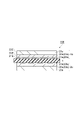
- FIG. 1 is a schematic cross-sectional view showing an example of a laminated body.
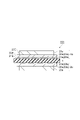
- FIG. 2 is a schematic cross-sectional view showing an example of the laminated body.
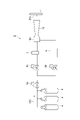
- FIG. 3 is a schematic view showing an example of a process of forming an alloy layer on a ceramic plate.
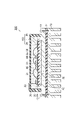
- FIG. 4 is a schematic cross-sectional view showing an example of the power module.
- the laminate includes a ceramic plate, a stress relaxation layer formed on the ceramic plate, and a metal circuit layer formed on the stress relaxation layer.
- the stress relaxation layer has an alloy layer in contact with the ceramic plate having a magnesium content of 7.5% by mass or less and an average thickness of less than 0.2 mm, and magnesium more than the alloy layer. It has a metal layer having a small content of and in contact with the metal circuit layer.
- FIG. 1 is a schematic cross-sectional view showing an example of the laminated body.
- the laminate 100 shown in FIG. 1 has a ceramic plate 1 and metal circuits 2a and 2b provided on both sides thereof.
- the metal circuit 2a includes a stress relaxation layer 20a and a metal circuit layer 23a.
- the metal circuit layer 23a is joined to the ceramic plate 1 via a stress relaxation layer 20a.
- the stress relaxation layer 20a is composed of an alloy layer 21a in contact with the ceramic plate 1 and a metal layer 22a provided on the alloy layer 21a and in contact with the metal circuit layer 23a.
- the metal circuit 2b includes a stress relaxation layer 20b and a metal circuit layer 23b.
- the metal circuit layer 23b is joined to the ceramic plate 1 via a stress relaxation layer 20b.
- the stress relaxation layer 20b is composed of an alloy layer 21b in contact with the ceramic plate 1 and a metal layer 22b provided on the alloy layer 21b and in contact with the metal circuit layer 23b.
- the metal circuit layers 23a and 23b shown in FIG. 1 are described as examples of uniform layers, they may have a pattern such as wiring.
- the metal circuit 2a and the metal circuit 2b are electrically insulated by the ceramic plate 1. As described above, the metal circuit layer and the stress relaxation layer or the metal circuit layer are in direct contact with each other, and the laminate 100 does not have a brazing material layer.
- the types of ceramic components constituting the ceramic plate 1 may be, for example, carbides, oxides, nitrides, and the like. Specifically, the type of ceramic component may be silicon carbide (SiC), aluminum oxide (Al 2 O 3 ), silicon nitride (Si 3 N 4 ), aluminum nitride (Al N 3 ), or the like.
- the ceramic plate 1 may be, for example, an aluminum oxide plate, a silicon nitride plate, and an aluminum nitride plate. Since the silicon nitride plate has few oxide layers on the surface, the effect of the present disclosure is more remarkable when the ceramic plate 1 is a silicon nitride plate.
- the oxide layer improves the adhesive force with other layers. In the laminate according to the present disclosure, the adhesive strength is improved by containing a predetermined amount of magnesium in the alloy layer. As a result, sufficient adhesive strength can be exhibited even when a ceramic plate having a small oxide layer is used.
- the average thickness of the ceramic plate 1 may be, for example, 0.2 to 1.5 mm or 0.25 to 1.0 mm.
- the average thickness of the plates and layers in the present specification means the average value of the thickness measured by a micrometer.
- the average value is the arithmetic mean value obtained by measuring at 10 points.
- the stress relaxation layers 20a and 20b are layers for relaxing the stress generated due to the difference in thermal expansion during the heat cycle between the ceramic plate 1 and the metal circuit layers 23a and 23b, respectively.
- the coefficient of thermal expansion of the stress relaxation layers 20a and 20b may be larger than the coefficient of thermal expansion of the ceramic plate 1 and may be larger than the coefficient of thermal expansion of the metal circuit layers 23a and 23b.
- the stress relaxation layers 20a and 20b are shown in the example of being composed of two layers of alloy layers 21a and 21b and metal layers 22a and 22b, respectively, but may be composed of, for example, three or more layers.
- the magnesium content in the stress relaxation layers 20a and 20b is set so as to be large on the ceramic plate 1 side and small on the metal circuit layers 23a and 23b.
- the metal layers 22a and 22b in contact with the metal circuit layers 23a and 23b do not have to contain magnesium. Since the metal layers 22a and 22b do not contain magnesium, they are softer than the alloy layers 21a and 21b, and the stress relaxation performance can be further improved.
- the alloy layers 21a and 21b contain magnesium. By containing magnesium having an excellent oxygen affinity, the bonding between the alloy layers 21a and 21b and the ceramic plate 1 becomes stronger. This effect is more remarkable when the oxide layer on the surface of the ceramic plate is small.
- the alloy layers 21a and 21b may be alloys containing magnesium and aluminum.
- the composition of the alloy layers 21a and 21b can be selected according to the metal composition of the metal layers 22a and 22b.
- the alloy layers 21a and 21b may be an aluminum-magnesium-based alloy or may be an aluminum-magnesium alloy.
- the alloy layers 21a and 21b may contain components other than aluminum and magnesium as long as the effects of the present invention are not impaired.
- the total content of other components is, for example, 5% by mass or less, 4% by mass or less, 3% by mass or less, 2% by mass or less, 1% by mass or less, 0.5% by mass or less, 0.1% by mass or less. , 0.05% by mass or less, or 0.01% by mass or less.
- other components includes impurities unintentionally contained in addition to the components to be arbitrarily added.
- Other components include, for example, O, C, Si, Mn, P, S, N, Ca, Cr, Ti, Nb, V, B, Mo, Cu, Ni, Sb, Sn, Ta, Mg, Zn, Examples thereof include Co, Zr, REM (Rare-earth element), and compounds thereof (for example, oxides, nitrides, sulfides, etc.).
- the upper limit of the magnesium content in the alloy layer 21a is 7.5% by mass or less based on the total amount of the alloy layer 21a, but for example, 7.0% by mass or less, 6.5% by mass or less, or 6 It may be 0.0% by mass or less.
- the lower limit of the magnesium content in the alloy layer 21a may be, for example, more than 0% by mass, based on the total amount of the alloy layer 21a, for example, 0.001% by mass or more, 0.01% by mass or more, 0.
- the magnesium content in the alloy layer 21a may be adjusted within the above range, and may be, for example, 0.001 to 7.5% by mass based on the total amount of the alloy layer 21a.
- the magnesium content in the present specification means a value measured by inductively coupled plasma (ICP) emission spectrometry.
- ICP inductively coupled plasma
- the upper limit of the average thickness of the alloy layer 21a is less than 0.2 mm, but may be, for example, 0.1 mm or less. Since the alloy layer 21a contains magnesium, it is a relatively hard layer. Therefore, if the upper limit of the average thickness of the alloy layer 21a is within the above range, the stress relaxation layer 20a is more sufficiently hardened. Suppresses and is more durable against heat cycles.
- the lower limit of the average thickness of the alloy layer 21a may be, for example, 0.02 mm or more, 0.03 mm or more, 0.04 mm or more, or 0.05 mm or more. When the lower limit of the average thickness of the alloy layer 21a is within the above range, the bond between the stress relaxation layer 20a and the ceramic plate 1 can be made stronger.
- the average thickness of the alloy layer 21a may be adjusted within the above range, and may be, for example, 0.02 mm or more and less than 0.2 mm, 0.02 mm to 0.1 mm, or 0.03 to 0.1 mm.
- the magnesium content in the alloy layer 21b may be the same as that described above for the alloy layer 21a.
- the magnesium content in the alloy layer 21b and the magnesium content in the alloy layer 21a may be the same or different. It may be adjusted according to the type and thickness of the metal of the metal circuit layers 23a and 23b.
- the average thickness of the alloy layer 21b may be the same as that described above for the alloy layer 21a.
- the average thickness of the alloy layer 21b and the average thickness of the alloy layer 21a may be the same or different.
- the average thickness of the alloy layers 21a and 21b can be adjusted according to the composition of the alloy layer, the difference in the coefficient of thermal expansion between the ceramic plate 1 and the metal circuit layers 23a and 23b, and the like.
- the metal layers 22a and 22b are layers having a lower magnesium content than the alloy layers 21a and 21b, and may not contain magnesium.
- the metal layers 22a and 22b may include, for example, at least one selected from the group consisting of aluminum and aluminum alloys, may be composed of aluminum or an aluminum alloy, or may be composed of aluminum.
- the metal layers 22a and 22b preferably do not contain magnesium and are more preferably composed only of aluminum and the metals constituting the metal circuit layers 23a and 23b.
- the metal may form an alloy with aluminum, and in this case, the alloy may form the metal circuit layers 23a and the metal circuit layers 23a and 22b of the metal layers 22a and 22b. It may be scattered on the surface on the 23b side.
- the metal layers 22a and 22b may contain components other than aluminum and magnesium as long as the effects of the present invention are not impaired.
- the total content of other components is, for example, 5% by mass or less, 4% by mass or less, 3% by mass or less, 2% by mass or less, 1% by mass or less, 0.5% by mass or less, 0.1% by mass or less. , 0.05% by mass or less, or 0.01% by mass or less.
- other components includes impurities unintentionally contained in addition to the components to be arbitrarily added.
- Other components include, for example, O, C, Si, Mn, P, S, N, Ca, Cr, Ti, Nb, V, B, Mo, Cu, Ni, Sb, Sn, Ta, Mg, Zn, Examples thereof include Co, Zr, REM, and compounds thereof (for example, oxides, nitrides, sulfides, etc.).
- the average thickness of the metal layer 22a is larger than the average thickness of the alloy layer 21a, and is, for example, 1.0 times or more, 1.5 times or more, or 2 times or more based on the average thickness of the alloy layer 21a. You can do it. Since the average thickness of the metal layer 22a and the average thickness of the alloy layer 21a have the above relationship, the stress relaxation layer 20a is more sufficiently suppressed from becoming too hard, and the durability against the heat cycle is more excellent.
- the average thickness of the metal layer 22a may be, for example, 20 times or less, 17 times or less, or 15 times or less based on the average thickness of the alloy layer 21a.
- the thermal resistance of the ceramic substrate can be reduced.
- the average thickness of the metal layer 22a may be adjusted within the above range, and may be, for example, 1.0 to 20 times based on the average thickness of the alloy layer 21a.
- the lower limit of the average thickness of the metal layer 22a may be, for example, more than 0.1 mm, 0.15 mm or more, or 0.2 mm or more. When the lower limit of the average thickness of the metal layer 22a is within the above range, the durability against the heat cycle is more excellent.
- the upper limit of the average thickness of the metal layer 22a may be, for example, 0.4 mm or less, 0.35 mm or less, or 0.3 mm or less. When the upper limit of the average thickness of the metal layer 22a is within the above range, the thermal resistance of the ceramic substrate can be reduced.
- the average thickness of the metal layer 22b may be the same as that described above for the metal layer 22a.
- the average thickness of the metal layer 22b and the average thickness of the metal layer 22a may be the same or different.
- the average thickness of the metal layers 22a and 22b can be adjusted according to the difference in the coefficient of thermal expansion between the ceramic plate 1 and the metal circuit layers 23a and 23b.
- the metal circuit layers 23a and 23b may contain metals such as gold, platinum, silver, copper, nickel, and chromium, may contain gold, silver, copper, and the like, and may be made of copper.
- the metal circuit layers 23a and 23b may be, for example, a wiring pattern made of copper, a wiring pattern made of a copper alloy, or the like.
- the lower limit of the average thickness of the metal circuit layers 23a and 23b may be, for example, 0.3 mm or more, 0.35 mm or more, or 0.4 mm or more.
- the upper limit of the average thickness of the metal circuit layers 23a and 23b may be, for example, 4 mm or less, 3 mm or less, or 2 mm or less.
- the laminate 100 of FIG. 1 shows an example in which the end face 21E of the alloy layer 21a, the end face 22E of the metal layer 22a, and the end face 23E of the metal circuit layer 23a are the same surface, but the end face 21E of the alloy layer 21a and the metal
- the surface composed of the end surface 22E of the layer 22a and the surface composed of the end surface 23E of the metal circuit layer 23a do not necessarily have to be the same surface.
- the laminate 101 shown in FIG. 2 is an example in which the surface composed of the end surface 21E of the alloy layer 21a and the end surface 22E of the metal layer 22a and the surface composed of the end surface 23E of the metal circuit layer 23a are different surfaces. Indicated.
- the laminated body is more excellent in durability against heat cycle. It can be a thing.
- the difference between the widths of the metal circuit layers 23a and 23b and the widths of the stress relaxation layers 20a and 20b may be, for example, 1 to 1000 ⁇ m or 10 to 100 ⁇ m.
- the above-mentioned laminates 100 and 101 can be manufactured by a method of sequentially forming an alloy layer, a stress relaxation layer including a metal layer, and a metal circuit layer on a ceramic plate by using a so-called cold spray method.
- a stress relaxation layer having an alloy layer and a metal layer and a metal circuit layer are formed on a ceramic plate by a spraying operation such as cold spraying or thermal spraying, irregularities derived from the spraying operation may be formed at the interface of each layer. .. Therefore, the above-mentioned laminated bodies 100 and 101 have characteristics different from those manufactured by sequentially laminating metal thin films and the like formed in layers in advance.
- a first metal powder containing magnesium is sprayed together with an inert gas from a nozzle onto the surface of the ceramic plate to form a first deposited layer in contact with the ceramic plate.
- a step of forming a third deposited layer in contact with the metal layer by spraying a third metal powder containing metal particles together with an inert gas from a nozzle onto the surface of the metal layer.
- the third layer is heat-treated in an inert gas atmosphere to form a metal circuit layer.
- FIG. 3 is a schematic view showing an example of a process of forming an alloy layer on a ceramic plate.
- the first deposited layer is formed on the ceramic plate 1 by spraying the metal powder onto the surface of the ceramic plate 1 using the powder spray device 3.
- the alloy layer 21a is formed by heat-treating the first sedimentary layer. After forming the alloy layer 21a, the alloy layer 21b on the back side thereof may be formed.
- the powder spray device 3 shown in FIG. 3 is mainly composed of a high-pressure gas cylinder 4, a heater 6, a powder supply device 7, a nozzle 10 of a spray gun having a tapered tapered shape, and a pipe connecting them.
- a first pressure regulator 5a is provided on the downstream side of the plurality of high-pressure gas cylinders 4, and the pipe branches into two circuits on the downstream side of the first pressure regulator 5a.
- a second pressure regulator 5b and a heater 6 and a third pressure regulator 5c and a powder supply device 7 are connected to each of the two branched circuits.
- the pipes from the heater 6 and the powder supply device 7 are connected to the nozzle 10.
- the high-pressure gas cylinder 4 is filled with an inert gas used as a working gas, for example, at a pressure of 1 MPa or more.
- the inert gas may be, for example, a single gas of helium or nitrogen, or a mixed gas thereof.
- the working gas OG supplied from the high-pressure gas cylinder 4 is heated by the heater 6 after being adjusted in pressure by the second pressure regulator 5b on one circuit, and then supplied to the nozzle 10 of the spray gun. ..
- the working gas OG is also supplied to the powder supply device 7 after the pressure is adjusted by the third pressure regulator 5c on the other circuit. From the powder supply device 7, metal powder for film formation is supplied to the nozzle 10 of the spray gun together with the working gas OG.
- the gauge pressure of the working gas OG is adjusted to be, for example, 1.5 to 5.0 MPa or 2.0 to 4.0 MPa at the inlet 10a of the nozzle 10.
- a sedimentary layer a layer that is later heat-treated to become an alloy layer
- the gauge pressure at the inlet of the nozzle of the working gas OG can be measured at the connection portion between the nozzle and the pipe.
- the heating temperature by the heater 6 is usually set lower than the melting point or softening point of the metal powder to be formed.
- the heater 6 can be arbitrarily selected from ordinary heating devices.
- the working gas supplied to the nozzle 10 of the spray gun is compressed by passing through the tapered portion, and is accelerated by being expanded at once in the divergent portion on the downstream side thereof.
- the metal powder is heated to a predetermined temperature, accelerated to a predetermined speed, and then ejected from the outlet of the nozzle 10.
- the metal powder ejected from the nozzle 10 is sprayed onto the surface of the ceramic plate 1.
- the metal powder is deposited on the surface of the ceramic plate 1 while colliding with each other in a solid phase state to form the first deposition layer.
- the first sedimentary layer is then heat treated to form an alloy layer 21a.
- the first metal powder may be, for example, magnesium alloy particles containing magnesium and other metal elements, or aluminum-magnesium alloy particles.
- the aluminum-magnesium alloy particles may be gas atomizing powder in which magnesium is dissolved in aluminum. Since the composition of the first metal powder (for example, the content of magnesium) is reflected in the composition of the alloy layer formed later (for example, the content of magnesium), the composition of the first metal powder is adjusted. , The composition of the alloy layer can be controlled.
- the first metal powder may be heated to, for example, 10 to 270 ° C. or 20 to 260 ° C. By setting the heating temperature of the first metal powder within this range, the first body lamination can be efficiently formed.
- the temperature at which the metal powder is heated means the maximum temperature reached by the metal powder.
- the temperature of the inert gas at the outlet of the nozzle 10 can also be regarded as the temperature at which the metal powder is heated.
- the term "heating" is used in the present specification to include adjusting the temperature to a predetermined temperature below room temperature.
- a first sedimentary layer or the like having a pattern may be formed on the ceramic base material.
- a metal circuit having a desired pattern can be easily formed without performing an additional process such as etching.
- the method according to the present embodiment is more advantageous than the conventional molten metal method and brazing method, which require etching for pattern formation, from the viewpoint of simplifying the process and controlling the quality of the obtained product. I can say.
- the first metal powder may be accelerated to 250 to 1050 m / sec in the nozzle 10.
- the rate at which the metal powder is accelerated means the maximum speed that the accelerated metal powder can reach. If the speed at which the accelerated metal powder arrives is less than 250 m / sec, it is difficult for the metal powder to be sufficiently plastically deformed at the moment when the metal powder collides with a ceramic base material or the like, so that it is difficult to form a deposited layer. Or, the adhesion of the formed sedimentary layer tends to decrease. If the speed at which the accelerated metal powder reaches exceeds 1050 m / sec, when the metal powder collides with a ceramic base material or the like, the metal powder tends to be crushed and scattered, making it difficult to form a deposited layer. be.
- the first body laminate formed on the ceramic plate is heat-treated in an inert gas atmosphere.
- the temperature of the heat treatment may be, for example, 400 to 600 ° C.
- the reaction between magnesium and the oxide layer on the surface of the ceramic plate can be further promoted, and a strong bond can be formed.
- the influence of softening of the first sedimentary layer can be reduced.
- a second deposited layer is formed by spraying the second metal powder onto the surface of the alloy layer by the same method as the above-mentioned formation of the alloy layer, and the metal layer is formed by the subsequent heat treatment.
- the stress relaxation layer is composed of three or more layers, for example, the layers can be sequentially formed by repeating the same means as the formation of the alloy layer described above.
- the composition and thickness of the metal layer can be controlled by the composition and the amount of spraying of the second metal powder, respectively.
- the composition of the alloy or metal constituting each layer can be changed by adjusting the composition of the metal powder sprayed on the surface of each layer.
- the content of magnesium in the metal powder may be adjusted to be gradually reduced.
- the metal powder to be finally sprayed to form a layer to be bonded to the metal circuit layer to be formed later preferably does not contain magnesium, and from the viewpoint of improving stress relaxation performance, for example, it is an aluminum powder. Is preferable.
- a third metal powder containing copper or the like as a main component is sprayed from the nozzle to the surface of the metal layer together with an inert gas to form a third deposited layer, followed by heat treatment to form a metal circuit. Form a layer.
- the third metal powder may be heated to, for example, 10 to 650 ° C or 20 to 640 ° C.
- the heating temperature of the third metal powder By setting the heating temperature of the third metal powder within the above range, the third sedimentary layer can be efficiently formed.
- the heating temperature of the third metal powder By setting the heating temperature of the third metal powder to 650 ° C. or lower, it is possible to prevent softened metal particles such as copper from adhering to the inner wall of the nozzle and clogging the nozzle, and the metal circuit.
- the formation of layers can be made easier.
- the heating temperature of the third metal powder to 10 ° C. or higher, the plastic deformation of the metal particles such as copper can be made easier, and the formation of the third sedimentary layer can be made easier.
- the gauge pressure of the working gas OG may be, for example, 1.5 to 5.0 MPa or 2.0 to 4.0 MPa at the inlet 10a of the nozzle 10.
- the gauge pressure of the working gas OG may be, for example, 1.5 to 5.0 MPa or 2.0 to 4.0 MPa at the inlet 10a of the nozzle 10.
- the gauge pressure of the working gas at the inlet of the nozzle is 5.0 MPa or less, the tertiary metal powder sprayed on the metal layer together with the inert gas is crushed, and the efficiency of forming the third deposited layer is reduced. It can be more suppressed.
- the conditions for forming the third sedimentary layer by spraying the third metal powder may be adjusted in the same manner as for the formation of the alloy layer and the metal layer described above.
- a third sedimentary layer having a pattern is formed and heated.
- a metal circuit layer having a pattern may be formed.
- the third sedimentary layer is heat-treated in an inert gas atmosphere.
- the temperature may be, for example, 250 to 350 ° C.
- strain in the alloy layer and the metal layer due to work hardening can be reduced.
- the first metal powder, the second metal powder, and / or the third metal powder may each be composed of spherical particles.
- the first metal powder, the second metal powder, and / or the third metal powder may each have a small variation in particle size.
- the average particle size of the metal powder may be, for example, 10 to 70 ⁇ m or 20 to 60 ⁇ m. By setting the average particle size of the metal powder to 10 ⁇ m or more, it is possible to further prevent the metal powder from clogging the tapered portion of the nozzle. By setting the average particle size of the metal powder to 70 ⁇ m or less, the speed of the metal powder can be sufficiently increased.
- the average particle size in the present specification is the particle size (D50) when the integrated value from the small particle size reaches 50% of the total in the volume-based particle size distribution curve measured by the laser diffraction / scattering method.
- D50 is also called a median diameter and is known as the average particle size of the target particles.
- the above-mentioned laminated body has excellent durability against heat cycles, it can be suitably used as, for example, a member (for example, a circuit board or the like) constituting a power module or the like.
- a member for example, a circuit board or the like
- the power module comprises a circuit board, a semiconductor element electrically connected on one main surface of the circuit board, and a heat dissipation member connected on the other main surface of the circuit board.
- the circuit board is the above-mentioned laminated body.
- FIG. 4 is a schematic cross-sectional view showing an example of a power module.
- the power module 300 includes a base plate 70 and a circuit board 102 that is joined to one surface of the base plate 70 via a solder 32.
- the metal circuit 2b (alloy layer, metal layer and metal circuit layer) of the circuit board 102 is joined to the solder 32.
- the circuit board 102 may be the above-mentioned laminates 100, 101, or the like.
- a semiconductor element 60 is attached to the metal circuit 2a of the circuit board 102 via a solder 31.
- the semiconductor element 60 is connected to a predetermined position in the metal circuit 2a by a metal wire 34 such as an aluminum wire (aluminum wire).
- a metal wire 34 such as an aluminum wire (aluminum wire).
- a predetermined portion of the metal circuit 2a is connected to an electrode 33 provided through the housing 36 via a solder 35.
- a housing 36 is arranged on one surface of the base plate 70 so as to accommodate the circuit board 102.
- the accommodation space formed by one surface of the base plate 70 and the housing 36 is filled with a resin 30 such as silicone gel.
- Cooling fins 72 forming a heat radiating member are joined to the other surface of the base plate 70 via grease 74.
- a screw 73 for fixing the cooling fin 72 to the base plate 70 is attached to the end of the base plate 70.
- the base plate 70 and the cooling fins 72 may be made of aluminum.
- the base plate 70 and the cooling fins 72 have high thermal conductivity and thus function well as heat radiating portions.
- the power module 300 includes metal circuits 2a and 2b of the circuit board 102 and a semiconductor element 60 that is electrically connected to the metal circuit 2a.
- the semiconductor element 60 is sealed with the resin 30 together with the circuit board 102.
- Such a power module 300 can maintain the adhesion between the resin 30 and the ceramic plate 1 even if the semiconductor element 60 generates heat.
- This raw material powder was uniaxially pressure-molded to prepare a molded product. This molded body was placed in an electric furnace equipped with a carbon heater and fired at 1800 ° C. for 12 hours in an atmosphere of nitrogen gas to obtain a flat plate-shaped silicon nitride plate. The obtained silicon nitride plate was used as a ceramic plate.
- Example 1 ⁇ Formation of alloy layer (layer made of aluminum-magnesium alloy)> Using an aluminum-magnesium alloy powder (manufactured by High Purity Chemical Laboratory Co., Ltd., gas atomized powder, median diameter: 24 ⁇ m), using a powder spraying device having the same configuration as in FIG. 3, length: 56 mm, width: 46 mm, A deposit layer (first deposit layer) of aluminum-magnesium alloy powder having a thickness of 0.1 mm was formed on each of the front and back surfaces of the aluminum nitride plate within a range of 2 mm inside from the end face of the base material.
- an aluminum-magnesium alloy powder manufactured by High Purity Chemical Laboratory Co., Ltd., gas atomized powder, median diameter: 24 ⁇ m
- a deposit layer (first deposit layer) of aluminum-magnesium alloy powder having a thickness of 0.1 mm was formed on each of the front and back surfaces of the aluminum nitride plate within a range of 2 mm inside from the end face of the base material.
- the formation of the first deposited layer was carried out under the conditions that nitrogen was used as the working gas, the temperature of the aluminum-magnesium alloy powder (gas atomized powder) was 260 ° C., and the pressure of the working gas at the nozzle inlet was 3 MPa.
- the first sedimentary layer was heat-treated by holding it at a temperature of 550 ° C. for 3 hours in a nitrogen atmosphere to form an aluminum-magnesium alloy layer (alloy layer).
- ⁇ Formation of metal layer (layer made of aluminum)>
- a powder spraying device having the same configuration as in FIG.
- a 0.2 mm aluminum powder deposit layer (second deposit layer) is formed on the surfaces of the two alloy layers formed as described above so that the length is 56 mm and the width is 46 mm, similarly to the alloy layer. did.
- the formation of the second sedimentary layer was carried out under the conditions that nitrogen was used as the working gas, the temperature of the aluminum powder was 260 ° C., and the pressure of the working gas at the nozzle inlet was 3 MPa.
- the second sedimentary layer was heat-treated by holding it at a temperature of 550 ° C. for 3 hours in a nitrogen atmosphere to form an aluminum layer (metal layer).
- ⁇ Formation of metal circuit layer (layer made of copper)> Further, a part of the aluminum layer is masked with an iron masking material, and copper powder (manufactured by Fukuda Metal Foil Powder Industry Co., Ltd., water atomized powder, median diameter: 17 ⁇ m) is used, and the powder has the same structure as that of FIG.
- the copper powder deposit layer (third deposit layer) is placed in the range 50 ⁇ m inside from the end face of the aluminum layer so that the length is 55.9 mm, the width is 45.9 mm, and the thickness is 0.4 mm. Formed.
- the third sedimentary layer was carried out under the conditions that nitrogen was used as the working gas, the temperature of the copper powder was 640 ° C., and the pressure of the working gas at the nozzle inlet was 3 MPa.
- the end face of the aluminum layer protruded outward with a width of 50 ⁇ m from the end face of the copper layer.
- the third sedimentary layer was heat-treated by holding it at a temperature of 300 ° C. for 1 hour in a nitrogen atmosphere to form a copper layer (metal circuit layer).
- Example 2 Lamination in the same manner as in Example 1 except that the type and thickness of the ceramic plate, the magnesium content in the alloy layer, the thickness of the alloy layer, and the thickness of the metal layer were changed as shown in Table 1.
- the body was prepared.
- Example 5 A laminate was prepared in the same manner as in Example 1 except that the type and thickness of the ceramic plate and the thickness of the metal layer were changed as shown in Table 2 without providing the alloy layer.
- heat cycle test> A heat cycle test was conducted on each of the laminates prepared in Examples 1 to 9 and Comparative Examples 1 to 17, and the durability against the heat cycle was evaluated. Specifically, a heat cycle test was conducted in which the laminate was left in an environment of 180 ° C. for 30 minutes and then left in an environment of ⁇ 55 ° C. for 30 minutes as one cycle, and this was carried out for 3000 cycles. From the cross-sectional observation of the laminated body after the test, it was evaluated according to the following criteria. The results are shown in Tables 1 and 2. A: No abnormalities such as peeling were observed even after 3000 cycles. B: Peeling was observed in more than 1500 cycles and less than 3000 cycles. C: Peeling was observed in more than 1000 cycles and less than 1500 cycles. D: Peeling was observed in 1000 cycles or less.
Landscapes
- Chemical & Material Sciences (AREA)
- Engineering & Computer Science (AREA)
- Chemical Kinetics & Catalysis (AREA)
- Materials Engineering (AREA)
- Mechanical Engineering (AREA)
- Metallurgy (AREA)
- Organic Chemistry (AREA)
- Ceramic Engineering (AREA)
- Laminated Bodies (AREA)
- Other Surface Treatments For Metallic Materials (AREA)
- Cooling Or The Like Of Semiconductors Or Solid State Devices (AREA)
Priority Applications (2)
| Application Number | Priority Date | Filing Date | Title |
|---|---|---|---|
| JP2022535194A JP7186929B1 (ja) | 2021-01-12 | 2022-01-04 | 積層体、及びその製造方法、並びに、パワーモジュール |
| JP2022190059A JP7538845B2 (ja) | 2021-01-12 | 2022-11-29 | 積層体、及び、パワーモジュール |
Applications Claiming Priority (2)
| Application Number | Priority Date | Filing Date | Title |
|---|---|---|---|
| JP2021003040 | 2021-01-12 | ||
| JP2021-003040 | 2021-01-12 |
Publications (1)
| Publication Number | Publication Date |
|---|---|
| WO2022153891A1 true WO2022153891A1 (ja) | 2022-07-21 |
Family
ID=82447341
Family Applications (1)
| Application Number | Title | Priority Date | Filing Date |
|---|---|---|---|
| PCT/JP2022/000041 Ceased WO2022153891A1 (ja) | 2021-01-12 | 2022-01-04 | 積層体、及びその製造方法、並びに、パワーモジュール |
Country Status (2)
| Country | Link |
|---|---|
| JP (2) | JP7186929B1 (https=) |
| WO (1) | WO2022153891A1 (https=) |
Citations (6)
| Publication number | Priority date | Publication date | Assignee | Title |
|---|---|---|---|---|
| JP2000281468A (ja) * | 1998-11-12 | 2000-10-10 | Denki Kagaku Kogyo Kk | 炭化珪素質複合体及びその製造方法とそれを用いた放熱部品 |
| JP2013074199A (ja) * | 2011-09-28 | 2013-04-22 | Nhk Spring Co Ltd | 放熱構造体、パワーモジュール、放熱構造体の製造方法およびパワーモジュールの製造方法 |
| WO2017082368A1 (ja) * | 2015-11-11 | 2017-05-18 | 日本発條株式会社 | 積層体および積層体の製造方法 |
| WO2018135490A1 (ja) * | 2017-01-17 | 2018-07-26 | デンカ株式会社 | セラミックス回路基板の製造方法 |
| WO2018135499A1 (ja) * | 2017-01-17 | 2018-07-26 | 国立大学法人信州大学 | セラミックス回路基板の製造方法 |
| JP2019067801A (ja) * | 2017-09-28 | 2019-04-25 | デンカ株式会社 | 放熱部品付きパワーモジュール |
-
2022
- 2022-01-04 JP JP2022535194A patent/JP7186929B1/ja active Active
- 2022-01-04 WO PCT/JP2022/000041 patent/WO2022153891A1/ja not_active Ceased
- 2022-11-29 JP JP2022190059A patent/JP7538845B2/ja active Active
Patent Citations (6)
| Publication number | Priority date | Publication date | Assignee | Title |
|---|---|---|---|---|
| JP2000281468A (ja) * | 1998-11-12 | 2000-10-10 | Denki Kagaku Kogyo Kk | 炭化珪素質複合体及びその製造方法とそれを用いた放熱部品 |
| JP2013074199A (ja) * | 2011-09-28 | 2013-04-22 | Nhk Spring Co Ltd | 放熱構造体、パワーモジュール、放熱構造体の製造方法およびパワーモジュールの製造方法 |
| WO2017082368A1 (ja) * | 2015-11-11 | 2017-05-18 | 日本発條株式会社 | 積層体および積層体の製造方法 |
| WO2018135490A1 (ja) * | 2017-01-17 | 2018-07-26 | デンカ株式会社 | セラミックス回路基板の製造方法 |
| WO2018135499A1 (ja) * | 2017-01-17 | 2018-07-26 | 国立大学法人信州大学 | セラミックス回路基板の製造方法 |
| JP2019067801A (ja) * | 2017-09-28 | 2019-04-25 | デンカ株式会社 | 放熱部品付きパワーモジュール |
Also Published As
| Publication number | Publication date |
|---|---|
| JP7538845B2 (ja) | 2024-08-22 |
| JPWO2022153891A1 (https=) | 2022-07-21 |
| JP2023026431A (ja) | 2023-02-24 |
| JP7186929B1 (ja) | 2022-12-09 |
Similar Documents
| Publication | Publication Date | Title |
|---|---|---|
| CN108290380B (zh) | 层叠体及层叠体的制造方法 | |
| CN102612745B (zh) | 电子设备用散热板及其制造方法 | |
| JP7440944B2 (ja) | 複合材料および放熱部品 | |
| JP6991516B2 (ja) | セラミックス回路基板の製造方法 | |
| JP6948350B2 (ja) | セラミックス回路基板の製造方法 | |
| TW201324701A (zh) | 接合體 | |
| JP5030633B2 (ja) | Cr−Cu合金板、半導体用放熱板及び半導体用放熱部品 | |
| JP3937952B2 (ja) | 放熱回路基板とその作製方法 | |
| JP2006278558A (ja) | 絶縁伝熱構造体及びパワーモジュール用基板 | |
| WO2022153891A1 (ja) | 積層体、及びその製造方法、並びに、パワーモジュール | |
| JP6378247B2 (ja) | 積層体、パワーモジュールおよび積層体の製造方法 | |
| CN114729440B (zh) | 复合基板及其制造方法、以及电路基板及其制造方法 | |
| JP5940589B2 (ja) | 積層体、及びパワーモジュール |
Legal Events
| Date | Code | Title | Description |
|---|---|---|---|
| ENP | Entry into the national phase |
Ref document number: 2022535194 Country of ref document: JP Kind code of ref document: A |
|
| 121 | Ep: the epo has been informed by wipo that ep was designated in this application |
Ref document number: 22739301 Country of ref document: EP Kind code of ref document: A1 |
|
| NENP | Non-entry into the national phase |
Ref country code: DE |
|
| 122 | Ep: pct application non-entry in european phase |
Ref document number: 22739301 Country of ref document: EP Kind code of ref document: A1 |