WO2022138487A1 - 口腔用組成物 - Google Patents
口腔用組成物 Download PDFInfo
- Publication number
- WO2022138487A1 WO2022138487A1 PCT/JP2021/046729 JP2021046729W WO2022138487A1 WO 2022138487 A1 WO2022138487 A1 WO 2022138487A1 JP 2021046729 W JP2021046729 W JP 2021046729W WO 2022138487 A1 WO2022138487 A1 WO 2022138487A1
- Authority
- WO
- WIPO (PCT)
- Prior art keywords
- component
- mass
- oral composition
- extract
- examples
- Prior art date
- Legal status (The legal status is an assumption and is not a legal conclusion. Google has not performed a legal analysis and makes no representation as to the accuracy of the status listed.)
- Ceased
Links
Classifications
-
- A—HUMAN NECESSITIES
- A61—MEDICAL OR VETERINARY SCIENCE; HYGIENE
- A61K—PREPARATIONS FOR MEDICAL, DENTAL OR TOILETRY PURPOSES
- A61K8/00—Cosmetics or similar toiletry preparations
- A61K8/18—Cosmetics or similar toiletry preparations characterised by the composition
- A61K8/19—Cosmetics or similar toiletry preparations characterised by the composition containing inorganic ingredients
- A61K8/25—Silicon; Compounds thereof
-
- A—HUMAN NECESSITIES
- A61—MEDICAL OR VETERINARY SCIENCE; HYGIENE
- A61K—PREPARATIONS FOR MEDICAL, DENTAL OR TOILETRY PURPOSES
- A61K8/00—Cosmetics or similar toiletry preparations
- A61K8/18—Cosmetics or similar toiletry preparations characterised by the composition
- A61K8/30—Cosmetics or similar toiletry preparations characterised by the composition containing organic compounds
- A61K8/40—Cosmetics or similar toiletry preparations characterised by the composition containing organic compounds containing nitrogen
-
- A—HUMAN NECESSITIES
- A61—MEDICAL OR VETERINARY SCIENCE; HYGIENE
- A61K—PREPARATIONS FOR MEDICAL, DENTAL OR TOILETRY PURPOSES
- A61K8/00—Cosmetics or similar toiletry preparations
- A61K8/18—Cosmetics or similar toiletry preparations characterised by the composition
- A61K8/30—Cosmetics or similar toiletry preparations characterised by the composition containing organic compounds
- A61K8/46—Cosmetics or similar toiletry preparations characterised by the composition containing organic compounds containing sulfur
-
- A—HUMAN NECESSITIES
- A61—MEDICAL OR VETERINARY SCIENCE; HYGIENE
- A61K—PREPARATIONS FOR MEDICAL, DENTAL OR TOILETRY PURPOSES
- A61K8/00—Cosmetics or similar toiletry preparations
- A61K8/18—Cosmetics or similar toiletry preparations characterised by the composition
- A61K8/96—Cosmetics or similar toiletry preparations characterised by the composition containing materials, or derivatives thereof of undetermined constitution
- A61K8/97—Cosmetics or similar toiletry preparations characterised by the composition containing materials, or derivatives thereof of undetermined constitution from algae, fungi, lichens or plants; from derivatives thereof
- A61K8/9783—Angiosperms [Magnoliophyta]
- A61K8/9789—Magnoliopsida [dicotyledons]
-
- A—HUMAN NECESSITIES
- A61—MEDICAL OR VETERINARY SCIENCE; HYGIENE
- A61K—PREPARATIONS FOR MEDICAL, DENTAL OR TOILETRY PURPOSES
- A61K8/00—Cosmetics or similar toiletry preparations
- A61K8/18—Cosmetics or similar toiletry preparations characterised by the composition
- A61K8/96—Cosmetics or similar toiletry preparations characterised by the composition containing materials, or derivatives thereof of undetermined constitution
- A61K8/97—Cosmetics or similar toiletry preparations characterised by the composition containing materials, or derivatives thereof of undetermined constitution from algae, fungi, lichens or plants; from derivatives thereof
- A61K8/9783—Angiosperms [Magnoliophyta]
- A61K8/9794—Liliopsida [monocotyledons]
-
- A—HUMAN NECESSITIES
- A61—MEDICAL OR VETERINARY SCIENCE; HYGIENE
- A61Q—SPECIFIC USE OF COSMETICS OR SIMILAR TOILETRY PREPARATIONS
- A61Q11/00—Preparations for care of the teeth, of the oral cavity or of dentures; Dentifrices, e.g. toothpastes; Mouth rinses
Definitions
- the present invention relates to an oral composition.
- Patent Document 1 describes a non-aqueous oral care composition containing a specific organic polyol such as glycerol, a particulate abrasive such as silicic acid anhydride, a surfactant, and xanthan gum.
- Patent Document 2 describes a non-aqueous toothpaste composition containing a carboxyvinyl polymer, an anhydrous wetting agent such as glycerin, and an abrasive such as polyethylene glycol, silica, and calcium carbonate, and may further contain a surfactant.
- the plant extract may be added to the oral composition for the purpose of imparting various physiological activities (for example, Patent Document 3).
- An object of the present invention is to provide a non-aqueous oral composition in which an unpleasant taste is suppressed.
- the present invention provides the following [1] to [8].
- the component (B) contains at least one selected from shell ginger extract, sardine extract, toki extract, calendula officinalis extract, chamomile extract, and mukuroji extract.
- an unpleasant taste can be suppressed in a non-aqueous oral composition.
- the oral composition contains (A) component: a component having an unpleasant taste, preferably a component having a bitter taste.
- the component (A) is usually a component other than a non-aqueous organic solvent, and is preferably an inorganic powder or a surfactant having an unpleasant taste.
- -Inorganic powder- Inorganic powder is a component generally contained in oral compositions such as toothpaste and dentifrice as a tooth cleaning agent and a thickener.
- the inorganic powder having an unpleasant taste include silica-based materials and calcium-based materials.
- the silica-based material include silica (precipitating silica, titanium-binding silica, silica gel, aluminosilicate, and zirconosilicate).
- Examples of calcium-based materials include calcium carbonate (light and heavy); calcium dibasic phosphate, dihydrate salt or anhydrate, calcium primary phosphate, calcium tertiary phosphate, calcium pyrophosphate, insoluble calcium metaphosphate, calcium tertiary phosphate, fourth.
- Calcium phosphate-based materials such as calcium phosphate and eighth calcium phosphate; calcium hydroxide; powders of inorganic substances such as calcium sulfate can be mentioned.
- silica is preferred. It is preferable to use silica having an RDA (Radioactive Dentin Abrasion) in the range of 50 to 250. RDA can be measured according to Hefferren's method (Hefferren (1976) Journal of Dental Research, July-August, 563-573).
- the size of the inorganic powder can be appropriately selected depending on the type of the inorganic material constituting each powder, but usually, the average particle size (volume-based D50, measured value by laser diffraction / scattering method) is 0.1 to 40 ⁇ m, preferably 0.1 to 40 ⁇ m.
- a particle size distribution measuring device for example, Microtrack particle size distribution measuring device (Made 117995-10, Type SRA) manufactured by Nikkiso Co., Ltd.) and adjust the turbidity (dV value) of the sample to 0.5. It can be measured, and the average particle size shown in the subsequent examples is the measured value by this method.
- a particle size distribution measuring device for example, Microtrack particle size distribution measuring device (Made 117995-10, Type SRA) manufactured by Nikkiso Co., Ltd.
- dV value turbidity
- the content is preferably 8% by mass or more, more preferably 10% by mass or more.
- the upper limit is preferably 40% by mass or less, more preferably 30% by mass or less. Thereby, the viscosity of the composition does not become too high and good physical properties can be obtained. Therefore, the content of the inorganic powder is preferably 8 to 40% by mass, more preferably 10 to 30% by mass.
- surfactant having an unpleasant taste examples include amphoteric surfactants and anionic surfactants.
- amphoteric surfactant examples include alkyldimethylaminoacetic acid betaine (eg, lauryldimethylaminoacetic acid betaine) and fatty acid amide propyl betaine (eg, cocamidopropyl betaine, fatty acid amide propyldimethylaminoacetic acid betaine, lauric acid amide propyl betaine). Etc.
- alkyldimethylaminoacetic acid betaine eg, lauryldimethylaminoacetic acid betaine
- fatty acid amide propyl betaine eg, cocamidopropyl betaine, fatty acid amide propyldimethylaminoacetic acid betaine, lauric acid amide propyl betaine
- Betaine-type amphoteric surfactant N-fatty acid acyl-N-carboxymethyl-N-hydroxyethylethylenediamine salt (eg, N-palm oil fatty acid acyl-N-carboxymethyl-N-hydroxyethylimidazolinium betaine); Examples thereof include imidazoline-type amphoteric surfactants such as coconut oil fatty acid imidazolinium betaine and 2-alkyl-N-carboxymethyl-N-hydroxyethyl imidazolinium betaine.
- the number of carbon atoms of the alkyl group and the acyl group is preferably 8 to 18.
- betaine-type amphoteric tenside agents are preferable, fatty acid amide propyl betaine is more preferable, and cocamidopropyl betaine and lauric acid amide propyl betaine are more preferable.
- anionic surfactant examples include alkyl sulfates, acyl amino acid salts, acyl taurine salts, ⁇ -olefin sulfonates, hydrogenated coconut fatty acid monoglyceride monosulfates, and lauryl sulfoacetates.
- the alkyl group and the acyl group may be either a straight chain or a branched chain, and may be saturated or unsaturated, and the number of carbon atoms thereof is usually 10 to 20, preferably 12 to 18, and more preferably 12 to 14.
- the salt can be selected from pharmacologically acceptable salts.
- Examples of the pharmacologically acceptable salt include inorganic base salts such as sodium salt, potassium salt, calcium salt, magnesium salt and ammonium salt; triethylammonium salt, triethanolammonium salt, pyridinium salt, diisopropylammonium salt and the like.
- Organic base salts examples include amino acid salts such as arginine salt, lysine salt and histidine salt. Of these, inorganic base salts are preferred, alkali metal salts (eg, sodium salts, potassium salts) or ammonium salts are more preferred, and sodium salts are even more preferred.
- alkyl sulfate examples include lauryl sulfate and myristoyl sulfate.
- acyl amino acid salt include acyl sarcosine salts such as lauroyl sarcosin salt and myristyl sarcosin salt; lauroyl glutamate; acyl glutamate such as myristoyl glutamate, palmitoyl glutamate and palmitoyl glutamate; N-lauroyl-N-methylglycine.
- Acylglycine salts such as salts and cocoylglycine salts; N-lauroyl- ⁇ -alanine salt, N-myristyl- ⁇ -alanine salt, N-cocoyl- ⁇ -alanine salt, N-lauroyl-N-methyl- ⁇ -alanine salt. , N-myristoyl-N-methyl- ⁇ -alanine salt, acylalanine salt such as N-methyl-N-acylalanine salt; acylasparaginate such as lauroyl aspartate.
- the acyl taurine salt include lauroylmethyl taurine salt, N-methyl-N-acyl taurine salt, and N-cocoyl methyl taurine salt.
- ⁇ -olefin sulfonate examples include ⁇ -olefin sulfonates having 12 to 18 carbon atoms such as tetradecene sulfonate.
- anionic surfactants include hydrogenated coconut fatty acid monoglyceride sodium monosulfate, sodium lauryl sulfoacetate.
- anionic surfactant ⁇ -olefin sulfonic acid is preferable, and tetradecene sulfonic acid salt is more preferable.
- the content of each of the anionic surfactant and the amphoteric surfactant is preferably 0.1% by mass or more, preferably 0.3% by mass or more, based on the composition. More preferred. Thereby, sufficient foaming performance can be obtained.
- the upper limit is preferably 3% by mass or less, more preferably 2.5% by mass or less. Thereby, the bitterness can be sufficiently suppressed in the composition. Therefore, the content of the surfactant is preferably 0.1 to 3% by mass, more preferably 0.3 to 2.5% by mass.
- the content of each component is an amount based on the amount of each component charged at the time of producing an oral composition.
- the component (A) may be one component having an unpleasant taste alone or a combination of two or more components.
- the component (A) preferably contains an inorganic powder and a surfactant, and more preferably contains an inorganic powder, an amphoteric surfactant, and an anionic surfactant.
- the oral composition contains (B) component: a plant extract.
- component (B) a plant extract.
- the plant extract may be an extract obtained by extracting from at least a part of the raw material plant.
- plant raw materials include shell ginger, peony, Toki, calendula officinalis, chamomile, and Sapindaceae.
- the extraction site include leaves, stems, roots, flowers, pericarp, and combinations thereof, which may be appropriately selected depending on the plant species and / or the extraction method.
- the extraction solvent examples include water, a polar solvent, a non-polar solvent, and a mixed solvent thereof.
- the polar solvent include ethyl ether, ethylene chloride, dioxane, acetone, alcohol (for example, lower monohydric alcohol having 1 to 5 carbon atoms such as ethanol, methanol, propyl alcohol and isopropyl alcohol) and glycol (for example, propylene glycol). , Butylene glycol), ethyl acetate, glycerin and the like.
- non-polar solvent examples include n-hexane, petroleum ether, ligroine, cyclohexane, carbon tetrachloride, chloroform, dichloromethane, 1,2-dichloroethane, toluene and benzene.
- a hydrophilic solvent is preferable, water, a lower monohydric alcohol having 1 to 5 carbon atoms, glycol, and a mixed solvent of 2 or more selected from these are preferable, and water, ethanol, propylene glycol, butylene glycol, and Two or more mixed solvents selected from these are more preferable, and water is even more preferable.
- the mixed solvent is preferably a mixed solvent of water and a lower monohydric alcohol or glycol, and more preferably a mixed solvent having a mixing ratio of water and a lower monohydric alcohol or glycol of 10:90 to 90:10 (mass ratio).
- a sample is taken from the extraction site of a plant, the sample is crushed as necessary, and then the extraction process is performed using an extraction solvent.
- the extraction residue obtained after the extraction is used as a raw material and the solvent is used.
- a method of extraction processing can be mentioned.
- post-treatment such as concentration, dilution, pulverization (for example, pulverization by a shaping treatment using dextrin), pulverization and the like may be performed, if necessary.
- the dosage form of the extract include liquid, powder, and solid, but the dosage form is not particularly limited.
- a plant extract obtained from the above plants can be used, and a single component contained in each plant or a combination thereof may be purified, or a commercially available product may be used.
- Preferred examples are as follows.
- Shell ginger extract For example, from the leaves of shell ginger (Alpinia speciosa), water, a lower monohydric alcohol having 1 to 5 carbon atoms (for example, ethanol), glycol (for example, 1,3-butylene glycol), or from these. Extracts extracted using two or more mixed solvents of choice; shell ginger extract is usually flavonoids, sugars, 7,8-dihydro-5,6-dehydrocawine ( ⁇ -pylons), cineole, pinen, And contains borneol, methyl silicate.
- a lower monohydric alcohol having 1 to 5 carbon atoms for example, ethanol
- glycol for example, 1,3-butylene glycol
- Extracts extracted using two or more mixed solvents of choice shell ginger extract is usually flavonoids, sugars, 7,8-dihydro-5,6-dehydrocawine ( ⁇ -pylons), cineole, pinen, And contains borneol, methyl silicate.
- Peony extract For example, from the roots of peony (Paeonia lactiflora), water, lower monohydric alcohols having 1 to 5 carbon atoms (eg, ethanol), glycols (eg, 1,3-butylene glycol), or selected from these. Extracts extracted using two or more mixed solvents; Peony extract usually contains monoterpene glycosyl (such as Peoniflorin) and tannins.
- Toki extract From the roots of Angelica acutiloba, for example, water, lower monohydric alcohols with 1 to 5 carbon atoms (eg, ethanol), glycols (eg, 1,3-butylene glycol), or from these. Extracts extracted using two or more mixed solvents of choice; Angelica acutiloba extracts usually include essential oils, fatty acids, coumarin derivatives, phthalids, polyacetylene compounds.
- Calendula officinalis extract From, for example, Calendula officinalis flowers, water, lower monohydric alcohols with 1-5 carbon atoms (eg, ethanol), glycols (eg, 1,3-butylene glycol), or from these. Extracts extracted using two or more mixed solvents of choice; calendula officinalis extract usually contains tannin, triterpenoid saponin (calendroside A).
- Chamomile extract For example, from chamomile (chamomile, chamomile recutita (matricaria)) flowers, water, lower monovalent alcohols with 1 to 5 carbon atoms (eg, ethanol), glycols (eg, 1,3-butylene glycol), Or an extract extracted using two or more mixed solvents selected from these; chamomile extract usually contains tannin, flavonoid, coumarin derivative (hernialin, umbelliferon), essential oil component (azulene).
- chamomile extract usually contains tannin, flavonoid, coumarin derivative (hernialin, umbelliferon), essential oil component (azulene).
- Sapindaceae extract selected from, for example, water, lower monohydric alcohols with 1-5 carbon atoms (eg, ethanol), glycols (eg, 1,3-butylene glycol) from the skin of Sapindus sapindaceae. Extract extracted using two or more mixed solvents; Sapindaceae extract usually contains a saponin glycoside.
- the component (B) may be used alone or in combination of two or more kinds of plant extracts.
- the content (extract pure content) of the component (B) is usually 0.00001% by mass or more, preferably 0.00003% by mass or more, and more preferably 0.00005% by mass or more with respect to the total amount of the composition. .. Thereby, the bitterness improving effect can be fully exhibited.
- the upper limit is usually 0.3% by mass or less, preferably 0.1% by mass or less, and more preferably 0.05% by mass or less.
- the content of the component (B) is usually 0.00001 to 0.1% by mass or 0.00001 to 0.3% by mass, preferably 0.00003 to 0.1% by mass, and more preferably 0.00005. It is about 0.05% by mass.
- the oral composition preferably contains (C): a polyhydric alcohol having a melting point of 25 ° C. or lower as a liquid medium.
- the heat of hydration of the solvent can give a warm feeling to the oral composition.
- Polyhydric alcohols having a melting point of 25 ° C. or lower include, for example, glycerin (melting point: 17.8 ° C.), polyethylene glycol (for example, polyethylene glycol having an average molecular weight of 190 to 650), propylene glycol (melting point: -59 ° C.), and dipropylene glycol. (Melting point: ⁇ 39 ° C.), butylene glycol (melting point: ⁇ 77 ° C.), polypropylene glycol and the like can be mentioned.
- glycerin, polyethylene glycol and butylene glycol are preferable, and a combination containing at least glycerin and polyethylene glycol is more preferable from the viewpoint of improving the feeling of warmth in the oral cavity.
- glycerin, polyethylene glycol and butylene glycol are preferable, and a combination containing at least glycerin and polyethylene glycol is more preferable from the viewpoint of improving the feeling of warmth in the oral cavity.
- the average molecular weight of polyethylene glycol is usually 650 or less, preferably 630 or less, and more preferably 600 or less.
- the lower limit is usually 150 or more, preferably 250 or more. Therefore, it is usually 150 to 650, preferably 150 to 630, and more preferably 250 to 600.
- Examples of polyethylene glycol include polyethylene glycol 200 (average molecular weight 190 to 210, melting point: -50 ° C), polyethylene glycol 400 (average molecular weight 380 to 420, melting point: 5 ° C), and polyethylene glycol 600 (average molecular weight 570 to 630, melting point). : 22 ° C.) can be used.
- the average molecular weight of polyethylene glycol is the average molecular weight described in the Quasi-drug Raw Material Standard 2006.
- the content of the component (C) is usually 20% by mass or more, preferably 40% by mass or more, based on the total amount of the composition.
- the upper limit is usually 85% by mass or less, preferably 80% by mass or less.
- the content of the component (C) is usually 20 to 85% by mass, preferably 40 to 80% by mass.
- the content thereof is usually 20% by mass or more, preferably 40% by mass or more, and more preferably 50% by mass or more with respect to the total amount of the component (C).
- the upper limit is usually 90% by mass or less, preferably 80% by mass or less, but is not particularly limited. Therefore, the content of glycerin is usually 20 to 100% by mass, preferably 40 to 90% by mass, and more preferably 50 to 80% by mass.
- the component (C) contains polyethylene glycol (for example, polyethylene glycol having an average molecular weight of 190 to 630), the content thereof is usually 10% by mass or more, preferably 15% by mass or more, based on the total amount of the component (C). Is. As a result, a good feeling of warmth can be exhibited. The upper limit is usually 30% by mass or less. This can result in a good flavor without bitterness. Therefore, the content of polyethylene glycol is usually 10% by mass or more, preferably 15 to 30% by mass.
- the oral composition is a non-aqueous composition that is substantially free of water.
- heat of hydration can be generated by contacting water with each component of the composition (mainly the component (C)) in the oral cavity during use, and a feeling of warmth can be exhibited in the oral cavity.
- the water content is usually 2% by mass or less, preferably 1% by mass or less, and more preferably 0.5% by mass or less.
- the water content is the ratio (%) of the total water content contained in the raw material before compounding (for example, the component (B)) to the total raw material, or the difference between the weight after drying of the oral composition and the weight before drying. Can be calculated as a ratio (%) to the weight before drying.
- the water content in the latter example is a value calculated by the former method.
- the oral composition may contain components other than the components (A) to (C) as long as the effects of the present invention are not impaired.
- Other ingredients include, for example, surfactants, sweeteners, fragrances, abrasives, wetting agents, binders, organic abrasives, pH regulators, preservatives, medicinal ingredients, oily ingredients, colorants (pigments) and the like. Ingredients that can be incorporated into the oral composition of, but are not limited to these.
- surfactant other than the component (A) examples include a nonionic surfactant and a cationic surfactant.
- Examples of the cationic surfactant include an alkylammonium salt and an alkylbenzylammonium salt.
- nonionic surfactant examples include polyoxyethylene alkyl ether, polyoxyethylene hydrogenated castor oil, sorbitan fatty acid ester, polyoxyethylene sorbitan fatty acid ester (eg, polyoxyethylene sorbitan monostearate), alkyrrole amide, and polyoxy.
- the number of carbon atoms in the alkyl chain of the polyoxyethylene alkyl ether is usually 14 to 18, and the average number of moles of ethylene oxide added is usually 15 to 30 mol.
- the average number of moles of ethylene oxide added to the polyoxyethylene hydrogenated castor oil is usually 20 to 100 mol, preferably 20 to 60 mol.
- the number of carbon atoms of the fatty acid of the sorbitan fatty acid ester is usually 12 to 18.
- the number of carbon atoms of the fatty acid of the polyoxyethylene sorbitan fatty acid ester is usually 16 to 18, and the average number of moles of ethylene oxide added is usually 10 to 40 mol.
- the number of carbon atoms in the alkyl chain of the alkylolamide is usually 12 to 14.
- the nonionic surfactant polyoxyethylene hydrogenated castor oil, polyoxyethylene sorbitan fatty acid ester, and polyoxyethylene alkyl ether are preferable.
- anionic and cationic surfactants When anionic and cationic surfactants are contained, the respective contents are usually 0.01 to 10% by mass, preferably 0.1 to 5% by mass, and more preferably 0.2 to 3% by mass based on the total composition. Is.
- the feeling of use can be further improved.
- the sweetener include xylitol, erythritol, maltitol, saccharin, saccharin sodium, aspartame, stebioside, stevia extract, paramethoxycinnamic aldehyde, neohesperidin dihydrochalcone, perillartine, glycyrrhizin, thaumatin, aspartame phenylalanine methyl ester and the like. Be done.
- the sweetener may be used alone or in combination of two or more.
- fragrances include peppermint oil, sparemint oil, eucalyptol oil, winter green oil, clove oil, thyme oil, sage oil, cardamon oil, rosemary oil, majorum oil, lemon oil, orange oil, nutmeg oil, lavender oil, etc.
- Natural essential oils such as parlacles oil, laurel oil, piment oil, laurel oil, perilla oil; menthol, carboxylic, synamic aldehyde, anetol, 1,8-cineole, methylsalicylate, eugenol, timole, linalol, limonene, menthol, menthyl acetate.
- Citraal camphor, borneol, pinen, spirantol, n-decyl alcohol, citronellol, ⁇ -terpineol, citronellyl acetate, cineole, ethyllinalol, varnish and other fragrance components contained in the above natural essential oils; ethyl acetate, ethyl butyrate.
- fragrance Isoamylacetate, hexanal, hexenal, methylanthranilate, ethylmethylphenylglycidate, benzaldehyde, vanillin, ethyl vanillin, franeol, N-ethyl-p-menthan-3-carboxamide, mentyllactate, ethyleneglycol-l-mentylcarbonate And the like; as well as various blended flavors such as mint-based, fruit-based, herbal-based, etc., which are a combination of some fragrance components and / or some natural essential oils.
- the fragrance may be used alone or in combination of two or more.
- medicinal ingredients include bactericidal or antibacterial agents such as cetylpyridinium chloride, benzalkonium chloride, benzethonium chloride, isopropylmethylphenol, zinc gluconate, zinc citrate, triclosan, timole, hinokithiol, and lysoteam chloride; Enzymes such as mutanase, amylase, protease, lytecenzyme; fluorides such as sodium fluoride, sodium monofluorophosphate, tin fluoride; ⁇ -aminocaproic acid, allantin, tranexamic acid, glycyrrhizinate (eg, glycyrrhetin dipotassium salt) ), Anti-inflammatory agents such as glycyrrhetinic acid, stearyl glycyrrhetinate, allantinchlorhydroxyaluminum, azulene, dihydrocholesterol
- Prophylactic agents blood flow promoters such as vitamin E (eg, tocopherol acetate); hypersensitivity inhibitors such as potassium nitrate, aluminum lactate, strontium chloride; coating agents such as hydroxyethyl cellulose dimethyldiallyl ammonium chloride; vitamin C (eg, ascorbic acid) Or its salt), astringents such as lysozyme chloride and sodium chloride; water-soluble copper compounds such as copper chlorophyll and copper gluconate; tooth stone preventive agents such as zeolite, amino acids such as alanine, glycine and proline; caropeptide and polyvinylpyrrolidone.
- the medicinal ingredient may be used alone or in combination of two or more. As for the content of the other active ingredients, the effective amount can be appropriately set.
- oily component examples include hydrocarbons such as squalane, liquid paraffin, vaseline, and microcrystalin wax; and having 8 carbon atoms such as higher alcohols (eg, lauryl alcohol, cetyl alcohol, cetostearyl alcohol, oleyl alcohol, and isostearyl alcohol). ⁇ 22 alcohols); higher fatty acids (eg, fatty acids with 8 to 22 carbon atoms such as lauric acid, myristic acid, oleic acid, isostearic acid), vegetable oils such as olive oil, castor oil, coconut oil; Examples include fatty acid esters.
- abrasive other than component (A)
- examples of the abrasive include an inorganic abrasive other than the component (A) and an organic abrasive.
- examples of the inorganic abrasive include aluminum-based materials such as aluminum oxide, aluminum hydroxide, and alumina; silicic acid-based materials such as anhydrous silicic acid, zeolite, and zirconium silicate; magnesium-based materials such as magnesium carbonate and tertiary magnesium phosphate.
- Apatite-based materials such as hydroxyapatite, fluoroapatite, and calcium-deficient apatite
- titanium-based materials such as titanium dioxide, mica titanium, and titanium oxide
- crystalline zirconium silicates such as bentonite.
- the organic abrasive include polymethylmethacrylate and synthetic resin-based abrasives.
- the content of the abrasive is preferably 0 to 10% by mass. Further, the total amount of the component (A) and the component (A) is preferably 50% by mass or less, more preferably 8 to 50% by mass, based on the whole composition.
- the antiseptic power of the pharmaceutical product can be ensured.
- the preservative include paraoxybenzoic acid esters (for example, methyl paraoxybenzoate, ethyl paraoxybenzoate, butyl paraoxybenzoate), sodium benzoate and the like.
- the preservative may be used alone or in combination of two or more.
- the feeling of use can be further improved.
- polyhydric alcohols other than the component (C) are preferable, and examples thereof include sugar alcohols such as sorbitol, erythritol, maltitol, lactitol, and xylitol; glycols such as propylene glycol and ethylene glycol; and reduced starch saccharified products. ..
- the content of the wetting agent is usually 0 to 20% by mass, preferably 1 to 10% by mass.
- -Blotting agent- Optional binders include known organic binders such as cellulosic binders (eg, carboxymethyl cellulose, hydroxyethyl cellulose, hydroxypropyl cellulose, hydroxypropyl methyl cellulose, methyl cellulose, cationized cellulose, etc.), carrageenan, xanthan gum. , Carboxyvinyl polymer, guagam, tragant gum, carrageenan, arabia gum, locust bean gum, sodium alginate, montmorillonite, sodium polyacrylate, polyvinylpyrrolidone, polyvinyl alcohol, propylene glycol alginate and the like.
- the content of any binder is preferably 0 to 1.0% by mass, more preferably 0.1 to 0.8% by mass.
- the pH stability of the pharmaceutical product can be ensured.
- the pH adjuster include organic acids such as phthalic acid, citric acid, succinic acid, acetic acid, fumaric acid, malic acid and lactic acid or salts thereof, and inorganic acids such as phosphoric acid (orthoric acid) or salts thereof.
- organic acids such as phthalic acid, citric acid, succinic acid, acetic acid, fumaric acid, malic acid and lactic acid or salts thereof
- inorganic acids such as phosphoric acid (orthoric acid) or salts thereof.
- potassium salt, sodium salt and ammonium salt hydroxides such as sodium hydroxide and potassium hydroxide can be mentioned.
- the inorganic acid salt include disodium hydrogen phosphate and sodium dihydrogen phosphate.
- the content of the pH adjuster is usually such that the pH of the composition after addition is 5 to 9, preferably 6 to 8.5.
- the pH value is usually a value at 25 ° C. and 3 minutes after the
- optional ingredients examples include waxes such as carnauba wax, rosin, rice wax, microcrystalline wax, honey wax, and paraffin wax; higher alcohols such as cetanol and stearyl alcohol; polyisobutylene, polybutadiene, urethane, and silicon. , Natural rubber can be mentioned. The content of these components can be appropriately set as long as the effect of the present invention is not impaired.
- the oral composition of the present invention can be in any suitable dosage form by any suitable method according to a conventional method.
- Dosage forms include, for example, liquids (solutions, emulsions, suspensions, syrups, etc.), semi-solids (gels, creams, pastes, etc.), solids (tablets, particulate agents, capsules, film agents, kneaded products, melts, etc.). Solids, waxy solids, elastic solids, soft capsules, etc.).
- the dosage form of the oral composition is preferably liquid or semi-solid.
- the oral composition of the present invention can be widely used in oral applications.
- Applications in solid dosage forms include, for example, troches, gummies, gums, powders or tablets of dentifrices.
- Examples of applications in the semi-solid dosage form include dentifrices and gel-like dentifrices.
- Examples of applications in the form of liquids include mouthwashes, liquid dentifrices, and mouthwashes (sprays and the like).
- the oral composition of the present invention is preferably a dentifrice (dentifrice, gel-like dentifrice). It was
- the method for producing the oral composition is not particularly limited, and can be prepared by each usual method depending on the dosage form.
- a method of preparing a component that dissolves in a solvent, mixing other insoluble components, and defoaming (for example, reducing the pressure) as necessary can be mentioned.
- the obtained toothpaste can be contained in a container and made into a product.
- the shape and material of the container are not particularly limited, and a container used for a normal dentifrice composition can be used, and examples thereof include plastic containers such as polyethylene, polypropylene, polyethylene terephthalate, and nylon.
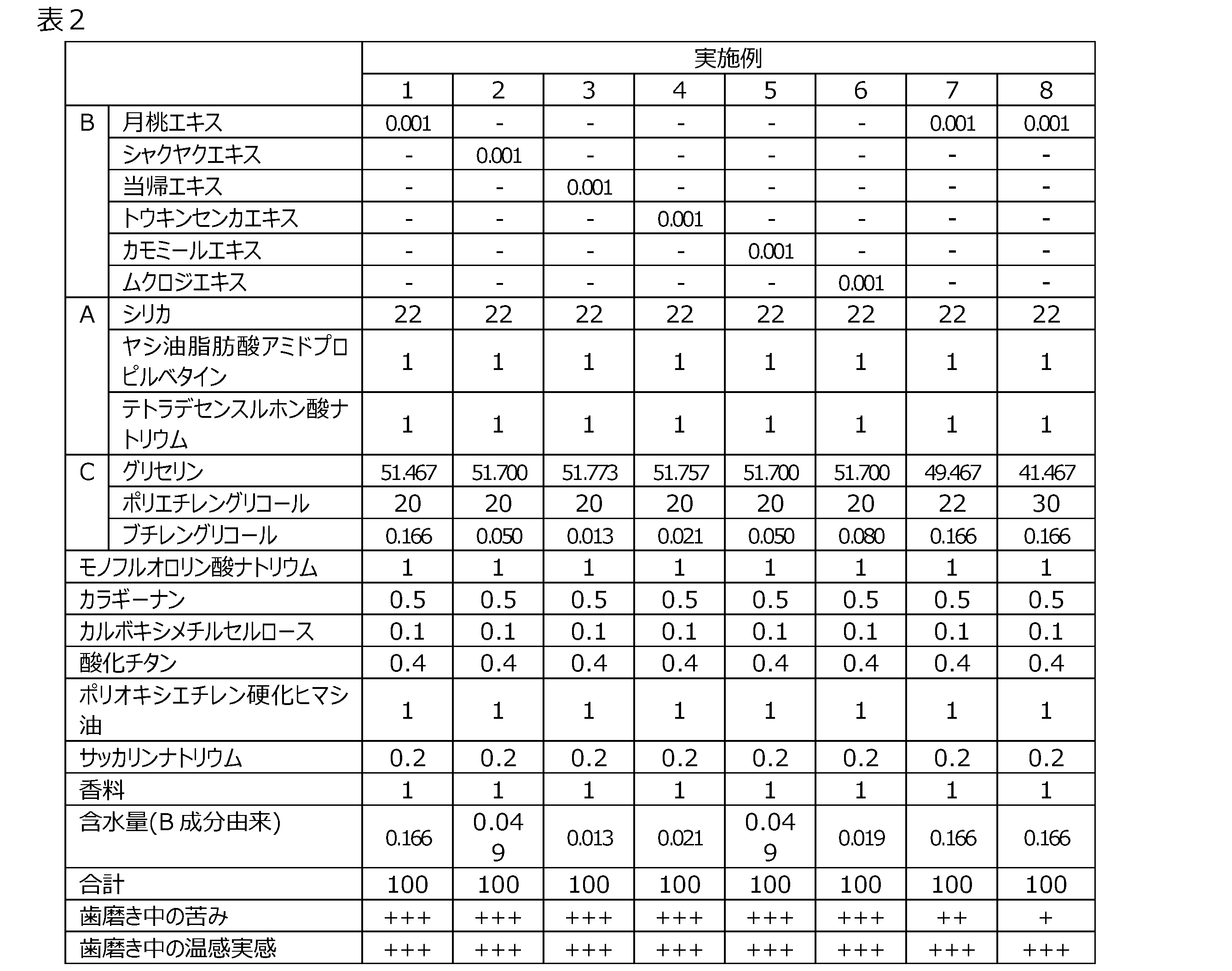
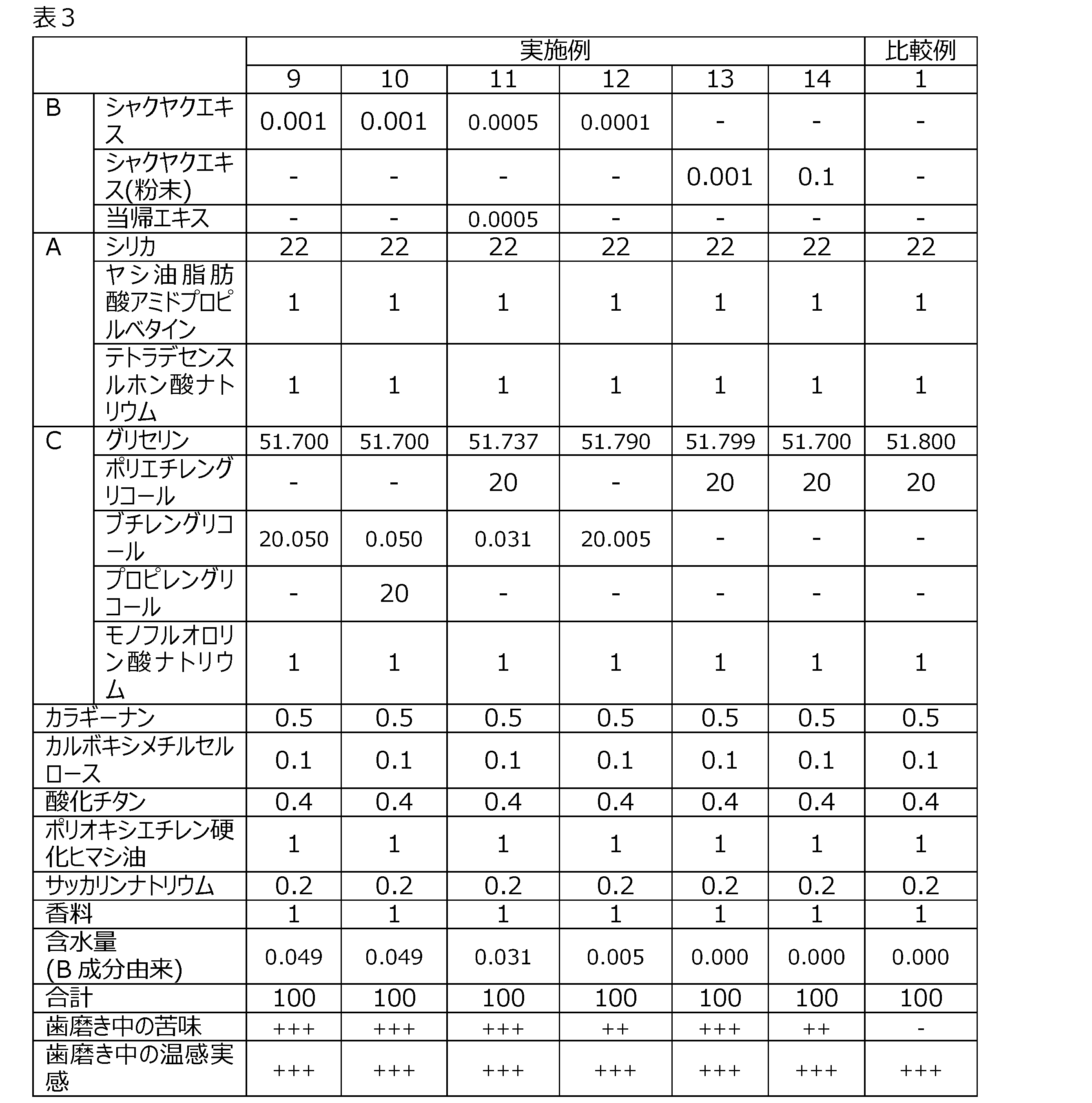
- Examples 1-14 and Comparative Example 1 (dentifrice) Using the above-mentioned components, a dentifrice composition having a compounding composition (part by mass) shown in Tables 2 to 3 was prepared according to the following preparation method.
- the obtained dentifrice composition was evaluated by the following procedure. The evaluation results are shown in Tables 2 and 3.
- ⁇ Evaluation method Evaluation of unpleasant taste (bitterness) in the mouth while brushing teeth
- a toothbrush Cosmetic Advantage toothbrush, 4-row compact, usually manufactured by Lion
- the average score of 10 taste-sensitive testers was calculated and shown in the table as +++, ++, +,-according to the following evaluation criteria.
- Taste-sensitive testers were selected from those who had "discontinued or changed brand due to the taste of dentifrice in the past" in the questionnaire.
- the actual feeling was evaluated on a five-point scale according to the scoring criteria shown below.
- the average score of 10 taste-sensitive testers was calculated and shown in the table as +++, ++, +,-according to the following evaluation criteria.
- the "feeling of warmth” means the feeling that the oral mucosa becomes warm.
- Taste-sensitive testers were selected from those who had "discontinued or changed brand due to the taste of dentifrice in the past" in the questionnaire.
Landscapes
- Life Sciences & Earth Sciences (AREA)
- Health & Medical Sciences (AREA)
- Public Health (AREA)
- Veterinary Medicine (AREA)
- General Health & Medical Sciences (AREA)
- Animal Behavior & Ethology (AREA)
- Epidemiology (AREA)
- Birds (AREA)
- Engineering & Computer Science (AREA)
- Biotechnology (AREA)
- Botany (AREA)
- Microbiology (AREA)
- Mycology (AREA)
- Inorganic Chemistry (AREA)
- Chemical & Material Sciences (AREA)
- Oral & Maxillofacial Surgery (AREA)
- Cosmetics (AREA)
Abstract
Description
特許文献1には、グリセロール等の特定の有機ポリオール、無水ケイ酸等の粒子状研磨剤、界面活性剤及びキサンタンガムを含む非水性口腔ケア用組成物が記載されている。特許文献2には、カルボキシビニルポリマー、グリセリン等の無水湿潤剤、ポリエチレングリコール、シリカ、炭酸カルシウム等の研磨剤を含み、界面活性剤を更に含んでもよい非水性歯磨き組成物が記載されている。
一方、植物抽出物は、各種生理活性を付与することを目的として口腔用組成物に配合されることがある(例えば、特許文献3)。
本発明の課題は、不快な味が抑制された非水系の口腔用組成物を提供することにある。
〔1〕(A)不快な味を有する成分、及び
(B)植物エキス
を含有し、水分含有量が2質量%以下である、口腔用組成物。
〔2〕(B)成分が、月桃エキス、シャクヤクエキス、当帰エキス、トウキンセンカエキス、カモミールエキス、及びムクロジエキスから選ばれる少なくとも1種を含む、〔1〕に記載の口腔用組成物。
〔3〕(B)成分の含有量が、0.00001~0.1質量%である、〔1〕又は〔2〕に記載の口腔用組成物。
〔4〕(B)成分の含有量が、0.00005~0.05質量%である、〔1〕~〔3〕のいずれか1項に記載の口腔用組成物。
〔5〕(A)成分が、無機粉体及び界面活性剤から選ばれる少なくとも1種を含む、〔1〕~〔4〕のいずれか1項に記載の口腔用組成物。
〔6〕(C)融点25℃以下の多価アルコールをさらに含有する、〔1〕~〔5〕のいずれか1項に記載の口腔用組成物。
〔7〕(C)成分の含有量が、20~85質量%である、〔6〕に記載の口腔用組成物。
〔8〕歯磨剤である、〔1〕~〔7〕のいずれか1項に記載の口腔用組成物。
[(A)不快な味を有する成分]
口腔用組成物は、(A)成分:不快な味を有する成分、好ましくは苦味を有する成分を含む。(A)成分は、通常、非水系有機溶媒以外の成分であり、好ましくは、不快な味を有する、無機粉体又は界面活性剤である。
無機粉体は、一般に、歯牙清掃剤、増粘剤として歯磨剤等の口腔用組成物に配合されている成分である。不快な味を有する無機粉体としては、例えばシリカ系材料、カルシウム系材料が挙げられる。シリカ系材料としては、例えば、シリカ(沈降性シリカ、チタン結合性シリカ、シリカゲル、アルミノシリケート、ジルコノシリケート)が挙げられる。カルシウム系材料としては、例えば炭酸カルシウム(軽質、重質);第2リン酸カルシウム・2水和塩又は無水和物、第1リン酸カルシウム、第3リン酸カルシウム、ピロリン酸カルシウム、不溶性メタリン酸カルシウム、第3リン酸カルシウム、第4リン酸カルシウム、第8リン酸カルシウム等のリン酸カルシウム系材料;水酸化カルシウム;硫酸カルシウム等の無機物の粉体が挙げられる。これらのうち、シリカが好ましい。シリカは、RDA(Radioactive Dentin Abrasion、放射性象牙質研磨力)が50~250の範囲であるものを使用することが好ましい。RDAは、Hefferrenの方法(Hefferren(1976)Journal of Dental Research、July-August,563-573)に従って測定できる。無機粉体のサイズは、各粉体を構成する無機物の種類によって適宜選択できるが、通常、平均粒子径(体積基準のD50、レーザー回折・散乱法による測定値)0.1~40μm、好ましくは1~30μmの範囲である。平均粒子径は、粒度分布測定装置(例えば、マイクロトラック粒度分布測定装置(日機装社製、Mode117995-10,Type SRA))を用い、検体の濁度(dV値)を0.5に調整して測定でき、後段の実施例において示す平均粒子径はこの方法による測定値である。
(A)成分が無機粉体である場合の含有量は、8質量%以上が好ましく、10質量%以上がより好ましい。これにより、適度な粘度及び使用時の清掃実感を得ることができる。上限は、好ましくは40質量%以下、より好ましくは30質量%以下である。これにより、組成物の粘度が高くなりすぎず良好な物性を得ることができる。従って、無機粉体の含有量は、好ましくは8~40質量%、より好ましくは10~30質量%である。
不快な味を有する界面活性剤としては、例えば、両性界面活性剤、アニオン界面活性剤が挙げられる。
(A)成分が界面活性剤を含む場合の、アニオン界面活性剤、両性界面活性剤のそれぞれの含有量は、組成物に対し、0.1質量%以上が好ましく、0.3質量%以上がより好ましい。これにより、十分な発泡性能を得ることができる。上限は、3質量%以下が好ましく、2.5質量%以下がより好ましい。これにより、組成物において苦味を十分に抑制できる。従って、界面活性剤の含有量は、好ましくは0.1~3質量%、より好ましくは0.3~2.5質量%である。
なお、本明細書において、各成分の含有量は、口腔用組成物を製造する際の各成分の仕込み量を基準とした量である。
口腔用組成物は、(B)成分:植物エキスを含む。(B)成分を含有することにより、(A)成分による非水系組成物特有の苦味を低減できる。
植物エキスは、原料植物の少なくとも一部から抽出して得られるエキスであればよい。植物原料としては、例えば、月桃、シャクヤク、当帰、トウキンセンカ、カモミール、及びムクロジが挙げられる。抽出部位は、例えば、葉、茎、根、花、果皮、これらの組み合わせが挙げられ、植物種及び/又は抽出方法に応じて適宜選択すればよい。
抽出溶媒は、例えば、水、極性溶媒、非極性溶媒、これらの混合溶媒が挙げられる。極性溶媒としては例えば、エチルエーテル、エチレンクロライド、ジオキサン、アセトン、アルコール(例えば、エタノール、メタノール、プロピルアルコール、イソプロピルアルコール等の炭素原子数1~5の低級1価アルコール)、グリコール(例えば、プロピレングリコール、ブチレングリコール)、酢酸エチル、グリセリンが挙げられる。非極性溶媒としては、例えば、n-ヘキサン、石油エーテル、リグロイン、シクロヘキサン、四塩化炭素、クロロホルム、ジクロルメタン、1,2-ジクロルエタン、トルエン、ベンゼンが挙げられる。これらのうち、親水性溶媒が好ましく、水、炭素原子数1~5の低級一価アルコール、グリコール、及びこれらから選ばれる2以上の混合溶媒が好ましく、水、エタノール、プロピレングリコール、ブチレングリコール、及びこれらから選ばれる2以上の混合溶媒がより好ましく、水がさらに好ましい。混合溶媒は、水と低級一価アルコール又はグリコールとの混合溶媒が好ましく、水と低級一価アルコール又はグリコールとの混合比率が10:90~90:10(質量比)の混合溶媒がより好ましい。
(A)成分としては、上記植物から得られる植物抽出エキスを用いることができ、各植物が含有する単一成分又はそれらの組み合わせまで精製されていてもよいし、市販品を用いてもよい。好ましい例は以下のとおりである。
(B)成分の含有量(エキス純分)は、組成物の全量に対し、通常、0.00001質量%以上、好ましくは0.00003質量%以上、より好ましくは0.00005質量%以上である。これにより、苦味改善効果が十分に発揮され得る。上限は、通常、0.3質量%以下、好ましくは0.1質量%以下、より好ましくは0.05質量%以下である。これにより、(B)成分自身の苦味の発生による使用感及び外観悪化を抑制できる。従って、(B)成分の含有量は、通常0.00001~0.1質量%又は0.00001~0.3質量%、好ましくは0.00003~0.1質量%、より好ましくは0.00005~0.05質量%である。
口腔用組成物は、液体媒体として(C):融点25℃以下の多価アルコールを含むことが好ましい。(C)成分を含むことにより、溶媒の水和熱により口腔用組成物に温感実感を付与できる。
融点25℃以下の多価アルコールは、例えば、グリセリン(融点:17.8℃)、ポリエチレングリコール(例えば、平均分子量190~650のポリエチレングリコール)、プロピレングリコール(融点:-59℃)、ジプロピレングリコール(融点:-39℃)、ブチレングリコール(融点:-77℃)、ポリプロピレングリコール等が挙げられる。これらの中でも、口腔内の温感実感を良好にする観点から、グリセリン、ポリエチレングリコール、ブチレングリコールが好ましく、グリセリンとポリエチレングリコールを少なくとも含む組み合わせがより好ましい。これらは1種を単独で用いても2種以上を組み合わせて用いてもよい。
(C)成分の含有量は、組成物の全量に対し、通常、20質量%以上、好ましくは40質量%以上である。上限は、通常、85質量%以下、好ましくは80質量%以下である。上記の上限及び/又は下限を満たすことにより、口腔用組成物の外観及び粘度が良好となり得る。従って、(C)成分の含有量は、通常20~85質量%、好ましくは40~80質量%である。
(C)成分がグリセリンを含む場合、その含有量は、(C)成分の全量に対し、通常、20質量%以上、好ましくは40質量%以上、より好ましくは50質量%以上である。これにより、グリセリン以外の非水系液体成分(例えば、ポリエチレングリコール、プロピレグリコール)に起因する苦味を抑制できる。上限は、通常、90質量%以下、好ましくは80質量%以下であるが特に限定はない。従って、グリセリンの含有量は、通常20~100質量%、好ましくは40~90質量%、より好ましくは50~80質量%である。
(C)成分がポリエチレングリコール(例えば、平均分子量190~630のポリエチレングリコール)を含む場合、その含有量は、(C)成分の全量に対し、通常、10質量%以上、好ましくは15質量%以上である。これにより、良好な温感実感が発揮できる。上限は、通常、30質量%以下である。これにより、苦味のない良好な風味となり得る。従って、ポリエチレングリコールの含有量は、通常10質量%以上、好ましくは15~30質量%である。
口腔用組成物は、実質的に水分を含まない非水系組成物である。これにより、使用時に口腔内で水分と組成物の各成分(主に(C)成分)とが接触することで水和熱を発生させることができ、口腔内で温感を発揮できる。水分量は、通常2質量%以下、好ましくは1質量%以下、より好ましくは0.5質量%以下である。水分量は、配合前の原料(例えば、(B)成分)に含まれる水分量の合計の全原料に対する割合(%)として、または、口腔用組成物の乾燥後重量の乾燥前重量との差分の、乾燥前の重量に対する割合(%)として、算出できる。後段の実施例における水分量は、前者の方法により算出した値である。
口腔用組成物は、本発明の効果を損なわない範囲で、(A)~(C)成分以外の他の成分を含有してもよい。他の成分としては、例えば、界面活性剤、甘味剤、香料、研磨剤、湿潤剤、粘結剤、有機研磨剤、pH調整剤、防腐剤、薬効成分、油性成分、着色剤(色素)等の口腔用組成物に配合され得る成分が挙げられるが、これらに限定されない。
(A)成分以外の界面活性剤としては、例えば、ノニオン界面活性剤、カチオン界面活性剤が挙げられる。
組成物が甘味剤を含むことにより、使用感をより向上させることができる。甘味剤としては、例えば、キシリトール、エリスリトール、マルチトール、サッカリン、サッカリンナトリウム、アスパルテーム、ステビオサイド、ステビアエキス、パラメトキシシンナミックアルデヒド、ネオヘスペリジンジヒドロカルコン、ペリラルチン、グリチルリチン、ソーマチン、アスパラチルフェニルアラニンメチルエステル等が挙げられる。甘味剤は、1種単独で用いてもよく、2種以上を組み合わせて用いてもよい。
組成物が香料を含むことにより、使用感をより向上させることができる。香料としては、例えば、ペパーミント油、スペアミント油、ユーカリ油、ウィンターグリーン油、クローブ油、タイム油、セージ油、カルダモン油、ローズマリー油、マジョラム油、レモン油、オレンジ油、ナツメグ油、ラベンダー油、パラクレス油、桂皮油、ピメント油、桂葉油、シソ油等の天然精油;メントール、カルボン、シンナミックアルデヒド、アネトール、1,8-シネオール、メチルサリシレート、オイゲノール、チモール、リナロール、リモネン、メントン、メンチルアセテート、シトラール、カンファー、ボルネオール、ピネン、スピラントール、n-デシルアルコール、シトロネロール、α-テルピネオール、シトロネリルアセテート、シネオール、エチルリナロール、ワニリン等の上記天然精油中に含まれる香料成分;エチルアセテート、エチルブチレート、イソアミルアセテート、ヘキサナール、ヘキセナール、メチルアンスラニレート、エチルメチルフェニルグリシデート、ベンズアルデヒド、バニリン、エチルバニリン、フラネオール、N-エチル-p-メンタン-3-カルボキサミド、メンチルラクテート、エチレングリコール-l-メンチルカーボネート等の香料成分;並びにいくつかの香料成分及び/又はいくつかの天然精油を組み合わせてなるミント系、フルーツ系、ハーブ系等の各種調合フレーバーが挙げられる。香料は、1種単独で用いてもよく、2種以上を組み合わせて用いてもよい。
薬用成分としては、例えば、塩化セチルピリジニウム、塩化ベンザルコニウム、塩化ベンゼトニウム、イソプロピルメチルフェノール、グルコン酸亜鉛、クエン酸亜鉛、トリクロサン、チモール、ヒノキチオール、塩化リゾチーム等の殺菌又は抗菌剤;デキストラナーゼ、ムタナーゼ、アミラーゼ、プロテアーゼ、リテックエンザイム等の酵素;フッ化ナトリウム、モノフルオロリン酸ナトリウム、フッ化スズ等のフッ化物;ε-アミノカプロン酸、アラントイン、トラネキサム酸、グリチルリチン酸塩(例えば、グリチルリチン2カリウム塩)、グリチルレチン酸、グリチルレチン酸ステアリル、アラントインクロルヒドロキシアルミニウム、アズレン、ジヒドロコレステロール等の抗炎症剤;亜鉛、銅塩、スズ塩等の金属塩;縮合リン酸塩、エタンヒドロキシジホスフォネート等の歯石予防剤;ビタミンE(例えば、酢酸トコフェロール)等の血流促進剤;硝酸カリウム、乳酸アルミニウム、塩化ストロンチウム等の知覚過敏抑制剤;ヒドロキシエチルセルロースジメチルジアリルアンモニウムクロリド等のコーティング剤;ビタミンC(例えば、アスコルビン酸またはその塩)、塩化リゾチーム、塩化ナトリウム等の収斂剤;銅クロロフィル、グルコン酸銅等の水溶性銅化合物;ゼオライト等の歯石予防剤、アラニン、グリシン、プロリン等のアミノ酸類;カロペプタイド、ポリビニルピロリドンを挙げることができる。薬用成分は、1種単独で用いてもよく、2種以上を組み合わせて用いてもよい。上記他の有効成分の含有量は、有効量を適宜設定できる。
油性成分としては、例えば、スクワラン、流動パラフィン、ワセリン、マイクロクリスタリンワックス等の炭化水素類;高級アルコール(例えば、ラウリルアルコール、セチルアルコール、セトステアリルアルコール、オレイルアルコール、イソステアリルアルコール等の炭素原子数8~22のアルコール);高級脂肪酸(例えば、ラウリン酸、ミリスチン酸、オレイン酸、イソステアリン酸等の炭素原子数8~22の脂肪酸)、オリーブ油、ひまし油、やし油等の植物油;ミリスチン酸イソプロピル等の脂肪酸エステルが挙げられる。
研磨剤としては、例えば、(A)成分以外の無機研磨剤、有機研磨剤が挙げられる。無機研磨剤としては、例えば、酸化アルミニウム、水酸化アルミニウム、アルミナ等のアルミニウム系材料;無水ケイ酸、ゼオライト、ケイ酸ジルコニウム等のケイ酸系材料;炭酸マグネシウム、第3リン酸マグネシウム等のマグネシウム系材料;ハイドロキシアパタイト、フルオロアパタイト、カルシウム欠損アパタイト等のアパタイト系材料;二酸化チタン、雲母チタン、酸化チタン等のチタン系材料;結晶性ジルコニウムシリケート;ベントナイト等の鉱物が挙げられる。有機研磨剤としては、例えば、ポリメチルメタアクリレート、合成樹脂系研磨剤が挙げられる。研磨剤の含有量は、0~10質量%が好ましい。また、(A)成分との合計量が組成物全体の50質量%以下が好ましく、8~50質量%がより好ましい。
組成物が防腐剤を含むことにより、製剤の防腐力を確保できる。防腐剤としては、パラオキシ安息香酸エステル(例えば、パラオキシ安息香酸メチル、パラオキシ安息香酸エチル、パラオキシ安息香酸ブチル)、安息香酸ナトリウム等が挙げられる。防腐剤は、1種単独で用いてもよく、2種以上を組み合わせて用いてもよい。
組成物が任意の湿潤剤を含むことにより、使用感をより向上させることができる。湿潤剤としては、(C)成分以外の多価アルコールが好ましく、例えば、ソルビトール、エリスリトール、マルチトール、ラクチトール、キシリトール等の糖アルコール;プロピレングリコール、エチレングリコール等のグリコール;還元でんぷん糖化物が挙げられる。湿潤剤の含有量は、通常、0~20質量%、好ましくは1~10質量%である。
任意の粘結剤としては、公知の有機粘結剤、例えば、セルロース系粘結剤(例えば、カルボキシメチルセルロース、ヒドロキシエチルセルロース、ヒドロキシプロピルセルロース、ヒドロキシプロピルメチルセルロース、メチルセルロース、カチオン化セルロース等)、カラギーナン、キサンタンガム、カルボキシビニルポリマー、グアガム、トラガントガム、カラヤガム、アラビヤガム、ローカストビーンガム、アルギン酸ナトリウム、モンモリロナイト、ポリアクリル酸ナトリウム、ポリビニルピロリドン、ポリビニルアルコール、アルギン酸プロピレングリコール等が挙げられる。任意の粘結剤の含有量は、0~1.0質量%が好ましく、0.1~0.8質量%がより好ましい。
組成物がpH調整剤を含むことにより、製剤のpH安定性を確保できる。pH調整剤としては、例えば、フタル酸、クエン酸、コハク酸、酢酸、フマル酸、リンゴ酸、及び乳酸等の有機酸又はそれらの塩、リン酸(オルトリン酸)等の無機酸又はそれらの塩(例えば、カリウム塩、ナトリウム塩及びアンモニウム塩)、水酸化ナトリウム、水酸化カリウム等の水酸化物が挙げられる。無機酸塩としては、例えば、リン酸水素二ナトリウム、リン酸二水素ナトリウムが挙げられる。pH調整剤の含有量は、通常、添加後の組成物のpHが5~9、好ましくは6~8.5になる量である。本明細書において、pH値は、通常、測定開始から25℃、3分後の値であり、東亜電波工業社製のpHメーター(型番Hm-30S)を用いて測定できる。
上記以外の任意成分の例としては、例えば、カルナバワックス、ロジン、ライスワックス、マイクロクリスタリンワックス、ミツロウ、パラフィンワックス等のワックス類;セタノール、ステアリルアルコール等の高級アルコール;ポリイソブチレン、ポリブタジエン、ウレタン、シリコン、天然ゴムが挙げられる。これらの成分の含有量は、本発明の効果を妨げない範囲で適宜設定できる。
口腔用組成物の製造方法は特に限定されず、剤形に応じて、それぞれの通常の方法で調製され得る。例えば練歯磨剤として利用する場合、溶媒に溶解する成分を調製した後、それ以外の不溶性成分を混合し、必要に応じて脱泡(例えば、減圧等)を行う方法が挙げられる。得られる練歯磨は、容器に収容して製品とすることができる。容器は、形状、材質は特に制限されず、通常の練歯磨剤組成物に使用される容器を使用でき、例えば、ポリエチレン、ポリプロピレン、ポリエチレンテレフタレート、ナイロンなどのプラスチック容器等が挙げられる。
実施例及び比較例において用いた主な原料を下記にまとめて記載する。
シリカ:Solvay社製、Tixosil(登録商標)73(平均粒子径9μm)
ヤシ油脂肪酸アミドプロピルベタイン:Evonik社製、TEGO Betain CK D
テトラデセンスルホン酸ナトリウム:ライオン・スペシャリティ・ケミカルズ社製、KリポランPJ-400CJ

グリセリン:阪本薬品工業(株)製、化粧品用濃グリセリン
ポリエチレングリコール:三洋化成工業(株)製、ポリエチレングリコール400
ブチレングリコール:長瀬産業(株)製、1,3-BG(Cosmetic Quality)
プロピレングリコール:(株)ADEKA製、プロピレングリコール
他の成分:
カラギーナン:三晶(株)製、GENUVISCO PJ-JPE
カルボキシメチルセルロースナトリウム:ダイセルファインケム(株)製、CMC1260
ポリオキシエチレン硬化ヒマシ油:日光ケミカルズ(株)製、NIKKOL HCO-20
その他の成分については医薬部外品原料規格2006に適合したものを用いた。
上述の成分を用いて、下記の調製方法に従って、表2~3に示す配合組成(質量部)を有する歯磨剤組成物を調製した。
表2~3に示す原料(表中の(B)成分の量は、エキス純分の量である)を常法により配合し、1.5Lニーダー(石山工作所社製)を用い常温で混合し、減圧(圧力4kPa)による脱泡を行い、歯磨剤組成物を得た。
歯磨剤組成物1gを歯ブラシ(クリニカアドバンテージ歯ブラシ、4列コンパクトふつう、ライオン社製)に載せ、通常の方法でブラッシングしている時の、口内の非水系基材特有の舌に残るような不快な苦みのなさを、下記に示す評点基準によって、5段階で評価した。味覚に敏感な試験者10名の平均点を算出し、次の評価基準に従って、+++、++、+、-で表に示した。味覚に敏感な試験者は、アンケートにて「過去に歯磨剤の味が原因で使用中止又は銘柄変更をした」経験がある者から選定した。
5点:苦味を全く感じない
4点:苦みを僅かに感じる
3点:苦みを感じる
2点:苦みを強く感じる
1点:苦みを非常に強く感じる
+++:平均4.5点以上
++:平均4.0点以上4.5点未満
+:平均3.0点以上4.0点未満
-:平均1.0点以上3.0点未満
歯磨剤組成物1gを歯ブラシ(クリニカアドバンテージ歯ブラシ、4列コンパクトふつう、ライオン社製)に載せ、通常の方法でブラッシングしている時の口内の温感実感を、下記に示す評点基準によって、5段階で評価した。味覚に敏感な試験者10名の平均点を算出し、次の評価基準に従って、+++、++、+、-で表に示した。ここで「温感実感」とは、口腔粘膜が温かみを帯びる感覚を意味する。味覚に敏感な試験者は、アンケートにて「過去に歯磨剤の味が原因で使用中止又は銘柄変更をした」経験がある者から選定した。
5点:ブラッシング開始後すぐに高い温感実感がある
4点:ブラッシング開始後すぐに認知できるほどの温感実感がある
3点:ブラッシング中に認知できる程度の温感実感がある
2点:ブラッシング中にほとんど温感実感が認知できない
1点:全く温感実感がない
+++:平均4.0点以上5.0点以下
++:平均3.0点以上4.0点未満
+:平均2.5点以上3.0点未満
-:平均1.0点以上2.5点未満
Claims (8)
- (A)不快な味を有する成分、及び
(B)植物エキス
を含有し、水分含有量が2質量%以下である、口腔用組成物。 - (B)成分が、月桃エキス、シャクヤクエキス、当帰エキス、トウキンセンカエキス、カモミールエキス、及びムクロジエキスから選ばれる少なくとも1種を含む、請求項1に記載の口腔用組成物。
- (B)成分の含有量が、0.00001~0.1質量%である、請求項1又は2に記載の口腔用組成物。
- (B)成分の含有量が、0.00005~0.05質量%である、請求項1~3のいずれか1項に記載の口腔用組成物。
- (A)成分が、無機粉体及び界面活性剤から選ばれる少なくとも1種を含む、請求項1~4のいずれか1項に記載の口腔用組成物。
- (C)融点25℃以下の多価アルコール
をさらに含有する、請求項1~5のいずれか1項に記載の口腔用組成物。 - (C)成分の含有量が、20~85質量%である、請求項6に記載の口腔用組成物。
- 歯磨剤である、請求項1~7のいずれか1項に記載の口腔用組成物。
Priority Applications (2)
| Application Number | Priority Date | Filing Date | Title |
|---|---|---|---|
| JP2022571402A JPWO2022138487A1 (ja) | 2020-12-23 | 2021-12-17 | |
| CN202180087130.1A CN116710065A (zh) | 2020-12-23 | 2021-12-17 | 口腔用组合物 |
Applications Claiming Priority (2)
| Application Number | Priority Date | Filing Date | Title |
|---|---|---|---|
| JP2020214323 | 2020-12-23 | ||
| JP2020-214323 | 2020-12-23 |
Publications (1)
| Publication Number | Publication Date |
|---|---|
| WO2022138487A1 true WO2022138487A1 (ja) | 2022-06-30 |
Family
ID=82157856
Family Applications (1)
| Application Number | Title | Priority Date | Filing Date |
|---|---|---|---|
| PCT/JP2021/046729 Ceased WO2022138487A1 (ja) | 2020-12-23 | 2021-12-17 | 口腔用組成物 |
Country Status (3)
| Country | Link |
|---|---|
| JP (1) | JPWO2022138487A1 (ja) |
| CN (1) | CN116710065A (ja) |
| WO (1) | WO2022138487A1 (ja) |
Citations (7)
| Publication number | Priority date | Publication date | Assignee | Title |
|---|---|---|---|---|
| JP2006347898A (ja) * | 2005-06-13 | 2006-12-28 | Ogawa & Co Ltd | 血流促進剤並びに該血流促進剤を含有する外用剤、化粧料、浴用剤及び洗剤 |
| JP2011522871A (ja) * | 2008-06-17 | 2011-08-04 | ザ プロクター アンド ギャンブル カンパニー | 全般的な歯の健康及び外観を改善するための組成物及び方法 |
| JP2018150362A (ja) * | 2018-05-31 | 2018-09-27 | 小林製薬株式会社 | 収斂用組成物 |
| JP2019064941A (ja) * | 2017-09-29 | 2019-04-25 | 丸善製薬株式会社 | 正常ヒト歯肉線維芽細胞におけるi型コラーゲン産生促進剤及び口腔用剤 |
| JP2019196329A (ja) * | 2018-05-10 | 2019-11-14 | 一丸ファルコス株式会社 | 歯周病予防口腔用組成物 |
| WO2019216568A1 (ko) * | 2018-05-09 | 2019-11-14 | 주식회사 하이센스바이오 | 상아질 지각과민증 완화를 위한 치약 조성물 |
| JP2020100589A (ja) * | 2018-12-21 | 2020-07-02 | ライオン株式会社 | 口腔用組成物 |
Family Cites Families (2)
| Publication number | Priority date | Publication date | Assignee | Title |
|---|---|---|---|---|
| CN110267641A (zh) * | 2017-02-10 | 2019-09-20 | 赢创德固赛有限公司 | 含有至少一种生物表面活性剂和氟化物的口腔护理组合物 |
| CN108464956B (zh) * | 2018-04-03 | 2020-07-10 | 弘美制药(中国)有限公司 | 一种应用于口腔的组合物及其制备方法与应用 |
-
2021
- 2021-12-17 JP JP2022571402A patent/JPWO2022138487A1/ja active Pending
- 2021-12-17 WO PCT/JP2021/046729 patent/WO2022138487A1/ja not_active Ceased
- 2021-12-17 CN CN202180087130.1A patent/CN116710065A/zh active Pending
Patent Citations (7)
| Publication number | Priority date | Publication date | Assignee | Title |
|---|---|---|---|---|
| JP2006347898A (ja) * | 2005-06-13 | 2006-12-28 | Ogawa & Co Ltd | 血流促進剤並びに該血流促進剤を含有する外用剤、化粧料、浴用剤及び洗剤 |
| JP2011522871A (ja) * | 2008-06-17 | 2011-08-04 | ザ プロクター アンド ギャンブル カンパニー | 全般的な歯の健康及び外観を改善するための組成物及び方法 |
| JP2019064941A (ja) * | 2017-09-29 | 2019-04-25 | 丸善製薬株式会社 | 正常ヒト歯肉線維芽細胞におけるi型コラーゲン産生促進剤及び口腔用剤 |
| WO2019216568A1 (ko) * | 2018-05-09 | 2019-11-14 | 주식회사 하이센스바이오 | 상아질 지각과민증 완화를 위한 치약 조성물 |
| JP2019196329A (ja) * | 2018-05-10 | 2019-11-14 | 一丸ファルコス株式会社 | 歯周病予防口腔用組成物 |
| JP2018150362A (ja) * | 2018-05-31 | 2018-09-27 | 小林製薬株式会社 | 収斂用組成物 |
| JP2020100589A (ja) * | 2018-12-21 | 2020-07-02 | ライオン株式会社 | 口腔用組成物 |
Also Published As
| Publication number | Publication date |
|---|---|
| CN116710065A (zh) | 2023-09-05 |
| JPWO2022138487A1 (ja) | 2022-06-30 |
Similar Documents
| Publication | Publication Date | Title |
|---|---|---|
| CN105658194A (zh) | 洁齿剂组合物 | |
| CN102264342B (zh) | 洁齿剂组合物 | |
| JP7347916B2 (ja) | 歯磨剤組成物 | |
| JP7079598B2 (ja) | 口腔用組成物及びコラーゲン合成促進剤 | |
| JP2021095380A (ja) | 歯磨剤組成物 | |
| WO2016194645A1 (ja) | 口腔用組成物 | |
| WO2022102628A1 (ja) | 口腔用組成物 | |
| JP2006347986A (ja) | 口腔用組成物 | |
| WO2023277084A1 (ja) | 口腔用組成物 | |
| JP7855420B2 (ja) | 口腔用組成物 | |
| CN116710065A (zh) | 口腔用组合物 | |
| JP7660480B2 (ja) | 非水系口腔用組成物 | |
| JP7621117B2 (ja) | 口腔用組成物 | |
| JP6753142B2 (ja) | 口腔用組成物 | |
| JP2020203853A (ja) | 歯磨用組成物 | |
| JP7731755B2 (ja) | 非水系口腔用組成物 | |
| WO2022075422A1 (ja) | 歯磨剤組成物 | |
| JP7550011B2 (ja) | 歯磨剤組成物 | |
| JP7630247B2 (ja) | 歯磨剤組成物 | |
| CN116634986A (zh) | 口腔用组合物 | |
| JP2026031285A (ja) | 口腔用組成物 | |
| WO2022054959A1 (ja) | 口腔用組成物 | |
| WO2025134729A1 (ja) | 口腔用組成物及び象牙質保護剤 | |
| JP7000823B2 (ja) | 練歯磨剤組成物 | |
| CN121489807A (zh) | 口腔用组合物 |
Legal Events
| Date | Code | Title | Description |
|---|---|---|---|
| 121 | Ep: the epo has been informed by wipo that ep was designated in this application |
Ref document number: 21910632 Country of ref document: EP Kind code of ref document: A1 |
|
| ENP | Entry into the national phase |
Ref document number: 2022571402 Country of ref document: JP Kind code of ref document: A |
|
| WWE | Wipo information: entry into national phase |
Ref document number: 202180087130.1 Country of ref document: CN |
|
| NENP | Non-entry into the national phase |
Ref country code: DE |
|
| 122 | Ep: pct application non-entry in european phase |
Ref document number: 21910632 Country of ref document: EP Kind code of ref document: A1 |