WO2022137992A1 - 缶用ラベル - Google Patents
缶用ラベル Download PDFInfo
- Publication number
- WO2022137992A1 WO2022137992A1 PCT/JP2021/043595 JP2021043595W WO2022137992A1 WO 2022137992 A1 WO2022137992 A1 WO 2022137992A1 JP 2021043595 W JP2021043595 W JP 2021043595W WO 2022137992 A1 WO2022137992 A1 WO 2022137992A1
- Authority
- WO
- WIPO (PCT)
- Prior art keywords
- layer
- electrostatic ink
- label
- adhesive
- epoxy compound
- Prior art date
- Legal status (The legal status is an assumption and is not a legal conclusion. Google has not performed a legal analysis and makes no representation as to the accuracy of the status listed.)
- Ceased
Links
Images


Classifications
-
- B—PERFORMING OPERATIONS; TRANSPORTING
- B32—LAYERED PRODUCTS
- B32B—LAYERED PRODUCTS, i.e. PRODUCTS BUILT-UP OF STRATA OF FLAT OR NON-FLAT, e.g. CELLULAR OR HONEYCOMB, FORM
- B32B27/00—Layered products comprising a layer of synthetic resin
- B32B27/36—Layered products comprising a layer of synthetic resin comprising polyesters
-
- B—PERFORMING OPERATIONS; TRANSPORTING
- B32—LAYERED PRODUCTS
- B32B—LAYERED PRODUCTS, i.e. PRODUCTS BUILT-UP OF STRATA OF FLAT OR NON-FLAT, e.g. CELLULAR OR HONEYCOMB, FORM
- B32B27/00—Layered products comprising a layer of synthetic resin
- B32B27/38—Layered products comprising a layer of synthetic resin comprising epoxy resins
-
- B—PERFORMING OPERATIONS; TRANSPORTING
- B32—LAYERED PRODUCTS
- B32B—LAYERED PRODUCTS, i.e. PRODUCTS BUILT-UP OF STRATA OF FLAT OR NON-FLAT, e.g. CELLULAR OR HONEYCOMB, FORM
- B32B27/00—Layered products comprising a layer of synthetic resin
- B32B27/40—Layered products comprising a layer of synthetic resin comprising polyurethanes
-
- B—PERFORMING OPERATIONS; TRANSPORTING
- B32—LAYERED PRODUCTS
- B32B—LAYERED PRODUCTS, i.e. PRODUCTS BUILT-UP OF STRATA OF FLAT OR NON-FLAT, e.g. CELLULAR OR HONEYCOMB, FORM
- B32B7/00—Layered products characterised by the relation between layers; Layered products characterised by the relative orientation of features between layers, or by the relative values of a measurable parameter between layers, i.e. products comprising layers having different physical, chemical or physicochemical properties; Layered products characterised by the interconnection of layers
- B32B7/04—Interconnection of layers
- B32B7/12—Interconnection of layers using interposed adhesives or interposed materials with bonding properties
-
- C—CHEMISTRY; METALLURGY
- C09—DYES; PAINTS; POLISHES; NATURAL RESINS; ADHESIVES; COMPOSITIONS NOT OTHERWISE PROVIDED FOR; APPLICATIONS OF MATERIALS NOT OTHERWISE PROVIDED FOR
- C09J—ADHESIVES; NON-MECHANICAL ASPECTS OF ADHESIVE PROCESSES IN GENERAL; ADHESIVE PROCESSES NOT PROVIDED FOR ELSEWHERE; USE OF MATERIALS AS ADHESIVES
- C09J175/00—Adhesives based on polyureas or polyurethanes; Adhesives based on derivatives of such polymers
- C09J175/04—Polyurethanes
-
- G—PHYSICS
- G09—EDUCATION; CRYPTOGRAPHY; DISPLAY; ADVERTISING; SEALS
- G09F—DISPLAYING; ADVERTISING; SIGNS; LABELS OR NAME-PLATES; SEALS
- G09F3/00—Labels, tag tickets, or similar identification or indication means; Seals; Postage or like stamps
- G09F3/02—Forms or constructions
-
- G—PHYSICS
- G09—EDUCATION; CRYPTOGRAPHY; DISPLAY; ADVERTISING; SEALS
- G09F—DISPLAYING; ADVERTISING; SIGNS; LABELS OR NAME-PLATES; SEALS
- G09F3/00—Labels, tag tickets, or similar identification or indication means; Seals; Postage or like stamps
- G09F3/08—Fastening or securing by means not forming part of the material of the label itself
- G09F3/10—Fastening or securing by means not forming part of the material of the label itself by an adhesive layer
Definitions
- This disclosure relates to labels for cans.
- Digital printing using an electrostatic ink composition can be handled in small lots, so it is used as various packaging materials.
- a digital printing machine manufactured by HP, Indigo 20000 label and digital printing machine for packaging
- a primer resin is applied to a first flexible substrate such as a PET film.
- a technique for obtaining a packaging material by performing electrostatic printing, further applying a cross-linking composition, and then laminating a flexible substrate is disclosed.
- the label affixed state on the can container after production is appropriate. It turned out that it may change from the state.
- the present disclosure provides a can label suitable for sticking to a can surface while having an electrostatic ink layer by a digital printing machine.
- the can label is a can label laminated to a can body, and is a first base material, a primer layer, an electrostatic ink layer, and an adhesive.
- the layers and the second substrate are laminated in this order, and the adhesive layer contains at least one of an adhesive composition containing a polyol, a polyisocyanate and an epoxy compound, and a cured product of the adhesive composition.
- the curing of the adhesive composition containing the epoxy compound suppresses the deformation of the label due to heating or the like during the manufacture of the can container. Therefore, a can label suitable for sticking to the can surface can be obtained while having an electrostatic ink layer produced by a digital printing machine.
- At least one of the first base material and the second base material may be a polyethylene terephthalate resin film.
- Labels for cans having a polyethylene terephthalate resin film are excellent in heat resistance and water resistance, and are therefore suitable for labels for cans used in various applications.
- the polyol may contain an aliphatic polyester polyol, and the epoxy compound may include those having epoxy groups at both ends.
- Such an adhesive layer has high adhesive strength even in a high temperature environment. Therefore, it is possible to obtain a can label capable of further suppressing deformation of the label due to heating or the like when manufacturing a can container to which the can label is attached.
- the epoxy compound can be an embodiment containing a bifunctional alicyclic epoxy compound. Since such an epoxy compound is bifunctional, it increases the number of cross-linking points with the electrostatic ink composition, so that the cross-linking with the electrostatic ink composition is promoted to obtain a strong cross-linking composition. Further, since it is an alicyclic type, it is possible to suppress the reaction with polyisocyanate due to steric hindrance. Therefore, it can be cured stably, and the adhesion at the interface between the adhesive layer and the electrostatic ink layer can be sufficiently excellent.
- the polyisocyanate can be an embodiment containing a xylylene diisocyanate derivative.
- Such polyisocyanates and polyols are excellent in reactivity. As a result, the curability of the adhesive composition is improved, so that deformation of the label attached to the can surface can be suppressed.
- a can label suitable for sticking to a can surface while having an electrostatic ink layer by a digital printing machine is provided.
- FIG. 1 is a diagram showing an example of a cross section along a stacking direction (thickness direction) of a can label according to an embodiment.
- FIG. 2 is a diagram showing an example of a can container to which a can label is attached.
- FIG. 3 is a diagram showing an example of a cross section of a can container.
- FIG. 4 is a diagram showing an example of a method for manufacturing a can container.
- FIG. 1 shows a cross section along a stacking direction (thickness direction) of a can label according to an embodiment.
- the can label 1 is a label affixed to the surface of a can container.
- the use of the can container is not particularly limited, and examples thereof include a beverage can in which a beverage is enclosed, a food can in which food, oil and the like are enclosed, an industrial can in which a drug / industrial product or the like is enclosed, and the like.
- the can label 1 includes a first base film 10 (first base material), a primer layer 40, an adhesive layer 30, and a second base film 20 (second base material). They are stacked in this order.
- a primer layer 40 is provided on one of the pair of main surfaces of the first base film 10 near the second base film 20.
- the first base film 10 and the second base film 20 may be flexible base materials.
- a film-like thermoplastic polymer can be used. More specifically, as flexible substrates, biaxially oriented polypropylene (BOPP), polyethylene terephthalate (PET), oriented polyamide (OPA), unstretched polypropylene (CPP), linear low density polyethylene (LLDPE), low A film of density polyethylene (LDPE) can be used.
- a PET film can be used as the first base film 10 and the second base film 20.
- a metal foil such as an aluminum foil may be used as the flexible base material.
- a material in which a metal foil such as an aluminum foil and a resin film are combined may be used as the flexible base material.
- the thickness of the first base film 10 and the second base film 20 may be 7 to 150 ⁇ m, 15 to 90 ⁇ m, or 20 to 80 ⁇ m.
- the thickness of the first base film 10 may be larger than the thickness of the second base film 20.
- the thickness of the second base film 20 can be 7 ⁇ m or more.
- the difference in thickness between the first base film 10 and the second base film 20 becomes large, the difference in stress derived from the difference in the thickness of the base film becomes the difference between the first base film 10 and the second base film. 2 It is possible to prevent the occurrence of the base film 20 labels and the like.
- the primer layer 40 may contain a resin.
- the resin include polyvinyl alcohol resin, cellulose resin, polyester, polyamine, polyethyleneimine resin, polyamide resin, polyurethane, polyacrylic polymer hydroxyl group-containing resin, carboxyl group-containing resin, and amine-based polymer.
- the coating amount of the resin constituting the primer layer 40 may be, for example, 0.01 to 1.5 g / m 2 or 0.05 to 1.0 g / m 2 .
- the can label 1 is provided with an electrostatic ink layer 50 on one of the pair of main surfaces of the primer layer 40, which is closer to the second base film 20.
- the electrostatic ink layer 50 is composed of an electrostatic ink composition and is provided by electrostatic printing using a digital printing machine.
- the plurality of electrostatic ink layers 50 in FIG. 1 may have the same composition, or may have different colors by having different compositions from each other.
- the electrostatic ink layers 50 may be provided so as to be scattered on the primer layer 40, or may be provided so as to cover the entire one surface of the primer layer 40.
- the electrostatic ink composition constituting the electrostatic ink layer 50 is an ink composition used for liquid electrophotographic printing, that is, electrostatic printing, and is printed on a base material such as paper and plastic.
- the electrostatic ink composition may contain a colorant or pigment such as a dye, and a resin.
- a carrier fluid or a carrier liquid may be included.
- it may include a charge director, a charge adjuvant, a surfactant, a viscosity modifier, an emulsifier and other additives.
- Examples of the colorant include cyan pigments, magenta pigments, yellow pigments, and black pigments.
- the resin include thermoplastic resins such as ethylene acrylic acid copolymer, propylene acrylic acid copolymer, ethylene methacrylic acid copolymer, propylene methacrylic acid copolymer, and ethylene vinyl acetate copolymer.
- the carrier liquid examples include hydrocarbons, silicone oils, vegetable oils and the like. Hydrocarbons include aliphatic hydrocarbons, branched chain aliphatic hydrocarbons, and aromatic hydrocarbons.
- the electrostatic ink composition may be substantially free of carrier liquid when printed on a printing substrate (for example, on the first substrate film 10 with the primer layer 40 interposed therebetween).
- the carrier liquid may be removed, for example, by an electrophoresis process during printing or evaporation. As a result, substantially only the solid content is transferred to the printing substrate.
- the charge director has the effect of maintaining sufficient electrostatic charge on the particles contained in the electrostatic ink composition.
- Charge directors include, for example, ionic compounds such as fatty acid metal salts, sulfosuccinate metal salts, oxyphosphate metal salts, alkylbenzene sulfonic acid metal salts, aromatic carboxylic acids or aromatic sulfonic acid metal salts. Also mentioned are dual ionic and nonionic compounds such as polyoxyethylated alkylamines, lecithin, polyvinylpyrrolidone, organic acid esters of polyvalent alcohols.
- the charge adjuvant has the effect of increasing or stabilizing the charge of the particles contained in the electrostatic ink composition.
- the charge adjuvant include barium petronate, calcium petronate, naphthenic acid Co salt, naphthenic acid Ca salt, naphthenic acid Cu salt, naphthenic acid Mn salt, naphthenic acid Ni salt, naphthenic acid Zn salt, naphthenic acid Fe salt, and stear.
- Examples thereof include acid Ba salt, stearic acid Co salt, stearic acid Pb salt, stearic acid Zn salt, stearic acid Al salt, stearic acid Cu salt, stearic acid Fe salt, and metal carboxylate.
- the electrostatic ink composition may contain a crosslinked product crosslinked by the components contained in the adhesive layer 30 and / or the primer layer 40.
- the strength of the electrostatic ink layer 50 itself and the adhesive strength between the adhesive layer 30, the electrostatic ink layer 50, and the electrostatic ink layer 50 and the primer layer 40 can be sufficiently increased.
- the adhesive layer 30 is laminated on the main surface of the primer layer 40 on which the electrostatic ink layer 50 is provided, and is formed so as to cover the electrostatic ink layer 50. That is, when the electrostatic ink layer 50 is formed so as to cover the entire one surface of the primer layer 40, the adhesive layer 30 is the one main surface of the electrostatic ink layer 50 (the surface in contact with the primer layer 40). Laminated against the opposite main surface). As described above, at least one main surface of the electrostatic ink layer 50 (the main surface opposite to the surface in contact with the primer layer 40) is an adhesive surface with the adhesive layer 30.
- the adhesive layer 30 may be composed of an adhesive composition, a cured product thereof, or a mixture thereof.
- the adhesive composition contains a polyol, a polyisocyanate, and an epoxy compound. At least a part of these three components (polyol, polyisocyanate, and epoxy compound) may react with each other to be cured to form a cured product.
- the adhesive layer 30 containing the above three components and the electrostatic ink layer 50 are in direct contact with each other at the interface thereof.
- the epoxy compound contained in the adhesive layer 30 and the ink composition contained in the electrostatic ink layer 50 crosslink each other, so that the adhesive strength between the adhesive layer 30 and the electrostatic ink layer 50 is sufficiently high. ..
- the polyol has, for example, a number average molecular weight of 400 or more and has two or more hydroxyl groups in one molecule.
- Polyisocyanates have two or more isocyanate groups in one molecule. Polyols and polyisocyanates react as a main agent and a curing agent, respectively, to produce polyurethane (polyurethane adhesive).
- the number average molecular weight of the polyol may be, for example, 10,000 or less.
- the polyol may contain at least one selected from the group consisting of polyester polyols and polyether polyols. Of these, the polyol may contain a polyester polyol or an aliphatic polyester polyol from the viewpoint of sufficiently increasing the adhesive strength of the adhesive layer 30 in a high temperature environment.
- the polyester polyol can be obtained, for example, by a condensation reaction between a polyhydric alcohol and a polybasic acid, an alkyl ester thereof, an acid anhydride thereof, or an acid halide thereof, or a transesterification reaction.
- the polyhydric alcohol include low molecular weight diols, low molecular weight triols, low molecular weight polyols having four or more hydroxyl groups, and the like.
- Examples of the low molecular weight diol include ethylene glycol, propylene glycol, trimethylene glycol, 1,4-butylene glycol, 1,3-butylene glycol, 1,2-butylene glycol, 1,5-pentanediol and 3-methyl-. 1,5-pentanediol, 2,2-dimethyl-1,3-propanediol, neopentyl glycol, 1,6-hexanediol, 2,2-diethyl-1,3-propanediol, 3,3-dimethylol Examples thereof include heptane, 2-ethyl-2-butyl-1,3-propanediol and the like.
- Examples of the low molecular weight triol include glycerin, 2-methyl-2-hydroxymethyl-1,3-propanediol, 2,4-dihydroxy-3-hydroxymethylpentane, 1,2,6-hexanetriol and trimethylolethane. , Trimethylolethane, 2-methyl-2-hydroxymethyl-1,3-propanediol, 2,4-dihydroxy-3- (hydroxymethyl) pentane, and 2,2-bis (hydroxymethyl) -3-butanol. And so on.
- Examples of the low molecular weight polyol having four or more hydroxyl groups include tetramethylolmethane, pentaerythritol, dipentaerythritol, D-sorbitol, xylitol, D-mannitol, and D-mannitol.
- alkyl ester of polybasic acid examples include methyl ester and ethyl ester of polybasic acid.
- acid anhydride examples include acid anhydrides derived from polybasic acids.
- acid halides include acid halides derived from the above-mentioned polybasic acids.
- acid halides include oxalic acid dichloride, adipic acid dichloride, sebatic acid dichloride and the like.
- the polyether polyol may be a polyalkylene oxide.
- the polyether polyol may be obtained, for example, by using a low molecular weight polyol as an initiator and subjecting it to an addition reaction with an alkylene oxide such as ethylene oxide and / or propylene oxide.
- Specific examples of the polyether polyol include polyethylene glycol, polypropylene glycol, and polyethylene polypropylene glycol (random or block copolymer).
- examples of the polyether polyol include polytetramethylene ether glycol obtained by ring-opening polymerization of tetrahydrofuran and the like.
- the polyisocyanate examples include polyisocyanate monomers, polyisocyanate derivatives, and isocyanate group-terminated prepolymers.
- the adhesive composition may contain a plurality of types of polyisocyanates that are different from each other.
- the molar ratio (NCO / OH) of the isocyanate group contained in the polyisocyanate to the hydroxyl group of the polyol may be 0.5 to 10.
- Such an adhesive composition can form a cured product having high adhesive strength and excellent flexibility.
- polyisocyanate monomer examples include aliphatic polyisocyanates, aromatic polyisocyanates, aromatic aliphatic polyisocyanates, and alicyclic polyisocyanates.
- aliphatic polyisocyanate examples include trimethylene diisocyanate, 1,2-propylene diisocyanate, butylene diisocyanate (tetramethylene diisocyanate, 1,2-butyrene diisocyanate, 2,3-butylenedi isocyanate, 1,3-butylenedi isocyanate), and 1 , 5-Pentamethylene diisocyanate (PDI), hexamethylene diisocyanate (HDI), 2,4,4-trimethylhexamethylene diisocyanate, 2,2,4-trimethylhexamethylene diisocyanate, 2,6-diisocyanismethylcapate, etc. Can be mentioned.
- PDI trimethylene diisocyanate
- HDI hexamethylene diisocyanate
- 2,4,4-trimethylhexamethylene diisocyanate 2,2,4-trimethylhexamethylene diisocyanate
- 2,6-diisocyanismethylcapate etc.
- Examples of the aromatic aliphatic polyisocyanate include xylylene diisocyanate derivatives.
- Examples of the xylylene diisocyanate derivative include xylylene diisocyanate (1,3-xylylene diisocyanate or 1,4-xylylene diisocyanate) (XDI) and tetramethylxylylene diisocyanate (1,3-tetramethylxylylene diisocyanate).
- TXDI 1,4-tetramethylxylylene diisocyanate
- ⁇ , ⁇ '-diisocyanate-1,4-diethylbenzene 1,4-tetramethylxylylene diisocyanate
- a polyol of xylylene diisocyanate obtained by the reaction of xylylene diisocyanate with trimethylolpropane examples include denatured substances.
- the content of the xylylene diisocyanate derivative with respect to the entire polyisocyanate may be 10% by mass or more, 20% by mass or more, and 30% by mass or more from the viewpoint of improving the reactivity with the main agent (for example, polyol). It may be 40% by mass or more. By setting the content to 30% by mass or more, the reactivity can be further enhanced.
- alicyclic polyisocyanate examples include 1,3-cyclopentanediisocyanate, 1,3-cyclopentenediisocyanate, cyclohexanediisocyanate (1,4-cyclohexanediisocyanate, 1,3-cyclohexanediisocyanate), and 3-isosyanatomethyl-3.
- IPDI isophorone diisocyanate
- methylcyclohexanediisocyanate methyl-2,4-cyclohexanediisocyanate, methyl-2,6-cyclohexanediisocyanate
- norbornandiisocyanate NBDI
- polyisocyanate derivative examples include the above-mentioned multimer of polyisocyanate monomer, allophanate modified product, polyol modified product, polyol modified product produced by reaction between the monomer and alcohols, biuret modified product, and urea modified product. , Oxaziazinetrion denatured, carbodiimide denatured, uretdione denatured, uretonimine denatured and the like.
- the isocyanate group-terminated prepolymer is a urethane prepolymer having at least two isocyanate groups at the molecular ends. It can be obtained by subjecting a polyol to at least one selected from the group consisting of a polyisocyanate monomer, a polyisocyanate derivative and an isocyanate group-terminated prepolymer by a urethanization reaction. At this time, the molar ratio (NCO / OH) of the isocyanate group contained in the polyisocyanate to the hydroxyl group of the polyol is 0.5 or more, 0.6 or more, 0.8 or more, 1 or more or 1.5 or more. good.
- the molar ratio (NCO / OH) may be 10 or less, 5 or less, 4 or less, or 3 or less. Examples of the numerical range of the molar ratio (NCO / OH) include 0.5-10, 0.5-5, 0.8-4, and 0.6-3.
- the epoxy compound may be a compound having one or two or more epoxy groups in one molecule. From the viewpoint of further increasing the adhesive strength of the adhesive layer 30 in a high temperature environment, the adhesive layer 30 may have epoxy groups at both ends.
- the epoxy compound include a glycisyl ether type epoxy compound, a glycisylamine type epoxy compound, a glycidyl ester type epoxy compound, and an alicyclic epoxy compound (cyclic aliphatic epoxy compound).
- the molecular weight of the epoxy compound may be 500 or less, 450 or less, or 400 or less. Such an epoxy compound can be sufficiently penetrated into the electrostatic ink composition constituting the electrostatic ink layer.
- the lower limit of the molecular weight of the epoxy compound may be, for example, 98.
- Examples of the alicyclic epoxy compound include epoxycyclohexylmethyl-epoxycyclohexanecarboxylate and bis (epoxycyclohexyl) adipate.
- Examples of the monofunctional alicyclic epoxy compound having one epoxy group in one molecule include 3,4 epoxycyclohexylmethylmethacrylate and 1,2-epoxy-4-vinylcyclohexane.
- Bifunctional epoxy compounds having two epoxy groups in one molecule include 3', 4'-epoxycyclohexylmethyl-3,4 epoxycyclohexanecarboxylate, bis (3,4-epoxycyclohexylmethyl) adipate, and , 4-Vinylcyclohexene dioxide and the like.
- 1,2-epoxy-4- of 2,2-bis (hydroxymethyl) -1-butanol represented by the following general formula (I). Examples include (2-oxylanyl) cyclohexane adducts.
- n may be an integer of 1 to 4.
- the epoxy compound may contain a bifunctional alicyclic epoxy compound.
- a bifunctional alicyclic epoxy compound By being bifunctional, it is possible to increase the number of cross-linking points with the electrostatic ink composition and the primer resin, promote the curing reaction of the adhesive, and facilitate the curing. Further, since it is an alicyclic type, it is possible to suppress the reaction with polyisocyanate due to steric hindrance. Therefore, the curing is stable, and the adhesion between the electrostatic ink layer 50 and the adhesive layer 30 can be sufficiently excellent.
- the content of the epoxy compound with respect to 100 parts by mass of the polyol may be 3 to 25 parts by mass and 6 to 25 parts by mass from the viewpoint of achieving both high adhesive strength and excellent shear suppressing power. It may be 8 to 20 parts by mass. If the content of the epoxy compound is excessive, the excellent shear-suppressing power tends to be impaired. That is, when the adhesive layer 30 is formed, the adhesive surface may shift or the adhesive composition may protrude. If the amount of the epoxy compound is too small, the adhesive strength tends to decrease under high temperature hot water treatment conditions.
- the content of polyisocyanate with respect to 100 parts by mass of the polyol may be 10 to 50 parts by mass, and may be 15 to 50 parts by mass, from the viewpoint of sufficiently increasing the sealing strength and the adhesive strength under high temperature hot water treatment conditions. It may be 35 parts by mass, or 20 to 30 parts by mass.
- the molar ratio of the epoxy group contained in the epoxy compound to the isocyanate group contained in the polyisocyanate may be 0.5 to 10, may be 1.5 to 9, and may be 2.0 to 6.5. May be good. This makes it possible to maintain a sufficiently high adhesive strength under high temperature hot water treatment conditions.
- the adhesive composition constituting the adhesive layer 30 may contain an optional component such as an additive in addition to the above-mentioned components.
- Additives include, for example, antioxidants, UV absorbers, light stabilizers, fillers, silane coupling agents, epoxy resins, catalysts, coatability improvers, leveling agents, nucleating agents, lubricants, mold release agents, etc. Examples thereof include defoaming agents, plasticizing agents, surfactants, pigments, dyes, organic fine particles, inorganic fine particles, antifungal agents, flame retardants and the like.
- the adhesive composition may contain a solvent such as an organic solvent.
- the adhesive composition constituting the adhesive layer 30 adheres the electrostatic ink layer 50 and the second base film 20. Any layer may be provided between the second base film 20 and the adhesive layer 30. In this case, the adhesive composition adheres the electrostatic ink layer 50 to an arbitrary layer.
- the adhesive composition forms a urethane bond by reacting with a polyol and a polyisocyanate, and exhibits a function as an adhesive. Since the formation of the urethane bond proceeds smoothly even in the coexistence of the epoxy compound, the adhesive composition applies the electrostatic ink layer 50 to the second base film 20 or any layer with sufficiently high adhesive strength. Can be glued.
- the adhesive composition constituting the adhesive layer 30 may have a function of cross-linking the electrostatic ink composition forming the electrostatic ink layer 50 together with the formation of urethane bonds. Thereby, the adhesive strength between the electrostatic ink layer 50 and the second base film 20 or between the adhesive layer 30 and any layer can be improved.
- the ratio of the electrostatic ink in the electrostatic ink layer 50 becomes high, the content of the epoxy compound contained in the adhesive composition is increased accordingly, so that the electrostatic ink composition is formed.
- the epoxy compound can be sufficiently permeated into the electrostatic ink layer 50 to be formed.
- the permeated epoxy compound has an effect of increasing the strength of the electrostatic ink composition (electrostatic ink layer 50) by cross-linking the electrostatic ink composition. Therefore, even if the ink coverage becomes high, the electrostatic ink layer 50 is deformed (for example, wrinkles, along the electrostatic ink layer 50) in the step of attaching the can label 1 to the can container, the subsequent heating step, or the like. It is possible to prevent a part of the can label 1 from floating, etc.).
- the adhesive composition can maintain high adhesive strength even after heat treatment, but is also excellent in pot life. Therefore, using the adhesive composition is also excellent in workability such as coating and laminating when adhering the electrostatic ink composition and the base material.
- the adhesive composition contains a polyol and a polyisocyanate forming urethane, and an epoxy compound, and at least a part of these may be a cured product to form an adhesive layer. By having such a structure, the number of layers constituting the can label 1 can be reduced as compared with the case where the adhesive layer containing only polyurethane and the epoxy coating layer are separately provided.
- the electrostatic ink layer 50 and the adhesive layer 30 are in direct contact with each other as in the label 1 for cans, components such as an epoxy compound and / or a polyisocyanate contained in the adhesive composition of the adhesive layer 30 are static. It sufficiently penetrates into the electric ink layer 50. As a result, the electrostatic ink compositions constituting the electrostatic ink layers 50 and 51 can be crosslinked to improve the strength of the electrostatic ink composition (electrostatic ink layer 50) and to improve the adhesive strength between the layers. Can be improved. As shown in FIG. 1, the electrostatic ink layer 50 includes a region not provided on the primer layer 40 (a plain portion without the electrostatic ink layer 50 and not colored by the electrostatic ink).
- the thickness of the can label 1 may be, for example, 15 to 200 ⁇ m or 18 to 120 ⁇ m.
- the configuration of the can label 1 can be changed as appropriate.
- the primer layer 40 on one side of the first base film 10 (the surface facing the second base film 20)
- one side of the second base film 20 (the first base film 10).
- the primer layer 40 may also be provided on the surface facing the surface).
- a film layer different from the first base film 10 and the second base film 20 for example, a resin layer such as a nylon film, an aluminum foil). Etc.
- a step of forming a primer layer 40 on one surface of the first base film 10 a step of printing an electrostatic ink composition on the primer layer 40 to form an electrostatic ink layer 50, and an electrostatic ink. It has a step of adhering the layer 50 and one surface of the second base film 20 using an adhesive composition.
- the primer layer 40 may be formed by gravure printing on one surface of the first base film 10.
- the primer layer 40 can be formed by cross-linking a resin raw material with a cross-linking agent. Cross-linking may be performed by irradiation with ionizing radiation such as ultraviolet light, heating, electron beam, and non-ionizing radiation such as microwave radiation. Printing of the electrostatic ink composition can be performed by electrostatic printing using a digital printing machine.
- Adhesion of the laminate by the first base film 10, the primer layer 40 and the electrostatic ink layer 50 and the second base film 20 by the adhesive composition can be performed by laminating. Lamination can be performed using any device.
- the epoxy compound and / or polyisocyanate contained in the adhesive composition permeates the electrostatic ink composition and the primer layer 40 constituting the electrostatic ink layer 50, and together with the components contained in the electrostatic ink composition and the primer layer 40.
- a cross-linking reaction may be carried out.
- the strength of the electrostatic ink layer 50 is improved, and the can label 1 in which the interfaces of the layers are sufficiently bonded can be obtained.
- At the time of laminating at least a part of the adhesive composition may be cured to become a cured product.
- the can label 1 including the first base film 10, the primer layer 40, the electrostatic ink layer 50, the adhesive layer 30, and the second base film 20 in this order can be manufactured.
- a step of storing the adhesive layer 30 under temperature conditions such as 40 ° C. for several hours to several days may be added.
- the can label 1 manufactured in this way has the configuration and properties as described in the above embodiment.
- the description of the can label 1 also applies to the description of the above-described embodiment of the manufacturing method.
- FIG. 2 is a perspective view schematically showing a can container to which the above-mentioned can label is affixed.
- the can label 1 is a label affixed to the surface of the can container 100.
- the use of the can container 100 is not particularly limited, and examples thereof include beverage cans in which beverages are enclosed, food cans in which foods, oils and the like are enclosed, industrial cans in which chemicals / industrial products and the like are enclosed.
- the can container 100 includes a body portion 110, a bottom portion 120, and a can lid 200.
- the body portion 110 is a main body portion of the can container 100 and has a cylindrical shape. By attaching the above-mentioned can label 1 to the body portion 110, for example, characters, symbols, patterns, and the like can be displayed.
- the bottom portion 120 is provided so as to block one end of the body portion 110.
- a lid portion 115 for attaching the can lid 200 is formed at an end portion opposite to one end where the bottom portion 120 of the body portion 110 is provided.
- the can lid 200 fixed to the lid portion 115 may be provided with, for example, a pull tab for opening the can container 100.
- the can container 100 shown in FIG. 2 is an example of a beverage can, and the shape and the like can be appropriately changed.
- the can container 100 is formed by attaching the can label 1 to the can body.
- the material of the can body for example, aluminum and steel can be used, but the material is not limited thereto.
- the structure of the can body is not limited to, for example, a two-piece can, a three-piece can, a bottle can, or the like.
- the method for manufacturing the can body is not particularly limited, and is not limited to any of a welded can, a DR (Draw & Redraw Can) can, a DI (Draw & Ironing Method) can, and a TULC (Toyo Ultimate Can).
- FIG. 3 is a diagram showing an example of the layer structure of the can container 100 in a state where the can label 1 is attached.
- a can label 1 is attached to the body 90 of the can container 100 via the adhesive layer 80 on the body 110 of the can container 100.
- the label 1 is attached to the can body 90 so that the main surface of the second base film 20 faces the can body 90.
- the adhesive layer 80 is composed of, for example, a cured adhesive or a cured semi-cured film.
- an acrylic resin-based, polyurethane-based, polyester-based, or epoxy resin-based adhesive can be used.
- FIG. 4 shows an example of a method for manufacturing the can container 100.
- the example shown in FIG. 4 is an example of a method in which a can container 100 filled with contents is manufactured by dry molding. Since the can container 100 can be manufactured by various methods as described above, the can container 100 is not limited to the method shown in FIG.
- step S01 dry molding is performed on the metal plate (step S01).
- a coiled metal plate is unwound and stretched (ancholar), and then a polyester resin film such as PET is laminated on one side or both sides of the metal plate.
- the metal plate after laminating is punched and drawn by a cupping press to obtain a bottomed cylindrical metal material.
- a can body having a portion corresponding to the body portion 110 and the bottom portion 120 can be obtained.
- the can label is adhered to the can body (step S02).
- the above-mentioned can label 1 is attached so as to cover at least a part of the can body obtained in step S01.
- an adhesive or a semi-curable film derived from the adhesive is placed between the sticking surface of the can body to which the can label 1 is attached and the can label 1, and the can label 1 is placed in that state.
- the can label 1 is attached to the can body.
- the application method can be appropriately adjusted depending on the type of adhesive used.
- neck processing is performed on the can body to which the can label is adhered (step S03).
- neck processing By molding one end of the can body by neck processing (necking), the lid portion 115 is formed so that the can lid 200 can be wound when the can lid 200 is attached later. Further, other parts of the can body may be processed at this stage.
- a known method can be used for neck processing. The neck processing may be performed before the can label is bonded (S02).
- the can container is filled with the contents (step S04).
- the can lid 200 is fixed to the lid portion 115 by, for example, winding, to obtain a can container 100 in a state in which the inside of the can is sealed.
- the can container is subjected to pressure heat treatment (step S05).
- a treatment for example, a treatment (so-called retort treatment) is performed in which the contents are filled and heated to a state where heat of 100 ° C. or higher is applied.
- the heating temperature, time, and the like can be changed depending on the contents, but as an example, heating conditions of 105 to 130 ° C. and 30 to 60 minutes can be used.
- a steam method can be used, but the method is not limited to this.
- the can container 100 after the pressure heat treatment can be packed or the like after undergoing various inspections, for example.
- the can label 1 includes a first base film 10, a primer layer 40, an electrostatic ink layer 50, an adhesive layer 30, and a second base film 20. They are stacked in this order. Further, the adhesive layer 30 contains at least one of an adhesive composition containing a polyol, a polyisocyanate and an epoxy compound, and a cured product of the adhesive composition.
- the adhesive layer 30 and the electrostatic ink layer are formed by cross-linking the epoxy compound contained in the adhesive layer 30 and the electrostatic ink composition contained in the electrostatic ink layer 50 with each other. Adhesive strength with 50 is increased. Therefore, since the rigidity of the can label 1 is also increased, deformation of the label due to heating or the like during manufacturing of the can container is suppressed. As described above, a can label suitable for sticking to the can surface can be obtained while having an electrostatic ink layer produced by a digital printing machine.
- heat treatment is often included in the process, for example, pressure heat treatment performed after filling the contents.
- the label attached to the can container may be deformed.
- the adhesive strength between the adhesive layer 30 and the electrostatic ink layer 50 is sufficiently high due to cross-linking by the epoxy compound contained in the adhesive layer 30. As a result, deformation of the can label during the manufacture of the can container is suppressed.
- the electrostatic ink composition produced by a digital printing machine tends to be inferior in heat resistance and strength as compared with other inks. Therefore, by heat-treating a can label having an electrostatic ink layer derived from an electrostatic ink composition, heat-derived deformation occurs in the electrostatic ink layer, and the appearance of the attached can label is May change.
- the electrostatic ink composition electrostatic ink
- the electrostatic ink composition is formed by cross-linking the epoxy compound contained in the adhesive layer 30 and the electrostatic ink composition contained in the electrostatic ink layer 50. The strength of the layer 50) is increased. As a result, changes in appearance due to deformation of the electrostatic ink layer and the like are suppressed, and it becomes possible to manufacture a can container having an excellent appearance.
- At least one of the first base film 10 and the second base film 20 may be a polyethylene terephthalate resin film.
- Labels for cans having a polyethylene terephthalate resin film are excellent in heat resistance and water resistance, and are therefore suitable for labels for cans used in various applications.
- the polyol may contain an aliphatic polyester polyol, and the epoxy compound may include those having epoxy groups at both ends.
- Such an adhesive layer 30 has high adhesive strength even in a high temperature environment. Therefore, it is possible to sufficiently suppress the generation of gaps in the vicinity of the electrostatic ink layer and the breakage of the electrostatic ink composition during the manufacture or use of the can container after the can label is affixed. can.
- the epoxy compound can be an embodiment containing a bifunctional alicyclic epoxy compound. Since such an epoxy compound is bifunctional, cross-linking with the electrostatic ink composition is promoted to obtain a strong cross-linking composition. Further, since it is an alicyclic type, it is possible to suppress the reaction with polyisocyanate due to steric hindrance. Therefore, it can be cured stably, and the adhesion at the interface between the adhesive layer and the electrostatic ink layer can be sufficiently excellent.
- the polyisocyanate can be an embodiment containing a xylylene diisocyanate derivative.
- Such polyisocyanates and polyols are excellent in reactivity. As a result, the curability of the adhesive composition is improved, so that deformation of the label attached to the can surface can be suppressed.
- the present disclosure is not limited to the above embodiments.
- the position where the can label is attached is not particularly limited, and may be attached to, for example, the can lid, the bottom, or the like.
- Example 1 [Preparation of laminated body] A polyethylene terephthalate film (PET film, thickness: 12 ⁇ m) was prepared as the first base film. A water-based primer resin (resin containing polyethyleneimine, manufactured by Michelman, trade name: DP050) was applied to one surface of this PET film to form a primer layer. Aqueous polyethyleneimine was applied so that the amount applied was 0.10 to 0.18 g / m 2 .
- Predetermined printing was performed on the surface of the primer layer using a digital printing machine (manufactured by HP, Digital 20000 label and digital printing machine for packaging).
- the ink coverage by one printing was set to 100%.
- an electrostatic ink composition (HP Indigo electro ink) containing a thermoplastic resin containing a copolymer of ethylene acrylic acid and ethylene methacrylic acid was used.
- colors of the electrostatic ink composition white (W), yellow (Y), magenta (M), and cyan (C) were used as shown in Table 1.
- a plurality of samples having different colors and ink coverages of the electrostatic ink composition were prepared. The ink coverage of each color and the total thereof are as shown in Table 1. As shown in Table 1, the total ink coverage was 200 to 500%.
- Aliphatic polyester polyol (A) (manufactured by Mitsui Chemicals Co., Ltd., trade name: Takelac A626), polyisocyanate (B) (manufactured by Mitsui Chemicals Co., Ltd., trade name: Takenate A50), epoxy compound (C) 3' , 4'-Epoxycyclohexylmethyl-3,4 Epoxycyclohexanecarboxylate and ethyl acetate as a solvent were blended to prepare an adhesive composition having a solid content concentration of 36.5% by mass.
- the structure of this epoxy compound is as shown in the following formula (1).
- the mass-based compounding ratio of each component was as shown in Table 1.
- An adhesive composition prepared as described above was applied onto the electrostatic ink layer formed of the electrostatic ink composition using a dry laminating apparatus to form an adhesive layer.
- the coating amount of the adhesive composition was 4.0 g / m 2 .
- the second base film a base film having an aluminum foil (manufactured by Toyo Aluminum Co., Ltd., thickness: 7 ⁇ m), a nylon film and an unstretched polypropylene film was prepared in this order.
- the second base film was bonded to the adhesive layer so that the adhesive layer and the aluminum foil were in contact with each other to obtain a laminated body.
- the curing time (aging) was set at 40 ° C. for 2 days. In this way, a laminated film (laminated body) was manufactured.
- the "laminated body" described in the following examples has a structure that can be used as a can label described in the above embodiment.
- the adhesive strength of the prepared laminate was measured according to JIS K 6854-1: 1999. Specifically, the prepared laminate was cut into a width of 15 mm and used as a measurement sample. After peeling the layers at the end of the measurement sample, the peel strength between the layers of the laminated body was measured using a tensile tester under the conditions of an angle of 90 °, a tensile speed of 300 mm / min, and room temperature. This peel strength was defined as the adhesive strength at room temperature (20 ° C.). The measurement results are as shown in Table 1.
- Examples 2 to 6 A laminate was prepared in the same manner as in Example 1 except that the composition of the adhesive composition was changed as shown in Tables 1 and 2, and the adhesive strength was measured. The measurement results are as shown in Tables 1 and 2.
- Example 7 The first liquid consisting of an aliphatic polyester polyol (A) (manufactured by Mitsui Chemicals Co., Ltd., trade name: Takelac A626), polyisocyanate (B) (manufactured by Mitsui Chemicals Co., Ltd., trade name: Takenate A50) and an epoxy compound (C). ), And a two-component adhesive contained in a container separately were prepared.
- the first liquid and the second liquid were mixed to prepare an adhesive composition having the formulation shown in Table 2.
- a laminate was prepared in the same manner as in Example 1 except that this adhesive composition was used, and the adhesive strength was measured. The measurement results are as shown in Table 2.
- Example 1 A laminate was prepared in the same manner as in Example 1 except that the epoxy compound (C) was not blended when the adhesive composition was prepared, and the adhesive strength was measured. The measurement results are as shown in Table 2.
- Comparative Example 2 An epoxy coating layer was provided by applying the epoxy compound of the formula (1) above the electrostatic ink layer formed by the electrostatic ink composition.
- the adhesive composition of Comparative Example 1 was applied to the epoxy coating layer.
- a laminate was prepared in the same manner as in Example 1 except that the above was applied, and the adhesive strength was measured.
- the coating amount of the epoxy coating layer was set to an amount corresponding to 0.53 parts by mass in the formulation shown in Table 2. The measurement results are as shown in Table 2.
- Example 5 As shown in Table 3, it was confirmed that the hot water adhesive strength of Example 5 was superior to that of Comparative Example 2.
- Example 8 [Preparation of adhesive composition and laminate] A polyethylene terephthalate film (PET film, thickness: 12 ⁇ m) was prepared as the first base film. A water-based primer resin (resin containing polyethyleneimine, manufactured by Michelman, trade name: DP050) was applied to one surface of this PET film to form a primer layer. Aqueous polyethyleneimine was applied so that the amount applied was 0.10 to 0.18 g / m 2 .
- Predetermined printing was performed on the surface of the primer layer using a printing machine manufactured by HP Indigo (trade name: Indigo 2000).
- an electrostatic ink composition (HP Indigo electro ink) containing a thermoplastic resin containing a copolymer of ethylene acrylic acid and ethylene methacrylic acid was used.
- white (W), yellow (Y), magenta (M), and cyan (C) were used.
- ink coverage W200% and C100% + M100% + Y100% + W200% were prepared.
- the former is referred to as “ink coverage (1)” and the latter is referred to as “ink coverage (2)”. In this way, two types of samples having different ink coverages of the electrostatic ink composition were prepared.
- the same adhesive composition as in Example 5 was prepared.
- the adhesive composition prepared as described above was applied on the electrostatic ink layer formed by the electrostatic ink composition with a handler laminator machine to form an adhesive layer.
- the coating amount of the adhesive composition was 4.0 g / m 2 .
- a base film having a nylon film and an unstretched polypropylene film in this order was prepared.
- the base film was bonded to the adhesive layer so that the adhesive layer and the nylon film were in contact with each other to obtain a laminate.
- the curing time (aging) was 40 ° C. ⁇ 2 days.
- the adhesive strength (normal temperature) and hot adhesive strength (120 ° C.) of the laminate thus obtained were measured.
- the method for measuring the adhesive strength (normal temperature) is the same as the method described above.
- the hot adhesive strength (120 ° C.) is a measurement of the adhesive strength of a laminate produced in accordance with JIS K 6854-1: 1999 under the temperature condition of 120 ° C. in the same manner as the adhesive strength (normal temperature). Is.
- the measurement results are as shown in Table 4.
- Example 9 When the adhesive composition was prepared, a laminate was prepared in the same manner as in Example 8 except that the blending amount of the polyisocyanate (B) was changed as shown in Table 4. The prepared laminate was evaluated in the same manner as in Example 8. The evaluation results are as shown in Table 4.
- Comparative Example 3 A laminate was produced in the same manner as in Comparative Example 1 except that the lamination above the electrostatic ink layer formed by the electrostatic ink composition was carried out by a handler laminator machine without using a dry laminating apparatus. The colors and ink coverage of the electrostatic ink composition were as shown in Table 4. The prepared laminate was evaluated in the same manner as in Example 8. The evaluation results are as shown in Table 4.
- Polyester polyol (A1) Mitsubishi Chemicals, Inc., Takelac A525)
- polyisocyanate (B1) Mitsubishi Chemicals, Inc., Takenate A52
- 3', 4'-epoxycyclohexylmethyl as the epoxy compound (C).
- An adhesive composition was prepared by blending -3,4 epoxycyclohexanecarboxylate. The blending ratio was as shown in Table 5.
- Laminates were prepared and evaluated in the same manner as in Examples 8 to 12, except that such an adhesive composition was used. The evaluation results are as shown in Table 5.
- Comparative Example 4 An aliphatic polyester polyol (A1) (Mitsui Chemicals, Inc., Takelac A525) and a polyisocyanate (B1) (Mitsui Chemicals, Inc., Takenate A52) were blended as polyols to prepare an adhesive composition. The blending ratio was as shown in Table 5. A laminate was prepared and evaluated in the same manner as in Comparative Example 3 except that such an adhesive composition was used. The evaluation results are as shown in Table 5.
- a can label suitable for sticking to a can surface while having an electrostatic ink layer by a digital printing machine.
Landscapes
- Physics & Mathematics (AREA)
- General Physics & Mathematics (AREA)
- Engineering & Computer Science (AREA)
- Theoretical Computer Science (AREA)
- Chemical & Material Sciences (AREA)
- Organic Chemistry (AREA)
- Laminated Bodies (AREA)
- Adhesives Or Adhesive Processes (AREA)
- Details Of Rigid Or Semi-Rigid Containers (AREA)
Abstract
缶体に対してラミネート加工される缶用ラベルであって、第1基材、プライマー層、静電インク層、接着剤層、および第2基材がこの順に積層され、接着剤層は、ポリオール、ポリイソシアネートおよびエポキシ化合物を含む接着剤組成物と、当該接着剤組成物の硬化物と、の少なくとも一方を含んでいる。
Description
本開示は、缶用ラベルに関する。
静電インク組成物を用いたデジタル印刷は小ロットでの対応が可能であるため、種々の包装材として用いられている。例えば、特許文献1では、PETフィルム等の第一の可撓性基材にプライマー樹脂を塗布した塗布面に対してデジタル印刷機(HP社製,Indigo20000ラベルおよびパッケージ用デジタル印刷機)を用いて静電印刷を行い、さらに、架橋組成物を塗布した後に、可撓性基材をラミネートすることによって包装材を得る技術が開示されている。
しかしながら、デジタル印刷機による静電インク組成物の印刷面を有する積層体を用いて缶用ラベルを作成して缶容器の製造に使用した場合、製造後の缶容器におけるラベルの貼付状態が、適切な状態から変化する場合があることが分かった。
そこで、本開示は、デジタル印刷機による静電インク層を有しつつ缶表面への貼付に適した缶用ラベルを提供する。
上記目的を達成するため、本開示の一形態に係る缶用ラベルは、缶体に対してラミネート加工される缶用ラベルであって、第1基材、プライマー層、静電インク層、接着剤層、および第2基材がこの順に積層され、前記接着剤層は、ポリオール、ポリイソシアネートおよびエポキシ化合物を含む接着剤組成物と、当該接着剤組成物の硬化物と、の少なくとも一方を含んでいる。
上記の缶用ラベルによれば、エポキシ化合物を含む接着剤組成物が硬化することによって、缶容器の製造時の加熱等によるラベルの変形も抑制される。そのため、デジタル印刷機による静電インク層を有しつつ缶表面への貼付に適した缶用ラベルが得られる。
前記第1基材および前記第2基材の少なくとも一方がポリエチレンテレフタレート樹脂フィルムである態様とすることができる。ポリエチレンテレフタレート樹脂フィルムを有する缶用ラベルは、耐熱性や耐水性に優れるため、種々の用途に用いられる缶用ラベルに適している。
前記ポリオールは脂肪族ポリエステルポリオールを含み、前記エポキシ化合物は、両末端にエポキシ基を有するものを含む態様とすることができる。このような接着剤層は、特に高温環境下においても高い接着強度を有する。そのため、缶用ラベルを貼付した缶容器を製造する際の加熱等によるラベルの変形をさらに抑制することが可能な缶用ラベルが得られる。
前記エポキシ化合物は2官能の脂環式エポキシ化合物を含む態様とすることができる。このようなエポキシ化合物は、2官能であることによって、静電インク組成物との架橋点を増やすため、静電インク組成物との架橋が促進され強固な架橋組成物を得る。また、脂環式であることによって、立体障害によりポリイソシアネートとの反応を抑制することができる。このため、安定的に硬化することができると共に、接着剤層と静電インク層との界面における密着性を十分に優れたものとすることができる。
前記ポリイソシアネートはキシリレンジイソシアネート誘導体を含む態様とすることができる。このようなポリイソシアネートとポリオールは反応性に優れる。これによって、接着剤組成物の硬化性が向上するため、缶表面に貼付したラベルの変形等を抑制することができる。
本開示によれば、デジタル印刷機による静電インク層を有しつつ缶表面への貼付に適した缶用ラベルが提供される。
以下、添付図面を参照して、本開示を実施するための形態を詳細に説明する。なお、図面の説明においては同一要素には同一符号を付し、重複する説明を省略する。
[缶用ラベル]
図1は、一実施形態に係る缶用ラベルの積層方向(厚さ方向)に沿う断面を示している。缶用ラベル1は、缶容器の表面に貼付されるラベルである。缶容器用途は特に限定されず、例えば、飲料が封入される飲料缶、食品、油等が封入される食品缶、薬品・工業製品等が封入される工業缶等が挙げられる。
図1は、一実施形態に係る缶用ラベルの積層方向(厚さ方向)に沿う断面を示している。缶用ラベル1は、缶容器の表面に貼付されるラベルである。缶容器用途は特に限定されず、例えば、飲料が封入される飲料缶、食品、油等が封入される食品缶、薬品・工業製品等が封入される工業缶等が挙げられる。
図1に示されるように、缶用ラベル1は、第1基材フィルム10(第1基材)、プライマー層40、接着剤層30、および第2基材フィルム20(第2基材)がこの順に積層されている。第1基材フィルム10の一対の主面のうち第2基材フィルム20寄りの一主面にはプライマー層40が設けられている。
第1基材フィルム10および第2基材フィルム20は、可撓性基材であってよい。可撓性基材としては、例えば、フィルム状の熱可塑性ポリマーを用いることができる。より詳細には、可撓性基材として、二軸配向ポリプロピレン(BOPP)、ポリエチレンテレフタレート(PET)、配向ポリアミド(OPA)、無延伸ポリプロピレン(CPP)、直鎖低密度ポリエチエレン(LLDPE)、低密度ポリエチレン(LDPE)のフィルムを用いることができる。一例として、第1基材フィルム10および第2基材フィルム20としてPETフィルムを用いることができる。なお、第2基材フィルム20については、可撓性基材として、アルミニウム箔等の金属箔を用いてもよい。また、第2基材フィルム20については、可撓性基材として、アルミニウム箔等の金属箔と樹脂フィルムとを組み合わせた材料を用いてもよい。
第1基材フィルム10および第2基材フィルム20の厚さは7~150μmであってよく、15~90μmであってよく、20~80μmであってもよい。なお、第1基材フィルム10の厚さは、第2基材フィルム20の厚さよりも大きくてもよい。缶用ラベル1の耐熱性、および缶用ラベル1としての剛性の観点から、第2基材フィルム20の厚さを7μm以上とすることができる。一方、第1基材フィルム10と第2基材フィルム20との厚さの差大きくなることで、基材フィルムの厚さの差に由来した応力の差が、第1基材フィルム10と第2基材フィルム20ラベルに生じることと等が防がれる。
プライマー層40は、樹脂を含んでいてよい。樹脂としては、ポリビニルアルコール樹脂、セルロース系樹脂、ポリエステル、ポリアミン、ポリエチレンイミン樹脂、ポリアミド樹脂、ポリウレタン、ポリアクリルポリマーヒドロキシル基含有樹脂、カルボキシル基含有樹脂、およびアミン系ポリマー等が挙げられる。プライマー層40を有することによって、デジタル印刷機を用いた静電インク組成物の印刷を円滑に行うことができる。プライマー層40を構成する樹脂の塗布量は、例えば0.01~1.5g/m2であってよく、0.05~1.0g/m2であってもよい。
缶用ラベル1は、プライマー層40の一対の主面のうち第2基材フィルム20寄りの一主面に静電インク層50が設けられる。静電インク層50は、静電インク組成物で構成され、デジタル印刷機を用いた静電印刷によって設けられる。図1において複数ある静電インク層50は、同一組成を有していてもよいし、互いに異なる組成を有することによって異なる色を有していてもよい。静電インク層50は、プライマー層40上に点在するように設けられてもよいし、プライマー層40の一方面の全体を覆うように設けられてもよい。
静電インク層50を構成する静電インク組成物は、液体電子写真印刷、すなわち静電印刷に用いられるインク組成物であり、紙およびプラスチック等の基材上に印刷される。静電インク組成物は、染料等の着色剤または顔料、および樹脂を含んでよい。また、これらに加えて、キャリア流体またはキャリア液体を含んでよい。さらに、チャージディレクタ、チャージアジュバント、界面活性剤、粘度調節剤、乳化剤およびその他の添加剤を含んでよい。
着色剤としては、例えば、シアン顔料、マゼンタ顔料、イエロー顔料、およびブラック顔料が挙げられる。樹脂としては、エチレンアクリル酸コポリマー、プロピレンアクリル酸コポリマー、エチレンメタクリル酸コポリマー、プロピレンメタクリル酸コポリマー、およびエチレン酢酸ビニルコポリマー等の熱可塑性樹脂が挙げられる。
キャリア液体としては、炭化水素、シリコーンオイル、および植物油等が挙げられる。炭化水素としては、脂肪族炭化水素、分岐鎖脂肪族炭化水素、および芳香族炭化水素が挙げられる。静電インク組成物は、印刷基材上(例えば、プライマー層40を挟んで第1基材フィルム10上)印刷された場合に、キャリア液体を実質的に含まないものであってよい。例えば印刷中の電気泳動プロセスまたは蒸発によってキャリア液体を除去してもよい。これによって実質的に固形分だけが印刷基材に転写される。
チャージディレクタは、静電インク組成物に含まれる粒子に十分な静電電荷を維持する作用を有する。チャージディレクタとしては、例えば脂肪酸の金属塩、スルホスクシネートの金属塩、オキシホスフェートの金属塩、アルキルベンゼンスルホン酸の金属塩、芳香族カルボン酸または芳香族スルホン酸の金属塩等のイオン性化合物、並びにポリオキシエチレン化アルキルアミン、レシチン、ポリビニルピロリドン、多価アルコールの有機酸エステルのような双対イオン性および非イオン性化合物が挙げられる。
チャージアジュバントは、静電インク組成物に含まれる粒子の電荷を増大させるまたは安定化させる作用を有する。チャージアジュバントとしては、例えばバリウムペトロネート、カルシウムペトロネート、ナフテン酸Co塩、ナフテン酸Ca塩、ナフテン酸Cu塩、ナフテン酸Mn塩、ナフテン酸Ni塩、ナフテン酸Zn塩、ナフテン酸Fe塩、ステアリン酸Ba塩、ステアリン酸Co塩、ステアリン酸Pb塩、ステアリン酸Zn塩、ステアリン酸Al塩、ステアリン酸Cu塩、ステアリン酸Fe塩、および金属カルボキシレート等が挙げられる。
静電インク組成物は、接着剤層30および/またはプライマー層40に含まれる成分によって架橋した架橋物を含んでいてもよい。これによって、静電インク層50自体の強度、並びに、接着剤層30と静電インク層50および静電インク層50とプライマー層40との接着強度を十分に高くすることができる。
接着剤層30は、プライマー層40のうち静電インク層50が設けられる主面に対して積層され、また、静電インク層50を覆うように形成される。すなわち、プライマー層40の一方面の全体を覆うように静電インク層50が形成されている場合、接着剤層30は、静電インク層50の一方の主面(プライマー層40と接する面と逆の主面)に対して積層される。このように、少なくとも静電インク層50の一方の主面(プライマー層40と接する面と逆の主面)は接着剤層30との接着面となる。
接着剤層30は、接着剤組成物、その硬化物、またはこれらの混合物で構成されていてよい。接着剤組成物は、ポリオールと、ポリイソシアネートと、エポキシ化合物と、を含有する。これらの三成分(ポリオール、ポリイソシアネート、およびエポキシ化合物)は、少なくとも一部が互いに反応して硬化し硬化物となっていてもよい。上記三成分を含有する接着剤層30と静電インク層50とは、その界面で直接接する。接着剤層30に含まれるエポキシ化合物と静電インク層50に含まれるインク組成物とが互いに架橋することによって、接着剤層30と静電インク層50との接着強度が十分に高くなっている。
ポリオールは、例えば、数平均分子量400以上であり、一分子中に2つ以上の水酸基を有する。ポリイソシアネートは、一分子中に2つ以上のイソシアネート基を有する。ポリオールおよびポリイソシアネートは、それぞれ、主剤および硬化剤として反応してポリウレタン(ポリウレタン接着剤)を生成する。ポリオールの数平均分子量は、例えば、10000以下であってよい。
ポリオールは、ポリエステルポリオール、およびポリエーテルポリオールからなる群より選ばれる少なくとも一つを含有してよい。このうち、高温環境下における接着剤層30の接着強度を十分に高くする観点から、ポリオールは、ポリエステルポリオールを含んでよく、脂肪族ポリエステルポリオールを含んでもよい。
ポリエステルポリオールとしては、例えば、多価アルコールと、多塩基酸、そのアルキルエステル、その酸無水物、または、その酸ハライドとの縮合反応、或いはエステル交換反応により得られる。多価アルコールとしては、低分子量ジオール、低分子量トリオール、水酸基を4つ以上有する低分子量ポリオール等が挙げられる。
低分子量ジオールとしては、例えば、エチレングリコール、プロピレングリコール、トリメチレングリコール、1,4-ブチレングリコール、1,3-ブチレングリコール、1,2-ブチレングリコール、1,5-ペンタンジオール、3-メチル-1,5-ペンタンジオール、2,2-ジメチル-1,3-プロパンジオール、ネオペンチルグリコール、1,6-ヘキサンジオール、2,2-ジエチル-1,3-プロパンジオール、3,3-ジメチロールヘプタン、2-エチル-2-ブチル-1,3-プロパンジオール等が挙げられる。
低分子量トリオールとしては、例えば、グリセリン、2-メチル-2-ヒドロキシメチル-1,3-プロパンジオール、2,4-ジヒドロキシ-3-ヒドロキシメチルペンタン、1,2,6-ヘキサントリオール、トリメチロールエタン、トリメチロールプロパン、2-メチル-2-ヒドロキシメチル-1,3-プロパンジオール、2,4-ジヒドロキシ-3-(ヒドロキシメチル)ペンタン、および、2,2-ビス(ヒドロキシメチル)-3-ブタノール等が挙げられる。
水酸基を4つ以上有する低分子量ポリオールとしては、例えば、テトラメチロールメタン、ペンタエリスリトール、ジペンタエリスリトール、D-ソルビトール、キシリトール、D-マンニトール、およびD-マンニット等が挙げられる。
多塩基酸のアルキルエステルとしては、多塩基酸のメチルエステル、エチルエステルなどが挙げられる。酸無水物としては、多塩基酸から誘導される酸無水物が挙げられる。例えば、多塩基酸から誘導される酸無水物として、無水シュウ酸、無水コハク酸、無水マレイン酸、無水フタル酸、無水2-アルキル(炭素数12~18)コハク酸、無水テトラヒドロフタル酸、および無水トリメリット酸等が挙げられる。
酸ハライドとしては、上記した多塩基酸から誘導される酸ハライドが挙げられる。例えば、酸ハライドとして、シュウ酸ジクロライド、アジピン酸ジクロライド、セバチン酸ジクロライドなどが挙げられる。
ポリエーテルポリオールは、ポリアルキレンオキサイドであってよい。ポリエーテルポリオールは、例えば、低分子量ポリオールを開始剤として、エチレンオキサイドおよび/またはプロピレンオキサイド等のアルキレンオキサイドを付加反応させることによって得られるものであってよい。ポリエーテルポリオールの具体例として、ポリエチレングリコール、ポリプロピレングリコール、ポリエチレンポリプロピレングリコール(ランダムまたはブロック共重合体)が挙げられる。また、ポリエーテルポリオールとして、例えば、テトラヒドロフランの開環重合などによって得られるポリテトラメチレンエーテルグリコールなどが挙げられる。
ポリイソシアネートとしては、例えば、ポリイソシアネート単量体、ポリイソシアネート誘導体、およびイソシアネート基末端プレポリマー等が挙げられる。接着剤組成物は、互いに異なる複数種類のポリイソシアネートを含んでいてもよい。ポリオールの水酸基に対する、ポリイソシアネートに含まれるイソシアネート基のモル比(NCO/OH)は、0.5~10であってよい。このような接着剤組成物は、高い接着強度を有しつつ柔軟性に優れる硬化物を形成することができる。
ポリイソシアネート単量体としては、例えば、脂肪族ポリイソシアネート、芳香族ポリイソシアネート、芳香脂肪族ポリイソシアネート、および脂環族ポリイソシアネート等が挙げられる。
脂肪族ポリイソシアネートとしては、例えば、トリメチレンジイソシアネート、1,2-プロピレンジイソシアネート、ブチレンジイソシアネート(テトラメチレンジイソシアネート、1,2-ブチレンジイソシアネート、2,3-ブチレンジイソシアネート、1,3-ブチレンジイソシアネート)、1,5-ペンタメチレンジイソシアネート(PDI)、ヘキサメチレンジイソシアネート(HDI)、2,4,4-トリメチルヘキサメチレンジイソシアネート、2,2,4-トリメチルヘキサメチレンジイソシアネート、および、2,6-ジイソシアネートメチルカプエート等が挙げられる。
芳香脂肪族ポリイソシアネートとしては、キシリレンジイソシアネート誘導体が挙げられる。キシリレンジイソシアネート誘導体としては、例えば、キシリレンジイソシアネート(1,3-キシリレンジイソシアネート、または、1,4-キシリレンジイソシアネート)(XDI)、テトラメチルキシリレンジイソシアネート(1,3-テトラメチルキシリレンジイソシアネート、または、1,4-テトラメチルキシリレンジイソシアネート)(TMXDI)、ω,ω’-ジイソシアネート-1,4-ジエチルベンゼン、および、キシリレンジイソシアネートとトリメチロールプロパンとの反応により得られるキシリレンジイソシアネートのポリオール変性体等が挙げられる。
ポリイソシアネート全体に対するキシリレンジイソシアネート誘導体の含有量は、主剤(例えば、ポリオール)との反応性向上の観点から、10質量%以上であってよく、20質量%以上であってよく、30質量%以上であってよく、40質量%以上であってもよい。30質量%以上とすることで、反応性を一層高くすることができる。
脂環族ポリイソシアネートとしては、例えば、1,3-シクロペンタンジイソシアネート、1,3-シクロペンテンジイソシアネート、シクロヘキサンジイソシアネート(1,4-シクロヘキサンジイソシアネート、1,3-シクロヘキサンジイソシアネート)、3-イソシアナトメチル-3,5,5-トリメチルシクロヘキシルイソシアネート(イソホロジイソシアネート)(IPDI)、メチルシクロヘキサンジイソシアネート(メチル-2,4-シクロヘキサンジイソシアネート、メチル-2,6-シクロヘキサンジイソシアネート)、および、ノルボルナンジイソシアネート(NBDI)等が挙げられる。
ポリイソシアネート誘導体としては、例えば、上記したポリイソシアネート単量体の多量体、アロファネート変性体、ポリオール変性体、単量体とアルコール類との反応より生成するポリオール変性体、ビウレット変性体、ウレア変性体、オキサジアジントリオン変性体、カルボジイミド変性体、ウレトジオン変性体、ウレトンイミン変性体などが挙げられる。
イソシアネート基末端プレポリマーは、少なくとも2つのイソシアネート基を分子末端に有するウレタンプレポリマーである。ポリイソシアネート単量体、ポリイソシアネート誘導体およびイソシアネート基末端プレポリマーからなる群より選ばれる少なくとも一種と、ポリオールとを、ウレタン化反応させて得ることができる。このとき、ポリオールの水酸基に対する、ポリイソシアネートに含まれるイソシアネート基のモル比(NCO/OH)は、0.5以上、0.6以上、0.8以上、1以上または1.5以上であってよい。上記モル比(NCO/OH)は、10以下、5以下、4以下、または、3以下であってもよい。モル比(NCO/OH)の数値範囲の例として、0.5~10、0.5~5、0.8~4、および0.6~3が挙げられる。
エポキシ化合物は、1分子中に1個または2個以上のエポキシ基を有する化合物であってよい。高温環境下における接着剤層30の接着強度を一層高くする観点から、両末端にエポキシ基を有するものであってよい。エポキシ化合物としては、グリジシルエーテル型エポキシ化合物、グリジシルアミン型エポキシ化合物、グリシジルエステル型エポキシ化合物、および、脂環式エポキシ化合物(環状脂肪族エポキシ化合物)等が挙げられる。
エポキシ化合物の分子量は、500以下であってよく、450以下であってよく、400以下であってもよい。このようなエポキシ化合物は、静電インク層を構成する静電インク組成物中に十分に浸透させることができる。エポキシ化合物の分子量の下限は、例えば98であってよい。
脂環式エポキシ化合物としては、例えば、エポキシシクロヘキシルメチル-エポキシシクロヘキサンカルボキシレート、および、ビス(エポキシシクロヘキシル)アジペート等が挙げられる。
1分子中に1個のエポキシ基を有する1官能の脂環式エポキシ化合物としては、3,4エポキシシクロヘキシルメチルメタクリレート、および、1,2-エポキシ-4-ビニルシクロヘキサン等が挙げられる。1分子中に2個のエポキシ基を有する2官能のエポキシ化合物としては、3’,4’-エポキシシクロヘキシルメチル-3,4エポキシシクロヘキサンカルボキシレート、ビス(3,4-エポキシシクロヘキシルメチル)アジペート、および、4-ビニルシクロヘキセンジオキシド等が挙げられる。また、1分子中に1個以上のエポキシ基を有するエポキシ化合物として、下記一般式(I)で表される2,2-ビス(ヒドロキシメチル)-1-ブタノールの1,2-エポキシ-4-(2-オキシラニル)シクロヘキサン付加物が挙げられる。

上記一般式(I)中、nは、1~4の整数であってよい。
エポキシ化合物は、2官能の脂環式エポキシ化合物を含むこととしてもよい。2官能であることによって、静電インク組成物およびプライマー樹脂との架橋点を増やして接着剤の硬化反応を促進し、硬化し易くすることができる。また、脂環式であることによって、立体障害によりポリイソシアネートとの反応を抑制することができる。このため、安定的に硬化し、静電インク層50と接着剤層30の界面の密着性を十分に優れたものとすることができる。
接着剤組成物において、ポリオール100質量部に対するエポキシ化合物の含有量は、高い接着強度と優れた剪断抑制力を両立する観点から、3~25質量部であってよく、6~25質量部であってよく、8~20質量部であってもよい。エポキシ化合物の含有量が過大になると、優れた剪断抑制力が損なわれる傾向にある。すなわち、接着剤層30を形成したときに接着面がずれたり、接着剤組成物がはみ出したりする場合がある。エポキシ化合物の配合量が過小になると、高温熱水処理条件下における接着強度が低下する傾向にある。
接着剤組成物において、ポリオール100質量部に対するポリイソシアネートの含有量は、シール強度および高温熱水処理条件下における接着強度を十分に高くする観点から、10~50質量部であってよく、15~35質量部であってよく、20~30質量部であってもよい。
ポリイソシアネートに含まれるイソシアネート基に対する、エポキシ化合物に含まれるエポキシ基のモル比は0.5~10であってよく、1.5~9であってよく、2.0~6.5であってもよい。これによって、高温熱水処理条件下において十分に高い接着強度を維持することができる。
接着剤層30を構成する接着剤組成物は、上述の成分の他に、添加剤等の任意成分を含有してよい。添加剤としては、例えば、酸化防止剤、紫外線吸収剤、光安定剤、充填剤、シランカップリング剤、エポキシ樹脂、触媒、塗工性改良剤、レベリング剤、核剤、滑剤、離型剤、消泡剤、可塑剤、界面活性剤、顔料、染料、有機微粒子、無機微粒子、防黴剤、および難燃剤等が挙げられる。接着剤組成物は、有機溶媒等の溶剤を含有してよい。
接着剤層30を構成する接着剤組成物は、静電インク層50と第2基材フィルム20とを接着する。第2基材フィルム20と接着剤層30の間には任意の層を備えていてよい。この場合、接着剤組成物は、静電インク層50と任意の層とを接着する。接着剤組成物は、ポリオールとポリイソシアネートと反応によってウレタン結合を形成し、接着剤としての機能を発揮する。エポキシ化合物の共存下でも、ウレタン結合の形成が円滑に進行するため、接着剤組成物は、静電インク層50と、第2基材フィルム20または任意の層とを、十分に高い接着強度で接着することできる。
接着剤層30を構成する接着剤組成物は、ウレタン結合の形成とともに静電インク層50を形成する静電インク組成物を架橋させる機能を有していてもよい。これによって、静電インク層50と第2基材フィルム20との間、または、接着剤層30任意の層との間の接着強度を向上させることができる。
静電インク層50における静電インクが占める割合(インク被覆率)が高くなっても、それに応じて接着剤組成物に含まれるエポキシ化合物の含有量を増やすことによって、静電インク組成物によって構成される静電インク層50に、エポキシ化合物を十分に浸透させることができる。浸透したエポキシ化合物は、静電インク組成物を架橋させることによって、静電インク組成物(静電インク層50)の強度を高める作用を有する。このため、インク被覆率が高くなっても、缶用ラベル1を缶容器に貼付する工程、またはその後の加熱工程等における静電インク層50の変形(例えば、シワ、静電インク層50に沿った缶用ラベル1の一部の浮き等)を防ぐことができる。
接着剤組成物は、熱処理後においても高い接着強度を維持できる一方で、ポットライフにも優れる。このため、接着組成物を用いることは、静電インク組成物と基材とを接着する際の、塗工およびラミネート加工等の作業性にも優れる。接着剤組成物は、ウレタンを形成するポリオールおよびポリイソシアネートと、エポキシ化合物とを含み、これらの少なくとも一部が硬化物となって接着剤層を形成してよい。このような構成を有することで、ポリウレタンのみを含む接着剤層とエポキシコーティング層とを別々に設ける場合に比べて、缶用ラベル1を構成する層の数を減らすことができる。このため、例えばロールトゥロールで缶用ラベルとなる積層体を作製する際、エージング後のロールの蛇行、および、ブロッキング等による皺の発生等の問題が発生しない。また、上記の接着組成物を用いることで、コーティング後のエージング工程を削減し、製造の効率化を図ることができる。
缶用ラベル1のように、静電インク層50と接着剤層30とが直接接している場合、接着剤層30の接着剤組成物に含まれるエポキシ化合物および/またはポリイソシアネート等の成分が静電インク層50中に十分に浸透する。これによって、静電インク層50,51を構成する静電インク組成物を架橋し、静電インク組成物(静電インク層50)の強度を向上することができるとともに、各層間の接着強度を向上することができる。なお、図1のように、静電インク層50がプライマー層40上に設けられていない領域(静電インク層50がない無地部分であって、静電インクによる着色がなされない領域)を含む場合であっても、エポキシ化合物は接着剤層30の中に含まれるため、べたつきをなくすことができる。一方、接着剤層30とは別にエポキシコーティング層を設けると、静電インク層50が無地部分を含む場合に、無地部分の近傍でエポキシ化合物が過剰となり、べたつきが発生しやすくなる。このように、缶用ラベル1は、静電インク層50が形成されていない無地部分を含む場合でも、高い接着強度で接着しつつ、べたつきをなくすことができる。
なお、上記の缶用ラベル1の厚みは、例えば、15~200μmであってよく、18~120μmであってもよい。
缶用ラベル1の構成は適宜変更することができる。例えば、第1基材フィルム10の一方面(第2基材フィルム20との対向面)にプライマー層40を設けることに加えて、第2基材フィルム20の一方面(第1基材フィルム10との対向面)にもプライマー層40を設ける構成としてもよい。また、第1基材フィルム10および第2基材フィルム20との間に、第1基材フィルム10および第2基材フィルム20とは異なるフィルム層(例えば、ナイロンフィルム等の樹脂層、アルミニウム箔等の金属層)が設けられていてもよい。
上記の缶用ラベル1の製造方法を以下に説明する。まず、第1基材フィルム10の一方面上にプライマー層40を形成する工程と、プライマー層40上に静電インク組成物を印刷して静電インク層50を形成する工程と、静電インク層50と第2基材フィルム20の一方面とを、接着剤組成物を用いて接着する工程と、を有する。
プライマー層40は、第1基材フィルム10の一方面上にグラビア印刷によって形成してよい。プライマー層40は、樹脂原料を、架橋剤によって架橋させて形成することができる。架橋は、紫外光、加熱、電子ビームのようなイオン化放射線、および、マイクロ波放射線のような非イオン化放射線を照射して行ってもよい。静電インク組成物の印刷は、デジタル印刷機を用いた静電印刷によって行うことができる。
第1基材フィルム10、プライマー層40および静電インク層50による積層体と、と第2基材フィルム20との接着剤組成物による接着は、ラミネートによって行うことができる。ラミネートは、任意の装置を用いて行うことができる。接着剤組成物に含まれるエポキシ化合物および/またはポリイソシアネートが静電インク層50を構成する静電インク組成物およびプライマー層40に浸透し、静電インク組成物およびプライマー層40に含まれる成分と架橋反応してもよい。これによって、静電インク層50の強度が向上するとともに、各層の界面が十分に結着した缶用ラベル1を得ることができる。ラミネートの際に、接着剤組成物の少なくとも一部は硬化して硬化物となってもよい。このようにして、第1基材フィルム10、プライマー層40、静電インク層50、接着剤層30および第2基材フィルム20をこの順に備える缶用ラベル1を製造することができる。なお、接着剤層30の硬化を促進するためのエージング処理として、例えば、40℃等の温度条件で数時間~数日保管する工程を加えてもよい。
このようにして製造される缶用ラベル1は、上記実施形態で説明したとおりの構成および性状を有する。缶用ラベル1に係る説明内容は、上述の製造方法の実施形態の説明にも適用される。
[缶用ラベルを貼付した缶容器]
図2は、上記の缶用ラベルが貼付された缶容器を模式的に示す斜視図である。
図2は、上記の缶用ラベルが貼付された缶容器を模式的に示す斜視図である。
缶用ラベル1は、缶容器100の表面に貼付されるラベルである。缶容器100の用途は特に限定されず、例えば、飲料が封入される飲料缶、食品、油等が封入される食品缶、薬品・工業製品等が封入される工業缶等が挙げられる。
缶容器100は、胴部110と、底部120と、缶蓋200と、を含んで構成される。胴部110は、缶容器100の本体部分であり、円筒状となっている。胴部110には、上述の缶用ラベル1が貼付されることで、例えば、文字、記号、絵柄等が表示され得る。底部120は、胴部110の一端をふさぐように設けられる。胴部110の底部120が設けられる一端とは逆の端部には、缶蓋200を取り付けるための蓋部115が形成される。蓋部115に対して固着される缶蓋200には、例えば、缶容器100を開封するためのプルタブ等が設けられてもよい。なお、図2に示す缶容器100は飲料缶の一例であり形状等については適宜変更され得る。
なお、缶容器100は、缶体に対して缶用ラベル1を貼付することで形成される。缶体の材質は、例えば、アルミニウム、スチールを用いることができるが、これらに限定されない。また、缶体の構造は、例えば、2ピース缶、3ピース缶、ボトル缶等のいずれにも限定されない。また、缶体の製造方法についても特に限定されず、溶接缶、DR(Draw&Redraw Can))缶、DI(Draw&Ironing Method)缶、TULC(Toyo Ultimate Can)のいずれにも限定されない。
図3は、缶用ラベル1が貼付された状態における缶容器100における層構造の一例を示す図である。図3に示すように、缶容器100の胴部110には、缶用ラベル1が接着層80を介して缶容器100の缶体90に対して貼付される。缶体90に対して缶用ラベル1を貼付する場合、例えば、第2基材フィルム20の主面が缶体90に対して対向するように、缶体90に対して貼付される。
接着層80は、例えば、硬化された接着剤または硬化された半硬化フィルム等によって構成される。接着層80に用いられる接着剤としては、例えば、アクリル樹脂系、ポリウレタン系、ポリエステル系、またはエポキシ樹脂系の接着剤を用いることができる。
図4は、缶容器100の製造方法の一例を示す。図4に示す例は、内容物が充填された缶容器100をドライ成形によって製造する場合の方法の一例である。缶容器100は、上述のように種々の方法で製造が可能であるので、図4に示す方法には限定されない。
まず、金属板に対してドライ成形を行う(ステップS01)。ドライ成形工程では、例えば、コイル状の金属板を巻きほどいて延ばした後(アンコイラ)、金属板の片面または両面に対してPET等のポリエステル樹脂フィルムをラミネートする。その後、カッピングプレスによってラミネート後の金属板を打ち抜きおよび絞り加工することによって、有底円筒状の金属素材を得る。この金属素材に対してさら加工を行うことで、胴部110および底部120に対応する部分の缶体が得られる。
次に、缶体に対して缶用ラベルを接着する(ステップS02)。上述の缶用ラベル1を、ステップS01で得られた缶体の少なくとも一部を覆う用に貼り付ける。このとき、例えば、接着剤または接着剤由来の半硬化フィルムを、缶用ラベル1を貼付する缶体の貼付面と、缶用ラベル1との間に配置し、その状態で缶用ラベル1を接着させることによって、缶用ラベル1が缶体に対して貼付される。なお、使用する接着剤の種類によって貼付方法は適宜調整され得る。
次に、缶用ラベルが接着された缶体についてネック加工を行う(ステップS03)。ネック加工(ネッキング)により、缶体の一端を成形することで、蓋部115を形成し、後で缶蓋200を取り付ける際の巻締ができるようにする。また、この段階で缶体の他の部分の加工を行ってもよい。ネック加工としては公知の方法を用いることができる。なお、ネック加工は、缶用ラベルの接着(S02)の前に行ってもよい。
次に、缶容器に対して内容物の充填を行う(ステップS04)。内容物を缶体の内部に充填をした後に缶蓋200を蓋部115に対して、例えば巻締固定によって固着することで、缶内が密封された状態の缶容器100が得られる。
次に、缶容器に対して加圧加熱処理を行う(ステップS05)。加圧加熱処理としては、例えば、内容物が充填された状態で100℃以上の熱がかかる状態に加圧加熱する処理(所謂レトルト処理)が行われる。加熱の温度や時間等は内容物に応じても変更され得るが、一例として、105~130℃、30~60分という加熱条件が用いられ得る。なお、加圧加熱方法としては、例えば蒸気式を用いることができるが、これに限定されない。加圧加熱処理を経ることで、内容物の殺菌、加熱による調理等が行われる。加圧加熱処理後の缶容器100は、例えば、種々の検査を経た後に梱包等の処理が行われ得る。
[作用]
上記実施形態で説明したように、本実施形態に係る缶用ラベル1は、第1基材フィルム10、プライマー層40、静電インク層50、接着剤層30、および第2基材フィルム20がこの順に積層されている。また、接着剤層30は、ポリオール、ポリイソシアネートおよびエポキシ化合物を含む接着剤組成物と、当該接着剤組成物の硬化物と、の少なくとも一方を含んでいる。
上記実施形態で説明したように、本実施形態に係る缶用ラベル1は、第1基材フィルム10、プライマー層40、静電インク層50、接着剤層30、および第2基材フィルム20がこの順に積層されている。また、接着剤層30は、ポリオール、ポリイソシアネートおよびエポキシ化合物を含む接着剤組成物と、当該接着剤組成物の硬化物と、の少なくとも一方を含んでいる。
上記の缶用ラベル1によれば、接着剤層30に含まれるエポキシ化合物と静電インク層50に含まれる静電インク組成物とが互いに架橋することによって、接着剤層30と静電インク層50との接着強度が高められる。そのため、缶用ラベル1としての剛性も高められるため、缶容器の製造時の加熱等によるラベルの変形が抑制される。このように、デジタル印刷機による静電インク層を有しつつ缶表面への貼付に適した缶用ラベルが得られる。
上述したように、缶容器の製造時には、例えば、内容物を充填した後に行われる加圧加熱処理等、工程中に加熱処理が含まれる場合が多い。加熱処理を行うことによって、上述のように、缶容器に貼付されたラベルの変形が生じ得る。これに対して、上記の缶用ラベル1では接着剤層30に含まれるエポキシ化合物による架橋によって、接着剤層30と静電インク層50との接着強度が十分高くなる。その結果、缶容器の製造時における缶用ラベルの変形が抑制される。
また、デジタル印刷機による静電インク組成物は、他のインクに比べて耐熱性および強度が劣る傾向にある。このため、静電インク組成物由来の静電インク層を有する缶用ラベルに対して、加熱処理を行うことで、静電インク層に熱由来の変形が生じ、貼付された缶用ラベルの外観が変化してしまう可能性がある。これに対して、上記の缶用ラベル1では、接着剤層30に含まれるエポキシ化合物と静電インク層50に含まれる静電インク組成物との架橋によって、静電インク組成物(静電インク層50)の強度が高められる。その結果、静電インク層の変形等に由来する外観の変化も抑制され、外観に優れた缶容器を製造することが可能となる。
第1基材フィルム10および第2基材フィルム20の少なくとも一方がポリエチレンテレフタレート樹脂フィルムである態様とすることができる。ポリエチレンテレフタレート樹脂フィルムを有する缶用ラベルは、耐熱性や耐水性に優れるため、種々の用途に用いられる缶用ラベルに適している。
また、ポリオールは脂肪族ポリエステルポリオールを含み、エポキシ化合物は、両末端にエポキシ基を有するものを含む態様とすることができる。このような接着剤層30は、特に高温環境下においても高い接着強度を有する。したがって、缶用ラベルを貼付した後の缶容器の製造時または使用時に、静電インク層の近傍に隙間が発生したり、静電インク組成物が破断したりすることを十分に抑制することができる。
エポキシ化合物は2官能の脂環式エポキシ化合物を含む態様とすることができる。このようなエポキシ化合物は、2官能であることによって、静電インク組成物との架橋が促進され強固な架橋組成物を得る。また、脂環式であることによって、立体障害によりポリイソシアネートとの反応を抑制することができる。このため、安定的に硬化することができると共に、接着剤層と静電インク層との界面における密着性を十分に優れたものとすることができる。
ポリイソシアネートはキシリレンジイソシアネート誘導体を含む態様とすることができる。このようなポリイソシアネートとポリオールは反応性に優れる。これによって、接着剤組成物の硬化性が向上するため、缶表面に貼付したラベルの変形等を抑制することができる。
以上、幾つかの実施形態を説明したが、本開示は上記実施形態に何ら限定されるものではない。例えば、缶用ラベルの貼付位置は特に限定されず、例えば、缶蓋、底部等に貼付してもよい。
実施例を参照して本開示の内容をより詳細に説明するが、本開示は下記の実施例に限定されるものではない。
(実施例1)
[積層体の作製]
第1基材フィルムとして、ポリエチレンテレフタレートフィルム(PETフィルム、厚さ:12μm)を準備した。このPETフィルムの一方面に水性プライマー樹脂(ポリエチレンイミンを含有する樹脂、Michelman社製、商品名:DP050)を塗布してプライマー層を形成した。水性ポリエチレンイミンの塗布量が0.10~0.18g/m2となるように塗布した。
[積層体の作製]
第1基材フィルムとして、ポリエチレンテレフタレートフィルム(PETフィルム、厚さ:12μm)を準備した。このPETフィルムの一方面に水性プライマー樹脂(ポリエチレンイミンを含有する樹脂、Michelman社製、商品名:DP050)を塗布してプライマー層を形成した。水性ポリエチレンイミンの塗布量が0.10~0.18g/m2となるように塗布した。
デジタル印刷機(HP社製,Indigo20000ラベルおよびパッケージ用デジタル印刷機)を用いて、プライマー層の表面に所定の印刷を行った。一回の印刷によるインク被覆率を100%とした。静電インク組成物としては、エチレンアクリル酸、およびエチレンメタクリル酸のコポリマーを含有する熱可塑性樹脂を含む静電インク組成物(HP Indigo エレクトロインキ)を使用した。静電インク組成物の色としては、表1に示すとおり、白(W)、黄色(Y)、マゼンタ(M)、シアン(C)を用いた。静電インク組成物の色およびインク被覆率が異なる複数の試料を作製した。各色のインク被覆率およびその合計は、表1に示すとおりとした。表1に示すとおり、インク被覆率の合計は200~500%であった。
主剤として脂肪族ポリエステルポリオール(A)(三井化学株式会社製、商品名:タケラックA626)、ポリイソシアネート(B)(三井化学株式会社製、商品名:タケネートA50)、エポキシ化合物(C)として3’,4’-エポキシシクロヘキシルメチル-3,4エポキシシクロヘキサンカルボキシレート、および、溶媒として酢酸エチルを配合して、固形分濃度が36.5質量%の接着剤組成物を調製した。このエポキシ化合物の構造は下記式(1)に示すとおりである。各成分の質量基準の配合比は、表1に示すとおりとした。表1の[(B)/(A)]×100の欄には、100質量部の脂肪族ポリエステルポリオールに対するポリイソシアネートの配合量(質量部)を示している。表1の[(C)/(A)]×100の欄には、100質量部の脂肪族ポリエステルポリオールに対するエポキシ化合物の配合量(質量部)を示している。表1の「エポキシ基/イソシアネート基」の欄には、ポリイソシアネート(B)に含まれるイソシアネート基に対する、エポキシ化合物(C)に含まれるエポキシ基のモル比を示している。
静電インク組成物により形成された静電インク層の上方に、ドライラミネート装置を用いて、上述のとおりに調製した接着剤組成物を塗布して接着層を形成した。接着剤組成物の塗布量は、4.0g/m2とした。

第2基材フィルムとして、アルミニウム箔(東洋アルミニウム株式会社製、厚さ:7μm)、ナイロンフィルムおよび無延伸ポリプロピレンフィルムをこの順に有する基材フィルムを準備した。上記ドライラミネート装置を用い、接着層とアルミニウム箔とが接触するようにして、第2基材フィルムを接着層に貼り合わせて積層体を得た。養生時間(エージング)は、40℃で2日間とした。このようにして積層フィルム(積層体)を製造した。なお、以下の実施例で説明する「積層体」とは、上記実施形態で説明した缶用ラベルとして利用することが可能な構造を有している。
[接着強度(常温)の測定]
JIS K 6854-1:1999に準拠して、作製した積層体の接着強度を測定した。具体的には、作製した積層体を15mm幅にカットして測定サンプルとした。測定サンプルの端部における層間を剥離した後、角度:90°、引張速度:300mm/min、および室温の条件で引張試験機を用いて、積層体の層間の剥離強度を測定した。この剥離強度を常温(20℃)での接着強度とした。測定結果は表1に示すとおりであった。
JIS K 6854-1:1999に準拠して、作製した積層体の接着強度を測定した。具体的には、作製した積層体を15mm幅にカットして測定サンプルとした。測定サンプルの端部における層間を剥離した後、角度:90°、引張速度:300mm/min、および室温の条件で引張試験機を用いて、積層体の層間の剥離強度を測定した。この剥離強度を常温(20℃)での接着強度とした。測定結果は表1に示すとおりであった。
(実施例2~6)
接着剤組成物の配合を、表1および表2に示すとおりに変更したこと以外は、実施例1と同様にして積層体を作製し、接着強度の測定を行った。測定結果は表1および表2に示すとおりであった。
接着剤組成物の配合を、表1および表2に示すとおりに変更したこと以外は、実施例1と同様にして積層体を作製し、接着強度の測定を行った。測定結果は表1および表2に示すとおりであった。
(実施例7)
脂肪族ポリエステルポリオール(A)(三井化学株式会社製、商品名:タケラックA626)からなる第1液と、ポリイソシアネート(B)(三井化学株式会社製、商品名:タケネートA50)およびエポキシ化合物(C)からなる第2液とが、別々に容器に収容された2液型接着剤を準備した。第1液と第2液とを混合し、表2に示す配合の接着剤組成物を調製した。この接着剤組成物を用いたこと以外は、実施例1と同様にして積層体を作製し、接着強度の測定を行った。測定結果は表2に示すとおりであった。
脂肪族ポリエステルポリオール(A)(三井化学株式会社製、商品名:タケラックA626)からなる第1液と、ポリイソシアネート(B)(三井化学株式会社製、商品名:タケネートA50)およびエポキシ化合物(C)からなる第2液とが、別々に容器に収容された2液型接着剤を準備した。第1液と第2液とを混合し、表2に示す配合の接着剤組成物を調製した。この接着剤組成物を用いたこと以外は、実施例1と同様にして積層体を作製し、接着強度の測定を行った。測定結果は表2に示すとおりであった。
(比較例1)
接着剤組成物を調製する際にエポキシ化合物(C)を配合しなかったこと以外は、実施例1と同様にして積層体を作製し、接着強度の測定を行った。測定結果は表2に示すとおりであった。
接着剤組成物を調製する際にエポキシ化合物(C)を配合しなかったこと以外は、実施例1と同様にして積層体を作製し、接着強度の測定を行った。測定結果は表2に示すとおりであった。
(比較例2)
静電インク組成物により形成された静電インク層の上方に、式(1)のエポキシ化合物を塗布してエポキシコーティング層を設けたこと、このエポキシコーティング層に、比較例1の接着剤組成物を塗布したこと以外は、実施例1と同様にして積層体を作製し、接着強度の測定を行った。エポキシコーティング層の塗布量は、表2に示す配合において0.53質量部に相当する量とした。測定結果は表2に示すとおりであった。
静電インク組成物により形成された静電インク層の上方に、式(1)のエポキシ化合物を塗布してエポキシコーティング層を設けたこと、このエポキシコーティング層に、比較例1の接着剤組成物を塗布したこと以外は、実施例1と同様にして積層体を作製し、接着強度の測定を行った。エポキシコーティング層の塗布量は、表2に示す配合において0.53質量部に相当する量とした。測定結果は表2に示すとおりであった。
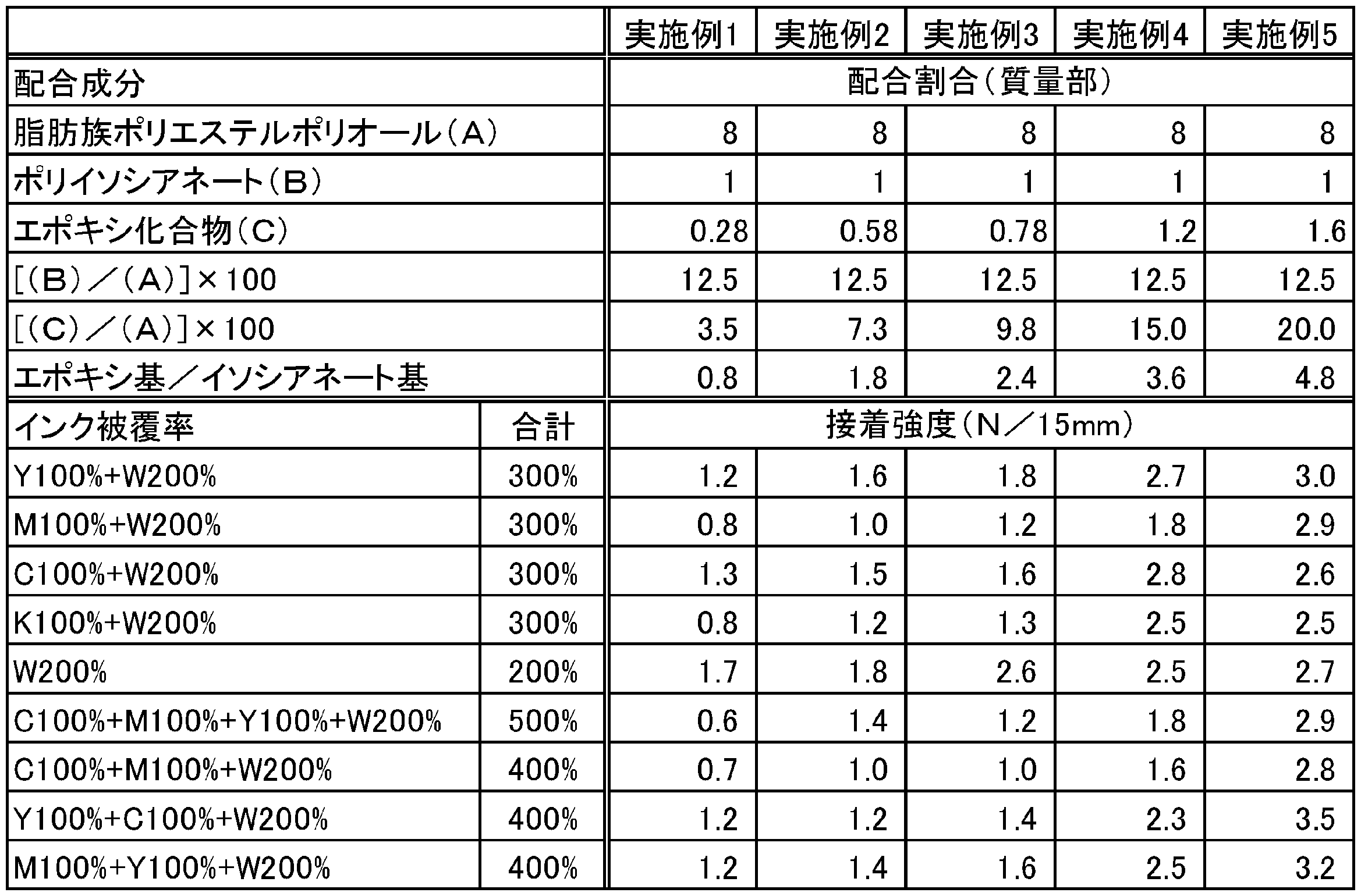
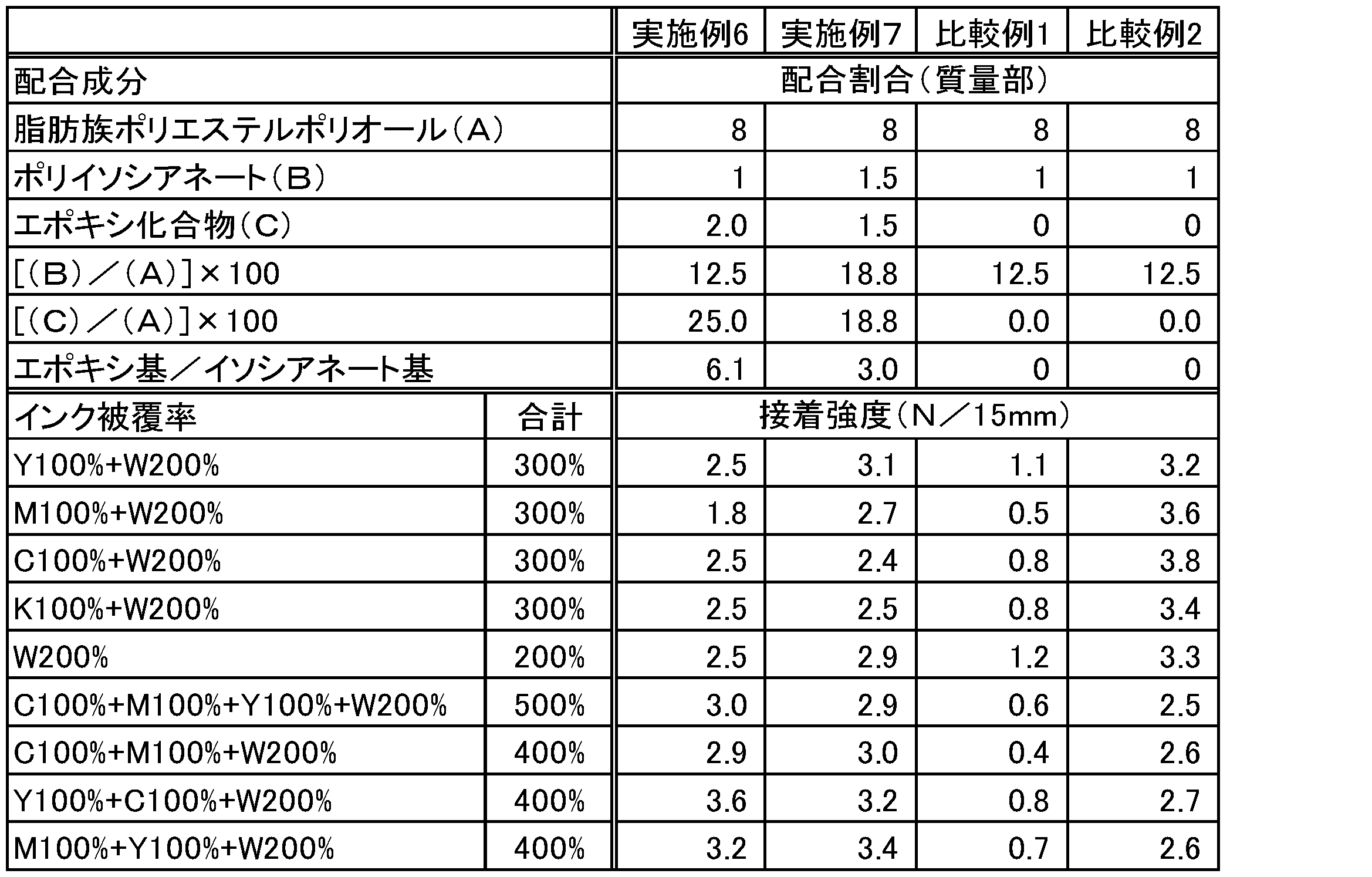
表1および表2に示すとおり、エポキシ化合物を含む接着剤層を用いた実施例1~7の積層体は、エポキシか化合物を含まない接着剤層を用いた比較例1の積層体よりも接着強度が高くなることが確認された。なお、比較例2では、比較的高い接着強度が得られたが、接着層に加えてエポキシコーティング層を形成するため、工程数が増加した必要があった。エポキシコーティング層の硬化(エージング)には2日間所要し、生産性が低下した。
比較例1の積層体では、静電インク層とプライマー層との界面付近で剥離していた。比較例2の積層体では、静電インク層が凝集破壊していた。一方、実施例1~7の積層体では、静電インク層と接着層の界面で剥離しており、静電インク層の凝集破壊は見られなかった。このことは、静電インク層の凝集力が向上していることを示唆している。なお、実施例1~7における、脂肪族ポリエステルポリオール(A)の水酸基に対する、ポリイソシアネート(B)に含まれるイソシアネート基のモル比は0.5~10の範囲内であった。
次に、実施例5および比較例2に係る積層体のレトルト熱処理後の接着強度および熱水接着強度の測定を行った。測定には、インク被覆率の合計が500%のものと、200%のものを用いた。測定手順の詳細は以下のとおりである。
[レトルト(120℃)後の接着強度の測定]
積層体を用いて三方袋を作製し、三方袋に水を封入した。その後、レトルト処理装置(日阪製作所製)を用いて、レトルト熱処理(120℃×30分間)を実施した。ここではレトルト熱処理として、蒸気式の加圧加熱方法を用いた。レトルト熱処理後、15mm幅にカットして積層体サンプルを採取し、インク層とインク層に接する層との層間強度を測定した。測定された剥離強度を、表3の「120℃」の欄に示す。なお、表3には、熱処理前の常温での接着強度も併せて示した。
積層体を用いて三方袋を作製し、三方袋に水を封入した。その後、レトルト処理装置(日阪製作所製)を用いて、レトルト熱処理(120℃×30分間)を実施した。ここではレトルト熱処理として、蒸気式の加圧加熱方法を用いた。レトルト熱処理後、15mm幅にカットして積層体サンプルを採取し、インク層とインク層に接する層との層間強度を測定した。測定された剥離強度を、表3の「120℃」の欄に示す。なお、表3には、熱処理前の常温での接着強度も併せて示した。
[レトルト(130℃)後の接着強度の測定]
積層体を用いて三方袋を作製し、三方袋に水を封入した。その後、レトルト処理装置(日阪製作所製)を用いて、レトルト熱処理(130℃×30分間)を実施した。レトルト熱処理後、15mm幅にカットして積層体サンプルを採取し、静電インク層と静電インク層に接する層との層間強度を測定した。測定された剥離強度を、表3の「130℃」の欄に示す。
積層体を用いて三方袋を作製し、三方袋に水を封入した。その後、レトルト処理装置(日阪製作所製)を用いて、レトルト熱処理(130℃×30分間)を実施した。レトルト熱処理後、15mm幅にカットして積層体サンプルを採取し、静電インク層と静電インク層に接する層との層間強度を測定した。測定された剥離強度を、表3の「130℃」の欄に示す。
[熱水接着強度の測定]
15mm幅にカットした積層体の端部における層間を剥離した後、90℃の熱水に浸した状態で引張試験機を用いて剥離強度を測定した。すなわち、剥離角度:フリー、引張速度:300mm/minとした。この剥離強度を熱水接着強度として表3に示す。
15mm幅にカットした積層体の端部における層間を剥離した後、90℃の熱水に浸した状態で引張試験機を用いて剥離強度を測定した。すなわち、剥離角度:フリー、引張速度:300mm/minとした。この剥離強度を熱水接着強度として表3に示す。

表3に示すとおり、熱水接着強度は実施例5の方が比較例2よりも優れることが確認された。
(実施例8)
[接着剤組成物および積層体の作製]
第1基材フィルムとして、ポリエチレンテレフタレートフィルム(PETフィルム、厚さ:12μm)を準備した。このPETフィルムの一方面に水性プライマー樹脂(ポリエチレンイミンを含有する樹脂、Michelman社製、商品名:DP050)を塗布してプライマー層を形成した。水性ポリエチレンイミンの塗布量が0.10~0.18g/m2となるように塗布した。
[接着剤組成物および積層体の作製]
第1基材フィルムとして、ポリエチレンテレフタレートフィルム(PETフィルム、厚さ:12μm)を準備した。このPETフィルムの一方面に水性プライマー樹脂(ポリエチレンイミンを含有する樹脂、Michelman社製、商品名:DP050)を塗布してプライマー層を形成した。水性ポリエチレンイミンの塗布量が0.10~0.18g/m2となるように塗布した。
HP Indigo社製の印刷機(商品名:Indigo 2000)を用いて、プライマー層の表面に所定の印刷を行った。静電インク組成物としては、エチレンアクリル酸、およびエチレンメタクリル酸のコポリマーを含有する熱可塑性樹脂を含む静電インク組成物(HP Indigo エレクトロインキ)を使用した。静電インク組成物の色としては、白(W)、黄色(Y)、マゼンタ(M)、シアン(C)を用いた。インク被覆率として、W200%のものと、C100%+M100%+Y100%+W200%のものを調製した。表4では、前者を「インク被覆率(1)」とし、後者を「インク被覆率(2)」とした。このように、静電インク組成物のインク被覆率が異なる2種類の試料を作製した。
実施例5と同じ接着剤組成物を調製した。静電インク組成物により形成された静電インク層の上方に、ハンドラミネーター機で、上述のとおりに調製した接着剤組成物を塗布して接着層を形成した。接着剤組成物の塗布量は、4.0g/m2とした。
第2基材フィルムとして、ナイロンフィルムおよび無延伸ポリプロピレンフィルムをこの順に有する基材フィルムを準備した。接着層とナイロンフィルムとが接触するようにして、基材フィルムを接着層に貼り合わせて積層体を得た。養生時間(エージング)は、40℃×2日間とした。
このようにして得られた積層体の接着強度(常温)、および熱間接着強度(120℃)について測定した。接着強度(常温)の測定方法は、上述した方法と同じである。また、熱間接着強度(120℃)は、120℃の温度条件にて、接着強度(常温)と同様にJIS K 6854-1:1999に準拠して作製した積層体の接着強度を測定したものである。測定結果は表4に示すとおりであった。
(実施例9~12)
接着剤組成物を調製する際、ポリイソシアネート(B)の配合量を表4に示すとおりに変更したこと以外は実施例8と同様にして積層体を作製した。作製した積層体を、実施例8と同様の方法で評価した。評価結果は表4に示すとおりであった。
接着剤組成物を調製する際、ポリイソシアネート(B)の配合量を表4に示すとおりに変更したこと以外は実施例8と同様にして積層体を作製した。作製した積層体を、実施例8と同様の方法で評価した。評価結果は表4に示すとおりであった。
(比較例3)
静電インク組成物により形成された静電インク層の上方におけるラミネートを、ドライラミネート装置を用いずにハンドラミネーター機で実施したこと以外は、比較例1と同様にして、積層体を作製した。静電インク組成物の色およびインク被覆率は、表4に示すとおりとした。作製した積層体を、実施例8と同様の方法で評価した。評価結果は表4に示すとおりであった。
静電インク組成物により形成された静電インク層の上方におけるラミネートを、ドライラミネート装置を用いずにハンドラミネーター機で実施したこと以外は、比較例1と同様にして、積層体を作製した。静電インク組成物の色およびインク被覆率は、表4に示すとおりとした。作製した積層体を、実施例8と同様の方法で評価した。評価結果は表4に示すとおりであった。

表4に示すとおり、各実施例では高温熱水処理条件下においても高い接着強度が得られることが確認された。また、脂肪族ポリエステルポリオール(A)に対するポリイソシアネート(B)の配合割合を調整することによって、熱間接着強度(120℃)を十分に高くできることが確認された。このことは、缶用ラベルのように、缶容器に貼付された状態での加圧加熱処理が行われる場合にも接着強度が十分高い状態を維持することができることを示している。一方、エポキシ化合物(C)を用いていない比較例3では、高温熱水処理条件に曝されると接着強度が大幅に低下することが確認された。なお、実施例8~12における、脂肪族ポリエステルポリオール(A)に含まれる水酸基に対する、ポリイソシアネート(B)に含まれるイソシアネート基のモル比は0.5~10の範囲内であった。
(実施例13~17)
脂肪族ポリエステルポリオール(A1)(三井化学株式会社製、タケラックA525)、ポリイソシアネート(B1)(三井化学株式会社製、タケネートA52)、およびエポキシ化合物(C)として3’,4’-エポキシシクロヘキシルメチル-3,4エポキシシクロヘキサンカルボキシレートを配合して、接着剤組成物を調製した。配合割合は、表5に示すとおりとした。このような接着剤組成物を用いたこと以外は、実施例8~実施例12と同様にして積層体を作製して評価した。評価結果は、表5に示すとおりであった。
脂肪族ポリエステルポリオール(A1)(三井化学株式会社製、タケラックA525)、ポリイソシアネート(B1)(三井化学株式会社製、タケネートA52)、およびエポキシ化合物(C)として3’,4’-エポキシシクロヘキシルメチル-3,4エポキシシクロヘキサンカルボキシレートを配合して、接着剤組成物を調製した。配合割合は、表5に示すとおりとした。このような接着剤組成物を用いたこと以外は、実施例8~実施例12と同様にして積層体を作製して評価した。評価結果は、表5に示すとおりであった。
(比較例4)
ポリオールとして脂肪族ポリエステルポリオール(A1)(三井化学株式会社製、タケラックA525)、および、ポリイソシアネート(B1)(三井化学株式会社製、タケネートA52)を配合して、接着剤組成物を調製した。配合割合は、表5に示すとおりとした。このような接着剤組成物を用いたこと以外は、比較例3と同様にして積層体を作製して評価した。評価結果は、表5に示すとおりであった。
ポリオールとして脂肪族ポリエステルポリオール(A1)(三井化学株式会社製、タケラックA525)、および、ポリイソシアネート(B1)(三井化学株式会社製、タケネートA52)を配合して、接着剤組成物を調製した。配合割合は、表5に示すとおりとした。このような接着剤組成物を用いたこと以外は、比較例3と同様にして積層体を作製して評価した。評価結果は、表5に示すとおりであった。
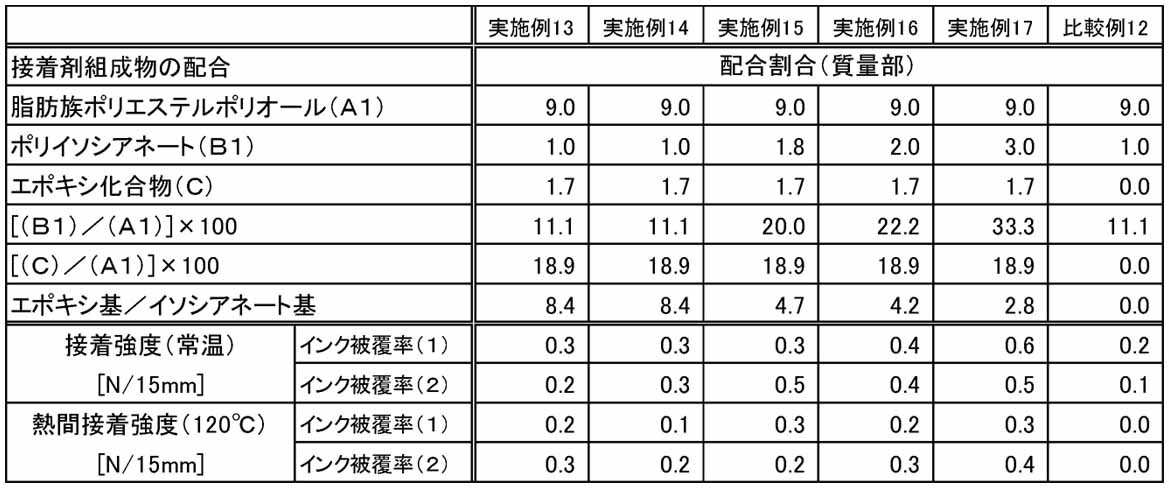
表5に示すとおり、脂肪族ポリエステルポリオールとポリイソシアネートの組み合わせを変更した場合も、各実施例では高い接着強度が得られることが確認された。また、脂肪族ポリエステルポリオール(A1)に対するポリイソシアネート(B1)の配合割合を調整することによって、熱間接着強度(120℃)を十分に高くできることが確認された。一方、エポキシ化合物(C)を用いていない比較例4では、高温熱水処理条件に曝されると接着強度が大幅に低下することが確認された。なお、実施例13~17における、脂肪族ポリエステルポリオール(A1)に含まれる水酸基に対する、ポリイソシアネート(B1)に含まれるイソシアネート基のモル比は0.5~10の範囲内であった。
本開示によれば、デジタル印刷機による静電インク層を有しつつ缶表面への貼付に適した缶用ラベルを提供することができる。
1…缶用ラベル、10…第1基材フィルム、20…第2基材フィルム、30…接着剤層、40…プライマー層、50…静電インク層、80…接着層、90…缶体、100…缶容器。
Claims (5)
- 缶体に対してラミネート加工される缶用ラベルであって、
第1基材、プライマー層、静電インク層、接着剤層、および第2基材がこの順に積層され、
前記接着剤層は、ポリオール、ポリイソシアネートおよびエポキシ化合物を含む接着剤組成物と、当該接着剤組成物の硬化物と、の少なくとも一方を含んでいる、缶用ラベル。 - 前記第1基材および前記第2基材の少なくとも一方がポリエチレンテレフタレート樹脂フィルムである、請求項1に記載の缶用ラベル。
- 前記ポリオールは脂肪族ポリエステルポリオールを含み、前記エポキシ化合物は、両末端にエポキシ基を有するものを含む、請求項1または2に記載の缶用ラベル。
- 前記エポキシ化合物は2官能の脂環式エポキシ化合物を含む、請求項1~3のいずれか一項に記載の缶用ラベル。
- 前記ポリイソシアネートはキシリレンジイソシアネート誘導体を含む、請求項1~4のいずれか一項に記載の缶用ラベル。
Applications Claiming Priority (2)
| Application Number | Priority Date | Filing Date | Title |
|---|---|---|---|
| JP2020-217544 | 2020-12-25 | ||
| JP2020217544A JP7622429B2 (ja) | 2020-12-25 | 2020-12-25 | 缶用ラベル |
Publications (1)
| Publication Number | Publication Date |
|---|---|
| WO2022137992A1 true WO2022137992A1 (ja) | 2022-06-30 |
Family
ID=82157670
Family Applications (1)
| Application Number | Title | Priority Date | Filing Date |
|---|---|---|---|
| PCT/JP2021/043595 Ceased WO2022137992A1 (ja) | 2020-12-25 | 2021-11-29 | 缶用ラベル |
Country Status (3)
| Country | Link |
|---|---|
| JP (1) | JP7622429B2 (ja) |
| TW (1) | TW202235283A (ja) |
| WO (1) | WO2022137992A1 (ja) |
Citations (4)
| Publication number | Priority date | Publication date | Assignee | Title |
|---|---|---|---|---|
| WO2010016503A1 (ja) * | 2008-08-04 | 2010-02-11 | 東洋製罐株式会社 | 加飾缶体及びその製造方法 |
| JP2015157363A (ja) * | 2014-02-21 | 2015-09-03 | 大日本印刷株式会社 | 積層体およびそれを用いた包装体 |
| US20160362583A1 (en) * | 2015-06-10 | 2016-12-15 | Upm Raflatac Oy | Printable label comprising a clear face layer and a clear adhesive layer |
| JP2018530478A (ja) * | 2015-10-23 | 2018-10-18 | エイチピー・インディゴ・ビー・ブイHP Indigo B.V. | フレキシブル包装材料 |
Family Cites Families (1)
| Publication number | Priority date | Publication date | Assignee | Title |
|---|---|---|---|---|
| JP2017068127A (ja) * | 2015-09-30 | 2017-04-06 | 株式会社フジシール | シュリンクラベル及び筒状シュリンクラベル |
-
2020
- 2020-12-25 JP JP2020217544A patent/JP7622429B2/ja active Active
-
2021
- 2021-11-29 WO PCT/JP2021/043595 patent/WO2022137992A1/ja not_active Ceased
- 2021-12-24 TW TW110148626A patent/TW202235283A/zh unknown
Patent Citations (4)
| Publication number | Priority date | Publication date | Assignee | Title |
|---|---|---|---|---|
| WO2010016503A1 (ja) * | 2008-08-04 | 2010-02-11 | 東洋製罐株式会社 | 加飾缶体及びその製造方法 |
| JP2015157363A (ja) * | 2014-02-21 | 2015-09-03 | 大日本印刷株式会社 | 積層体およびそれを用いた包装体 |
| US20160362583A1 (en) * | 2015-06-10 | 2016-12-15 | Upm Raflatac Oy | Printable label comprising a clear face layer and a clear adhesive layer |
| JP2018530478A (ja) * | 2015-10-23 | 2018-10-18 | エイチピー・インディゴ・ビー・ブイHP Indigo B.V. | フレキシブル包装材料 |
Also Published As
| Publication number | Publication date |
|---|---|
| TW202235283A (zh) | 2022-09-16 |
| JP2022102672A (ja) | 2022-07-07 |
| JP7622429B2 (ja) | 2025-01-28 |
Similar Documents
| Publication | Publication Date | Title |
|---|---|---|
| JP7661835B2 (ja) | 硬化剤、2液型接着剤、接着剤組成物、硬化物、積層体及びその製造方法、包装材、並びに包装体 | |
| TWI753975B (zh) | 反應型接著劑、積層薄膜及包裝體 | |
| WO2010010664A1 (ja) | 無溶剤型接着剤を使用した多層フィルム、その製造方法および包装容器 | |
| TW201840420A (zh) | 蓄電裝置用外裝材、蓄電裝置用外裝外殼及蓄電裝置 | |
| JP2020094154A (ja) | 反応性接着剤、積層フィルム、及び包装体 | |
| JP7440003B1 (ja) | 水性ウレタン樹脂組成物 | |
| JP2021088184A (ja) | 包装材及び包装容器 | |
| JP7183646B2 (ja) | 2液型接着剤、積層フィルム及び包装体 | |
| JP7622429B2 (ja) | 缶用ラベル | |
| JP2023121833A (ja) | 容器、及び加熱用包装袋 | |
| JP7746666B2 (ja) | 積層体及びその製造方法、包装袋並びに包装体 | |
| JP7746668B2 (ja) | 包装袋 | |
| JP7746669B2 (ja) | スパウト付きパウチ及びその製造方法、並びに、積層体、包装材及び包装体 | |
| JP2025152380A (ja) | 積層体及びその製造方法、包装袋、並びに包装体 | |
| JP2025051058A (ja) | 積層体及びその製造方法、包装袋、並びに包装体 | |
| JP2025177239A (ja) | 積層体及びその製造方法、包装袋、並びに包装体 | |
| JP2025178659A (ja) | 積層体及び包装袋、並びに包装袋の製造方法 | |
| TWI922566B (zh) | 容器、及加熱用包裝袋 | |
| JP2025180997A (ja) | 印刷物及び積層体、並びに包装袋 | |
| JP2025039978A (ja) | 積層体及びその製造方法、包装材、包装袋、並びに包装体 | |
| JP2025051059A (ja) | 包装体及びその製造方法 | |
| JP2025051060A (ja) | 積層体及びその製造方法、包装袋、並びに包装体 | |
| WO2022138379A1 (ja) | 積層体及びその製造方法、スパウト付きパウチ及びその製造方法、包装材、包装袋並びに包装体 | |
| CN116710277A (zh) | 容器以及加热用包装袋 | |
| TR2024006498T (tr) | Lami̇nasyon yapiştiricisi, ambalaj i̇çi̇n lami̇nant ve ambalaj |
Legal Events
| Date | Code | Title | Description |
|---|---|---|---|
| 121 | Ep: the epo has been informed by wipo that ep was designated in this application |
Ref document number: 21910144 Country of ref document: EP Kind code of ref document: A1 |
|
| NENP | Non-entry into the national phase |
Ref country code: DE |
|
| 122 | Ep: pct application non-entry in european phase |
Ref document number: 21910144 Country of ref document: EP Kind code of ref document: A1 |