WO2022131313A1 - 包装用部材 - Google Patents
包装用部材 Download PDFInfo
- Publication number
- WO2022131313A1 WO2022131313A1 PCT/JP2021/046397 JP2021046397W WO2022131313A1 WO 2022131313 A1 WO2022131313 A1 WO 2022131313A1 JP 2021046397 W JP2021046397 W JP 2021046397W WO 2022131313 A1 WO2022131313 A1 WO 2022131313A1
- Authority
- WO
- WIPO (PCT)
- Prior art keywords
- region
- packaging member
- blank material
- lid
- container
- Prior art date
- Legal status (The legal status is an assumption and is not a legal conclusion. Google has not performed a legal analysis and makes no representation as to the accuracy of the status listed.)
- Ceased
Links
Images







Classifications
-
- B—PERFORMING OPERATIONS; TRANSPORTING
- B65—CONVEYING; PACKING; STORING; HANDLING THIN OR FILAMENTARY MATERIAL
- B65D—CONTAINERS FOR STORAGE OR TRANSPORT OF ARTICLES OR MATERIALS, e.g. BAGS, BARRELS, BOTTLES, BOXES, CANS, CARTONS, CRATES, DRUMS, JARS, TANKS, HOPPERS, FORWARDING CONTAINERS; ACCESSORIES, CLOSURES, OR FITTINGS THEREFOR; PACKAGING ELEMENTS; PACKAGES
- B65D3/00—Rigid or semi-rigid containers having bodies or peripheral walls of curved or partially-curved cross-section made by winding or bending paper without folding along defined lines
-
- B—PERFORMING OPERATIONS; TRANSPORTING
- B65—CONVEYING; PACKING; STORING; HANDLING THIN OR FILAMENTARY MATERIAL
- B65D—CONTAINERS FOR STORAGE OR TRANSPORT OF ARTICLES OR MATERIALS, e.g. BAGS, BARRELS, BOTTLES, BOXES, CANS, CARTONS, CRATES, DRUMS, JARS, TANKS, HOPPERS, FORWARDING CONTAINERS; ACCESSORIES, CLOSURES, OR FITTINGS THEREFOR; PACKAGING ELEMENTS; PACKAGES
- B65D3/00—Rigid or semi-rigid containers having bodies or peripheral walls of curved or partially-curved cross-section made by winding or bending paper without folding along defined lines
- B65D3/28—Other details of walls
-
- B—PERFORMING OPERATIONS; TRANSPORTING
- B65—CONVEYING; PACKING; STORING; HANDLING THIN OR FILAMENTARY MATERIAL
- B65D—CONTAINERS FOR STORAGE OR TRANSPORT OF ARTICLES OR MATERIALS, e.g. BAGS, BARRELS, BOTTLES, BOXES, CANS, CARTONS, CRATES, DRUMS, JARS, TANKS, HOPPERS, FORWARDING CONTAINERS; ACCESSORIES, CLOSURES, OR FITTINGS THEREFOR; PACKAGING ELEMENTS; PACKAGES
- B65D43/00—Lids or covers for rigid or semi-rigid containers
Definitions
- the present invention relates to a packaging member.
- the present invention particularly relates to a packaging member having an annular side wall.
- a packaging member such as a flexible container for accommodating beverages such as coffee and contents such as delicatessen, and a lid for such a container
- a packaging member made of a paper-based material has been proposed.
- Packaging members such as containers and lids have an annular side wall around the canopy and bottom material.
- annular side wall one obtained from a blank material made of a strip-shaped piece of paper or the like has been proposed.
- the blank material is rolled into an annular shape and two ends separated along the longitudinal direction of the blank material are overlapped to form an overlapping portion, and the ends are joined to each other at the overlapping portion to form a joint portion. Then, the side wall is obtained.
- the airtightness between the container and the lid is impaired even in the container to which the lid is attached. If the airtightness between the container and the lid is impaired, the contents may unintentionally spill out from the container to which the lid is attached. Further, at the position of the end portion of the blank material, the end face tends to be exposed, and when the contents of the container are liquid, the liquid easily permeates from the end face.
- Patent Document 1 discloses a technique for filling a stepped portion by applying a resin to the stepped portion.
- An object of the present invention is to provide a packaging member having excellent airtightness and improved penetration of the contents from the end face of the blank material.
- the present invention (1) It has an annular side wall having a joint portion in which two ends of a blank material made of a paper-based material are overlapped and the opposite regions of the ends are joined to each other. Each of the two ends forms a compression part in which the blank material is compressed, and has a shape that tapers toward the tip.
- each of the end portions has the following formula 1. Meet, Packaging material.
- ⁇ is the first direction from the outer end of the facing region to the inner end of the facing region with respect to the direction along the horizontal plane on the cut surface of the blank material along the thickness direction of the blank material.
- ⁇ is the position of the non-opposed region corresponding to the back surface side of the inner end of the opposed region from the outer end of the non-opposed region with reference to the direction along the horizontal plane in the cut surface. Indicates the second elevation / depression angle in the direction toward.
- L1 indicates the separation distance from the outer end of the facing region to the inner end of the facing region on the cut surface of the blank material along the thickness direction of the blank material
- L2 is the distance between the cut surface and the inner end of the facing region. The separation distance from the outer end of the inclined surface to the inner end of the inclined surface is shown.
- the packaging member according to (1) or (2) above at at least one of the end portions, the outer end of the facing region and the outer end of the non-opposing region coincide with each other.
- the tip of at least one of the end faces forms an end face, the outer end of the opposite region is formed on one edge of the end face, and the outer end of the non-opposite region is formed on the other edge of the end face.
- the facing regions of the two end portions have different shapes and have shapes corresponding to each other.
- the joint portion is formed in a state where the entire surfaces of the facing regions of the two end portions are joined.
- the combination of the ⁇ and the ⁇ is different between the two ends, and each of the compression portions forming each of the two ends has a different compression rate profile from each other.
- the packaging member according to (1) above. (8) One of the ends has a smaller sum of ⁇ and ⁇ than the other end, and is exposed on the inner peripheral surface of the side wall. The packaging member according to (1) above. (9) In the compressed portion, the degree of compression of the blank material increases toward the tip of the end portion. The packaging member according to (1) or (2) above. (10) The compression portion is formed over the entire end portion. The packaging member according to (1) or (2) above. (11) The compressed portion is formed by a hot press process. The packaging member according to (1) or (2) above.
- the packaging member according to (1) or (2) above Used as a container or lid, The packaging member according to (1) or (2) above. (13) Used as a container, The container has an annular curl portion formed in an outer winding along the upper end of the side wall and an opening surrounded by the curl portion. The compressed portion is exposed on the outer peripheral surface of the curled portion. The packaging member according to (1) or (2) above. (14) Used as a lid, In the lid, the compression portion is exposed on the inner peripheral surface of the side wall. The packaging member according to (1) or (2) above. Is the gist.
- the packaging member has an annular side wall provided with a joint portion in which two ends of a blank material made of a paper-based material are overlapped and the opposite regions of the ends are joined to each other. is doing. Further, each of the two end portions forms a compression portion in which the blank material is compressed, and has a shape that tapers toward the tip end, and the region of the end portion on the back surface side with respect to the facing region is not included.
- each end thereof satisfies the above formula 1.
- each of the two end portions forms a compression portion obtained by compressing the blank material and has a shape tapered toward the tip end.
- an inclined surface inclined to the outer end of the non-opposing portion is formed in the non-opposing area defined as the area on the back surface side with respect to the facing area, and the plane whose normal is the thickness direction of the blank material is a horizontal plane.
- Each of the end portions satisfies the above formula 2.
- the packaging member by providing the packaging member with the above-mentioned configuration, it is possible to provide a packaging member having excellent airtightness.
- a packaging member having excellent airtightness By obtaining a packaging member having excellent airtightness, it is possible to suppress a situation in which the contents are unintentionally spilled from the container to which the lid is attached.
- the end portion of the blank material is compressed and the area of the end face of the end portion is suppressed, the permeation of the contents from the end portion can be improved.
- the compression unit can be realized by a physical process called compression, it is possible to suppress the need to consider the elution of components contained in the resin, which is a concern when a chemical substance such as a resin is newly used. Will be.
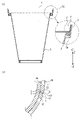
- FIG. 1 is a perspective view for explaining an embodiment of the first embodiment.
- FIG. 2 is a vertical cross-sectional view showing a state of the vertical cross section of the line AA of FIG.
- FIG. 3 is a diagram showing a state of a cross section of the line BB of FIG. 1 for explaining an embodiment of the first embodiment, and a portion showing an enlarged state of a region S1 surrounded by a long-dotted line. It is an enlarged view.
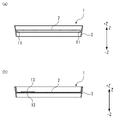
- FIG. 4A is a plan view showing an example of the blank material.
- FIG. 4B is a cross-sectional view showing a state of a vertical cross section of the line CC in which the blank material is cut along the alternate long and short dash line W of FIG. 4A.
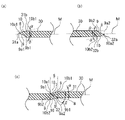
- FIG. 5 (a) and 5 (b) are cross-sectional views showing an example of the vicinity of the end portion of the blank material.
- FIG. 5C is a diagram showing an example of the state of the overlapping portion and the joint portion in the first embodiment.
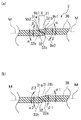
- 6 (a) and 6 (b) are cross-sectional views showing an example of the state of the overlapping portion and the joint portion in the first embodiment.
- 7 (a) to 7 (g) are cross-sectional views showing an example of an end portion in the first embodiment.
- FIG. 8 is a cross-sectional view for explaining a blank material according to an embodiment of the second embodiment.
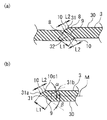
- 9 (a) and 9 (b) are cross-sectional views showing an example of the state of the overlapping portion and the joint portion in the second embodiment.
- FIG. 10A is a cross-sectional view showing a state in which the lid is attached to the packaging member (container) of the first embodiment, and is a partially enlarged view of the portion of the region S2.
- FIG. 10B is an enlarged view of a main part showing a state in which a lid is attached to the packaging member (container) of the first embodiment.
- FIG. 11A is a cross-sectional view for explaining an embodiment of the fourth embodiment.
- FIG. 11B is a cross-sectional view for explaining an embodiment of the fifth embodiment.
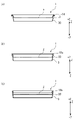
- 12 (a), 12 (b), and 12 (c) are cross-sectional views for explaining an embodiment of the sixth embodiment.
- FIG. 13 is a perspective view for explaining an embodiment of the seventh embodiment, and a partially enlarged view of the area S3.
- FIG. 13 is a perspective view for explaining an embodiment of the seventh embodiment, and a partially enlarged view of the area S3.
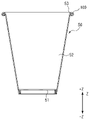
- FIG. 14 is a perspective view for explaining an embodiment of a modified example of the seventh embodiment.
- FIG. 15 is a vertical cross-sectional view showing a state of the vertical cross section of the DD line of FIG.
- FIG. 16A is a plan view for explaining one embodiment of the modified example of the seventh embodiment, and is a partially enlarged view of the region S4.
- FIG. 16B is an enlarged view of a main part showing a state in which a lid is attached to a packaging member (container) according to an embodiment of a modified example of the seventh embodiment.
- 17 (a) to 17 (h) are process cross-sectional views for explaining an embodiment of the method for manufacturing a packaging member according to the first embodiment.
- FIG. 18 is a cross-sectional view for explaining a step of forming a compression portion at an end portion of the blank material.
- FIG. 19 is a cross-sectional view showing an example of a state of an overlapping portion and a joint portion in a blank material for forming a conventional packaging member.
- the following description is a suitable specific example of the present invention, and the content of the present invention is not limited to these embodiments and the like. Further, in the following description, for convenience of explanation, directions such as front-back, left-right, up-down, etc. are shown, but the content of the present invention is not limited to these directions.
- the Z-axis direction is the vertical direction (the upper side is the + Z direction and the lower side is the lower side).
- X-axis direction is front-back direction (front side is + X direction, rear side is -X direction), Y-axis direction is left-right direction (right side is + Y direction, left side is -Y direction), based on this Give an explanation.
- the relative magnitude ratio of the size and thickness of each layer shown in each of FIGS. 1 to 19 is described for convenience, and does not limit the actual magnitude ratio.
- the "packaging member” refers to a member that can be used for the purpose of accommodating various articles such as food and drink as contents.
- the packaging member is a concept that includes a container, a lid, and other packaging bodies. Therefore, the packaging member may be used as either a container or a lid.
- the description will be given based on one embodiment in the case where the packaging member is used as a lid. In the seventh embodiment, the description will be given based on one embodiment in the case where the packaging member is used as a container.
- the packaging member according to the first embodiment of the present invention is the lid body 1.
- the lid 1 includes a canopy 2 and a wall material 3.
- the lid 1 can be attached to, for example, the opening edge of the bottomed container T having an opening on the upper end side.
- a container T having rigidity such as metal may be used, but a container T having flexibility at the opening edge portion is particularly preferably used.
- the canopy 2 has a top surface portion 4 that covers the opening of the container T and a rising portion 5 that rises upward from the outer peripheral edge of the top surface portion 4 in a state of being attached to the container T.
- the rising portion 5 is joined to the inner peripheral surface side of the wall material 3 at a predetermined position above the lower end of the wall material 3 (the lower end toward the container T side).
- the shape of the top surface portion 4 is not particularly limited, and may be determined according to the shape of the container T.
- an elliptical shape, a rectangular shape, a triangular shape, a polygonal shape, a chamfered rectangular shape, a chamfered polygonal shape, and the like can be exemplified.
- Examples of the material constituting the canopy 2 include pulp-based materials, fiber-based materials, synthetic resin-based materials, metal-based materials, wood-based materials, glass-based materials, and composites and laminates thereof.
- the canopy 2 can be obtained, for example, by molding a blank material for forming a canopy, which is formed by punching a raw material.
- the material of the raw material for forming the canopy is not limited, but for example, a paper material, a woven fabric material, a non-woven fabric material, a resin film / sheet material, a metal foil such as aluminum foil, a wood foil, etc. are appropriately used. It is selectable. From the viewpoint of environmental load and ease of handling, the raw material for canopy formation is preferably a paper-based material.
- Paper-based materials include so-called papers manufactured by laminating plant fibers and other fibers, as well as chemical fiber papers, synthetic papers, water-resistant papers, coated papers, alternative papers, sheepskin papers, woolen papers, and glass fiber papers. , Stone paper, porcelain paper, etc.
- the non-woven fabric include so-called air-laid sheets formed into a sheet by combining crushed pulp piled up by an air flow, a pulp-based material, and a non-woven fabric of fibers such as a natural fiber material and a synthetic fiber.
- the resin film / sheet material include synthetic resin, natural resin, and biodegradable resin film and sheet, and among them, biodegradable resin film and sheet can be preferably used.
- the lid 1 has a wall material 3 as a side wall of the packaging member.
- the wall material 3 is formed in an annular shape.
- the wall material 3 has an overlapping portion 6 in which two ends 31 and 32 of a blank material 30 for forming a wall material having a predetermined shape are overlapped, and a joint portion 7 in which the overlapping portions 6 join the ends 31 and 32 to each other. And prepare.
- one surface of the end portion 31 and one surface of the end portion 32 face each other.
- the portion of the end portions 31 and 32 facing each other is the facing region 9.
- a paper-based material is used as the raw material for forming the blank material 30 for forming the wall material. Therefore, as the blank material 30, a paper-based material is used.
- a paper-based material various paper-based materials as described above for the raw material for forming the canopy can be appropriately used.
- a paper-based material formed in a fan shape is used as a raw material for forming a wall material, and two ends of the paper-based material separated along the circumferential direction are overlapped with each other and overlapped. Is formed.
- the end portions 31 and 32 referred to here indicate a portion from the edge of the blank material 30 to a predetermined position facing inward.
- the joining portion 7 is formed by joining at least a part of the overlapping portion 6, preferably the entire overlapping portion 6, with the two end portions 31, 32 facing each other, 9 and 9.
- the joint portion 7 may be formed in a state where the facing regions 9 and 9 are completely joined to each other, or may be formed in a state where a part of the facing regions is joined to each other. In the example shown in FIG. 3, the joint portion 7 is formed in a state where the facing regions 9 and 9 are completely joined to each other.
- Examples of the bonding method of the two ends 31 and 32 include an adhesive, a hot melt adhesive, a two-component adhesive, a heat seal, a high frequency bonding, and an ultrasonic bonding, but ultrasonic bonding is preferable. be.
- the joint portion 7 is formed by joining a formed portion of the compression portion 8 described later or a portion including the formed portion thereof. In this case, the entire compression portion 8 can be used for the joint portion 7.
- each of the end portions 31 and 32 forms the compression portion 8, and the facing regions 9 and 9 are set on one side of the formed portion of the respective compression portions 8 as the facing regions 9 and 9.
- the joint portion 7 is formed by the entire joint of the above. It should be noted that this does not prohibit the joint portion 7 from being formed in a part of the formed portion of the compression portion 8.
- FIG. 5 is a schematic drawing of a portion including the overlapping portion 6 in FIG. 3 extracted.
- the compression portion 8 may be formed on a part of the end portion 31 forming the overlapping portion 6, but as shown in FIG. 5, the compression portion 8 is from the tip end 31a to the base end 31b of the end portion 31 forming the overlapping portion 6. It is preferable that the compression portion 8 is formed over the entire surface. In this case, the change in the thickness of the blank material 30 becomes moderately gradual at the position of the end portion 31 of the blank material 30, and the adhesion to the container T can be further improved.
- the position of the base end of the compression portion 8 of the end portion 31 is the inner end 9b1 of the facing region 9 and the inner end of the non-opposing region 10. It corresponds to 10b1, and the tip of the compression portion 8 coincides with the outer end 9a1 of the facing region 9 and the outer end 10a1 of the non-opposing region 10.
- the compression portion 8 of the end portion 32 does not prohibit the formation range of the compression portion 8 from being different from the range of the end portions 31 and 32 and the formation range of the facing region 9.
- the end portion 31 may be formed in a part of the formation range of the compression portion 8.
- the compression portion 8 is a portion formed by compressing the blank material 30 for forming the wall material.
- the compression portion 8 is formed by compressing the end portions 31 and the end portions 32 of the blank material 30 for forming the wall material, as described above.
- a method of compressing the blank material 30 for forming the wall material for example, a pressing process or the like can be mentioned.
- the press treatment include a non-heated press treatment under non-heated conditions, a hot press treatment under heated conditions, an ultrasonic press treatment, and the like.
- a humidifying condition or the like can be mentioned in addition to the heating condition.
- examples of the press process include a press process in a humidified state.
- the non-heated press treatment or the hot press treatment may be carried out under humidified conditions or may be carried out under non-humidified conditions.
- the hot press process is preferable.
- the thickness of the end portion 31 of the blank material 30 for forming the wall material can be easily reduced, and the thinner the thickness of the blank material 30, the blank material for forming the wall material. It is possible to form a state in which the density of 30 is improved.
- the degree of compression of the blank material 30 for forming the wall material increases toward the tip 31a of the end portion 31. This is because when at least one end 31 of the wall material forming blank material 30 is compressed, the wall material forming blank material 30 is pressed with a stronger force at a position closer to the tip end 31a of the end portion 31. It can be realized concretely with. Further, in the case of the examples of FIGS. 3 to 5, the density of the tip 31a of the end portion 31 in the blank material 30 for forming the wall material is increased. Further, it becomes easy to reduce the area of the end face of the tip end 31a of the end portion 31 in the blank material 30 for forming the wall material.
- the content of the container T to which the lid 1 is attached is liquid, even if the content adheres to the position of the tip 31a of the end portion 31 of the blank material 30 forming the wall material 3.
- the contents are less likely to permeate from the tip 31a toward the inside of the wall material 3.
- the degree of compression of the blank material 30 for forming the wall material increases toward the tip 32a of the end portion 32.
- the case of the end portion 32 can also be realized by the same method as the case of the end portion 31, and the same effect as the case of the end portion 31 can be expected.
- the end portion 31 of the blank material 30 for forming the wall material has a shape that tapers toward the tip 31a (a shape in which the wall thickness of the blank material 30 decreases toward the tip 31a).
- the base end 31b of the end portion 31 corresponds to the base end of the compression portion 8
- the tip end 31a of the end portion 31 corresponds to the tip end of the compression portion 8.
- the end portion 32 also has a shape that tapers toward the tip end 32a, the base end of the end portion 32 corresponds to the base end of the compression portion 8, and the tip end 32a of the end portion 32 is the compression portion 8. Corresponds to the tip of.
- each of the end portions 31 and 32 the region on the back surface side of the end portions 31 and 32 with respect to the facing regions 9 and 9 is defined as the non-opposing regions 10 and 10, and the thickness direction of the blank material 30 is normal (FIG. In 4 (b), when the plane to be the normal F) is aligned (parallel) with the horizontal plane M, each of the end portions 31 and 32 satisfies the following equation 3.
- the plane whose normal is the thickness direction of the blank material 30 is a horizontal plane, as shown in FIG. 4A, the blank whose end portions 31 and 32 of the wall material 3 as the side wall are separated and developed in a plane.
- the region on the back surface side with respect to the facing region 9 indicates a region corresponding to the opposite surface side in the direction along the thickness direction of the blank material 30 with respect to the forming region of the facing region 9.
- ⁇ is a horizontal plane M on the cut surface of the blank material along the longitudinal direction of the blank material 30 (one-dot chain line W in FIG. 4 (a)) as shown in FIG. 4 (b).
- the first elevation / depression angle in the direction from the outer end of the facing area 9 to the inner end of the facing area 9 with respect to the direction along the line is shown
- ⁇ is a non-facing area with respect to the direction along the horizontal plane M on the cut surface.
- the second elevation / depression angle in the direction from the outer end of the 10 toward the position of the non-opposed area 10 corresponding to the back surface side of the inner end of the opposed area 9 (the inner end of the area of the non-opposed area 10) is shown.
- FIG. 1 is a horizontal plane M on the cut surface of the blank material along the longitudinal direction of the blank material 30 (one-dot chain line W in FIG. 4 (a)) as shown in FIG. 4 (b).
- the first elevation / depression angle ( ⁇ ) is the horizontal plane M and the direction from the outer end 9a1 of the facing region 9 to the inner end 9b1 (outer end 9a1 and inner end 9b1).
- the second elevation / depression angle ( ⁇ ) is the angle formed by the extending direction of the straight line connecting the two, and the second elevation / depression angle ( ⁇ ) is the direction from the outer end 10a1 of the non-opposite region 10 to the inner end 10b1 (outer end 10a1 and inner end). It is an angle formed with (the direction in which the straight line connecting 10b1 extends).
- the first elevation / depression angle ( ⁇ ) is the direction from the outer end 9a2 of the facing region 9 to the inner end 9b2 (the direction in which the straight line connecting the outer end 9a2 and the inner end 9b2 extends) with the horizontal plane M.
- the second elevation / depression angle ( ⁇ ) is the direction between the horizontal plane M and the outer end 10a2 of the non-opposing region toward the inner end 10b2 (the direction in which the straight line connecting the outer end 10a2 and the inner end 10b2 extends). It is a suspended angle. This also applies to FIGS. 5, 6, 7, and 9.
- the value of ⁇ is more than 0 ° and less than 90 °, and the value of ⁇ is 0 ° or more and less than 90 °. Further, the magnitude relationship between ⁇ and ⁇ is preferably ⁇ > ⁇ in the above equation 3. With such a configuration, it becomes easy to secure the area of the facing areas 9 and 9 of the end portions 31 and 32, and it is possible to easily secure the size of the overlapping portion 6.
- the combination of values of ⁇ and ⁇ ( ⁇ , ⁇ ) may be different between the two ends (ends 31, 32). That is, as shown in FIG. 6B, the combination of ( ⁇ , ⁇ ) at the end 31 was defined as ( ⁇ 1, ⁇ 1), and the combination of ( ⁇ , ⁇ ) at the end 32 was defined as ( ⁇ 2, ⁇ 2). In some cases, ⁇ 1 and ⁇ 2 may be different, and ⁇ 1 and ⁇ 2 may be different. In this case, the compression ratio profiles are likely to be different from each other between the ends 31 and 32.
- the profile of the compression ratio for the end portion 31 indicates the relationship between each position from the base end 31b to the tip end 31a of the end portion 31 and the compression ratio.
- the profile of the compression ratio for the end portion 32 indicates the relationship between each position of the end portion 32 from the base end 32b to the tip end 32a and the compression ratio.
- the sum of the values of ⁇ and ⁇ is smaller than that of the other of 31 and 32) and is exposed on the inner peripheral surface of the side wall (inner peripheral surface 3a of the wall material 3). That is, for example, when the sum of the values of ⁇ and ⁇ is smaller in the end 31 than in the end 32 between the two ends (ends 31 and 32), the end 31 is the wall. It is preferable that the material 3 is exposed on the inner peripheral surface 3a. In this case, the end portion having the increased compression ratio can be arranged on the inner peripheral surface side of the side wall, the step difference of the overlapping portion 6 can be more effectively eliminated, and the contents can be absorbed. Can be suppressed more effectively.
- the tip of the end portion 31 may protrude as shown in FIG.
- the tip 31a of the end portion 31 protrudes along the length direction of the blank material 30, the positions of the outer end 9a1 of the facing region 9 and the outer end 10a1 of the non-opposing region 10 can be roughly aligned in the vertical direction. .. Further, the tip 31a of the end portion 31 may form an end face as shown in FIGS. 7 (b) and 7 (e).
- the outer end 9a1 of the facing region 9 is formed on one edge of the end surface forming the tip 31a
- the outer end 10a1 of the non-opposing region 10 is formed on the other edge of the end surface
- the outer end 9a1 and the outer end 10a1 are separated from each other. ..
- the tip 32a both of the tips 31a and 32a may form an end face, but may be formed at the tip of at least one of the ends 31 and 32 (for example, the tip 31a of the end 31).
- the shapes of the facing region 9 and the non-opposing region 10 are not particularly limited, and as shown in FIGS. 7 (b) to 7 (g), the inclined surface, the bent surface, and the bent surface Any curved surface may be used.
- the non-opposing region 10 may be a flat surface as shown in FIG. 7A.
- the shape of at least one of the facing region 9 and the non-opposing region 10 is an inclined surface
- the inclined surface may be a non-curved inclined surface or a curved inclined surface.
- it is a curved inclined surface, it may be a convex curved surface or a concave curved surface.
- unevenness may be formed in at least one of the facing area 9 and the non-facing area 10.
- the method of forming the unevenness is not limited, but can be specifically realized, for example, by embossing the portions of the facing area 9 and the non-opposing area 10 where the unevenness is to be formed. Note that FIGS. 7 (a) to 7 (g) show the end portion 31, but the same applies to the end portion 32.
- the shapes of the facing region 9 and the non-opposing region 10 may be a combination of an inclined surface and a curved surface, or may be a combination of a flat surface and a curved surface.
- the shapes of the facing region 9 and the non-opposing region 10 are non-curved inclined surfaces on the inner ends (9b1, 10b1, 9b2, 10b2), respectively, and the outer ends (9a1, 10a1, 9a2, 10a2) Convex curved surfaces are formed toward the tips 31a and 32a of the ends 31 and 32 at positions in the vicinity. Further, in this example, all or a part of the convex curved surface portion in the facing regions 9 and 9 formed on one side of the ends 31 and 32 is formed on the other side of the ends 31 and 32. It does not have to be joined to regions 9 and 9.
- the combination of the end portion 31 and the end portion 32 is, for example, when the shape of the end portion 31 is the shape as shown in FIG. 7 (f), the end portion 32 is also shaped as shown in FIG. 7 (f).
- the shapes of the facing regions 9 are similar to each other, but the facing regions 9 and 9 of the two end portions 31 and 32 may have different shapes.
- one facing region 9 of the ends 31 and 32 may be formed by a concave curved inclined surface
- the other facing region 9 of the ends 31 and 32 may be formed by a convex curved inclined surface.
- the facing regions of the two ends 31 and 32 have a shape corresponding to each other from the viewpoint that the two ends 31 and 32 can be joined more closely.
- the combination of the end portion 31 and the end portion 32 is, for example, when the shape of the end portion 31 is as shown in FIG. 7 (f), the end portion 32 is also shown in FIG. 7 (f).
- the shapes of the non-opposite regions 10 may be the same or different from each other.
- the external shape of the wall material 3 is not particularly limited and may be formed in a tubular shape having the same diameter in the vertical direction, but as shown in FIGS. 1 to 3, the side wall formed by the wall material 3 is upward. It is preferable to form a cylindrical shape in which the inner diameter decreases downward from the top, and the mouth portion of the container T whose inner diameter at the lower end portion of the lid 1 is closed by the lid 1 is formed. It is more preferable that the upper end portion is formed so as to be slightly smaller than the outer diameter.
- a paper-based material is easily deformed in the thickness direction such as bending, but has a property of being difficult to be deformed in a plane direction orthogonal to the thickness direction.
- the canopy 2 and the wall material 3 are formed of the canopy 2 and the wall material 3 as in the lid 1 according to the present embodiment, the canopy 2 is easily deformed in the bending direction and the wall material 3 has the circumferential direction. It can be made difficult to deform.
- the lid 1 having a structure in which the side wall is formed in a cylindrical shape whose inner diameter decreases downward and the inner diameter of the lower end portion is slightly smaller than the outer diameter of the mouth portion of the container T, the container 1 is formed.
- the canopy 2 can be bent and deformed with respect to T, and the mouth portion of the container T can be deformed and fitted.
- the lid body 1 can be smoothly attached to the container T. Further, since the lid 1 is formed with the compression portion 8 to greatly reduce the thickness of the overlapping portion 6 inside the side wall, the inner surface side of the side wall of the lid 1 and the mouth portion of the container T when the lid is closed. It is also possible to greatly improve the airtightness between and. Further, the lid 1 is formed so that the inner diameter of the lower end portion is smaller than the outer diameter of the mouth portion of the container T, and the gap between the lid 1 and the container T at the time of closing the lid is reduced.
- the container T is unexpectedly dropped with the lid 1 attached. Even in this case, it is possible to reduce the situation where the lid 1 comes off due to the impact at the time of dropping. Even when the lid 1 is attached in this way, when the user intends to remove the lid 1, the canopy 2 can be removed while being bent and deformed, so that it can be easily removed. It can also be made possible.
- the lid 1 is made of a paper-based material
- the environment is taken into consideration, but the paper-based material has less cushioning property and higher dimensional stability than the resin material such as urethane material. Therefore, if a large step due to the thickness of the blank material is formed in the overlapping portion of the wall material of the lid, the contents of the container leak from the step in the container to which the lid is attached. There is a risk of issuing it.
- the lid body serving as the packaging member according to the first embodiment at least one end (end 31) of the blank material 30 forming the wall material 3 as the side wall is the compression portion 8, and the above formula is used.
- the thickness of the blank material 30 becomes thinner toward the tips 31a and 32a at the ends 31 and 32. Therefore, in the overlapping portion 6 in which the end portions 31 and 32 are overlapped with each other, the step due to the thickness of the tips 31a and 32a of the end portions 31 and 32 of the blank material 30 is reduced.
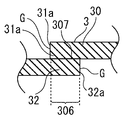
- the step formed in the overlapping portion 6 is a step corresponding to the step G formed at the end of the overlapping portion 306 at the tips 31a and 32a of the ends 31 and 32 as shown in FIG. show.
- FIG. 19 is a diagram showing a portion of the overlapping portion 6 in the conventional packaging member.
- Reference numeral 307 indicates a joint portion.
- the lid 1 forms an overlapping portion 6 so that the compression portion 8 is exposed on the inner peripheral surface 3a side thereof. Therefore, when the lid 1 is attached to the container T so that the compression portion 8 faces the outer peripheral surface side of the container T which is the joint surface with the container T, it is shown in FIGS. 10 (a) and 10 (b). As described above, the inner peripheral surface 3a of the lid 1 can be brought into close contact with the portion on the outer peripheral surface side of the opening edge portion of the container T.
- FIG. 10A shows a state in which the lid 1 is attached to the container T
- FIG. 10B shows a contact portion between the lid 1 and the container T.
- the raw material for forming the blank material 30 is water-repellent, and when the raw material is cut to form the blank material 30, the end face of the blank material 30 is formed. Is a non-treated surface of water repellent treatment. Therefore, when the blank material 30 is obtained by cutting the raw material diagonally, the non-treated surface of the water-repellent treatment is widely exposed at the end portion of the blank material 30.
- the end portion of the blank material 30 forming the wall material 3 is formed. Liquid easily seeps from the positions 31 and 32.
- the end portion 31 is the compression portion 8, and the compression ratio is increased by the tips 31a and 32a of the end portions 31 and 32. There is. Therefore, the fiber density of the blank material 30 is increased at the ends 31 and 32, and the liquid does not easily permeate from the positions of the ends 31 and 32 of the blank material 30 toward the inside of the blank material 30.
- the compression ratio is increased by the tips 31a and 32a of the ends 31 and 32, so that the wall material is formed from the ends 31 and 32. 3 Since the permeation of the liquid into the inside is regulated, it is possible to reduce the need to give the above consideration.
- the lid 1 is attached so that the wall material 3 is arranged on the outside with respect to the opening edge of the container T is exemplified, but the lid 1 is not limited to this, and the lid 1 is a container.
- the wall material may be arranged inside the opening edge of the T. This also applies to each of the second and subsequent embodiments described later.
- the packaging member according to the second embodiment of the present invention is the lid body 1.
- the lid 1 includes a canopy 2 and a wall material 3 as a side wall, as in the first embodiment described above.
- the canopy 2 may be the same as in the first embodiment.
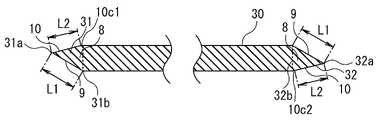
- the wall material 3 is the first except that an inclined surface is formed in the non-opposing area 10 defined as the area on the back surface side with respect to the facing area 9, and the following formula 4 is satisfied instead of the condition of the formula 3. It may be the same as the embodiment of.
- the inclined surface of the non-opposed area 10 satisfies the following equation 4 and is inclined to the outer end of the non-opposed area 10.
- the shape of the inclined surface is not particularly limited, and is the same as the case where the shape of the facing region in the first embodiment is the shape of the inclined surface.
- it may be a non-curved inclined surface or a curved inclined surface.
- each end satisfies the following formula 4.
- L1 indicates the separation distance from the outer end of the facing area 9 to the inner end of the facing area 9 on the cut surface of the blank material 30 along the thickness direction of the blank material 30, and L2 indicates the non-existence on the cut surface.
- the separation distance from the outer end of the inclined surface of the facing area 10 (that is, the outer end of the non-opposing area 10) to the inner end of the inclined surface of the non-opposing area 10 is shown.
- the inner end of the inclined surface of the non-opposing region 10 with respect to the end portion 31 is indicated by reference numeral 10c1
- the inner end of the inclined surface of the non-opposing region 10 with respect to the end portion 32 is indicated by reference numeral 10c2.
- the area of the facing region 9 is large, and L1 and L2 are preferably L1> L2.
- the compression rate on the tip side is higher than that on the base end of the compression portion 8.
- the state can be set, and the infiltration of liquid from the ends 31 and 32 into the wall material 3 can be effectively regulated.
- the packaging member according to the third embodiment of the present invention is the lid body 1.
- the lid 1 includes a canopy 2 and a wall material 3 as a side wall, as in the first embodiment described above.
- the canopy may be the same as in the first embodiment.
- the wall material 3 may be the same as that of the first embodiment except that the condition of the formula 4 is further satisfied (FIG. 9 (b)).
- the compression rate on the tip side (tip side of the end portion) of the compression portion 8 may be higher than that on the base end. It is possible to more effectively regulate the infiltration of liquid from the ends 31 and 32 into the wall material 3.
- the rising portion 5 of the canopy 2 may be omitted (fourth embodiment).
- a hanging wall 11 may be formed downward on the outer peripheral edge portion of the canopy 2, and the hanging wall 11 may be joined to the wall material 3.
- the same effect as the lid body according to the third embodiment can be obtained from the first embodiment.
- the portion of the wall material 3 above the top surface portion 4 may be omitted. In this case, the vertical dimension of the lid 1 can be reduced.
- the hole portion 12 may be formed in the top surface portion 4 (fifth embodiment).
- the seal portion 13 is provided so as to cover the hole portion 12. Since the hole portion 12 is formed in the top surface portion 4, the contents can be transferred from the inside of the container T through the hole portion 12 in a state where the lid body 1 is attached to the container T on the upper surface side of the top surface portion 4 of the lid body 1. Can be put out to.
- a structure for avoiding the formation of a state in which the end face of the blank material is exposed upward at the upper end position of the wall material 3 (end-to-end structure). May be provided (sixth embodiment).
- a curl portion 14 in which the blank material is curled at the upper end position of the wall material 3 can be provided.
- the repellent structure is not limited to this example, and the outer folded portion 15a in which the upper end side of the blank material is folded outward as shown in FIG. 12 (b) and the upper end of the blank material as shown in FIG. 12 (c). It may be an inner folded portion 15b whose side is folded inward.
- the lid body according to the sixth embodiment since the end-removing structure is provided, even if the user's mouth touches the upper end of the wall material 3, the end face of the blank material touches the mouth. Roughness is less likely to occur.
- the packaging member according to the seventh embodiment of the present invention is the container 50.
- the container 50 includes a body member 52 that forms a side peripheral surface and a bottom surface material 51 that forms a bottom surface.
- the body member 52 is joined around the bottom surface member 51.
- the container 50 has a bottomed structure in which a space is formed inside the body member 52 and the bottom surface member 51, and the upper end side is opened.
- a container having a flexibility in the opening edge 53 is particularly preferably used. It is preferable that the container 50 is used with the lid C attached to the opening edge 53.
- the bottom surface material 51 can be manufactured by subjecting a predetermined raw material to a punching process or the like.
- the raw material for forming the bottom material 51 the same material as the raw material for forming the canopy described in the first embodiment may be used.
- the body member 52 is provided as a side wall of the packaging member.
- the body member 52 is formed in an annular shape.
- the body member 52 has an overlapping portion 60 in which two ends 91 and 92 of a blank material 90 for forming a body material having a predetermined shape are overlapped, and a joint portion 70 in which the overlapping portions 60 join the ends 91 and 92 to each other. And prepare.
- the blank material 90 for forming the body material a paper-based material is used as in the blank material 30 for forming the wall material 3 described in the first embodiment.
- the overlapping portion 60 and the joining portion 70 of the body member 52 may be formed in the same manner as the overlapping portion 6 and the joining portion 7 of the wall material 3 described in the first to third embodiments, respectively.
- the end portion 91 and the end portion 92 overlap each other to form an overlapping portion 60, and the facing regions 111 of the end portion 91 and the end portion 92 are joined to form a joint portion 70.
- the non-opposing region 112 is formed in the portion on the back surface side of the facing region 111.
- the ends (ends 91 and 92) of the blank material 90 for forming the body material form the compression portion 80.
- the compression unit 80 is formed in the same manner as the compression unit 8 described in the first to third embodiments, and is similar to the compression unit 8 described in the first to third embodiments. It may have a structure and shape.
- the end portion 91 and the end portion 92 are formed in the same manner as the end portion 31 and the end portion 32 described in the first to third embodiments, and in the first to third embodiments. It may have the same structure and shape as the described end 31 and end 32.
- the facing area 111 and the non-opposing area 112 are also formed in the same manner as the facing area 9 and the non-opposing area 10 described in the first to third embodiments as in the case of the end portions 91 and 92.
- the opposite region 9 and the non-opposed region 10 described in the first to third embodiments may have the same structure and shape.
- the compression portions 80 are formed at the ends 91 and 92, and the ends 91 and 92 are formed so as to taper from the base end 91b toward the tip 91a and from the base end 92b toward the tip 92a. ing.
- the compressibility of the compression unit 80 increases toward the tips 91a and 92a of the ends 91 and 92.
- the end portion 91 and the end portion 92 satisfy at least one of the above formulas 3 and 4, similarly to the end portion 31 and the end portion 32 described in the first to third embodiments.
- the step of the overlapping portion 60 is reduced as in the first embodiment, and when the lid C is attached to the container 50, the lid is attached. C can be brought into close contact with the container 50, and the adhesiveness can be improved.
- the step of the overlapping portion 60 is reduced on the outer peripheral surface 52b side of the body member 52.
- the container 50 has an annular curl portion 100 formed in an outer winding along the upper end of the body member 52 serving as a side wall. May have.
- the opening edge portion 53 is formed by the curl portion 100, and the opening surrounded by the curl portion 100 is formed on the upper end side of the container 50.
- the compression portion 80 is exposed on the outer peripheral surface of the curl portion 100.
- This can be realized by manufacturing the body member 52 as follows. That is, a paper-based material formed in a fan shape is used as the blank material 90 for forming the body material, and the two end portions 91 and 92 separated along the circumferential direction of the paper-based material are overlapped with each other to overlap the overlapping portion 60.
- the overlapping portion 60 is formed by superimposing the two end portions 91 and 92 on each other so that the end portion 91 forming the compression portion 80 faces the inner peripheral surface 52a side of the body member 52. It is formed.
- the upper end side end portion of the body member 52 is wound around the outer winding to form the curl portion 100.
- the inner peripheral surface 52a side of the body member 52 is located on the exposed surface side of the curl portion 100. In this way, it is possible to realize a state in which the compression portion 80 is exposed on the outer peripheral surface of the curl portion 100.
- the end portion 92 is caught inside the curl portion 100 and concealed.
- FIG. 16B shows a contact portion between the lid C and the container 50 when the lid C is attached to the container 50. At this time, as shown in FIG.
- the container 50 is equipped with the lid 1 shown in any of the first to sixth embodiments.
- a state in which the lid 1 according to any one of the first to sixth embodiments is in close contact with the container 50 according to the seventh embodiment is formed.
- the steps at the overlapping portions 60 and 6 are reduced, so that the container is a container.
- the adhesion between the 50 and the lid 1 can be further improved.
- the blank material 90 is directed from the positions of the ends 91 and 92 toward the inside of the body material 52. It becomes difficult for the liquid to soak into it.
- FIG. 17 is a diagram for explaining an embodiment of the method for manufacturing a packaging member according to the first embodiment.
- FIG. 18 is a cross-sectional view for explaining a process of forming the compression portion 8.
- a blank material 30 is formed by punching a raw material made of a paper-based material into a fan shape (FIG. 17 (a)).
- a compression step is performed to form a compression portion 8 by compressing the ends 31 and 32 of the blank material 30 made of a paper-based material.
- the compression unit 8 is implemented, for example, by applying a press process to the two ends 31 and 32 of the blank material 30.
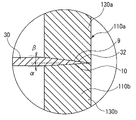
- the pressing process for forming the compression portion 8 of the end portion 32 can be realized by passing the end portion 32 of the blank material 30 between the two rollers 110a and 110b (FIGS. 17B and 17B). (C)).
- the rollers 110a and 110b those having protrusions 130a and 130b on the outer peripheral surface can be used.
- the ridges 130a and 130b form surfaces corresponding to the facing region 9 and the non-facing region 10 on the surface, and as shown in FIG.
- the compression portion 8 By pressing the end portion 32 with, the compression portion 8 can be formed on the end portion 32.
- the blank material 30 is formed at the end portion 32.
- the shape of the compressed portion 8 to be formed can be a desired shape
- the compression ratio of the end portion 32 of the blank material 30 can be a desired compression ratio
- the tip end 32a of the end portion 32 of the blank material 30 can be obtained.
- the compression ratio can be increased toward (FIG. 17 (c)).
- the press treatment may be carried out under heated conditions or non-heated conditions, and may be carried out under humidified conditions or non-humidified conditions. Further, the press process may be an ultrasonic press process.
- the two end portions 31 and 32 are overlapped to form the overlapping portion 6, and the overlapping portions 6 join the ends 31 and 32 to each other to form a joint portion.
- 7 is formed (side wall forming step).
- the wall material 3 as an annular side wall is formed (FIG. 17 (d)).
- a method for forming the bonding portion 7 a method such as ultrasonic bonding can be used.
- the raw material for forming the canopy is punched out in a circular shape to form the blank material of the canopy 2, and the outer circumference of the blank material of the canopy is bent to form the top surface portion 4 and the rising portion 5 to obtain the canopy 2. Then, the canopy 2 is arranged at a predetermined position on the inner peripheral surface 3a of the wall material 3 (FIGS. 17 (e) and 17 (f)).
- the inner peripheral surface 3a of the wall material 3 and the outer peripheral surface of the rising portion 5 are joined.
- a heat seal or the like can be used for the joining process.
- an adhesive is applied to the outer peripheral surface of the rising portion 5 in advance, and the rising portion 5 of the canopy 2 is pressed against the inner peripheral surface 3a of the wall material 3, and the inner peripheral surface of the rising portion 5 is pressed.
- the roller 120 is pressed from the side to heat and pressurize (FIG. 17 (g)).
- the roller 120 rotates along the inner peripheral surface side of the rising portion 5 while rotating.
- the adhesive is melted and the canopy 2 and the wall material 3 are joined to obtain a lid 1 as a packaging member (FIG. 17 (h)).
- an adhesive is applied between the rising portion 5 of the canopy 2 and the wall material 3, but this is one of the examples, and the manufacturing method is not limited to this.
- the roller 120 is pressed against the rising portion 5 of the canopy 2 so as to directly face the wall material 3 to heat the canopy blank material.
- the canopy 2 and the wall material 3 can be joined by the heat seal that is joined by applying pressure.
- a joining method may be appropriately adopted.
- the present invention is not limited to the above-mentioned example of the embodiment, and various modifications are possible.
- the configurations, methods, processes, shapes, materials, numerical values, etc. given in the examples of the above-described embodiments are merely examples, and different configurations, methods, processes, shapes, materials, numerical values, etc. may be used as necessary. good.
- the effects exemplified in the specification do not limit the content of the present invention.
Landscapes
- Engineering & Computer Science (AREA)
- Mechanical Engineering (AREA)
- Cartons (AREA)
Priority Applications (1)
| Application Number | Priority Date | Filing Date | Title |
|---|---|---|---|
| JP2022570048A JP7464311B2 (ja) | 2020-12-15 | 2021-12-15 | 包装用部材 |
Applications Claiming Priority (2)
| Application Number | Priority Date | Filing Date | Title |
|---|---|---|---|
| JP2020-207995 | 2020-12-15 | ||
| JP2020207995 | 2020-12-15 |
Publications (1)
| Publication Number | Publication Date |
|---|---|
| WO2022131313A1 true WO2022131313A1 (ja) | 2022-06-23 |
Family
ID=82059528
Family Applications (1)
| Application Number | Title | Priority Date | Filing Date |
|---|---|---|---|
| PCT/JP2021/046397 Ceased WO2022131313A1 (ja) | 2020-12-15 | 2021-12-15 | 包装用部材 |
Country Status (2)
| Country | Link |
|---|---|
| JP (1) | JP7464311B2 (https=) |
| WO (1) | WO2022131313A1 (https=) |
Cited By (1)
| Publication number | Priority date | Publication date | Assignee | Title |
|---|---|---|---|---|
| WO2024204401A1 (ja) * | 2023-03-28 | 2024-10-03 | Toppanホールディングス株式会社 | 紙ラミネートチューブ |
Citations (4)
| Publication number | Priority date | Publication date | Assignee | Title |
|---|---|---|---|---|
| JPS56164839A (en) * | 1980-05-22 | 1981-12-18 | Nippon Dekishi Kk | Manufacture of vessel made of paper |
| JPS5882316U (ja) * | 1981-12-01 | 1983-06-03 | 伊藤 禎美 | 容器 |
| JPH11342931A (ja) * | 1998-04-23 | 1999-12-14 | Sonoco Dev Inc | 筒状容器およびその製造方法 |
| JP2008162700A (ja) * | 2006-12-28 | 2008-07-17 | Weyerhaeuser Co | 断熱コップのためのリムおよび端部シールを形成する方法 |
-
2021
- 2021-12-15 JP JP2022570048A patent/JP7464311B2/ja active Active
- 2021-12-15 WO PCT/JP2021/046397 patent/WO2022131313A1/ja not_active Ceased
Patent Citations (4)
| Publication number | Priority date | Publication date | Assignee | Title |
|---|---|---|---|---|
| JPS56164839A (en) * | 1980-05-22 | 1981-12-18 | Nippon Dekishi Kk | Manufacture of vessel made of paper |
| JPS5882316U (ja) * | 1981-12-01 | 1983-06-03 | 伊藤 禎美 | 容器 |
| JPH11342931A (ja) * | 1998-04-23 | 1999-12-14 | Sonoco Dev Inc | 筒状容器およびその製造方法 |
| JP2008162700A (ja) * | 2006-12-28 | 2008-07-17 | Weyerhaeuser Co | 断熱コップのためのリムおよび端部シールを形成する方法 |
Cited By (1)
| Publication number | Priority date | Publication date | Assignee | Title |
|---|---|---|---|---|
| WO2024204401A1 (ja) * | 2023-03-28 | 2024-10-03 | Toppanホールディングス株式会社 | 紙ラミネートチューブ |
Also Published As
| Publication number | Publication date |
|---|---|
| JP7464311B2 (ja) | 2024-04-09 |
| JPWO2022131313A1 (https=) | 2022-06-23 |
Similar Documents
| Publication | Publication Date | Title |
|---|---|---|
| US8011568B2 (en) | Method for manufacturing a board tray, a blank for the tray, and a tray obtained by the method | |
| JP6803495B1 (ja) | 包装用部材 | |
| WO2022131313A1 (ja) | 包装用部材 | |
| CN116507481B (zh) | 用于散装固体的复合纸板容器及其生产方法 | |
| JP2023548439A (ja) | ファイバーを含むリムを備えた複合板紙容器、および該容器を製造する方法 | |
| TW202513422A (zh) | 蓋體、附蓋體的容器、以及蓋體和容器的組合 | |
| JP7368820B2 (ja) | 多層紙袋の製造方法及びそれによって製造された多層紙袋 | |
| JP7788091B2 (ja) | 蓋体及び蓋体の製造方法 | |
| JP7596702B2 (ja) | 蓋体 | |
| JP7339460B1 (ja) | 蓋体、蓋体用ブランク材、蓋体と容器の組み合わせ、及び蓋体付き容器 | |
| JP2020156938A (ja) | 紙製飲用ストロー | |
| US20260061720A1 (en) | Method of manufacturing a padded mailer | |
| WO2025197999A1 (ja) | 蓋体、蓋体付き容器、及び蓋体と容器の組み合わせ | |
| JP2022055259A (ja) | 蓋体及び蓋体の製造方法 | |
| WO2025047988A1 (ja) | 蓋体、蓋体用ブランク材、蓋体と容器の組み合わせ、及び蓋体付き容器 | |
| JP2022114756A (ja) | チューブ容器 | |
| JP2023152305A (ja) | 蓋体、及び蓋体と容器の組み合わせ | |
| TWM663033U (zh) | 蓋體、蓋體用坯料、蓋體與容器的組合、以及附蓋體的容器 | |
| JP2002145240A (ja) | 容 器 | |
| HK40110016A (zh) | 盖体、盖体用坯料、盖体与容器的组合、以及带盖体的容器 | |
| CN117615974A (zh) | 盖体、带盖体的容器、盖体与容器的组合 | |
| TWM439416U (en) | Cup body structure of paper cup |
Legal Events
| Date | Code | Title | Description |
|---|---|---|---|
| 121 | Ep: the epo has been informed by wipo that ep was designated in this application |
Ref document number: 21906674 Country of ref document: EP Kind code of ref document: A1 |
|
| ENP | Entry into the national phase |
Ref document number: 2022570048 Country of ref document: JP Kind code of ref document: A |
|
| NENP | Non-entry into the national phase |
Ref country code: DE |
|
| 122 | Ep: pct application non-entry in european phase |
Ref document number: 21906674 Country of ref document: EP Kind code of ref document: A1 |