WO2022118751A1 - 塩化ビニル系樹脂用耐アミン性付与剤 - Google Patents
塩化ビニル系樹脂用耐アミン性付与剤 Download PDFInfo
- Publication number
- WO2022118751A1 WO2022118751A1 PCT/JP2021/043389 JP2021043389W WO2022118751A1 WO 2022118751 A1 WO2022118751 A1 WO 2022118751A1 JP 2021043389 W JP2021043389 W JP 2021043389W WO 2022118751 A1 WO2022118751 A1 WO 2022118751A1
- Authority
- WO
- WIPO (PCT)
- Prior art keywords
- vinyl chloride
- acid
- chloride resin
- imparting agent
- amine
- Prior art date
- Legal status (The legal status is an assumption and is not a legal conclusion. Google has not performed a legal analysis and makes no representation as to the accuracy of the status listed.)
- Ceased
Links
Classifications
-
- B—PERFORMING OPERATIONS; TRANSPORTING
- B32—LAYERED PRODUCTS
- B32B—LAYERED PRODUCTS, i.e. PRODUCTS BUILT-UP OF STRATA OF FLAT OR NON-FLAT, e.g. CELLULAR OR HONEYCOMB, FORM
- B32B27/00—Layered products comprising a layer of synthetic resin
- B32B27/18—Layered products comprising a layer of synthetic resin characterised by the use of special additives
-
- B—PERFORMING OPERATIONS; TRANSPORTING
- B32—LAYERED PRODUCTS
- B32B—LAYERED PRODUCTS, i.e. PRODUCTS BUILT-UP OF STRATA OF FLAT OR NON-FLAT, e.g. CELLULAR OR HONEYCOMB, FORM
- B32B27/00—Layered products comprising a layer of synthetic resin
- B32B27/30—Layered products comprising a layer of synthetic resin comprising vinyl (co)polymers; comprising acrylic (co)polymers
-
- B—PERFORMING OPERATIONS; TRANSPORTING
- B32—LAYERED PRODUCTS
- B32B—LAYERED PRODUCTS, i.e. PRODUCTS BUILT-UP OF STRATA OF FLAT OR NON-FLAT, e.g. CELLULAR OR HONEYCOMB, FORM
- B32B5/00—Layered products characterised by the non- homogeneity or physical structure, i.e. comprising a fibrous, filamentary, particulate or foam layer; Layered products characterised by having a layer differing constitutionally or physically in different parts
- B32B5/18—Layered products characterised by the non- homogeneity or physical structure, i.e. comprising a fibrous, filamentary, particulate or foam layer; Layered products characterised by having a layer differing constitutionally or physically in different parts characterised by features of a layer of foamed material
-
- B—PERFORMING OPERATIONS; TRANSPORTING
- B60—VEHICLES IN GENERAL
- B60R—VEHICLES, VEHICLE FITTINGS, OR VEHICLE PARTS, NOT OTHERWISE PROVIDED FOR
- B60R13/00—Elements for body-finishing, identifying, or decorating; Arrangements or adaptations for advertising purposes
- B60R13/02—Internal Trim mouldings ; Internal Ledges; Wall liners for passenger compartments; Roof liners
-
- C—CHEMISTRY; METALLURGY
- C08—ORGANIC MACROMOLECULAR COMPOUNDS; THEIR PREPARATION OR CHEMICAL WORKING-UP; COMPOSITIONS BASED THEREON
- C08K—Use of inorganic or non-macromolecular organic substances as compounding ingredients
- C08K5/00—Use of organic ingredients
- C08K5/36—Sulfur-, selenium-, or tellurium-containing compounds
- C08K5/39—Thiocarbamic acids; Derivatives thereof, e.g. dithiocarbamates
-
- C—CHEMISTRY; METALLURGY
- C08—ORGANIC MACROMOLECULAR COMPOUNDS; THEIR PREPARATION OR CHEMICAL WORKING-UP; COMPOSITIONS BASED THEREON
- C08L—COMPOSITIONS OF MACROMOLECULAR COMPOUNDS
- C08L27/00—Compositions of homopolymers or copolymers of compounds having one or more unsaturated aliphatic radicals, each having only one carbon-to-carbon double bond, and at least one being terminated by a halogen; Compositions of derivatives of such polymers
- C08L27/02—Compositions of homopolymers or copolymers of compounds having one or more unsaturated aliphatic radicals, each having only one carbon-to-carbon double bond, and at least one being terminated by a halogen; Compositions of derivatives of such polymers not modified by chemical after-treatment
- C08L27/04—Compositions of homopolymers or copolymers of compounds having one or more unsaturated aliphatic radicals, each having only one carbon-to-carbon double bond, and at least one being terminated by a halogen; Compositions of derivatives of such polymers not modified by chemical after-treatment containing chlorine atoms
- C08L27/06—Homopolymers or copolymers of vinyl chloride
Definitions
- the present invention relates to an amine resistance imparting agent for vinyl chloride resin (hereinafter, also referred to as “amine resistance imparting agent”), and the present invention can suppress discoloration of the vinyl chloride resin due to amine.
- Vinyl chloride resin has excellent properties such as flame retardancy, chemical resistance, mechanical stability, heat resistance, and weather resistance, and is inexpensive, so it is widely used as a general-purpose resin material with high utility value. It is widely used as a skin material for automobile interior materials.
- an interior material for an automobile is composed of a skin layer for giving a feeling (texture) such as a soft feeling, a high-class feeling, and a design such as an aesthetic appearance, and a base material layer for holding a structure.
- a feeling such as a soft feeling, a high-class feeling, and a design such as an aesthetic appearance
- a base material layer for holding a structure.
- the epidermis layer is often lined with a foam layer such as urethane to give a softer feeling.
- vinyl chloride resin As this skin layer, vinyl chloride resin, thermoplastic elastomer, polyolefin foam such as polyethylene, etc. are used. Among them, vinyl chloride resin is widely used because it can give various tactile sensations from semi-hard to soft depending on the amount of plasticizer, and it is also excellent in molding processability and design. ..
- Patent Documents 1 and 2 propose a vinyl chloride resin composition to which zinc dithiocarbamate is added.
- Patent Document 3 is for improving the blackening promotion phenomenon (zinc burning phenomenon) of the vinyl chloride resin due to zinc and the weather resistance, and suppresses the discoloration of the vinyl chloride resin due to the amine. It is clearly different from what we do, and the current situation is that we cannot obtain any knowledge on this point.
- an object of the present invention is an amine resistance imparting agent for vinyl chloride resin, a stabilizer composition for vinyl chloride resin, a vinyl chloride resin composition, which can suppress discoloration of vinyl chloride resin due to amine. It is an object of the present invention to provide a vinyl chloride resin molded body, a laminate, an automobile interior material, and a method for suppressing discoloration of a vinyl chloride resin.
- a predetermined zinc dithiocarbamate compound can suppress discoloration of a vinyl chloride resin due to an amine, and have completed the present invention.
- the amine resistance-imparting agent for vinyl chloride resin of the present invention is characterized by containing one or more of the zinc dithiocarbamate compounds represented by the following general formula (1).
- R 1 and R 2 each independently have an alkyl group having 1 to 20 carbon atoms, an aryl group having 6 to 20 carbon atoms, or an aryl alkyl group having 7 to 20 carbon atoms. Represented, R 1 and R 2 may be linked to form a ring with the nitrogen atom to which they are bonded.
- the vinyl chloride resin is preferably a vinyl chloride resin for automobile interior materials.
- the vinyl chloride resin for the automobile interior material is a raw material resin for the vinyl chloride resin molded body used in the automobile interior material composed of a laminate of the vinyl chloride resin molded body and the polyurethane foam molded body. Is preferable.
- the stabilizer composition for a vinyl chloride resin of the present invention is characterized by containing one or more of the stabilizers for a vinyl chloride resin and the amine resistance imparting agent for a vinyl chloride resin of the present invention. It is something to do.
- the vinyl chloride-based resin composition of the present invention is characterized by containing a vinyl chloride-based resin and an amine resistance-imparting agent for a vinyl chloride-based resin of the present invention.
- the content of the amine resistance imparting agent for vinyl chloride resin is 0.005 to 3.0 parts by mass with respect to 100 parts by mass of the vinyl chloride resin. Is preferable.
- the vinyl chloride resin composition of the present invention is suitable for powder molding.
- the vinyl chloride-based resin molded product of the present invention is characterized by being obtained from the vinyl chloride-based resin composition of the present invention.
- the laminate of the present invention is a laminate of a vinyl chloride resin molded product and a polyurethane foam, and is characterized in that the vinyl chloride resin molded product is obtained from the vinyl chloride resin composition of the present invention. It is something to do.
- the automobile interior material of the present invention is characterized by containing the vinyl chloride resin molded product of the present invention.
- Other automobile interior materials of the present invention are characterized by containing the laminate of the present invention.
- the method for suppressing discoloration of a vinyl chloride resin of the present invention is a method for suppressing discoloration of an automobile interior material including a laminate of a vinyl chloride resin molded body and a polyurethane foamed molded body, and is an amine resistance resistant method for a vinyl chloride resin of the present invention. It is characterized in that the sex-imparting agent is blended with a vinyl chloride-based resin, which is a raw material resin for a vinyl chloride-based resin molded body.
- an amine resistance imparting agent for vinyl chloride resin a stabilizer composition for vinyl chloride resin, a vinyl chloride resin composition, vinyl chloride, which can suppress discoloration of vinyl chloride resin due to amine. It is possible to provide a method for suppressing discoloration of a based resin molded body, a laminated body, an automobile interior material, and a vinyl chloride based resin.
- the vinyl chloride resin molded product of the present invention suppresses discoloration due to an amine compound and is suitable as an automobile interior material.
- the amine resistance imparting agent for vinyl chloride resin of the present invention has a function of imparting amine resistance to the vinyl chloride resin, which suppresses discoloration of the vinyl chloride resin due to the amine compound.
- the amine resistance-imparting agent for vinyl chloride resin of the present invention contains one or more of zinc dithiocarbamate compounds represented by the following general formula (1).
- R 1 and R 2 each independently have an alkyl group having 1 to 20 carbon atoms, an aryl group having 6 to 20 carbon atoms, or an aryl alkyl group having 7 to 20 carbon atoms. show.
- Examples of the alkyl group having 1 to 20 carbon atoms of R 1 and R 2 of the general formula (1) include methyl, ethyl, n-propyl, isopropyl, n-butyl, isobutyl, sec-butyl and tert-butyl.
- n-pentyl isopentyl, neopentyl, tert-amyl, 1,2-dimethylpropyl, n-hexyl, cyclohexyl, 1,3-dimethylbutyl, 1-isopropylpropyl, 1,2-dimethylbutyl, n-heptyl, 2- Heptyl, 1,4-dimethylpentyl, tert-heptyl, 2-methyl-1-isopropylpropyl, 1-ethyl-3-methylbutyl, n-octyl, tert-octyl, 2-ethylhexyl, 2-methylhexyl, 2-propyl Hexyl, n-nonyl, isononyl, n-decyl, isodecyl, n-undecyl, isoundesyl, n-dodecyl, isododecyl, n
- Examples of the aryl group of R 1 and R 2 of the general formula (1) having 6 to 20 carbon atoms include phenyl, p-methylphenyl, o-methylphenyl, p-tert-butylphenyl and p-methoxyphenyl. o-biphenylyl, m-biphenylyl, p-biphenylyl, ⁇ -naphthyl, ⁇ -naphthyl, 1-anthryl, 2-anthryl, 9-anthryl, 1-phenanthryl, 2-phenanthril, 3-phenanthril, 4-phenanthryl, 9- Examples thereof include phenyl, benzyl and the like.
- Examples of the arylalkyl group having 7 to 20 carbon atoms of R 1 and R 2 of the general formula (1) include benzyl, phenethyl, 2-phenylpropane-2-yl, styryl, cinnamyl, diphenylmethyl and triphenylmethyl. And so on.
- R 1 and R 2 of the general formula (1) may be linked to form a ring together with the nitrogen atom to which each is bonded.
- Examples of such a ring include a pyrrolidine ring and a piperidine ring.
- R 1 and R 2 are preferably an alkyl group, a phenyl group or a benzyl group having 1 to 4 carbon atoms, preferably a methyl group, an ethyl group or an n-propyl group, from the viewpoint of imparting amine resistance to the vinyl chloride resin.
- An n-butyl group, a phenyl group or a benzyl group is more preferable, a methyl group or an ethyl group is even more preferable, and an ethyl group is particularly preferable.
- zinc dithiocarbamate compound represented by the general formula (1) preferable from the viewpoint of imparting amine resistance include the following compound No. 1 to No. 7 is mentioned.
- compound No. 1, No. 2. No. 4, No. 5, No. 6, No. 7 is more preferable, and compound No. 1, No. 2 is even more preferable, and compound No. 2 is particularly preferable.
- the amine resistance imparting agent of the present invention is used in combination with one or more of the stabilizers for vinyl chloride resin and used as a stabilizer composition for vinyl chloride resin.
- a zinc salt of an organic acid other than dithiocarbamic acid is preferable from the viewpoint of amine resistance and thermal stability.
- the zinc salt of such an organic acid include zinc salts of organic carboxylic acids, phenols and organic phosphoric acids.
- organic carboxylic acid examples include acetic acid, propionic acid, butyric acid, benzoic acid, caproic acid, enant acid, capric acid, pelargonic acid, 2-ethylhexic acid, neodecanoic acid, capric acid, undecanoic acid, isoundecic acid, and lauric acid.
- Examples thereof include di- or triester compounds of trivalent or tetravalent carboxylic acids such as butane tricarboxylic acid, butane tetracarboxylic acid, hemimellitic acid, trimellitic acid, merophaneic acid and pyromellitic acid.
- phenols include tertiary butylphenol, nonylphenol, dinonylphenol, cyclohexylphenol, phenylphenol, octylphenol, phenol, cresol, xylenol, n-butylphenol, isoamylphenol, ethylphenol, isopropylphenol, isooctylphenol, 2-.
- Examples thereof include ethylhexylphenol, tertiary nonylphenol, decylphenol, tertiary octylphenol, isohexylphenol, octadecylphenol, diisobutylphenol, methylpropylphenol, diamilphenol, methylisohexylphenol, and methyl tertiary octylphenol.
- organic phosphoric acids include mono- or dioctyl phosphoric acid, mono- or didodecyl phosphoric acid, mono- or dioctadecyl phosphoric acid, mono- or di- (nonylphenyl) phosphoric acid, phosphonic acid nonylphenyl ester, and phosphonic acid stearyl ester. Can be mentioned.
- the zinc salt of the organic acid may be an acidic salt, a neutral salt, a basic salt, or a hyperbasic complex in which a part or all of the base of the basic salt is neutralized with carbonic acid.
- the zinc salt of an organic acid may be composed of two or more kinds of organic acids.
- a zinc salt made of a monovalent organic acid the same organic acid may form an anion moiety and form a salt with divalent zinc forming a cation moiety, and different monovalent organic acids 2 may be formed.
- the seed may form a salt with a divalent zinc that forms an anionic moiety and forms a cation moiety.
- Zinc salts include zinc benzoate, zinc tolurate, 4-tert-butyl zinc benzoate, zinc stearate, zinc laurate, zinc versaticate, zinc octylate, and oleic acid in terms of amine resistance and thermal stability. Zinc, palmitin zinc, and myristin zinc are preferred. Only one type of zinc salt of organic acid may be used, or two or more types may be used in combination.
- the content of the zinc salt of the organic acid is the point of amine resistance and thermal stability with respect to 100 parts by mass of the amine resistance imparting agent. Therefore, 5 to 20000 parts by mass is preferable, 10 to 8000 parts by mass is more preferable, and 20 to 800 parts by mass is even more preferable.
- the stabilizer to be used in combination with the amine resistance imparting agent is a group of barium salts of organic acids and barium carbonates of hyperbasic from the viewpoint of amine resistance and thermal stability.
- the stabilizer to be used in combination with the amine resistance imparting agent is a group of barium salts of organic acids and barium carbonates of hyperbasic from the viewpoint of amine resistance and thermal stability.
- One or more selected from the above is preferable.
- barium salt of organic acid examples include barium salts such as organic carboxylic acids, phenols and organic phosphoric acids.
- organic carboxylic acid examples include acetic acid, propionic acid, butyric acid, benzoic acid, caproic acid, enant acid, capric acid, pelargonic acid, 2-ethylhexic acid, neodecanoic acid, capric acid, undecanoic acid, isoundecic acid, and lauric acid.
- Examples thereof include di- or triester compounds of trivalent or tetravalent carboxylic acids such as butane tricarboxylic acid, butane tetracarboxylic acid, hemimellitic acid, trimellitic acid, merophaneic acid and pyromellitic acid.
- phenols include tertiary butylphenol, nonylphenol, dinonylphenol, cyclohexylphenol, phenylphenol, octylphenol, phenol, cresol, xylenol, n-butylphenol, isoamylphenol, ethylphenol, isopropylphenol, isooctylphenol, 2-.
- Examples thereof include ethylhexylphenol, tertiary nonylphenol, decylphenol, tertiary octylphenol, isohexylphenol, octadecylphenol, diisobutylphenol, methylpropylphenol, diamilphenol, methylisohexylphenol, and methyl tertiary octylphenol.
- organic phosphoric acids include mono- or dioctyl phosphoric acid, mono- or didodecyl phosphoric acid, mono- or dioctadecyl phosphoric acid, mono- or di- (nonylphenyl) phosphoric acid, phosphonic acid nonylphenyl ester, and phosphonic acid stearyl ester. Can be mentioned.
- the barium salt of an organic acid may be composed of two or more kinds of organic acids.
- the same organic acid may form an anion moiety and form a salt with a divalent barium forming a cation moiety, and different monovalent organic acids 2 may be formed.
- the seed may form a salt with divalent barium that forms an anionic moiety and forms a cation moiety.
- the barium salt of the organic acid may be used alone or in combination of two or more.
- the barium salt of the organic acid may be an acid salt, a neutral salt, or a basic salt.
- the superbasic barium carbonate salt is a liquid superbasic carboxylate / carbonate complex of barium.
- This complex unlike a simple mixture of barium carboxylic acid positive salt and barium carbonate, is a complex formed by some interaction and has a high metal content in an organic solvent. It has the characteristic of showing a uniform liquid.
- This complex is composed of a carboxylic acid positive salt of barium, barium carbonate, and a composite salt of barium carboxylic acid and carbonic acid as constituents, and is composed mainly of barium carbonate, barium carboxylic acid positive salt and barium carboxylic acid.
- a complex salt of carbonic acid and carbonic acid exists in the vicinity thereof, and a so-called micelle-like substance is formed to show a uniform liquid state in an organic solvent.
- liquid perbasic carboxylate / carbonate complexes of barium can be produced, for example, by the production method shown in JP-A-2004-238364.
- liquid perbasic carboxylate / carbonate complex of barium various commercially available complexes can be used as they are.
- hyperbasic barium carbonate salts may be used alone or in combination of two or more.
- the stabilizer composition of the present invention contains a barium salt or a perbasic carbonate barium salt of an organic acid
- the content thereof is amine resistance and thermal stability with respect to 100 parts by mass of the amine resistance imparting agent. From the viewpoint of properties, 10 to 60,000 parts by mass is preferable, 30 to 10000 parts by mass is more preferable, and 50 to 2000 parts by mass is even more preferable.
- the stabilizer to be used in combination with the amine resistance imparting agent is a group of calcium salts of organic acids and calcium carbonates of hyperbasic acid from the viewpoint of amine resistance and thermal stability.
- the calcium salt of such an organic acid include calcium salts of organic carboxylic acids, phenols and organic phosphoric acids.
- Examples of the organic carboxylic acid include those exemplified by barium salt.
- Examples of the phenols include those exemplified by barium salts.
- examples of the organic phosphoric acids include those exemplified by barium salts.
- the calcium salt of an organic acid may be composed of two or more kinds of organic acids.
- a calcium salt made of a monovalent organic acid the same organic acid may form an anion moiety and form a salt with a divalent calcium forming a cation moiety, and different monovalent organic acids 2 may be formed.
- the seed may form a salt with a divalent calcium that forms an anionic moiety and forms a cation moiety.
- the calcium salt of the organic acid may be used alone or in combination of two or more.
- the calcium salt of the organic acid may be an acid salt, a neutral salt, or a basic salt.
- the hyperbasic calcium carbonate salt is a liquid perbasic carboxylate / carbonate complex of calcium.
- This complex is different from a simple mixture of a positive carboxylic acid salt of calcium and calcium carbonate, which is a complex by some interaction, and has a high metal content in an organic solvent. It has the characteristic of showing a uniform liquid.
- This complex is composed of calcium carboxylic acid positive salt, calcium carbonate, and a complex salt of calcium carboxylic acid and carbonic acid as constituents, and is composed mainly of calcium carbonate, calcium carboxylic acid positive salt and calcium carboxylic acid.
- a complex salt of calcium and calcium exists in the vicinity thereof, and a so-called micelle-like substance is formed to show a uniform liquid state in an organic solvent.
- hyperbasic calcium carbonate salts may be used alone or in combination of two or more.
- the stabilizer composition of the present invention contains a calcium salt of an organic acid or a perbasic calcium carbonate, the content thereof is amine resistance and thermal stability with respect to 100 parts by mass of the amine resistance imparting agent. From the viewpoint of properties, 10 to 60,000 parts by mass is preferable, 30 to 10000 parts by mass is more preferable, and 50 to 2000 parts by mass is even more preferable.
- the ⁇ -diketone compound is preferable as the stabilizer used in combination with the amine resistance imparting agent from the viewpoint of amine resistance and thermal stability.
- ⁇ -diketone compounds include acetylacetone, triacetylmethane, 2,4,6-heptatrione, butanoylacetylmethane, lauroylacetylmethane, palmitoylacetylmethane, stearoylbenzoylmethane, palmitoylbenzoylmethane, and distearoylmethane.
- ⁇ -diketone compound Only one type of ⁇ -diketone compound may be used, or two or more types may be used in combination.
- dibenzoylmethane, stearoylbenzoylmethane or acetylacetone zinc salt is preferable from the viewpoint of amine resistance and thermal stability.
- the content thereof is 10 to 60,000 mass by mass with respect to 100 parts by mass of the amine resistance imparting agent from the viewpoint of amine resistance and thermal stability. Parts are preferable, 30 to 10000 parts by mass are more preferable, and 50 to 2000 parts by mass are even more preferable.
- one or more phosphite ester compounds are preferable from the viewpoint of amine resistance and thermal stability.
- phosphorous acid ester compounds include phosphorous acid trialkyl ester, phosphorous acid dialkyl ester, phosphorous acid dialkyl monoallyl ester, phosphorous acid alkylallyl ester, phosphorous acid monoalkyl diallyl ester, and phosphorous acid diallyl ester. , Phosphorous acid triallyl ester and the like.
- a triester or a diester can be used, but from the viewpoint of thermal stability, it is preferable to use a triester.
- Thioester can also be used.
- phosphite compounds include triphenylphosphite, tricresylphosphite, tris (2,4-dithiary butylphenyl) phosphite, tris (nonylphenyl) phosphite, tris (dinonylphenyl).
- Phenylphosphite Tris (mono- and di-mixed nonylphenyl) phosphite, Tris (2,4-di-tertiary butylphenyl) phosphite, diphenylphosphite, 2,2'-methylenebis (4,6-di) Tertiary Butylphenyl) Octylphosphite, 2,2'-Methylenebis (4,6-3rd Butylphenyl) -2-ethylhexylphosphite, 2,2'-Methylenebis (4,6-3rd Butylphenyl) -Octadecyl Phenylphosphite, 2,2'-Ethyldenbis (4,6-dithiary butylphenyl) fluorophosphite, octyldiphenylphosphite, diphenyldecylphosphite, diphenyl (2-e
- the phosphite ester compound may be used alone or in combination of two or more.
- these subphosphate ester compounds from the viewpoint of thermal stability, it is preferable to use a subphosphate ester compound having 12 to 80 carbon atoms, and a subphosphate ester compound having 12 to 46 carbon atoms is used. It is more preferable to use a subphosphate ester compound having 12 to 36 carbon atoms, and it is more preferable to use a subphosphate ester compound having 18 to 30 carbon atoms.
- the stabilizer composition of the present invention contains a phosphite ester compound
- the content thereof is 10 to 60,000 from the viewpoint of amine resistance and thermal stability with respect to 100 parts by mass of the amine resistance imparting agent.
- mass is preferable, 50 to 6000 parts by mass is more preferable, and 100 to 2000 parts by mass is even more preferable.
- phenolic antioxidants are preferable from the viewpoint of amine resistance and thermal stability.
- examples of such phenolic antioxidants include 2,6-ditertiary butyl-p-cresol, 2,6-diphenyl-4-octadecyloxyphenol, and stearyl (3,5-ditritiary butyl-4-4).
- phenolic antioxidant only one type of phenolic antioxidant may be used, or two or more types may be used in combination.
- these phenolic antioxidants pentaerythritol tetrakis [3- (3,5-di-tert-butyl-4-hydroxyphenyl) propionate] or octadecyl 3- (3,5) from the viewpoint of thermal stability.
- -Di-tert-butyl-4-hydroxyphenyl) propionate is preferred.
- the stabilizer composition of the present invention contains a phenolic antioxidant, the content thereof is 1 to 2000 from the viewpoint of amine resistance and thermal stability with respect to 100 parts by mass of the amine resistance imparting agent. By mass is preferable, 2 to 200 parts by mass is more preferable, and 4 to 100 parts by mass is even more preferable.
- hindered amine-based light stabilizers are preferable from the viewpoint of amine resistance and thermal stability.
- hindered amine-based light stabilizers include 2,2,6,6-tetramethyl-4-piperidyl stearate, 1,2,2,6,6-pentamethyl-4-piperidyl stearate, 2,2.
- the stabilizer composition of the present invention contains a hindered amine-based light stabilizer
- the content thereof is 5 to 15,000 from the viewpoint of amine resistance and thermal stability with respect to 100 parts by mass of the amine resistance imparting agent.
- mass is preferable, 10 to 2000 parts by mass is more preferable, and 20 to 700 parts by mass is even more preferable.
- one or more inorganic auxiliary agents are preferable from the viewpoint of amine resistance and thermal stability.
- examples of such an inorganic auxiliary agent include hydrotalcite compounds and zeolite compounds.
- hydrotalcite compound examples include compounds represented by the following general formula (2).
- x1, x2 and y1 represent numbers that satisfy the conditions represented by the following formulas, 0 ⁇ x2 / x1 ⁇ 10, 2 ⁇ x1 + x2 ⁇ 20, 0 ⁇ y1 ⁇ 2, respectively, and m is Indicates 0 or any integer.
- hydrotalcite compound magnesium and aluminum, or a double salt compound composed of zinc, magnesium and aluminum are preferably used. Further, the water of crystallization may be dehydrated. Such hydrotalcite compounds may be natural products or synthetic products. There are no restrictions on the crystal structure, crystal particle size, etc. of the hydrotalcite compound.
- the surface thereof is a higher fatty acid such as stearic acid, a higher fatty acid metal salt such as oleic acid alkali metal salt, an organic sulfonic acid metal salt such as dodecylbenzene sulfonic acid alkali metal salt, a higher fatty acid amide, and a higher grade.
- a higher fatty acid ester, wax, or the like can also be used.
- the hydrotalcite compound containing a perchlorate anion or treated with perchlorate can be used, but in terms of safety and environment. Considering the above points, its use is not preferable.
- hydrotalcite compound Only one type of hydrotalcite compound may be used, or two or more types may be used in combination.
- Zeolites are alkali or alkaline earth metal aluminosilicates with a unique three-dimensional zeolite crystal structure, typically A-type, X-type, Y-type and P-type zeolites, monodenites, and analsites. , Sodalite aluminosilicate, clinobtyrolite, erionite, chavasite, etc., and water-containing substances having crystalline water (so-called zeolite water) of these zeolite compounds or anhydrous products from which crystalline water has been removed.
- zeolite water water-containing substances having crystalline water
- any of these may be used, and those having a particle size of 0.1 to 50 ⁇ m can be used, and those having a particle size of 0.5 to 10 ⁇ m are particularly preferable. Only one kind of zeolite compound may be used, or two or more kinds may be used in combination.
- the inorganic auxiliary agent only one type may be used, two or more types may be used in combination, or a hydrotalcite compound and a zeolite compound may be used in combination.
- the stabilizer composition of the present invention contains an inorganic auxiliary agent
- the content thereof is 50 to 80,000 mass by mass with respect to 100 parts by mass of the amine resistance imparting agent from the viewpoint of amine resistance and thermal stability. Parts are preferable, 100 to 8000 parts by mass are more preferable, and 400 to 4000 parts by mass are even more preferable.
- the vinyl chloride-based resin composition of the present invention is characterized in that the amine-resistant imparting agent of the present invention is blended with the vinyl chloride-based resin.
- the vinyl chloride-based resin in the vinyl chloride-based resin composition of the present invention is not particularly limited to its polymerization method such as massive polymerization, solution polymerization, suspension polymerization, and emulsion polymerization, and is, for example, polyvinyl chloride and chlorinated poly.
- Vinyl chloride polyvinylidene chloride, chlorinated polyethylene, vinyl chloride-vinyl acetate copolymer, vinyl chloride-ethylene copolymer, vinyl chloride-propylene copolymer, vinyl chloride-styrene copolymer, vinyl chloride-isobutylene copolymer Combined, vinyl chloride-vinylidene chloride copolymer, vinyl chloride-styrene-maleic anhydride ternary copolymer, vinyl chloride-styrene-acrylonilittle copolymer, vinyl chloride-butadiene copolymer, vinyl chloride-isoprene Polymers, vinyl chloride-chlorinated propylene copolymers, vinyl chloride-vinylidene chloride-vinyl acetate ternary copolymers, vinyl chloride-maleic acid ester copolymers, vinyl chloride-methacrylic acid ester copolymers, vinyl chloride- Vinyl chloride resins such as acrylon
- vinyl chloride resins examples thereof include copolymers, ethylene-vinyl acetate copolymers, ethylene-ethyl (meth) acrylate copolymers, blended products with polyesters, block copolymers, graft copolymers and the like.
- These vinyl chloride resins may be a mixture of two or more kinds, or may be a mixture with other synthetic resins.
- the vinyl chloride resin used is preferably polyvinyl chloride from the viewpoint of amine resistance, and particularly preferably polyvinyl chloride used for powder molding.
- the amine resistance imparting agent of the present invention is 0.005 to 100 parts by mass with respect to 100 parts by mass of the vinyl chloride resin from the viewpoint of imparting amine resistance to the vinyl chloride resin. 3.0 parts by mass is preferable, 0.01 to 2.0 parts by mass is more preferable, 0.02 to 1.0 parts by mass is even more preferable, and 0.05 to 0.5 parts by mass is even more preferable. preferable. If it is less than 0.005 parts by mass, the amine resistance may be insufficient, and if it exceeds 3.0 parts by mass, the improvement of the effect is small, and rather it may adversely affect other performance.
- the amine resistance imparting agent may be blended in the vinyl chloride resin as a stabilizer composition, or may be blended in the vinyl chloride resin separately from the stabilizer and other components to be blended.
- the vinyl chloride resin composition of the present invention contains a plasticizer.
- plasticizers include dibutylphthalate, butylhexylphthalate, diheptylphthalate, dioctylphthalate, diisononylphthalate, diisodecylphthalate, dilaurylphthalate, dicyclohexylphthalate, dioctylterephthalate and other phthalate plasticizers; dioctyl adipate, diisononyl adipate, etc.
- Adipate-based plasticizers such as diisodecyl adipate and di (butyl diglycol) adipate; triphenyl phosphate, tricresyl phosphate, trixylenyl phosphate, tri (isopropylphenyl) phosphate, triethyl phosphate, tributyl phosphate, trioctyl phosphate, tri ( Butoxyethyl) phosphate, octyldiphenyl phosphate and other phosphate plasticizers; ethylene glycol, diethylene glycol, triethylene glycol, 1,2-propylene glycol, 1,3-propylene glycol, 1,3-butanediol, 1,4-butane Polyhydric alcohols such as diols, 1,5-hexanediols, 1,6-hexanediols and neopentylglycols, and oxalic acid, malonic acid, succin
- At least one selected from the group consisting of the trimellitic acid-based plasticizer which is a trimellitic acid ester compound and the pyromellitic acid-based plasticizer which is a pyromellitic acid ester compound has an amine resistance. Is preferable.
- trimellitic acid ester compound or pyromellitic acid ester compound a trimellitic acid or a trimellitic acid and a monovalent alcohol triester compound or a tetraester compound are used, respectively.
- the monohydric alcohol used for producing the trimellitic acid trimester compound or the pyromellitic acid tetraester compound includes, for example, methanol, ethanol, propyl alcohol, isopropyl alcohol, butyl alcohol, isobutyl alcohol, secondary butyl alcohol, and the like.
- Tertiary butyl alcohol pentyl alcohol, isopentyl alcohol, hexanol, isohexanol, heptanol, octanol, 2-ethylhexanol, nonyl alcohol, isononyl alcohol, decanol, isodecanol, undecanol, dodecanol, tridecanol, isotridecanol, tetradeca Examples thereof include linear or branched alcohols such as Noor, Pentadecanol, Hexadecanol, Heptadecanol, Octadecanol, Nonadecanol, Icosanol, Henicosanol, Docosanol and mixtures thereof.
- the content of the plasticizer is preferably 5 to 200 parts by mass, preferably 10 to 100 parts by mass, with respect to 100 parts by mass of the vinyl chloride resin from the viewpoint of amine resistance. More preferred.
- the vinyl chloride resin composition of the present invention preferably contains one or more stabilizers.
- the stabilizer may be blended as a stabilizer composition or may be blended individually.
- the vinyl chloride resin composition of the present invention other additives usually used for the vinyl chloride resin composition, for example, an epoxy compound, a polyhydric alcohol compound, an ultraviolet absorber, a filler and the like are added. be able to.
- epoxy compound examples include bisphenol type and novolak type epoxy resins, epoxidized soybean oil, epoxidized linseed oil, epoxidized tung oil, epoxidized fish oil, epoxidized beef fat oil, epoxidized castor oil, and epoxidized safflower oil.
- polyhydric alcohol examples include pentaerythritol, dipentaerythritol, tripentaerythritol, polypentaerythritol, neopentylglycol, trimethylolpropane, ditrimethylolpropane, and 1,3,5-tris (2-hydroxyethyl) isocyanurate.
- ultraviolet absorber examples include 2,4-dihydroxybenzophenone, 2-hydroxy-4-methoxybenzophenone, 2-hydroxy-4-octoxybenzophenone, 5,5'-methylenebis (2-hydroxy-4-methoxybenzophenone) and the like.
- fillers calcium carbonate, calcium oxide, calcium hydroxide, zinc hydroxide, zinc carbonate, zinc sulfide, magnesium oxide, magnesium hydroxide, magnesium carbonate, aluminum oxide, aluminum hydroxide, sodium alumina silicate, hydrocarbimite.
- the vinyl chloride resin composition of the present invention includes a cross-linking agent, a foaming agent, an antistatic agent, an antifogging agent, a plate-out inhibitor, a surface treatment agent, a lubricant, a flame retardant, a fluorescent agent, and the like.
- Antistatic agents, bactericidal agents, metal deactivators, mold release agents, pigments, processing aids, solvents and the like can be blended.
- lubricants examples include hydrocarbon-based lubricants such as low-molecular-weight wax, paraffin wax, polyethylene wax, chlorinated hydrocarbons, and fluorocarbon; natural wax-based lubricants such as carnauba wax and candelilla wax; lauric acid, stearic acid, and behenin.
- Higher fatty acids such as acids and fatty acid-based lubricants such as oxy fatty acids such as hydroxystearic acid; aliphatic amide compounds such as stearylamide, laurylamide and oleylamide, and alkylene bis such as methylenebisstearylamide and ethylenebisstearylamide.
- An aliphatic amide-based lubricant such as an aliphatic amide; a fatty acid monovalent alcohol ester compound such as stearyl stearate, butyl stearate, and distearyl phthalate, and also glycerin tristearate, sorbitan tristearate, pentaerythritol tetrastearate, and dipenta.
- Fatty acid polyvalent alcohol ester compounds such as erythritol hexastearate, polyglycerin polylysinolate, and hardened castor oil, monovalent fatty acids such as dipentaerythritol adipic acid / stearic acid ester, and polybasic organic acids.
- Fatty acid alcohol ester-based lubricants such as composite ester compounds of alcohol; fatty alcohol-based lubricants such as steearic acid, lauryl alcohol, and palmityl alcohol; metal soaps; montanic acid-based lubricants such as partially saponified montanic acid esters; acrylic lubricants ; Silicone oil and the like can be mentioned. Only one kind of these lubricants may be used, or two or more kinds thereof may be used in combination.
- processing aids are homopolymers or copolymers of alkyl methacrylates such as methyl methacrylate, ethyl methacrylate and butyl methacrylate; co-polymers of the above alkyl methacrylate and alkyl acrylates such as methyl acrylate, ethyl acrylate and butyl acrylate.
- pigments examples include white pigments such as titanium dioxide and blue pigments such as ultramarine blue and phthalocyanine blue.
- the vinyl chloride-based resin composition of the present invention further includes other additives usually used for vinyl chloride-based resins, such as sulfur-based antioxidants, impact resistance improvers, reinforcing materials, perchlorates, and organic substances.
- additives usually used for vinyl chloride-based resins such as sulfur-based antioxidants, impact resistance improvers, reinforcing materials, perchlorates, and organic substances.
- Magnesium salts of acids, perbasic magnesium carbonates, flame retardants, flame retardant aids and the like can also be blended within a range that does not impair the effects of the present invention.
- sulfur-based antioxidants examples include dialkylthiodipropionates such as dilauryl, dimyristyl, myristylstearyl, and distearyl esters of thiodipropionic acid, and polyols such as pentaerythritol tetra ( ⁇ -dodecyl mercaptopropionate). ⁇ -Alkyl mercaptopropionic acid esters and the like. Only one kind of these sulfur-based antioxidants may be used, or two or more kinds thereof may be used in combination.
- impact resistance improvers examples include polybutadiene, polyisoprene, polychloroprene, fluororubber, styrene-butadiene copolymer rubber, methyl methacrylate-butadiene-styrene copolymer, methyl methacrylate-butadiene-styrene.
- System-based graft copolymer acrylonitrile-styrene-butadiene-based copolymer rubber, acrylonitrile-styrene-butadiene-based graft copolymer, styrene-butadiene-styrene block copolymer rubber, styrene-isoprene-styrene copolymer rubber, styrene -Ethethylene-butylene-styrene copolymer rubber, ethylene-propylene copolymer rubber, ethylene-propylene-diene copolymer rubber (EPDM), silicone-containing acrylic rubber, silicone / acrylic composite rubber graft copolymer, silicone Examples include rubber-based rubber.
- EPDM diene examples include 1,4-hexanediene, dicyclopentadiene, methylenenorbornene, ethylidenenorbornene, propenylnorbornene and the like. Only one kind of these impact resistance improving agents may be used, or two or more kinds thereof may be used in combination.
- fibrous, plate-shaped, granular, or powder-like ones that are usually used for strengthening synthetic resins can be used.
- These fortifiers may be coated or focused with a thermoplastic resin such as an ethylene / vinyl acetate copolymer or a thermosetting resin such as an epoxy resin, and may be coated with a coupling agent such as aminosilane or epoxysilane. It may have been processed. Only one kind of these fortifiers may be used, or two or more kinds thereof may be used in combination.
- perchlorate salts include perchloric acid metal salts, ammonium perchlorate, perchloric acid-treated silicates, and the like.
- metal constituting these metal salts include lithium, sodium, potassium, calcium, magnesium, strontium, barium, zinc, cadmium, lead, aluminum and the like.
- the perchloric acid metal salt may be an anhydride or a hydrous salt, or may be dissolved in an alcohol-based or ester-based solvent such as butyl diglycol or butyl diglycol adipate, or a dehydrated product thereof. Only one kind of these perchlorates may be used, or two or more kinds may be used in combination. However, in the resin composition of the present invention, the use of perchlorates is not preferable in consideration of safety and environmental aspects.
- the magnesium salt of organic acid will be explained.
- Examples of the magnesium salt of an organic acid include magnesium salts of organic carboxylic acids, phenols and organic phosphoric acids.
- Examples of the organic carboxylic acid include those exemplified by the barium salt of the organic acid.
- examples of the phenols include those exemplified by the barium salt of an organic acid.
- examples of organic phosphoric acids include those exemplified by barium salts of organic acids.
- the magnesium salt of an organic acid may be composed of two or more kinds of organic acids.
- a magnesium salt made of a monovalent organic acid the same organic acid may form an anion moiety and form a salt with a divalent magnesium forming a cation moiety, and different monovalent organic acids 2 may be formed.
- the seed may form a salt with a divalent magnesium that forms an anionic moiety and forms a cation moiety. Only one type of magnesium salt of organic acid may be used, or two or more types may be used in combination.
- the magnesium salt of the organic acid may be an acid salt, a neutral salt, or a basic salt.
- the hyperbasic magnesium carbonate salt is a liquid perbasic carboxylate / carbonate complex of magnesium.
- This complex unlike a simple mixture of magnesium, a positive carboxylic acid salt, and magnesium carbonate, is a complex formed by some interaction, and has a high metal content in an organic solvent. It has the characteristic of showing a uniform liquid.
- This complex is composed of magnesium carboxylic acid positive salt, magnesium carbonate, and a composite salt of magnesium carboxylic acid and carbonic acid as constituents, and is composed mainly of magnesium carbonate, magnesium carboxylic acid positive salt, and magnesium carboxylic acid.
- a complex salt of magnesium and carbon dioxide exists in the vicinity thereof, and a so-called micelle-like substance is formed to show a uniform liquid state in an organic solvent.
- the liquid perbasic carboxylate / carbonate complex of magnesium can be produced by the same method as the liquid superbasic liquid carboxylate / carbonate complex of barium. Further, a commercially available complex can be used as it is.
- hyperbasic magnesium carbonate salts may be used alone or in combination of two or more.
- flame retardants and flame retardants include triazine ring-containing compounds, metal hydroxides, other inorganic phosphorus, halogen-based flame retardants, silicone-based flame retardants, phosphoric acid ester-based flame retardants, condensed phosphoric acid ester-based flame retardants. , Intomescent flame retardants, antioxidants such as antimon trioxide, other inorganic flame retardants, organic flame retardants and the like.
- triazine ring-containing compound examples include melamine, ammeline, benzguanamine, acetoguanamine, phthalodiguanamine, melamine cyanurate, melamine pyrophosphate, butyreneguanamine, norbornenediguanamine, methylenediguanamine, ethylenedimelamine, and trimethylenedi.
- examples thereof include melamine, tetramethylene dimelamine, hexamethylene dimelamine, 1,3-hexylene melamine and the like.
- metal hydroxide examples include magnesium hydroxide, aluminum hydroxide, calcium hydroxide, barium hydroxide, zinc hydroxide, Kismer 5A (magnesium hydroxide: manufactured by Kyowa Chemical Industry Co., Ltd.) and the like.
- Examples of phosphoric acid ester flame retardants include trimethyl phosphate, triethyl phosphate, tributyl phosphate, tributoxyethyl phosphate, trischloroethyl phosphate, trisdichloropropyl phosphate, triphenyl phosphate, tricresyl phosphate, and cresyldiphenyl phosphate.
- Trixylenyl phosphate Trixylenyl phosphate, Octyldiphenyl phosphate, Xylenyldiphenyl phosphate, Trisisopropylphenyl phosphate, 2-Ethylhexyldiphenyl phosphate, t-butylphenyldiphenyl phosphate, Bis- (t-butylphenyl) phenyl phosphate, Tris- (t-) Examples thereof include butylphenyl) phosphate, isopropylphenyldiphenyl phosphate, bis- (isopropylphenyl) diphenyl phosphate, tris- (isopropylphenyl) phosphate and the like.
- Examples of the condensed phosphoric acid ester flame retardant include 1,3-phenylene bis (diphenyl phosphate), 1,3-phenylene bis (dixylenyl phosphate), bisphenol A bis (diphenyl phosphate), and the like.
- Examples of the flame retardant include ammonium salts and amine salts of (poly) phosphoric acid such as ammonium polyphosphate, melamine polyphosphate, piperazine polyphosphate, ammonium pyrophosphate, melamine pyrophosphate, and piperazine pyrophosphate.
- inorganic flame-retardant aids include inorganic compounds such as titanium oxide, aluminum oxide, magnesium oxide, and talc, and surface-treated products thereof.
- inorganic compounds such as titanium oxide, aluminum oxide, magnesium oxide, and talc
- surface-treated products thereof include inorganic compounds such as titanium oxide, aluminum oxide, magnesium oxide, and talc, and surface-treated products thereof.
- TIPAQUE R-680 titanium oxide: Ishihara Sangyo (Titanium oxide: Ishihara Sangyo)
- Kyowamag 150 magnesium oxide: manufactured by Kyowa Chemical Industry Co., Ltd.
- a lead-based stabilizer, a cadmium-based stabilizer, and a tin-based stabilizer can be used in the vinyl chloride-based resin composition of the present invention, it is preferable not to contain them from the viewpoint of toxicity and adverse effects on the environment. ..
- a stabilizing aid usually used for vinyl chloride resin can be added within a range that does not impair the effect of the present invention.
- a stabilizing aid for example, diphenylthiourea, anilinodithiotriazine, melamine, benzoic acid, silicate, p-tertiary butyl benzoic acid and the like are used.
- additives usually used for vinyl chloride resins such as cross-linking agents, antistatic agents, antifogging agents, plate-out inhibitors, surface treatment agents, fluorescent agents, fungicides, fungicides, etc.
- a metal deactivator, a mold release agent, etc. can be blended within a range that does not impair the effects of the present invention. Only one kind of these optional components may be used, or two or more kinds thereof may be used in combination.
- the vinyl chloride resin composition of the present invention contains the amine resistance imparting agent of the present invention, the vinyl chloride resin and, if necessary, stabilizers, plasticizers and various additives, for example, a mortar mixer, a henschel mixer, a Banbury mixer, and the like. It can be mixed by stirring with a stirrer such as a ribbon blender to obtain a mixed powder of a vinyl chloride resin composition.
- the amine resistance imparting agent, the vinyl chloride resin and, if necessary, a stabilizer, a plasticizer, and various additives of the present invention can be used, for example, a conical twin-screw extruder, a parallel twin-screw extruder, a single-screw extruder, or a conider.
- a pellet-shaped vinyl chloride resin composition can also be obtained by melt-molding with a kneader such as a mold kneader or a roll kneader.
- the vinyl chloride paste resin and, if necessary, stabilizers, plasticizers and various additives can be used, for example, a pony mixer, a butterfly mixer, a planetary mixer, a ribbon blender, a kneader, a dissolver, and the like. It is also possible to obtain a paste-like vinyl chloride resin composition by uniformly mixing with a mixer such as a shaft mixer, a Henshell mixer, or a three-roll mill and, if necessary, defoaming under reduced pressure.
- the vinyl chloride resin molded product of the present invention is a vinyl chloride resin composition (blended powder or pellet) according to the present invention, which is vacuum-molded, compression-molded, extrusion-molded, injection-molded, calendar-molded, press-molded, or blow-molded. , By melt molding using a conventionally known method such as powder molding, it can be molded into a desired shape.
- the paste-like vinyl chloride resin composition can be molded into a desired shape by molding using conventionally known methods such as spread molding, dipping molding, gravure molding, slash molding, and screen processing. can.
- a molded product obtained by powder molding such as powder slush molding, fluid immersion molding, powder rotary molding is preferable, and molding obtained by powder slush molding is particularly preferable.
- the body is particularly preferred.
- the shape of the molded body is not particularly limited, and examples thereof include a rod shape, a sheet shape, a film shape, a plate shape, a cylindrical shape, a circular shape, an elliptical shape, for example, a star shape and a polygonal shape.
- the vinyl chloride resin molded product of the present invention is preferably a laminate with polyurethane, particularly a polyurethane foam molded product, from the viewpoint of amine resistance.
- the polyurethane particularly the polyurethane foam molded product, may be any conventionally known one, and can be obtained, for example, as follows. That is, it is obtained by reacting, foaming and curing a raw material of a polyurethane foam containing polyols, polyisocyanates, a foaming agent and a catalyst.
- polyether polyol a polyether polyol or a polyester polyol is used.
- polypropylene glycol polytetramethylene glycol
- the polyhydric alcohol include glycerin and dipropylene glycol.
- polyester polyol in addition to a condensed polyester polyol obtained by reacting a polycarboxylic acid such as adipic acid and phthalic acid with a polyol such as ethylene glycol, diethylene glycol, propylene glycol and glycerin, a lactone-based polyester polyol and a polycarbonate-based polyol. Polyols are used.
- Polyisocyanates are compounds having a plurality of isocyanate groups, specifically, tolylene diisocyanate (TDI), 4,4-diphenylmethane diisocyanate (MDI), 1,5-naphthalenediocyanate (NDI), and triphenylmethane tri.
- TDI tolylene diisocyanate
- MDI 4,4-diphenylmethane diisocyanate
- NDI 1,5-naphthalenediocyanate
- triphenylmethane tri triphenylmethane tri.
- Isocyanate, xylylene diisocyanate (XDI), hexamethylene diisocyanate (HDI), dicyclohexylmethane diisocyanate, isophorone diisocyanate (IPDI), modified products thereof and the like are used.
- the foaming agent is for foaming a polyurethane resin to form a polyurethane foam molded product.
- a polyurethane resin for example, in addition to water, pentane, cyclopentane, hexane, cyclohexane, dichloromethane, carbon dioxide, etc. are used.
- the catalyst is for accelerating the urethanization reaction between polyols and polyisocyanates, such as triethylenediamine, dimethylethanolamine, N, N', N'-trimethylaminoethylpiperazine, triphenylamine, triethylamine, N, N, N',, N'-tetramethyl-1,3-butanediamine, N-methylmorpholin, N-ethylmorpholin, N-acetylmorpholin, N-octylmorpholin, N-phenylmorpholin, N-hydroxylethylmorpholin, N-hydroxylmethylmorpholin, 4,4'-dithiodimorpholin, dimethylpiperazine, N, N, N', N'-tetramethylpropanediamine, trimethylaminoethylpiperazine, N, N-dimethylethanolamine, dimethylhexadecyl Amine, 1- (2-ethylhexenyl) piperazine, tri-n-octyl
- the present invention is excellent and preferable because it is excellent in imparting the effect of suppressing discoloration of the vinyl chloride resin by the amine catalyst that promotes the urethanization reaction.
- the vinyl chloride-based resin molded product of the present invention is useful and preferable as an automobile interior material from the viewpoint of amine resistance.
- the laminated body composed of the vinyl chloride resin molded body and the polyurethane foam molded body is the skin layer, and further is composed of the base material layer for maintaining the structure.
- the base material layer a known material such as a polypropylene resin molded body or an ABS resin molded body is used.
- Examples of automobile interior materials include instrument panels, door trims, console boxes, glove boxes, pillar trims, dashboards, trunk trims, seats, ceiling materials, AT shifts, armrests, headrests, floor carpets, wire harnesses, various malls, etc.
- Examples thereof include sashes, sealing materials, weather strips, gaskets, undercoat materials, etc., and in particular, as the above-mentioned automobile interior materials laminated with a polyurethane foam molded body, for example, instrument panels, door trims, seat seats, ceiling materials, etc. It is useful and preferable.
- Examples 1 to 8 Comparative Examples 1 to 3
- Vinyl chloride resin manufactured by Shin-Etsu Chemical Industry Co., Ltd., TK-1300 (average polymerization degree 1300) 100 parts by mass, diisononyl phthalate (plasticizer) 50 parts by mass, calcium carbonate (filler) 10 parts by mass, large epoxidation 3 parts by mass of soybean oil (epoxy compound), 2 parts by mass of Ba—Zn-based stabilizer (manufactured by ADEKA Co., Ltd., AC-255), and the following compound No. 1 as an amine resistance imparting agent. 1, No. 2. No. 4. No. 5, No. 6, No. 7 was mixed in the blending amounts (parts by mass) shown in Tables 1 and 2 to obtain a vinyl chloride resin composition.
- a sheet was prepared by powder slash molding. That is, the obtained vinyl chloride resin composition was heated in a gear oven at 130 ° C. for 90 minutes and dried up. The dry-up compound was sprinkled on a textured mold heated to a surface temperature of 250 ° C. and allowed to stand for 15 seconds to melt. After shaking off the excess compound, the mold was placed in an oven set at 250 ° C. and allowed to stand for 45 seconds. The mold was taken out from the oven and cooled with water to obtain a vinyl chloride resin sheet having a thickness of 1 mm.
- the obtained vinyl chloride resin sheet was backed with polyurethane foam to a thickness of 10 mm to prepare a laminated body.
- the following ⁇ amine resistance test> was performed using the obtained laminate.
- the one containing no amine resistance-imparting agent was evaluated as Comparative Example 1 in the same manner as in Examples.
- an amine resistance-imparting agent as a zinc compound, 0.1 parts by mass of zinc stearate was blended as Comparative Example 2, and 0.1 parts by mass of zinc benzoate was blended as Comparative Example 3. It was evaluated in the same manner as in the examples.
- ⁇ Amine resistance test> First, the yellowness of the obtained vinyl chloride resin sheet was measured. Next, the obtained laminate was placed in an oven at 80 ° C. for 8 weeks, the vinyl chloride resin sheet and the polyurethane foam were separated, and the yellowness of the vinyl chloride resin sheet was measured to determine the color difference ( ⁇ E). It can be said that the smaller the value, the better the amine resistance. The degree of yellowness was measured according to JIS K7373.
Landscapes
- Chemical & Material Sciences (AREA)
- Health & Medical Sciences (AREA)
- Chemical Kinetics & Catalysis (AREA)
- Medicinal Chemistry (AREA)
- Polymers & Plastics (AREA)
- Organic Chemistry (AREA)
- Engineering & Computer Science (AREA)
- Mechanical Engineering (AREA)
- Compositions Of Macromolecular Compounds (AREA)
Abstract
塩化ビニル系樹脂のアミンによる変色を抑制することができる塩化ビニル系樹脂用耐アミン性付与剤、塩化ビニル系樹脂用安定剤組成物、塩化ビニル系樹脂組成物、塩化ビニル系樹脂成形体、積層体、自動車内装材および塩化ビニル系樹脂の変色抑制方法を提供する。 下記一般式(1)で表されるジチオカルバミン酸亜鉛化合物の1種以上を含有する塩化ビニル系樹脂用耐アミン性付与剤である。ここで、一般式(1)中、R1およびR2は、各々独立して、炭素原子数1~20のアルキル基、炭素原子数6~20のアリール基または炭素原子数7~20のアリールアルキル基を表し、R1およびR2は連結してそれぞれが結合する窒素原子とともに環を形成してもよい。
Description
本発明は、塩化ビニル系樹脂用耐アミン性付与剤(以下、「耐アミン性付与剤」とも称す)に関し、塩化ビニル系樹脂のアミンによる変色を抑制することができる塩化ビニル系樹脂用耐アミン性付与剤、塩化ビニル系樹脂用安定剤組成物、塩化ビニル系樹脂組成物、塩化ビニル系樹脂成形体(以下、それぞれ「安定剤組成物」、「樹脂組成物」、「成形体」とも称す)、積層体、自動車内装材および塩化ビニル系樹脂の変色抑制方法に関する。
塩化ビニル系樹脂は、難燃性、耐薬品性、機械的安定性、耐熱性、耐候性等の優れた性質を有し、かつ安価であることから、利用価値の高い汎用樹脂材料として広く用いられており、特に自動車内装材の表皮材として多く使用されている。
自動車の室内には、乗り心地を良くするために様々な内装材が使われている。通常、自動車用内装材は、ソフト感等の感触(風合い)や高級感、美観等の意匠性を出すための表皮層と構造を保持するための基材層から構成されている。更に表皮層にはよりソフト感を出すためにウレタン等の発泡層を裏打ちして使われることが多い。
この表皮層としては、塩化ビニル系樹脂、熱塑性エラストマーやポリエチレン等のポリオレフィンの発泡体等が使われている。なかでも、塩化ビニル系樹脂が可塑剤の配合量により半硬質から軟質まで様々な触感を出すことが可能であり、更にその成形加工性の容易さやデザイン性にも優れるため、広く使われている。
この塩化ビニル系樹脂を使用する内装材においては、ソフト感を出すために、ウレタン樹脂、特に発泡ポリウレタン(ポリウレタン発泡成形体ともいう)で裏打ちされた、ポリ塩化ビニル系樹脂成形体と発泡ポリウレタンの積層体が多く使用されている。
しかしながら、塩化ビニル系樹脂が、発泡ポリウレタンとの積層体として使用される場合、ポリウレタン発泡成形体の形成時に触媒として使用されたアミン化合物の、塩化ビニル系樹脂成形体への移行により、塩化ビニル系樹脂成形体が着色し、変色するという問題があった。そこで、このアミン化合物による塩化ビニル系樹脂成形体の変色を防ぐため、過塩素酸ナトリウム、過塩素酸バリウム、過塩素酸処理ハイドロタルサイト等の過塩素酸系化合物を塩化ビニル系樹脂組成物に配合する方法が提案されている(特許文献1、2)。また、特許文献3では、ジチオカルバミン酸亜鉛が添加された塩化ビニル樹脂組成物が提案されている。
しかしながら、特許文献1、2で提案されているような、塩化ビニル系樹脂組成物に過塩素酸系化合物を配合する方法では、変色抑制効果は十分とは言えなかった。また、火薬や爆薬にも使用される過塩素酸塩類は消防法で第1類(酸化性固体)に規定される危険物であり、常に摩擦や衝撃によって爆発や火災を起こす危険性を有している。さらに、少なくとも米国の20州で過塩素酸塩による水質汚染が報告されており、米国カリフォルニア州有害物質管理局(DTSC)は、過塩素酸塩の取り扱いに関して規制を制定していることから、過塩素酸系化合物の使用は安全面、環境面において多くの懸念が存在する。以上のことから、過塩素酸系化合物を使用しないアミンによる変色が抑制された自動車部材等に好適な塩化ビニル系樹脂組成物ないし自動車用内装材が望まれている。
また、特許文献3で提案されている発明は、亜鉛による塩化ビニル樹脂の黒化促進現象(ジンクバーニング現象)と耐候性を改善するためのものであり、塩化ビニル系樹脂のアミンによる変色を抑制することとは明らかに相違し、この点については、何ら知見を得ることもできないというのが現状である。
そこで、本発明の目的は、塩化ビニル系樹脂のアミンによる変色を抑制することができる塩化ビニル系樹脂用耐アミン性付与剤、塩化ビニル系樹脂用安定剤組成物、塩化ビニル系樹脂組成物、塩化ビニル系樹脂成形体、積層体、自動車内装材および塩化ビニル系樹脂の変色抑制方法を提供することにある。
本発明者らは、上記課題を解決すべく鋭意検討した結果、所定のジチオカルバミン酸亜鉛化合物が、塩化ビニル系樹脂のアミンによる変色を抑制できることを見出し、本発明を完成するに至った。
すなわち、本発明の塩化ビニル系樹脂用耐アミン性付与剤は、下記一般式(1)で表されるジチオカルバミン酸亜鉛化合物の1種以上を含有することを特徴とするものである。
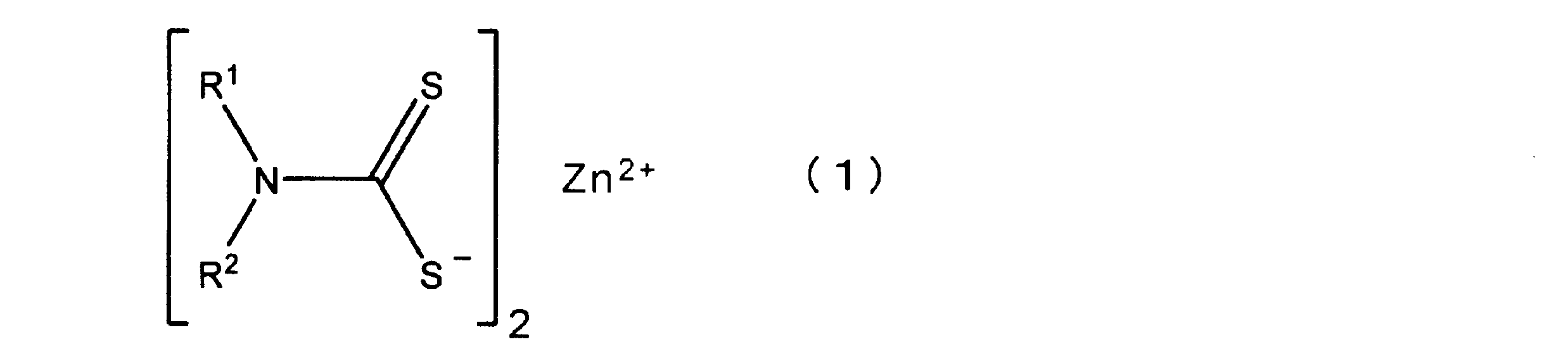
一般式(1)中、R1およびR2は、各々独立して、炭素原子数1~20のアルキル基、炭素原子数6~20のアリール基または炭素原子数7~20のアリールアルキル基を表し、R1およびR2は連結してそれぞれが結合する窒素原子とともに環を形成してもよい。
本発明の塩化ビニル系樹脂用耐アミン性付与剤においては、前記塩化ビニル系樹脂は、自動車内装材用の塩化ビニル系樹脂であることが好ましい。特に、前記自動車内装材用の塩化ビニル系樹脂が、塩化ビニル系樹脂成形体とポリウレタン発泡成形体との積層体からなる自動車内装材で使用される塩化ビニル系樹脂成形体の原料樹脂であることが好ましい。
本発明の塩化ビニル系樹脂用安定剤組成物は、塩化ビニル系樹脂用の安定剤の1種以上と、本発明の塩化ビニル系樹脂用耐アミン性付与剤と、を含有することを特徴とするものである。
本発明の塩化ビニル系樹脂組成物は、塩化ビニル系樹脂と、本発明の塩化ビニル系樹脂用耐アミン性付与剤と、を含有することを特徴とするものである。
本発明の塩化ビニル系樹脂組成物においては、塩化ビニル系樹脂用耐アミン性付与剤の含有量が、前記塩化ビニル系樹脂100質量部に対して0.005~3.0質量部であることが好ましい。本発明の塩化ビニル系樹脂組成物は、粉末成形用に好適である。
本発明の塩化ビニル系樹脂成形体は、本発明の塩化ビニル系樹脂組成物から得られることを特徴とするものである。
本発明の積層体は、塩化ビニル系樹脂成形体とポリウレタン発泡体との積層体であって、前記塩化ビニル系樹脂成形体が、本発明の塩化ビニル系樹脂組成物から得られることを特徴とするものである。
本発明の自動車内装材は、本発明の塩化ビニル系樹脂成形体を含むことを特徴とするものである。本発明の他の自動車内装材は、本発明の積層体を含むことを特徴とするものである。
本発明の塩化ビニル系樹脂の変色抑制方法は、塩化ビニル系樹脂成形体とポリウレタン発泡成形体の積層体を含む自動車内装材の変色抑制方法であって、本発明の塩化ビニル系樹脂用耐アミン性付与剤を、塩化ビニル系樹脂成形体の原料樹脂である塩化ビニル系樹脂に配合することを特徴とするものである。
本発明によれば、塩化ビニル系樹脂のアミンによる変色を抑制することができる塩化ビニル系樹脂用耐アミン性付与剤、塩化ビニル系樹脂用安定剤組成物、塩化ビニル系樹脂組成物、塩化ビニル系樹脂成形体、積層体、自動車内装材および塩化ビニル系樹脂の変色抑制方法を提供することができる。
本発明の塩化ビニル系樹脂成形体は、アミン化合物による変色が抑制されたものであり、自動車内装材として好適である。
以下、本発明の実施形態について詳細に説明する。
まず、本発明の塩化ビニル系樹脂用耐アミン性付与剤について説明する。本発明の耐アミン性付与剤は、塩化ビニル系樹脂のアミン化合物による変色を抑制する、耐アミン性を塩化ビニル系樹脂に付与する機能を有する。
まず、本発明の塩化ビニル系樹脂用耐アミン性付与剤について説明する。本発明の耐アミン性付与剤は、塩化ビニル系樹脂のアミン化合物による変色を抑制する、耐アミン性を塩化ビニル系樹脂に付与する機能を有する。
本発明の塩化ビニル系樹脂用耐アミン性付与剤は、下記一般式(1)で表されるジチオカルバミン酸亜鉛化合物の1種以上を含有する。
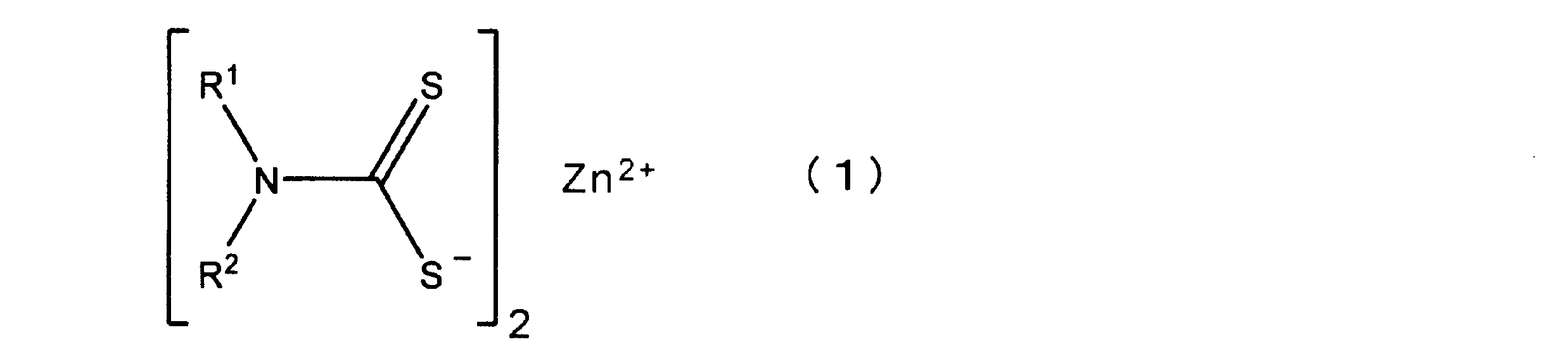
一般式(1)中、R1およびR2は、各々独立して、炭素原子数1~20のアルキル基、炭素原子数6~20のアリール基または炭素原子数7~20のアリールアルキル基を表す。
一般式(1)のR1およびR2の炭素原子数1~20のアルキル基としては、例えば、メチル、エチル、n-プロピル、イソプロピル、n-ブチル、イソブチル、sec-ブチル、tert-ブチル、n-ペンチル、イソペンチル、ネオペンチル、tert-アミル、1,2-ジメチルプロピル、n-ヘキシル、シクロヘキシル、1,3-ジメチルブチル、1-イソプロピルプロピル、1,2-ジメチルブチル、n-ヘプチル、2-ヘプチル、1,4-ジメチルペンチル、tert-ヘプチル、2-メチル-1-イソプロピルプロピル、1-エチル-3-メチルブチル、n-オクチル、tert-オクチル、2-エチルヘキシル、2-メチルヘキシル、2-プロピルヘキシル、n-ノニル、イソノニル、n-デシル、イソデシル、n-ウンデシル、イソウンデシル、n-ドデシル、イソドデシル、n-トリデシル、イソトリデシル、n-テトラデシル、イソテトラデシル、n-ペンタデシル、イソペンタデシル、n-ヘキサデシル、イソヘキサデシル、n-ヘプタデシル、イソヘプタデシル、n-オクタデシル、イソオクタデシル、n-ノナデシル、イソノナデシル、n-イコシル、イソイコシル、シクロペンチル、シクロヘキシル、シクロオクチル、シクロドデシル等が挙げられる。アルキル基のアルキレン部分は、不飽和結合、エーテル結合、チオエーテル結合、エステル結合、チオエステル結合、アミド結合またウレタン結合により1~5回中断されていてもよい。
一般式(1)のR1およびR2の炭素原子数6~20のアリール基としては、例えば、フェニル、p-メチルフェニル、o-メチルフェニル、p-tert-ブチルフェニル、p-メトキシフェニル、o-ビフェニリル、m-ビフェニリル、p-ビフェニリル、α-ナフチル、β-ナフチル、1-アントリル、2-アントリル、9-アントリル、1-フェナントリル、2-フェナントリル、3-フェナントリル、4-フェナントリル、9-フェナントリル、ベンジル等が挙げられる。
一般式(1)のR1およびR2の炭素原子数7~20のアリールアルキル基としては、例えば、ベンジル、フェネチル、2-フェニルプロパン-2-イル、スチリル、シンナミル、ジフェニルメチル、トリフェニルメチル等が挙げられる。
また、一般式(1)のR1およびR2は連結してそれぞれが結合する窒素原子とともに環を形成してもよい。このような環としてはピロリジン環、ピペリジン環が挙げられる。
R1およびR2は、塩化ビニル系樹脂への耐アミン性付与の点から、炭素原子数1~4のアルキル基、フェニル基またはベンジル基が好ましく、メチル基、エチル基、n-プロピル基、n-ブチル基、フェニル基またはベンジル基がより好ましく、メチル基またはエチル基がさらにより好ましく、エチル基が特に好ましい。
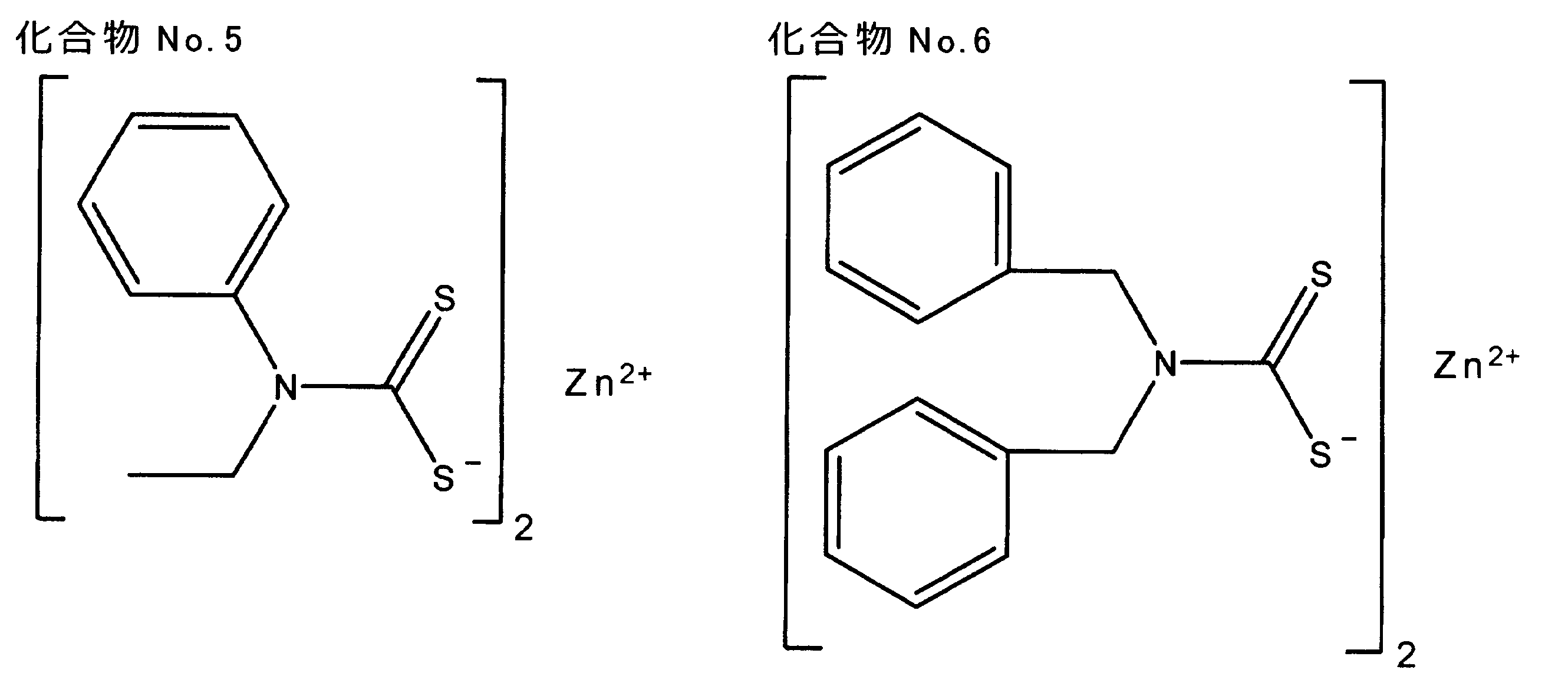
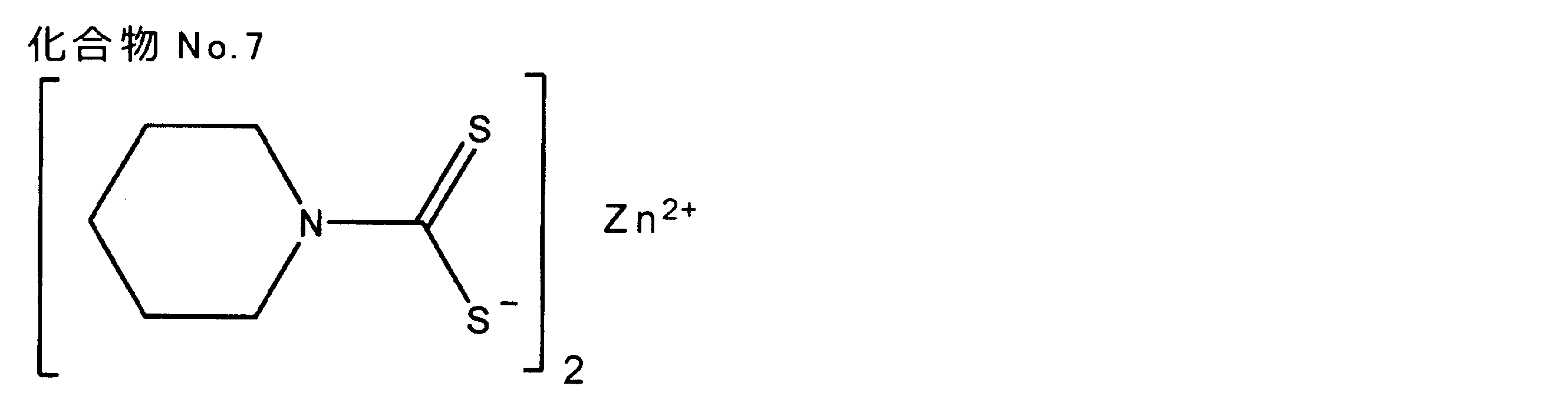
一般式(1)で表されるジチオカルバミン酸亜鉛化合物の、耐アミン性付与の点から好ましい具体例としては、下記化合物No.1~No.7が挙げられる。これらの中でも、耐アミン性付与の点から、化合物No.1、No.2、No.4、No.5、No.6、No.7がより好ましく、化合物No.1、No.2がさらにより好ましく、化合物No.2が特に好ましい。

本発明の耐アミン性付与剤は、塩化ビニル系樹脂の安定剤の1種以上と併用し、塩化ビニル系樹脂用安定剤組成物として使用することも好ましい。
耐アミン性付与剤と併用される安定剤としては、耐アミン性と熱安定性の点から、ジチオカルバミン酸以外の有機酸の亜鉛塩が好ましい。かかる有機酸の亜鉛塩としては、有機カルボン酸、フェノール類また有機リン酸類等の亜鉛塩が挙げられる。
有機カルボン酸としては、例えば、酢酸、プロピオン酸、酪酸、吉草酸、カプロン酸、エナント酸、カプリル酸、ペラルゴン酸、2-エチルヘキシル酸、ネオデカン酸、カプリン酸、ウンデカン酸、イソウンデシル酸、ラウリン酸、イソラウリン酸、トリデカン酸、ミリスチン酸、イソミリスチン酸、パルミチン酸、イソパルミチン酸、イソステアリン酸、ステアリン酸、12-ヒドロキシステアリン酸、ベヘニン酸、モンタン酸、バーサチック酸、安息香酸、モノクロル安息香酸、4-tert-ブチル安息香酸、ジメチルヒドロキシ安息香酸、3,5-ジ第三ブチル-4-ヒドロキシ安息香酸、o-トルイル酸、m-トルイル酸、p-トルイル酸、トルイル酸、ジメチル安息香酸、2,4-ジメチル安息香酸、3,5-ジメチル安息香酸、2,4,6-トリメチル安息香酸、エチル安息香酸、2-エチル安息香酸、3-エチル安息香酸、4-エチル安息香酸、2,4,6-トリエチル安息香酸、4-イソプロピル安息香酸、n-プロピル安息香酸、アミノ安息香酸、N,N-ジメチルアミノ安息香酸、アセトキシ安息香酸、サリチル酸、p-第三オクチルサリチル酸、エライジン酸、オレイン酸、リノール酸、リノレン酸、ミリストレイン酸、パルミトレイン酸、エレオステアリン酸、エイコセン酸、エイコサジエン酸、エイコサトリエン酸、エイコサテトラエン酸、アラキドン酸、ドコサペンタエン酸、ドコサヘキサエン酸、リシノール酸、チオグリコール酸、メルカプトプロピオン酸、オクチルメルカプトプロピオン酸等の一価カルボン酸;シュウ酸、マロン酸、コハク酸、グルタル酸、アジピン酸、ピメリン酸、スベリン酸、アゼライン酸、セバシン酸、フタル酸、イソフタル酸、テレフタル酸、ヒドロキシフタル酸、クロルフタル酸、アミノフタル酸、マレイン酸、フマル酸、シトラコン酸、メタコン酸、イタコン酸、アコニット酸、チオジプロピオン酸等の二価カルボン酸或いはこれらのモノエステルまたモノアマイド化合物;ブタントリカルボン酸、ブタンテトラカルボン酸、ヘミメリット酸、トリメリット酸、メロファン酸、ピロメリット酸等の三価また四価カルボン酸のジまたトリエステル化合物が挙げられる。
また、フェノール類としては、例えば、第三ブチルフェノール、ノニルフェノール、ジノニルフェノール、シクロヘキシルフェノール、フェニルフェノール、オクチルフェノール、フェノール、クレゾール、キシレノール、n-ブチルフェノール、イソアミルフェノール、エチルフェノール、イソプロピルフェノール、イソオクチルフェノール、2-エチルヘキシルフェノール、第三ノニルフェノール、デシルフェノール、第三オクチルフェノール、イソヘキシルフェノール、オクタデシルフェノール、ジイソブチルフェノール、メチルプロピルフェノール、ジアミルフェノール、メチルイソヘキシルフェノール、メチル第三オクチルフェノール等が挙げられる。
また、有機リン酸類としては、例えば、モノまたジオクチルリン酸、モノまたジドデシルリン酸、モノまたジオクタデシルリン酸、モノまたジ-(ノニルフェニル)リン酸、ホスホン酸ノニルフェニルエステル、ホスホン酸ステアリルエステル等が挙げられる。
有機酸の亜鉛塩は、酸性塩、中性塩、塩基性塩或いは塩基性塩の塩基の一部また全部を炭酸で中和した過塩基性錯体であってもよい。
有機酸の亜鉛塩は、2種以上の有機酸から構成されていてもよい。例えば、1価の有機酸による亜鉛塩の場合、同一の有機酸がアニオン部位を形成し、カチオン部位を形成する2価の亜鉛と塩を形成していてもよく、異なる1価の有機酸2種がアニオン部位を形成し、カチオン部位を形成する2価の亜鉛と塩を形成していてもよい。
亜鉛塩は、耐アミン性と熱安定性の点から、安息香酸亜鉛、トルイル酸亜鉛、4-tert-ブチル安息香酸亜鉛、ステアリン酸亜鉛、ラウリン酸亜鉛、バーサチック酸亜鉛、オクチル酸亜鉛、オレイン酸亜鉛、パルミチン亜鉛、ミリスチン亜鉛が好ましい。有機酸の亜鉛塩は、1種類のみ使用しても、2種類以上を併用してもよい。
本発明の安定剤組成物に、有機酸の亜鉛塩を含有させる場合、有機酸の亜鉛塩の含有量は、耐アミン性付与剤100質量部に対して、耐アミン性と熱安定性の点から、5~20000質量部が好ましく、10~8000質量部がより好ましく、20~800質量部がさらにより好ましい。
さらに、本発明の安定剤組成物において、耐アミン性付与剤と併用される安定剤としては、耐アミン性と熱安定性の点から、有機酸のバリウム塩、過塩基性炭酸バリウム塩の群から選ばれる1種以上が好ましい。
まず、有機酸のバリウム塩について説明する。有機酸のバリウム塩としては、有機カルボン酸、フェノール類また有機リン酸類等のバリウム塩が挙げられる。
有機カルボン酸としては、例えば、酢酸、プロピオン酸、酪酸、吉草酸、カプロン酸、エナント酸、カプリル酸、ペラルゴン酸、2-エチルヘキシル酸、ネオデカン酸、カプリン酸、ウンデカン酸、イソウンデシル酸、ラウリン酸、イソラウリン酸、トリデカン酸、ミリスチン酸、イソミリスチン酸、パルミチン酸、イソパルミチン酸、イソステアリン酸、ステアリン酸、12-ヒドロキシステアリン酸、ベヘニン酸、モンタン酸、バーサチック酸、安息香酸、モノクロル安息香酸、4-tert-ブチル安息香酸、ジメチルヒドロキシ安息香酸、3,5-ジ第三ブチル-4-ヒドロキシ安息香酸、o-トルイル酸、m-トルイル酸、p-トルイル酸、トルイル酸、ジメチル安息香酸、2,4-ジメチル安息香酸、3,5-ジメチル安息香酸、2,4,6-トリメチル安息香酸、エチル安息香酸、2-エチル安息香酸、3-エチル安息香酸、4-エチル安息香酸、2,4,6-トリエチル安息香酸、4-イソプロピル安息香酸、n-プロピル安息香酸、アミノ安息香酸、N,N-ジメチルアミノ安息香酸、アセトキシ安息香酸、サリチル酸、p-第三オクチルサリチル酸、エライジン酸、オレイン酸、リノール酸、リノレン酸、ミリストレイン酸、パルミトレイン酸、エレオステアリン酸、エイコセン酸、エイコサジエン酸、エイコサトリエン酸、エイコサテトラエン酸、アラキドン酸、ドコサペンタエン酸、ドコサヘキサエン酸、リシノール酸、チオグリコール酸、メルカプトプロピオン酸、オクチルメルカプトプロピオン酸等の一価カルボン酸;シュウ酸、マロン酸、コハク酸、グルタル酸、アジピン酸、ピメリン酸、スベリン酸、アゼライン酸、セバシン酸、フタル酸、イソフタル酸、テレフタル酸、ヒドロキシフタル酸、クロルフタル酸、アミノフタル酸、マレイン酸、フマル酸、シトラコン酸、メタコン酸、イタコン酸、アコニット酸、チオジプロピオン酸等の二価カルボン酸或いはこれらのモノエステルまたモノアマイド化合物;ブタントリカルボン酸、ブタンテトラカルボン酸、ヘミメリット酸、トリメリット酸、メロファン酸、ピロメリット酸等の三価また四価カルボン酸のジまたトリエステル化合物が挙げられる。
また、フェノール類としては、例えば、第三ブチルフェノール、ノニルフェノール、ジノニルフェノール、シクロヘキシルフェノール、フェニルフェノール、オクチルフェノール、フェノール、クレゾール、キシレノール、n-ブチルフェノール、イソアミルフェノール、エチルフェノール、イソプロピルフェノール、イソオクチルフェノール、2-エチルヘキシルフェノール、第三ノニルフェノール、デシルフェノール、第三オクチルフェノール、イソヘキシルフェノール、オクタデシルフェノール、ジイソブチルフェノール、メチルプロピルフェノール、ジアミルフェノール、メチルイソヘキシルフェノール、メチル第三オクチルフェノール等が挙げられる。
また、有機リン酸類としては、例えば、モノまたジオクチルリン酸、モノまたジドデシルリン酸、モノまたジオクタデシルリン酸、モノまたジ-(ノニルフェニル)リン酸、ホスホン酸ノニルフェニルエステル、ホスホン酸ステアリルエステル等が挙げられる。
有機酸のバリウム塩は、2種以上の有機酸から構成されていてもよい。例えば、1価の有機酸によるバリウム塩の場合、同一の有機酸がアニオン部位を形成し、カチオン部位を形成する2価のバリウムと塩を形成していてもよく、異なる1価の有機酸2種がアニオン部位を形成し、カチオン部位を形成する2価のバリウムと塩を形成していてもよい。
有機酸のバリウム塩は、1種類のみ使用しても、2種類以上を併用してもよい。
また、有機酸のバリウム塩は、酸性塩、中性塩、塩基性塩でもよい。
次に過塩基性炭酸バリウム塩について説明する。過塩基性炭酸バリウム塩とは、バリウムの液状過塩基性カルボキシレート/カーボネート錯体である。この錯体は、バリウムのカルボン酸正塩と炭酸バリウムとの単純な混合物とは異なり、これらが何等かのインタラクションにより錯体となっているものであり、高い金属含有量を有しながら、有機溶媒中で均一な液状を示すという特徴を有している。この錯体は、バリウムのカルボン酸正塩、炭酸バリウム、およびバリウムのカルボン酸と炭酸との複合塩を構成成分として構成されており、炭酸バリウムを中心にバリウムのカルボン酸正塩およびバリウムのカルボン酸と炭酸との複合塩がその周辺に存在し、言わばミセルのようなものが形成されることによって、有機溶媒中で均一な液状を示すものである。
これら、バリウムの液状過塩基性カルボキシレート/カーボネート錯体は、例えば特開2004-238364号公報に示す製造方法によって製造することができる。
また、バリウムの液状過塩基性カルボキシレート/カーボネート錯体は、種々の市販されている錯体をそのまま使用することもできる。市販されている錯体の代表的なものとしては、例えば、米国AM STABILIZERS社製の「PlastistabTM 2116」(過塩基性バリウムオレート/カーボネート錯体:比重1.42~1.53、Ba=33~36%)、「PlastistabTM2513」(過塩基性バリウムオレート/カーボネート錯体:比重1.41~1.52、Ba=33~36%)、「PlastistabTM 2508」(過塩基性バリウムオレート/カーボネート錯体:比重1.39~1.51、Ba=33~36%)等が挙げられる。
これら過塩基性炭酸バリウム塩は、1種類のみ使用しても、2種類以上を併用してもよい。
本発明の安定剤組成物に、有機酸のバリウム塩または過塩基性炭酸バリウム塩を含有させる場合、それらの含有量は、耐アミン性付与剤100質量部に対して、耐アミン性と熱安定性の点から、10~60000質量部が好ましく、30~10000質量部がより好ましく、50~2000質量部がさらにより好ましい。
さらに、本発明の安定剤組成物において、耐アミン性付与剤と併用される安定剤としては、耐アミン性と熱安定性の点から、有機酸のカルシウム塩、過塩基性炭酸カルシウム塩の群から選ばれる1種以上が好ましい。かかる有機酸のカルシウム塩としては、有機カルボン酸、フェノール類また有機リン酸類等のカルシウム塩が挙げられる。
有機カルボン酸としては、例えば、バリウム塩で例示したものが挙げられる。またフェノール類としては、例えば、バリウム塩で例示したものが挙げられる。また有機リン酸類としては、例えば、バリウム塩で例示したものが挙げられる。
有機酸のカルシウム塩は、2種以上の有機酸から構成されていてもよい。例えば、1価の有機酸によるカルシウム塩の場合、同一の有機酸がアニオン部位を形成し、カチオン部位を形成する2価のカルシウムと塩を形成していてもよく、異なる1価の有機酸2種がアニオン部位を形成し、カチオン部位を形成する2価のカルシウムと塩を形成していてもよい。
有機酸のカルシウム塩は、1種類のみ使用しても、2種類以上を併用してもよい。
有機酸のカルシウム塩は、酸性塩、中性塩、塩基性塩でもよい。
次に過塩基性炭酸カルシウム塩について説明する。過塩基性炭酸カルシウム塩とは、カルシウムの液状過塩基性カルボキシレート/カーボネート錯体である。この錯体は、カルシウムのカルボン酸正塩と炭酸カルシウムとの単純な混合物とは異なり、これらが何等かのインタラクションにより錯体となっているものであり、高い金属含有量を有しながら、有機溶媒中で均一な液状を示すという特徴を有している。この錯体は、カルシウムのカルボン酸正塩、炭酸カルシウム、およびカルシウムのカルボン酸と炭酸との複合塩を構成成分として構成されており、炭酸カルシウムを中心にカルシウムのカルボン酸正塩およびカルシウムのカルボン酸と炭酸との複合塩がその周辺に存在し、言わばミセルのようなものが形成されることによって、有機溶媒中で均一な液状を示すものである。
カルシウムの液状過塩基性カルボキシレート/カーボネート錯体は、バリウムの液状過塩基性液状カルボキシレート/カーボネート錯体と同様の方法で製造することができる。また、種々の市販されている錯体をそのまま使用することもできる。市販されている錯体の代表的なものとしては、例えば、米国AM STABILIZERS社製の、「PlastistabTM 2265」(過塩基性カルシウムオレート/カーボネート錯体:比重1.04~1.09、Ca=10%)が挙げられる。
これら過塩基性炭酸カルシウム塩は、1種類のみ使用しても、2種類以上を併用してもよい。
本発明の安定剤組成物に、有機酸のカルシウム塩または過塩基性炭酸カルシウム塩を含有させる場合、それらの含有量は、耐アミン性付与剤100質量部に対して、耐アミン性と熱安定性の点から、10~60000質量部が好ましく、30~10000質量部がより好ましく、50~2000質量部がさらにより好ましい。
さらに、本発明の安定剤組成物において、耐アミン性付与剤と併用される安定剤としては、耐アミン性と熱安定性の点から、β-ジケトン化合物が好ましい。かかるβ-ジケトン化合物としては、例えば、アセチルアセトン、トリアセチルメタン、2,4,6-ヘプタトリオン、ブタノイルアセチルメタン、ラウロイルアセチルメタン、パルミトイルアセチルメタン、ステアロイルベンゾイルメタン、パルミトイルベンゾイルメタン、ジステアロイルメタン、ステアロイルアセチルメタン、フェニルアセチルアセチルメタン、ジシクロヘキシルカルボニルメタン、ベンゾイルホルミルメタン、ベンゾイルアセチルメタン、ジベンゾイルメタン、オクチルベンゾイルメタン、ビス(4-オクチルベンゾイル)メタン、ベンゾイルジアセチルメタン、4-メトキシベンゾイルベンゾイルメタン、ビス(4-カルボキシメチルベンゾイル)メタン、2-カルボキシメチルベンゾイルアセチルオクチルメタン、デヒドロ酢酸、アセト酢酸エチル、シクロヘキサン-1,3-ジオン、3,6-ジメチル-2,4-ジオキシシクロヘキサン-1カルボン酸メチル、2-アセチルシクロヘキサノン、ジメドン、2-ベンゾイルシクロヘキサン等が挙げられ、これらの金属塩も同様に使用することができる。金属塩の例としては、リチウム塩、ナトリウム塩、カリウム塩、カルシウム塩、亜鉛塩、マグネシウム塩、アルミニウム塩が挙げられる。好ましい金属塩の例としては、アセチルアセトンカルシウム塩、アセチルアセトン亜鉛塩等が挙げられる。
β-ジケトン化合物は1種類のみ使用してもよいし、2種以上を併用してもよい。これらのβ-ジケトン化合物の中でも、耐アミン性と熱安定性の点から、ジベンゾイルメタン、ステアロイルベンゾイルメタンまたはアセチルアセトン亜鉛塩が好ましい。
本発明の安定剤組成物に、β-ジケトン化合物を含有させる場合、その含有量は、耐アミン性付与剤100質量部に対して、耐アミン性と熱安定性の点から、10~60000質量部が好ましく、30~10000質量部がより好ましく、50~2000質量部がさらにより好ましい。
さらに、本発明の安定剤組成物において、耐アミン性付与剤と併用される安定剤としては、耐アミン性と熱安定性の点から、亜リン酸エステル化合物の1種以上が好ましい。かかる亜リン酸エステル化合物としては、亜リン酸トリアルキルエステル、亜リン酸ジアルキルエステル、亜リン酸ジアルキルモノアリルエステル、亜リン酸アルキルアリルエステル、亜リン酸モノアルキルジアリルエステル、亜リン酸ジアリルエステル、亜リン酸トリアリルエステル等が挙げられる。本発明の安定剤組成物においては、トリエステルでもジエステルでも使用することができるが、熱安定性の点から、トリエステルを使用することが好ましい。また、チオエステルも使用することができる。
亜リン酸エステル化合物の例を挙げると、トリフェニルホスファイト、トリクレジルホスファイト、トリス(2,4-ジ第三ブチルフェニル)ホスファイト、トリス(ノニルフェニル)ホスファイト、トリス(ジノニルフェニル)ホスファイト、トリス(モノ-およびジ-混合ノニルフェニル)ホスファイト、トリス(2,4-ジ-第三ブチルフェニル)ホスファイト、ジフェニルホスファイト、2,2’-メチレンビス(4,6-ジ第三ブチルフェニル)オクチルホスファイト、2,2’-メチレンビス(4,6-第三ブチルフェニル)-2-エチルヘキシルホスファイト、2,2’-メチレンビス(4,6-第三ブチルフェニル)-オクタデシルホスファイト、2,2’-エチリデンビス(4,6-ジ第三ブチルフェニル)フルオロホスファイト、オクチルジフェニルホスファイト、ジフェニルデシルホスファイト、ジフェニル(2-エチルヘキシル)ホスファイト、ジ(デシル)モノフェニルホスファイト、ジフェニルトリデシルホスファイト、ジフェニル(C12~C15混合アルキル)ホスファイト、フェニルジイソデシルホスファイト、フェニルビス(イソトリデシル)ホスファイト、トリエチルホスファイト、トリブチルホスファイト、トリス(2-エチルヘキシル)ホスファイト、トリス(デシル)ホスファイト、トリラウリルホスファイト、トリス(トリデシル)ホスファイト、トリオレイルホスファイト、トリステアリルホスファイト、ジエチルホスファイト、ジブチルホスファイト、ジラウリルホスファイト、ビス(2-エチルヘキシル)ホスファイト、ジオレイルホスファイト、トリラウリルトリチオホスファイト、ビス(ネオペンチルグリコール)-1,4-シクロヘキサンジメチルジホスファイト、ビス(2,4-ジ第三ブチルフェニル)ペンタエリスリトールジホスファイト、ビス(2,6-ジ第三ブチル-4-メチルフェニル)ペンタエリスリトールジホスファイト、ビス(2,4,6-トリ第三ブチルフェニル)ペンタエリスリトールジホスファイト、ビス(2,4-ジクミルフェニル)ペンタエリスリトールジホスファイト、ジステアリルペンタエリスリトールジホスファイト、ジ(ノニルフェニル)ペンタエリスリトールジホスファイト、ジ(トリデシル)ペンタエリスリトールジホスファイト、フェニル-4,4’-イソプロピリデンジフェノール・ペンタエリスリトールジホスファイト、テトラ(C12~15混合アルキル)-4,4’-イソプロピリデンジフェニルジホスファイト、水素化-4,4’-イソプロピリデンジフェノールポリホスファイト、ビス(オクチルフェニル)・ビス〔4,4’-n-ブチリデンビス(2-第三ブチル-5-メチルフェノール)〕・1,6-ヘキサンジオール・ジホスファイト、テトラ(トリデシル)-4,4’-n-ブチリデンビス(2-第三ブチル-5-メチルフェノール)ジホスファイト、ヘキサ(トリデシル)-1,1,3-トリス(2-メチル-4-ヒドロキシ-5-第三ブチルフェニル)ブタントリホスファイト、ヘキサ(トリデシル)・1,1,3-トリス(2-メチル-5-第三ブチル-4-ヒドロキシフェニル)ブタン・トリホスファイト、9,10-ジハイドロ-9-オキサ-10-ホスファフェナンスレン-10-オキサイド、2-ブチル-2-エチルプロパンジオール・2,4,6-トリ第三ブチルフェノールモノホスファイト、トリス〔2-第三ブチル-4-(3-第三ブチル-4-ヒドロキシ-5-メチルフェニルチオ)-5-メチルフェニル〕ホスファイト、テトラ(トリデシル)イソプロピリデンジフェノールジホスファイト、テトラキス(2,4-ジ第三ブチルフェニル)ビフェニレンジホスファイト、トリス(2-〔(2,4,8,10-テトラキス第三ブチルジベンゾ〔d,f〕〔1,3,2〕ジオキサホスフェピン-6-イル)オキシ〕エチル)アミン、2-エチル-2-ブチルプロピレングリコールと2,4,6-トリ第三ブチルフェノールのホスファイト等が挙げられる。
亜リン酸エステル化合物は、1種類のみ使用しても、2種以上を併用してもよい。これらの亜リン酸エステル化合物の中でも、熱安定性の点から、炭素原子数12~80の亜リン酸エステル化合物を使用することが好ましく、炭素原子数12~46の亜リン酸エステル化合物を使用することがより好ましく、炭素原子数12~36の亜リン酸エステル化合物を使用することが好ましく、炭素原子数18~30の亜リン酸エステル化合物を使用することがより好ましい。
本発明の安定剤組成物に、亜リン酸エステル化合物を含有させる場合、その含有量は、耐アミン性付与剤100質量部に対して、耐アミン性と熱安定性の点から、10~60000質量部が好ましく、50~6000質量部がより好ましく、100~2000質量部がさらにより好ましい。
さらに、本発明の安定剤組成物において、耐アミン性付与剤と併用される安定剤としては、耐アミン性と熱安定性の点から、フェノール系酸化防止剤の1種以上が好ましい。かかるフェノール系酸化防止剤としては、例えば、2,6-ジ第三ブチル-p-クレゾール、2,6-ジフェニル-4-オクタデシロキシフェノール、ステアリル(3,5-ジ第三ブチル-4-ヒドロキシフェニル)-プロピオネート、ジステアリル(3,5-ジ第三ブチル-4-ヒドロキシベンジル)ホスホネート、チオジエチレングリコールビス〔(3,5-ジ第三ブチル-4-ヒドロキシフェニル)プロピオネート〕、1,6-ヘキサメチレンビス〔(3,5-ジ第三ブチル-4-ヒドロキシフェニル)プロピオネート〕、1,6-ヘキサメチレンビス〔(3,5-ジ第三ブチル-4-ヒドロキシフェニル)プロピオン酸アミド〕、4,4’-チオビス(6-第三ブチル-m-クレゾール)、2,2’-メチレンビス(4-メチル-6-第三ブチルフェノール)、2,2’-メチレンビス(4-エチル-6-第三ブチルフェノール)、ビス〔3,3-ビス(4-ヒドロキシ-3-第三ブチルフェニル)ブチリックアシッド〕グリコールエステル、4,4’-ブチリデンビス(6-第三ブチル-m-クレゾール)、2,2’-エチリデンビス(4,6-ジ第三ブチルフェノール)、2,2’-エチリデンビス(4-第二ブチル-6-第三ブチルフェノール)、1,1,3-トリス(2-メチル-4-ヒドロキシ-5-第三ブチルフェニル)ブタン、ビス〔2-第三ブチル-4-メチル-6-(2-ヒドロキシ-3-第三ブチル-5-メチルベンジル)フェニル〕テレフタレート、1,3,5-トリス(2,6-ジメチル-3-ヒドロキシ-4-第三ブチルベンジル)イソシアヌレート、1,3,5-トリス(3,5-ジ第三ブチル-4-ヒドルキシベンジル)イソシアヌレート、1,3,5-トリス(3,5-ジ第三ブチル-4-ヒドロキシベンジル)-2,4,6-トリメチルベンゼン、1,3,5-トリス〔(3,5-ジ第三ブチル-4-ヒドロキシフェニル)プロピオニルオキシエチル〕イソシアヌレート、テトラキス〔メチレン-3-(3’,5’-ジ第三ブチル-4’-ヒドロキシフェニル)プロピオネート〕メタン、2-第三ブチル-4-メチル-6-(2-アクリロイルオキシ-3-第三ブチル-5-メチルベンジル)フェノール、3,9-ビス〔1,1-ジメチル-2-{(3-第三ブチル-4-ヒドロキシ-5-メチルフェニル)プロピオニルオキシ}エチル〕-2,4,8,10-テトラオキサスピロ〔5.5〕ウンデカン、トリエチレングリコールビス〔(3-第三ブチル-4-ヒドロキシ-5-メチルフェニル)プロピオネート〕等が挙げられる。
フェノール系酸化防止剤は1種類のみ使用してもよいし、2種以上を併用してもよい。これらのフェノール系酸化防止剤の中でも、熱安定性の点から、ペンタエリトリトールテトラキス[3-(3,5-ジ-tert-ブチル-4-ヒドロキシフェニル)プロピオネート]、またはオクタデシル3-(3,5-ジ-tert-ブチル-4-ヒドロキシフェニル)プロピオネートが好ましい。
本発明の安定剤組成物に、フェノール系酸化防止剤を含有させる場合、その含有量は、耐アミン性付与剤100質量部に対して、耐アミン性と熱安定性の点から、1~2000質量部が好ましく、2~200質量部がより好ましく、4~100質量部がさらにより好ましい。
さらに、本発明の安定剤組成物において、耐アミン性付与剤と併用される安定剤としては、耐アミン性と熱安定性の点から、ヒンダードアミン系光安定剤の1種以上が好ましい。かかるヒンダードアミン系光安定剤としては、例えば、2,2,6,6-テトラメチル-4-ピペリジルステアレート、1,2,2,6,6-ペンタメチル-4-ピペリジルステアレート、2,2,6,6-テトラメチル-4-ピペリジルベンゾエート、ビス(2,2,6,6-テトラメチル-4-ピペリジル)セバケート、ビス(1,2,2,6,6-ペンタメチル-4-ピペリジル)セバケート、ビス(1-オクトキシ-2,2,6,6-テトラメチル-4-ピペリジル)セバケート、テトラキス(2,2,6,6-テトラメチル-4-ピペリジル)-1,2,3,4-ブタンテトラカルボキシレート、テトラキス(1,2,2,6,6-ペンタメチル-4-ピペリジル)-1,2,3,4-ブタンテトラカルボキシレート、ビス(2,2,6,6-テトラメチル-4-ピペリジル)・ビス(トリデシル)-1,2,3,4-ブタンテトラカルボキシレート、ビス(1,2,2,6,6-ペンタメチル-4-ピペリジル)・ビス(トリデシル)-1,2,3,4-ブタンテトラカルボキシレート、ビス(1,2,2,6,6-ペンタメチル-4-ピペリジル)-2-ブチル-2-(3,5-ジ第三ブチル-4-ヒドロキシベンジル)マロネート、1,2,2,6,6-ペンタメチル-4-ピペリジルメタクリレート、ポリ〔{6-(1,1,3,3-テトラメチルブチル)アミノ-1,3,5-トリアジン-2,4-ジイル}{(2,2,6,6-テトラメチル-4-ピペリジル)イミノ}ヘキサメチレン{(2,2,6,6-テトラメチル-4-ピペリジル)イミノ}〕、1,2,3,4-ブタンカルボン酸/2,2-ビス(ヒドロキシメチル)-1,3-プロパンジオール/3-ヒドロキシ-2,2-ジメチルプロパナール/1,2,2,6,6-ペンタメチル-4-ピペリジニルエステル重縮合物、ビス(1,2,2,6,6-ペンタメチル-4-ピペリジル)=デカンジオアート/メチル=1,2,2,6,6-ペンタメチル-4-ピペリジル=セバカート混合物、2,2,6,6-テトラメチル-4-ピペリジルメタクリレート、1-(2-ヒドロキシエチル)-2,2,6,6-テトラメチル-4-ピペリジノール/コハク酸ジエチル重縮合物、1,6-ビス(2,2,6,6-テトラメチル-4-ピペリジルアミノ)ヘキサン/ジブロモエタン重縮合物、1,6-ビス(2,2,6,6-テトラメチル-4-ピペリジルアミノ)ヘキサン/2,4-ジクロロ-6-モルホリノ-s-トリアジン重縮合物、1,6-ビス(2,2,6,6-テトラメチル-4-ピペリジルアミノ)ヘキサン/2,4-ジクロロ-6-第三オクチルアミノ-s-トリアジン重縮合物、1,5,8,12-テトラキス[2,4-ビス(N-ブチル-N-(2,2,6,6-テトラメチル-4-ピペリジル)アミノ)-s-トリアジン-6-イル]-1,5,8,12-テトラアザドデカン、1,5,8,12-テトラキス[2,4-ビス(N-ブチル-N-(1,2,2,6,6-ペンタメチル-4-ピペリジル)アミノ)-s-トリアジン-6-イル]-1,5,8,12-テトラアザドデカン、1,6,11-トリス[2,4-ビス(N-ブチル-N-(2,2,6,6-テトラメチル-4-ピペリジル)アミノ)-s-トリアジン-6-イルアミノ]ウンデカン、1,6,11-トリス[2,4-ビス(N-ブチル-N-(1,2,2,6,6-ペンタメチル-4-ピペリジル)アミノ)-s-トリアジン-6-イルアミノ]ウンデカン、3,9-ビス〔1,1-ジメチル-2-{トリス(2,2,6,6-テトラメチル-4-ピペリジルオキシカルボニル)ブチルカルボニルオキシ}エチル〕-2,4,8,10-テトラオキサスピロ〔5.5〕ウンデカン、3,9-ビス〔1,1-ジメチル-2-{トリス(1,2,2,6,6-ペンタメチル-4-ピペリジルオキシカルボニル)ブチルカルボニルオキシ}エチル〕-2,4,8,10-テトラオキサスピロ〔5.5〕ウンデカン、ビス(1-ウンデシルオキシ-2,2,6,6-テトラメチルピペリジン-4-イル)カーボネート、2,2,6,6-テトラメチル-4-ピペリジルヘキサデカノエート、2,2,6,6-テトラメチル-4-ピペリジルオクタデカノエート等が挙げられる。
ヒンダードアミン系光安定剤は、1種類のみ使用しても、2種類以上を併用してもよい。
本発明の安定剤組成物に、ヒンダードアミン系光安定剤を含有させる場合、その含有量は、耐アミン性付与剤100質量部に対して、耐アミン性と熱安定性の点から、5~15000質量部が好ましく、10~2000質量部がより好ましく、20~700質量部がさらにより好ましい。
さらに、本発明の安定剤組成物において、耐アミン性付与剤と併用される安定剤としては、耐アミン性と熱安定性の点から、無機系助剤の1種以上が好ましい。かかる無機系助剤としては、ハイドロタルサイト化合物、ゼオライト化合物が挙げられる。
ハイドロタルサイト化合物としては、下記一般式(2)で表される化合物が挙げられる。

一般式(2)中、x1、x2およびy1は各々下記式、0≦x2/x1<10、2≦x1+x2<20、0≦y1≦2で表される条件を満足する数を示し、mは0または任意の整数を示す。
ハイドロタルサイト化合物としては、マグネシウムとアルミニウム、または亜鉛、マグネシウムおよびアルミニウムからなる複塩化合物が好ましく用いられる。また、結晶水を脱水したものであってもよい。このようなハイドロタルサイト化合物は、天然物であってもよく、また合成品であってもよい。ハイドロタルサイト化合物の結晶構造、結晶粒子径等に制限はない。
また、ハイドロタルサイト化合物として、その表面をステアリン酸等の高級脂肪酸、オレイン酸アルカリ金属塩等の高級脂肪酸金属塩、ドデシルベンゼンスルホン酸アルカリ金属塩等の有機スルホン酸金属塩、高級脂肪酸アミド、高級脂肪酸エステルまたはワックス等で被覆したものも使用することができる。
ただし、本発明の安定剤組成物において、ハイドロタルサイト化合物は、過塩素酸アニオンを含むものや、過塩素酸塩処理されたものは、使用することが可能であるが、安全面、環境面の点を考慮すると、その使用は好ましくない。
ハイドロタルサイト系化合物は1種類のみ使用してもよいし、2種以上を併用してもよい。
ゼオライト化合物は、独特の三次元のゼオライト結晶構造を有するアルカリまたはアルカリ土類金属のアルミノケイ酸塩であり、その代表例としては、A型、X型、Y型およびP型ゼオライト、モノデナイト、アナルサイト、ソーダライト族アルミノケイ酸塩、クリノブチロライト、エリオナイトおよびチャバサイト等を挙げることができ、これらのゼオライト化合物の結晶水(いわゆるゼオライト水)を有する含水物または結晶水を除去した無水物のいずれでもよく、またその粒径が0.1~50μmのものを用いることができ、特に、0.5~10μmのものが好ましい。ゼオライト化合物は、1種類のみ使用してもよいし、2種以上を併用してもよい。
無機系助剤は、1種類のみ使用しても、2種類以上を併用してもよく、ハイドロタルサイト化合物とゼオライト化合物を併用してもよい。
本発明の安定剤組成物に、無機系助剤を含有させる場合、その含有量は、耐アミン性付与剤100質量部に対して、耐アミン性と熱安定性の点から、50~80000質量部が好ましく、100~8000質量部がより好ましく、400~4000質量部がさらにより好ましい。
次に、本発明の塩化ビニル系樹脂組成物について説明する。
本発明の塩化ビニル系樹脂組成物は、塩化ビニル系樹脂に対して、本発明の耐アミン性付与剤が配合されている点に特徴を有する。
本発明の塩化ビニル系樹脂組成物は、塩化ビニル系樹脂に対して、本発明の耐アミン性付与剤が配合されている点に特徴を有する。
本発明の塩化ビニル系樹脂組成物における、塩化ビニル系樹脂としては、塊状重合、溶液重合、懸濁重合、乳化重合等その重合方法には特に限定されず、例えば、ポリ塩化ビニル、塩素化ポリ塩化ビニル、ポリ塩化ビニリデン、塩素化ポリエチレン、塩化ビニル-酢酸ビニル共重合体、塩化ビニル-エチレン共重合体、塩化ビニル-プロピレン共重合体、塩化ビニル-スチレン共重合体、塩化ビニル-イソブチレン共重合体、塩化ビニル-塩化ビニリデン共重合体、塩化ビニル-スチレン-無水マレイン酸三元共重合体、塩化ビニル-スチレン-アクリロニリトル共重合体、塩化ビニル-ブタジエン共重合体、塩化ビニル-イソプレン共重合体、塩化ビニル-塩素化プロピレン共重合体、塩化ビニル-塩化ビニリデン-酢酸ビニル三元共重合体、塩化ビニル-マレイン酸エステル共重合体、塩化ビニル-メタクリル酸エステル共重合体、塩化ビニル-アクリロニトリル共重合体、塩化ビニル-各種ビニルエーテル共重合体等の塩化ビニル系樹脂、およびそれら相互のブレンド品或いは他の塩素を含まない合成樹脂、例えば、アクリロニトリル-スチレン共重合体、アクリロニトリル-ブタジエン-スチレン共重合体、エチレン-酢酸ビニル共重合体、エチレン-エチル(メタ)アクリレート共重合体、ポリエステル等とのブレンド品、ブロック共重合体、グラフト共重合体等を挙げることができる。これら塩化ビニル系樹脂は2種以上の混合物でもよく、他の合成樹脂との混合物でもよい。使用される塩化ビニル系樹脂は、耐アミン性の点から、ポリ塩化ビニルが好ましく、特に粉体成形用に用いられるポリ塩化ビニルが好ましい。
本発明の塩化ビニル系樹脂組成物において、本発明の耐アミン性付与剤は、塩化ビニル系樹脂への耐アミン性付与の点から、塩化ビニル系樹脂100質量部に対して、0.005~3.0質量部使用することが好ましく、0.01~2.0質量部がより好ましく、0.02~1.0質量部がさらにより好ましく、0.05~0.5質量部がさらにより好ましい。0.005質量部未満だと、耐アミン性が不充分な場合があり、3.0質量部を超えても、効果の向上は小さく、むしろ他の性能に悪影響を与える可能性がある。
耐アミン性付与剤は、安定剤組成物として、塩化ビニル系樹脂に配合してもよいし、安定剤や配合する他の成分と別々に塩化ビニル系樹脂に配合してもよい。
本発明の塩化ビニル系樹脂組成物には、可塑剤を含有させることが好ましい。
可塑剤の例を挙げると、ジブチルフタレート、ブチルヘキシルフタレート、ジヘプチルフタレート、ジオクチルフタレート、ジイソノニルフタレート、ジイソデシルフタレート、ジラウリルフタレート、ジシクロヘキシルフタレート、ジオクチルテレフタレート等のフタレート系可塑剤;ジオクチルアジペート、ジイソノニルアジペート、ジイソデシルアジペート、ジ(ブチルジグリコール)アジペート等のアジペート系可塑剤;トリフェニルホスフェート、トリクレジルホスフェート、トリキシレニルホスフェート、トリ(イソプロピルフェニル)ホスフェート、トリエチルホスフェート、トリブチルホスフェート、トリオクチルホスフェート、トリ(ブトキシエチル)ホスフェート、オクチルジフェニルホスフェート等のホスフェート系可塑剤;エチレングリコール、ジエチレングリコール、トリエチレングリコール、1,2-プロピレングリコール、1,3-プロピレングリコール、1,3-ブタンジオール、1,4-ブタンジオール、1,5-ヘキサンジオール、1,6-ヘキサンジオール、ネオペンチルグリコール等の多価アルコールと、シュウ酸、マロン酸、コハク酸、グルタル酸、アジピン酸、ピメリン酸、スベリン酸、アゼライン酸、セバチン酸、フタル酸、イソフタル酸、テレフタル酸等の二塩基酸を用い、必要により一価アルコール、モノカルボン酸をストッパーとして使用したポリエステル系可塑剤;その他、テトラヒドロフタル酸系可塑剤、アゼライン酸系可塑剤、セバチン酸系可塑剤、ステアリン酸系可塑剤、クエン酸系可塑剤、トリメリット酸系可塑剤、ピロメリット酸系可塑剤、ビフェニレンポリカルボン酸系可塑剤等が挙げられる。これらの可塑剤は、1種類のみ使用してもよいし、2種以上を併用してもよい。
これら可塑剤のなかでも、トリメリット酸エステル化合物であるトリメリット酸系可塑剤およびピロメリット酸エステル化合物であるピロメリット酸系可塑剤からなる群より選ばれる少なくとも一種以上が、耐アミン性の点から好ましい。
トリメリット酸エステル化合物またはピロメリット酸エステル化合物としては、それぞれトリメリット酸またはピロメリット酸と一価アルコールとのトリエステル化合物またはテトラエステル化合物が用いられる。
トリメリット酸トリエステル化合物またはピロメリット酸テトラエステル化合物を製造するために使用される一価アルコールとしては、例えば、メタノール、エタノール、プロピルアルコール、イソプロピルアルコール、ブチルアルコール、イソブチルアルコール、第二ブチルアルコール、第三ブチルアルコール、ペンチルアルコール、イソペンチルアルコール、ヘキサノール、イソヘキサノール、ヘプタノール、オクタノール、2-エチルヘキサノール、ノニルアルコール、イソノニルアルコール、デカノール、イソデカノール、ウンデカノール、ドデカノール、トリデカノール、イソトリデカノール、テトラデカノール、ペンタデカノール、ヘキサデカノール、ヘプタデカノール、オクタデカノール、ノナデカノール、イコサノール、ヘンイコサノール、ドコサノール等の直鎖または分岐のアルコールおよびこれらの混合物が挙げられる。
本発明の塩化ビニル系樹脂組成物においては、可塑剤の含有量は、塩化ビニル系樹脂100質量部に対し、耐アミン性の点から、5~200質量部が好ましく、10~100質量部がより好ましい。
本発明の塩化ビニル系樹脂組成物には、安定剤の1種以上を含有させることが好ましい。安定剤は、安定剤組成物として配合してもよいし、それぞれ個別に配合してもよい。
また、本発明の塩化ビニル系樹脂組成物には、通常、塩化ビニル系樹脂組成物に用いられる他の添加剤、例えば、エポキシ化合物、多価アルコール化合物、紫外線吸収剤、充填剤等を添加することができる。
エポキシ化合物としては、例えば、ビスフェノール型およびノボラック型のエポキシ樹脂、エポキシ化大豆油、エポキシ化アマニ油、エポキシ化桐油、エポキシ化魚油、エポキシ化牛脂油、エポキシ化ヒマシ油、エポキシ化サフラワー油、エポキシ化トール油脂肪酸オクチル、エポキシ化アマニ油脂肪酸ブチル、エポキシステアリン酸メチル,-ブチル,-2-エチルヘキシルまたは-ステアリル、トリス(エポキシプロピル)イソシアヌレート、3-(2-キセノキシ)-1,2-エポキシプロパン、エポキシ化ポリブタジエン、ビスフェノール-Aジグリシジルエーテル、水素添加ビスフェノールAジグリシジルエーテル、ビニルシクロヘキセンジエポキサイド、ジシクロペンタジエンジエポキサイド、3,4-エポキシシクロヘキシル-6-メチルエポキシシクロヘキサンカルボキシレート、ビス(3,4-エポキシシクロヘキシル)アジペート等が挙げられる。エポキシ化合物は1種類のみ使用してもよいし、2種以上を併用してもよい。
多価アルコールとしては、例えば、ペンタエリスリトール、ジペンタエリスリトール、トリペンタエリスリトール、ポリペンタエリスリトール、ネオペンチルグリコール、トリメチロールプロパン、ジトリメチロールプロパン、1,3,5-トリス(2-ヒドロキシエチル)イソシアヌレート、ポリエチレングリコール、グリセリン、ジグリセリン、マンニトール、マルチトール、ラクチトール、ソルビトール、エリスリトール、キシリトール、キシロース、スクロース(シュクロース)、トレハロース、イノシトール、フルクトース、マルトース、ラクトース等が挙げられる。多価アルコール化合物は1種類のみ使用してもよいし、2種以上を併用してもよい。
紫外線吸収剤としては、2,4-ジヒドロキシベンゾフェノン、2-ヒドロキシ-4-メトキシベンゾフェノン、2-ヒドロキシ-4-オクトキシベンゾフェノン、5,5’-メチレンビス(2-ヒドロキシ-4-メトキシベンゾフェノン)等の2-ヒドロキシベンゾフェノン類;2-(2-ヒドロキシ-5-メチルフェニル)ベンゾトリアゾール、2-(2-ヒドロキシ-5-第三オクチルフェニル)ベンゾトリアゾール、2-(2-ヒドロキシ-3,5-ジ第三ブチルフェニル)-5-クロロベンゾトリアゾール、2-(2-ヒドロキシ-3-第三ブチル-5-メチルフェニル)-5-クロロベンゾトリアゾール、2-(2-ヒドロキシ-3,5-ジクミルフェニル)ベンゾトリアゾール、2,2’-メチレンビス(4-第三オクチル-6-ベンゾトリアゾリル)フェノール、2-(2-ヒドロキシ-3-第三ブチル-5-カルボキシフェニル)ベンゾトリアゾールのポリエチレングリコールエステル等の2-(2-ヒドロキシフェニル)ベンゾトリアゾール類;フェニルサリシレート、レゾルシノールモノベンゾエート、2,4-ジ第三ブチルフェニル-3,5-ジ第三ブチル-4-ヒドロキシベンゾエート、2,4-ジ第三アミルフェニル-3,5-ジ第三ブチル-4-ヒドロキシベンゾエート、ヘキサデシル-3,5-ジ第三ブチル-4-ヒドロキシベンゾエート等のベンゾエート類;2-エチル-2’-エトキシオキザニリド、2-エトキシ-4’-ドデシルオキザニリド等の置換オキザニリド類;エチル-α-シアノ-β,β-ジフェニルアクリレート、メチル-2-シアノ-3-メチル-3-(p-メトキシフェニル)アクリレート等のシアノアクリレート類;2-(2-ヒドロキシ-4-オクトキシフェニル)-4,6-ビス(2,4-ジ第三ブチルフェニル)-s-トリアジン、2-(2-ヒドロキシ-4-メトキシフェニル)-4,6-ジフェニル-s-トリアジン、2-(2-ヒドロキシ-4-プロポキシ-5-メチルフェニル)-4,6-ビス(2,4-ジ第三ブチルフェニル)-s-トリアジン等のトリアリールトリアジン類等が挙げられる。これらの紫外線吸収剤は、1種類のみ使用してもよいし、2種以上を併用してもよい。
充填剤としては、炭酸カルシウム、酸化カルシウム、水酸化カルシウム、水酸化亜鉛、炭酸亜鉛、硫化亜鉛、酸化マグネシウム、水酸化マグネシウム、炭酸マグネシウム、酸化アルミニウム、水酸化アルミニウム、アルミナケイ酸ナトリウム、ハイドロカルマイト、ケイ酸アルミニウム、ケイ酸マグネシウム、ケイ酸カルシウム、ゼオライト、活性白土、タルク、クレイ、ベンガラ、アスベスト、三酸化アンチモン、シリカ、ガラスビーズ、マイカ、セリサイト、ガラスフレーク、アスベスト、ウオラストナイト、チタン酸カリウム、PMF、石膏繊維、ゾノライト、MOS,ホスフェートファイバー、ガラス繊維、炭素繊維、アラミド繊維等が挙げられる。これらの充填剤は、1種類のみ使用してもよいし、2種以上を併用してもよい。
本発明の塩化ビニル系樹脂組成物には、さらに必要に応じて、架橋剤、発泡剤、帯電防止剤、防曇剤、プレートアウト防止剤、表面処理剤、滑剤、難燃剤、螢光剤、防黴剤、殺菌剤、金属不活性剤、離型剤、顔料、加工助剤、溶剤等を配合することができる。
滑剤の例を挙げると、低分子ワックス、パラフィンワックス、ポリエチレンワックス、塩素化炭化水素、フルオロカーボン等の炭化水素系滑剤;カルナバワックス、キャンデリラワックス等の天然ワックス系滑剤;ラウリン酸、ステアリン酸、ベヘニン酸等の高級脂肪酸、またヒドロキシステアリン酸のようなオキシ脂肪酸等の脂肪酸系滑剤;ステアリルアミド、ラウリルアミド、オレイルアミド等の脂肪族アミド化合物またメチレンビスステアリルアミド、エチレンビスステアリルアミドのようなアルキレンビス脂肪族アミド等の脂肪族アミド系滑剤;ステアリルステアレート、ブチルステアレート、ジステアリルフタレート等の脂肪酸1価アルコールエステル化合物また、グリセリントリステアレート、ソルビタントリステアレート、ペンタエリスリトールテトラステアレート、ジペンタエリスリトールヘキサステアレート、ポリグリセリンポリリシノレート、硬化ヒマシ油等の脂肪酸多価アルコールエステル化合物、また、ジペンタエリスリトールのアジピン酸・ステアリン酸エステルのような1価脂肪酸および多塩基性有機酸と多価アルコールの複合エステル化合物等の脂肪酸アルコールエステル系滑剤;ステアリルアルコール、ラウリルアルコール、パルミチルアルコール等の脂肪族アルコール系滑剤;金属石鹸類;部分ケン化モンタン酸エステル等のモンタン酸系滑剤;アクリル系滑剤;シリコーンオイル等が挙げられる。これらの滑剤は、1種類のみ使用してもよいし、2種以上を併用してもよい。
加工助剤の例を挙げると、メチルメタクリレート、エチルメタクリレート、ブチルメタクリレート等のアルキルメタクリレートの単独重合体また共重合体;上記アルキルメタクリレートと、メチルアクリレート、エチルアクリレート、ブチルアクリレート等のアルキルアクリレートとの共重合体;上記アルキルメタクリレートと、スチレン、α-メチルスチレン、ビニルトルエン等の芳香族ビニル化合物との共重合体;上記アルキルメタクリレートと、アクリロニトリル、メタクリロニトリル等のビニルシアン化合物等との共重合体等を挙げることができる。これらの加工助剤は、1種類のみ使用してもよいし、2種以上を併用してもよい。
顔料の例を挙げると、二酸化チタン等の白色顔料、ウルトラマリンブルー、フタロシアニンブルー等の青色顔料が挙げられる。
本発明の塩化ビニル系樹脂組成物には、さらに、通常塩化ビニル系樹脂に用いられる他の添加剤、例えば、硫黄系酸化防止剤、耐衝撃性改良剤、強化材、過塩素酸塩類、有機酸のマグネシウム塩、過塩基性炭酸マグネシウム塩、難燃剤、難燃助剤等を、本発明の効果を損なわない範囲で配合することもできる。
硫黄系酸化防止剤の例を挙げると、チオジプロピオン酸のジラウリル、ジミリスチル、ミリスチルステアリル、ジステアリルエステル等のジアルキルチオジプロピオネート類およびペンタエリスリトールテトラ(β-ドデシルメルカプトプロピオネート)等のポリオールのβ-アルキルメルカプトプロピオン酸エステル類等が挙げられる。これらの硫黄系酸化防止剤は、1種類のみ使用してもよいし、2種以上を併用してもよい。
耐衝撃性改良剤の例を挙げると、ポリブタジエン、ポリイソプレン、ポリクロロプレン、フッ素ゴム、スチレン-ブタジエン系共重合体ゴム、メタクリル酸メチル-ブタジエン-スチレン系共重合体、メタクリル酸メチル-ブタジエン-スチレン系グラフト共重合体、アクリロニトリル-スチレン-ブタジエン系共重合体ゴム、アクリロニトリル-スチレン-ブタジエン系グラフト共重合体、スチレン-ブタジエン-スチレンブロック共重合体ゴム、スチレン-イソプレン-スチレン共重合体ゴム、スチレン-エチレン-ブチレン-スチレン共重合体ゴム、エチレン-プロピレン共重合体ゴム、エチレン-プロピレン-ジエン共重合体ゴム(EPDM)、シリコーン含有アクリル系ゴム、シリコーン/アクリル複合ゴム系グラフト共重合体、シリコーン系ゴム等を挙げることができる。なお、上記のエチレン-プロピレン-ジエン共重合体ゴム(EPDM)のジエンとしては、1,4-ヘキサンジエン、ジシクロペンタジエン、メチレンノルボルネン、エチリデンノルボルネン、プロペニルノルボルネン等を挙げることができる。これらの耐衝撃性改良剤は、1種類のみ使用してもよいし、2種以上を併用してもよい。
強化剤は、通常合成樹脂の強化に用いられる繊維状、板状、粒状、粉末状のものを用いることができる。具体的には、ガラス繊維、アスベスト繊維、炭素繊維、グラファイト繊維、金属繊維、チタン酸カリウムウイスカー、ホウ酸アルミニウムウイスカー、マグネシウム系ウイスカー、珪素系ウイスカー、ワラステナイト、セピオライト、アスベスト、スラグ繊維、ゾノライト、エレスタダイト、石膏繊維、シリカ繊維、シリカ・アルミナ繊維、ジルコニア繊維、窒化硼素繊維、窒化硅素繊維および硼素繊維等の無機繊維状強化材、ポリエステル繊維、ナイロン繊維、アクリル繊維、再生セルロース繊維、アセテート繊維、ケナフ、ラミー、木綿、ジュート、麻、サイザル、亜麻、リネン、絹、マニラ麻、さとうきび、木材パルプ、紙屑、古紙およびウール等の有機繊維状強化剤、ガラスフレーク、非膨潤性雲母、グラファイト、金属箔、セラミックビーズ、クレー、マイカ、セリサイト、ゼオライト、ベントナイト、ドロマイト、カオリン、微粉ケイ酸、長石粉、チタン酸カリウム、シラスバルーン、炭酸カルシウム、炭酸マグネシウム、硫酸バリウム、酸化カルシウム、酸化アルミニウム、酸化チタン、ケイ酸アルミニウム、酸化ケイ素、石膏、ノバキュライト、ドーソナイトおよび白土等の板状や粒状の強化剤が挙げられる。これらの強化剤は、エチレン/酢酸ビニル共重合体等の熱可塑性樹脂や、エポキシ樹脂等の熱硬化性樹脂で被覆また集束処理されていてもよく、アミノシランやエポキシシラン等のカップリング剤等で処理されていても良い。これらの強化剤は、1種類のみ使用してもよいし、2種以上を併用してもよい。
過塩素酸塩類の例を挙げると、過塩素酸金属塩、過塩素酸アンモニウム、過塩素酸処理珪酸塩等が挙げられる。これらの金属塩を構成する金属としては、リチウム、ナトリウム、カリウム、カルシウム、マグネシウム、ストロンチウム、バリウム、亜鉛、カドミウム、鉛、アルミニウム等が例示できる。過塩素酸金属塩は、無水物でも含水塩でもよく、また、ブチルジグリコール、ブチルジグリコールアジペート等のアルコール系およびエステル系の溶剤に溶かしたものおよびその脱水物でもよい。これらの過塩素酸塩類は、1種類のみ使用してもよいし、2種以上を併用してもよい。ただし、本発明の樹脂組成物において、過塩素酸塩類は、安全面、環境面の点を考慮すると、その使用は好ましくない。
有機酸のマグネシウム塩について説明する。有機酸のマグネシウム塩としては、有機カルボン酸、フェノール類また有機リン酸類等のマグネシウム塩が挙げられる。
有機カルボン酸としては、例えば、有機酸のバリウム塩で例示したものが挙げられる。また、フェノール類としては、例えば、有機酸のバリウム塩で例示したものが挙げられる。また、有機リン酸類としては、例えば、有機酸のバリウム塩で例示したものが挙げられる。有機酸のマグネシウム塩は、2種以上の有機酸から構成されていてもよい。例えば、1価の有機酸によるマグネシウム塩の場合、同一の有機酸がアニオン部位を形成し、カチオン部位を形成する2価のマグネシウムと塩を形成していてもよく、異なる1価の有機酸2種がアニオン部位を形成し、カチオン部位を形成する2価のマグネシウムと塩を形成していてもよい。有機酸のマグネシウム塩は、1種類のみ使用しても、2種類以上を併用してもよい。
また、有機酸のマグネシウム塩は、酸性塩、中性塩、塩基性塩でもよい。
過塩基性炭酸マグネシウム塩について説明する。過塩基性炭酸マグネシウム塩とは、マグネシウムの液状過塩基性カルボキシレート/カーボネート錯体である。この錯体は、マグネシウムとカルボン酸正塩と炭酸マグネシウムとの単純な混合物とは異なり、これらが何等かのインタラクションにより錯体となっているものであり、高い金属含有量を有しながら、有機溶媒中で均一な液状を示すという特徴を有している。この錯体は、マグネシウムのカルボン酸正塩、炭酸マグネシウム、およびマグネシウムのカルボン酸と炭酸との複合塩を構成成分として構成されており、炭酸マグネシウムを中心にマグネシウムのカルボン酸正塩およびマグネシウムのカルボン酸と炭酸との複合塩がその周辺に存在し、言わばミセルのようなものが形成されることによって、有機溶媒中で均一な液状を示すものである。
マグネシウムの液状過塩基性カルボキシレート/カーボネート錯体は、バリウムの液状過塩基性液状カルボキシレート/カーボネート錯体と同様の方法で製造することができる。また、市販されている錯体をそのまま使用することもできる。
これら過塩基性炭酸マグネシウム塩は、1種類のみ使用しても、2種類以上を併用してもよい。
難燃剤および難燃助剤の例としては、トリアジン環含有化合物、金属水酸化物、その他無機リン、ハロゲン系難燃剤、シリコーン系難燃剤、リン酸エステル系難燃剤、縮合リン酸エステル系難燃剤、イントメッセント系難燃剤、三酸化アンチモン等の酸化アンチモン、その他の無機系難燃助剤、有機系難燃助剤等が挙げられる。
トリアジン環含有化合物としては、例えば、メラミン、アンメリン、ベンズグアナミン、アセトグアナミン、フタロジグアナミン、メラミンシアヌレート、ピロリン酸メラミン、ブチレンジグアナミン、ノルボルネンジグアナミン、メチレンジグアナミン、エチレンジメラミン、トリメチレンジメラミン、テトラメチレンジメラミン、ヘキサメチレンジメラミン、1,3-ヘキシレンジメラミン等が挙げられる。
金属水酸化物としては、水酸化マグネシウム、水酸化アルミニウム、水酸化カルシウム、水酸化バリウム、水酸化亜鉛、キスマー5A(水酸化マグネシウム:協和化学工業(株)製)等が挙げられる。
リン酸エステル系難燃剤の例としては、例えば、トリメチルホスフェート、トリエチルホスフェート、トリブチルホスフェート、トリブトキシエチルホスフェート、トリスクロロエチルホスフェート、トリスジクロロプロピルホスフェート、トリフェニルホスフェート、トリクレジルホスフェート、クレジルジフェニルホスフェート、トリキシレニルホスフェート、オクチルジフェニルホスフェート、キシレニルジフェニルホスフェート、トリスイソプロピルフェニルホスフェート、2-エチルヘキシルジフェニルホスフェート、t-ブチルフェニルジフェニルホスフェート、ビス-(t-ブチルフェニル)フェニルホスフェート、トリス-(t-ブチルフェニル)ホスフェート、イソプロピルフェニルジフェニルホスフェート、ビス-(イソプロピルフェニル)ジフェニルホスフェート、トリス-(イソプロピルフェニル)ホスフェート等が挙げられる。
縮合リン酸エステル系難燃剤の例としては、1,3-フェニレンビス(ジフェニルホスフェート)、1,3-フェニレンビス(ジキシレニルホスフェート)、ビスフェノールAビス(ジフェニルホスフェート)等が挙げられ、イントメッセント系難燃剤としては、ポリリン酸アンモニウム、ポリリン酸メラミン、ポリリン酸ピペラジン、ピロリン酸アンモニウム、ピロリン酸メラミン、ピロリン酸ピペラジン等の、(ポリ)リン酸のアンモニウム塩やアミン塩が挙げられる。
その他の無機系難燃助剤としては、例えば、酸化チタン、酸化アルミニウム、酸化マグネシウム、タルク等の無機化合物、およびその表面処理品が挙げられ、例えば、TIPAQUE R-680(酸化チタン:石原産業(株)製)、キョーワマグ150(酸化マグネシウム:協和化学工業(株)製)、等の種々の市販品を用いることができる。
これらの難燃剤および難燃助剤は、1種類のみ使用してもよいし、2種以上を併用してもよい。
本発明の塩化ビニル系樹脂組成物は、鉛系安定剤、カドミウム系安定剤、スズ系安定剤を使用することも可能であるが、毒性や環境に対する悪影響の点からは、含有しないことが好ましい。
さらに本発明の塩化ビニル系樹脂組成物には、通常塩化ビニル系樹脂に使用される安定化助剤を本発明の効果を損なわない範囲内で添加することができる。このような安定化助剤としては、例えば、ジフェニルチオ尿素、アニリノジチオトリアジン、メラミン、安息香酸、ケイヒ酸、p-第三ブチル安息香酸等が用いられる。さらに必要に応じて、通常塩化ビニル系樹脂に使用される添加剤、例えば、架橋剤、帯電防止剤、防曇剤、プレートアウト防止剤、表面処理剤、蛍光剤、防黴剤、殺菌剤、金属不活性剤、離型剤等を、本発明の効果を損なわない範囲で配合することができる。これらの任意成分は、1種類のみ使用してもよいし、2種以上を併用してもよい。
本発明の塩化ビニル系樹脂組成物は、本発明の耐アミン性付与剤、塩化ビニル系樹脂および必要に応じて安定剤、可塑剤、各種添加剤を、例えばモルタルミキサー、ヘンシェルミキサー、バンバリーミキサー、リボンブレンダー等の攪拌機により攪拌混合を行い、塩化ビニル系樹脂組成物の混合粉とすることができる。
また、本発明の耐アミン性付与剤、塩化ビニル系樹脂および必要に応じて安定剤、可塑剤、各種添加剤を、例えばコニカル二軸押出機、パラレル二軸押出機、単軸押出機、コニーダー型混練機、ロール混練機等の混練機により溶融成形することによりペレット状の塩化ビニル系樹脂組成物を得ることもできる。
また、本発明の耐アミン性付与剤、塩化ビニル系ペースト樹脂および必要に応じて安定剤、可塑剤、各種添加剤を、例えばポニーミキサー、バタフライミキサー、プラネタリミキサー、リボンブレンダー、ニーダー、ディゾルバー、二軸ミキサー、ヘンシェルミキサー、三本ロールミル等の混合機により均一に混合し、必要に応じて減圧下で脱泡処理し、ペースト状の塩化ビニル系樹脂組成物を得ることもできる。
次に本発明の塩化ビニル系樹脂成形体について説明する。
本発明の塩化ビニル樹脂成形体は、本発明に係る塩化ビニル系樹脂組成物(配合粉状やペレット状)を、真空成形、圧縮成形、押出成形、射出成形、カレンダー成形、プレス成形、ブロー成形、粉体成形等の従来公知の方法を用いて溶融成形加工することにより、所望の形状に成形することができる。
本発明の塩化ビニル樹脂成形体は、本発明に係る塩化ビニル系樹脂組成物(配合粉状やペレット状)を、真空成形、圧縮成形、押出成形、射出成形、カレンダー成形、プレス成形、ブロー成形、粉体成形等の従来公知の方法を用いて溶融成形加工することにより、所望の形状に成形することができる。
一方、ペースト状の塩化ビニル系樹脂組成物は、スプレッド成形、ディッピング成形、グラビア成形、スラッシュ成形、スクリーン加工等の従来公知の方法を用いて成形加工することにより、所望の形状に成形することができる。
本発明の成形体においては、耐アミン性の点から、粉体スラッシュ成形、流動浸漬成形、粉体回転成形等の粉体成形によって得られる成形体が好ましく、特に粉体スラッシュ成形によって得られる成形体が特に好ましい。
成形体の形状としては、特に限定されないが、例えば、ロッド状、シート状、フィルム状、板状、円筒状、円形、楕円形、例えば星形、多角形形状等が挙げられる。
本発明の塩化ビニル系樹脂成形体は、耐アミン性の点から、ポリウレタン、特にポリウレタン発泡成形体との積層体とすることが好ましい。
ポリウレタン、特にポリウレタン発泡成形体は、従来公知のものであればよく、例えば次のようにして得られる。すなわち、ポリオール類、ポリイソシアネート類、発泡剤および触媒を含有するポリウレタン発泡体の原料を反応させ、発泡および硬化させて得られる。
ポリオール類としては、ポリエーテルポリオールまたポリエステルポリオールが用いられる。ポリエーテルポリオールとしては、ポリプロピレングリコール、ポリテトラメチレングリコール、多価アルコールにプロピレンオキシドとエチレンオキシドとを付加重合させた重合体よりなるポリエーテルポリオール、それらの変性体等が用いられる。多価アルコールとしては、グリセリン、ジプロピレングリコール等が挙げられる。ポリエステルポリオールとしては、アジピン酸、フタル酸等のポリカルボン酸を、エチレングリコール、ジエチレングリコール、プロピレングリコール、グリセリン等のポリオールと反応させることによって得られる縮合系ポリエステルポリオールのほか、ラクトン系ポリエステルポリオールおよびポリカーボネート系ポリオールが用いられる。
ポリイソシアネート類はイソシアネート基を複数個有する化合物であって、具体的にはトリレンジイソシアネート(TDI)、4,4-ジフェニルメタンジイソシアネート(MDI)、1,5-ナフタレンジイソシアネート(NDI)、トリフェニルメタントリイソシアネート、キシリレンジイソシアネート(XDI)、ヘキサメチレンジイソシアネート(HDI)、ジシクロヘキシルメタンジイソシアネート、イソホロンジイソシアネート(IPDI)、これらの変性物等が用いられる。
発泡剤はポリウレタン樹脂を発泡させてポリウレタン発泡成形体とするためのもので、例えば水のほかペンタン、シクロペンタン、ヘキサン、シクロヘキサン、ジクロロメタン、炭酸ガス等が用いられる。
触媒はポリオール類とポリイソシアネート類とのウレタン化反応を促進するためのものであり、トリエチレンジアミン、ジメチルエタノールアミン、N,N’,N’-トリメチルアミノエチルピペラジン、トリフェニルアミン、トリエチルアミン、N,N,N’,、N’-テトラメチル-1,3-ブタンジアミン、N-メチルモルホリン、N-エチルモルホリン、N-アセチルモルホリン、N-オクチルモルホリン、N-フェニルモルホリン、N-ヒドロキシルエチルモルホリン、N-ヒドロキシルメチルモルホリン、4,4’-ジチオジモルホリン、ジメチルピペラジン、N,N,N’,、N’-テトラメチルプロパンジアミン、トリメチルアミノエチルピペラジン、N,N-ジメチルエタノールアミン、ジメチルヘキサデシルアミン、1-(2-エチルヘキセニル)ピペラジン、トリ-n-オクチルアミン、トリメチルアミン、N,N’-ジメチルベンジルアミン、トリエタノールアミン、1,2,4-トリメチルピペラジン、N-メチルジシクロへキシルアミン、メチルジシクロヘキシルアミン等の第3級アミンであるアミン触媒が好ましい。
本発明は、このウレタン化反応を促進するアミン触媒による、塩化ビニル系樹脂の変色を抑制する効果を付与することに優れており好ましい。
本発明の塩化ビニル系樹脂成形体、塩化ビニル系樹脂成形体とポリウレタン発泡成形体との積層体は、耐アミン性の点から、自動車内装材として有用であり好ましい。特に、塩化ビニル系樹脂成形体とポリウレタン発泡成形体から構成される積層体を表皮層とし、さらに構造を保持するための基材層から構成されることが好ましい。基材層には、ポリプロピレン樹脂成形体やABS樹脂成形体等の公知のものが用いられる。
自動車内装材の例としては、インストルメントパネル、ドアトリム、コンソールボックス、グローブボックス、ピラートリム、ダッシュボード、トランクトリム、座席シート、天井材、ATシフト、アームレスト、ヘッドレスト、フロアカーペット、ワイヤーハーネス、各種モール、サッシュ、シーリング材、ウェザーストリップ、ガスケット、アンダーコート材等が挙げられ、特に、ポリウレタン発泡成形体と積層されている上記自動車内装材、例えば、インストルメントパネル、ドアトリム、座席シート、天井材等として非常に有用であり、好ましい。
以下、本発明を実施例により、具体的に説明する。ただし、本発明は以下の実施例により何ら制限されるものではない。
〔実施例1~8、比較例1~3〕
塩化ビニル樹脂(信越化学工業(株)製、TK-1300(平均重合度1300))100質量部、フタル酸ジイソノニル(可塑剤)50質量部、炭酸カルシウム(充填剤)10質量部、エポキシ化大豆油(エポキシ化合物)3質量部、Ba-Zn系安定剤((株)ADEKA製、AC-255)2質量部、さらに耐アミン性付与剤として、以下の化合物No.1、No.2、No.4.No.5、No.6、No.7を表1、2記載の配合量(質量部)で、混合して、塩化ビニル系樹脂組成物を得た。
塩化ビニル樹脂(信越化学工業(株)製、TK-1300(平均重合度1300))100質量部、フタル酸ジイソノニル(可塑剤)50質量部、炭酸カルシウム(充填剤)10質量部、エポキシ化大豆油(エポキシ化合物)3質量部、Ba-Zn系安定剤((株)ADEKA製、AC-255)2質量部、さらに耐アミン性付与剤として、以下の化合物No.1、No.2、No.4.No.5、No.6、No.7を表1、2記載の配合量(質量部)で、混合して、塩化ビニル系樹脂組成物を得た。
次に、粉体スラッシュ成形によりシートを作製した。すなわち、得られた塩化ビニル系樹脂組成物をギヤーオーブンで、130℃で90分間加熱し、ドライアップした。そのドライアップコンパウンドを表面温度250℃に加熱したシボ付き金型に振りかけ、15秒間静置して溶融させた。余分なコンパウンドを振り落としてから、金型を250℃に設定したオーブンに入れ、45秒間静置した。金型をオーブンから取出し、水冷し、厚さ1mmの塩化ビニル樹脂シートを得た。
得られた塩化ビニル樹脂シートに、発泡ポリウレタンを10mmの厚さでバッキングし、積層体を作成した。得られた積層体を用いて下記<耐アミン性試験>を行った。また、耐アミン性付与剤を配合しないものを比較例1として実施例と同様に評価した。さらに耐アミン性付与剤を配合しないかわりに、亜鉛化合物として、ステアリン酸亜鉛を0.1質量部配合したものを比較例2、安息香酸亜鉛を0.1質量部配合したものを比較例3として実施例と同様に評価した。
<耐アミン性試験>
まず、得られた塩化ビニル樹脂シートの黄色度を測定した。次に得られた積層体を80℃のオーブンに8週間入れた後、塩化ビニル樹脂シートと発泡ポリウレタンを分離し、塩化ビニル樹脂シートの黄色度を測定し、色差(ΔE)を求めた。数値が小さいほど、耐アミン性に優れるといえる。黄色度は、JIS K7373に準拠して測定した。
まず、得られた塩化ビニル樹脂シートの黄色度を測定した。次に得られた積層体を80℃のオーブンに8週間入れた後、塩化ビニル樹脂シートと発泡ポリウレタンを分離し、塩化ビニル樹脂シートの黄色度を測定し、色差(ΔE)を求めた。数値が小さいほど、耐アミン性に優れるといえる。黄色度は、JIS K7373に準拠して測定した。
耐アミン性付与剤

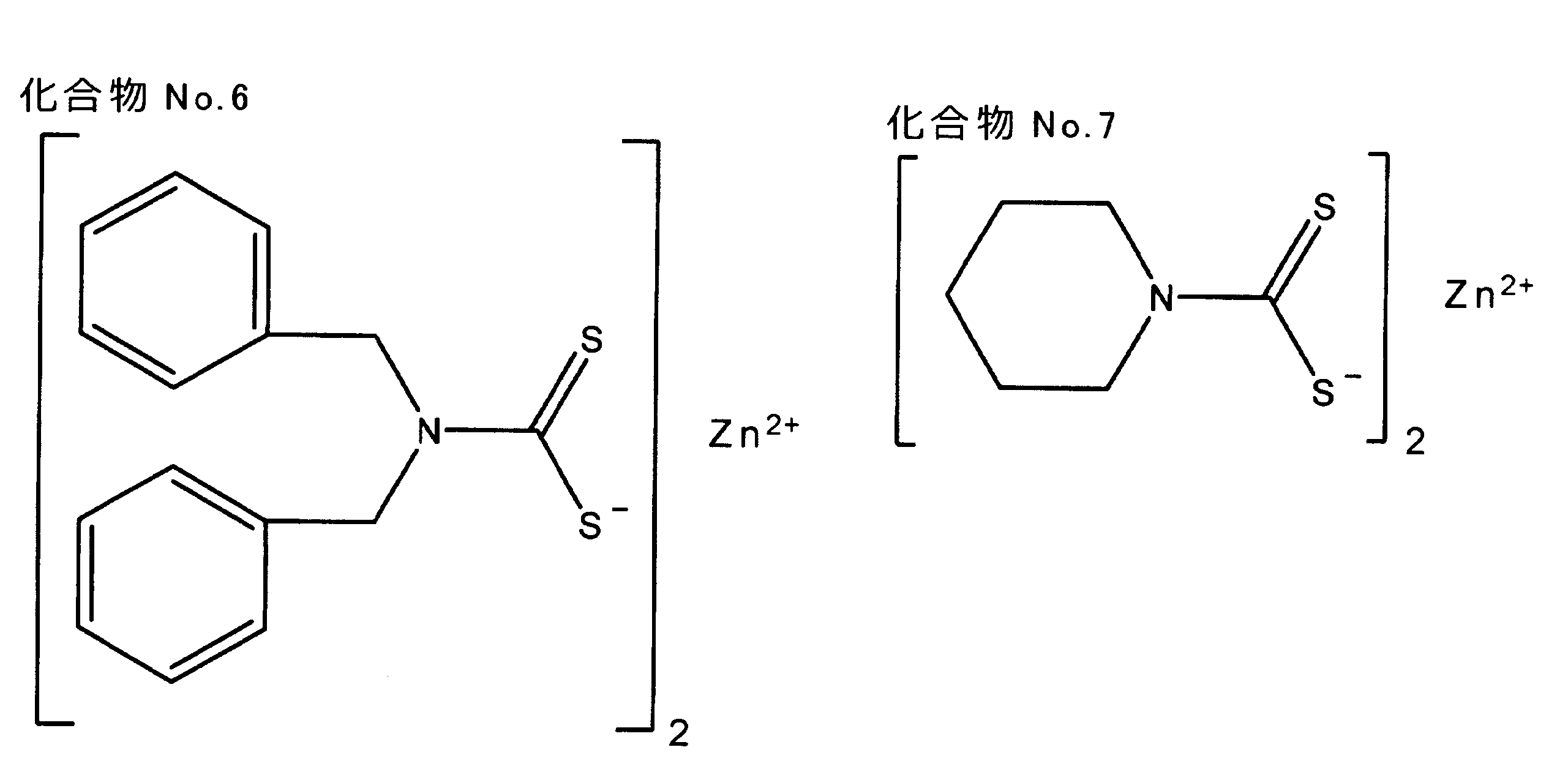
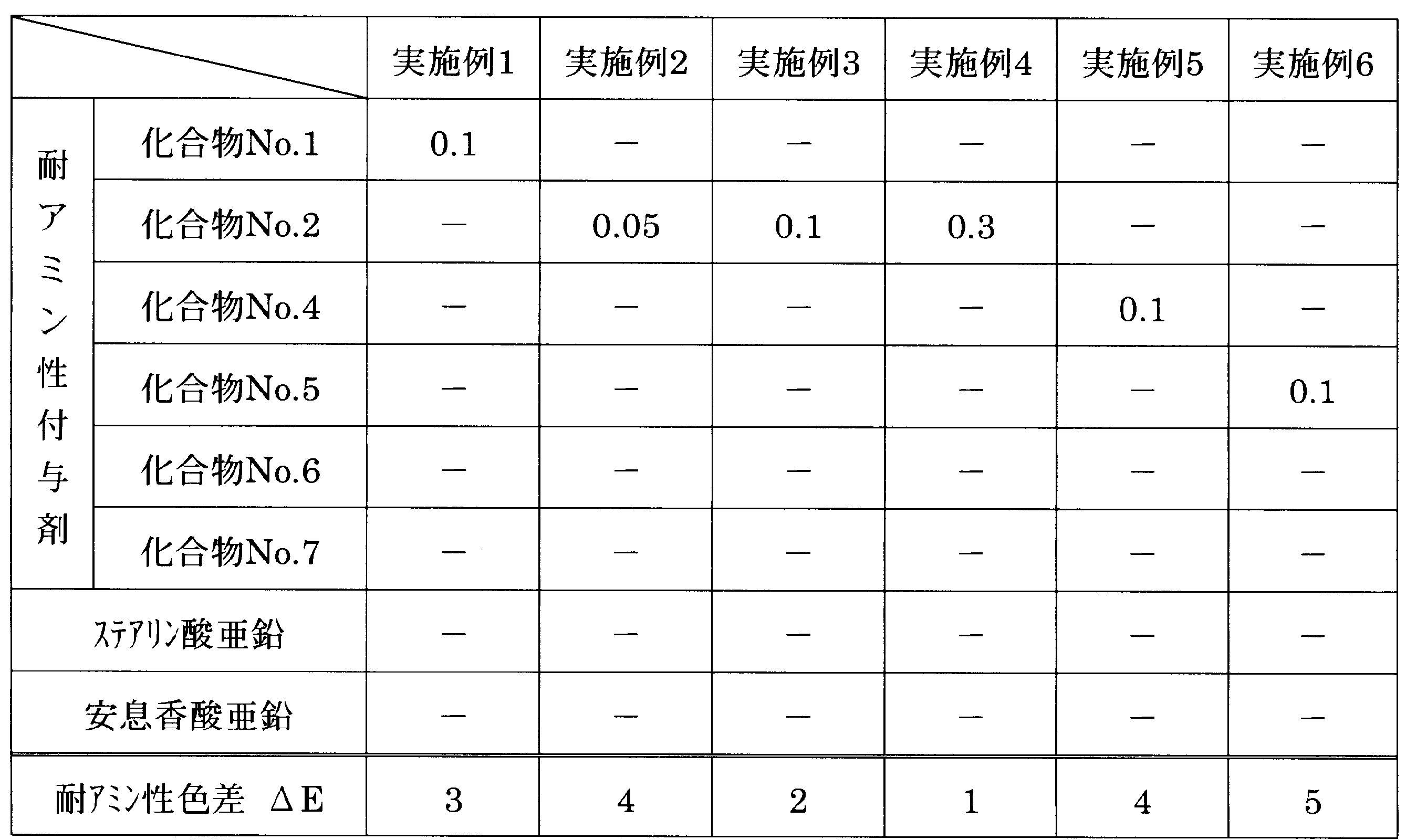
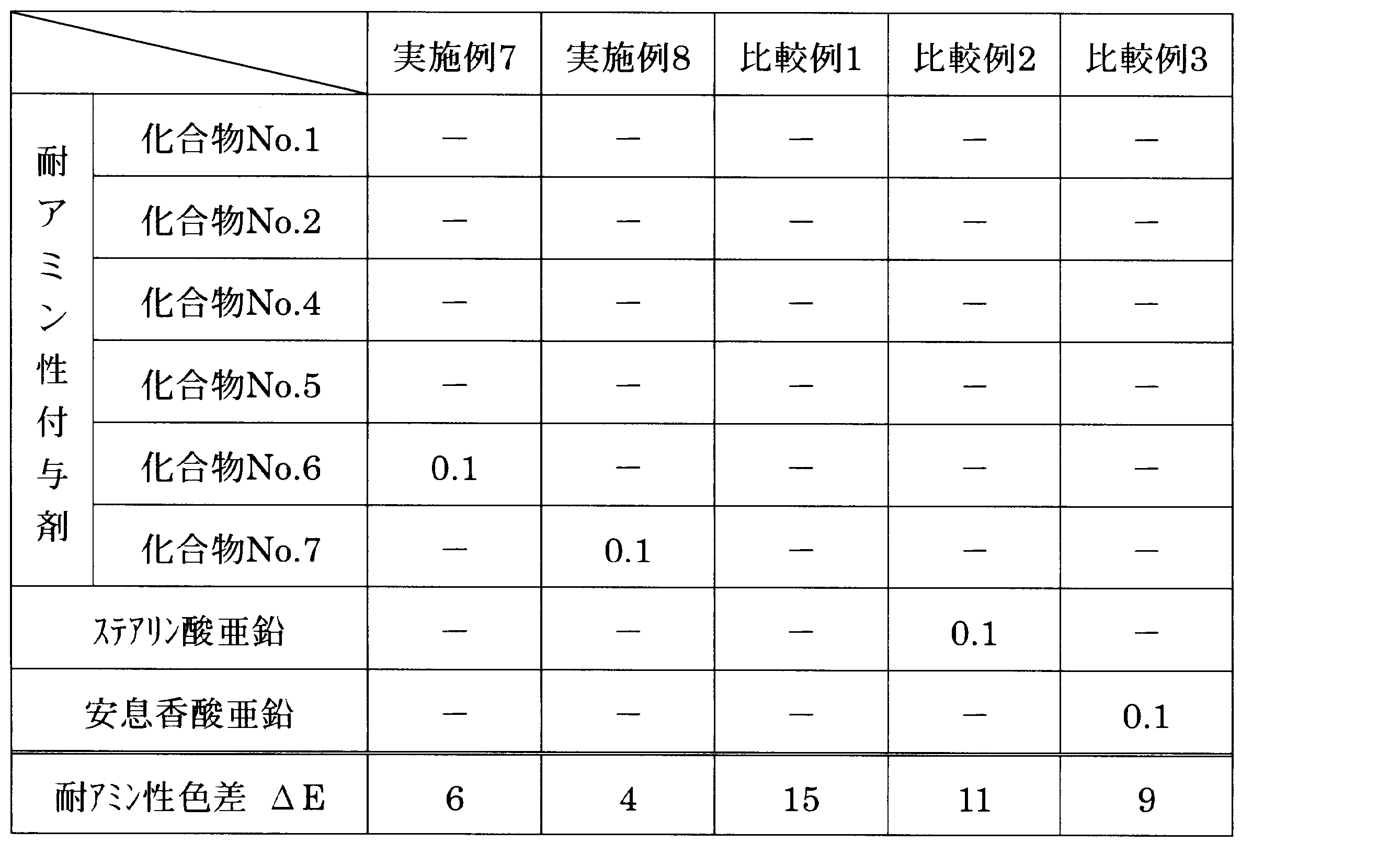
表1、2に示す結果から、本発明の耐アミン性付与剤は、塩化ビニル系樹脂のアミンによる変色抑制に優れることが明らかである。
Claims (12)
- 下記一般式(1)で表されるジチオカルバミン酸亜鉛化合物の1種以上を含有することを特徴とする塩化ビニル系樹脂用耐アミン性付与剤。
一般式(1)中、R1およびR2は、各々独立して、炭素原子数1~20のアルキル基、炭素原子数6~20のアリール基または炭素原子数7~20のアリールアルキル基を表し、R1およびR2は連結してそれぞれが結合する窒素原子とともに環を形成してもよい。
- 前記塩化ビニル系樹脂が、自動車内装材用の塩化ビニル系樹脂である請求項1記載の塩化ビニル系樹脂用耐アミン性付与剤。
- 前記自動車内装材用の塩化ビニル系樹脂が、塩化ビニル系樹脂成形体とポリウレタン発泡成形体との積層体からなる自動車内装材で使用される塩化ビニル系樹脂成形体の原料樹脂である請求項2記載の塩化ビニル系樹脂用耐アミン性付与剤。
- 塩化ビニル系樹脂用の安定剤の1種以上と、請求項1~3のうちいずれか一項記載の塩化ビニル系樹脂用耐アミン性付与剤と、を含有することを特徴とする塩化ビニル系樹脂用安定剤組成物。
- 塩化ビニル系樹脂と、請求項1~3のうちいずれか一項記載の塩化ビニル系樹脂用耐アミン性付与剤と、を含有することを特徴とする塩化ビニル系樹脂組成物。
- 塩化ビニル系樹脂用耐アミン性付与剤の含有量が、前記塩化ビニル系樹脂100質量部に対して0.005~3.0質量部である請求項5記載の塩化ビニル系樹脂組成物。
- 粉末成形用である請求項5または6記載の塩化ビニル系樹脂組成物。
- 請求項5~7のうちいずれか一項記載の塩化ビニル系樹脂組成物から得られることを特徴とする塩化ビニル系樹脂成形体。
- 塩化ビニル系樹脂成形体とポリウレタン発泡体との積層体であって、
前記塩化ビニル系樹脂成形体が、請求項5~7のうちいずれか一項記載の塩化ビニル系樹脂組成物から得られることを特徴とする積層体。 - 請求項8記載の塩化ビニル系樹脂成形体を含むことを特徴とする自動車内装材。
- 請求項9記載の積層体を含むことを特徴とする自動車内装材。
- 塩化ビニル系樹脂成形体とポリウレタン発泡成形体の積層体を含む自動車内装材の変色抑制方法であって、請求項1~3のうちいずれか一項記載の塩化ビニル系樹脂用耐アミン性付与剤を、塩化ビニル系樹脂成形体の原料樹脂である塩化ビニル系樹脂に配合することを特徴とする変色抑制方法。
Priority Applications (1)
| Application Number | Priority Date | Filing Date | Title |
|---|---|---|---|
| JP2022566886A JPWO2022118751A1 (ja) | 2020-12-04 | 2021-11-26 |
Applications Claiming Priority (2)
| Application Number | Priority Date | Filing Date | Title |
|---|---|---|---|
| JP2020202161 | 2020-12-04 | ||
| JP2020-202161 | 2020-12-04 |
Publications (1)
| Publication Number | Publication Date |
|---|---|
| WO2022118751A1 true WO2022118751A1 (ja) | 2022-06-09 |
Family
ID=81853882
Family Applications (1)
| Application Number | Title | Priority Date | Filing Date |
|---|---|---|---|
| PCT/JP2021/043389 Ceased WO2022118751A1 (ja) | 2020-12-04 | 2021-11-26 | 塩化ビニル系樹脂用耐アミン性付与剤 |
Country Status (2)
| Country | Link |
|---|---|
| JP (1) | JPWO2022118751A1 (ja) |
| WO (1) | WO2022118751A1 (ja) |
Citations (4)
| Publication number | Priority date | Publication date | Assignee | Title |
|---|---|---|---|---|
| JPS5468853A (en) * | 1977-11-11 | 1979-06-02 | Katsuta Kako Kk | Composition for stabilizing halogenncontaining resin |
| JPS5740540A (en) * | 1980-08-25 | 1982-03-06 | Dainippon Ink & Chem Inc | Vinyl chloride resin composition |
| JPS6268839A (ja) * | 1985-09-19 | 1987-03-28 | Katsuta Kako Kk | ポリ塩化ビニル系樹脂組成物 |
| JPS6327546A (ja) * | 1986-07-18 | 1988-02-05 | Dainippon Ink & Chem Inc | 塩化ビニル樹脂組成物 |
Family Cites Families (2)
| Publication number | Priority date | Publication date | Assignee | Title |
|---|---|---|---|---|
| JPH0517648A (ja) * | 1991-07-16 | 1993-01-26 | Nippon Zeon Co Ltd | 粉体成形用塩化ビニル系樹脂組成物 |
| JPH07173354A (ja) * | 1993-12-20 | 1995-07-11 | Mitsubishi Chem Mkv Co | 粉体成形用塩化ビニル系樹脂組成物 |
-
2021
- 2021-11-26 WO PCT/JP2021/043389 patent/WO2022118751A1/ja not_active Ceased
- 2021-11-26 JP JP2022566886A patent/JPWO2022118751A1/ja active Pending
Patent Citations (4)
| Publication number | Priority date | Publication date | Assignee | Title |
|---|---|---|---|---|
| JPS5468853A (en) * | 1977-11-11 | 1979-06-02 | Katsuta Kako Kk | Composition for stabilizing halogenncontaining resin |
| JPS5740540A (en) * | 1980-08-25 | 1982-03-06 | Dainippon Ink & Chem Inc | Vinyl chloride resin composition |
| JPS6268839A (ja) * | 1985-09-19 | 1987-03-28 | Katsuta Kako Kk | ポリ塩化ビニル系樹脂組成物 |
| JPS6327546A (ja) * | 1986-07-18 | 1988-02-05 | Dainippon Ink & Chem Inc | 塩化ビニル樹脂組成物 |
Also Published As
| Publication number | Publication date |
|---|---|
| JPWO2022118751A1 (ja) | 2022-06-09 |
Similar Documents
| Publication | Publication Date | Title |
|---|---|---|
| JP6514637B2 (ja) | 半硬質又は硬質透明製品用塩化ビニル系樹脂組成物 | |
| US11840617B2 (en) | Stabilizer composition, vinyl chloride resin composition containing same, and article molded therefrom | |
| JPWO2011024399A1 (ja) | 透明製品用塩化ビニル系樹脂組成物 | |
| CN106604963B (zh) | 氯乙烯类树脂用稳定剂组合物、含有该稳定剂组合物的氯乙烯类树脂组合物及其成形品 | |
| JPWO2020162414A1 (ja) | 安定剤組成物、これを含有する塩化ビニル系樹脂組成物およびその成形体 | |
| JP6871682B2 (ja) | 塩化ビニル系樹脂用安定剤組成物 | |
| JP2019194288A (ja) | 塩化ビニル系樹脂組成物およびその成形体 | |
| JP7811102B2 (ja) | 塩化ビニル系樹脂用変色抑制組成物 | |
| JP2021054947A (ja) | 塩化ビニル系樹脂用発泡セル調整剤、これを含有する塩化ビニル系樹脂組成物およびその発泡成形体 | |
| JP6626091B2 (ja) | 塩化ビニル系樹脂組成物 | |
| WO2022118751A1 (ja) | 塩化ビニル系樹脂用耐アミン性付与剤 | |
| WO2022014338A1 (ja) | 安定剤組成物、これを含有する塩化ビニル系樹脂組成物およびその成形体 | |
| JP6608691B2 (ja) | カレンダー成形用塩化ビニル系樹脂組成物 | |
| JP2022135458A (ja) | 塩化ビニル系樹脂の液状安定剤組成物の液状酸化防止剤及び液状安定剤組成物 | |
| JP2024131233A (ja) | 塩化ビニル系樹脂用耐アミン性付与剤 | |
| JP2024033127A (ja) | 塩化ビニル系樹脂用耐アミン性付与剤 | |
| JP7713927B2 (ja) | 発泡成形用塩化ビニル系樹脂の安定剤組成物、これを含む発泡成形用塩化ビニル系樹脂組成物、及びその発泡成形体 | |
| JP7580995B2 (ja) | 帯電防止剤組成物、これを含む塩化ビニル系樹脂組成物およびその成形体 | |
| JP2022053386A (ja) | 帯電防止剤組成物、これを含む塩化ビニル系樹脂組成物およびその成形体 | |
| JP2023117501A (ja) | 塩素化塩化ビニル樹脂用安定剤組成物、これを含有する塩素化塩化ビニル樹脂組成物およびその成形体 | |
| JPH0135015B2 (ja) | ||
| JPS6234062B2 (ja) |
Legal Events
| Date | Code | Title | Description |
|---|---|---|---|
| 121 | Ep: the epo has been informed by wipo that ep was designated in this application |
Ref document number: 21900505 Country of ref document: EP Kind code of ref document: A1 |
|
| ENP | Entry into the national phase |
Ref document number: 2022566886 Country of ref document: JP Kind code of ref document: A |
|
| NENP | Non-entry into the national phase |
Ref country code: DE |
|
| 122 | Ep: pct application non-entry in european phase |
Ref document number: 21900505 Country of ref document: EP Kind code of ref document: A1 |