WO2022114130A1 - 熱蛍光測定方法及び熱蛍光測定装置 - Google Patents
熱蛍光測定方法及び熱蛍光測定装置 Download PDFInfo
- Publication number
- WO2022114130A1 WO2022114130A1 PCT/JP2021/043398 JP2021043398W WO2022114130A1 WO 2022114130 A1 WO2022114130 A1 WO 2022114130A1 JP 2021043398 W JP2021043398 W JP 2021043398W WO 2022114130 A1 WO2022114130 A1 WO 2022114130A1
- Authority
- WO
- WIPO (PCT)
- Prior art keywords
- substance
- thermal
- heated
- thermal fluorescence
- fluorescence
- Prior art date
- Legal status (The legal status is an assumption and is not a legal conclusion. Google has not performed a legal analysis and makes no representation as to the accuracy of the status listed.)
- Ceased
Links
Images






Classifications
-
- G—PHYSICS
- G01—MEASURING; TESTING
- G01T—MEASUREMENT OF NUCLEAR OR X-RADIATION
- G01T1/00—Measuring X-radiation, gamma radiation, corpuscular radiation, or cosmic radiation
- G01T1/02—Dosimeters
- G01T1/10—Luminescent dosimeters
- G01T1/11—Thermo-luminescent dosimeters
- G01T1/115—Read-out devices
Definitions
- the present disclosure relates to a thermal fluorescence measuring method and a thermal fluorescence measuring device.
- This application claims priority based on Japanese Patent Application No. 2020-197373 filed in Japan on November 27, 2020, the contents of which are incorporated herein by reference.
- thermoluminescence (TL) phenomenon which emits light when a certain substance is heated after being exposed to radiation.
- TL substance a substance that causes the TL phenomenon
- the TL substance is often treated as a TL element (thermal fluorescent element) in a state of being enclosed in a glass tube in a powder state, or in a state of being formed in a rod shape, a sheet shape, or a thin film shape and housed in a case.
- the method for measuring the amount of thermal fluorescence of a TL substance include a method using a measuring device equipped with a heating mechanism for heating the TL element and a detection mechanism for detecting the intensity of thermal fluorescence emitted from the TL element.
- Patent Document 1 discloses a measuring method in which a heat-fluorescent sheet is heated at a predetermined temperature rise rate and the fluorescence (heat fluorescence) emitted from the heat-fluorescent sheet is read.
- the heating method of the TL element includes a light heating method in which infrared rays from a light source such as an infrared lamp irradiate the TL element of the thermoluminescent dosimeter, a hot air heating method, a hot plate heating method, and the like.
- a light heating method in which infrared rays from a light source such as an infrared lamp irradiate the TL element of the thermoluminescent dosimeter, a hot air heating method, a hot plate heating method, and the like.
- the energy of radiation stored in the TL material that is, the intensity of thermal fluorescence
- the TL element is heated in a temperature range of about 350 ° C. or lower.
- the TL substance after reading the intensity of thermal fluorescence may have residual radiation energy that could not be detected. Therefore, before using the TL element next time, an annealing treatment for releasing the energy of the radiation remaining in the TL substance is performed.
- the heating mechanism of the conventional measuring device since the area where the TL element is installed or the entire space is heated, the components other than the TL substance that should be originally heated are also heated, which is inefficient. Further, an apparatus for annealing treatment is often required separately from the measuring apparatus, which is complicated.
- the measured temperature of the TL element for detecting the thermal fluorescence from the TL element (that is, reading out the thermal fluorescence) in order to prevent melting or deformation of the glass tube or other components.
- the upper limit was constrained. Therefore, the measured temperature at the time of detecting the thermal fluorescence from the TL element may be lower than the maximum temperature at which the thermal fluorescence from the TL element can be detected, and only a part of the radiation accumulated in the TL element may be read out. The amount and characteristics of thermal fluorescence of the TL element in the region higher than the restricted measurement temperature were not accurately measured.
- the present invention provides a thermal fluorescence measuring method and a thermal fluorescence measuring device capable of efficiently measuring thermal fluorescence of a TL substance in a short time and accurately measuring thermal fluorescence in a high temperature region.
- the substance to be heated is heated by irradiating the substance to be heated with a laser beam, and the heat of the measurement target to which the substance to be heated is heated by the laser beam is applied.
- the intensity of thermal fluorescence emitted from a fluorescent substance is measured.
- the first alteration temperature at which the heated substance is heated to a temperature higher than a predetermined heating temperature at which thermal fluorescence is generated in the thermal fluorescent substance by the laser beam, and the thermal fluorescent substance is altered, and the subject.
- the heated substance may be heated at a temperature lower than the lower of the second alteration temperature at which the substance is altered.
- the thermal fluorescence measuring device is arranged in contact with a substance to be heated that can be heated by being irradiated with a laser beam, a laser light source that irradiates the substance to be heated with the laser beam, and the substance to be heated.
- a thermal fluorescence detector that detects thermal fluorescence emitted from a thermal fluorescent substance heated by the heated substance, and a predetermined thermal fluorescence based on the intensity of the thermal fluorescence detected by the thermal fluorescence detector. It is provided with an information acquisition device for acquiring the information of the above.
- the heated substance is higher than a predetermined heating temperature at which thermal fluorescence occurs in the thermal fluorescent substance, and the first alteration temperature at which the thermal fluorescence substance is altered and the altered temperature of the heated substance are altered. It may be heated at a temperature lower than the lower of the second alteration temperature.
- the heated substance may contain an absorbent and an adhesive capable of absorbing the laser beam and may be arranged in contact with the surface of the thermal fluorescence substance.
- the absorbent may be a blackbody.
- thermo fluorescence measuring method and a thermal fluorescence measuring device capable of efficiently measuring the thermal fluorescence of a TL substance in a short time and accurately measuring the thermal fluorescence in a high temperature region.
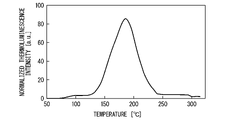
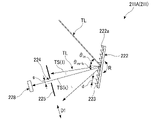
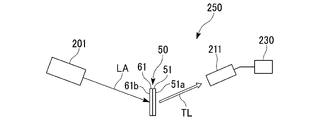
- FIG. 1 It is a schematic diagram for demonstrating the thermal fluorescence measurement method of one Embodiment which concerns on this invention. It is a graph which shows an example of the glow curve of a thermofluorescent substance. It is a partial plan view of the structure of the thermal fluorescence measuring apparatus of one Embodiment which concerns on this invention. It is a side view of the structure shown in FIG. It is a side view of the thermal fluorescence measuring apparatus of one Embodiment which concerns on this invention. It is a top view of the thermal fluorescence detector of the thermal fluorescence measuring apparatus shown in FIG. It is a top view of the modification of the thermal fluorescence detector shown in FIG. It is a side view of the thermal fluorescence measuring apparatus in Example 2. FIG.
- Example 2 the intensity of thermal fluorescence and the intensity of total thermal fluorescence for each wavelength when the thermal fluorescence from the thermal fluorescent substance is read out at 420 ° C. and when read out at 480 ° C. and then read out at 980 ° C. are shown. It is a graph.
- thermal fluorescence in the TL substance (thermal fluorescent substance) 51 will be briefly explained.
- the electrons e in the valence band 101 obtain excitation energy and move to the conduction band 103 due to the interaction.
- a hole h is generated.
- the holes h are captured by the capture center formed by the lattice defects of the crystals constituting the TL substance 51 or the strain of the lattice by the active substance, and move to the vicinity of the fluorescence center level 106.
- the electron e that has moved to the conduction band 103 is captured by the capture center level 105 formed by the lattice defects of the crystals constituting the TL substance 51 or the strain of the lattice by the active substance, and becomes a metastable state.
- thermofluorescent TL is proportional to the amount of radiation RA that hits the TL substance 51. That is, the radiation amount received by the TL substance 51 can be calculated by applying heat TH to the TL substance 51 irradiated with the radiation RA to cause a TL phenomenon and measuring the amount of light emitted from the TL substance 51.
- FIG. 2 shows a typical example of a glow curve when calcium sulfate (CaSO 4 : Tm) to which thulium is added is heated at a heating rate of 0.2 ° C./sec.
- the glow curve is represented by a graph in which the temperature of the TL substance is taken on the horizontal axis and the intensity of thermal fluorescence at each temperature is taken on the vertical axis.
- the heat accumulated on itself by the time it reaches a temperature of about 190 ° C. causes a peak of thermal fluorescence intensity (sometimes referred to as a glow peak). That is, from the glow curve of FIG. 2, when measuring the thermal fluorescence of CaSO 4 : Tm, it is necessary to heat CaSO 4 : Tm to at least 200 ° C., preferably to 300 ° C., depending on the heating rate. Is assumed.
- the TL element 50 is used to measure the thermal fluorescence TL of the TL substance (thermal fluorescent substance) 51.
- the TL element 50 has a TL substance (thermal fluorescent substance) 51 to be measured and a substance to be heated 61.
- the TL substance 51 has a desired plan-view shape and a predetermined thickness.
- the desired shape is, for example, as shown in FIG. 3, a substantially rectangular shape in which the corners of the rectangle are missing.
- the TL substance 51 is a substance that emits thermal fluorescence when heated after being exposed to a radiation RA (not shown).
- a radiation RA not shown.
- As the TL substance 51 for example, lithium borate (Li 2 B 4 O: Cu; effective atom number 7.3) to which copper is added as an impurity, and berylium oxide (BeO: Na; effective atom) to which sodium is added as an impurity. No. 7.9), beryllium oxide (BeO: Na, Li; effective atomic number 7.9) to which sodium and lithium were added as impurities, lithium fluoride (LiF; effective atomic number 8.2), and terbium as impurities.
- Added magnesium compound (MgB 4 O 7 : Tb; effective atomic number 8.4, Mg 2 SiO 4 : Tb; effective atomic number 11.4), calcium sulfate to which turium was added as an impurity (CaSO 4 : Tm; An effective atomic number of 15.4) and calcium fluoride (CaF 2 : Dy; effective atomic number 16.3) to which dysprosium is added as an impurity can be mentioned.
- the composition of the TL substance 51 is not particularly limited as long as it can emit thermal fluorescence as described above.
- the substance to be heated 61 is adjacent to the TL substance 51 in the thickness direction of the TL substance 51 and is in contact with the surface 51b of the TL substance 51.
- the substance to be heated 61 has the same plan-view shape and a predetermined thickness as the TL substance 51.
- the substance to be heated 61 is a substance that can be heated by being irradiated with the laser beam LA described later.
- the substance to be heated 61 of the present embodiment includes an absorbent capable of absorbing the laser beam LA and an adhesive.
- an absorbent a blackbody that has almost no radioactivity is used.
- the substance to be heated 61 of the present embodiment is a blackbody or a blackbody paint containing a substance having the same emissivity as the blackbody and an adhesive.
- blackbody and substances having the same emissivity as blackbody are collectively referred to as blackbody.
- the blackbody paint contains, for example, a substance such as zircon (SiZrO 4 ) and chromium (III) oxide (Cr 2O 3 ) as a main component, and contains an adhesive for adhering the blackbody to the TL substance 51 to be adhered.
- the blackbody paint may contain, for example, an alloy such as oxidized stainless steel, or a carbon-based substance.
- Adhesives are agents that have little effect on the emissivity and radiation properties of blackbody.
- the blackbody paint is a paint having an emissivity close to that of a blackbody, and is a TL substance when irradiated with laser light LA by being applied to the surface of the TL substance 51 and arranged in contact with the surface of the TL substance 51.
- the blackbody paint preferably has a total emissivity of 0.8 or more and a heat resistant temperature of at least 400 ° C., preferably 1000 ° C. or higher, and is, for example, a commercially available blackbody paint ( Product names: JSC-3, manufactured by Japan Sensor Co., Ltd., blackbody spray (trade name: TA410KS, manufactured by Ichinen TASCO Co., Ltd.) and the like.
- the substance to be heated 61 is integrally formed with the TL substance 51 by laminating the blackbody paint on the surface 51b of the TL substance 51 in the thickness direction of the TL substance 51.
- the absorber of the laser beam LA is not limited to the blackbody paint described above, and as described above, it has a total emissivity of 0.8 or more, a heat resistant temperature of 1000 ° C. or higher, and a TL substance 51. Any substance that can supply heat energy is widely included.
- the thermal fluorescence measuring device 200 of the present embodiment includes the above-mentioned TL element 50, a laser light source 201, a TL detector (thermal fluorescence detector) 211, and an information acquisition device 230. , Equipped with.
- the laser light source 201 is a light source for irradiating the surface 61b of the substance to be heated 61 with the laser beam LA, and emits the laser beam LA that heats the substance to be heated 61 to a predetermined temperature.
- the thermal fluorescence measurement method of the present embodiment will be described, and it is preferable that the emission conditions of the laser beam LA from the laser light source 201 can be appropriately set or controlled.
- the output and beam size of the laser beam LA emitted from the laser light source 201 are set large in consideration of the type and composition of the TL substance 51 so as not to cause deterioration or damage of the TL element 50.
- the TL detector 211 is a detector for detecting the thermofluorescent TL from the TL substance 51, and is emitted from the surface 51a of the TL substance 51 heated by the heated substance 61 heated by the laser beam LA. Thermal fluorescence TL is detected.
- the TL detector 211 is, for example, a high-sensitivity photodetector, an image sensor, a CCD, or the like, but is not particularly limited as long as it can detect the thermal fluorescence TL emitted from the TL substance 51 as described above.
- the TL detector 211 may be a spectroscope or a spectroscopic sensor having a function of measuring the wavelength of the thermofluorescent TL as described later.
- the information acquisition device 230 acquires information (predetermined information) regarding the thermal fluorescence TL based on at least the intensity of the thermal fluorescence TL detected by the TL detector 211.
- the information acquisition device 230 receives information on the intensity and wavelength of the thermofluorescent TL from the TL detector 211. Based on the received information, the information acquisition device 230 outputs, for example, data or a graph showing a change in intensity with respect to a wavelength to an output device (not shown) or the like.
- the information acquisition device 230 is basically composed of software that executes the above-mentioned work, but may be composed of hardware such as an integrated circuit, a computer, or the like.
- the thermal fluorescence measuring device 200 includes a control device (not shown) that controls the emission conditions of the laser beam LA in the laser light source 201. Further, the above-mentioned control device is connected to the information acquisition device 230, and the information acquisition device 230 acquires information on the thermal fluorescence TL based on the intensity and wavelength of the thermal fluorescence TL in consideration of the emission conditions of the laser beam LA. Is preferable.
- the thermal fluorescence measuring device 200 described above is used to measure the thermal fluorescence TL of the TL substance 51.
- the heated substance 61 is heated by irradiating the heated substance 61 with a laser beam LA.
- the temperature at which the substance to be heated 61 is heated is higher than the predetermined heating temperature at which the thermal fluorescent TL is generated in the TL substance 51, and the first alteration temperature at which the TL substance 51 is altered and the first alteration temperature at which the heated substance 61 is altered are the first. 2
- the temperature shall be lower than the lower of the alteration temperature.
- the "predetermined heating temperature at which the thermal fluorescence TL is generated" in the thermal fluorescence measuring method of the present embodiment means the maximum temperature at which the thermal fluorescence TL of the TL substance 51 can be generated in a state where the TL substance 51 is not deteriorated.
- the intensity of the thermofluorescent TL emitted from the TL substance 51 heated by the heated substance 61 heated by the laser beam LA is measured.
- the TL detector 211 detects the thermofluorescent TL emitted mainly from the surface 51a of the TL substance 51 heated by the heated substance 61.
- the information acquisition device 230 acquires information on the thermal fluorescence TL based on the intensity and the like related to the thermal fluorescence TL detected by the TL detector 211.
- a glow curve representing the intensity of the thermal fluorescence TL with respect to the temperature of the TL substance 51 in the TL element 50 can be created. Further, based on the intensity and wavelength of the thermal fluorescence TL detected by the TL detector 211, it is possible to create a spectrum of the thermal fluorescence TL representing the intensity of the thermal fluorescence TL with respect to the wavelength.
- the heated substance 61 is heated by irradiating the heated substance 61 with laser light LA.
- the intensity of the thermofluorescent TL emitted from the TL substance 51 to be measured of the thermofluorescent TL, which is heated by the heated substance 61 heated by the laser beam LA, is measured.
- the energy of heat TH (see FIG. 1) is applied to the TL substance 51 by the laser beam LA via the substance to be heated 61.
- thermal fluorescence measurement method of the present embodiment since laser light LA having a higher output than continuous light or the like is used, a large amount of thermal TH energy is applied to the TL substance 51 in a shorter time than the conventional thermal fluorescence measurement method. be able to. This makes it possible to read out and measure the thermal fluorescence TL in a shorter time and at a higher temperature than the conventional thermal fluorescence measuring method. Further, according to the thermal fluorescence measurement method of the present embodiment, in order to directly heat the substance to be heated 61, heat TH is selectively applied to the substance to be heated 61 and the adjacent TL element 50, and the surroundings of these elements are applied. You don't have to heat the space.
- the thermal fluorescence TL can be read out and measured more efficiently than the conventional thermal fluorescence measuring method. Therefore, according to the thermal fluorescence measuring method of the present embodiment, the thermal fluorescence TL of the TL substance 51 can be measured efficiently in a short time. As a result, the thermal fluorescence TL can be measured with high sensitivity.
- the first method is that the heated substance 61 is higher than the maximum temperature (predetermined heating temperature) at which the thermal fluorescent TL is generated in the TL substance 51 by the laser beam LA, and the TL substance 51 is altered. It is heated at a temperature lower than the lower of the alteration temperature and the second alteration temperature at which the substance to be heated 61 is altered.
- the thermal fluorescence TL emitted by the TL substance 51 is about 350 ° C. in order to prevent melting, breakage, and alteration of the components of the measuring device.
- it is read out at a temperature of at least 400 ° C. or lower.
- the thermal fluorescence TL is higher than the maximum temperature at which the thermal fluorescence TL is generated with respect to the TL substance 51 via the heated substance 61, and is lower than the first alteration temperature and the second alteration temperature. Provides heat TH energy corresponding to a suitable temperature lower than the alteration temperature of.
- thermal fluorescence measuring method of the present embodiment all the thermal fluorescence TLs in the TL substance 51 can be read out without deteriorating the heated substance 61 and the TL substance 51. Therefore, according to the thermal fluorescence measuring method of the present embodiment, it is possible to accurately measure the amount and characteristics of the thermal fluorescence TL of the TL substance 51 in a region higher than the measurement temperature restricted as in the conventional case.
- the thermal fluorescence TL that could not be read out during the measurement at the measurement temperature, which was restricted by the upper limit as described above, is read out and becomes detectable. May be. Therefore, when the TL element 50 is used next time after the measurement by the conventional thermal fluorescence measuring method, an annealing treatment for releasing the remaining thermal fluorescence TL is indispensable.
- the thermal fluorescence measuring method of the present embodiment since it is possible to read out almost all the thermal fluorescence TL in the TL substance 51 as described above, it is not necessary to perform the annealing treatment. If the elapsed time until the next use of the TL element 50 is long, the TL element 50 should be annealed immediately before the next use, as in the conventional thermal fluorescence measurement method. Is good. This is because the TL substance 51 is irradiated with even a small amount of radiation RA from, for example, the air around the TL element 50.
- the thermal fluorescence measuring method of the present embodiment since the laser light LA having a higher output than the continuous light or the like is used, the time required for the annealing process can be shortened. Therefore, according to the thermal fluorescence measuring method of the present embodiment, the thermal fluorescence TL of the TL substance 51 can be measured efficiently in a short time.
- thermal fluorescence measurement method of the present embodiment based on the above-mentioned action and effect, even a TL substance having a relatively low effective atomic number is heated to a desired high temperature in a short time via the substance to be heated 61, and the TL substance is used.
- the emitted thermal fluorescence TL can be measured.
- the thermal fluorescence measuring device 200 of the present embodiment includes the above-mentioned substance to be heated 61, a laser light source 201, a TL detector 211, and an information acquisition device 230.
- the substance to be heated 61 is a substance that can be heated by being irradiated with the laser beam LA.
- the laser light source 201 irradiates the substance to be heated 61 with the laser beam LA.
- the TL detector 211 detects the thermal fluorescence TL emitted from the TL substance 51 arranged in contact with the heated substance 61 so that the heat TH is given by the heated substance 61.
- the information acquisition device 230 acquires predetermined information regarding the thermal fluorescence TL based on the intensity of the thermal fluorescence TL detected by the TL detector 211.
- the TL substance 51 receives a large amount of thermal TH energy in a shorter time than the conventional thermal fluorescence measuring method by using the laser beam LA having a higher output than the continuous light or the like. Join.
- the thermal fluorescence TL can be read out and measured at a higher temperature in a shorter time than in the conventional thermal fluorescence measuring method.
- the thermal fluorescence measuring device 200 since the substance to be heated 61 is directly heated, the heat TH is selectively applied to the substance to be heated 61 and the adjacent TL element 50. As a result, the thermal fluorescence TL can be read out and measured more efficiently than the conventional thermal fluorescence measuring device. Therefore, according to the thermal fluorescence measuring device 200 of the present embodiment, the thermal fluorescence TL of the TL substance 51 can be measured efficiently in a short time.
- the thermal fluorescence TL of the TL substance 51 can be measured more efficiently in a shorter time than the conventional thermal fluorescence measuring device, so that the thermal fluorescence TL is high. It can be measured with sensitivity. Further, according to the thermal fluorescence measuring device 200 of the present embodiment, the TL in the TL element 50 is compared with the heating using the infrared lamp, the tungsten filament heater, the hot air or the hot plate used in the conventional thermal fluorescence measuring device. The temperature of the substance 51 can be easily and accurately controlled, and the energy consumption of the thermal fluorescence measuring device 200 can be suppressed so that the substance 51 can be used for a long period of time.
- the substance to be heated 61 is higher than the maximum temperature (predetermined heating temperature) at which the thermal fluorescence TL is generated in the TL substance 51, and is out of the first alteration temperature and the second alteration temperature. It is heated at a temperature lower than the lower alteration temperature.
- the TL substance 51 via the heated substance 61 is higher than the maximum temperature at which the thermal fluorescence TL is generated and higher than the lower alteration temperature of the first alteration temperature and the second alteration temperature. Provides heat TH energy corresponding to a low suitable temperature.
- the thermal fluorescence measuring device 200 of the present embodiment the heat in the high temperature region that remains in the TL substance 51 without being read by the conventional thermal fluorescence measuring device without deteriorating the heated substance 61 and the TL substance 51. Fluorescent TL can be read out.
- the substance to be heated 61 contains an absorbent and an adhesive capable of absorbing laser light LA, and is arranged in contact with the surface 51b of the TL substance 51 to be measured. According to the thermal fluorescence measuring device 200, since the substance to be heated 61 contains an absorbent, it satisfactorily absorbs the irradiated laser beam LA and is heated. Further, according to the thermal fluorescence measuring device 200, since the substance to be heated 61 contains an adhesive, the substance 61 to be heated is arranged so as to be adjacent to the TL substance 51 in a stable state with high adhesive strength. .. Therefore, the heat TH is efficiently supplied to the TL substance 51 from the substance to be heated 61 heated by the laser beam LA. Further, as described above, the TL element 50 having the TL substance 51 and the heated substance 61 adjacent to each other can be installed in the thermal fluorescence measuring device 200 in any posture without requiring a special case or the like.
- the absorbent of the substance to be heated 61 is a blackbody, and the substance to be heated 61 is a blackbody paint. According to the thermal fluorescence measuring device 200, if the irradiated laser light LA is visible light, the substance to be heated 61 absorbs the laser light LA and is heated regardless of the wavelength. That is, the degree of freedom in selection of the laser light source 201 is increased.
- the “predetermined heating temperature at which the thermal fluorescence TL is generated” is not necessarily the thermal fluorescence of the TL substance 51 as long as the TL substance 51 does not deteriorate. It is not limited to the maximum temperature at which TL can occur. That is, the material to be heated 61 has an appropriate temperature slightly higher than a predetermined heating temperature lower than the maximum temperature at which thermal fluorescence TL can occur, and lower than the lower of the first alteration temperature and the second alteration temperature. May be heated in. In that case, it is preferable to perform the annealing treatment of the TL element 50 using the thermal fluorescence measuring device 200 after the measurement of the thermal fluorescence TL.
- the TL element 50 of the above-described embodiment has a substantially rectangular shape in a plan view, but the plan view shape of the TL element 50 is a rectangular shape having no missing corners, a polygonal shape other than the rectangular shape, an elliptical shape, and a star. It may have a shape or any other shape, and may be appropriately set in consideration of the arrangement in the thermal fluorescence measuring device and the like.
- the heated substance 61 is a blackbody paint, but if the heated substance 61 can be heated by absorbing the laser beam LA, it is possible. Not particularly limited.
- the substance to be heated 61 may be a paint containing at least a red or purple colorant and an adhesive capable of absorbing the red laser beam LA.
- the substance to be heated 61 is not limited to the paint capable of absorbing the laser beam LA, and may be a solid material or a compound capable of absorbing the laser beam LA.
- the adhesive is irradiated with laser light LA and does not deteriorate even when heated to a predetermined temperature and does not affect the characteristics of the thermofluorescent TL, the surface 51b of the TL substance 51 and the adhesive-free cover are not included.
- the surface 61a of the heating substance 61 may be adhered by the above-mentioned adhesive.
- the heated substance 61 does not have to be adhered to the TL substance 51 via an adhesive as long as the heat TH is given to the TL substance 51 by being heated by the laser beam LA.
- the surface 51b of the TL substance 51 and the surface 61a of the substance to be heated 61 are in close contact with each other without a gap, and the TL substance 51 and the substance to be heated 61 are laminated in the thickness direction in a plan view of both substances.
- At least a part of the peripheral edge portion may be sandwiched and fixed in the thickness direction by a support or the like. In that case, it is preferable that the support is one that is irradiated with laser light LA and does not melt or deteriorate even when heated.
- the support may be melted or deteriorated, even if the irradiation pattern of the laser light LA is controlled so that the laser light LA is irradiated to the central portion of the substance to be heated 61 in the thermal fluorescence measuring device 200. good.
- the TL detector 211 has a function of measuring the wavelength of the thermal fluorescence TL, and specifically, thermal fluorescence with a high signal-to-noise ratio (S / N ratio) based on the peak wavelength of the thermal fluorescence TL.
- a spectroscope or a spectroscopic sensor capable of detecting TL is preferable.
- the TL detector 211A which is a preferred embodiment of the TL detector 211, includes a diffraction grating (spectral element) 222, a slit 224, and a photodetector (photodetector) 228.
- the diffraction grating 222 is arranged on the path of the thermal fluorescence TL emitted from the TL substance 51 shown in FIG. 5, and has a lattice surface 222a on which the thermal fluorescence TL is incident.
- a reflection type periodic structure 223 is formed on the lattice surface 222a of the diffraction grating 222.
- thermofluorescent TL incident on the lattice surface 222a of the diffraction grating 222 is diffracted in different directions by different diffraction angles for each wavelength.
- d represents the period of the periodic structure 223.
- ⁇ represents the wavelength of the kth spectral component TS (k) contained in the thermal fluorescence TL.
- k is a number indicating the order when counting from the shortest wavelength of the spectrum of the thermal fluorescence TL at a predetermined wavelength interval.
- the wavelength interval described above is formal, and the spectrum of the thermal fluorescence TL is continuously distributed within a predetermined range on the wavelength axis. According to the grating equation, if the wavelength ⁇ is set for a predetermined period d and the incident angle ⁇ in , the diffraction angle ⁇ m ⁇ k of the spectral component TS (k) of the wavelength ⁇ of the thermal fluorescence TL is uniquely determined. ..
- the slit 224 is formed on the path of the thermofluorescent TL diffracted by the diffraction grating 222.
- the slit 224 is formed in a shielding plate 225 extending in a direction intersecting the path of the thermofluorescent TL diffracted by the diffraction grating 222 (hereinafter, D1 direction). Let s be the width of the slit 224 in the D1 direction.
- the photodetector 228 is arranged in front of the slit 224 of the spectral component TS (k) of the thermofluorescent TL passing through the slit 224.
- the photodetector 228 receives the spectral component TS (k) that has passed through the slit 224 of the thermal fluorescence TL diffracted by the diffraction grating 222, and plots a quantitative electric signal indicating the light intensity of the spectral component TS (k). It is output to the information acquisition device 230 shown in 5.
- the position of the shielding plate 225, that is, the slit 224, and the photodetector 228 that receives the spectral component TS (k) passing through the slit 224 are fixed.
- the diffraction grating 222 rotates in the R direction in a plane parallel to the path of the thermal fluorescence TL, the number k of the spectral component TS (k) of the thermal fluorescence TL received by the photodetector 228 through the slit 224 is changed. Change.
- the diffraction grating 222 is rotated in the R direction at a predetermined angular range and a predetermined angular interval according to the spectral band of the thermal fluorescence TL emitted from the TL substance 51, and the spectral component TS of the thermal fluorescence TL is rotated at each predetermined angular interval.
- the diffraction grating 222, the shielding plate 225 on which the slit 224 is formed, and the photodetector 228 are sequentially arranged on the path of the thermal fluorescence TL emitted from the TL substance 51.
- the shielding plate 225 and the diffraction grating on which the slit 224 is formed are formed in the path of the thermofluorescent TL.
- the TL detector 211B in which 222 and the photodetector 228 are sequentially arranged can be mentioned.
- the thermal fluorescence TL emitted from the TL substance 51 shown in FIG. 5 passes through the slit 224 having a width s and is incident on the periodic structure 223 of the diffraction grating 222.
- the thermofluorescent TL diffracted by the periodic structure 223 is diffracted at a diffraction angle ⁇ mk different for each wavelength ⁇ , and is emitted from the diffraction grating 222 toward the photodetector 228.
- the position of the shielding plate 225, that is, the slit 224, and the photodetector 228 that receives the spectral component TS (k) passing through the slit 224 are fixed.
- the diffraction grating 222 does not need to be rotated and is fixed.
- the wavelength ⁇ of the spectral information of the thermal fluorescence TL is the period d of the periodic structure 223 of the diffraction lattice 222 and the heat.
- the incident angle ⁇ in of the fluorescent TL the diffraction angle ⁇ mk of the kth spectral component TS ( k ) of the thermal fluorescent TL detected by the photodetector 228 through the slit 224, that is, the slit 224 and the diffraction lattice 222. It is calculated by the relative position where the photodetector 228 is arranged and fixed, and the diffraction order m.
- the interval of the wavelength ⁇ of the spectral information of the thermal fluorescence TL described above varies depending on the period d of the periodic structure 223 of the diffraction grating 222 and the width s of the slit 224. That is, the wavelength resolution of the spectral distribution of the above-mentioned thermal fluorescence TL is determined by the period d and the width s. As the period d becomes larger and the width s becomes wider, the wavelength resolution of the spectral distribution of the thermal fluorescence TL decreases, and noise components other than the spectral component TS (k) of the thermal fluorescence TL pass through the slit 224.
- the light is received by the photodetector 228, and the S / N ratio in the measurement and detection of the thermal fluorescence TL decreases.
- the period d of the periodic structure 223 of the diffraction lattice 222 and the width s of the slit 224 are set to achieve a wavelength resolution of at least twice the half width of the highest peak of the spectrum of the thermofluorescent TL of the TL material 51. It is more preferable that the wavelength resolution is set to be equivalent to that of the half-value width, and it is further preferable that the wavelength resolution is set to be 1 ⁇ 2 of the half-value width.
- the period d and the width s have a wavelength resolution of about 5 nm when measuring the spectral information and spectral distribution of the thermofluorescent TL. It is preferably set to achieve, and preferably set to achieve a wavelength resolution of about 2 nm.
- a spectroscope provided with a wavelength filter using, for example, a glass plate as a substrate as in the prior art has a wavelength resolution of about 10 nm or more, and it is difficult to realize a wavelength resolution of several nm or 1 nm or less as described above.
- the thermal fluorescence TL can be measured at a higher S / N ratio than before. can.
- the information acquisition device 230 includes a control unit (not shown) configured so that the width s of the slit 224 can be adjusted.
- the control unit has information on the light intensity of the spectral component TS (k) of the thermal fluorescence TL from the photodetector 228 input to the information acquisition device 230, and the S / N at the time of measuring the spectral component TS (k) of the thermal fluorescence TL.
- the width s of the slit 224 is adjusted in real time according to the ratio.
- the control unit may be configured so that the position can be adjusted in addition to the width s of the slit 224.
- the information acquisition device 230 is provided with a control unit and the width s of the slit 224 can be adjusted, the optimum wavelength resolution and measurement conditions for the thermal fluorescence characteristics of any TL substance 51 can be derived, and the optimum wavelength resolution and measurement conditions can be obtained.
- the thermal fluorescence TL can be measured with high accuracy.
- FIG. 5 shows in advance.
- the spectral distribution of the thermal fluorescence TL of the TL substance 51 or the TL substance of the same type as the TL substance 51 used for the actual measurement may be measured by using the thermal fluorescence measuring device 200 shown.
- the width s of the slit 224 capable of measuring the light intensity of the spectral component TS (k) is determined in a good state in which the S / N ratio satisfies a predetermined condition for each wavelength in the measurement wavelength band, and the wavelength ⁇ is set to the information acquisition device 230.
- a data table of the number k and the determined width s is stored, and the control unit can adjust the width s of the slit 224 based on the above-mentioned data table at the time of actual measurement.
- the width s of the slit 224 is set in real time so that the S / N ratio satisfies a predetermined condition for each wavelength in the measurement wavelength band at the time of actual measurement of the thermal fluorescence TL. It may be adjusted.
- a transmission type periodic structure may be formed on the lattice surface 222a of the diffraction grating 222.
- a spectroscopic element such as a prism may be used instead of the diffraction grating 222.
- a grid (not shown) may be used instead of the shielding plate 225 and the slit 224.
- the grid comprises a plurality of grids arranged side by side along the D1 direction (directions intersecting each other in different directions).
- Thermal fluorescence TL which is diffracted by the diffraction grating 222 and travels along the direction intersecting the D1 direction, passes through each grating.
- the wavelength of the spectral component TS (k) of the thermofluorescent TL that can pass through each grid depends on the position of the grid in the D1 direction. That is, the spectral component TS ( k ) can pass through the grid on the path in the direction forming the diffraction angle ⁇ mk with respect to the lattice surface 222a of the diffraction grating 222 (directions different from each other).
- Information is acquired by the photodetector 228. Therefore, in the TL detector 211A equipped with a grid instead of the shielding plate 225 and the slit 224, the photodetector 228 is composed of a photodetector array, and each detection unit of the photodetector array is arranged so as to correspond to each grid of the grid.
- the wavelength resolution and the S / N ratio when detecting the spectral information of the thermal fluorescence TL are the sizes of openings in the D1 direction of the plurality of grids of the grid, that is, the heat in the plurality of grids. It is determined by the width dimension through which the fluorescent TL can pass. That is, the size of the aperture in the D1 direction of the plurality of grids of the grid satisfies the predetermined condition of the S / N ratio, and the light intensity of each wavelength of the spectral component TS (k) is measured in good condition and with high accuracy. It is set to the size possible.
- the information acquisition device 230 as described for the TL detector 211A. Is output to.
- the spectral information of the thermal fluorescence TL is acquired by arranging the above-mentioned grid on the incident side of the thermal fluorescence TL, that is, on the front side of the path of the thermal fluorescence TL from the light receiving surface of the CMOS (Measurement Metal Oxide Spectroscopy) camera. Spectral measurement of thermal fluorescence TL can be performed.
- each grid of the above-mentioned grid with an optical element having a wavelength selection function such as a dichroic mirror and a wavelength filter, it is possible to reduce noise due to thermal fluorescence TL as compared with the case where the optical element is not used. can.
- a photodetector such as a photomultiplier tube may be used instead of the photodetector 228.
- the TL detector 211A at least one of the front side of the diffraction grating 222, between the diffraction grating 222 and the shielding plate 225, and between the shielding plate 225 and the photodetector 228 on the path of the thermofluorescent TL.
- the beam diameter of the thermal fluorescence TL is in the path of the thermal fluorescence TL, in at least one region between the shielding plate 225 and the diffraction grating 222, and between the diffraction grating 222 and the photodetector 228.
- a lens (not shown) for enlarging or reducing the size, a reflection mirror (not shown) for refracting the path of the thermal fluorescence TL, a diffraction grating, a filter having a desired optical function, or the like may be appropriately arranged.
- the laser beam LA is directly applied to the heated substance 61, and the TL substance 51 is subjected to the conventional annealing treatment via the heated substance 61 and the heat resistant temperature of the glass.
- Thermal fluorescence TL can be measured at a higher S / N ratio by heating to a higher temperature, that is, at least 400 ° C. or higher in a very short time in seconds.
- the members not described in detail above and the supporting members of the substance to be heated 61 and the TL substance 51 also have heat resistance at least 400 ° C. or higher. That is, the heat resistant temperature of the substance to be heated 61, the TL substance 51, and the support member of these substances is preferably 400 ° C. or higher.
- the wavelength of the light emitted by the heat radiation from the TL substance 51 depends on the predetermined heating temperature at which the TL substance 51 is heated according to the temperature at which the heated substance 61 is heated, and increases as the heating temperature increases. For example, in a heating temperature of 400 ° C. or higher, the wavelength band of light due to heat radiation from the TL substance 51 overlaps with the wavelength band of the thermal fluorescence TL at least partially. For example, when the spectrum of the thermal fluorescence TL from the TL substance 51 is detected through a wavelength filter made of a solid material such as a glass filter, the thermal fluorescence TL is used as signal light due to the optical characteristics, heat resistance, etc. of the solid material.
- thermofluorescent TL The / N ratio decreases, and it is difficult to accurately detect the spectral characteristics of the thermofluorescent TL that should be obtained. That is, in the situation of the heating temperature (temperature) in which at least a part of the wavelength band of the thermal fluorescence TL and at least a part of the wavelength band of the light emitted from the TL material 51 overlap each other, the conventional glass filter It is difficult to use a device that disperses thermal fluorescence TL with a wavelength filter made of a fixed material such as a dose meter.
- the thermal fluorescence measuring method and the thermal fluorescence measuring apparatus 200 have the above-mentioned configuration, at least a part of the wavelength band of the thermal fluorescence TL and at least a part of the wavelength band of the light emitted by heat radiation from the TL substance 51.
- the measurement of the thermal fluorescence TL at a high S / N ratio is realized even in the situation of the heating temperature where the bands of the above overlap with each other.
- Example 1 A ceramic plate of beryllium oxide (BeO) was used as the TL substance 51.
- a commercially available black body paint (trade name; JSC-3, manufactured by Japan Sensor Co., Ltd.) was used as the black body paint.
- the shape and configuration of the TL element 50 were the same as those shown in FIGS. 3 and 4.
- the size of the TL element 50 in a plan view was set to 10 mm ⁇ 10 mm.
- the blackbody paint described above was laminated on the surface 51b of the TL substance 51 by spraying the commercially available blackbody paint described above on the surface 51b by a spray injection method to form the substance to be heated 61, and the TL element 50 was manufactured.
- a commercially available laser plane instantaneous heating device (product name; ExLASER (registered trademark), manufactured by Sakaguchi Electric Heat Co., Ltd.) was prepared as a measuring device having the same configuration as each configuration other than the TL element 50 shown in FIG.
- the TL element was irradiated with laser light from the laser light source of the laser plane instantaneous heating device.
- the average output of the laser light source was 3000 W, and the output density was 95.6 W / cm 2 .
- the peak wavelength of the laser beam LA was 940 nm, and the beam size was basically ⁇ 56 mm. Under such conditions, the temperature of the TL element rose to 500 ° C. in 1 second from the start of irradiation, and the temperature of the TL element rose to 1000 ° C. in 5 seconds from the start of irradiation. Further, even if the TL element was repeatedly heated 10 times until the temperature of the TL element reached 1000 ° C.
- the TL element can be heated to a high temperature of about 1000 ° C. in a shorter time than before by irradiating the substance to be heated of the TL element with a laser beam.
- a thermal fluorescence measuring device 250 was prototyped as a modification of the thermal fluorescence measuring device 200 of the above-described embodiment.
- the TL element 50 is arranged so that the surface 51a of the TL substance 51 and the surface 61b of the substance to be heated 61 stand substantially perpendicular to a horizontal plane (not shown).
- the laser light source 201 was arranged so that the laser beam LA was obliquely incident on the surface 61b of the substance to be heated 61.
- the TL detector 211 is arranged so as to detect the thermofluorescent TL mainly emitted from the surface 51a of the TL substance 51 at an obliquely upward angle.
- TL substance 51 aluminum oxide ( Al2O3 : Cr) to which chromium was added as an impurity was used.
- the substance to be heated 61 the same blackbody paint as in Example 1 (trade name; JSC-3, manufactured by Japan Sensor Co., Ltd.) was used as the blackbody paint.
- the shape and configuration of the TL element 50 were the same as those shown in FIGS. 3 and 4.
- the size of the TL element 50 in a plan view was set to 10 mm ⁇ 10 mm.
- the surface 51b of the TL substance 51 was laminated by spraying the above-mentioned commercially available blackbody paint to form the substance to be heated 61, and the TL element 50 was manufactured.
- the laser light source 201 of the thermal fluorescence measuring device 250 a commercially available laser diode (LD) heating light source (model number; LD-HEATER L10060-7, manufactured by Hamamatsu Photonics Co., Ltd.) was used.
- LD-HEATER L10060-7 a commercially available laser diode (LD-HEATER L10060-7, manufactured by Hamamatsu Photonics Co., Ltd.) was used.
- TL detector 211 a commercially available two-color radiation thermometer (model number: EF2RL-F0-1-0-01BL, manufactured by FLUKE Process Instruments) is used to detect the temperature of the TL element 50, and the thermal fluorescence TL is used.
- a commercially available multi-channel spectroscope (model number; PMA12 C10027-01, manufactured by Hamamatsu Photonics Co., Ltd.) was used to detect the wavelength and intensity of the above.
- the durability of the TL element 50 during heating was examined.
- the output of the laser light source was set to 35 W, and the TL element 50 was heated to 420 ° C. Further, the output of the laser light source was set to 80 W, and the TL element 50 was heated to 980 ° C.
- the beam size was set to ⁇ 10 mm at any heating temperature.
- the irradiation distance of the laser beam (that is, the distance from the exit port of the laser light source to the incident surface of the TL element) was set to about 150 mm. At any temperature, when the entire TL element 50 was irradiated with the laser beam LA, the TL element 50 was not altered or deformed. When the laser beam LA was applied to only a part of the TL element 50, the TL element 50 was damaged.
- the thermal fluorescence TL of the TL element 50 is read out at 420 ° C. and 980 ° C. according to the above-mentioned thermal fluorescence measuring method of the embodiment, and the sensitivities of the thermal fluorescence TL are compared. did.
- the irradiation distance of the laser beam LA (that is, the distance from the exit port of the laser light source to the incident surface of the TL element) was set to 480 mm.
- FIG. 9 shows the results of measuring the thermal fluorescence TL from the TL element 50 at 420 ° C., reading out at 480 ° C., and then measuring the thermal fluorescence TL from the TL element 50 at 980 ° C., and the obtained total thermal fluorescence.
- the result was that it was 5.9 times more than the amount of thermal fluorescence.
- the result was that all the amount of thermal fluorescence from the TL element 50 was 6.9 times higher than the amount of thermal fluorescence read out at 420 ° C.
- Al 2 O 3 : Cr is an example of the TL substance 51, but at 420 ° C.
- thermofluorescence TL in the temperature range where the conventional thermal fluorescence TL is read out, all the thermal fluorescence TL from the TL substance 51 (that is, total thermal fluorescence). ) It became clear that only a part of it could be read. Further, at 980 ° C., which is a region higher than 420 ° C., the thermal fluorescence TL can be read out more accurately than the conventional one, and the TL element 50 can be appropriately irradiated with the laser beam LA to the heated substance 61. It was clarified that it is possible to heat up to a high temperature region without deteriorating the quality. It took about 6 seconds to read out the thermofluorescent TL.
- Example 2 The shorter the readout time of the thermal fluorescence TL, the higher the intensity of the thermal fluorescence TL per unit time, so that further increase in sensitivity is expected.
- Al 2 O 3 : Cr was used as the TL substance 51, but it is expected that similar results can be obtained with all TL elements other than Al 2 O 3 : Cr. That is, the information accumulated in the conventional TL element can be measured with high efficiency by reading out at a temperature below the melting point or below the alteration point. Further, by increasing the output of the laser beam emitted from the laser light source, the time required for reading the thermal fluorescence TL can be shortened.
- thermo fluorescence substance thermo fluorescence substance
- heated substance 200
- 250 ... thermal fluorescence measuring device 201
- laser light source 211
- TL detector thermo fluorescence detector
- information acquisition device LA ... Laser light
Landscapes
- Physics & Mathematics (AREA)
- Health & Medical Sciences (AREA)
- Life Sciences & Earth Sciences (AREA)
- General Physics & Mathematics (AREA)
- High Energy & Nuclear Physics (AREA)
- Molecular Biology (AREA)
- Spectroscopy & Molecular Physics (AREA)
- Investigating, Analyzing Materials By Fluorescence Or Luminescence (AREA)
Priority Applications (1)
| Application Number | Priority Date | Filing Date | Title |
|---|---|---|---|
| JP2022565450A JP7411286B2 (ja) | 2020-11-27 | 2021-11-26 | 熱蛍光測定方法及び熱蛍光測定装置 |
Applications Claiming Priority (2)
| Application Number | Priority Date | Filing Date | Title |
|---|---|---|---|
| JP2020197373 | 2020-11-27 | ||
| JP2020-197373 | 2020-11-27 |
Publications (1)
| Publication Number | Publication Date |
|---|---|
| WO2022114130A1 true WO2022114130A1 (ja) | 2022-06-02 |
Family
ID=81755639
Family Applications (1)
| Application Number | Title | Priority Date | Filing Date |
|---|---|---|---|
| PCT/JP2021/043398 Ceased WO2022114130A1 (ja) | 2020-11-27 | 2021-11-26 | 熱蛍光測定方法及び熱蛍光測定装置 |
Country Status (2)
| Country | Link |
|---|---|
| JP (1) | JP7411286B2 (https=) |
| WO (1) | WO2022114130A1 (https=) |
Citations (3)
| Publication number | Priority date | Publication date | Assignee | Title |
|---|---|---|---|---|
| JPS5016955B1 (https=) * | 1970-02-05 | 1975-06-17 | ||
| JPS5339178A (en) * | 1976-09-22 | 1978-04-10 | Matsushita Electric Ind Co Ltd | Method and apparatus for measuring of thermal luminescence dose |
| EP3605045A1 (en) * | 2018-07-30 | 2020-02-05 | Nederlandse Organisatie voor toegepast- natuurwetenschappelijk onderzoek TNO | Slit homogenizer for spectral imaging |
-
2021
- 2021-11-26 WO PCT/JP2021/043398 patent/WO2022114130A1/ja not_active Ceased
- 2021-11-26 JP JP2022565450A patent/JP7411286B2/ja active Active
Patent Citations (3)
| Publication number | Priority date | Publication date | Assignee | Title |
|---|---|---|---|---|
| JPS5016955B1 (https=) * | 1970-02-05 | 1975-06-17 | ||
| JPS5339178A (en) * | 1976-09-22 | 1978-04-10 | Matsushita Electric Ind Co Ltd | Method and apparatus for measuring of thermal luminescence dose |
| EP3605045A1 (en) * | 2018-07-30 | 2020-02-05 | Nederlandse Organisatie voor toegepast- natuurwetenschappelijk onderzoek TNO | Slit homogenizer for spectral imaging |
Non-Patent Citations (2)
| Title |
|---|
| P BRAUNLICH; J. GASIOT; J. P. FILLARD; M. CASTAGNE: "Laser heating of thermoluminescent dielectric layers", APPLIED PHYSICS LETTERS, AMERICAN INSTITUTE OF PHYSICS, 2 HUNTINGTON QUADRANGLE, MELVILLE, NY 11747, vol. 39, no. 9, 1 November 1981 (1981-11-01), 2 Huntington Quadrangle, Melville, NY 11747, pages 769 - 771, XP001427436, ISSN: 0003-6951 * |
| ZHAO FANG; THUONG NGUYEN THUONG; GOLSHARIFI MOHAMMAD; AMAKUBO SUGURU; LOH K. P.; JACKMAN RICHARD B.: "Electronic properties of graphene-single crystal diamond heterostructures", JOURNAL OF APPLIED PHYSICS, vol. 114, no. 5, 5 August 2013 (2013-08-05), pages 1 - 6, XP012240701, ISSN: 0021-8979, DOI: 10.1063/1.4816092 * |
Also Published As
| Publication number | Publication date |
|---|---|
| JPWO2022114130A1 (https=) | 2022-06-02 |
| JP7411286B2 (ja) | 2024-01-11 |
Similar Documents
| Publication | Publication Date | Title |
|---|---|---|
| US9001968B2 (en) | Method for characterization of a spherically bent crystal for Kα X-ray imaging of laser plasmas using a focusing monochromator geometry | |
| JP4418731B2 (ja) | フォトルミネッセンス量子収率測定方法およびこれに用いる装置 | |
| US7038220B2 (en) | Dose distribution reading method and reader for glass dosimeter | |
| Pravilov | Radiometry in modern scientific experiments | |
| Stuik et al. | Absolute calibration of a multilayer-based XUV diagnostic | |
| JP2003149177A (ja) | X線装置用アタッチメント、試料高温装置及びx線装置 | |
| WO2022114130A1 (ja) | 熱蛍光測定方法及び熱蛍光測定装置 | |
| Shevelko et al. | X-ray focusing crystal von Hamos spectrometer with a CCD linear array as a detector | |
| US11933675B2 (en) | System and method for multi-channel pyrometer allowing non-contact temperature measurements down to 800 K on the microsecond scale | |
| Schürmann et al. | Metrology tools for EUVL-source characterization and optimization | |
| Bailie et al. | An investigation of the L-shell x-ray conversion efficiency for laser-irradiated tin foils | |
| Missalla et al. | Metrology tools for EUV-source characterization and optimization | |
| JP4728116B2 (ja) | X線吸収分光装置および方法 | |
| Tallents et al. | An investigation of the x-ray point-source brightness for a short-pulse laser plasma | |
| Johnston et al. | Absolute calibration method for nanosecond-resolved, time-streaked, fiber optic light collection, spectroscopy systems | |
| Legall et al. | Spatial and spectral characterization of a laser produced plasma source for extreme ultraviolet metrology | |
| Kiehn et al. | Absolute calibration of an XUV time resolving spectrograph | |
| WO2018072766A1 (en) | Apparatus for spectrum and intensity profile characterization of a beam, use thereof and method thereof | |
| Böwering et al. | Metrology of laser-produced plasma light source for EUV lithography | |
| Singh et al. | L-shell x-ray conversion yields for laser-irradiated tin and silver foils | |
| Scholze et al. | Characterization of a laser-produced plasma source for a laboratory EUV reflectometer | |
| JP3860641B2 (ja) | 蛍光x線分析装置 | |
| Shevelko et al. | Absolute x-ray calibration of laser-produced plasmas using a CCD linear array and a focusing crystal spectrometer | |
| JP2011164043A (ja) | X線装置 | |
| WO2025127087A1 (ja) | ドシメータ材料、測定装置、及び、測定方法 |
Legal Events
| Date | Code | Title | Description |
|---|---|---|---|
| 121 | Ep: the epo has been informed by wipo that ep was designated in this application |
Ref document number: 21898102 Country of ref document: EP Kind code of ref document: A1 |
|
| DPE1 | Request for preliminary examination filed after expiration of 19th month from priority date (pct application filed from 20040101) | ||
| ENP | Entry into the national phase |
Ref document number: 2022565450 Country of ref document: JP Kind code of ref document: A |
|
| NENP | Non-entry into the national phase |
Ref country code: DE |
|
| 122 | Ep: pct application non-entry in european phase |
Ref document number: 21898102 Country of ref document: EP Kind code of ref document: A1 |